<?xml version="1.0" encoding="ISO-8859-1"?><article xmlns:mml="http://www.w3.org/1998/Math/MathML" xmlns:xlink="http://www.w3.org/1999/xlink" xmlns:xsi="http://www.w3.org/2001/XMLSchema-instance">
<front>
<journal-meta>
<journal-id>1646-107X</journal-id>
<journal-title><![CDATA[Motricidade]]></journal-title>
<abbrev-journal-title><![CDATA[Motri.]]></abbrev-journal-title>
<issn>1646-107X</issn>
<publisher>
<publisher-name><![CDATA[Edições Desafio Singular]]></publisher-name>
</publisher>
</journal-meta>
<article-meta>
<article-id>S1646-107X2017000100007</article-id>
<title-group>
<article-title xml:lang="en"><![CDATA[Validation of the Goal Content for Exercise Questionnaire (GCEQ) for a sample of elderly Portuguese people]]></article-title>
</title-group>
<contrib-group>
<contrib contrib-type="author">
<name>
<surname><![CDATA[Antunes]]></surname>
<given-names><![CDATA[Raul]]></given-names>
</name>
<xref ref-type="aff" rid="A01"/>
</contrib>
<contrib contrib-type="author">
<name>
<surname><![CDATA[Couto]]></surname>
<given-names><![CDATA[Nuno]]></given-names>
</name>
<xref ref-type="aff" rid="A01"/>
</contrib>
<contrib contrib-type="author">
<name>
<surname><![CDATA[Monteiro]]></surname>
<given-names><![CDATA[Diogo]]></given-names>
</name>
<xref ref-type="aff" rid="A01"/>
<xref ref-type="aff" rid="A03"/>
</contrib>
<contrib contrib-type="author">
<name>
<surname><![CDATA[Moutão]]></surname>
<given-names><![CDATA[João]]></given-names>
</name>
<xref ref-type="aff" rid="A01"/>
<xref ref-type="aff" rid="A03"/>
</contrib>
<contrib contrib-type="author">
<name>
<surname><![CDATA[Marinho]]></surname>
<given-names><![CDATA[Daniel A.]]></given-names>
</name>
<xref ref-type="aff" rid="A02"/>
<xref ref-type="aff" rid="A03"/>
</contrib>
<contrib contrib-type="author">
<name>
<surname><![CDATA[Cid]]></surname>
<given-names><![CDATA[Luis]]></given-names>
</name>
<xref ref-type="aff" rid="A01"/>
<xref ref-type="aff" rid="A03"/>
</contrib>
</contrib-group>
<aff id="A01">
<institution><![CDATA[,Escola Superior de Desporto de Rio Maior  ]]></institution>
<addr-line><![CDATA[Rio Maior ]]></addr-line>
<country>Portugal</country>
</aff>
<aff id="A02">
<institution><![CDATA[,Universidade da Beira-Interior  ]]></institution>
<addr-line><![CDATA[Covilhã ]]></addr-line>
<country>Portugal</country>
</aff>
<aff id="A03">
<institution><![CDATA[,Research Center in Sport, Health and Human Development  ]]></institution>
<addr-line><![CDATA[ ]]></addr-line>
</aff>
<pub-date pub-type="pub">
<day>00</day>
<month>03</month>
<year>2017</year>
</pub-date>
<pub-date pub-type="epub">
<day>00</day>
<month>03</month>
<year>2017</year>
</pub-date>
<volume>13</volume>
<numero>1</numero>
<fpage>59</fpage>
<lpage>67</lpage>
<copyright-statement/>
<copyright-year/>
<self-uri xlink:href="http://scielo.pt/scielo.php?script=sci_arttext&amp;pid=S1646-107X2017000100007&amp;lng=en&amp;nrm=iso"></self-uri><self-uri xlink:href="http://scielo.pt/scielo.php?script=sci_abstract&amp;pid=S1646-107X2017000100007&amp;lng=en&amp;nrm=iso"></self-uri><self-uri xlink:href="http://scielo.pt/scielo.php?script=sci_pdf&amp;pid=S1646-107X2017000100007&amp;lng=en&amp;nrm=iso"></self-uri><abstract abstract-type="short" xml:lang="en"><p><![CDATA[According Sebire, Standage and Vansteenkiste (2008), goals contents (motives) are the major drivers of behavior, giving rise to the goal content theory, which is in the basis of Goal Content for Exercise Questionnaire (GCEQ: Sebire et al., 2008) development. So, the main goal of present study was to conduct the validation of GCEQ for a sample of Portuguese elderly (n = 311), with equal or higher ages than 60 years old (M = 68.53; DP = 6.69). The main results show us that CGEQ measurement model (5 factors, 20 items) only present adequate fit to data after the elimination of 3 items: S-B&#967;²=219.9, df=109, p=.001, SRMR=.049, TLI=.916, CFI=.934, RMSEA=.057, RMSEA 90% CI=.046-.068, PCFI=.747). Besides that, the 5 factors show us acceptable values of composite reliability: between .76 and .88. Those findings allow us to conclude that GCEQ with 5 factors and 17 items can be used to measure goal content in a population of elderly Portuguese people in physical activity domain.]]></p></abstract>
<kwd-group>
<kwd lng="en"><![CDATA[Goal Content]]></kwd>
<kwd lng="en"><![CDATA[exercise]]></kwd>
<kwd lng="en"><![CDATA[elderly people]]></kwd>
<kwd lng="en"><![CDATA[confirmatory factorial analysis]]></kwd>
</kwd-group>
</article-meta>
</front><body><![CDATA[  <font face="Verdana" size="2">      <p align=right><b>ORIGINAL ARTICLE</b></p>      <p>&nbsp;</p> </font>     <p><font size="4" face="Verdana"><b>Validation of   the Goal Content for Exercise Questionnaire (GCEQ) for a sample of elderly Portuguese people</b></font></p> <font face="Verdana" size="2">     <p>&nbsp;</p>     <p>&nbsp;</p>     <p><b>Raul Antunes<sup>1,</sup><a href="#end"><sup>*</sup></a><a name="topo"></a>; Nuno Couto<sup>1</sup>; Diogo Monteiro<sup>1,3</sup>; João Moutão<sup>1,3</sup>; Daniel A. Marinho<sup>2,3</sup>; Luis Cid<sup>1,3</sup></b></p> <sup>1</sup> <i>Escola Superior de   Desporto de Rio Maior, ESDRM-IPSANTARÉM, Rio Maior, Portugal     <br> </i><sup>2</sup> <i>Universidade da Beira-Interior, UBI, Covilhã, Portugal     <br> </i><sup>3</sup><i> Research Center in Sport, Health and Human Development, CIDESD </i>     <p>&nbsp;</p>     ]]></body>
<body><![CDATA[<p>&nbsp;</p> </font> <hr noshade size="1"> <font face="Verdana" size="2">     <p><b>ABSTRACT</b></p>     <p>According Sebire,   Standage and Vansteenkiste (2008), goals contents (motives) are the major drivers   of behavior, giving rise to the goal content theory, which is in the basis of   Goal Content for Exercise Questionnaire (GCEQ: Sebire et al., 2008)   development. So, the main goal of present study was to conduct the validation   of GCEQ for a sample of Portuguese elderly (n = 311),&nbsp;with equal or higher   ages than 60 years old (M = 68.53; DP = 6.69). The main results show us that   CGEQ measurement model (5 factors, 20 items) only present adequate fit to data   after the elimination of 3 items: S-B&#967;²=219.9, df=109,   p=.001, SRMR=.049, TLI=.916, CFI=.934, RMSEA=.057, RMSEA 90% CI=.046-.068,   PCFI=.747). Besides that, the 5 factors show us acceptable values of composite   reliability: between .76 and .88. Those findings allow us to conclude that GCEQ   with 5 factors and 17 items can be used to measure goal content in a population of elderly Portuguese people in physical activity domain.</p>     <p><b>Keywords: </b>Goal Content, exercise, elderly people, confirmatory factorial analysis.</p> </font> <hr noshade size="1"> <font face="Verdana" size="2">     <p>&nbsp;</p>     <p>&nbsp;</p> </font>     <p><font size="3" face="Verdana"><b>INTRODUCTION</b></font></p> <font face="Verdana" size="2">     <p>Understanding the underlying reasons behind human involvement in a   certain activity is one of the major questions in social science   investigations, and motivation has clearly been one of the most studied themes in several fields, notably, in sports sciences (Biddle &amp; Mutrie, 2007).</p>     <p>Motivation has a crucial role in every aspect of life; it is an   authentic “<i>engine</i>” for executing any sort of activity and it can be   defined as a psychological variable that drives an individual towards the   action, orientation, maintenance, or dropout of a sport or physical activity   (Dosil, 2008). Motivation can be determined by the cognitive association of   distinct situations, due to a set of both environmental and individual factors,   resulting from the interaction, between these situations and the motivation to   perform a certain activity (Samulski, 2002). Therefore, motivation concerns the   behavioural aspects of activation and intention, namely energy, direction, persistence and equifinality (Ryan &amp; Deci, 2000).</p>     <p>Among the several theoretical models that approach motivation, Self   Determination Theory (SDT: Deci &amp; Ryan, 1985) is one of the most important,   since represents a macro theory regarding human motivation (Deci &amp; Ryan,   2008) that is concerned with the causes and consequences of the intrinsically   motivated behaviour. According to the authors, this theory implies that the   subjects’ motivation is mediated by the satisfaction of three basic   psychological needs (autonomy: ability to regulate one’s own actions;   competence: efficacy ability to interact with the involvement; relatedness:   ability to search for and develop connections and interpersonal relationships)   (Ryan &amp; Deci, 2007). These three basic psychological needs will determine   the individual’s regulation of behaviour by a motivational <i>continuum</i>   that oscillates between more autonomous or more controlled forms of behaviour   regulation (Deci &amp; Ryan, 1985; Ryan &amp; Deci, 2002): amotivation (absence   of regulation or lack of intention to act); external motivation (the behaviour   is accomplished to satisfy external demands, meaning, to obtain rewards or   avoid punishment); introjected motivation (the behaviour is executed to avoid   negative feelings such as guilt and/or anxiety); identified motivation (the   behaviour is personally accepted as important since the individual identifies   himself with the objective/value); integrated motivation (the individual   internalises the behaviour as part of himself); intrinsic motivation (the   behaviour is accomplished for its intrinsic pleasure, interest, amusement, and satisfaction).</p>     ]]></body>
<body><![CDATA[<p>In brief, according to Deci and Ryan (2008), the main central difference   within the self-determination theory is between autonomous motivation   (intrinsic motivation, integrated and identified extrinsic motivation) and controlled motivation (introjected and external extrinsic motivation).  </p>     <p>According to Ryan and Deci (2007), intrinsic motivation is among the   major factors in the maintenance of a behaviour related to physical activity,   since those people who regulate their motivation in this fashion show greater   persistence, commitment, and pleasure in their activities (Deci &amp; Ryan,   2000) and involvement in a behaviour for intrinsic goals is a potential   generator of wellbeing (Teixeira, Carraça, Markland, Silva, &amp; Ryan, 2012).   In this sense, Sebire, Standage and Vansteenkiste (2008) suggested that it is   the goal content (motives) that is the major impetus for the individuals’ behaviour.</p>     <p>The goal content theory makes a distinction between intrinsic and   extrinsic goals, as well as analysing its impact on motivation regulation and   wellbeing (Sebire et al., 2008). According to the authors, the goals are then   viewed according to the way they can provide satisfaction of the three basic   psychological needs (autonomy, competence, and relatedness) and they have a   differentiated impact on the individuals’ wellbeing, taking into consideration   their content (intrinsic or extrinsic). In other words, the basic psychological   needs are satisfied in a differentiated way, as a function of the goals content   that people show (expectation of what they hope to accomplish). For instance,   goals such as self-acceptance, affiliation, community contribution or even   health can be seen as a chance to satisfy the basic psychological needs, and,   thus, are labelled as intrinsic goals. On the other hand, goals such as   searching for fame, physical appearance, and economic success seem not to   satisfy the basic psychological needs, and, thus, are labelled as extrinsic goals.</p>     <p>Therefore, although there were instruments that assess the motives (goal   content) for the practice of physical activity, the Goal Content for Exercise   Questionnaire (GCEQ: Sebire et al., 2008) was developed based on the conceptual   framework of SDT. The CGEQ aims to assess the importance that people place on   their efforts and on the practice of physical activity. Their 5 factors, based   on the SDT inputs and on the motives specification (Goal Content) within the   physical exercise context, are: social affiliation (the goal to create   significant and close bonds with other individuals); image (the goal to improve   image and physical appearance); health management (the goal to improve health   and physical performance); social recognition (the goal to be admired and   recognised by others in the exercise context); skills development (the goal to acquire and develop skills). </p>     <p>The study of Sebire et al., (2008), which was developed and validated   with a sample of 312 individuals, with ages ranging from 19 to 63 years old (M   = 34.44; SD = 11.88), resorts to a confirmatory factorial analysis, of which   the initial model (5 factors, 26 items) shows a good adjustment to the data.   However, to improve the model, the authors decided to eliminate also the items   that showed cross-loadings and being associated with multiple measurements   errors. Therefore, to guarantee the parity of the number of items of each   factor, the final model result in a structure of 5 factors and 20 items that,   according to the authors, adjusted excellently to the data (&#967;² = 301.14; df =   160; CFI =.97; SRMR = .05; RMSEA= .05; RMSEA 90%CI = .04–.06). In the same   study, a second order model  with two   factors was tested: intrinsic goals (health management, skills development and   social affiliation) and two extrinsic factors (image and social recognition),   that show similar results to the first order model (&#967;² = 355.30; df = 164; CFI =.95; SRMR = .07; RMSEA= .06; RMSEA 90%CI = .05–.07).</p>     <p>The CGEQ has been used in several studies in last years, for example,   Sebire, Standage, and Vansteenkiste (2009) in a study conducted with 410 adults   (M= 41.39 e SD=11.02), concluded that the content of most intrinsic goals   positively predicted cognitive, affective and behavioural adaptation to   exercise, and also identified the effects of most intrinsic goals on physical   self-esteem and on psychological well-being. In another study, Sebire,   Standage, and Vansteenkiste (2011), using a sample of 101 adults (M = 38.79   years; SD = 11.5), analyse the predictive effect of goal content on physical   activity, and the results show no correlations between intrinsic goals and   physical activity behaviour, however, through an analysis of the mediating   effect of autonomous motivation, they concluded that goal content may predict individuals’ physical activity.</p>     <p>In Portugal, the GCEQ was translated and validated in a preliminarily   study, conducted by Ramos, Cid and Moutão (2013), on a sample of gym exercisers   (n=389), with a mean age of 31.4 (SD=11.15) years old,  the initial model (5 factors, 20 items) show   some issues (e.g.,  cross-loadings) in   the adjustment to data  that leads to a   final model of 5 factors and 15 items with acceptable fit: &#967;<i><sup> 2 </sup></i>= 299.09; p =   .00; &#967;<sup> 2</sup>/df = 3.74; SRMR = .06; NNFI = .88; CFI = .91; RMSEA = .08; RMSEA 90%CI = .07–.09.</p>     <p>Therefore, since that there are no validation studies of this instrument   with elderly subjects, our main purpose was to analyse the psychometric   properties of the GCEQ measurement model in a sample of elderly individuals (60 years or older).</p>     <p>&nbsp;</p> </font>     <p><font size="3" face="Verdana"><b>METHOD</b></font></p> <font face="Verdana" size="2">     ]]></body>
<body><![CDATA[<p><b>Participants </b></p>     <p>The sample was comprised of, 311 individuals (n = 311), 244 females and   67 males, who were aged between 60 to 90 years (M = 68.63; DP = 6.55), all   being attendees of Senior Universities and day care centres in the Ribatejo and   West zone regions of continental Portugal. From the total sample, 79.7% were   found to practice physical activity regularly with a frequency of 1 to 7 times   per week (M = 1.73; DP = 1.53), with duration sessions ranging from 30 to 120   minutes. Subjects also reported an PA-related experience that ranged from 1 to   564 months (M = 51.95, SD = 76.9). Among the related activities, the most common were: maintenance gymnastics, aerobics, water aerobics. </p>     <p>The present study takes part of a research project approved by the   Regional Health Administration of Lisboa e Vale do Tejo (ARSLVT) Ethics Committee, under the registration reference 128 / CES / INV / 2013.</p>     <p><b>Instruments</b></p>     <p>The Goal Content for Exercise Questionnaire (GCEQ: Sebire et al.,   2008) consists of 20 items, which are answered on a <i>Likert</i> type scale,   with 7 response options, that vary from 1 (“totally disagree”) to 7 (“fully   agree”). Later the items are grouped in five factors: health management (e.g.,   “to improve my overall health”; skills development (e.g., “to acquire new   exercise skills”; social affiliation (e.g., “to develop close friendships”;   image (e.g., “to improve my appearance”; social recognition (e.g., “to be   socially respected by others”), each one having four items. In this study, the preliminary translated and validated version of Ramos et al. was used (2013).</p>     <p><b>Procedures</b></p>     <p><i>Data collection procedures</i></p>     <p>After being contacted in senior universities and day care centres, and   the signing of informed consent by the participants, all the data were   collected and analysed anonymously guaranteeing the principle of   confidentiality. It should be pointed out that the data were collected in a   classroom context in the senior universities, by small groups (maximum of 20   individuals), taking on average 20 minutes for their contribution. Every   subject answered autonomously, thereby there was no need to differentiate the application of the instrument.</p>     <p><b>Data analysis</b></p>     <p>In relation to the data analysis, it was taken into consideration the   recommendations suggested by Byrne (2001; 2006), Hair, Black, Babin and   Anderson (2014), Kahn (2006), Worthington and Whittaker (2006). Therefore, the confirmatory factor analysis was operationalized using maximum likelihood (ML).</p>     ]]></body>
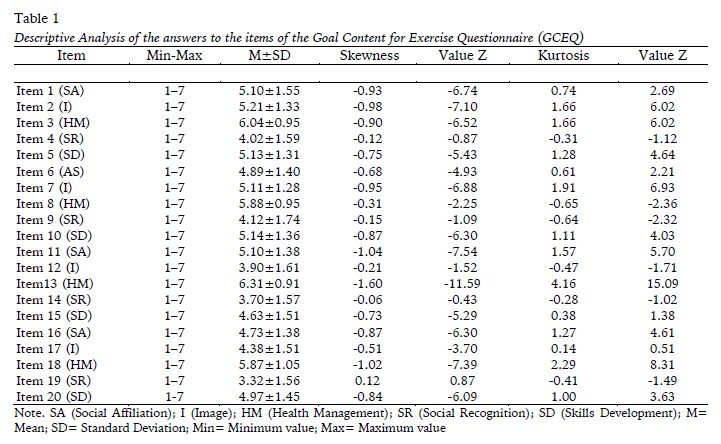
<body><![CDATA[<p>The following goodness-of-fit-indexes of adjustment quality were used:   Standardized Root Mean Square Residual (SRMR), Comparative Fit Index (CFI),   Tucker-Lewis Index (TLI), Root Mean Square Error of Approximation (RMSEA) and   the respective confidence interval (90% CI). In the present study, the cut-off   values suggested by Hu and Bentler (1999) were adopted: SRMR&#8804; 0.08, CFI e   TLI&#8805; 0.95 e RMSEA&#8804; 0.06., although on the incremental indexes (CFI   and TLI) the cut-off values of Hu and Bentler (1999) should not be generalised,   it being equally advisable to consider values equal or above to .90 (Marsh,   Hau, &amp; Wen, 2004). We also analysed the parsimony indexes (e.g., parsimony   comparative fit index - PCFI), especially used when the models are non-nested.   According to Mâroco (2010) and Hair et al. (2014), cut-off values between .60   and .80 must be considered as good model adjustment, and values higher than .80 are representative of an excellent adjustment.</p>     <p>Besides analysis of normal univariate distribution through standardized   value (Z value) of the skewness and kurtosis, the underlying theory of the   estimation method ML (maximum likelihood) assumes that the data has a normal   multivariate distribution (Kahn, 2006; Kline, 2005), this being necessary to   analyse the coefficient of Mardia (see Mardia, 1970) and check the normality of   the data (Hoyle &amp; Panter, 1995). According to Byrne (2006), if the   normalised Mardia coefficient is above 5.0 it is an indication that the data   does not have a normal multivariate distribution, a situation that occurs with   our sample (kurtosis multivariate: Mardia = 163.68; normalised Mardia = 48.65).   Because of that, we used the Satorra-Bentler correction (S-B&#967;²: see Satorra   &amp; Bentler, 1994), which corrects the values into the non-normality of data distribution and produces more satisfactory results (Chou &amp; Bentler, 1995).</p>     <p>Concerning the analysis of the convergent validity (with the objective   of verifying if the items are related with the respective factor), a   calculation was made of the average variance extracted (AVE), using the   recommended reference values (AVE &#8805;.50) (Hair et al., 2014). Relative to   the discriminant validity (to assess if the factors are sufficiently distinct   from each other), it was verified if the square of the factors correlation is   below the AVE of the same (Hair et al., 2014). The Cronbach’s alpha (&#945;) and composite   reliability (CR) were calculated, to evaluate the internal consistency of the   factors, adopting as cut-off values .70 as suggested by Nunnaly (1978) and Hair et al. (2014), respectively.</p>     <p>&nbsp;</p> </font>     <p><font size="3" face="Verdana"><b>RESULTS</b></font></p> <font face="Verdana" size="2">     <p>As we can see in <a href="/img/revistas/mot/v13n1/13n1a07t1.jpg">table 1</a>, we can verify that the subjects used all   levels of answer (e.g., between 1 and 7) the higher average being verified on   the items related to the “health motives” factor (e.g., item 3 “to increase my   resistance towards illness” and factor 13 “to improve my overall health”,   whereas the lower mean values are verified on the “social recognition” factor   (e.g., item 14 “to be accepted by others” and item 19 “so that others recognise   me as a sportsman”). These mean values are, in a certain way, confirmed by the   univariate non-normal distribution, which show a tendency to skew to the left,   centred on the right side of the scale, which means, on the answers “agree”, “quite agree” and “fully agree”, asymmetrical results can be seen.</p>     
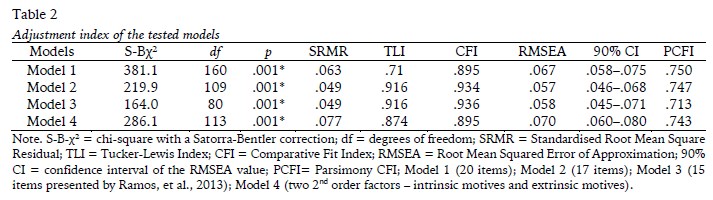
<p>Regarding the adjustment of measurement model to the   data, as can be seen on <a href="/img/revistas/mot/v13n1/13n1a07t2.jpg">Table 2</a>, the initial model (e.g., 5 factors/20 items)   did not adjust satisfactorily to the data (see model 1, <a href="/img/revistas/mot/v13n1/13n1a07t3.jpg">table 2</a>), as the cut-off values adopted (Hu &amp; Bentler, 1999) were not reached.</p>     
<p>Therefore, we looked into   potential fragilities within the model, through the analysis of the residual   values between the items and the modification indexes, and hence the model was   readjusted by the elimination of items 1, 12 and 15 since there were observable   residual values much higher than the other items and because the <i>Lagrange     Multiplier </i>test and the <i>Wald Test</i> suggest the possibility of a   strong relation existing (e.g., cross-loading) with   other factors. After this change, (see model 2 from <a href="/img/revistas/mot/v13n1/13n1a07t2.jpg">table 2</a>), we can verify   that the model adjusted satisfactorily to the data (S-B&#967;² =   219.9; df = 109; p = .001; TLI = .916; CFI = .934; SRMR = .049; RMSEA= .057;   RMSEA IC 90% = .046–.068; PCFI = .747), although the cut-off values of Hu and   Bentler (1999) were not achieved, not all the authors advise generalising for   these values; .90 is considered a satisfactorily cut-off value for the   incremental indexes (Marsh, Hau, &amp; Wen, 2004), and .08 for the RMSEA (Hair et al., 2014).</p>     
<p>The model of 15 items/5   factors (see model 3, <a href="/img/revistas/mot/v13n1/13n1a07t2.jpg">table 2</a>), preliminarily validated by Ramos, Cid and   Moutão (2013) was also analysed in our sample, and the results revealed that   this model can also adjust to the data satisfactorily (S-B&#967;² =   164.01; df = 80; p = .001; TLI = .916; CF I= .936; SRMR = .049; RMSEA = .058;   RMSEA IC 90% = .045–.071; PCFI = .713), thus it can be configured as an alternative to model 2.</p>     
<p>Just like the authors’   study of the original instrument (Sebire, Standage, &amp; Vansteekiste, 2008),   starting from the model 2 (5 factors, 17 items) we tested a second order model   with two factors: intrinsic goals (health management, skills, development of   social affiliation) and two extrinsic factors (appearance and social   recognition). As we can verify, this model (see model 4, <a href="/img/revistas/mot/v13n1/13n1a07t2.jpg">table 2</a>), shows no   adjustment to the data (S-B&#967;² =   286.1; df = 113; p = .001; TLI = .874; CFI = .895; SRMR = .077; RMSEA = .070; RMSEA IC 90% = .060–.080; PCFI = .743).</p>     
]]></body>
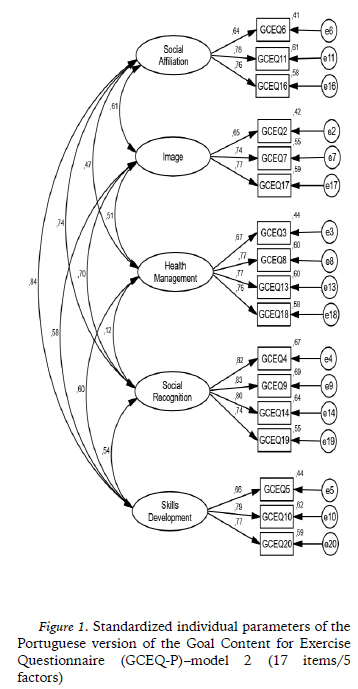
<body><![CDATA[<p>Taking into consideration the adjustment results of   the individual parameters from the model, and as can be verified in <a href="#f1">figure 1</a>,   the factor loadings varying from .64 (item 6 “to share my practice experiences   (exercise) with people that care about me” and .83 (item 9 “to be socially   respected by others”). Regarding the relation between the variables, the values   show a significant positive correlation between all the factors with the   exception of the relation between social recognition and health management, which, in spite of being positive, is not significant (r = .12, p = .076).</p>     <p><a name="f1"></a></p>     <p>&nbsp;</p>     <p align="center"><img src="/img/revistas/mot/v13n1/13n1a07f1.jpg" width="358" height="689"></p>     
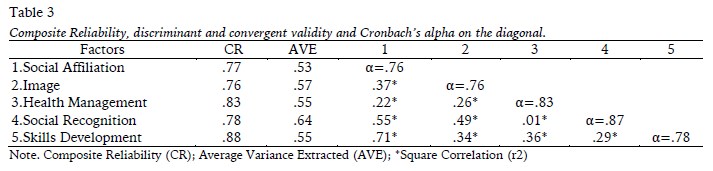
<p>&nbsp;</p>     <p>In relation to the internal reliability of the   factors, we can verify that the <i>Cronbach</i>’s alpha shows values of   internal consistency that we can consider acceptable in all the factors (&#945;<sub>social affiliation </sub>= .76; &#945; <sub>image</sub> = .76; &#945; <sub>health management</sub> = .83<sub>; </sub>&#945; <sub>social recognition </sub>= .87; &#945; <sub>skills development </sub>=<sub>.</sub>78).   Besides that, it was also verifiable that none of the items increased their   internal consistency from the respective factor as a result of being eliminated.</p>     <p>Furthermore, in <a href="/img/revistas/mot/v13n1/13n1a07t3.jpg">Table 3,</a> we can verify that the   measurement model shows good values of composite reliability (&gt; .70), such as recommended by Hair et al.   (2014). Regarding convergent validity, the results indicate that all the   factors show higher values than the recommended cut-off values (AVE &#8805;.50)   (Hair et al., 2014). On the other hand, concerning the discriminant validity,   issues are only verifiable between the social affiliation factor and the skills   development factor (r<sup>2</sup>=.67), since on every other factor the square of the correlations is below the AVE of the same (Hair et al., 2014). </p>     
<p>&nbsp;</p> </font>     <p><font size="3" face="Verdana"><b>DISCUSSION</b></font></p> <font face="Verdana" size="2">     <p>Taking into consideration the main purpose of this study consisted in   validating a Portuguese version of the Goal Content for Exercise Questionnaire   (GCEQ: Sebire et al., 2008) to a sample of Portuguese elderly people, with a   group aged 60 and above, we verified that the initial model (e.g., 5 factors/20   items) did not adjust satisfactorily to the data. However, as mentioned before,   we proceeded to the adjustment of the model by eliminating items 1, 12 and 15   (factors of social affiliation, image, skills development, respectively),   resulting in a model of 5 factors and 17 items that show adjustment values   significantly better than the previous model and achieve recommended cut-off   values less conservative of Marsh el al (2004). The eliminated items show   associations with other factors (e.g., item 15 of the skills development factor   “to become competent in a certain exercise or activity” associates with the   social recognition factor, specially by the association with item 14 “to be   accepted by others”) which assumes that the subjects might be interpreting differently from what is supposed.</p>     ]]></body>
<body><![CDATA[<p>This situation can be justified by semantical point of view, since the   subjects can be involved in exercise to develop skills and they expect to be   accepted by others. On other hand, there is also an empirical justification,   since results revealed a positive correlation (r=.54) between two factors:   “skills development” and “social recognition”). However, from a conceptual   point of view, taking into consideration the theoretical framework (Sebire et   al., 2008), a correlation of this nature should not have been verified, since   “skills development” factor is associated with intrinsic motives, and “social   recognition” factor is associated with extrinsic motives. A similar situation   happened with items 1 (social affiliation) and 12 (image), that are associated   with appearance and health factors. In our opinion, these results may indicate   that motives related with physical appearance may be interpreted as a promoter   of goals related with social affiliation (r=.61) and health management (r=.51)   in elderly population. The same evidence was found also in a  Ramos et al. (2013) study, in fitness domain,   where the image showed also significant positive correlations with the factors mentioned, especially with health management (r=.61).</p>     <p>However, although the adjustment levels of the model (e.g., 5 factors/17   items) did not reach the more conservative cut-off values of Hu and Bentler   (1999), adopted in the methodology, we consider the model acceptable, as there   are authors (e.g., Marsh et al., 2004) that consider that the cut-off values of   Hu and Bentler (1999) should not be generalised, otherwise good models would be   rejected; the vast majority of authors recommend less conservative cut-off   values (e.g., CFI e TLI &#8805;.90 e RMSEA&#8804;.08) (Hair et al., 2014, Marsh et al., 2004).</p>     <p>Finally, as the authors of the original instrument (Sebire et al.,   2008), we also tested a second order model (2 factors of 2<sup>nd</sup> order,   5 factors of 1<sup>st</sup> order, 17 items): intrinsic motives (health   management, skills development, social affiliation) and extrinsic motives   (image, social recognition), which did not show satisfactory adjustment values   (see <a href="/img/revistas/mot/v13n1/13n1a07t2.jpg">table 2</a>). However, Sebire et al. (2008) supported a five factor factorial   solution, with factors tapping intrinsic (social affiliation, health   management, and skill development) and extrinsic (social recognition and image) goals. </p>     
<p>Although theoretically distinct constructs, intrinsic and extrinsic   goals display a tendency to be pursued for autonomous and controlled   regulations, respectively (Sheldon, Ryan, Deci, &amp; Kasser, 2004), and the   study conducted by Sebire et al. (2008) put these in evidence because intrinsic   and extrinsic goal show a tendency to correlate more strongly with autonomous and controlled exercise regulations, respectively.</p>     <p>Therefore, concerning the values of internal consistency (<i>Cronbach´s</i>   alpha and composite reliability), and the recommendation of Hair et al. (2014),   it is suggested that items of all factors are assessed identically and   simultaneously their respective constructs. Regarding the convergent validity,   the results show that the items are strongly associated to respective factor,   since all the values are above the recommended (AVE &#8805;.50) (Hair et al.,   2014). Relative to discriminant validity, the results indicate that the   constructs are sufficiently independent from each other, with the exception of   the social affiliation and skills development pair (r<sup>2 </sup>= .67), since   in every other factor the square of the correlations factors is below the AVE   of the same (Hair et al., 2014). On other hand, the value of discriminant   validity shown by the referred pair of factors (e.g., social affiliation and   development of skill) can be explained by literature, which considers them to be relative factors to intrinsic motives (Sebire et al., 2008).</p>     <p>&nbsp;</p> </font>     <p><font size="3" face="Verdana"><b>CONCLUSION</b></font></p> <font face="Verdana" size="2">     <p>The measurement model (2 factors and 17 items) of Portuguese version of   GCEQ has satisfactory psychometric properties to assess the goal content   (motives) for physical activity practice in the elderly Portuguese population,   maintaining the congruence relatively to original version of questionnaire   (Sebire et al., 2008). However, the results did not provide satisfactory   support for higher order structure of the GCEQ as the original version, which   may be require more research in future. Even so, the construct captured the   importance placed on exercise goals in light of the intrinsic and extrinsic goal content dichotomy highlighted in SDT (Deci &amp; Ryan, 2000).</p>     <p>Besides that, to address some of the limitations associated with a   sample of the present study, we also recommend more studies about GCEQ   validation, especially with younger exercisers, and also about model invariance across gender, age, and type of physical activity or exercise.</p>     <p>&nbsp;</p> </font>     ]]></body>
<body><![CDATA[<p><font face="Verdana"><b>REFERENCES</b></font></p> <font face="Verdana" size="2">     <!-- ref --><p>Biddle, S., &amp; Mutrie, N. (2007). <i>Psychology of physical activity:   determinants, well-being and interventions</i>. London: Routledge, Taylor &amp; Francis Group.    &nbsp;&nbsp;&nbsp;&nbsp;&nbsp;&nbsp;&nbsp;&nbsp;[&#160;<a href="javascript:void(0);" onclick="javascript: window.open('/scielo.php?script=sci_nlinks&ref=362803&pid=S1646-107X201700010000700001&lng=','','width=640,height=500,resizable=yes,scrollbars=1,menubar=yes,');">Links</a>&#160;]<!-- end-ref --></p>     <p>Byrne, B. (2001). <i>Structural equation modeling with AMOS. Basic concepts, applications and programming</i>. Mahwah, NJ: Lawrence Erlbaum.</p>     <p>Byrne, B. (2006). <i>Structural equation modeling with EQS. Basic   concepts, applications, and programming</i> (2nd ed.). Mahwah, NJ: Lawrence Erlbaum.</p>     <p>Chou, C., &amp; Bentler, P. (1995). Estimates and tests in structural   equation modeling. In R. Hoyle (Ed.), <i>Structural equation modeling. Concepts, issues, and applications</i> (pp. 37–54). Thousand Oaks, CA: Sage.</p>     <!-- ref --><p>Deci, E., &amp; Ryan, R. (1985).  <i>Intrinsic   motivation and self-determination in human behavior</i>. New York: Plenum Press.    &nbsp;&nbsp;&nbsp;&nbsp;&nbsp;&nbsp;&nbsp;&nbsp;[&#160;<a href="javascript:void(0);" onclick="javascript: window.open('/scielo.php?script=sci_nlinks&ref=362808&pid=S1646-107X201700010000700005&lng=','','width=640,height=500,resizable=yes,scrollbars=1,menubar=yes,');">Links</a>&#160;]<!-- end-ref --></p>     <!-- ref --><p>Deci, E., &amp; Ryan, R. (2000). The “what” and “why” of goal pursuits:   human needs and the self-determination of behavior.  <i>Psychological Inquiry, 11(4),</i> 227–268. doi: 10.1207/S15327965PLI1104_01&nbsp;&nbsp;&nbsp;&nbsp;&nbsp;&nbsp;&nbsp;&nbsp;[&#160;<a href="javascript:void(0);" onclick="javascript: window.open('/scielo.php?script=sci_nlinks&ref=362810&pid=S1646-107X201700010000700006&lng=','','width=640,height=500,resizable=yes,scrollbars=1,menubar=yes,');">Links</a>&#160;]<!-- end-ref --><!-- ref --><p>Deci, E., &amp; Ryan, R. (2008). Self-determination theory: a   macrotheory of human motivation, development, and health. <i>Canadian Psychology, 49(3),</i> 182&nbsp;185. doi: 10.1037/a0012801&nbsp;&nbsp;&nbsp;&nbsp;&nbsp;&nbsp;&nbsp;&nbsp;[&#160;<a href="javascript:void(0);" onclick="javascript: window.open('/scielo.php?script=sci_nlinks&ref=362811&pid=S1646-107X201700010000700007&lng=','','width=640,height=500,resizable=yes,scrollbars=1,menubar=yes,');">Links</a>&#160;]<!-- end-ref --><!-- ref --><p>Dosil, J. (2008). <i>Psicologia de la actividad física y del deporte</i> (2ª ed.). Madrid: McGraw Hill.    &nbsp;&nbsp;&nbsp;&nbsp;&nbsp;&nbsp;&nbsp;&nbsp;[&#160;<a href="javascript:void(0);" onclick="javascript: window.open('/scielo.php?script=sci_nlinks&ref=362812&pid=S1646-107X201700010000700008&lng=','','width=640,height=500,resizable=yes,scrollbars=1,menubar=yes,');">Links</a>&#160;]<!-- end-ref --></p>     <p>Hair, J., Black, W., Babin, B., &amp; Anderson, R. (2014). <i>Multivariate data analysis</i> (7 th ed.). Upper Saddle River, NJ: Pearson Educational.</p>     <p>Hoyle, R., &amp; Panter, A. (1995). Writing about structural equation   models. In R. Hoyle (Ed.), <i>Structural equation modeling. Concepts, issues, and applications</i> (pp. 158–176). Thousand Oaks, CA: Sage.</p>     <!-- ref --><p>Hu, L., &amp; Bentler, P. (1999). Cutoff criteria for fit indexes in   covariance structure analysis: Conventional criteria versus new alternatives. <i>Structural Equation Modeling, 6</i>(1), 1–55. doi: 10.1080/10705519909540118&nbsp;&nbsp;&nbsp;&nbsp;&nbsp;&nbsp;&nbsp;&nbsp;[&#160;<a href="javascript:void(0);" onclick="javascript: window.open('/scielo.php?script=sci_nlinks&ref=362816&pid=S1646-107X201700010000700011&lng=','','width=640,height=500,resizable=yes,scrollbars=1,menubar=yes,');">Links</a>&#160;]<!-- end-ref --><!-- ref --><p>Kahn, J. (2006). Factor analysis in counseling psychology. Research,   training, and practice: Principles, advances and applications. <i>The Counseling Psychologist, 34</i>(5), 684–718. doi: 10.1177/0011000006286347&nbsp;&nbsp;&nbsp;&nbsp;&nbsp;&nbsp;&nbsp;&nbsp;[&#160;<a href="javascript:void(0);" onclick="javascript: window.open('/scielo.php?script=sci_nlinks&ref=362817&pid=S1646-107X201700010000700012&lng=','','width=640,height=500,resizable=yes,scrollbars=1,menubar=yes,');">Links</a>&#160;]<!-- end-ref --><!-- ref --><p>Kline, R. (2005). <i>Principles and practice of structural equation modeling </i>(2<sup>nd</sup> ed.). New York: The Guilford Press.    &nbsp;&nbsp;&nbsp;&nbsp;&nbsp;&nbsp;&nbsp;&nbsp;[&#160;<a href="javascript:void(0);" onclick="javascript: window.open('/scielo.php?script=sci_nlinks&ref=362818&pid=S1646-107X201700010000700013&lng=','','width=640,height=500,resizable=yes,scrollbars=1,menubar=yes,');">Links</a>&#160;]<!-- end-ref --></p>     <!-- ref --><p>Mardia, K. (1970). Measures of multivariate skewness and kurtosis with applications. <i>Biometrika, 57</i>(3), 519–530. doi: 10.2307/2334770&nbsp;&nbsp;&nbsp;&nbsp;&nbsp;&nbsp;&nbsp;&nbsp;[&#160;<a href="javascript:void(0);" onclick="javascript: window.open('/scielo.php?script=sci_nlinks&ref=362820&pid=S1646-107X201700010000700014&lng=','','width=640,height=500,resizable=yes,scrollbars=1,menubar=yes,');">Links</a>&#160;]<!-- end-ref --><!-- ref --><p>Maroco, J. (2010). <i>Análise de Equações Estruturais: Fundamentos teóricos, Software e Aplicações</i>. Pêro Pinheiro: ReportNumber.    &nbsp;&nbsp;&nbsp;&nbsp;&nbsp;&nbsp;&nbsp;&nbsp;[&#160;<a href="javascript:void(0);" onclick="javascript: window.open('/scielo.php?script=sci_nlinks&ref=362821&pid=S1646-107X201700010000700015&lng=','','width=640,height=500,resizable=yes,scrollbars=1,menubar=yes,');">Links</a>&#160;]<!-- end-ref --></p>     <!-- ref --><p>Marsh, H., Hau, K., &amp; Wen, Z. (2004). In search of golden rules:   Comment on hypothesis-testing approaches to setting cutoff values for fit   indexes and dangers in overgeneralizing Hu and Bentler’s (1999) findings. <i>Structural Equation Modeling, 11</i>(3), 320–341. doi: 10.1207/s15328007sem1103_2&nbsp;&nbsp;&nbsp;&nbsp;&nbsp;&nbsp;&nbsp;&nbsp;[&#160;<a href="javascript:void(0);" onclick="javascript: window.open('/scielo.php?script=sci_nlinks&ref=362823&pid=S1646-107X201700010000700016&lng=','','width=640,height=500,resizable=yes,scrollbars=1,menubar=yes,');">Links</a>&#160;]<!-- end-ref --><p>Nunnally J. C. (1978). Psychometric theory. NewYork, NY: McGraw-Hill Inc</p>     <!-- ref --><p>Ramos, E., Cid, L., &amp; Moutão, J. (2013). Avaliação do conteúdo dos   objetivos de prática de exercício físico: Propriedades psicométricas da versão   portuguesa do <i>Goal content for exercise questionnaire</i>.    &nbsp;&nbsp;&nbsp;&nbsp;&nbsp;&nbsp;&nbsp;&nbsp;[&#160;<a href="javascript:void(0);" onclick="javascript: window.open('/scielo.php?script=sci_nlinks&ref=362825&pid=S1646-107X201700010000700018&lng=','','width=640,height=500,resizable=yes,scrollbars=1,menubar=yes,');">Links</a>&#160;]<!-- end-ref --> Paper presented   in III Congresso Galego-Português de Psicologia da Atividade Física e do   Desporto e XIV Jornadas da Sociedade de Psicologia do Desporto. Maia: Instituto Superior da Maia (ISMAI), novembro, 2013.</p>     <!-- ref --><p>Ryan, R., &amp; Deci, E. (2000).  Self-determination theory and the facilitation of intrinsic motivation, social development and well-being.                   <i>American Psychologist,</i> 55(1), 68––78. doi: 10.1037/0003-066X.55.1.68&nbsp;&nbsp;&nbsp;&nbsp;&nbsp;&nbsp;&nbsp;&nbsp;[&#160;<a href="javascript:void(0);" onclick="javascript: window.open('/scielo.php?script=sci_nlinks&ref=362827&pid=S1646-107X201700010000700019&lng=','','width=640,height=500,resizable=yes,scrollbars=1,menubar=yes,');">Links</a>&#160;]<!-- end-ref --><p>Ryan, R., &amp; Deci, E. (2002). Overview of self-determination theory:   an organismic dialectial perspective. In E. Deci &amp; R. Ryan (Eds.), <i>Handbook     of self-determination research </i>(pp. 3–33). Rochester, New York: The University of Rochester Press.</p>     <p>Ryan, R., &amp; Deci, E. (2007).  Active human nature: self-determination theory and the promotion and maintenance of sport, exercise, and health. In M. Hagger                   &amp; N.   Chatzisarantis (Eds.), <i>Intrinsic motivation and self-determination in exercise and sport</i> (pp. 1–19). Champaing, Illinois: Human Kinetics.</p>     <!-- ref --><p>Samulski, D. (2002). <i>Psicologia do esporte</i>. S. Paulo: Editora Manole.    &nbsp;&nbsp;&nbsp;&nbsp;&nbsp;&nbsp;&nbsp;&nbsp;[&#160;<a href="javascript:void(0);" onclick="javascript: window.open('/scielo.php?script=sci_nlinks&ref=362830&pid=S1646-107X201700010000700022&lng=','','width=640,height=500,resizable=yes,scrollbars=1,menubar=yes,');">Links</a>&#160;]<!-- end-ref --></p>     ]]></body>
<body><![CDATA[<p>Satorra, A., &amp; Bentler, P. (1994). Corrections to test statistics   and standard errors in covariance structure analysis. In A. Eye &amp; C. Clogg   (Eds.), <i>Latent variables analysis: Applications for development research.</i> Thousand Oaks, CA: Sage.</p>     <!-- ref --><p>Sebire, S. J., Standage, M., &amp; Vansteenkiste, M. (2008).  Development and validation of the goal   content for exercise questionnaire. <i>Journal of Sport &amp; Exercise Psychology, 30,</i> 353–377.    &nbsp;&nbsp;&nbsp;&nbsp;&nbsp;&nbsp;&nbsp;&nbsp;[&#160;<a href="javascript:void(0);" onclick="javascript: window.open('/scielo.php?script=sci_nlinks&ref=362833&pid=S1646-107X201700010000700024&lng=','','width=640,height=500,resizable=yes,scrollbars=1,menubar=yes,');">Links</a>&#160;]<!-- end-ref --></p>     <!-- ref --><p>Sebire, S., Standage, M., &amp; Vansteenkiste, M. (2009). Examining   intrinsic versus extrinsic exercise goals: Cognitive, affective, and behavioral   outcomes. <i>Journal of Sport and Exercise Psychology, 31,</i> 189-210.    &nbsp;&nbsp;&nbsp;&nbsp;&nbsp;&nbsp;&nbsp;&nbsp;[&#160;<a href="javascript:void(0);" onclick="javascript: window.open('/scielo.php?script=sci_nlinks&ref=362835&pid=S1646-107X201700010000700025&lng=','','width=640,height=500,resizable=yes,scrollbars=1,menubar=yes,');">Links</a>&#160;]<!-- end-ref --></p>     <!-- ref --><p>Sebire, S., Standage, M., &amp; Vansteenkiste, M. (2011). Predicting   objectively assessed physical activity from the content and regulation of   exercise goals: Evidence for a mediational model. <i>Journal of Sport &amp; Exercise Psychology, 33,</i> 175-197.    &nbsp;&nbsp;&nbsp;&nbsp;&nbsp;&nbsp;&nbsp;&nbsp;[&#160;<a href="javascript:void(0);" onclick="javascript: window.open('/scielo.php?script=sci_nlinks&ref=362837&pid=S1646-107X201700010000700026&lng=','','width=640,height=500,resizable=yes,scrollbars=1,menubar=yes,');">Links</a>&#160;]<!-- end-ref --></p>     <!-- ref --><p>Sheldon, K., Ryan, R., Deci, E., &amp; Kasser, T. (2004). The   independent effects of goal contents and motives on well-being: it’s both what   you pursue and why you pursue it. Personality and Social Psychology Bulletin, 30, 475–486. doi: 10.1177/0146167203261883&nbsp;&nbsp;&nbsp;&nbsp;&nbsp;&nbsp;&nbsp;&nbsp;[&#160;<a href="javascript:void(0);" onclick="javascript: window.open('/scielo.php?script=sci_nlinks&ref=362839&pid=S1646-107X201700010000700027&lng=','','width=640,height=500,resizable=yes,scrollbars=1,menubar=yes,');">Links</a>&#160;]<!-- end-ref --><!-- ref --><p>Teixeira, P., Carraça, E., Markland, D., Silva, M., &amp; Ryan, R.   (2012). Exercise, physical activity, and self-determination theory: a   systematic review. International Journal of Behavioral Nutrition and Physical Activity, 9-78. doi: 10.1186/1479-5868-9-78&nbsp;&nbsp;&nbsp;&nbsp;&nbsp;&nbsp;&nbsp;&nbsp;[&#160;<a href="javascript:void(0);" onclick="javascript: window.open('/scielo.php?script=sci_nlinks&ref=362840&pid=S1646-107X201700010000700028&lng=','','width=640,height=500,resizable=yes,scrollbars=1,menubar=yes,');">Links</a>&#160;]<!-- end-ref --><!-- ref --><p>Worthington, R., &amp; Whittaker, T. (2006). Scale development research.   A content analysis and recommendations for best practices. <i>The Counseling Psychologist, 34(6)</i>, 806–838. doi: 10.1177/0011000006288127&nbsp;&nbsp;&nbsp;&nbsp;&nbsp;&nbsp;&nbsp;&nbsp;[&#160;<a href="javascript:void(0);" onclick="javascript: window.open('/scielo.php?script=sci_nlinks&ref=362841&pid=S1646-107X201700010000700029&lng=','','width=640,height=500,resizable=yes,scrollbars=1,menubar=yes,');">Links</a>&#160;]<!-- end-ref --><p>&nbsp;</p>     <p><font size="2" face="Verdana"><b>Acknowledgments:</b>    <br>   Nothing to declare.<b>    <br>   Conflict of interests:</b>    <br>   Nothing to declare.<b>    <br> Funding:</b>Nothing to declare.</font></p>     <p><font size="2" face="Verdana">Manuscript   received at July 17th 2016; Accepted at January 1st 2017 </font></p> <font face="Verdana" size="2">     <p>&nbsp;</p>     <p>&nbsp;</p> <a name="end"></a><a href="#topo">*</a> <i>Corresponding author</i>: Escola Superior de Desporto de Rio Maior, ESDRM-IPSANTAR&Eacute;M), Av. Dr. M&aacute;rio Soares, n.&ordm; 110, 2040-413, Rio Maior <i>E-mail: </i><a href="mailto:rantunes@esdrm.ipsantarem.pt">rantunes@esdrm.ipsantarem.pt</a>.</font>      ]]></body><back>
<ref-list>
<ref id="B1">
<nlm-citation citation-type="book">
<person-group person-group-type="author">
<name>
<surname><![CDATA[Biddle]]></surname>
<given-names><![CDATA[S.]]></given-names>
</name>
<name>
<surname><![CDATA[Mutrie]]></surname>
<given-names><![CDATA[N.]]></given-names>
</name>
</person-group>
<source><![CDATA[Psychology of physical activity: determinants, well-being and interventions]]></source>
<year>2007</year>
<publisher-loc><![CDATA[London ]]></publisher-loc>
<publisher-name><![CDATA[Routledge, Taylor & Francis Group]]></publisher-name>
</nlm-citation>
</ref>
<ref id="B2">
<nlm-citation citation-type="book">
<person-group person-group-type="author">
<name>
<surname><![CDATA[Byrne]]></surname>
<given-names><![CDATA[B.]]></given-names>
</name>
</person-group>
<source><![CDATA[Structural equation modeling with AMOS: Basic concepts, applications and programming]]></source>
<year>2001</year>
<publisher-loc><![CDATA[Mahwah ]]></publisher-loc>
<publisher-name><![CDATA[Lawrence Erlbaum]]></publisher-name>
</nlm-citation>
</ref>
<ref id="B3">
<nlm-citation citation-type="book">
<person-group person-group-type="author">
<name>
<surname><![CDATA[Byrne]]></surname>
<given-names><![CDATA[B.]]></given-names>
</name>
</person-group>
<source><![CDATA[Structural equation modeling with EQS: Basic concepts, applications, and programming]]></source>
<year>2006</year>
<edition>2</edition>
<publisher-loc><![CDATA[Mahwah ]]></publisher-loc>
<publisher-name><![CDATA[Lawrence Erlbaum]]></publisher-name>
</nlm-citation>
</ref>
<ref id="B4">
<nlm-citation citation-type="book">
<person-group person-group-type="author">
<name>
<surname><![CDATA[Chou]]></surname>
<given-names><![CDATA[C.]]></given-names>
</name>
<name>
<surname><![CDATA[Bentler]]></surname>
<given-names><![CDATA[P.]]></given-names>
</name>
</person-group>
<article-title xml:lang="en"><![CDATA[Estimates and tests in structural equation modeling]]></article-title>
<person-group person-group-type="editor">
<name>
<surname><![CDATA[Hoyle]]></surname>
<given-names><![CDATA[R.]]></given-names>
</name>
</person-group>
<source><![CDATA[Structural equation modeling: Concepts, issues, and applications]]></source>
<year>1995</year>
<page-range>37-54</page-range><publisher-loc><![CDATA[Thousand Oaks ]]></publisher-loc>
<publisher-name><![CDATA[Sage]]></publisher-name>
</nlm-citation>
</ref>
<ref id="B5">
<nlm-citation citation-type="book">
<person-group person-group-type="author">
<name>
<surname><![CDATA[Deci]]></surname>
<given-names><![CDATA[E.]]></given-names>
</name>
<name>
<surname><![CDATA[Ryan]]></surname>
<given-names><![CDATA[R.]]></given-names>
</name>
</person-group>
<source><![CDATA[Intrinsic motivation and self-determination in human behavior]]></source>
<year>1985</year>
<publisher-loc><![CDATA[New York ]]></publisher-loc>
<publisher-name><![CDATA[Plenum Press]]></publisher-name>
</nlm-citation>
</ref>
<ref id="B6">
<nlm-citation citation-type="journal">
<person-group person-group-type="author">
<name>
<surname><![CDATA[Deci]]></surname>
<given-names><![CDATA[E.]]></given-names>
</name>
<name>
<surname><![CDATA[Ryan]]></surname>
<given-names><![CDATA[R.]]></given-names>
</name>
</person-group>
<article-title xml:lang="en"><![CDATA[The “what” and “why” of goal pursuits: human needs and the self-determination of behavior]]></article-title>
<source><![CDATA[Psychological Inquiry]]></source>
<year>2000</year>
<volume>11</volume>
<numero>4</numero>
<issue>4</issue>
<page-range>227-268</page-range></nlm-citation>
</ref>
<ref id="B7">
<nlm-citation citation-type="journal">
<person-group person-group-type="author">
<name>
<surname><![CDATA[Deci]]></surname>
<given-names><![CDATA[E.]]></given-names>
</name>
<name>
<surname><![CDATA[Ryan]]></surname>
<given-names><![CDATA[R.]]></given-names>
</name>
</person-group>
<article-title xml:lang="en"><![CDATA[Self-determination theory: a macrotheory of human motivation, development, and health]]></article-title>
<source><![CDATA[Canadian Psychology]]></source>
<year>2008</year>
<volume>49</volume>
<numero>3</numero>
<issue>3</issue>
<page-range>182 185</page-range></nlm-citation>
</ref>
<ref id="B8">
<nlm-citation citation-type="book">
<person-group person-group-type="author">
<name>
<surname><![CDATA[Dosil]]></surname>
<given-names><![CDATA[J.]]></given-names>
</name>
</person-group>
<source><![CDATA[Psicologia de la actividad física y del deporte]]></source>
<year>2008</year>
<edition>2</edition>
<publisher-loc><![CDATA[Madrid ]]></publisher-loc>
<publisher-name><![CDATA[McGraw Hill]]></publisher-name>
</nlm-citation>
</ref>
<ref id="B9">
<nlm-citation citation-type="book">
<person-group person-group-type="author">
<name>
<surname><![CDATA[Hair]]></surname>
<given-names><![CDATA[J.]]></given-names>
</name>
<name>
<surname><![CDATA[Black]]></surname>
<given-names><![CDATA[W.]]></given-names>
</name>
<name>
<surname><![CDATA[Babin]]></surname>
<given-names><![CDATA[B.]]></given-names>
</name>
<name>
<surname><![CDATA[Anderson]]></surname>
<given-names><![CDATA[R.]]></given-names>
</name>
</person-group>
<source><![CDATA[Multivariate data analysis]]></source>
<year>2014</year>
<edition>7</edition>
<publisher-loc><![CDATA[Upper Saddle River ]]></publisher-loc>
<publisher-name><![CDATA[Pearson Educational]]></publisher-name>
</nlm-citation>
</ref>
<ref id="B10">
<nlm-citation citation-type="book">
<person-group person-group-type="author">
<name>
<surname><![CDATA[Hoyle]]></surname>
<given-names><![CDATA[R.]]></given-names>
</name>
<name>
<surname><![CDATA[Panter]]></surname>
<given-names><![CDATA[A.]]></given-names>
</name>
</person-group>
<article-title xml:lang="en"><![CDATA[Writing about structural equation models]]></article-title>
<person-group person-group-type="editor">
<name>
<surname><![CDATA[Hoyle]]></surname>
<given-names><![CDATA[R.]]></given-names>
</name>
</person-group>
<source><![CDATA[Structural equation modeling: Concepts, issues, and applications]]></source>
<year>1995</year>
<page-range>158-176</page-range><publisher-loc><![CDATA[Thousand Oaks ]]></publisher-loc>
<publisher-name><![CDATA[Sage]]></publisher-name>
</nlm-citation>
</ref>
<ref id="B11">
<nlm-citation citation-type="journal">
<person-group person-group-type="author">
<name>
<surname><![CDATA[Hu]]></surname>
<given-names><![CDATA[L.]]></given-names>
</name>
<name>
<surname><![CDATA[Bentler]]></surname>
<given-names><![CDATA[P.]]></given-names>
</name>
</person-group>
<article-title xml:lang="en"><![CDATA[Cutoff criteria for fit indexes in covariance structure analysis: Conventional criteria versus new alternatives]]></article-title>
<source><![CDATA[Structural Equation Modeling]]></source>
<year>1999</year>
<volume>6</volume>
<numero>1</numero>
<issue>1</issue>
<page-range>1-55</page-range></nlm-citation>
</ref>
<ref id="B12">
<nlm-citation citation-type="journal">
<person-group person-group-type="author">
<name>
<surname><![CDATA[Kahn]]></surname>
<given-names><![CDATA[J.]]></given-names>
</name>
</person-group>
<article-title xml:lang="en"><![CDATA[Factor analysis in counseling psychology: Research, training, and practice: Principles, advances and applications]]></article-title>
<source><![CDATA[The Counseling Psychologist]]></source>
<year>2006</year>
<volume>34</volume>
<numero>5</numero>
<issue>5</issue>
<page-range>684-718</page-range></nlm-citation>
</ref>
<ref id="B13">
<nlm-citation citation-type="book">
<person-group person-group-type="author">
<name>
<surname><![CDATA[Kline]]></surname>
<given-names><![CDATA[R.]]></given-names>
</name>
</person-group>
<source><![CDATA[Principles and practice of structural equation modeling]]></source>
<year>2005</year>
<edition>2</edition>
<publisher-loc><![CDATA[New York ]]></publisher-loc>
<publisher-name><![CDATA[The Guilford Press]]></publisher-name>
</nlm-citation>
</ref>
<ref id="B14">
<nlm-citation citation-type="journal">
<person-group person-group-type="author">
<name>
<surname><![CDATA[Mardia]]></surname>
<given-names><![CDATA[K.]]></given-names>
</name>
</person-group>
<article-title xml:lang="en"><![CDATA[Measures of multivariate skewness and kurtosis with applications]]></article-title>
<source><![CDATA[Biometrika]]></source>
<year>1970</year>
<volume>57</volume>
<numero>3</numero>
<issue>3</issue>
<page-range>519-530</page-range></nlm-citation>
</ref>
<ref id="B15">
<nlm-citation citation-type="book">
<person-group person-group-type="author">
<name>
<surname><![CDATA[Maroco]]></surname>
<given-names><![CDATA[J.]]></given-names>
</name>
</person-group>
<source><![CDATA[Análise de Equações Estruturais: Fundamentos teóricos, Software e Aplicações]]></source>
<year>2010</year>
<publisher-loc><![CDATA[Pêro Pinheiro ]]></publisher-loc>
<publisher-name><![CDATA[ReportNumber]]></publisher-name>
</nlm-citation>
</ref>
<ref id="B16">
<nlm-citation citation-type="journal">
<person-group person-group-type="author">
<name>
<surname><![CDATA[Marsh]]></surname>
<given-names><![CDATA[H.]]></given-names>
</name>
<name>
<surname><![CDATA[Hau]]></surname>
<given-names><![CDATA[K.]]></given-names>
</name>
<name>
<surname><![CDATA[Wen]]></surname>
<given-names><![CDATA[Z.]]></given-names>
</name>
</person-group>
<article-title xml:lang="en"><![CDATA[In search of golden rules: Comment on hypothesis-testing approaches to setting cutoff values for fit indexes and dangers in overgeneralizing Hu and Bentler’s (1999) findings]]></article-title>
<source><![CDATA[Structural Equation Modeling]]></source>
<year>2004</year>
<volume>11</volume>
<numero>3</numero>
<issue>3</issue>
<page-range>320-341</page-range></nlm-citation>
</ref>
<ref id="B17">
<nlm-citation citation-type="book">
<person-group person-group-type="author">
<name>
<surname><![CDATA[Nunnally J.]]></surname>
<given-names><![CDATA[C.]]></given-names>
</name>
</person-group>
<source><![CDATA[Psychometric theory]]></source>
<year>1978</year>
<publisher-loc><![CDATA[NewYork ]]></publisher-loc>
<publisher-name><![CDATA[McGraw-Hill Inc]]></publisher-name>
</nlm-citation>
</ref>
<ref id="B18">
<nlm-citation citation-type="">
<person-group person-group-type="author">
<name>
<surname><![CDATA[Ramos]]></surname>
<given-names><![CDATA[E.]]></given-names>
</name>
<name>
<surname><![CDATA[Cid]]></surname>
<given-names><![CDATA[L.]]></given-names>
</name>
<name>
<surname><![CDATA[Moutão]]></surname>
<given-names><![CDATA[J.]]></given-names>
</name>
</person-group>
<article-title xml:lang="pt"><![CDATA[Avaliação do conteúdo dos objetivos de prática de exercício físico: Propriedades psicométricas da versão portuguesa do Goal content for exercise questionnaire]]></article-title>
<source><![CDATA[]]></source>
<year>2013</year>
</nlm-citation>
</ref>
<ref id="B19">
<nlm-citation citation-type="journal">
<person-group person-group-type="author">
<name>
<surname><![CDATA[Ryan]]></surname>
<given-names><![CDATA[R.]]></given-names>
</name>
<name>
<surname><![CDATA[Deci]]></surname>
<given-names><![CDATA[E.]]></given-names>
</name>
</person-group>
<article-title xml:lang="en"><![CDATA[Self-determination theory and the facilitation of intrinsic motivation, social development and well-being]]></article-title>
<source><![CDATA[American Psychologist]]></source>
<year>2000</year>
<volume>55</volume>
<numero>1</numero>
<issue>1</issue>
<page-range>68--78</page-range></nlm-citation>
</ref>
<ref id="B20">
<nlm-citation citation-type="book">
<person-group person-group-type="author">
<name>
<surname><![CDATA[Ryan]]></surname>
<given-names><![CDATA[R.]]></given-names>
</name>
<name>
<surname><![CDATA[Deci]]></surname>
<given-names><![CDATA[E.]]></given-names>
</name>
</person-group>
<article-title xml:lang="en"><![CDATA[Overview of self-determination theory: an organismic dialectial perspective]]></article-title>
<person-group person-group-type="editor">
<name>
<surname><![CDATA[Deci]]></surname>
<given-names><![CDATA[E.]]></given-names>
</name>
<name>
<surname><![CDATA[Ryan]]></surname>
<given-names><![CDATA[R.]]></given-names>
</name>
</person-group>
<source><![CDATA[Handbook of self-determination research]]></source>
<year>2002</year>
<page-range>3-33</page-range><publisher-loc><![CDATA[Rochester ]]></publisher-loc>
<publisher-name><![CDATA[The University of Rochester Press]]></publisher-name>
</nlm-citation>
</ref>
<ref id="B21">
<nlm-citation citation-type="book">
<person-group person-group-type="author">
<name>
<surname><![CDATA[Ryan]]></surname>
<given-names><![CDATA[R.]]></given-names>
</name>
<name>
<surname><![CDATA[Deci]]></surname>
<given-names><![CDATA[E.]]></given-names>
</name>
</person-group>
<article-title xml:lang="en"><![CDATA[Active human nature: self-determination theory and the promotion and maintenance of sport, exercise, and health]]></article-title>
<person-group person-group-type="editor">
<name>
<surname><![CDATA[Hagger]]></surname>
<given-names><![CDATA[M.]]></given-names>
</name>
<name>
<surname><![CDATA[Chatzisarantis]]></surname>
<given-names><![CDATA[N.]]></given-names>
</name>
</person-group>
<source><![CDATA[Intrinsic motivation and self-determination in exercise and sport]]></source>
<year>2007</year>
<page-range>1-19</page-range><publisher-loc><![CDATA[Champaing ]]></publisher-loc>
<publisher-name><![CDATA[Human Kinetics]]></publisher-name>
</nlm-citation>
</ref>
<ref id="B22">
<nlm-citation citation-type="book">
<person-group person-group-type="author">
<name>
<surname><![CDATA[Samulski]]></surname>
<given-names><![CDATA[D.]]></given-names>
</name>
</person-group>
<source><![CDATA[Psicologia do esporte]]></source>
<year>2002</year>
<publisher-loc><![CDATA[S. Paulo ]]></publisher-loc>
<publisher-name><![CDATA[Editora Manole]]></publisher-name>
</nlm-citation>
</ref>
<ref id="B23">
<nlm-citation citation-type="book">
<person-group person-group-type="author">
<name>
<surname><![CDATA[Satorra]]></surname>
<given-names><![CDATA[A.]]></given-names>
</name>
<name>
<surname><![CDATA[Bentler]]></surname>
<given-names><![CDATA[P.]]></given-names>
</name>
</person-group>
<article-title xml:lang="en"><![CDATA[Corrections to test statistics and standard errors in covariance structure analysis]]></article-title>
<person-group person-group-type="editor">
<name>
<surname><![CDATA[Eye]]></surname>
<given-names><![CDATA[A.]]></given-names>
</name>
<name>
<surname><![CDATA[Clogg]]></surname>
<given-names><![CDATA[C.]]></given-names>
</name>
</person-group>
<source><![CDATA[Latent variables analysis: Applications for development research]]></source>
<year>1994</year>
<publisher-loc><![CDATA[Thousand Oaks ]]></publisher-loc>
<publisher-name><![CDATA[Sage]]></publisher-name>
</nlm-citation>
</ref>
<ref id="B24">
<nlm-citation citation-type="journal">
<person-group person-group-type="author">
<name>
<surname><![CDATA[Sebire]]></surname>
<given-names><![CDATA[S. J.]]></given-names>
</name>
<name>
<surname><![CDATA[Standage]]></surname>
<given-names><![CDATA[M.]]></given-names>
</name>
<name>
<surname><![CDATA[Vansteenkiste]]></surname>
<given-names><![CDATA[M.]]></given-names>
</name>
</person-group>
<article-title xml:lang="en"><![CDATA[Development and validation of the goal content for exercise questionnaire]]></article-title>
<source><![CDATA[Journal of Sport & Exercise Psychology]]></source>
<year>2008</year>
<volume>30</volume>
<page-range>353-377</page-range></nlm-citation>
</ref>
<ref id="B25">
<nlm-citation citation-type="journal">
<person-group person-group-type="author">
<name>
<surname><![CDATA[Sebire]]></surname>
<given-names><![CDATA[S.]]></given-names>
</name>
<name>
<surname><![CDATA[Standage]]></surname>
<given-names><![CDATA[M.]]></given-names>
</name>
<name>
<surname><![CDATA[Vansteenkiste]]></surname>
<given-names><![CDATA[M.]]></given-names>
</name>
</person-group>
<article-title xml:lang="en"><![CDATA[Examining intrinsic versus extrinsic exercise goals: Cognitive, affective, and behavioral outcomes]]></article-title>
<source><![CDATA[Journal of Sport and Exercise Psychology]]></source>
<year>2009</year>
<volume>31</volume>
<page-range>189-210</page-range></nlm-citation>
</ref>
<ref id="B26">
<nlm-citation citation-type="journal">
<person-group person-group-type="author">
<name>
<surname><![CDATA[Sebire]]></surname>
<given-names><![CDATA[S.]]></given-names>
</name>
<name>
<surname><![CDATA[Standage]]></surname>
<given-names><![CDATA[M.]]></given-names>
</name>
<name>
<surname><![CDATA[Vansteenkiste]]></surname>
<given-names><![CDATA[M.]]></given-names>
</name>
</person-group>
<article-title xml:lang="en"><![CDATA[Predicting objectively assessed physical activity from the content and regulation of exercise goals: Evidence for a mediational model]]></article-title>
<source><![CDATA[Journal of Sport & Exercise Psychology]]></source>
<year>2011</year>
<volume>33</volume>
<page-range>175-197</page-range></nlm-citation>
</ref>
<ref id="B27">
<nlm-citation citation-type="journal">
<person-group person-group-type="author">
<name>
<surname><![CDATA[Sheldon]]></surname>
<given-names><![CDATA[K.]]></given-names>
</name>
<name>
<surname><![CDATA[Ryan]]></surname>
<given-names><![CDATA[R.]]></given-names>
</name>
<name>
<surname><![CDATA[Deci]]></surname>
<given-names><![CDATA[E.]]></given-names>
</name>
<name>
<surname><![CDATA[Kasser]]></surname>
<given-names><![CDATA[T.]]></given-names>
</name>
</person-group>
<article-title xml:lang="en"><![CDATA[The independent effects of goal contents and motives on well-being: it’s both what you pursue and why you pursue it]]></article-title>
<source><![CDATA[Personality and Social Psychology Bulletin]]></source>
<year>2004</year>
<volume>30</volume>
<page-range>475-486</page-range></nlm-citation>
</ref>
<ref id="B28">
<nlm-citation citation-type="journal">
<person-group person-group-type="author">
<name>
<surname><![CDATA[Teixeira]]></surname>
<given-names><![CDATA[P.]]></given-names>
</name>
<name>
<surname><![CDATA[Carraça]]></surname>
<given-names><![CDATA[E.]]></given-names>
</name>
<name>
<surname><![CDATA[Markland]]></surname>
<given-names><![CDATA[D.]]></given-names>
</name>
<name>
<surname><![CDATA[Silva]]></surname>
<given-names><![CDATA[M.]]></given-names>
</name>
<name>
<surname><![CDATA[Ryan]]></surname>
<given-names><![CDATA[R.]]></given-names>
</name>
</person-group>
<article-title xml:lang="en"><![CDATA[Exercise, physical activity, and self-determination theory: a systematic review]]></article-title>
<source><![CDATA[International Journal of Behavioral Nutrition and Physical Activity]]></source>
<year>2012</year>
<page-range>9-78</page-range></nlm-citation>
</ref>
<ref id="B29">
<nlm-citation citation-type="journal">
<person-group person-group-type="author">
<name>
<surname><![CDATA[Worthington]]></surname>
<given-names><![CDATA[R.]]></given-names>
</name>
<name>
<surname><![CDATA[Whittaker]]></surname>
<given-names><![CDATA[T.]]></given-names>
</name>
</person-group>
<article-title xml:lang="en"><![CDATA[Scale development research: A content analysis and recommendations for best practices]]></article-title>
<source><![CDATA[The Counseling Psychologist]]></source>
<year>2006</year>
<volume>34</volume>
<numero>6</numero>
<issue>6</issue>
<page-range>806-838</page-range></nlm-citation>
</ref>
</ref-list>
</back>
</article>
