<?xml version="1.0" encoding="ISO-8859-1"?><article xmlns:mml="http://www.w3.org/1998/Math/MathML" xmlns:xlink="http://www.w3.org/1999/xlink" xmlns:xsi="http://www.w3.org/2001/XMLSchema-instance">
<front>
<journal-meta>
<journal-id>1646-107X</journal-id>
<journal-title><![CDATA[Motricidade]]></journal-title>
<abbrev-journal-title><![CDATA[Motri.]]></abbrev-journal-title>
<issn>1646-107X</issn>
<publisher>
<publisher-name><![CDATA[Edições Desafio Singular]]></publisher-name>
</publisher>
</journal-meta>
<article-meta>
<article-id>S1646-107X2017000100008</article-id>
<title-group>
<article-title xml:lang="en"><![CDATA[Correlation between maximum isometric strength variables and specific performance of Brazilian military judokas]]></article-title>
</title-group>
<contrib-group>
<contrib contrib-type="author">
<name>
<surname><![CDATA[Gonçalves]]></surname>
<given-names><![CDATA[Michel Moraes]]></given-names>
</name>
<xref ref-type="aff" rid="A01"/>
<xref ref-type="aff" rid="A05"/>
</contrib>
<contrib contrib-type="author">
<name>
<surname><![CDATA[Borba-Pinheiro]]></surname>
<given-names><![CDATA[Claudio Joaquim]]></given-names>
</name>
<xref ref-type="aff" rid="A03"/>
<xref ref-type="aff" rid="A04"/>
</contrib>
<contrib contrib-type="author">
<name>
<surname><![CDATA[Marson]]></surname>
<given-names><![CDATA[Runer Augusto]]></given-names>
</name>
<xref ref-type="aff" rid="A01"/>
</contrib>
<contrib contrib-type="author">
<name>
<surname><![CDATA[Camposo]]></surname>
<given-names><![CDATA[Lucas Rodrigues]]></given-names>
</name>
<xref ref-type="aff" rid="A02"/>
</contrib>
<contrib contrib-type="author">
<name>
<surname><![CDATA[Saraiva]]></surname>
<given-names><![CDATA[Alam dos Reis]]></given-names>
</name>
<xref ref-type="aff" rid="A03"/>
<xref ref-type="aff" rid="A06"/>
</contrib>
<contrib contrib-type="author">
<name>
<surname><![CDATA[Novaes]]></surname>
<given-names><![CDATA[Jefferson da Silva]]></given-names>
</name>
<xref ref-type="aff" rid="A05"/>
</contrib>
</contrib-group>
<aff id="A01">
<institution><![CDATA[,Instituto de Pesquisa da Capacitação Física do Exército  ]]></institution>
<addr-line><![CDATA[Rio de Janeiro ]]></addr-line>
<country>Brasil</country>
</aff>
<aff id="A02">
<institution><![CDATA[,Escola de Educação Física do Exército  ]]></institution>
<addr-line><![CDATA[Rio de Janeiro ]]></addr-line>
<country>Brasil</country>
</aff>
<aff id="A03">
<institution><![CDATA[,Instituto Federal de Educação Ciência e Tecnologia do Pará  ]]></institution>
<addr-line><![CDATA[Pará ]]></addr-line>
<country>Brasil</country>
</aff>
<aff id="A04">
<institution><![CDATA[,Universidade do Estado do Pará  ]]></institution>
<addr-line><![CDATA[Pará ]]></addr-line>
<country>Brasil</country>
</aff>
<aff id="A05">
<institution><![CDATA[,Universidade Federal do Rio de Janeiro  ]]></institution>
<addr-line><![CDATA[Rio de Janeiro ]]></addr-line>
<country>Brasil</country>
</aff>
<aff id="A06">
<institution><![CDATA[,Universidade de Trás-os-Montes e Alto Douro  ]]></institution>
<addr-line><![CDATA[Vila Real ]]></addr-line>
<country>Portugal</country>
</aff>
<pub-date pub-type="pub">
<day>00</day>
<month>03</month>
<year>2017</year>
</pub-date>
<pub-date pub-type="epub">
<day>00</day>
<month>03</month>
<year>2017</year>
</pub-date>
<volume>13</volume>
<numero>1</numero>
<fpage>68</fpage>
<lpage>76</lpage>
<copyright-statement/>
<copyright-year/>
<self-uri xlink:href="http://scielo.pt/scielo.php?script=sci_arttext&amp;pid=S1646-107X2017000100008&amp;lng=en&amp;nrm=iso"></self-uri><self-uri xlink:href="http://scielo.pt/scielo.php?script=sci_abstract&amp;pid=S1646-107X2017000100008&amp;lng=en&amp;nrm=iso"></self-uri><self-uri xlink:href="http://scielo.pt/scielo.php?script=sci_pdf&amp;pid=S1646-107X2017000100008&amp;lng=en&amp;nrm=iso"></self-uri><abstract abstract-type="short" xml:lang="en"><p><![CDATA[It was our objective to correlate specific performance in the Special Judo Fitness Test (SJFT) and the maximum isometric handgrip (HGSMax), scapular traction (STSMax) and lumbar traction (LTSMax) strength tests in military judo athletes. Twenty-two military athletes from the judo team of the Brazilian Navy Almirante Alexandrino Instruction Centre, with average age of 26.14 ± 3.31 years old, and average body mass of 83.23 ± 14.14 kg participated in the study. Electronic dynamometry tests for HGSMax, STSMax and LTSMax were conducted. Then, after approximately 1 hour-interval, the SJFT protocol was applied. All variables were adjusted to the body mass of the athletes. Pearson correlation coefficient for statistical analysis was used. The results showed moderate negative correlation between the SJFT index and STSMax (r= -0.550, p= 0.008), strong negative correlations between the SJFT index and HGSMax (r= -0.706, p< 0.001), SJFT index and LTSMax (r= -0.721; p= 0.001), besides the correlation between the sum of the three maximum isometric strength tests and the SJFT index (r= -0.786, p< 0.001). This study concludes that negative correlations occur between the SJFT index and maximum isometric handgrip, shoulder and lumbar traction strength and the sum of the three maximum isometric strength tests in military judokas.]]></p></abstract>
<kwd-group>
<kwd lng="en"><![CDATA[dynamometry muscle strength]]></kwd>
<kwd lng="en"><![CDATA[judo]]></kwd>
<kwd lng="en"><![CDATA[sports performance]]></kwd>
</kwd-group>
</article-meta>
</front><body><![CDATA[  <font face="Verdana" size="2">      <p align="right"><b>ORIGINAL ARTICLE</b></p>      <p>&nbsp;</p> </font>     <p><font size="4" face="Verdana"><b>Correlation between   maximum isometric strength variables and specific performance of Brazilian military judokas</b></font></p> <font face="Verdana" size="2">     <p>&nbsp;</p>     <p>&nbsp;</p>     <p><b>Michel Moraes Gonçalves<sup>1,5,</sup><a href="#end"><sup>*</sup></a><a name="topo"></a>; Claudio Joaquim Borba-Pinheiro<sup>3,4</sup>; Runer Augusto Marson<sup>1</sup>; Lucas Rodrigues Camposo<sup>2</sup>; Alam dos Reis Saraiva<sup>3,6</sup>; Jefferson da Silva Novaes<sup>5</sup></b></p>     <p><sup>1</sup> <i>Instituto de Pesquisa da   Capacitação Física do Exército, IPCFEx, Rio de Janeiro, Brasil     <br>    </i><sup>2 </sup><i>Escola de Educação Física     do Exército, EsEFEx, Rio de Janeiro, Brasil </i>    <br>   <sup>3</sup><i> Instituto Federal de     Educação Ciência e Tecnologia do Pará, IFPA, Pará, Brasil </i>    ]]></body>
<body><![CDATA[<br>   <sup>4 </sup><i>Universidade do Estado do     Pará, UEPA, campus de Tucuruí, Pará, Brasil </i>    <br>   <sup>5</sup> <i>Universidade Federal do     Rio de Janeiro, UFRJ, Rio de Janeiro, Brasil </i>    <br>   <sup>6</sup> <i>Universidade de     Trás-os-Montes e Alto Douro, UTAD, Vila Real, Portugal </i></p>     <p>&nbsp;</p>             <p>&nbsp;</p> </font> <hr noshade size="1"> <font face="Verdana" size="2">     <p><b>ABSTRACT</b></p>     <p>It was our   objective to correlate specific performance in the Special Judo Fitness Test   (SJFT) and the maximum isometric handgrip (HGSMax), scapular traction (STSMax)   and lumbar traction (LTSMax) strength tests in military judo athletes.   Twenty-two military athletes from the judo team of the Brazilian Navy Almirante   Alexandrino Instruction Centre, with average age of 26.14 ± 3.31 years old, and   average body mass of 83.23 ± 14.14 kg participated in the study. Electronic   dynamometry tests for HGSMax, STSMax and LTSMax were conducted. Then, after   approximately 1 hour-interval, the SJFT protocol was applied. All variables   were adjusted to the body mass of the athletes. Pearson correlation coefficient   for statistical analysis was used. The results showed moderate negative   correlation between the SJFT index and STSMax (r= -0.550, p= 0.008), strong   negative correlations between the SJFT index and HGSMax (r= -0.706, p&lt;   0.001), SJFT index and LTSMax (r= -0.721; p= 0.001), besides the correlation   between the sum of the three maximum isometric strength tests and the SJFT   index (r= -0.786, p&lt; 0.001). This study concludes that negative correlations   occur between the SJFT index and maximum isometric handgrip, shoulder and   lumbar traction strength and the sum of the three maximum isometric strength tests in military judokas.</p>     <p><b>Keywords:</b> dynamometry muscle strength; judo; sports performance</p> </font> <hr noshade size="1"> <font face="Verdana" size="2">     <p>&nbsp;</p>     <p>&nbsp;</p> </font>     ]]></body>
<body><![CDATA[<p><font size="3" face="Verdana"><b>INTRODUCTION</b></font></p> <font face="Verdana" size="2">     <p>Judo is a combat sport featuring complex and multi-factorial   characteristics for the athlete specific performance development, since it   involves a variety of motor actions of different intensities, effort levels and   fatigue (Amtmann &amp; Cotton, 2005; Olívio-Junior &amp; Drigo, 2015).   Professional judo may cause damage to athletes, due to fast body fat loss,   significant storage of blood lactate and increase in lesion risk (Azevedo et   al., 2007; Franchini, Takito, &amp; Bertuzzi, 2005; Piucco &amp; Santos, 2010).   Therefore, a high level of judo training requires specific planning,   considering both the variables that can improve the athletes’ performance and   competition results and the protection of the body against those variables that   negatively interfere in the training and competitions (Amtmann &amp; Cotton,   2005; Azevedo et al., 2007; Olívio-Junior &amp; Drigo, 2015; Piucco &amp; Santos, 2010; Saraiva et al., 2014).</p>     <p>The interest in high performance development for judo athletes is still   recent in the scientific literature. However, specific training may potentially   contribute to these athletes’ success or failure (Olívio-Junior &amp; Drigo,   2015). In this way, studies trying to verify the associations among specific   variables of judo athletes’ performance might help to better understand the   multi-factorial complexity of such combat sport, consequently helping to plan specific training. </p>     <p>Studies have demonstrated muscular strength in judo athletes to be a   determinant variable for good results within specific performance in   competitions as well as for body protection (Alves, Borba-pinheiro, Carvalho,   Chulvi-Medrano, &amp; Dantas, 2012; Blais, Trilles, &amp; Lacouture, 2007).   However, only few studies have been researching the correlation between the   performance variables and specific performance (Bonitch-Góngora,   Bonitch-Domínguez, Padial, &amp; Feriche, 2012; Franchini, Nunes, Moraes, &amp;   Del Vecchio, 2007), thus justifying the present investigation, which brings   forward the following issue: is there any statistical correlation between specific performance and the muscular strength variables in judo athletes?</p>     <p>The initial hypothesis stated that significant negative correlation   would be found between the indexes of the special judo fitness test and the   maximum isometric handgrip (HGSMax), scapular traction (STSMax) and lumbar traction (LTSMax) strength tests.</p>     <p>Thus, this study aims to verify possible statistical correlations   between judo specific performance and maximum isometric muscle strength variables: handgrip, scapular and lumbar traction in judo military athletes. </p>     <p>&nbsp;</p> </font>     <p><font face="Verdana"><b>METHOD</b></font></p> <font face="Verdana" size="2">     <p><b>Participants</b></p>     <p>Participated in the present study 22 male athletes of the judo team of   the Brazilian Navy Almirante Alexandrino Instruction Centre, with average age   of 26.14±3.31 years old, average body mass of 83.23±14.14 kg and average height of 1.77±0.06 m. </p>     ]]></body>
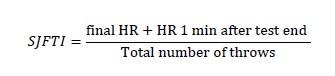
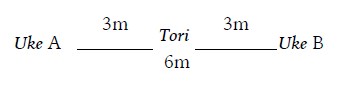
<body><![CDATA[<p>To be included in the sample, the following criteria were observed: a)   having experience with the <i>Special Judo Fitness Test;</i> b) training four   to five times a week, and c) the judo specific training session needed to be at   least 60 minutes long. The exclusion criteria were the following: a) current or   previous injure in the dominant upper limb, b) use of heart rate altering   drugs, c) total judo training time of less than one year and, according to   Frabrini et al<i>.</i> (2010) d) no body mass reduction technique that might affect performance should be applied.</p>     <p>All volunteers were not elite athletes and they were aware of the   procedures utilized in the research and of the importance of the objectives.   All subjects signed a free and informed consent form used in researches with   human beings (Brasil, 2012). The research Project was approved by the Research   and Ethics Committee of the State University of Pará/Brazil, under the protocol number CAAE: 0070.412.000-11.</p>     <p>Initially, all subjects informed their personal data through anamnesis, in order to assess the individual’s aptitude to participate in the study. </p>     <p><b>Instruments and Procedures</b></p>     <p><i>Anthropometric Analysis</i></p>     <p>An estadiometer and a scale (model 31, Filizola<sup>™</sup>, São Paulo,   Brazil) were used, to measure height and body mass, which were assessed with precision of 0.5 cm and 0.1 kg, respectively. </p>     <p><i>Specific Performance Analysis</i></p>     <p>For such analysis, the <i>Special Judo Fitness Test </i>(SJFT) was used,   that is effectively presented in the literature by Sterkowicz and Franchini   (1999), and normalized by Franchini, DelVecchio, and Sterkowicz (2006). The   SJTF is a test which respects the judo specificity and simulates the fight   metabolic request. The test is conducted at the athletes’ training local, where   they wear the training and competition outfit, the <i>judogi,</i> in order to measure the athletes’ specific performance. </p>     <p>The SJFT protocol is described as follows: two judokas to be thrown (<i>uke)</i>,   of similar stature and body mass as the performer (<i>tori), </i>will be   positioned at a 6-meter distance from one another and at a 3-meter distance   from the <i>tori. </i>The test is divided into three periods, the first one of   15 seconds and the second and third ones of thirty seconds each, with a 10   seconds interval (static recovery) between each period. During these partial   periods, the <i>Tori </i>must throw the two <i>ukes</i> as many times as   possible, within the given time, using the <i>ipon seoi nage</i> technique.   Such number of throws will be computed by the Sony<sup>™</sup> HDR-CX220   digital camera (Tokio-JA); the acute heart rate and the heart rate after a   1-minute recovery will be registered by the Polar<sup>™</sup> RS400 frequency   meter (Kempele-FI). Then, the lowest indexes found will indicate the best test results. The index (SJFTI) is calculated through the following formula: </p>     <p>&nbsp;</p>     ]]></body>
<body><![CDATA[<p align="center"><img src="/img/revistas/mot/v13n1/13n1a08e1.jpg" width="335" height="76"></p>     
<p align="center">&nbsp;</p>     <p>The structure below explains the SJFT execution framework:</p>     <p>&nbsp;</p>     <p align="center"><img src="/img/revistas/mot/v13n1/13n1a08e2.jpg" width="343" height="85"></p>     
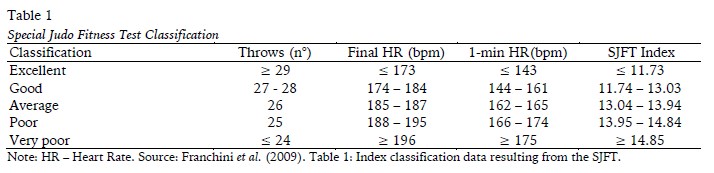
<p>&nbsp;</p>     <p><a href="/img/revistas/mot/v13n1/13n1a08t1.jpg">Table 1</a> shows the reference values for the SJFT classification. </p>     
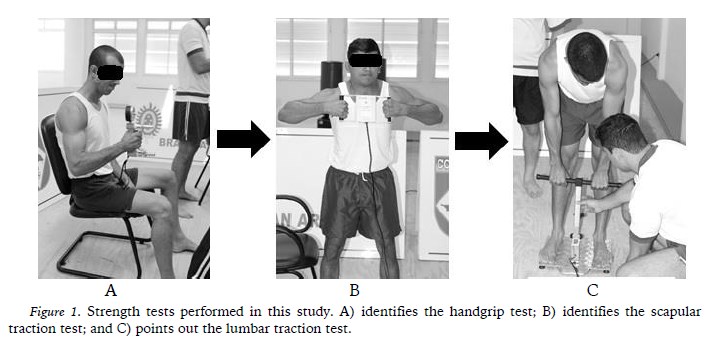
<p><i>Maximum Handgrip Strength Test (HGSMax) Analysis</i></p>     <p>The Maximum Handgrip Strength (HGSMax) analysis identifies the   individual’s handgrip strength. It is indicated by the American Society of Hand   Therapists (ASHT) and it is widely used to assess such type of strength in judokas (Lima, Kubota, Monteiro, Baldan, &amp; Pompeu, 2014).</p>     <p>The athletes were comfortably seated, with their dominant upper limb to   the side of their body with slight adduction, their elbow flexed at 90º,   forearm in neutral position and wrist extension able to vary between 0º and   30º. The HGSMax was measured by a JAMAR<sup>™</sup> strength dynamometer, which   is a hydraulic instrument widely used to assess handgrip strength. Three   different trials were performed, since the study conducted by Mathiovetz,   Weber, Yolland, and Kashman (1984) showed greater test-retest reliability when using three trials (0.883), compared to one (0.788) or two trials (0.862). </p>     ]]></body>
<body><![CDATA[<p>The test was conducted using a familiarization session, consisting of   sub-maximal HGSMax contractions. Then, three 10 seconds series were performed,   where the dominant hand contraction time lasted for the last 6 seconds of each   series, with a 90 seconds interval between them. The best dominant upper limb result out of the three trials was considered.</p>     <p><i>Maximum Scapular Traction Strength Test (STSMax) Analysis</i></p>     <p>Immediately after the last handgrip test execution, the athlete was   directed to the Maximum Scapular Traction Strength Test (STSMax). In order to   assess the STSMax, a standard procedure was applied, described by Soares,   Júnior, Franchini, Domenech, and Júnior (2012), where the individual   needs to be standing with shoulder abduction, elbow flexion, forearm in neutral   position, slight wrist extension, thumb extension and abduction and only the   rest of the fingers touching the handle. The individual is instructed to apply   a traction force to the sides (20 cm distance between hands). The STSMax was   assessed using an electronic dynamometer, model TRF200<sup>™</sup> EMG System   (Brazil) with a flexible shielded 2-meter cable, and with a data acquisition   system allowing for reading up to 200 N. A familiarization session was   conducted, consisting of sub-maximal STSMax contractions. Then, three 10   seconds series were performed, where the contraction time lasted for the last 6   seconds of each series, with a 90 seconds interval between them. The best result out of the three trials was considered.</p>     <p><i>Maximum Lumbar Traction Strength Test (LTSMax) Analysis</i></p>     <p>Finally, after the STSMax test, the athlete was guided to the Maximum   Lumbar Traction Strength Test (LTSMax). In order to assess the LTSMax, a   standard procedure described by Soares et al. (2012) was applied, where   a barefoot individual was positioned on a platform containing a charge-coupled   cell. The subject was instructed to keep the spine erect, and the arms extended   in front of the thighs, in order to correctly execute the traction. Then, the   individual needed to flex the trunk forward, slightly flex the knees and hold   the handle, applying the maximum traction strength with the hands on the   handle, perpendicularly to the platform, without letting the handle or the   hands touch any other part of the body. Three repetitions of 10 seconds were   performed, where the contraction time for measuring the LTSMax lasted for the   last 6 seconds of each repetition, with a 90 seconds interval between them. As with the other tests, the best result out of the three trials was considered.</p>     <p>&nbsp;</p> </font>     <p align="center"><font size="2" face="Verdana"><a href="/img/revistas/mot/v13n1/13n1a08f1.jpg">Figure 1</a></font></p>     
<p align="center">&nbsp;</p> <font face="Verdana" size="2">     <p><i>Sum of the Three Isometric Strength Tests (&#425;3 tests)</i></p>     <p>After conducting all analyses, the sum of the results from the HGSMax,   STSMax, and LTSMax was conducted, in order to correlate the total isometric strength peak of the three tests with the SJFT.</p>     ]]></body>
<body><![CDATA[<p>It is worth highlighting that all analysed variables (HGSMax, STSMax,   and LTSMax, &#425;3 tests and SJFT   index) have been adjusted to the body mass of the studied athletes, calculated through the following equation: </p>     <p>&nbsp;</p>     <p align="center"><img src="/img/revistas/mot/v13n1/13n1a08e3.jpg" width="332" height="73"></p>     

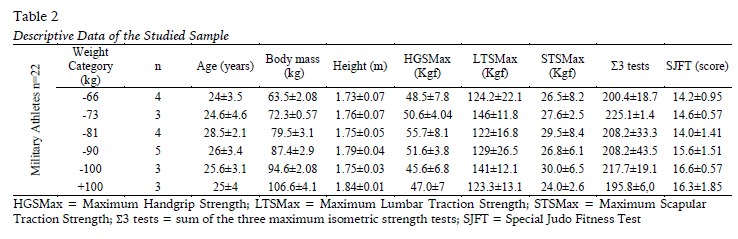
<p>&nbsp;</p>     <p><b>Statistical Analysis</b></p>     <p>Statistical analysis was conducted using the SPSS software for Windows   20.0, setting the significance level at p &lt; 0.05. A normality analysis was   applied, using the Shapiro Wilk test, where the data fell within a normal   distribution curve and, due to this, the Pearson correlation coefficient was used to verify possible correlations among the studied variables.</p>     <p>A descriptive analysis of the data characterizing the sample was conducted.  </p>     <p>&nbsp;</p> </font>     <p><font size="3" face="Verdana"><b>RESULTS</b></font></p> <font face="Verdana" size="2">     <p><a href="/img/revistas/mot/v13n1/13n1a08t2.jpg">Table 2</a> shows the descriptive data, classifying them into weight   categories of the studied judokas and variable values: age, body mass, height,   HGSMax, STSMax, LTSMax, &#425;3 tests and SJFT index (SJFTI).</p>     
]]></body>
<body><![CDATA[<p><a href="/img/revistas/mot/v13n1/13n1a08f2.jpg">Figure 2</a> shows the results for the statistical correlation between the   SJFT index and the strength tests: HGSMax, STSMax, LTSMax, and &#425;3 tests adjusted to the athletes’ body mass. The   results show strong negative correlation between the SJFT and the LTSMax and   HGSMax; moderate negative correlation was also found between the SJFT and   STSMax. In addition, the sum of the three maximum strength tests showed strong negative correlation with the SJFT.</p>     
<p>&nbsp;</p> </font>     <p><font face="Verdana"><b>DISCUSSION</b></font></p> <font face="Verdana" size="2">     <p>The present study aimed to find possible statistical correlations   between the judo specific performance and maximum isometric muscle strength   variables (handgrip, scapular and lumbar traction) of judo military athletes.   The main results indicated negative correlations between the maximum strength tests and the SJFT index.</p>     <p>The importance of muscle strength for high-performance judokas was   already analysed in a few studies. Franchini, Miarka, Matheus, and Del Vecchio   (2011) showed high level fighters to feature better results in dynamic strength   endurance tests in bar pull-ups grabbing the Judo-Gi (12 ± 5 repetitions), when   compared to regional level judokas (9 ± 4 repetitions). Another study showed   high-performance judokas to feature significant arm strength improvement (&#8710;%   = 48.2 %; p=0.0006) after a training period (Alves et al., 2012). Lima, Kubota,   Monteiro, Baldan, and Pompeu (2014) have also demonstrated judo black belt   athletes to feature better handgrip strength (p &lt; 0.05), compared to judo   white belt ones. In another study by Sánchez, Domínguez, Turpin, Tormo, and   Llorca (2011), bilateral handgrip strength was assessed in 102 judokas, aged   between 15 and 19 years, members of the 2008 Gales/Spain Junior League, and   significant difference was found among the heavy weight male categories.   Sterkowicz et al. (2011) showed the knee extensor muscle relative strength in   young Polish judokas to be greater than in the sedentary group; the same also   occurred for the trunk flexion-extension strength. In addition, Soares et al.   (2012) found correlation among the isometric handgrip, scapular and lumbar traction strength variables, which were analysed in the present study. </p>     <p>The results from the aforementioned studies show the need for handgrip, arm   and trunk strength use both for high-performance judokas and for junior   athletes competing at regional level, thus corroborating the results from this   study, since the need for developing such associated variables refers to   athletes of all different classes and categories, as well as to military athletes. </p>     <p>The complexity of the judo combat underlines the necessity for muscle   strength of the utilized muscle groups during competition, especially those   used in offensive and defensive actions, such as the paravertebral muscles of   the lumbar region, widely used in these actions to keep the static-dynamic   balance (Olívio-Júnior &amp; Drigo, 2015). Consequently, the specific strength   variables and the SJFT index report may be a fundamental factor for the final   performance in competitions and/or lesion prevention (Drid et al., 2011;   O’Donovan, Cheung, Catley, McGregor, &amp; Strutton, 2006). Nevertheless, it is   necessary to remember that the dynamics complexity of the judo combats,   particularly characterized by the variability of different intensity motor   actions, needs specific planning that considers the many factors involved   (Olívio-Júnior &amp; Drigo, 2015; Sterkowicz, Lech, &amp; Almansba, 2010;   Verkoshansky, 1990). Thus, the strength training will need to be adjusted to   technical training. Considering this, Blais and Trilles (2006) studied the   execution time of two projection techniques (Soto Gari and Morote Seoi Nague)   during a period of strength training with a specific machine, combined with   technical training, and found significant results for better execution time of such techniques (p &lt; 0.05). </p>     <p>Lech, Tyka, Palka, &amp; Krawczyk (2010) suggested paying greater   attention to training periodization for high-performance judokas, since this   allows for better motor performance during combat. Another study analysed 14   judoka finalists at the 2005 European Championship, ratifying that specific   actions during combat require high levels of functional strength for   performance success in competitions (Boguszewski &amp; Boguszewska, 2006). Such   need for high performance during combat reinforces the results found in the   present study, where greater maximum isometric handgrip, scapular and lumbar   traction strength, as well as the sum of the three, is inversely related to SJFT execution time for specific performance.</p>     <p>The importance of high-performance judokas’ global training has become a   topic of interest for researchers, as to improve physical performance, lesion   protection, technical ability, and psychological preparation (Olívio-Júnior   &amp; Drigo, 2015; Sterkowicz et al., 2010). In order to further investigate   such topic, Blais, Trilles, &amp; Lacouture (2007) validated a machine for   strength specific training using the technical movement of judo projections.   The study found statistical difference for the pulling strengths (collar and   sleeve) favourable to the movement executed with the machine, compared to the   movement traditionally executed against the opponent. This may be explained due   to the fact of the partner opposing lower resistance during the throwing   technique, compared to the specific resistance machine for the judo throwing technique.  </p>     <p>The present study indicated maximum handgrip, scapular and lumbar   traction muscle strength, as well as the sum of all three, to show correlation   with specific performance through the SJFT. This points out to the need of   school level, regional level, military and high-performance judokas to have a   period of specific training, including technical / physical / functional /   training associated to a specific strength. Such information is important,   since, according to Deval, García, and Monteiro (2009), judokas are   characterized by the fact of mainly using the te-waza techniques in   competitions, mostly applying hand/arm techniques, such as the Seoi-Nage; these   techniques require greater arm, shoulder and lumbar muscle strength, thus   supporting the correlations found in this study about specific performance and maximum strength of specific body regions. </p>     ]]></body>
<body><![CDATA[<p>A study verified the association between handgrip strength and blood   lactate concentration in national level male judokas during a competition, and   significant inverse relation (p&lt;0.05) was found between such variable,   especially for the non-dominant hand, where increase in the lactate   concentration and decrease in the handgrip strength were observed after the   first, third, and fourth fight (Bonitch-Góngora et al., 2012). Another study   analysed the correlation among judoka variables, finding association   (p&lt;0.05) between the VO<sub>2max</sub> (maximal oxygen uptake) and the   number of throws in the  SJFT, besides   the association between the fat percentage and the number of throws in the   SJFT, thus concluding that those athletes with greater aerobic power featured   better performance at high intensity, and that higher body fat percentage is   negatively related to performance in activities with body mass movement (Franchini et al., 2007).</p>     <p>Among the researchers of the judo combat complexity, Olívio-Júnior and   Drigo (2015) showed a basis for such complexity, under the name of judo combat   functional units, in which the fight characteristics and necessities are   considered to be as follows: 1-moment, 2-units, 3-sub-units e 4-micro-units.   The moments have been characterized together with their units as follows: a)   pre-contact, aimed at approximation and actual contact; b) standing control,   aimed at contact, opportunity creation, unbalance, application and projection;   c) transitioning control, aimed at unbalance, application, projection and   transition from standing to floor combat, and d) floor control, aimed at the   transition and actual combat on the ground. Each unit features sub-units, where   all contribute to the effectiveness of offensive and defensive actions, either   standing or on the floor; therefore, the micro-units are movements towards different   directions, advantage and disadvantage positions, among others, and aim at the   most refined movements within the technical training for actual combat   approximation. The results of the present study agree with the judo combat   complexity presented by Olívio-Júnior and Drigo (2015), since the association   between the maximum isometric strength variables and specific performance are observed within the judo combat functional units suggested by these authors.</p>     <p>Such issues related to judo combat have also been studied by other   authors (Carballeira &amp; Iglesias, 2007; Franchini, 2001; Sterkowicz, Garcià,   &amp; Lerma, 2007; Sterkowicz et al., 2011), and, due to this, judoka training   periodization needs to consider the complex interaction among the physical,   technical, functional and emotional variables for the effective conditioning of these athletes. </p>     <p>Nonetheless, future studies with judo elite athletes need to be   conducted, using these and other variable interactions, to better understand   the judo combat complexity and the need for greater specificity in training planning.</p>     <p>&nbsp;</p> </font>     <p><font size="3" face="Verdana"><b>CONCLUSIONS</b></font></p> <font face="Verdana" size="2">     <p>In conclusion, this study showed strong negative correlations to occur   between the SJFT index, the maximum isometric handgrip, shoulder traction and   lumbar traction strengths, and the sum of all three isometric test results,   adjusted to the body mass of the military judokas. Considering this, it is   possible to say that the athletes with the best performance in the SJFT, that   is, lowest test index, were those athletes who also obtained better levels of maximum isometric strength.</p>     <p>&nbsp;</p> </font>     <p><font size="3" face="Verdana"><b>REFERENCES</b></font></p> <font face="Verdana" size="2">     <!-- ref --><p>Alves, J., Borba-pinheiro, C. J., Carvalho, M. C. G., Chulvi-Medrano,   I., &amp; Dantas, M.E.H. (2012). Fuerza muscular y flexibilidad de judokas   masculinos de alto rendimiento que participaron en la liga española durante 2011. <i>Motricidad Humana</i>, <i>13</i>, 28-35.    &nbsp;&nbsp;&nbsp;&nbsp;&nbsp;&nbsp;&nbsp;&nbsp;[&#160;<a href="javascript:void(0);" onclick="javascript: window.open('/scielo.php?script=sci_nlinks&ref=365112&pid=S1646-107X201700010000800001&lng=','','width=640,height=500,resizable=yes,scrollbars=1,menubar=yes,');">Links</a>&#160;]<!-- end-ref --></p>     <!-- ref --><p>Amtmann, J., &amp; Cotton, A. (2005). Strength and Conditioning for Judo. <i>Strength and Conditioning Journal</i>, 27(2), 26-31.    &nbsp;&nbsp;&nbsp;&nbsp;&nbsp;&nbsp;&nbsp;&nbsp;[&#160;<a href="javascript:void(0);" onclick="javascript: window.open('/scielo.php?script=sci_nlinks&ref=365114&pid=S1646-107X201700010000800002&lng=','','width=640,height=500,resizable=yes,scrollbars=1,menubar=yes,');">Links</a>&#160;]<!-- end-ref --></p>     <!-- ref --><p>Azevedo, P. H. S. M., Drigo, A. J., Carvalho, M. C. G. A., Oliveira, J.   C., Nunes, J. E. D., Baldissera, V., &amp; Perez, S. E. A. (2007).   Determination of judo endurance performance using the <i>Uchi - Komi </i>technique   and an adapted lactate minimum test. <i>Journal of Sports Science and Medicine</i>, <i>6</i>(CSSI-2), 10-14.    &nbsp;&nbsp;&nbsp;&nbsp;&nbsp;&nbsp;&nbsp;&nbsp;[&#160;<a href="javascript:void(0);" onclick="javascript: window.open('/scielo.php?script=sci_nlinks&ref=365116&pid=S1646-107X201700010000800003&lng=','','width=640,height=500,resizable=yes,scrollbars=1,menubar=yes,');">Links</a>&#160;]<!-- end-ref --></p>     <!-- ref --><p>Blais, L., &amp; Trilles, F. (2006). The progress achieved by judokas   after strength training with a judo-specific machine. <i>Journal of Sports Science and Medicine</i>, <i>5</i>(CSSI), 132-135.    &nbsp;&nbsp;&nbsp;&nbsp;&nbsp;&nbsp;&nbsp;&nbsp;[&#160;<a href="javascript:void(0);" onclick="javascript: window.open('/scielo.php?script=sci_nlinks&ref=365118&pid=S1646-107X201700010000800004&lng=','','width=640,height=500,resizable=yes,scrollbars=1,menubar=yes,');">Links</a>&#160;]<!-- end-ref --> </p>     <!-- ref --><p>Blais, L., Trilles, F., &amp; Lacouture, P. (2007). Validation of a   specific machine to the strength training of judokas. <i>Journal of Strength and Conditioning Research, 21</i>(2), 409-12.    &nbsp;&nbsp;&nbsp;&nbsp;&nbsp;&nbsp;&nbsp;&nbsp;[&#160;<a href="javascript:void(0);" onclick="javascript: window.open('/scielo.php?script=sci_nlinks&ref=365120&pid=S1646-107X201700010000800005&lng=','','width=640,height=500,resizable=yes,scrollbars=1,menubar=yes,');">Links</a>&#160;]<!-- end-ref --></p>     <!-- ref --><p>Brasil. (2012) Resolução 466/12 do Conselho Nacional de Saúde do Brasil   que trata de pesquisas envolvendo seres humanos, dezembro, 2012. Retrieved from <a href="http://conselho.saude.gov.br/resolucoes/2012/Reso466.pdf/" target="_blank">http://conselho.saude.gov.br/resolucoes/2012/Reso466.pdf/</a>&nbsp;&nbsp;&nbsp;&nbsp;&nbsp;&nbsp;&nbsp;&nbsp;[&#160;<a href="javascript:void(0);" onclick="javascript: window.open('/scielo.php?script=sci_nlinks&ref=365122&pid=S1646-107X201700010000800006&lng=','','width=640,height=500,resizable=yes,scrollbars=1,menubar=yes,');">Links</a>&#160;]<!-- end-ref --><!-- ref --><p>Boguszewski, D., &amp; Boguszewska, K. (2006). Dynamics of judo contests   performed by finalists of European Championships (Rotterdam 2005). <i>Archives of Budo</i>, <i>2</i>, 40-44.    &nbsp;&nbsp;&nbsp;&nbsp;&nbsp;&nbsp;&nbsp;&nbsp;[&#160;<a href="javascript:void(0);" onclick="javascript: window.open('/scielo.php?script=sci_nlinks&ref=365123&pid=S1646-107X201700010000800007&lng=','','width=640,height=500,resizable=yes,scrollbars=1,menubar=yes,');">Links</a>&#160;]<!-- end-ref --></p>     <!-- ref --><p>Bonitch-Góngora, J. G., Bonitch-Domínguez, J. G., Padial, P., &amp;   Feriche, B. (2012). The effect of lactate concentration on the handgrip   strength during judo bouts. <i>Journal of Strength and Conditioning Research, 26</i>(7), 1863–1871.    &nbsp;&nbsp;&nbsp;&nbsp;&nbsp;&nbsp;&nbsp;&nbsp;[&#160;<a href="javascript:void(0);" onclick="javascript: window.open('/scielo.php?script=sci_nlinks&ref=365125&pid=S1646-107X201700010000800008&lng=','','width=640,height=500,resizable=yes,scrollbars=1,menubar=yes,');">Links</a>&#160;]<!-- end-ref --></p>     <!-- ref --><p>Carballeira, E., &amp; Iglesias, E. (2007). Efectos agudos del   enfrentamiento en judo: análisis multiparamétrico. <i>European Journal Human of Movement</i>, <i>19</i>, 117-144.    &nbsp;&nbsp;&nbsp;&nbsp;&nbsp;&nbsp;&nbsp;&nbsp;[&#160;<a href="javascript:void(0);" onclick="javascript: window.open('/scielo.php?script=sci_nlinks&ref=365127&pid=S1646-107X201700010000800009&lng=','','width=640,height=500,resizable=yes,scrollbars=1,menubar=yes,');">Links</a>&#160;]<!-- end-ref --></p>     <!-- ref --><p>Deval, V. C., García, J. M. G., &amp; Monteiro, F. L. (2009). Análisis   de las acciones técnicas de los judokas cadetes participantes en el campeonato   de España. <i>Revista Internacional de Ciencias del Deporte</i>, <i>15</i>(5), 64-80. Retrieved from <a href="http://www.cafyd.com/REVISTA/01505.pdf/" target="_blank">http://www.cafyd.com/REVISTA/01505.pdf/</a>&nbsp;&nbsp;&nbsp;&nbsp;&nbsp;&nbsp;&nbsp;&nbsp;[&#160;<a href="javascript:void(0);" onclick="javascript: window.open('/scielo.php?script=sci_nlinks&ref=365129&pid=S1646-107X201700010000800010&lng=','','width=640,height=500,resizable=yes,scrollbars=1,menubar=yes,');">Links</a>&#160;]<!-- end-ref --><!-- ref --><p>Drid, P., Ostojic, S. M., Vujkov, S., Purkovic, S., Trivic, T., and   Stojanovic, M. (2011). Physiological adaptations of a specific muscle-imbalance   reduction training programme in the elite female judokas. <i>Archives of Budo</i>, <i>7</i>(2), 61-64.    &nbsp;&nbsp;&nbsp;&nbsp;&nbsp;&nbsp;&nbsp;&nbsp;[&#160;<a href="javascript:void(0);" onclick="javascript: window.open('/scielo.php?script=sci_nlinks&ref=365130&pid=S1646-107X201700010000800011&lng=','','width=640,height=500,resizable=yes,scrollbars=1,menubar=yes,');">Links</a>&#160;]<!-- end-ref --></p>     <!-- ref --><p>Fabrini, S. P., Brito, C. J.,   Mendes, E. L., Sabarense, C. M., Marins, J. C. B., &amp; Franchini, E. (2010).   Práticas de redução de massa corporal em judocas nos períodos pré-competitivos. <i>Revista Brasileira de Educação Física e Esporte</i>, <i>24</i>(2), 165-177.    &nbsp;&nbsp;&nbsp;&nbsp;&nbsp;&nbsp;&nbsp;&nbsp;[&#160;<a href="javascript:void(0);" onclick="javascript: window.open('/scielo.php?script=sci_nlinks&ref=365132&pid=S1646-107X201700010000800012&lng=','','width=640,height=500,resizable=yes,scrollbars=1,menubar=yes,');">Links</a>&#160;]<!-- end-ref --></p>     <!-- ref --><p>Franchini, E. (2001). <i>Judô Desempenho Competitivo</i>. (1<sup>st</sup> ed.). São Paulo, Brasil: Manole.    &nbsp;&nbsp;&nbsp;&nbsp;&nbsp;&nbsp;&nbsp;&nbsp;[&#160;<a href="javascript:void(0);" onclick="javascript: window.open('/scielo.php?script=sci_nlinks&ref=365134&pid=S1646-107X201700010000800013&lng=','','width=640,height=500,resizable=yes,scrollbars=1,menubar=yes,');">Links</a>&#160;]<!-- end-ref --></p>     <!-- ref --><p>Franchini, E., Takito, M. Y., and Bertuzzi, R. C. M. (2005).   Morphological, physiological &amp; technical variables in high-level college judoists. <i>Archives of Budo</i>, <i>1</i>, 1-7.    &nbsp;&nbsp;&nbsp;&nbsp;&nbsp;&nbsp;&nbsp;&nbsp;[&#160;<a href="javascript:void(0);" onclick="javascript: window.open('/scielo.php?script=sci_nlinks&ref=365136&pid=S1646-107X201700010000800014&lng=','','width=640,height=500,resizable=yes,scrollbars=1,menubar=yes,');">Links</a>&#160;]<!-- end-ref --></p>     <!-- ref --><p>Franchini, E., DelVecchio, F. B., &amp; Sterkowicz S. (2006).   Classificatory norms to the Special Judo Fitness Test. 1° Word Scientific Congress of Combat. <i>Sports and Matial Artsin Rzeszow</i>, <i>9</i>, 64.    &nbsp;&nbsp;&nbsp;&nbsp;&nbsp;&nbsp;&nbsp;&nbsp;[&#160;<a href="javascript:void(0);" onclick="javascript: window.open('/scielo.php?script=sci_nlinks&ref=365138&pid=S1646-107X201700010000800015&lng=','','width=640,height=500,resizable=yes,scrollbars=1,menubar=yes,');">Links</a>&#160;]<!-- end-ref --></p>     <!-- ref --><p>Franchini, E., Miarka, B., Matheus, L., &amp; Del Vecchio, F.B. (2011).   Endurance in judogi grip strength tests: Comparison between elite and non-elite judo players. <i>Archives of Budo</i>, <i>7</i>(1), 1-4.    &nbsp;&nbsp;&nbsp;&nbsp;&nbsp;&nbsp;&nbsp;&nbsp;[&#160;<a href="javascript:void(0);" onclick="javascript: window.open('/scielo.php?script=sci_nlinks&ref=365140&pid=S1646-107X201700010000800016&lng=','','width=640,height=500,resizable=yes,scrollbars=1,menubar=yes,');">Links</a>&#160;]<!-- end-ref --></p>     <!-- ref --><p>Franchini, E., Nunes, A. V.,   Moraes, J. M., &amp; Del Vecchio F. B. (2007). Physical fitness and   anthropometrical profile of the Brazilian male judo team. <i>Journal of Physiological Anthropology</i>, <i>26</i>(2), 59-67.    &nbsp;&nbsp;&nbsp;&nbsp;&nbsp;&nbsp;&nbsp;&nbsp;[&#160;<a href="javascript:void(0);" onclick="javascript: window.open('/scielo.php?script=sci_nlinks&ref=365142&pid=S1646-107X201700010000800017&lng=','','width=640,height=500,resizable=yes,scrollbars=1,menubar=yes,');">Links</a>&#160;]<!-- end-ref --></p>     <!-- ref --><p>Lima, M. C., Kubota, L. M., Monteiro, C. B. M., Baldan, C. S., &amp;   Pompeu, J. E. (2014). Força de preensão manual em atletas de judô. <i>Revista     Brasileira de Medicina do Esporte</i>, <i>20</i>(3), 210-213. doi: 10.1590/1517-86922014200301525.    &nbsp;&nbsp;&nbsp;&nbsp;&nbsp;&nbsp;&nbsp;&nbsp;[&#160;<a href="javascript:void(0);" onclick="javascript: window.open('/scielo.php?script=sci_nlinks&ref=365144&pid=S1646-107X201700010000800018&lng=','','width=640,height=500,resizable=yes,scrollbars=1,menubar=yes,');">Links</a>&#160;]<!-- end-ref --></p>     <!-- ref --><p>Lech, G., Tyka, A., Palka, T., &amp; Krawczyk, R. (2010). Effect of   physical endurance on fighting and the level of sports performance in junior judokas. <i>Archives of Budo</i>, <i>6</i>(1), 1-6.    &nbsp;&nbsp;&nbsp;&nbsp;&nbsp;&nbsp;&nbsp;&nbsp;[&#160;<a href="javascript:void(0);" onclick="javascript: window.open('/scielo.php?script=sci_nlinks&ref=365146&pid=S1646-107X201700010000800019&lng=','','width=640,height=500,resizable=yes,scrollbars=1,menubar=yes,');">Links</a>&#160;]<!-- end-ref --></p>     <!-- ref --><p>Mathiowetz, V., Weber, K., Yolland, G., &amp; Kashman, N. (1984).   Reliability and validity of grip and pinch strength evaluations. <i>Journal of Hand Surgery (America Volume), 9</i>(2), 222-226.    &nbsp;&nbsp;&nbsp;&nbsp;&nbsp;&nbsp;&nbsp;&nbsp;[&#160;<a href="javascript:void(0);" onclick="javascript: window.open('/scielo.php?script=sci_nlinks&ref=365148&pid=S1646-107X201700010000800020&lng=','','width=640,height=500,resizable=yes,scrollbars=1,menubar=yes,');">Links</a>&#160;]<!-- end-ref --></p>     <!-- ref --><p>O’Donovan, O., Cheung, J., Catley, M., McGregor, A. H., &amp; Strutton,   A. H. (2006). An investigation of leg and trunk strength and reaction times of   hardstyle martial arts practitioners. <i>Journal of Sports Science and Medicine,</i> <i>5</i>(CSSI), 5-12.    &nbsp;&nbsp;&nbsp;&nbsp;&nbsp;&nbsp;&nbsp;&nbsp;[&#160;<a href="javascript:void(0);" onclick="javascript: window.open('/scielo.php?script=sci_nlinks&ref=365150&pid=S1646-107X201700010000800021&lng=','','width=640,height=500,resizable=yes,scrollbars=1,menubar=yes,');">Links</a>&#160;]<!-- end-ref --></p>     <!-- ref --><p>Olívio-Junior, J. A., &amp; Drigo, A. J. (2015). <i>Pedagogia complexa   do Judô: um manual para treinadores de equipes de base</i>. (1<sup>st</sup> ed.). Leme, Brasil: Mundo Jurídico.    &nbsp;&nbsp;&nbsp;&nbsp;&nbsp;&nbsp;&nbsp;&nbsp;[&#160;<a href="javascript:void(0);" onclick="javascript: window.open('/scielo.php?script=sci_nlinks&ref=365152&pid=S1646-107X201700010000800022&lng=','','width=640,height=500,resizable=yes,scrollbars=1,menubar=yes,');">Links</a>&#160;]<!-- end-ref --></p>     <!-- ref --><p>Piucco, T., &amp; Santos, S.G. (2010). Valores de impacto no corpo do   judoca ao ser projetado pela técnica Ippon-Seoi-Nage. <i>Motricidade</i>; <i>6</i>(1), 71-83. doi: 10.6063/motricidade.6(1), 71-83.    &nbsp;&nbsp;&nbsp;&nbsp;&nbsp;&nbsp;&nbsp;&nbsp;[&#160;<a href="javascript:void(0);" onclick="javascript: window.open('/scielo.php?script=sci_nlinks&ref=365154&pid=S1646-107X201700010000800023&lng=','','width=640,height=500,resizable=yes,scrollbars=1,menubar=yes,');">Links</a>&#160;]<!-- end-ref --></p>     <!-- ref --><p>Sánchez, Á. G., Domínguez, A. S., Turpin, J.A. P., Tormo, J. M. C.,   &amp; Llorca, C. S. (2011). Importance of hand-grip strength as an indicator   for predicting the results of competitions of young judokas. <i>Archives of Budo</i>, <i>7</i>(3), 167-172.    &nbsp;&nbsp;&nbsp;&nbsp;&nbsp;&nbsp;&nbsp;&nbsp;[&#160;<a href="javascript:void(0);" onclick="javascript: window.open('/scielo.php?script=sci_nlinks&ref=365156&pid=S1646-107X201700010000800024&lng=','','width=640,height=500,resizable=yes,scrollbars=1,menubar=yes,');">Links</a>&#160;]<!-- end-ref --></p>     <!-- ref --><p>Saraiva, A. R., Reis, V. M., Costa<u>,</u> P. B., Bentes, C. M., Silva, G. V. C., &amp; Novaes, J. S. (2014). Chronic   Effects of Different Resistance Training Exercise Orders on Flexibility in   Elite Judo Athletes. <i>Journal     of Human Kinetics</i>, <i>40</i>(1), 129–137. doi<b>: </b>10.2478/hukin-2014-0015<u>.    &nbsp;&nbsp;&nbsp;&nbsp;&nbsp;&nbsp;&nbsp;&nbsp;[&#160;<a href="javascript:void(0);" onclick="javascript: window.open('/scielo.php?script=sci_nlinks&ref=365158&pid=S1646-107X201700010000800025&lng=','','width=640,height=500,resizable=yes,scrollbars=1,menubar=yes,');">Links</a>&#160;]<!-- end-ref --></u></p>     <!-- ref --><p>Soares, A. V., Júnior, J. M. C.,   Franchini, E., Domenech, S. C., &amp;   Júnior, N. G. B. (2012). Correlação entre os testes de dinamometria de preensão   manual, escapular e lombar. <i>Acta Brasileira do Movimento Humano, 2</i>(1), 65-72.    &nbsp;&nbsp;&nbsp;&nbsp;&nbsp;&nbsp;&nbsp;&nbsp;[&#160;<a href="javascript:void(0);" onclick="javascript: window.open('/scielo.php?script=sci_nlinks&ref=365160&pid=S1646-107X201700010000800026&lng=','','width=640,height=500,resizable=yes,scrollbars=1,menubar=yes,');">Links</a>&#160;]<!-- end-ref --></p>     <!-- ref --><p>Sterkowicz, S., &amp; Franchini, E. (1999). Analysis of a specific judo test. <i>Revista Kinesis</i>, <i>21</i>, 91-108.    &nbsp;&nbsp;&nbsp;&nbsp;&nbsp;&nbsp;&nbsp;&nbsp;[&#160;<a href="javascript:void(0);" onclick="javascript: window.open('/scielo.php?script=sci_nlinks&ref=365162&pid=S1646-107X201700010000800027&lng=','','width=640,height=500,resizable=yes,scrollbars=1,menubar=yes,');">Links</a>&#160;]<!-- end-ref --></p>     <!-- ref --><p>Sterkowicz, S., Garcià, J. M. G., &amp; Lerma, F. S. (2007). The   importance of judo trainers’ professional activities. <i>Archives of Budo</i>, <i>3</i>, 57-61.    &nbsp;&nbsp;&nbsp;&nbsp;&nbsp;&nbsp;&nbsp;&nbsp;[&#160;<a href="javascript:void(0);" onclick="javascript: window.open('/scielo.php?script=sci_nlinks&ref=365164&pid=S1646-107X201700010000800028&lng=','','width=640,height=500,resizable=yes,scrollbars=1,menubar=yes,');">Links</a>&#160;]<!-- end-ref --></p>     <!-- ref --><p>Sterkowicz, S., Lech, G., Chwala, W., Ambrozy, T., Jaworski, J., &amp;   Klys, A. (2011). Muscle strength in young judo contestants vs. untrained subjects. <i>Archives of Budo</i>, <i>7</i>(3), 179-184.    &nbsp;&nbsp;&nbsp;&nbsp;&nbsp;&nbsp;&nbsp;&nbsp;[&#160;<a href="javascript:void(0);" onclick="javascript: window.open('/scielo.php?script=sci_nlinks&ref=365166&pid=S1646-107X201700010000800029&lng=','','width=640,height=500,resizable=yes,scrollbars=1,menubar=yes,');">Links</a>&#160;]<!-- end-ref --></p>     <!-- ref --><p>Sterkowicz, S., Lech, G., &amp; Almansba, R. (2010). The course of fight   and the level of sports achievements in judo. <i>Achives of Budo</i>, <i>6</i>(1), 1-6.    &nbsp;&nbsp;&nbsp;&nbsp;&nbsp;&nbsp;&nbsp;&nbsp;[&#160;<a href="javascript:void(0);" onclick="javascript: window.open('/scielo.php?script=sci_nlinks&ref=365168&pid=S1646-107X201700010000800030&lng=','','width=640,height=500,resizable=yes,scrollbars=1,menubar=yes,');">Links</a>&#160;]<!-- end-ref -->  </p>     <!-- ref --><p>Verkoshansky, Y. V. (1990). <i>Entrenamiento deportivo: planificación e programación. </i>(1<sup>st</sup> ed.). Barcelona, Espanha: Martinez Roca.    &nbsp;&nbsp;&nbsp;&nbsp;&nbsp;&nbsp;&nbsp;&nbsp;[&#160;<a href="javascript:void(0);" onclick="javascript: window.open('/scielo.php?script=sci_nlinks&ref=365170&pid=S1646-107X201700010000800031&lng=','','width=640,height=500,resizable=yes,scrollbars=1,menubar=yes,');">Links</a>&#160;]<!-- end-ref --> </p>     <p>&nbsp;</p>     ]]></body>
<body><![CDATA[<p><b>Acknowledgments:</b>We thank the command of the Physical Capacitating   Center of the Brazilian Army and to the Almirante Alexandrino Instruction   Center of the Brazilian Navy.<b>    <br>   Conflict of interest:</b>Nothing to declare<b>    <br>   Funding:    <br> </b>Nothing to declare</p> </font>     <p><font size="2" face="Verdana">Manuscript received at February 25th 2016;   Accepted at November 11th 2016 </font></p>     <p>&nbsp;</p>     <p>&nbsp;</p> <font face="Verdana" size="2"><a name="end"></a><a href="#topo">*</a> <i>Corresponding author</i>: Instituto de Pesquisa da Capacita&ccedil;&atilde;o F&iacute;sica do Ex&eacute;rcito, Av. Jo&atilde;o Luiz Alves, S/n&ordm;, Urca CEP: 22291-090, Rio de Janeiro, Brasil. <i>E-mail</i>: <a href="mailto:michel_fitness@hotmail.com">michel_fitness@hotmail.com</a></font>      ]]></body><back>
<ref-list>
<ref id="B1">
<nlm-citation citation-type="journal">
<person-group person-group-type="author">
<name>
<surname><![CDATA[Alves]]></surname>
<given-names><![CDATA[J.]]></given-names>
</name>
<name>
<surname><![CDATA[Borba-pinheiro]]></surname>
<given-names><![CDATA[C. J.]]></given-names>
</name>
<name>
<surname><![CDATA[Carvalho]]></surname>
<given-names><![CDATA[M. C. G.]]></given-names>
</name>
<name>
<surname><![CDATA[Chulvi-Medrano]]></surname>
<given-names><![CDATA[I.]]></given-names>
</name>
<name>
<surname><![CDATA[Dantas]]></surname>
<given-names><![CDATA[M.E.H.]]></given-names>
</name>
</person-group>
<article-title xml:lang="es"><![CDATA[Fuerza muscular y flexibilidad de judokas masculinos de alto rendimiento que participaron en la liga española durante 2011]]></article-title>
<source><![CDATA[Motricidad Humana]]></source>
<year>2012</year>
<volume>13</volume>
<page-range>28-35</page-range></nlm-citation>
</ref>
<ref id="B2">
<nlm-citation citation-type="journal">
<person-group person-group-type="author">
<name>
<surname><![CDATA[Amtmann]]></surname>
<given-names><![CDATA[J.]]></given-names>
</name>
<name>
<surname><![CDATA[Cotton]]></surname>
<given-names><![CDATA[A.]]></given-names>
</name>
</person-group>
<article-title xml:lang="en"><![CDATA[Strength and Conditioning for Judo]]></article-title>
<source><![CDATA[Strength and Conditioning Journal]]></source>
<year>2005</year>
<volume>27</volume>
<numero>2</numero>
<issue>2</issue>
<page-range>26-31</page-range></nlm-citation>
</ref>
<ref id="B3">
<nlm-citation citation-type="journal">
<person-group person-group-type="author">
<name>
<surname><![CDATA[Azevedo]]></surname>
<given-names><![CDATA[P. H. S. M.]]></given-names>
</name>
<name>
<surname><![CDATA[Drigo]]></surname>
<given-names><![CDATA[A. J.]]></given-names>
</name>
<name>
<surname><![CDATA[Carvalho]]></surname>
<given-names><![CDATA[M. C. G. A.]]></given-names>
</name>
<name>
<surname><![CDATA[Oliveira]]></surname>
<given-names><![CDATA[J. C.]]></given-names>
</name>
<name>
<surname><![CDATA[Nunes]]></surname>
<given-names><![CDATA[J. E. D.]]></given-names>
</name>
<name>
<surname><![CDATA[Baldissera]]></surname>
<given-names><![CDATA[V.]]></given-names>
</name>
<name>
<surname><![CDATA[Perez]]></surname>
<given-names><![CDATA[S. E. A.]]></given-names>
</name>
</person-group>
<article-title xml:lang="en"><![CDATA[Determination of judo endurance performance using the Uchi - Komi technique and an adapted lactate minimum test]]></article-title>
<source><![CDATA[Journal of Sports Science and Medicine]]></source>
<year>2007</year>
<volume>6</volume>
<page-range>10-14</page-range></nlm-citation>
</ref>
<ref id="B4">
<nlm-citation citation-type="journal">
<person-group person-group-type="author">
<name>
<surname><![CDATA[Blais]]></surname>
<given-names><![CDATA[L.]]></given-names>
</name>
<name>
<surname><![CDATA[Trilles]]></surname>
<given-names><![CDATA[F.]]></given-names>
</name>
</person-group>
<article-title xml:lang="en"><![CDATA[The progress achieved by judokas after strength training with a judo-specific machine]]></article-title>
<source><![CDATA[Journal of Sports Science and Medicine]]></source>
<year>2006</year>
<volume>5</volume>
<page-range>132-135</page-range></nlm-citation>
</ref>
<ref id="B5">
<nlm-citation citation-type="journal">
<person-group person-group-type="author">
<name>
<surname><![CDATA[Blais]]></surname>
<given-names><![CDATA[L.]]></given-names>
</name>
<name>
<surname><![CDATA[Trilles]]></surname>
<given-names><![CDATA[F.]]></given-names>
</name>
<name>
<surname><![CDATA[Lacouture]]></surname>
<given-names><![CDATA[P.]]></given-names>
</name>
</person-group>
<article-title xml:lang="en"><![CDATA[Validation of a specific machine to the strength training of judokas]]></article-title>
<source><![CDATA[Journal of Strength and Conditioning Research]]></source>
<year>2007</year>
<volume>21</volume>
<numero>2</numero>
<issue>2</issue>
<page-range>409-12</page-range></nlm-citation>
</ref>
<ref id="B6">
<nlm-citation citation-type="">
<collab>Brasil</collab>
<source><![CDATA[Resolução 466/12 do Conselho Nacional de Saúde do Brasil que trata de pesquisas envolvendo seres humanos, dezembro, 2012]]></source>
<year>2012</year>
</nlm-citation>
</ref>
<ref id="B7">
<nlm-citation citation-type="journal">
<person-group person-group-type="author">
<name>
<surname><![CDATA[Boguszewski]]></surname>
<given-names><![CDATA[D.]]></given-names>
</name>
<name>
<surname><![CDATA[Boguszewska]]></surname>
<given-names><![CDATA[K.]]></given-names>
</name>
</person-group>
<article-title xml:lang="en"><![CDATA[Dynamics of judo contests performed by finalists of European Championships (Rotterdam 2005)]]></article-title>
<source><![CDATA[Archives of Budo]]></source>
<year>2006</year>
<volume>2</volume>
<page-range>40-44</page-range></nlm-citation>
</ref>
<ref id="B8">
<nlm-citation citation-type="journal">
<person-group person-group-type="author">
<name>
<surname><![CDATA[Bonitch-Góngora]]></surname>
<given-names><![CDATA[J. G.]]></given-names>
</name>
<name>
<surname><![CDATA[Bonitch-Domínguez]]></surname>
<given-names><![CDATA[J. G.]]></given-names>
</name>
<name>
<surname><![CDATA[Padial]]></surname>
<given-names><![CDATA[P.]]></given-names>
</name>
<name>
<surname><![CDATA[Feriche]]></surname>
<given-names><![CDATA[B.]]></given-names>
</name>
</person-group>
<article-title xml:lang="en"><![CDATA[The effect of lactate concentration on the handgrip strength during judo bouts]]></article-title>
<source><![CDATA[Journal of Strength and Conditioning Research]]></source>
<year>2012</year>
<volume>26</volume>
<numero>7</numero>
<issue>7</issue>
<page-range>1863-1871</page-range></nlm-citation>
</ref>
<ref id="B9">
<nlm-citation citation-type="journal">
<person-group person-group-type="author">
<name>
<surname><![CDATA[Carballeira]]></surname>
<given-names><![CDATA[E.]]></given-names>
</name>
<name>
<surname><![CDATA[Iglesias]]></surname>
<given-names><![CDATA[E.]]></given-names>
</name>
</person-group>
<article-title xml:lang="es"><![CDATA[Efectos agudos del enfrentamiento en judo: análisis multiparamétrico]]></article-title>
<source><![CDATA[European Journal Human of Movement]]></source>
<year>2007</year>
<volume>19</volume>
<page-range>117-144</page-range></nlm-citation>
</ref>
<ref id="B10">
<nlm-citation citation-type="journal">
<person-group person-group-type="author">
<name>
<surname><![CDATA[Deval]]></surname>
<given-names><![CDATA[V. C.]]></given-names>
</name>
<name>
<surname><![CDATA[García]]></surname>
<given-names><![CDATA[J. M. G.]]></given-names>
</name>
<name>
<surname><![CDATA[Monteiro]]></surname>
<given-names><![CDATA[F. L.]]></given-names>
</name>
</person-group>
<article-title xml:lang="es"><![CDATA[Análisis de las acciones técnicas de los judokas cadetes participantes en el campeonato de España]]></article-title>
<source><![CDATA[Revista Internacional de Ciencias del Deporte]]></source>
<year>2009</year>
<volume>15</volume>
<numero>5</numero>
<issue>5</issue>
<page-range>64-80</page-range></nlm-citation>
</ref>
<ref id="B11">
<nlm-citation citation-type="journal">
<person-group person-group-type="author">
<name>
<surname><![CDATA[Drid]]></surname>
<given-names><![CDATA[P.]]></given-names>
</name>
<name>
<surname><![CDATA[Ostojic]]></surname>
<given-names><![CDATA[S. M.]]></given-names>
</name>
<name>
<surname><![CDATA[Vujkov]]></surname>
<given-names><![CDATA[S.]]></given-names>
</name>
<name>
<surname><![CDATA[Purkovic]]></surname>
<given-names><![CDATA[S.]]></given-names>
</name>
<name>
<surname><![CDATA[Trivic]]></surname>
<given-names><![CDATA[T.]]></given-names>
</name>
<name>
<surname><![CDATA[Stojanovic]]></surname>
<given-names><![CDATA[M.]]></given-names>
</name>
</person-group>
<article-title xml:lang="en"><![CDATA[Physiological adaptations of a specific muscle-imbalance reduction training programme in the elite female judokas]]></article-title>
<source><![CDATA[Archives of Budo]]></source>
<year>2011</year>
<volume>7</volume>
<numero>2</numero>
<issue>2</issue>
<page-range>61-64</page-range></nlm-citation>
</ref>
<ref id="B12">
<nlm-citation citation-type="journal">
<person-group person-group-type="author">
<name>
<surname><![CDATA[Fabrini]]></surname>
<given-names><![CDATA[S. P.]]></given-names>
</name>
<name>
<surname><![CDATA[Brito]]></surname>
<given-names><![CDATA[C. J.]]></given-names>
</name>
<name>
<surname><![CDATA[Mendes]]></surname>
<given-names><![CDATA[E. L.]]></given-names>
</name>
<name>
<surname><![CDATA[Sabarense]]></surname>
<given-names><![CDATA[C. M.]]></given-names>
</name>
<name>
<surname><![CDATA[Marins]]></surname>
<given-names><![CDATA[J. C. B.]]></given-names>
</name>
<name>
<surname><![CDATA[Franchini]]></surname>
<given-names><![CDATA[E.]]></given-names>
</name>
</person-group>
<article-title xml:lang="pt"><![CDATA[Práticas de redução de massa corporal em judocas nos períodos pré-competitivos]]></article-title>
<source><![CDATA[Revista Brasileira de Educação Física e Esporte]]></source>
<year>2010</year>
<volume>24</volume>
<numero>2</numero>
<issue>2</issue>
<page-range>165-177</page-range></nlm-citation>
</ref>
<ref id="B13">
<nlm-citation citation-type="book">
<person-group person-group-type="author">
<name>
<surname><![CDATA[Franchini]]></surname>
<given-names><![CDATA[E.]]></given-names>
</name>
</person-group>
<source><![CDATA[Judô Desempenho Competitivo]]></source>
<year>2001</year>
<edition>1</edition>
<publisher-loc><![CDATA[São Paulo ]]></publisher-loc>
<publisher-name><![CDATA[Manole]]></publisher-name>
</nlm-citation>
</ref>
<ref id="B14">
<nlm-citation citation-type="journal">
<person-group person-group-type="author">
<name>
<surname><![CDATA[Franchini]]></surname>
<given-names><![CDATA[E.]]></given-names>
</name>
<name>
<surname><![CDATA[Takito]]></surname>
<given-names><![CDATA[M. Y.]]></given-names>
</name>
<name>
<surname><![CDATA[Bertuzzi]]></surname>
<given-names><![CDATA[R. C. M.]]></given-names>
</name>
</person-group>
<article-title xml:lang="en"><![CDATA[Morphological, physiological & technical variables in high-level college judoists]]></article-title>
<source><![CDATA[Archives of Budo]]></source>
<year>2005</year>
<volume>1</volume>
<page-range>1-7</page-range></nlm-citation>
</ref>
<ref id="B15">
<nlm-citation citation-type="journal">
<person-group person-group-type="author">
<name>
<surname><![CDATA[Franchini]]></surname>
<given-names><![CDATA[E.]]></given-names>
</name>
<name>
<surname><![CDATA[DelVecchio]]></surname>
<given-names><![CDATA[F. B.]]></given-names>
</name>
<name>
<surname><![CDATA[Sterkowicz]]></surname>
<given-names><![CDATA[S.]]></given-names>
</name>
</person-group>
<article-title xml:lang="en"><![CDATA[Classificatory norms to the Special Judo Fitness Test: 1° Word Scientific Congress of Combat]]></article-title>
<source><![CDATA[Sports and Matial Artsin Rzeszow]]></source>
<year>2006</year>
<volume>9</volume>
</nlm-citation>
</ref>
<ref id="B16">
<nlm-citation citation-type="journal">
<person-group person-group-type="author">
<name>
<surname><![CDATA[Franchini]]></surname>
<given-names><![CDATA[E.]]></given-names>
</name>
<name>
<surname><![CDATA[Miarka]]></surname>
<given-names><![CDATA[B.]]></given-names>
</name>
<name>
<surname><![CDATA[Matheus]]></surname>
<given-names><![CDATA[L.]]></given-names>
</name>
<name>
<surname><![CDATA[Del Vecchio]]></surname>
<given-names><![CDATA[F.B.]]></given-names>
</name>
</person-group>
<article-title xml:lang="en"><![CDATA[Endurance in judogi grip strength tests: Comparison between elite and non-elite judo players]]></article-title>
<source><![CDATA[Archives of Budo]]></source>
<year>2011</year>
<volume>7</volume>
<numero>1</numero>
<issue>1</issue>
<page-range>1-4</page-range></nlm-citation>
</ref>
<ref id="B17">
<nlm-citation citation-type="journal">
<person-group person-group-type="author">
<name>
<surname><![CDATA[Franchini]]></surname>
<given-names><![CDATA[E.]]></given-names>
</name>
<name>
<surname><![CDATA[Nunes]]></surname>
<given-names><![CDATA[A. V.]]></given-names>
</name>
<name>
<surname><![CDATA[Moraes]]></surname>
<given-names><![CDATA[J. M.]]></given-names>
</name>
<name>
<surname><![CDATA[Del Vecchio F.]]></surname>
<given-names><![CDATA[B.]]></given-names>
</name>
</person-group>
<article-title xml:lang="en"><![CDATA[Physical fitness and anthropometrical profile of the Brazilian male judo team]]></article-title>
<source><![CDATA[Journal of Physiological Anthropology]]></source>
<year>2007</year>
<volume>26</volume>
<numero>2</numero>
<issue>2</issue>
<page-range>59-67</page-range></nlm-citation>
</ref>
<ref id="B18">
<nlm-citation citation-type="journal">
<person-group person-group-type="author">
<name>
<surname><![CDATA[Lima]]></surname>
<given-names><![CDATA[M. C.]]></given-names>
</name>
<name>
<surname><![CDATA[Kubota]]></surname>
<given-names><![CDATA[L. M.]]></given-names>
</name>
<name>
<surname><![CDATA[Monteiro]]></surname>
<given-names><![CDATA[C. B. M.]]></given-names>
</name>
<name>
<surname><![CDATA[Baldan]]></surname>
<given-names><![CDATA[C. S.]]></given-names>
</name>
<name>
<surname><![CDATA[Pompeu]]></surname>
<given-names><![CDATA[J. E.]]></given-names>
</name>
</person-group>
<article-title xml:lang="pt"><![CDATA[Força de preensão manual em atletas de judô]]></article-title>
<source><![CDATA[Revista Brasileira de Medicina do Esporte]]></source>
<year>2014</year>
<volume>20</volume>
<numero>3</numero>
<issue>3</issue>
<page-range>210-213</page-range></nlm-citation>
</ref>
<ref id="B19">
<nlm-citation citation-type="journal">
<person-group person-group-type="author">
<name>
<surname><![CDATA[Lech]]></surname>
<given-names><![CDATA[G.]]></given-names>
</name>
<name>
<surname><![CDATA[Tyka]]></surname>
<given-names><![CDATA[A.]]></given-names>
</name>
<name>
<surname><![CDATA[Palka]]></surname>
<given-names><![CDATA[T.]]></given-names>
</name>
<name>
<surname><![CDATA[Krawczyk]]></surname>
<given-names><![CDATA[R.]]></given-names>
</name>
</person-group>
<article-title xml:lang="en"><![CDATA[Effect of physical endurance on fighting and the level of sports performance in junior judokas]]></article-title>
<source><![CDATA[Archives of Budo]]></source>
<year>2010</year>
<volume>6</volume>
<numero>1</numero>
<issue>1</issue>
<page-range>1-6</page-range></nlm-citation>
</ref>
<ref id="B20">
<nlm-citation citation-type="journal">
<person-group person-group-type="author">
<name>
<surname><![CDATA[Mathiowetz]]></surname>
<given-names><![CDATA[V.]]></given-names>
</name>
<name>
<surname><![CDATA[Weber]]></surname>
<given-names><![CDATA[K.]]></given-names>
</name>
<name>
<surname><![CDATA[Yolland]]></surname>
<given-names><![CDATA[G.]]></given-names>
</name>
<name>
<surname><![CDATA[Kashman]]></surname>
<given-names><![CDATA[N.]]></given-names>
</name>
</person-group>
<article-title xml:lang="en"><![CDATA[Reliability and validity of grip and pinch strength evaluations]]></article-title>
<source><![CDATA[Journal of Hand Surgery (America Volume)]]></source>
<year>1984</year>
<volume>9</volume>
<numero>2</numero>
<issue>2</issue>
<page-range>222-226</page-range></nlm-citation>
</ref>
<ref id="B21">
<nlm-citation citation-type="journal">
<person-group person-group-type="author">
<name>
<surname><![CDATA[O’Donovan]]></surname>
<given-names><![CDATA[O.]]></given-names>
</name>
<name>
<surname><![CDATA[Cheung]]></surname>
<given-names><![CDATA[J.]]></given-names>
</name>
<name>
<surname><![CDATA[Catley]]></surname>
<given-names><![CDATA[M.]]></given-names>
</name>
<name>
<surname><![CDATA[McGregor]]></surname>
<given-names><![CDATA[A. H.]]></given-names>
</name>
<name>
<surname><![CDATA[Strutton]]></surname>
<given-names><![CDATA[A. H.]]></given-names>
</name>
</person-group>
<article-title xml:lang="en"><![CDATA[An investigation of leg and trunk strength and reaction times of hardstyle martial arts practitioners]]></article-title>
<source><![CDATA[Journal of Sports Science and Medicine]]></source>
<year>2006</year>
<volume>5</volume>
<page-range>5-12</page-range></nlm-citation>
</ref>
<ref id="B22">
<nlm-citation citation-type="book">
<person-group person-group-type="author">
<name>
<surname><![CDATA[Olívio-Junior]]></surname>
<given-names><![CDATA[J. A.]]></given-names>
</name>
<name>
<surname><![CDATA[Drigo]]></surname>
<given-names><![CDATA[A. J.]]></given-names>
</name>
</person-group>
<source><![CDATA[Pedagogia complexa do Judô: um manual para treinadores de equipes de base]]></source>
<year>2015</year>
<edition>1</edition>
<publisher-loc><![CDATA[Leme ]]></publisher-loc>
<publisher-name><![CDATA[Mundo Jurídico]]></publisher-name>
</nlm-citation>
</ref>
<ref id="B23">
<nlm-citation citation-type="journal">
<person-group person-group-type="author">
<name>
<surname><![CDATA[Piucco]]></surname>
<given-names><![CDATA[T.]]></given-names>
</name>
<name>
<surname><![CDATA[Santos]]></surname>
<given-names><![CDATA[S.G.]]></given-names>
</name>
</person-group>
<article-title xml:lang="pt"><![CDATA[Valores de impacto no corpo do judoca ao ser projetado pela técnica Ippon-Seoi-Nage]]></article-title>
<source><![CDATA[Motricidade]]></source>
<year>2010</year>
<volume>6</volume>
<numero>1</numero>
<issue>1</issue>
<page-range>71-83</page-range></nlm-citation>
</ref>
<ref id="B24">
<nlm-citation citation-type="journal">
<person-group person-group-type="author">
<name>
<surname><![CDATA[Sánchez]]></surname>
<given-names><![CDATA[Á. G.]]></given-names>
</name>
<name>
<surname><![CDATA[Domínguez]]></surname>
<given-names><![CDATA[A. S.]]></given-names>
</name>
<name>
<surname><![CDATA[Turpin]]></surname>
<given-names><![CDATA[J.A. P.]]></given-names>
</name>
<name>
<surname><![CDATA[Tormo]]></surname>
<given-names><![CDATA[J. M. C.]]></given-names>
</name>
<name>
<surname><![CDATA[Llorca]]></surname>
<given-names><![CDATA[C. S.]]></given-names>
</name>
</person-group>
<article-title xml:lang="en"><![CDATA[Importance of hand-grip strength as an indicator for predicting the results of competitions of young judokas]]></article-title>
<source><![CDATA[Archives of Budo]]></source>
<year>2011</year>
<volume>7</volume>
<numero>3</numero>
<issue>3</issue>
<page-range>167-172</page-range></nlm-citation>
</ref>
<ref id="B25">
<nlm-citation citation-type="journal">
<person-group person-group-type="author">
<name>
<surname><![CDATA[Saraiva]]></surname>
<given-names><![CDATA[A. R.]]></given-names>
</name>
<name>
<surname><![CDATA[Reis]]></surname>
<given-names><![CDATA[V. M.]]></given-names>
</name>
<name>
<surname><![CDATA[Costa]]></surname>
<given-names><![CDATA[P. B.]]></given-names>
</name>
<name>
<surname><![CDATA[Bentes]]></surname>
<given-names><![CDATA[C. M.]]></given-names>
</name>
<name>
<surname><![CDATA[Silva]]></surname>
<given-names><![CDATA[G. V. C.]]></given-names>
</name>
<name>
<surname><![CDATA[Novaes]]></surname>
<given-names><![CDATA[J. S.]]></given-names>
</name>
</person-group>
<article-title xml:lang="en"><![CDATA[Chronic Effects of Different Resistance Training Exercise Orders on Flexibility in Elite Judo Athletes]]></article-title>
<source><![CDATA[Journal of Human Kinetics]]></source>
<year>2014</year>
<volume>40</volume>
<numero>1</numero>
<issue>1</issue>
<page-range>129-137</page-range></nlm-citation>
</ref>
<ref id="B26">
<nlm-citation citation-type="journal">
<person-group person-group-type="author">
<name>
<surname><![CDATA[Soares]]></surname>
<given-names><![CDATA[A. V.]]></given-names>
</name>
<name>
<surname><![CDATA[Júnior]]></surname>
<given-names><![CDATA[J. M. C.]]></given-names>
</name>
<name>
<surname><![CDATA[Franchini]]></surname>
<given-names><![CDATA[E.]]></given-names>
</name>
<name>
<surname><![CDATA[Domenech]]></surname>
<given-names><![CDATA[S. C.]]></given-names>
</name>
<name>
<surname><![CDATA[Júnior]]></surname>
<given-names><![CDATA[N. G. B.]]></given-names>
</name>
</person-group>
<article-title xml:lang="pt"><![CDATA[Correlação entre os testes de dinamometria de preensão manual, escapular e lombar]]></article-title>
<source><![CDATA[Acta Brasileira do Movimento Humano]]></source>
<year>2012</year>
<volume>2</volume>
<numero>1</numero>
<issue>1</issue>
<page-range>65-72</page-range></nlm-citation>
</ref>
<ref id="B27">
<nlm-citation citation-type="journal">
<person-group person-group-type="author">
<name>
<surname><![CDATA[Sterkowicz]]></surname>
<given-names><![CDATA[S.]]></given-names>
</name>
<name>
<surname><![CDATA[Franchini]]></surname>
<given-names><![CDATA[E.]]></given-names>
</name>
</person-group>
<article-title xml:lang="en"><![CDATA[Analysis of a specific judo test]]></article-title>
<source><![CDATA[Revista Kinesis]]></source>
<year>1999</year>
<volume>21</volume>
<page-range>91-108</page-range></nlm-citation>
</ref>
<ref id="B28">
<nlm-citation citation-type="journal">
<person-group person-group-type="author">
<name>
<surname><![CDATA[Sterkowicz]]></surname>
<given-names><![CDATA[S.]]></given-names>
</name>
<name>
<surname><![CDATA[Garcià]]></surname>
<given-names><![CDATA[J. M. G.]]></given-names>
</name>
<name>
<surname><![CDATA[Lerma]]></surname>
<given-names><![CDATA[F. S.]]></given-names>
</name>
</person-group>
<article-title xml:lang="en"><![CDATA[The importance of judo trainers’ professional activities]]></article-title>
<source><![CDATA[Archives of Budo]]></source>
<year>2007</year>
<volume>3</volume>
<page-range>57-61</page-range></nlm-citation>
</ref>
<ref id="B29">
<nlm-citation citation-type="journal">
<person-group person-group-type="author">
<name>
<surname><![CDATA[Sterkowicz]]></surname>
<given-names><![CDATA[S.]]></given-names>
</name>
<name>
<surname><![CDATA[Lech]]></surname>
<given-names><![CDATA[G.]]></given-names>
</name>
<name>
<surname><![CDATA[Chwala]]></surname>
<given-names><![CDATA[W.]]></given-names>
</name>
<name>
<surname><![CDATA[Ambrozy]]></surname>
<given-names><![CDATA[T.]]></given-names>
</name>
<name>
<surname><![CDATA[Jaworski]]></surname>
<given-names><![CDATA[J.]]></given-names>
</name>
<name>
<surname><![CDATA[Klys]]></surname>
<given-names><![CDATA[A.]]></given-names>
</name>
</person-group>
<article-title xml:lang="en"><![CDATA[Muscle strength in young judo contestants vs. untrained subjects]]></article-title>
<source><![CDATA[Archives of Budo]]></source>
<year>2011</year>
<volume>7</volume>
<numero>3</numero>
<issue>3</issue>
<page-range>179-184</page-range></nlm-citation>
</ref>
<ref id="B30">
<nlm-citation citation-type="journal">
<person-group person-group-type="author">
<name>
<surname><![CDATA[Sterkowicz]]></surname>
<given-names><![CDATA[S.]]></given-names>
</name>
<name>
<surname><![CDATA[Lech]]></surname>
<given-names><![CDATA[G.]]></given-names>
</name>
<name>
<surname><![CDATA[Almansba]]></surname>
<given-names><![CDATA[R.]]></given-names>
</name>
</person-group>
<article-title xml:lang="en"><![CDATA[The course of fight and the level of sports achievements in judo]]></article-title>
<source><![CDATA[Achives of Budo]]></source>
<year>2010</year>
<volume>6</volume>
<numero>1</numero>
<issue>1</issue>
<page-range>1-6</page-range></nlm-citation>
</ref>
<ref id="B31">
<nlm-citation citation-type="book">
<person-group person-group-type="author">
<name>
<surname><![CDATA[Verkoshansky]]></surname>
<given-names><![CDATA[Y. V.]]></given-names>
</name>
</person-group>
<source><![CDATA[Entrenamiento deportivo: planificación e programación]]></source>
<year>1990</year>
<edition>1</edition>
<publisher-loc><![CDATA[Barcelona ]]></publisher-loc>
<publisher-name><![CDATA[Martinez Roca]]></publisher-name>
</nlm-citation>
</ref>
</ref-list>
</back>
</article>