<?xml version="1.0" encoding="ISO-8859-1"?><article xmlns:mml="http://www.w3.org/1998/Math/MathML" xmlns:xlink="http://www.w3.org/1999/xlink" xmlns:xsi="http://www.w3.org/2001/XMLSchema-instance">
<front>
<journal-meta>
<journal-id>1646-107X</journal-id>
<journal-title><![CDATA[Motricidade]]></journal-title>
<abbrev-journal-title><![CDATA[Motri.]]></abbrev-journal-title>
<issn>1646-107X</issn>
<publisher>
<publisher-name><![CDATA[Edições Desafio Singular]]></publisher-name>
</publisher>
</journal-meta>
<article-meta>
<article-id>S1646-107X2017000300003</article-id>
<article-id pub-id-type="doi">10.6063/motricidade.10129</article-id>
<title-group>
<article-title xml:lang="en"><![CDATA[Correlations between the simulated military tasks performance and physical fitness tests at high altitude]]></article-title>
</title-group>
<contrib-group>
<contrib contrib-type="author">
<name>
<surname><![CDATA[Neves]]></surname>
<given-names><![CDATA[Eduardo Borba]]></given-names>
</name>
<xref ref-type="aff" rid="A01"/>
</contrib>
</contrib-group>
<aff id="A01">
<institution><![CDATA[,Brazilian Army Research Institute of Physical Fitness ]]></institution>
<addr-line><![CDATA[Rio de Janeiro ]]></addr-line>
<country>Brazil</country>
</aff>
<pub-date pub-type="pub">
<day>00</day>
<month>06</month>
<year>2017</year>
</pub-date>
<pub-date pub-type="epub">
<day>00</day>
<month>06</month>
<year>2017</year>
</pub-date>
<volume>13</volume>
<numero>2</numero>
<fpage>12</fpage>
<lpage>17</lpage>
<copyright-statement/>
<copyright-year/>
<self-uri xlink:href="http://scielo.pt/scielo.php?script=sci_arttext&amp;pid=S1646-107X2017000300003&amp;lng=en&amp;nrm=iso"></self-uri><self-uri xlink:href="http://scielo.pt/scielo.php?script=sci_abstract&amp;pid=S1646-107X2017000300003&amp;lng=en&amp;nrm=iso"></self-uri><self-uri xlink:href="http://scielo.pt/scielo.php?script=sci_pdf&amp;pid=S1646-107X2017000300003&amp;lng=en&amp;nrm=iso"></self-uri><abstract abstract-type="short" xml:lang="en"><p><![CDATA[The aim of this study was to investigate the Correlations between the Simulated Military Tasks Performance and Physical Fitness Tests at high altitude. This research is part of a project to modernize the physical fitness test of the Colombian Army. Data collection was performed at the 13th Battalion of Instruction and Training, located 30km south of Bogota D.C., with a temperature range from 1ºC to 23ºC during the study period, and at 3100m above sea level. The sample was composed by 60 volunteers from three different platoons. The volunteers start the data collection protocol after 2 weeks of acclimation at this altitude. The main results were the identification of a high positive correlation between the 3 Assault wall in succession and the Simulated Military Tasks performance (r = 0.764, p<0.001), and a moderate negative correlation between pull-ups and the Simulated Military Tasks performance (r = -0.535, p<0.001). It can be recommended the use of the 20-consecutive overtaking of the 3 Assault wall in succession as a good way to estimate the performance in operational tasks which involve: assault walls, network of wires, military Climbing Nets, Tarzan jump among others, at high altitude.]]></p></abstract>
<kwd-group>
<kwd lng="en"><![CDATA[Simulated Military Tasks]]></kwd>
<kwd lng="en"><![CDATA[Obstacle course]]></kwd>
<kwd lng="en"><![CDATA[Physical Fitness Tests]]></kwd>
<kwd lng="en"><![CDATA[Moderate Altitude]]></kwd>
</kwd-group>
</article-meta>
</front><body><![CDATA[  <font face="Verdana" size="2">       <p align="right"><b>ORIGINAL ARTICLE</b></p>      <p>&nbsp;</p> </font>     <p><font size="4" face="Verdana"><b>Correlations between the simulated   military tasks performance and physical fitness tests at high altitude</b></font></p> <font face="Verdana" size="2">     <p>&nbsp;</p>     <p>&nbsp;</p>     <p><b>Eduardo Borba Neves<sup>1,<a href="#end">*</a></sup><a name="topo"></a></b></p>     <p><sup>1</sup> <i>Brazilian Army Research Institute of Physical Fitness, Rio de Janeiro, Brazil</i></p>     <p>&nbsp;</p>     <p>&nbsp;</p> </font> <hr noshade size="1"> <font face="Verdana" size="2">     ]]></body>
<body><![CDATA[<p><b>ABSTRACT</b></p>     <p>The aim of this study was to investigate the   Correlations between the Simulated Military Tasks Performance and Physical   Fitness Tests at high altitude. This research is part of a project to modernize   the physical fitness test of the Colombian Army. Data collection was performed   at the 13<sup>th</sup> Battalion of Instruction and Training, located 30km   south of Bogota D.C., with a temperature range from 1ºC to 23ºC during the   study period, and at 3100m above sea level. The sample was composed by 60   volunteers from three different platoons. The volunteers start the data   collection protocol after 2 weeks of acclimation at this altitude. The main   results were the identification of a high positive correlation between the 3   Assault wall in succession and the Simulated Military Tasks performance (r =   0.764, p&lt;0.001), and a moderate negative correlation between pull-ups and   the Simulated Military Tasks performance (r = -0.535, p&lt;0.001). It can be   recommended the use of the 20-consecutive overtaking of the 3 Assault wall in   succession as a good way to estimate the performance in operational tasks which   involve: assault walls, network of wires, military Climbing Nets, Tarzan jump among others, at high altitude.</p>     <p><b>Keywords:</b> Simulated Military Tasks, Obstacle course, Physical Fitness Tests, Moderate Altitude.</p> </font> <hr noshade size="1">      <p>&nbsp;</p>     <p>&nbsp;</p>     <p><font size="3" face="Verdana"><b>INTRODUCTION</b></font></p> <font face="Verdana" size="2">    <p>The readiness and   physical resilience of each soldier are essential for the good operational   performance of a troop. Thus, an adequate and periodic assessment is a prerequisite   for maintenance and improvement of a military readiness (Rohde, Sievert,   Rüther, Witzki, &amp; Leyk, 2015). Nowadays most military physical fitness   tests (MPFT) still not adequate to reproduce and monitor physical requirements of military tasks (Jonas, O'Connor, Deuster, &amp; Macedonia, 2010).</p>     <p>On the other   hand, some nations start to develop additional mission-related test methods to   assess operational readiness, such as: the Combat Fitness Test of the U.S.   Marine Corps (United States of America, 2015) and FORCE Fitness Profile of the   Canadian Armed Forces (Gagnon, Spivock, Reilly, Mattie, &amp; Stockbrugger,   2015). This can be considered a change in MPFT philosophy, but these tests have   to be feasible to assess a large number of military in a few time (Wyss, Marti, Rossi, Kohler, &amp; Mader, 2007).</p>     <p>However, some   missions must be done in adverse conditions, as in high altitude (Derby &amp;   Weber, 2010; United States of America, 2002), and in this case, the hypoxia can   alter the performance of troops in some activities, because it decrease the   maximal consume of oxygen in 17% (Consolazio, Nelson, Matoush, &amp; Hansen,   1966). Moreover, military tasks in cold weather at moderate altitude are   accompanied by increases in several indicators of oxidative stress such as: breath   pentane, oxygen radical absorption capacity, and lipid peroxides (LPO)(Chao,   Askew, Roberts, Wood, &amp; Perkins, 1999). Thus, it makes sense to know the   response of troop to this kind of stimulus, nevertheless how to do it in places   without large military areas or buildings which allow simulating military   tasks? One solution can be the use of physical fitness tests which are strongly   related with military tasks performance (Gagnon, 2016). In this sense, the aim   of this study was to investigate the Correlations between the Simulated Military Tasks Performance and Physical Fitness Tests at high altitude.</p>     <p>&nbsp;</p> </font>     ]]></body>
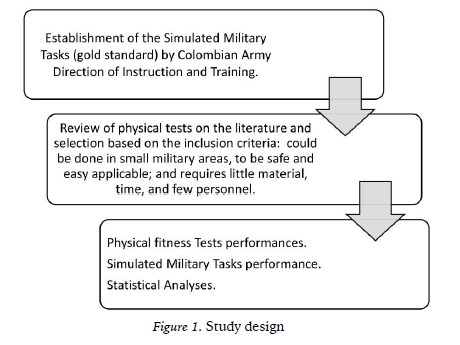
<body><![CDATA[<p><font size="3" face="Verdana"><b>METHOD</b></font></p> <font face="Verdana" size="2">     <p>This research is   part of a project to modernize the physical fitness test of the Colombian Army.   Data collection was performed at the 13<sup>th</sup> Battalion of Instruction   and Training, located 30km south of Bogota D.C., with a temperature range from 1ºC to 23ºC during the study period, and at 3100m above sea level.</p>     <p>The sample was   composed by 60 volunteers from three different platoons. The volunteers start   the data collection protocol after 2 weeks of acclimation at this altitude.   During these 2 weeks they have had different kind of operational and physical   instructions. All volunteers signed written informed consent, and all   procedures were carried out in accordance with the Declaration of Helsinki and national guidelines.</p>     <p>First, it was   established the Simulated Military Tasks to serve as a gold standard, by the   Colombian Army Direction of Training and Instruction. After, it was done a   selection of the physical fitness test which could be done in small military   areas, safe and easy applicable; and requires little material, time, and few personnel. The others phases of this study are presented in the <a href="#f1">Figure 1</a>.</p>     <p><a name="f1" id="f1"></a></p>     <p>&nbsp;</p>     <p align="center"><img src="/img/revistas/mot/v13n2/13n2a03f1.jpg" width="460" height="345"></p>     
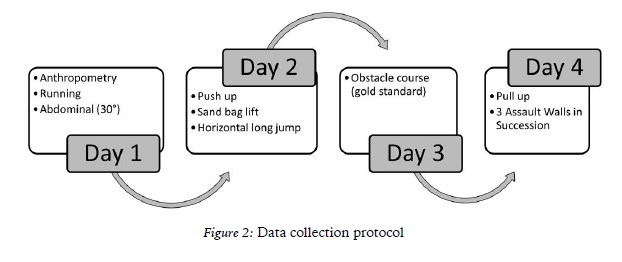
<p>&nbsp;</p>     <p>Three days before   start data collection, volunteers were instructed to avoid strenuous physical   activities for at least 24 hours prior to the evaluation (Rosa et al., 2017).   Data collection start on Monday (Day 1) and was carried out according to the sequence presented in <a href="/img/revistas/mot/v13n2/13n2a03f2.jpg">Figure 2</a>. </p>     
<p>During   anthropometric measurements, body mass was measured in kilograms (kg) using a   Filizola scale with an accuracy of 100 g and a range of 150 kg. Height was   measured in centimetres (cm), using the Frankfurt plane as a reference. From   these measurements, it was obtained Body Mass Index (BMI) values (weight/height<sup>2</sup>)   (Neves, 2008). Abdomen circumference was measured on the umbilicus using a   flexible steel tape and recorded in millimetres. The fat percentage (Fat%) was calculated by the following equation proposed by Salem (2008).</p>     ]]></body>
<body><![CDATA[<p>&nbsp;</p>     <p align="center"><img src="/img/revistas/mot/v13n2/13n2a03e1.jpg" width="501" height="58"></p>     
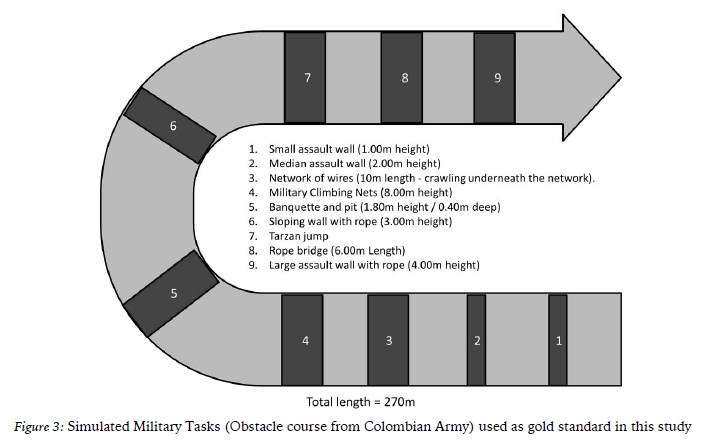
<p>&nbsp;</p>     <p>Where: AC =   Abdominal circumference, and BM = Body mass.</p>     <p>The Simulated   Military Tasks were selected from an obstacle course which already existed in   the 13th Battalion of Instruction and Training. Nine from twelve obstacles were selected to be performed as presented in the <a href="/img/revistas/mot/v13n2/13n2a03f3.jpg">Figure 3</a>.</p>     
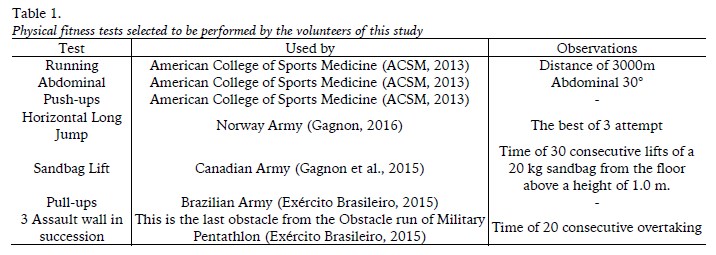
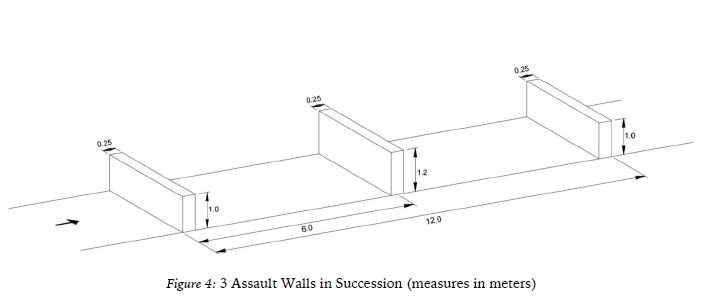
<p>The physical   fitness tests selected were presented in the <a href="/img/revistas/mot/v13n2/13n2a03t1.jpg">Table 1</a>. The last test, 3 Assault wall in succession was illustrated in <a href="/img/revistas/mot/v13n2/13n2a03f4.jpg">Figure 4</a>.</p>     
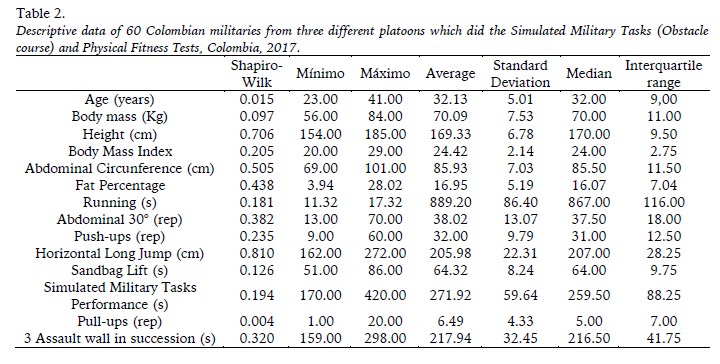
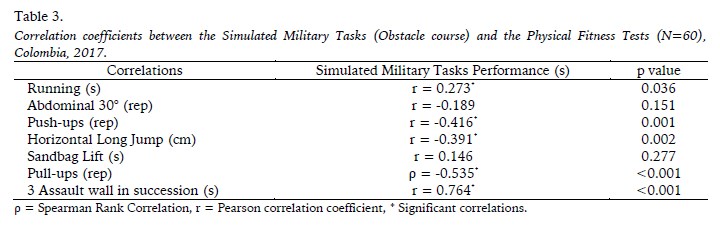
<p>The data analysis   started with the normality verification using the Shapiro-Wilk test. Once some   variables show a nonparametric distribution, descriptive data are presented as   minimum, maximum, mean, median, standard deviation, interquartile range. The correlation   analysis was performed with Pearson correlation coefficient and Spearman Rank   Correlation, according to the type of distribution presented by each variable   (Mukaka, 2012). The analyses were performed using the software Statistical   Package for Social Sciences version 21.0. The significance level was set in 0.05.</p>     <p>&nbsp;</p> </font>     <p><font size="3" face="Verdana"><b>RESULTS</b></font></p> <font face="Verdana" size="2">     <p>The <a href="/img/revistas/mot/v13n2/13n2a03t2.jpg">Table 2</a>  presents descriptive data from 60 Colombian militaries from three different   platoons which did the simulated military tasks and physical fitness tests   selected for this study. The <a href="/img/revistas/mot/v13n2/13n2a03t3.jpg">Table 3</a> presents the correlation coefficients   between the simulated military tasks performance (Obstacle course illustrated in the <a href="/img/revistas/mot/v13n2/13n2a03f3.jpg">Figure 3</a>) and the physical fitness tests selected.</p>     
]]></body>
<body><![CDATA[<p>Regarding   to the anthropometric variables, the Pearson correlations coefficients with the   simulated military tasks performance were: 0.279 with body mass (p=0.039),   0.079 with height (p=0.565), 0.271 Body Mass Index (p=0.046), 0.527 with   abdominal circumference (p&lt;0.001), and 0.505 with fat percentage (p&lt;0.001).</p>     <p>&nbsp;</p> </font>     <p><font size="3" face="Verdana"><b>DISCUSSION</b></font></p> <font face="Verdana" size="2">     <p>The objective of   this study was to investigate the correlations between the Simulated Military   Tasks Performance and Commons Physical Fitness Tests at high altitude. The main   results were the identification of a high positive correlation (Mukaka, 2012)   between the 3 Assault wall in succession and the Simulated Military Tasks   performance (r = 0.764, p&lt;0.001), and a moderate negative correlation   between pull-ups and the Simulated Military Tasks performance (r = -0.535, p&lt;0.001).</p>     <p>These results   agree with those found by Pihlainen, Santtila, Häkkinen, and Kyröläinen (2017)   when studied soldiers from Finnish Defense Forces, and they reported a   moderated correlation between the countermovement jump performed with the   combat load and a military simulated test (MST) time (&#961; = -0.659,   p&lt;0.001). They also find significant correlations among the MST time with   Pull-ups (&#961; = -0.435, p&lt;0.001), and fat percentage (&#961; = 0.534,   p&lt;0.001). In the present study, it was found a similar correlation   coefficient among the simulated military tasks with Pull-ups (&#961; = -0.535, p&lt;0.001), and the fat percentage (r = 0.505, p&lt;0.001).</p>     <p>The high positive   correlation coefficient found between the 20 consecutive overtaking of the 3   Assault wall in succession and the simulated military tasks reinforce the idea   reported by Pihlainen et al. (2017) that the endurance capacity and the muscle   power of the lower extremities are crucial performance components in anaerobic combat situations, even at high altitude (3100m above sea level).</p>     <p>However, the   correlation coefficients depend of the operational tasks stablished as   reference, i.e. those defined by Canadian Armed Forces (escape to cover,   picking, digging, stretcher-carry and sandbag fortifications, among others…),   in a project named FORCE program (Gagnon, 2016), in which they did similar   analyses between operational tasks and physical fitness tests. The correlation   coefficient between the stretcher-carry task and sandbag lift was 0.737, and   between push-ups and the sandbag fortifications task was 0.599. In the present   study, these physical fitness tests (sandbag lift and push-ups) did not show   good correlations coefficients with the simulated military tasks composed by   assault walls, network of wires, military Climbing Nets, Tarzan jump among others illustrated in <a href="/img/revistas/mot/v13n2/13n2a03f3.jpg">Figure 3</a>.</p>     
<p>Most of the   studies were done in low altitude. This study brings some results of   correlations between simulated military tasks performance and physical fitness   tests at 3100m above sea level. The sample size and the guarantee of the same   level of subject’s motivation in all days of this study protocol can be cited   as a limitation of this study. Future procedures involve increase the sample size and the test of reliability of the physical fitness tests performed.</p>     <p>&nbsp;</p> </font>     <p><font size="3" face="Verdana"><b>PRACTICAL APPLICATIONS</b></font></p> <font face="Verdana" size="2">     ]]></body>
<body><![CDATA[<p>For while, it can   be recommended the use of the 20-consecutive overtaking of the 3 Assault wall   in succession as a good way to estimate the performance in operational tasks   which involve: assault walls, network of wires, military Climbing Nets, Tarzan   jump among others illustrated in <a href="/img/revistas/mot/v13n2/13n2a03f3.jpg">Figure 3</a>, at high altitude (3100m above sea   level). This test can be done in small military areas, it is safe and easy applicable; and requires little material, time, and few personnel.</p>     
<p>&nbsp;</p> </font>     <p><font size="3" face="Verdana"><b>REFERENCES</b></font></p> <font face="Verdana" size="2">     <!-- ref --><p>ACSM, American College of Sports Medicine. (2013). <i>ACSM's   guidelines for exercise testing and prescription</i>: Lippincott Williams &amp; Wilkins.    &nbsp;&nbsp;&nbsp;&nbsp;&nbsp;&nbsp;&nbsp;&nbsp;[&#160;<a href="javascript:void(0);" onclick="javascript: window.open('/scielo.php?script=sci_nlinks&ref=366116&pid=S1646-107X201700030000300001&lng=','','width=640,height=500,resizable=yes,scrollbars=1,menubar=yes,');">Links</a>&#160;]<!-- end-ref --></p>     <!-- ref --><p>Chao, Wei-Hsun, Askew, Eldon W., Roberts, Donald E.,   Wood, Steven M., &amp; Perkins, James B. (1999). Oxidative Stress in Humans   during Work at Moderate Altitude. <i>The Journal of Nutrition, 129</i>(11), 2009-2012.    &nbsp;&nbsp;&nbsp;&nbsp;&nbsp;&nbsp;&nbsp;&nbsp;[&#160;<a href="javascript:void(0);" onclick="javascript: window.open('/scielo.php?script=sci_nlinks&ref=366118&pid=S1646-107X201700030000300002&lng=','','width=640,height=500,resizable=yes,scrollbars=1,menubar=yes,');">Links</a>&#160;]<!-- end-ref --> </p>     <!-- ref --><p>Consolazio, C. F., Nelson, R. A., Matoush, L. R., &amp;   Hansen, J. E. (1966). Energy metabolism at high altitude (3,475 m). <i>Journal of Applied Physiology, 21</i>(6), 1732-1740.    &nbsp;&nbsp;&nbsp;&nbsp;&nbsp;&nbsp;&nbsp;&nbsp;[&#160;<a href="javascript:void(0);" onclick="javascript: window.open('/scielo.php?script=sci_nlinks&ref=366120&pid=S1646-107X201700030000300003&lng=','','width=640,height=500,resizable=yes,scrollbars=1,menubar=yes,');">Links</a>&#160;]<!-- end-ref --> </p>     <!-- ref --><p>Derby, Richard, &amp; Weber, Kevin de. (2010). The athlete and high altitude. <i>Current sports medicine reports, 9</i>(2), 79-85.    &nbsp;&nbsp;&nbsp;&nbsp;&nbsp;&nbsp;&nbsp;&nbsp;[&#160;<a href="javascript:void(0);" onclick="javascript: window.open('/scielo.php?script=sci_nlinks&ref=366122&pid=S1646-107X201700030000300004&lng=','','width=640,height=500,resizable=yes,scrollbars=1,menubar=yes,');">Links</a>&#160;]<!-- end-ref --></p>     <!-- ref --><p>Exército Brasileiro, Estado Maior do Exército   Brasileiro. (2015). <i>EB20-MC-10.350  Treinamento F  ísico Militar</i> (4ª ed.). Brasília: EGGCF.    &nbsp;&nbsp;&nbsp;&nbsp;&nbsp;&nbsp;&nbsp;&nbsp;[&#160;<a href="javascript:void(0);" onclick="javascript: window.open('/scielo.php?script=sci_nlinks&ref=366124&pid=S1646-107X201700030000300005&lng=','','width=640,height=500,resizable=yes,scrollbars=1,menubar=yes,');">Links</a>&#160;]<!-- end-ref --></p>     <!-- ref --><p>Gagnon, Patrick. (2016, 22 Set). <i>FORCEcombat –   Adapting the Annual FORCE Evaluation for the Specific Demands of the Canadian   Army’s Combat Missions.</i> Paper presented at the Nordic Military Sports Leader Meeting and Symposium, Tuusula, Finland.    &nbsp;&nbsp;&nbsp;&nbsp;&nbsp;&nbsp;&nbsp;&nbsp;[&#160;<a href="javascript:void(0);" onclick="javascript: window.open('/scielo.php?script=sci_nlinks&ref=366126&pid=S1646-107X201700030000300006&lng=','','width=640,height=500,resizable=yes,scrollbars=1,menubar=yes,');">Links</a>&#160;]<!-- end-ref --></p>     <!-- ref --><p>Gagnon, Patrick, Spivock, Michael, Reilly, Tara,   Mattie, Paige, &amp; Stockbrugger, Barry. (2015). The FORCE Fitness   Profile—Adding a Measure of Health-Related Fitness to the Canadian Armed Forces   Operational Fitness Evaluation. <i>The Journal of Strength &amp; Conditioning Research, 29</i>, S192-S198.    &nbsp;&nbsp;&nbsp;&nbsp;&nbsp;&nbsp;&nbsp;&nbsp;[&#160;<a href="javascript:void(0);" onclick="javascript: window.open('/scielo.php?script=sci_nlinks&ref=366128&pid=S1646-107X201700030000300007&lng=','','width=640,height=500,resizable=yes,scrollbars=1,menubar=yes,');">Links</a>&#160;]<!-- end-ref --> </p>     <!-- ref --><p>Jonas, Wayne B, O'Connor, Francis, Deuster, Patricia,   &amp; Macedonia, Christian. (2010). Total Force Fitness for the 21st Century A New Paradigm. <i>Military Medicine, 175</i>( August Supplement ), 14-20.    &nbsp;&nbsp;&nbsp;&nbsp;&nbsp;&nbsp;&nbsp;&nbsp;[&#160;<a href="javascript:void(0);" onclick="javascript: window.open('/scielo.php?script=sci_nlinks&ref=366130&pid=S1646-107X201700030000300008&lng=','','width=640,height=500,resizable=yes,scrollbars=1,menubar=yes,');">Links</a>&#160;]<!-- end-ref --> </p>     <!-- ref --><p>Mukaka, MM. (2012). A guide to appropriate use of   correlation coefficient in medical research. <i>Malawi Medical Journal, 24</i>(3), 69-71.    &nbsp;&nbsp;&nbsp;&nbsp;&nbsp;&nbsp;&nbsp;&nbsp;[&#160;<a href="javascript:void(0);" onclick="javascript: window.open('/scielo.php?script=sci_nlinks&ref=366132&pid=S1646-107X201700030000300009&lng=','','width=640,height=500,resizable=yes,scrollbars=1,menubar=yes,');">Links</a>&#160;]<!-- end-ref --> </p>     <!-- ref --><p>Neves, Eduardo Borba. (2008). Prevalência de sobrepeso   e obesidade em militares do exército brasileiro: associação com a hipertensão arterial. <i>Ciên Saúde Coletiva, 13</i>(5), 1661-1668.    &nbsp;&nbsp;&nbsp;&nbsp;&nbsp;&nbsp;&nbsp;&nbsp;[&#160;<a href="javascript:void(0);" onclick="javascript: window.open('/scielo.php?script=sci_nlinks&ref=366134&pid=S1646-107X201700030000300010&lng=','','width=640,height=500,resizable=yes,scrollbars=1,menubar=yes,');">Links</a>&#160;]<!-- end-ref --> </p>     <!-- ref --><p>Pihlainen, K, Santtila, M, Häkkinen, K, &amp;   Kyröläinen, H. (2017). Associations of physical fitness and body composition   characteristics with simulated military task performance. <i>The Journal of     Strength &amp; Conditioning Research, Epub ahead of print</i>. doi: 10.1519/JSC.0000000000001921&nbsp;&nbsp;&nbsp;&nbsp;&nbsp;&nbsp;&nbsp;&nbsp;[&#160;<a href="javascript:void(0);" onclick="javascript: window.open('/scielo.php?script=sci_nlinks&ref=366136&pid=S1646-107X201700030000300011&lng=','','width=640,height=500,resizable=yes,scrollbars=1,menubar=yes,');">Links</a>&#160;]<!-- end-ref --><!-- ref --><p>Rohde, Ulrich, Sievert, Alexander, Rüther, Thomas,   Witzki, Alexander, &amp; Leyk, Dieter. (2015). Concept for a predeployment   assessment of basic military fitness in the German armed forces. <i>The Journal of Strength &amp; Conditioning Research, 29</i>, S211-S215.    &nbsp;&nbsp;&nbsp;&nbsp;&nbsp;&nbsp;&nbsp;&nbsp;[&#160;<a href="javascript:void(0);" onclick="javascript: window.open('/scielo.php?script=sci_nlinks&ref=366137&pid=S1646-107X201700030000300012&lng=','','width=640,height=500,resizable=yes,scrollbars=1,menubar=yes,');">Links</a>&#160;]<!-- end-ref --> </p>     <!-- ref --><p>Rosa, Claudio, Vilaça-Alves, José, Neves, Eduardo   Borba, Saavedra, Francisco José Félix, Reckziegel, Miriam Beatris, Pohl,   Hildegard Hedwig, . . . Reis, Victor Machado. (2017). The effect of weekly low   frequency exercise on body composition and blood pressure of elederly women. <i>Archivos de Medicina del Deporte, 34</i>(1), 9-14.    &nbsp;&nbsp;&nbsp;&nbsp;&nbsp;&nbsp;&nbsp;&nbsp;[&#160;<a href="javascript:void(0);" onclick="javascript: window.open('/scielo.php?script=sci_nlinks&ref=366139&pid=S1646-107X201700030000300013&lng=','','width=640,height=500,resizable=yes,scrollbars=1,menubar=yes,');">Links</a>&#160;]<!-- end-ref --> </p>     <!-- ref --><p>Salem, Marcelo. (2008). <i>Desenvolvimento e validação   de equações e índices para a determinação da gordura corporal relativa, em   militares brasileiros, a partir de medidas antropométricas.</i> (Tese de Doutorado), FIOCRUZ, Rio de Janeiro.    &nbsp;&nbsp;&nbsp;&nbsp;&nbsp;&nbsp;&nbsp;&nbsp;[&#160;<a href="javascript:void(0);" onclick="javascript: window.open('/scielo.php?script=sci_nlinks&ref=366141&pid=S1646-107X201700030000300014&lng=','','width=640,height=500,resizable=yes,scrollbars=1,menubar=yes,');">Links</a>&#160;]<!-- end-ref -->   </p>     ]]></body>
<body><![CDATA[<!-- ref --><p>United States of America. (2002). Field Manual 3-97.61 Military Mountaineering. Washington DC: Department of the Army (US).    &nbsp;&nbsp;&nbsp;&nbsp;&nbsp;&nbsp;&nbsp;&nbsp;[&#160;<a href="javascript:void(0);" onclick="javascript: window.open('/scielo.php?script=sci_nlinks&ref=366143&pid=S1646-107X201700030000300015&lng=','','width=640,height=500,resizable=yes,scrollbars=1,menubar=yes,');">Links</a>&#160;]<!-- end-ref --></p>     <!-- ref --><p>United States of America. (2015). <i>Marine Corps   Order 6100.13 W/CH 2: Marine Corps Physical Fitness Program</i>.  Washington DC: Headquarters United States Marine Corps.    &nbsp;&nbsp;&nbsp;&nbsp;&nbsp;&nbsp;&nbsp;&nbsp;[&#160;<a href="javascript:void(0);" onclick="javascript: window.open('/scielo.php?script=sci_nlinks&ref=366145&pid=S1646-107X201700030000300016&lng=','','width=640,height=500,resizable=yes,scrollbars=1,menubar=yes,');">Links</a>&#160;]<!-- end-ref --></p>     <!-- ref --><p>Wyss, Thomas, Marti, Bernard, Rossi, Sandro, Kohler,   Urs, &amp; Mader, Urs. (2007). Assembling and verification of a fitness test   battery for the recruitment of the Swiss Army and nation-wide use. <i>Schweizerische Zeitschrift fur Sportmedizin und Sporttraumatologie, 55</i>(4), 126-131.    &nbsp;&nbsp;&nbsp;&nbsp;&nbsp;&nbsp;&nbsp;&nbsp;[&#160;<a href="javascript:void(0);" onclick="javascript: window.open('/scielo.php?script=sci_nlinks&ref=366147&pid=S1646-107X201700030000300017&lng=','','width=640,height=500,resizable=yes,scrollbars=1,menubar=yes,');">Links</a>&#160;]<!-- end-ref --> </p>     <p>&nbsp;</p>     <p><b>Acknowledgments:    <br> </b>We would to say thanks to the Chief of   Colombian Army Department of Military Education, to the Director of Training   and Instruction, to the Commander of 13th Battalion of Instruction and Training, and to all volunteers of this study    <br> <b>Conflict of interest:    ]]></body>
<body><![CDATA[<br> </b>Nothing to declare    <br> <b>Funding:    <br> </b>Nothing to declare</p>     <p>Manuscript received at March 15<sup>th</sup> 2017; Accepted at June 5<sup>th</sup> 2017 </p> </font>     <p>&nbsp;</p>     <p>&nbsp;</p>     <p><font face="Verdana" size="2"><a name="end"></a><a href="#topo">*</a><i>Corresponding author</i>: Av João Luis Alves s/nº Fortaleza de São João - Urca, CEP:   22291-090, Rio de Janeiro, RJ, Brazil. <i>E-mail</i>: <a href="mailto:neveseb@gmail.com">neveseb@gmail.com</a></font></p>      ]]></body><back>
<ref-list>
<ref id="B1">
<nlm-citation citation-type="book">
<collab>American College of Sports Medicine</collab>
<source><![CDATA[ACSM's guidelines for exercise testing and prescription]]></source>
<year>2013</year>
<publisher-name><![CDATA[Lippincott Williams & Wilkins]]></publisher-name>
</nlm-citation>
</ref>
<ref id="B2">
<nlm-citation citation-type="journal">
<person-group person-group-type="author">
<name>
<surname><![CDATA[Chao]]></surname>
<given-names><![CDATA[Wei-Hsun]]></given-names>
</name>
<name>
<surname><![CDATA[Askew]]></surname>
<given-names><![CDATA[Eldon W.]]></given-names>
</name>
<name>
<surname><![CDATA[Roberts]]></surname>
<given-names><![CDATA[Donald E.]]></given-names>
</name>
<name>
<surname><![CDATA[Wood]]></surname>
<given-names><![CDATA[Steven M.]]></given-names>
</name>
<name>
<surname><![CDATA[Perkins]]></surname>
<given-names><![CDATA[James B.]]></given-names>
</name>
</person-group>
<article-title xml:lang="en"><![CDATA[Oxidative Stress in Humans during Work at Moderate Altitude]]></article-title>
<source><![CDATA[The Journal of Nutrition]]></source>
<year>1999</year>
<volume>129</volume>
<numero>11</numero>
<issue>11</issue>
<page-range>2009-2012</page-range></nlm-citation>
</ref>
<ref id="B3">
<nlm-citation citation-type="journal">
<person-group person-group-type="author">
<name>
<surname><![CDATA[Consolazio]]></surname>
<given-names><![CDATA[C. F.]]></given-names>
</name>
<name>
<surname><![CDATA[Nelson]]></surname>
<given-names><![CDATA[R. A.]]></given-names>
</name>
<name>
<surname><![CDATA[Matoush]]></surname>
<given-names><![CDATA[L. R.]]></given-names>
</name>
<name>
<surname><![CDATA[Hansen]]></surname>
<given-names><![CDATA[J. E.]]></given-names>
</name>
</person-group>
<article-title xml:lang="en"><![CDATA[Energy metabolism at high altitude (3,475 m)]]></article-title>
<source><![CDATA[Journal of Applied Physiology]]></source>
<year>1966</year>
<volume>21</volume>
<numero>6</numero>
<issue>6</issue>
<page-range>1732-1740</page-range></nlm-citation>
</ref>
<ref id="B4">
<nlm-citation citation-type="journal">
<person-group person-group-type="author">
<name>
<surname><![CDATA[Derby]]></surname>
<given-names><![CDATA[Richard]]></given-names>
</name>
<name>
<surname><![CDATA[Weber]]></surname>
<given-names><![CDATA[Kevin de]]></given-names>
</name>
</person-group>
<article-title xml:lang="en"><![CDATA[The athlete and high altitude]]></article-title>
<source><![CDATA[Current sports medicine reports]]></source>
<year>2010</year>
<volume>9</volume>
<numero>2</numero>
<issue>2</issue>
<page-range>79-85</page-range></nlm-citation>
</ref>
<ref id="B5">
<nlm-citation citation-type="book">
<collab>Estado Maior do Exército Brasileiro^dExército Brasileiro</collab>
<source><![CDATA[EB20-MC-10.350 Treinamento F ísico Militar]]></source>
<year>2015</year>
<edition>4</edition>
<publisher-loc><![CDATA[Brasília ]]></publisher-loc>
<publisher-name><![CDATA[EGGCF]]></publisher-name>
</nlm-citation>
</ref>
<ref id="B6">
<nlm-citation citation-type="confpro">
<person-group person-group-type="author">
<name>
<surname><![CDATA[Gagnon]]></surname>
<given-names><![CDATA[Patrick]]></given-names>
</name>
</person-group>
<source><![CDATA[FORCEcombat: Adapting the Annual FORCE Evaluation for the Specific Demands of the Canadian Army’s Combat Missions]]></source>
<year>2016</year>
<conf-name><![CDATA[ Nordic Military Sports Leader Meeting and Symposium]]></conf-name>
<conf-loc>Tuusula </conf-loc>
</nlm-citation>
</ref>
<ref id="B7">
<nlm-citation citation-type="journal">
<person-group person-group-type="author">
<name>
<surname><![CDATA[Gagnon]]></surname>
<given-names><![CDATA[Patrick]]></given-names>
</name>
<name>
<surname><![CDATA[Spivock]]></surname>
<given-names><![CDATA[Michael]]></given-names>
</name>
<name>
<surname><![CDATA[Reilly]]></surname>
<given-names><![CDATA[Tara]]></given-names>
</name>
<name>
<surname><![CDATA[Mattie]]></surname>
<given-names><![CDATA[Paige]]></given-names>
</name>
<name>
<surname><![CDATA[Stockbrugger]]></surname>
<given-names><![CDATA[Barry]]></given-names>
</name>
</person-group>
<article-title xml:lang="en"><![CDATA[The FORCE Fitness Profile-Adding a Measure of Health-Related Fitness to the Canadian Armed Forces Operational Fitness Evaluation]]></article-title>
<source><![CDATA[The Journal of Strength & Conditioning Research]]></source>
<year>2015</year>
<volume>29</volume>
<page-range>S192-S198</page-range></nlm-citation>
</ref>
<ref id="B8">
<nlm-citation citation-type="journal">
<person-group person-group-type="author">
<name>
<surname><![CDATA[Jonas]]></surname>
<given-names><![CDATA[Wayne B]]></given-names>
</name>
<name>
<surname><![CDATA[O'Connor]]></surname>
<given-names><![CDATA[Francis]]></given-names>
</name>
<name>
<surname><![CDATA[Deuster]]></surname>
<given-names><![CDATA[Patricia]]></given-names>
</name>
<name>
<surname><![CDATA[Macedonia]]></surname>
<given-names><![CDATA[Christian]]></given-names>
</name>
</person-group>
<article-title xml:lang="en"><![CDATA[Total Force Fitness for the 21st Century A New Paradigm]]></article-title>
<source><![CDATA[Military Medicine]]></source>
<year>2010</year>
<volume>175</volume>
<numero>^sAugust</numero>
<issue>^sAugust</issue>
<supplement>August</supplement>
<page-range>14-20</page-range></nlm-citation>
</ref>
<ref id="B9">
<nlm-citation citation-type="journal">
<person-group person-group-type="author">
<name>
<surname><![CDATA[Mukaka]]></surname>
<given-names><![CDATA[MM.]]></given-names>
</name>
</person-group>
<article-title xml:lang="en"><![CDATA[A guide to appropriate use of correlation coefficient in medical research]]></article-title>
<source><![CDATA[Malawi Medical Journal]]></source>
<year>2012</year>
<volume>24</volume>
<numero>3</numero>
<issue>3</issue>
<page-range>69-71</page-range></nlm-citation>
</ref>
<ref id="B10">
<nlm-citation citation-type="journal">
<person-group person-group-type="author">
<name>
<surname><![CDATA[Neves]]></surname>
<given-names><![CDATA[Eduardo Borba]]></given-names>
</name>
</person-group>
<article-title xml:lang="pt"><![CDATA[Prevalência de sobrepeso e obesidade em militares do exército brasileiro: associação com a hipertensão arterial]]></article-title>
<source><![CDATA[Ciên Saúde Coletiva]]></source>
<year>2008</year>
<volume>13</volume>
<numero>5</numero>
<issue>5</issue>
<page-range>1661-1668</page-range></nlm-citation>
</ref>
<ref id="B11">
<nlm-citation citation-type="journal">
<person-group person-group-type="author">
<name>
<surname><![CDATA[Pihlainen]]></surname>
<given-names><![CDATA[K]]></given-names>
</name>
<name>
<surname><![CDATA[Santtila]]></surname>
<given-names><![CDATA[M]]></given-names>
</name>
<name>
<surname><![CDATA[Häkkinen]]></surname>
<given-names><![CDATA[K]]></given-names>
</name>
<name>
<surname><![CDATA[Kyröläinen]]></surname>
<given-names><![CDATA[H.]]></given-names>
</name>
</person-group>
<article-title xml:lang="en"><![CDATA[Associations of physical fitness and body composition characteristics with simulated military task performance]]></article-title>
<source><![CDATA[The Journal of Strength & Conditioning Research, Epub ahead of print]]></source>
<year>2017</year>
</nlm-citation>
</ref>
<ref id="B12">
<nlm-citation citation-type="journal">
<person-group person-group-type="author">
<name>
<surname><![CDATA[Rohde]]></surname>
<given-names><![CDATA[Ulrich]]></given-names>
</name>
<name>
<surname><![CDATA[Sievert]]></surname>
<given-names><![CDATA[Alexander]]></given-names>
</name>
<name>
<surname><![CDATA[Rüther]]></surname>
<given-names><![CDATA[Thomas]]></given-names>
</name>
<name>
<surname><![CDATA[Witzki]]></surname>
<given-names><![CDATA[Alexander]]></given-names>
</name>
<name>
<surname><![CDATA[Leyk]]></surname>
<given-names><![CDATA[Dieter]]></given-names>
</name>
</person-group>
<article-title xml:lang="en"><![CDATA[Concept for a predeployment assessment of basic military fitness in the German armed forces]]></article-title>
<source><![CDATA[The Journal of Strength & Conditioning Research]]></source>
<year>2015</year>
<volume>29</volume>
<page-range>S211-S215</page-range></nlm-citation>
</ref>
<ref id="B13">
<nlm-citation citation-type="journal">
<person-group person-group-type="author">
<name>
<surname><![CDATA[Rosa]]></surname>
<given-names><![CDATA[Claudio]]></given-names>
</name>
<name>
<surname><![CDATA[Vilaça-Alves]]></surname>
<given-names><![CDATA[José]]></given-names>
</name>
<name>
<surname><![CDATA[Neves]]></surname>
<given-names><![CDATA[Eduardo Borba]]></given-names>
</name>
<name>
<surname><![CDATA[Saavedra]]></surname>
<given-names><![CDATA[Francisco José Félix]]></given-names>
</name>
<name>
<surname><![CDATA[Reckziegel]]></surname>
<given-names><![CDATA[Miriam Beatris]]></given-names>
</name>
<name>
<surname><![CDATA[Pohl]]></surname>
<given-names><![CDATA[Hildegard Hedwig]]></given-names>
</name>
<name>
<surname><![CDATA[Reis]]></surname>
<given-names><![CDATA[Victor Machado]]></given-names>
</name>
</person-group>
<article-title xml:lang="en"><![CDATA[The effect of weekly low frequency exercise on body composition and blood pressure of elederly women]]></article-title>
<source><![CDATA[Archivos de Medicina del Deporte]]></source>
<year>2017</year>
<volume>34</volume>
<numero>1</numero>
<issue>1</issue>
<page-range>9-14</page-range></nlm-citation>
</ref>
<ref id="B14">
<nlm-citation citation-type="">
<person-group person-group-type="author">
<name>
<surname><![CDATA[Salem]]></surname>
<given-names><![CDATA[Marcelo]]></given-names>
</name>
</person-group>
<source><![CDATA[Desenvolvimento e validação de equações e índices para a determinação da gordura corporal relativa, em militares brasileiros, a partir de medidas antropométricas.]]></source>
<year>2008</year>
</nlm-citation>
</ref>
<ref id="B15">
<nlm-citation citation-type="book">
<collab>United States of America</collab>
<source><![CDATA[Field Manual 3-97.61 Military Mountaineering]]></source>
<year>2002</year>
<publisher-loc><![CDATA[Washington DC ]]></publisher-loc>
<publisher-name><![CDATA[Department of the Army (US)]]></publisher-name>
</nlm-citation>
</ref>
<ref id="B16">
<nlm-citation citation-type="book">
<collab>United States of America</collab>
<source><![CDATA[Marine Corps Order 6100.13 W/CH 2: Marine Corps Physical Fitness Program]]></source>
<year>2015</year>
<publisher-loc><![CDATA[Washington DC ]]></publisher-loc>
<publisher-name><![CDATA[Headquarters United States Marine Corps]]></publisher-name>
</nlm-citation>
</ref>
<ref id="B17">
<nlm-citation citation-type="journal">
<person-group person-group-type="author">
<name>
<surname><![CDATA[Wyss]]></surname>
<given-names><![CDATA[Thomas]]></given-names>
</name>
<name>
<surname><![CDATA[Marti]]></surname>
<given-names><![CDATA[Bernard]]></given-names>
</name>
<name>
<surname><![CDATA[Rossi]]></surname>
<given-names><![CDATA[Sandro]]></given-names>
</name>
<name>
<surname><![CDATA[Kohler]]></surname>
<given-names><![CDATA[Urs]]></given-names>
</name>
<name>
<surname><![CDATA[Mader]]></surname>
<given-names><![CDATA[Urs]]></given-names>
</name>
</person-group>
<article-title xml:lang="en"><![CDATA[Assembling and verification of a fitness test battery for the recruitment of the Swiss Army and nation-wide use]]></article-title>
<source><![CDATA[Schweizerische Zeitschrift fur Sportmedizin und Sporttraumatologie]]></source>
<year>2007</year>
<volume>55</volume>
<numero>4</numero>
<issue>4</issue>
<page-range>126-131</page-range></nlm-citation>
</ref>
</ref-list>
</back>
</article>