

<?xml version="1.0" encoding="ISO-8859-1"?><article xmlns:mml="http://www.w3.org/1998/Math/MathML" xmlns:xlink="http://www.w3.org/1999/xlink" xmlns:xsi="http://www.w3.org/2001/XMLSchema-instance">
<front>
<journal-meta>
<journal-id>1646-107X</journal-id>
<journal-title><![CDATA[Motricidade]]></journal-title>
<abbrev-journal-title><![CDATA[Motri.]]></abbrev-journal-title>
<issn>1646-107X</issn>
<publisher>
<publisher-name><![CDATA[Edições Desafio Singular]]></publisher-name>
</publisher>
</journal-meta>
<article-meta>
<article-id>S1646-107X2017000300006</article-id>
<article-id pub-id-type="doi">10.6063/motricidade.8549</article-id>
<title-group>
<article-title xml:lang="en"><![CDATA[Contributions of body fat, fat free mass and arm muscle area in athletic performance of wheelchair basketball players]]></article-title>
</title-group>
<contrib-group>
<contrib contrib-type="author">
<name>
<surname><![CDATA[Oliveira]]></surname>
<given-names><![CDATA[Lúcia]]></given-names>
</name>
<xref ref-type="aff" rid="A01"/>
<xref ref-type="aff" rid="A02"/>
</contrib>
<contrib contrib-type="author">
<name>
<surname><![CDATA[Oliveira]]></surname>
<given-names><![CDATA[Saulo]]></given-names>
</name>
<xref ref-type="aff" rid="A01"/>
<xref ref-type="aff" rid="A02"/>
</contrib>
<contrib contrib-type="author">
<name>
<surname><![CDATA[Guimarães]]></surname>
<given-names><![CDATA[Fernando]]></given-names>
</name>
<xref ref-type="aff" rid="A01"/>
<xref ref-type="aff" rid="A02"/>
</contrib>
<contrib contrib-type="author">
<name>
<surname><![CDATA[Costa]]></surname>
<given-names><![CDATA[Manoel]]></given-names>
</name>
<xref ref-type="aff" rid="A01"/>
<xref ref-type="aff" rid="A02"/>
</contrib>
</contrib-group>
<aff id="A01">
<institution><![CDATA[,Universidade de Pernambuco  ]]></institution>
<addr-line><![CDATA[Recife ]]></addr-line>
<country>Brasil</country>
</aff>
<aff id="A02">
<institution><![CDATA[,Escola Superior de Educação Física  ]]></institution>
<addr-line><![CDATA[ ]]></addr-line>
<country>Brasil</country>
</aff>
<pub-date pub-type="pub">
<day>00</day>
<month>06</month>
<year>2017</year>
</pub-date>
<pub-date pub-type="epub">
<day>00</day>
<month>06</month>
<year>2017</year>
</pub-date>
<volume>13</volume>
<numero>2</numero>
<fpage>36</fpage>
<lpage>48</lpage>
<copyright-statement/>
<copyright-year/>
<self-uri xlink:href="http://scielo.pt/scielo.php?script=sci_arttext&amp;pid=S1646-107X2017000300006&amp;lng=en&amp;nrm=iso"></self-uri><self-uri xlink:href="http://scielo.pt/scielo.php?script=sci_abstract&amp;pid=S1646-107X2017000300006&amp;lng=en&amp;nrm=iso"></self-uri><self-uri xlink:href="http://scielo.pt/scielo.php?script=sci_pdf&amp;pid=S1646-107X2017000300006&amp;lng=en&amp;nrm=iso"></self-uri><abstract abstract-type="short" xml:lang="en"><p><![CDATA[The aims of this study were: to verify the relationship (1) and dependency (2) between body fat (BF), fat free mass (FFM) and the arm muscle area (AMA) with athletic performance of wheelchair basketball players. Twenty-two subjects were evaluated according to the following order, in 24-hour intervals: a) anthropometric measurements and the Wingate anaerobic test (day 1); b) assessment of VO2peak and threshold (2); and c) specific tests (3). The results showed satisfactory relationships of AMA with handgrip left (r=.36; p=.08), VO2peak (r=.59; p=.03), medicine ball throwing (r=.54; p=.00), absolute (r=.61; p=.00) and relative anaerobic power (r=.67; p=.00). BF with handgrip left (r= .43; p=.03), medicine ball throwing (r=.50; p=.01), absolute (r=.77; p=.00) and relative (r=.82; p=.00) anaerobic power. And FFM with handgrip (r=.44; p=.03), medicine ball throwing (r=.43; p=.03), absolute (r=.64; p=.00) and relative (r=.69; p= .00) anaerobic power. The regression analyses revealed that only predictive models by AMA presented good determination coefficients to VO2peak (r²=.35; p=.00), medicine ball throwing (r²=.29; p=.00), absolute (r²=.37; p=.00) and relative (r²=.46; p=.00) anaerobic Power. The results indicated the importance to consider some anthropometric measures, in particular muscular tissue, to sport training and athletic performance evaluation of wheelchair basketball players.]]></p></abstract>
<kwd-group>
<kwd lng="en"><![CDATA[disabled persons]]></kwd>
<kwd lng="en"><![CDATA[athletic performance]]></kwd>
<kwd lng="en"><![CDATA[physical fitness]]></kwd>
<kwd lng="en"><![CDATA[body composition]]></kwd>
</kwd-group>
</article-meta>
</front><body><![CDATA[  <font face="Verdana" size="2">       <p align="right"><b>ORIGINAL ARTICLE</b></p>      <p>&nbsp;</p> </font>     <p><font size="4" face="Verdana"><b>Contributions of body fat, fat free   mass and arm muscle area in athletic performance of wheelchair basketball   players</b></font></p> <font face="Verdana" size="2">     <p>&nbsp;</p>     <p>&nbsp;</p>     <p><b>Lúcia Oliveira<sup>1</sup>; Saulo Oliveira<sup>1<a href="#end">,*</a></sup><a name="topo"></a>; Fernando Guimarães<sup>1</sup>; Manoel Costa<sup>1</sup></b></p>     <p><sup>1</sup> <i>Universidade de Pernambuco, Recife, Brasil. Escola Superior de Educação Física, ESEF, Brasil.</i></p>     <p>&nbsp;</p>     <p>&nbsp;</p> </font> <hr noshade size="1"> <font face="Verdana" size="2">     ]]></body>
<body><![CDATA[<p><b>ABSTRACT</b></p>     <p>The aims of this study were: to verify   the relationship (1) and dependency (2) between body fat (<i>BF</i>), fat free   mass (<i>FFM</i>) and the arm muscle area (<i>AMA</i>) with athletic   performance of wheelchair basketball players. Twenty-two subjects were   evaluated according to the following order, in 24-hour intervals: a)   anthropometric measurements and the Wingate anaerobic test (day 1); b)   assessment of VO<sub>2peak</sub> and threshold (2); and c) specific tests (3).   The results showed satisfactory relationships of <i>AMA</i> with handgrip left   (r=.36; p=.08), VO<sub>2peak</sub> (r=.59; p=.03), medicine ball throwing   (r=.54; p=.00), absolute (r=.61; p=.00) and relative anaerobic power (r=.67;   p=.00). <i>BF</i> with handgrip left (r= .43; p=.03), medicine ball throwing   (r=.50; p=.01), absolute (r=.77; p=.00) and relative (r=.82; p=.00) anaerobic   power. And <i>FFM</i> with handgrip (r=.44; p=.03), medicine ball throwing   (r=.43; p=.03), absolute (r=.64; p=.00) and relative (r=.69; p= .00) anaerobic   power. The regression analyses revealed that only predictive models by <i>AMA</i>   presented good determination coefficients to VO<sub>2peak</sub> (r<sup>2</sup>=.35;   p=.00), medicine ball throwing (r<sup>2</sup>=.29; p=.00), absolute (r<sup>2</sup>=.37;   p=.00) and relative (r<sup>2</sup>=.46; p=.00) anaerobic Power. The results   indicated the importance to consider some anthropometric measures, in   particular muscular tissue, to sport training and athletic performance evaluation of wheelchair basketball players.</p>     <p><b>Keywords:</b> disabled persons, athletic performance, physical fitness, body composition.</p> </font> <hr noshade size="1">     <p><font face="Verdana" size="2"> </font></p> <font face="Verdana" size="2">     <p>&nbsp;</p>     <p><b>INTRODUCTION</b></p>     <p>Wheelchair   basketball is considered one of the precursors of the Paralympic Movement. It   is a modality that contains various types of athletes with different   disabilities, but which are equivalent in terms of functionality through its   classification system. Currently, its regulation occurs through of the   International Wheelchair Basketball Federation (IWBF). Its rules are managed by   the IWBF in all competitions, whether national or international. The rules of   wheelchair basketball, if compared to the standard basketball, has a few   changes. In wheelchair Basketball, the wheelchairs have their camber (wheel   axle) amended for greater stability on the court. Because of this, they generate   a better athletic performance and safer throwing and dribbling. In adapted   sport, there is also a classification of athletes due to the functional   disparity between them. The functional classification of wheelchair basketball   athletes is well defined by people with spinal cord injury or similar   disabilities. They are classified in 1.0, 1.5, 2.0, 2.5, 3.0, 3.5, 4.0, 4.5, where the lowest numbers refer to minor functionality.</p>     <p>Wheelchair   basketball requires a performance survey from the athletes through collected   and data analysis appropriate. However, as the performance is related to many   factors such as technical support, biomechanics and physiologic parameters   (Goosey-Tolfrey, 2010; Laferrier et al., 2012). Among the criteria used to   evaluate and control sessions of training, aerobic capacity and anaerobic are   chosen because of its strong relationship with the energy demands of the sport   (Flores, de Campos, Gouveia, de Souza Pena, &amp; Gorla, 2013; Goosey-Tolfrey,   &amp; Tolfrey, 2008; Vanlandewijck, Van De Vliet, Verellen, &amp; Theisen,   2006;), as well as specific skills tests commonly used by athletes on the court (Vanlandevijck, Daly, &amp;Theisen, 1999).</p>     <p>Therefore, the   body composition analysis of athletes is an important factor to evaluate and   control the physical fitness, measuring the practices and reliably lean mass of   those individuals (Goosey-Tolfrey, 2005; Goosey-Tolfrey &amp; Leicht, 2013;   Goosey-Tolfrey, &amp; Tolfrey, 2008;). In this sense, Neto and Lopes (2011)   enforce that body composition evaluation is a way to analyze the distribution   of different tissues, organs and components responsible for determining the   ratio of lean and fat body mass, which are predictive variables for physiological answers to training.</p>     <p>Thus, the   importance of studying the link between body composition and performance, comes   from the lack of evidence about athletes with disability, which is still wide.   According to Mello and Winckler (2012) the variety of deficiencies in adapted   sports generates a lack of standard reference and develops defined studies.   Knowing these difficulties our aim is to relate the lean mass of wheelchair   basketball players in athletic performance variables commonly used for   performance evaluation in sport. Being an intermittent sport, wheelchair   basketball players usually need a physical training that provides stimulus and   enhanced aerobic and anaerobic capacities, as well as muscle power (Davis &amp;   Shephard, 1990; Granados et al, 2015; Noreau, Shephard, Simard, Paré, &amp; Pomerleau, 1993;).</p>     ]]></body>
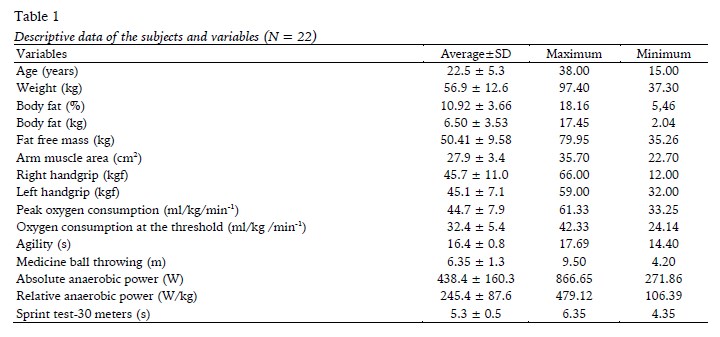
<body><![CDATA[<p>Previous studies   have shown that there are relative contributions to the diverse body components   in athletic performance. Among the components, the fat free mass (muscle mass)   represents the metabolic active tissue which by muscle contractions can provide   the locomotion and physical performance. From the proposed methods to quantify   the muscular component, the arm muscle area (AMA) has been utilized because it   presents strong relation to the sport performance (Moura, et al., 2014; Santos,   et al, 2014). Nevertheless, it is not well known what the relative   contributions are, and neither the existent associations between the muscle mass and the athletic performance in wheelchair basketball players.</p>     <p>Referring to   people with disability, especially those who utilize wheelchairs, the AMA seems   to be more recommended because it focuses only on anthropometric measures of   the non-injured limb. From point of view of sports performance in wheelchair   basketball, studies have shown that physical fitness tests as well as   assessment protocols through specific skills of the sport can be sensitive for   comparison class teams and different performance levels (Barfield &amp; Malone,   2012; Rhodes, Mason, Malone, &amp; Goosey-Tolfrey, 2015). It is noted that the   specific functional classification seems to influence in a significant way the   performance of the sport athletes in general and specific tests of sport (Molik   et al., 2014; Molik, Laskin, Kosmol, Skucas, &amp; Bida, 2010). However, the   influence of anthropometric characteristics or body composition on athletic performance basketball players in wheelchairs has not yet been properly studied.</p>     <p>Therefore,   knowing the paradigm of locomotion in wheelchair users, and the importance of   body composition to sport performance, the aim of the present study was: a) to   verify the relationship between the body composition and physical performance   in wheelchair basketball players. And b) additionally, we propose the   quantification of the degree in athletic performance by muscle mass and percent body fat.</p>     <p>&nbsp;</p> </font>     <p><font size="3" face="Verdana"><b>METHODS</b></font></p> <font face="Verdana" size="2">     <p><b>Cross-sectional design</b></p>     <p>This research was   conducted in three phases and is properly registered with the Ethics Committee   of the University of Pernambuco/Brazil (register 078/2011). In the first,   subjects were conducted and properly oriented about the procedures that would   be performed in steps. Then had their actual anthropometric profile in a   standard way by a single trained investigator. Body mass was collected by means   of a mechanical scale (Filizola, BRA) with a precision of 100 grams. Even at   this stage, engines tests were performed related to anaerobic capacity   (Wingate). In the second phase, it was conducted a cardiorespiratory evaluation   protocol through open circuit spirometry, direct verification of the volume of   exhaled gases. In the third and final stage, field tests were conducted to   check agility (maneuverability), speed, handgrip strength and medicine ball   throwing. All stages were performed in the afternoon, with an interval of 24   hours, being the first and second stages at the laboratory with controlled   temperature and relative humidity (24ºC and 44%, respectively), and performance   tests were performed on a basketball court similar to the training conditions   of the athletes. In all situations, the subjects used their own sport wheelchair.</p>     <p><b>Participants</b></p>     <p>Participated in   the present study 22 players, properly registered in the Federação Brasileira   de Basquetebol em Cadeiras de Rodas (CBBC). All subjects had medical clearance   to practice physical exercises. The descriptive data of the subjects are   presented in <a href="/img/revistas/mot/v13n2/13n2a06t1.jpg">Table 1</a>. Due to the absence of recent procedures of functional   classification of the participants, this information was not used in this   research. All in all, the athletes who participated in the study had paraplegia   (N= 4), poliomyelitis (N= 9), amputation (N= 3) and malformation in the lower body (N= 6). </p>     
<p><b>Procedures</b></p>     ]]></body>
<body><![CDATA[<p><i>Procedures to measure body composition and arm muscle area</i></p>     <p>Initially, it was   collected the triceps, subscapular, abdominal and axillary skinfold thickness   through a scientific caliper (Lange, USA). The values found are included in the   equation proposed by Evans, Rowe, Misic, Prior, and Arngrimsson (2005),   validated by Mojtahedi, Valentine, and Evans (2009) to determine the percent body fat: </p>     <p>&nbsp;</p> </font>     <p align="center"><font face="Verdana" size="2"><a href="/img/revistas/mot/v13n2/13n2a06e1.jpg">Equation 1</a> </font></p> <font face="Verdana" size="2">     
<p>&nbsp;</p>     <p>Then they   calculated the fat-free mass (FFM) and body fat (BF), both in kilograms. The   weight of the subjects was evaluated in a mechanical balance accurately 100g   (FILIZOLA, BRA), with athletes out of wheelchairs and properly seated. The arm   muscle area (AMA) was calculated using the model proposed by Frisancho (1981).   For this measure relaxed and contracted right arm circumference were collected   in centimeters, using a flexible fiber anthropometric tape (Mabbis, JAP) with a   degree in millimeters. Subsequently, the triceps skinfold thickness was   collected. All samples were taken in the right hemisphere of the participants,   by a previously trained evaluator and using standardized measurement criteria   (ISAK). After the collection of all points, the values were properly corrected for centimeters and substituted into the equation: </p>     <p>&nbsp;</p>     <p align="center"><img src="/img/revistas/mot/v13n2/13n2a06e2.jpg" width="338" height="64"></p>     
<p>&nbsp;</p>     <p>Where AMA is the   arm muscle area with arm relaxed, AC (cm) is the arm circumference, TS (cm) is   the thickness of triceps skinfold thickness, and &#960; = 3.1416. The participants of this investigation presented no   disabilities and improved arms perimeters.</p>     ]]></body>
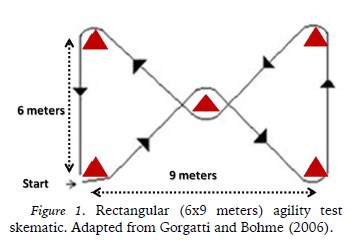
<body><![CDATA[<p><i>Test peak oxygen consumption (VO<sub>2</sub>peak)</i></p>     <p>The aerobic work   capacity was verified by an incremental treadmill test, specially designed for   wheelchair users (Imbramed, Wheelchair Series, BRA). Initially the subjects   were positioned on the conveyor belt, and properly instructed regarding the   security measures. At the distal end of the belt safety straps was placed a   metal rod coated with a pad, to serve as a displacement limiter back of the   sample. Then, the test began with a 5-minute warm up period, at a speed of 4   km/h. After this period, the protocol consisted of 1-minute stages, increasing   the speed by 1 km/h each stage till subject exhaustion. At all times the gas   exchange was measured using an open circuit spirometry system (COSMED, ITA),   pre-calibrated according to the manufacturer's instructions. The criterion for   determination of peak oxygen consumption (VO<sub>2peak</sub>) and respiratory   decompensation point (ventilatory threshold or anaerobic threshold) was   proposed by Wasserman, Hansen, Sue, Whipp, and Froelicher (1987), with the   display of the inflection curve of oxygen consumption and dioxide carbon   production. In addition to the voluntary withdrawal of the subjects, the test   was interrupted when a heart rate of approximately 95% of maximum predicted for age, and a respiratory quotient equal to or greater than 1 was achieved.</p>     <p><i>Wingate anaerobic test </i></p>     <p>For verification   of the maximum anaerobic power a Wingate test in an arm ergometer with   mechanical braking (CEFISE, BRA) was used. Initially, the subjects were placed   on the ergometer by a regulator according to their anthropometric   characteristics. Then, the subjects underwent a 5-minute warm-up period in the   equipment itself, without the use of braking loads. After this period, the   participants were instructed to develop the maximum possible speed in a period   of 10 seconds. Immediately after this period a corresponding braking load to 5%   of the body weight of the subject was placed, and the subjects were instructed   to maintain the same speed for a period of 30 seconds. In the meantime, the   number of rotations was measured by inductive sensor (Sensorbras, BRA) every 5   seconds, and transmitted to the computer. The maximum and mean power was   calculated (POMÁX and POMED, respectively) and the percentage of fatigue index   (FI%), based on the relationship between the number of revolutions (RPM), and the braking load supported during 30 seconds. </p>     <p><i>Rectangular Agility test</i></p>     <p>To evaluate the   agility it was used a test proposed by Gorgatti and Bohme (2006). Five cones   were distributed on the court in a rectangle 6 feet wide by 9 meters long. A   cone is positioned in the center of the rectangle to serve as a cone maneuver.   The subjects were instructed to roam, <i>zig zag</i>, the course marked by   cones in the shortest time possible. A previously trained investigator was   positioned in the cone of start/finish, activating the timer to the first   movement and stopping when the subjects fully surpassed the finish line. The   procedure was repeated twice, with the shortest time between attempts to measure agility. <a href="#f1">Figure 1</a> illustrates organized route.</p>     <p><a name="f1"></a></p>     <p>&nbsp;</p>     <p align="center"><img src="/img/revistas/mot/v13n2/13n2a06f1.jpg" width="354" height="250"></p>     
<p>&nbsp;</p>     ]]></body>
<body><![CDATA[<p><i>Sprint test of 30 meters (30 m-sprint)</i></p>     <p>The speed test at   30 meters (Gaya &amp; Silva, 2007), was used to evaluate the rapid straight   deployment capacity. A course measured on the sidelines of the playing court   was used as reference. Two cones are positioned at the ends to signal the start   and end of test. A third cone was placed 5 meters after the finish line, and   the participants were instructed to patrol the distance to the third cone at   the highest possible speed without deviate from the route. This was necessary   to prevent the subjects deceleration before arriving at the last cone. An   evaluator was positioned in the cone of arrival, and controlled the output (in   the first movement) and the arrival (when exceeded the line demarcated by the   cone) of the participants. The procedure was repeated twice, and it was considered the shortest time between attempts.</p>     <p><i>The medicine ball throwing test</i></p>     <p>Originally   described by Marins and Giannichi (1996), the throwing of medicine ball test   was used to evaluate the power of the upper limbs. Sitting in their one   wheelchair subjects were instructed to throw one 2kg medicine ball as far as   possible. Participants had their wheelchairs positioned on a side wall of the   court to prevent back displacement. One investigator was positioned on the back   of the wheelchair to prevent subjects movements and help to execute the   movement with the trunk pitch. A second evaluator was positioned in order to   check the exact location where the ball touched the ground. In two attempts, it was considered the longest distance.</p>     <p><i>Handgrip dynamometry</i></p>     <p>The subjects were   comfortably seated. Then, with the arm and forearm forming an angle of 90°, the   participants had the manual dynamometer (Jamar, JAP) adjusted to the size of   their hands. At the signal of evaluators subjects performed the clamping motion   with their hands, using the maximum isometric strength as possible for 5   seconds. The same procedure was repeated 2 times in each hand alternately. The highest value in kilogram-force reached was considered.</p>     <p><b>Statistical analysis</b></p>     <p>Previously, an   exploratory analysis of data was performed in order to verify the assumptions   of normality using the Shapiro-Wilk test. Then the measures of central tendency   and normality were analyzed by mean and the respective standard deviations of   all variables. Given that, all parametric data were considered to verify the   relationship between the AMA, BF and FFM with the various physical fitness variables, and Pearson product-moment correlation coefficient was calculated.</p>     <p>Then to determine   the relative contribution of the AMA, BF and FFM on athletic performance, it   was used a simple linear regression analysis for those variables considered   significantly associated with <i>p</i>&#8804;0.05. An isolated mathematical   model for each performance variable was created and the wire prediction level   checked by the value of the determination coefficient (R<sup>2</sup>) and their   respective statistical significance. Data were tabulated and calculated using   the Graphpad Prism (Version 5.0, GraphPad, USA). For all analyzes, it was considered a significance level of <i>p</i>&#8804; .05.</p>     <p>&nbsp;</p> </font>     ]]></body>
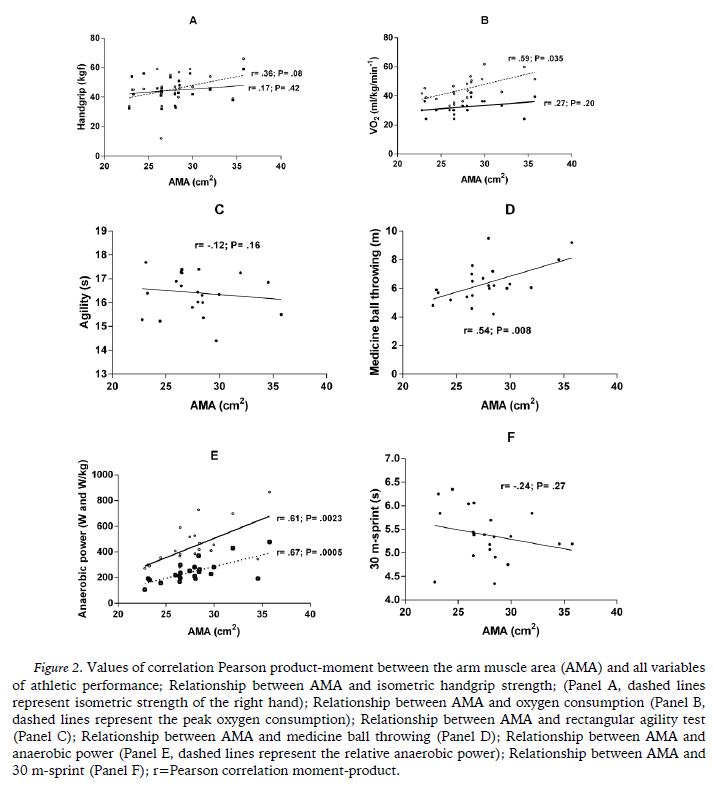
<body><![CDATA[<p><font size="3" face="Verdana"><b>RESULTS</b></font></p> <font face="Verdana" size="2">     <p>In <a href="/img/revistas/mot/v13n2/13n2a06t1.jpg">Table 1</a>  descriptive data is presented. Correlation between AMA and athletic performance variables are shown in <a href="/img/revistas/mot/v13n2/13n2a06f2.jpg">Figure 2</a>.</p>     
<p><i>Relationships between body composition and arm muscle area with athletic performance</i></p>     <p>Analyzing   the Pearson correlation coefficients (<a href="/img/revistas/mot/v13n2/13n2a06f2.jpg">Figure 2</a>), positive relationships are   found between the AMA and the handgrip (r= .36; p= .08; panel A), peak oxygen   consumption (r= .59; p= .035) and threshold (r= .27; p= .20; panel B), medicine   ball throwing (r= .54; p= .008; panel D) and absolute (r= .61; p= .002) and   relative anaerobic power (r=.67; p= .0005; panel E). For agility and speed   tests correlations are negative (r= -.12; p= .16; panel C and r= -.24; p= .27;   panel F, respectively), indicating inversely proportional relationship.   However, only oxygen consumption, anaerobic power and throwing medicine ball, showed statistically significant values (<i>P</i> &lt;.05).</p>     
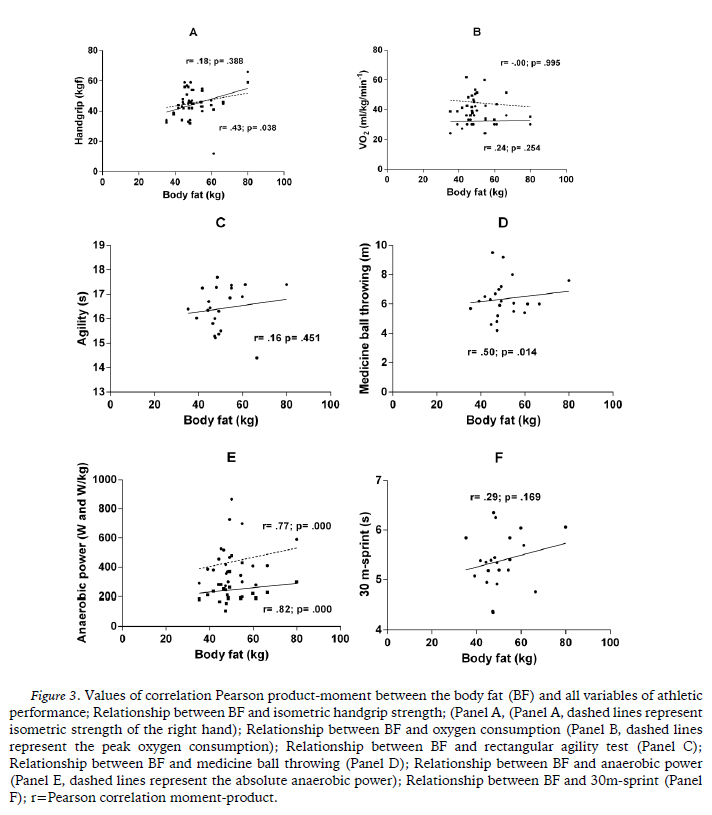
<p>In <a href="/img/revistas/mot/v13n2/13n2a06f3.jpg">figure 3</a> the values of correlation between the fat   mass and athletic performance variables are presented. Significant associations   were found with isometric force of the left hand (r= .43, p= .038; panel A),   medicine ball throwing (r= .50, p= .014; panel D) and absolute anaerobic power   (r= .77, p= 0.000) and relative (r= .82, p= .000), both in the panel E.   Regarding the other variables, weak relationships were checked with the agility   (r= .16; p= .451, panel C), with time 30 m-sprint (r= .29, p= .169; F panel)   and oxygen consumption threshold (r = .24, p =. 254; panel B). From the peak   oxygen consumption, fat mass was negatively and weakly correlated (r = -.00, p = .995; panel B).</p>     
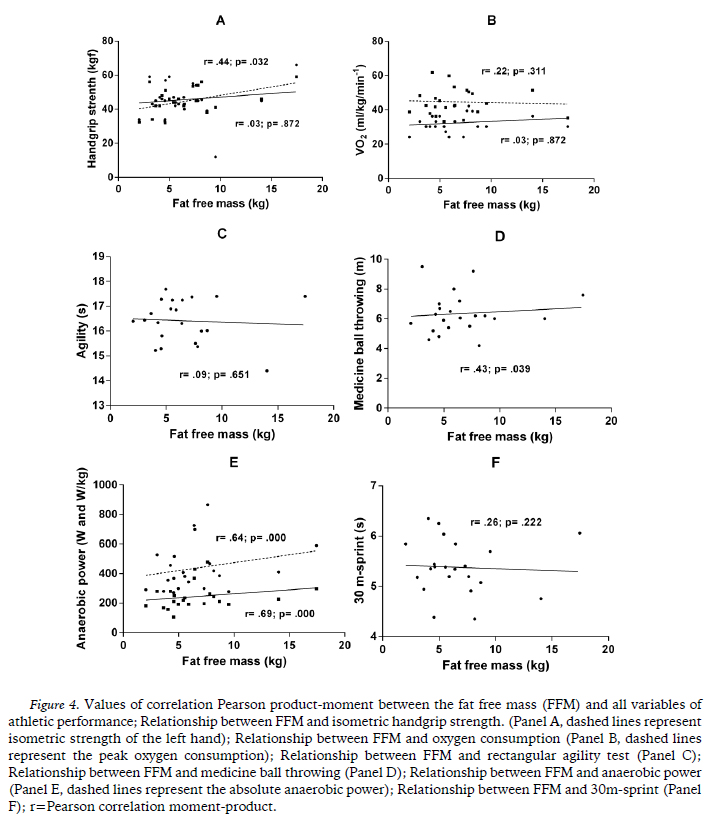
<p>Regarding the fat free mass, <a href="/img/revistas/mot/v13n2/13n2a06f4.jpg">figure 4</a>  shows the correlation values with all the athletic performance variables.   Positive and significant correlations were found with the isometric force of   the left hand (r= .44, p= .032; panel A), throwing medicine ball (r= .43, p=   .039; panel D), and the absolute (r= .64; p= .000) and relative aerobic power   (r= .69; p= .000), both can be viewed in panel E. There were positive and weak   correlation to the isometric strength of his right hand (r= .03; p= .872; panel   A), the oxygen consumption threshold (r= .003; p= .872) and peak (r= .22; p=   .311; panel B), the agility (r= .09; p= .651; panel C) and the time in the 30 m-sprint (r = .26; p = .222; panel D).</p>     
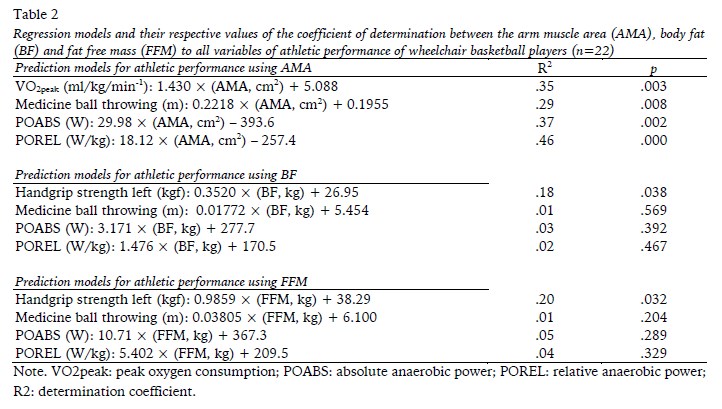
<p><i>Contributions of the arm muscle area and body composition for athletic performance</i></p>     <p>All explanatory mathematical models for   each dependent variable (athletic performance) and independent (AMA, BF and   FFM) was presented in <a href="/img/revistas/mot/v13n2/13n2a06t2.jpg">table 2</a>. After mathematical modeling using simple linear   regression between AMB and VO<sub>2peak</sub>, POMÁX, POMED and MB, all   developed models were statistically valuable when comparing the actual values   and those estimated by the model (<i>p</i>&lt;.05). In addition, predictive   models based on AMB showed determination coefficient values (R<sup>2</sup>)   greater than 20%, to .35 (35%) for VO<sub>2peak</sub>; .37 (37%) for POABS and 0.46 (46%) for POREL; and .29 (29%) for the medicine ball throwing.</p>     
<p>For the prediction model taken from body fat, only the   left hand isometric strength showed significant results for the coefficient of   determination (R<sup>2</sup>= .18, p= .038), explaining about 18% of the variation   observed in isometric strength. The determination coefficient to medicine ball   throwing was .01 (.1%), the absolute power .03 (.3%) and the relative power of   .02 (.2%). For these predictive models (medicine ball and anaerobic power), based on body fat, values were not found significant.</p>     <p>Similarly, with respect to fat free mass, only the   left hand isometric strength showed significant results for the determination   coefficient (R<sup>2</sup>= .20, p= .32), explaining about 20% of the observed   variation in isometric strength. For the medicine ball throwing the   determination coefficient values were .01 (.1%), the absolute power .05 (.5%) and the relative power .04 (.4%), each with no significant values (p&lt;.05). </p>     ]]></body>
<body><![CDATA[<p>&nbsp;</p> </font>     <p><font size="3" face="Verdana"><b>DISCUSSION</b></font></p> <font face="Verdana" size="2">     <p>The objectives of   this study were a) to determine the relationship between the composition and   the muscular area of the arm with athletic performance in wheelchair basketball   players; and b) check the level of dependency between these variables in the   group of athletes. Thus, the main result of this study was to analyze   objectively the importance of fat free mass, body fat, the arm muscular area, and the relationship with the performance in wheelchair basketball players.</p>     <p>Among the   analyzed variables, oxygen consumption, dynamic muscle strength (represented by   the distance of the medicine ball throwing) and isometric (handgrip) strength   beyond the anaerobic power, were those that were more related and might have   predicted performance more efficiently than the body composition and the arm   muscle area. To date there have been no studies conducted for this purpose,   probably due to lack of standardized anthropometric methods in addition to the variety of procedures for conditioning tests for this audience.</p>     <p><i>Relationship between the variables</i></p>     <p>In this sense,   Ozmen, Yuktasir, Yildirim, Yalcin, and Willems (2014) reported that the   strength and power are key variables in wheelchair basketball, for the case of   a sport that requires certain specific movements (e.g. free throw, dribbling   and wheelchair propulsion) muscle strength and physical fitness must be   estimated for these athletes. Although there are no validated methods for   assessing body composition in athletes with disabilities, Mojtahedi, Valentine,   and Evans (2009), in their study of athletes with spinal cord injury, suggested   that body composition data are important in monitoring training programs   resulting in an improved performance of the athlete. In this sense, it is   recommended, where possible, the use of more robust methods for assessing body composition, such as DEXA (Dual Energy X-Ray), or ultrasound.</p>     <p>We know that the   evaluation of oxygen consumption is an excellent predictor for analyzing body   composition of any individual, whether spinal cord injured, either individuals   without injury. However, VO<sub>2</sub>max is a commonly used index and used to   evaluate the level of cardiorespiratory fitness of individuals, being   considered the best indicator of the cardiorespiratory system and aerobic   fitness. Flores, de Campos, Gouveia, de Souza Pena, and Gorla (2013) stated   that the VO<sub>2max</sub> is the best marker for the functional capacity of   individuals. Therefore, the greater the fitness of the individual (lean body mass) higher his VO<sub>2</sub>.</p>     <p>The arm muscle   area is an important predictor of performance in individual sports such as   swimming (Santos et al., 2014). This study also showed that the amount of   muscle is presented as a control factor or high associative strength also in   athletes with a physical disability. Most of associations found through the   Pearson correlation coefficients showed that maintaining optimal levels of   muscular cross section in the upper limbs promotes better results on   standardized tests, including those not directly related to the body composition, such as maximum oxygen consumption.</p>     <p>The metabolic   capacity, in particular can be explained by the different phases of oxygen   consumption (Denadai, 1995). Some of these steps include the use of oxygen as   an energy source, and thus a greater muscle contribution, adduced by higher   enzymatic components and local energy substrates, could influence the momentary   income gains in a standardized exercise test (Vanlandewijck, Daly, &amp; Theisen, 1999; Vanlandewijck, van de Vliet, Verellen, &amp; Theisen, 2006).</p>     <p>There were also   positive and significant correlations between AMA and Wintage test parameters.   This capability, in particular is extremely dependent on the number of   metabolically active tissue component, as well as substrate to withstand stress   by the predetermined time (30 seconds). A prominent factor in this regard is   that both power variables, both the relative and absolute, showed to be   significant. In this regard, although we had different disabilities in the team   (spina bifida, spinal cord injury-rachis, polio, amputations, etc.), muscle   cross-sectional area appears to have an important influence on the physical performance of athletes.</p>     ]]></body>
<body><![CDATA[<p>This research   showed that the arm muscle area, body fat and fat free mass were correlated and   showed significant prediction levels in relation to isometric strength of the   right and left hands. To date there is no data in the literature that can   support these findings in samples of athletes with physical disabilities. Thus   Miller (2002) stated that the biomechanical characteristics of the pitch in the   top level basketball athletes can be described with the elevation of the ball   beyond the face in the position where the movement is completed with the   extension of the right elbow and flexion of wrist and fingers. Regardless of   the dominant hand, a player with good technical level should display such characteristics.</p>     <p>Thus, contrasting   with throwing arm, the opposite one should serve as support and guidance to the   basket, performing an important contraction (often isometric) to control the   technical gesture. In addition to this technical aspect, some gaming action can   also occur in slow contraction speed conditions, or even isometric such that   the ball disputes, blocks and rebounds near basket (Wang, Chen,   Limroongreungrat, &amp; Change, 2005). Nevertheless, this study showed that the   dependence of the isometric strength levels for muscularity indicators and body composition were not considered significant.</p>     <p><i>Level of dependency between the variables</i></p>     <p>Among the   predictive mathematical models found in this study, those with the best   determination coefficient, and consequently the greater explanatory power for   athletic performance were those that predicted peak oxygen consumption (35%   explanatory power) and power absolute anaerobic (37% of explanatory power) and   relative (46% explanatory power), all obtained through the arm muscle area. The   other models derived from the fat mass and fat-free mass did not show   determination coefficient (R<sup>2</sup>) greater than .20, values related to explanatory powers of up to 20% of the variance explained by the model.</p>     <p>Some factors   could be contributing to these findings. Initially, the method used in this   study to determine the arm muscle area considers only the morphological   dimensions of the upper limbs, regardless of the subject analysis (Serpa,   Nogueira, &amp; Pompeu, 2014). Thus, becomes an index accepted for control of   the training or even the nutritional level of athletes with some kind of   physical disabilities, especially those who have the ends of the upper limbs preserved.</p>     <p>This same characteristic   does not occur with the estimated equations for determining the body   composition (body fat and fat free mass), as is the case of the model chosen in   this study, which are used in this population. Commonly equations are proposed   for athletes and sedentary subjects without shortcomings and then validated   according to the characteristics of a given population. This implementation may   lead to estimation errors due to expected changes in the distribution of body   components (fat, skeletal muscle, bone and water) in some types of common   disorders such as quadriplegia, paraplegia, and poliomyelitis (Cimigliaro et al, 2013).</p>     <p>In general, it is   noticed that the arm muscle area accounts for 46% of income in relative   anaerobic power, 37% in absolute anaerobic power and 35% in oxygen consumption.   These findings show the relative importance of morphology in the metabolic   athletic performance in basketball players in wheelchairs. Other factors such   as the time of practice, individual skill, economy of movement and the level of   training, may be contributing to the athletic performance in specific ways in each of the dimensions analyzed.</p>     <p>In our   understanding, this study points out important indicators when dealing with   wheelchair basketball players. The use of the upper limbs while shifting the   drivers in wheelchairs, both to perform specific actions play (offense and   defense), and to perform motor tasks with aerobic and anaerobic   characteristics, as pointed out in previous studies (Molik et al., 2008; Pérez-Tejero &amp; Pinilla Arbex, 2015).</p>     <p>An additional   concern in the context of sports for people with disabilities, especially at   higher levels of performance, is the consideration of a simple and low-cost   measure that could serve as a parameter of training control during the season.   This becomes of paramount importance for coaches, physiologists and players,   increasing the assessment of physical performance of athletes in this population.</p>     <p>The main   limitation of the study was the non-utilization of the functional classification   of the evaluated athletes. However, considering outdated values of   functionality could influence negatively the results found. In this regard, it   is recommended that further studies must be conducted controlling possible   influencing variables in each of these physiological aspects. An important   recommendation is to consider the functional classification system developed   for wheelchair basketball or other type of disability. Finally, another   limitation was the use of standard methods for assessing body composition of   wheelchair athletes. Still, there are no low cost validated methods for such analysis in this population.</p>     ]]></body>
<body><![CDATA[<p>&nbsp;</p> </font>     <p><font size="3" face="Verdana"><b>CONCLUSION</b></font></p> <font face="Verdana" size="2">     <p>In view of the   results presented, we concluded that there is significant influence of lean   mass, particularly skeletal muscle tissue in the upper limbs or arm muscular   area, in athletic performance of wheelchair basketball players. With this,   assessment, training and control of body composition in athletes with   disabilities constitute important parameters for athletic performance in wheelchair court sports such as wheelchair basketball.</p>     <p>&nbsp;</p> </font>     <p><font size="3" face="Verdana"><b>REFERENCES</b></font></p> <font face="Verdana" size="2">     <!-- ref --><p>Barfield, J. P., &amp; Malone, L.   (2012). Performance Test Differences and Paralympic Team Selection: Pilot Study   of the United States National Wheelchair Rugby Team. <i>International Journal of Sports Science and Coaching, 7</i>(4), 715-720. Doi: 10.1260/1747-9541.7.4.715&nbsp;&nbsp;&nbsp;&nbsp;&nbsp;&nbsp;&nbsp;&nbsp;[&#160;<a href="javascript:void(0);" onclick="javascript: window.open('/scielo.php?script=sci_nlinks&ref=366665&pid=S1646-107X201700030000600001&lng=','','width=640,height=500,resizable=yes,scrollbars=1,menubar=yes,');">Links</a>&#160;]<!-- end-ref --><!-- ref --><p>Cirnigliaro, C. M., La Fountaine, M.   F., Emmons, R., Kirshblum, S. C., Asselin, P., Spungen, A. M., &amp; Bauman, W.   A. (2013). Prediction of limb lean tissue mass from bioimpedance spectroscopy   in persons with chronic spinal cord injury. <i>The Journal of Spinal Cord Medicine</i>, <i>36</i>(5), 443–453. <a href="https://doi.org/10.1179/2045772313Y.0000000108" target="_blank">https://doi.org/10.1179/2045772313Y.0000000108</a>&nbsp;&nbsp;&nbsp;&nbsp;&nbsp;&nbsp;&nbsp;&nbsp;[&#160;<a href="javascript:void(0);" onclick="javascript: window.open('/scielo.php?script=sci_nlinks&ref=366666&pid=S1646-107X201700030000600002&lng=','','width=640,height=500,resizable=yes,scrollbars=1,menubar=yes,');">Links</a>&#160;]<!-- end-ref --><!-- ref --><p>Davis, G. M., &amp; Shephard, R. J.   (1990). Strength training for wheelchair users. <i>British journal of sports medicine, 24</i>(1), 25-30. Doi:10.1136/bjsm.24.1.25&nbsp;&nbsp;&nbsp;&nbsp;&nbsp;&nbsp;&nbsp;&nbsp;[&#160;<a href="javascript:void(0);" onclick="javascript: window.open('/scielo.php?script=sci_nlinks&ref=366667&pid=S1646-107X201700030000600003&lng=','','width=640,height=500,resizable=yes,scrollbars=1,menubar=yes,');">Links</a>&#160;]<!-- end-ref --><!-- ref --><p>Denadai, B. S. (1995). Consumo máximo   de oxigênio: fatores determinantes e limitantes. <i>Revista Brasileira de Atividade Física &amp; Saúde, 1</i>(1), 85-94.    &nbsp;&nbsp;&nbsp;&nbsp;&nbsp;&nbsp;&nbsp;&nbsp;[&#160;<a href="javascript:void(0);" onclick="javascript: window.open('/scielo.php?script=sci_nlinks&ref=366668&pid=S1646-107X201700030000600004&lng=','','width=640,height=500,resizable=yes,scrollbars=1,menubar=yes,');">Links</a>&#160;]<!-- end-ref --></p>     ]]></body>
<body><![CDATA[<!-- ref --><p>Drolet, M., Noreau, L., Vachon, J.,   &amp; Moffet, H. (1999). Muscle strength changes as measured by dynamometry   following functional rehabilitation in individuals with spinal cord injury. <i>Archives of Physical Medicine and Rehabilitation</i>, <i>80</i>(7), 791–800.    &nbsp;&nbsp;&nbsp;&nbsp;&nbsp;&nbsp;&nbsp;&nbsp;[&#160;<a href="javascript:void(0);" onclick="javascript: window.open('/scielo.php?script=sci_nlinks&ref=366670&pid=S1646-107X201700030000600005&lng=','','width=640,height=500,resizable=yes,scrollbars=1,menubar=yes,');">Links</a>&#160;]<!-- end-ref --></p>     <!-- ref --><p>Evans, E. M., Rowe, D. A., Misic, M.   M., Prior, B. M., &amp; Arngrimsson, S. A. (2005). Skinfold prediction equation   for athletes developed using a four-component model. <i>Medicine and science in sports and exercise, 37</i>(11), 2006. Doi: 10.1249/01.mss.0000176682.54071.5c&nbsp;&nbsp;&nbsp;&nbsp;&nbsp;&nbsp;&nbsp;&nbsp;[&#160;<a href="javascript:void(0);" onclick="javascript: window.open('/scielo.php?script=sci_nlinks&ref=366672&pid=S1646-107X201700030000600006&lng=','','width=640,height=500,resizable=yes,scrollbars=1,menubar=yes,');">Links</a>&#160;]<!-- end-ref --><!-- ref --><p>Flores, L. A., de Campos, L. F. C. C.,   Gouveia, R. B., de Souza Pena, L. G., &amp; Gorla, J. I. (2013). Avaliação da   potência aeróbia de praticantes de Rugby em Cadeira de Rodas através de um teste de quadra. <i>Motriz, 19</i>(2), 368-377.    &nbsp;&nbsp;&nbsp;&nbsp;&nbsp;&nbsp;&nbsp;&nbsp;[&#160;<a href="javascript:void(0);" onclick="javascript: window.open('/scielo.php?script=sci_nlinks&ref=366673&pid=S1646-107X201700030000600007&lng=','','width=640,height=500,resizable=yes,scrollbars=1,menubar=yes,');">Links</a>&#160;]<!-- end-ref --></p>     <!-- ref --><p>Frisancho, A. R. (1981). New norms of   upper limb fat and muscle areas for assessment of nutritional status. <i>The American journal of clinical nutrition</i>, <i>34</i>(11), 2540-2545.    &nbsp;&nbsp;&nbsp;&nbsp;&nbsp;&nbsp;&nbsp;&nbsp;[&#160;<a href="javascript:void(0);" onclick="javascript: window.open('/scielo.php?script=sci_nlinks&ref=366675&pid=S1646-107X201700030000600008&lng=','','width=640,height=500,resizable=yes,scrollbars=1,menubar=yes,');">Links</a>&#160;]<!-- end-ref --></p>     <!-- ref --><p>Gaya, A., &amp; Silva, G. (2007).   Manual de aplicação de medidas e testes, normas e critérios de avaliação. <i>Projeto Esporte Brasil,</i> 1-27.    &nbsp;&nbsp;&nbsp;&nbsp;&nbsp;&nbsp;&nbsp;&nbsp;[&#160;<a href="javascript:void(0);" onclick="javascript: window.open('/scielo.php?script=sci_nlinks&ref=366677&pid=S1646-107X201700030000600009&lng=','','width=640,height=500,resizable=yes,scrollbars=1,menubar=yes,');">Links</a>&#160;]<!-- end-ref --></p>     <!-- ref --><p>Goosey-Tolfrey, V. (2010). Supporting   the paralympic athlete: focus on wheeled sports. <i>Disability and rehabilitation, 32</i>(26), 2237-2243. Doi: 10.3109/09638288.2010.491577&nbsp;&nbsp;&nbsp;&nbsp;&nbsp;&nbsp;&nbsp;&nbsp;[&#160;<a href="javascript:void(0);" onclick="javascript: window.open('/scielo.php?script=sci_nlinks&ref=366679&pid=S1646-107X201700030000600010&lng=','','width=640,height=500,resizable=yes,scrollbars=1,menubar=yes,');">Links</a>&#160;]<!-- end-ref --><!-- ref --><p>Goosey-Tolfrey, V. (2005).   Physiological profiles of elite wheelchair basketball players in preparation   for the 2000 Paralympic Games. <i>Adapted Physical Activity Quarterly, 22</i>(1), 57-66.    &nbsp;&nbsp;&nbsp;&nbsp;&nbsp;&nbsp;&nbsp;&nbsp;[&#160;<a href="javascript:void(0);" onclick="javascript: window.open('/scielo.php?script=sci_nlinks&ref=366680&pid=S1646-107X201700030000600011&lng=','','width=640,height=500,resizable=yes,scrollbars=1,menubar=yes,');">Links</a>&#160;]<!-- end-ref --></p>     <!-- ref --><p>Goosey-Tolfrey, V., &amp; Leicht, C.   A. (2013). Field-based physiological testing of wheelchair athletes. <i>Sports medicine, 43</i>(2), 77-91. Doi: 10.1007/s40279-012-0009-6&nbsp;&nbsp;&nbsp;&nbsp;&nbsp;&nbsp;&nbsp;&nbsp;[&#160;<a href="javascript:void(0);" onclick="javascript: window.open('/scielo.php?script=sci_nlinks&ref=366682&pid=S1646-107X201700030000600012&lng=','','width=640,height=500,resizable=yes,scrollbars=1,menubar=yes,');">Links</a>&#160;]<!-- end-ref --><!-- ref --><p>Goosey-Tolfrey, V. L., &amp; Tolfrey,   K. (2008). The multi-stage fitness test as a predictor of endurance fitness in wheelchair athletes.<i> Journal of sports sciences, 26</i>(5), 511-517. Doi: <a href="http://dx.doi.org/10.1080/02640410701624531" target="_blank">http://dx.doi.org/10.1080/02640410701624531</a>&nbsp;&nbsp;&nbsp;&nbsp;&nbsp;&nbsp;&nbsp;&nbsp;[&#160;<a href="javascript:void(0);" onclick="javascript: window.open('/scielo.php?script=sci_nlinks&ref=366683&pid=S1646-107X201700030000600013&lng=','','width=640,height=500,resizable=yes,scrollbars=1,menubar=yes,');">Links</a>&#160;]<!-- end-ref --><!-- ref --><p>Gorgatti, M. G., &amp; Böhme, M. T. S.   (2003). Autenticidade científica de um teste de agilidade para indivíduos em cadeira de rodas. <i>Revista Paulista de Educação Física, 17</i>(1), 41-50.    &nbsp;&nbsp;&nbsp;&nbsp;&nbsp;&nbsp;&nbsp;&nbsp;[&#160;<a href="javascript:void(0);" onclick="javascript: window.open('/scielo.php?script=sci_nlinks&ref=366684&pid=S1646-107X201700030000600014&lng=','','width=640,height=500,resizable=yes,scrollbars=1,menubar=yes,');">Links</a>&#160;]<!-- end-ref --></p>     <!-- ref --><p>Granados, C., Yanci, J., Badiola, A.,   Iturricastillo, A., Otero, M., Olasagasti, J., … Gil, S. M. (2015).   Anthropometry and Performance in Wheelchair Basketball. <i>Journal of Strength and Conditioning Research</i>, <i>29</i>(7), 1812–1820. <a href="https://doi.org/10.1519/JSC.0000000000000817" target="_blank">https://doi.org/10.1519/JSC.0000000000000817</a>&nbsp;&nbsp;&nbsp;&nbsp;&nbsp;&nbsp;&nbsp;&nbsp;[&#160;<a href="javascript:void(0);" onclick="javascript: window.open('/scielo.php?script=sci_nlinks&ref=366686&pid=S1646-107X201700030000600015&lng=','','width=640,height=500,resizable=yes,scrollbars=1,menubar=yes,');">Links</a>&#160;]<!-- end-ref --><!-- ref --><p>Gil, S. M. (2015). Anthropometry and   performance in wheelchair basketball. <i>The Journal of Strength &amp; Conditioning Research, 29</i>(7), 1812-1820. Doi: 10.1519/JSC.0000000000000817&nbsp;&nbsp;&nbsp;&nbsp;&nbsp;&nbsp;&nbsp;&nbsp;[&#160;<a href="javascript:void(0);" onclick="javascript: window.open('/scielo.php?script=sci_nlinks&ref=366687&pid=S1646-107X201700030000600016&lng=','','width=640,height=500,resizable=yes,scrollbars=1,menubar=yes,');">Links</a>&#160;]<!-- end-ref --><!-- ref --><p>Santos, M. A. M., Junior, M. L. B., de   Castro Melo, W. V., da Costa, A. V., &amp; Costa, M. da C. (2012). Estimate of   propulsive force in front crawl swimming in young athletes. <i>Open Access Journal of Sports Medicine</i>, <i>3</i>, 115–120. <a href="https://doi.org/10.2147/OAJSM.S35430" target="_blank">https://doi.org/10.2147/OAJSM.S35430</a>&nbsp;&nbsp;&nbsp;&nbsp;&nbsp;&nbsp;&nbsp;&nbsp;[&#160;<a href="javascript:void(0);" onclick="javascript: window.open('/scielo.php?script=sci_nlinks&ref=366688&pid=S1646-107X201700030000600017&lng=','','width=640,height=500,resizable=yes,scrollbars=1,menubar=yes,');">Links</a>&#160;]<!-- end-ref --><!-- ref --><p>Laferrier, J. Z., Rice, I., Pearlman,   J., Sporner, M. L., Cooper, R., Liu, T., &amp; Cooper, R. A. (2012). Technology   to improve sports performance in wheelchair sports. <i>Sports Technology, 5</i>(1-2), 4-19. Doi: 10.1080/19346182.2012.663531&nbsp;&nbsp;&nbsp;&nbsp;&nbsp;&nbsp;&nbsp;&nbsp;[&#160;<a href="javascript:void(0);" onclick="javascript: window.open('/scielo.php?script=sci_nlinks&ref=366689&pid=S1646-107X201700030000600018&lng=','','width=640,height=500,resizable=yes,scrollbars=1,menubar=yes,');">Links</a>&#160;]<!-- end-ref --><!-- ref --><p>Marins, J. C. B., &amp; Giannichi, R.   S. (1998). <i>Avaliação e prescrição de atividade física: guia prático</i>. Shape.    &nbsp;&nbsp;&nbsp;&nbsp;&nbsp;&nbsp;&nbsp;&nbsp;[&#160;<a href="javascript:void(0);" onclick="javascript: window.open('/scielo.php?script=sci_nlinks&ref=366690&pid=S1646-107X201700030000600019&lng=','','width=640,height=500,resizable=yes,scrollbars=1,menubar=yes,');">Links</a>&#160;]<!-- end-ref --></p>     <!-- ref --><p>Mello, M. T., &amp; Winckler C. (2012). <i>Esporte paralímpico.</i> São Paulo: Atheneu.    &nbsp;&nbsp;&nbsp;&nbsp;&nbsp;&nbsp;&nbsp;&nbsp;[&#160;<a href="javascript:void(0);" onclick="javascript: window.open('/scielo.php?script=sci_nlinks&ref=366692&pid=S1646-107X201700030000600020&lng=','','width=640,height=500,resizable=yes,scrollbars=1,menubar=yes,');">Links</a>&#160;]<!-- end-ref --></p>     <!-- ref --><p>Miller, S. A. (2002). Variability in   basketball shooting: practical implications. <i>International research in sports biomechanics</i>, 27-34.    &nbsp;&nbsp;&nbsp;&nbsp;&nbsp;&nbsp;&nbsp;&nbsp;[&#160;<a href="javascript:void(0);" onclick="javascript: window.open('/scielo.php?script=sci_nlinks&ref=366694&pid=S1646-107X201700030000600021&lng=','','width=640,height=500,resizable=yes,scrollbars=1,menubar=yes,');">Links</a>&#160;]<!-- end-ref --></p>     <!-- ref --><p>Mojtahedi, M. C., Valentine, R. J.,   &amp; Evans, E. M. (2009). Body composition assessment in athletes with spinal   cord injury: comparison of field methods with dual-energy X-ray absorptiometry. <i>Spinal Cord, 47</i>(9), 698-704. Doi: 10.1038/sc.2009.20&nbsp;&nbsp;&nbsp;&nbsp;&nbsp;&nbsp;&nbsp;&nbsp;[&#160;<a href="javascript:void(0);" onclick="javascript: window.open('/scielo.php?script=sci_nlinks&ref=366696&pid=S1646-107X201700030000600022&lng=','','width=640,height=500,resizable=yes,scrollbars=1,menubar=yes,');">Links</a>&#160;]<!-- end-ref --><!-- ref --><p>Molik, B., Lubelska, E., Kosmol, A.,   Bogdan, M., Yilla, A., &amp; Hyla, E. (2008). An examination of the   international wheelchair rugby federation classification system utilizing   parameters of offensive game efficiency. <i>Adapted Physical Activity Quarterly, 25</i>(4), 335-351.    &nbsp;&nbsp;&nbsp;&nbsp;&nbsp;&nbsp;&nbsp;&nbsp;[&#160;<a href="javascript:void(0);" onclick="javascript: window.open('/scielo.php?script=sci_nlinks&ref=366697&pid=S1646-107X201700030000600023&lng=','','width=640,height=500,resizable=yes,scrollbars=1,menubar=yes,');">Links</a>&#160;]<!-- end-ref --></p>     <!-- ref --><p>Molik, B., Laskin, J. J., Kosmol, A.,   Marsza&#322;ek, J.,   Morgulec-Adamowicz, N., &amp; Frick, T. (2014). Relationships between anaerobic   performance, field tests, and functional level of elite female wheelchair basketball athletes. <i>Human Movement</i>, <i>14</i>(4), 366–371. <a href="https://doi.org/10.2478/humo-2013-0045" target="_blank">https://doi.org/10.2478/humo-2013-0045</a>&nbsp;&nbsp;&nbsp;&nbsp;&nbsp;&nbsp;&nbsp;&nbsp;[&#160;<a href="javascript:void(0);" onclick="javascript: window.open('/scielo.php?script=sci_nlinks&ref=366699&pid=S1646-107X201700030000600024&lng=','','width=640,height=500,resizable=yes,scrollbars=1,menubar=yes,');">Links</a>&#160;]<!-- end-ref --><!-- ref --><p>Molik, B., Laskin, J. J., Kosmol, A.,   Skucas, K., &amp; Bida, U. (2010). Relationship between functional classification   levels and anaerobic performance of wheelchair basketball athletes. <i>Research Quarterly for Exercise and Sport</i>, <i>81</i>(1), 69–73. <a href="https://doi.org/10.1080/02701367.2010.10599629" target="_blank">https://doi.org/10.1080/02701367.2010.10599629</a>&nbsp;&nbsp;&nbsp;&nbsp;&nbsp;&nbsp;&nbsp;&nbsp;[&#160;<a href="javascript:void(0);" onclick="javascript: window.open('/scielo.php?script=sci_nlinks&ref=366700&pid=S1646-107X201700030000600025&lng=','','width=640,height=500,resizable=yes,scrollbars=1,menubar=yes,');">Links</a>&#160;]<!-- end-ref --><!-- ref --><p>Moura, T., Costa, M., Oliveira, S.,   Júnior, M. B., Ritti-Dias, R., &amp; Santos, M. (2014). Height and body   composition determine arm propulsive force in youth swimmers independent of a maturation stage. <i>Journal of Human Kinetics</i>, <i>42</i>, 277–284. <a href="https://doi.org/10.2478/hukin-2014-0081" target="_blank">https://doi.org/10.2478/hukin-2014-0081</a>&nbsp;&nbsp;&nbsp;&nbsp;&nbsp;&nbsp;&nbsp;&nbsp;[&#160;<a href="javascript:void(0);" onclick="javascript: window.open('/scielo.php?script=sci_nlinks&ref=366701&pid=S1646-107X201700030000600026&lng=','','width=640,height=500,resizable=yes,scrollbars=1,menubar=yes,');">Links</a>&#160;]<!-- end-ref --><!-- ref --><p>Neto, F. R., &amp; Lopes, G. H.   (2011). Body composition modifications in people with chronic spinal cord   injury after supervised physical activity. <i>The journal of spinal cord medicine, 34</i>(6), 586-593. Doi: 10.1179/2045772311Y.0000000038&nbsp;&nbsp;&nbsp;&nbsp;&nbsp;&nbsp;&nbsp;&nbsp;[&#160;<a href="javascript:void(0);" onclick="javascript: window.open('/scielo.php?script=sci_nlinks&ref=366702&pid=S1646-107X201700030000600027&lng=','','width=640,height=500,resizable=yes,scrollbars=1,menubar=yes,');">Links</a>&#160;]<!-- end-ref --><!-- ref --><p>Noreau, L., Shephard, R. J., Simard,   C., Paré, G., &amp; Pomerleau, P. (1993). Relationship of impairment and   functional ability to habitual activity and fitness following spinal cord   injury. <i>International Journal of Rehabilitation Research, 16</i>(4), 265-276.    &nbsp;&nbsp;&nbsp;&nbsp;&nbsp;&nbsp;&nbsp;&nbsp;[&#160;<a href="javascript:void(0);" onclick="javascript: window.open('/scielo.php?script=sci_nlinks&ref=366703&pid=S1646-107X201700030000600028&lng=','','width=640,height=500,resizable=yes,scrollbars=1,menubar=yes,');">Links</a>&#160;]<!-- end-ref --></p>     <!-- ref --><p>Ozmen, T., Yuktasir, B., Yildirim, N.   U., Yalcin, B., &amp; Willems, M. E. (2014). Explosive strength training   improves speed and agility in wheelchair basketball athletes. <i>Revista     Brasileira de Medicina do Esporte</i>, <i>20</i>(2), 97-100. Doi: 10.1590/1517-86922014200201568&nbsp;&nbsp;&nbsp;&nbsp;&nbsp;&nbsp;&nbsp;&nbsp;[&#160;<a href="javascript:void(0);" onclick="javascript: window.open('/scielo.php?script=sci_nlinks&ref=366705&pid=S1646-107X201700030000600029&lng=','','width=640,height=500,resizable=yes,scrollbars=1,menubar=yes,');">Links</a>&#160;]<!-- end-ref --><!-- ref --><p>Pérez-Tejero, J., &amp; Arbex, J. P.   (2015). Rendimiento del jugador de baloncesto en silla de ruedas según la   estadística de juego. <i>Cuadernos de Psicología del Deporte, 15</i>(3), 231-236.    &nbsp;&nbsp;&nbsp;&nbsp;&nbsp;&nbsp;&nbsp;&nbsp;[&#160;<a href="javascript:void(0);" onclick="javascript: window.open('/scielo.php?script=sci_nlinks&ref=366706&pid=S1646-107X201700030000600030&lng=','','width=640,height=500,resizable=yes,scrollbars=1,menubar=yes,');">Links</a>&#160;]<!-- end-ref --></p>     <!-- ref --><p>Rhodes, J. M., Mason, B. S., Malone,   L. A., &amp; Goosey-Tolfrey, V. L. (2015). Effect of team rank and player   classification on activity profiles of elite wheelchair rugby players. <i>Journal of sports sciences, 33</i>(19), 2070-2078. Doi: 10.1080/02640414.2015.1028087&nbsp;&nbsp;&nbsp;&nbsp;&nbsp;&nbsp;&nbsp;&nbsp;[&#160;<a href="javascript:void(0);" onclick="javascript: window.open('/scielo.php?script=sci_nlinks&ref=366708&pid=S1646-107X201700030000600031&lng=','','width=640,height=500,resizable=yes,scrollbars=1,menubar=yes,');">Links</a>&#160;]<!-- end-ref --><!-- ref --><p>Santos, D. A., Dawson, J. A., Matias,   C. N., Rocha, P. M., Minderico, C. S., Allison, D. B., … Silva, A. M. (2014).   Reference values for body composition and anthropometric measurements in athletes. <i>PloS One</i>, <i>9</i>(5), e97846. <a href="https://doi.org/10.1371/journal.pone.0097846" target="_blank">https://doi.org/10.1371/journal.pone.0097846</a>&nbsp;&nbsp;&nbsp;&nbsp;&nbsp;&nbsp;&nbsp;&nbsp;[&#160;<a href="javascript:void(0);" onclick="javascript: window.open('/scielo.php?script=sci_nlinks&ref=366709&pid=S1646-107X201700030000600032&lng=','','width=640,height=500,resizable=yes,scrollbars=1,menubar=yes,');">Links</a>&#160;]<!-- end-ref --><!-- ref --><p>Serpa, T. K. F., Nogueira, F. D. S.,   &amp; Pompeu, F. A. M. S. (2014). Prediction of lean body mass in Brazilian   adults through arm muscle area. <i>Revista Brasileira de Medicina do Esporte, 20</i>(3), 186-189. Doi: 10.1590/1517-86922014200301839&nbsp;&nbsp;&nbsp;&nbsp;&nbsp;&nbsp;&nbsp;&nbsp;[&#160;<a href="javascript:void(0);" onclick="javascript: window.open('/scielo.php?script=sci_nlinks&ref=366710&pid=S1646-107X201700030000600033&lng=','','width=640,height=500,resizable=yes,scrollbars=1,menubar=yes,');">Links</a>&#160;]<!-- end-ref --><!-- ref --><p>Thomas, J. R., Nelson, J. K., &amp;   Silverman, S. J. (2002). <i>Métodos de pesquisa em atividade física</i>. Porto Alegre: Artmed.    &nbsp;&nbsp;&nbsp;&nbsp;&nbsp;&nbsp;&nbsp;&nbsp;[&#160;<a href="javascript:void(0);" onclick="javascript: window.open('/scielo.php?script=sci_nlinks&ref=366711&pid=S1646-107X201700030000600034&lng=','','width=640,height=500,resizable=yes,scrollbars=1,menubar=yes,');">Links</a>&#160;]<!-- end-ref --></p>     <!-- ref --><p>Vanlandewijck, Y. C., Van De Vliet,   P., Verellen, J., &amp; Theisen, D. (2006). Determinants of shuttle run   performance in the prediction of peak VO2 in wheelchair users. <i>Disability and rehabilitation, 28</i>(20), 1259-1266. Doi: 10.1080/09638280600554769&nbsp;&nbsp;&nbsp;&nbsp;&nbsp;&nbsp;&nbsp;&nbsp;[&#160;<a href="javascript:void(0);" onclick="javascript: window.open('/scielo.php?script=sci_nlinks&ref=366713&pid=S1646-107X201700030000600035&lng=','','width=640,height=500,resizable=yes,scrollbars=1,menubar=yes,');">Links</a>&#160;]<!-- end-ref --><!-- ref --><p>Vanlandewijck, Y. C., Daly, D. J.,   &amp; Theisen, D. M. (1999). Field test evaluation of aerobic, anaerobic, and   wheelchair basketball skill performances. <i>International journal of sports medicine</i>, <i>20</i>(8), 548-554.    &nbsp;&nbsp;&nbsp;&nbsp;&nbsp;&nbsp;&nbsp;&nbsp;[&#160;<a href="javascript:void(0);" onclick="javascript: window.open('/scielo.php?script=sci_nlinks&ref=366714&pid=S1646-107X201700030000600036&lng=','','width=640,height=500,resizable=yes,scrollbars=1,menubar=yes,');">Links</a>&#160;]<!-- end-ref --></p>     <!-- ref --><p>Wang, Y. T., Chen, S.   Limroongreungrat, W. T., &amp; Change, L. S. (2005). Contributions of selected   fundamental factors to wheelchair basketball performance. <i>Medicine and     science in sports and exercise, 37</i>(1), 130-137. Doi: 10.1249/01.MSS.0000150076.36706.B2&nbsp;&nbsp;&nbsp;&nbsp;&nbsp;&nbsp;&nbsp;&nbsp;[&#160;<a href="javascript:void(0);" onclick="javascript: window.open('/scielo.php?script=sci_nlinks&ref=366716&pid=S1646-107X201700030000600037&lng=','','width=640,height=500,resizable=yes,scrollbars=1,menubar=yes,');">Links</a>&#160;]<!-- end-ref --><!-- ref --><p>Wasserman, K., Hansen, J. E., Sue, D.   Y., Whipp, B. J., &amp; Froelicher, V. F. (1987). Principles of exercise   testing and interpretation. <i>Journal of Cardiopulmonary Rehabilitation and Prevention, 7</i>(4), 189.    &nbsp;&nbsp;&nbsp;&nbsp;&nbsp;&nbsp;&nbsp;&nbsp;[&#160;<a href="javascript:void(0);" onclick="javascript: window.open('/scielo.php?script=sci_nlinks&ref=366717&pid=S1646-107X201700030000600038&lng=','','width=640,height=500,resizable=yes,scrollbars=1,menubar=yes,');">Links</a>&#160;]<!-- end-ref --> </p>     <p>&nbsp;</p>     ]]></body>
<body><![CDATA[<p><b>Acknowledgments:    <br> </b>We would like to thank the technical   support offered by Marcus Plautu and Tatiana Acioly in the Human Performance   Laboratory for valuable assistance during the phases of research, especially with regard data collection.    <br> <b>Conflict of interest:    <br> </b>Nothing to declare.    <br> <b>Funding:    <br> </b>The materials used in the study were   provided by the University of Pernambuco, and the financial support kindly provided by the Brazilian Government through the Ministry of Sports</p>     <p>Manuscript   received at February 2<sup>nd</sup> 2016; Accepted at January 1<sup>st</sup> 2017 </p> </font>     <p>&nbsp;</p>     <p>&nbsp;</p>     <p><font face="Verdana" size="2"><a name="end"></a><a href="#topo">*</a><i>Corresponding author</i>:   Universidade de Pernambuco, Rua Arnóbio   Marques, 310, Santo Amaro, Recife-Pernambuco, Brasil. <i>E-mail</i>:   <a href="mailto:saulofmoliveira@gmail.com">saulofmoliveira@gmail.com</a></font> </p>     ]]></body>
<body><![CDATA[ ]]></body><back>
<ref-list>
<ref id="B1">
<nlm-citation citation-type="journal">
<person-group person-group-type="author">
<name>
<surname><![CDATA[Barfield]]></surname>
<given-names><![CDATA[J. P.]]></given-names>
</name>
<name>
<surname><![CDATA[Malone]]></surname>
<given-names><![CDATA[L.]]></given-names>
</name>
</person-group>
<article-title xml:lang="en"><![CDATA[Performance Test Differences and Paralympic Team Selection: Pilot Study of the United States National Wheelchair Rugby Team]]></article-title>
<source><![CDATA[International Journal of Sports Science and Coaching]]></source>
<year>2012</year>
<volume>7</volume>
<numero>4</numero>
<issue>4</issue>
<page-range>715-720</page-range></nlm-citation>
</ref>
<ref id="B2">
<nlm-citation citation-type="journal">
<person-group person-group-type="author">
<name>
<surname><![CDATA[Cirnigliaro]]></surname>
<given-names><![CDATA[C. M.]]></given-names>
</name>
<name>
<surname><![CDATA[La Fountaine]]></surname>
<given-names><![CDATA[M. F.]]></given-names>
</name>
<name>
<surname><![CDATA[Emmons]]></surname>
<given-names><![CDATA[R.]]></given-names>
</name>
<name>
<surname><![CDATA[Kirshblum]]></surname>
<given-names><![CDATA[S. C.]]></given-names>
</name>
<name>
<surname><![CDATA[Asselin]]></surname>
<given-names><![CDATA[P.]]></given-names>
</name>
<name>
<surname><![CDATA[Spungen]]></surname>
<given-names><![CDATA[A. M.]]></given-names>
</name>
<name>
<surname><![CDATA[Bauman]]></surname>
<given-names><![CDATA[W. A.]]></given-names>
</name>
</person-group>
<article-title xml:lang="en"><![CDATA[Prediction of limb lean tissue mass from bioimpedance spectroscopy in persons with chronic spinal cord injury]]></article-title>
<source><![CDATA[The Journal of Spinal Cord Medicine]]></source>
<year>2013</year>
<volume>36</volume>
<numero>5</numero>
<issue>5</issue>
<page-range>443-453</page-range></nlm-citation>
</ref>
<ref id="B3">
<nlm-citation citation-type="journal">
<person-group person-group-type="author">
<name>
<surname><![CDATA[Davis]]></surname>
<given-names><![CDATA[G. M.]]></given-names>
</name>
<name>
<surname><![CDATA[Shephard]]></surname>
<given-names><![CDATA[R. J.]]></given-names>
</name>
</person-group>
<article-title xml:lang="en"><![CDATA[Strength training for wheelchair users]]></article-title>
<source><![CDATA[British journal of sports medicine]]></source>
<year>1990</year>
<volume>24</volume>
<numero>1</numero>
<issue>1</issue>
<page-range>25-30</page-range></nlm-citation>
</ref>
<ref id="B4">
<nlm-citation citation-type="journal">
<person-group person-group-type="author">
<name>
<surname><![CDATA[Denadai]]></surname>
<given-names><![CDATA[B. S.]]></given-names>
</name>
</person-group>
<article-title xml:lang="pt"><![CDATA[Consumo máximo de oxigênio: fatores determinantes e limitantes]]></article-title>
<source><![CDATA[Revista Brasileira de Atividade Física & Saúde]]></source>
<year>1995</year>
<volume>1</volume>
<numero>1</numero>
<issue>1</issue>
<page-range>85-94</page-range></nlm-citation>
</ref>
<ref id="B5">
<nlm-citation citation-type="journal">
<person-group person-group-type="author">
<name>
<surname><![CDATA[Drolet]]></surname>
<given-names><![CDATA[M.]]></given-names>
</name>
<name>
<surname><![CDATA[Noreau]]></surname>
<given-names><![CDATA[L.]]></given-names>
</name>
<name>
<surname><![CDATA[Vachon]]></surname>
<given-names><![CDATA[J.]]></given-names>
</name>
<name>
<surname><![CDATA[Moffet]]></surname>
<given-names><![CDATA[H.]]></given-names>
</name>
</person-group>
<article-title xml:lang="en"><![CDATA[Muscle strength changes as measured by dynamometry following functional rehabilitation in individuals with spinal cord injury]]></article-title>
<source><![CDATA[Archives of Physical Medicine and Rehabilitation]]></source>
<year>1999</year>
<volume>80</volume>
<numero>7</numero>
<issue>7</issue>
<page-range>791-800</page-range></nlm-citation>
</ref>
<ref id="B6">
<nlm-citation citation-type="journal">
<person-group person-group-type="author">
<name>
<surname><![CDATA[Evans]]></surname>
<given-names><![CDATA[E. M.]]></given-names>
</name>
<name>
<surname><![CDATA[Rowe]]></surname>
<given-names><![CDATA[D. A.]]></given-names>
</name>
<name>
<surname><![CDATA[Misic]]></surname>
<given-names><![CDATA[M. M.]]></given-names>
</name>
<name>
<surname><![CDATA[Prior]]></surname>
<given-names><![CDATA[B. M.]]></given-names>
</name>
<name>
<surname><![CDATA[Arngrimsson]]></surname>
<given-names><![CDATA[S. A.]]></given-names>
</name>
</person-group>
<article-title xml:lang="en"><![CDATA[Skinfold prediction equation for athletes developed using a four-component model]]></article-title>
<source><![CDATA[Medicine and science in sports and exercise]]></source>
<year>2005</year>
<volume>37</volume>
<numero>11</numero>
<issue>11</issue>
<page-range>2006</page-range></nlm-citation>
</ref>
<ref id="B7">
<nlm-citation citation-type="journal">
<person-group person-group-type="author">
<name>
<surname><![CDATA[Flores]]></surname>
<given-names><![CDATA[L. A.]]></given-names>
</name>
<name>
<surname><![CDATA[de Campos]]></surname>
<given-names><![CDATA[L. F. C. C.]]></given-names>
</name>
<name>
<surname><![CDATA[Gouveia]]></surname>
<given-names><![CDATA[R. B.]]></given-names>
</name>
<name>
<surname><![CDATA[de Souza Pena]]></surname>
<given-names><![CDATA[L. G.]]></given-names>
</name>
<name>
<surname><![CDATA[Gorla]]></surname>
<given-names><![CDATA[J. I.]]></given-names>
</name>
</person-group>
<article-title xml:lang="pt"><![CDATA[Avaliação da potência aeróbia de praticantes de Rugby em Cadeira de Rodas através de um teste de quadra]]></article-title>
<source><![CDATA[Motriz]]></source>
<year>2013</year>
<volume>19</volume>
<numero>2</numero>
<issue>2</issue>
<page-range>368-377</page-range></nlm-citation>
</ref>
<ref id="B8">
<nlm-citation citation-type="journal">
<person-group person-group-type="author">
<name>
<surname><![CDATA[Frisancho]]></surname>
<given-names><![CDATA[A. R.]]></given-names>
</name>
</person-group>
<article-title xml:lang="en"><![CDATA[New norms of upper limb fat and muscle areas for assessment of nutritional status]]></article-title>
<source><![CDATA[The American journal of clinical nutrition]]></source>
<year>1981</year>
<volume>34</volume>
<numero>11</numero>
<issue>11</issue>
<page-range>2540-2545</page-range></nlm-citation>
</ref>
<ref id="B9">
<nlm-citation citation-type="journal">
<person-group person-group-type="author">
<name>
<surname><![CDATA[Gaya]]></surname>
<given-names><![CDATA[A.]]></given-names>
</name>
<name>
<surname><![CDATA[Silva]]></surname>
<given-names><![CDATA[G.]]></given-names>
</name>
</person-group>
<article-title xml:lang="pt"><![CDATA[Manual de aplicação de medidas e testes, normas e critérios de avaliação]]></article-title>
<source><![CDATA[Projeto Esporte Brasil]]></source>
<year>2007</year>
<page-range>1-27</page-range></nlm-citation>
</ref>
<ref id="B10">
<nlm-citation citation-type="journal">
<person-group person-group-type="author">
<name>
<surname><![CDATA[Goosey-Tolfrey]]></surname>
<given-names><![CDATA[V.]]></given-names>
</name>
</person-group>
<article-title xml:lang="en"><![CDATA[Supporting the paralympic athlete: focus on wheeled sports]]></article-title>
<source><![CDATA[Disability and rehabilitation]]></source>
<year>2010</year>
<volume>32</volume>
<numero>26</numero>
<issue>26</issue>
<page-range>2237-2243</page-range></nlm-citation>
</ref>
<ref id="B11">
<nlm-citation citation-type="journal">
<person-group person-group-type="author">
<name>
<surname><![CDATA[Goosey-Tolfrey]]></surname>
<given-names><![CDATA[V.]]></given-names>
</name>
</person-group>
<article-title xml:lang="en"><![CDATA[Physiological profiles of elite wheelchair basketball players in preparation for the 2000 Paralympic Games]]></article-title>
<source><![CDATA[Adapted Physical Activity Quarterly]]></source>
<year>2005</year>
<volume>22</volume>
<numero>1</numero>
<issue>1</issue>
<page-range>57-66</page-range></nlm-citation>
</ref>
<ref id="B12">
<nlm-citation citation-type="journal">
<person-group person-group-type="author">
<name>
<surname><![CDATA[Goosey-Tolfrey]]></surname>
<given-names><![CDATA[V.]]></given-names>
</name>
<name>
<surname><![CDATA[Leicht]]></surname>
<given-names><![CDATA[C. A.]]></given-names>
</name>
</person-group>
<article-title xml:lang="en"><![CDATA[Field-based physiological testing of wheelchair athletes]]></article-title>
<source><![CDATA[Sports medicine]]></source>
<year>2013</year>
<volume>43</volume>
<numero>2</numero>
<issue>2</issue>
<page-range>77-91</page-range></nlm-citation>
</ref>
<ref id="B13">
<nlm-citation citation-type="journal">
<person-group person-group-type="author">
<name>
<surname><![CDATA[Goosey-Tolfrey]]></surname>
<given-names><![CDATA[V. L.]]></given-names>
</name>
<name>
<surname><![CDATA[Tolfrey]]></surname>
<given-names><![CDATA[K.]]></given-names>
</name>
</person-group>
<article-title xml:lang="en"><![CDATA[The multi-stage fitness test as a predictor of endurance fitness in wheelchair athletes]]></article-title>
<source><![CDATA[Journal of sports sciences]]></source>
<year>2008</year>
<volume>26</volume>
<numero>5</numero>
<issue>5</issue>
<page-range>511-517</page-range></nlm-citation>
</ref>
<ref id="B14">
<nlm-citation citation-type="journal">
<person-group person-group-type="author">
<name>
<surname><![CDATA[Gorgatti]]></surname>
<given-names><![CDATA[M. G.]]></given-names>
</name>
<name>
<surname><![CDATA[Böhme]]></surname>
<given-names><![CDATA[M. T. S.]]></given-names>
</name>
</person-group>
<article-title xml:lang="pt"><![CDATA[Autenticidade científica de um teste de agilidade para indivíduos em cadeira de rodas]]></article-title>
<source><![CDATA[Revista Paulista de Educação Física]]></source>
<year>2003</year>
<volume>17</volume>
<numero>1</numero>
<issue>1</issue>
<page-range>41-50</page-range></nlm-citation>
</ref>
<ref id="B15">
<nlm-citation citation-type="journal">
<person-group person-group-type="author">
<name>
<surname><![CDATA[Granados]]></surname>
<given-names><![CDATA[C.]]></given-names>
</name>
<name>
<surname><![CDATA[Yanci]]></surname>
<given-names><![CDATA[J.]]></given-names>
</name>
<name>
<surname><![CDATA[Badiola]]></surname>
<given-names><![CDATA[A.]]></given-names>
</name>
<name>
<surname><![CDATA[Iturricastillo]]></surname>
<given-names><![CDATA[A.]]></given-names>
</name>
<name>
<surname><![CDATA[Otero]]></surname>
<given-names><![CDATA[M.]]></given-names>
</name>
<name>
<surname><![CDATA[Olasagasti]]></surname>
<given-names><![CDATA[J.]]></given-names>
</name>
<name>
<surname><![CDATA[Gil]]></surname>
<given-names><![CDATA[S. M.]]></given-names>
</name>
</person-group>
<article-title xml:lang="en"><![CDATA[Anthropometry and Performance in Wheelchair Basketball]]></article-title>
<source><![CDATA[Journal of Strength and Conditioning Research]]></source>
<year>2015</year>
<volume>29</volume>
<numero>7</numero>
<issue>7</issue>
<page-range>1812-1820</page-range></nlm-citation>
</ref>
<ref id="B16">
<nlm-citation citation-type="journal">
<person-group person-group-type="author">
<name>
<surname><![CDATA[Gil]]></surname>
<given-names><![CDATA[S. M.]]></given-names>
</name>
</person-group>
<article-title xml:lang="en"><![CDATA[Anthropometry and performance in wheelchair basketball]]></article-title>
<source><![CDATA[The Journal of Strength & Conditioning Research]]></source>
<year>2015</year>
<volume>29</volume>
<numero>7</numero>
<issue>7</issue>
<page-range>1812-1820</page-range></nlm-citation>
</ref>
<ref id="B17">
<nlm-citation citation-type="journal">
<person-group person-group-type="author">
<name>
<surname><![CDATA[Santos]]></surname>
<given-names><![CDATA[M. A. M.]]></given-names>
</name>
<name>
<surname><![CDATA[Junior]]></surname>
<given-names><![CDATA[M. L. B.]]></given-names>
</name>
<name>
<surname><![CDATA[de Castro Melo]]></surname>
<given-names><![CDATA[W. V.]]></given-names>
</name>
<name>
<surname><![CDATA[da Costa]]></surname>
<given-names><![CDATA[A. V.]]></given-names>
</name>
<name>
<surname><![CDATA[Costa]]></surname>
<given-names><![CDATA[M. da C.]]></given-names>
</name>
</person-group>
<article-title xml:lang="en"><![CDATA[Estimate of propulsive force in front crawl swimming in young athletes]]></article-title>
<source><![CDATA[Open Access Journal of Sports Medicine]]></source>
<year>2012</year>
<volume>3</volume>
<page-range>115-120</page-range></nlm-citation>
</ref>
<ref id="B18">
<nlm-citation citation-type="journal">
<person-group person-group-type="author">
<name>
<surname><![CDATA[Laferrier]]></surname>
<given-names><![CDATA[J. Z.]]></given-names>
</name>
<name>
<surname><![CDATA[Rice]]></surname>
<given-names><![CDATA[I.]]></given-names>
</name>
<name>
<surname><![CDATA[Pearlman]]></surname>
<given-names><![CDATA[J.]]></given-names>
</name>
<name>
<surname><![CDATA[Sporner]]></surname>
<given-names><![CDATA[M. L.]]></given-names>
</name>
<name>
<surname><![CDATA[Cooper]]></surname>
<given-names><![CDATA[R.]]></given-names>
</name>
<name>
<surname><![CDATA[Liu]]></surname>
<given-names><![CDATA[T.]]></given-names>
</name>
<name>
<surname><![CDATA[Cooper]]></surname>
<given-names><![CDATA[R. A.]]></given-names>
</name>
</person-group>
<article-title xml:lang="en"><![CDATA[Technology to improve sports performance in wheelchair sports]]></article-title>
<source><![CDATA[Sports Technology]]></source>
<year>2012</year>
<volume>5</volume>
<numero>1-2</numero>
<issue>1-2</issue>
<page-range>4-19</page-range></nlm-citation>
</ref>
<ref id="B19">
<nlm-citation citation-type="book">
<person-group person-group-type="author">
<name>
<surname><![CDATA[Marins]]></surname>
<given-names><![CDATA[J. C. B.]]></given-names>
</name>
<name>
<surname><![CDATA[Giannichi]]></surname>
<given-names><![CDATA[R. S.]]></given-names>
</name>
</person-group>
<source><![CDATA[Avaliação e prescrição de atividade física: guia prático]]></source>
<year>1998</year>
<publisher-name><![CDATA[Shape]]></publisher-name>
</nlm-citation>
</ref>
<ref id="B20">
<nlm-citation citation-type="book">
<person-group person-group-type="author">
<name>
<surname><![CDATA[Mello]]></surname>
<given-names><![CDATA[M. T.]]></given-names>
</name>
<name>
<surname><![CDATA[Winckler]]></surname>
<given-names><![CDATA[C.]]></given-names>
</name>
</person-group>
<source><![CDATA[Esporte paralímpico]]></source>
<year>2012</year>
<publisher-loc><![CDATA[São Paulo ]]></publisher-loc>
<publisher-name><![CDATA[Atheneu]]></publisher-name>
</nlm-citation>
</ref>
<ref id="B21">
<nlm-citation citation-type="journal">
<person-group person-group-type="author">
<name>
<surname><![CDATA[Miller]]></surname>
<given-names><![CDATA[S. A.]]></given-names>
</name>
</person-group>
<article-title xml:lang="en"><![CDATA[Variability in basketball shooting: practical implications]]></article-title>
<source><![CDATA[International research in sports biomechanics]]></source>
<year>2002</year>
<page-range>27-34</page-range></nlm-citation>
</ref>
<ref id="B22">
<nlm-citation citation-type="journal">
<person-group person-group-type="author">
<name>
<surname><![CDATA[Mojtahedi]]></surname>
<given-names><![CDATA[M. C.]]></given-names>
</name>
<name>
<surname><![CDATA[Valentine]]></surname>
<given-names><![CDATA[R. J.]]></given-names>
</name>
<name>
<surname><![CDATA[Evans]]></surname>
<given-names><![CDATA[E. M.]]></given-names>
</name>
</person-group>
<article-title xml:lang="en"><![CDATA[Body composition assessment in athletes with spinal cord injury: comparison of field methods with dual-energy X-ray absorptiometry]]></article-title>
<source><![CDATA[Spinal Cord]]></source>
<year>2009</year>
<volume>47</volume>
<numero>9</numero>
<issue>9</issue>
<page-range>698-704</page-range></nlm-citation>
</ref>
<ref id="B23">
<nlm-citation citation-type="journal">
<person-group person-group-type="author">
<name>
<surname><![CDATA[Molik]]></surname>
<given-names><![CDATA[B.]]></given-names>
</name>
<name>
<surname><![CDATA[Lubelska]]></surname>
<given-names><![CDATA[E.]]></given-names>
</name>
<name>
<surname><![CDATA[Kosmol]]></surname>
<given-names><![CDATA[A.]]></given-names>
</name>
<name>
<surname><![CDATA[Bogdan]]></surname>
<given-names><![CDATA[M.]]></given-names>
</name>
<name>
<surname><![CDATA[Yilla]]></surname>
<given-names><![CDATA[A.]]></given-names>
</name>
<name>
<surname><![CDATA[Hyla]]></surname>
<given-names><![CDATA[E.]]></given-names>
</name>
</person-group>
<article-title xml:lang="en"><![CDATA[An examination of the international wheelchair rugby federation classification system utilizing parameters of offensive game efficiency]]></article-title>
<source><![CDATA[Adapted Physical Activity Quarterly]]></source>
<year>2008</year>
<volume>25</volume>
<numero>4</numero>
<issue>4</issue>
<page-range>335-351</page-range></nlm-citation>
</ref>
<ref id="B24">
<nlm-citation citation-type="journal">
<person-group person-group-type="author">
<name>
<surname><![CDATA[Molik]]></surname>
<given-names><![CDATA[B.]]></given-names>
</name>
<name>
<surname><![CDATA[Laskin]]></surname>
<given-names><![CDATA[J. J.]]></given-names>
</name>
<name>
<surname><![CDATA[Kosmol]]></surname>
<given-names><![CDATA[A.]]></given-names>
</name>
<name>
<surname><![CDATA[Marsza&#322;ek]]></surname>
<given-names><![CDATA[J.]]></given-names>
</name>
<name>
<surname><![CDATA[Morgulec-Adamowicz]]></surname>
<given-names><![CDATA[N.]]></given-names>
</name>
<name>
<surname><![CDATA[Frick]]></surname>
<given-names><![CDATA[T.]]></given-names>
</name>
</person-group>
<article-title xml:lang="en"><![CDATA[Relationships between anaerobic performance, field tests, and functional level of elite female wheelchair basketball athletes]]></article-title>
<source><![CDATA[Human Movement]]></source>
<year>2014</year>
<volume>14</volume>
<numero>4</numero>
<issue>4</issue>
<page-range>366-371</page-range></nlm-citation>
</ref>
<ref id="B25">
<nlm-citation citation-type="journal">
<person-group person-group-type="author">
<name>
<surname><![CDATA[Molik]]></surname>
<given-names><![CDATA[B.]]></given-names>
</name>
<name>
<surname><![CDATA[Laskin]]></surname>
<given-names><![CDATA[J. J.]]></given-names>
</name>
<name>
<surname><![CDATA[Kosmol]]></surname>
<given-names><![CDATA[A.]]></given-names>
</name>
<name>
<surname><![CDATA[Skucas]]></surname>
<given-names><![CDATA[K.]]></given-names>
</name>
<name>
<surname><![CDATA[Bida]]></surname>
<given-names><![CDATA[U.]]></given-names>
</name>
</person-group>
<article-title xml:lang="en"><![CDATA[Relationship between functional classification levels and anaerobic performance of wheelchair basketball athletes]]></article-title>
<source><![CDATA[Research Quarterly for Exercise and Sport]]></source>
<year>2010</year>
<volume>81</volume>
<numero>1</numero>
<issue>1</issue>
<page-range>69-73</page-range></nlm-citation>
</ref>
<ref id="B26">
<nlm-citation citation-type="journal">
<person-group person-group-type="author">
<name>
<surname><![CDATA[Moura]]></surname>
<given-names><![CDATA[T.]]></given-names>
</name>
<name>
<surname><![CDATA[Costa]]></surname>
<given-names><![CDATA[M.]]></given-names>
</name>
<name>
<surname><![CDATA[Oliveira]]></surname>
<given-names><![CDATA[S.]]></given-names>
</name>
<name>
<surname><![CDATA[Júnior]]></surname>
<given-names><![CDATA[M. B.]]></given-names>
</name>
<name>
<surname><![CDATA[Ritti-Dias]]></surname>
<given-names><![CDATA[R.]]></given-names>
</name>
<name>
<surname><![CDATA[Santos]]></surname>
<given-names><![CDATA[M.]]></given-names>
</name>
</person-group>
<article-title xml:lang="en"><![CDATA[Height and body composition determine arm propulsive force in youth swimmers independent of a maturation stage]]></article-title>
<source><![CDATA[Journal of Human Kinetics]]></source>
<year>2014</year>
<volume>42</volume>
<page-range>277-284</page-range></nlm-citation>
</ref>
<ref id="B27">
<nlm-citation citation-type="journal">
<person-group person-group-type="author">
<name>
<surname><![CDATA[Neto]]></surname>
<given-names><![CDATA[F. R.]]></given-names>
</name>
<name>
<surname><![CDATA[Lopes]]></surname>
<given-names><![CDATA[G. H.]]></given-names>
</name>
</person-group>
<article-title xml:lang="en"><![CDATA[Body composition modifications in people with chronic spinal cord injury after supervised physical activity]]></article-title>
<source><![CDATA[The journal of spinal cord medicine]]></source>
<year>2011</year>
<volume>34</volume>
<numero>6</numero>
<issue>6</issue>
<page-range>586-593</page-range></nlm-citation>
</ref>
<ref id="B28">
<nlm-citation citation-type="journal">
<person-group person-group-type="author">
<name>
<surname><![CDATA[Noreau]]></surname>
<given-names><![CDATA[L.]]></given-names>
</name>
<name>
<surname><![CDATA[Shephard]]></surname>
<given-names><![CDATA[R. J.]]></given-names>
</name>
<name>
<surname><![CDATA[Simard]]></surname>
<given-names><![CDATA[C.]]></given-names>
</name>
<name>
<surname><![CDATA[Paré]]></surname>
<given-names><![CDATA[G.]]></given-names>
</name>
<name>
<surname><![CDATA[Pomerleau]]></surname>
<given-names><![CDATA[P.]]></given-names>
</name>
</person-group>
<article-title xml:lang="en"><![CDATA[Relationship of impairment and functional ability to habitual activity and fitness following spinal cord injury]]></article-title>
<source><![CDATA[International Journal of Rehabilitation Research]]></source>
<year>1993</year>
<volume>16</volume>
<numero>4</numero>
<issue>4</issue>
<page-range>265-276</page-range></nlm-citation>
</ref>
<ref id="B29">
<nlm-citation citation-type="journal">
<person-group person-group-type="author">
<name>
<surname><![CDATA[Ozmen]]></surname>
<given-names><![CDATA[T.]]></given-names>
</name>
<name>
<surname><![CDATA[Yuktasir]]></surname>
<given-names><![CDATA[B.]]></given-names>
</name>
<name>
<surname><![CDATA[Yildirim]]></surname>
<given-names><![CDATA[N. U.]]></given-names>
</name>
<name>
<surname><![CDATA[Yalcin]]></surname>
<given-names><![CDATA[B.]]></given-names>
</name>
<name>
<surname><![CDATA[Willems]]></surname>
<given-names><![CDATA[M. E.]]></given-names>
</name>
</person-group>
<article-title xml:lang="en"><![CDATA[Explosive strength training improves speed and agility in wheelchair basketball athletes]]></article-title>
<source><![CDATA[Revista Brasileira de Medicina do Esporte]]></source>
<year>2014</year>
<volume>20</volume>
<numero>2</numero>
<issue>2</issue>
<page-range>97-100</page-range></nlm-citation>
</ref>
<ref id="B30">
<nlm-citation citation-type="journal">
<person-group person-group-type="author">
<name>
<surname><![CDATA[Pérez-Tejero]]></surname>
<given-names><![CDATA[J.]]></given-names>
</name>
<name>
<surname><![CDATA[Arbex]]></surname>
<given-names><![CDATA[J. P.]]></given-names>
</name>
</person-group>
<article-title xml:lang="es"><![CDATA[Rendimiento del jugador de baloncesto en silla de ruedas según la estadística de juego]]></article-title>
<source><![CDATA[Cuadernos de Psicología del Deporte]]></source>
<year>2015</year>
<volume>15</volume>
<numero>3</numero>
<issue>3</issue>
<page-range>231-236</page-range></nlm-citation>
</ref>
<ref id="B31">
<nlm-citation citation-type="journal">
<person-group person-group-type="author">
<name>
<surname><![CDATA[Rhodes]]></surname>
<given-names><![CDATA[J. M.]]></given-names>
</name>
<name>
<surname><![CDATA[Mason]]></surname>
<given-names><![CDATA[B. S.]]></given-names>
</name>
<name>
<surname><![CDATA[Malone]]></surname>
<given-names><![CDATA[L. A.]]></given-names>
</name>
<name>
<surname><![CDATA[Goosey-Tolfrey]]></surname>
<given-names><![CDATA[V. L.]]></given-names>
</name>
</person-group>
<article-title xml:lang="en"><![CDATA[Effect of team rank and player classification on activity profiles of elite wheelchair rugby players]]></article-title>
<source><![CDATA[Journal of sports sciences]]></source>
<year>2015</year>
<volume>33</volume>
<numero>19</numero>
<issue>19</issue>
<page-range>2070-2078</page-range></nlm-citation>
</ref>
<ref id="B32">
<nlm-citation citation-type="journal">
<person-group person-group-type="author">
<name>
<surname><![CDATA[Santos]]></surname>
<given-names><![CDATA[D. A.]]></given-names>
</name>
<name>
<surname><![CDATA[Dawson]]></surname>
<given-names><![CDATA[J. A.]]></given-names>
</name>
<name>
<surname><![CDATA[Matias]]></surname>
<given-names><![CDATA[C. N.]]></given-names>
</name>
<name>
<surname><![CDATA[Rocha]]></surname>
<given-names><![CDATA[P. M.]]></given-names>
</name>
<name>
<surname><![CDATA[Minderico]]></surname>
<given-names><![CDATA[C. S.]]></given-names>
</name>
<name>
<surname><![CDATA[Allison]]></surname>
<given-names><![CDATA[D. B.]]></given-names>
</name>
<name>
<surname><![CDATA[Silva]]></surname>
<given-names><![CDATA[A. M.]]></given-names>
</name>
</person-group>
<article-title xml:lang="en"><![CDATA[Reference values for body composition and anthropometric measurements in athletes]]></article-title>
<source><![CDATA[PloS One]]></source>
<year>2014</year>
<volume>9</volume>
<numero>5</numero>
<issue>5</issue>
<page-range>e97846</page-range></nlm-citation>
</ref>
<ref id="B33">
<nlm-citation citation-type="journal">
<person-group person-group-type="author">
<name>
<surname><![CDATA[Serpa]]></surname>
<given-names><![CDATA[T. K. F.]]></given-names>
</name>
<name>
<surname><![CDATA[Nogueira]]></surname>
<given-names><![CDATA[F. D. S.]]></given-names>
</name>
<name>
<surname><![CDATA[Pompeu]]></surname>
<given-names><![CDATA[F. A. M. S.]]></given-names>
</name>
</person-group>
<article-title xml:lang="en"><![CDATA[Prediction of lean body mass in Brazilian adults through arm muscle area]]></article-title>
<source><![CDATA[Revista Brasileira de Medicina do Esporte]]></source>
<year>2014</year>
<volume>20</volume>
<numero>3</numero>
<issue>3</issue>
<page-range>186-189</page-range></nlm-citation>
</ref>
<ref id="B34">
<nlm-citation citation-type="book">
<person-group person-group-type="author">
<name>
<surname><![CDATA[Thomas]]></surname>
<given-names><![CDATA[J. R.]]></given-names>
</name>
<name>
<surname><![CDATA[Nelson]]></surname>
<given-names><![CDATA[J. K.]]></given-names>
</name>
<name>
<surname><![CDATA[Silverman]]></surname>
<given-names><![CDATA[S. J.]]></given-names>
</name>
</person-group>
<source><![CDATA[Métodos de pesquisa em atividade física]]></source>
<year>2002</year>
<publisher-loc><![CDATA[Porto Alegre ]]></publisher-loc>
<publisher-name><![CDATA[Artmed]]></publisher-name>
</nlm-citation>
</ref>
<ref id="B35">
<nlm-citation citation-type="journal">
<person-group person-group-type="author">
<name>
<surname><![CDATA[Vanlandewijck]]></surname>
<given-names><![CDATA[Y. C.]]></given-names>
</name>
<name>
<surname><![CDATA[Van De Vliet]]></surname>
<given-names><![CDATA[P.]]></given-names>
</name>
<name>
<surname><![CDATA[Verellen]]></surname>
<given-names><![CDATA[J.]]></given-names>
</name>
<name>
<surname><![CDATA[Theisen]]></surname>
<given-names><![CDATA[D.]]></given-names>
</name>
</person-group>
<article-title xml:lang="en"><![CDATA[Determinants of shuttle run performance in the prediction of peak VO2 in wheelchair users]]></article-title>
<source><![CDATA[Disability and rehabilitation]]></source>
<year>2006</year>
<volume>28</volume>
<numero>20</numero>
<issue>20</issue>
<page-range>1259-1266</page-range></nlm-citation>
</ref>
<ref id="B36">
<nlm-citation citation-type="journal">
<person-group person-group-type="author">
<name>
<surname><![CDATA[Vanlandewijck]]></surname>
<given-names><![CDATA[Y. C.]]></given-names>
</name>
<name>
<surname><![CDATA[Daly]]></surname>
<given-names><![CDATA[D. J.]]></given-names>
</name>
<name>
<surname><![CDATA[Theisen]]></surname>
<given-names><![CDATA[D. M.]]></given-names>
</name>
</person-group>
<article-title xml:lang="en"><![CDATA[Field test evaluation of aerobic, anaerobic, and wheelchair basketball skill performances]]></article-title>
<source><![CDATA[International journal of sports medicine]]></source>
<year>1999</year>
<volume>20</volume>
<numero>8</numero>
<issue>8</issue>
<page-range>548-554</page-range></nlm-citation>
</ref>
<ref id="B37">
<nlm-citation citation-type="journal">
<person-group person-group-type="author">
<name>
<surname><![CDATA[Wang]]></surname>
<given-names><![CDATA[Y. T.]]></given-names>
</name>
<name>
<surname><![CDATA[Chen]]></surname>
<given-names><![CDATA[S.]]></given-names>
</name>
<name>
<surname><![CDATA[Limroongreungrat]]></surname>
<given-names><![CDATA[W. T.]]></given-names>
</name>
<name>
<surname><![CDATA[Change]]></surname>
<given-names><![CDATA[L. S.]]></given-names>
</name>
</person-group>
<article-title xml:lang="en"><![CDATA[Contributions of selected fundamental factors to wheelchair basketball performance]]></article-title>
<source><![CDATA[Medicine and science in sports and exercise]]></source>
<year>2005</year>
<volume>37</volume>
<numero>1</numero>
<issue>1</issue>
<page-range>130-137</page-range></nlm-citation>
</ref>
<ref id="B38">
<nlm-citation citation-type="journal">
<person-group person-group-type="author">
<name>
<surname><![CDATA[Wasserman]]></surname>
<given-names><![CDATA[K.]]></given-names>
</name>
<name>
<surname><![CDATA[Hansen]]></surname>
<given-names><![CDATA[J. E.]]></given-names>
</name>
<name>
<surname><![CDATA[Sue]]></surname>
<given-names><![CDATA[D. Y.]]></given-names>
</name>
<name>
<surname><![CDATA[Whipp]]></surname>
<given-names><![CDATA[B. J.]]></given-names>
</name>
<name>
<surname><![CDATA[Froelicher]]></surname>
<given-names><![CDATA[V. F.]]></given-names>
</name>
</person-group>
<article-title xml:lang="en"><![CDATA[Principles of exercise testing and interpretation]]></article-title>
<source><![CDATA[Journal of Cardiopulmonary Rehabilitation and Prevention]]></source>
<year>1987</year>
<volume>7</volume>
<numero>4</numero>
<issue>4</issue>
<page-range>189</page-range></nlm-citation>
</ref>
</ref-list>
</back>
</article>