<?xml version="1.0" encoding="ISO-8859-1"?><article xmlns:mml="http://www.w3.org/1998/Math/MathML" xmlns:xlink="http://www.w3.org/1999/xlink" xmlns:xsi="http://www.w3.org/2001/XMLSchema-instance">
<front>
<journal-meta>
<journal-id>1646-107X</journal-id>
<journal-title><![CDATA[Motricidade]]></journal-title>
<abbrev-journal-title><![CDATA[Motri.]]></abbrev-journal-title>
<issn>1646-107X</issn>
<publisher>
<publisher-name><![CDATA[Edições Desafio Singular]]></publisher-name>
</publisher>
</journal-meta>
<article-meta>
<article-id>S1646-107X2017000300007</article-id>
<article-id pub-id-type="doi">10.6063/motricidade.9461</article-id>
<title-group>
<article-title xml:lang="en"><![CDATA[Determination of concentric and eccentric peak moment values for trunk flexion and extension in sedentary asymptomatic individuals by isokinetic dynamometry: a pilot study]]></article-title>
</title-group>
<contrib-group>
<contrib contrib-type="author">
<name>
<surname><![CDATA[Bernardelli]]></surname>
<given-names><![CDATA[Rafaella Stradiotto]]></given-names>
</name>
<xref ref-type="aff" rid="A01"/>
</contrib>
<contrib contrib-type="author">
<name>
<surname><![CDATA[Moser]]></surname>
<given-names><![CDATA[Auristela Duarte de Lima]]></given-names>
</name>
<xref ref-type="aff" rid="A01"/>
</contrib>
<contrib contrib-type="author">
<name>
<surname><![CDATA[Bichinho]]></surname>
<given-names><![CDATA[Gerson Linck]]></given-names>
</name>
<xref ref-type="aff" rid="A01"/>
</contrib>
</contrib-group>
<aff id="A01">
<institution><![CDATA[,Pontifical Catholic University of Parana  ]]></institution>
<addr-line><![CDATA[ ]]></addr-line>
</aff>
<pub-date pub-type="pub">
<day>00</day>
<month>06</month>
<year>2017</year>
</pub-date>
<pub-date pub-type="epub">
<day>00</day>
<month>06</month>
<year>2017</year>
</pub-date>
<volume>13</volume>
<numero>2</numero>
<fpage>49</fpage>
<lpage>57</lpage>
<copyright-statement/>
<copyright-year/>
<self-uri xlink:href="http://scielo.pt/scielo.php?script=sci_arttext&amp;pid=S1646-107X2017000300007&amp;lng=en&amp;nrm=iso"></self-uri><self-uri xlink:href="http://scielo.pt/scielo.php?script=sci_abstract&amp;pid=S1646-107X2017000300007&amp;lng=en&amp;nrm=iso"></self-uri><self-uri xlink:href="http://scielo.pt/scielo.php?script=sci_pdf&amp;pid=S1646-107X2017000300007&amp;lng=en&amp;nrm=iso"></self-uri><abstract abstract-type="short" xml:lang="en"><p><![CDATA[The spine has a direct influence on postural alignment and movement of the whole body. Lumbar muscles constitute a critical element in trunk performance while weakness of these muscles has been associated with low back pain. Hence, strength profiling of trunk muscles is clinically significant. The objective of this research was to determine, by means of isokinetic dynamometry, peak moment (PM) values during isokinetic concentric and eccentric efforts of trunk flexion and extension in sedentary asymptomatic individuals. The sample consisted of 100 asymptomatic sedentary volunteers, fifty from each sex, aging 22.2 ± 3.3 years old. The sample underwent concentric and eccentric isokinetic assessment of the trunk flexor and extensor muscles at an angular velocity of 60 degrees/sec for each mode of contraction. The mean concentric PM for trunk flexion and extension were 139.5 and 166.6 Nm, respectively, while the respective values for the eccentric efforts were 188.8 and 221.2 Nm. The PM flexion/extension ratio was 0.87 and 0.89 for the concentric and eccentric efforts, respectively. These values of concentric and eccentric PM and PM ratio will serve as comparison parameters for future research, as well as for the assessment of symptomatic patients, and to help in the creation of the trunk muscle rebalance protocols.]]></p></abstract>
<kwd-group>
<kwd lng="en"><![CDATA[Skeletal muscle]]></kwd>
<kwd lng="en"><![CDATA[Spine]]></kwd>
<kwd lng="en"><![CDATA[Muscle strength]]></kwd>
<kwd lng="en"><![CDATA[Dynamometer]]></kwd>
</kwd-group>
</article-meta>
</front><body><![CDATA[  <font face="Verdana" size="2">       <p align="right"><b>ORIGINAL ARTICLE</b></p>      <p>&nbsp;</p> </font>     <p><font size="4" face="Verdana"><b>Determination of concentric and   eccentric peak moment values for trunk flexion and extension in sedentary   asymptomatic individuals by isokinetic dynamometry: a pilot study</b></font></p> <font face="Verdana" size="2">     <p>&nbsp;</p>     <p>&nbsp;</p>     <p><b>Rafaella Stradiotto Bernardelli<sup>1,<a href="#end">*</a></sup><a name="topo"></a>; Auristela Duarte de Lima Moser<sup>1</sup>; Gerson Linck Bichinho<sup>1</sup></b></p>     <p><sup>1 </sup><i>Pontifical Catholic University of Parana - PUCPR</i></p>     <p>&nbsp;</p>     <p>&nbsp;</p> </font> <hr noshade size="1"> <font face="Verdana" size="2">     ]]></body>
<body><![CDATA[<p><b>ABSTRACT</b></p>     <p>The spine has a direct influence on   postural alignment and movement of the whole body. Lumbar muscles constitute a   critical element in trunk performance while weakness of these muscles has been   associated with low back pain. Hence, strength profiling of trunk muscles is   clinically significant. The objective of this research was to determine, by   means of isokinetic dynamometry, peak moment (PM) values during isokinetic concentric   and eccentric efforts of trunk flexion and extension in sedentary asymptomatic   individuals. The sample consisted of 100 asymptomatic sedentary volunteers,   fifty from each sex, aging 22.2 ± 3.3 years old. The sample underwent   concentric and eccentric isokinetic assessment of the trunk flexor and extensor   muscles at an angular velocity of 60 degrees/sec for each mode of contraction.   The mean concentric PM for trunk flexion and extension were 139.5 and 166.6 Nm,   respectively, while the respective values for the eccentric efforts were 188.8   and 221.2 Nm. The PM flexion/extension ratio was 0.87 and 0.89 for the   concentric and eccentric efforts, respectively. These values of concentric and   eccentric PM and PM ratio will serve as comparison parameters for future   research, as well as for the assessment of symptomatic patients, and to help in the creation of the trunk muscle rebalance protocols.</p>     <p><b>Keywords:</b> Skeletal muscle; Spine; Muscle strength; Dynamometer.</p> </font> <hr noshade size="1"> <font face="Verdana" size="2">     <p>&nbsp;</p>     <p>&nbsp;</p> </font>     <p><font size="3" face="Verdana"><b>INTRODUCTION</b></font></p> <font face="Verdana" size="2">     <p>The spine forms a   closed kinematic chain through segmental coordination of the upper and lower   extremities and the pelvic girdle, and affects the static and dynamic patterns   of daily life activities (Jeon &amp; Kim, 2016; Pinto et al., 2008), while also   having a direct influence on postural alignment and movement of the whole body   through musculoskeletal connections (Haight, Dahm, Smith, &amp; Krause, 2005; Jeon &amp; Kim, 2016).</p>     <p>The trunk   musculature plays a fundamental role when it is required to act against   imbalances imposed on the joints. Several studies and reviews show that muscle   strength and balance are primary factors in lumbar stability (Hides, Stanton,   Mendis, &amp; Sexton, 2011; Lee et al., 1999; Silva Neto, Simões, Grangeiro   Neto, &amp; Cardone, 2010; van Middelkoop et al., 2011; van Middelkoop et al., 2010).</p>     <p>Data from the   World Health Organization show that about 80-85% of back pain episodes   worldwide have no known cause. Low back pain (LBP) is the most common spine   disorder, affecting more than 80% of people at some point in their lives, and   90% of those affected have more than one episode. Low back pain has been identified as a frequent cause of disability among young adults (WHO, 2013). </p>     <p>Thus, there has   been an increase in research related to methods of treatment, prevention, and   diagnosis of lumbar dysfunction. Most of these studies have assessed the   relationship between trunk muscle strength and LBP and show weakness and   imbalance of these muscles in individuals with this and other spine disorder   (Lim, Poh, Low, &amp; Wong, 2011; Marshall, Kennedy, Brooks, &amp; Lonsdale,   2013; Mostagi et al., 2015; Pereira et al., 2012; Wajswelner, Metcalf, &amp;   Bennell, 2012; Wells, Kolt, Marshall, Hill, &amp; Bialocerkowski, 2013; Yahia et al., 2010; Yahia et al., 2011).</p>     ]]></body>
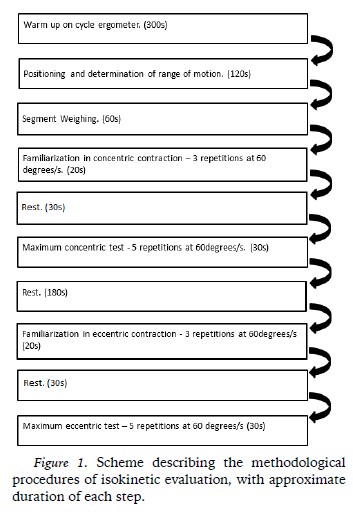
<body><![CDATA[<p>The development   of modern dynamometers allows better measurement of muscle parameters such as   torque production capacity, muscle power, fatigue, and work in isokinetic   contraction. These dynamometers also enable recording of maximum muscle   strength in all ranges of motion. Isokinetic dynamometry is one of the most   widely used objective methods to test trunk muscle strength, and more recently,   it has been used in strength training. (Grabiner, Jeziorowski, &amp; Divekar,   1990; Newton &amp; Waddell, 1993). It measures trunk flexion and extension   strength at various angular speeds and contraction modes (isometric,   concentric, and eccentric), and has been found to be safe (den Hartog et al.,   2010), reliable (Hupli, Sainio, Hurri, &amp; Alaranta, 1997), validated   (Guilhem, Giroux, Couturier, &amp; Maffiuletti, 2014), and sensitive enough to   detect muscle weakness (Barczyk-Pawelec, Piechura, Dziubek, &amp; Rozek, 2015; Cho et al., 2014).</p>     <p>There is great   benefit in using trunk isokinetic dynamometry to reliably assess strength   parameters (Barczyk-Pawelec et al., 2015; Guilhem et al., 2014; Jeon &amp; Kim,   2016; Newton &amp; Waddell, 1993). There is a lack of normative data of   strength of flexors and extensors trunk muscles in the literature. In especial,   the lack of normative data from asymptomatic sedentary adults hinders the   accurate assessment of muscle parameters in other populations, for example,   individuals with low back disorders and athletes. This is because, unlike of   the arms and legs that may have the strength of a limb compared to the   contralateral limb, the trunk does not present this possibility. In this way,   the comparison of the trunk strength of an individual always will need to   compare with normative data or parameters of normality. Therefore, this study   may contribute to the establishment of normal parameters for future studies with larger samples in this population. </p>     <p>Hence, this study   aimed to use isokinetic dynamometry to determine peak moment (PM) values in   concentric and eccentric contractions in trunk flexion and extension, and the relationship between these values in asymptomatic sedentary subjects.</p>     <p>&nbsp;</p> </font>     <p><font size="3" face="Verdana"><b>METHOD</b></font></p> <font face="Verdana" size="2">     <p>This research is   an evaluative, cross-sectional, exploratory, descriptive, experimental pilot   study. Experiments were carried out at the Isokinetic Dynamometry Center of the   Physiotherapy Clinic at Pontifical Catholic University of Paraná - Brazil,   after approval by the Human Research Ethics Committee of the same institution, under protocol number: 249771.</p>     <p><b>Participants</b></p>     <p>The participants   consisted of 100 sedentary individuals asymptomatic for LBP, 50 of each sex,   aged 18-30 years old, who agreed to participate in the research by providing a   signed and informed consent before enrolment. The inclusion criterion was that   individuals were classified as sedentary, that is, not practicing regular   physical activity (less than 150 minutes of vigorous-intensity physical   activity throughout the week, or an equivalent combination of moderate and   vigorous intensity activity, or muscle-strengthening activities less than twice   a week (WHO, 2010)). Individuals with evident postural change, spine or hip   osteomyoarticular lesions, abdominal or spine surgeries, pain in the lumbar   region, knee injuries and misalignments, and pregnant women were excluded.   Individuals who failed to correctly complete the test, i.e., who stopped or   reversed force direction during the test, were excluded. The participants   consisted of PUCPR students, who were invited by the researchers to participate in this project.</p>     <p><b>Measures and Procedures</b></p>     <p>Each participant   underwent an isokinetic assessment following a protocol that tested the trunk   flexor and extensor musculature in concentric and eccentric contraction,   starting with 10° of extension and going up to 70° of flexion, with five   repetitions at an angular velocity of 60°/s (den Hartog et al., 2010; Gómez et   al., 2005; Hupli et al., 1997; Silva Neto et al., 2010; Yahia et al., 2010; Yahia et al., 2011). The protocol is described in <a href="#f1">Figure 1</a>.</p>     ]]></body>
<body><![CDATA[<p><a name="f1"></a></p>     <p>&nbsp;</p>     <p align="center"><img src="/img/revistas/mot/v13n2/13n2a07f1.jpg" width="353" height="512"></p>     
<p>&nbsp;</p>     <p>Participants were   positioned on the dynamometer in accordance with the technical standards guide   of the equipment as prescribed by the manufacturer (Cybex®, model NORM 700011)   (CYBEX, 1995) in the specific module for analysing trunk strength. The   participant remained in the same position throughout the test. </p>     <p>Each volunteer   was placed standing with semi-flexed knees, limited behind in the popliteal   line, and below and above the patella in front; the drive shaft of the   dynamometer was positioned at the L4/L5 level, with a fastening belt at the   hip, and with the shoulder girdle region fixed by a belt above the nipples; only free flexion and extension of the trunk was possible (CYBEX, 1995).</p>     <p>After proper   attachment of the individual to the equipment, the trunk was weighed by the   device in a 45° flexion position, and this value was subtracted from the body   weight (CYBEX, 1995). The same researcher positioned and attached all subjects in this experiment to avoid bias.</p>     <p>During the tests,   all subjects received the same verbal stimulus in order to develop maximum   strength. The selected parameter for muscle performance assessment was peak moment, in Newton meters (Nm).</p>     <p><b>Statistical Analysis</b></p>     <p>Results were   expressed as mean, median, minimum and maximum values, and standard deviations.   Pearson’s correlation coefficient was estimated to establish the relationship   between the parameters. For comparisons between groups, Student's t-test was   considered for independent as well as paired samples. The analysis of   covariance (ANCOVA) was used for comparisons between groups, keeping another quantitative covariable, and considering a statistical significance of 5%.</p>     ]]></body>
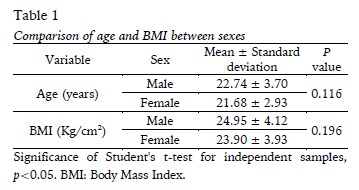
<body><![CDATA[<p>&nbsp;</p> </font>     <p><font size="3" face="Verdana"><b>RESULTS</b></font></p> <font face="Verdana" size="2">     <p>The mean age of   participants was 22.2 ± 3.3 years, and the body mass index (BMI) was 24.4 ± 4.0 kg/cm<sup>2</sup> (<a href="#t1">Table 1</a>).</p>     <p><a name="t1"></a></p>     <p>&nbsp;</p>     <p align="center"><img src="/img/revistas/mot/v13n2/13n2a07t1.jpg" width="359" height="190"></p>     
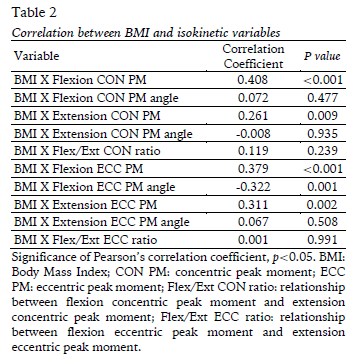
<p>&nbsp;</p>     <p>The evaluation of   the correlations between BMI and the variables analysed with isokinetic dynamometry are described in <a href="#t2">Table 2</a>.</p>     <p><a name="t2"></a></p>     <p>&nbsp;</p>     ]]></body>
<body><![CDATA[<p align="center"><img src="/img/revistas/mot/v13n2/13n2a07t2.jpg" width="359" height="364"></p>     
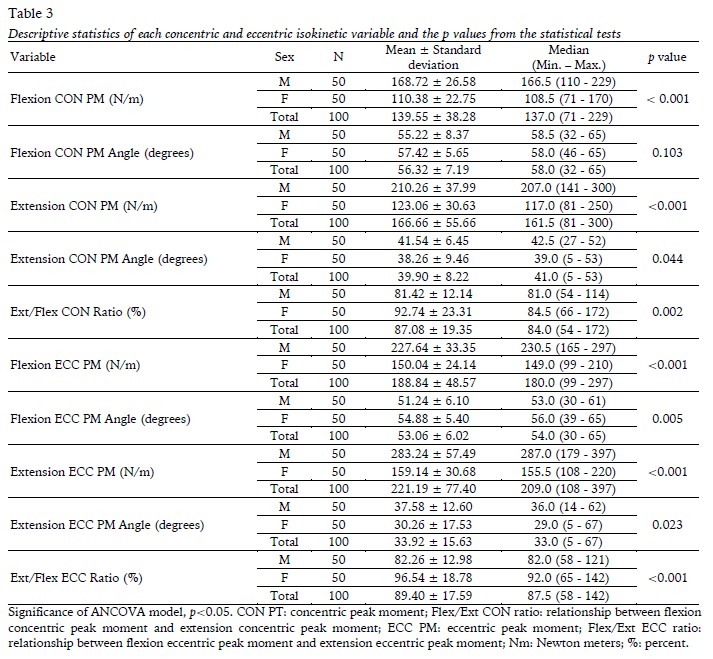
<p>&nbsp;</p>     <p>Although no   significant differences were found for BMI when stratified according to sex   (<a href="#t1">Table 1</a>), <a href="#t2">Table 2</a> shows that BMI had a significant correlation with the   following isokinetic variables: trunk flexion concentric peak moment (Flexion CON PM); trunk extension concentric peak   moment (Extension CON PM); trunk flexion   eccentric peak moment (Flexion ECC PM); trunk   flexion eccentric peak moment angle (Flexion ECC PM   angle); and trunk extension eccentric peak moment (Extension ECC PM). This result shows that 50% of the   isokinetic data have a significant correlation with BMI. For this reason, it   was decided to perform the analysis of the isokinetic data stratified according to sex set to BMI.</p>     <p>The concentric   and eccentric PM values obtained are shown in <a href="/img/revistas/mot/v13n2/13n2a07t3.jpg">Table 3</a>, for total sample and   stratified according to sex. The results of the comparison between these variables when stratified according to sex are Also shown.</p>     
<p>The results in   <a href="/img/revistas/mot/v13n2/13n2a07t3.jpg">Table 3</a> show a significant difference for the variables of concentric PM for   both trunk flexor (<i>p</i>&lt;0.001) and extensor muscles (<i>p</i>&lt;0.001),   when comparing sexes. Men showed higher mean values for both flexor and extensor muscle concentric PM.</p>     
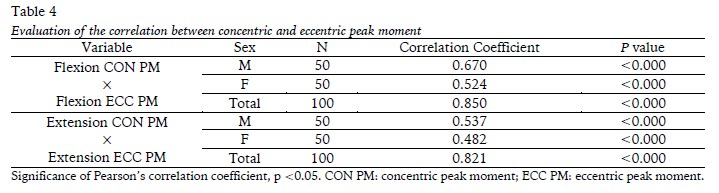
<p>The variables   referring to the concentric relationship between trunk extensor and flexor   muscles (<i>p</i>=0.002) showed higher mean values for women. The trunk   extension concentric PM angle also differed between sexes (<i>p</i>=0.044), and   was higher (occurring when the trunk was more flexed) for men. On the other   hand, the trunk flexion concentric PM angle did not present significantly   different mean values between sexes (<i>p</i>=0.103). Similar to the   concentric isokinetic variables, the results of the eccentric peak moment   variables also show a significant difference when comparing sexes, for both the   trunk flexor (<i>p</i>&lt;0.001) and extensor muscles (<i>p</i>&lt;0.001), with higher PM mean values for men.</p>     <p>Mean values for   angles also showed significant differences between sexes. The eccentric PM   angle of trunk flexors was higher in women (<i>p</i>=0.005), whereas the eccentric PM angle of trunk extensors was higher in men (<i>p</i>=0.023).</p>     <p>The eccentric   relationship between trunk extensor and flexor muscles showed a significantly   higher mean for women (<i>p</i>&lt;0.001). When compare concentric and   eccentric PM of the sample, globally and stratified according to sex, the   results of the Student’s t-test show a significant difference when comparing   the values of concentric PM with those of eccentric PM for trunk flexor and   extensor muscles. The eccentric PM mean value was higher than the concentric   value (<i>p</i> = 0.001) in both sexes and in total sample for flexors and extensors.</p>     <p>The results of   the evaluation of the correlation between concentric and eccentric PM of the   sample, globally and stratified according to sex (<a href="/img/revistas/mot/v13n2/13n2a07t4.jpg">table 4</a>) show a significant   positive correlation between the values of concentric and eccentric PM of trunk   flexor muscles as well as between the values of concentric and eccentric PM of trunk extensor muscles, for both the total and sex-stratified sample.</p>     
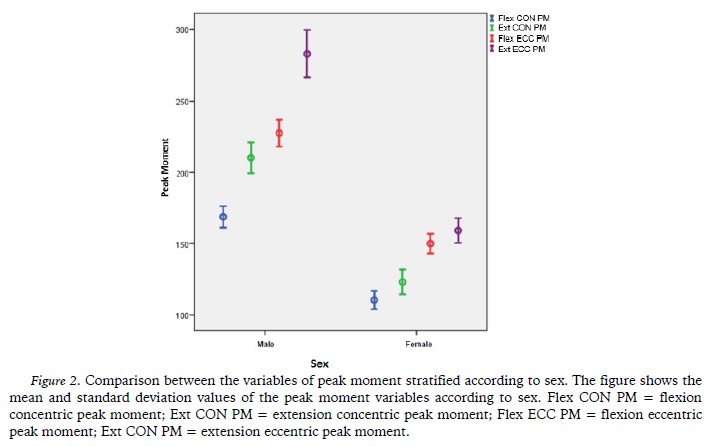
<p>It was then   observed that the individuals’ concentric and eccentric PM values were directly   proportional and correlated with one another, although they had significantly   different mean values, as shown in <a href="/img/revistas/mot/v13n2/13n2a07f2.jpg">figure 2</a>. <a href="/img/revistas/mot/v13n2/13n2a07f2.jpg">Figure 2</a> also shows the results   for peak moment presented in the previous tables. It was observed a higher PM   values for male subjects compared with female subjects, both in concentric and eccentric contraction of flexor and extensor muscles.</p>     
]]></body>
<body><![CDATA[<p>&nbsp;</p> </font>     <p><font size="3" face="Verdana"><b>DISCUSSION</b></font></p> <font face="Verdana" size="2">     <p>It is known that   normative data or common values are important to characterize populations, to   identify parameters of normality and variations of these and to compare the   characteristics between distinct populations. This statement is true also for   parameters of strength. It is known that muscular strength varies according to   population characteristics such as age, sex, level of physical activity, among   others. The isokinetic dynamometer is an accurate equipment, capturing small   variations in muscle strength parameters, as in the case of PM in this study.   Therefore, it is important to clarify that when comparing PM values between   different studies, it is important to consider the characteristics of the   population and the characteristics of the isokinetic dynamometer, as well as   the parameters, such as speed, number of repetition and mode of contraction, stipulated for the isokinetic test.</p>     <p>Delitto, Rose,   Crandell, and Strube (1991) assessed 29 asymptomatic men and 32 asymptomatic   women with a mean age of 40 years old. In this study, three trunk isokinetic   tests were performed at an angular velocity of 60°/s in concentric mode, with a   one-week interval between the first and second testing, and two weeks between   the second and third. The data presented the mean values of the three   assessments. The peak moment mean was 58 Nm for flexor muscles and 82 Nm for   extensors in women. In men, the values were 81 Nm for flexors and 111 Nm for extensors (Delitto, Rose, Crandell, &amp; Strube, 1991).</p>     <p>It is observed   that the current study presents values of concentric peak moment higher than   those found by Delitto et al. (1991). An accurate comparison of these values   between studies is hampered by the lack of data on range of motion and age   groups of the individuals. However, the current findings corroborate the   previous results regarding the higher mean force found for the extensor muscles   compared with the flexors, as well as for the higher peak moment mean values found in men. </p>     <p>Gómez et al.   (2005) performed an isokinetic evaluation of trunk muscle concentric   contraction in 38 females and 35 male volunteers, aged 20 to 39 years old,   testing angular velocity of 60°/s and range of motion of 70° of flexion and 10°   of extension. The PM mean was 204 Nm for flexors and 235 Nm for extensors in   women. In men, the mean values were 284 Nm for the flexors and 360 Nm for the   extensors (Gómez et al., 2005). The peak moment values shown in <a href="/img/revistas/mot/v13n2/13n2a07t3.jpg">Table 3</a> are   lower than those found by Gómez, but the study did not specify whether the   individuals had any regular physical activity, which could explain the higher   values. It is worth noting that the study by Gómez et al. (2005) has a smaller   sample than our study and like that of Delitto et al. (1991), only evaluated the participants in concentric contraction.</p>     
<p>Yahia et al.   (2010) compared the strength of individuals with chronic sciatic pain with   asymptomatic individuals. Of 68 individuals of both sexes that were assessed,   40 had no lumbar pain, while the other 28 had chronic sciatic pain symptoms.   Concentric testing was performed with an angular velocity of 60°/sec and a   range of motion of 70° of flexion and 0° of extension. Asymptomatic subjects   showed 177.44 Nm and 192.73 Nm for flexion and extension peak moment mean,   respectively. On the other hand, symptomatic subjects showed flexion peak   moment mean values of 134.32 Nm and extension peak moment mean values of 123.71 Nm (Yahia et al., 2010).</p>     <p>In order to   investigate postural characteristics of the trunk and lower limbs, as well as   strength profiles in subjects with chronic LBP, Yahia et al. (2011) assessed 60   individuals, predominantly women; 30 had LBP (mean age 41.1 years old), and 30   were asymptomatic (mean age 39 years old). Trunk concentric isokinetic testing   was performed with an angular velocity of 60°/sec, and range of motion of 70°   of flexion and 0° of extension. For asymptomatic individuals, the flexion peak   moment mean was 122.5 Nm and extension peak moment mean was 144.8 Nm. For   symptomatic individuals, the flexion and extension peak moment means were   102.06 Nm and 75.7 Nm, respectively (Yahia et al., 2011). The results for the   asymptomatic group of the study by Yahia et al. (2011) are similar to those   shown in <a href="/img/revistas/mot/v13n2/13n2a07t3.jpg">Table 3</a>, while the asymptomatic group of the study by Yahia et al. (2010) have higher peak moment values than those of our study.</p>     
<p>The present study   showed that women have significantly lower peak moment values than men in trunk   extension and flexion in concentric and eccentric contraction (<a href="/img/revistas/mot/v13n2/13n2a07t3.jpg">Table 3</a>), as   shown by Van Damme et al. (2013) in assessing healthy individuals at angular velocities of 30º/s, 60º/s, 90°/s, and 120°/s in concentric contraction.</p>     
<p>In a validation   study of isokinetic trunk dynamometry by Guilhem, Giroux, Couturier, and   Maffiuletti, (2014), 15 healthy young adults were evaluated, and PM values were   higher than those obtained in the current study for both concentric and   eccentric contraction. However, it is not known whether these subjects were   sedentary or not. Their data showed that eccentric peak moment values are   higher than concentric values (Guilhem et al., 2014), which corroborates our   results. The results show significant differences when comparing peak moment   values for concentric and eccentric of trunk flexors and extensors; the average   peak eccentric moment is higher, with a 26.1% difference in the flexors and   24.65% in the extensors, when all the subjects are evaluated together. The data   also show strong and significant positive correlations between the PM values   for concentric and eccentric of trunk flexors and extensors (<a href="/img/revistas/mot/v13n2/13n2a07t4.jpg">Table 4</a>). Thus,   concentric and eccentric PM values are directly proportional and related to   each other, although they have significantly different mean values, with   eccentric values always being higher. Therefore, these variables maintain a   greater or directly proportional decrease, showing a significant difference   between concentric and eccentric values (<a href="/img/revistas/mot/v13n2/13n2a07f2.jpg">figure 2</a>). These results are in   accordance with those observed by Helfman (1966), which showed that peak moment production decreases from eccentric to concentric contraction. </p>     
]]></body>
<body><![CDATA[<p>Regarding the   muscle agonist/antagonist ratio, or trunk extensors/flexors, it is known that   an imbalance in muscle strength, with decreased extensor muscle strength   relative to flexor muscles, may be a risk factor for lumbar pain (Lee et al.,   1999). The literature shows that the relationship between flexor/extensor   muscle trunk PM remains between 0.71 and 0.92 for healthy individuals (Delitto   et al., 1991; Gómez et al., 2005; Yahia et al., 2010). This is in accordance   with the data shown in <a href="/img/revistas/mot/v13n2/13n2a07t3.jpg">Table 3</a>, in which the mean value for men is 0.81 and for women is 0.92. </p>     
<p>There is a   variation of the trunk extensor/flexor relationship between the present study   and the studies by Delitto et al. (1991) and Gómez et al. (2015), with the   present study having the highest values of the aforementioned relation.   Although the three studies presented values among the most commonly found in the literature (0.71 and 0.92).</p>     <p>Regarding angular   momentum, the PM of the flexor muscles in concentric contraction occurred at an   average angle of 56.32° of trunk flexion, and peak of the extensor muscles at   an average of 39.90° of trunk flexion. In eccentric contraction, the PM of the   flexor muscles occurred at an average angle of 53.06° of trunk flexion, and PM   of the extensor muscles at an angle of 33.92° of trunk flexion, evidencing   angular moments very similar in concentric and eccentric contraction. These   results are similar to those found by Gómez et al. (2005), which were obtained   for the same angular velocity and range of motion in concentric contraction.   However, we did not find studies that evaluated the angular momentum of PM in eccentric contraction.</p>     <p>By determining   the isokinetic PM angle, it is possible to establish criteria for movement   execution to strengthen specific trunk muscle groups, thus optimizing muscle rehabilitation of the analysed segment.</p>     <p>&nbsp;</p> </font>     <p><font size="3" face="Verdana"><b>CONCLUSION</b></font></p> <font face="Verdana" size="2">     <p>The current study   indicates that the concentric and eccentric peak moment values of the flexor   and extensor trunk muscles are correlated and directly proportional to each   other, despite presenting significantly different mean values. The study also   shows notably higher peak moment values for men when compared to women for both flexor and extensor muscles in concentric and eccentric contraction.</p>     <p>The results of   the present study reflect in part the findings of others on the same topic. The   authors believe that due to the incipience of studies in this topic and   specifically with these variables, these findings should be considered mainly   regarding eccentric values and to peak moment angle if not yet extensively   investigated in other studies. The authors also believe that on account of the   characteristics of the study population, the peak moment values found could   serve as a minimum acceptable standard of trunk muscle strength and balance.   Moreover, they could be used as a parameter for diagnosis and comparison for   studying symptomatic patients, athletes and other populations with specific   characteristics. Furthermore, defining the peak moment angle for the trunk   movement range enables the establishment of criteria for the execution of   strengthening movements of specific trunk muscle groups, thereby optimizing muscle rehabilitation of the analysed segment.</p>     <p>&nbsp;</p> </font>     <p><font size="3" face="Verdana"><b>REFERENCES</b></font></p> <font face="Verdana" size="2">     ]]></body>
<body><![CDATA[<!-- ref --><p>Barczyk-Pawelec, K., Piechura, J. R.,   Dziubek, W., &amp; Rozek, K. (2015). Evaluation of isokinetic trunk muscle   strength in adolescents with normal and abnormal postures. <i>Journal of     Manipulative and Physiological Therapeutics, 38</i>(7), 484-492. doi:10.1016/j.jmpt.2015.06.010&nbsp;&nbsp;&nbsp;&nbsp;&nbsp;&nbsp;&nbsp;&nbsp;[&#160;<a href="javascript:void(0);" onclick="javascript: window.open('/scielo.php?script=sci_nlinks&ref=366852&pid=S1646-107X201700030000700001&lng=','','width=640,height=500,resizable=yes,scrollbars=1,menubar=yes,');">Links</a>&#160;]<!-- end-ref --><!-- ref --><p>Cho, K. H., Beom, J. W., Lee, T. S.,   Lim, J. H., Lee, T. H., &amp; Yuk, J. H. (2014). Trunk Muscles Strength as a   Risk Factor for Nonspecific Low Back Pain: A Pilot Study. <i>Annals of Rehabilitation Medicine, 38</i>(2), 234-240. doi:10.5535/arm.2014.38.2.234&nbsp;&nbsp;&nbsp;&nbsp;&nbsp;&nbsp;&nbsp;&nbsp;[&#160;<a href="javascript:void(0);" onclick="javascript: window.open('/scielo.php?script=sci_nlinks&ref=366853&pid=S1646-107X201700030000700002&lng=','','width=640,height=500,resizable=yes,scrollbars=1,menubar=yes,');">Links</a>&#160;]<!-- end-ref --><!-- ref --><p>CYBEX (1995). <i>CYBEX NORM™ testing &amp; rehabilitation system</i>. Service &amp; Parts Manual.    &nbsp;&nbsp;&nbsp;&nbsp;&nbsp;&nbsp;&nbsp;&nbsp;[&#160;<a href="javascript:void(0);" onclick="javascript: window.open('/scielo.php?script=sci_nlinks&ref=366854&pid=S1646-107X201700030000700003&lng=','','width=640,height=500,resizable=yes,scrollbars=1,menubar=yes,');">Links</a>&#160;]<!-- end-ref --> </p>     <!-- ref --><p>Delitto, A., Rose, S. J., Crandell, C.   E., &amp; Strube, M. J. (1991). Reliability of isokinetic measurements of trunk muscle performance. <i>Spine, 16</i>(7), 800-803.    &nbsp;&nbsp;&nbsp;&nbsp;&nbsp;&nbsp;&nbsp;&nbsp;[&#160;<a href="javascript:void(0);" onclick="javascript: window.open('/scielo.php?script=sci_nlinks&ref=366856&pid=S1646-107X201700030000700004&lng=','','width=640,height=500,resizable=yes,scrollbars=1,menubar=yes,');">Links</a>&#160;]<!-- end-ref --> </p>     <!-- ref --><p>den Hartog, D., Eker, H. H.,   Tuinebreijer, W. E., Kleinrensink, G. J., Stam, H. J., &amp; Lange, J. F.   (2010). Isokinetic strength of the trunk flexor muscles after surgical repair   for incisional hernia. <i>Hernia, 14</i>(3), 243-247. doi:10.1007/s10029-010-0627-6&nbsp;&nbsp;&nbsp;&nbsp;&nbsp;&nbsp;&nbsp;&nbsp;[&#160;<a href="javascript:void(0);" onclick="javascript: window.open('/scielo.php?script=sci_nlinks&ref=366858&pid=S1646-107X201700030000700005&lng=','','width=640,height=500,resizable=yes,scrollbars=1,menubar=yes,');">Links</a>&#160;]<!-- end-ref --><!-- ref --><p>Gómez, H. B., Zarco, R. C., Arias, D.   C., García, M. P. D., Hernández, S. R. L., &amp; Martinez, E. (2005).   Valaración isocinética del tronco em sujetos asintomáticos del Centro Nacional de Rehabilitación. <i>Acta Ortopédica Mexicana, 19</i>, 49-55.    &nbsp;&nbsp;&nbsp;&nbsp;&nbsp;&nbsp;&nbsp;&nbsp;[&#160;<a href="javascript:void(0);" onclick="javascript: window.open('/scielo.php?script=sci_nlinks&ref=366859&pid=S1646-107X201700030000700006&lng=','','width=640,height=500,resizable=yes,scrollbars=1,menubar=yes,');">Links</a>&#160;]<!-- end-ref --> </p>     <!-- ref --><p>Grabiner, M. D., Jeziorowski, J. J.,   &amp; Divekar, A. D. (1990). Isokinetic measurements of trunk extension and   flexion performance collected with the biodex clinical data station. <i>Journal of Orthopaedic &amp; Sports Physical Therapy, 11</i>(12), 590-598.    &nbsp;&nbsp;&nbsp;&nbsp;&nbsp;&nbsp;&nbsp;&nbsp;[&#160;<a href="javascript:void(0);" onclick="javascript: window.open('/scielo.php?script=sci_nlinks&ref=366861&pid=S1646-107X201700030000700007&lng=','','width=640,height=500,resizable=yes,scrollbars=1,menubar=yes,');">Links</a>&#160;]<!-- end-ref --> </p>     <!-- ref --><p>Guilhem, G., Giroux, C., Couturier,   A., &amp; Maffiuletti, N. A. (2014). Validity of trunk extensor and flexor   torque measurements using isokinetic dynamometry. <i>Journal of     Electromyography and Kinesiology, 24</i>(6), 986-993. doi:10.1016/j.jelekin.2014.07.006&nbsp;&nbsp;&nbsp;&nbsp;&nbsp;&nbsp;&nbsp;&nbsp;[&#160;<a href="javascript:void(0);" onclick="javascript: window.open('/scielo.php?script=sci_nlinks&ref=366863&pid=S1646-107X201700030000700008&lng=','','width=640,height=500,resizable=yes,scrollbars=1,menubar=yes,');">Links</a>&#160;]<!-- end-ref --><!-- ref --><p>Haight, H. J., Dahm, D. L., Smith, J.,   &amp; Krause, D. A. (2005). Measuring standing hindfoot alignment: reliability   of goniometric and visual measurements. <i>Archives of Physical Medicine and Rehabilitation, 86</i>(3), 571-575. doi:10.1016/j.apmr.2004.05.014&nbsp;&nbsp;&nbsp;&nbsp;&nbsp;&nbsp;&nbsp;&nbsp;[&#160;<a href="javascript:void(0);" onclick="javascript: window.open('/scielo.php?script=sci_nlinks&ref=366864&pid=S1646-107X201700030000700009&lng=','','width=640,height=500,resizable=yes,scrollbars=1,menubar=yes,');">Links</a>&#160;]<!-- end-ref --><!-- ref --><p>Helfman, H. (1966). Biomechanics of muscle. <i>Journal of Bone and Joint Surgery, 44</i>(A), 363-373.    &nbsp;&nbsp;&nbsp;&nbsp;&nbsp;&nbsp;&nbsp;&nbsp;[&#160;<a href="javascript:void(0);" onclick="javascript: window.open('/scielo.php?script=sci_nlinks&ref=366865&pid=S1646-107X201700030000700010&lng=','','width=640,height=500,resizable=yes,scrollbars=1,menubar=yes,');">Links</a>&#160;]<!-- end-ref --> </p>     <!-- ref --><p>Hides, J., Stanton, W., Mendis, M. D.,   &amp; Sexton, M. (2011). The relationship of transversus abdominis and lumbar   multifidus clinical muscle tests in patients with chronic low back pain. <i>Manual Therapy, 16</i>(6), 573-577. doi:10.1016/j.math.2011.05.007&nbsp;&nbsp;&nbsp;&nbsp;&nbsp;&nbsp;&nbsp;&nbsp;[&#160;<a href="javascript:void(0);" onclick="javascript: window.open('/scielo.php?script=sci_nlinks&ref=366867&pid=S1646-107X201700030000700011&lng=','','width=640,height=500,resizable=yes,scrollbars=1,menubar=yes,');">Links</a>&#160;]<!-- end-ref --><!-- ref --><p>Hupli, M., Sainio, P., Hurri, H.,   &amp; Alaranta, H. (1997). Comparison of trunk strength measurements between   two different isokinetic devices used at clinical settings. <i>Journal of Spinal Disorders, 10</i>(5), 391-397.    &nbsp;&nbsp;&nbsp;&nbsp;&nbsp;&nbsp;&nbsp;&nbsp;[&#160;<a href="javascript:void(0);" onclick="javascript: window.open('/scielo.php?script=sci_nlinks&ref=366868&pid=S1646-107X201700030000700012&lng=','','width=640,height=500,resizable=yes,scrollbars=1,menubar=yes,');">Links</a>&#160;]<!-- end-ref --> </p>     <!-- ref --><p>Jeon, K., &amp; Kim, S. (2016). Effect   of unilateral exercise on spinal and pelvic deformities, and isokinetic trunk   muscle strength. <i>Journal of Physical Therapy Science, 28</i>(3), 844-849. doi:10.1589/jpts.28.844&nbsp;&nbsp;&nbsp;&nbsp;&nbsp;&nbsp;&nbsp;&nbsp;[&#160;<a href="javascript:void(0);" onclick="javascript: window.open('/scielo.php?script=sci_nlinks&ref=366870&pid=S1646-107X201700030000700013&lng=','','width=640,height=500,resizable=yes,scrollbars=1,menubar=yes,');">Links</a>&#160;]<!-- end-ref --><!-- ref --><p>Lee, J., Hoshino, Y., Nakamura, K.,   Kariya, Y., Saita, K., &amp; Ito, K. (1999). Trunk Muscle Weakness as a Risk   Factor for Low Back Pain: A 5-Year Prospective Study. <i>Spine, 24</i>(1), 54-57. doi:10.1097/00007632-199901010-00013&nbsp;&nbsp;&nbsp;&nbsp;&nbsp;&nbsp;&nbsp;&nbsp;[&#160;<a href="javascript:void(0);" onclick="javascript: window.open('/scielo.php?script=sci_nlinks&ref=366871&pid=S1646-107X201700030000700014&lng=','','width=640,height=500,resizable=yes,scrollbars=1,menubar=yes,');">Links</a>&#160;]<!-- end-ref --><!-- ref --><p>Lim, E. C., Poh, R. L., Low, A. Y.,   &amp; Wong, W. P. (2011). Effects of Pilates-based exercises on pain and   disability in individuals with persistent nonspecific low back pain: a   systematic review with meta-analysis. <i>Journal of Orthopaedic &amp; Sports Physical Therapy, 41</i>(2), 70-80. doi:10.2519/jospt.2011.3393&nbsp;&nbsp;&nbsp;&nbsp;&nbsp;&nbsp;&nbsp;&nbsp;[&#160;<a href="javascript:void(0);" onclick="javascript: window.open('/scielo.php?script=sci_nlinks&ref=366872&pid=S1646-107X201700030000700015&lng=','','width=640,height=500,resizable=yes,scrollbars=1,menubar=yes,');">Links</a>&#160;]<!-- end-ref --><!-- ref --><p>Marshall, P. W., Kennedy, S., Brooks,   C., &amp; Lonsdale, C. (2013). Pilates exercise or stationary cycling for   chronic nonspecific low back pain: does it matter? a randomized controlled trial with 6-month follow-up. <i>Spine, 38</i>(15), 952-959. doi:10.1097/BRS.0b013e318297c1e5.    &nbsp;&nbsp;&nbsp;&nbsp;&nbsp;&nbsp;&nbsp;&nbsp;[&#160;<a href="javascript:void(0);" onclick="javascript: window.open('/scielo.php?script=sci_nlinks&ref=366873&pid=S1646-107X201700030000700016&lng=','','width=640,height=500,resizable=yes,scrollbars=1,menubar=yes,');">Links</a>&#160;]<!-- end-ref --></p>     <!-- ref --><p>Mostagi, F. Q., Dias, J. M., Pereira,   L. M., Obara, K., Mazuquin, B. F., Silva, M. F., . . . Cardoso, J. R. (2015).   Pilates versus general exercise effectiveness on pain and functionality in   non-specific chronic low back pain subjects. <i>Journal of Bodywork and Movement Therapies, 19</i>(4), 636-645. doi:10.1016/j.jbmt.2014.11.009&nbsp;&nbsp;&nbsp;&nbsp;&nbsp;&nbsp;&nbsp;&nbsp;[&#160;<a href="javascript:void(0);" onclick="javascript: window.open('/scielo.php?script=sci_nlinks&ref=366875&pid=S1646-107X201700030000700017&lng=','','width=640,height=500,resizable=yes,scrollbars=1,menubar=yes,');">Links</a>&#160;]<!-- end-ref --><!-- ref --><p>Newton, M., &amp; Waddell, G. (1993).   Trunk strength testing with iso-machines. Part 1: Review of a decade of scientific evidence. <i>Spine, 18</i>(7), 801-811.    &nbsp;&nbsp;&nbsp;&nbsp;&nbsp;&nbsp;&nbsp;&nbsp;[&#160;<a href="javascript:void(0);" onclick="javascript: window.open('/scielo.php?script=sci_nlinks&ref=366876&pid=S1646-107X201700030000700018&lng=','','width=640,height=500,resizable=yes,scrollbars=1,menubar=yes,');">Links</a>&#160;]<!-- end-ref --> </p>     <!-- ref --><p>Pereira, L. M., Obara, K., Dias, J.   M., Menacho, M. O., Guariglia, D. A., Schiavoni, D., . . . Cardoso, J. R.   (2012). Comparing the Pilates method with no exercise or lumbar stabilization   for pain and functionality in patients with chronic low back pain: systematic   review and meta-analysis. <i>Clinical Rehabilitation, 26</i>(1), 10-20. doi:10.1177/0269215511411113&nbsp;&nbsp;&nbsp;&nbsp;&nbsp;&nbsp;&nbsp;&nbsp;[&#160;<a href="javascript:void(0);" onclick="javascript: window.open('/scielo.php?script=sci_nlinks&ref=366878&pid=S1646-107X201700030000700019&lng=','','width=640,height=500,resizable=yes,scrollbars=1,menubar=yes,');">Links</a>&#160;]<!-- end-ref --><!-- ref --><p>Pinto, R. Z., Souza, T. R., Trede, R.   G., Kirkwood, R. N., Figueiredo, E. M., &amp; Fonseca, S. T. (2008). Bilateral   and unilateral increases in calcaneal eversion affect pelvic alignment in   standing position. <i>Manual Therapy, 13</i>(6), 513-519. doi:10.1016/j.math.2007.06.004&nbsp;&nbsp;&nbsp;&nbsp;&nbsp;&nbsp;&nbsp;&nbsp;[&#160;<a href="javascript:void(0);" onclick="javascript: window.open('/scielo.php?script=sci_nlinks&ref=366879&pid=S1646-107X201700030000700020&lng=','','width=640,height=500,resizable=yes,scrollbars=1,menubar=yes,');">Links</a>&#160;]<!-- end-ref --><!-- ref --><p>Silva Neto, M., Simões, R., Grangeiro   Neto, J. A., &amp; Cardone, C. P. (2010). Avaliação isocinética da força   muscular em atletas profissionais de futebol feminino. <i>Revista Brasileira de Medicina do Esporte, 16</i>, 33-35.    &nbsp;&nbsp;&nbsp;&nbsp;&nbsp;&nbsp;&nbsp;&nbsp;[&#160;<a href="javascript:void(0);" onclick="javascript: window.open('/scielo.php?script=sci_nlinks&ref=366880&pid=S1646-107X201700030000700021&lng=','','width=640,height=500,resizable=yes,scrollbars=1,menubar=yes,');">Links</a>&#160;]<!-- end-ref --> </p>     ]]></body>
<body><![CDATA[<!-- ref --><p>Van Damme, B. B., Stevens, V. K., Van   Tiggelen, D. E., Duvigneaud, N. N., Neyens, E., &amp; Danneels, L. A. (2013).   Velocity of isokinetic trunk exercises influences back muscle recruitment   patterns in healthy subjects. <i>Journal of Electromyography and Kinesiology, 23</i>(2), 378-386. doi:10.1016/j.jelekin.2012.10.015&nbsp;&nbsp;&nbsp;&nbsp;&nbsp;&nbsp;&nbsp;&nbsp;[&#160;<a href="javascript:void(0);" onclick="javascript: window.open('/scielo.php?script=sci_nlinks&ref=366882&pid=S1646-107X201700030000700022&lng=','','width=640,height=500,resizable=yes,scrollbars=1,menubar=yes,');">Links</a>&#160;]<!-- end-ref --><!-- ref --><p>van Middelkoop, M., Rubinstein, S. M.,   Kuijpers, T., Verhagen, A. P., Ostelo, R., Koes, B. W., &amp; van Tulder, M. W.   (2011). A systematic review on the effectiveness of physical and rehabilitation   interventions for chronic non-specific low back pain<i>. European Spine Journal, 20</i>(1), 19-39. doi:10.1007/s00586-010-1518-3&nbsp;&nbsp;&nbsp;&nbsp;&nbsp;&nbsp;&nbsp;&nbsp;[&#160;<a href="javascript:void(0);" onclick="javascript: window.open('/scielo.php?script=sci_nlinks&ref=366883&pid=S1646-107X201700030000700023&lng=','','width=640,height=500,resizable=yes,scrollbars=1,menubar=yes,');">Links</a>&#160;]<!-- end-ref --><!-- ref --><p>van Middelkoop, M., Rubinstein, S. M.,   Verhagen, A. P., Ostelo, R. W., Koes, B. W., &amp; van Tulder, M. W. (2010).   Exercise therapy for chronic nonspecific low-back pain. <i>Best Practice &amp;   Research: Clinical Rheumatology, 24</i>(2), 193-204. doi:10.1016/j.berh.2010.01.002&nbsp;&nbsp;&nbsp;&nbsp;&nbsp;&nbsp;&nbsp;&nbsp;[&#160;<a href="javascript:void(0);" onclick="javascript: window.open('/scielo.php?script=sci_nlinks&ref=366884&pid=S1646-107X201700030000700024&lng=','','width=640,height=500,resizable=yes,scrollbars=1,menubar=yes,');">Links</a>&#160;]<!-- end-ref --><!-- ref --><p>Wajswelner, H., Metcalf, B., &amp;   Bennell, K. (2012). Clinical pilates versus general exercise for chronic low   back pain: randomized trial. <i>Medicine &amp; Science in Sports &amp; Exercise, 44</i>(7), 1197-1205. doi:10.1249/MSS.0b013e318248f665&nbsp;&nbsp;&nbsp;&nbsp;&nbsp;&nbsp;&nbsp;&nbsp;[&#160;<a href="javascript:void(0);" onclick="javascript: window.open('/scielo.php?script=sci_nlinks&ref=366885&pid=S1646-107X201700030000700025&lng=','','width=640,height=500,resizable=yes,scrollbars=1,menubar=yes,');">Links</a>&#160;]<!-- end-ref --><!-- ref --><p>Wells, C., Kolt, G. S., Marshall, P.,   Hill, B., &amp; Bialocerkowski, A. (2013). Effectiveness of Pilates exercise in   treating people with chronic low back pain: a systematic review of systematic   reviews. <i>BMC Medical Research Methodology, 13</i>, 7. doi:10.1186/1471-2288-13-7&nbsp;&nbsp;&nbsp;&nbsp;&nbsp;&nbsp;&nbsp;&nbsp;[&#160;<a href="javascript:void(0);" onclick="javascript: window.open('/scielo.php?script=sci_nlinks&ref=366886&pid=S1646-107X201700030000700026&lng=','','width=640,height=500,resizable=yes,scrollbars=1,menubar=yes,');">Links</a>&#160;]<!-- end-ref --><!-- ref --><p>WHO (2010). <i>Global recommendations on physical activity for health</i>. World Health Organization.    &nbsp;&nbsp;&nbsp;&nbsp;&nbsp;&nbsp;&nbsp;&nbsp;[&#160;<a href="javascript:void(0);" onclick="javascript: window.open('/scielo.php?script=sci_nlinks&ref=366887&pid=S1646-107X201700030000700027&lng=','','width=640,height=500,resizable=yes,scrollbars=1,menubar=yes,');">Links</a>&#160;]<!-- end-ref --> </p>     <!-- ref --><p>WHO (2013). <i>Department of Chronic   Diseases and Health Promotion and Chronic Respiratory Diseases and Arthritis</i>. World Health Organization.    &nbsp;&nbsp;&nbsp;&nbsp;&nbsp;&nbsp;&nbsp;&nbsp;[&#160;<a href="javascript:void(0);" onclick="javascript: window.open('/scielo.php?script=sci_nlinks&ref=366889&pid=S1646-107X201700030000700028&lng=','','width=640,height=500,resizable=yes,scrollbars=1,menubar=yes,');">Links</a>&#160;]<!-- end-ref --> </p>     <!-- ref --><p>Yahia, A., Ghroubi, S., Kharrat, O.,   Jribi, S., Elleuch, M., &amp; Elleuch, M. H. (2010). A study of isokinetic   trunk and knee muscle strength in patients with chronic sciatica. <i>Annals of     Physical and Rehabilitation Medicine, 53</i>(4), 239-244, 244-239. doi:10.1016/j.rehab.2010.03.002&nbsp;&nbsp;&nbsp;&nbsp;&nbsp;&nbsp;&nbsp;&nbsp;[&#160;<a href="javascript:void(0);" onclick="javascript: window.open('/scielo.php?script=sci_nlinks&ref=366891&pid=S1646-107X201700030000700029&lng=','','width=640,height=500,resizable=yes,scrollbars=1,menubar=yes,');">Links</a>&#160;]<!-- end-ref --><!-- ref --><p>Yahia, A., Jribi, S., Ghroubi, S.,   Elleuch, M., Baklouti, S., &amp; Habib Elleuch, M. (2011). Evaluation of the   posture and muscular strength of the trunk and inferior members of patients   with chronic lumbar pain. <i>Joint Bone Spine, 78</i>(3), 291-297. doi:10.1016/j.jbspin.2010.09.008&nbsp;&nbsp;&nbsp;&nbsp;&nbsp;&nbsp;&nbsp;&nbsp;[&#160;<a href="javascript:void(0);" onclick="javascript: window.open('/scielo.php?script=sci_nlinks&ref=366892&pid=S1646-107X201700030000700030&lng=','','width=640,height=500,resizable=yes,scrollbars=1,menubar=yes,');">Links</a>&#160;]<!-- end-ref --><p>&nbsp;</p>     <p><b>Acknowledgments:    <br> </b>Coordination for the Improvement of Higher Education Personnel (CAPES) granted a scholarship to first author    <br> <b>Conflict of interests:    <br> </b>Nothing to declare.    <br> <b>Funding:    <br> </b>Nothing to declare.</p>     <p>Manuscript received at June 1<sup>st</sup> 2016; Accepted at February 2<sup>nd</sup> 2017 </p> </font>     <p>&nbsp;</p>     ]]></body>
<body><![CDATA[<p>&nbsp;</p>     <p><font face="Verdana" size="2"><a name="end"></a><a href="#topo">*</a><i>Corresponding author</i>: Pontifical   Catholic University of Parana - PUCPR, Curitba-Brazil. <i>E-mail</i>: <a href="mailto:rafaellasb@yahoo.com.br">rafaellasb@yahoo.com.br</a></font> </p>      ]]></body><back>
<ref-list>
<ref id="B1">
<nlm-citation citation-type="journal">
<person-group person-group-type="author">
<name>
<surname><![CDATA[Barczyk-Pawelec]]></surname>
<given-names><![CDATA[K.]]></given-names>
</name>
<name>
<surname><![CDATA[Piechura]]></surname>
<given-names><![CDATA[J. R.]]></given-names>
</name>
<name>
<surname><![CDATA[Dziubek]]></surname>
<given-names><![CDATA[W.]]></given-names>
</name>
<name>
<surname><![CDATA[Rozek]]></surname>
<given-names><![CDATA[K.]]></given-names>
</name>
</person-group>
<article-title xml:lang="en"><![CDATA[Evaluation of isokinetic trunk muscle strength in adolescents with normal and abnormal postures]]></article-title>
<source><![CDATA[Journal of Manipulative and Physiological Therapeutics]]></source>
<year>2015</year>
<volume>38</volume>
<numero>7</numero>
<issue>7</issue>
<page-range>484-492</page-range></nlm-citation>
</ref>
<ref id="B2">
<nlm-citation citation-type="journal">
<person-group person-group-type="author">
<name>
<surname><![CDATA[Cho]]></surname>
<given-names><![CDATA[K. H.]]></given-names>
</name>
<name>
<surname><![CDATA[Beom]]></surname>
<given-names><![CDATA[J. W.]]></given-names>
</name>
<name>
<surname><![CDATA[Lee]]></surname>
<given-names><![CDATA[T. S.]]></given-names>
</name>
<name>
<surname><![CDATA[Lim]]></surname>
<given-names><![CDATA[J. H.]]></given-names>
</name>
<name>
<surname><![CDATA[Lee]]></surname>
<given-names><![CDATA[T. H.]]></given-names>
</name>
<name>
<surname><![CDATA[Yuk]]></surname>
<given-names><![CDATA[J. H.]]></given-names>
</name>
</person-group>
<article-title xml:lang="en"><![CDATA[Trunk Muscles Strength as a Risk Factor for Nonspecific Low Back Pain: A Pilot Study]]></article-title>
<source><![CDATA[Annals of Rehabilitation Medicine]]></source>
<year>2014</year>
<volume>38</volume>
<numero>2</numero>
<issue>2</issue>
<page-range>234-240</page-range></nlm-citation>
</ref>
<ref id="B3">
<nlm-citation citation-type="">
<collab>CYBEX</collab>
<source><![CDATA[CYBEX NORM™ testing & rehabilitation system: Service & Parts Manual]]></source>
<year>1995</year>
</nlm-citation>
</ref>
<ref id="B4">
<nlm-citation citation-type="journal">
<person-group person-group-type="author">
<name>
<surname><![CDATA[Delitto]]></surname>
<given-names><![CDATA[A.]]></given-names>
</name>
<name>
<surname><![CDATA[Rose]]></surname>
<given-names><![CDATA[S. J.]]></given-names>
</name>
<name>
<surname><![CDATA[Crandell]]></surname>
<given-names><![CDATA[C. E.]]></given-names>
</name>
<name>
<surname><![CDATA[Strube]]></surname>
<given-names><![CDATA[M. J.]]></given-names>
</name>
</person-group>
<article-title xml:lang="en"><![CDATA[Reliability of isokinetic measurements of trunk muscle performance]]></article-title>
<source><![CDATA[Spine]]></source>
<year>1991</year>
<volume>16</volume>
<numero>7</numero>
<issue>7</issue>
<page-range>800-803</page-range></nlm-citation>
</ref>
<ref id="B5">
<nlm-citation citation-type="journal">
<person-group person-group-type="author">
<name>
<surname><![CDATA[den Hartog]]></surname>
<given-names><![CDATA[D.]]></given-names>
</name>
<name>
<surname><![CDATA[Eker]]></surname>
<given-names><![CDATA[H. H.]]></given-names>
</name>
<name>
<surname><![CDATA[Tuinebreijer]]></surname>
<given-names><![CDATA[W. E.]]></given-names>
</name>
<name>
<surname><![CDATA[Kleinrensink]]></surname>
<given-names><![CDATA[G. J.]]></given-names>
</name>
<name>
<surname><![CDATA[Stam]]></surname>
<given-names><![CDATA[H. J.]]></given-names>
</name>
<name>
<surname><![CDATA[Lange]]></surname>
<given-names><![CDATA[J. F.]]></given-names>
</name>
</person-group>
<article-title xml:lang="en"><![CDATA[Isokinetic strength of the trunk flexor muscles after surgical repair for incisional hernia]]></article-title>
<source><![CDATA[Hernia]]></source>
<year>2010</year>
<volume>14</volume>
<numero>3</numero>
<issue>3</issue>
<page-range>243-247</page-range></nlm-citation>
</ref>
<ref id="B6">
<nlm-citation citation-type="journal">
<person-group person-group-type="author">
<name>
<surname><![CDATA[Gómez]]></surname>
<given-names><![CDATA[H. B.]]></given-names>
</name>
<name>
<surname><![CDATA[Zarco]]></surname>
<given-names><![CDATA[R. C.]]></given-names>
</name>
<name>
<surname><![CDATA[Arias]]></surname>
<given-names><![CDATA[D. C.]]></given-names>
</name>
<name>
<surname><![CDATA[García]]></surname>
<given-names><![CDATA[M. P. D.]]></given-names>
</name>
<name>
<surname><![CDATA[Hernández]]></surname>
<given-names><![CDATA[S. R. L.]]></given-names>
</name>
<name>
<surname><![CDATA[Martinez]]></surname>
<given-names><![CDATA[E.]]></given-names>
</name>
</person-group>
<article-title xml:lang="es"><![CDATA[Valaración isocinética del tronco em sujetos asintomáticos del Centro Nacional de Rehabilitación]]></article-title>
<source><![CDATA[Acta Ortopédica Mexicana]]></source>
<year>2005</year>
<volume>19</volume>
<page-range>49-55</page-range></nlm-citation>
</ref>
<ref id="B7">
<nlm-citation citation-type="journal">
<person-group person-group-type="author">
<name>
<surname><![CDATA[Grabiner]]></surname>
<given-names><![CDATA[M. D.]]></given-names>
</name>
<name>
<surname><![CDATA[Jeziorowski]]></surname>
<given-names><![CDATA[J. J.]]></given-names>
</name>
<name>
<surname><![CDATA[Divekar]]></surname>
<given-names><![CDATA[A. D.]]></given-names>
</name>
</person-group>
<article-title xml:lang="en"><![CDATA[Isokinetic measurements of trunk extension and flexion performance collected with the biodex clinical data station]]></article-title>
<source><![CDATA[Journal of Orthopaedic & Sports Physical Therapy]]></source>
<year>1990</year>
<volume>11</volume>
<numero>12</numero>
<issue>12</issue>
<page-range>590-598</page-range></nlm-citation>
</ref>
<ref id="B8">
<nlm-citation citation-type="journal">
<person-group person-group-type="author">
<name>
<surname><![CDATA[Guilhem]]></surname>
<given-names><![CDATA[G.]]></given-names>
</name>
<name>
<surname><![CDATA[Giroux]]></surname>
<given-names><![CDATA[C.]]></given-names>
</name>
<name>
<surname><![CDATA[Couturier]]></surname>
<given-names><![CDATA[A.]]></given-names>
</name>
<name>
<surname><![CDATA[Maffiuletti]]></surname>
<given-names><![CDATA[N. A.]]></given-names>
</name>
</person-group>
<article-title xml:lang="en"><![CDATA[Validity of trunk extensor and flexor torque measurements using isokinetic dynamometry]]></article-title>
<source><![CDATA[Journal of Electromyography and Kinesiology]]></source>
<year>2014</year>
<volume>24</volume>
<numero>6</numero>
<issue>6</issue>
<page-range>986-993</page-range></nlm-citation>
</ref>
<ref id="B9">
<nlm-citation citation-type="journal">
<person-group person-group-type="author">
<name>
<surname><![CDATA[Haight]]></surname>
<given-names><![CDATA[H. J.]]></given-names>
</name>
<name>
<surname><![CDATA[Dahm]]></surname>
<given-names><![CDATA[D. L.]]></given-names>
</name>
<name>
<surname><![CDATA[Smith]]></surname>
<given-names><![CDATA[J.]]></given-names>
</name>
<name>
<surname><![CDATA[Krause]]></surname>
<given-names><![CDATA[D. A.]]></given-names>
</name>
</person-group>
<article-title xml:lang="en"><![CDATA[Measuring standing hindfoot alignment: reliability of goniometric and visual measurements]]></article-title>
<source><![CDATA[Archives of Physical Medicine and Rehabilitation]]></source>
<year>2005</year>
<volume>86</volume>
<numero>3</numero>
<issue>3</issue>
<page-range>571-575</page-range></nlm-citation>
</ref>
<ref id="B10">
<nlm-citation citation-type="journal">
<person-group person-group-type="author">
<name>
<surname><![CDATA[Helfman]]></surname>
<given-names><![CDATA[H.]]></given-names>
</name>
</person-group>
<article-title xml:lang="en"><![CDATA[Biomechanics of muscle]]></article-title>
<source><![CDATA[Journal of Bone and Joint Surgery]]></source>
<year>1966</year>
<volume>44</volume>
<numero>A</numero>
<issue>A</issue>
<page-range>363-373</page-range></nlm-citation>
</ref>
<ref id="B11">
<nlm-citation citation-type="journal">
<person-group person-group-type="author">
<name>
<surname><![CDATA[Hides]]></surname>
<given-names><![CDATA[J.]]></given-names>
</name>
<name>
<surname><![CDATA[Stanton]]></surname>
<given-names><![CDATA[W.]]></given-names>
</name>
<name>
<surname><![CDATA[Mendis]]></surname>
<given-names><![CDATA[M. D.]]></given-names>
</name>
<name>
<surname><![CDATA[Sexton]]></surname>
<given-names><![CDATA[M.]]></given-names>
</name>
</person-group>
<article-title xml:lang="en"><![CDATA[The relationship of transversus abdominis and lumbar multifidus clinical muscle tests in patients with chronic low back pain]]></article-title>
<source><![CDATA[Manual Therapy]]></source>
<year>2011</year>
<volume>16</volume>
<numero>6</numero>
<issue>6</issue>
<page-range>573-577</page-range></nlm-citation>
</ref>
<ref id="B12">
<nlm-citation citation-type="journal">
<person-group person-group-type="author">
<name>
<surname><![CDATA[Hupli]]></surname>
<given-names><![CDATA[M.]]></given-names>
</name>
<name>
<surname><![CDATA[Sainio]]></surname>
<given-names><![CDATA[P.]]></given-names>
</name>
<name>
<surname><![CDATA[Hurri]]></surname>
<given-names><![CDATA[H.]]></given-names>
</name>
<name>
<surname><![CDATA[Alaranta]]></surname>
<given-names><![CDATA[H.]]></given-names>
</name>
</person-group>
<article-title xml:lang="en"><![CDATA[Comparison of trunk strength measurements between two different isokinetic devices used at clinical settings]]></article-title>
<source><![CDATA[Journal of Spinal Disorders]]></source>
<year>1997</year>
<volume>10</volume>
<numero>5</numero>
<issue>5</issue>
<page-range>391-397</page-range></nlm-citation>
</ref>
<ref id="B13">
<nlm-citation citation-type="journal">
<person-group person-group-type="author">
<name>
<surname><![CDATA[Jeon]]></surname>
<given-names><![CDATA[K.]]></given-names>
</name>
<name>
<surname><![CDATA[Kim]]></surname>
<given-names><![CDATA[S.]]></given-names>
</name>
</person-group>
<article-title xml:lang="en"><![CDATA[Effect of unilateral exercise on spinal and pelvic deformities, and isokinetic trunk muscle strength]]></article-title>
<source><![CDATA[Journal of Physical Therapy Science]]></source>
<year>2016</year>
<volume>28</volume>
<numero>3</numero>
<issue>3</issue>
<page-range>844-849</page-range></nlm-citation>
</ref>
<ref id="B14">
<nlm-citation citation-type="journal">
<person-group person-group-type="author">
<name>
<surname><![CDATA[Lee]]></surname>
<given-names><![CDATA[J.]]></given-names>
</name>
<name>
<surname><![CDATA[Hoshino]]></surname>
<given-names><![CDATA[Y.]]></given-names>
</name>
<name>
<surname><![CDATA[Nakamura]]></surname>
<given-names><![CDATA[K.]]></given-names>
</name>
<name>
<surname><![CDATA[Kariya]]></surname>
<given-names><![CDATA[Y.]]></given-names>
</name>
<name>
<surname><![CDATA[Saita]]></surname>
<given-names><![CDATA[K.]]></given-names>
</name>
<name>
<surname><![CDATA[Ito]]></surname>
<given-names><![CDATA[K.]]></given-names>
</name>
</person-group>
<article-title xml:lang="en"><![CDATA[Trunk Muscle Weakness as a Risk Factor for Low Back Pain: A 5-Year Prospective Study]]></article-title>
<source><![CDATA[Spine]]></source>
<year>1999</year>
<volume>24</volume>
<numero>1</numero>
<issue>1</issue>
<page-range>54-57</page-range></nlm-citation>
</ref>
<ref id="B15">
<nlm-citation citation-type="journal">
<person-group person-group-type="author">
<name>
<surname><![CDATA[Lim]]></surname>
<given-names><![CDATA[E. C.]]></given-names>
</name>
<name>
<surname><![CDATA[Poh]]></surname>
<given-names><![CDATA[R. L.]]></given-names>
</name>
<name>
<surname><![CDATA[Low]]></surname>
<given-names><![CDATA[A. Y.]]></given-names>
</name>
<name>
<surname><![CDATA[Wong]]></surname>
<given-names><![CDATA[W. P.]]></given-names>
</name>
</person-group>
<article-title xml:lang="en"><![CDATA[Effects of Pilates-based exercises on pain and disability in individuals with persistent nonspecific low back pain: a systematic review with meta-analysis]]></article-title>
<source><![CDATA[Journal of Orthopaedic & Sports Physical Therapy]]></source>
<year>2011</year>
<volume>41</volume>
<numero>2</numero>
<issue>2</issue>
<page-range>70-80</page-range></nlm-citation>
</ref>
<ref id="B16">
<nlm-citation citation-type="journal">
<person-group person-group-type="author">
<name>
<surname><![CDATA[Marshall]]></surname>
<given-names><![CDATA[P. W.]]></given-names>
</name>
<name>
<surname><![CDATA[Kennedy]]></surname>
<given-names><![CDATA[S.]]></given-names>
</name>
<name>
<surname><![CDATA[Brooks]]></surname>
<given-names><![CDATA[C.]]></given-names>
</name>
<name>
<surname><![CDATA[Lonsdale]]></surname>
<given-names><![CDATA[C.]]></given-names>
</name>
</person-group>
<article-title xml:lang="en"><![CDATA[Pilates exercise or stationary cycling for chronic nonspecific low back pain: does it matter? a randomized controlled trial with 6-month follow-up]]></article-title>
<source><![CDATA[Spine]]></source>
<year>2013</year>
<volume>38</volume>
<numero>15</numero>
<issue>15</issue>
<page-range>952-959</page-range></nlm-citation>
</ref>
<ref id="B17">
<nlm-citation citation-type="journal">
<person-group person-group-type="author">
<name>
<surname><![CDATA[Mostagi]]></surname>
<given-names><![CDATA[F. Q.]]></given-names>
</name>
<name>
<surname><![CDATA[Dias]]></surname>
<given-names><![CDATA[J. M.]]></given-names>
</name>
<name>
<surname><![CDATA[Pereira]]></surname>
<given-names><![CDATA[L. M.]]></given-names>
</name>
<name>
<surname><![CDATA[Obara]]></surname>
<given-names><![CDATA[K.]]></given-names>
</name>
<name>
<surname><![CDATA[Mazuquin]]></surname>
<given-names><![CDATA[B. F.]]></given-names>
</name>
<name>
<surname><![CDATA[Silva]]></surname>
<given-names><![CDATA[M. F.]]></given-names>
</name>
<name>
<surname><![CDATA[Cardoso]]></surname>
<given-names><![CDATA[J. R.]]></given-names>
</name>
</person-group>
<article-title xml:lang="en"><![CDATA[Pilates versus general exercise effectiveness on pain and functionality in non-specific chronic low back pain subjects]]></article-title>
<source><![CDATA[Journal of Bodywork and Movement Therapies]]></source>
<year>2015</year>
<volume>19</volume>
<numero>4</numero>
<issue>4</issue>
<page-range>636-645</page-range></nlm-citation>
</ref>
<ref id="B18">
<nlm-citation citation-type="journal">
<person-group person-group-type="author">
<name>
<surname><![CDATA[Newton]]></surname>
<given-names><![CDATA[M.]]></given-names>
</name>
<name>
<surname><![CDATA[Waddell]]></surname>
<given-names><![CDATA[G.]]></given-names>
</name>
</person-group>
<article-title xml:lang="en"><![CDATA[Trunk strength testing with iso-machines: Part 1: Review of a decade of scientific evidence]]></article-title>
<source><![CDATA[Spine]]></source>
<year>1993</year>
<volume>18</volume>
<numero>7</numero>
<issue>7</issue>
<page-range>801-811</page-range></nlm-citation>
</ref>
<ref id="B19">
<nlm-citation citation-type="journal">
<person-group person-group-type="author">
<name>
<surname><![CDATA[Pereira]]></surname>
<given-names><![CDATA[L. M.]]></given-names>
</name>
<name>
<surname><![CDATA[Obara]]></surname>
<given-names><![CDATA[K.]]></given-names>
</name>
<name>
<surname><![CDATA[Dias]]></surname>
<given-names><![CDATA[J. M.]]></given-names>
</name>
<name>
<surname><![CDATA[Menacho]]></surname>
<given-names><![CDATA[M. O.]]></given-names>
</name>
<name>
<surname><![CDATA[Guariglia]]></surname>
<given-names><![CDATA[D. A.]]></given-names>
</name>
<name>
<surname><![CDATA[Schiavoni]]></surname>
<given-names><![CDATA[D.]]></given-names>
</name>
<name>
<surname><![CDATA[Cardoso]]></surname>
<given-names><![CDATA[J. R.]]></given-names>
</name>
</person-group>
<article-title xml:lang="en"><![CDATA[Comparing the Pilates method with no exercise or lumbar stabilization for pain and functionality in patients with chronic low back pain: systematic review and meta-analysis]]></article-title>
<source><![CDATA[Clinical Rehabilitation]]></source>
<year>2012</year>
<volume>26</volume>
<numero>1</numero>
<issue>1</issue>
<page-range>10-20</page-range></nlm-citation>
</ref>
<ref id="B20">
<nlm-citation citation-type="journal">
<person-group person-group-type="author">
<name>
<surname><![CDATA[Pinto]]></surname>
<given-names><![CDATA[R. Z.]]></given-names>
</name>
<name>
<surname><![CDATA[Souza]]></surname>
<given-names><![CDATA[T. R.]]></given-names>
</name>
<name>
<surname><![CDATA[Trede]]></surname>
<given-names><![CDATA[R. G.]]></given-names>
</name>
<name>
<surname><![CDATA[Kirkwood]]></surname>
<given-names><![CDATA[R. N.]]></given-names>
</name>
<name>
<surname><![CDATA[Figueiredo]]></surname>
<given-names><![CDATA[E. M.]]></given-names>
</name>
<name>
<surname><![CDATA[Fonseca]]></surname>
<given-names><![CDATA[S. T.]]></given-names>
</name>
</person-group>
<article-title xml:lang="en"><![CDATA[Bilateral and unilateral increases in calcaneal eversion affect pelvic alignment in standing position]]></article-title>
<source><![CDATA[Manual Therapy]]></source>
<year>2008</year>
<volume>13</volume>
<numero>6</numero>
<issue>6</issue>
<page-range>513-519</page-range></nlm-citation>
</ref>
<ref id="B21">
<nlm-citation citation-type="journal">
<person-group person-group-type="author">
<name>
<surname><![CDATA[Silva Neto]]></surname>
<given-names><![CDATA[M.]]></given-names>
</name>
<name>
<surname><![CDATA[Simões]]></surname>
<given-names><![CDATA[R.]]></given-names>
</name>
<name>
<surname><![CDATA[Grangeiro Neto]]></surname>
<given-names><![CDATA[J. A.]]></given-names>
</name>
<name>
<surname><![CDATA[Cardone]]></surname>
<given-names><![CDATA[C. P.]]></given-names>
</name>
</person-group>
<article-title xml:lang="pt"><![CDATA[Avaliação isocinética da força muscular em atletas profissionais de futebol feminino]]></article-title>
<source><![CDATA[Revista Brasileira de Medicina do Esporte]]></source>
<year>2010</year>
<volume>16</volume>
<page-range>33-35</page-range></nlm-citation>
</ref>
<ref id="B22">
<nlm-citation citation-type="journal">
<person-group person-group-type="author">
<name>
<surname><![CDATA[Van Damme]]></surname>
<given-names><![CDATA[B. B.]]></given-names>
</name>
<name>
<surname><![CDATA[Stevens]]></surname>
<given-names><![CDATA[V. K.]]></given-names>
</name>
<name>
<surname><![CDATA[Van Tiggelen]]></surname>
<given-names><![CDATA[D. E.]]></given-names>
</name>
<name>
<surname><![CDATA[Duvigneaud]]></surname>
<given-names><![CDATA[N. N.]]></given-names>
</name>
<name>
<surname><![CDATA[Neyens]]></surname>
<given-names><![CDATA[E.]]></given-names>
</name>
<name>
<surname><![CDATA[Danneels]]></surname>
<given-names><![CDATA[L. A.]]></given-names>
</name>
</person-group>
<article-title xml:lang="en"><![CDATA[Velocity of isokinetic trunk exercises influences back muscle recruitment patterns in healthy subjects]]></article-title>
<source><![CDATA[Journal of Electromyography and Kinesiology]]></source>
<year>2013</year>
<volume>23</volume>
<numero>2</numero>
<issue>2</issue>
<page-range>378-386</page-range></nlm-citation>
</ref>
<ref id="B23">
<nlm-citation citation-type="journal">
<person-group person-group-type="author">
<name>
<surname><![CDATA[van Middelkoop]]></surname>
<given-names><![CDATA[M.]]></given-names>
</name>
<name>
<surname><![CDATA[Rubinstein]]></surname>
<given-names><![CDATA[S. M.]]></given-names>
</name>
<name>
<surname><![CDATA[Kuijpers]]></surname>
<given-names><![CDATA[T.]]></given-names>
</name>
<name>
<surname><![CDATA[Verhagen]]></surname>
<given-names><![CDATA[A. P.]]></given-names>
</name>
<name>
<surname><![CDATA[Ostelo]]></surname>
<given-names><![CDATA[R.]]></given-names>
</name>
<name>
<surname><![CDATA[Koes]]></surname>
<given-names><![CDATA[B. W.]]></given-names>
</name>
<name>
<surname><![CDATA[van Tulder]]></surname>
<given-names><![CDATA[M. W.]]></given-names>
</name>
</person-group>
<article-title xml:lang="en"><![CDATA[A systematic review on the effectiveness of physical and rehabilitation interventions for chronic non-specific low back pain]]></article-title>
<source><![CDATA[European Spine Journal]]></source>
<year>2011</year>
<volume>20</volume>
<numero>1</numero>
<issue>1</issue>
<page-range>19-39</page-range></nlm-citation>
</ref>
<ref id="B24">
<nlm-citation citation-type="journal">
<person-group person-group-type="author">
<name>
<surname><![CDATA[van Middelkoop]]></surname>
<given-names><![CDATA[M.]]></given-names>
</name>
<name>
<surname><![CDATA[Rubinstein]]></surname>
<given-names><![CDATA[S. M.]]></given-names>
</name>
<name>
<surname><![CDATA[Verhagen]]></surname>
<given-names><![CDATA[A. P.]]></given-names>
</name>
<name>
<surname><![CDATA[Ostelo]]></surname>
<given-names><![CDATA[R. W.]]></given-names>
</name>
<name>
<surname><![CDATA[Koes]]></surname>
<given-names><![CDATA[B. W.]]></given-names>
</name>
<name>
<surname><![CDATA[van Tulder]]></surname>
<given-names><![CDATA[M. W.]]></given-names>
</name>
</person-group>
<article-title xml:lang="en"><![CDATA[Exercise therapy for chronic nonspecific low-back pain]]></article-title>
<source><![CDATA[Best Practice & Research: Clinical Rheumatology]]></source>
<year>2010</year>
<volume>24</volume>
<numero>2</numero>
<issue>2</issue>
<page-range>193-204</page-range></nlm-citation>
</ref>
<ref id="B25">
<nlm-citation citation-type="journal">
<person-group person-group-type="author">
<name>
<surname><![CDATA[Wajswelner]]></surname>
<given-names><![CDATA[H.]]></given-names>
</name>
<name>
<surname><![CDATA[Metcalf]]></surname>
<given-names><![CDATA[B.]]></given-names>
</name>
<name>
<surname><![CDATA[Bennell]]></surname>
<given-names><![CDATA[K.]]></given-names>
</name>
</person-group>
<article-title xml:lang="en"><![CDATA[Clinical pilates versus general exercise for chronic low back pain: randomized trial]]></article-title>
<source><![CDATA[Medicine & Science in Sports & Exercise]]></source>
<year>2012</year>
<volume>44</volume>
<numero>7</numero>
<issue>7</issue>
<page-range>1197-1205</page-range></nlm-citation>
</ref>
<ref id="B26">
<nlm-citation citation-type="journal">
<person-group person-group-type="author">
<name>
<surname><![CDATA[Wells]]></surname>
<given-names><![CDATA[C.]]></given-names>
</name>
<name>
<surname><![CDATA[Kolt]]></surname>
<given-names><![CDATA[G. S.]]></given-names>
</name>
<name>
<surname><![CDATA[Marshall]]></surname>
<given-names><![CDATA[P.]]></given-names>
</name>
<name>
<surname><![CDATA[Hill]]></surname>
<given-names><![CDATA[B.]]></given-names>
</name>
<name>
<surname><![CDATA[Bialocerkowski]]></surname>
<given-names><![CDATA[A.]]></given-names>
</name>
</person-group>
<article-title xml:lang="en"><![CDATA[Effectiveness of Pilates exercise in treating people with chronic low back pain: a systematic review of systematic reviews]]></article-title>
<source><![CDATA[BMC Medical Research Methodology]]></source>
<year>2013</year>
<volume>13</volume>
<numero>7</numero>
<issue>7</issue>
</nlm-citation>
</ref>
<ref id="B27">
<nlm-citation citation-type="book">
<collab>WHO</collab>
<source><![CDATA[Global recommendations on physical activity for health]]></source>
<year>2010</year>
<publisher-name><![CDATA[World Health Organization]]></publisher-name>
</nlm-citation>
</ref>
<ref id="B28">
<nlm-citation citation-type="book">
<collab>WHO</collab>
<source><![CDATA[Department of Chronic Diseases and Health Promotion and Chronic Respiratory Diseases and Arthritis]]></source>
<year>2013</year>
<publisher-name><![CDATA[World Health Organization]]></publisher-name>
</nlm-citation>
</ref>
<ref id="B29">
<nlm-citation citation-type="journal">
<person-group person-group-type="author">
<name>
<surname><![CDATA[Yahia]]></surname>
<given-names><![CDATA[A.]]></given-names>
</name>
<name>
<surname><![CDATA[Ghroubi]]></surname>
<given-names><![CDATA[S.]]></given-names>
</name>
<name>
<surname><![CDATA[Kharrat]]></surname>
<given-names><![CDATA[O.]]></given-names>
</name>
<name>
<surname><![CDATA[Jribi]]></surname>
<given-names><![CDATA[S.]]></given-names>
</name>
<name>
<surname><![CDATA[Elleuch]]></surname>
<given-names><![CDATA[M.]]></given-names>
</name>
<name>
<surname><![CDATA[Elleuch]]></surname>
<given-names><![CDATA[M. H.]]></given-names>
</name>
</person-group>
<article-title xml:lang="en"><![CDATA[A study of isokinetic trunk and knee muscle strength in patients with chronic sciatica]]></article-title>
<source><![CDATA[Annals of Physical and Rehabilitation Medicine]]></source>
<year>2010</year>
<volume>53</volume>
<numero>4</numero>
<issue>4</issue>
<page-range>239-244</page-range><page-range>244-239</page-range></nlm-citation>
</ref>
<ref id="B30">
<nlm-citation citation-type="journal">
<person-group person-group-type="author">
<name>
<surname><![CDATA[Yahia]]></surname>
<given-names><![CDATA[A.]]></given-names>
</name>
<name>
<surname><![CDATA[Jribi]]></surname>
<given-names><![CDATA[S.]]></given-names>
</name>
<name>
<surname><![CDATA[Ghroubi]]></surname>
<given-names><![CDATA[S.]]></given-names>
</name>
<name>
<surname><![CDATA[Elleuch]]></surname>
<given-names><![CDATA[M.]]></given-names>
</name>
<name>
<surname><![CDATA[Baklouti]]></surname>
<given-names><![CDATA[S.]]></given-names>
</name>
<name>
<surname><![CDATA[Habib Elleuch]]></surname>
<given-names><![CDATA[M.]]></given-names>
</name>
</person-group>
<article-title xml:lang="en"><![CDATA[Evaluation of the posture and muscular strength of the trunk and inferior members of patients with chronic lumbar pain]]></article-title>
<source><![CDATA[Joint Bone Spine]]></source>
<year>2011</year>
<volume>78</volume>
<numero>3</numero>
<issue>3</issue>
<page-range>291-297</page-range></nlm-citation>
</ref>
</ref-list>
</back>
</article>