<?xml version="1.0" encoding="ISO-8859-1"?><article xmlns:mml="http://www.w3.org/1998/Math/MathML" xmlns:xlink="http://www.w3.org/1999/xlink" xmlns:xsi="http://www.w3.org/2001/XMLSchema-instance">
<front>
<journal-meta>
<journal-id>1646-107X</journal-id>
<journal-title><![CDATA[Motricidade]]></journal-title>
<abbrev-journal-title><![CDATA[Motri.]]></abbrev-journal-title>
<issn>1646-107X</issn>
<publisher>
<publisher-name><![CDATA[Edições Desafio Singular]]></publisher-name>
</publisher>
</journal-meta>
<article-meta>
<article-id>S1646-107X2017000300008</article-id>
<article-id pub-id-type="doi">10.6063/motricidade.9746</article-id>
<title-group>
<article-title xml:lang="en"><![CDATA[Impact of the Basic Psychological Needs in Subjective Happiness, Subjective Vitality and Physical Activity in an Elderly Portuguese Population]]></article-title>
</title-group>
<contrib-group>
<contrib contrib-type="author">
<name>
<surname><![CDATA[Couto]]></surname>
<given-names><![CDATA[Nuno]]></given-names>
</name>
<xref ref-type="aff" rid="A01"/>
</contrib>
<contrib contrib-type="author">
<name>
<surname><![CDATA[Antunes]]></surname>
<given-names><![CDATA[Raul]]></given-names>
</name>
<xref ref-type="aff" rid="A01"/>
</contrib>
<contrib contrib-type="author">
<name>
<surname><![CDATA[Monteiro]]></surname>
<given-names><![CDATA[Diogo]]></given-names>
</name>
<xref ref-type="aff" rid="A01"/>
<xref ref-type="aff" rid="A03"/>
</contrib>
<contrib contrib-type="author">
<name>
<surname><![CDATA[Moutão]]></surname>
<given-names><![CDATA[João]]></given-names>
</name>
<xref ref-type="aff" rid="A01"/>
<xref ref-type="aff" rid="A03"/>
</contrib>
<contrib contrib-type="author">
<name>
<surname><![CDATA[Marinho]]></surname>
<given-names><![CDATA[Daniel A.]]></given-names>
</name>
<xref ref-type="aff" rid="A02"/>
<xref ref-type="aff" rid="A03"/>
</contrib>
<contrib contrib-type="author">
<name>
<surname><![CDATA[Cid]]></surname>
<given-names><![CDATA[Luís]]></given-names>
</name>
<xref ref-type="aff" rid="A01"/>
<xref ref-type="aff" rid="A03"/>
</contrib>
</contrib-group>
<aff id="A01">
<institution><![CDATA[,Escola Superior de Desporto de Rio Maior  ]]></institution>
<addr-line><![CDATA[Rio Maior ]]></addr-line>
<country>Portugal</country>
</aff>
<aff id="A02">
<institution><![CDATA[,Universidade da Beira-Interior  ]]></institution>
<addr-line><![CDATA[Covilhã ]]></addr-line>
<country>Portugal</country>
</aff>
<aff id="A03">
<institution><![CDATA[,Research Center in Sport, Health and Human Development  ]]></institution>
<addr-line><![CDATA[ ]]></addr-line>
<country>Portugal</country>
</aff>
<pub-date pub-type="pub">
<day>00</day>
<month>06</month>
<year>2017</year>
</pub-date>
<pub-date pub-type="epub">
<day>00</day>
<month>06</month>
<year>2017</year>
</pub-date>
<volume>13</volume>
<numero>2</numero>
<fpage>58</fpage>
<lpage>70</lpage>
<copyright-statement/>
<copyright-year/>
<self-uri xlink:href="http://scielo.pt/scielo.php?script=sci_arttext&amp;pid=S1646-107X2017000300008&amp;lng=en&amp;nrm=iso"></self-uri><self-uri xlink:href="http://scielo.pt/scielo.php?script=sci_abstract&amp;pid=S1646-107X2017000300008&amp;lng=en&amp;nrm=iso"></self-uri><self-uri xlink:href="http://scielo.pt/scielo.php?script=sci_pdf&amp;pid=S1646-107X2017000300008&amp;lng=en&amp;nrm=iso"></self-uri><abstract abstract-type="short" xml:lang="en"><p><![CDATA[The goal of this work is to analyze the impact of elderly Portuguese individuals’ global perception of satisfying basic psychological needs in the areas of subjective happiness, subjective vitality and physical activity through a structural equations model. The way of well-being differs according to the amount of physical activity practiced in Portuguese elderly was also analyzed. Participants included 309 elderly people (242 females, 67 males) of Portuguese nationality who practice different levels of physical activity. Their ages range from 60 to 90 years old (M=68.59; DP=6.60). The obtained results show that the perception of basic psychological needs in Portuguese elderly people’s lives are a positive predictor of subjective happiness and subjective vitality. Also, the results verified that elderly people who perceive higher levels of competence practice more physical activity. Consequently, it is also possible to conclude that elderly people who participate in more physical activities perceive greater levels of subjective happiness and subjective vitality.]]></p></abstract>
<kwd-group>
<kwd lng="en"><![CDATA[elderly people]]></kwd>
<kwd lng="en"><![CDATA[well-being]]></kwd>
<kwd lng="en"><![CDATA[physical activity]]></kwd>
<kwd lng="en"><![CDATA[basic psychological needs]]></kwd>
</kwd-group>
</article-meta>
</front><body><![CDATA[  <font face="Verdana" size="2">       <p align="right"><b>ORIGINAL ARTICLE</b></p>      <p>&nbsp;</p> </font>     <p><font size="4" face="Verdana"><b>Impact of the Basic Psychological   Needs in Subjective Happiness, Subjective Vitality and Physical Activity in an   Elderly Portuguese Population</b></font></p> <font face="Verdana" size="2">     <p>&nbsp;</p>     <p>&nbsp;</p>     <p><b>Nuno Couto<sup>1,<a href="#end">*</a></sup><a name="topo"></a>; Raul Antunes<sup>1</sup>; Diogo Monteiro<sup>1,3</sup>; João Moutão<sup>1,3</sup>; Daniel A. Marinho<sup>2,3</sup>; Luís Cid<sup>1,3</sup></b></p>     <p><sup>1</sup> <i>Escola Superior de Desporto de Rio Maior, ESDRM-IPSANTARÉM,   Rio Maior, Portugal    <br> </i><sup>2</sup> <i>Universidade da Beira-Interior, UBI, Covilhã, Portugal    <br> </i><sup>3</sup> <i>Research Center in Sport, Health and Human Development, CIDESD, Portugal</i></p>     ]]></body>
<body><![CDATA[<p>&nbsp;</p>     <p>&nbsp;</p> </font> <hr noshade size="1"> <font face="Verdana" size="2">     <p><b>ABSTRACT</b></p>     <p>The goal of this work is to analyze   the impact of elderly Portuguese individuals’ global perception of satisfying   basic psychological needs in the areas of subjective happiness, subjective   vitality and physical activity through a structural equations model. The way of   well-being differs according to the amount of physical activity practiced in   Portuguese elderly was also analyzed. Participants included 309 elderly people   (242 females, 67 males) of Portuguese nationality who practice different levels   of physical activity. Their ages range from 60 to 90 years old (M=68.59; DP=6.60).</p>     <p>The obtained results show that the   perception of basic psychological needs in Portuguese elderly people’s lives   are a positive predictor of subjective happiness and subjective vitality. Also,   the results verified that elderly people who perceive higher levels of   competence practice more physical activity. Consequently, it is also possible   to conclude that elderly people who participate in more physical activities perceive greater levels of subjective happiness and subjective vitality.</p>     <p><b>Key words:</b> elderly people, well-being, physical activity, basic psychological needs.</p> </font> <hr noshade size="1">     <p>&nbsp;</p>     <p>&nbsp;</p>       <p><font size="3" face="Verdana"><b>INTRODUCTION</b></font></p> <font face="Verdana" size="2">    <p>As is known, the   average life expectancy has been increasing, which leads researchers to be   concerned about the way people in advanced phases of life can live without   health problems (Ferrand, Martinent, &amp; Durmaz, 2014). Because of this,   research has shown that physical activity is essential to elderly people’s   quality of life (Franchi &amp; Montenegro, 2005), since it contributes to the   maintenance of their daily activities, and it also contributes to the   prevention of diseases that usually occur with the aging process (National   Institute on Aging [NIA], 2010). Thus, physical exercise can inclusively promote the elderlies’ well-being in general (Biddle &amp; Ekekkakis, 2005).</p>     ]]></body>
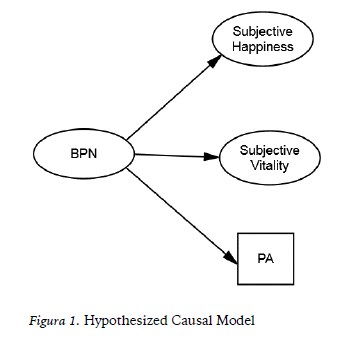
<body><![CDATA[<p>Diener and Lucas   (1999) defined subjective well-being by the evaluation people make of their own   lives. Diener (1994) also interpreted this to mean an experience characterized   by the presence of positive affections, reduced presence of negative affections   and high levels of life satisfaction. According to Neri (2004), subjective   well-being in elderly populations is known as the capacity that an individual   has to come with compensatory mechanisms, such as work and involvement in   groups of social activities, leaving the prejudice that defines elderly people   as unhappy and lonely. This understanding suggests that experiences of   well-being are strongly influenced by self-qualities and socio-cognitive   variables, which links well-being to the social condition where elderly people live (Neto, Lima, Gomes, Santos, &amp; Tolentino, 2012).</p>     <p>Subjective   well-being focuses on happiness by maximizing pleasure and minimizing pain,   considering happiness to be the total of moments lived with pleasure, all of   which are the main characteristics of well-being from the hedonic perspective   (Ryan, Huta, &amp; Deci, 2008). Nevertheless, the eudemonic perspective also   has room in its definition for well-being, in that such is intimately related to an individual’s optimal functioning (Ryan &amp; Deci, 2001, 2008).</p>     <p>This well-being   conceptualization affirms this is not only a result or a final state, but an   accomplishment, or a state of one’s <i>Daimon</i> (Ryan &amp; Deci, 2001,   2008). Ryff (1989) interpreted the term <i>Daimon</i> as an ideal in terms of   excellence and perfection, a state of being in which an individual is willing   to fight for something, which means the person has a direction in his or her   life, thus it is centered on the eudemonic perspective in psychological   well-being, which is characterized by an individual’s optimal functioning (Ryan &amp; Deci, 2001).</p>     <p>Deci &amp; Ryan,   (2000) explained Self-Determination Theory (SDT) saying that self-achievement   is the main aspect of well-being and it explains how basic psychological need   (BPN) satisfaction is important to psychological development (e.g., intrinsic   motivation), integrity (e.g., internalization and assimilation of cultural   practices), well-being (e.g., psychological health), as well as a perception of   vitality, which psychologists have conceptually interpreted as one’s   conscientious experience of energy and one’s possessing a sense of vivacity (Ryan &amp; Deci, 2001; Ryan &amp; Frederick, 1997).</p>     <p>In this way, Ryan   and Deci (2002) explained the basic psychological needs theory, which is one of   the mini theories integrated into SDT, such that BPN consists of autonomy   (i.e., an individual’s capacity to regulate his own actions), competence (i.e.,   an individual’s capacity of efficacy in interaction with the involvement), and   relatedness (i.e., an individual’s capacity to look for and develop   interpersonal connections and relationships), and that these have an essential   role in an individual’s daily life because they are essential conditions to the   great functioning of one’s natural dispositions. That is, autonomy, competence,   and relatedness are needed for the growth and integration of one’s personality   and cognitive structures, as well as of one’s social development and personal   well-being (Ryan &amp; Deci, 2000a, 2002). Thus, an individual with a high   amount of BPN of autonomy, competence, and relatedness will be an individual   who is constantly active in the search of his or her own satisfaction (Ryan &amp; Deci, 2000b).</p>     <p>Some researchers   have diversified BPN satisfaction in terms of behaviour variance, based on   influences from an individual’s personal relationships or integration contexts   (La Guardia &amp; Patrick, 2008), thus one’s motivational function is ideally   reached with one’s overall satisfaction with all aspects of their life (Ryan   &amp; Deci, 2007). Deci and Ryan’s (2000) investigation showed that the higher   one’s perception of BPN satisfaction, the more self-determined (more   autonomous) is the behaviour, which is intimately related with well-being. On   the other hand, the lower the BPN satisfaction, the less self-determined (more   controlled) is the behaviour, which predicts lower levels of well-being (Deci,   Koestner, &amp; Ryan, 1999). Ryan and Deci (2001) also explained that when an   activity promotes an autonomous behaviour, it simultaneous provides subjective   happiness and subjective vitality, which are characteristics of subjective well-being and psychological well-being, respectively.</p>     <p>Vallerand,   O’Connor, and Hamel (1995), from studying motivation in an elderly population,   affirmed that this theme is extremely important in this population: first,   because this process helps us to understand the factors that regulate the   behaviour in elderly people; second, because changes associated with aging   involve the perception of incompetence or feelings that reduce the   self-determination of the behaviour; third, the comprehension of motivation is   necessary to understand the psychological process in aging and the factors that   influence health in this life phase; lastly, the authors affirm that   understanding elderly populations’ motivation allows us to structure contexts where these interact, in order to potentiate motivation in individuals’ lives.</p>     <p>This last point   is essential, since the context where the individual is situated mediates his   or her actions (Kirkland, Karlin, Stelino, &amp; Pulos, 2011), positively   contributing to BNP satisfaction, and when the individual realizes his or her   satisfaction, he or she tends to begin to maintain a variety of behaviours   (Losier, Bourque, &amp; Vallerand, 1993; Vallerand &amp; Losier, 1999), which   tendency makes it possible to include the practice of physical activity, among other things.</p>     <p>As mentioned   before, physical activity may be the vehicle to increase well-being to those   who practice it (Biddle &amp; Ekkekakis, 2005). Nevertheless, epidemiologic   studies have been showing that the practice of physical activity decreases with   aging (Hallal et al, 2012; Sun, Norman, &amp; While, 2013). Furthermore, for   those who maintain active life styles over time, it is not the fact of being   active that leads them to get positive results from the practice, since,   according to Chodzko-Zajko et al. (2009), being physically active is better than   not being so; however, individuals need to follow certain parameters, as the   majority of positive results to health are amplified with the increase of   intensity, frequency and duration of the practice of physical activity. In a   study about subjective well-being and physical activity in elderly individuals,   Neto et al. (2012) concluded that active elderly people have a greater   perception of subjective well-being than do the sedentary elderly. Nonetheless,   individuals who practice physical activity four to five times a week present   higher values of subjective well-being. Withall et al. (2014) also confirmed   the existence of positive links between the amount of physical activity with   moderate and vigorous intensity and the perception of well-being in elderly individuals.   Solberg, Halvari, Ommundsen, and Hopkins (2014) tested several training types   (i.e., endurance, functional, strength) in a four-month program in an elderly   population, concluding that every type of training enhanced the evaluated well-being dimensions.</p>     <p>In short, if we   take into account: i) a low adherence to physical activity behaviour all over   the world (Hallal et al., 2012), which assumes particular relevance in the   European elderly population (European Comission, 2010; European Comission, 2014a),   which makes this question even more worrying if we consider demographic   projections for the next decades which show an overall aging of the population   (European Comission, 2014b); ii) the clear and unquestionable benefits of   physical activity in health and well-being (WHO, 2015), on non-transmissible   diseases prevention (Lee et al., 2012) and on well-being (Withall et al., 2014)   iii) that behaviour regulation plays an important role as a determinate of a   physically active life (Ferrand, Nasarre, Hautier, &amp; Bonnefoy, 2012); iv)   that the satisfaction of basic psychological needs has a significant and   positive impact on well-being, (Moutão, Alves, Monteiro, &amp; Cid, 2015), and   iv) little is known about its motivational determinants in elderly population,   in particular in non-clinic populations, in the present study, in the   hypothesizes casual model (<a href="#f1">Figure 1</a>) we initially analyzed the impact of an   elderly population’s global perception of BPN satisfaction (underlying to SDT)   in their daily lives, looking at subjective happiness and subjective  vitality (i.e., well-being variables), on the   practice of physical activity (PA) in Portuguese elderly individuals. In the   second place, we analyzed how well-being may differ according to the amount of physical activity the Portuguese elderly individuals practiced.</p>     ]]></body>
<body><![CDATA[<p><a name="f1"></a></p>     <p>&nbsp;</p>     <p align="center"><img src="/img/revistas/mot/v13n2/13n2a08f1.jpg" width="345" height="340"></p> </font>     
<p>&nbsp;</p>     <p><font size="3" face="Verdana"><b>METHODOLOGY</b></font></p> <font face="Verdana" size="2">     <p><b>Participants</b></p>     <p>Three hundred   nine elderly people (242 females, 67 males) of Portuguese nationality   participated in this study. The participants frequented senior universities and   nursing homes (none of them were institutionalized), were residents in Ribatejo   and in the West Area of continental Portugal, were aged between 60 and 90 years   old (M= 68.59; DP = 6.60), and they had regular practice of physical activity   (among the reported activities, maintenance gymnastics, aerobic, hydro-gymnastics, and walking are those that stand out the most).</p>     <p><b>Instruments</b></p>     <p>The <i>General   Need Satisfaction Scale</i> (BNSG-S: Gagné, 2003), validated to the elderly   Portuguese population by Couto et al. (submitted), enables the evaluation of   BPN global satisfaction in Portuguese elderly people’s lives. This   questionnaire consisted of 11 items answered on a Likert-type scale of 7   levels, whose answers varied between 1 (“totally disagree”) and 7 (“totally   agree”). We posteriorly grouped the items into three factors (i.e. autonomy, 3   items; competence, 3 items; relatedness, 5 items), reflecting the basic   psychological needs underlying the SDT (Deci &amp; Ryan, 1985). Afterwards, we   calculated the score using the sum of the items, and previously, we calculated it by inverting the negative items. </p>     <p>The <i>Subjective   Happiness Scale</i> (SHS: Lyubomirsky &amp; Lepper, 1999), validated to the   elderly Portuguese population by Couto et al. (submitted), enables the   assessment of subjective happiness in the elderly Portuguese population. SHS   consists of three items answered on a Likert-type scale with seven answer   possibilities. We calculated the subjective happiness value by averaging the individuals’ answers.</p>     ]]></body>
<body><![CDATA[<p>The <i>Subjective   Vitality Scale</i> (SVS: Ryan &amp; Frederick, 1997), validated to Portuguese   exercisers (Moutão, Alves, &amp; Cid, 2013) and Portuguese elderly population   (Couto et al., submitted), enables the assessment of subjective vitality in the   elderly Portuguese population. It consists of 6 items that make up a single   factor that measures subjective vitality, with seven answer possibilities on a   Likert-type scale, which vary between 1 (“totally disagree”) and 7 (“totally   agree”). We calculated the subjective vitality value by averaging the individuals’ answers.</p>     <p>The <i>International   Physical Activity Questionnaire </i>(IPAQ), validated to 12 countries including   Portugal (Craig et al., 2003), enables the quantification of the practice of   physical activity in daily life. Psychologists use this questionnaire, which   consists of 4 questions, to evaluate individuals’ weekly physical activity in walking,   moderate activities, and vigorous activities. IPAQ categorizes physical   activity according to the frequency and duration of each specific type of   activity, and also by the time spent seated each day in a week. We converted   the data we obtained data from IPAQ to MET-min/week (metabolic equivalent) by   calculating the marked minutes a week in each category of activities by the   specific metabolic equivalent. We then classified each individual’s physical   activity level based on IPAQ’s recommendations, into the following categories of physical activity: </p>     <p>Category 1 (Low):   The lowest physical activity level corresponds with individuals who did not   fulfil the criteria for categories 2 or 3. IPAQ considers these individuals inactive.</p>     <p>Category 2   (Moderate): corresponds with individuals who met one of the following criteria:   a) participated in 3 or more days of vigorous physical activity for at least 20   minutes a day; b) participated in 5 or more days of moderate physical activity   and/or walking for at least 30 minute a day; c) participated in 5 or more days   of any combination of walking, moderate, or vigorous physical activity, and reached a minimum total physical activity of at least 600 MET-minutes/week.</p>     <p>Category 3   (High): consists of individuals who met one of the following criteria: a)   participated in vigorous activity for at least 3 days per week, reaching a   minimum total of physical activity of 1500 MET-minutes/week; b) participated 7   days a week in any combination of walking and moderate or vigorous activities   and reached a minimum total physical activity of at least 3,000 MET-minutes/week.</p>     <p><b>Procedures</b></p>     <p><i>Data Collection Procedures  </i></p>     <p>The study has a   cross-sectional design, being the data collected in a single moment and by   convenience. After we received the practitioners’ informed consent signatures   by way of contacting the heads of the senior universities and the nursing   homes, we collected and analyzed all data, leaving the participants anonymous.   Proctors collected the data in a classroom context in functioning local senior   universities, where the participants were in small groups (maximum of 20 people). Participants took about 20 minutes to complete the forms.</p>     <p>The ethics   commission of Regional Health Administration from Lisbon and Tejo’s Valley   (ARSLVT in Portuguese): Judgment 129/CES/INV/2013 from Ethics Commission   approved the present work, which belongs to a larger study that they approved in totality.</p>     <p><i>Data Analysis Procedures</i></p>     ]]></body>
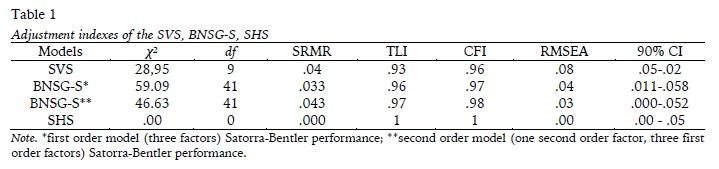
<body><![CDATA[<p>We used   structural equations models (SEM), which involve a multivariate technique that   allows users to simultaneously examine relationships between latent constructs   and measurement variables, such as between several model constructs (Hair,   Black, Babin, &amp; Anderson, 2014). Some see this type of analysis as a fusion   of two techniques: regression analysis and factorial analyses. While regression   analysis (also known as path analysis) focuses on hypothetical causal   relationships within variables, factorial analysis focuses on finding a group   of factors that explain the common variance within an item’s group (Biddle,   Markland, Gilbourne, Chatzisarantis, &amp; Sparkes, 2001). In this manner, in   the present study, the influence of autonomy, competence and relatedness on the   well-being and physical activity of the elderly was tested from the BNP model underlying SDT (Deci &amp; Ryan, 1985).</p>     <p>In operational   terms, SEM was made from AMOS 21 software, underlying the guidelines from   several authors (Byrne, 2010; Hair et al., 2014; Worthington &amp; Whittaker,   2006). We used the maximum likelihood (ML) estimation method through a   chi-square (&#967;²) test with the respective degrees of freedom (df)   and significance level (p). Additionally, we also used the following indexes of   adjustment quality: Standardized Root Mean Square Residual (SRMR), Comparative   Fit Index (CFI), Tucker-Lewis Index (TLI), Root Mean Square Error of   Approximation (RMSEA) and the respective confidence interval (90% CI). In the   current study, we adopted the cut-off values that Hu and Bentler (1999)   suggested: SRMR &#8804; .08, CFI e TLI &#8805; .95 e RMSEA &#8804; .06.   However, we also took the advice from several authors (e.g., Byrne, 2010; Hair   et al., 2014; Marsh, Hau, &amp; Wen, 2004), and considered values equal or   higher than .90 in case of incremental indexes and between &#8804; .05 and &#8804; .08 in absolute indexes, to avoid the rejection of good models.</p>     <p>The theory   underlying the ML (maximum likelihood) estimation method assumes data have a   normal multivariate distribution, which is necessary to analyse Mardia’s   coefficient (see Mardia, 1970). According to Byrne (2010), a normalized   Mardia’s coefficient higher than 5.0 indicates that the data does not have a normal multivariate distribution.</p>     <p>Regarding the   differences in the study, initially, we made a univariate analysis of location   measures and central tendency (mean) and dispersion measures (standard   deviation). Secondly, we used parametric statistic techniques since the sample   size allowed us to do so, and also because parametric tests confer a greater   power when compared to non-parametric tests (Ho, 2014) in order to study the   differences in terms of subjective happiness and subjective vitality between   the different physical activity levels, because we used an ANOVA One Way test   (means comparison in more than two groups), complemented with a Post-hoc Tukey   HSD. The significance level adopted to reject null hypotheses was p &#8804;   .05. Effect sizes are reported as partial eta-squared (&#951;<sub>p</sub><sup>2</sup>), with cut-off   values of: trivial (0 –.19); small (.20 – .49); medium (.50 – .79) and large (0.80 and greater) (Cohen, 1992).</p>     <p>&nbsp;</p> </font>     <p><font size="3" face="Verdana"><b>RESULTS</b></font></p> <font face="Verdana" size="2">     <p>Regarding data   adjustment to the measurement models, as seen in <a href="/img/revistas/mot/v13n2/13n2a08t1.jpg">Table 1</a>, all measurement   models adjusted themselves to the data in a satisfactory way, even though not   all cut-off values adopted in the methodology were reached in every model (Hu   &amp; Bentler, 1999). However, as it was mentioned in the methodology, some   authors equally advise to consider values that are equal to or above .90 in   incremental indexes and between &#8804; .05 and &#8804; .08 in absolute indexes   (Byrne, 2010; Hair et al., 2014; Marsh et al., 2004) thus avoiding the rejection of good models.</p>     
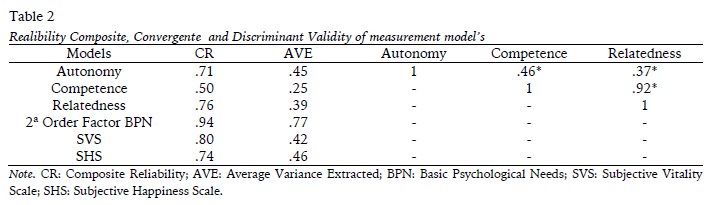
<p>In relation to   the data’s adjustment to the measurement models (<a href="/img/revistas/mot/v13n2/13n2a08t2.jpg">Table 2</a>), all presented a good   adjustment, being in agreement with the cut-off values adopted in the methodology (Byrne, 2010; Hair et al., 2014; Marsh et al., 2004).</p>     
<p>In <a href="/img/revistas/mot/v13n2/13n2a08t2.jpg">table 2</a> are   presented the data concerning to the convergent and discriminant validity, as well, composite reliability for all measurement model’s used.</p>     
<p>Through Mardia’s   coefficient, we verified the presence of the non-normal multivariate, once the   obtained value of 32.50 exceeded the adopted cut-off value of 5.0 (Byrne,   2010). Therefore, Bollen-Stine bootstrap on 2,000 samples was used (Nevitt   &amp; Hancock, 2001). No missing values, univariate outliers (z&lt;3) and   multivariate outliers (D<sup>2</sup>= p1&gt;.001; p2&gt;.001) were detected (Byrne, 2010). </p>     ]]></body>
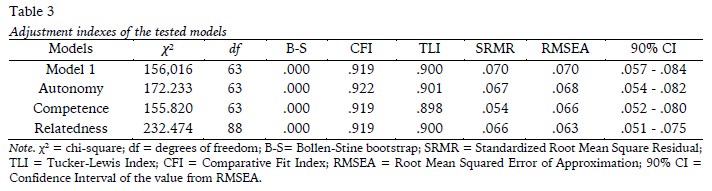
<body><![CDATA[<p>Through   structural equations analysis, we observed that the initially hypothesized   model (model 1) adjusted itself to the data &#967;² = 156.016; df =   63; B-S = <i>p </i>&lt; .000; SRMR = .070; TLI = .90; CFI = .919; RMSEA = .070   90% IC .057—.084, although we did not reach the cut-off values from Hu and Bentler (1999) that we had adopted in the methodology.</p>     <p>As Model 1   addresses BPN in a total satisfaction manner, not discriminating the three BPN   categories (i.e., autonomy, competence and relatedness), we also studied the   way each BPN independently influences the studied variables (i.e., subjective   happiness, subjective vitality, physical activity category). Thus, we analyzed   three other models, one for each BPN, to verify the adjustment of the models to   the data for all the BPN, as <a href="/img/revistas/mot/v13n2/13n2a08t3.jpg">Table 3</a> shows, even though we did not reach every cut-off value from Hu and Bentler (1999).</p>     
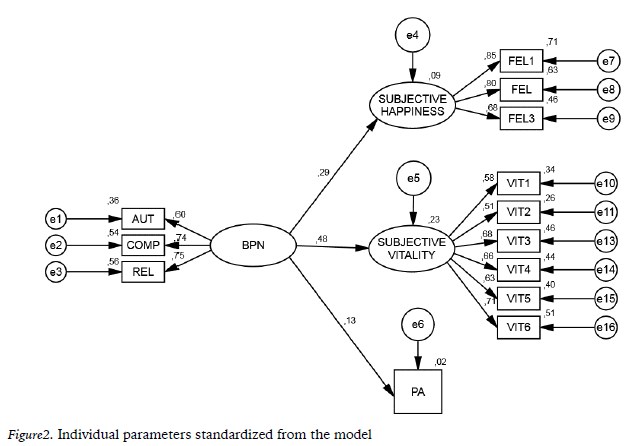
<p>By the analysis   of the effect of BPN total satisfaction in the life of Portuguese elderly   individuals on the studied well-being variables and physical activity, we   verified, as shown in <a href="/img/revistas/mot/v13n2/13n2a08f2.jpg">Figure 2</a>, that positive and significant effects exist   between BPN satisfaction, subjective happiness (ß = .29) and subjective   vitality (ß = .48). Regarding physical activity, the positive effect between BPN and physical activity (ß = .13) was not significant.</p>     
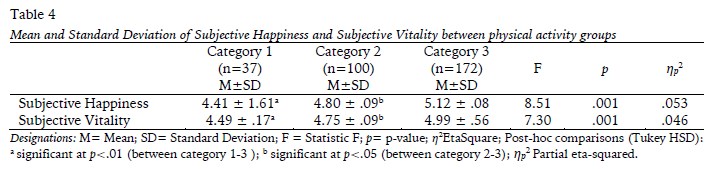
<p>We also analyzed   models that reflect the relation of each BPN individually, namely on well-being   and physical activity. In this way, for the BPN of autonomy, we confirmed a   positive and significant effect on happiness (&#946; = .40) and   vitality (&#946; = .59), and a not significant positive effect on physical activity (&#946; = .06); on the   other hand, the BPN of competence obtained a direct and significant effect on   subjective happiness (B = .50) subjective vitality (&#946; = .73) and   physical activity (&#946; = .33). At last, relatively to the BPN of relatedness,   we also verified a direct and positive effect with subjective happiness (&#946; = .17) and   subjective vitality (&#946; = .35), and a not significant positive effect was obtained for physical activity.</p>     <p>Regarding the   differences in the study, we found it possible to verify, as shown in <a href="/img/revistas/mot/v13n2/13n2a08t4.jpg">Table 4</a>,   that in a general way, individuals included in Category 3 of physical activity   had a higher valorization of the studied variables. On the other hand,   individuals in Category 1 of physical activity presented the lowest average levels of subjective happiness and subjective vitality.</p>     
<p>In the means   comparison between physical activity categories, we found it possible to verify   by One Way ANOVA analysis, after confirming the normality through p   non-signification (p &#8805; .05) in the Kolmogorov-Smirnov test, that   statistically significant differences exist between physical activity   categories regarding the analyzed well-being dimensions (F<sub>Subjective     happiness </sub>= 8.50, p &lt; .01; F<sub>Subjective Vitality </sub>= 7.29, p &lt; .01).</p>     <p>Afterwards, we   conducted the multiple comparisons of means through the analysis of a Post-hoc   Tukey test, because the variances are homogeneous (Levene´s test &#8805; .05).   Regarding subjective happiness, we found a significant statistical difference   (p = .001) between Category 1 (M = 4.41; SD = .16) and Category 3 (M = 5.12; SD   = .08) for physical activity and significant differences (p = .034) between   Category 2 (M = 4.80; SD = .09) and 3 (M = 5.12; SD = .08) for physical   activity, yet, we found no differences between Category 1 (M = 4.41; SD = .16)   and 2 (M = 4.80; SD = .09) for physical activity. Regarding subjective   vitality, the results from the Post-hoc Tukey test, like those about subjective   happiness, showed a significant statistical differences (p = .002) between   Category 1 (M 4.49; SD = .17) and 3 (M = 4.99; SD = .56) for physical activity   and significant differences (p= .039) between Category 2 (M = 4.75; SD = .08)   and 3 (M = 4.99; SD = .56) for physical activity, showing no significant   differences between Category 1 (M 4.49; SD = .17) and 2 (M = 4.75; SD = .08)   for physical activity. We can also verify an existence of a trivial effect size in both variables.</p>     <p>&nbsp;</p> </font>     <p><font size="3" face="Verdana"><b>DISCUSSION</b></font></p> <font face="Verdana" size="2">     <p>Successfully   aging assumes the following: avoiding diseases and/or incapacities; maintaining   a high physical and cognitive function; and engaging in productive social   activities in a sustained manner (Rowe, 1997). Therefore, physical activity is   essential in this process, whether to the capacity to keep individual’s   functionality overtime, or to the capacity to recover from limitations linked   to the course of time (NIA, 2010). Taking this into account regarding the main   goal of this study, we conducted an analysis of hypothetical causal   relationships between BPN in elderly Portuguese individuals’ overall lives,   including their subjective happiness, subjective vitality and the practice of physical activity.</p>     ]]></body>
<body><![CDATA[<p>Therefore, the   initially hypothesized model (Model 1) was satisfactorily adjusted to the data,   even though some of the cut-off values adopted in the methodology were not   reached. As was already demonstrated, we also tried to understand how each   isolated BPN relates with the studied well-being dimensions and physical activity, and established a single model for each BPN.</p>     <p>Similar to Model   1, all other models were adjusted to data, yet they did not comply with the   cut-off values from Hu and Bentler (1999) to the incremental indexes CFI and   TLI and to the absolute index RMSEA. However, as was previously mentioned, some   authors (e.g., Byrne, 2010; Hair et al., 2014; Marsh et al., 2004) equally   advised researchers to consider values equal or higher than .90 in incremental   indexes and values between .05 and .08 in absolute indexes in order to avoid the rejection of good models.</p>     <p>Thus, as is   visible in <a href="/img/revistas/mot/v13n2/13n2a08f2.jpg">Figure 2</a>, the results from Model 1 indicate that the BPN   satisfaction in the overall life of the Portuguese elderly population significantly   predicts subjective happiness and subjective vitality. The same, however, did   not happen with the practice of physical activity, since besides the positive   direct effect of BPN on physical activity not significant (p &#8805; .05).   Therefore, it is possible to affirm that as elderly individuals globally   perceive a greater BPN satisfaction in their lives, they likewise perceive   higher levels of subjective happiness and subjective vitality, consequently, determining a positive effect on the studied well-being variables.</p>     
<p>In a study   containing a sample that included elderly individuals, Reis, Sheldon, Gable,   Roscoe, &amp; Ryan (2000) also verified that a bigger perception of BPN   satisfaction also determines a positive variance of positive affections,   happiness and subjective vitality. Sheldon and Niemiec (2006) also ascertained   that each BPN, in an individual manner, significantly predicts happiness. More   recently, Molix and Nichols (2013) confirmed, among other results, a positive   connection between BPN satisfaction and a eudemonic and hedonic perspective of   well-being, data that corroborates the positive influence of BPN on well-being in both perspectives.</p>     <p>To the individual   analysis of each BPN (i.e., autonomy, competence, relatedness), we developed   three independent models, and, as indicated earlier, they adjusted themselves   to the data. All separate BPNs are predictors of subjective happiness and   subjective  vitality. Regarding   subjective happiness, the BPN of competence presented the biggest direct effect   and the BPN of relatedness presented the lowest, though all were significant (p   &#8804; .05). Data that was also corroborated by the work done from Sapmaz, Do&#287;an, Sapmaz, Temizel, &amp; Dilek Tel (2012) where,   through a sample of Turkish adults, they verified a positive contribute of BPN   on happiness, as well as they verified that the BPN of competence has the   biggest influence on subjective happiness, followed by autonomy and relatedness, respectively.</p>     <p>Regarding   subjective vitality, all BPNs also presented a positive and significant direct   effect (p &#8804; .05), meeting Ryan and Deci’s (2008) expectations in that   they confirmed that the behaviours that predict BPN satisfaction are essential   to subjective vitality maintenance. Just as the case with subjective happiness,   the BPN of competence also presented the highest direct effect and the   relatedness need presented the lowest direct effect. Sheldon, Ryan, and Reis   (1996) studied BPN’s fluctuation over a period of two weeks and also verified that the BPN of competence has the biggest influence on subjective vitality.</p>     <p>Regarding   physical activity, BPN satisfaction in elderly Portuguese people’s overall life   did not significantly predict the practice of physical activity, since, even   though there is a positive direct effect, it is not significant (p &#8805;   .05). In other words, it is not the fact that the elderly perceives a bigger   satisfaction of all BPN in their lives that makes them practice more physical   activity. Nevertheless, by individual analysis of BPN, the results verified   that there is a significant ( p &#8804; .05) and a positive direct effect   between the competence need and the practice of physical activity, indicating   that the elderly who perceive a bigger satisfaction of competence need in their daily lives practice more physical activity.</p>     <p>The competence   need refers to the efficacy of an individual’s interactions in a certain   context, resulting in more opportunities to manifest his or her capacities   (Ryan &amp; Deci, 2002). In other words, the success of these interactions has   as an outcome an increase in competence that automatically happens, providing   new learning intentions (Krapp, 2005), and this is an important issue because   elderly people’s daily competence also refers to the individual’s personal   capacity to participate in several activities that are considered essential to   their independence (Diehl, 1998). To sum up, if changes linked to aging involve   a perception of incompetence or feelings that reduce a person’s   self-determination to continue a behaviour (Vallerand, O’Connor, &amp; Hamel,   1995), then, it seems the promotion of competence’s BPN plays an essential role in the lives of the elderly Portuguese population.</p>     <p>Results from the   current study also evidenced that there are significant differences in   well-being variables underlying the practice levels of physical activity, as   was shown likewise in the work of Neto et al. (2012) and of Withall et al.   (2014). This means that those who have higher levels of physical activity have   a bigger perception of subjective happiness and subjective vitality compared to   the individuals who have lower levels of physical activity. This data confirms the importance of physical activity to promote well-being in this population.</p>     <p>Additionally, the   results verified that differences of well-being exist between Categories 1   (low) and 3 (vigorous) of physical activity and between 2 (moderate) and 3,   both with trivial effect-size. Yet, we found no differences about well-being   between Categories 1 and 2. The non-existence of differences between these two   categories may be explained by the small difference of weekly minutes of   moderate physical activity between the two categories. In order to be in   Category 2 of physical activity, individuals needed at least 150 min./week of   moderate physical activity or walking; however, the individuals in Category 1   did practice physical activity, although not enough to be in Category 2, which   fact might explain the existing difference between Categories 1 and 3, since   the amount of physical activity differs much more significantly. Nonetheless,   the difference of METs/week between Categories 2 and 3 is higher than comparing   Categories 1 and 2, which justifies the existence of differences in the studied well-being variables between Categories 2 and 3 from IPAQ as well. </p>     ]]></body>
<body><![CDATA[<p>&nbsp;</p> </font>     <p><font size="3" face="Verdana"><b>CONCLUSION</b></font></p> <font face="Verdana" size="2">     <p>With this work,   the results demonstrate to the elderly population that physical activity   influences the studied well-being dimensions, since those who have more   practice of physical activity had higher levels of subjective happiness and   subjective vitality. The results also verified that BPN in elderly people’s   overall life predicts subjective happiness and subjective vitality, since the   elderly who perceive higher BPN satisfaction in their overall life perceive   more subjective happiness and subjective vitality, too. The results also   verified that the BPN of competence has a greater influence on subjective   happiness and subjective vitality more than being a positive direct predictor   of a bigger practice of physical activity in this population, which leads to indicate that it is vital in elderly Portuguese people’s lives.</p>     <p>Therefore, it   seems crucial to promote BPN satisfaction, especially in the area of   competence, in the several life domains of Portuguese elderly individuals, in   all the domains that are part of their daily lives, whether to the potentiation   of well-being that they promote, or to the positive influence on the practice   of physical activity. In this way, it is fundamental for all those who are part   of the elderly’s daily lives, to be aware of the BPN importance in their lives,   and they should be fundamental elements in the promotion of their well-being,   through the establishment of the conditions capable of promoting satisfaction   of all BPN in this population. It also seems to us fundamental for this   population, to promote efficient strategies that determine a greater amount of   physical activity practice in elderly people, in order to promote a greater perception of well-being.</p>     <p>The necessity to   continue the study of these variables also seems evident. In the first place,   we believe that is important to analyze the invariance of the model according   to gender, using for that a more balanced sample between men and women, which   is not verified in the present study, that allows verifying the influence of   this variable in relation between the BPN, the well-being and the physical   activity. In the second place, with a physical activity assessment that enables   a more effective quantification (e.g., pedometers) that would contribute to the   clarification of the determinants and consequences of physical activity   practices in this population, even though, unfortunately, we continue to see a   tiny amount of physical activity practiced and all the harmful consequences to the life quality of the elderly.</p>     <p>&nbsp;</p> </font>     <p><font size="3" face="Verdana"><b>REFER&Ecirc;NCIAS</b></font></p> <font face="Verdana" size="2">     <!-- ref --><p>Biddle, S., &amp; Ekkekakis, P.&nbsp;(2005).  Physically  active lifestyles and well-being. In F.A. Huppert, B. Keverne &amp; N. Baylis  (Eds.), <i>The science of well-being</i> (pp. 140-168). Oxford: Oxford  University Press.    &nbsp;&nbsp;&nbsp;&nbsp;&nbsp;&nbsp;&nbsp;&nbsp;[&#160;<a href="javascript:void(0);" onclick="javascript: window.open('/scielo.php?script=sci_nlinks&ref=367025&pid=S1646-107X201700030000800001&lng=','','width=640,height=500,resizable=yes,scrollbars=1,menubar=yes,');">Links</a>&#160;]<!-- end-ref -->&nbsp;</p>     <!-- ref --><p> Biddle,  S., Markland, D., Gilbourne, D., Chatzisarantis, N., &amp; Sparkes, A. (2001).  Quantitative and qualitative research issues in sport psychology. <i>Journal of Sport Sciences</i>, <i>19</i>(10), 777-809. <a href="http://dx.doi.org/10.1080/026404101317015438" target="_blank">http://dx.doi.org/10.1080/026404101317015438</a>.    &nbsp;&nbsp;&nbsp;&nbsp;&nbsp;&nbsp;&nbsp;&nbsp;[&#160;<a href="javascript:void(0);" onclick="javascript: window.open('/scielo.php?script=sci_nlinks&ref=367027&pid=S1646-107X201700030000800002&lng=','','width=640,height=500,resizable=yes,scrollbars=1,menubar=yes,');">Links</a>&#160;]<!-- end-ref --></p>     <!-- ref --><p>Byrne, B.  (2010). <i>Structural equation modeling with  AMOS. Basic concepts, applications, and programming </i>(2nd ed.). New  York: Taylor &amp; Francis Group.    &nbsp;&nbsp;&nbsp;&nbsp;&nbsp;&nbsp;&nbsp;&nbsp;[&#160;<a href="javascript:void(0);" onclick="javascript: window.open('/scielo.php?script=sci_nlinks&ref=367029&pid=S1646-107X201700030000800003&lng=','','width=640,height=500,resizable=yes,scrollbars=1,menubar=yes,');">Links</a>&#160;]<!-- end-ref --></p>     <!-- ref --><p>Chodzko-Zajko W., Fiatarone S., Minson C., Nigg C.,  Salem G., &amp; Skinner J. (2009). Exercise and physical activity for older  adults. <i>Medicine and Science in Sports  and Exercise</i>, <i>41</i>, 1510-1530. <a href="http://dx.doi.org/10.1249/MSS.0b013e3181a0c95c" target="_blank">http://dx.doi.org/10.1249/MSS.0b013e3181a0c95c</a>.    &nbsp;&nbsp;&nbsp;&nbsp;&nbsp;&nbsp;&nbsp;&nbsp;[&#160;<a href="javascript:void(0);" onclick="javascript: window.open('/scielo.php?script=sci_nlinks&ref=367031&pid=S1646-107X201700030000800004&lng=','','width=640,height=500,resizable=yes,scrollbars=1,menubar=yes,');">Links</a>&#160;]<!-- end-ref --></p>     <!-- ref --><p>Cohen, J. (1992). A  power primer.&nbsp;Psychological Bulletin, 112(1), 155-159. <a href="http://dx.doi.org/10.1037/0033-2909.112.1.155" target="_blank">http://dx.doi.org/10.1037/0033-2909.112.1.155</a> &nbsp;&nbsp;&nbsp;&nbsp;&nbsp;&nbsp;&nbsp;&nbsp;[&#160;<a href="javascript:void(0);" onclick="javascript: window.open('/scielo.php?script=sci_nlinks&ref=367033&pid=S1646-107X201700030000800005&lng=','','width=640,height=500,resizable=yes,scrollbars=1,menubar=yes,');">Links</a>&#160;]<!-- end-ref --><!-- ref --><p>Couto, N., Antunes, R., Monteiro, D., Marinho, D., Vitorino,  A., &amp; Luis Cid. (submitted). Validation of the Basic  Need Satisfaction General Scale (BNSG-S) in a sample of Portuguese older  people. <i>Universitas Psychologica</i>.    &nbsp;&nbsp;&nbsp;&nbsp;&nbsp;&nbsp;&nbsp;&nbsp;[&#160;<a href="javascript:void(0);" onclick="javascript: window.open('/scielo.php?script=sci_nlinks&ref=367034&pid=S1646-107X201700030000800006&lng=','','width=640,height=500,resizable=yes,scrollbars=1,menubar=yes,');">Links</a>&#160;]<!-- end-ref --> </p>     <!-- ref --><p>Couto, N., Antunes, R., Vitorino, A., Monteiro, D., Mout&atilde;o,  J., Marinho. D., &amp; Cid, L. (submitted). Valida&ccedil;&atilde;o da Subjetive Happiness  Scale (SHS) e influ&ecirc;ncia da atividade f&iacute;sica sobre a felicidade dos idosos  portugueses. <i>Revista Iberoamericana de  Psicolog&iacute;a del Ejercicio y el Deporte</i>.    &nbsp;&nbsp;&nbsp;&nbsp;&nbsp;&nbsp;&nbsp;&nbsp;[&#160;<a href="javascript:void(0);" onclick="javascript: window.open('/scielo.php?script=sci_nlinks&ref=367036&pid=S1646-107X201700030000800007&lng=','','width=640,height=500,resizable=yes,scrollbars=1,menubar=yes,');">Links</a>&#160;]<!-- end-ref --> </p>     ]]></body>
<body><![CDATA[<!-- ref --><p>Couto, N., Antunes, R., Monteiro, D.,  Mout&atilde;o, J., Marinho, D., &amp; Cid, L. (2017). Validation of the Subjective  Vitality Scale and study of the vitality of elderly people according to their physical  activity.&nbsp;<i>Brazilian Journal of </i>Kinanthropometry  and Human Performance, 19(3), 261-269. doi: <a href="http://dx.doi.org/10.5007/1980-0037.2017v19n3p261" target="_blank">http://dx.doi.org/10.5007/1980-0037.2017v19n3p261</a>.    &nbsp;&nbsp;&nbsp;&nbsp;&nbsp;&nbsp;&nbsp;&nbsp;[&#160;<a href="javascript:void(0);" onclick="javascript: window.open('/scielo.php?script=sci_nlinks&ref=367038&pid=S1646-107X201700030000800008&lng=','','width=640,height=500,resizable=yes,scrollbars=1,menubar=yes,');">Links</a>&#160;]<!-- end-ref --></p>     <p>Craig, C., Marshall, A., Sjostrom, M., Bauman A., Booth,  M., &amp; Ainsworth, B. (2003). International physical activity questionnaire:  12-country reliability and validity. <i>Medicine  Science Sports Exercise</i>, <i>35</i>(8),  1381&ndash;95. <a href="http://dx.doi.org/10.1249/01.MSS.0000078924.61453.FB" target="_blank">http://dx.doi.org/10.1249/01.MSS.0000078924.61453.FB</a>. </p>     <p>Deci, E.,  Koestner, R., &amp; Ryan, R. (1999). A meta-analytic review of experiments  examining the effects of extrinsic rewards on intrinsic motivation. <i>Psychological Bulletin</i>, <i>125</i>, 627&ndash;668.</p>     <!-- ref --><p>Deci, E., &amp; Ryan, R. (1985)<i>. Intrinsic motivation and  self-determination in human behavior</i>. New York: Plenum.    &nbsp;&nbsp;&nbsp;&nbsp;&nbsp;&nbsp;&nbsp;&nbsp;[&#160;<a href="javascript:void(0);" onclick="javascript: window.open('/scielo.php?script=sci_nlinks&ref=367042&pid=S1646-107X201700030000800011&lng=','','width=640,height=500,resizable=yes,scrollbars=1,menubar=yes,');">Links</a>&#160;]<!-- end-ref --></p>     <p>Deci, E., &amp; Ryan, R. (2000). The &ldquo;what&rdquo; and &ldquo;why&rdquo;  of goal pursuits: Human needs and the self-determination of behavior. <i>Psychological Inquiry</i>, <i>11</i>(4), 227-268.</p>     <p>Diehl, M.  (1998). Everyday competence in later life: Current status and future  directions. <i>Gerontologist, 38</i>(4),  422&ndash;433.</p>     <!-- ref --><p>Diener, E. (1994). Assessing Subjective Well-Being: Progress and  Opportunities. <i>Social Indicators  Research, 31</i>, 103-157.    &nbsp;&nbsp;&nbsp;&nbsp;&nbsp;&nbsp;&nbsp;&nbsp;[&#160;<a href="javascript:void(0);" onclick="javascript: window.open('/scielo.php?script=sci_nlinks&ref=367046&pid=S1646-107X201700030000800014&lng=','','width=640,height=500,resizable=yes,scrollbars=1,menubar=yes,');">Links</a>&#160;]<!-- end-ref --></p>     ]]></body>
<body><![CDATA[<!-- ref --><p>Diener,  E., &amp; Lucas, R. (1999). Personality and subjective well-being. In D.  Kahnerman, E. Diener, &amp; N. Schwarz (Eds.), <i>Well-being: the foundations of hedonic psychology</i> (pp. 213-229).  New York, NY: Russel Sage Foundation.    &nbsp;&nbsp;&nbsp;&nbsp;&nbsp;&nbsp;&nbsp;&nbsp;[&#160;<a href="javascript:void(0);" onclick="javascript: window.open('/scielo.php?script=sci_nlinks&ref=367048&pid=S1646-107X201700030000800015&lng=','','width=640,height=500,resizable=yes,scrollbars=1,menubar=yes,');">Links</a>&#160;]<!-- end-ref --> </p>     <!-- ref --><p>European  Comission. (2010). Sport and physical activity. Special Eurobarometer 334/Wave  72.3. Brussels: directorate-general Education and Culture.    &nbsp;&nbsp;&nbsp;&nbsp;&nbsp;&nbsp;&nbsp;&nbsp;[&#160;<a href="javascript:void(0);" onclick="javascript: window.open('/scielo.php?script=sci_nlinks&ref=367050&pid=S1646-107X201700030000800016&lng=','','width=640,height=500,resizable=yes,scrollbars=1,menubar=yes,');">Links</a>&#160;]<!-- end-ref --></p>     <!-- ref --><p>European  Comission. (2014a). Sport and physical activity. Special Eurobarometer 412.  Brussels: directorate-general Education and Culture. doi: 10.2766/73002.    &nbsp;&nbsp;&nbsp;&nbsp;&nbsp;&nbsp;&nbsp;&nbsp;[&#160;<a href="javascript:void(0);" onclick="javascript: window.open('/scielo.php?script=sci_nlinks&ref=367052&pid=S1646-107X201700030000800017&lng=','','width=640,height=500,resizable=yes,scrollbars=1,menubar=yes,');">Links</a>&#160;]<!-- end-ref --></p>     <!-- ref --><p>European  Comission (2014b). <i>The 2015 Ageing  Report. Underlying Assumptions and Projection Methodologies.</i> Brussels:  directorate-General for Economic and Financial Affairs Unit Communication and  interinstitutional relations. doi:10.2765/76255.    &nbsp;&nbsp;&nbsp;&nbsp;&nbsp;&nbsp;&nbsp;&nbsp;[&#160;<a href="javascript:void(0);" onclick="javascript: window.open('/scielo.php?script=sci_nlinks&ref=367054&pid=S1646-107X201700030000800018&lng=','','width=640,height=500,resizable=yes,scrollbars=1,menubar=yes,');">Links</a>&#160;]<!-- end-ref --></p>     <!-- ref --><p>Ferrand, C.,  Martinent, G., &amp; Durmaz, N. (2014). Psychological need satisfaction and  well-being in adults aged 80 years and older living in residential homes: Using  a self-determination theory perspective. <i>Journal of Aging Studies, 30</i>, 104-111. <a href="http://dx.doi.org/10.1016/j.jaging.2014.04.004" target="_blank">http://dx.doi.org/10.1016/j.jaging.2014.04.004</a>.    &nbsp;&nbsp;&nbsp;&nbsp;&nbsp;&nbsp;&nbsp;&nbsp;[&#160;<a href="javascript:void(0);" onclick="javascript: window.open('/scielo.php?script=sci_nlinks&ref=367056&pid=S1646-107X201700030000800019&lng=','','width=640,height=500,resizable=yes,scrollbars=1,menubar=yes,');">Links</a>&#160;]<!-- end-ref --> </p>     ]]></body>
<body><![CDATA[<!-- ref --><p>Ferrand, C.,  Nasarre, S., Hautier, C., &amp; Bonnefoy, M. (2012). Aging and well-being in  French older adults regularly practicing physical activity: A  self-determination perspective. <i>Journal  of Aging and Physical Activity</i>, <i>20</i>(2),  215-230.    &nbsp;&nbsp;&nbsp;&nbsp;&nbsp;&nbsp;&nbsp;&nbsp;[&#160;<a href="javascript:void(0);" onclick="javascript: window.open('/scielo.php?script=sci_nlinks&ref=367058&pid=S1646-107X201700030000800020&lng=','','width=640,height=500,resizable=yes,scrollbars=1,menubar=yes,');">Links</a>&#160;]<!-- end-ref --> </p>     <!-- ref --><p>Franchi, K., &amp; Montenegro, J.  (2005). Atividade  f&iacute;sica: uma necessidade para a boa sa&uacute;de na terceira idade. <i>Revista Brasileira em Promo&ccedil;&atilde;o da Sa&uacute;de</i>, <i>18</i>(3), 52-156.    &nbsp;&nbsp;&nbsp;&nbsp;&nbsp;&nbsp;&nbsp;&nbsp;[&#160;<a href="javascript:void(0);" onclick="javascript: window.open('/scielo.php?script=sci_nlinks&ref=367060&pid=S1646-107X201700030000800021&lng=','','width=640,height=500,resizable=yes,scrollbars=1,menubar=yes,');">Links</a>&#160;]<!-- end-ref --></p>     <!-- ref --><p>Gagn&eacute;, M. (2003). The role of autonomy support and autonomy  orientation in prosocial behavior engagement. <i>Motivation and Emotion, 27</i>, 199-223. <a href="http://dx.doi.org/10.1023/A:1025007614869" target="_blank">http://dx.doi.org/10.1023/A:1025007614869</a>.    &nbsp;&nbsp;&nbsp;&nbsp;&nbsp;&nbsp;&nbsp;&nbsp;[&#160;<a href="javascript:void(0);" onclick="javascript: window.open('/scielo.php?script=sci_nlinks&ref=367062&pid=S1646-107X201700030000800022&lng=','','width=640,height=500,resizable=yes,scrollbars=1,menubar=yes,');">Links</a>&#160;]<!-- end-ref --></p>     <!-- ref --><p>Hair, Jr., Black, W., Babin, B.,  &amp; Anderson, R. (2014). <i>Multivariate  data analysis</i> (7th ed.). New Jersey: Pearson Educational, Inc.    &nbsp;&nbsp;&nbsp;&nbsp;&nbsp;&nbsp;&nbsp;&nbsp;[&#160;<a href="javascript:void(0);" onclick="javascript: window.open('/scielo.php?script=sci_nlinks&ref=367064&pid=S1646-107X201700030000800023&lng=','','width=640,height=500,resizable=yes,scrollbars=1,menubar=yes,');">Links</a>&#160;]<!-- end-ref --></p>     <!-- ref --><p>Hallal, P., Andersen, L., Bull, F.,  Guthold, R., Haskell, W., &amp; Ekelund, U. (2012). Global physical activity  levels: Surveillance progress, pitfalls, and prospects. <i>The Lancet, 380</i>(9838), 247-257.    &nbsp;&nbsp;&nbsp;&nbsp;&nbsp;&nbsp;&nbsp;&nbsp;[&#160;<a href="javascript:void(0);" onclick="javascript: window.open('/scielo.php?script=sci_nlinks&ref=367066&pid=S1646-107X201700030000800024&lng=','','width=640,height=500,resizable=yes,scrollbars=1,menubar=yes,');">Links</a>&#160;]<!-- end-ref --></p>     ]]></body>
<body><![CDATA[<!-- ref --><p>Ho, R. (2014). <i>Handbook of univariate and multivariate data analysis with IBM SPSS</i>.  (2nd ed.). New York, NY: CRC Press.    &nbsp;&nbsp;&nbsp;&nbsp;&nbsp;&nbsp;&nbsp;&nbsp;[&#160;<a href="javascript:void(0);" onclick="javascript: window.open('/scielo.php?script=sci_nlinks&ref=367068&pid=S1646-107X201700030000800025&lng=','','width=640,height=500,resizable=yes,scrollbars=1,menubar=yes,');">Links</a>&#160;]<!-- end-ref --></p>     <!-- ref --><p>Hu, L. &amp; Bentler, P. (1999).  Cut-off criteria for fit indexes in covariance structure analysis: conventional  criteria versus new alternatives. <i>Structural  Equation Modeling, 6</i>(1), 1-55. <a href="http://dx.doi.org/10.1080/10705519909540118" target="_blank">http://dx.doi.org/10.1080/10705519909540118</a>.    &nbsp;&nbsp;&nbsp;&nbsp;&nbsp;&nbsp;&nbsp;&nbsp;[&#160;<a href="javascript:void(0);" onclick="javascript: window.open('/scielo.php?script=sci_nlinks&ref=367070&pid=S1646-107X201700030000800026&lng=','','width=640,height=500,resizable=yes,scrollbars=1,menubar=yes,');">Links</a>&#160;]<!-- end-ref --></p>     <!-- ref --><p>Kirkland, R., Karlin, N., Stellino,  M., &amp; Pulo, S. (2011). Basic psychological needs satisfaction, motivation,  and exercise in older adults. <i>Activities,  adaptation &amp; aging</i>, <i>35</i>(3),  181-196.    &nbsp;&nbsp;&nbsp;&nbsp;&nbsp;&nbsp;&nbsp;&nbsp;[&#160;<a href="javascript:void(0);" onclick="javascript: window.open('/scielo.php?script=sci_nlinks&ref=367072&pid=S1646-107X201700030000800027&lng=','','width=640,height=500,resizable=yes,scrollbars=1,menubar=yes,');">Links</a>&#160;]<!-- end-ref --></p>     <!-- ref --><p>Krapp,  A. (2005). Basic needs and the development of interest and intrinsic  motivational orientations. <i>Learning and  Instruction</i>, <i>15</i>(5), 381-395.  <a href="http://dx.doi.org/10.1016/j.learninstruc.2005.07.007" target="_blank">http://dx.doi.org/10.1016/j.learninstruc.2005.07.007</a>.    &nbsp;&nbsp;&nbsp;&nbsp;&nbsp;&nbsp;&nbsp;&nbsp;[&#160;<a href="javascript:void(0);" onclick="javascript: window.open('/scielo.php?script=sci_nlinks&ref=367074&pid=S1646-107X201700030000800028&lng=','','width=640,height=500,resizable=yes,scrollbars=1,menubar=yes,');">Links</a>&#160;]<!-- end-ref --> </p>     <!-- ref --><p>La Guardia, J.,  &amp; Patrick, H. (2008). Self-determination theory as a fundamental theory of  close relationships. <i>Canadian Psychology</i>, <i>29</i>(3), 201-209.    &nbsp;&nbsp;&nbsp;&nbsp;&nbsp;&nbsp;&nbsp;&nbsp;[&#160;<a href="javascript:void(0);" onclick="javascript: window.open('/scielo.php?script=sci_nlinks&ref=367076&pid=S1646-107X201700030000800029&lng=','','width=640,height=500,resizable=yes,scrollbars=1,menubar=yes,');">Links</a>&#160;]<!-- end-ref --></p>     ]]></body>
<body><![CDATA[<!-- ref --><p>Lee,  I., Shiroma, E., Lobelo, F., Puska, P., Blair, S., &amp; Katzmarzyk, P. (2012).  Effect of physical inactivity on major non-communicable diseases worldwide: an  analysis of burden of disease and life expectancy. <i>Lancet,  380</i>,  219-229. <a href="http://dx.doi.org/10.1016/S0140-6736(12)61031-9" target="_blank">http://dx.doi.org/10.1016/S0140-6736(12)61031-9</a> &nbsp;&nbsp;&nbsp;&nbsp;&nbsp;&nbsp;&nbsp;&nbsp;[&#160;<a href="javascript:void(0);" onclick="javascript: window.open('/scielo.php?script=sci_nlinks&ref=367078&pid=S1646-107X201700030000800030&lng=','','width=640,height=500,resizable=yes,scrollbars=1,menubar=yes,');">Links</a>&#160;]<!-- end-ref --><!-- ref --><p>Losier, G. F., Bourque, P. E., &amp; Vallerand,  R. J. (1993). A motivational model of leisure participation in the elderly. <i>Journal of Psychology</i>,&nbsp;<i>127</i>, 153-170.    &nbsp;&nbsp;&nbsp;&nbsp;&nbsp;&nbsp;&nbsp;&nbsp;[&#160;<a href="javascript:void(0);" onclick="javascript: window.open('/scielo.php?script=sci_nlinks&ref=367079&pid=S1646-107X201700030000800031&lng=','','width=640,height=500,resizable=yes,scrollbars=1,menubar=yes,');">Links</a>&#160;]<!-- end-ref --></p>     <!-- ref --><p>Lyubomirsky, S., &amp; Lepper, H. (1999). A measure of subjective  happiness: Preliminary reliability and construct validation. <i>Social Indicators Research, 46</i>(2),  137-155. <a href="http://dx.doi.org/10.1023/A:1006824100041" target="_blank">http://dx.doi.org/10.1023/A:1006824100041</a>.    &nbsp;&nbsp;&nbsp;&nbsp;&nbsp;&nbsp;&nbsp;&nbsp;[&#160;<a href="javascript:void(0);" onclick="javascript: window.open('/scielo.php?script=sci_nlinks&ref=367081&pid=S1646-107X201700030000800032&lng=','','width=640,height=500,resizable=yes,scrollbars=1,menubar=yes,');">Links</a>&#160;]<!-- end-ref --> </p>     <!-- ref --><p>Mardia,  K. (1970). Measures of multivariate skewness and kurtosis. <i>Biometrika</i>, <i>57</i>(3),  519-530. <a href="http://dx.doi.org/10.1093/biomet/57.3.519" target="_blank">http://dx.doi.org/10.1093/biomet/57.3.519</a>&nbsp;&nbsp;&nbsp;&nbsp;&nbsp;&nbsp;&nbsp;&nbsp;[&#160;<a href="javascript:void(0);" onclick="javascript: window.open('/scielo.php?script=sci_nlinks&ref=367083&pid=S1646-107X201700030000800033&lng=','','width=640,height=500,resizable=yes,scrollbars=1,menubar=yes,');">Links</a>&#160;]<!-- end-ref --><p>Marsh, H., Hau, K., &amp; Wen, Z. (2004). In search of  golden rules: Comment on hypothesis- testing approaches to setting cutoff  values for fit indexes and dangers in overgeneralizing Hu and Bentler&rsquo;s (1999)  findings. <i>Structural Equation Modeling</i>, <i>11</i>(3), 320-341.  <a href="http://dx.doi.org/10.1207/s15328007sem1103_2" target="_blank">http://dx.doi.org/10.1207/s15328007sem1103_2</a>. </p>     <!-- ref --><p>Molix, L. &amp; Nichols, C. (2013).  Satisfaction of basic psychological needs as a mediator of the relationship  between community esteem and wellbeing. <i>International Journal of Wellbeing</i>, <i>3</i>(1), 20-34. <a href="http://dx.doi.org/10.5502/ijw.v3i1.2" target="_blank">http://dx.doi.org/10.5502/ijw.v3i1.2</a>.    &nbsp;&nbsp;&nbsp;&nbsp;&nbsp;&nbsp;&nbsp;&nbsp;[&#160;<a href="javascript:void(0);" onclick="javascript: window.open('/scielo.php?script=sci_nlinks&ref=367085&pid=S1646-107X201700030000800035&lng=','','width=640,height=500,resizable=yes,scrollbars=1,menubar=yes,');">Links</a>&#160;]<!-- end-ref --></p>     <!-- ref --><p>Mout&atilde;o, J., Alves, S.,  &amp; Cid, L. (2013). Traducci&oacute;n y validaci&oacute;n de la Subjective Vitality Scale  en una muestra de practicantes de ejercicio portugueses.&nbsp;Revista  Latinoamericana de Psicolog&iacute;a,&nbsp;45(2),  223-230.    &nbsp;&nbsp;&nbsp;&nbsp;&nbsp;&nbsp;&nbsp;&nbsp;[&#160;<a href="javascript:void(0);" onclick="javascript: window.open('/scielo.php?script=sci_nlinks&ref=367087&pid=S1646-107X201700030000800036&lng=','','width=640,height=500,resizable=yes,scrollbars=1,menubar=yes,');">Links</a>&#160;]<!-- end-ref -->&nbsp;</p>     <!-- ref --><p>Mout&atilde;o, J., Alves, S.,  Monteiro, D., &amp; Cid, L. (2015). O papel de media&ccedil;&atilde;o das necessidades psicol&oacute;gicas na associa&ccedil;&atilde;o entre o  suporte de autonomia e o bem-estar psicol&oacute;gico em praticantes de fitness<i>. Motricidade</i>, <i>11</i>(2), 29-40. <a href="http://dx.doi.org/10.6063/motricidade.3734" target="_blank">http://dx.doi.org/10.6063/motricidade.3734</a>.    &nbsp;&nbsp;&nbsp;&nbsp;&nbsp;&nbsp;&nbsp;&nbsp;[&#160;<a href="javascript:void(0);" onclick="javascript: window.open('/scielo.php?script=sci_nlinks&ref=367089&pid=S1646-107X201700030000800037&lng=','','width=640,height=500,resizable=yes,scrollbars=1,menubar=yes,');">Links</a>&#160;]<!-- end-ref --> </p>     <!-- ref --><p>Neri, M. (2004). Velhice bem-sucedida: Aspetos afetivos e  cognitivos. <i>Psico-USF</i>, <i>9</i>(1),  109-110.    &nbsp;&nbsp;&nbsp;&nbsp;&nbsp;&nbsp;&nbsp;&nbsp;[&#160;<a href="javascript:void(0);" onclick="javascript: window.open('/scielo.php?script=sci_nlinks&ref=367091&pid=S1646-107X201700030000800038&lng=','','width=640,height=500,resizable=yes,scrollbars=1,menubar=yes,');">Links</a>&#160;]<!-- end-ref --> </p>     <!-- ref --><p>Neto, J., Lima, C., Gomes, Santos, M., &amp; Tolentino, F.  (2012). Bem-estar subjetivo em idosos praticantes de atividade f&iacute;sica. <i>Motricidade, 8</i>(2),  1097-1104.    &nbsp;&nbsp;&nbsp;&nbsp;&nbsp;&nbsp;&nbsp;&nbsp;[&#160;<a href="javascript:void(0);" onclick="javascript: window.open('/scielo.php?script=sci_nlinks&ref=367093&pid=S1646-107X201700030000800039&lng=','','width=640,height=500,resizable=yes,scrollbars=1,menubar=yes,');">Links</a>&#160;]<!-- end-ref --></p>     <!-- ref --><p>Nevitt, J., &amp; Hancock, G.R.  (2001). Performance of bootstrapping approaches to model test statistics and  parameter standard error estimation in structural equation modeling. <i>Structural Equation Modeling</i>, <i>8</i>, 353-377. <a href="http://dx.doi.org/10.1207/S15328007SEM0803_2" target="_blank">http://dx.doi.org/10.1207/S15328007SEM0803_2</a>.    &nbsp;&nbsp;&nbsp;&nbsp;&nbsp;&nbsp;&nbsp;&nbsp;[&#160;<a href="javascript:void(0);" onclick="javascript: window.open('/scielo.php?script=sci_nlinks&ref=367095&pid=S1646-107X201700030000800040&lng=','','width=640,height=500,resizable=yes,scrollbars=1,menubar=yes,');">Links</a>&#160;]<!-- end-ref --></p>     <!-- ref --><p>National Institute on Aging.  (2010). <i>Healthy Aging: Lessons from the  Baltimore Longitudinal Study of Aging.</i> Baltimore, MD: National Institute on Aging, U.S. Department of  Health &amp; Human Services.    &nbsp;&nbsp;&nbsp;&nbsp;&nbsp;&nbsp;&nbsp;&nbsp;[&#160;<a href="javascript:void(0);" onclick="javascript: window.open('/scielo.php?script=sci_nlinks&ref=367097&pid=S1646-107X201700030000800041&lng=','','width=640,height=500,resizable=yes,scrollbars=1,menubar=yes,');">Links</a>&#160;]<!-- end-ref --></p>     <!-- ref --><p>Reis, H., Sheldon, K., Gable, S.,  Roscoe, R., &amp; Ryan. R. (2000). Daily well-being: The role of autonomy,  competence, and relatedness. <i>Personality  and Social Psychology Bulletin</i>, <i>26</i>(4),  419-435. <a href="http://dx.doi.org/ 10.1177/0146167200266002" target="_blank">http://dx.doi.org/ 10.1177/0146167200266002</a>.    &nbsp;&nbsp;&nbsp;&nbsp;&nbsp;&nbsp;&nbsp;&nbsp;[&#160;<a href="javascript:void(0);" onclick="javascript: window.open('/scielo.php?script=sci_nlinks&ref=367099&pid=S1646-107X201700030000800042&lng=','','width=640,height=500,resizable=yes,scrollbars=1,menubar=yes,');">Links</a>&#160;]<!-- end-ref --></p>     <!-- ref --><p>Rowe, J., &amp; Kahn, R. (1997). Successful aging. <i>Gerontologist, 37</i>(4), 433-440.    &nbsp;&nbsp;&nbsp;&nbsp;&nbsp;&nbsp;&nbsp;&nbsp;[&#160;<a href="javascript:void(0);" onclick="javascript: window.open('/scielo.php?script=sci_nlinks&ref=367101&pid=S1646-107X201700030000800043&lng=','','width=640,height=500,resizable=yes,scrollbars=1,menubar=yes,');">Links</a>&#160;]<!-- end-ref --></p>     <!-- ref --><p>Ryan, R., &amp; Deci, E. (2000a).  Self-Determination Theory and the Facilitation of Intrinsic Motivation, Social  Development, and Well-Being. <i>American Psychologist</i>, <i>55</i>(1), 68-78.    &nbsp;&nbsp;&nbsp;&nbsp;&nbsp;&nbsp;&nbsp;&nbsp;[&#160;<a href="javascript:void(0);" onclick="javascript: window.open('/scielo.php?script=sci_nlinks&ref=367103&pid=S1646-107X201700030000800044&lng=','','width=640,height=500,resizable=yes,scrollbars=1,menubar=yes,');">Links</a>&#160;]<!-- end-ref --> </p>     <p>Ryan, R., &amp; Deci, E. (2000b).  Intrinsic and extrinsic motivations: Classic definitions and new directions. <i>Contemporary  Educational Psychology</i>, <i>25</i>,  54&ndash;67.</p>     <!-- ref --><p>Ryan, R., &amp; Deci, E. (2001). On happiness  and human potentials: A review of research on hedonic and eudaimonic well-being. <i>Annual Review of Psychology</i>, <i>52</i>, 141-166, <a href="http://dx.doi.org/10.1146/annurev.psych.52.1.141" target="_blank">http://dx.doi.org/10.1146/annurev.psych.52.1.141</a> &nbsp;&nbsp;&nbsp;&nbsp;&nbsp;&nbsp;&nbsp;&nbsp;[&#160;<a href="javascript:void(0);" onclick="javascript: window.open('/scielo.php?script=sci_nlinks&ref=367106&pid=S1646-107X201700030000800046&lng=','','width=640,height=500,resizable=yes,scrollbars=1,menubar=yes,');">Links</a>&#160;]<!-- end-ref --><!-- ref --><p>Ryan, R., &amp; Deci, E. (2002). An overview of  self-determination theory. In E. Deci &amp; R. Ryan (Eds.), <i>Handbook of self-determination research</i>&nbsp;(pp. 3-33). Rochester, NY: The  University of Rochester Press.    &nbsp;&nbsp;&nbsp;&nbsp;&nbsp;&nbsp;&nbsp;&nbsp;[&#160;<a href="javascript:void(0);" onclick="javascript: window.open('/scielo.php?script=sci_nlinks&ref=367107&pid=S1646-107X201700030000800047&lng=','','width=640,height=500,resizable=yes,scrollbars=1,menubar=yes,');">Links</a>&#160;]<!-- end-ref --></p>     <!-- ref --><p>Ryan, R., &amp; Deci, E. (2007).  Active human nature: Self-determination theory and the promotion and  maintenance of sport, exercise and health. In M. Hagger &amp; N. Chatzisarantis  (Eds.), <i>Intrinsic motivation and  self-determination in exercise and sport </i>(pp. 1-19). Champaign, IL: Human  Kinetics.    &nbsp;&nbsp;&nbsp;&nbsp;&nbsp;&nbsp;&nbsp;&nbsp;[&#160;<a href="javascript:void(0);" onclick="javascript: window.open('/scielo.php?script=sci_nlinks&ref=367109&pid=S1646-107X201700030000800048&lng=','','width=640,height=500,resizable=yes,scrollbars=1,menubar=yes,');">Links</a>&#160;]<!-- end-ref --></p>     <!-- ref --><p>Ryan R., &amp; Deci E. (2008). From  ego-depletion to vitality: Theory and findings concerning the facilitation of  energy available to the self.&nbsp;<i>Social and Personality Psychology Compass</i>,&nbsp;<i>2</i>(2): 702-717. <a href="http://dx.doi.org/10.1111/j.1751-9004.2008.00098.x" target="_blank">http://dx.doi.org/10.1111/j.1751-9004.2008.00098.x</a>.    &nbsp;&nbsp;&nbsp;&nbsp;&nbsp;&nbsp;&nbsp;&nbsp;[&#160;<a href="javascript:void(0);" onclick="javascript: window.open('/scielo.php?script=sci_nlinks&ref=367111&pid=S1646-107X201700030000800049&lng=','','width=640,height=500,resizable=yes,scrollbars=1,menubar=yes,');">Links</a>&#160;]<!-- end-ref --></p>     <!-- ref --><p>Ryan, R., &amp; Frederick, C. (1997). On energy, personality, and  health: Subjective vitality as a dynamic reflection of well-being. <i>Journal of Personality, 65</i>(3), 529-565.    &nbsp;&nbsp;&nbsp;&nbsp;&nbsp;&nbsp;&nbsp;&nbsp;[&#160;<a href="javascript:void(0);" onclick="javascript: window.open('/scielo.php?script=sci_nlinks&ref=367113&pid=S1646-107X201700030000800050&lng=','','width=640,height=500,resizable=yes,scrollbars=1,menubar=yes,');">Links</a>&#160;]<!-- end-ref --></p>     <!-- ref --><p>Ryan, R., Huta, V., &amp; Deci, E. (2008). Living well: A  self-determination theory perspective on eudaimonia. <i>Journal of Happiness Studies</i>, <i>9</i>,  139-170. <a href="http://dx.doi.org/10.1007/s10902-006-9023-4" target="_blank">http://dx.doi.org/10.1007/s10902-006-9023-4</a>.    &nbsp;&nbsp;&nbsp;&nbsp;&nbsp;&nbsp;&nbsp;&nbsp;[&#160;<a href="javascript:void(0);" onclick="javascript: window.open('/scielo.php?script=sci_nlinks&ref=367115&pid=S1646-107X201700030000800051&lng=','','width=640,height=500,resizable=yes,scrollbars=1,menubar=yes,');">Links</a>&#160;]<!-- end-ref --></p>     <p>Ryff, C. (1989). Happiness is  everything, or is it? Explorations on the meaning of psychological well-being. <i>Journal of Personality and Social Psychology</i>, <i>57</i>(6), 1069&ndash;1081. </p>     ]]></body>
<body><![CDATA[<!-- ref --><p>Sapmaz, F., Do&#287;an, T., Sapmaz, S., Temizel, S., &amp;  Dilek Tel, F. (2012). Examining  predictive role of psychological need satisfaction on happiness in terms of  self-determination theory. <i>Procedia -  Social and Behavioral Sciences</i>, <i>55</i>(5),  861-868. <a href="http://dx.doi.org/10.1016/j.sbspro.2012.09.573" target="_blank">http://dx.doi.org/10.1016/j.sbspro.2012.09.573</a>.    &nbsp;&nbsp;&nbsp;&nbsp;&nbsp;&nbsp;&nbsp;&nbsp;[&#160;<a href="javascript:void(0);" onclick="javascript: window.open('/scielo.php?script=sci_nlinks&ref=367118&pid=S1646-107X201700030000800053&lng=','','width=640,height=500,resizable=yes,scrollbars=1,menubar=yes,');">Links</a>&#160;]<!-- end-ref --></p>     <p>Sheldon, K., &amp; Niemic, C.  (2006). It&rsquo;s not just the amount that counts: balanced need satisfaction also  affects well-being. <i>Journal of  Personality and Social Psychology</i>, <i>91</i>(2),  331-341. <a href="http://dx.doi.org/10.1037/0022-3514.91.2.331" target="_blank">http://dx.doi.org/10.1037/0022-3514.91.2.331</a>.</p>     <p>Sheldon, K., Ryan, R., &amp; Reis,  H. (1996). What makes for a good day? Competence and autonomy in the day and in  the person. <i>Personality and Social Psychology Bulletin</i>, <i>22,</i> 1270&ndash;1279.</p>     <!-- ref --><p>Solberg, P., Halvary, H., Ommundsen,  Y., Hopkins, W. (2014) A 1-year follow-up on effects of exercise programs on  well-being in older adults. <i>Journal of  Aging and Physical Activity</i>, <i>22</i>(1),  52-64. <a href="http://dx.doi.org/10.1123/JAPA.2012-0181" target="_blank">http://dx.doi.org/10.1123/JAPA.2012-0181</a> &nbsp;&nbsp;&nbsp;&nbsp;&nbsp;&nbsp;&nbsp;&nbsp;[&#160;<a href="javascript:void(0);" onclick="javascript: window.open('/scielo.php?script=sci_nlinks&ref=367122&pid=S1646-107X201700030000800056&lng=','','width=640,height=500,resizable=yes,scrollbars=1,menubar=yes,');">Links</a>&#160;]<!-- end-ref --><!-- ref --><p>Sun, F., Norman, I., &amp; While, A. (2013). Physical activity in older  people: A systematic review. <i>BMC Public Health</i>, <i>13</i>, 449. <a href="http://dx.doi.org/10.1186/1471-2458-13-449" target="_blank">http://dx.doi.org/10.1186/1471-2458-13-449</a>.    &nbsp;&nbsp;&nbsp;&nbsp;&nbsp;&nbsp;&nbsp;&nbsp;[&#160;<a href="javascript:void(0);" onclick="javascript: window.open('/scielo.php?script=sci_nlinks&ref=367123&pid=S1646-107X201700030000800057&lng=','','width=640,height=500,resizable=yes,scrollbars=1,menubar=yes,');">Links</a>&#160;]<!-- end-ref --></p>     <!-- ref --><p>Vallerand, R. J., &amp; Losier, G. F. (1999). An integrative analysis of  intrinsic and extrinsic motivation in sport.&nbsp;<i>Journal of Applied Sport Psychology</i>,&nbsp;<i>11</i>, 142-169.    &nbsp;&nbsp;&nbsp;&nbsp;&nbsp;&nbsp;&nbsp;&nbsp;[&#160;<a href="javascript:void(0);" onclick="javascript: window.open('/scielo.php?script=sci_nlinks&ref=367125&pid=S1646-107X201700030000800058&lng=','','width=640,height=500,resizable=yes,scrollbars=1,menubar=yes,');">Links</a>&#160;]<!-- end-ref --></p>     <!-- ref --><p>Vallerand, R. J., O'Connor, B. P.,  &amp; Hamel, M. (1995). Motivation in later life: Theory and assessment.&nbsp;<i>International Journal of Aging and Human  Development</i>,&nbsp;<i>41</i>, 221-238.    &nbsp;&nbsp;&nbsp;&nbsp;&nbsp;&nbsp;&nbsp;&nbsp;[&#160;<a href="javascript:void(0);" onclick="javascript: window.open('/scielo.php?script=sci_nlinks&ref=367127&pid=S1646-107X201700030000800059&lng=','','width=640,height=500,resizable=yes,scrollbars=1,menubar=yes,');">Links</a>&#160;]<!-- end-ref --></p>     <!-- ref --><p>Withall, J., Stathi, A.,  Davis, M., Coulson, J., Thompson, J., &amp; Fox, K. (2014). Objective  indicators of physical activity and sedentary time and associations with  subjective well-being in adults aged 70 and over. <i>International Journal of Environmental Research and Public Health</i>, <i>11</i>(1), 643-656. <a href="http://dx.doi.org/ 0.3390/ijerph110100643" target="_blank">http://dx.doi.org/ 0.3390/ijerph110100643</a>.    &nbsp;&nbsp;&nbsp;&nbsp;&nbsp;&nbsp;&nbsp;&nbsp;[&#160;<a href="javascript:void(0);" onclick="javascript: window.open('/scielo.php?script=sci_nlinks&ref=367129&pid=S1646-107X201700030000800060&lng=','','width=640,height=500,resizable=yes,scrollbars=1,menubar=yes,');">Links</a>&#160;]<!-- end-ref --></p>     <!-- ref --><p>WHO (2015). <i>World Report on Ageing and Health. </i>Geneva: World Health  Organization.    &nbsp;&nbsp;&nbsp;&nbsp;&nbsp;&nbsp;&nbsp;&nbsp;[&#160;<a href="javascript:void(0);" onclick="javascript: window.open('/scielo.php?script=sci_nlinks&ref=367131&pid=S1646-107X201700030000800061&lng=','','width=640,height=500,resizable=yes,scrollbars=1,menubar=yes,');">Links</a>&#160;]<!-- end-ref --></p>     <!-- ref --><p>Worthing,  R., &amp; Wittaker, T. (2006). Scale development research. A content analysis  and recommendations for best practices. <i>The  Counselling Psychologist, 34</i>(6), 806-838.  <a href="http://dx.doi.org/100.1177/00100000288127" target="_blank">http://dx.doi.org/100.1177/00100000288127</a>.    &nbsp;&nbsp;&nbsp;&nbsp;&nbsp;&nbsp;&nbsp;&nbsp;[&#160;<a href="javascript:void(0);" onclick="javascript: window.open('/scielo.php?script=sci_nlinks&ref=367133&pid=S1646-107X201700030000800062&lng=','','width=640,height=500,resizable=yes,scrollbars=1,menubar=yes,');">Links</a>&#160;]<!-- end-ref --></p>     <p>&nbsp;</p> </font> <font face="Verdana" size="2">     <p><b>Acknowledgments:</b>    <br> Nothing to declare    ]]></body>
<body><![CDATA[<br> <b>Conflict of interest:    <br> </b>Nothing to declare    <br> <b>Funding:    <br> </b>Nothing to declare</p>     <p>Manuscript received at June 27<sup>th</sup> 2016; Accepted at April 4<sup>th</sup> 2017 </p> </font>     <p>&nbsp;</p>     <p>&nbsp;</p>     <p><font face="Verdana" size="2"><a name="end"></a><a href="#topo">*</a><i>Corresponding author</i>: Escola Superior de Desporto de Rio   Maior, ESDRM-IPSANTARÉM, Av. Dr. Mário Soares, nº 110, 2040-413, Rio Maior. <i>E-mail</i>: <a href="mailto:ncouto@esdrm.ipsantarem.pt">ncouto@esdrm.ipsantarem.pt</a></font> </p>      ]]></body><back>
<ref-list>
<ref id="B1">
<nlm-citation citation-type="book">
<person-group person-group-type="author">
<name>
<surname><![CDATA[Biddle]]></surname>
<given-names><![CDATA[S.]]></given-names>
</name>
<name>
<surname><![CDATA[Ekkekakis]]></surname>
<given-names><![CDATA[P.]]></given-names>
</name>
</person-group>
<article-title xml:lang="en"><![CDATA[Physically active lifestyles and well-being]]></article-title>
<person-group person-group-type="editor">
<name>
<surname><![CDATA[Huppert]]></surname>
<given-names><![CDATA[F.A.]]></given-names>
</name>
<name>
<surname><![CDATA[Keverne]]></surname>
<given-names><![CDATA[B.]]></given-names>
</name>
<name>
<surname><![CDATA[Baylis]]></surname>
<given-names><![CDATA[N.]]></given-names>
</name>
</person-group>
<source><![CDATA[The science of well-being]]></source>
<year>2005</year>
<page-range>140-168</page-range><publisher-loc><![CDATA[Oxford ]]></publisher-loc>
<publisher-name><![CDATA[Oxford University Press]]></publisher-name>
</nlm-citation>
</ref>
<ref id="B2">
<nlm-citation citation-type="journal">
<person-group person-group-type="author">
<name>
<surname><![CDATA[Biddle]]></surname>
<given-names><![CDATA[S.]]></given-names>
</name>
<name>
<surname><![CDATA[Markland]]></surname>
<given-names><![CDATA[D.]]></given-names>
</name>
<name>
<surname><![CDATA[Gilbourne]]></surname>
<given-names><![CDATA[D.]]></given-names>
</name>
<name>
<surname><![CDATA[Chatzisarantis]]></surname>
<given-names><![CDATA[N.]]></given-names>
</name>
<name>
<surname><![CDATA[Sparkes]]></surname>
<given-names><![CDATA[A.]]></given-names>
</name>
</person-group>
<article-title xml:lang="en"><![CDATA[Quantitative and qualitative research issues in sport psychology]]></article-title>
<source><![CDATA[Journal of Sport Sciences]]></source>
<year>2001</year>
<volume>19</volume>
<numero>10</numero>
<issue>10</issue>
<page-range>777-809</page-range></nlm-citation>
</ref>
<ref id="B3">
<nlm-citation citation-type="book">
<person-group person-group-type="author">
<name>
<surname><![CDATA[Byrne]]></surname>
<given-names><![CDATA[B.]]></given-names>
</name>
</person-group>
<source><![CDATA[Structural equation modeling with AMOS: Basic concepts, applications, and programming]]></source>
<year>2010</year>
<edition>2</edition>
<publisher-loc><![CDATA[New York ]]></publisher-loc>
<publisher-name><![CDATA[Taylor & Francis Group]]></publisher-name>
</nlm-citation>
</ref>
<ref id="B4">
<nlm-citation citation-type="journal">
<person-group person-group-type="author">
<name>
<surname><![CDATA[Chodzko-Zajko]]></surname>
<given-names><![CDATA[W.]]></given-names>
</name>
<name>
<surname><![CDATA[Fiatarone]]></surname>
<given-names><![CDATA[S.]]></given-names>
</name>
<name>
<surname><![CDATA[Minson]]></surname>
<given-names><![CDATA[C.]]></given-names>
</name>
<name>
<surname><![CDATA[Nigg]]></surname>
<given-names><![CDATA[C.]]></given-names>
</name>
<name>
<surname><![CDATA[Salem]]></surname>
<given-names><![CDATA[G.]]></given-names>
</name>
<name>
<surname><![CDATA[Skinner]]></surname>
<given-names><![CDATA[J.]]></given-names>
</name>
</person-group>
<article-title xml:lang="en"><![CDATA[Exercise and physical activity for older adults]]></article-title>
<source><![CDATA[Medicine and Science in Sports and Exercise]]></source>
<year>2009</year>
<volume>41</volume>
<page-range>1510-1530</page-range></nlm-citation>
</ref>
<ref id="B5">
<nlm-citation citation-type="journal">
<person-group person-group-type="author">
<name>
<surname><![CDATA[Cohen]]></surname>
<given-names><![CDATA[J.]]></given-names>
</name>
</person-group>
<article-title xml:lang="en"><![CDATA[A power primer]]></article-title>
<source><![CDATA[Psychological Bulletin]]></source>
<year>1992</year>
<volume>112</volume>
<numero>1</numero>
<issue>1</issue>
<page-range>155-159</page-range></nlm-citation>
</ref>
<ref id="B6">
<nlm-citation citation-type="journal">
<person-group person-group-type="author">
<name>
<surname><![CDATA[Couto]]></surname>
<given-names><![CDATA[N.]]></given-names>
</name>
<name>
<surname><![CDATA[Antunes]]></surname>
<given-names><![CDATA[R.]]></given-names>
</name>
<name>
<surname><![CDATA[Monteiro]]></surname>
<given-names><![CDATA[D.]]></given-names>
</name>
<name>
<surname><![CDATA[Marinho]]></surname>
<given-names><![CDATA[D.]]></given-names>
</name>
<name>
<surname><![CDATA[Vitorino]]></surname>
<given-names><![CDATA[A.]]></given-names>
</name>
<name>
<surname><![CDATA[Luis]]></surname>
<given-names><![CDATA[Cid]]></given-names>
</name>
</person-group>
<article-title xml:lang="en"><![CDATA[Validation of the Basic Need Satisfaction General Scale (BNSG-S) in a sample of Portuguese older people]]></article-title>
<source><![CDATA[Universitas Psychologica]]></source>
<year></year>
</nlm-citation>
</ref>
<ref id="B7">
<nlm-citation citation-type="journal">
<person-group person-group-type="author">
<name>
<surname><![CDATA[Couto]]></surname>
<given-names><![CDATA[N.]]></given-names>
</name>
<name>
<surname><![CDATA[Antunes]]></surname>
<given-names><![CDATA[R.]]></given-names>
</name>
<name>
<surname><![CDATA[Vitorino]]></surname>
<given-names><![CDATA[A.]]></given-names>
</name>
<name>
<surname><![CDATA[Monteiro]]></surname>
<given-names><![CDATA[D.]]></given-names>
</name>
<name>
<surname><![CDATA[Moutão]]></surname>
<given-names><![CDATA[J.]]></given-names>
</name>
<name>
<surname><![CDATA[Marinho]]></surname>
<given-names><![CDATA[D.]]></given-names>
</name>
<name>
<surname><![CDATA[Cid]]></surname>
<given-names><![CDATA[L.]]></given-names>
</name>
</person-group>
<article-title xml:lang="pt"><![CDATA[Validação da Subjetive Happiness Scale (SHS) e influência da atividade física sobre a felicidade dos idosos portugueses]]></article-title>
<source><![CDATA[Revista Iberoamericana de Psicología del Ejercicio y el Deporte]]></source>
<year></year>
</nlm-citation>
</ref>
<ref id="B8">
<nlm-citation citation-type="journal">
<person-group person-group-type="author">
<name>
<surname><![CDATA[Couto]]></surname>
<given-names><![CDATA[N.]]></given-names>
</name>
<name>
<surname><![CDATA[Antunes]]></surname>
<given-names><![CDATA[R.]]></given-names>
</name>
<name>
<surname><![CDATA[Monteiro]]></surname>
<given-names><![CDATA[D.]]></given-names>
</name>
<name>
<surname><![CDATA[Moutão]]></surname>
<given-names><![CDATA[J.]]></given-names>
</name>
<name>
<surname><![CDATA[Marinho]]></surname>
<given-names><![CDATA[D.]]></given-names>
</name>
<name>
<surname><![CDATA[Cid]]></surname>
<given-names><![CDATA[L.]]></given-names>
</name>
</person-group>
<article-title xml:lang="en"><![CDATA[Validation of the Subjective Vitality Scale and study of the vitality of elderly people according to their physical activity]]></article-title>
<source><![CDATA[Brazilian Journal of Kinanthropometry and Human Performance]]></source>
<year>2017</year>
<volume>19</volume>
<numero>3</numero>
<issue>3</issue>
<page-range>261-269</page-range></nlm-citation>
</ref>
<ref id="B9">
<nlm-citation citation-type="journal">
<person-group person-group-type="author">
<name>
<surname><![CDATA[Craig]]></surname>
<given-names><![CDATA[C.]]></given-names>
</name>
<name>
<surname><![CDATA[Marshall]]></surname>
<given-names><![CDATA[A.]]></given-names>
</name>
<name>
<surname><![CDATA[Sjostrom]]></surname>
<given-names><![CDATA[M.]]></given-names>
</name>
<name>
<surname><![CDATA[Bauman]]></surname>
<given-names><![CDATA[A.]]></given-names>
</name>
<name>
<surname><![CDATA[Booth]]></surname>
<given-names><![CDATA[M.]]></given-names>
</name>
<name>
<surname><![CDATA[Ainsworth]]></surname>
<given-names><![CDATA[B.]]></given-names>
</name>
</person-group>
<article-title xml:lang="en"><![CDATA[International physical activity questionnaire: 12-country reliability and validity]]></article-title>
<source><![CDATA[Medicine Science Sports Exercise]]></source>
<year>2003</year>
<volume>35</volume>
<numero>8</numero>
<issue>8</issue>
<page-range>1381-95</page-range></nlm-citation>
</ref>
<ref id="B10">
<nlm-citation citation-type="journal">
<person-group person-group-type="author">
<name>
<surname><![CDATA[Deci]]></surname>
<given-names><![CDATA[E.]]></given-names>
</name>
<name>
<surname><![CDATA[Koestner]]></surname>
<given-names><![CDATA[R.]]></given-names>
</name>
<name>
<surname><![CDATA[Ryan]]></surname>
<given-names><![CDATA[R.]]></given-names>
</name>
</person-group>
<article-title xml:lang="en"><![CDATA[A meta-analytic review of experiments examining the effects of extrinsic rewards on intrinsic motivation]]></article-title>
<source><![CDATA[Psychological Bulletin]]></source>
<year>1999</year>
<volume>125</volume>
<page-range>627-668</page-range></nlm-citation>
</ref>
<ref id="B11">
<nlm-citation citation-type="book">
<person-group person-group-type="author">
<name>
<surname><![CDATA[Deci]]></surname>
<given-names><![CDATA[E.]]></given-names>
</name>
<name>
<surname><![CDATA[Ryan]]></surname>
<given-names><![CDATA[R.]]></given-names>
</name>
</person-group>
<source><![CDATA[Intrinsic motivation and self-determination in human behavior]]></source>
<year>1985</year>
<publisher-loc><![CDATA[New York ]]></publisher-loc>
<publisher-name><![CDATA[Plenum]]></publisher-name>
</nlm-citation>
</ref>
<ref id="B12">
<nlm-citation citation-type="journal">
<person-group person-group-type="author">
<name>
<surname><![CDATA[Deci]]></surname>
<given-names><![CDATA[E.]]></given-names>
</name>
<name>
<surname><![CDATA[Ryan]]></surname>
<given-names><![CDATA[R.]]></given-names>
</name>
</person-group>
<article-title xml:lang="en"><![CDATA[The “what” and “why” of goal pursuits: Human needs and the self-determination of behavior]]></article-title>
<source><![CDATA[Psychological Inquiry]]></source>
<year>2000</year>
<volume>11</volume>
<numero>4</numero>
<issue>4</issue>
<page-range>227-268</page-range></nlm-citation>
</ref>
<ref id="B13">
<nlm-citation citation-type="journal">
<person-group person-group-type="author">
<name>
<surname><![CDATA[Diehl]]></surname>
<given-names><![CDATA[M.]]></given-names>
</name>
</person-group>
<article-title xml:lang="en"><![CDATA[Everyday competence in later life: Current status and future directions]]></article-title>
<source><![CDATA[Gerontologist]]></source>
<year>1998</year>
<volume>38</volume>
<numero>4</numero>
<issue>4</issue>
<page-range>422-433</page-range></nlm-citation>
</ref>
<ref id="B14">
<nlm-citation citation-type="journal">
<person-group person-group-type="author">
<name>
<surname><![CDATA[Diener]]></surname>
<given-names><![CDATA[E.]]></given-names>
</name>
</person-group>
<article-title xml:lang="en"><![CDATA[Assessing Subjective Well-Being: Progress and Opportunities]]></article-title>
<source><![CDATA[Social Indicators Research]]></source>
<year>1994</year>
<volume>31</volume>
<page-range>103-157</page-range></nlm-citation>
</ref>
<ref id="B15">
<nlm-citation citation-type="book">
<person-group person-group-type="author">
<name>
<surname><![CDATA[Diener]]></surname>
<given-names><![CDATA[E.]]></given-names>
</name>
<name>
<surname><![CDATA[Lucas]]></surname>
<given-names><![CDATA[R.]]></given-names>
</name>
</person-group>
<article-title xml:lang="en"><![CDATA[Personality and subjective well-being]]></article-title>
<person-group person-group-type="editor">
<name>
<surname><![CDATA[Kahnerman]]></surname>
<given-names><![CDATA[D.]]></given-names>
</name>
<name>
<surname><![CDATA[Diener]]></surname>
<given-names><![CDATA[E.]]></given-names>
</name>
<name>
<surname><![CDATA[Schwarz]]></surname>
<given-names><![CDATA[N.]]></given-names>
</name>
</person-group>
<source><![CDATA[Well-being: the foundations of hedonic psychology]]></source>
<year>1999</year>
<page-range>213-229</page-range><publisher-loc><![CDATA[New York^eNY NY]]></publisher-loc>
<publisher-name><![CDATA[Russel Sage Foundation]]></publisher-name>
</nlm-citation>
</ref>
<ref id="B16">
<nlm-citation citation-type="book">
<collab>European Comission</collab>
<article-title xml:lang="en"><![CDATA[Sport and physical activity]]></article-title>
<source><![CDATA[Special Eurobarometer 334/Wave 72.3.]]></source>
<year>2010</year>
<publisher-loc><![CDATA[Brussels ]]></publisher-loc>
<publisher-name><![CDATA[directorate-general Education and Culture]]></publisher-name>
</nlm-citation>
</ref>
<ref id="B17">
<nlm-citation citation-type="book">
<collab>European Comission</collab>
<article-title xml:lang="en"><![CDATA[Sport and physical activity]]></article-title>
<source><![CDATA[Special Eurobarometer 412]]></source>
<year>2014</year>
<publisher-loc><![CDATA[Brussels ]]></publisher-loc>
<publisher-name><![CDATA[directorate-general Education and Culture]]></publisher-name>
</nlm-citation>
</ref>
<ref id="B18">
<nlm-citation citation-type="book">
<collab>European Comission</collab>
<source><![CDATA[The 2015 Ageing Report: Underlying Assumptions and Projection Methodologies]]></source>
<year>2014</year>
<publisher-loc><![CDATA[Brussels ]]></publisher-loc>
<publisher-name><![CDATA[directorate-General for Economic and Financial Affairs Unit Communication and interinstitutional relations]]></publisher-name>
</nlm-citation>
</ref>
<ref id="B19">
<nlm-citation citation-type="journal">
<person-group person-group-type="author">
<name>
<surname><![CDATA[Ferrand]]></surname>
<given-names><![CDATA[C.]]></given-names>
</name>
<name>
<surname><![CDATA[Martinent]]></surname>
<given-names><![CDATA[G.]]></given-names>
</name>
<name>
<surname><![CDATA[Durmaz]]></surname>
<given-names><![CDATA[N.]]></given-names>
</name>
</person-group>
<article-title xml:lang="en"><![CDATA[Psychological need satisfaction and well-being in adults aged 80 years and older living in residential homes: Using a self-determination theory perspective]]></article-title>
<source><![CDATA[Journal of Aging Studies]]></source>
<year>2014</year>
<volume>30</volume>
<page-range>104-111</page-range></nlm-citation>
</ref>
<ref id="B20">
<nlm-citation citation-type="journal">
<person-group person-group-type="author">
<name>
<surname><![CDATA[Ferrand]]></surname>
<given-names><![CDATA[C.]]></given-names>
</name>
<name>
<surname><![CDATA[Nasarre]]></surname>
<given-names><![CDATA[S.]]></given-names>
</name>
<name>
<surname><![CDATA[Hautier]]></surname>
<given-names><![CDATA[C.]]></given-names>
</name>
<name>
<surname><![CDATA[Bonnefoy]]></surname>
<given-names><![CDATA[M.]]></given-names>
</name>
</person-group>
<article-title xml:lang="en"><![CDATA[Aging and well-being in French older adults regularly practicing physical activity: A self-determination perspective]]></article-title>
<source><![CDATA[Journal of Aging and Physical Activity]]></source>
<year>2012</year>
<volume>20</volume>
<numero>2</numero>
<issue>2</issue>
<page-range>215-230</page-range></nlm-citation>
</ref>
<ref id="B21">
<nlm-citation citation-type="journal">
<person-group person-group-type="author">
<name>
<surname><![CDATA[Franchi]]></surname>
<given-names><![CDATA[K.]]></given-names>
</name>
<name>
<surname><![CDATA[Montenegro]]></surname>
<given-names><![CDATA[J.]]></given-names>
</name>
</person-group>
<article-title xml:lang="pt"><![CDATA[Atividade física: uma necessidade para a boa saúde na terceira idade]]></article-title>
<source><![CDATA[Revista Brasileira em Promoção da Saúde]]></source>
<year>2005</year>
<volume>18</volume>
<numero>3</numero>
<issue>3</issue>
<page-range>52-156</page-range></nlm-citation>
</ref>
<ref id="B22">
<nlm-citation citation-type="journal">
<person-group person-group-type="author">
<name>
<surname><![CDATA[Gagné]]></surname>
<given-names><![CDATA[M.]]></given-names>
</name>
</person-group>
<article-title xml:lang="en"><![CDATA[The role of autonomy support and autonomy orientation in prosocial behavior engagement]]></article-title>
<source><![CDATA[Motivation and Emotion]]></source>
<year>2003</year>
<volume>27</volume>
<page-range>199-223</page-range></nlm-citation>
</ref>
<ref id="B23">
<nlm-citation citation-type="book">
<person-group person-group-type="author">
<name>
<surname><![CDATA[Hair]]></surname>
<given-names><![CDATA[Jr.]]></given-names>
</name>
<name>
<surname><![CDATA[Black]]></surname>
<given-names><![CDATA[W.]]></given-names>
</name>
<name>
<surname><![CDATA[Babin]]></surname>
<given-names><![CDATA[B.]]></given-names>
</name>
<name>
<surname><![CDATA[Anderson]]></surname>
<given-names><![CDATA[R.]]></given-names>
</name>
</person-group>
<source><![CDATA[Multivariate data analysis]]></source>
<year>2014</year>
<edition>7</edition>
<publisher-loc><![CDATA[New Jersey ]]></publisher-loc>
<publisher-name><![CDATA[Pearson Educational, Inc.]]></publisher-name>
</nlm-citation>
</ref>
<ref id="B24">
<nlm-citation citation-type="journal">
<person-group person-group-type="author">
<name>
<surname><![CDATA[Hallal]]></surname>
<given-names><![CDATA[P.]]></given-names>
</name>
<name>
<surname><![CDATA[Andersen]]></surname>
<given-names><![CDATA[L.]]></given-names>
</name>
<name>
<surname><![CDATA[Bull]]></surname>
<given-names><![CDATA[F.]]></given-names>
</name>
<name>
<surname><![CDATA[Guthold]]></surname>
<given-names><![CDATA[R.]]></given-names>
</name>
<name>
<surname><![CDATA[Haskell]]></surname>
<given-names><![CDATA[W.]]></given-names>
</name>
<name>
<surname><![CDATA[Ekelund]]></surname>
<given-names><![CDATA[U.]]></given-names>
</name>
</person-group>
<article-title xml:lang="en"><![CDATA[Global physical activity levels: Surveillance progress, pitfalls, and prospects]]></article-title>
<source><![CDATA[The Lancet]]></source>
<year>2012</year>
<volume>380</volume>
<numero>9838</numero>
<issue>9838</issue>
<page-range>247-257</page-range></nlm-citation>
</ref>
<ref id="B25">
<nlm-citation citation-type="book">
<person-group person-group-type="author">
<name>
<surname><![CDATA[Ho]]></surname>
<given-names><![CDATA[R.]]></given-names>
</name>
</person-group>
<source><![CDATA[Handbook of univariate and multivariate data analysis with IBM SPSS]]></source>
<year>2014</year>
<edition>2</edition>
<publisher-loc><![CDATA[New York^eNY NY]]></publisher-loc>
<publisher-name><![CDATA[CRC Press]]></publisher-name>
</nlm-citation>
</ref>
<ref id="B26">
<nlm-citation citation-type="journal">
<person-group person-group-type="author">
<name>
<surname><![CDATA[Hu]]></surname>
<given-names><![CDATA[L.]]></given-names>
</name>
<name>
<surname><![CDATA[Bentler]]></surname>
<given-names><![CDATA[P.]]></given-names>
</name>
</person-group>
<article-title xml:lang="en"><![CDATA[Cut-off criteria for fit indexes in covariance structure analysis: conventional criteria versus new alternatives]]></article-title>
<source><![CDATA[Structural Equation Modeling]]></source>
<year>1999</year>
<volume>6</volume>
<numero>1</numero>
<issue>1</issue>
<page-range>1-55</page-range></nlm-citation>
</ref>
<ref id="B27">
<nlm-citation citation-type="journal">
<person-group person-group-type="author">
<name>
<surname><![CDATA[Kirkland]]></surname>
<given-names><![CDATA[R.]]></given-names>
</name>
<name>
<surname><![CDATA[Karlin]]></surname>
<given-names><![CDATA[N.]]></given-names>
</name>
<name>
<surname><![CDATA[Stellino]]></surname>
<given-names><![CDATA[M.]]></given-names>
</name>
<name>
<surname><![CDATA[Pulo]]></surname>
<given-names><![CDATA[S.]]></given-names>
</name>
</person-group>
<article-title xml:lang="en"><![CDATA[Basic psychological needs satisfaction, motivation, and exercise in older adults]]></article-title>
<source><![CDATA[Activities, adaptation & aging]]></source>
<year>2011</year>
<volume>35</volume>
<numero>3</numero>
<issue>3</issue>
<page-range>181-196</page-range></nlm-citation>
</ref>
<ref id="B28">
<nlm-citation citation-type="journal">
<person-group person-group-type="author">
<name>
<surname><![CDATA[Krapp]]></surname>
<given-names><![CDATA[A.]]></given-names>
</name>
</person-group>
<article-title xml:lang="en"><![CDATA[Basic needs and the development of interest and intrinsic motivational orientations]]></article-title>
<source><![CDATA[Learning and Instruction]]></source>
<year>2005</year>
<volume>15</volume>
<numero>5</numero>
<issue>5</issue>
<page-range>381-395</page-range></nlm-citation>
</ref>
<ref id="B29">
<nlm-citation citation-type="journal">
<person-group person-group-type="author">
<name>
<surname><![CDATA[La Guardia]]></surname>
<given-names><![CDATA[J.]]></given-names>
</name>
<name>
<surname><![CDATA[Patrick]]></surname>
<given-names><![CDATA[H.]]></given-names>
</name>
</person-group>
<article-title xml:lang="en"><![CDATA[Self-determination theory as a fundamental theory of close relationships]]></article-title>
<source><![CDATA[Canadian Psychology]]></source>
<year>2008</year>
<volume>29</volume>
<numero>3</numero>
<issue>3</issue>
<page-range>201-209</page-range></nlm-citation>
</ref>
<ref id="B30">
<nlm-citation citation-type="journal">
<person-group person-group-type="author">
<name>
<surname><![CDATA[Lee]]></surname>
<given-names><![CDATA[I.]]></given-names>
</name>
<name>
<surname><![CDATA[Shiroma]]></surname>
<given-names><![CDATA[E.]]></given-names>
</name>
<name>
<surname><![CDATA[Lobelo]]></surname>
<given-names><![CDATA[F.]]></given-names>
</name>
<name>
<surname><![CDATA[Puska]]></surname>
<given-names><![CDATA[P.]]></given-names>
</name>
<name>
<surname><![CDATA[Blair]]></surname>
<given-names><![CDATA[S.]]></given-names>
</name>
<name>
<surname><![CDATA[Katzmarzyk]]></surname>
<given-names><![CDATA[P.]]></given-names>
</name>
</person-group>
<article-title xml:lang="en"><![CDATA[Effect of physical inactivity on major non-communicable diseases worldwide: an analysis of burden of disease and life expectancy]]></article-title>
<source><![CDATA[Lancet]]></source>
<year>2012</year>
<volume>380</volume>
<page-range>219-229</page-range></nlm-citation>
</ref>
<ref id="B31">
<nlm-citation citation-type="journal">
<person-group person-group-type="author">
<name>
<surname><![CDATA[Losier]]></surname>
<given-names><![CDATA[G. F.]]></given-names>
</name>
<name>
<surname><![CDATA[Bourque]]></surname>
<given-names><![CDATA[P. E.]]></given-names>
</name>
<name>
<surname><![CDATA[Vallerand]]></surname>
<given-names><![CDATA[R. J.]]></given-names>
</name>
</person-group>
<article-title xml:lang="en"><![CDATA[A motivational model of leisure participation in the elderly]]></article-title>
<source><![CDATA[Journal of Psychology]]></source>
<year>1993</year>
<volume>127</volume>
<page-range>153-170</page-range></nlm-citation>
</ref>
<ref id="B32">
<nlm-citation citation-type="journal">
<person-group person-group-type="author">
<name>
<surname><![CDATA[Lyubomirsky]]></surname>
<given-names><![CDATA[S.]]></given-names>
</name>
<name>
<surname><![CDATA[Lepper]]></surname>
<given-names><![CDATA[H.]]></given-names>
</name>
</person-group>
<article-title xml:lang="en"><![CDATA[A measure of subjective happiness: Preliminary reliability and construct validation]]></article-title>
<source><![CDATA[Social Indicators Research]]></source>
<year>1999</year>
<volume>46</volume>
<numero>2</numero>
<issue>2</issue>
<page-range>137-155</page-range></nlm-citation>
</ref>
<ref id="B33">
<nlm-citation citation-type="journal">
<person-group person-group-type="author">
<name>
<surname><![CDATA[Mardia]]></surname>
<given-names><![CDATA[K.]]></given-names>
</name>
</person-group>
<article-title xml:lang="en"><![CDATA[Measures of multivariate skewness and kurtosis]]></article-title>
<source><![CDATA[Biometrika]]></source>
<year>1970</year>
<volume>57</volume>
<numero>3</numero>
<issue>3</issue>
<page-range>519-530</page-range></nlm-citation>
</ref>
<ref id="B34">
<nlm-citation citation-type="journal">
<person-group person-group-type="author">
<name>
<surname><![CDATA[Marsh]]></surname>
<given-names><![CDATA[H.]]></given-names>
</name>
<name>
<surname><![CDATA[Hau]]></surname>
<given-names><![CDATA[K.]]></given-names>
</name>
<name>
<surname><![CDATA[Wen]]></surname>
<given-names><![CDATA[Z.]]></given-names>
</name>
</person-group>
<article-title xml:lang="en"><![CDATA[In search of golden rules: Comment on hypothesis- testing approaches to setting cutoff values for fit indexes and dangers in overgeneralizing Hu and Bentler’s (1999) findings]]></article-title>
<source><![CDATA[Structural Equation Modeling]]></source>
<year>2004</year>
<volume>11</volume>
<numero>3</numero>
<issue>3</issue>
<page-range>320-341</page-range></nlm-citation>
</ref>
<ref id="B35">
<nlm-citation citation-type="journal">
<person-group person-group-type="author">
<name>
<surname><![CDATA[Molix]]></surname>
<given-names><![CDATA[L.]]></given-names>
</name>
<name>
<surname><![CDATA[Nichols]]></surname>
<given-names><![CDATA[C.]]></given-names>
</name>
</person-group>
<article-title xml:lang="en"><![CDATA[Satisfaction of basic psychological needs as a mediator of the relationship between community esteem and wellbeing]]></article-title>
<source><![CDATA[International Journal of Wellbeing]]></source>
<year>2013</year>
<volume>3</volume>
<numero>1</numero>
<issue>1</issue>
<page-range>20-34</page-range></nlm-citation>
</ref>
<ref id="B36">
<nlm-citation citation-type="journal">
<person-group person-group-type="author">
<name>
<surname><![CDATA[Moutão]]></surname>
<given-names><![CDATA[J.]]></given-names>
</name>
<name>
<surname><![CDATA[Alves]]></surname>
<given-names><![CDATA[S.]]></given-names>
</name>
<name>
<surname><![CDATA[Cid]]></surname>
<given-names><![CDATA[L.]]></given-names>
</name>
</person-group>
<article-title xml:lang="es"><![CDATA[Traducción y validación de la Subjective Vitality Scale en una muestra de practicantes de ejercicio portugueses]]></article-title>
<source><![CDATA[Revista Latinoamericana de Psicología]]></source>
<year>2013</year>
<volume>45</volume>
<numero>2</numero>
<issue>2</issue>
<page-range>223-230</page-range></nlm-citation>
</ref>
<ref id="B37">
<nlm-citation citation-type="journal">
<person-group person-group-type="author">
<name>
<surname><![CDATA[Moutão]]></surname>
<given-names><![CDATA[J.]]></given-names>
</name>
<name>
<surname><![CDATA[Alves]]></surname>
<given-names><![CDATA[S.]]></given-names>
</name>
<name>
<surname><![CDATA[Monteiro]]></surname>
<given-names><![CDATA[D.]]></given-names>
</name>
<name>
<surname><![CDATA[Cid]]></surname>
<given-names><![CDATA[L.]]></given-names>
</name>
</person-group>
<article-title xml:lang="pt"><![CDATA[O papel de mediação das necessidades psicológicas na associação entre o suporte de autonomia e o bem-estar psicológico em praticantes de fitness]]></article-title>
<source><![CDATA[Motricidade]]></source>
<year>2015</year>
<volume>11</volume>
<numero>2</numero>
<issue>2</issue>
<page-range>29-40</page-range></nlm-citation>
</ref>
<ref id="B38">
<nlm-citation citation-type="journal">
<person-group person-group-type="author">
<name>
<surname><![CDATA[Neri]]></surname>
<given-names><![CDATA[M.]]></given-names>
</name>
</person-group>
<article-title xml:lang="pt"><![CDATA[Velhice bem-sucedida: Aspetos afetivos e cognitivos]]></article-title>
<source><![CDATA[Psico-USF]]></source>
<year>2004</year>
<volume>9</volume>
<numero>1</numero>
<issue>1</issue>
<page-range>109-110</page-range></nlm-citation>
</ref>
<ref id="B39">
<nlm-citation citation-type="journal">
<person-group person-group-type="author">
<name>
<surname><![CDATA[Neto]]></surname>
<given-names><![CDATA[J.]]></given-names>
</name>
<name>
<surname><![CDATA[Lima]]></surname>
<given-names><![CDATA[C.]]></given-names>
</name>
<name>
<surname><![CDATA[Gomes]]></surname>
<given-names><![CDATA[Santos, M.]]></given-names>
</name>
<name>
<surname><![CDATA[Tolentino]]></surname>
<given-names><![CDATA[F.]]></given-names>
</name>
</person-group>
<article-title xml:lang="pt"><![CDATA[Bem-estar subjetivo em idosos praticantes de atividade física]]></article-title>
<source><![CDATA[Motricidade]]></source>
<year>2012</year>
<volume>8</volume>
<numero>2</numero>
<issue>2</issue>
<page-range>1097-1104</page-range></nlm-citation>
</ref>
<ref id="B40">
<nlm-citation citation-type="journal">
<person-group person-group-type="author">
<name>
<surname><![CDATA[Nevitt]]></surname>
<given-names><![CDATA[J.]]></given-names>
</name>
<name>
<surname><![CDATA[Hancock]]></surname>
<given-names><![CDATA[G.R.]]></given-names>
</name>
</person-group>
<article-title xml:lang="en"><![CDATA[Performance of bootstrapping approaches to model test statistics and parameter standard error estimation in structural equation modeling]]></article-title>
<source><![CDATA[Structural Equation Modeling]]></source>
<year>2001</year>
<volume>8</volume>
<page-range>353-377</page-range></nlm-citation>
</ref>
<ref id="B41">
<nlm-citation citation-type="book">
<collab>National Institute on Aging</collab>
<source><![CDATA[Healthy Aging: Lessons from the Baltimore Longitudinal Study of Aging]]></source>
<year>2010</year>
<publisher-loc><![CDATA[Baltimore^eMD MD]]></publisher-loc>
<publisher-name><![CDATA[National Institute on Aging, U.S. Department of Health & Human Services]]></publisher-name>
</nlm-citation>
</ref>
<ref id="B42">
<nlm-citation citation-type="journal">
<person-group person-group-type="author">
<name>
<surname><![CDATA[Reis]]></surname>
<given-names><![CDATA[H.]]></given-names>
</name>
<name>
<surname><![CDATA[Sheldon]]></surname>
<given-names><![CDATA[K.]]></given-names>
</name>
<name>
<surname><![CDATA[Gable]]></surname>
<given-names><![CDATA[S.]]></given-names>
</name>
<name>
<surname><![CDATA[Roscoe]]></surname>
<given-names><![CDATA[R.]]></given-names>
</name>
<name>
<surname><![CDATA[Ryan]]></surname>
<given-names><![CDATA[R.]]></given-names>
</name>
</person-group>
<article-title xml:lang="en"><![CDATA[Daily well-being: The role of autonomy, competence, and relatedness]]></article-title>
<source><![CDATA[Personality and Social Psychology Bulletin]]></source>
<year>2000</year>
<volume>26</volume>
<numero>4</numero>
<issue>4</issue>
<page-range>419-435</page-range></nlm-citation>
</ref>
<ref id="B43">
<nlm-citation citation-type="journal">
<person-group person-group-type="author">
<name>
<surname><![CDATA[Rowe]]></surname>
<given-names><![CDATA[J.]]></given-names>
</name>
<name>
<surname><![CDATA[Kahn]]></surname>
<given-names><![CDATA[R.]]></given-names>
</name>
</person-group>
<article-title xml:lang="en"><![CDATA[Successful aging]]></article-title>
<source><![CDATA[Gerontologist]]></source>
<year>1997</year>
<volume>37</volume>
<numero>4</numero>
<issue>4</issue>
<page-range>433-440</page-range></nlm-citation>
</ref>
<ref id="B44">
<nlm-citation citation-type="journal">
<person-group person-group-type="author">
<name>
<surname><![CDATA[Ryan]]></surname>
<given-names><![CDATA[R.]]></given-names>
</name>
<name>
<surname><![CDATA[Deci]]></surname>
<given-names><![CDATA[E.]]></given-names>
</name>
</person-group>
<article-title xml:lang="en"><![CDATA[Self-Determination Theory and the Facilitation of Intrinsic Motivation, Social Development, and Well-Being]]></article-title>
<source><![CDATA[American Psychologist]]></source>
<year>2000</year>
<volume>55</volume>
<numero>1</numero>
<issue>1</issue>
<page-range>68-78</page-range></nlm-citation>
</ref>
<ref id="B45">
<nlm-citation citation-type="journal">
<person-group person-group-type="author">
<name>
<surname><![CDATA[Ryan]]></surname>
<given-names><![CDATA[R.]]></given-names>
</name>
<name>
<surname><![CDATA[Deci]]></surname>
<given-names><![CDATA[E.]]></given-names>
</name>
</person-group>
<article-title xml:lang="en"><![CDATA[Intrinsic and extrinsic motivations: Classic definitions and new directions]]></article-title>
<source><![CDATA[Contemporary Educational Psychology]]></source>
<year>2000</year>
<volume>25</volume>
<page-range>54-67</page-range></nlm-citation>
</ref>
<ref id="B46">
<nlm-citation citation-type="journal">
<person-group person-group-type="author">
<name>
<surname><![CDATA[Ryan]]></surname>
<given-names><![CDATA[R.]]></given-names>
</name>
<name>
<surname><![CDATA[Deci]]></surname>
<given-names><![CDATA[E.]]></given-names>
</name>
</person-group>
<article-title xml:lang="en"><![CDATA[On happiness and human potentials: A review of research on hedonic and eudaimonic well-being]]></article-title>
<source><![CDATA[Annual Review of Psychology]]></source>
<year>2001</year>
<volume>52</volume>
<page-range>141-166</page-range></nlm-citation>
</ref>
<ref id="B47">
<nlm-citation citation-type="book">
<person-group person-group-type="author">
<name>
<surname><![CDATA[Ryan]]></surname>
<given-names><![CDATA[R.]]></given-names>
</name>
<name>
<surname><![CDATA[Deci]]></surname>
<given-names><![CDATA[E.]]></given-names>
</name>
</person-group>
<article-title xml:lang="en"><![CDATA[An overview of self-determination theory]]></article-title>
<person-group person-group-type="editor">
<name>
<surname><![CDATA[Deci]]></surname>
<given-names><![CDATA[E.]]></given-names>
</name>
<name>
<surname><![CDATA[Ryan]]></surname>
<given-names><![CDATA[R.]]></given-names>
</name>
</person-group>
<source><![CDATA[Handbook of self-determination research]]></source>
<year>2002</year>
<page-range>3-33</page-range><publisher-loc><![CDATA[Rochester^eNY NY]]></publisher-loc>
<publisher-name><![CDATA[The University of Rochester Press]]></publisher-name>
</nlm-citation>
</ref>
<ref id="B48">
<nlm-citation citation-type="book">
<person-group person-group-type="author">
<name>
<surname><![CDATA[Ryan]]></surname>
<given-names><![CDATA[R.]]></given-names>
</name>
<name>
<surname><![CDATA[Deci]]></surname>
<given-names><![CDATA[E.]]></given-names>
</name>
</person-group>
<article-title xml:lang="en"><![CDATA[Active human nature: Self-determination theory and the promotion and maintenance of sport, exercise and health]]></article-title>
<person-group person-group-type="editor">
<name>
<surname><![CDATA[Hagger]]></surname>
<given-names><![CDATA[M.]]></given-names>
</name>
<name>
<surname><![CDATA[Chatzisarantis]]></surname>
<given-names><![CDATA[N.]]></given-names>
</name>
</person-group>
<source><![CDATA[Intrinsic motivation and self-determination in exercise and sport]]></source>
<year>2007</year>
<page-range>1-19</page-range><publisher-loc><![CDATA[Champaign^eIL IL]]></publisher-loc>
<publisher-name><![CDATA[Human Kinetics]]></publisher-name>
</nlm-citation>
</ref>
<ref id="B49">
<nlm-citation citation-type="journal">
<person-group person-group-type="author">
<name>
<surname><![CDATA[Ryan]]></surname>
<given-names><![CDATA[R.]]></given-names>
</name>
<name>
<surname><![CDATA[Deci]]></surname>
<given-names><![CDATA[E.]]></given-names>
</name>
</person-group>
<article-title xml:lang="en"><![CDATA[From ego-depletion to vitality: Theory and findings concerning the facilitation of energy available to the self]]></article-title>
<source><![CDATA[Social and Personality Psychology Compass]]></source>
<year>2008</year>
<volume>2</volume>
<numero>2</numero>
<issue>2</issue>
<page-range>702-717</page-range></nlm-citation>
</ref>
<ref id="B50">
<nlm-citation citation-type="journal">
<person-group person-group-type="author">
<name>
<surname><![CDATA[Ryan]]></surname>
<given-names><![CDATA[R.]]></given-names>
</name>
<name>
<surname><![CDATA[Frederick]]></surname>
<given-names><![CDATA[C.]]></given-names>
</name>
</person-group>
<article-title xml:lang="en"><![CDATA[On energy, personality, and health: Subjective vitality as a dynamic reflection of well-being]]></article-title>
<source><![CDATA[Journal of Personality]]></source>
<year>1997</year>
<volume>65</volume>
<numero>3</numero>
<issue>3</issue>
<page-range>529-565</page-range></nlm-citation>
</ref>
<ref id="B51">
<nlm-citation citation-type="journal">
<person-group person-group-type="author">
<name>
<surname><![CDATA[Ryan]]></surname>
<given-names><![CDATA[R.]]></given-names>
</name>
<name>
<surname><![CDATA[Huta]]></surname>
<given-names><![CDATA[V.]]></given-names>
</name>
<name>
<surname><![CDATA[Deci]]></surname>
<given-names><![CDATA[E.]]></given-names>
</name>
</person-group>
<article-title xml:lang="en"><![CDATA[Living well: A self-determination theory perspective on eudaimonia]]></article-title>
<source><![CDATA[Journal of Happiness Studies]]></source>
<year>2008</year>
<volume>9</volume>
<page-range>139-170</page-range></nlm-citation>
</ref>
<ref id="B52">
<nlm-citation citation-type="journal">
<person-group person-group-type="author">
<name>
<surname><![CDATA[Ryff]]></surname>
<given-names><![CDATA[C.]]></given-names>
</name>
</person-group>
<article-title xml:lang="en"><![CDATA[Happiness is everything, or is it?: Explorations on the meaning of psychological well-being]]></article-title>
<source><![CDATA[Journal of Personality and Social Psychology]]></source>
<year>1989</year>
<volume>57</volume>
<numero>6</numero>
<issue>6</issue>
<page-range>1069-1081</page-range></nlm-citation>
</ref>
<ref id="B53">
<nlm-citation citation-type="journal">
<person-group person-group-type="author">
<name>
<surname><![CDATA[Sapmaz]]></surname>
<given-names><![CDATA[F.]]></given-names>
</name>
<name>
<surname><![CDATA[Do&#287;an]]></surname>
<given-names><![CDATA[T.]]></given-names>
</name>
<name>
<surname><![CDATA[Sapmaz]]></surname>
<given-names><![CDATA[S.]]></given-names>
</name>
<name>
<surname><![CDATA[Temizel]]></surname>
<given-names><![CDATA[S.]]></given-names>
</name>
<name>
<surname><![CDATA[Dilek Tel]]></surname>
<given-names><![CDATA[F.]]></given-names>
</name>
</person-group>
<article-title xml:lang="en"><![CDATA[Examining predictive role of psychological need satisfaction on happiness in terms of self-determination theory]]></article-title>
<source><![CDATA[Procedia - Social and Behavioral Sciences]]></source>
<year>2012</year>
<volume>55</volume>
<numero>5</numero>
<issue>5</issue>
<page-range>861-868</page-range></nlm-citation>
</ref>
<ref id="B54">
<nlm-citation citation-type="journal">
<person-group person-group-type="author">
<name>
<surname><![CDATA[Sheldon]]></surname>
<given-names><![CDATA[K.]]></given-names>
</name>
<name>
<surname><![CDATA[Niemic]]></surname>
<given-names><![CDATA[C.]]></given-names>
</name>
</person-group>
<article-title xml:lang="en"><![CDATA[It’s not just the amount that counts: balanced need satisfaction also affects well-being]]></article-title>
<source><![CDATA[Journal of Personality and Social Psychology]]></source>
<year>2006</year>
<volume>91</volume>
<numero>2</numero>
<issue>2</issue>
<page-range>331-341</page-range></nlm-citation>
</ref>
<ref id="B55">
<nlm-citation citation-type="journal">
<person-group person-group-type="author">
<name>
<surname><![CDATA[Sheldon]]></surname>
<given-names><![CDATA[K.]]></given-names>
</name>
<name>
<surname><![CDATA[Ryan]]></surname>
<given-names><![CDATA[R.]]></given-names>
</name>
<name>
<surname><![CDATA[Reis]]></surname>
<given-names><![CDATA[H.]]></given-names>
</name>
</person-group>
<article-title xml:lang="en"><![CDATA[What makes for a good day?: Competence and autonomy in the day and in the person]]></article-title>
<source><![CDATA[Personality and Social Psychology Bulletin]]></source>
<year>1996</year>
<volume>22</volume>
<page-range>1270-1279</page-range></nlm-citation>
</ref>
<ref id="B56">
<nlm-citation citation-type="journal">
<person-group person-group-type="author">
<name>
<surname><![CDATA[Solberg]]></surname>
<given-names><![CDATA[P.]]></given-names>
</name>
<name>
<surname><![CDATA[Halvary]]></surname>
<given-names><![CDATA[H.]]></given-names>
</name>
<name>
<surname><![CDATA[Ommundsen]]></surname>
<given-names><![CDATA[Y.]]></given-names>
</name>
<name>
<surname><![CDATA[Hopkins]]></surname>
<given-names><![CDATA[W.]]></given-names>
</name>
</person-group>
<article-title xml:lang="en"><![CDATA[A 1-year follow-up on effects of exercise programs on well-being in older adults]]></article-title>
<source><![CDATA[Journal of Aging and Physical Activity]]></source>
<year>2014</year>
<volume>22</volume>
<numero>1</numero>
<issue>1</issue>
<page-range>52-64</page-range></nlm-citation>
</ref>
<ref id="B57">
<nlm-citation citation-type="journal">
<person-group person-group-type="author">
<name>
<surname><![CDATA[Sun]]></surname>
<given-names><![CDATA[F.]]></given-names>
</name>
<name>
<surname><![CDATA[Norman]]></surname>
<given-names><![CDATA[I.]]></given-names>
</name>
<name>
<surname><![CDATA[While]]></surname>
<given-names><![CDATA[A.]]></given-names>
</name>
</person-group>
<article-title xml:lang="en"><![CDATA[Physical activity in older people: A systematic review]]></article-title>
<source><![CDATA[BMC Public Health]]></source>
<year>2013</year>
<volume>13</volume>
<page-range>449</page-range></nlm-citation>
</ref>
<ref id="B58">
<nlm-citation citation-type="journal">
<person-group person-group-type="author">
<name>
<surname><![CDATA[Vallerand]]></surname>
<given-names><![CDATA[R. J.]]></given-names>
</name>
<name>
<surname><![CDATA[Losier]]></surname>
<given-names><![CDATA[G. F.]]></given-names>
</name>
</person-group>
<article-title xml:lang="en"><![CDATA[An integrative analysis of intrinsic and extrinsic motivation in sport]]></article-title>
<source><![CDATA[Journal of Applied Sport Psychology]]></source>
<year>1999</year>
<volume>11</volume>
<page-range>142-169</page-range></nlm-citation>
</ref>
<ref id="B59">
<nlm-citation citation-type="journal">
<person-group person-group-type="author">
<name>
<surname><![CDATA[Vallerand]]></surname>
<given-names><![CDATA[R. J.]]></given-names>
</name>
<name>
<surname><![CDATA[O'Connor]]></surname>
<given-names><![CDATA[B. P.]]></given-names>
</name>
<name>
<surname><![CDATA[Hamel]]></surname>
<given-names><![CDATA[M.]]></given-names>
</name>
</person-group>
<article-title xml:lang="en"><![CDATA[Motivation in later life: Theory and assessment]]></article-title>
<source><![CDATA[International Journal of Aging and Human Development]]></source>
<year>1995</year>
<volume>41</volume>
<page-range>221-238</page-range></nlm-citation>
</ref>
<ref id="B60">
<nlm-citation citation-type="journal">
<person-group person-group-type="author">
<name>
<surname><![CDATA[Withall]]></surname>
<given-names><![CDATA[J.]]></given-names>
</name>
<name>
<surname><![CDATA[Stathi]]></surname>
<given-names><![CDATA[A.]]></given-names>
</name>
<name>
<surname><![CDATA[Davis]]></surname>
<given-names><![CDATA[M.]]></given-names>
</name>
<name>
<surname><![CDATA[Coulson]]></surname>
<given-names><![CDATA[J.]]></given-names>
</name>
<name>
<surname><![CDATA[Thompson]]></surname>
<given-names><![CDATA[J.]]></given-names>
</name>
<name>
<surname><![CDATA[Fox]]></surname>
<given-names><![CDATA[K.]]></given-names>
</name>
</person-group>
<article-title xml:lang="en"><![CDATA[Objective indicators of physical activity and sedentary time and associations with subjective well-being in adults aged 70 and over]]></article-title>
<source><![CDATA[International Journal of Environmental Research and Public Health]]></source>
<year>2014</year>
<volume>11</volume>
<numero>1</numero>
<issue>1</issue>
<page-range>643-656</page-range></nlm-citation>
</ref>
<ref id="B61">
<nlm-citation citation-type="book">
<collab>WHO</collab>
<source><![CDATA[World Report on Ageing and Health]]></source>
<year>2015</year>
<publisher-loc><![CDATA[Geneva ]]></publisher-loc>
<publisher-name><![CDATA[World Health Organization]]></publisher-name>
</nlm-citation>
</ref>
<ref id="B62">
<nlm-citation citation-type="journal">
<person-group person-group-type="author">
<name>
<surname><![CDATA[Worthing]]></surname>
<given-names><![CDATA[R.]]></given-names>
</name>
<name>
<surname><![CDATA[Wittaker]]></surname>
<given-names><![CDATA[T.]]></given-names>
</name>
</person-group>
<article-title xml:lang="en"><![CDATA[Scale development research: A content analysis and recommendations for best practices]]></article-title>
<source><![CDATA[The Counselling Psychologist]]></source>
<year>2006</year>
<volume>34</volume>
<numero>6</numero>
<issue>6</issue>
<page-range>806-838</page-range></nlm-citation>
</ref>
</ref-list>
</back>
</article>