<?xml version="1.0" encoding="ISO-8859-1"?><article xmlns:mml="http://www.w3.org/1998/Math/MathML" xmlns:xlink="http://www.w3.org/1999/xlink" xmlns:xsi="http://www.w3.org/2001/XMLSchema-instance">
<front>
<journal-meta>
<journal-id>1646-107X</journal-id>
<journal-title><![CDATA[Motricidade]]></journal-title>
<abbrev-journal-title><![CDATA[Motri.]]></abbrev-journal-title>
<issn>1646-107X</issn>
<publisher>
<publisher-name><![CDATA[Edições Desafio Singular]]></publisher-name>
</publisher>
</journal-meta>
<article-meta>
<article-id>S1646-107X2017000300009</article-id>
<article-id pub-id-type="doi">10.6063/motricidade.9770</article-id>
<title-group>
<article-title xml:lang="en"><![CDATA[Analysis of the influence of plyometric training in improving the performance of athletes in rhythmic gymnastics]]></article-title>
</title-group>
<contrib-group>
<contrib contrib-type="author">
<name>
<surname><![CDATA[Agostini]]></surname>
<given-names><![CDATA[Barbara Raquel]]></given-names>
</name>
<xref ref-type="aff" rid="A01"/>
</contrib>
<contrib contrib-type="author">
<name>
<surname><![CDATA[Palomares]]></surname>
<given-names><![CDATA[Edson Marcos de Godoy]]></given-names>
</name>
<xref ref-type="aff" rid="A01"/>
</contrib>
<contrib contrib-type="author">
<name>
<surname><![CDATA[Andrade]]></surname>
<given-names><![CDATA[Rosane de Almeida]]></given-names>
</name>
<xref ref-type="aff" rid="A02"/>
</contrib>
<contrib contrib-type="author">
<name>
<surname><![CDATA[Uchôa]]></surname>
<given-names><![CDATA[Francisco Nataniel Macêdo]]></given-names>
</name>
<xref ref-type="aff" rid="A02"/>
<xref ref-type="aff" rid="A03"/>
</contrib>
<contrib contrib-type="author">
<name>
<surname><![CDATA[Alves]]></surname>
<given-names><![CDATA[Nilton]]></given-names>
</name>
<xref ref-type="aff" rid="A04"/>
<xref ref-type="aff" rid="A05"/>
</contrib>
</contrib-group>
<aff id="A01">
<institution><![CDATA[,Universidade de Cultura Física, Esporte, Juventude e Turismo da Rússia  ]]></institution>
<addr-line><![CDATA[Moscow ]]></addr-line>
<country>Rússia</country>
</aff>
<aff id="A02">
<institution><![CDATA[,Universidade de Trás-os-Montes e Alto Douro  ]]></institution>
<addr-line><![CDATA[Vila Real ]]></addr-line>
<country>Portugal</country>
</aff>
<aff id="A03">
<institution><![CDATA[,Faculdade Integrada Da Grande Fortaleza  ]]></institution>
<addr-line><![CDATA[Fortaleza ]]></addr-line>
<country>Brasil</country>
</aff>
<aff id="A04">
<institution><![CDATA[,Facultad de Odontología Universidad de La Frontera ]]></institution>
<addr-line><![CDATA[Temuco ]]></addr-line>
<country>Chile</country>
</aff>
<aff id="A05">
<institution><![CDATA[,Centro de Investigación en Morfología Aplicada Reconstructiva y Forense  ]]></institution>
<addr-line><![CDATA[Temuco ]]></addr-line>
<country>Chile</country>
</aff>
<pub-date pub-type="pub">
<day>00</day>
<month>06</month>
<year>2017</year>
</pub-date>
<pub-date pub-type="epub">
<day>00</day>
<month>06</month>
<year>2017</year>
</pub-date>
<volume>13</volume>
<numero>2</numero>
<fpage>71</fpage>
<lpage>80</lpage>
<copyright-statement/>
<copyright-year/>
<self-uri xlink:href="http://scielo.pt/scielo.php?script=sci_arttext&amp;pid=S1646-107X2017000300009&amp;lng=en&amp;nrm=iso"></self-uri><self-uri xlink:href="http://scielo.pt/scielo.php?script=sci_abstract&amp;pid=S1646-107X2017000300009&amp;lng=en&amp;nrm=iso"></self-uri><self-uri xlink:href="http://scielo.pt/scielo.php?script=sci_pdf&amp;pid=S1646-107X2017000300009&amp;lng=en&amp;nrm=iso"></self-uri><abstract abstract-type="short" xml:lang="en"><p><![CDATA[Rhythmic gymnastics (RG) athletes need high-performance training since a high degree of precision is required in their exercises. Plyometric training (PT) has been used to improve athletes' neuromuscular function, explosive performance and strength in competition. The object of this study was to assess the efficiency of PT in improving the performance of RG athletes in the juvenile and adult categories over 12 months, by incorporating PT into two training macrocycles. Thirty athletes were selected; they were divided randomly into a control group (CG) and an experimental group (EG) of 15 athletes each. Two 6-month training macrocycles were drawn up for the EG in which they maintained normal training with the addition of PT. The CG maintained its normal training. Three tests were used for the assessment: vertical jump, horizontal jump and agility, assessed at 5 different moments. After 12 months it was observed an improvement in test performance in both groups, with a more significant improvement in the EG when compared to the CG. The addition of PT to normal training improved the performance of athletes by developing greater power in the lower limbs, increasing their capacity in vertical jump, horizontal jump and agility.]]></p></abstract>
<kwd-group>
<kwd lng="en"><![CDATA[plyometric training]]></kwd>
<kwd lng="en"><![CDATA[rhythmic gymnastics]]></kwd>
<kwd lng="en"><![CDATA[athletes]]></kwd>
</kwd-group>
</article-meta>
</front><body><![CDATA[  <font face="Verdana" size="2">       <p align="right"><b>ORIGINAL ARTICLE</b></p>      <p>&nbsp;</p> </font>     <p><font size="4" face="Verdana"><b>Analysis of the influence of   plyometric training in improving the performance of athletes in rhythmic   gymnastics</b></font></p> <font face="Verdana" size="2">     <p>&nbsp;</p>     <p>&nbsp;</p>     <p><b>Barbara Raquel Agostini<sup>1</sup>; Edson Marcos de Godoy Palomares<sup>1</sup>; Rosane de Almeida Andrade<sup>2</sup>; Francisco Nataniel Macêdo Uchôa<sup>2,3</sup>; Nilton Alves<sup>4,5<a href="#end">*</a></sup><a name="topo"></a></b></p>     <p><sup>1 </sup><i>Universidade   de Cultura Física, Esporte, Juventude e Turismo da Rússia, Moscow, Rússia.    <br> </i><sup>2</sup>   <i>Universidade de Trás-os-Montes- Alto Douro, Vila Real, Portugal.    <br> </i><sup>3 </sup><i>Faculdade   Integrada Da Grande Fortaleza-FGF, Fortaleza, Brasil</i>.    ]]></body>
<body><![CDATA[<br> <sup>4 </sup><i>Facultad de Odontología, Universidad de La Frontera,   Temuco, Chile.    <br> </i><sup>5 </sup><i>Centro de Investigación en Morfología Aplicada Reconstructiva y Forense, Temuco, Chile.</i></p>     <p>&nbsp;</p>     <p>&nbsp;</p> </font> <hr noshade size="1"> <font face="Verdana" size="2">     <p><b>ABSTRACT</b></p>     <p>Rhythmic gymnastics (RG) athletes need   high-performance training since a high degree of precision is required in their   exercises. Plyometric training (PT) has been used to improve athletes'   neuromuscular function, explosive performance and strength in competition. The   object of this study was to assess the efficiency of PT in improving the performance   of RG athletes in the juvenile and adult categories over 12 months, by   incorporating PT into two training macrocycles. Thirty athletes were selected;   they were divided randomly into a control group (CG) and an experimental group   (EG) of 15 athletes each. Two 6-month training macrocycles were drawn up for   the EG in which they maintained normal training with the addition of PT. The CG   maintained its normal training. Three tests were used for the assessment:   vertical jump, horizontal jump and agility, assessed at 5 different moments.   After 12 months it was observed an improvement in test performance in both   groups, with a more significant improvement in the EG when compared to the CG.   The addition of PT to normal training improved the performance of athletes by   developing greater power in the lower limbs, increasing their capacity in vertical jump, horizontal jump and agility.</p>     <p><b>Keywords:</b> plyometric training, rhythmic gymnastics, athletes.</p> </font> <hr noshade size="1">     <p>&nbsp;</p>     <p><font face="Verdana" size="2"> </font></p>      <p><font size="3" face="Verdana"><b>INTRODUCTION</b></font></p> <font face="Verdana" size="2">     ]]></body>
<body><![CDATA[<p>Rhythmic   gymnastics (RG), with its style of body control and its physical demands,   requires great qualities (Mirela, Raducu, Antoanela, Carmen &amp; Laura, 2014).   These gymnasts must have physical strength, flexibility, agility, coordination,   balance and grace, as well as optimum functioning of the neuromuscular system   (Gaiole &amp; Patil, 2016). RG gymnasts start to practice the sport from a very   young age, requiring intense physical training with many hours spent in the   gymnasium, resulting in a high number of injuries (Maffuli, 1990). The injury   rate among gymnasts is exceeded only by soccer, wrestling and softball   (Chimera, Swanik, Swanik &amp; Straub, 2004). Particularly, female athletes who   perform jumping movements present a higher risk of non-contact anterior   cruciate ligament injuries than their male counterparts (Chimera et al., 2004; Wright &amp; De Cree, 1998). </p>     <p>RG requires   strength training to improve jumping ability, however, a low degree of muscular   hypertrophy is a pre-requisite for slenderness and &quot;lightness&quot; (Di   Cagno et al., 2010). Regular training reduces the likelihood of sport-related   injuries, improves motor skills and facilitates weight control (Piazza et al.,   2014). RG gymnasts must carry out a variety of movements, including vertical   jumps and frequent changes of movement, posture and tension. Many of these   attributes are developed simply by practicing normal gymnastic routines,   however supplementing this with Plyometric training (PT) appears to facilitate   gymnasts' progress in developing strength and speed (Hewett, Stroupe, Nance   &amp; Noyes, 1996). PT is a specialised, high intensity training method, with   the object of increasing specific explosive strength for RG and improving the   rate of strength development (Adams, O'Shea, O’Shea, &amp; Climstein, 1992). In   addition to enhancing athletic performance, PT may also facilitate beneficial   adaptations in the sensorimotor system that enhances dynamic restraint   mechanisms (Swanik et al., 2002). PT is related with performance of stretch   shortening cycle (SSC) movements that involve a high-intensity eccentric contraction   immediately after a rapid and powerful concentric contraction (Malisoux,   Francaux, Nielens &amp; Theisen, 2006). SSC increases the capacity of the   neural and muscle-tendon systems to produce maximum force in the shortest   possible time, prompting the use of plyometric exercises as a bridge between   strength and speed (Hortobagyi, Sio, Fodor &amp; Merkely, 1991). These   exercises have been used to improve neuromuscular function, explosive   performance and strength in athletic events (Markovic, Jukic, Milanovic, &amp; Metikos,   2007; Spurrs, Murphy, &amp; Watsford, 2003). It is important for gymnasts to   have sufficient explosive strength in the musculature of the lower limbs to   carry out the multitude of skills required for jumping while maintaining bodily   control (Marina &amp; Jemni, 2014). Explosive strength, ground reaction time,   flexibility and anthropometric features account for 41% of success in   performing rhythmic gymnastics (Miletic, Kati&#263; &amp; Malès, 2004). PT for the lower limbs includes various types of   bodyweight jumping-type exercises, such as drop jumps, countermovement jumps,   alternate-leg bounding, hopping and other SSC jumping exercises (Fleck &amp;   Kraemer, 2004). Women who take part in a PT programme present a significant   reduction in the number of severe knee injuries (Hewett et al., 1996) as a   result of neuromuscular adaptations which enhance dynamic knee stability and   performance (Hewett, 2000). Other research has shown that PT improves   performance in vertical jumping, as well as preventing injuries in adolescent gymnasts (Zelisko, Noble &amp; Porter, 1982). </p>     <p>The object of   this study was to assess the efficiency of plyometric training in improving the   performance of RG athletes in the juvenile and adult categories over 12 months, by incorporating PT into two training macrocycles.</p>     <p>&nbsp;</p> </font>     <p><font size="3" face="Verdana"><b>METHOD</b></font></p> <font face="Verdana" size="2">     <p><b>Sample</b></p>     <p>For this study 30   female athletes were selected intentionally in the juvenile and adult   categories. They belonged to a Brazilian team which competes in regional and   international tournaments. All the athletes in the adult categories and the   parents or guardians of those in the juvenile categories signed an informed   consent. This study was carried out in compliance with Brazilian bio-ethical   regulatory criteria, the Helsinki Declaration and resolution 196/1996 of the   Health Council. The anonymity and impersonality of the information were   guaranteed. This study was approved by the Scientific Ethics Committee, protocol nº. 1595-16.</p>     <p>The athletes were   divided randomly into a control group (CG) of 15 athletes (Mean age ± SD:   15.2±1.5 years; stature: 1.65±0.07 m; years of experience: 7.5±1.6; daily   training time: 4±0.20 hours); and an experimental group (EG) of 15 athletes   (Mean age ± SD: 15.4±1.2 years; stature: 1.69±0.2 m; years of experience: 7.5±1.8; daily training time: 4±0.20 hours). </p>     <p><b>Instruments</b></p>     <p>To analyse the   performance of the CG and EG, three tests were carried out (vertical jump,   horizontal jump and agility) at 5 moments during training: (1) pre-training;   (2) 3 months after start of training; (3) at the end of the preparatory   macrocycle; (4) 9 months after start of training; (5) at the end of the competitive macrocycle. </p>     ]]></body>
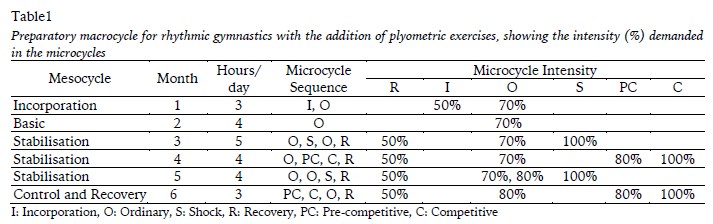
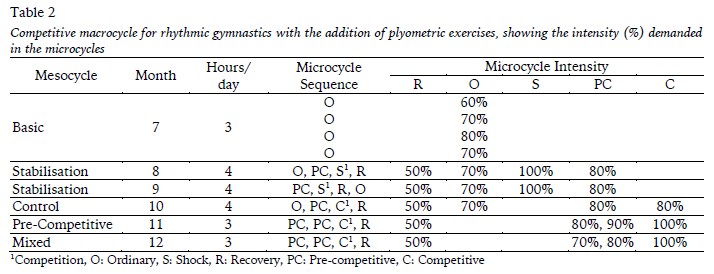
<body><![CDATA[<p>Test 1 - Vertical   Jump (Cokolova &amp; Gaidukov, 2011): The object of this test was to   measure the power of the lower limbs. An Abalakov belt (ABK) was used, in which   a tape measure is attached to a belt worn round the athlete's waist. The tape   measure slides through a guide on the floor between the athlete's feet,   allowing the height of the jump to be measured. The athletes jumped, swinging   their arms above their heads, and the height reached by the centre of gravity   in the jump was measured. Each athlete made three jumps and only the highest result was recorded.</p>     <p>Test 2 -   Horizontal Jump (Genadevna &amp; Karpenko, 2014): The athletes stood   with their feet parallel and slightly apart, the toes behind a line. They swung   their arms, as often as wished, as a preparatory movement to gain momentum but   without flexing the knees. They jumped by swinging the arms forward, extending   the hips, knees and ankles (helped by the preparatory movement), and the object   was to jump as far forward as possible. Each athlete made three attempts and only the best result was recorded.</p>     <p>Test 3 – Agility   (Golomazov &amp; Shirva, 1996): The &quot;square agility test&quot; was   used, in which four cones are placed to form a 5 metre square. On the signal to   start, the athlete runs forward from the first cone to the second, then   sideways to the right from the second to the third, backwards to the fourth and   sideways to the left to the starting point. The test is done clockwise. The   athletes made two attempts and only the better time was recorded. The athlete   must face forwards throughout the test. To run forward subject uses the   acceleration of the posterior chain of the legs; to move sideways to the right   subject uses the muscular capacity of the adductors and abductors; backwards,   the contraction of the anterior leg muscles; and to the left the contralateral   adductors and abductors. In this way the test assesses the various muscle   groups of the legs and their integration in changes of direction during movement. </p>     <p><b>Procedures</b></p>     <p>The CG maintained   its training routine consisting of: stretching, joint warm-up, general warm-up,   neuromotor warm-up (with and without apparatus), physical training, technical   training (skills, dynamic rotation elements and running through routines) and   wind-down. The EG athletes did PT in addition to normal training. Two 6-month   macrocycles (preparatory and competitive) were drawn up using the principles of periodization (<a href="/img/revistas/mot/v13n2/13n2a09t1.jpg">Tables 1</a> and <a href="/img/revistas/mot/v13n2/13n2a09t2.jpg">2</a>). </p>     
<p>The entire   sequence followed the 4 methodological steps of PT described by Verkoshanski   (1996) and adapted by contemporary authors (Damian, Popescu, Oltean, Traicu, &amp;   Giurgiu, 2014). The plyometric exercises used in physical training were:   two-leg jumps; alternate-leg bounding; step jumps and drop jumps from a box. PT   was carried out after 10 minutes of moderate stretching using specific RG   exercises; each PT session lasted on average 15 to 20 minutes. Strength   training took place in blocks. After PT, technical training on apparatus (to   improve movement precision) occurred normally. The model was divided into three   logically grouped blocks: block A (special physical preparation) activates the   mechanisms of the adaptation process and is oriented to the morphological and   functional specialization of the organism; block B (technical-tactical   preparation) assimilates the capacity to use the evolution of the loco-motor   potential through a gradual increase in the intensity of execution of the   competitive exercise; block C (competitions) ensures completion of the   adaptation cycle and the body's ability to maximize the work done through   competitions. Some of the contents of the blocks overlap so that the effects of the succeeding block benefit from delayed effects of training.</p>     <p>This   periodization model was based on contemporary authors (Gomes, 2009; Platonov,   2014; Zatsiorski, 2004). As described above, PT was performed twice a week for   20 minutes in each basic mesocycle and in the first two weeks of the   incorporation mesocycle. In the following two weeks there was an interval in   PT, but the other components of training were maintained. PT was resumed 3   times per week in the control and mixed mesocycles. This plan followed the   methodology proposed by Yuri Verkhoshanski, the creator of the method, who in   the preparatory period recommended a 6-week program with a frequency of 2 times   per week, giving a total of 12 training sessions; or a variant of 5 weeks, with   3 weekly sessions, giving a total of 15 sessions. The author also states that   the positive functional effect of concentrated force loads is not revealed   immediately, but only after loading. After intensive small volume loading, it is possible to exceed these levels by 20 to 30% (Verkoshanski, 1996).</p>     <p>In the   competitive macrocycle PT occurred during the whole basic mesocycle and in the   first week of the stabilisation mesocycle 3 times per week for 20 minutes.   There was a break for the three following weeks, and PT was re-started in the   second stabilisation mesocycle twice a week for 20 minutes, and maintained at   that level until the first week of the control mesocycle. Finally, at the start   of the pre-competitive mesocycle the frequency was set at twice a week for 15   minutes until the second week of the mixed mesocycle. PT was interrupted in the   penultimate week of the annual periodization, since this is a competitive   microcycle when the last and most important competition of the cycle for this   group of athletes occurs; only technical training continued (running through   routines and correction of the most serious errors). During the last week of   the mesocycle, in the recovery microcycle, PT was carried out twice in the week for 15 minutes.</p>     <p>The intensity of   the exercises was controlled in direct relation to the training volume. In the   shock and competitive microcycles, the intensity was 100%. The indices achieved   in these phases served as a parameter for controlling the intensity in the other microcycles.</p>     <p><b>Statistical analysis</b></p>     ]]></body>
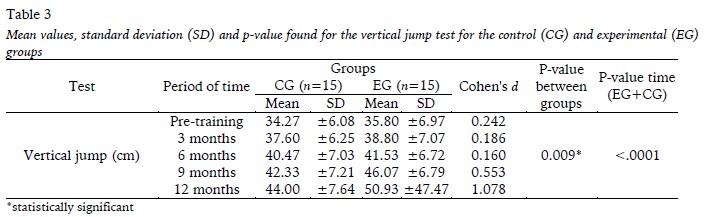
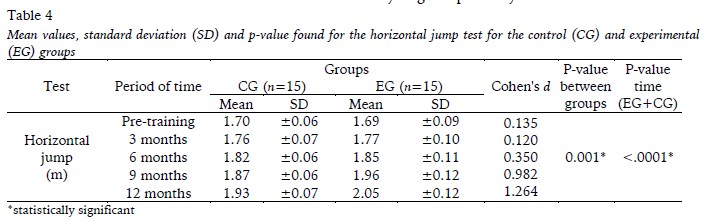
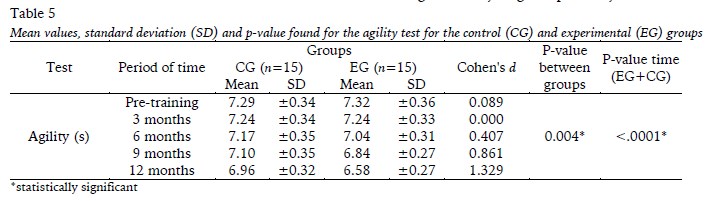
<body><![CDATA[<p>Descriptive   statistical and normality tests were done using <i>SAS System 9.0</i>. ANOVA   with repeated measurements was used for data with normal distribution, followed   by Tukey's multiple comparison test whenever a statistically significant effect   was identified in the factor. Three models of ANOVA were developed, always with   the particular measurements (vertical jump, horizontal jump and agility) as   dependent variables and the factors (group, time with repeated measurements,   and group-time interaction) as independent variables. The magnitude of the   effect was analysed by Cohen's <i>d</i> and classified as very small (0.01),   small (0.29), medium (0.50), large (0.80), very large (1.20) and enormous (2.00), according to Sawilowsky (2009).</p>     <p>The significance level used in testing the hypotheses developed in this work was 5%. </p>     <p>&nbsp;</p> </font>     <p><font size="3" face="Verdana"><b>RESULTS</b></font></p> <font face="Verdana" size="2">     <p>The p-value, standard   deviation, effect size and mean values found for the vertical jump, horizontal jump and agility tests are described in <a href="/img/revistas/mot/v13n2/13n2a09t3.jpg">Tables 3</a>, <a href="/img/revistas/mot/v13n2/13n2a09t4.jpg">4</a> and <a href="/img/revistas/mot/v13n2/13n2a09t5.jpg">5</a> respectively.</p>     
<p><b>Test 1 - Vertical Jump</b></p>     <p>Both   groups presented an increase in the height achieved in the vertical jump from   the pre-training period to the end of the 12 months (p &lt; 0.0001). We   observed that the mean height recorded for the CG increased from 34.27 cm to   44.0 cm, an increase of 28.40%, while that of the EG increased from 35.80 cm to   50.93 cm, an increase of 42.26%. The EG therefore presented a greater   improvement than the CG with a statistically significant difference between   groups (p = 0.009). A statistically significant difference was observed in the   increased height of the vertical jump after 6 months (p = 0.0008), 9 months (p   &lt; .0001) and 12 months (p &lt; .0001) of training for both the CG and the   EG. The magnitude of the effect after 6, 9 and 12 months was medium, large and very large respectively.</p>     <p><b>Test 2 - Horizontal Jump</b></p>     <p>We   observed that the distance of the horizontal jump in the CG increased from 1.70   m to 1.93 m, an increase of 13.52%, while in the EG it increased from 1.69 m to   2.05 m, an increase of 21.30%. The EG therefore presented a greater improvement   than the CG with a statistically significant difference between groups (p = 0.001). </p>     <p>The   CG presented an increase in distance in the horizontal jump after 3 months (p =   0.03), 6 months (p &lt; 0.0001), 9 months (p &lt; 0.0001) and 12 months (p &lt;   0.0001) of training. The EG presented an increase in distance in the horizontal   jump after 3 months (p = 0.01), 6 months (p &lt; 0.0001), 9 months (p &lt; 0.0001)   and 12 months (p &lt; 0.0001) of training with the addition of plyometric   exercises. The magnitude of the effect after 9 and 12 months was large and very large respectively.</p>     ]]></body>
<body><![CDATA[<p><b>Test 3 - Agility test</b></p>     <p>After   one year of training, the CG presented a reduction in the time taken to do the   agility test from 7.29 to 6.96 seconds, a reduction of 4.74%; the EG presented   better agility performance after plyometric training, with test time reduced   from 7.32 to 6.58 seconds, an improvement of 11.24%. The EG therefore presented   a greater improvement than the CG with a statistically significant difference between groups (p = 0.004). </p>     <p>We   also observed that both groups presented a progressive reduction in test times,   with a statistically significant difference observed between the time at the   start of training and the times recorded after 6 months (p = 0.01), 9 months (p   &lt; 0.001) and 12 months (p &lt; 0.001). The magnitude of the effect after 9 and 12 months was large and very large respectively.</p>     <p>&nbsp;</p> </font>     <p><font size="3" face="Verdana"><b>DISCUSSION</b></font></p> <font face="Verdana" size="2">     <p>The incorporation   of plyometric exercises in athletes' training reduces the risk of injury by   improving the functional stability of leg joints (Chimera et al., 2004). It   should be noted however that initial training with PT must be at low to   moderate intensity and concentrate on technical proficiency in the exercises to   avoid injury (Bishop, Smith, Smith &amp; Rigby, 2009). Furthermore, the   exercises must be specific to the movements in which the increased energy   production is required, and the overload should be built up gradually by   increasing the intensity and volume of training (Marina &amp; Jemni, 2014). It   should further be noted that the gymnasts produced greater mechanical power   during repetitive maximal jumping exercises, but also get tired rapidly (Kums, Ereline, Gapeyeva &amp; Pääsuke, 2005).  </p>     <p>The results of   the present study were significant in quantitative and qualitative parameters   for the performance of RG athletes. PT also improves arm-leg coordination   (Ridderikhoff, Batelaan, &amp; Bobbert, 1999; Vittori, 1990), which may explain   the improved performance of athletes trained with the addition of this method.   The literature shows that PT improves scores in jumping ability by 57%, and   that 43% of this is due to gains in muscle strength (Bosco, Vittori &amp; Matteuci,   1995; Brown, Mayhew &amp; Boleach, 1986; Church, Wiggins, Moode, &amp; Crist,   2001). Vertical jumps can be used as a model to assess the explosive   strength-generating capacity and anaerobic power of the leg extensor muscles   (Bosco et al., 1982). In a study of 20 female athletes (10 EG, 10 CG), aged 17   to 20 years, with 11 ± 14 years’ experience, (Taktak, TakTak, &amp; Shephard,   2014) found increases of 6 and 7 cm in the height of squat jumps and   counter-movement jumps, respectively, in the experimental group after 12 weeks   of PT, while in the control group, an increase of 1 cm was observed in squat   jumps and no change in counter-movement jumps. These authors also report that   PT showed a significant increase in the athletes' explosive strength, a finding that coincides with the results of the present study. </p>     <p>The finding of   increased jump heights in the results obtained in competitions during the   competitive macrocycle showed that PT is an important tool for use in long-term   planning in this sport. The specific effects of PT on jump height in different   types of vertical jumps could be of particular importance. It has been   suggested that PT is more effective in improving vertical jump performance in   SSC jumps as it enhances the ability of subjects to use the elastic and neural   benefits of SSC (Wilson, Newton, Murphy &amp; Humphries, 1993). After 12   months, the athletes in our study who trained with plyometric exercises   obtained an improvement of 42.26% in the vertical jump test. Other studies also   reported excellent improvements with PT, ranging from 18.2% to 31.8% (Diallo,   Dore, Duche &amp; Van Praagh, 2001; Kyröläinen et al., 2005; Spurrs et al., 2003). </p>     <p>In our study both   groups presented an increase in horizontal jump after 9 and 12 months of   training; however, the group subjected to PT presented better test results than   the CG. In the literature an improvement of 1.4 to 7.0% is reported in the   horizontal jump with use of PT (Grosset, Piscione, Lambertz, &amp; Pérot, 2009;   Hortobagyi, Havasi &amp; Varga, 1990; Hortobagyi et al., 1991; Markovic et al.,   2007; Spurrs et al., 2003; Paavolainen, Häkkinen, Hämäläinen, Nummela, &amp;   Rusko, 1999). These values are lower than those found in the present study for   the group trained with plyometric exercises after a period of 12 months (EG: 21.30%).</p>     <p>Agility has been   defined as a rapid whole-body movement with change of velocity or direction in   response to a stimulus (Sheppard &amp; Young, 2006). Most of agility tasks   demand a rapid change from eccentric to concentric muscle action in the leg   extensor muscles (SSC muscle function). Plyometric exercises can diminish   ground reaction times in tests by increasing the production of muscular   strength and movement efficiency, with a positive effect on agility performance   (Roper, 1998). In our study both the CG and the EG presented better performance   in the agility test after 12 months of training, but the improvement was   greater in the group subjected to PT. Other studies have reported increased   agility after PT with improvements of 1.5 to 10.2% (Malisoux et al., 2006;   Markovic et al., 2007; Miller, Herniman, Ricard, Cheatham, &amp; Michael, 2006;   Salonikidis, &amp; Zafeiridis, 2008) and in our study, after 12 months, the   group trained with plyometric exercises improved its performance in the agility test by 11.24%.</p>     ]]></body>
<body><![CDATA[<p>In a randomized,   controlled study, Piazza et al. (2014) determined the effectiveness of two   strength training programs on lower limb explosive and reactive strength in   young female athletes using the squat jump test, counter movement jump test and   hopping test after six weeks of training. These authors reported that the two   protocols had a positive effect on jumping performance, with an increase of   6-7% in lower limb explosive strength. However, they stated that, owing to the   fact that the athletes continued their normal sports activity during the   intervention period, it was difficult to determine the independent contribution   of each strength protocol to the improvement in muscular power. Other authors   stress the need to clarify whether improvement in performance of the athletes   who train with plyometric exercises is due to the quality of the PT or to the   increase in the number of hours that the athletes devoted to training (Hall,   Bishop &amp; Gee, 2016). In our study the athletes who trained with normal   exercises (CG) and the athletes who trained with the addition of plyometric   exercises (EG) were subjected to the same number of hours of training/day/week, suggesting that the improvement in the EG athletes was due to PT.</p>     <p>According to   Douda, Toubekis, Avloniti and Tokmakidis (2008), selected anthropometric   characteristics (body mass, arm span, circumferences and diameters), aerobic   power, flexibility and explosive strength are important determinants of   successful performance by RG athletes. The literature says that PT is effective   for increasing flexibility (Gaiole &amp; Patil, 2016) and improving explosive   power (Mirela et al., 2014) in athletes. It also contributes to weight control   (Piazza et al., 2014), helping them to maintain a slender, &quot;light&quot;   body, which is a requisite for RG (Di Cagno et al., 2010). In our research we   also found greater agility and increased distances in vertical and horizontal   jumps. In a study to assess the effectiveness of a combined strength and   plyometric training program (experimental period) on jumping performance when   compared with a training routine on apparatus (control period), Marina and   Jemni (2014) analysed the jump performance of 9 female elite-orientated   gymnasts. The authors concluded that a combination of heavy strength training   with high impact plyometric jumps is effective in pre-pubertal gymnasts. In   another study, Hall et al. (2016) evaluated the effect of a PT intervention   added to habitual gymnastic training on handspring vault performance and lower   body power development in a group of 20 athletes (10 EG, 10 CG), mean age of   12.5 years, with at least three years of experience, where the EG were   subjected to 10 h per week of PT during 6 weeks. It was found that after PT the athletes presented a small but significant increase in post-flight time. </p>     <p>As both groups,   control and experimental, carried out the same hours of training, and the   experimental group obtained better performance, we agree with Marina and Jemni   (2014) that time devoted to physical condition training designed to optimize   the plyometric skills of gymnasts should be increased at the expense of time spent on technical routines.</p>     <p>There are few   studies reported in the literature which analysed the effects of PT on RG   athletes; moreover, other tests are used to quantify the effectiveness of the   PT intervention, making it difficult to compare the findings reported in the   literature with the findings of our study. One limitation of our study was the   sample size. A future study could be done with a larger sample to make it more   representative, with a larger number of data, as this would reduce the risk of bias in the investigation.</p>     <p>&nbsp;</p> </font>     <p><font size="3" face="Verdana"><b>CONCLUSIONS</b></font></p> <font face="Verdana" size="2">     <p>In our study all   the athletes presented improvements in performance after the 12 months of the   training period, however the athletes trained with the addition of plyometric   exercises presented better performance than the group trained with normal   exercises, with greater strength in the lower limbs in vertical jump and horizontal jump, and improved agility. </p>     <p>&nbsp;</p> </font>     <p><font size="3" face="Verdana"><b>REFERENCES</b></font></p> <font face="Verdana" size="2">     <!-- ref --><p>Adams, K., O'shea, J. P.,   O’shea, K. L., &amp; Climstein, M. (1992). The effect of six weeks of squat,   plyometrics and squat-plyometric training on power production. <i>Journal of Applied Sport Science Research, 6</i>(1), 36-41.    &nbsp;&nbsp;&nbsp;&nbsp;&nbsp;&nbsp;&nbsp;&nbsp;[&#160;<a href="javascript:void(0);" onclick="javascript: window.open('/scielo.php?script=sci_nlinks&ref=367281&pid=S1646-107X201700030000900001&lng=','','width=640,height=500,resizable=yes,scrollbars=1,menubar=yes,');">Links</a>&#160;]<!-- end-ref --></p>     <!-- ref --><p>Bishop, D. C., Smith, R. J., Smith, M. F., &amp; Rigby, H. E. (2009).   Effect of Plyometric Training on Swimming Block Start Performance in   Adolescents. <i>Journal of Strength and Conditioning Research, 23</i>(7), 2137-2143.  doi: 10.1519/JSC.0b013e3181b866d0&nbsp;&nbsp;&nbsp;&nbsp;&nbsp;&nbsp;&nbsp;&nbsp;[&#160;<a href="javascript:void(0);" onclick="javascript: window.open('/scielo.php?script=sci_nlinks&ref=367283&pid=S1646-107X201700030000900002&lng=','','width=640,height=500,resizable=yes,scrollbars=1,menubar=yes,');">Links</a>&#160;]<!-- end-ref --><!-- ref --><p>Bosco, C., Ito, A., Komi,   P. V., Luhtanen, P., Rahkila, P., Rusko, H., &amp; Viitasalo, J. T. (1982).   Neuromuscular function and mechanical efficiency of human leg extensor muscles   during jumping exercises. <i>Acta Physiologica Scandinavica, 114</i>(4), 543-550.    &nbsp;&nbsp;&nbsp;&nbsp;&nbsp;&nbsp;&nbsp;&nbsp;[&#160;<a href="javascript:void(0);" onclick="javascript: window.open('/scielo.php?script=sci_nlinks&ref=367284&pid=S1646-107X201700030000900003&lng=','','width=640,height=500,resizable=yes,scrollbars=1,menubar=yes,');">Links</a>&#160;]<!-- end-ref --> </p>     <!-- ref --><p>Bosco, C., Vittori, C.,   &amp; Matteuci, E. (1995). Considerazioni sulle variazzioni dinamiche di alcuni parametric biomeccanici nela corsa. <i>Atleticastudi, 2</i>, 155-162.    &nbsp;&nbsp;&nbsp;&nbsp;&nbsp;&nbsp;&nbsp;&nbsp;[&#160;<a href="javascript:void(0);" onclick="javascript: window.open('/scielo.php?script=sci_nlinks&ref=367286&pid=S1646-107X201700030000900004&lng=','','width=640,height=500,resizable=yes,scrollbars=1,menubar=yes,');">Links</a>&#160;]<!-- end-ref --></p>     <!-- ref --><p>Brown, M. E., Mayhew, J.   L., &amp; Boleach, L. W. (1986). Effect of plyometric training on vertical jump   performance in high school basketball players. <i>Journal of Sports Medicine and Physical Fitness, 26</i>(1), 1-4.    &nbsp;&nbsp;&nbsp;&nbsp;&nbsp;&nbsp;&nbsp;&nbsp;[&#160;<a href="javascript:void(0);" onclick="javascript: window.open('/scielo.php?script=sci_nlinks&ref=367288&pid=S1646-107X201700030000900005&lng=','','width=640,height=500,resizable=yes,scrollbars=1,menubar=yes,');">Links</a>&#160;]<!-- end-ref --></p>     <!-- ref --><p>Chimera, N. J., Swanik, K.   A., Swanik, C. B., &amp; Straub S. J. (2004). Effects of plyometric training on   muscle-activation strategies and performance in female athletes. <i>Journal of Athletic Training, 39</i>(1), 24-31.    &nbsp;&nbsp;&nbsp;&nbsp;&nbsp;&nbsp;&nbsp;&nbsp;[&#160;<a href="javascript:void(0);" onclick="javascript: window.open('/scielo.php?script=sci_nlinks&ref=367290&pid=S1646-107X201700030000900006&lng=','','width=640,height=500,resizable=yes,scrollbars=1,menubar=yes,');">Links</a>&#160;]<!-- end-ref --></p>     ]]></body>
<body><![CDATA[<!-- ref --><p>Church, J. B.; Wiggins, M.   S., Moode, F. M., &amp; Crist, R. (2001). Effect of warm-up and flexibility   treatments on vertical jump performance. <i>Journal of Strength &amp; Conditioning Research,</i> <i>15</i>(3), 332-336.    &nbsp;&nbsp;&nbsp;&nbsp;&nbsp;&nbsp;&nbsp;&nbsp;[&#160;<a href="javascript:void(0);" onclick="javascript: window.open('/scielo.php?script=sci_nlinks&ref=367292&pid=S1646-107X201700030000900007&lng=','','width=640,height=500,resizable=yes,scrollbars=1,menubar=yes,');">Links</a>&#160;]<!-- end-ref --></p>     <!-- ref --><p>Cokolova, N. M., &amp;   Gaidukov, E. A. (2011). Sport selection and prognosis of the results of track and field athletes aged 10-12 years old based on the analysis of motor readiness.   <i>Scientific journal of the University of Lesgaft</i>, <i>4</i>(74), 796-799.    &nbsp;&nbsp;&nbsp;&nbsp;&nbsp;&nbsp;&nbsp;&nbsp;[&#160;<a href="javascript:void(0);" onclick="javascript: window.open('/scielo.php?script=sci_nlinks&ref=367294&pid=S1646-107X201700030000900008&lng=','','width=640,height=500,resizable=yes,scrollbars=1,menubar=yes,');">Links</a>&#160;]<!-- end-ref --> </p>     <!-- ref --><p>Damian, M., Popescu, R.,   Oltean, A., Traicu, C., &amp; Giurgiu, L. (2014). Plyometric exercises to   improve explosive power in artistic gymnastics. <i>Science, Movement and Health</i>, <i>14</i>(2), 381-386.    &nbsp;&nbsp;&nbsp;&nbsp;&nbsp;&nbsp;&nbsp;&nbsp;[&#160;<a href="javascript:void(0);" onclick="javascript: window.open('/scielo.php?script=sci_nlinks&ref=367296&pid=S1646-107X201700030000900009&lng=','','width=640,height=500,resizable=yes,scrollbars=1,menubar=yes,');">Links</a>&#160;]<!-- end-ref --></p>     <!-- ref --><p>Diallo, O., Dore, E.,   Duche, P., &amp; Van Praagh, E. (2001). Effects of plyometric training followed   by a reduced training program on physical performance in prepubescent soccer   players. <i>The Journal of Sports Medicine and Physical Fitness</i>, <i>41</i>(3), 342-348.    &nbsp;&nbsp;&nbsp;&nbsp;&nbsp;&nbsp;&nbsp;&nbsp;[&#160;<a href="javascript:void(0);" onclick="javascript: window.open('/scielo.php?script=sci_nlinks&ref=367298&pid=S1646-107X201700030000900010&lng=','','width=640,height=500,resizable=yes,scrollbars=1,menubar=yes,');">Links</a>&#160;]<!-- end-ref --></p>     <!-- ref --><p>Di Cagno, A., Baldari, C.,   Battaglia, C., Gallotta, M. C., Videira, M., Piazza, M., &amp; Guidetti, L.   (2010). Preexercise static stretching effect on leaping performance in elite   rhythmic gymnasts.<i> Journal of Strength and Conditioning Research, 24</i>(8), 1995-2000.    &nbsp;&nbsp;&nbsp;&nbsp;&nbsp;&nbsp;&nbsp;&nbsp;[&#160;<a href="javascript:void(0);" onclick="javascript: window.open('/scielo.php?script=sci_nlinks&ref=367300&pid=S1646-107X201700030000900011&lng=','','width=640,height=500,resizable=yes,scrollbars=1,menubar=yes,');">Links</a>&#160;]<!-- end-ref --></p>     ]]></body>
<body><![CDATA[<!-- ref --><p>Douda, H. T., Toubekis, A.   G., Avloniti, A. A., &amp; Tokmakidis, S. P. (2008). Physiological and   anthropometric determinants of rhythmic gymnastics performance. <i>International Journal of Sports Physiology and Performance, 3</i>, 41-54.    &nbsp;&nbsp;&nbsp;&nbsp;&nbsp;&nbsp;&nbsp;&nbsp;[&#160;<a href="javascript:void(0);" onclick="javascript: window.open('/scielo.php?script=sci_nlinks&ref=367302&pid=S1646-107X201700030000900012&lng=','','width=640,height=500,resizable=yes,scrollbars=1,menubar=yes,');">Links</a>&#160;]<!-- end-ref --></p>     <!-- ref --><p>Fleck, S. J., &amp;   Kraemer, W. J. (2004). <i>Designing resistance training program</i>. Champaign: Human Kinetics.    &nbsp;&nbsp;&nbsp;&nbsp;&nbsp;&nbsp;&nbsp;&nbsp;[&#160;<a href="javascript:void(0);" onclick="javascript: window.open('/scielo.php?script=sci_nlinks&ref=367304&pid=S1646-107X201700030000900013&lng=','','width=640,height=500,resizable=yes,scrollbars=1,menubar=yes,');">Links</a>&#160;]<!-- end-ref --> </p>     <!-- ref --><p>Gaiole, R., &amp; Patil,   P. P. (2016). Plyometric training effect on flexibility in female puberal   gymnasts. <i>International Journal of Therapies and Rehabilitation Research, 5</i>, 1.    &nbsp;&nbsp;&nbsp;&nbsp;&nbsp;&nbsp;&nbsp;&nbsp;[&#160;<a href="javascript:void(0);" onclick="javascript: window.open('/scielo.php?script=sci_nlinks&ref=367306&pid=S1646-107X201700030000900014&lng=','','width=640,height=500,resizable=yes,scrollbars=1,menubar=yes,');">Links</a>&#160;]<!-- end-ref --> </p>     <!-- ref --><p>Genadevna, R. O., &amp;   Karpenko, L. A. (2014). <i>Teoria e metodologia da preparação física na ginástica rítmica estética.</i> Moscou.    &nbsp;&nbsp;&nbsp;&nbsp;&nbsp;&nbsp;&nbsp;&nbsp;[&#160;<a href="javascript:void(0);" onclick="javascript: window.open('/scielo.php?script=sci_nlinks&ref=367308&pid=S1646-107X201700030000900015&lng=','','width=640,height=500,resizable=yes,scrollbars=1,menubar=yes,');">Links</a>&#160;]<!-- end-ref --></p>     <!-- ref --><p>Golomazov, S., &amp;   Shirva, B. (1996). <i>Futebol: treino da qualidade do movimento para atletas jovens</i>. São Paulo: Livraria Aratebi.    &nbsp;&nbsp;&nbsp;&nbsp;&nbsp;&nbsp;&nbsp;&nbsp;[&#160;<a href="javascript:void(0);" onclick="javascript: window.open('/scielo.php?script=sci_nlinks&ref=367310&pid=S1646-107X201700030000900016&lng=','','width=640,height=500,resizable=yes,scrollbars=1,menubar=yes,');">Links</a>&#160;]<!-- end-ref --></p>     ]]></body>
<body><![CDATA[<!-- ref --><p>Gomes, A. C. (2009). <i>Treinamento desportivo: estruturação e periodização. </i>Porto<i>: </i>Artmed.    &nbsp;&nbsp;&nbsp;&nbsp;&nbsp;&nbsp;&nbsp;&nbsp;[&#160;<a href="javascript:void(0);" onclick="javascript: window.open('/scielo.php?script=sci_nlinks&ref=367312&pid=S1646-107X201700030000900017&lng=','','width=640,height=500,resizable=yes,scrollbars=1,menubar=yes,');">Links</a>&#160;]<!-- end-ref --></p>     <!-- ref --><p>Grosset, J. F., Piscione,   J., Lambertz, D., &amp; Pérot, C. (2009). Paired changes in electromechanical   delay and musculo-tendinous stiffness after endurance or plyometric training. <i>European Journal of Applied     Physiology,</i> <i>105</i>(1), 131-139. doi: 10.1007/s00421-008-0882-8.    &nbsp;&nbsp;&nbsp;&nbsp;&nbsp;&nbsp;&nbsp;&nbsp;[&#160;<a href="javascript:void(0);" onclick="javascript: window.open('/scielo.php?script=sci_nlinks&ref=367314&pid=S1646-107X201700030000900018&lng=','','width=640,height=500,resizable=yes,scrollbars=1,menubar=yes,');">Links</a>&#160;]<!-- end-ref --></p>     <!-- ref --><p>Hewett, T. E. (2000). Neuromuscular and hormonal factors associated with   knee injuries in female athletes: strategies for intervention. <i>Sports Medicine, 29</i>, 313-327.    &nbsp;&nbsp;&nbsp;&nbsp;&nbsp;&nbsp;&nbsp;&nbsp;[&#160;<a href="javascript:void(0);" onclick="javascript: window.open('/scielo.php?script=sci_nlinks&ref=367316&pid=S1646-107X201700030000900019&lng=','','width=640,height=500,resizable=yes,scrollbars=1,menubar=yes,');">Links</a>&#160;]<!-- end-ref --></p>     <!-- ref --><p>Hewett, T. E., Stroupe, A. L., Nance, T. A., &amp; Noyes, F. R. (1996).   Plyometric training in female athletes: decreased impact forces and increased hamstring torques. <i>American Journal of Sports Medicine, 24</i>(6), 765-773.    &nbsp;&nbsp;&nbsp;&nbsp;&nbsp;&nbsp;&nbsp;&nbsp;[&#160;<a href="javascript:void(0);" onclick="javascript: window.open('/scielo.php?script=sci_nlinks&ref=367318&pid=S1646-107X201700030000900020&lng=','','width=640,height=500,resizable=yes,scrollbars=1,menubar=yes,');">Links</a>&#160;]<!-- end-ref --></p>     <!-- ref --><p>Hall, E., Bishop, D. C.,   &amp; Gee, T. I. (2016). Effect of plyometric training on handspring vault   performance and functional power in youth female gymnasts. <i>Public Library of Science One,</i> <i>11</i>(2), e0148790. doi: 10.1371/journal.pone.0148790&nbsp;&nbsp;&nbsp;&nbsp;&nbsp;&nbsp;&nbsp;&nbsp;[&#160;<a href="javascript:void(0);" onclick="javascript: window.open('/scielo.php?script=sci_nlinks&ref=367320&pid=S1646-107X201700030000900021&lng=','','width=640,height=500,resizable=yes,scrollbars=1,menubar=yes,');">Links</a>&#160;]<!-- end-ref --><!-- ref --><p>Hortobagyi, T., Havasi, J., &amp; Varga, Z. (1990). Comparison of two   stretch-shorten exercise programs in 13-year-old-boys: nonspecific training effects. <i>Journal of Human Movements Studies, 18</i>(4), 177-188.    &nbsp;&nbsp;&nbsp;&nbsp;&nbsp;&nbsp;&nbsp;&nbsp;[&#160;<a href="javascript:void(0);" onclick="javascript: window.open('/scielo.php?script=sci_nlinks&ref=367321&pid=S1646-107X201700030000900022&lng=','','width=640,height=500,resizable=yes,scrollbars=1,menubar=yes,');">Links</a>&#160;]<!-- end-ref --></p>     <!-- ref --><p>Hortobagyi, T., Sio, A.,   Fodor, T., &amp; Merkely, B. (1991). Effects of targeted skill development and   plyometric conditioning on long jump performance in 16-year-old boys. <i>Journal of Human Movements Studies</i>, <i>21</i>(1), 1-17.    &nbsp;&nbsp;&nbsp;&nbsp;&nbsp;&nbsp;&nbsp;&nbsp;[&#160;<a href="javascript:void(0);" onclick="javascript: window.open('/scielo.php?script=sci_nlinks&ref=367323&pid=S1646-107X201700030000900023&lng=','','width=640,height=500,resizable=yes,scrollbars=1,menubar=yes,');">Links</a>&#160;]<!-- end-ref --> </p>     <!-- ref --><p>Kums, T., Ereline, J.,   Gapeyeva, H., &amp; Pääsuke, M. (2005). Vertical jumping performance in young rhythmic gymnasts. <i>Biology of Sport, 22</i>(3), 237-246.    &nbsp;&nbsp;&nbsp;&nbsp;&nbsp;&nbsp;&nbsp;&nbsp;[&#160;<a href="javascript:void(0);" onclick="javascript: window.open('/scielo.php?script=sci_nlinks&ref=367325&pid=S1646-107X201700030000900024&lng=','','width=640,height=500,resizable=yes,scrollbars=1,menubar=yes,');">Links</a>&#160;]<!-- end-ref --></p>     <!-- ref --><p>Kyröläinen, H., Avela, J.,   McBride, J. M., Koskinen, S., Andersen, J. L., Sipilä S, Takala, T. E., &amp;   Komi, P. V. (2005). Effects of power training on muscle structure and   neuromuscular performance. <i>Scandinavian Journal of Medicine &amp; Science in Sports</i>, <i>15</i>(1), 58-64.    &nbsp;&nbsp;&nbsp;&nbsp;&nbsp;&nbsp;&nbsp;&nbsp;[&#160;<a href="javascript:void(0);" onclick="javascript: window.open('/scielo.php?script=sci_nlinks&ref=367327&pid=S1646-107X201700030000900025&lng=','','width=640,height=500,resizable=yes,scrollbars=1,menubar=yes,');">Links</a>&#160;]<!-- end-ref --> </p>     <!-- ref --><p>Maffuli, N. (1990). Intensive training in young athletes: An orthopaedic surgeons view point. <i>Sports Medicine, 9</i>(4), 229-243.    &nbsp;&nbsp;&nbsp;&nbsp;&nbsp;&nbsp;&nbsp;&nbsp;[&#160;<a href="javascript:void(0);" onclick="javascript: window.open('/scielo.php?script=sci_nlinks&ref=367329&pid=S1646-107X201700030000900026&lng=','','width=640,height=500,resizable=yes,scrollbars=1,menubar=yes,');">Links</a>&#160;]<!-- end-ref --></p>     <!-- ref --><p>Malisoux, L., Francaux,   M., Nielens, H., &amp; Theisen, D. (2006). Stretch-shortening cycle exercises:   an effective training paradigm to enhance power output of human single muscle   fibers. <i>Journal of Applied Physiology, 100</i>(3), 771-779. doi: 10.1152/japplphysiol.01027.2005&nbsp;&nbsp;&nbsp;&nbsp;&nbsp;&nbsp;&nbsp;&nbsp;[&#160;<a href="javascript:void(0);" onclick="javascript: window.open('/scielo.php?script=sci_nlinks&ref=367331&pid=S1646-107X201700030000900027&lng=','','width=640,height=500,resizable=yes,scrollbars=1,menubar=yes,');">Links</a>&#160;]<!-- end-ref --><!-- ref --><p>Marina, M., &amp; Jemni, M. (2014). Plyometric training performance in   elite-oriented pre-pubertal female gymnasts. <i>Journal of Strength and Conditioning Research,</i> <i>28</i>(4), 1015-1025.    &nbsp;&nbsp;&nbsp;&nbsp;&nbsp;&nbsp;&nbsp;&nbsp;[&#160;<a href="javascript:void(0);" onclick="javascript: window.open('/scielo.php?script=sci_nlinks&ref=367332&pid=S1646-107X201700030000900028&lng=','','width=640,height=500,resizable=yes,scrollbars=1,menubar=yes,');">Links</a>&#160;]<!-- end-ref --> </p>     <!-- ref --><p>Markovic, G., Jukic, I.,   Milanovic, D., &amp; Metikos, D. (2007). Effects of sprint and plyometric   training on muscle function and athletic performance. <i>Journal of Strength and Conditioning Research</i>, <i>21</i>(2), 543-549.    &nbsp;&nbsp;&nbsp;&nbsp;&nbsp;&nbsp;&nbsp;&nbsp;[&#160;<a href="javascript:void(0);" onclick="javascript: window.open('/scielo.php?script=sci_nlinks&ref=367334&pid=S1646-107X201700030000900029&lng=','','width=640,height=500,resizable=yes,scrollbars=1,menubar=yes,');">Links</a>&#160;]<!-- end-ref --> </p>     <!-- ref --><p>Miletic, D., Kati&#263;, R., &amp; Malès, B.   (2004). Some anthropologic factors of performance in rhythmic gymnastics novices. <i>Collegium Antropologicum, 28</i>(2), 727-737.    &nbsp;&nbsp;&nbsp;&nbsp;&nbsp;&nbsp;&nbsp;&nbsp;[&#160;<a href="javascript:void(0);" onclick="javascript: window.open('/scielo.php?script=sci_nlinks&ref=367336&pid=S1646-107X201700030000900030&lng=','','width=640,height=500,resizable=yes,scrollbars=1,menubar=yes,');">Links</a>&#160;]<!-- end-ref --></p>     <!-- ref --><p>Miller, M. G., Herniman,   J. J., Ricard, M. D., Cheatham, C. C., &amp; Michael, T. J. (2006). The effects   of a 6-week plyometric training program on agility. <i>Journal of Sports Science &amp; Medicine, 5</i>(3), 459-465.    &nbsp;&nbsp;&nbsp;&nbsp;&nbsp;&nbsp;&nbsp;&nbsp;[&#160;<a href="javascript:void(0);" onclick="javascript: window.open('/scielo.php?script=sci_nlinks&ref=367338&pid=S1646-107X201700030000900031&lng=','','width=640,height=500,resizable=yes,scrollbars=1,menubar=yes,');">Links</a>&#160;]<!-- end-ref --> </p>     <!-- ref --><p>Mirela, D., Raducu, P.,   Antoanela, O., Carmen, T., &amp; Laura G. (2014). Plyometric exercises to   improve explosive power in artistic gymnastics.<i> Science, Movement and Health, 14</i>(2, Supplement), 281-286.    &nbsp;&nbsp;&nbsp;&nbsp;&nbsp;&nbsp;&nbsp;&nbsp;[&#160;<a href="javascript:void(0);" onclick="javascript: window.open('/scielo.php?script=sci_nlinks&ref=367340&pid=S1646-107X201700030000900032&lng=','','width=640,height=500,resizable=yes,scrollbars=1,menubar=yes,');">Links</a>&#160;]<!-- end-ref --></p>     ]]></body>
<body><![CDATA[<!-- ref --><p>Paavolainen, L., Häkkinen,   K., Hämäläinen, I, Nummela, A., &amp; Rusko, H. (1999). Explosive-strength   training improves 5-km running time by improving running economy and muscle power. <i>Journal of Applied Physiology, 86</i>(5), 1527-1533.    &nbsp;&nbsp;&nbsp;&nbsp;&nbsp;&nbsp;&nbsp;&nbsp;[&#160;<a href="javascript:void(0);" onclick="javascript: window.open('/scielo.php?script=sci_nlinks&ref=367342&pid=S1646-107X201700030000900033&lng=','','width=640,height=500,resizable=yes,scrollbars=1,menubar=yes,');">Links</a>&#160;]<!-- end-ref --></p>     <!-- ref --><p>Piazza, M., Battaglia, C.,   Fiorilli, G., Innocenti, G., Iuliano, E., Aquino, G., Calcagno, G., Giombini,   A., &amp; Di Cagno, A. (2014). Effects of resistance training of jumping   performance in pre-adolescent rhythmic gymnasts. A randomized controlled study. <i>Italian Journal of Anatomy and Embriology, 119</i>(1), 10-19.    &nbsp;&nbsp;&nbsp;&nbsp;&nbsp;&nbsp;&nbsp;&nbsp;[&#160;<a href="javascript:void(0);" onclick="javascript: window.open('/scielo.php?script=sci_nlinks&ref=367344&pid=S1646-107X201700030000900034&lng=','','width=640,height=500,resizable=yes,scrollbars=1,menubar=yes,');">Links</a>&#160;]<!-- end-ref --></p>     <!-- ref --><p>Platonov, V. N. (2014). <i>Sistema de preparação de atletas nos esportes olímpicos. </i>Kiev: Literatura Olímpica.    &nbsp;&nbsp;&nbsp;&nbsp;&nbsp;&nbsp;&nbsp;&nbsp;[&#160;<a href="javascript:void(0);" onclick="javascript: window.open('/scielo.php?script=sci_nlinks&ref=367346&pid=S1646-107X201700030000900035&lng=','','width=640,height=500,resizable=yes,scrollbars=1,menubar=yes,');">Links</a>&#160;]<!-- end-ref --></p>     <!-- ref --><p>Ridderikhoff, A.,   Batelaan, J. H., &amp; Bobbert, M. F. (1999). Jumping for distance: control of   the external force in squat jumps. <i>Medicine and Science in Sports and Exercise, 31</i>(8), 1196-1204.    &nbsp;&nbsp;&nbsp;&nbsp;&nbsp;&nbsp;&nbsp;&nbsp;[&#160;<a href="javascript:void(0);" onclick="javascript: window.open('/scielo.php?script=sci_nlinks&ref=367348&pid=S1646-107X201700030000900036&lng=','','width=640,height=500,resizable=yes,scrollbars=1,menubar=yes,');">Links</a>&#160;]<!-- end-ref --> </p>     <!-- ref --><p>Roper, R. L. (1998).   Incorporating agility training and backward movement into a plyometric program. <i>Strength and Conditioning Journal</i>, <i>20</i>(4), 60-63.    &nbsp;&nbsp;&nbsp;&nbsp;&nbsp;&nbsp;&nbsp;&nbsp;[&#160;<a href="javascript:void(0);" onclick="javascript: window.open('/scielo.php?script=sci_nlinks&ref=367350&pid=S1646-107X201700030000900037&lng=','','width=640,height=500,resizable=yes,scrollbars=1,menubar=yes,');">Links</a>&#160;]<!-- end-ref --></p>     ]]></body>
<body><![CDATA[<!-- ref --><p>Salonikidis, K., &amp;   Zafeiridis, A. (2008). The effects of plyometric, tennis-drills, and combined   training on reaction, lateral and linear speed, power, and strength in novice   tennis players. <i>Journal of Strength and Conditioning Research,</i> <i>22</i>(1), 182-191.    &nbsp;&nbsp;&nbsp;&nbsp;&nbsp;&nbsp;&nbsp;&nbsp;[&#160;<a href="javascript:void(0);" onclick="javascript: window.open('/scielo.php?script=sci_nlinks&ref=367352&pid=S1646-107X201700030000900038&lng=','','width=640,height=500,resizable=yes,scrollbars=1,menubar=yes,');">Links</a>&#160;]<!-- end-ref --> </p>     <!-- ref --><p>Sawilowsky, S. S. (2009). New effect size rules of thumb. <i>Journal of Modern Applied Statistical Methods</i>, <i>8</i>(2), 597-599.    &nbsp;&nbsp;&nbsp;&nbsp;&nbsp;&nbsp;&nbsp;&nbsp;[&#160;<a href="javascript:void(0);" onclick="javascript: window.open('/scielo.php?script=sci_nlinks&ref=367354&pid=S1646-107X201700030000900039&lng=','','width=640,height=500,resizable=yes,scrollbars=1,menubar=yes,');">Links</a>&#160;]<!-- end-ref --></p>     <!-- ref --><p>Sheppard, J. M., &amp;   Young, W. B. (2006). Agility literature review: classification, training and testing.<i> Journal of Sports Sciences,</i> <i>24</i>(9), 919-932.    &nbsp;&nbsp;&nbsp;&nbsp;&nbsp;&nbsp;&nbsp;&nbsp;[&#160;<a href="javascript:void(0);" onclick="javascript: window.open('/scielo.php?script=sci_nlinks&ref=367356&pid=S1646-107X201700030000900040&lng=','','width=640,height=500,resizable=yes,scrollbars=1,menubar=yes,');">Links</a>&#160;]<!-- end-ref --></p>     <!-- ref --><p>Spurrs, R. W., Murphy, A.   J., &amp; Watsford, M. L. (2003). The effect of plyometric training on distance   running performance. <i>European Journal of Applied Physiology,</i> <i>89</i>(1), 1-7.    &nbsp;&nbsp;&nbsp;&nbsp;&nbsp;&nbsp;&nbsp;&nbsp;[&#160;<a href="javascript:void(0);" onclick="javascript: window.open('/scielo.php?script=sci_nlinks&ref=367358&pid=S1646-107X201700030000900041&lng=','','width=640,height=500,resizable=yes,scrollbars=1,menubar=yes,');">Links</a>&#160;]<!-- end-ref --> </p>     <!-- ref --><p>Swanik, K. A., Lephart, S.   M., Swanik, C. B., Lephart, S. P., Stone, D. A., &amp; Fu, F. H. (2002). The   effects of shoulder plyometric training on proprioception and selected muscle   performance characteristics. <i>Journal of Shoulder Elbow Surgery, 11</i>, 579-586.    &nbsp;&nbsp;&nbsp;&nbsp;&nbsp;&nbsp;&nbsp;&nbsp;[&#160;<a href="javascript:void(0);" onclick="javascript: window.open('/scielo.php?script=sci_nlinks&ref=367360&pid=S1646-107X201700030000900042&lng=','','width=640,height=500,resizable=yes,scrollbars=1,menubar=yes,');">Links</a>&#160;]<!-- end-ref --></p>     ]]></body>
<body><![CDATA[<!-- ref --><p>Taktak, F., TakTak, I.,   &amp; Shephard, R. J. (2013). A controlled trial of plyometric training for   rhythmic female gymnasts.<i> Health &amp; Fitness Journal of Canada, 6</i>(3), 123-131.    &nbsp;&nbsp;&nbsp;&nbsp;&nbsp;&nbsp;&nbsp;&nbsp;[&#160;<a href="javascript:void(0);" onclick="javascript: window.open('/scielo.php?script=sci_nlinks&ref=367362&pid=S1646-107X201700030000900043&lng=','','width=640,height=500,resizable=yes,scrollbars=1,menubar=yes,');">Links</a>&#160;]<!-- end-ref --> </p>     <!-- ref --><p>Verkoshanski, Y. (1996).<i> Força: treinamento da potência muscular</i>. Londrina: CID.    &nbsp;&nbsp;&nbsp;&nbsp;&nbsp;&nbsp;&nbsp;&nbsp;[&#160;<a href="javascript:void(0);" onclick="javascript: window.open('/scielo.php?script=sci_nlinks&ref=367364&pid=S1646-107X201700030000900044&lng=','','width=640,height=500,resizable=yes,scrollbars=1,menubar=yes,');">Links</a>&#160;]<!-- end-ref --></p>     <!-- ref --><p>Vittori, C. (1990). El   entrenamiento de la fuerza para el sprint. <i>Red: revista de entrenamiento deportivo, 4</i>(3), 2-8.    &nbsp;&nbsp;&nbsp;&nbsp;&nbsp;&nbsp;&nbsp;&nbsp;[&#160;<a href="javascript:void(0);" onclick="javascript: window.open('/scielo.php?script=sci_nlinks&ref=367366&pid=S1646-107X201700030000900045&lng=','','width=640,height=500,resizable=yes,scrollbars=1,menubar=yes,');">Links</a>&#160;]<!-- end-ref --> </p>     <!-- ref --><p>Wilson, G. J., Newton, R.   U., Murphy, A. J., &amp; Humphries, B. J. (1993). The optimal training load for   the development of dynamic athletic performance.<i> Medicine and Science in Sports &amp; Exercise, 25(</i>11), 1279–1286.    &nbsp;&nbsp;&nbsp;&nbsp;&nbsp;&nbsp;&nbsp;&nbsp;[&#160;<a href="javascript:void(0);" onclick="javascript: window.open('/scielo.php?script=sci_nlinks&ref=367368&pid=S1646-107X201700030000900046&lng=','','width=640,height=500,resizable=yes,scrollbars=1,menubar=yes,');">Links</a>&#160;]<!-- end-ref --></p>     <!-- ref --><p>Wright, K. J., &amp; De   Cree, C. (1998). The influence of somatotype, strength and flexibility on   injury occurrence among female competitive Olympic style gymnasts - A pilot study. <i>Journal of Physical Therapy Science, 10</i>, 87-92.    &nbsp;&nbsp;&nbsp;&nbsp;&nbsp;&nbsp;&nbsp;&nbsp;[&#160;<a href="javascript:void(0);" onclick="javascript: window.open('/scielo.php?script=sci_nlinks&ref=367370&pid=S1646-107X201700030000900047&lng=','','width=640,height=500,resizable=yes,scrollbars=1,menubar=yes,');">Links</a>&#160;]<!-- end-ref --></p>     ]]></body>
<body><![CDATA[<!-- ref --><p>Zatsiorsky, V. M. (2004). <i>Biomecânica do desempenho e prevenção de lesão. </i>Rio de Janeiro: Guanabara Koogan.    &nbsp;&nbsp;&nbsp;&nbsp;&nbsp;&nbsp;&nbsp;&nbsp;[&#160;<a href="javascript:void(0);" onclick="javascript: window.open('/scielo.php?script=sci_nlinks&ref=367372&pid=S1646-107X201700030000900048&lng=','','width=640,height=500,resizable=yes,scrollbars=1,menubar=yes,');">Links</a>&#160;]<!-- end-ref --></p>     <!-- ref --><p>Zelisko, J. A., Noble, H.   B., &amp; Porter, M. (1982). A comparison of men’s and women’s professional   basketball injuries. <i>The American Journal of Sports Medicine, 10</i>(5), 297-299.    &nbsp;&nbsp;&nbsp;&nbsp;&nbsp;&nbsp;&nbsp;&nbsp;[&#160;<a href="javascript:void(0);" onclick="javascript: window.open('/scielo.php?script=sci_nlinks&ref=367374&pid=S1646-107X201700030000900049&lng=','','width=640,height=500,resizable=yes,scrollbars=1,menubar=yes,');">Links</a>&#160;]<!-- end-ref --> </p>     <p>&nbsp;</p>     <p><b>Acknowledgments:    <br> </b>Nothing to declare    <br> <b>Conflict of interest:    <br> </b>Nothing to declare    <br> <b>Funding:    ]]></body>
<body><![CDATA[<br> </b>Nothing to declare</p>     <p>Manuscript   received at September 26<sup>th</sup> 2016; Accepted at April 11<sup>th</sup> 2017 </p> </font>     <p>&nbsp;</p>     <p>&nbsp;</p>     <p><font face="Verdana" size="2"><a name="end"></a><a href="#topo">*</a><i>Corresponding author</i>: Facultad de   Odontología, Universidad de La Frontera, Avenida Francisco Salazar, 1145,   Casilla 54-D, Temuco, Chile. <i>E-mail:</i> <a href="mailto:niltonnalves@ufrontera.cl">niltonnalves@ufrontera.cl</a></font> </p>      ]]></body><back>
<ref-list>
<ref id="B1">
<nlm-citation citation-type="journal">
<person-group person-group-type="author">
<name>
<surname><![CDATA[Adams]]></surname>
<given-names><![CDATA[K.]]></given-names>
</name>
<name>
<surname><![CDATA[O'shea]]></surname>
<given-names><![CDATA[J. P.]]></given-names>
</name>
<name>
<surname><![CDATA[O’shea]]></surname>
<given-names><![CDATA[K. L.]]></given-names>
</name>
<name>
<surname><![CDATA[Climstein]]></surname>
<given-names><![CDATA[M.]]></given-names>
</name>
</person-group>
<article-title xml:lang="en"><![CDATA[The effect of six weeks of squat, plyometrics and squat-plyometric training on power production]]></article-title>
<source><![CDATA[Journal of Applied Sport Science Research]]></source>
<year>1992</year>
<volume>6</volume>
<numero>1</numero>
<issue>1</issue>
<page-range>36-41</page-range></nlm-citation>
</ref>
<ref id="B2">
<nlm-citation citation-type="journal">
<person-group person-group-type="author">
<name>
<surname><![CDATA[Bishop]]></surname>
<given-names><![CDATA[D. C.]]></given-names>
</name>
<name>
<surname><![CDATA[Smith]]></surname>
<given-names><![CDATA[R. J.]]></given-names>
</name>
<name>
<surname><![CDATA[Smith]]></surname>
<given-names><![CDATA[M. F.]]></given-names>
</name>
<name>
<surname><![CDATA[Rigby]]></surname>
<given-names><![CDATA[H. E.]]></given-names>
</name>
</person-group>
<article-title xml:lang="en"><![CDATA[Effect of Plyometric Training on Swimming Block Start Performance in Adolescents]]></article-title>
<source><![CDATA[Journal of Strength and Conditioning Research]]></source>
<year>2009</year>
<volume>23</volume>
<numero>7</numero>
<issue>7</issue>
<page-range>2137-2143</page-range></nlm-citation>
</ref>
<ref id="B3">
<nlm-citation citation-type="journal">
<person-group person-group-type="author">
<name>
<surname><![CDATA[Bosco]]></surname>
<given-names><![CDATA[C.]]></given-names>
</name>
<name>
<surname><![CDATA[Ito]]></surname>
<given-names><![CDATA[A.]]></given-names>
</name>
<name>
<surname><![CDATA[Komi]]></surname>
<given-names><![CDATA[P. V.]]></given-names>
</name>
<name>
<surname><![CDATA[Luhtanen]]></surname>
<given-names><![CDATA[P.]]></given-names>
</name>
<name>
<surname><![CDATA[Rahkila]]></surname>
<given-names><![CDATA[P.]]></given-names>
</name>
<name>
<surname><![CDATA[Rusko]]></surname>
<given-names><![CDATA[H.]]></given-names>
</name>
<name>
<surname><![CDATA[Viitasalo]]></surname>
<given-names><![CDATA[J. T.]]></given-names>
</name>
</person-group>
<article-title xml:lang="en"><![CDATA[Neuromuscular function and mechanical efficiency of human leg extensor muscles during jumping exercises]]></article-title>
<source><![CDATA[Acta Physiologica Scandinavica]]></source>
<year>1982</year>
<volume>114</volume>
<numero>4</numero>
<issue>4</issue>
<page-range>543-550</page-range></nlm-citation>
</ref>
<ref id="B4">
<nlm-citation citation-type="journal">
<person-group person-group-type="author">
<name>
<surname><![CDATA[Bosco]]></surname>
<given-names><![CDATA[C.]]></given-names>
</name>
<name>
<surname><![CDATA[Vittori]]></surname>
<given-names><![CDATA[C.]]></given-names>
</name>
<name>
<surname><![CDATA[Matteuci]]></surname>
<given-names><![CDATA[E.]]></given-names>
</name>
</person-group>
<article-title xml:lang="it"><![CDATA[Considerazioni sulle variazzioni dinamiche di alcuni parametric biomeccanici nela corsa]]></article-title>
<source><![CDATA[Atleticastudi]]></source>
<year>1995</year>
<volume>2</volume>
<page-range>155-162</page-range></nlm-citation>
</ref>
<ref id="B5">
<nlm-citation citation-type="journal">
<person-group person-group-type="author">
<name>
<surname><![CDATA[Brown]]></surname>
<given-names><![CDATA[M. E.]]></given-names>
</name>
<name>
<surname><![CDATA[Mayhew]]></surname>
<given-names><![CDATA[J. L.]]></given-names>
</name>
<name>
<surname><![CDATA[Boleach]]></surname>
<given-names><![CDATA[L. W.]]></given-names>
</name>
</person-group>
<article-title xml:lang="en"><![CDATA[Effect of plyometric training on vertical jump performance in high school basketball players]]></article-title>
<source><![CDATA[Journal of Sports Medicine and Physical Fitness]]></source>
<year>1986</year>
<volume>26</volume>
<numero>1</numero>
<issue>1</issue>
<page-range>1-4</page-range></nlm-citation>
</ref>
<ref id="B6">
<nlm-citation citation-type="journal">
<person-group person-group-type="author">
<name>
<surname><![CDATA[Chimera]]></surname>
<given-names><![CDATA[N. J.]]></given-names>
</name>
<name>
<surname><![CDATA[Swanik]]></surname>
<given-names><![CDATA[K. A.]]></given-names>
</name>
<name>
<surname><![CDATA[Swanik]]></surname>
<given-names><![CDATA[C. B.]]></given-names>
</name>
<name>
<surname><![CDATA[Straub]]></surname>
<given-names><![CDATA[S. J.]]></given-names>
</name>
</person-group>
<article-title xml:lang="en"><![CDATA[Effects of plyometric training on muscle-activation strategies and performance in female athletes]]></article-title>
<source><![CDATA[Journal of Athletic Training]]></source>
<year>2004</year>
<volume>39</volume>
<numero>1</numero>
<issue>1</issue>
<page-range>24-31</page-range></nlm-citation>
</ref>
<ref id="B7">
<nlm-citation citation-type="journal">
<person-group person-group-type="author">
<name>
<surname><![CDATA[Church]]></surname>
<given-names><![CDATA[J. B.]]></given-names>
</name>
<name>
<surname><![CDATA[Wiggins]]></surname>
<given-names><![CDATA[M. S.]]></given-names>
</name>
<name>
<surname><![CDATA[Moode]]></surname>
<given-names><![CDATA[F. M.]]></given-names>
</name>
<name>
<surname><![CDATA[Crist]]></surname>
<given-names><![CDATA[R.]]></given-names>
</name>
</person-group>
<article-title xml:lang="en"><![CDATA[Effect of warm-up and flexibility treatments on vertical jump performance]]></article-title>
<source><![CDATA[Journal of Strength & Conditioning Research]]></source>
<year>2001</year>
<volume>15</volume>
<numero>3</numero>
<issue>3</issue>
<page-range>332-336</page-range></nlm-citation>
</ref>
<ref id="B8">
<nlm-citation citation-type="journal">
<person-group person-group-type="author">
<name>
<surname><![CDATA[Cokolova]]></surname>
<given-names><![CDATA[N. M.]]></given-names>
</name>
<name>
<surname><![CDATA[Gaidukov]]></surname>
<given-names><![CDATA[E. A.]]></given-names>
</name>
</person-group>
<article-title xml:lang="en"><![CDATA[Sport selection and prognosis of the results of track and field athletes aged 10-12 years old based on the analysis of motor readiness]]></article-title>
<source><![CDATA[Scientific journal of the University of Lesgaft]]></source>
<year>2011</year>
<volume>4</volume>
<numero>74</numero>
<issue>74</issue>
<page-range>796-799</page-range></nlm-citation>
</ref>
<ref id="B9">
<nlm-citation citation-type="journal">
<person-group person-group-type="author">
<name>
<surname><![CDATA[Damian]]></surname>
<given-names><![CDATA[M.]]></given-names>
</name>
<name>
<surname><![CDATA[Popescu]]></surname>
<given-names><![CDATA[R.]]></given-names>
</name>
<name>
<surname><![CDATA[Oltean]]></surname>
<given-names><![CDATA[A.]]></given-names>
</name>
<name>
<surname><![CDATA[Traicu]]></surname>
<given-names><![CDATA[C.]]></given-names>
</name>
<name>
<surname><![CDATA[Giurgiu]]></surname>
<given-names><![CDATA[L.]]></given-names>
</name>
</person-group>
<article-title xml:lang="en"><![CDATA[Plyometric exercises to improve explosive power in artistic gymnastics]]></article-title>
<source><![CDATA[Science, Movement and Health]]></source>
<year>2014</year>
<volume>14</volume>
<numero>2</numero>
<issue>2</issue>
<page-range>381-386</page-range></nlm-citation>
</ref>
<ref id="B10">
<nlm-citation citation-type="journal">
<person-group person-group-type="author">
<name>
<surname><![CDATA[Diallo]]></surname>
<given-names><![CDATA[O.]]></given-names>
</name>
<name>
<surname><![CDATA[Dore]]></surname>
<given-names><![CDATA[E.]]></given-names>
</name>
<name>
<surname><![CDATA[Duche]]></surname>
<given-names><![CDATA[P.]]></given-names>
</name>
<name>
<surname><![CDATA[Van Praagh]]></surname>
<given-names><![CDATA[E.]]></given-names>
</name>
</person-group>
<article-title xml:lang="en"><![CDATA[Effects of plyometric training followed by a reduced training program on physical performance in prepubescent soccer players]]></article-title>
<source><![CDATA[The Journal of Sports Medicine and Physical Fitness]]></source>
<year>2001</year>
<volume>41</volume>
<numero>3</numero>
<issue>3</issue>
<page-range>342-348</page-range></nlm-citation>
</ref>
<ref id="B11">
<nlm-citation citation-type="journal">
<person-group person-group-type="author">
<name>
<surname><![CDATA[Di Cagno]]></surname>
<given-names><![CDATA[A.]]></given-names>
</name>
<name>
<surname><![CDATA[Baldari]]></surname>
<given-names><![CDATA[C.]]></given-names>
</name>
<name>
<surname><![CDATA[Battaglia]]></surname>
<given-names><![CDATA[C.]]></given-names>
</name>
<name>
<surname><![CDATA[Gallotta]]></surname>
<given-names><![CDATA[M. C.]]></given-names>
</name>
<name>
<surname><![CDATA[Videira]]></surname>
<given-names><![CDATA[M.]]></given-names>
</name>
<name>
<surname><![CDATA[Piazza]]></surname>
<given-names><![CDATA[M.]]></given-names>
</name>
<name>
<surname><![CDATA[Guidetti]]></surname>
<given-names><![CDATA[L.]]></given-names>
</name>
</person-group>
<article-title xml:lang="en"><![CDATA[Preexercise static stretching effect on leaping performance in elite rhythmic gymnasts]]></article-title>
<source><![CDATA[Journal of Strength and Conditioning Research]]></source>
<year>2010</year>
<volume>24</volume>
<numero>8</numero>
<issue>8</issue>
<page-range>1995-2000</page-range></nlm-citation>
</ref>
<ref id="B12">
<nlm-citation citation-type="journal">
<person-group person-group-type="author">
<name>
<surname><![CDATA[Douda]]></surname>
<given-names><![CDATA[H. T.]]></given-names>
</name>
<name>
<surname><![CDATA[Toubekis]]></surname>
<given-names><![CDATA[A. G.]]></given-names>
</name>
<name>
<surname><![CDATA[Avloniti]]></surname>
<given-names><![CDATA[A. A.]]></given-names>
</name>
<name>
<surname><![CDATA[Tokmakidis]]></surname>
<given-names><![CDATA[S. P.]]></given-names>
</name>
</person-group>
<article-title xml:lang="en"><![CDATA[Physiological and anthropometric determinants of rhythmic gymnastics performance]]></article-title>
<source><![CDATA[International Journal of Sports Physiology and Performance]]></source>
<year>2008</year>
<volume>3</volume>
<page-range>41-54</page-range></nlm-citation>
</ref>
<ref id="B13">
<nlm-citation citation-type="book">
<person-group person-group-type="author">
<name>
<surname><![CDATA[Fleck]]></surname>
<given-names><![CDATA[S. J.]]></given-names>
</name>
<name>
<surname><![CDATA[Kraemer]]></surname>
<given-names><![CDATA[W. J.]]></given-names>
</name>
</person-group>
<source><![CDATA[Designing resistance training program]]></source>
<year>2004</year>
<publisher-loc><![CDATA[Champaign ]]></publisher-loc>
<publisher-name><![CDATA[Human Kinetics]]></publisher-name>
</nlm-citation>
</ref>
<ref id="B14">
<nlm-citation citation-type="journal">
<person-group person-group-type="author">
<name>
<surname><![CDATA[Gaiole]]></surname>
<given-names><![CDATA[R.]]></given-names>
</name>
<name>
<surname><![CDATA[Patil]]></surname>
<given-names><![CDATA[P. P.]]></given-names>
</name>
</person-group>
<article-title xml:lang="en"><![CDATA[Plyometric training effect on flexibility in female puberal gymnasts]]></article-title>
<source><![CDATA[International Journal of Therapies and Rehabilitation Research]]></source>
<year>2016</year>
<volume>5</volume>
<numero>1</numero>
<issue>1</issue>
</nlm-citation>
</ref>
<ref id="B15">
<nlm-citation citation-type="">
<person-group person-group-type="author">
<name>
<surname><![CDATA[Genadevna]]></surname>
<given-names><![CDATA[R. O.]]></given-names>
</name>
<name>
<surname><![CDATA[Karpenko]]></surname>
<given-names><![CDATA[L. A.]]></given-names>
</name>
</person-group>
<source><![CDATA[Teoria e metodologia da preparação física na ginástica rítmica estética]]></source>
<year>2014</year>
<publisher-loc><![CDATA[Moscou ]]></publisher-loc>
</nlm-citation>
</ref>
<ref id="B16">
<nlm-citation citation-type="book">
<person-group person-group-type="author">
<name>
<surname><![CDATA[Golomazov]]></surname>
<given-names><![CDATA[S.]]></given-names>
</name>
<name>
<surname><![CDATA[Shirva]]></surname>
<given-names><![CDATA[B.]]></given-names>
</name>
</person-group>
<source><![CDATA[Futebol: treino da qualidade do movimento para atletas jovens]]></source>
<year>1996</year>
<publisher-loc><![CDATA[São Paulo ]]></publisher-loc>
<publisher-name><![CDATA[Livraria Aratebi]]></publisher-name>
</nlm-citation>
</ref>
<ref id="B17">
<nlm-citation citation-type="book">
<person-group person-group-type="author">
<name>
<surname><![CDATA[Gomes]]></surname>
<given-names><![CDATA[A. C.]]></given-names>
</name>
</person-group>
<source><![CDATA[Treinamento desportivo: estruturação e periodização]]></source>
<year>2009</year>
<publisher-loc><![CDATA[Porto ]]></publisher-loc>
<publisher-name><![CDATA[Artmed]]></publisher-name>
</nlm-citation>
</ref>
<ref id="B18">
<nlm-citation citation-type="journal">
<person-group person-group-type="author">
<name>
<surname><![CDATA[Grosset]]></surname>
<given-names><![CDATA[J. F.]]></given-names>
</name>
<name>
<surname><![CDATA[Piscione]]></surname>
<given-names><![CDATA[J.]]></given-names>
</name>
<name>
<surname><![CDATA[Lambertz]]></surname>
<given-names><![CDATA[D.]]></given-names>
</name>
<name>
<surname><![CDATA[Pérot]]></surname>
<given-names><![CDATA[C.]]></given-names>
</name>
</person-group>
<article-title xml:lang="en"><![CDATA[Paired changes in electromechanical delay and musculo-tendinous stiffness after endurance or plyometric training]]></article-title>
<source><![CDATA[European Journal of Applied Physiology]]></source>
<year>2009</year>
<volume>105</volume>
<numero>1</numero>
<issue>1</issue>
<page-range>131-139</page-range></nlm-citation>
</ref>
<ref id="B19">
<nlm-citation citation-type="journal">
<person-group person-group-type="author">
<name>
<surname><![CDATA[Hewett]]></surname>
<given-names><![CDATA[T. E.]]></given-names>
</name>
</person-group>
<article-title xml:lang="en"><![CDATA[Neuromuscular and hormonal factors associated with knee injuries in female athletes: strategies for intervention]]></article-title>
<source><![CDATA[Sports Medicine]]></source>
<year>2000</year>
<volume>29</volume>
<page-range>313-327</page-range></nlm-citation>
</ref>
<ref id="B20">
<nlm-citation citation-type="journal">
<person-group person-group-type="author">
<name>
<surname><![CDATA[Hewett]]></surname>
<given-names><![CDATA[T. E.]]></given-names>
</name>
<name>
<surname><![CDATA[Stroupe]]></surname>
<given-names><![CDATA[A. L.]]></given-names>
</name>
<name>
<surname><![CDATA[Nance]]></surname>
<given-names><![CDATA[T. A.]]></given-names>
</name>
<name>
<surname><![CDATA[Noyes]]></surname>
<given-names><![CDATA[F. R.]]></given-names>
</name>
</person-group>
<article-title xml:lang="en"><![CDATA[Plyometric training in female athletes: decreased impact forces and increased hamstring torques]]></article-title>
<source><![CDATA[American Journal of Sports Medicine]]></source>
<year>1996</year>
<volume>24</volume>
<numero>6</numero>
<issue>6</issue>
<page-range>765-773</page-range></nlm-citation>
</ref>
<ref id="B21">
<nlm-citation citation-type="journal">
<person-group person-group-type="author">
<name>
<surname><![CDATA[Hall]]></surname>
<given-names><![CDATA[E.]]></given-names>
</name>
<name>
<surname><![CDATA[Bishop]]></surname>
<given-names><![CDATA[D. C.]]></given-names>
</name>
<name>
<surname><![CDATA[Gee]]></surname>
<given-names><![CDATA[T. I.]]></given-names>
</name>
</person-group>
<article-title xml:lang="en"><![CDATA[Effect of plyometric training on handspring vault performance and functional power in youth female gymnasts]]></article-title>
<source><![CDATA[Public Library of Science One]]></source>
<year>2016</year>
<volume>11</volume>
<numero>2</numero>
<issue>2</issue>
<page-range>e0148790</page-range></nlm-citation>
</ref>
<ref id="B22">
<nlm-citation citation-type="journal">
<person-group person-group-type="author">
<name>
<surname><![CDATA[Hortobagyi]]></surname>
<given-names><![CDATA[T.]]></given-names>
</name>
<name>
<surname><![CDATA[Havasi]]></surname>
<given-names><![CDATA[J.]]></given-names>
</name>
<name>
<surname><![CDATA[Varga]]></surname>
<given-names><![CDATA[Z.]]></given-names>
</name>
</person-group>
<article-title xml:lang="en"><![CDATA[Comparison of two stretch-shorten exercise programs in 13-year-old-boys: nonspecific training effects]]></article-title>
<source><![CDATA[Journal of Human Movements Studies]]></source>
<year>1990</year>
<volume>18</volume>
<numero>4</numero>
<issue>4</issue>
<page-range>177-188</page-range></nlm-citation>
</ref>
<ref id="B23">
<nlm-citation citation-type="journal">
<person-group person-group-type="author">
<name>
<surname><![CDATA[Hortobagyi]]></surname>
<given-names><![CDATA[T.]]></given-names>
</name>
<name>
<surname><![CDATA[Sio]]></surname>
<given-names><![CDATA[A.]]></given-names>
</name>
<name>
<surname><![CDATA[Fodor]]></surname>
<given-names><![CDATA[T.]]></given-names>
</name>
<name>
<surname><![CDATA[Merkely]]></surname>
<given-names><![CDATA[B.]]></given-names>
</name>
</person-group>
<article-title xml:lang="en"><![CDATA[Effects of targeted skill development and plyometric conditioning on long jump performance in 16-year-old boys]]></article-title>
<source><![CDATA[Journal of Human Movements Studies]]></source>
<year>1991</year>
<volume>21</volume>
<numero>1</numero>
<issue>1</issue>
<page-range>1-17</page-range></nlm-citation>
</ref>
<ref id="B24">
<nlm-citation citation-type="journal">
<person-group person-group-type="author">
<name>
<surname><![CDATA[Kums]]></surname>
<given-names><![CDATA[T.]]></given-names>
</name>
<name>
<surname><![CDATA[Ereline]]></surname>
<given-names><![CDATA[J.]]></given-names>
</name>
<name>
<surname><![CDATA[Gapeyeva]]></surname>
<given-names><![CDATA[H.]]></given-names>
</name>
<name>
<surname><![CDATA[Pääsuke]]></surname>
<given-names><![CDATA[M.]]></given-names>
</name>
</person-group>
<article-title xml:lang="en"><![CDATA[Vertical jumping performance in young rhythmic gymnasts]]></article-title>
<source><![CDATA[Biology of Sport]]></source>
<year>2005</year>
<volume>22</volume>
<numero>3</numero>
<issue>3</issue>
<page-range>237-246</page-range></nlm-citation>
</ref>
<ref id="B25">
<nlm-citation citation-type="journal">
<person-group person-group-type="author">
<name>
<surname><![CDATA[Kyröläinen]]></surname>
<given-names><![CDATA[H.]]></given-names>
</name>
<name>
<surname><![CDATA[Avela]]></surname>
<given-names><![CDATA[J.]]></given-names>
</name>
<name>
<surname><![CDATA[McBride]]></surname>
<given-names><![CDATA[J. M.]]></given-names>
</name>
<name>
<surname><![CDATA[Koskinen]]></surname>
<given-names><![CDATA[S.]]></given-names>
</name>
<name>
<surname><![CDATA[Andersen]]></surname>
<given-names><![CDATA[J. L.]]></given-names>
</name>
<name>
<surname><![CDATA[Sipilä]]></surname>
<given-names><![CDATA[S]]></given-names>
</name>
<name>
<surname><![CDATA[Takala]]></surname>
<given-names><![CDATA[T. E.]]></given-names>
</name>
<name>
<surname><![CDATA[Komi]]></surname>
<given-names><![CDATA[P. V.]]></given-names>
</name>
</person-group>
<article-title xml:lang="en"><![CDATA[Effects of power training on muscle structure and neuromuscular performance]]></article-title>
<source><![CDATA[Scandinavian Journal of Medicine & Science in Sports]]></source>
<year>2005</year>
<volume>15</volume>
<numero>1</numero>
<issue>1</issue>
<page-range>58-64</page-range></nlm-citation>
</ref>
<ref id="B26">
<nlm-citation citation-type="journal">
<person-group person-group-type="author">
<name>
<surname><![CDATA[Maffuli]]></surname>
<given-names><![CDATA[N.]]></given-names>
</name>
</person-group>
<article-title xml:lang="en"><![CDATA[Intensive training in young athletes: An orthopaedic surgeons view point]]></article-title>
<source><![CDATA[Sports Medicine]]></source>
<year>1990</year>
<volume>9</volume>
<numero>4</numero>
<issue>4</issue>
<page-range>229-243</page-range></nlm-citation>
</ref>
<ref id="B27">
<nlm-citation citation-type="journal">
<person-group person-group-type="author">
<name>
<surname><![CDATA[Malisoux]]></surname>
<given-names><![CDATA[L.]]></given-names>
</name>
<name>
<surname><![CDATA[Francaux]]></surname>
<given-names><![CDATA[M.]]></given-names>
</name>
<name>
<surname><![CDATA[Nielens]]></surname>
<given-names><![CDATA[H.]]></given-names>
</name>
<name>
<surname><![CDATA[Theisen]]></surname>
<given-names><![CDATA[D.]]></given-names>
</name>
</person-group>
<article-title xml:lang="en"><![CDATA[Stretch-shortening cycle exercises: an effective training paradigm to enhance power output of human single muscle fibers]]></article-title>
<source><![CDATA[Journal of Applied Physiology]]></source>
<year>2006</year>
<volume>100</volume>
<numero>3</numero>
<issue>3</issue>
<page-range>771-779</page-range></nlm-citation>
</ref>
<ref id="B28">
<nlm-citation citation-type="journal">
<person-group person-group-type="author">
<name>
<surname><![CDATA[Marina]]></surname>
<given-names><![CDATA[M.]]></given-names>
</name>
<name>
<surname><![CDATA[Jemni]]></surname>
<given-names><![CDATA[M.]]></given-names>
</name>
</person-group>
<article-title xml:lang="en"><![CDATA[Plyometric training performance in elite-oriented pre-pubertal female gymnasts]]></article-title>
<source><![CDATA[Journal of Strength and Conditioning Research]]></source>
<year>2014</year>
<volume>28</volume>
<numero>4</numero>
<issue>4</issue>
<page-range>1015-1025</page-range></nlm-citation>
</ref>
<ref id="B29">
<nlm-citation citation-type="journal">
<person-group person-group-type="author">
<name>
<surname><![CDATA[Markovic]]></surname>
<given-names><![CDATA[G.]]></given-names>
</name>
<name>
<surname><![CDATA[Jukic]]></surname>
<given-names><![CDATA[I.]]></given-names>
</name>
<name>
<surname><![CDATA[Milanovic]]></surname>
<given-names><![CDATA[D.]]></given-names>
</name>
<name>
<surname><![CDATA[Metikos]]></surname>
<given-names><![CDATA[D.]]></given-names>
</name>
</person-group>
<article-title xml:lang="en"><![CDATA[Effects of sprint and plyometric training on muscle function and athletic performance]]></article-title>
<source><![CDATA[Journal of Strength and Conditioning Research]]></source>
<year>2007</year>
<volume>21</volume>
<numero>2</numero>
<issue>2</issue>
<page-range>543-549</page-range></nlm-citation>
</ref>
<ref id="B30">
<nlm-citation citation-type="journal">
<person-group person-group-type="author">
<name>
<surname><![CDATA[Miletic]]></surname>
<given-names><![CDATA[D.]]></given-names>
</name>
<name>
<surname><![CDATA[Kati&#263;]]></surname>
<given-names><![CDATA[R.]]></given-names>
</name>
<name>
<surname><![CDATA[Malès]]></surname>
<given-names><![CDATA[B.]]></given-names>
</name>
</person-group>
<article-title xml:lang="en"><![CDATA[Some anthropologic factors of performance in rhythmic gymnastics novices]]></article-title>
<source><![CDATA[Collegium Antropologicum]]></source>
<year>2004</year>
<volume>28</volume>
<numero>2</numero>
<issue>2</issue>
<page-range>727-737</page-range></nlm-citation>
</ref>
<ref id="B31">
<nlm-citation citation-type="journal">
<person-group person-group-type="author">
<name>
<surname><![CDATA[Miller]]></surname>
<given-names><![CDATA[M. G.]]></given-names>
</name>
<name>
<surname><![CDATA[Herniman]]></surname>
<given-names><![CDATA[J. J.]]></given-names>
</name>
<name>
<surname><![CDATA[Ricard]]></surname>
<given-names><![CDATA[M. D.]]></given-names>
</name>
<name>
<surname><![CDATA[Cheatham]]></surname>
<given-names><![CDATA[C. C.]]></given-names>
</name>
<name>
<surname><![CDATA[Michael]]></surname>
<given-names><![CDATA[T. J.]]></given-names>
</name>
</person-group>
<article-title xml:lang="en"><![CDATA[The effects of a 6-week plyometric training program on agility]]></article-title>
<source><![CDATA[Journal of Sports Science & Medicine]]></source>
<year>2006</year>
<volume>5</volume>
<numero>3</numero>
<issue>3</issue>
<page-range>459-465</page-range></nlm-citation>
</ref>
<ref id="B32">
<nlm-citation citation-type="journal">
<person-group person-group-type="author">
<name>
<surname><![CDATA[Mirela]]></surname>
<given-names><![CDATA[D.]]></given-names>
</name>
<name>
<surname><![CDATA[Raducu]]></surname>
<given-names><![CDATA[P.]]></given-names>
</name>
<name>
<surname><![CDATA[Antoanela]]></surname>
<given-names><![CDATA[O.]]></given-names>
</name>
<name>
<surname><![CDATA[Carmen]]></surname>
<given-names><![CDATA[T.]]></given-names>
</name>
<name>
<surname><![CDATA[Laura]]></surname>
<given-names><![CDATA[G.]]></given-names>
</name>
</person-group>
<article-title xml:lang="en"><![CDATA[Plyometric exercises to improve explosive power in artistic gymnastics]]></article-title>
<source><![CDATA[Science, Movement and Health]]></source>
<year>2014</year>
<volume>14</volume>
<numero>2^sSupplement</numero>
<issue>2^sSupplement</issue>
<supplement>Supplement</supplement>
<page-range>281-286</page-range></nlm-citation>
</ref>
<ref id="B33">
<nlm-citation citation-type="journal">
<person-group person-group-type="author">
<name>
<surname><![CDATA[Paavolainen]]></surname>
<given-names><![CDATA[L.]]></given-names>
</name>
<name>
<surname><![CDATA[Häkkinen]]></surname>
<given-names><![CDATA[K.]]></given-names>
</name>
<name>
<surname><![CDATA[Hämäläinen]]></surname>
<given-names><![CDATA[I]]></given-names>
</name>
<name>
<surname><![CDATA[Nummela]]></surname>
<given-names><![CDATA[A.]]></given-names>
</name>
<name>
<surname><![CDATA[Rusko]]></surname>
<given-names><![CDATA[H.]]></given-names>
</name>
</person-group>
<article-title xml:lang="en"><![CDATA[Explosive-strength training improves 5-km running time by improving running economy and muscle power]]></article-title>
<source><![CDATA[Journal of Applied Physiology]]></source>
<year>1999</year>
<volume>86</volume>
<numero>5</numero>
<issue>5</issue>
<page-range>1527-1533</page-range></nlm-citation>
</ref>
<ref id="B34">
<nlm-citation citation-type="journal">
<person-group person-group-type="author">
<name>
<surname><![CDATA[Piazza]]></surname>
<given-names><![CDATA[M.]]></given-names>
</name>
<name>
<surname><![CDATA[Battaglia]]></surname>
<given-names><![CDATA[C.]]></given-names>
</name>
<name>
<surname><![CDATA[Fiorilli]]></surname>
<given-names><![CDATA[G.]]></given-names>
</name>
<name>
<surname><![CDATA[Innocenti]]></surname>
<given-names><![CDATA[G.]]></given-names>
</name>
<name>
<surname><![CDATA[Iuliano]]></surname>
<given-names><![CDATA[E.]]></given-names>
</name>
<name>
<surname><![CDATA[Aquino]]></surname>
<given-names><![CDATA[G.]]></given-names>
</name>
<name>
<surname><![CDATA[Calcagno]]></surname>
<given-names><![CDATA[G.]]></given-names>
</name>
<name>
<surname><![CDATA[Giombini]]></surname>
<given-names><![CDATA[A.]]></given-names>
</name>
<name>
<surname><![CDATA[Di Cagno]]></surname>
<given-names><![CDATA[A.]]></given-names>
</name>
</person-group>
<article-title xml:lang="en"><![CDATA[Effects of resistance training of jumping performance in pre-adolescent rhythmic gymnasts: A randomized controlled study]]></article-title>
<source><![CDATA[Italian Journal of Anatomy and Embriology]]></source>
<year>2014</year>
<volume>119</volume>
<numero>1</numero>
<issue>1</issue>
<page-range>10-19</page-range></nlm-citation>
</ref>
<ref id="B35">
<nlm-citation citation-type="book">
<person-group person-group-type="author">
<name>
<surname><![CDATA[Platonov]]></surname>
<given-names><![CDATA[V. N.]]></given-names>
</name>
</person-group>
<source><![CDATA[Sistema de preparação de atletas nos esportes olímpicos]]></source>
<year>2014</year>
<publisher-loc><![CDATA[Kiev ]]></publisher-loc>
<publisher-name><![CDATA[Literatura Olímpica]]></publisher-name>
</nlm-citation>
</ref>
<ref id="B36">
<nlm-citation citation-type="journal">
<person-group person-group-type="author">
<name>
<surname><![CDATA[Ridderikhoff]]></surname>
<given-names><![CDATA[A.]]></given-names>
</name>
<name>
<surname><![CDATA[Batelaan]]></surname>
<given-names><![CDATA[J. H.]]></given-names>
</name>
<name>
<surname><![CDATA[Bobbert]]></surname>
<given-names><![CDATA[M. F.]]></given-names>
</name>
</person-group>
<article-title xml:lang="en"><![CDATA[Jumping for distance: control of the external force in squat jumps]]></article-title>
<source><![CDATA[Medicine and Science in Sports and Exercise]]></source>
<year>1999</year>
<volume>31</volume>
<numero>8</numero>
<issue>8</issue>
<page-range>1196-1204</page-range></nlm-citation>
</ref>
<ref id="B37">
<nlm-citation citation-type="journal">
<person-group person-group-type="author">
<name>
<surname><![CDATA[Roper]]></surname>
<given-names><![CDATA[R. L.]]></given-names>
</name>
</person-group>
<article-title xml:lang="en"><![CDATA[Incorporating agility training and backward movement into a plyometric program]]></article-title>
<source><![CDATA[Strength and Conditioning Journal]]></source>
<year>1998</year>
<volume>20</volume>
<numero>4</numero>
<issue>4</issue>
<page-range>60-63</page-range></nlm-citation>
</ref>
<ref id="B38">
<nlm-citation citation-type="journal">
<person-group person-group-type="author">
<name>
<surname><![CDATA[Salonikidis]]></surname>
<given-names><![CDATA[K.]]></given-names>
</name>
<name>
<surname><![CDATA[Zafeiridis]]></surname>
<given-names><![CDATA[A.]]></given-names>
</name>
</person-group>
<article-title xml:lang="en"><![CDATA[The effects of plyometric, tennis-drills, and combined training on reaction, lateral and linear speed, power, and strength in novice tennis players]]></article-title>
<source><![CDATA[Journal of Strength and Conditioning Research]]></source>
<year>2008</year>
<volume>22</volume>
<numero>1</numero>
<issue>1</issue>
<page-range>182-191</page-range></nlm-citation>
</ref>
<ref id="B39">
<nlm-citation citation-type="journal">
<person-group person-group-type="author">
<name>
<surname><![CDATA[Sawilowsky]]></surname>
<given-names><![CDATA[S. S.]]></given-names>
</name>
</person-group>
<article-title xml:lang="en"><![CDATA[New effect size rules of thumb]]></article-title>
<source><![CDATA[Journal of Modern Applied Statistical Methods]]></source>
<year>2009</year>
<volume>8</volume>
<numero>2</numero>
<issue>2</issue>
<page-range>597-599</page-range></nlm-citation>
</ref>
<ref id="B40">
<nlm-citation citation-type="journal">
<person-group person-group-type="author">
<name>
<surname><![CDATA[Sheppard]]></surname>
<given-names><![CDATA[J. M.]]></given-names>
</name>
<name>
<surname><![CDATA[Young]]></surname>
<given-names><![CDATA[W. B.]]></given-names>
</name>
</person-group>
<article-title xml:lang="en"><![CDATA[Agility literature review: classification, training and testing]]></article-title>
<source><![CDATA[Journal of Sports Sciences]]></source>
<year>2006</year>
<volume>24</volume>
<numero>9</numero>
<issue>9</issue>
<page-range>919-932</page-range></nlm-citation>
</ref>
<ref id="B41">
<nlm-citation citation-type="journal">
<person-group person-group-type="author">
<name>
<surname><![CDATA[Spurrs]]></surname>
<given-names><![CDATA[R. W.]]></given-names>
</name>
<name>
<surname><![CDATA[Murphy]]></surname>
<given-names><![CDATA[A. J.]]></given-names>
</name>
<name>
<surname><![CDATA[Watsford]]></surname>
<given-names><![CDATA[M. L.]]></given-names>
</name>
</person-group>
<article-title xml:lang="en"><![CDATA[The effect of plyometric training on distance running performance]]></article-title>
<source><![CDATA[European Journal of Applied Physiology]]></source>
<year>2003</year>
<volume>89</volume>
<numero>1</numero>
<issue>1</issue>
<page-range>1-7</page-range></nlm-citation>
</ref>
<ref id="B42">
<nlm-citation citation-type="journal">
<person-group person-group-type="author">
<name>
<surname><![CDATA[Swanik]]></surname>
<given-names><![CDATA[K. A.]]></given-names>
</name>
<name>
<surname><![CDATA[Lephart]]></surname>
<given-names><![CDATA[S. M.]]></given-names>
</name>
<name>
<surname><![CDATA[Swanik]]></surname>
<given-names><![CDATA[C. B.]]></given-names>
</name>
<name>
<surname><![CDATA[Lephart]]></surname>
<given-names><![CDATA[S. P.]]></given-names>
</name>
<name>
<surname><![CDATA[Stone]]></surname>
<given-names><![CDATA[D. A.]]></given-names>
</name>
<name>
<surname><![CDATA[Fu]]></surname>
<given-names><![CDATA[F. H.]]></given-names>
</name>
</person-group>
<article-title xml:lang="en"><![CDATA[The effects of shoulder plyometric training on proprioception and selected muscle performance characteristics]]></article-title>
<source><![CDATA[Journal of Shoulder Elbow Surgery]]></source>
<year>2002</year>
<volume>11</volume>
<page-range>579-586</page-range></nlm-citation>
</ref>
<ref id="B43">
<nlm-citation citation-type="journal">
<person-group person-group-type="author">
<name>
<surname><![CDATA[Taktak]]></surname>
<given-names><![CDATA[F.]]></given-names>
</name>
<name>
<surname><![CDATA[TakTak]]></surname>
<given-names><![CDATA[I.]]></given-names>
</name>
<name>
<surname><![CDATA[Shephard]]></surname>
<given-names><![CDATA[R. J.]]></given-names>
</name>
</person-group>
<article-title xml:lang="en"><![CDATA[A controlled trial of plyometric training for rhythmic female gymnasts]]></article-title>
<source><![CDATA[Health & Fitness Journal of Canada]]></source>
<year>2013</year>
<volume>6</volume>
<numero>3</numero>
<issue>3</issue>
<page-range>123-131</page-range></nlm-citation>
</ref>
<ref id="B44">
<nlm-citation citation-type="book">
<person-group person-group-type="author">
<name>
<surname><![CDATA[Verkoshanski]]></surname>
<given-names><![CDATA[Y.]]></given-names>
</name>
</person-group>
<source><![CDATA[Força: treinamento da potência muscular]]></source>
<year>1996</year>
<publisher-loc><![CDATA[Londrina ]]></publisher-loc>
<publisher-name><![CDATA[CID]]></publisher-name>
</nlm-citation>
</ref>
<ref id="B45">
<nlm-citation citation-type="journal">
<person-group person-group-type="author">
<name>
<surname><![CDATA[Vittori]]></surname>
<given-names><![CDATA[C.]]></given-names>
</name>
</person-group>
<article-title xml:lang="es"><![CDATA[El entrenamiento de la fuerza para el sprint]]></article-title>
<source><![CDATA[Red: revista de entrenamiento deportivo]]></source>
<year>1990</year>
<volume>4</volume>
<numero>3</numero>
<issue>3</issue>
<page-range>2-8</page-range></nlm-citation>
</ref>
<ref id="B46">
<nlm-citation citation-type="journal">
<person-group person-group-type="author">
<name>
<surname><![CDATA[Wilson]]></surname>
<given-names><![CDATA[G. J.]]></given-names>
</name>
<name>
<surname><![CDATA[Newton]]></surname>
<given-names><![CDATA[R. U.]]></given-names>
</name>
<name>
<surname><![CDATA[Murphy]]></surname>
<given-names><![CDATA[A. J.]]></given-names>
</name>
<name>
<surname><![CDATA[Humphries]]></surname>
<given-names><![CDATA[B. J.]]></given-names>
</name>
</person-group>
<article-title xml:lang="en"><![CDATA[The optimal training load for the development of dynamic athletic performance]]></article-title>
<source><![CDATA[Medicine and Science in Sports & Exercise]]></source>
<year>1993</year>
<volume>25</volume>
<numero>11</numero>
<issue>11</issue>
<page-range>1279-1286</page-range></nlm-citation>
</ref>
<ref id="B47">
<nlm-citation citation-type="journal">
<person-group person-group-type="author">
<name>
<surname><![CDATA[Wright]]></surname>
<given-names><![CDATA[K. J.]]></given-names>
</name>
<name>
<surname><![CDATA[De Cree]]></surname>
<given-names><![CDATA[C.]]></given-names>
</name>
</person-group>
<article-title xml:lang="en"><![CDATA[The influence of somatotype, strength and flexibility on injury occurrence among female competitive Olympic style gymnasts: A pilot study]]></article-title>
<source><![CDATA[Journal of Physical Therapy Science]]></source>
<year>1998</year>
<volume>10</volume>
<page-range>87-92</page-range></nlm-citation>
</ref>
<ref id="B48">
<nlm-citation citation-type="book">
<person-group person-group-type="author">
<name>
<surname><![CDATA[Zatsiorsky]]></surname>
<given-names><![CDATA[V. M.]]></given-names>
</name>
</person-group>
<source><![CDATA[Biomecânica do desempenho e prevenção de lesão]]></source>
<year>2004</year>
<publisher-loc><![CDATA[Rio de Janeiro ]]></publisher-loc>
<publisher-name><![CDATA[Guanabara Koogan]]></publisher-name>
</nlm-citation>
</ref>
<ref id="B49">
<nlm-citation citation-type="journal">
<person-group person-group-type="author">
<name>
<surname><![CDATA[Zelisko]]></surname>
<given-names><![CDATA[J. A.]]></given-names>
</name>
<name>
<surname><![CDATA[Noble]]></surname>
<given-names><![CDATA[H. B.]]></given-names>
</name>
<name>
<surname><![CDATA[Porter]]></surname>
<given-names><![CDATA[M.]]></given-names>
</name>
</person-group>
<article-title xml:lang="en"><![CDATA[A comparison of men’s and women’s professional basketball injuries]]></article-title>
<source><![CDATA[The American Journal of Sports Medicine]]></source>
<year>1982</year>
<volume>10</volume>
<numero>5</numero>
<issue>5</issue>
<page-range>297-299</page-range></nlm-citation>
</ref>
</ref-list>
</back>
</article>