<?xml version="1.0" encoding="ISO-8859-1"?><article xmlns:mml="http://www.w3.org/1998/Math/MathML" xmlns:xlink="http://www.w3.org/1999/xlink" xmlns:xsi="http://www.w3.org/2001/XMLSchema-instance">
<front>
<journal-meta>
<journal-id>1646-107X</journal-id>
<journal-title><![CDATA[Motricidade]]></journal-title>
<abbrev-journal-title><![CDATA[Motri.]]></abbrev-journal-title>
<issn>1646-107X</issn>
<publisher>
<publisher-name><![CDATA[Edições Desafio Singular]]></publisher-name>
</publisher>
</journal-meta>
<article-meta>
<article-id>S1646-107X2017000400004</article-id>
<article-id pub-id-type="doi">10.6063/motricidade.10058</article-id>
<title-group>
<article-title xml:lang="en"><![CDATA[Prevalence of Developmental Coordination Disorder signs in children 5 to 14 years in São Carlos]]></article-title>
</title-group>
<contrib-group>
<contrib contrib-type="author">
<name>
<surname><![CDATA[Barba]]></surname>
<given-names><![CDATA[Patricia Carla de Souza Della]]></given-names>
</name>
<xref ref-type="aff" rid="A01"/>
</contrib>
<contrib contrib-type="author">
<name>
<surname><![CDATA[Luiz]]></surname>
<given-names><![CDATA[Erika Marques]]></given-names>
</name>
<xref ref-type="aff" rid="A01"/>
</contrib>
<contrib contrib-type="author">
<name>
<surname><![CDATA[Pinheiro]]></surname>
<given-names><![CDATA[Raquel Cristina]]></given-names>
</name>
<xref ref-type="aff" rid="A01"/>
</contrib>
<contrib contrib-type="author">
<name>
<surname><![CDATA[Lourenço]]></surname>
<given-names><![CDATA[Gerusa Ferreira]]></given-names>
</name>
<xref ref-type="aff" rid="A01"/>
</contrib>
</contrib-group>
<aff id="A01">
<institution><![CDATA[,Universidade Federal de São Carlos  ]]></institution>
<addr-line><![CDATA[São Carlos ]]></addr-line>
<country>Brazil</country>
</aff>
<pub-date pub-type="pub">
<day>00</day>
<month>09</month>
<year>2017</year>
</pub-date>
<pub-date pub-type="epub">
<day>00</day>
<month>09</month>
<year>2017</year>
</pub-date>
<volume>13</volume>
<numero>3</numero>
<fpage>22</fpage>
<lpage>30</lpage>
<copyright-statement/>
<copyright-year/>
<self-uri xlink:href="http://scielo.pt/scielo.php?script=sci_arttext&amp;pid=S1646-107X2017000400004&amp;lng=en&amp;nrm=iso"></self-uri><self-uri xlink:href="http://scielo.pt/scielo.php?script=sci_abstract&amp;pid=S1646-107X2017000400004&amp;lng=en&amp;nrm=iso"></self-uri><self-uri xlink:href="http://scielo.pt/scielo.php?script=sci_pdf&amp;pid=S1646-107X2017000400004&amp;lng=en&amp;nrm=iso"></self-uri><abstract abstract-type="short" xml:lang="en"><p><![CDATA[This study aimed to identify the prevalence of Developmental Coordination Disorder (DCD) in children aged 5-14 years, enrolled in public preschools and elementary schools in São Carlos - SP. There were 130 participating families. Instruments were: Developmental Coordination Disorder Questionnaire - Brazil (DCDQ - Brazil), Brazil criteria and a questionnaire for the characterization of children. The prevalence of DCD found was 30%, which is overestimated when compared to data found in much of the literature, justified by the use of the instrument for detection of the DCD. No significant difference was found between the presence of signs in boys and girls and there was a higher concentration of children with DCD signs on B2, C1 and C2 socioeconomic classes. The prevalence of DCD signs was higher in children over 8 years.]]></p></abstract>
<kwd-group>
<kwd lng="en"><![CDATA[Motor Skills Disorders]]></kwd>
<kwd lng="en"><![CDATA[Developmental Coordination Disorder]]></kwd>
<kwd lng="en"><![CDATA[Children]]></kwd>
<kwd lng="en"><![CDATA[Prevalence]]></kwd>
<kwd lng="en"><![CDATA[Developmental Coordination Disorder Questionnaire - Brasil (DCDQ - Brasil)]]></kwd>
</kwd-group>
</article-meta>
</front><body><![CDATA[ <p align="right"><b><font size="2" face="Verdana">ORIGINAL ARTICLE</font></b></p>     <p>&nbsp;</p>      <p><font size="4" face="Verdana"><b>Prevalence of Developmental   Coordination Disorder signs in children 5 to 14 years in São Carlos</b></font></p> <font face="Verdana" size="2">     <p>&nbsp;</p>     <p>&nbsp;</p>     <p><b>Patricia Carla de Souza Della Barba<sup>1,</sup><a href="#end"><sup>*</sup></a><i><a name="top" id="top"></a></i>; Erika Marques Luiz<sup>1</sup>; Raquel Cristina Pinheiro<sup>1</sup>; Gerusa Ferreira Lourenço<sup>1</sup></b></p>     <p><i><sup>1 </sup>Universidade Federal de S&atilde;o Carlos, S&atilde;o Carlos, Brazil</i></p>     <p>&nbsp;</p>     <p>&nbsp;</p> </font> <hr noshade size="1"> <font face="Verdana" size="2">     <p><b>ABSTRACT</b></p> </font><font face="Verdana" size="2">     ]]></body>
<body><![CDATA[<p>This study aimed to   identify the prevalence of Developmental Coordination Disorder (DCD) in   children aged 5-14 years, enrolled in public preschools and elementary schools   in São Carlos - SP. There were 130 participating families. Instruments were:   Developmental Coordination Disorder Questionnaire – Brazil (DCDQ - Brazil),   Brazil criteria and a questionnaire for the characterization of children. The   prevalence of DCD found was 30%, which is overestimated when compared to data   found in much of the literature, justified by the use of the instrument for   detection of the DCD. No significant difference was found between the presence   of signs in boys and girls and there was a higher concentration of children   with DCD signs on B2, C1 and C2 socioeconomic classes. The prevalence of DCD signs was higher in children over 8 years. </p>     <p><b>Keywords: </b>Motor Skills   Disorders, Developmental Coordination Disorder, Children, Prevalence, Developmental Coordination Disorder Questionnaire – Brasil (DCDQ - Brasil).</p> </font> <hr noshade size="1">     <p>&nbsp;</p>     <p>&nbsp;</p>     <p><font size="3" face="Verdana"><b>INTRODUCTION</b></font></p> <font face="Verdana" size="2">     <p>Human development consists of   progressive changes throughout life. In turn, the motor development is facing   the movement and control of body parts, with a focus on childhood, as the child grows the development of the skills is enhanced (Berns, 2002).</p>     <p>To identify deficits in child   development is essential to prevent possible future sequels. Once acknowledged,   such interventions can minimize delays and therefore minimize future   development disorders. Motor problems in childhood can significantly influence   the performance of the child's daily activities. When such motor difficulties   are not explained, i.e. by congenital or acquired neurological disorders, or   global intellectual disability, we deal with Developmental Coordination Disorder (DCD) (Missiuna, Pollock, Egan, DeLaat, Gaines, &amp; Soucie, 2008).</p>     <p>The DCD signs are noticeable. The   child may have difficulty in action planning, organization, implementation   and/or modification of their movements, as well as learning new skills. The   movements of the child with DCD may seem immature when compared to their peers   of the same age. Children do not recognize easily this error in motor   execution, therefore, do not learn from their own mistakes to correct them,   making it difficult to acquire new skills and change strategies to perform the   same task (Missiuna, Gaines, Mclean, LeLaat, Egan, &amp; Soucie, 2011; Silva &amp; Beltrame, 2013, Missiuna et al, 2014).</p>     <p>Several motor aspects can be   affected, as fine motor skills, gross motor function and postural control   during movement execution. The impact is especially noticeable in everyday   activities such as dressing, to tie the shoelaces, using cutlery, cycling, grab   and throw a ball. However, some children have only academic performance,   particularly in writing and spatial organization (Asonitou, Koutsouki,   Kourtessis, &amp; Charitou, 2012; Magalhães, Rezende, Amparo, Ferreira, &amp; Renger, 2009).</p>     <p>These features make DCD heterogeneous,   moreover, some co-morbidities are common such as Deficit Disorder, Attention   Deficit Hyperactivity Disorder, learning problems and social-affective   problems, making diagnosis a challenge (Ferreira, Nascimento, Apolinário, &amp; Freudenheim, 2006).</p>     ]]></body>
<body><![CDATA[<p>The DSM - IV provides four diagnostic criteria that are essential and guide through the identification of DCD:</p>     <p>Criterion A: Performance in daily activities that require motor   coordination is substantially lower than expected, considering child’s age and   individual intelligence. The motor disorder can manifest with significant   delays in reaching motor milestones (eg, walking, crawling, sitting), dropping   to things, &quot;clumsiness,&quot; poor performance in sports, or poor handwriting.</p>     <p>Criterion B: The disturbance in Criterion A significantly interferes with academic achievement, or activities of daily living. </p>     <p>Criterion C: The disturbance is not due to a general medical condition   (e.g., cerebral palsy, hemiplegia or muscular dystrophy) and does not meet criteria for Pervasive Developmental Disorder. </p>     <p>Criterion D: If their mental retardation and motor difficulties are   greater than those normally associated with cognitive impairment. The DCD is   characterized by marked impairment in the performance of motor activities, with   significant negative impact on the performance of daily living activities and   may include difficulty with global and fine motor skills. (American Psychiatric Association [APA], 2002, p. 49-50).</p>     <p>In DSM - 5, most current version of the manual, new features are considered to diagnose DCD:</p>     <p>Criterion A: The acquisition and execution of coordinated motor skills   are substantially lower than expected, considering the chronological age of the   individual and the opportunity to learn and use the skill. The difficulties are   manifested by clumsiness (p. Ex., Dropping or hitting objects), as well as slow   or inaccuracy in the performance of motor skills (eg., take an object, use a knife or scissors, writing hand, cycling or playing sports). </p>     <p>Criterion B: O déficit nas   habilidades motoras descritas no critério A devem interferir significativamente   e persistentemente nas atividades diárias adequadas à idade cronológica (por   exemplo, autocuidado e auto-manutenção), impactando a produtividade acadêmica /   escolar, atividades pré-profissionais e profissionais, bem como no lazer e ao jogar.</p>     <p>Criterion C: The onset of symptoms occurs early in the development period. </p>     <p>Criterion D: Deficits in motor skills are not better accounted for by   intellectual disability (Disorder Intellectual Development), or visual   impairment and are not attributable to any neurological condition affecting   movements (eg., cerebral palsy, muscular dystrophy, degenerative disease) (APA, 2014. p. 74-77).</p>     ]]></body>
<body><![CDATA[<p>With the DSM - 5 it was explicit the   need for the child to have the opportunity to learn and use the requested   skill. It was also clear in DSM - 5 that motor impairment should affect daily   activities appropriate to chronological age. Another point made clear in the   new manual is that symptoms should occur very early in the child's development, a point that did not appear in the manual used in this study.</p>     <p>To evaluate the four diagnostic   criteria, according to the two versions of the DSM, a multidisciplinary work   team is needed , since it is necessary to evaluate motor performance, impact on   daily living activities, overall clinical condition and evaluate subject’s intellectual condition (Missiuna et al, 2008).</p>     <p>No tests considered the gold standard   for assessing these criteria, but there are some frequently used by   researchers. According to Souza (2015), most of the studies analyzed in a   systematic review, the criterion A was evaluated by the test Movement   Assessment Battery for Children (MABC-2); for the criterion B, the most widely   used questionnaire was the Developmental Coordination Disorder Questionnaire   (DCDQ). To assess the criterion C and D there was no prevalence of any evaluation or specific instrument.</p>     <p>When all the diagnostic criteria   listed in the DSM - IV are not assessed it cannot be said that the subject has   DCD, for this reason many studies consider as probable DCD. Consequently, the   prevalence of DCD ranges from 1.4% to 19% (Lingman, Hunt, Golding, Jongmans,   &amp; Emond, 2009; França, 2008; Silva &amp; Beltrame, 2013). This variation   reflects the different methodologies used to identify the prevalence of DCD in different contexts (Zwiker, Missiuna, Harris, &amp; Boyd, 2012). </p>     <p>In the literature produced in Brazil   there are few studies described that measure the prevalence of DCD and, for the   most part, the whole DSM-IV is not evaluated. França (2008) sought to   characterize the children motor performance investigating the prevalence of   DCD, but he only used the MABC to assess motor performance of 417 children. The   other criteria are not specified in the aforementioned study; thus, the   prevalence of probable DCD was found to be 10.8%. The same occured in the study   of Silva and Beltrame (2013), where 406 children were evaluated using only the MABC, that is, only assessing criterion A, and a prevalence of 11.1% was found.</p>     <p>More recently, two studies identified   the prevalence of DCD in children in the state of São Paulo. Joia’s study   (2014), in order to identify the DCD in seven years old children, enrolled in   public schools in the city of Araraquara, SP, and based on the DSM - IV, used   the MABC - 2 to assess the criteria A, the DCDQ - Brazil to evaluate the   criteria B. Criteria C and D were evaluated implicitly by the researcher and by   parental and teachers report. In this study, it was found a prevalence, joining   the motor test and the questionnaire, of 0.99% for severe DCD and 2.97% for   moderate DCD, according to the classification of the instrument used in the   study (MABC - 2). The study by Silva (2015) using the DSM - 5 and MABC-2,   DCDQ-Brazil and teachers report - identified a prevalence of DCD of 7.93% in children of seven years old of public schools, in Itirapina, SP.</p>     <p>Studies that use only one instrument   to identify the prevalence of DCD, thus evaluating only one DSM criterion, tend   to increase this percentile. Like that of Franca et al. (2015), that found a   prevalence of 47%. The study evaluated, through the DCDQ - Brazil Instrument,   535 children aged 7-8 years living in the city of João Pessoa, Paraiba -   Brazil. This confirms once again the need to combine different instruments and professionals to diagnose the disorder.</p>     <p>Against a broad impact of DCD on the   child's life, both in social and academic performance, as well as in   participation in motor activities typical for the age, there is a lack of studies that prove the prevalence of DCD in Brazil.</p>     <p>The realization of an early   identification as a decisive action for effective treatment can enable the   education and guidance of all every day children’s stakeholders, avoiding negative impacts on the day-to-day(Cardoso &amp; Magalhães, 2012).</p>     <p>This study is justified by the need   to map the prevalence of DCD as early as possible, as well as to provide resources monitoring and guidance to teachers and schools.</p>     ]]></body>
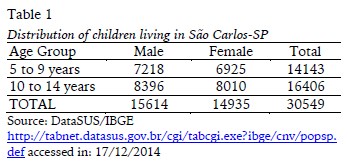
<body><![CDATA[<p>The aim of this study was to identify   the prevalence of Developmental Disorder Coordination (DCD) in children aged   5-14 years enrolled in pre-schools and primary public schools in São Carlos – SP, considering the variables age, gender and economic classification.</p>     <p>&nbsp;</p> </font>     <p><font size="3" face="Verdana"><b>METHOD</b></font></p> <font face="Verdana" size="2">     <p>This research was approved by the   Committee of Ethics in Research of the Federal University of São Carlos, Brazil, with the number 409.521/2013.</p>     <p>The research was quantitative. and   cross-sectional aiming to describe individuals of a population and its characteristics, analyzing the phenomenon at a given point in time.</p> <b>Sample</b>      <p>After consulting the Census 2012, it   was found the number of children in the age group of interest, residents of the city, divided by gender (<a href="#t1">Table 1</a>).</p>     <p><a name="t1"></a></p>     <p>&nbsp;</p>     <p align="center"><img src="/img/revistas/mot/v13n3/13n3a04t1.jpg" width="348" height="163"></p>     
<p>&nbsp;</p>     ]]></body>
<body><![CDATA[<p>Considering the data pointed by the   literature, the estimated prevalence of DCD is 5 to 15% of school-age children   (5-11 years) (APA, 2002; Cairney, Hay, Mandigo, Wade, Faught, &amp; Flouris,   2007; França, 2008; Miranda, Beltrame, &amp; Cardoso, 2011; Silva, Contreira, Beltrame, &amp; Sperandio, 2011).</p>     <p>In this sense, it was necessary to   calculate the sample size to detect an expected prevalence of 10% with 90%   confidence and a maximum error of 5%. To ensure the validity of the study a minimum sample of 97 individuals would be required.</p>     <p>The study included 130 families of   children from public schools in the city of São Carlos, SP, aged 5-14 years and   11 months. This age was selected to fit the scope of the questionnaire (DCDQ - Brazil).</p>     <p>In addition to the above features, it   was considered only families who signed the Terms of Consent. Moreover, were   excluded the children with a clinical diagnosis of physical or cognitive   deficits (cerebral palsy, autism, muscular dystrophy, hearing or visual   impairment), or children who have attended some form of physical rehabilitation services (Occupational Therapy, Physical Therapy, Psychomotor, etc.).</p> <b>Instruments</b>      <p><i>The   Economic Classification Criterion Brazil</i>   (2012), aims to classify the economic classes of the participants families   defined in A1, A2, B1, B2, C1, C2, D and E. It evaluates the purchasing power   of consumers through a system of points, with questions about the ownership of items and level of education of the household head (ABEP, 2012).</p>     <p><i>The   Developmental Coordination Disorder Questionnaire - Brazil</i> (DCDQ - Brazil) is a questionnaire for parents, self-administered. It evaluates   the performance of children in different situations of daily life. Aims to   screen DCD signs in 5-14 years and 11 months old children. The DCDQ has 15   items, which are divided into three groups: motor control during movement,   thin/writing motor skills and overall coordination. To answer the questions,   parents are instructed to compare their children with other children of the   same age, where it says, &quot;is nothing like a child&quot;, matches the score   1, to &quot;extremely like your child&quot;, matches the score 5. All questions   must be answered to allow the sum of the final score. The maximum score is 75.   There are three cutoff points for DCD identification, and the age group of 5 to   7 years and 11 months, the score of 1-46 indicates that the child is suspected   of having DCD; 8 to 9 years and 11 months, a score of 1-55 identifies that   children have DCD signals; 10 to 14 years and 11 months, children between 1-57   scores are suspected of having DCD. The cutoff score used was validated in   Canada (Cairney et al, 2007; Prado, Magalhães, &amp; Wilson, 2009; Wilson, Kaplan, Crawford, &amp; Roberts, 2007).</p>     <p><i>Questionnaire   characterizing children - </i>contains questions that aim to   identify date of birth, prematurity, physical or intellectual disabilities,   school problems, medication use and specialized treatment, based on the parents / guardians report.</p> <b>Procedures</b>      <p>Data collection was conducted in five   public schools. This number has been defined using statistical calculations, seeking representation of the city.</p>     <p>The data collection took place from the following steps:</p>     <p>1 - Telephone contact with each school;</p>     ]]></body>
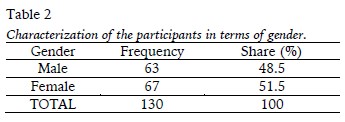
<body><![CDATA[<p>2 - Meeting with the Director and/or Teaching   Coordinator to explain the research, request authorization and decide the best strategy for distribution of questionnaires;</p>     <p>3 - Distribution of questionnaires,   which occurred in three ways: a) Delivered and returned by the students for   parents to respond at home; b) Meeting with parents to answer the questionnaires   in the presence of the researcher; or c) Delivered directly to parents address and returned by them to teachers.</p>     <p>4 - Gathering of questionnaires.</p> <b>Statistical analysis</b>      <p>In the data analysis we used Fisher's   exact test, which tests the significance for contingency tables based on the   calculation of the probability of a particular data arrangement from a   hypergeometric distribution. It is often employed when the sample size is   relatively small due to be able to calculate, for example, the exact p-value, it does not depend on asymptotic results (Agresti, 2002). </p> </font>     <p>&nbsp;</p>     <p><font size="3" face="Verdana"><b>RESULTS</b></font></p>     <p><font face="Verdana" size="2"><b>Sample Profile</b>    </font></p> <font face="Verdana" size="2">     <p>The study sample was composed of a balanced number of boys (48%) and girls (51%) randomly selected (<a href="#t2">Table 2</a>).</p>     <p><a name="t2"></a></p>     <p>&nbsp;</p>     ]]></body>
<body><![CDATA[<p align="center"><img src="/img/revistas/mot/v13n3/13n3a04t2.jpg" width="345" height="122"></p>     
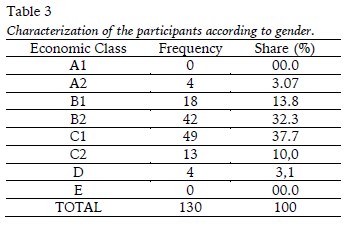
<p>&nbsp;</p>     <p><a href="#t3">Table 3</a> shows that there was a higher concentration of participants in   economic classes B2 and C1, according to the Economic Classification Criteria of Brazil.</p>     <p><a name="t3"></a></p>     <p>&nbsp;</p>     <p align="center"><img src="/img/revistas/mot/v13n3/13n3a04t3.jpg" width="348" height="226"></p>     
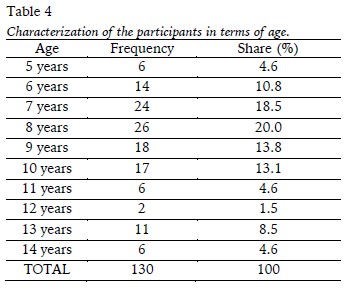
<p>&nbsp;</p>     <p>As to age, we can see in <a href="#t4">Table 4</a> that there was a concentration of   participants between 7 and 10 years.</p>     <p><a name="t4"></a></p>     <p>&nbsp;</p>     ]]></body>
<body><![CDATA[<p align="center"><img src="/img/revistas/mot/v13n3/13n3a04t4.jpg" width="349" height="291"></p> </font>     
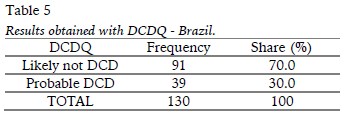
<p>&nbsp;</p>     <p><font face="Verdana" size="2"><b>Descriptive results of DCDQ instruments - Brazil</b>    </font></p> <font face="Verdana" size="2">     <p><i>DCDQ - Brazil</i></p>     <p>The DCDQ - Brazil classifies the child as &quot;Probable DCD&quot; or   &quot;Likely not DCD&quot; according to the final score obtained in the   questionnaire and according to each age group. <a href="#t5">Table 5</a> shows the results obtained by means of DCDQ - Brazil.</p>     <p><a name="t5"></a></p>     <p>&nbsp;</p>     <p align="center"><img src="/img/revistas/mot/v13n3/13n3a04t5.jpg" width="346" height="124"></p>     
<p>&nbsp;</p>     <p><a href="#t5">Table 5</a> highlights that 39 children had scores lower than expected,   indicating &quot;probable DCD&quot;, that is, 30% of the participants have to indicate DCD.</p> <b>Association analysis of the variables</b>      ]]></body>
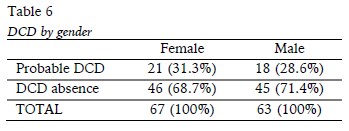
<body><![CDATA[<p>In <a href="#t6">Table 6</a>, it can be observed that the percentage of girls with DCD   probability (31.3%) is very similar to boys (28.6%). Fisher's exact test was   performed to verify this finding (p = 0.848), reinforcing the view that the percentage of DCD likely in children is independent of its gender.</p>     <p><a name="t6"></a></p>     <p>&nbsp;</p>     <p align="center"><img src="/img/revistas/mot/v13n3/13n3a04t6.jpg" width="349" height="131"></p>     
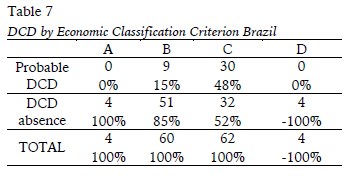
<p>&nbsp;</p>     <p>Based on <a href="#t7">Table 7</a>, it is plausible to say that DCD is related to the   purchasing power of the families of children (Classification Criteria of Brazil),   when we group the classes in A, B, C and D. Of the four children who belonged   to the classification A, none had a likelihood of DCD. As in class B, only 9 of   the 60 children (15%) presented DCD likely. In class C, approximately 48% of the children presented a probability of DCD. </p>     <p><a name="t7"></a></p>     <p>&nbsp;</p>     <p align="center"><img src="/img/revistas/mot/v13n3/13n3a04t7.jpg" width="350" height="176"></p>     
<p>&nbsp;</p>     ]]></body>
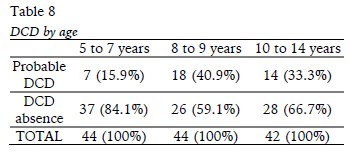
<body><![CDATA[<p>The p-value obtained by applying Fisher's exact test for this case was   about 0.0003, thus reinforcing the relationship between DCD and household purchasing power.</p>     <p>In view of <a href="#t8">Table 8</a>, it was observed that the percentage of DCD is likely   related to the age of the children. This percentage is only 15.9% in children   aged 5-7 years and eleven months, against 40.9% in children aged 8-9 years and eleven months and 33.3% in children aged 10-14 years and eleven months (p=0.03).</p>     <p><a name="t8"></a></p>     <p>&nbsp;</p>     <p align="center"><img src="/img/revistas/mot/v13n3/13n3a04t8.jpg" width="350" height="153"></p>     
<p>&nbsp;</p> </font>     <p>&nbsp;</p>     <p><font size="3" face="Verdana"><b>DISCUSSION</b></font></p> <font face="Verdana" size="2">     <p>This study aimed to identify the   prevalence of Developmental Coordination Disorder (DCD) in children aged 5-14   years and 11 months, using self-administered questionnaires, considering the variables age, gender and economic classification.</p>     <p>With regard to the identification of   the DCD signal, the results of the present study indicate a prevalence of 30%. Such   findings are in line with the data found in the research of Franca et al.   (2015). The prevalence found by the authors was 47% in a total of 535 children   in the city of João Pessoa, Paraíba - Brazil, from the application of the DCDQ   - Brazil Instrument (Franca et al, 2015). The high incidence is justified by   the methodology of the study, which used only one tool for the detection of DCD   signals. The instrument serves mainly for criteria B of the DSM - IV and partly   for criteria A. Criteria C and D were evaluated according to the principles of   the parents' vision, through a structured interview, general medical condition check and presence of physical or mental disabilities (Franca et al., 2015).</p>     ]]></body>
<body><![CDATA[<p>Studies that did not evaluate all the   diagnostic criteria established by the DSM - IV present a higher prevalence than   those that assessed all criteria (França, 2008; Silva &amp; Beltrame, 2013). The more tools and professionals involved in the   evaluation, the safer the diagnosis will be. This was emphasized and more clearly defined from the DSM - 5, where   the correlation between the criteria and the need to assess each with a specific instrument is explicit.</p>     <p>The European Academy of Childhood   Disability (EACD), guides that several professionals should participate in the   diagnostic evaluation, as a medical doctor, psychologist, occupational   therapist, physiotherapist and physical educator. The EACD brings DCDQ and MABC   as the instruments best suited at the moment, to evaluate and diagnose the DCD,   together with a medical evaluation to certify the absence of any physical or   neurological disorders that may interfere with the child’s motor capacity and a   psychological evaluation attesting to the absence of cognitive and intellectual   problems that may interfere with their performance (Blank., Bouwien, Polatajko, &amp; Wilson, 2012). </p>     <p>Civetta (2008), developed the first   study comparing the results found in two instruments, the MABC and the DCDQ.   She identified that the connection of these generated large numbers of false   positives and negatives. Joia (2014) found the same relationship, as did Souza   (2016), proving that the instruments should be used concomitantly, in order to   offer an accurate diagnosis. Since the MACB evaluates capacity and the DCDQ evaluates performance, encompassing criteria A and B of DSM V.</p>     <p>The DCDQ is a questionnaire answered   by parents; has a self-administered format, i.e., when used as interview,   enables interviewer bias. In this study, the questionnaire was given to parents   for individual answers, without researcher interference ,. It is worth   mentioning that is not common in Brazilian culture, answering survey   questionnaires and return them to the researcher, for this reason there may be changes in the quality of responses (Silva, 2014). </p>     <p>It is also important to mention the   size of Brazil which provides cultural differences and use of regional expressions,   which could interfere with the understanding of parents about the issues (Silva, 2015; Joia, 2014).</p>     <p>Another point to consider is the lack   of cultural adaptation of the cutoff point, since the questionnaire was   culturally adapted but still uses the Canadian cut grade. Joia (2014), in his   study, established a new cut-off point, using the ROC curve. The Canadian court   score for 7 years old is 46 points, and the Brazilian court grade would be 49   points, justifying the high prevalence found in several studies. Being a single   study, it cannot establish this note at national level, but highlights the importance of further studies.</p>     <p>Souza (2016) also proposed, in his   study, a review in the points of cut currently used in Brazil. The DCDQ - Brazil   and the MABC were applied to 100 children from 8 to 10 years of age, proposing   a new cut from the ROC curve with the results of the two instruments. For   children 8 years old the new cut grade would be <u>&#8804;</u> 47, less than   Canadian that is <u>&#8804;</u> 49. The same happens with the cut grade for   children of 10 years, where the Brazilian grade would be &#8804; 52, different   from the Canadian grade &#8804; 57. These findings demonstrate the need for a   study to establish a Brazilian cut note, since this disparity makes it difficult to accurately diagnose the disorder.</p>     <p>Regarding the prevalence of DCD in   relation to gender, this study found no significant difference between the   presence of signs in both boys and girls, the percentage found is very similar   between genders (31% girls and 28% boys). This same result was found in the   study of Joia (2014) and Silva (2015), but other studies show a higher incidence of DCD in boys (Giagazoglou et al., 2011).</p>     <p>Some studies were significantly   related to the low economic class with motor difficulties (Grantham-Mcgregor et   al., 2007; Assis-Madeira &amp; Blascovi-Assis, 2013). The data from this study   confirm this hypothesis. It can be observed a higher concentration of children   with DCD signs in classes B and C. This factor may be related to the motor experiences   that the individual passed, depending on the socio-cultural factors that surround him.</p>     <p>This study found a higher prevalence   of DCD signs in children over 8 years (37%), and a prevalence of 15% in   children 5-7 years. This difference can be explained by the difficulty in   diagnosing DCD in younger children. The EACD (Blank et al, 2012) guides DCD diagnose   in children of school age, i.e., over five years old. During this period the   motor skills are already more stable, and the level of participation increases   in activities of daily living; academic requirements reach a more sophisticated level and socialization plays a key role in building self-esteem.</p>     ]]></body>
<body><![CDATA[<p>Among the limitations of this study,   the criteria A, C and D were evaluated by structured questionnaire, not   following the recommendations of the EACD, which recommends the use of   standardized instruments and a multi professional team. Another limitation   concerns the low rate of return of the questionnaires sent to the parents,   considering all the notes made above. We also point to the difficulty of   parents and caregivers in answering the questionnaires, since they needed to   compare their child to a peer of the same age and to establish if he had a performance that was remarkably similar to that of his child.</p> </font>     <p>&nbsp;</p>     <p><font size="3" face="Verdana"><b>CONCLUSIONS</b></font></p> <font face="Verdana" size="2">     <p>The present study found a prevalence   of probable DCD of 30%. This is not a simple disorder to diagnose, since it   requires a set of conditions, such as the effort of a multidisciplinary team, a   series of evaluations and the combination of these assessments with the clinical observation of these professionals to identify the disorder.</p>     <p>This study used, based on the DSM -   IV, assessing directly only the criterion B. For this reason, we have not found   the prevalence of DCD, but the prevalence of disorder signs. The other criteria   were checked indirectly through the DCDQ for parents. However, it emphasizes   the importance of following all the criteria established by DSM, noting that today DMS - 5 more often used.</p>     <p>It may be noted in this study the need   to reassess the DCDQ - Brazil in its semantics and vocabulary, as it was   observed that parents had difficulty in understanding some items of the   questionnaire. The DCD significantly influences the performance of daily   activities of the child, as previously mentioned. The child signs are perceived   as difficulty in action planning, organization, implementation and/or   modification of their movements and learn new skills. That is, various motor   aspects can be affected, making it a very heterogeneous disorder, complicating it   identification and treatment. In addition, negatively reflecting on the   construction and consolidation of self-esteem and the child's sense of competence.</p>     <p>Early diagnosis of DCD is essential   because it can enable the education and guidance of all actors present in the   children's daily lives, thus avoiding negative impacts on the day-to-day. Finally,   the importance of the role of occupational therapist in the composition of the   multidisciplinary team that will evaluate and diagnose DCD is highlighted,   considering that the disorder significantly affects the activities of daily living and should be directed to the intervention as early as possible.</p>     <p>&nbsp;</p> </font>     <p><font size="3" face="Verdana"><b>REFERENCES</b></font></p> <font face="Verdana" size="2">     <!-- ref --><p>Agresti, A. (2002) <i>Categorical data analysis.</i> Second edition. New York: John Wiley &amp; Sons.    &nbsp;&nbsp;&nbsp;&nbsp;&nbsp;&nbsp;&nbsp;&nbsp;[&#160;<a href="javascript:void(0);" onclick="javascript: window.open('/scielo.php?script=sci_nlinks&ref=367786&pid=S1646-107X201700040000400001&lng=','','width=640,height=500,resizable=yes,scrollbars=1,menubar=yes,');">Links</a>&#160;]<!-- end-ref --></p>     <!-- ref --><p>APA. American Psychiatric   Association (2002). <i>DSM–IV: Manual diagnóstico e estatístico de     transtornos mentais: DSM - IV.</i>  Porto Alegre: Artes Médicas.    &nbsp;&nbsp;&nbsp;&nbsp;&nbsp;&nbsp;&nbsp;&nbsp;[&#160;<a href="javascript:void(0);" onclick="javascript: window.open('/scielo.php?script=sci_nlinks&ref=367788&pid=S1646-107X201700040000400002&lng=','','width=640,height=500,resizable=yes,scrollbars=1,menubar=yes,');">Links</a>&#160;]<!-- end-ref --></p>     <!-- ref --><p>APA. American Psychiatric   Association (2014). <i>Manual Diagnóstico e estatístico de     Transtornos mentais: DSM - 5.</i> Porto Alegre: Artes Médicas.    &nbsp;&nbsp;&nbsp;&nbsp;&nbsp;&nbsp;&nbsp;&nbsp;[&#160;<a href="javascript:void(0);" onclick="javascript: window.open('/scielo.php?script=sci_nlinks&ref=367790&pid=S1646-107X201700040000400003&lng=','','width=640,height=500,resizable=yes,scrollbars=1,menubar=yes,');">Links</a>&#160;]<!-- end-ref --></p>     <!-- ref --><p>Asonitou, K., Koutsouki, D., Kourtessis, T., &amp;   Charitou, S. (2012). Motor and cognitive performance differences between   children with and without developmental coordination disorder (DCD). <i>Research     in Developmental Disabilities</i>, <i>33</i>(4), 996–1005. <a href="https://doi.org/10.1016/j.ridd.2012.01.008" target="_blank">https://doi.org/10.1016/j.ridd.2012.01.008</a>&nbsp;&nbsp;&nbsp;&nbsp;&nbsp;&nbsp;&nbsp;&nbsp;[&#160;<a href="javascript:void(0);" onclick="javascript: window.open('/scielo.php?script=sci_nlinks&ref=367792&pid=S1646-107X201700040000400004&lng=','','width=640,height=500,resizable=yes,scrollbars=1,menubar=yes,');">Links</a>&#160;]<!-- end-ref --><!-- ref --><p>Assis-Madeira,   E. A., Carvalho, S. G., &amp; Blascovi-Assis, S. M. (2013). Desempenho funcional de crianças com   paralisia cerebral de níveis socioeconômicos alto e baixo. <i>Revista Paulista de Pediatria,</i> <i>31</i>(1), 51-57. <a href="https://doi.org/10.1590/S0103-05822013000100009" target="_blank">https://doi.org/10.1590/S0103-05822013000100009</a><b>&nbsp;    &nbsp;&nbsp;&nbsp;&nbsp;&nbsp;&nbsp;&nbsp;&nbsp;[&#160;<a href="javascript:void(0);" onclick="javascript: window.open('/scielo.php?script=sci_nlinks&ref=367793&pid=S1646-107X201700040000400005&lng=','','width=640,height=500,resizable=yes,scrollbars=1,menubar=yes,');">Links</a>&#160;]<!-- end-ref --></b></p>     <!-- ref --><p>Associação Brasileira de Empresas de Pesquisa (2012). <i>Critério de Classificação Econômica Brasil. </i>Disponível em: <a href="http://www.abep.org/novo/Content.aspx?SectionID=84" target="_blank">www.abep.org/novo/Content.aspx?SectionID=84</a> Acesso em: 12 jun. 2013.    &nbsp;&nbsp;&nbsp;&nbsp;&nbsp;&nbsp;&nbsp;&nbsp;[&#160;<a href="javascript:void(0);" onclick="javascript: window.open('/scielo.php?script=sci_nlinks&ref=367795&pid=S1646-107X201700040000400006&lng=','','width=640,height=500,resizable=yes,scrollbars=1,menubar=yes,');">Links</a>&#160;]<!-- end-ref --></p>     ]]></body>
<body><![CDATA[<!-- ref --><p>Berns, R. M. (2002). <i>Desenvolvimento da criança</i>. Editora Loyola: São Paulo.    &nbsp;&nbsp;&nbsp;&nbsp;&nbsp;&nbsp;&nbsp;&nbsp;[&#160;<a href="javascript:void(0);" onclick="javascript: window.open('/scielo.php?script=sci_nlinks&ref=367797&pid=S1646-107X201700040000400007&lng=','','width=640,height=500,resizable=yes,scrollbars=1,menubar=yes,');">Links</a>&#160;]<!-- end-ref --></p>     <!-- ref --><p>Blank,   R., Bouwien, S. E., Polatajko, H., &amp; Wilson, P. (2012) European Academy for   Childhood Disability (EACD): recommendations on the definition, diagnosis and   intervention of developmental coordination disorder (long version). <i>Developmental Medicine &amp; Child Neurology,</i> <i>54</i>(1), 54-93. <a href="https://doi.org/10.1111/j.1469-8749.2011.04171.x" target="_blank">https://doi.org/10.1111/j.1469-8749.2011.04171.x</a>&nbsp;&nbsp;&nbsp;&nbsp;&nbsp;&nbsp;&nbsp;&nbsp;[&#160;<a href="javascript:void(0);" onclick="javascript: window.open('/scielo.php?script=sci_nlinks&ref=367799&pid=S1646-107X201700040000400008&lng=','','width=640,height=500,resizable=yes,scrollbars=1,menubar=yes,');">Links</a>&#160;]<!-- end-ref --><!-- ref --><p>Cairney, J., Hay, J., Mandigo, J. J., Wade, T., Faught, B. E., &amp;   Flouris, A. (2007). Developmental coordination disorder and reported enjoyment of physical education in children. <i>European Physical Education Review, 13</i>(1), 81-98. <a href="https://doi.org/10.1177/1356336X07072678" target="_blank">https://doi.org/10.1177/1356336X07072678</a>&nbsp;&nbsp;&nbsp;&nbsp;&nbsp;&nbsp;&nbsp;&nbsp;[&#160;<a href="javascript:void(0);" onclick="javascript: window.open('/scielo.php?script=sci_nlinks&ref=367800&pid=S1646-107X201700040000400009&lng=','','width=640,height=500,resizable=yes,scrollbars=1,menubar=yes,');">Links</a>&#160;]<!-- end-ref --><!-- ref --><p>Cardoso A. C., &amp;   Magalhães L. C. (2012). Validade de   critério da Avaliação da Coordenação e Destreza   Motora. <i>Revista Brasileira de Fisioterapia</i>, <i>16</i>(1), 16-22.    &nbsp;&nbsp;&nbsp;&nbsp;&nbsp;&nbsp;&nbsp;&nbsp;[&#160;<a href="javascript:void(0);" onclick="javascript: window.open('/scielo.php?script=sci_nlinks&ref=367801&pid=S1646-107X201700040000400010&lng=','','width=640,height=500,resizable=yes,scrollbars=1,menubar=yes,');">Links</a>&#160;]<!-- end-ref --></p>     <!-- ref --><p>Civetta, L. R., &amp;   Hillier, S. L. (2008). The developmental   coordination disorder questionnaire and movement assessment battery for children as a diagnostic method in Australian children. <i>Pediatric Physical Therapy</i>, <i>20</i>(1), 39-46. <a href="https://doi.org/10.1097/PEP.0b013e31815ccaeb" target="_blank">https://doi.org/10.1097/PEP.0b013e31815ccaeb</a>&nbsp;&nbsp;&nbsp;&nbsp;&nbsp;&nbsp;&nbsp;&nbsp;[&#160;<a href="javascript:void(0);" onclick="javascript: window.open('/scielo.php?script=sci_nlinks&ref=367803&pid=S1646-107X201700040000400011&lng=','','width=640,height=500,resizable=yes,scrollbars=1,menubar=yes,');">Links</a>&#160;]<!-- end-ref --><!-- ref --><p>Ferreira, L. F., Nascimento R. O.,   Apolinário M. R., &amp; Freudenheim A. M. (2006). Desordem da coordenação do   desenvolvimento. <i>Motriz, 12</i>(3), 283-292.    &nbsp;&nbsp;&nbsp;&nbsp;&nbsp;&nbsp;&nbsp;&nbsp;[&#160;<a href="javascript:void(0);" onclick="javascript: window.open('/scielo.php?script=sci_nlinks&ref=367804&pid=S1646-107X201700040000400012&lng=','','width=640,height=500,resizable=yes,scrollbars=1,menubar=yes,');">Links</a>&#160;]<!-- end-ref --> </p>     <!-- ref --><p>Franca, A. S., Matias, R., Real, M. H. C., Vale, A. D. L.,   Pacheco, M. A. V., Clase, J. P. D., ... Araujo, C. R. S. (2015). Motor   coordination and attentional problems in school-aged children in a low-income population from northeastern Brazil. <i>Journal of Comorbidity</i>, <i>5</i>(2), 81. <a href="http://dx.doi.org/10.15256/joc.2015.5.52" target="_blank">http://dx.doi.org/10.15256/joc.2015.5.52</a>&nbsp;&nbsp;&nbsp;&nbsp;&nbsp;&nbsp;&nbsp;&nbsp;[&#160;<a href="javascript:void(0);" onclick="javascript: window.open('/scielo.php?script=sci_nlinks&ref=367806&pid=S1646-107X201700040000400013&lng=','','width=640,height=500,resizable=yes,scrollbars=1,menubar=yes,');">Links</a>&#160;]<!-- end-ref --><!-- ref --><p>França, C. de. (2008). <i>Desordem coordenativa desenvolvimental   em crianças de 7 e 8 anos de idade</i> (Dissertação Mestrado em Ciências do   Movimento Humano). Universidade do Estado de Santa Catarina, Santa Catarina. Retrieved from <a href="http://tede.udesc.br//handle/handle/381" target="_blank">http://tede.udesc.br//handle/handle/381</a>&nbsp;&nbsp;&nbsp;&nbsp;&nbsp;&nbsp;&nbsp;&nbsp;[&#160;<a href="javascript:void(0);" onclick="javascript: window.open('/scielo.php?script=sci_nlinks&ref=367807&pid=S1646-107X201700040000400014&lng=','','width=640,height=500,resizable=yes,scrollbars=1,menubar=yes,');">Links</a>&#160;]<!-- end-ref --><!-- ref --><p>Giagazoglou P., Kabitsis, N., Kokaridas,   D., Zaragas, C, Katartzi, E., &amp; Kabitsis, C. (2011). The   movement assessment battery in Greek preschoolers: the impact of age, gender,   birth order, and physical activity on motor outcome. <i>Research in Disabilities, 32</i>(6)<i>,</i> 77-82. <a href="http://dx.doi.org/10.1016/j.ridd.2011.06.020" target="_blank">http://dx.doi.org/10.1016/j.ridd.2011.06.020</a>&nbsp;&nbsp;&nbsp;&nbsp;&nbsp;&nbsp;&nbsp;&nbsp;[&#160;<a href="javascript:void(0);" onclick="javascript: window.open('/scielo.php?script=sci_nlinks&ref=367808&pid=S1646-107X201700040000400015&lng=','','width=640,height=500,resizable=yes,scrollbars=1,menubar=yes,');">Links</a>&#160;]<!-- end-ref --><!-- ref --><p>Grantham-McGregor,   S., Cheung Y. B., Cueto, S, Glewwe, P., Richter, L., &amp; Strupp, B. (2007). Developmental potential in the first 5 years for children in developing countries. <i>Lancet, 369</i>(9555), 60-70. <a href="http://dx.doi.org/10.1016/S0140-6736(07)60032-4" target="_blank">http://dx.doi.org/10.1016/S0140-6736(07)60032-4</a>&nbsp;&nbsp;&nbsp;&nbsp;&nbsp;&nbsp;&nbsp;&nbsp;[&#160;<a href="javascript:void(0);" onclick="javascript: window.open('/scielo.php?script=sci_nlinks&ref=367809&pid=S1646-107X201700040000400016&lng=','','width=640,height=500,resizable=yes,scrollbars=1,menubar=yes,');">Links</a>&#160;]<!-- end-ref --><!-- ref --><p>Instituto   Brasileiro de Geografia e Estatística, Diretoria de Pesquisas, Coordenação de População   e Indicadores Sociais (2014). <i>NOTA 1<b>: </b>Estimativas     da população residente com data referência 1º de julho de 2014 publicadas no     Diário Oficial da União em 28/08/2014</i>. Disponível em: <a href="http://www.cidades.ibge.gov.br/xtras/temas.php?lang=&codmun=354890&idtema=130&search=sao-paulo|sao-carlos|estimativa-da-populacao-2014-" target="_blank">http://www.cidades.ibge.gov.br/xtras/temas.php?lang=&amp;codmun=354890&amp;idtema=130&amp;search=sao-paulo|sao-carlos|estimativa-da-populacao-2014-</a>. Acessado em: 22/06/2015.    &nbsp;&nbsp;&nbsp;&nbsp;&nbsp;&nbsp;&nbsp;&nbsp;[&#160;<a href="javascript:void(0);" onclick="javascript: window.open('/scielo.php?script=sci_nlinks&ref=367810&pid=S1646-107X201700040000400017&lng=','','width=640,height=500,resizable=yes,scrollbars=1,menubar=yes,');">Links</a>&#160;]<!-- end-ref --></p>     <!-- ref --><p>Jóia, A. F. (2014). <i>Transtorno   do Desenvolvimento da Coordenação em crianças de 7 anos de idade matriculadas   em escolas públicas no município de Araraquara – SP</i> (Dissertação de Mestrado   em Terapia Ocupacional). Universidade Federal de São Carlos, São Carlos.    &nbsp;&nbsp;&nbsp;&nbsp;&nbsp;&nbsp;&nbsp;&nbsp;[&#160;<a href="javascript:void(0);" onclick="javascript: window.open('/scielo.php?script=sci_nlinks&ref=367812&pid=S1646-107X201700040000400018&lng=','','width=640,height=500,resizable=yes,scrollbars=1,menubar=yes,');">Links</a>&#160;]<!-- end-ref --></p>     <!-- ref --><p>Lingman, R., Hunt L., Golding J., Jongmans,   M., &amp; Emond, A. (2009). Prevalence of Developmental Coordination Disorder using the DSM-IV at 7 years of Age: a UK population – based study. <i>Pediatries,123</i>(4), 692-700. <a href="https://doi.org/10.1542/peds.2008-1770" target="_blank">https://doi.org/10.1542/peds.2008-1770</a>&nbsp;&nbsp;&nbsp;&nbsp;&nbsp;&nbsp;&nbsp;&nbsp;[&#160;<a href="javascript:void(0);" onclick="javascript: window.open('/scielo.php?script=sci_nlinks&ref=367814&pid=S1646-107X201700040000400019&lng=','','width=640,height=500,resizable=yes,scrollbars=1,menubar=yes,');">Links</a>&#160;]<!-- end-ref --><!-- ref --><p>Magalhães, L. C., Rezende, M. B., Amparo, F., Ferreira,   G. N., &amp; Renger, C. (2009). Problemas de coordenação motora em crianças de   4 a 8 anos: levantamento baseado no relato de professores. <i>Revista de Terapia Ocupacional     da Universidade de São Paulo,</i> <i>20</i>(1), 20-28. <a href="http://dx.doi.org/10.11606/issn.2238-6149.v20i1p20-28" target="_blank">http://dx.doi.org/10.11606/issn.2238-6149.v20i1p20-28</a>&nbsp;&nbsp;&nbsp;&nbsp;&nbsp;&nbsp;&nbsp;&nbsp;[&#160;<a href="javascript:void(0);" onclick="javascript: window.open('/scielo.php?script=sci_nlinks&ref=367815&pid=S1646-107X201700040000400020&lng=','','width=640,height=500,resizable=yes,scrollbars=1,menubar=yes,');">Links</a>&#160;]<!-- end-ref --><!-- ref --><p>Miranda, T. B., Beltrame, T. S.,   &amp; Cardoso, F. L. (2011). Desempenho motor e estado nutricional de escolares   com e sem transtorno do desenvolvimento da coordenação. <i>Revista Brasileira de Cineantropometria &amp; Desempenho Humano, 13</i>(1), 59-66. <a href="http://dx.doi.org/10.5007/1980-0037.2011v13n1p59" target="_blank">http://dx.doi.org/10.5007/1980-0037.2011v13n1p59</a>&nbsp;&nbsp;&nbsp;&nbsp;&nbsp;&nbsp;&nbsp;&nbsp;[&#160;<a href="javascript:void(0);" onclick="javascript: window.open('/scielo.php?script=sci_nlinks&ref=367816&pid=S1646-107X201700040000400021&lng=','','width=640,height=500,resizable=yes,scrollbars=1,menubar=yes,');">Links</a>&#160;]<!-- end-ref --><!-- ref --><p>Missiuna, C., Gaines, R.,   Mclean, J., LeLaat, D., Egan, M. E., &amp; Soucie, H. (2011). Description of   children identified by physicians as having developmental coordination disorder, <i>Developmental Medicine &amp; Child Neurology,</i> <i>50</i>(11), 839-844. <a href="http://dx.doi.org/10.1111/j.1469-8749.2008.03140.x" target="_blank">http://dx.doi.org/10.1111/j.1469-8749.2008.03140.x</a>&nbsp;&nbsp;&nbsp;&nbsp;&nbsp;&nbsp;&nbsp;&nbsp;[&#160;<a href="javascript:void(0);" onclick="javascript: window.open('/scielo.php?script=sci_nlinks&ref=367817&pid=S1646-107X201700040000400022&lng=','','width=640,height=500,resizable=yes,scrollbars=1,menubar=yes,');">Links</a>&#160;]<!-- end-ref --><!-- ref --><p>Missiuna, C., Pollock, N.,   Egan, M., DeLaat, D., Gaines, R., &amp; Soucie, H. (2008). Enabling occupation through facilitating the diagnosis of Developmental Coordination Disorder. <i>Canadian Journal of Occupational Therapy, 75</i>(1), 26-34. -<a href="https://doi.org/10.2182/cjot.07.012" target="_blank">https://doi.org/10.2182/cjot.07.012</a>&nbsp;&nbsp;&nbsp;&nbsp;&nbsp;&nbsp;&nbsp;&nbsp;[&#160;<a href="javascript:void(0);" onclick="javascript: window.open('/scielo.php?script=sci_nlinks&ref=367818&pid=S1646-107X201700040000400023&lng=','','width=640,height=500,resizable=yes,scrollbars=1,menubar=yes,');">Links</a>&#160;]<!-- end-ref --><!-- ref --><p>Missiuna, C., Cairney, J., Pollock, N., Campbell, W., Russell, D. J.,   Macdonald, K., … Cousins, M. (2014). Psychological distress in children with   developmental coordination disorder and attention-deficit hyperactivity   disorder. <i>Research in Developmental Disabilities</i>, <i>35</i>(5), 1198–1207. <a href="https://doi.org/10.1016/j.ridd.2014.01.007" target="_blank">https://doi.org/10.1016/j.ridd.2014.01.007</a>&nbsp;&nbsp;&nbsp;&nbsp;&nbsp;&nbsp;&nbsp;&nbsp;[&#160;<a href="javascript:void(0);" onclick="javascript: window.open('/scielo.php?script=sci_nlinks&ref=367819&pid=S1646-107X201700040000400024&lng=','','width=640,height=500,resizable=yes,scrollbars=1,menubar=yes,');">Links</a>&#160;]<!-- end-ref --><!-- ref --><p>Prado,   M. S. S., Magalhães, L. C., &amp; Wilson, B. N. (2009). Cross-cultural   adaptation of the Developmental Coordination Disorder Questionnaire for Brazilian children. <i>Revista Brasileira de Fisioterapia. 13</i>(3), 236-43. <a href="http://dx.doi.org/10.1590/S1413-35552009005000024" target="_blank">http://dx.doi.org/10.1590/S1413-35552009005000024</a>&nbsp;    &nbsp;&nbsp;&nbsp;&nbsp;&nbsp;&nbsp;&nbsp;&nbsp;[&#160;<a href="javascript:void(0);" onclick="javascript: window.open('/scielo.php?script=sci_nlinks&ref=367820&pid=S1646-107X201700040000400025&lng=','','width=640,height=500,resizable=yes,scrollbars=1,menubar=yes,');">Links</a>&#160;]<!-- end-ref --></p>     <!-- ref --><p>Silva, A. F. R. (2015). <i>Prevalência do transtorno do desenvolvimento da coordenação em crianças   de 7 anos de idade matriculadas em escolas públicas de Itirapina-SP</i> (Dissertação   de Mestrado em Terapia Ocupacional). Universidade Federal de São Carlos, São Carlos.    &nbsp;&nbsp;&nbsp;&nbsp;&nbsp;&nbsp;&nbsp;&nbsp;[&#160;<a href="javascript:void(0);" onclick="javascript: window.open('/scielo.php?script=sci_nlinks&ref=367822&pid=S1646-107X201700040000400026&lng=','','width=640,height=500,resizable=yes,scrollbars=1,menubar=yes,');">Links</a>&#160;]<!-- end-ref --> </p>     <!-- ref --><p>Silva, E. V. A., Contreira, A. R., Beltrame,   T. S., &amp; Sperandio, F. F. (2011). Programa de intervenção motora para   escolares com indicativo de transtorno do desenvolvimento da coordenação - DCD.   <i>Revista brasileira de educação Especial</i>,   <i>17</i>(1), 137-150. <a href="http://dx.doi.org/10.1590/S1413-65382011000100010" target="_blank">http://dx.doi.org/10.1590/S1413-65382011000100010</a>  &nbsp;    &nbsp;&nbsp;&nbsp;&nbsp;&nbsp;&nbsp;&nbsp;&nbsp;[&#160;<a href="javascript:void(0);" onclick="javascript: window.open('/scielo.php?script=sci_nlinks&ref=367824&pid=S1646-107X201700040000400027&lng=','','width=640,height=500,resizable=yes,scrollbars=1,menubar=yes,');">Links</a>&#160;]<!-- end-ref --></p>     <!-- ref --><p>Silva, J., &amp; Beltrame, T. S. (2013).   Indicativo de Transtorno do Desenvolvimento da Coordenação de escolares com   idade entre 7 e 10 anos. <i>Revista Brasileira de Ciências do Esporte, Florianópolis, 35</i>(1), 3-14. <a href="http://dx.doi.org/10.1590/S0101-32892013000100002" target="_blank">http://dx.doi.org/10.1590/S0101-32892013000100002</a>&nbsp;    &nbsp;&nbsp;&nbsp;&nbsp;&nbsp;&nbsp;&nbsp;&nbsp;[&#160;<a href="javascript:void(0);" onclick="javascript: window.open('/scielo.php?script=sci_nlinks&ref=367826&pid=S1646-107X201700040000400028&lng=','','width=640,height=500,resizable=yes,scrollbars=1,menubar=yes,');">Links</a>&#160;]<!-- end-ref --></p>     <!-- ref --><p>Souza, T. F. (2015). <i>Critérios   Diagnósticos para a Identificação do Transtorno do Desenvolvimento da Coordenação:   Revisão Sistemática da Literatura</i> (Trabalho de Conclusão de Curso de Especialização em Intervenção em Neuropediatria). Universidade Federal de São Carlos, São Carlos.    &nbsp;&nbsp;&nbsp;&nbsp;&nbsp;&nbsp;&nbsp;&nbsp;[&#160;<a href="javascript:void(0);" onclick="javascript: window.open('/scielo.php?script=sci_nlinks&ref=367828&pid=S1646-107X201700040000400029&lng=','','width=640,height=500,resizable=yes,scrollbars=1,menubar=yes,');">Links</a>&#160;]<!-- end-ref --></p>     <!-- ref --><p>Souza, T. D. F. D. (2016). <i>Especificidade e sensibilidade do Questionário de Transtorno do   Desenvolvimento da Coordenação-Brasil para crianças de 8 a 10 anos</i>   (Dissertação de Mestrado em Terapia Ocupacional). Universidade Federal de São Carlos, São Carlos.    &nbsp;&nbsp;&nbsp;&nbsp;&nbsp;&nbsp;&nbsp;&nbsp;[&#160;<a href="javascript:void(0);" onclick="javascript: window.open('/scielo.php?script=sci_nlinks&ref=367830&pid=S1646-107X201700040000400030&lng=','','width=640,height=500,resizable=yes,scrollbars=1,menubar=yes,');">Links</a>&#160;]<!-- end-ref --> </p>     <!-- ref --><p>Wilson, B. N., Kaplan, B. J., Crawford, S.   G., &amp; Roberts, G. (2007). <i>The Developmental Coordination Disorder Questionnaire 2007©(DCDQ’07).</i> <i>Administrative manual for the DCDQ107 with psychometric properties</i>.    &nbsp;&nbsp;&nbsp;&nbsp;&nbsp;&nbsp;&nbsp;&nbsp;[&#160;<a href="javascript:void(0);" onclick="javascript: window.open('/scielo.php?script=sci_nlinks&ref=367832&pid=S1646-107X201700040000400031&lng=','','width=640,height=500,resizable=yes,scrollbars=1,menubar=yes,');">Links</a>&#160;]<!-- end-ref --></p>     <!-- ref --><p>Zwiker, J. G.,   Missiuna, C., Harris, S. R., &amp; Boyd, L. A. (2012). Developmental coordination   disorder: a review and update. <i>Official Journal of the European Pediatric Neurology Society, 16</i>(6), 573-581. <a href="http://dx.doi.org/10.1016/j.ejpn.2012.05.005" target="_blank">http://dx.doi.org/10.1016/j.ejpn.2012.05.005</a>&nbsp;&nbsp;&nbsp;&nbsp;&nbsp;&nbsp;&nbsp;&nbsp;[&#160;<a href="javascript:void(0);" onclick="javascript: window.open('/scielo.php?script=sci_nlinks&ref=367834&pid=S1646-107X201700040000400032&lng=','','width=640,height=500,resizable=yes,scrollbars=1,menubar=yes,');">Links</a>&#160;]<!-- end-ref --><p>&nbsp;</p> </font>     <p><font size="2" face="Verdana"><b>Acknowledgments:    ]]></body>
<body><![CDATA[<br>   </b>To research participants   and CNPQ<b>    <br>   Conflict   of interest:</b>    <br>   Nothing to declare.<b>    <br>   Funding:</b>    <br>   Conselho Nacional de Desenvolvimento Cient&iacute;fico e Tecnol&oacute;gico (CNPQ)</font></p>     <p><font size="2" face="Verdana">Manuscript received at  September 28th 2016; Accepted at April 2nd 2017 </font></p> <font face="Verdana" size="2">     <p>&nbsp;</p>     <p>&nbsp;</p> </font><font face="Verdana" size="2"><a href="#top"><sup>*</sup></a><i><a name="end"></a></i> <i>Corresponding  author</i>: Rodovia Washington Lu&iacute;s, s/n, S&atilde;o Carlos - SP, 13565-905, Brasil <i>E-mail</i>: <a href="mailto:patriciadellabarba@yahoo.com.br">patriciadellabarba@yahoo.com.br</a>     <p>&nbsp;</p> </font>      ]]></body><back>
<ref-list>
<ref id="B1">
<nlm-citation citation-type="book">
<person-group person-group-type="author">
<name>
<surname><![CDATA[Agresti]]></surname>
<given-names><![CDATA[A.]]></given-names>
</name>
</person-group>
<source><![CDATA[Categorical data analysis]]></source>
<year>2002</year>
<edition>Second edition</edition>
<publisher-loc><![CDATA[New York ]]></publisher-loc>
<publisher-name><![CDATA[John Wiley & Sons]]></publisher-name>
</nlm-citation>
</ref>
<ref id="B2">
<nlm-citation citation-type="book">
<collab>APA. American Psychiatric Association</collab>
<source><![CDATA[DSM-IV: Manual diagnóstico e estatístico de transtornos mentais: DSM - IV]]></source>
<year>2002</year>
<publisher-loc><![CDATA[Porto Alegre ]]></publisher-loc>
<publisher-name><![CDATA[Artes Médicas]]></publisher-name>
</nlm-citation>
</ref>
<ref id="B3">
<nlm-citation citation-type="book">
<collab>APA. American Psychiatric Association</collab>
<source><![CDATA[Manual Diagnóstico e estatístico de Transtornos mentais: DSM - 5]]></source>
<year>2014</year>
<publisher-loc><![CDATA[Porto Alegre ]]></publisher-loc>
<publisher-name><![CDATA[Artes Médicas]]></publisher-name>
</nlm-citation>
</ref>
<ref id="B4">
<nlm-citation citation-type="journal">
<person-group person-group-type="author">
<name>
<surname><![CDATA[Asonitou]]></surname>
<given-names><![CDATA[K.]]></given-names>
</name>
<name>
<surname><![CDATA[Koutsouki]]></surname>
<given-names><![CDATA[D.]]></given-names>
</name>
<name>
<surname><![CDATA[Kourtessis]]></surname>
<given-names><![CDATA[T.]]></given-names>
</name>
<name>
<surname><![CDATA[Charitou]]></surname>
<given-names><![CDATA[S.]]></given-names>
</name>
</person-group>
<article-title xml:lang="en"><![CDATA[Motor and cognitive performance differences between children with and without developmental coordination disorder (DCD)]]></article-title>
<source><![CDATA[Research in Developmental Disabilities]]></source>
<year>2012</year>
<volume>33</volume>
<numero>4</numero>
<issue>4</issue>
<page-range>996-1005</page-range></nlm-citation>
</ref>
<ref id="B5">
<nlm-citation citation-type="journal">
<person-group person-group-type="author">
<name>
<surname><![CDATA[Assis-Madeira]]></surname>
<given-names><![CDATA[E. A.]]></given-names>
</name>
<name>
<surname><![CDATA[Carvalho]]></surname>
<given-names><![CDATA[S. G.]]></given-names>
</name>
<name>
<surname><![CDATA[Blascovi-Assis]]></surname>
<given-names><![CDATA[S. M.]]></given-names>
</name>
</person-group>
<article-title xml:lang="pt"><![CDATA[Desempenho funcional de crianças com paralisia cerebral de níveis socioeconômicos alto e baixo]]></article-title>
<source><![CDATA[Revista Paulista de Pediatria]]></source>
<year>2013</year>
<volume>31</volume>
<numero>1</numero>
<issue>1</issue>
<page-range>51-57</page-range></nlm-citation>
</ref>
<ref id="B6">
<nlm-citation citation-type="">
<collab>Associação Brasileira de Empresas de Pesquisa</collab>
<source><![CDATA[Critério de Classificação Econômica Brasil]]></source>
<year>2012</year>
</nlm-citation>
</ref>
<ref id="B7">
<nlm-citation citation-type="book">
<person-group person-group-type="author">
<name>
<surname><![CDATA[Berns]]></surname>
<given-names><![CDATA[R. M.]]></given-names>
</name>
</person-group>
<source><![CDATA[Desenvolvimento da criança]]></source>
<year>2002</year>
<publisher-loc><![CDATA[São Paulo ]]></publisher-loc>
<publisher-name><![CDATA[Editora Loyola]]></publisher-name>
</nlm-citation>
</ref>
<ref id="B8">
<nlm-citation citation-type="journal">
<person-group person-group-type="author">
<name>
<surname><![CDATA[Blank]]></surname>
<given-names><![CDATA[R.]]></given-names>
</name>
<name>
<surname><![CDATA[Bouwien]]></surname>
<given-names><![CDATA[S. E.]]></given-names>
</name>
<name>
<surname><![CDATA[Polatajko]]></surname>
<given-names><![CDATA[H.]]></given-names>
</name>
<name>
<surname><![CDATA[Wilson]]></surname>
<given-names><![CDATA[P.]]></given-names>
</name>
</person-group>
<article-title xml:lang="en"><![CDATA[European Academy for Childhood Disability (EACD): recommendations on the definition, diagnosis and intervention of developmental coordination disorder (long version)]]></article-title>
<source><![CDATA[Developmental Medicine & Child Neurology]]></source>
<year>2012</year>
<volume>54</volume>
<numero>1</numero>
<issue>1</issue>
<page-range>54-93</page-range></nlm-citation>
</ref>
<ref id="B9">
<nlm-citation citation-type="journal">
<person-group person-group-type="author">
<name>
<surname><![CDATA[Cairney]]></surname>
<given-names><![CDATA[J.]]></given-names>
</name>
<name>
<surname><![CDATA[Hay]]></surname>
<given-names><![CDATA[J.]]></given-names>
</name>
<name>
<surname><![CDATA[Mandigo]]></surname>
<given-names><![CDATA[J. J.]]></given-names>
</name>
<name>
<surname><![CDATA[Wade]]></surname>
<given-names><![CDATA[T.]]></given-names>
</name>
<name>
<surname><![CDATA[Faught]]></surname>
<given-names><![CDATA[B. E.]]></given-names>
</name>
<name>
<surname><![CDATA[Flouris]]></surname>
<given-names><![CDATA[A.]]></given-names>
</name>
</person-group>
<article-title xml:lang="en"><![CDATA[Developmental coordination disorder and reported enjoyment of physical education in children]]></article-title>
<source><![CDATA[European Physical Education Review]]></source>
<year>2007</year>
<volume>13</volume>
<numero>1</numero>
<issue>1</issue>
<page-range>81-98</page-range></nlm-citation>
</ref>
<ref id="B10">
<nlm-citation citation-type="journal">
<person-group person-group-type="author">
<name>
<surname><![CDATA[Cardoso]]></surname>
<given-names><![CDATA[A. C.]]></given-names>
</name>
<name>
<surname><![CDATA[Magalhães]]></surname>
<given-names><![CDATA[L. C.]]></given-names>
</name>
</person-group>
<article-title xml:lang="pt"><![CDATA[Validade de critério da Avaliação da Coordenação e Destreza Motora]]></article-title>
<source><![CDATA[Revista Brasileira de Fisioterapia]]></source>
<year>2012</year>
<volume>16</volume>
<numero>1</numero>
<issue>1</issue>
<page-range>16-22</page-range></nlm-citation>
</ref>
<ref id="B11">
<nlm-citation citation-type="journal">
<person-group person-group-type="author">
<name>
<surname><![CDATA[Civetta]]></surname>
<given-names><![CDATA[L. R.]]></given-names>
</name>
<name>
<surname><![CDATA[Hillier]]></surname>
<given-names><![CDATA[S. L.]]></given-names>
</name>
</person-group>
<article-title xml:lang="en"><![CDATA[The developmental coordination disorder questionnaire and movement assessment battery for children as a diagnostic method in Australian children]]></article-title>
<source><![CDATA[Pediatric Physical Therapy]]></source>
<year>2008</year>
<volume>20</volume>
<numero>1</numero>
<issue>1</issue>
<page-range>39-46</page-range></nlm-citation>
</ref>
<ref id="B12">
<nlm-citation citation-type="journal">
<person-group person-group-type="author">
<name>
<surname><![CDATA[Ferreira]]></surname>
<given-names><![CDATA[L. F.]]></given-names>
</name>
<name>
<surname><![CDATA[Nascimento]]></surname>
<given-names><![CDATA[R. O.]]></given-names>
</name>
<name>
<surname><![CDATA[Apolinário]]></surname>
<given-names><![CDATA[M. R.]]></given-names>
</name>
<name>
<surname><![CDATA[Freudenheim]]></surname>
<given-names><![CDATA[A. M.]]></given-names>
</name>
</person-group>
<article-title xml:lang="pt"><![CDATA[Desordem da coordenação do desenvolvimento]]></article-title>
<source><![CDATA[Motriz]]></source>
<year>2006</year>
<volume>12</volume>
<numero>3</numero>
<issue>3</issue>
<page-range>283-292</page-range></nlm-citation>
</ref>
<ref id="B13">
<nlm-citation citation-type="journal">
<person-group person-group-type="author">
<name>
<surname><![CDATA[Franca]]></surname>
<given-names><![CDATA[A. S.]]></given-names>
</name>
<name>
<surname><![CDATA[Matias]]></surname>
<given-names><![CDATA[R.]]></given-names>
</name>
<name>
<surname><![CDATA[Real]]></surname>
<given-names><![CDATA[M. H. C.]]></given-names>
</name>
<name>
<surname><![CDATA[Vale]]></surname>
<given-names><![CDATA[A. D. L.]]></given-names>
</name>
<name>
<surname><![CDATA[Pacheco]]></surname>
<given-names><![CDATA[M. A. V.]]></given-names>
</name>
<name>
<surname><![CDATA[Clase]]></surname>
<given-names><![CDATA[J. P. D.]]></given-names>
</name>
<name>
<surname><![CDATA[Araujo]]></surname>
<given-names><![CDATA[C. R. S.]]></given-names>
</name>
</person-group>
<article-title xml:lang="en"><![CDATA[Motor coordination and attentional problems in school-aged children in a low-income population from northeastern Brazil]]></article-title>
<source><![CDATA[Journal of Comorbidity]]></source>
<year>2015</year>
<volume>5</volume>
<numero>2</numero>
<issue>2</issue>
<page-range>81</page-range></nlm-citation>
</ref>
<ref id="B14">
<nlm-citation citation-type="">
<person-group person-group-type="author">
<name>
<surname><![CDATA[França]]></surname>
<given-names><![CDATA[C. de.]]></given-names>
</name>
</person-group>
<source><![CDATA[Desordem coordenativa desenvolvimental em crianças de 7 e 8 anos de idade]]></source>
<year>2008</year>
</nlm-citation>
</ref>
<ref id="B15">
<nlm-citation citation-type="journal">
<person-group person-group-type="author">
<name>
<surname><![CDATA[Giagazoglou]]></surname>
<given-names><![CDATA[P.]]></given-names>
</name>
<name>
<surname><![CDATA[Kabitsis]]></surname>
<given-names><![CDATA[N.]]></given-names>
</name>
<name>
<surname><![CDATA[Kokaridas]]></surname>
<given-names><![CDATA[D.]]></given-names>
</name>
<name>
<surname><![CDATA[Zaragas]]></surname>
<given-names><![CDATA[C]]></given-names>
</name>
<name>
<surname><![CDATA[Katartzi]]></surname>
<given-names><![CDATA[E.]]></given-names>
</name>
<name>
<surname><![CDATA[Kabitsis]]></surname>
<given-names><![CDATA[C.]]></given-names>
</name>
</person-group>
<article-title xml:lang="en"><![CDATA[The movement assessment battery in Greek preschoolers: the impact of age, gender, birth order, and physical activity on motor outcome]]></article-title>
<source><![CDATA[Research in Disabilities]]></source>
<year>2011</year>
<volume>32</volume>
<numero>6</numero>
<issue>6</issue>
<page-range>77-82</page-range></nlm-citation>
</ref>
<ref id="B16">
<nlm-citation citation-type="journal">
<person-group person-group-type="author">
<name>
<surname><![CDATA[Grantham-McGregor]]></surname>
<given-names><![CDATA[S.]]></given-names>
</name>
<name>
<surname><![CDATA[Cheung]]></surname>
<given-names><![CDATA[Y. B.]]></given-names>
</name>
<name>
<surname><![CDATA[Cueto]]></surname>
<given-names><![CDATA[S]]></given-names>
</name>
<name>
<surname><![CDATA[Glewwe]]></surname>
<given-names><![CDATA[P.]]></given-names>
</name>
<name>
<surname><![CDATA[Richter]]></surname>
<given-names><![CDATA[L.]]></given-names>
</name>
<name>
<surname><![CDATA[Strupp]]></surname>
<given-names><![CDATA[B.]]></given-names>
</name>
</person-group>
<article-title xml:lang="en"><![CDATA[Developmental potential in the first 5 years for children in developing countries]]></article-title>
<source><![CDATA[Lancet]]></source>
<year>2007</year>
<volume>369</volume>
<numero>9555</numero>
<issue>9555</issue>
<page-range>60-70</page-range></nlm-citation>
</ref>
<ref id="B17">
<nlm-citation citation-type="">
<collab>Instituto Brasileiro de Geografia e Estatística^dDiretoria de Pesquisas, Coordenação de População e Indicadores Sociais</collab>
<source><![CDATA[NOTA 1: Estimativas da população residente com data referência 1º de julho de 2014 publicadas no Diário Oficial da União em 28/08/2014]]></source>
<year>2014</year>
</nlm-citation>
</ref>
<ref id="B18">
<nlm-citation citation-type="">
<person-group person-group-type="author">
<name>
<surname><![CDATA[Jóia]]></surname>
<given-names><![CDATA[A. F.]]></given-names>
</name>
</person-group>
<source><![CDATA[Transtorno do Desenvolvimento da Coordenação em crianças de 7 anos de idade matriculadas em escolas públicas no município de Araraquara - SP]]></source>
<year>2014</year>
</nlm-citation>
</ref>
<ref id="B19">
<nlm-citation citation-type="journal">
<person-group person-group-type="author">
<name>
<surname><![CDATA[Lingman]]></surname>
<given-names><![CDATA[R.]]></given-names>
</name>
<name>
<surname><![CDATA[Hunt]]></surname>
<given-names><![CDATA[L.]]></given-names>
</name>
<name>
<surname><![CDATA[Golding]]></surname>
<given-names><![CDATA[J.]]></given-names>
</name>
<name>
<surname><![CDATA[Jongmans]]></surname>
<given-names><![CDATA[M.]]></given-names>
</name>
<name>
<surname><![CDATA[Emond]]></surname>
<given-names><![CDATA[A.]]></given-names>
</name>
</person-group>
<article-title xml:lang="en"><![CDATA[Prevalence of Developmental Coordination Disorder using the DSM-IV at 7 years of Age: a UK population - based study]]></article-title>
<source><![CDATA[Pediatries]]></source>
<year>2009</year>
<volume>123</volume>
<numero>4</numero>
<issue>4</issue>
<page-range>692-700</page-range></nlm-citation>
</ref>
<ref id="B20">
<nlm-citation citation-type="journal">
<person-group person-group-type="author">
<name>
<surname><![CDATA[Magalhães]]></surname>
<given-names><![CDATA[L. C.]]></given-names>
</name>
<name>
<surname><![CDATA[Rezende]]></surname>
<given-names><![CDATA[M. B.]]></given-names>
</name>
<name>
<surname><![CDATA[Amparo]]></surname>
<given-names><![CDATA[F.]]></given-names>
</name>
<name>
<surname><![CDATA[Ferreira]]></surname>
<given-names><![CDATA[G. N.]]></given-names>
</name>
<name>
<surname><![CDATA[Renger]]></surname>
<given-names><![CDATA[C.]]></given-names>
</name>
</person-group>
<article-title xml:lang="pt"><![CDATA[Problemas de coordenação motora em crianças de 4 a 8 anos: levantamento baseado no relato de professores]]></article-title>
<source><![CDATA[Revista de Terapia Ocupacional da Universidade de São Paulo]]></source>
<year>2009</year>
<volume>20</volume>
<numero>1</numero>
<issue>1</issue>
<page-range>20-28</page-range></nlm-citation>
</ref>
<ref id="B21">
<nlm-citation citation-type="journal">
<person-group person-group-type="author">
<name>
<surname><![CDATA[Miranda]]></surname>
<given-names><![CDATA[T. B.]]></given-names>
</name>
<name>
<surname><![CDATA[Beltrame]]></surname>
<given-names><![CDATA[T. S.]]></given-names>
</name>
<name>
<surname><![CDATA[Cardoso]]></surname>
<given-names><![CDATA[F. L.]]></given-names>
</name>
</person-group>
<article-title xml:lang="pt"><![CDATA[Desempenho motor e estado nutricional de escolares com e sem transtorno do desenvolvimento da coordenação]]></article-title>
<source><![CDATA[Revista Brasileira de Cineantropometria & Desempenho Humano]]></source>
<year>2011</year>
<volume>13</volume>
<numero>1</numero>
<issue>1</issue>
<page-range>59-66</page-range></nlm-citation>
</ref>
<ref id="B22">
<nlm-citation citation-type="journal">
<person-group person-group-type="author">
<name>
<surname><![CDATA[Missiuna]]></surname>
<given-names><![CDATA[C.]]></given-names>
</name>
<name>
<surname><![CDATA[Gaines]]></surname>
<given-names><![CDATA[R.]]></given-names>
</name>
<name>
<surname><![CDATA[Mclean]]></surname>
<given-names><![CDATA[J.]]></given-names>
</name>
<name>
<surname><![CDATA[LeLaat]]></surname>
<given-names><![CDATA[D.]]></given-names>
</name>
<name>
<surname><![CDATA[Egan]]></surname>
<given-names><![CDATA[M. E.]]></given-names>
</name>
<name>
<surname><![CDATA[Soucie]]></surname>
<given-names><![CDATA[H.]]></given-names>
</name>
</person-group>
<article-title xml:lang="en"><![CDATA[Description of children identified by physicians as having developmental coordination disorder]]></article-title>
<source><![CDATA[Developmental Medicine & Child Neurology]]></source>
<year>2011</year>
<volume>50</volume>
<numero>11</numero>
<issue>11</issue>
<page-range>839-844</page-range></nlm-citation>
</ref>
<ref id="B23">
<nlm-citation citation-type="journal">
<person-group person-group-type="author">
<name>
<surname><![CDATA[Missiuna]]></surname>
<given-names><![CDATA[C.]]></given-names>
</name>
<name>
<surname><![CDATA[Pollock]]></surname>
<given-names><![CDATA[N.]]></given-names>
</name>
<name>
<surname><![CDATA[Egan]]></surname>
<given-names><![CDATA[M.]]></given-names>
</name>
<name>
<surname><![CDATA[DeLaat]]></surname>
<given-names><![CDATA[D.]]></given-names>
</name>
<name>
<surname><![CDATA[Gaines]]></surname>
<given-names><![CDATA[R.]]></given-names>
</name>
<name>
<surname><![CDATA[Soucie]]></surname>
<given-names><![CDATA[H.]]></given-names>
</name>
</person-group>
<article-title xml:lang="en"><![CDATA[Enabling occupation through facilitating the diagnosis of Developmental Coordination Disorder]]></article-title>
<source><![CDATA[Canadian Journal of Occupational Therapy]]></source>
<year>2008</year>
<volume>75</volume>
<numero>1</numero>
<issue>1</issue>
<page-range>26-34</page-range></nlm-citation>
</ref>
<ref id="B24">
<nlm-citation citation-type="journal">
<person-group person-group-type="author">
<name>
<surname><![CDATA[Missiuna]]></surname>
<given-names><![CDATA[C.]]></given-names>
</name>
<name>
<surname><![CDATA[Cairney]]></surname>
<given-names><![CDATA[J.]]></given-names>
</name>
<name>
<surname><![CDATA[Pollock]]></surname>
<given-names><![CDATA[N.]]></given-names>
</name>
<name>
<surname><![CDATA[Campbell]]></surname>
<given-names><![CDATA[W.]]></given-names>
</name>
<name>
<surname><![CDATA[Russell]]></surname>
<given-names><![CDATA[D. J.]]></given-names>
</name>
<name>
<surname><![CDATA[Macdonald]]></surname>
<given-names><![CDATA[K.]]></given-names>
</name>
<name>
<surname><![CDATA[Cousins]]></surname>
<given-names><![CDATA[M.]]></given-names>
</name>
</person-group>
<article-title xml:lang="en"><![CDATA[Psychological distress in children with developmental coordination disorder and attention-deficit hyperactivity disorder]]></article-title>
<source><![CDATA[Research in Developmental Disabilities]]></source>
<year>2014</year>
<volume>35</volume>
<numero>5</numero>
<issue>5</issue>
<page-range>1198-1207</page-range></nlm-citation>
</ref>
<ref id="B25">
<nlm-citation citation-type="journal">
<person-group person-group-type="author">
<name>
<surname><![CDATA[Prado]]></surname>
<given-names><![CDATA[M. S. S.]]></given-names>
</name>
<name>
<surname><![CDATA[Magalhães]]></surname>
<given-names><![CDATA[L. C.]]></given-names>
</name>
<name>
<surname><![CDATA[Wilson]]></surname>
<given-names><![CDATA[B. N.]]></given-names>
</name>
</person-group>
<article-title xml:lang="en"><![CDATA[Cross-cultural adaptation of the Developmental Coordination Disorder Questionnaire for Brazilian children]]></article-title>
<source><![CDATA[Revista Brasileira de Fisioterapia]]></source>
<year>2009</year>
<volume>13</volume>
<numero>3</numero>
<issue>3</issue>
<page-range>236-43</page-range></nlm-citation>
</ref>
<ref id="B26">
<nlm-citation citation-type="">
<person-group person-group-type="author">
<name>
<surname><![CDATA[Silva]]></surname>
<given-names><![CDATA[A. F. R.]]></given-names>
</name>
</person-group>
<source><![CDATA[Prevalência do transtorno do desenvolvimento da coordenação em crianças de 7 anos de idade matriculadas em escolas públicas de Itirapina-SP]]></source>
<year>2015</year>
</nlm-citation>
</ref>
<ref id="B27">
<nlm-citation citation-type="journal">
<person-group person-group-type="author">
<name>
<surname><![CDATA[Silva]]></surname>
<given-names><![CDATA[E. V. A.]]></given-names>
</name>
<name>
<surname><![CDATA[Contreira]]></surname>
<given-names><![CDATA[A. R.]]></given-names>
</name>
<name>
<surname><![CDATA[Beltrame]]></surname>
<given-names><![CDATA[T. S.]]></given-names>
</name>
<name>
<surname><![CDATA[Sperandio]]></surname>
<given-names><![CDATA[F. F.]]></given-names>
</name>
</person-group>
<article-title xml:lang="pt"><![CDATA[Programa de intervenção motora para escolares com indicativo de transtorno do desenvolvimento da coordenação - DCD]]></article-title>
<source><![CDATA[Revista brasileira de educação Especial]]></source>
<year>2011</year>
<volume>17</volume>
<numero>1</numero>
<issue>1</issue>
<page-range>137-150</page-range></nlm-citation>
</ref>
<ref id="B28">
<nlm-citation citation-type="journal">
<person-group person-group-type="author">
<name>
<surname><![CDATA[Silva]]></surname>
<given-names><![CDATA[J.]]></given-names>
</name>
<name>
<surname><![CDATA[Beltrame]]></surname>
<given-names><![CDATA[T. S.]]></given-names>
</name>
</person-group>
<article-title xml:lang="pt"><![CDATA[Indicativo de Transtorno do Desenvolvimento da Coordenação de escolares com idade entre 7 e 10 anos]]></article-title>
<source><![CDATA[Revista Brasileira de Ciências do Esporte, Florianópolis]]></source>
<year>2013</year>
<volume>35</volume>
<numero>1</numero>
<issue>1</issue>
<page-range>3-14</page-range></nlm-citation>
</ref>
<ref id="B29">
<nlm-citation citation-type="">
<person-group person-group-type="author">
<name>
<surname><![CDATA[Souza]]></surname>
<given-names><![CDATA[T. F.]]></given-names>
</name>
</person-group>
<source><![CDATA[Critérios Diagnósticos para a Identificação do Transtorno do Desenvolvimento da Coordenação: Revisão Sistemática da Literatura]]></source>
<year>2015</year>
</nlm-citation>
</ref>
<ref id="B30">
<nlm-citation citation-type="">
<person-group person-group-type="author">
<name>
<surname><![CDATA[Souza]]></surname>
<given-names><![CDATA[T. D. F. D.]]></given-names>
</name>
</person-group>
<source><![CDATA[Especificidade e sensibilidade do Questionário de Transtorno do Desenvolvimento da Coordenação-Brasil para crianças de 8 a 10 anos]]></source>
<year>2016</year>
</nlm-citation>
</ref>
<ref id="B31">
<nlm-citation citation-type="">
<person-group person-group-type="author">
<name>
<surname><![CDATA[Wilson]]></surname>
<given-names><![CDATA[B. N.]]></given-names>
</name>
<name>
<surname><![CDATA[Kaplan]]></surname>
<given-names><![CDATA[B. J.]]></given-names>
</name>
<name>
<surname><![CDATA[Crawford]]></surname>
<given-names><![CDATA[S. G.]]></given-names>
</name>
<name>
<surname><![CDATA[Roberts]]></surname>
<given-names><![CDATA[G.]]></given-names>
</name>
</person-group>
<source><![CDATA[The Developmental Coordination Disorder Questionnaire 2007©(DCDQ’07): Administrative manual for the DCDQ107 with psychometric properties]]></source>
<year>2007</year>
</nlm-citation>
</ref>
<ref id="B32">
<nlm-citation citation-type="journal">
<person-group person-group-type="author">
<name>
<surname><![CDATA[Zwiker]]></surname>
<given-names><![CDATA[J. G.]]></given-names>
</name>
<name>
<surname><![CDATA[Missiuna]]></surname>
<given-names><![CDATA[C.]]></given-names>
</name>
<name>
<surname><![CDATA[Harris]]></surname>
<given-names><![CDATA[S. R.]]></given-names>
</name>
<name>
<surname><![CDATA[Boyd]]></surname>
<given-names><![CDATA[L. A.]]></given-names>
</name>
</person-group>
<article-title xml:lang="en"><![CDATA[Developmental coordination disorder: a review and update]]></article-title>
<source><![CDATA[Official Journal of the European Pediatric Neurology Society]]></source>
<year>2012</year>
<volume>16</volume>
<numero>6</numero>
<issue>6</issue>
<page-range>573-581</page-range></nlm-citation>
</ref>
</ref-list>
</back>
</article>