<?xml version="1.0" encoding="ISO-8859-1"?><article xmlns:mml="http://www.w3.org/1998/Math/MathML" xmlns:xlink="http://www.w3.org/1999/xlink" xmlns:xsi="http://www.w3.org/2001/XMLSchema-instance">
<front>
<journal-meta>
<journal-id>1646-107X</journal-id>
<journal-title><![CDATA[Motricidade]]></journal-title>
<abbrev-journal-title><![CDATA[Motri.]]></abbrev-journal-title>
<issn>1646-107X</issn>
<publisher>
<publisher-name><![CDATA[Edições Desafio Singular]]></publisher-name>
</publisher>
</journal-meta>
<article-meta>
<article-id>S1646-107X2017000400005</article-id>
<article-id pub-id-type="doi">10.6063/motricidade.10237</article-id>
<title-group>
<article-title xml:lang="en"><![CDATA[Hemodynamic responses to strength exercise with blood flow restriction during different phases of the menstrual cycle]]></article-title>
</title-group>
<contrib-group>
<contrib contrib-type="author">
<name>
<surname><![CDATA[Neto]]></surname>
<given-names><![CDATA[Gabriel Rodrigues]]></given-names>
</name>
<xref ref-type="aff" rid="A01"/>
<xref ref-type="aff" rid="A02"/>
<xref ref-type="aff" rid="A03"/>
<xref ref-type="aff" rid="A04"/>
</contrib>
<contrib contrib-type="author">
<name>
<surname><![CDATA[Novaes]]></surname>
<given-names><![CDATA[Jefferson Silva]]></given-names>
</name>
<xref ref-type="aff" rid="A04"/>
<xref ref-type="aff" rid="A05"/>
</contrib>
<contrib contrib-type="author">
<name>
<surname><![CDATA[Júnior]]></surname>
<given-names><![CDATA[Adenilson Targino de Araújo]]></given-names>
</name>
<xref ref-type="aff" rid="A02"/>
<xref ref-type="aff" rid="A06"/>
<xref ref-type="aff" rid="A07"/>
</contrib>
<contrib contrib-type="author">
<name>
<surname><![CDATA[Silva]]></surname>
<given-names><![CDATA[Júlio César Gomes]]></given-names>
</name>
<xref ref-type="aff" rid="A01"/>
<xref ref-type="aff" rid="A02"/>
</contrib>
<contrib contrib-type="author">
<name>
<surname><![CDATA[Souza]]></surname>
<given-names><![CDATA[Rodrigo Poderoso]]></given-names>
</name>
<xref ref-type="aff" rid="A02"/>
<xref ref-type="aff" rid="A07"/>
</contrib>
<contrib contrib-type="author">
<name>
<surname><![CDATA[Cirilo-Sousa]]></surname>
<given-names><![CDATA[Maria Socorro]]></given-names>
</name>
<xref ref-type="aff" rid="A01"/>
<xref ref-type="aff" rid="A02"/>
</contrib>
</contrib-group>
<aff id="A01">
<institution><![CDATA[,University of Pernambuco and Federal University of Paraiba Department of Physical Education Graduate Associate Program in Physical Education]]></institution>
<addr-line><![CDATA[João Pessoa Paraíba]]></addr-line>
<country>Brazil</country>
</aff>
<aff id="A02">
<institution><![CDATA[,Laboratory of Kinanthropometry and Human Performance Department of Physical Education ]]></institution>
<addr-line><![CDATA[ ]]></addr-line>
</aff>
<aff id="A03">
<institution><![CDATA[,Faculdades de Enfermagem e Medicina Nova Esperança Coordination of Physical Education ]]></institution>
<addr-line><![CDATA[ ]]></addr-line>
</aff>
<aff id="A04">
<institution><![CDATA[,Federal University of Rio de Janeiro Department of Gymnastics Graduate Program in Physical Education]]></institution>
<addr-line><![CDATA[Rio de Janeiro RJ]]></addr-line>
<country>Brazil</country>
</aff>
<aff id="A05">
<institution><![CDATA[,Federal University of Juiz de Fora Department of Physical Education Physical Education Post Graduation Program]]></institution>
<addr-line><![CDATA[Juiz de Fora ]]></addr-line>
<country>Brazil</country>
</aff>
<aff id="A06">
<institution><![CDATA[,Federal Institute of Paraíba Department of Physical Education ]]></institution>
<addr-line><![CDATA[Campina Grande Paraíba]]></addr-line>
<country>Brazil</country>
</aff>
<aff id="A07">
<institution><![CDATA[,University of Trás-os-Montes and Alto Douro Department of Physical Education ]]></institution>
<addr-line><![CDATA[Vila Real ]]></addr-line>
<country>Portugal</country>
</aff>
<pub-date pub-type="pub">
<day>00</day>
<month>09</month>
<year>2017</year>
</pub-date>
<pub-date pub-type="epub">
<day>00</day>
<month>09</month>
<year>2017</year>
</pub-date>
<volume>13</volume>
<numero>3</numero>
<fpage>31</fpage>
<lpage>40</lpage>
<copyright-statement/>
<copyright-year/>
<self-uri xlink:href="http://scielo.pt/scielo.php?script=sci_arttext&amp;pid=S1646-107X2017000400005&amp;lng=en&amp;nrm=iso"></self-uri><self-uri xlink:href="http://scielo.pt/scielo.php?script=sci_abstract&amp;pid=S1646-107X2017000400005&amp;lng=en&amp;nrm=iso"></self-uri><self-uri xlink:href="http://scielo.pt/scielo.php?script=sci_pdf&amp;pid=S1646-107X2017000400005&amp;lng=en&amp;nrm=iso"></self-uri><abstract abstract-type="short" xml:lang="en"><p><![CDATA[The present study aimed to determine the influence of low-load (LL) resistance exercise (RE) with blood flow restriction (BFR) on systolic blood pressure (SBP), diastolic blood pressure (DBP), mean blood pressure (MBP), heart rate (HR), double product (DP) and oxygen saturation (SpO2) during the phases of the menstrual cycle (MC). Thirty untrained women were randomly and proportionally divided into three groups: HI = high-intensity exercises (80% of one-repetition maximum (1RM)); LL = low-load exercises (20% of 1RM); and LL+BFR = LL exercises combined with BFR. The exercise sessions were performed during the 3rd-4th days (follicular phase), 16th day (ovulatory phase) and the 24th-26th days (luteal phase) of the MC. Before and immediately after the exercises, SBP, DBP, HR and SpO2 were evaluated. We observed an increase in SBP, HR and DP in the three phases of the MC for all groups (p < 0.05). Groups LL and/or LL+BFR exhibited a greater increase in SBP, DBP, MBP, HR and DP when compared with the HI group (p < 0.05), and in the three groups, SpO2 was not reduced (p &gt; 0.05). There was a significant effect of the MC phases on HR and DP (p < 0.05). We conclude that the three groups exhibited increased SBP, HR and DP; however, SpO2 was not different. Furthermore, groups LL and LL+BFR exhibited greater increases in hemodynamics, and the MC phases seem to influence only HR and DP.]]></p></abstract>
<kwd-group>
<kwd lng="en"><![CDATA[kaatsu training]]></kwd>
<kwd lng="en"><![CDATA[vascular occlusion]]></kwd>
<kwd lng="en"><![CDATA[women]]></kwd>
</kwd-group>
</article-meta>
</front><body><![CDATA[ <p align="right"><b><font face="Verdana" size="2">    ORIGINAL ARTICLE</font></b><font face="Verdana" size="2"> </font></p> <font face="Verdana" size="2">    <p>&nbsp;</p> </font>     <p><font size="4" face="Verdana"><b>Hemodynamic responses to strength   exercise with blood flow restriction during different phases of the menstrual   cycle</b></font></p> <font face="Verdana" size="2">     <p>&nbsp;</p>     <p>&nbsp;</p>     <p><b>Gabriel Rodrigues   Neto<sup>1,2,3,4,</sup><a href="#end"><sup>*</sup></a><i><a name="top" id="top"></a></i>; Jefferson Silva   Novaes<sup>4,5</sup>; Adenilson Targino   de Araújo Júnior<sup>2,6,7</sup>; Júlio César Gomes Silva<sup>1,2</sup>; Rodrigo Poderoso   Souza<sup>2,7</sup>; Maria Socorro Cirilo-Sousa<sup>1,2</sup></b></p>     <p><sup>1</sup><i> Department of  Physical Education, Graduate Associate Program in Physical Education,  University of Pernambuco / Federal University of Paraiba - UPE / UFPB, Jo&atilde;o  Pessoa, Para&iacute;ba, Brazil</i>    <br>   <sup>2</sup> <i>Department of  Physical Education, Laboratory of Kinanthropometry and Human Performance </i>    <br>   <sup>3</sup> <i>Coordination of  Physical Education, Nursing and Medical Schools, Nova Esperan&ccedil;a (FAMENE/  FACENE)</i>    <br>   <sup>4</sup> <i>Department of  Gymnastics, Federal University of Rio de Janeiro, Graduate Program in Physical  Education, Rio de Janeiro, RJ, Brazil</i>    ]]></body>
<body><![CDATA[<br>   <sup>5</sup> <i>Department of  Physical Education, Federal University of Juiz de Fora, Physical Education Post  Graduation Program, Juiz de Fora, Brazil</i>    <br>   <sup>6</sup> <i>Federal Institute  of Para&iacute;ba (IFPB), Department of Physical Education, Campina Grande, Para&iacute;ba &ndash;  Brazil</i>    <br>   <sup>7</sup> <i>Department of Physical  Education, University of Tr&aacute;s-os-Montes and Alto Douro (UTAD), Vila Real,  Portugal</i></p>     <p>&nbsp;</p>     <p>&nbsp;</p> </font> <hr noshade size="1"> <font face="Verdana" size="2">     <p><b>ABSTRACT</b></p>     <p>The present study aimed to determine the   influence of low-load (LL) resistance exercise (RE) with blood flow restriction   (BFR) on systolic blood pressure (SBP), diastolic blood pressure (DBP), mean   blood pressure (MBP), heart rate (HR), double product (DP) and oxygen   saturation (SpO2) during the phases of the menstrual cycle (MC). Thirty   untrained women were randomly and proportionally divided into three groups: HI   = high-intensity exercises (80% of one-repetition maximum (1RM)); LL = low-load   exercises (20% of 1RM); and LL+BFR = LL exercises combined with BFR. The   exercise sessions were performed during the 3<sup>rd</sup>-4<sup>th</sup> days   (follicular phase), 16<sup>th</sup> day (ovulatory phase) and the 24<sup>th</sup>-26<sup>th</sup>   days (luteal phase) of the MC. Before and immediately after the exercises, SBP,   DBP, HR and SpO2 were evaluated. We observed an increase in SBP, HR and DP in   the three phases of the MC for all groups (<i>p   &lt;</i> 0.05). Groups LL and/or LL+BFR exhibited a greater increase in SBP,   DBP, MBP, HR and DP when compared with the HI group (<i>p </i>&lt; 0.05), and in the three groups, SpO2 was not reduced (<i>p </i>&gt; 0.05). There was a significant   effect of the MC phases on HR and DP (<i>p   &lt;</i> 0.05). We conclude that the three groups exhibited increased SBP, HR   and DP; however, SpO2 was not different. Furthermore, groups LL and LL+BFR   exhibited greater increases in hemodynamics, and the MC phases seem to influence only HR and DP.</p>     <p><b>Keywords:</b> kaatsu training, vascular occlusion, women</p> </font> <hr noshade size="1">     <p>&nbsp;</p>     <p>&nbsp;</p>     ]]></body>
<body><![CDATA[<p><font size="3" face="Verdana"><b>INTRODUCTION</b></font></p> <font face="Verdana" size="2">     <p>Women exhibit hormonal variations   (estrogen and progesterone) during the three phases of the menstrual cycle   (MC). These variations may promote a negative effect on cardiovascular   responses due to the increased body temperature after ovulation and during the   luteal phase (18-24<sup>th</sup> day of MC) (Jonge, 2003). In addition, it is   well-established that differences exist in cardiovascular indicators between   the sexes in response to exercise, and one of the influencing factors is the   hormonal variation that occurs during the MC phases (O'Toole, 1988). Thus, some   studies aimed to identify the influence of the MC on cardiovascular responses   after different exercises (Hessemer &amp; Bruck, 1985; Lynn, McCord, &amp;   Halliwill, 2007; Pivarnik, Marichal, Spillman, &amp; Morrow, 1992; Stachenfeld,   Silva, &amp; Keefe, 2000). However, the influence of low-load resistance   exercises (LL; 20-30% of one-repetition maximum (1RM)) combined with the blood   flow restriction (BFR) technique has not been investigated. This training   method consists of using low weight (20-30% of 1RM) combined with BFR promoted   by elastic bands or standard sphygmomanometers (Sato, Yoshitomi, &amp; Abe, 2005). </p>     <p>The BFR training method has been used   to increase strength (Laurentino et al., 2012; Silva et al., 2015; Vechin et   al., 2015), muscle mass (Laurentino et al., 2012; Vechin et al., 2015), muscular   endurance (Gil et al., 2017; Kacin &amp; Strazar, 2011), and functional   capacity (Araujo et al., 2015) and was shown to be safe (Araújo et al., 2014;   Neto et al., 2015; Neto et al., 2016; Takano et al., 2005). In this scenario,   gains in strength and muscle mass with the use of this technique have been   shown to be as effective as high-intensity resistance training (HI; &#8805; 80%   of 1RM). This contrasts with the position of the American College of Sports   Medicine (ACSM), which recommends weights equal to or greater than 60% of 1RM   to increase strength and muscle mass (ACSM, 2009). Additionally, only two   studies analyzed the influence of this technique on strength and hypertrophy   (Sakamaki, Yasuda, &amp; Abe, 2012) and muscular power and endurance (Gil et al., 2017) with respect to MC phases. </p>     <p>Some studies evaluated the acute   effects of resistance exercises with BFR on systolic blood pressure (SBP),   diastolic blood pressure (DBP), mean blood pressure (MBP), heart rate (HR),   double product (DP) (Araújo et al., 2014; Neto et al., 2015; Neto et al., 2016;   Okuno, Pedro, Leicht, Ramos, &amp; Nakamura, 2014; Rossow et al., 2012; Rossow   et al., 2011; Takano et al., 2005; Vieira, Chiappa, Umpierre, Stein, &amp;   Ribeiro, 2013) and oxygen saturation (SpO2) (Neto et al., 2016). However, no   studies have evaluated these variables after sessions of resistance   exercitation with BFR performed during the MC phases (follicular, ovulatory and luteal).  </p>     <p>Thus, the first hypothesis of the   present study was that LL performed with BFR would increase SBP, DBP, MBP, HR,   DP and SpO2 values, similar to HI and LL without BFR. The second hypothesis was   that the greatest increase in SBP, DBP, MBP, HR, DP and SpO2 values would occur   in the luteal phase, when compared with the follicular and ovulatory phases.   Therefore, the present study aimed to determine the influence of LL with BFR on SBP, DBP, MBP, HR, DP and SpO2 during different MC phases.</p>     <p>&nbsp;</p> </font>     <p><font size="3" face="Verdana"><b>METHODS</b></font></p> <font face="Verdana" size="2">     <p><b>Participants</b></p>     <p>Thirty untrained women (age: 21.7 ±   3.4 years; body mass index: 23.5 ± 3.9 kg.m<sup>-2</sup>) were randomly and   proportionally divided into three groups: HI (exercises at 80% of 1RM); LL   (exercises at 20% of 1RM); and LL+BFR (LL combined with BFR). The sample size   was determined using the software G*Power 3.1 (Faul, Erdfelder, Lang, &amp;   Buchner, 2007), and based on an a priori analysis, we adopted a power of 0.80,   an &#945; = 0.05, a correlation coefficient of   0.5 and an effect size of 0.50; therefore, N = 30 individuals was calculated.   The sample size was sufficient to provide 81.7% of the statistical power. To calculate the sample, the procedures suggested by Beck (2013) were adopted. </p>     <p>Women with irregular menstrual   cycles, with any type of ostheomyoarticular injury on the upper or lower limbs,   those using contraceptives for at least six months, those under hormone   replacement therapy and ingesting supplements and those who responded   positively to any of the items of the Physical Activity Readiness   Questionnaire/PAR-Q were excluded from the study (Shephard, 1988). After the   risks and benefits of the survey were explained, the participants signed the   informed consent form prepared according to the Helsinki Statement. The study   was approved by the Human Ethics and Research Committee of the Federal   University of Paraíba (Universidade Federal da Paraíba) (State of João Pessoa), under protocol 0476/13.</p>     ]]></body>
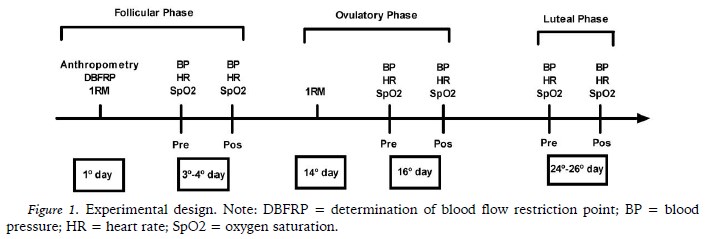
<body><![CDATA[<p><b>Study design</b></p>     <p>On the first visit (1<sup>st</sup>   day of the follicular phase), an anthropometric evaluation was conducted, the   BFR point was determined, and the maximum strength was evaluated using the 1RM   test. Subsequently, the volunteers were subjected to three training sessions   (biceps curl and knee extension). Those sessions occurred during the 3<sup>rd</sup>-4<sup>th</sup>   days (follicular phase), 16<sup>th</sup> day (ovulatory phase) and 24<sup>th</sup>-26<sup>th</sup>   days (luteal phase) of the MC. On the 14<sup>th</sup> day (ovulatory phase),   the maximum strength was evaluated to adjust the load. Before and immediately   after the exercises, SBP, DBP, HR and SpO2 were evaluated (<a href="/img/revistas/mot/v13n3/13n3a05f1.jpg">Figure 1</a>). The three groups in the study performed the following routine: HI; LL; and LL+BFR.  </p> <b>Procedures </b>      
<p><i>Anthropometric evaluation</i></p>     <p>Height and body mass were measured   with a precision of 0.5 cm and 0.1 kg, respectively, using a stadiometer and a   Filizola® scale. These measurements were used to obtain the body mass index (kg.m<sup>-2</sup>).</p>     <p><i>Blood flow restriction determination</i></p>     <p>Total blood flow restriction was   performed using vascular Doppler (MedPeg® DV -2001, Ribeirão Preto, State of   São Paulo - SP, Brazil), in which the probe was placed on the radial artery   (arms) and on the tibial artery (legs) to determine the arterial pressure   (mmHg) of BFR. The participants stayed in the supine position, and a standard   blood pressure sphygmomanometer (pneumatic tourniquet komprimeter to hemostasis   in extremities - Riester) for biceps (width 60 mm; length 470 mm) and for knee   extension (width 100 mm; length 540 mm) was placed on the axillary and inguinal   fold regions, respectively, and was inflated until the auscultation pulse of   the radial and tibial artery was interrupted. The cuff pressure used during the   exercises was set to be 80% of the pressure needed for total blood flow   restriction at rest (Laurentino et al., 2012). The cuff was deflated between sets. </p>     <p><i>One-Repetition Maximum (1RM) Testing</i></p>     <p>The prescription of the training load   was evaluated using a 1RM test (ACSM, 2000). The evaluations were performed   during the 1<sup>st</sup> day (follicular phase) and the 14<sup>th</sup> day   (ovulatory phase), and the load was adjusted immediately after each evaluation.   The exercises were performed bilaterally: direct biceps curl and knee   extension. For recovery time between exercises, a standard of 10 minutes was   used. The warm-up consisted on two series of 5-10 repetitions at 40-60%   (one-minute interval between the series) of the maximum perception of the   strength of the individual. After a one-minute interval, the third series was   concluded using 3-5 repetitions at 60-80% of the maximum perceived strength.   After one more rest period (1 min), the strength evaluation was started, in   which up to five attempts could be performed, adjusting the load before every   new attempt. The recovery duration between the attempts was standardized at 3-5   minutes. The test was interrupted when the individual could not perform the   movement correctly, and the repetition with complete execution was considered the maximum load. </p>     <p><i>Blood Pressure (BP), Heart Rate (HR) and Double Product (DP) </i></p>     <p>The participants were equipped with   an automatic blood pressure monitor (OMROM; model HEM-705CP) (Vera-Cala,   Orostegui, Valencia-Angel, López, &amp; Bautista, 2011). The cuff was placed on   the right arm, which was completely surrounded, covering at least two-thirds of   the upper region of the arm. This device was used for all pre- and post-session   systolic and diastolic blood pressure measurements. All measurements were   performed according to guidelines of the American Heart Association (Pickering   et al., 2005). The HR was continuously monitored pre- and post-sessions (Polar   T31 codedTM transmitter). DP was obtained by multiplying the HR (bpm) by the SBP (mm Hg). MBP was calculated using the equation (SBP+2DBP)/3. </p>     ]]></body>
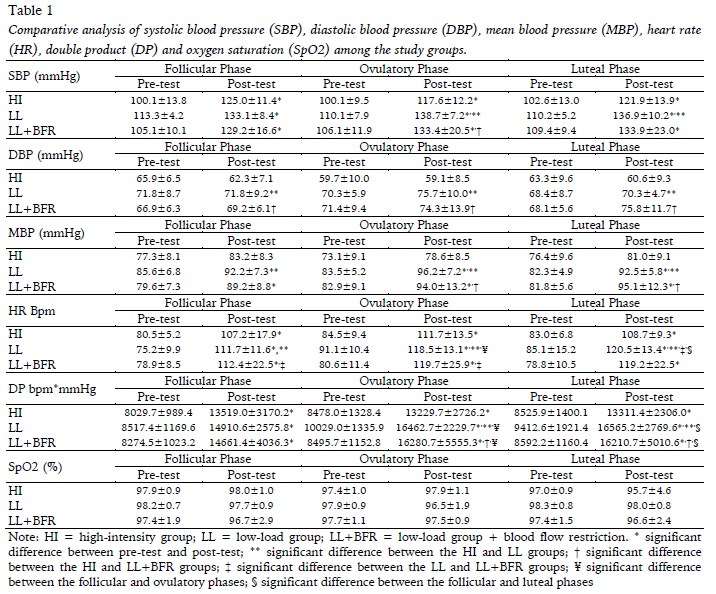
<body><![CDATA[<p><i>Oxygen Saturation (SpO2) Level</i></p>     <p>The oxygen saturation (SpO2) level   was evaluated using a finger oximeter (model CMS50DL; OXYM2000) at the pre- and post-session moments.</p>     <p><i>Exercise protocol</i></p>     <p><a>Each group (HI, LL and LL+BFR)   performed two resistance exercises   bilaterally: direct biceps curl (with a conventional bar and discs) and   knee extension (leg extension).</a> In the HI group, participants   completed four series of eight repetitions with 80% of 1RM with two-minute   intervals between series and one minute between exercises. In the LL group,   participants completed a series of 30 repetitions followed by three series of   15 repetitions using 20% of 1RM with 30 seconds of rest between all series and   one minute between exercises. In the LL+BFR group, participants performed the   same series, repetitions and rest as those in LL while using a standard blood   pressure sphygmomanometer for BFR. The pressure of the cuff was maintained   throughout the exercise session, except for the 30-second intervals between the   series. The execution speed was established at four seconds (two seconds for   concentric and two seconds for eccentric muscular action), controlled by the   metronome. </p>     <p><b>Statistical analysis</b></p>     <p>The statistical analysis was   initially performed using the <i>Shapiro-Wilk</i>   normality test<i>, </i>the <i>Levene </i>homogeneity test and <i>Mauchly’s</i> sphericity test. The variables   exhibited normal distribution or homogeneity or sphericity (<i>p</i> &gt; 0.05). Three-way repeated   measures ANOVA (Group [HI <i>vs</i>. LL <i>vs</i>. LL+BFR] × Time [Pre-test <i>vs</i>. Post-test] × Phases [Follicular <i>vs</i>. Ovulatory <i>vs</i>. Luteal]) was used, and a <i>post     hoc</i> <i>Bonferroni</i> test was used to   analyze possible differences in the dependent variables. The effect size (ES)   was used to determine the magnitude (<i>trivial</i>   &lt; 0.50, <i>small</i> = 0.50 - 1.25, <i>moderate </i>= 1.25 - 1.9, <i>large </i>&gt; 2.0) of changes between the   evaluations of the study protocols (Rhea, 2004). The significance level was set   at <i>p &lt;</i> 0.05. All statistical   analyses were performed using the statistical software package SPSS version 20.0 (SPSS Inc., Chicago, IL).</p> </font>     <p>&nbsp;</p>     <p><font size="3" face="Verdana"><b>RESULTS</b></font></p> <font face="Verdana" size="2">     <p>The mean pressure used throughout the   exercise protocol was as follows: arms, right = 129.0 ± 11.0 mmHg, left = 128.0 ± 13.9 mmHg; and legs, right = 136.0 ± 9.6 mmHg, left = 136.0 ± 12.6 mmHg. </p> <b>Systolic Blood Pressure (SBP)</b>      <p>There was no interaction among group   × time × phases or between group × time, group × phases, or time × phases (<i>p </i>&gt; 0.05). There were no significant   effects of phases (<i>p</i> = 0.430);   however, significant differences were observed between groups (<i>p </i>= 0.003) and time (<i>p &lt;</i> 0.001). With respect to the group   effect, significant differences were observed between the HI <i>vs.</i> LL groups and the HI <i>vs.</i> LL+BFR groups (<i>p &lt;</i> 0.001; <i>p </i>= 0.006,   respectively) in the ovulatory phase and between the HI <i>vs. </i>LL groups (<i>p </i>= 0.017)   in the luteal phase. With respect to the time effect, we observed an increase in the three phases of the MC for all groups (<i>p &lt;</i> 0.05), as shown in <a href="/img/revistas/mot/v13n3/13n3a05t1.jpg">Table 1</a>. </p>     
]]></body>
<body><![CDATA[<p><b>Diastolic Blood Pressure   (DBP)</b></p>     <p>There was no interaction among group   × time × phases or between group × time or time × phases (<i>p </i>&gt; 0.05); however, there was a significant interaction between   group × phases (<i>p </i>= 0.040). There   were no significant effects between the phases (<i>p </i>= 0.889) or the time (<i>p </i>=   0.355); however, significant effects were observed between groups (<i>p &lt;</i> 0.001). With respect to the group   effect, significant differences were observed between the HI and LL groups and the HI and LL+BFR groups   (<i>p </i>= 0.006; <i>p </i>= 0.044, respectively) in the follicular phase, between the HI   and LL groups and the HI and LL+BFR   groups (<i>p &lt;</i> 0.001; <i>p </i>= 0.001, respectively) in the   ovulatory phase, and between the HI and LL   groups and the HI and LL+BFR groups (<i>p </i>=   0.015; <i>p &lt;</i> 0.001, respectively) in the luteal phase, as shown in <a href="/img/revistas/mot/v13n3/13n3a05t1.jpg">Table 1</a>. </p>     
<p><b>Mean Blood Pressure (MBP)</b></p>     <p>There was no interaction among group   × time × phases or between group × time or time × phases (<i>p </i>&gt; 0.05); however, there was a significant interaction between   group × phases (<i>p </i>= 0.011). There   were no significant effects between phases (<i>p   </i>= 0.919), but significant differences were observed between groups (<i>p &lt;</i> 0.001) and times (<i>p &lt;</i> 0.001). With respect to the group   effect, significant differences were observed between the HI and LL groups (<i>p </i>= 0.013) in the follicular phase, between the HI and LL groups and the HI and LL+BFR groups   (<i>p &lt;</i> 0.001; <i>p &lt;</i> 0.001, respectively) in the ovulatory phase, and between the   HI and LL groups and the HI and LL+BFR   groups (<i>p </i>= 0.003; <i>p &lt;</i> 0.001, respectively) in the   luteal phase. With respect to the time effect, we observed an increase in the   three phases of the MC for the LL+BFR group (<i>p &lt;</i> 0.05) and in the ovulatory and luteal phases for the LL   group (<i>p &lt;</i> 0.05), as shown in <a href="/img/revistas/mot/v13n3/13n3a05t1.jpg">Table 1</a>.</p>     
<p><b>Heart Rate (HR)</b></p>     <p>There was no interaction among group   × time × phases or between group × phases or time × phases (<i>p </i>&gt; 0.05); however, there was a   significant interaction between group × time (<i>p &lt;</i> 0.001). There were significant effects between groups (<i>p </i>= 0.033), phases (<i>p </i>= 0.001) and times (<i>p &lt;</i>   0.001). With respect to the group effect, significant differences were observed   between the HI and LL groups and the   LL and LL+BFR groups (<i>p &lt;</i> 0.001; <i>p &lt;</i> 0.001, respectively) in the   follicular phase, between the HI and LL   groups and the LL and LL+BFR groups (<i>p </i>=   0.002; <i>p &lt;</i> 0.001, respectively) in   the ovulatory phase, and between the HI and LL groups and the LL and LL+BFR groups (  <i>p   &lt;</i> 0.001; <i>p &lt;</i> 0.001,   respectively) in the luteal phase. With respect to the phases effect, significant   differences were observed between the follicular and ovulatory phases and the follicular and luteal phases (<i>p &lt;</i>   0.001; <i>p </i>= 0.019, respectively) in   the LL group. With respect to the time effect, we observed an increase in the three phases of the MC for the HI and LL+BFR groups (<i>p &lt;</i> 0.05) and in the follicular phase for the LL group (<i>p</i>= 0.006), as shown in <a href="/img/revistas/mot/v13n3/13n3a05t1.jpg">Table 1</a>.</p> <b>Double Product (DP)</b>      
<p>There was no interaction among group   × time × phases or between group × time, group × phases, or time × phases (<i>p </i>&gt; 0.05). There were significant   effects among groups (<i>p &lt;</i> 0.05),   phases (<i>p </i>= 0.006) and times (<i>p &lt;</i> 0.001). With respect to the group   effects, significant differences were observed between the HI and LL groups and the HI and LL+BFR groups   (<i>p </i>= 0.014; <i>p </i>= 0.019, respectively) in the ovulatory phase and between the HI   and LL groups and the HI and LL+BFR   groups (<i>p </i>= 0.010; <i>p </i>= 0.022, respectively) in the luteal   phase. With respect to the phases effect, significant differences were observed   between the follicular and ovulatory   phases and the follicular and luteal   phases (<i>p </i>= 0.034; <i>p </i>= 0.020, respectively) in the LL group   and between the follicular and ovulatory   phases and the follicular and luteal   phases (<i>p </i>= 0.027; <i>p </i>= 0.028, respectively) in the LL+BFR   group. With respect to the time effect, we observed an increase in the three   phases of the MC for all groups (<i>p &lt;</i> 0.05), as shown in <a href="/img/revistas/mot/v13n3/13n3a05t1.jpg">Table 1</a>. </p> <b>Oxygen Saturation (SpO2)</b>      
<p>There was no interaction among group   × time × phases or between group × time or time × phases (<i>p </i>&gt; 0.05); however, there was a significant interaction between   group × phases (<i>p </i>= 0.013). There   were no significant effects among groups (<i>p   </i>= 0.344), phases (<i>p </i>= 0.302) or time (<i>p </i>= 0.122), as shown in <a href="/img/revistas/mot/v13n3/13n3a05t1.jpg">Table 1</a>.</p>     
<p>&nbsp;</p> </font>     <p><font size="3" face="Verdana"><b>DISCUSSION</b></font></p> <font face="Verdana" size="2">     ]]></body>
<body><![CDATA[<p>The present study investigated the   influence of LL with BFR on SBP, DBP, MBP, HR, DP and SpO2 during different MC   phases. To our knowledge, the present study is the first to evaluate the effect   of resistance training with BFR on hemodynamics with respect to MC phases in   women. The primary results of the present study were as follows: i) the three   groups exhibited increased SBP, HR and DP but did not exhibit differences on   SpO2; ii) the LL and LL+BFR treatments resulted in greater hemodynamic   increases compared with the HI treatment; and iii) the phases of the MC seem to   influence only HR and DP. Nonetheless, we observed a significant increase in   SBP, HR and DP among the three exercise groups, and between the few studies   that evaluated these variables after RE with BFR (Araújo et al., 2014;   Brandner, Kidgell, &amp; Warmington, 2015; Neto et al., 2016; Okuno et al.,   2014), two corroborate with our findings (Brandner et al., 2015; Neto et al.,   2016). These authors reported increased SBP, DBP and MBP (Brandner et al.,   2015) and HR and DP (Brandner et al., 2015; Neto et al., 2016) immediately   after LL with BFR and after LL and HI exercises. Thus, we concluded that the   increased values observed in the present study are within the normal patterns,   which reinforces the safety of both continuous and intermittent BFR (Brandner et al., 2015). </p>     <p>With respect to the greater increase   in hemodynamics in the LL and LL+BFR groups when compared with the HI group,   four studies disagree with our findings (Fahs et al., 2011; Okuno et al., 2014;   Poton &amp; Polito, 2016, 2015), and one corroborates with our findings (Araújo   et al., 2014). In this context, we observed that the hemodynamics seem to   significantly increase the HI protocol when compared with LL or LL+BFR in men.   However, this increase seems to occur differently in women, as observed in the   present study and in the study by Araújo et al. (2014), which was the only   study to evaluate only women. Thus, we speculate that women may be more   sensitive to the accumulation of metabolites and the intramuscular pH reduction   caused by BFR, which may cause more discomfort and thus increase the   hemodynamics for both healthy and hypertensive women (Araújo et al., 2014).  </p>     <p>With respect to SpO2, our results   corroborate the findings of Neto et al. (2016). Although there were no   significant differences, we observed a little reduction for the LL and LL+BFR   groups in the three phases of the MC. Neto et al. (2016) reported a reduction   in SpO2 for the LL and LL+BFR protocols and mentioned that this reduction   occurred because training with BFR decreases the amount of oxygen transported   by the blood, perhaps caused by the blood occlusion. Consequently, there would   be a lower availability of O2 for consumption in the muscle tissue. Thus, it is   likely that a HI resistance training is able to promote greater blood   mobilization (Copeland et al., 1996) and thus a greater influx of post-exercise   muscle oxygen when compared with LL training, irrespective of BFR status, which does not reduce SpO2. </p>     <p>Although no articles evaluating the   hemodynamics of women monitored the MC after resistance exercises, one study   reported a significant increase in HR in the luteal phase when compared with   the follicular phase after aerobic exercise (Pivarnik et al., 1992). Our   findings are in accordance and we could speculate that this may have also   occurred with DP. Thus, the hormone variation and the changes in the estrogen   (anabolic effect) and progesterone (catabolic effect) levels during the MC   phases may affect HR and DP (Jonge, 2003). In addition, although no study has   evaluated the effect of LL with BFR on hemodynamics during the MC phases, two   studies evaluated the effect of resistance exercises with BFR with respect to the phases of the MC (Gil et al., 2017; Sakamaki et al., 2012). </p>     <p>Gil et al. (2017) analysed the effect   of strength training with BFR on muscular power and endurance in the three   phases of the MC. The authors concluded that BFR does not seem to increase the   power of the upper and lower limbs, but it may be a good strategy to improve   muscular endurance, especially in the ovulatory and luteal phase of the MC. In   turn, Sakamaki et al. (2012) compared the effect of LL combined with BFR on   muscle hypertrophy and strength during the follicular and luteal phases of the   MC. The results indicated that increased muscle hypertrophy and strength were   greater in the luteal phase than in the follicular phase. Sakamaki et al.   (2012) also examined the influence of estradiol, progesterone and testosterone   on muscle strength and hypertrophy, aiming to analyse the possible changes resulting   from hormone variations that occur during the MC. Interestingly, the authors   observed that the hormones did not influence the increased muscle strength and   hypertrophy. Thus, as hormones did not influence strength and hypertrophy, we   speculate that in the present study, hormones did not influence SBP, DBP, MBP   and SpO2. However, we can observe that even though the hormone variation did   not influence strength and hypertrophy in the study by Sakamaki et al. (2012),   in both studies, the luteal phase was the only phase with greater increases in   muscular endurance (Gil et al., 2017), strength and hypertrophy (Sakamaki et   al., 2012). In the present study, the increase in the HR and DP demonstrates   the need for attention that health professionals and trainers must pay to the MC phases of women, with an emphasis on the luteal phase.   </p>     <p>Thus, to prevent possible limitations   of hemodynamic variations during the experiment, the present study focused on   evaluating hemodynamics with respect to the three phases of the MC (follicular,   ovulatory and luteal), which reflects the originality and relevance of the   present study. However, with respect to the results obtained in the present   study, some limiting factors became relevant, for example, the levels of   endothelium-dependent vasodilator agents, autonomic nervous activity and   cardiac debt. In addition, hormonal variation was not determined (estrogen,   progesterone) to detect the possible influences that occur during the MC phases. </p> </font>     <p>&nbsp;</p>     <p><font size="3" face="Verdana"><b>CONCLUSIONS</b></font></p> <font face="Verdana" size="2">     <p>In conclusion, the three treatments   increased SBP, HR and DP but did not change SpO2. The LL and LL+BFR treatments   promoted a greater increase in hemodynamics compared with the HI treatment, and   the MC phases influenced only HR and DP. Thus, it is important to conduct new   experiments that analyse<a name="_GoBack"></a> the hemodynamics in women with   different levels of physical conditioning, especially involving other exercises and other intensities using BFR.</p> </font>     <p>&nbsp;</p>     ]]></body>
<body><![CDATA[<p><font size="3" face="Verdana"><b>REFERÊNCIAS</b></font></p> <font face="Verdana" size="2">     <!-- ref --><p>ACSM. (2000). <i>American College of Sports Medicine. ACSM’s   Guidelines for Exercise Testing and Prescription</i> (6th ed ed.). Baltimore, MD: Williams &amp; Wilkins.    &nbsp;&nbsp;&nbsp;&nbsp;&nbsp;&nbsp;&nbsp;&nbsp;[&#160;<a href="javascript:void(0);" onclick="javascript: window.open('/scielo.php?script=sci_nlinks&ref=367953&pid=S1646-107X201700040000500001&lng=','','width=640,height=500,resizable=yes,scrollbars=1,menubar=yes,');">Links</a>&#160;]<!-- end-ref --></p>     <!-- ref --><p>ACSM. (2009). American College   of Sports Medicine. Progression models in resistance training for healthy   adults. <i>Medicine and Science in Sports and Exercise, 41</i>(3), 687-708. doi: 10.1249/MSS.0b013e3181915670&nbsp;&nbsp;&nbsp;&nbsp;&nbsp;&nbsp;&nbsp;&nbsp;[&#160;<a href="javascript:void(0);" onclick="javascript: window.open('/scielo.php?script=sci_nlinks&ref=367955&pid=S1646-107X201700040000500002&lng=','','width=640,height=500,resizable=yes,scrollbars=1,menubar=yes,');">Links</a>&#160;]<!-- end-ref --><!-- ref --><p><a>Araujo, J. P., Neto, G. R.,   Loenneke, J. P., Bemben, M. G., Laurentino, G., Batista, G., . . .   Cirilo-Sousa, M. S. (2015). The effects of water aerobics in combination with   blood flow restriction on strength and functional capacity in post-menopausal   women. </a><i>AGE</i>. doi: 10.1007/s11357-015-9851-4&nbsp;&nbsp;&nbsp;&nbsp;&nbsp;&nbsp;&nbsp;&nbsp;[&#160;<a href="javascript:void(0);" onclick="javascript: window.open('/scielo.php?script=sci_nlinks&ref=367956&pid=S1646-107X201700040000500003&lng=','','width=640,height=500,resizable=yes,scrollbars=1,menubar=yes,');">Links</a>&#160;]<!-- end-ref --><!-- ref --><p><a>Araújo, J. P., Silva, E. D., Silva, J. C. G., Souza, T. S.   P., Lima, E. O., Guerra, I., &amp; Sousa, M. S. C. (2014). </a>The acute   effect of resistance exercise with blood flow restriction with hemodynamic   variables on hypertensive subjects. <i>Journal of Human Kinetics, 43</i>(1), 79-85. doi: 10.2478/hukin-2014-0092 &nbsp;&nbsp;&nbsp;&nbsp;&nbsp;&nbsp;&nbsp;&nbsp;[&#160;<a href="javascript:void(0);" onclick="javascript: window.open('/scielo.php?script=sci_nlinks&ref=367957&pid=S1646-107X201700040000500004&lng=','','width=640,height=500,resizable=yes,scrollbars=1,menubar=yes,');">Links</a>&#160;]<!-- end-ref --><!-- ref --><p><a>Beck, T. W. (2013). The   importance of a priori sample size estimation in strength and conditioning   research. <i>Journal of Strength and Conditioning Research, 27</i>(8), 2323-2337. doi: 10.1519/JSC.0b013e318278eea0</a>&nbsp;&nbsp;&nbsp;&nbsp;&nbsp;&nbsp;&nbsp;&nbsp;[&#160;<a href="javascript:void(0);" onclick="javascript: window.open('/scielo.php?script=sci_nlinks&ref=367958&pid=S1646-107X201700040000500005&lng=','','width=640,height=500,resizable=yes,scrollbars=1,menubar=yes,');">Links</a>&#160;]<!-- end-ref --><!-- ref --><p><a>Brandner, C. R., Kidgell, D.   J., &amp; Warmington, S. A. (2015). Unilateral bicep curl hemodynamics: Low</a>&#8208;pressure continuous vs high&#8208;pressure intermittent blood flow restriction. <i>Scandinavian Journal of Medicine and Science in Sports, 25</i>(6), 770-777. doi: 10.1111/sms.12297&nbsp;&nbsp;&nbsp;&nbsp;&nbsp;&nbsp;&nbsp;&nbsp;[&#160;<a href="javascript:void(0);" onclick="javascript: window.open('/scielo.php?script=sci_nlinks&ref=367959&pid=S1646-107X201700040000500006&lng=','','width=640,height=500,resizable=yes,scrollbars=1,menubar=yes,');">Links</a>&#160;]<!-- end-ref --><!-- ref --><p><a>Copeland, S. R., Mills, M. C.,   Lerner, J. L., Crizer, M. F., Thompson, C. W., &amp; Sullivan, J. M. (1996). Hemodynamic effects of aerobic vs resistance exercise. <i>Journal of Human Hypertension, 10</i>(11), 747-753.    &nbsp;&nbsp;&nbsp;&nbsp;&nbsp;&nbsp;&nbsp;&nbsp;[&#160;<a href="javascript:void(0);" onclick="javascript: window.open('/scielo.php?script=sci_nlinks&ref=367960&pid=S1646-107X201700040000500007&lng=','','width=640,height=500,resizable=yes,scrollbars=1,menubar=yes,');">Links</a>&#160;]<!-- end-ref --> </a></p>     ]]></body>
<body><![CDATA[<!-- ref --><p><a>Fahs, C. A., Rossow, L. M.,   Seo, D., Loenneke, J. P., Sherk, V. D., Kim, E., . . . Bemben, M. G. (2011).   Effect of different types of resistance exercise on arterial compliance and   calf blood flow. <i>European Journal of Applied Physiology, 111</i>(12), 2969-2975. doi: 10.1007/s00421-011-1927-y</a>&nbsp;&nbsp;&nbsp;&nbsp;&nbsp;&nbsp;&nbsp;&nbsp;[&#160;<a href="javascript:void(0);" onclick="javascript: window.open('/scielo.php?script=sci_nlinks&ref=367962&pid=S1646-107X201700040000500008&lng=','','width=640,height=500,resizable=yes,scrollbars=1,menubar=yes,');">Links</a>&#160;]<!-- end-ref --><!-- ref --><p><a>Faul, F., Erdfelder, E., Lang,   A. G., &amp; Buchner, A. (2007). G* Power 3: A flexible statistical power   analysis program for the social, behavioral, and biomedical sciences. <i>Behavior Research Methods, 39</i>(2), 175-191.    &nbsp;&nbsp;&nbsp;&nbsp;&nbsp;&nbsp;&nbsp;&nbsp;[&#160;<a href="javascript:void(0);" onclick="javascript: window.open('/scielo.php?script=sci_nlinks&ref=367963&pid=S1646-107X201700040000500009&lng=','','width=640,height=500,resizable=yes,scrollbars=1,menubar=yes,');">Links</a>&#160;]<!-- end-ref --> </a></p>     <!-- ref --><p><a>Gil, A. L. S., Neto, G. R.,   Sousa, M. S. C., Dias, I., Vianna, J., Nunes, R. A. M., &amp; Novaes, J. S.   (2017). Effect of strength training with blood flow restriction on muscle power and submaximal strength in eumenorrheic women. <i>Clinical Physiology and Functional Imaging, 37</i>(2)<i>, 221-228</i>. doi: 10.1111/cpf.12291</a>&nbsp;&nbsp;&nbsp;&nbsp;&nbsp;&nbsp;&nbsp;&nbsp;[&#160;<a href="javascript:void(0);" onclick="javascript: window.open('/scielo.php?script=sci_nlinks&ref=367965&pid=S1646-107X201700040000500010&lng=','','width=640,height=500,resizable=yes,scrollbars=1,menubar=yes,');">Links</a>&#160;]<!-- end-ref --><!-- ref --><p><a>Hessemer, V., &amp; Bruck, K.   (1985). Influence of menstrual cycle on thermoregulatory, metabolic, and heart   rate responses to exercise at night. <i>Journal of Applied Physiology, 59</i>(6), 1911-1917.    &nbsp;&nbsp;&nbsp;&nbsp;&nbsp;&nbsp;&nbsp;&nbsp;[&#160;<a href="javascript:void(0);" onclick="javascript: window.open('/scielo.php?script=sci_nlinks&ref=367966&pid=S1646-107X201700040000500011&lng=','','width=640,height=500,resizable=yes,scrollbars=1,menubar=yes,');">Links</a>&#160;]<!-- end-ref --> </a></p>     <!-- ref --><p>Janse de Jonge, X. A. K.   (2003). Effects of the menstrual cycle on exercise performance. <i>Sports Medicine</i>, <i>33</i>(11), 833–851.    &nbsp;&nbsp;&nbsp;&nbsp;&nbsp;&nbsp;&nbsp;&nbsp;[&#160;<a href="javascript:void(0);" onclick="javascript: window.open('/scielo.php?script=sci_nlinks&ref=367968&pid=S1646-107X201700040000500012&lng=','','width=640,height=500,resizable=yes,scrollbars=1,menubar=yes,');">Links</a>&#160;]<!-- end-ref --></p>     <!-- ref --><p><a>Kacin, A., &amp; Strazar, K.   (2011). Frequent low-load ischemic resistance exercise to failure enhances   muscle oxygen delivery and endurance capacity. <i>Scandinavian Journal of Medicine and Science in Sports, 21</i>(6), 231-241. doi: 10.1111/j.1600-0838.2010.01260.x</a>&nbsp;&nbsp;&nbsp;&nbsp;&nbsp;&nbsp;&nbsp;&nbsp;[&#160;<a href="javascript:void(0);" onclick="javascript: window.open('/scielo.php?script=sci_nlinks&ref=367970&pid=S1646-107X201700040000500013&lng=','','width=640,height=500,resizable=yes,scrollbars=1,menubar=yes,');">Links</a>&#160;]<!-- end-ref --><!-- ref --><p>Laurentino, G. C., Ugrinowitsch, C., Roschel, H., Aoki, M. S., Soares, A.   G., Neves, M., … Tricoli,   V. (2012). Strength training with blood flow restriction diminishes myostatin   gene expression. <i>Medicine and Science in Sports and Exercise</i>, <i>44</i>(3), 406–412. <a href="https://doi.org/10.1249/MSS.0b013e318233b4bc" target="_blank">https://doi.org/10.1249/MSS.0b013e318233b4bc</a>&nbsp;&nbsp;&nbsp;&nbsp;&nbsp;&nbsp;&nbsp;&nbsp;[&#160;<a href="javascript:void(0);" onclick="javascript: window.open('/scielo.php?script=sci_nlinks&ref=367971&pid=S1646-107X201700040000500014&lng=','','width=640,height=500,resizable=yes,scrollbars=1,menubar=yes,');">Links</a>&#160;]<!-- end-ref --><!-- ref --><p><a>Lynn, B. M., McCord, J. L.,   &amp; Halliwill, J. R. (2007). Effects of the menstrual cycle and sex on postexercise   hemodynamics. <i>American Journal of     Physiology-Regulatory, Integrative and Comparative Physiology, 292</i>(3), R1260-R1270. doi: 10.1152/ajpregu.00589.2006</a>&nbsp;&nbsp;&nbsp;&nbsp;&nbsp;&nbsp;&nbsp;&nbsp;[&#160;<a href="javascript:void(0);" onclick="javascript: window.open('/scielo.php?script=sci_nlinks&ref=367972&pid=S1646-107X201700040000500015&lng=','','width=640,height=500,resizable=yes,scrollbars=1,menubar=yes,');">Links</a>&#160;]<!-- end-ref --><!-- ref --><p><a>Neto, G. R., Sousa, M. S. C., Costa, P. B., Salles, B. F.,   Novaes, G. S., &amp; Novaes, J. S. (2015). </a>Hypotensive effects of resistance   exercises with blood flow restriction. <i>Journal     of Strength and Conditioning Research, 29</i>(4), 1064-1070. doi: 10.1519/JSC.0000000000000734&nbsp;&nbsp;&nbsp;&nbsp;&nbsp;&nbsp;&nbsp;&nbsp;[&#160;<a href="javascript:void(0);" onclick="javascript: window.open('/scielo.php?script=sci_nlinks&ref=367973&pid=S1646-107X201700040000500016&lng=','','width=640,height=500,resizable=yes,scrollbars=1,menubar=yes,');">Links</a>&#160;]<!-- end-ref --><!-- ref --><p><a>Neto, G. R., Sousa, M. S. C., Silva, G. V. C., Gil, A. L. S.,   Salles, B. F., &amp; Novaes, J. S. (2016). </a>Acute resistance exercise with blood   flow restriction effects on heart rate, double product, oxygen saturation and   perceived exertion. <i>Clinical Physiology and Functional Imaging, 36</i>(1), 53-59. doi: 10.1111/cpf.12193&nbsp;&nbsp;&nbsp;&nbsp;&nbsp;&nbsp;&nbsp;&nbsp;[&#160;<a href="javascript:void(0);" onclick="javascript: window.open('/scielo.php?script=sci_nlinks&ref=367974&pid=S1646-107X201700040000500017&lng=','','width=640,height=500,resizable=yes,scrollbars=1,menubar=yes,');">Links</a>&#160;]<!-- end-ref --><!-- ref --><p><a>O'Toole, M. L. (1988). Gender   differences in the cardiovascular response to exercise. </a><i>Cardiovascular clinics, 19</i>(3), 17-33.    &nbsp;&nbsp;&nbsp;&nbsp;&nbsp;&nbsp;&nbsp;&nbsp;[&#160;<a href="javascript:void(0);" onclick="javascript: window.open('/scielo.php?script=sci_nlinks&ref=367975&pid=S1646-107X201700040000500018&lng=','','width=640,height=500,resizable=yes,scrollbars=1,menubar=yes,');">Links</a>&#160;]<!-- end-ref --> </p>     <!-- ref --><p><a>Okuno, N. M., Pedro, R. E., Leicht, A. S., Ramos, P. S.,   &amp; Nakamura, F. Y. (2014). </a>Cardiac autonomic recovery after a single session of   resistance exercise with and without vascular occlusion. <i>Journal of Strength and Conditioning Research, 27</i>(9), 1143-1150. doi: 10.1519/JSC.0000000000000245&nbsp;&nbsp;&nbsp;&nbsp;&nbsp;&nbsp;&nbsp;&nbsp;[&#160;<a href="javascript:void(0);" onclick="javascript: window.open('/scielo.php?script=sci_nlinks&ref=367977&pid=S1646-107X201700040000500019&lng=','','width=640,height=500,resizable=yes,scrollbars=1,menubar=yes,');">Links</a>&#160;]<!-- end-ref --><!-- ref --><p><a>Pickering, T. G., Hall, J. E.,   Appel, L. J., Falkner, B. E., Graves, J., Hill, M. N., . . . Roccella, E. J.   (2005). Recommendations for blood pressure measurement in humans and   experimental animals part 1: blood pressure measurement in humans: a statement for   professionals from the Subcommittee of Professional and Public Education of the American Heart Association Council on High Blood Pressure Research. <i>Circulation, 111</i>(5), 697-716.    &nbsp;&nbsp;&nbsp;&nbsp;&nbsp;&nbsp;&nbsp;&nbsp;[&#160;<a href="javascript:void(0);" onclick="javascript: window.open('/scielo.php?script=sci_nlinks&ref=367978&pid=S1646-107X201700040000500020&lng=','','width=640,height=500,resizable=yes,scrollbars=1,menubar=yes,');">Links</a>&#160;]<!-- end-ref --> </a></p>     <!-- ref --><p><a>Pivarnik, J. M., Marichal, C.   J., Spillman, T., &amp; Morrow, J. R. (1992). Menstrual cycle phase affects temperature regulation during endurance exercise. <i>Journal of Applied Physiology, 72</i>(2), 543-548.    &nbsp;&nbsp;&nbsp;&nbsp;&nbsp;&nbsp;&nbsp;&nbsp;[&#160;<a href="javascript:void(0);" onclick="javascript: window.open('/scielo.php?script=sci_nlinks&ref=367980&pid=S1646-107X201700040000500021&lng=','','width=640,height=500,resizable=yes,scrollbars=1,menubar=yes,');">Links</a>&#160;]<!-- end-ref --> </a></p>     ]]></body>
<body><![CDATA[<!-- ref --><p><a>Poton, R., &amp; Polito, M. D.   (2016). Hemodynamic response to resistance exercise with and without blood flow   restriction in healthy subjects. <i>Clinical     Physiology and Functional Imaging</i>, <i>36</i>(3), 231-236. doi: 10.1111/cpf.12218</a>&nbsp;&nbsp;&nbsp;&nbsp;&nbsp;&nbsp;&nbsp;&nbsp;[&#160;<a href="javascript:void(0);" onclick="javascript: window.open('/scielo.php?script=sci_nlinks&ref=367982&pid=S1646-107X201700040000500022&lng=','','width=640,height=500,resizable=yes,scrollbars=1,menubar=yes,');">Links</a>&#160;]<!-- end-ref --><!-- ref --><p><a>Poton, R., &amp; Polito, M. D.   (2015). Hemodynamics responses during lower-limb resistance exercise with blood   flow restriction in healthy subjects. <i>Journal of Sports Medicine and Physical Fitness, 55</i>(12), 1571-1577.    &nbsp;&nbsp;&nbsp;&nbsp;&nbsp;&nbsp;&nbsp;&nbsp;[&#160;<a href="javascript:void(0);" onclick="javascript: window.open('/scielo.php?script=sci_nlinks&ref=367983&pid=S1646-107X201700040000500023&lng=','','width=640,height=500,resizable=yes,scrollbars=1,menubar=yes,');">Links</a>&#160;]<!-- end-ref --> </a></p>     <!-- ref --><p><a>Rhea, M. R. (2004).   Determining the magnitude of treatment effects in strength training research   through the use the effect size. <i>Journal of Strength and Conditioning Research, 18</i>(4), 918-920.    &nbsp;&nbsp;&nbsp;&nbsp;&nbsp;&nbsp;&nbsp;&nbsp;[&#160;<a href="javascript:void(0);" onclick="javascript: window.open('/scielo.php?script=sci_nlinks&ref=367985&pid=S1646-107X201700040000500024&lng=','','width=640,height=500,resizable=yes,scrollbars=1,menubar=yes,');">Links</a>&#160;]<!-- end-ref --> </a></p>     <!-- ref --><p><a>Rossow, L. M., Fahs, C. A.,   Loenneke, J. P., Thiebaud, R. S., Sherk, V. D., Abe, T., &amp; Bemben, M. G.   (2012). Cardiovascular and perceptual responses to blood</a>&#8208;flow&#8208;restricted   resistance exercise with differing restrictive cuffs. <i>Clinical Physiology and Functional Imaging, 32</i>(5), 331-337. doi: 10.1111/j.1475-097X.2012.01131.x&nbsp;&nbsp;&nbsp;&nbsp;&nbsp;&nbsp;&nbsp;&nbsp;[&#160;<a href="javascript:void(0);" onclick="javascript: window.open('/scielo.php?script=sci_nlinks&ref=367987&pid=S1646-107X201700040000500025&lng=','','width=640,height=500,resizable=yes,scrollbars=1,menubar=yes,');">Links</a>&#160;]<!-- end-ref --><!-- ref --><p><a>Rossow, L. M., Fahs, C. A.,   Sherk, V. D., Seo, D., Bemben, D. A., &amp; Bemben, M. G. (2011). The effect of   acute blood-flow-restricted resistance exercise on postexercise blood pressure.   <i>Clinical Physiology and Functional Imaging, 31</i>(6), 429-434. doi: 10.1111/j.1475-097X.2011.01038.x</a>&nbsp;&nbsp;&nbsp;&nbsp;&nbsp;&nbsp;&nbsp;&nbsp;[&#160;<a href="javascript:void(0);" onclick="javascript: window.open('/scielo.php?script=sci_nlinks&ref=367988&pid=S1646-107X201700040000500026&lng=','','width=640,height=500,resizable=yes,scrollbars=1,menubar=yes,');">Links</a>&#160;]<!-- end-ref --><!-- ref --><p><a>Sakamaki, M., Yasuda, T.,   &amp; Abe, T. (2012). Comparison of low-intensity blood flow-restricted   training-induced muscular hypertrophy in eumenorrheic women in the follicular   phase and luteal phase and age-matched men. <i>Clinical     Physiology and Functional Imaging, 32</i>(1), 185-191. doi: 10.1111/j.1475-097X.2011.01075.x</a>&nbsp;&nbsp;&nbsp;&nbsp;&nbsp;&nbsp;&nbsp;&nbsp;[&#160;<a href="javascript:void(0);" onclick="javascript: window.open('/scielo.php?script=sci_nlinks&ref=367989&pid=S1646-107X201700040000500027&lng=','','width=640,height=500,resizable=yes,scrollbars=1,menubar=yes,');">Links</a>&#160;]<!-- end-ref --><!-- ref --><p><a>Sato, Y., Yoshitomi, A., &amp;   Abe, T. (2005). Acute growth hormone response to low-intensity KAATSU resistance exercise: comparison between arm and leg. <i>International Journal of KAATSU Training Research, 1</i>(2), 45-50.    &nbsp;&nbsp;&nbsp;&nbsp;&nbsp;&nbsp;&nbsp;&nbsp;[&#160;<a href="javascript:void(0);" onclick="javascript: window.open('/scielo.php?script=sci_nlinks&ref=367990&pid=S1646-107X201700040000500028&lng=','','width=640,height=500,resizable=yes,scrollbars=1,menubar=yes,');">Links</a>&#160;]<!-- end-ref --> </a></p>     ]]></body>
<body><![CDATA[<!-- ref --><p><a>Shephard, R. J. (1988). PAR-Q,   Canadian Home Fitness Test and exercise screening alternatives. </a><i>Sports     Medine, 5</i>(3), 185-195.    &nbsp;&nbsp;&nbsp;&nbsp;&nbsp;&nbsp;&nbsp;&nbsp;[&#160;<a href="javascript:void(0);" onclick="javascript: window.open('/scielo.php?script=sci_nlinks&ref=367992&pid=S1646-107X201700040000500029&lng=','','width=640,height=500,resizable=yes,scrollbars=1,menubar=yes,');">Links</a>&#160;]<!-- end-ref --> </p>     <!-- ref --><p><a>Silva, J. C. G., Neto, G. R., Freitas, E., Neto, E., Batista,   G., Torres, M., &amp; Sousa, M. S. C. (2015). </a>Chronic   effect of strength training with blood flow restriction on muscular strength   among women with osteoporosis. <i>Journal of Exercise Physiologyonline, 18</i>(4), 33-41.    &nbsp;&nbsp;&nbsp;&nbsp;&nbsp;&nbsp;&nbsp;&nbsp;[&#160;<a href="javascript:void(0);" onclick="javascript: window.open('/scielo.php?script=sci_nlinks&ref=367994&pid=S1646-107X201700040000500030&lng=','','width=640,height=500,resizable=yes,scrollbars=1,menubar=yes,');">Links</a>&#160;]<!-- end-ref --> </p>     <!-- ref --><p><a>Stachenfeld, N. S., Silva, C.,   &amp; Keefe, D. L. (2000). Estrogen modifies the temperature effects of   progesterone. <i>Journal of Applied Physiology, 88</i>(5), 1643-1649.    &nbsp;&nbsp;&nbsp;&nbsp;&nbsp;&nbsp;&nbsp;&nbsp;[&#160;<a href="javascript:void(0);" onclick="javascript: window.open('/scielo.php?script=sci_nlinks&ref=367996&pid=S1646-107X201700040000500031&lng=','','width=640,height=500,resizable=yes,scrollbars=1,menubar=yes,');">Links</a>&#160;]<!-- end-ref --> </a></p>     <!-- ref --><p><a>Takano, H., Morita, T., Iida,   H., Asada, K., Kato, M., Uno, K., . . . Hirata, Y. (2005). Hemodynamic and   hormonal responses to a short-term low-intensity resistance exercise with the   reduction of muscle blood flow. <i>European Journal of Applied Physiology, 95</i>(1), 65-73.    &nbsp;&nbsp;&nbsp;&nbsp;&nbsp;&nbsp;&nbsp;&nbsp;[&#160;<a href="javascript:void(0);" onclick="javascript: window.open('/scielo.php?script=sci_nlinks&ref=367998&pid=S1646-107X201700040000500032&lng=','','width=640,height=500,resizable=yes,scrollbars=1,menubar=yes,');">Links</a>&#160;]<!-- end-ref --> </a></p>     <!-- ref --><p><a>Vechin, F. C., Libardi, C. A.,   Conceição, M. S., Damas, F. R., Lixandrão, M. E., Berton, R. P. B., . . .   Chacon-Mikahil, M. P. T. (2015). Comparisons between low-intensity resistance   training with blood flow restriction and high-intensity resistance training on   quadriceps muscle mass and strength in elderly. <i>Journal of Strength and Conditioning Research, 29</i>(4), 1071-1076. doi: 10.1519/JSC.0000000000000703</a>&nbsp;&nbsp;&nbsp;&nbsp;&nbsp;&nbsp;&nbsp;&nbsp;[&#160;<a href="javascript:void(0);" onclick="javascript: window.open('/scielo.php?script=sci_nlinks&ref=368000&pid=S1646-107X201700040000500033&lng=','','width=640,height=500,resizable=yes,scrollbars=1,menubar=yes,');">Links</a>&#160;]<!-- end-ref --><!-- ref --><p><a>Vera-Cala, L. M., Orostegui,   M., Valencia-Angel, L. I., López, N., &amp; Bautista, L. E. (2011). Accuracy of   the Omron HEM-705 CP for blood pressure measurement in large epidemiologic   studies. </a><i>Arquivos Brasileiros de Cardiologia, 96</i>(5), 393-398. doi: <a href="http://dx.doi.org/10.1590/S0066-782X2011005000038" target="_blank">http://dx.doi.org/10.1590/S0066-782X2011005000038</a>&nbsp;&nbsp;&nbsp;&nbsp;&nbsp;&nbsp;&nbsp;&nbsp;[&#160;<a href="javascript:void(0);" onclick="javascript: window.open('/scielo.php?script=sci_nlinks&ref=368001&pid=S1646-107X201700040000500034&lng=','','width=640,height=500,resizable=yes,scrollbars=1,menubar=yes,');">Links</a>&#160;]<!-- end-ref --><!-- ref --><p><a>Vieira, P. J. C., Chiappa, G. R., Umpierre, D., Stein, R.,   &amp; Ribeiro, J. P. (2013). </a>Hemodynamic responses to resistance exercise with   restricted blood flow in young and older men. <i>Journal of Strength and Conditioning Research, 27</i>(8), 2288-2294. doi: 10.1519/JSC.0b013e318278f21f&nbsp;&nbsp;&nbsp;&nbsp;&nbsp;&nbsp;&nbsp;&nbsp;[&#160;<a href="javascript:void(0);" onclick="javascript: window.open('/scielo.php?script=sci_nlinks&ref=368002&pid=S1646-107X201700040000500035&lng=','','width=640,height=500,resizable=yes,scrollbars=1,menubar=yes,');">Links</a>&#160;]<!-- end-ref --><p>&nbsp;</p>     <p><font size="2" face="Verdana"><b>Acknowledgments:</b>    <br>   Nothing to declare<b>    <br>   Conflict   of interest:</b>    <br>   Nothing to declare<b>    <br>   Funding:    <br>   </b></font><font size="2" face="Verdana">Nothing to declare</font></p>     <p><font face="Verdana" size="2">Manuscript received at  November 5th 2016; Accepted at January 4th 2017 </font></p> <font face="Verdana" size="2">     <p>&nbsp;</p>     ]]></body>
<body><![CDATA[<p>&nbsp;</p> <a href="#top"><sup>*</sup></a><i><a name="end"></a></i></font> <font size="2" face="Verdana"><i>Corresponding author</i>: Coordination of Physical Education - Nursing and  Medical Schools, Nova Esperan&ccedil;a (FAMENE / FACENE). Avenida Frei Galv&atilde;o, 12 - Gramame, PB, 58067-695, Jo&atilde;o Pessoa, Brazil. <i>E-mail</i>:  <a href="mailto:gabrielrodrigues_1988@hotmail.com">gabrielrodrigues_1988@hotmail.com</a></font>      ]]></body><back>
<ref-list>
<ref id="B1">
<nlm-citation citation-type="book">
<collab>ACSM</collab>
<source><![CDATA[American College of Sports Medicine: ACSM’s Guidelines for Exercise Testing and Prescription]]></source>
<year>2000</year>
<edition>6</edition>
<publisher-loc><![CDATA[Baltimore^eMD MD]]></publisher-loc>
<publisher-name><![CDATA[Williams & Wilkins]]></publisher-name>
</nlm-citation>
</ref>
<ref id="B2">
<nlm-citation citation-type="journal">
<collab>ACSM</collab>
<article-title xml:lang="en"><![CDATA[American College of Sports Medicine: Progression models in resistance training for healthy adults]]></article-title>
<source><![CDATA[Medicine and Science in Sports and Exercise]]></source>
<year>2009</year>
<volume>41</volume>
<numero>3</numero>
<issue>3</issue>
<page-range>687-708</page-range></nlm-citation>
</ref>
<ref id="B3">
<nlm-citation citation-type="journal">
<person-group person-group-type="author">
<name>
<surname><![CDATA[Araujo]]></surname>
<given-names><![CDATA[J. P.]]></given-names>
</name>
<name>
<surname><![CDATA[Neto]]></surname>
<given-names><![CDATA[G. R.]]></given-names>
</name>
<name>
<surname><![CDATA[Loenneke]]></surname>
<given-names><![CDATA[J. P.]]></given-names>
</name>
<name>
<surname><![CDATA[Bemben]]></surname>
<given-names><![CDATA[M. G.]]></given-names>
</name>
<name>
<surname><![CDATA[Laurentino]]></surname>
<given-names><![CDATA[G.]]></given-names>
</name>
<name>
<surname><![CDATA[Batista]]></surname>
<given-names><![CDATA[G.]]></given-names>
</name>
<name>
<surname><![CDATA[Cirilo-Sousa]]></surname>
<given-names><![CDATA[M. S.]]></given-names>
</name>
</person-group>
<article-title xml:lang="en"><![CDATA[The effects of water aerobics in combination with blood flow restriction on strength and functional capacity in post-menopausal women]]></article-title>
<source><![CDATA[AGE]]></source>
<year>2015</year>
</nlm-citation>
</ref>
<ref id="B4">
<nlm-citation citation-type="journal">
<person-group person-group-type="author">
<name>
<surname><![CDATA[Araújo]]></surname>
<given-names><![CDATA[J. P.]]></given-names>
</name>
<name>
<surname><![CDATA[Silva]]></surname>
<given-names><![CDATA[E. D.]]></given-names>
</name>
<name>
<surname><![CDATA[Silva]]></surname>
<given-names><![CDATA[J. C. G.]]></given-names>
</name>
<name>
<surname><![CDATA[Souza]]></surname>
<given-names><![CDATA[T. S. P.]]></given-names>
</name>
<name>
<surname><![CDATA[Lima]]></surname>
<given-names><![CDATA[E. O.]]></given-names>
</name>
<name>
<surname><![CDATA[Guerra]]></surname>
<given-names><![CDATA[I.]]></given-names>
</name>
<name>
<surname><![CDATA[Sousa]]></surname>
<given-names><![CDATA[M. S. C.]]></given-names>
</name>
</person-group>
<article-title xml:lang="en"><![CDATA[The acute effect of resistance exercise with blood flow restriction with hemodynamic variables on hypertensive subjects]]></article-title>
<source><![CDATA[Journal of Human Kinetics]]></source>
<year>2014</year>
<volume>43</volume>
<numero>1</numero>
<issue>1</issue>
<page-range>79-85</page-range></nlm-citation>
</ref>
<ref id="B5">
<nlm-citation citation-type="journal">
<person-group person-group-type="author">
<name>
<surname><![CDATA[Beck]]></surname>
<given-names><![CDATA[T. W.]]></given-names>
</name>
</person-group>
<article-title xml:lang="en"><![CDATA[The importance of a priori sample size estimation in strength and conditioning research]]></article-title>
<source><![CDATA[Journal of Strength and Conditioning Research]]></source>
<year>2013</year>
<volume>27</volume>
<numero>8</numero>
<issue>8</issue>
<page-range>2323-2337</page-range></nlm-citation>
</ref>
<ref id="B6">
<nlm-citation citation-type="journal">
<person-group person-group-type="author">
<name>
<surname><![CDATA[Brandner]]></surname>
<given-names><![CDATA[C. R.]]></given-names>
</name>
<name>
<surname><![CDATA[Kidgell]]></surname>
<given-names><![CDATA[D. J.]]></given-names>
</name>
<name>
<surname><![CDATA[Warmington]]></surname>
<given-names><![CDATA[S. A.]]></given-names>
</name>
</person-group>
<article-title xml:lang="en"><![CDATA[Unilateral bicep curl hemodynamics: Low&#8208;pressure continuous vs high&#8208;pressure intermittent blood flow restriction]]></article-title>
<source><![CDATA[Scandinavian Journal of Medicine and Science in Sports]]></source>
<year>2015</year>
<volume>25</volume>
<numero>6</numero>
<issue>6</issue>
<page-range>770-777</page-range></nlm-citation>
</ref>
<ref id="B7">
<nlm-citation citation-type="journal">
<person-group person-group-type="author">
<name>
<surname><![CDATA[Copeland]]></surname>
<given-names><![CDATA[S. R.]]></given-names>
</name>
<name>
<surname><![CDATA[Mills]]></surname>
<given-names><![CDATA[M. C.]]></given-names>
</name>
<name>
<surname><![CDATA[Lerner]]></surname>
<given-names><![CDATA[J. L.]]></given-names>
</name>
<name>
<surname><![CDATA[Crizer]]></surname>
<given-names><![CDATA[M. F.]]></given-names>
</name>
<name>
<surname><![CDATA[Thompson]]></surname>
<given-names><![CDATA[C. W.]]></given-names>
</name>
<name>
<surname><![CDATA[Sullivan]]></surname>
<given-names><![CDATA[J. M.]]></given-names>
</name>
</person-group>
<article-title xml:lang="en"><![CDATA[Hemodynamic effects of aerobic vs resistance exercise]]></article-title>
<source><![CDATA[Journal of Human Hypertension]]></source>
<year>1996</year>
<volume>10</volume>
<numero>11</numero>
<issue>11</issue>
<page-range>747-753</page-range></nlm-citation>
</ref>
<ref id="B8">
<nlm-citation citation-type="journal">
<person-group person-group-type="author">
<name>
<surname><![CDATA[Fahs]]></surname>
<given-names><![CDATA[C. A.]]></given-names>
</name>
<name>
<surname><![CDATA[Rossow]]></surname>
<given-names><![CDATA[L. M.]]></given-names>
</name>
<name>
<surname><![CDATA[Seo]]></surname>
<given-names><![CDATA[D.]]></given-names>
</name>
<name>
<surname><![CDATA[Loenneke]]></surname>
<given-names><![CDATA[J. P.]]></given-names>
</name>
<name>
<surname><![CDATA[Sherk]]></surname>
<given-names><![CDATA[V. D.]]></given-names>
</name>
<name>
<surname><![CDATA[Kim]]></surname>
<given-names><![CDATA[E.]]></given-names>
</name>
<name>
<surname><![CDATA[Bemben]]></surname>
<given-names><![CDATA[M. G.]]></given-names>
</name>
</person-group>
<article-title xml:lang="en"><![CDATA[Effect of different types of resistance exercise on arterial compliance and calf blood flow]]></article-title>
<source><![CDATA[European Journal of Applied Physiology]]></source>
<year>2011</year>
<volume>111</volume>
<numero>12</numero>
<issue>12</issue>
<page-range>2969-2975</page-range></nlm-citation>
</ref>
<ref id="B9">
<nlm-citation citation-type="journal">
<person-group person-group-type="author">
<name>
<surname><![CDATA[Faul]]></surname>
<given-names><![CDATA[F.]]></given-names>
</name>
<name>
<surname><![CDATA[Erdfelder]]></surname>
<given-names><![CDATA[E.]]></given-names>
</name>
<name>
<surname><![CDATA[Lang]]></surname>
<given-names><![CDATA[A. G.]]></given-names>
</name>
<name>
<surname><![CDATA[Buchner]]></surname>
<given-names><![CDATA[A.]]></given-names>
</name>
</person-group>
<article-title xml:lang="en"><![CDATA[G* Power 3: A flexible statistical power analysis program for the social, behavioral, and biomedical sciences]]></article-title>
<source><![CDATA[Behavior Research Methods]]></source>
<year>2007</year>
<volume>39</volume>
<numero>2</numero>
<issue>2</issue>
<page-range>175-191</page-range></nlm-citation>
</ref>
<ref id="B10">
<nlm-citation citation-type="journal">
<person-group person-group-type="author">
<name>
<surname><![CDATA[Gil]]></surname>
<given-names><![CDATA[A. L. S.]]></given-names>
</name>
<name>
<surname><![CDATA[Neto]]></surname>
<given-names><![CDATA[G. R.]]></given-names>
</name>
<name>
<surname><![CDATA[Sousa]]></surname>
<given-names><![CDATA[M. S. C.]]></given-names>
</name>
<name>
<surname><![CDATA[Dias]]></surname>
<given-names><![CDATA[I.]]></given-names>
</name>
<name>
<surname><![CDATA[Vianna]]></surname>
<given-names><![CDATA[J.]]></given-names>
</name>
<name>
<surname><![CDATA[Nunes]]></surname>
<given-names><![CDATA[R. A. M.]]></given-names>
</name>
<name>
<surname><![CDATA[Novaes]]></surname>
<given-names><![CDATA[J. S.]]></given-names>
</name>
</person-group>
<article-title xml:lang="en"><![CDATA[Effect of strength training with blood flow restriction on muscle power and submaximal strength in eumenorrheic women]]></article-title>
<source><![CDATA[Clinical Physiology and Functional Imaging]]></source>
<year>2017</year>
<volume>37</volume>
<numero>2</numero>
<issue>2</issue>
<page-range>221-228</page-range></nlm-citation>
</ref>
<ref id="B11">
<nlm-citation citation-type="journal">
<person-group person-group-type="author">
<name>
<surname><![CDATA[Hessemer]]></surname>
<given-names><![CDATA[V.]]></given-names>
</name>
<name>
<surname><![CDATA[Bruck]]></surname>
<given-names><![CDATA[K.]]></given-names>
</name>
</person-group>
<article-title xml:lang="en"><![CDATA[Influence of menstrual cycle on thermoregulatory, metabolic, and heart rate responses to exercise at night]]></article-title>
<source><![CDATA[Journal of Applied Physiology]]></source>
<year>1985</year>
<volume>59</volume>
<numero>6</numero>
<issue>6</issue>
<page-range>1911-1917</page-range></nlm-citation>
</ref>
<ref id="B12">
<nlm-citation citation-type="journal">
<person-group person-group-type="author">
<name>
<surname><![CDATA[Janse de Jonge]]></surname>
<given-names><![CDATA[X. A. K.]]></given-names>
</name>
</person-group>
<article-title xml:lang="en"><![CDATA[Effects of the menstrual cycle on exercise performance]]></article-title>
<source><![CDATA[Sports Medicine]]></source>
<year>2003</year>
<volume>33</volume>
<numero>11</numero>
<issue>11</issue>
<page-range>833-851</page-range></nlm-citation>
</ref>
<ref id="B13">
<nlm-citation citation-type="journal">
<person-group person-group-type="author">
<name>
<surname><![CDATA[Kacin]]></surname>
<given-names><![CDATA[A.]]></given-names>
</name>
<name>
<surname><![CDATA[Strazar]]></surname>
<given-names><![CDATA[K.]]></given-names>
</name>
</person-group>
<article-title xml:lang="en"><![CDATA[Frequent low-load ischemic resistance exercise to failure enhances muscle oxygen delivery and endurance capacity]]></article-title>
<source><![CDATA[Scandinavian Journal of Medicine and Science in Sports]]></source>
<year>2011</year>
<volume>21</volume>
<numero>6</numero>
<issue>6</issue>
<page-range>231-241</page-range></nlm-citation>
</ref>
<ref id="B14">
<nlm-citation citation-type="journal">
<person-group person-group-type="author">
<name>
<surname><![CDATA[Laurentino]]></surname>
<given-names><![CDATA[G. C.]]></given-names>
</name>
<name>
<surname><![CDATA[Ugrinowitsch]]></surname>
<given-names><![CDATA[C.]]></given-names>
</name>
<name>
<surname><![CDATA[Roschel]]></surname>
<given-names><![CDATA[H.]]></given-names>
</name>
<name>
<surname><![CDATA[Aoki]]></surname>
<given-names><![CDATA[M. S.]]></given-names>
</name>
<name>
<surname><![CDATA[Soares]]></surname>
<given-names><![CDATA[A. G.]]></given-names>
</name>
<name>
<surname><![CDATA[Neves]]></surname>
<given-names><![CDATA[M.]]></given-names>
</name>
<name>
<surname><![CDATA[Tricoli]]></surname>
<given-names><![CDATA[V.]]></given-names>
</name>
</person-group>
<article-title xml:lang="en"><![CDATA[Strength training with blood flow restriction diminishes myostatin gene expression]]></article-title>
<source><![CDATA[Medicine and Science in Sports and Exercise]]></source>
<year>2012</year>
<volume>44</volume>
<numero>3</numero>
<issue>3</issue>
<page-range>406-412</page-range></nlm-citation>
</ref>
<ref id="B15">
<nlm-citation citation-type="journal">
<person-group person-group-type="author">
<name>
<surname><![CDATA[Lynn]]></surname>
<given-names><![CDATA[B. M.]]></given-names>
</name>
<name>
<surname><![CDATA[McCord]]></surname>
<given-names><![CDATA[J. L.]]></given-names>
</name>
<name>
<surname><![CDATA[Halliwill]]></surname>
<given-names><![CDATA[J. R.]]></given-names>
</name>
</person-group>
<article-title xml:lang="en"><![CDATA[Effects of the menstrual cycle and sex on postexercise hemodynamics]]></article-title>
<source><![CDATA[American Journal of Physiology-Regulatory, Integrative and Comparative Physiology]]></source>
<year>2007</year>
<volume>292</volume>
<numero>3</numero>
<issue>3</issue>
<page-range>R1260-R1270</page-range></nlm-citation>
</ref>
<ref id="B16">
<nlm-citation citation-type="journal">
<person-group person-group-type="author">
<name>
<surname><![CDATA[Neto]]></surname>
<given-names><![CDATA[G. R.]]></given-names>
</name>
<name>
<surname><![CDATA[Sousa]]></surname>
<given-names><![CDATA[M. S. C.]]></given-names>
</name>
<name>
<surname><![CDATA[Costa]]></surname>
<given-names><![CDATA[P. B.]]></given-names>
</name>
<name>
<surname><![CDATA[Salles]]></surname>
<given-names><![CDATA[B. F.]]></given-names>
</name>
<name>
<surname><![CDATA[Novaes]]></surname>
<given-names><![CDATA[G. S.]]></given-names>
</name>
<name>
<surname><![CDATA[Novaes]]></surname>
<given-names><![CDATA[J. S.]]></given-names>
</name>
</person-group>
<article-title xml:lang="en"><![CDATA[Hypotensive effects of resistance exercises with blood flow restriction]]></article-title>
<source><![CDATA[Journal of Strength and Conditioning Research]]></source>
<year>2015</year>
<volume>29</volume>
<numero>4</numero>
<issue>4</issue>
<page-range>1064-1070</page-range></nlm-citation>
</ref>
<ref id="B17">
<nlm-citation citation-type="journal">
<person-group person-group-type="author">
<name>
<surname><![CDATA[Neto]]></surname>
<given-names><![CDATA[G. R.]]></given-names>
</name>
<name>
<surname><![CDATA[Sousa]]></surname>
<given-names><![CDATA[M. S. C.]]></given-names>
</name>
<name>
<surname><![CDATA[Silva]]></surname>
<given-names><![CDATA[G. V. C.]]></given-names>
</name>
<name>
<surname><![CDATA[Gil]]></surname>
<given-names><![CDATA[A. L. S.]]></given-names>
</name>
<name>
<surname><![CDATA[Salles]]></surname>
<given-names><![CDATA[B. F.]]></given-names>
</name>
<name>
<surname><![CDATA[Novaes]]></surname>
<given-names><![CDATA[J. S.]]></given-names>
</name>
</person-group>
<article-title xml:lang="en"><![CDATA[Acute resistance exercise with blood flow restriction effects on heart rate, double product, oxygen saturation and perceived exertion]]></article-title>
<source><![CDATA[Clinical Physiology and Functional Imaging]]></source>
<year>2016</year>
<volume>36</volume>
<numero>1</numero>
<issue>1</issue>
<page-range>53-59</page-range></nlm-citation>
</ref>
<ref id="B18">
<nlm-citation citation-type="journal">
<person-group person-group-type="author">
<name>
<surname><![CDATA[O'Toole]]></surname>
<given-names><![CDATA[M. L.]]></given-names>
</name>
</person-group>
<article-title xml:lang="en"><![CDATA[Gender differences in the cardiovascular response to exercise]]></article-title>
<source><![CDATA[Cardiovascular clinics]]></source>
<year>1988</year>
<volume>19</volume>
<numero>3</numero>
<issue>3</issue>
<page-range>17-33</page-range></nlm-citation>
</ref>
<ref id="B19">
<nlm-citation citation-type="journal">
<person-group person-group-type="author">
<name>
<surname><![CDATA[Okuno]]></surname>
<given-names><![CDATA[N. M.]]></given-names>
</name>
<name>
<surname><![CDATA[Pedro]]></surname>
<given-names><![CDATA[R. E.]]></given-names>
</name>
<name>
<surname><![CDATA[Leicht]]></surname>
<given-names><![CDATA[A. S.]]></given-names>
</name>
<name>
<surname><![CDATA[Ramos]]></surname>
<given-names><![CDATA[P. S.]]></given-names>
</name>
<name>
<surname><![CDATA[Nakamura]]></surname>
<given-names><![CDATA[F. Y.]]></given-names>
</name>
</person-group>
<article-title xml:lang="en"><![CDATA[Cardiac autonomic recovery after a single session of resistance exercise with and without vascular occlusion]]></article-title>
<source><![CDATA[Journal of Strength and Conditioning Research]]></source>
<year>2014</year>
<volume>27</volume>
<numero>9</numero>
<issue>9</issue>
<page-range>1143-1150</page-range></nlm-citation>
</ref>
<ref id="B20">
<nlm-citation citation-type="journal">
<person-group person-group-type="author">
<name>
<surname><![CDATA[Pickering]]></surname>
<given-names><![CDATA[T. G.]]></given-names>
</name>
<name>
<surname><![CDATA[Hall]]></surname>
<given-names><![CDATA[J. E.]]></given-names>
</name>
<name>
<surname><![CDATA[Appel]]></surname>
<given-names><![CDATA[L. J.]]></given-names>
</name>
<name>
<surname><![CDATA[Falkner]]></surname>
<given-names><![CDATA[B. E.]]></given-names>
</name>
<name>
<surname><![CDATA[Graves]]></surname>
<given-names><![CDATA[J.]]></given-names>
</name>
<name>
<surname><![CDATA[Hill]]></surname>
<given-names><![CDATA[M. N.]]></given-names>
</name>
<name>
<surname><![CDATA[Roccella]]></surname>
<given-names><![CDATA[E. J.]]></given-names>
</name>
</person-group>
<article-title xml:lang="en"><![CDATA[Recommendations for blood pressure measurement in humans and experimental animals part 1: blood pressure measurement in humans: a statement for professionals from the Subcommittee of Professional and Public Education of the American Heart Association Council on High Blood Pressure Research]]></article-title>
<source><![CDATA[Circulation]]></source>
<year>2005</year>
<volume>111</volume>
<numero>5</numero>
<issue>5</issue>
<page-range>697-716</page-range></nlm-citation>
</ref>
<ref id="B21">
<nlm-citation citation-type="journal">
<person-group person-group-type="author">
<name>
<surname><![CDATA[Pivarnik]]></surname>
<given-names><![CDATA[J. M.]]></given-names>
</name>
<name>
<surname><![CDATA[Marichal]]></surname>
<given-names><![CDATA[C. J.]]></given-names>
</name>
<name>
<surname><![CDATA[Spillman]]></surname>
<given-names><![CDATA[T.]]></given-names>
</name>
<name>
<surname><![CDATA[Morrow]]></surname>
<given-names><![CDATA[J. R.]]></given-names>
</name>
</person-group>
<article-title xml:lang="en"><![CDATA[Menstrual cycle phase affects temperature regulation during endurance exercise]]></article-title>
<source><![CDATA[Journal of Applied Physiology]]></source>
<year>1992</year>
<volume>72</volume>
<numero>2</numero>
<issue>2</issue>
<page-range>543-548</page-range></nlm-citation>
</ref>
<ref id="B22">
<nlm-citation citation-type="journal">
<person-group person-group-type="author">
<name>
<surname><![CDATA[Poton]]></surname>
<given-names><![CDATA[R.]]></given-names>
</name>
<name>
<surname><![CDATA[Polito]]></surname>
<given-names><![CDATA[M. D.]]></given-names>
</name>
</person-group>
<article-title xml:lang="en"><![CDATA[Hemodynamic response to resistance exercise with and without blood flow restriction in healthy subjects]]></article-title>
<source><![CDATA[Clinical Physiology and Functional Imaging]]></source>
<year>2016</year>
<volume>36</volume>
<numero>3</numero>
<issue>3</issue>
<page-range>231-236</page-range></nlm-citation>
</ref>
<ref id="B23">
<nlm-citation citation-type="journal">
<person-group person-group-type="author">
<name>
<surname><![CDATA[Poton]]></surname>
<given-names><![CDATA[R.]]></given-names>
</name>
<name>
<surname><![CDATA[Polito]]></surname>
<given-names><![CDATA[M. D.]]></given-names>
</name>
</person-group>
<article-title xml:lang="en"><![CDATA[Hemodynamics responses during lower-limb resistance exercise with blood flow restriction in healthy subjects]]></article-title>
<source><![CDATA[Journal of Sports Medicine and Physical Fitness]]></source>
<year>2015</year>
<volume>55</volume>
<numero>12</numero>
<issue>12</issue>
<page-range>1571-1577</page-range></nlm-citation>
</ref>
<ref id="B24">
<nlm-citation citation-type="journal">
<person-group person-group-type="author">
<name>
<surname><![CDATA[Rhea]]></surname>
<given-names><![CDATA[M. R.]]></given-names>
</name>
</person-group>
<article-title xml:lang="en"><![CDATA[Determining the magnitude of treatment effects in strength training research through the use the effect size]]></article-title>
<source><![CDATA[Journal of Strength and Conditioning Research]]></source>
<year>2004</year>
<volume>18</volume>
<numero>4</numero>
<issue>4</issue>
<page-range>918-920</page-range></nlm-citation>
</ref>
<ref id="B25">
<nlm-citation citation-type="journal">
<person-group person-group-type="author">
<name>
<surname><![CDATA[Rossow]]></surname>
<given-names><![CDATA[L. M.]]></given-names>
</name>
<name>
<surname><![CDATA[Fahs]]></surname>
<given-names><![CDATA[C. A.]]></given-names>
</name>
<name>
<surname><![CDATA[Loenneke]]></surname>
<given-names><![CDATA[J. P.]]></given-names>
</name>
<name>
<surname><![CDATA[Thiebaud]]></surname>
<given-names><![CDATA[R. S.]]></given-names>
</name>
<name>
<surname><![CDATA[Sherk]]></surname>
<given-names><![CDATA[V. D.]]></given-names>
</name>
<name>
<surname><![CDATA[Abe]]></surname>
<given-names><![CDATA[T.]]></given-names>
</name>
<name>
<surname><![CDATA[Bemben]]></surname>
<given-names><![CDATA[M. G.]]></given-names>
</name>
</person-group>
<article-title xml:lang="en"><![CDATA[Cardiovascular and perceptual responses to blood&#8208;flow&#8208;restricted resistance exercise with differing restrictive cuffs]]></article-title>
<source><![CDATA[Clinical Physiology and Functional Imaging]]></source>
<year>2012</year>
<volume>32</volume>
<numero>5</numero>
<issue>5</issue>
<page-range>331-337</page-range></nlm-citation>
</ref>
<ref id="B26">
<nlm-citation citation-type="journal">
<person-group person-group-type="author">
<name>
<surname><![CDATA[Rossow]]></surname>
<given-names><![CDATA[L. M.]]></given-names>
</name>
<name>
<surname><![CDATA[Fahs]]></surname>
<given-names><![CDATA[C. A.]]></given-names>
</name>
<name>
<surname><![CDATA[Sherk]]></surname>
<given-names><![CDATA[V. D.]]></given-names>
</name>
<name>
<surname><![CDATA[Seo]]></surname>
<given-names><![CDATA[D.]]></given-names>
</name>
<name>
<surname><![CDATA[Bemben]]></surname>
<given-names><![CDATA[D. A.]]></given-names>
</name>
<name>
<surname><![CDATA[Bemben]]></surname>
<given-names><![CDATA[M. G.]]></given-names>
</name>
</person-group>
<article-title xml:lang="en"><![CDATA[The effect of acute blood-flow-restricted resistance exercise on postexercise blood pressure]]></article-title>
<source><![CDATA[Clinical Physiology and Functional Imaging]]></source>
<year>2011</year>
<volume>31</volume>
<numero>6</numero>
<issue>6</issue>
<page-range>429-434</page-range></nlm-citation>
</ref>
<ref id="B27">
<nlm-citation citation-type="journal">
<person-group person-group-type="author">
<name>
<surname><![CDATA[Sakamaki]]></surname>
<given-names><![CDATA[M.]]></given-names>
</name>
<name>
<surname><![CDATA[Yasuda]]></surname>
<given-names><![CDATA[T.]]></given-names>
</name>
<name>
<surname><![CDATA[Abe]]></surname>
<given-names><![CDATA[T.]]></given-names>
</name>
</person-group>
<article-title xml:lang="en"><![CDATA[Comparison of low-intensity blood flow-restricted training-induced muscular hypertrophy in eumenorrheic women in the follicular phase and luteal phase and age-matched men]]></article-title>
<source><![CDATA[Clinical Physiology and Functional Imaging]]></source>
<year>2012</year>
<volume>32</volume>
<numero>1</numero>
<issue>1</issue>
<page-range>185-191</page-range></nlm-citation>
</ref>
<ref id="B28">
<nlm-citation citation-type="journal">
<person-group person-group-type="author">
<name>
<surname><![CDATA[Sato]]></surname>
<given-names><![CDATA[Y.]]></given-names>
</name>
<name>
<surname><![CDATA[Yoshitomi]]></surname>
<given-names><![CDATA[A.]]></given-names>
</name>
<name>
<surname><![CDATA[Abe]]></surname>
<given-names><![CDATA[T.]]></given-names>
</name>
</person-group>
<article-title xml:lang="en"><![CDATA[Acute growth hormone response to low-intensity KAATSU resistance exercise: comparison between arm and leg]]></article-title>
<source><![CDATA[International Journal of KAATSU Training Research]]></source>
<year>2005</year>
<volume>1</volume>
<numero>2</numero>
<issue>2</issue>
<page-range>45-50</page-range></nlm-citation>
</ref>
<ref id="B29">
<nlm-citation citation-type="journal">
<person-group person-group-type="author">
<name>
<surname><![CDATA[Shephard]]></surname>
<given-names><![CDATA[R. J.]]></given-names>
</name>
</person-group>
<article-title xml:lang="en"><![CDATA[PAR-Q, Canadian Home Fitness Test and exercise screening alternatives]]></article-title>
<source><![CDATA[Sports Medine]]></source>
<year>1988</year>
<volume>5</volume>
<numero>3</numero>
<issue>3</issue>
<page-range>185-195</page-range></nlm-citation>
</ref>
<ref id="B30">
<nlm-citation citation-type="journal">
<person-group person-group-type="author">
<name>
<surname><![CDATA[Silva]]></surname>
<given-names><![CDATA[J. C. G.]]></given-names>
</name>
<name>
<surname><![CDATA[Neto]]></surname>
<given-names><![CDATA[G. R.]]></given-names>
</name>
<name>
<surname><![CDATA[Freitas]]></surname>
<given-names><![CDATA[E.]]></given-names>
</name>
<name>
<surname><![CDATA[Neto]]></surname>
<given-names><![CDATA[E.]]></given-names>
</name>
<name>
<surname><![CDATA[Batista]]></surname>
<given-names><![CDATA[G.]]></given-names>
</name>
<name>
<surname><![CDATA[Torres]]></surname>
<given-names><![CDATA[M.]]></given-names>
</name>
<name>
<surname><![CDATA[Sousa]]></surname>
<given-names><![CDATA[M. S. C.]]></given-names>
</name>
</person-group>
<article-title xml:lang="en"><![CDATA[Chronic effect of strength training with blood flow restriction on muscular strength among women with osteoporosis]]></article-title>
<source><![CDATA[Journal of Exercise Physiologyonline]]></source>
<year>2015</year>
<volume>18</volume>
<numero>4</numero>
<issue>4</issue>
<page-range>33-41</page-range></nlm-citation>
</ref>
<ref id="B31">
<nlm-citation citation-type="journal">
<person-group person-group-type="author">
<name>
<surname><![CDATA[Stachenfeld]]></surname>
<given-names><![CDATA[N. S.]]></given-names>
</name>
<name>
<surname><![CDATA[Silva]]></surname>
<given-names><![CDATA[C.]]></given-names>
</name>
<name>
<surname><![CDATA[Keefe]]></surname>
<given-names><![CDATA[D. L.]]></given-names>
</name>
</person-group>
<article-title xml:lang="en"><![CDATA[Estrogen modifies the temperature effects of progesterone]]></article-title>
<source><![CDATA[Journal of Applied Physiology]]></source>
<year>2000</year>
<volume>88</volume>
<numero>5</numero>
<issue>5</issue>
<page-range>1643-1649</page-range></nlm-citation>
</ref>
<ref id="B32">
<nlm-citation citation-type="journal">
<person-group person-group-type="author">
<name>
<surname><![CDATA[Takano]]></surname>
<given-names><![CDATA[H.]]></given-names>
</name>
<name>
<surname><![CDATA[Morita]]></surname>
<given-names><![CDATA[T.]]></given-names>
</name>
<name>
<surname><![CDATA[Iida]]></surname>
<given-names><![CDATA[H.]]></given-names>
</name>
<name>
<surname><![CDATA[Asada]]></surname>
<given-names><![CDATA[K.]]></given-names>
</name>
<name>
<surname><![CDATA[Kato]]></surname>
<given-names><![CDATA[M.]]></given-names>
</name>
<name>
<surname><![CDATA[Uno]]></surname>
<given-names><![CDATA[K.]]></given-names>
</name>
<name>
<surname><![CDATA[Hirata]]></surname>
<given-names><![CDATA[Y.]]></given-names>
</name>
</person-group>
<article-title xml:lang="en"><![CDATA[Hemodynamic and hormonal responses to a short-term low-intensity resistance exercise with the reduction of muscle blood flow]]></article-title>
<source><![CDATA[European Journal of Applied Physiology]]></source>
<year>2005</year>
<volume>95</volume>
<numero>1</numero>
<issue>1</issue>
<page-range>65-73</page-range></nlm-citation>
</ref>
<ref id="B33">
<nlm-citation citation-type="journal">
<person-group person-group-type="author">
<name>
<surname><![CDATA[Vechin]]></surname>
<given-names><![CDATA[F. C.]]></given-names>
</name>
<name>
<surname><![CDATA[Libardi]]></surname>
<given-names><![CDATA[C. A.]]></given-names>
</name>
<name>
<surname><![CDATA[Conceição]]></surname>
<given-names><![CDATA[M. S.]]></given-names>
</name>
<name>
<surname><![CDATA[Damas]]></surname>
<given-names><![CDATA[F. R.]]></given-names>
</name>
<name>
<surname><![CDATA[Lixandrão]]></surname>
<given-names><![CDATA[M. E.]]></given-names>
</name>
<name>
<surname><![CDATA[Berton]]></surname>
<given-names><![CDATA[R. P. B.]]></given-names>
</name>
<name>
<surname><![CDATA[Chacon-Mikahil]]></surname>
<given-names><![CDATA[M. P. T.]]></given-names>
</name>
</person-group>
<article-title xml:lang="en"><![CDATA[Comparisons between low-intensity resistance training with blood flow restriction and high-intensity resistance training on quadriceps muscle mass and strength in elderly]]></article-title>
<source><![CDATA[Journal of Strength and Conditioning Research]]></source>
<year>2015</year>
<volume>29</volume>
<numero>4</numero>
<issue>4</issue>
<page-range>1071-1076</page-range></nlm-citation>
</ref>
<ref id="B34">
<nlm-citation citation-type="journal">
<person-group person-group-type="author">
<name>
<surname><![CDATA[Vera-Cala]]></surname>
<given-names><![CDATA[L. M.]]></given-names>
</name>
<name>
<surname><![CDATA[Orostegui]]></surname>
<given-names><![CDATA[M.]]></given-names>
</name>
<name>
<surname><![CDATA[Valencia-Angel]]></surname>
<given-names><![CDATA[L. I.]]></given-names>
</name>
<name>
<surname><![CDATA[López]]></surname>
<given-names><![CDATA[N.]]></given-names>
</name>
<name>
<surname><![CDATA[Bautista]]></surname>
<given-names><![CDATA[L. E.]]></given-names>
</name>
</person-group>
<article-title xml:lang="en"><![CDATA[Accuracy of the Omron HEM-705 CP for blood pressure measurement in large epidemiologic studies]]></article-title>
<source><![CDATA[Arquivos Brasileiros de Cardiologia]]></source>
<year>2011</year>
<volume>96</volume>
<numero>5</numero>
<issue>5</issue>
<page-range>393-398</page-range></nlm-citation>
</ref>
<ref id="B35">
<nlm-citation citation-type="journal">
<person-group person-group-type="author">
<name>
<surname><![CDATA[Vieira]]></surname>
<given-names><![CDATA[P. J. C.]]></given-names>
</name>
<name>
<surname><![CDATA[Chiappa]]></surname>
<given-names><![CDATA[G. R.]]></given-names>
</name>
<name>
<surname><![CDATA[Umpierre]]></surname>
<given-names><![CDATA[D.]]></given-names>
</name>
<name>
<surname><![CDATA[Stein]]></surname>
<given-names><![CDATA[R.]]></given-names>
</name>
<name>
<surname><![CDATA[Ribeiro]]></surname>
<given-names><![CDATA[J. P.]]></given-names>
</name>
</person-group>
<article-title xml:lang="en"><![CDATA[Hemodynamic responses to resistance exercise with restricted blood flow in young and older men]]></article-title>
<source><![CDATA[Journal of Strength and Conditioning Research]]></source>
<year>2013</year>
<volume>27</volume>
<numero>8</numero>
<issue>8</issue>
<page-range>2288-2294</page-range></nlm-citation>
</ref>
</ref-list>
</back>
</article>