<?xml version="1.0" encoding="ISO-8859-1"?><article xmlns:mml="http://www.w3.org/1998/Math/MathML" xmlns:xlink="http://www.w3.org/1999/xlink" xmlns:xsi="http://www.w3.org/2001/XMLSchema-instance">
<front>
<journal-meta>
<journal-id>1646-107X</journal-id>
<journal-title><![CDATA[Motricidade]]></journal-title>
<abbrev-journal-title><![CDATA[Motri.]]></abbrev-journal-title>
<issn>1646-107X</issn>
<publisher>
<publisher-name><![CDATA[Edições Desafio Singular]]></publisher-name>
</publisher>
</journal-meta>
<article-meta>
<article-id>S1646-107X2017000400006</article-id>
<article-id pub-id-type="doi">10.6063/motricidade.10319</article-id>
<title-group>
<article-title xml:lang="en"><![CDATA[Fitness, cardiovascular and metabolic risk factors: A correlational study]]></article-title>
</title-group>
<contrib-group>
<contrib contrib-type="author">
<name>
<surname><![CDATA[Batalau]]></surname>
<given-names><![CDATA[Rui Miguel]]></given-names>
</name>
<xref ref-type="aff" rid="A01"/>
<xref ref-type="aff" rid="A02"/>
</contrib>
<contrib contrib-type="author">
<name>
<surname><![CDATA[Cruz]]></surname>
<given-names><![CDATA[Joana Mendes]]></given-names>
</name>
<xref ref-type="aff" rid="A02"/>
</contrib>
<contrib contrib-type="author">
<name>
<surname><![CDATA[Gonçalves]]></surname>
<given-names><![CDATA[Ricardo Carmo]]></given-names>
</name>
<xref ref-type="aff" rid="A02"/>
</contrib>
<contrib contrib-type="author">
<name>
<surname><![CDATA[Santos]]></surname>
<given-names><![CDATA[Magda Almeida]]></given-names>
</name>
<xref ref-type="aff" rid="A02"/>
</contrib>
<contrib contrib-type="author">
<name>
<surname><![CDATA[Leal]]></surname>
<given-names><![CDATA[João]]></given-names>
</name>
<xref ref-type="aff" rid="A03"/>
</contrib>
<contrib contrib-type="author">
<name>
<surname><![CDATA[Palmeira]]></surname>
<given-names><![CDATA[António Labisa]]></given-names>
</name>
<xref ref-type="aff" rid="A01"/>
<xref ref-type="aff" rid="A04"/>
</contrib>
</contrib-group>
<aff id="A01">
<institution><![CDATA[,Universidade Lusófona Faculdade de Educação Física e Desporto ]]></institution>
<addr-line><![CDATA[Lisboa ]]></addr-line>
<country>Portugal</country>
</aff>
<aff id="A02">
<institution><![CDATA[,Instituto Superior Manuel Teixeira Gomes Centro de Investigação em Desporto e Educação Física ]]></institution>
<addr-line><![CDATA[Portimão ]]></addr-line>
<country>Portugal</country>
</aff>
<aff id="A03">
<institution><![CDATA[,Instituto Politécnico de Beja  ]]></institution>
<addr-line><![CDATA[ ]]></addr-line>
</aff>
<aff id="A04">
<institution><![CDATA[,Universidade de Lisboa Faculdade de Motricidade Humana Centro Interdisciplinar da Performance Humana]]></institution>
<addr-line><![CDATA[ ]]></addr-line>
<country>Portugal</country>
</aff>
<pub-date pub-type="pub">
<day>00</day>
<month>09</month>
<year>2017</year>
</pub-date>
<pub-date pub-type="epub">
<day>00</day>
<month>09</month>
<year>2017</year>
</pub-date>
<volume>13</volume>
<numero>3</numero>
<fpage>41</fpage>
<lpage>52</lpage>
<copyright-statement/>
<copyright-year/>
<self-uri xlink:href="http://scielo.pt/scielo.php?script=sci_arttext&amp;pid=S1646-107X2017000400006&amp;lng=en&amp;nrm=iso"></self-uri><self-uri xlink:href="http://scielo.pt/scielo.php?script=sci_abstract&amp;pid=S1646-107X2017000400006&amp;lng=en&amp;nrm=iso"></self-uri><self-uri xlink:href="http://scielo.pt/scielo.php?script=sci_pdf&amp;pid=S1646-107X2017000400006&amp;lng=en&amp;nrm=iso"></self-uri><abstract abstract-type="short" xml:lang="en"><p><![CDATA[This study aimed to verify the relationship between anthropometric measures (AM), blood pressure (BP) and cardiorespiratory fitness (CRF), physical activity (PA), sedentary behaviour (SB), predicted BMI z-score, waist circumference (WC) and waist-to-height ratio (WHtR) variance. A total of 245 children (8.90 ± .80years-old) were recruited from a Portuguese school. WHtR was classified according the reference &#8805; 0.5. WC was measured above iliac crest. BP was assessed using a sphygmomanometer, and CRF using 20-m run test. PA and SB were assessed by accelerometers (Actigraph GT3x) and by questionnaire. Participants did not meet recommendations on PA. CRF and vigorous PA (VPA) were inversely correlated with AM. Moderate and vigorous PA were positively correlated with CRF. CRF was inversely correlated with systolic and diastolic BP. CRF and PA explained BMI z-score variance. WC and WHtR variance was predicted by CRF. These results emphasize the importance of international recommendations for PA with the purpose of developing CRF. A new emphasis should be given to CRF and interdisciplinary approaches in international recommendations. This should provide new health implications for primary care providers and school services.]]></p></abstract>
<kwd-group>
<kwd lng="en"><![CDATA[Fitness]]></kwd>
<kwd lng="en"><![CDATA[physical activity]]></kwd>
<kwd lng="en"><![CDATA[sedentary behaviours]]></kwd>
<kwd lng="en"><![CDATA[blood pressure]]></kwd>
<kwd lng="en"><![CDATA[children]]></kwd>
</kwd-group>
</article-meta>
</front><body><![CDATA[ <p align="right"><font size="2" face="Verdana"><b>ORIGINAL ARTICLE</b></font></p>     <p>&nbsp;</p>      <p><font size="4" face="Verdana"><b>Fitness, cardiovascular and   metabolic risk factors: A correlational study</b></font></p> <font face="Verdana" size="2">     <p>&nbsp;</p>     <p>&nbsp;</p> </font>     <p><font size="2" face="Verdana"><b>Rui Miguel Batalau<sup>1,2,</sup><a href="#end"><sup>*</sup></a><i><a name="top" id="top"></a>;</i> Joana Mendes Cruz<sup>2</sup>; Ricardo Carmo Gonçalves<sup>2</sup>; Magda Almeida Santos<sup>2</sup>; João Leal<sup>3</sup>; António Labisa Palmeira<sup>1,4</sup></b></font></p>      <p> <font size="2" face="Verdana"><sup>1</sup> <i>Faculdade de Educa&ccedil;&atilde;o F&iacute;sica e Desporto, Universidade  Lus&oacute;fona, Lisboa, Portugal</i>    <br>   <sup>2</sup> <i></i><i>Instituto Superior Manuel Teixeira Gomes, CIDEF,  Portim&atilde;o, Portugal</i>    <br>   <sup>3</sup> <i></i><i>Instituto Polit&eacute;cnico de Beja</i>    <br>   <sup>4</sup> <i></i><i>Faculdade de Motricidade Humana, CIPER, Universidade de  Lisboa, Portugal </i></font></p>     ]]></body>
<body><![CDATA[<p>&nbsp;</p>     <p>&nbsp;</p> <hr noshade size="1">     <p><font size="2" face="Verdana"><b>ABSTRACT</b></font></p> <font face="Verdana" size="2">    <p>This study aimed to verify the relationship   between anthropometric measures (AM), blood pressure (BP) and cardiorespiratory   fitness (CRF), physical activity (PA), sedentary behaviour (SB), predicted BMI z-score,   waist circumference (WC) and waist-to-height ratio (WHtR) variance. A total of   245 children (8.90 ± .80years-old) were recruited from a Portuguese school.   WHtR was classified according the reference &#8805; 0.5. WC was measured above   iliac crest. BP was assessed using a sphygmomanometer, and CRF using 20-m run   test. PA and SB were assessed by accelerometers (Actigraph GT3x) and by   questionnaire. Participants did not meet recommendations on PA. CRF and   vigorous PA (VPA) were inversely correlated with AM. Moderate and vigorous PA   were positively correlated with CRF. CRF was inversely correlated with systolic   and diastolic BP. CRF and PA explained BMI z-score variance. WC and WHtR   variance was predicted by CRF. These results emphasize the importance of international   recommendations for PA with the purpose of developing CRF. A new emphasis   should be given to CRF and interdisciplinary approaches in international   recommendations. This should provide new health implications for primary care providers and school services. </p>     <p><b>Keywords: </b>Fitness, physical activity, sedentary behaviours, blood pressure, children. </p> </font> <hr noshade size="1">     <p>&nbsp;</p>     <p>&nbsp;</p>     <p><font size="3" face="Verdana"><b>INTRODUCTION</b></font></p> <font face="Verdana" size="2">     <p>Physical inactivity is a primary   cause of pathological and clinical conditions such as the loss of functional   capacities with chronological aging, metabolic syndrome, obesity, insulin   resistance, prediabetes/type 2 diabetes, non-alcoholic liver disease, cardiovascular   diseases, cognitive functions and diseases, bone and connective tissue   disorders, cancer, reproductive diseases, and diseases of digestive tract,   pulmonary, and kidney (Booth, Roberts, &amp; Laye, 2012). These processes are   related to the presence of cardiovascular disease risk factors: age, gender,   diet, physical inactivity, high blood pressure (BP), and overweight/obesity   (Daniels et al., 2012). In addition, evidences showed relationships between   increases in moderate-to-vigorous physical activity (MVPA), and decreases in   systolic and diastolic blood pressure (SBP and DBP), decreases in body fat and   body mass index (BMI), and improvements in fitness measures in childhood and adolescence (Daniels et al., 2012). </p>     <p>The dose-response association between   PA and health benefits indicated that more PA is needed for increasing health   benefits (Janssen &amp; Leblanc, 2010). Considering their higher impact on   cardiorespiratory fitness (CRF), vigorous activities and muscle and bone   strengthening activities have been highlighted in many international   recommendations on PA for Health (Tremblay et al., 2016; World Health Organization [WHO], 2010). </p>     ]]></body>
<body><![CDATA[<p>A longitudinal study showed a   clustering of cardiovascular disease risk factors highly associated with a low   fitness level at the age of six and nine years old (Andersen, Bugge, Dencker,   Eiberg, &amp; El-Naaman, 2011). Moreover, higher PA levels were consistently   associated with an improved metabolic profile and a reduced risk for metabolic   syndrome and/or insulin resistance (IR) (Guinhouya, Samouda, Zitouni, Vilhelm,   &amp; Hubert, 2011). Inverse associations between obesity and PA were also   highlighted (Ferrari et al., 2015; Nemet, 2016). Among normal weight youth,   those with relatively high levels of PA tend to have less adiposity than youth   with low PA levels (CDC, 2008). However, there were evidences that a large   proportion of children did not met the PA recommendations and exhibited   prolonged sedentary behaviours (SB) (Verloigne et al., 2012), leading to an   increased concern about the time spent in a sedentary behaviour (‘sitting   time’), especially with the development of attractive home-based electronic   entertainment (Biddle, O'Connell, &amp; Braithwaite, 2011). This constellation   of obesogenic factors resulted in an increase from 8.1% to 12.9% in boys, and   from 8.4% to 13.4% in girls of the overweight and obesity in developed countries (Ng et al., 2014). </p>     <p>Obesity has become a major global   health challenge (Ng et al., 2014) especially during childhood since it affects   social and emotional health and school performance (Sahoo et al., 2015). Given   these facts, paediatric obesity was associated with the increased rate of premature death due to endogenous causes (Franks et al., 2007).</p>     <p>Although the overwhelming scientific   evidences about physical inactivity as a primary cause of most chronic   diseases, it has been largely ignored and prioritized as low (Booth et al.,   2012). However, there are known gaps in the literature, specifically with   regard to the prediction and association between cardiovascular and metabolic   risk factors or risk reduction in childhood and clinical events in adult life   (Daniels et al., 2012). Thus, from primary prevention perspective, the study of   the prevalence of several variables related to cardiovascular disease at early   ages has become very important. In the absence of personal or family history   with conditions that increase risk, cardiovascular risk assessment should begin   at the age of 9 years old or before (Juonala et al., 2010), allowing for early   interventions, that can be merged with the day-to-day of the children (e.g., in   schools). Therefore, this study focused in several variables related to   cardiovascular and metabolic risk factors at early ages, in a school setting,   using many covariates such as gender, age, and socioeconomic status, in a geographic region that was seldom studied. </p>     <p>To the best of our knowledge,   predictions of anthropometric measures (AM) such as BMI z-score, waist   circumference (WC), waist-to-height ratio (WHtR), and BP, considering PA and   CRF, and SB combining self-reports and objective data in children, have not   been studied in depth. This research aimed to analyse AM, CRF, PA, SB, and BP   according gender, age, and socioeconomic status (SES) and to explore the   association between AM and BP with CRF, PA and types of SB. Furthermore, we   aimed to predict BMI z-score, WC and WHtR through the aforementioned variables.   It was hypothesized that PA, CRF, and SB would be important predictors of all   AM and that strong inverse correlations would be found between PA, CRF, and SB with AM and with BP.</p>     <p>&nbsp;</p> </font>     <p><font face="Verdana"><b>METHOD</b></font> </p>     <p><font face="Verdana" size="2"><b> Participants</b>    </font></p> <font face="Verdana" size="2">     <p>A total of 245 children (7-11 years;   8.90 ± 0.80 years old; 111 girls: 45.1%) were recruited from a convenience   sample of a primary urban school. First, after the approvals to conduct this   research, the school introduced the study into its annual activity plan. Later,   it was presented to teachers, participants and legal guardians of each class to   achieve the necessary sample. All participants and their legal guardians were   provided with an informed consent form. The   participants eligible for the study must be between 7 and 10 years old   (inclusively) and participants and legal guardians   signed the informed consent forms. Exclusion   criteria were: i) disabilities or severe motor handicaps; ii) relevant health problems; iii) incapacity to perform all the tasks involved in the study. </p>     <p>Participant’s age was divided into: 7–8, 9 and 10–11. SES was also categorized (low, average and high) according parent’s   employment circumstances/annual income. This cross-sectional study, was the   first stage of a larger investigation. The second stage was a randomized   controlled trial in children with cardiovascular and metabolic risk factors previously identified.  </p>     <p><b>Measures and Procedures  </b></p>     ]]></body>
<body><![CDATA[<p>The researchers assessed all   variables during school activities and recess periods in a prepared classroom.   The teachers organized their students in small groups for the assessments.   After the data collection, a meeting with the legal guardians was held to fill questionnaires and to report on the results of the previous measures. </p>     <p>The   height was measured with a stadiometer (Seca 206), body weight was measured   using the Omron BF511T. BMI z-score was calculated because is the most widely   used and recommended measure to estimate weight status in these age groups.   Overweight and obesity status were determined (WHO, 2007). WC was measured   above the iliac crest, and classified (Fernández, Redden, Pietrobelli, &amp;   Allison, 2004). WHtR was calculated as the ratio of waist and height and was   classified according the reference value of &#8805; 0.5 (Nambiar, Hughes, &amp;   Davies, 2010). This is a useful measure to identify children with higher body   fat percentage at greater risk of developing weight-related cardiovascular disease at an earlier age.</p>     <p>For BP, three measurements were taken   using a digital sphygmomanometer (Hartmann Tensoval Duo Control). Standardized   procedures were performed. An appropriate sized cuff was placed after 5 minutes rest. The mean value of second and third measurements was calculated. </p>     <p>CRF, as the major predictor of   functional capacity (Booth et al., 2012), was   assessed using the 20-m shuttle run test.   VO<sub>2</sub>max was estimated using Fernhall et al.’s (Fernhall et al., 1998) and Matsuzaka et al.’s (Matsuzaka et al., 2004) models’.  </p>     <p>PA and SB were measured through   accelerometers (Actigraph GT3x) over 5 days, 3 weekdays and 2 weekend days. A   wear time validation criterion was applied, corresponding to 10 hours wearing   periods during weekdays (Cain, Sallis, Conway, Van Dyck, &amp; Calhoon, 2013;   Rich et al., 2013). On weekends, a criterion of 8 hours periods was used.   Included data had a minimum of 10 hours wearing time in two weekdays and a   minimum of 8 hours-wearing time in one of the weekend days. The 10 seconds   epoch was used to assess short duration PA (Kelli &amp; Cain, 2014). Minutes   per day of SB, light PA (LPA), moderate (MPA) and vigorous (VPA) was estimated   (Evenson, Catellier, Gill, Ondrak, &amp; McMurray, 2008; Trost, Loprinzi, Moore, &amp; Pfeiffer, 2011).  </p>     <p>The importance of combining   self-reports and objective data to examine associations with specific SB in the   contexts within which they occur was considered (Pulsford et al., 2011).   Self-reports provide important behaviour-specific estimates of sedentary time,   such as social activities and technologically-oriented SB (Biddle et al.,   2011). An adapted version of the Adolescent Sedentary Activity Questionnaire   (ASAQ) was also administered to the children’s parents (Hardy, Booth, &amp; Okely, 2007).  </p>     <p><b>Statistical Analysis</b></p>     <p>In statistical analysis a   significance level of set for p&lt;0.05. ANCOVA was used for comparative   analysis (gender, age and SES as covariates). Effect sizes were expressed as   partial eta squared (.01 = small, .06 = medium, and .14 = large effect) (Lakens,   2013; Pallant, 2007). Pearson correlations were   performed to evaluate the strength of relationships. Correlation   coefficients were classified according to Cohen’s criterion (small = .10;   medium = .30; large = .50) (Cohen, 1998). The R<sup>2 </sup>was used for the   correlations’s effect size (Field, 2009). A hierarchical linear regression was   carried out to identify AM predictors. A forced entry was used to control for   age and SES, followed by the stepwise method to select potential predictor variables. </p>     <p>&nbsp;</p> </font>     <p><font size="3" face="Verdana"><b>RESULTS</b></font></p> <font face="Verdana" size="2">     ]]></body>
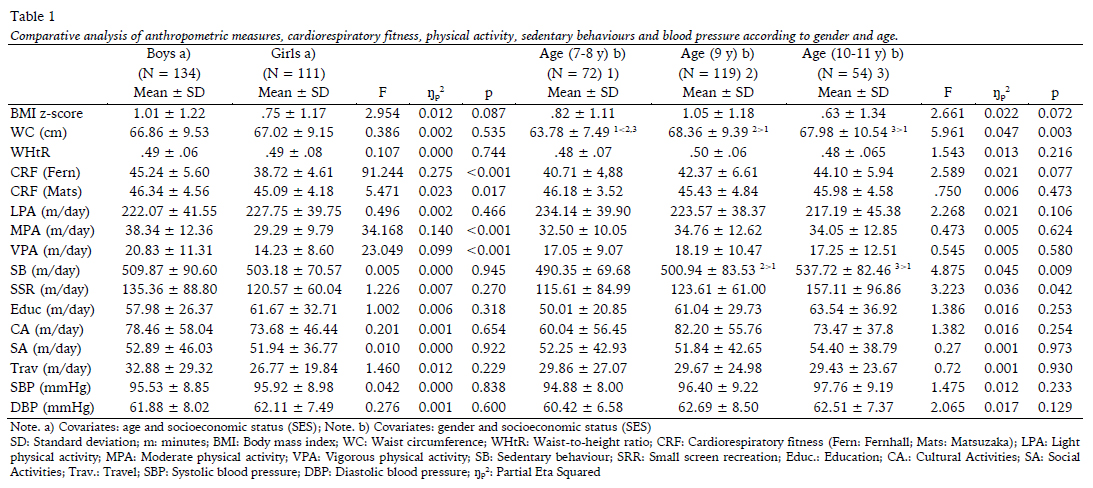
<body><![CDATA[<p>Descriptive statistics, as well as comparative analysis of AM, CRF, PA, SB and BP according to gender and age are presented in <a href="/img/revistas/mot/v13n3/13n3a06t1.jpg">Table 1</a>. </p>     
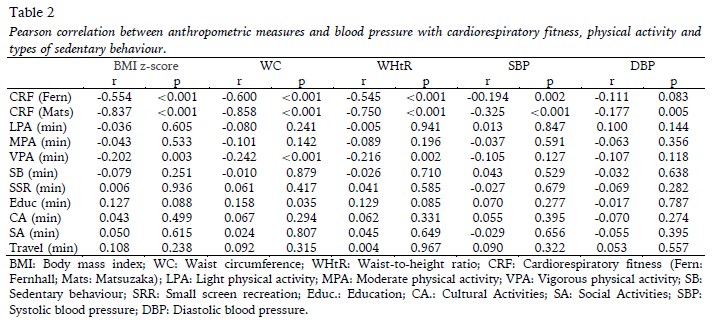
<p>The   sample comprised 50.2% normal weight children, 29.8% with overweight status and   20% with obese status. A total of 76.7% children had normal WC. The prevalence of children with a high WC was 23.3%. </p>     <p>More than half of the participants (58.8%) had a WHtR   smaller than 0.5 and 41.2% larger than 0.5. In the BMI z-score, no differences   were found between the age tertiles. There were differences   in WC according age, indicating higher values in the second and third tertiles when compared to the first one (<i>F</i> <sub>(2,240) </sub>= 5.96, <i>p</i>   = 0.003; <i>&#331;<sub>p</sub><sup>2</sup></i> = 0.047).</p>     <p>In   WHtR, no differences were found between genders and age. The boys had higher   levels of CRF in both models. The size effect   was large for the Fernhall et al. (1998) model and small for the Matsuzaka et al. (2004) model.</p>     <p>Participants   did not met recommendations of 60 minutes of MVPA per day. Regarding LPA, after controlling   for age and SES, no differences were found between genders. In other PA levels,   boys presented higher levels of MPA and VPA (no significant covariates, effect   size was large for MPA and medium for VPA). No differences were found in intensity PA levels between ages. In SB, results showed that participants spent more than eight hours per   day in SB. Controlling   for age, no differences were observed among boys and girls in total time SB (min/day). Age (as a   covariate) was associated to SB (<i>F</i> <sub>(1,210)</sub>   = 8.32, <i>p</i> = 0.004, <i>&#331;<sub>p</sub><sup>2</sup></i> =   0.038). Older participants (9y and 10–11y) spent more time per day in SB than younger ones (none of the   covariates were statistically significant in this analysis). The ANCOVA on   self-reported SB, showed no differences between boys and girls. Comparing age   tertiles, a significant difference was only observed in the small screen   recreation (<i>F </i><sub>(2,174)</sub>   = 3.22, <i>p</i> = 0.042; <i>&#331;<sub>p</sub><sup>2</sup></i> = 0.036). No differences were   observed for time spent in other activities (education, cultural and social   activities). No significant differences were found in gender and age tertiles for SBP and DBP.  </p>     <p>Pearson   analysis showed a significant correlation between CRF and all AM (<a href="/img/revistas/mot/v13n3/13n3a06t2.jpg">Table II</a>), indicating the presence of a negative   relationship between CRF (both models) and BMI z-score,   WC, and WHtR. The CRF   (Fernhall et al.’s   model) shared 30.7% of BMI z-score variability, 36.0% of WC variability, and 29.7% of WHtR variability. The CRF (Matsuzaka et al.’s   model) shared 70.1% of BMI z-score variability, 73.6% of WC variability, and 56.3% of WHtR variability. </p>     
<p><a>Similar results were verified   between </a>CRF (Fernhall et al.’s model) and   SBP, albeit with a weaker relation (CRF shared only 3.8% of SBP variability). The CRF (Matsuzaka et al.’s model) was   also inversely correlated with both SPB (medium relation) and DBP (weaker   relation), sharing 10.6 of SBP variability, and 3.1% of DBP variability. </p>     <p>Considering   the associations between PA and AM, only VPA was negatively correlated with BMI   z-score, WC, and WHtR (a weak relationship). VPA shared 4.1% of the variability in   BMI z-score,   5.9% of the   variability in WC,   and 4.7% of the variability in WHtR.</p>     <p>There was   found a positive correlation between CRF   and MPA (<i>r</i> (245) = 0.39, <i>p</i> &lt; 0.001), as well as between CRF and VPA (<i>r</i> (245) = 0.31, <i>p</i> &lt;   0.001, both reflected a medium correlation). MPA shared 15.2% of CRF variability   and VPA shared 9.6%. Neither   total time spent in SB, nor its different activities were correlated with AM or   BP. The exception was the positive correlation between education-related SB and WC. </p>     <p>No   correlations were found between CRF and SB. A negative correlation   was found between CRF and the mean of time spent in SB   education-related activities (Fernhall et al.’s model: <i>r </i>(180) = -0.12, <i>p</i> =   0.019; Matsuzaka et al.’s model: <i>r</i>   (180) = -0.13, <i>p </i>= 0.009). A positive   correlation (medium relation) was observed between SBP and BMI z-score (<i>r</i> (245) = 0.35) and WC (<i>r</i>   (245) = 0.39). The positive correlation between SBP and WHtR was weaker (<i>r</i> (245) = 0.29, all <i>p</i> &lt; 0.001). Similar results were found for DBP (BMI z-score (<i>r </i>(245) = 0.16, WC (<i>r</i>   (245) = 0.20), and WHtR (<i>r</i> (245) =   0.160), all <i>p</i> &#8804; 0.012). All the observed r-values were weaker. </p>     ]]></body>
<body><![CDATA[<p>Regression   models are presented in <a href="/img/revistas/mot/v13n3/13n3a06t3.jpg">Table III</a>. CRF   (Fernhall et al.’s model), PA, the age and SES covariates explained 38.8% of the BMI z-score variance. Only MPA presented a positive coefficient (0.138). </p>     
<p>Age and CRF (Fernhall et al.’s model)   explained 44.5% of the WC variance and 30.7% of the WHtR variance. Considering   the Matsuzaka et al.’s model, CRF, MPA (also with positive coefficient), age   and SES explained 73.3% of the BMI z-score variance. The age, SES and the CRF explained 76.5% of the WC variance and 53.3% of the WHtR variance. </p> </font>     <p>&nbsp;</p>     <p><font size="3" face="Verdana"><b>DISCUSSION</b></font></p> <font face="Verdana" size="2">     <p>In an attempt to better understand   several variables associated with the early development of cardiovascular and   metabolic risk factors in youth<b>, </b>our purpose was to study the relationship between AM and BP with PA, CRF and SB. Furthermore, the study aimed to predict   BMI z-score, WC and WHtR taking the aforementioned variables into   consideration. The hypothesis that suggested PA, CRF, and SB as important   predictors of all AM, as well as, strong inverse correlations between PA, CRF,   and SB with AM and with BP, were partially confirmed. The predictive power of   CRF and inverse correlations with AM and BP were confirmed. The predictive   power of PA and inverse correlations with AM were confirmed. However, the   predictive power and inverse correlations of SB were not confirmed. CRF (Fernhall et al.’s model), LPA, MPA, and VPA along with the covariates age   and SES explained 38.8% of the BMI z-score variance. Moreover, WC and WHtR   variance was only explained by CRF.   Higher values for CRF   (Matsuzaka et al.’s model) predicted a higher BMI z-score, WC, and WHtR   variance. CRF was inversely correlated with   BMI z-score, WC, and WHtR, and only VPA was inversely correlated with BMI   z-score, WC, and WHtR. MPA and VPA was positively correlated with CRF. Positive correlations between SBP and DBP and all AM were found. Equally important was the inverse correlation between CRF (Matsuzaka et al.’s model) and SBP and DBP.</p>     <p>Our results showed that BMI z-score,   WC and WHtR variance was explained by CRF, thus confirming the importance of   the current PA recommendations which focus on developing CRF (CDC, 2011).   Considering overweight/obesity and their relationship with cardiovascular   disease risk factors in childhood, CRF may have an independent protective   influence on a subsequent increase in cardiovascular risk (Eisenmann, Welk,   Wickel, &amp; Blair, 2007). These results highlight the importance of global   approaches considering both fatness and aerobic fitness when cardiovascular   risk factors in children are studied (Kolsgaard et al., 2012). This is also in   agreement with previous longitudinal reports (Andersen et al., 2011). Perhaps,   the greater predictive power of BMI z-score, WC, and WHtR variance verified   when Matsuzaka et al.’s model was included in linear regression can be   justified by the VO<sub>2</sub>max estimation equation used when compared with   the Fernhall et al.’s model. In both models, BMI, gender and pacer laps are   included, but only Matsuzaka et al.’s model included age, and at such young ages the development factors may play a larger role. </p>     <p>For BMI z-score variance, only MPA   had a positive coefficient, thus reflecting higher BMI z-scores in association   with higher MPA, a result that appears controversial. This   may be explained by the low amount of MPA per   day (in opposition to the large amount of LPA which was the most common intensity of   participants’ PA; see <a href="/img/revistas/mot/v13n3/13n3a06t1.jpg">Table I</a>). We   suggest that in our study LPA is important because of its amount. This has   already been suggested before as LPA seems to have some beneficial   effect on adiposity among older children, but little to no effect among younger   children (Kwon, Janz, Burns, &amp; Levy, 2011). We recognize that several   cross-sectional studies showed no relationship between time performing LPA and   BMI (Byrd-Williams, Kelly, Davis, Spruijt-Metz, &amp; Goran, 2007; Hughes,   Henderson, Ortiz-Rodriguez, Artinou, &amp; Reilly, 2006; Thompson et al., 2009; Wrotniak, Epstein, Dorn, Jones, &amp; Kondilis, 2006).  </p>     
<p>VPA seems to be relevant not only   because of the amount but also because of the intensity. Considering the   different metabolic equivalents commonly used to express the intensity of PA,   MPA does not have the same cardiovascular and metabolic effects, when compared   with VPA, and therefore possibly has a smaller positive effect on the BMI z-score (WHO, 2010). </p>     <p>Children with obesity did less VPA   when compared with overweight and normal weight children. Children with obesity   may not have enough CRF to perform a lot of VPA. But even this small amount of   VPA appeared to be sufficient to be associated with lowers BMI z-scores. The   inverse correlations between VPA or CRF and BMI z-score, WC and WHtR, as well   as the positive correlations between MPA and VPA and CRF, are consistent with   international recommendations that suggest at least 1 hour of MVPA every day of   the week, with VPA on at least three of those days (WHO, 2010). It seems that   PA intensity is an important variable, even if VPA duration and weekly frequency is not high. </p>     <p>A higher intensity of PA achieved at   these ages is relevant because it can cause a significant impact on variables   associated with the cardiovascular and metabolic profile, namely, CRF and BMI   z-score, WC, and WHtR. In fact, evidence has substantially supported these   associations (Ferrari et al., 2015; Nemet, 2016). In children from many   countries, greater MVPA and VPA were both associated with lower odds of obesity,   independently of SB (Nemet, 2016). An increase in MVPA is associated with lower   SBP and DBP, decreased measures of body fat, decreased BMI and improved fitness   measurements in childhood (Thompson et al., 2009). An important systematic   review concluded that it is possible to achieve improvements in CRF with   exercise training at intensities greater than 80% of maximal heart rate, at a   frequency of 3 to 4 days per week, for a duration of 30 to 60 minutes per   session over the course of 1 to 3 months (CDC, 2008). PA is associated with   numerous health benefits and to achieve substantial health benefits,   school-aged children and youth should performed PA at a moderate intensity, at   least, and it should be recognized that vigorous activities may provide even greater benefits (Janssen &amp; Leblanc, 2010).</p>     ]]></body>
<body><![CDATA[<p>Analysing PA according to gender   showed higher levels of both MPA and VPA in boys, a finding in agreement with   previous research (Verloigne et al., 2012). As expected, boys showed a higher   level of CRF. Some recommendations have focused on the importance of more   effective interventions in girls since they tend to spend less time doing PA.   In the same study, the authors concluded that girls spent significantly less   time on LPA (267 minutes/day) and MVPA (32 minutes/day) than boys (284   minutes/day and; 43 minutes/day, respectively). Our results confirmed that   Portuguese girls appear to have PA behaviour identical to girls from other European countries. </p>     <p>Nevertheless, as in previous studies,   the participants of this study did not engage in 60 minutes of daily MVPA. In a   previously referenced study dedicated to the levels of PA and SB among   10-to-12-year-old European boys and girls, author concluded that a large   proportion of children did not meet PA recommendations (Verloigne et al.,   2012). Considering the several health and academic performance benefits of PA   (CDC, 2011) and the growing problem of childhood obesity caused by energy   deficit-related behaviours, these results are worrisome. However, in this study   the children were advised to remove the accelerometer in many sports, such as   in swimming, in aquatic sports and others that could damage the device. This   procedure may help explain why the children did not meet PA recommendations   because sports participation normally provides more vigorous activities, and   these sport activities (i.e., swimming, soccer) are available in the region where the study was held. </p>     <p>Regarding SB, no correlations were   found between types and total time spent in SB and anthropometric measures or   BP, except between behaviours related to education and WC. Similar results were   observed within the framework of the National Health and Nutrition Examination   Surveys, where no association was also observed between overall volume and   patterns of SB with cardio-metabolic risk factors in children and adolescents   (Carson &amp; Janssen, 2011). Our results showed that children spent more than   8 hours per day in SB. Contrary to the results of other studies, in our sample   girls did not spend more time in sedentary activities compared to boys (Verloigne et al., 2012).  </p>     <p>The total time spent in SB did not   explain the variance in AM. Academic performance, in fact, is substantially   focused on mathematics and Portuguese language in the classroom. Therefore, the   environmental context of Portuguese schools seems to promote many sedentary   educational activities as the predominant activity at school is sitting in   class. It is known that an increased sedentary time is associated with negative   health outcomes in both boys and girls (Tremblay et al., 2011). Works focusing   on the relationship between SB and body composition have shown that more than   two hours of SB was related to an increased risk of being overweight or obese.   Results concerning the relation between SB and metabolic syndrome or   cardiovascular disease markers have shown that more than two hours of screen   time per day was associated with higher blood pressure and an increased risk   for metabolic syndrome. Longitudinal studies concluded that more than 1.2 hours   of TV per day is associated with increased SBP. Contemporary youths watch   1.8–2.8 hours/day of television, with 28% watching more than 4 hours/day. In   this report, total screen time averaged 2.7–4.3 hours/day (Marshall, Gorely,   &amp; Biddle, 2006). In our study, age was associated with SB. Older children   (9 and 10–11 years of age) spent more time per day in SB than younger ones (7–8   years of age). Perhaps, small screen recreation time can be associated with   total time SB (7–8 years of age, 115.61 min/day ± 84.99; 9 years of age, 123.61 min/day ± 61.00; 10–11 years of age, 157.11 min/day ± 96.86). </p>     <p>Our results indicated that in   children the harmful health effects caused by SB are not as evident as in other   ages. In adults, physical inactivity is now identified as the fourth leading   risk factor for global mortality (WHO, 2010). PA and diet may partly explain   these results, and may represent confounding factors that lead to an increase   in energy deficit-related behaviour. Television watching may not be a good   marker of SB in children because the relationships observed between television   watching, obesity, and metabolic risk may be confounded or mediated by other   behaviours, such as snacking while watching television (Steele, Brage, Corder, Wareham, &amp; Ekelund, 2008).  </p>     <p>Positive correlations found between   SBP and DBP and all AM are in agreement with other studies (Baker,   Farpour-Lambert, Nowicka, Pietrobelli, &amp; Weiss, 2010). Obesity in children   and adolescents is associated with numerous immediate health risks, including high BP. </p>     <p>Considering that in Portugal as in   many other countries, primary health care providers, including paediatricians,   family practitioners, dieticians, and nurses supervise the majority of   overweight or obese children and school health services, these findings should   provide an additional interdisciplinary tool. Due to the lack of training of   many primary health care providers on PA recommendations for children,   interventions usually are focused on calorie intake and food habits.   Insufficient feedbacks are dedicated to PA, CRF, and SB. In this context,   increased PA and decreased SB could be very helpful because energy expenditure   is an important part of the energy balance equation that determines body weight (Baker et al., 2010). </p>     <p><b>Limitations and Strengths</b></p>     <p>The findings from the present study   should be considered together with some limitations. Our sample is not   nationwide representative because all participants were only recruited from one   Portuguese school. More detailed approach in SB analysis is suggested,   including bouts and breaks for this type of behaviour. The sample size can be   regarded as one of the strengths of the study. We suggest the replication of   this study in other samples in different contexts. Other strengths are the   inclusion of different AM and its assessment carried out by the same researcher. PA and SB patterns objectively measured through accelerometers helped to reduce measurement error. </p>     <p>&nbsp;</p> </font>     ]]></body>
<body><![CDATA[<p><font size="3" face="Verdana"><b>CONCLUSIONS</b></font> </p>      <p><font size="2" face="Verdana">In summary, our findings indicated a   higher percentage of BMI z-score, WC and WHtR variance explained by CRF. Only VPA was inversely correlated with BMI   z-score, WC, and WHR. VPA and MPA were positively related with CRF. Even at early ages, the predictions and   associations found emphasized the   importance of current international recommendations for PA with the specific purpose of developing CRF and potentially prevent health problems.   Probably, a new emphasis should be given to the development of CRF. Effective   interdisciplinary approaches in international recommendations should be developed   in order to protect children's health. This should provide new public implications for primary health care providers,   school health services, and physical education teachers. No associations were   found between main SB and anthropometric measures, CRF or BP. Therefore, these data seem to   suggest that harmful health effects caused by SB do not   occur as in later ages. Due to the dearth of information, more observational and longitudinal studies concerning this age group are necessary to confirm some of the main findings.</font></p>     <p>&nbsp;</p>     <p><font size="3" face="Verdana"><b>REFERENCES</b></font></p> <font face="Verdana" size="2">    <!-- ref --><p>Andersen, L. B., Bugge, A., Dencker, M., Eiberg, S., &amp;   El-Naaman, B. (2011). The association between physical activity, physical   fitness and development of metabolic disorders. <i>International Journal of Pediatric Obesity, 6 Suppl 1</i>, 29-34. doi:10.3109/17477166.2011.606816&nbsp;&nbsp;&nbsp;&nbsp;&nbsp;&nbsp;&nbsp;&nbsp;[&#160;<a href="javascript:void(0);" onclick="javascript: window.open('/scielo.php?script=sci_nlinks&ref=368126&pid=S1646-107X201700040000600001&lng=','','width=640,height=500,resizable=yes,scrollbars=1,menubar=yes,');">Links</a>&#160;]<!-- end-ref --><!-- ref --><p>Baker, J., Farpour-Lambert, N., Nowicka, P., Pietrobelli, A.,   &amp; Weiss, R. (2010). Evaluation of the overweight/obese child - practical   tips for the primary health care provider: recommendations from the Childhood   Obesity Task Force of the European Association for the Study of Obesity. <i>Obesity Facts, 3</i>(2), 131-137. doi:10.1159/000295112&nbsp;&nbsp;&nbsp;&nbsp;&nbsp;&nbsp;&nbsp;&nbsp;[&#160;<a href="javascript:void(0);" onclick="javascript: window.open('/scielo.php?script=sci_nlinks&ref=368127&pid=S1646-107X201700040000600002&lng=','','width=640,height=500,resizable=yes,scrollbars=1,menubar=yes,');">Links</a>&#160;]<!-- end-ref --><!-- ref --><p>Biddle, S. J., O'Connell, S., &amp; Braithwaite, R. E.   (2011). Sedentary behaviour interventions in young people: a meta-analysis. <i>British Journal of Sports Medicine, 45</i>(11), 937-942. doi:10.1136/bjsports-2011-090205&nbsp;&nbsp;&nbsp;&nbsp;&nbsp;&nbsp;&nbsp;&nbsp;[&#160;<a href="javascript:void(0);" onclick="javascript: window.open('/scielo.php?script=sci_nlinks&ref=368128&pid=S1646-107X201700040000600003&lng=','','width=640,height=500,resizable=yes,scrollbars=1,menubar=yes,');">Links</a>&#160;]<!-- end-ref --><!-- ref --><p>Booth, F. W., Roberts, C. K., &amp; Laye, M. J. (2012). Lack of exercise is a major cause of chronic diseases. <i>Comprehensive Physiology, 2</i>(2), 1143-1211. doi:10.1002/cphy.c110025&nbsp;&nbsp;&nbsp;&nbsp;&nbsp;&nbsp;&nbsp;&nbsp;[&#160;<a href="javascript:void(0);" onclick="javascript: window.open('/scielo.php?script=sci_nlinks&ref=368129&pid=S1646-107X201700040000600004&lng=','','width=640,height=500,resizable=yes,scrollbars=1,menubar=yes,');">Links</a>&#160;]<!-- end-ref --><!-- ref --><p>Byrd-Williams, C., Kelly, L. A., Davis, J. N., Spruijt-Metz,   D., &amp; Goran, M. I. (2007). Influence of gender, BMI and Hispanic ethnicity   on physical activity in children. <i>Internationl     Journal of Pediatriatic Obesity, 2</i>(3), 159-166. doi:10.1080/17477160701369167&nbsp;&nbsp;&nbsp;&nbsp;&nbsp;&nbsp;&nbsp;&nbsp;[&#160;<a href="javascript:void(0);" onclick="javascript: window.open('/scielo.php?script=sci_nlinks&ref=368130&pid=S1646-107X201700040000600005&lng=','','width=640,height=500,resizable=yes,scrollbars=1,menubar=yes,');">Links</a>&#160;]<!-- end-ref --><!-- ref --><p>Cain, K. L., Sallis, J. F., Conway, T. L., Van Dyck, D.,   &amp; Calhoon, L. (2013). Using accelerometers in youth physical activity   studies: a review of methods. <i>Journal of Physical Activity and Health, 10</i>(3), 437-450.    &nbsp;&nbsp;&nbsp;&nbsp;&nbsp;&nbsp;&nbsp;&nbsp;[&#160;<a href="javascript:void(0);" onclick="javascript: window.open('/scielo.php?script=sci_nlinks&ref=368131&pid=S1646-107X201700040000600006&lng=','','width=640,height=500,resizable=yes,scrollbars=1,menubar=yes,');">Links</a>&#160;]<!-- end-ref --> </p>     <!-- ref --><p>Carson, V., &amp; Janssen, I. (2011). Volume, patterns, and   types of sedentary behavior and cardio-metabolic health in children and   adolescents: a cross-sectional study. <i>BMC Public Health, 11</i>, 274. doi:10.1186/1471-2458-11-274&nbsp;&nbsp;&nbsp;&nbsp;&nbsp;&nbsp;&nbsp;&nbsp;[&#160;<a href="javascript:void(0);" onclick="javascript: window.open('/scielo.php?script=sci_nlinks&ref=368133&pid=S1646-107X201700040000600007&lng=','','width=640,height=500,resizable=yes,scrollbars=1,menubar=yes,');">Links</a>&#160;]<!-- end-ref --><!-- ref --><p>CDC. (2008). <i>Physical   Activity Guidelines Advisory Committee Report</i>. Washington, DC: US Department of Health and Human Services.    &nbsp;&nbsp;&nbsp;&nbsp;&nbsp;&nbsp;&nbsp;&nbsp;[&#160;<a href="javascript:void(0);" onclick="javascript: window.open('/scielo.php?script=sci_nlinks&ref=368134&pid=S1646-107X201700040000600008&lng=','','width=640,height=500,resizable=yes,scrollbars=1,menubar=yes,');">Links</a>&#160;]<!-- end-ref -->  </p>     <!-- ref --><p>CDC. (2011). <i>School   Health Guidelines to Promote Healthy Eating and Physical Activity</i>. Washington, DC: US Department of Health and Human Services.    &nbsp;&nbsp;&nbsp;&nbsp;&nbsp;&nbsp;&nbsp;&nbsp;[&#160;<a href="javascript:void(0);" onclick="javascript: window.open('/scielo.php?script=sci_nlinks&ref=368136&pid=S1646-107X201700040000600009&lng=','','width=640,height=500,resizable=yes,scrollbars=1,menubar=yes,');">Links</a>&#160;]<!-- end-ref -->   </p>     <!-- ref --><p>Cohen, J. (1998). <i>Statistical   Power Analysis for the Behavioral Sciences</i> (2<sup>nd</sup> ed.). Hillsdale, NJ: Lawrence Erlbaum Associates.    &nbsp;&nbsp;&nbsp;&nbsp;&nbsp;&nbsp;&nbsp;&nbsp;[&#160;<a href="javascript:void(0);" onclick="javascript: window.open('/scielo.php?script=sci_nlinks&ref=368138&pid=S1646-107X201700040000600010&lng=','','width=640,height=500,resizable=yes,scrollbars=1,menubar=yes,');">Links</a>&#160;]<!-- end-ref --> </p>     <!-- ref --><p>Daniels, S., Irwin, B., Christakis, D., Dennison, B.,   Gidding, S., Gillman, M., . . . Washington, R. (2012). <i>Expert Panel on Integrated Guidelines for Cardiovascular Health and     Risk Reduction in Children and Adolescents.</i> US Department of Health and   Human Services. National Heart, Lung, and Blood Institute. National Institutes of Health.    &nbsp;&nbsp;&nbsp;&nbsp;&nbsp;&nbsp;&nbsp;&nbsp;[&#160;<a href="javascript:void(0);" onclick="javascript: window.open('/scielo.php?script=sci_nlinks&ref=368140&pid=S1646-107X201700040000600011&lng=','','width=640,height=500,resizable=yes,scrollbars=1,menubar=yes,');">Links</a>&#160;]<!-- end-ref -->   </p>     ]]></body>
<body><![CDATA[<!-- ref --><p>Eisenmann, J. C., Welk, G. J., Wickel, E. E., &amp; Blair, S.   N. (2007). Combined influence of cardiorespiratory fitness and body mass index   on cardiovascular disease risk factors among 8-18 year old youth: The Aerobics   Center Longitudinal Study. <i>International Journal of Pedriatic Obesity, 2</i>(2), 66-72. doi:10.1080/17477160601133713&nbsp;&nbsp;&nbsp;&nbsp;&nbsp;&nbsp;&nbsp;&nbsp;[&#160;<a href="javascript:void(0);" onclick="javascript: window.open('/scielo.php?script=sci_nlinks&ref=368142&pid=S1646-107X201700040000600012&lng=','','width=640,height=500,resizable=yes,scrollbars=1,menubar=yes,');">Links</a>&#160;]<!-- end-ref --><!-- ref --><p>Evenson, K. R., Catellier, D. J., Gill, K., Ondrak, K. S.,   &amp; McMurray, R. G. (2008). Calibration of two objective measures of physical   activity for children. <i>Journal of Sports Sciences, 26</i>(14), 1557-1565. doi:10.1080/02640410802334196&nbsp;&nbsp;&nbsp;&nbsp;&nbsp;&nbsp;&nbsp;&nbsp;[&#160;<a href="javascript:void(0);" onclick="javascript: window.open('/scielo.php?script=sci_nlinks&ref=368143&pid=S1646-107X201700040000600013&lng=','','width=640,height=500,resizable=yes,scrollbars=1,menubar=yes,');">Links</a>&#160;]<!-- end-ref --><!-- ref --><p>Fernández, J. R., Redden, D. T., Pietrobelli, A., &amp;   Allison, D. B. (2004). Waist circumference percentiles in nationally   representative samples of African-American, European-American, and   Mexican-American children and adolescents. <i>Journal Pediatrics, 145</i>(4), 439-444. doi:10.1016/j.jpeds.2004.06.044&nbsp;&nbsp;&nbsp;&nbsp;&nbsp;&nbsp;&nbsp;&nbsp;[&#160;<a href="javascript:void(0);" onclick="javascript: window.open('/scielo.php?script=sci_nlinks&ref=368144&pid=S1646-107X201700040000600014&lng=','','width=640,height=500,resizable=yes,scrollbars=1,menubar=yes,');">Links</a>&#160;]<!-- end-ref --><!-- ref --><p>Fernhall, B., Pitetti, K. H., Vukovich, M. D., Stubbs, N.,   Hensen, T., Winnick, J. P., &amp; Short, F. X. (1998). Validation of   cardiovascular fitness field tests in children with mental retardation. <i>American Journal of Mental Retardation, 102</i>(6), 602-612.    &nbsp;&nbsp;&nbsp;&nbsp;&nbsp;&nbsp;&nbsp;&nbsp;[&#160;<a href="javascript:void(0);" onclick="javascript: window.open('/scielo.php?script=sci_nlinks&ref=368145&pid=S1646-107X201700040000600015&lng=','','width=640,height=500,resizable=yes,scrollbars=1,menubar=yes,');">Links</a>&#160;]<!-- end-ref --> </p>     <!-- ref --><p>Ferrari, G. L., Oliveira, L. C., Araujo, T. L., Matsudo, V.,   Barreira, T. V., Tudor-Locke, C., &amp; Katzmarzyk, P. (2015).   Moderate-to-Vigorous Physical Activity and Sedentary Behavior: Independent   Associations With Body Composition Variables in Brazilian Children. <i>Pediatric Exercise Science, 27</i>(3), 380-389. doi:10.1123/pes.2014-0150&nbsp;&nbsp;&nbsp;&nbsp;&nbsp;&nbsp;&nbsp;&nbsp;[&#160;<a href="javascript:void(0);" onclick="javascript: window.open('/scielo.php?script=sci_nlinks&ref=368147&pid=S1646-107X201700040000600016&lng=','','width=640,height=500,resizable=yes,scrollbars=1,menubar=yes,');">Links</a>&#160;]<!-- end-ref --><!-- ref --><p>Field, A. (2009). <i>Discovering Statistics using SPSS </i>(3<sup>rd</sup> Ed.)<i>.</i> SAGE Publications Ltd.    &nbsp;&nbsp;&nbsp;&nbsp;&nbsp;&nbsp;&nbsp;&nbsp;[&#160;<a href="javascript:void(0);" onclick="javascript: window.open('/scielo.php?script=sci_nlinks&ref=368148&pid=S1646-107X201700040000600017&lng=','','width=640,height=500,resizable=yes,scrollbars=1,menubar=yes,');">Links</a>&#160;]<!-- end-ref --></p>     <!-- ref --><p>Franks, P. W., Hanson, R. L., Knowler, W. C., Moffett, C.,   Enos, G., Infante, A. M., . . . Looker, H. C. (2007). Childhood predictors of   young-onset type 2 diabetes. <i>Diabetes, 56</i>(12), 2964-2972. doi:10.2337/db06-1639&nbsp;&nbsp;&nbsp;&nbsp;&nbsp;&nbsp;&nbsp;&nbsp;[&#160;<a href="javascript:void(0);" onclick="javascript: window.open('/scielo.php?script=sci_nlinks&ref=368150&pid=S1646-107X201700040000600018&lng=','','width=640,height=500,resizable=yes,scrollbars=1,menubar=yes,');">Links</a>&#160;]<!-- end-ref --><!-- ref --><p>Guinhouya, B. C., Samouda, H.,   Zitouni, D., Vilhelm, C., &amp; Hubert, H. (2011). Evidence   of the influence of physical activity on the metabolic syndrome and/or on   insulin resistance in pediatric populations: a systematic review. <i>International Journal of Pediatric Obesity, 6</i>(5-6), 361-388. doi:10.3109/17477166.2011.605896&nbsp;&nbsp;&nbsp;&nbsp;&nbsp;&nbsp;&nbsp;&nbsp;[&#160;<a href="javascript:void(0);" onclick="javascript: window.open('/scielo.php?script=sci_nlinks&ref=368151&pid=S1646-107X201700040000600019&lng=','','width=640,height=500,resizable=yes,scrollbars=1,menubar=yes,');">Links</a>&#160;]<!-- end-ref --><!-- ref --><p>Hardy, L. L., Booth, M. L., &amp; Okely, A. D. (2007). The   reliability of the Adolescent Sedentary Activity Questionnaire (ASAQ). <i>Preventive Medicine, 45</i>(1), 71-74. doi:10.1016/j.ypmed.2007.03.014&nbsp;&nbsp;&nbsp;&nbsp;&nbsp;&nbsp;&nbsp;&nbsp;[&#160;<a href="javascript:void(0);" onclick="javascript: window.open('/scielo.php?script=sci_nlinks&ref=368152&pid=S1646-107X201700040000600020&lng=','','width=640,height=500,resizable=yes,scrollbars=1,menubar=yes,');">Links</a>&#160;]<!-- end-ref --><!-- ref --><p>Hughes, A. R., Henderson, A., Ortiz-Rodriguez, V., Artinou,   M. L., &amp; Reilly, J. J. (2006). Habitual physical activity and sedentary   behaviour in a clinical sample of obese children. <i>Internationl Journal of Obesity (Lond), 30</i>(10), 1494-1500. doi:10.1038/sj.ijo.0803334&nbsp;&nbsp;&nbsp;&nbsp;&nbsp;&nbsp;&nbsp;&nbsp;[&#160;<a href="javascript:void(0);" onclick="javascript: window.open('/scielo.php?script=sci_nlinks&ref=368153&pid=S1646-107X201700040000600021&lng=','','width=640,height=500,resizable=yes,scrollbars=1,menubar=yes,');">Links</a>&#160;]<!-- end-ref --><!-- ref --><p>Janssen, I., &amp; Leblanc, A. G. (2010). Systematic review   of the health benefits of physical activity and fitness in school-aged children   and youth. <i>International Journal Behavioral Nutrition Physical Activity, 7</i>, 40. doi:10.1186/1479-5868-7-40&nbsp;&nbsp;&nbsp;&nbsp;&nbsp;&nbsp;&nbsp;&nbsp;[&#160;<a href="javascript:void(0);" onclick="javascript: window.open('/scielo.php?script=sci_nlinks&ref=368154&pid=S1646-107X201700040000600022&lng=','','width=640,height=500,resizable=yes,scrollbars=1,menubar=yes,');">Links</a>&#160;]<!-- end-ref --><!-- ref --><p>Juonala, M., Magnussen, C. G., Venn, A., Dwyer, T., Burns, T.   L., Davis, P. H., . . . Raitakari, O. T. (2010). Influence of age on   associations between childhood risk factors and carotid intima-media thickness   in adulthood: the Cardiovascular Risk in Young Finns Study, the Childhood   Determinants of Adult Health Study, the Bogalusa Heart Study, and the Muscatine   Study for the International Childhood Cardiovascular Cohort (i3C) Consortium. <i>Circulation, 122</i>(24), 2514-2520. doi:10.1161/CIRCULATIONAHA.110.966465&nbsp;&nbsp;&nbsp;&nbsp;&nbsp;&nbsp;&nbsp;&nbsp;[&#160;<a href="javascript:void(0);" onclick="javascript: window.open('/scielo.php?script=sci_nlinks&ref=368155&pid=S1646-107X201700040000600023&lng=','','width=640,height=500,resizable=yes,scrollbars=1,menubar=yes,');">Links</a>&#160;]<!-- end-ref --><!-- ref --><p>Kelli, L., &amp; Cain, M. (2014). <i>International Physical Activity and the Environment Network</i>. IPEN Adolescent Accelerometer Data Collection Training.    &nbsp;&nbsp;&nbsp;&nbsp;&nbsp;&nbsp;&nbsp;&nbsp;[&#160;<a href="javascript:void(0);" onclick="javascript: window.open('/scielo.php?script=sci_nlinks&ref=368156&pid=S1646-107X201700040000600024&lng=','','width=640,height=500,resizable=yes,scrollbars=1,menubar=yes,');">Links</a>&#160;]<!-- end-ref --> </p>     <!-- ref --><p>Kolsgaard, M. L., Joner, G., Brunborg, C., Anderssen, S. A.,   Tonstad, S., &amp; Andersen, L. F. (2012). Reduction in BMI z-score and   improvement in cardiometabolic risk factors in obese children and adolescents.   The Oslo adiposity intervention study - a hospital/public health nurse combined   treatment. <i>BMC Pediatric, 12</i>, 77. doi:10.1186/1471-2431-12-77&nbsp;&nbsp;&nbsp;&nbsp;&nbsp;&nbsp;&nbsp;&nbsp;[&#160;<a href="javascript:void(0);" onclick="javascript: window.open('/scielo.php?script=sci_nlinks&ref=368158&pid=S1646-107X201700040000600025&lng=','','width=640,height=500,resizable=yes,scrollbars=1,menubar=yes,');">Links</a>&#160;]<!-- end-ref --><!-- ref --><p>Kwon, S., Janz, K. F., Burns, T. L., &amp; Levy, S. M.   (2011). Association between light-intensity physical activity and adiposity in   childhood. <i>Pediatric Exercise Science, 23</i>(2), 218-229.    &nbsp;&nbsp;&nbsp;&nbsp;&nbsp;&nbsp;&nbsp;&nbsp;[&#160;<a href="javascript:void(0);" onclick="javascript: window.open('/scielo.php?script=sci_nlinks&ref=368159&pid=S1646-107X201700040000600026&lng=','','width=640,height=500,resizable=yes,scrollbars=1,menubar=yes,');">Links</a>&#160;]<!-- end-ref --> </p>     <!-- ref --><p>Lakens, D. (2013). Calculating and reporting effect sizes to   facilitate cumulative science: a practical primer for t-tests and ANOVAs. <i>Frontiers in Psychology, 4</i>, 863. doi:10.3389/fpsyg.2013.00863&nbsp;&nbsp;&nbsp;&nbsp;&nbsp;&nbsp;&nbsp;&nbsp;[&#160;<a href="javascript:void(0);" onclick="javascript: window.open('/scielo.php?script=sci_nlinks&ref=368161&pid=S1646-107X201700040000600027&lng=','','width=640,height=500,resizable=yes,scrollbars=1,menubar=yes,');">Links</a>&#160;]<!-- end-ref --><!-- ref --><p>Marshall, S. J., Gorely, T., &amp; Biddle, S. J. (2006). A   descriptive epidemiology of screen-based media use in youth: a review and   critique. <i>Journal of Adolescence, 29</i>(3), 333-349. doi:10.1016/j.adolescence.2005.08.016&nbsp;&nbsp;&nbsp;&nbsp;&nbsp;&nbsp;&nbsp;&nbsp;[&#160;<a href="javascript:void(0);" onclick="javascript: window.open('/scielo.php?script=sci_nlinks&ref=368162&pid=S1646-107X201700040000600028&lng=','','width=640,height=500,resizable=yes,scrollbars=1,menubar=yes,');">Links</a>&#160;]<!-- end-ref --><!-- ref --><p>Matsuzaka,   A., Takahashi, Y., Yamazoe, M., Kumakura, N., Ikeda, A., Wilk, B., &amp;   Bar-Or, O. (2004). Validity of the Multistage 20-M Shuttle-Run Test for   Japanese Children, Adolescents, and Adults. <i>Pediatric     Exercise Science</i>, <i>16</i>(2), 113–125. <a href="https://doi.org/10.1123/pes.16.2.113" target="_blank">https://doi.org/10.1123/pes.16.2.113</a>&nbsp;&nbsp;&nbsp;&nbsp;&nbsp;&nbsp;&nbsp;&nbsp;[&#160;<a href="javascript:void(0);" onclick="javascript: window.open('/scielo.php?script=sci_nlinks&ref=368163&pid=S1646-107X201700040000600029&lng=','','width=640,height=500,resizable=yes,scrollbars=1,menubar=yes,');">Links</a>&#160;]<!-- end-ref --><!-- ref --><p>Nambiar, S., Hughes, I., &amp; Davies, P. S. (2010).   Developing waist-to-height ratio cut-offs to define overweight and obesity in   children and adolescents. <i>Public Health Nutrition, 13</i>(10), 1566-1574. doi:10.1017/S1368980009993053&nbsp;&nbsp;&nbsp;&nbsp;&nbsp;&nbsp;&nbsp;&nbsp;[&#160;<a href="javascript:void(0);" onclick="javascript: window.open('/scielo.php?script=sci_nlinks&ref=368164&pid=S1646-107X201700040000600030&lng=','','width=640,height=500,resizable=yes,scrollbars=1,menubar=yes,');">Links</a>&#160;]<!-- end-ref --><!-- ref --><p>Nemet, D. (2016). Childhood Obesity, Physical Activity, and   Exercise. <i>Pediatric Exercise Science, 28</i>(1), 48-51. doi:10.1123/pes.2016-0014&nbsp;&nbsp;&nbsp;&nbsp;&nbsp;&nbsp;&nbsp;&nbsp;[&#160;<a href="javascript:void(0);" onclick="javascript: window.open('/scielo.php?script=sci_nlinks&ref=368165&pid=S1646-107X201700040000600031&lng=','','width=640,height=500,resizable=yes,scrollbars=1,menubar=yes,');">Links</a>&#160;]<!-- end-ref --><!-- ref --><p>Ng, M., Fleming, T., Robinson, M., Thomson, B., Graetz, N.,   Margono, C., . . . Gakidou, E. (2014). Global, regional, and national   prevalence of overweight and obesity in children and adults during 1980-2013: a   systematic analysis for the Global Burden of Disease Study 2013. <i>Lancet, 384</i>(9945), 766-781. doi:10.1016/S0140-6736(14)60460-8&nbsp;&nbsp;&nbsp;&nbsp;&nbsp;&nbsp;&nbsp;&nbsp;[&#160;<a href="javascript:void(0);" onclick="javascript: window.open('/scielo.php?script=sci_nlinks&ref=368166&pid=S1646-107X201700040000600032&lng=','','width=640,height=500,resizable=yes,scrollbars=1,menubar=yes,');">Links</a>&#160;]<!-- end-ref --><!-- ref --><p>Pallant, J. (2007). <i>SPSS survival manual. </i>New York: McGraw-Hill Education.    &nbsp;&nbsp;&nbsp;&nbsp;&nbsp;&nbsp;&nbsp;&nbsp;[&#160;<a href="javascript:void(0);" onclick="javascript: window.open('/scielo.php?script=sci_nlinks&ref=368167&pid=S1646-107X201700040000600033&lng=','','width=640,height=500,resizable=yes,scrollbars=1,menubar=yes,');">Links</a>&#160;]<!-- end-ref --> </p>     <!-- ref --><p>Pulsford, R. M., Cortina-Borja, M., Rich, C., Kinnafick, F.   E., Dezateux, C., &amp; Griffiths, L. J. (2011). Actigraph   accelerometer-defined boundaries for sedentary behaviour and physical activity   intensities in 7 year old children. <i>PLoS One, 6</i>(8), e21822. doi:10.1371/journal.pone.0021822&nbsp;&nbsp;&nbsp;&nbsp;&nbsp;&nbsp;&nbsp;&nbsp;[&#160;<a href="javascript:void(0);" onclick="javascript: window.open('/scielo.php?script=sci_nlinks&ref=368169&pid=S1646-107X201700040000600034&lng=','','width=640,height=500,resizable=yes,scrollbars=1,menubar=yes,');">Links</a>&#160;]<!-- end-ref --><!-- ref --><p>Rich, C., Geraci, M., Griffiths, L., Sera, F., Dezateux, C.,   &amp; Cortina-Borja, M. (2013). Quality control methods in accelerometer data   processing: defining minimum wear time. <i>PLoS One, 8</i>(6), e67206. doi:10.1371/journal.pone.0067206&nbsp;&nbsp;&nbsp;&nbsp;&nbsp;&nbsp;&nbsp;&nbsp;[&#160;<a href="javascript:void(0);" onclick="javascript: window.open('/scielo.php?script=sci_nlinks&ref=368170&pid=S1646-107X201700040000600035&lng=','','width=640,height=500,resizable=yes,scrollbars=1,menubar=yes,');">Links</a>&#160;]<!-- end-ref --><!-- ref --><p>Sahoo, K., Sahoo, B., Choudhury, A. K., Sofi, N. Y., Kumar,   R., &amp; Bhadoria, A. S. (2015). Childhood obesity: causes and consequences. <i>Journal of Family Medice Primary Care, 4</i>(2), 187-192. doi:10.4103/2249-4863.154628&nbsp;&nbsp;&nbsp;&nbsp;&nbsp;&nbsp;&nbsp;&nbsp;[&#160;<a href="javascript:void(0);" onclick="javascript: window.open('/scielo.php?script=sci_nlinks&ref=368171&pid=S1646-107X201700040000600036&lng=','','width=640,height=500,resizable=yes,scrollbars=1,menubar=yes,');">Links</a>&#160;]<!-- end-ref --><!-- ref --><p>Steele, R. M., Brage, S., Corder, K., Wareham, N. J., &amp;   Ekelund, U. (2008). Physical activity, cardiorespiratory fitness, and the   metabolic syndrome in youth. <i>Journal of Applied Physiology (1985), 105</i>(1), 342-351. doi:10.1152/japplphysiol.00072.2008&nbsp;&nbsp;&nbsp;&nbsp;&nbsp;&nbsp;&nbsp;&nbsp;[&#160;<a href="javascript:void(0);" onclick="javascript: window.open('/scielo.php?script=sci_nlinks&ref=368172&pid=S1646-107X201700040000600037&lng=','','width=640,height=500,resizable=yes,scrollbars=1,menubar=yes,');">Links</a>&#160;]<!-- end-ref --><!-- ref --><p>Thompson, A. M., Campagna, P. D., Durant, M., Murphy, R. J.,   Rehman, L. A., &amp; Wadsworth, L. A. (2009). Are overweight students in Grades   3, 7, and 11 less physically active than their healthy weight counterparts? <i>International Journal of Pediatric Obesity, 4</i>(1), 28-35. doi:10.1080/17477160802170050&nbsp;&nbsp;&nbsp;&nbsp;&nbsp;&nbsp;&nbsp;&nbsp;[&#160;<a href="javascript:void(0);" onclick="javascript: window.open('/scielo.php?script=sci_nlinks&ref=368173&pid=S1646-107X201700040000600038&lng=','','width=640,height=500,resizable=yes,scrollbars=1,menubar=yes,');">Links</a>&#160;]<!-- end-ref --><!-- ref --><p>Tremblay, M. S., Carson, V., Chaput, J. P., Connor Gorber,   S., Dinh, T., Duggan, M., . . . Zehr, L. (2016). Canadian 24-Hour Movement   Guidelines for Children and Youth: An Integration of Physical Activity,   Sedentary Behaviour, and Sleep. <i>Applied     Physiology Nutrition and Metabolism, 41</i>(6 Suppl 3), S311-327. doi:10.1139/apnm-2016-0151&nbsp;&nbsp;&nbsp;&nbsp;&nbsp;&nbsp;&nbsp;&nbsp;[&#160;<a href="javascript:void(0);" onclick="javascript: window.open('/scielo.php?script=sci_nlinks&ref=368174&pid=S1646-107X201700040000600039&lng=','','width=640,height=500,resizable=yes,scrollbars=1,menubar=yes,');">Links</a>&#160;]<!-- end-ref --><!-- ref --><p>Tremblay, M. S., LeBlanc, A., Kho, M., Saunders, T.,   Larouche, R., Colley, R., . . . Connor Gorber, S. (2011). Systematic review of   sedentary behaviour and health indicators in school-aged children and youth. <i>International Journal of Behavioral Nutrition and Physical Activity, 8</i>, 98. doi:10.1186/1479-5868-8-98&nbsp;&nbsp;&nbsp;&nbsp;&nbsp;&nbsp;&nbsp;&nbsp;[&#160;<a href="javascript:void(0);" onclick="javascript: window.open('/scielo.php?script=sci_nlinks&ref=368175&pid=S1646-107X201700040000600040&lng=','','width=640,height=500,resizable=yes,scrollbars=1,menubar=yes,');">Links</a>&#160;]<!-- end-ref --><!-- ref --><p>Trost, S. G., Loprinzi, P. D., Moore, R., &amp; Pfeiffer, K.   A. (2011). Comparison of accelerometer cut points for predicting activity   intensity in youth. <i>Medicine and Science in Sports and Exercise, 43</i>(7), 1360-1368. doi:10.1249/MSS.0b013e318206476e&nbsp;&nbsp;&nbsp;&nbsp;&nbsp;&nbsp;&nbsp;&nbsp;[&#160;<a href="javascript:void(0);" onclick="javascript: window.open('/scielo.php?script=sci_nlinks&ref=368176&pid=S1646-107X201700040000600041&lng=','','width=640,height=500,resizable=yes,scrollbars=1,menubar=yes,');">Links</a>&#160;]<!-- end-ref --><!-- ref --><p>Verloigne, M., Van Lippevelde, W., Maes, L.,   Y&#305;ld&#305;r&#305;m, M., Chinapaw, M., Manios, Y., . . . De Bourdeaudhuij,   I. (2012). Levels of physical activity and sedentary time among 10- to   12-year-old boys and girls across 5 European countries using accelerometers: an   observational study within the ENERGY-project. <i>International Journal of Behavioral Nutrition an Physical Activity, 9</i>, 34. doi:10.1186/1479-5868-9-34&nbsp;&nbsp;&nbsp;&nbsp;&nbsp;&nbsp;&nbsp;&nbsp;[&#160;<a href="javascript:void(0);" onclick="javascript: window.open('/scielo.php?script=sci_nlinks&ref=368177&pid=S1646-107X201700040000600042&lng=','','width=640,height=500,resizable=yes,scrollbars=1,menubar=yes,');">Links</a>&#160;]<!-- end-ref --><!-- ref --><p>WHO. (2007). <i>Child   Growth Standards: Head circumference-for-age, arm circumference-for-age,   triceps skinfold-for-age and subscapular skinfold-for-age: Methods and development. </i>Geneva: Multicentre Growth Reference Study Group.    &nbsp;&nbsp;&nbsp;&nbsp;&nbsp;&nbsp;&nbsp;&nbsp;[&#160;<a href="javascript:void(0);" onclick="javascript: window.open('/scielo.php?script=sci_nlinks&ref=368178&pid=S1646-107X201700040000600043&lng=','','width=640,height=500,resizable=yes,scrollbars=1,menubar=yes,');">Links</a>&#160;]<!-- end-ref --></p>     <!-- ref --><p>WHO. (2009). <i>Interventions on Diet and Physical Activity. What Works. Summary Report</i>. Geneva: WHO&nbsp;&nbsp;&nbsp;&nbsp;&nbsp;&nbsp;&nbsp;&nbsp;[&#160;<a href="javascript:void(0);" onclick="javascript: window.open('/scielo.php?script=sci_nlinks&ref=368180&pid=S1646-107X201700040000600044&lng=','','width=640,height=500,resizable=yes,scrollbars=1,menubar=yes,');">Links</a>&#160;]<!-- end-ref --><!-- ref --><p>WHO. (2010). <i>Global Recommendations on Physical Activity for Health</i>. Geneva: WHO&nbsp;&nbsp;&nbsp;&nbsp;&nbsp;&nbsp;&nbsp;&nbsp;[&#160;<a href="javascript:void(0);" onclick="javascript: window.open('/scielo.php?script=sci_nlinks&ref=368181&pid=S1646-107X201700040000600045&lng=','','width=640,height=500,resizable=yes,scrollbars=1,menubar=yes,');">Links</a>&#160;]<!-- end-ref --><!-- ref --><p>Wrotniak, B.   H., Epstein, L. H., Dorn, J. M., Jones, K. E., &amp; Kondilis, V. A. (2006).   The relationship between motor proficiency and physical activity in children. <i>Pediatrics, 118</i>(6), e1758-1765. doi:10.1542/peds.2006-0742&nbsp;&nbsp;&nbsp;&nbsp;&nbsp;&nbsp;&nbsp;&nbsp;[&#160;<a href="javascript:void(0);" onclick="javascript: window.open('/scielo.php?script=sci_nlinks&ref=368182&pid=S1646-107X201700040000600046&lng=','','width=640,height=500,resizable=yes,scrollbars=1,menubar=yes,');">Links</a>&#160;]<!-- end-ref --><p>&nbsp;</p>     <p><font size="2" face="Verdana"><b>Acknowledgments:</b>    <br>   Nothing to declare.<b>    <br>   Conflict   of interest:</b>    <br>   Nothing to declare.    <br>   </font><font size="2" face="Verdana"><b>Funding: </b>    <br>   This work was   supported by the Portuguese Science Foundation through individual research   grant (SFRH/BD/85518/2012) co-financed by the European Social Fund and   Portuguese National Funds from MCTES</font></p> <font face="Verdana" size="2">     <p>Manuscript received at  December 11th 2016; Accepted at February 19th 2017</p>     <p>&nbsp;</p>     ]]></body>
<body><![CDATA[<p>&nbsp;</p>     <p><a href="#top"><sup>*</sup></a><i><a name="end"></a></i>   <i>Corresponding  author: </i>Faculdade de Educa&ccedil;&atilde;o F&iacute;sica e Desporto, Universidade Lus&oacute;fona, Lisboa,  Portugal<i>; E-mail: </i><a href="mailto:ruibatalau@gmail.com">ruibatalau@gmail.com</a></p> </font>      ]]></body><back>
<ref-list>
<ref id="B1">
<nlm-citation citation-type="journal">
<person-group person-group-type="author">
<name>
<surname><![CDATA[Andersen]]></surname>
<given-names><![CDATA[L. B.]]></given-names>
</name>
<name>
<surname><![CDATA[Bugge]]></surname>
<given-names><![CDATA[A.]]></given-names>
</name>
<name>
<surname><![CDATA[Dencker]]></surname>
<given-names><![CDATA[M.]]></given-names>
</name>
<name>
<surname><![CDATA[Eiberg]]></surname>
<given-names><![CDATA[S.]]></given-names>
</name>
<name>
<surname><![CDATA[El-Naaman]]></surname>
<given-names><![CDATA[B.]]></given-names>
</name>
</person-group>
<article-title xml:lang="en"><![CDATA[The association between physical activity, physical fitness and development of metabolic disorders]]></article-title>
<source><![CDATA[International Journal of Pediatric Obesity]]></source>
<year>2011</year>
<volume>6</volume>
<numero>^s1</numero>
<issue>^s1</issue>
<supplement>1</supplement>
<page-range>29-34</page-range></nlm-citation>
</ref>
<ref id="B2">
<nlm-citation citation-type="journal">
<person-group person-group-type="author">
<name>
<surname><![CDATA[Baker]]></surname>
<given-names><![CDATA[J.]]></given-names>
</name>
<name>
<surname><![CDATA[Farpour-Lambert]]></surname>
<given-names><![CDATA[N.]]></given-names>
</name>
<name>
<surname><![CDATA[Nowicka]]></surname>
<given-names><![CDATA[P.]]></given-names>
</name>
<name>
<surname><![CDATA[Pietrobelli]]></surname>
<given-names><![CDATA[A.]]></given-names>
</name>
<name>
<surname><![CDATA[Weiss]]></surname>
<given-names><![CDATA[R.]]></given-names>
</name>
</person-group>
<article-title xml:lang="en"><![CDATA[Evaluation of the overweight/obese child: practical tips for the primary health care provider: recommendations from the Childhood Obesity Task Force of the European Association for the Study of Obesity]]></article-title>
<source><![CDATA[Obesity Facts]]></source>
<year>2010</year>
<volume>3</volume>
<numero>2</numero>
<issue>2</issue>
<page-range>131-137</page-range></nlm-citation>
</ref>
<ref id="B3">
<nlm-citation citation-type="journal">
<person-group person-group-type="author">
<name>
<surname><![CDATA[Biddle]]></surname>
<given-names><![CDATA[S. J.]]></given-names>
</name>
<name>
<surname><![CDATA[O'Connell]]></surname>
<given-names><![CDATA[S.]]></given-names>
</name>
<name>
<surname><![CDATA[Braithwaite]]></surname>
<given-names><![CDATA[R. E.]]></given-names>
</name>
</person-group>
<article-title xml:lang="en"><![CDATA[Sedentary behaviour interventions in young people: a meta-analysis]]></article-title>
<source><![CDATA[British Journal of Sports Medicine]]></source>
<year>2011</year>
<volume>45</volume>
<numero>11</numero>
<issue>11</issue>
<page-range>937-942</page-range></nlm-citation>
</ref>
<ref id="B4">
<nlm-citation citation-type="journal">
<person-group person-group-type="author">
<name>
<surname><![CDATA[Booth]]></surname>
<given-names><![CDATA[F. W.]]></given-names>
</name>
<name>
<surname><![CDATA[Roberts]]></surname>
<given-names><![CDATA[C. K.]]></given-names>
</name>
<name>
<surname><![CDATA[Laye]]></surname>
<given-names><![CDATA[M. J.]]></given-names>
</name>
</person-group>
<article-title xml:lang="en"><![CDATA[Lack of exercise is a major cause of chronic diseases]]></article-title>
<source><![CDATA[Comprehensive Physiology]]></source>
<year>2012</year>
<volume>2</volume>
<numero>2</numero>
<issue>2</issue>
<page-range>1143-1211</page-range></nlm-citation>
</ref>
<ref id="B5">
<nlm-citation citation-type="journal">
<person-group person-group-type="author">
<name>
<surname><![CDATA[Byrd-Williams]]></surname>
<given-names><![CDATA[C.]]></given-names>
</name>
<name>
<surname><![CDATA[Kelly]]></surname>
<given-names><![CDATA[L. A.]]></given-names>
</name>
<name>
<surname><![CDATA[Davis]]></surname>
<given-names><![CDATA[J. N.]]></given-names>
</name>
<name>
<surname><![CDATA[Spruijt-Metz]]></surname>
<given-names><![CDATA[D.]]></given-names>
</name>
<name>
<surname><![CDATA[Goran]]></surname>
<given-names><![CDATA[M. I.]]></given-names>
</name>
</person-group>
<article-title xml:lang="en"><![CDATA[Influence of gender, BMI and Hispanic ethnicity on physical activity in children]]></article-title>
<source><![CDATA[Internationl Journal of Pediatriatic Obesity]]></source>
<year>2007</year>
<volume>2</volume>
<numero>3</numero>
<issue>3</issue>
<page-range>159-166</page-range></nlm-citation>
</ref>
<ref id="B6">
<nlm-citation citation-type="journal">
<person-group person-group-type="author">
<name>
<surname><![CDATA[Cain]]></surname>
<given-names><![CDATA[K. L.]]></given-names>
</name>
<name>
<surname><![CDATA[Sallis]]></surname>
<given-names><![CDATA[J. F.]]></given-names>
</name>
<name>
<surname><![CDATA[Conway]]></surname>
<given-names><![CDATA[T. L.]]></given-names>
</name>
<name>
<surname><![CDATA[Van Dyck]]></surname>
<given-names><![CDATA[D.]]></given-names>
</name>
<name>
<surname><![CDATA[Calhoon]]></surname>
<given-names><![CDATA[L.]]></given-names>
</name>
</person-group>
<article-title xml:lang="en"><![CDATA[Using accelerometers in youth physical activity studies: a review of methods]]></article-title>
<source><![CDATA[Journal of Physical Activity and Health]]></source>
<year>2013</year>
<volume>10</volume>
<numero>3</numero>
<issue>3</issue>
<page-range>437-450</page-range></nlm-citation>
</ref>
<ref id="B7">
<nlm-citation citation-type="journal">
<person-group person-group-type="author">
<name>
<surname><![CDATA[Carson]]></surname>
<given-names><![CDATA[V.]]></given-names>
</name>
<name>
<surname><![CDATA[Janssen]]></surname>
<given-names><![CDATA[I.]]></given-names>
</name>
</person-group>
<article-title xml:lang="en"><![CDATA[Volume, patterns, and types of sedentary behavior and cardio-metabolic health in children and adolescents: a cross-sectional study]]></article-title>
<source><![CDATA[BMC Public Health]]></source>
<year>2011</year>
<volume>11</volume>
<page-range>274</page-range></nlm-citation>
</ref>
<ref id="B8">
<nlm-citation citation-type="book">
<collab>CDC</collab>
<source><![CDATA[Physical Activity Guidelines Advisory Committee Report]]></source>
<year>2008</year>
<publisher-loc><![CDATA[Washington^eDC DC]]></publisher-loc>
<publisher-name><![CDATA[US Department of Health and Human Services]]></publisher-name>
</nlm-citation>
</ref>
<ref id="B9">
<nlm-citation citation-type="book">
<collab>CDC</collab>
<source><![CDATA[School Health Guidelines to Promote Healthy Eating and Physical Activity]]></source>
<year>2011</year>
<publisher-loc><![CDATA[Washington^eDC DC]]></publisher-loc>
<publisher-name><![CDATA[US Department of Health and Human Services]]></publisher-name>
</nlm-citation>
</ref>
<ref id="B10">
<nlm-citation citation-type="book">
<person-group person-group-type="author">
<name>
<surname><![CDATA[Cohen]]></surname>
<given-names><![CDATA[J.]]></given-names>
</name>
</person-group>
<source><![CDATA[Statistical Power Analysis for the Behavioral Sciences]]></source>
<year>1998</year>
<edition>2</edition>
<publisher-loc><![CDATA[Hillsdale^eNJ NJ]]></publisher-loc>
<publisher-name><![CDATA[Lawrence Erlbaum Associates]]></publisher-name>
</nlm-citation>
</ref>
<ref id="B11">
<nlm-citation citation-type="book">
<person-group person-group-type="author">
<name>
<surname><![CDATA[Daniels]]></surname>
<given-names><![CDATA[S.]]></given-names>
</name>
<name>
<surname><![CDATA[Irwin]]></surname>
<given-names><![CDATA[B.]]></given-names>
</name>
<name>
<surname><![CDATA[Christakis]]></surname>
<given-names><![CDATA[D.]]></given-names>
</name>
<name>
<surname><![CDATA[Dennison]]></surname>
<given-names><![CDATA[B.]]></given-names>
</name>
<name>
<surname><![CDATA[Gidding]]></surname>
<given-names><![CDATA[S.]]></given-names>
</name>
<name>
<surname><![CDATA[Gillman]]></surname>
<given-names><![CDATA[M.]]></given-names>
</name>
<name>
<surname><![CDATA[Washington]]></surname>
<given-names><![CDATA[R.]]></given-names>
</name>
</person-group>
<source><![CDATA[Expert Panel on Integrated Guidelines for Cardiovascular Health and Risk Reduction in Children and Adolescents]]></source>
<year>2012</year>
<publisher-name><![CDATA[US Department of Health and Human Services. National Heart, Lung, and Blood Institute. National Institutes of Health]]></publisher-name>
</nlm-citation>
</ref>
<ref id="B12">
<nlm-citation citation-type="journal">
<person-group person-group-type="author">
<name>
<surname><![CDATA[Eisenmann]]></surname>
<given-names><![CDATA[J. C.]]></given-names>
</name>
<name>
<surname><![CDATA[Welk]]></surname>
<given-names><![CDATA[G. J.]]></given-names>
</name>
<name>
<surname><![CDATA[Wickel]]></surname>
<given-names><![CDATA[E. E.]]></given-names>
</name>
<name>
<surname><![CDATA[Blair]]></surname>
<given-names><![CDATA[S. N.]]></given-names>
</name>
</person-group>
<article-title xml:lang="en"><![CDATA[Combined influence of cardiorespiratory fitness and body mass index on cardiovascular disease risk factors among 8-18 year old youth: The Aerobics Center Longitudinal Study]]></article-title>
<source><![CDATA[International Journal of Pedriatic Obesity]]></source>
<year>2007</year>
<volume>2</volume>
<numero>2</numero>
<issue>2</issue>
<page-range>66-72</page-range></nlm-citation>
</ref>
<ref id="B13">
<nlm-citation citation-type="journal">
<person-group person-group-type="author">
<name>
<surname><![CDATA[Evenson]]></surname>
<given-names><![CDATA[K. R.]]></given-names>
</name>
<name>
<surname><![CDATA[Catellier]]></surname>
<given-names><![CDATA[D. J.]]></given-names>
</name>
<name>
<surname><![CDATA[Gill]]></surname>
<given-names><![CDATA[K.]]></given-names>
</name>
<name>
<surname><![CDATA[Ondrak]]></surname>
<given-names><![CDATA[K. S.]]></given-names>
</name>
<name>
<surname><![CDATA[McMurray]]></surname>
<given-names><![CDATA[R. G.]]></given-names>
</name>
</person-group>
<article-title xml:lang="en"><![CDATA[Calibration of two objective measures of physical activity for children]]></article-title>
<source><![CDATA[Journal of Sports Sciences]]></source>
<year>2008</year>
<volume>26</volume>
<numero>14</numero>
<issue>14</issue>
<page-range>1557-1565</page-range></nlm-citation>
</ref>
<ref id="B14">
<nlm-citation citation-type="journal">
<person-group person-group-type="author">
<name>
<surname><![CDATA[Fernández]]></surname>
<given-names><![CDATA[J. R.]]></given-names>
</name>
<name>
<surname><![CDATA[Redden]]></surname>
<given-names><![CDATA[D. T.]]></given-names>
</name>
<name>
<surname><![CDATA[Pietrobelli]]></surname>
<given-names><![CDATA[A.]]></given-names>
</name>
<name>
<surname><![CDATA[Allison]]></surname>
<given-names><![CDATA[D. B.]]></given-names>
</name>
</person-group>
<article-title xml:lang="en"><![CDATA[Waist circumference percentiles in nationally representative samples of African-American, European-American, and Mexican-American children and adolescents]]></article-title>
<source><![CDATA[Journal Pediatrics]]></source>
<year>2004</year>
<volume>145</volume>
<numero>4</numero>
<issue>4</issue>
<page-range>439-444</page-range></nlm-citation>
</ref>
<ref id="B15">
<nlm-citation citation-type="journal">
<person-group person-group-type="author">
<name>
<surname><![CDATA[Fernhall]]></surname>
<given-names><![CDATA[B.]]></given-names>
</name>
<name>
<surname><![CDATA[Pitetti]]></surname>
<given-names><![CDATA[K. H.]]></given-names>
</name>
<name>
<surname><![CDATA[Vukovich]]></surname>
<given-names><![CDATA[M. D.]]></given-names>
</name>
<name>
<surname><![CDATA[Stubbs]]></surname>
<given-names><![CDATA[N.]]></given-names>
</name>
<name>
<surname><![CDATA[Hensen]]></surname>
<given-names><![CDATA[T.]]></given-names>
</name>
<name>
<surname><![CDATA[Winnick]]></surname>
<given-names><![CDATA[J. P.]]></given-names>
</name>
<name>
<surname><![CDATA[Short]]></surname>
<given-names><![CDATA[F. X.]]></given-names>
</name>
</person-group>
<article-title xml:lang="en"><![CDATA[Validation of cardiovascular fitness field tests in children with mental retardation]]></article-title>
<source><![CDATA[American Journal of Mental Retardation]]></source>
<year>1998</year>
<volume>102</volume>
<numero>6</numero>
<issue>6</issue>
<page-range>602-612</page-range></nlm-citation>
</ref>
<ref id="B16">
<nlm-citation citation-type="journal">
<person-group person-group-type="author">
<name>
<surname><![CDATA[Ferrari]]></surname>
<given-names><![CDATA[G. L.]]></given-names>
</name>
<name>
<surname><![CDATA[Oliveira]]></surname>
<given-names><![CDATA[L. C.]]></given-names>
</name>
<name>
<surname><![CDATA[Araujo]]></surname>
<given-names><![CDATA[T. L.]]></given-names>
</name>
<name>
<surname><![CDATA[Matsudo]]></surname>
<given-names><![CDATA[V.]]></given-names>
</name>
<name>
<surname><![CDATA[Barreira]]></surname>
<given-names><![CDATA[T. V.]]></given-names>
</name>
<name>
<surname><![CDATA[Tudor-Locke]]></surname>
<given-names><![CDATA[C.]]></given-names>
</name>
<name>
<surname><![CDATA[Katzmarzyk]]></surname>
<given-names><![CDATA[P.]]></given-names>
</name>
</person-group>
<article-title xml:lang="en"><![CDATA[Moderate-to-Vigorous Physical Activity and Sedentary Behavior: Independent Associations With Body Composition Variables in Brazilian Children]]></article-title>
<source><![CDATA[Pediatric Exercise Science]]></source>
<year>2015</year>
<volume>27</volume>
<numero>3</numero>
<issue>3</issue>
<page-range>380-389</page-range></nlm-citation>
</ref>
<ref id="B17">
<nlm-citation citation-type="book">
<person-group person-group-type="author">
<name>
<surname><![CDATA[Field]]></surname>
<given-names><![CDATA[A.]]></given-names>
</name>
</person-group>
<source><![CDATA[Discovering Statistics using SPSS]]></source>
<year>2009</year>
<edition>3</edition>
<publisher-name><![CDATA[SAGE Publications Ltd.]]></publisher-name>
</nlm-citation>
</ref>
<ref id="B18">
<nlm-citation citation-type="journal">
<person-group person-group-type="author">
<name>
<surname><![CDATA[Franks]]></surname>
<given-names><![CDATA[P. W.]]></given-names>
</name>
<name>
<surname><![CDATA[Hanson]]></surname>
<given-names><![CDATA[R. L.]]></given-names>
</name>
<name>
<surname><![CDATA[Knowler]]></surname>
<given-names><![CDATA[W. C.]]></given-names>
</name>
<name>
<surname><![CDATA[Moffett]]></surname>
<given-names><![CDATA[C.]]></given-names>
</name>
<name>
<surname><![CDATA[Enos]]></surname>
<given-names><![CDATA[G.]]></given-names>
</name>
<name>
<surname><![CDATA[Infante]]></surname>
<given-names><![CDATA[A. M.]]></given-names>
</name>
<name>
<surname><![CDATA[Looker]]></surname>
<given-names><![CDATA[H. C.]]></given-names>
</name>
</person-group>
<article-title xml:lang="en"><![CDATA[Childhood predictors of young-onset type 2 diabetes]]></article-title>
<source><![CDATA[Diabetes]]></source>
<year>2007</year>
<volume>56</volume>
<numero>12</numero>
<issue>12</issue>
<page-range>2964-2972</page-range></nlm-citation>
</ref>
<ref id="B19">
<nlm-citation citation-type="journal">
<person-group person-group-type="author">
<name>
<surname><![CDATA[Guinhouya]]></surname>
<given-names><![CDATA[B. C.]]></given-names>
</name>
<name>
<surname><![CDATA[Samouda]]></surname>
<given-names><![CDATA[H.]]></given-names>
</name>
<name>
<surname><![CDATA[Zitouni]]></surname>
<given-names><![CDATA[D.]]></given-names>
</name>
<name>
<surname><![CDATA[Vilhelm]]></surname>
<given-names><![CDATA[C.]]></given-names>
</name>
<name>
<surname><![CDATA[Hubert]]></surname>
<given-names><![CDATA[H.]]></given-names>
</name>
</person-group>
<article-title xml:lang="en"><![CDATA[Evidence of the influence of physical activity on the metabolic syndrome and/or on insulin resistance in pediatric populations: a systematic review]]></article-title>
<source><![CDATA[International Journal of Pediatric Obesity]]></source>
<year>2011</year>
<volume>6</volume>
<numero>5-6</numero>
<issue>5-6</issue>
<page-range>361-388</page-range></nlm-citation>
</ref>
<ref id="B20">
<nlm-citation citation-type="journal">
<person-group person-group-type="author">
<name>
<surname><![CDATA[Hardy]]></surname>
<given-names><![CDATA[L. L.]]></given-names>
</name>
<name>
<surname><![CDATA[Booth]]></surname>
<given-names><![CDATA[M. L.]]></given-names>
</name>
<name>
<surname><![CDATA[Okely]]></surname>
<given-names><![CDATA[A. D.]]></given-names>
</name>
</person-group>
<article-title xml:lang="en"><![CDATA[The reliability of the Adolescent Sedentary Activity Questionnaire (ASAQ)]]></article-title>
<source><![CDATA[Preventive Medicine]]></source>
<year>2007</year>
<volume>45</volume>
<numero>1</numero>
<issue>1</issue>
<page-range>71-74</page-range></nlm-citation>
</ref>
<ref id="B21">
<nlm-citation citation-type="journal">
<person-group person-group-type="author">
<name>
<surname><![CDATA[Hughes]]></surname>
<given-names><![CDATA[A. R.]]></given-names>
</name>
<name>
<surname><![CDATA[Henderson]]></surname>
<given-names><![CDATA[A.]]></given-names>
</name>
<name>
<surname><![CDATA[Ortiz-Rodriguez]]></surname>
<given-names><![CDATA[V.]]></given-names>
</name>
<name>
<surname><![CDATA[Artinou]]></surname>
<given-names><![CDATA[M. L.]]></given-names>
</name>
<name>
<surname><![CDATA[Reilly]]></surname>
<given-names><![CDATA[J. J.]]></given-names>
</name>
</person-group>
<article-title xml:lang="en"><![CDATA[Habitual physical activity and sedentary behaviour in a clinical sample of obese children]]></article-title>
<source><![CDATA[Internationl Journal of Obesity (Lond)]]></source>
<year>2006</year>
<volume>30</volume>
<numero>10</numero>
<issue>10</issue>
<page-range>1494-1500</page-range></nlm-citation>
</ref>
<ref id="B22">
<nlm-citation citation-type="journal">
<person-group person-group-type="author">
<name>
<surname><![CDATA[Janssen]]></surname>
<given-names><![CDATA[I.]]></given-names>
</name>
<name>
<surname><![CDATA[Leblanc]]></surname>
<given-names><![CDATA[A. G.]]></given-names>
</name>
</person-group>
<article-title xml:lang="en"><![CDATA[Systematic review of the health benefits of physical activity and fitness in school-aged children and youth]]></article-title>
<source><![CDATA[International Journal Behavioral Nutrition Physical Activity]]></source>
<year>2010</year>
<volume>7</volume>
<numero>40</numero>
<issue>40</issue>
</nlm-citation>
</ref>
<ref id="B23">
<nlm-citation citation-type="journal">
<person-group person-group-type="author">
<name>
<surname><![CDATA[Juonala]]></surname>
<given-names><![CDATA[M.]]></given-names>
</name>
<name>
<surname><![CDATA[Magnussen]]></surname>
<given-names><![CDATA[C. G.]]></given-names>
</name>
<name>
<surname><![CDATA[Venn]]></surname>
<given-names><![CDATA[A.]]></given-names>
</name>
<name>
<surname><![CDATA[Dwyer]]></surname>
<given-names><![CDATA[T.]]></given-names>
</name>
<name>
<surname><![CDATA[Burns]]></surname>
<given-names><![CDATA[T. L.]]></given-names>
</name>
<name>
<surname><![CDATA[Davis]]></surname>
<given-names><![CDATA[P. H.]]></given-names>
</name>
<name>
<surname><![CDATA[Raitakari]]></surname>
<given-names><![CDATA[O. T.]]></given-names>
</name>
</person-group>
<article-title xml:lang="en"><![CDATA[Influence of age on associations between childhood risk factors and carotid intima-media thickness in adulthood: the Cardiovascular Risk in Young Finns Study, the Childhood Determinants of Adult Health Study, the Bogalusa Heart Study, and the Muscatine Study for the International Childhood Cardiovascular Cohort (i3C) Consortium]]></article-title>
<source><![CDATA[Circulation]]></source>
<year>2010</year>
<volume>122</volume>
<numero>24</numero>
<issue>24</issue>
<page-range>2514-2520</page-range></nlm-citation>
</ref>
<ref id="B24">
<nlm-citation citation-type="book">
<person-group person-group-type="author">
<name>
<surname><![CDATA[Kelli]]></surname>
<given-names><![CDATA[L.]]></given-names>
</name>
<name>
<surname><![CDATA[Cain]]></surname>
<given-names><![CDATA[M.]]></given-names>
</name>
</person-group>
<source><![CDATA[International Physical Activity and the Environment Network]]></source>
<year>2014</year>
<publisher-name><![CDATA[IPEN Adolescent Accelerometer Data Collection Training]]></publisher-name>
</nlm-citation>
</ref>
<ref id="B25">
<nlm-citation citation-type="journal">
<person-group person-group-type="author">
<name>
<surname><![CDATA[Kolsgaard]]></surname>
<given-names><![CDATA[M. L.]]></given-names>
</name>
<name>
<surname><![CDATA[Joner]]></surname>
<given-names><![CDATA[G.]]></given-names>
</name>
<name>
<surname><![CDATA[Brunborg]]></surname>
<given-names><![CDATA[C.]]></given-names>
</name>
<name>
<surname><![CDATA[Anderssen]]></surname>
<given-names><![CDATA[S. A.]]></given-names>
</name>
<name>
<surname><![CDATA[Tonstad]]></surname>
<given-names><![CDATA[S.]]></given-names>
</name>
<name>
<surname><![CDATA[Andersen]]></surname>
<given-names><![CDATA[L. F.]]></given-names>
</name>
</person-group>
<article-title xml:lang="en"><![CDATA[Reduction in BMI z-score and improvement in cardiometabolic risk factors in obese children and adolescents: The Oslo adiposity intervention study - a hospital/public health nurse combined treatment]]></article-title>
<source><![CDATA[BMC Pediatric]]></source>
<year>2012</year>
<volume>12</volume>
<page-range>77</page-range></nlm-citation>
</ref>
<ref id="B26">
<nlm-citation citation-type="journal">
<person-group person-group-type="author">
<name>
<surname><![CDATA[Kwon]]></surname>
<given-names><![CDATA[S.]]></given-names>
</name>
<name>
<surname><![CDATA[Janz]]></surname>
<given-names><![CDATA[K. F.]]></given-names>
</name>
<name>
<surname><![CDATA[Burns]]></surname>
<given-names><![CDATA[T. L.]]></given-names>
</name>
<name>
<surname><![CDATA[Levy]]></surname>
<given-names><![CDATA[S. M.]]></given-names>
</name>
</person-group>
<article-title xml:lang="en"><![CDATA[Association between light-intensity physical activity and adiposity in childhood]]></article-title>
<source><![CDATA[Pediatric Exercise Science]]></source>
<year>2011</year>
<volume>23</volume>
<numero>2</numero>
<issue>2</issue>
<page-range>218-229</page-range></nlm-citation>
</ref>
<ref id="B27">
<nlm-citation citation-type="journal">
<person-group person-group-type="author">
<name>
<surname><![CDATA[Lakens]]></surname>
<given-names><![CDATA[D.]]></given-names>
</name>
</person-group>
<article-title xml:lang="en"><![CDATA[Calculating and reporting effect sizes to facilitate cumulative science: a practical primer for t-tests and ANOVAs]]></article-title>
<source><![CDATA[Frontiers in Psychology]]></source>
<year>2013</year>
<volume>4</volume>
<page-range>863</page-range></nlm-citation>
</ref>
<ref id="B28">
<nlm-citation citation-type="journal">
<person-group person-group-type="author">
<name>
<surname><![CDATA[Marshall]]></surname>
<given-names><![CDATA[S. J.]]></given-names>
</name>
<name>
<surname><![CDATA[Gorely]]></surname>
<given-names><![CDATA[T.]]></given-names>
</name>
<name>
<surname><![CDATA[Biddle]]></surname>
<given-names><![CDATA[S. J.]]></given-names>
</name>
</person-group>
<article-title xml:lang="en"><![CDATA[A descriptive epidemiology of screen-based media use in youth]]></article-title>
<source><![CDATA[Journal of Adolescence]]></source>
<year>2006</year>
<volume>29</volume>
<numero>3</numero>
<issue>3</issue>
<page-range>333-349</page-range></nlm-citation>
</ref>
<ref id="B29">
<nlm-citation citation-type="journal">
<person-group person-group-type="author">
<name>
<surname><![CDATA[Matsuzaka]]></surname>
<given-names><![CDATA[A.]]></given-names>
</name>
<name>
<surname><![CDATA[Takahashi]]></surname>
<given-names><![CDATA[Y.]]></given-names>
</name>
<name>
<surname><![CDATA[Yamazoe]]></surname>
<given-names><![CDATA[M.]]></given-names>
</name>
<name>
<surname><![CDATA[Kumakura]]></surname>
<given-names><![CDATA[N.]]></given-names>
</name>
<name>
<surname><![CDATA[Ikeda]]></surname>
<given-names><![CDATA[A.]]></given-names>
</name>
<name>
<surname><![CDATA[Wilk]]></surname>
<given-names><![CDATA[B.]]></given-names>
</name>
<name>
<surname><![CDATA[Bar-Or]]></surname>
<given-names><![CDATA[O.]]></given-names>
</name>
</person-group>
<article-title xml:lang="en"><![CDATA[Validity of the Multistage 20-M Shuttle-Run Test for Japanese Children, Adolescents, and Adults]]></article-title>
<source><![CDATA[Pediatric Exercise Science]]></source>
<year>2004</year>
<volume>16</volume>
<numero>2</numero>
<issue>2</issue>
<page-range>113-125</page-range></nlm-citation>
</ref>
<ref id="B30">
<nlm-citation citation-type="journal">
<person-group person-group-type="author">
<name>
<surname><![CDATA[Nambiar]]></surname>
<given-names><![CDATA[S.]]></given-names>
</name>
<name>
<surname><![CDATA[Hughes]]></surname>
<given-names><![CDATA[I.]]></given-names>
</name>
<name>
<surname><![CDATA[Davies]]></surname>
<given-names><![CDATA[P. S.]]></given-names>
</name>
</person-group>
<article-title xml:lang="en"><![CDATA[Developing waist-to-height ratio cut-offs to define overweight and obesity in children and adolescents]]></article-title>
<source><![CDATA[Public Health Nutrition]]></source>
<year>2010</year>
<volume>13</volume>
<numero>10</numero>
<issue>10</issue>
<page-range>1566-1574</page-range></nlm-citation>
</ref>
<ref id="B31">
<nlm-citation citation-type="journal">
<person-group person-group-type="author">
<name>
<surname><![CDATA[Nemet]]></surname>
<given-names><![CDATA[D.]]></given-names>
</name>
</person-group>
<article-title xml:lang="en"><![CDATA[Childhood Obesity, Physical Activity, and Exercise]]></article-title>
<source><![CDATA[Pediatric Exercise Science]]></source>
<year>2016</year>
<volume>28</volume>
<numero>1</numero>
<issue>1</issue>
<page-range>48-51</page-range></nlm-citation>
</ref>
<ref id="B32">
<nlm-citation citation-type="journal">
<person-group person-group-type="author">
<name>
<surname><![CDATA[Ng]]></surname>
<given-names><![CDATA[M.]]></given-names>
</name>
<name>
<surname><![CDATA[Fleming]]></surname>
<given-names><![CDATA[T.]]></given-names>
</name>
<name>
<surname><![CDATA[Robinson]]></surname>
<given-names><![CDATA[M.]]></given-names>
</name>
<name>
<surname><![CDATA[Thomson]]></surname>
<given-names><![CDATA[B.]]></given-names>
</name>
<name>
<surname><![CDATA[Graetz]]></surname>
<given-names><![CDATA[N.]]></given-names>
</name>
<name>
<surname><![CDATA[Margono]]></surname>
<given-names><![CDATA[C.]]></given-names>
</name>
<name>
<surname><![CDATA[Gakidou]]></surname>
<given-names><![CDATA[E.]]></given-names>
</name>
</person-group>
<article-title xml:lang="en"><![CDATA[Global, regional, and national prevalence of overweight and obesity in children and adults during 1980-2013: a systematic analysis for the Global Burden of Disease Study 2013]]></article-title>
<source><![CDATA[Lancet]]></source>
<year>2014</year>
<volume>384</volume>
<numero>9945</numero>
<issue>9945</issue>
<page-range>766-781</page-range></nlm-citation>
</ref>
<ref id="B33">
<nlm-citation citation-type="book">
<person-group person-group-type="author">
<name>
<surname><![CDATA[Pallant]]></surname>
<given-names><![CDATA[J.]]></given-names>
</name>
</person-group>
<source><![CDATA[SPSS survival manual]]></source>
<year>2007</year>
<publisher-loc><![CDATA[New York ]]></publisher-loc>
<publisher-name><![CDATA[McGraw-Hill Education]]></publisher-name>
</nlm-citation>
</ref>
<ref id="B34">
<nlm-citation citation-type="journal">
<person-group person-group-type="author">
<name>
<surname><![CDATA[Pulsford]]></surname>
<given-names><![CDATA[R. M.]]></given-names>
</name>
<name>
<surname><![CDATA[Cortina-Borja]]></surname>
<given-names><![CDATA[M.]]></given-names>
</name>
<name>
<surname><![CDATA[Rich]]></surname>
<given-names><![CDATA[C.]]></given-names>
</name>
<name>
<surname><![CDATA[Kinnafick]]></surname>
<given-names><![CDATA[F. E.]]></given-names>
</name>
<name>
<surname><![CDATA[Dezateux]]></surname>
<given-names><![CDATA[C.]]></given-names>
</name>
<name>
<surname><![CDATA[Griffiths]]></surname>
<given-names><![CDATA[L. J.]]></given-names>
</name>
</person-group>
<article-title xml:lang="en"><![CDATA[Actigraph accelerometer-defined boundaries for sedentary behaviour and physical activity intensities in 7 year old children]]></article-title>
<source><![CDATA[PLoS One]]></source>
<year>2011</year>
<volume>6</volume>
<numero>8</numero>
<issue>8</issue>
<page-range>e21822</page-range></nlm-citation>
</ref>
<ref id="B35">
<nlm-citation citation-type="journal">
<person-group person-group-type="author">
<name>
<surname><![CDATA[Rich]]></surname>
<given-names><![CDATA[C.]]></given-names>
</name>
<name>
<surname><![CDATA[Geraci]]></surname>
<given-names><![CDATA[M.]]></given-names>
</name>
<name>
<surname><![CDATA[Griffiths]]></surname>
<given-names><![CDATA[L.]]></given-names>
</name>
<name>
<surname><![CDATA[Sera]]></surname>
<given-names><![CDATA[F.]]></given-names>
</name>
<name>
<surname><![CDATA[Dezateux]]></surname>
<given-names><![CDATA[C.]]></given-names>
</name>
<name>
<surname><![CDATA[Cortina-Borja]]></surname>
<given-names><![CDATA[M.]]></given-names>
</name>
</person-group>
<article-title xml:lang="en"><![CDATA[Quality control methods in accelerometer data processing: defining minimum wear time]]></article-title>
<source><![CDATA[PLoS One]]></source>
<year>2013</year>
<volume>8</volume>
<numero>6</numero>
<issue>6</issue>
<page-range>e67206</page-range></nlm-citation>
</ref>
<ref id="B36">
<nlm-citation citation-type="journal">
<person-group person-group-type="author">
<name>
<surname><![CDATA[Sahoo]]></surname>
<given-names><![CDATA[K.]]></given-names>
</name>
<name>
<surname><![CDATA[Sahoo]]></surname>
<given-names><![CDATA[B.]]></given-names>
</name>
<name>
<surname><![CDATA[Choudhury]]></surname>
<given-names><![CDATA[A. K.]]></given-names>
</name>
<name>
<surname><![CDATA[Sofi]]></surname>
<given-names><![CDATA[N. Y.]]></given-names>
</name>
<name>
<surname><![CDATA[Kumar]]></surname>
<given-names><![CDATA[R.]]></given-names>
</name>
<name>
<surname><![CDATA[Bhadoria]]></surname>
<given-names><![CDATA[A. S.]]></given-names>
</name>
</person-group>
<article-title xml:lang="en"><![CDATA[Childhood obesity: causes and consequences]]></article-title>
<source><![CDATA[Journal of Family Medice Primary Care]]></source>
<year>2015</year>
<volume>4</volume>
<numero>2</numero>
<issue>2</issue>
<page-range>187-192</page-range></nlm-citation>
</ref>
<ref id="B37">
<nlm-citation citation-type="journal">
<person-group person-group-type="author">
<name>
<surname><![CDATA[Steele]]></surname>
<given-names><![CDATA[R. M.]]></given-names>
</name>
<name>
<surname><![CDATA[Brage]]></surname>
<given-names><![CDATA[S.]]></given-names>
</name>
<name>
<surname><![CDATA[Corder]]></surname>
<given-names><![CDATA[K.]]></given-names>
</name>
<name>
<surname><![CDATA[Wareham]]></surname>
<given-names><![CDATA[N. J.]]></given-names>
</name>
<name>
<surname><![CDATA[Ekelund]]></surname>
<given-names><![CDATA[U.]]></given-names>
</name>
</person-group>
<article-title xml:lang="en"><![CDATA[Physical activity, cardiorespiratory fitness, and the metabolic syndrome in youth]]></article-title>
<source><![CDATA[Journal of Applied Physiology (1985)]]></source>
<year>2008</year>
<volume>105</volume>
<numero>1</numero>
<issue>1</issue>
<page-range>342-351</page-range></nlm-citation>
</ref>
<ref id="B38">
<nlm-citation citation-type="journal">
<person-group person-group-type="author">
<name>
<surname><![CDATA[Thompson]]></surname>
<given-names><![CDATA[A. M.]]></given-names>
</name>
<name>
<surname><![CDATA[Campagna]]></surname>
<given-names><![CDATA[P. D.]]></given-names>
</name>
<name>
<surname><![CDATA[Durant]]></surname>
<given-names><![CDATA[M.]]></given-names>
</name>
<name>
<surname><![CDATA[Murphy]]></surname>
<given-names><![CDATA[R. J.]]></given-names>
</name>
<name>
<surname><![CDATA[Rehman]]></surname>
<given-names><![CDATA[L. A.]]></given-names>
</name>
<name>
<surname><![CDATA[Wadsworth]]></surname>
<given-names><![CDATA[L. A.]]></given-names>
</name>
</person-group>
<article-title xml:lang="en"><![CDATA[Are overweight students in Grades 3, 7, and 11 less physically active than their healthy weight counterparts?]]></article-title>
<source><![CDATA[International Journal of Pediatric Obesity]]></source>
<year>2009</year>
<volume>4</volume>
<numero>1</numero>
<issue>1</issue>
<page-range>28-35</page-range></nlm-citation>
</ref>
<ref id="B39">
<nlm-citation citation-type="journal">
<person-group person-group-type="author">
<name>
<surname><![CDATA[Tremblay]]></surname>
<given-names><![CDATA[M. S.]]></given-names>
</name>
<name>
<surname><![CDATA[Carson]]></surname>
<given-names><![CDATA[V.]]></given-names>
</name>
<name>
<surname><![CDATA[Chaput]]></surname>
<given-names><![CDATA[J. P.]]></given-names>
</name>
<name>
<surname><![CDATA[Connor Gorber]]></surname>
<given-names><![CDATA[S.]]></given-names>
</name>
<name>
<surname><![CDATA[Dinh]]></surname>
<given-names><![CDATA[T.]]></given-names>
</name>
<name>
<surname><![CDATA[Duggan]]></surname>
<given-names><![CDATA[M.]]></given-names>
</name>
<name>
<surname><![CDATA[Zehr]]></surname>
<given-names><![CDATA[L.]]></given-names>
</name>
</person-group>
<article-title xml:lang="en"><![CDATA[Canadian 24-Hour Movement Guidelines for Children and Youth: An Integration of Physical Activity, Sedentary Behaviour, and Sleep]]></article-title>
<source><![CDATA[Applied Physiology Nutrition and Metabolism]]></source>
<year>2016</year>
<volume>41</volume>
<numero>6^s3</numero>
<issue>6^s3</issue>
<supplement>3</supplement>
<page-range>S311-327</page-range></nlm-citation>
</ref>
<ref id="B40">
<nlm-citation citation-type="journal">
<person-group person-group-type="author">
<name>
<surname><![CDATA[Tremblay]]></surname>
<given-names><![CDATA[M. S.]]></given-names>
</name>
<name>
<surname><![CDATA[LeBlanc]]></surname>
<given-names><![CDATA[A.]]></given-names>
</name>
<name>
<surname><![CDATA[Kho]]></surname>
<given-names><![CDATA[M.]]></given-names>
</name>
<name>
<surname><![CDATA[Saunders]]></surname>
<given-names><![CDATA[T.]]></given-names>
</name>
<name>
<surname><![CDATA[Larouche]]></surname>
<given-names><![CDATA[R.]]></given-names>
</name>
<name>
<surname><![CDATA[Colley]]></surname>
<given-names><![CDATA[R.]]></given-names>
</name>
<name>
<surname><![CDATA[Connor Gorber]]></surname>
<given-names><![CDATA[S.]]></given-names>
</name>
</person-group>
<article-title xml:lang="en"><![CDATA[Systematic review of sedentary behaviour and health indicators in school-aged children and youth]]></article-title>
<source><![CDATA[International Journal of Behavioral Nutrition and Physical Activity]]></source>
<year>2011</year>
<volume>8</volume>
<page-range>98</page-range></nlm-citation>
</ref>
<ref id="B41">
<nlm-citation citation-type="journal">
<person-group person-group-type="author">
<name>
<surname><![CDATA[Trost]]></surname>
<given-names><![CDATA[S. G.]]></given-names>
</name>
<name>
<surname><![CDATA[Loprinzi]]></surname>
<given-names><![CDATA[P. D.]]></given-names>
</name>
<name>
<surname><![CDATA[Moore]]></surname>
<given-names><![CDATA[R.]]></given-names>
</name>
<name>
<surname><![CDATA[Pfeiffer]]></surname>
<given-names><![CDATA[K. A.]]></given-names>
</name>
</person-group>
<article-title xml:lang="en"><![CDATA[Comparison of accelerometer cut points for predicting activity intensity in youth]]></article-title>
<source><![CDATA[Medicine and Science in Sports and Exercise]]></source>
<year>2011</year>
<volume>43</volume>
<numero>7</numero>
<issue>7</issue>
<page-range>1360-1368</page-range></nlm-citation>
</ref>
<ref id="B42">
<nlm-citation citation-type="journal">
<person-group person-group-type="author">
<name>
<surname><![CDATA[Verloigne]]></surname>
<given-names><![CDATA[M.]]></given-names>
</name>
<name>
<surname><![CDATA[Van Lippevelde]]></surname>
<given-names><![CDATA[W.]]></given-names>
</name>
<name>
<surname><![CDATA[Maes]]></surname>
<given-names><![CDATA[L.]]></given-names>
</name>
<name>
<surname><![CDATA[Y&#305;ld&#305;r&#305;m]]></surname>
<given-names><![CDATA[M.]]></given-names>
</name>
<name>
<surname><![CDATA[Chinapaw]]></surname>
<given-names><![CDATA[M.]]></given-names>
</name>
<name>
<surname><![CDATA[Manios]]></surname>
<given-names><![CDATA[Y.]]></given-names>
</name>
<name>
<surname><![CDATA[De Bourdeaudhuij]]></surname>
<given-names><![CDATA[I.]]></given-names>
</name>
</person-group>
<article-title xml:lang="en"><![CDATA[Levels of physical activity and sedentary time among 10- to 12-year-old boys and girls across 5 European countries using accelerometers: an observational study within the ENERGY-project]]></article-title>
<source><![CDATA[International Journal of Behavioral Nutrition an Physical Activity]]></source>
<year>2012</year>
<volume>9</volume>
<page-range>34</page-range></nlm-citation>
</ref>
<ref id="B43">
<nlm-citation citation-type="book">
<collab>WHO</collab>
<source><![CDATA[Child Growth Standards: Head circumference-for-age, arm circumference-for-age, triceps skinfold-for-age and subscapular skinfold-for-age: Methods and development]]></source>
<year>2007</year>
<publisher-loc><![CDATA[Geneva ]]></publisher-loc>
<publisher-name><![CDATA[Multicentre Growth Reference Study Group]]></publisher-name>
</nlm-citation>
</ref>
<ref id="B44">
<nlm-citation citation-type="book">
<collab>WHO</collab>
<source><![CDATA[Interventions on Diet and Physical Activity: What Works. Summary Report]]></source>
<year>2009</year>
<publisher-loc><![CDATA[Geneva ]]></publisher-loc>
<publisher-name><![CDATA[WHO]]></publisher-name>
</nlm-citation>
</ref>
<ref id="B45">
<nlm-citation citation-type="book">
<collab>WHO</collab>
<source><![CDATA[Global Recommendations on Physical Activity for Health]]></source>
<year>2010</year>
<publisher-loc><![CDATA[Geneva ]]></publisher-loc>
<publisher-name><![CDATA[WHO]]></publisher-name>
</nlm-citation>
</ref>
<ref id="B46">
<nlm-citation citation-type="journal">
<person-group person-group-type="author">
<name>
<surname><![CDATA[Wrotniak]]></surname>
<given-names><![CDATA[B. H.]]></given-names>
</name>
<name>
<surname><![CDATA[Epstein]]></surname>
<given-names><![CDATA[L. H.]]></given-names>
</name>
<name>
<surname><![CDATA[Dorn]]></surname>
<given-names><![CDATA[J. M.]]></given-names>
</name>
<name>
<surname><![CDATA[Jones]]></surname>
<given-names><![CDATA[K. E.]]></given-names>
</name>
<name>
<surname><![CDATA[Kondilis]]></surname>
<given-names><![CDATA[V. A.]]></given-names>
</name>
</person-group>
<article-title xml:lang="en"><![CDATA[The relationship between motor proficiency and physical activity in children]]></article-title>
<source><![CDATA[Pediatrics]]></source>
<year>2006</year>
<volume>118</volume>
<numero>6</numero>
<issue>6</issue>
<page-range>e1758-1765</page-range></nlm-citation>
</ref>
</ref-list>
</back>
</article>