<?xml version="1.0" encoding="ISO-8859-1"?><article xmlns:mml="http://www.w3.org/1998/Math/MathML" xmlns:xlink="http://www.w3.org/1999/xlink" xmlns:xsi="http://www.w3.org/2001/XMLSchema-instance">
<front>
<journal-meta>
<journal-id>1646-107X</journal-id>
<journal-title><![CDATA[Motricidade]]></journal-title>
<abbrev-journal-title><![CDATA[Motri.]]></abbrev-journal-title>
<issn>1646-107X</issn>
<publisher>
<publisher-name><![CDATA[Edições Desafio Singular]]></publisher-name>
</publisher>
</journal-meta>
<article-meta>
<article-id>S1646-107X2017000400007</article-id>
<article-id pub-id-type="doi">10.6063/motricidade.10660</article-id>
<title-group>
<article-title xml:lang="en"><![CDATA[Hepatic glycogen levels in female rats submitted to aquatic therapy after muscle disuse]]></article-title>
</title-group>
<contrib-group>
<contrib contrib-type="author">
<name>
<surname><![CDATA[Fortes]]></surname>
<given-names><![CDATA[Jefferson Pacheco Amaral]]></given-names>
</name>
<xref ref-type="aff" rid="A01"/>
</contrib>
<contrib contrib-type="author">
<name>
<surname><![CDATA[Carvalho]]></surname>
<given-names><![CDATA[Felipe Lima de]]></given-names>
</name>
<xref ref-type="aff" rid="A01"/>
</contrib>
<contrib contrib-type="author">
<name>
<surname><![CDATA[Alves]]></surname>
<given-names><![CDATA[Juliana Osório]]></given-names>
</name>
<xref ref-type="aff" rid="A02"/>
</contrib>
<contrib contrib-type="author">
<name>
<surname><![CDATA[Chaves]]></surname>
<given-names><![CDATA[Marcia Maria Gonçalves Felinto]]></given-names>
</name>
<xref ref-type="aff" rid="A01"/>
</contrib>
<contrib contrib-type="author">
<name>
<surname><![CDATA[Carneiro]]></surname>
<given-names><![CDATA[Mayara Rangel Araújo]]></given-names>
</name>
<xref ref-type="aff" rid="A03"/>
</contrib>
<contrib contrib-type="author">
<name>
<surname><![CDATA[Souza]]></surname>
<given-names><![CDATA[Karla Camila Lima de]]></given-names>
</name>
<xref ref-type="aff" rid="A02"/>
</contrib>
<contrib contrib-type="author">
<name>
<surname><![CDATA[Júnior]]></surname>
<given-names><![CDATA[Francisco Fleury Uchoa Santos]]></given-names>
</name>
<xref ref-type="aff" rid="A02"/>
<xref ref-type="aff" rid="A03"/>
</contrib>
<contrib contrib-type="author">
<name>
<surname><![CDATA[Ceccatto]]></surname>
<given-names><![CDATA[Vânia Marilande]]></given-names>
</name>
<xref ref-type="aff" rid="A02"/>
</contrib>
</contrib-group>
<aff id="A01">
<institution><![CDATA[,Faculdade de Tecnologia Intensiva  ]]></institution>
<addr-line><![CDATA[Fortaleza ]]></addr-line>
<country>Brazil</country>
</aff>
<aff id="A02">
<institution><![CDATA[,Universidade Estadual do Ceará  ]]></institution>
<addr-line><![CDATA[Fortaleza ]]></addr-line>
<country>Brazil</country>
</aff>
<aff id="A03">
<institution><![CDATA[,Centro Universitário Estácio do Ceará  ]]></institution>
<addr-line><![CDATA[Fortaleza ]]></addr-line>
<country>Brazil</country>
</aff>
<pub-date pub-type="pub">
<day>00</day>
<month>09</month>
<year>2017</year>
</pub-date>
<pub-date pub-type="epub">
<day>00</day>
<month>09</month>
<year>2017</year>
</pub-date>
<volume>13</volume>
<numero>3</numero>
<fpage>53</fpage>
<lpage>58</lpage>
<copyright-statement/>
<copyright-year/>
<self-uri xlink:href="http://scielo.pt/scielo.php?script=sci_arttext&amp;pid=S1646-107X2017000400007&amp;lng=en&amp;nrm=iso"></self-uri><self-uri xlink:href="http://scielo.pt/scielo.php?script=sci_abstract&amp;pid=S1646-107X2017000400007&amp;lng=en&amp;nrm=iso"></self-uri><self-uri xlink:href="http://scielo.pt/scielo.php?script=sci_pdf&amp;pid=S1646-107X2017000400007&amp;lng=en&amp;nrm=iso"></self-uri><abstract abstract-type="short" xml:lang="en"><p><![CDATA[The aim of the present study was to analyse the changes in liver glycogen content in rats subjected to aquatic therapy post-disuse of the paw. 32 wistar adult female rats were equally divided: Control (C), kept in the cage for two weeks without interventions; Disuse (D) had the right paw immobilized with hip extension, knee and plantar flexion for two weeks; Aquatic Therapy (AT) underwent aquatic therapy with increments of 3 minutes daily for two weeks, totalizing 36 minutes of training; Disused Aquatic Therapy (DTA) was first subjected to immobilization for two weeks and 24 hours after withdrawal of immobilization aquatic therapy was started for two more weeks, in same protocols of D and AT groups. At the end of the experiment, the animals were sacrificed, and tissues were dissected, weighed and stored. The liver tissues were referred analysis of glycogen content. It was observed that the blood glucose levels of the AT group (104 mg/dL) were different from the C group (86 mg/dL; p = 0.0213). Regarding hepatic glycogen, the D (2.35mg±0.07) and AT (2.73mg±0.07) groups had hepatic glycogen reduction by 22% and 15%, relative to C (2.51mg±0.03); p <0.0001). The DTA group presented no differences when compared to the control, suggesting the normalization of the finding. Muscle disuse by two weeks promoted changes in glycogen levels, however, two weeks after disuse condition, the aquatic therapy were able to correct the energetic reserve in liver.]]></p></abstract>
<kwd-group>
<kwd lng="en"><![CDATA[Metabolism]]></kwd>
<kwd lng="en"><![CDATA[Immobilization]]></kwd>
<kwd lng="en"><![CDATA[Glycogen]]></kwd>
<kwd lng="en"><![CDATA[Muscle]]></kwd>
<kwd lng="en"><![CDATA[Liver]]></kwd>
</kwd-group>
</article-meta>
</front><body><![CDATA[ <p align="right"><b><font face="Verdana" size="2">      ORIGINAL ARTICLE</font></b><font face="Verdana" size="2"> </font></p> <font face="Verdana" size="2">    <p>&nbsp;</p> </font>     <p><font size="4" face="Verdana"><b>Hepatic glycogen levels in female   rats submitted to aquatic therapy after muscle disuse</b></font></p> <font face="Verdana" size="2">     <p>&nbsp;</p>     <p>&nbsp;</p>     <p><b>Jefferson Pacheco   Amaral Fortes<sup>1</sup>; Felipe Lima de   Carvalho<sup>1</sup>; Juliana Osório   Alves<sup>2</sup>; Marcia Maria Gonçalves   Felinto Chaves<sup>1</sup>; Mayara Rangel Araújo Carneiro<sup>3</sup>; Karla Camila Lima de Souza<sup>2</sup>; Francisco Fleury Uchoa Santos Júnior<sup>2,3</sup>; Vânia Marilande Ceccatto<sup>2,</sup><a href="#end"><sup>*</sup></a></b></p>     <p><sup>1</sup>   <i>Faculdade de Tecnologia Intensiva, Fortaleza, Brazil</i>    <br>   <sup>2</sup> <i>Universidade Estadual do Cear&aacute;, Fortaleza, Brazil</i>    <br>   <sup>3</sup> <i>Centro Universit&aacute;rio Est&aacute;cio do Cear&aacute;, Fortaleza, Brazil </i></p>     <p>&nbsp;</p>     ]]></body>
<body><![CDATA[<p>&nbsp;</p> </font> <hr noshade size="1"> <font face="Verdana" size="2">     <p><b>ABSTRACT</b></p>     <p>The aim of the present study was to analyse the   changes in liver glycogen content in rats subjected to aquatic therapy   post-disuse of the paw. 32 wistar adult female rats were equally divided:   Control (C), kept in the cage for two weeks without interventions; Disuse (D)   had the right paw immobilized with hip extension, knee and plantar flexion for   two weeks; Aquatic Therapy (AT) underwent aquatic therapy with increments of 3   minutes daily for two weeks, totalizing 36 minutes of training; Disused Aquatic   Therapy (DTA) was first subjected to immobilization for two weeks and 24 hours   after withdrawal of immobilization aquatic therapy was started for two more   weeks, in same protocols of D and AT groups. At the end of the experiment, the   animals were sacrificed, and tissues were dissected, weighed and stored. The   liver tissues were referred analysis of glycogen content. It was observed that   the blood glucose levels of the AT group (104 mg/dL) were different from the C   group (86 mg/dL; p = 0.0213). Regarding hepatic glycogen, the D (2.35mg±0.07)   and AT (2.73mg±0.07) groups had hepatic glycogen reduction by 22% and 15%,   relative to C (2.51mg±0.03); p &lt;0.0001). The DTA group presented no   differences when compared to the control, suggesting the normalization of the   finding. Muscle disuse by two weeks promoted changes in glycogen levels,   however, two weeks after disuse condition, the aquatic therapy were able to correct the energetic reserve in liver.</p>     <p><b>Keywords: </b>Metabolism, Immobilization, Glycogen, Muscle, Liver.</p> </font> <hr noshade size="1"> <font face="Verdana" size="2">     <p>&nbsp;</p>     <p>&nbsp;</p> </font>     <p><font size="3" face="Verdana"><b>INTRODUCTION</b></font></p> <font face="Verdana" size="2">     <p>The muscle disuse induced by   immobilization of a body segment is widely used in treatment of traumatic   injuries, ostheomyoarticular injuries and algic pathologies to assist therapy   and promote bone healing. Several biochemical, metabolic and structural changes   are found in muscle disuse related to immobilization (Alves et al., 2013; Volpi   et al., 2008). Among them is muscle atrophy, a process that causes loss of   strength, gradual decreasing of the activities performed by the patient and metabolism changes (Appell, 1990). </p>     <p>Muscle disuse, even for a short   period of time, can cause muscle hypotrophy, increased connective tissue,   reduction of metabolic activities, among other changes (Bertolini, Oliveira,   &amp; Cararo, 2010). Regarding the metabolic changes, we highlight   the energy metabolism in which glycogen is the main element and its largest   reserves are found in the liver and skeletal muscle (Lima-Silva et al., 2007). In the liver, glycogen can be converted to glucose, led into the bloodstream and directed to different tissues, which sharpens the development of studies on mobility loss (Ploug et al., 1995), acting as a source of energy for muscle contraction (Carlos et al., 2014; Motta, 2011).  </p>     <p>The glucose acts in the muscle energy   metabolism, especially by a GLUT-4 transporter (Hundal et al., 1992) and this   could be related with glycogen synthesis. In addition, the glucose blood   control is relevant to body functions and it is maintained by glucose intake   and glycogen equilibrium between synthesis and consumption (Klip, 1990; Nunes   &amp; Mello, 2009). Moreover, this related glucose process could influence the hepatic and muscle glycogen values (Salway, 2004).  </p>     ]]></body>
<body><![CDATA[<p>Mobility impairment is usually   treated by several physical therapy techniques, among them, the use of aquatic   therapy. The aquatic therapy is used to treat rheumatic (Biasoli &amp; Machado,   2006), neurological (Resende, Rassi, &amp; Viana, 2008) and vestibular   (Gabilan, et al., 2006) disorders and orthopaedic trauma (Pestana et al.,   2012). Its physiological effects benefit the tissue repair process, improving   peripheral circulation and oxygen supply for muscle tissue, reducing the sensitivity   of nerve endings, muscle relaxation and decreased musculoskeletal overload   (Pestana et al., 2012; Medeiros et al., 2004). In this context, this present   study investigates the liver glycogen content in rats submitted to aquatic   therapy after two weeks of paw immobilization, searching for possible changes   in this variable. The aquatic therapy is a very popular rehabilitation method,   but it is extremely important to verify the possible beneficial changes in body   functions and metabolism, which are still unknown. The hypothesis of this   research is that aquatic therapy can modulate the glucose/glycogen values,   producing recovery in liver glycogen contents post to disuse condition. In this   context, this present study aimed to investigate the liver glycogen content in rats submitted to aquatic therapy after two weeks of paw immobilization.</p>     <p>&nbsp;</p> </font>     <p><font size="3" face="Verdana"><b>METHODS</b></font></p> <font face="Verdana" size="2">     <p>The study had the approval of the   Ethics Committee for the Use of Animals of State University of Ceará –   Fortaleza/CE – Brazil, registered under the number 10725887-0/18. It was used   thirty-two female rats (<i>Rattus norvegicus</i>,   Wistar), young adult (±20 weeks old), average body weight of 200±15g. The   animals were kept at a temperature of 22 to 25 °C, according to a cycle of 12   hours light/dark, with food and water <i>ad     libitum</i>. At the end of the experiment the animals were anesthetized   (Ketamine 60mg/kg and Xylazine 8mg/kg) and sacrificed for subsequent dissection   of parts to be used. Tissues (liver, and the right gastrocnemius, red and white   portion) were removed, weighed and stored in nitrogen fluid for subsequent analysis.</p> <b>Experimental Groups</b>      <p>The animals were divided into four   (4) experimental groups (n=8), 32 rats total: Control group (C), at the   beginning of the experiment, was separated from the other animals, weighed and   left in the cages for two weeks without experimental interventions. Disuse   group (D), was maintained under the same conditions as the control group, and   the right hind limb was kept immobilized for two weeks. Aquatic Therapy (AT),   group underwent the aquatic training protocol for two weeks, starting with 3   minutes per day and daily increments of 3 minutes totalizing 36 minutes on the   last day of training. Disuse Aquatic Therapy (DAT), group was maintained under   the same conditions as the D group, the right hind limb was kept immobilized   for two weeks. Twenty-four hours after immobilization withdrawal, the animals   started the aquatic training for another two weeks, as described in the AT group.</p> <b>Immobilization Technique </b>      <p>The immobilization was maintained for   two weeks. The right hind limb was immobilized with waterproof tape (Cremer<sup>®</sup>   tape, 10cm wide), involving the pelvis, hip and knee in extension and the ankle   in plantar flexion. Immobilization did not prevent the animals from moving or eating (Santos Júnior et al., 2010). <sup> </sup> </p> <b>Aquatic Therapy</b>      <p>To perform the aquatic therapy, the   animals swam in a plastic (PVC) container filled with approximately 60 liters   of water. The adapted therapeutic protocol (Gomes et al., 2016) started with 3   minutes a day followed by daily increase of 3 minutes until reaching 36 minutes   at the end of the second week. A resistance was applied in the tail of the   animal, corresponding to 5% of its body weight in order to avoid the   fluctuation during the aquatic therapy. The exercises in the water were   performed in the morning, during six days a week followed by a weekly rest on   Sunday. The water temperature was maintained at 33±1°C, measured by a   thermostat. The animals were then immediately dried using a hot air flow device.</p> <b>Glycemia</b>      <p>Glucose levels were analysed using   the Accu-check ACTIVE<sup>® </sup>(Roche), a blood glucose monitoring system. The rats were fasted for a period of 8h. </p> <b>Evaluation of glycogen content</b>      <p>The liver tissue (200mg) was digested   in 30% KOH solution, boiled for 30 minutes, and the glycogen evaluation was   based on the phenol sulfuric method, read in a spectrophotometer (490 nm) (Lo, Russel, &amp; Taylor, 1970).</p> <b>Statistical analysis</b>      <p>The normality was checked using the   Shapiro-Will test and parametric analysis were performed. The results were analysed   using the ANOVA test followed by the Kruskal-Wallis test. GraphPad Prism   software version 7.00 for Windows was used (GraphPad Software, La Jolla,   California, USA). In addition, the Pearson correlation test was performed. Statistical significance was set at <i>p</i> &lt;0.05.</p> </font>     ]]></body>
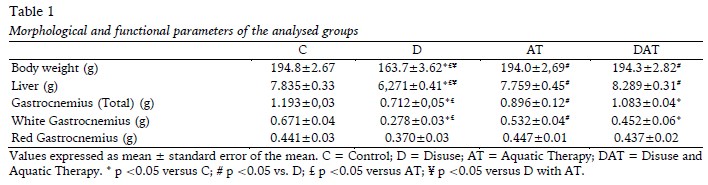
<body><![CDATA[<p>&nbsp;</p>     <p><font size="3" face="Verdana"><b>RESULTS</b></font></p> <font face="Verdana" size="2">     <p>The morphological and functional parameters were analysed among the four   groups and the results obtained indicated a weight reduction of the D group,   which include body weight, liver weight, total gastrocnemius weight and white   portion of the gastrocnemius comparing to the C group and AT group. The disuse   group showed lower liver and body weight in comparison to DAT group. The DAT   group compared to the C, only decreased the weight of total and white portion of the gastrocnemius (<a href="/img/revistas/mot/v13n3/13n3a07t1.jpg">Table 1</a>). </p>     
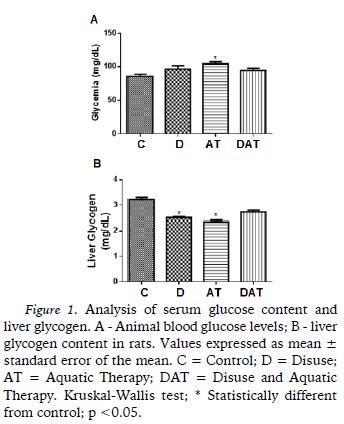
<p>Blood glucose levels were equal in the C group (86 mg/dL); D (96 mg/dL)   and DAT (94 mg/dL), however, the AT group (104 mg/dL) was statistically different   (<i>p</i> = 0.0213) from the C group (<a href="#f1">Figure 1A</a>).</p>     <p><a name="f1"></a></p>     <p>&nbsp;</p>     <p align="center"><img src="/img/revistas/mot/v13n3/13n3a07f1.jpg" width="344" height="424"></p>     
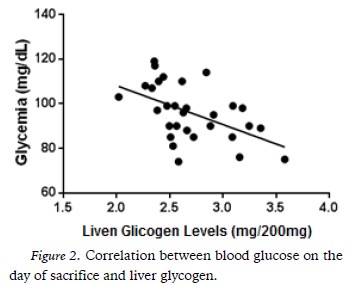
<p>&nbsp;</p>     <p>Regarding the values of liver glycogen (<a href="#f1">Figure 1B</a>), it was found   3.22±0.08 mg in the C group, 2.51±0.03 mg in the D group, 2.35±0.07 mg in the   AT group, 2.73mg ± 0.07 in the DAT group. Groups D and AT were statistically   different from the C group (<i>p</i> &lt;0.0001).</p>     <p>A correlation analysis was performed between hepatic glycogen and blood   glucose of the animals (<a href="#f2">Figure 2</a>) and it was obtained a moderate and inverse correlation (<i>p</i> = 0, 0038; <i>r</i> = 0, 5123). </p>     ]]></body>
<body><![CDATA[<p><a name="f2"></a></p>     <p>&nbsp;</p>     <p align="center"><img src="/img/revistas/mot/v13n3/13n3a07f2.jpg" width="348" height="285"></p>     
<p>&nbsp;</p>     <p>Blood glucose showed a moderated inverse correlation (<i>r</i> = -0.5123, <i>p</i> = 0.0038).</p>     <p>&nbsp;</p> </font><font size="3" face="Verdana"><b>DISCUSSION</b></font>  <font face="Verdana" size="2"></font><font face="Verdana" size="2">     <p>The present study showed that two   weeks of immobilization of a body part caused muscle loss and dysfunction in   the energy metabolism reserve. The liver glycogen reserves of D and AT groups   were reduced. The performance of the aquatic therapy after immobilization   resulted in regain of muscle weight, blood glucose and levels of liver glycogen.</p>     <p>Regarding tissue mass loss, this   study demonstrated that two weeks of disuse by paw immobilization in extension   caused a decrease in muscle mass of the gastrocnemius, comparing to the C   group, which it was evidenced by the reduction in body and muscle weight. These   data are consistent with previous studies, showing that a short period of   disuse by immobilization generates weight reduction (Carvalho et al., 2014; Santos   Júnior et al., 2010), reduction in muscle length (Carvalho et al.,   2014) and contractile capacity (Santos Júnior et al., 2015). It is known that   disuse by immobilization promotes several morphological and physiological   changes (Alves et al., 2013) and it acts directly in the muscle tone loss,   leading to muscle atrophy (Santos Júnior et al., 2010). Two weeks of   immobilization can cause loss of myofibrils and decrease of the size of muscle   fibers (Ploug et al., 1995), changes in the morphology of the fibers and muscle   mechanics (Lima et al., 2007). Skeletal muscles can be affected by external   influences, such as therapeutic immobilization, which changes their biochemical   and structural characteristics (Artifon et al., 2012). In a previous study on   energy metabolism in muscle atrophy (Stein &amp; Wade, 2005) results showed an   increase in enzyme expression values related to gluconeogenesis in the liver,   indicating a higher consumption of liver glycogen, which supports the data   obtained in this study, considering that a decrease in liver glycogen in immobilized animals was also observed.</p>     <p>The AT group had lower levels of   liver glycogen and higher blood glucose compared to the C group. A previous   study about acute intermittent jumping exercise in rats showed an increase in   glucose levels and decreased hepatic glycogen levels (Romijn et al., 1993),   corroborating with the data obtained in this study. Blood glucose control is   essential to the functions of glucose dependent tissues, maintained through   consumption of carbohydrates, glycogenolysis and gluconeogenesis (Alves et al.,   2013). Exercise increases the oxidation of muscle glycogen (Rogatto   et al., 2004), and the reduction of liver glycogen evidenced in this study may   be related to higher consumption of muscle glycogen during exercise or as a   replacement strategy for muscle glycogen. This fact would justify the lower   level of glycogen in the liver and increased glucose circulating in AT group, as supported by statistical correlation.</p>     <p>Aquatic therapy is a resource used in   rehabilitation aimed at muscle recovery (Santos Júnior, 2012), in order to   provide functional restoration (Canderolo &amp; Caromano, 2007). Aquatic   therapy can promote improvements in muscle strength, flexibility and   cardiorespiratory fitness, being efficient in fitness with a less risk of   injury (Canderolo &amp; Caromano, 2007; Canderolo, Caromano, 2008). The DAT   group showed values for liver glycogen similar to the C group, demonstrating that aquatic therapy was effective to restore liver energy reserves.</p>     ]]></body>
<body><![CDATA[<p>In a human study, the glycogen   contents and the glycogen synthase protein levels were decreased post two weeks   of immobilization in the vastus lateralis muscle, and the values were recovered   after six weeks of supervised ergometer bicycle training (Vigelso et al.,   2016). Our animal model presented similar results in liver and muscle weights,   demonstrating that it is possible to perform the glycogen liver recovery with aquatic therapy. </p>     <p>&nbsp;</p> </font><font size="3" face="Verdana"><b>CONCLUSION</b></font>      <p><font size="2" face="Verdana">The results indicated that the disuse   caused by paw immobilization in rats for a two weeks’ period promoted   significant changes in the hepatic glucose reserves and the aquatic therapy   restored some adverse factors of the immobilization, especially influencing the regulation of energy metabolism.</font></p>     <p>&nbsp;</p>     <p><font size="3" face="Verdana"><b>REFERENCES</b></font></p> <font face="Verdana" size="2">    <!-- ref --><p>Alves, J. S.,   Leal-Cardoso, J. H., Santos Júnior, F. F. U., Carlos, P. S., Silva, R. C.,   Lucci, C.M., ... Ceccatto, V. M. (2013). Limb   immobilization alters functional electrophysiological parameters of sciatic   nerve. <i>Brazilian Journal of Medical and Biological Research, 46</i>(8), 715-721. doi: 10.1590/1414-431X20132626 &nbsp;&nbsp;&nbsp;&nbsp;&nbsp;&nbsp;&nbsp;&nbsp;[&#160;<a href="javascript:void(0);" onclick="javascript: window.open('/scielo.php?script=sci_nlinks&ref=368299&pid=S1646-107X201700040000700001&lng=','','width=640,height=500,resizable=yes,scrollbars=1,menubar=yes,');">Links</a>&#160;]<!-- end-ref --><!-- ref --><p>Appell, H. J. (1990). Muscular atrophy following   immobilization. A review. <i>Sports Medicine, 10</i>(1), 42-58.    &nbsp;&nbsp;&nbsp;&nbsp;&nbsp;&nbsp;&nbsp;&nbsp;[&#160;<a href="javascript:void(0);" onclick="javascript: window.open('/scielo.php?script=sci_nlinks&ref=368300&pid=S1646-107X201700040000700002&lng=','','width=640,height=500,resizable=yes,scrollbars=1,menubar=yes,');">Links</a>&#160;]<!-- end-ref --></p>     <!-- ref --><p>Artifon, E. L., Ferrari, D.,   Cunha, D. M., Nascimento, C. M., Ribeiro, L.   F., &amp; Bertolini, G. R. (2012). Effects   of therapeutic ultrasound associated with static stretching on longitudinal histomorphometric parameters of immobilized soleus of rats. <i>Revista Brasileira de Medicina do Esporte, 18</i>(5), 341-344. doi: 10.1590/S1517-86922012000500012&nbsp;&nbsp;&nbsp;&nbsp;&nbsp;&nbsp;&nbsp;&nbsp;[&#160;<a href="javascript:void(0);" onclick="javascript: window.open('/scielo.php?script=sci_nlinks&ref=368302&pid=S1646-107X201700040000700003&lng=','','width=640,height=500,resizable=yes,scrollbars=1,menubar=yes,');">Links</a>&#160;]<!-- end-ref --><!-- ref --><p>Bertolini,   S. M., De Oliveira, P. D., &amp; Cararo, D. C. (2010). Morphometric study of post-joint immobilization of soleus muscle on wistar lineage rats. <i>Acta Scientiarum. Health Sciences, 32</i>(1), 23-27. doi: 10.4025/actascihealthsci.v32i1.5908&nbsp;&nbsp;&nbsp;&nbsp;&nbsp;&nbsp;&nbsp;&nbsp;[&#160;<a href="javascript:void(0);" onclick="javascript: window.open('/scielo.php?script=sci_nlinks&ref=368303&pid=S1646-107X201700040000700004&lng=','','width=640,height=500,resizable=yes,scrollbars=1,menubar=yes,');">Links</a>&#160;]<!-- end-ref --><!-- ref --><p>Biasoli,   M. C., &amp; Machado, C. M. (2006). Hidroterapia: técnicas e aplicabilidades   nas disfunções reumatológicas. <i>Temas de Reumatologia Clínica, 7</i>(3), 78-87.    &nbsp;&nbsp;&nbsp;&nbsp;&nbsp;&nbsp;&nbsp;&nbsp;[&#160;<a href="javascript:void(0);" onclick="javascript: window.open('/scielo.php?script=sci_nlinks&ref=368304&pid=S1646-107X201700040000700005&lng=','','width=640,height=500,resizable=yes,scrollbars=1,menubar=yes,');">Links</a>&#160;]<!-- end-ref --></p>     <!-- ref --><p>Candeloro,   J. M., &amp; Caromano, F. A. (2007). Effects of a   hydrotherapy program on flexibility and muscular strength in elderly women. <i>Revista Brasileira de Fisioterapia, 11</i>(4), 303-309. doi: 10.1590/S1413-35552007000400010&nbsp;&nbsp;&nbsp;&nbsp;&nbsp;&nbsp;&nbsp;&nbsp;[&#160;<a href="javascript:void(0);" onclick="javascript: window.open('/scielo.php?script=sci_nlinks&ref=368306&pid=S1646-107X201700040000700006&lng=','','width=640,height=500,resizable=yes,scrollbars=1,menubar=yes,');">Links</a>&#160;]<!-- end-ref --><!-- ref --><p>Candeloro, J. M., &amp; Caromano, F. A. (2008). Effects   of a hydrotherapy program on blood pressure and heart rate in elderly,   sedentary women. <i>Fisioterapia e Pesquisa, 15</i>(1), 26-32. doi: 10.1590/S1809-29502008000100005 &nbsp;&nbsp;&nbsp;&nbsp;&nbsp;&nbsp;&nbsp;&nbsp;[&#160;<a href="javascript:void(0);" onclick="javascript: window.open('/scielo.php?script=sci_nlinks&ref=368307&pid=S1646-107X201700040000700007&lng=','','width=640,height=500,resizable=yes,scrollbars=1,menubar=yes,');">Links</a>&#160;]<!-- end-ref --><!-- ref --><p>Carvalho, M. M.,   Martins, W. R., Blackzick, J. C., Cruz Júnior, C. A., Souza, H. A., Kückelhaus,   S. A. S., &amp; Mota, M. R. (2014). Morphometric   analysis of the effects of immobilization on the gastrocnemius muscle of rats. <i>Universitas: Ciências da Saúde, 11</i>(2), 99-106. doi: 10.5102/ucs.v11i2.2518&nbsp;&nbsp;&nbsp;&nbsp;&nbsp;&nbsp;&nbsp;&nbsp;[&#160;<a href="javascript:void(0);" onclick="javascript: window.open('/scielo.php?script=sci_nlinks&ref=368308&pid=S1646-107X201700040000700008&lng=','','width=640,height=500,resizable=yes,scrollbars=1,menubar=yes,');">Links</a>&#160;]<!-- end-ref --><!-- ref --><p>Carlos,   C. S., Oliveira, V. F., Saraiva, L. G., Dornelas, P. G., Corrêa, J. A., Costa, A. M., ... Calábria, L. K. (2014). Glycogenoses: An Overeview. <i>Bioscience Journal, 30</i>(5), 1598-1605.    &nbsp;&nbsp;&nbsp;&nbsp;&nbsp;&nbsp;&nbsp;&nbsp;[&#160;<a href="javascript:void(0);" onclick="javascript: window.open('/scielo.php?script=sci_nlinks&ref=368309&pid=S1646-107X201700040000700009&lng=','','width=640,height=500,resizable=yes,scrollbars=1,menubar=yes,');">Links</a>&#160;]<!-- end-ref --></p>     <!-- ref --><p>Gabilan,   Y. P., Perracini, M. R., Munhoz, M. S., &amp; Ganança, F. F. (2006). Aquatic physiotherapy for vestibular rehabilitation. <i>Acta Otorrinolaringologia, 24</i>(1), 23-8.    &nbsp;&nbsp;&nbsp;&nbsp;&nbsp;&nbsp;&nbsp;&nbsp;[&#160;<a href="javascript:void(0);" onclick="javascript: window.open('/scielo.php?script=sci_nlinks&ref=368311&pid=S1646-107X201700040000700010&lng=','','width=640,height=500,resizable=yes,scrollbars=1,menubar=yes,');">Links</a>&#160;]<!-- end-ref --></p>     <!-- ref --><p>Gomes,   N. M. A., Souza, K. C. L., Rabelo, M., Fortes, J. P. A., Barbosa, L. S.,   Craveiro, R. M. C. B., Filho, F. S. L. V., Júnior, F. F. U. S., &amp; Ceccatto,   V. M.  (2016). Aquatic therapy in bone mineral density in   rats after paw disuse by immobilization. <i>International     Journal of Therapies &amp; Rehabilitation Research, 5</i>(5), 161-169. doi: 10.5455/ijtrr.000000200&nbsp;&nbsp;&nbsp;&nbsp;&nbsp;&nbsp;&nbsp;&nbsp;[&#160;<a href="javascript:void(0);" onclick="javascript: window.open('/scielo.php?script=sci_nlinks&ref=368313&pid=S1646-107X201700040000700011&lng=','','width=640,height=500,resizable=yes,scrollbars=1,menubar=yes,');">Links</a>&#160;]<!-- end-ref --><!-- ref --><p>Hundal, H. S., Ramlal, T., Reyes, R., Leiter, L.   A., &amp; Klip, A. (1992). Cellular mechanism of metformin action involves   glucose transporter translocation from an intracellular pool to the plasma   membrane in L6 muscle cells. <i>Endocrinology</i>,   <i>131</i>(3), 1165-1173. doi: 10.1210/endo.131.3.1505458&nbsp;&nbsp;&nbsp;&nbsp;&nbsp;&nbsp;&nbsp;&nbsp;[&#160;<a href="javascript:void(0);" onclick="javascript: window.open('/scielo.php?script=sci_nlinks&ref=368314&pid=S1646-107X201700040000700012&lng=','','width=640,height=500,resizable=yes,scrollbars=1,menubar=yes,');">Links</a>&#160;]<!-- end-ref --><!-- ref --><p>Klip, A., &amp; Pâquet, M. R. (1990). Glucose transport and glucose   transporters in muscle and their metabolic regulation. <i>Diabetes Care,</i> <i>13</i>(3), 228-243.    &nbsp;&nbsp;&nbsp;&nbsp;&nbsp;&nbsp;&nbsp;&nbsp;[&#160;<a href="javascript:void(0);" onclick="javascript: window.open('/scielo.php?script=sci_nlinks&ref=368315&pid=S1646-107X201700040000700013&lng=','','width=640,height=500,resizable=yes,scrollbars=1,menubar=yes,');">Links</a>&#160;]<!-- end-ref --> </p>     <!-- ref --><p>Lima-Silva,   A. E., Fernandes, T. C., Oliveira, F. R., Nakamura, F. Y., &amp; Gevaerd, M. D.   (2007). Muscle glycogen metabolism during exercise: mechanism   of regulation. <i>Revista de Nutrição, 20</i>(4), 417-429. doi: 10.1590/S1415-52732007000400009&nbsp;&nbsp;&nbsp;&nbsp;&nbsp;&nbsp;&nbsp;&nbsp;[&#160;<a href="javascript:void(0);" onclick="javascript: window.open('/scielo.php?script=sci_nlinks&ref=368317&pid=S1646-107X201700040000700014&lng=','','width=640,height=500,resizable=yes,scrollbars=1,menubar=yes,');">Links</a>&#160;]<!-- end-ref --><!-- ref --><p>Lima,   S. C., Caierão, Q. M., Durigan, J. L., Schwarzenbeck, A., Silva, C. A.,   Minamoto, V. B., &amp; Guirro, R. R. (2007). Short-term   immobilization causes morphometric and mechanical alterations on rat muscles. <i>Revista Brasileira de Fisioterapia, 11</i>(4), 297-302. doi: 10.1590/S1413-35552007000400009&nbsp;&nbsp;&nbsp;&nbsp;&nbsp;&nbsp;&nbsp;&nbsp;[&#160;<a href="javascript:void(0);" onclick="javascript: window.open('/scielo.php?script=sci_nlinks&ref=368318&pid=S1646-107X201700040000700015&lng=','','width=640,height=500,resizable=yes,scrollbars=1,menubar=yes,');">Links</a>&#160;]<!-- end-ref --><!-- ref --><p>Lo, S., Russel, J. C., &amp; Taylor, A. (1970). Determination of glycogen in small tissue   samples. <i>Journal of Applied Physiology, 28</i>(2), 234-236.    &nbsp;&nbsp;&nbsp;&nbsp;&nbsp;&nbsp;&nbsp;&nbsp;[&#160;<a href="javascript:void(0);" onclick="javascript: window.open('/scielo.php?script=sci_nlinks&ref=368319&pid=S1646-107X201700040000700016&lng=','','width=640,height=500,resizable=yes,scrollbars=1,menubar=yes,');">Links</a>&#160;]<!-- end-ref --></p>     <!-- ref --><p>Medeiros, A., Oliveira, E. M., Gianolla, R., Casarini,   D. E., Negrão, C. E., &amp; Brum, P. C. (2004). Swimming   training increases cardiac vagal activity and induces cardiac hypertrophy in   rats.   <i>Brazilian Journal of Medical and   Biological Research, 37</i>(12), 1909-17. doi: 10.1590/S0100-879X2004001200018&nbsp;&nbsp;&nbsp;&nbsp;&nbsp;&nbsp;&nbsp;&nbsp;[&#160;<a href="javascript:void(0);" onclick="javascript: window.open('/scielo.php?script=sci_nlinks&ref=368321&pid=S1646-107X201700040000700017&lng=','','width=640,height=500,resizable=yes,scrollbars=1,menubar=yes,');">Links</a>&#160;]<!-- end-ref --><!-- ref --><p>Motta, V. T. (2011). <i>Bioquímica</i> (2ª   ed.). Belgium: Medbook.    &nbsp;&nbsp;&nbsp;&nbsp;&nbsp;&nbsp;&nbsp;&nbsp;[&#160;<a href="javascript:void(0);" onclick="javascript: window.open('/scielo.php?script=sci_nlinks&ref=368322&pid=S1646-107X201700040000700018&lng=','','width=640,height=500,resizable=yes,scrollbars=1,menubar=yes,');">Links</a>&#160;]<!-- end-ref --></p>     ]]></body>
<body><![CDATA[<!-- ref --><p>Nunes, W. M. S., &amp;   Mello, M. A. R. (2009). Glicidic metabolism in rats submitted to denervation of skeletal muscle and swimming exercise. <i>Revista Brasileira de Medicina do Esporte, 15</i>(1), 42-45. doi: 10.1590/S1517-86922009000100009&nbsp;&nbsp;&nbsp;&nbsp;&nbsp;&nbsp;&nbsp;&nbsp;[&#160;<a href="javascript:void(0);" onclick="javascript: window.open('/scielo.php?script=sci_nlinks&ref=368324&pid=S1646-107X201700040000700019&lng=','','width=640,height=500,resizable=yes,scrollbars=1,menubar=yes,');">Links</a>&#160;]<!-- end-ref --><!-- ref --><p>Pestana, P. R., Alves, A. N., Fernandes, K. P., Silva Júnior, J. A.,   França, C. M., Martins, M. D., Bussadori, S.K., &amp; Mesquita-Ferrari, R. A.   (2012). Swimming influence on the expression of myogenic   regulatory factors during skeletal muscle repair of rats<i>. Revista Brasileira de Medicina do Esporte, 18</i>(6), 419-422. doi: 10.1590/S1517-86922012000600015&nbsp;&nbsp;&nbsp;&nbsp;&nbsp;&nbsp;&nbsp;&nbsp;[&#160;<a href="javascript:void(0);" onclick="javascript: window.open('/scielo.php?script=sci_nlinks&ref=368325&pid=S1646-107X201700040000700020&lng=','','width=640,height=500,resizable=yes,scrollbars=1,menubar=yes,');">Links</a>&#160;]<!-- end-ref --><!-- ref --><p>Ploug, T., Ohkuwa, T. E., Handberg, A. A., Vissing, J. O., &amp; Galbo,   H. (1995). Effect of   immobilization on glucose transport and glucose transporter expression in rat   skeletal muscle. <i>American Journal of Physiology Endocrinology and Metabolism, 268</i>(5), E980-E986&nbsp;&nbsp;&nbsp;&nbsp;&nbsp;&nbsp;&nbsp;&nbsp;[&#160;<a href="javascript:void(0);" onclick="javascript: window.open('/scielo.php?script=sci_nlinks&ref=368326&pid=S1646-107X201700040000700021&lng=','','width=640,height=500,resizable=yes,scrollbars=1,menubar=yes,');">Links</a>&#160;]<!-- end-ref --><!-- ref --><p>Resende, S. M., Rassi, C. M., &amp;   Viana, F. P. (2008). Effects of hydrotherapy in balance and prevention of   falls among elderly women. <i>Revista     Brasileira de Fisioterapia, 12</i>(1), 57-63. doi: 10.1590/S1413-35552008000100011&nbsp;&nbsp;&nbsp;&nbsp;&nbsp;&nbsp;&nbsp;&nbsp;[&#160;<a href="javascript:void(0);" onclick="javascript: window.open('/scielo.php?script=sci_nlinks&ref=368327&pid=S1646-107X201700040000700022&lng=','','width=640,height=500,resizable=yes,scrollbars=1,menubar=yes,');">Links</a>&#160;]<!-- end-ref --><!-- ref --><p>Rogatto,   G. P., Oliveira, C. A. M., Faria, M. C., &amp; Luciano, E. (2004). Acute metabolic responses of Wistar rats to intermittent jump exercise. <i>Motriz, 10</i>(2), 61-66.    &nbsp;&nbsp;&nbsp;&nbsp;&nbsp;&nbsp;&nbsp;&nbsp;[&#160;<a href="javascript:void(0);" onclick="javascript: window.open('/scielo.php?script=sci_nlinks&ref=368328&pid=S1646-107X201700040000700023&lng=','','width=640,height=500,resizable=yes,scrollbars=1,menubar=yes,');">Links</a>&#160;]<!-- end-ref --></p>     <!-- ref --><p>Romijn, J. A., Coyle, E. F., Sidossis, L. S.,   Gastaldelli, A., Horowitz, J. F., Endert, E., &amp; Wolfe, R. R. (1993).   Regulation of endogenous fat and carbohydrate metabolism in relation to   exercise intensity and duration. <i>American Journal of Physiology, 265</i>(3), E380-E391.    &nbsp;&nbsp;&nbsp;&nbsp;&nbsp;&nbsp;&nbsp;&nbsp;[&#160;<a href="javascript:void(0);" onclick="javascript: window.open('/scielo.php?script=sci_nlinks&ref=368330&pid=S1646-107X201700040000700024&lng=','','width=640,height=500,resizable=yes,scrollbars=1,menubar=yes,');">Links</a>&#160;]<!-- end-ref --></p>     <!-- ref --><p>Santos   Júnior, F. F. U., Alves, J. S., Machado, A. A., Carlos, P. S., Ferraz, A. S.,   Barbosa, R., Leal-Cardoso, J. H., &amp; Ceccatto, V. M. (2010). Morphometric alterations in respiratory muscle   of rats submitted to paw immobilization. <i>Revista Brasileira de Medicina do Esporte, 16</i>(3), 215-218. doi: 10.1590/S1517-86922010000300012&nbsp;&nbsp;&nbsp;&nbsp;&nbsp;&nbsp;&nbsp;&nbsp;[&#160;<a href="javascript:void(0);" onclick="javascript: window.open('/scielo.php?script=sci_nlinks&ref=368332&pid=S1646-107X201700040000700025&lng=','','width=640,height=500,resizable=yes,scrollbars=1,menubar=yes,');">Links</a>&#160;]<!-- end-ref --><!-- ref --><p>Santos Júnior, F. F.   U., Souza, A. L., Franco, F. G., André, N. M., &amp; Ceccatto, V. M. (2012). Diaphragmatic rehabilitation post-immobilization with aquatic therapy in   rats. <i>Fisioterapia Brasil, 13</i>(6), 420-424&nbsp;&nbsp;&nbsp;&nbsp;&nbsp;&nbsp;&nbsp;&nbsp;[&#160;<a href="javascript:void(0);" onclick="javascript: window.open('/scielo.php?script=sci_nlinks&ref=368333&pid=S1646-107X201700040000700026&lng=','','width=640,height=500,resizable=yes,scrollbars=1,menubar=yes,');">Links</a>&#160;]<!-- end-ref --><!-- ref --><p>Santos Júnior, F. F.   U., Freitas Pires, A., Ribeiro, N. M., Mendonça, V. A., Alves, J. O., Soares,   P. M., Ceccatto, V. M., &amp; Assreuy, A. M. (2015). Sensorial,   structural and functional response of rats subjected to hindlimb   immobilization. <i>Life Sciences, 137</i>, 158-63. doi: 10.1016/j.lfs.2015.07.020&nbsp;&nbsp;&nbsp;&nbsp;&nbsp;&nbsp;&nbsp;&nbsp;[&#160;<a href="javascript:void(0);" onclick="javascript: window.open('/scielo.php?script=sci_nlinks&ref=368334&pid=S1646-107X201700040000700027&lng=','','width=640,height=500,resizable=yes,scrollbars=1,menubar=yes,');">Links</a>&#160;]<!-- end-ref --><!-- ref --><p>Stein, T. P., &amp; Wade, C. E. (2005).   Metabolic consequences of muscle disuse atrophy.<i> The Journal of Nutrition, 135</i>(7), 1824S-1828S.    &nbsp;&nbsp;&nbsp;&nbsp;&nbsp;&nbsp;&nbsp;&nbsp;[&#160;<a href="javascript:void(0);" onclick="javascript: window.open('/scielo.php?script=sci_nlinks&ref=368335&pid=S1646-107X201700040000700028&lng=','','width=640,height=500,resizable=yes,scrollbars=1,menubar=yes,');">Links</a>&#160;]<!-- end-ref --> </p>     <!-- ref --><p>Vigelsø, A., Gram, M., Wiuff,   C., Hansen, C. N., Prats, C., Dela, F., &amp; Helge, J. W. (2016). Effects of   immobilization and aerobic training on proteins related to intramuscular substrate storage and metabolism in young and older men. <i>European journal of applied physiology</i>, <i>116</i>(3), 481-494. doi: 10.1007/s00421-015-3302-x&nbsp;&nbsp;&nbsp;&nbsp;&nbsp;&nbsp;&nbsp;&nbsp;[&#160;<a href="javascript:void(0);" onclick="javascript: window.open('/scielo.php?script=sci_nlinks&ref=368337&pid=S1646-107X201700040000700029&lng=','','width=640,height=500,resizable=yes,scrollbars=1,menubar=yes,');">Links</a>&#160;]<!-- end-ref --><!-- ref --><p>Volpi, F. S., Casarolli, L. M., Pudell, C.,   Menon, T., Ciena, A. P., Alves, E. P., &amp; Bertolini, G. R. F. (2008). Effects of remobilization in two weeks of swimming on the soleus muscle   of rats submitted to immobilization. <i>Revista Brasileira de Medicina do Esporte, 14</i>(3), 168-170. doi: 10.1590/S1517-86922008000300001&nbsp;&nbsp;&nbsp;&nbsp;&nbsp;&nbsp;&nbsp;&nbsp;[&#160;<a href="javascript:void(0);" onclick="javascript: window.open('/scielo.php?script=sci_nlinks&ref=368338&pid=S1646-107X201700040000700030&lng=','','width=640,height=500,resizable=yes,scrollbars=1,menubar=yes,');">Links</a>&#160;]<!-- end-ref --><p>&nbsp;</p>     <p><font size="2" face="Verdana"><b>Acknowledgments:</b>    <br>   Nothing   to declare<b>    <br>   Conflict of interest:</b>    <br>   Nothing to   declare<b>    ]]></body>
<body><![CDATA[<br>   Funding:    <br>   </b></font><font size="2" face="Verdana">Nothing to   declare</font></p> <font size="2" face="Verdana">Manuscript received at  January 1st 2017; Accepted at May 18th 2017     <p>&nbsp;</p>     <p>&nbsp;</p> <a href="#top"><sup>*</sup></a><i><a name="end"></a> Corresponding author</i>:  Laboratory of Biochemistry and Genic Expression &ndash; Superior Institute of  Biomedical Sciences. Av. Dr. Silas Munguba, 1700  - Campus do Itaperi. Fortaleza/CE/Brasil. CEP: 60714-903. Tel.: (+55) 85 3101 9814; <a href="http://www.uece.br/cmacf" target="_blank">www.uece.br/cmacf</a> <i>E-mail: </i><a href="mailto:vania.ceccatto@uece.br">vania.ceccatto@uece.br</a></font>      ]]></body><back>
<ref-list>
<ref id="B1">
<nlm-citation citation-type="journal">
<person-group person-group-type="author">
<name>
<surname><![CDATA[Alves]]></surname>
<given-names><![CDATA[J. S.]]></given-names>
</name>
<name>
<surname><![CDATA[Leal-Cardoso]]></surname>
<given-names><![CDATA[J. H.]]></given-names>
</name>
<name>
<surname><![CDATA[Santos Júnior]]></surname>
<given-names><![CDATA[F. F. U.]]></given-names>
</name>
<name>
<surname><![CDATA[Carlos]]></surname>
<given-names><![CDATA[P. S.]]></given-names>
</name>
<name>
<surname><![CDATA[Silva]]></surname>
<given-names><![CDATA[R. C.]]></given-names>
</name>
<name>
<surname><![CDATA[Lucci]]></surname>
<given-names><![CDATA[C.M.]]></given-names>
</name>
<name>
<surname><![CDATA[Ceccatto]]></surname>
<given-names><![CDATA[V. M.]]></given-names>
</name>
</person-group>
<article-title xml:lang="en"><![CDATA[Limb immobilization alters functional electrophysiological parameters of sciatic nerve]]></article-title>
<source><![CDATA[Brazilian Journal of Medical and Biological Research]]></source>
<year>2013</year>
<volume>46</volume>
<numero>8</numero>
<issue>8</issue>
<page-range>715-721</page-range></nlm-citation>
</ref>
<ref id="B2">
<nlm-citation citation-type="journal">
<person-group person-group-type="author">
<name>
<surname><![CDATA[Appell]]></surname>
<given-names><![CDATA[H. J.]]></given-names>
</name>
</person-group>
<article-title xml:lang="en"><![CDATA[Muscular atrophy following immobilization: A review]]></article-title>
<source><![CDATA[Sports Medicine]]></source>
<year>1990</year>
<volume>10</volume>
<numero>1</numero>
<issue>1</issue>
<page-range>42-58</page-range></nlm-citation>
</ref>
<ref id="B3">
<nlm-citation citation-type="journal">
<person-group person-group-type="author">
<name>
<surname><![CDATA[Artifon]]></surname>
<given-names><![CDATA[E. L.]]></given-names>
</name>
<name>
<surname><![CDATA[Ferrari]]></surname>
<given-names><![CDATA[D.]]></given-names>
</name>
<name>
<surname><![CDATA[Cunha]]></surname>
<given-names><![CDATA[D. M.]]></given-names>
</name>
<name>
<surname><![CDATA[Nascimento]]></surname>
<given-names><![CDATA[C. M.]]></given-names>
</name>
<name>
<surname><![CDATA[Ribeiro]]></surname>
<given-names><![CDATA[L. F.]]></given-names>
</name>
<name>
<surname><![CDATA[Bertolini]]></surname>
<given-names><![CDATA[G. R.]]></given-names>
</name>
</person-group>
<article-title xml:lang="en"><![CDATA[Effects of therapeutic ultrasound associated with static stretching on longitudinal histomorphometric parameters of immobilized soleus of rats]]></article-title>
<source><![CDATA[Revista Brasileira de Medicina do Esporte]]></source>
<year>2012</year>
<volume>18</volume>
<numero>5</numero>
<issue>5</issue>
<page-range>341-344</page-range></nlm-citation>
</ref>
<ref id="B4">
<nlm-citation citation-type="journal">
<person-group person-group-type="author">
<name>
<surname><![CDATA[Bertolini]]></surname>
<given-names><![CDATA[S. M.]]></given-names>
</name>
<name>
<surname><![CDATA[De Oliveira]]></surname>
<given-names><![CDATA[P. D.]]></given-names>
</name>
<name>
<surname><![CDATA[Cararo]]></surname>
<given-names><![CDATA[D. C.]]></given-names>
</name>
</person-group>
<article-title xml:lang="en"><![CDATA[Morphometric study of post-joint immobilization of soleus muscle on wistar lineage rats]]></article-title>
<source><![CDATA[Acta Scientiarum. Health Sciences]]></source>
<year>2010</year>
<volume>32</volume>
<numero>1</numero>
<issue>1</issue>
<page-range>23-27</page-range></nlm-citation>
</ref>
<ref id="B5">
<nlm-citation citation-type="journal">
<person-group person-group-type="author">
<name>
<surname><![CDATA[Biasoli]]></surname>
<given-names><![CDATA[M. C.]]></given-names>
</name>
<name>
<surname><![CDATA[Machado]]></surname>
<given-names><![CDATA[C. M.]]></given-names>
</name>
</person-group>
<article-title xml:lang="pt"><![CDATA[Hidroterapia: técnicas e aplicabilidades nas disfunções reumatológicas]]></article-title>
<source><![CDATA[Temas de Reumatologia Clínica]]></source>
<year>2006</year>
<volume>7</volume>
<numero>3</numero>
<issue>3</issue>
<page-range>78-87</page-range></nlm-citation>
</ref>
<ref id="B6">
<nlm-citation citation-type="journal">
<person-group person-group-type="author">
<name>
<surname><![CDATA[Candeloro]]></surname>
<given-names><![CDATA[J. M.]]></given-names>
</name>
<name>
<surname><![CDATA[Caromano]]></surname>
<given-names><![CDATA[F. A.]]></given-names>
</name>
</person-group>
<article-title xml:lang="en"><![CDATA[Effects of a hydrotherapy program on flexibility and muscular strength in elderly women]]></article-title>
<source><![CDATA[Revista Brasileira de Fisioterapia]]></source>
<year>2007</year>
<volume>11</volume>
<numero>4</numero>
<issue>4</issue>
<page-range>303-309</page-range></nlm-citation>
</ref>
<ref id="B7">
<nlm-citation citation-type="journal">
<person-group person-group-type="author">
<name>
<surname><![CDATA[Candeloro]]></surname>
<given-names><![CDATA[J. M.]]></given-names>
</name>
<name>
<surname><![CDATA[Caromano]]></surname>
<given-names><![CDATA[F. A.]]></given-names>
</name>
</person-group>
<article-title xml:lang="en"><![CDATA[Effects of a hydrotherapy program on blood pressure and heart rate in elderly, sedentary women]]></article-title>
<source><![CDATA[Fisioterapia e Pesquisa]]></source>
<year>2008</year>
<volume>15</volume>
<numero>1</numero>
<issue>1</issue>
<page-range>26-32</page-range></nlm-citation>
</ref>
<ref id="B8">
<nlm-citation citation-type="journal">
<person-group person-group-type="author">
<name>
<surname><![CDATA[Carvalho]]></surname>
<given-names><![CDATA[M. M.]]></given-names>
</name>
<name>
<surname><![CDATA[Martins]]></surname>
<given-names><![CDATA[W. R.]]></given-names>
</name>
<name>
<surname><![CDATA[Blackzick]]></surname>
<given-names><![CDATA[J. C.]]></given-names>
</name>
<name>
<surname><![CDATA[Cruz Júnior]]></surname>
<given-names><![CDATA[C. A.]]></given-names>
</name>
<name>
<surname><![CDATA[Souza]]></surname>
<given-names><![CDATA[H. A.]]></given-names>
</name>
<name>
<surname><![CDATA[Kückelhaus]]></surname>
<given-names><![CDATA[S. A. S.]]></given-names>
</name>
<name>
<surname><![CDATA[Mota]]></surname>
<given-names><![CDATA[M. R.]]></given-names>
</name>
</person-group>
<article-title xml:lang="en"><![CDATA[Morphometric analysis of the effects of immobilization on the gastrocnemius muscle of rats]]></article-title>
<source><![CDATA[Universitas: Ciências da Saúde]]></source>
<year>2014</year>
<volume>11</volume>
<numero>2</numero>
<issue>2</issue>
<page-range>99-106</page-range></nlm-citation>
</ref>
<ref id="B9">
<nlm-citation citation-type="journal">
<person-group person-group-type="author">
<name>
<surname><![CDATA[Carlos]]></surname>
<given-names><![CDATA[C. S.]]></given-names>
</name>
<name>
<surname><![CDATA[Oliveira]]></surname>
<given-names><![CDATA[V. F.]]></given-names>
</name>
<name>
<surname><![CDATA[Saraiva]]></surname>
<given-names><![CDATA[L. G.]]></given-names>
</name>
<name>
<surname><![CDATA[Dornelas]]></surname>
<given-names><![CDATA[P. G.]]></given-names>
</name>
<name>
<surname><![CDATA[Corrêa]]></surname>
<given-names><![CDATA[J. A.]]></given-names>
</name>
<name>
<surname><![CDATA[Costa]]></surname>
<given-names><![CDATA[A. M.]]></given-names>
</name>
<name>
<surname><![CDATA[Calábria]]></surname>
<given-names><![CDATA[L. K.]]></given-names>
</name>
</person-group>
<article-title xml:lang="en"><![CDATA[Glycogenoses: An Overeview]]></article-title>
<source><![CDATA[Bioscience Journal]]></source>
<year>2014</year>
<volume>30</volume>
<numero>5</numero>
<issue>5</issue>
<page-range>1598-1605</page-range></nlm-citation>
</ref>
<ref id="B10">
<nlm-citation citation-type="journal">
<person-group person-group-type="author">
<name>
<surname><![CDATA[Gabilan]]></surname>
<given-names><![CDATA[Y. P.]]></given-names>
</name>
<name>
<surname><![CDATA[Perracini]]></surname>
<given-names><![CDATA[M. R.]]></given-names>
</name>
<name>
<surname><![CDATA[Munhoz]]></surname>
<given-names><![CDATA[M. S.]]></given-names>
</name>
<name>
<surname><![CDATA[Ganança]]></surname>
<given-names><![CDATA[F. F.]]></given-names>
</name>
</person-group>
<article-title xml:lang="en"><![CDATA[Aquatic physiotherapy for vestibular rehabilitation]]></article-title>
<source><![CDATA[Acta Otorrinolaringologia]]></source>
<year>2006</year>
<volume>24</volume>
<numero>1</numero>
<issue>1</issue>
<page-range>23-8</page-range></nlm-citation>
</ref>
<ref id="B11">
<nlm-citation citation-type="journal">
<person-group person-group-type="author">
<name>
<surname><![CDATA[Gomes]]></surname>
<given-names><![CDATA[N. M. A.]]></given-names>
</name>
<name>
<surname><![CDATA[Souza]]></surname>
<given-names><![CDATA[K. C. L.]]></given-names>
</name>
<name>
<surname><![CDATA[Rabelo]]></surname>
<given-names><![CDATA[M.]]></given-names>
</name>
<name>
<surname><![CDATA[Fortes]]></surname>
<given-names><![CDATA[J. P. A.]]></given-names>
</name>
<name>
<surname><![CDATA[Barbosa]]></surname>
<given-names><![CDATA[L. S.]]></given-names>
</name>
<name>
<surname><![CDATA[Craveiro]]></surname>
<given-names><![CDATA[R. M. C. B.]]></given-names>
</name>
<name>
<surname><![CDATA[Filho]]></surname>
<given-names><![CDATA[F. S. L. V.]]></given-names>
</name>
<name>
<surname><![CDATA[Júnior]]></surname>
<given-names><![CDATA[F. F. U. S.]]></given-names>
</name>
<name>
<surname><![CDATA[Ceccatto]]></surname>
<given-names><![CDATA[V. M.]]></given-names>
</name>
</person-group>
<article-title xml:lang="en"><![CDATA[Aquatic therapy in bone mineral density in rats after paw disuse by immobilization]]></article-title>
<source><![CDATA[International Journal of Therapies & Rehabilitation Research]]></source>
<year>2016</year>
<volume>5</volume>
<numero>5</numero>
<issue>5</issue>
<page-range>161-169</page-range></nlm-citation>
</ref>
<ref id="B12">
<nlm-citation citation-type="journal">
<person-group person-group-type="author">
<name>
<surname><![CDATA[Hundal]]></surname>
<given-names><![CDATA[H. S.]]></given-names>
</name>
<name>
<surname><![CDATA[Ramlal]]></surname>
<given-names><![CDATA[T.]]></given-names>
</name>
<name>
<surname><![CDATA[Reyes]]></surname>
<given-names><![CDATA[R.]]></given-names>
</name>
<name>
<surname><![CDATA[Leiter]]></surname>
<given-names><![CDATA[L. A.]]></given-names>
</name>
<name>
<surname><![CDATA[Klip]]></surname>
<given-names><![CDATA[A.]]></given-names>
</name>
</person-group>
<article-title xml:lang="en"><![CDATA[Cellular mechanism of metformin action involves glucose transporter translocation from an intracellular pool to the plasma membrane in L6 muscle cells]]></article-title>
<source><![CDATA[Endocrinology]]></source>
<year>1992</year>
<volume>131</volume>
<numero>3</numero>
<issue>3</issue>
<page-range>1165-1173</page-range></nlm-citation>
</ref>
<ref id="B13">
<nlm-citation citation-type="journal">
<person-group person-group-type="author">
<name>
<surname><![CDATA[Klip]]></surname>
<given-names><![CDATA[A.]]></given-names>
</name>
<name>
<surname><![CDATA[Pâquet]]></surname>
<given-names><![CDATA[M. R.]]></given-names>
</name>
</person-group>
<article-title xml:lang="en"><![CDATA[Glucose transport and glucose transporters in muscle and their metabolic regulation]]></article-title>
<source><![CDATA[Diabetes Care]]></source>
<year>1990</year>
<volume>13</volume>
<numero>3</numero>
<issue>3</issue>
<page-range>228-243</page-range></nlm-citation>
</ref>
<ref id="B14">
<nlm-citation citation-type="journal">
<person-group person-group-type="author">
<name>
<surname><![CDATA[Lima-Silva]]></surname>
<given-names><![CDATA[A. E.]]></given-names>
</name>
<name>
<surname><![CDATA[Fernandes]]></surname>
<given-names><![CDATA[T. C.]]></given-names>
</name>
<name>
<surname><![CDATA[Oliveira]]></surname>
<given-names><![CDATA[F. R.]]></given-names>
</name>
<name>
<surname><![CDATA[Nakamura]]></surname>
<given-names><![CDATA[F. Y.]]></given-names>
</name>
<name>
<surname><![CDATA[Gevaerd]]></surname>
<given-names><![CDATA[M. D.]]></given-names>
</name>
</person-group>
<article-title xml:lang="en"><![CDATA[Muscle glycogen metabolism during exercise: mechanism of regulation]]></article-title>
<source><![CDATA[Revista de Nutrição]]></source>
<year>2007</year>
<volume>20</volume>
<numero>4</numero>
<issue>4</issue>
<page-range>417-429</page-range></nlm-citation>
</ref>
<ref id="B15">
<nlm-citation citation-type="journal">
<person-group person-group-type="author">
<name>
<surname><![CDATA[Lima]]></surname>
<given-names><![CDATA[S. C.]]></given-names>
</name>
<name>
<surname><![CDATA[Caierão]]></surname>
<given-names><![CDATA[Q. M.]]></given-names>
</name>
<name>
<surname><![CDATA[Durigan]]></surname>
<given-names><![CDATA[J. L.]]></given-names>
</name>
<name>
<surname><![CDATA[Schwarzenbeck]]></surname>
<given-names><![CDATA[A.]]></given-names>
</name>
<name>
<surname><![CDATA[Silva]]></surname>
<given-names><![CDATA[C. A.]]></given-names>
</name>
<name>
<surname><![CDATA[Minamoto]]></surname>
<given-names><![CDATA[V. B.]]></given-names>
</name>
<name>
<surname><![CDATA[Guirro]]></surname>
<given-names><![CDATA[R. R.]]></given-names>
</name>
</person-group>
<article-title xml:lang="en"><![CDATA[Short-term immobilization causes morphometric and mechanical alterations on rat muscles]]></article-title>
<source><![CDATA[Revista Brasileira de Fisioterapia]]></source>
<year>2007</year>
<volume>11</volume>
<numero>4</numero>
<issue>4</issue>
<page-range>297-302</page-range></nlm-citation>
</ref>
<ref id="B16">
<nlm-citation citation-type="journal">
<person-group person-group-type="author">
<name>
<surname><![CDATA[Lo]]></surname>
<given-names><![CDATA[S.]]></given-names>
</name>
<name>
<surname><![CDATA[Russel]]></surname>
<given-names><![CDATA[J. C.]]></given-names>
</name>
<name>
<surname><![CDATA[Taylor]]></surname>
<given-names><![CDATA[A.]]></given-names>
</name>
</person-group>
<article-title xml:lang="en"><![CDATA[Determination of glycogen in small tissue samples]]></article-title>
<source><![CDATA[Journal of Applied Physiology]]></source>
<year>1970</year>
<volume>28</volume>
<numero>2</numero>
<issue>2</issue>
<page-range>234-236</page-range></nlm-citation>
</ref>
<ref id="B17">
<nlm-citation citation-type="journal">
<person-group person-group-type="author">
<name>
<surname><![CDATA[Medeiros]]></surname>
<given-names><![CDATA[A.]]></given-names>
</name>
<name>
<surname><![CDATA[Oliveira]]></surname>
<given-names><![CDATA[E. M.]]></given-names>
</name>
<name>
<surname><![CDATA[Gianolla]]></surname>
<given-names><![CDATA[R.]]></given-names>
</name>
<name>
<surname><![CDATA[Casarini]]></surname>
<given-names><![CDATA[D. E.]]></given-names>
</name>
<name>
<surname><![CDATA[Negrão]]></surname>
<given-names><![CDATA[C. E.]]></given-names>
</name>
<name>
<surname><![CDATA[Brum]]></surname>
<given-names><![CDATA[P. C.]]></given-names>
</name>
</person-group>
<article-title xml:lang="en"><![CDATA[Swimming training increases cardiac vagal activity and induces cardiac hypertrophy in rats]]></article-title>
<source><![CDATA[Brazilian Journal of Medical and Biological Research]]></source>
<year>2004</year>
<volume>37</volume>
<numero>12</numero>
<issue>12</issue>
<page-range>1909-17</page-range></nlm-citation>
</ref>
<ref id="B18">
<nlm-citation citation-type="book">
<person-group person-group-type="author">
<name>
<surname><![CDATA[Motta]]></surname>
<given-names><![CDATA[V. T.]]></given-names>
</name>
</person-group>
<source><![CDATA[Bioquímica]]></source>
<year>2011</year>
<edition>2</edition>
<publisher-name><![CDATA[Medbook]]></publisher-name>
</nlm-citation>
</ref>
<ref id="B19">
<nlm-citation citation-type="journal">
<person-group person-group-type="author">
<name>
<surname><![CDATA[Nunes]]></surname>
<given-names><![CDATA[W. M. S.]]></given-names>
</name>
<name>
<surname><![CDATA[Mello]]></surname>
<given-names><![CDATA[M. A. R.]]></given-names>
</name>
</person-group>
<article-title xml:lang="en"><![CDATA[Glicidic metabolism in rats submitted to denervation of skeletal muscle and swimming exercise]]></article-title>
<source><![CDATA[Revista Brasileira de Medicina do Esporte]]></source>
<year>2009</year>
<volume>15</volume>
<numero>1</numero>
<issue>1</issue>
<page-range>42-45</page-range></nlm-citation>
</ref>
<ref id="B20">
<nlm-citation citation-type="journal">
<person-group person-group-type="author">
<name>
<surname><![CDATA[Pestana]]></surname>
<given-names><![CDATA[P. R.]]></given-names>
</name>
<name>
<surname><![CDATA[Alves]]></surname>
<given-names><![CDATA[A. N.]]></given-names>
</name>
<name>
<surname><![CDATA[Fernandes]]></surname>
<given-names><![CDATA[K. P.]]></given-names>
</name>
<name>
<surname><![CDATA[Silva Júnior]]></surname>
<given-names><![CDATA[J. A.]]></given-names>
</name>
<name>
<surname><![CDATA[França]]></surname>
<given-names><![CDATA[C. M.]]></given-names>
</name>
<name>
<surname><![CDATA[Martins]]></surname>
<given-names><![CDATA[M. D.]]></given-names>
</name>
<name>
<surname><![CDATA[Bussadori]]></surname>
<given-names><![CDATA[S.K.]]></given-names>
</name>
<name>
<surname><![CDATA[Mesquita-Ferrari]]></surname>
<given-names><![CDATA[R. A.]]></given-names>
</name>
</person-group>
<article-title xml:lang="en"><![CDATA[Swimming influence on the expression of myogenic regulatory factors during skeletal muscle repair of rats]]></article-title>
<source><![CDATA[Revista Brasileira de Medicina do Esporte]]></source>
<year>2012</year>
<volume>18</volume>
<numero>6</numero>
<issue>6</issue>
<page-range>419-422</page-range></nlm-citation>
</ref>
<ref id="B21">
<nlm-citation citation-type="journal">
<person-group person-group-type="author">
<name>
<surname><![CDATA[Ploug]]></surname>
<given-names><![CDATA[T.]]></given-names>
</name>
<name>
<surname><![CDATA[Ohkuwa]]></surname>
<given-names><![CDATA[T. E.]]></given-names>
</name>
<name>
<surname><![CDATA[Handberg]]></surname>
<given-names><![CDATA[A. A.]]></given-names>
</name>
<name>
<surname><![CDATA[Vissing]]></surname>
<given-names><![CDATA[J. O.]]></given-names>
</name>
<name>
<surname><![CDATA[Galbo]]></surname>
<given-names><![CDATA[H.]]></given-names>
</name>
</person-group>
<article-title xml:lang="en"><![CDATA[Effect of immobilization on glucose transport and glucose transporter expression in rat skeletal muscle]]></article-title>
<source><![CDATA[American Journal of Physiology Endocrinology and Metabolism]]></source>
<year>1995</year>
<volume>268</volume>
<numero>5</numero>
<issue>5</issue>
<page-range>E980-E986</page-range></nlm-citation>
</ref>
<ref id="B22">
<nlm-citation citation-type="journal">
<person-group person-group-type="author">
<name>
<surname><![CDATA[Resende]]></surname>
<given-names><![CDATA[S. M.]]></given-names>
</name>
<name>
<surname><![CDATA[Rassi]]></surname>
<given-names><![CDATA[C. M.]]></given-names>
</name>
<name>
<surname><![CDATA[Viana]]></surname>
<given-names><![CDATA[F. P.]]></given-names>
</name>
</person-group>
<article-title xml:lang="en"><![CDATA[Effects of hydrotherapy in balance and prevention of falls among elderly women]]></article-title>
<source><![CDATA[Revista Brasileira de Fisioterapia]]></source>
<year>2008</year>
<volume>12</volume>
<numero>1</numero>
<issue>1</issue>
<page-range>57-63</page-range></nlm-citation>
</ref>
<ref id="B23">
<nlm-citation citation-type="journal">
<person-group person-group-type="author">
<name>
<surname><![CDATA[Rogatto]]></surname>
<given-names><![CDATA[G. P.]]></given-names>
</name>
<name>
<surname><![CDATA[Oliveira]]></surname>
<given-names><![CDATA[C. A. M.]]></given-names>
</name>
<name>
<surname><![CDATA[Faria]]></surname>
<given-names><![CDATA[M. C.]]></given-names>
</name>
<name>
<surname><![CDATA[Luciano]]></surname>
<given-names><![CDATA[E.]]></given-names>
</name>
</person-group>
<article-title xml:lang="en"><![CDATA[Acute metabolic responses of Wistar rats to intermittent jump exercise]]></article-title>
<source><![CDATA[Motriz]]></source>
<year>2004</year>
<volume>10</volume>
<numero>2</numero>
<issue>2</issue>
<page-range>61-66</page-range></nlm-citation>
</ref>
<ref id="B24">
<nlm-citation citation-type="journal">
<person-group person-group-type="author">
<name>
<surname><![CDATA[Romijn]]></surname>
<given-names><![CDATA[J. A.]]></given-names>
</name>
<name>
<surname><![CDATA[Coyle]]></surname>
<given-names><![CDATA[E. F.]]></given-names>
</name>
<name>
<surname><![CDATA[Sidossis]]></surname>
<given-names><![CDATA[L. S.]]></given-names>
</name>
<name>
<surname><![CDATA[Gastaldelli]]></surname>
<given-names><![CDATA[A.]]></given-names>
</name>
<name>
<surname><![CDATA[Horowitz]]></surname>
<given-names><![CDATA[J. F.]]></given-names>
</name>
<name>
<surname><![CDATA[Endert]]></surname>
<given-names><![CDATA[E.]]></given-names>
</name>
<name>
<surname><![CDATA[Wolfe]]></surname>
<given-names><![CDATA[R. R.]]></given-names>
</name>
</person-group>
<article-title xml:lang="en"><![CDATA[Regulation of endogenous fat and carbohydrate metabolism in relation to exercise intensity and duration]]></article-title>
<source><![CDATA[American Journal of Physiology]]></source>
<year>1993</year>
<volume>265</volume>
<numero>3</numero>
<issue>3</issue>
<page-range>E380-E391</page-range></nlm-citation>
</ref>
<ref id="B25">
<nlm-citation citation-type="journal">
<person-group person-group-type="author">
<name>
<surname><![CDATA[Santos Júnior]]></surname>
<given-names><![CDATA[F. F. U.]]></given-names>
</name>
<name>
<surname><![CDATA[Alves]]></surname>
<given-names><![CDATA[J. S.]]></given-names>
</name>
<name>
<surname><![CDATA[Machado]]></surname>
<given-names><![CDATA[A. A.]]></given-names>
</name>
<name>
<surname><![CDATA[Carlos]]></surname>
<given-names><![CDATA[P. S.]]></given-names>
</name>
<name>
<surname><![CDATA[Ferraz]]></surname>
<given-names><![CDATA[A. S.]]></given-names>
</name>
<name>
<surname><![CDATA[Barbosa]]></surname>
<given-names><![CDATA[R.]]></given-names>
</name>
<name>
<surname><![CDATA[Leal-Cardoso]]></surname>
<given-names><![CDATA[J. H.]]></given-names>
</name>
<name>
<surname><![CDATA[Ceccatto]]></surname>
<given-names><![CDATA[V. M.]]></given-names>
</name>
</person-group>
<article-title xml:lang="en"><![CDATA[Morphometric alterations in respiratory muscle of rats submitted to paw immobilization]]></article-title>
<source><![CDATA[Revista Brasileira de Medicina do Esporte]]></source>
<year>2010</year>
<volume>16</volume>
<numero>3</numero>
<issue>3</issue>
<page-range>215-218</page-range></nlm-citation>
</ref>
<ref id="B26">
<nlm-citation citation-type="journal">
<person-group person-group-type="author">
<name>
<surname><![CDATA[Santos Júnior]]></surname>
<given-names><![CDATA[F. F. U.]]></given-names>
</name>
<name>
<surname><![CDATA[Souza]]></surname>
<given-names><![CDATA[A. L.]]></given-names>
</name>
<name>
<surname><![CDATA[Franco]]></surname>
<given-names><![CDATA[F. G.]]></given-names>
</name>
<name>
<surname><![CDATA[André]]></surname>
<given-names><![CDATA[N. M.]]></given-names>
</name>
<name>
<surname><![CDATA[Ceccatto]]></surname>
<given-names><![CDATA[V. M.]]></given-names>
</name>
</person-group>
<article-title xml:lang="en"><![CDATA[Diaphragmatic rehabilitation post-immobilization with aquatic therapy in rats]]></article-title>
<source><![CDATA[Fisioterapia Brasil]]></source>
<year>2012</year>
<volume>13</volume>
<numero>6</numero>
<issue>6</issue>
<page-range>420-424</page-range></nlm-citation>
</ref>
<ref id="B27">
<nlm-citation citation-type="journal">
<person-group person-group-type="author">
<name>
<surname><![CDATA[Santos Júnior]]></surname>
<given-names><![CDATA[F. F. U.]]></given-names>
</name>
<name>
<surname><![CDATA[Freitas Pires]]></surname>
<given-names><![CDATA[A.]]></given-names>
</name>
<name>
<surname><![CDATA[Ribeiro]]></surname>
<given-names><![CDATA[N. M.]]></given-names>
</name>
<name>
<surname><![CDATA[Mendonça]]></surname>
<given-names><![CDATA[V. A.]]></given-names>
</name>
<name>
<surname><![CDATA[Alves]]></surname>
<given-names><![CDATA[J. O.]]></given-names>
</name>
<name>
<surname><![CDATA[Soares]]></surname>
<given-names><![CDATA[P. M.]]></given-names>
</name>
<name>
<surname><![CDATA[Ceccatto]]></surname>
<given-names><![CDATA[V. M.]]></given-names>
</name>
<name>
<surname><![CDATA[Assreuy]]></surname>
<given-names><![CDATA[A. M.]]></given-names>
</name>
</person-group>
<article-title xml:lang="en"><![CDATA[Sensorial, structural and functional response of rats subjected to hindlimb immobilization]]></article-title>
<source><![CDATA[Life Sciences]]></source>
<year>2015</year>
<volume>137</volume>
<page-range>158-63</page-range></nlm-citation>
</ref>
<ref id="B28">
<nlm-citation citation-type="journal">
<person-group person-group-type="author">
<name>
<surname><![CDATA[Stein]]></surname>
<given-names><![CDATA[T. P.]]></given-names>
</name>
<name>
<surname><![CDATA[Wade]]></surname>
<given-names><![CDATA[C. E.]]></given-names>
</name>
</person-group>
<article-title xml:lang="en"><![CDATA[Metabolic consequences of muscle disuse atrophy]]></article-title>
<source><![CDATA[The Journal of Nutrition]]></source>
<year>2005</year>
<volume>135</volume>
<numero>7</numero>
<issue>7</issue>
<page-range>1824S-1828S</page-range></nlm-citation>
</ref>
<ref id="B29">
<nlm-citation citation-type="journal">
<person-group person-group-type="author">
<name>
<surname><![CDATA[Vigelsø]]></surname>
<given-names><![CDATA[A.]]></given-names>
</name>
<name>
<surname><![CDATA[Gram]]></surname>
<given-names><![CDATA[M.]]></given-names>
</name>
<name>
<surname><![CDATA[Wiuff]]></surname>
<given-names><![CDATA[C.]]></given-names>
</name>
<name>
<surname><![CDATA[Hansen]]></surname>
<given-names><![CDATA[C. N.]]></given-names>
</name>
<name>
<surname><![CDATA[Prats]]></surname>
<given-names><![CDATA[C.]]></given-names>
</name>
<name>
<surname><![CDATA[Dela]]></surname>
<given-names><![CDATA[F.]]></given-names>
</name>
<name>
<surname><![CDATA[Helge]]></surname>
<given-names><![CDATA[J. W.]]></given-names>
</name>
</person-group>
<article-title xml:lang="en"><![CDATA[Effects of immobilization and aerobic training on proteins related to intramuscular substrate storage and metabolism in young and older men]]></article-title>
<source><![CDATA[European journal of applied physiology]]></source>
<year>2016</year>
<volume>116</volume>
<numero>3</numero>
<issue>3</issue>
<page-range>481-494</page-range></nlm-citation>
</ref>
<ref id="B30">
<nlm-citation citation-type="journal">
<person-group person-group-type="author">
<name>
<surname><![CDATA[Volpi]]></surname>
<given-names><![CDATA[F. S.]]></given-names>
</name>
<name>
<surname><![CDATA[Casarolli]]></surname>
<given-names><![CDATA[L. M.]]></given-names>
</name>
<name>
<surname><![CDATA[Pudell]]></surname>
<given-names><![CDATA[C.]]></given-names>
</name>
<name>
<surname><![CDATA[Menon]]></surname>
<given-names><![CDATA[T.]]></given-names>
</name>
<name>
<surname><![CDATA[Ciena]]></surname>
<given-names><![CDATA[A. P.]]></given-names>
</name>
<name>
<surname><![CDATA[Alves]]></surname>
<given-names><![CDATA[E. P.]]></given-names>
</name>
<name>
<surname><![CDATA[Bertolini]]></surname>
<given-names><![CDATA[G. R. F.]]></given-names>
</name>
</person-group>
<article-title xml:lang="en"><![CDATA[Effects of remobilization in two weeks of swimming on the soleus muscle of rats submitted to immobilization]]></article-title>
<source><![CDATA[Revista Brasileira de Medicina do Esporte]]></source>
<year>2008</year>
<volume>14</volume>
<numero>3</numero>
<issue>3</issue>
<page-range>168-170</page-range></nlm-citation>
</ref>
</ref-list>
</back>
</article>