<?xml version="1.0" encoding="ISO-8859-1"?><article xmlns:mml="http://www.w3.org/1998/Math/MathML" xmlns:xlink="http://www.w3.org/1999/xlink" xmlns:xsi="http://www.w3.org/2001/XMLSchema-instance">
<front>
<journal-meta>
<journal-id>1646-107X</journal-id>
<journal-title><![CDATA[Motricidade]]></journal-title>
<abbrev-journal-title><![CDATA[Motri.]]></abbrev-journal-title>
<issn>1646-107X</issn>
<publisher>
<publisher-name><![CDATA[Edições Desafio Singular]]></publisher-name>
</publisher>
</journal-meta>
<article-meta>
<article-id>S1646-107X2017000400008</article-id>
<article-id pub-id-type="doi">10.6063/motricidade.10817</article-id>
<title-group>
<article-title xml:lang="en"><![CDATA[Morfofunctional parameters in judo's fight]]></article-title>
</title-group>
<contrib-group>
<contrib contrib-type="author">
<name>
<surname><![CDATA[Campos]]></surname>
<given-names><![CDATA[Ítalo Sérgio Lopes]]></given-names>
</name>
<xref ref-type="aff" rid="A01"/>
</contrib>
<contrib contrib-type="author">
<name>
<surname><![CDATA[Campos]]></surname>
<given-names><![CDATA[Yan Sobral]]></given-names>
</name>
<xref ref-type="aff" rid="A01"/>
</contrib>
<contrib contrib-type="author">
<name>
<surname><![CDATA[Páez]]></surname>
<given-names><![CDATA[Hector Andrés]]></given-names>
</name>
<xref ref-type="aff" rid="A01"/>
<xref ref-type="aff" rid="A02"/>
</contrib>
<contrib contrib-type="author">
<name>
<surname><![CDATA[Saraiva]]></surname>
<given-names><![CDATA[Alam dos Reis]]></given-names>
</name>
<xref ref-type="aff" rid="A03"/>
</contrib>
<contrib contrib-type="author">
<name>
<surname><![CDATA[Gouveia]]></surname>
<given-names><![CDATA[Amauri]]></given-names>
</name>
<xref ref-type="aff" rid="A01"/>
</contrib>
</contrib-group>
<aff id="A01">
<institution><![CDATA[,Universidade Federal do Pará  ]]></institution>
<addr-line><![CDATA[Belém Pará]]></addr-line>
</aff>
<aff id="A02">
<institution><![CDATA[,Universidad Santo Tomás Seccional Bucaramanga  ]]></institution>
<addr-line><![CDATA[Bucaramanga Santander]]></addr-line>
<country>Colombia</country>
</aff>
<aff id="A03">
<institution><![CDATA[,Instituto Federal do Pará  ]]></institution>
<addr-line><![CDATA[Belém Pará]]></addr-line>
<country>Brazil</country>
</aff>
<pub-date pub-type="pub">
<day>00</day>
<month>09</month>
<year>2017</year>
</pub-date>
<pub-date pub-type="epub">
<day>00</day>
<month>09</month>
<year>2017</year>
</pub-date>
<volume>13</volume>
<numero>3</numero>
<fpage>59</fpage>
<lpage>68</lpage>
<copyright-statement/>
<copyright-year/>
<self-uri xlink:href="http://scielo.pt/scielo.php?script=sci_arttext&amp;pid=S1646-107X2017000400008&amp;lng=en&amp;nrm=iso"></self-uri><self-uri xlink:href="http://scielo.pt/scielo.php?script=sci_abstract&amp;pid=S1646-107X2017000400008&amp;lng=en&amp;nrm=iso"></self-uri><self-uri xlink:href="http://scielo.pt/scielo.php?script=sci_pdf&amp;pid=S1646-107X2017000400008&amp;lng=en&amp;nrm=iso"></self-uri><abstract abstract-type="short" xml:lang="en"><p><![CDATA[Considering the complexity of judo and the ample energy and neuromuscular demands, a whole process of competitive preparation must be directed to different physical capacities allowing the athlete to perform his combat actions with the best suitability possible. Mapping the behaviour of a judo athlete from observations of behaviour units in a real fighting situation would be a way of trying to identify the best topography or the best "aptitude" to achieve victory. The present investigation analysed the judo from the interactions of a real competition situation, aiming to verify, between winners and losers, possible differences or correlations between anthropometric parameters, motor performance and functional behaviours in a competitive situation. The results showed that: a) the experience is decisive between winning or losing; b) leg techniques are the most used between winners and losers, and losers use them more frequently; c) there are different strategies between fights; d) The energy cost in judo depends on the configuration of the fights. It is believed that such results can help coaches and athletes in guiding and rationalizing the training process in relation to performance determinants in judo.]]></p></abstract>
<kwd-group>
<kwd lng="en"><![CDATA[martial arts]]></kwd>
<kwd lng="en"><![CDATA[judo]]></kwd>
<kwd lng="en"><![CDATA[training]]></kwd>
<kwd lng="en"><![CDATA[performance]]></kwd>
<kwd lng="en"><![CDATA[energy cost]]></kwd>
</kwd-group>
</article-meta>
</front><body><![CDATA[ <p align="right"><b><font size="2" face="Verdana">ORIGINAL ARTICLE</font></b></p>     <p>&nbsp;</p>      <p><font size="4" face="Verdana"><b>Morfofunctional   parameters in judo's fight</b></font></p> <font face="Verdana" size="2">     <p>&nbsp;</p>     <p>&nbsp;</p>     <p><b>Ítalo Sérgio Lopes   Campos<sup>1,</sup><a href="#end"><sup>*</sup></a><i><a name="top" id="top"></a></i>; Yan Sobral   Campos<sup>1</sup>; Hector Andrés   Páez<sup>1,2</sup>; Alam dos Reis Saraiva<sup>3</sup>; Amauri Gouveia<sup>1</sup></b></p>     <p><sup>1</sup>   <i>Universidade  Federal do Par&aacute;, Bel&eacute;m-Par&aacute;, Brazil</i>    <br>   <sup>2</sup>  <i>Universidad Santo Tom&aacute;s Seccional Bucaramanga, Bucaramanga, Santander,  Colombia</i>    <br>   <sup>3</sup> <i>Instituto Federal do Par&aacute;, IFPA,  Bel&eacute;m-Par&aacute;, Brazil</i></p>     <p>&nbsp;</p>     ]]></body>
<body><![CDATA[<p>&nbsp;</p> </font> <hr noshade size="1"> <font face="Verdana" size="2">     <p><b>ABSTRACT</b></p>     <p>Considering the complexity of judo and the   ample energy and neuromuscular demands, a whole process of competitive   preparation must be directed to different physical capacities allowing the   athlete to perform his combat actions with the best suitability possible.   Mapping the  behaviour of a judo athlete   from observations of behaviour units  in   a real fighting situation would be a way of trying to identify the best   topography or the best &quot;aptitude&quot; to achieve victory. The present   investigation analysed the judo from the interactions of a real competition situation, aiming to verify, between winners and   losers, possible differences or correlations between anthropometric parameters,   motor performance and functional behaviours in a competitive situation. The   results showed that: a) the experience is decisive between winning or losing; b)   leg techniques are the most used between winners and losers, and losers use   them more frequently; c) there are different strategies between fights; d) The   energy cost in judo depends on the configuration of the fights. It is believed   that such results can help coaches and athletes in guiding and rationalizing the training process in relation to performance determinants in judo.</p>     <p><b>Keywords: </b>martial arts, judo, training, performance, energy cost.</p> </font> <hr noshade size="1">     <p>&nbsp;</p>     <p>&nbsp;</p>     <p><font size="3" face="Verdana"><b>INTRODUCTION</b></font></p> <font face="Verdana" size="2">     <p>A Judo is one of the most popular   fighting sports practiced in the western world. Regarding its technical aspect,   this basically predicts the use of movements from the use of force and the   weight of the opponent against himself (Watson, 2011); therefore, the   application of throws is based on the principle of the levers where the <i>kuzushi </i>(opponent's imbalance), <i>tsukuri</i> (strike entry) and <i>kake</i> (projection) are used (Santos,   2013). In short, judo combines physical abilities with good technical-tactical   and psychological preparation, with extensive energy and neuromuscular demands   in constant variations, requiring good combination of aerobic, anaerobic, strength and flexibility (Detanico &amp; Santos, 2012; Nagata, 2010).</p>     <p>In the competitive aspect, a judo   fight is characterized as an intermittent effort, also requiring complex skills   of high intensity and dynamics, combined with an excellent fighting tactic   (Franchini et al., 2011). In this way, taking the initiative to grab, hold or   compete for a better position of movement, within the limits of the rules, can   be determinant to lead the athlete to a more effective performance in the   competition. This justifies a whole process of competitive preparation directed   to different physical capacities to allow the athlete to perform his   techniques/tactics of fight with better physical conditioning (Franchini, et al., 2011).</p>     <p>The level of performance of judo, in   terms of energy expenditure, has been subject of research (Artioli et al.,   2012; Drigo et al., 1996; Franchini, et al., 2008; Franchini et al., 2011; Julio et al., 2016). Such studies aimed   to define physiological profiles of athletes using laboratory tests to simulate   some demands of the fight in judo. Through the observation of video recording   of athletes in competitive situations (Ando et al., 2016; Marcon et al., 2010;   Miarka, 2014) it is possible to identify at least two control strategies, one characterized   by a more aerobic profile (resistance) and one with a more anaerobic profile   (explosion) (Gariod et al., 1995). The fight time is related to these profiles.   In the first situation the fight can develop for a few minutes and in the   second only for a few seconds. We consider that the qualitative analysis of the   energy cost of a judo match, combined with training regime data and   morphofunctional parameters of athletes, may be useful in identifying which   elements (morphofunctional, technical and tactical) influence the energy expenditure and the winning or losing result.</p>     ]]></body>
<body><![CDATA[<p>Based on these assumptions, to map   the behaviour (not always so explicit) of a judo athlete from observations of behaviour   units, in a real fighting situation, would be a way of trying to identify the   best topography or the best &quot;aptitude&quot; to achieve victory. From this   perspective it is possible to think of a functional analysis of the fight in   judo from the elaboration of an ethogram. According to Lehner (1996), this type   of process aims to identify levels of organization of behaviour and how these   tend to occur in a subject in a given environmental situation in terms of   common characteristics, dyads, behaviour types and body involvement (frequency and duration).</p>     <p>In order to deepen the knowledge,   specifically with regard to morphofunctional parameters, the present study aims   to analyse judo from the quantitative and qualitative interactions of an ethogram   in a real competition situation, prospecting to verify between winners and   losers, possible differences or correlations between anthropometric parameters   (Body mass, height, body mass index/BMI), motor performance (handgrip strength, lumbar force, thoraco-lumbar flexibility) and functional conducts in real competition situations. </p>     <p>&nbsp;</p> </font>     <p><font size="3" face="Verdana"><b>METHOD</b></font></p> <font face="Verdana" size="2">     <p>The research is an quasi-experimental   observational study and was initiated in accordance with the approval of the   Ethics Committee in Research of the Federal University of Pará (UFPA),   resolution nº 1.622.308. The confirmation of the participant in the study was   determined by the signing of the Informed Consent Form (TCLE) prepared for this purpose.</p> <b>Sample</b>      <p>From a sample originally composed of 15   male judo athletes, all ranked and volunteers, were pre-selected extremes in   terms of higher and lower colocation in the ranking of the Judo Federation of   Pará. In the end, twelve athletes with competitive experience were followed,   ranging from regional to national and usual training regime. As an   inclusion/exclusion criterion, recruited participants should not present any   evidence of cardiovascular disease, history of endocrine disorders or   hypertension, or even the use of steroid drugs. Regarding the technical capacity, all the athletes presented at least the purple range. </p> <b>Instruments and Procedures</b>      <p>Participants were assessed at their   training sites, preliminary to the completion of an anamnesis. At the same   place, morphofunctional measures were performed, including anthropometry   (weight, height and BMI) and physical tests (manual grip strength, lumbar force   and thoraco-lumbar flexibility). Subsequently, participants were informed of   the need to be monitored later in a real judo competition situation where they   would be filmed for further observations and analysis. With the consent of the   Judo Federation, the participants were accompanied at a competitive event in   the city of Paragominas. All information collected, related to anamnesis,   anthropometry and motor tests, were recorded in a specific worksheet built for this purpose. </p>     <p><i>Anamnesis </i></p>     <p>All study participants completed an   anamnesis with general information on identification, health, medication use,   and sports routine. This instrument was previously completed to carry out the anthropometric measurements and the motor tests.</p>     <p><i>Anthropometric Measurements</i></p>     ]]></body>
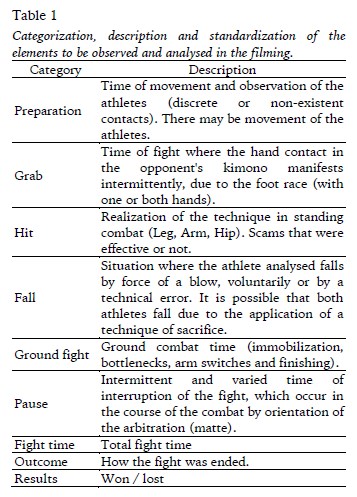
<body><![CDATA[<p>To measure body mass, a digital scale   (Incoterm, 28010, Brazil) was used, with a capacity of 150 kg, with an accuracy   of up to 100 grams, while the height measurement was done using a tape measure   (Fiber Glass), fixed to the wall, to the nearest millimetre. Both protocols   were applied according specific standardization (França &amp; Vívolo, 1994).   From the measures of mass and height, the Body Mass Index (BMI) was calculated and classified from the kg/m<sup>2</sup> ratio (WHO, 2003). </p>     <p><i>Motor Testing</i></p>     <p>Measurement of hand grip strength was   determined by manual dynamometry (Jamar, USA) in kilogram-force, according to   standardization (Caporrino et al., 1998). Lumbar strength was measured with the   lumbar model dynamometer (PC5039B Medical Iberica, Spain) according to   standards (Mathews, 1980). For the measurement of thoraco-lumbar flexibility,   the linear test of sit and reach was used, through the Well's Bank, according to specific standardization (Guedes &amp; Guedes, 2006). </p>     <p><i>Film of the fighting</i></p>     <p>The athletes were filmed (Sony   DCR-SX20, Japan) in two judo matches, regardless of previous defeat. The   recordings were made from the side of the combat area, with the full vision and   full timing of the fight (Miarka, 2014). The material collected and transcribed   on a spreadsheet comprised the video recording of twenty-three battles with an initial duration of three minutes each. </p>     <p><i>Description and standardization of observation</i></p>     <p>The categories analysed in each   fight, as well as the description of the videos are presented in <a href="#t1">table 1</a>. It   was decided to adapt some categories from the model of situational phases of   the fight proposed by Miarka (2014). Finally, the athletes were classified in winners or losers in relation to the first fight.</p>     <p><a name="t1"></a></p>     <p>&nbsp;</p>     <p align="center"><img src="/img/revistas/mot/v13n3/13n3a08t1.jpg" width="357" height="497"></p>     
]]></body>
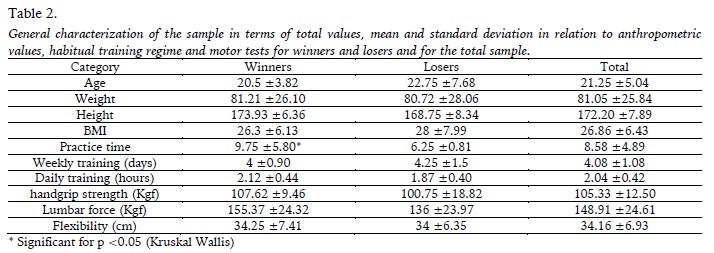
<body><![CDATA[<p>&nbsp;</p>     <p><i>Qualitative analysis of the energy cost of the figth </i></p>     <p>Considering the difficulty to   establish a physiological response to quantify the intensity in judo due to the   unpredictability, dynamics and different arrangements of the fight (Franchini   et al., 2008; Julio, 2015; Miarka, 2014;), the qualitative index of the energy   cost of fight (IQCE) was elaborated from the available values in the literature   and analysed elements. For this purpose, the study by Franchini et al. (2008),   on the contributions of VO<sub>2</sub> (ml.kg.min<sup>-1</sup>) and total energy   cost (KJ) for the execution of three different judo techniques <i>Morote-seoi-nage</i> (arm), 273 KJ; <i>Harai-goshi</i> (hip), 259 KJ and <i>o-uchi-gari </i>(leg), 237 KJ. The IQCE was   calculated referencing the value of the leg strike (lower energy cost) as 100   percent, and dividing the values of the other throws by this one and   multiplying by 10, in order to facilitate the application. Thus, the division   of the total energy costs of arm blows (273 KJ) and hip (259 KJ), the total   cost of the leg strike (237 KJ), generated the percentage values on the leg   strike respectively: 1.15 for arm; 1.09 for hip; 1 for leg. To give   authenticity to the numerical values found, they were faced with the VO<sub>2</sub>   values (ml.kg.min<sup>-1</sup>) of the respective strokes (arm, 33.71 ml, hip,   32.28 ml and leg, 29.97 ml) available in the same study of Franchini et al.   (2008), and converted to Liters (L.min<sup>-1</sup>) using the mean body mass   of the participants (81.21 kg). This procedure was used to confirm the maintenance of the energy order of the throws through VO<sub>2</sub> (L.min<sup>-1</sup>).</p> <b>Statistical analysis</b>      <p>After normality test (Komoroff-smirnoff)   the morphofunctional data and sports regime were analysed through one-way ANOVA   (result of the first fight) or Kruskal-Wallis test (Anova in Ranks). The   description of the Fighting was analysed by two-way ANOVA (the result of the   first fight × fights (1<sup>st</sup> and 2<sup>nd</sup>).) The anthropometric   and motor parameters were correlated through Pearson's correlation coefficient.   The differences in results between the first and second fight were analysed by Kendall's Tau correlation coefficient.</p> </font>     <p>&nbsp;</p>     <p><font size="3" face="Verdana"><b>RESULTS</b></font></p> <font face="Verdana" size="2">     <p><a href="/img/revistas/mot/v13n3/13n3a08t2.jpg">Table 2</a> shows the anthropometric values, the usual training regime and the results of the motor tests.</p>     
<p>Despite the differences found between   winners and losers in terms of mass and height and BMI, they were not   statistically significant. Regarding the usual training regime, the analysis   showed that there was a statistically significant difference [H = 4.810, (p =   0.028)] in the comparison of the average time of practice between winners and   losers. As for the analysis of the motor tests, it was observed that winners   present higher values for all the questions, however, these values were not statistically significant.</p>     <p>Data correlation analysis (Pearson)   identified the existence of significant correlation coefficients (p &lt; 0.05)   between anthropometric and motor parameters. It was observed that body mass   presented a positive correlation with BMI (r = 0.846, p &lt; 0.000) and with handgrip   strength (r = 0.525, p = 0.040) and negative correlation with flexibility (r =   -0.641, p = 0.012). It was also observed that the height presented a positive   correlation with handgrip strength (r = 0.697, p = 0.006). In relation to BMI,   it correlated positively with handgrip strength (r = 0.608, p = 0.018) and negatively   with flexibility (r = -0.725, p = 0.004). The handgrip strength had   a positive correlation with lumbar force (r = 0.644, p = 0.012) and negative   correlation with flexibility (r = -0.635, p = 0.013). It was also identified a   negative correlation between lumbar force and flexibility (r = -0.635, p = 0.013).</p>     <p><i>Description of the fights</i></p>     ]]></body>
<body><![CDATA[<p>Regarding the results of the temporal   analysis of the fight in the competition, it was observed that there was no   difference between the categories analysed between the first and the second   fight, being the distribution of the elements preparation, footprint, pause,   ground fight, similar between fights and between winners and losers. It was   observed that both in the first and in the second fight, the preparation time   was similar between winners and losers. However, in the grab dispute category,   losers presented average values higher than the winners in the second fight. In   relation to the pause time, losers presented values superior to the winners,   both in the first and in the second fight, and in the second fight these values   were higher. As for the fight time on the ground, it was observed a change in   the configuration of the fights, considering that in the first fight the   winners presented average values superior to the losers, whereas in the second   fight this fact has inverted considerably. As for the results of the functional   analysis of the fight, a similar distribution was also observed between the   elements of the first and the second fight between winners and losers, with a   predominance of the use of the throws of legs in relation to the other blows.   Leg strikes showed significant differences between winners and losers [F<sub>(1,18)</sub>=   6.168, p = 0.023], with no difference between the fights [F<sub>(1,18)</sub>=   0.486] and no interaction between the factors [F<sub>(1,18)</sub>= 1.805]. In   relation to the losers it was observed a decrease in the use of the arm strikes in the second fight compared with the first fight.  </p>     <p>As for the outcome of the two fights,   it was observed that winners were more effective than losers in relation to the   number of <i>ippon</i>. On the other hand,   it was observed a decrease of such effectiveness in the second fight,   considering the decrease in the number of <i>ippon</i> in favour of other forms of outcome for the termination of the fight.</p>     <p>Regarding the results of the energy cost   of the fights, the data found revealed that in the first fight the energy cost   of the fight is lower for winners than for losers. In the second fight it was   observed an inversion of the energy cost, with winners presenting higher values in relation to losers. </p>     <p>A Pearson correlation analysis was   performed to verify the existence of a linear relationship between functional   elements and the outcome of the fight (win or lose); elements among themselves;   fight elements and morphofunctional parameters; elements of the fight and   training regime. Thus, it was observed that the leg strike had a positive   correlation with the outcome of the fight (r = 0.663, p = 0.019). In relation   to the time of the fight, this one presented a positive correlation with the   arm strike (r = 0.759, p = 0.011) and with the leg strike (r = 0.659, p =   0.0380). The arm strike also showed a positive correlation with the fall (r =   0.602, p = 0.038) and with the outcome of the fight (r = 0.602, p = 0.038). The   fall presented a positive correlation with the leg strike (r = 0.635, p =   0.026) and with the outcome (r = 0.589, p = 0.044). Grabbing showed a positive   correlation with lumbar force (r = 0.666, p = 0.016) and with practice time (r   = 0.576, p = 0.050). The pause presented a positive correlation with the   practice time (r = 0.717, p = 0.009). The leg strike had a positive correlation   with the mass (r = 0.668, p = 0.018). A positive correlation between handgrip   strength and footprint (r = 0.682, p = 0.030) and negative correlation between handgrip strength and weekly training (r = -0.575, p = 0.051) and between handgrip strength and   training time (r = -0.685, p = 0.014). Likewise, lumbar force presented a   negative correlation with weekly training (r = -0.567, p = 0.055) and with   training time (r = -0.777, p = 0.003), as well as flexibility showed a negative correlation with the handgrip strength (r = -0.664, p = 0.036).   </p>     <p>&nbsp;</p> </font><font size="3" face="Verdana"><b>DISCUSSION</b></font><font face="Verdana" size="2">      <p><i>Training time and morphofunctional factors</i></p>     <p>Practice time implies acquired   experience. It was observed in the data collected that the practice time in   judo seems to influence the outcome of the fights, considering that winners,   despite having a lower average age present a significant superior mean time of   practice in relation to the losers. In terms of the optimization of results as   a function of experience, this seems to be one of the factors that distinguish   novice athletes from those with more competitive experiences in judo (García et al., 2007). </p>     <p>Regarding the usual training regime,   although the difference was not statistically significative in this study, it   was observed that the winners presented a higher weekly training load than the   losers. In these conditions, an athlete who dedicates a longer physical   preparation time probably has a higher degree of training and a greater chance of competitive success when compared to individuals with a lower training load.</p>     <p>As for the values of the <a>h</a>andgrip stregth motor tests (sum of both   hands), lower back strength and flexibility, it was found that although the   difference was not statistically significative, winners showed higher values   than the losers in all tests. However, winners presented handgrip strength values considered good, while in the losers, such values were considered average (105-122 kgf, Caballero et al., 1996).</p>     <p>In relation to the values of <a>h</a>andgrip strength,   the athlete's experience, combined with a longer training time, seems to be   associated with an increase in muscle strength when compared to the beginner   and higher ranked athletes (Costa et al., 2011; Lima et al., 2014). It should be   emphasized that handgrip   strength tends to be higher in relation to height and   body mass increase (Franchini et al., 2000), a fact observed in the winners,   since these are taller, heavier and have higher values of handgrip strength than losers.</p>     ]]></body>
<body><![CDATA[<p>In relation to the values of <a>lumbar   strength</a> available in other studies such as Eichinger et al. (2016) evaluating   non-athletes, found lumbar   strength values (114 kgf) well below the mean of winners   and losers in this study. Franchini et al. (2000) found values (151 Kgf) very   similar to the winners of this study in juvenile judo athletes. Mansilla et al.   (2000) identified in Spanish judo athletes, lumbar strength values   (165kgf) 6% higher than the values of winners in this study. In the question of   flexibility (sit-and-reach test), winners and losers did not differ   statistically from each other, with the average values of the winners being 10%   lower (Castro et al. 2008) or 10% higher (Meloni et al. 2007) compared to other   studies involving judo. Similar results in the flexibility test (39.46 cm) were   found in jiu-jitsu athletes, demonstrating that the specific morphological   characteristics of each modality depend on the requirements related to the   context and the type of practice (Campos et al., 2015). In fact, both jiu-jitsu   and judo are required, especially in the ground, for large amplitudes of body   movement, under the active and passive forms of muscle stretching (Campos et al., 2015).</p>     <p><i>Description of the fights</i></p>     <p>In judo,   attacks are organized to occur in different directions, depending on the   opponent and the goals defined in the technical-tactical system of each fighter   (Ando et al., 2016). In relation to the preparation and grabbing times, very   close results and inferences were found by Marcon et al. (2010) which corroborate   with the findings of the present investigation. However, unlike the present   study, the temporal structure analysis was done using a specially designed   computer program, so simulated judo matches were analysed, identifying   preparation and grabbing times of around 4 seconds and 17 seconds,   respectively. As for the mean values increased in the grabbing dispute,   identified in losers in the second fight, it is possible to infer that this   happened due to a smaller technical-tactical repertoire (Calmet &amp; Ahmaidi,   2004). Due to the longer time of practice, it is perceptible to think that   winners present a greater number of techniques on the basis of experience, and   thus to be more effective in the grabbing dispute (Miarka, 2014). As for the   longer pause time presented by the losers in the two fights, it is possible   that this is due to a strategy of fight. For Miarka (2014), the pause can   represent a feedback opportunity for the athletes, being possible to use this   time for technical-tactical readjustments of the fight. It should also be   emphasized that the structure of a judo match has often been correlated with   athletes' physical endurance (Ryszard et al., 2014). Thus, the change in the   configuration of the fights in terms of pause and fight time on the ground may   be a consequence of fatigue of the athletes or due to technical and tactical   adjustments made from the time of pause, since in the first fight the winners   presented values of ground fighting superiors to those of the losers, whereas in the second fight this fact reversed itself considerably.</p>     <p>As for the   elements of the fight, the preliminary analysis showed that leg kicks were the   most used, both by winners and losers, and such scams are statistically more   significant in losers than in winners. It is worth mentioning that the preferred and most used judo   projection techniques belong to the <i>Ashi-waza</i> (leg techniques) (Detanico et al., 2007). This   suggests a strong preference for leg attacks, especially for heavier athletes   (Ryszard et al., 2014), which is one of the probable justifications for the   greater number of leg strikes presented by the losers, considering that they   had higher BMI values, in relation to the winners. Coincidentally, there is a   similarity between the prevalence of leg techniques and the height of the   athletes, from this study with the results found by Detanico et al. (2007), where   it was also observed a higher incidence of leg techniques for the same mean height (173.8 cm) of the athletes. </p>     <p>As for the   reduction of arm strikes by the losers in the second fight, this may have   happened because of a greater decline in isometric upper limb performance,   compared to lower limb (Fernández et al., 2008). As for the outcome of the two   fights, it was observed that 41% of the combats had the <i>ippon</i> outcome, with winners being more effective than losers. In a   study developed by Witkowski et al. (2012), it was demonstrated that in male   judo of the 2008 Beijing Olympics, out of a total of 303 bouts, 46.53% were   decided by <i>ippon</i>, data very close to   those of this study. In a similar research developed by Sterkowicz et al.   (2007), involving video analysis (518 fights/64 hours duration) of Polish championships   of judo, it was discussed the question of effectiveness and efficiency in the   technical actions of judo. According to the aforementioned study, efficacy is a   quantitative variable defined by arithmetic average scores, being expressed by   the division of the total of points obtained by the number of effective   techniques. Efficiency is already a qualitative variable defined by dividing   the number of effective techniques by the total number of techniques multiplied   by 100. Therefore, it was observed that in the second fight, there was a   decrease in the effectiveness of the <i>ippon</i>   application by the winners; however, the efficiency of the attacks was maintained, triggering in the victory by other forms of outcome.</p>     <p><i>Qualitative index of energy cost</i></p>     <p>IQCE data revealed that winners spent   less energy than losers in the first fight. Despite the greater time spent on   ground fighting and the use of arm-strikes (greater energy expenditure),   winners were more effective in the application of <i>ippon</i>. This has direct implication on the energy economy of the   fight. Indeed, winners have preserved their energy reserves, unlike the losers   who have spent far more energy than the winners in the use of leg strikes and   fall defences. Probably these factors were responsible for the increase in   attack and defence actions, respectively, and consequently for the increase of the IQCE.</p>     <p>In the second fight, there was an   inversion of the energy cost, possibly due to a combat strategy change or   fatigue effect. Thus, winners presented higher IQCE values than losers. It is   worth noting that winners presented a higher incidence of throws of upper limbs than   the losers in the first as well as in the second fights. Considering that such throws   lead to a greater decline of the isometric strength in relation to the lower   limbs (Fernández et al., 2008), and considering that the outcomes in the second   fight pointed to other less energy-efficient means, such as the finalizations, for   example, that happen mainly in function of upper limbs, it is possible to infer that such reasons justified the higher ICQE of the winners in the second fight.</p>     <p>In research with a sample close to   this study, Franchini et al. (2008) studied three techniques of judo, <i>morote-seoi-nage, harai-goshi and     o-uchi-gari</i>, in 12 judokas and showed that total energy (kJ) was higher for   <i>morote-seoi-nage</i> (Arm technique). In   a pioneering article aimed at estimating the contributions of energy systems   during the simulations of 12 judo athletes, Julio et al. (2016), also proposed   a calculation of the contribution of energy systems to estimate the energy   expenditure of judo from resting VO<sub>2</sub> (equivalent to 4.5ml.kg.min<sup>-1</sup>),   confirming the importance of physiological indicators in the construction of energy   estimates. This strategy confirms our concern in linking the IQEC to VO<sub>2</sub>   values, since it reinforces and expands the quantitative/qualitative relationship between the studies</p>     <p>Finally, it is worth mentioning that   aerobic metabolism is responsible for providing the highest proportion of energy   needed in a judo combat (Franchini et al., 2008; Julio et al, 2016). However,   in judo, which generates scores and consequently determines the victory, are   mainly attacks with projection techniques that require high short-term energy   cost (ATP-PC system). Thus, the time spent in grab disputes and fhigth   application requires muscle work, directly affecting the glycolytic demand (Julio et al., 2016), a fact fully demonstrated in this study through ICQE.</p>     ]]></body>
<body><![CDATA[<p><i>Correlations between morphofunctional parameters, training regime and elements of the fight</i></p>     <p>The correlations found between the   morphofunctional parameters are due to specific characteristics of the   modalities. In a study conducted by Campos et al. (2015), it was found that the   requirements related to the context and type of practice justify the   correlation between BMI, handgrip strength and lumbar strength, and how much this may imply in the decrease of flexibility as a   function of the increase in muscle mass (Campos et al. 2015). Thus, it is fully   expected that the mean total   BMI values found in this study result from muscle mass overweight gain, which   is a morphological feature of the sport and may also be associated with increased in handgrip and lumbar strength.</p>     <p>As for the correlations between   functional elements of the fight, morphofunctional parameters and training   regime of the athletes, it is possible to infer that the configuration of the   fights provided a close relation between the use of the throws, considering the   experiences of the athletes, and their respective combat strategies. Of course,   athletes who presented the highest indicators of hand grip strength, lumbar strength, and thoraco-lumbar flexibility probably had an increased advantage in footprint,   trunk extension strength, and posterior thigh (hamstring) stretching relative   to opponents with lower values in these indicators. Specifically, given the   grabbing correlation (<i>Kumi-Kata</i>) and handgrip strength, it is worth highlight the important role of this association as a   tactical technical component in judo. Grabbing is one of the determining   technical factors in establishing a good control over the opponent's balance   (Kajmovic et al., 2014). The same can be thought about the correlation of the   leg strike with the result of the fight and the correlation of the time of the   fight with the strikes of arms and legs. An effective grab is likely to allow   an effective (arm or leg) attack culminating with fall and consequently, with   the outcome of the fight. Regarding the correlation of pause time and practice   time, it is possible to establish an association between these elements from   the understanding that the pause time may have been used as a strategic element   for more experienced athletes. It seems that the competitive environment   emphasizes the differences between more experienced athletes and those with   less training time (Garcia et al., 2007), that is, athletes with more   competitive experience are able to better adapt their combat actions due to greater   technical assets. This seems to be one of the factors that differentiate winners and losers in the results obtained in this study.</p>     <p>It is noticeable that the performance   of a judo athlete should undergo eventual fluctuations during a competition   (Campos et al., 2017). In this respect, it should be understood that in the   face of various adversaries and different forms of confrontation, a wide   variety of behaviours are likely to be delineated (Calmet &amp; Ahmaidi, 2004,   Campos et al., 2017). However, any supplementary information that can detail   competitive behaviour can be useful in raising performance indicators on   winners and losers. Of course, the survey data in real situation tend to   provide lower internal validity and some limitations due to the   unpredictability of the environment. On the other hand, it is believed that the   competitive situation and the impact of the cheer can also bring punctual   elements, only identifiable in surveys of real combat situations in judo, and   even so, according to Calmet and Ahmaidi (2004), it is very rare to see a judo athlete express all his experience during a single competition. </p>     <p>&nbsp;</p> </font><font size="3" face="Verdana"><b>CONCLUSIONS</b></font><font face="Verdana" size="2">      <p>According to the data presented in   the present investigation, it is concluded that: 1) The experience factor is   determinant between winning or losing; 2) Leg techniques are more used between   winners and losers, and losers use them more frequently; 3) There are different   strategies between one fight and another subsequent; 4) The energy cost in judo depends on the configuration of the fights.</p>     <p>In summary, the results presented   here revealed some performance indicators in judo that could only be detailed   from <i>in situ</i> observations. This is   the greatest merit of the study. It is believed that because of practicality,   this type of knowledge approach can be incorporated into training programs in   several areas involving combat sport, helping coaches and athletes in the   search for solutions that can guide and rationalize the training process in relation to the determinants of performance in judo.</p> </font>     <p>&nbsp;</p>     <p><font size="3" face="Verdana"><b>REFER&Ecirc;NCIAS</b></font></p> <font face="Verdana" size="2">     <!-- ref --><p>Ando, G. Y. U., Miarka, B., &amp; Pinto, M. N. N. (2016). Avaliação   de análise técnico-tática em combates de judô por programa computacional por usuários com diferentes níveis de expertise. <i>Journal of Physical Education</i>, 27(1), e 2718.    &nbsp;&nbsp;&nbsp;&nbsp;&nbsp;&nbsp;&nbsp;&nbsp;[&#160;<a href="javascript:void(0);" onclick="javascript: window.open('/scielo.php?script=sci_nlinks&ref=368461&pid=S1646-107X201700040000800001&lng=','','width=640,height=500,resizable=yes,scrollbars=1,menubar=yes,');">Links</a>&#160;]<!-- end-ref --></p>     <!-- ref --><p>Artioli, G. G.,   Bertuzzi, R. C., Roschel, H., Mendes, S. H., Lancha Jr, A. H., &amp; Franchini,   E. (2012). Determining the contribution of the energy systems during exercise. <i>Journal of Visualized Experiments, 61</i>(61), e3413, doi:10.3791/3413.    &nbsp;&nbsp;&nbsp;&nbsp;&nbsp;&nbsp;&nbsp;&nbsp;[&#160;<a href="javascript:void(0);" onclick="javascript: window.open('/scielo.php?script=sci_nlinks&ref=368463&pid=S1646-107X201700040000800002&lng=','','width=640,height=500,resizable=yes,scrollbars=1,menubar=yes,');">Links</a>&#160;]<!-- end-ref --> </p>     <!-- ref --><p>Caballero, J. A. R., Manso, J. M. G., Valdivielso, M. N.,   Ojeda, M. E. B., Campos, I. G., &amp; García, R. N. (1996). Algunos aspectos   sobre la evaluación de la fuerza: test isometricos dinamometria y   electromiografia<i>. In Anais da X Jornadas     Canarias de Traumatologia Y Cirugia Ortopédica </i>(p. 166-170). Las Palmas de Gran Canária: Universidad de Las Palmas de Gran Canaria.    &nbsp;&nbsp;&nbsp;&nbsp;&nbsp;&nbsp;&nbsp;&nbsp;[&#160;<a href="javascript:void(0);" onclick="javascript: window.open('/scielo.php?script=sci_nlinks&ref=368465&pid=S1646-107X201700040000800003&lng=','','width=640,height=500,resizable=yes,scrollbars=1,menubar=yes,');">Links</a>&#160;]<!-- end-ref --> </p>     <!-- ref --><p>Calmet, M., &amp;   Ahmaidi, S. (2004, September). Survey   of the advantages obtained by judoka in competition according to their level of   practice. <i>Perceptual and Motor Skills, 99</i>(1), 284-290, doi: 10.2466/PMS.99.5.284-290 &nbsp;&nbsp;&nbsp;&nbsp;&nbsp;&nbsp;&nbsp;&nbsp;[&#160;<a href="javascript:void(0);" onclick="javascript: window.open('/scielo.php?script=sci_nlinks&ref=368467&pid=S1646-107X201700040000800004&lng=','','width=640,height=500,resizable=yes,scrollbars=1,menubar=yes,');">Links</a>&#160;]<!-- end-ref --><!-- ref --><p>Campos, I. S. L, Campos, Y.,   Campos, Y. S., Saraiva, A. R., &amp; Gouveia Jr, A. (2016). Ganhar e perder em esportes de combate: descri  ção de elementos determinantes. <i>Revista brasileira Ciência e Movimento, 24</i>(4), 156-167.    &nbsp;&nbsp;&nbsp;&nbsp;&nbsp;&nbsp;&nbsp;&nbsp;[&#160;<a href="javascript:void(0);" onclick="javascript: window.open('/scielo.php?script=sci_nlinks&ref=368468&pid=S1646-107X201700040000800005&lng=','','width=640,height=500,resizable=yes,scrollbars=1,menubar=yes,');">Links</a>&#160;]<!-- end-ref --></p>     <!-- ref --><p>Campos, I. S. L., Campos, Y. S, &amp; Gouveia Jr, A. (2015). Características   morfofuncionais e contexto esportivo. <i>Revista brasileira de prescrição e fisiologia do Exercício</i>, <i>9</i>(56), 655-661.    &nbsp;&nbsp;&nbsp;&nbsp;&nbsp;&nbsp;&nbsp;&nbsp;[&#160;<a href="javascript:void(0);" onclick="javascript: window.open('/scielo.php?script=sci_nlinks&ref=368470&pid=S1646-107X201700040000800006&lng=','','width=640,height=500,resizable=yes,scrollbars=1,menubar=yes,');">Links</a>&#160;]<!-- end-ref -->     </p>     ]]></body>
<body><![CDATA[<!-- ref --><p>Caporrino, F. A., Faloppa, F., Santos, J. B. G., Réssio, C.,   Soares, F. H. C., Nakachima, L. R., &amp; Segre, N. G. (1998). Estudo populacional da força de preensão palmar com dinamômetro Jamar. <i>Revista Brasileira Ortopedia</i>, <i>33</i>(2), 150-154.    &nbsp;&nbsp;&nbsp;&nbsp;&nbsp;&nbsp;&nbsp;&nbsp;[&#160;<a href="javascript:void(0);" onclick="javascript: window.open('/scielo.php?script=sci_nlinks&ref=368472&pid=S1646-107X201700040000800007&lng=','','width=640,height=500,resizable=yes,scrollbars=1,menubar=yes,');">Links</a>&#160;]<!-- end-ref --> </p>     <!-- ref --><p>Castro, E. A., Venâncio, R. A. F., Doimo, L. A., &amp;   Locatelli, J. (2008). Comparação entre   dois métodos de treinamento para aprimoramento da flexibilidade em judocas da Associação Atlética Acadêmica – Luve/Ufv. <i>Coleção Pesquisa em Educação Física, 7</i>(2), 1981-4313.    &nbsp;&nbsp;&nbsp;&nbsp;&nbsp;&nbsp;&nbsp;&nbsp;[&#160;<a href="javascript:void(0);" onclick="javascript: window.open('/scielo.php?script=sci_nlinks&ref=368474&pid=S1646-107X201700040000800008&lng=','','width=640,height=500,resizable=yes,scrollbars=1,menubar=yes,');">Links</a>&#160;]<!-- end-ref --> </p>     <!-- ref --><p>Costa, R. P., &amp; Oliveira, F. B. (2011). Mensuração da força de preensão palmar em   atletas de jiu-jitsu. <i>VII Congresso Goiano de Ciências do Esporte</i>. Goiania-GO.    &nbsp;&nbsp;&nbsp;&nbsp;&nbsp;&nbsp;&nbsp;&nbsp;[&#160;<a href="javascript:void(0);" onclick="javascript: window.open('/scielo.php?script=sci_nlinks&ref=368476&pid=S1646-107X201700040000800009&lng=','','width=640,height=500,resizable=yes,scrollbars=1,menubar=yes,');">Links</a>&#160;]<!-- end-ref --></p>     <!-- ref --><p>Detanico, D., &amp; Santos, S. G. (2012). Avaliação específica no judô: uma revisão   de métodos. <i>Revista     Brasileira Cineantropometria e Desempenho Humano, 14</i>(6), 738-748.    &nbsp;&nbsp;&nbsp;&nbsp;&nbsp;&nbsp;&nbsp;&nbsp;[&#160;<a href="javascript:void(0);" onclick="javascript: window.open('/scielo.php?script=sci_nlinks&ref=368478&pid=S1646-107X201700040000800010&lng=','','width=640,height=500,resizable=yes,scrollbars=1,menubar=yes,');">Links</a>&#160;]<!-- end-ref -->  </p>     <!-- ref --><p>Drigo,   A. J., Amorim, A. R., Martins, C. J., &amp; Molina, R. (1996). Demanda   metabólica em lutas de projeção e de solo no judô: estudo pelo lactato   sanguíneo. <i>Motriz, 2</i>(2), 80.    &nbsp;&nbsp;&nbsp;&nbsp;&nbsp;&nbsp;&nbsp;&nbsp;[&#160;<a href="javascript:void(0);" onclick="javascript: window.open('/scielo.php?script=sci_nlinks&ref=368480&pid=S1646-107X201700040000800011&lng=','','width=640,height=500,resizable=yes,scrollbars=1,menubar=yes,');">Links</a>&#160;]<!-- end-ref --></p>     ]]></body>
<body><![CDATA[<!-- ref --><p>Eichinger, F. L. F., Soares, A. V., Júnior, J. M. C.,   Gevaerd, M. S., Domenech, S. C., &amp; Júnior, N. G. B. (2016). Dinamometria lombar: um teste funcional para   o tronco. <i>Revista Brasileira Medicina Trabalho, 14</i>(2), 120-126.    &nbsp;&nbsp;&nbsp;&nbsp;&nbsp;&nbsp;&nbsp;&nbsp;[&#160;<a href="javascript:void(0);" onclick="javascript: window.open('/scielo.php?script=sci_nlinks&ref=368482&pid=S1646-107X201700040000800012&lng=','','width=640,height=500,resizable=yes,scrollbars=1,menubar=yes,');">Links</a>&#160;]<!-- end-ref --></p>     <!-- ref --><p>Fernández, E. C., Soler, E. I., &amp; Calvo, X. D. (2008). Análise dos efeitos agudos do enfrentamento no judô,   através do estudo da associação entre parâmetros metabólicos e mecânicos. <i>Fitness e Performance Journal</i>, <i>7</i>(4) 229-38.    &nbsp;&nbsp;&nbsp;&nbsp;&nbsp;&nbsp;&nbsp;&nbsp;[&#160;<a href="javascript:void(0);" onclick="javascript: window.open('/scielo.php?script=sci_nlinks&ref=368484&pid=S1646-107X201700040000800013&lng=','','width=640,height=500,resizable=yes,scrollbars=1,menubar=yes,');">Links</a>&#160;]<!-- end-ref --> </p>     <!-- ref --><p>França, N. M., &amp; Vívolo, M. A. (1994). Medidas   Antropométricas. In V. K. R. Matsudo (Org.) <i>Testes em ciências do exporte</i> (pp. 19-32). São Caetano do Sul: Burti&nbsp;&nbsp;&nbsp;&nbsp;&nbsp;&nbsp;&nbsp;&nbsp;[&#160;<a href="javascript:void(0);" onclick="javascript: window.open('/scielo.php?script=sci_nlinks&ref=368486&pid=S1646-107X201700040000800014&lng=','','width=640,height=500,resizable=yes,scrollbars=1,menubar=yes,');">Links</a>&#160;]<!-- end-ref --><!-- ref --><p>Franchini, E., Bertuzzi, R. C. M., Degaki, E., Mello, F. C.,   Fiebig, E., &amp; Silva, W. F. F. L. (2008). Energy expenditure   in different judo throwing techniques. Source: Proceedings of first joint   international pre-Olympic conference of sports science and sports engineering. <i>Bio-mechanics and sports engineering, 2</i>, 55-60.    &nbsp;&nbsp;&nbsp;&nbsp;&nbsp;&nbsp;&nbsp;&nbsp;[&#160;<a href="javascript:void(0);" onclick="javascript: window.open('/scielo.php?script=sci_nlinks&ref=368487&pid=S1646-107X201700040000800015&lng=','','width=640,height=500,resizable=yes,scrollbars=1,menubar=yes,');">Links</a>&#160;]<!-- end-ref --> </p>     <!-- ref --><p>Franchini, E., Takito, M. Y., &amp; Kiss, M. A. P. D. (2000). Somatótipo, composição   corporal e força isométrica em diferentes períodos do treinamento em atletas de   judô juvenis. <i>Revista Treinamento Desportivo, 5</i>(2), 4-10.    &nbsp;&nbsp;&nbsp;&nbsp;&nbsp;&nbsp;&nbsp;&nbsp;[&#160;<a href="javascript:void(0);" onclick="javascript: window.open('/scielo.php?script=sci_nlinks&ref=368489&pid=S1646-107X201700040000800016&lng=','','width=640,height=500,resizable=yes,scrollbars=1,menubar=yes,');">Links</a>&#160;]<!-- end-ref --></p>     <!-- ref --><p>Franchini, F., Sterkowicz, S.,   Szmatlan-Gabrys, U., Gabrys, T., &amp; Garnys, M. (2011). Energy System contributions to the Special Judo   Fitness Test. <i>International Journal of Sports Physiology and Performance</i>,<i> 6</i>(3), 334-343.    &nbsp;&nbsp;&nbsp;&nbsp;&nbsp;&nbsp;&nbsp;&nbsp;[&#160;<a href="javascript:void(0);" onclick="javascript: window.open('/scielo.php?script=sci_nlinks&ref=368491&pid=S1646-107X201700040000800017&lng=','','width=640,height=500,resizable=yes,scrollbars=1,menubar=yes,');">Links</a>&#160;]<!-- end-ref --></p>     <!-- ref --><p>García, J. M. G., Valdivielso, F. N., Ravé, J. M. G., &amp;   Bibiana, C. R. (2007). Paradigma experto-novato: Análisis diferencial de la   pérdida de consistencia del <i>Tokui Waza </i>en Judo bajo situación específica   de fatiga. <i>Revista internacional de Ciencias del deporte<b>, </b>9</i>(3), 12-29, doi:10.5232/ricyde2007.00902&nbsp;&nbsp;&nbsp;&nbsp;&nbsp;&nbsp;&nbsp;&nbsp;[&#160;<a href="javascript:void(0);" onclick="javascript: window.open('/scielo.php?script=sci_nlinks&ref=368493&pid=S1646-107X201700040000800018&lng=','','width=640,height=500,resizable=yes,scrollbars=1,menubar=yes,');">Links</a>&#160;]<!-- end-ref --><!-- ref --><p>Gariod, L., Favre-Juvin, A., Novel, U., &amp; Rossi, A.   (1995). Évaluation du profil énergétique des judokas par spectroscopie RMN du. <i>Sciences &amp; sports, 10</i>(4), 201-207.    &nbsp;&nbsp;&nbsp;&nbsp;&nbsp;&nbsp;&nbsp;&nbsp;[&#160;<a href="javascript:void(0);" onclick="javascript: window.open('/scielo.php?script=sci_nlinks&ref=368494&pid=S1646-107X201700040000800019&lng=','','width=640,height=500,resizable=yes,scrollbars=1,menubar=yes,');">Links</a>&#160;]<!-- end-ref --></p>     <!-- ref --><p>Guedes, D. P., &amp; Guedes, J. E. R. P. (2006). <i>Manual Prático para Avaliação em Educação   Física</i>. Barueri: Manole.    &nbsp;&nbsp;&nbsp;&nbsp;&nbsp;&nbsp;&nbsp;&nbsp;[&#160;<a href="javascript:void(0);" onclick="javascript: window.open('/scielo.php?script=sci_nlinks&ref=368496&pid=S1646-107X201700040000800020&lng=','','width=640,height=500,resizable=yes,scrollbars=1,menubar=yes,');">Links</a>&#160;]<!-- end-ref --></p>     <!-- ref --><p>Julio, U. F. (2015). <i>Aptidão física, ações técnicas e resposta   fisiológicas durante a luta de judô</i> (Tese de Doutorado em Educação Física e Esporte), Universidade de São Paulo, São Paulo.    &nbsp;&nbsp;&nbsp;&nbsp;&nbsp;&nbsp;&nbsp;&nbsp;[&#160;<a href="javascript:void(0);" onclick="javascript: window.open('/scielo.php?script=sci_nlinks&ref=368498&pid=S1646-107X201700040000800021&lng=','','width=640,height=500,resizable=yes,scrollbars=1,menubar=yes,');">Links</a>&#160;]<!-- end-ref --> </p>     <!-- ref --><p>Julio, U. F., Panissa, V. L. G., Esteves, J. V., Cury,   R. L., Agostinho, M. F., &amp; Franchini, E. (2017). Energy-System Contributions to   Simulated Judo Matches. <i>International Journal of Sports Physiology and Performance</i>, <i>12</i>(5), 676–683. <a href="https://doi.org/10.1123/ijspp.2015-0750" target="_blank">https://doi.org/10.1123/ijspp.2015-0750</a>&nbsp;&nbsp;&nbsp;&nbsp;&nbsp;&nbsp;&nbsp;&nbsp;[&#160;<a href="javascript:void(0);" onclick="javascript: window.open('/scielo.php?script=sci_nlinks&ref=368500&pid=S1646-107X201700040000800022&lng=','','width=640,height=500,resizable=yes,scrollbars=1,menubar=yes,');">Links</a>&#160;]<!-- end-ref --><!-- ref --><p>Kajmovic, H., Rado, I., Mekic, A., Crnogorac, B., &amp; Colakhodzic, E. (2014). Differences in   gripping configurations during the execution of throwing techniques between   male and female cadets at the European Judo Championship<i>. Archives of budo, science of martial arts,10</i>, 141-146.    &nbsp;&nbsp;&nbsp;&nbsp;&nbsp;&nbsp;&nbsp;&nbsp;[&#160;<a href="javascript:void(0);" onclick="javascript: window.open('/scielo.php?script=sci_nlinks&ref=368501&pid=S1646-107X201700040000800023&lng=','','width=640,height=500,resizable=yes,scrollbars=1,menubar=yes,');">Links</a>&#160;]<!-- end-ref --></p>     <!-- ref --><p>Lehner, P. N. (1996) <i>Handbook of ethological methods </i>(2<sup>nd</sup>   Ed.). Cambridge University Press.    &nbsp;&nbsp;&nbsp;&nbsp;&nbsp;&nbsp;&nbsp;&nbsp;[&#160;<a href="javascript:void(0);" onclick="javascript: window.open('/scielo.php?script=sci_nlinks&ref=368503&pid=S1646-107X201700040000800024&lng=','','width=640,height=500,resizable=yes,scrollbars=1,menubar=yes,');">Links</a>&#160;]<!-- end-ref --></p>     <!-- ref --><p>Lima, M. C., Kubota, L. M., Monteiro, C. B. M., Baldan, C.   S., &amp; Pompeu, J. E. (2014). Força   de preensão manual em atletas de judô. <i>Revista Brasileira Medicina e Esporte, 20</i>(3), 210-213.    &nbsp;&nbsp;&nbsp;&nbsp;&nbsp;&nbsp;&nbsp;&nbsp;[&#160;<a href="javascript:void(0);" onclick="javascript: window.open('/scielo.php?script=sci_nlinks&ref=368505&pid=S1646-107X201700040000800025&lng=','','width=640,height=500,resizable=yes,scrollbars=1,menubar=yes,');">Links</a>&#160;]<!-- end-ref --></p>     <!-- ref --><p>Mansilla,   F. M., Villa, V. J., García, L. J., &amp; López, R. C. (2000). Comparación   de diferentes manifestaciones de fuerza y flexibilidad entre luchadores de   lucha leonesa y judocas. <i>I Congreso Internacional de la Asociación Española de Ciencias del Deporte</i>. Cáceres.    &nbsp;&nbsp;&nbsp;&nbsp;&nbsp;&nbsp;&nbsp;&nbsp;[&#160;<a href="javascript:void(0);" onclick="javascript: window.open('/scielo.php?script=sci_nlinks&ref=368507&pid=S1646-107X201700040000800026&lng=','','width=640,height=500,resizable=yes,scrollbars=1,menubar=yes,');">Links</a>&#160;]<!-- end-ref --> </p>     <!-- ref --><p>Marcon, G., Franchini, F., Jardim,   J. R., &amp; Neto, T. L. B. (2010). Structural   Analysis of Action and Time in Sports: Judo. <i>Journal of quantitative analysis in sports, 6</i>(4). doi<b>: </b>10.2202/1559-0410.1226&nbsp;&nbsp;&nbsp;&nbsp;&nbsp;&nbsp;&nbsp;&nbsp;[&#160;<a href="javascript:void(0);" onclick="javascript: window.open('/scielo.php?script=sci_nlinks&ref=368509&pid=S1646-107X201700040000800027&lng=','','width=640,height=500,resizable=yes,scrollbars=1,menubar=yes,');">Links</a>&#160;]<!-- end-ref --><!-- ref --><p>Meloni, P. H. S., Venâncio, R. A, Locatelli, J., Milani, N.   S., &amp; Doimo, L. A. (2007). Análise   morfológica dos atletas de judô participantes do campeonato mineiro <b>– </b>VIÇOSA-MG.   <i>Coleção Pesquisa em Educação Física, 6,</i> 95-102.    &nbsp;&nbsp;&nbsp;&nbsp;&nbsp;&nbsp;&nbsp;&nbsp;[&#160;<a href="javascript:void(0);" onclick="javascript: window.open('/scielo.php?script=sci_nlinks&ref=368510&pid=S1646-107X201700040000800028&lng=','','width=640,height=500,resizable=yes,scrollbars=1,menubar=yes,');">Links</a>&#160;]<!-- end-ref --> </p>     ]]></body>
<body><![CDATA[<!-- ref --><p>Miarka, B. (2014). <i>Modelagem   das interações técnicas e táticas em atletas de judô: comparações entre   categorias, nível competitivo e resultados de combate no circuito mundial de   judô dos jogos olímpicos de Londres</i> (Tese de Doutorado em Educação Física e Esporte). Universidade de São Paulo, São Paulo.    &nbsp;&nbsp;&nbsp;&nbsp;&nbsp;&nbsp;&nbsp;&nbsp;[&#160;<a href="javascript:void(0);" onclick="javascript: window.open('/scielo.php?script=sci_nlinks&ref=368512&pid=S1646-107X201700040000800029&lng=','','width=640,height=500,resizable=yes,scrollbars=1,menubar=yes,');">Links</a>&#160;]<!-- end-ref --></p>     <!-- ref --><p>Ryszard, P.,   Marek, A., Agnieszka, K., &amp; Wieslaw, B. (2014). The course of the judo fight in the heaviest category (+100kg) seen from the perspective of attacks in the standing position, based on the Olympic Games in London 2012.   <i>Journal of Martial Arts Anthropology, 14</i>(1), 63-71.    &nbsp;&nbsp;&nbsp;&nbsp;&nbsp;&nbsp;&nbsp;&nbsp;[&#160;<a href="javascript:void(0);" onclick="javascript: window.open('/scielo.php?script=sci_nlinks&ref=368514&pid=S1646-107X201700040000800030&lng=','','width=640,height=500,resizable=yes,scrollbars=1,menubar=yes,');">Links</a>&#160;]<!-- end-ref --></p>     <!-- ref --><p>Santos, S. O. D. (2013). <i>A   integração oriente-ocidente e os fundamentos do judô educativo</i> (Dissertação   de mestrado em Educação). Faculdade de humanidades e Direito da Universidade Metodista de São Paulo, São Bernardo do Campo.    &nbsp;&nbsp;&nbsp;&nbsp;&nbsp;&nbsp;&nbsp;&nbsp;[&#160;<a href="javascript:void(0);" onclick="javascript: window.open('/scielo.php?script=sci_nlinks&ref=368516&pid=S1646-107X201700040000800031&lng=','','width=640,height=500,resizable=yes,scrollbars=1,menubar=yes,');">Links</a>&#160;]<!-- end-ref --></p>     <!-- ref --><p>Sterkowicz, S.,   Lech, G., &amp; Almansba,   R. (2007). The course of fight and the level of sports achievements in judô. <i>Archives of Budo, 3</i>, 72-78.    &nbsp;&nbsp;&nbsp;&nbsp;&nbsp;&nbsp;&nbsp;&nbsp;[&#160;<a href="javascript:void(0);" onclick="javascript: window.open('/scielo.php?script=sci_nlinks&ref=368518&pid=S1646-107X201700040000800032&lng=','','width=640,height=500,resizable=yes,scrollbars=1,menubar=yes,');">Links</a>&#160;]<!-- end-ref --></p>     <!-- ref --><p>Watson, B. N. (2011). <i>Memórias   de Jigoro Kano: o ensino da história do judô</i>. São Paulo: Cultrix.    &nbsp;&nbsp;&nbsp;&nbsp;&nbsp;&nbsp;&nbsp;&nbsp;[&#160;<a href="javascript:void(0);" onclick="javascript: window.open('/scielo.php?script=sci_nlinks&ref=368520&pid=S1646-107X201700040000800033&lng=','','width=640,height=500,resizable=yes,scrollbars=1,menubar=yes,');">Links</a>&#160;]<!-- end-ref --></p>     ]]></body>
<body><![CDATA[<!-- ref --><p>Wilson, G.V., &amp; Kerr, J.H. (1999). Affective   responses to success and failure: a study of winning and losing in competitive rugby. <i>Personality and Individual Differences, 27</i>(1), 85-99.    &nbsp;&nbsp;&nbsp;&nbsp;&nbsp;&nbsp;&nbsp;&nbsp;[&#160;<a href="javascript:void(0);" onclick="javascript: window.open('/scielo.php?script=sci_nlinks&ref=368522&pid=S1646-107X201700040000800034&lng=','','width=640,height=500,resizable=yes,scrollbars=1,menubar=yes,');">Links</a>&#160;]<!-- end-ref --></p>     <!-- ref --><p>Witkowski, k., Ma&#347;li&#324;ski, J., &amp; Kotwica,   T. (2012). Analysis of fighting actions of judo competitors on the basis of the men’s tournament during the 2008 Olympic Games in Beijing<i>. Journal of Combat Sports and Martial Arts, 3</i>(2), 121-129.    &nbsp;&nbsp;&nbsp;&nbsp;&nbsp;&nbsp;&nbsp;&nbsp;[&#160;<a href="javascript:void(0);" onclick="javascript: window.open('/scielo.php?script=sci_nlinks&ref=368524&pid=S1646-107X201700040000800035&lng=','','width=640,height=500,resizable=yes,scrollbars=1,menubar=yes,');">Links</a>&#160;]<!-- end-ref --> </p>     <!-- ref --><p>World Health   Organization. (2003). <i>Diet, Nutrition and     the Prevention of Chronic Disease</i>. <i>Report 8. Núm. 916.</i> Geneva: WHO.    &nbsp;&nbsp;&nbsp;&nbsp;&nbsp;&nbsp;&nbsp;&nbsp;[&#160;<a href="javascript:void(0);" onclick="javascript: window.open('/scielo.php?script=sci_nlinks&ref=368526&pid=S1646-107X201700040000800036&lng=','','width=640,height=500,resizable=yes,scrollbars=1,menubar=yes,');">Links</a>&#160;]<!-- end-ref --></p> </font>     <p>&nbsp;</p>     <p><font size="2" face="Verdana"><b>Acknowledgments:</b>    <br>   Nothing to declare<b>    <br>   Conflict   of interest:</b>    ]]></body>
<body><![CDATA[<br>   Nothing to declare<b>    <br>   Funding:    <br> </b></font><font size="2" face="Verdana">Nothing to declare</font></p> <font face="Verdana" size="2">     <p>Manuscript received at  February 6th 2017; Accepted at March 3rd 2017</p>     <p>&nbsp;</p>     <p>&nbsp;</p>     <p><a href="#top"><sup>*</sup></a><i><a name="end"></a> Corresponding  author</i>: Rua Augusto Corr&ecirc;a, 1 - Guam&aacute;, Bel&eacute;m - PA,  66075-110, Brasil. <i>E-mail</i>: <a href="mailto:italo@ufpa.br">italo@ufpa.br</a></p> </font>      ]]></body><back>
<ref-list>
<ref id="B1">
<nlm-citation citation-type="journal">
<person-group person-group-type="author">
<name>
<surname><![CDATA[Ando]]></surname>
<given-names><![CDATA[G. Y. U.]]></given-names>
</name>
<name>
<surname><![CDATA[Miarka]]></surname>
<given-names><![CDATA[B.]]></given-names>
</name>
<name>
<surname><![CDATA[Pinto]]></surname>
<given-names><![CDATA[M. N. N.]]></given-names>
</name>
</person-group>
<article-title xml:lang="pt"><![CDATA[Avaliação de análise técnico-tática em combates de judô por programa computacional por usuários com diferentes níveis de expertise]]></article-title>
<source><![CDATA[Journal of Physical Education]]></source>
<year>2016</year>
<volume>27</volume>
<numero>1</numero>
<issue>1</issue>
<page-range>e 2718</page-range></nlm-citation>
</ref>
<ref id="B2">
<nlm-citation citation-type="journal">
<person-group person-group-type="author">
<name>
<surname><![CDATA[Artioli]]></surname>
<given-names><![CDATA[G. G.]]></given-names>
</name>
<name>
<surname><![CDATA[Bertuzzi]]></surname>
<given-names><![CDATA[R. C.]]></given-names>
</name>
<name>
<surname><![CDATA[Roschel]]></surname>
<given-names><![CDATA[H.]]></given-names>
</name>
<name>
<surname><![CDATA[Mendes]]></surname>
<given-names><![CDATA[S. H.]]></given-names>
</name>
<name>
<surname><![CDATA[Lancha Jr]]></surname>
<given-names><![CDATA[A. H.]]></given-names>
</name>
<name>
<surname><![CDATA[Franchini]]></surname>
<given-names><![CDATA[E.]]></given-names>
</name>
</person-group>
<article-title xml:lang="en"><![CDATA[Determining the contribution of the energy systems during exercise]]></article-title>
<source><![CDATA[Journal of Visualized Experiments]]></source>
<year>2012</year>
<volume>61</volume>
<numero>61</numero>
<issue>61</issue>
<page-range>e3413</page-range></nlm-citation>
</ref>
<ref id="B3">
<nlm-citation citation-type="book">
<person-group person-group-type="author">
<name>
<surname><![CDATA[Caballero]]></surname>
<given-names><![CDATA[J. A. R.]]></given-names>
</name>
<name>
<surname><![CDATA[Manso]]></surname>
<given-names><![CDATA[J. M. G.]]></given-names>
</name>
<name>
<surname><![CDATA[Valdivielso]]></surname>
<given-names><![CDATA[M. N.]]></given-names>
</name>
<name>
<surname><![CDATA[Ojeda]]></surname>
<given-names><![CDATA[M. E. B.]]></given-names>
</name>
<name>
<surname><![CDATA[Campos]]></surname>
<given-names><![CDATA[I. G.]]></given-names>
</name>
<name>
<surname><![CDATA[García]]></surname>
<given-names><![CDATA[R. N.]]></given-names>
</name>
</person-group>
<article-title xml:lang="es"><![CDATA[Algunos aspectos sobre la evaluación de la fuerza: test isometricos dinamometria y electromiografia]]></article-title>
<source><![CDATA[Anais da X Jornadas Canarias de Traumatologia Y Cirugia Ortopédica]]></source>
<year>1996</year>
<page-range>166-170</page-range><publisher-loc><![CDATA[Las Palmas de Gran Canária ]]></publisher-loc>
<publisher-name><![CDATA[Universidad de Las Palmas de Gran Canaria]]></publisher-name>
</nlm-citation>
</ref>
<ref id="B4">
<nlm-citation citation-type="journal">
<person-group person-group-type="author">
<name>
<surname><![CDATA[Calmet]]></surname>
<given-names><![CDATA[M.]]></given-names>
</name>
<name>
<surname><![CDATA[Ahmaidi]]></surname>
<given-names><![CDATA[S.]]></given-names>
</name>
</person-group>
<article-title xml:lang="en"><![CDATA[Survey of the advantages obtained by judoka in competition according to their level of practice]]></article-title>
<source><![CDATA[Perceptual and Motor Skills]]></source>
<year>2004</year>
<volume>99</volume>
<numero>1</numero>
<issue>1</issue>
<page-range>284-290</page-range></nlm-citation>
</ref>
<ref id="B5">
<nlm-citation citation-type="journal">
<person-group person-group-type="author">
<name>
<surname><![CDATA[Campos]]></surname>
<given-names><![CDATA[I. S. L]]></given-names>
</name>
<name>
<surname><![CDATA[Campos]]></surname>
<given-names><![CDATA[Y.]]></given-names>
</name>
<name>
<surname><![CDATA[Campos]]></surname>
<given-names><![CDATA[Y. S.]]></given-names>
</name>
<name>
<surname><![CDATA[Saraiva]]></surname>
<given-names><![CDATA[A. R.]]></given-names>
</name>
<name>
<surname><![CDATA[Gouveia Jr]]></surname>
<given-names><![CDATA[A.]]></given-names>
</name>
</person-group>
<article-title xml:lang="pt"><![CDATA[Ganhar e perder em esportes de combate: descri ção de elementos determinantes]]></article-title>
<source><![CDATA[Revista brasileira Ciência e Movimento]]></source>
<year>2016</year>
<volume>24</volume>
<numero>4</numero>
<issue>4</issue>
<page-range>156-167</page-range></nlm-citation>
</ref>
<ref id="B6">
<nlm-citation citation-type="journal">
<person-group person-group-type="author">
<name>
<surname><![CDATA[Campos]]></surname>
<given-names><![CDATA[I. S. L.]]></given-names>
</name>
<name>
<surname><![CDATA[Campos]]></surname>
<given-names><![CDATA[Y. S]]></given-names>
</name>
<name>
<surname><![CDATA[Gouveia Jr]]></surname>
<given-names><![CDATA[A.]]></given-names>
</name>
</person-group>
<article-title xml:lang="pt"><![CDATA[Características morfofuncionais e contexto esportivo]]></article-title>
<source><![CDATA[Revista brasileira de prescrição e fisiologia do Exercício]]></source>
<year>2015</year>
<volume>9</volume>
<numero>56</numero>
<issue>56</issue>
<page-range>655-661</page-range></nlm-citation>
</ref>
<ref id="B7">
<nlm-citation citation-type="journal">
<person-group person-group-type="author">
<name>
<surname><![CDATA[Caporrino]]></surname>
<given-names><![CDATA[F. A.]]></given-names>
</name>
<name>
<surname><![CDATA[Faloppa]]></surname>
<given-names><![CDATA[F.]]></given-names>
</name>
<name>
<surname><![CDATA[Santos]]></surname>
<given-names><![CDATA[J. B. G.]]></given-names>
</name>
<name>
<surname><![CDATA[Réssio]]></surname>
<given-names><![CDATA[C.]]></given-names>
</name>
<name>
<surname><![CDATA[Soares]]></surname>
<given-names><![CDATA[F. H. C.]]></given-names>
</name>
<name>
<surname><![CDATA[Nakachima]]></surname>
<given-names><![CDATA[L. R.]]></given-names>
</name>
<name>
<surname><![CDATA[Segre]]></surname>
<given-names><![CDATA[N. G.]]></given-names>
</name>
</person-group>
<article-title xml:lang="pt"><![CDATA[Estudo populacional da força de preensão palmar com dinamômetro Jamar]]></article-title>
<source><![CDATA[Revista Brasileira Ortopedia]]></source>
<year>1998</year>
<volume>33</volume>
<numero>2</numero>
<issue>2</issue>
<page-range>150-154</page-range></nlm-citation>
</ref>
<ref id="B8">
<nlm-citation citation-type="journal">
<person-group person-group-type="author">
<name>
<surname><![CDATA[Castro]]></surname>
<given-names><![CDATA[E. A.]]></given-names>
</name>
<name>
<surname><![CDATA[Venâncio]]></surname>
<given-names><![CDATA[R. A. F.]]></given-names>
</name>
<name>
<surname><![CDATA[Doimo]]></surname>
<given-names><![CDATA[L. A.]]></given-names>
</name>
<name>
<surname><![CDATA[Locatelli]]></surname>
<given-names><![CDATA[J.]]></given-names>
</name>
</person-group>
<article-title xml:lang="pt"><![CDATA[Comparação entre dois métodos de treinamento para aprimoramento da flexibilidade em judocas da Associação Atlética Acadêmica - Luve/Ufv]]></article-title>
<source><![CDATA[Coleção Pesquisa em Educação Física]]></source>
<year>2008</year>
<volume>7</volume>
<numero>2</numero>
<issue>2</issue>
<page-range>1981-4313</page-range></nlm-citation>
</ref>
<ref id="B9">
<nlm-citation citation-type="confpro">
<person-group person-group-type="author">
<name>
<surname><![CDATA[Costa]]></surname>
<given-names><![CDATA[R. P.]]></given-names>
</name>
<name>
<surname><![CDATA[Oliveira]]></surname>
<given-names><![CDATA[F. B.]]></given-names>
</name>
</person-group>
<article-title xml:lang="pt"><![CDATA[Mensuração da força de preensão palmar em atletas de jiu-jitsu]]></article-title>
<source><![CDATA[]]></source>
<year>2011</year>
<conf-name><![CDATA[VII Congresso Goiano de Ciências do Esporte]]></conf-name>
<conf-loc>Goiania GO</conf-loc>
</nlm-citation>
</ref>
<ref id="B10">
<nlm-citation citation-type="journal">
<person-group person-group-type="author">
<name>
<surname><![CDATA[Detanico]]></surname>
<given-names><![CDATA[D.]]></given-names>
</name>
<name>
<surname><![CDATA[Santos]]></surname>
<given-names><![CDATA[S. G.]]></given-names>
</name>
</person-group>
<article-title xml:lang="pt"><![CDATA[Avaliação específica no judô: uma revisão de métodos]]></article-title>
<source><![CDATA[Revista Brasileira Cineantropometria e Desempenho Humano]]></source>
<year>2012</year>
<volume>14</volume>
<numero>6</numero>
<issue>6</issue>
<page-range>738-748</page-range></nlm-citation>
</ref>
<ref id="B11">
<nlm-citation citation-type="journal">
<person-group person-group-type="author">
<name>
<surname><![CDATA[Drigo]]></surname>
<given-names><![CDATA[A. J.]]></given-names>
</name>
<name>
<surname><![CDATA[Amorim]]></surname>
<given-names><![CDATA[A. R.]]></given-names>
</name>
<name>
<surname><![CDATA[Martins]]></surname>
<given-names><![CDATA[C. J.]]></given-names>
</name>
<name>
<surname><![CDATA[Molina]]></surname>
<given-names><![CDATA[R.]]></given-names>
</name>
</person-group>
<article-title xml:lang="pt"><![CDATA[Demanda metabólica em lutas de projeção e de solo no judô: estudo pelo lactato sanguíneo]]></article-title>
<source><![CDATA[Motriz]]></source>
<year>1996</year>
<volume>2</volume>
<numero>2</numero>
<issue>2</issue>
<page-range>80</page-range></nlm-citation>
</ref>
<ref id="B12">
<nlm-citation citation-type="journal">
<person-group person-group-type="author">
<name>
<surname><![CDATA[Eichinger]]></surname>
<given-names><![CDATA[F. L. F.]]></given-names>
</name>
<name>
<surname><![CDATA[Soares]]></surname>
<given-names><![CDATA[A. V.]]></given-names>
</name>
<name>
<surname><![CDATA[Júnior]]></surname>
<given-names><![CDATA[J. M. C.]]></given-names>
</name>
<name>
<surname><![CDATA[Gevaerd]]></surname>
<given-names><![CDATA[M. S.]]></given-names>
</name>
<name>
<surname><![CDATA[Domenech]]></surname>
<given-names><![CDATA[S. C.]]></given-names>
</name>
<name>
<surname><![CDATA[Júnior]]></surname>
<given-names><![CDATA[N. G. B.]]></given-names>
</name>
</person-group>
<article-title xml:lang="pt"><![CDATA[Dinamometria lombar: um teste funcional para o tronco]]></article-title>
<source><![CDATA[Revista Brasileira Medicina Trabalho]]></source>
<year>2016</year>
<volume>14</volume>
<numero>2</numero>
<issue>2</issue>
<page-range>120-126</page-range></nlm-citation>
</ref>
<ref id="B13">
<nlm-citation citation-type="journal">
<person-group person-group-type="author">
<name>
<surname><![CDATA[Fernández]]></surname>
<given-names><![CDATA[E. C.]]></given-names>
</name>
<name>
<surname><![CDATA[Soler]]></surname>
<given-names><![CDATA[E. I.]]></given-names>
</name>
<name>
<surname><![CDATA[Calvo]]></surname>
<given-names><![CDATA[X. D.]]></given-names>
</name>
</person-group>
<article-title xml:lang="pt"><![CDATA[Análise dos efeitos agudos do enfrentamento no judô, através do estudo da associação entre parâmetros metabólicos e mecânicos]]></article-title>
<source><![CDATA[Fitness e Performance Journal]]></source>
<year>2008</year>
<volume>7</volume>
<numero>4</numero>
<issue>4</issue>
<page-range>229-38</page-range></nlm-citation>
</ref>
<ref id="B14">
<nlm-citation citation-type="book">
<person-group person-group-type="author">
<name>
<surname><![CDATA[França]]></surname>
<given-names><![CDATA[N. M.]]></given-names>
</name>
<name>
<surname><![CDATA[Vívolo]]></surname>
<given-names><![CDATA[M. A.]]></given-names>
</name>
</person-group>
<article-title xml:lang="pt"><![CDATA[Medidas Antropométricas]]></article-title>
<person-group person-group-type="editor">
<name>
<surname><![CDATA[Matsudo]]></surname>
<given-names><![CDATA[V. K. R.]]></given-names>
</name>
</person-group>
<source><![CDATA[Testes em ciências do exporte]]></source>
<year>1994</year>
<page-range>19-32</page-range><publisher-loc><![CDATA[São Caetano do Sul ]]></publisher-loc>
<publisher-name><![CDATA[Burti]]></publisher-name>
</nlm-citation>
</ref>
<ref id="B15">
<nlm-citation citation-type="journal">
<person-group person-group-type="author">
<name>
<surname><![CDATA[Franchini]]></surname>
<given-names><![CDATA[E.]]></given-names>
</name>
<name>
<surname><![CDATA[Bertuzzi]]></surname>
<given-names><![CDATA[R. C. M.]]></given-names>
</name>
<name>
<surname><![CDATA[Degaki]]></surname>
<given-names><![CDATA[E.]]></given-names>
</name>
<name>
<surname><![CDATA[Mello]]></surname>
<given-names><![CDATA[F. C.]]></given-names>
</name>
<name>
<surname><![CDATA[Fiebig]]></surname>
<given-names><![CDATA[E.]]></given-names>
</name>
<name>
<surname><![CDATA[Silva]]></surname>
<given-names><![CDATA[W. F. F. L.]]></given-names>
</name>
</person-group>
<article-title xml:lang="en"><![CDATA[Energy expenditure in different judo throwing techniques]]></article-title>
<source><![CDATA[Bio-mechanics and sports engineering]]></source>
<year>2008</year>
<volume>2</volume>
<page-range>55-60</page-range></nlm-citation>
</ref>
<ref id="B16">
<nlm-citation citation-type="journal">
<person-group person-group-type="author">
<name>
<surname><![CDATA[Franchini]]></surname>
<given-names><![CDATA[E.]]></given-names>
</name>
<name>
<surname><![CDATA[Takito]]></surname>
<given-names><![CDATA[M. Y.]]></given-names>
</name>
<name>
<surname><![CDATA[Kiss]]></surname>
<given-names><![CDATA[M. A. P. D.]]></given-names>
</name>
</person-group>
<article-title xml:lang="pt"><![CDATA[Somatótipo, composição corporal e força isométrica em diferentes períodos do treinamento em atletas de judô juvenis]]></article-title>
<source><![CDATA[Revista Treinamento Desportivo]]></source>
<year>2000</year>
<volume>5</volume>
<numero>2</numero>
<issue>2</issue>
<page-range>4-10</page-range></nlm-citation>
</ref>
<ref id="B17">
<nlm-citation citation-type="journal">
<person-group person-group-type="author">
<name>
<surname><![CDATA[Franchini]]></surname>
<given-names><![CDATA[F.]]></given-names>
</name>
<name>
<surname><![CDATA[Sterkowicz]]></surname>
<given-names><![CDATA[S.]]></given-names>
</name>
<name>
<surname><![CDATA[Szmatlan-Gabrys]]></surname>
<given-names><![CDATA[U.]]></given-names>
</name>
<name>
<surname><![CDATA[Gabrys]]></surname>
<given-names><![CDATA[T.]]></given-names>
</name>
<name>
<surname><![CDATA[Garnys]]></surname>
<given-names><![CDATA[M.]]></given-names>
</name>
</person-group>
<article-title xml:lang="en"><![CDATA[Energy System contributions to the Special Judo Fitness Test]]></article-title>
<source><![CDATA[International Journal of Sports Physiology and Performance]]></source>
<year>2011</year>
<volume>6</volume>
<numero>3</numero>
<issue>3</issue>
<page-range>334-343</page-range></nlm-citation>
</ref>
<ref id="B18">
<nlm-citation citation-type="journal">
<person-group person-group-type="author">
<name>
<surname><![CDATA[García]]></surname>
<given-names><![CDATA[J. M. G.]]></given-names>
</name>
<name>
<surname><![CDATA[Valdivielso]]></surname>
<given-names><![CDATA[F. N.]]></given-names>
</name>
<name>
<surname><![CDATA[Ravé]]></surname>
<given-names><![CDATA[J. M. G.]]></given-names>
</name>
<name>
<surname><![CDATA[Bibiana]]></surname>
<given-names><![CDATA[C. R.]]></given-names>
</name>
</person-group>
<article-title xml:lang="en"><![CDATA[Paradigma experto-novato: Análisis diferencial de la pérdida de consistencia del Tokui Waza en Judo bajo situación específica de fatiga]]></article-title>
<source><![CDATA[Revista internacional de Ciencias del deporte]]></source>
<year>2007</year>
<volume>9</volume>
<numero>3</numero>
<issue>3</issue>
<page-range>12-29</page-range></nlm-citation>
</ref>
<ref id="B19">
<nlm-citation citation-type="journal">
<person-group person-group-type="author">
<name>
<surname><![CDATA[Gariod]]></surname>
<given-names><![CDATA[L.]]></given-names>
</name>
<name>
<surname><![CDATA[Favre-Juvin]]></surname>
<given-names><![CDATA[A.]]></given-names>
</name>
<name>
<surname><![CDATA[Novel]]></surname>
<given-names><![CDATA[U.]]></given-names>
</name>
<name>
<surname><![CDATA[Rossi]]></surname>
<given-names><![CDATA[A.]]></given-names>
</name>
</person-group>
<article-title xml:lang="fr"><![CDATA[Évaluation du profil énergétique des judokas par spectroscopie RMN du]]></article-title>
<source><![CDATA[Sciences & sports]]></source>
<year>1995</year>
<volume>10</volume>
<numero>4</numero>
<issue>4</issue>
<page-range>201-207</page-range></nlm-citation>
</ref>
<ref id="B20">
<nlm-citation citation-type="book">
<person-group person-group-type="author">
<name>
<surname><![CDATA[Guedes]]></surname>
<given-names><![CDATA[D. P.]]></given-names>
</name>
<name>
<surname><![CDATA[Guedes]]></surname>
<given-names><![CDATA[J. E. R. P.]]></given-names>
</name>
</person-group>
<source><![CDATA[Manual Prático para Avaliação em Educação Física]]></source>
<year>2006</year>
<publisher-loc><![CDATA[Barueri ]]></publisher-loc>
<publisher-name><![CDATA[Manole]]></publisher-name>
</nlm-citation>
</ref>
<ref id="B21">
<nlm-citation citation-type="">
<person-group person-group-type="author">
<name>
<surname><![CDATA[Julio]]></surname>
<given-names><![CDATA[U. F.]]></given-names>
</name>
</person-group>
<source><![CDATA[Aptidão física, ações técnicas e resposta fisiológicas durante a luta de judô]]></source>
<year>2015</year>
</nlm-citation>
</ref>
<ref id="B22">
<nlm-citation citation-type="journal">
<person-group person-group-type="author">
<name>
<surname><![CDATA[Julio]]></surname>
<given-names><![CDATA[U. F.]]></given-names>
</name>
<name>
<surname><![CDATA[Panissa]]></surname>
<given-names><![CDATA[V. L. G.]]></given-names>
</name>
<name>
<surname><![CDATA[Esteves]]></surname>
<given-names><![CDATA[J. V.]]></given-names>
</name>
<name>
<surname><![CDATA[Cury]]></surname>
<given-names><![CDATA[R. L.]]></given-names>
</name>
<name>
<surname><![CDATA[Agostinho]]></surname>
<given-names><![CDATA[M. F.]]></given-names>
</name>
<name>
<surname><![CDATA[Franchini]]></surname>
<given-names><![CDATA[E.]]></given-names>
</name>
</person-group>
<article-title xml:lang="en"><![CDATA[Energy-System Contributions to Simulated Judo Matches]]></article-title>
<source><![CDATA[International Journal of Sports Physiology and Performance]]></source>
<year>2017</year>
<volume>12</volume>
<numero>5</numero>
<issue>5</issue>
<page-range>676-683</page-range></nlm-citation>
</ref>
<ref id="B23">
<nlm-citation citation-type="journal">
<person-group person-group-type="author">
<name>
<surname><![CDATA[Kajmovic]]></surname>
<given-names><![CDATA[H.]]></given-names>
</name>
<name>
<surname><![CDATA[Rado]]></surname>
<given-names><![CDATA[I.]]></given-names>
</name>
<name>
<surname><![CDATA[Mekic]]></surname>
<given-names><![CDATA[A.]]></given-names>
</name>
<name>
<surname><![CDATA[Crnogorac]]></surname>
<given-names><![CDATA[B.]]></given-names>
</name>
<name>
<surname><![CDATA[Colakhodzic]]></surname>
<given-names><![CDATA[E.]]></given-names>
</name>
</person-group>
<article-title xml:lang="en"><![CDATA[Differences in gripping configurations during the execution of throwing techniques between male and female cadets at the European Judo Championship]]></article-title>
<source><![CDATA[Archives of budo, science of martial arts]]></source>
<year>2014</year>
<volume>10</volume>
<page-range>141-146</page-range></nlm-citation>
</ref>
<ref id="B24">
<nlm-citation citation-type="book">
<person-group person-group-type="author">
<name>
<surname><![CDATA[Lehner]]></surname>
<given-names><![CDATA[P. N.]]></given-names>
</name>
</person-group>
<source><![CDATA[Handbook of ethological methods]]></source>
<year>1996</year>
<edition>2</edition>
<publisher-name><![CDATA[Cambridge University Press]]></publisher-name>
</nlm-citation>
</ref>
<ref id="B25">
<nlm-citation citation-type="journal">
<person-group person-group-type="author">
<name>
<surname><![CDATA[Lima]]></surname>
<given-names><![CDATA[M. C.]]></given-names>
</name>
<name>
<surname><![CDATA[Kubota]]></surname>
<given-names><![CDATA[L. M.]]></given-names>
</name>
<name>
<surname><![CDATA[Monteiro]]></surname>
<given-names><![CDATA[C. B. M.]]></given-names>
</name>
<name>
<surname><![CDATA[Baldan]]></surname>
<given-names><![CDATA[C. S.]]></given-names>
</name>
<name>
<surname><![CDATA[Pompeu]]></surname>
<given-names><![CDATA[J. E.]]></given-names>
</name>
</person-group>
<article-title xml:lang="pt"><![CDATA[Força de preensão manual em atletas de judô]]></article-title>
<source><![CDATA[Revista Brasileira Medicina e Esporte]]></source>
<year>2014</year>
<volume>20</volume>
<numero>3</numero>
<issue>3</issue>
<page-range>210-213</page-range></nlm-citation>
</ref>
<ref id="B26">
<nlm-citation citation-type="confpro">
<person-group person-group-type="author">
<name>
<surname><![CDATA[Mansilla]]></surname>
<given-names><![CDATA[F. M.]]></given-names>
</name>
<name>
<surname><![CDATA[Villa]]></surname>
<given-names><![CDATA[V. J.]]></given-names>
</name>
<name>
<surname><![CDATA[García]]></surname>
<given-names><![CDATA[L. J.]]></given-names>
</name>
<name>
<surname><![CDATA[López]]></surname>
<given-names><![CDATA[R. C.]]></given-names>
</name>
</person-group>
<article-title xml:lang="es"><![CDATA[Comparación de diferentes manifestaciones de fuerza y flexibilidad entre luchadores de lucha leonesa y judocas]]></article-title>
<source><![CDATA[]]></source>
<year>2000</year>
<conf-name><![CDATA[I Congreso Internacional de la Asociación Española de Ciencias del Deporte]]></conf-name>
<conf-loc>Cáceres </conf-loc>
</nlm-citation>
</ref>
<ref id="B27">
<nlm-citation citation-type="journal">
<person-group person-group-type="author">
<name>
<surname><![CDATA[Marcon]]></surname>
<given-names><![CDATA[G.]]></given-names>
</name>
<name>
<surname><![CDATA[Franchini]]></surname>
<given-names><![CDATA[F.]]></given-names>
</name>
<name>
<surname><![CDATA[Jardim]]></surname>
<given-names><![CDATA[J. R.]]></given-names>
</name>
<name>
<surname><![CDATA[Neto]]></surname>
<given-names><![CDATA[T. L. B.]]></given-names>
</name>
</person-group>
<article-title xml:lang="en"><![CDATA[Structural Analysis of Action and Time in Sports: Judo]]></article-title>
<source><![CDATA[Journal of quantitative analysis in sports]]></source>
<year>2010</year>
<volume>6</volume>
<numero>4</numero>
<issue>4</issue>
</nlm-citation>
</ref>
<ref id="B28">
<nlm-citation citation-type="journal">
<person-group person-group-type="author">
<name>
<surname><![CDATA[Meloni]]></surname>
<given-names><![CDATA[P. H. S.]]></given-names>
</name>
<name>
<surname><![CDATA[Venâncio]]></surname>
<given-names><![CDATA[R. A]]></given-names>
</name>
<name>
<surname><![CDATA[Locatelli]]></surname>
<given-names><![CDATA[J.]]></given-names>
</name>
<name>
<surname><![CDATA[Milani]]></surname>
<given-names><![CDATA[N. S.]]></given-names>
</name>
<name>
<surname><![CDATA[Doimo]]></surname>
<given-names><![CDATA[L. A.]]></given-names>
</name>
</person-group>
<article-title xml:lang="pt"><![CDATA[Análise morfológica dos atletas de judô participantes do campeonato mineiro: VIÇOSA-MG]]></article-title>
<source><![CDATA[Coleção Pesquisa em Educação Física]]></source>
<year>2007</year>
<volume>6</volume>
<page-range>95-102</page-range></nlm-citation>
</ref>
<ref id="B29">
<nlm-citation citation-type="">
<person-group person-group-type="author">
<name>
<surname><![CDATA[Miarka]]></surname>
<given-names><![CDATA[B.]]></given-names>
</name>
</person-group>
<source><![CDATA[Modelagem das interações técnicas e táticas em atletas de judô: comparações entre categorias, nível competitivo e resultados de combate no circuito mundial de judô dos jogos olímpicos de Londres]]></source>
<year>2014</year>
</nlm-citation>
</ref>
<ref id="B30">
<nlm-citation citation-type="journal">
<person-group person-group-type="author">
<name>
<surname><![CDATA[Ryszard]]></surname>
<given-names><![CDATA[P.]]></given-names>
</name>
<name>
<surname><![CDATA[Marek]]></surname>
<given-names><![CDATA[A.]]></given-names>
</name>
<name>
<surname><![CDATA[Agnieszka]]></surname>
<given-names><![CDATA[K.]]></given-names>
</name>
<name>
<surname><![CDATA[Wieslaw]]></surname>
<given-names><![CDATA[B.]]></given-names>
</name>
</person-group>
<article-title xml:lang="en"><![CDATA[The course of the judo fight in the heaviest category (+100kg) seen from the perspective of attacks in the standing position, based on the Olympic Games in London 2012]]></article-title>
<source><![CDATA[Journal of Martial Arts Anthropology]]></source>
<year>2014</year>
<volume>14</volume>
<numero>1</numero>
<issue>1</issue>
<page-range>63-71</page-range></nlm-citation>
</ref>
<ref id="B31">
<nlm-citation citation-type="">
<person-group person-group-type="author">
<name>
<surname><![CDATA[Santos]]></surname>
<given-names><![CDATA[S. O. D.]]></given-names>
</name>
</person-group>
<source><![CDATA[A integração oriente-ocidente e os fundamentos do judô educativo]]></source>
<year>2013</year>
</nlm-citation>
</ref>
<ref id="B32">
<nlm-citation citation-type="journal">
<person-group person-group-type="author">
<name>
<surname><![CDATA[Sterkowicz]]></surname>
<given-names><![CDATA[S.]]></given-names>
</name>
<name>
<surname><![CDATA[Lech]]></surname>
<given-names><![CDATA[G.]]></given-names>
</name>
<name>
<surname><![CDATA[Almansba]]></surname>
<given-names><![CDATA[R.]]></given-names>
</name>
</person-group>
<article-title xml:lang="en"><![CDATA[The course of fight and the level of sports achievements in judô]]></article-title>
<source><![CDATA[Archives of Budo]]></source>
<year>2007</year>
<volume>3</volume>
<page-range>72-78</page-range></nlm-citation>
</ref>
<ref id="B33">
<nlm-citation citation-type="book">
<person-group person-group-type="author">
<name>
<surname><![CDATA[Watson]]></surname>
<given-names><![CDATA[B. N.]]></given-names>
</name>
</person-group>
<source><![CDATA[Memórias de Jigoro Kano: o ensino da história do judô]]></source>
<year>2011</year>
<publisher-loc><![CDATA[São Paulo ]]></publisher-loc>
<publisher-name><![CDATA[Cultrix]]></publisher-name>
</nlm-citation>
</ref>
<ref id="B34">
<nlm-citation citation-type="journal">
<person-group person-group-type="author">
<name>
<surname><![CDATA[Wilson]]></surname>
<given-names><![CDATA[G.V.]]></given-names>
</name>
<name>
<surname><![CDATA[Kerr]]></surname>
<given-names><![CDATA[J.H.]]></given-names>
</name>
</person-group>
<article-title xml:lang="en"><![CDATA[Affective responses to success and failure: a study of winning and losing in competitive rugby]]></article-title>
<source><![CDATA[Personality and Individual Differences]]></source>
<year>1999</year>
<volume>27</volume>
<numero>1</numero>
<issue>1</issue>
<page-range>85-99</page-range></nlm-citation>
</ref>
<ref id="B35">
<nlm-citation citation-type="journal">
<person-group person-group-type="author">
<name>
<surname><![CDATA[Witkowski]]></surname>
<given-names><![CDATA[k.]]></given-names>
</name>
<name>
<surname><![CDATA[Ma&#347;li&#324;ski]]></surname>
<given-names><![CDATA[J.]]></given-names>
</name>
<name>
<surname><![CDATA[Kotwica]]></surname>
<given-names><![CDATA[T.]]></given-names>
</name>
</person-group>
<article-title xml:lang="en"><![CDATA[Analysis of fighting actions of judo competitors on the basis of the men’s tournament during the 2008 Olympic Games in Beijing]]></article-title>
<source><![CDATA[Journal of Combat Sports and Martial Arts]]></source>
<year>2012</year>
<volume>3</volume>
<numero>2</numero>
<issue>2</issue>
<page-range>121-129</page-range></nlm-citation>
</ref>
<ref id="B36">
<nlm-citation citation-type="book">
<collab>World Health Organization</collab>
<source><![CDATA[Diet, Nutrition and the Prevention of Chronic Disease: Report 8. Núm. 916]]></source>
<year>2003</year>
<publisher-loc><![CDATA[Geneva ]]></publisher-loc>
<publisher-name><![CDATA[WHO]]></publisher-name>
</nlm-citation>
</ref>
</ref-list>
</back>
</article>