<?xml version="1.0" encoding="ISO-8859-1"?><article xmlns:mml="http://www.w3.org/1998/Math/MathML" xmlns:xlink="http://www.w3.org/1999/xlink" xmlns:xsi="http://www.w3.org/2001/XMLSchema-instance">
<front>
<journal-meta>
<journal-id>1646-107X</journal-id>
<journal-title><![CDATA[Motricidade]]></journal-title>
<abbrev-journal-title><![CDATA[Motri.]]></abbrev-journal-title>
<issn>1646-107X</issn>
<publisher>
<publisher-name><![CDATA[Edições Desafio Singular]]></publisher-name>
</publisher>
</journal-meta>
<article-meta>
<article-id>S1646-107X2017000400009</article-id>
<article-id pub-id-type="doi">10.6063/motricidade.10049</article-id>
<title-group>
<article-title xml:lang="en"><![CDATA[Chronic effects of exhausting exercise and overtraining on the immune response: Th1 and Th2 profile]]></article-title>
</title-group>
<contrib-group>
<contrib contrib-type="author">
<name>
<surname><![CDATA[Guimarães]]></surname>
<given-names><![CDATA[Thiago Teixeira]]></given-names>
</name>
<xref ref-type="aff" rid="A01"/>
<xref ref-type="aff" rid="A02"/>
<xref ref-type="aff" rid="A03"/>
</contrib>
<contrib contrib-type="author">
<name>
<surname><![CDATA[Terra]]></surname>
<given-names><![CDATA[Rodrigo]]></given-names>
</name>
<xref ref-type="aff" rid="A01"/>
</contrib>
<contrib contrib-type="author">
<name>
<surname><![CDATA[Dutra]]></surname>
<given-names><![CDATA[Patrícia Maria Lourenço]]></given-names>
</name>
<xref ref-type="aff" rid="A01"/>
<xref ref-type="aff" rid="A02"/>
</contrib>
</contrib-group>
<aff id="A01">
<institution><![CDATA[,University of the State of Rio de Janeiro Faculty of Medical Sciences Department of Microbiology, Immunology and Parasitology]]></institution>
<addr-line><![CDATA[ ]]></addr-line>
<country>Brazil</country>
</aff>
<aff id="A02">
<institution><![CDATA[,University of the State of Rio de Janeiro Post-Graduation Program in Exercise and Sport Sciences ]]></institution>
<addr-line><![CDATA[ ]]></addr-line>
<country>Brazil</country>
</aff>
<aff id="A03">
<institution><![CDATA[,Estácio de Sá University Laboratory of Exercise Physiology ]]></institution>
<addr-line><![CDATA[Rio de Janeiro ]]></addr-line>
<country>Brazil</country>
</aff>
<pub-date pub-type="pub">
<day>00</day>
<month>09</month>
<year>2017</year>
</pub-date>
<pub-date pub-type="epub">
<day>00</day>
<month>09</month>
<year>2017</year>
</pub-date>
<volume>13</volume>
<numero>3</numero>
<fpage>69</fpage>
<lpage>78</lpage>
<copyright-statement/>
<copyright-year/>
<self-uri xlink:href="http://scielo.pt/scielo.php?script=sci_arttext&amp;pid=S1646-107X2017000400009&amp;lng=en&amp;nrm=iso"></self-uri><self-uri xlink:href="http://scielo.pt/scielo.php?script=sci_abstract&amp;pid=S1646-107X2017000400009&amp;lng=en&amp;nrm=iso"></self-uri><self-uri xlink:href="http://scielo.pt/scielo.php?script=sci_pdf&amp;pid=S1646-107X2017000400009&amp;lng=en&amp;nrm=iso"></self-uri><abstract abstract-type="short" xml:lang="en"><p><![CDATA[Although physical inactivity figures as one of the main causes attributed to mortality, the damage caused by excessive exercise is also a reality. Professional athletes, amateur or uncompetitive modalities beneficiaries are often affected by deleterious conditions resulting from excessive exercise, such as neurological, endocrine and immune origin. The thin line between losses and benefits of successive fatiguing sessions effort depends on the understanding of concepts and methodological training principles. Exercise may have a paradoxical relationship and its consistent prescription in terms of public health depends on a better understanding of their cellular mechanisms. In this sense, the purpose of this review was to explore a promising topic in sports science, able to contribute to elucidate such mechanisms: Th1 and Th2 profile of the immune response related with chronic exhausting exercise and overtraining.]]></p></abstract>
<kwd-group>
<kwd lng="en"><![CDATA[overtraining]]></kwd>
<kwd lng="en"><![CDATA[exhaustion]]></kwd>
<kwd lng="en"><![CDATA[immune system]]></kwd>
<kwd lng="en"><![CDATA[physical activity]]></kwd>
<kwd lng="en"><![CDATA[cytokines]]></kwd>
</kwd-group>
</article-meta>
</front><body><![CDATA[ <p align="right"><b><font size="2" face="Verdana">REVIEW ARTICLE</font></b><font face="Verdana" size="2"></font></p> <font face="Verdana" size="2">    <p>&nbsp;</p> </font>     <p><font size="4" face="Verdana"><b>Chronic effects of exhausting   exercise and overtraining on the immune response: T<sub>h</sub>1 and T<sub>h</sub>2   profile</b></font></p> <font face="Verdana" size="2">     <p>&nbsp;</p>     <p>&nbsp;</p>     <p><b>Thiago Teixeira Guimarães<sup>1,2,3,</sup><a href="#end"><sup>*</sup></a><i><a name="top" id="top"></a></i>; Rodrigo Terra<sup>1</sup>; Patrícia Maria Lourenço Dutra<sup>1,2</sup></b></p>     <p><sup>1</sup> <i>Laboratory of  Protozoan Biochemistry and Immunophysiology of Exercise, LIFE, Department of  Microbiology, Immunology and Parasitology, Faculty of Medical Sciences, University  of the State of Rio de Janeiro, UERJ, Brazil</i>    <br>   <sup>2 </sup><i>Post-Graduation Program in Exercise and Sport Sciences &ndash; UERJ &ndash; Brazil    <br>   </i><sup>3 </sup><i>Laboratory of Exercise Physiology, LAFIEX, Est&aacute;cio de S&aacute; University, UNESA,  Rio de Janeiro, Brazil</i></p>     <p>&nbsp;</p>     ]]></body>
<body><![CDATA[<p>&nbsp;</p> </font> <hr noshade size="1"> <font face="Verdana" size="2">     <p><b>ABSTRACT</b></p>     <p>Although physical inactivity figures as one of     the main causes attributed to mortality, the damage caused by excessive     exercise is also a reality. Professional athletes, amateur or uncompetitive     modalities beneficiaries are often affected by deleterious conditions resulting     from excessive exercise, such as neurological, endocrine and immune origin. The     thin line between losses and benefits of successive fatiguing sessions effort     depends on the understanding of concepts and methodological training     principles. Exercise may have a paradoxical relationship and its consistent     prescription in terms of public health depends on a better understanding of     their cellular mechanisms. In this sense, the purpose of this review was to     explore a promising topic in sports science, able to contribute to elucidate such     mechanisms: T<sub>h</sub>1 and T<sub>h</sub>2 profile of the immune response related with chronic exhausting exercise and overtraining. </p>     <p><b>Keywords:</b> overtraining, exhaustion, immune system, physical activity, cytokines.</p> </font> <hr noshade size="1">      <p>&nbsp;</p>     <p>&nbsp;</p>     <p><font face="Verdana"><b>INTRODUCTION</b></font></p> <font face="Verdana" size="2">    <p>Although the expectation of global     life has increased, the number of people affected by chronic diseases, such as     cardiovascular, diabetes, several types of cancer, mental disorders, bone and     joint diseases has also increased (Handschin &amp; Spiegelman, 2008; Lee et     al., 2012). Physical inactivity figures as one of the main causes attributed to     mortality (Hallal et al., 2012). According to the World Health Organization     (2012), in addition to causing suffering, functional dependence, intangible     costs on health systems and reduced quality of life, these diseases account for 58.5% of all deaths worldwide.</p>     <p>On the other hand, the damage caused     by excessive exercise is also a reality. The intense physical exercise can     optimize performance and health (Gohil &amp; Brooks, 2012), however, strenuous     loads of mental and physical stress can cause numerous deleterious conditions     such as overtraining syndrome, pathological remodeling and heart arrhythmia, and muscular and skeletal injuries. </p>     <p>The immune imbalance seems to be the     origin of the problem (Smith, 2000). In this sense, the purpose of this review     is to explore a promising topic in sports science, able to contribute to the     elucidation of such mechanisms: T<sub>h</sub>1 and T<sub>h</sub>2 profile of     the immune response related with chronic exhausting exercise and overtraining.     Few chronic studies involving protocols of exhaustion and overtraining were     carried out to investigate the change in the relationship between T<sub>h</sub>1     and T<sub>h</sub>2 cells. For such, the following topics will be addressed: 1)     Thin line between risks and benefits of heavy physical exercise; 2) General     characteristics of the immune response; 3) Basic considerations on the immune     response to exercise; 4) Chronic effects of exhaustive exercise and     overtraining: T<sub>h</sub>1 and T<sub>h</sub>2 profile; 5) Physical inactivity, excessive exercise and public health.</p> <b>Thin line between risks and benefits of heavy physical exercise</b>      ]]></body>
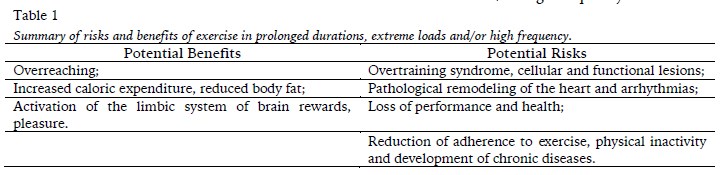
<body><![CDATA[<p>Exercise has been considered a   &quot;polypill&quot; (Fiuza-Luces, Garatachea, Berger, &amp; Lucia, 2013), able     to promote numerous biological and functional benefits. There are intense     exercise protocols potentially beneficial, such as high intensity interval     training, for example (Burgomaster et al., 2008; Burgomaster, Hughes,     Heigenhauser, Bradwell, &amp; Gibala, 2005; Gibala &amp; McGee, 2008). It can     be found  in the literature results     pointing out that maximum exercise active areas of the brain limbic system,     regions could be related to the promotion of pleasure, emotions and rewards     (Guimarães et al., 2014; Guimarães &amp; Deslandes, 2014). Other positive     examples of high intensity exercise include the greater impact on energy     expenditure (and possibly on body composition), in addition to the     overreaching, temporary exhaustion induced by excessive training, followed by physiological overcompensation and improvement of physical fitness. </p>     <p>Meeusen et al. (2006) defined     functional overreaching as a short-term performance decrement without severe     psychological or other lasting negative symptoms that eventually leads to     improvement in performance after days of recovery (Meeusen et al., 2006). This     condition is relatively easy to be recovered in the short term, between two and     four weeks (Fry &amp; Kraemer, 1997; Fry, Morton, &amp; Keast, 1991). Meeusen     et al. (2006) characterized nonfunctional overreaching as a performance     decrement that can be reversed after weeks or months of recovery, while a     performance decrement in overtraining syndrome can last months to years. It has     been proposed that overreaching is a stage prior to overtraining (Rogero,     Mendes, &amp; Tirapegui, 2005). Short periods of rest between exercise     sessions, in addition to increases in volume and intensity of training, can     make the practitioner routine increasingly exhausting (Rogero et al., 2005).     Individual differences in recovery time, ability to perform and tolerate     physical effort, the impact of adverse weather conditions, lack of nutritional     planning (control of carbohydrates, amino acids and hydration, for example) and     other stressors not related to training (sleep, diet, family, studies, work,     leisure, finances) may explain why each practitioner has a different answer for     the same routine or training planning (Freitas, Miranda, &amp; Bara Filho, 2009; Wanner, Wilke, &amp; Duffield, 2016).</p>     <p>Amateur or professional athletes are     often affected by deleterious conditions resulting from excessive exercise,     such as neurological, endocrine and immune. These changes are the overtraining     syndrome characteristics, involving mood and anxiety disorders, depression,     general apathy, emotional instability, loss of appetite, sleep disorders,     hormonal changes, increased heart rate at rest and increased vulnerability to     infection and injury in addition to muscle and joint pain (Kellmann, 2010;     Matta Mello Portugal et al., 2013; Reardon &amp; Factor, 2010; Schaal et al.,     2011). Overtraining can be defined as a condition of poor adaptation to a     chronic period of excessive stress caused by physical exertion, resulting in     the development of the syndrome, compromising the health and sports performance (Kreher &amp; Schwartz, 2012).</p>     <p>The prevalence of the overtraining is     rarely studied, but it is estimated that 60% of marathoners, 50% of football     players and 33% of basketball players have experienced its symptoms (Armstrong   &amp; VanHeest, 2002). However, frequently, fitness programs for people who do     not aim the competition involving endurance exercise, strength and speed also     cause undesirable acute or chronic damage and side effects (Rogero et al.,     2005). One of the most common symptom or consequence of the muscle damage     suffered by beginners is the delayed onset muscle soreness, characterized as a     feeling of discomfort in the skeletal muscle, which occurs a few hours after     exercise, triggered by inflammation from excessive overloads (Foschini,     Prestes, &amp; Charro, 2007; Tricoli, 2001). In addition to beginners, severe     stress caused by physical exertion in non-competitive environment can also lead     to extreme complications, as in the study of case presented in 2011, during the     annual meeting of the American College of Sports Medicine (Hadeed, Kuehl,     Elliot, &amp; Sleigh, 2011). Three days after a session of intense exercise,     based on the Crossfit method, a 33 year old male, previously asymptomatic and     physically active, experienced a condition of rhabdomyolysis (Hadeed, Kuehl,     Elliot, &amp; Sleigh, 2011). This syndrome is characterized by damage to the     skeletal muscles, the result of extravasation of intracellular content     (Criddle, 2003; Lopes &amp; Costa, 2013). Microtraumas from exercise may     include disruption of extracellular matrix, basement membrane, and the     sarcolemma, resulting in the release of intracellular proteins such as     myoglobin, lactate dehydrogenase, aspartate aminotransferase and creatine     kinase (CK), for example, into the bloodstream (Catanho da Silva &amp; Macedo,     2011; Lazarim et al., 2009). When the stress caused by physical effort is     controlled, the degenerative microtrauma are followed by a regenerative tissue     repair phase resulting in remodeling of damaged tissue (Catanho da Silva &amp;   Macedo, 2011; Smith, 2004). However, excessive stress can result in muscle   weakness, myalgia, nausea, renal failure or even lead to death (Lopes &amp; Costa, 2013).  </p>     <p>Excessive endurance exercise in     people with different levels of physical fitness, as well as muscular and     skeletal injuries, can induce pathological remodeling of the heart structures     and adjacent arteries (O'Keefe et al., 2012). Marathons, ultramarathons,     triathlons, too long bike races, can cause acute volume overload in the atria     and ventricles, with transient decreases in ventricular ejection fraction and     cardiac biomarker elevations, which return to normal within a week. Over months     and years of repetitive stress, this process may result in fibrosis of the     myocardium, particularly in atria, ventricles and interventricular septum,     which may develop fibrillations and arrhythmias (O'Keefe et al., 2012; Patil et al., 2012).</p>     <p>The desirable effects of exercise     seem to depend on an adequate dose, or a dose that cannot cause side effects.     Excessive exercise can damage health of practitioners from many different     levels of physical fitness and sports purposes, inducing a reduction in     physical performance and ends the competitive athlete's career early. <a href="/img/revistas/mot/v13n3/13n3a09t1.jpg">Table 1</a>  summarizes possible risks and benefits of exercise in prolonged durations, extreme loads and/or high frequency.</p>     
<p><b>General   characteristics of the immune response </b></p>     <p>The immunological response may be     understood in two steps: innate and adaptive response. The innate response     includes physical barriers (i.e., skin), chemical (i.e., tear complement     system) and the participation of cells such as macrophages, neutrophils,     dendritic cells, natural killer cells (NK) and microbicides molecules such as     nitric oxide (NO) and superoxide anion (O2-). The adaptive immune response     involves mainly T (TCD4<sup>+</sup> and TCD8<sup>+</sup>) and B lymphocytes and     their products, cytokines and antibodies, respectively. It can be divided into     humoral (mediated for antibodies) and cellular immune response (cell-mediated,     such as T lymphocytes and macrophages). The TCD4<sup>+</sup> lymphocytes     (helper/helper-Th0) can differentiate into various cell subpopulations as T<sub>h</sub>1     (T helper type 1) and T<sub>h</sub>2 (T helper type 2), that produce different     standards of cytokines (Del Prete, 2008; Romagnani, 1991; Terra, Silva,     Salerno, &amp; Dutra, 2012). The differentiation of TCD4<sup>+</sup> in T<sub>h</sub>1     lymphocytes can be stimulated by interleukin 12 (IL-12) produced by     antigen-presenting cells (macrophages and dendritic cells), whereas     differentiation into T<sub>h</sub>2 is induced by autocrine action of IL-4     produced by TCD4<sup>+</sup>. The T<sub>h</sub>1 cells predominantly produce     interferon-gamma (IFN-&#947;) and are related to cellular     immune response control caused by intracellular microorganism’s infections. The     T<sub>h</sub>2 cells produce mainly IL-4 and are related to the humoral immune     response and control of extracellular infections. Various factors such as     predominant cytokines in the activation microenvironment, costimulatory     molecules, the type of antigen and early events occurring during the innate     immune response involving dendritic cells and NK cells can drive predominant     response, determining control or not of an infection (Ostrowski, Rohde, Asp,     Schjerling, &amp; Pedersen, 1999; Pedersen &amp; Febbraio, 2008; Pedersen &amp; Hoffman-Goetz, 2000; Terra et al., 2012).</p> </font>     <p><font face="Verdana" size="2"><b>Basic considerations on the immune response to exercise</b></font></p>     <p><font face="Verdana" size="2">According to the American College of   Sports Medicine, aerobic activities ranging from 40 to 59% of VO<sub>2max</sub>,   55 and 69% of maximum heart rate and 12-13 on the Borg scale are considered   moderate, while aerobic activities ranging from 60 to 84% of VO<sub>2max</sub>,   70 and 89% of maximum heart rate and 14-16 on the Borg scale are considered   high intensity (ACSM, 1998; Febbraio &amp; Pedersen, 2002; Pedersen &amp;   Febbraio, 2008). The International Society of Exercise and Immunology (ISEI),   in its official position, points out that immune dysfunction observed after   exercise is more pronounced when the effort is continuous, prolonged (&gt; 1.5   hours) and held in intensity ranging from moderate to high (55 and 75% of VO<sub>2max</sub>)   (Pedersen et al., 2003; Walsh et al., 2011). </font></p> <font face="Verdana" size="2">     ]]></body>
<body><![CDATA[<p>During and immediately after the     exertion the leukocytes appear to suffer an increase (transient leukocytosis),     followed by a fall (leucopenia) (Catanho da Silva &amp; Macedo, 2011). The     period in which agents of the immune system are suppressed after the exhaustion     caused by a training session or competitive event is known as the &quot;window     of opportunity&quot; (Febbraio &amp; Pedersen, 2005). The increased risk of     respiratory tract infections or other deleterious condition from the     opportunity for pathogens may vary within one to nine hours (Pedersen &amp;   Fischer, 2007), 72 hours (Steensberg et al., 2000) or even two weeks (Fischer   et al., 2004). In addition, it has been hypothesized that overtraining begins   at the time when new strenuous exercise sessions are performed without the necessary time to recover from immunosuppression (Nielsen &amp; Pedersen, 2008).</p>     <p>Mechanical, hormonal and metabolic     factors can modulate the immune response to exercise (Costa Rosa &amp; Vaisber,     2002). As examples of mechanical factors, hypoxia, hyperthermia and muscle     injury are capable of generating a localized inflammatory process (Costa Rosa   &amp; Vaisber, 2002). Overtraining induced by downhill running training     sessions is associated with DNA damage in peripheral blood and skeletal muscle     cells, with oxidative stress in skeletal muscle cells and total blood (Pereira et     al., 2013). DNA damage observed in lymphocytes, provoked by strenuous exercise,     may compromise immune function (Dong et al., 2011; Wierzba, Olek, Fedeli, &amp; Falcioni, 2006).</p>     <p>The hypothalamus is the structure     responsible for coordinating responses resulting from the interaction between     the nervous system and secretory glands of hormones (cortisol and growth     hormone, for example). Its action changes when there is a neuroendocrine     imbalance (Mackinnon, 2000; Meeusen et al., 2004; Smith, 2004). Cytokines are     able to modulate the activity of the hypothalamic-pituitary-adrenal axis and     other areas of the brain responsible for mood control and anxiety. Activation     of the autonomic nervous system and the hypothalamic-pituitary-adrenal axis     together with suppression of the hypothalamic-pituitary-gonadal axis can be     governed by cytokines such as IL-1&#946;,     IL-6 and TNF-&#945; representing consequences     related to the overtraining syndrome (Smith, 2000). Athletes with chronic pain     have enhanced production of IL-1, IL-2, TNF-&#945; and IFN-&#947; and reduced performance in     the ergospirometric test (Vaisberg, de Mello, Seelaender, dos Santos, &amp; Costa Rosa, 2007). </p>     <p>In relation to metabolism, during     catabolic states like infections, surgeries, traumas, acidosis and strenuous     physical exercises, plasma glutamine undergoes a reduction (Mackinnon, 2000),     correlating with an increase in symptoms of upper respiratory tract infections     (dos Santos, Caperuto, de Mello, &amp; Costa Rosa, 2009). Several studies have     shown a decrease in plasma glutamine concentration after exhaustive exercise in     humans and animals (Bassit, Sawada, Bacurau, Navarro, &amp; Costa Rosa, 2000;     Castell, 2002; dos Santos et al., 2009; Koyama, Kaya, Tsujita, &amp; Hori,     1998; Walsh, Blannin, Robson, &amp; Gleeson, 1998), as well as in the presence     of overtraining syndrome (dos Santos et al., 2009; Parry-Billings et al., 1992;     Rowbottom, Keast, Goodman, &amp; Morton, 1995). Macrophages use high rates of     glutamine to generate energy and biosynthesis (dos Santos et al., 2009). Mice     submitted to moderate and strenuous eight weeks training protocols, relative to     sedentary control, suffered an increase in macrophage post-exercise function,     which was supported by enhanced glutamine consumption and metabolism (dos Santos et al., 2009).</p>     <p>Insulin metabolism also appears to be     compromised by overtraining status, affecting factors related to immune     function (Pereira et al., 2014). Besides the liver suffer an up regulation of     gluconeogenesis, promoting a high-caloric state and redirecting even more amino     acids (like glutamine) to this function, insulin presents its metabolism     altered. An eight-week protocol involving three groups of rats under different     training combinations (sedentary, moderate, and strenuous), evidenced an     impaired insulin signaling pathway with concomitant increases in enzymatic     complex linked to the cellular response to inflammation, the stress-activated     protein kinases/Jun aminoterminal kinases and the suppressor of cytokine signaling 3 (SOCS3) (Pereira et al., 2014).</p> <b>Chronic effects of exhaustive exercise and overtraining: T<sub>h</sub>1 and T<sub>h</sub>2 profile</b>      <p>Even if several studies associate     extreme exercise damages with immunosuppression, the increase in incidence of     disease is not exclusive of immunosuppression, but, above all, a change in the     immunological profile, from an increase in humoral immunity coupled with the     suppression of cellular immunity (Lakier Smith, 2003). While the moderate     intensity exercise promotes a protection against infections caused by     intracellular microorganisms, because it directs the immune response to the     predominance of a response profile of T<sub>h</sub>1 type, vigorous activities     generate increasing concentrations of anti-inflammatory cytokines. This     condition promoting the predominance of a T<sub>h</sub>2 response profile, in     order to decrease the muscle tissue damage resulting from inflammation,     although this may result in increased susceptibility to infections (Terra et al., 2012).</p>     <p>Data collected by Terra et al. (2013)     showed that lymph nodes cells from mice submitted to swimming activity of     moderate intensity for 12 weeks presented an elevation in IFN-&#947; and TNF-&#945; concentrations and IL-4 and     IL-10 significantly decreased compared to sedentary group. These data suggest     that moderate exercise promote the predominance of a protective immune response     type T<sub>h</sub>1 in mice (Terra et al., 2013). On the other hand, a review     written by Smith (2000) suggests that trauma generated in muscle and skeletal     system, from the extreme stress provoked by exercise, produce large amounts of     proinflammatory cytokines such as IL-1&#946;,     IL-6 and TNF-&#945; (Smith, 2000). The positive     feedback of the anti-inflammatory components becomes imminent and the imbalance     in T<sub>h</sub>1 and T<sub>h</sub>2 profile can reflect a disturbing condition     of homeostasis. Successive chronic stimuli, without proper recovery of stable physiological state, may develop symptoms related to overtraining. </p>     <p>Few studies, however, have tested the     hypothesis that T<sub>h</sub>1 and T<sub>h</sub>2 profile are chronically     altered by overtraining. There are ethical limitations in studies with humans     and animals, therefore, are more frequently used. Despite the different     protocols of chronic exhaustion and populations used, the results indicate a predominance of the T<sub>h</sub>2 response on T<sub>h</sub>1. </p>     <p><i>Protocols of four to six days of exhaustion. </i></p>     <p>Mice experienced a suppression in     antigen presentation by macrophages three and 24 hours after four days of     exhaustive training when compared to moderate group (Ceddia &amp; Woods, 1999).     Macrophages are antigen presenting cells capable of causing differentiation of     TCD4<sup>+</sup> lymphocytes into T<sub>h</sub>1. The authors suggested that     cellular immunosuppression is a consequence in reducing differentiation of T<sub>h</sub>1     new cells, causing an imbalance in T<sub>h</sub>1 and T<sub>h</sub>2 profile.     In another study, seven cyclists under six days of intensified training also     experienced an imbalance in the ratio T<sub>h</sub>1/T<sub>h</sub>2 immediately     after an exhaustive effort session and the end of two weeks of rest (Lancaster     et al., 2004). It was observed a reduction in IFN-&#947; while IL-4 remained unchanged. Therefore, the ratio IFN-&#947;/IL-4 reduced with severe stress and was associated with the window of opportunity (Lancaster et al., 2004).</p>     ]]></body>
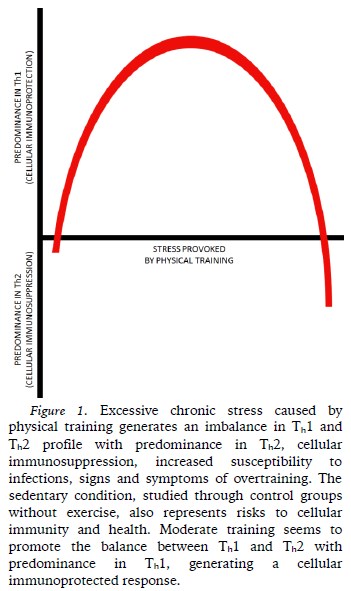
<body><![CDATA[<p><i>Studies with longer intervention time (overtraining). </i></p>     <p>The study of Ru and Peije (2009) found     that eight rats submitted to nine weeks of progressive training, six days a     week, provoked a cellular immunosuppression by predominance of T<sub>h</sub>2     response, reduced systemic hemoglobin concentration and decreased in     testosterone and corticosterone 36 hours after the last training session. Seven     days after the last session, the authors found in the spleen a reduction of     natural killer T cells and IFN-&#947; in     addition to IL-4 increased, unbalancing the ratio T<sub>h</sub>1/T<sub>h</sub>2     through IFN-&#947;/IL-4 compared to the control group (Ru &amp; Peijie, 2009). </p>     <p>Farhangimaleki et al. (2009) found in     cyclists that combined a maintenance of intensity with a decrease in the     duration (tapering) within one to three weeks, immediately after eight weeks of     training with increasing volume, an improvement in performance compared to a control     group. The control group, who trained for eleven weeks progressively from the     first to the eleventh, did not improve performance as well as IL-1 &#946;, IL-6 and TNF-&#945; increased in relation to tapering group. Although the authors did not     evaluate the T<sub>h</sub>2 profile, the findings suggested the importance of     tapering period to prevent disturbances in physiological homeostasis, risk of infections and fatigue (Farhangimaleki, Zehsaz, &amp; Tiidus, 2009).</p>     <p>Gholamnezhad et al. (2014)     investigated the effect of eight weeks of moderate training and eleven weeks of     severe training (overtraining), immediately, 24 hours and two weeks after in     the plasma concentration of cytokines. Although TNF-&#945; has increased in overtraining and overtraining post two weeks recovery,     IL-10 and IL-4 increased in both conditions, and IFN-&#947; increased just at moderate group. Even though the authors have not     shared the results of physical capacity, moderate training promoted cellular     immunity while in other groups, including the control, was observed cellular     immunosuppression (Gholamnezhad, Boskabady, Hosseini, Sankian, &amp; Khajavi     Rad, 2014). These groups had a response directed to the T<sub>h</sub>2 profile     while the response of moderated group was directed to the T<sub>h</sub>1     profile. In this study, two weeks of recovery (tapering) were not enough to     reverse the cellular immunosuppression, as the findings of Farhangimaleki et     al. (2009). <a href="#f1">Figure 1</a> summarizes the changes of different types of chronic     stress caused by physical training in T<sub>h</sub>1 and T<sub>h</sub>2 profile.</p>     <p><a name="f1"></a></p>     <p>&nbsp;</p>     <p align="center"><img src="/img/revistas/mot/v13n3/13n3a09f1.jpg" width="351" height="591"></p>     
<p>&nbsp;</p>     <p>Overtraining can be seen as the third     stage of the General Adaptation Syndrome, originally described by Hans Selye in     1936. The depletion stage (third stage) refers to recover for survival, unlike     the latter, in which the body resists the alarm (first stage) and adapts. The     third stage is to protect the body against excessive physiological stress. The     signs and symptoms of overtraining syndrome are the positive precaution point     of view against even more severe damage (Smith, 2000). Numerous models to     explain the mechanisms of acute and chronic fatigue have been developed, but     few discuss the relationship of cytokines between the need to repair and     regulate afferent feedbacks that process signals that might lead to sensations     and feelings of exhaustion (Vargas &amp; Marino, 2014). The organism requires     absolute repose and negative changes in T<sub>h</sub>1 and T<sub>h</sub>2 profile appear to help the immune system to repair even greater injuries. </p> <b>Physical inactivity, excessive exercise and public health</b>      <p>According to the concept of Hormesis     favorable biological responses generally occur due to the properly controlled     exposure to stressful stimuli (Radak, Chung, &amp; Goto, 2008). In the context     of public health, not only physical inactivity should figure as the main     concern. The exercise has been considered a miracle drug because there is     epidemiological evidence to corroborate this statement. However, experimental     studies question the effectiveness of any configuration of a physical training     program in relation to the intensity and duration. Regular exercise has     benefits before the development of overtraining, however, according to Farhangimaleki et al. (2009), overtraining is a poorly understood process.</p>     ]]></body>
<body><![CDATA[<p>The state of physical and mental     exhaustion not only impairs performance. Its signs and symptoms are consistent     with the development of damage to health similar to chronic noncommunicable     diseases. The difference between medicine and poison is the dose. With physical     exercise does not seem to be different. In this context, we suggest more     attention of researchers and policy makers not only to physical inactivity, but     at the excessive exercise. The immune imbalance and cellular immunosuppression     represent a promising topic in sports science that can help broaden the understanding and discussion of the paradox of exercise.</p> </font>     <p>&nbsp;</p>     <p><font size="3" face="Verdana"><b>CONCLUSION</b></font></p>      <p><font size="2" face="Verdana">Chronic exhaustive training may cause     the imbalance in T<sub>h</sub>1 and T<sub>h</sub>2 profile with predominance in     T<sub>h</sub>2, resulting in cellular immunosuppression, increased     susceptibility to infections, inflammation, signs and symptoms of overtraining.     On the other hand, the moderate training seems to promote the balance between T<sub>h</sub>1     and T<sub>h</sub>2 with predominance in T<sub>h</sub>1, generating a cellular immunoprotection.</font></p>     <p>&nbsp;</p>     <p><font size="3" face="Verdana"><b>REFERENCES</b></font></p> <font face="Verdana" size="2">    <!-- ref --><p>ACSM (1998). American College of Sports Medicine     Position Stand. Exercise and physical activity for olde<a></a>r     adults. <i>Medicine &amp; Science in Sports &amp; Exercise, 30</i>(6), 992-1008.    &nbsp;&nbsp;&nbsp;&nbsp;&nbsp;&nbsp;&nbsp;&nbsp;[&#160;<a href="javascript:void(0);" onclick="javascript: window.open('/scielo.php?script=sci_nlinks&ref=368635&pid=S1646-107X201700040000900001&lng=','','width=640,height=500,resizable=yes,scrollbars=1,menubar=yes,');">Links</a>&#160;]<!-- end-ref --></p>     <!-- ref --><p>Armstrong, L. E., &amp; VanHeest, J. L. (2002). The     unknown mechanism of the overtraining syndrome: clues from depression and psychoneuroimmunology. <i>Sports Medicine, 32</i>(3), 185-209.    &nbsp;&nbsp;&nbsp;&nbsp;&nbsp;&nbsp;&nbsp;&nbsp;[&#160;<a href="javascript:void(0);" onclick="javascript: window.open('/scielo.php?script=sci_nlinks&ref=368637&pid=S1646-107X201700040000900002&lng=','','width=640,height=500,resizable=yes,scrollbars=1,menubar=yes,');">Links</a>&#160;]<!-- end-ref --> </p>     ]]></body>
<body><![CDATA[<!-- ref --><p>Bassit, R. A.,     Sawada, L. A., Bacurau, R. F., Navarro, F., &amp; Costa Rosa, L. F. (2000). The effect of BCAA supplementation upon the immune response of triathletes. <i>Medicine &amp; Science in Sports &amp; Exercise, 32</i>(7), 1214-1219.    &nbsp;&nbsp;&nbsp;&nbsp;&nbsp;&nbsp;&nbsp;&nbsp;[&#160;<a href="javascript:void(0);" onclick="javascript: window.open('/scielo.php?script=sci_nlinks&ref=368639&pid=S1646-107X201700040000900003&lng=','','width=640,height=500,resizable=yes,scrollbars=1,menubar=yes,');">Links</a>&#160;]<!-- end-ref --> </p>     <!-- ref --><p>Burgomaster, K. A., Howarth, K. R., Phillips, S. M.,     Rakobowchuk, M., Macdonald, M. J., McGee, S. L., &amp; Gibala, M. J. (2008).     Similar metabolic adaptations during exercise after low volume sprint interval     and traditional endurance training in humans. <i>The Journal Physiology, 586</i>(1), 151-160. doi:10.1113/jphysiol.2007.142109&nbsp;&nbsp;&nbsp;&nbsp;&nbsp;&nbsp;&nbsp;&nbsp;[&#160;<a href="javascript:void(0);" onclick="javascript: window.open('/scielo.php?script=sci_nlinks&ref=368641&pid=S1646-107X201700040000900004&lng=','','width=640,height=500,resizable=yes,scrollbars=1,menubar=yes,');">Links</a>&#160;]<!-- end-ref --><!-- ref --><p>Burgomaster, K. A., Hughes, S. C., Heigenhauser, G.     J., Bradwell, S. N., &amp; Gibala, M. J. (2005). Six sessions of sprint     interval training increases muscle oxidative potential and cycle endurance     capacity in humans. <i>Journal of Applied Physiology, 98</i>(6), 1985-1990. doi: 10.1152/japplphysiol.01095.2004&nbsp;&nbsp;&nbsp;&nbsp;&nbsp;&nbsp;&nbsp;&nbsp;[&#160;<a href="javascript:void(0);" onclick="javascript: window.open('/scielo.php?script=sci_nlinks&ref=368642&pid=S1646-107X201700040000900005&lng=','','width=640,height=500,resizable=yes,scrollbars=1,menubar=yes,');">Links</a>&#160;]<!-- end-ref --><!-- ref --><p>Castell, L. M. (2002). Can glutamine modify the apparent immunodepression observed after prolonged, exhaustive exercise? <i>Nutrition, 18</i>(5), 371-375.    &nbsp;&nbsp;&nbsp;&nbsp;&nbsp;&nbsp;&nbsp;&nbsp;[&#160;<a href="javascript:void(0);" onclick="javascript: window.open('/scielo.php?script=sci_nlinks&ref=368643&pid=S1646-107X201700040000900006&lng=','','width=640,height=500,resizable=yes,scrollbars=1,menubar=yes,');">Links</a>&#160;]<!-- end-ref --> </p>     <!-- ref --><p>Catanho da     Silva, F., &amp; Macedo, D. (2011). Exercício físico, processo inflamatório e     adaptação: uma visão geral <i>Revista Brasileira de Cineantropometria e Desempenho Humano, 13</i>(4), 320-328. doi: 10.5007/1980-0037.2011v13n4p320&nbsp;&nbsp;&nbsp;&nbsp;&nbsp;&nbsp;&nbsp;&nbsp;[&#160;<a href="javascript:void(0);" onclick="javascript: window.open('/scielo.php?script=sci_nlinks&ref=368645&pid=S1646-107X201700040000900007&lng=','','width=640,height=500,resizable=yes,scrollbars=1,menubar=yes,');">Links</a>&#160;]<!-- end-ref --><!-- ref --><p>Ceddia, M. A., &amp; Woods, J. A. (1999). Exercise     suppresses macrophage antigen presentation. <i>Journal of Applied Physiology, 87</i>(6), 2253-2258.    &nbsp;&nbsp;&nbsp;&nbsp;&nbsp;&nbsp;&nbsp;&nbsp;[&#160;<a href="javascript:void(0);" onclick="javascript: window.open('/scielo.php?script=sci_nlinks&ref=368646&pid=S1646-107X201700040000900008&lng=','','width=640,height=500,resizable=yes,scrollbars=1,menubar=yes,');">Links</a>&#160;]<!-- end-ref --> </p>     <!-- ref --><p>Costa Rosa, L. F. P. B., &amp; Vaisber, M. W. (2002). Influência do Exercício na     Reposta Imune. <i>Revista Brasileira de Medicina do Esporte, 8</i>(4), 167-172.    &nbsp;&nbsp;&nbsp;&nbsp;&nbsp;&nbsp;&nbsp;&nbsp;[&#160;<a href="javascript:void(0);" onclick="javascript: window.open('/scielo.php?script=sci_nlinks&ref=368648&pid=S1646-107X201700040000900009&lng=','','width=640,height=500,resizable=yes,scrollbars=1,menubar=yes,');">Links</a>&#160;]<!-- end-ref --> </p>     <!-- ref --><p>Criddle, L. M. (2003).     Rhabdomyolysis. Pathophysiology,     recognition, and management. <i>Critical Care Nurse</i>, <i>23</i>(6), 14–22, 24–26, 28 passim; quiz 31-32.    &nbsp;&nbsp;&nbsp;&nbsp;&nbsp;&nbsp;&nbsp;&nbsp;[&#160;<a href="javascript:void(0);" onclick="javascript: window.open('/scielo.php?script=sci_nlinks&ref=368650&pid=S1646-107X201700040000900010&lng=','','width=640,height=500,resizable=yes,scrollbars=1,menubar=yes,');">Links</a>&#160;]<!-- end-ref --></p>     <!-- ref --><p>Del Prete, G.     (2008). The complexity of the CD4 T-cell responses: old and new T-cell subsets. <i>Parassitologia, 50</i>(1-2), 9-16.    &nbsp;&nbsp;&nbsp;&nbsp;&nbsp;&nbsp;&nbsp;&nbsp;[&#160;<a href="javascript:void(0);" onclick="javascript: window.open('/scielo.php?script=sci_nlinks&ref=368652&pid=S1646-107X201700040000900011&lng=','','width=640,height=500,resizable=yes,scrollbars=1,menubar=yes,');">Links</a>&#160;]<!-- end-ref --> </p>     <!-- ref --><p>Dong, J., Chen, P., Wang, R., Yu, D., Zhang, Y., &amp;   Xiao, W. (2011). NADPH oxidase: a target for the modulation of the excessive oxidase damage induced by overtraining in rat neutrophils. <i>International Journal of Biological Sciences, 7</i>(6), 881-891.    &nbsp;&nbsp;&nbsp;&nbsp;&nbsp;&nbsp;&nbsp;&nbsp;[&#160;<a href="javascript:void(0);" onclick="javascript: window.open('/scielo.php?script=sci_nlinks&ref=368654&pid=S1646-107X201700040000900012&lng=','','width=640,height=500,resizable=yes,scrollbars=1,menubar=yes,');">Links</a>&#160;]<!-- end-ref --> </p>     <!-- ref --><p>dos Santos, R.     V., Caperuto, E. C., de Mello, M. T., &amp; Costa Rosa, L. F. (2009). Effect of exercise on glutamine metabolism in macrophages of trained     rats. <i>European Journal of Applied Physiology, 107</i>(3), 309-315. doi:10.1007/s00421-009-1130-6&nbsp;&nbsp;&nbsp;&nbsp;&nbsp;&nbsp;&nbsp;&nbsp;[&#160;<a href="javascript:void(0);" onclick="javascript: window.open('/scielo.php?script=sci_nlinks&ref=368656&pid=S1646-107X201700040000900013&lng=','','width=640,height=500,resizable=yes,scrollbars=1,menubar=yes,');">Links</a>&#160;]<!-- end-ref --><!-- ref --><p>Farhangimaleki, N., Zehsaz, F., &amp; Tiidus, P. M.     (2009). The effect of tapering period on plasma pro-inflammatory cytokine levels and performance in elite male cyclists. <i>Journal of Sports Science and Medicine, 8</i>(4), 600-606.    &nbsp;&nbsp;&nbsp;&nbsp;&nbsp;&nbsp;&nbsp;&nbsp;[&#160;<a href="javascript:void(0);" onclick="javascript: window.open('/scielo.php?script=sci_nlinks&ref=368657&pid=S1646-107X201700040000900014&lng=','','width=640,height=500,resizable=yes,scrollbars=1,menubar=yes,');">Links</a>&#160;]<!-- end-ref --> </p>     ]]></body>
<body><![CDATA[<!-- ref --><p>Febbraio, M. A., &amp; Pedersen, B. K. (2002).     Muscle-derived interleukin-6: mechanisms for activation and possible biological     roles. <i>The FASEB Journal, 16</i>(11), 1335-1347. doi:10.1096/fj.01-0876rev&nbsp;&nbsp;&nbsp;&nbsp;&nbsp;&nbsp;&nbsp;&nbsp;[&#160;<a href="javascript:void(0);" onclick="javascript: window.open('/scielo.php?script=sci_nlinks&ref=368659&pid=S1646-107X201700040000900015&lng=','','width=640,height=500,resizable=yes,scrollbars=1,menubar=yes,');">Links</a>&#160;]<!-- end-ref --><!-- ref --><p>Febbraio, M. A., &amp; Pedersen, B. K. (2005).     Contraction-induced myokine production and release: is skeletal muscle an     endocrine organ? <i>Exercercise and Sport Science Reviews, 33</i>(3), 114-119.    &nbsp;&nbsp;&nbsp;&nbsp;&nbsp;&nbsp;&nbsp;&nbsp;[&#160;<a href="javascript:void(0);" onclick="javascript: window.open('/scielo.php?script=sci_nlinks&ref=368660&pid=S1646-107X201700040000900016&lng=','','width=640,height=500,resizable=yes,scrollbars=1,menubar=yes,');">Links</a>&#160;]<!-- end-ref --> </p>     <!-- ref --><p>Fischer, C. P., Hiscock, N. J., Penkowa, M., Basu, S.,     Vessby, B., Kallner, A., . . . Pedersen, B. K. (2004). Supplementation with     vitamins C and E inhibits the release of interleukin-6 from contracting human     skeletal muscle. <i>Journal of Physiology, 558</i>(2), 633-645. doi:10.1113/jphysiol.2004.066779&nbsp;&nbsp;&nbsp;&nbsp;&nbsp;&nbsp;&nbsp;&nbsp;[&#160;<a href="javascript:void(0);" onclick="javascript: window.open('/scielo.php?script=sci_nlinks&ref=368662&pid=S1646-107X201700040000900017&lng=','','width=640,height=500,resizable=yes,scrollbars=1,menubar=yes,');">Links</a>&#160;]<!-- end-ref --><!-- ref --><p>Fiuza-Luces, C., Garatachea, N., Berger, N. A., &amp; Lucia, A. (2013). Exercise is the real polypill. <i>Physiology, 28</i>(5), 330-358. doi:10.1152/physiol.00019.2013&nbsp;&nbsp;&nbsp;&nbsp;&nbsp;&nbsp;&nbsp;&nbsp;[&#160;<a href="javascript:void(0);" onclick="javascript: window.open('/scielo.php?script=sci_nlinks&ref=368663&pid=S1646-107X201700040000900018&lng=','','width=640,height=500,resizable=yes,scrollbars=1,menubar=yes,');">Links</a>&#160;]<!-- end-ref --><!-- ref --><p>Foschini, D., Prestes, J., &amp; Charro, M. A. (2007).     Relationship between physical exercise, muscle damage and delayed-onset muscle     soreness. <i>Revista Brasileira de Cineantropomemtria e Desempenho Humano, 9</i>(1), 101-106. doi:10.5007/%25x&nbsp;&nbsp;&nbsp;&nbsp;&nbsp;&nbsp;&nbsp;&nbsp;[&#160;<a href="javascript:void(0);" onclick="javascript: window.open('/scielo.php?script=sci_nlinks&ref=368664&pid=S1646-107X201700040000900019&lng=','','width=640,height=500,resizable=yes,scrollbars=1,menubar=yes,');">Links</a>&#160;]<!-- end-ref --><!-- ref --><p>Freitas, D.,     Miranda, R., &amp; Bara Filho, M. (2009). Marcadores psicológico, fisiológico e     bioquímico para determinação dos efeitos da carga de treino e do overtraining. <i>Revista Brasileira de Cineantropomemtria e Desempenho Humano, 11</i>(4), 457-465 &nbsp;&nbsp;&nbsp;&nbsp;&nbsp;&nbsp;&nbsp;&nbsp;[&#160;<a href="javascript:void(0);" onclick="javascript: window.open('/scielo.php?script=sci_nlinks&ref=368665&pid=S1646-107X201700040000900020&lng=','','width=640,height=500,resizable=yes,scrollbars=1,menubar=yes,');">Links</a>&#160;]<!-- end-ref --><!-- ref --><p>Fry, A. C.,   &amp; Kraemer, W. J. (1997). Resistance exercise overtraining and overreaching. Neuroendocrine responses. <i>Sports Medicine, 23</i>(2), 106-129.    &nbsp;&nbsp;&nbsp;&nbsp;&nbsp;&nbsp;&nbsp;&nbsp;[&#160;<a href="javascript:void(0);" onclick="javascript: window.open('/scielo.php?script=sci_nlinks&ref=368666&pid=S1646-107X201700040000900021&lng=','','width=640,height=500,resizable=yes,scrollbars=1,menubar=yes,');">Links</a>&#160;]<!-- end-ref --> </p>     <!-- ref --><p>Fry, R. W., Morton, A. R., &amp; Keast, D. (1991).     Overtraining in athletes. An update. <i>Sports Medicine, 12</i>(1), 32-65.    &nbsp;&nbsp;&nbsp;&nbsp;&nbsp;&nbsp;&nbsp;&nbsp;[&#160;<a href="javascript:void(0);" onclick="javascript: window.open('/scielo.php?script=sci_nlinks&ref=368668&pid=S1646-107X201700040000900022&lng=','','width=640,height=500,resizable=yes,scrollbars=1,menubar=yes,');">Links</a>&#160;]<!-- end-ref --> </p>     <!-- ref --><p>Gholamnezhad, Z., Boskabady, M. H., Hosseini, M.,     Sankian, M., &amp; Khajavi Rad, A. (2014). Evaluation of immune response after moderate and overtraining exercise in wistar rat. <i>Iranian Journal of Basic Medical Sciences, 17</i>(1), 1-8.    &nbsp;&nbsp;&nbsp;&nbsp;&nbsp;&nbsp;&nbsp;&nbsp;[&#160;<a href="javascript:void(0);" onclick="javascript: window.open('/scielo.php?script=sci_nlinks&ref=368670&pid=S1646-107X201700040000900023&lng=','','width=640,height=500,resizable=yes,scrollbars=1,menubar=yes,');">Links</a>&#160;]<!-- end-ref --> </p>     <!-- ref --><p>Gibala, M. J., &amp; McGee, S. L. (2008). Metabolic     adaptations to short-term high-intensity interval training: a little pain for a     lot of gain? <i>Exercise and Sport Science Review, 36</i>(2), 58-63. doi: 10.1097/JES.0b013e318168ec1f&nbsp;&nbsp;&nbsp;&nbsp;&nbsp;&nbsp;&nbsp;&nbsp;[&#160;<a href="javascript:void(0);" onclick="javascript: window.open('/scielo.php?script=sci_nlinks&ref=368672&pid=S1646-107X201700040000900024&lng=','','width=640,height=500,resizable=yes,scrollbars=1,menubar=yes,');">Links</a>&#160;]<!-- end-ref --><!-- ref --><p>Gohil, K., &amp; Brooks, G. A. (2012). Exercise tames     the wild side of the Myc network: a hypothesis. <i>American Journal of Physiology. Endocrinology and Metabolism, 303</i>(1), E18-30. doi:10.1152/ajpendo.00027.2012&nbsp;&nbsp;&nbsp;&nbsp;&nbsp;&nbsp;&nbsp;&nbsp;[&#160;<a href="javascript:void(0);" onclick="javascript: window.open('/scielo.php?script=sci_nlinks&ref=368673&pid=S1646-107X201700040000900025&lng=','','width=640,height=500,resizable=yes,scrollbars=1,menubar=yes,');">Links</a>&#160;]<!-- end-ref --><!-- ref --><p>Guimaraes, T. T., Costa, B. M. da,     Cerqueira, L. S., Serdeiro, A. de C. A., Pompeu, F. A. M. S., Moraes, H. S. de,   … Deslandes, A. C. (2015). Acute Effect of Different Patterns of Exercise on     Mood, Anxiety and Cortical Activity. <i>Archives of Neuroscience</i>, <i>2</i>(1), e18781. <a href="https://doi.org/10.5812/archneurosci.18781" target="_blank">https://doi.org/10.5812/archneurosci.18781</a>&nbsp;&nbsp;&nbsp;&nbsp;&nbsp;&nbsp;&nbsp;&nbsp;[&#160;<a href="javascript:void(0);" onclick="javascript: window.open('/scielo.php?script=sci_nlinks&ref=368674&pid=S1646-107X201700040000900026&lng=','','width=640,height=500,resizable=yes,scrollbars=1,menubar=yes,');">Links</a>&#160;]<!-- end-ref --><!-- ref --><p>Guimarães, T.,   &amp; Deslandes, A. (2014). <i>Exercício     físico em diferentes intensidades: efeito sobre o humor, ansiedade, cognição e atividade cortical</i>. Novas Edições Acadêmicas.    &nbsp;&nbsp;&nbsp;&nbsp;&nbsp;&nbsp;&nbsp;&nbsp;[&#160;<a href="javascript:void(0);" onclick="javascript: window.open('/scielo.php?script=sci_nlinks&ref=368675&pid=S1646-107X201700040000900027&lng=','','width=640,height=500,resizable=yes,scrollbars=1,menubar=yes,');">Links</a>&#160;]<!-- end-ref --></p>     <!-- ref --><p>Hadeed, M. J., Kuehl, K. S., Elliot,     D. L., &amp; Sleigh, A. (2011). Exertional Rhabdomyolysis After Crossfit     Exercise Program: 1210. <i>Medicine &amp; Science in Sports &amp; Exercise</i>, <i>43</i>(5), 224–225. <a href="https://doi.org/10.1249/01.MSS.0000400606.24620.bc" target="_blank">https://doi.org/10.1249/01.MSS.0000400606.24620.bc</a>&nbsp;&nbsp;&nbsp;&nbsp;&nbsp;&nbsp;&nbsp;&nbsp;[&#160;<a href="javascript:void(0);" onclick="javascript: window.open('/scielo.php?script=sci_nlinks&ref=368677&pid=S1646-107X201700040000900028&lng=','','width=640,height=500,resizable=yes,scrollbars=1,menubar=yes,');">Links</a>&#160;]<!-- end-ref --><!-- ref --><p>Hallal, P. C., Andersen, L. B., Bull, F. C., Guthold,     R., Haskell, W., Ekelund, U., &amp; Group, L. P. A. S. W. (2012). Global     physical activity levels: surveillance progress, pitfalls, and prospects. <i>Lancet, 380</i>(9838), 247-257. doi:10.1016/S0140-6736(12)60646-1&nbsp;&nbsp;&nbsp;&nbsp;&nbsp;&nbsp;&nbsp;&nbsp;[&#160;<a href="javascript:void(0);" onclick="javascript: window.open('/scielo.php?script=sci_nlinks&ref=368678&pid=S1646-107X201700040000900029&lng=','','width=640,height=500,resizable=yes,scrollbars=1,menubar=yes,');">Links</a>&#160;]<!-- end-ref --><!-- ref --><p>Handschin, C., &amp; Spiegelman, B. M. (2008). The role     of exercise and PGC1alpha in inflammation and chronic disease. <i>Nature, 454</i>(7203), 463-469. doi:10.1038/nature07206&nbsp;&nbsp;&nbsp;&nbsp;&nbsp;&nbsp;&nbsp;&nbsp;[&#160;<a href="javascript:void(0);" onclick="javascript: window.open('/scielo.php?script=sci_nlinks&ref=368679&pid=S1646-107X201700040000900030&lng=','','width=640,height=500,resizable=yes,scrollbars=1,menubar=yes,');">Links</a>&#160;]<!-- end-ref --><!-- ref --><p>Kellmann, M. (2010). Preventing overtraining in athletes in high-intensity     sports and stress/recovery monitoring. <i>Scandinavian Journal of Medicine   &amp; Science in Sports</i>, <i>20</i>(Suppl 2), 95–102. <a href="https://doi.org/10.1111/j.1600-0838.2010.01192.x" target="_blank">https://doi.org/10.1111/j.1600-0838.2010.01192.x</a>&nbsp;&nbsp;&nbsp;&nbsp;&nbsp;&nbsp;&nbsp;&nbsp;[&#160;<a href="javascript:void(0);" onclick="javascript: window.open('/scielo.php?script=sci_nlinks&ref=368680&pid=S1646-107X201700040000900031&lng=','','width=640,height=500,resizable=yes,scrollbars=1,menubar=yes,');">Links</a>&#160;]<!-- end-ref --><!-- ref --><p>Koyama, K.,     Kaya, M., Tsujita, J., &amp; Hori, S. (1998). Effects     of decreased plasma glutamine concentrations on peripheral lymphocyte     proliferation in rats. <i>European Journal of Applied Physiology and Occupational Physiology, 77</i>(1-2), 25-31.    &nbsp;&nbsp;&nbsp;&nbsp;&nbsp;&nbsp;&nbsp;&nbsp;[&#160;<a href="javascript:void(0);" onclick="javascript: window.open('/scielo.php?script=sci_nlinks&ref=368681&pid=S1646-107X201700040000900032&lng=','','width=640,height=500,resizable=yes,scrollbars=1,menubar=yes,');">Links</a>&#160;]<!-- end-ref --> </p>     <!-- ref --><p>Kreher, J. B., &amp; Schwartz, J. B. (2012). Overtraining syndrome: a     practical guide. <i>Sports Health</i>, <i>4</i>(2), 128–138. <a href="https://doi.org/10.1177/1941738111434406" target="_blank">https://doi.org/10.1177/1941738111434406</a>&nbsp;&nbsp;&nbsp;&nbsp;&nbsp;&nbsp;&nbsp;&nbsp;[&#160;<a href="javascript:void(0);" onclick="javascript: window.open('/scielo.php?script=sci_nlinks&ref=368683&pid=S1646-107X201700040000900033&lng=','','width=640,height=500,resizable=yes,scrollbars=1,menubar=yes,');">Links</a>&#160;]<!-- end-ref --><!-- ref --><p>Lakier Smith, L. (2003). Overtraining, excessive     exercise, and altered immunity: is this a T helper-1 versus T helper-2     lymphocyte response? <i>Sports Medicine, 33</i>(5), 347-364.    &nbsp;&nbsp;&nbsp;&nbsp;&nbsp;&nbsp;&nbsp;&nbsp;[&#160;<a href="javascript:void(0);" onclick="javascript: window.open('/scielo.php?script=sci_nlinks&ref=368684&pid=S1646-107X201700040000900034&lng=','','width=640,height=500,resizable=yes,scrollbars=1,menubar=yes,');">Links</a>&#160;]<!-- end-ref --> </p>     <!-- ref --><p>Lancaster, G. I., Halson, S. L., Khan, Q., Drysdale,     P., Wallace, F., Jeukendrup, A. E., . . . Gleeson, M. (2004). Effects of acute     exhaustive exercise and chronic exercise training on type 1 and type 2 T     lymphocytes. <i>Exercise Immunology Review, 10</i>, 91-106.    &nbsp;&nbsp;&nbsp;&nbsp;&nbsp;&nbsp;&nbsp;&nbsp;[&#160;<a href="javascript:void(0);" onclick="javascript: window.open('/scielo.php?script=sci_nlinks&ref=368686&pid=S1646-107X201700040000900035&lng=','','width=640,height=500,resizable=yes,scrollbars=1,menubar=yes,');">Links</a>&#160;]<!-- end-ref --></p>     <!-- ref --><p>Lazarim, F.     L., Antunes-Neto, J. M., da Silva, F. O., Nunes, L. A., Bassini-Cameron, A.,     Cameron, L. C., . . . de Macedo, D. V. (2009). The     upper values of plasma creatine kinase of professional soccer players during     the Brazilian National Championship. <i>Journal       of Science and Medicine in Sport, 12</i>(1), 85-90. doi:10.1016/j.jsams.2007.10.004&nbsp;&nbsp;&nbsp;&nbsp;&nbsp;&nbsp;&nbsp;&nbsp;[&#160;<a href="javascript:void(0);" onclick="javascript: window.open('/scielo.php?script=sci_nlinks&ref=368688&pid=S1646-107X201700040000900036&lng=','','width=640,height=500,resizable=yes,scrollbars=1,menubar=yes,');">Links</a>&#160;]<!-- end-ref --><!-- ref --><p>Lee, I. M., Shiroma, E. J., Lobelo, F., Puska, P.,     Blair, S. N., Katzmarzyk, P. T., &amp; Group, L. P. A. S. W. (2012). Effect of     physical inactivity on major non-communicable diseases worldwide: an analysis     of burden of disease and life expectancy. <i>Lancet, 380</i>(9838), 219-229. doi:10.1016/S0140-6736(12)61031-9&nbsp;&nbsp;&nbsp;&nbsp;&nbsp;&nbsp;&nbsp;&nbsp;[&#160;<a href="javascript:void(0);" onclick="javascript: window.open('/scielo.php?script=sci_nlinks&ref=368689&pid=S1646-107X201700040000900037&lng=','','width=640,height=500,resizable=yes,scrollbars=1,menubar=yes,');">Links</a>&#160;]<!-- end-ref --><!-- ref --><p>Lopes, C.,   &amp; Costa, L. (2013). Rabdomiólise induzida pelo exercício: biomarcadores, mecanismos fisiopatológicos e possibilidades terapêuticas. <i>Revista HUPE, 12</i>(4), 59-65.    &nbsp;&nbsp;&nbsp;&nbsp;&nbsp;&nbsp;&nbsp;&nbsp;[&#160;<a href="javascript:void(0);" onclick="javascript: window.open('/scielo.php?script=sci_nlinks&ref=368690&pid=S1646-107X201700040000900038&lng=','','width=640,height=500,resizable=yes,scrollbars=1,menubar=yes,');">Links</a>&#160;]<!-- end-ref --> </p>     <!-- ref --><p>Mackinnon, L. T. (2000). Chronic exercise training     effects on immune function. <i>Medicine and Science in Sports and Exercise, 32</i>(7 Suppl), S369-376.    &nbsp;&nbsp;&nbsp;&nbsp;&nbsp;&nbsp;&nbsp;&nbsp;[&#160;<a href="javascript:void(0);" onclick="javascript: window.open('/scielo.php?script=sci_nlinks&ref=368692&pid=S1646-107X201700040000900039&lng=','','width=640,height=500,resizable=yes,scrollbars=1,menubar=yes,');">Links</a>&#160;]<!-- end-ref --> </p>     <!-- ref --><p>Matta Mello     Portugal, E., Cevada, T., Sobral Monteiro-Junior, R., Teixeira Guimarães, T.,     da Cruz Rubini, E., Lattari, E., . . . Camaz     Deslandes, A. (2013). Neuroscience of exercise: from neurobiology mechanisms to     mental health. <i>Neuropsychobiology, 68</i>(1), 1-14. doi:10.1159/000350946&nbsp;&nbsp;&nbsp;&nbsp;&nbsp;&nbsp;&nbsp;&nbsp;[&#160;<a href="javascript:void(0);" onclick="javascript: window.open('/scielo.php?script=sci_nlinks&ref=368694&pid=S1646-107X201700040000900040&lng=','','width=640,height=500,resizable=yes,scrollbars=1,menubar=yes,');">Links</a>&#160;]<!-- end-ref --><!-- ref --><p>Meeusen, R., Duclos, M., Gleeson, M., Rietjens, G., Steinacker, J., &amp;   Urhausen, A. (2006). Prevention, diagnosis and treatment of the Overtraining   Syndrome. <i>European Journal of Sport Science</i>, <i>6</i>(1), 1–14. <a href="https://doi.org/10.1080/17461390600617717" target="_blank">https://doi.org/10.1080/17461390600617717</a>&nbsp;&nbsp;&nbsp;&nbsp;&nbsp;&nbsp;&nbsp;&nbsp;[&#160;<a href="javascript:void(0);" onclick="javascript: window.open('/scielo.php?script=sci_nlinks&ref=368695&pid=S1646-107X201700040000900041&lng=','','width=640,height=500,resizable=yes,scrollbars=1,menubar=yes,');">Links</a>&#160;]<!-- end-ref --><!-- ref --><p>Meeusen, R., Piacentini, M. F., Busschaert, B., Buyse,     L., De Schutter, G., &amp; Stray-Gundersen, J. (2004). Hormonal responses in     athletes: the use of a two bout exercise protocol to detect subtle differences     in (over)training status. <i>European       Journal of Applied Physiology, 91</i>(2-3), 140-146. doi:10.1007/s00421-003-0940-1&nbsp;&nbsp;&nbsp;&nbsp;&nbsp;&nbsp;&nbsp;&nbsp;[&#160;<a href="javascript:void(0);" onclick="javascript: window.open('/scielo.php?script=sci_nlinks&ref=368696&pid=S1646-107X201700040000900042&lng=','','width=640,height=500,resizable=yes,scrollbars=1,menubar=yes,');">Links</a>&#160;]<!-- end-ref --><!-- ref --><p>Nielsen, S., &amp; Pedersen, B. K. (2008). Skeletal     muscle as an immunogenic organ. <i>Current Opinion in Pharmacology, 8</i>(3), 346-351. doi:10.1016/j.coph.2008.02.005&nbsp;&nbsp;&nbsp;&nbsp;&nbsp;&nbsp;&nbsp;&nbsp;[&#160;<a href="javascript:void(0);" onclick="javascript: window.open('/scielo.php?script=sci_nlinks&ref=368697&pid=S1646-107X201700040000900043&lng=','','width=640,height=500,resizable=yes,scrollbars=1,menubar=yes,');">Links</a>&#160;]<!-- end-ref --><!-- ref --><p>O'Keefe, J. H., Patil, H. R., Lavie, C. J., Magalski,     A., Vogel, R. A., &amp; McCullough, P. A. (2012). Potential adverse     cardiovascular effects from excessive endurance exercise. <i>Mayo Clinic Proceedings, 87</i>(6), 587-595. doi:10.1016/j.mayocp.2012.04.005&nbsp;&nbsp;&nbsp;&nbsp;&nbsp;&nbsp;&nbsp;&nbsp;[&#160;<a href="javascript:void(0);" onclick="javascript: window.open('/scielo.php?script=sci_nlinks&ref=368698&pid=S1646-107X201700040000900044&lng=','','width=640,height=500,resizable=yes,scrollbars=1,menubar=yes,');">Links</a>&#160;]<!-- end-ref --><!-- ref --><p>Ostrowski, K., Rohde, T., Asp, S., Schjerling, P.,   &amp; Pedersen, B. K. (1999). Pro- and anti-inflammatory cytokine balance in     strenuous exercise in humans. <i>Journal of Physiology, 515</i>(1), 287-291.    &nbsp;&nbsp;&nbsp;&nbsp;&nbsp;&nbsp;&nbsp;&nbsp;[&#160;<a href="javascript:void(0);" onclick="javascript: window.open('/scielo.php?script=sci_nlinks&ref=368699&pid=S1646-107X201700040000900045&lng=','','width=640,height=500,resizable=yes,scrollbars=1,menubar=yes,');">Links</a>&#160;]<!-- end-ref --> </p>     <!-- ref --><p>Parry-Billings, M., Budgett, R., Koutedakis, Y.,     Blomstrand, E., Brooks, S., Williams, C., . . . Newsholme, E. A. (1992). Plasma     amino acid concentrations in the overtraining syndrome: possible effects on the     immune system. <i>Medicine &amp; Science in Sports &amp; Exercise, 24</i>(12), 1353-1358.    &nbsp;&nbsp;&nbsp;&nbsp;&nbsp;&nbsp;&nbsp;&nbsp;[&#160;<a href="javascript:void(0);" onclick="javascript: window.open('/scielo.php?script=sci_nlinks&ref=368701&pid=S1646-107X201700040000900046&lng=','','width=640,height=500,resizable=yes,scrollbars=1,menubar=yes,');">Links</a>&#160;]<!-- end-ref --> </p>     <!-- ref --><p>Patil, H. R., O'Keefe, J. H., Lavie, C. J., Magalski,     A., Vogel, R. A., &amp; McCullough, P. A. (2012). Cardiovascular damage resulting from chronic excessive endurance exercise. <i>Missouri Medicine, 109</i>(4), 312-321.    &nbsp;&nbsp;&nbsp;&nbsp;&nbsp;&nbsp;&nbsp;&nbsp;[&#160;<a href="javascript:void(0);" onclick="javascript: window.open('/scielo.php?script=sci_nlinks&ref=368703&pid=S1646-107X201700040000900047&lng=','','width=640,height=500,resizable=yes,scrollbars=1,menubar=yes,');">Links</a>&#160;]<!-- end-ref --> </p>     <!-- ref --><p>Pedersen, B. K., &amp; Febbraio, M. A. (2008). Muscle     as an endocrine organ: focus on muscle-derived interleukin-6. <i>Physiological Reviews, 88</i>(4), 1379-1406. doi:10.1152/physrev.90100.2007&nbsp;&nbsp;&nbsp;&nbsp;&nbsp;&nbsp;&nbsp;&nbsp;[&#160;<a href="javascript:void(0);" onclick="javascript: window.open('/scielo.php?script=sci_nlinks&ref=368705&pid=S1646-107X201700040000900048&lng=','','width=640,height=500,resizable=yes,scrollbars=1,menubar=yes,');">Links</a>&#160;]<!-- end-ref --><!-- ref --><p>Pedersen, B. K., &amp; Fischer, C. P. (2007).     Physiological roles of muscle-derived interleukin-6 in response to exercise. <i>Current Opinion in Clinical Nutrition and Metabolic Care, 10</i>(3), 265-271. doi:10.1097/MCO.0b013e3280ebb5b3&nbsp;&nbsp;&nbsp;&nbsp;&nbsp;&nbsp;&nbsp;&nbsp;[&#160;<a href="javascript:void(0);" onclick="javascript: window.open('/scielo.php?script=sci_nlinks&ref=368706&pid=S1646-107X201700040000900049&lng=','','width=640,height=500,resizable=yes,scrollbars=1,menubar=yes,');">Links</a>&#160;]<!-- end-ref --><!-- ref --><p>Pedersen, B. K., &amp; Hoffman-Goetz, L. (2000). Exercise and the immune system: regulation, integration, and adaptation. <i>Physiological Reviews, 80</i>(3), 1055-1081.    &nbsp;&nbsp;&nbsp;&nbsp;&nbsp;&nbsp;&nbsp;&nbsp;[&#160;<a href="javascript:void(0);" onclick="javascript: window.open('/scielo.php?script=sci_nlinks&ref=368707&pid=S1646-107X201700040000900050&lng=','','width=640,height=500,resizable=yes,scrollbars=1,menubar=yes,');">Links</a>&#160;]<!-- end-ref --></p>     ]]></body>
<body><![CDATA[<!-- ref --><p>Pedersen, B. K., Steensberg, A., Fischer, C., Keller,     C., Keller, P., Plomgaard, P., . . . Saltin, B. (2003). Searching for the     exercise factor: is IL-6 a candidate? <i>Journal of Muscle Research and Cell Motility, 24</i>(2-3), 113-119.    &nbsp;&nbsp;&nbsp;&nbsp;&nbsp;&nbsp;&nbsp;&nbsp;[&#160;<a href="javascript:void(0);" onclick="javascript: window.open('/scielo.php?script=sci_nlinks&ref=368709&pid=S1646-107X201700040000900051&lng=','','width=640,height=500,resizable=yes,scrollbars=1,menubar=yes,');">Links</a>&#160;]<!-- end-ref --> </p>     <!-- ref --><p>Pereira, B.     C., Pauli, J. R., Antunes, L. M., de Freitas, E. C., de Almeida, M. R., de Paula     Venâncio, V., . . . da Silva, A. S. (2013). Overtraining     is associated with DNA damage in blood and skeletal muscle cells of Swiss mice.   <i>BMC Physiology, 13</i>, 11. doi:10.1186/1472-6793-13-11&nbsp;&nbsp;&nbsp;&nbsp;&nbsp;&nbsp;&nbsp;&nbsp;[&#160;<a href="javascript:void(0);" onclick="javascript: window.open('/scielo.php?script=sci_nlinks&ref=368711&pid=S1646-107X201700040000900052&lng=','','width=640,height=500,resizable=yes,scrollbars=1,menubar=yes,');">Links</a>&#160;]<!-- end-ref --><!-- ref --><p>Pereira, B.     C., Pauli, J. R., De Souza, C. T., Ropelle, E. R., Cintra, D. E., Freitas, E.     C., &amp; da Silva, A. S. (2014). Eccentric exercise     leads to performance decrease and insulin signaling impairment. <i>Medicine &amp; Science in Sports &amp; Exercise, 46</i>(4), 686-694. doi:10.1249/MSS.0000000000000149&nbsp;&nbsp;&nbsp;&nbsp;&nbsp;&nbsp;&nbsp;&nbsp;[&#160;<a href="javascript:void(0);" onclick="javascript: window.open('/scielo.php?script=sci_nlinks&ref=368712&pid=S1646-107X201700040000900053&lng=','','width=640,height=500,resizable=yes,scrollbars=1,menubar=yes,');">Links</a>&#160;]<!-- end-ref --><!-- ref --><p>Radak, Z., Chung, H. Y., &amp; Goto, S. (2008).     Systemic adaptation to oxidative challenge induced by regular exercise. <i>Free Radical Biology &amp; Medicine, 44</i>(2), 153-159. doi: 10.1016/j.freeradbiomed.2007.01.029 &nbsp;&nbsp;&nbsp;&nbsp;&nbsp;&nbsp;&nbsp;&nbsp;[&#160;<a href="javascript:void(0);" onclick="javascript: window.open('/scielo.php?script=sci_nlinks&ref=368713&pid=S1646-107X201700040000900054&lng=','','width=640,height=500,resizable=yes,scrollbars=1,menubar=yes,');">Links</a>&#160;]<!-- end-ref --><!-- ref --><p>Reardon, C. L., &amp; Factor,     R. M. (2010). Sport psychiatry: a systematic review of diagnosis and medical     treatment of mental illness in athletes. <i>Sports Medicine,       40</i>(11), 961-980. doi:10.2165/11536580-000000000-00000&nbsp;&nbsp;&nbsp;&nbsp;&nbsp;&nbsp;&nbsp;&nbsp;[&#160;<a href="javascript:void(0);" onclick="javascript: window.open('/scielo.php?script=sci_nlinks&ref=368714&pid=S1646-107X201700040000900055&lng=','','width=640,height=500,resizable=yes,scrollbars=1,menubar=yes,');">Links</a>&#160;]<!-- end-ref --><p>Rogero, M. M.,     Mendes, R. R., &amp; Tirapegui, J. (2005). Neuroendocrine     and nutritional aspects of overtraining. <i>Arquivos Brasileiros de Endocrinologia &amp;amp;       Metabologia</i>, <i>49</i>(3), 359–368. <a href="https://doi.org/10.1590/S0004-27302005000300006" target="_blank">https://doi.org/10.1590/S0004-27302005000300006</a></p>     <!-- ref --><p> Romagnani, S. (1991). Type     1 T helper and type 2 T helper cells: functions, regulation and role in     protection and disease. <i>International Journal of Clinical &amp; Laboratory Research, 21</i>(2), 152-158.    &nbsp;&nbsp;&nbsp;&nbsp;&nbsp;&nbsp;&nbsp;&nbsp;[&#160;<a href="javascript:void(0);" onclick="javascript: window.open('/scielo.php?script=sci_nlinks&ref=368716&pid=S1646-107X201700040000900057&lng=','','width=640,height=500,resizable=yes,scrollbars=1,menubar=yes,');">Links</a>&#160;]<!-- end-ref --> </p>     <!-- ref --><p>Rowbottom, D. G., Keast, D., Goodman, C., &amp;   Morton, A. R. (1995). The haematological, biochemical and immunological profile   of athletes suffering from the overtraining syndrome. <i>European Journal of Applied Physiology and Occupational Physiology, 70</i>(6), 502-509.    &nbsp;&nbsp;&nbsp;&nbsp;&nbsp;&nbsp;&nbsp;&nbsp;[&#160;<a href="javascript:void(0);" onclick="javascript: window.open('/scielo.php?script=sci_nlinks&ref=368718&pid=S1646-107X201700040000900058&lng=','','width=640,height=500,resizable=yes,scrollbars=1,menubar=yes,');">Links</a>&#160;]<!-- end-ref --> </p>     <!-- ref --><p>Ru, W., &amp; Peijie, C. (2009). Modulation of NKT     cells and T<sub>h</sub>1/T<sub>h</sub>2 imbalance after alpha-GalCer treatment     in progressive load-trained rats. <i>International Journal of Biological Sciences, 5</i>(4), 338-343.    &nbsp;&nbsp;&nbsp;&nbsp;&nbsp;&nbsp;&nbsp;&nbsp;[&#160;<a href="javascript:void(0);" onclick="javascript: window.open('/scielo.php?script=sci_nlinks&ref=368720&pid=S1646-107X201700040000900059&lng=','','width=640,height=500,resizable=yes,scrollbars=1,menubar=yes,');">Links</a>&#160;]<!-- end-ref --> </p>     <!-- ref --><p>Saúde.,     Ministério da Saúde. (2011). <i>Plano de       Ações Estratégicas para o Enfrentamento das Doenças Crônicas Não Transmissíveis (DCNT) no Brasil 2011-2022</i>. Brasília: Ministério da Saúde.    &nbsp;&nbsp;&nbsp;&nbsp;&nbsp;&nbsp;&nbsp;&nbsp;[&#160;<a href="javascript:void(0);" onclick="javascript: window.open('/scielo.php?script=sci_nlinks&ref=368722&pid=S1646-107X201700040000900060&lng=','','width=640,height=500,resizable=yes,scrollbars=1,menubar=yes,');">Links</a>&#160;]<!-- end-ref --></p>     <!-- ref --><p>Schaal, K., Tafflet, M., Nassif, H., Thibault, V.,     Pichard, C., Alcotte, M., . . . Toussaint, J. F. (2011). Psychological     balance in high level athletes: gender-based differences and sport-specific     patterns. <i>PLoS One, 6</i>(5), e19007. doi:10.1371/journal.pone.0019007&nbsp;&nbsp;&nbsp;&nbsp;&nbsp;&nbsp;&nbsp;&nbsp;[&#160;<a href="javascript:void(0);" onclick="javascript: window.open('/scielo.php?script=sci_nlinks&ref=368724&pid=S1646-107X201700040000900061&lng=','','width=640,height=500,resizable=yes,scrollbars=1,menubar=yes,');">Links</a>&#160;]<!-- end-ref --><!-- ref --><p>Smith, L. L. (2000). Cytokine hypothesis of overtraining: a physiological adaptation to excessive stress? <i>Medicine &amp; Science in Sports &amp; Exercise, 32</i>(2), 317-331.    &nbsp;&nbsp;&nbsp;&nbsp;&nbsp;&nbsp;&nbsp;&nbsp;[&#160;<a href="javascript:void(0);" onclick="javascript: window.open('/scielo.php?script=sci_nlinks&ref=368725&pid=S1646-107X201700040000900062&lng=','','width=640,height=500,resizable=yes,scrollbars=1,menubar=yes,');">Links</a>&#160;]<!-- end-ref --> </p>     <!-- ref --><p>Smith, L. L. (2004). Tissue trauma: the underlying     cause of overtraining syndrome? <i>Journal of Strength and Conditioning Research, 18</i>(1), 185-193.    &nbsp;&nbsp;&nbsp;&nbsp;&nbsp;&nbsp;&nbsp;&nbsp;[&#160;<a href="javascript:void(0);" onclick="javascript: window.open('/scielo.php?script=sci_nlinks&ref=368727&pid=S1646-107X201700040000900063&lng=','','width=640,height=500,resizable=yes,scrollbars=1,menubar=yes,');">Links</a>&#160;]<!-- end-ref --> </p>     ]]></body>
<body><![CDATA[<!-- ref --><p>Steensberg, A., van Hall, G., Osada, T., Sacchetti,     M., Saltin, B., &amp; Klarlund Pedersen, B. (2000). Production of interleukin-6     in contracting human skeletal muscles can account for the exercise-induced     increase in plasma interleukin-6. <i>Journal of Physiology, 529</i>(1), 237-242.    &nbsp;&nbsp;&nbsp;&nbsp;&nbsp;&nbsp;&nbsp;&nbsp;[&#160;<a href="javascript:void(0);" onclick="javascript: window.open('/scielo.php?script=sci_nlinks&ref=368729&pid=S1646-107X201700040000900064&lng=','','width=640,height=500,resizable=yes,scrollbars=1,menubar=yes,');">Links</a>&#160;]<!-- end-ref --> </p>     <!-- ref --><p>Terra, R., Alves, P. J., Gonçalves da Silva, S. A.,     Salerno, V. P., &amp; Dutra, P. M. (2013). Exercise improves the T<sub>h</sub>1     response by modulating cytokine and NO production in BALB/c mice. <i>International Journal of Sports Medicine, 34</i>(7), 661-666. doi:10.1055/s-0032-1329992&nbsp;&nbsp;&nbsp;&nbsp;&nbsp;&nbsp;&nbsp;&nbsp;[&#160;<a href="javascript:void(0);" onclick="javascript: window.open('/scielo.php?script=sci_nlinks&ref=368731&pid=S1646-107X201700040000900065&lng=','','width=640,height=500,resizable=yes,scrollbars=1,menubar=yes,');">Links</a>&#160;]<!-- end-ref --><!-- ref --><p>Terra, R.,     Silva, S. A. G. da, Pinto, V. S., &amp; Dutra, P. M. L. (2012). Effect of exercise on immune system: response, adaptation and cell     signaling. <i>Revista Brasileira de Medicina Do Esporte</i>, <i>18</i>(3), 208–214. <a href="https://doi.org/10.1590/S1517-86922012000300015" target="_blank">https://doi.org/10.1590/S1517-86922012000300015</a>&nbsp;&nbsp;&nbsp;&nbsp;&nbsp;&nbsp;&nbsp;&nbsp;[&#160;<a href="javascript:void(0);" onclick="javascript: window.open('/scielo.php?script=sci_nlinks&ref=368732&pid=S1646-107X201700040000900066&lng=','','width=640,height=500,resizable=yes,scrollbars=1,menubar=yes,');">Links</a>&#160;]<!-- end-ref --><!-- ref --><p>Tricoli, V.     (2001). Mecanismos envolvidos na etiologia da dor muscular tardia. <i>Revista Brasileira de Ciência e Movimento, 9</i>(2), 39-44.    &nbsp;&nbsp;&nbsp;&nbsp;&nbsp;&nbsp;&nbsp;&nbsp;[&#160;<a href="javascript:void(0);" onclick="javascript: window.open('/scielo.php?script=sci_nlinks&ref=368733&pid=S1646-107X201700040000900067&lng=','','width=640,height=500,resizable=yes,scrollbars=1,menubar=yes,');">Links</a>&#160;]<!-- end-ref --> </p>     <!-- ref --><p>Vaisberg, M.,     de Mello, M. T., Seelaender, M. C., dos Santos, R. V., &amp; Costa Rosa, L. F.     (2007). Reduced maximal oxygen consumption and overproduction of proinflammatory cytokines in athletes. <i>Neuroimmunomodulation, 14</i>(6), 304-309. doi:10.1159/000123155&nbsp;&nbsp;&nbsp;&nbsp;&nbsp;&nbsp;&nbsp;&nbsp;[&#160;<a href="javascript:void(0);" onclick="javascript: window.open('/scielo.php?script=sci_nlinks&ref=368735&pid=S1646-107X201700040000900068&lng=','','width=640,height=500,resizable=yes,scrollbars=1,menubar=yes,');">Links</a>&#160;]<!-- end-ref --><!-- ref --><p>Vargas, N. T., &amp; Marino, F. (2014). A neuroinflammatory model for acute fatigue during exercise. <i>Sports Medicine, 44</i>(11), 1479-1487. doi:10.1007/s40279-014-0232-4&nbsp;&nbsp;&nbsp;&nbsp;&nbsp;&nbsp;&nbsp;&nbsp;[&#160;<a href="javascript:void(0);" onclick="javascript: window.open('/scielo.php?script=sci_nlinks&ref=368736&pid=S1646-107X201700040000900069&lng=','','width=640,height=500,resizable=yes,scrollbars=1,menubar=yes,');">Links</a>&#160;]<!-- end-ref --><!-- ref --><p>Walsh, N. P., Blannin, A. K., Robson, P. J., &amp;   Gleeson, M. (1998). Glutamine, exercise and immune function. Links and possible   mechanisms. <i>Sports Medicine, 26</i>(3), 177-191.    &nbsp;&nbsp;&nbsp;&nbsp;&nbsp;&nbsp;&nbsp;&nbsp;[&#160;<a href="javascript:void(0);" onclick="javascript: window.open('/scielo.php?script=sci_nlinks&ref=368737&pid=S1646-107X201700040000900070&lng=','','width=640,height=500,resizable=yes,scrollbars=1,menubar=yes,');">Links</a>&#160;]<!-- end-ref --> </p>     ]]></body>
<body><![CDATA[<!-- ref --><p>Walsh, N. P., Gleeson, M., Pyne, D. B., Nieman, D. C.,     Dhabhar, F. S., Shephard, R. J., . . . Kajeniene, A. (2011). Position statement. Part two: Maintaining immune health. <i>Exercise Immunology Review, 17</i>, 64-103.    &nbsp;&nbsp;&nbsp;&nbsp;&nbsp;&nbsp;&nbsp;&nbsp;[&#160;<a href="javascript:void(0);" onclick="javascript: window.open('/scielo.php?script=sci_nlinks&ref=368739&pid=S1646-107X201700040000900071&lng=','','width=640,height=500,resizable=yes,scrollbars=1,menubar=yes,');">Links</a>&#160;]<!-- end-ref --> </p>     <!-- ref --><p>Wanner, S. P., Wilke, C. F., &amp; Duffield, R.     (2016). Nutritional strategies for maximizing recovery from strenuous exercise     in the heat: An important role for carbohydrate (sago) supplementation. <i>Temperature</i>, <i>3</i>(3), 366–368. <a href="https://doi.org/10.1080/23328940.2016.1214335" target="_blank">https://doi.org/10.1080/23328940.2016.1214335</a>&nbsp;&nbsp;&nbsp;&nbsp;&nbsp;&nbsp;&nbsp;&nbsp;[&#160;<a href="javascript:void(0);" onclick="javascript: window.open('/scielo.php?script=sci_nlinks&ref=368741&pid=S1646-107X201700040000900072&lng=','','width=640,height=500,resizable=yes,scrollbars=1,menubar=yes,');">Links</a>&#160;]<!-- end-ref --><!-- ref --><p>Wierzba, T. H.,     Olek, R. A., Fedeli, D., &amp; Falcioni, G. (2006). Lymphocyte     DNA damage in rats challenged with a single bout of strenuous exercise. <i>Journal       of Physiology and Pharmacology: An Official Journal of the Polish Physiological Society</i>, <i>57 Suppl 10</i>, 115–131.    &nbsp;&nbsp;&nbsp;&nbsp;&nbsp;&nbsp;&nbsp;&nbsp;[&#160;<a href="javascript:void(0);" onclick="javascript: window.open('/scielo.php?script=sci_nlinks&ref=368742&pid=S1646-107X201700040000900073&lng=','','width=640,height=500,resizable=yes,scrollbars=1,menubar=yes,');">Links</a>&#160;]<!-- end-ref --></p>     <p>&nbsp;</p>     <p><b>Acknowledgments:</b>    <br>   Nothing to declare<b>    <br>   Conflict of interest:</b>    <br> Nothing to declare<b>    ]]></body>
<body><![CDATA[<br> Funding:</b>    <br> Nothing to declare</p> </font>     <p><font size="2" face="Verdana">Manuscript received at  September 26th 2016; Accepted at April 11th 2017</font></p>     <p>&nbsp;</p>     <p>&nbsp;</p>     <p><font face="Verdana" size="2"><a href="#top"><sup>*</sup></a><i><a name="end"></a></i><i> Autor correspondente</i>: Rua  Sargento Jo&atilde;o Lopes, 608, Ilha do Governador, Rio de Janeiro, Brasil, CEP:  21931-420. Faculdades. <i>E-mail</i>: <a href="mailto:thiagotguimaraes@yahoo.com.br">thiagotguimaraes@yahoo.com.br</a></font></p>      ]]></body><back>
<ref-list>
<ref id="B1">
<nlm-citation citation-type="journal">
<collab>ACSM</collab>
<article-title xml:lang="en"><![CDATA[American College of Sports Medicine Position Stand: Exercise and physical activity for older adults]]></article-title>
<source><![CDATA[Medicine & Science in Sports & Exercise]]></source>
<year>1998</year>
<volume>30</volume>
<numero>6</numero>
<issue>6</issue>
<page-range>992-1008</page-range></nlm-citation>
</ref>
<ref id="B2">
<nlm-citation citation-type="journal">
<person-group person-group-type="author">
<name>
<surname><![CDATA[Armstrong]]></surname>
<given-names><![CDATA[L. E.]]></given-names>
</name>
<name>
<surname><![CDATA[VanHeest]]></surname>
<given-names><![CDATA[J. L.]]></given-names>
</name>
</person-group>
<article-title xml:lang="en"><![CDATA[The unknown mechanism of the overtraining syndrome: clues from depression and psychoneuroimmunology]]></article-title>
<source><![CDATA[Sports Medicine]]></source>
<year>2002</year>
<volume>32</volume>
<numero>3</numero>
<issue>3</issue>
<page-range>185-209</page-range></nlm-citation>
</ref>
<ref id="B3">
<nlm-citation citation-type="journal">
<person-group person-group-type="author">
<name>
<surname><![CDATA[Bassit]]></surname>
<given-names><![CDATA[R. A.]]></given-names>
</name>
<name>
<surname><![CDATA[Sawada]]></surname>
<given-names><![CDATA[L. A.]]></given-names>
</name>
<name>
<surname><![CDATA[Bacurau]]></surname>
<given-names><![CDATA[R. F.]]></given-names>
</name>
<name>
<surname><![CDATA[Navarro]]></surname>
<given-names><![CDATA[F.]]></given-names>
</name>
<name>
<surname><![CDATA[Costa Rosa]]></surname>
<given-names><![CDATA[L. F.]]></given-names>
</name>
</person-group>
<article-title xml:lang="en"><![CDATA[The effect of BCAA supplementation upon the immune response of triathletes]]></article-title>
<source><![CDATA[Medicine & Science in Sports & Exercise]]></source>
<year>2000</year>
<volume>32</volume>
<numero>7</numero>
<issue>7</issue>
<page-range>1214-1219</page-range></nlm-citation>
</ref>
<ref id="B4">
<nlm-citation citation-type="journal">
<person-group person-group-type="author">
<name>
<surname><![CDATA[Burgomaster]]></surname>
<given-names><![CDATA[K. A.]]></given-names>
</name>
<name>
<surname><![CDATA[Howarth]]></surname>
<given-names><![CDATA[K. R.]]></given-names>
</name>
<name>
<surname><![CDATA[Phillips]]></surname>
<given-names><![CDATA[S. M.]]></given-names>
</name>
<name>
<surname><![CDATA[Rakobowchuk]]></surname>
<given-names><![CDATA[M.]]></given-names>
</name>
<name>
<surname><![CDATA[Macdonald]]></surname>
<given-names><![CDATA[M. J.]]></given-names>
</name>
<name>
<surname><![CDATA[McGee]]></surname>
<given-names><![CDATA[S. L.]]></given-names>
</name>
<name>
<surname><![CDATA[Gibala]]></surname>
<given-names><![CDATA[M. J.]]></given-names>
</name>
</person-group>
<article-title xml:lang="en"><![CDATA[Similar metabolic adaptations during exercise after low volume sprint interval and traditional endurance training in humans]]></article-title>
<source><![CDATA[The Journal Physiology]]></source>
<year>2008</year>
<volume>586</volume>
<numero>1</numero>
<issue>1</issue>
<page-range>151-160</page-range></nlm-citation>
</ref>
<ref id="B5">
<nlm-citation citation-type="journal">
<person-group person-group-type="author">
<name>
<surname><![CDATA[Burgomaster]]></surname>
<given-names><![CDATA[K. A.]]></given-names>
</name>
<name>
<surname><![CDATA[Hughes]]></surname>
<given-names><![CDATA[S. C.]]></given-names>
</name>
<name>
<surname><![CDATA[Heigenhauser]]></surname>
<given-names><![CDATA[G. J.]]></given-names>
</name>
<name>
<surname><![CDATA[Bradwell]]></surname>
<given-names><![CDATA[S. N.]]></given-names>
</name>
<name>
<surname><![CDATA[Gibala]]></surname>
<given-names><![CDATA[M. J.]]></given-names>
</name>
</person-group>
<article-title xml:lang="en"><![CDATA[Six sessions of sprint interval training increases muscle oxidative potential and cycle endurance capacity in humans]]></article-title>
<source><![CDATA[Journal of Applied Physiology]]></source>
<year>2005</year>
<volume>98</volume>
<numero>6</numero>
<issue>6</issue>
<page-range>1985-1990</page-range></nlm-citation>
</ref>
<ref id="B6">
<nlm-citation citation-type="journal">
<person-group person-group-type="author">
<name>
<surname><![CDATA[Castell]]></surname>
<given-names><![CDATA[L. M.]]></given-names>
</name>
</person-group>
<article-title xml:lang="en"><![CDATA[Can glutamine modify the apparent immunodepression observed after prolonged, exhaustive exercise?]]></article-title>
<source><![CDATA[Nutrition]]></source>
<year>2002</year>
<volume>18</volume>
<numero>5</numero>
<issue>5</issue>
<page-range>371-375</page-range></nlm-citation>
</ref>
<ref id="B7">
<nlm-citation citation-type="journal">
<person-group person-group-type="author">
<name>
<surname><![CDATA[Catanho da Silva]]></surname>
<given-names><![CDATA[F.]]></given-names>
</name>
<name>
<surname><![CDATA[Macedo]]></surname>
<given-names><![CDATA[D.]]></given-names>
</name>
</person-group>
<article-title xml:lang="pt"><![CDATA[Exercício físico, processo inflamatório e adaptação: uma visão geral]]></article-title>
<source><![CDATA[Revista Brasileira de Cineantropometria e Desempenho Humano]]></source>
<year>2011</year>
<volume>13</volume>
<numero>4</numero>
<issue>4</issue>
<page-range>320-328</page-range></nlm-citation>
</ref>
<ref id="B8">
<nlm-citation citation-type="journal">
<person-group person-group-type="author">
<name>
<surname><![CDATA[Ceddia]]></surname>
<given-names><![CDATA[M. A.]]></given-names>
</name>
<name>
<surname><![CDATA[Woods]]></surname>
<given-names><![CDATA[J. A.]]></given-names>
</name>
</person-group>
<article-title xml:lang="en"><![CDATA[Exercise suppresses macrophage antigen presentation]]></article-title>
<source><![CDATA[Journal of Applied Physiology]]></source>
<year>1999</year>
<volume>87</volume>
<numero>6</numero>
<issue>6</issue>
<page-range>2253-2258</page-range></nlm-citation>
</ref>
<ref id="B9">
<nlm-citation citation-type="journal">
<person-group person-group-type="author">
<name>
<surname><![CDATA[Costa Rosa]]></surname>
<given-names><![CDATA[L. F. P. B.]]></given-names>
</name>
<name>
<surname><![CDATA[Vaisber]]></surname>
<given-names><![CDATA[M. W.]]></given-names>
</name>
</person-group>
<article-title xml:lang="pt"><![CDATA[Influência do Exercício na Reposta Imune]]></article-title>
<source><![CDATA[Revista Brasileira de Medicina do Esporte]]></source>
<year>2002</year>
<volume>8</volume>
<numero>4</numero>
<issue>4</issue>
<page-range>167-172</page-range></nlm-citation>
</ref>
<ref id="B10">
<nlm-citation citation-type="journal">
<person-group person-group-type="author">
<name>
<surname><![CDATA[Criddle]]></surname>
<given-names><![CDATA[L. M.]]></given-names>
</name>
</person-group>
<article-title xml:lang="en"><![CDATA[Rhabdomyolysis: Pathophysiology, recognition, and management]]></article-title>
<source><![CDATA[Critical Care Nurse]]></source>
<year>2003</year>
<volume>23</volume>
<numero>6</numero>
<issue>6</issue>
<page-range>14-22</page-range><page-range>24-26</page-range><page-range>28</page-range><page-range>31-32</page-range></nlm-citation>
</ref>
<ref id="B11">
<nlm-citation citation-type="journal">
<person-group person-group-type="author">
<name>
<surname><![CDATA[Del Prete]]></surname>
<given-names><![CDATA[G.]]></given-names>
</name>
</person-group>
<article-title xml:lang="en"><![CDATA[The complexity of the CD4 T-cell responses: old and new T-cell subsets]]></article-title>
<source><![CDATA[Parassitologia]]></source>
<year>2008</year>
<volume>50</volume>
<numero>1-2</numero>
<issue>1-2</issue>
<page-range>9-16</page-range></nlm-citation>
</ref>
<ref id="B12">
<nlm-citation citation-type="journal">
<person-group person-group-type="author">
<name>
<surname><![CDATA[Dong]]></surname>
<given-names><![CDATA[J.]]></given-names>
</name>
<name>
<surname><![CDATA[Chen]]></surname>
<given-names><![CDATA[P.]]></given-names>
</name>
<name>
<surname><![CDATA[Wang]]></surname>
<given-names><![CDATA[R.]]></given-names>
</name>
<name>
<surname><![CDATA[Yu]]></surname>
<given-names><![CDATA[D.]]></given-names>
</name>
<name>
<surname><![CDATA[Zhang]]></surname>
<given-names><![CDATA[Y.]]></given-names>
</name>
<name>
<surname><![CDATA[Xiao]]></surname>
<given-names><![CDATA[W]]></given-names>
</name>
</person-group>
<article-title xml:lang="en"><![CDATA[NADPH oxidase: a target for the modulation of the excessive oxidase damage induced by overtraining in rat neutrophils]]></article-title>
<source><![CDATA[International Journal of Biological Sciences]]></source>
<year>2011</year>
<volume>7</volume>
<numero>6</numero>
<issue>6</issue>
<page-range>881-891</page-range></nlm-citation>
</ref>
<ref id="B13">
<nlm-citation citation-type="journal">
<person-group person-group-type="author">
<name>
<surname><![CDATA[dos Santos]]></surname>
<given-names><![CDATA[R. V.]]></given-names>
</name>
<name>
<surname><![CDATA[Caperuto]]></surname>
<given-names><![CDATA[E. C.]]></given-names>
</name>
<name>
<surname><![CDATA[de Mello]]></surname>
<given-names><![CDATA[M. T.]]></given-names>
</name>
<name>
<surname><![CDATA[Costa Rosa]]></surname>
<given-names><![CDATA[L. F.]]></given-names>
</name>
</person-group>
<article-title xml:lang="en"><![CDATA[Effect of exercise on glutamine metabolism in macrophages of trained rats]]></article-title>
<source><![CDATA[European Journal of Applied Physiology]]></source>
<year>2009</year>
<volume>107</volume>
<numero>3</numero>
<issue>3</issue>
<page-range>309-315</page-range></nlm-citation>
</ref>
<ref id="B14">
<nlm-citation citation-type="journal">
<person-group person-group-type="author">
<name>
<surname><![CDATA[Farhangimaleki]]></surname>
<given-names><![CDATA[N.]]></given-names>
</name>
<name>
<surname><![CDATA[Zehsaz]]></surname>
<given-names><![CDATA[F.]]></given-names>
</name>
<name>
<surname><![CDATA[Tiidus]]></surname>
<given-names><![CDATA[P. M.]]></given-names>
</name>
</person-group>
<article-title xml:lang="en"><![CDATA[The effect of tapering period on plasma pro-inflammatory cytokine levels and performance in elite male cyclists]]></article-title>
<source><![CDATA[Journal of Sports Science and Medicine]]></source>
<year>2009</year>
<volume>8</volume>
<numero>4</numero>
<issue>4</issue>
<page-range>600-606</page-range></nlm-citation>
</ref>
<ref id="B15">
<nlm-citation citation-type="journal">
<person-group person-group-type="author">
<name>
<surname><![CDATA[Febbraio]]></surname>
<given-names><![CDATA[M. A.]]></given-names>
</name>
<name>
<surname><![CDATA[Pedersen]]></surname>
<given-names><![CDATA[B. K.]]></given-names>
</name>
</person-group>
<article-title xml:lang="en"><![CDATA[Muscle-derived interleukin-6: mechanisms for activation and possible biological roles]]></article-title>
<source><![CDATA[The FASEB Journal]]></source>
<year>2002</year>
<volume>16</volume>
<numero>11</numero>
<issue>11</issue>
<page-range>1335-1347</page-range></nlm-citation>
</ref>
<ref id="B16">
<nlm-citation citation-type="journal">
<person-group person-group-type="author">
<name>
<surname><![CDATA[Febbraio]]></surname>
<given-names><![CDATA[M. A.]]></given-names>
</name>
<name>
<surname><![CDATA[Pedersen]]></surname>
<given-names><![CDATA[B. K.]]></given-names>
</name>
</person-group>
<article-title xml:lang="en"><![CDATA[Contraction-induced myokine production and release: is skeletal muscle an endocrine organ?]]></article-title>
<source><![CDATA[Exercercise and Sport Science Reviews]]></source>
<year>2005</year>
<volume>33</volume>
<numero>3</numero>
<issue>3</issue>
<page-range>114-119</page-range></nlm-citation>
</ref>
<ref id="B17">
<nlm-citation citation-type="journal">
<person-group person-group-type="author">
<name>
<surname><![CDATA[Fischer]]></surname>
<given-names><![CDATA[C. P.]]></given-names>
</name>
<name>
<surname><![CDATA[Hiscock]]></surname>
<given-names><![CDATA[N. J.]]></given-names>
</name>
<name>
<surname><![CDATA[Penkowa]]></surname>
<given-names><![CDATA[M.]]></given-names>
</name>
<name>
<surname><![CDATA[Basu]]></surname>
<given-names><![CDATA[S.]]></given-names>
</name>
<name>
<surname><![CDATA[Vessby]]></surname>
<given-names><![CDATA[B.]]></given-names>
</name>
<name>
<surname><![CDATA[Kallner]]></surname>
<given-names><![CDATA[A.]]></given-names>
</name>
<name>
<surname><![CDATA[Pedersen]]></surname>
<given-names><![CDATA[B. K.]]></given-names>
</name>
</person-group>
<article-title xml:lang="en"><![CDATA[Supplementation with vitamins C and E inhibits the release of interleukin-6 from contracting human skeletal muscle]]></article-title>
<source><![CDATA[Journal of Physiology]]></source>
<year>2004</year>
<volume>558</volume>
<numero>2</numero>
<issue>2</issue>
<page-range>633-645</page-range></nlm-citation>
</ref>
<ref id="B18">
<nlm-citation citation-type="journal">
<person-group person-group-type="author">
<name>
<surname><![CDATA[Fiuza-Luces]]></surname>
<given-names><![CDATA[C.]]></given-names>
</name>
<name>
<surname><![CDATA[Garatachea]]></surname>
<given-names><![CDATA[N.]]></given-names>
</name>
<name>
<surname><![CDATA[Berger]]></surname>
<given-names><![CDATA[N. A.]]></given-names>
</name>
<name>
<surname><![CDATA[Lucia]]></surname>
<given-names><![CDATA[A.]]></given-names>
</name>
</person-group>
<article-title xml:lang="en"><![CDATA[Exercise is the real polypill]]></article-title>
<source><![CDATA[Physiology]]></source>
<year>2013</year>
<volume>28</volume>
<numero>5</numero>
<issue>5</issue>
<page-range>330-358</page-range></nlm-citation>
</ref>
<ref id="B19">
<nlm-citation citation-type="journal">
<person-group person-group-type="author">
<name>
<surname><![CDATA[Foschini]]></surname>
<given-names><![CDATA[D.]]></given-names>
</name>
<name>
<surname><![CDATA[Prestes]]></surname>
<given-names><![CDATA[J.]]></given-names>
</name>
<name>
<surname><![CDATA[Charro]]></surname>
<given-names><![CDATA[M. A.]]></given-names>
</name>
</person-group>
<article-title xml:lang="en"><![CDATA[Relationship between physical exercise, muscle damage and delayed-onset muscle soreness]]></article-title>
<source><![CDATA[Revista Brasileira de Cineantropomemtria e Desempenho Humano]]></source>
<year>2007</year>
<volume>9</volume>
<numero>1</numero>
<issue>1</issue>
<page-range>101-106</page-range></nlm-citation>
</ref>
<ref id="B20">
<nlm-citation citation-type="journal">
<person-group person-group-type="author">
<name>
<surname><![CDATA[Freitas]]></surname>
<given-names><![CDATA[D.]]></given-names>
</name>
<name>
<surname><![CDATA[Miranda]]></surname>
<given-names><![CDATA[R.]]></given-names>
</name>
<name>
<surname><![CDATA[Bara Filho]]></surname>
<given-names><![CDATA[M.]]></given-names>
</name>
</person-group>
<article-title xml:lang="pt"><![CDATA[Marcadores psicológico, fisiológico e bioquímico para determinação dos efeitos da carga de treino e do overtraining]]></article-title>
<source><![CDATA[Revista Brasileira de Cineantropomemtria e Desempenho Humano]]></source>
<year>2009</year>
<volume>11</volume>
<numero>4</numero>
<issue>4</issue>
<page-range>457-465</page-range></nlm-citation>
</ref>
<ref id="B21">
<nlm-citation citation-type="journal">
<person-group person-group-type="author">
<name>
<surname><![CDATA[Fry]]></surname>
<given-names><![CDATA[A. C.]]></given-names>
</name>
<name>
<surname><![CDATA[Kraemer]]></surname>
<given-names><![CDATA[W. J.]]></given-names>
</name>
</person-group>
<article-title xml:lang="en"><![CDATA[Resistance exercise overtraining and overreaching: Neuroendocrine responses]]></article-title>
<source><![CDATA[Sports Medicine]]></source>
<year>1997</year>
<volume>23</volume>
<numero>2</numero>
<issue>2</issue>
<page-range>106-129</page-range></nlm-citation>
</ref>
<ref id="B22">
<nlm-citation citation-type="journal">
<person-group person-group-type="author">
<name>
<surname><![CDATA[Fry]]></surname>
<given-names><![CDATA[R. W.]]></given-names>
</name>
<name>
<surname><![CDATA[Morton]]></surname>
<given-names><![CDATA[A. R.]]></given-names>
</name>
<name>
<surname><![CDATA[Keast]]></surname>
<given-names><![CDATA[D.]]></given-names>
</name>
</person-group>
<article-title xml:lang="en"><![CDATA[Overtraining in athletes: An update]]></article-title>
<source><![CDATA[Sports Medicine]]></source>
<year>1991</year>
<volume>12</volume>
<numero>1</numero>
<issue>1</issue>
<page-range>32-65</page-range></nlm-citation>
</ref>
<ref id="B23">
<nlm-citation citation-type="journal">
<person-group person-group-type="author">
<name>
<surname><![CDATA[Gholamnezhad]]></surname>
<given-names><![CDATA[Z.]]></given-names>
</name>
<name>
<surname><![CDATA[Boskabady]]></surname>
<given-names><![CDATA[M. H.]]></given-names>
</name>
<name>
<surname><![CDATA[Hosseini]]></surname>
<given-names><![CDATA[M.]]></given-names>
</name>
<name>
<surname><![CDATA[Sankian]]></surname>
<given-names><![CDATA[M.]]></given-names>
</name>
<name>
<surname><![CDATA[Khajavi Rad]]></surname>
<given-names><![CDATA[A.]]></given-names>
</name>
</person-group>
<article-title xml:lang="en"><![CDATA[Evaluation of immune response after moderate and overtraining exercise in wistar rat]]></article-title>
<source><![CDATA[Iranian Journal of Basic Medical Sciences]]></source>
<year>2014</year>
<volume>17</volume>
<numero>1</numero>
<issue>1</issue>
<page-range>1-8</page-range></nlm-citation>
</ref>
<ref id="B24">
<nlm-citation citation-type="journal">
<person-group person-group-type="author">
<name>
<surname><![CDATA[Gibala]]></surname>
<given-names><![CDATA[M. J.]]></given-names>
</name>
<name>
<surname><![CDATA[McGee]]></surname>
<given-names><![CDATA[S. L.]]></given-names>
</name>
</person-group>
<article-title xml:lang="en"><![CDATA[Metabolic adaptations to short-term high-intensity interval training: a little pain for a lot of gain?]]></article-title>
<source><![CDATA[Exercise and Sport Science Review]]></source>
<year>2008</year>
<volume>36</volume>
<numero>2</numero>
<issue>2</issue>
<page-range>58-63</page-range></nlm-citation>
</ref>
<ref id="B25">
<nlm-citation citation-type="journal">
<person-group person-group-type="author">
<name>
<surname><![CDATA[Gohil]]></surname>
<given-names><![CDATA[K.]]></given-names>
</name>
<name>
<surname><![CDATA[Brooks]]></surname>
<given-names><![CDATA[G. A.]]></given-names>
</name>
</person-group>
<article-title xml:lang="en"><![CDATA[Exercise tames the wild side of the Myc network: a hypothesis]]></article-title>
<source><![CDATA[American Journal of Physiology. Endocrinology and Metabolism]]></source>
<year>2012</year>
<volume>303</volume>
<numero>1</numero>
<issue>1</issue>
<page-range>E18-30</page-range></nlm-citation>
</ref>
<ref id="B26">
<nlm-citation citation-type="journal">
<person-group person-group-type="author">
<name>
<surname><![CDATA[Guimaraes]]></surname>
<given-names><![CDATA[T. T.]]></given-names>
</name>
<name>
<surname><![CDATA[Costa]]></surname>
<given-names><![CDATA[B. M. da]]></given-names>
</name>
<name>
<surname><![CDATA[Cerqueira]]></surname>
<given-names><![CDATA[L. S.]]></given-names>
</name>
<name>
<surname><![CDATA[Serdeiro]]></surname>
<given-names><![CDATA[A. de C. A.]]></given-names>
</name>
<name>
<surname><![CDATA[Pompeu]]></surname>
<given-names><![CDATA[F. A. M. S.]]></given-names>
</name>
<name>
<surname><![CDATA[Moraes]]></surname>
<given-names><![CDATA[H. S. de]]></given-names>
</name>
<name>
<surname><![CDATA[Deslandes]]></surname>
<given-names><![CDATA[A. C.]]></given-names>
</name>
</person-group>
<article-title xml:lang="en"><![CDATA[Acute Effect of Different Patterns of Exercise on Mood, Anxiety and Cortical Activity]]></article-title>
<source><![CDATA[Archives of Neuroscience]]></source>
<year>2015</year>
<volume>2</volume>
<numero>1</numero>
<issue>1</issue>
<page-range>e18781</page-range></nlm-citation>
</ref>
<ref id="B27">
<nlm-citation citation-type="book">
<person-group person-group-type="author">
<name>
<surname><![CDATA[Guimarães]]></surname>
<given-names><![CDATA[T.]]></given-names>
</name>
<name>
<surname><![CDATA[Deslandes]]></surname>
<given-names><![CDATA[A.]]></given-names>
</name>
</person-group>
<source><![CDATA[Exercício físico em diferentes intensidades: efeito sobre o humor, ansiedade, cognição e atividade cortical]]></source>
<year>2014</year>
<publisher-name><![CDATA[Novas Edições Acadêmicas]]></publisher-name>
</nlm-citation>
</ref>
<ref id="B28">
<nlm-citation citation-type="journal">
<person-group person-group-type="author">
<name>
<surname><![CDATA[Hadeed]]></surname>
<given-names><![CDATA[M. J.]]></given-names>
</name>
<name>
<surname><![CDATA[Kuehl]]></surname>
<given-names><![CDATA[K. S.]]></given-names>
</name>
<name>
<surname><![CDATA[Elliot]]></surname>
<given-names><![CDATA[D. L.]]></given-names>
</name>
<name>
<surname><![CDATA[Sleigh]]></surname>
<given-names><![CDATA[A.]]></given-names>
</name>
</person-group>
<article-title xml:lang="en"><![CDATA[Exertional Rhabdomyolysis After Crossfit Exercise Program: 1210]]></article-title>
<source><![CDATA[Medicine & Science in Sports & Exercise]]></source>
<year>2011</year>
<volume>43</volume>
<numero>5</numero>
<issue>5</issue>
<page-range>224-225</page-range></nlm-citation>
</ref>
<ref id="B29">
<nlm-citation citation-type="journal">
<person-group person-group-type="author">
<name>
<surname><![CDATA[Hallal]]></surname>
<given-names><![CDATA[P. C.]]></given-names>
</name>
<name>
<surname><![CDATA[Andersen]]></surname>
<given-names><![CDATA[L. B.]]></given-names>
</name>
<name>
<surname><![CDATA[Bull]]></surname>
<given-names><![CDATA[F. C.]]></given-names>
</name>
<name>
<surname><![CDATA[Guthold]]></surname>
<given-names><![CDATA[R.]]></given-names>
</name>
<name>
<surname><![CDATA[Haskell]]></surname>
<given-names><![CDATA[W.]]></given-names>
</name>
<name>
<surname><![CDATA[Ekelund]]></surname>
<given-names><![CDATA[U.]]></given-names>
</name>
<name>
<surname><![CDATA[Group]]></surname>
<given-names><![CDATA[L. P. A. S. W.]]></given-names>
</name>
</person-group>
<article-title xml:lang="en"><![CDATA[Global physical activity levels: surveillance progress, pitfalls, and prospects]]></article-title>
<source><![CDATA[Lancet]]></source>
<year>2012</year>
<volume>380</volume>
<numero>9838</numero>
<issue>9838</issue>
<page-range>247-257</page-range></nlm-citation>
</ref>
<ref id="B30">
<nlm-citation citation-type="journal">
<person-group person-group-type="author">
<name>
<surname><![CDATA[Handschin]]></surname>
<given-names><![CDATA[C.]]></given-names>
</name>
<name>
<surname><![CDATA[Spiegelman]]></surname>
<given-names><![CDATA[B. M.]]></given-names>
</name>
</person-group>
<article-title xml:lang="en"><![CDATA[The role of exercise and PGC1alpha in inflammation and chronic disease]]></article-title>
<source><![CDATA[Nature]]></source>
<year>2008</year>
<volume>454</volume>
<numero>7203</numero>
<issue>7203</issue>
<page-range>463-469</page-range></nlm-citation>
</ref>
<ref id="B31">
<nlm-citation citation-type="journal">
<person-group person-group-type="author">
<name>
<surname><![CDATA[Kellmann]]></surname>
<given-names><![CDATA[M.]]></given-names>
</name>
</person-group>
<article-title xml:lang="en"><![CDATA[Preventing overtraining in athletes in high-intensity sports and stress/recovery monitoring]]></article-title>
<source><![CDATA[Scandinavian Journal of Medicine & Science in Sports]]></source>
<year>2010</year>
<volume>20</volume>
<numero>^s2</numero>
<issue>^s2</issue>
<supplement>2</supplement>
<page-range>95-102</page-range></nlm-citation>
</ref>
<ref id="B32">
<nlm-citation citation-type="journal">
<person-group person-group-type="author">
<name>
<surname><![CDATA[Koyama]]></surname>
<given-names><![CDATA[K.]]></given-names>
</name>
<name>
<surname><![CDATA[Kaya]]></surname>
<given-names><![CDATA[M.]]></given-names>
</name>
<name>
<surname><![CDATA[Tsujita]]></surname>
<given-names><![CDATA[J.]]></given-names>
</name>
<name>
<surname><![CDATA[Hori]]></surname>
<given-names><![CDATA[S.]]></given-names>
</name>
</person-group>
<article-title xml:lang="en"><![CDATA[Effects of decreased plasma glutamine concentrations on peripheral lymphocyte proliferation in rats]]></article-title>
<source><![CDATA[European Journal of Applied Physiology and Occupational Physiology]]></source>
<year>1998</year>
<volume>77</volume>
<numero>1-2</numero>
<issue>1-2</issue>
<page-range>25-31</page-range></nlm-citation>
</ref>
<ref id="B33">
<nlm-citation citation-type="journal">
<person-group person-group-type="author">
<name>
<surname><![CDATA[Kreher]]></surname>
<given-names><![CDATA[J. B.]]></given-names>
</name>
<name>
<surname><![CDATA[Schwartz]]></surname>
<given-names><![CDATA[J. B.]]></given-names>
</name>
</person-group>
<article-title xml:lang="en"><![CDATA[Overtraining syndrome: a practical guide]]></article-title>
<source><![CDATA[Sports Health]]></source>
<year>2012</year>
<volume>4</volume>
<numero>2</numero>
<issue>2</issue>
<page-range>128-138</page-range></nlm-citation>
</ref>
<ref id="B34">
<nlm-citation citation-type="journal">
<person-group person-group-type="author">
<name>
<surname><![CDATA[Lakier Smith]]></surname>
<given-names><![CDATA[L.]]></given-names>
</name>
</person-group>
<article-title xml:lang="en"><![CDATA[Overtraining, excessive exercise, and altered immunity: is this a T helper-1 versus T helper-2 lymphocyte response?]]></article-title>
<source><![CDATA[Sports Medicine]]></source>
<year>2003</year>
<volume>33</volume>
<numero>5</numero>
<issue>5</issue>
<page-range>347-364</page-range></nlm-citation>
</ref>
<ref id="B35">
<nlm-citation citation-type="journal">
<person-group person-group-type="author">
<name>
<surname><![CDATA[Lancaster]]></surname>
<given-names><![CDATA[G. I.]]></given-names>
</name>
<name>
<surname><![CDATA[Halson]]></surname>
<given-names><![CDATA[S. L.]]></given-names>
</name>
<name>
<surname><![CDATA[Khan]]></surname>
<given-names><![CDATA[Q.]]></given-names>
</name>
<name>
<surname><![CDATA[Drysdale]]></surname>
<given-names><![CDATA[P.]]></given-names>
</name>
<name>
<surname><![CDATA[Wallace]]></surname>
<given-names><![CDATA[F.]]></given-names>
</name>
<name>
<surname><![CDATA[Jeukendrup]]></surname>
<given-names><![CDATA[A. E.]]></given-names>
</name>
<name>
<surname><![CDATA[Gleeson]]></surname>
<given-names><![CDATA[M.]]></given-names>
</name>
</person-group>
<article-title xml:lang="en"><![CDATA[Effects of acute exhaustive exercise and chronic exercise training on type 1 and type 2 T lymphocytes]]></article-title>
<source><![CDATA[Exercise Immunology Review]]></source>
<year>2004</year>
<volume>10</volume>
<page-range>91-106</page-range></nlm-citation>
</ref>
<ref id="B36">
<nlm-citation citation-type="journal">
<person-group person-group-type="author">
<name>
<surname><![CDATA[Lazarim]]></surname>
<given-names><![CDATA[F. L.]]></given-names>
</name>
<name>
<surname><![CDATA[Antunes-Neto]]></surname>
<given-names><![CDATA[J. M.]]></given-names>
</name>
<name>
<surname><![CDATA[da Silva]]></surname>
<given-names><![CDATA[F. O.]]></given-names>
</name>
<name>
<surname><![CDATA[Nunes]]></surname>
<given-names><![CDATA[L. A.]]></given-names>
</name>
<name>
<surname><![CDATA[Bassini-Cameron]]></surname>
<given-names><![CDATA[A.]]></given-names>
</name>
<name>
<surname><![CDATA[Cameron]]></surname>
<given-names><![CDATA[L. C.]]></given-names>
</name>
<name>
<surname><![CDATA[de Macedo]]></surname>
<given-names><![CDATA[D. V.]]></given-names>
</name>
</person-group>
<article-title xml:lang="en"><![CDATA[The upper values of plasma creatine kinase of professional soccer players during the Brazilian National Championship]]></article-title>
<source><![CDATA[Journal of Science and Medicine in Sport]]></source>
<year>2009</year>
<volume>12</volume>
<numero>1</numero>
<issue>1</issue>
<page-range>85-90</page-range></nlm-citation>
</ref>
<ref id="B37">
<nlm-citation citation-type="journal">
<person-group person-group-type="author">
<name>
<surname><![CDATA[Lee]]></surname>
<given-names><![CDATA[I. M.]]></given-names>
</name>
<name>
<surname><![CDATA[Shiroma]]></surname>
<given-names><![CDATA[E. J.]]></given-names>
</name>
<name>
<surname><![CDATA[Lobelo]]></surname>
<given-names><![CDATA[F.]]></given-names>
</name>
<name>
<surname><![CDATA[Puska]]></surname>
<given-names><![CDATA[P.]]></given-names>
</name>
<name>
<surname><![CDATA[Blair]]></surname>
<given-names><![CDATA[S. N.]]></given-names>
</name>
<name>
<surname><![CDATA[Katzmarzyk]]></surname>
<given-names><![CDATA[P. T.]]></given-names>
</name>
<name>
<surname><![CDATA[Group]]></surname>
<given-names><![CDATA[L. P. A. S. W.]]></given-names>
</name>
</person-group>
<article-title xml:lang="en"><![CDATA[Effect of physical inactivity on major non-communicable diseases worldwide: an analysis of burden of disease and life expectancy]]></article-title>
<source><![CDATA[Lancet]]></source>
<year>2012</year>
<volume>380</volume>
<numero>9838</numero>
<issue>9838</issue>
<page-range>219-229</page-range></nlm-citation>
</ref>
<ref id="B38">
<nlm-citation citation-type="journal">
<person-group person-group-type="author">
<name>
<surname><![CDATA[Lopes]]></surname>
<given-names><![CDATA[C.]]></given-names>
</name>
<name>
<surname><![CDATA[Costa]]></surname>
<given-names><![CDATA[L.]]></given-names>
</name>
</person-group>
<article-title xml:lang="pt"><![CDATA[Rabdomiólise induzida pelo exercício: biomarcadores, mecanismos fisiopatológicos e possibilidades terapêuticas]]></article-title>
<source><![CDATA[Revista HUPE]]></source>
<year>2013</year>
<volume>12</volume>
<numero>4</numero>
<issue>4</issue>
<page-range>59-65</page-range></nlm-citation>
</ref>
<ref id="B39">
<nlm-citation citation-type="journal">
<person-group person-group-type="author">
<name>
<surname><![CDATA[Mackinnon]]></surname>
<given-names><![CDATA[L. T.]]></given-names>
</name>
</person-group>
<article-title xml:lang="en"><![CDATA[Chronic exercise training effects on immune function]]></article-title>
<source><![CDATA[Medicine and Science in Sports and Exercise]]></source>
<year>2000</year>
<volume>32</volume>
<numero>^s7</numero>
<issue>^s7</issue>
<supplement>7</supplement>
<page-range>S369-376</page-range></nlm-citation>
</ref>
<ref id="B40">
<nlm-citation citation-type="journal">
<person-group person-group-type="author">
<name>
<surname><![CDATA[Matta Mello Portugal]]></surname>
<given-names><![CDATA[E.]]></given-names>
</name>
<name>
<surname><![CDATA[Cevada]]></surname>
<given-names><![CDATA[T.]]></given-names>
</name>
<name>
<surname><![CDATA[Sobral Monteiro-Junior]]></surname>
<given-names><![CDATA[R.]]></given-names>
</name>
<name>
<surname><![CDATA[Teixeira Guimarães]]></surname>
<given-names><![CDATA[T.]]></given-names>
</name>
<name>
<surname><![CDATA[da Cruz Rubini]]></surname>
<given-names><![CDATA[E.]]></given-names>
</name>
<name>
<surname><![CDATA[Lattari]]></surname>
<given-names><![CDATA[E.]]></given-names>
</name>
<name>
<surname><![CDATA[Camaz Deslandes]]></surname>
<given-names><![CDATA[A.]]></given-names>
</name>
</person-group>
<article-title xml:lang="en"><![CDATA[Neuroscience of exercise: from neurobiology mechanisms to mental health]]></article-title>
<source><![CDATA[Neuropsychobiology]]></source>
<year>2013</year>
<volume>68</volume>
<numero>1</numero>
<issue>1</issue>
<page-range>1-14</page-range></nlm-citation>
</ref>
<ref id="B41">
<nlm-citation citation-type="journal">
<person-group person-group-type="author">
<name>
<surname><![CDATA[Meeusen]]></surname>
<given-names><![CDATA[R.]]></given-names>
</name>
<name>
<surname><![CDATA[Duclos]]></surname>
<given-names><![CDATA[M.]]></given-names>
</name>
<name>
<surname><![CDATA[Gleeson]]></surname>
<given-names><![CDATA[M.]]></given-names>
</name>
<name>
<surname><![CDATA[Rietjens]]></surname>
<given-names><![CDATA[G.]]></given-names>
</name>
<name>
<surname><![CDATA[Steinacker]]></surname>
<given-names><![CDATA[J.]]></given-names>
</name>
<name>
<surname><![CDATA[Urhausen]]></surname>
<given-names><![CDATA[A.]]></given-names>
</name>
</person-group>
<article-title xml:lang="en"><![CDATA[Prevention, diagnosis and treatment of the Overtraining Syndrome]]></article-title>
<source><![CDATA[European Journal of Sport Science]]></source>
<year>2006</year>
<volume>6</volume>
<numero>1</numero>
<issue>1</issue>
<page-range>1-14</page-range></nlm-citation>
</ref>
<ref id="B42">
<nlm-citation citation-type="journal">
<person-group person-group-type="author">
<name>
<surname><![CDATA[Meeusen]]></surname>
<given-names><![CDATA[R.]]></given-names>
</name>
<name>
<surname><![CDATA[Piacentini]]></surname>
<given-names><![CDATA[M. F.]]></given-names>
</name>
<name>
<surname><![CDATA[Busschaert]]></surname>
<given-names><![CDATA[B.]]></given-names>
</name>
<name>
<surname><![CDATA[Buyse]]></surname>
<given-names><![CDATA[L.]]></given-names>
</name>
<name>
<surname><![CDATA[De Schutter]]></surname>
<given-names><![CDATA[G.]]></given-names>
</name>
<name>
<surname><![CDATA[Stray-Gundersen]]></surname>
<given-names><![CDATA[J.]]></given-names>
</name>
</person-group>
<article-title xml:lang="en"><![CDATA[Hormonal responses in athletes: the use of a two bout exercise protocol to detect subtle differences in (over)training status]]></article-title>
<source><![CDATA[European Journal of Applied Physiology]]></source>
<year>2004</year>
<volume>91</volume>
<numero>2-3</numero>
<issue>2-3</issue>
<page-range>140-146</page-range></nlm-citation>
</ref>
<ref id="B43">
<nlm-citation citation-type="journal">
<person-group person-group-type="author">
<name>
<surname><![CDATA[Nielsen]]></surname>
<given-names><![CDATA[S.]]></given-names>
</name>
<name>
<surname><![CDATA[Pedersen]]></surname>
<given-names><![CDATA[B. K.]]></given-names>
</name>
</person-group>
<article-title xml:lang="en"><![CDATA[Skeletal muscle as an immunogenic organ]]></article-title>
<source><![CDATA[Current Opinion in Pharmacology]]></source>
<year>2008</year>
<volume>8</volume>
<numero>3</numero>
<issue>3</issue>
<page-range>346-351</page-range></nlm-citation>
</ref>
<ref id="B44">
<nlm-citation citation-type="journal">
<person-group person-group-type="author">
<name>
<surname><![CDATA[O'Keefe]]></surname>
<given-names><![CDATA[J. H.]]></given-names>
</name>
<name>
<surname><![CDATA[Patil]]></surname>
<given-names><![CDATA[H. R.]]></given-names>
</name>
<name>
<surname><![CDATA[Lavie]]></surname>
<given-names><![CDATA[C. J.]]></given-names>
</name>
<name>
<surname><![CDATA[Magalski]]></surname>
<given-names><![CDATA[A.]]></given-names>
</name>
<name>
<surname><![CDATA[Vogel]]></surname>
<given-names><![CDATA[R. A.]]></given-names>
</name>
<name>
<surname><![CDATA[McCullough]]></surname>
<given-names><![CDATA[P. A.]]></given-names>
</name>
</person-group>
<article-title xml:lang="en"><![CDATA[Potential adverse cardiovascular effects from excessive endurance exercise]]></article-title>
<source><![CDATA[Mayo Clinic Proceedings]]></source>
<year>2012</year>
<volume>87</volume>
<numero>6</numero>
<issue>6</issue>
<page-range>587-595</page-range></nlm-citation>
</ref>
<ref id="B45">
<nlm-citation citation-type="journal">
<person-group person-group-type="author">
<name>
<surname><![CDATA[Ostrowski]]></surname>
<given-names><![CDATA[K.]]></given-names>
</name>
<name>
<surname><![CDATA[Rohde]]></surname>
<given-names><![CDATA[T.]]></given-names>
</name>
<name>
<surname><![CDATA[Asp]]></surname>
<given-names><![CDATA[S.]]></given-names>
</name>
<name>
<surname><![CDATA[Schjerling]]></surname>
<given-names><![CDATA[P.]]></given-names>
</name>
<name>
<surname><![CDATA[Pedersen]]></surname>
<given-names><![CDATA[B. K.]]></given-names>
</name>
</person-group>
<article-title xml:lang="en"><![CDATA[Pro- and anti-inflammatory cytokine balance in strenuous exercise in humans]]></article-title>
<source><![CDATA[Journal of Physiology]]></source>
<year>1999</year>
<volume>515</volume>
<numero>1</numero>
<issue>1</issue>
<page-range>287-291</page-range></nlm-citation>
</ref>
<ref id="B46">
<nlm-citation citation-type="journal">
<person-group person-group-type="author">
<name>
<surname><![CDATA[Parry-Billings]]></surname>
<given-names><![CDATA[M.]]></given-names>
</name>
<name>
<surname><![CDATA[Budgett]]></surname>
<given-names><![CDATA[R.]]></given-names>
</name>
<name>
<surname><![CDATA[Koutedakis]]></surname>
<given-names><![CDATA[Y.]]></given-names>
</name>
<name>
<surname><![CDATA[Blomstrand]]></surname>
<given-names><![CDATA[E.]]></given-names>
</name>
<name>
<surname><![CDATA[Brooks]]></surname>
<given-names><![CDATA[S.]]></given-names>
</name>
<name>
<surname><![CDATA[Williams]]></surname>
<given-names><![CDATA[C.]]></given-names>
</name>
<name>
<surname><![CDATA[Newsholme]]></surname>
<given-names><![CDATA[E. A.]]></given-names>
</name>
</person-group>
<article-title xml:lang="en"><![CDATA[Plasma amino acid concentrations in the overtraining syndrome: possible effects on the immune system]]></article-title>
<source><![CDATA[Medicine & Science in Sports & Exercise]]></source>
<year>1992</year>
<volume>24</volume>
<numero>12</numero>
<issue>12</issue>
<page-range>1353-1358</page-range></nlm-citation>
</ref>
<ref id="B47">
<nlm-citation citation-type="journal">
<person-group person-group-type="author">
<name>
<surname><![CDATA[Patil]]></surname>
<given-names><![CDATA[H. R.]]></given-names>
</name>
<name>
<surname><![CDATA[O'Keefe]]></surname>
<given-names><![CDATA[J. H.]]></given-names>
</name>
<name>
<surname><![CDATA[Lavie]]></surname>
<given-names><![CDATA[C. J.]]></given-names>
</name>
<name>
<surname><![CDATA[Magalski]]></surname>
<given-names><![CDATA[A.]]></given-names>
</name>
<name>
<surname><![CDATA[Vogel]]></surname>
<given-names><![CDATA[R. A.]]></given-names>
</name>
<name>
<surname><![CDATA[McCullough]]></surname>
<given-names><![CDATA[P. A.]]></given-names>
</name>
</person-group>
<article-title xml:lang="en"><![CDATA[Cardiovascular damage resulting from chronic excessive endurance exercise]]></article-title>
<source><![CDATA[Missouri Medicine]]></source>
<year>2012</year>
<volume>109</volume>
<numero>4</numero>
<issue>4</issue>
<page-range>312-321</page-range></nlm-citation>
</ref>
<ref id="B48">
<nlm-citation citation-type="journal">
<person-group person-group-type="author">
<name>
<surname><![CDATA[Pedersen]]></surname>
<given-names><![CDATA[B. K.]]></given-names>
</name>
<name>
<surname><![CDATA[Febbraio]]></surname>
<given-names><![CDATA[M. A.]]></given-names>
</name>
</person-group>
<article-title xml:lang="en"><![CDATA[Muscle as an endocrine organ: focus on muscle-derived interleukin-6]]></article-title>
<source><![CDATA[Physiological Reviews]]></source>
<year>2008</year>
<volume>88</volume>
<numero>4</numero>
<issue>4</issue>
<page-range>1379-1406</page-range></nlm-citation>
</ref>
<ref id="B49">
<nlm-citation citation-type="journal">
<person-group person-group-type="author">
<name>
<surname><![CDATA[Pedersen]]></surname>
<given-names><![CDATA[B. K.]]></given-names>
</name>
<name>
<surname><![CDATA[Fischer]]></surname>
<given-names><![CDATA[C. P.]]></given-names>
</name>
</person-group>
<article-title xml:lang="en"><![CDATA[Physiological roles of muscle-derived interleukin-6 in response to exercise]]></article-title>
<source><![CDATA[Current Opinion in Clinical Nutrition and Metabolic Care]]></source>
<year>2007</year>
<volume>10</volume>
<numero>3</numero>
<issue>3</issue>
<page-range>265-271</page-range></nlm-citation>
</ref>
<ref id="B50">
<nlm-citation citation-type="journal">
<person-group person-group-type="author">
<name>
<surname><![CDATA[Pedersen]]></surname>
<given-names><![CDATA[B. K.]]></given-names>
</name>
<name>
<surname><![CDATA[Hoffman-Goetz]]></surname>
<given-names><![CDATA[L.]]></given-names>
</name>
</person-group>
<article-title xml:lang="en"><![CDATA[Exercise and the immune system: regulation, integration, and adaptation]]></article-title>
<source><![CDATA[Physiological Reviews]]></source>
<year>2000</year>
<volume>80</volume>
<numero>3</numero>
<issue>3</issue>
<page-range>1055-1081</page-range></nlm-citation>
</ref>
<ref id="B51">
<nlm-citation citation-type="journal">
<person-group person-group-type="author">
<name>
<surname><![CDATA[Pedersen]]></surname>
<given-names><![CDATA[B. K.]]></given-names>
</name>
<name>
<surname><![CDATA[Steensberg]]></surname>
<given-names><![CDATA[A.]]></given-names>
</name>
<name>
<surname><![CDATA[Fischer]]></surname>
<given-names><![CDATA[C.]]></given-names>
</name>
<name>
<surname><![CDATA[Keller]]></surname>
<given-names><![CDATA[C.]]></given-names>
</name>
<name>
<surname><![CDATA[Keller]]></surname>
<given-names><![CDATA[P.]]></given-names>
</name>
<name>
<surname><![CDATA[Plomgaard]]></surname>
<given-names><![CDATA[P.]]></given-names>
</name>
<name>
<surname><![CDATA[Saltin]]></surname>
<given-names><![CDATA[B.]]></given-names>
</name>
</person-group>
<article-title xml:lang="en"><![CDATA[Searching for the exercise factor: is IL-6 a candidate?]]></article-title>
<source><![CDATA[Journal of Muscle Research and Cell Motility]]></source>
<year>2003</year>
<volume>24</volume>
<numero>2-3</numero>
<issue>2-3</issue>
<page-range>113-119</page-range></nlm-citation>
</ref>
<ref id="B52">
<nlm-citation citation-type="journal">
<person-group person-group-type="author">
<name>
<surname><![CDATA[Pereira]]></surname>
<given-names><![CDATA[B. C.]]></given-names>
</name>
<name>
<surname><![CDATA[Pauli]]></surname>
<given-names><![CDATA[J. R.]]></given-names>
</name>
<name>
<surname><![CDATA[Antunes]]></surname>
<given-names><![CDATA[L. M.]]></given-names>
</name>
<name>
<surname><![CDATA[de Freitas]]></surname>
<given-names><![CDATA[E. C.]]></given-names>
</name>
<name>
<surname><![CDATA[de Almeida]]></surname>
<given-names><![CDATA[M. R.]]></given-names>
</name>
<name>
<surname><![CDATA[de Paula Venâncio]]></surname>
<given-names><![CDATA[V.]]></given-names>
</name>
<name>
<surname><![CDATA[da Silva]]></surname>
<given-names><![CDATA[A. S.]]></given-names>
</name>
</person-group>
<article-title xml:lang="en"><![CDATA[Overtraining is associated with DNA damage in blood and skeletal muscle cells of Swiss mice]]></article-title>
<source><![CDATA[BMC Physiology]]></source>
<year>2013</year>
<volume>13</volume>
<page-range>11</page-range></nlm-citation>
</ref>
<ref id="B53">
<nlm-citation citation-type="journal">
<person-group person-group-type="author">
<name>
<surname><![CDATA[Pereira]]></surname>
<given-names><![CDATA[B. C.]]></given-names>
</name>
<name>
<surname><![CDATA[Pauli]]></surname>
<given-names><![CDATA[J. R.]]></given-names>
</name>
<name>
<surname><![CDATA[De Souza]]></surname>
<given-names><![CDATA[C. T.]]></given-names>
</name>
<name>
<surname><![CDATA[Ropelle]]></surname>
<given-names><![CDATA[E. R.]]></given-names>
</name>
<name>
<surname><![CDATA[Cintra]]></surname>
<given-names><![CDATA[D. E.]]></given-names>
</name>
<name>
<surname><![CDATA[Freitas]]></surname>
<given-names><![CDATA[E. C.]]></given-names>
</name>
<name>
<surname><![CDATA[da Silva]]></surname>
<given-names><![CDATA[A. S.]]></given-names>
</name>
</person-group>
<article-title xml:lang="en"><![CDATA[Eccentric exercise leads to performance decrease and insulin signaling impairment]]></article-title>
<source><![CDATA[Medicine & Science in Sports & Exercise]]></source>
<year>2014</year>
<volume>46</volume>
<numero>4</numero>
<issue>4</issue>
<page-range>686-694</page-range></nlm-citation>
</ref>
<ref id="B54">
<nlm-citation citation-type="journal">
<person-group person-group-type="author">
<name>
<surname><![CDATA[Radak]]></surname>
<given-names><![CDATA[Z.]]></given-names>
</name>
<name>
<surname><![CDATA[Chung]]></surname>
<given-names><![CDATA[H. Y.]]></given-names>
</name>
<name>
<surname><![CDATA[Goto]]></surname>
<given-names><![CDATA[S.]]></given-names>
</name>
</person-group>
<article-title xml:lang="en"><![CDATA[Systemic adaptation to oxidative challenge induced by regular exercise]]></article-title>
<source><![CDATA[Free Radical Biology & Medicine]]></source>
<year>2008</year>
<volume>44</volume>
<numero>2</numero>
<issue>2</issue>
<page-range>153-159</page-range></nlm-citation>
</ref>
<ref id="B55">
<nlm-citation citation-type="journal">
<person-group person-group-type="author">
<name>
<surname><![CDATA[Reardon]]></surname>
<given-names><![CDATA[C. L.]]></given-names>
</name>
<name>
<surname><![CDATA[Factor]]></surname>
<given-names><![CDATA[R. M.]]></given-names>
</name>
</person-group>
<article-title xml:lang="en"><![CDATA[Sport psychiatry: a systematic review of diagnosis and medical treatment of mental illness in athletes]]></article-title>
<source><![CDATA[Sports Medicine]]></source>
<year>2010</year>
<volume>40</volume>
<numero>11</numero>
<issue>11</issue>
<page-range>961-980</page-range></nlm-citation>
</ref>
<ref id="B56">
<nlm-citation citation-type="journal">
<person-group person-group-type="author">
<name>
<surname><![CDATA[Rogero]]></surname>
<given-names><![CDATA[M. M.]]></given-names>
</name>
<name>
<surname><![CDATA[Mendes]]></surname>
<given-names><![CDATA[R. R.]]></given-names>
</name>
<name>
<surname><![CDATA[Tirapegui]]></surname>
<given-names><![CDATA[J.]]></given-names>
</name>
</person-group>
<article-title xml:lang="en"><![CDATA[Neuroendocrine and nutritional aspects of overtraining]]></article-title>
<source><![CDATA[Arquivos Brasileiros de Endocrinologia & Metabologia]]></source>
<year>2005</year>
<volume>49</volume>
<numero>3</numero>
<issue>3</issue>
<page-range>359-368</page-range></nlm-citation>
</ref>
<ref id="B57">
<nlm-citation citation-type="journal">
<person-group person-group-type="author">
<name>
<surname><![CDATA[Romagnani]]></surname>
<given-names><![CDATA[S.]]></given-names>
</name>
</person-group>
<article-title xml:lang="en"><![CDATA[Type 1 T helper and type 2 T helper cells: functions, regulation and role in protection and disease]]></article-title>
<source><![CDATA[International Journal of Clinical & Laboratory Research]]></source>
<year>1991</year>
<volume>21</volume>
<numero>2</numero>
<issue>2</issue>
<page-range>152-158</page-range></nlm-citation>
</ref>
<ref id="B58">
<nlm-citation citation-type="journal">
<person-group person-group-type="author">
<name>
<surname><![CDATA[Rowbottom]]></surname>
<given-names><![CDATA[D. G.]]></given-names>
</name>
<name>
<surname><![CDATA[Keast]]></surname>
<given-names><![CDATA[D.]]></given-names>
</name>
<name>
<surname><![CDATA[Goodman]]></surname>
<given-names><![CDATA[C.]]></given-names>
</name>
<name>
<surname><![CDATA[Morton]]></surname>
<given-names><![CDATA[A. R.]]></given-names>
</name>
</person-group>
<article-title xml:lang="en"><![CDATA[The haematological, biochemical and immunological profile of athletes suffering from the overtraining syndrome]]></article-title>
<source><![CDATA[European Journal of Applied Physiology and Occupational Physiology]]></source>
<year>1995</year>
<volume>70</volume>
<numero>6</numero>
<issue>6</issue>
<page-range>502-509</page-range></nlm-citation>
</ref>
<ref id="B59">
<nlm-citation citation-type="journal">
<person-group person-group-type="author">
<name>
<surname><![CDATA[Ru]]></surname>
<given-names><![CDATA[W.]]></given-names>
</name>
<name>
<surname><![CDATA[Peijie]]></surname>
<given-names><![CDATA[C.]]></given-names>
</name>
</person-group>
<article-title xml:lang="en"><![CDATA[Modulation of NKT cells and Th1/Th2 imbalance after alpha-GalCer treatment in progressive load-trained rats]]></article-title>
<source><![CDATA[International Journal of Biological Sciences]]></source>
<year>2009</year>
<volume>5</volume>
<numero>4</numero>
<issue>4</issue>
<page-range>338-343</page-range></nlm-citation>
</ref>
<ref id="B60">
<nlm-citation citation-type="book">
<collab>Ministério da Saúde</collab>
<source><![CDATA[Plano de Ações Estratégicas para o Enfrentamento das Doenças Crônicas Não Transmissíveis (DCNT) no Brasil 2011-2022]]></source>
<year>2011</year>
<publisher-loc><![CDATA[Brasília ]]></publisher-loc>
<publisher-name><![CDATA[Ministério da Saúde]]></publisher-name>
</nlm-citation>
</ref>
<ref id="B61">
<nlm-citation citation-type="journal">
<person-group person-group-type="author">
<name>
<surname><![CDATA[Schaal]]></surname>
<given-names><![CDATA[K.]]></given-names>
</name>
<name>
<surname><![CDATA[Tafflet]]></surname>
<given-names><![CDATA[M.]]></given-names>
</name>
<name>
<surname><![CDATA[Nassif]]></surname>
<given-names><![CDATA[H.]]></given-names>
</name>
<name>
<surname><![CDATA[Thibault]]></surname>
<given-names><![CDATA[V.]]></given-names>
</name>
<name>
<surname><![CDATA[Pichard]]></surname>
<given-names><![CDATA[C.]]></given-names>
</name>
<name>
<surname><![CDATA[Alcotte]]></surname>
<given-names><![CDATA[M.]]></given-names>
</name>
<name>
<surname><![CDATA[Toussaint]]></surname>
<given-names><![CDATA[J. F.]]></given-names>
</name>
</person-group>
<article-title xml:lang="en"><![CDATA[Psychological balance in high level athletes: gender-based differences and sport-specific patterns]]></article-title>
<source><![CDATA[PLoS One]]></source>
<year>2011</year>
<volume>6</volume>
<numero>5</numero>
<issue>5</issue>
<page-range>e19007</page-range></nlm-citation>
</ref>
<ref id="B62">
<nlm-citation citation-type="journal">
<person-group person-group-type="author">
<name>
<surname><![CDATA[Smith]]></surname>
<given-names><![CDATA[L. L.]]></given-names>
</name>
</person-group>
<article-title xml:lang="en"><![CDATA[Cytokine hypothesis of overtraining: a physiological adaptation to excessive stress?]]></article-title>
<source><![CDATA[Medicine & Science in Sports & Exercise]]></source>
<year>2000</year>
<volume>32</volume>
<numero>2</numero>
<issue>2</issue>
<page-range>317-331</page-range></nlm-citation>
</ref>
<ref id="B63">
<nlm-citation citation-type="journal">
<person-group person-group-type="author">
<name>
<surname><![CDATA[Smith]]></surname>
<given-names><![CDATA[L. L.]]></given-names>
</name>
</person-group>
<article-title xml:lang="en"><![CDATA[Tissue trauma: the underlying cause of overtraining syndrome?]]></article-title>
<source><![CDATA[Journal of Strength and Conditioning Research]]></source>
<year>2004</year>
<volume>18</volume>
<numero>1</numero>
<issue>1</issue>
<page-range>185-193</page-range></nlm-citation>
</ref>
<ref id="B64">
<nlm-citation citation-type="journal">
<person-group person-group-type="author">
<name>
<surname><![CDATA[Steensberg]]></surname>
<given-names><![CDATA[A.]]></given-names>
</name>
<name>
<surname><![CDATA[van Hall]]></surname>
<given-names><![CDATA[G.]]></given-names>
</name>
<name>
<surname><![CDATA[Osada]]></surname>
<given-names><![CDATA[T.]]></given-names>
</name>
<name>
<surname><![CDATA[Sacchetti]]></surname>
<given-names><![CDATA[M.]]></given-names>
</name>
<name>
<surname><![CDATA[Saltin]]></surname>
<given-names><![CDATA[B.]]></given-names>
</name>
<name>
<surname><![CDATA[Klarlund Pedersen]]></surname>
<given-names><![CDATA[B.]]></given-names>
</name>
</person-group>
<article-title xml:lang="en"><![CDATA[Production of interleukin-6 in contracting human skeletal muscles can account for the exercise-induced increase in plasma interleukin-6]]></article-title>
<source><![CDATA[Journal of Physiology]]></source>
<year>2000</year>
<volume>529</volume>
<numero>1</numero>
<issue>1</issue>
<page-range>237-242</page-range></nlm-citation>
</ref>
<ref id="B65">
<nlm-citation citation-type="journal">
<person-group person-group-type="author">
<name>
<surname><![CDATA[Terra]]></surname>
<given-names><![CDATA[R.]]></given-names>
</name>
<name>
<surname><![CDATA[Alves]]></surname>
<given-names><![CDATA[P. J.]]></given-names>
</name>
<name>
<surname><![CDATA[Gonçalves da Silva]]></surname>
<given-names><![CDATA[S. A.]]></given-names>
</name>
<name>
<surname><![CDATA[Salerno]]></surname>
<given-names><![CDATA[V. P.]]></given-names>
</name>
<name>
<surname><![CDATA[Dutra]]></surname>
<given-names><![CDATA[P. M.]]></given-names>
</name>
</person-group>
<article-title xml:lang="en"><![CDATA[Exercise improves the Th1 response by modulating cytokine and NO production in BALB/c mice]]></article-title>
<source><![CDATA[International Journal of Sports Medicine]]></source>
<year>2013</year>
<volume>34</volume>
<numero>7</numero>
<issue>7</issue>
<page-range>661-666</page-range></nlm-citation>
</ref>
<ref id="B66">
<nlm-citation citation-type="journal">
<person-group person-group-type="author">
<name>
<surname><![CDATA[Terra]]></surname>
<given-names><![CDATA[R.]]></given-names>
</name>
<name>
<surname><![CDATA[Silva]]></surname>
<given-names><![CDATA[S. A. G. da]]></given-names>
</name>
<name>
<surname><![CDATA[Pinto]]></surname>
<given-names><![CDATA[V. S.]]></given-names>
</name>
<name>
<surname><![CDATA[Dutra]]></surname>
<given-names><![CDATA[P. M. L.]]></given-names>
</name>
</person-group>
<article-title xml:lang="en"><![CDATA[Effect of exercise on immune system: response, adaptation and cell signaling]]></article-title>
<source><![CDATA[Revista Brasileira de Medicina Do Esporte]]></source>
<year>2012</year>
<volume>18</volume>
<numero>3</numero>
<issue>3</issue>
<page-range>208-214</page-range></nlm-citation>
</ref>
<ref id="B67">
<nlm-citation citation-type="journal">
<person-group person-group-type="author">
<name>
<surname><![CDATA[Tricoli]]></surname>
<given-names><![CDATA[V.]]></given-names>
</name>
</person-group>
<article-title xml:lang="pt"><![CDATA[Mecanismos envolvidos na etiologia da dor muscular tardia]]></article-title>
<source><![CDATA[Revista Brasileira de Ciência e Movimento]]></source>
<year>2001</year>
<volume>9</volume>
<numero>2</numero>
<issue>2</issue>
<page-range>39-44</page-range></nlm-citation>
</ref>
<ref id="B68">
<nlm-citation citation-type="journal">
<person-group person-group-type="author">
<name>
<surname><![CDATA[Vaisberg]]></surname>
<given-names><![CDATA[M.]]></given-names>
</name>
<name>
<surname><![CDATA[de Mello]]></surname>
<given-names><![CDATA[M. T.]]></given-names>
</name>
<name>
<surname><![CDATA[Seelaender]]></surname>
<given-names><![CDATA[M. C.]]></given-names>
</name>
<name>
<surname><![CDATA[dos Santos]]></surname>
<given-names><![CDATA[R. V.]]></given-names>
</name>
<name>
<surname><![CDATA[Costa Rosa]]></surname>
<given-names><![CDATA[L. F.]]></given-names>
</name>
</person-group>
<article-title xml:lang="en"><![CDATA[Reduced maximal oxygen consumption and overproduction of proinflammatory cytokines in athletes]]></article-title>
<source><![CDATA[Neuroimmunomodulation]]></source>
<year>2007</year>
<volume>14</volume>
<numero>6</numero>
<issue>6</issue>
<page-range>304-309</page-range></nlm-citation>
</ref>
<ref id="B69">
<nlm-citation citation-type="journal">
<person-group person-group-type="author">
<name>
<surname><![CDATA[Vargas]]></surname>
<given-names><![CDATA[N. T.]]></given-names>
</name>
<name>
<surname><![CDATA[Marino]]></surname>
<given-names><![CDATA[F.]]></given-names>
</name>
</person-group>
<article-title xml:lang="en"><![CDATA[A neuroinflammatory model for acute fatigue during exercise]]></article-title>
<source><![CDATA[Sports Medicine]]></source>
<year>2014</year>
<volume>44</volume>
<numero>11</numero>
<issue>11</issue>
<page-range>1479-1487</page-range></nlm-citation>
</ref>
<ref id="B70">
<nlm-citation citation-type="journal">
<person-group person-group-type="author">
<name>
<surname><![CDATA[Walsh]]></surname>
<given-names><![CDATA[N. P.]]></given-names>
</name>
<name>
<surname><![CDATA[Blannin]]></surname>
<given-names><![CDATA[A. K.]]></given-names>
</name>
<name>
<surname><![CDATA[Robson]]></surname>
<given-names><![CDATA[P. J.]]></given-names>
</name>
<name>
<surname><![CDATA[Gleeson]]></surname>
<given-names><![CDATA[M.]]></given-names>
</name>
</person-group>
<article-title xml:lang="en"><![CDATA[Glutamine, exercise and immune function: Links and possible mechanisms]]></article-title>
<source><![CDATA[Sports Medicine]]></source>
<year>1998</year>
<volume>26</volume>
<numero>3</numero>
<issue>3</issue>
<page-range>177-191</page-range></nlm-citation>
</ref>
<ref id="B71">
<nlm-citation citation-type="journal">
<person-group person-group-type="author">
<name>
<surname><![CDATA[Walsh]]></surname>
<given-names><![CDATA[N. P.]]></given-names>
</name>
<name>
<surname><![CDATA[Gleeson]]></surname>
<given-names><![CDATA[M.]]></given-names>
</name>
<name>
<surname><![CDATA[Pyne]]></surname>
<given-names><![CDATA[D. B.]]></given-names>
</name>
<name>
<surname><![CDATA[Nieman]]></surname>
<given-names><![CDATA[D. C.]]></given-names>
</name>
<name>
<surname><![CDATA[Dhabhar]]></surname>
<given-names><![CDATA[F. S.]]></given-names>
</name>
<name>
<surname><![CDATA[Shephard]]></surname>
<given-names><![CDATA[R. J.]]></given-names>
</name>
<name>
<surname><![CDATA[Kajeniene]]></surname>
<given-names><![CDATA[A.]]></given-names>
</name>
</person-group>
<article-title xml:lang="en"><![CDATA[Position statement: Part two: Maintaining immune health]]></article-title>
<source><![CDATA[Exercise Immunology Review]]></source>
<year>2011</year>
<volume>17</volume>
<page-range>64-103</page-range></nlm-citation>
</ref>
<ref id="B72">
<nlm-citation citation-type="journal">
<person-group person-group-type="author">
<name>
<surname><![CDATA[Wanner]]></surname>
<given-names><![CDATA[S. P.]]></given-names>
</name>
<name>
<surname><![CDATA[Wilke]]></surname>
<given-names><![CDATA[C. F.]]></given-names>
</name>
<name>
<surname><![CDATA[Duffield]]></surname>
<given-names><![CDATA[R.]]></given-names>
</name>
</person-group>
<article-title xml:lang="en"><![CDATA[Nutritional strategies for maximizing recovery from strenuous exercise in the heat: An important role for carbohydrate (sago) supplementation]]></article-title>
<source><![CDATA[Temperature]]></source>
<year>2016</year>
<volume>3</volume>
<numero>3</numero>
<issue>3</issue>
<page-range>366-368</page-range></nlm-citation>
</ref>
<ref id="B73">
<nlm-citation citation-type="journal">
<person-group person-group-type="author">
<name>
<surname><![CDATA[Wierzba]]></surname>
<given-names><![CDATA[T. H.]]></given-names>
</name>
<name>
<surname><![CDATA[Olek]]></surname>
<given-names><![CDATA[R. A.]]></given-names>
</name>
<name>
<surname><![CDATA[Fedeli]]></surname>
<given-names><![CDATA[D.]]></given-names>
</name>
<name>
<surname><![CDATA[Falcioni]]></surname>
<given-names><![CDATA[G.]]></given-names>
</name>
</person-group>
<article-title xml:lang="en"><![CDATA[Lymphocyte DNA damage in rats challenged with a single bout of strenuous exercise]]></article-title>
<source><![CDATA[Journal of Physiology and Pharmacology: An Official Journal of the Polish Physiological Society]]></source>
<year>2006</year>
<volume>57</volume>
<numero>^s10</numero>
<issue>^s10</issue>
<supplement>10</supplement>
<page-range>115-131</page-range></nlm-citation>
</ref>
</ref-list>
</back>
</article>
