<?xml version="1.0" encoding="ISO-8859-1"?><article xmlns:mml="http://www.w3.org/1998/Math/MathML" xmlns:xlink="http://www.w3.org/1999/xlink" xmlns:xsi="http://www.w3.org/2001/XMLSchema-instance">
<front>
<journal-meta>
<journal-id>1646-107X</journal-id>
<journal-title><![CDATA[Motricidade]]></journal-title>
<abbrev-journal-title><![CDATA[Motri.]]></abbrev-journal-title>
<issn>1646-107X</issn>
<publisher>
<publisher-name><![CDATA[Edições Desafio Singular]]></publisher-name>
</publisher>
</journal-meta>
<article-meta>
<article-id>S1646-107X2017000500001</article-id>
<article-id pub-id-type="doi">10.6063/motricidade.13815</article-id>
<title-group>
<article-title xml:lang="en"><![CDATA[Make yourself discoverable]]></article-title>
</title-group>
<contrib-group>
<contrib contrib-type="author">
<name>
<surname><![CDATA[Garrido]]></surname>
<given-names><![CDATA[Nuno D.]]></given-names>
</name>
</contrib>
</contrib-group>
<aff id="A">
<institution><![CDATA[,  ]]></institution>
<addr-line><![CDATA[ ]]></addr-line>
</aff>
<pub-date pub-type="pub">
<day>00</day>
<month>12</month>
<year>2017</year>
</pub-date>
<pub-date pub-type="epub">
<day>00</day>
<month>12</month>
<year>2017</year>
</pub-date>
<volume>13</volume>
<numero>4</numero>
<fpage>1</fpage>
<lpage>2</lpage>
<copyright-statement/>
<copyright-year/>
<self-uri xlink:href="http://scielo.pt/scielo.php?script=sci_arttext&amp;pid=S1646-107X2017000500001&amp;lng=en&amp;nrm=iso"></self-uri><self-uri xlink:href="http://scielo.pt/scielo.php?script=sci_abstract&amp;pid=S1646-107X2017000500001&amp;lng=en&amp;nrm=iso"></self-uri><self-uri xlink:href="http://scielo.pt/scielo.php?script=sci_pdf&amp;pid=S1646-107X2017000500001&amp;lng=en&amp;nrm=iso"></self-uri></article-meta>
</front><body><![CDATA[ <p align="right"><b><font size="2" face="Verdana">EDITORIAL</font></b></p>     <p>&nbsp;</p>     <p><b><font size="4" face="Verdana">Make yourself   discoverable</font></b></p>       <p>&nbsp;</p>       <p>&nbsp;</p>     <p><b><font size="2" face="Verdana">Nuno D. Garrido<a href="#end"><sup>*</sup></a><a name="topo"></a></a></font></b></p>      <p>&nbsp;</p> <font size="2" face="Verdana">     <p>As 2017 is ending evolution does not stop, and publishing systems are getting along with this evolvement, since the “publish or perish” dictum is nowadays a way of living among the academy. In this way, in this competitive context, one must keep the publication records updated and, most of all, visible, easy to find, or discoverable. </p>      <p>Some questions arise related to this topic: how can publishers help to connect individuals with their contributions? How can publishers make the publishing process easier for the authors, editors, and reviewers? How can publishers improve discoverability?</p>      <p>ORCID can help us with that. What is ORCID? ORCID stands for Open Researcher and Contributor ID, and as a non-profit organization runs by and for the research community. In this way ORCID provides the researcher with a unique identifier which connects researcher, research contributions and research affiliations. This identifier can be utilized in several systems, and the one concerning journal Motricidade, is during manuscript submission.</p>      ]]></body>
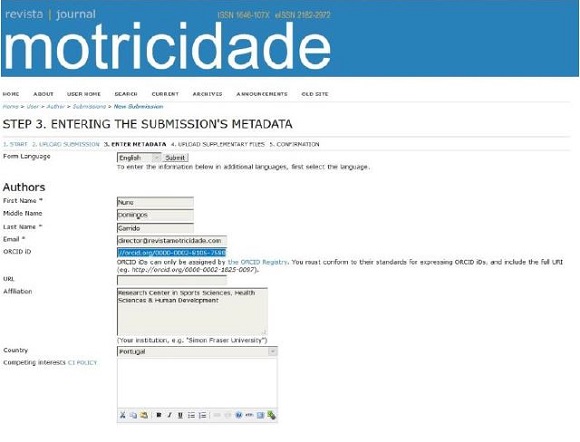
<body><![CDATA[<p>Some benefits for researchers are better described as follows (<a href="http://www.orcid.org" target="_blank">www.orcid.org</a>):</p>    1. Reliably      and simply connects authors with his/her contributions and affiliations;    <br> 2. Alleviates authors mistaken identity, helping to distinguish one from another, solving the name ambiguity problem in research and scholarly communications;    <br> 3. Saves author’s      time – “enter once, re-use often”;    <br> 4. Improves recognition for author and his/her research outputs, ensuring authors get the credit they deserve for their work;    <br> 5. Increases      discoverability of author research outputs;    <br> 6. Enables authors to comply with organizations that require ORCID iD, helping to associate authors work with the institutional records and comply to funder or institutional mandates;    <br> 7. Many      systems that authors already use are connected with ORCID.    <br> 8. It is free to register and use.        <p>Therefore, our system is embedding ORCID iDs in its workflows helping to streamline authors processes and enhance the discoverability of authors work. </p>      <p>When submitting a manuscript (<a href="http://revistas.rcaap.pt/motricidade/author/submit/1" target="_blank">http://revistas.rcaap.pt/motricidade/author/submit/1</a>) at journal Motricidade authors must go through 5 steps: Step 1. Starting the submission; Step 2. Uploading the submission; Step 3. Entering the submission metadata; Step 4. Uploading supplementary files; Step 5. Confirming the submission.</p>      ]]></body>
<body><![CDATA[<p>At Step 3, when identifying the authorship of the manuscript, there is a box where author can insert their ORCID iDs (<a href="#i1">figure 1</a>).</p>     <p>&nbsp;</p>     <p><a name="i1"></a></p>     <p align="center"><img src="/img/revistas/mot/v13n4/13n4a01i1.JPG" width="580" height="442"></p>     
<p>&nbsp;</p>     <p>In this way, we are inviting all authors, when submitting a manuscript, to be sure to have ORCID updated, by only inserting his/her iD in the correct box. </p>      <p>All information about ORCID was retrieved from <a href="http://www.orcid.org" target="_blank">www.orcid.org</a> which should be consulted for further information.</p>      <p>We hope you had a fruitful year and we are committed to improve our authors visibility further on. Thank you for your contribution and have a nice 2018. </p>     <p>&nbsp;</p>     <p><font size="2" face="Verdana"><a name="end"></a><a href="#topo">*</a>Director of the Journal Motricidade; Research Centre in Sports Sciences, Health Sciences and Human Development, CIDESD, Vila Real, Portugal. Complexo Desportivo da UTAD, Quinta de Prados, 5000-801 Vila Real, Portugal. <i>E-mail</i>: <a href="mailto:director@revistamotricidade.com">director@revistamotricidade.com</a></a></font></p> </font>         ]]></body>
<body><![CDATA[ ]]></body>
</article>
