<?xml version="1.0" encoding="ISO-8859-1"?><article xmlns:mml="http://www.w3.org/1998/Math/MathML" xmlns:xlink="http://www.w3.org/1999/xlink" xmlns:xsi="http://www.w3.org/2001/XMLSchema-instance">
<front>
<journal-meta>
<journal-id>1646-107X</journal-id>
<journal-title><![CDATA[Motricidade]]></journal-title>
<abbrev-journal-title><![CDATA[Motri.]]></abbrev-journal-title>
<issn>1646-107X</issn>
<publisher>
<publisher-name><![CDATA[Edições Desafio Singular]]></publisher-name>
</publisher>
</journal-meta>
<article-meta>
<article-id>S1646-107X2017000600003</article-id>
<title-group>
<article-title xml:lang="en"><![CDATA[Evaluation of nutritional status of children aged 0 to 5 years old in Early Childhood Education of the Municipal Education Network of Itajaí/SC]]></article-title>
</title-group>
<contrib-group>
<contrib contrib-type="author">
<name>
<surname><![CDATA[Flores]]></surname>
<given-names><![CDATA[Zilá Gomes de Moraes]]></given-names>
</name>
<xref ref-type="aff" rid="A01"/>
<xref ref-type="aff" rid="A03"/>
</contrib>
<contrib contrib-type="author">
<name>
<surname><![CDATA[Souza]]></surname>
<given-names><![CDATA[Elisabete Laurindo de]]></given-names>
</name>
<xref ref-type="aff" rid="A02"/>
<xref ref-type="aff" rid="A03"/>
</contrib>
<contrib contrib-type="author">
<name>
<surname><![CDATA[Souza]]></surname>
<given-names><![CDATA[Edegilson de]]></given-names>
</name>
<xref ref-type="aff" rid="A03"/>
</contrib>
</contrib-group>
<aff id="A01">
<institution><![CDATA[,Porto das Águas College  ]]></institution>
<addr-line><![CDATA[Porto Belo ]]></addr-line>
<country>Brazil</country>
</aff>
<aff id="A02">
<institution><![CDATA[,Avantis College  ]]></institution>
<addr-line><![CDATA[Balneário Camboriú]]></addr-line>
<country>Brazil</country>
</aff>
<aff id="A03">
<institution><![CDATA[,Municipal Secretary of Education  ]]></institution>
<addr-line><![CDATA[Itajaí ]]></addr-line>
<country>Brazil</country>
</aff>
<pub-date pub-type="pub">
<day>00</day>
<month>12</month>
<year>2017</year>
</pub-date>
<pub-date pub-type="epub">
<day>00</day>
<month>12</month>
<year>2017</year>
</pub-date>
<volume>13</volume>
<fpage>14</fpage>
<lpage>20</lpage>
<copyright-statement/>
<copyright-year/>
<self-uri xlink:href="http://scielo.pt/scielo.php?script=sci_arttext&amp;pid=S1646-107X2017000600003&amp;lng=en&amp;nrm=iso"></self-uri><self-uri xlink:href="http://scielo.pt/scielo.php?script=sci_abstract&amp;pid=S1646-107X2017000600003&amp;lng=en&amp;nrm=iso"></self-uri><self-uri xlink:href="http://scielo.pt/scielo.php?script=sci_pdf&amp;pid=S1646-107X2017000600003&amp;lng=en&amp;nrm=iso"></self-uri><abstract abstract-type="short" xml:lang="en"><p><![CDATA[The increasing number of children from 0 to 5 years old, evaluated as overweight in recent years, motivated teams of the Health Program at School and the School Feeding Program of the Municipal School Network of Itajaí/SC (Brazil) to conduct a research in order to verify the nutritional status of students regularly attending the Early Childhood Education centers. We seek to minimize the effects of this condition throughout life. We adopted the cross-sectional, descriptive and field study method, with data collection between April and July 2016, from 64 Early Childhood Education Centers. Data shows that 925 children, representing 1/3 of the total number of students aged 0 to 5 years and 11 months old, are in an overweight situation. From those, 610 were with high weight for the age, corroborating the waistline perimeter data (WP) with children at risk; 175 children were diagnosed with thinness and, of these, 65 also have low weight for their age. Thus, these children require special attention of those involved. We considered, therefore, the study presented extremely important as it may trigger prevention actions and immediate intervention.]]></p></abstract>
<kwd-group>
<kwd lng="en"><![CDATA[physical education]]></kwd>
<kwd lng="en"><![CDATA[early childhood education]]></kwd>
<kwd lng="en"><![CDATA[childhood obesity]]></kwd>
<kwd lng="en"><![CDATA[nutrition evaluation]]></kwd>
</kwd-group>
</article-meta>
</front><body><![CDATA[  <font face="Verdana" size="2">     <p align="right"><b>ORIGINAL ARTICLE</b></p>      <p>&nbsp;</p> </font>     <p><font size="4" face="Verdana"><b>Evaluation of nutritional status of   children aged 0 to 5 years old in Early Childhood Education of the Municipal Education Network of Itajaí/SC</b></font></p> <font face="Verdana" size="2">     <p>&nbsp;</p>     <p>&nbsp;</p>     <p><b>Zilá Gomes de Moraes Flores<sup>1,3,</sup><a href="#end"><sup>*</sup></a><i><a name="top" id="top"></a></i>; Elisabete Laurindo de Souza<sup>2,3</sup>; Edegilson de Souza<sup>3</sup></b></p>     <p><sup>1</sup> <i>Porto das Águas College (FAPAG), Porto   Belo, Brazil.    <br> </i><sup>2</sup><i> Avantis College, Balneário, Camboriú, Brazil.    <br> </i><sup>3 </sup><i>Municipal Secretary of Education, Itajaí, Brazil. </i></p>     ]]></body>
<body><![CDATA[<p>&nbsp;</p>     <p>&nbsp;</p> </font> <hr noshade size="1"> <font face="Verdana" size="2">     <p><b>ABSTRACT</b></p>     <p>The increasing number of children from   0 to 5 years old, evaluated as overweight in recent years, motivated teams of   the Health Program at School and the School Feeding Program of the Municipal   School Network of Itajaí/SC (Brazil) to conduct a research in order to verify   the nutritional status of students regularly attending the Early Childhood   Education centers. We seek to minimize the effects of this condition throughout   life. We adopted the cross-sectional, descriptive and field study method, with   data collection between April and July 2016, from 64 Early Childhood Education   Centers. Data shows that 925 children, representing 1/3 of the total number of   students aged 0 to 5 years and 11 months old, are in an overweight situation.   From those, 610 were with high weight for the age, corroborating the waistline   perimeter data (WP) with children at risk; 175 children were diagnosed with   thinness and, of these, 65 also have low weight for their age. Thus, these   children require special attention of those involved. We considered, therefore,   the study presented extremely important as it may trigger prevention actions and immediate intervention.</p>     <p><b>Keywords:</b> physical education, early childhood education, childhood obesity, nutrition evaluation.</p> </font> <hr noshade size="1">     <p>&nbsp;</p>     <p>&nbsp;</p>     <p><font size="3" face="Verdana"><b><b>INTRODUCTION</b></b></font></p> <font face="Verdana" size="2">     <p>The World Health   Organization (WHO) points out that the biggest public health problem in the   world today is obesity, which is growing at a rapid pace. The Organization   predicts that about 2.3 billion adults may be diagnosed with being overweight.   This is even more worrying as the projection estimates that 700 million people   might present an obese state and that the number of overweight and obese   children in the world may reach 75 million if nothing is done about it (Brazil, 2014). </p>     <p>The reality in   Brazil is also a concern due to the growth of obesity rates in the country.   Some surveys indicate that more than 50% of the population is classified as   being overweight and obese. Among children, this rate reaches approximately   15%, according to a study done by the National Network of Early Childhood (<i>Rede Nacional da Primeira Infância</i> - RNPI, 2014).</p>     ]]></body>
<body><![CDATA[<p>The growing   interest in the search for reasons about the prevalence and factors associated   with the diagnosis of overweight and obesity in 0 to 5-year-old children has   been verified in several studies. The main causes of being overweight are   associated with improper eating habits, sedentary lifestyle, overweight and   obese parents, socioeconomic status and environmental factors (Onis, 2015; Rivera et al., 2014). </p>     <p>Obesity is   defined as an atypical accumulation or excess of fat in the body, which can   lead to negative implications for the health condition and to the development   of other pathologies such as diabetes, hypercholesterolemia, arterial   hypertension, osteoarticular involvement, cardiovascular diseases, and various   types of cancers. Malnutrition (Chagas et al., 2013), on the other hand, is   defined as a condition resulting in different dimensions of energy and protein deficiency, being aggravated by repeated situations of infectious processes.</p>     <p>According to RNPI   (2014), in Latin America, approximately 3.8 million children aged up to five   years old were diagnosed with excessive weight: overweight or obesity. At the   same time, the same data was pointed out by the Pan American Health   Organization (PAHO, 2014), in its report, which presents obesity as an epidemic.   Data from the Food and Nutritional Surveillance System of the Ministry of   Health (Brazil, 2014) has revealed a rise in the diagnosis of overweight risk,   overweight and obesity in Brazilian children in recent years, increasing the   epidemiological panorama of the so-called non-communicable diseases, which are risk factors for other diseases.</p>     <p>Although the data   presented shows problems of excessive weight, the table of classification of   nutritional status also presents diagnoses of thinness and acute thinness that   occur throughout the country, especially in children living in conditions of   social vulnerability. According to Conde and Gigante (2007), underweight or   malnutrition has been considered, if not the main cause, one of the risk   factors relevant to the number of people with disability and the fourth factor   for mortality in terms of world population, especially in developing countries.   In Brazil, according to IBGE (2006), underweight cases (below z-2.0 score) are   among the poorest social classes, whose total family income is lower than the   minimum wage. The highest frequency is in urban areas, in the North and Northeast regions.</p>     <p>Chagas et al.   (2013), in a survey in the six largest municipalities of the state of Maranhão   (Brazil), in 2006/2007, with 1214 under five-year-old children, found that in   the weight-for-age classification, malnutrition was 4.5%, and in the   weight-for-height 3.9% were already classified as malnourished, corroborating   with height-for-age of 8.5% of children with previous malnutrition; and 6.7% being overweight.</p>     <p>Lima et al.   (2010), in a survey carried out in the northeast of Brazil, on the causes of   the decline of malnutrition in that region, confirmed that the prevalence of   malnutrition due to being underweight has decreased in Brazil. On the other   hand, it has been noticed the prevalence of diagnoses related to overweight in   children, although it is not affirmed that there was a substitution or   compensation, but that the interferences of environment, the increase of   nutritional options and the possible decrease of children’s physical activity,   can justify that the cases of overweight and obesity prevail to those of thinness.</p>     <p>Magalhães,   Sant’Ana, Priore and Franceschini (2014), in a bibliographical study, analyzed   researches with indicators for fat accumulation, among them the Waist Perimeter   (WP), stating that the WP measure, when assessing obesity in the abdominal   region, revealed that fat excess in the central region of the trunk in children   corroborates the results obtained in other indicators, such as the Body Mass Index (BMI).</p>     <p>In the Municipal   School Network of the city of Itajai (Santa Catarina – Brazil), there are about   10 thousand students enrolled in Early Childhood Education, aged 0 to 5 years   and 11 months old, distributed in nursery, pre-kindergarten, kindergarten,   pre-school, living daily in an educational environment that has the   institutional role of caring for and educating young children at all times   during their routine (Itajaí, 2015), namely: the entrance and exit, feeding,   hygiene, rest, plays, Physical Education classes in the park and in the   external areas, among other activities that are experienced daily by the children, being translated into meaningful experiences.</p>     <p>Given that, the   present research, developed through a partnership between Avantis College and   the Municipal Secretariats of Education and Health of Itajaí/SC, had the   objective of verifying the nutritional status of students who regularly attend   the Municipal School Network of Itajaí/SC. We intend to support future   appropriate nutritional prescriptions, through the ‘Health in School’ and   ‘School Feeding’ Programs, as well as intersectoral health actions with schools   and families, in the pursuit of compliance with Law No. 5853, of September 16<sup>th</sup>,   2011 (Itajaí, 2011), which establishes the Policy of Obesity and Overweight   Combat – ‘Lighter Itajaí’ in the scope of the Municipality of Itajaí/SC. In   this study, the focus was on Early Childhood Education, involving 0 to 5 years and 11-month-old students. </p>     <p>Therefore, this   research is justified because, nowadays, many children are at risk due to their   body composition condition. According to WHO (2015), about 40% of Brazilian   children are diagnosed with overweight and obesity, and, despite that, diagnoses of malnutrition due to being underweight still occurs.</p>     ]]></body>
<body><![CDATA[<p>This research was   inserted in the Brazil Platform n.º CAAE:   55258116.3.0000.5592, and evaluated and approved by the Committee of Ethics and Research of the Avantis College under the protocol n.º 032069/2016.</p>     <p> </p> </font><font size="3" face="Verdana"><b>METHOD</b></font><font face="Verdana" size="2">      <p>This is a   cross-sectional, descriptive and field study (Thomas, Nelson, &amp; Silverman, 2012). Data was collected between   April and July 2016 in 64 Early Childhood Education Centers of Itajai/SC, which   belong to the Municipal School Network, with students enrolled and present on   the day of data collection. However, it is necessary to emphasize that the   research samples did not consider as basis of analysis the students with Down   Syndrome, because they are subjects that must be evaluated in a specific manner. </p>     <p>The nutritional   diagnosis of the students was defined based on the widely used anthropometric   indices indicated by the WHO (2006, 2007 as cited in Brazil, 2011), and adopted   by the Brazilian Ministry of Health for the evaluation and classification of   the nutritional status of children according to gender: BMI-for-age,   weight-for-age, height-for-age for all, and weight-for-height for children up   to 60 months of age; as well as Waist Perimeter (WP) classified by Fernández, Redden, Pietrobelli and Allison (2004) for children over 2 years old.</p> <b>Participants</b>      <p>The sample size   covered 6,432 children aged 0 to 5 years and 11 months old, corresponding to   66% of the total number of children enrolled in the 64 Early Childhood   Education Centers of Itajaí/SC in the Municipal School Network. The age of the   children was defined in months based on the difference between the date of   birth reported by the schools and the date when data was collected. Anonymity and confidentiality were guaranteed to the subjects.</p>     <p><b>Instruments and Procedures</b></p>     <p>The   instrumentation adopted for data collection included the elaboration of   spreadsheets with the students’ cadastral information, containing: class, name,   date of birth and gender; Mabbis® non-elastic, flexible anthropometric tape;   Welmy® baby scale and WCS® horizontal anthropometer to verify the length;   Powner® digital scale, with a maximum capacity of 150 kg; WCS® stadiometer,   built in wood, with printed scale, varying from 40 to 220 cm.   Following the guidelines for the collection of anthropometric   measurements from the Ministry of Health (Brazil, 2011), the weight was   measured and recorded in kilograms on the scale for babies, weighed without   clothing; the other children were weighed on a digital scale placed on a flat   even floor, assuming the orthostatic positioning, barefoot, without coats,   upper limbs along the body, head with the Frankfurt plan established. The   length was measured in children up to 2 years of age with the anthropometer, in   the oldest the height was measured also observing the orthostatic positioning,   barefoot, the head with the Frankfurt plan established, registered in the nearest millimeter.</p>     <p>The   anthropometric evaluation of the students was established from the calculation of the Body Mass Index, verified through the formula:</p>     <p>&nbsp;</p>     <p align="center"><img src="/img/revistas/mot/v13s1/13s1a03e1.jpg" width="329" height="44"></p>     
]]></body>
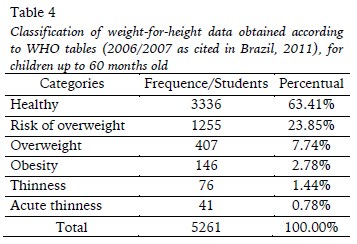
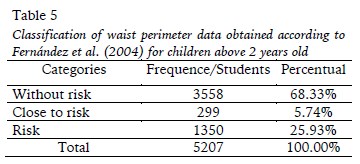
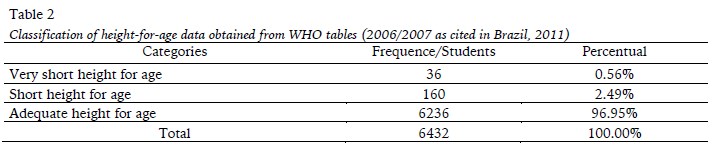
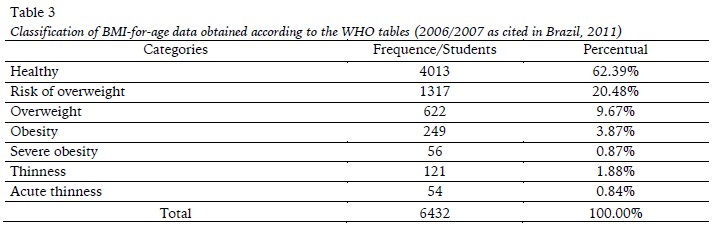
<body><![CDATA[<p>&nbsp;</p>     <p>The   weight-for-age, weight-for-height and height-for-age indices were used to   classify the nutritional status, according to the Percentile Tables of the   World Health Organization (WHO, 2006, 2007, as cited in Brazil, 2011),   considering the age in months, as already described. These procedures followed   the description of measurement and analysis of the ‘Guidelines for the   collection and analysis of anthropometric data in health services: Technical   Standard of the Food and Nutrition Surveillance System’ of SISVAN - Ministry of Health (Brazil, 2011).</p>     <p>For the   classification of the cardiac risk of the students, the Perimeter of the Waist   (PW) according to Petroski’s protocol (2007) was measured, being verified with   the anthropometric tape and having as reference the midpoint between the last   lower rib and the iliac crest. The data obtained were registered to the nearest   millimeter, classified by the percentile tables for PW of Fernández et al.   (2004), for children and adolescents from 2 to 18 years of age, by gender, considering the cut-off points for Risk and No Risk.</p>     <p>The researchers   decided to add the classification ‘Near Risk’, for children who, despite not   being at risk, present proximity of values of risk classification, serving as an alert.</p> <b><b>Statistical analysis</b></b>      <p>Data was   tabulated in the Microsoft Excel® program and are expressed in percentages,   considering that the research is still in progress for the data collection with   children and adolescents of Elementary and Young Adult Education (called EJA in Brazil).</p>     <p>The statistical   results of the research by categories according to the anthropometric indices   evaluated are presented in tables. No statistical association was made considering the gender of the students with the other data investigated.</p> </font>     <p>&nbsp;</p>     <p><font size="3" face="Verdana"><b><b>RESULTS</b></b></font></p> <font face="Verdana" size="2">     <p>The results of   the anthropometric indices, divided by categories, are presented in Tables 1 to 5.</p>     <p>&nbsp;</p> </font>     ]]></body>
<body><![CDATA[<p align="center"><font size="2" face="Verdana"><a href="/img/revistas/mot/v13s1/13s1a03t1.jpg">Table 1</a></font></p>     
<p align="center">&nbsp;</p>     <p align="center">&nbsp;</p>     <p align="center"><font size="2" face="Verdana"><a href="/img/revistas/mot/v13s1/13s1a03t2.jpg">Table 2</a></font></p>     
<p align="center">&nbsp;</p>     <p align="center">&nbsp;</p>     <p align="center"><font size="2" face="Verdana"><a href="/img/revistas/mot/v13s1/13s1a03t3.jpg">Table 3</a></font></p> <font face="Verdana" size="2">     
<p>&nbsp;</p>     <p>&nbsp;</p>     <p align="center"><img src="/img/revistas/mot/v13s1/13s1a03t4.jpg" width="357" height="244"></p>     
]]></body>
<body><![CDATA[<p>&nbsp;</p>     <p>&nbsp;</p>     <p align="center"><img src="/img/revistas/mot/v13s1/13s1a03t5.jpg" width="360" height="164"></p> </font>     
<p>&nbsp;</p>     <p>&nbsp;</p>     <p><font size="3" face="Verdana"><b><b>DISCUSSION</b></b></font></p> <font face="Verdana" size="2">     <p>From the data   presented, we can verify that the prevalence of malnutrition is low in relation   to the values of overweight indicators. Although society discusses obesity as   an epidemic, this is worrying as malnutrition and its consequences are forgotten.</p>     <p>Chagas et al.   (2013) investigated children from six municipalities in the state of Maranhão   (Brazil). They found 4.5% of those evaluated with BMI rating of thinness, and   the values of the weight index for the stature of 3.9% in malnutrition at that   time. These are values that differ from the 2.0% thinness found in Itajaí/SC,   indicating malnutrition for both BMI and weight-for-height, which could trigger   diseases such as anemia and hypovitaminosis, exposing the subjects to a high risk of becoming ill and even dying.</p>     <p>The overweight   indicators of both BMI and weight-for-height were 34.89% and 34.37%,   respectively. Comparing them to the data obtained by the analysis and   classification of the WP, 25.93% are at risk; and 5.74% with values very close   to the risk percentiles, which totals 31.67% of children over 2 years old.   Therefore, through the approximation of results, the confirmation of these   values indicates risks for children to become obese adults, develop   noncommunicable diseases linked to obesity, such as diabetes, hypertension,   high cholesterol, insulin resistance, and triglycerides, among others (Onis, 2015).</p>     <p>In the study of   Vitolo et al. (2008), of 3,957 children aged 1 month to 5 years old, during the   National Vaccination Campaign in the city of São Leopoldo (Rio Grande do Sul –   Brazil) in 2002, they found that 9.8% of the evaluated children were overweight.</p>     ]]></body>
<body><![CDATA[<p>The data   presented by Miglioli et al. (2015), in a cross-sectional study investigating   the nutritional status of 790 children under five years of age, they found 1.5%   of those evaluated through BMI for age with low-weight diagnosis; and through   the weight-for-age classification 2.6% were with underweight diagnosis. With   the same indicators, 4.7% and 8.6% of the children diagnosed, respectively,   with overweight, and 8.9% of the sample with short height-for-age, differing   from the data found in this research of 3%, when the data of short stature and very short stature were added.</p>     <p>In this aspect,   we can see that, although the sample is smaller, the data presented by Vitolo,   Gama, Bortolini, Campagnolo, and Drachler (2008) and Miglioli et al. (2015) are   also generally close to the data of the research with the children of   Itajaí/SC, in which the BMI indices by age and height-for-age are very close in all their classifications.</p>     <p>In the study   carried out in Itajaí/SC, we can verify a higher percentage of children who   have high weight compared to that found by Schuch, Castro, Vasconcelos, Dutra, and Goldani   (2013). The authors carried out a study with students from public schools in   the states of Rio Grande do Sul and Santa Catarina, totaling 4,914 children   (2,578 in Rio Grande do Sul and 2,336 in Santa Catarina). In the case of Santa Catarina, in six municipalities, 7.5% of the children were overweight.</p>     <p>PAHO proposed, in   the 2014-2019 action plan, to prevent obesity in children and adolescents in   Latin America. This plan focuses on modifying a current environment that   predisposes obesity to a beneficial environment that allows the consumption of   a nutritious diet and physical activity exercise, and approaching the WHO global tactic on food intake, physical activity and health.</p>     <p>In relation to   prevention, the Municipal School Network of Itajaí/SC, through the Municipal   Department of Education, included Physical Education (PE) as a compulsory   school content, taught by a PE professional in all Early Childhood Education schools in 2014.</p>     <p>It is worth   clarifying that in all the years of elementary education, PE has already been   an effective curricular component, taught by duly qualified teachers. The   practice of physical and playful activity systematized since childhood can   contribute to improving the health status of children. Concomitant with the   inclusion of PE in Early Childhood Education, a Municipal School Feeding Plan   was developed, which established rules and guidelines for local actions,   including the substitution of rich in fat and sugar foods for natural ones. The   consumption and variety of fruits and vegetables was considerably increased, as   well as the inclusion of infant formula instead of cow’s milk for children up   to 2 years of age, improving the nutritional quality of the menus served to children daily. </p>     <p>The intention of   the Municipal Department of Education was to provide students with a healthy,   balanced and adequate menu by age group, consisting of some whole foods such as   bread, pasta and rice, beans, lentils, eggs, meat, fish, vegetables, varied   fruits and natural juices. Another important measure was the deactivation of   canteens in all school units in the municipality. The lack of anthropometric   data prior to this action was a limiting factor for a comparative analysis to   verify if the PE classes, as well as the adequacy of the menus, contributed or not to reduce the cases of overweight.</p>     <p>Another situation   considered as limiting to this study refers to the impossibility of covering   all the students in the data collection, although it is sensible to say that   the sample of 66% is consistent to demonstrate its relevance. Data shows that   925 (1/3) children are in an overweight situation. Among these 610 have high   weight for their age, corroborating with Waist Perimeter (WP) data with   children at risk, and 175 children with a diagnosis of thinness – among them, 65 also indicate low weight for age and need special attention.</p> </font>     <p>&nbsp;</p>     <p><font size="3" face="Verdana"><b><b>CONCLUSION</b></b></font></p> <font face="Verdana" size="2">     ]]></body>
<body><![CDATA[<p>In this study,   the high number of overweight children found warn to the development of   effective public policies. It is necessary to immediately implement a periodic   evaluation routine for all children, since the early childhood education,   involving Physical Education professionals, with training in protocols of anthropometric measures and adequate equipment. </p>     <p>The research   developed, and the referenced studies show that the disposition for childhood   obesity starts at six months. Thus, monitoring the growth pattern becomes   effective to monitor and control the occurrence of overweight cases in   school-age children and adolescents. This will enable immediate intervention   throughout the observation of the increase in the percentiles of the   BMI-for-age, weight-for-age, height-for-age, weight-for-height indicators and   WP, providing to family members, schools, nutritionists and health-care   professionals at school with up-to-date data and information, generating   knowledge that supports the adoption of healthy eating habits and practices of   physical activities in their daily routine. Thereby, ensuring the maintenance,   preservation and expansion of times and spaces for physical activity at school   are essential for the transformation of obesogenic environments into healthy environments.</p> </font>     <p>&nbsp;</p>     <p><font size="3" face="Verdana"><b><b>REFERENCES</b></b></font></p> <font face="Verdana" size="2">     <!-- ref --><p>Brasil. (2014). <i>OMS quer estratégia   global contra crise de obesidade infantil</i>. Retrieved October 12, 2016, from <a href="http://www4.planalto.gov.br/consea/comunicacao/noticias/2014/oms-quer-estrategia-global-contra-crise-de-obesidade-infantil" target="_blank">http://www4.planalto.gov.br/consea/comunicacao/noticias/2014/oms-quer-estrategia-global-contra-crise-de-obesidade-infantil</a>.    &nbsp;&nbsp;&nbsp;&nbsp;&nbsp;&nbsp;&nbsp;&nbsp;[&#160;<a href="javascript:void(0);" onclick="javascript: window.open('/scielo.php?script=sci_nlinks&ref=371097&pid=S1646-107X201700060000300001&lng=','','width=640,height=500,resizable=yes,scrollbars=1,menubar=yes,');">Links</a>&#160;]<!-- end-ref --></p>     <!-- ref --><p>Brasil. (2011). <i>Orientações para   análise de dados antropométricos em serviços de saúde: Norma técnica do sistema   de vigilância Alimentar e Nutricional</i> – SISVAN. Brasília: Ministério da Saúde, 2011. Retrieved February 15, 2016, from <a href="http://bvsms.saude.gov.br/bvs/publicacoes/orientacoes_coleta_analise_dados_antropometricos.pdf" target="_blank">http://bvsms.saude.gov.br/bvs/publicacoes/orientacoes_coleta_analise_dados_antropometricos.pdf</a>&nbsp;&nbsp;&nbsp;&nbsp;&nbsp;&nbsp;&nbsp;&nbsp;[&#160;<a href="javascript:void(0);" onclick="javascript: window.open('/scielo.php?script=sci_nlinks&ref=371099&pid=S1646-107X201700060000300002&lng=','','width=640,height=500,resizable=yes,scrollbars=1,menubar=yes,');">Links</a>&#160;]<!-- end-ref --><!-- ref --><p>Chagas, D. C., Silva , A. A. M.,   Batista, R. F. L., Simões, V. M. F., Lamy, Z. C., Coimbra, L. C., &amp; Alves,   M. T . S. S. B. (2013). Prevalência e fatores associados à desnutrição e ao   excesso de peso em menores de cinco anos nos seis maiores municípios do   Maranhão. <i>Revista brasileira de epidemiologia.</i>, <i>16</i>(1), 146-156. doi: 10.1590/S1415-790X2013000100014&nbsp;&nbsp;&nbsp;&nbsp;&nbsp;&nbsp;&nbsp;&nbsp;[&#160;<a href="javascript:void(0);" onclick="javascript: window.open('/scielo.php?script=sci_nlinks&ref=371100&pid=S1646-107X201700060000300003&lng=','','width=640,height=500,resizable=yes,scrollbars=1,menubar=yes,');">Links</a>&#160;]<!-- end-ref --><!-- ref --><p>Conde, W. L., &amp; Gigante, D. P.   (2007). Epidemiologia da desnutrição infantil. In Kac, G., Sichieri, R. &amp;   Gigante, D. P. (Eds), <i>Epidemiologia nutricional </i>(1<sup>a</sup> ed.) [online] (pp. 280-295). Rio de Janeiro: FIOCRUZ/Atheneu.    &nbsp;&nbsp;&nbsp;&nbsp;&nbsp;&nbsp;&nbsp;&nbsp;[&#160;<a href="javascript:void(0);" onclick="javascript: window.open('/scielo.php?script=sci_nlinks&ref=371101&pid=S1646-107X201700060000300004&lng=','','width=640,height=500,resizable=yes,scrollbars=1,menubar=yes,');">Links</a>&#160;]<!-- end-ref --> </p>     ]]></body>
<body><![CDATA[<!-- ref --><p>Fernández, J. R., Redden, D. T.,   Pietrobelli, A., &amp; Allison, D. B. (2004). Waist circumference percentiles in nationally   representative samples of african-american, european-american, and   mexican-american children and adolescents. <i>The</i> <i>Journal of     Pediatrics</i>, <i>145</i>(4), 439-44. doi: 10.1016/j.jpeds.2004.06.044&nbsp;&nbsp;&nbsp;&nbsp;&nbsp;&nbsp;&nbsp;&nbsp;[&#160;<a href="javascript:void(0);" onclick="javascript: window.open('/scielo.php?script=sci_nlinks&ref=371103&pid=S1646-107X201700060000300005&lng=','','width=640,height=500,resizable=yes,scrollbars=1,menubar=yes,');">Links</a>&#160;]<!-- end-ref --><!-- ref --><p>Instituto Brasileiro de Geografia e   Estatística. (2006). <i>Pesquisa de Orçamentos Familiares 2002-2003:     antropometria e análise do estado nutricional de crianças e adolescentes no Brasil</i> (2<sup>a</sup> ed.). Rio de Janeiro: IBGE.    &nbsp;&nbsp;&nbsp;&nbsp;&nbsp;&nbsp;&nbsp;&nbsp;[&#160;<a href="javascript:void(0);" onclick="javascript: window.open('/scielo.php?script=sci_nlinks&ref=371104&pid=S1646-107X201700060000300006&lng=','','width=640,height=500,resizable=yes,scrollbars=1,menubar=yes,');">Links</a>&#160;]<!-- end-ref --></p>     <!-- ref --><p>Itajaí. (2011). Lei n. 5853, de 16 de   setembro de 2011. Institui a Política de Combate à Obesidade e ao Sobrepeso   ‘Itajaí mais leve’ no âmbito do município de Itajaí, e dá outras providências. Retrieved August 21, 2016, from <a href="http://portaldocidadao.itajai.sc.gov.br/servico_link/28" target="_blank">http://portaldocidadao.itajai.sc.gov.br/servico_link/28</a>&nbsp;&nbsp;&nbsp;&nbsp;&nbsp;&nbsp;&nbsp;&nbsp;[&#160;<a href="javascript:void(0);" onclick="javascript: window.open('/scielo.php?script=sci_nlinks&ref=371106&pid=S1646-107X201700060000300007&lng=','','width=640,height=500,resizable=yes,scrollbars=1,menubar=yes,');">Links</a>&#160;]<!-- end-ref --><!-- ref --><p>Itajaí. (2015). <i>Diretrizes   Municipais para a Educação Infantil</i>. Retrieved September 10, 2016, from <a href="http://www.educacao.itajai.sc.gov.br/d/85" target="_blank">www.educacao.itajai.sc.gov.br/d/85</a>&nbsp;&nbsp;&nbsp;&nbsp;&nbsp;&nbsp;&nbsp;&nbsp;[&#160;<a href="javascript:void(0);" onclick="javascript: window.open('/scielo.php?script=sci_nlinks&ref=371107&pid=S1646-107X201700060000300008&lng=','','width=640,height=500,resizable=yes,scrollbars=1,menubar=yes,');">Links</a>&#160;]<!-- end-ref --><!-- ref --><p>Lima, A. L. L., Silva, A. C. F.,   Konno, S. C., Conde, W. L., Benicio, M. H. D., &amp; Monteiro, C. A.  (2010). Causas do declínio acelerado da   desnutrição infantil no Nordeste do Brasil (1986-1996-2006). <i>Revista Saúde     Pública,</i> <i>44</i>(1), 17-27. doi: 10.1590/S0034-89102010000100002&nbsp;&nbsp;&nbsp;&nbsp;&nbsp;&nbsp;&nbsp;&nbsp;[&#160;<a href="javascript:void(0);" onclick="javascript: window.open('/scielo.php?script=sci_nlinks&ref=371108&pid=S1646-107X201700060000300009&lng=','','width=640,height=500,resizable=yes,scrollbars=1,menubar=yes,');">Links</a>&#160;]<!-- end-ref --><!-- ref --><p>Magalhães, E. I. Da S., Sant’Ana, L.   F. Da R., Priore, S. E., &amp; Franceschini, S. do C. C. (2014). Perímetro da   cintura, relação cintura/estatura e perímetro do pescoço como parâmetros na   avaliação da obesidade central em crianças. <i>Revista paulista pediatria</i> <i>32</i>(3), 273-281. doi: 10.1590/0103-0582201432320&nbsp;&nbsp;&nbsp;&nbsp;&nbsp;&nbsp;&nbsp;&nbsp;[&#160;<a href="javascript:void(0);" onclick="javascript: window.open('/scielo.php?script=sci_nlinks&ref=371109&pid=S1646-107X201700060000300010&lng=','','width=640,height=500,resizable=yes,scrollbars=1,menubar=yes,');">Links</a>&#160;]<!-- end-ref --><!-- ref --><p>Miglioli, T. C., Fonseca, V. M.,   Junior, S. C. G., Silva, K. S., Lira, P. I. C., &amp; Filho, M. B. (2015).   Fatores associados ao estado nutricional de crianças menores de cinco anos. <i>Revista Saúde Pública</i>, <i>49</i>, 59. doi: 10.1590/S0034-8910.2015049005441.    &nbsp;&nbsp;&nbsp;&nbsp;&nbsp;&nbsp;&nbsp;&nbsp;[&#160;<a href="javascript:void(0);" onclick="javascript: window.open('/scielo.php?script=sci_nlinks&ref=371110&pid=S1646-107X201700060000300011&lng=','','width=640,height=500,resizable=yes,scrollbars=1,menubar=yes,');">Links</a>&#160;]<!-- end-ref --></p>     <!-- ref --><p>Onis, M. De. (2015). Prevenção do   sobrepeso e da obesidade infantis. <i>Jornal de Pediatria,</i> <i>91</i>(2), 105-107. doi: 10.1016/j.jped.2014.10.002&nbsp;&nbsp;&nbsp;&nbsp;&nbsp;&nbsp;&nbsp;&nbsp;[&#160;<a href="javascript:void(0);" onclick="javascript: window.open('/scielo.php?script=sci_nlinks&ref=371112&pid=S1646-107X201700060000300012&lng=','','width=640,height=500,resizable=yes,scrollbars=1,menubar=yes,');">Links</a>&#160;]<!-- end-ref --><!-- ref --><p>Pan American Health Organization. PAHO   (2014). <i>Plan of action for the prevention of obesity in children and adolescents</i>. Retrieved September 14, 2016, from <a href="http://www.paho.org/bra/images/stories/UTFGCV/planofactionchildobesity-por.pdf?ua=1" target="_blank">http://www.paho.org/bra/images/stories/UTFGCV/planofactionchildobesity-por.pdf?ua=1</a>&nbsp;&nbsp;&nbsp;&nbsp;&nbsp;&nbsp;&nbsp;&nbsp;[&#160;<a href="javascript:void(0);" onclick="javascript: window.open('/scielo.php?script=sci_nlinks&ref=371113&pid=S1646-107X201700060000300013&lng=','','width=640,height=500,resizable=yes,scrollbars=1,menubar=yes,');">Links</a>&#160;]<!-- end-ref --><!-- ref --><p>Petroski, E. L. (2007). <i>Antropometria:   técnicas e padronizações</i> (3ª ed.). Blumenau: Nova Letra.    &nbsp;&nbsp;&nbsp;&nbsp;&nbsp;&nbsp;&nbsp;&nbsp;[&#160;<a href="javascript:void(0);" onclick="javascript: window.open('/scielo.php?script=sci_nlinks&ref=371114&pid=S1646-107X201700060000300014&lng=','','width=640,height=500,resizable=yes,scrollbars=1,menubar=yes,');">Links</a>&#160;]<!-- end-ref --></p>     <!-- ref --><p>Rede Nacional Primeira Infância.   (2014). <i>Plano Nacional da Primeira Infância/Projeto Observatório Nacional da     Primeira Infância</i>: Mapeamento da ação finalística evitando acidentes na primeira infância. Fortaleza: RNPI. Retrieved September 23, 2016, from: <a href="http://primeirainfancia.org.br/wp-content/uploads/2015/01/Obesidade-Infantil-v6.pdf" target="_blank">http://primeirainfancia.org.br/wp-content/uploads/2015/01/Obesidade-Infantil-v6.pdf</a>&nbsp;&nbsp;&nbsp;&nbsp;&nbsp;&nbsp;&nbsp;&nbsp;[&#160;<a href="javascript:void(0);" onclick="javascript: window.open('/scielo.php?script=sci_nlinks&ref=371116&pid=S1646-107X201700060000300015&lng=','','width=640,height=500,resizable=yes,scrollbars=1,menubar=yes,');">Links</a>&#160;]<!-- end-ref --><!-- ref --><p>Rivera, J. A., Cossio, T. G., Pedraza,   L. S., Aburto, T. C., Sánchez, T. C., &amp; Martorell, R. (2014). Childhood and   adolescent overweight and obesity in Latin America: a systematic review. <i>Lancet Diabetes Endocrinol</i>, <i>2</i>(4), 321-32. doi: 10.1016/S2213-8587(13)70173-6&nbsp;&nbsp;&nbsp;&nbsp;&nbsp;&nbsp;&nbsp;&nbsp;[&#160;<a href="javascript:void(0);" onclick="javascript: window.open('/scielo.php?script=sci_nlinks&ref=371117&pid=S1646-107X201700060000300016&lng=','','width=640,height=500,resizable=yes,scrollbars=1,menubar=yes,');">Links</a>&#160;]<!-- end-ref --><!-- ref --><p>Schuch, I., Castro, T. G.,   Vasconcelos, F. A. G., Dutra, C. L. C., &amp; Goldani, M. Z. (2013). Excesso de   peso em crianças de pré-escolas: prevalência e fatores associados. <i>Jornal de     Pediatria, 89</i>(2), 179-188. doi: 10.1016/j.jped.2013.03.003&nbsp;&nbsp;&nbsp;&nbsp;&nbsp;&nbsp;&nbsp;&nbsp;[&#160;<a href="javascript:void(0);" onclick="javascript: window.open('/scielo.php?script=sci_nlinks&ref=371118&pid=S1646-107X201700060000300017&lng=','','width=640,height=500,resizable=yes,scrollbars=1,menubar=yes,');">Links</a>&#160;]<!-- end-ref --><!-- ref --><p>Thomas, J., Nelson, J., &amp;   Silverman, S. J. (2012). <i>Métodos de pesquisa em atividade física</i> (6<sup>a</sup> ed.). Porto Alegre: Artmed.    &nbsp;&nbsp;&nbsp;&nbsp;&nbsp;&nbsp;&nbsp;&nbsp;[&#160;<a href="javascript:void(0);" onclick="javascript: window.open('/scielo.php?script=sci_nlinks&ref=371119&pid=S1646-107X201700060000300018&lng=','','width=640,height=500,resizable=yes,scrollbars=1,menubar=yes,');">Links</a>&#160;]<!-- end-ref --></p>     <!-- ref --><p>Vitolo, M. R., Gama, C. M., Bortolini,   G. A., Campagnolo, P. D. B., &amp; Drachler, M. L. (2008). Alguns fatores   associados a excesso de peso, baixa estatura e déficit de peso em menores de 5   anos. <i>Jornal de     Pediatria</i>, <i>84</i>(3). doi: 10.2223/JPED.1776&nbsp;&nbsp;&nbsp;&nbsp;&nbsp;&nbsp;&nbsp;&nbsp;[&#160;<a href="javascript:void(0);" onclick="javascript: window.open('/scielo.php?script=sci_nlinks&ref=371121&pid=S1646-107X201700060000300019&lng=','','width=640,height=500,resizable=yes,scrollbars=1,menubar=yes,');">Links</a>&#160;]<!-- end-ref --><!-- ref --><p>World Health Organization [WHO].   (2015). <i>Obesity and overweight</i>. Fact sheet n. 311. Retrieved August 25, 2016, from <a href="http://www.who.int/mediacentre/factsheets/fs311/en/index.html" target="_blank">http://www.who.int/mediacentre/factsheets/fs311/en/index.html</a>&nbsp;&nbsp;&nbsp;&nbsp;&nbsp;&nbsp;&nbsp;&nbsp;[&#160;<a href="javascript:void(0);" onclick="javascript: window.open('/scielo.php?script=sci_nlinks&ref=371122&pid=S1646-107X201700060000300020&lng=','','width=640,height=500,resizable=yes,scrollbars=1,menubar=yes,');">Links</a>&#160;]<!-- end-ref --><p>&nbsp;</p>     <p><b>Acknowledgments:    <br> </b>Nothing to declare.    <br> <b>Conflict of interests:    <br> </b>Nothing to declare.    <br> <b>Funding:    <br> </b>Nothing to declare.</p> </font>     <p>&nbsp;</p>     <p>&nbsp;</p>     <p><font size="2" face="Verdana"><a href="#top"><sup>*</sup></a><i><a name="end"></a>Corresponding   Author: </i>Porto   das Águas College (FAPAG), Av. Vereador Abraão João Francisco, 3855, Sacada, 88307-303, Itajaí, Brazil.<i> Email: </i><a href="mailto:zilamflores@gmail.com">zilamflores@gmail.com</a></font></p>      ]]></body>
<body><![CDATA[ ]]></body><back>
<ref-list>
<ref id="B1">
<nlm-citation citation-type="">
<collab>Brasil</collab>
<source><![CDATA[OMS quer estratégia global contra crise de obesidade infantil]]></source>
<year>2014</year>
</nlm-citation>
</ref>
<ref id="B2">
<nlm-citation citation-type="book">
<collab>Brasil</collab>
<source><![CDATA[Orientações para análise de dados antropométricos em serviços de saúde: Norma técnica do sistema de vigilância Alimentar e Nutricional - SISVAN]]></source>
<year>2011</year>
<publisher-loc><![CDATA[Brasília ]]></publisher-loc>
<publisher-name><![CDATA[Ministério da Saúde]]></publisher-name>
</nlm-citation>
</ref>
<ref id="B3">
<nlm-citation citation-type="journal">
<person-group person-group-type="author">
<name>
<surname><![CDATA[Chagas]]></surname>
<given-names><![CDATA[D. C.]]></given-names>
</name>
<name>
<surname><![CDATA[Silva]]></surname>
<given-names><![CDATA[A. A. M.]]></given-names>
</name>
<name>
<surname><![CDATA[Batista]]></surname>
<given-names><![CDATA[R. F. L.]]></given-names>
</name>
<name>
<surname><![CDATA[Simões]]></surname>
<given-names><![CDATA[V. M. F.]]></given-names>
</name>
<name>
<surname><![CDATA[Lamy]]></surname>
<given-names><![CDATA[Z. C.]]></given-names>
</name>
<name>
<surname><![CDATA[Coimbra]]></surname>
<given-names><![CDATA[L. C.]]></given-names>
</name>
<name>
<surname><![CDATA[Alves]]></surname>
<given-names><![CDATA[M. T . S. S. B.]]></given-names>
</name>
</person-group>
<article-title xml:lang="pt"><![CDATA[Prevalência e fatores associados à desnutrição e ao excesso de peso em menores de cinco anos nos seis maiores municípios do Maranhão]]></article-title>
<source><![CDATA[Revista brasileira de epidemiologia]]></source>
<year>2013</year>
<volume>16</volume>
<numero>1</numero>
<issue>1</issue>
<page-range>146-156</page-range></nlm-citation>
</ref>
<ref id="B4">
<nlm-citation citation-type="book">
<person-group person-group-type="author">
<name>
<surname><![CDATA[Conde]]></surname>
<given-names><![CDATA[W. L.]]></given-names>
</name>
<name>
<surname><![CDATA[Gigante]]></surname>
<given-names><![CDATA[D. P.]]></given-names>
</name>
</person-group>
<article-title xml:lang="pt"><![CDATA[Epidemiologia da desnutrição infantil]]></article-title>
<person-group person-group-type="editor">
<name>
<surname><![CDATA[Kac]]></surname>
<given-names><![CDATA[G.]]></given-names>
</name>
<name>
<surname><![CDATA[Sichieri]]></surname>
<given-names><![CDATA[R.]]></given-names>
</name>
<name>
<surname><![CDATA[Gigante]]></surname>
<given-names><![CDATA[D. P.]]></given-names>
</name>
</person-group>
<source><![CDATA[Epidemiologia nutricional]]></source>
<year>2007</year>
<edition>1</edition>
<page-range>280-295</page-range><publisher-loc><![CDATA[Rio de Janeiro ]]></publisher-loc>
<publisher-name><![CDATA[FIOCRUZ/Atheneu]]></publisher-name>
</nlm-citation>
</ref>
<ref id="B5">
<nlm-citation citation-type="journal">
<person-group person-group-type="author">
<name>
<surname><![CDATA[Fernández]]></surname>
<given-names><![CDATA[J. R.]]></given-names>
</name>
<name>
<surname><![CDATA[Redden]]></surname>
<given-names><![CDATA[D. T.]]></given-names>
</name>
<name>
<surname><![CDATA[Pietrobelli]]></surname>
<given-names><![CDATA[A.]]></given-names>
</name>
<name>
<surname><![CDATA[Allison]]></surname>
<given-names><![CDATA[D. B.]]></given-names>
</name>
</person-group>
<article-title xml:lang="en"><![CDATA[Waist circumference percentiles in nationally representative samples of african-american, european-american, and mexican-american children and adolescents]]></article-title>
<source><![CDATA[The Journal of Pediatrics]]></source>
<year>2004</year>
<volume>145</volume>
<numero>4</numero>
<issue>4</issue>
<page-range>439-44</page-range></nlm-citation>
</ref>
<ref id="B6">
<nlm-citation citation-type="book">
<collab>Instituto Brasileiro de Geografia e Estatística</collab>
<source><![CDATA[Pesquisa de Orçamentos Familiares 2002-2003: antropometria e análise do estado nutricional de crianças e adolescentes no Brasil]]></source>
<year>2006</year>
<edition>2</edition>
<publisher-loc><![CDATA[Rio de Janeiro ]]></publisher-loc>
<publisher-name><![CDATA[IBGE]]></publisher-name>
</nlm-citation>
</ref>
<ref id="B7">
<nlm-citation citation-type="">
<collab>Itajaí</collab>
<source><![CDATA[Lei n. 5853, de 16 de setembro de 2011: Institui a Política de Combate à Obesidade e ao Sobrepeso ‘Itajaí mais leve’ no âmbito do município de Itajaí, e dá outras providências]]></source>
<year>2011</year>
</nlm-citation>
</ref>
<ref id="B8">
<nlm-citation citation-type="">
<collab>Itajaí</collab>
<source><![CDATA[Diretrizes Municipais para a Educação Infantil]]></source>
<year>2015</year>
</nlm-citation>
</ref>
<ref id="B9">
<nlm-citation citation-type="journal">
<person-group person-group-type="author">
<name>
<surname><![CDATA[Lima]]></surname>
<given-names><![CDATA[A. L. L.]]></given-names>
</name>
<name>
<surname><![CDATA[Silva]]></surname>
<given-names><![CDATA[A. C. F.]]></given-names>
</name>
<name>
<surname><![CDATA[Konno]]></surname>
<given-names><![CDATA[S. C.]]></given-names>
</name>
<name>
<surname><![CDATA[Conde]]></surname>
<given-names><![CDATA[W. L.]]></given-names>
</name>
<name>
<surname><![CDATA[Benicio]]></surname>
<given-names><![CDATA[M. H. D.]]></given-names>
</name>
<name>
<surname><![CDATA[Monteiro]]></surname>
<given-names><![CDATA[C. A.]]></given-names>
</name>
</person-group>
<article-title xml:lang="pt"><![CDATA[Causas do declínio acelerado da desnutrição infantil no Nordeste do Brasil (1986-1996-2006)]]></article-title>
<source><![CDATA[Revista Saúde Pública]]></source>
<year>2010</year>
<volume>44</volume>
<numero>1</numero>
<issue>1</issue>
<page-range>17-27</page-range></nlm-citation>
</ref>
<ref id="B10">
<nlm-citation citation-type="journal">
<person-group person-group-type="author">
<name>
<surname><![CDATA[Magalhães]]></surname>
<given-names><![CDATA[E. I. Da S.]]></given-names>
</name>
<name>
<surname><![CDATA[Sant’Ana]]></surname>
<given-names><![CDATA[L. F. Da R.]]></given-names>
</name>
<name>
<surname><![CDATA[Priore]]></surname>
<given-names><![CDATA[S. E.]]></given-names>
</name>
<name>
<surname><![CDATA[Franceschini]]></surname>
<given-names><![CDATA[S. do C. C.]]></given-names>
</name>
</person-group>
<article-title xml:lang="pt"><![CDATA[Perímetro da cintura, relação cintura/estatura e perímetro do pescoço como parâmetros na avaliação da obesidade central em crianças]]></article-title>
<source><![CDATA[Revista paulista pediatria]]></source>
<year>2014</year>
<volume>32</volume>
<numero>3</numero>
<issue>3</issue>
<page-range>273-281</page-range></nlm-citation>
</ref>
<ref id="B11">
<nlm-citation citation-type="journal">
<person-group person-group-type="author">
<name>
<surname><![CDATA[Miglioli]]></surname>
<given-names><![CDATA[T. C.]]></given-names>
</name>
<name>
<surname><![CDATA[Fonseca]]></surname>
<given-names><![CDATA[V. M.]]></given-names>
</name>
<name>
<surname><![CDATA[Junior]]></surname>
<given-names><![CDATA[S. C. G.]]></given-names>
</name>
<name>
<surname><![CDATA[Silva]]></surname>
<given-names><![CDATA[K. S.]]></given-names>
</name>
<name>
<surname><![CDATA[Lira]]></surname>
<given-names><![CDATA[P. I. C.]]></given-names>
</name>
<name>
<surname><![CDATA[Filho]]></surname>
<given-names><![CDATA[M. B.]]></given-names>
</name>
</person-group>
<article-title xml:lang="pt"><![CDATA[Fatores associados ao estado nutricional de crianças menores de cinco anos]]></article-title>
<source><![CDATA[Revista Saúde Pública]]></source>
<year>2015</year>
<volume>49</volume>
<page-range>59</page-range></nlm-citation>
</ref>
<ref id="B12">
<nlm-citation citation-type="journal">
<person-group person-group-type="author">
<name>
<surname><![CDATA[Onis]]></surname>
<given-names><![CDATA[M. De]]></given-names>
</name>
</person-group>
<article-title xml:lang="pt"><![CDATA[Prevenção do sobrepeso e da obesidade infantis]]></article-title>
<source><![CDATA[Jornal de Pediatria]]></source>
<year>2015</year>
<volume>91</volume>
<numero>2</numero>
<issue>2</issue>
<page-range>105-107</page-range></nlm-citation>
</ref>
<ref id="B13">
<nlm-citation citation-type="">
<collab>Pan American Health Organization</collab>
<source><![CDATA[Plan of action for the prevention of obesity in children and adolescents]]></source>
<year>2014</year>
</nlm-citation>
</ref>
<ref id="B14">
<nlm-citation citation-type="book">
<person-group person-group-type="author">
<name>
<surname><![CDATA[Petroski]]></surname>
<given-names><![CDATA[E. L.]]></given-names>
</name>
</person-group>
<source><![CDATA[Antropometria: técnicas e padronizações]]></source>
<year>2007</year>
<edition>3</edition>
<publisher-loc><![CDATA[Blumenau ]]></publisher-loc>
<publisher-name><![CDATA[Nova Letra]]></publisher-name>
</nlm-citation>
</ref>
<ref id="B15">
<nlm-citation citation-type="book">
<collab>Rede Nacional Primeira Infância</collab>
<source><![CDATA[Plano Nacional da Primeira Infância/Projeto Observatório Nacional da Primeira Infância: Mapeamento da ação finalística evitando acidentes na primeira infância]]></source>
<year>2014</year>
<publisher-loc><![CDATA[Fortaleza ]]></publisher-loc>
<publisher-name><![CDATA[RNPI]]></publisher-name>
</nlm-citation>
</ref>
<ref id="B16">
<nlm-citation citation-type="journal">
<person-group person-group-type="author">
<name>
<surname><![CDATA[Rivera]]></surname>
<given-names><![CDATA[J. A.]]></given-names>
</name>
<name>
<surname><![CDATA[Cossio]]></surname>
<given-names><![CDATA[T. G.]]></given-names>
</name>
<name>
<surname><![CDATA[Pedraza]]></surname>
<given-names><![CDATA[L. S.]]></given-names>
</name>
<name>
<surname><![CDATA[Aburto]]></surname>
<given-names><![CDATA[T. C.]]></given-names>
</name>
<name>
<surname><![CDATA[Sánchez]]></surname>
<given-names><![CDATA[T. C.]]></given-names>
</name>
<name>
<surname><![CDATA[Martorell]]></surname>
<given-names><![CDATA[R.]]></given-names>
</name>
</person-group>
<article-title xml:lang="en"><![CDATA[Childhood and adolescent overweight and obesity in Latin America: a systematic review]]></article-title>
<source><![CDATA[Lancet Diabetes Endocrinol]]></source>
<year>2014</year>
<volume>2</volume>
<numero>4</numero>
<issue>4</issue>
<page-range>321-32</page-range></nlm-citation>
</ref>
<ref id="B17">
<nlm-citation citation-type="journal">
<person-group person-group-type="author">
<name>
<surname><![CDATA[Schuch]]></surname>
<given-names><![CDATA[I.]]></given-names>
</name>
<name>
<surname><![CDATA[Castro]]></surname>
<given-names><![CDATA[T. G.]]></given-names>
</name>
<name>
<surname><![CDATA[Vasconcelos]]></surname>
<given-names><![CDATA[F. A. G.]]></given-names>
</name>
<name>
<surname><![CDATA[Dutra]]></surname>
<given-names><![CDATA[C. L. C.]]></given-names>
</name>
<name>
<surname><![CDATA[Goldani]]></surname>
<given-names><![CDATA[M. Z.]]></given-names>
</name>
</person-group>
<article-title xml:lang="pt"><![CDATA[Excesso de peso em crianças de pré-escolas: prevalência e fatores associados]]></article-title>
<source><![CDATA[Jornal de Pediatria]]></source>
<year>2013</year>
<volume>89</volume>
<numero>2</numero>
<issue>2</issue>
<page-range>179-188</page-range></nlm-citation>
</ref>
<ref id="B18">
<nlm-citation citation-type="book">
<person-group person-group-type="author">
<name>
<surname><![CDATA[Thomas]]></surname>
<given-names><![CDATA[J.]]></given-names>
</name>
<name>
<surname><![CDATA[Nelson]]></surname>
<given-names><![CDATA[J.]]></given-names>
</name>
<name>
<surname><![CDATA[Silverman]]></surname>
<given-names><![CDATA[S. J.]]></given-names>
</name>
</person-group>
<source><![CDATA[Métodos de pesquisa em atividade física]]></source>
<year>2012</year>
<edition>6</edition>
<publisher-loc><![CDATA[Porto Alegre ]]></publisher-loc>
<publisher-name><![CDATA[Artmed]]></publisher-name>
</nlm-citation>
</ref>
<ref id="B19">
<nlm-citation citation-type="journal">
<person-group person-group-type="author">
<name>
<surname><![CDATA[Vitolo]]></surname>
<given-names><![CDATA[M. R.]]></given-names>
</name>
<name>
<surname><![CDATA[Gama]]></surname>
<given-names><![CDATA[C. M.]]></given-names>
</name>
<name>
<surname><![CDATA[Bortolini]]></surname>
<given-names><![CDATA[G. A.]]></given-names>
</name>
<name>
<surname><![CDATA[Campagnolo]]></surname>
<given-names><![CDATA[P. D. B.]]></given-names>
</name>
<name>
<surname><![CDATA[Drachler]]></surname>
<given-names><![CDATA[M. L.]]></given-names>
</name>
</person-group>
<article-title xml:lang="pt"><![CDATA[Alguns fatores associados a excesso de peso, baixa estatura e déficit de peso em menores de 5 anos]]></article-title>
<source><![CDATA[Jornal de Pediatria]]></source>
<year>2008</year>
<volume>84</volume>
<numero>3</numero>
<issue>3</issue>
</nlm-citation>
</ref>
<ref id="B20">
<nlm-citation citation-type="">
<collab>World Health Organization</collab>
<source><![CDATA[Obesity and overweight]]></source>
<year>2015</year>
</nlm-citation>
</ref>
</ref-list>
</back>
</article>