<?xml version="1.0" encoding="ISO-8859-1"?><article xmlns:mml="http://www.w3.org/1998/Math/MathML" xmlns:xlink="http://www.w3.org/1999/xlink" xmlns:xsi="http://www.w3.org/2001/XMLSchema-instance">
<front>
<journal-meta>
<journal-id>1646-107X</journal-id>
<journal-title><![CDATA[Motricidade]]></journal-title>
<abbrev-journal-title><![CDATA[Motri.]]></abbrev-journal-title>
<issn>1646-107X</issn>
<publisher>
<publisher-name><![CDATA[Edições Desafio Singular]]></publisher-name>
</publisher>
</journal-meta>
<article-meta>
<article-id>S1646-107X2017000600004</article-id>
<title-group>
<article-title xml:lang="en"><![CDATA[Fun and Healthy Every Day: using a website as an educational tool to promote health in school children]]></article-title>
</title-group>
<contrib-group>
<contrib contrib-type="author">
<name>
<surname><![CDATA[Pereira]]></surname>
<given-names><![CDATA[Raiane Maiara dos Santos]]></given-names>
</name>
<xref ref-type="aff" rid="A01"/>
</contrib>
<contrib contrib-type="author">
<name>
<surname><![CDATA[Ramos]]></surname>
<given-names><![CDATA[Isabela Almeida]]></given-names>
</name>
<xref ref-type="aff" rid="A01"/>
</contrib>
<contrib contrib-type="author">
<name>
<surname><![CDATA[Brito]]></surname>
<given-names><![CDATA[Stéphany Vieira]]></given-names>
</name>
<xref ref-type="aff" rid="A01"/>
</contrib>
<contrib contrib-type="author">
<name>
<surname><![CDATA[Fontes]]></surname>
<given-names><![CDATA[Eduardo Bodnariuc]]></given-names>
</name>
<xref ref-type="aff" rid="A02"/>
</contrib>
<contrib contrib-type="author">
<name>
<surname><![CDATA[Campbell]]></surname>
<given-names><![CDATA[Carmen Sílvia Grubert]]></given-names>
</name>
<xref ref-type="aff" rid="A01"/>
</contrib>
</contrib-group>
<aff id="A01">
<institution><![CDATA[,Catholic University of Brasília  ]]></institution>
<addr-line><![CDATA[Brasília DF]]></addr-line>
<country>Brazil</country>
</aff>
<aff id="A02">
<institution><![CDATA[,Federal University of Rio Grande do Norte  ]]></institution>
<addr-line><![CDATA[Natal ]]></addr-line>
<country>Brazil</country>
</aff>
<pub-date pub-type="pub">
<day>00</day>
<month>12</month>
<year>2017</year>
</pub-date>
<pub-date pub-type="epub">
<day>00</day>
<month>12</month>
<year>2017</year>
</pub-date>
<volume>13</volume>
<fpage>21</fpage>
<lpage>27</lpage>
<copyright-statement/>
<copyright-year/>
<self-uri xlink:href="http://scielo.pt/scielo.php?script=sci_arttext&amp;pid=S1646-107X2017000600004&amp;lng=en&amp;nrm=iso"></self-uri><self-uri xlink:href="http://scielo.pt/scielo.php?script=sci_abstract&amp;pid=S1646-107X2017000600004&amp;lng=en&amp;nrm=iso"></self-uri><self-uri xlink:href="http://scielo.pt/scielo.php?script=sci_pdf&amp;pid=S1646-107X2017000600004&amp;lng=en&amp;nrm=iso"></self-uri><abstract abstract-type="short" xml:lang="en"><p><![CDATA[A sedentary lifestyle and poor nutrition in childhood contribute to increasing levels of poor health among the population. This study aimed to develop a website as a pedagogical tool for health promotion in schoolchildren. Therefore, a total of 39 eutrophic schoolchildren were recruited (22 girls and 17 boys), from 2nd and 5th grades of elementary school (8-10yr), from both public (61.5%) and private (38.5%) schools. Children accessed the TODDS Kids (Fun and Healthy Every Day) website for 1 hour, which was built in HTML5 format on the Wix platform. The participants answered a questionnaire to assess their perception of the site and its content. It was observed that 97.4% of children said they would like to access the site again, and all of them said they would indicate the site to a friend. Scores between 9.14 and 9.56 were attributed to colours, images and information presented on the website. 92.3% and 87.2% reported they intended to be more active and to eat healthier foods after accessing the website, respectively. In conclusion, TODDS Kids website was a well-accepted tool, helping kids to raise awareness about healthier choices and could be used as a pedagogical tool for supporting child health promotion.]]></p></abstract>
<kwd-group>
<kwd lng="en"><![CDATA[Software]]></kwd>
<kwd lng="en"><![CDATA[Health Behaviors]]></kwd>
<kwd lng="en"><![CDATA[Child]]></kwd>
</kwd-group>
</article-meta>
</front><body><![CDATA[  <font face="Verdana" size="2">     <p align="right"><b>ORIGINAL ARTICLE</b></p>      <p>&nbsp;</p> </font>     <p><font size="4" face="Verdana"><b>Fun and Healthy Every Day: using a website as an educational tool to promote health in school children</b></font></p> <font face="Verdana" size="2">     <p>&nbsp;</p>     <p>&nbsp;</p>     <p><b>Raiane     Maiara dos Santos Pereira<sup>1,</sup><a href="#end"><sup>*</sup></a><i><a name="top" id="top"></a></i>;      Isabela Almeida Ramos<sup>1</sup>;     Stéphany Vieira Brito<sup>1</sup>;     Eduardo Bodnariuc Fontes<sup>2</sup>; Carmen   Sílvia Grubert Campbell<sup>1</sup></b></p>     <p><sup>1</sup> <i>Catholic University of Brasília, Brasília-DF, Brazil.    <br> </i><sup>2</sup> <i>Federal University of Rio Grande do Norte, Natal, Brazil.</i></p>     <p>&nbsp;</p>     ]]></body>
<body><![CDATA[<p>&nbsp;</p> </font> <hr noshade size="1"> <font face="Verdana" size="2">     <p><b>ABSTRACT</b></p>     <p>A sedentary lifestyle and poor     nutrition in childhood contribute to increasing levels of poor health among the     population. This study aimed to develop a website as a pedagogical tool for     health promotion in schoolchildren. Therefore, a total of 39 eutrophic     schoolchildren were recruited (22 girls and 17 boys), from 2<sup>nd</sup> and 5<sup>th</sup>   grades of elementary school (8-10yr), from both public (61.5%) and private   (38.5%) schools. Children accessed the TODDS Kids (Fun and Healthy Every Day)   website for 1 hour, which was built in HTML5 format on the Wix platform. The   participants answered a questionnaire to assess their perception of the site   and its content. It was observed that 97.4% of children said they would like to   access the site again, and all of them said they would indicate the site to a   friend. Scores between 9.14 and 9.56 were attributed to colours, images and   information presented on the website. 92.3% and 87.2% reported they intended to   be more active and to eat healthier foods after accessing the website,   respectively. In conclusion, TODDS Kids website was a well-accepted tool,   helping kids to raise awareness about healthier choices and could be used as a pedagogical tool for supporting child health promotion.</p>     <p><b>Keywords:</b> Software, Health Behaviors, Child.</p> </font> <hr noshade size="1"> <font face="Verdana" size="2">     <p>&nbsp;</p>     <p>&nbsp;</p> </font><font size="3" face="Verdana"><b><b>INTRODUCTION</b></b></font><font face="Verdana" size="2">      <p>Excessive energy     consumption associated with low expenditure contributes to the development of     overweight and obesity, which are associated with innumerable other orthopedic,     neurological, gastric, endocrine and cardiovascular diseases (Center Disease Control     [CDC], 2011; Mazzoccante, Moraes &amp; Campbell, 2012; Word Health Organization     [WHO], 2014). Public spending on the treatment of diseases associated with     overweight amounts to about US$2.1 billion per year (Brazilian Association for     Studies of Obesity and Metabolic Syndrome [ABESO], 2012). Data from 2012 show     that in Brazil, 34.8% and 16.6% of boys, and 32% and 11.8% of girls from 5 to 9     years old are overweight and obese, respectively (Mazzoccante, Moraes, &amp; Campbell, 2012). </p>     <p>Nowadays,     children spend more than two hours a day being entertained on screens such as     computers, mobile phones, and TVs, which in addition to stimulating a sedentary     lifestyle (Page, Cooper, Griew, &amp; Jago,     2010), also leads to the consumption of unhealthy foods advertised by television     advertisements (Mendes, 2012; Roman, 2011; Fontenelle, 2014; Nunes, 2013;     Rodrigues &amp; Fiates, 2012). However, technology can be an instrument of     pedagogical support and awareness of the importance of healthy choices (Coutinho, 2007). </p>     <p>In this sense, we     believe that access to content shown on educational websites can be an     important means of information and communication technology in the     teaching-learning process, significantly contributing as material to support     health and education professionals. Thus, our objective was to create and     evaluate the use of a website as a pedagogical support tool for health promotion in schoolchildren.</p> </font>     <p>&nbsp;</p>     ]]></body>
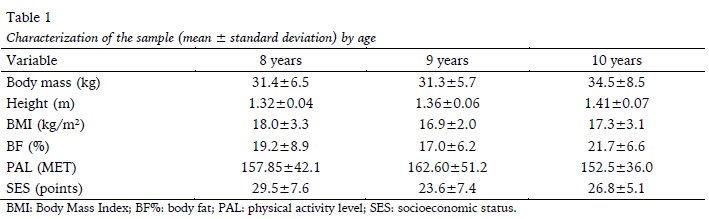
<body><![CDATA[<p><font size="3" face="Verdana"><b><b>METHOD</b></b></font></p> <font face="Verdana" size="2">     <p>An exploratory,     quasi-experimental, cross-sectional study conducted in two stages: 1 -     development of the instrument (choice of name, logo, prototype and conducting of a pilot study); and 2 - testing and data analysis.</p> <b><b>Participants</b></b>      <p>The sample     consisted of 39 randomly selected children of both genders (22 girls and 17     boys) from 8 to 10 years old, in the 2<sup>nd</sup> to the 5<sup>th</sup>   grades of the elementary school of public (61.5%) and private (38.5%) schools in the Federal District.</p>     <p><a href="/img/revistas/mot/v13s1/13s1a04t1.jpg">Table 1</a> shows the     mean and standard deviation values of the sample characterization data. On     average, the children were considered to be eutrophic (WHO, 2007), with a good     percentage of fat (Lohman, 1992), belonging to socioeconomic class B     (Association of Brazilian Research Companies [ABEP], 2012), and physically to     moderately active (Barros &amp; Nahas, 2003). Only children without     intellectual, visual or reading disabilities, and those whose legal guardians signed the Free and Informed Consent Form participated in the research.</p> </font>     
<p><font face="Verdana" size="2"><b><b>Instruments e Procedures</b></b>    </font></p> <font face="Verdana" size="2">     <p>Body mass (Tanita     UM 080W), height (Sanny®), Body Mass Index (BMI), and Body fat (BF) were     measured by tricipital and subscapular skinfold measurement by a Lange     adipometer (Maryland, USA) according to the methods proposed by Slaughter     (1988). The physical activity level (PAL) was evaluated using the Lifestyle     Questionnaire developed by Barros &amp; Nahas (2003); and socioeconomic status     (SES) using the questionnaire developed by the Brazilian Advertising     Association/Brazilian Market Research Association [ABA/ABIPEME] and adapted by Almeida and Wickerhauser (1991).</p>     <p>A questionnaire     based on one developed by Coutinho (2007) was designed to evaluate users'     perceptions regarding the navigability and attractiveness of the website, as     well as the child’s learning. After the intervention, the parents or the person     in charge were contacted by telephone inquiry about a possible change in the     child's behaviour. The data collection was carried out in two phases, beginning     after approval by the Research Ethics Committee of the Catholic University of Brasilia (Opinion no. 803.429). </p>     <p>Phase 1 – Website     Development: First, the name TODDS Kids (<i>Todo Dia Divertido e Saudável</i>)     and the logo (<a href="#f1">Figure 1</a>) were created based on the idea: “Having a healthy life     every day can be fun!” The logo was initially drawn on A4 paper and then     vectored in the <i>Adobe Illustrator</i> program, and is composed of letters that represent toys and games in different environments, and accessible fruits:</p>     <p><a name="f1"></a></p>     <p>&nbsp;</p>     ]]></body>
<body><![CDATA[<p align="center"><img src="/img/revistas/mot/v13s1/13s1a04f1.jpg" width="346" height="211"></p>     
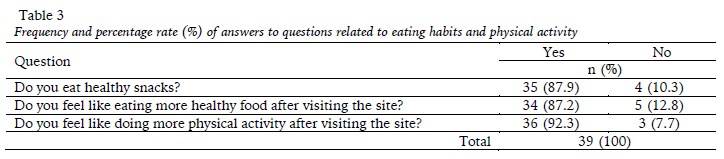
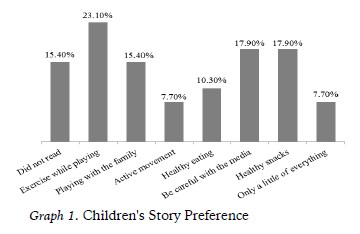
<p>&nbsp;</p>     <p>In order to create     the prototype of the website, aesthetics and an attractive form of information     provided in children's educational websites were initially considered. The     website was designed using the HTML5 cloud-based web development platform, wix.com, maintained and operated by Wixpress Ltd. (“Wix”). </p>     <p>During the     creation phase we sought to elaborate a variety of playful/fun ways of exposing     the information to the children's audience (stories, pictures, small texts,     videos, games from other web pages). Thus, a pilot study was carried out with     15 children, from 8 to 10 years old, who navigated the site for 1h. Clarity of     information, navigability, suggestions and critiques were evaluated by     questionnaire. The children’s interaction with the site and the pages of greater or lesser interest were also observed.</p>     <p>Phase 2 – Website     application: After instrument consolidation, 39 children were divided into     groups of 2 to 5 children who individually and freely navigated the site for 1     hour, using the computers of the computer laboratory of the Catholic University     of Brasilia (UCB). Children used headsets to listen to website content and also     to avoid distractions from external stimuli. Afterwards, the questionnaire was     applied to evaluate the children's perceptions (<a href="#g1">Graph 1</a> and <a href="#t2">Table 2</a>), and knowledge acquired through the site (<a href="/img/revistas/mot/v13s1/13s1a04t3.jpg">Table 3</a>).</p>     
<p><a name="g1"></a></p>     <p>&nbsp;</p>     <p align="center"><img src="/img/revistas/mot/v13s1/13s1a04g1.jpg" width="360" height="234"></p>     
<p>&nbsp;</p>     <p><a name="t2"></a></p>     ]]></body>
<body><![CDATA[<p>&nbsp;</p>     <p align="center"><img src="/img/revistas/mot/v13s1/13s1a04t2.jpg" width="358" height="156"></p>     
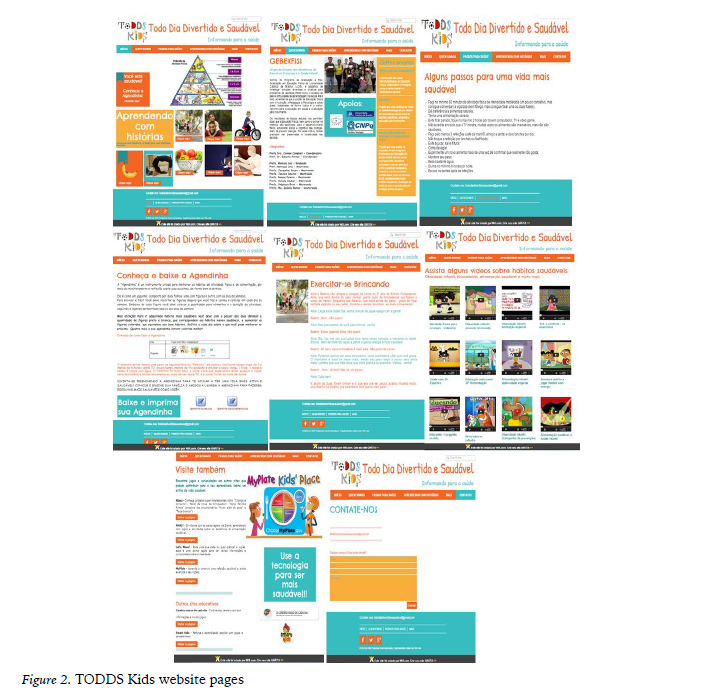
<p>&nbsp;</p>     <p>Phase 3 - Phone     inquiry to parents: Ten days after the intervention, a telephone survey was     carried out containing four questions directed to the parents or     tutors/guardians, where they should answer: yes, to a certain extent or no. Due     to the time of data collection being the school holidays period, it was only possible to contact 30 of the 39 parents. </p> <b><b>Statistical analysis</b></b>      <p>The data     normality of the sample characterization (PAL, SES, body mass, height, BMI, BF)     was tested by the Skewness and Kurtosis protocol, in addition to Shapiro-Wilk.     Mean and the standard deviation (SD) were calculated for descriptive     statistics. Frequency and percentage rate were also calculated for the     post-intervention questionnaire data. For the item &quot;grade&quot;, minimum     and maximum values and the coefficient of variance (Cv = SD/mean) were also     calculated, verifying how many deviated from the mean. Data was tabulated and processed in the SPSS statistical package for Windows, version 20.0.</p> </font>     <p>&nbsp;</p>     <p><font size="3" face="Verdana"><b><b>RESULTS</b></b></font></p> <font face="Verdana" size="2">     <p>The navigation     bar of the “TODDS KIDS” tool (URL: <a href="http://tododiadivertidoes.wix.com/toddskids" target="_blank">http://tododiadivertidoes.wix.com/toddskids</a>)     (<a href="http:/img/revistas/mot/v13s1/13s1a04f2.jpg">Figure 2</a>), provides access to: &lt;Home&gt;, &lt;About us&gt;, &lt;Steps to     health&gt;, &lt;Learning with stories&gt;, &lt;More&gt; which give access to:   &lt;Videos&gt;, &lt;Also visit&gt;, as well as &lt;Contact us&gt;, and the     possibility of downloading the “Schedule/Agenda” created by Pereira et al.     (2016) on the &lt;Monitoring Your Health&gt; page. It was possible to verify     that the videos attained 38.5% of the children's preference through the     questionnaire applied after the session on the website, and whose contents in     the form of cartoons referred to children obesity, healthy eating and games.     Regarding the lower preference, 76.9% reported that there was no activity that     they liked the least, 94.9% approved navigability, and 94.9% would like to meet     the research team in person. All children (100%) would indicate access to a friend, and only one did not show interest in accessing it again. </p>     <p>The children were     able to access some pages related to healthy habits (My Plate, Nhac, Alana,     Let’s Move, Smart kids), while the Nhac page was the most accessed by the children (48.7%) due to the presence of games. </p>     <p>The short stories   were created by the research team. <a href="#g1">Graph 1</a> shows those preferred by children. </p>     ]]></body>
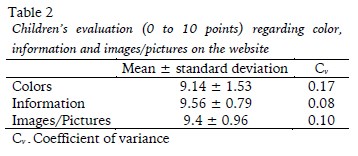
<body><![CDATA[<p>In <a href="#t2">Table 2</a> shows     the evaluation of the website by the children with a grade above 9, when <a href="/img/revistas/mot/v13s1/13s1a04t3.jpg">Table 3</a>, the     children reported that the healthy snack they ate most frequently is fruit.     Among those who reported not wanting to practice more physical activities after browsing the site, the justification was that they were already active.</p>     
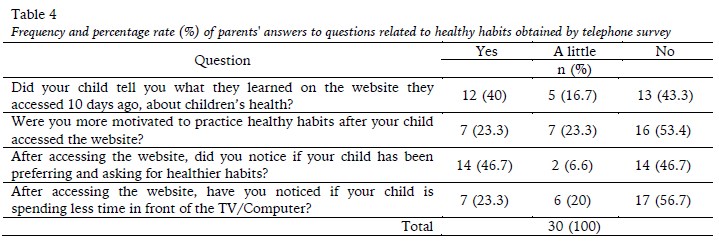
<p>All children (n =     39) satisfactorily answered the question &quot;Why should I practice physical     activity?&quot; 24 (61.5%), 34 (87.2%) and 28 (71.8%) children were able to     associate physical activity with healthy eating in their answers to the     questions: &quot;According to the website, what should you do to not become     obese?&quot;; &quot;Name three attitudes that make you healthier&quot;;   &quot;What did you learn from the site?&quot; Only one volunteer did not answer this last question, claiming to have prior knowledge of the topic. </p>     <p><a href="/img/revistas/mot/v13s1/13s1a04t4.jpg">Table 4</a> presents     responses from parents or guardian/tutors to the telephone survey conducted 10 days after the intervention with the children.</p> </font>     
<p>&nbsp;</p>     <p><font size="3" face="Verdana"><b><b>DISCUSSION</b></b></font></p> <font face="Verdana" size="2">     <p>The present study     demonstrated that the TODDS Kids website was considered easy to navigate by     children, as well as providing them with awareness of healthy habits and could     be useful as support material for health and education professionals, as well as parents and/or guardians/tutors. </p>     <p>A pilot study was     initially applied with the first version of the website. In it, children's high     preference for short and dynamic information was observed, in addition to their     fondness for games and videos, emphasizing the power of attractiveness, ludicity     and visual effects for this age group. According to Cavalcante et al. (2011),     the visual aspect of the instrument is one of the main factors to establish trust with the user.</p>     <p>A combination of     cold and warm colors used on the site follow the proposal of Oliveira (2015),     who reports that cold colors are processed in the prefrontal cortex and are     associated with seriousness and reliable transmission; warm colors are     associated to the brain area responsible for the reward state and dopamine     release, with green referring to consideration and balance; orange referring to     change and the need for repetition of pleasurable experiences. Thus, the use of     these colors being more appealing to both more impulsive and more rational users.</p>     <p>For Fermiano,     Bessa, and Cantelli (2013), the colors reinforce the     intended message as they refer to emotions, having a strong power of     persuasion. In this sense, the combination of the colors used in the site can     contribute to a feeling of needing to change to healthier choices, as well as     to persuade children with different personalities to become aware of their health. </p>     <p>We observed that     15.4% (n = 6) of the children did not read the stories, while 38.5% emphasized     that the videos were their favorite item. This is possibly due to the fact that     this is an audiovisual resource with great power of attraction due to its     various visual and sound effects (Andrade &amp; Acevedo, 2014; Machado, 2007).     However, 30.8% suggested &quot;more games&quot;, confirming the findings of     Paraskeva, Mysirlaki, and Papagianni (2009), who report that children and     young people accumulate approximately 2.5 hours a day in activities related to     online multiplayer games, and this weekly workload is considered extensive.     However, it is possible to use technology through games by self-reference, and     to raise awareness about technology use, both in terms of time spent and content quality. </p>     ]]></body>
<body><![CDATA[<p>Therefore,     although technology is largely used in a negative way, electronic games can     help teachers as alternative teaching and learning methods (Quiroga, 2009;     Paraskeva et al., 2009). Great authors like Piaget, Le Bouche, Wallon, and     Freire emphasized the importance of games in the psychosocial development of a     child, as well as more recent scholars such as Zea, Sánchez, Gutiérrez, Cabrera   &amp; Paderewski (2009). For them, learning while playing allows for the     discovery of skills, limitations, abstract thinking and mechanisms of coexistence. </p>     <p>The playfulness     of the site may have contributed to the high percentage of correct answers and     reports associated with the motivation to practice healthy habits among     children after accessing it (<a href="/img/revistas/mot/v13s1/13s1a04t3.jpg">Table 3</a>). This is similar to other     foreign/international interventions such as “Henry Gets moving” (Nielsen &amp;   Rouzier, 2012) and “Take10!” (Kibbe et al., 2011), which verified a significant improvement in body composition, and also in school performance. </p>     
<p>The present study     sought to provide information for the direct awareness of the child,     considering them to be an active and transforming agent of their reality (Libâneo,     2013), making them influential in positive changes in their family (Chenga,     Mendonça &amp; Farias Junior, 2014). This can be observed in the responses to     the telephone survey by the parents or guardian, in which 46.5% of them     considered themselves motivated to improve their habits after the child     participated in the intervention (<a href="/img/revistas/mot/v13s1/13s1a04t4.jpg">Table 4</a>). This is corroborated by a study by     Pereira et al. (2016), where 25% of the parents started a physical activity     practice after the child participated in intervention for 2 months at school,     emphasizing the importance of interventions in childhood in partnership with family and school. </p>     
<p>Based on the     limitations of the present study, we suggest that future studies with a larger     sample, follow-up time and intervention should be carried out, as well as be     extended to family care. Also, anthropometric and physical aptitude     assessments, interviews and questionnaires applied to children should be     included to investigate the degree of influence access to the site has on their     lifestyle in the long term. However, this initial and innovative study may     stimulate the creation of future tools with educational content to be used by     health and education professionals, since we observed that the TODDS Kids     website can be used as a pedagogical support tool to be used in school for the promotion of child health.</p> </font>     <p>&nbsp;</p>     <p><font size="3" face="Verdana"><b><b>REFERENCES</b></b></font></p> <font face="Verdana" size="2">     <!-- ref --><p>Almeida, P. M., &amp; Wickerhauser, H.   (1991). <i>O critério ABA-ABIPEME: em busca de uma atualização</i>. São Paulo.    &nbsp;&nbsp;&nbsp;&nbsp;&nbsp;&nbsp;&nbsp;&nbsp;[&#160;<a href="javascript:void(0);" onclick="javascript: window.open('/scielo.php?script=sci_nlinks&ref=371223&pid=S1646-107X201700060000400001&lng=','','width=640,height=500,resizable=yes,scrollbars=1,menubar=yes,');">Links</a>&#160;]<!-- end-ref --></p>     <!-- ref --><p>Andrade, M. A., &amp; Acevedo, C. R.     (2014) Práticas de Comunicação de Marketing para Crianças em Websites. <i>Revista Brasileira de Pesquisas de Marketing, Opinião e Mídia</i>, <i>14,</i> 19-37.    &nbsp;&nbsp;&nbsp;&nbsp;&nbsp;&nbsp;&nbsp;&nbsp;[&#160;<a href="javascript:void(0);" onclick="javascript: window.open('/scielo.php?script=sci_nlinks&ref=371225&pid=S1646-107X201700060000400002&lng=','','width=640,height=500,resizable=yes,scrollbars=1,menubar=yes,');">Links</a>&#160;]<!-- end-ref --></p>     ]]></body>
<body><![CDATA[<!-- ref --><p>Associação Brasileira de Empresas de     pesquisa. ABEP. (2012) Critério Padrão de Classificação Econômica no Brasil – 2008.    &nbsp;&nbsp;&nbsp;&nbsp;&nbsp;&nbsp;&nbsp;&nbsp;[&#160;<a href="javascript:void(0);" onclick="javascript: window.open('/scielo.php?script=sci_nlinks&ref=371227&pid=S1646-107X201700060000400003&lng=','','width=640,height=500,resizable=yes,scrollbars=1,menubar=yes,');">Links</a>&#160;]<!-- end-ref --></p>     <!-- ref --><p>Associação Brasileira para o estudo da     obesidade e da síndrome metabólica. (2014). Custos de doenças ligadas à obesidade para o SUS. Retrieved September 26, 2016, from <a href="http://www.abeso.org.br/lenoticia/909/custos+de+doencas+ligadas+a+obesidade+para+o+sus.shtml" target="_blank">http://www.abeso.org.br/lenoticia/909/custos+de+doencas+ligadas+a+obesidade+para+o+sus.shtml</a>.    &nbsp;&nbsp;&nbsp;&nbsp;&nbsp;&nbsp;&nbsp;&nbsp;[&#160;<a href="javascript:void(0);" onclick="javascript: window.open('/scielo.php?script=sci_nlinks&ref=371229&pid=S1646-107X201700060000400004&lng=','','width=640,height=500,resizable=yes,scrollbars=1,menubar=yes,');">Links</a>&#160;]<!-- end-ref --></p>     <!-- ref --><p>Barros, M. V. G., &amp; Nahas, M. V.     (2003) <i>Medidas da Atividade Física: teoria e aplicação em diversos grupos populacionais</i> (4ª ed.). Londrina:<i> Midiograf.    &nbsp;&nbsp;&nbsp;&nbsp;&nbsp;&nbsp;&nbsp;&nbsp;[&#160;<a href="javascript:void(0);" onclick="javascript: window.open('/scielo.php?script=sci_nlinks&ref=371231&pid=S1646-107X201700060000400005&lng=','','width=640,height=500,resizable=yes,scrollbars=1,menubar=yes,');">Links</a>&#160;]<!-- end-ref --></i></p>     <!-- ref --><p>Chenga, L. A., Mendonça, G., &amp;   Farias Júnior, J. C. (2014). Physical activity in adolescents: analysis of     social in&#64258;uence of parents and friends. <i>Jornal de Pediatria.</i> <i>90</i>(1), 35-41. doi: 10.1016/j.jped.2013.05.006&nbsp;&nbsp;&nbsp;&nbsp;&nbsp;&nbsp;&nbsp;&nbsp;[&#160;<a href="javascript:void(0);" onclick="javascript: window.open('/scielo.php?script=sci_nlinks&ref=371233&pid=S1646-107X201700060000400006&lng=','','width=640,height=500,resizable=yes,scrollbars=1,menubar=yes,');">Links</a>&#160;]<!-- end-ref --><!-- ref --><p>Coutinho, J. G. (2007) <i>Aprender a     Falar, Falar a Brincar: Software Educativo para Intervenção</i> (Dissertação de Mestrado em Ciências da Fala e da Audição). Universidade de Aveiro, Aveiro<i>.    &nbsp;&nbsp;&nbsp;&nbsp;&nbsp;&nbsp;&nbsp;&nbsp;[&#160;<a href="javascript:void(0);" onclick="javascript: window.open('/scielo.php?script=sci_nlinks&ref=371234&pid=S1646-107X201700060000400007&lng=','','width=640,height=500,resizable=yes,scrollbars=1,menubar=yes,');">Links</a>&#160;]<!-- end-ref --></i></p>     <!-- ref --><p>Fermiano, M. A. B., Bessa, S., &amp;   Cantelli, V. C. B. (2013) Criança Consumo e Neuromarketing. <i>XXVI Encontro Nacional de professores do PROEPRI. Neurociências e educação</i>. São Paulo.    &nbsp;&nbsp;&nbsp;&nbsp;&nbsp;&nbsp;&nbsp;&nbsp;[&#160;<a href="javascript:void(0);" onclick="javascript: window.open('/scielo.php?script=sci_nlinks&ref=371236&pid=S1646-107X201700060000400008&lng=','','width=640,height=500,resizable=yes,scrollbars=1,menubar=yes,');">Links</a>&#160;]<!-- end-ref --></p>     <!-- ref --><p>Fontenelle, L. Uma infância perdida:   publicidade infantil é um abuso contra as crianças. (2014) Alana - Defesa.    &nbsp;&nbsp;&nbsp;&nbsp;&nbsp;&nbsp;&nbsp;&nbsp;[&#160;<a href="javascript:void(0);" onclick="javascript: window.open('/scielo.php?script=sci_nlinks&ref=371238&pid=S1646-107X201700060000400009&lng=','','width=640,height=500,resizable=yes,scrollbars=1,menubar=yes,');">Links</a>&#160;]<!-- end-ref --></p>     <!-- ref --><p>Kibbe, D. L., Hackett, J., Hurley, M.,     McFarland, M., Schubert, K. G., Schultz, A., &amp; Harris, S. (2011) Ten Years     of TAKE 10!®: Integrating physical activity with academic concepts in     elementary school classrooms. <i>Preventive Medicine</i>, <i>52</i>(Suppl. 1), S43-S50. doi: 10.1016/j.ypmed.2011.01.025&nbsp;&nbsp;&nbsp;&nbsp;&nbsp;&nbsp;&nbsp;&nbsp;[&#160;<a href="javascript:void(0);" onclick="javascript: window.open('/scielo.php?script=sci_nlinks&ref=371240&pid=S1646-107X201700060000400010&lng=','','width=640,height=500,resizable=yes,scrollbars=1,menubar=yes,');">Links</a>&#160;]<!-- end-ref --><!-- ref --><p>Libâneo, J. C. (2013). <i>Didática </i>(3ª   ed.). São Paulo: Ed. Cortez.    &nbsp;&nbsp;&nbsp;&nbsp;&nbsp;&nbsp;&nbsp;&nbsp;[&#160;<a href="javascript:void(0);" onclick="javascript: window.open('/scielo.php?script=sci_nlinks&ref=371241&pid=S1646-107X201700060000400011&lng=','','width=640,height=500,resizable=yes,scrollbars=1,menubar=yes,');">Links</a>&#160;]<!-- end-ref --> </p>     <!-- ref --><p>Lohman, T. G. (1986) Applicability of     body composition techniques and constants for children and youths. <i>Exercise       Sports Science Journal</i>, <i>14</i>, 325-57.    &nbsp;&nbsp;&nbsp;&nbsp;&nbsp;&nbsp;&nbsp;&nbsp;[&#160;<a href="javascript:void(0);" onclick="javascript: window.open('/scielo.php?script=sci_nlinks&ref=371243&pid=S1646-107X201700060000400012&lng=','','width=640,height=500,resizable=yes,scrollbars=1,menubar=yes,');">Links</a>&#160;]<!-- end-ref --></p>     <!-- ref --><p>Machado, R. C. (2007) <i>Um software     educativo de Exercício-e-prática como ferramenta no processo de alfabetização     infantil</i> (Dissertação de Mestrado). Universidade Federal de Uberlândia, Uberlândia.    &nbsp;&nbsp;&nbsp;&nbsp;&nbsp;&nbsp;&nbsp;&nbsp;[&#160;<a href="javascript:void(0);" onclick="javascript: window.open('/scielo.php?script=sci_nlinks&ref=371245&pid=S1646-107X201700060000400013&lng=','','width=640,height=500,resizable=yes,scrollbars=1,menubar=yes,');">Links</a>&#160;]<!-- end-ref --></p>     ]]></body>
<body><![CDATA[<!-- ref --><p>Mazzoccante, R. P., Moraes, J. F. V.     N., &amp; Campbell, C. S. G. (2012) Gastos públicos diretos com a obesidade e     doenças associadas no Brasil. <i>Revista de Ciências Médicas, 21</i>(1-6), 25-34.    &nbsp;&nbsp;&nbsp;&nbsp;&nbsp;&nbsp;&nbsp;&nbsp;[&#160;<a href="javascript:void(0);" onclick="javascript: window.open('/scielo.php?script=sci_nlinks&ref=371247&pid=S1646-107X201700060000400014&lng=','','width=640,height=500,resizable=yes,scrollbars=1,menubar=yes,');">Links</a>&#160;]<!-- end-ref --></p>     <!-- ref --><p>Mendes, Beatriz. (2014). Publicidade infantil: proibir ou não proibir? Carta     Capital. [online]. São Paulo: <i>Editora Confiança</i>. Retrieved September 26, 2016, from <a href="http://www.cartacapital.com.br/sociedade/a-publicidade-infantil-em-debate/" target="_blank">http://www.cartacapital.com.br/sociedade/a-publicidade-infantil-em-debate/</a>.    &nbsp;&nbsp;&nbsp;&nbsp;&nbsp;&nbsp;&nbsp;&nbsp;[&#160;<a href="javascript:void(0);" onclick="javascript: window.open('/scielo.php?script=sci_nlinks&ref=371249&pid=S1646-107X201700060000400015&lng=','','width=640,height=500,resizable=yes,scrollbars=1,menubar=yes,');">Links</a>&#160;]<!-- end-ref --></p>     <!-- ref --><p>Oliveira, L., &amp; Real, E. (2011).     Publicidade, consumo e comportamento infantil. <i>Intercom – Sociedade       Brasileira de Estudos Interdisciplinares da Comunicação XIII Congresso de Ciências da Comunicação na Região Nordeste. </i>Maceió.    &nbsp;&nbsp;&nbsp;&nbsp;&nbsp;&nbsp;&nbsp;&nbsp;[&#160;<a href="javascript:void(0);" onclick="javascript: window.open('/scielo.php?script=sci_nlinks&ref=371251&pid=S1646-107X201700060000400016&lng=','','width=640,height=500,resizable=yes,scrollbars=1,menubar=yes,');">Links</a>&#160;]<!-- end-ref --></p>     <!-- ref --><p>Paraskeva, F., Mysirlaki, S. E., &amp;   Papagianni, A. (2009). Multiplayer online games as educational tools: facing new challenges in learning. <i>Computers Education, 54</i>, 498-505.  doi: 10.1016/j.compedu.2009.09.001&nbsp;&nbsp;&nbsp;&nbsp;&nbsp;&nbsp;&nbsp;&nbsp;[&#160;<a href="javascript:void(0);" onclick="javascript: window.open('/scielo.php?script=sci_nlinks&ref=371253&pid=S1646-107X201700060000400017&lng=','','width=640,height=500,resizable=yes,scrollbars=1,menubar=yes,');">Links</a>&#160;]<!-- end-ref --><!-- ref --><p>Pereira, R. M. S., Rauber, S. B.,     Ramos, I. A., Andrade, D. T., Militão, A. G., Moraes, J. F. V. N., Simões, H.     G., &amp; Campbell, C. S. G. (2016). Recording daily     routines with guidance on healthy lifestyle to improve health parameters in     children and their families. <i>Motriz</i>, <i>22</i>(3), 164-171. doi: 10.1590/S1980-6574201600030007&nbsp;&nbsp;&nbsp;&nbsp;&nbsp;&nbsp;&nbsp;&nbsp;[&#160;<a href="javascript:void(0);" onclick="javascript: window.open('/scielo.php?script=sci_nlinks&ref=371254&pid=S1646-107X201700060000400018&lng=','','width=640,height=500,resizable=yes,scrollbars=1,menubar=yes,');">Links</a>&#160;]<!-- end-ref --><!-- ref --><p>Roman, C. (2014). A publicidade infantil invade a tevê. Carta Capital     [online]. São Paulo. <i>Editora Confiança</i>, dez. 2011. Retrieved September 28, 2016, from <a href="http://www.cartacapital.com.br/sociedade/os-maleficios-da-publicidade-infantil" target="_blank">http://www.cartacapital.com.br/sociedade/os-maleficios-da-publicidade-infantil</a>.    &nbsp;&nbsp;&nbsp;&nbsp;&nbsp;&nbsp;&nbsp;&nbsp;[&#160;<a href="javascript:void(0);" onclick="javascript: window.open('/scielo.php?script=sci_nlinks&ref=371255&pid=S1646-107X201700060000400019&lng=','','width=640,height=500,resizable=yes,scrollbars=1,menubar=yes,');">Links</a>&#160;]<!-- end-ref --></p>     ]]></body>
<body><![CDATA[<!-- ref --><p>World Health Organization (WHO).   (2014). Atividade física. Retrieved September 28, 2016, from <a href="http://www.who.int/mediacentre/factsheets/fs385/en/" target="_blank">http://www.who.int/mediacentre/factsheets/fs385/en/</a>.    &nbsp;&nbsp;&nbsp;&nbsp;&nbsp;&nbsp;&nbsp;&nbsp;[&#160;<a href="javascript:void(0);" onclick="javascript: window.open('/scielo.php?script=sci_nlinks&ref=371257&pid=S1646-107X201700060000400020&lng=','','width=640,height=500,resizable=yes,scrollbars=1,menubar=yes,');">Links</a>&#160;]<!-- end-ref --></p>     <!-- ref --><p>Zea, N. P., Sánchez, J. L. G., Gutiérrez, F. L., Cabrera, M. J. E., &amp; Paderewski, P. (2009) Design     of Educational multiplayer videogames: A vision from collaborative learning. <i>Advances in Engineering Software, 40</i>(12), 1251-1260.    &nbsp;&nbsp;&nbsp;&nbsp;&nbsp;&nbsp;&nbsp;&nbsp;[&#160;<a href="javascript:void(0);" onclick="javascript: window.open('/scielo.php?script=sci_nlinks&ref=371259&pid=S1646-107X201700060000400021&lng=','','width=640,height=500,resizable=yes,scrollbars=1,menubar=yes,');">Links</a>&#160;]<!-- end-ref --></p>     <p>&nbsp;</p>     <p><b>Acknowledgments:    <br> </b>To CNPq, CAPES, Universidade Católica de Brasília - UCB, SESC-DF, study participants.    <br> <b>Conflict of interests:    <br> </b>Nothing to declare.    <br> <b>Funding:    ]]></body>
<body><![CDATA[<br> </b>CNPq/CAPES</p> </font>     <p>&nbsp;</p>     <p>&nbsp;</p>     <p><font face="Verdana" size="2"><a href="#top"><sup>*</sup></a><i><a name="end"></a></i></font>    <font size="2" face="Verdana"><i>Corresponding   author: </i>Catholic University of Brasília, QNL 14 conjunto A casa 04, Taguatinga, 71966-700, Brasília-DF, Brazil. <i>Email:</i> <a href="mailto:raianemsp@gmail.com">raianemsp@gmail.com</a></font></p>      ]]></body><back>
<ref-list>
<ref id="B1">
<nlm-citation citation-type="">
<person-group person-group-type="author">
<name>
<surname><![CDATA[Almeida]]></surname>
<given-names><![CDATA[P. M.]]></given-names>
</name>
<name>
<surname><![CDATA[Wickerhauser]]></surname>
<given-names><![CDATA[H.]]></given-names>
</name>
</person-group>
<source><![CDATA[O critério ABA-ABIPEME: em busca de uma atualização]]></source>
<year>1991</year>
<publisher-loc><![CDATA[São Paulo ]]></publisher-loc>
</nlm-citation>
</ref>
<ref id="B2">
<nlm-citation citation-type="journal">
<person-group person-group-type="author">
<name>
<surname><![CDATA[Andrade]]></surname>
<given-names><![CDATA[M. A.]]></given-names>
</name>
<name>
<surname><![CDATA[Acevedo]]></surname>
<given-names><![CDATA[C. R.]]></given-names>
</name>
</person-group>
<article-title xml:lang="pt"><![CDATA[Práticas de Comunicação de Marketing para Crianças em Websites]]></article-title>
<source><![CDATA[Revista Brasileira de Pesquisas de Marketing, Opinião e Mídia]]></source>
<year>2014</year>
<volume>14</volume>
<page-range>19-37</page-range></nlm-citation>
</ref>
<ref id="B3">
<nlm-citation citation-type="">
<collab>Associação Brasileira de Empresas de pesquisa</collab>
<source><![CDATA[Critério Padrão de Classificação Econômica no Brasil: 2008]]></source>
<year>2012</year>
</nlm-citation>
</ref>
<ref id="B4">
<nlm-citation citation-type="">
<collab>Associação Brasileira para o estudo da obesidade e da síndrome metabólica</collab>
<source><![CDATA[Custos de doenças ligadas à obesidade para o SUS]]></source>
<year>2014</year>
</nlm-citation>
</ref>
<ref id="B5">
<nlm-citation citation-type="book">
<person-group person-group-type="author">
<name>
<surname><![CDATA[Barros]]></surname>
<given-names><![CDATA[M. V. G.]]></given-names>
</name>
<name>
<surname><![CDATA[Nahas]]></surname>
<given-names><![CDATA[M. V.]]></given-names>
</name>
</person-group>
<source><![CDATA[Medidas da Atividade Física: teoria e aplicação em diversos grupos populacionais]]></source>
<year>2003</year>
<edition>4</edition>
<publisher-loc><![CDATA[Londrina ]]></publisher-loc>
<publisher-name><![CDATA[Midiograf]]></publisher-name>
</nlm-citation>
</ref>
<ref id="B6">
<nlm-citation citation-type="journal">
<person-group person-group-type="author">
<name>
<surname><![CDATA[Chenga]]></surname>
<given-names><![CDATA[L. A.]]></given-names>
</name>
<name>
<surname><![CDATA[Mendonça]]></surname>
<given-names><![CDATA[G.]]></given-names>
</name>
<name>
<surname><![CDATA[Farias Júnior]]></surname>
<given-names><![CDATA[J. C.]]></given-names>
</name>
</person-group>
<article-title xml:lang="en"><![CDATA[Physical activity in adolescents: analysis of social in&#64258;uence of parents and friends]]></article-title>
<source><![CDATA[Jornal de Pediatria]]></source>
<year>2014</year>
<volume>90</volume>
<numero>1</numero>
<issue>1</issue>
<page-range>35-41</page-range></nlm-citation>
</ref>
<ref id="B7">
<nlm-citation citation-type="">
<person-group person-group-type="author">
<name>
<surname><![CDATA[Coutinho]]></surname>
<given-names><![CDATA[J. G.]]></given-names>
</name>
</person-group>
<source><![CDATA[Aprender a Falar, Falar a Brincar: Software Educativo para Intervenção]]></source>
<year>2007</year>
</nlm-citation>
</ref>
<ref id="B8">
<nlm-citation citation-type="">
<person-group person-group-type="author">
<name>
<surname><![CDATA[Fermiano]]></surname>
<given-names><![CDATA[M. A. B.]]></given-names>
</name>
<name>
<surname><![CDATA[Bessa]]></surname>
<given-names><![CDATA[S.]]></given-names>
</name>
<name>
<surname><![CDATA[Cantelli]]></surname>
<given-names><![CDATA[V. C. B.]]></given-names>
</name>
</person-group>
<article-title xml:lang="pt"><![CDATA[Criança Consumo e Neuromarketing]]></article-title>
<source><![CDATA[XXVI Encontro Nacional de professores do PROEPRI: Neurociências e educação]]></source>
<year>2013</year>
<publisher-loc><![CDATA[São Paulo ]]></publisher-loc>
</nlm-citation>
</ref>
<ref id="B9">
<nlm-citation citation-type="book">
<person-group person-group-type="author">
<name>
<surname><![CDATA[Fontenelle]]></surname>
<given-names><![CDATA[L.]]></given-names>
</name>
</person-group>
<source><![CDATA[Uma infância perdida: publicidade infantil é um abuso contra as crianças]]></source>
<year>2014</year>
<publisher-loc><![CDATA[Alana ]]></publisher-loc>
<publisher-name><![CDATA[Defesa]]></publisher-name>
</nlm-citation>
</ref>
<ref id="B10">
<nlm-citation citation-type="journal">
<person-group person-group-type="author">
<name>
<surname><![CDATA[Kibbe]]></surname>
<given-names><![CDATA[D. L.]]></given-names>
</name>
<name>
<surname><![CDATA[Hackett]]></surname>
<given-names><![CDATA[J.]]></given-names>
</name>
<name>
<surname><![CDATA[Hurley]]></surname>
<given-names><![CDATA[M.]]></given-names>
</name>
<name>
<surname><![CDATA[McFarland]]></surname>
<given-names><![CDATA[M.]]></given-names>
</name>
<name>
<surname><![CDATA[Schubert]]></surname>
<given-names><![CDATA[K. G.]]></given-names>
</name>
<name>
<surname><![CDATA[Schultz]]></surname>
<given-names><![CDATA[A.]]></given-names>
</name>
<name>
<surname><![CDATA[Harris]]></surname>
<given-names><![CDATA[S.]]></given-names>
</name>
</person-group>
<article-title xml:lang="en"><![CDATA[Ten Years of TAKE 10!®: Integrating physical activity with academic concepts in elementary school classrooms]]></article-title>
<source><![CDATA[Preventive Medicine]]></source>
<year>2011</year>
<volume>52</volume>
<numero>^s1</numero>
<issue>^s1</issue>
<supplement>1</supplement>
<page-range>S43-S50</page-range></nlm-citation>
</ref>
<ref id="B11">
<nlm-citation citation-type="book">
<person-group person-group-type="author">
<name>
<surname><![CDATA[Libâneo]]></surname>
<given-names><![CDATA[J. C.]]></given-names>
</name>
</person-group>
<source><![CDATA[Didática]]></source>
<year>2013</year>
<edition>3</edition>
<publisher-loc><![CDATA[São Paulo ]]></publisher-loc>
<publisher-name><![CDATA[Ed. Cortez]]></publisher-name>
</nlm-citation>
</ref>
<ref id="B12">
<nlm-citation citation-type="journal">
<person-group person-group-type="author">
<name>
<surname><![CDATA[Lohman]]></surname>
<given-names><![CDATA[T. G.]]></given-names>
</name>
</person-group>
<article-title xml:lang="en"><![CDATA[Applicability of body composition techniques and constants for children and youths]]></article-title>
<source><![CDATA[Exercise Sports Science Journal]]></source>
<year>1986</year>
<volume>14</volume>
<page-range>325-57</page-range></nlm-citation>
</ref>
<ref id="B13">
<nlm-citation citation-type="">
<person-group person-group-type="author">
<name>
<surname><![CDATA[Machado]]></surname>
<given-names><![CDATA[R. C.]]></given-names>
</name>
</person-group>
<source><![CDATA[Um software educativo de Exercício-e-prática como ferramenta no processo de alfabetização infantil]]></source>
<year>2007</year>
</nlm-citation>
</ref>
<ref id="B14">
<nlm-citation citation-type="journal">
<person-group person-group-type="author">
<name>
<surname><![CDATA[Mazzoccante]]></surname>
<given-names><![CDATA[R. P.]]></given-names>
</name>
<name>
<surname><![CDATA[Moraes]]></surname>
<given-names><![CDATA[J. F. V. N.]]></given-names>
</name>
<name>
<surname><![CDATA[Campbell]]></surname>
<given-names><![CDATA[C. S. G.]]></given-names>
</name>
</person-group>
<article-title xml:lang="pt"><![CDATA[Gastos públicos diretos com a obesidade e doenças associadas no Brasil]]></article-title>
<source><![CDATA[Revista de Ciências Médicas]]></source>
<year>2012</year>
<volume>21</volume>
<numero>1-6</numero>
<issue>1-6</issue>
<page-range>25-34</page-range></nlm-citation>
</ref>
<ref id="B15">
<nlm-citation citation-type="book">
<person-group person-group-type="author">
<name>
<surname><![CDATA[Mendes]]></surname>
<given-names><![CDATA[Beatriz]]></given-names>
</name>
</person-group>
<source><![CDATA[Publicidade infantil: proibir ou não proibir? Carta Capital.]]></source>
<year>2014</year>
<publisher-loc><![CDATA[São Paulo ]]></publisher-loc>
<publisher-name><![CDATA[Editora Confiança]]></publisher-name>
</nlm-citation>
</ref>
<ref id="B16">
<nlm-citation citation-type="confpro">
<person-group person-group-type="author">
<name>
<surname><![CDATA[Oliveira]]></surname>
<given-names><![CDATA[L.]]></given-names>
</name>
<name>
<surname><![CDATA[Real]]></surname>
<given-names><![CDATA[E.]]></given-names>
</name>
</person-group>
<article-title xml:lang="pt"><![CDATA[Publicidade, consumo e comportamento infantil]]></article-title>
<source><![CDATA[Intercom: Sociedade Brasileira de Estudos Interdisciplinares da Comunicação]]></source>
<year>2011</year>
<conf-name><![CDATA[ XIII Congresso de Ciências da Comunicação na Região Nordeste]]></conf-name>
<conf-loc>Maceió </conf-loc>
</nlm-citation>
</ref>
<ref id="B17">
<nlm-citation citation-type="journal">
<person-group person-group-type="author">
<name>
<surname><![CDATA[Paraskeva]]></surname>
<given-names><![CDATA[F.]]></given-names>
</name>
<name>
<surname><![CDATA[Mysirlaki]]></surname>
<given-names><![CDATA[S. E.]]></given-names>
</name>
<name>
<surname><![CDATA[Papagianni]]></surname>
<given-names><![CDATA[A.]]></given-names>
</name>
</person-group>
<article-title xml:lang="en"><![CDATA[Multiplayer online games as educational tools: facing new challenges in learning]]></article-title>
<source><![CDATA[Computers Education]]></source>
<year>2009</year>
<volume>54</volume>
<page-range>498-505</page-range></nlm-citation>
</ref>
<ref id="B18">
<nlm-citation citation-type="journal">
<person-group person-group-type="author">
<name>
<surname><![CDATA[Pereira]]></surname>
<given-names><![CDATA[R. M. S.]]></given-names>
</name>
<name>
<surname><![CDATA[Rauber]]></surname>
<given-names><![CDATA[S. B.]]></given-names>
</name>
<name>
<surname><![CDATA[Ramos]]></surname>
<given-names><![CDATA[I. A.]]></given-names>
</name>
<name>
<surname><![CDATA[Andrade]]></surname>
<given-names><![CDATA[D. T.]]></given-names>
</name>
<name>
<surname><![CDATA[Militão]]></surname>
<given-names><![CDATA[A. G.]]></given-names>
</name>
<name>
<surname><![CDATA[Moraes]]></surname>
<given-names><![CDATA[J. F. V. N.]]></given-names>
</name>
<name>
<surname><![CDATA[Simões]]></surname>
<given-names><![CDATA[H. G.]]></given-names>
</name>
<name>
<surname><![CDATA[Campbell]]></surname>
<given-names><![CDATA[C. S. G.]]></given-names>
</name>
</person-group>
<article-title xml:lang="en"><![CDATA[Recording daily routines with guidance on healthy lifestyle to improve health parameters in children and their families]]></article-title>
<source><![CDATA[Motriz]]></source>
<year>2016</year>
<volume>22</volume>
<numero>3</numero>
<issue>3</issue>
<page-range>164-171</page-range></nlm-citation>
</ref>
<ref id="B19">
<nlm-citation citation-type="book">
<person-group person-group-type="author">
<name>
<surname><![CDATA[Roman]]></surname>
<given-names><![CDATA[C.]]></given-names>
</name>
</person-group>
<source><![CDATA[A publicidade infantil invade a tevê: Carta Capital]]></source>
<year>2014</year>
<publisher-loc><![CDATA[São Paulo ]]></publisher-loc>
<publisher-name><![CDATA[Editora Confiança]]></publisher-name>
</nlm-citation>
</ref>
<ref id="B20">
<nlm-citation citation-type="">
<collab>World Health Organization</collab>
<source><![CDATA[Atividade física]]></source>
<year>2014</year>
</nlm-citation>
</ref>
<ref id="B21">
<nlm-citation citation-type="journal">
<person-group person-group-type="author">
<name>
<surname><![CDATA[Zea]]></surname>
<given-names><![CDATA[N. P.]]></given-names>
</name>
<name>
<surname><![CDATA[Sánchez]]></surname>
<given-names><![CDATA[J. L. G.]]></given-names>
</name>
<name>
<surname><![CDATA[Gutiérrez]]></surname>
<given-names><![CDATA[F. L.]]></given-names>
</name>
<name>
<surname><![CDATA[Cabrera]]></surname>
<given-names><![CDATA[M. J. E.]]></given-names>
</name>
<name>
<surname><![CDATA[Paderewski]]></surname>
<given-names><![CDATA[P.]]></given-names>
</name>
</person-group>
<article-title xml:lang="en"><![CDATA[Design of Educational multiplayer videogames: A vision from collaborative learning]]></article-title>
<source><![CDATA[Advances in Engineering Software]]></source>
<year>2009</year>
<volume>40</volume>
<numero>12</numero>
<issue>12</issue>
<page-range>1251-1260</page-range></nlm-citation>
</ref>
</ref-list>
</back>
</article>