<?xml version="1.0" encoding="ISO-8859-1"?><article xmlns:mml="http://www.w3.org/1998/Math/MathML" xmlns:xlink="http://www.w3.org/1999/xlink" xmlns:xsi="http://www.w3.org/2001/XMLSchema-instance">
<front>
<journal-meta>
<journal-id>1646-107X</journal-id>
<journal-title><![CDATA[Motricidade]]></journal-title>
<abbrev-journal-title><![CDATA[Motri.]]></abbrev-journal-title>
<issn>1646-107X</issn>
<publisher>
<publisher-name><![CDATA[Edições Desafio Singular]]></publisher-name>
</publisher>
</journal-meta>
<article-meta>
<article-id>S1646-107X2017000600005</article-id>
<title-group>
<article-title xml:lang="en"><![CDATA[Implementation of an intervention program with physical activity and healthy diet for health promotion at school: a possible challenge]]></article-title>
</title-group>
<contrib-group>
<contrib contrib-type="author">
<name>
<surname><![CDATA[Tkac]]></surname>
<given-names><![CDATA[Claudio Marcelo]]></given-names>
</name>
<xref ref-type="aff" rid="A01"/>
</contrib>
<contrib contrib-type="author">
<name>
<surname><![CDATA[Fridlund]]></surname>
<given-names><![CDATA[Luciana Ennes]]></given-names>
</name>
<xref ref-type="aff" rid="A01"/>
</contrib>
<contrib contrib-type="author">
<name>
<surname><![CDATA[Moyses]]></surname>
<given-names><![CDATA[Samuel Jorge]]></given-names>
</name>
<xref ref-type="aff" rid="A01"/>
</contrib>
<contrib contrib-type="author">
<name>
<surname><![CDATA[Werneck]]></surname>
<given-names><![CDATA[Renata Iani]]></given-names>
</name>
<xref ref-type="aff" rid="A01"/>
</contrib>
<contrib contrib-type="author">
<name>
<surname><![CDATA[Moyses]]></surname>
<given-names><![CDATA[Simone Tetu]]></given-names>
</name>
<xref ref-type="aff" rid="A01"/>
</contrib>
</contrib-group>
<aff id="A01">
<institution><![CDATA[,Pontifical Catholic University of Paraná  ]]></institution>
<addr-line><![CDATA[Curitiba ]]></addr-line>
<country>Brazil</country>
</aff>
<pub-date pub-type="pub">
<day>00</day>
<month>12</month>
<year>2017</year>
</pub-date>
<pub-date pub-type="epub">
<day>00</day>
<month>12</month>
<year>2017</year>
</pub-date>
<volume>13</volume>
<fpage>28</fpage>
<lpage>35</lpage>
<copyright-statement/>
<copyright-year/>
<self-uri xlink:href="http://scielo.pt/scielo.php?script=sci_arttext&amp;pid=S1646-107X2017000600005&amp;lng=en&amp;nrm=iso"></self-uri><self-uri xlink:href="http://scielo.pt/scielo.php?script=sci_abstract&amp;pid=S1646-107X2017000600005&amp;lng=en&amp;nrm=iso"></self-uri><self-uri xlink:href="http://scielo.pt/scielo.php?script=sci_pdf&amp;pid=S1646-107X2017000600005&amp;lng=en&amp;nrm=iso"></self-uri><abstract abstract-type="short" xml:lang="en"><p><![CDATA[The early development of chronic non-communicable diseases has represented the greatest concern in the health prevention in all countries. The goal of this research was to investigate how a program to promote the health of school children through physical activity and healthy diet can be implemented aiming sustainability and continuity. The participants of this study were 1098 students, aged 6 to 10 years, of both sexes. The students belong to two schools: experimental school (ES-n=592)/control school (CS-n=506). The project was implemented in 2013 (pre-test) and was followed until 2015 (post-test), with an intervention in 2014. The following variables were evaluated: nutritional status, level of blood glucose, cardiorespiratory endurance, fondness for exercises and 4 categories of food. The statistical analysis used was the Wilcoxon test (paired) and the Wilcoxon test (U of Mann Whitney) (independent samples), assuming a significance level of p<0.05. The results showed differences between ES and CS groups in the years 2013 and 2015. The biggest differences occurred in ES 2015. It can be concluded that the intervention was effective and implemented with intersectoral articulations to ensure sustainability and continuity.]]></p></abstract>
<kwd-group>
<kwd lng="en"><![CDATA[early intervention]]></kwd>
<kwd lng="en"><![CDATA[physical activity]]></kwd>
<kwd lng="en"><![CDATA[healthy eating]]></kwd>
<kwd lng="en"><![CDATA[school health]]></kwd>
</kwd-group>
</article-meta>
</front><body><![CDATA[  <font face="Verdana" size="2">     <p align="right"><b>ORIGINAL ARTICLE</b></p>      <p>&nbsp;</p> </font>     <p><font size="4" face="Verdana"><b>Implementation of an intervention   program with physical activity and healthy diet for health promotion at school:   a possible challenge.</b></font></p> <font face="Verdana" size="2">     <p>&nbsp;</p>     <p>&nbsp;</p>     <p><b>Claudio   Marcelo Tkac<sup>1,</sup><a href="#end"><sup>*</sup></a><i><a name="top" id="top"></a></i>;   Luciana Ennes Fridlund<sup>1</sup>; Samuel   Jorge Moyses<sup>1</sup>;   Renata Iani Werneck<sup>1</sup>; Simone Tetu Moyses<sup>1</sup></b></p>     <p><sup>1</sup> <i>Pontifical Catholic University of Paraná, Curitiba, Brazil.</i></p>     <p>&nbsp;</p>     <p>&nbsp;</p> </font> <hr noshade size="1"> <font face="Verdana" size="2">     ]]></body>
<body><![CDATA[<p><b>ABSTRACT</b></p>     <p>The early development of chronic   non-communicable diseases has represented the greatest concern in the health   prevention in all countries. The goal of this research was to investigate how a   program to promote the health of school children through physical activity and   healthy diet can be implemented aiming sustainability and continuity. The   participants of this study were 1098 students, aged 6 to 10 years, of both   sexes. The students belong to two schools: experimental school   (ES-n=592)/control school (CS-n=506). The project was implemented in 2013   (pre-test) and was followed until 2015 (post-test), with an intervention in   2014. The following variables were evaluated: nutritional status, level of   blood glucose, cardiorespiratory endurance, fondness for exercises and 4   categories of food. The statistical analysis used was the Wilcoxon test   (paired) and the Wilcoxon test (U of Mann Whitney) (independent samples),   assuming a significance level of p&lt;0.05. The results showed differences   between ES and CS groups in the years 2013 and 2015. The biggest differences   occurred in ES 2015. It can be concluded that the intervention was effective   and implemented with intersectoral articulations to ensure sustainability and continuity.</p>     <p><b>Keywords: </b>early intervention, physical activity, healthy eating, school health.</p> </font> <hr noshade size="1">     <p>&nbsp;</p>     <p>&nbsp;</p>     <p><font size="3" face="Verdana"><b><b>INTRODUCTION</b></b></font></p> <font face="Verdana" size="2">     <p>Physical activity is associated with   several health promotion benefits, but the majority of children do not reach   the recommended levels. Particularly, on childhood obesity prevention, physical   activity is embedded in most programs to reduce obesity, with results pointing   to an association between high levels of physical activity with low body mass indexes (Metcalf, Henley, &amp; Wikin, 2012).</p>     <p>Historically, the World Health   Organization (WHO) has been publishing reports with guidelines for the   prevention of chronic non-communicable diseases (NCD's) (WHO, 2005a; WHO,   2008a; WHO, 2009) in which physical activity and healthy eating are considered   conditions for the promotion of health in combating the NCD's, in countries, in   communities and at school. A report was published recently to end childhood   obesity in the world (WHO, 2016), indicating the physical activity as one of   the strategies of effectiveness. Therefore, the identification and control of   risk factors to health, that are modifiable, are fundamental to the prevention   of NCD's (Gunawardena et al., 2016).</p>     <p>In South America, the recommendations   for physical activity interventions for health promotion, indicate at least 180   minutes a day of physical activity in any intensity (preschoolers) and at least   60 minutes of physical activity, often 3 times per week, with moderate to   vigorous intensity in middle and high school (Gonzales, Garcia, Martinez, &amp;   Sarmiento, 2016). Despite the recommendations about the intensity of physical   activity in the school environment, results show (Costa et al., 2016) that   during physical education classes, children (7-11 years) do not reach 50% of   moderate or vigorous intensity. To the effectiveness of policies for health   promotion in school through physical activity and healthy eating, it is   necessary that Governments are encouraged to develop and coordinate teams that   guide programs in schools, implement monitoring and evaluation systems, and   determine goals and objectives for health promotion policies in school to be disseminated and effective (WHO, 2008b).</p>     <p>In Brazil, health promotion in the   school environment has as public policy the School Health Program (PSE),   established by Presidential Decree No. 6,286, of 5th December of 2007, which   integrates the Ministry of Health and the Ministry of Education seeking to   enlarge health actions for students of public schools. The PSE must play a   fundamental and decisive role on student´s    formation, with regard to the construction of citizenship and equity in   health care, where the school becomes a loccus for health promotion programs for students of all educational levels (Brasil, 2009).</p>     ]]></body>
<body><![CDATA[<p>Despite a public policy aimed at the   promotion of school health (PSE), physical activity is far from fulfilling its   role with effectiveness results for the improvement of students’ health   condition at all levels. The PSE must promote the articulation between the   State and municipal education secretariats and the unified health system (SUS)   subsidizing, planning and integrating the PSE actions, intersectorally   integrating health and basic education professionals, for implementation of actions of the program (Ferreira, Moysés, França, Carvalho, &amp; Moysés, 2014)</p>     <p>On the above, it is necessary that   health promotion projects in school through physical activity and healthy   eating, are implemented on the basis of public policy, coordination between   health and education departments and establishment of sustainability strategies   for belonging to school and not just mere, but rather permanent interventions.   Therefore, the objective of this study is to investigate how a health promotion   program from elementary school through physical activity and healthy eating, can be deployed with a view to sustainability and continuity.</p> <b><b>Method</b></b>      <p>This research   began in August 2013 with diagnostic evaluation and all subjects of the   research were reassessed in February 2015, so it is a longitudinal study, the experimental type (groups: experimental and control).</p> <b><b>Participants</b></b>      <p>1098 children of   both sexes (&#9794; = 554/&#9792; = 544), aged 6 to 10 years, participated in this   research, all of them students of municipal public schools (elementary school)   of a city in the metropolitan region of Curitiba/PR. Survey respondents belong to two schools, namely: ES-experimental school (n = 592/&#9794; = 318 | &#9792; = 274); CS-control school (n = 506/&#9794; = 236 | &#9792; = 270). </p>     <p>The sample   consisted by 100% of the students of both schools. The experimental school was   chosen by agreement between the School Board and the research group on Motor   Behavior (GECOM/PUCPR), while the control school was indicated by the Municipal   Secretary of Education. To ensure that schools do not provide socioeconomic   differences, pairing was based on the economic level of the students (p=0.232).   The schools are within a distance of 4 Km, ensuring that there was no contamination of the experimental school in control school.</p>     <p>For all students   was guaranteed the right to the data confidentiality with the approval of the   project in the Committee of Ethics in Research with Humans, the Pontifical Catholic University of Paraná (Protocol 96,321/2012).</p> <b><b>Instruments</b></b>      <p>To assess the economic condition, the   questionnaire of the Brazilian Association of Research Companies (ABEP, 2016)   was used, which rates the assessed students in A1, A2, B1, B2, C1, C2 and D.   For determination of nutritional status were evaluated the measures of weight   and height. Date of birth and sex were noted. All data was evaluated using the   software WHOANTHRO PLUSS of the World Health Organization. For classification   of nutritional status were used the Z score cutting points of body mass index   (BMI), from the recommendations of the National System of Food and Nutrition Surveillance (Brasil, 2008).</p>     <p>Evaluation of blood glucose was   accomplished with a G-TECH free brand glucometer, with corresponding reagents   tapes. It was adopted the procedure of collecting blood drop pendant with   postprandial range (2:00 after the last meal). This procedure was adopted to   prevent the assessed student from not fulfilling the 8-hour interval.   Therefore, the assessment of blood glucose has always been collected before the   school lunch. For classification of glycemia (normal/high) the criteria were the guidelines of the Brazilian Society of Diabetes (SBD, 2016).</p>     <p>The running/walk test of 6 minutes was   used to assess and classify the cardiorespiratory capacity, in accordance with the procedures of Sport Brazil Project (Gaya &amp; Gaya, 2016).</p>     <p>The eating habits and consumption of   food categories were evaluated with the questionnaire DAFA Typical Day of   Physical Activity and Nutrition), validated in 2007 (Barros et al., 2007). This   instrument was developed for children as it is based on drawings that represent opportunities for physical activity and nutrition.</p> <b><b>Procedures</b></b>      ]]></body>
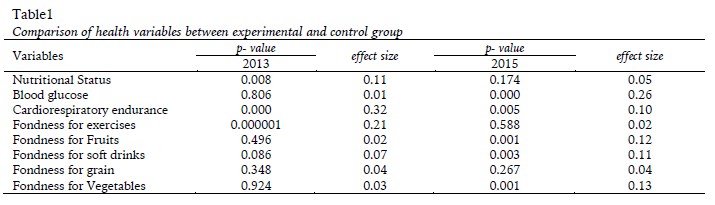
<body><![CDATA[<p>This survey was   initiated in August of 2013, with meetings and authorizations. When the   authorization phase was complete, the first data collection (pre-test) was   conducted, at the Experimental School (ES) and control School (CS). During the   year of 2014 educational interventions were implemented on healthy eating and   physical activity. At the beginning of 2015 all students were reevaluated (post-test), using the same instruments and data collection procedures.</p> <b><b>Intervention</b></b>      <p>The intervention during the year 2014   (only in ES) was planned based on values (equity, participation and   sustainability) and pillars (autonomy, empowerment, integrity, intersectoral   approach and governance) of health promotion (Kusma, Moysés, &amp; Moysés, 2010),   as well as the strategies of the document prepared for the WHO workshop on   physical activity and public health (WHO, 2005b) which are: awareness,   education, conducting programs, skills development, creation of environments propitious to physical activity, give recognition/awards.</p>     <p>During the intervening period were   performed the following actions: lectures on healthy eating (Dietitians);   informational materials on healthy eating (Dietitians); directed study about   food pyramid (nutrition/physical education teacher); Knowledge fair with an   emphasis on physical activity and healthy eating (nutrition/school);   prohibition of &quot;unhealthy&quot; snacks at school (direction/teachers);   construction of the school vegetable garden (parents/students/teachers/direction);   increased levels of physical activity during the school physical education   classes (physical education teacher); lectures about activity and physical   inactivity (Undergraduate teachers in physical education); visits of students   to the University to experience different possibilities for physical activity   (school/college); Active gaming activities at school (school/college); training   of all teachers of physical education of Municipal Education (Secretariat of   Education/University); contest and prizes for drawings (students) on the theme   &quot;what a healthy family is&quot;. All the interventions were supported by   the municipal departments of education and health, the direction of the school and of research groups of private and public universities.</p>     <p><b><b>Statistical analysis</b></b></p>     <p>All variables used for the statistical   analysis were nominal and coded for the statistical treatment (ordinals). For   the comparison between the CS and ES groups (independent samples) in 2013 and   2015, the Wilcoxon test (Mann-Whitney U) was used. For comparison of the   results of the CS group (2013-2015) and ES (2013-2015) the Wilcoxon test   (signed rank test) was used. To determine the percentage of occurrence of   cases, between 2013 and 2015, cross-reference tables were used. The calculation   of the effect size was accomplished using the following equation: value of   test/square root of number of subjects (Field, 2009). All statistical   procedures were performed with SPSS software 21.0 and Microsoft Excel. The significance level of p&lt;0.05 was assumed.</p> </font>     <p>&nbsp;</p>     <p><font size="3" face="Verdana"><b><b>RESULTS</b></b></font></p> <font face="Verdana" size="2">     <p>The results found   in the comparison between the experimental and control groups (<a href="/img/revistas/mot/v13s1/13s1a05t1.jpg">table 1</a>), in the   year 2013 (pre-test) showed statistically significant difference only in 3   variables: nutritional status, cardiorespiratory endurance and taste for   exercises. In the assessment of nutritional status variables 2015, taste for   exercises and fondness for grain were not identified with statistically significant.</p>     
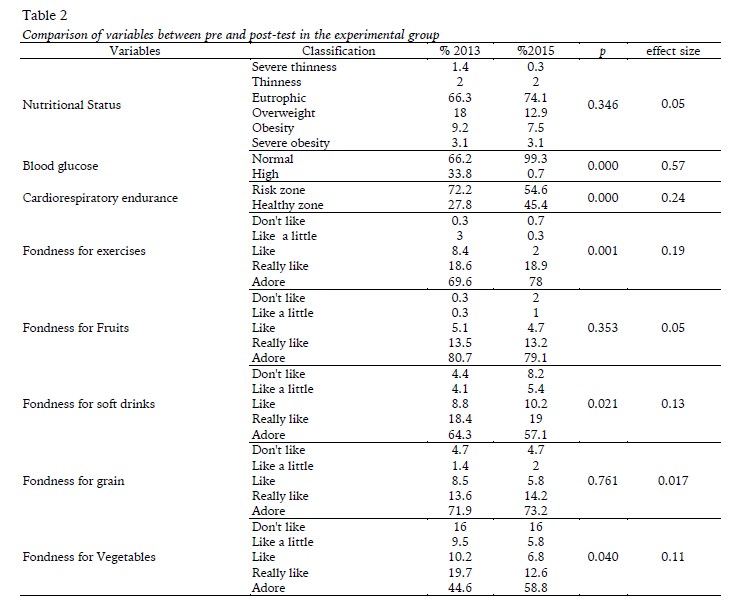
<p>The In comparison of   the pre and post-test assessments, on experimental school (<a href="/img/revistas/mot/v13s1/13s1a05t2.jpg">table 2</a>) there was a   decrease of nutritional Status of severe thinness, overweight and obesity. On   the other hand, the nutritional state of leanness and severe obesity remained with the same occurrence, while the condition of eutrophy has increased. </p>     
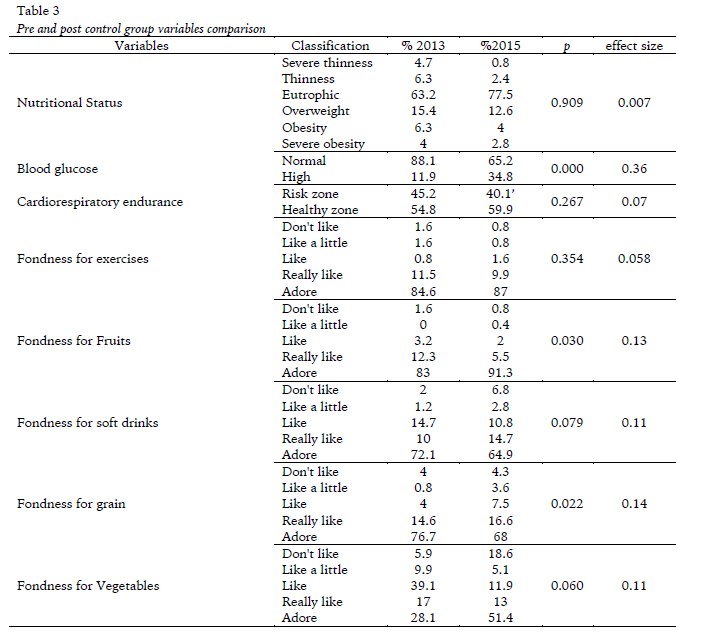
<p>In spite of the   differences found, a statistically significant difference between the two   evaluations has not been identified. The blood glucose and cardiorespiratory   endurance variables present significant difference between the assessments,   with best results after the intervention. When it comes to the fondness for   exercises, the greatest difference was identified in the &quot;I adore   exercise&quot; (p=0.001). In the matter of fondness for soft drinks,   &quot;don't like&quot; increased and &quot;like&quot; dropped in comparison   between 2013 and 2015. In the matter of fondness for grains, a statistically   significant difference hasn’t been identified. In the matter of the fondness   for vegetables, the most important increase was related to &quot;like”. In the results   of the CS group (<a href="/img/revistas/mot/v13s1/13s1a05t3.jpg">table 3</a>), it was identified a statistically significant   difference in blood glucose, with decreased normal blood glucose cases and an   increase in cases of high blood glucose. In the item fondness for fruit, there   has been an increase in &quot;like&quot; at the same it was identified a decrease   in &quot;really like&quot; (p=0.021). Another difference was identified in the   fondness for vegetables with an increase in &quot;like&quot;, but with decreased &quot;really like&quot; and &quot;like&quot; (p = 0.040).</p> </font>     
]]></body>
<body><![CDATA[<p>&nbsp;</p>     <p><font size="3" face="Verdana"><b><b>DISCUSSION</b></b></font></p> <font face="Verdana" size="2">     <p>The results found   in the comparison between the experimental and control groups (<a href="/img/revistas/mot/v13s1/13s1a05t1.jpg">table 1</a>), in the   year 2013 (pre-test) showed statistically significant difference only in 3   variables: nutritional status, cardiorespiratory endurance and fondness for   exercises. In the assessment of nutritional status variables in 2015, fondness   for exercises and fondness for grain were not identified with statistically significant difference.</p>     
<p>It must be taken into consideration   that the differences found between the groups (<a href="/img/revistas/mot/v13s1/13s1a05t1.jpg">table 1</a>), in 2013 evaluation   (pre-test) and 2015 (post-test), are relatively consistent and expected,   because interventions addressed to children, based on healthy eating and   physical activity, have a great impact on the health of schoolchildren.   Behavioral and environmental changes, as much at school as in the family, too,   can be effective when focused on educational processes for health promotion   (Myers et al., 2014). It should be noted that changes can only be achieved with   long periods of intervention time (Adab et al., 2015), that is, before the   intervention proposed by this research,    we did not have access to which kind of activities were carried out and what kind of obesogenic factors the children were exposed to.</p>     
<p>The results found in the comparison of   the results obtained in the CS group, between 2013 and 2015 (<a href="/img/revistas/mot/v13s1/13s1a05t2.jpg">table 2</a>) showed no   major changes, once they were not exposed to the intervention actions. In this   sense, the implementation of programs focused on health promotion must be   genuinely effective, with the participation of the community and reinforced by   public policies that are addressed to this goal (Haggis, Sims-Gould, Winters, Gutteridge, &amp; McKay, 2013).</p>     
<p>Based on all of the actions developed   in the year 2014, on experimental school, there was a highly positive impact   with regard to changes in behavior and diagnosed. Intervention programs   implemented in the school environment, with eating education and increased   levels of physical activity, in partnership with organizations (departments of   health and education) guarantee the sustainability of the initiative and   increase the empowerment on nutrition and possible impacts on obesity, mainly in childhood (Madsen et al., 2015).</p>     <p>Fortunately, planned actions based on   public policy, as the PSE and in guiding principles of health promotion tend to   generate positive impacts in terms of school health. Active health education,   with the increase of the possibilities of participation of children in physical   activities and the development of skills for healthy decision-making in   homelike increase the consistency and sustainability of interventions focused on health at school (Haggis et al., 2013).</p>     <p>Obviously, not all actions of health   promotion in the school environment are effective and/or hold up, as the   program “The Active for Life Year 5” (AFLY5) (Kipping et al., 2014) which found   evidences that, in order to increase levels of physical activity, the training   of teachers is not effective. Therefore, the implementation of intervention   programs to increase levels of physical activity and healthy eating at school should be planned, evaluated and controlled to have assurance of effectiveness.</p>     <p>In this research, following the   actions and curricular content of physical education may have caused   undesirable effects and/or interfered in the results. Therefore, the control of   the contents of the school physical education should be agreed with the proponents of the deployment of an intervention project.</p> </font>     <p>&nbsp;</p>     ]]></body>
<body><![CDATA[<p><font size="3" face="Verdana"><b><b>CONCLUSION</b></b></font></p> <font face="Verdana" size="2">     <p>Based on the   implementation of a school-based health promotion program, with physical   activity and healthy eating, it can be concluded that it is possible,   sustainable and viable to keep constant actions in the school environment,   aiming the education of healthy habits, reinforcing pillars of health   promotion, as the health care equity. The implementation and sustainability of   a program for health promotion in school, should be articulated in an   intersectorial way, involving managers of the health and education sectors, the   community (students, parents, teachers and the school direction) in which all can actively and consensually participate in the process.</p>     <p>The results   demonstrate that long-term interventions promote positive and significant   changes in the profile of school health indicators.  They also change behaviors from the   empowerment, not only of students as that of managers and parents. Therefore,   to follow the recommendations of the Health Organization, values and pillars of   health promotion, proposed by collective health, to implement actions aimed to   health promotion, result in consistent changes in the current scenario of health at school.</p> </font>     <p>&nbsp;</p>     <p><font size="3" face="Verdana"><b><b>REFERENCES</b></b></font></p> <font face="Verdana" size="2">     <!-- ref --><p>ABEP.   Associação Brasileira de Empresas de Pesquisa. (2016). Questionário para avaliação de condição sócioeconômica. Retrieved September 22, 2016, from <a href="http://www.abep.org/" target="_blank">http://www.abep.org</a>&nbsp;&nbsp;&nbsp;&nbsp;&nbsp;&nbsp;&nbsp;&nbsp;[&#160;<a href="javascript:void(0);" onclick="javascript: window.open('/scielo.php?script=sci_nlinks&ref=371351&pid=S1646-107X201700060000500001&lng=','','width=640,height=500,resizable=yes,scrollbars=1,menubar=yes,');">Links</a>&#160;]<!-- end-ref --><!-- ref --><p>Adab,   P., Pallan, M. J., Lancashire, E. R., Hemming, K., Frew, E., Griffin, T., …   Cheng, K. K. (2015). A cluster-randomised controlled trial to assess the   effectiveness and cost-effectiveness of a childhood obesity prevention   programme delivered through schools, targeting 6-7 year old children: the WAVES   study protocol. <i>BMC Public Health</i>, <i>15</i>(1), 488. doi: 10.1186/s12889-015-1800-8&nbsp;&nbsp;&nbsp;&nbsp;&nbsp;&nbsp;&nbsp;&nbsp;[&#160;<a href="javascript:void(0);" onclick="javascript: window.open('/scielo.php?script=sci_nlinks&ref=371352&pid=S1646-107X201700060000500002&lng=','','width=640,height=500,resizable=yes,scrollbars=1,menubar=yes,');">Links</a>&#160;]<!-- end-ref --><!-- ref --><p>Barros,   M. V. G., Assis, M. A. A., Pires, M. C., Grossemann, S., Vasconcelos, F. De A.   G. de, Luna, M. E. P., &amp; Barros, S. S. H. (2007). Validação de um   questionário de atividade física e consumo alimentar para crianças de sete a   dez anos de idade. <i>Revista Brasileira Saúde Materna Infantil</i> <i>7</i>(<i>4</i>), 437–448. doi: 10.1590/S1519-38292007000400011&nbsp;&nbsp;&nbsp;&nbsp;&nbsp;&nbsp;&nbsp;&nbsp;[&#160;<a href="javascript:void(0);" onclick="javascript: window.open('/scielo.php?script=sci_nlinks&ref=371353&pid=S1646-107X201700060000500003&lng=','','width=640,height=500,resizable=yes,scrollbars=1,menubar=yes,');">Links</a>&#160;]<!-- end-ref --><!-- ref --><p>Brasil,   M. D. S. (2009). <i>Cadernos de Atenção Básica - Saúde na Escola</i>. <i>saúde na escola</i>. Brasília, BRASIL: Ministério da Saúde. Retrieved from <a href="http://dab.saude.gov.br/docs/publicacoes/cadernos_ab/abcad24.pdf" target="_blank">http://dab.saude.gov.br/docs/publicacoes/cadernos_ab/abcad24.pdf</a>.    &nbsp;&nbsp;&nbsp;&nbsp;&nbsp;&nbsp;&nbsp;&nbsp;[&#160;<a href="javascript:void(0);" onclick="javascript: window.open('/scielo.php?script=sci_nlinks&ref=371354&pid=S1646-107X201700060000500004&lng=','','width=640,height=500,resizable=yes,scrollbars=1,menubar=yes,');">Links</a>&#160;]<!-- end-ref --></p>     ]]></body>
<body><![CDATA[<!-- ref --><p>Costa,   B. G. G. da, Silva, K. S. da, Hino, A. A. F., Leal, D. B., Gripa, L. T., &amp;   Assis, M. A. A. de. (2016). Context and Intensity of Primary School Physical   Education Classes in Brazilian Schoolchildren. <i>Mathews Journal of Pediatrics</i>, <i>1</i>(1), 2–7.    &nbsp;&nbsp;&nbsp;&nbsp;&nbsp;&nbsp;&nbsp;&nbsp;[&#160;<a href="javascript:void(0);" onclick="javascript: window.open('/scielo.php?script=sci_nlinks&ref=371356&pid=S1646-107X201700060000500005&lng=','','width=640,height=500,resizable=yes,scrollbars=1,menubar=yes,');">Links</a>&#160;]<!-- end-ref --> </p>     <!-- ref --><p>Ferreira,   I. do R., Moysés, S. J., França, B. H. S., Carvalho, M. L. de, &amp; Moysés, S.   T. (2014). Percepções de gestores locais sobre a intersetorialidade no Programa   Saúde na Escola. <i>Revista Brasileira de Educação</i>, <i>19</i>(56), 61–76. Retrieved from <a href="http://www.scielo.br/scielo.php?script=sci_arttext&amp;pid=S1413-24782014000100004&amp;lang=pt" target="_blank">http://www.scielo.br/scielo.php?script=sci_arttext&amp;pid=S1413-24782014000100004&amp;lang=pt</a>&nbsp;&nbsp;&nbsp;&nbsp;&nbsp;&nbsp;&nbsp;&nbsp;[&#160;<a href="javascript:void(0);" onclick="javascript: window.open('/scielo.php?script=sci_nlinks&ref=371358&pid=S1646-107X201700060000500006&lng=','','width=640,height=500,resizable=yes,scrollbars=1,menubar=yes,');">Links</a>&#160;]<!-- end-ref --><!-- ref --><p>Field,   A. (2009). <i>Descobrindo a estatistica usando o SPSS-2</i> (2<sup>a</sup> Ed.). Porto Alegre: Artmed.    &nbsp;&nbsp;&nbsp;&nbsp;&nbsp;&nbsp;&nbsp;&nbsp;[&#160;<a href="javascript:void(0);" onclick="javascript: window.open('/scielo.php?script=sci_nlinks&ref=371359&pid=S1646-107X201700060000500007&lng=','','width=640,height=500,resizable=yes,scrollbars=1,menubar=yes,');">Links</a>&#160;]<!-- end-ref --> </p>     <!-- ref --><p>Gaya,   A., &amp; Gaya, A. (2016). <i>Projeto esporte Brasil: manual de testes e     avaliação</i>. (URGS, Ed.) (1<sup>a</sup> ed.). Porto Alegre: URGS. Retrieved September 23, 2016, from <a href="https://www.ufrgs.br/proesp/arquivos/manual-proesp-br-2015.pdf" target="_blank">https://www.ufrgs.br/proesp/arquivos/manual-proesp-br-2015.pdf</a>&nbsp;&nbsp;&nbsp;&nbsp;&nbsp;&nbsp;&nbsp;&nbsp;[&#160;<a href="javascript:void(0);" onclick="javascript: window.open('/scielo.php?script=sci_nlinks&ref=371361&pid=S1646-107X201700060000500008&lng=','','width=640,height=500,resizable=yes,scrollbars=1,menubar=yes,');">Links</a>&#160;]<!-- end-ref --><!-- ref --><p>Gonzales,   S. A., Garcia, J., Martinez, A., &amp; Sarmiento, O. L. (2016). <i>2<sup>o</sup>   Reporte de clificaciones en actividad física en niños y adolescentes</i>. <i>Universidad de los Andes</i>. Bogotá: Universidad de los Andes.    &nbsp;&nbsp;&nbsp;&nbsp;&nbsp;&nbsp;&nbsp;&nbsp;[&#160;<a href="javascript:void(0);" onclick="javascript: window.open('/scielo.php?script=sci_nlinks&ref=371362&pid=S1646-107X201700060000500009&lng=','','width=640,height=500,resizable=yes,scrollbars=1,menubar=yes,');">Links</a>&#160;]<!-- end-ref --></p>     <!-- ref --><p>Gunawardena,   N., Kurotani, K., Indrawansa, S., Nonaka, D., Mizoue, T., &amp; Samarasinghe,   D. (2016). School-based intervention to enable school children to act as change   agents on weight, physical activity and diet of their mothers: a cluster   randomized controlled trial. <i>The International Journal of Behavioral     Nutrition and Physical Activity</i>, <i>13</i>, 45. doi: 10.1186/s12966-016-0369-7&nbsp;&nbsp;&nbsp;&nbsp;&nbsp;&nbsp;&nbsp;&nbsp;[&#160;<a href="javascript:void(0);" onclick="javascript: window.open('/scielo.php?script=sci_nlinks&ref=371364&pid=S1646-107X201700060000500010&lng=','','width=640,height=500,resizable=yes,scrollbars=1,menubar=yes,');">Links</a>&#160;]<!-- end-ref --><!-- ref --><p>Haggis,   C., Sims-Gould, J., Winters, M., Gutteridge, K., &amp; McKay, H. A. (2013).   Sustained impact of community-based physical activity interventions: key   elements for success. <i>BMC Public Health</i>, <i>13</i>(1), 892. doi: 10.1186/1471-2458-13-892&nbsp;&nbsp;&nbsp;&nbsp;&nbsp;&nbsp;&nbsp;&nbsp;[&#160;<a href="javascript:void(0);" onclick="javascript: window.open('/scielo.php?script=sci_nlinks&ref=371365&pid=S1646-107X201700060000500011&lng=','','width=640,height=500,resizable=yes,scrollbars=1,menubar=yes,');">Links</a>&#160;]<!-- end-ref --><!-- ref --><p>Kipping,   R. R., Howe, L. D., Jago, R., Campbell, R., Wells, S., Chittleborough, C. R., …   Lowlor, D. A. (2014). Effect of intervention aimed at increasing physical   activity, reducing sedentary behaviour, and increasing fruit and vegetable   consumption in children: Active for Life Year 5 (AFLY5) school based cluster   randomised controlled trial. <i>BMJ</i>, <i>348</i>(May), g3256. doi: 10.1136/bmj.g3256&nbsp;&nbsp;&nbsp;&nbsp;&nbsp;&nbsp;&nbsp;&nbsp;[&#160;<a href="javascript:void(0);" onclick="javascript: window.open('/scielo.php?script=sci_nlinks&ref=371366&pid=S1646-107X201700060000500012&lng=','','width=640,height=500,resizable=yes,scrollbars=1,menubar=yes,');">Links</a>&#160;]<!-- end-ref --><!-- ref --><p>Kusma,   S. Z., Moysés, S. T., &amp; Moysés, S. J. (2010). Promoção da saúde&#8239;: perspectivas avaliativas para a saúde bucal na atenção   primária em saúde. <i>Ciencia e Saude Coletiva</i>, <i>15</i>(1), 269–276. doi: 10.1590/S0102-311X2012001300003&nbsp;&nbsp;&nbsp;&nbsp;&nbsp;&nbsp;&nbsp;&nbsp;[&#160;<a href="javascript:void(0);" onclick="javascript: window.open('/scielo.php?script=sci_nlinks&ref=371367&pid=S1646-107X201700060000500013&lng=','','width=640,height=500,resizable=yes,scrollbars=1,menubar=yes,');">Links</a>&#160;]<!-- end-ref --><!-- ref --><p>Madsen,   K., Linchey, J., Gerstein, D., Ross, M., Myers, E., Brown, K., &amp; Crawford,   P. (2015). Energy balance 4 kids with play: Results from a two-year   cluster-randomized trial. <i>Childhood Obesity</i>, <i>11</i>(4), 375–383. doi: 10.1089/chi.2015.0002&nbsp;&nbsp;&nbsp;&nbsp;&nbsp;&nbsp;&nbsp;&nbsp;[&#160;<a href="javascript:void(0);" onclick="javascript: window.open('/scielo.php?script=sci_nlinks&ref=371368&pid=S1646-107X201700060000500014&lng=','','width=640,height=500,resizable=yes,scrollbars=1,menubar=yes,');">Links</a>&#160;]<!-- end-ref --><!-- ref --><p>Metcalf,   B., Henley, W., &amp; Wikin, T. (2012). Effectiveness of intervention on   physical activity of children: Systematic review and meta-analysis of   controlled trials with objectively measured outcomes (EarlyBird 54). <i>BMJ</i>, <i>345</i>(7876), no pagination-no pagination. doi: 10.1136/bmj.e5888&nbsp;&nbsp;&nbsp;&nbsp;&nbsp;&nbsp;&nbsp;&nbsp;[&#160;<a href="javascript:void(0);" onclick="javascript: window.open('/scielo.php?script=sci_nlinks&ref=371369&pid=S1646-107X201700060000500015&lng=','','width=640,height=500,resizable=yes,scrollbars=1,menubar=yes,');">Links</a>&#160;]<!-- end-ref --><!-- ref --><p>Brasil.   (2008). Protocolos do Sistema de Vigilância Alimentar e Nutricional - SISVAN na   assistência à saúde.<i> Brasilia: Ministério da Saúde.    &nbsp;&nbsp;&nbsp;&nbsp;&nbsp;&nbsp;&nbsp;&nbsp;[&#160;<a href="javascript:void(0);" onclick="javascript: window.open('/scielo.php?script=sci_nlinks&ref=371370&pid=S1646-107X201700060000500016&lng=','','width=640,height=500,resizable=yes,scrollbars=1,menubar=yes,');">Links</a>&#160;]<!-- end-ref --></i></p>     <!-- ref --><p>Myers,   E. F., Gerstein, D. E., Foster, J., Ross, M., Brown, K., Kennedy, E., …   Crawford, P. B. (2014). Energy Balance for Kids with Play: Design and   Implementation of a Multi-Component School-Based Obesity Prevention Program. <i>Childhood Obesity</i>, <i>10</i>(<i>3</i>), 251–259. doi: 10.1089/chi.2013.0075&nbsp;&nbsp;&nbsp;&nbsp;&nbsp;&nbsp;&nbsp;&nbsp;[&#160;<a href="javascript:void(0);" onclick="javascript: window.open('/scielo.php?script=sci_nlinks&ref=371372&pid=S1646-107X201700060000500017&lng=','','width=640,height=500,resizable=yes,scrollbars=1,menubar=yes,');">Links</a>&#160;]<!-- end-ref --><!-- ref --><p>Brazilian   Society of Diabetes [SBD]. (2016). <i>Diretrizes da Sociedade Brasileira de     Diabetes|2015-2016</i>. <i>Diabetes Mellitus Tipo 1 E Tipo2</i> (1<sup>a</sup>   ed., Vol. <i>5</i>). São Paulo: A.C. Farmacêutica. doi: 10.1590/S0102-311X2003000700004&nbsp;&nbsp;&nbsp;&nbsp;&nbsp;&nbsp;&nbsp;&nbsp;[&#160;<a href="javascript:void(0);" onclick="javascript: window.open('/scielo.php?script=sci_nlinks&ref=371373&pid=S1646-107X201700060000500018&lng=','','width=640,height=500,resizable=yes,scrollbars=1,menubar=yes,');">Links</a>&#160;]<!-- end-ref --><!-- ref --><p>World Health Organization [WHO]. (2005a). <i>Preventing Chronic Diseases: a vital investment</i>. <i>World Health Organization</i>. Geneva.    &nbsp;&nbsp;&nbsp;&nbsp;&nbsp;&nbsp;&nbsp;&nbsp;[&#160;<a href="javascript:void(0);" onclick="javascript: window.open('/scielo.php?script=sci_nlinks&ref=371374&pid=S1646-107X201700060000500019&lng=','','width=640,height=500,resizable=yes,scrollbars=1,menubar=yes,');">Links</a>&#160;]<!-- end-ref --></p>     ]]></body>
<body><![CDATA[<!-- ref --><p>World Health Organization [WHO]. (2005b). <i>Review of Best Practice in Interventions   to Promote Physical Activity in Developing Countries: Background Document   prepared for the WHO Workshop on Physical Activity and Public Health</i>. <i>World Health Organization</i>. Beijing.    &nbsp;&nbsp;&nbsp;&nbsp;&nbsp;&nbsp;&nbsp;&nbsp;[&#160;<a href="javascript:void(0);" onclick="javascript: window.open('/scielo.php?script=sci_nlinks&ref=371376&pid=S1646-107X201700060000500020&lng=','','width=640,height=500,resizable=yes,scrollbars=1,menubar=yes,');">Links</a>&#160;]<!-- end-ref --></p>     <!-- ref --><p>World Health Organization [WHO]. (2008a). <i>Preventing Noncommunicable Diseases in the   Workplace through Diet and Physical Activity/World Economic Forun Report of a Joint Event</i>. <i>World Health Organization</i>. Geneva.    &nbsp;&nbsp;&nbsp;&nbsp;&nbsp;&nbsp;&nbsp;&nbsp;[&#160;<a href="javascript:void(0);" onclick="javascript: window.open('/scielo.php?script=sci_nlinks&ref=371378&pid=S1646-107X201700060000500021&lng=','','width=640,height=500,resizable=yes,scrollbars=1,menubar=yes,');">Links</a>&#160;]<!-- end-ref --></p>     <!-- ref --><p>World Health Organization [WHO]. (2008b). School Policy framework: implemantation of   the who global strategy on diet, physical activity and health. <i>World Health Organization</i>. Geneva.    &nbsp;&nbsp;&nbsp;&nbsp;&nbsp;&nbsp;&nbsp;&nbsp;[&#160;<a href="javascript:void(0);" onclick="javascript: window.open('/scielo.php?script=sci_nlinks&ref=371380&pid=S1646-107X201700060000500022&lng=','','width=640,height=500,resizable=yes,scrollbars=1,menubar=yes,');">Links</a>&#160;]<!-- end-ref --></p>     <!-- ref --><p>World Health Organization [WHO]. (2009). Interventions on diet and physical activity: what works/methodology. <i>World Health Organization</i>. Geneva.    &nbsp;&nbsp;&nbsp;&nbsp;&nbsp;&nbsp;&nbsp;&nbsp;[&#160;<a href="javascript:void(0);" onclick="javascript: window.open('/scielo.php?script=sci_nlinks&ref=371382&pid=S1646-107X201700060000500023&lng=','','width=640,height=500,resizable=yes,scrollbars=1,menubar=yes,');">Links</a>&#160;]<!-- end-ref --></p>     <!-- ref --><p>World Health Organization [WHO]. (2016). Ending Childhood Obesity. <i>World Health Organization</i>. Geneva.    &nbsp;&nbsp;&nbsp;&nbsp;&nbsp;&nbsp;&nbsp;&nbsp;[&#160;<a href="javascript:void(0);" onclick="javascript: window.open('/scielo.php?script=sci_nlinks&ref=371384&pid=S1646-107X201700060000500024&lng=','','width=640,height=500,resizable=yes,scrollbars=1,menubar=yes,');">Links</a>&#160;]<!-- end-ref --> </p>     ]]></body>
<body><![CDATA[<p>&nbsp;</p>     <p><b>Acknowledgments:    <br> </b>The health and Education   Departments of Campina Grande do Sul/PR. To everyone who contributed to this research.    <br> <b>Conflict of interests:    <br> </b>Nothing to declare.    <br> <b>Funding:    <br> </b>Nothing to declare.</p> </font>     <p>&nbsp;</p>     <p>&nbsp;</p>     <p><font size="2" face="Verdana"><a href="#top"><sup>*</sup></a><i><a name="end"></a> Corresponding Author: </i>Pontifical Catholic University of Paraná, Imac. Conceição, 1155, Prado Velho, 80215-901, Curitiba, Brazil.<i> Email: </i><a href="mailto:claudio.tkac@pucpr.br">claudio.tkac@pucpr.br</a></font></p>      ]]></body>
<body><![CDATA[ ]]></body><back>
<ref-list>
<ref id="B1">
<nlm-citation citation-type="">
<collab>Associação Brasileira de Empresas de Pesquisa</collab>
<source><![CDATA[Questionário para avaliação de condição sócioeconômica]]></source>
<year>2016</year>
</nlm-citation>
</ref>
<ref id="B2">
<nlm-citation citation-type="journal">
<person-group person-group-type="author">
<name>
<surname><![CDATA[Adab]]></surname>
<given-names><![CDATA[P.]]></given-names>
</name>
<name>
<surname><![CDATA[Pallan]]></surname>
<given-names><![CDATA[M. J.]]></given-names>
</name>
<name>
<surname><![CDATA[Lancashire]]></surname>
<given-names><![CDATA[E. R.]]></given-names>
</name>
<name>
<surname><![CDATA[Hemming]]></surname>
<given-names><![CDATA[K.]]></given-names>
</name>
<name>
<surname><![CDATA[Frew]]></surname>
<given-names><![CDATA[E.]]></given-names>
</name>
<name>
<surname><![CDATA[Griffin]]></surname>
<given-names><![CDATA[T.]]></given-names>
</name>
<name>
<surname><![CDATA[Cheng]]></surname>
<given-names><![CDATA[K. K.]]></given-names>
</name>
</person-group>
<article-title xml:lang="en"><![CDATA[A cluster-randomised controlled trial to assess the effectiveness and cost-effectiveness of a childhood obesity prevention programme delivered through schools, targeting 6-7 year old children: the WAVES study protocol]]></article-title>
<source><![CDATA[BMC Public Health]]></source>
<year>2015</year>
<volume>15</volume>
<numero>1</numero>
<issue>1</issue>
<page-range>488</page-range></nlm-citation>
</ref>
<ref id="B3">
<nlm-citation citation-type="journal">
<person-group person-group-type="author">
<name>
<surname><![CDATA[Barros]]></surname>
<given-names><![CDATA[M. V. G.]]></given-names>
</name>
<name>
<surname><![CDATA[Assis]]></surname>
<given-names><![CDATA[M. A. A.]]></given-names>
</name>
<name>
<surname><![CDATA[Pires]]></surname>
<given-names><![CDATA[M. C.]]></given-names>
</name>
<name>
<surname><![CDATA[Grossemann]]></surname>
<given-names><![CDATA[S.]]></given-names>
</name>
<name>
<surname><![CDATA[Vasconcelos]]></surname>
<given-names><![CDATA[F. De A. G. de]]></given-names>
</name>
<name>
<surname><![CDATA[Luna]]></surname>
<given-names><![CDATA[M. E. P.]]></given-names>
</name>
<name>
<surname><![CDATA[Barros]]></surname>
<given-names><![CDATA[S. S. H.]]></given-names>
</name>
</person-group>
<article-title xml:lang="pt"><![CDATA[Validação de um questionário de atividade física e consumo alimentar para crianças de sete a dez anos de idade]]></article-title>
<source><![CDATA[Revista Brasileira Saúde Materna Infantil]]></source>
<year>2007</year>
<volume>7</volume>
<numero>4</numero>
<issue>4</issue>
<page-range>437-448</page-range></nlm-citation>
</ref>
<ref id="B4">
<nlm-citation citation-type="book">
<collab>Brasil, M. D. S.</collab>
<source><![CDATA[Cadernos de Atenção Básica: Saúde na Escola. saúde na escola]]></source>
<year>2009</year>
<publisher-loc><![CDATA[Brasília ]]></publisher-loc>
<publisher-name><![CDATA[Ministério da Saúde]]></publisher-name>
</nlm-citation>
</ref>
<ref id="B5">
<nlm-citation citation-type="journal">
<person-group person-group-type="author">
<name>
<surname><![CDATA[Costa]]></surname>
<given-names><![CDATA[B. G. G. da]]></given-names>
</name>
<name>
<surname><![CDATA[Silva]]></surname>
<given-names><![CDATA[K. S. da]]></given-names>
</name>
<name>
<surname><![CDATA[Hino]]></surname>
<given-names><![CDATA[A. A. F.]]></given-names>
</name>
<name>
<surname><![CDATA[Leal]]></surname>
<given-names><![CDATA[D. B.]]></given-names>
</name>
<name>
<surname><![CDATA[Gripa]]></surname>
<given-names><![CDATA[L. T.]]></given-names>
</name>
<name>
<surname><![CDATA[Assis]]></surname>
<given-names><![CDATA[M. A. A. de.]]></given-names>
</name>
</person-group>
<article-title xml:lang="en"><![CDATA[Context and Intensity of Primary School Physical Education Classes in Brazilian Schoolchildren]]></article-title>
<source><![CDATA[Mathews Journal of Pediatrics]]></source>
<year>2016</year>
<volume>1</volume>
<numero>1</numero>
<issue>1</issue>
<page-range>2-7</page-range></nlm-citation>
</ref>
<ref id="B6">
<nlm-citation citation-type="journal">
<person-group person-group-type="author">
<name>
<surname><![CDATA[Ferreira]]></surname>
<given-names><![CDATA[I. do R.]]></given-names>
</name>
<name>
<surname><![CDATA[Moysés]]></surname>
<given-names><![CDATA[S. J.]]></given-names>
</name>
<name>
<surname><![CDATA[França]]></surname>
<given-names><![CDATA[B. H. S.]]></given-names>
</name>
<name>
<surname><![CDATA[Carvalho]]></surname>
<given-names><![CDATA[M. L. de]]></given-names>
</name>
<name>
<surname><![CDATA[Moysés]]></surname>
<given-names><![CDATA[S. T.]]></given-names>
</name>
</person-group>
<article-title xml:lang="pt"><![CDATA[Percepções de gestores locais sobre a intersetorialidade no Programa Saúde na Escola]]></article-title>
<source><![CDATA[Revista Brasileira de Educação]]></source>
<year>2014</year>
<volume>19</volume>
<numero>56</numero>
<issue>56</issue>
<page-range>61-76</page-range></nlm-citation>
</ref>
<ref id="B7">
<nlm-citation citation-type="book">
<person-group person-group-type="author">
<name>
<surname><![CDATA[Field]]></surname>
<given-names><![CDATA[A.]]></given-names>
</name>
</person-group>
<source><![CDATA[Descobrindo a estatistica usando o SPSS-2]]></source>
<year>2009</year>
<edition>2</edition>
<publisher-loc><![CDATA[Porto Alegre ]]></publisher-loc>
<publisher-name><![CDATA[Artmed]]></publisher-name>
</nlm-citation>
</ref>
<ref id="B8">
<nlm-citation citation-type="book">
<person-group person-group-type="author">
<name>
<surname><![CDATA[Gaya]]></surname>
<given-names><![CDATA[A.]]></given-names>
</name>
<name>
<surname><![CDATA[Gaya]]></surname>
<given-names><![CDATA[A.]]></given-names>
</name>
</person-group>
<source><![CDATA[Projeto esporte Brasil: manual de testes e avaliação]]></source>
<year>2016</year>
<edition>1</edition>
<publisher-loc><![CDATA[Porto Alegre ]]></publisher-loc>
<publisher-name><![CDATA[URGS]]></publisher-name>
</nlm-citation>
</ref>
<ref id="B9">
<nlm-citation citation-type="book">
<person-group person-group-type="author">
<name>
<surname><![CDATA[Gonzales]]></surname>
<given-names><![CDATA[S. A.]]></given-names>
</name>
<name>
<surname><![CDATA[Garcia]]></surname>
<given-names><![CDATA[J.]]></given-names>
</name>
<name>
<surname><![CDATA[Martinez]]></surname>
<given-names><![CDATA[A.]]></given-names>
</name>
<name>
<surname><![CDATA[Sarmiento]]></surname>
<given-names><![CDATA[O. L.]]></given-names>
</name>
</person-group>
<source><![CDATA[2º Reporte de clificaciones en actividad física en niños y adolescentes: Universidad de los Andes]]></source>
<year>2016</year>
<publisher-loc><![CDATA[Bogotá ]]></publisher-loc>
<publisher-name><![CDATA[Universidad de los Andes]]></publisher-name>
</nlm-citation>
</ref>
<ref id="B10">
<nlm-citation citation-type="journal">
<person-group person-group-type="author">
<name>
<surname><![CDATA[Gunawardena]]></surname>
<given-names><![CDATA[N.]]></given-names>
</name>
<name>
<surname><![CDATA[Kurotani]]></surname>
<given-names><![CDATA[K.]]></given-names>
</name>
<name>
<surname><![CDATA[Indrawansa]]></surname>
<given-names><![CDATA[S.]]></given-names>
</name>
<name>
<surname><![CDATA[Nonaka]]></surname>
<given-names><![CDATA[D.]]></given-names>
</name>
<name>
<surname><![CDATA[Mizoue]]></surname>
<given-names><![CDATA[T.]]></given-names>
</name>
<name>
<surname><![CDATA[Samarasinghe]]></surname>
<given-names><![CDATA[D.]]></given-names>
</name>
</person-group>
<article-title xml:lang="en"><![CDATA[School-based intervention to enable school children to act as change agents on weight, physical activity and diet of their mothers: a cluster randomized controlled trial]]></article-title>
<source><![CDATA[The International Journal of Behavioral Nutrition and Physical Activity]]></source>
<year>2016</year>
<volume>13</volume>
<page-range>45</page-range></nlm-citation>
</ref>
<ref id="B11">
<nlm-citation citation-type="journal">
<person-group person-group-type="author">
<name>
<surname><![CDATA[Haggis]]></surname>
<given-names><![CDATA[C.]]></given-names>
</name>
<name>
<surname><![CDATA[Sims-Gould]]></surname>
<given-names><![CDATA[J.]]></given-names>
</name>
<name>
<surname><![CDATA[Winters]]></surname>
<given-names><![CDATA[M.]]></given-names>
</name>
<name>
<surname><![CDATA[Gutteridge]]></surname>
<given-names><![CDATA[K.]]></given-names>
</name>
<name>
<surname><![CDATA[McKay]]></surname>
<given-names><![CDATA[H. A.]]></given-names>
</name>
</person-group>
<article-title xml:lang="en"><![CDATA[Sustained impact of community-based physical activity interventions: key elements for success]]></article-title>
<source><![CDATA[BMC Public Health]]></source>
<year>2013</year>
<volume>13</volume>
<numero>1</numero>
<issue>1</issue>
<page-range>892</page-range></nlm-citation>
</ref>
<ref id="B12">
<nlm-citation citation-type="journal">
<person-group person-group-type="author">
<name>
<surname><![CDATA[Kipping]]></surname>
<given-names><![CDATA[R. R.]]></given-names>
</name>
<name>
<surname><![CDATA[Howe]]></surname>
<given-names><![CDATA[L. D.]]></given-names>
</name>
<name>
<surname><![CDATA[Jago]]></surname>
<given-names><![CDATA[R.]]></given-names>
</name>
<name>
<surname><![CDATA[Campbell]]></surname>
<given-names><![CDATA[R.]]></given-names>
</name>
<name>
<surname><![CDATA[Wells]]></surname>
<given-names><![CDATA[S.]]></given-names>
</name>
<name>
<surname><![CDATA[Chittleborough]]></surname>
<given-names><![CDATA[C. R.]]></given-names>
</name>
<name>
<surname><![CDATA[Lowlor]]></surname>
<given-names><![CDATA[D. A.]]></given-names>
</name>
</person-group>
<article-title xml:lang="en"><![CDATA[Effect of intervention aimed at increasing physical activity, reducing sedentary behaviour, and increasing fruit and vegetable consumption in children: Active for Life Year 5 (AFLY5) school based cluster randomised controlled trial]]></article-title>
<source><![CDATA[BMJ]]></source>
<year>2014</year>
<volume>348</volume>
<page-range>g3256</page-range></nlm-citation>
</ref>
<ref id="B13">
<nlm-citation citation-type="journal">
<person-group person-group-type="author">
<name>
<surname><![CDATA[Kusma]]></surname>
<given-names><![CDATA[S. Z.]]></given-names>
</name>
<name>
<surname><![CDATA[Moysés]]></surname>
<given-names><![CDATA[S. T.]]></given-names>
</name>
<name>
<surname><![CDATA[Moysés]]></surname>
<given-names><![CDATA[S. J.]]></given-names>
</name>
</person-group>
<article-title xml:lang="pt"><![CDATA[Promoção da saúde: perspectivas avaliativas para a saúde bucal na atenção primária em saúde]]></article-title>
<source><![CDATA[Ciencia e Saude Coletiva]]></source>
<year>2010</year>
<volume>15</volume>
<numero>1</numero>
<issue>1</issue>
<page-range>269-276</page-range></nlm-citation>
</ref>
<ref id="B14">
<nlm-citation citation-type="journal">
<person-group person-group-type="author">
<name>
<surname><![CDATA[Madsen]]></surname>
<given-names><![CDATA[K.]]></given-names>
</name>
<name>
<surname><![CDATA[Linchey]]></surname>
<given-names><![CDATA[J.]]></given-names>
</name>
<name>
<surname><![CDATA[Gerstein]]></surname>
<given-names><![CDATA[D.]]></given-names>
</name>
<name>
<surname><![CDATA[Ross]]></surname>
<given-names><![CDATA[M.]]></given-names>
</name>
<name>
<surname><![CDATA[Myers]]></surname>
<given-names><![CDATA[E.]]></given-names>
</name>
<name>
<surname><![CDATA[Brown]]></surname>
<given-names><![CDATA[K.]]></given-names>
</name>
<name>
<surname><![CDATA[Crawford]]></surname>
<given-names><![CDATA[P.]]></given-names>
</name>
</person-group>
<article-title xml:lang="en"><![CDATA[Energy balance 4 kids with play: Results from a two-year cluster-randomized trial]]></article-title>
<source><![CDATA[Childhood Obesity]]></source>
<year>2015</year>
<volume>11</volume>
<numero>4</numero>
<issue>4</issue>
<page-range>375-383</page-range></nlm-citation>
</ref>
<ref id="B15">
<nlm-citation citation-type="journal">
<person-group person-group-type="author">
<name>
<surname><![CDATA[Metcalf]]></surname>
<given-names><![CDATA[B.]]></given-names>
</name>
<name>
<surname><![CDATA[Henley]]></surname>
<given-names><![CDATA[W.]]></given-names>
</name>
<name>
<surname><![CDATA[Wikin]]></surname>
<given-names><![CDATA[T.]]></given-names>
</name>
</person-group>
<article-title xml:lang="en"><![CDATA[Effectiveness of intervention on physical activity of children: Systematic review and meta-analysis of controlled trials with objectively measured outcomes (EarlyBird 54)]]></article-title>
<source><![CDATA[BMJ]]></source>
<year>2012</year>
<volume>345</volume>
<numero>7876</numero>
<issue>7876</issue>
</nlm-citation>
</ref>
<ref id="B16">
<nlm-citation citation-type="book">
<collab>Brasil</collab>
<source><![CDATA[Protocolos do Sistema de Vigilância Alimentar e Nutricional: SISVAN na assistência à saúde]]></source>
<year>2008</year>
<publisher-loc><![CDATA[Brasilia ]]></publisher-loc>
<publisher-name><![CDATA[Ministério da Saúde]]></publisher-name>
</nlm-citation>
</ref>
<ref id="B17">
<nlm-citation citation-type="journal">
<person-group person-group-type="author">
<name>
<surname><![CDATA[Myers]]></surname>
<given-names><![CDATA[E. F.]]></given-names>
</name>
<name>
<surname><![CDATA[Gerstein]]></surname>
<given-names><![CDATA[D. E.]]></given-names>
</name>
<name>
<surname><![CDATA[Foster]]></surname>
<given-names><![CDATA[J.]]></given-names>
</name>
<name>
<surname><![CDATA[Ross]]></surname>
<given-names><![CDATA[M.]]></given-names>
</name>
<name>
<surname><![CDATA[Brown]]></surname>
<given-names><![CDATA[K.]]></given-names>
</name>
<name>
<surname><![CDATA[Kennedy]]></surname>
<given-names><![CDATA[E.]]></given-names>
</name>
<name>
<surname><![CDATA[Crawford]]></surname>
<given-names><![CDATA[P. B.]]></given-names>
</name>
</person-group>
<article-title xml:lang="en"><![CDATA[Energy Balance for Kids with Play: Design and Implementation of a Multi-Component School-Based Obesity Prevention Program]]></article-title>
<source><![CDATA[Childhood Obesity]]></source>
<year>2014</year>
<volume>10</volume>
<numero>3</numero>
<issue>3</issue>
<page-range>251-259</page-range></nlm-citation>
</ref>
<ref id="B18">
<nlm-citation citation-type="book">
<collab>Brazilian Society of Diabetes</collab>
<source><![CDATA[Diretrizes da Sociedade Brasileira de Diabetes: 2015-2016. Diabetes Mellitus Tipo 1 E Tipo2]]></source>
<year>2016</year>
<volume>5</volume>
<edition>1</edition>
<publisher-loc><![CDATA[São Paulo ]]></publisher-loc>
<publisher-name><![CDATA[A.C. Farmacêutica]]></publisher-name>
</nlm-citation>
</ref>
<ref id="B19">
<nlm-citation citation-type="book">
<collab>World Health Organization</collab>
<source><![CDATA[Preventing Chronic Diseases: a vital investment]]></source>
<year>2005</year>
<publisher-loc><![CDATA[Geneva ]]></publisher-loc>
<publisher-name><![CDATA[World Health Organization]]></publisher-name>
</nlm-citation>
</ref>
<ref id="B20">
<nlm-citation citation-type="book">
<collab>World Health Organization</collab>
<source><![CDATA[Review of Best Practice in Interventions to Promote Physical Activity in Developing Countries: Background Document prepared for the WHO Workshop on Physical Activity and Public Health]]></source>
<year>2005</year>
<publisher-loc><![CDATA[Beijing ]]></publisher-loc>
<publisher-name><![CDATA[World Health Organization]]></publisher-name>
</nlm-citation>
</ref>
<ref id="B21">
<nlm-citation citation-type="book">
<collab>World Health Organization</collab>
<source><![CDATA[Preventing Noncommunicable Diseases in the Workplace through Diet and Physical Activity: World Economic Forun Report of a Joint Event]]></source>
<year>2008</year>
<publisher-loc><![CDATA[Geneva ]]></publisher-loc>
<publisher-name><![CDATA[World Health Organization]]></publisher-name>
</nlm-citation>
</ref>
<ref id="B22">
<nlm-citation citation-type="book">
<collab>World Health Organization</collab>
<source><![CDATA[School Policy framework: implemantation of the who global strategy on diet, physical activity and health]]></source>
<year>2008</year>
<publisher-loc><![CDATA[Geneva ]]></publisher-loc>
<publisher-name><![CDATA[World Health Organization]]></publisher-name>
</nlm-citation>
</ref>
<ref id="B23">
<nlm-citation citation-type="book">
<collab>World Health Organization</collab>
<source><![CDATA[Interventions on diet and physical activity: what works/methodology]]></source>
<year>2009</year>
<publisher-loc><![CDATA[Geneva ]]></publisher-loc>
<publisher-name><![CDATA[World Health Organization]]></publisher-name>
</nlm-citation>
</ref>
<ref id="B24">
<nlm-citation citation-type="book">
<collab>World Health Organization</collab>
<source><![CDATA[Ending Childhood Obesity]]></source>
<year>2016</year>
<publisher-loc><![CDATA[Geneva ]]></publisher-loc>
<publisher-name><![CDATA[World Health Organization]]></publisher-name>
</nlm-citation>
</ref>
</ref-list>
</back>
</article>