<?xml version="1.0" encoding="ISO-8859-1"?><article xmlns:mml="http://www.w3.org/1998/Math/MathML" xmlns:xlink="http://www.w3.org/1999/xlink" xmlns:xsi="http://www.w3.org/2001/XMLSchema-instance">
<front>
<journal-meta>
<journal-id>1646-107X</journal-id>
<journal-title><![CDATA[Motricidade]]></journal-title>
<abbrev-journal-title><![CDATA[Motri.]]></abbrev-journal-title>
<issn>1646-107X</issn>
<publisher>
<publisher-name><![CDATA[Edições Desafio Singular]]></publisher-name>
</publisher>
</journal-meta>
<article-meta>
<article-id>S1646-107X2017000600006</article-id>
<title-group>
<article-title xml:lang="en"><![CDATA[Knowledge Related to Health in Physical Education Students in the National Assessment of Student Achievement (ENADE)]]></article-title>
</title-group>
<contrib-group>
<contrib contrib-type="author">
<name>
<surname><![CDATA[Sousa]]></surname>
<given-names><![CDATA[Leandro Araujo de]]></given-names>
</name>
<xref ref-type="aff" rid="A01"/>
</contrib>
<contrib contrib-type="author">
<name>
<surname><![CDATA[Oliveira]]></surname>
<given-names><![CDATA[Kaio Breno Belizario de]]></given-names>
</name>
<xref ref-type="aff" rid="A02"/>
</contrib>
<contrib contrib-type="author">
<name>
<surname><![CDATA[Filho]]></surname>
<given-names><![CDATA[Antonio Evanildo Cardoso de Medeiros]]></given-names>
</name>
<xref ref-type="aff" rid="A02"/>
</contrib>
<contrib contrib-type="author">
<name>
<surname><![CDATA[Moral]]></surname>
<given-names><![CDATA[Sonia Olivares]]></given-names>
</name>
<xref ref-type="aff" rid="A03"/>
</contrib>
<contrib contrib-type="author">
<name>
<surname><![CDATA[Filho]]></surname>
<given-names><![CDATA[Nicolino Trompieri]]></given-names>
</name>
<xref ref-type="aff" rid="A04"/>
</contrib>
</contrib-group>
<aff id="A01">
<institution><![CDATA[,Federal Institute of Education, Science and Technology of Ceará  ]]></institution>
<addr-line><![CDATA[Canindé ]]></addr-line>
<country>Brazil</country>
</aff>
<aff id="A02">
<institution><![CDATA[,Catholic University Center of Quixadá  ]]></institution>
<addr-line><![CDATA[Quixadá ]]></addr-line>
<country>Brazil</country>
</aff>
<aff id="A03">
<institution><![CDATA[,University of Salamanca  ]]></institution>
<addr-line><![CDATA[Salamanca ]]></addr-line>
<country>Spain</country>
</aff>
<aff id="A04">
<institution><![CDATA[,Federal University of Ceará  ]]></institution>
<addr-line><![CDATA[Fortaleza ]]></addr-line>
<country>Brazil</country>
</aff>
<pub-date pub-type="pub">
<day>00</day>
<month>12</month>
<year>2017</year>
</pub-date>
<pub-date pub-type="epub">
<day>00</day>
<month>12</month>
<year>2017</year>
</pub-date>
<volume>13</volume>
<fpage>36</fpage>
<lpage>42</lpage>
<copyright-statement/>
<copyright-year/>
<self-uri xlink:href="http://scielo.pt/scielo.php?script=sci_arttext&amp;pid=S1646-107X2017000600006&amp;lng=en&amp;nrm=iso"></self-uri><self-uri xlink:href="http://scielo.pt/scielo.php?script=sci_abstract&amp;pid=S1646-107X2017000600006&amp;lng=en&amp;nrm=iso"></self-uri><self-uri xlink:href="http://scielo.pt/scielo.php?script=sci_pdf&amp;pid=S1646-107X2017000600006&amp;lng=en&amp;nrm=iso"></self-uri><abstract abstract-type="short" xml:lang="en"><p><![CDATA[The study aims to analyze the knowledge related to health required the evidence of Physical Education students from the National Assessment of Student Achievement (ENADE) 2014. All Physical Education students from Brazil who declared “present" in the specific component of the test. Students are categorized by gender (male and female), type of institution (public and private) and Brazil region (North, Northeast, Southeast, South and Midwest). Valid percentage of each alternative and the index of difficulty and discrimination of the items were analyzed. We used the SPSS statistical package (version 20.0). Most students answered the items correctly, with good understanding involving healthy habits in childhood and the contributions of physical education in teaching such content. However, many of them interpreted incorrectly, with misunderstandings about elementary questions on this topic. It is concluded that there are some knowledge limitations related to the Physical education students’ health, when the ENADE 2014 is used as a parameter.]]></p></abstract>
<kwd-group>
<kwd lng="en"><![CDATA[large scale assessment]]></kwd>
<kwd lng="en"><![CDATA[higher education]]></kwd>
<kwd lng="en"><![CDATA[proficiency]]></kwd>
</kwd-group>
</article-meta>
</front><body><![CDATA[  <font face="Verdana" size="2">     <p align="right"><b>ORIGINAL ARTICLE</b></p>      <p>&nbsp;</p> </font>     <p><font size="4" face="Verdana"><b>Knowledge Related to Health in   Physical Education Students in the National Assessment of Student Achievement   (ENADE)</b></font></p> <font face="Verdana" size="2">     <p>&nbsp;</p>     <p>&nbsp;</p>     <p><b>Leandro     Araujo de Sousa<sup>1,</sup><a href="#end"><sup>*</sup></a><i><a name="top" id="top"></a></i>; Kaio     Breno Belizario de Oliveira<sup>2</sup>; Antonio Evanildo Cardoso de Medeiros Filho<sup>2</sup>; Sonia Olivares     Moral<sup>3</sup>; Nicolino Trompieri Filho<sup>4</sup></b></p>     <p><sup>1</sup> <i>Federal Institute of Education, Science and Technology of Ceará - IFCE, Canindé, Brazil.    <br> </i><sup>2</sup> <i>Catholic University Center of Quixadá - Unicatólica, Quixadá, Brazil.    <br> </i><sup>3</sup> <i>University of Salamanca - USAL, Salamanca, Spain.    ]]></body>
<body><![CDATA[<br> </i><sup>4</sup> <i>Federal University of Ceará - UFC, Fortaleza, Brazil.</i></p>     <p>&nbsp;</p>     <p>&nbsp;</p> </font> <hr noshade size="1"> <font face="Verdana" size="2">     <p><b>ABSTRACT</b></p>     <p>The study aims to analyze the     knowledge related to health required the evidence of Physical Education     students from the National Assessment of Student Achievement (ENADE) 2014.  All Physical Education students from Brazil     who declared “present&quot; in the specific component of the test. Students are     categorized by gender (male and female), type of institution (public and     private) and Brazil region (North, Northeast, Southeast, South and Midwest).     Valid percentage of each alternative and the index of difficulty and     discrimination of the items were analyzed. We used the SPSS statistical package     (version 20.0). Most students answered the items correctly, with good     understanding involving healthy habits in childhood and the contributions of     physical education in teaching such content. However, many of them interpreted     incorrectly, with misunderstandings about elementary questions on this topic.     It is concluded that there are some knowledge limitations related to the     Physical education students’ health, when the ENADE 2014 is used as a parameter.</p>     <p><b>Keywords:</b> large scale assessment, higher education, proficiency</p> </font> <hr noshade size="1">     <p>&nbsp;</p>     <p>&nbsp;</p>     <p><font size="3" face="Verdana"><b><b>INTRODUCTION</b></b></font></p> <font face="Verdana" size="2">     <p>The evaluation is     clearly presented as a complex issue involving multiple sectors of society;     however, specifically the educational assessment has been widely discussed     covering various audiences, serving as a means for diagnosis, implementation     and maintenance practices and educational policies (Bertolin &amp; Marcon,     2015). In this sense, large scale evaluation is shown as a means of finding and     / or selection of directions for making decisions about educational practices     to improve the student’s performance, quality of education and other aspects     which influence the educational development (Pontes Junior &amp; Trompieri Filho, 2015).</p>     ]]></body>
<body><![CDATA[<p>On that basis,     the practice of the assessment on a large scale interacts with the development     of students' education and / or educational systems, reflecting on curriculum     improvement and training itself for the improvement of education (Gatti, 2009).     Thus, the large-scale evaluation is configured as an essential tool in     reviewing and restructuring the public policies, supporting in new     decision-making face the evaluated educational system, and having the quality of education as the main goal (Vianna, 2003; Werle, 2011) </p>     <p>Among the     large-scale assessments in Higher Education in Brazil, there is the National     Assessment of Student Achievement (ENADE), component of the National Higher     Education Evaluation System (SINAES), which seeks to assess the performance of     entering and graduating students, i.e., assessing their training in respect of     program content, the necessary skills and abilities for the labour market which are acquired during training (Brasil, 2011). </p>     <p>ENADE has been     applied in many higher education courses since its first edition, in 2004. For     many years, Physical Education students have been evaluated on their skills,     abilities and knowledge acquired during their training, however, few studies address this issue. </p>     <p>Thus, evaluating     the practice of students (who are ending the teacher´s training course of     School Physical Education) concerning the aspects of health required in ENADE     can be an important parameter about these professionals’ profile who will be     working in schools. Studies point out that it is through the evaluation and     co-evaluation that the teacher can seek to improve with respect to their     training and pedagogical practice (Fernández-Rio, 2014; Telles, Krüger, Marques, &amp; Krug, 2014).</p>     <p>On the other     hand, the inclusion of physical education professional in questions related to     health, even contributing in multidisciplinary teams as it occurs in the     Centers of Support for Family Health (NASF), requires the professional’s     responsibility and qualification to perform a service of preventive, protective     and health rehabilitation (Falci &amp; Belisario, 2013), a role which can also     be played by the teacher of school physical education. This brings the need for evaluation of health-related knowledge required for the examination.</p>     <p>Therefore, the     theoretical and practical training, especially the abilities, skills and     attitudes (Libâneo, 2004) is considered one of the segments which contribute to     the profession excellence. In this sense, not only the student’s effort but     also the quality of course has its influences (Santiago, Pedrosa, &amp; Ferraz, 2016).</p>     <p>Thus, we can     start with the following question: what is the health knowledge requested the     students of Physical Education in ENADE? In the view of this question, the     study aims to analyse the knowledge related to health, required in Physical Education exams of ENADE 2014.</p> </font>     <p>&nbsp;</p>     <p><font size="3" face="Verdana"><b><b>METHOD</b></b></font></p>     <p><font face="Verdana" size="2">      <b><b>Participants</b></b>    </font></p> <font face="Verdana" size="2">     ]]></body>
<body><![CDATA[<p>The participants     characteristics are contained in <a href="/img/revistas/mot/v13s1/13s1a06t1.jpg">Table 1</a>. All students of Physical Education     from Brazil which declared &quot;present&quot; in carrying out the specific     test component participated. Students are categorized by gender (male and     female), type of institution (public and private) and region of Brazil (North, Northeast, Southeast, South and Midwest).</p>     
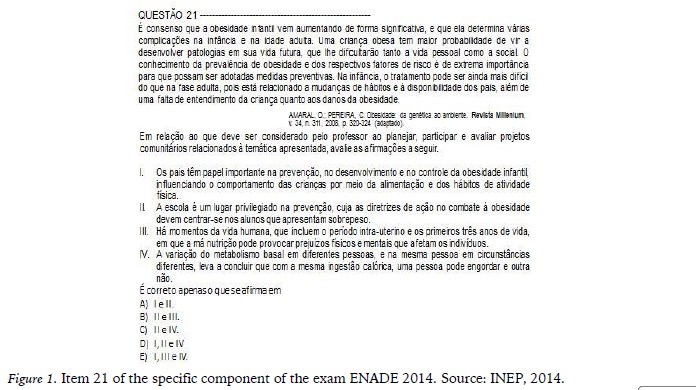
<p>Data on the     performance of students of Physical     Education courses were extracted from databases (micro) survey, made available     via the Internet by the National Institute of Educational Studies Teixeira -     INEP. A sample of students is selected from the institution's own criteria, in     which select by stratified random sampling, involving participants from all     regions and states of Brazil. The questionnaire has socioeconomic information     of students, as well as their responses to each item, as well as for each     component notes, general and specific training. For this study we used only the     responses of candidates for the specific component of health items of evidence     in 2014, in which the examinations for that course were applied. These items     were identified in the tests for the examination which are also available on     the website. The items which had been cancelled and with low level of discrimination from INEP criteria were excluded from the analysis.</p> <b><b>Statistical analysis</b></b>      <p>Items related to     health examination were selected in order to perform the analysis. Valid     percentages of choice were analysed for each alternative of items in order to     identify those ones preferred by students. The answers to these items were also     dichotomized into 1 and 0 (corresponding to right and wrong, respectively).     Questions without answers or multiple answers were considered wrong. Thus, the     parameter of difficulty (p) of the items from the hitting ratio was calculated,     having its values ranging from 0 to 1, and the items with less ratio were     considered the most difficult ones. The items with average rate of difficulty     were considered adequate. It was also estimated the discrimination parameter of     the items by point-biserial correlation between the items and the grade in     specific component of the test, being considered discriminative values r<sub>bp</sub>   &#8805; 0:20. Descriptive statistics was used (mean and standard deviation) for the students' grades in the items. Data were analysed via SPSS (version 20.0).</p> </font>     <p>&nbsp;</p>     <p><font size="3" face="Verdana"><b><b>RESULTS</b></b></font></p> <font face="Verdana" size="2">     <p>With the test     analysis, it was identified three items which were about health-related     knowledge; however, one of them was taken out. <a href="/img/revistas/mot/v13s1/13s1a06f1.jpg">Figure 1</a> presents an issue that     deals with childhood obesity and its complications into adulthood, requiring     the student to assess the role of physical education teacher in front of projects regarding this issue. </p>     
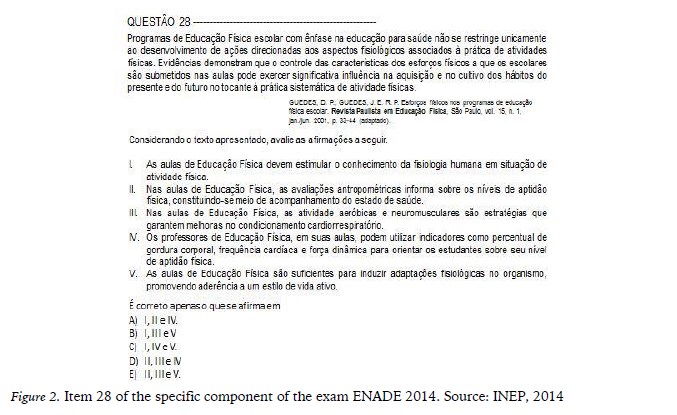
<p><a href="/img/revistas/mot/v13s1/13s1a06f2.jpg">Figure 2</a> presents     a question related to health education programs in Physical Education in     school, requiring an understanding about the contributions of this discipline     to schoolchildren’s health. <a href="/img/revistas/mot/v13s1/13s1a06t2.jpg">Table 2</a> shows the statistics about the items 21 and     28. In the item 21, option E (the correct one) had the greatest students’   acceptance. But option D also had great acceptance. Those who have chosen this   one did not recognize that eating behaviours early in life affect the physical   and mental aspects of the child. Option A received considerable acceptance.   Those who have opted for this one did not consider that people with similar   eating habits get distinct physiological reactions when the basal metabolism is   different.       Option A (correct) from     item 28 had the greatest students’ acceptance. Option D was widely accepted.     Those who have opted for this one failed to understand that physical education     can provide knowledge about exercise physiology and also that anthropometric     assessments provide information for monitoring the students’ health. In     addition, they also associated, wrongly, neuromuscular activities to good     cardio respiratory fitness. Similarly, option B     had great acceptance. Besides the other students’ misconceptions, the ones who     chosen B considered that physical education classes are sufficient to cause physiological changes in the body and promote adherence to an active lifestyle.</p>     
<p>As for the     parameters, the items showed good levels of difficulty and discrimination,     within acceptable margins. This leads to a good metric quality of the items, indicating that despite a few items, they had a reliable assessment.</p> </font>     <p>&nbsp;</p>     <p><font size="3" face="Verdana"><b><b>DISCUSSION</b></b></font></p> <font face="Verdana" size="2">     ]]></body>
<body><![CDATA[<p>When we discuss     about health promotion in schools, managers, teachers and students have the     possibility of a new vision for a healthy lifestyle for prevention of chronic     diseases (Rocha et al., 2011; Sá, Carvalho, &amp; Gomes, 2014). Spohr, Fortes,     Rombaldi, Hallal, and Azevedo (2014) stress that the issue of health remains     the agenda for discussions at school, contributing to habits / actions for the whole population in terms of health promotion.</p>     <p>Simultaneously,     Brito, Silva, and França (2012) conclude that actions taken in intervention     programs in Brazilian schools are reducing inactivity and integrating health     with education activities, although they emphasize the importance of greater     participation by the Physical Education professionals in programs to support     family’s health. Thus, knowledge about the benefits of an active and healthy     life for students, family, professional and own co-workers is indispensable (Bankoff &amp; Zamai, 1999; Santos &amp; Marques, 2013).</p>     <p>Yet this     perspective, the greater the teachers’ knowledge on health promotion at school,     the better the possibility to transmit this knowledge to students, therefore,     students will have increased awareness of the risk factors that lead to chronic     diseases. For instance, the knowledge of high school students presents     deficient knowledge about sport and health, as indicated by the results of a     large-scale evaluation applied to this level of education in Brazil (Pontes Junior et al., 2016).</p>     <p>This way,     Rombaldi, Borges, Canabarro, Corrêa, and Neutzling (2012) conclude that     teachers have knowledge in aspects related to physical inactivity, unhealthy     diet, smoking etc. These authors still point out that the results are worrying     because the school should be the environment to develop the learning on how to deal with the risk factors associated with chronic diseases in adulthood.</p>     <p>Supporting this     view, Ferreira, Oliveira, and Sampaio (2013) point out that the concept of     health adopted by the participants in the study does not include the extended     sense, and also that it is necessary to go beyond the individual and biological     aspects of their practices. In this way, teachers from Jaguariúna-SP work with     health elements, even though they do not belong to the central axis of their     teaching practices, that is, you need a wider understanding of this topic for     the development of health in schools (Zancha Magellan, Martins, Silva, &amp; Abraham, 2013).  </p>     <p>According to this     reality, in other words, to improve the knowledge obtained during and after     graduation, the Ministry of Health and Education has contributed through     actions at the undergraduate and the postgraduate courses (Falci &amp;   Belisario, 2013). From this perspective, there are higher education   institutions that make curricular changes in order to bring up the guidelines. According   to Costa et al. (2012), these changes are still insufficient, which the author suggests postgraduate courses, in order to minimize the deficits.</p>     <p>Thus, as <a href="/img/revistas/mot/v13s1/13s1a06t2.jpg">Table 2</a>  shown in, almost half of the participants pointed out the correct option (E),   followed by D, option that is obviously wrong. However, those who chose D   considered that the action guidelines in the fight against obesity should focus   on students who are overweight. This statement implies that the ones considered in the proper weight will not become obese.</p>     
<p>Therefore,     considering that children and teenagers who are overweight or obese are     becoming more frequent, there is the need to work some concepts in classroom,     and especially practical intervention programs, which foster physical activity.     That is why the presence of a Physical education professional is a key factor in the search for results.</p>     <p>Nevertheless, it is worth noting that the     interdisciplinary among the subjects can greatly contribute to health promotion     at school, such as nutritional monitoring can accelerate the delivery of     results, when the goal is a loss, or low caloric intake (Hoehr, Reuter, Tornquist, Nunes, &amp; Burgos, 2014).</p>     <p>Complementing,     Araújo, Brito, and Silva (2010) state that when the teacher suggests proposals     that get students together, in an attempt to alleviate physical inactivity, he     / she contributes in health promotion consequently and must always consider the     exercise, sport and physical fitness related to health as one of the main contents of Physical Education.</p>     ]]></body>
<body><![CDATA[<p>In order to     assist the planning of Physical Education classes with the health theme, high     school teachers can make use of students' perceptions scales about the     teaching-learning process of the discipline, in order to identify their     expectations regarding the objectives associated with health and quality of life (Sousa et al., 2016).</p>     <p><a href="/img/revistas/mot/v13s1/13s1a06t2.jpg">Table 2</a> shows     that only 30% indicated as correct the alternative (A), and 29.4% chose the     alternative (D), which there is great similarity statistically. However, when     the applicant picked the item D, he or she disagreed the Physical Education     classes should encourage the knowledge about human physiology in situations of     physical activity, when in fact, both anatomical and physiological knowledge     and gathering the minimum knowledge about the body, always linking with     physical activities experienced in the students’ reality (Melo &amp; Sousa Neto, 2016).</p>     
<p>Regarding the     aspects and prospects of continuing education of Physical Education course,     Salles, Farias, and Nascimento (2015) found that students of both courses have     interests to specialize in the area of physical activity and health,     specifically, some of the graduates reported that they plan to do some course     related to sports training, while the graduates reported they intend to take     courses related to exercise physiology. This way it is possible to see interest in parts of some graduates in physiology.</p>     <p>Corroborating,     Vanzela, Balbo, and Justina (2007) analysed a sample of students in the 3rd     grade of high school to see if they were able to relate the physiological     systems in their everyday problems situations. Thus, some of these issues show     some relevant points to be addressed in school, such as the performance of the     respiratory and circulatory systems during the exercise, and the nervous system and the muscular system in carrying out movements. </p>     <p>Based on this     assumption, the understanding of the human organism in its functioning as a     whole during basic education is not impossible, but it is not an easy task.     Therefore, it is necessary that future professionals must be aware of this task     still in college, so that in the profession, they can facilitate student’s learning.</p> </font>     <p>&nbsp;</p>     <p><font size="3" face="Verdana"><b><b>CONCLUSION</b></b></font></p> <font face="Verdana" size="2">     <p>The singled out     and discussed results show that there are limitations in knowledge related to     the health of Physical Education students, when the ENADE 2014 is used as a     parameter. The questions discussed show that the number of participants who chose the right option was lower than the ones who chose the wrong one.</p>     <p>However, it is     emphasized that there are few questions to analyse the health students’   knowledge effectively. It is recommended that such a relevant topic to the   training and performance of Physical Education teachers may have a larger   sample of items in the examination, in order to enable a more efficient student assessment.</p> </font>     <p>&nbsp;</p>     ]]></body>
<body><![CDATA[<p><font size="3" face="Verdana"><b><b>REFERENCES</b></b></font></p> <font face="Verdana" size="2">     <!-- ref --><p>Araújo, R. A., Brito, A. A., &amp;   Silva, F. M. (2010). O papel da educação física escolar diante da epidemia da     obesidade em crianças e adolescentes. <i>Educação Física em Revista</i>, <i>4</i>(2), 1-9.    &nbsp;&nbsp;&nbsp;&nbsp;&nbsp;&nbsp;&nbsp;&nbsp;[&#160;<a href="javascript:void(0);" onclick="javascript: window.open('/scielo.php?script=sci_nlinks&ref=371485&pid=S1646-107X201700060000600001&lng=','','width=640,height=500,resizable=yes,scrollbars=1,menubar=yes,');">Links</a>&#160;]<!-- end-ref --> </p>     <!-- ref --><p>Bankoff, A. D. P., &amp; Zamai, C. A.     (1999). Estudo do perfil dos professores do ensino fundamental do estado de São     Paulo sobre o conhecimento do tema atividade física e saúde. <i>Revista Brasileira de Atividade Física &amp; Saúde, 4</i>(3), 36-42.    &nbsp;&nbsp;&nbsp;&nbsp;&nbsp;&nbsp;&nbsp;&nbsp;[&#160;<a href="javascript:void(0);" onclick="javascript: window.open('/scielo.php?script=sci_nlinks&ref=371487&pid=S1646-107X201700060000600002&lng=','','width=640,height=500,resizable=yes,scrollbars=1,menubar=yes,');">Links</a>&#160;]<!-- end-ref --></p>     <!-- ref --><p>Bertolin, J. C. G., &amp; Marcon, T.     (2015). O (des) entendimento de qualidade na educação superior brasileira – das     quimeras do provão e do ENADE à realidade do capital cultural dos estudantes. <i>Avaliação, 20</i>(1), 105-122. doi: 10.590/S1414-40772015000100008&nbsp;&nbsp;&nbsp;&nbsp;&nbsp;&nbsp;&nbsp;&nbsp;[&#160;<a href="javascript:void(0);" onclick="javascript: window.open('/scielo.php?script=sci_nlinks&ref=371489&pid=S1646-107X201700060000600003&lng=','','width=640,height=500,resizable=yes,scrollbars=1,menubar=yes,');">Links</a>&#160;]<!-- end-ref --><!-- ref --><p>Brasil. (2011). Instituto Nacional de     Estudos e Pesquisas Educacionais Anísio Teixeira – Inep. Ministério da     Educação. <i>Sinaes - 2011</i>. Retrieved September 22, 2016, from <a href="http://portal.inep.gov.br/superior-187sinaes" target="_blank">http://portal.inep.gov.br/superior-187sinaes</a>.    &nbsp;&nbsp;&nbsp;&nbsp;&nbsp;&nbsp;&nbsp;&nbsp;[&#160;<a href="javascript:void(0);" onclick="javascript: window.open('/scielo.php?script=sci_nlinks&ref=371490&pid=S1646-107X201700060000600004&lng=','','width=640,height=500,resizable=yes,scrollbars=1,menubar=yes,');">Links</a>&#160;]<!-- end-ref --></p>     <!-- ref --><p>Brito, A. K. A., Silva, F. I. C.,   &amp; França, N. M. (2012). Programas de intervenção nas escolas brasileiras:     uma contribuição da escola para a educação em saúde. <i>Saúde em Debate, 36</i>(96), 624-632. doi: 10.1590/S0103-11042012000400014&nbsp;&nbsp;&nbsp;&nbsp;&nbsp;&nbsp;&nbsp;&nbsp;[&#160;<a href="javascript:void(0);" onclick="javascript: window.open('/scielo.php?script=sci_nlinks&ref=371492&pid=S1646-107X201700060000600005&lng=','','width=640,height=500,resizable=yes,scrollbars=1,menubar=yes,');">Links</a>&#160;]<!-- end-ref --><!-- ref --><p>Falci, D. M., &amp; Belisário, S. A.     (2013). A inserção do profissional de educação física na atenção primária à   saúde e os desafios em sua formação. <i>Interface</i>, <i>17</i>(47), 885-899. doi: 10.1590/S1414-32832013005000027&nbsp;&nbsp;&nbsp;&nbsp;&nbsp;&nbsp;&nbsp;&nbsp;[&#160;<a href="javascript:void(0);" onclick="javascript: window.open('/scielo.php?script=sci_nlinks&ref=371493&pid=S1646-107X201700060000600006&lng=','','width=640,height=500,resizable=yes,scrollbars=1,menubar=yes,');">Links</a>&#160;]<!-- end-ref --><!-- ref --><p>Fernández-Rio, J. (2014).     Investigación-Acción en una Experiencia de co-evaluación en educación     secundaria en el marco del modelo comprensivo de iniciaón deportiva. <i>Revista de Educación Física, 30</i>(1).    &nbsp;&nbsp;&nbsp;&nbsp;&nbsp;&nbsp;&nbsp;&nbsp;[&#160;<a href="javascript:void(0);" onclick="javascript: window.open('/scielo.php?script=sci_nlinks&ref=371494&pid=S1646-107X201700060000600007&lng=','','width=640,height=500,resizable=yes,scrollbars=1,menubar=yes,');">Links</a>&#160;]<!-- end-ref --> </p>     <!-- ref --><p>Ferreira, H. S., Oliveira, B. N.,   &amp; Sampaio, J. J. C. (2013). Análise da percepção dos professores de     educação física acerca da interface entre a saúde e a educação física escolar:     conceitos e metodologias. <i>Revista Brasileira de Ciências do Esporte</i>, <i>Florianópolis, 35</i>(3), 673-685. doi: 10.1590/S0101-32892013000300011&nbsp;&nbsp;&nbsp;&nbsp;&nbsp;&nbsp;&nbsp;&nbsp;[&#160;<a href="javascript:void(0);" onclick="javascript: window.open('/scielo.php?script=sci_nlinks&ref=371496&pid=S1646-107X201700060000600008&lng=','','width=640,height=500,resizable=yes,scrollbars=1,menubar=yes,');">Links</a>&#160;]<!-- end-ref --><!-- ref --><p>Gatti, B. A. (2009). Avaliação de sistemas     educacionais do Brasil. <i>Revista de Ciências da Educação</i>, <i>9</i>(1), 7-18.    &nbsp;&nbsp;&nbsp;&nbsp;&nbsp;&nbsp;&nbsp;&nbsp;[&#160;<a href="javascript:void(0);" onclick="javascript: window.open('/scielo.php?script=sci_nlinks&ref=371497&pid=S1646-107X201700060000600009&lng=','','width=640,height=500,resizable=yes,scrollbars=1,menubar=yes,');">Links</a>&#160;]<!-- end-ref --></p>     <!-- ref --><p>Hoehr, C. F., Reuter, C. P.,     Tornquist, L., Nunes, H. M. B., &amp; Burgos, M. S. (2014). Prevalência de     obesidade e hipertensão arterial em escolares: estudo comparativo entre escolas     rurais do município de Santa Cruz do Sul/RS. <i>Rev Epidemiol Control Infect</i>, <i>4</i>(2), 122-126. doi: 10.17058/reci.v4i2.4772&nbsp;&nbsp;&nbsp;&nbsp;&nbsp;&nbsp;&nbsp;&nbsp;[&#160;<a href="javascript:void(0);" onclick="javascript: window.open('/scielo.php?script=sci_nlinks&ref=371499&pid=S1646-107X201700060000600010&lng=','','width=640,height=500,resizable=yes,scrollbars=1,menubar=yes,');">Links</a>&#160;]<!-- end-ref --><!-- ref --><p>Libâneo, J. C. (2004). <i>Organização e gestão da escola: teoria e prática</i>. 5. ed. Goiânia: Alternativa.    &nbsp;&nbsp;&nbsp;&nbsp;&nbsp;&nbsp;&nbsp;&nbsp;[&#160;<a href="javascript:void(0);" onclick="javascript: window.open('/scielo.php?script=sci_nlinks&ref=371500&pid=S1646-107X201700060000600011&lng=','','width=640,height=500,resizable=yes,scrollbars=1,menubar=yes,');">Links</a>&#160;]<!-- end-ref --></p>     <!-- ref --><p>Costa, L. C., Lopes Junior, C. A. F.,     Costa, E. C., Feitosa, M. C., Aguiar, J. B., &amp; Gurgel, L. A. (2012).     Formação profissional e produtividade em saúde coletiva do Profissional de     Educação Física. <i>Rev. Bras. Ativ. Fis. Saúde</i>, <i>17</i>(2), 107-113. doi: 10.12820/RBAFS.V.17N2P107-113&nbsp;&nbsp;&nbsp;&nbsp;&nbsp;&nbsp;&nbsp;&nbsp;[&#160;<a href="javascript:void(0);" onclick="javascript: window.open('/scielo.php?script=sci_nlinks&ref=371502&pid=S1646-107X201700060000600012&lng=','','width=640,height=500,resizable=yes,scrollbars=1,menubar=yes,');">Links</a>&#160;]<!-- end-ref --><!-- ref --><p>Melo, E. A. L., &amp; Sousa Neto, V.     A. (2016). A relevância da temática saúde e qualidade de vida nas aulas de     educação física do ensino médio em uma escola de comunidade carente de Fortaleza. <i>Revista Redfoco</i>, <i>3</i>(1), 2-17.    &nbsp;&nbsp;&nbsp;&nbsp;&nbsp;&nbsp;&nbsp;&nbsp;[&#160;<a href="javascript:void(0);" onclick="javascript: window.open('/scielo.php?script=sci_nlinks&ref=371503&pid=S1646-107X201700060000600013&lng=','','width=640,height=500,resizable=yes,scrollbars=1,menubar=yes,');">Links</a>&#160;]<!-- end-ref -->  </p>     <!-- ref --><p>Pontes Junior, J. A. F., &amp;   Trompieri Filho, N. (2015). Avaliação cognitiva em larga escala dos conteúdos     da Educação Física no Ensino Fundamental. In: M. T. Almeida. (Ed.), <i>Educação       física em diferentes contextos</i>. 1 ed. Assis, SP: Storbem Gráfica e Editora, 1-56.    &nbsp;&nbsp;&nbsp;&nbsp;&nbsp;&nbsp;&nbsp;&nbsp;[&#160;<a href="javascript:void(0);" onclick="javascript: window.open('/scielo.php?script=sci_nlinks&ref=371505&pid=S1646-107X201700060000600014&lng=','','width=640,height=500,resizable=yes,scrollbars=1,menubar=yes,');">Links</a>&#160;]<!-- end-ref --></p>     <!-- ref --><p>Pontes Junior, J. A. F., Silva, A. G.,     Tavare, E. D., Sousa, L. A., Bastos, F. C., Cruz, F. N. I., Almeida, L. S.     (2016). Aspectos psicométricos dos itens de Educação Física relacionados aos     conhecimentos de Esporte e Saúde no Exame Nacional do Ensino Médio (Enem). <i>Motricidade</i>, <i>12</i>(S1), 12-21. doi: 10.6063/motricidade.8482&nbsp;&nbsp;&nbsp;&nbsp;&nbsp;&nbsp;&nbsp;&nbsp;[&#160;<a href="javascript:void(0);" onclick="javascript: window.open('/scielo.php?script=sci_nlinks&ref=371507&pid=S1646-107X201700060000600015&lng=','','width=640,height=500,resizable=yes,scrollbars=1,menubar=yes,');">Links</a>&#160;]<!-- end-ref --><!-- ref --><p>Rocha, A., Marques, A., Figueiredo,     C., Almeida, C., Batista, I., &amp; Almeida, J. (2011). Evolução da saúde     escolar em Portugal: revisão legislativa no âmbito da educação<i>. Millenium, 41</i>, 69-87.    &nbsp;&nbsp;&nbsp;&nbsp;&nbsp;&nbsp;&nbsp;&nbsp;[&#160;<a href="javascript:void(0);" onclick="javascript: window.open('/scielo.php?script=sci_nlinks&ref=371508&pid=S1646-107X201700060000600016&lng=','','width=640,height=500,resizable=yes,scrollbars=1,menubar=yes,');">Links</a>&#160;]<!-- end-ref --></p>     <!-- ref --><p>Rombaldi, A. J., Borges, T. T., Canabarro,     L. K., Corrêa, L. Q., &amp; Neutzling, M. B. (2012). Conhecimento de     professores de educação física sobre fatores de risco para doenças crônicas de     uma cidade do sul do Brasil. <i>Revista Brasileira de Cineantropometria &amp; Desempenho Humano, 14</i>(1), 61-72. doi: 10.5007/1980-0037.2012v14n1p61&nbsp;&nbsp;&nbsp;&nbsp;&nbsp;&nbsp;&nbsp;&nbsp;[&#160;<a href="javascript:void(0);" onclick="javascript: window.open('/scielo.php?script=sci_nlinks&ref=371510&pid=S1646-107X201700060000600017&lng=','','width=640,height=500,resizable=yes,scrollbars=1,menubar=yes,');">Links</a>&#160;]<!-- end-ref --><!-- ref --><p>Salles, W. N., Farias, G. O., &amp;   Nascimento, J. V. (2015). Inserção profissional e formação continuada de     egressos de cursos de graduação em educação física. <i>Rev Bras Educ Fís Esporte</i>, <i>29</i>(3), 475-486. doi: 10.1590/1807-55092015000300475&nbsp;&nbsp;&nbsp;&nbsp;&nbsp;&nbsp;&nbsp;&nbsp;[&#160;<a href="javascript:void(0);" onclick="javascript: window.open('/scielo.php?script=sci_nlinks&ref=371511&pid=S1646-107X201700060000600018&lng=','','width=640,height=500,resizable=yes,scrollbars=1,menubar=yes,');">Links</a>&#160;]<!-- end-ref --><!-- ref --><p>Santiago, M. L. E., Pedrosa, J. I. S.,   &amp; Ferraz, A. S. M. (2016). A formação em saúde à luz do projeto pedagógico     e das diretrizes curriculares da educação física. <i>Movimento</i>, <i>22</i>(2), 443-458.    &nbsp;&nbsp;&nbsp;&nbsp;&nbsp;&nbsp;&nbsp;&nbsp;[&#160;<a href="javascript:void(0);" onclick="javascript: window.open('/scielo.php?script=sci_nlinks&ref=371512&pid=S1646-107X201700060000600019&lng=','','width=640,height=500,resizable=yes,scrollbars=1,menubar=yes,');">Links</a>&#160;]<!-- end-ref --></p>     ]]></body>
<body><![CDATA[<!-- ref --><p>Santos, M. N., &amp; Marques, A. C.     (2013). Condições de saúde, estilo de vida e características de trabalho de     professores de uma cidade do sul do Brasil. <i>Ciência &amp; Saúde Coletiva,</i> <i>18</i>(3), 837-846. doi: <a href="http://dx.doi.org/10.1590/S1413-81232013000300029" target="_blank">http://dx.doi.org/10.1590/S1413-81232013000300029</a>&nbsp;&nbsp;&nbsp;&nbsp;&nbsp;&nbsp;&nbsp;&nbsp;[&#160;<a href="javascript:void(0);" onclick="javascript: window.open('/scielo.php?script=sci_nlinks&ref=371514&pid=S1646-107X201700060000600020&lng=','','width=640,height=500,resizable=yes,scrollbars=1,menubar=yes,');">Links</a>&#160;]<!-- end-ref --><!-- ref --><p>Sá, C. S., Carvalho, R. G. S., &amp;   Gomes, L. E. (2014). Saúde escolar de crianças no ensino fundamental: avaliação     da prevalência de dor nas costas. <i>Revista Arquivos de Ciências da Saúde</i>, <i>21</i>(2), 77-82.    &nbsp;&nbsp;&nbsp;&nbsp;&nbsp;&nbsp;&nbsp;&nbsp;[&#160;<a href="javascript:void(0);" onclick="javascript: window.open('/scielo.php?script=sci_nlinks&ref=371515&pid=S1646-107X201700060000600021&lng=','','width=640,height=500,resizable=yes,scrollbars=1,menubar=yes,');">Links</a>&#160;]<!-- end-ref --> </p>     <!-- ref --><p>Sousa, L. A, Silva, A. G, Medeiros     Filho, A. E. C., Silva, C. S., Carvalho, A. B. L., &amp; Pontes Junior, J. A.     F.(2016).  Objetivos de ensino da     Educação Física nos fatores de atividade física e saúde e formação humana:     validação da escala de percepção discente. <i>Motricidade</i>, <i>12</i>(S1), 85-94. doi: <a href="http://dx.doi.org/10.6063/motricidade.8482" target="_blank">http://dx.doi.org/10.6063/motricidade.8482</a>&nbsp;&nbsp;&nbsp;&nbsp;&nbsp;&nbsp;&nbsp;&nbsp;[&#160;<a href="javascript:void(0);" onclick="javascript: window.open('/scielo.php?script=sci_nlinks&ref=371517&pid=S1646-107X201700060000600022&lng=','','width=640,height=500,resizable=yes,scrollbars=1,menubar=yes,');">Links</a>&#160;]<!-- end-ref --><!-- ref --><p>Spohr, C. F., Fortes, M. O., Rombaldi,     A. J., Hallal, P. C., &amp; Azevedo, M. R. (2014). Atividade física e saúde na     educação física escolar: efetividade de um ano do projeto “educação física +”. <i>Revista       Brasileira de Atividade Física &amp; Saúde, 19</i>(3), 300-313. doi: 10.12820/rbafs.v.19n3p300&nbsp;&nbsp;&nbsp;&nbsp;&nbsp;&nbsp;&nbsp;&nbsp;[&#160;<a href="javascript:void(0);" onclick="javascript: window.open('/scielo.php?script=sci_nlinks&ref=371518&pid=S1646-107X201700060000600023&lng=','','width=640,height=500,resizable=yes,scrollbars=1,menubar=yes,');">Links</a>&#160;]<!-- end-ref --><!-- ref --><p>Telles, C., Krüger, L. G., Marques, M.     N., &amp; Krug, H. N. (2014). A formação de professores de educação física: a     avaliação das disciplinas teórico-práticas na licenciatura do centro de     educação física e desportos (CEFD) da Universidade Federal de Santa Maria (UFSM). <i>Contexto &amp; Educação, 29</i>(92), 190-214.    &nbsp;&nbsp;&nbsp;&nbsp;&nbsp;&nbsp;&nbsp;&nbsp;[&#160;<a href="javascript:void(0);" onclick="javascript: window.open('/scielo.php?script=sci_nlinks&ref=371519&pid=S1646-107X201700060000600024&lng=','','width=640,height=500,resizable=yes,scrollbars=1,menubar=yes,');">Links</a>&#160;]<!-- end-ref --></p>     <!-- ref --><p>Vanzela, E. C., Balbo, S. L., &amp;   Justina, L. A. D. (2007). A integração dos sistemas fisiológicos e sua compreensão por alunos do nível médio. <i>Arq Mudi</i>, <i>11</i>(3), 12-19.    &nbsp;&nbsp;&nbsp;&nbsp;&nbsp;&nbsp;&nbsp;&nbsp;[&#160;<a href="javascript:void(0);" onclick="javascript: window.open('/scielo.php?script=sci_nlinks&ref=371521&pid=S1646-107X201700060000600025&lng=','','width=640,height=500,resizable=yes,scrollbars=1,menubar=yes,');">Links</a>&#160;]<!-- end-ref --></p>     <!-- ref --><p>Vianna, H. M. (2003). Avaliações     nacionais em larga escala: Análises e propostas. <i>Estudos em avaliação Educacional, 27</i>(1), 41-76. doi: <a href="http://dx.doi.org/10.18222/eae02720032177" target="_blank">http://dx.doi.org/10.18222/eae02720032177</a>&nbsp;&nbsp;&nbsp;&nbsp;&nbsp;&nbsp;&nbsp;&nbsp;[&#160;<a href="javascript:void(0);" onclick="javascript: window.open('/scielo.php?script=sci_nlinks&ref=371523&pid=S1646-107X201700060000600026&lng=','','width=640,height=500,resizable=yes,scrollbars=1,menubar=yes,');">Links</a>&#160;]<!-- end-ref --><!-- ref --><p>Werle, F. O. (2011). Políticas de     avaliação em larga escala na educação básica: do controle de resultados à   intervenção nos processos de operacionalização do ensino. <i>Ensaio: Avaliação de Políticas Públicas Educacionais, 19</i>(79), 769-792. doi: <a href="http://dx.doi.org/10.1590/S0104-40362011000500003" target="_blank">http://dx.doi.org/10.1590/S0104-40362011000500003</a>&nbsp;&nbsp;&nbsp;&nbsp;&nbsp;&nbsp;&nbsp;&nbsp;[&#160;<a href="javascript:void(0);" onclick="javascript: window.open('/scielo.php?script=sci_nlinks&ref=371524&pid=S1646-107X201700060000600027&lng=','','width=640,height=500,resizable=yes,scrollbars=1,menubar=yes,');">Links</a>&#160;]<!-- end-ref --><!-- ref --><p>Zancha, D., Magalhães, G. B. S.,     Martins, J., Silva, T. A., &amp; Abrahão, T. B. (2013). Conhecimento dos     professores de educação física escolar sobre a abordagem saúde renovada e a     temática saúde. <i>Conexões: revista da Faculdade de Educação Física da UNICAMP, Campinas, 11</i>(1), 204-217. doi: 10.20396/conex.v11i1.8637638&nbsp;&nbsp;&nbsp;&nbsp;&nbsp;&nbsp;&nbsp;&nbsp;[&#160;<a href="javascript:void(0);" onclick="javascript: window.open('/scielo.php?script=sci_nlinks&ref=371525&pid=S1646-107X201700060000600028&lng=','','width=640,height=500,resizable=yes,scrollbars=1,menubar=yes,');">Links</a>&#160;]<!-- end-ref --><p>&nbsp;</p>     <p><b>Acknowledgments:</b>    <br> Nothing to declare.    <br> <b>Conflict of interests:    <br> </b>Nothing to declare.    <br> <b>Funding:    <br> </b>Nothing to declare.</p> </font>     <p>&nbsp;</p>     ]]></body>
<body><![CDATA[<p>&nbsp;</p>     <p><font size="2" face="Verdana"><a href="#top"><sup>*</sup></a><i><a name="end"></a>Corresponding Author</i>: Federal   Institute of Education, Science and Technology of Ceará - IFCE, 62700-000, Canindé, Brazil. BR 020, Km 303, s/n - Jubaia, Canindé - CE. <i>Email: </i><a href="mailto:leandrosousaifce@gmail.com">leandrosousaifce@gmail.com</a></font></p>       ]]></body><back>
<ref-list>
<ref id="B1">
<nlm-citation citation-type="journal">
<person-group person-group-type="author">
<name>
<surname><![CDATA[Araújo]]></surname>
<given-names><![CDATA[R. A.]]></given-names>
</name>
<name>
<surname><![CDATA[Brito]]></surname>
<given-names><![CDATA[A. A.]]></given-names>
</name>
<name>
<surname><![CDATA[Silva]]></surname>
<given-names><![CDATA[F. M.]]></given-names>
</name>
</person-group>
<article-title xml:lang="pt"><![CDATA[O papel da educação física escolar diante da epidemia da obesidade em crianças e adolescentes]]></article-title>
<source><![CDATA[Educação Física em Revista]]></source>
<year>2010</year>
<volume>4</volume>
<numero>2</numero>
<issue>2</issue>
<page-range>1-9</page-range></nlm-citation>
</ref>
<ref id="B2">
<nlm-citation citation-type="journal">
<person-group person-group-type="author">
<name>
<surname><![CDATA[Bankoff]]></surname>
<given-names><![CDATA[A. D. P.]]></given-names>
</name>
<name>
<surname><![CDATA[Zamai]]></surname>
<given-names><![CDATA[C. A.]]></given-names>
</name>
</person-group>
<article-title xml:lang="pt"><![CDATA[Estudo do perfil dos professores do ensino fundamental do estado de São Paulo sobre o conhecimento do tema atividade física e saúde]]></article-title>
<source><![CDATA[Revista Brasileira de Atividade Física & Saúde]]></source>
<year>1999</year>
<volume>4</volume>
<numero>3</numero>
<issue>3</issue>
<page-range>36-42</page-range></nlm-citation>
</ref>
<ref id="B3">
<nlm-citation citation-type="journal">
<person-group person-group-type="author">
<name>
<surname><![CDATA[Bertolin]]></surname>
<given-names><![CDATA[J. C. G.]]></given-names>
</name>
<name>
<surname><![CDATA[Marcon]]></surname>
<given-names><![CDATA[T.]]></given-names>
</name>
</person-group>
<article-title xml:lang="pt"><![CDATA[O (des) entendimento de qualidade na educação superior brasileira: das quimeras do provão e do ENADE à realidade do capital cultural dos estudantes]]></article-title>
<source><![CDATA[Avaliação]]></source>
<year>2015</year>
<volume>20</volume>
<numero>1</numero>
<issue>1</issue>
<page-range>105-122</page-range></nlm-citation>
</ref>
<ref id="B4">
<nlm-citation citation-type="book">
<collab>Brasil</collab>
<source><![CDATA[Instituto Nacional de Estudos e Pesquisas Educacionais Anísio Teixeira: Inep]]></source>
<year>2011</year>
<publisher-name><![CDATA[Ministério da Educação]]></publisher-name>
</nlm-citation>
</ref>
<ref id="B5">
<nlm-citation citation-type="journal">
<person-group person-group-type="author">
<name>
<surname><![CDATA[Brito]]></surname>
<given-names><![CDATA[A. K. A.]]></given-names>
</name>
<name>
<surname><![CDATA[Silva]]></surname>
<given-names><![CDATA[F. I. C.]]></given-names>
</name>
<name>
<surname><![CDATA[França]]></surname>
<given-names><![CDATA[N. M.]]></given-names>
</name>
</person-group>
<article-title xml:lang="pt"><![CDATA[Programas de intervenção nas escolas brasileiras: uma contribuição da escola para a educação em saúde]]></article-title>
<source><![CDATA[Saúde em Debate]]></source>
<year>2012</year>
<volume>36</volume>
<numero>96</numero>
<issue>96</issue>
<page-range>624-632</page-range></nlm-citation>
</ref>
<ref id="B6">
<nlm-citation citation-type="journal">
<person-group person-group-type="author">
<name>
<surname><![CDATA[Falci]]></surname>
<given-names><![CDATA[D. M.]]></given-names>
</name>
<name>
<surname><![CDATA[Belisário]]></surname>
<given-names><![CDATA[S. A.]]></given-names>
</name>
</person-group>
<article-title xml:lang="pt"><![CDATA[A inserção do profissional de educação física na atenção primária à saúde e os desafios em sua formação]]></article-title>
<source><![CDATA[Interface]]></source>
<year>2013</year>
<volume>17</volume>
<numero>47</numero>
<issue>47</issue>
<page-range>885-899</page-range></nlm-citation>
</ref>
<ref id="B7">
<nlm-citation citation-type="journal">
<person-group person-group-type="author">
<name>
<surname><![CDATA[Fernández-Rio]]></surname>
<given-names><![CDATA[J.]]></given-names>
</name>
</person-group>
<article-title xml:lang="es"><![CDATA[Investigación-Acción en una Experiencia de co-evaluación en educación secundaria en el marco del modelo comprensivo de iniciaón deportiva]]></article-title>
<source><![CDATA[Revista de Educación Física]]></source>
<year>2014</year>
<volume>30</volume>
<numero>1</numero>
<issue>1</issue>
</nlm-citation>
</ref>
<ref id="B8">
<nlm-citation citation-type="journal">
<person-group person-group-type="author">
<name>
<surname><![CDATA[Ferreira]]></surname>
<given-names><![CDATA[H. S.]]></given-names>
</name>
<name>
<surname><![CDATA[Oliveira]]></surname>
<given-names><![CDATA[B. N.]]></given-names>
</name>
<name>
<surname><![CDATA[Sampaio]]></surname>
<given-names><![CDATA[J. J. C.]]></given-names>
</name>
</person-group>
<article-title xml:lang="pt"><![CDATA[Análise da percepção dos professores de educação física acerca da interface entre a saúde e a educação física escolar: conceitos e metodologias]]></article-title>
<source><![CDATA[Revista Brasileira de Ciências do Esporte, Florianópolis]]></source>
<year>2013</year>
<volume>35</volume>
<numero>3</numero>
<issue>3</issue>
<page-range>673-685</page-range></nlm-citation>
</ref>
<ref id="B9">
<nlm-citation citation-type="journal">
<person-group person-group-type="author">
<name>
<surname><![CDATA[Gatti]]></surname>
<given-names><![CDATA[B. A.]]></given-names>
</name>
</person-group>
<article-title xml:lang="pt"><![CDATA[Avaliação de sistemas educacionais do Brasil]]></article-title>
<source><![CDATA[Revista de Ciências da Educação]]></source>
<year>2009</year>
<volume>9</volume>
<numero>1</numero>
<issue>1</issue>
<page-range>7-18</page-range></nlm-citation>
</ref>
<ref id="B10">
<nlm-citation citation-type="journal">
<person-group person-group-type="author">
<name>
<surname><![CDATA[Hoehr]]></surname>
<given-names><![CDATA[C. F.]]></given-names>
</name>
<name>
<surname><![CDATA[Reuter]]></surname>
<given-names><![CDATA[C. P.]]></given-names>
</name>
<name>
<surname><![CDATA[Tornquist]]></surname>
<given-names><![CDATA[L.]]></given-names>
</name>
<name>
<surname><![CDATA[Nunes]]></surname>
<given-names><![CDATA[H. M. B.]]></given-names>
</name>
<name>
<surname><![CDATA[Burgos]]></surname>
<given-names><![CDATA[M. S.]]></given-names>
</name>
</person-group>
<article-title xml:lang="pt"><![CDATA[Prevalência de obesidade e hipertensão arterial em escolares: estudo comparativo entre escolas rurais do município de Santa Cruz do Sul/RS]]></article-title>
<source><![CDATA[Rev Epidemiol Control Infect]]></source>
<year>2014</year>
<volume>4</volume>
<numero>2</numero>
<issue>2</issue>
<page-range>122-126</page-range></nlm-citation>
</ref>
<ref id="B11">
<nlm-citation citation-type="book">
<person-group person-group-type="author">
<name>
<surname><![CDATA[Libâneo]]></surname>
<given-names><![CDATA[J. C.]]></given-names>
</name>
</person-group>
<source><![CDATA[Organização e gestão da escola: teoria e prática]]></source>
<year>2004</year>
<edition>5</edition>
<publisher-loc><![CDATA[Goiânia ]]></publisher-loc>
<publisher-name><![CDATA[Alternativa]]></publisher-name>
</nlm-citation>
</ref>
<ref id="B12">
<nlm-citation citation-type="journal">
<person-group person-group-type="author">
<name>
<surname><![CDATA[Costa]]></surname>
<given-names><![CDATA[L. C.]]></given-names>
</name>
<name>
<surname><![CDATA[Lopes Junior]]></surname>
<given-names><![CDATA[C. A. F.]]></given-names>
</name>
<name>
<surname><![CDATA[Costa]]></surname>
<given-names><![CDATA[E. C.]]></given-names>
</name>
<name>
<surname><![CDATA[Feitosa]]></surname>
<given-names><![CDATA[M. C.]]></given-names>
</name>
<name>
<surname><![CDATA[Aguiar]]></surname>
<given-names><![CDATA[J. B.]]></given-names>
</name>
<name>
<surname><![CDATA[Gurgel]]></surname>
<given-names><![CDATA[L. A.]]></given-names>
</name>
</person-group>
<article-title xml:lang="pt"><![CDATA[Formação profissional e produtividade em saúde coletiva do Profissional de Educação Física]]></article-title>
<source><![CDATA[Rev. Bras. Ativ. Fis. Saúde]]></source>
<year>2012</year>
<volume>17</volume>
<numero>2</numero>
<issue>2</issue>
<page-range>107-113</page-range></nlm-citation>
</ref>
<ref id="B13">
<nlm-citation citation-type="journal">
<person-group person-group-type="author">
<name>
<surname><![CDATA[Melo]]></surname>
<given-names><![CDATA[E. A. L.]]></given-names>
</name>
<name>
<surname><![CDATA[Sousa Neto]]></surname>
<given-names><![CDATA[V. A.]]></given-names>
</name>
</person-group>
<article-title xml:lang="pt"><![CDATA[A relevância da temática saúde e qualidade de vida nas aulas de educação física do ensino médio em uma escola de comunidade carente de Fortaleza]]></article-title>
<source><![CDATA[Revista Redfoco]]></source>
<year>2016</year>
<volume>3</volume>
<numero>1</numero>
<issue>1</issue>
<page-range>2-17</page-range></nlm-citation>
</ref>
<ref id="B14">
<nlm-citation citation-type="book">
<person-group person-group-type="author">
<name>
<surname><![CDATA[Pontes Junior]]></surname>
<given-names><![CDATA[J. A. F.]]></given-names>
</name>
<name>
<surname><![CDATA[Trompieri Filho]]></surname>
<given-names><![CDATA[N.]]></given-names>
</name>
</person-group>
<article-title xml:lang="pt"><![CDATA[Avaliação cognitiva em larga escala dos conteúdos da Educação Física no Ensino Fundamental]]></article-title>
<person-group person-group-type="editor">
<name>
<surname><![CDATA[Almeida]]></surname>
<given-names><![CDATA[M. T.]]></given-names>
</name>
</person-group>
<source><![CDATA[Educação física em diferentes contextos]]></source>
<year>2015</year>
<edition>1</edition>
<page-range>1-56</page-range><publisher-loc><![CDATA[Assis^eSP SP]]></publisher-loc>
<publisher-name><![CDATA[Storbem Gráfica e Editora]]></publisher-name>
</nlm-citation>
</ref>
<ref id="B15">
<nlm-citation citation-type="journal">
<person-group person-group-type="author">
<name>
<surname><![CDATA[Pontes Junior]]></surname>
<given-names><![CDATA[J. A. F.]]></given-names>
</name>
<name>
<surname><![CDATA[Silva]]></surname>
<given-names><![CDATA[A. G.]]></given-names>
</name>
<name>
<surname><![CDATA[Tavare]]></surname>
<given-names><![CDATA[E. D.]]></given-names>
</name>
<name>
<surname><![CDATA[Sousa]]></surname>
<given-names><![CDATA[L. A.]]></given-names>
</name>
<name>
<surname><![CDATA[Bastos]]></surname>
<given-names><![CDATA[F. C.]]></given-names>
</name>
<name>
<surname><![CDATA[Cruz]]></surname>
<given-names><![CDATA[F. N. I.]]></given-names>
</name>
<name>
<surname><![CDATA[Almeida]]></surname>
<given-names><![CDATA[L. S.]]></given-names>
</name>
</person-group>
<article-title xml:lang="pt"><![CDATA[Aspectos psicométricos dos itens de Educação Física relacionados aos conhecimentos de Esporte e Saúde no Exame Nacional do Ensino Médio (Enem)]]></article-title>
<source><![CDATA[Motricidade]]></source>
<year>2016</year>
<volume>12</volume>
<numero>^s1</numero>
<issue>^s1</issue>
<supplement>1</supplement>
<page-range>12-21</page-range></nlm-citation>
</ref>
<ref id="B16">
<nlm-citation citation-type="journal">
<person-group person-group-type="author">
<name>
<surname><![CDATA[Rocha]]></surname>
<given-names><![CDATA[A.]]></given-names>
</name>
<name>
<surname><![CDATA[Marques]]></surname>
<given-names><![CDATA[A.]]></given-names>
</name>
<name>
<surname><![CDATA[Figueiredo]]></surname>
<given-names><![CDATA[C.]]></given-names>
</name>
<name>
<surname><![CDATA[Almeida]]></surname>
<given-names><![CDATA[C.]]></given-names>
</name>
<name>
<surname><![CDATA[Batista]]></surname>
<given-names><![CDATA[I.]]></given-names>
</name>
<name>
<surname><![CDATA[Almeida]]></surname>
<given-names><![CDATA[J.]]></given-names>
</name>
</person-group>
<article-title xml:lang="pt"><![CDATA[Evolução da saúde escolar em Portugal: revisão legislativa no âmbito da educação]]></article-title>
<source><![CDATA[Millenium]]></source>
<year>2011</year>
<volume>41</volume>
<page-range>69-87</page-range></nlm-citation>
</ref>
<ref id="B17">
<nlm-citation citation-type="journal">
<person-group person-group-type="author">
<name>
<surname><![CDATA[Rombaldi]]></surname>
<given-names><![CDATA[A. J.]]></given-names>
</name>
<name>
<surname><![CDATA[Borges]]></surname>
<given-names><![CDATA[T. T.]]></given-names>
</name>
<name>
<surname><![CDATA[Canabarro]]></surname>
<given-names><![CDATA[L. K.]]></given-names>
</name>
<name>
<surname><![CDATA[Corrêa]]></surname>
<given-names><![CDATA[L. Q.]]></given-names>
</name>
<name>
<surname><![CDATA[Neutzling]]></surname>
<given-names><![CDATA[M. B.]]></given-names>
</name>
</person-group>
<article-title xml:lang="pt"><![CDATA[Conhecimento de professores de educação física sobre fatores de risco para doenças crônicas de uma cidade do sul do Brasil]]></article-title>
<source><![CDATA[Revista Brasileira de Cineantropometria & Desempenho Humano]]></source>
<year>2012</year>
<volume>14</volume>
<numero>1</numero>
<issue>1</issue>
<page-range>61-72</page-range></nlm-citation>
</ref>
<ref id="B18">
<nlm-citation citation-type="journal">
<person-group person-group-type="author">
<name>
<surname><![CDATA[Salles]]></surname>
<given-names><![CDATA[W. N.]]></given-names>
</name>
<name>
<surname><![CDATA[Farias]]></surname>
<given-names><![CDATA[G. O.]]></given-names>
</name>
<name>
<surname><![CDATA[Nascimento]]></surname>
<given-names><![CDATA[J. V.]]></given-names>
</name>
</person-group>
<article-title xml:lang="pt"><![CDATA[Inserção profissional e formação continuada de egressos de cursos de graduação em educação física]]></article-title>
<source><![CDATA[Rev Bras Educ Fís Esporte]]></source>
<year>2015</year>
<volume>29</volume>
<numero>3</numero>
<issue>3</issue>
<page-range>475-486</page-range></nlm-citation>
</ref>
<ref id="B19">
<nlm-citation citation-type="journal">
<person-group person-group-type="author">
<name>
<surname><![CDATA[Santiago]]></surname>
<given-names><![CDATA[M. L. E.]]></given-names>
</name>
<name>
<surname><![CDATA[Pedrosa]]></surname>
<given-names><![CDATA[J. I. S.]]></given-names>
</name>
<name>
<surname><![CDATA[Ferraz]]></surname>
<given-names><![CDATA[A. S. M.]]></given-names>
</name>
</person-group>
<article-title xml:lang="pt"><![CDATA[A formação em saúde à luz do projeto pedagógico e das diretrizes curriculares da educação física]]></article-title>
<source><![CDATA[Movimento]]></source>
<year>2016</year>
<volume>22</volume>
<numero>2</numero>
<issue>2</issue>
<page-range>443-458</page-range></nlm-citation>
</ref>
<ref id="B20">
<nlm-citation citation-type="journal">
<person-group person-group-type="author">
<name>
<surname><![CDATA[Santos]]></surname>
<given-names><![CDATA[M. N.]]></given-names>
</name>
<name>
<surname><![CDATA[Marques]]></surname>
<given-names><![CDATA[A. C.]]></given-names>
</name>
</person-group>
<article-title xml:lang="pt"><![CDATA[Condições de saúde, estilo de vida e características de trabalho de professores de uma cidade do sul do Brasil]]></article-title>
<source><![CDATA[Ciência & Saúde Coletiva]]></source>
<year>2013</year>
<volume>18</volume>
<numero>3</numero>
<issue>3</issue>
<page-range>837-846</page-range></nlm-citation>
</ref>
<ref id="B21">
<nlm-citation citation-type="journal">
<person-group person-group-type="author">
<name>
<surname><![CDATA[Sá]]></surname>
<given-names><![CDATA[C. S.]]></given-names>
</name>
<name>
<surname><![CDATA[Carvalho]]></surname>
<given-names><![CDATA[R. G. S.]]></given-names>
</name>
<name>
<surname><![CDATA[Gomes]]></surname>
<given-names><![CDATA[L. E.]]></given-names>
</name>
</person-group>
<article-title xml:lang="pt"><![CDATA[Saúde escolar de crianças no ensino fundamental: avaliação da prevalência de dor nas costas]]></article-title>
<source><![CDATA[Revista Arquivos de Ciências da Saúde]]></source>
<year>2014</year>
<volume>21</volume>
<numero>2</numero>
<issue>2</issue>
<page-range>77-82</page-range></nlm-citation>
</ref>
<ref id="B22">
<nlm-citation citation-type="journal">
<person-group person-group-type="author">
<name>
<surname><![CDATA[Sousa]]></surname>
<given-names><![CDATA[L. A]]></given-names>
</name>
<name>
<surname><![CDATA[Silva]]></surname>
<given-names><![CDATA[A. G]]></given-names>
</name>
<name>
<surname><![CDATA[Medeiros Filho]]></surname>
<given-names><![CDATA[A. E. C.]]></given-names>
</name>
<name>
<surname><![CDATA[Silva]]></surname>
<given-names><![CDATA[C. S.]]></given-names>
</name>
<name>
<surname><![CDATA[Carvalho]]></surname>
<given-names><![CDATA[A. B. L.]]></given-names>
</name>
<name>
<surname><![CDATA[Pontes Junior]]></surname>
<given-names><![CDATA[J. A. F.]]></given-names>
</name>
</person-group>
<article-title xml:lang="pt"><![CDATA[Objetivos de ensino da Educação Física nos fatores de atividade física e saúde e formação humana: validação da escala de percepção discente]]></article-title>
<source><![CDATA[Motricidade]]></source>
<year>2016</year>
<volume>12</volume>
<numero>^s1</numero>
<issue>^s1</issue>
<supplement>1</supplement>
<page-range>85-94</page-range></nlm-citation>
</ref>
<ref id="B23">
<nlm-citation citation-type="journal">
<person-group person-group-type="author">
<name>
<surname><![CDATA[Spohr]]></surname>
<given-names><![CDATA[C. F.]]></given-names>
</name>
<name>
<surname><![CDATA[Fortes]]></surname>
<given-names><![CDATA[M. O.]]></given-names>
</name>
<name>
<surname><![CDATA[Rombaldi]]></surname>
<given-names><![CDATA[A. J.]]></given-names>
</name>
<name>
<surname><![CDATA[Hallal]]></surname>
<given-names><![CDATA[P. C.]]></given-names>
</name>
<name>
<surname><![CDATA[Azevedo]]></surname>
<given-names><![CDATA[M. R.]]></given-names>
</name>
</person-group>
<article-title xml:lang="pt"><![CDATA[Atividade física e saúde na educação física escolar: efetividade de um ano do projeto “educação física +”]]></article-title>
<source><![CDATA[Revista Brasileira de Atividade Física & Saúde]]></source>
<year>2014</year>
<volume>19</volume>
<numero>3</numero>
<issue>3</issue>
<page-range>300-313</page-range></nlm-citation>
</ref>
<ref id="B24">
<nlm-citation citation-type="journal">
<person-group person-group-type="author">
<name>
<surname><![CDATA[Telles]]></surname>
<given-names><![CDATA[C.]]></given-names>
</name>
<name>
<surname><![CDATA[Krüger]]></surname>
<given-names><![CDATA[L. G.]]></given-names>
</name>
<name>
<surname><![CDATA[Marques]]></surname>
<given-names><![CDATA[M. N.]]></given-names>
</name>
<name>
<surname><![CDATA[Krug]]></surname>
<given-names><![CDATA[H. N.]]></given-names>
</name>
</person-group>
<article-title xml:lang="pt"><![CDATA[A formação de professores de educação física: a avaliação das disciplinas teórico-práticas na licenciatura do centro de educação física e desportos (CEFD) da Universidade Federal de Santa Maria (UFSM)]]></article-title>
<source><![CDATA[Contexto & Educação]]></source>
<year>2014</year>
<volume>29</volume>
<numero>92</numero>
<issue>92</issue>
<page-range>190-214</page-range></nlm-citation>
</ref>
<ref id="B25">
<nlm-citation citation-type="journal">
<person-group person-group-type="author">
<name>
<surname><![CDATA[Vanzela]]></surname>
<given-names><![CDATA[E. C.]]></given-names>
</name>
<name>
<surname><![CDATA[Balbo]]></surname>
<given-names><![CDATA[S. L.]]></given-names>
</name>
<name>
<surname><![CDATA[Justina]]></surname>
<given-names><![CDATA[L. A. D.]]></given-names>
</name>
</person-group>
<article-title xml:lang="pt"><![CDATA[A integração dos sistemas fisiológicos e sua compreensão por alunos do nível médio]]></article-title>
<source><![CDATA[Arq Mudi]]></source>
<year>2007</year>
<volume>11</volume>
<numero>3</numero>
<issue>3</issue>
<page-range>12-19</page-range></nlm-citation>
</ref>
<ref id="B26">
<nlm-citation citation-type="journal">
<person-group person-group-type="author">
<name>
<surname><![CDATA[Vianna]]></surname>
<given-names><![CDATA[H. M.]]></given-names>
</name>
</person-group>
<article-title xml:lang="pt"><![CDATA[Avaliações nacionais em larga escala: Análises e propostas]]></article-title>
<source><![CDATA[Estudos em avaliação Educacional]]></source>
<year>2003</year>
<volume>27</volume>
<numero>1</numero>
<issue>1</issue>
<page-range>41-76</page-range></nlm-citation>
</ref>
<ref id="B27">
<nlm-citation citation-type="journal">
<person-group person-group-type="author">
<name>
<surname><![CDATA[Werle]]></surname>
<given-names><![CDATA[F. O.]]></given-names>
</name>
</person-group>
<article-title xml:lang="pt"><![CDATA[Políticas de avaliação em larga escala na educação básica: do controle de resultados à intervenção nos processos de operacionalização do ensino]]></article-title>
<source><![CDATA[Ensaio: Avaliação de Políticas Públicas Educacionais]]></source>
<year>2011</year>
<volume>19</volume>
<numero>79</numero>
<issue>79</issue>
<page-range>769-792</page-range></nlm-citation>
</ref>
<ref id="B28">
<nlm-citation citation-type="journal">
<person-group person-group-type="author">
<name>
<surname><![CDATA[Zancha]]></surname>
<given-names><![CDATA[D.]]></given-names>
</name>
<name>
<surname><![CDATA[Magalhães]]></surname>
<given-names><![CDATA[G. B. S.]]></given-names>
</name>
<name>
<surname><![CDATA[Martins]]></surname>
<given-names><![CDATA[J.]]></given-names>
</name>
<name>
<surname><![CDATA[Silva]]></surname>
<given-names><![CDATA[T. A.]]></given-names>
</name>
<name>
<surname><![CDATA[Abrahão]]></surname>
<given-names><![CDATA[T. B.]]></given-names>
</name>
</person-group>
<article-title xml:lang="pt"><![CDATA[Conhecimento dos professores de educação física escolar sobre a abordagem saúde renovada e a temática saúde]]></article-title>
<source><![CDATA[Conexões: revista da Faculdade de Educação Física da UNICAMP, Campinas]]></source>
<year>2013</year>
<volume>11</volume>
<numero>1</numero>
<issue>1</issue>
<page-range>204-217</page-range></nlm-citation>
</ref>
</ref-list>
</back>
</article>