<?xml version="1.0" encoding="ISO-8859-1"?><article xmlns:mml="http://www.w3.org/1998/Math/MathML" xmlns:xlink="http://www.w3.org/1999/xlink" xmlns:xsi="http://www.w3.org/2001/XMLSchema-instance">
<front>
<journal-meta>
<journal-id>1646-107X</journal-id>
<journal-title><![CDATA[Motricidade]]></journal-title>
<abbrev-journal-title><![CDATA[Motri.]]></abbrev-journal-title>
<issn>1646-107X</issn>
<publisher>
<publisher-name><![CDATA[Edições Desafio Singular]]></publisher-name>
</publisher>
</journal-meta>
<article-meta>
<article-id>S1646-107X2017000600008</article-id>
<title-group>
<article-title xml:lang="en"><![CDATA[Impact of motor interventions oriented by mastery motivational climate in fundamental motor skills of children: A systematic review]]></article-title>
</title-group>
<contrib-group>
<contrib contrib-type="author">
<name>
<surname><![CDATA[Bandeira]]></surname>
<given-names><![CDATA[Paulo Felipe Ribeiro]]></given-names>
</name>
<xref ref-type="aff" rid="A01"/>
<xref ref-type="aff" rid="A02"/>
</contrib>
<contrib contrib-type="author">
<name>
<surname><![CDATA[Souza]]></surname>
<given-names><![CDATA[Mariele Santayana De]]></given-names>
</name>
<xref ref-type="aff" rid="A01"/>
</contrib>
<contrib contrib-type="author">
<name>
<surname><![CDATA[Zanella]]></surname>
<given-names><![CDATA[Larissa Wagner]]></given-names>
</name>
<xref ref-type="aff" rid="A01"/>
</contrib>
<contrib contrib-type="author">
<name>
<surname><![CDATA[Valentini]]></surname>
<given-names><![CDATA[Nadia Cristina]]></given-names>
</name>
<xref ref-type="aff" rid="A01"/>
</contrib>
</contrib-group>
<aff id="A01">
<institution><![CDATA[,Federal University do Rio Grande do Sul  ]]></institution>
<addr-line><![CDATA[Porto Alegre ]]></addr-line>
<country>Brazil</country>
</aff>
<aff id="A02">
<institution><![CDATA[,Leão Sampaio University Center  ]]></institution>
<addr-line><![CDATA[Juazeiro do Norte Ceará]]></addr-line>
<country>Brazil</country>
</aff>
<pub-date pub-type="pub">
<day>00</day>
<month>12</month>
<year>2017</year>
</pub-date>
<pub-date pub-type="epub">
<day>00</day>
<month>12</month>
<year>2017</year>
</pub-date>
<volume>13</volume>
<fpage>50</fpage>
<lpage>61</lpage>
<copyright-statement/>
<copyright-year/>
<self-uri xlink:href="http://scielo.pt/scielo.php?script=sci_arttext&amp;pid=S1646-107X2017000600008&amp;lng=en&amp;nrm=iso"></self-uri><self-uri xlink:href="http://scielo.pt/scielo.php?script=sci_abstract&amp;pid=S1646-107X2017000600008&amp;lng=en&amp;nrm=iso"></self-uri><self-uri xlink:href="http://scielo.pt/scielo.php?script=sci_pdf&amp;pid=S1646-107X2017000600008&amp;lng=en&amp;nrm=iso"></self-uri><abstract abstract-type="short" xml:lang="en"><p><![CDATA[The domain and maintenance of fundamental motor skills are essential for acquisition of more complex skills that are used in sport activities. The aim of this study was review systematically the experimental and quasi-experimental studies which implemented the mastery motivational climate in motor interventions and verify impact in fundamental motor skills of children. A search without language and date restrictions in eight databases was realized. Motor intervention studies that used the mastery motivational climate with focus in strategy for optimize the locomotors and object control skills performance in children 3 to 10 year-old were included. The evaluate of methodological quality was realized by two independents reviewers. Six papers that described motor interventions oriented by mastery motivational climate were included. The participants were children with identified motor delay, with or without cognitive or motor disabilities. All the studies indicated positive effect of intervention programs in locomotor and object control skills. The mastery motivational climate is an efficient methodological proposal teaching to promote development of locomotors and object control skills in children with motor delay.]]></p></abstract>
<kwd-group>
<kwd lng="en"><![CDATA[fundamental motor skills]]></kwd>
<kwd lng="en"><![CDATA[motor intervention]]></kwd>
<kwd lng="en"><![CDATA[climate motivation]]></kwd>
<kwd lng="en"><![CDATA[mastery]]></kwd>
<kwd lng="en"><![CDATA[children]]></kwd>
<kwd lng="en"><![CDATA[systematic review]]></kwd>
</kwd-group>
</article-meta>
</front><body><![CDATA[  <font face="Verdana" size="2">     <p align="right"><b>REVIEW ARTICLE</b></p>      <p>&nbsp;</p> </font>     <p><font size="4" face="Verdana"><b>Impact of motor interventions   oriented by mastery motivational climate in fundamental motor skills of   children: A systematic review</b></font></p> <font face="Verdana" size="2">     <p>&nbsp;</p>     <p>&nbsp;</p>     <p><b>Paulo Felipe Ribeiro Bandeira<sup>1,2,</sup><a href="#end"><sup>*</sup></a><i><a name="top" id="top"></a></i>; Mariele Santayana De Souza<sup>1</sup>; Larissa Wagner Zanella<sup>1</sup>; Nadia Cristina Valentini<sup>1</sup></b></p>     <p><sup>1 </sup><i>Federal University do Rio Grande do Sul (UFRGS), Porto Alegre, Brazil.    <br> </i><sup>2 </sup><i>Leão Sampaio University Center (UniLeão), Juazeiro do Norte, Ceará, Brazil.</i></p>     <p>&nbsp;</p>     ]]></body>
<body><![CDATA[<p>&nbsp;</p> </font> <hr noshade size="1"> <font face="Verdana" size="2">     <p><b>ABSTRACT</b></p>     <p>The domain and maintenance of   fundamental motor skills are essential for acquisition of more complex skills   that are used in sport activities. The aim of this study was review   systematically the experimental and quasi-experimental studies which   implemented the mastery motivational climate in motor interventions and verify   impact in fundamental motor skills of children. A search without language and   date restrictions in eight databases was realized. Motor intervention studies   that used the mastery motivational climate with focus in strategy for optimize   the locomotors and object control skills performance in children 3 to 10   year-old were included. The evaluate of methodological quality was realized by   two independents reviewers. Six papers that described motor interventions   oriented by mastery motivational climate were included. The participants were   children with identified motor delay, with or without cognitive or motor   disabilities. All the studies indicated positive effect of intervention   programs in locomotor and object control skills. The mastery motivational   climate is an efficient methodological proposal teaching to promote development of locomotors and object control skills in children with motor delay. </p>     <p><b>Keywords:</b> fundamental motor skills; motor intervention; climate motivation; mastery; children; systematic review.</p> </font> <hr noshade size="1">     <p>&nbsp;</p>     <p>&nbsp;</p>     <p><font size="3" face="Verdana"><b><b>INTRODUCTION</b></b></font></p> <font face="Verdana" size="2">     <p>The domain and   maintenance of fundamental motor skills are essential for the acquisition of   more complex skills, which are used in sports activities (Clark &amp; Metcalfe,   2002; Gallahue, Ozmun, &amp; Goodway, 2013). The competence in fundamental motor   skills during childhood is essential for participation in games and sports in   adolescence and adulthood (Barnett, Van Beurden, Morgan, Brooks, &amp; Beard,   2008; Robinson et al., 2006; Stodden et al., 2008). Therefore, involvement in   physical activities may have a positive effect on increasing physical activity   levels and adopting a healthy lifestyle, reducing the problems related to   physical inactivity and obesity (Larouche, Boyer, Tremblay, &amp; Longmuir,   2013, Laukkanen, Pesola, Havu, Sääkslahti, &amp; Finni, 2014; Lloyd, Saunders, Bremer, &amp; Tremblay, 2014).</p>     <p>A considerable number of researches in   several countries report data from children with delays in fundamental motor   skills and below expected competencies in a period of childhood in which they   should have a diverse and efficient motor base (Draper, Achmat, Forbes, &amp;   Lambert, 2012; Goodway, Robinson, &amp; Crowe, 2010; Hardy, King, Espinel,   Okely, &amp; Bauman, 2011; LeGear et al., 2012; Spessato, Gabbard, Valentini,   &amp; Rudisill, 2013; Venetsanou &amp; Kambas, 2009). Considering the   increasing rates of children with motor delays, researchers and teachers have   been concerned with promoting compensatory programs with intervention   strategies to minimize motor difficulties. Several studies report that motor   interventions with appropriate strategies stimulate development and promote   learning of key motor skills (Logan, Robinson, Webster, &amp; Barber, 2013;   Lubans, Morgan, Cliff, Barnett, &amp; Okely, 2010; Morgan et al. Myer et al.,   2015; Riethmuller, Jones, &amp; Okely; 2009, Robinson et al., 2015, Valentini, 2002).</p>     <p>Researches also report that when   methodological strategies that promote the motivation and autonomy of the child   in the learning process their gains in motor intervention are optimized   (Martin, Rudisill, &amp; Hastie, 2009; Robinson &amp; Goodway 2009; Valentini   &amp; Rudisill, 2004, 2002). At the present time, the   teaching-learning methodologies implemented in compensatory programs involve   less traditional classes with emphasis on the autonomy of the child, such as   the motivation climate for mastery (Logan et al., 2013; Martin et al., 2009; Robinson &amp; Goodway; Valentini &amp; Rudisill, 2004a; Valentini, 2002)</p>     ]]></body>
<body><![CDATA[<p>Children motivated for mastery tend to   accept challenges, to engage more in the task and to recognize that success is   related to effort (Valentini, Rudisill, &amp; Goodway, 1999). By engaging more   in activities proposed in this climate (Valentini, 2002), children practice   more skills and engage themselves more in physical activity and sports. The   methodology with Motivational Climate Oriented for Mastery implements the   practice of fundamental motor skills from an environment of autonomy for the   child. To implement this methodology, the TARGET structure is used, which,   through 6 dimensions of the classroom (task, authority, recognition, grouping, evaluation   and time), creates a favourable and autonomous motivational climate for   students to learn different motor skills of the children (Valentini, Rudisill, &amp; Goodway, 1999a; Valentini et al., 1999b; Valentini, 2002).</p>     <p>The TARGET dimensions allow the mapping   of strategies related to the characteristics of the task (proposed activity)   that the children engage in, the autonomy of the students, the recognition by   the efforts, the groups formation with different characteristics, the   monitoring of the learning process and the adequate time for the learning of each child (Valentini et al., 1999a, 1999b).</p>     <p>Given the benefits of Mastery Oriented   Motivational Climate for learning fundamental motor skills, the aim of the   present study was to systematically review the effectiveness of motor based   intervention programs based on Motivation for Mastery in the fundamental motor skills of children.</p> </font>     <p>&nbsp;</p>     <p><font size="3" face="Verdana"><b><b>METHOD</b></b></font></p> <font face="Verdana" size="2">     <p>This is a   systematic review study. For this study, the PRISMA (Statement) guidelines will be used (Moher, Liberati, Tetzlaff, Altman, &amp; Grp, 2009).</p> <b><b>Kind of Studies and Eligibility criteria</b></b>      <p>The following   inclusion criteria were defined: (1) quasi-experimental or experimental studies   with a pre- and post-intervention design with a control group; (2) studies used   the first or second edition of the Test of Gross Motor Development (TGMD),   2000); (3) had a sample aged less than three years or greater than 10 years and   11 months. Studies were excluded when: (1) they did not use validated test   batteries for motor performance evaluation in children aged three to 10 years;   (2) when they did not present locomotion skills, object control and broad motor   quotient (sum of locomotion skills and object control scores); (3) were   characterized as abstracts, theses, dissertations and articles of literature   review or systematic and meta-analyses; (4) did not present all complete data from one or more groups, as well as studies without a group control.</p> <b><b>Comparator Group and Variables</b></b>      <p>The Control group   with children 3 to 10 who participated in other methods of motor intervention   different from the climate of motivation to mastery were considered in the   present study. The variables investigated were performance in locomotion   skills, object control and the broad motor quotient, characterized as continuous variables.</p> <b><b>Sampling</b></b>      <p>The search for   the articles occurred in the Academic Search Premiere databases, CINAHL,   PsycArticles, PsicINFO, Pubmed, Scopus, Sport Discus and Web of Science. In addition,   a manual search was carried out in the references of the studies found to   verify the existence of more studies that were not found in the search   strategy, as well as known studies not located by the databases. The search for   the data occurred until April 15, 2015. From a review of the literature, from   the consultation to Descriptors in Health Sciences (DeCS) and search terms,   Mesh and not Mesh (Pubmed) the following were defined Terms   &quot;children&quot; &quot;motor skill&quot;, &quot;intervention&quot;,   &quot;mastery climate&quot; and associated terms. Boolean operators AND and OR   were used. The search terms were combined according to the characteristics of each database. There were no language restrictions on the search.</p> <b><b>Studies Selection and Data Extraction</b></b>      <p>The Initially, two independent reviewers selected the   studies. The stages of independent selection followed the order: step 1:   electing studies evaluating titles and abstracts; Step 2: reading the article   in full when the title and abstract were not enough. After the independent   evaluation processes, the reviewers will compare individually chosen studies to   identify decision-making differences, and therefore to establish a consensus in   the selection of the studies. After defining the included studies, the reviewers   read the complete articles selected for data extraction. The eligibility   criteria assumed in the survey were considered in this process. Data were   extracted by two independent reviewers, using a standardized form considering   the main characteristics of the studies: participants, type of intervention and variables, methodological characteristics.</p> </font>     ]]></body>
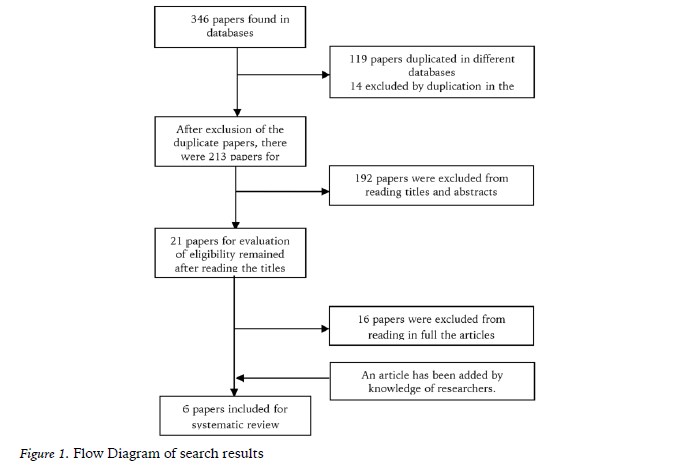
<body><![CDATA[<p>&nbsp;</p>     <p><font size="3" face="Verdana"><b><b>RESULTS</b></b></font></p> <font face="Verdana" size="2">     <p><i>Study Overview</i></p>     <p>The organization   and selection of studies was careful and respected the process that can be observed in <a href="/img/revistas/mot/v13s1/13s1a08f1.jpg">Figure 1</a>. </p>     
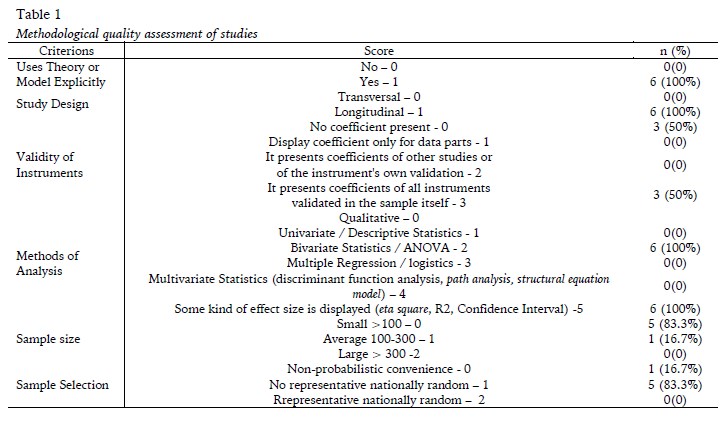
<p>The   methodological quality of the studies was evaluated by the scale proposed by   Goodson, Buhi, and Dunsmore (2006) adapted by Spessato (2012). The studies   presented an average of 9.5 points out of a total of 14. In the study design,   in the use of theory or model, and in the methods of analysis, 100% of the studies had a maximum score (<a href="/img/revistas/mot/v13s1/13s1a08t1.jpg">Table 1</a>). </p>     
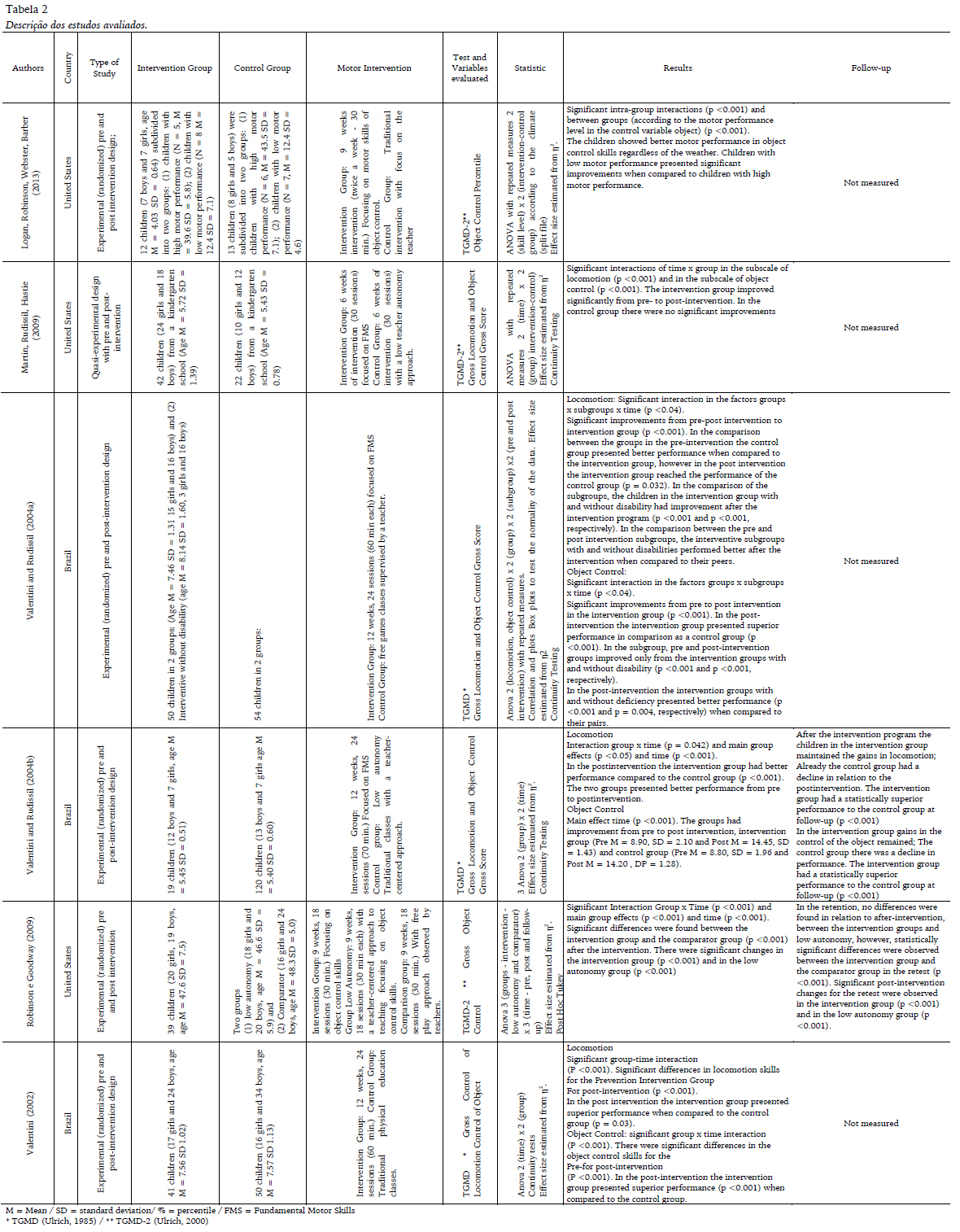
<p><i>Characteristics of Studies and Participants</i></p>     <p>From the 6   articles analysed, 4 were conducted in the United States (Logan et al., 2013,   Martin et al., 2009, Robinson &amp; Goodway, 2009) and 2 were carried out in   Brazil (Valentini &amp; Rudisill, 2004a, 2004b; Valentine, 2002). In relation   to the methodological design, five studies were characterized as experimental   (randomized) with a pre and post-intervention design with group control (Logan   et al., 2013, Robinson &amp; Goodway, 2009; Valentini &amp; Rudisill, 2004a,   2004b; Valentine, 2002); a study was characterized as quasi-experimental with   group control (Martin et al., 2009). The children in the studies were between   four and 10 years old, in one study, children in a subgroup of intervention and   control had physical and cognitive deficits (Valentini &amp; Rudisill, 2004b),   in the other studies the children had a typical development (Logan et al.,   2013; Martin et al., 2009; Robinson &amp; Goodway 2009; Valentini, 2002;   Valentine &amp; Rudisill, 2004a). All studies selected children according to   motor performance, children with delays were included in the research, after   that stage the children were randomized, except for the study by Martin et al.   (2009) in intervention and control groups. The characteristics of the Studies are described in <a href="/img/revistas/mot/v13s1/13s1a08t2.jpg">Table 2</a>. </p>     
<p><i>Characteristics of Motor Interventions</i></p>     <p>In all studies, the intervention   groups were submitted to motor intervention programs using the Motivation   Climate for Mastery with the TARGET structure for the design of strategy in the   classroom dimensions (Logan et al., 2013; Martin et al., 2009; Robinson &amp;   Goodway, 2009; Valentini &amp; Rudisill, 2004a, 2004b; Valentini, 2002). In the   studies by Valentini (2002), Valentini &amp; Rudisill (2004a) and Valentini   &amp; Rudisill, (2004b) the interventions were conducted in 12 weeks with 24   class sessions lasting between 60 and 70 minutes. In the study by Logan et al.   (2013) the intervention lasted nine weeks with 18 sessions lasting 30 minutes;   in the study by Martin et al. (2009) were 30 sessions in five weeks and in the   study by Robinson &amp; Goodway (2009) were 18 sessions in nine weeks with an   average duration of 30 minutes. All interventions were conducted by experienced   physical education teachers or by the researchers themselves with the assistance of trainees.</p>     <p><i>Test Batteries, Variables and Statistical Procedures</i></p>     ]]></body>
<body><![CDATA[<p>In order to evaluate the   fundamental motor skills, three of the six studies used the Test of Gross Motor   Development (TGMD) first edition (Valentini &amp; Rudisill, 2004a,   2004b; Valentini, 2002) and three used the second version of TGMD-2 (Logan et   al., 2013; Martin et al., 2009; Robinson &amp; Goodway, 2009). In the studies   of Logan et al. (2013) and Robinson and Goodway (2009) were evaluated only the   impact of intervention on the percentile and gross object control score,   respectively. The other studies evaluated the impact on gross locomotion and   object control scores. Regarding statistical procedures, all the studies used ANOVA   with repeated measures in the time factor and comparisons between groups and subgroups. The size of the effect was estimated through the partial eta (&#8131;<sup>2</sup>).</p>     <p><i>Impact of interventions on locomotion and object control skills</i></p>     <p>The studies that evaluated the impact   of motor intervention based on motivation climate for mastery reported a   significant effect of the program on locomotion and object control skills in   the children who participated in the intervention (Logan et al., 2013; Martin   et al., 2009; Robinson &amp; Goodway, 2009; Valentini &amp; Rudisill, 2004a,   2004b; Valentini, 2002). From six studies   four evaluated the impact of the intervention on locomotion skills and object   control (Martin et al., 2009; Valentini &amp; Rudisill, 2004a, 2004b;   Valentini, 2002), studies by Robinson and Goodway (2009) and Logan et al.   (2013) evaluated only the impact of the intervention on object control skills.   It is noteworthy that in the latter similar study changes resulting from the intervention program were reported in the intervention and group control. </p>     <p>Only two studies evaluated   the impact of the intervention at other times (follow-up). The study by   Valentini and Rudisill (2004b) reported that gains from intervention in   locomotion and object control skills were maintained after six months in the   intervention group. In the group control there was no change from pre to post   intervention after this period and performance was similar to pre and post test   performance. The study by Robinson and Goodway (2009) reported that in the follow-up   were found significant improvements in the gross locomotion score in the children of the intervention group and the low-autonomy group.</p> </font>     <p>&nbsp;</p>     <p><font size="3" face="Verdana"><b><b>DISCUSSION</b></b></font></p> <font face="Verdana" size="2">     <p>The aim of this systematic review was   to synthesize the evidences on the impact of motor interventions with the   Motivation Climate for Mastery in the motor skills of locomotion and object   control of children. The strategies used in the Motivation Climate for Mastery   lead children to a motivating and challenging environment, experiencing   diversified activities with different levels of difficulty, the child has   autonomy to choose its tasks, is recognized by the efforts, works in groups and   has strategies of self-evaluation. All these strategies of the Motivation   Climate for Mastery allow meaningful and contextualized learning (Ames &amp; Bell, 1990; Ames, 1992).</p>     <p>When the child has significant   learning, persistence in motor activities and adequate perceived competence are   guaranteed (Kirk, 2005; Valentini &amp; Rudisill, 2004a, 2004b; Valentini,   2002). Following the methodological proposal implemented in the reviewed   studies, the more the child performs an activity in a varied way, the more   competent it can become; even more, if she is aware that success in the task   depends on her work, the possible failures are perceived as an impulse to work   harder (Valentini, 2002; Valentini &amp; Rudisill, 2004a, 2004b). The feeling   of competence can be strengthened when the child is faced with moderate levels   of challenges, which with effort can overcome; perceive itself competent, therefore,   it is possible when performing tasks with the objective of self-overcoming   (Píffero &amp; Valentini, 2010) factors that contribute to achieving motor proficiency.</p>     <p>It is fundamental that children   achieve motor proficiency at the appropriate age. All studies reviewed reported   improvement in scores or percentiles of locomotion and object control skills in   children undergoing motor intervention. These results are consistent and follow   a positive trend of studies that used the Motivation Climate for Mastery as an   interventional approach that have generated positive impact, such as increased   physical activity levels (Wadsworth, Robinson, Rudisill, &amp; Getchell, 2013);   improvement in eating habits and more controlled physical activity practices   (Papaioannou, Milosis, Kosmidou, &amp; Tsigilis, 2007) strengthening the   perception of competence (Valentini &amp; Rudisill, 2004a); greater proficiency   in specialized tennis skills (Píffero &amp; Valentini, 2010), decreased anxiety   (Barkoukis, Tsorbatzoudis, &amp; Grouios, 2008); and more frequent use of competitive athletic learning strategies (Morgan &amp; Carpenter, 2002).</p>     <p>However, few studies are devoted to   investigating the gains of motor intervention after the period of its   implementation. Of all the studies reviewed, only two studies investigated   whether gains were maintained over time after the end of the (follow-up)   (Robinson &amp; Goodway, 2009; Valentini &amp; Rudisill, 2004b). In the study   by Robinson and Goodway (2009) the gains from the intervention group remained   in the follow-up, however the post-follow-up interval was only one week,   considered a relatively short time to check changes in movement patterns. The   study by (Valentini &amp; Rudisill, 2004b) re-evaluated the children who   participated in the intervention and group control. The authors reported that   even after six months the gains from the intervention were still present in the   intervention group. This information allows us to better understand the effects   of this Climate of Motivation over time which probably has generated in children   greater meanings in the skills learned. But little is known whether these gains remain and evolve over time.</p>     ]]></body>
<body><![CDATA[<p>Of the six studies, only one,   conducted motor intervention in a school environment (Martin et al., 2009), but   only in six weeks, a shorter period than other interventions and different from   the school curriculum. All other studies implemented programs in other   contexts, this information indicates the need for studies that investigate the   effectiveness of the Motivation Climate for Mastery in the regular school   physical education classes and with a duration that is closer to this school   reality. Teachers nowadays facing a growing need to implement educational   contexts that accommodate a wide variety of children who have different levels   of development in the same group. The Motivation Climate for Mastery is an   alternative that leads all learners to engage in the learning process and builds effective perspectives to meet the needs of all children.</p>     <p>None of the interventions reported the   time of practice and engagement of children in fundamental motor skills, this   information would be important since some theories of motor development   indicate that one of the central points of development is related to engagement   (Robinson et al., 2015; Silverman, 1991) Interventions from the reviewed   studies lasted from six to 12 weeks, suggesting the need for longer   interventions that go along with development of the children for a longer period as well.</p>     <p>All interventions assessed total   scores or percentiles of total scores on locomotion and object control skills,   and no assessed study investigated the impact of interventions on specific   motor skills (running, galloping, jumping, kicking, throwing, bouncing,   receiving the ball). This information would be important for teachers and   researchers to plan interventions based on the most difficult skills and in the   future, it would be important for the Physical Education area to plan a curriculum based on age, gender and level of development.</p> </font>     <p>&nbsp;</p>     <p><font face="Verdana"><b><b>CONCLUSION</b></b></font></p> <font face="Verdana" size="2">     <p>The motivational climate for mastery is an efficient   methodological proposal of teaching to promote the motor skills of locomotion   and control of objects in children with motor delays. The following highlights the strengths, limitations of the study and implications for practice.</p> <b><b>Limitations</b></b>      <p>It were not   evaluated other variables related to motor skills, such as the perception of competence, level of physical activity and nutritional status</p>     <p><b><b>Implications for practice</b></b></p>     <p>Assess   specifically the impact of interventions in motor skills not only the total   scores or percentages of the total scores of locomotion and control of object;   Assess the impact of the intervention over time, and to evaluate whether   children proficient remain engaged in physical activities and sports; To   include parents in motor interventions; Implement motor intervention programs in school contexts and with a greater period of time.</p> </font>     <p>&nbsp;</p>     ]]></body>
<body><![CDATA[<p><font size="3" face="Verdana"><b><b>REFERENCES</b></b></font></p> <font face="Verdana" size="2">     <!-- ref --><p>Ames, A., &amp; Bell, H. (1990).   Motivation: What Teachers Need to Know, <i>91</i>(3). <i>Teachers College Record</i>, 409-421.    &nbsp;&nbsp;&nbsp;&nbsp;&nbsp;&nbsp;&nbsp;&nbsp;[&#160;<a href="javascript:void(0);" onclick="javascript: window.open('/scielo.php?script=sci_nlinks&ref=371767&pid=S1646-107X201700060000800001&lng=','','width=640,height=500,resizable=yes,scrollbars=1,menubar=yes,');">Links</a>&#160;]<!-- end-ref --></p>     <!-- ref --><p>Ames, C. (1992). Achievement goals and   classroom motivacional climate. In J. Meece &amp; D. Schunk (Eds.), <i>Students perceptions in the classroom</i>. Hillsdale, NJ: Erlbaum, 327-348.    &nbsp;&nbsp;&nbsp;&nbsp;&nbsp;&nbsp;&nbsp;&nbsp;[&#160;<a href="javascript:void(0);" onclick="javascript: window.open('/scielo.php?script=sci_nlinks&ref=371769&pid=S1646-107X201700060000800002&lng=','','width=640,height=500,resizable=yes,scrollbars=1,menubar=yes,');">Links</a>&#160;]<!-- end-ref --></p>     <!-- ref --><p>Barkoukis, V., Tsorbatzoudis, H.,   &amp; Grouios, G. (2008). Construct validity of the physical Education State   Anxiety Scale: a multitrait-multimethod approach. <i>Perceptual And Motor Skills</i>, <i>107</i>(3), 651–662.    &nbsp;&nbsp;&nbsp;&nbsp;&nbsp;&nbsp;&nbsp;&nbsp;[&#160;<a href="javascript:void(0);" onclick="javascript: window.open('/scielo.php?script=sci_nlinks&ref=371771&pid=S1646-107X201700060000800003&lng=','','width=640,height=500,resizable=yes,scrollbars=1,menubar=yes,');">Links</a>&#160;]<!-- end-ref --></p>     <!-- ref --><p>Barnett, L. M., Van Beurden, E.,   Morgan, P. J., Brooks, L. O., &amp; Beard, J. R. (2008). Does childhood motor   skill proficiency predict adolescent fitness? <i>Medicine and Science in Sports and Exercise</i>, <i>40</i>(12), 2137–2144. <a href="http://doi.org/10.1249/MSS.0b013e31818160d3" target="_blank">http://doi.org/10.1249/MSS.0b013e31818160d3</a>&nbsp;&nbsp;&nbsp;&nbsp;&nbsp;&nbsp;&nbsp;&nbsp;[&#160;<a href="javascript:void(0);" onclick="javascript: window.open('/scielo.php?script=sci_nlinks&ref=371773&pid=S1646-107X201700060000800004&lng=','','width=640,height=500,resizable=yes,scrollbars=1,menubar=yes,');">Links</a>&#160;]<!-- end-ref --><!-- ref --><p>Clark, J. E., &amp; Metcalfe, J. S.   (2002). A montanha do desenvolvimento motor -   Jane Clark. <i>Motor Development: Research and Reviews</i>, <i>2</i>, 163–190.    &nbsp;&nbsp;&nbsp;&nbsp;&nbsp;&nbsp;&nbsp;&nbsp;[&#160;<a href="javascript:void(0);" onclick="javascript: window.open('/scielo.php?script=sci_nlinks&ref=371774&pid=S1646-107X201700060000800005&lng=','','width=640,height=500,resizable=yes,scrollbars=1,menubar=yes,');">Links</a>&#160;]<!-- end-ref --></p>     ]]></body>
<body><![CDATA[<!-- ref --><p>Draper, C. E., Achmat, M., Forbes,   J., &amp; Lambert, E. V. (2012). Impact of a community-based programme for   motor development on gross motor skills and cognitive function in preschool   children from disadvantaged settings. <i>Early Child Development and Care</i>, <i>182</i>(1), 137–152. <a href="http://doi.org/10.1080/03004430.2010.547250" target="_blank">http://doi.org/10.1080/03004430.2010.547250</a>&nbsp;&nbsp;&nbsp;&nbsp;&nbsp;&nbsp;&nbsp;&nbsp;[&#160;<a href="javascript:void(0);" onclick="javascript: window.open('/scielo.php?script=sci_nlinks&ref=371776&pid=S1646-107X201700060000800006&lng=','','width=640,height=500,resizable=yes,scrollbars=1,menubar=yes,');">Links</a>&#160;]<!-- end-ref --><!-- ref --><p>Gallahue, D. L., Ozmun, J. C., &amp; Goodway, J. D.   (2013). <i>Compreendendo o Desenvolvimento Motor: Bebês,     Crianças, Adolescentes e Adultos</i> (7<sup>a</sup> Ed.). Porto Alegre: ARTMED.    &nbsp;&nbsp;&nbsp;&nbsp;&nbsp;&nbsp;&nbsp;&nbsp;[&#160;<a href="javascript:void(0);" onclick="javascript: window.open('/scielo.php?script=sci_nlinks&ref=371777&pid=S1646-107X201700060000800007&lng=','','width=640,height=500,resizable=yes,scrollbars=1,menubar=yes,');">Links</a>&#160;]<!-- end-ref --></p>     <!-- ref --><p>Goodson, P., Buhi, E. R., &amp;   Dunsmore, S. C. (2006). Self-esteem and adolescent sexual behaviors, attitudes,   and intentions: a systematic review. <i>The Journal of Adolescent Health:     Official Publication of the Society for Adolescent Medicine</i>, <i>38</i>(3), 310–9. <a href="http://doi.org/10.1016/j.jadohealth.2005.05.026" target="_blank">http://doi.org/10.1016/j.jadohealth.2005.05.026</a>&nbsp;&nbsp;&nbsp;&nbsp;&nbsp;&nbsp;&nbsp;&nbsp;[&#160;<a href="javascript:void(0);" onclick="javascript: window.open('/scielo.php?script=sci_nlinks&ref=371779&pid=S1646-107X201700060000800008&lng=','','width=640,height=500,resizable=yes,scrollbars=1,menubar=yes,');">Links</a>&#160;]<!-- end-ref --><!-- ref --><p>Goodway, J. D., Robinson, L. E., &amp;   Crowe, H. (2010). Gender differences in fundamental motor skill development in   disadvantaged preschoolers from two geographical regions. <i>Research Quartely for Exercise and Sport</i>, <i>81</i>(1), 17–24.    &nbsp;&nbsp;&nbsp;&nbsp;&nbsp;&nbsp;&nbsp;&nbsp;[&#160;<a href="javascript:void(0);" onclick="javascript: window.open('/scielo.php?script=sci_nlinks&ref=371780&pid=S1646-107X201700060000800009&lng=','','width=640,height=500,resizable=yes,scrollbars=1,menubar=yes,');">Links</a>&#160;]<!-- end-ref --></p>     <!-- ref --><p>Hardy, L. L., King, L., Espinel, P.,   Okely, A. D., &amp; Bauman, A. (2011). Methods of the NSW schools physical   activity and nutrition survey 2010 (SPANS 2010). <i>Journal of Science and Medicine in Sport</i>, <i>14</i>(5), 390–396. <a href="http://doi.org/10.1016/j.jsams.2011.03.003" target="_blank">http://doi.org/10.1016/j.jsams.2011.03.003</a>&nbsp;&nbsp;&nbsp;&nbsp;&nbsp;&nbsp;&nbsp;&nbsp;[&#160;<a href="javascript:void(0);" onclick="javascript: window.open('/scielo.php?script=sci_nlinks&ref=371782&pid=S1646-107X201700060000800010&lng=','','width=640,height=500,resizable=yes,scrollbars=1,menubar=yes,');">Links</a>&#160;]<!-- end-ref --><!-- ref --><p>Kirk, D. (2005). Physical education,   youth sport and lifelong participation: the importance of early learning experiences. <i>European Physical Education Review</i>, <i>11</i>(3), 239–255. <a href="http://doi.org/10.1177/1356336X05056649" target="_blank">http://doi.org/10.1177/1356336X05056649</a>&nbsp;&nbsp;&nbsp;&nbsp;&nbsp;&nbsp;&nbsp;&nbsp;[&#160;<a href="javascript:void(0);" onclick="javascript: window.open('/scielo.php?script=sci_nlinks&ref=371783&pid=S1646-107X201700060000800011&lng=','','width=640,height=500,resizable=yes,scrollbars=1,menubar=yes,');">Links</a>&#160;]<!-- end-ref --><!-- ref --><p>Larouche, R., Boyer, C., Tremblay, S.   M., &amp; Longmuir, P. (2013). Physical fitness, motor skill and physical   activity relationships in Grade 4 to 6 children. <i>Applied Physiology, Nutrition, and Metabolism</i>, <i>39</i>(5), 553–559.    &nbsp;&nbsp;&nbsp;&nbsp;&nbsp;&nbsp;&nbsp;&nbsp;[&#160;<a href="javascript:void(0);" onclick="javascript: window.open('/scielo.php?script=sci_nlinks&ref=371784&pid=S1646-107X201700060000800012&lng=','','width=640,height=500,resizable=yes,scrollbars=1,menubar=yes,');">Links</a>&#160;]<!-- end-ref --></p>     ]]></body>
<body><![CDATA[<!-- ref --><p>Laukkanen, A., Pesola, A., Havu, M.,   Sääkslahti, A., &amp; Finni, T. (2014). Relationship between habitual physical   activity and gross motor skills is multifaceted in 5 to 8-year-old children. <i>Scandinavian Journal of Medicine and Science in Sports</i>, <i>24</i>(2), 102–111. <a href="http://doi.org/10.1111/sms.12116" target="_blank">http://doi.org/10.1111/sms.12116</a>&nbsp;&nbsp;&nbsp;&nbsp;&nbsp;&nbsp;&nbsp;&nbsp;[&#160;<a href="javascript:void(0);" onclick="javascript: window.open('/scielo.php?script=sci_nlinks&ref=371786&pid=S1646-107X201700060000800013&lng=','','width=640,height=500,resizable=yes,scrollbars=1,menubar=yes,');">Links</a>&#160;]<!-- end-ref --><!-- ref --><p>LeGear, M., Greyling, L., Sloan, E.,   Bell, R. I., Williams, B. L., Naylor, P. J., &amp; Temple, V. a. (2012). A   window of opportunity? Motor skills and perceptions of competence of children   in Kindergarten. <i>International Journal of Behavioral Nutrition and Physical Activity</i>, <i>9</i>(1), 29. <a href="http://doi.org/10.1186/1479-5868-9-29" target="_blank">http://doi.org/10.1186/1479-5868-9-29</a>&nbsp;&nbsp;&nbsp;&nbsp;&nbsp;&nbsp;&nbsp;&nbsp;[&#160;<a href="javascript:void(0);" onclick="javascript: window.open('/scielo.php?script=sci_nlinks&ref=371787&pid=S1646-107X201700060000800014&lng=','','width=640,height=500,resizable=yes,scrollbars=1,menubar=yes,');">Links</a>&#160;]<!-- end-ref --><!-- ref --><p>Lloyd, M., Saunders, T. J., Bremer,   E., &amp; Tremblay, M. S. (2014). Long-term importance of fundamental motor   skills: A 20-year follow-up study. <i>Adapted Physical Activity Quarterly</i>, <i>31</i>(1), 67–78. <a href="http://doi.org/10.1123/apaq.2013-0048" target="_blank">http://doi.org/10.1123/apaq.2013-0048</a>&nbsp;&nbsp;&nbsp;&nbsp;&nbsp;&nbsp;&nbsp;&nbsp;[&#160;<a href="javascript:void(0);" onclick="javascript: window.open('/scielo.php?script=sci_nlinks&ref=371788&pid=S1646-107X201700060000800015&lng=','','width=640,height=500,resizable=yes,scrollbars=1,menubar=yes,');">Links</a>&#160;]<!-- end-ref --><!-- ref --><p>Logan, S., Robinson, L., Webster, E.   K., &amp; Barber, L. (2013). Exploring preschoolers’ engagement and perceived   physical competence in an autonomy-based object control skill intervention: A   preliminary study. <i>European Physical Education Review</i>, <i>19</i>(3), 302–314. <a href="http://doi.org/10.1177/1356336X13495627" target="_blank">http://doi.org/10.1177/1356336X13495627</a>&nbsp;&nbsp;&nbsp;&nbsp;&nbsp;&nbsp;&nbsp;&nbsp;[&#160;<a href="javascript:void(0);" onclick="javascript: window.open('/scielo.php?script=sci_nlinks&ref=371789&pid=S1646-107X201700060000800016&lng=','','width=640,height=500,resizable=yes,scrollbars=1,menubar=yes,');">Links</a>&#160;]<!-- end-ref --><!-- ref --><p>Lubans, D. R., Morgan, P. J., Cliff,   D. P., Barnett, L. M., &amp; Okely, A. D. (2010). Fundamental movement skills   in children and adolescents: Review of associated health benefits. <i>Sports Medicine</i>, <i>40</i>(12), 1019–1035. <a href="http://doi.org/10.2165/11536850-000000000-00000" target="_blank">http://doi.org/10.2165/11536850-000000000-00000</a>&nbsp;&nbsp;&nbsp;&nbsp;&nbsp;&nbsp;&nbsp;&nbsp;[&#160;<a href="javascript:void(0);" onclick="javascript: window.open('/scielo.php?script=sci_nlinks&ref=371790&pid=S1646-107X201700060000800017&lng=','','width=640,height=500,resizable=yes,scrollbars=1,menubar=yes,');">Links</a>&#160;]<!-- end-ref --><!-- ref --><p>Martin, E. H., Rudisill, M. E., &amp;   Hastie, P. A. (2009). Motivational climate and fundamental motor skill   performance in a naturalistic physical education setting. <i>Physical Education and Sport Pedagogy</i>, <i>14</i>(3), 227–240.    &nbsp;&nbsp;&nbsp;&nbsp;&nbsp;&nbsp;&nbsp;&nbsp;[&#160;<a href="javascript:void(0);" onclick="javascript: window.open('/scielo.php?script=sci_nlinks&ref=371791&pid=S1646-107X201700060000800018&lng=','','width=640,height=500,resizable=yes,scrollbars=1,menubar=yes,');">Links</a>&#160;]<!-- end-ref --></p>     <!-- ref --><p>Moher, D., Liberati, A., Tetzlaff, J.,   Altman, D. G., &amp; Grp, P. (2009). Preferred Reporting Items for Systematic   Reviews and Meta-Analyses: The PRISMA Statement (Reprinted from Annals of Internal Medicine). <i>Physical Therapy</i>, <i>89</i>(9), 873–880. <a href="http://doi.org/10.1371/journal.pmed.1000097" target="_blank">http://doi.org/10.1371/journal.pmed.1000097</a>&nbsp;&nbsp;&nbsp;&nbsp;&nbsp;&nbsp;&nbsp;&nbsp;[&#160;<a href="javascript:void(0);" onclick="javascript: window.open('/scielo.php?script=sci_nlinks&ref=371793&pid=S1646-107X201700060000800019&lng=','','width=640,height=500,resizable=yes,scrollbars=1,menubar=yes,');">Links</a>&#160;]<!-- end-ref --><!-- ref --><p>Morgan, K., &amp; Carpenter, P.   (2002). Effects of manipulating the motivational climate in physical education lessons. <i>European Physical Education Review</i>, <i>8</i>(3), 207–229.    &nbsp;&nbsp;&nbsp;&nbsp;&nbsp;&nbsp;&nbsp;&nbsp;[&#160;<a href="javascript:void(0);" onclick="javascript: window.open('/scielo.php?script=sci_nlinks&ref=371794&pid=S1646-107X201700060000800020&lng=','','width=640,height=500,resizable=yes,scrollbars=1,menubar=yes,');">Links</a>&#160;]<!-- end-ref --></p>     ]]></body>
<body><![CDATA[<!-- ref --><p>Morgan, P. J., Barnett, L. M., Cliff,   D. P., Okely, A. D., Scott, H. A., Cohen, K. E., &amp; Lubans, D. R. (2013).   Fundamental Movement Skill Interventions in Youth: A Systematic Review and Meta-analysis. <i>Pediatrics</i>, <i>132</i>(5), e1361–e1383. <a href="http://doi.org/10.1542/peds.2013-1167" target="_blank">http://doi.org/10.1542/peds.2013-1167</a>&nbsp;&nbsp;&nbsp;&nbsp;&nbsp;&nbsp;&nbsp;&nbsp;[&#160;<a href="javascript:void(0);" onclick="javascript: window.open('/scielo.php?script=sci_nlinks&ref=371796&pid=S1646-107X201700060000800021&lng=','','width=640,height=500,resizable=yes,scrollbars=1,menubar=yes,');">Links</a>&#160;]<!-- end-ref --><!-- ref --><p>Myer, G. D., Faigenbaum, A. D.,   Edwards, N. M., Clark, J. F., Best, T. M., &amp; Sallis, R. E. (2015). Sixty   minutes of what? A developing brain perspective for activating children with an integrative exercise approach. <i>British Journal of Sports Medicine</i>, 1–9. <a href="http://doi.org/10.1136/bjsports-2014-093661" target="_blank">http://doi.org/10.1136/bjsports-2014-093661</a>&nbsp;&nbsp;&nbsp;&nbsp;&nbsp;&nbsp;&nbsp;&nbsp;[&#160;<a href="javascript:void(0);" onclick="javascript: window.open('/scielo.php?script=sci_nlinks&ref=371797&pid=S1646-107X201700060000800022&lng=','','width=640,height=500,resizable=yes,scrollbars=1,menubar=yes,');">Links</a>&#160;]<!-- end-ref --><!-- ref --><p>Papaioannou, A. G., Milosis, D.,   Kosmidou, E., &amp; Tsigilis, N. (2007). Motivational Climate and Achievement   Goals at the Situational Level of Generality. <i>Journal of Applied Sport Psychology</i>, <i>19</i>(1), 38–66. <a href="http://doi.org/10.1080/10413200601113778" target="_blank">http://doi.org/10.1080/10413200601113778</a>&nbsp;&nbsp;&nbsp;&nbsp;&nbsp;&nbsp;&nbsp;&nbsp;[&#160;<a href="javascript:void(0);" onclick="javascript: window.open('/scielo.php?script=sci_nlinks&ref=371798&pid=S1646-107X201700060000800023&lng=','','width=640,height=500,resizable=yes,scrollbars=1,menubar=yes,');">Links</a>&#160;]<!-- end-ref --><!-- ref --><p>Píffero, C. M., &amp; Valentini, N. C.   (2010). Habilidades especializadas do tênis&#8239;: um estudo de intervenção na iniciação esportiva com crianças   escolares. <i>Rev. Bras. Fís.     Esporte</i>, <i>24</i>(2), 149–163.    &nbsp;&nbsp;&nbsp;&nbsp;&nbsp;&nbsp;&nbsp;&nbsp;[&#160;<a href="javascript:void(0);" onclick="javascript: window.open('/scielo.php?script=sci_nlinks&ref=371799&pid=S1646-107X201700060000800024&lng=','','width=640,height=500,resizable=yes,scrollbars=1,menubar=yes,');">Links</a>&#160;]<!-- end-ref --></p>     <!-- ref --><p>Riethmuller, A. M., Jones, R. A.,   &amp; Okely, A. D. (2009). Efficacy of Interventions to Improve Motor   Development in Young Children: A Systematic Review. <i>Pediatrics</i>, <i>124</i>(4), e782-792. <a href="http://doi.org/10.1542/peds.2009-0333" target="_blank">http://doi.org/10.1542/peds.2009-0333</a>&nbsp;&nbsp;&nbsp;&nbsp;&nbsp;&nbsp;&nbsp;&nbsp;[&#160;<a href="javascript:void(0);" onclick="javascript: window.open('/scielo.php?script=sci_nlinks&ref=371801&pid=S1646-107X201700060000800025&lng=','','width=640,height=500,resizable=yes,scrollbars=1,menubar=yes,');">Links</a>&#160;]<!-- end-ref --><!-- ref --><p>Robinson, L. E., &amp; Goodway, J. D.   (2009). Instructional climates in preschool children who are at-risk. Part I:   object-control skill development. <i>Research Quarterly for Exercise and Sport</i>, <i>80</i>(3), 533–542. <a href="https://doi.org/10.1080/02701367.2009.10599591" target="_blank">https://doi.org/10.1080/02701367.2009.10599591</a>.    &nbsp;&nbsp;&nbsp;&nbsp;&nbsp;&nbsp;&nbsp;&nbsp;[&#160;<a href="javascript:void(0);" onclick="javascript: window.open('/scielo.php?script=sci_nlinks&ref=371802&pid=S1646-107X201700060000800026&lng=','','width=640,height=500,resizable=yes,scrollbars=1,menubar=yes,');">Links</a>&#160;]<!-- end-ref --></p>     <!-- ref --><p> Robinson, L. E., Stodden, D. F., Barnett, L.   M., Lopes, V. P., Logan, S. W., Rodrigues, L. P., &amp; D’Hondt, E. (2015).   Motor Competence and its Effect on Positive Developmental Trajectories of Health. <i>Sports Medicine</i>, <i>45</i>(9), 1273–1284. <a href="http://doi.org/10.1007/s40279-015-0351-6" target="_blank">http://doi.org/10.1007/s40279-015-0351-6</a>&nbsp;&nbsp;&nbsp;&nbsp;&nbsp;&nbsp;&nbsp;&nbsp;[&#160;<a href="javascript:void(0);" onclick="javascript: window.open('/scielo.php?script=sci_nlinks&ref=371804&pid=S1646-107X201700060000800027&lng=','','width=640,height=500,resizable=yes,scrollbars=1,menubar=yes,');">Links</a>&#160;]<!-- end-ref --><!-- ref --><p>Silverman, S. (1991). Research on   teaching in physical education. <i>Research     Quarterly for Exercise and Sport</i>, <i>62</i>(4), 352–364.    &nbsp;&nbsp;&nbsp;&nbsp;&nbsp;&nbsp;&nbsp;&nbsp;[&#160;<a href="javascript:void(0);" onclick="javascript: window.open('/scielo.php?script=sci_nlinks&ref=371805&pid=S1646-107X201700060000800028&lng=','','width=640,height=500,resizable=yes,scrollbars=1,menubar=yes,');">Links</a>&#160;]<!-- end-ref --></p>     <!-- ref --><p>Spessato,   B. C. (2012). <i>Competencia motora, atividade fisica e percepcao de     competencia: Uma relacao que se fortalece ao longo da infancia </i>(Tese de Doutoramento). Universidade Federal do Rio Grande do Sul, Porto Alegre.    &nbsp;&nbsp;&nbsp;&nbsp;&nbsp;&nbsp;&nbsp;&nbsp;[&#160;<a href="javascript:void(0);" onclick="javascript: window.open('/scielo.php?script=sci_nlinks&ref=371807&pid=S1646-107X201700060000800029&lng=','','width=640,height=500,resizable=yes,scrollbars=1,menubar=yes,');">Links</a>&#160;]<!-- end-ref --></p>     <!-- ref --><p>Spessato, B. C., Gabbard, C., Valentini,   N., &amp; Rudisill, M. (2013). Gender differences in Brazilian children’s fundamental   movement skill performance. <i>Early Child Development and Care</i>, <i>183</i>(7), 916–923. <a href="http://doi.org/10.1080/03004430.2012.689761" target="_blank">http://doi.org/10.1080/03004430.2012.689761</a>&nbsp;&nbsp;&nbsp;&nbsp;&nbsp;&nbsp;&nbsp;&nbsp;[&#160;<a href="javascript:void(0);" onclick="javascript: window.open('/scielo.php?script=sci_nlinks&ref=371809&pid=S1646-107X201700060000800030&lng=','','width=640,height=500,resizable=yes,scrollbars=1,menubar=yes,');">Links</a>&#160;]<!-- end-ref --><!-- ref --><p>Stodden, D. F., Goodway, J. D.,   Langendorfer, S. J., Roberton, M. A., Rudisill, M. E., Garcia, C., &amp;   Garcia, L. E. (2008). A Developmental Perspective on the Role of Motor Skill   Competence in Physical Activity: An Emergent Relationship. <i>Quest</i>, <i>60</i>(2), 290–306. <a href="http://doi.org/10.1080/00336297.2008.10483582" target="_blank">http://doi.org/10.1080/00336297.2008.10483582</a>&nbsp;&nbsp;&nbsp;&nbsp;&nbsp;&nbsp;&nbsp;&nbsp;[&#160;<a href="javascript:void(0);" onclick="javascript: window.open('/scielo.php?script=sci_nlinks&ref=371810&pid=S1646-107X201700060000800031&lng=','','width=640,height=500,resizable=yes,scrollbars=1,menubar=yes,');">Links</a>&#160;]<!-- end-ref --><!-- ref --><p>Ulrich, D. A. (1985). <i>Test of Gross Motor Development, TGMD.</i> Austin: Prod-Ed.    &nbsp;&nbsp;&nbsp;&nbsp;&nbsp;&nbsp;&nbsp;&nbsp;[&#160;<a href="javascript:void(0);" onclick="javascript: window.open('/scielo.php?script=sci_nlinks&ref=371811&pid=S1646-107X201700060000800032&lng=','','width=640,height=500,resizable=yes,scrollbars=1,menubar=yes,');">Links</a>&#160;]<!-- end-ref --></p>     <!-- ref --><p>Ulrich, D. A. (2000). <i>Test of Gross Motor Development</i> (2ª Ed.). Austin: Prod-Ed.    &nbsp;&nbsp;&nbsp;&nbsp;&nbsp;&nbsp;&nbsp;&nbsp;[&#160;<a href="javascript:void(0);" onclick="javascript: window.open('/scielo.php?script=sci_nlinks&ref=371813&pid=S1646-107X201700060000800033&lng=','','width=640,height=500,resizable=yes,scrollbars=1,menubar=yes,');">Links</a>&#160;]<!-- end-ref --></p>     <!-- ref --><p>Valentini, N. C. (2002). A influência de uma intervenção motora no desempenho motor e   na percepção de competência de crianças com atrasos motores. <i>Revista Paulista de Educação Física</i>, <i>16</i>(1), 61–75.    &nbsp;&nbsp;&nbsp;&nbsp;&nbsp;&nbsp;&nbsp;&nbsp;[&#160;<a href="javascript:void(0);" onclick="javascript: window.open('/scielo.php?script=sci_nlinks&ref=371815&pid=S1646-107X201700060000800034&lng=','','width=640,height=500,resizable=yes,scrollbars=1,menubar=yes,');">Links</a>&#160;]<!-- end-ref --></p>     <!-- ref --><p>Valentini,   N. C. (2002). Influência e uma intervenção motora e desempenho motor e na   percepção de competência de crianças com atrasos motores. <i>Revista Paulista de Educação Física</i>, <i>16</i>(1), 61–75.    &nbsp;&nbsp;&nbsp;&nbsp;&nbsp;&nbsp;&nbsp;&nbsp;[&#160;<a href="javascript:void(0);" onclick="javascript: window.open('/scielo.php?script=sci_nlinks&ref=371817&pid=S1646-107X201700060000800035&lng=','','width=640,height=500,resizable=yes,scrollbars=1,menubar=yes,');">Links</a>&#160;]<!-- end-ref --></p>     <!-- ref --><p>Valentini,   N. C., &amp; Rudisill, M. E. (2004a). Effectiveness of an inclusive mastery climate intervention   on the motor skill development of children. <i>Adapted Physical Activity Quarterly</i>, <i>21</i>, 330–347.    &nbsp;&nbsp;&nbsp;&nbsp;&nbsp;&nbsp;&nbsp;&nbsp;[&#160;<a href="javascript:void(0);" onclick="javascript: window.open('/scielo.php?script=sci_nlinks&ref=371819&pid=S1646-107X201700060000800036&lng=','','width=640,height=500,resizable=yes,scrollbars=1,menubar=yes,');">Links</a>&#160;]<!-- end-ref --></p>     <!-- ref --><p>Valentini, N. C., &amp; Rudisill, M.   (2004b). Motivational Climate, Motor-Skill Development, and Perceived   Competence&#8239;: Two Studies of Developmentally Delayed Kindergarten Children. <i>Journal of Teaching in Physical Education</i>, <i>23</i>, 216–234.    &nbsp;&nbsp;&nbsp;&nbsp;&nbsp;&nbsp;&nbsp;&nbsp;[&#160;<a href="javascript:void(0);" onclick="javascript: window.open('/scielo.php?script=sci_nlinks&ref=371821&pid=S1646-107X201700060000800037&lng=','','width=640,height=500,resizable=yes,scrollbars=1,menubar=yes,');">Links</a>&#160;]<!-- end-ref --></p>     <!-- ref --><p>Valentini, N. C., Rudisill, M. E.,   &amp; Goodway, J. D. (1999a). Incorporating a mastery climate into physical   education&#8239;: It’s developmentally appropriate&#8239;! <i>Journal of Physical Education, Recreation &amp; Dance</i>, <i>70</i>(7), 28–33.    &nbsp;&nbsp;&nbsp;&nbsp;&nbsp;&nbsp;&nbsp;&nbsp;[&#160;<a href="javascript:void(0);" onclick="javascript: window.open('/scielo.php?script=sci_nlinks&ref=371823&pid=S1646-107X201700060000800038&lng=','','width=640,height=500,resizable=yes,scrollbars=1,menubar=yes,');">Links</a>&#160;]<!-- end-ref --></p>     <!-- ref --><p>Valentini, N. C., Rudisill, M. E.,   &amp; Goodway, J. D. (1999b). Mastery Climate: Children in Charge of their own learning. <i>Teaching Elementary Physical Education</i>, <i>10</i>, 6–10.    &nbsp;&nbsp;&nbsp;&nbsp;&nbsp;&nbsp;&nbsp;&nbsp;[&#160;<a href="javascript:void(0);" onclick="javascript: window.open('/scielo.php?script=sci_nlinks&ref=371825&pid=S1646-107X201700060000800039&lng=','','width=640,height=500,resizable=yes,scrollbars=1,menubar=yes,');">Links</a>&#160;]<!-- end-ref --></p>     <!-- ref --><p>Venetsanou, F., &amp; Kambas, A.   (2009). Environmental Factors Affecting Preschoolers’ Motor Development. <i>Early Childhood Education Journal</i>, <i>37</i>(4), 319–327. <a href="http://doi.org/10.1007/s10643-009-0350-z" target="_blank">http://doi.org/10.1007/s10643-009-0350-z</a>&nbsp;&nbsp;&nbsp;&nbsp;&nbsp;&nbsp;&nbsp;&nbsp;[&#160;<a href="javascript:void(0);" onclick="javascript: window.open('/scielo.php?script=sci_nlinks&ref=371827&pid=S1646-107X201700060000800040&lng=','','width=640,height=500,resizable=yes,scrollbars=1,menubar=yes,');">Links</a>&#160;]<!-- end-ref --><!-- ref --><p>Wadsworth, D. D., Robinson, L. E.,   Rudisill, M. E., &amp; Getchell, N. (2013). The Effect of Physical Education   Climates on Elementary Students’ Physical Activity. <i>Journal of School Health</i>, <i>83</i>(5), 306–313.    &nbsp;&nbsp;&nbsp;&nbsp;&nbsp;&nbsp;&nbsp;&nbsp;[&#160;<a href="javascript:void(0);" onclick="javascript: window.open('/scielo.php?script=sci_nlinks&ref=371828&pid=S1646-107X201700060000800041&lng=','','width=640,height=500,resizable=yes,scrollbars=1,menubar=yes,');">Links</a>&#160;]<!-- end-ref --> </p>     <p>&nbsp;</p>     <p><b>Acknowledgments:    <br> </b>Nothing to declare.    <br> <b>Conflict of interests:    <br> </b>Nothing to declare.    <br> <b>Funding:    ]]></body>
<body><![CDATA[<br> </b>This research was supported by CNPq and CAPES from the granting of scholarships to researchers.</p> </font>     <p>&nbsp;</p>     <p>&nbsp;</p>     <p><font face="Verdana" size="2"><a href="#top"><sup>*</sup></a><i><a name="end"></a></i></font>    <font size="2" face="Verdana"><i>Corresponding Author:   </i>Graduate Program in Human Movement Sciences (PPGCMH) of Federal University   of Rio Grande do Sul, Felizardo Street, 750, Jardim Botânico, 90690-200, Porto Alegre, Brazil. <i>Email: </i><a href="mailto:paulo.felipe@ufrgs.br">paulo.felipe@ufrgs.br</a></font></p>      ]]></body><back>
<ref-list>
<ref id="B1">
<nlm-citation citation-type="journal">
<person-group person-group-type="author">
<name>
<surname><![CDATA[Ames]]></surname>
<given-names><![CDATA[A.]]></given-names>
</name>
<name>
<surname><![CDATA[Bell]]></surname>
<given-names><![CDATA[H.]]></given-names>
</name>
</person-group>
<article-title xml:lang="en"><![CDATA[Motivation: What Teachers Need to Know]]></article-title>
<source><![CDATA[Teachers College Record]]></source>
<year>1990</year>
<volume>91</volume>
<numero>3</numero>
<issue>3</issue>
</nlm-citation>
</ref>
<ref id="B2">
<nlm-citation citation-type="book">
<person-group person-group-type="author">
<name>
<surname><![CDATA[Ames]]></surname>
<given-names><![CDATA[C.]]></given-names>
</name>
</person-group>
<article-title xml:lang="en"><![CDATA[Achievement goals and classroom motivacional climate]]></article-title>
<person-group person-group-type="editor">
<name>
<surname><![CDATA[Meece]]></surname>
<given-names><![CDATA[J.]]></given-names>
</name>
<name>
<surname><![CDATA[Schunk]]></surname>
<given-names><![CDATA[D.]]></given-names>
</name>
</person-group>
<source><![CDATA[Students perceptions in the classroom]]></source>
<year>1992</year>
<page-range>327-348</page-range><publisher-loc><![CDATA[Hillsdale^eNJ NJ]]></publisher-loc>
<publisher-name><![CDATA[Erlbaum]]></publisher-name>
</nlm-citation>
</ref>
<ref id="B3">
<nlm-citation citation-type="journal">
<person-group person-group-type="author">
<name>
<surname><![CDATA[Barkoukis]]></surname>
<given-names><![CDATA[V.]]></given-names>
</name>
<name>
<surname><![CDATA[Tsorbatzoudis]]></surname>
<given-names><![CDATA[H.]]></given-names>
</name>
<name>
<surname><![CDATA[Grouios]]></surname>
<given-names><![CDATA[G.]]></given-names>
</name>
</person-group>
<article-title xml:lang="en"><![CDATA[Construct validity of the physical Education State Anxiety Scale: a multitrait-multimethod approach]]></article-title>
<source><![CDATA[Perceptual And Motor Skills]]></source>
<year>2008</year>
<volume>107</volume>
<numero>3</numero>
<issue>3</issue>
<page-range>651-662</page-range></nlm-citation>
</ref>
<ref id="B4">
<nlm-citation citation-type="journal">
<person-group person-group-type="author">
<name>
<surname><![CDATA[Barnett]]></surname>
<given-names><![CDATA[L. M.]]></given-names>
</name>
<name>
<surname><![CDATA[Van Beurden]]></surname>
<given-names><![CDATA[E.]]></given-names>
</name>
<name>
<surname><![CDATA[Morgan]]></surname>
<given-names><![CDATA[P. J.]]></given-names>
</name>
<name>
<surname><![CDATA[Brooks]]></surname>
<given-names><![CDATA[L. O.]]></given-names>
</name>
<name>
<surname><![CDATA[Beard]]></surname>
<given-names><![CDATA[J. R.]]></given-names>
</name>
</person-group>
<article-title xml:lang="en"><![CDATA[Does childhood motor skill proficiency predict adolescent fitness?]]></article-title>
<source><![CDATA[Medicine and Science in Sports and Exercise]]></source>
<year>2008</year>
<volume>40</volume>
<numero>12</numero>
<issue>12</issue>
<page-range>2137-2144</page-range></nlm-citation>
</ref>
<ref id="B5">
<nlm-citation citation-type="journal">
<person-group person-group-type="author">
<name>
<surname><![CDATA[Clark]]></surname>
<given-names><![CDATA[J. E.]]></given-names>
</name>
<name>
<surname><![CDATA[Metcalfe]]></surname>
<given-names><![CDATA[J. S.]]></given-names>
</name>
</person-group>
<article-title xml:lang="pt"><![CDATA[A montanha do desenvolvimento motor: Jane Clark]]></article-title>
<source><![CDATA[Motor Development: Research and Reviews]]></source>
<year>2002</year>
<volume>2</volume>
<page-range>163-190</page-range></nlm-citation>
</ref>
<ref id="B6">
<nlm-citation citation-type="journal">
<person-group person-group-type="author">
<name>
<surname><![CDATA[Draper]]></surname>
<given-names><![CDATA[C. E.]]></given-names>
</name>
<name>
<surname><![CDATA[Achmat]]></surname>
<given-names><![CDATA[M.]]></given-names>
</name>
<name>
<surname><![CDATA[Forbes]]></surname>
<given-names><![CDATA[J.]]></given-names>
</name>
<name>
<surname><![CDATA[Lambert]]></surname>
<given-names><![CDATA[E. V.]]></given-names>
</name>
</person-group>
<article-title xml:lang="en"><![CDATA[Impact of a community-based programme for motor development on gross motor skills and cognitive function in preschool children from disadvantaged settings]]></article-title>
<source><![CDATA[Early Child Development and Care]]></source>
<year>2012</year>
<volume>182</volume>
<numero>1</numero>
<issue>1</issue>
<page-range>137-152</page-range></nlm-citation>
</ref>
<ref id="B7">
<nlm-citation citation-type="book">
<person-group person-group-type="author">
<name>
<surname><![CDATA[Gallahue]]></surname>
<given-names><![CDATA[D. L.]]></given-names>
</name>
<name>
<surname><![CDATA[Ozmun]]></surname>
<given-names><![CDATA[J. C.]]></given-names>
</name>
<name>
<surname><![CDATA[Goodway]]></surname>
<given-names><![CDATA[J. D.]]></given-names>
</name>
</person-group>
<source><![CDATA[Compreendendo o Desenvolvimento Motor: Bebês, Crianças, Adolescentes e Adultos]]></source>
<year>2013</year>
<edition>7</edition>
<publisher-loc><![CDATA[Porto Alegre ]]></publisher-loc>
<publisher-name><![CDATA[ARTMED]]></publisher-name>
</nlm-citation>
</ref>
<ref id="B8">
<nlm-citation citation-type="journal">
<person-group person-group-type="author">
<name>
<surname><![CDATA[Goodson]]></surname>
<given-names><![CDATA[P.]]></given-names>
</name>
<name>
<surname><![CDATA[Buhi]]></surname>
<given-names><![CDATA[E. R.]]></given-names>
</name>
<name>
<surname><![CDATA[Dunsmore]]></surname>
<given-names><![CDATA[S. C.]]></given-names>
</name>
</person-group>
<article-title xml:lang="en"><![CDATA[Self-esteem and adolescent sexual behaviors, attitudes, and intentions: a systematic review]]></article-title>
<source><![CDATA[The Journal of Adolescent Health: Official Publication of the Society for Adolescent Medicine]]></source>
<year>2006</year>
<volume>38</volume>
<numero>3</numero>
<issue>3</issue>
<page-range>310-9</page-range></nlm-citation>
</ref>
<ref id="B9">
<nlm-citation citation-type="journal">
<person-group person-group-type="author">
<name>
<surname><![CDATA[Goodway]]></surname>
<given-names><![CDATA[J. D.]]></given-names>
</name>
<name>
<surname><![CDATA[Robinson]]></surname>
<given-names><![CDATA[L. E.]]></given-names>
</name>
<name>
<surname><![CDATA[Crowe]]></surname>
<given-names><![CDATA[H.]]></given-names>
</name>
</person-group>
<article-title xml:lang="en"><![CDATA[Gender differences in fundamental motor skill development in disadvantaged preschoolers from two geographical regions]]></article-title>
<source><![CDATA[Research Quartely for Exercise and Sport]]></source>
<year>2010</year>
<volume>81</volume>
<numero>1</numero>
<issue>1</issue>
<page-range>17-24</page-range></nlm-citation>
</ref>
<ref id="B10">
<nlm-citation citation-type="journal">
<person-group person-group-type="author">
<name>
<surname><![CDATA[Hardy]]></surname>
<given-names><![CDATA[L. L.]]></given-names>
</name>
<name>
<surname><![CDATA[King]]></surname>
<given-names><![CDATA[L.]]></given-names>
</name>
<name>
<surname><![CDATA[Espinel]]></surname>
<given-names><![CDATA[P.]]></given-names>
</name>
<name>
<surname><![CDATA[Okely]]></surname>
<given-names><![CDATA[A. D.]]></given-names>
</name>
<name>
<surname><![CDATA[Bauman]]></surname>
<given-names><![CDATA[A.]]></given-names>
</name>
</person-group>
<article-title xml:lang="en"><![CDATA[Methods of the NSW schools physical activity and nutrition survey 2010 (SPANS 2010)]]></article-title>
<source><![CDATA[Journal of Science and Medicine in Sport]]></source>
<year>2011</year>
<volume>14</volume>
<numero>5</numero>
<issue>5</issue>
<page-range>390-396</page-range></nlm-citation>
</ref>
<ref id="B11">
<nlm-citation citation-type="journal">
<person-group person-group-type="author">
<name>
<surname><![CDATA[Kirk]]></surname>
<given-names><![CDATA[D.]]></given-names>
</name>
</person-group>
<article-title xml:lang="en"><![CDATA[Physical education, youth sport and lifelong participation: the importance of early learning experiences]]></article-title>
<source><![CDATA[European Physical Education Review]]></source>
<year>2005</year>
<volume>11</volume>
<numero>3</numero>
<issue>3</issue>
<page-range>239-255</page-range></nlm-citation>
</ref>
<ref id="B12">
<nlm-citation citation-type="journal">
<person-group person-group-type="author">
<name>
<surname><![CDATA[Larouche]]></surname>
<given-names><![CDATA[R.]]></given-names>
</name>
<name>
<surname><![CDATA[Boyer]]></surname>
<given-names><![CDATA[C.]]></given-names>
</name>
<name>
<surname><![CDATA[Tremblay]]></surname>
<given-names><![CDATA[S. M.]]></given-names>
</name>
<name>
<surname><![CDATA[Longmuir]]></surname>
<given-names><![CDATA[P.]]></given-names>
</name>
</person-group>
<article-title xml:lang="en"><![CDATA[Physical fitness, motor skill and physical activity relationships in Grade 4 to 6 children]]></article-title>
<source><![CDATA[Applied Physiology, Nutrition, and Metabolism]]></source>
<year>2013</year>
<volume>39</volume>
<numero>5</numero>
<issue>5</issue>
<page-range>553-559</page-range></nlm-citation>
</ref>
<ref id="B13">
<nlm-citation citation-type="journal">
<person-group person-group-type="author">
<name>
<surname><![CDATA[Laukkanen]]></surname>
<given-names><![CDATA[A.]]></given-names>
</name>
<name>
<surname><![CDATA[Pesola]]></surname>
<given-names><![CDATA[A.]]></given-names>
</name>
<name>
<surname><![CDATA[Havu]]></surname>
<given-names><![CDATA[M.]]></given-names>
</name>
<name>
<surname><![CDATA[Sääkslahti]]></surname>
<given-names><![CDATA[A.]]></given-names>
</name>
<name>
<surname><![CDATA[Finni]]></surname>
<given-names><![CDATA[T.]]></given-names>
</name>
</person-group>
<article-title xml:lang="en"><![CDATA[Relationship between habitual physical activity and gross motor skills is multifaceted in 5 to 8-year-old children]]></article-title>
<source><![CDATA[Scandinavian Journal of Medicine and Science in Sports]]></source>
<year>2014</year>
<volume>24</volume>
<numero>2</numero>
<issue>2</issue>
<page-range>102-111</page-range></nlm-citation>
</ref>
<ref id="B14">
<nlm-citation citation-type="journal">
<person-group person-group-type="author">
<name>
<surname><![CDATA[LeGear]]></surname>
<given-names><![CDATA[M.]]></given-names>
</name>
<name>
<surname><![CDATA[Greyling]]></surname>
<given-names><![CDATA[L.]]></given-names>
</name>
<name>
<surname><![CDATA[Sloan]]></surname>
<given-names><![CDATA[E.]]></given-names>
</name>
<name>
<surname><![CDATA[Bell]]></surname>
<given-names><![CDATA[R. I.]]></given-names>
</name>
<name>
<surname><![CDATA[Williams]]></surname>
<given-names><![CDATA[B. L.]]></given-names>
</name>
<name>
<surname><![CDATA[Naylor]]></surname>
<given-names><![CDATA[P. J.]]></given-names>
</name>
<name>
<surname><![CDATA[Temple]]></surname>
<given-names><![CDATA[V. a.]]></given-names>
</name>
</person-group>
<article-title xml:lang="en"><![CDATA[A window of opportunity?: Motor skills and perceptions of competence of children in Kindergarten]]></article-title>
<source><![CDATA[International Journal of Behavioral Nutrition and Physical Activity]]></source>
<year>2012</year>
<volume>9</volume>
<numero>1</numero>
<issue>1</issue>
<page-range>29</page-range></nlm-citation>
</ref>
<ref id="B15">
<nlm-citation citation-type="journal">
<person-group person-group-type="author">
<name>
<surname><![CDATA[Lloyd]]></surname>
<given-names><![CDATA[M.]]></given-names>
</name>
<name>
<surname><![CDATA[Saunders]]></surname>
<given-names><![CDATA[T. J.]]></given-names>
</name>
<name>
<surname><![CDATA[Bremer]]></surname>
<given-names><![CDATA[E.]]></given-names>
</name>
<name>
<surname><![CDATA[Tremblay]]></surname>
<given-names><![CDATA[M. S.]]></given-names>
</name>
</person-group>
<article-title xml:lang="en"><![CDATA[Long-term importance of fundamental motor skills: A 20-year follow-up study]]></article-title>
<source><![CDATA[Adapted Physical Activity Quarterly]]></source>
<year>2014</year>
<volume>31</volume>
<numero>1</numero>
<issue>1</issue>
<page-range>67-78</page-range></nlm-citation>
</ref>
<ref id="B16">
<nlm-citation citation-type="journal">
<person-group person-group-type="author">
<name>
<surname><![CDATA[Logan]]></surname>
<given-names><![CDATA[S.]]></given-names>
</name>
<name>
<surname><![CDATA[Robinson]]></surname>
<given-names><![CDATA[L.]]></given-names>
</name>
<name>
<surname><![CDATA[Webster]]></surname>
<given-names><![CDATA[E. K.]]></given-names>
</name>
<name>
<surname><![CDATA[Barber]]></surname>
<given-names><![CDATA[L.]]></given-names>
</name>
</person-group>
<article-title xml:lang="en"><![CDATA[Exploring preschoolers’ engagement and perceived physical competence in an autonomy-based object control skill intervention: A preliminary study]]></article-title>
<source><![CDATA[European Physical Education Review]]></source>
<year>2013</year>
<volume>19</volume>
<numero>3</numero>
<issue>3</issue>
<page-range>302-314</page-range></nlm-citation>
</ref>
<ref id="B17">
<nlm-citation citation-type="journal">
<person-group person-group-type="author">
<name>
<surname><![CDATA[Lubans]]></surname>
<given-names><![CDATA[D. R.]]></given-names>
</name>
<name>
<surname><![CDATA[Morgan]]></surname>
<given-names><![CDATA[P. J.]]></given-names>
</name>
<name>
<surname><![CDATA[Cliff]]></surname>
<given-names><![CDATA[D. P.]]></given-names>
</name>
<name>
<surname><![CDATA[Barnett]]></surname>
<given-names><![CDATA[L. M.]]></given-names>
</name>
<name>
<surname><![CDATA[Okely]]></surname>
<given-names><![CDATA[A. D.]]></given-names>
</name>
</person-group>
<article-title xml:lang="en"><![CDATA[Fundamental movement skills in children and adolescents: Review of associated health benefits]]></article-title>
<source><![CDATA[Sports Medicine]]></source>
<year>2010</year>
<volume>40</volume>
<numero>12</numero>
<issue>12</issue>
<page-range>1019-1035</page-range></nlm-citation>
</ref>
<ref id="B18">
<nlm-citation citation-type="journal">
<person-group person-group-type="author">
<name>
<surname><![CDATA[Martin]]></surname>
<given-names><![CDATA[E. H.]]></given-names>
</name>
<name>
<surname><![CDATA[Rudisill]]></surname>
<given-names><![CDATA[M. E.]]></given-names>
</name>
<name>
<surname><![CDATA[Hastie]]></surname>
<given-names><![CDATA[P. A.]]></given-names>
</name>
</person-group>
<article-title xml:lang="en"><![CDATA[Motivational climate and fundamental motor skill performance in a naturalistic physical education setting]]></article-title>
<source><![CDATA[Physical Education and Sport Pedagogy]]></source>
<year>2009</year>
<volume>14</volume>
<numero>3</numero>
<issue>3</issue>
<page-range>227-240</page-range></nlm-citation>
</ref>
<ref id="B19">
<nlm-citation citation-type="journal">
<person-group person-group-type="author">
<name>
<surname><![CDATA[Moher]]></surname>
<given-names><![CDATA[D.]]></given-names>
</name>
<name>
<surname><![CDATA[Liberati]]></surname>
<given-names><![CDATA[A.]]></given-names>
</name>
<name>
<surname><![CDATA[Tetzlaff]]></surname>
<given-names><![CDATA[J.]]></given-names>
</name>
<name>
<surname><![CDATA[Altman]]></surname>
<given-names><![CDATA[D. G.]]></given-names>
</name>
<name>
<surname><![CDATA[Grp]]></surname>
<given-names><![CDATA[P.]]></given-names>
</name>
</person-group>
<article-title xml:lang="en"><![CDATA[Preferred Reporting Items for Systematic Reviews and Meta-Analyses: The PRISMA Statement (Reprinted from Annals of Internal Medicine)]]></article-title>
<source><![CDATA[Physical Therapy]]></source>
<year>2009</year>
<volume>89</volume>
<numero>9</numero>
<issue>9</issue>
<page-range>873-880</page-range></nlm-citation>
</ref>
<ref id="B20">
<nlm-citation citation-type="journal">
<person-group person-group-type="author">
<name>
<surname><![CDATA[Morgan]]></surname>
<given-names><![CDATA[K.]]></given-names>
</name>
<name>
<surname><![CDATA[Carpenter]]></surname>
<given-names><![CDATA[P.]]></given-names>
</name>
</person-group>
<article-title xml:lang="en"><![CDATA[Effects of manipulating the motivational climate in physical education lessons]]></article-title>
<source><![CDATA[European Physical Education Review]]></source>
<year>2002</year>
<volume>8</volume>
<numero>3</numero>
<issue>3</issue>
<page-range>207-229</page-range></nlm-citation>
</ref>
<ref id="B21">
<nlm-citation citation-type="journal">
<person-group person-group-type="author">
<name>
<surname><![CDATA[Morgan]]></surname>
<given-names><![CDATA[P. J.]]></given-names>
</name>
<name>
<surname><![CDATA[Barnett]]></surname>
<given-names><![CDATA[L. M.]]></given-names>
</name>
<name>
<surname><![CDATA[Cliff]]></surname>
<given-names><![CDATA[D. P.]]></given-names>
</name>
<name>
<surname><![CDATA[Okely]]></surname>
<given-names><![CDATA[A. D.]]></given-names>
</name>
<name>
<surname><![CDATA[Scott]]></surname>
<given-names><![CDATA[H. A.]]></given-names>
</name>
<name>
<surname><![CDATA[Cohen]]></surname>
<given-names><![CDATA[K. E.]]></given-names>
</name>
<name>
<surname><![CDATA[Lubans]]></surname>
<given-names><![CDATA[D. R.]]></given-names>
</name>
</person-group>
<article-title xml:lang="en"><![CDATA[Fundamental Movement Skill Interventions in Youth: A Systematic Review and Meta-analysis]]></article-title>
<source><![CDATA[Pediatrics]]></source>
<year>2013</year>
<volume>132</volume>
<numero>5</numero>
<issue>5</issue>
<page-range>e1361-e1383</page-range></nlm-citation>
</ref>
<ref id="B22">
<nlm-citation citation-type="journal">
<person-group person-group-type="author">
<name>
<surname><![CDATA[Myer]]></surname>
<given-names><![CDATA[G. D.]]></given-names>
</name>
<name>
<surname><![CDATA[Faigenbaum]]></surname>
<given-names><![CDATA[A. D.]]></given-names>
</name>
<name>
<surname><![CDATA[Edwards]]></surname>
<given-names><![CDATA[N. M.]]></given-names>
</name>
<name>
<surname><![CDATA[Clark]]></surname>
<given-names><![CDATA[J. F.]]></given-names>
</name>
<name>
<surname><![CDATA[Best]]></surname>
<given-names><![CDATA[T. M.]]></given-names>
</name>
<name>
<surname><![CDATA[Sallis]]></surname>
<given-names><![CDATA[R. E.]]></given-names>
</name>
</person-group>
<article-title xml:lang="en"><![CDATA[Sixty minutes of what?: A developing brain perspective for activating children with an integrative exercise approach]]></article-title>
<source><![CDATA[British Journal of Sports Medicine]]></source>
<year>2015</year>
<page-range>1-9</page-range></nlm-citation>
</ref>
<ref id="B23">
<nlm-citation citation-type="journal">
<person-group person-group-type="author">
<name>
<surname><![CDATA[Papaioannou]]></surname>
<given-names><![CDATA[A. G.]]></given-names>
</name>
<name>
<surname><![CDATA[Milosis]]></surname>
<given-names><![CDATA[D.]]></given-names>
</name>
<name>
<surname><![CDATA[Kosmidou]]></surname>
<given-names><![CDATA[E.]]></given-names>
</name>
<name>
<surname><![CDATA[Tsigilis]]></surname>
<given-names><![CDATA[N.]]></given-names>
</name>
</person-group>
<article-title xml:lang="en"><![CDATA[Motivational Climate and Achievement Goals at the Situational Level of Generality]]></article-title>
<source><![CDATA[Journal of Applied Sport Psychology]]></source>
<year>2007</year>
<volume>19</volume>
<numero>1</numero>
<issue>1</issue>
<page-range>38-66</page-range></nlm-citation>
</ref>
<ref id="B24">
<nlm-citation citation-type="journal">
<person-group person-group-type="author">
<name>
<surname><![CDATA[Píffero]]></surname>
<given-names><![CDATA[C. M.]]></given-names>
</name>
<name>
<surname><![CDATA[Valentini]]></surname>
<given-names><![CDATA[N. C.]]></given-names>
</name>
</person-group>
<article-title xml:lang="pt"><![CDATA[Habilidades especializadas do tênis: um estudo de intervenção na iniciação esportiva com crianças escolares]]></article-title>
<source><![CDATA[Rev. Bras. Fís. Esporte]]></source>
<year>2010</year>
<volume>24</volume>
<numero>2</numero>
<issue>2</issue>
<page-range>149-163</page-range></nlm-citation>
</ref>
<ref id="B25">
<nlm-citation citation-type="journal">
<person-group person-group-type="author">
<name>
<surname><![CDATA[Riethmuller]]></surname>
<given-names><![CDATA[A. M.]]></given-names>
</name>
<name>
<surname><![CDATA[Jones]]></surname>
<given-names><![CDATA[R. A.]]></given-names>
</name>
<name>
<surname><![CDATA[Okely]]></surname>
<given-names><![CDATA[A. D.]]></given-names>
</name>
</person-group>
<article-title xml:lang="en"><![CDATA[Efficacy of Interventions to Improve Motor Development in Young Children: A Systematic Review]]></article-title>
<source><![CDATA[Pediatrics]]></source>
<year>2009</year>
<volume>124</volume>
<numero>4</numero>
<issue>4</issue>
<page-range>e782-792</page-range></nlm-citation>
</ref>
<ref id="B26">
<nlm-citation citation-type="journal">
<person-group person-group-type="author">
<name>
<surname><![CDATA[Robinson]]></surname>
<given-names><![CDATA[L. E.]]></given-names>
</name>
<name>
<surname><![CDATA[Goodway]]></surname>
<given-names><![CDATA[J. D.]]></given-names>
</name>
</person-group>
<article-title xml:lang="en"><![CDATA[Instructional climates in preschool children who are at-risk: Part I: object-control skill development]]></article-title>
<source><![CDATA[Research Quarterly for Exercise and Sport]]></source>
<year>2009</year>
<volume>80</volume>
<numero>3</numero>
<issue>3</issue>
<page-range>533-542</page-range></nlm-citation>
</ref>
<ref id="B27">
<nlm-citation citation-type="journal">
<person-group person-group-type="author">
<name>
<surname><![CDATA[Robinson]]></surname>
<given-names><![CDATA[L. E.]]></given-names>
</name>
<name>
<surname><![CDATA[Stodden]]></surname>
<given-names><![CDATA[D. F.]]></given-names>
</name>
<name>
<surname><![CDATA[Barnett]]></surname>
<given-names><![CDATA[L. M.]]></given-names>
</name>
<name>
<surname><![CDATA[Lopes]]></surname>
<given-names><![CDATA[V. P.]]></given-names>
</name>
<name>
<surname><![CDATA[Logan]]></surname>
<given-names><![CDATA[S. W.]]></given-names>
</name>
<name>
<surname><![CDATA[Rodrigues]]></surname>
<given-names><![CDATA[L. P.]]></given-names>
</name>
<name>
<surname><![CDATA[D’Hondt]]></surname>
<given-names><![CDATA[E.]]></given-names>
</name>
</person-group>
<article-title xml:lang="en"><![CDATA[Motor Competence and its Effect on Positive Developmental Trajectories of Health]]></article-title>
<source><![CDATA[Sports Medicine]]></source>
<year>2015</year>
<volume>45</volume>
<numero>9</numero>
<issue>9</issue>
<page-range>1273-1284</page-range></nlm-citation>
</ref>
<ref id="B28">
<nlm-citation citation-type="journal">
<person-group person-group-type="author">
<name>
<surname><![CDATA[Silverman]]></surname>
<given-names><![CDATA[S.]]></given-names>
</name>
</person-group>
<article-title xml:lang="en"><![CDATA[Research on teaching in physical education]]></article-title>
<source><![CDATA[Research Quarterly for Exercise and Sport]]></source>
<year>1991</year>
<volume>62</volume>
<numero>4</numero>
<issue>4</issue>
<page-range>352-364</page-range></nlm-citation>
</ref>
<ref id="B29">
<nlm-citation citation-type="">
<person-group person-group-type="author">
<name>
<surname><![CDATA[Spessato]]></surname>
<given-names><![CDATA[B. C.]]></given-names>
</name>
</person-group>
<source><![CDATA[Competencia motora, atividade fisica e percepcao de competencia: Uma relacao que se fortalece ao longo da infancia]]></source>
<year>2012</year>
</nlm-citation>
</ref>
<ref id="B30">
<nlm-citation citation-type="journal">
<person-group person-group-type="author">
<name>
<surname><![CDATA[Spessato]]></surname>
<given-names><![CDATA[B. C.]]></given-names>
</name>
<name>
<surname><![CDATA[Gabbard]]></surname>
<given-names><![CDATA[C.]]></given-names>
</name>
<name>
<surname><![CDATA[Valentini]]></surname>
<given-names><![CDATA[N.]]></given-names>
</name>
<name>
<surname><![CDATA[Rudisill]]></surname>
<given-names><![CDATA[M.]]></given-names>
</name>
</person-group>
<article-title xml:lang="en"><![CDATA[Gender differences in Brazilian children’s fundamental movement skill performance]]></article-title>
<source><![CDATA[Early Child Development and Care]]></source>
<year>2013</year>
<volume>183</volume>
<numero>7</numero>
<issue>7</issue>
<page-range>916-923</page-range></nlm-citation>
</ref>
<ref id="B31">
<nlm-citation citation-type="journal">
<person-group person-group-type="author">
<name>
<surname><![CDATA[Stodden]]></surname>
<given-names><![CDATA[D. F.]]></given-names>
</name>
<name>
<surname><![CDATA[Goodway]]></surname>
<given-names><![CDATA[J. D.]]></given-names>
</name>
<name>
<surname><![CDATA[Langendorfer]]></surname>
<given-names><![CDATA[S. J.]]></given-names>
</name>
<name>
<surname><![CDATA[Roberton]]></surname>
<given-names><![CDATA[M. A.]]></given-names>
</name>
<name>
<surname><![CDATA[Rudisill]]></surname>
<given-names><![CDATA[M. E.]]></given-names>
</name>
<name>
<surname><![CDATA[Garcia]]></surname>
<given-names><![CDATA[C.]]></given-names>
</name>
<name>
<surname><![CDATA[Garcia]]></surname>
<given-names><![CDATA[L. E.]]></given-names>
</name>
</person-group>
<article-title xml:lang="en"><![CDATA[A Developmental Perspective on the Role of Motor Skill Competence in Physical Activity: An Emergent Relationship]]></article-title>
<source><![CDATA[Quest]]></source>
<year>2008</year>
<volume>60</volume>
<numero>2</numero>
<issue>2</issue>
<page-range>290-306</page-range></nlm-citation>
</ref>
<ref id="B32">
<nlm-citation citation-type="book">
<person-group person-group-type="author">
<name>
<surname><![CDATA[Ulrich]]></surname>
<given-names><![CDATA[D. A.]]></given-names>
</name>
</person-group>
<source><![CDATA[Test of Gross Motor Development, TGMD]]></source>
<year>1985</year>
<publisher-loc><![CDATA[Austin ]]></publisher-loc>
<publisher-name><![CDATA[Prod-Ed]]></publisher-name>
</nlm-citation>
</ref>
<ref id="B33">
<nlm-citation citation-type="book">
<person-group person-group-type="author">
<name>
<surname><![CDATA[Ulrich]]></surname>
<given-names><![CDATA[D. A.]]></given-names>
</name>
</person-group>
<source><![CDATA[Test of Gross Motor Development]]></source>
<year>2000</year>
<edition>2</edition>
<publisher-loc><![CDATA[Austin ]]></publisher-loc>
<publisher-name><![CDATA[Prod-Ed]]></publisher-name>
</nlm-citation>
</ref>
<ref id="B34">
<nlm-citation citation-type="journal">
<person-group person-group-type="author">
<name>
<surname><![CDATA[Valentini]]></surname>
<given-names><![CDATA[N. C.]]></given-names>
</name>
</person-group>
<article-title xml:lang="en"><![CDATA[A influência de uma intervenção motora no desempenho motor e na percepção de competência de crianças com atrasos motores]]></article-title>
<source><![CDATA[Revista Paulista de Educação Física]]></source>
<year>2002</year>
<volume>16</volume>
<numero>1</numero>
<issue>1</issue>
<page-range>61-75</page-range></nlm-citation>
</ref>
<ref id="B35">
<nlm-citation citation-type="journal">
<person-group person-group-type="author">
<name>
<surname><![CDATA[Valentini]]></surname>
<given-names><![CDATA[N. C.]]></given-names>
</name>
</person-group>
<article-title xml:lang="pt"><![CDATA[Influência e uma intervenção motora e desempenho motor e na percepção de competência de crianças com atrasos motores]]></article-title>
<source><![CDATA[Revista Paulista de Educação Física]]></source>
<year>2002</year>
<volume>16</volume>
<numero>1</numero>
<issue>1</issue>
<page-range>61-75</page-range></nlm-citation>
</ref>
<ref id="B36">
<nlm-citation citation-type="journal">
<person-group person-group-type="author">
<name>
<surname><![CDATA[Valentini]]></surname>
<given-names><![CDATA[N. C.]]></given-names>
</name>
<name>
<surname><![CDATA[Rudisill]]></surname>
<given-names><![CDATA[M. E.]]></given-names>
</name>
</person-group>
<article-title xml:lang="en"><![CDATA[Effectiveness of an inclusive mastery climate intervention on the motor skill development of children]]></article-title>
<source><![CDATA[Adapted Physical Activity Quarterly]]></source>
<year>2004</year>
<volume>21</volume>
<page-range>330-347</page-range></nlm-citation>
</ref>
<ref id="B37">
<nlm-citation citation-type="journal">
<person-group person-group-type="author">
<name>
<surname><![CDATA[Valentini]]></surname>
<given-names><![CDATA[N. C.]]></given-names>
</name>
<name>
<surname><![CDATA[Rudisill]]></surname>
<given-names><![CDATA[M.]]></given-names>
</name>
</person-group>
<article-title xml:lang="en"><![CDATA[Motivational Climate, Motor-Skill Development, and Perceived Competence: Two Studies of Developmentally Delayed Kindergarten Children]]></article-title>
<source><![CDATA[Journal of Teaching in Physical Education]]></source>
<year>2004</year>
<volume>23</volume>
<page-range>216-234</page-range></nlm-citation>
</ref>
<ref id="B38">
<nlm-citation citation-type="journal">
<person-group person-group-type="author">
<name>
<surname><![CDATA[Valentini]]></surname>
<given-names><![CDATA[N. C.]]></given-names>
</name>
<name>
<surname><![CDATA[Rudisill]]></surname>
<given-names><![CDATA[M. E.]]></given-names>
</name>
<name>
<surname><![CDATA[Goodway]]></surname>
<given-names><![CDATA[J. D.]]></given-names>
</name>
</person-group>
<article-title xml:lang="en"><![CDATA[Incorporating a mastery climate into physical education: It’s developmentally appropriate&#8239;!]]></article-title>
<source><![CDATA[Journal of Physical Education, Recreation & Dance]]></source>
<year>1999</year>
<volume>70</volume>
<numero>7</numero>
<issue>7</issue>
<page-range>28-33</page-range></nlm-citation>
</ref>
<ref id="B39">
<nlm-citation citation-type="journal">
<person-group person-group-type="author">
<name>
<surname><![CDATA[Valentini]]></surname>
<given-names><![CDATA[N. C.]]></given-names>
</name>
<name>
<surname><![CDATA[Rudisill]]></surname>
<given-names><![CDATA[M. E.]]></given-names>
</name>
<name>
<surname><![CDATA[Goodway]]></surname>
<given-names><![CDATA[J. D.]]></given-names>
</name>
</person-group>
<article-title xml:lang="en"><![CDATA[Mastery Climate: Children in Charge of their own learning]]></article-title>
<source><![CDATA[Teaching Elementary Physical Education]]></source>
<year>1999</year>
<volume>10</volume>
<page-range>6-10</page-range></nlm-citation>
</ref>
<ref id="B40">
<nlm-citation citation-type="journal">
<person-group person-group-type="author">
<name>
<surname><![CDATA[Venetsanou]]></surname>
<given-names><![CDATA[F.]]></given-names>
</name>
<name>
<surname><![CDATA[Kambas]]></surname>
<given-names><![CDATA[A.]]></given-names>
</name>
</person-group>
<article-title xml:lang="en"><![CDATA[Environmental Factors Affecting Preschoolers’ Motor Development]]></article-title>
<source><![CDATA[Early Childhood Education Journal]]></source>
<year>2009</year>
<volume>37</volume>
<numero>4</numero>
<issue>4</issue>
<page-range>319-327</page-range></nlm-citation>
</ref>
<ref id="B41">
<nlm-citation citation-type="journal">
<person-group person-group-type="author">
<name>
<surname><![CDATA[Wadsworth]]></surname>
<given-names><![CDATA[D. D.]]></given-names>
</name>
<name>
<surname><![CDATA[Robinson]]></surname>
<given-names><![CDATA[L. E.]]></given-names>
</name>
<name>
<surname><![CDATA[Rudisill]]></surname>
<given-names><![CDATA[M. E.]]></given-names>
</name>
<name>
<surname><![CDATA[Getchell]]></surname>
<given-names><![CDATA[N.]]></given-names>
</name>
</person-group>
<article-title xml:lang="en"><![CDATA[The Effect of Physical Education Climates on Elementary Students’ Physical Activity]]></article-title>
<source><![CDATA[Journal of School Health]]></source>
<year>2013</year>
<volume>83</volume>
<numero>5</numero>
<issue>5</issue>
<page-range>306-313</page-range></nlm-citation>
</ref>
</ref-list>
</back>
</article>