<?xml version="1.0" encoding="ISO-8859-1"?><article xmlns:mml="http://www.w3.org/1998/Math/MathML" xmlns:xlink="http://www.w3.org/1999/xlink" xmlns:xsi="http://www.w3.org/2001/XMLSchema-instance">
<front>
<journal-meta>
<journal-id>1646-107X</journal-id>
<journal-title><![CDATA[Motricidade]]></journal-title>
<abbrev-journal-title><![CDATA[Motri.]]></abbrev-journal-title>
<issn>1646-107X</issn>
<publisher>
<publisher-name><![CDATA[Edições Desafio Singular]]></publisher-name>
</publisher>
</journal-meta>
<article-meta>
<article-id>S1646-107X2017000600009</article-id>
<title-group>
<article-title xml:lang="en"><![CDATA[Physical activity and sedentary time in Physical Education classes and their association with cardiorespiratory fitness in students]]></article-title>
</title-group>
<contrib-group>
<contrib contrib-type="author">
<name>
<surname><![CDATA[Maziero]]></surname>
<given-names><![CDATA[Renato Silva Barbosa]]></given-names>
</name>
<xref ref-type="aff" rid="A01"/>
</contrib>
<contrib contrib-type="author">
<name>
<surname><![CDATA[Rech]]></surname>
<given-names><![CDATA[Cassiano Ricardo]]></given-names>
</name>
<xref ref-type="aff" rid="A02"/>
</contrib>
<contrib contrib-type="author">
<name>
<surname><![CDATA[Filho]]></surname>
<given-names><![CDATA[Valter Cordeiro Barbosa]]></given-names>
</name>
<xref ref-type="aff" rid="A02"/>
</contrib>
<contrib contrib-type="author">
<name>
<surname><![CDATA[Campos]]></surname>
<given-names><![CDATA[Wagner de]]></given-names>
</name>
<xref ref-type="aff" rid="A01"/>
</contrib>
</contrib-group>
<aff id="A01">
<institution><![CDATA[,Center for Physical Activity and Health Studies Federal University of Paraná ]]></institution>
<addr-line><![CDATA[Curitiba ]]></addr-line>
<country>Brazil</country>
</aff>
<aff id="A02">
<institution><![CDATA[,Federal University of Santa Catarina Nucleus of Research in Physical Activity and Health ]]></institution>
<addr-line><![CDATA[Florianópolis ]]></addr-line>
<country>Brasil</country>
</aff>
<pub-date pub-type="pub">
<day>00</day>
<month>12</month>
<year>2017</year>
</pub-date>
<pub-date pub-type="epub">
<day>00</day>
<month>12</month>
<year>2017</year>
</pub-date>
<volume>13</volume>
<fpage>62</fpage>
<lpage>69</lpage>
<copyright-statement/>
<copyright-year/>
<self-uri xlink:href="http://scielo.pt/scielo.php?script=sci_arttext&amp;pid=S1646-107X2017000600009&amp;lng=en&amp;nrm=iso"></self-uri><self-uri xlink:href="http://scielo.pt/scielo.php?script=sci_abstract&amp;pid=S1646-107X2017000600009&amp;lng=en&amp;nrm=iso"></self-uri><self-uri xlink:href="http://scielo.pt/scielo.php?script=sci_pdf&amp;pid=S1646-107X2017000600009&amp;lng=en&amp;nrm=iso"></self-uri><abstract abstract-type="short" xml:lang="en"><p><![CDATA[This study aimed to evaluate the intensity and duration of activities in Physical Education classes and to test their association with cardiorespiratory fitness. It is a cross-sectional study with 614 schoolchildren (51% girls), aged 10 to 17 years old, evaluated by accelerometers in 100 Physical Education classes in Pinhais, Southern Brazil. The intensity of the activities was determined by accelerometry (Actigraph, model WGT3X). The time spent in each intensity (sedentary, light, moderate, intense and very intense) was evaluated. Cardiorespiratory fitness was determined by the Léger test 20 meters. The average duration of the classes was 31.5 minutes (SD = 4.3). On average, boys and girls passed 23.8% and 16.9% (p <0.05) of a class in activities of moderate and vigorous intensity, respectively. The correlation between time in physical activity and cardiorespiratory fitness was significant in boys (Light, moderate and vigorous, respectively: r = 0.12, p = 0.04, r = 0.12, p = 0.04, r = 0.15, p = 0.009). In conclusion, the low correlation between physical activity time in Physical Education classes and cardiorespiratory fitness reinforces the discussion about how this subject can contribute to the public health in young population.]]></p></abstract>
<kwd-group>
<kwd lng="en"><![CDATA[motor activity]]></kwd>
<kwd lng="en"><![CDATA[physical effort]]></kwd>
<kwd lng="en"><![CDATA[cardiorespiratory fitness]]></kwd>
</kwd-group>
</article-meta>
</front><body><![CDATA[  <font face="Verdana" size="2">     <p align="right"><b>ORIGINAL ARTICLE</b></p>      <p>&nbsp;</p> </font>     <p><font size="4" face="Verdana"><b>Physical activity and sedentary   time in Physical Education classes and their association with cardiorespiratory fitness in students</b></font></p> <font face="Verdana" size="2">     <p>&nbsp;</p>     <p>&nbsp;</p>     <p><b>Renato     Silva Barbosa Maziero<sup>1,</sup><a href="#end"><sup>*</sup></a><i><a name="top" id="top"></a></i>; Cassiano Ricardo Rech<sup>2</sup>;   Valter Cordeiro Barbosa Filho<sup>2</sup>; Wagner de Campos<sup>1</sup></b><sup> </sup></p>     <p><i><sup>1</sup></i> <i>Federal     University of Paraná, CEAFS (Center for Physical Activity and Health Studies), Curitiba, Brazil.    <br> </i><i><sup>2 </sup>Nucleus of     Research in Physical Activity and Health (NuPAF), Federal University of Santa Catarina, Florianópolis, Brasil.  </i></p>     <p>&nbsp;</p>     ]]></body>
<body><![CDATA[<p>&nbsp;</p> </font> <hr noshade size="1"> <font face="Verdana" size="2">     <p><b>ABSTRACT</b></p>     <p>This study aimed to evaluate the     intensity and duration of activities in Physical Education classes and to test     their association with cardiorespiratory fitness. It is a cross-sectional study     with 614 schoolchildren (51% girls), aged 10 to 17 years old, evaluated by     accelerometers in 100 Physical Education classes in Pinhais, Southern Brazil.     The intensity of the activities was determined by accelerometry (Actigraph,     model WGT3X). The time spent in each intensity (sedentary, light, moderate,     intense and very intense) was evaluated. Cardiorespiratory fitness was     determined by the Léger test 20 meters. The average duration of the classes was     31.5 minutes (SD = 4.3). On average, boys and girls passed 23.8% and 16.9% (p   &lt;0.05) of a class in activities of moderate and vigorous intensity,     respectively. The correlation between time in physical activity and     cardiorespiratory fitness was significant in boys (Light, moderate and     vigorous, respectively: r = 0.12, p = 0.04, r = 0.12, p = 0.04, r = 0.15, p =     0.009). In conclusion, the low correlation between physical activity time in     Physical Education classes and cardiorespiratory fitness reinforces the     discussion about how this subject can contribute to the public health in young population.</p>     <p><b>Keywords:</b> motor activity, physical effort, cardiorespiratory fitness.</p> </font> <hr noshade size="1">     <p>&nbsp;</p>     <p>&nbsp;</p>     <p><font face="Verdana" size="2"><b><b>INTRODUCTION</b></b>    </font></p> <font face="Verdana" size="2">     <p>The     Cardiorespiratory fitness (CF) is an important indicator of the health of the     young population (Anderssen et al., 2007; Lobelo, Pate, Dowda, Liese, &amp;   Ruiz, 2009). Studies have pointed out that low CF is associated with the   development of several cardiovascular risk factors, such as overweight and   hyperglyceridaemia (Lobelo et al., 2009), high concentrations of total   cholesterol (Wedderkopp, Froberg, Hansen, Riddoch, &amp; Andersen, 2003). There     is also evidence that this association of CF with cardiovascular risk factors     extends into adult life, contributing to the development and worsening of     chronic-degenerative diseases (Katzmarzyk, Church, Craig, &amp; Bouchard, 2009).</p>     <p>Among the     different factors that may influence the CF, from genetic to environmental     factors (Barbieri, 2010), stimulating an active lifestyle represents an     important contribution to the development and maintenance of the individual's     CF (World Health Organization [WHO], 2010). Evidence with accelerometer     measurements shows that moderate and/or vigorous intensity physical activity     (MVPA) is positively related to CF, with moderate intensity having a weaker     relationship with CF than vigorous intensity (Gutin, Yin, Humphries, &amp;   Barbeu, 2005), which is based on the results obtained by Martinez-Gomez et al. (2010).</p>     <p>One aspect that     seems not yet elucidated is the contribution (or relation) of the PA performed     during Physical Education classes in the CF. The school has been perceived as     the better space for the promotion of PA through bodily practices and the     reduction of sedentary behaviours (Hoehner et al., 2013), and Physical     Education (PE) classes have been understood as a time and space for contribute     to the increase of time in PA of different intensities, both inside and outside     the classroom (Araújo, Brito, &amp; Silva, 2010). Experiences at school during     PE classes may result in the appropriation of active behaviour, especially when     classes are pleasurable and assist in engaging in regular PA (Hoehner et al.,     2013). In Brazil, studies on the time in PA at different intensities in the     Physical Education classes were performed previously (Guedes &amp; Guedes,     1997; Hino, Reis, &amp; Añez, 2007) and found that the composition of Physical     Education classes is fundamentally of light or sedentary activities. A study     with PA measured by accelerometry reinforced these findings, indicating that     22.6% of the time of PE classes were in sedentary activities, and that only     32.7% of classes were composed by PA of moderate to vigorous intensity (Kremer, 2010).</p>     ]]></body>
<body><![CDATA[<p>One question is     whether the time in PA during Physical Education classes is related to an     important attribute related to health and the active lifestyle among school     children: the CF. The PA time in Physical Education classes seems to have     little contribution to time in out-of-school PA (Kremer, 2010), but studies     that analyse this relationship with CF are unknown in the national literature.     Collecting evidence on this aspect may contribute to the organization of PE classes     that aim to increase active participation in Physical Education classes, as     well as whether this participation is justified by the relation with a health aspect, such as CF.</p> </font>     <p>&nbsp;</p>     <p><font size="3" face="Verdana"><b><b>METHOD</b></b></font></p> <font face="Verdana" size="2">     <p>This study     presented a descriptive and correlational cross-sectional survey, and was     carried out with students from the state public network of Pinhais, Paraná,     Southern Brazil (human development index of the municipality of 0.761). In     2014, 7.058 individuals were enrolled in elementary school classes and 5.196 in high school in the 13 schools belonging to the municipality (SEED, 2014).</p> <b><b>Participants</b></b>      <p>The study     participants consisted of students of both sexes, enrolled in the 13 existing     elementary schools and two high schools. Altogether, 420 classes were eligible     in the state public education system of the city of Pinhais, Paraná, with students aged 10 to 17.9 years.</p>     <p>The Gpower     software test was used a priori to calculate the sample size in the test of     hypotheses for correlation, assuming an effect size of 0.15 as a function of     not having found previous studies that used these variables, alpha of 0.05 and     power of 0.80. In addition, to correct the error related to the sample     selection process according to recommendations for studies with cluster     sampling (classes), a delineation effect of 1.2 was added, producing a minimum     sample of (n=408). Following the sample calculation, 30% were added for possible losses and refusals. Therefore, the total sample was 537 students.</p>     <p>The selection of     the sample of this study was made from the proportional stratified random     sampling process. Initially, all the schools participated in the sample, in     which the classes were the strata, being the separation of the classes by     grades. Next, a draw of the classes was carried out. The number of classes per     grade was defined by dividing the total number of students required for the     study by 30 (the average number of students per class). In the second stage,     the schools were drawn from the sequence numbering of the classes by grade     (from the 6<sup>th</sup> year of elementary school to the 2<sup>nd</sup> year     of high school) and by school, this procedure was carried out for all schools.     A random draw of the total of classes was carried out, where the selection of     the class indicates the school. To solve the problem of possible losses and     refusals of students in each class, a new class of the same grade was drawn to     compose the necessary number of students to be evaluated. In the end, 50     classes were evaluated in two classes of thirteen state schools, representing     100% of schools in the city of Pinhais-PR, in the total of 100 evaluations with accelerometers during classes in the schools evaluated. </p>     <p>The students who     presented the written informed consent form (WICF) signed by the     parents/guardians and the agreement signed by the students at the time of data     collection, aged less than 10.0 years old and over 17.9 years old.     Schoolchildren with physical disabilities who could have compromised PA levels were excluded from the sample.</p> <b><b>Instruments and Procedures</b></b>      <p>The assessment of     the intensity and duration of PA in PE classes, and total PA was performed     using accelerometry with the Actigraph Accelerometer, WGT3X (ActiGraph,     Pensacola, FL). The students were instructed to use the accelerometer for seven     days for monitoring, including the two days of the weekend to identify the PA     behaviours (Trost et al., 2002). Schoolchildren were instructed to wear the     accelerometer immediately after waking up, only to be withdrawn at times of     bathing, water activities and periods of sleep. To ensure greater adherence to     the use of the accelerometer, schoolchildren were contacted via cellular     message and telephone calls made by the persons responsible, as well as     pamphlets with instructions on the use of the devices. The accelerometer was     positioned using an elastic band in the hip aligned to the average axillary line of the students and was programmed with epoch of 60 seconds.</p>     <p>For the present     study, the calculation of the duration of the PA intensities in two PE classes     in the same week was used, based on the monitoring of the beginning and end of     the 45-minute classes. The class was selected at the time the class draw was     held. The presence of the participants in the class was controlled by the     teacher's presence list and the PE teachers were not informed about the main     content of the research so as not to influence the normal progress of their     classes. Nevertheless, the students were not monitored by the evaluators during     PE classes and the activities developed were not recorded. This care was taken     so that the presence of the evaluators did not influence the intensity of the     PA during the classes, as well as the type of teacher's class, that could     modify its practice motivated by the presence of the evaluators and the     knowledge about which variables would be measured. The beginning and end time     of the class was considered the same as informed by the direction of the school     and the beginning of the activity schedule was reported by the students. The     total time in PA outside Physical Education classes was used as a control variable.</p>     ]]></body>
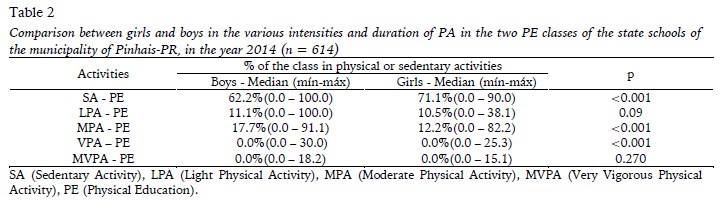
<body><![CDATA[<p>The CF was     estimated from the prediction of maximal oxygen consumption (predicted VO<sub>2</sub>max),     by performing the 20-meter back-and-forth test (Léger, Mercier, Gadoury, &amp;   Lambert, 1988). The students were classified according to the distribution in   appropriate and inadequate ACR, according to cut-off point for both sexes (FITNESSGRAM, 2014).</p>     <p>Some control     variables were evaluated. For the socioeconomic classification of the family,     the criterion Brazil (ABEP, 2008) was used, this criterion aims at estimating     the purchasing power of the individuals and families and the degree of     education of the head of the family, separating in the socioeconomic classes     (A1, A2, B1, B2, C1, C2, D, E). The biological maturation was determined using     the self-evaluation method of pubic hairiness (Tanner, 1962). The test was     applied by 1 (one) evaluator of the same sex as the evaluated one. All     evaluations occurred in an individualized way to preserve the intimacy of the     students. In order to obtain BMI, height and body mass were collected using     standardized criteria (Guedes, 2007) and BMI was determined by calculating the     ratio (division) between the measures of total body mass in kilograms by height     in meters raised to the square. BMI was classified according to the criteria     proposed by the cut-off points for sex and age (Cole, Bellizzi, Flegal, &amp; Dietz, 2000).</p> <b><b>Ethical aspects of the study</b></b>      <p>For the     collection of data, the norms that regulate the research involving human beings     of the National Health Council (resolution nº 466/2012) were followed, being     evaluated and approved by the Research Ethics Committee of the Federal University of Paraná under opinion nº 638.917.</p> <b><b>Statistical analysis</b></b>      <p>For statistical     analysis we used the simple and relative frequency distribution for the     characterization of the sample, the normality of the data was tested using the     Kolmogorov-Smirnov test. Considering the non-normality of the data, the     comparison between the sexes in the percentage variable of the duration in the     activities in different intensities in the two PE classes was performed using     the U test by Mann Whitney. The relationship between PA intensity and duration     within the two PE classes with the CF was performed by means of a partial     correlation, controlled for socioeconomic status, maturational stage, BMI and total time of PA in moderate to vigorous intensity.</p>     <p>The association     between the percentage of time spent in Physical Education classes in     activities of different intensities and the classification of CF to health was     estimated through multivariate logistic regression. For that, the odds ratio     and its 95% confidence intervals (CI 95%) were calculated, with adjustments for     potential confounding variables (maturational stage, economic condition, BMI     and time in MVPA beyond Physical Education class). The percentage of time in     Physical Education class was continuously used to avoid loss of statistical power in the analyses in the categorization of the independent variable.</p>     <p>All analyses were     performed with the total sample and by sex. The SPSS Statistics 21® software was used, with the significance level being set at p &lt;0.05 in all analyses.</p> </font>     <p>&nbsp;</p>     <p><font size="3" face="Verdana"><b><b>RESULTS</b></b></font></p> <font face="Verdana" size="2">     <p>The final sample     consisted of 614 students, 312 girls (50.8%) and 302 boys (49.2%). In the total     sample, 70.0% of normal weight, 23.0% were overweight and 7.0% were obese. In     the analysis of the maturational stage, 37.0% of the students were in the     maturational stage 4 (four) and in relation to the socioeconomic classification 59.28% of the students belonged to the “C” classes (<a href="#t1">Table 1</a>).</p>     <p><a name="t1"></a></p>     ]]></body>
<body><![CDATA[<p>&nbsp;</p>     <p align="center"><img src="/img/revistas/mot/v13s1/13s1a09t1.jpg" width="358" height="410"></p>     
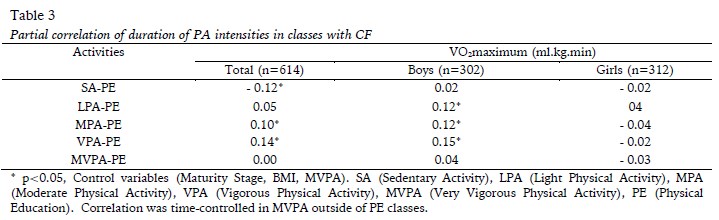
<p>&nbsp;</p>     <p>The description of     the time in physical and sedentary activities in Physical Education classes can     be observed in <a href="/img/revistas/mot/v13s1/13s1a09t2.jpg">Table 2</a>. Most of the time of Physical Education classes was in     sedentary activities (62.2% and 71.1% for boys and girls, respectively). The     time in vigorous physical activities ranged from 0.0% to 30.0% in boys and from     0.0% and 25.3% in girls. ). The time in very vigorous physical activities ranged from 0.0% to 18.2% in boys and from 0.0% and 15.1% in girls.</p>     
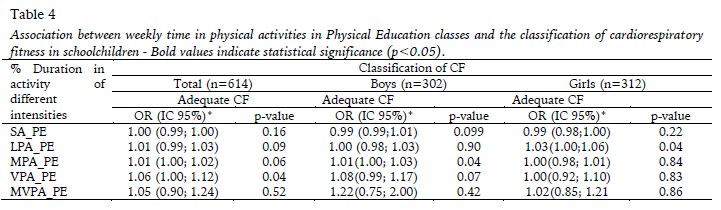
<p>The correlation     between the time in the intensities of PA in the classes and CF was significant     only for the boys in LPA, MPA and VPA (r = 0.12; p = 0.04, r = 0.12; p = 0.04,     r = 0.15; p = 0.009, respectively), indicating that the boys who engaged for     the most time at these intensities had higher values of VO<sub>2</sub>max (<a href="/img/revistas/mot/v13s1/13s1a09t3.jpg">Table 3</a>).</p>     
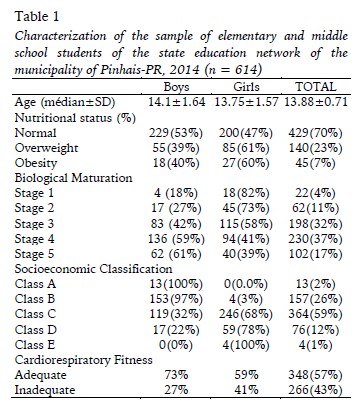
<p>In the total     sample, only the percentage of the PE time in VPA presented a significant     association with the CF adequate. After adjustment for control variables, a     longer time in VPA in Physical Education classes was associated with a greater     chance of having a CF adequate. The MPA showed a non-significant tendency (p =     0.06) to be associated with CF. In the gender analysis, the percentage of time     in the Physical Education class in MPA was positively associated with a greater     chance of having the ACR adequate in boys. The VPA showed a non-significant     tendency (p = 0.07) to be associated with CF in boys. However, only the     percentage of PE time in LPA was positively associated with a greater chance of having CF adequate in girls (<a href="/img/revistas/mot/v13s1/13s1a09t4.jpg">Table 4</a>).</p> </font>     
<p>&nbsp;</p>     <p><font size="3" face="Verdana"><b><b>DISCUSSION</b></b></font></p> <font face="Verdana" size="2">     <p>In the analysis     of the results regarding to the association between the duration of the     intensities of PA in the PE with the CF, a significant relationship was found     for boys in LPA, MPA and VPA, indicating that boys who spent more time in these     intensities inside the PE classes had a higher CF, independent of the PA     performed outside the school. Regarding the girls, no significant relationship was found in the PA intensities.</p>     <p>When we compare     the times in the various PA intensities in PE classes, girls were involved in a     higher proportion of sedentary PA than boys (71.1% and 62.2%). Kremer (2010), showed that     only 22.6% of PE class time was in sedentary PA, and this difference in     relation to the results obtained may have been due to the presence of PE     teachers and researchers among the students during the process of the mentioned     study, which did not occur in the present study. Moreover, the study by Hino et     al. (2007), also found that girls spend more time in sedentary activities during class, as observed in the present study.</p>     ]]></body>
<body><![CDATA[<p>The results found     in this study indicate that, on average, less than 20% of the time of PE     classes, around six minutes, the students were in MVPA. Physical Education     classes tend to have limited durations (the average duration of the classes was     about 30 minutes, when, in theory, the classes should take 50 minutes), mainly     due to the processes related to the organization of schoolchildren. Some     studies (Hino et al., 2007; Kremer, 2010) identified that much of the class     time was used by teachers to guide activities, transition and take attendance,     which may have contributed to the great time in SA and LPA, which also occurred     in the present study, indicating that PE classes apparently do not have their time entirely used.</p>     <p>The low     proportion of time spent on the recommended intensities to ensure the health of     the young population - MVPA - (WHO, 2010), the short duration of these stimuli     and the high time in sedentary PA are important findings, but the causes that     lead to this outcome are still few studied. Cultural differences, educational     legislation, and ethical procedures in the studies affect the curriculum in the     number of PE sessions at the school and in the content described may explain     the low relationship found in the duration of the various PA intensities in PE     classes with the CF. This short duration of MVPA seems to be insufficient to be a contribution in motor/physical aspects (including CF).</p>     <p>The findings of     this study may contribute to the organization of PE classes, helping teachers     to rethink the organization of activities, giving greater intensity and     duration of MVPA, as well as motivating students to participate in the     activities, creating opportunities for all to take part. Create strategies to     reduce the transition time between classes, as well as in the optimization of     the spaces destined to take attendance and the explanations of the activities.     Finally, it may be suggested that continuing teacher training, it is also     necessary to increase the efficiency and effectiveness of PE classes in primary and secondary education.</p>     <p>Given the health     benefits of regular PA practice (Strong et al., 2005), PE classes are important     in school life so that suggested levels of PA are achieved (Mckenzie et al.,     1996). It is still necessary that students have a more active participation in     PE classes by increasing the duration of PA intensities in PE classes, being     motivated with interesting classes which would result in improvements in CF and health.</p>     <p>In particular,     there is a need for reflection on the proposed alternatives of physical     activities that compose the Physical Education classes and that are directed to     the girls. The low MVPA time during classes and the lack of correlation with     the CF indicate that stimulating the regular practice of PA in PE and how it     can contribute to health attributes in this population subgroup should be a     topic of discussion in the training of teachers who work in this context. This     indicates that the differences between boys and girls in weekly PA are mainly     due to the difference in participation in intense PA. As the research results     are consistent, it is evident the need to create intervention programs in the promotion of PA, where we have attention with the girls in all the age groups.</p>     <p>The present study     was important because it includes, in an objective way, the activities of     different intensities that compose the PE classes, which brought important     contributions to the discussion of the composition of the PE classes and how it     can be associated with health attributes in the school population. Nevertheless,     the correlations controlled by potential confounding variables related to CF     (such as maturational stage and BMI), as well as the time in PA outside the PE     class brought robustness to the inferences of the study. Finally, the inclusion     of a probabilistic sample also supports the extrapolations of these results to     the population of interest. One limitation of this study was the inclusion of     schoolchildren only from the public network of a municipality of Paraná, which     makes it difficult to extrapolate the findings to other populations and     educational networks (such as private schools). The CF measurement by field     test, although it is well accepted in the literature and with acceptable     validity (Ortega, Ruiz, Castillo, &amp; Sjöström, 2008), is not a direct     measure of oxygen consumption and, therefore, is susceptible to measurement     errors. Finally, it is recognized that there was no detailing of the types of     activities (games, free classes, plays, among others) that were carried out     during PE classes, what could subsidize deep discussions about the time in sedentary and physical activities and the interests of schoolchildren.</p> </font>     <p>&nbsp;</p>     <p><font size="3" face="Verdana"><b><b>CONCLUSION</b></b></font></p> <font face="Verdana" size="2">     <p>The present study     observed that more than 60% of a PE class is composed of sedentary activities,     whereas less than 20% is composed of activities that correspond to the     recommended health activities (MVPA) in the young population. The correlation     between time in PA in PE and the CF was significant only among boys. This low     correlation between the time in physical activities in the classes of Physical     Education and the cardiorespiratory aptitude reinforces the discussion about     how this discipline can contribute to the health of the young public. It may     also show that only PE classes in the current model are not sufficient to     achieve the recommended PA levels for health benefit gains in this age group.     It is hoped that the results of this research contribute to a professional     reflection on the organization of activities and how to motivate the students to participate in the activities in the PE classes.</p> </font>     <p>&nbsp;</p>     ]]></body>
<body><![CDATA[<p><font size="3" face="Verdana"><b><b>REFERENCES</b></b></font></p> <font face="Verdana" size="2">     <!-- ref --><p>ABEP. Associação Brasileira de Estudos     Populacionais. (2008). <i>Critério Brasil de Classificação Econômica</i>. Retrieved March 10, 2014, from <a href="http://www.abep.org/codigosguias/Criterio_Brasil_2008.pdf" target="_blank">http://www.abep.org/codigosguias/Criterio_Brasil_2008.pdf</a>.    &nbsp;&nbsp;&nbsp;&nbsp;&nbsp;&nbsp;&nbsp;&nbsp;[&#160;<a href="javascript:void(0);" onclick="javascript: window.open('/scielo.php?script=sci_nlinks&ref=371946&pid=S1646-107X201700060000900001&lng=','','width=640,height=500,resizable=yes,scrollbars=1,menubar=yes,');">Links</a>&#160;]<!-- end-ref --></p>     <!-- ref --><p>Anderssen, S. A., Cooper, A. R.,     Riddoch, C., Sardinha, L. B., Harro, M., Brage, S., &amp; Andersen, L. B.     (2007). Low cardiorespiratory fitness is a strong predictor for clustering of     cardiovascular disease risk factors in children independent of country, age and     sex. <i>European Journal of Cardiovascular Prevention and Rehabilitation, 14</i>, 526–531. doi: 10.1097/HJR.0b013e328011efc1&nbsp;&nbsp;&nbsp;&nbsp;&nbsp;&nbsp;&nbsp;&nbsp;[&#160;<a href="javascript:void(0);" onclick="javascript: window.open('/scielo.php?script=sci_nlinks&ref=371948&pid=S1646-107X201700060000900002&lng=','','width=640,height=500,resizable=yes,scrollbars=1,menubar=yes,');">Links</a>&#160;]<!-- end-ref --><!-- ref --><p>Araújo, A. R., Brito A. A., &amp; da     Silva, F. M. (2010). O papel da Educação Física escolar diante da epidemia da obesidade em crianças e adolescentes. <i>Educação Física em Revista</i>, <i>4</i>(2), 1-9.    &nbsp;&nbsp;&nbsp;&nbsp;&nbsp;&nbsp;&nbsp;&nbsp;[&#160;<a href="javascript:void(0);" onclick="javascript: window.open('/scielo.php?script=sci_nlinks&ref=371949&pid=S1646-107X201700060000900003&lng=','','width=640,height=500,resizable=yes,scrollbars=1,menubar=yes,');">Links</a>&#160;]<!-- end-ref --></p>     <!-- ref --><p>Barbieri R. A. (2010). <i>Impacto     genético e ambiental na aptidão cardiorrespiratória, atividade física e     metabolismo de glicose</i> (Dissertação de Mestrado em Ciências da Motricidade     Humana). Instituto de Biociências do Campus de Rio Claro, Universidade Estadual Paulista. Rio Claro.  Retrieved September 15, 2014, from <a href="http://repositorio.unesp.br/bitstream/handle/11449/87376/barbieri_ra_me_rcla.pdf?sequence=1" target="_blank">http://repositorio.unesp.br/bitstream/handle/11449/87376/barbieri_ra_me_rcla.pdf?sequence=1</a>&nbsp;&nbsp;&nbsp;&nbsp;&nbsp;&nbsp;&nbsp;&nbsp;[&#160;<a href="javascript:void(0);" onclick="javascript: window.open('/scielo.php?script=sci_nlinks&ref=371951&pid=S1646-107X201700060000900004&lng=','','width=640,height=500,resizable=yes,scrollbars=1,menubar=yes,');">Links</a>&#160;]<!-- end-ref --><!-- ref --><p>Chen, L. J., Fox, K. R., &amp; Haase,     A. (2006). Obesity, fitness and health in Taiwanese children and adolescents. <i>European       Journal of Clinical Nutrition</i><b>, </b><i>60</i>(12), 1367–1375, doi: 10.1038/sj.ejcn.1602466&nbsp;&nbsp;&nbsp;&nbsp;&nbsp;&nbsp;&nbsp;&nbsp;[&#160;<a href="javascript:void(0);" onclick="javascript: window.open('/scielo.php?script=sci_nlinks&ref=371952&pid=S1646-107X201700060000900005&lng=','','width=640,height=500,resizable=yes,scrollbars=1,menubar=yes,');">Links</a>&#160;]<!-- end-ref --><!-- ref --><p>Cole, T. J., Bellizzi, M. C., Flegal,     K. M., &amp; Dietz, W. H. (2000).     Establishing a standard definition for child overweight and obesity worldwide:     international survey. <i>British Medical Journal</i>, <i>320</i>(7244), 1240-1243.doi: 10.1136/bmj.320.7244.1240&nbsp;&nbsp;&nbsp;&nbsp;&nbsp;&nbsp;&nbsp;&nbsp;[&#160;<a href="javascript:void(0);" onclick="javascript: window.open('/scielo.php?script=sci_nlinks&ref=371953&pid=S1646-107X201700060000900006&lng=','','width=640,height=500,resizable=yes,scrollbars=1,menubar=yes,');">Links</a>&#160;]<!-- end-ref --><!-- ref --><p>FITNESSGRAM. (2014). <i>Statute     Pertaining to the Physical Fitness Test. State Superintendent of Public Instruction. </i>Califórnia: Department Of Education.    &nbsp;&nbsp;&nbsp;&nbsp;&nbsp;&nbsp;&nbsp;&nbsp;[&#160;<a href="javascript:void(0);" onclick="javascript: window.open('/scielo.php?script=sci_nlinks&ref=371954&pid=S1646-107X201700060000900007&lng=','','width=640,height=500,resizable=yes,scrollbars=1,menubar=yes,');">Links</a>&#160;]<!-- end-ref --> </p>     <!-- ref --><p>Guedes, D. P. (2007). Implicações     associadas ao acompanhamento do desempenho motor de crianças e adolescentes. <i>Revista Brasileira Educação Física e Esporte</i>, <i>21</i>, 37-60.    &nbsp;&nbsp;&nbsp;&nbsp;&nbsp;&nbsp;&nbsp;&nbsp;[&#160;<a href="javascript:void(0);" onclick="javascript: window.open('/scielo.php?script=sci_nlinks&ref=371956&pid=S1646-107X201700060000900008&lng=','','width=640,height=500,resizable=yes,scrollbars=1,menubar=yes,');">Links</a>&#160;]<!-- end-ref --> </p>     <!-- ref --><p>Guedes, J. E. R. P., &amp; Guedes, D.     P. (1997). Características dos programas de educação física escolar. <i>Revista Paulista de Educação Física</i>,<i> 11</i>(1), 49-62.    &nbsp;&nbsp;&nbsp;&nbsp;&nbsp;&nbsp;&nbsp;&nbsp;[&#160;<a href="javascript:void(0);" onclick="javascript: window.open('/scielo.php?script=sci_nlinks&ref=371958&pid=S1646-107X201700060000900009&lng=','','width=640,height=500,resizable=yes,scrollbars=1,menubar=yes,');">Links</a>&#160;]<!-- end-ref --></p>     <!-- ref --><p>Gutin, B., Yin,     Z., Humphries, M. C., &amp; Barbeu, P. (2005). Relations of     moderate and vigorous physical activity to fitness and fatness in adolescents. <i>The American Journal of Clinical Nutrition, 81</i>(4), 746-750.    &nbsp;&nbsp;&nbsp;&nbsp;&nbsp;&nbsp;&nbsp;&nbsp;[&#160;<a href="javascript:void(0);" onclick="javascript: window.open('/scielo.php?script=sci_nlinks&ref=371960&pid=S1646-107X201700060000900010&lng=','','width=640,height=500,resizable=yes,scrollbars=1,menubar=yes,');">Links</a>&#160;]<!-- end-ref --></p>     <!-- ref --><p>Hino, A. A. F., Reis, R. S., &amp;   Añez, C. R. R. (2007). Observação dos níveis de atividade física contexto das     aulas e comportamento do professor em aulas de Educação Física do Ensino Médio     da rede pública. <i>Revista Brasileira de Atividade Física e Saúde</i>, <i>12</i>(3), 21-30.    &nbsp;&nbsp;&nbsp;&nbsp;&nbsp;&nbsp;&nbsp;&nbsp;[&#160;<a href="javascript:void(0);" onclick="javascript: window.open('/scielo.php?script=sci_nlinks&ref=371962&pid=S1646-107X201700060000900011&lng=','','width=640,height=500,resizable=yes,scrollbars=1,menubar=yes,');">Links</a>&#160;]<!-- end-ref --> </p>     <!-- ref --><p>Hoehner,     C. M., Ribeiro, I. C., Parra, D. C., Reis, R. S., Azevedo, M. R., Hino, A. A.,   … Brownson, R. C.     (2013). Physical activity interventions in Latin America: expanding and     classifying the evidence. <i>American Journal of Preventive Medicine</i>, <i>44</i>(3), e31-40. <a href="https://doi.org/10.1016/j.amepre.2012.10.026" target="_blank">https://doi.org/10.1016/j.amepre.2012.10.026</a>&nbsp;&nbsp;&nbsp;&nbsp;&nbsp;&nbsp;&nbsp;&nbsp;[&#160;<a href="javascript:void(0);" onclick="javascript: window.open('/scielo.php?script=sci_nlinks&ref=371964&pid=S1646-107X201700060000900012&lng=','','width=640,height=500,resizable=yes,scrollbars=1,menubar=yes,');">Links</a>&#160;]<!-- end-ref --><!-- ref --><p>Katzmarzyk, P. T., Church, T. S.,     Craig, C. L., &amp; Bouchard, C. (2009). Sitting time and mortality from all     causes, cardiovascular disease, and cancer. <i>Medicine and Science in Sports and Exercise</i>, <i>41</i>(5), 998–1005. <a href="https://doi.org/10.1249/MSS.0b013e3181930355" target="_blank">https://doi.org/10.1249/MSS.0b013e3181930355</a>&nbsp;&nbsp;&nbsp;&nbsp;&nbsp;&nbsp;&nbsp;&nbsp;[&#160;<a href="javascript:void(0);" onclick="javascript: window.open('/scielo.php?script=sci_nlinks&ref=371965&pid=S1646-107X201700060000900013&lng=','','width=640,height=500,resizable=yes,scrollbars=1,menubar=yes,');">Links</a>&#160;]<!-- end-ref --><!-- ref --><p>Kremer, M. M. (2010). <i>Intensidade e     duração de esforços físicos em aulas curriculares de EF</i> (Dissertação de     Mestrado em Ciências área do Conhecimento:     Educação Física). Universidade Federal de Pelotas. Pelotas.  Retrieved September 21, 2014, from <a href="http://guaiaca.ufpel.edu.br/bitstream/123456789/1845/1/Marina%20Kremer.pdf" target="_blank">http://guaiaca.ufpel.edu.br/bitstream/123456789/1845/1/Marina%20Kremer.pdf</a>.    &nbsp;&nbsp;&nbsp;&nbsp;&nbsp;&nbsp;&nbsp;&nbsp;[&#160;<a href="javascript:void(0);" onclick="javascript: window.open('/scielo.php?script=sci_nlinks&ref=371966&pid=S1646-107X201700060000900014&lng=','','width=640,height=500,resizable=yes,scrollbars=1,menubar=yes,');">Links</a>&#160;]<!-- end-ref --></p>     <!-- ref --><p>Léger, L. A., Mercier, D., Gadoury,     C., &amp; Lambert, J. (1988). The multistage 20-meter shuttle run test for aerobic     fitness. <i>Journal of Sports Sciences</i>, <i>6</i>(2), 93-101. doi: 10.1080/02640418808729800&nbsp;&nbsp;&nbsp;&nbsp;&nbsp;&nbsp;&nbsp;&nbsp;[&#160;<a href="javascript:void(0);" onclick="javascript: window.open('/scielo.php?script=sci_nlinks&ref=371968&pid=S1646-107X201700060000900015&lng=','','width=640,height=500,resizable=yes,scrollbars=1,menubar=yes,');">Links</a>&#160;]<!-- end-ref --><p>Lobelo, F., Pate, R. R., Dowda, M.,     Liese, A. D., &amp; Ruiz, J. R. (2009). Validity of cardiorespiratory fitness     criterion-referenced standards for adolescents.    <!-- ref --><br>   <i>Medicine and Science in Sports and Exercise</i>, <i>41</i>(6), 1222–1229. doi: 10.1249/MSS.0b013e318195d491&nbsp;&nbsp;&nbsp;&nbsp;&nbsp;&nbsp;&nbsp;&nbsp;[&#160;<a href="javascript:void(0);" onclick="javascript: window.open('/scielo.php?script=sci_nlinks&ref=371970&pid=S1646-107X201700060000900016&lng=','','width=640,height=500,resizable=yes,scrollbars=1,menubar=yes,');">Links</a>&#160;]<!-- end-ref --><!-- ref --><p>Martinez&#8208;Gomez, D., Ruiz, J. R, Ortega, F. B, Casajús, J. A., Veiga, O. L., Widhalm, K., ... Sjöström M. (2010). Recommended levels and intensities of     physical activity to avoid low-cardiorespiratory fitness <i>in European       adolescents: The HELENA study. Am J Hum Biol: The Official Journal of the Human Biology Council, 22</i>(6), 750–756. doi: 10.1002/ajhb.21076&nbsp;&nbsp;&nbsp;&nbsp;&nbsp;&nbsp;&nbsp;&nbsp;[&#160;<a href="javascript:void(0);" onclick="javascript: window.open('/scielo.php?script=sci_nlinks&ref=371971&pid=S1646-107X201700060000900017&lng=','','width=640,height=500,resizable=yes,scrollbars=1,menubar=yes,');">Links</a>&#160;]<!-- end-ref --><!-- ref --><p>Mckenzie, T. L., Nader, P. R, Miller,     P. K. S, Yang, M., Stone, E. J., &amp; Perry, C. L. (1996). School Physical     Education - Effect of the Child and Adolescent Trial for Cardiovascular Health. P<i>reventive Medicine, 25</i>(74), 423-431. doi:10.1006/pmed.1996.0074&nbsp;&nbsp;&nbsp;&nbsp;&nbsp;&nbsp;&nbsp;&nbsp;[&#160;<a href="javascript:void(0);" onclick="javascript: window.open('/scielo.php?script=sci_nlinks&ref=371972&pid=S1646-107X201700060000900018&lng=','','width=640,height=500,resizable=yes,scrollbars=1,menubar=yes,');">Links</a>&#160;]<!-- end-ref --><!-- ref --><p>Ortega, F. B., Ruiz, J. R., Castillo,     M. J., &amp; Sjöström, M. (2008). Physical fitness in childhood and adolescence: a     powerful marker of health. <i>International Journal of Obesity, 32</i>(1), 1-11. doi: 10.1038/sj.ijo.0803774&nbsp;&nbsp;&nbsp;&nbsp;&nbsp;&nbsp;&nbsp;&nbsp;[&#160;<a href="javascript:void(0);" onclick="javascript: window.open('/scielo.php?script=sci_nlinks&ref=371973&pid=S1646-107X201700060000900019&lng=','','width=640,height=500,resizable=yes,scrollbars=1,menubar=yes,');">Links</a>&#160;]<!-- end-ref --><!-- ref --><p>Strong, W. B., Malina, R. M., Blimkie,     C. J. R., Daniels, S. R., Dishman, R. K., &amp; Gutin, B. (2005). Evidence     based physical activity for school-age youth. <i>The Journal of pediatrics, 146</i>(6), 732-737. doi: 10.1016/j.jpeds.2005.01.055&nbsp;&nbsp;&nbsp;&nbsp;&nbsp;&nbsp;&nbsp;&nbsp;[&#160;<a href="javascript:void(0);" onclick="javascript: window.open('/scielo.php?script=sci_nlinks&ref=371974&pid=S1646-107X201700060000900020&lng=','','width=640,height=500,resizable=yes,scrollbars=1,menubar=yes,');">Links</a>&#160;]<!-- end-ref --><!-- ref --><p>Tanner, J. M. (1962). <i>Growth and adolescence</i>. Oxford: Blackwell Scientific Publications.    &nbsp;&nbsp;&nbsp;&nbsp;&nbsp;&nbsp;&nbsp;&nbsp;[&#160;<a href="javascript:void(0);" onclick="javascript: window.open('/scielo.php?script=sci_nlinks&ref=371975&pid=S1646-107X201700060000900021&lng=','','width=640,height=500,resizable=yes,scrollbars=1,menubar=yes,');">Links</a>&#160;]<!-- end-ref --> </p>     <!-- ref --><p>Trost, S. G, Pate, R. R., Sallis, J.     F, Freedson, P. S, Taylor, W. C, Dowda, M., &amp; Sirard, J. R. (2002). Age and     gender differences in objectively measured physical activity in youth. <i>Medicine and science in sports and exercise, 34</i>(2), 350-355. doi: 10.1097/00005768-200202000-00025&nbsp;&nbsp;&nbsp;&nbsp;&nbsp;&nbsp;&nbsp;&nbsp;[&#160;<a href="javascript:void(0);" onclick="javascript: window.open('/scielo.php?script=sci_nlinks&ref=371977&pid=S1646-107X201700060000900022&lng=','','width=640,height=500,resizable=yes,scrollbars=1,menubar=yes,');">Links</a>&#160;]<!-- end-ref --><!-- ref --><p>Wedderkopp, N., Froberg, K., Hansen,     H. S., Riddoch, C., &amp; Andersen, L. B. (2003). Cardiovascular risk factors     cluster in children and adolescents with low physical fitness: The European     Youth Heart Study (EYHY). <i>Pediatric Exercise Science</i>, <i>15</i>(4), 419-427.doi: 10.1123/pes.15.4.419&nbsp;&nbsp;&nbsp;&nbsp;&nbsp;&nbsp;&nbsp;&nbsp;[&#160;<a href="javascript:void(0);" onclick="javascript: window.open('/scielo.php?script=sci_nlinks&ref=371978&pid=S1646-107X201700060000900023&lng=','','width=640,height=500,resizable=yes,scrollbars=1,menubar=yes,');">Links</a>&#160;]<!-- end-ref --><!-- ref --><p>World Health Organization [WHO]. (2010). <i>Global recommendations on physical activity for health</i>. Geneva, Switzerland. Retrieved June 10, 2013, from <a href="http://whqlibdoc.who.int/publications/2010/9789241599979_eng.pdf" target="_blank">http://whqlibdoc.who.int/publications/2010/9789241599979_eng.pdf</a>.    &nbsp;&nbsp;&nbsp;&nbsp;&nbsp;&nbsp;&nbsp;&nbsp;[&#160;<a href="javascript:void(0);" onclick="javascript: window.open('/scielo.php?script=sci_nlinks&ref=371979&pid=S1646-107X201700060000900024&lng=','','width=640,height=500,resizable=yes,scrollbars=1,menubar=yes,');">Links</a>&#160;]<!-- end-ref --></p>     <p>&nbsp;</p>     <p><b>Acknowledgments:    <br> </b>To the State Department of     Education of Paraná (Regional Nucleus North Metropolitan Area), State schools     of the city of Pinhais for availability and help and all schoolchildren who participated in this study.    <br> <b>Conflict of interests:    ]]></body>
<body><![CDATA[<br> </b>Nothing to declare.    <br> <b>Funding:    <br> </b>Nothing to declare.</p> </font>     <p>&nbsp;</p>     <p>&nbsp;</p>     <p><font face="Verdana" size="2"><a href="#top"><sup>*</sup></a><i><a name="end"></a></i></font>    <font size="2" face="Verdana"><i> Corresponding author: </i>Federal   University of Paraná, Department of Physical Education, Pref Lothario Meissner   Av., 3400, Campus Jardim Botânico, 80210-170, Curitiba, Paraná, Brazil.<i> Email: </i><a href="mailto:maziero@ufpr.br">maziero@ufpr.br</a></font></p>      ]]></body><back>
<ref-list>
<ref id="B1">
<nlm-citation citation-type="">
<collab>Associação Brasileira de Estudos Populacionais</collab>
<source><![CDATA[Critério Brasil de Classificação Econômica]]></source>
<year>2008</year>
</nlm-citation>
</ref>
<ref id="B2">
<nlm-citation citation-type="journal">
<person-group person-group-type="author">
<name>
<surname><![CDATA[Anderssen]]></surname>
<given-names><![CDATA[S. A.]]></given-names>
</name>
<name>
<surname><![CDATA[Cooper]]></surname>
<given-names><![CDATA[A. R.]]></given-names>
</name>
<name>
<surname><![CDATA[Riddoch]]></surname>
<given-names><![CDATA[C.]]></given-names>
</name>
<name>
<surname><![CDATA[Sardinha]]></surname>
<given-names><![CDATA[L. B.]]></given-names>
</name>
<name>
<surname><![CDATA[Harro]]></surname>
<given-names><![CDATA[M.]]></given-names>
</name>
<name>
<surname><![CDATA[Brage]]></surname>
<given-names><![CDATA[S.]]></given-names>
</name>
<name>
<surname><![CDATA[Andersen]]></surname>
<given-names><![CDATA[L. B.]]></given-names>
</name>
</person-group>
<article-title xml:lang="en"><![CDATA[Low cardiorespiratory fitness is a strong predictor for clustering of cardiovascular disease risk factors in children independent of country, age and sex]]></article-title>
<source><![CDATA[European Journal of Cardiovascular Prevention and Rehabilitation]]></source>
<year>2007</year>
<volume>14</volume>
<page-range>526-531</page-range></nlm-citation>
</ref>
<ref id="B3">
<nlm-citation citation-type="journal">
<person-group person-group-type="author">
<name>
<surname><![CDATA[Araújo]]></surname>
<given-names><![CDATA[A. R.]]></given-names>
</name>
<name>
<surname><![CDATA[Brito]]></surname>
<given-names><![CDATA[A. A.]]></given-names>
</name>
<name>
<surname><![CDATA[da Silva]]></surname>
<given-names><![CDATA[F. M.]]></given-names>
</name>
</person-group>
<article-title xml:lang="pt"><![CDATA[O papel da Educação Física escolar diante da epidemia da obesidade em crianças e adolescentes]]></article-title>
<source><![CDATA[Educação Física em Revista]]></source>
<year>2010</year>
<volume>4</volume>
<numero>2</numero>
<issue>2</issue>
<page-range>1-9</page-range></nlm-citation>
</ref>
<ref id="B4">
<nlm-citation citation-type="">
<person-group person-group-type="author">
<name>
<surname><![CDATA[Barbieri]]></surname>
<given-names><![CDATA[R. A.]]></given-names>
</name>
</person-group>
<source><![CDATA[Impacto genético e ambiental na aptidão cardiorrespiratória, atividade física e metabolismo de glicose]]></source>
<year>2010</year>
</nlm-citation>
</ref>
<ref id="B5">
<nlm-citation citation-type="journal">
<person-group person-group-type="author">
<name>
<surname><![CDATA[Chen]]></surname>
<given-names><![CDATA[L. J.]]></given-names>
</name>
<name>
<surname><![CDATA[Fox]]></surname>
<given-names><![CDATA[K. R.]]></given-names>
</name>
<name>
<surname><![CDATA[Haase]]></surname>
<given-names><![CDATA[A.]]></given-names>
</name>
</person-group>
<article-title xml:lang="en"><![CDATA[Obesity, fitness and health in Taiwanese children and adolescents]]></article-title>
<source><![CDATA[European Journal of Clinical Nutrition]]></source>
<year>2006</year>
<volume>60</volume>
<numero>12</numero>
<issue>12</issue>
<page-range>1367-1375</page-range></nlm-citation>
</ref>
<ref id="B6">
<nlm-citation citation-type="journal">
<person-group person-group-type="author">
<name>
<surname><![CDATA[Cole]]></surname>
<given-names><![CDATA[T. J.]]></given-names>
</name>
<name>
<surname><![CDATA[Bellizzi]]></surname>
<given-names><![CDATA[M. C.]]></given-names>
</name>
<name>
<surname><![CDATA[Flegal]]></surname>
<given-names><![CDATA[K. M.]]></given-names>
</name>
<name>
<surname><![CDATA[Dietz]]></surname>
<given-names><![CDATA[W. H.]]></given-names>
</name>
</person-group>
<article-title xml:lang="en"><![CDATA[Establishing a standard definition for child overweight and obesity worldwide: international survey]]></article-title>
<source><![CDATA[British Medical Journal]]></source>
<year>2000</year>
<volume>320</volume>
<numero>7244</numero>
<issue>7244</issue>
<page-range>1240-1243</page-range></nlm-citation>
</ref>
<ref id="B7">
<nlm-citation citation-type="book">
<collab>FITNESSGRAM</collab>
<source><![CDATA[Statute Pertaining to the Physical Fitness Test: State Superintendent of Public Instruction]]></source>
<year>2014</year>
<publisher-loc><![CDATA[Califórnia ]]></publisher-loc>
<publisher-name><![CDATA[Department Of Education]]></publisher-name>
</nlm-citation>
</ref>
<ref id="B8">
<nlm-citation citation-type="journal">
<person-group person-group-type="author">
<name>
<surname><![CDATA[Guedes]]></surname>
<given-names><![CDATA[D. P.]]></given-names>
</name>
</person-group>
<article-title xml:lang="pt"><![CDATA[Implicações associadas ao acompanhamento do desempenho motor de crianças e adolescentes]]></article-title>
<source><![CDATA[Revista Brasileira Educação Física e Esporte]]></source>
<year>2007</year>
<volume>21</volume>
<page-range>37-60</page-range></nlm-citation>
</ref>
<ref id="B9">
<nlm-citation citation-type="journal">
<person-group person-group-type="author">
<name>
<surname><![CDATA[Guedes]]></surname>
<given-names><![CDATA[J. E. R. P.]]></given-names>
</name>
<name>
<surname><![CDATA[Guedes]]></surname>
<given-names><![CDATA[D. P.]]></given-names>
</name>
</person-group>
<article-title xml:lang="pt"><![CDATA[Características dos programas de educação física escolar]]></article-title>
<source><![CDATA[Revista Paulista de Educação Física]]></source>
<year>1997</year>
<volume>11</volume>
<numero>1</numero>
<issue>1</issue>
<page-range>49-62</page-range></nlm-citation>
</ref>
<ref id="B10">
<nlm-citation citation-type="journal">
<person-group person-group-type="author">
<name>
<surname><![CDATA[Gutin]]></surname>
<given-names><![CDATA[B.]]></given-names>
</name>
<name>
<surname><![CDATA[Yin]]></surname>
<given-names><![CDATA[Z.]]></given-names>
</name>
<name>
<surname><![CDATA[Humphries]]></surname>
<given-names><![CDATA[M. C.]]></given-names>
</name>
<name>
<surname><![CDATA[Barbeu]]></surname>
<given-names><![CDATA[P.]]></given-names>
</name>
</person-group>
<article-title xml:lang="en"><![CDATA[Relations of moderate and vigorous physical activity to fitness and fatness in adolescents]]></article-title>
<source><![CDATA[The American Journal of Clinical Nutrition]]></source>
<year>2005</year>
<volume>81</volume>
<numero>4</numero>
<issue>4</issue>
<page-range>746-750</page-range></nlm-citation>
</ref>
<ref id="B11">
<nlm-citation citation-type="journal">
<person-group person-group-type="author">
<name>
<surname><![CDATA[Hino]]></surname>
<given-names><![CDATA[A. A. F.]]></given-names>
</name>
<name>
<surname><![CDATA[Reis]]></surname>
<given-names><![CDATA[R. S.]]></given-names>
</name>
<name>
<surname><![CDATA[Añez]]></surname>
<given-names><![CDATA[C. R. R.]]></given-names>
</name>
</person-group>
<article-title xml:lang="pt"><![CDATA[Observação dos níveis de atividade física contexto das aulas e comportamento do professor em aulas de Educação Física do Ensino Médio da rede pública]]></article-title>
<source><![CDATA[Revista Brasileira de Atividade Física e Saúde]]></source>
<year>2007</year>
<volume>12</volume>
<numero>3</numero>
<issue>3</issue>
<page-range>21-30</page-range></nlm-citation>
</ref>
<ref id="B12">
<nlm-citation citation-type="journal">
<person-group person-group-type="author">
<name>
<surname><![CDATA[Hoehner]]></surname>
<given-names><![CDATA[C. M.]]></given-names>
</name>
<name>
<surname><![CDATA[Ribeiro]]></surname>
<given-names><![CDATA[I. C.]]></given-names>
</name>
<name>
<surname><![CDATA[Parra]]></surname>
<given-names><![CDATA[D. C.]]></given-names>
</name>
<name>
<surname><![CDATA[Reis]]></surname>
<given-names><![CDATA[R. S.]]></given-names>
</name>
<name>
<surname><![CDATA[Azevedo]]></surname>
<given-names><![CDATA[M. R.]]></given-names>
</name>
<name>
<surname><![CDATA[Hino]]></surname>
<given-names><![CDATA[A. A.]]></given-names>
</name>
<name>
<surname><![CDATA[Brownson]]></surname>
<given-names><![CDATA[R. C.]]></given-names>
</name>
</person-group>
<article-title xml:lang="en"><![CDATA[Physical activity interventions in Latin America: expanding and classifying the evidence]]></article-title>
<source><![CDATA[American Journal of Preventive Medicine]]></source>
<year>2013</year>
<volume>44</volume>
<numero>3</numero>
<issue>3</issue>
<page-range>e31-40</page-range></nlm-citation>
</ref>
<ref id="B13">
<nlm-citation citation-type="journal">
<person-group person-group-type="author">
<name>
<surname><![CDATA[Katzmarzyk]]></surname>
<given-names><![CDATA[P. T.]]></given-names>
</name>
<name>
<surname><![CDATA[Church]]></surname>
<given-names><![CDATA[T. S.]]></given-names>
</name>
<name>
<surname><![CDATA[Craig]]></surname>
<given-names><![CDATA[C. L.]]></given-names>
</name>
<name>
<surname><![CDATA[Bouchard]]></surname>
<given-names><![CDATA[C.]]></given-names>
</name>
</person-group>
<article-title xml:lang="en"><![CDATA[Sitting time and mortality from all causes, cardiovascular disease, and cancer]]></article-title>
<source><![CDATA[Medicine and Science in Sports and Exercise]]></source>
<year>2009</year>
<volume>41</volume>
<numero>5</numero>
<issue>5</issue>
<page-range>998-1005</page-range></nlm-citation>
</ref>
<ref id="B14">
<nlm-citation citation-type="">
<person-group person-group-type="author">
<name>
<surname><![CDATA[Kremer]]></surname>
<given-names><![CDATA[M. M.]]></given-names>
</name>
</person-group>
<source><![CDATA[Intensidade e duração de esforços físicos em aulas curriculares de EF]]></source>
<year>2010</year>
</nlm-citation>
</ref>
<ref id="B15">
<nlm-citation citation-type="journal">
<person-group person-group-type="author">
<name>
<surname><![CDATA[Léger]]></surname>
<given-names><![CDATA[L. A.]]></given-names>
</name>
<name>
<surname><![CDATA[Mercier]]></surname>
<given-names><![CDATA[D.]]></given-names>
</name>
<name>
<surname><![CDATA[Gadoury]]></surname>
<given-names><![CDATA[C.]]></given-names>
</name>
<name>
<surname><![CDATA[Lambert]]></surname>
<given-names><![CDATA[J.]]></given-names>
</name>
</person-group>
<article-title xml:lang="en"><![CDATA[The multistage 20-meter shuttle run test for aerobic fitness]]></article-title>
<source><![CDATA[Journal of Sports Sciences]]></source>
<year>1988</year>
<volume>6</volume>
<numero>2</numero>
<issue>2</issue>
<page-range>93-101</page-range></nlm-citation>
</ref>
<ref id="B16">
<nlm-citation citation-type="journal">
<person-group person-group-type="author">
<name>
<surname><![CDATA[Lobelo]]></surname>
<given-names><![CDATA[F.]]></given-names>
</name>
<name>
<surname><![CDATA[Pate]]></surname>
<given-names><![CDATA[R. R.]]></given-names>
</name>
<name>
<surname><![CDATA[Dowda]]></surname>
<given-names><![CDATA[M.]]></given-names>
</name>
<name>
<surname><![CDATA[Liese]]></surname>
<given-names><![CDATA[A. D.]]></given-names>
</name>
<name>
<surname><![CDATA[Ruiz]]></surname>
<given-names><![CDATA[J. R.]]></given-names>
</name>
</person-group>
<article-title xml:lang="en"><![CDATA[Validity of cardiorespiratory fitness criterion-referenced standards for adolescents]]></article-title>
<source><![CDATA[Medicine and Science in Sports and Exercise]]></source>
<year>2009</year>
<volume>41</volume>
<numero>6</numero>
<issue>6</issue>
<page-range>1222-1229</page-range></nlm-citation>
</ref>
<ref id="B17">
<nlm-citation citation-type="journal">
<person-group person-group-type="author">
<name>
<surname><![CDATA[Martinez&#8208;Gomez]]></surname>
<given-names><![CDATA[D.]]></given-names>
</name>
<name>
<surname><![CDATA[Ruiz]]></surname>
<given-names><![CDATA[J. R]]></given-names>
</name>
<name>
<surname><![CDATA[Ortega]]></surname>
<given-names><![CDATA[F. B]]></given-names>
</name>
<name>
<surname><![CDATA[Casajús]]></surname>
<given-names><![CDATA[J. A.]]></given-names>
</name>
<name>
<surname><![CDATA[Veiga]]></surname>
<given-names><![CDATA[O. L.]]></given-names>
</name>
<name>
<surname><![CDATA[Widhalm]]></surname>
<given-names><![CDATA[K.]]></given-names>
</name>
<name>
<surname><![CDATA[Sjöström]]></surname>
<given-names><![CDATA[M.]]></given-names>
</name>
</person-group>
<article-title xml:lang="en"><![CDATA[Recommended levels and intensities of physical activity to avoid low-cardiorespiratory fitness in European adolescents: The HELENA study]]></article-title>
<source><![CDATA[Am J Hum Biol: The Official Journal of the Human Biology Council]]></source>
<year>2010</year>
<volume>22</volume>
<numero>6</numero>
<issue>6</issue>
<page-range>750-756</page-range></nlm-citation>
</ref>
<ref id="B18">
<nlm-citation citation-type="journal">
<person-group person-group-type="author">
<name>
<surname><![CDATA[Mckenzie]]></surname>
<given-names><![CDATA[T. L.]]></given-names>
</name>
<name>
<surname><![CDATA[Nader]]></surname>
<given-names><![CDATA[P. R]]></given-names>
</name>
<name>
<surname><![CDATA[Miller]]></surname>
<given-names><![CDATA[P. K. S]]></given-names>
</name>
<name>
<surname><![CDATA[Yang]]></surname>
<given-names><![CDATA[M.]]></given-names>
</name>
<name>
<surname><![CDATA[Stone]]></surname>
<given-names><![CDATA[E. J.]]></given-names>
</name>
<name>
<surname><![CDATA[Perry]]></surname>
<given-names><![CDATA[C. L.]]></given-names>
</name>
</person-group>
<article-title xml:lang="en"><![CDATA[School Physical Education: Effect of the Child and Adolescent Trial for Cardiovascular Health]]></article-title>
<source><![CDATA[Preventive Medicine]]></source>
<year>1996</year>
<volume>25</volume>
<numero>74</numero>
<issue>74</issue>
<page-range>423-431</page-range></nlm-citation>
</ref>
<ref id="B19">
<nlm-citation citation-type="journal">
<person-group person-group-type="author">
<name>
<surname><![CDATA[Ortega]]></surname>
<given-names><![CDATA[F. B.]]></given-names>
</name>
<name>
<surname><![CDATA[Ruiz]]></surname>
<given-names><![CDATA[J. R.]]></given-names>
</name>
<name>
<surname><![CDATA[Castillo]]></surname>
<given-names><![CDATA[M. J.]]></given-names>
</name>
<name>
<surname><![CDATA[Sjöström]]></surname>
<given-names><![CDATA[M.]]></given-names>
</name>
</person-group>
<article-title xml:lang="en"><![CDATA[Physical fitness in childhood and adolescence: a powerful marker of health]]></article-title>
<source><![CDATA[International Journal of Obesity]]></source>
<year>2008</year>
<volume>32</volume>
<numero>1</numero>
<issue>1</issue>
<page-range>1-11</page-range></nlm-citation>
</ref>
<ref id="B20">
<nlm-citation citation-type="journal">
<person-group person-group-type="author">
<name>
<surname><![CDATA[Strong]]></surname>
<given-names><![CDATA[W. B.]]></given-names>
</name>
<name>
<surname><![CDATA[Malina]]></surname>
<given-names><![CDATA[R. M.]]></given-names>
</name>
<name>
<surname><![CDATA[Blimkie]]></surname>
<given-names><![CDATA[C. J. R.]]></given-names>
</name>
<name>
<surname><![CDATA[Daniels]]></surname>
<given-names><![CDATA[S. R.]]></given-names>
</name>
<name>
<surname><![CDATA[Dishman]]></surname>
<given-names><![CDATA[R. K.]]></given-names>
</name>
<name>
<surname><![CDATA[Gutin]]></surname>
<given-names><![CDATA[B.]]></given-names>
</name>
</person-group>
<article-title xml:lang="en"><![CDATA[Evidence based physical activity for school-age youth]]></article-title>
<source><![CDATA[The Journal of pediatrics]]></source>
<year>2005</year>
<volume>146</volume>
<numero>6</numero>
<issue>6</issue>
<page-range>732-737</page-range></nlm-citation>
</ref>
<ref id="B21">
<nlm-citation citation-type="book">
<person-group person-group-type="author">
<name>
<surname><![CDATA[Tanner]]></surname>
<given-names><![CDATA[J. M.]]></given-names>
</name>
</person-group>
<source><![CDATA[Growth and adolescence]]></source>
<year>1962</year>
<publisher-loc><![CDATA[Oxford ]]></publisher-loc>
<publisher-name><![CDATA[Blackwell Scientific Publications]]></publisher-name>
</nlm-citation>
</ref>
<ref id="B22">
<nlm-citation citation-type="journal">
<person-group person-group-type="author">
<name>
<surname><![CDATA[Trost]]></surname>
<given-names><![CDATA[S. G]]></given-names>
</name>
<name>
<surname><![CDATA[Pate]]></surname>
<given-names><![CDATA[R. R.]]></given-names>
</name>
<name>
<surname><![CDATA[Sallis]]></surname>
<given-names><![CDATA[J. F]]></given-names>
</name>
<name>
<surname><![CDATA[Freedson]]></surname>
<given-names><![CDATA[P. S]]></given-names>
</name>
<name>
<surname><![CDATA[Taylor]]></surname>
<given-names><![CDATA[W. C]]></given-names>
</name>
<name>
<surname><![CDATA[Dowda]]></surname>
<given-names><![CDATA[M.]]></given-names>
</name>
<name>
<surname><![CDATA[Sirard]]></surname>
<given-names><![CDATA[J. R.]]></given-names>
</name>
</person-group>
<article-title xml:lang="en"><![CDATA[Age and gender differences in objectively measured physical activity in youth]]></article-title>
<source><![CDATA[Medicine and science in sports and exercise]]></source>
<year>2002</year>
<volume>34</volume>
<numero>2</numero>
<issue>2</issue>
<page-range>350-355</page-range></nlm-citation>
</ref>
<ref id="B23">
<nlm-citation citation-type="journal">
<person-group person-group-type="author">
<name>
<surname><![CDATA[Wedderkopp]]></surname>
<given-names><![CDATA[N.]]></given-names>
</name>
<name>
<surname><![CDATA[Froberg]]></surname>
<given-names><![CDATA[K.]]></given-names>
</name>
<name>
<surname><![CDATA[Hansen]]></surname>
<given-names><![CDATA[H. S.]]></given-names>
</name>
<name>
<surname><![CDATA[Riddoch]]></surname>
<given-names><![CDATA[C.]]></given-names>
</name>
<name>
<surname><![CDATA[Andersen]]></surname>
<given-names><![CDATA[L. B.]]></given-names>
</name>
</person-group>
<article-title xml:lang="en"><![CDATA[Cardiovascular risk factors cluster in children and adolescents with low physical fitness: The European Youth Heart Study (EYHY)]]></article-title>
<source><![CDATA[Pediatric Exercise Science]]></source>
<year>2003</year>
<volume>15</volume>
<numero>4</numero>
<issue>4</issue>
<page-range>419-427</page-range></nlm-citation>
</ref>
<ref id="B24">
<nlm-citation citation-type="">
<collab>World Health Organization</collab>
<source><![CDATA[Global recommendations on physical activity for health]]></source>
<year>2010</year>
<publisher-loc><![CDATA[Geneva ]]></publisher-loc>
</nlm-citation>
</ref>
</ref-list>
</back>
</article>