ORIGINAL ARTICLE
Physical Education in School: physical spaces and materials in public school in Fortaleza
Mabelle Maia Mota1,*; Aline Lima Torres1; Bruna Oliveira Alves2; Heraldo Simões Ferreira1,2
1 Graduate Program in Education (PPGE), State University of Ceará, Ceará, Brazil.
2 Professional Master in Health Teaching (CMEPES), State University of Ceará, Ceará, Brazil.
]]>
ABSTRACT
Physical Education has specific needs when it comes to physical spaces, materials and / or other conditions available to work with the body in motion. The aim was to then analyze the conditions of operation of physical education teachers in public schools of Fortaleza. To do this, from a descriptive quantitative study and qualitative exploratory, public schools were the scene of the research and their physical education teachers, totaling n = 73, were participants in this investigation. A questionnaire on the conditions of physical spaces and materials and a group interview with some teachers were the instruments used to diagnose the conditions of teaching practice in these schools of Fortaleza. In most schools, the physical spaces present themselves inadequate, limited and / or missing, as well as the materials are of poor quality and / or reduced amount. Finally, although a study unfinished, front of the entire context surrounding the school dynamics, it is believed that schools need greater availability of physical spaces and materials as well as other conditions for the physical education teacher can act in a more efficient and satisfactory manner, favoring the teaching and student learning.
Keywords: physical education, education, physical spaces, materials.
INTRODUCTION
The study object of this article is outlined by the performance of the Physical Education Teachers about the conditions of physical spaces and availability of materials at public schools of Fortaleza.
The interlacement among school disciplines shows the entire context that pass through the educational process bringing the peculiarities that each one presents in practice. Physical Education involves the body movement and their contents are entirely connected to the body practice they suggest a diversity of spaces and differentiated materials to contemplate the universe of practice activities required by the theme.
In the research realized by the Brazilian Institute of Opinion and Statistics (IBOPE) about physical structure, only 64% of municipal schools have spaces for physical education, 34% of schools of the northeast uses outside spaces, 55% of schools have sports court, and only 38% of schools have covered sports court. About basic materials such as soccer balls (87%), ropes (81%), goal post (71%) and nets (67%), the result was also not satisfactory, since they mentioned only minimum conditions for the discipline contents. For other teaching conditions, the study revealed that 25% of schools in the northeast had multiserial classes, which distances the focus of the activities provided, due to the variation of the student’s age (IBOPE, 2012).
]]> This research, therefore, carried out a more focused analysis for the conditions of physical and material spaces that involve the performance of Physical Education teachers in the municipal public schools of Fortaleza.Therefore, the following guiding questions of research activity were formulated: What are the working conditions that the teacher finds in his reality about physical and material structure? How does he evaluate the conditions that are offered to them for their teaching?
In order to answer the questions quoted and to reject or confirm the launched hypotheses, a field research was inspired by the research at the national level, already mentioned (IBOPE, 2012). The present study resembles the same one by using the questionnaire with objective and subjective questions as instrument of collection and the Physical Education teachers of the public network as subjects of the research. It differs, however, to choose only some aspects to be investigated, since the delimitation of the proposed theme, to apply only to the teachers, excluding the directors, because it’s considered unnecessary to use another subject, for addressing the teacher in person and not by phone, due to the greater availability of going to the field; And to focus on the municipal education network of Fortaleza, delimiting and portraying the scenario of this study.
The aim was to analyze the conditions of teaching performance, regarding the physical and material spaces available in the municipal public schools of Fortaleza.
METHOD
In a synthetic and specific way, the study can be characterized as quantitative descriptive and, at the same time, qualitative exploratory. Quantitative in the descriptive phase when using statistical data, while also inserts as qualitative, when interpretative tools express the understanding of meanings (Minayo, 2008).
ParticipantsThe participants of the research correspond to the teachers who teach the discipline of Physical Education in the municipal public schools of Fortaleza, CE. Only one teacher per school has been recruited, as well as the location, at random so that it represents the reality of their work environment. A total of 73 teachers were surveyed, according to data from 2015.
After the authorization of the institution, through the Instrument of Consent, the researcher invited these teachers to participate of the research at a convenient day and time for both. The respondents were informed that the research was registered in the Brazil Platform and approved by the Committee of Ethics in Research of the UECE under Opinion 1.206.436/2015.
Instruments and ProceduresThe first step was the questionnaire that presented objective and subjective questions and was constructed after the application of the pilot test. Compared to what was investigated in the national research, only some aspects were used: conditions of physical spaces and material conditions of the Physical Education discipline. From some items already described, the teacher indicated the number of spaces that the school had, and could add places not mentioned; occurring in the same way for materials. Next, it was necessary to assess their conditions in general on two subjective questions.
]]> In order to assist the researcher in this stage of the study, members of the UECE Group of Physical Education Studies were part of this voluntary data collection phase, as well as some undergraduate students in Physical Education at UECE. Both were submitted by a training conducted by the researcher in order to systematize and unify the process of data collection, avoiding possible biases of research.The second stage of data collection was performed through a group interview with six teachers from the initial stage of the study. The subjects were questioned about the possible sufficient and / or ideal conditions of physical and material spaces in the school, they reported on other factors that could involve their performance from their evaluation against the conditions that are offered to them in the schools surveyed.
It was carried out in two stages. In the first one, the researchers presented a questionnaire to Physical Education teachers, regarding the physical materials and spaces of the respective schools. In a second moment, one teacher from each school responded together to an interview.
Statistical analysisAt first, there was the analysis of the objective questions of the questionnaire, each physical space and material was counted in order to diagnose the total quantitative present in the schools of the municipal network of Fortaleza. Thus, it was possible to verify the availability of places and pedagogical materials for the teaching of Physical Education in a broader way.
These data were analyzed through simple descriptive statistics using the Microsoft Office Excel program as an aid in tabulating and reading data in the form of tables and / or Tables. The use of this program allowed a systematized analysis of the most objective aspects: identification data, training and conditions of physical and material spaces of the teacher.
In the interviews, Minayo (2008) was used, from transcription, reading and categorization by themes and discussed in the light of subjectivity. The author deploys this type of analysis in three stages:
a) Pre-analysis: aims to understand and interpret the material collected guiding the final interpretation;
b) Exploration of the material: seeks to find categories of specification of the themes according to the reports of the participants;
c) Treatment of the results obtained and interpretation: systematizes in simple statistics relating to the theoretical framework studied from inferences and interpretations of the information relating them to the theory presented above and launching new readings.
]]> RESULTS
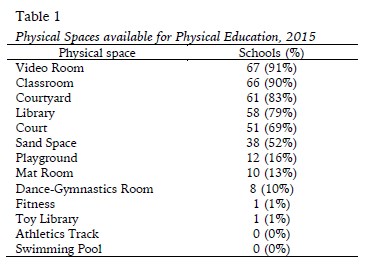
The use of the places by the school community does not exclude the possibilities with the teaching of Physical Education. On the contrary, as the discipline requires the exploration of the body in movement, the physical space has much importance in the execution of the class activities. Inquiring about these spaces to teach classes, teachers reported the availability described in Table 1. In it are exposed the types and quantities of physical spaces of the schools they teach.
One of the teachers, when asked about the enough spaces, reported that the classrooms of each class were used by teachers of other disciplines during the hours of Physical Education, which prevented the availability to the teacher himself at that time needing to rethink possible interventions of a kind more theoretical.
Highlight for the 51 detected blocks, 69%. Not all schools have this space where much of the content is taught, see the sports modalities, or that would allow to approach other content that requires more space.
In the schools surveyed, some deficiencies are confirmed, in addition to the limitations already presented, omissions about places of psychomotor and / or recreational practices such as playgrounds and toy libraries is evident in the table. Lack of availability may cause teachers to limit their approaches or even improvise spaces. In addition, given the scarcity of public spaces for leisure, culture and healthy social life for children, the school also becomes a safe place to meet those needs at the time of recess or other curricular and extracurricular activities in the school context.
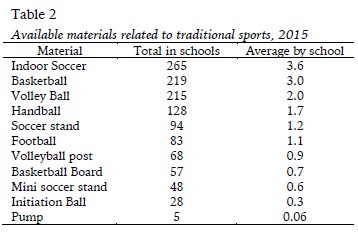
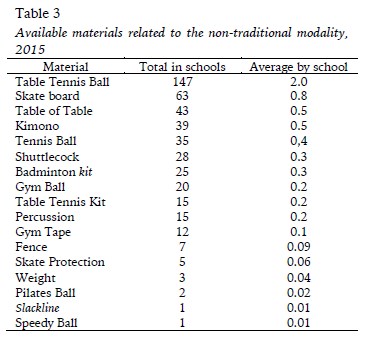
Table 2 shows that, although content treated with priority, Physical Education teachers have little availability of materials linked to these modalities, an average of one to three balls per modality. When it refers to other materials related to these sports and essential for their practice, such as volleyball poles, basketball tables, etc., the incidence is even lower. This fact evidences the improvisation already mentioned in the discussions about the physical spaces. For example, the teacher has no pump to fill the balls or works volleyball with stretched ropes and/or elastics simulating a volleyball net. This will also be present in relation to other materials. Table 3 shows materials that are not commonly found in schools such as skateboarding, slackline, speedyball, shuttlecock, badminton kit, proprioceptive disk, agility scale, etc. The existence of these and other equipment was possible due to the initiative of the teachers themselves who bought materials to assist their teaching practice, something that was reported in the group interview by certain teachers. Some even expressed discontent at having to take such an attitude to be able to perform certain activities.
]]>
DISCUSSION
]]> The recognition of the pedagogical space as a didactic instrument favors the search for a place that contributes to the learning involving the articulation between what its components need and what is wanted. According to Escallier (2010), the architecture of school buildings is a matter of the present time. The author exemplifies that England has a plan to rebuild its spaces by 2020, based on its historical cultural context and the needs of students. Prove of this is the indication that this planning should be composed of a team that involves several professionals and actors participating in the later use of this space. In Brazil, the proposal is presented in an easier and direct way. Attention is initially focused on providing site availability, as is the case with the work already begun in the Growth Acceleration Program (PAC), which includes sports facilities and other facilities in schools that have submitted their proposals.Directing the vision to the whole school, spaces can be distributed according to a specialized destination, always taking into account the interrelationship and mutual use by agents. The following division of spaces can be taken as an example: merely pedagogical, like the classrooms and the court; Leisure facilities such as patios; Such as the office and concierge; Common areas such as the entrance and corridors; The canteen and the bathrooms; Private / restricted, such as the office, the teacher's room and the kitchen.
As explained by Ferreira (2014), Physical Education underwent several transformations over the years and currently has some differentiated conceptions that guide its conduction in the school. Analyzing Table 1, it can be seen that the availability of physical spaces also refers to the use of the same places by other areas and to the way the teacher intervenes in their performance. Emphasizing the quantities presented before, video/multimedia room, classroom, patio, library, court and spaces with sand were the spaces that stood out the most.
The new conceptions about the teaching of Physical Education may have broadened the view of teachers about their performance in other spaces compared to those that were provided by the discipline previously, when the classes were strictly practical, valuing only the know-how. The fact that the teacher already considers video / multimedia room, classroom and library as places to teach classes already shows that some content can be worked using different audiovisual resources, arousing the attention and curiosity of the student.
The review by Soares, Jesus, Karino, and Andrade (2013) used data from the 2011 School Census to verify the levels of school infrastructure in general, classifying them as elementary, basic, adequate and advanced. A scale of 22 items was analyzed including the existence of spaces and conditions such as kitchen, electricity, sewage, teacher’s room, etc. The sports court was included only at the so-called 'adequate' and 'advanced' level of infrastructure, revealing perhaps not as essential to the functioning of the school. This research occurred with 194 932 schools in Brazil and only 15.5% of the schools presented blocks. When referring only to the northeast, this percentage fell to 7.4%. This scenario reveals a much poorer picture than that presented in this review. Still, whether at the national or municipal level, as verified in Fortaleza's reality, it is possible to infer the improvisation of places to teach classes, such as courtyards and open spaces. Sometimes the courtyards can be even in the middle of the rooms, disrupting the classes of the other teachers or even the open spaces can pose risks to the health of those involved.
The Curricular Guidelines of the city of Fortaleza also highlight the exposure to social risks and urban violence in streets, squares, associations and other leisure environments, even believing that these spaces contribute to the construction of toys, games and games socializing experiences. According to the document, Physical Education can collaborate with educational proposals that aim at the solidarity participation of a citizen society that experiences these experiences in its own environment from a pedagogical intention (Teixeira & Dias, 2011).
These quantities only allow working with practical activities in which a large group (about 10 students) has access to only one material. If the teacher intends to perform an activity in pairs or trios, it is impossible, often restricting itself only to collective games due to the lack of materials. This is one of the main difficulties faced by the professor of Physical Education in the research of Gaspari et al. (2006), the lack of physical and material conditions to teach. The same research affirms that, generally, the space and material are restricted to the practice of futsal / soccer even by the stigma of the discipline, with an overvaluation of know-how. Or even, as confirmed by the study by Santos, Mendes and Ladislau (2014), the use of improvisation to make alternative materials to meet the needs to cover all students. Such an initiative of the teacher can’t be considered as definitive for teaching, since the maintainers of the school must provide the availability of materials.
Using proposals of the psychomotor, developmental and constructivist approaches, the teachers work with games, jokes and other activities that involve more the childhood context. Physical Education teachers generally not only use the materials involved in these interventions, but rather, some acquisitions were made from teacher’s pedagogical practices such as pedagogical games, for example. The research of Gaspari et al. (2006) reveals that campaigns in the school community to collect materials and transform scrap into teaching materials are mentioned as possible solutions to the scarcity of materials at school.
Cones and hoops, the most present, are materials that have longer durability and are generally not used in other activities. Such suspicion is due to the fact that some materials, when they are borrowed for recreation, for example, get lost or easily spoiled as reported in the interview.
To consider this study as over is to believe that other aspects of everyday school life are not important. The evaluation of the quality of these elements was made even more relevant by showing the concrete reality of what is found in the school, regardless of the numbers found. The greater the amount and type of physical structure and materials available for the subject, the greater the range of interventions proposed by the teacher in order to provide greater bodily experiences to the students. Therefore, new studies are proposed that can diagnose other influencing aspects in the teaching performance, not only in the Physical Education discipline, but in other fields of activity that form the integrality of the student.
]]>CONCLUSION
As far as the conditions of performance sufficient for the teaching of Physical Education, the perspective of fanciful and/or unachievable conditions was not present in the expectations of the teachers. This view is justified by looking at the real objectives of Physical Education and by the teachers' observation that official structures and equipment fit better in specific training places for income modalities and in smaller proportions.
Therefore, regarding the physical structure, the teachers were realistic about the sufficient conditions to teach. They would only need to develop their activities in large and covered spaces that offer protection to students and with the permission of noise. Already as an ideal condition, but of real possibility, I would add the availability of a large and closed room for fighting activities, with a removable mat; Gymnastic or rhythmic activities, with sound equipment; Or other interventions as a very satisfactory condition to offer classes of better quality and motivation for students.
With regard to materials, thinking about what would be sufficient, there’s a need for a greater diversity of objects in reasonable quantities, allowing the use for groups of about five students with an object. Already in the ideal condition, this availability was complemented by larger quantities, in which each student had the opportunity to experience the material individually, according to the stimulated activity. This indication, as already mentioned, is not impossible and, somehow, with the teacher's direction, would also favor more effective classes, without surprises regarding the management or conservation of these materials, considering the possibilities of learning provided by satisfactory practices.
REFERENCES
Escallier, C. (n.d.). Arquitectura escolar e identidade: o espaço pedagógico como instrumento de aprendizagem. In Actas do Congresso Internacional de La Habana. Havana. Retrieved from http://www3.uma.pt/blogs/christineescallier/wp-content/uploads/2010/04/cuba-ped.pdf. [ Links ]
Ferreira, J. L. (2014). A complexa relação entre teoria e prática pedagógica na formação de professores. In J. L. Ferreira (Ed.), Formação de professores: teoria e prática (pp. 33-49). Petrópolis: Vozes. [ Links ]
Gaspari, T. C., Souza, O., Jr., Maciel, V., Impolcetto, F., Venancio, L., Rosário, L. F., Iorio, L., Thommazo, A., Di, & Darido, S. C. (2006). A realidade dos professores de Educação Física na escola: dificuldades e sugestões. Revista Mineira de Educação Física, 4(1), 109-137. [ Links ]
Instituto Brasileiro de Opinião Pública e Estatística (IBOPE). (2012). Relatório de pesquisa: Educação Física nas escolas públicas brasileiras. São Paulo: IBOPE. Retrieved from: http://senna.globo.com/institutoayrtonsenna/quem_somos/publicacoes/educacao_fisica_escolas_publicas/Relatorio.pdf. [ Links ]
Minayo, M. C. S. (2008). O desafio do conhecimento: pesquisa qualitativa em saúde. São Paulo: Hucitec. [ Links ]
Santos, N. de S., Mendes, J. de S., & Ladislau, C. R. (2014). Educação Física escolar: dificuldades e estratégias. Anais do Congresso Sudeste de Ciências do Esporte, Lavras, MG, Brasil. Retrieved from: www.congressos.cbce.org.br/index.php/5sudeste/lavras/paper/viewFile/6383/3226. [ Links ]
Soares, J. J., Neto, Jesus, G. R. Karino, C. A., & Andrade, D. F. (2013). Uma escala para medir a infraestrutura escolar. Estudos em Avaliação Educacional, 24(54), 78-99. doi: 10.18222/eae245420131903 [ Links ]
Teixeira, F. R. de G., & Dias, A. M. I. (Eds.) (2011). Diretrizes Curriculares para o Ensino Fundamental do Sistema Público Municipal de Ensino de Fortaleza. Fortaleza: Secretaria Municipal de Educação. [ Links ]
Acknowledgments:
To members of the Study and Research in School Physical Education Group of State University of Ceará and volunteer who support in the data collect.
Conflict of interests:
Nothing to declare.
Funding:
Nothing to declare.
]]>
* Corresponding author: Graduate Program in Education of State University of Ceará, Dr. Silas Munguba Av., 1700, Center of Education (CED) – 2 floor - Campus of Itaperi, 60714-903, Fortaleza, Brazil. Email: mabellemota@gmail.com
]]>