<?xml version="1.0" encoding="ISO-8859-1"?><article xmlns:mml="http://www.w3.org/1998/Math/MathML" xmlns:xlink="http://www.w3.org/1999/xlink" xmlns:xsi="http://www.w3.org/2001/XMLSchema-instance">
<front>
<journal-meta>
<journal-id>1646-107X</journal-id>
<journal-title><![CDATA[Motricidade]]></journal-title>
<abbrev-journal-title><![CDATA[Motri.]]></abbrev-journal-title>
<issn>1646-107X</issn>
<publisher>
<publisher-name><![CDATA[Edições Desafio Singular]]></publisher-name>
</publisher>
</journal-meta>
<article-meta>
<article-id>S1646-107X2017000600011</article-id>
<title-group>
<article-title xml:lang="en"><![CDATA[Relationship between physical activity, physical fitness, and motor competence in school children]]></article-title>
</title-group>
<contrib-group>
<contrib contrib-type="author">
<name>
<surname><![CDATA[Santos]]></surname>
<given-names><![CDATA[Camila Ramos dos]]></given-names>
</name>
<xref ref-type="aff" rid="A01"/>
</contrib>
<contrib contrib-type="author">
<name>
<surname><![CDATA[Silva]]></surname>
<given-names><![CDATA[Carla Cristiane da]]></given-names>
</name>
<xref ref-type="aff" rid="A02"/>
</contrib>
<contrib contrib-type="author">
<name>
<surname><![CDATA[Marques]]></surname>
<given-names><![CDATA[Inara]]></given-names>
</name>
<xref ref-type="aff" rid="A02"/>
</contrib>
</contrib-group>
<aff id="A01">
<institution><![CDATA[,Londrina State University  ]]></institution>
<addr-line><![CDATA[Londrina ]]></addr-line>
<country>Brazil</country>
</aff>
<aff id="A02">
<institution><![CDATA[,State University of Northern Paraná  ]]></institution>
<addr-line><![CDATA[Jacarezinho ]]></addr-line>
<country>Brazil</country>
</aff>
<pub-date pub-type="pub">
<day>00</day>
<month>12</month>
<year>2017</year>
</pub-date>
<pub-date pub-type="epub">
<day>00</day>
<month>12</month>
<year>2017</year>
</pub-date>
<volume>13</volume>
<fpage>76</fpage>
<lpage>83</lpage>
<copyright-statement/>
<copyright-year/>
<self-uri xlink:href="http://scielo.pt/scielo.php?script=sci_arttext&amp;pid=S1646-107X2017000600011&amp;lng=en&amp;nrm=iso"></self-uri><self-uri xlink:href="http://scielo.pt/scielo.php?script=sci_abstract&amp;pid=S1646-107X2017000600011&amp;lng=en&amp;nrm=iso"></self-uri><self-uri xlink:href="http://scielo.pt/scielo.php?script=sci_pdf&amp;pid=S1646-107X2017000600011&amp;lng=en&amp;nrm=iso"></self-uri><abstract abstract-type="short" xml:lang="en"><p><![CDATA[The aim of this study was to verify the relationship between habitual physical activity, physical fitness, and motor competence in school children. In total, 100 children aged 8-10 years took part in this study, subdivided into 2 groups: the Physical Education Group (PEG) characterized only by practical classes of Physical Education; and another group that performed Systematized Physical Activity (SPA). Habitual physical activity was investigated using the webdafa questionnaire. The physical fitness battery included a 20-meter running test, throwing a medicine ball, a horizontal jump test, and running for six minutes. Motor competence was measured by the TGMD-2 test. For statistical analysis we used the Spearman correlation, Mann-Whitney and Chi-square Fisher tests. The results demonstrated moderate correlations between habitual physical activity and the 20-meter running test (r=0.41) and (r=0.49) motor competence. Furthermore, moderate correlations were found between physical fitness and motor competence in the horizontal jump test (r=0.55), running for six minutes (r=0.50), and 20 meter running test (r=0.65). In conclusion, it was observed that the SPA demonstrated better results and the school physical education classes were not sufficient to ensure adequate levels of habitual physical activity, physical fitness, or motor competence in the children in the present study.]]></p></abstract>
<kwd-group>
<kwd lng="en"><![CDATA[motor skills]]></kwd>
<kwd lng="en"><![CDATA[healthy]]></kwd>
<kwd lng="en"><![CDATA[children]]></kwd>
</kwd-group>
</article-meta>
</front><body><![CDATA[  <font face="Verdana" size="2">      <p align="right"><b>ORIGINAL ARTICLE</b></p>     <p>&nbsp;</p> </font>     <p><font size="4" face="Verdana"><b>Relationship between physical activity, physical fitness, and motor competence in school children</b></font></p> <font face="Verdana" size="2">     <p>&nbsp;</p>     <p>&nbsp;</p>     <p><b>Camila   Ramos dos Santos<sup>1,</sup><a href="#end"><sup>*</sup></a><i><a name="top" id="top"></a></i>; Carla   Cristiane da Silva<sup>2</sup>; Inara   Marques<sup>3</sup></b></p>     <p><sup>1</sup> <i>Londrina State University, Londrina, Brazil.    <br> </i><sup>2</sup> <i>State University of Northern Paraná, Jacarezinho, Brazil.    <br> </i><sup>3 </sup><i>Londrina State University, Londrina, Paraná, Brazil.</i></p>     ]]></body>
<body><![CDATA[<p>&nbsp;</p>     <p>&nbsp;</p> </font> <hr noshade size="1"> <font face="Verdana" size="2">     <p><b>ABSTRACT</b></p>     <p>The aim of this study was to verify   the relationship between habitual physical activity, physical fitness, and   motor competence in school children. In total, 100 children aged 8-10 years   took part in this study, subdivided into 2 groups: the Physical Education Group   (PEG) characterized only by practical classes of Physical Education; and   another group that performed Systematized Physical Activity (SPA). Habitual   physical activity was investigated using the <i>webdafa</i> questionnaire. The   physical fitness battery included a 20-meter running test, throwing a medicine   ball, a horizontal jump test, and running for six minutes. Motor competence was   measured by the TGMD-2 test. For statistical analysis we used the Spearman   correlation, Mann-Whitney and Chi-square Fisher tests. The results demonstrated   moderate correlations between habitual physical activity and the 20-meter   running test (r=0.41) and (r=0.49) motor competence. Furthermore, moderate   correlations were found between physical fitness and motor competence in the   horizontal jump test (r=0.55), running for six minutes (r=0.50), and 20 meter   running test (r=0.65). In conclusion, it was observed that the SPA demonstrated   better results and the school physical education classes were not sufficient to   ensure adequate levels of habitual physical activity, physical fitness, or motor competence in the children in the present study.</p>     <p><b>Keywords:</b> motor skills, healthy, children.</p> </font> <hr noshade size="1">     <p>&nbsp;</p>     <p>&nbsp;</p>     <p><font size="3" face="Verdana"><b><b>INTRODUCTION</b></b></font></p> <font face="Verdana" size="2">     <p>The Physical   inactivity is the fourth leading cause of death worldwide, being considered a   global pandemic with a negative impact on health status, resulting in   devastating economic and social consequences (Kohl et al., 2012). It is   recognized that adequate incorporation of motor practice habits in childhood   and adolescence has an important impact on a physically active lifestyle in   adulthood (Telama et al., 2014). On the other hand, obesity patterns   established in childhood predispose to an increased risk of cardiovascular   morbidity and mortality in adulthood (Cote et al., 2013). Thus, it is   acknowledged that, although the clinical outcomes of chronic dysfunctions occur   in maturity, it is during childhood and adolescence that eating and physical   activity habits are established (Yumuk et al., 2015). In this context, the   school environment is highlighted, since it is in the school setting that both   academic performance and guidelines for a healthy lifestyle are established (Donnelly et al., 2016; Vanhelst et al., 2016). </p>     <p>On one hand, it   is known that regular practice of physical activity relates directly and   positively with scores of physical fitness (PA) related to health components   (Gallota et al., 2016). On the other hand, the relation between habitual   physical activity (HPA), PA, and motor competence (MC) is relatively recent   (Robinson et al., 2015; Stodden et al., 2008). In this sense, a systematic   review indicated strong evidence that the development of MC was inversely   associated with total body mass and positively associated with   cardiorespiratory and musculoskeletal fitness throughout childhood and   adolescence (Cattuzzo et al., 2016). Participation in sports and organized   practices also impacts on MC. Previous studies have shown that children in   these environments present better motor coordination, and better levels of PA,   MC, and daily task performance when compared to children who are not engaged in   these practices (Fransen et al., 2012; Lai et   al., 2014; Lubans et al., 2012; Nazario &amp; Vieira, 2013; Queiroz et al., 2014; Vandorpe et al., 2012). </p>     ]]></body>
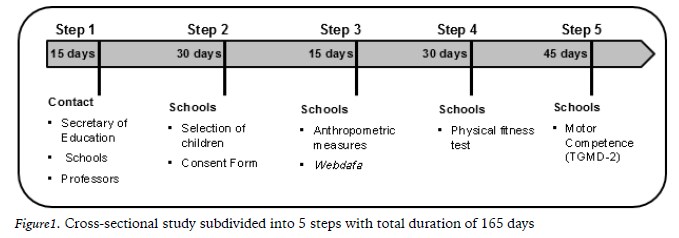
<body><![CDATA[<p>In this context,   the opportunity for structured and systematized practice within the educational   process is the responsibility of the teachers of school physical education   classes. However, previous studies have indicated negligence in class regarding   the elaboration of the programmed content (Fortes et al., 2012; Gallotta et   al., 2016; Guedes &amp; Guedes, 2001; Telford et al., 2016). Thus, children   demonstrate lower MC levels than expected for the age group, which,   consequently, leads to a lower engagement in organized, sport, recreational,   and other activities, thus reducing levels of PA and HPA in childhood and   adolescence (Fortes et al., 2012; Guedes &amp; Guedes, 2001; Spessato et al.,   2012). For these reasons, the objectives of the present study were to verify   the relationship between HPA, PA, and MC of children practicing exclusively   school physical education classes and another group included in systemized   physical activities organized in the period of the day when they were not at   school and, secondarily, to determine if the children belonging to the school physical education classes maintained adequate levels of HPA, PA, and MC.</p> </font>     <p>&nbsp;</p>     <p><font size="3" face="Verdana"><b><b>METHOD</b></b></font></p> <font face="Verdana" size="2">     <p>A cross-sectional   study, in which all ethical issues were approved prior to execution by the local Ethics Committee (CAEE 44106815.4.0000.5231).</p> <b><b>Participants</b></b>      <p>The   sample was selected for convenience and was composed of 100 eutrophic   prepubertal children, between 8 and 10 years old, of both sexes. The   eligibility criteria required the absence of any ongoing drug therapy and/or illness or physiological dysfunction in the included children.</p>     <p>Two   groups of schoolchildren with distinct physical activity practices were   organized. One of the groups was characterized by exclusive participation in   school physical education classes (PEG), composed of 56 children (25 boys and   31 girls) without any extracurricular physical activity practice in the 6   months prior to the project. The classes were given twice a week for 50 minutes   and followed a similar operating pattern, with stretching activities, global   warm-up with running, structured classroom content and, finally, teacher <i>feedback</i>   to students. The other group consisted of 44 children (19 boys and 25 girls)   who performed systemized physical activity (SPA) in athletics, in addition to   the school physical education classes, for at least 6 months prior to the   beginning of data collection. The athletics practice was performed 3 times a week for 50 minutes.</p> <b><b>Instruments and Procedures</b></b>      <p>The eutrophic   nutritional status was obtained by calculating the body mass index (BMI) from   the body mass to height ratio according to the WHO criteria (Onis et al.,   2007). In addition, relative fat was calculated from the predictive equations specific to sex and maturational status proposed by Slaughter et al. (1988). </p>     <p>The level of HPA   was investigated through the Electronic Questionnaire of a Typical Day of   Physical Activity and Food <i>webdafa </i>(Legnani et al., 2013). The   evaluation of PA was obtained using the PROESP-BR battery of motor tests   (2015). In the present study the horizontal jump, 20-meter run, <i>medicine     ball </i>throw, and six-minute run tests were performed (Proesp, 2015),   strictly following this order of execution. All tests were conducted individually,   except for the six-minute run, which was performed with groups of 4 children.   To investigate the MC, the <i>Test of Motor Development Second Edition</i>   (TGMD-2) was applied, as proposed by Ulrich (2000) and validated for the   Brazilian population by Valentini (2012). As a blinding strategy, three   previously trained evaluators who did not participate in the data collection   analysed the images. The reproducibility between the three evaluators presented   an intraclass correlation coefficient equal to 0.85 for the motor quotient   scores. This value is classified as excellent reproducibility according to Atkinson et al. (1998).</p>     <p>All research   procedures were carried out in the school environment, respecting the academic   hours and content. The description and timetable of the procedure steps are shown in <a href="/img/revistas/mot/v13s1/13s1a11f1.jpg">figure 1</a>, and the duration was, in total, 165 days.</p>     
<p><b><b>Statistical analysis</b></b></p>     ]]></body>
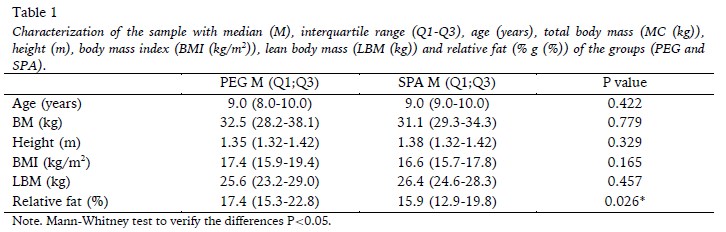
<body><![CDATA[<p>The normality of   the data was verified by the <i>Shapiro-Wilk</i> test and the <i>Levene’s</i>   test for homogeneity. As the data did not present normal distribution or   homogeneity, the <i>Spearman</i> correlation was applied to the HPA, PA, and MC   variables. Correlations were classified as; weak (r between 0.20 and 0.39);   moderate (r = 0.40 to 0.59); moderate to severe (r = 0.60 to 0.79); and strong   (r&gt; 0.80) (Cohen, 1992). Subsequently, associations were carried out between   the groups with the <i>Mann-Whitney</i> and Fisher's exact chi-square tests.   All procedures were performed using the statistical package SPSS 20.0 and a   significance level of P&lt;0.05was adopted. The principal investigator of the study was blinded to the statistical procedures.</p> </font>     <p>&nbsp;</p>     <p><font size="3" face="Verdana"><b><b>RESULTS</b></b></font></p> <font face="Verdana" size="2">     <p>The   anthropometric characteristics of the groups (PEG and SPA) demonstrated   homogeneity for the variables age, total body mass, BMI, and lean body mass. In   the relative fat variable, significant differences were observed, with the PEG   presenting a higher percentage of fat when compared to the SPA (P&lt;0.030) (<a href="/img/revistas/mot/v13s1/13s1a11t1.jpg">Table 1</a>).</p>     
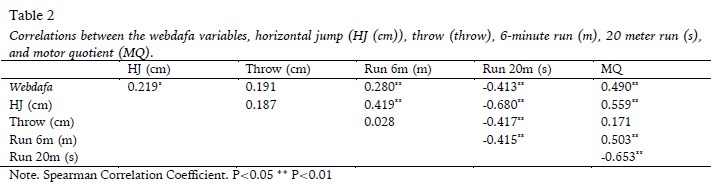
<p><a href="/img/revistas/mot/v13s1/13s1a11t2.jpg">Table   2</a> presents the degree of correlation between the HPA variables evaluated by the   <i>webdafa</i> questionnaire, horizontal jump, medicine ball throw, six-minute   run, 20-meter run, and MC (TGMD-2). The results demonstrated that HPA indicated   a moderate positive correlation (r = 0.49) with CM, a moderate negative   correlation (r = 0.41) with the 20-meter run, and a positive but weak   correlation (r = 0.28) with the 6-minute run. However, the 6-minute run test   presented a moderately positive correlation (r = 0.50) with the motor quotient,   indicating that increasing aerobic fitness enhances the motor competence score.   The values of the correlations demonstrated an inversely proportional pattern,   that is, negative correlations between the 20-meter run and the other research   variables. The moderate to severe negative correlation of r = -0.65 with the   motor quotient is highlighted, indicating that the higher the speed in the   20-meter run, characterized by anaerobic metabolic predominance, the higher the   motor competence scores. In addition, it is important to mention that MC   indicated a moderate positive correlation (r = 0.55) with the horizontal jump,   that is, the higher the horizontal jumping ability, the higher the motor quotient value.</p>     
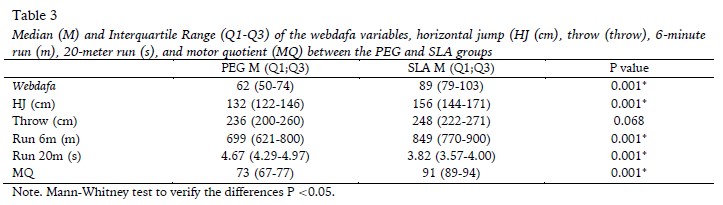
<p>The   comparisons between groups (PEG and SPA) for all variables are presented in   <a href="/img/revistas/mot/v13s1/13s1a11t3.jpg">Table 3</a>. The results demonstrated, for all variables except for <i>medicine     ball</i> throw, statistically significant differences between groups, with the SPA presenting significantly higher values when compared to the PEG (<i>P</i>&lt;0.001).</p>     
<p><a href="/img/revistas/mot/v13s1/13s1a11t4.jpg">Table   4</a> presents the values of the associations between the groups (PEG and SPA). The   results demonstrated significant differences (<i>P</i>&lt;0.001) for all   associations except the <i>medicine ball</i> throw. In the HPA variable, the   highest percentage of children (80.4%) in the PEG remained in the non-active   classification, while the SPA showed higher percentages in the active   classification (84.1%), with significant differences between groups (<i>P</i>&lt;0.001).   The associations for the six-minute run and 20 meter run variables are   emphasized, in which the highest percentage of the PEG were allocated in the   weak classification (69.6% and 62.5%, respectively). In the MC analysis, the   results indicated a significant superiority for the SPA, with percentages for   the motor quotient of 65.9%, classified as average or above average, while in   the PEG only 1.8% were indicated as average, while 98.2% of the PEG sample were allocated in the very poor, poor, and below average classifications.</p> </font>     
<p>&nbsp;</p>     <p><font size="3" face="Verdana"><b><b>DISCUSSION</b></b></font></p> <font face="Verdana" size="2">     <p>The main findings   of the present study indicated a moderate relation (r = 0.49) between HPA and   MC. Among the PA tests, the 20-meter run with a moderate negative correlation   (r = -0.41) with HPA and a moderate to strong positive correlation (r = 0.65)   with MC was the most prominent. In this context, the literature also shows positive correlations between HPA and MC variables.</p>     ]]></body>
<body><![CDATA[<p>Stodden et al.   (2008) proposed a conceptual framework in which MC levels promote participation   in physical activity practice. Based on this assumption, literature review   studies have found positive correlations between MC and HPA (Barnett et al.,   2016; Holfelder &amp; Schott, 2014; Logan et al., 2015; Lubans et al., 2010).   However, although the authors reinforce that there is evidence of a cause and   effect relationship, the strength of the correlations do not demonstrate high   values, indicating limitations for an effective conclusion on the relation   between the variables (Barnnett et al., 2016; Khodaverdi et al., 2015; Logan et al., 2015; Robinson et al., 2015).</p>     <p>The results of a   moderate correlation between PA and MC in the present study corroborate a   recent systematic review of Cattuzzo et al. (2016). These associations may be   explained by the causal mechanisms of improvement in coordination patterns and   in the performance of locomotion and control of objects which are closely   related to changes in the muscular system, such as the recruitment of motor   units, coactivation of antagonists, altered proprioceptor sensitivity, and   concentric and eccentric muscle activity. Thus, there is a reciprocal   combination between elements, in which the increase in one variable possibly   results in improvement in the other (Cattuzzo et al., 2016; Stodden et al., 2014).</p>     <p>In the   comparisons between the groups, the SPA demonstrated superior and significant   values to the PEG group in the HPA, MC, horizontal jump, 20-meter run, and   six-minute run (P &lt;0.001). With regard to meeting the criteria for health,   the results showed that a significant percentage of the SPA sample was   classified in the top score in all parameters analyzed. On the other hand, the   PEG presented worrying results, with 83.9% of children in this group classified   as poor and very poor for MC, underlining that, in HPA, about 80.4% of the   group were classified as non-active by the <i>webdafa</i>. In addition, there   were poor PA classifications in both the aerobic 6-minute run (69.6%), and the   anaerobic 20-meter test (62.5%). The results of the present study are in   agreement with others previously reported in the literature which indicated   that the practice of organized physical activity potentiates MC levels, motor   coordination, PA, and body weight <i>status</i> in children, when compared to   their peers who are not engaged in the same stimulatory environment (Fransen et   al., 2012; Lai et al., 2014; Lubans et al., 2012; Queiroz et al., 2014;   Vandorpe et al., 2012). Fransen et al. (2012) analyzed the levels of PA and   participation in sports in children with low, medium, and high MC. In the   analyses, children with higher MC, measured by the <i>Bruininks-Oseretsky</i>   test, demonstrated higher levels of PA through the <i>Eurofit physical fitness     test</i> (EUROFIT). In addition, greater engagement in organized physical   activities was indicated. Thus, the authors reinforce that children with high   MC have greater possibilities to develop adequate levels of PA and a greater probability   of inclusion in programmed practices, in contrast to children with low and average MC.</p>     <p>Additional   results from the present study indicate that school physical education classes   were not sufficient to improve HPA, PA (six minute run and 20 meter run), or   MC. Similar to these findings, intervention studies with physical activity   programs in the school environment have identified that general content, short   effective classroom time, motivation, and teaching strategies do not guarantee   the achievement of desirable health criteria (Gallotta et al., 2016; Lai et al., 2014; Lonsdale et al., 2013; Telford et al., 2016). </p>     <p>Analysing the   school physical education classes, Spessato et al. (2012) evaluated 1248   children between 3 and 10 years of age with the TGMD-2 test. Overall, 69% of   boys and 82% of girls scored below the test average. The authors questioned the   fact that Physical Education classes are developed in 45 minutes, twice a week,   and although many of them include free or sports content, they do not involve   instruction and correction of motor skills. From these observations, some   elements seem fundamental for the classes to potentiate motor competence, among   them the following stand out: 1) to evaluate level of motor competence and draw   up an activity plan for improvement; 2) offer varied types of practice in motor   skills in situations of different contexts with instruction and feedback; 3) develop tasks appropriate to the needs of students (Spessato et al., 2012). </p>     <p>Corroborating   with these indicatives, the results of the present study are worrisome, due to   the high percentage of schoolchildren in ratings below the expected for the age   group in the HPA, PA, and MC variables. As limitations, we can highlight the   non-use of direct instruments for the measurement of HPA, the absence of a   sample calculation as the sample was selected for convenience, and the absence   of qualitative analysis of the school physical education classes. However, it   is possible to indicate practical implications from the results of the present   study, in which it is suggested that teachers of physical education at school   regularly evaluate the PA and MC of the children to better adapt the structured   activities in class. In future studies mapping of the activities performed is   proposed in addition to which the use of direct HPA instruments could minimize these biases and reinforce the findings of the present study. </p> </font>     <p>&nbsp;</p>     <p><font size="3" face="Verdana"><b><b>CONCLUSION</b></b></font></p> <font face="Verdana" size="2">     <p>Positive   correlations were observed between HPA, PA, and MC in children aged 8 to 10   years. Additionally, it is clear that the children participating in the SPA   presented better results in all variables when compared to their peers who   exclusively participated in the school physical education classes. Thus,   physical education classes seem not to be sufficient to guarantee adequate levels of HPA, PA, and MC in the children in this study.</p> </font>     <p>&nbsp;</p>     ]]></body>
<body><![CDATA[<p><font size="3" face="Verdana"><b><b>REFERENCES</b></b></font></p> <font face="Verdana" size="2">     <!-- ref --><p>Atkinson, G., &amp; Nevill, A. M.   (1998). Statistical methods for assessing measurement error (reliability) in   variables relevant to sports medicine<i>. Sports Medicine</i>, <i>26</i>(4), 217-238.    &nbsp;&nbsp;&nbsp;&nbsp;&nbsp;&nbsp;&nbsp;&nbsp;[&#160;<a href="javascript:void(0);" onclick="javascript: window.open('/scielo.php?script=sci_nlinks&ref=372184&pid=S1646-107X201700060001100001&lng=','','width=640,height=500,resizable=yes,scrollbars=1,menubar=yes,');">Links</a>&#160;]<!-- end-ref --></p>     <!-- ref --><p>Barnett, L. M., Lai, S. K., Veldman,   S. L. C., Hardy, L. L., Cliff, D. P., Morgan, P.J., &amp; Okely, A. D. (2016)<i>.   </i>Correlates of gross motor competence in children and adolescents: A systematic review and meta-analysis. <i>Sports Medicine</i>, <i>46</i>(11),1663-1688.    &nbsp;&nbsp;&nbsp;&nbsp;&nbsp;&nbsp;&nbsp;&nbsp;[&#160;<a href="javascript:void(0);" onclick="javascript: window.open('/scielo.php?script=sci_nlinks&ref=372186&pid=S1646-107X201700060001100002&lng=','','width=640,height=500,resizable=yes,scrollbars=1,menubar=yes,');">Links</a>&#160;]<!-- end-ref --></p>     <!-- ref --><p>Cattuzzo, M. T., Henrique, R.S., Ré,   A. H. N., Oliveira, I. S., Melo, B. M., Moura, M. S., &amp; Stodden, D. F.   (2106). Motor competence   and health related physical fitness in youth: A systematic review. <i>Journal of Science and Medicine in Sport</i>, <i>19</i>(2), 123-129.    &nbsp;&nbsp;&nbsp;&nbsp;&nbsp;&nbsp;&nbsp;&nbsp;[&#160;<a href="javascript:void(0);" onclick="javascript: window.open('/scielo.php?script=sci_nlinks&ref=372188&pid=S1646-107X201700060001100003&lng=','','width=640,height=500,resizable=yes,scrollbars=1,menubar=yes,');">Links</a>&#160;]<!-- end-ref --> </p>     <!-- ref --><p>Cohen, J. (1992). Quantitative Methods in Psychology. A power Primer. <i>Psychological Bulletin, 112</i>(1), 155-159.    &nbsp;&nbsp;&nbsp;&nbsp;&nbsp;&nbsp;&nbsp;&nbsp;[&#160;<a href="javascript:void(0);" onclick="javascript: window.open('/scielo.php?script=sci_nlinks&ref=372190&pid=S1646-107X201700060001100004&lng=','','width=640,height=500,resizable=yes,scrollbars=1,menubar=yes,');">Links</a>&#160;]<!-- end-ref --></p>     <!-- ref --><p>Cote, A.T, Harris, K. C.,   Panagiotopoulos C., Sandor G, G., &amp; Devlin A, M. (2013). Childhood obesity   and cardiovascular dysfunction. <i>Journal of the American College of </i>Cardiology, <i>62</i>(15), 1309-1319.    &nbsp;&nbsp;&nbsp;&nbsp;&nbsp;&nbsp;&nbsp;&nbsp;[&#160;<a href="javascript:void(0);" onclick="javascript: window.open('/scielo.php?script=sci_nlinks&ref=372192&pid=S1646-107X201700060001100005&lng=','','width=640,height=500,resizable=yes,scrollbars=1,menubar=yes,');">Links</a>&#160;]<!-- end-ref --> </p>     <!-- ref --><p>Donnelly, J. E., Hillman, C. H.,   Castelli, D., Etnier J. L., Lee, S., Tomporowski, P., Lambourne, K., &amp;   Szabo-Reed, A. N. (2016). Physical Activity, Fitness, Cognitive Function, and   Academic Achievement in Children: A Systematic Review. <i>Medicine &amp; Science in Sports &amp; Exercise</i>, <i>48</i>(6), 1197-1222.    &nbsp;&nbsp;&nbsp;&nbsp;&nbsp;&nbsp;&nbsp;&nbsp;[&#160;<a href="javascript:void(0);" onclick="javascript: window.open('/scielo.php?script=sci_nlinks&ref=372194&pid=S1646-107X201700060001100006&lng=','','width=640,height=500,resizable=yes,scrollbars=1,menubar=yes,');">Links</a>&#160;]<!-- end-ref --></p>     <!-- ref --><p>Fortes, M. O., Azevedo, M. R., Kremer,   M. M., &amp; Hallal, P. C. (2012). A Educação Física na cidade de Pelotas-RS: Contexto   das aulas e conteúdos. <i>Revista de Educação Física/UEM</i>, <i>23</i>(1), 69-78.    &nbsp;&nbsp;&nbsp;&nbsp;&nbsp;&nbsp;&nbsp;&nbsp;[&#160;<a href="javascript:void(0);" onclick="javascript: window.open('/scielo.php?script=sci_nlinks&ref=372196&pid=S1646-107X201700060001100007&lng=','','width=640,height=500,resizable=yes,scrollbars=1,menubar=yes,');">Links</a>&#160;]<!-- end-ref --></p>     <!-- ref --><p>Frasen, J., Pion, J., Vandendriessche,   J., Vandorpe, B., Vaeyens, R., Lenoir, M., &amp; Philippaerts, R. M. (2012). Differences in   physical fitness and gross motor coordination in boys aged 6–12 years   specializing in one versus sampling more than one sport. <i>Journal of Sports Sciences,</i> <i>30</i>(4), 379-386,    &nbsp;&nbsp;&nbsp;&nbsp;&nbsp;&nbsp;&nbsp;&nbsp;[&#160;<a href="javascript:void(0);" onclick="javascript: window.open('/scielo.php?script=sci_nlinks&ref=372198&pid=S1646-107X201700060001100008&lng=','','width=640,height=500,resizable=yes,scrollbars=1,menubar=yes,');">Links</a>&#160;]<!-- end-ref --> </p>     <!-- ref --><p>Gallotta, M. C., Emerenziani, G. P.,   Iazzoni, S., Iasevoli, L., Guidetti, L., &amp; Baldari, C. (2017). Effects of   different physical education programmes on children’s skill- and health-related   outcomes: a pilot randomised controlled trial. <i>Journal of Sports Sciences</i>, <i>35</i>(15), 1547–1555. <a href="https://doi.org/10.1080/02640414.2016.1225969" target="_blank">https://doi.org/10.1080/02640414.2016.1225969</a>&nbsp;&nbsp;&nbsp;&nbsp;&nbsp;&nbsp;&nbsp;&nbsp;[&#160;<a href="javascript:void(0);" onclick="javascript: window.open('/scielo.php?script=sci_nlinks&ref=372200&pid=S1646-107X201700060001100009&lng=','','width=640,height=500,resizable=yes,scrollbars=1,menubar=yes,');">Links</a>&#160;]<!-- end-ref --><!-- ref --><p>Gaya, A., Lemos, A., Gaya, A.,   Teixeira, D., Pinheiro, E., &amp; Moreira, R. (2015). <i>Manual de testes de avaliação</i>. Projeto Esporte Brasil.    &nbsp;&nbsp;&nbsp;&nbsp;&nbsp;&nbsp;&nbsp;&nbsp;[&#160;<a href="javascript:void(0);" onclick="javascript: window.open('/scielo.php?script=sci_nlinks&ref=372201&pid=S1646-107X201700060001100010&lng=','','width=640,height=500,resizable=yes,scrollbars=1,menubar=yes,');">Links</a>&#160;]<!-- end-ref --></p>     ]]></body>
<body><![CDATA[<!-- ref --><p>Guedes, D. P., &amp; Guedes, J. E. R.   P. (2001). Esforços físicos nos programas de educação física escolar. <i>Revista Paulista de Educação Física, 15</i>(1), 33-44.    &nbsp;&nbsp;&nbsp;&nbsp;&nbsp;&nbsp;&nbsp;&nbsp;[&#160;<a href="javascript:void(0);" onclick="javascript: window.open('/scielo.php?script=sci_nlinks&ref=372203&pid=S1646-107X201700060001100011&lng=','','width=640,height=500,resizable=yes,scrollbars=1,menubar=yes,');">Links</a>&#160;]<!-- end-ref --></p>     <!-- ref --><p>Holfelder, B., &amp; Schott, N.   (2014). Relationship of fundamental movement skills and physical activity in   children and adolescents: A systematic review. <i>Psychology of Sport and Exercise, 15</i>(4), 382-391.    &nbsp;&nbsp;&nbsp;&nbsp;&nbsp;&nbsp;&nbsp;&nbsp;[&#160;<a href="javascript:void(0);" onclick="javascript: window.open('/scielo.php?script=sci_nlinks&ref=372205&pid=S1646-107X201700060001100012&lng=','','width=640,height=500,resizable=yes,scrollbars=1,menubar=yes,');">Links</a>&#160;]<!-- end-ref --></p>     <!-- ref --><p>Khodaverdi, Z., Bahram, A., Stodden,   D., &amp; Kazemnejad, A. (2016). The relationship between actual motor   competence and physical activity in children: mediating roles of perceived   motor competence and health-related physical fitness. <i>Journal of Sports Sciences</i>, <i>34</i>(16), 1523-1529.    &nbsp;&nbsp;&nbsp;&nbsp;&nbsp;&nbsp;&nbsp;&nbsp;[&#160;<a href="javascript:void(0);" onclick="javascript: window.open('/scielo.php?script=sci_nlinks&ref=372207&pid=S1646-107X201700060001100013&lng=','','width=640,height=500,resizable=yes,scrollbars=1,menubar=yes,');">Links</a>&#160;]<!-- end-ref --></p>     <!-- ref --><p>Kohl, H. W., Craig, C.L., Lambert E,   V., Inoue S., Alkandari J, R., Leetongin G., &amp; Kahlmeier S. (2012). The   pandemic of physical inactivity: Global action for public health. <i>Lancet</i>, <i>380</i>(9838), 294–305.    &nbsp;&nbsp;&nbsp;&nbsp;&nbsp;&nbsp;&nbsp;&nbsp;[&#160;<a href="javascript:void(0);" onclick="javascript: window.open('/scielo.php?script=sci_nlinks&ref=372209&pid=S1646-107X201700060001100014&lng=','','width=640,height=500,resizable=yes,scrollbars=1,menubar=yes,');">Links</a>&#160;]<!-- end-ref --></p>     <!-- ref --><p>Lai, S. K., Costigan, S. A., Morgan,   P. J., Lubans, D. R., Stodden, D. F., Salmon, J., &amp; Barnett, L. M. (2014).   Do school-based interventions focusing on physical activity, fitness, or   fundamental movement skill competency produce a sustained impact in these   outcomes in children and adolescents? A systematic review of follow-up studies. <i>Sports Medicine</i>, <i>44</i>(1), 67-79.    &nbsp;&nbsp;&nbsp;&nbsp;&nbsp;&nbsp;&nbsp;&nbsp;[&#160;<a href="javascript:void(0);" onclick="javascript: window.open('/scielo.php?script=sci_nlinks&ref=372211&pid=S1646-107X201700060001100015&lng=','','width=640,height=500,resizable=yes,scrollbars=1,menubar=yes,');">Links</a>&#160;]<!-- end-ref --></p>     ]]></body>
<body><![CDATA[<!-- ref --><p>Legnani, E., Legnani, R.F.S., Rech,   C.R., Barros, M. V. G., Campos, W., &amp; Assis, M. A. A. (2013). Concordância e   fidedignidade de um questionário eletrônico para crianças (<i>webdafa</i>). <i>Revista Brasileira de Cineantropometria e Desempenho Humano</i>, <i>15</i>(1), 38-48.    &nbsp;&nbsp;&nbsp;&nbsp;&nbsp;&nbsp;&nbsp;&nbsp;[&#160;<a href="javascript:void(0);" onclick="javascript: window.open('/scielo.php?script=sci_nlinks&ref=372213&pid=S1646-107X201700060001100016&lng=','','width=640,height=500,resizable=yes,scrollbars=1,menubar=yes,');">Links</a>&#160;]<!-- end-ref --></p>     <!-- ref --><p>Logan, S. W., Kipling Webster, E.,   Getchell, N., Pfeiffer, K. A., &amp; Robinson, L. E. (2015). Relationship   Between Fundamental Motor Skill Competence and Physical Activity During   Childhood and Adolescence: A Systematic Review. <i>Kinesiology Review</i>, <i>4</i>(4), 416–426. <a href="https://doi.org/10.1123/kr.2013-0012" target="_blank">https://doi.org/10.1123/kr.2013-0012</a>&nbsp;&nbsp;&nbsp;&nbsp;&nbsp;&nbsp;&nbsp;&nbsp;[&#160;<a href="javascript:void(0);" onclick="javascript: window.open('/scielo.php?script=sci_nlinks&ref=372215&pid=S1646-107X201700060001100017&lng=','','width=640,height=500,resizable=yes,scrollbars=1,menubar=yes,');">Links</a>&#160;]<!-- end-ref --><!-- ref --><p>Lonsdale, C., Rosenkranz, R. R.,   Peralta, L. R., Bennie, A., &amp; Lubans, D. R. (2013). A systematic review and   meta-analysis of interventions designed to increase moderate-to-vigorous   physical activity in school physical education lessons. <i>Preventive Medicine,</i> <i>56</i>, 152-161.    &nbsp;&nbsp;&nbsp;&nbsp;&nbsp;&nbsp;&nbsp;&nbsp;[&#160;<a href="javascript:void(0);" onclick="javascript: window.open('/scielo.php?script=sci_nlinks&ref=372216&pid=S1646-107X201700060001100018&lng=','','width=640,height=500,resizable=yes,scrollbars=1,menubar=yes,');">Links</a>&#160;]<!-- end-ref --></p>     <!-- ref --><p>Lubans, D. R., Morgan, P. J., Cliff,   D. P., Barnett, L. M., &amp; Okely, A. D. (2010). Fundamental movement skills in children and adolescents. <i>Sports Medicine</i>, <i>40</i>(12), 1019–1035.    &nbsp;&nbsp;&nbsp;&nbsp;&nbsp;&nbsp;&nbsp;&nbsp;[&#160;<a href="javascript:void(0);" onclick="javascript: window.open('/scielo.php?script=sci_nlinks&ref=372218&pid=S1646-107X201700060001100019&lng=','','width=640,height=500,resizable=yes,scrollbars=1,menubar=yes,');">Links</a>&#160;]<!-- end-ref --></p>     <!-- ref --><p>Lubans, D.R. Morgan, P. J., Weaver,   K., Callister, R., Dewar, D. L., Costigan, S. A, &amp; Plotnikoff, R. C.   (2012). Rationale and study protocol for the supporting children outcomes using   rewards, exercise and skills (SCORES) group randomized controlled trial: a   physical activity and fundamental movement skills intervention for primary   schools in low-income communities. <i>BMC Public Health</i>, <i>12</i>(1), 427–438.    &nbsp;&nbsp;&nbsp;&nbsp;&nbsp;&nbsp;&nbsp;&nbsp;[&#160;<a href="javascript:void(0);" onclick="javascript: window.open('/scielo.php?script=sci_nlinks&ref=372220&pid=S1646-107X201700060001100020&lng=','','width=640,height=500,resizable=yes,scrollbars=1,menubar=yes,');">Links</a>&#160;]<!-- end-ref --></p>     <!-- ref --><p>Nazario, P. F., &amp; Vieira, J. L. L.   (2014). Sport context and   the motor development of children. <i>Revista Brasileira de Cineantropometria e Desempenho     Humano</i>, <i>16</i>(1), 86-95.    &nbsp;&nbsp;&nbsp;&nbsp;&nbsp;&nbsp;&nbsp;&nbsp;[&#160;<a href="javascript:void(0);" onclick="javascript: window.open('/scielo.php?script=sci_nlinks&ref=372222&pid=S1646-107X201700060001100021&lng=','','width=640,height=500,resizable=yes,scrollbars=1,menubar=yes,');">Links</a>&#160;]<!-- end-ref --></p>     <!-- ref --><p>Onis M., Onyango A. W., Borghi E.,   Siyam A, Nishida., &amp; Siekmann J. (2007). Development of a WHO growth reference   for school-aged children and adolescents. <i>Bull World Health Organ, 85</i>(9), 660-667.    &nbsp;&nbsp;&nbsp;&nbsp;&nbsp;&nbsp;&nbsp;&nbsp;[&#160;<a href="javascript:void(0);" onclick="javascript: window.open('/scielo.php?script=sci_nlinks&ref=372224&pid=S1646-107X201700060001100022&lng=','','width=640,height=500,resizable=yes,scrollbars=1,menubar=yes,');">Links</a>&#160;]<!-- end-ref --></p>     <!-- ref --><p>Queiroz, D.R., Ré, A. H. N., Henrique,   R. S., Moura, M.S., &amp; Cattuzzo, M. T. (2014). Participation in sports   practice and motor competence in preschoolers. <i>Motriz</i>, <i>20</i>(1), 26-32.    &nbsp;&nbsp;&nbsp;&nbsp;&nbsp;&nbsp;&nbsp;&nbsp;[&#160;<a href="javascript:void(0);" onclick="javascript: window.open('/scielo.php?script=sci_nlinks&ref=372226&pid=S1646-107X201700060001100023&lng=','','width=640,height=500,resizable=yes,scrollbars=1,menubar=yes,');">Links</a>&#160;]<!-- end-ref --></p>     <!-- ref --><p>Robinson, L. E., Stodden, D. F.,   Barnett, L. M., Lopes, V. P., Logan, S. W., Rodrigues, L. P., &amp; D’Hondt, E.   (2015) Motor competence and its effect on positive developmental trajectories of health. <i>Sports Medicine</i>, <i>45</i>(9), 1273-1284.    &nbsp;&nbsp;&nbsp;&nbsp;&nbsp;&nbsp;&nbsp;&nbsp;[&#160;<a href="javascript:void(0);" onclick="javascript: window.open('/scielo.php?script=sci_nlinks&ref=372228&pid=S1646-107X201700060001100024&lng=','','width=640,height=500,resizable=yes,scrollbars=1,menubar=yes,');">Links</a>&#160;]<!-- end-ref --></p>     <!-- ref --><p>Slaughter, M. H., Lohman, T. G.,   Boileau, R. A., Horswill, C. A., Stillman, R. J., Van Loan, M. D., &amp;   Bemben, D. A. (1988). Skinfold Equations for Estimation of Body Fatness in Children and Youth. <i>Human Biology</i>, <i>60</i>(5), 709-723&nbsp;&nbsp;&nbsp;&nbsp;&nbsp;&nbsp;&nbsp;&nbsp;[&#160;<a href="javascript:void(0);" onclick="javascript: window.open('/scielo.php?script=sci_nlinks&ref=372230&pid=S1646-107X201700060001100025&lng=','','width=640,height=500,resizable=yes,scrollbars=1,menubar=yes,');">Links</a>&#160;]<!-- end-ref --><!-- ref --><p>Spessato, B. C., Gabbard, C.,   Valentini, N., &amp; Rudisill, M. E. (2013). Gender differences in Brazilian   children’s fundamental movement skill performance<i>. Early Child Development and Care, 183</i>(7), 916-923.    &nbsp;&nbsp;&nbsp;&nbsp;&nbsp;&nbsp;&nbsp;&nbsp;[&#160;<a href="javascript:void(0);" onclick="javascript: window.open('/scielo.php?script=sci_nlinks&ref=372231&pid=S1646-107X201700060001100026&lng=','','width=640,height=500,resizable=yes,scrollbars=1,menubar=yes,');">Links</a>&#160;]<!-- end-ref --></p>     ]]></body>
<body><![CDATA[<!-- ref --><p>Stodden, D. F., Gao, Z., &amp;   Langendorfer, S. J. (2014). Dynamic relationships between motor skill   competence and health-related fitness in youth<b>. </b><i>Pediatric Exercise Science</i>, <i>26</i>, 231–241.    &nbsp;&nbsp;&nbsp;&nbsp;&nbsp;&nbsp;&nbsp;&nbsp;[&#160;<a href="javascript:void(0);" onclick="javascript: window.open('/scielo.php?script=sci_nlinks&ref=372233&pid=S1646-107X201700060001100027&lng=','','width=640,height=500,resizable=yes,scrollbars=1,menubar=yes,');">Links</a>&#160;]<!-- end-ref --></p>     <!-- ref --><p>Stodden, D. F., Goodway, J. D.,   Langendorfer, S. J., Roberton, M. A., Rudisill, M. E., Garcia, C., &amp;   Garcia, L. E. A. (2008). Developmen­tal Perspective on the Role of Motor Skill   Competence in Physical Activity: An Emergent Relationship. <i>Quest</i>, <i>60</i>(2), 290–306.    &nbsp;&nbsp;&nbsp;&nbsp;&nbsp;&nbsp;&nbsp;&nbsp;[&#160;<a href="javascript:void(0);" onclick="javascript: window.open('/scielo.php?script=sci_nlinks&ref=372235&pid=S1646-107X201700060001100028&lng=','','width=640,height=500,resizable=yes,scrollbars=1,menubar=yes,');">Links</a>&#160;]<!-- end-ref --></p>     <!-- ref --><p>Telama, R., Yang, X., Leskinen, E.,   Kankaanpää, A., Hirvensalo, M., Tammelin, T., &amp; Raitakari, O. T. (2014).   Tracking of physical activity from early childhood through youth into   adulthood. <i>Medicine &amp; Science in Sports &amp; Exercise</i>, <i>46</i>(5), 955–962.    &nbsp;&nbsp;&nbsp;&nbsp;&nbsp;&nbsp;&nbsp;&nbsp;[&#160;<a href="javascript:void(0);" onclick="javascript: window.open('/scielo.php?script=sci_nlinks&ref=372237&pid=S1646-107X201700060001100029&lng=','','width=640,height=500,resizable=yes,scrollbars=1,menubar=yes,');">Links</a>&#160;]<!-- end-ref --></p>     <!-- ref --><p>Telford, R. M., Olive, L.S., Cochrane,   T., Davey, R., &amp; Telford, R. D. (2016). Outcomes of a four-year   specialist-taught physical education program on physical activity: a cluster   randomized controlled trial, the LOOK study. <i>International Journal of Behavioral Nutrition and Physical Activity</i>, <i>13</i>(64), 1-11.    &nbsp;&nbsp;&nbsp;&nbsp;&nbsp;&nbsp;&nbsp;&nbsp;[&#160;<a href="javascript:void(0);" onclick="javascript: window.open('/scielo.php?script=sci_nlinks&ref=372239&pid=S1646-107X201700060001100030&lng=','','width=640,height=500,resizable=yes,scrollbars=1,menubar=yes,');">Links</a>&#160;]<!-- end-ref --></p>     <!-- ref --><p>Ultich, D. A. (2000). Test of Gross Motor Development Examiner’s Manual. (2ª ed). Austin, Texas: Pro Ed.    &nbsp;&nbsp;&nbsp;&nbsp;&nbsp;&nbsp;&nbsp;&nbsp;[&#160;<a href="javascript:void(0);" onclick="javascript: window.open('/scielo.php?script=sci_nlinks&ref=372241&pid=S1646-107X201700060001100031&lng=','','width=640,height=500,resizable=yes,scrollbars=1,menubar=yes,');">Links</a>&#160;]<!-- end-ref --></p>     ]]></body>
<body><![CDATA[<!-- ref --><p>Valentini, N. C. (2012). Validity and   reliability of the TGMD-2 for Brazilian children. <i>Journal of Motor Behavior, 44</i>(4), 275–280.    &nbsp;&nbsp;&nbsp;&nbsp;&nbsp;&nbsp;&nbsp;&nbsp;[&#160;<a href="javascript:void(0);" onclick="javascript: window.open('/scielo.php?script=sci_nlinks&ref=372243&pid=S1646-107X201700060001100032&lng=','','width=640,height=500,resizable=yes,scrollbars=1,menubar=yes,');">Links</a>&#160;]<!-- end-ref --></p>     <!-- ref --><p>Vandorpe, B., Vandendriessche, J.,   Vaeyens, R., Pion, J., Matthys, S., Lefevre, J., Philippaerts, R., &amp;   Lenoir, M. (2012). Relationship between sports participation and the level of   motor coordination in childhood: A longitudinal approach. <i>Journal of Science Medicine in Sports</i>, <i>15</i>(3), 220-225.    &nbsp;&nbsp;&nbsp;&nbsp;&nbsp;&nbsp;&nbsp;&nbsp;[&#160;<a href="javascript:void(0);" onclick="javascript: window.open('/scielo.php?script=sci_nlinks&ref=372245&pid=S1646-107X201700060001100033&lng=','','width=640,height=500,resizable=yes,scrollbars=1,menubar=yes,');">Links</a>&#160;]<!-- end-ref --></p>     <!-- ref --><p>Vanhelst, J., Béghin, L., Duhamel, A.,   De Henauw S., Molnar, D., Vicente-Rodriguez G., Manios, Y<sup>, </sup>&amp;   Gottrand, F. (2016). Relationship between school rhythm and physical activity in adolescents: the HELENA study. <i>Journal of Sports Science</i>, <i>6</i>, 1-8.    &nbsp;&nbsp;&nbsp;&nbsp;&nbsp;&nbsp;&nbsp;&nbsp;[&#160;<a href="javascript:void(0);" onclick="javascript: window.open('/scielo.php?script=sci_nlinks&ref=372247&pid=S1646-107X201700060001100034&lng=','','width=640,height=500,resizable=yes,scrollbars=1,menubar=yes,');">Links</a>&#160;]<!-- end-ref --> </p>     <!-- ref --><p>Yumuk, V., Tsigos, C., Fried, M.,   Schindler, K., Busetto, L., Micic, D., Toplak, H. Obesity Management Task Force   of the European Association for the Study of Obesity. (2015). European Guidelines for Obesity Management in Adults. <i>Obesity Facts</i>, <i>8</i>(6), 402–424. <a href="https://doi.org/10.1159/000442721" target="_blank">https://doi.org/10.1159/000442721</a>&nbsp;&nbsp;&nbsp;&nbsp;&nbsp;&nbsp;&nbsp;&nbsp;[&#160;<a href="javascript:void(0);" onclick="javascript: window.open('/scielo.php?script=sci_nlinks&ref=372249&pid=S1646-107X201700060001100035&lng=','','width=640,height=500,resizable=yes,scrollbars=1,menubar=yes,');">Links</a>&#160;]<!-- end-ref --><p>&nbsp;</p>     <p><b>Acknowledgments:    <br> </b>Nothing to declare.    ]]></body>
<body><![CDATA[<br> <b>Conflict of interests:    <br> </b>Nothing to declare.    <br> <b>Funding:    <br> </b>Nothing to declare.</p> </font>     <p>&nbsp;</p>     <p>&nbsp;</p>     <p><font face="Verdana" size="2"><a href="#top"><sup>*</sup></a><i><a name="end"></a></i></font>    <font size="2" face="Verdana"><i>Corresponding author: </i>Londrina State   University, Celso Garcia Cid PR 445 km 380, 86057-970, Londrina, Brazil. <i>Email: </i><a href="mailto:camilaramos_3@hotmail.com">camilaramos_3@hotmail.com</a></font></p> <font face="Verdana" size="2"></font>      ]]></body><back>
<ref-list>
<ref id="B1">
<nlm-citation citation-type="journal">
<person-group person-group-type="author">
<name>
<surname><![CDATA[Atkinson]]></surname>
<given-names><![CDATA[G.]]></given-names>
</name>
<name>
<surname><![CDATA[Nevill]]></surname>
<given-names><![CDATA[A. M.]]></given-names>
</name>
</person-group>
<article-title xml:lang="en"><![CDATA[Statistical methods for assessing measurement error (reliability) in variables relevant to sports medicine]]></article-title>
<source><![CDATA[Sports Medicine]]></source>
<year>1998</year>
<volume>26</volume>
<numero>4</numero>
<issue>4</issue>
<page-range>217-238</page-range></nlm-citation>
</ref>
<ref id="B2">
<nlm-citation citation-type="journal">
<person-group person-group-type="author">
<name>
<surname><![CDATA[Barnett]]></surname>
<given-names><![CDATA[L. M.]]></given-names>
</name>
<name>
<surname><![CDATA[Lai]]></surname>
<given-names><![CDATA[S. K.]]></given-names>
</name>
<name>
<surname><![CDATA[Veldman]]></surname>
<given-names><![CDATA[S. L. C.]]></given-names>
</name>
<name>
<surname><![CDATA[Hardy]]></surname>
<given-names><![CDATA[L. L.]]></given-names>
</name>
<name>
<surname><![CDATA[Cliff]]></surname>
<given-names><![CDATA[D. P.]]></given-names>
</name>
<name>
<surname><![CDATA[Morgan]]></surname>
<given-names><![CDATA[P.J.]]></given-names>
</name>
<name>
<surname><![CDATA[Okely]]></surname>
<given-names><![CDATA[A. D.]]></given-names>
</name>
</person-group>
<article-title xml:lang="en"><![CDATA[Correlates of gross motor competence in children and adolescents: A systematic review and meta-analysis]]></article-title>
<source><![CDATA[Sports Medicine]]></source>
<year>2016</year>
<volume>46</volume>
<numero>11</numero>
<issue>11</issue>
<page-range>1663-1688</page-range></nlm-citation>
</ref>
<ref id="B3">
<nlm-citation citation-type="journal">
<person-group person-group-type="author">
<name>
<surname><![CDATA[Cattuzzo]]></surname>
<given-names><![CDATA[M. T.]]></given-names>
</name>
<name>
<surname><![CDATA[Henrique]]></surname>
<given-names><![CDATA[R.S.]]></given-names>
</name>
<name>
<surname><![CDATA[Ré]]></surname>
<given-names><![CDATA[A. H. N.]]></given-names>
</name>
<name>
<surname><![CDATA[Oliveira]]></surname>
<given-names><![CDATA[I. S.]]></given-names>
</name>
<name>
<surname><![CDATA[Melo]]></surname>
<given-names><![CDATA[B. M.]]></given-names>
</name>
<name>
<surname><![CDATA[Moura]]></surname>
<given-names><![CDATA[M. S.]]></given-names>
</name>
<name>
<surname><![CDATA[Stodden]]></surname>
<given-names><![CDATA[D. F.]]></given-names>
</name>
</person-group>
<article-title xml:lang="en"><![CDATA[Motor competence and health related physical fitness in youth: A systematic review]]></article-title>
<source><![CDATA[Journal of Science and Medicine in Sport]]></source>
<year>2106</year>
<volume>19</volume>
<numero>2</numero>
<issue>2</issue>
<page-range>123-129</page-range></nlm-citation>
</ref>
<ref id="B4">
<nlm-citation citation-type="journal">
<person-group person-group-type="author">
<name>
<surname><![CDATA[Cohen]]></surname>
<given-names><![CDATA[J.]]></given-names>
</name>
</person-group>
<article-title xml:lang="en"><![CDATA[Quantitative Methods in Psychology: A power Primer]]></article-title>
<source><![CDATA[Psychological Bulletin]]></source>
<year>1992</year>
<volume>112</volume>
<numero>1</numero>
<issue>1</issue>
<page-range>155-159</page-range></nlm-citation>
</ref>
<ref id="B5">
<nlm-citation citation-type="journal">
<person-group person-group-type="author">
<name>
<surname><![CDATA[Cote]]></surname>
<given-names><![CDATA[A.T]]></given-names>
</name>
<name>
<surname><![CDATA[Harris]]></surname>
<given-names><![CDATA[K. C.]]></given-names>
</name>
<name>
<surname><![CDATA[Panagiotopoulos]]></surname>
<given-names><![CDATA[C.]]></given-names>
</name>
<name>
<surname><![CDATA[Sandor]]></surname>
<given-names><![CDATA[G, G.]]></given-names>
</name>
<name>
<surname><![CDATA[Devlin]]></surname>
<given-names><![CDATA[A, M.]]></given-names>
</name>
</person-group>
<article-title xml:lang="en"><![CDATA[Childhood obesity and cardiovascular dysfunction]]></article-title>
<source><![CDATA[Journal of the American College of Cardiology]]></source>
<year>2013</year>
<volume>62</volume>
<numero>15</numero>
<issue>15</issue>
<page-range>1309-1319</page-range></nlm-citation>
</ref>
<ref id="B6">
<nlm-citation citation-type="journal">
<person-group person-group-type="author">
<name>
<surname><![CDATA[Donnelly]]></surname>
<given-names><![CDATA[J. E.]]></given-names>
</name>
<name>
<surname><![CDATA[Hillman]]></surname>
<given-names><![CDATA[C. H.]]></given-names>
</name>
<name>
<surname><![CDATA[Castelli]]></surname>
<given-names><![CDATA[D.]]></given-names>
</name>
<name>
<surname><![CDATA[Etnier]]></surname>
<given-names><![CDATA[J. L.]]></given-names>
</name>
<name>
<surname><![CDATA[Lee]]></surname>
<given-names><![CDATA[S.]]></given-names>
</name>
<name>
<surname><![CDATA[Tomporowski]]></surname>
<given-names><![CDATA[P.]]></given-names>
</name>
<name>
<surname><![CDATA[Lambourne]]></surname>
<given-names><![CDATA[K.]]></given-names>
</name>
<name>
<surname><![CDATA[Szabo-Reed]]></surname>
<given-names><![CDATA[A. N.]]></given-names>
</name>
</person-group>
<article-title xml:lang="en"><![CDATA[Physical Activity, Fitness, Cognitive Function, and Academic Achievement in Children: A Systematic Review]]></article-title>
<source><![CDATA[Medicine & Science in Sports & Exercise]]></source>
<year>2016</year>
<volume>48</volume>
<numero>6</numero>
<issue>6</issue>
<page-range>1197-1222</page-range></nlm-citation>
</ref>
<ref id="B7">
<nlm-citation citation-type="journal">
<person-group person-group-type="author">
<name>
<surname><![CDATA[Fortes]]></surname>
<given-names><![CDATA[M. O.]]></given-names>
</name>
<name>
<surname><![CDATA[Azevedo]]></surname>
<given-names><![CDATA[M. R.]]></given-names>
</name>
<name>
<surname><![CDATA[Kremer]]></surname>
<given-names><![CDATA[M. M.]]></given-names>
</name>
<name>
<surname><![CDATA[Hallal]]></surname>
<given-names><![CDATA[P. C.]]></given-names>
</name>
</person-group>
<article-title xml:lang="pt"><![CDATA[A Educação Física na cidade de Pelotas-RS: Contexto das aulas e conteúdos]]></article-title>
<source><![CDATA[Revista de Educação Física/UEM]]></source>
<year>2012</year>
<volume>23</volume>
<numero>1</numero>
<issue>1</issue>
<page-range>69-78</page-range></nlm-citation>
</ref>
<ref id="B8">
<nlm-citation citation-type="journal">
<person-group person-group-type="author">
<name>
<surname><![CDATA[Frasen]]></surname>
<given-names><![CDATA[J.]]></given-names>
</name>
<name>
<surname><![CDATA[Pion]]></surname>
<given-names><![CDATA[J.]]></given-names>
</name>
<name>
<surname><![CDATA[Vandendriessche]]></surname>
<given-names><![CDATA[J.]]></given-names>
</name>
<name>
<surname><![CDATA[Vandorpe]]></surname>
<given-names><![CDATA[B.]]></given-names>
</name>
<name>
<surname><![CDATA[Vaeyens]]></surname>
<given-names><![CDATA[R.]]></given-names>
</name>
<name>
<surname><![CDATA[Lenoir]]></surname>
<given-names><![CDATA[M.]]></given-names>
</name>
<name>
<surname><![CDATA[Philippaerts]]></surname>
<given-names><![CDATA[R. M.]]></given-names>
</name>
</person-group>
<article-title xml:lang="en"><![CDATA[Differences in physical fitness and gross motor coordination in boys aged 6-12 years specializing in one versus sampling more than one sport]]></article-title>
<source><![CDATA[Journal of Sports Sciences]]></source>
<year>2012</year>
<volume>30</volume>
<numero>4</numero>
<issue>4</issue>
<page-range>379-386</page-range></nlm-citation>
</ref>
<ref id="B9">
<nlm-citation citation-type="journal">
<person-group person-group-type="author">
<name>
<surname><![CDATA[Gallotta]]></surname>
<given-names><![CDATA[M. C.]]></given-names>
</name>
<name>
<surname><![CDATA[Emerenziani]]></surname>
<given-names><![CDATA[G. P.]]></given-names>
</name>
<name>
<surname><![CDATA[Iazzoni]]></surname>
<given-names><![CDATA[S.]]></given-names>
</name>
<name>
<surname><![CDATA[Iasevoli]]></surname>
<given-names><![CDATA[L.]]></given-names>
</name>
<name>
<surname><![CDATA[Guidetti]]></surname>
<given-names><![CDATA[L.]]></given-names>
</name>
<name>
<surname><![CDATA[Baldari]]></surname>
<given-names><![CDATA[C.]]></given-names>
</name>
</person-group>
<article-title xml:lang="en"><![CDATA[Effects of different physical education programmes on children’s skill- and health-related outcomes: a pilot randomised controlled trial]]></article-title>
<source><![CDATA[Journal of Sports Sciences]]></source>
<year>2017</year>
<volume>35</volume>
<numero>15</numero>
<issue>15</issue>
<page-range>1547-1555</page-range></nlm-citation>
</ref>
<ref id="B10">
<nlm-citation citation-type="book">
<person-group person-group-type="author">
<name>
<surname><![CDATA[Gaya]]></surname>
<given-names><![CDATA[A.]]></given-names>
</name>
<name>
<surname><![CDATA[Lemos]]></surname>
<given-names><![CDATA[A.]]></given-names>
</name>
<name>
<surname><![CDATA[Gaya]]></surname>
<given-names><![CDATA[A.]]></given-names>
</name>
<name>
<surname><![CDATA[Teixeira]]></surname>
<given-names><![CDATA[D.]]></given-names>
</name>
<name>
<surname><![CDATA[Pinheiro]]></surname>
<given-names><![CDATA[E.]]></given-names>
</name>
<name>
<surname><![CDATA[Moreira]]></surname>
<given-names><![CDATA[R.]]></given-names>
</name>
</person-group>
<source><![CDATA[Manual de testes de avaliação]]></source>
<year>2015</year>
<publisher-name><![CDATA[Projeto Esporte Brasil]]></publisher-name>
</nlm-citation>
</ref>
<ref id="B11">
<nlm-citation citation-type="journal">
<person-group person-group-type="author">
<name>
<surname><![CDATA[Guedes]]></surname>
<given-names><![CDATA[D. P.]]></given-names>
</name>
<name>
<surname><![CDATA[Guedes]]></surname>
<given-names><![CDATA[J. E. R. P.]]></given-names>
</name>
</person-group>
<article-title xml:lang="pt"><![CDATA[Esforços físicos nos programas de educação física escolar]]></article-title>
<source><![CDATA[Revista Paulista de Educação Física]]></source>
<year>2001</year>
<volume>15</volume>
<numero>1</numero>
<issue>1</issue>
<page-range>33-44</page-range></nlm-citation>
</ref>
<ref id="B12">
<nlm-citation citation-type="journal">
<person-group person-group-type="author">
<name>
<surname><![CDATA[Holfelder]]></surname>
<given-names><![CDATA[B.]]></given-names>
</name>
<name>
<surname><![CDATA[Schott]]></surname>
<given-names><![CDATA[N.]]></given-names>
</name>
</person-group>
<article-title xml:lang="en"><![CDATA[Relationship of fundamental movement skills and physical activity in children and adolescents: A systematic review]]></article-title>
<source><![CDATA[Psychology of Sport and Exercise]]></source>
<year>2014</year>
<volume>15</volume>
<numero>4</numero>
<issue>4</issue>
<page-range>382-391</page-range></nlm-citation>
</ref>
<ref id="B13">
<nlm-citation citation-type="journal">
<person-group person-group-type="author">
<name>
<surname><![CDATA[Khodaverdi]]></surname>
<given-names><![CDATA[Z.]]></given-names>
</name>
<name>
<surname><![CDATA[Bahram]]></surname>
<given-names><![CDATA[A.]]></given-names>
</name>
<name>
<surname><![CDATA[Stodden]]></surname>
<given-names><![CDATA[D.]]></given-names>
</name>
<name>
<surname><![CDATA[Kazemnejad]]></surname>
<given-names><![CDATA[A.]]></given-names>
</name>
</person-group>
<article-title xml:lang="en"><![CDATA[The relationship between actual motor competence and physical activity in children: mediating roles of perceived motor competence and health-related physical fitness]]></article-title>
<source><![CDATA[Journal of Sports Sciences]]></source>
<year>2016</year>
<volume>34</volume>
<numero>16</numero>
<issue>16</issue>
<page-range>1523-1529</page-range></nlm-citation>
</ref>
<ref id="B14">
<nlm-citation citation-type="journal">
<person-group person-group-type="author">
<name>
<surname><![CDATA[Kohl]]></surname>
<given-names><![CDATA[H. W.]]></given-names>
</name>
<name>
<surname><![CDATA[Craig]]></surname>
<given-names><![CDATA[C.L.]]></given-names>
</name>
<name>
<surname><![CDATA[Lambert]]></surname>
<given-names><![CDATA[E, V.]]></given-names>
</name>
<name>
<surname><![CDATA[Inoue]]></surname>
<given-names><![CDATA[S.]]></given-names>
</name>
<name>
<surname><![CDATA[Alkandari]]></surname>
<given-names><![CDATA[J, R.]]></given-names>
</name>
<name>
<surname><![CDATA[Leetongin]]></surname>
<given-names><![CDATA[G.]]></given-names>
</name>
<name>
<surname><![CDATA[Kahlmeier]]></surname>
<given-names><![CDATA[S.]]></given-names>
</name>
</person-group>
<article-title xml:lang="en"><![CDATA[The pandemic of physical inactivity: Global action for public health]]></article-title>
<source><![CDATA[Lancet]]></source>
<year>2012</year>
<volume>380</volume>
<numero>9838</numero>
<issue>9838</issue>
<page-range>294-305</page-range></nlm-citation>
</ref>
<ref id="B15">
<nlm-citation citation-type="journal">
<person-group person-group-type="author">
<name>
<surname><![CDATA[Lai]]></surname>
<given-names><![CDATA[S. K.]]></given-names>
</name>
<name>
<surname><![CDATA[Costigan]]></surname>
<given-names><![CDATA[S. A.]]></given-names>
</name>
<name>
<surname><![CDATA[Morgan]]></surname>
<given-names><![CDATA[P. J.]]></given-names>
</name>
<name>
<surname><![CDATA[Lubans]]></surname>
<given-names><![CDATA[D. R.]]></given-names>
</name>
<name>
<surname><![CDATA[Stodden]]></surname>
<given-names><![CDATA[D. F.]]></given-names>
</name>
<name>
<surname><![CDATA[Salmon]]></surname>
<given-names><![CDATA[J.]]></given-names>
</name>
<name>
<surname><![CDATA[Barnett]]></surname>
<given-names><![CDATA[L. M.]]></given-names>
</name>
</person-group>
<article-title xml:lang="en"><![CDATA[Do school-based interventions focusing on physical activity, fitness, or fundamental movement skill competency produce a sustained impact in these outcomes in children and adolescents?: A systematic review of follow-up studies]]></article-title>
<source><![CDATA[Sports Medicine]]></source>
<year>2014</year>
<volume>44</volume>
<numero>1</numero>
<issue>1</issue>
<page-range>67-79</page-range></nlm-citation>
</ref>
<ref id="B16">
<nlm-citation citation-type="journal">
<person-group person-group-type="author">
<name>
<surname><![CDATA[Legnani]]></surname>
<given-names><![CDATA[E.]]></given-names>
</name>
<name>
<surname><![CDATA[Legnani]]></surname>
<given-names><![CDATA[R.F.S.]]></given-names>
</name>
<name>
<surname><![CDATA[Rech]]></surname>
<given-names><![CDATA[C.R.]]></given-names>
</name>
<name>
<surname><![CDATA[Barros]]></surname>
<given-names><![CDATA[M. V. G.]]></given-names>
</name>
<name>
<surname><![CDATA[Campos]]></surname>
<given-names><![CDATA[W.]]></given-names>
</name>
<name>
<surname><![CDATA[Assis]]></surname>
<given-names><![CDATA[M. A. A.]]></given-names>
</name>
</person-group>
<article-title xml:lang="pt"><![CDATA[Concordância e fidedignidade de um questionário eletrônico para crianças (webdafa)]]></article-title>
<source><![CDATA[Revista Brasileira de Cineantropometria e Desempenho Humano]]></source>
<year>2013</year>
<volume>15</volume>
<numero>1</numero>
<issue>1</issue>
<page-range>38-48</page-range></nlm-citation>
</ref>
<ref id="B17">
<nlm-citation citation-type="journal">
<person-group person-group-type="author">
<name>
<surname><![CDATA[Logan]]></surname>
<given-names><![CDATA[S. W.]]></given-names>
</name>
<name>
<surname><![CDATA[Kipling Webster]]></surname>
<given-names><![CDATA[E.]]></given-names>
</name>
<name>
<surname><![CDATA[Getchell]]></surname>
<given-names><![CDATA[N.]]></given-names>
</name>
<name>
<surname><![CDATA[Pfeiffer]]></surname>
<given-names><![CDATA[K. A.]]></given-names>
</name>
<name>
<surname><![CDATA[Robinson]]></surname>
<given-names><![CDATA[L. E.]]></given-names>
</name>
</person-group>
<article-title xml:lang="en"><![CDATA[Relationship Between Fundamental Motor Skill Competence and Physical Activity During Childhood and Adolescence: A Systematic Review]]></article-title>
<source><![CDATA[Kinesiology Review]]></source>
<year>2015</year>
<volume>4</volume>
<numero>4</numero>
<issue>4</issue>
<page-range>416-426</page-range></nlm-citation>
</ref>
<ref id="B18">
<nlm-citation citation-type="journal">
<person-group person-group-type="author">
<name>
<surname><![CDATA[Lonsdale]]></surname>
<given-names><![CDATA[C.]]></given-names>
</name>
<name>
<surname><![CDATA[Rosenkranz]]></surname>
<given-names><![CDATA[R. R.]]></given-names>
</name>
<name>
<surname><![CDATA[Peralta]]></surname>
<given-names><![CDATA[L. R.]]></given-names>
</name>
<name>
<surname><![CDATA[Bennie]]></surname>
<given-names><![CDATA[A.]]></given-names>
</name>
<name>
<surname><![CDATA[Lubans]]></surname>
<given-names><![CDATA[D. R.]]></given-names>
</name>
</person-group>
<article-title xml:lang="en"><![CDATA[A systematic review and meta-analysis of interventions designed to increase moderate-to-vigorous physical activity in school physical education lessons]]></article-title>
<source><![CDATA[Preventive Medicine]]></source>
<year>2013</year>
<volume>56</volume>
<page-range>152-161</page-range></nlm-citation>
</ref>
<ref id="B19">
<nlm-citation citation-type="journal">
<person-group person-group-type="author">
<name>
<surname><![CDATA[Lubans]]></surname>
<given-names><![CDATA[D. R.]]></given-names>
</name>
<name>
<surname><![CDATA[Morgan]]></surname>
<given-names><![CDATA[P. J.]]></given-names>
</name>
<name>
<surname><![CDATA[Cliff]]></surname>
<given-names><![CDATA[D. P.]]></given-names>
</name>
<name>
<surname><![CDATA[Barnett]]></surname>
<given-names><![CDATA[L. M.]]></given-names>
</name>
<name>
<surname><![CDATA[Okely]]></surname>
<given-names><![CDATA[A. D.]]></given-names>
</name>
</person-group>
<article-title xml:lang="en"><![CDATA[Fundamental movement skills in children and adolescents]]></article-title>
<source><![CDATA[Sports Medicine]]></source>
<year>2010</year>
<volume>40</volume>
<numero>12</numero>
<issue>12</issue>
<page-range>1019-1035</page-range></nlm-citation>
</ref>
<ref id="B20">
<nlm-citation citation-type="journal">
<person-group person-group-type="author">
<name>
<surname><![CDATA[Lubans]]></surname>
<given-names><![CDATA[D.R.]]></given-names>
</name>
<name>
<surname><![CDATA[Morgan]]></surname>
<given-names><![CDATA[P. J.]]></given-names>
</name>
<name>
<surname><![CDATA[Weaver]]></surname>
<given-names><![CDATA[K.]]></given-names>
</name>
<name>
<surname><![CDATA[Callister]]></surname>
<given-names><![CDATA[R.]]></given-names>
</name>
<name>
<surname><![CDATA[Dewar]]></surname>
<given-names><![CDATA[D. L.]]></given-names>
</name>
<name>
<surname><![CDATA[Costigan]]></surname>
<given-names><![CDATA[S. A]]></given-names>
</name>
<name>
<surname><![CDATA[Plotnikoff]]></surname>
<given-names><![CDATA[R. C.]]></given-names>
</name>
</person-group>
<article-title xml:lang="en"><![CDATA[Rationale and study protocol for the supporting children outcomes using rewards, exercise and skills (SCORES) group randomized controlled trial: a physical activity and fundamental movement skills intervention for primary schools in low-income communities]]></article-title>
<source><![CDATA[BMC Public Health]]></source>
<year>2012</year>
<volume>12</volume>
<numero>1</numero>
<issue>1</issue>
<page-range>427-438</page-range></nlm-citation>
</ref>
<ref id="B21">
<nlm-citation citation-type="journal">
<person-group person-group-type="author">
<name>
<surname><![CDATA[Nazario]]></surname>
<given-names><![CDATA[P. F.]]></given-names>
</name>
<name>
<surname><![CDATA[Vieira]]></surname>
<given-names><![CDATA[J. L. L.]]></given-names>
</name>
</person-group>
<article-title xml:lang="en"><![CDATA[Sport context and the motor development of children]]></article-title>
<source><![CDATA[Revista Brasileira de Cineantropometria e Desempenho Humano]]></source>
<year>2014</year>
<volume>16</volume>
<numero>1</numero>
<issue>1</issue>
<page-range>86-95</page-range></nlm-citation>
</ref>
<ref id="B22">
<nlm-citation citation-type="journal">
<person-group person-group-type="author">
<name>
<surname><![CDATA[Onis]]></surname>
<given-names><![CDATA[M.]]></given-names>
</name>
<name>
<surname><![CDATA[Onyango]]></surname>
<given-names><![CDATA[A. W.]]></given-names>
</name>
<name>
<surname><![CDATA[Borghi]]></surname>
<given-names><![CDATA[E.]]></given-names>
</name>
<name>
<surname><![CDATA[Siyam]]></surname>
<given-names><![CDATA[A]]></given-names>
</name>
<name>
<surname><![CDATA[Nishida]]></surname>
</name>
<name>
<surname><![CDATA[Siekmann]]></surname>
<given-names><![CDATA[J.]]></given-names>
</name>
</person-group>
<article-title xml:lang="en"><![CDATA[Development of a WHO growth reference for school-aged children and adolescents]]></article-title>
<source><![CDATA[Bull World Health Organ]]></source>
<year>2007</year>
<volume>85</volume>
<numero>9</numero>
<issue>9</issue>
<page-range>660-667</page-range></nlm-citation>
</ref>
<ref id="B23">
<nlm-citation citation-type="journal">
<person-group person-group-type="author">
<name>
<surname><![CDATA[Queiroz]]></surname>
<given-names><![CDATA[D.R.]]></given-names>
</name>
<name>
<surname><![CDATA[Ré]]></surname>
<given-names><![CDATA[A. H. N.]]></given-names>
</name>
<name>
<surname><![CDATA[Henrique]]></surname>
<given-names><![CDATA[R. S.]]></given-names>
</name>
<name>
<surname><![CDATA[Moura]]></surname>
<given-names><![CDATA[M.S.]]></given-names>
</name>
<name>
<surname><![CDATA[Cattuzzo]]></surname>
<given-names><![CDATA[M. T.]]></given-names>
</name>
</person-group>
<article-title xml:lang="en"><![CDATA[Participation in sports practice and motor competence in preschoolers]]></article-title>
<source><![CDATA[Motriz]]></source>
<year>2014</year>
<volume>20</volume>
<numero>1</numero>
<issue>1</issue>
<page-range>26-32</page-range></nlm-citation>
</ref>
<ref id="B24">
<nlm-citation citation-type="journal">
<person-group person-group-type="author">
<name>
<surname><![CDATA[Robinson]]></surname>
<given-names><![CDATA[L. E.]]></given-names>
</name>
<name>
<surname><![CDATA[Stodden]]></surname>
<given-names><![CDATA[D. F.]]></given-names>
</name>
<name>
<surname><![CDATA[Barnett]]></surname>
<given-names><![CDATA[L. M.]]></given-names>
</name>
<name>
<surname><![CDATA[Lopes]]></surname>
<given-names><![CDATA[V. P.]]></given-names>
</name>
<name>
<surname><![CDATA[Logan]]></surname>
<given-names><![CDATA[S. W.]]></given-names>
</name>
<name>
<surname><![CDATA[Rodrigues]]></surname>
<given-names><![CDATA[L. P.]]></given-names>
</name>
<name>
<surname><![CDATA[D’Hondt]]></surname>
<given-names><![CDATA[E.]]></given-names>
</name>
</person-group>
<article-title xml:lang="en"><![CDATA[Motor competence and its effect on positive developmental trajectories of health]]></article-title>
<source><![CDATA[Sports Medicine]]></source>
<year>2015</year>
<volume>45</volume>
<numero>9</numero>
<issue>9</issue>
<page-range>1273-1284</page-range></nlm-citation>
</ref>
<ref id="B25">
<nlm-citation citation-type="journal">
<person-group person-group-type="author">
<name>
<surname><![CDATA[Slaughter]]></surname>
<given-names><![CDATA[M. H.]]></given-names>
</name>
<name>
<surname><![CDATA[Lohman]]></surname>
<given-names><![CDATA[T. G.]]></given-names>
</name>
<name>
<surname><![CDATA[Boileau]]></surname>
<given-names><![CDATA[R. A.]]></given-names>
</name>
<name>
<surname><![CDATA[Horswill]]></surname>
<given-names><![CDATA[C. A.]]></given-names>
</name>
<name>
<surname><![CDATA[Stillman]]></surname>
<given-names><![CDATA[R. J.]]></given-names>
</name>
<name>
<surname><![CDATA[Van Loan]]></surname>
<given-names><![CDATA[M. D.]]></given-names>
</name>
<name>
<surname><![CDATA[Bemben]]></surname>
<given-names><![CDATA[D. A.]]></given-names>
</name>
</person-group>
<article-title xml:lang="en"><![CDATA[Skinfold Equations for Estimation of Body Fatness in Children and Youth]]></article-title>
<source><![CDATA[Human Biology]]></source>
<year>1988</year>
<volume>60</volume>
<numero>5</numero>
<issue>5</issue>
<page-range>709-723</page-range></nlm-citation>
</ref>
<ref id="B26">
<nlm-citation citation-type="journal">
<person-group person-group-type="author">
<name>
<surname><![CDATA[Spessato]]></surname>
<given-names><![CDATA[B. C.]]></given-names>
</name>
<name>
<surname><![CDATA[Gabbard]]></surname>
<given-names><![CDATA[C.]]></given-names>
</name>
<name>
<surname><![CDATA[Valentini]]></surname>
<given-names><![CDATA[N.]]></given-names>
</name>
<name>
<surname><![CDATA[Rudisill]]></surname>
<given-names><![CDATA[M. E.]]></given-names>
</name>
</person-group>
<article-title xml:lang="en"><![CDATA[Gender differences in Brazilian children’s fundamental movement skill performance]]></article-title>
<source><![CDATA[Early Child Development and Care]]></source>
<year>2013</year>
<volume>183</volume>
<numero>7</numero>
<issue>7</issue>
<page-range>916-923</page-range></nlm-citation>
</ref>
<ref id="B27">
<nlm-citation citation-type="journal">
<person-group person-group-type="author">
<name>
<surname><![CDATA[Stodden]]></surname>
<given-names><![CDATA[D. F.]]></given-names>
</name>
<name>
<surname><![CDATA[Gao]]></surname>
<given-names><![CDATA[Z.]]></given-names>
</name>
<name>
<surname><![CDATA[Langendorfer]]></surname>
<given-names><![CDATA[S. J.]]></given-names>
</name>
</person-group>
<article-title xml:lang="en"><![CDATA[Dynamic relationships between motor skill competence and health-related fitness in youth]]></article-title>
<source><![CDATA[Pediatric Exercise Science]]></source>
<year>2014</year>
<volume>26</volume>
<page-range>231-241</page-range></nlm-citation>
</ref>
<ref id="B28">
<nlm-citation citation-type="journal">
<person-group person-group-type="author">
<name>
<surname><![CDATA[Stodden]]></surname>
<given-names><![CDATA[D. F.]]></given-names>
</name>
<name>
<surname><![CDATA[Goodway]]></surname>
<given-names><![CDATA[J. D.]]></given-names>
</name>
<name>
<surname><![CDATA[Langendorfer]]></surname>
<given-names><![CDATA[S. J.]]></given-names>
</name>
<name>
<surname><![CDATA[Roberton]]></surname>
<given-names><![CDATA[M. A.]]></given-names>
</name>
<name>
<surname><![CDATA[Rudisill]]></surname>
<given-names><![CDATA[M. E.]]></given-names>
</name>
<name>
<surname><![CDATA[Garcia]]></surname>
<given-names><![CDATA[C.]]></given-names>
</name>
<name>
<surname><![CDATA[Garcia]]></surname>
<given-names><![CDATA[L. E. A.]]></given-names>
</name>
</person-group>
<article-title xml:lang="en"><![CDATA[Developmen­tal Perspective on the Role of Motor Skill Competence in Physical Activity: An Emergent Relationship]]></article-title>
<source><![CDATA[Quest]]></source>
<year>2008</year>
<volume>60</volume>
<numero>2</numero>
<issue>2</issue>
<page-range>290-306</page-range></nlm-citation>
</ref>
<ref id="B29">
<nlm-citation citation-type="journal">
<person-group person-group-type="author">
<name>
<surname><![CDATA[Telama]]></surname>
<given-names><![CDATA[R.]]></given-names>
</name>
<name>
<surname><![CDATA[Yang]]></surname>
<given-names><![CDATA[X.]]></given-names>
</name>
<name>
<surname><![CDATA[Leskinen]]></surname>
<given-names><![CDATA[E.]]></given-names>
</name>
<name>
<surname><![CDATA[Kankaanpää]]></surname>
<given-names><![CDATA[A.]]></given-names>
</name>
<name>
<surname><![CDATA[Hirvensalo]]></surname>
<given-names><![CDATA[M.]]></given-names>
</name>
<name>
<surname><![CDATA[Tammelin]]></surname>
<given-names><![CDATA[T.]]></given-names>
</name>
<name>
<surname><![CDATA[Raitakari]]></surname>
<given-names><![CDATA[O. T.]]></given-names>
</name>
</person-group>
<article-title xml:lang="en"><![CDATA[Tracking of physical activity from early childhood through youth into adulthood]]></article-title>
<source><![CDATA[Medicine & Science in Sports & Exercise]]></source>
<year>2014</year>
<volume>46</volume>
<numero>5</numero>
<issue>5</issue>
<page-range>955-962</page-range></nlm-citation>
</ref>
<ref id="B30">
<nlm-citation citation-type="journal">
<person-group person-group-type="author">
<name>
<surname><![CDATA[Telford]]></surname>
<given-names><![CDATA[R. M.]]></given-names>
</name>
<name>
<surname><![CDATA[Olive]]></surname>
<given-names><![CDATA[L.S.]]></given-names>
</name>
<name>
<surname><![CDATA[Cochrane]]></surname>
<given-names><![CDATA[T.]]></given-names>
</name>
<name>
<surname><![CDATA[Davey]]></surname>
<given-names><![CDATA[R.]]></given-names>
</name>
<name>
<surname><![CDATA[Telford]]></surname>
<given-names><![CDATA[R. D.]]></given-names>
</name>
</person-group>
<article-title xml:lang="en"><![CDATA[Outcomes of a four-year specialist-taught physical education program on physical activity: a cluster randomized controlled trial, the LOOK study]]></article-title>
<source><![CDATA[International Journal of Behavioral Nutrition and Physical Activity]]></source>
<year>2016</year>
<volume>13</volume>
<numero>64</numero>
<issue>64</issue>
<page-range>1-11</page-range></nlm-citation>
</ref>
<ref id="B31">
<nlm-citation citation-type="book">
<person-group person-group-type="author">
<name>
<surname><![CDATA[Ultich]]></surname>
<given-names><![CDATA[D. A.]]></given-names>
</name>
</person-group>
<source><![CDATA[Test of Gross Motor Development Examiner’s Manual]]></source>
<year>2000</year>
<edition>2</edition>
<publisher-loc><![CDATA[Austin^eTexas Texas]]></publisher-loc>
<publisher-name><![CDATA[Pro Ed]]></publisher-name>
</nlm-citation>
</ref>
<ref id="B32">
<nlm-citation citation-type="journal">
<person-group person-group-type="author">
<name>
<surname><![CDATA[Valentini]]></surname>
<given-names><![CDATA[N. C.]]></given-names>
</name>
</person-group>
<article-title xml:lang="en"><![CDATA[Validity and reliability of the TGMD-2 for Brazilian children]]></article-title>
<source><![CDATA[Journal of Motor Behavior]]></source>
<year>2012</year>
<volume>44</volume>
<numero>4</numero>
<issue>4</issue>
<page-range>275-280</page-range></nlm-citation>
</ref>
<ref id="B33">
<nlm-citation citation-type="journal">
<person-group person-group-type="author">
<name>
<surname><![CDATA[Vandorpe]]></surname>
<given-names><![CDATA[B.]]></given-names>
</name>
<name>
<surname><![CDATA[Vandendriessche]]></surname>
<given-names><![CDATA[J.]]></given-names>
</name>
<name>
<surname><![CDATA[Vaeyens]]></surname>
<given-names><![CDATA[R.]]></given-names>
</name>
<name>
<surname><![CDATA[Pion]]></surname>
<given-names><![CDATA[J.]]></given-names>
</name>
<name>
<surname><![CDATA[Matthys]]></surname>
<given-names><![CDATA[S.]]></given-names>
</name>
<name>
<surname><![CDATA[Lefevre]]></surname>
<given-names><![CDATA[J.]]></given-names>
</name>
<name>
<surname><![CDATA[Philippaerts]]></surname>
<given-names><![CDATA[R.]]></given-names>
</name>
<name>
<surname><![CDATA[Lenoir]]></surname>
<given-names><![CDATA[M.]]></given-names>
</name>
</person-group>
<article-title xml:lang="en"><![CDATA[Relationship between sports participation and the level of motor coordination in childhood: A longitudinal approach]]></article-title>
<source><![CDATA[Journal of Science Medicine in Sports]]></source>
<year>2012</year>
<volume>15</volume>
<numero>3</numero>
<issue>3</issue>
<page-range>220-225</page-range></nlm-citation>
</ref>
<ref id="B34">
<nlm-citation citation-type="journal">
<person-group person-group-type="author">
<name>
<surname><![CDATA[Vanhelst]]></surname>
<given-names><![CDATA[J.]]></given-names>
</name>
<name>
<surname><![CDATA[Béghin]]></surname>
<given-names><![CDATA[L.]]></given-names>
</name>
<name>
<surname><![CDATA[Duhamel]]></surname>
<given-names><![CDATA[A.]]></given-names>
</name>
<name>
<surname><![CDATA[De Henauw]]></surname>
<given-names><![CDATA[S.]]></given-names>
</name>
<name>
<surname><![CDATA[Molnar]]></surname>
<given-names><![CDATA[D.]]></given-names>
</name>
<name>
<surname><![CDATA[Vicente-Rodriguez]]></surname>
<given-names><![CDATA[G.]]></given-names>
</name>
<name>
<surname><![CDATA[Manios]]></surname>
<given-names><![CDATA[Y]]></given-names>
</name>
<name>
<surname><![CDATA[Gottrand]]></surname>
<given-names><![CDATA[F.]]></given-names>
</name>
</person-group>
<article-title xml:lang="en"><![CDATA[Relationship between school rhythm and physical activity in adolescents: the HELENA study]]></article-title>
<source><![CDATA[Journal of Sports Science]]></source>
<year>2016</year>
<volume>6</volume>
<page-range>1-8</page-range></nlm-citation>
</ref>
<ref id="B35">
<nlm-citation citation-type="journal">
<person-group person-group-type="author">
<name>
<surname><![CDATA[Yumuk]]></surname>
<given-names><![CDATA[V.]]></given-names>
</name>
<name>
<surname><![CDATA[Tsigos]]></surname>
<given-names><![CDATA[C.]]></given-names>
</name>
<name>
<surname><![CDATA[Fried]]></surname>
<given-names><![CDATA[M.]]></given-names>
</name>
<name>
<surname><![CDATA[Schindler]]></surname>
<given-names><![CDATA[K.]]></given-names>
</name>
<name>
<surname><![CDATA[Busetto]]></surname>
<given-names><![CDATA[L.]]></given-names>
</name>
<name>
<surname><![CDATA[Micic]]></surname>
<given-names><![CDATA[D.]]></given-names>
</name>
<name>
<surname><![CDATA[Toplak]]></surname>
<given-names><![CDATA[H.]]></given-names>
</name>
</person-group>
<article-title xml:lang="en"><![CDATA[Obesity Management Task Force of the European Association for the Study of Obesity: (2015). European Guidelines for Obesity Management in Adults]]></article-title>
<source><![CDATA[Obesity Facts]]></source>
<year></year>
<volume>8</volume>
<numero>6</numero>
<issue>6</issue>
<page-range>402-424</page-range></nlm-citation>
</ref>
</ref-list>
</back>
</article>