<?xml version="1.0" encoding="ISO-8859-1"?><article xmlns:mml="http://www.w3.org/1998/Math/MathML" xmlns:xlink="http://www.w3.org/1999/xlink" xmlns:xsi="http://www.w3.org/2001/XMLSchema-instance">
<front>
<journal-meta>
<journal-id>1646-107X</journal-id>
<journal-title><![CDATA[Motricidade]]></journal-title>
<abbrev-journal-title><![CDATA[Motri.]]></abbrev-journal-title>
<issn>1646-107X</issn>
<publisher>
<publisher-name><![CDATA[Edições Desafio Singular]]></publisher-name>
</publisher>
</journal-meta>
<article-meta>
<article-id>S1646-107X2017000600012</article-id>
<title-group>
<article-title xml:lang="en"><![CDATA[Stages of change for physical activity and socioeconomic correlates in schoolchildren from Fortaleza, Ceará, Brazil: a cross-sectional study]]></article-title>
</title-group>
<contrib-group>
<contrib contrib-type="author">
<name>
<surname><![CDATA[Lopes]]></surname>
<given-names><![CDATA[Iraneide Etelvina]]></given-names>
</name>
<xref ref-type="aff" rid="A01"/>
</contrib>
<contrib contrib-type="author">
<name>
<surname><![CDATA[Bandeira]]></surname>
<given-names><![CDATA[Alexsandra da Silva]]></given-names>
</name>
<xref ref-type="aff" rid="A02"/>
</contrib>
<contrib contrib-type="author">
<name>
<surname><![CDATA[Filho]]></surname>
<given-names><![CDATA[Valter Cordeiro Barbosa]]></given-names>
</name>
<xref ref-type="aff" rid="A03"/>
</contrib>
</contrib-group>
<aff id="A01">
<institution><![CDATA[,Federal University of Amapá  ]]></institution>
<addr-line><![CDATA[Macapá ]]></addr-line>
<country>Brazil</country>
</aff>
<aff id="A02">
<institution><![CDATA[,Federal University of Santa Catarina  ]]></institution>
<addr-line><![CDATA[Florianópolis ]]></addr-line>
<country>Brazil</country>
</aff>
<aff id="A03">
<institution><![CDATA[,Catholic University Center of Quixadá  ]]></institution>
<addr-line><![CDATA[Quixadá ]]></addr-line>
<country>Brazil</country>
</aff>
<pub-date pub-type="pub">
<day>00</day>
<month>12</month>
<year>2017</year>
</pub-date>
<pub-date pub-type="epub">
<day>00</day>
<month>12</month>
<year>2017</year>
</pub-date>
<volume>13</volume>
<fpage>84</fpage>
<lpage>90</lpage>
<copyright-statement/>
<copyright-year/>
<self-uri xlink:href="http://scielo.pt/scielo.php?script=sci_arttext&amp;pid=S1646-107X2017000600012&amp;lng=en&amp;nrm=iso"></self-uri><self-uri xlink:href="http://scielo.pt/scielo.php?script=sci_abstract&amp;pid=S1646-107X2017000600012&amp;lng=en&amp;nrm=iso"></self-uri><self-uri xlink:href="http://scielo.pt/scielo.php?script=sci_pdf&amp;pid=S1646-107X2017000600012&amp;lng=en&amp;nrm=iso"></self-uri><abstract abstract-type="short" xml:lang="en"><p><![CDATA[This study aimed to identify the prevalence and factors associated with Stages of Change for Physical Activity (SCPA) in adolescents. A cross-sectional study was conducted with 386 students from public schools in Fortaleza, Ceará. The following question was used: “In relation to your physical activity habits, would you say that:” classifying the answers in five SCPA (pre-contemplation, contemplation, preparation, action and maintenance). Sex, age, number of people who live, work situation, family income and parental education were independent variables. The Chi-square test was used (p <0,05). The prevalence of students in SCPA was 17,7%, 19,2%, 21,6%, 14,8%, and 27,0% for pre-contemplation, contemplation, preparation, action and maintenance, respectively. Boys had elevated proportion in the action and maintenance stages (p = 0,01). Adolescents whose family had income greater than R$ 1000,00 had higher proportion in the maintenance stage when compared to those with lower income (p = 0,01). The other variables were not associated with SCPA (p &gt; 0,05). In conclusion, elevated prevalence of adolescents in inactive SCPA was identified. It is important to direct strategies that generate interest for physical activity, especially girls and adolescents with lower income.]]></p></abstract>
<kwd-group>
<kwd lng="en"><![CDATA[adolescent behaviour]]></kwd>
<kwd lng="en"><![CDATA[motor activity]]></kwd>
<kwd lng="en"><![CDATA[social class]]></kwd>
</kwd-group>
</article-meta>
</front><body><![CDATA[  <font face="Verdana" size="2">      <p align="right"><b>ORIGINAL ARTICLE</b></p>      <p>&nbsp;</p> </font>     <p><font size="4" face="Verdana"><b>Stages of change for physical   activity and socioeconomic correlates in schoolchildren from Fortaleza, Ceará,   Brazil: a cross-sectional study</b></font></p> <font face="Verdana" size="2">     <p>&nbsp;</p>     <p>&nbsp;</p>     <p><b>Iraneide   Etelvina Lopes<sup>1,</sup><a href="#end"><sup>*</sup></a><i><a name="top" id="top"></a></i>; Alexsandra da Silva Bandeira<sup>2</sup>; Valter Cordeiro Barbosa Filho<sup>3</sup></b></p>     <p><sup>1</sup><i> Federal University of   Amapá, Macapá, Brazil.    <br> </i><sup>2 </sup><i>Federal   University of Santa Catarina, Florianópolis, Brazil.    <br> </i><sup>3 </sup><i>Catholic University Center of Quixadá, Unicatólica, Quixadá, Brazil.</i></p>     ]]></body>
<body><![CDATA[<p>&nbsp;</p>     <p>&nbsp;</p> </font> <hr noshade size="1"> <font face="Verdana" size="2">     <p><b>ABSTRACT</b></p>     <p>This study aimed to identify the   prevalence and factors associated with Stages of Change for Physical Activity   (SCPA) in adolescents. A cross-sectional study was conducted with 386 students   from public schools in Fortaleza, Ceará. The following question was used: “In   relation to your physical activity habits, would you say that:” classifying the   answers in five SCPA (pre-contemplation, contemplation, preparation, action and   maintenance). Sex, age, number of people who live, work situation, family   income and parental education were independent variables. The Chi-square test   was used (<i>p</i> &lt;0,05). The prevalence of students in SCPA was 17,7%,   19,2%, 21,6%, 14,8%, and 27,0% for pre-contemplation, contemplation,   preparation, action and maintenance, respectively. Boys had elevated proportion   in the action and maintenance stages (<i>p </i>= 0,01). Adolescents whose   family had income greater than R$ 1000,00 had higher proportion in the   maintenance stage when compared to those with lower income (<i>p </i>= 0,01).   The other variables were not associated with SCPA (<i>p</i> <u>&gt;</u> 0,05).   In conclusion, elevated prevalence of adolescents in inactive SCPA was   identified. It is important to direct strategies that generate interest for physical activity, especially girls and adolescents with lower income.</p>     <p><b>Keywords: </b>adolescent behaviour, motor activity, social class</p> </font> <hr noshade size="1">     <p>&nbsp;</p>     <p>&nbsp;</p>     <p><font size="3" face="Verdana"><b><b>INTRODUCTION</b></b></font></p> <font face="Verdana" size="2">     <p>The benefits   provided by the practice of physical activity (PA) in adolescence are   fundamental for the physical and bone development of the young population,   besides it is a preponderant factor in influencing the adoption of this habit   in adult life (Seabra, Mendonça, Thomis, Anjos, &amp; Maia 2008; World Health Organization [WHO],   2010). International recommendations for children and adolescents are directed   toward the accumulation of at least 60 minutes of moderate to vigorous daily PA   (WHO, 2010). However, it is observed that the lifestyle of children and   adolescents has been characterized by the least amount of body movements in   recent years (Murphy, Mcneilly, &amp; Murtagh, 2010).</p>     <p>Some behavioural   theories have been used to understand adherence to PA. One of them is the   Transtheoretical Model (TM), which is based on five stages of behaviour change   (SBC): precontemplation, contemplation, preparation, action and maintenance,   following an order from the &quot;least favourable to behaviour&quot; to the   &quot;most favourable to behaviour&quot; (Matta, 2012; Silva, Smith-Menezes,   Almeida-Gomes, &amp; Sousa,   2010). This model can aid in the understanding of aspects of social cognitive   theory and learning theory (Boscatto, Duarte, &amp; Gomes, 2011), as well as facilitate the planning of strategies to promote PA according to the SBC in which the individual is at a given moment.</p>     ]]></body>
<body><![CDATA[<p>The stages of   behaviour change for physical activity (SBCPA) are characterized by assuming in   their conception cognitive, social and environmental factors, where its   application consists in identifying the current and/or intentional habits of   change in the future for the practice of PA (Boscatto et al., 2011). The   literature presents the evaluation of SBCPA in adolescents as a decisive factor   in the identification of inappropriate habits, as well as an important strategy to promote PA with this population (Hintze, Cattai, Silva, &amp; Junior 2012; Silva, Pelegrini, Grigollo, Silva, &amp; Petroski, 2011; Viana &amp; Andrade, 2010).</p>     <p>In a systematic   review on the prevalence and factors associated with PA in Brazilian   adolescents, it was pointed out that only two of the 48 studies included had   evaluated the SBCPA (Barbosa Filho, Campos, &amp; Lopes, 2014). Moreover, the discussion about   socioeconomic factors (for instance, age, income, parental schooling,   occupation) that may be associated with SBCPA represented a poor area of   studies. A study in this perspective may contribute by indicating the   population subgroups with the highest propensity to the inactive stages of   SBCPA, which may help in the definition and direction of strategies and public policies to promote PA in the young population.</p>     <p>Thus, the present   study aims to analyse the prevalence and factors associated with SBCPA in a sample of public school students from the city of Fortaleza, Ceará.</p> </font>     <p>&nbsp;</p>     <p><font size="3" face="Verdana"><b><b>METHOD</b></b></font></p> <font face="Verdana" size="2">     <p>This was a   descriptive, analytical, correlational, cross-sectional survey study using a quantitative methodology (Thomas &amp; Nelson, 2007).</p> <b><b>Participants</b></b>      <p>The study sample   consisted of 386 adolescents of both sexes, aged between 11 and 18 years old,   enrolled in the 7th, 8th and 9th grades of elementary school, in the morning   and afternoon shifts of four public schools of the city of Fortaleza, Ceará.   These schools were selected intentionally because of the availability and acceptance of school direction to participate in the study.</p> <b><b>Instruments and Procedures</b></b>      <p>For the   identification and classification of SBCPA, it was considered as physically   active a young person who accumulates at least 60 minutes of physical activity   every day of the week, as recommended by the World Health Organization (Who,   2010). To this end, each adolescent answered the following question: <i>“In     regard to your habits of practicing physical activities, you would say that:”, </i>with   five response items indicating each SBCPA, namely: (1) maintenance, <i>“I have     been physically active for more than 6 months”</i>; (2) action, <i>“I have been       physically active for less than 6 months”</i>; (3) preparation, <i>“I am not,         but I intend to become physically active in the next 30 days”</i>; (4)   contemplation, <i>“I am not, but I intend to become physically active in the     next 6 months”</i>; and (5) precontemplation, <i>“I am not and do not intend to       become physically active in the next 6 months”</i>. This question has been used   to identify SBCPA in studies with Brazilian adolescents (Barbosa Filho et al., 2014).</p>     <p>The information   on the demographic characteristics (sex, age), socioeconomic characteristics   (number of people with whom they live, work situation, family income and   parental schooling) were reported by the adolescents in a structured   questionnaire and with closed response options. The questions used were based   on an instrument previously applied with Brazilian adolescents (Silva et al., 2013).</p>     <p>The application   of this questionnaire was carried out in the classroom with the group of   students present on the day of data collection. After the distribution of the   questionnaires and possession of a copy, the researcher read each question, and   then the students marked their answer individually, moving on to the next question. Data collection was performed in September and October 2013.</p> <b><b>Statistical analysis</b></b>      ]]></body>
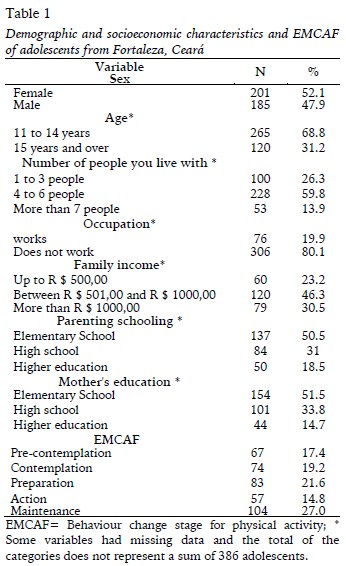
<body><![CDATA[<p>The descriptive   data analysis for categorical variables was performed using distributions of   absolute and relative frequency. The SBCPA comparisons between the categories   of demographic and socioeconomic variables were performed using the Chi-square   test. The level of significance was set at 5% (<i>p</i> &lt; 0.05). The data were entered and analysed in SPSS version 20.</p> <b><b>Ethical Concepts</b></b>      <p>The authorization   of the managerial nucleus (the direction/coordination) of the school was   obtained by means of official signature and voluntary adherence of the   respondents to participate in the study. The parents and/or guardians   authorized the participation of the students in the research by signing the   informed consent form. The confidentiality of the identity of the respondents   was guaranteed and the information obtained was only used for scientific purposes.</p> </font>     <p>&nbsp;</p>     <p><font size="3" face="Verdana"><b><b>RESULTS</b></b></font></p> <font face="Verdana" size="2">     <p>A total of 386   adolescents were investigated, the majority being female (52.1%) and aged   between 11 and 14 (68.8%). According to <a href="#t1">Table 1</a>, most respondents do not work   (80.1%), live with 4 to 6 people (59.8%) and have family income up to 1000,00   reais (69.5%). The most cited fathers and mothers schooling was to have reached   up to middle school 50.5% and 51.5%, respectively (<a href="#t1">Table 1</a>). Regarding to the   SBCPA, 27.0% of adolescents reported being in the maintenance phase. The   proportions of adolescents in the preparation, contemplation, precontemplation   and action in the SBCPA were 21.6%, 19.2%, 17.4%, and 14.8%, respectively (<a href="#t1">Table 1</a>).</p>     <p><a name="t1"></a></p>     <p>&nbsp;</p>     <p align="center"><img src="/img/revistas/mot/v13s1/13s1a12t1.jpg" width="346" height="566"></p>     
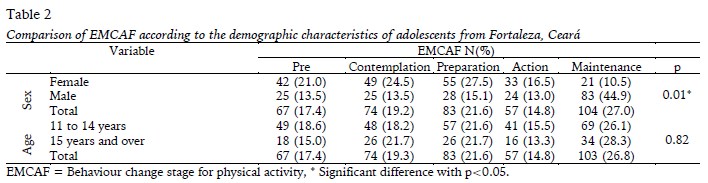
<p>&nbsp;</p>     <p>When comparing   the sexes, there was a significant difference between boys and girls, where   male adolescents presented a higher prevalence in the maintenance stage when   compared to the girls (<i>p</i> = 0.01). While the   girls were more frequent in the precontemplation stage compared to the boys (<i>p</i>   = 0.01). There was no significant difference between the age groups (<i>p</i> = 0.82) (<a href="/img/revistas/mot/v13s1/13s1a12t2.jpg">Table 2</a>). </p>     
]]></body>
<body><![CDATA[<p><a href="/img/revistas/mot/v13s1/13s1a12t3.jpg">Table 3</a> refers to   the comparison of socioeconomic characteristics (number of people with whom   they live, occupation, family income and schooling of the father and mother)   with the SBCPA. Concerning to income, it was observed that 47.4% of those   surveyed who have family income up to R$ 500.00 are in the maintenance and   action stages; 28.3% of the adolescents who have income between R$ 501.00 and   R$ 1000.00 are in the preparation stage. And 48.1% of adolescents who have   income greater than R$ 1000.00 are in the maintenance stage. There were   statistically significant differences for the variable in question (<i>p</i> =   0.01). The other variables were not associated with the SBCPA (<i>p</i>&#8805; 0.05).</p>     
<p>&nbsp;</p> </font>     <p><font size="3" face="Verdana"><b><b>DISCUSSION</b></b></font></p> <font face="Verdana" size="2">     <p>Among the SBCPA   of those surveyed in the study, the ones with the highest number of adolescents   were the maintenance and preparation stages. However, in general, it can be   seen that there was a balance in the distribution of the subjects in relation   to the SBCPA. Despite this, it is important to note that more than half of the   sample is identified in the stages of precontemplation, contemplation and   preparation, in which they characterize individuals who are not active, regardless of time.</p>     <p>These results are   in agreement with the study by Maciel and Veiga (2012) that investigated the   SBCPA in 416 adolescents between the ages of 14 and 19 belonging to the   secondary schools in the cities of Belo Horizonte and Contagem/MG. In which   they found the majority of the participants in the stages of precontemplation,   contemplation, preparation and relapse, thus classified as physically inactive   in leisure. In a study carried out with 281 high school students from a city of   Sergipe, it was identified that 65.8% of the adolescents were classified in the   stages referring to a physically inactive behaviour: precontemplation,   contemplation, preparation (Silva, Smith-Menezes, Almeida-Gomes, &amp; Sousa, 2010).</p>     <p>On the other   hand, Viana and Andrade (2010) show that there are divergences in the practice   of physical activity in the adolescent population, the results of the study   analysed by these authors vary in very high or modest proportions, where there   is a prevalence of 67.6% of the adolescents who practice some type of physical exercise   with regularity (stages of action and maintenance). Corroborating with these   data, the study by Silva, Pelegrini, Grigollo, Silva, and Petroski   (2011) investigated the SBCPA of 601 high school students from the Midwest of   Santa Catarina with an average of 15.7 years old and had the following results:   41.9% and 14%, respectively, in the maintenance and action stages. That is,   55.9% of the participants considered active. These investigations demonstrate   different forms and criteria to identify the SBCPA, such as collection and   characteristics of the samples and the recommendation of the daily and weekly amount of physical activity practice.</p>     <p>The importance of   using the behavioural stages model is emphasized because this theory is   considered a tool to promote the practice of physical activity in the   population. Mainly, when there is scope for differentiating individuals as to   their intention to begin practicing physical activity (for those physically   inactive) and the time they practice (for those physically active) (Dumith, Domingues, &amp; Gigante, 2008).</p>     <p>The values   related to the association between the SBCPA and sex indicate a prevalence of   male students in the maintenance stage, that is, boys have higher PA practice   habits than girls. These results are in accordance with the study of Oliveira   et al. (2012) in which the SBCPA of 4.207 adolescents between 14 and 19 years   old was investigated. The authors showed that the frequency of adolescents in   the maintenance and action stages (physically active) was also significantly   higher among boys. Other studies that analysed the adolescents' SBCPA presented   higher percentages for inactive behaviours, also with an emphasis on the   physical inactivity of women (Silva, Smith-Menezes, Almeida-Gomes, &amp; Sousa 2010; Souza &amp; Duarte, 2005).</p>     <p>The decline in   the practice of physical activity in adolescence, especially among girls,   occurs due to cultural factors, stimulation of games that emphasize home care,   dolls and the permanence of girls at home (Malta et al., 2010). This information   is confirmed in the literature, where there is clarification regarding men   being more active than women (Hallal Knuth, Cruz, Mendes, &amp; Malta, 2010; Tenório et al., 2010).</p>     <p>Overall, in the   present study, there was a balance in the association of subjects' ages with   the SBCPA. However, in a study carried out to evaluate the stage of readiness   to change of behaviour (SRCB) of the feeding and the PA of 145 adolescents,   aged between 10 and 18 years old, interested in joining the Multiprofessional   Obesity Treatment Program (MOTP) Hintze et al. (2012), verified that older   adolescents (13 to 17 years old) were in more advanced SRCB compared to younger   adolescents (11 and 12 years old). Significant differences were also found   between the SBCPA and age at a study in Korea, with adolescents aged between 13   to 18 years old. Where, it was found that those with lower age (13-15 years   old) had more advanced stages of readiness compared to the usual practice of   physical activity, in relation to adolescents between 16 and 18 years old (Kim, 2004).</p>     ]]></body>
<body><![CDATA[<p>The different   results found among the studies mentioned above are possibly due to the   differences between the samples studied, because the regions in which the research was carried out had different social and behavioural contexts.</p>     <p>Among the results   obtained from the comparison of the SBCPA related to socioeconomic   characteristics, it is important to highlight that parents' schooling has   become an important indicator of economic level. In the present study, although   there is no significant difference of this variable when related to the SBCPA,   a balanced distribution can be highlighted in the results. Where, regardless of   parents' educational level, most adolescents are in the maintenance stages. On   the other hand, the level of physical activity may be related to the level of   education, with the highest probability of practicing physical activity in   people who have completed higher education and less in those with lower education levels (Florindo &amp; Ribeiro, 2009).</p>     <p>Another relevant   aspect that can be observed regarding the socioeconomic characteristics of the   individuals was observed in the income that had a significant influence on the   analysis of the results. It is observed that the highest percentage of school   children who are in the maintenance stage (actives) are those with high family   income (over R$ 1000.00). Confirming what was found in a study by Bungum and   Vincent (1997), which shows that the socioeconomic level can influence the   number of opportunities offered to young people, since the richest may be   involved in both structured activities as those of gyms and clubs and free   activities in parks, in the neighbourhood or in playgrounds, while the poorest theoretically would only have the second option.</p>     <p>The present study   analysed the prevalence of the SBCPA of adolescents from a region not yet   investigated and sought to verify the association of these stages with   demographic and socioeconomic factors. This initial step was important to   highlight the framework of intention in which the young are in the regions   investigated. The answers of this study are directed to facilitate the   development of strategies of interventions directed to the physical activity.   Where, there is a need to emphasize and motivate the female audience to engage   in physical activity. Regarding to the limitations of this study, it is   possible to mention the deficiency in the association of the SBCPA with other   variables related to behavioural factors for physical activity such as active   time in physical education classes and adolescents' preferred leisure activities.</p> </font>     <p>&nbsp;</p>     <p><font size="3" face="Verdana"><b><b>CONCLUSION</b></b></font></p> <font face="Verdana" size="2">     <p>Although the   SBCPA of the majority of adolescents investigated have been presented in a   balanced manner, the prevalence in the stages of behaviour associated with   physical inactivity (precontemplation, contemplation and preparation) is still   permanent compared to the stages of action and maintenance. The boys stood out   with more significant possibilities for adopting the practice of PA in relation   to girls. Similarly, low-income adolescents were more likely not to engage in   physical activity. Thus, it is important to emphasize and prioritize actions to   promote physical activity that can reach and motivate female adolescents and low family income.</p> </font>     <p>&nbsp;</p>     <p><font size="3" face="Verdana"><b><b>REFERENCES</b></b></font></p> <font face="Verdana" size="2">     <!-- ref --><p>Barbosa Filho, V. C., Campos, W. D.,   &amp; Lopes, A. D. S. (2014). Epidemiology of physical inactivity, sedentary   behaviors, and unhealthy eating habits among brazilian adolescents: a   systematic review. <i>Ciência &amp; Saúde Coletiva</i>, <i>19</i>(1), 173-194. doi: 10.1590/1413-81232014191.0446&nbsp;&nbsp;&nbsp;&nbsp;&nbsp;&nbsp;&nbsp;&nbsp;[&#160;<a href="javascript:void(0);" onclick="javascript: window.open('/scielo.php?script=sci_nlinks&ref=372358&pid=S1646-107X201700060001200001&lng=','','width=640,height=500,resizable=yes,scrollbars=1,menubar=yes,');">Links</a>&#160;]<!-- end-ref --><!-- ref --><p>Boscatto, E. C., Duarte, M. F. S.,   &amp; Gomes, M. A. (2011). Estágios de mudança de comportamento e barreiras   para a atividade física em obesos mórbidos. <i>Revista Brasileira de Cineantropometria do Desempenho Humano</i>, <i>13</i>(5), 320-332. doi: 10.5007/1980-0037.2011v13n5p329&nbsp;&nbsp;&nbsp;&nbsp;&nbsp;&nbsp;&nbsp;&nbsp;[&#160;<a href="javascript:void(0);" onclick="javascript: window.open('/scielo.php?script=sci_nlinks&ref=372359&pid=S1646-107X201700060001200002&lng=','','width=640,height=500,resizable=yes,scrollbars=1,menubar=yes,');">Links</a>&#160;]<!-- end-ref --><!-- ref --><p>Bungum, T. J., &amp; Vincent, M. L.   (1997). Determinants of   physical activity among female adolescents. <i>American Journal of Preventive Medicine</i>, <i>13</i>(2), 115-22.    &nbsp;&nbsp;&nbsp;&nbsp;&nbsp;&nbsp;&nbsp;&nbsp;[&#160;<a href="javascript:void(0);" onclick="javascript: window.open('/scielo.php?script=sci_nlinks&ref=372360&pid=S1646-107X201700060001200003&lng=','','width=640,height=500,resizable=yes,scrollbars=1,menubar=yes,');">Links</a>&#160;]<!-- end-ref --></p>     <!-- ref --><p>Dumith, S. C., Domingues, M. R., &amp;   Gigante, D. P. (2008). Estágios de mudança de comportamento para a prática de   atividade física: uma revisão da literatura. <i>Revista Brasileira de     Cineantropometria e Desempenho Humano</i>, <i>10</i>(3), 301-307. doi: 10.5007/1980-0037.2010V12N5P367&nbsp;&nbsp;&nbsp;&nbsp;&nbsp;&nbsp;&nbsp;&nbsp;[&#160;<a href="javascript:void(0);" onclick="javascript: window.open('/scielo.php?script=sci_nlinks&ref=372362&pid=S1646-107X201700060001200004&lng=','','width=640,height=500,resizable=yes,scrollbars=1,menubar=yes,');">Links</a>&#160;]<!-- end-ref --><!-- ref --><p>Florindo,   A. A., &amp; Ribeiro, E. H. C. (2009). Atividade física e saúde em crianças e   adolescentes. In D. de Rose Júnior (Ed.), <i>Esporte e atividade física na     infância e na adolescência: Uma abordagem multidisciplinar</i>. Porto Alegre: Artmed Editora.    &nbsp;&nbsp;&nbsp;&nbsp;&nbsp;&nbsp;&nbsp;&nbsp;[&#160;<a href="javascript:void(0);" onclick="javascript: window.open('/scielo.php?script=sci_nlinks&ref=372363&pid=S1646-107X201700060001200005&lng=','','width=640,height=500,resizable=yes,scrollbars=1,menubar=yes,');">Links</a>&#160;]<!-- end-ref --></p>     <!-- ref --><p>Hallal, P. C., Knuth, A. G., Cruz, D.   K. A., Mendes, M. I., &amp; Malta, D. C. (2010). Prática de atividade física em   adolescentes brasileiros. <i>Ciência &amp; Saúde Coletiva</i>, <i>15</i>(supl.2), p.3035-3042. doi: <a href="http://dx.doi.org/10.1590/S141381232010000800008&nbsp;" target="_blank">http://dx.doi.org/10.1590/S141381232010000800008&nbsp;    &nbsp;&nbsp;&nbsp;&nbsp;&nbsp;&nbsp;&nbsp;&nbsp;[&#160;<a href="javascript:void(0);" onclick="javascript: window.open('/scielo.php?script=sci_nlinks&ref=372365&pid=S1646-107X201700060001200006&lng=','','width=640,height=500,resizable=yes,scrollbars=1,menubar=yes,');">Links</a>&#160;]<!-- end-ref --></a></p>     <!-- ref --><p>Hintze, L. J., Cattai, G. B. P.,   Silva, D. F., &amp; Junior, N. N. (2012). Estágio de prontidão para mudança de   comportamento de adolescentes interessados em ingressar no Programa   Multiprofissional de Tratamento da Obesidade. <i>Revista Paulista de Pediatria</i>, <i>30</i>(2), 237-43. doi: <a href="http://dx.doi.org/10.1590/S0103-05822012000200013" target="_blank">http://dx.doi.org/10.1590/S0103-05822012000200013</a>&nbsp;&nbsp;&nbsp;&nbsp;&nbsp;&nbsp;&nbsp;&nbsp;[&#160;<a href="javascript:void(0);" onclick="javascript: window.open('/scielo.php?script=sci_nlinks&ref=372367&pid=S1646-107X201700060001200007&lng=','','width=640,height=500,resizable=yes,scrollbars=1,menubar=yes,');">Links</a>&#160;]<!-- end-ref --><!-- ref --><p>Kim, Y. (2004). Korean adolescents’   exercise behavior and its relationship with psychological variables based on   stages of change model.  <i>Journal of     Adolescent Health</i>, <i>34</i>(6), 523-530. doi: 10.1016/j.jadohealth.2003.07.025&nbsp;&nbsp;&nbsp;&nbsp;&nbsp;&nbsp;&nbsp;&nbsp;[&#160;<a href="javascript:void(0);" onclick="javascript: window.open('/scielo.php?script=sci_nlinks&ref=372368&pid=S1646-107X201700060001200008&lng=','','width=640,height=500,resizable=yes,scrollbars=1,menubar=yes,');">Links</a>&#160;]<!-- end-ref --><!-- ref --><p>Maciel, M. G., &amp; Veiga, R. T.   (2012). Intenção de   mudança de comportamento em adolescentes para a prática de atividades físicas   de lazer. <i>Revista Brasileira de Educação Física e Esporte</i>, <i>26</i>(4), 705-16. doi: <a href="http://dx.doi.org/10.1590/S1807-55092012000400014" target="_blank">http://dx.doi.org/10.1590/S1807-55092012000400014</a>&nbsp;&nbsp;&nbsp;&nbsp;&nbsp;&nbsp;&nbsp;&nbsp;[&#160;<a href="javascript:void(0);" onclick="javascript: window.open('/scielo.php?script=sci_nlinks&ref=372369&pid=S1646-107X201700060001200009&lng=','','width=640,height=500,resizable=yes,scrollbars=1,menubar=yes,');">Links</a>&#160;]<!-- end-ref --><!-- ref --><p>Malta, D. C., Sardinha, L. M. V.,   Mendes, I., et al. (2010). Prevalence of risk health behavior among adolescents: results   from the 2009 National Adolescent School-based Health Survey (PeNSE). <i>Ciência &amp; Saúde Coletiva</i>, <i>15</i>(supl.2), 3009-3019. doi: <a href="http://dx.doi.org/10.1590/S1413-81232010000800002" target="_blank">http://dx.doi.org/10.1590/S1413-81232010000800002</a>&nbsp;&nbsp;&nbsp;&nbsp;&nbsp;&nbsp;&nbsp;&nbsp;[&#160;<a href="javascript:void(0);" onclick="javascript: window.open('/scielo.php?script=sci_nlinks&ref=372370&pid=S1646-107X201700060001200010&lng=','','width=640,height=500,resizable=yes,scrollbars=1,menubar=yes,');">Links</a>&#160;]<!-- end-ref --><!-- ref --><p>Matta, R. O. B. (2012). <i>Aplicação   do Modelo Transteórico de Mudança de Comportamento para o estudo do   comportamento informacional de usuários de informação financeira pessoal</i>   (Tese de Doutorado). Faculdade de Filosofia e Ciências da Universidade Estadual Paulista, São Paulo.    &nbsp;&nbsp;&nbsp;&nbsp;&nbsp;&nbsp;&nbsp;&nbsp;[&#160;<a href="javascript:void(0);" onclick="javascript: window.open('/scielo.php?script=sci_nlinks&ref=372371&pid=S1646-107X201700060001200011&lng=','','width=640,height=500,resizable=yes,scrollbars=1,menubar=yes,');">Links</a>&#160;]<!-- end-ref --></p>     <!-- ref --><p>Murphy, M. H., Mcneilly, A. M., &amp;   Murtagh, E. M. (2010). Public health nutrition physical activity prescription   for public health. <i>Proceedings of the Nutrition Society</i>, <i>69</i>(1), 178-184. doi: 10.1017/S0029665109991741&nbsp;&nbsp;&nbsp;&nbsp;&nbsp;&nbsp;&nbsp;&nbsp;[&#160;<a href="javascript:void(0);" onclick="javascript: window.open('/scielo.php?script=sci_nlinks&ref=372373&pid=S1646-107X201700060001200012&lng=','','width=640,height=500,resizable=yes,scrollbars=1,menubar=yes,');">Links</a>&#160;]<!-- end-ref --><!-- ref --><p>Oliveira, N. K. R., Barros, M. V. G.,   Reis, R. S., Tassiano, R. M., Tenório, M. C. M., Bezerra, J., ... Farias Junior, J.   C. (2012). Estágios de mudança de comportamento para a atividade física em adolescentes. <i>Motriz</i>, <i>18</i>(1), 42-54. doi: <a href="http://dx.doi.org/10.1590/S1980-65742012000100005&nbsp;" target="_blank">http://dx.doi.org/10.1590/S1980-65742012000100005&nbsp;    &nbsp;&nbsp;&nbsp;&nbsp;&nbsp;&nbsp;&nbsp;&nbsp;[&#160;<a href="javascript:void(0);" onclick="javascript: window.open('/scielo.php?script=sci_nlinks&ref=372374&pid=S1646-107X201700060001200013&lng=','','width=640,height=500,resizable=yes,scrollbars=1,menubar=yes,');">Links</a>&#160;]<!-- end-ref --></a></p>     <!-- ref --><p>Seabra, A. F., Mendonça, D. M.,   Thomis, M. A., Anjos, L. A., &amp; Maia, J. A. (2008). Determinantes biológicos   e sócio-culturais associados à prática de atividade física de adolescentes.<i> Caderno de Saúde Pública</i>, <i>4</i>(24), 721-73.    &nbsp;&nbsp;&nbsp;&nbsp;&nbsp;&nbsp;&nbsp;&nbsp;[&#160;<a href="javascript:void(0);" onclick="javascript: window.open('/scielo.php?script=sci_nlinks&ref=372376&pid=S1646-107X201700060001200014&lng=','','width=640,height=500,resizable=yes,scrollbars=1,menubar=yes,');">Links</a>&#160;]<!-- end-ref --> </p>     <!-- ref --><p>Silva, D. A. S., Smith-Menezes, A.,   Almeida-Gomes, M., &amp; Sousa, T. F. (2010). Estágios de mudanças de   comportamento para atividade física em estudantes de uma cidade do Brasil. <i>Revista de salud pública</i>, <i>12</i>(4), 623-34.    &nbsp;&nbsp;&nbsp;&nbsp;&nbsp;&nbsp;&nbsp;&nbsp;[&#160;<a href="javascript:void(0);" onclick="javascript: window.open('/scielo.php?script=sci_nlinks&ref=372378&pid=S1646-107X201700060001200015&lng=','','width=640,height=500,resizable=yes,scrollbars=1,menubar=yes,');">Links</a>&#160;]<!-- end-ref --> </p>     <!-- ref --><p>Silva, D. A. S., Pelegrini, A.,   Grigollo, L. R., Silva, A. F., &amp; Petroski, E. L. (2011). Diferenças e   similaridades dos estágios de mudança de comportamento para atividade física em   adolescentes de duas áreas brasileiras. <i>Revista Paulista de Pediatria, 29</i>(2), 193-201. doi: <a href="http://dx.doi.org/10.1590/S0103-05822011000200010" target="_blank">http://dx.doi.org/10.1590/S0103-05822011000200010</a>&nbsp;&nbsp;&nbsp;&nbsp;&nbsp;&nbsp;&nbsp;&nbsp;[&#160;<a href="javascript:void(0);" onclick="javascript: window.open('/scielo.php?script=sci_nlinks&ref=372380&pid=S1646-107X201700060001200016&lng=','','width=640,height=500,resizable=yes,scrollbars=1,menubar=yes,');">Links</a>&#160;]<!-- end-ref --><!-- ref --><p>Silva, K. S., Lopes, A. D. S.,   Hoefelmann, L. P. et al. (2013). Health risk behaviors project (COMPAC) in   youth of the Santa Catarina State, Brazil: ethics and methodological aspects. <i>Revista     Brasileira de Cineantropometria &amp; Desempenho Humano</i>, <i>15</i>(1), 1-15. doi: <a href="http://dx.doi.org/10.5007/1980-0037.2013v15n1p1" target="_blank">http://dx.doi.org/10.5007/1980-0037.2013v15n1p1</a> &nbsp;&nbsp;&nbsp;&nbsp;&nbsp;&nbsp;&nbsp;&nbsp;[&#160;<a href="javascript:void(0);" onclick="javascript: window.open('/scielo.php?script=sci_nlinks&ref=372381&pid=S1646-107X201700060001200017&lng=','','width=640,height=500,resizable=yes,scrollbars=1,menubar=yes,');">Links</a>&#160;]<!-- end-ref --><!-- ref --><p>Souza, G. S., &amp; Duarte, M. F. S.   (2005). Behavior change   stages related to physical activity in adolescents. <i>Revista Brasileira de Medicina do     Esporte</i>, <i>11</i>(2), 104-108. doi: 10.1016/j.rppede.2016.03.017&nbsp;&nbsp;&nbsp;&nbsp;&nbsp;&nbsp;&nbsp;&nbsp;[&#160;<a href="javascript:void(0);" onclick="javascript: window.open('/scielo.php?script=sci_nlinks&ref=372382&pid=S1646-107X201700060001200018&lng=','','width=640,height=500,resizable=yes,scrollbars=1,menubar=yes,');">Links</a>&#160;]<!-- end-ref --><!-- ref --><p>Tenório, M. C. M., Barros, M. V. G.,   Tassitano, R. M., Bezerra, J., Tenório, J. M., &amp; Hallal, P. C. (2010).   Atividade física e comportamento sedentário em adolescentes estudantes do   ensino médio<i>. Revista Brasileira de Epidemiologia</i>, <i>13</i>(1), 105-17. doi: <a href="http://dx.doi.org/10.1590/S1415-790X2010000100010&nbsp;" target="_blank">http://dx.doi.org/10.1590/S1415-790X2010000100010&nbsp;    &nbsp;&nbsp;&nbsp;&nbsp;&nbsp;&nbsp;&nbsp;&nbsp;[&#160;<a href="javascript:void(0);" onclick="javascript: window.open('/scielo.php?script=sci_nlinks&ref=372383&pid=S1646-107X201700060001200019&lng=','','width=640,height=500,resizable=yes,scrollbars=1,menubar=yes,');">Links</a>&#160;]<!-- end-ref --></a></p>     <!-- ref --><p>Thomas, J. R., &amp; Nelson, J. K<i>. </i>(2007).<i> Métodos de pesquisa em atividade física</i> (5ª ed.). Porto Alegre: Artmed.    &nbsp;&nbsp;&nbsp;&nbsp;&nbsp;&nbsp;&nbsp;&nbsp;[&#160;<a href="javascript:void(0);" onclick="javascript: window.open('/scielo.php?script=sci_nlinks&ref=372385&pid=S1646-107X201700060001200020&lng=','','width=640,height=500,resizable=yes,scrollbars=1,menubar=yes,');">Links</a>&#160;]<!-- end-ref --></p>     <!-- ref --><p>Viana, M. S., &amp; Andrade, A.   (2010). Estágios de mudança de comportamento relacionados ao exercício físico   em adolescentes<i>. Revista Brasileira Cineantropometria do Desempenho Humano</i>, <i>12</i>(5), 367-374. doi: 10.5007/1980-0037.2010V12N5P367&nbsp;    &nbsp;&nbsp;&nbsp;&nbsp;&nbsp;&nbsp;&nbsp;&nbsp;[&#160;<a href="javascript:void(0);" onclick="javascript: window.open('/scielo.php?script=sci_nlinks&ref=372387&pid=S1646-107X201700060001200021&lng=','','width=640,height=500,resizable=yes,scrollbars=1,menubar=yes,');">Links</a>&#160;]<!-- end-ref --></p>     ]]></body>
<body><![CDATA[<!-- ref --><p>World Health Organization [WHO]. (2010). Global   recommendations on physical activity for health<i>. World Health Organization:</i> Geneva.    &nbsp;&nbsp;&nbsp;&nbsp;&nbsp;&nbsp;&nbsp;&nbsp;[&#160;<a href="javascript:void(0);" onclick="javascript: window.open('/scielo.php?script=sci_nlinks&ref=372389&pid=S1646-107X201700060001200022&lng=','','width=640,height=500,resizable=yes,scrollbars=1,menubar=yes,');">Links</a>&#160;]<!-- end-ref --> </p>     <p>&nbsp;</p>     <p><b>Acknowledgments:    <br> </b>Nothing to declare.    <br> <b>Conflict of interests:    <br> </b>Nothing to declare.    <br> <b>Funding:    <br> </b>Nothing to declare.</p> </font>     <p>&nbsp;</p>     ]]></body>
<body><![CDATA[<p>&nbsp;</p>     <p><font face="Verdana" size="2"><a href="#top"><sup>*</sup></a><i><a name="end"></a></i></font>    <font size="2" face="Verdana"><i>Corresponding author:   </i>Federal University of Amapá, Juscelino Kubitschek, Jardim Marco Zero, 68902-197, Macapá, Brazil. Email: <a href="mailto:iraneide12@gmail.com">iraneide12@gmail.com</a></font></p>      ]]></body><back>
<ref-list>
<ref id="B1">
<nlm-citation citation-type="journal">
<person-group person-group-type="author">
<name>
<surname><![CDATA[Barbosa Filho]]></surname>
<given-names><![CDATA[V. C.]]></given-names>
</name>
<name>
<surname><![CDATA[Campos]]></surname>
<given-names><![CDATA[W. D.]]></given-names>
</name>
<name>
<surname><![CDATA[Lopes]]></surname>
<given-names><![CDATA[A. D. S.]]></given-names>
</name>
</person-group>
<article-title xml:lang="en"><![CDATA[Epidemiology of physical inactivity, sedentary behaviors, and unhealthy eating habits among brazilian adolescents: a systematic review]]></article-title>
<source><![CDATA[Ciência & Saúde Coletiva]]></source>
<year>2014</year>
<volume>19</volume>
<numero>1</numero>
<issue>1</issue>
<page-range>173-194</page-range></nlm-citation>
</ref>
<ref id="B2">
<nlm-citation citation-type="journal">
<person-group person-group-type="author">
<name>
<surname><![CDATA[Boscatto]]></surname>
<given-names><![CDATA[E. C.]]></given-names>
</name>
<name>
<surname><![CDATA[Duarte]]></surname>
<given-names><![CDATA[M. F. S.]]></given-names>
</name>
<name>
<surname><![CDATA[Gomes]]></surname>
<given-names><![CDATA[M. A.]]></given-names>
</name>
</person-group>
<article-title xml:lang="pt"><![CDATA[Estágios de mudança de comportamento e barreiras para a atividade física em obesos mórbidos]]></article-title>
<source><![CDATA[Revista Brasileira de Cineantropometria do Desempenho Humano]]></source>
<year>2011</year>
<volume>13</volume>
<numero>5</numero>
<issue>5</issue>
<page-range>320-332</page-range></nlm-citation>
</ref>
<ref id="B3">
<nlm-citation citation-type="journal">
<person-group person-group-type="author">
<name>
<surname><![CDATA[Bungum]]></surname>
<given-names><![CDATA[T. J.]]></given-names>
</name>
<name>
<surname><![CDATA[Vincent]]></surname>
<given-names><![CDATA[M. L.]]></given-names>
</name>
</person-group>
<article-title xml:lang="en"><![CDATA[Determinants of physical activity among female adolescents]]></article-title>
<source><![CDATA[American Journal of Preventive Medicine]]></source>
<year>1997</year>
<volume>13</volume>
<numero>2</numero>
<issue>2</issue>
<page-range>115-22</page-range></nlm-citation>
</ref>
<ref id="B4">
<nlm-citation citation-type="journal">
<person-group person-group-type="author">
<name>
<surname><![CDATA[Dumith]]></surname>
<given-names><![CDATA[S. C.]]></given-names>
</name>
<name>
<surname><![CDATA[Domingues]]></surname>
<given-names><![CDATA[M. R.]]></given-names>
</name>
<name>
<surname><![CDATA[Gigante]]></surname>
<given-names><![CDATA[D. P.]]></given-names>
</name>
</person-group>
<article-title xml:lang="pt"><![CDATA[Estágios de mudança de comportamento para a prática de atividade física: uma revisão da literatura]]></article-title>
<source><![CDATA[Revista Brasileira de Cineantropometria e Desempenho Humano]]></source>
<year>2008</year>
<volume>10</volume>
<numero>3</numero>
<issue>3</issue>
<page-range>301-307</page-range></nlm-citation>
</ref>
<ref id="B5">
<nlm-citation citation-type="book">
<person-group person-group-type="author">
<name>
<surname><![CDATA[Florindo]]></surname>
<given-names><![CDATA[A. A.]]></given-names>
</name>
<name>
<surname><![CDATA[Ribeiro]]></surname>
<given-names><![CDATA[E. H. C.]]></given-names>
</name>
</person-group>
<article-title xml:lang="pt"><![CDATA[Atividade física e saúde em crianças e adolescentes]]></article-title>
<person-group person-group-type="editor">
<name>
<surname><![CDATA[Júnior]]></surname>
<given-names><![CDATA[D. de Rose]]></given-names>
</name>
</person-group>
<source><![CDATA[Esporte e atividade física na infância e na adolescência: Uma abordagem multidisciplinar]]></source>
<year>2009</year>
<publisher-loc><![CDATA[Porto Alegre ]]></publisher-loc>
<publisher-name><![CDATA[Artmed Editora]]></publisher-name>
</nlm-citation>
</ref>
<ref id="B6">
<nlm-citation citation-type="journal">
<person-group person-group-type="author">
<name>
<surname><![CDATA[Hallal]]></surname>
<given-names><![CDATA[P. C.]]></given-names>
</name>
<name>
<surname><![CDATA[Knuth]]></surname>
<given-names><![CDATA[A. G.]]></given-names>
</name>
<name>
<surname><![CDATA[Cruz]]></surname>
<given-names><![CDATA[D. K. A.]]></given-names>
</name>
<name>
<surname><![CDATA[Mendes]]></surname>
<given-names><![CDATA[M. I.]]></given-names>
</name>
<name>
<surname><![CDATA[Malta]]></surname>
<given-names><![CDATA[D. C.]]></given-names>
</name>
</person-group>
<article-title xml:lang="pt"><![CDATA[Prática de atividade física em adolescentes brasileiros]]></article-title>
<source><![CDATA[Ciência & Saúde Coletiva]]></source>
<year>2010</year>
<volume>15</volume>
<numero>^s2</numero>
<issue>^s2</issue>
<supplement>2</supplement>
<page-range>3035-3042</page-range></nlm-citation>
</ref>
<ref id="B7">
<nlm-citation citation-type="journal">
<person-group person-group-type="author">
<name>
<surname><![CDATA[Hintze]]></surname>
<given-names><![CDATA[L. J.]]></given-names>
</name>
<name>
<surname><![CDATA[Cattai]]></surname>
<given-names><![CDATA[G. B. P.]]></given-names>
</name>
<name>
<surname><![CDATA[Silva]]></surname>
<given-names><![CDATA[D. F.]]></given-names>
</name>
<name>
<surname><![CDATA[Junior]]></surname>
<given-names><![CDATA[N. N.]]></given-names>
</name>
</person-group>
<article-title xml:lang="pt"><![CDATA[Estágio de prontidão para mudança de comportamento de adolescentes interessados em ingressar no Programa Multiprofissional de Tratamento da Obesidade]]></article-title>
<source><![CDATA[Revista Paulista de Pediatria]]></source>
<year>2012</year>
<volume>30</volume>
<numero>2</numero>
<issue>2</issue>
<page-range>237-43</page-range></nlm-citation>
</ref>
<ref id="B8">
<nlm-citation citation-type="journal">
<person-group person-group-type="author">
<name>
<surname><![CDATA[Kim]]></surname>
<given-names><![CDATA[Y.]]></given-names>
</name>
</person-group>
<article-title xml:lang="en"><![CDATA[Korean adolescents’ exercise behavior and its relationship with psychological variables based on stages of change model]]></article-title>
<source><![CDATA[Journal of Adolescent Health]]></source>
<year>2004</year>
<volume>34</volume>
<numero>6</numero>
<issue>6</issue>
<page-range>523-530</page-range></nlm-citation>
</ref>
<ref id="B9">
<nlm-citation citation-type="journal">
<person-group person-group-type="author">
<name>
<surname><![CDATA[Maciel]]></surname>
<given-names><![CDATA[M. G.]]></given-names>
</name>
<name>
<surname><![CDATA[Veiga]]></surname>
<given-names><![CDATA[R. T.]]></given-names>
</name>
</person-group>
<article-title xml:lang="pt"><![CDATA[Intenção de mudança de comportamento em adolescentes para a prática de atividades físicas de lazer]]></article-title>
<source><![CDATA[Revista Brasileira de Educação Física e Esporte]]></source>
<year>2012</year>
<volume>26</volume>
<numero>4</numero>
<issue>4</issue>
<page-range>705-16</page-range></nlm-citation>
</ref>
<ref id="B10">
<nlm-citation citation-type="journal">
<person-group person-group-type="author">
<name>
<surname><![CDATA[Malta]]></surname>
<given-names><![CDATA[D. C.]]></given-names>
</name>
<name>
<surname><![CDATA[Sardinha]]></surname>
<given-names><![CDATA[L. M. V.]]></given-names>
</name>
<name>
<surname><![CDATA[Mendes]]></surname>
<given-names><![CDATA[I.]]></given-names>
</name>
</person-group>
<article-title xml:lang="en"><![CDATA[Prevalence of risk health behavior among adolescents: results from the 2009 National Adolescent School-based Health Survey (PeNSE)]]></article-title>
<source><![CDATA[Ciência & Saúde Coletiva]]></source>
<year>2010</year>
<volume>15</volume>
<numero>^s2</numero>
<issue>^s2</issue>
<supplement>2</supplement>
<page-range>3009-3019</page-range></nlm-citation>
</ref>
<ref id="B11">
<nlm-citation citation-type="">
<person-group person-group-type="author">
<name>
<surname><![CDATA[Matta]]></surname>
<given-names><![CDATA[R. O. B.]]></given-names>
</name>
</person-group>
<source><![CDATA[Aplicação do Modelo Transteórico de Mudança de Comportamento para o estudo do comportamento informacional de usuários de informação financeira pessoal]]></source>
<year>2012</year>
</nlm-citation>
</ref>
<ref id="B12">
<nlm-citation citation-type="journal">
<person-group person-group-type="author">
<name>
<surname><![CDATA[Murphy]]></surname>
<given-names><![CDATA[M. H.]]></given-names>
</name>
<name>
<surname><![CDATA[Mcneilly]]></surname>
<given-names><![CDATA[A. M.]]></given-names>
</name>
<name>
<surname><![CDATA[Murtagh]]></surname>
<given-names><![CDATA[E. M.]]></given-names>
</name>
</person-group>
<article-title xml:lang="en"><![CDATA[Public health nutrition physical activity prescription for public health]]></article-title>
<source><![CDATA[Proceedings of the Nutrition Society]]></source>
<year>2010</year>
<volume>69</volume>
<numero>1</numero>
<issue>1</issue>
<page-range>178-184</page-range></nlm-citation>
</ref>
<ref id="B13">
<nlm-citation citation-type="journal">
<person-group person-group-type="author">
<name>
<surname><![CDATA[Oliveira]]></surname>
<given-names><![CDATA[N. K. R.]]></given-names>
</name>
<name>
<surname><![CDATA[Barros]]></surname>
<given-names><![CDATA[M. V. G.]]></given-names>
</name>
<name>
<surname><![CDATA[Reis]]></surname>
<given-names><![CDATA[R. S.]]></given-names>
</name>
<name>
<surname><![CDATA[Tassiano]]></surname>
<given-names><![CDATA[R. M.]]></given-names>
</name>
<name>
<surname><![CDATA[Tenório]]></surname>
<given-names><![CDATA[M. C. M.]]></given-names>
</name>
<name>
<surname><![CDATA[Bezerra]]></surname>
<given-names><![CDATA[J.]]></given-names>
</name>
<name>
<surname><![CDATA[Farias Junior]]></surname>
<given-names><![CDATA[J. C.]]></given-names>
</name>
</person-group>
<article-title xml:lang="pt"><![CDATA[Estágios de mudança de comportamento para a atividade física em adolescentes]]></article-title>
<source><![CDATA[Motriz]]></source>
<year>2012</year>
<volume>18</volume>
<numero>1</numero>
<issue>1</issue>
<page-range>42-54</page-range></nlm-citation>
</ref>
<ref id="B14">
<nlm-citation citation-type="journal">
<person-group person-group-type="author">
<name>
<surname><![CDATA[Seabra]]></surname>
<given-names><![CDATA[A. F.]]></given-names>
</name>
<name>
<surname><![CDATA[Mendonça]]></surname>
<given-names><![CDATA[D. M.]]></given-names>
</name>
<name>
<surname><![CDATA[Thomis]]></surname>
<given-names><![CDATA[M. A.]]></given-names>
</name>
<name>
<surname><![CDATA[Anjos]]></surname>
<given-names><![CDATA[L. A.]]></given-names>
</name>
<name>
<surname><![CDATA[Maia]]></surname>
<given-names><![CDATA[J. A.]]></given-names>
</name>
</person-group>
<article-title xml:lang="pt"><![CDATA[Determinantes biológicos e sócio-culturais associados à prática de atividade física de adolescentes]]></article-title>
<source><![CDATA[Caderno de Saúde Pública]]></source>
<year>2008</year>
<volume>4</volume>
<numero>24</numero>
<issue>24</issue>
<page-range>721-73</page-range></nlm-citation>
</ref>
<ref id="B15">
<nlm-citation citation-type="journal">
<person-group person-group-type="author">
<name>
<surname><![CDATA[Silva]]></surname>
<given-names><![CDATA[D. A. S.]]></given-names>
</name>
<name>
<surname><![CDATA[Smith-Menezes]]></surname>
<given-names><![CDATA[A.]]></given-names>
</name>
<name>
<surname><![CDATA[Almeida-Gomes]]></surname>
<given-names><![CDATA[M.]]></given-names>
</name>
<name>
<surname><![CDATA[Sousa]]></surname>
<given-names><![CDATA[T. F.]]></given-names>
</name>
</person-group>
<article-title xml:lang="pt"><![CDATA[Estágios de mudanças de comportamento para atividade física em estudantes de uma cidade do Brasil]]></article-title>
<source><![CDATA[Revista de salud pública]]></source>
<year>2010</year>
<volume>12</volume>
<numero>4</numero>
<issue>4</issue>
<page-range>623-34</page-range></nlm-citation>
</ref>
<ref id="B16">
<nlm-citation citation-type="journal">
<person-group person-group-type="author">
<name>
<surname><![CDATA[Silva]]></surname>
<given-names><![CDATA[D. A. S.]]></given-names>
</name>
<name>
<surname><![CDATA[Pelegrini]]></surname>
<given-names><![CDATA[A.]]></given-names>
</name>
<name>
<surname><![CDATA[Grigollo]]></surname>
<given-names><![CDATA[L. R.]]></given-names>
</name>
<name>
<surname><![CDATA[Silva]]></surname>
<given-names><![CDATA[A. F.]]></given-names>
</name>
<name>
<surname><![CDATA[Petroski]]></surname>
<given-names><![CDATA[E. L.]]></given-names>
</name>
</person-group>
<article-title xml:lang="pt"><![CDATA[Diferenças e similaridades dos estágios de mudança de comportamento para atividade física em adolescentes de duas áreas brasileiras]]></article-title>
<source><![CDATA[Revista Paulista de Pediatria]]></source>
<year>2011</year>
<volume>29</volume>
<numero>2</numero>
<issue>2</issue>
<page-range>193-201</page-range></nlm-citation>
</ref>
<ref id="B17">
<nlm-citation citation-type="journal">
<person-group person-group-type="author">
<name>
<surname><![CDATA[Silva]]></surname>
<given-names><![CDATA[K. S.]]></given-names>
</name>
<name>
<surname><![CDATA[Lopes]]></surname>
<given-names><![CDATA[A. D. S.]]></given-names>
</name>
<name>
<surname><![CDATA[Hoefelmann]]></surname>
<given-names><![CDATA[L. P.]]></given-names>
</name>
</person-group>
<article-title xml:lang="en"><![CDATA[Health risk behaviors project (COMPAC) in youth of the Santa Catarina State, Brazil: ethics and methodological aspects]]></article-title>
<source><![CDATA[Revista Brasileira de Cineantropometria & Desempenho Humano]]></source>
<year>2013</year>
<volume>15</volume>
<numero>1</numero>
<issue>1</issue>
<page-range>1-15</page-range></nlm-citation>
</ref>
<ref id="B18">
<nlm-citation citation-type="journal">
<person-group person-group-type="author">
<name>
<surname><![CDATA[Souza]]></surname>
<given-names><![CDATA[G. S.]]></given-names>
</name>
<name>
<surname><![CDATA[Duarte]]></surname>
<given-names><![CDATA[M. F. S.]]></given-names>
</name>
</person-group>
<article-title xml:lang="en"><![CDATA[Behavior change stages related to physical activity in adolescents]]></article-title>
<source><![CDATA[Revista Brasileira de Medicina do Esporte]]></source>
<year>2005</year>
<volume>11</volume>
<numero>2</numero>
<issue>2</issue>
<page-range>104-108</page-range></nlm-citation>
</ref>
<ref id="B19">
<nlm-citation citation-type="journal">
<person-group person-group-type="author">
<name>
<surname><![CDATA[Tenório]]></surname>
<given-names><![CDATA[M. C. M.]]></given-names>
</name>
<name>
<surname><![CDATA[Barros]]></surname>
<given-names><![CDATA[M. V. G.]]></given-names>
</name>
<name>
<surname><![CDATA[Tassitano]]></surname>
<given-names><![CDATA[R. M.]]></given-names>
</name>
<name>
<surname><![CDATA[Bezerra]]></surname>
<given-names><![CDATA[J.]]></given-names>
</name>
<name>
<surname><![CDATA[Tenório]]></surname>
<given-names><![CDATA[J. M.]]></given-names>
</name>
<name>
<surname><![CDATA[Hallal]]></surname>
<given-names><![CDATA[P. C.]]></given-names>
</name>
</person-group>
<article-title xml:lang="pt"><![CDATA[Atividade física e comportamento sedentário em adolescentes estudantes do ensino médio]]></article-title>
<source><![CDATA[Revista Brasileira de Epidemiologia]]></source>
<year>2010</year>
<volume>13</volume>
<numero>1</numero>
<issue>1</issue>
<page-range>105-17</page-range></nlm-citation>
</ref>
<ref id="B20">
<nlm-citation citation-type="book">
<person-group person-group-type="author">
<name>
<surname><![CDATA[Thomas]]></surname>
<given-names><![CDATA[J. R.]]></given-names>
</name>
<name>
<surname><![CDATA[Nelson]]></surname>
<given-names><![CDATA[J. K.]]></given-names>
</name>
</person-group>
<source><![CDATA[Métodos de pesquisa em atividade física]]></source>
<year>2007</year>
<edition>5</edition>
<publisher-loc><![CDATA[Porto Alegre ]]></publisher-loc>
<publisher-name><![CDATA[Artmed]]></publisher-name>
</nlm-citation>
</ref>
<ref id="B21">
<nlm-citation citation-type="journal">
<person-group person-group-type="author">
<name>
<surname><![CDATA[Viana]]></surname>
<given-names><![CDATA[M. S.]]></given-names>
</name>
<name>
<surname><![CDATA[Andrade]]></surname>
<given-names><![CDATA[A.]]></given-names>
</name>
</person-group>
<article-title xml:lang="pt"><![CDATA[Estágios de mudança de comportamento relacionados ao exercício físico em adolescentes]]></article-title>
<source><![CDATA[Revista Brasileira Cineantropometria do Desempenho Humano]]></source>
<year>2010</year>
<volume>12</volume>
<numero>5</numero>
<issue>5</issue>
<page-range>367-374</page-range></nlm-citation>
</ref>
<ref id="B22">
<nlm-citation citation-type="book">
<collab>World Health Organization</collab>
<source><![CDATA[Global recommendations on physical activity for health]]></source>
<year>2010</year>
<publisher-loc><![CDATA[Geneva ]]></publisher-loc>
<publisher-name><![CDATA[World Health Organization]]></publisher-name>
</nlm-citation>
</ref>
</ref-list>
</back>
</article>