<?xml version="1.0" encoding="ISO-8859-1"?><article xmlns:mml="http://www.w3.org/1998/Math/MathML" xmlns:xlink="http://www.w3.org/1999/xlink" xmlns:xsi="http://www.w3.org/2001/XMLSchema-instance">
<front>
<journal-meta>
<journal-id>1646-107X</journal-id>
<journal-title><![CDATA[Motricidade]]></journal-title>
<abbrev-journal-title><![CDATA[Motri.]]></abbrev-journal-title>
<issn>1646-107X</issn>
<publisher>
<publisher-name><![CDATA[Edições Desafio Singular]]></publisher-name>
</publisher>
</journal-meta>
<article-meta>
<article-id>S1646-107X2017000600013</article-id>
<title-group>
<article-title xml:lang="en"><![CDATA[Perception of Body Image in Teenagers in Physical Education Classes]]></article-title>
</title-group>
<contrib-group>
<contrib contrib-type="author">
<name>
<surname><![CDATA[Catunda]]></surname>
<given-names><![CDATA[Ricardo]]></given-names>
</name>
<xref ref-type="aff" rid="A01"/>
<xref ref-type="aff" rid="A02"/>
</contrib>
<contrib contrib-type="author">
<name>
<surname><![CDATA[Marques]]></surname>
<given-names><![CDATA[Adilson]]></given-names>
</name>
<xref ref-type="aff" rid="A02"/>
<xref ref-type="aff" rid="A03"/>
</contrib>
<contrib contrib-type="author">
<name>
<surname><![CDATA[Januário]]></surname>
<given-names><![CDATA[Carlos]]></given-names>
</name>
<xref ref-type="aff" rid="A03"/>
</contrib>
</contrib-group>
<aff id="A01">
<institution><![CDATA[,State University of Ceará  ]]></institution>
<addr-line><![CDATA[Fortaleza ]]></addr-line>
<country>Brazil</country>
</aff>
<aff id="A02">
<institution><![CDATA[,University of Lisbon Faculty of Human Kinetics ]]></institution>
<addr-line><![CDATA[Lisbon ]]></addr-line>
<country>Portugal</country>
</aff>
<aff id="A03">
<institution><![CDATA[,Conselho Nacional de Desenvolvimento Científico e Tecnológico Center for Research on Physical Activity in School ]]></institution>
<addr-line><![CDATA[Ceará ]]></addr-line>
<country>Brazil</country>
</aff>
<pub-date pub-type="pub">
<day>00</day>
<month>12</month>
<year>2017</year>
</pub-date>
<pub-date pub-type="epub">
<day>00</day>
<month>12</month>
<year>2017</year>
</pub-date>
<volume>13</volume>
<fpage>91</fpage>
<lpage>99</lpage>
<copyright-statement/>
<copyright-year/>
<self-uri xlink:href="http://scielo.pt/scielo.php?script=sci_arttext&amp;pid=S1646-107X2017000600013&amp;lng=en&amp;nrm=iso"></self-uri><self-uri xlink:href="http://scielo.pt/scielo.php?script=sci_abstract&amp;pid=S1646-107X2017000600013&amp;lng=en&amp;nrm=iso"></self-uri><self-uri xlink:href="http://scielo.pt/scielo.php?script=sci_pdf&amp;pid=S1646-107X2017000600013&amp;lng=en&amp;nrm=iso"></self-uri><abstract abstract-type="short" xml:lang="en"><p><![CDATA[This study showed the objectives to evaluate the self-perception of body image in adolescents, raising the issues related to the physical aspects and the physical education classes. The design of this research was qualitative and quantitative nature, associated with the field research of experimental and comparative type. In the experimental phase was the implementation of an intervention program in relation to body image. In the quantitative study, met the perception of body image of 102 students with a mean of 15.5 (± 1.2) years of age, 50 adolescents from the experimental school (49.0%) and 52 adolescents in the control school (51.0%), enrolled in classes of 1st and 2nd year of high school in the public-school network. In experimental school there was a significant improvement to the program in the perception that the girls had on their body image. In the qualitative study parse through 8 focus groups (48 students) the issue focus of research from personal experiences. The students showed a high rate of dissatisfaction with the body and the willingness to take risk behaviors in pursuit of the ideal body with better results after the program. The approach on body image in Physical Education was nonexistent.]]></p></abstract>
<kwd-group>
<kwd lng="en"><![CDATA[body image]]></kwd>
<kwd lng="en"><![CDATA[physical education]]></kwd>
<kwd lng="en"><![CDATA[adolescents]]></kwd>
<kwd lng="en"><![CDATA[intervention program]]></kwd>
</kwd-group>
</article-meta>
</front><body><![CDATA[  <font face="Verdana" size="2">      <p align="right"><b>ORIGINAL ARTICLE</b></p>      <p>&nbsp;</p> </font>     <p><font size="4" face="Verdana"><b>Perception of Body Image in   Teenagers in Physical Education Classes</b></font></p> <font face="Verdana" size="2">     <p>&nbsp;</p>     <p>&nbsp;</p>     <p><b>Ricardo   Catunda<sup>1,2,</sup><a href="#end"><sup>*</sup></a><i><a name="top" id="top"></a></i>; Adilson Marques<sup>2,3</sup>;   Carlos Januário<sup>3</sup></b></p>     <p><sup>1 </sup><i>State University of Ceará, Fortaleza, Brazil.    <br> </i><sup>2</sup><i> Faculty of Human Kinetics, University of Lisbon, Lisbon, Portugal.    <br> </i><sup>3</sup><i> Center for Research on Physical Activity in School, NIAFE/CNPq, Ceará, Brazil.</i></p>     ]]></body>
<body><![CDATA[<p>&nbsp;</p>     <p>&nbsp;</p> </font> <hr noshade size="1"> <font face="Verdana" size="2">     <p><b>ABSTRACT</b></p>     <p>This study showed   the objectives to evaluate the self-perception of body image in adolescents, raising   the issues related to the physical aspects and the physical education classes.   The design of this research was qualitative and quantitative nature, associated   with the field research of experimental and comparative type. In the   experimental phase was the implementation of an intervention program in   relation to body image. In the quantitative study, met the perception of body   image of 102 students with a mean of 15.5 (± 1.2) years of age, 50 adolescents   from the experimental school (49.0%) and 52 adolescents in the control school   (51.0%), enrolled in classes of 1st and 2nd year of high school in the   public-school network. In experimental school there was a significant   improvement to the program in the perception that the girls had on their body   image. In the qualitative study parse through 8 focus groups (48 students) the   issue focus of research from personal experiences. The students showed a high   rate of dissatisfaction with the body and the willingness to take risk   behaviors in pursuit of the ideal body with better results after the program. The approach on body image in Physical Education was nonexistent.</p>     <p><b>Keywords:</b> body image, physical education, adolescents, intervention program.</p> </font> <hr noshade size="1">     <p>&nbsp;</p>     <p>&nbsp;</p>     <p><font size="3" face="Verdana"><b><b>INTRODUCTION</b></b></font></p> <font face="Verdana" size="2">     <p>The level of   satisfaction with the body image of adolescents is a reason for growing   attention of national and international organizations related to education and   health promotion, governments, and researchers. The media, such as television,   magazines (fashion and fitness) and the recent phenomenon of social networks,   the most used by adolescents, propagate a model for the body whose lean   pattern, besides being a reference for a healthy body (Marques, Diniz, Carreiro   da Costa, Contramestre, &amp; Piéron, 2009). It is recognized by the athletic   and muscular profile, making it perfect and unattainable for cultural ideals to   be conquered by adolescents, especially girls. These reasons are sufficient for   social pressures to adapt to the current body model to become a goal to be   achieved, especially among women, producing among other consequences the body dissatisfaction (Conti, Costa, Peres, &amp; Toral, 2009).</p>     <p>The pattern of   beauty valued in the society associated to thinness ends up emphasizing aspects   related to shape, disregarding the diversity of the physical, socioeconomic,   cultural and health constituencies present in the population (Damasceno et al.,   2006; Kakeshita &amp; Almeida, 2006; Teixeira et al., 2006). Although there are   values of body mass index (BMI) and percentage of body fat (% BF) suitable for   health, it is believed that the physical type can be determined culturally,   with the acknowledged influence of parents and pairs in the development of body image (McKinley &amp; Randa, 2005; Tantleff-Dunn &amp; Gokee, 2004).</p>     ]]></body>
<body><![CDATA[<p>Being under   subculture influences, as it is characteristic of adolescence, the young woman   does not always reflect on the means to pursue her aesthetic goals (McKinley   &amp; Randa, 2005), being exposed to identifiable risks (restrictive diets,   psychological disorders such as bulimia, anorexia and vigorexia, excessive   practice of physical exercise and use of anabolic steroids) in the search for   the ideal body. In addition, they have inherent difficulties of age to counter   pressures and internalization of the media to which they are exposed (Knauss,   Paxton, &amp; Alsaker, 2007). As result it is not always expected, and the   pursuit of the perfect body is unfeasible, the frustration that girls   experience may lead to damage to self-esteem and cause depression (Paxton, Neumark-Sztainer,   Hannan, &amp; Eisenberg, 2006), causing emotional and physical instability (Thompson, Coovert, &amp; Stormer, 1999; Wertheim et al., 2009).</p>     <p>Actions related   to body image in adolescence need to be treated as a public health problem due   to injuries caused by the dissatisfaction of adolescents with their body. For   these actions, it became a consensus that the school constitutes an ideal   environment for interventions in education and health promotion, requiring the   pedagogical support and commitment of Physical Education teachers. As in the   last decades the problem has stabilized with a high incidence of affected   adolescents, there are indications for evaluation and promotion of body image   from efficient programs and interventions (Levine &amp; Smolak, 2006; Yager,   Diedrichs, Ricciardelli, &amp; Halliwell, 2013). Several investigations showed   that interventions in schools aimed to improve body image of adolescents,   recognizing as appropriate this potential environment of interactions (Levine   &amp; Smolak, 2006; Ortiz, Veloz, Solis, &amp; Montano, 2010; Richardson &amp;   Paxton, 2010; Wilksch &amp; Wade, 2009), being the researchers external from   the school where the study was conducted. It was not found specific   participation of the Physical Education teacher. This fact is evidenced, since   body image is a multidimensional construct (Adami, Fernandes, Frainer &amp;   Oliveira, 2005) which have, among others, affective, cultural, and motor aspects that are common approaches to Physical Education.</p>     <p>The dimensional   expansion of its applicability has been consolidated the formative character   with which Physical Education has been presented in the school environment   (Catunda, Sartori, &amp; Laurindo, 2014). Therefore, Physical Education is   characterized as a unique discipline, being the only one to promote health and   the various languages &#8203;&#8203;of the human   movement directly, through the teaching of an active and healthy lifestyle   (Sallis et al., 2012) besides of developing cultural, motor, cognitive, affective, and social aspects.</p>     <p>It is in this   panorama that the school has been pointed as privileged environment of   intervention. The hypothesis that knowledge about health-related physical   activity is linked to increased levels of physical activity in adolescents   demonstrates the importance of the school promoting through Physical Education   activities that potentiate this recommendation (Andersen, Harro &amp; Sardinha,   2006). Since knowing how much physical activity the adolescent should do to   benefit from the health effects could be a facilitator for the formation of   healthy habits (Harrison et al., 1992) recognized as a predictor of a positive appreciation for body image (Marques et al., 2009).</p>     <p>In the context   described, the objective of the research was to evaluate self-perception of   body image, factors associated with weight concerns and satisfaction with   appearance, and to know if the intervention program influenced the perception of the young female on body image.</p>     <p>&nbsp;</p> </font><font size="3" face="Verdana"><b><b>METHOD</b></b></font><font face="Verdana" size="2">      <p>The design of   this research has a qualitative and quantitative nature associated to field research of experimental and comparative type</p> <b><b>Participants</b></b>      <p>The sample   consisted of 102 students with a mean of 15.5 (± 1.2) years of age, ranging   from a minimum of 13 to a maximum of 18 years. In this study, a non-probabilistic   non-intentional sample consisted of 50 students from the experimental school   (49.0%) and 52 students from the control school (51.0%). The sample of teachers   was consisted of two teachers of the experimental school and two teachers of the control school.</p>     <p>Inclusion   criteria for the students were: to be enrolled, to attend regularly the school,   to be able to participate in the classes of Physical Education, and to sign the   term of informed consent. Exclusion criteria were: medical impediment for not   participating regularly in physical education classes, and absence in the   sessions where the researcher observed the classes. The sample of teachers was   composed of the totality of high school teachers. Participants were informed of   the guarantee of anonymity and confidentiality of the information that would be under the researcher's tutelage.</p> <b><b>Instruments and Procedures</b></b>      <p>In order to   verify the level of adolescents’ dissatisfaction with body image, we applied   the Body Dissatisfaction Scale in Adolescents (BDSA), developed by Baile, Grima, and   Landívar (2003), and the Brazilian version translated by   Conti, Slater and Latorre (2009). In the deepening of the study central   question, we used the technique of focal group that was applied to all groups   investigated, making a total of 8 groups with 6 participants each, totalizing   48 adolescents. Among the applications of the instruments, we developed a   training program only for teachers from the experimental school on the teaching   of physical fitness. Teachers participated in a theoretical exposition and   practical experiences of the methodology to be worked with students from the   experimental group during the period of 29 days. After the training phase, the   teachers applied the activities during three consecutive classes in each of the   groups surveyed, with the purpose of increasing the physical activity time of   students during the classes with the experimental group compared to the control   group. For this pedagogical experience, we used the context of modified games   during application of the intervention program to teachers (Light &amp; Georgakis, 2008).</p>     ]]></body>
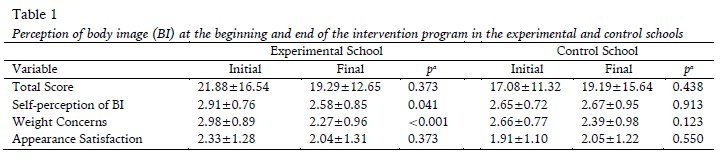
<body><![CDATA[<p>In order to start   the research, a request for authorization was issued to the school directors,   by means of an agreement that explained the research and its development   procedures. In addition, the students’ underage of 18 years-old and their legal   guardian had, obligatorily, to sign the Informed Consent Term (ICT), in   addition, the teachers signed the ICT authorizing the study during Physical Education classes.</p>     <p>For the teachers   from experimental school, we presented the research project, explained the data   collection procedures, the instruments to be applied, the Physical Education   experimental training program to which they would be submitted, and set the   date for the researcher's presentation to the students. For the data collection   procedures, an agenda was developed in agreement with the teachers, containing   an initial phase, pre, and post application for the experimental school, and an   intervention program for teachers between the two phases. The control school had application in two moments without the intervention program.</p> <b><b>Statistical analysis</b></b>      <p>For all variables   of the questionnaires, the descriptive statistics were applied, calculating   percentages, mean, standard deviation, minimum, and maximum values. For the   continuous and ordinal variables that could be treated as quantitative, the   normality of their distributions and the homogeneity of variances,   respectively, were evaluated with the Kolmogorov-Smirnov or Shapiro Wilk test,   depending on whether the group was about 50 individuals, and with the Levene   test. Whenever one of the groups analysed had a subject number equal to or greater than 30, the central limit theory was evoked.</p>     <p>With the results   from BDSA, in the first and second moment of its application, the internal   consistency was calculated, obtaining alpha values of 0.87 and 0.84,   respectively. Then a score was calculated that translated the general   perception of the corporal image of each student. However, for the analysis of   the body image constructs presented in the BDSA (Conti et al., 2009), we used   the exploratory factorial analysis, for the extraction of the factors by the   main components method, followed by a Varimax rotation. The application of the   factorial analysis to the 32 items of the EEICA, after checking its adequacy,   through the Bartlett sphericity test (&#967;<sup>2</sup> (496) = 1871,106, p &lt;0.001) and the   Kaiser-Meyer-Olkin statistic KMO = 0.803), allowed the extraction of 7   components according to the eigenvalue rule superior to 1, which explained   65.8% of the total variance of the original variables. However, the grouping of   the items did not follow the one described by Conti et al. (2009) and it was   not possible to interpret the items grouped in each component. In this way, we   chose to compute new variables from items that had the same meaning, after   checking their internal consistency through Cronbach's alpha. The constructs   created were: self-perception of body image, concerns about weight, means used   to achieve the ideal body, rejection of the body today, difficulties with   dress, satisfaction with appearance, control of eating and fear of gaining weight, with values of consistency of &#945; = 0.7.</p>     <p>With the   qualitative analysis we wanted to complement the quantitative data, looking for   possible implicit explanations in the speeches, documents and testimonies,   establishing configurations and flow of cause and effect. For this purpose, we   used the method of content analysis (Bardin, 1977). From the messages of the   subjects and from the interview guide, the categories of message analysis were   defined. From the categories were named the subcategories, in order to classify   more specifically the units of record. Quantitative data were processed using   the Statistical Package for Social Sciences (SPSS) version 22. The significance level for the analyses was 0.05.</p>     <p>&nbsp;</p> </font><font size="3" face="Verdana"><b><b>RESULTS</b></b></font><font face="Verdana" size="2">      <p>The results   regarding to body image perception before and after the intervention program   are presented in <a href="/img/revistas/mot/v13s1/13s1a13t1.jpg">Table 1</a>. Before the intervention program, the experimental   school had a BDSA total score of 21.88 ± 16.54 (highest dissatisfaction), while   the control school adolescents presented a lower value (less dissatisfaction).   Nevertheless, the values did not present significant differences (t (100) =   0.894, p = 0.373). On the other hand, in the self-perception of body image, the   adolescents from experimental school initially presented a value superior to   the one of the adolescents from control school (2,91 ± 0,76 vs. 2,58 ± 0,85),   being the differences between schools statistically significant (t (100) = 2.071, p = 0.041).</p>     
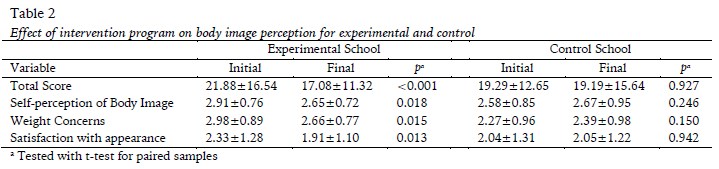
<p>The   comparison between the initial and final moments of the intervention program   can be observed in <a href="/img/revistas/mot/v13s1/13s1a13t2.jpg">Table 2</a>. In the experimental school, it was verified that   the program promoted a significant improvement in the adolescents' perception   of their body image, since the values registered were significantly lower for   the total score of BDSA (t (49) = 4,846, p &lt;0.001), self-perception of body   image (t (49) = 2,450, p = 0.018), concerns about weight (t (49) = 2.517, p =   0.015), and satisfaction with appearance (t (49) = 2.564, p = 0.013). For the   control school, the values of the variables related to body image differed   slightly between the two moments of intervention, with no statistically significant difference being recorded.</p>     
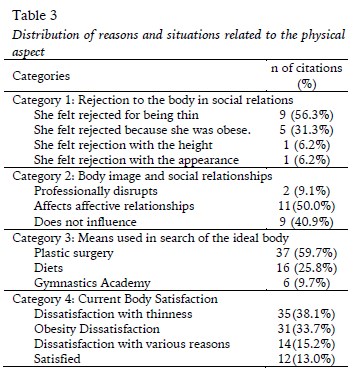
<p>After   the application of BDSA, the adolescents were invited to participate in a   deepening of the study in the questions about the physical aspect, the Physical   Education classes and the corporal image, presented in <a href="#t3">Table 3</a>, in which we used the focal group technique.  </p>     <p><a name="t3"></a></p>     ]]></body>
<body><![CDATA[<p>&nbsp;</p>     <p align="center"><img src="/img/revistas/mot/v13s1/13s1a13t3.jpg" width="356" height="377"></p>     
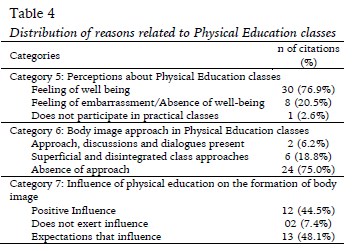
<p>&nbsp;</p>     <p>Regarding   to body rejection, the students stated that the biggest reason for rejection   was to be considered lean (56.3%). For 31.3% of the students, another reason   with more frequent registration was rejection because they were obese. Plastic   surgery was the mean that young women indicated more frequently to solve problems of dissatisfaction with the current body (59.7%).</p>     <p>In the questions   related to Physical Education (<a href="#t4">Table 4</a>), the adolescents' perceptions about the   classes showed that the effective participation, the feeling of effectiveness,   and the positive interaction with teachers, would raise the level of   satisfaction of 76.9% who affirmed to feel the sensation of well-being in class.</p> </font>     <p><font face="Verdana" size="2"><a name="t4"></a></font></p>     <p>&nbsp;</p>     <p align="center"><font size="2" face="Verdana"><img src="/img/revistas/mot/v13s1/13s1a13t4.jpg" width="353" height="251"></font></p> <font face="Verdana" size="2">     
<p>&nbsp;</p>     <p>The results   related to the body image approach in Physical Education classes, the majority   of adolescents (75.0%) affirmed the absence of a body image approach in   classes. Regarding the influence of physical education classes on body image   formation, 48.1% of the young women stated that they had an expectation for   influence, evidencing the importance of teachers discussing issues related to body in general and body image formation.</p>     ]]></body>
<body><![CDATA[<p>&nbsp;</p> </font>     <p><font size="3" face="Verdana"><b><b>DISCUSSION</b></b></font></p> <font face="Verdana" size="2">     <p>The adolescents   from experimental school showed greater dissatisfaction with the body image   before the intervention program, compared to the girls in the control school,   without, however, presenting significant differences. Several studies in the   national and international literature have shown that body dissatisfaction is   highly prevalent among adolescents, and the results are similar to the present   study (Al Sabbah et al., 2009; Bearman, Martinez, &amp; Stice,   2006; Schneider et al., 2013), in which adolescents pointed out many parts of   their body that they desired to change (Conti, Frutuoso, &amp;   Gambardella, 2005), psychological implications such as depression (Paxton,   Neumark-Sztainer, Hannan, &amp; Eisenberg, 2006), self-esteem and depressive mood (Mond et al., 2011).</p>     <p>Considering the   negative implications that the low perception of the body image may have on the   psychological level in the adolescents, in some countries projects have been   developed whose objective is the improvement of the body image, as for example   the program Happy being me (Bird, Halliwell, Diedrichs, &amp; Harcourt,   2013) and Bodythink (Shanel, Richardson, Paxton, &amp; Thomson,   2009). These programs, implemented in a school context, have contributed to the   reduction of factors associated with negative body image, eating disorder (Bird   et al., 2013; Shanel et al., 2009) and improvement of self-esteem (Richardson et al., 2010).</p>     <p>We affirm that   adolescents' recognition of body image has a great importance, since body   dissatisfaction stimulated by the ideal leanness pattern is commonly related to   eating disorders, restrictive diets, abuse of purgative methods and excessive   practice of physical exercises (Ramalho et al., 2007), being necessary to   confront the problem by the school in order to reduce the high rates of   adolescent dissatisfaction with the body, especially girls in relation to   excess of body fat (Graup et al., 2008; Martins, Pelegrini, Matheus, &amp; Petroski,   2010). The few programs implemented regarding health in the school need greater   participation of Physical Education professionals (Brito, Silva, &amp; França, 2012).</p>     <p>For the   self-perception of the body image, the results presented in relation to the   experimental school showed that the adolescents presented a negative perception   of the body, demonstrating that the female gender is minded to greater body   dissatisfaction (Branco, Hilário, &amp; Cintra, 2006; Martins, Nunes, &amp; Noronha,   2008), different from the control school adolescents who showed a positive   perception of the body image, being in this case the differences between groups   statistically significant. After completion of the intervention program, the   experimental school showed a significant improvement in the adolescents'   perception of their body image. In the control school, there was a slight difference   in the variables values between the two moments of the intervention, not being found statistically significant difference.</p>     <p>Analysing the   values related to body image perception in the two moments evaluated (before   and after the intervention program), considering the comparisons between   schools and values within each school, the results indicate that the   intervention program had a positive effect on adolescents' perception of their   body image, emphasizing the role of the Physical Education discipline in   addressing body related issues and the need to develop more school programs   which promote changes in body image concepts (Alves, Vasconcelos, Calvo, &amp; Neves,   2008). These programs may involve more adolescents in coeducation, in physical   activities with compatible demands their abilities and participation capacity,   through modified games with adapted rules (Van Acker, Carreiro da Costa, Bourdeaudhuij, Cardon, &amp; Haerens, 2010).</p>     <p>The adolescents   showed dissatisfaction with their weight, both because they felt lean and   because they were above ideal weight independent of BMI. Studies have shown   that female adolescents are more concerned with weight than men with body image   disorders (Smolak, 2012), compromising their psychological well-being (Wardle   &amp; Cooke, 2005) and showing poor performance in performing tasks which   require the support of body weight (Morano et al., 2010). Regarding to   satisfaction with appearance, the adolescents pointed out parts of the body   that they said they did not like and were determined to seek change at any   cost, using means such as plastic surgery, diets and physical exercises. As the   goal was not always achieved, body dissatisfaction was common. The adolescents   at the experimental school had a positive self-perception of body image compared to the adolescents from the control school.</p>     <p>After the   intervention program, the adolescents from experimental school showed a   significant improvement in their perception of body image. In control school,   there was a slight difference between the two moments. When we analysed the two   moments (before and after the program) between schools considering comparisons   and values, we identified that the intervention program had a positive effect on the adolescents' perception of their body image.</p>     <p>The adolescents   chose as main objectives valued in the classes of Physical Education, the   search for information on the health and the sporting experience, which   suggests a positive intention referring to the health approach at school.   Regarding the perception of the classes, the adolescents affirmed a relation   with &quot;being healthy&quot; and &quot;improvement of physical   capacities&quot;, affirming that the classes should bring more direct health   benefits. The teacher of Physical Education is determinant for this approach,   since the movement is the essence for recognition and construction of corporal   image (Schilder, 1999). Regarding to body image approach in the classes, most   of subjects reported total absence of approach (Catunda, 2015). Our results   confirm the hypothesis of insecurity referred to teachers in the approach to   the theme, due to the lack of knowledge in the formation corroborating with   other studies (Ricerardelli et al., 2010; Yager, Diedrichs, Ricciardelli, &amp; Halliwell, 2013).</p> </font>     ]]></body>
<body><![CDATA[<p>&nbsp;</p>     <p><font size="3" face="Verdana"><b><b>CONCLUSION</b></b></font></p> <font face="Verdana" size="2">     <p>The discipline of   Physical Education presents a favourable potential to influence the acquisition   of a positive body image in adolescents. However, it was not identified in the   practice and in the planning of the teachers mention to body image. Schools do   not take advantage of the condition of Physical Education as the only discipline capable of acting directly on the promotion of young women's health.</p>     <p>We identified   that the intervention program had a positive effect on the adolescents'   perception of their body image. In this aspect, we highlight the role of   Physical Education in offering activities compatible with the level of motor   development of adolescents, making them feel able to participate and perform   tasks successfully, bringing improvements to self-esteem and positive self-assessment of their body image.</p>     <p>Regarding the   body image approach in the classes, most of students mentioned a total lack of   approach. We identified the existence of an expectation that Physical Education   classes will influence development and provide a positive relation with body image.</p> </font>     <p>&nbsp;</p>     <p><font size="3" face="Verdana"><b><b>REFERENCES</b></b></font></p> <font face="Verdana" size="2">     <!-- ref --><p>Acker, R. V., Costa, F. C. da,   Bourdeaudhuij, I. D., Cardon, G., &amp; Haerens, L. (2010). Sex equity and   physical activity levels in coeducational physical education: exploring the   potential of modified game forms. <i>Physical Education and Sport Pedagogy</i>, <i>15</i>(2), 159–173. doi: 10.1080/17408980902877609&nbsp;&nbsp;&nbsp;&nbsp;&nbsp;&nbsp;&nbsp;&nbsp;[&#160;<a href="javascript:void(0);" onclick="javascript: window.open('/scielo.php?script=sci_nlinks&ref=372494&pid=S1646-107X201700060001300001&lng=','','width=640,height=500,resizable=yes,scrollbars=1,menubar=yes,');">Links</a>&#160;]<!-- end-ref --><!-- ref --><p>Adami, F., Fernandes, T. C., Frainer,   D. E. S., &amp; Oliveira, F. R. (2005). Aspectos da construção e   desenvolvimento da imagem corporal e implicações na Educação Física. <i>Revista Digital de Buenos</i> <i>Aires, 83</i>. Retrieved from: <a href="http://www.efdeportes.com/efd83/imagem.htm" target="_blank">http://www.efdeportes.com/efd83/imagem.htm</a>.    &nbsp;&nbsp;&nbsp;&nbsp;&nbsp;&nbsp;&nbsp;&nbsp;[&#160;<a href="javascript:void(0);" onclick="javascript: window.open('/scielo.php?script=sci_nlinks&ref=372495&pid=S1646-107X201700060001300002&lng=','','width=640,height=500,resizable=yes,scrollbars=1,menubar=yes,');">Links</a>&#160;]<!-- end-ref --></p>     ]]></body>
<body><![CDATA[<!-- ref --><p>Adams, T., &amp; Brynteson, P. (1992).   A comparison of attitudes and exercise habits of alumni from colleges with   varying degrees of physical education activity programs. <i>Research Quarterly for Exercise and Sport, 63(2)</i>, 148–152. doi: 10.1080/02701367.1992.10607574&nbsp;&nbsp;&nbsp;&nbsp;&nbsp;&nbsp;&nbsp;&nbsp;[&#160;<a href="javascript:void(0);" onclick="javascript: window.open('/scielo.php?script=sci_nlinks&ref=372497&pid=S1646-107X201700060001300003&lng=','','width=640,height=500,resizable=yes,scrollbars=1,menubar=yes,');">Links</a>&#160;]<!-- end-ref --><!-- ref --><p>Al Sabbah, H., Vereecken, C. A.,   Elgar, F. J., Nansel, T., Aasvee, K., Abdeen, Z., … Maes, L. (2009). Body   weight dissatisfaction and communication with parents among adolescents in 24   countries: international cross-sectional survey. BMC Public Health, <i>9</i>(52). doi: 10.1186/1471-2458-9-52&nbsp;&nbsp;&nbsp;&nbsp;&nbsp;&nbsp;&nbsp;&nbsp;[&#160;<a href="javascript:void(0);" onclick="javascript: window.open('/scielo.php?script=sci_nlinks&ref=372498&pid=S1646-107X201700060001300004&lng=','','width=640,height=500,resizable=yes,scrollbars=1,menubar=yes,');">Links</a>&#160;]<!-- end-ref --><!-- ref --><p>Alves, E., Vasconcelos, F. A. G.,   Calvo, M. C. M., &amp; Neves, J. (2008). Prevalência de sintomas de anorexia   nervosa e insatisfação com a imagem corporal em adolescentes do sexo feminino   do Município de Florianópolis, Santa Catarina, Brasil. <i>Cadernos de Saúde Pública</i>, <i>24</i>(3), 503-512. doi: 10.1590/S0102-311X2008000300004&nbsp;&nbsp;&nbsp;&nbsp;&nbsp;&nbsp;&nbsp;&nbsp;[&#160;<a href="javascript:void(0);" onclick="javascript: window.open('/scielo.php?script=sci_nlinks&ref=372499&pid=S1646-107X201700060001300005&lng=','','width=640,height=500,resizable=yes,scrollbars=1,menubar=yes,');">Links</a>&#160;]<!-- end-ref --><!-- ref --><p>Anderssen, L. Harro, M., &amp;   Sardinha, L. (2006). Physical activity and clustered cardiovascular risk in children: across   sectional study (The European Youth Hearth Study). <i>Lancet, 368</i>(9532), 299-304. doi: 10.1016/S0140-6736(06)69075-2&nbsp;&nbsp;&nbsp;&nbsp;&nbsp;&nbsp;&nbsp;&nbsp;[&#160;<a href="javascript:void(0);" onclick="javascript: window.open('/scielo.php?script=sci_nlinks&ref=372500&pid=S1646-107X201700060001300006&lng=','','width=640,height=500,resizable=yes,scrollbars=1,menubar=yes,');">Links</a>&#160;]<!-- end-ref --><!-- ref --><p>Baile, J. I., Grima, F. G., &amp;   Landívar, E. G. (2003). Desarrollo y validación de una escala de insatisfacción corporal para adolescentes. <i>Medicina Clínica</i>, <i>121</i>(5), 173–177.    &nbsp;&nbsp;&nbsp;&nbsp;&nbsp;&nbsp;&nbsp;&nbsp;[&#160;<a href="javascript:void(0);" onclick="javascript: window.open('/scielo.php?script=sci_nlinks&ref=372501&pid=S1646-107X201700060001300007&lng=','','width=640,height=500,resizable=yes,scrollbars=1,menubar=yes,');">Links</a>&#160;]<!-- end-ref --></p>     <!-- ref --><p>Bardin, L. (1977). <i>Análise de   conteúdo</i>. Lisboa: Edições 70.    &nbsp;&nbsp;&nbsp;&nbsp;&nbsp;&nbsp;&nbsp;&nbsp;[&#160;<a href="javascript:void(0);" onclick="javascript: window.open('/scielo.php?script=sci_nlinks&ref=372503&pid=S1646-107X201700060001300008&lng=','','width=640,height=500,resizable=yes,scrollbars=1,menubar=yes,');">Links</a>&#160;]<!-- end-ref --></p>     <!-- ref --><p>Bearman, S. K., Martinez, E., &amp;   Stice, E. (2006). The skinny on body dissatisfaction: a longitudinal study of adolescent   girls and boys. <i>Journal of Youth and Adolescence, </i>35, 217-229. doi: 10.1007/s10964-005-9010-9&nbsp;&nbsp;&nbsp;&nbsp;&nbsp;&nbsp;&nbsp;&nbsp;[&#160;<a href="javascript:void(0);" onclick="javascript: window.open('/scielo.php?script=sci_nlinks&ref=372505&pid=S1646-107X201700060001300009&lng=','','width=640,height=500,resizable=yes,scrollbars=1,menubar=yes,');">Links</a>&#160;]<!-- end-ref --><!-- ref --><p>Branco, L. M., Hilario, M. O. E.,   &amp; Cintra I.P. (2006). Perception and satisfaction with body image in   adolescents and correlations with nutrition status. <i>Archives of Clinical Psychiatry, 33</i>, 292-296. doi: 10.1590/S0101-60832006000600001  &nbsp;&nbsp;&nbsp;&nbsp;&nbsp;&nbsp;&nbsp;&nbsp;[&#160;<a href="javascript:void(0);" onclick="javascript: window.open('/scielo.php?script=sci_nlinks&ref=372506&pid=S1646-107X201700060001300010&lng=','','width=640,height=500,resizable=yes,scrollbars=1,menubar=yes,');">Links</a>&#160;]<!-- end-ref --><!-- ref --><p>Brito, A. K. A., Silva, F. I. C.,   &amp; França, N. M. (2012). Programas de intervenção nas escolas brasileiras:   uma contribuição da escola para a educação em saúde. <i>Saúde em Debate</i>, <i>36</i>(95), 624-632. doi: 10.1590/S0103-11042012000400014 &nbsp;&nbsp;&nbsp;&nbsp;&nbsp;&nbsp;&nbsp;&nbsp;[&#160;<a href="javascript:void(0);" onclick="javascript: window.open('/scielo.php?script=sci_nlinks&ref=372507&pid=S1646-107X201700060001300011&lng=','','width=640,height=500,resizable=yes,scrollbars=1,menubar=yes,');">Links</a>&#160;]<!-- end-ref --><!-- ref --><p>Bird, E., Halliwell, E., Diedrichs,   P., &amp; Harcourt, D. (2013). Happy Being Me in the UK: A controlled   evaluation of a school-based body image intervention with pre-adolescent   children. <i>Body Image, 10</i>, 326-334. doi: 10.1016/j.bodyim.2013.02.008&nbsp;&nbsp;&nbsp;&nbsp;&nbsp;&nbsp;&nbsp;&nbsp;[&#160;<a href="javascript:void(0);" onclick="javascript: window.open('/scielo.php?script=sci_nlinks&ref=372508&pid=S1646-107X201700060001300012&lng=','','width=640,height=500,resizable=yes,scrollbars=1,menubar=yes,');">Links</a>&#160;]<!-- end-ref --><!-- ref --><p>Catunda, R. (2015). <i>Influência dos   padrões estéticos na imagem corporal de adolescentes do gênero feminino: um   estudo com professores e alunos na Educação Física escolar</i> (Tese de   Doutoramento). Faculdade de Motricidade Humana da Universidade Técnica de Lisboa, Lisboa.    &nbsp;&nbsp;&nbsp;&nbsp;&nbsp;&nbsp;&nbsp;&nbsp;[&#160;<a href="javascript:void(0);" onclick="javascript: window.open('/scielo.php?script=sci_nlinks&ref=372509&pid=S1646-107X201700060001300013&lng=','','width=640,height=500,resizable=yes,scrollbars=1,menubar=yes,');">Links</a>&#160;]<!-- end-ref --></p>     <!-- ref --><p>Catunda, R., Sartori, S. K., &amp;   Laurindo, E. (Eds.). (2014). <i>Recomendações para a Educação Física escolar</i>. Rio de Janeiro: Conselho Federal de Educação Física.    &nbsp;&nbsp;&nbsp;&nbsp;&nbsp;&nbsp;&nbsp;&nbsp;[&#160;<a href="javascript:void(0);" onclick="javascript: window.open('/scielo.php?script=sci_nlinks&ref=372511&pid=S1646-107X201700060001300014&lng=','','width=640,height=500,resizable=yes,scrollbars=1,menubar=yes,');">Links</a>&#160;]<!-- end-ref --></p>     <!-- ref --><p>Conti, M. A., Frutuoso, M. F. P.,   &amp; Gambardella, A. M. D. (2005). Excesso de peso e insatisfação corporal em   adolescentes. <i>Revista de Nutrição,</i> Campinas, <i>18</i>(4), 491-497. doi: 10.1590/S1415-52732005000400005.    &nbsp;&nbsp;&nbsp;&nbsp;&nbsp;&nbsp;&nbsp;&nbsp;[&#160;<a href="javascript:void(0);" onclick="javascript: window.open('/scielo.php?script=sci_nlinks&ref=372513&pid=S1646-107X201700060001300015&lng=','','width=640,height=500,resizable=yes,scrollbars=1,menubar=yes,');">Links</a>&#160;]<!-- end-ref --></p>     <!-- ref --><p>Conti, M. A., Slater, B., &amp;   Latorre, M. R. D. O. (2009). Validação e reprodutibilidade da Escala de   Evaluación de Insatisfación Corporal para Adolescentes. <i>Saúde Pública</i>, <i>43</i>(3), 515-524. doi: 10.1590/S0034-89102009000300016  &nbsp;&nbsp;&nbsp;&nbsp;&nbsp;&nbsp;&nbsp;&nbsp;[&#160;<a href="javascript:void(0);" onclick="javascript: window.open('/scielo.php?script=sci_nlinks&ref=372515&pid=S1646-107X201700060001300016&lng=','','width=640,height=500,resizable=yes,scrollbars=1,menubar=yes,');">Links</a>&#160;]<!-- end-ref --><!-- ref --><p>Conti,   M. A., Costa, L. S., Peres, S. V., &amp; Toral, N. (2009). A insatisfação   corporal de jovens: um estudo exploratório. <i>Physis: Revista de Saúde Coletiva</i>, <i>19</i>(2), 509–528. doi: 10.1590/S0103-73312009000200015&nbsp;&nbsp;&nbsp;&nbsp;&nbsp;&nbsp;&nbsp;&nbsp;[&#160;<a href="javascript:void(0);" onclick="javascript: window.open('/scielo.php?script=sci_nlinks&ref=372516&pid=S1646-107X201700060001300017&lng=','','width=640,height=500,resizable=yes,scrollbars=1,menubar=yes,');">Links</a>&#160;]<!-- end-ref --><!-- ref --><p>Damasceno, V. O., Vianna, V. R. A.,   Vianna, J. M., Lacio, M., Lima J. R. P., &amp; Novaes, J. S. (2006) Imagem   corporal e corpo ideal. <i>Revista Brasileira Ciencias Movimento</i>, <i>14</i>, 81-94.    &nbsp;&nbsp;&nbsp;&nbsp;&nbsp;&nbsp;&nbsp;&nbsp;[&#160;<a href="javascript:void(0);" onclick="javascript: window.open('/scielo.php?script=sci_nlinks&ref=372517&pid=S1646-107X201700060001300018&lng=','','width=640,height=500,resizable=yes,scrollbars=1,menubar=yes,');">Links</a>&#160;]<!-- end-ref --> </p>     <!-- ref --><p>Graup, S., Pereira, E. F., Lopes, A.   S., Araújo, V. C., Legnani, R. F. S., &amp; Borgatto, A. F. (2008). Associação   entre a percepção da imagem corporal e indicadores antropométricos de   escolares. <i>Revista Brasileira Educação Física Esporte</i>, <i>22</i>(2) 129-38. doi: 10.1590/S1807-55092008000200004&nbsp;&nbsp;&nbsp;&nbsp;&nbsp;&nbsp;&nbsp;&nbsp;[&#160;<a href="javascript:void(0);" onclick="javascript: window.open('/scielo.php?script=sci_nlinks&ref=372519&pid=S1646-107X201700060001300019&lng=','','width=640,height=500,resizable=yes,scrollbars=1,menubar=yes,');">Links</a>&#160;]<!-- end-ref --><!-- ref --><p>Harrison, M., Burns, C., McGuinness,   M., Heslin, J., &amp; Murphy, N. (2006). Influence of a health education   intervention on physical activity and screen time in primary school children:   ‘Switch Off–Get Active’. <i>Journal of Science and Medicine in Sport, 9(5)</i>, 388–394. doi: 10.1016/j.jsams.2006.06.012&nbsp;&nbsp;&nbsp;&nbsp;&nbsp;&nbsp;&nbsp;&nbsp;[&#160;<a href="javascript:void(0);" onclick="javascript: window.open('/scielo.php?script=sci_nlinks&ref=372520&pid=S1646-107X201700060001300020&lng=','','width=640,height=500,resizable=yes,scrollbars=1,menubar=yes,');">Links</a>&#160;]<!-- end-ref --><!-- ref --><p>Kakeshita, I. S., &amp; Almeida, S. S.   (2006). Relação entre índice de massa corporal e a percepção da auto-imagem em   universitários. <i>Revista Saúde Pública</i>, <i>40</i>(3) 497-504. doi: 10.1590/S0034-89102006000300019.    &nbsp;&nbsp;&nbsp;&nbsp;&nbsp;&nbsp;&nbsp;&nbsp;[&#160;<a href="javascript:void(0);" onclick="javascript: window.open('/scielo.php?script=sci_nlinks&ref=372521&pid=S1646-107X201700060001300021&lng=','','width=640,height=500,resizable=yes,scrollbars=1,menubar=yes,');">Links</a>&#160;]<!-- end-ref --></p>     <!-- ref --><p>Knauss,   C., Paxton, S. J., &amp; Alsaker, F. D. (2007). Relationships amongst body   dissatisfaction, internalisation of the media body ideal and perceived pressure   from media in adolescent girls and boys. <i>Body Image</i>, <i>4</i>(4), 353–360. doi: 10.1016/j.bodyim.2007.06.007&nbsp;&nbsp;&nbsp;&nbsp;&nbsp;&nbsp;&nbsp;&nbsp;[&#160;<a href="javascript:void(0);" onclick="javascript: window.open('/scielo.php?script=sci_nlinks&ref=372523&pid=S1646-107X201700060001300022&lng=','','width=640,height=500,resizable=yes,scrollbars=1,menubar=yes,');">Links</a>&#160;]<!-- end-ref --><!-- ref --><p>Levine, M., &amp; Smolak, L. (2006). <i>The   prevention of eating problems and eating disorders: Theory, research and practice</i>. Mahwah, NJ: Lawrence Erlbaum Associates.    &nbsp;&nbsp;&nbsp;&nbsp;&nbsp;&nbsp;&nbsp;&nbsp;[&#160;<a href="javascript:void(0);" onclick="javascript: window.open('/scielo.php?script=sci_nlinks&ref=372524&pid=S1646-107X201700060001300023&lng=','','width=640,height=500,resizable=yes,scrollbars=1,menubar=yes,');">Links</a>&#160;]<!-- end-ref --></p>     <!-- ref --><p>Light, R., &amp; Georgakis, S. (2008).   Invasion Games in Physical Education: Assessing Knowledge-in-Action in using   the Team Sport Assessment Procedure. <i>In Loughland Proceedings of the     Authentic Assessment Practices for Student Learning Conference, </i>35-50. Sydney, 16-17 August, 2007.    &nbsp;&nbsp;&nbsp;&nbsp;&nbsp;&nbsp;&nbsp;&nbsp;[&#160;<a href="javascript:void(0);" onclick="javascript: window.open('/scielo.php?script=sci_nlinks&ref=372526&pid=S1646-107X201700060001300024&lng=','','width=640,height=500,resizable=yes,scrollbars=1,menubar=yes,');">Links</a>&#160;]<!-- end-ref --></p>     <!-- ref --><p>Marques, A., Diniz, J., Carreiro da   Costa, F., Contramestre, J., &amp; Piéron, M. (2009). Percepção de saúde,   competência e imagem corporal dos alunos que frequentam os estabelecimentos militares de ensino em Portugal. <i>Boletim SPEF</i>, <i>3</i>, 51-63.    &nbsp;&nbsp;&nbsp;&nbsp;&nbsp;&nbsp;&nbsp;&nbsp;[&#160;<a href="javascript:void(0);" onclick="javascript: window.open('/scielo.php?script=sci_nlinks&ref=372528&pid=S1646-107X201700060001300025&lng=','','width=640,height=500,resizable=yes,scrollbars=1,menubar=yes,');">Links</a>&#160;]<!-- end-ref --> </p>     <!-- ref --><p>Marques, A. (2010). <i>A escola, a   Educação Física e a promoção de estilos de vida activos e saudáveis – estudo de   caso</i> (Tese de doutoramento). Faculdade de Motricidade Humana da Universidade Técnica de Lisboa, Lisboa.    &nbsp;&nbsp;&nbsp;&nbsp;&nbsp;&nbsp;&nbsp;&nbsp;[&#160;<a href="javascript:void(0);" onclick="javascript: window.open('/scielo.php?script=sci_nlinks&ref=372530&pid=S1646-107X201700060001300026&lng=','','width=640,height=500,resizable=yes,scrollbars=1,menubar=yes,');">Links</a>&#160;]<!-- end-ref --></p>     <!-- ref --><p>Marques, A., &amp; Costa, F. C.   (2013). Educar para um estilo de vida activo. Caracterização das aulas de um   grupo de professores de Educação Física. <i>Boletim da Sociedade Portuguesa de Educação Física</i>, (37)109-123.    &nbsp;&nbsp;&nbsp;&nbsp;&nbsp;&nbsp;&nbsp;&nbsp;[&#160;<a href="javascript:void(0);" onclick="javascript: window.open('/scielo.php?script=sci_nlinks&ref=372532&pid=S1646-107X201700060001300027&lng=','','width=640,height=500,resizable=yes,scrollbars=1,menubar=yes,');">Links</a>&#160;]<!-- end-ref --></p>     <!-- ref --><p>Martins, C. R., Pelegrini, A.,   Matheus, S. C. &amp; Petroski, E. L. (2010). Insatisfação com a imagem corporal   e relação com estado nutricional, adiposidade corporal e sintomas de anorexia e   bulimia em adolescents. <i>Revista de Psiquiatria do Rio Grande do Sul</i>, <i>32</i>(1)19-23. doi: 10.1590/S0101-81082010000100004  &nbsp;&nbsp;&nbsp;&nbsp;&nbsp;&nbsp;&nbsp;&nbsp;[&#160;<a href="javascript:void(0);" onclick="javascript: window.open('/scielo.php?script=sci_nlinks&ref=372534&pid=S1646-107X201700060001300028&lng=','','width=640,height=500,resizable=yes,scrollbars=1,menubar=yes,');">Links</a>&#160;]<!-- end-ref --><!-- ref --><p>Martins, D. F., Nunes, M. F. O., &amp;   Noronha, A. P. P. (2008). Satisfação com a Imagem Corporal e   autoconceito em Adolescentes<b>. </b><i>Psicologia: Teoria e Prática</i>, <i>10</i>(2) 94-105.    &nbsp;&nbsp;&nbsp;&nbsp;&nbsp;&nbsp;&nbsp;&nbsp;[&#160;<a href="javascript:void(0);" onclick="javascript: window.open('/scielo.php?script=sci_nlinks&ref=372535&pid=S1646-107X201700060001300029&lng=','','width=640,height=500,resizable=yes,scrollbars=1,menubar=yes,');">Links</a>&#160;]<!-- end-ref --></p>     ]]></body>
<body><![CDATA[<!-- ref --><p>McKinley, N. M., &amp; Randa, L. A.   (2005). Adult attachment   and body satisfaction. An exploration of general and specific relationship   differences. <i>Body Image</i>, <i>2</i>(3), 209-218. doi: 10.1016/j.bodyim.2005.04.003&nbsp;&nbsp;&nbsp;&nbsp;&nbsp;&nbsp;&nbsp;&nbsp;[&#160;<a href="javascript:void(0);" onclick="javascript: window.open('/scielo.php?script=sci_nlinks&ref=372537&pid=S1646-107X201700060001300030&lng=','','width=640,height=500,resizable=yes,scrollbars=1,menubar=yes,');">Links</a>&#160;]<!-- end-ref --><!-- ref --><p>Mond, J., Van den Berg, P., Boutelle,   K., Hannan, P., &amp; Neumark-Sztainer, D. (2011). Obesity, body   dissatisfaction, and emotional well-being in early and late adolescence:   Findings from the Project EAT study. <i>Journal of Adolescent Health, 48</i>(4), 373-378. doi: 10.1016/j.jadohealth.2010.07.022&nbsp;&nbsp;&nbsp;&nbsp;&nbsp;&nbsp;&nbsp;&nbsp;[&#160;<a href="javascript:void(0);" onclick="javascript: window.open('/scielo.php?script=sci_nlinks&ref=372538&pid=S1646-107X201700060001300031&lng=','','width=640,height=500,resizable=yes,scrollbars=1,menubar=yes,');">Links</a>&#160;]<!-- end-ref --><!-- ref --><p>Morano, M., Dario Colella, D., &amp;   Capranica, L. (2010). Body image,   perceived and actual physical abilities in normal-weight and overweight boys   involved in individual and team sports, <i>Journal of Sports Sciences</i>, <i>29</i>(4), 355-362.198-202. doi: 10.1080/02640414.2010.530678&nbsp;&nbsp;&nbsp;&nbsp;&nbsp;&nbsp;&nbsp;&nbsp;[&#160;<a href="javascript:void(0);" onclick="javascript: window.open('/scielo.php?script=sci_nlinks&ref=372539&pid=S1646-107X201700060001300032&lng=','','width=640,height=500,resizable=yes,scrollbars=1,menubar=yes,');">Links</a>&#160;]<!-- end-ref --><!-- ref --><p>Ortiz, P. M. T., Veloz, D. C., Solís   A. F., Montano, F. E. M. &amp; Esparza, G. V. (2010). Insatisfacción con la   imagen corporal asociada al Índice de Masa Corporal en adolescentes. <i>Revista Cubana de Enfermería, 26</i>(3), 144-154.    &nbsp;&nbsp;&nbsp;&nbsp;&nbsp;&nbsp;&nbsp;&nbsp;[&#160;<a href="javascript:void(0);" onclick="javascript: window.open('/scielo.php?script=sci_nlinks&ref=372540&pid=S1646-107X201700060001300033&lng=','','width=640,height=500,resizable=yes,scrollbars=1,menubar=yes,');">Links</a>&#160;]<!-- end-ref --> </p>     <!-- ref --><p>Paxton, S. J., Neumark-Sztainer, D.,   Hannan, P. J., &amp; Eisenberg, M. E. (2006). Body dissatisfaction   prospectively predicts depressive mood and low self-esteem in adolescent girls   and boys. <i>Journal of Clinical Child and Adolescent Psychology, 35</i>(4), 539-549. doi: 10.1207/s15374424jccp3504_5&nbsp;&nbsp;&nbsp;&nbsp;&nbsp;&nbsp;&nbsp;&nbsp;[&#160;<a href="javascript:void(0);" onclick="javascript: window.open('/scielo.php?script=sci_nlinks&ref=372542&pid=S1646-107X201700060001300034&lng=','','width=640,height=500,resizable=yes,scrollbars=1,menubar=yes,');">Links</a>&#160;]<!-- end-ref --><!-- ref --><p>Ramalho, A., Gardotti, C. M., Borges,   M. B. F., Oliveira, M. D., Palavras, M. N., Paula, S., &amp; Duarte, S. M.   (2007). Imagem corporal na adolescência.<i> Junguiana, 25</i>, 133-142.    &nbsp;&nbsp;&nbsp;&nbsp;&nbsp;&nbsp;&nbsp;&nbsp;[&#160;<a href="javascript:void(0);" onclick="javascript: window.open('/scielo.php?script=sci_nlinks&ref=372543&pid=S1646-107X201700060001300035&lng=','','width=640,height=500,resizable=yes,scrollbars=1,menubar=yes,');">Links</a>&#160;]<!-- end-ref --> </p>     <!-- ref --><p>Ricciardelli, L., Yager, Z., Paxton,   S., McCabe, M., Mussap, A., &amp; Toumborou, J. (2010). (Unpublished   Research Report). <i>Research Report: Body Image in Schools.</i> Deakin University and La Trobe University.    &nbsp;&nbsp;&nbsp;&nbsp;&nbsp;&nbsp;&nbsp;&nbsp;[&#160;<a href="javascript:void(0);" onclick="javascript: window.open('/scielo.php?script=sci_nlinks&ref=372545&pid=S1646-107X201700060001300036&lng=','','width=640,height=500,resizable=yes,scrollbars=1,menubar=yes,');">Links</a>&#160;]<!-- end-ref --> </p>     ]]></body>
<body><![CDATA[<!-- ref --><p>Schneider, S., Weiss, M., Thiel, A.,   Werner, A., Mayer, J., Hoffmann, H., … Diehl, K. (2013). Body dissatisfaction   in female adolescents: extent and correlates. <i>European Journal of Pediatrics</i>, <i>172</i>(3), 373–384. doi: 10.1007/s00431-012-1897-z&nbsp;&nbsp;&nbsp;&nbsp;&nbsp;&nbsp;&nbsp;&nbsp;[&#160;<a href="javascript:void(0);" onclick="javascript: window.open('/scielo.php?script=sci_nlinks&ref=372547&pid=S1646-107X201700060001300037&lng=','','width=640,height=500,resizable=yes,scrollbars=1,menubar=yes,');">Links</a>&#160;]<!-- end-ref --><!-- ref --><p>Richardson, S. M., &amp; Paxton, S. J.   (2010). An evaluation of a body image intervention based on risk factors for   body dissatisfaction: A controlled study with adolescent girls. <i>International Journal of Eating Disorders, 43</i>(2), 112–122. doi: 10.1002/eat.20682&nbsp;&nbsp;&nbsp;&nbsp;&nbsp;&nbsp;&nbsp;&nbsp;[&#160;<a href="javascript:void(0);" onclick="javascript: window.open('/scielo.php?script=sci_nlinks&ref=372548&pid=S1646-107X201700060001300038&lng=','','width=640,height=500,resizable=yes,scrollbars=1,menubar=yes,');">Links</a>&#160;]<!-- end-ref --><!-- ref --><p>Sallis, J. F., McKenzie, T. L., Beets,   M. W., Beighle, A., Erwin, H., &amp; Lee, S. (2012). Physical education's role   in public health: steps forward and backward over 20 years and HOPE for the   future. <i>Research     Quarterly for Exercise and Sport, 83</i>(2), 125-135. doi: 10.1080/02701367.2012.10599842&nbsp;&nbsp;&nbsp;&nbsp;&nbsp;&nbsp;&nbsp;&nbsp;[&#160;<a href="javascript:void(0);" onclick="javascript: window.open('/scielo.php?script=sci_nlinks&ref=372549&pid=S1646-107X201700060001300039&lng=','','width=640,height=500,resizable=yes,scrollbars=1,menubar=yes,');">Links</a>&#160;]<!-- end-ref --><!-- ref --><p>Schilder, P. (1999). <i>A Imagem do   Corpo: as energias construtivas da psique</i>. São Paulo: Martins Fontes.    &nbsp;&nbsp;&nbsp;&nbsp;&nbsp;&nbsp;&nbsp;&nbsp;[&#160;<a href="javascript:void(0);" onclick="javascript: window.open('/scielo.php?script=sci_nlinks&ref=372550&pid=S1646-107X201700060001300040&lng=','','width=640,height=500,resizable=yes,scrollbars=1,menubar=yes,');">Links</a>&#160;]<!-- end-ref --> </p>     <!-- ref --><p>Richardson, S. R., Paxton, S., &amp;   Thomson, J. (2009). Is BodyThink an efficacious body image and self-esteem. <i>Body Image</i>, <i>6</i>(2), 75-82. doi: 10.1016/j.bodyim.2008.11.001&nbsp;&nbsp;&nbsp;&nbsp;&nbsp;&nbsp;&nbsp;&nbsp;[&#160;<a href="javascript:void(0);" onclick="javascript: window.open('/scielo.php?script=sci_nlinks&ref=372552&pid=S1646-107X201700060001300041&lng=','','width=640,height=500,resizable=yes,scrollbars=1,menubar=yes,');">Links</a>&#160;]<!-- end-ref --><!-- ref --><p>Smolak, L. (2012). Appearance in   childhood and adolescence. In N. Rumsey &amp; D. Harcourt (Eds.), <i>Oxford     Handbook of the Psychology of Appearance</i> (pp. 114–123). London: Oxford University Press.    &nbsp;&nbsp;&nbsp;&nbsp;&nbsp;&nbsp;&nbsp;&nbsp;[&#160;<a href="javascript:void(0);" onclick="javascript: window.open('/scielo.php?script=sci_nlinks&ref=372553&pid=S1646-107X201700060001300042&lng=','','width=640,height=500,resizable=yes,scrollbars=1,menubar=yes,');">Links</a>&#160;]<!-- end-ref --> </p>     <!-- ref --><p>Tantleff-Dunn, S., &amp; Gokee, J. L.   (2004). Interpersonal influences on body image development. In T. F. Cash &amp;   T. Pruzinsky (Eds.), <i>Body image: A     handbook of theory, research, and clinical practice</i> (pp. 108-116). New York: Guilford Press.    &nbsp;&nbsp;&nbsp;&nbsp;&nbsp;&nbsp;&nbsp;&nbsp;[&#160;<a href="javascript:void(0);" onclick="javascript: window.open('/scielo.php?script=sci_nlinks&ref=372555&pid=S1646-107X201700060001300043&lng=','','width=640,height=500,resizable=yes,scrollbars=1,menubar=yes,');">Links</a>&#160;]<!-- end-ref --> </p>     ]]></body>
<body><![CDATA[<!-- ref --><p>Teixeira, P. J., Going, S. B.,   Houtkooper, L. B., Cussler, E. C., Metcalfe, L. L., Blew, R. M., … Lohman, T.   G. (2006). Exercise motivation, eating, and body image variables as predictors   of weight control. <i>Medicine and Science in Sports and Exercise</i>, <i>38</i>(1), 179–188.    &nbsp;&nbsp;&nbsp;&nbsp;&nbsp;&nbsp;&nbsp;&nbsp;[&#160;<a href="javascript:void(0);" onclick="javascript: window.open('/scielo.php?script=sci_nlinks&ref=372557&pid=S1646-107X201700060001300044&lng=','','width=640,height=500,resizable=yes,scrollbars=1,menubar=yes,');">Links</a>&#160;]<!-- end-ref --></p>     <!-- ref --><p>Thompson, J. K., Coovert, M. D., &amp;   Stormer, S. M. (1999). Body image, social comparison, and eating disturbance: a   covariance structure modeling investigation. <i>The International Journal of Eating Disorders</i>, <i>26</i>(1), 43–51.    &nbsp;&nbsp;&nbsp;&nbsp;&nbsp;&nbsp;&nbsp;&nbsp;[&#160;<a href="javascript:void(0);" onclick="javascript: window.open('/scielo.php?script=sci_nlinks&ref=372559&pid=S1646-107X201700060001300045&lng=','','width=640,height=500,resizable=yes,scrollbars=1,menubar=yes,');">Links</a>&#160;]<!-- end-ref --></p>     <!-- ref --><p>Wardle, J., &amp; Cooke, L. (2005).   The impact of obesity on psychological well-being. <i>Best Practice and Research:     Clinical Endocrinology and Metabolism, 19</i>(3), 421-440. doi: 10.1016/j.beem.2005.04.006&nbsp;&nbsp;&nbsp;&nbsp;&nbsp;&nbsp;&nbsp;&nbsp;[&#160;<a href="javascript:void(0);" onclick="javascript: window.open('/scielo.php?script=sci_nlinks&ref=372561&pid=S1646-107X201700060001300046&lng=','','width=640,height=500,resizable=yes,scrollbars=1,menubar=yes,');">Links</a>&#160;]<!-- end-ref --><!-- ref --><p>Wertheim, E., Paxton, S., &amp;   Blaney, S. (2009). Body image in girls. In L. Smolak &amp; J. K. Thompson   (Eds.), <i>Body image, eating disorders, and obesity in youth: Assessment,     prevention, and treatment</i> (2<sup>nd</sup> ed.) (pp. 47-76). Washington DC: American Psychological Association.    &nbsp;&nbsp;&nbsp;&nbsp;&nbsp;&nbsp;&nbsp;&nbsp;[&#160;<a href="javascript:void(0);" onclick="javascript: window.open('/scielo.php?script=sci_nlinks&ref=372562&pid=S1646-107X201700060001300047&lng=','','width=640,height=500,resizable=yes,scrollbars=1,menubar=yes,');">Links</a>&#160;]<!-- end-ref --></p>     <!-- ref --><p>Wilksch, S. M., &amp; Wade, T. D.   (2009). Reduction of shape and weight concern in young adolescents: A 30-month   controlled evaluation of a media literacy program. <i>Journal of the American     Academy of Child and Adolescent Psychiatry, 48</i>(6), 652-661. doi: 10.1097/CHI.0b013e3181a1f559&nbsp;&nbsp;&nbsp;&nbsp;&nbsp;&nbsp;&nbsp;&nbsp;[&#160;<a href="javascript:void(0);" onclick="javascript: window.open('/scielo.php?script=sci_nlinks&ref=372564&pid=S1646-107X201700060001300048&lng=','','width=640,height=500,resizable=yes,scrollbars=1,menubar=yes,');">Links</a>&#160;]<!-- end-ref --><!-- ref --><p>Yager, Z., Diedrichs, P. C.,   Ricciardelli, L. A., &amp; Halliwell, E. (2013). What works in secondary   schools? A systematic review of classroom-based body image programs. <i>Body     Image</i>, <i>10</i>(3), 271–281. doi:  10.1016/j.bodyim.2013.04.001&nbsp;&nbsp;&nbsp;&nbsp;&nbsp;&nbsp;&nbsp;&nbsp;[&#160;<a href="javascript:void(0);" onclick="javascript: window.open('/scielo.php?script=sci_nlinks&ref=372565&pid=S1646-107X201700060001300049&lng=','','width=640,height=500,resizable=yes,scrollbars=1,menubar=yes,');">Links</a>&#160;]<!-- end-ref --><p>&nbsp;</p>     ]]></body>
<body><![CDATA[<p><b>Acknowledgments:    <br> </b>Nothing to declare.    <br> <b>Conflict of interests:    <br> </b>Nothing to declare.    <br> <b>Funding:    <br> </b>Nothing to declare.</p> </font>     <p>&nbsp;</p>     <p>&nbsp;</p>     <p><font face="Verdana" size="2"><a href="#top"><sup>*</sup></a><i><a name="end"></a></i></font>    <font size="2" face="Verdana"><i>Corresponding author: </i>State   University of Ceará, Dr. Silas Munguba Av., 1700, Campus do Itaperi, 60714-903, Fortaleza-CE, Brazil. <i>Email: </i><a href="mailto:ricardo.catunda@uece.br">ricardo.catunda@uece.br</a></font></p> <font face="Verdana" size="2"></font>      ]]></body><back>
<ref-list>
<ref id="B1">
<nlm-citation citation-type="journal">
<person-group person-group-type="author">
<name>
<surname><![CDATA[Acker]]></surname>
<given-names><![CDATA[R. V.]]></given-names>
</name>
<name>
<surname><![CDATA[Costa]]></surname>
<given-names><![CDATA[F. C. da]]></given-names>
</name>
<name>
<surname><![CDATA[Bourdeaudhuij]]></surname>
<given-names><![CDATA[I. D.]]></given-names>
</name>
<name>
<surname><![CDATA[Cardon]]></surname>
<given-names><![CDATA[G.]]></given-names>
</name>
<name>
<surname><![CDATA[Haerens]]></surname>
<given-names><![CDATA[L.]]></given-names>
</name>
</person-group>
<article-title xml:lang="en"><![CDATA[Sex equity and physical activity levels in coeducational physical education: exploring the potential of modified game forms]]></article-title>
<source><![CDATA[Physical Education and Sport Pedagogy]]></source>
<year>2010</year>
<volume>15</volume>
<numero>2</numero>
<issue>2</issue>
<page-range>159-173</page-range></nlm-citation>
</ref>
<ref id="B2">
<nlm-citation citation-type="journal">
<person-group person-group-type="author">
<name>
<surname><![CDATA[Adami]]></surname>
<given-names><![CDATA[F.]]></given-names>
</name>
<name>
<surname><![CDATA[Fernandes]]></surname>
<given-names><![CDATA[T. C.]]></given-names>
</name>
<name>
<surname><![CDATA[Frainer]]></surname>
<given-names><![CDATA[D. E. S.]]></given-names>
</name>
<name>
<surname><![CDATA[Oliveira]]></surname>
<given-names><![CDATA[F. R.]]></given-names>
</name>
</person-group>
<article-title xml:lang="en"><![CDATA[Aspectos da construção e desenvolvimento da imagem corporal e implicações na Educação Física]]></article-title>
<source><![CDATA[Revista Digital de Buenos Aires]]></source>
<year>2005</year>
<volume>83</volume>
</nlm-citation>
</ref>
<ref id="B3">
<nlm-citation citation-type="journal">
<person-group person-group-type="author">
<name>
<surname><![CDATA[Adams]]></surname>
<given-names><![CDATA[T.]]></given-names>
</name>
<name>
<surname><![CDATA[Brynteson]]></surname>
<given-names><![CDATA[P.]]></given-names>
</name>
</person-group>
<article-title xml:lang="en"><![CDATA[A comparison of attitudes and exercise habits of alumni from colleges with varying degrees of physical education activity programs]]></article-title>
<source><![CDATA[Research Quarterly for Exercise and Sport]]></source>
<year>1992</year>
<volume>63</volume>
<numero>2</numero>
<issue>2</issue>
<page-range>148-152</page-range></nlm-citation>
</ref>
<ref id="B4">
<nlm-citation citation-type="journal">
<person-group person-group-type="author">
<name>
<surname><![CDATA[Al Sabbah]]></surname>
<given-names><![CDATA[H.]]></given-names>
</name>
<name>
<surname><![CDATA[Vereecken]]></surname>
<given-names><![CDATA[C. A.]]></given-names>
</name>
<name>
<surname><![CDATA[Elgar]]></surname>
<given-names><![CDATA[F. J.]]></given-names>
</name>
<name>
<surname><![CDATA[Nansel]]></surname>
<given-names><![CDATA[T.]]></given-names>
</name>
<name>
<surname><![CDATA[Aasvee]]></surname>
<given-names><![CDATA[K.]]></given-names>
</name>
<name>
<surname><![CDATA[Abdeen]]></surname>
<given-names><![CDATA[Z.]]></given-names>
</name>
<name>
<surname><![CDATA[Maes]]></surname>
<given-names><![CDATA[L.]]></given-names>
</name>
</person-group>
<article-title xml:lang="en"><![CDATA[Body weight dissatisfaction and communication with parents among adolescents in 24 countries: international cross-sectional survey]]></article-title>
<source><![CDATA[BMC Public Health]]></source>
<year>2009</year>
<volume>9</volume>
<numero>52</numero>
<issue>52</issue>
</nlm-citation>
</ref>
<ref id="B5">
<nlm-citation citation-type="journal">
<person-group person-group-type="author">
<name>
<surname><![CDATA[Alves]]></surname>
<given-names><![CDATA[E.]]></given-names>
</name>
<name>
<surname><![CDATA[Vasconcelos]]></surname>
<given-names><![CDATA[F. A. G.]]></given-names>
</name>
<name>
<surname><![CDATA[Calvo]]></surname>
<given-names><![CDATA[M. C. M.]]></given-names>
</name>
<name>
<surname><![CDATA[Neves]]></surname>
<given-names><![CDATA[J.]]></given-names>
</name>
</person-group>
<article-title xml:lang="pt"><![CDATA[Prevalência de sintomas de anorexia nervosa e insatisfação com a imagem corporal em adolescentes do sexo feminino do Município de Florianópolis, Santa Catarina, Brasil]]></article-title>
<source><![CDATA[Cadernos de Saúde Pública]]></source>
<year>2008</year>
<volume>24</volume>
<numero>3</numero>
<issue>3</issue>
<page-range>503-512</page-range></nlm-citation>
</ref>
<ref id="B6">
<nlm-citation citation-type="journal">
<person-group person-group-type="author">
<name>
<surname><![CDATA[Anderssen]]></surname>
<given-names><![CDATA[L.]]></given-names>
</name>
<name>
<surname><![CDATA[Harro]]></surname>
<given-names><![CDATA[M.]]></given-names>
</name>
<name>
<surname><![CDATA[Sardinha]]></surname>
<given-names><![CDATA[L.]]></given-names>
</name>
</person-group>
<article-title xml:lang="en"><![CDATA[Physical activity and clustered cardiovascular risk in children: across sectional study (The European Youth Hearth Study)]]></article-title>
<source><![CDATA[Lancet]]></source>
<year>2006</year>
<volume>368</volume>
<numero>9532</numero>
<issue>9532</issue>
<page-range>299-304</page-range></nlm-citation>
</ref>
<ref id="B7">
<nlm-citation citation-type="journal">
<person-group person-group-type="author">
<name>
<surname><![CDATA[Baile]]></surname>
<given-names><![CDATA[J. I.]]></given-names>
</name>
<name>
<surname><![CDATA[Grima]]></surname>
<given-names><![CDATA[F. G.]]></given-names>
</name>
<name>
<surname><![CDATA[Landívar]]></surname>
<given-names><![CDATA[E. G.]]></given-names>
</name>
</person-group>
<article-title xml:lang="es"><![CDATA[Desarrollo y validación de una escala de insatisfacción corporal para adolescentes]]></article-title>
<source><![CDATA[Medicina Clínica]]></source>
<year>2003</year>
<volume>121</volume>
<numero>5</numero>
<issue>5</issue>
<page-range>173-177</page-range></nlm-citation>
</ref>
<ref id="B8">
<nlm-citation citation-type="book">
<person-group person-group-type="author">
<name>
<surname><![CDATA[Bardin]]></surname>
<given-names><![CDATA[L.]]></given-names>
</name>
</person-group>
<source><![CDATA[Análise de conteúdo]]></source>
<year>1977</year>
<publisher-loc><![CDATA[Lisboa ]]></publisher-loc>
<publisher-name><![CDATA[Edições 70]]></publisher-name>
</nlm-citation>
</ref>
<ref id="B9">
<nlm-citation citation-type="journal">
<person-group person-group-type="author">
<name>
<surname><![CDATA[Bearman]]></surname>
<given-names><![CDATA[S. K.]]></given-names>
</name>
<name>
<surname><![CDATA[Martinez]]></surname>
<given-names><![CDATA[E.]]></given-names>
</name>
<name>
<surname><![CDATA[Stice]]></surname>
<given-names><![CDATA[E.]]></given-names>
</name>
</person-group>
<article-title xml:lang="en"><![CDATA[The skinny on body dissatisfaction: a longitudinal study of adolescent girls and boys]]></article-title>
<source><![CDATA[Journal of Youth and Adolescence]]></source>
<year>2006</year>
<volume>35</volume>
<page-range>217-229</page-range></nlm-citation>
</ref>
<ref id="B10">
<nlm-citation citation-type="journal">
<person-group person-group-type="author">
<name>
<surname><![CDATA[Branco]]></surname>
<given-names><![CDATA[L. M.]]></given-names>
</name>
<name>
<surname><![CDATA[Hilario]]></surname>
<given-names><![CDATA[M. O. E.]]></given-names>
</name>
<name>
<surname><![CDATA[Cintra]]></surname>
<given-names><![CDATA[I.P.]]></given-names>
</name>
</person-group>
<article-title xml:lang="en"><![CDATA[Perception and satisfaction with body image in adolescents and correlations with nutrition status]]></article-title>
<source><![CDATA[Archives of Clinical Psychiatry]]></source>
<year>2006</year>
<volume>33</volume>
<page-range>292-296</page-range></nlm-citation>
</ref>
<ref id="B11">
<nlm-citation citation-type="journal">
<person-group person-group-type="author">
<name>
<surname><![CDATA[Brito]]></surname>
<given-names><![CDATA[A. K. A.]]></given-names>
</name>
<name>
<surname><![CDATA[Silva]]></surname>
<given-names><![CDATA[F. I. C.]]></given-names>
</name>
<name>
<surname><![CDATA[França]]></surname>
<given-names><![CDATA[N. M.]]></given-names>
</name>
</person-group>
<article-title xml:lang="pt"><![CDATA[Programas de intervenção nas escolas brasileiras: uma contribuição da escola para a educação em saúde]]></article-title>
<source><![CDATA[Saúde em Debate]]></source>
<year>2012</year>
<volume>36</volume>
<numero>95</numero>
<issue>95</issue>
<page-range>624-632</page-range></nlm-citation>
</ref>
<ref id="B12">
<nlm-citation citation-type="journal">
<person-group person-group-type="author">
<name>
<surname><![CDATA[Bird]]></surname>
<given-names><![CDATA[E.]]></given-names>
</name>
<name>
<surname><![CDATA[Halliwell]]></surname>
<given-names><![CDATA[E.]]></given-names>
</name>
<name>
<surname><![CDATA[Diedrichs]]></surname>
<given-names><![CDATA[P.]]></given-names>
</name>
<name>
<surname><![CDATA[Harcourt]]></surname>
<given-names><![CDATA[D.]]></given-names>
</name>
</person-group>
<article-title xml:lang="en"><![CDATA[Happy Being Me in the UK: A controlled evaluation of a school-based body image intervention with pre-adolescent children]]></article-title>
<source><![CDATA[Body Image]]></source>
<year>2013</year>
<volume>10</volume>
<page-range>326-334</page-range></nlm-citation>
</ref>
<ref id="B13">
<nlm-citation citation-type="">
<person-group person-group-type="author">
<name>
<surname><![CDATA[Catunda]]></surname>
<given-names><![CDATA[R.]]></given-names>
</name>
</person-group>
<source><![CDATA[Influência dos padrões estéticos na imagem corporal de adolescentes do gênero feminino: um estudo com professores e alunos na Educação Física escolar]]></source>
<year>2015</year>
</nlm-citation>
</ref>
<ref id="B14">
<nlm-citation citation-type="book">
<person-group person-group-type="author">
<name>
<surname><![CDATA[Catunda]]></surname>
<given-names><![CDATA[R.]]></given-names>
</name>
<name>
<surname><![CDATA[Sartori]]></surname>
<given-names><![CDATA[S. K.]]></given-names>
</name>
<name>
<surname><![CDATA[Laurindo]]></surname>
<given-names><![CDATA[E.]]></given-names>
</name>
</person-group>
<source><![CDATA[Recomendações para a Educação Física escolar]]></source>
<year>2014</year>
<publisher-loc><![CDATA[Rio de Janeiro ]]></publisher-loc>
<publisher-name><![CDATA[Conselho Federal de Educação Física]]></publisher-name>
</nlm-citation>
</ref>
<ref id="B15">
<nlm-citation citation-type="journal">
<person-group person-group-type="author">
<name>
<surname><![CDATA[Conti]]></surname>
<given-names><![CDATA[M. A.]]></given-names>
</name>
<name>
<surname><![CDATA[Frutuoso]]></surname>
<given-names><![CDATA[M. F. P.]]></given-names>
</name>
<name>
<surname><![CDATA[Gambardella]]></surname>
<given-names><![CDATA[A. M. D.]]></given-names>
</name>
</person-group>
<article-title xml:lang="pt"><![CDATA[Excesso de peso e insatisfação corporal em adolescentes]]></article-title>
<source><![CDATA[Revista de Nutrição]]></source>
<year>2005</year>
<volume>18</volume>
<numero>4</numero>
<issue>4</issue>
<page-range>491-497</page-range><publisher-loc><![CDATA[Campinas ]]></publisher-loc>
</nlm-citation>
</ref>
<ref id="B16">
<nlm-citation citation-type="journal">
<person-group person-group-type="author">
<name>
<surname><![CDATA[Conti]]></surname>
<given-names><![CDATA[M. A.]]></given-names>
</name>
<name>
<surname><![CDATA[Slater]]></surname>
<given-names><![CDATA[B.]]></given-names>
</name>
<name>
<surname><![CDATA[Latorre]]></surname>
<given-names><![CDATA[M. R. D. O.]]></given-names>
</name>
</person-group>
<article-title xml:lang="pt"><![CDATA[Validação e reprodutibilidade da Escala de Evaluación de Insatisfación Corporal para Adolescentes]]></article-title>
<source><![CDATA[Saúde Pública]]></source>
<year>2009</year>
<volume>43</volume>
<numero>3</numero>
<issue>3</issue>
<page-range>515-524</page-range></nlm-citation>
</ref>
<ref id="B17">
<nlm-citation citation-type="journal">
<person-group person-group-type="author">
<name>
<surname><![CDATA[Conti]]></surname>
<given-names><![CDATA[M. A.]]></given-names>
</name>
<name>
<surname><![CDATA[Costa]]></surname>
<given-names><![CDATA[L. S.]]></given-names>
</name>
<name>
<surname><![CDATA[Peres]]></surname>
<given-names><![CDATA[S. V.]]></given-names>
</name>
<name>
<surname><![CDATA[Toral]]></surname>
<given-names><![CDATA[N.]]></given-names>
</name>
</person-group>
<article-title xml:lang="pt"><![CDATA[A insatisfação corporal de jovens: um estudo exploratório]]></article-title>
<source><![CDATA[Physis: Revista de Saúde Coletiva]]></source>
<year>2009</year>
<volume>19</volume>
<numero>2</numero>
<issue>2</issue>
<page-range>509-528</page-range></nlm-citation>
</ref>
<ref id="B18">
<nlm-citation citation-type="journal">
<person-group person-group-type="author">
<name>
<surname><![CDATA[Damasceno]]></surname>
<given-names><![CDATA[V. O.]]></given-names>
</name>
<name>
<surname><![CDATA[Vianna]]></surname>
<given-names><![CDATA[V. R. A.]]></given-names>
</name>
<name>
<surname><![CDATA[Vianna]]></surname>
<given-names><![CDATA[J. M.]]></given-names>
</name>
<name>
<surname><![CDATA[Lacio]]></surname>
<given-names><![CDATA[M.]]></given-names>
</name>
<name>
<surname><![CDATA[Lima]]></surname>
<given-names><![CDATA[J. R. P.]]></given-names>
</name>
<name>
<surname><![CDATA[Novaes]]></surname>
<given-names><![CDATA[J. S.]]></given-names>
</name>
</person-group>
<article-title xml:lang="pt"><![CDATA[Imagem corporal e corpo ideal]]></article-title>
<source><![CDATA[Revista Brasileira Ciencias Movimento]]></source>
<year>2006</year>
<volume>14</volume>
<page-range>81-94</page-range></nlm-citation>
</ref>
<ref id="B19">
<nlm-citation citation-type="journal">
<person-group person-group-type="author">
<name>
<surname><![CDATA[Graup]]></surname>
<given-names><![CDATA[S.]]></given-names>
</name>
<name>
<surname><![CDATA[Pereira]]></surname>
<given-names><![CDATA[E. F.]]></given-names>
</name>
<name>
<surname><![CDATA[Lopes]]></surname>
<given-names><![CDATA[A. S.]]></given-names>
</name>
<name>
<surname><![CDATA[Araújo]]></surname>
<given-names><![CDATA[V. C.]]></given-names>
</name>
<name>
<surname><![CDATA[Legnani]]></surname>
<given-names><![CDATA[R. F.]]></given-names>
</name>
<name>
<surname><![CDATA[Borgatto]]></surname>
<given-names><![CDATA[A. F.]]></given-names>
</name>
</person-group>
<article-title xml:lang="pt"><![CDATA[Associação entre a percepção da imagem corporal e indicadores antropométricos de escolares]]></article-title>
<source><![CDATA[Revista Brasileira Educação Física Esporte]]></source>
<year>2008</year>
<volume>22</volume>
<numero>2</numero>
<issue>2</issue>
<page-range>129-38</page-range></nlm-citation>
</ref>
<ref id="B20">
<nlm-citation citation-type="journal">
<person-group person-group-type="author">
<name>
<surname><![CDATA[Harrison]]></surname>
<given-names><![CDATA[M.]]></given-names>
</name>
<name>
<surname><![CDATA[Burns]]></surname>
<given-names><![CDATA[C.]]></given-names>
</name>
<name>
<surname><![CDATA[McGuinness]]></surname>
<given-names><![CDATA[M.]]></given-names>
</name>
<name>
<surname><![CDATA[Heslin]]></surname>
<given-names><![CDATA[J.]]></given-names>
</name>
<name>
<surname><![CDATA[Murphy]]></surname>
<given-names><![CDATA[N.]]></given-names>
</name>
</person-group>
<article-title xml:lang="en"><![CDATA[Influence of a health education intervention on physical activity and screen time in primary school children: ‘Switch Off-Get Active’]]></article-title>
<source><![CDATA[Journal of Science and Medicine in Sport]]></source>
<year>2006</year>
<volume>9</volume>
<numero>5</numero>
<issue>5</issue>
<page-range>388-394</page-range></nlm-citation>
</ref>
<ref id="B21">
<nlm-citation citation-type="journal">
<person-group person-group-type="author">
<name>
<surname><![CDATA[Kakeshita]]></surname>
<given-names><![CDATA[I. S.]]></given-names>
</name>
<name>
<surname><![CDATA[Almeida]]></surname>
<given-names><![CDATA[S. S.]]></given-names>
</name>
</person-group>
<article-title xml:lang="pt"><![CDATA[Relação entre índice de massa corporal e a percepção da auto-imagem em universitários]]></article-title>
<source><![CDATA[Revista Saúde Pública]]></source>
<year>2006</year>
<volume>40</volume>
<numero>3</numero>
<issue>3</issue>
<page-range>497-504</page-range></nlm-citation>
</ref>
<ref id="B22">
<nlm-citation citation-type="journal">
<person-group person-group-type="author">
<name>
<surname><![CDATA[Knauss]]></surname>
<given-names><![CDATA[C.]]></given-names>
</name>
<name>
<surname><![CDATA[Paxton]]></surname>
<given-names><![CDATA[S. J.]]></given-names>
</name>
<name>
<surname><![CDATA[Alsaker]]></surname>
<given-names><![CDATA[F. D.]]></given-names>
</name>
</person-group>
<article-title xml:lang="en"><![CDATA[Relationships amongst body dissatisfaction, internalisation of the media body ideal and perceived pressure from media in adolescent girls and boys]]></article-title>
<source><![CDATA[Body Image]]></source>
<year>2007</year>
<volume>4</volume>
<numero>4</numero>
<issue>4</issue>
<page-range>353-360</page-range></nlm-citation>
</ref>
<ref id="B23">
<nlm-citation citation-type="book">
<person-group person-group-type="author">
<name>
<surname><![CDATA[Levine]]></surname>
<given-names><![CDATA[M.]]></given-names>
</name>
<name>
<surname><![CDATA[Smolak]]></surname>
<given-names><![CDATA[L.]]></given-names>
</name>
</person-group>
<source><![CDATA[The prevention of eating problems and eating disorders: Theory, research and practice]]></source>
<year>2006</year>
<publisher-loc><![CDATA[Mahwah^eNJ NJ]]></publisher-loc>
<publisher-name><![CDATA[Lawrence Erlbaum Associates]]></publisher-name>
</nlm-citation>
</ref>
<ref id="B24">
<nlm-citation citation-type="">
<person-group person-group-type="author">
<name>
<surname><![CDATA[Light]]></surname>
<given-names><![CDATA[R.]]></given-names>
</name>
<name>
<surname><![CDATA[Georgakis]]></surname>
<given-names><![CDATA[S.]]></given-names>
</name>
</person-group>
<article-title xml:lang="en"><![CDATA[Invasion Games in Physical Education: Assessing Knowledge-in-Action in using the Team Sport Assessment Procedure]]></article-title>
<source><![CDATA[Loughland Proceedings of the Authentic Assessment Practices for Student Learning Conference]]></source>
<year>2008</year>
<month>16</month>
<day>-1</day>
<page-range>35-50</page-range><publisher-loc><![CDATA[Sydney ]]></publisher-loc>
</nlm-citation>
</ref>
<ref id="B25">
<nlm-citation citation-type="journal">
<person-group person-group-type="author">
<name>
<surname><![CDATA[Marques]]></surname>
<given-names><![CDATA[A.]]></given-names>
</name>
<name>
<surname><![CDATA[Diniz]]></surname>
<given-names><![CDATA[J.]]></given-names>
</name>
<name>
<surname><![CDATA[Carreiro da Costa]]></surname>
<given-names><![CDATA[F.]]></given-names>
</name>
<name>
<surname><![CDATA[Contramestre]]></surname>
<given-names><![CDATA[J.]]></given-names>
</name>
<name>
<surname><![CDATA[Piéron]]></surname>
<given-names><![CDATA[M.]]></given-names>
</name>
</person-group>
<article-title xml:lang="pt"><![CDATA[Percepção de saúde, competência e imagem corporal dos alunos que frequentam os estabelecimentos militares de ensino em Portugal]]></article-title>
<source><![CDATA[Boletim SPEF]]></source>
<year>2009</year>
<volume>3</volume>
<page-range>51-63</page-range></nlm-citation>
</ref>
<ref id="B26">
<nlm-citation citation-type="">
<person-group person-group-type="author">
<name>
<surname><![CDATA[Marques]]></surname>
<given-names><![CDATA[A.]]></given-names>
</name>
</person-group>
<source><![CDATA[A escola, a Educação Física e a promoção de estilos de vida activos e saudáveis: estudo de caso]]></source>
<year>2010</year>
</nlm-citation>
</ref>
<ref id="B27">
<nlm-citation citation-type="journal">
<person-group person-group-type="author">
<name>
<surname><![CDATA[Marques]]></surname>
<given-names><![CDATA[A.]]></given-names>
</name>
<name>
<surname><![CDATA[Costa]]></surname>
<given-names><![CDATA[F. C.]]></given-names>
</name>
</person-group>
<article-title xml:lang="pt"><![CDATA[Educar para um estilo de vida activo: Caracterização das aulas de um grupo de professores de Educação Física]]></article-title>
<source><![CDATA[Boletim da Sociedade Portuguesa de Educação Física]]></source>
<year>2013</year>
<volume>37</volume>
<page-range>109-123</page-range></nlm-citation>
</ref>
<ref id="B28">
<nlm-citation citation-type="journal">
<person-group person-group-type="author">
<name>
<surname><![CDATA[Martins]]></surname>
<given-names><![CDATA[C. R.]]></given-names>
</name>
<name>
<surname><![CDATA[Pelegrini]]></surname>
<given-names><![CDATA[A.]]></given-names>
</name>
<name>
<surname><![CDATA[Matheus]]></surname>
<given-names><![CDATA[S. C.]]></given-names>
</name>
<name>
<surname><![CDATA[Petroski]]></surname>
<given-names><![CDATA[E. L.]]></given-names>
</name>
</person-group>
<article-title xml:lang="pt"><![CDATA[Insatisfação com a imagem corporal e relação com estado nutricional, adiposidade corporal e sintomas de anorexia e bulimia em adolescents]]></article-title>
<source><![CDATA[Revista de Psiquiatria do Rio Grande do Sul]]></source>
<year>2010</year>
<volume>32</volume>
<numero>1</numero>
<issue>1</issue>
<page-range>19-23</page-range></nlm-citation>
</ref>
<ref id="B29">
<nlm-citation citation-type="journal">
<person-group person-group-type="author">
<name>
<surname><![CDATA[Martins]]></surname>
<given-names><![CDATA[D. F.]]></given-names>
</name>
<name>
<surname><![CDATA[Nunes]]></surname>
<given-names><![CDATA[M. F. O.]]></given-names>
</name>
<name>
<surname><![CDATA[Noronha]]></surname>
<given-names><![CDATA[A. P. P.]]></given-names>
</name>
</person-group>
<article-title xml:lang="pt"><![CDATA[Satisfação com a Imagem Corporal e autoconceito em Adolescentes]]></article-title>
<source><![CDATA[Psicologia: Teoria e Prática]]></source>
<year>2008</year>
<volume>10</volume>
<numero>2</numero>
<issue>2</issue>
<page-range>94-105</page-range></nlm-citation>
</ref>
<ref id="B30">
<nlm-citation citation-type="journal">
<person-group person-group-type="author">
<name>
<surname><![CDATA[McKinley]]></surname>
<given-names><![CDATA[N. M.]]></given-names>
</name>
<name>
<surname><![CDATA[Randa]]></surname>
<given-names><![CDATA[L. A.]]></given-names>
</name>
</person-group>
<article-title xml:lang="en"><![CDATA[Adult attachment and body satisfaction: An exploration of general and specific relationship differences]]></article-title>
<source><![CDATA[Body Image]]></source>
<year>2005</year>
<volume>2</volume>
<numero>3</numero>
<issue>3</issue>
<page-range>209-218</page-range></nlm-citation>
</ref>
<ref id="B31">
<nlm-citation citation-type="journal">
<person-group person-group-type="author">
<name>
<surname><![CDATA[Mond]]></surname>
<given-names><![CDATA[J.]]></given-names>
</name>
<name>
<surname><![CDATA[Van den Berg]]></surname>
<given-names><![CDATA[P.]]></given-names>
</name>
<name>
<surname><![CDATA[Boutelle]]></surname>
<given-names><![CDATA[K.]]></given-names>
</name>
<name>
<surname><![CDATA[Hannan]]></surname>
<given-names><![CDATA[P.]]></given-names>
</name>
<name>
<surname><![CDATA[Neumark-Sztainer]]></surname>
<given-names><![CDATA[D.]]></given-names>
</name>
</person-group>
<article-title xml:lang="en"><![CDATA[Obesity, body dissatisfaction, and emotional well-being in early and late adolescence: Findings from the Project EAT study]]></article-title>
<source><![CDATA[Journal of Adolescent Health]]></source>
<year>2011</year>
<volume>48</volume>
<numero>4</numero>
<issue>4</issue>
<page-range>373-378</page-range></nlm-citation>
</ref>
<ref id="B32">
<nlm-citation citation-type="journal">
<person-group person-group-type="author">
<name>
<surname><![CDATA[Morano]]></surname>
<given-names><![CDATA[M.]]></given-names>
</name>
<name>
<surname><![CDATA[Dario Colella]]></surname>
<given-names><![CDATA[D.]]></given-names>
</name>
<name>
<surname><![CDATA[Capranica]]></surname>
<given-names><![CDATA[L.]]></given-names>
</name>
</person-group>
<article-title xml:lang="en"><![CDATA[Body image, perceived and actual physical abilities in normal-weight and overweight boys involved in individual and team sports]]></article-title>
<source><![CDATA[Journal of Sports Sciences]]></source>
<year>2010</year>
<volume>29</volume>
<numero>4</numero>
<issue>4</issue>
<page-range>355-362</page-range><page-range>198-202</page-range></nlm-citation>
</ref>
<ref id="B33">
<nlm-citation citation-type="journal">
<person-group person-group-type="author">
<name>
<surname><![CDATA[Ortiz]]></surname>
<given-names><![CDATA[P. M. T.]]></given-names>
</name>
<name>
<surname><![CDATA[Veloz]]></surname>
<given-names><![CDATA[D. C.]]></given-names>
</name>
<name>
<surname><![CDATA[Solís]]></surname>
<given-names><![CDATA[A. F.]]></given-names>
</name>
<name>
<surname><![CDATA[Montano]]></surname>
<given-names><![CDATA[F. E. M.]]></given-names>
</name>
<name>
<surname><![CDATA[Esparza]]></surname>
<given-names><![CDATA[G. V.]]></given-names>
</name>
</person-group>
<article-title xml:lang="es"><![CDATA[Insatisfacción con la imagen corporal asociada al Índice de Masa Corporal en adolescentes]]></article-title>
<source><![CDATA[Revista Cubana de Enfermería]]></source>
<year>2010</year>
<volume>26</volume>
<numero>3</numero>
<issue>3</issue>
<page-range>144-154</page-range></nlm-citation>
</ref>
<ref id="B34">
<nlm-citation citation-type="journal">
<person-group person-group-type="author">
<name>
<surname><![CDATA[Paxton]]></surname>
<given-names><![CDATA[S. J.]]></given-names>
</name>
<name>
<surname><![CDATA[Neumark-Sztainer]]></surname>
<given-names><![CDATA[D.]]></given-names>
</name>
<name>
<surname><![CDATA[Hannan]]></surname>
<given-names><![CDATA[P. J.]]></given-names>
</name>
<name>
<surname><![CDATA[Eisenberg]]></surname>
<given-names><![CDATA[M. E.]]></given-names>
</name>
</person-group>
<article-title xml:lang="en"><![CDATA[Body dissatisfaction prospectively predicts depressive mood and low self-esteem in adolescent girls and boys]]></article-title>
<source><![CDATA[Journal of Clinical Child and Adolescent Psychology]]></source>
<year>2006</year>
<volume>35</volume>
<numero>4</numero>
<issue>4</issue>
<page-range>539-549</page-range></nlm-citation>
</ref>
<ref id="B35">
<nlm-citation citation-type="journal">
<person-group person-group-type="author">
<name>
<surname><![CDATA[Ramalho]]></surname>
<given-names><![CDATA[A.]]></given-names>
</name>
<name>
<surname><![CDATA[Gardotti]]></surname>
<given-names><![CDATA[C. M.]]></given-names>
</name>
<name>
<surname><![CDATA[Borges]]></surname>
<given-names><![CDATA[M. B. F.]]></given-names>
</name>
<name>
<surname><![CDATA[Oliveira]]></surname>
<given-names><![CDATA[M. D.]]></given-names>
</name>
<name>
<surname><![CDATA[Palavras]]></surname>
<given-names><![CDATA[M. N.]]></given-names>
</name>
<name>
<surname><![CDATA[Paula]]></surname>
<given-names><![CDATA[S.]]></given-names>
</name>
<name>
<surname><![CDATA[Duarte]]></surname>
<given-names><![CDATA[S. M.]]></given-names>
</name>
</person-group>
<article-title xml:lang="pt"><![CDATA[Imagem corporal na adolescência]]></article-title>
<source><![CDATA[Junguiana]]></source>
<year>2007</year>
<volume>25</volume>
<page-range>133-142</page-range></nlm-citation>
</ref>
<ref id="B36">
<nlm-citation citation-type="book">
<person-group person-group-type="author">
<name>
<surname><![CDATA[Ricciardelli]]></surname>
<given-names><![CDATA[L.]]></given-names>
</name>
<name>
<surname><![CDATA[Yager]]></surname>
<given-names><![CDATA[Z.]]></given-names>
</name>
<name>
<surname><![CDATA[Paxton]]></surname>
<given-names><![CDATA[S.]]></given-names>
</name>
<name>
<surname><![CDATA[McCabe]]></surname>
<given-names><![CDATA[M.]]></given-names>
</name>
<name>
<surname><![CDATA[Mussap]]></surname>
<given-names><![CDATA[A.]]></given-names>
</name>
<name>
<surname><![CDATA[Toumborou]]></surname>
<given-names><![CDATA[J.]]></given-names>
</name>
</person-group>
<source><![CDATA[Research Report: Body Image in Schools]]></source>
<year>2010</year>
<publisher-name><![CDATA[Deakin University and La Trobe University]]></publisher-name>
</nlm-citation>
</ref>
<ref id="B37">
<nlm-citation citation-type="journal">
<person-group person-group-type="author">
<name>
<surname><![CDATA[Schneider]]></surname>
<given-names><![CDATA[S.]]></given-names>
</name>
<name>
<surname><![CDATA[Weiss]]></surname>
<given-names><![CDATA[M.]]></given-names>
</name>
<name>
<surname><![CDATA[Thiel]]></surname>
<given-names><![CDATA[A.]]></given-names>
</name>
<name>
<surname><![CDATA[Werner]]></surname>
<given-names><![CDATA[A.]]></given-names>
</name>
<name>
<surname><![CDATA[Mayer]]></surname>
<given-names><![CDATA[J.]]></given-names>
</name>
<name>
<surname><![CDATA[Hoffmann]]></surname>
<given-names><![CDATA[H.]]></given-names>
</name>
<name>
<surname><![CDATA[Diehl]]></surname>
<given-names><![CDATA[K.]]></given-names>
</name>
</person-group>
<article-title xml:lang="en"><![CDATA[Body dissatisfaction in female adolescents: extent and correlates]]></article-title>
<source><![CDATA[European Journal of Pediatrics]]></source>
<year>2013</year>
<volume>172</volume>
<numero>3</numero>
<issue>3</issue>
<page-range>373-384</page-range></nlm-citation>
</ref>
<ref id="B38">
<nlm-citation citation-type="journal">
<person-group person-group-type="author">
<name>
<surname><![CDATA[Richardson]]></surname>
<given-names><![CDATA[S. M.]]></given-names>
</name>
<name>
<surname><![CDATA[Paxton]]></surname>
<given-names><![CDATA[S. J.]]></given-names>
</name>
</person-group>
<article-title xml:lang="en"><![CDATA[An evaluation of a body image intervention based on risk factors for body dissatisfaction: A controlled study with adolescent girls]]></article-title>
<source><![CDATA[International Journal of Eating Disorders]]></source>
<year>2010</year>
<volume>43</volume>
<numero>2</numero>
<issue>2</issue>
<page-range>112-122</page-range></nlm-citation>
</ref>
<ref id="B39">
<nlm-citation citation-type="journal">
<person-group person-group-type="author">
<name>
<surname><![CDATA[Sallis]]></surname>
<given-names><![CDATA[J. F.]]></given-names>
</name>
<name>
<surname><![CDATA[McKenzie]]></surname>
<given-names><![CDATA[T. L.]]></given-names>
</name>
<name>
<surname><![CDATA[Beets]]></surname>
<given-names><![CDATA[M. W.]]></given-names>
</name>
<name>
<surname><![CDATA[Beighle]]></surname>
<given-names><![CDATA[A.]]></given-names>
</name>
<name>
<surname><![CDATA[Erwin]]></surname>
<given-names><![CDATA[H.]]></given-names>
</name>
<name>
<surname><![CDATA[Lee]]></surname>
<given-names><![CDATA[S.]]></given-names>
</name>
</person-group>
<article-title xml:lang="en"><![CDATA[Physical education's role in public health: steps forward and backward over 20 years and HOPE for the future]]></article-title>
<source><![CDATA[Research Quarterly for Exercise and Sport]]></source>
<year>2012</year>
<volume>83</volume>
<numero>2</numero>
<issue>2</issue>
<page-range>125-135</page-range></nlm-citation>
</ref>
<ref id="B40">
<nlm-citation citation-type="book">
<person-group person-group-type="author">
<name>
<surname><![CDATA[Schilder]]></surname>
<given-names><![CDATA[P.]]></given-names>
</name>
</person-group>
<source><![CDATA[A Imagem do Corpo: as energias construtivas da psique]]></source>
<year>1999</year>
<publisher-loc><![CDATA[São Paulo ]]></publisher-loc>
<publisher-name><![CDATA[Martins Fontes]]></publisher-name>
</nlm-citation>
</ref>
<ref id="B41">
<nlm-citation citation-type="journal">
<person-group person-group-type="author">
<name>
<surname><![CDATA[Richardson]]></surname>
<given-names><![CDATA[S. R.]]></given-names>
</name>
<name>
<surname><![CDATA[Paxton]]></surname>
<given-names><![CDATA[S.]]></given-names>
</name>
<name>
<surname><![CDATA[Thomson]]></surname>
<given-names><![CDATA[J.]]></given-names>
</name>
</person-group>
<article-title xml:lang="en"><![CDATA[Is BodyThink an efficacious body image and self-esteem]]></article-title>
<source><![CDATA[Body Image]]></source>
<year>2009</year>
<volume>6</volume>
<numero>2</numero>
<issue>2</issue>
<page-range>75-82</page-range></nlm-citation>
</ref>
<ref id="B42">
<nlm-citation citation-type="book">
<person-group person-group-type="author">
<name>
<surname><![CDATA[Smolak]]></surname>
<given-names><![CDATA[L.]]></given-names>
</name>
</person-group>
<article-title xml:lang="en"><![CDATA[Appearance in childhood and adolescence]]></article-title>
<person-group person-group-type="editor">
<name>
<surname><![CDATA[Rumsey]]></surname>
<given-names><![CDATA[N.]]></given-names>
</name>
<name>
<surname><![CDATA[Harcourt]]></surname>
<given-names><![CDATA[D.]]></given-names>
</name>
</person-group>
<source><![CDATA[Oxford Handbook of the Psychology of Appearance]]></source>
<year>2012</year>
<page-range>114-123</page-range><publisher-loc><![CDATA[London ]]></publisher-loc>
<publisher-name><![CDATA[Oxford University Press]]></publisher-name>
</nlm-citation>
</ref>
<ref id="B43">
<nlm-citation citation-type="book">
<person-group person-group-type="author">
<name>
<surname><![CDATA[Tantleff-Dunn]]></surname>
<given-names><![CDATA[S.]]></given-names>
</name>
<name>
<surname><![CDATA[Gokee]]></surname>
<given-names><![CDATA[J. L.]]></given-names>
</name>
</person-group>
<article-title xml:lang="en"><![CDATA[Interpersonal influences on body image development]]></article-title>
<person-group person-group-type="editor">
<name>
<surname><![CDATA[Cash]]></surname>
<given-names><![CDATA[T. F.]]></given-names>
</name>
<name>
<surname><![CDATA[Pruzinsky]]></surname>
<given-names><![CDATA[T.]]></given-names>
</name>
</person-group>
<source><![CDATA[Body image: A handbook of theory, research, and clinical practice]]></source>
<year>2004</year>
<page-range>108-116</page-range><publisher-loc><![CDATA[New York ]]></publisher-loc>
<publisher-name><![CDATA[Guilford Press]]></publisher-name>
</nlm-citation>
</ref>
<ref id="B44">
<nlm-citation citation-type="journal">
<person-group person-group-type="author">
<name>
<surname><![CDATA[Teixeira]]></surname>
<given-names><![CDATA[P. J.]]></given-names>
</name>
<name>
<surname><![CDATA[Going]]></surname>
<given-names><![CDATA[S. B.]]></given-names>
</name>
<name>
<surname><![CDATA[Houtkooper]]></surname>
<given-names><![CDATA[L. B.]]></given-names>
</name>
<name>
<surname><![CDATA[Cussler]]></surname>
<given-names><![CDATA[E. C.]]></given-names>
</name>
<name>
<surname><![CDATA[Metcalfe]]></surname>
<given-names><![CDATA[L. L.]]></given-names>
</name>
<name>
<surname><![CDATA[Blew]]></surname>
<given-names><![CDATA[R. M.]]></given-names>
</name>
<name>
<surname><![CDATA[Lohman]]></surname>
<given-names><![CDATA[T. G.]]></given-names>
</name>
</person-group>
<article-title xml:lang="en"><![CDATA[Exercise motivation, eating, and body image variables as predictors of weight control]]></article-title>
<source><![CDATA[Medicine and Science in Sports and Exercise]]></source>
<year>2006</year>
<volume>38</volume>
<numero>1</numero>
<issue>1</issue>
<page-range>179-188</page-range></nlm-citation>
</ref>
<ref id="B45">
<nlm-citation citation-type="journal">
<person-group person-group-type="author">
<name>
<surname><![CDATA[Thompson]]></surname>
<given-names><![CDATA[J. K.]]></given-names>
</name>
<name>
<surname><![CDATA[Coovert]]></surname>
<given-names><![CDATA[M. D.]]></given-names>
</name>
<name>
<surname><![CDATA[Stormer]]></surname>
<given-names><![CDATA[S. M.]]></given-names>
</name>
</person-group>
<article-title xml:lang="en"><![CDATA[Body image, social comparison, and eating disturbance: a covariance structure modeling investigation]]></article-title>
<source><![CDATA[The International Journal of Eating Disorders]]></source>
<year>1999</year>
<volume>26</volume>
<numero>1</numero>
<issue>1</issue>
<page-range>43-51</page-range></nlm-citation>
</ref>
<ref id="B46">
<nlm-citation citation-type="journal">
<person-group person-group-type="author">
<name>
<surname><![CDATA[Wardle]]></surname>
<given-names><![CDATA[J.]]></given-names>
</name>
<name>
<surname><![CDATA[Cooke]]></surname>
<given-names><![CDATA[L.]]></given-names>
</name>
</person-group>
<article-title xml:lang="en"><![CDATA[The impact of obesity on psychological well-being]]></article-title>
<source><![CDATA[Best Practice and Research: Clinical Endocrinology and Metabolism]]></source>
<year>2005</year>
<volume>19</volume>
<numero>3</numero>
<issue>3</issue>
<page-range>421-440</page-range></nlm-citation>
</ref>
<ref id="B47">
<nlm-citation citation-type="book">
<person-group person-group-type="author">
<name>
<surname><![CDATA[Wertheim]]></surname>
<given-names><![CDATA[E.]]></given-names>
</name>
<name>
<surname><![CDATA[Paxton]]></surname>
<given-names><![CDATA[S.]]></given-names>
</name>
<name>
<surname><![CDATA[Blaney]]></surname>
<given-names><![CDATA[S.]]></given-names>
</name>
</person-group>
<article-title xml:lang="en"><![CDATA[Body image in girls]]></article-title>
<person-group person-group-type="editor">
<name>
<surname><![CDATA[Smolak]]></surname>
<given-names><![CDATA[L.]]></given-names>
</name>
<name>
<surname><![CDATA[Thompson]]></surname>
<given-names><![CDATA[J. K.]]></given-names>
</name>
</person-group>
<source><![CDATA[Body image, eating disorders, and obesity in youth: Assessment, prevention, and treatment]]></source>
<year>2009</year>
<edition>2</edition>
<page-range>47-76</page-range><publisher-loc><![CDATA[Washington^eDC DC]]></publisher-loc>
<publisher-name><![CDATA[American Psychological Association]]></publisher-name>
</nlm-citation>
</ref>
<ref id="B48">
<nlm-citation citation-type="journal">
<person-group person-group-type="author">
<name>
<surname><![CDATA[Wilksch]]></surname>
<given-names><![CDATA[S. M.]]></given-names>
</name>
<name>
<surname><![CDATA[Wade]]></surname>
<given-names><![CDATA[T. D.]]></given-names>
</name>
</person-group>
<article-title xml:lang="en"><![CDATA[Reduction of shape and weight concern in young adolescents: A 30-month controlled evaluation of a media literacy program]]></article-title>
<source><![CDATA[Journal of the American Academy of Child and Adolescent Psychiatry]]></source>
<year>2009</year>
<volume>48</volume>
<numero>6</numero>
<issue>6</issue>
<page-range>652-661</page-range></nlm-citation>
</ref>
<ref id="B49">
<nlm-citation citation-type="journal">
<person-group person-group-type="author">
<name>
<surname><![CDATA[Yager]]></surname>
<given-names><![CDATA[Z.]]></given-names>
</name>
<name>
<surname><![CDATA[Diedrichs]]></surname>
<given-names><![CDATA[P. C.]]></given-names>
</name>
<name>
<surname><![CDATA[Ricciardelli]]></surname>
<given-names><![CDATA[L. A.]]></given-names>
</name>
<name>
<surname><![CDATA[Halliwell]]></surname>
<given-names><![CDATA[E.]]></given-names>
</name>
</person-group>
<article-title xml:lang="en"><![CDATA[What works in secondary schools?: A systematic review of classroom-based body image programs]]></article-title>
<source><![CDATA[Body Image]]></source>
<year>2013</year>
<volume>10</volume>
<numero>3</numero>
<issue>3</issue>
<page-range>271-281</page-range></nlm-citation>
</ref>
</ref-list>
</back>
</article>