<?xml version="1.0" encoding="ISO-8859-1"?><article xmlns:mml="http://www.w3.org/1998/Math/MathML" xmlns:xlink="http://www.w3.org/1999/xlink" xmlns:xsi="http://www.w3.org/2001/XMLSchema-instance">
<front>
<journal-meta>
<journal-id>1646-107X</journal-id>
<journal-title><![CDATA[Motricidade]]></journal-title>
<abbrev-journal-title><![CDATA[Motri.]]></abbrev-journal-title>
<issn>1646-107X</issn>
<publisher>
<publisher-name><![CDATA[Edições Desafio Singular]]></publisher-name>
</publisher>
</journal-meta>
<article-meta>
<article-id>S1646-107X2017000600014</article-id>
<title-group>
<article-title xml:lang="en"><![CDATA[The performing of a secondary physical education department committed to the Portuguese physical education national curriculum]]></article-title>
</title-group>
<contrib-group>
<contrib contrib-type="author">
<name>
<surname><![CDATA[Marques]]></surname>
<given-names><![CDATA[Adilson]]></given-names>
</name>
<xref ref-type="aff" rid="A01"/>
<xref ref-type="aff" rid="A02"/>
</contrib>
<contrib contrib-type="author">
<name>
<surname><![CDATA[Ferro]]></surname>
<given-names><![CDATA[Nuno]]></given-names>
</name>
<xref ref-type="aff" rid="A03"/>
</contrib>
<contrib contrib-type="author">
<name>
<surname><![CDATA[Martins]]></surname>
<given-names><![CDATA[João]]></given-names>
</name>
<xref ref-type="aff" rid="A03"/>
<xref ref-type="aff" rid="A04"/>
</contrib>
<contrib contrib-type="author">
<name>
<surname><![CDATA[Costa]]></surname>
<given-names><![CDATA[Francisco Carreiro da]]></given-names>
</name>
<xref ref-type="aff" rid="A01"/>
<xref ref-type="aff" rid="A04"/>
</contrib>
</contrib-group>
<aff id="A01">
<institution><![CDATA[,University of Lisbon Faculty of Human Kinetics Centro Interdisciplinar de Estudo da Performance Humana]]></institution>
<addr-line><![CDATA[Lisbon ]]></addr-line>
<country>Portugal</country>
</aff>
<aff id="A02">
<institution><![CDATA[,Nova University of Lisbon Escola Nacional de Saúde Pública Centro de Investigação em Saúde Pública]]></institution>
<addr-line><![CDATA[Lisbon ]]></addr-line>
<country>Portugal</country>
</aff>
<aff id="A03">
<institution><![CDATA[,University of Lisbon Faculty of Human Kinetics ]]></institution>
<addr-line><![CDATA[Lisbon ]]></addr-line>
<country>Portugal</country>
</aff>
<aff id="A04">
<institution><![CDATA[,Lusofona University of Humanities and Technologies Faculty of Physical Education and Sports ]]></institution>
<addr-line><![CDATA[Lisbon ]]></addr-line>
<country>Portugal</country>
</aff>
<pub-date pub-type="pub">
<day>00</day>
<month>12</month>
<year>2017</year>
</pub-date>
<pub-date pub-type="epub">
<day>00</day>
<month>12</month>
<year>2017</year>
</pub-date>
<volume>13</volume>
<fpage>100</fpage>
<lpage>111</lpage>
<copyright-statement/>
<copyright-year/>
<self-uri xlink:href="http://scielo.pt/scielo.php?script=sci_arttext&amp;pid=S1646-107X2017000600014&amp;lng=en&amp;nrm=iso"></self-uri><self-uri xlink:href="http://scielo.pt/scielo.php?script=sci_abstract&amp;pid=S1646-107X2017000600014&amp;lng=en&amp;nrm=iso"></self-uri><self-uri xlink:href="http://scielo.pt/scielo.php?script=sci_pdf&amp;pid=S1646-107X2017000600014&amp;lng=en&amp;nrm=iso"></self-uri><abstract abstract-type="short" xml:lang="en"><p><![CDATA[This study examined the performance of a secondary physical education (PE) department committed to the Portuguese PE National Curriculum. PE department head perceptions, PE teachers’ educational believes, school and PE department characteristics, PE curriculum, and PE classes were analysed. The main goal set by PE teachers was to prepare students for an active and healthy lifestyle. PE teachers showed a shared commitment about what is important to teach and the best way to have an organized learning environment. They worked as a team, focusing their teaching in students’ learning. They showed high expectations, believing that students can succeed, which suggested a strong moral purpose. Teachers share different PE values orientations, however, students engaged in MVPA for more than 50% of the available class time. This reflected the teachers’ collective compromise to follow the same PE objectives, along with making students’ interests a top priority. To promote teamwork and coherent curricular decisions, as well as good educational practices in a school, the PE department is probably a crucial component to providing a positive learning environment.]]></p></abstract>
<kwd-group>
<kwd lng="en"><![CDATA[physical education department]]></kwd>
<kwd lng="en"><![CDATA[health promotion]]></kwd>
<kwd lng="en"><![CDATA[physical education]]></kwd>
</kwd-group>
</article-meta>
</front><body><![CDATA[  <font face="Verdana" size="2">      <p align="right"><b>ORIGINAL ARTICLE</b></p>      <p>&nbsp;</p> </font>     <p><font size="3" face="Verdana"><b>The performing of a secondary   physical education department committed to the Portuguese physical education   national curriculum</b></font></p> <font face="Verdana" size="2">     <p>&nbsp;</p>     <p>&nbsp;</p>     <p><b>Adilson     Marques<sup>1,2,</sup><a href="#end"><sup>*</sup></a><i><a name="top" id="top"></a></i>; Nuno     Ferro<sup>3</sup>; João     Martins<sup>3,4</sup>; Francisco Carreiro da Costa<sup>1,4</sup></b></p>     <p><sup>1 </sup><i>Centro Interdisciplinar de     Estudo da Performance Humana, Faculty of Human Kinetics, University of Lisbon, Lisbon, Portugal.    <br> </i><sup>2</sup> <i>Centro de Investigação em     Saúde Pública, Escola Nacional de Saúde Pública, Nova University of Lisbon, Lisbon, Portugal.    <br> </i><sup>3</sup> <i>Faculty of Human Kinetics, University of Lisbon, Lisbon, Portugal.    ]]></body>
<body><![CDATA[<br> </i><sup>4</sup> <i>Faculty     of Physical Education and Sports, Lusofona University of Humanities and Technologies, Lisbon, Portugal.</i></p>     <p>&nbsp;</p>     <p>&nbsp;</p> </font> <hr noshade size="1"> <font face="Verdana" size="2">     <p><b>ABSTRACT</b></p>     <p>This study examined the performance of     a secondary physical education (PE) department committed to the Portuguese PE     National Curriculum. PE department head perceptions, PE teachers’ educational     believes, school and PE department characteristics, PE curriculum, and PE     classes were analysed. The main goal set by PE teachers was to prepare students     for an active and healthy lifestyle. PE teachers showed a shared commitment     about what is important to teach and the best way to have an organized learning     environment. They worked as a team, focusing their teaching in students’   learning. They showed high expectations, believing that students can succeed,   which suggested a strong moral purpose. Teachers share different PE values   orientations, however, students engaged in MVPA for more than 50% of the   available class time. This reflected the teachers’ collective compromise to     follow the same PE objectives, along with making students’ interests a top     priority. To promote teamwork and coherent curricular decisions, as well as     good educational practices in a school, the PE department is probably a crucial component to providing a positive learning environment. </p>     <p><b>Keywords:</b> physical education department, health promotion, physical education</p> </font> <hr noshade size="1">     <p>&nbsp;</p>     <p>&nbsp;</p>     <p><font size="3" face="Verdana"><b><b>INTRODUCTION</b></b></font></p> <font face="Verdana" size="2">     <p>The role of     schools and physical education (PE) in the promotion of an active and healthy     lifestyle has been largely recognized (Pate et al., 2006; Sallis &amp;   McKenzie, 1991; Sallis et al., 2012). It has been stated that if PE intends to   promote an active and healthy lifestyle the main goals should be for the   students to take part in appropriate amounts of physical activity (PA) during   class time, and to become equipped with the knowledge, attitudes and physical   skills to be active outside school and throughout life (MacNamara et al., 2011; Simons-Morton, 1994).</p>     ]]></body>
<body><![CDATA[<p>In spite of this     recognition, research examining PE classes has consistently shown that students     spend a limited amount of time engaged in moderate-to-vigorous PA (MVPA)     (Fairclough &amp; Stratton, 2006a; Scruggs et al., 2003), and students’   knowledge and conceptions of fitness concepts are narrow, vague, and often   inaccurate (Keating et al., 2009; Marques, Martins, Sarmento, Rocha, &amp;   Carreiro da Costa, 2015; Stewart &amp; Mitchell, 2003). Moreover, studies concerned     with the impact of PE on the practice of PA show that PE has not been     especially successful in PA facilitation (Piéron, Ruiz, &amp; García Montes,     2008; Rikard &amp; Banville, 2006). These findings support the opinion of those     who argue that PE is inadequately educating young people (Haerens, Kirk, Cardon, &amp; De Bourdeaudhuij, 2011).</p>     <p>Castelli and Rink     (2003) carried out a study whose purpose was to compare high (HPS) and low     (LPS) performing secondary PE programs. Using both quantitative and qualitative     methods, this investigation examined reform efficacy, teacher perceptions,     program characteristics, department and school characteristics, and     facilitators and inhibitors, in four HPS and four LPS schools. Relationships     between PE members were an aspect that has distinguished HPS and LPS schools.     HPS department members have demonstrated positive relationships, by     communicating effectively, and taking a team approach to planning and data     collection, while LPS department members acted as individuals, and presented     informal and procedural communication, even though teachers did not necessarily     lack resources, planning time, or teacher development. These results are in     line with the characteristics of effective schools (Sammons &amp; Bakkum,     2011). Despite the diversity of indicators regarding school effectiveness,     strong leadership and a shared vision (Fullan, 2001), positive learning     environment, good team work and team coherence (Reynolds &amp; Teddlie, 2000) are indicators that have largely been considered vital.</p>     <p>Despite widespread     acknowledgment of the power of professional collaboration, the norm in most     schools is teachers working in isolation (DuFour, 2011; Hargreaves, 1995).     Thus, through separateness, teaching becomes a trial and error process whereby     the individual must depend heavily on his or her own ability to grow and solve problems.</p>     <p>Considering that     we know little about which PE department organization and functioning     characteristics are related to a supportive PA climate in schools, the purpose     of this study was to analyse the functioning of a PE department of a secondary     school located among the top places of the Portuguese academic achievement     ranking, committed to follow the Portuguese National Curriculum of Physical     Education (NCPE) (Carreiro da Costa, 2005). PE department head perceptions, PE     teachers’ educational beliefs, school and PE department characteristics, PE     curriculum, and PE classes were examined. Notes from school and PE documents were also considered.</p> </font>     <p>&nbsp;</p>     <p><font face="Verdana" size="3"><b><b>METHOD</b></b>    </font></p> <font face="Verdana" size="2">     <p>The study was     carried out in a public secondary school during one academic year. The first     author was a participant researcher, working among teachers, in the PE     department, for more than 9 months. During this time: (a) the head of the PE     department was interviewed; (b) PE teachers were questioned; (c) PE classes,     meetings, and the organization of extracurricular activities were observed; (d)     formal and informal conversations were held; (e) and school and PE department     documents were analysed. The main ideas from these observations and conversations     were written and used as field notes. The study was conducted according to the     ethical standards in sport and exercise science research (Harriss &amp;   Atkinson, 2009) and the protocol received approval from both the institutional   review board of the Faculty of Human Kinetics and the Portuguese Minister of   Education. Prior to the data collection, the school was contacted and the   authorization to carry out the study was granted. Informed written consent was   obtained from each participant, from the students the approval was obtained from their legal guardians.</p> <b><b>Participants</b></b>      <p>The school,     situated in an urban location, had 1100 students enrolled, and is considered a     reference in the Portuguese educational context, being in the top position of     the best schools in academic achievement. The school principal has been leading     the school for several years, working in order to have a stable group of     teachers, and by implementing strategies to improve students’ academic     achievement. The facilities for PE were good, and the PE department was known     for teaching according to the NCPE. The PE department was comprised of 10     teachers (6 women, 4 men), ranging from 25 to 58 years of age. Their peers     perceived PE teachers as competent professionals, each had a Master’s degree,     and their teaching experience varied from 1 to 35 years. Some of them were     leaders of national associations related with PE and sport, and two of them were co-authors of the NCPE.</p> <b><b>Instruments and Procedures</b></b>      <p>Aiming to     identify conceptual and methodological options, and the organization of the PE     department with respect to the NCPE guidelines, an interview was conducted with     the head of the department. The interview was focused on his PE philosophy and     how he imparts these ideas to other PE teachers. Some specific aspects of the     NCPE were discussed, namely, promoting healthy lifestyles, the organization of     teachers’ work, the quantity and quality of PA extracurricular activities     provided, and his opinion about PE time allocation. The interview was     semi-structured and lasted approximately 60 minutes. The interview was recorded and then transcribed verbatim. </p>     <p>To assess     teachers’ educational beliefs, and to analyse how these beliefs influence     decisions regarding curriculum content, the shortened version of the Value     Orientation Inventory (VOI) (Chen, Ennis, &amp; Loftus, 1997), validated for     the Portuguese population (Vieira, 2007) was applied to the PE teachers. Each     teacher of the PE department received the shortened version of the VOI, and     they were asked to complete and return it within one week. Teachers had to rank     and order each of the five items within each of the 10 sets according to     his/her priorities (5=highest priority; 1=lowest priority). The score for each     value orientation was calculated by adding up the rankings for the items within     each orientation, across the 10 sets. Therefore, each teacher completing the     VOI produced five scores (i.e. one for each value orientation) which range from     l0 to 50. Scores 0.6 standard deviation above the mean were considered to     reflect a high priority, while scores 0.6 below the mean reflected a low     priority; scores within 0.6 standard deviation of the mean were categorized as neutral (Ennis &amp; Zhu, 1991).</p>     ]]></body>
<body><![CDATA[<p>PE classes were     analysed by the first author through the System for Observing Fitness     Instruction Time (SOFIT) (McKenzie, Sallis, &amp; Nader, 1991). This system has     demonstrated reliability, validity, and feasibility (Rowe, Mars, Schuldheisz,   &amp; Fox, 2004), and was selected for the study due to its inclusion of the     factors of curricular context and teacher behaviour, as well as factors     associated with health-related fitness (Kulinna, Silverman, &amp; Keating,     2000). A total of 30 classes were observed (three classes led by each teacher).     On a rotation basis, the PA levels of four randomly selected students (i.e.     lying down, siting, standing, walking, very active), the lesson contexts in     which they occurred (management, general knowledge, physical fitness knowledge,     fitness activity, skill practice and scrimmage, game play, other), and teacher     behaviour (i.e. promotes fitness, demonstrates fitness, instructs generally, manages, observes, other-task) were observed and coded throughout each lesson.</p>     <p>A wireless     microphone linked to a headphone was used to better understand the teacher’s     verbal instructions. A tape recorder using pre-recorded audio tapes paces the     observation time by using a standard 10-second observe/10-second record format.     Data collection followed the same procedures used in previous studies (Kulinna     et al., 2000; Rowe et al., 2004). Descriptive analysis and percentage     occurrence of intervals were calculated for each SOFIT sub-category. The     categories of walking and very active were combined to create a measure of time spent in MVPA.</p>     <p>Observer training     was done with the use of videotaped lessons. Data collection only began after     intra observer agreement exceeds 0.85 achieved for three classes of 45 minutes     between two times separated by one week. The values recorded for the first,     second and third classes were 87%, 88% and 92%, respectively. Intra observer     agreement was calculated using the formula (agreements/observed intervals) x.100.</p>     <p>Heart rates (HR)     of 40 students (4 associated with each PE teacher) were measured during three     lessons. The students observed via the SOFIT were fitted with the HR telemeters     (Polar Precision Performance SW Version 4.00.022) while changing into their PE     uniforms. HR was recorded once every 5 seconds for the duration of the lessons,     and total lesson time was equivalent to total recording HR time on the     telemeter. Telemeters were set to begin recording when the teachers officially     began the lessons, and were stopped at the end of lessons. The telemeters were     then removed and data was downloaded for analysis. Based on previous work     (Armstrong, 1998; Armstrong &amp; Welsman, 2006), moderate activity (brisk     walking) generates a HR of about 140 bpm. This value was used as a threshold to     interpret the HR data. Mean and standard deviation of HR in PE lessons were     calculated. Additionally, percentage and time spent in HR &#8805;140 bpm were     also calculated. Differences in lesson time spent in HR &#8805;140 bpm in 45-     and 90-minute classes were analysed using paired-samples t test. Previously,     exploratory analyses were conducted. Shapiro-Wilk test revealed that data was     normally distributed, and subsequent Levene’s test confirmed the data’s homogeneity of variance.</p>     <p>A document     analysis of current materials for the PE department was also conducted.     Reviewed documents included the PE program of school adapted from NCPE, annual     plans from all grades (7th to 12th), initial assessment protocol of all grades,     a self-evaluation questionnaire to apply to students at the end of the academic     year (7th to 12th), evaluation test to assess health-related knowledge for each     grade, a questionnaire to assess if the NCPE was being followed in each grade,     evaluation criteria for each grade, Fitnessgram protocol used at school, school     sport guidelines, and the annual report of trainee teachers. Due to lack of space we will not present the results of the inductive content analysis.</p> </font>     <p>&nbsp;</p>     <p><font size="3" face="Verdana"><b><b>RESULTS</b></b></font></p> <font face="Verdana" size="2">     <p><i>Goals of PE, methodological guidelines and the organization of the PE department</i></p>     <p>The results     consist of the interview with the head of the PE department, conversations with     PE teachers, and notes taken during department meetings and from the documents     analysed. The main goal set by the PE department was to prepare students for an     active and healthy lifestyle. Teachers sought to do so through an eclectic     program, teaching a variety of sports. They claimed that the sports contained     within the NCPE could be transformed into tools to be used by students in order     to become physically active, and to practice PA autonomously. The PE department head said:</p>     <p>“What is implicit     and explicit in our decisions is related to the preparation of students for     their entire life, promoting an active lifestyle. This is the basic premise of     what we propose to do. The question is how can we do that? Well, using the     NCPE, which is an eclectic curriculum, we try to teach students a wide range of physical activities for students to use to practice PA autonomously.”</p>     ]]></body>
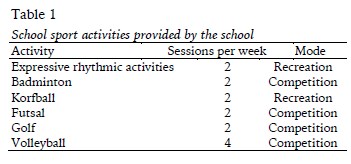
<body><![CDATA[<p>For both the head     of the department and PE teachers, the NCPE was an important document that     helped guide their practices. However, not all of the teachers had the     preparation necessary to teach all of the sports that are part of the NCPE. For     this reason, in order to be prepared and correctly teach the activities from     the NCPE, teachers organize courses within the department, in which each     teacher has the responsibility to train their colleagues, teaching them how to     teach the sport activities in which they are specialists. If there was a gap,     and no one was able to train others in some specific sport, the teachers either     assumed the responsibility for attending courses outside the school, or a     specialist was invited to come to the school to deliver a training course.     Thus, at the beginning of each academic year, PE teachers expressed their     difficulties and planned the training process. For instance, while the research     was taking place, the PE department invited a specialist to deliver a practical     course on teaching handball; and commissioned the Portuguese Federation of     Badminton to facilitate training in the teaching of badminton. These training     programs took place during the first months of classes, so that teachers were prepared to teach these sports.</p>     <p>The PE curriculum     at the school has made up of three defined areas, as defined by the NCPE: (1)     PA (which includes sports, dance and expressive rhythmic activities,     traditional games, and outdoor recreation activities), (2) Knowledge (which     includes the learning of the development and maintenance of physical fitness,     and knowledge concerning the interpretation and participation in sport in a     social perspective), and (3) Physical Fitness (where they develop physical capacities). The PE department head stated:</p>     <p>“The NCPE defined     clearly three major guidelines for teaching. One is related to PA, and the aim     is to teach students for them to be able to practice regularly. The other has     to do with theoretical knowledge to enable students to understand how important     PA and fitness is to improve health. The third is physical fitness, and in each     class students have to work to improve their fitness levels, because there is a relationship between fitness and health.”</p>     <p>The PE department     head added that teachers were supposed to teach more than one PA in each PE     lesson, sometimes at the same time, with students performing different tasks     according to their needs. Teachers should use the class time to explain the     objective of each exercise, allowing students to better understand the real purpose of each exercise.</p>     <p>Apart from the     implementation of the NCPE, extracurricular activities have great importance in     school, being represented in several forms. They could be tournaments     (organized by students, in which students, staff and teachers all participate),     school sports, or activities for parents and former students. In school sports, the school provides 6 activities, as can be seen in <a href="#t1">table 1</a>.</p>     <p><a name="t1"></a></p>     <p>&nbsp;</p>     <p align="center"><img src="/img/revistas/mot/v13s1/13s1a14t1.jpg" width="351" height="164"></p>     
<p>&nbsp;</p>     <p>The School sports   were a complement to PE lessons, and were undertaken for a dual purpose. The   first perspective was related to athletic performance. It was a space where   students could compete with other students from other schools in a formal   competition. The second role served to improve students’ performance in sports   in which they had more difficulties. It seems that school sports worked as a   support for PE classes. For instance, this relationship between school sports   and PE was the reason why the volleyball team had more hours to practice, and   had more students enrolled, because teachers identified that most students had   learning difficulties in this particular sport. Characterizing the school   sports activities, from the informal conversations, the head of the PE   department stated:</p>     ]]></body>
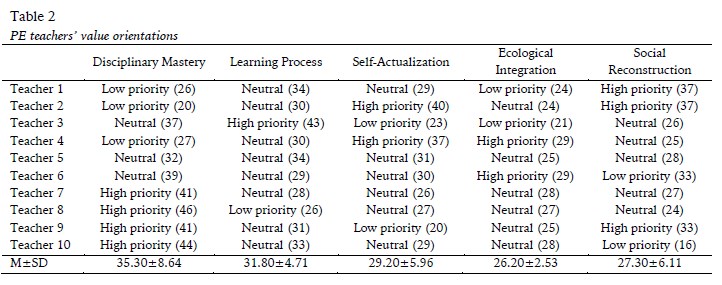
<body><![CDATA[<p>“The school     sports are a subsidiary of PE. We assume school sports in two different     perspectives. The first is related with sports competition. The aim is to     improve, but always using a formative approach. The other perspective, which is     relatively recent in our school, is related to the sports in which students     have difficulties in PE. In school, students play sports to practice and     improve their performance. Naturally this will have a repercussion in PE marks     at the end of the academic year. Sometimes we joke around with the parents;     they send their kids to have extra lessons of mathematics outside school for     them to achieve good marks, so we do the same in school sports to help them to achieve better marks in PE.”</p>     <p>With the     intention to increase the educational opportunities for students to improve     their motor skills in PE and physical fitness, the head of the department asked     the school principal to allow more time to work with those students who had     more difficulties. The request was granted. Every week more than 30 students     (previously identified as having more difficulties) had an extra 45-minute,     small-group PE session focused on physical fitness as well as the sport with which they were struggling.</p>     <p><i>PE teachers’ value orientation</i></p>     <p>Data from VOI     showed that teachers in the PE school department share different PE value     orientations (<a href="/img/revistas/mot/v13s1/13s1a14t2.jpg">table 2</a>). Three teachers gave priority to the disciplinary     mastery value orientation (T7, T8, T10); and three teachers gave priority to     two value orientations, namely: T2 presented simultaneous preference to     self-actualization and social reconstruction, T4 valued both self-actualization     and ecological integration, and T9 favoured both the disciplinary mastery and     social reconstruction orientation. T1 held mainly the social reconstruction     value orientation, T3 gave priority to the learning process value orientation,     and T6 gave priority to ecological integration. Finally, T5 showed a neutral value orientation.</p>     
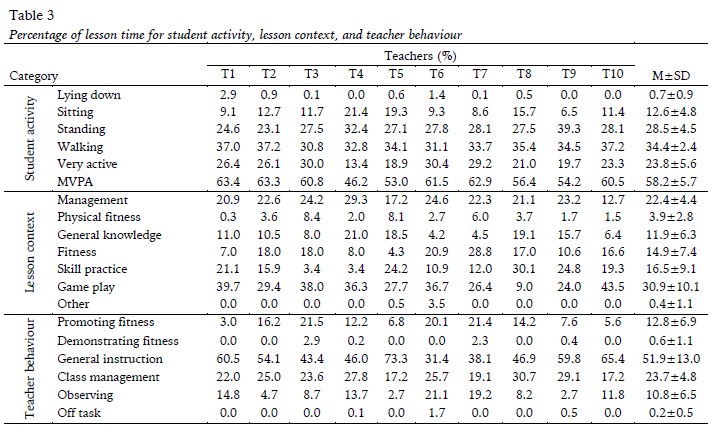
<p><i>PE classes</i></p>     <p><a href="/img/revistas/mot/v13s1/13s1a14t3.jpg">Table 3</a>  represents the proportion of lesson time for the main SOFIT categories (student   activity, lesson context, and teacher behaviour). Overall, students spent the   majority of their lesson time walking (34.4%), which is classified as MPA,   followed by standing (28.5%), and in VPA (23.8%). Students from nine teachers   engaged in MVPA for more than 50% of the available time during the three   lessons observed. Six of the teachers have offered more than 60% of MVPA. Only   one teacher did not provide 50% or more of MVPA. The lesson activity time was   mainly devoted to game play (30.9%), with students generally performing without   major intervention from the teacher, followed by time focused on management   (22.4%). In most of the observed classes teachers taught more than on PA, and   during time devoted to game play the students performed more than one sport. As   for the activity time devoted to activities in which the major purpose was to   improve the students’ fitness in terms of cardiovascular endurance, strength,     or flexibility, the average was 14.9% (ranging between 4.3% and 28.8%). Only     3.9% of the lesson time was centred on delivering information related to     physical fitness. Through information gathered based on observation and     conversation with teachers, the lower time centred on information related to     physical fitness was due to the fact that it was expected that the students had     already acquired this knowledge because it had been mentioned frequently     throughout the year (SOFIT data were collected near the end of the academic     year). With respect to teacher behaviour, 51.9% of their time was spent     providing general instruction, followed by class management (23.7%), matching     with 22.4% in the category with the same name but belonging to the level of     lesson content. Promoting fitness took 12.8% of the class time, and teachers     spent only 0.6% demonstrating fitness. When teachers were asked about this     value, they indicated that the students were already familiarized with most of the exercises.</p>     
<p>&nbsp;</p>     <p align="center"><a href="/img/revistas/mot/v13s1/13s1a14t4.jpg">Table 4</a></p>     
<p>&nbsp;</p>     <p><i>HR monitoring</i></p>     ]]></body>
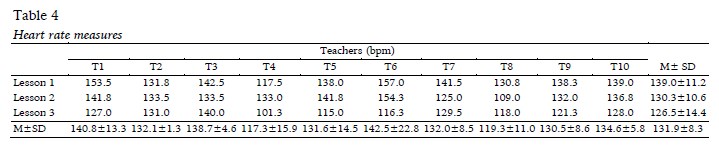
<body><![CDATA[<p>The intensity of     the PA provided to students shows an average of 131.9 bpm, ranging from 117.3     to 142.5 bpm (<a href="/img/revistas/mot/v13s1/13s1a14t5.jpg">table 5</a>). The average duration of PE lessons was 74 minutes.     Students engaged in MVPA for 30 minutes of lesson, which represents 40% of the     lesson time. In the 45-minute lessons, students were 20.8±9.7 minutes with     levels of HR below 140 bpm and 23±10.6 minutes above 140 bpm. In 90-minute     lessons, the averages were 42.2±15.3 minutes below 140 bpm and 37±16.9 minutes     above 140 bpm. According to paired-samples <i>t</i> test, there were no     statistically significant differences in mean levels of HR between 45 and     90-minutes classes (t(23)=1.477, <i>p</i>=0.153). The average time in which     students were engaged in activities with an intensity below and above 140 bpm     was not significant in 45-minutes (t(23)=-0.542, p=0.593) and 90-minutes classes (t(23)=1.253, p=0.223).</p>     
<p>&nbsp;</p> </font>     <p><font face="Verdana" size="3"><b><b>DISCUSSION</b></b>    </font></p> <font face="Verdana" size="2">     <p>This study     analysed the functioning of a PE department of a secondary school focused on     NCPE with respect to health and PA promotion. School PE teachers favoured an     educational perspective of health-related PE (Johns &amp; Tinning, 2006), and     created an education climate that favoured the development of a physically     literate person (Castelli, Barcelona, &amp; Bryant, 2015) by ensuring: (1) that     students possessed the knowledge and motor skills to be able to value PA and     (2) that they were able to design intentionally their PA and fitness exercises     and practice, throughout their lives, in order to maintain and/or improve their health status.</p>     <p>The     characteristics of the curriculum and the diversity of the PA entailed some     difficulties for the teachers, because not all of them had the necessary     preparation to teach all activities. To solve this situation, they organized a     training plan, in which each teacher would teach their area of expertise to the     other teachers. This attitude of the PE department clearly showed the importance     they gave to the NCPE, while teaching the PA in a useful perspective so that,     in the future, students could use what they have learned as a tool to practice     PA autonomously. The way teachers organized the training plan, and planned the     activities for the entire year, demonstrates that they work as a professional     learning community (Hord, 1997; Schmoker, 2004). These types of communities are     characterized by a shared vision and a focus on: collegiality, students’   learning, individualizing the teaching process, and providing additional time for students with more difficulties.</p>     <p>Students engaged     in MVPA for 58.2% of the lesson time. Only the students of one teacher did not     reach 50% of lesson time in MVPA. On the other hand, six teachers have offered     more than 60% of MVPA. This data was higher than those found in the literature     (Fairclough &amp; Stratton, 2006b; McKenzie, Marshall, Sallis, &amp; Conway,     2000) and meets what is recommended for the PE class time (USDHHS, 2000). The     fact that only one teacher had not achieved 50% of class time in MVPA takes on     particular relevance when one considers that teachers don’t share the same PE     value orientations. This may reflect on the teachers’ collective compromise to     follow the same PE objectives, and valuing students’ interests above all else.     We also see the educational work characteristics of the school PE department,     where the focus is on complying with the NCPE, and the principles and     strategies to be employed to maximize the number of students engaged in active     learning for the maximum amount of available time. These principles were     successfully followed in the SPARK PE programs by non-PE specialist teachers,     who have achieved the 50% MVPA goal in their lessons (McKenzie, Sallis, Kolody,   &amp; Faucette, 1997). This data seems to support the recommendation that     health-enhancing PA in PE should be deliberately planned (Fairclough &amp;   Stratton, 2005a, 2005b; Martin, Kulinna, Eklund, &amp; Reed, 2001). The     teachers’ collective compromise to maximize students’ time on task and to provide     them with sufficient PA is probably a key ingredient to engaging students in     MVPA and to avoid the influence of PE value orientations that do not support this goal.</p>     <p>Across all     observed lessons most lesson time was apportioned to game play and skill practice,     while teachers were giving general instructions. This addresses the knowledge     and understanding, and motor skill development goals of PE. Apart from the time     achieved in MVPA it could be said that, if time devoted to instruction was     reduced, students could enhance their time in MVPA. Mersh and Fairclough (2010)     indicated that when making judgments about PA and sedentary behaviour in PE     time, it is important to do this in relation to the planned lesson objectives.     If lesson segments designed to give instruction result in effective pedagogy,     they should be viewed as a necessary part of PE and its potential to foster     long-term positive PA attitudes and skills (Castelli &amp; Rink, 2003; Cone,     2004). This means that active and inactive segments in PE classes, through     enjoyable and motivating learning environments, are required to promote     students’ PA education by enhancing their knowledge and understanding (Brynteson &amp; Adams, 1993; Dale, Corbin, &amp; Cuddihy, 1998).</p>     <p>Regarding time     devoted to management, teachers spent, on average, 22.4% of their total     intervention on lesson context and 23.7% of their behaviour. Siedentop (1991)     mentions that if classroom management time represents more than 20% of total     intervention, it means that teachers faced some difficulties in organizing the     class. Since most teachers are experienced, it is unlikely that they had     difficulties. The high percentage of time devoted to classroom management was     due to the diversity of activities that were taught in the same class. Several     times, while some students were playing or practicing skills, teachers     organized other students for another task. This explains why both time devoted to management and MVPA were high.</p>     <p>According to the     Portuguese education system, students from grades 7 to 9 have 135 minutes of PE     per week, and students from grades 10 to 12 have 180 minutes. Schools have the     autonomy to allocate this time as they want; in this school, students in grades     7 to 9 had a 45-minute plus a 90-minute class, and those who attended grades 10     to 12 had two 90-minute classes. Although the schools had the autonomy to     allocate PE time, the NCPE recommends PE lessons of 45 minutes in order to     provide students with a greater number of times to practice PA per week. PE     teachers required that the PE time allocation should be as has been prescribed by the NCPE; however, their claim was not recognised by the school principal.</p>     <p>The results of     comparative analysis between 45-minute and 90-minute classes showed no     significant differences in mean levels of HR, suggesting that from a     pedagogical viewpoint, both options are adequate and contribute to improved     physical fitness. According to this data, the time allocated in a 45-minute     class provided students with the opportunity to exercise at least three times a     week. If we then add school sports, opportunities available for all students     (free of charge), students could practice PA at least 5/6 times a week. This is     almost sufficient to meet the youth PA recommendation (World Health     Organization, 2010). It also demonstrates that schools can provide     opportunities to help students to meet PA recommendation; PE and school sports play an important role.</p>     ]]></body>
<body><![CDATA[<p>Studies have     found that teachers from secondary schools gave priority to social     reconstruction value orientation, and delineating curricular goals for social     responsibility, while disciplinary mastery value orientation was not favoured     (Behets &amp; Vergauwen, 2004; Ennis &amp; Chen, 1995). These results are not     in accordance with ours. Most of the PE teachers from the investigated school     centred their attention on the contents of PE, appearing disciplinary mastery     and ecological integration as the most valued value orientations. This may be     the result of the commitment of the PE department to promoting students’   learning, teaching the PA from the NCPE, as well as preparing students to be fit, and acquire the knowledge that allows them to be autonomous.</p>     <p>Curriculum     scholars argue that value orientations influence curricular decision-making and     determine choices related to content, pedagogy, and assessment (Carreiro da     Costa, 2005; Curtner-Smith &amp; Meek, 2000; Ennis &amp; Chen, 1995). This     study has revealed that although teachers possess different value orientations,     the goals for PE were similar in classes, as was the concern to provide high     levels of intensity in these classes. We believed that the commitment expressed     in the documents, and the collective work, contributed to minimize the     individual differences. This demonstrates the importance of collective work and overlapping individual beliefs when the goal is promoting health-related PE.</p> </font>     <p>&nbsp;</p>     <p><font size="3" face="Verdana"><b><b>CONCLUSION</b></b></font></p> <font face="Verdana" size="2">     <p>The results seem     to confirm the hypothesis that the diversity of educational beliefs shared by     PE teachers in a school does not prevent them from pursuing common objectives.     On the other hand, considering that a relationship between the belief system of     the individual teachers and their teaching behaviours was not found, this     result may become a valuable asset to argue that the importance given to the     work climate characterizing the school PE department cannot be forgotten. This     is especially pertinent as one considers a strategy aiming to improve the     quality of PE and pupils’ learning, specifically when the aim is optimizing the role of PE in PA (Solmon, 2015).</p>     <p>PE teachers     showed a shared commitment about what is important to teach and how best to     organize learning. They worked as a team, focusing their teaching in students’   learning. They showed high expectations, believing that students can succeed.   This suggests that they possess a strong moral purpose. They behave like an   organized group whose members: 1) share a common goal, 2) wish to improve the   quality of education, 3) have a desire to learn from each other, and 4) value   contextualized and collaborative professional learning. These characteristics   are consistent with the literature about effective and better schools   correlates (Lezotte &amp; Snyder, 2011; Reynolds &amp; Teddlie, 2000; Sammons   &amp; Bakkum, 2011) and are in line with the characteristics of the high     performing secondary PE programs (Castelli &amp; Rink, 2003). To promote     teamwork and coherent curricular decisions, as well as good educational     practices in a school, the PE department is probably a key determinant to     provide a positive, motivating, and success-oriented learning environment with     the potential to influence students’ present and future participation in PA.     Thus, PE teacher education programs have the responsibility to educate     graduates that possess the ability to identify not only the correlates of     better schools but also those of high PE programs, which value team work and     are able to work accordingly, and assume that students’ interests should take     precedence over the differences that may exist in a PE department in relation to the aims of PE.</p> </font>     <p>&nbsp;</p>     <p><font size="3" face="Verdana"><b><b>REFERENCES</b></b></font></p> <font face="Verdana" size="2">     <!-- ref --><p>Armstrong, N. (1998). Young people’s     physical activity patterns as assessed by heart rate monitoring. <i>Journal of       Sports Science and Medicine, 16</i>(Suppl. 1), S9-16. doi: 10.1080/026404198366632&nbsp;&nbsp;&nbsp;&nbsp;&nbsp;&nbsp;&nbsp;&nbsp;[&#160;<a href="javascript:void(0);" onclick="javascript: window.open('/scielo.php?script=sci_nlinks&ref=372707&pid=S1646-107X201700060001400001&lng=','','width=640,height=500,resizable=yes,scrollbars=1,menubar=yes,');">Links</a>&#160;]<!-- end-ref --><!-- ref --><p>Armstrong, N., &amp; Welsman, J.     (2006). The physical activity patterns of European youth with reference to     methods of assessment. <i>Sports Medicine, 36</i>(12), 1067-1086. doi: 10.2165/00007256-200636120-00005&nbsp;&nbsp;&nbsp;&nbsp;&nbsp;&nbsp;&nbsp;&nbsp;[&#160;<a href="javascript:void(0);" onclick="javascript: window.open('/scielo.php?script=sci_nlinks&ref=372708&pid=S1646-107X201700060001400002&lng=','','width=640,height=500,resizable=yes,scrollbars=1,menubar=yes,');">Links</a>&#160;]<!-- end-ref --><!-- ref --><p>Behets, D., &amp; Vergauwen, L.     (2004). Value orientations of elementary and secondary physical education     teachers in Flanders. <i>Research Quarterly for Exercise and Sport, 75</i>(2), 156-164.    &nbsp;&nbsp;&nbsp;&nbsp;&nbsp;&nbsp;&nbsp;&nbsp;[&#160;<a href="javascript:void(0);" onclick="javascript: window.open('/scielo.php?script=sci_nlinks&ref=372709&pid=S1646-107X201700060001400003&lng=','','width=640,height=500,resizable=yes,scrollbars=1,menubar=yes,');">Links</a>&#160;]<!-- end-ref --></p>     <!-- ref --><p>Brynteson, P., &amp; Adams, T. (1993).     The effects of conceptually based Physical Education programs on attitudes and     exercise habits of college alumni after 2 to 11 years of follow-up. <i>Research       Quarterly for Exercise and Sport, 64</i>(2), 208-212. doi: 10.1080/02701367.1993.10608798&nbsp;&nbsp;&nbsp;&nbsp;&nbsp;&nbsp;&nbsp;&nbsp;[&#160;<a href="javascript:void(0);" onclick="javascript: window.open('/scielo.php?script=sci_nlinks&ref=372711&pid=S1646-107X201700060001400004&lng=','','width=640,height=500,resizable=yes,scrollbars=1,menubar=yes,');">Links</a>&#160;]<!-- end-ref --><!-- ref --><p>Carreiro da Costa, F. (2005). Changing     the curriculum does not mean changing practices at school: the impact of     teachers beliefs on curriculum implementation. <i>The art and science of teaching in Physical Education and Sport</i>, 257-277.    &nbsp;&nbsp;&nbsp;&nbsp;&nbsp;&nbsp;&nbsp;&nbsp;[&#160;<a href="javascript:void(0);" onclick="javascript: window.open('/scielo.php?script=sci_nlinks&ref=372712&pid=S1646-107X201700060001400005&lng=','','width=640,height=500,resizable=yes,scrollbars=1,menubar=yes,');">Links</a>&#160;]<!-- end-ref --></p>     <!-- ref --><p>Castelli, D., Barcelona, J., &amp;   Bryant, L. (2015). Contextualizing physical literacy in the school environment: The   challenges. <i>Journal of Sport and Health Science, 4</i>(3), 156–163. doi: 10.1016/j.jshs.2015.04.003&nbsp;&nbsp;&nbsp;&nbsp;&nbsp;&nbsp;&nbsp;&nbsp;[&#160;<a href="javascript:void(0);" onclick="javascript: window.open('/scielo.php?script=sci_nlinks&ref=372714&pid=S1646-107X201700060001400006&lng=','','width=640,height=500,resizable=yes,scrollbars=1,menubar=yes,');">Links</a>&#160;]<!-- end-ref --><!-- ref --><p>Castelli, D., &amp; Rink, J. (2003).     Chapter 3: a comparison of high and low performing secondary Physical Education     programs. <i>Journal of Teaching in Physical Education, 22</i>(5), 512-532. doi: 10.1123/jtpe.22.5.512&nbsp;&nbsp;&nbsp;&nbsp;&nbsp;&nbsp;&nbsp;&nbsp;[&#160;<a href="javascript:void(0);" onclick="javascript: window.open('/scielo.php?script=sci_nlinks&ref=372715&pid=S1646-107X201700060001400007&lng=','','width=640,height=500,resizable=yes,scrollbars=1,menubar=yes,');">Links</a>&#160;]<!-- end-ref --><!-- ref --><p>Chen, A., Ennis, C. D., &amp; Loftus,     S. (1997). Refining the value orientation inventory. <i>Research Quarterly for Exercise and Sport, 68</i>(4), 352-356. doi: 10.1080/02701367.1997.10608016&nbsp;&nbsp;&nbsp;&nbsp;&nbsp;&nbsp;&nbsp;&nbsp;[&#160;<a href="javascript:void(0);" onclick="javascript: window.open('/scielo.php?script=sci_nlinks&ref=372716&pid=S1646-107X201700060001400008&lng=','','width=640,height=500,resizable=yes,scrollbars=1,menubar=yes,');">Links</a>&#160;]<!-- end-ref --><!-- ref --><p>Cone, S. (2004). Pay me now or pay me     later: 10 years later and have seen any change? <i>Journal of Teaching in Physical Education, 23</i>(4), 271-280. doi: 10.1123/jtpe.23.4.271&nbsp;&nbsp;&nbsp;&nbsp;&nbsp;&nbsp;&nbsp;&nbsp;[&#160;<a href="javascript:void(0);" onclick="javascript: window.open('/scielo.php?script=sci_nlinks&ref=372717&pid=S1646-107X201700060001400009&lng=','','width=640,height=500,resizable=yes,scrollbars=1,menubar=yes,');">Links</a>&#160;]<!-- end-ref --><!-- ref --><p>Curtner-Smith, M., &amp; Meek, G.     (2000). Teachers’ value orientations and their compatibility with National     Curriculum for Physical Education. <i>European Physical Education Review, 6</i>(1), 27-45. doi: 10.1177/1356336X000061004&nbsp;&nbsp;&nbsp;&nbsp;&nbsp;&nbsp;&nbsp;&nbsp;[&#160;<a href="javascript:void(0);" onclick="javascript: window.open('/scielo.php?script=sci_nlinks&ref=372718&pid=S1646-107X201700060001400010&lng=','','width=640,height=500,resizable=yes,scrollbars=1,menubar=yes,');">Links</a>&#160;]<!-- end-ref --><!-- ref --><p>Dale, D., Corbin, C., &amp; Cuddihy,     T. (1998). Can conceptual Physical Education promote physically active     lifestyle? <i>Pediatric Exercise Science, 10</i>(2), 97-109. doi: 10.1123/pes.10.2.97&nbsp;&nbsp;&nbsp;&nbsp;&nbsp;&nbsp;&nbsp;&nbsp;[&#160;<a href="javascript:void(0);" onclick="javascript: window.open('/scielo.php?script=sci_nlinks&ref=372719&pid=S1646-107X201700060001400011&lng=','','width=640,height=500,resizable=yes,scrollbars=1,menubar=yes,');">Links</a>&#160;]<!-- end-ref --><!-- ref --><p>DuFour, R. (2011). Work together: but     only if you want to. <i>Phi Delta Kappan, 92</i>(5), 57-61. doi: 10.1177/003172171109200513&nbsp;&nbsp;&nbsp;&nbsp;&nbsp;&nbsp;&nbsp;&nbsp;[&#160;<a href="javascript:void(0);" onclick="javascript: window.open('/scielo.php?script=sci_nlinks&ref=372720&pid=S1646-107X201700060001400012&lng=','','width=640,height=500,resizable=yes,scrollbars=1,menubar=yes,');">Links</a>&#160;]<!-- end-ref --><!-- ref --><p>Ennis, C. D., &amp; Chen, A. (1995).     Teachers' value orientations in urban and rural school settings. <i>Research       Quarterly for Exercise and Sport, 66</i>(1), 41-50. doi: 10.1080/02701367.1995.10607654&nbsp;&nbsp;&nbsp;&nbsp;&nbsp;&nbsp;&nbsp;&nbsp;[&#160;<a href="javascript:void(0);" onclick="javascript: window.open('/scielo.php?script=sci_nlinks&ref=372721&pid=S1646-107X201700060001400013&lng=','','width=640,height=500,resizable=yes,scrollbars=1,menubar=yes,');">Links</a>&#160;]<!-- end-ref --><!-- ref --><p>Ennis, C. D., &amp; Zhu, W. (1991).     Value orientations: A description of teachers' goals for student learning. <i>Research       Quarterly for Exercise and Sport</i>, <i>62</i>(1), 33-40. doi: 10.1080/02701367.1991.10607516&nbsp;&nbsp;&nbsp;&nbsp;&nbsp;&nbsp;&nbsp;&nbsp;[&#160;<a href="javascript:void(0);" onclick="javascript: window.open('/scielo.php?script=sci_nlinks&ref=372722&pid=S1646-107X201700060001400014&lng=','','width=640,height=500,resizable=yes,scrollbars=1,menubar=yes,');">Links</a>&#160;]<!-- end-ref --><!-- ref --><p>Fairclough, S., &amp; Stratton, G.     (2005a). Improving health-enhancing physical activity in girls’ physical     education. <i>Health Educational Research, 20</i>(4), 448-457. doi: 10.1093/her/cyg137&nbsp;&nbsp;&nbsp;&nbsp;&nbsp;&nbsp;&nbsp;&nbsp;[&#160;<a href="javascript:void(0);" onclick="javascript: window.open('/scielo.php?script=sci_nlinks&ref=372723&pid=S1646-107X201700060001400015&lng=','','width=640,height=500,resizable=yes,scrollbars=1,menubar=yes,');">Links</a>&#160;]<!-- end-ref --><!-- ref --><p>Fairclough, S., &amp; Stratton, G.     (2005b). 'Physical education makes you fit and healthy'. Physical education's     contribution to young people's physical activity levels. <i>Health Educational Research, 20</i>(1), 14-23. doi: 10.1093/her/cyg101&nbsp;&nbsp;&nbsp;&nbsp;&nbsp;&nbsp;&nbsp;&nbsp;[&#160;<a href="javascript:void(0);" onclick="javascript: window.open('/scielo.php?script=sci_nlinks&ref=372724&pid=S1646-107X201700060001400016&lng=','','width=640,height=500,resizable=yes,scrollbars=1,menubar=yes,');">Links</a>&#160;]<!-- end-ref --><!-- ref --><p>Fairclough, S., &amp; Stratton, G.     (2006a). Effects of a physical education intervention to improve student     activity levels. <i>Physical Education and Sport Pedagogy, 11</i>(1), 29-44. doi: 10.1080/17408980500467613&nbsp;&nbsp;&nbsp;&nbsp;&nbsp;&nbsp;&nbsp;&nbsp;[&#160;<a href="javascript:void(0);" onclick="javascript: window.open('/scielo.php?script=sci_nlinks&ref=372725&pid=S1646-107X201700060001400017&lng=','','width=640,height=500,resizable=yes,scrollbars=1,menubar=yes,');">Links</a>&#160;]<!-- end-ref --><!-- ref --><p>Fairclough, S., &amp; Stratton, G.     (2006b). Physical activity, fitness, and affective responses of normal-weight     and overweight adolescents during physical education. <i>Pediatric Exercise Science, 18</i>(1), 53-63. doi: 10.1123/pes.18.1.53&nbsp;&nbsp;&nbsp;&nbsp;&nbsp;&nbsp;&nbsp;&nbsp;[&#160;<a href="javascript:void(0);" onclick="javascript: window.open('/scielo.php?script=sci_nlinks&ref=372726&pid=S1646-107X201700060001400018&lng=','','width=640,height=500,resizable=yes,scrollbars=1,menubar=yes,');">Links</a>&#160;]<!-- end-ref --><!-- ref --><p>Fullan, M. (2001). <i>Leading in a culture of change</i>. San Francisco: Jossey-Bass.    &nbsp;&nbsp;&nbsp;&nbsp;&nbsp;&nbsp;&nbsp;&nbsp;[&#160;<a href="javascript:void(0);" onclick="javascript: window.open('/scielo.php?script=sci_nlinks&ref=372727&pid=S1646-107X201700060001400019&lng=','','width=640,height=500,resizable=yes,scrollbars=1,menubar=yes,');">Links</a>&#160;]<!-- end-ref --></p>     ]]></body>
<body><![CDATA[<!-- ref --><p>Haerens, L., Kirk, D., Cardon, G.,   &amp; De Bourdeaudhuij, I. (2011). Toward the development of a pedagogical     model for health-based physical education. <i>Quest, 63</i>(3), 321-338. doi: 10.1080/00336297.2011.10483684&nbsp;&nbsp;&nbsp;&nbsp;&nbsp;&nbsp;&nbsp;&nbsp;[&#160;<a href="javascript:void(0);" onclick="javascript: window.open('/scielo.php?script=sci_nlinks&ref=372729&pid=S1646-107X201700060001400020&lng=','','width=640,height=500,resizable=yes,scrollbars=1,menubar=yes,');">Links</a>&#160;]<!-- end-ref --><!-- ref --><p>Hargreaves, A. (1995). Development and     desire. A post-modern perspective. In T. Guskey &amp; M. Huberman (Eds.), <i>Professional       development in education: New paradigms and perspectives</i> (pp. 9-34). New York: Teachers College Press.    &nbsp;&nbsp;&nbsp;&nbsp;&nbsp;&nbsp;&nbsp;&nbsp;[&#160;<a href="javascript:void(0);" onclick="javascript: window.open('/scielo.php?script=sci_nlinks&ref=372730&pid=S1646-107X201700060001400021&lng=','','width=640,height=500,resizable=yes,scrollbars=1,menubar=yes,');">Links</a>&#160;]<!-- end-ref --></p>     <!-- ref --><p>Harriss, D. J., &amp; Atkinson, G.     (2009). International Journal of Sports Medicine - ethical standards in sport     and exercise science research. <i>International Journal of Sports Medicine, 30</i>(10), 701-702. doi: 10.1055/s-0029-1237378&nbsp;&nbsp;&nbsp;&nbsp;&nbsp;&nbsp;&nbsp;&nbsp;[&#160;<a href="javascript:void(0);" onclick="javascript: window.open('/scielo.php?script=sci_nlinks&ref=372732&pid=S1646-107X201700060001400022&lng=','','width=640,height=500,resizable=yes,scrollbars=1,menubar=yes,');">Links</a>&#160;]<!-- end-ref --><!-- ref --><p>Hord, S. (1997). Professional learning     communities: What are they and why Are they important? <i>Issues about Change, 1</i>(6).    &nbsp;&nbsp;&nbsp;&nbsp;&nbsp;&nbsp;&nbsp;&nbsp;[&#160;<a href="javascript:void(0);" onclick="javascript: window.open('/scielo.php?script=sci_nlinks&ref=372733&pid=S1646-107X201700060001400023&lng=','','width=640,height=500,resizable=yes,scrollbars=1,menubar=yes,');">Links</a>&#160;]<!-- end-ref --></p>     <!-- ref --><p>Johns, D., &amp; Tinning, R. (2006).     Risk reduction: recontextualing health as a physical education curriculum. <i>Quest, 58</i>(4), 395-409. doi: 10.1080/00336297.2006.10491890&nbsp;&nbsp;&nbsp;&nbsp;&nbsp;&nbsp;&nbsp;&nbsp;[&#160;<a href="javascript:void(0);" onclick="javascript: window.open('/scielo.php?script=sci_nlinks&ref=372735&pid=S1646-107X201700060001400024&lng=','','width=640,height=500,resizable=yes,scrollbars=1,menubar=yes,');">Links</a>&#160;]<!-- end-ref --><!-- ref --><p>Keating, X., Harrison, L., Chen, L.,     Xiang, P., Lambdin, D., Dauenhauer, B., …Castro-Pinero, J. (2009). An analysis     of research on student health-related fitness knowledge in K-16 Physical     Education programs. <i>Journal of Teaching in Physical Education, 28</i>(3), 333-349. doi: 10.1123/jtpe.28.3.333&nbsp;&nbsp;&nbsp;&nbsp;&nbsp;&nbsp;&nbsp;&nbsp;[&#160;<a href="javascript:void(0);" onclick="javascript: window.open('/scielo.php?script=sci_nlinks&ref=372736&pid=S1646-107X201700060001400025&lng=','','width=640,height=500,resizable=yes,scrollbars=1,menubar=yes,');">Links</a>&#160;]<!-- end-ref --><!-- ref --><p>Kulinna, P., Silverman, S., &amp;   Keating, X. (2000). Relationships between teachers’ belief systems and actions     toward teaching physical activity and fitness. <i>Journal of Teaching in Physical Education, 19</i>(2), 206-221. doi: 10.1123/jtpe.19.2.206&nbsp;&nbsp;&nbsp;&nbsp;&nbsp;&nbsp;&nbsp;&nbsp;[&#160;<a href="javascript:void(0);" onclick="javascript: window.open('/scielo.php?script=sci_nlinks&ref=372737&pid=S1646-107X201700060001400026&lng=','','width=640,height=500,resizable=yes,scrollbars=1,menubar=yes,');">Links</a>&#160;]<!-- end-ref --><!-- ref --><p>Lezotte, L. W., &amp; Snyder, K. M.     (2011). <i>What effective schools do: Re-envisioning the correlates</i>. Bloomington, In Solution Tree Press.    &nbsp;&nbsp;&nbsp;&nbsp;&nbsp;&nbsp;&nbsp;&nbsp;[&#160;<a href="javascript:void(0);" onclick="javascript: window.open('/scielo.php?script=sci_nlinks&ref=372738&pid=S1646-107X201700060001400027&lng=','','width=640,height=500,resizable=yes,scrollbars=1,menubar=yes,');">Links</a>&#160;]<!-- end-ref --></p>     <!-- ref --><p>MacNamara, A., Collins, D., Bailey,     R., Toms, M., Ford, P., &amp; Pearce, G. (2011). Promoting lifelong physical     activity and high level performance: realising an achievable aim for physical     education. <i>Physical Education and Sport Pedagogy, 16</i>(3), 265-278. doi: 10.1080/17408989.2010.535200&nbsp;&nbsp;&nbsp;&nbsp;&nbsp;&nbsp;&nbsp;&nbsp;[&#160;<a href="javascript:void(0);" onclick="javascript: window.open('/scielo.php?script=sci_nlinks&ref=372740&pid=S1646-107X201700060001400028&lng=','','width=640,height=500,resizable=yes,scrollbars=1,menubar=yes,');">Links</a>&#160;]<!-- end-ref --><!-- ref --><p>Marques, A., Martins, J., Sarmento,     H., Rocha, L., &amp; Carreiro da Costa, F. (2015). Do students know the physical activity     recommendations for health promotion? <i>Journal of Physical Activity and Health, 12</i>(2), 253-256. doi: 10.1123/jpah.2013-0228&nbsp;&nbsp;&nbsp;&nbsp;&nbsp;&nbsp;&nbsp;&nbsp;[&#160;<a href="javascript:void(0);" onclick="javascript: window.open('/scielo.php?script=sci_nlinks&ref=372741&pid=S1646-107X201700060001400029&lng=','','width=640,height=500,resizable=yes,scrollbars=1,menubar=yes,');">Links</a>&#160;]<!-- end-ref --><!-- ref --><p>Martin, J., Kulinna, P., Eklund, R.,   &amp; Reed, B. (2001). Determinants of teachers’ intentions to teach physically     active Physical Education classes. <i>Journal of Teaching in Physical Education, 20</i>(2), 129-143. doi: 10.1123/jtpe.20.2.129&nbsp;&nbsp;&nbsp;&nbsp;&nbsp;&nbsp;&nbsp;&nbsp;[&#160;<a href="javascript:void(0);" onclick="javascript: window.open('/scielo.php?script=sci_nlinks&ref=372742&pid=S1646-107X201700060001400030&lng=','','width=640,height=500,resizable=yes,scrollbars=1,menubar=yes,');">Links</a>&#160;]<!-- end-ref --><!-- ref --><p>McKenzie, T., Marshall, S., Sallis,     J., &amp; Conway, T. (2000). Student activity levels, lesson context, and     teacher behavior during middle school physical education. <i>Research Quarterly for Exercise and Sport, 71</i>(3), 249-259. doi: 10.1080/02701367.2000.10608905&nbsp;&nbsp;&nbsp;&nbsp;&nbsp;&nbsp;&nbsp;&nbsp;[&#160;<a href="javascript:void(0);" onclick="javascript: window.open('/scielo.php?script=sci_nlinks&ref=372743&pid=S1646-107X201700060001400031&lng=','','width=640,height=500,resizable=yes,scrollbars=1,menubar=yes,');">Links</a>&#160;]<!-- end-ref --><!-- ref --><p>McKenzie, T., Sallis, J., Kolody, B.,   &amp; Faucette, F. (1997). Long-term effects of a physical education curriculum     and staff development program: SPARK. <i>Research Quarterly for Exercise and Sport, 68</i>(4), 280-291. doi: 10.1080/02701367.1997.10608009&nbsp;&nbsp;&nbsp;&nbsp;&nbsp;&nbsp;&nbsp;&nbsp;[&#160;<a href="javascript:void(0);" onclick="javascript: window.open('/scielo.php?script=sci_nlinks&ref=372744&pid=S1646-107X201700060001400032&lng=','','width=640,height=500,resizable=yes,scrollbars=1,menubar=yes,');">Links</a>&#160;]<!-- end-ref --><!-- ref --><p>McKenzie, T., Sallis, J., &amp; Nader,     P. (1991). SOFIT: System for Observing Fitness Instruction Time. <i>Journal of Teaching in Physical Education, 11(2)</i>, 195-205. doi: 10.1123/jtpe.11.2.195&nbsp;&nbsp;&nbsp;&nbsp;&nbsp;&nbsp;&nbsp;&nbsp;[&#160;<a href="javascript:void(0);" onclick="javascript: window.open('/scielo.php?script=sci_nlinks&ref=372745&pid=S1646-107X201700060001400033&lng=','','width=640,height=500,resizable=yes,scrollbars=1,menubar=yes,');">Links</a>&#160;]<!-- end-ref --><!-- ref --><p>Mersh, R., &amp; Fairclough, S.     (2010). Physical activity, lesson context and teacher behaviours within the     revised English National Curriculum for Physical Education: A case study of one     school. <i>European Physical Education Review, 16</i>(1), 29-45. doi: 10.1177/1356336X10369199&nbsp;&nbsp;&nbsp;&nbsp;&nbsp;&nbsp;&nbsp;&nbsp;[&#160;<a href="javascript:void(0);" onclick="javascript: window.open('/scielo.php?script=sci_nlinks&ref=372746&pid=S1646-107X201700060001400034&lng=','','width=640,height=500,resizable=yes,scrollbars=1,menubar=yes,');">Links</a>&#160;]<!-- end-ref --><!-- ref --><p>Pate, R. R., Davis, M. G., Robinson,     T. N., Stone, E. J., McKenzie, T. L., Young, J. C., . . . Council on     Cardiovascular, N. (2006). Promoting physical activity in children and youth: a     leadership role for schools: a scientific statement from the American Heart     Association Council on Nutrition, Physical Activity, and Metabolism (Physical     Activity Committee) in collaboration with the Councils on Cardiovascular Disease in the Young and Cardiovascular Nursing. <i>Circulation, 114</i>(11), 1214-1224.    &nbsp;&nbsp;&nbsp;&nbsp;&nbsp;&nbsp;&nbsp;&nbsp;[&#160;<a href="javascript:void(0);" onclick="javascript: window.open('/scielo.php?script=sci_nlinks&ref=372747&pid=S1646-107X201700060001400035&lng=','','width=640,height=500,resizable=yes,scrollbars=1,menubar=yes,');">Links</a>&#160;]<!-- end-ref --></p>     ]]></body>
<body><![CDATA[<!-- ref --><p>Piéron, M., Ruiz, F., &amp; García     Montes, H. (2008). La opinión del alumnado de enseñanza seundaria sobre las     clases de Educación Física: Un desafío para los profesores y los formadores. <i>Revista Fuentes, 8</i>, 159-175.    &nbsp;&nbsp;&nbsp;&nbsp;&nbsp;&nbsp;&nbsp;&nbsp;[&#160;<a href="javascript:void(0);" onclick="javascript: window.open('/scielo.php?script=sci_nlinks&ref=372749&pid=S1646-107X201700060001400036&lng=','','width=640,height=500,resizable=yes,scrollbars=1,menubar=yes,');">Links</a>&#160;]<!-- end-ref --></p>     <!-- ref --><p>Reynolds, D., &amp; Teddlie, C.     (2000). The process of school effectiveness. In C. Teddlie &amp; D. Reynolds     (Eds.), <i>The international handbook of school effectiveness research </i>(pp. 134-159). London: Falmer Press.    &nbsp;&nbsp;&nbsp;&nbsp;&nbsp;&nbsp;&nbsp;&nbsp;[&#160;<a href="javascript:void(0);" onclick="javascript: window.open('/scielo.php?script=sci_nlinks&ref=372751&pid=S1646-107X201700060001400037&lng=','','width=640,height=500,resizable=yes,scrollbars=1,menubar=yes,');">Links</a>&#160;]<!-- end-ref --></p>     <!-- ref --><p>Rikard, G., &amp; Banville, D. (2006).     High school student attitudes about Physical Education. <i>Sport, Education and Society, 11</i>(4), 385-400. doi: 10.1080/13573320600924882 &nbsp;&nbsp;&nbsp;&nbsp;&nbsp;&nbsp;&nbsp;&nbsp;[&#160;<a href="javascript:void(0);" onclick="javascript: window.open('/scielo.php?script=sci_nlinks&ref=372753&pid=S1646-107X201700060001400038&lng=','','width=640,height=500,resizable=yes,scrollbars=1,menubar=yes,');">Links</a>&#160;]<!-- end-ref --><!-- ref --><p>Rowe, P., Mars, H., Schuldheisz, J.,   &amp; Fox, S. (2004). Measuring students' physical activity leveIs: validating     SOFIT for use with high-school students. <i>Journal of Teaching in Physical Education, 23</i>, 235-251. doi: 10.1123/jtpe.23.3.235&nbsp;&nbsp;&nbsp;&nbsp;&nbsp;&nbsp;&nbsp;&nbsp;[&#160;<a href="javascript:void(0);" onclick="javascript: window.open('/scielo.php?script=sci_nlinks&ref=372754&pid=S1646-107X201700060001400039&lng=','','width=640,height=500,resizable=yes,scrollbars=1,menubar=yes,');">Links</a>&#160;]<!-- end-ref --><!-- ref --><p>Sallis, J. F., &amp; McKenzie, T. L.     (1991). Physical education's role in public health. <i>Research quarterly for exercise and sport, 62(2), </i>124-137. doi: 10.1080/02701367.1991.10608701&nbsp;&nbsp;&nbsp;&nbsp;&nbsp;&nbsp;&nbsp;&nbsp;[&#160;<a href="javascript:void(0);" onclick="javascript: window.open('/scielo.php?script=sci_nlinks&ref=372755&pid=S1646-107X201700060001400040&lng=','','width=640,height=500,resizable=yes,scrollbars=1,menubar=yes,');">Links</a>&#160;]<!-- end-ref --><!-- ref --><p>Sallis, J. F., McKenzie, T. L., Beets,     M. W., Beighle, A., Erwin, H., &amp; Lee, S. (2012). Physical education's role     in public health: steps forward and backward over 20 years and HOPE for the     future. <i>Research Quarterly for Exercise and Sport, 83</i>(2), 125-135. doi: 10.1080/02701367.2012.10599842&nbsp;&nbsp;&nbsp;&nbsp;&nbsp;&nbsp;&nbsp;&nbsp;[&#160;<a href="javascript:void(0);" onclick="javascript: window.open('/scielo.php?script=sci_nlinks&ref=372756&pid=S1646-107X201700060001400041&lng=','','width=640,height=500,resizable=yes,scrollbars=1,menubar=yes,');">Links</a>&#160;]<!-- end-ref --><!-- ref --><p>Sammons, P., &amp; Bakkum, L. (2011).     Effective schools, equity and teacher effectiveness: a review to the     literature. <i>Revista de Currículum y Formación del Profesorado, 15</i>(3), 9-26.    &nbsp;&nbsp;&nbsp;&nbsp;&nbsp;&nbsp;&nbsp;&nbsp;[&#160;<a href="javascript:void(0);" onclick="javascript: window.open('/scielo.php?script=sci_nlinks&ref=372757&pid=S1646-107X201700060001400042&lng=','','width=640,height=500,resizable=yes,scrollbars=1,menubar=yes,');">Links</a>&#160;]<!-- end-ref --></p>     ]]></body>
<body><![CDATA[<!-- ref --><p>Schmoker, M. (2004). Tipping point:     From feckless reform to substantive instructional improvement. <i>Phi Delta Kappan, 85</i>(6), 424-432. doi: 10.1177/003172170408500605&nbsp;&nbsp;&nbsp;&nbsp;&nbsp;&nbsp;&nbsp;&nbsp;[&#160;<a href="javascript:void(0);" onclick="javascript: window.open('/scielo.php?script=sci_nlinks&ref=372759&pid=S1646-107X201700060001400043&lng=','','width=640,height=500,resizable=yes,scrollbars=1,menubar=yes,');">Links</a>&#160;]<!-- end-ref --><!-- ref --><p>Scruggs, P., Beveridge, S., Eisenman,     P., Watson, L., Shultz, S., &amp; Ransdell, L. (2003). Quantifying physical     activity via pedometry in elementary Physical Education. <i>Medicine &amp;     Science in Sport &amp; Exercise, 35</i>(6), 1065-1071. doi: 10.1249/01.MSS.0000069748.02525.B2&nbsp;&nbsp;&nbsp;&nbsp;&nbsp;&nbsp;&nbsp;&nbsp;[&#160;<a href="javascript:void(0);" onclick="javascript: window.open('/scielo.php?script=sci_nlinks&ref=372760&pid=S1646-107X201700060001400044&lng=','','width=640,height=500,resizable=yes,scrollbars=1,menubar=yes,');">Links</a>&#160;]<!-- end-ref --><!-- ref --><p>Siedentop, D. (1991). <i>Developing     Teaching Skills in Physical Education</i>. Mountain View: Mayfield Publishing Company.    &nbsp;&nbsp;&nbsp;&nbsp;&nbsp;&nbsp;&nbsp;&nbsp;[&#160;<a href="javascript:void(0);" onclick="javascript: window.open('/scielo.php?script=sci_nlinks&ref=372761&pid=S1646-107X201700060001400045&lng=','','width=640,height=500,resizable=yes,scrollbars=1,menubar=yes,');">Links</a>&#160;]<!-- end-ref --></p>     <!-- ref --><p>Simons-Morton, B. (1994). Implementing     health-related physical education. In R. Pate &amp; R. Hohn (Eds.), <i>Health       and fitness through physical education</i> (pp. 137-146). Champaign, Il: Human Kinetics.    &nbsp;&nbsp;&nbsp;&nbsp;&nbsp;&nbsp;&nbsp;&nbsp;[&#160;<a href="javascript:void(0);" onclick="javascript: window.open('/scielo.php?script=sci_nlinks&ref=372763&pid=S1646-107X201700060001400046&lng=','','width=640,height=500,resizable=yes,scrollbars=1,menubar=yes,');">Links</a>&#160;]<!-- end-ref --></p>     <!-- ref --><p>Solmon, M. A. (2015). Optimizing the     role of physical education in promoting physical activity: A social-ecological     approach. <i>Research quarterly for exercise and sport, 86</i>(4), 329-337. doi: 10.1080/02701367.2015.1091712&nbsp;&nbsp;&nbsp;&nbsp;&nbsp;&nbsp;&nbsp;&nbsp;[&#160;<a href="javascript:void(0);" onclick="javascript: window.open('/scielo.php?script=sci_nlinks&ref=372765&pid=S1646-107X201700060001400047&lng=','','width=640,height=500,resizable=yes,scrollbars=1,menubar=yes,');">Links</a>&#160;]<!-- end-ref --><!-- ref --><p>Stewart, S., &amp; Mitchell, M.     (2003). Instructional Variables and Student Knowledge and Conceptions of     Fitness. <i>Journal of Teaching in Physical Education, 22</i>(5), 533-551. doi: 10.1123/jtpe.22.5.533&nbsp;&nbsp;&nbsp;&nbsp;&nbsp;&nbsp;&nbsp;&nbsp;[&#160;<a href="javascript:void(0);" onclick="javascript: window.open('/scielo.php?script=sci_nlinks&ref=372766&pid=S1646-107X201700060001400048&lng=','','width=640,height=500,resizable=yes,scrollbars=1,menubar=yes,');">Links</a>&#160;]<!-- end-ref --><!-- ref --><p>USDHHS. United States Department of     Health and Human Services. (2000). <i>Healthy       People 2010: Understanding and improving health</i> (2<sup>nd</sup> ed.). Washington, DC: U.S. Government Printing Office.    &nbsp;&nbsp;&nbsp;&nbsp;&nbsp;&nbsp;&nbsp;&nbsp;[&#160;<a href="javascript:void(0);" onclick="javascript: window.open('/scielo.php?script=sci_nlinks&ref=372767&pid=S1646-107X201700060001400049&lng=','','width=640,height=500,resizable=yes,scrollbars=1,menubar=yes,');">Links</a>&#160;]<!-- end-ref --></p>     ]]></body>
<body><![CDATA[<!-- ref --><p>Vieira, F., &amp; da Costa, F. C.     (2007). <i>As orientações       educacionais dos professores de educação física e o currículo institucional.</i> Instituto Piaget, Horizontes pedagógicos&nbsp;&nbsp;&nbsp;&nbsp;&nbsp;&nbsp;&nbsp;&nbsp;[&#160;<a href="javascript:void(0);" onclick="javascript: window.open('/scielo.php?script=sci_nlinks&ref=372769&pid=S1646-107X201700060001400050&lng=','','width=640,height=500,resizable=yes,scrollbars=1,menubar=yes,');">Links</a>&#160;]<!-- end-ref --><!-- ref --><p>World Health Organization [WHO]. (2010). Global     recommendations on physical activity for health. <i>World Health Organization</i>: Geneva, Switzerland.    &nbsp;&nbsp;&nbsp;&nbsp;&nbsp;&nbsp;&nbsp;&nbsp;[&#160;<a href="javascript:void(0);" onclick="javascript: window.open('/scielo.php?script=sci_nlinks&ref=372770&pid=S1646-107X201700060001400051&lng=','','width=640,height=500,resizable=yes,scrollbars=1,menubar=yes,');">Links</a>&#160;]<!-- end-ref --></p>     <p>&nbsp;</p>     <p><b>Acknowledgments:    <br>   </b>Nothing to declare.    <br>   <b>Conflict of interests:    <br>       </b>Nothing to declare.    <br>   <b>Funding:    <br>       </b>Nothing to declare.</p> </font>     ]]></body>
<body><![CDATA[<p>&nbsp;</p>     <p>&nbsp;</p>     <p><font face="Verdana" size="2"><a href="#top"><sup>*</sup></a><i><a name="end"></a></i></font> <font size="2" face="Verdana"><i>Corresponding   author: </i>Faculty   of Human Kinetics, University of Lisbon, Lisbon, Portugal, Estrada da Costa,   1499-002 Cruz-Quebrada, Portugal.<i> Email: </i><a href="mailto:amarques@fmh.ulisboa.pt">amarques@fmh.ulisboa.pt</a></font> </p>      ]]></body><back>
<ref-list>
<ref id="B1">
<nlm-citation citation-type="journal">
<person-group person-group-type="author">
<name>
<surname><![CDATA[Armstrong]]></surname>
<given-names><![CDATA[N.]]></given-names>
</name>
</person-group>
<article-title xml:lang="en"><![CDATA[Young people’s physical activity patterns as assessed by heart rate monitoring]]></article-title>
<source><![CDATA[Journal of Sports Science and Medicine]]></source>
<year>1998</year>
<volume>16</volume>
<numero>^s1</numero>
<issue>^s1</issue>
<supplement>1</supplement>
<page-range>S9-16</page-range></nlm-citation>
</ref>
<ref id="B2">
<nlm-citation citation-type="journal">
<person-group person-group-type="author">
<name>
<surname><![CDATA[Armstrong]]></surname>
<given-names><![CDATA[N.]]></given-names>
</name>
<name>
<surname><![CDATA[Welsman]]></surname>
<given-names><![CDATA[J.]]></given-names>
</name>
</person-group>
<article-title xml:lang="en"><![CDATA[The physical activity patterns of European youth with reference to methods of assessment]]></article-title>
<source><![CDATA[Sports Medicine]]></source>
<year>2006</year>
<volume>36</volume>
<numero>12</numero>
<issue>12</issue>
<page-range>1067-1086</page-range></nlm-citation>
</ref>
<ref id="B3">
<nlm-citation citation-type="journal">
<person-group person-group-type="author">
<name>
<surname><![CDATA[Behets]]></surname>
<given-names><![CDATA[D.]]></given-names>
</name>
<name>
<surname><![CDATA[Vergauwen]]></surname>
<given-names><![CDATA[L.]]></given-names>
</name>
</person-group>
<article-title xml:lang="en"><![CDATA[Value orientations of elementary and secondary physical education teachers in Flanders]]></article-title>
<source><![CDATA[Research Quarterly for Exercise and Sport]]></source>
<year>2004</year>
<volume>75</volume>
<numero>2</numero>
<issue>2</issue>
<page-range>156-164</page-range></nlm-citation>
</ref>
<ref id="B4">
<nlm-citation citation-type="journal">
<person-group person-group-type="author">
<name>
<surname><![CDATA[Brynteson]]></surname>
<given-names><![CDATA[P.]]></given-names>
</name>
<name>
<surname><![CDATA[Adams]]></surname>
<given-names><![CDATA[T.]]></given-names>
</name>
</person-group>
<article-title xml:lang="en"><![CDATA[The effects of conceptually based Physical Education programs on attitudes and exercise habits of college alumni after 2 to 11 years of follow-up]]></article-title>
<source><![CDATA[Research Quarterly for Exercise and Sport]]></source>
<year>1993</year>
<volume>64</volume>
<numero>2</numero>
<issue>2</issue>
<page-range>208-212</page-range></nlm-citation>
</ref>
<ref id="B5">
<nlm-citation citation-type="journal">
<person-group person-group-type="author">
<name>
<surname><![CDATA[Carreiro da Costa]]></surname>
<given-names><![CDATA[F.]]></given-names>
</name>
</person-group>
<article-title xml:lang="en"><![CDATA[Changing the curriculum does not mean changing practices at school: the impact of teachers beliefs on curriculum implementation]]></article-title>
<source><![CDATA[The art and science of teaching in Physical Education and Sport]]></source>
<year>2005</year>
<page-range>257-277</page-range></nlm-citation>
</ref>
<ref id="B6">
<nlm-citation citation-type="journal">
<person-group person-group-type="author">
<name>
<surname><![CDATA[Castelli]]></surname>
<given-names><![CDATA[D.]]></given-names>
</name>
<name>
<surname><![CDATA[Barcelona]]></surname>
<given-names><![CDATA[J.]]></given-names>
</name>
<name>
<surname><![CDATA[Bryant]]></surname>
<given-names><![CDATA[L.]]></given-names>
</name>
</person-group>
<article-title xml:lang="en"><![CDATA[Contextualizing physical literacy in the school environment: The challenges]]></article-title>
<source><![CDATA[Journal of Sport and Health Science]]></source>
<year>2015</year>
<volume>4</volume>
<numero>3</numero>
<issue>3</issue>
<page-range>156-163</page-range></nlm-citation>
</ref>
<ref id="B7">
<nlm-citation citation-type="journal">
<person-group person-group-type="author">
<name>
<surname><![CDATA[Castelli]]></surname>
<given-names><![CDATA[D.]]></given-names>
</name>
<name>
<surname><![CDATA[Rink]]></surname>
<given-names><![CDATA[J.]]></given-names>
</name>
</person-group>
<article-title xml:lang="en"><![CDATA[Chapter 3: a comparison of high and low performing secondary Physical Education programs]]></article-title>
<source><![CDATA[Journal of Teaching in Physical Education]]></source>
<year>2003</year>
<volume>22</volume>
<numero>5</numero>
<issue>5</issue>
<page-range>512-532</page-range></nlm-citation>
</ref>
<ref id="B8">
<nlm-citation citation-type="journal">
<person-group person-group-type="author">
<name>
<surname><![CDATA[Chen]]></surname>
<given-names><![CDATA[A.]]></given-names>
</name>
<name>
<surname><![CDATA[Ennis]]></surname>
<given-names><![CDATA[C. D.]]></given-names>
</name>
<name>
<surname><![CDATA[Loftus]]></surname>
<given-names><![CDATA[S.]]></given-names>
</name>
</person-group>
<article-title xml:lang="en"><![CDATA[Refining the value orientation inventory]]></article-title>
<source><![CDATA[Research Quarterly for Exercise and Sport]]></source>
<year>1997</year>
<volume>68</volume>
<numero>4</numero>
<issue>4</issue>
<page-range>352-356</page-range></nlm-citation>
</ref>
<ref id="B9">
<nlm-citation citation-type="journal">
<person-group person-group-type="author">
<name>
<surname><![CDATA[Cone]]></surname>
<given-names><![CDATA[S.]]></given-names>
</name>
</person-group>
<article-title xml:lang="en"><![CDATA[Pay me now or pay me later: 10 years later and have seen any change?]]></article-title>
<source><![CDATA[Journal of Teaching in Physical Education]]></source>
<year>2004</year>
<volume>23</volume>
<numero>4</numero>
<issue>4</issue>
<page-range>271-280</page-range></nlm-citation>
</ref>
<ref id="B10">
<nlm-citation citation-type="journal">
<person-group person-group-type="author">
<name>
<surname><![CDATA[Curtner-Smith]]></surname>
<given-names><![CDATA[M.]]></given-names>
</name>
<name>
<surname><![CDATA[Meek]]></surname>
<given-names><![CDATA[G.]]></given-names>
</name>
</person-group>
<article-title xml:lang="en"><![CDATA[Teachers’ value orientations and their compatibility with National Curriculum for Physical Education]]></article-title>
<source><![CDATA[European Physical Education Review]]></source>
<year>2000</year>
<volume>6</volume>
<numero>1</numero>
<issue>1</issue>
<page-range>27-45</page-range></nlm-citation>
</ref>
<ref id="B11">
<nlm-citation citation-type="journal">
<person-group person-group-type="author">
<name>
<surname><![CDATA[Dale]]></surname>
<given-names><![CDATA[D.]]></given-names>
</name>
<name>
<surname><![CDATA[Corbin]]></surname>
<given-names><![CDATA[C.]]></given-names>
</name>
<name>
<surname><![CDATA[Cuddihy]]></surname>
<given-names><![CDATA[T.]]></given-names>
</name>
</person-group>
<article-title xml:lang="en"><![CDATA[Can conceptual Physical Education promote physically active lifestyle?]]></article-title>
<source><![CDATA[Pediatric Exercise Science]]></source>
<year>1998</year>
<volume>10</volume>
<numero>2</numero>
<issue>2</issue>
<page-range>97-109</page-range></nlm-citation>
</ref>
<ref id="B12">
<nlm-citation citation-type="journal">
<person-group person-group-type="author">
<name>
<surname><![CDATA[DuFour]]></surname>
<given-names><![CDATA[R.]]></given-names>
</name>
</person-group>
<article-title xml:lang="en"><![CDATA[Work together: but only if you want to]]></article-title>
<source><![CDATA[Phi Delta Kappan]]></source>
<year>2011</year>
<volume>92</volume>
<numero>5</numero>
<issue>5</issue>
<page-range>57-61</page-range></nlm-citation>
</ref>
<ref id="B13">
<nlm-citation citation-type="journal">
<person-group person-group-type="author">
<name>
<surname><![CDATA[Ennis]]></surname>
<given-names><![CDATA[C. D.]]></given-names>
</name>
<name>
<surname><![CDATA[Chen]]></surname>
<given-names><![CDATA[A.]]></given-names>
</name>
</person-group>
<article-title xml:lang="en"><![CDATA[Teachers' value orientations in urban and rural school settings]]></article-title>
<source><![CDATA[Research Quarterly for Exercise and Sport]]></source>
<year>1995</year>
<volume>66</volume>
<numero>1</numero>
<issue>1</issue>
<page-range>41-50</page-range></nlm-citation>
</ref>
<ref id="B14">
<nlm-citation citation-type="journal">
<person-group person-group-type="author">
<name>
<surname><![CDATA[Ennis]]></surname>
<given-names><![CDATA[C. D.]]></given-names>
</name>
<name>
<surname><![CDATA[Zhu]]></surname>
<given-names><![CDATA[W.]]></given-names>
</name>
</person-group>
<article-title xml:lang="en"><![CDATA[Value orientations: A description of teachers' goals for student learning]]></article-title>
<source><![CDATA[Research Quarterly for Exercise and Sport]]></source>
<year>1991</year>
<volume>62</volume>
<numero>1</numero>
<issue>1</issue>
<page-range>33-40</page-range></nlm-citation>
</ref>
<ref id="B15">
<nlm-citation citation-type="journal">
<person-group person-group-type="author">
<name>
<surname><![CDATA[Fairclough]]></surname>
<given-names><![CDATA[S.]]></given-names>
</name>
<name>
<surname><![CDATA[Stratton]]></surname>
<given-names><![CDATA[G.]]></given-names>
</name>
</person-group>
<article-title xml:lang="en"><![CDATA[Improving health-enhancing physical activity in girls’ physical education]]></article-title>
<source><![CDATA[Health Educational Research]]></source>
<year>2005</year>
<volume>20</volume>
<numero>4</numero>
<issue>4</issue>
<page-range>448-457</page-range></nlm-citation>
</ref>
<ref id="B16">
<nlm-citation citation-type="journal">
<person-group person-group-type="author">
<name>
<surname><![CDATA[Fairclough]]></surname>
<given-names><![CDATA[S.]]></given-names>
</name>
<name>
<surname><![CDATA[Stratton]]></surname>
<given-names><![CDATA[G.]]></given-names>
</name>
</person-group>
<article-title xml:lang="en"><![CDATA[Physical education makes you fit and healthy: Physical education's contribution to young people's physical activity levels]]></article-title>
<source><![CDATA[Health Educational Research]]></source>
<year>2005</year>
<volume>20</volume>
<numero>1</numero>
<issue>1</issue>
<page-range>14-23</page-range></nlm-citation>
</ref>
<ref id="B17">
<nlm-citation citation-type="journal">
<person-group person-group-type="author">
<name>
<surname><![CDATA[Fairclough]]></surname>
<given-names><![CDATA[S.]]></given-names>
</name>
<name>
<surname><![CDATA[Stratton]]></surname>
<given-names><![CDATA[G.]]></given-names>
</name>
</person-group>
<article-title xml:lang="en"><![CDATA[Effects of a physical education intervention to improve student activity levels]]></article-title>
<source><![CDATA[Physical Education and Sport Pedagogy]]></source>
<year>2006</year>
<volume>11</volume>
<numero>1</numero>
<issue>1</issue>
<page-range>29-44</page-range></nlm-citation>
</ref>
<ref id="B18">
<nlm-citation citation-type="journal">
<person-group person-group-type="author">
<name>
<surname><![CDATA[Fairclough]]></surname>
<given-names><![CDATA[S.]]></given-names>
</name>
<name>
<surname><![CDATA[Stratton]]></surname>
<given-names><![CDATA[G.]]></given-names>
</name>
</person-group>
<article-title xml:lang="en"><![CDATA[Physical activity, fitness, and affective responses of normal-weight and overweight adolescents during physical education]]></article-title>
<source><![CDATA[Pediatric Exercise Science]]></source>
<year>2006</year>
<volume>18</volume>
<numero>1</numero>
<issue>1</issue>
<page-range>53-63</page-range></nlm-citation>
</ref>
<ref id="B19">
<nlm-citation citation-type="book">
<person-group person-group-type="author">
<name>
<surname><![CDATA[Fullan]]></surname>
<given-names><![CDATA[M.]]></given-names>
</name>
</person-group>
<source><![CDATA[Leading in a culture of change]]></source>
<year>2001</year>
<publisher-loc><![CDATA[San Francisco ]]></publisher-loc>
<publisher-name><![CDATA[Jossey-Bass]]></publisher-name>
</nlm-citation>
</ref>
<ref id="B20">
<nlm-citation citation-type="journal">
<person-group person-group-type="author">
<name>
<surname><![CDATA[Haerens]]></surname>
<given-names><![CDATA[L.]]></given-names>
</name>
<name>
<surname><![CDATA[Kirk]]></surname>
<given-names><![CDATA[D.]]></given-names>
</name>
<name>
<surname><![CDATA[Cardon]]></surname>
<given-names><![CDATA[G.]]></given-names>
</name>
<name>
<surname><![CDATA[De Bourdeaudhuij]]></surname>
<given-names><![CDATA[I.]]></given-names>
</name>
</person-group>
<article-title xml:lang="en"><![CDATA[Toward the development of a pedagogical model for health-based physical education]]></article-title>
<source><![CDATA[Quest]]></source>
<year>2011</year>
<volume>63</volume>
<numero>3</numero>
<issue>3</issue>
<page-range>321-338</page-range></nlm-citation>
</ref>
<ref id="B21">
<nlm-citation citation-type="book">
<person-group person-group-type="author">
<name>
<surname><![CDATA[Hargreaves]]></surname>
<given-names><![CDATA[A.]]></given-names>
</name>
</person-group>
<article-title xml:lang="en"><![CDATA[Development and desire: A post-modern perspective]]></article-title>
<person-group person-group-type="editor">
<name>
<surname><![CDATA[Guskey]]></surname>
<given-names><![CDATA[T.]]></given-names>
</name>
<name>
<surname><![CDATA[Huberman]]></surname>
<given-names><![CDATA[M.]]></given-names>
</name>
</person-group>
<source><![CDATA[Professional development in education: New paradigms and perspectives]]></source>
<year>1995</year>
<page-range>9-34</page-range><publisher-loc><![CDATA[New York ]]></publisher-loc>
<publisher-name><![CDATA[Teachers College Press]]></publisher-name>
</nlm-citation>
</ref>
<ref id="B22">
<nlm-citation citation-type="journal">
<person-group person-group-type="author">
<name>
<surname><![CDATA[Harriss]]></surname>
<given-names><![CDATA[D. J.]]></given-names>
</name>
<name>
<surname><![CDATA[Atkinson]]></surname>
<given-names><![CDATA[G.]]></given-names>
</name>
</person-group>
<article-title xml:lang="en"><![CDATA[International Journal of Sports Medicine: ethical standards in sport and exercise science research]]></article-title>
<source><![CDATA[International Journal of Sports Medicine]]></source>
<year>2009</year>
<volume>30</volume>
<numero>10</numero>
<issue>10</issue>
<page-range>701-702</page-range></nlm-citation>
</ref>
<ref id="B23">
<nlm-citation citation-type="journal">
<person-group person-group-type="author">
<name>
<surname><![CDATA[Hord]]></surname>
<given-names><![CDATA[S.]]></given-names>
</name>
</person-group>
<article-title xml:lang="en"><![CDATA[Professional learning communities: What are they and why Are they important?]]></article-title>
<source><![CDATA[Issues about Change]]></source>
<year>1997</year>
<volume>1</volume>
<numero>6</numero>
<issue>6</issue>
</nlm-citation>
</ref>
<ref id="B24">
<nlm-citation citation-type="journal">
<person-group person-group-type="author">
<name>
<surname><![CDATA[Johns]]></surname>
<given-names><![CDATA[D.]]></given-names>
</name>
<name>
<surname><![CDATA[Tinning]]></surname>
<given-names><![CDATA[R.]]></given-names>
</name>
</person-group>
<article-title xml:lang="en"><![CDATA[Risk reduction: recontextualing health as a physical education curriculum]]></article-title>
<source><![CDATA[Quest]]></source>
<year>2006</year>
<volume>58</volume>
<numero>4</numero>
<issue>4</issue>
<page-range>395-409</page-range></nlm-citation>
</ref>
<ref id="B25">
<nlm-citation citation-type="journal">
<person-group person-group-type="author">
<name>
<surname><![CDATA[Keating]]></surname>
<given-names><![CDATA[X.]]></given-names>
</name>
<name>
<surname><![CDATA[Harrison]]></surname>
<given-names><![CDATA[L.]]></given-names>
</name>
<name>
<surname><![CDATA[Chen]]></surname>
<given-names><![CDATA[L.]]></given-names>
</name>
<name>
<surname><![CDATA[Xiang]]></surname>
<given-names><![CDATA[P.]]></given-names>
</name>
<name>
<surname><![CDATA[Lambdin]]></surname>
<given-names><![CDATA[D.]]></given-names>
</name>
<name>
<surname><![CDATA[Dauenhauer]]></surname>
<given-names><![CDATA[B.]]></given-names>
</name>
<name>
<surname><![CDATA[Castro-Pinero]]></surname>
<given-names><![CDATA[J.]]></given-names>
</name>
</person-group>
<article-title xml:lang="en"><![CDATA[An analysis of research on student health-related fitness knowledge in K-16 Physical Education programs]]></article-title>
<source><![CDATA[Journal of Teaching in Physical Education]]></source>
<year>2009</year>
<volume>28</volume>
<numero>3</numero>
<issue>3</issue>
<page-range>333-349</page-range></nlm-citation>
</ref>
<ref id="B26">
<nlm-citation citation-type="journal">
<person-group person-group-type="author">
<name>
<surname><![CDATA[Kulinna]]></surname>
<given-names><![CDATA[P.]]></given-names>
</name>
<name>
<surname><![CDATA[Silverman]]></surname>
<given-names><![CDATA[S.]]></given-names>
</name>
<name>
<surname><![CDATA[Keating]]></surname>
<given-names><![CDATA[X.]]></given-names>
</name>
</person-group>
<article-title xml:lang="en"><![CDATA[Relationships between teachers’ belief systems and actions toward teaching physical activity and fitness]]></article-title>
<source><![CDATA[Journal of Teaching in Physical Education]]></source>
<year>2000</year>
<volume>19</volume>
<numero>2</numero>
<issue>2</issue>
<page-range>206-221</page-range></nlm-citation>
</ref>
<ref id="B27">
<nlm-citation citation-type="book">
<person-group person-group-type="author">
<name>
<surname><![CDATA[Lezotte]]></surname>
<given-names><![CDATA[L. W.]]></given-names>
</name>
<name>
<surname><![CDATA[Snyder]]></surname>
<given-names><![CDATA[K. M.]]></given-names>
</name>
</person-group>
<source><![CDATA[What effective schools do: Re-envisioning the correlates]]></source>
<year>2011</year>
<publisher-loc><![CDATA[Bloomington ]]></publisher-loc>
<publisher-name><![CDATA[In Solution Tree Press]]></publisher-name>
</nlm-citation>
</ref>
<ref id="B28">
<nlm-citation citation-type="journal">
<person-group person-group-type="author">
<name>
<surname><![CDATA[MacNamara]]></surname>
<given-names><![CDATA[A.]]></given-names>
</name>
<name>
<surname><![CDATA[Collins]]></surname>
<given-names><![CDATA[D.]]></given-names>
</name>
<name>
<surname><![CDATA[Bailey]]></surname>
<given-names><![CDATA[R.]]></given-names>
</name>
<name>
<surname><![CDATA[Toms]]></surname>
<given-names><![CDATA[M.]]></given-names>
</name>
<name>
<surname><![CDATA[Ford]]></surname>
<given-names><![CDATA[P.]]></given-names>
</name>
<name>
<surname><![CDATA[Pearce]]></surname>
<given-names><![CDATA[G.]]></given-names>
</name>
</person-group>
<article-title xml:lang="en"><![CDATA[Promoting lifelong physical activity and high level performance: realising an achievable aim for physical education]]></article-title>
<source><![CDATA[Physical Education and Sport Pedagogy]]></source>
<year>2011</year>
<volume>16</volume>
<numero>3</numero>
<issue>3</issue>
<page-range>265-278</page-range></nlm-citation>
</ref>
<ref id="B29">
<nlm-citation citation-type="journal">
<person-group person-group-type="author">
<name>
<surname><![CDATA[Marques]]></surname>
<given-names><![CDATA[A.]]></given-names>
</name>
<name>
<surname><![CDATA[Martins]]></surname>
<given-names><![CDATA[J.]]></given-names>
</name>
<name>
<surname><![CDATA[Sarmento]]></surname>
<given-names><![CDATA[H.]]></given-names>
</name>
<name>
<surname><![CDATA[Rocha]]></surname>
<given-names><![CDATA[L.]]></given-names>
</name>
<name>
<surname><![CDATA[Carreiro da Costa]]></surname>
<given-names><![CDATA[F.]]></given-names>
</name>
</person-group>
<article-title xml:lang="en"><![CDATA[Do students know the physical activity recommendations for health promotion?]]></article-title>
<source><![CDATA[Journal of Physical Activity and Health]]></source>
<year>2015</year>
<volume>12</volume>
<numero>2</numero>
<issue>2</issue>
<page-range>253-256</page-range></nlm-citation>
</ref>
<ref id="B30">
<nlm-citation citation-type="journal">
<person-group person-group-type="author">
<name>
<surname><![CDATA[Martin]]></surname>
<given-names><![CDATA[J.]]></given-names>
</name>
<name>
<surname><![CDATA[Kulinna]]></surname>
<given-names><![CDATA[P.]]></given-names>
</name>
<name>
<surname><![CDATA[Eklund]]></surname>
<given-names><![CDATA[R.]]></given-names>
</name>
<name>
<surname><![CDATA[Reed]]></surname>
<given-names><![CDATA[B.]]></given-names>
</name>
</person-group>
<article-title xml:lang="en"><![CDATA[Determinants of teachers’ intentions to teach physically active Physical Education classes]]></article-title>
<source><![CDATA[Journal of Teaching in Physical Education]]></source>
<year>2001</year>
<volume>20</volume>
<numero>2</numero>
<issue>2</issue>
<page-range>129-143</page-range></nlm-citation>
</ref>
<ref id="B31">
<nlm-citation citation-type="journal">
<person-group person-group-type="author">
<name>
<surname><![CDATA[McKenzie]]></surname>
<given-names><![CDATA[T.]]></given-names>
</name>
<name>
<surname><![CDATA[Marshall]]></surname>
<given-names><![CDATA[S.]]></given-names>
</name>
<name>
<surname><![CDATA[Sallis]]></surname>
<given-names><![CDATA[J.]]></given-names>
</name>
<name>
<surname><![CDATA[Conway]]></surname>
<given-names><![CDATA[T.]]></given-names>
</name>
</person-group>
<article-title xml:lang="en"><![CDATA[Student activity levels, lesson context, and teacher behavior during middle school physical education]]></article-title>
<source><![CDATA[Research Quarterly for Exercise and Sport]]></source>
<year>2000</year>
<volume>71</volume>
<numero>3</numero>
<issue>3</issue>
<page-range>249-259</page-range></nlm-citation>
</ref>
<ref id="B32">
<nlm-citation citation-type="journal">
<person-group person-group-type="author">
<name>
<surname><![CDATA[McKenzie]]></surname>
<given-names><![CDATA[T.]]></given-names>
</name>
<name>
<surname><![CDATA[Sallis]]></surname>
<given-names><![CDATA[J.]]></given-names>
</name>
<name>
<surname><![CDATA[Kolody]]></surname>
<given-names><![CDATA[B.]]></given-names>
</name>
<name>
<surname><![CDATA[Faucette]]></surname>
<given-names><![CDATA[F.]]></given-names>
</name>
</person-group>
<article-title xml:lang="en"><![CDATA[Long-term effects of a physical education curriculum and staff development program: SPARK]]></article-title>
<source><![CDATA[Research Quarterly for Exercise and Sport]]></source>
<year>1997</year>
<volume>68</volume>
<numero>4</numero>
<issue>4</issue>
<page-range>280-291</page-range></nlm-citation>
</ref>
<ref id="B33">
<nlm-citation citation-type="journal">
<person-group person-group-type="author">
<name>
<surname><![CDATA[McKenzie]]></surname>
<given-names><![CDATA[T.]]></given-names>
</name>
<name>
<surname><![CDATA[Sallis]]></surname>
<given-names><![CDATA[J.]]></given-names>
</name>
<name>
<surname><![CDATA[Nader]]></surname>
<given-names><![CDATA[P.]]></given-names>
</name>
</person-group>
<article-title xml:lang="en"><![CDATA[SOFIT: System for Observing Fitness Instruction Time]]></article-title>
<source><![CDATA[Journal of Teaching in Physical Education]]></source>
<year>1991</year>
<volume>11</volume>
<numero>2</numero>
<issue>2</issue>
<page-range>195-205</page-range></nlm-citation>
</ref>
<ref id="B34">
<nlm-citation citation-type="journal">
<person-group person-group-type="author">
<name>
<surname><![CDATA[Mersh]]></surname>
<given-names><![CDATA[R.]]></given-names>
</name>
<name>
<surname><![CDATA[Fairclough]]></surname>
<given-names><![CDATA[S.]]></given-names>
</name>
</person-group>
<article-title xml:lang="en"><![CDATA[Physical activity, lesson context and teacher behaviours within the revised English National Curriculum for Physical Education: A case study of one school]]></article-title>
<source><![CDATA[European Physical Education Review]]></source>
<year>2010</year>
<volume>16</volume>
<numero>1</numero>
<issue>1</issue>
<page-range>29-45</page-range></nlm-citation>
</ref>
<ref id="B35">
<nlm-citation citation-type="journal">
<person-group person-group-type="author">
<name>
<surname><![CDATA[Pate]]></surname>
<given-names><![CDATA[R. R.]]></given-names>
</name>
<name>
<surname><![CDATA[Davis]]></surname>
<given-names><![CDATA[M. G.]]></given-names>
</name>
<name>
<surname><![CDATA[Robinson]]></surname>
<given-names><![CDATA[T. N.]]></given-names>
</name>
<name>
<surname><![CDATA[Stone]]></surname>
<given-names><![CDATA[E. J.]]></given-names>
</name>
<name>
<surname><![CDATA[McKenzie]]></surname>
<given-names><![CDATA[T. L.]]></given-names>
</name>
<name>
<surname><![CDATA[Young]]></surname>
<given-names><![CDATA[J. C.]]></given-names>
</name>
</person-group>
<collab>Council on Cardiovascular</collab>
<article-title xml:lang="en"><![CDATA[Promoting physical activity in children and youth: a leadership role for schools: a scientific statement from the American Heart Association Council on Nutrition, Physical Activity, and Metabolism (Physical Activity Committee) in collaboration with the Councils on Cardiovascular Disease in the Young and Cardiovascular Nursing]]></article-title>
<source><![CDATA[Circulation]]></source>
<year>2006</year>
<volume>114</volume>
<numero>11</numero>
<issue>11</issue>
<page-range>1214-1224</page-range></nlm-citation>
</ref>
<ref id="B36">
<nlm-citation citation-type="journal">
<person-group person-group-type="author">
<name>
<surname><![CDATA[Piéron]]></surname>
<given-names><![CDATA[M.]]></given-names>
</name>
<name>
<surname><![CDATA[Ruiz]]></surname>
<given-names><![CDATA[F.]]></given-names>
</name>
<name>
<surname><![CDATA[García Montes]]></surname>
<given-names><![CDATA[H.]]></given-names>
</name>
</person-group>
<article-title xml:lang="en"><![CDATA[La opinión del alumnado de enseñanza seundaria sobre las clases de Educación Física: Un desafío para los profesores y los formadores]]></article-title>
<source><![CDATA[Revista Fuentes]]></source>
<year>2008</year>
<volume>8</volume>
<page-range>159-175</page-range></nlm-citation>
</ref>
<ref id="B37">
<nlm-citation citation-type="book">
<person-group person-group-type="author">
<name>
<surname><![CDATA[Reynolds]]></surname>
<given-names><![CDATA[D.]]></given-names>
</name>
<name>
<surname><![CDATA[Teddlie]]></surname>
<given-names><![CDATA[C.]]></given-names>
</name>
</person-group>
<article-title xml:lang="en"><![CDATA[The process of school effectiveness]]></article-title>
<person-group person-group-type="editor">
<name>
<surname><![CDATA[Teddlie]]></surname>
<given-names><![CDATA[C.]]></given-names>
</name>
<name>
<surname><![CDATA[Reynolds]]></surname>
<given-names><![CDATA[D.]]></given-names>
</name>
</person-group>
<source><![CDATA[The international handbook of school effectiveness research]]></source>
<year>2000</year>
<page-range>134-159</page-range><publisher-loc><![CDATA[London ]]></publisher-loc>
<publisher-name><![CDATA[Falmer Press]]></publisher-name>
</nlm-citation>
</ref>
<ref id="B38">
<nlm-citation citation-type="journal">
<person-group person-group-type="author">
<name>
<surname><![CDATA[Rikard]]></surname>
<given-names><![CDATA[G.]]></given-names>
</name>
<name>
<surname><![CDATA[Banville]]></surname>
<given-names><![CDATA[D.]]></given-names>
</name>
</person-group>
<article-title xml:lang="en"><![CDATA[High school student attitudes about Physical Education]]></article-title>
<source><![CDATA[Sport, Education and Society]]></source>
<year>2006</year>
<volume>11</volume>
<numero>4</numero>
<issue>4</issue>
<page-range>385-400</page-range></nlm-citation>
</ref>
<ref id="B39">
<nlm-citation citation-type="journal">
<person-group person-group-type="author">
<name>
<surname><![CDATA[Rowe]]></surname>
<given-names><![CDATA[P.]]></given-names>
</name>
<name>
<surname><![CDATA[Mars]]></surname>
<given-names><![CDATA[H.]]></given-names>
</name>
<name>
<surname><![CDATA[Schuldheisz]]></surname>
<given-names><![CDATA[J.]]></given-names>
</name>
<name>
<surname><![CDATA[Fox]]></surname>
<given-names><![CDATA[S.]]></given-names>
</name>
</person-group>
<article-title xml:lang="en"><![CDATA[Measuring students' physical activity leveIs: validating SOFIT for use with high-school students]]></article-title>
<source><![CDATA[Journal of Teaching in Physical Education]]></source>
<year>2004</year>
<volume>23</volume>
<page-range>235-251</page-range></nlm-citation>
</ref>
<ref id="B40">
<nlm-citation citation-type="journal">
<person-group person-group-type="author">
<name>
<surname><![CDATA[Sallis]]></surname>
<given-names><![CDATA[J. F.]]></given-names>
</name>
<name>
<surname><![CDATA[McKenzie]]></surname>
<given-names><![CDATA[T. L.]]></given-names>
</name>
</person-group>
<article-title xml:lang="en"><![CDATA[Physical education's role in public health]]></article-title>
<source><![CDATA[Research quarterly for exercise and sport]]></source>
<year>1991</year>
<volume>62</volume>
<numero>2</numero>
<issue>2</issue>
<page-range>124-137</page-range></nlm-citation>
</ref>
<ref id="B41">
<nlm-citation citation-type="journal">
<person-group person-group-type="author">
<name>
<surname><![CDATA[Sallis]]></surname>
<given-names><![CDATA[J. F.]]></given-names>
</name>
<name>
<surname><![CDATA[McKenzie]]></surname>
<given-names><![CDATA[T. L.]]></given-names>
</name>
<name>
<surname><![CDATA[Beets]]></surname>
<given-names><![CDATA[M. W.]]></given-names>
</name>
<name>
<surname><![CDATA[Beighle]]></surname>
<given-names><![CDATA[A.]]></given-names>
</name>
<name>
<surname><![CDATA[Erwin]]></surname>
<given-names><![CDATA[H.]]></given-names>
</name>
<name>
<surname><![CDATA[Lee]]></surname>
<given-names><![CDATA[S.]]></given-names>
</name>
</person-group>
<article-title xml:lang="en"><![CDATA[Physical education's role in public health: steps forward and backward over 20 years and HOPE for the future]]></article-title>
<source><![CDATA[Research Quarterly for Exercise and Sport]]></source>
<year>2012</year>
<volume>83</volume>
<numero>2</numero>
<issue>2</issue>
<page-range>125-135</page-range></nlm-citation>
</ref>
<ref id="B42">
<nlm-citation citation-type="journal">
<person-group person-group-type="author">
<name>
<surname><![CDATA[Sammons]]></surname>
<given-names><![CDATA[P.]]></given-names>
</name>
<name>
<surname><![CDATA[Bakkum]]></surname>
<given-names><![CDATA[L.]]></given-names>
</name>
</person-group>
<article-title xml:lang="en"><![CDATA[Effective schools, equity and teacher effectiveness: a review to the literature]]></article-title>
<source><![CDATA[Revista de Currículum y Formación del Profesorado]]></source>
<year>2011</year>
<volume>15</volume>
<numero>3</numero>
<issue>3</issue>
<page-range>9-26</page-range></nlm-citation>
</ref>
<ref id="B43">
<nlm-citation citation-type="journal">
<person-group person-group-type="author">
<name>
<surname><![CDATA[Schmoker]]></surname>
<given-names><![CDATA[M.]]></given-names>
</name>
</person-group>
<article-title xml:lang="en"><![CDATA[Tipping point: From feckless reform to substantive instructional improvement]]></article-title>
<source><![CDATA[Phi Delta Kappan]]></source>
<year>2004</year>
<volume>85</volume>
<numero>6</numero>
<issue>6</issue>
<page-range>424-432</page-range></nlm-citation>
</ref>
<ref id="B44">
<nlm-citation citation-type="journal">
<person-group person-group-type="author">
<name>
<surname><![CDATA[Scruggs]]></surname>
<given-names><![CDATA[P.]]></given-names>
</name>
<name>
<surname><![CDATA[Beveridge]]></surname>
<given-names><![CDATA[S.]]></given-names>
</name>
<name>
<surname><![CDATA[Eisenman]]></surname>
<given-names><![CDATA[P.]]></given-names>
</name>
<name>
<surname><![CDATA[Watson]]></surname>
<given-names><![CDATA[L.]]></given-names>
</name>
<name>
<surname><![CDATA[Shultz]]></surname>
<given-names><![CDATA[S.]]></given-names>
</name>
<name>
<surname><![CDATA[Ransdell]]></surname>
<given-names><![CDATA[L.]]></given-names>
</name>
</person-group>
<article-title xml:lang="en"><![CDATA[Quantifying physical activity via pedometry in elementary Physical Education]]></article-title>
<source><![CDATA[Medicine & Science in Sport & Exercise]]></source>
<year>2003</year>
<volume>35</volume>
<numero>6</numero>
<issue>6</issue>
<page-range>1065-1071</page-range></nlm-citation>
</ref>
<ref id="B45">
<nlm-citation citation-type="book">
<person-group person-group-type="author">
<name>
<surname><![CDATA[Siedentop]]></surname>
<given-names><![CDATA[D.]]></given-names>
</name>
</person-group>
<source><![CDATA[Developing Teaching Skills in Physical Education]]></source>
<year>1991</year>
<publisher-loc><![CDATA[Mountain View ]]></publisher-loc>
<publisher-name><![CDATA[Mayfield Publishing Company]]></publisher-name>
</nlm-citation>
</ref>
<ref id="B46">
<nlm-citation citation-type="book">
<person-group person-group-type="author">
<name>
<surname><![CDATA[Simons-Morton]]></surname>
<given-names><![CDATA[B.]]></given-names>
</name>
</person-group>
<article-title xml:lang="en"><![CDATA[Implementing health-related physical education]]></article-title>
<person-group person-group-type="editor">
<name>
<surname><![CDATA[Pate]]></surname>
<given-names><![CDATA[R.]]></given-names>
</name>
<name>
<surname><![CDATA[Hohn]]></surname>
<given-names><![CDATA[R.]]></given-names>
</name>
</person-group>
<source><![CDATA[Health and fitness through physical education]]></source>
<year>1994</year>
<page-range>137-146</page-range><publisher-loc><![CDATA[Champaign^eIl Il]]></publisher-loc>
<publisher-name><![CDATA[Human Kinetics]]></publisher-name>
</nlm-citation>
</ref>
<ref id="B47">
<nlm-citation citation-type="journal">
<person-group person-group-type="author">
<name>
<surname><![CDATA[Solmon]]></surname>
<given-names><![CDATA[M. A.]]></given-names>
</name>
</person-group>
<article-title xml:lang="en"><![CDATA[Optimizing the role of physical education in promoting physical activity: A social-ecological approach]]></article-title>
<source><![CDATA[Research quarterly for exercise and sport]]></source>
<year>2015</year>
<volume>86</volume>
<numero>4</numero>
<issue>4</issue>
<page-range>329-337</page-range></nlm-citation>
</ref>
<ref id="B48">
<nlm-citation citation-type="journal">
<person-group person-group-type="author">
<name>
<surname><![CDATA[Stewart]]></surname>
<given-names><![CDATA[S.]]></given-names>
</name>
<name>
<surname><![CDATA[Mitchell]]></surname>
<given-names><![CDATA[M.]]></given-names>
</name>
</person-group>
<article-title xml:lang="en"><![CDATA[Instructional Variables and Student Knowledge and Conceptions of Fitness]]></article-title>
<source><![CDATA[Journal of Teaching in Physical Education]]></source>
<year>2003</year>
<volume>22</volume>
<numero>5</numero>
<issue>5</issue>
<page-range>533-551</page-range></nlm-citation>
</ref>
<ref id="B49">
<nlm-citation citation-type="book">
<collab>United States Department of Health and Human Services</collab>
<source><![CDATA[Healthy People 2010: Understanding and improving health]]></source>
<year>2000</year>
<edition>2</edition>
<publisher-loc><![CDATA[Washington^eDC DC]]></publisher-loc>
<publisher-name><![CDATA[U.S. Government Printing Office]]></publisher-name>
</nlm-citation>
</ref>
<ref id="B50">
<nlm-citation citation-type="book">
<person-group person-group-type="author">
<name>
<surname><![CDATA[Vieira]]></surname>
<given-names><![CDATA[F.]]></given-names>
</name>
<name>
<surname><![CDATA[da Costa]]></surname>
<given-names><![CDATA[F. C.]]></given-names>
</name>
</person-group>
<source><![CDATA[As orientações educacionais dos professores de educação física e o currículo institucional]]></source>
<year>2007</year>
<publisher-name><![CDATA[Instituto Piaget]]></publisher-name>
</nlm-citation>
</ref>
<ref id="B51">
<nlm-citation citation-type="book">
<collab>World Health Organization</collab>
<source><![CDATA[Global recommendations on physical activity for health]]></source>
<year>2010</year>
<publisher-loc><![CDATA[Geneva ]]></publisher-loc>
<publisher-name><![CDATA[World Health Organization]]></publisher-name>
</nlm-citation>
</ref>
</ref-list>
</back>
</article>