ORIGINAL ARTICLE
The relationship between pedagogical practices with physical activity levels in classes of Physical Education
Ana Luisa Batista Santos1; Luciana Fialho Rocha1; Danielle Bezerra Sá1; Felipe Nogueira Catunda1; Ricardo Catunda1,2,*
1 State University of Ceará, Center for Research on Physical Activity in School (NIAFE/CNPq), Fortaleza, Brazil.
2 Faculty of Human Kinetics, University of Lisbon, Lisbon, Portugal.
]]>
ABSTRACT
Socioeconomic status (family income that may affect access to healthy nutrition, culture, sports, leisure, and health), repressive family and school environments with inappropriate or demotivating teaching methods are among various factors which influence the nonadherence to physical activity, contributing for a sedentary lifestyle. The difficulty of access to sports and leisure brings up one of the major problems in education and public health, the impairment of physical inactivity in children and adolescents. This study aims to analyze pedagogical practices developed in Physical Education classes and its consequences on the students level of physical activity. The research is quantitative with experimental character which included two public schools of Ceará. The sample was consisted of 2 teachers and 6 students from each school. The instrument used in 96 observations was the System for Observing Fitness Instruction Time. The results demonstrate the need for a joint effort between the school management and teachers of Physical Education to develop strategies that facilitate and promote the adoption of physically active lifestyle by the students.
Keywords: physical education and training, school health, health promotion.
INTRODUCTION
The level of physical activity may be influenced by internal and external factors, such as: psychological factors (low self-esteem, shyness, anxiety), physiological (growth deficit) and motor (motor coordination deficit); socioeconomic level (family income which can affect access to healthy nutrition, culture, sports, leisure, and health), repressive family environments, and school environment with inadequate or demotivating teaching methods, contributing to low levels of populational physical activity. Therefore, it is possible to mention the number of barriers that hamper engagement of schoolchildren in regular physical activity practices (Hearst et al., 2012).
A nationwide survey of 9th grade students from public and private schools found that only 43.1% of Brazilian adolescents are physically active, with boys more active than girls; as well as adolescents with more educated mothers are also more active. In this context of physical inactivity, a meta-analysis found that the north-eastern region is one of the areas with the highest numbers of physically inactive youths, and 79.2% are exposed to sedentary behaviour (Barufaldi et al., 2012).
The limited access to sports and leisure brings to light one of the problems with great repercussion in the area of education and public health, the impairment of physical inactivity in children and adolescents. A study conducted in New Zealand has indicated children who go to school using motorized transport are more sedentary in their daily activities than those who move actively (going to school on foot or by bicycle), and emphasized knowledge of associated factors to sedentary lifestyle is relevant for the elaboration of strategies which aim to increase levels of physical activity practice (Hinckson et al., 2014).
]]> The increase of physically inactive individuals is due, in part, to the access to physical exercise practices restricted to Physical Education classes at school. The raised discussions around the study of physical education as a compulsory curricular component, as well as the organized selection of contents to be worked, has been widely established over the years (Barroso & Darido, 2009). Thereby, Physical Education is characterized as a singular discipline, being the unique to directly promote health and several languages of human movement, through the teaching of an active and healthy lifestyle. The pedagogical practice adopted by the teacher in classes may reflect on behaviour, attitude and, considerably, on students' level of learning.In order to promote students behavioural change through the reflection of pedagogical practices used in Physical Education classes, teacher must involve them in the construction of learning process, with creativity and autonomy, facilitating the development of social skills.
Considering the pertinence of this theme for teachers, regarding to the evaluation of teaching methodologies adopted, the present study seeks to analyse pedagogical practices developed in Physical Education classes and its consequences in the level of students’ physical activity. Whereas, the results of this behaviour can evaluate the quality of class performance referring to promotion of physically active lifestyle of students. Therefore, it is assumed that the results of this study will provide subsidies for Physical Education teachers about importance of planning and conducting classes which provide satisfactory levels of physical activity and approach health promotion in order to stimulate the adoption of a physically active lifestyle.
METHOD
It is a descriptive study with quantitative and experimental nature.
ParticipantsTwo schools, which belonged to the Official Education Network and were maintained by the Government of the State of Ceará, participated in the study. They were located in communities with several challenges such as unemployment, prostitution, teenage pregnancy, lack of basic sanitation, insecurity, and few options for active leisure. In addition, high disapproval rates and urban violence, lack of parental guidance, unmotivated students, fragile school-community interaction, requirement of continuing training for teachers were related by school managers and registered on field diary as obstacles to the development of quality education.
The structure for Physical Education classes at the experimental school counted on multi-sport gymnasium, sand court for beach volleyball, and rooms for theoretical and practical classes. The pedagogical material available to be used on classes was predominantly balls, directed to teaching of collective sports (volleyball, futsal, basketball, and handball). The control school followed the same pattern of the experimental school, with similar structure and pedagogical material, except for sand court availability. The choice of these schools was justified by the need to compare institutions and students with similar characteristics for the application of the intervention training program.
Four Physical Education teachers from both high school institutions were included in the study, who were 31.5 years and had professional experience of 3.2 years (average). They presented, in 50% of the sample, certification in graduated courses. The identity of the teachers was kept confidential, safeguarding their privacy. Thus, we standardized the identification as teachers P1 and P2 (experimental school), P3 and P4 (control school).
As inclusion criteria for participating teachers, we had: to be permanent teacher of the investigated schools, to teach Physical Education class for the students involved in the research, and to accept to participate in the research, allowing the observation of classes. Teachers P1 and P2 also agreed to participate in the training for the application of the intervention program of Physical Education.
]]> The sample of students was consisted of 6 students from each school, who had an average of 15.5 (± 1.2) years of age, varying between the minimum of 13 and the maximum of 18 years.Inclusion criteria for students were: to be enrolled, to attend regularly the school, and to be able to participate in Physical Education classes. Exclusion criteria were: medical impediment for not participating regularly in Physical Education classes.
InstrumentsThe instrument used was the System for Observing Fitness Instruction Time (SOFIT). This system was used to analyse the curriculum in action and the quantity and quality of student activity, the context of the class and the teacher behaviour. It is an observation tool designed by McKenzie, Sallis, and Nader (1991). This observation system examines decision phases. The first phase refers to the activity of individual students and it is done through the observation of pre-selected students, determining their level of physical activity periodically. The second phase analyses the context of class, and the third phase observes the teacher behaviour. It is a technique of observation by interval recording during useful time of class. The behaviour is recorded in a specific datasheet created for this purpose. SOFIT enabled to compare the data about context of class, teacher behaviour, and students’ level of physical activity during the classes of Physical Education.
We initially conducted training with the observers in order to develop their necessary skills for achieving results above the reference value (85%), which were assessed by the Bellack index to measure fidelity of the level of agreement. An observation and recording training was carried out with the use of filmed classes.
ProceduresAn intervention program was developed only for experimental schoolteachers about teaching of physical fitness. Teachers from experimental group participated in theoretical exposition and practical experiences of the method to be worked with students for 29 days. After the training phase, teachers used the methodology developed during the program through the application of activities during three consecutive classes in each group surveyed, in order to allow a greater participation of students in the tasks. Content related to physical exercise and energy expenditure, muscular strength and flexibility, health and quality of life and knowledge about the body with practical experiences of self-perception of body image were addressed. The objective was to assess if this intervention program would give better results in the experimental group.
For this pedagogical experience, the context of modified games was used during the application of intervention program to teachers (Light & Georgakis, 2008). In modified games, activity focuses on game and not on technical skills as in traditional approaches (Light, 2004). Classes begin with modified games, reducing skill requirements and allowing rules to be flexible, leading to greater participation of less skilled students.
It was observed low capacity of teachers to problematize in the game, raising questions in order to motivate students to presented solutions as teamwork. In playful situations provided by the game, students experienced motor, cooperative, collective experiences, and strategies in which interaction and effectiveness are facilitated by moderate initial complexity, enabling participation in accordance with their level of development. The use of modified games with simplified rules has the potential as a co-educational tool to increase levels of moderate to vigorous physical activity intensity (Van Acker et al., 2010), which corresponds to the physical activity guidelines in both gender, regardless of the context of class.
The theoretical exposition and practical experiences of the intervention program were conducted as a training system with the intention of guaranteeing that classes would be developed in accordance with the objectives outlined in this investigation. The application training occurred in four weeks, with eight meetings, being the orientation of work conducted out by the researcher.
The training sessions began with theoretical exposition on the discipline of Physical Education, body image, gender issues, teaching methodology, planning, and didactic decisions. Posteriorly, studies on the theme of modified games, levels of participation of adolescents in traditional classes and on the method of modified games were presented. Moreover, invasion games were discussed and how they develop in teaching context in Physical Education classes.
From the third session, the practical experiences were applied. We used a group of high school students from the experimental school that did not participate in the research, with the same age of the groups investigated. Initially, the researcher assumed the conduction of the "training class", being filmed the session for later analysis and study with the teachers before assuming the class. It was done a step-by-step process which made possible for teachers to participate in each stage, discussing, positioning themselves, asking questions, and suggesting. The researcher payed attention to ensure that the understanding and learning of the conduction by the teachers were effective. Then, each teacher took over the class for a period, the researcher being attentive to the development of the activities and making notes for discussion with the teachers after the intervention.
]]> For the next three sessions, it was agreed that each teacher would take a "training class", one teacher being an observer when the other was not driving the class. This procedure allowed them to make notes for a discussion at the end of each session. In the last session, an evaluation was made on teachers' understanding of modified games and a reflection on the perspective of student participation.At the end of each class time was reserved for a moment of conversation, in which students were encouraged to talk about participation in the activity, positive and negative aspects, experiences on the theme of the day, relationship of the approach with everyday practices, and expansion of knowledge, being this moment followed by the observers of the research group for later verification of information that deserved prominence in the study.
After the program for teachers, it was identified by trial that it was possible to start the application of the modified games technique and the theoretical approach of body image. It was requested that each teacher prepared three classes to be applied with the experimental group, enabling the observation of the classes using SOFIT as an instrument.
Statistical analysisThe data treatment was performed after a systematic organization and tabulation of collected data. For all the variables of the instrument, the descriptive statistics were calculated through percentages, mean, standard deviation, minimum, and maximum values. Quantitative data were processed using the Statistical Package for the Social Sciences (SPSS) version 22.
RESULTS & DISCUSSION
The results were obtained by observing the 4 teachers (2 from experimental school - P1 and P2; 2 from control school - P3 and P4) and 6 students from each school, before and after the intervention program, totalling 96 observations on the behaviour of teachers and students as well as context of classes through SOFIT.
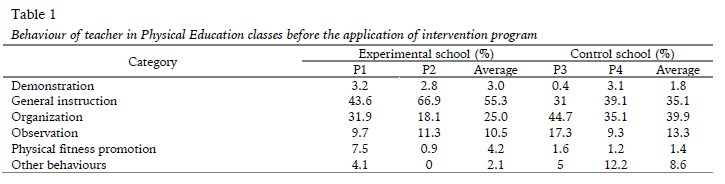
Regarding the teacher behaviour in Physical Education classes, Table 1 presents its results before the application of intervention program.
It is evident that more than half of the time class of experimental school (E.S) was spent on instruction, followed by a quarter of the class time in organization. If values are summed, these behaviours account for more than 80% of the class time, which clearly shows possible problems in management of class time. Consequently, a reduced potential of learning time for the students, which corroborates the values presented for the students’ behaviours. For the control school (C.S), the time lapse of organization consumed 39.9% of the class time, followed by 35.1% in general instruction. In both schools, a short time dedicated to promotion of physical fitness was identified (averages: E.S - 4.2%, C.S - 1.4%), when compared to the time used for instruction, organization and observation.
It was observed that students used class time to organize their personal objects, to use the bathroom, to hydrate themselves and to go from the classroom to the gymnasium (in the two schools the distance classroom/gymnasium is approximately 30 meters). On the way, there was dispersion for indiscipline. In addition to the time spent on the way, upon arriving at the gymnasium, the teacher still had to organize the materials to be used in class. Before starting, teachers also had to solve problems of students who did not want to participate in class for various reasons (illness, demotivation, dislike of activities, not wanting to sweat and return to the room, absence of changing rooms, choosing to stay seating on the bleacher using the cell phone and chatting).
]]> The excess of time used to organize the class goes against the recommendations of Almeida and Franco (2011), who recommend that physical education classes should have a greater time dedicated to the practice (of physical activity) in order to effectively promote teaching and learning. Therefore, it is extremely important that the teacher knows how to manage class time and potentiate learning. Other essential elements for an effective physical education are the planning, development, revision and re-arrangement of the pedagogical work. Table 1 shows the exactly the opposite in which: teachers have difficulties in management of class time, since the highest frequencies were found in behaviours of instruction and organization.Lima (2012) found similar problems to the present study when he reiterates that the physical education teacher, in his pedagogical practice at school, faces several challenges that hinder his effective performance. The devaluation of physical education, salary precariousness, insufficiency of physical spaces, and material resources are some of the adversities found in the teachers’ daily life which interfere in the development of classes and on their work as a whole.
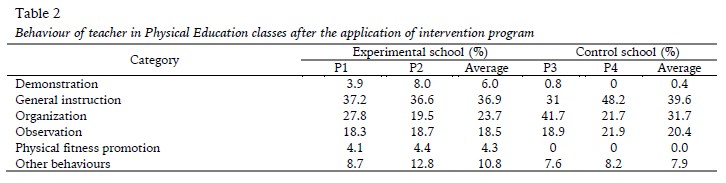
After the intervention program was carried out, the results of the teacher's behaviour took a new configuration, as can be seen in Table 2.
For the experimental school, there was a reduction of instruction time, going from 55.3% to 36.9%, with similar values among teachers. There was also a brief reduction in organization time (23.7%) and increase in demonstration time, which was more pronounced in P2. The promotion of physical fitness showed little change, with averages. The time that the teachers dedicated to observation was 18,5% of the class. The other behaviours increased from 2.1% to 10.8%, which shows, as previously mentioned, possible unpredicted behaviours in the lesson plan. In the classes of control school, the most common behaviours of teachers were dedicated to general instruction (39.6%), organization (31.7%), and observation (20.4%). There was no record of any behaviour dedicated to promotion of physical fitness.
A survey carried out with physical education teachers from municipal schools of Porto Alegre (RS) verified that number of classes, excessive number of students to assist, number of hours dedicated to pedagogical practice, lack of time for qualification, affects both qualities of personal and professional teachers lives. It was also observed that classes are applied in open spaces, constantly subject to the interruption of parents and other individuals who are present in these spaces, which impairs the concentration of students and makes difficult the pedagogical practice of the teacher, reflecting on the class development (Santini & Molina Neto, 2005). These findings contribute to the understanding of data in the table 2 that presents the insufficiency of contents about physical fitness promotion, which must be part of the didactic-pedagogical structure of physical education classes.
For many physical education teachers, this school culture has become comfortable and ensured (Darido & Neto, 2005). For others, the feeling of conflict and impotence is still frequent. Some analyse these situations as obstacles in the development of pedagogical proposals that, for a long time, have been constructing a de-motivating school culture for both teacher and student. However, the physical education teachers must fulfil the duties of educator, promoting the empowerment of students who can help them to find strategies to improve the quality of teaching.
The organizational model adopted by schools should be considered, since it adds elements inherent to the teachers’ behaviour. Therefore, it is pertinent highlight that the status of Physical Education in the schools studied is influenced by the commitment and the motivational capacity teachers, being evident in the difference of students' involvement with the discipline. The experimental school follows the annual content plan, but the applied strategy is not very dynamic, which leads the students to a low participation. On the other hand, the control school does not follow the pre-established content program in the pedagogical project, which makes classes a time of recreation and improvisation, lacking continuity and progression in teaching. Even so, there is a good participation of the students, because they use a lot of games.
In view of the exposed context of planning/monotonous classes/low participation and improvisation/dynamic classes/high participation, it can be considered that the planning of the experimental school needs to be elaborated considering the students' demand, which in this case calls for greater dynamism in class. While in control school, must be implemented a planning that promotes the progression of teaching. The management of class time directed to the theoretical and practical approach to physical fitness must be improved in both schools.
Since school is a prominent place for promotion of physical fitness, physical education must create a pedagogical project that reaches the majority of students and motivates them to participate in classes through the development of dynamic classes with greater time destined to physical fitness, showing the benefits of physical activity for health promotion and enhancing situations of encouragement to the adoption of an active lifestyle (Gaya et al., 2012).
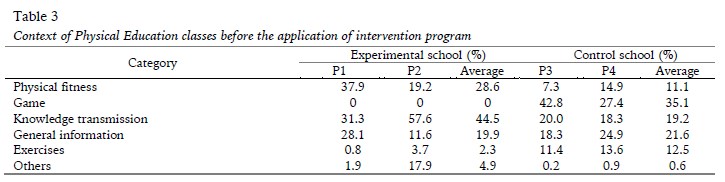
Regarding the class context, Table 3 shows the data obtained before the intervention program was applied.
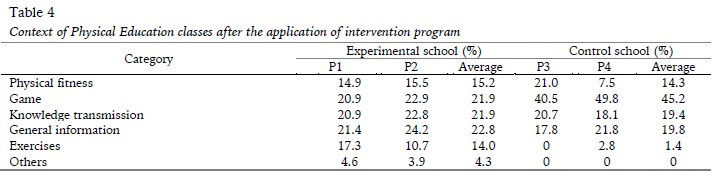
]]> The highest frequencies of experimental school were related to transmission of knowledge (44.5%), to physical fitness (through exercises and teacher demonstration) (28.6%), and to general information (19.9%). Between the two teachers, in the 3 classes observed of each one, there was no record regarding the practice of games. For the control school, unlike the experimental school, most of the class time was dedicated to games (35.1%), followed by general information (21.6%), and knowledge transmission (19.2%). It is worth mentioning that the time spent for physical fitness was only 11.1%.The results of class context after the intervention program are presented in Table 4, which shows some changes in the experimental school related to the categories: games and physical exercises.
In the experimental school, a reduction in the amount of class time spent on knowledge transmission (44.5% vs. 21.9%) was verified, which was transferred to games (21.9%) and to exercises (14%) that also can be used to increase the level of physical activity achieved in physical education classes.
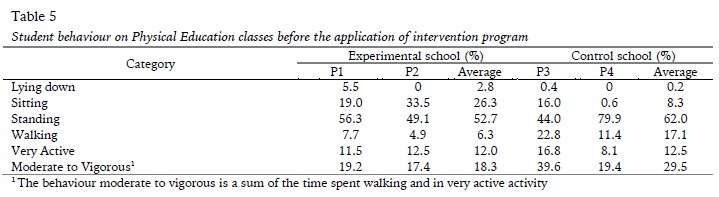
Regarding to the students’ level of physical activity in the classes of physical education, Table 5 presents the data of the students’ behaviour, from experimental and control schools, before the intervention program.
The most common adolescents’ behaviour in both groups was standing (52.7% and 62%). The categories, which characterize very active and moderate to vigorous levels of physical activity also presented higher values in the control school, data previously mentioned about the greater participation of experimental school students. It is also pointed out that for the adolescent of the experimental school about a quarter of the class time was spent sitting.
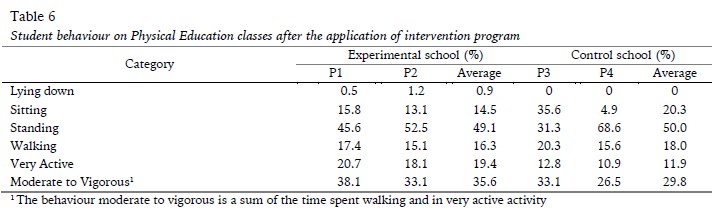
The results of adolescents’ behaviour after implementation of the intervention program are presented in Table 6.
For both schools, in about half of the class time the adolescents were standing, without locomotion (49.1% and 50%). The time spent in physical activity with moderate to vigorous intensity was 35.6% and 29.8% of the class time for the experimental and control schools, respectively. It is worth emphasizing that there was a pronounced increase of class time spent in moderate to vigorous behaviour in the classes of both teachers from experimental school, which could be the result of the intervention program effect. On the other hand, the same did not happen with the adolescents from control school.
Despite the recognition of physical fitness as a standard of physical conditioning capable of providing to the individual vigorous physical activity practice, which is analysed under aspects related to health and motor/sportive performance (Bouchard & Shepard, 1992). By analysing tables 5 and 6, it was verified the low frequencies related to class time in moderate to vigorous intensity physical activity, even with a slight increment of these values after the intervention program and that, nevertheless, do not exceed the numbers related to the class time in which the adolescents were standing, without locomotion. These findings explain the lack of planned and dynamically implemented interventions aimed at increasing levels of physical activity among schoolchildren.
Even though, there are still few studies in Brazil that deal with the effectiveness of physical education in school and level of physical activity promoted in its classes. Some investigations with children and adolescents observed positive results of physical education classes in reducing physical inactivity and improving body composition in schoolchildren (Azevedo Jr, Araújo, & Pereira, 2006; Cunha, 2002; Farias et al., 2009; Hallal et al., 2011; Menezes et al., 2006; Ribeiro & Florindo, 2010).
Therefore, it is suggested the modification of the pedagogical practices evaluated in this study, since it was observed difficulty in the management of class time directed to health promotion, class contexts guided in the transmission of knowledge and in the game, besides students with low levels of physical activity. It is worth reinforcing that the challenge to be faced by teachers exceed the scope of the classroom/gymnasium, since in addition to these, other influencing factors, such as socioeconomic aspects of students and school structure, may be interfering in the low participation of students in class.
]]>CONCLUSION
It was concluded that the study answers the proposed objectives, once it was verified that pedagogical practices adopted by teachers were not enough to make students to reach satisfied physical activity levels. Therefore, the necessity of a joint effort between school management and teachers of Physical Education in order to develop strategies to facilitate and promote the physically active lifestyle by students must be evidenced. Once, debate about Physical Education at school and promotion of physical activity and health is current and with extreme relevance.
REFERENCES
Almeida, F. J., & Franco, M. G. (2011). Avaliação para aprendizagem: o processo avaliativo para melhorar o desempenho dos alunos. São Paulo: ática educadores. [ Links ]
Azevedo Jr, M. R., Araújo, C. L. P., Pereira, F. M. (2006) Atividades físicas e esportivas na adolescência: mudanças de preferências ao longo das últimas décadas. Revista Brasileira de Educação Física e Esportes, 20(1), 51–58. http://dx.doi.org/10.1590/S1807-55092006000100005 [ Links ]
Barroso, A. L. R., & Darido, S. C. (2009) A pedagogia do esporte e as dimensões dos conteúdos: conceitual, procedimental e atitudinal. Revista da Educação Física, 20(2), 281-289. http://dx.doi.org/10.4025/reveducfis.v20i2.3884 [ Links ]
Barufaldi, L. A., Abreu, G. de A., Coutinho, E. S. F., & Bloch, K. V. (2012). Meta-analysis of the prevalence of physical inactivity among Brazilian adolescents. Cadernos de Saúde Pública, 28(6), 1019–1032. https://doi.org/10.1590/S0102-311X2012000600002 [ Links ]
Bouchard, C., & Shepard, R. J. (1992). Physical Activity, fitness, and health: the model and key concepts. In.: Bouchard, C., Sherpard, R. J., & Stephens, T. (Eds.), Physical Activity, fitness, and health: international proceedings and consensus statement. Champaign, IL: Human Kinetics. [ Links ]
Cunha, C. T. (2002). Impacto do programa educativo no gasto energético de escolares nas aulas de educação física: ensaio randomizado controlado (Dissertação de mestrado). Universidade Federal de São Paulo, São Paulo. [ Links ]
Darido, S. C., & Neto, L. S. (2005). O contexto da educação física na escola. In: Darido, S. C., & Rangel, I. C. A. (Coord.), Educação Física na escola: implicações para a prática pedagógica. Guanabara: Koogan. [ Links ]
Farias, E. S., Paula, F., Carvalho, W. R. G., Gonçalves, E. M., Baldin, A. D., & Guerra-Júnior, G. (2009). Efeito da atividade física programada sobre a composição corporal em escolares adolescentes. Jornal de Pediatria, 85(1), 28–34. https://doi.org/10.1590/S0021-75572009000100006 [ Links ]
Gaya, A., Lemos, A., GAYA, A., Teixeira, D., Pinheiro, E., & Moreira, R. (2012). Manual de aplicação de medidas e teste, normas e critérios de avaliação. Projeto Esporte Brasil (PROESP-Br). Porto Alegre: UFRGS. [ Links ]
Hallal, P. C., Knuth, A. G., Cruz, D. K. A., & Malta, D. C. (2011). Monitoramento da prática de atividade física no Brasil. In: Avaliação de efetividade de programas de atividade física no Brasil. Ministério da Saúde. [ Links ]
Hearst, M. O., Patnode, C. D., Sirard, J. R., Farbakhsh, K., & Lytle, L. A. (2012). Multilevel predictors of adolescent physical activity: a longitudinal analysis. International Journal of Behavioral Nutrition and Physical Activity, 9(8). https://doi.org/10.1186/1479-5868-9-8 [ Links ]
Hinckson, E. A., McGrath, L., Hopkins, W., Oliver, M., Badland, H., Mavoa, S., … Kearns, R. A. (2014). Distance to School is Associated with Sedentary Time in Children: Findings from the URBAN Study. Frontiers in Public Health, 2. https://doi.org/10.3389/fpubh.2014.00151 [ Links ]
Light, R., & Georgakis, S. (2008). Invasion Games in Physical Education: Assessing Knowledge-in-Action in using the Team Sport Assessment Procedure. In Loughland T Proceedings of the Authentic Assessment Practices for Student Learning Conference (pp. 35–50). Sydney. [ Links ]
Light, R. (2004). Coaches experiences of game sense: opportunities and challenges. Physical Education and Sport Pedagogy, 9(2), 115-132. http://dx.doi.org/10.1080/1740898042000294949 [ Links ]
Lima, V. M. M. (2012) A complexidade da docência nos anos iniciais na escola pública. Revista Nuances: um estudo sobre a educação, 22 (23), 151-169. http://dx.doi.org/10.14572/nuances.v22i23.1767 [ Links ]
McKenzie, T., Sallis, J., & Nader, P. (1991). SOFIT: System for Observing Fitness Instruction Time. Journal of Teaching in Physical Education, 11(2), 195-205. https://doi.org/10.1123/jtpe.11.2.195 [ Links ]
Menezes, A., Assunção, M. C., Neutzling, M., Malcon, M., Hallal, P. C., Marques, A., ... Victora, C. (2006). Effectiveness of an education on smoking, diet and physical activity among adolescentes. Final report from the Federal University of Pelotas; Pelotas, Brazil. [ Links ]
]]>Ribeiro, E. M. C., & Florindo, A. A. (2010). Efeitos de um programa de intervenção no nível de atividade física de adolescentes de escolas públicas de uma região de baixo nível socioeconômico: descrição dos métodos utilizados. Revista Brasileira de Atividade Física e Saúde, 15(1), 28–34. http://dx.doi.org/10.12820/rbafs.v.15n1p28-34 [ Links ]
Santini, J., & Molina Neto, V. (2005.). A síndrome do esgotamento profissional em professores de educação física: um estudo na rede municipal de ensino de Porto Alegre. Revista Brasileira de Educação Física e Esporte, 19(3), 209-222. http://dx.doi.org/10.1590/S1807-55092005000300004 [ Links ]
Van Acker, R., Carreiro da Costa, F., Bourdeaudhuij, I., Cardon, G., & Haerens, L. (2010). Sex equity and physical activity levels in coeducational Physical Education: exploring the potential of modified game forms. Physical Education and Sport Pedagogy, 15(2), 159-173. http://dx.doi.org/10.1080/17408980902877609 [ Links ]
Acknowledgments:
Nothing to declare.
Conflict of interests:
Nothing to declare.
Funding:
Nothing to declare.
* Corresponding author: State University of Ceará, Dr. Silas Munguba Av., 1700, Campus do Itaperi, 60714-903, Fortaleza, Brazil. Email: ricardo.catunda@uece.br
]]>