<?xml version="1.0" encoding="ISO-8859-1"?><article xmlns:mml="http://www.w3.org/1998/Math/MathML" xmlns:xlink="http://www.w3.org/1999/xlink" xmlns:xsi="http://www.w3.org/2001/XMLSchema-instance">
<front>
<journal-meta>
<journal-id>1646-107X</journal-id>
<journal-title><![CDATA[Motricidade]]></journal-title>
<abbrev-journal-title><![CDATA[Motri.]]></abbrev-journal-title>
<issn>1646-107X</issn>
<publisher>
<publisher-name><![CDATA[Edições Desafio Singular]]></publisher-name>
</publisher>
</journal-meta>
<article-meta>
<article-id>S1646-107X2017000600016</article-id>
<title-group>
<article-title xml:lang="en"><![CDATA[Virtual games assets: strategy potential to promote health and combat obesity school]]></article-title>
</title-group>
<contrib-group>
<contrib contrib-type="author">
<name>
<surname><![CDATA[Braga]]></surname>
<given-names><![CDATA[Rafael Kanitz]]></given-names>
</name>
<xref ref-type="aff" rid="A01"/>
</contrib>
<contrib contrib-type="author">
<name>
<surname><![CDATA[Lima]]></surname>
<given-names><![CDATA[Camilla Aparecida Franco de]]></given-names>
</name>
<xref ref-type="aff" rid="A01"/>
</contrib>
<contrib contrib-type="author">
<name>
<surname><![CDATA[Moyses]]></surname>
<given-names><![CDATA[Samuel Jorge]]></given-names>
</name>
<xref ref-type="aff" rid="A01"/>
</contrib>
<contrib contrib-type="author">
<name>
<surname><![CDATA[Moyses]]></surname>
<given-names><![CDATA[Simone Tetu]]></given-names>
</name>
<xref ref-type="aff" rid="A01"/>
</contrib>
<contrib contrib-type="author">
<name>
<surname><![CDATA[Werneck]]></surname>
<given-names><![CDATA[Renata Iani]]></given-names>
</name>
<xref ref-type="aff" rid="A01"/>
</contrib>
</contrib-group>
<aff id="A01">
<institution><![CDATA[,Pontifical Catholic University of Paraná  ]]></institution>
<addr-line><![CDATA[Curitiba ]]></addr-line>
<country>Brazil</country>
</aff>
<pub-date pub-type="pub">
<day>00</day>
<month>12</month>
<year>2017</year>
</pub-date>
<pub-date pub-type="epub">
<day>00</day>
<month>12</month>
<year>2017</year>
</pub-date>
<volume>13</volume>
<fpage>121</fpage>
<lpage>128</lpage>
<copyright-statement/>
<copyright-year/>
<self-uri xlink:href="http://scielo.pt/scielo.php?script=sci_arttext&amp;pid=S1646-107X2017000600016&amp;lng=en&amp;nrm=iso"></self-uri><self-uri xlink:href="http://scielo.pt/scielo.php?script=sci_abstract&amp;pid=S1646-107X2017000600016&amp;lng=en&amp;nrm=iso"></self-uri><self-uri xlink:href="http://scielo.pt/scielo.php?script=sci_pdf&amp;pid=S1646-107X2017000600016&amp;lng=en&amp;nrm=iso"></self-uri><abstract abstract-type="short" xml:lang="en"><p><![CDATA[Evidence indicates the potential of virtual gaming assets to raise and / or maintain the level of motivation in the classroom and promote greater physiological intensity activities. The aim of the study was to compare the level of motivation and level of physical activity among school children of traditional physical education class (EDFT) and school children in physical education classes with the use of active virtual games (JVA). Participated 117 students divided into two distinct groups: EDFT and JVA. For 12 classes, variables motivation and level of physical activity were measured. To assess the level of motivation, it was used Martins motivation scale and Duarte (1997). The level of physical activity was measured by System for Observing Fitness Instruction Time. For analysis comparing the level of physical activity, it was used the U test of Mann Whitney. The motivation was analyzed by Repeated Measures Mixed test. For all analyzes, it was adopted as significance level p <0.05. Data were tabulated in SPSS_22.0 software. The results did not show significant differences in the level of physical activity and motivation between groups. It concludes that the JVA has the peculiarity to promote a practice environment that demands greater physiological intensity.]]></p></abstract>
<kwd-group>
<kwd lng="en"><![CDATA[intervention]]></kwd>
<kwd lng="en"><![CDATA[physical activity]]></kwd>
<kwd lng="en"><![CDATA[video game]]></kwd>
</kwd-group>
</article-meta>
</front><body><![CDATA[  <font face="Verdana" size="2">      <p align="right"><b>ORIGINAL ARTICLE</b></p>      <p>&nbsp;</p> </font>     <p><font size="4" face="Verdana"><b>Virtual games assets: strategy   potential to promote health and combat obesity school</b></font></p> <font face="Verdana" size="2">     <p>&nbsp;</p>     <p>&nbsp;</p>     <p><b>Rafael     Kanitz Braga<sup>1,</sup><a href="#end"><sup>*</sup></a><i><a name="top" id="top"></a></i>;     Camilla Aparecida Franco de Lima<sup>1</sup>; Samuel Jorge Moyses<sup>1</sup>; Simone Tetu Moyses<sup>1</sup>; Renata Iani   Werneck<sup>1</sup></b></p>     <p><sup>1</sup> <i>Pontifical Catholic University of Paraná, Curitiba, Brazil.</i></p>     <p>&nbsp;</p>     <p>&nbsp;</p> </font> <hr noshade size="1"> <font face="Verdana" size="2">     ]]></body>
<body><![CDATA[<p><b>ABSTRACT</b></p>     <p>Evidence indicates the potential of     virtual gaming assets to raise and / or maintain the level of motivation in the     classroom and promote greater physiological intensity activities. The aim of     the study was to compare the level of motivation and level of physical activity     among school children of traditional physical education class (EDFT) and school     children in physical education classes with the use of active virtual games     (JVA). Participated 117 students divided into two distinct groups: EDFT and     JVA. For 12 classes, variables motivation and level of physical activity were     measured. To assess the level of motivation, it was used Martins motivation     scale and Duarte (1997). The level of physical activity was measured by System     for Observing Fitness Instruction Time. For analysis comparing the level of     physical activity, it was used the U test of Mann Whitney. The motivation was     analyzed by Repeated Measures Mixed test. For all analyzes, it was adopted as     significance level p &lt;0.05. Data were tabulated in SPSS_22.0 software. The     results did not show significant differences in the level of physical activity     and motivation between groups. It concludes that the JVA has the peculiarity to promote a practice environment that demands greater physiological intensity.</p>     <p><b>Keywords:</b> intervention, physical activity, video game</p> </font> <hr noshade size="1">     <p>&nbsp;</p>     <p>&nbsp;</p>     <p><font size="3" face="Verdana"><b><b>INTRODUCTION</b></b></font></p> <font face="Verdana" size="2">     <p>The prevalence of     obesity and overweight is increasing on a progressive way, currently being     considered as a worldwide epidemic (Organização Pan-americana da Saúde [OPAS],     2014). The World Health Organization indicates obesity as one of the major     problems in public health, impacting all age groups. The advancement of obesity     is strongly tied to the food ingestion and the physical inactivity (Brasil,     2011, 2012) and it is     determined by demographic, socioeconomic, epidemiological and cultural nature,     besides the environment, what turns obesity into a multifactorial disease (Brasil, 2012).</p>     <p>In this context,     Brazil’s Health Ministry developed a plan with strategic actions to face the     Noncommunicable Disease (NCDs), aiming to stop the quick growth of obesity,     together with the combat of other diverse pathologies. These interventions have     been presenting positive results, however, when it comes to raising the level     of physical activities and the consumption of low sugar food, the results are     not satisfactory (Duncan et al, 2012; Malta &amp; Silva Junior, 2014; Silva,     Cotta, &amp; Rosa, 2013). Among the reasons for the poor effectiveness     are demographic, cultural and epidemiologic characteristics of the population     (Santos &amp; Victoria, 2004) who is being modified due to the influence of the globalization of the human behaviour (Duncan et al<i>,</i> 2012).</p>     <p>Considering these     observations, some investigations (Duncan et al 2012; Silva, Cotta, &amp; Rosa, 2013) point to the need of a     reformulation of the national strategies on health prevention and health     promotion with a goal to approach to a new epidemiological model, characterized     by a human behaviour using the technology, among which digital games stands out.</p>     <p>Currently, around     48.8 million Brazilian people use a variety of devices to play a huge diversity     of digital games. According to <i>Escola Superior de Propaganda e Marketing</i>   (ESPM, 2017), Brazil is the number one country in the occidental world in   number of social gaming players. In this perspective, the use of digital games   is being presented by the researchers as an allied in the fight against NCDs   once the <i>gamification</i> is gradually becoming a characteristic of the     human behaviour in this century. Among the big variety of digital games, the     current evidences have named the Exergames as a potential tool to contribute in     an effective way in the increase of the level of physical activity as well as     in reducing body mass above the health level, mainly in children and young     people (Gao, Zhang, &amp; Stodden,     2013; Lamboglia et al, 2013; Wu, Wu, &amp; Chu, 2015). Facing such evidences, the use of digital     games as a public health strategy is being observed in some developed country (Mccallum, 2012). </p>     ]]></body>
<body><![CDATA[<p>Despite the     vertiginous growth of investigations interested in understanding the potential     use of Exergames in the prevention and promotion of health, currently, the     quantity of these researches in Latin America is extremely scarce. The small     number of studies in the country aimed at verifying the potential use of     exergames within the context of school physical education (Finco &amp; Fraga,     2012; Vaghetti &amp; Botelho, 2010). The understanding of the authors is that     this discipline is fundamental in the prevention and promotion of health,     stimulating the schoolchildren to raise the daily level of physical activities     by a major variety of body practices, have healthy life habits and eat a     balanced diet. Nevertheless, there are some researches that indicate that the     traditional practices offered by this discipline do not overtake the goals     related to health (Hino, Añez, &amp; Reis 2010;     Kremer, Reichert, &amp; Hallal     2012). On the other hand, studies related to the Exergames in the school     environment are presenting positive results, suggesting that this tool can be     utilizes as a support to the Physical Education classes, offering an     alternative to uninterested students and increasing the level of energy     expenditure (Finco, Reategui, Zaro, Sheehan, &amp; Katz, 2015; Gao &amp; Huang 2012; Lieberman, 2006;). </p>     <p>In addition to     the fact that physical education classes, predominantly, don’t reach the level     of physiological intensity required to a satisfactory level of health, the     findings of recent investigation suggest that schoolchildren classified as     obese, independent of the sex, see themselves with low or moderate competencies     to perform motor tasks. These finding result in a low level of motivation and     lack of interest in the practice of motor activities, among them, the ones that     are proposed in the physical education classes (Souza, Spessato, &amp; Valintini, 2016). In regard to the motivation     for the practice, one of the explanations for the occurrence of the digital     games growth is the theory utilized by the virtual reality names as <i>Flow:       the psychology of optimal experience</i>, presented by Csikszentmihalyi (1990).     The theory proposes that during the flow experience, the one practicing it has     the performance sensation maximized and the feeling of time control minimized.     The study done by Vaghetti (2013) indicated the effectiveness of the Exergames     in enhancing the level of motivation in schoolchildren for the practice of school physical education, as well as conduct them to a flow zone experience.</p>     <p>The lack of     investigation conducted in national region that aim to verify the effectiveness     of the Exergame used within School Physical Education to raise the level of     physical intensity in class, help the food balance and enhance the level of     motivation in the participation of the classes justify the conduction of the     present investigation. Therefore, the present study aimed to verify the Motivation     and Physical Activity Level during the Physical Education classes by using the     Exergames in order to identify the effectiveness of this new tool in the fight against child obesity in the school environment.</p> </font>     <p>&nbsp;</p>     <p><font size="3" face="Verdana"><b><b>METHOD</b></b></font></p> <font face="Verdana" size="2">     <p>The present     investigation is characterized by being of quantitative character and control     group, once it aimed to compare the behaviour of certain variables in two     distinguish groups, one being the intervention group and the other the control     group (Thomas, Nelson, &amp; Silverman, 2009).</p> <b><b>Participants</b></b>      <p>Population:     Schoolchildren from elementary school from Lucídio Florêncio Ribeiro school, located at the city Campina Grande do Sul, PR.</p>     <p>Sample: It was     composed on a probabilistic form, through draw, with 4 children groups of the     elementary school from the Lucidio Florêncio Riberio school. The groups 3<sup>rd</sup>A     and 5<sup>th</sup>A from the morning classes, through draw, composed the group     named as Traditional Physical Education Group (TPEG). TPEG was composed by 57     schoolchildren, with 26 females’ students and 31 male students. The groups 3<sup>rd</sup>A     and 5<sup>th </sup>A from the afternoon classes composed the intervention group     with the Exergames (ExerGG). The ExerGG had 60 schoolchildren, with 26 male     students and 34 female students. The age average for TPEG was 10 years old (± 2.3) and for the ExerGG it was 10 years old (± 0.9).</p> <b><b>Instruments and Procedures</b></b>      <p>To evaluate the     level of physical education done by the participants of both groups during the     Physical education classes, it was used the System for Observing Fitness     Instruction Time (SOFIT) proposed by McKenzie, Sallis and Nader (1991).     According to Hino et al. (2010), the method consists in a direct observation     with low cost and easy management providing the records of Physical education     and contextual information of the physical education classes. The level of     motivation was measured by the Adaptation Scale of Motivation to the practice of physical education proposed by Martins and Duarte (1997). </p>     <p>The level of     motivation, as well as the level of physic activities of the participants from     the groups TPEG and ExerGG was measured throughout 3 months, in a total of 12     classes. In regard to the motivation level, the schoolchildren, before leaving     the classroom and walking to the place where the physical education classes     were conducted and after visualizing the Likert scale proposed by Martins and     Duarte (1997), were asked by the researcher to indicate the picture that represented     their level of motivation for that class. The same procedure was conducted at     the end of the classes. The level of physic activities of the participants from     TPEG and ExerGG was measured throughout the 12 classes according to the     protocol proposed by McKenzie et al. (1991). Thus, the behaviour of each     student was observed during 4 minutes, with a break of 20 seconds between the     observations. It is important to observe that the research right after the     project approval by the ethic committee from PUCPR, being registered by the CAAE number.</p> <b><b>Statistical analysis</b></b>      ]]></body>
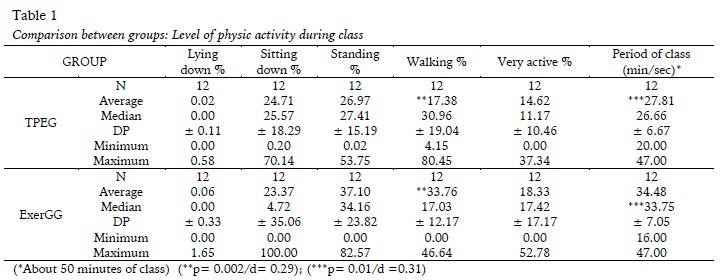
<body><![CDATA[<p>First of all, the     objective was to observe the normality on the distribution of the results, once     the groups had in its composition more than 50 participants. Since the     normality on the distribution was not observed, a nonparametric statistic was     chosen to analyse the results. To compare the level of physic activities     between the groups the U de Mann-Whitney test was utilized. To compare the     initial motivation and the final motivation intra and inter groups, at first it     as searched to observe the homogeneity of the results distribution using the     Levene test where it was evidenced the absence of homogeneity. Therefore, it     was used the covariance analysis test of Mixed Repeated Measures, with sphericity     testing of <i>Mauchly</i>, where this assumption was not found (p=0.000).     Considering that, the interaction test of <i>Greenhouse-Geisser </i>was     utilized. The <i>Bonferroni</i> test was also applied to find the difference     among the 12 classes. To all the analysis the significance index was p&lt;0.05.     The data was tabulated on the SPSS 22.0 software. Specifically, to verify the     size of the effect in the analysis of the variables the <i>Cohen </i>test was applied.</p> </font>     <p>&nbsp;</p>     <p><font size="3" face="Verdana"><b><b>RESULTS</b></b></font></p> <font face="Verdana" size="2">     <p>The According to     <a href="/img/revistas/mot/v13s1/13s1a16t1.jpg">table 1</a>, it is possible to observe that a significant difference was evidenced     between groups in the walking behaviour as well as the in the average time of     class. It was not identified significant difference on the other behaviours     proposed by this measurement instrument. For the walking behaviour the data     indicates that ExerGG presented this type of motor activity in a higher     percentage of the class. When observing the average time of the classes, the     classes from the TPEG were significantly longer. Yet, even thou the average     time of the classes in the TPEG, when observing the accumulated percentage of     the ExerGG in the walking and very active activities (considered from moderated     to high intensity level of the energetic demand) and lying down and sitting     down (considered as low intensity level of the energetic demand), there is a     balance of intensity throughout the class. The same thing does not happen in     the TPEG, where about 60% of the average class period the investment of time was on low energy demand activities (lying down or sitting down). </p>     
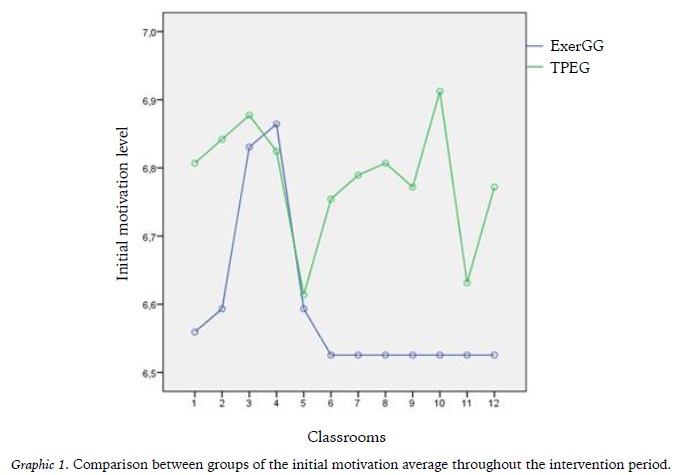
<p>When analyzing     the initial motivation average on both TPEG and ExerGG, throughout the 12     classes, it is observed similarity between results. This similarity is     evidenced by the statistical analysis where no significant statistical     difference in the initial motivation on the participants of each group during     the evaluation period (p=0.090/ &#951;<sup>2 </sup>0.15). Results     also evidence that during the evaluated period there were significant variance     intra group on the variable initial motivation (p=0.006/ &#951;<sup>2 </sup>0.26). <a href="/img/revistas/mot/v13s1/13s1a16g1.jpg">Graphic 1</a>  indicates that the most impacting difference to both groups happened between classes 4 and 5, and this was confirmed by the <i>Bonferonni </i>test. (p=0.000).</p>     
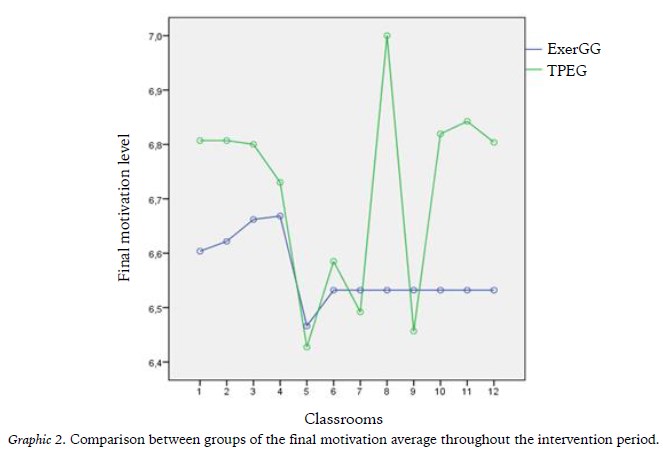
<p><b>Graphic 2.</b></p>     <p><a href="/img/revistas/mot/v13s1/13s1a16g2.jpg">Graphic 2</a>  demonstrates the results of the variable final motivation of the participants   of TPEG and ExerGG. Similar to the initial motivation, it is observed closeness   between the averages of motivation, and they are very close to the maximum   motivation proposed by the research instrument (7). Statistical analysis ratify   the described results once it was not observed any significant difference in   the final motivation on the comparison of the groups (p=0.095/ &#951;<sup>2 </sup>0.16). Statics     also evidence a significant difference between the average in the intra group     comparison in TPEG and ExerGG (p=0.006/ &#951;<sup>2 </sup>0.26). <a href="/img/revistas/mot/v13s1/13s1a16g2.jpg">Graphic 2</a>  help us understand this difference that for TPEG happened among classes   (p=0.002/ &#951;<sup>2 </sup>0.26) and for ExerGG occurred between classes 4 and 5 (p=0.001/ &#951;<sup>2 </sup>0.38).</p> </font>     
<p>&nbsp;</p>     <p><font size="3" face="Verdana"><b><b>DISCUSSION</b></b></font></p> <font face="Verdana" size="2">     <p>The motivation     related to the Exergames is being explained by many factors. According to     Epstein, Beecher, Graf, and Roemmich, (2007) the motivational interest can     occur due to the socially interactive nature of the tool. To Hawkins (2009),     the participants are less prone to be motivated to play when they have positive     feelings related to physic activities/exercises proposed by the game. Some     researchers are relating the motivation for the games with the so-called Theory     of Flows. This theory explains the mental flow state that the activity can     exercise on an individual (Sheehan &amp; Katz, 2012; Vaghetti, Mustaro, &amp; Botelho,     2011). According to the results, it is possible to observe on the variable     motivation there were no significant difference between groups and both groups     presented high motivational interest during the intervention period. This     aspect contrasts the current literature that indicates that individuals exposed     to a long period practicing Exergames tend to have their interest diminished,     originating a reduction on the motivation and adherence (Sun, 2012; Sun, 2013;     Wiemeyer, 2010). The exergames have the potential to bring to the physical     education classes a variety of contents in a playful, fun and motivating way,     offering the children and young people the opportunity to experience unusual     sports and activities that they never practiced before (Palma &amp; Ramos,     2013). That way, the age group of this research is classified as second     childhood, from 07 to 12 years old and according to Gallahue, Ozmun, and Goodway     (2013), it is considered a period where the child is eager for movement and any     activity that provides freedom to learn as well as to move it is considered as a highly satisfactory activity. </p>     ]]></body>
<body><![CDATA[<p>Other positive     aspects that are being demonstrated by the literature about the utilization of     the Exergames are the high potential to increase the intensity and duration of     the physical activity during the classes, besides that it presents improvements     in motor skills, strength, balance and engagement (Hawkins, 2009). According to     Lamboglia et al, (2013) the exergames are a tool that can contribute to a more     active life style, with positive effects in the human behaviour related to     individual`s health. In the study of Maddison et al. (2011), it was     observed that the energetic waste of an individual that practices exergames     during a short period of time (5 min) was comparable with the level of     intensity slight to moderate for traditional physical activities such as     walking, jumping and trotting. On the study conducted by Silva (2014), the     level of intensity found was 82% of maximum heart rate, being characterized as vigorous     activity. Some recent research results demonstrate that exergames can also have     a positive effect on the body in the mass index and excess body composition and     obese children, and it can be a tool to fight against children obesity (Lieberman, 2006; Guy, Ratzki-Leewing, &amp; Gwadry-Sridhar<i>,</i> 2011). </p>     <p>The results about     the level of physical activity involving exergames are aligned with the     literature in which it has been observed that the classes with exergames     provide to the schoolchildren the permanence of an expressive period of time in     level of activities considered as moderated or vigorous (Lieberman, 2011;     Pereira, Rodrigues, Campos, &amp; Santo<i>,</i> 2013). The study     of Shayne, Fogel, Miltenberger, and Koehler (2012), where the effects of exergames     and the traditional physical education were compared among four active children     indicated that the students were very involved in the practice of exergames and     it was possible to involve the students in different ways of physical     activities/exercises. In the study of Fogel, Miltenberger, Graves, and     Koehler(2010), the results showed that the practice offered more time of     physical activity when compared to conventional physical education classes.     Sheehan and Katz (2013) also pointed the viability of using exergames as a     practical in the physical education classes. Finco, Reategui, and Zaro (2015)     add that the exergames provide situations where the students can increase the     frequency that they practice physical activities and can be an alternative for the ones with lack of interest.</p> </font>     <p>&nbsp;</p>     <p><font size="3" face="Verdana"><b><b>CONCLUSION</b></b></font></p> <font face="Verdana" size="2">     <p>The evidences of     this investigation allow us to conclude that there was no significant     difference in the level of physical activity, as well as the level of     motivation in the beginning and in the end of the classes from the     schoolchildren of the elementary school that participated on the practices of the     traditional physical education classes and the ones that participated in the     physical education classes that utilized the exergames. The results also     indicated the potential of utilization of the exergames as a strategy for     physiological use in the physical education classes in a playful and motivating     way, assisting in reaching the international recommendation for health maintenance.</p> </font>     <p>&nbsp;</p>     <p><font size="3" face="Verdana"><b><b>REFERENCES</b></b></font></p> <font face="Verdana" size="2">     <!-- ref --><p>Brasil. (2011). <i>Plano de ações estratégicas para o     enfrentamento das doenças crônicas não transmissíveis (DCNT) no Brasil     2011-2022.</i> Ministério da Saúde, Secretaria de Vigilância em Saúde. Departamento de Análise de Situação de Saúde.    &nbsp;&nbsp;&nbsp;&nbsp;&nbsp;&nbsp;&nbsp;&nbsp;[&#160;<a href="javascript:void(0);" onclick="javascript: window.open('/scielo.php?script=sci_nlinks&ref=373021&pid=S1646-107X201700060001600001&lng=','','width=640,height=500,resizable=yes,scrollbars=1,menubar=yes,');">Links</a>&#160;]<!-- end-ref --></p>     <!-- ref --><p>Brasil. (2012). Politica nacional de     alimentação e nutrição. Secretaria de atenção à saúde. Departamento de atenção básica. <i>Brasília: Ministério da Saúde</i>.    &nbsp;&nbsp;&nbsp;&nbsp;&nbsp;&nbsp;&nbsp;&nbsp;[&#160;<a href="javascript:void(0);" onclick="javascript: window.open('/scielo.php?script=sci_nlinks&ref=373023&pid=S1646-107X201700060001600002&lng=','','width=640,height=500,resizable=yes,scrollbars=1,menubar=yes,');">Links</a>&#160;]<!-- end-ref --></p>     <!-- ref --><p>Csikszentmihalyi, M. (1990). <i>Flow. The Psychology of Optimal Experience</i>. New York (HarperPerennial).    &nbsp;&nbsp;&nbsp;&nbsp;&nbsp;&nbsp;&nbsp;&nbsp;[&#160;<a href="javascript:void(0);" onclick="javascript: window.open('/scielo.php?script=sci_nlinks&ref=373025&pid=S1646-107X201700060001600003&lng=','','width=640,height=500,resizable=yes,scrollbars=1,menubar=yes,');">Links</a>&#160;]<!-- end-ref --></p>     <!-- ref --><p>Duncan, B. B., Chor, D., Aquino, E. M.     L. D., Benseñor, I. J. M., Mill, J. G., Schmidt, M. I., ... &amp; Barreto, S. M. (2012). Doenças     crônicas não transmissíveis no Brasil: prioridade para enfrentamento e investigação. <i>Revista de saúde pública, 46</i>(1), 126-134.    &nbsp;&nbsp;&nbsp;&nbsp;&nbsp;&nbsp;&nbsp;&nbsp;[&#160;<a href="javascript:void(0);" onclick="javascript: window.open('/scielo.php?script=sci_nlinks&ref=373027&pid=S1646-107X201700060001600004&lng=','','width=640,height=500,resizable=yes,scrollbars=1,menubar=yes,');">Links</a>&#160;]<!-- end-ref --></p>     <!-- ref --><p>ESPM. (2017). <i>Comportamento,     consumo e tendências do gamer brasileiro</i>. Available in: <a href="https://www.pesquisagamebrasil.com.br/" target="_blank">https://www.pesquisagamebrasil.com.br/</a>. Access: 08/05/2017.    &nbsp;&nbsp;&nbsp;&nbsp;&nbsp;&nbsp;&nbsp;&nbsp;[&#160;<a href="javascript:void(0);" onclick="javascript: window.open('/scielo.php?script=sci_nlinks&ref=373029&pid=S1646-107X201700060001600005&lng=','','width=640,height=500,resizable=yes,scrollbars=1,menubar=yes,');">Links</a>&#160;]<!-- end-ref --></p>     <!-- ref --><p>Epstein, L. H., Beecher, M. D., Graf,     J. L., &amp; Roemmich, J. N. (2007). Choice of interactive dance and bicycle games in overweight and nonoverweight youth. <i>Annals of Behavioral Medicine</i>, <i>33</i>(2), 124-131. doi: 10.1007/BF02879893&nbsp;&nbsp;&nbsp;&nbsp;&nbsp;&nbsp;&nbsp;&nbsp;[&#160;<a href="javascript:void(0);" onclick="javascript: window.open('/scielo.php?script=sci_nlinks&ref=373031&pid=S1646-107X201700060001600006&lng=','','width=640,height=500,resizable=yes,scrollbars=1,menubar=yes,');">Links</a>&#160;]<!-- end-ref --><!-- ref --><p>Finco, M. D., &amp; Fraga, A. B.     (2012). Rompendo fronteiras na Educação Física     através dos videogames com interação corporal. <i>Motriz: Revista de Educação Física</i>, <i>18</i>(3), 533–541. doi: 10.1590/S1980-65742012000300014&nbsp;&nbsp;&nbsp;&nbsp;&nbsp;&nbsp;&nbsp;&nbsp;[&#160;<a href="javascript:void(0);" onclick="javascript: window.open('/scielo.php?script=sci_nlinks&ref=373032&pid=S1646-107X201700060001600007&lng=','','width=640,height=500,resizable=yes,scrollbars=1,menubar=yes,');">Links</a>&#160;]<!-- end-ref --><!-- ref --><p>Finco, M. D., Reategui, E. B., &amp;   Zaro, M. A. (2015). Laboratório de exergames: um espaço complementar para as     aulas de educação física. <i>Movimento</i>, <i>21</i>(3), 687-700.    &nbsp;&nbsp;&nbsp;&nbsp;&nbsp;&nbsp;&nbsp;&nbsp;[&#160;<a href="javascript:void(0);" onclick="javascript: window.open('/scielo.php?script=sci_nlinks&ref=373033&pid=S1646-107X201700060001600008&lng=','','width=640,height=500,resizable=yes,scrollbars=1,menubar=yes,');">Links</a>&#160;]<!-- end-ref --></p>     <!-- ref --><p>Finkelstein, S., Nickel, A., Lipps,     Z., Barnes, T., Wartell, Z., &amp; Suma, E. A. (2011). Astrojumper: Motivating exercise with     an immersive virtual reality exergame. <i>Presence: Teleoperators and Virtual       Environments</i>, <i>20</i>(1), 78-92.    &nbsp;&nbsp;&nbsp;&nbsp;&nbsp;&nbsp;&nbsp;&nbsp;[&#160;<a href="javascript:void(0);" onclick="javascript: window.open('/scielo.php?script=sci_nlinks&ref=373035&pid=S1646-107X201700060001600009&lng=','','width=640,height=500,resizable=yes,scrollbars=1,menubar=yes,');">Links</a>&#160;]<!-- end-ref --></p>     <!-- ref --><p>Fogel, V. A., Miltenberger, R. G.,     Graves, R., &amp; Koehler, S. (2010). The effects of exergaming on physical     activity among inactive children in a physical education classroom. <i>Journal       of applied behavior analysis</i>, <i>43</i>(4), 591-600. doi: 10.1901/jaba.2010.43-591&nbsp;&nbsp;&nbsp;&nbsp;&nbsp;&nbsp;&nbsp;&nbsp;[&#160;<a href="javascript:void(0);" onclick="javascript: window.open('/scielo.php?script=sci_nlinks&ref=373037&pid=S1646-107X201700060001600010&lng=','','width=640,height=500,resizable=yes,scrollbars=1,menubar=yes,');">Links</a>&#160;]<!-- end-ref --><!-- ref --><p>Gallahue, D. L., Ozmun, J. C., &amp;   Goodway, J. D. (2013). <i>Compreendendo o Desenvolvimento Motor:       Bebês, Crianças, Adolescentes e Adultos</i> (7<sup>a</sup>   Ed.). Porto Alegre: ARTMED.    &nbsp;&nbsp;&nbsp;&nbsp;&nbsp;&nbsp;&nbsp;&nbsp;[&#160;<a href="javascript:void(0);" onclick="javascript: window.open('/scielo.php?script=sci_nlinks&ref=373038&pid=S1646-107X201700060001600011&lng=','','width=640,height=500,resizable=yes,scrollbars=1,menubar=yes,');">Links</a>&#160;]<!-- end-ref --></p>     <!-- ref --><p>Gao, Z., &amp; Huang, C. (2012).     Children’s motivation, perceived exertion, and physical activity levels in     exergaming. <i>Research Quarterly for Exercise and Sport, 82</i>(Suppl.1), 70-71.    &nbsp;&nbsp;&nbsp;&nbsp;&nbsp;&nbsp;&nbsp;&nbsp;[&#160;<a href="javascript:void(0);" onclick="javascript: window.open('/scielo.php?script=sci_nlinks&ref=373040&pid=S1646-107X201700060001600012&lng=','','width=640,height=500,resizable=yes,scrollbars=1,menubar=yes,');">Links</a>&#160;]<!-- end-ref --></p>     <!-- ref --><p>Gao, Z., Zhang, T., &amp; Stodden, D.     (2013). Children's physical activity levels and psychological correlates in interactive dance versus aerobic dance. <i>Journal of Sport and Health Science</i>, <i>2</i>(3), 146-151. doi: 10.1016/j.jshs.2013.01.005&nbsp;&nbsp;&nbsp;&nbsp;&nbsp;&nbsp;&nbsp;&nbsp;[&#160;<a href="javascript:void(0);" onclick="javascript: window.open('/scielo.php?script=sci_nlinks&ref=373042&pid=S1646-107X201700060001600013&lng=','','width=640,height=500,resizable=yes,scrollbars=1,menubar=yes,');">Links</a>&#160;]<!-- end-ref --><!-- ref --><p>Guy, S., Ratzki-Leewing, A., &amp;   Gwadry-Sridhar, F. (2011). Moving Beyond the Stigma: Systematic Review of Video   Games and Their Potential to Combat Obesity. <i>International Journal of Hypertension</i>, <i>2011</i>, Article ID 179124. <a href="https://doi.org/10.4061/2011/179124" target="_blank">https://doi.org/10.4061/2011/179124</a>&nbsp;&nbsp;&nbsp;&nbsp;&nbsp;&nbsp;&nbsp;&nbsp;[&#160;<a href="javascript:void(0);" onclick="javascript: window.open('/scielo.php?script=sci_nlinks&ref=373043&pid=S1646-107X201700060001600014&lng=','','width=640,height=500,resizable=yes,scrollbars=1,menubar=yes,');">Links</a>&#160;]<!-- end-ref --><!-- ref --><p>Hawkins, D. (2009). Using game equipment to teach. <i>Curriculum Review</i>, <i>48</i>(6), 10-11.    &nbsp;&nbsp;&nbsp;&nbsp;&nbsp;&nbsp;&nbsp;&nbsp;[&#160;<a href="javascript:void(0);" onclick="javascript: window.open('/scielo.php?script=sci_nlinks&ref=373044&pid=S1646-107X201700060001600015&lng=','','width=640,height=500,resizable=yes,scrollbars=1,menubar=yes,');">Links</a>&#160;]<!-- end-ref --></p>     <!-- ref --><p>Hino, A. A. F., Rodriguez-Añez, C. R.,   &amp; Reis, R. S. (2010). Validação do “SOFIT” para avaliação da atividade     física em aulas de Educação Física em escolares do ensino médio. <i>Journal of       Physical Education</i>, <i>21</i>(2), 271-278. doi: 10.4025/reveducfis.v21i2.7739&nbsp;&nbsp;&nbsp;&nbsp;&nbsp;&nbsp;&nbsp;&nbsp;[&#160;<a href="javascript:void(0);" onclick="javascript: window.open('/scielo.php?script=sci_nlinks&ref=373046&pid=S1646-107X201700060001600016&lng=','','width=640,height=500,resizable=yes,scrollbars=1,menubar=yes,');">Links</a>&#160;]<!-- end-ref --><!-- ref --><p>Kremer, M. M., Reichert, F. F., &amp;   Hallal, P. C. (2012). Intensidade e duração dos esforços físicos em aulas de Educação Física. <i>Revista de Saúde Pública</i>, <i>46</i>(2), 320-326.    &nbsp;&nbsp;&nbsp;&nbsp;&nbsp;&nbsp;&nbsp;&nbsp;[&#160;<a href="javascript:void(0);" onclick="javascript: window.open('/scielo.php?script=sci_nlinks&ref=373047&pid=S1646-107X201700060001600017&lng=','','width=640,height=500,resizable=yes,scrollbars=1,menubar=yes,');">Links</a>&#160;]<!-- end-ref --></p>     <!-- ref --><p>Lamboglia,     C. M. G. F., Silva, V. T. B. L. da, Filho, V., De, J. E., Pinheiro, M. H. N.     P., Munguba, M. C. da S., … Silva, C. A. B. da. (2013). Exergaming as a Strategic     Tool in the Fight against Childhood Obesity: A Systematic Review. <i>Journal of Obesity</i>, <i>2013</i>, Article ID 438364. <a href="https://doi.org/10.1155/2013/438364" target="_blank">https://doi.org/10.1155/2013/438364</a>&nbsp;&nbsp;&nbsp;&nbsp;&nbsp;&nbsp;&nbsp;&nbsp;[&#160;<a href="javascript:void(0);" onclick="javascript: window.open('/scielo.php?script=sci_nlinks&ref=373049&pid=S1646-107X201700060001600018&lng=','','width=640,height=500,resizable=yes,scrollbars=1,menubar=yes,');">Links</a>&#160;]<!-- end-ref --><!-- ref --><p>Lieberman, D. A. (2006). What Can We     Learn From Playing Interactive Games? In P. Vorderer &amp; J. Bryant (Eds.), <i>Playing       video games: Motives, responses, and consequences</i> (pp. 379-397). Mahwah, NJ: Lawrence Erlbaum Associates&nbsp;&nbsp;&nbsp;&nbsp;&nbsp;&nbsp;&nbsp;&nbsp;[&#160;<a href="javascript:void(0);" onclick="javascript: window.open('/scielo.php?script=sci_nlinks&ref=373050&pid=S1646-107X201700060001600019&lng=','','width=640,height=500,resizable=yes,scrollbars=1,menubar=yes,');">Links</a>&#160;]<!-- end-ref --><!-- ref --><p>Lieberman, D. A., Chamberlin, B.,     Medina, E., Franklin, B. A., Sanner, B. M., &amp; Vafiadis, D. K. (2011). The     power of play: innovations in getting active summit 2011. <i>Circulation</i>, <i>123</i>(21), 2507-2516. doi: 10.1161/CIR.0b013e318219661d&nbsp;&nbsp;&nbsp;&nbsp;&nbsp;&nbsp;&nbsp;&nbsp;[&#160;<a href="javascript:void(0);" onclick="javascript: window.open('/scielo.php?script=sci_nlinks&ref=373051&pid=S1646-107X201700060001600020&lng=','','width=640,height=500,resizable=yes,scrollbars=1,menubar=yes,');">Links</a>&#160;]<!-- end-ref --><!-- ref --><p>Maddison, R., Foley, L., Mhurchu, C.     N., Jiang, Y., Jull, A., Prapavessis, H., ... &amp; Rodgers, A. (2011). Effects     of active video games on body composition: a randomized controlled trial. <i>The American journal of clinical nutrition</i>, <i>94</i>(1), 156-163.    &nbsp;&nbsp;&nbsp;&nbsp;&nbsp;&nbsp;&nbsp;&nbsp;[&#160;<a href="javascript:void(0);" onclick="javascript: window.open('/scielo.php?script=sci_nlinks&ref=373052&pid=S1646-107X201700060001600021&lng=','','width=640,height=500,resizable=yes,scrollbars=1,menubar=yes,');">Links</a>&#160;]<!-- end-ref --></p>     ]]></body>
<body><![CDATA[<!-- ref --><p>Malta, D. C., &amp; Silva Jr, J. B. D.     (2014). Plano de Ações     Estratégicas para o Enfrentamento das Doenças Crônicas Não Transmissíveis no     Brasil após três anos de implantação, 2011-2013. <i>Epidemiologia e Serviços de Saúde</i>, <i>23</i>(3), 389-395.    &nbsp;&nbsp;&nbsp;&nbsp;&nbsp;&nbsp;&nbsp;&nbsp;[&#160;<a href="javascript:void(0);" onclick="javascript: window.open('/scielo.php?script=sci_nlinks&ref=373054&pid=S1646-107X201700060001600022&lng=','','width=640,height=500,resizable=yes,scrollbars=1,menubar=yes,');">Links</a>&#160;]<!-- end-ref --></p>     <!-- ref --><p>Martins C. O., &amp; Duarte, M. D. F.     S. (1997). A influência da música na atividade física. <i>Revista Brasileira de Atividade Física &amp; Saúde</i>, <i>2</i>(4), 5-16.    &nbsp;&nbsp;&nbsp;&nbsp;&nbsp;&nbsp;&nbsp;&nbsp;[&#160;<a href="javascript:void(0);" onclick="javascript: window.open('/scielo.php?script=sci_nlinks&ref=373056&pid=S1646-107X201700060001600023&lng=','','width=640,height=500,resizable=yes,scrollbars=1,menubar=yes,');">Links</a>&#160;]<!-- end-ref --></p>     <!-- ref --><p>McCallum, S. (2012). Gamification and     serious games for personalized health. <i>Studies in Health Technology and       Informatics</i>, <i>177</i>(2012), 85-96. doi: 10.3233/978-1-61499-069-7-85&nbsp;&nbsp;&nbsp;&nbsp;&nbsp;&nbsp;&nbsp;&nbsp;[&#160;<a href="javascript:void(0);" onclick="javascript: window.open('/scielo.php?script=sci_nlinks&ref=373058&pid=S1646-107X201700060001600024&lng=','','width=640,height=500,resizable=yes,scrollbars=1,menubar=yes,');">Links</a>&#160;]<!-- end-ref --><!-- ref --><p>McKenzie, T. L., Sallis, J. F., &amp;   Nader, P. R. (1992). SOFIT: System for observing fitness instruction time. <i>Journal       of teaching in physical Education</i>, <i>11</i>(2), 195-205. doi: 10.1123/jtpe.11.2.195&nbsp;&nbsp;&nbsp;&nbsp;&nbsp;&nbsp;&nbsp;&nbsp;[&#160;<a href="javascript:void(0);" onclick="javascript: window.open('/scielo.php?script=sci_nlinks&ref=373059&pid=S1646-107X201700060001600025&lng=','','width=640,height=500,resizable=yes,scrollbars=1,menubar=yes,');">Links</a>&#160;]<!-- end-ref --><!-- ref --><p>Organização pan-americana da saúde     (2014). <i>Plano de ação para prevenção da obesidade em crianças e adolescentes. </i>Washington, D.C.    &nbsp;&nbsp;&nbsp;&nbsp;&nbsp;&nbsp;&nbsp;&nbsp;[&#160;<a href="javascript:void(0);" onclick="javascript: window.open('/scielo.php?script=sci_nlinks&ref=373060&pid=S1646-107X201700060001600026&lng=','','width=640,height=500,resizable=yes,scrollbars=1,menubar=yes,');">Links</a>&#160;]<!-- end-ref --> </p>     <!-- ref --><p>Palma, N., &amp;   Ramos, J. L. (2013). Atividade física, obesidade e videojogos ativos na Escola:     estudo de hábitos e práticas de jogos em jovens do ensino básico e secundário.     Presented at the Conferência da sociedade portuguesa de ciências dos videojogos, Coimbra.    &nbsp;&nbsp;&nbsp;&nbsp;&nbsp;&nbsp;&nbsp;&nbsp;[&#160;<a href="javascript:void(0);" onclick="javascript: window.open('/scielo.php?script=sci_nlinks&ref=373062&pid=S1646-107X201700060001600027&lng=','','width=640,height=500,resizable=yes,scrollbars=1,menubar=yes,');">Links</a>&#160;]<!-- end-ref --></p>     ]]></body>
<body><![CDATA[<!-- ref --><p>Pereira, J. C., Rodrigues, M. E.,     Campos, H. O., &amp; dos Santos Amorim, P. R. (2013). Exergames como     alternativa para o aumento do dispêndio energético: uma revisão sistemática. <i>Revista Brasileira de Atividade Física &amp; Saúde</i>, <i>17</i>(5), 332-340.    &nbsp;&nbsp;&nbsp;&nbsp;&nbsp;&nbsp;&nbsp;&nbsp;[&#160;<a href="javascript:void(0);" onclick="javascript: window.open('/scielo.php?script=sci_nlinks&ref=373064&pid=S1646-107X201700060001600028&lng=','','width=640,height=500,resizable=yes,scrollbars=1,menubar=yes,');">Links</a>&#160;]<!-- end-ref --></p>     <!-- ref --><p>Santos,     I. S. dos, &amp; Victora, C. G. (2004). Serviços de saúde: epidemiologia, pesquisa e avaliação. <i>Cadernos de Saúde Pública</i>, <i>20</i>, S337–S341. <a href="https://doi.org/10.1590/S0102-311X2004000800027" target="_blank">https://doi.org/10.1590/S0102-311X2004000800027</a>&nbsp;&nbsp;&nbsp;&nbsp;&nbsp;&nbsp;&nbsp;&nbsp;[&#160;<a href="javascript:void(0);" onclick="javascript: window.open('/scielo.php?script=sci_nlinks&ref=373066&pid=S1646-107X201700060001600029&lng=','','width=640,height=500,resizable=yes,scrollbars=1,menubar=yes,');">Links</a>&#160;]<!-- end-ref --><!-- ref --><p>Shayne, R. K., Fogel, V. A.,     Miltenberger, R. G., &amp; Koehler, S. (2012). The effects of exergaming on     physical activity in a third&#8208;grade physical education class. <i>Journal of applied behavior       analysis</i>, <i>45</i>(1), 211-215. doi: 10.1901/jaba.2012.45-211&nbsp;&nbsp;&nbsp;&nbsp;&nbsp;&nbsp;&nbsp;&nbsp;[&#160;<a href="javascript:void(0);" onclick="javascript: window.open('/scielo.php?script=sci_nlinks&ref=373067&pid=S1646-107X201700060001600030&lng=','','width=640,height=500,resizable=yes,scrollbars=1,menubar=yes,');">Links</a>&#160;]<!-- end-ref --><!-- ref --><p>Sheehan, D., &amp; Katz, L. (2012).     The practical and theoretical implications of flow theory and intrinsic     motivation in designing and implementing exergaming in the school     environment.&nbsp;Loading... The Journal of the Canadian Game Studies Association,&nbsp;<i>6</i>(9), 53-68.    &nbsp;&nbsp;&nbsp;&nbsp;&nbsp;&nbsp;&nbsp;&nbsp;[&#160;<a href="javascript:void(0);" onclick="javascript: window.open('/scielo.php?script=sci_nlinks&ref=373068&pid=S1646-107X201700060001600031&lng=','','width=640,height=500,resizable=yes,scrollbars=1,menubar=yes,');">Links</a>&#160;]<!-- end-ref --></p>     <!-- ref --><p>Sheehan, D. P., &amp; Katz, L. (2012).     The practical and theoretical implications of flow theory and intrinsic     motivation in designing and implementing exergaming in the school environment. <i>Loading...</i>, <i>6</i>(9), 53-68.    &nbsp;&nbsp;&nbsp;&nbsp;&nbsp;&nbsp;&nbsp;&nbsp;[&#160;<a href="javascript:void(0);" onclick="javascript: window.open('/scielo.php?script=sci_nlinks&ref=373070&pid=S1646-107X201700060001600032&lng=','','width=640,height=500,resizable=yes,scrollbars=1,menubar=yes,');">Links</a>&#160;]<!-- end-ref --></p>     <!-- ref --><p>Sheehan, D. P., &amp; Katz, L. (2013).     The effects of a daily, 6-week exergaming curriculum on balance in fourth grade children. <i>Journal of Sport and Health Science</i>, <i>2</i>(3), 131-137. doi: 10.1016/j.jshs.2013.02.002&nbsp;&nbsp;&nbsp;&nbsp;&nbsp;&nbsp;&nbsp;&nbsp;[&#160;<a href="javascript:void(0);" onclick="javascript: window.open('/scielo.php?script=sci_nlinks&ref=373072&pid=S1646-107X201700060001600033&lng=','','width=640,height=500,resizable=yes,scrollbars=1,menubar=yes,');">Links</a>&#160;]<!-- end-ref --><!-- ref --><p>Silva, L. S. da, Cotta, R. M. M., &amp; Rosa, C. de O.     B. (2013). Estratégias de promoção da saúde e prevenção     primária para enfrentamento das doenças crônicas: revisão sistemática. <i>Revista Panamericana de Salud Pública</i>, <i>34</i>, 343–350.    &nbsp;&nbsp;&nbsp;&nbsp;&nbsp;&nbsp;&nbsp;&nbsp;[&#160;<a href="javascript:void(0);" onclick="javascript: window.open('/scielo.php?script=sci_nlinks&ref=373073&pid=S1646-107X201700060001600034&lng=','','width=640,height=500,resizable=yes,scrollbars=1,menubar=yes,');">Links</a>&#160;]<!-- end-ref --></p>     <!-- ref --><p>Souza, M., Spessato, B., Coutinho, M.,   &amp; Valentini, N. (2016). Estado nutricional, idade e sexo influenciam os     níveis de atividade física de escolares? <i>Revista Brasileira de Atividade Física &amp; Saúde</i>, <i>20</i>(6), 598-607. doi: 10.12820/RBAFS.V.20N6P598&nbsp;&nbsp;&nbsp;&nbsp;&nbsp;&nbsp;&nbsp;&nbsp;[&#160;<a href="javascript:void(0);" onclick="javascript: window.open('/scielo.php?script=sci_nlinks&ref=373075&pid=S1646-107X201700060001600035&lng=','','width=640,height=500,resizable=yes,scrollbars=1,menubar=yes,');">Links</a>&#160;]<!-- end-ref --><!-- ref --><p>Staiano, A. E., &amp; Calvert, S. L.     (2011). Exergames for physical     education courses: Physical, social, and cognitive benefits. <i>Child       development perspectives</i>, <i>5</i>(2), 93-98.    &nbsp;&nbsp;&nbsp;&nbsp;&nbsp;&nbsp;&nbsp;&nbsp;[&#160;<a href="javascript:void(0);" onclick="javascript: window.open('/scielo.php?script=sci_nlinks&ref=373076&pid=S1646-107X201700060001600036&lng=','','width=640,height=500,resizable=yes,scrollbars=1,menubar=yes,');">Links</a>&#160;]<!-- end-ref --></p>     <!-- ref --><p>Sun, H. (2012). Exergaming impact on     physical activity and interest in elementary school children. <i>Research       quarterly for exercise and sport</i>, <i>83</i>(2), 212-220.    &nbsp;&nbsp;&nbsp;&nbsp;&nbsp;&nbsp;&nbsp;&nbsp;[&#160;<a href="javascript:void(0);" onclick="javascript: window.open('/scielo.php?script=sci_nlinks&ref=373078&pid=S1646-107X201700060001600037&lng=','','width=640,height=500,resizable=yes,scrollbars=1,menubar=yes,');">Links</a>&#160;]<!-- end-ref --></p>     <!-- ref --><p>Sun, H. (2013). Impact of exergames on     physical activity and motivation in elementary school students: A follow-up study. <i>Journal of Sport and Health Science</i>, <i>2</i>(3), 138-145. doi: 10.1016/j.jshs.2013.02.003&nbsp;&nbsp;&nbsp;&nbsp;&nbsp;&nbsp;&nbsp;&nbsp;[&#160;<a href="javascript:void(0);" onclick="javascript: window.open('/scielo.php?script=sci_nlinks&ref=373080&pid=S1646-107X201700060001600038&lng=','','width=640,height=500,resizable=yes,scrollbars=1,menubar=yes,');">Links</a>&#160;]<!-- end-ref --><!-- ref --><p>Thomas, J. R., Nelson, J. K., &amp; Silverman, S. J. (2009). <i>Métodos de pesquisa em atividade física</i>. Artmed Editora.    &nbsp;&nbsp;&nbsp;&nbsp;&nbsp;&nbsp;&nbsp;&nbsp;[&#160;<a href="javascript:void(0);" onclick="javascript: window.open('/scielo.php?script=sci_nlinks&ref=373081&pid=S1646-107X201700060001600039&lng=','','width=640,height=500,resizable=yes,scrollbars=1,menubar=yes,');">Links</a>&#160;]<!-- end-ref --></p>     <!-- ref --><p>Vaghetti,     C. A. O. (2013). <i>Exergames em rede: a Educação Física no cyberspace</i>   (Tese de Doutorado em Educação em Ciência). Universidade Federal do Rio Grande, Rio Grande. Retrieved from <a href="http://repositorio.furg.br/handle/1/4824" target="_blank">http://repositorio.furg.br/handle/1/4824</a>&nbsp;&nbsp;&nbsp;&nbsp;&nbsp;&nbsp;&nbsp;&nbsp;[&#160;<a href="javascript:void(0);" onclick="javascript: window.open('/scielo.php?script=sci_nlinks&ref=373083&pid=S1646-107X201700060001600040&lng=','','width=640,height=500,resizable=yes,scrollbars=1,menubar=yes,');">Links</a>&#160;]<!-- end-ref --><!-- ref --><p>Vaghetti, C. A. O., Botelho, S. S. da     C. (2010). Ambientes virtuais de aprendizagem na educação física: uma revisão     sobre a utilização de Exergames. <i>Ciências &amp; Cognição</i>, <i>15</i>(1), 76-88.    &nbsp;&nbsp;&nbsp;&nbsp;&nbsp;&nbsp;&nbsp;&nbsp;[&#160;<a href="javascript:void(0);" onclick="javascript: window.open('/scielo.php?script=sci_nlinks&ref=373084&pid=S1646-107X201700060001600041&lng=','','width=640,height=500,resizable=yes,scrollbars=1,menubar=yes,');">Links</a>&#160;]<!-- end-ref --> </p>     <!-- ref --><p>Vaghetti, C.,     Mustaro, P. N., &amp; Botelho, S. D. C. (2011). Exergames no ciberespaço: uma     possibilidade para Educação Física. In <i>Anais do X Simpósio Brasileiro de Jogos e Entretenimento Digital</i> (pp. 7–9). Salvador.    &nbsp;&nbsp;&nbsp;&nbsp;&nbsp;&nbsp;&nbsp;&nbsp;[&#160;<a href="javascript:void(0);" onclick="javascript: window.open('/scielo.php?script=sci_nlinks&ref=373086&pid=S1646-107X201700060001600042&lng=','','width=640,height=500,resizable=yes,scrollbars=1,menubar=yes,');">Links</a>&#160;]<!-- end-ref --></p>     <!-- ref --><p>Wiemeyer, J. (2010). Serious Games-The     challenges for computer science in sport. <i>International Journal of Computer Science in Sport,</i> <i>9</i>(SI), 67.    &nbsp;&nbsp;&nbsp;&nbsp;&nbsp;&nbsp;&nbsp;&nbsp;[&#160;<a href="javascript:void(0);" onclick="javascript: window.open('/scielo.php?script=sci_nlinks&ref=373088&pid=S1646-107X201700060001600043&lng=','','width=640,height=500,resizable=yes,scrollbars=1,menubar=yes,');">Links</a>&#160;]<!-- end-ref --> </p>     <!-- ref --><p>Wu, P. T., Wu, W. L., &amp; Chu, I. H.     (2015). Energy Expenditure and Intensity in Healthy Young Adults during Exergaming. <i>American journal of health behavior</i>, <i>39</i>(4), 556-561. doi: 10.5993/AJHB.39.4.12&nbsp;&nbsp;&nbsp;&nbsp;&nbsp;&nbsp;&nbsp;&nbsp;[&#160;<a href="javascript:void(0);" onclick="javascript: window.open('/scielo.php?script=sci_nlinks&ref=373090&pid=S1646-107X201700060001600044&lng=','','width=640,height=500,resizable=yes,scrollbars=1,menubar=yes,');">Links</a>&#160;]<!-- end-ref --><p>&nbsp;</p>     <p><b>Acknowledgments:    <br> </b>Nothing to declare.    ]]></body>
<body><![CDATA[<br> <b>Conflict of interests:    <br> </b>Nothing to declare.    <br> <b>Funding:    <br> </b>Nothing to declare.</p> </font>     <p>&nbsp;</p>     <p>&nbsp;</p>     <p><font face="Verdana" size="2"><a href="#top"><sup>*</sup></a><i><a name="end"></a></i></font>    <font size="2" face="Verdana"><i>Corresponding   author: </i>Rua Ângelo Greca, 536, cs 2, 82630-145, Curitiba, Brazil. <i>Email: </i><a href="mailto:rafael.braga@pucpr.br">rafael.braga@pucpr.br</a><i>.</i></font></p> <font face="Verdana" size="2"></font>      ]]></body><back>
<ref-list>
<ref id="B1">
<nlm-citation citation-type="book">
<collab>Brasil</collab>
<source><![CDATA[Plano de ações estratégicas para o enfrentamento das doenças crônicas não transmissíveis (DCNT) no Brasil 2011-2022]]></source>
<year>2011</year>
<publisher-name><![CDATA[Ministério da Saúde, Secretaria de Vigilância em Saúde. Departamento de Análise de Situação de Saúde]]></publisher-name>
</nlm-citation>
</ref>
<ref id="B2">
<nlm-citation citation-type="book">
<collab>Brasil</collab>
<source><![CDATA[Politica nacional de alimentação e nutrição]]></source>
<year>2012</year>
<publisher-loc><![CDATA[Brasília ]]></publisher-loc>
<publisher-name><![CDATA[Ministério da Saúde]]></publisher-name>
</nlm-citation>
</ref>
<ref id="B3">
<nlm-citation citation-type="book">
<person-group person-group-type="author">
<name>
<surname><![CDATA[Csikszentmihalyi]]></surname>
<given-names><![CDATA[M.]]></given-names>
</name>
</person-group>
<source><![CDATA[Flow: The Psychology of Optimal Experience]]></source>
<year>1990</year>
<publisher-loc><![CDATA[New York ]]></publisher-loc>
<publisher-name><![CDATA[HarperPerennial]]></publisher-name>
</nlm-citation>
</ref>
<ref id="B4">
<nlm-citation citation-type="journal">
<person-group person-group-type="author">
<name>
<surname><![CDATA[Duncan]]></surname>
<given-names><![CDATA[B. B.]]></given-names>
</name>
<name>
<surname><![CDATA[Chor]]></surname>
<given-names><![CDATA[D.]]></given-names>
</name>
<name>
<surname><![CDATA[Aquino]]></surname>
<given-names><![CDATA[E. M. L. D.]]></given-names>
</name>
<name>
<surname><![CDATA[Benseñor]]></surname>
<given-names><![CDATA[I. J. M.]]></given-names>
</name>
<name>
<surname><![CDATA[Mill]]></surname>
<given-names><![CDATA[J. G.]]></given-names>
</name>
<name>
<surname><![CDATA[Schmidt]]></surname>
<given-names><![CDATA[M. I.]]></given-names>
</name>
<name>
<surname><![CDATA[Barreto]]></surname>
<given-names><![CDATA[S. M.]]></given-names>
</name>
</person-group>
<article-title xml:lang="pt"><![CDATA[Doenças crônicas não transmissíveis no Brasil: prioridade para enfrentamento e investigação]]></article-title>
<source><![CDATA[Revista de saúde pública]]></source>
<year>2012</year>
<volume>46</volume>
<numero>1</numero>
<issue>1</issue>
<page-range>126-134</page-range></nlm-citation>
</ref>
<ref id="B5">
<nlm-citation citation-type="">
<collab>ESPM</collab>
<source><![CDATA[Comportamento, consumo e tendências do gamer brasileiro]]></source>
<year>2017</year>
</nlm-citation>
</ref>
<ref id="B6">
<nlm-citation citation-type="journal">
<person-group person-group-type="author">
<name>
<surname><![CDATA[Epstein]]></surname>
<given-names><![CDATA[L. H.]]></given-names>
</name>
<name>
<surname><![CDATA[Beecher]]></surname>
<given-names><![CDATA[M. D.]]></given-names>
</name>
<name>
<surname><![CDATA[Graf]]></surname>
<given-names><![CDATA[J. L.]]></given-names>
</name>
<name>
<surname><![CDATA[Roemmich]]></surname>
<given-names><![CDATA[J. N.]]></given-names>
</name>
</person-group>
<article-title xml:lang="en"><![CDATA[Choice of interactive dance and bicycle games in overweight and nonoverweight youth]]></article-title>
<source><![CDATA[Annals of Behavioral Medicine]]></source>
<year>2007</year>
<volume>33</volume>
<numero>2</numero>
<issue>2</issue>
<page-range>124-131</page-range></nlm-citation>
</ref>
<ref id="B7">
<nlm-citation citation-type="journal">
<person-group person-group-type="author">
<name>
<surname><![CDATA[Finco]]></surname>
<given-names><![CDATA[M. D.]]></given-names>
</name>
<name>
<surname><![CDATA[Fraga]]></surname>
<given-names><![CDATA[A. B.]]></given-names>
</name>
</person-group>
<article-title xml:lang="pt"><![CDATA[Rompendo fronteiras na Educação Física através dos videogames com interação corporal]]></article-title>
<source><![CDATA[Motriz: Revista de Educação Física]]></source>
<year>2012</year>
<volume>18</volume>
<numero>3</numero>
<issue>3</issue>
<page-range>533-541</page-range></nlm-citation>
</ref>
<ref id="B8">
<nlm-citation citation-type="journal">
<person-group person-group-type="author">
<name>
<surname><![CDATA[Finco]]></surname>
<given-names><![CDATA[M. D.]]></given-names>
</name>
<name>
<surname><![CDATA[Reategui]]></surname>
<given-names><![CDATA[E. B.]]></given-names>
</name>
<name>
<surname><![CDATA[Zaro]]></surname>
<given-names><![CDATA[M. A.]]></given-names>
</name>
</person-group>
<article-title xml:lang="en"><![CDATA[Laboratório de exergames: um espaço complementar para as aulas de educação física]]></article-title>
<source><![CDATA[Movimento]]></source>
<year>2015</year>
<volume>21</volume>
<numero>3</numero>
<issue>3</issue>
<page-range>687-700</page-range></nlm-citation>
</ref>
<ref id="B9">
<nlm-citation citation-type="journal">
<person-group person-group-type="author">
<name>
<surname><![CDATA[Finkelstein]]></surname>
<given-names><![CDATA[S.]]></given-names>
</name>
<name>
<surname><![CDATA[Nickel]]></surname>
<given-names><![CDATA[A.]]></given-names>
</name>
<name>
<surname><![CDATA[Lipps]]></surname>
<given-names><![CDATA[Z.]]></given-names>
</name>
<name>
<surname><![CDATA[Barnes]]></surname>
<given-names><![CDATA[T.]]></given-names>
</name>
<name>
<surname><![CDATA[Wartell]]></surname>
<given-names><![CDATA[Z.]]></given-names>
</name>
<name>
<surname><![CDATA[Suma]]></surname>
<given-names><![CDATA[E. A.]]></given-names>
</name>
</person-group>
<article-title xml:lang="en"><![CDATA[Astrojumper: Motivating exercise with an immersive virtual reality exergame]]></article-title>
<source><![CDATA[Presence: Teleoperators and Virtual Environments]]></source>
<year>2011</year>
<volume>20</volume>
<numero>1</numero>
<issue>1</issue>
<page-range>78-92</page-range></nlm-citation>
</ref>
<ref id="B10">
<nlm-citation citation-type="journal">
<person-group person-group-type="author">
<name>
<surname><![CDATA[Fogel]]></surname>
<given-names><![CDATA[V. A.]]></given-names>
</name>
<name>
<surname><![CDATA[Miltenberger]]></surname>
<given-names><![CDATA[R. G.]]></given-names>
</name>
<name>
<surname><![CDATA[Graves]]></surname>
<given-names><![CDATA[R.]]></given-names>
</name>
<name>
<surname><![CDATA[Koehler]]></surname>
<given-names><![CDATA[S.]]></given-names>
</name>
</person-group>
<article-title xml:lang="en"><![CDATA[The effects of exergaming on physical activity among inactive children in a physical education classroom]]></article-title>
<source><![CDATA[Journal of applied behavior analysis]]></source>
<year>2010</year>
<volume>43</volume>
<numero>4</numero>
<issue>4</issue>
<page-range>591-600</page-range></nlm-citation>
</ref>
<ref id="B11">
<nlm-citation citation-type="book">
<person-group person-group-type="author">
<name>
<surname><![CDATA[Gallahue]]></surname>
<given-names><![CDATA[D. L.]]></given-names>
</name>
<name>
<surname><![CDATA[Ozmun]]></surname>
<given-names><![CDATA[J. C.]]></given-names>
</name>
<name>
<surname><![CDATA[Goodway]]></surname>
<given-names><![CDATA[J. D.]]></given-names>
</name>
</person-group>
<source><![CDATA[Compreendendo o Desenvolvimento Motor: Bebês, Crianças, Adolescentes e Adultos]]></source>
<year>2013</year>
<edition>7</edition>
<publisher-loc><![CDATA[Porto Alegre ]]></publisher-loc>
<publisher-name><![CDATA[ARTMED]]></publisher-name>
</nlm-citation>
</ref>
<ref id="B12">
<nlm-citation citation-type="journal">
<person-group person-group-type="author">
<name>
<surname><![CDATA[Gao]]></surname>
<given-names><![CDATA[Z.]]></given-names>
</name>
<name>
<surname><![CDATA[Huang]]></surname>
<given-names><![CDATA[C.]]></given-names>
</name>
</person-group>
<article-title xml:lang="en"><![CDATA[Children’s motivation, perceived exertion, and physical activity levels in exergaming]]></article-title>
<source><![CDATA[Research Quarterly for Exercise and Sport]]></source>
<year>2012</year>
<volume>82</volume>
<numero>^s1</numero>
<issue>^s1</issue>
<supplement>1</supplement>
<page-range>70-71</page-range></nlm-citation>
</ref>
<ref id="B13">
<nlm-citation citation-type="journal">
<person-group person-group-type="author">
<name>
<surname><![CDATA[Gao]]></surname>
<given-names><![CDATA[Z.]]></given-names>
</name>
<name>
<surname><![CDATA[Zhang]]></surname>
<given-names><![CDATA[T.]]></given-names>
</name>
<name>
<surname><![CDATA[Stodden]]></surname>
<given-names><![CDATA[D.]]></given-names>
</name>
</person-group>
<article-title xml:lang="en"><![CDATA[Children's physical activity levels and psychological correlates in interactive dance versus aerobic dance]]></article-title>
<source><![CDATA[Journal of Sport and Health Science]]></source>
<year>2013</year>
<volume>2</volume>
<numero>3</numero>
<issue>3</issue>
<page-range>146-151</page-range></nlm-citation>
</ref>
<ref id="B14">
<nlm-citation citation-type="journal">
<person-group person-group-type="author">
<name>
<surname><![CDATA[Guy]]></surname>
<given-names><![CDATA[S.]]></given-names>
</name>
<name>
<surname><![CDATA[Ratzki-Leewing]]></surname>
<given-names><![CDATA[A.]]></given-names>
</name>
<name>
<surname><![CDATA[Gwadry-Sridhar]]></surname>
<given-names><![CDATA[F.]]></given-names>
</name>
</person-group>
<article-title xml:lang="en"><![CDATA[Moving Beyond the Stigma: Systematic Review of Video Games and Their Potential to Combat Obesity]]></article-title>
<source><![CDATA[International Journal of Hypertension]]></source>
<year>2011</year>
<month>20</month>
<day>11</day>
</nlm-citation>
</ref>
<ref id="B15">
<nlm-citation citation-type="journal">
<person-group person-group-type="author">
<name>
<surname><![CDATA[Hawkins]]></surname>
<given-names><![CDATA[D.]]></given-names>
</name>
</person-group>
<article-title xml:lang="en"><![CDATA[Using game equipment to teach]]></article-title>
<source><![CDATA[Curriculum Review]]></source>
<year>2009</year>
<volume>48</volume>
<numero>6</numero>
<issue>6</issue>
<page-range>10-11</page-range></nlm-citation>
</ref>
<ref id="B16">
<nlm-citation citation-type="journal">
<person-group person-group-type="author">
<name>
<surname><![CDATA[Hino]]></surname>
<given-names><![CDATA[A. A. F.]]></given-names>
</name>
<name>
<surname><![CDATA[Rodriguez-Añez]]></surname>
<given-names><![CDATA[C. R.]]></given-names>
</name>
<name>
<surname><![CDATA[Reis]]></surname>
<given-names><![CDATA[R. S.]]></given-names>
</name>
</person-group>
<article-title xml:lang="pt"><![CDATA[Validação do “SOFIT” para avaliação da atividade física em aulas de Educação Física em escolares do ensino médio]]></article-title>
<source><![CDATA[Journal of Physical Education]]></source>
<year>2010</year>
<volume>21</volume>
<numero>2</numero>
<issue>2</issue>
<page-range>271-278</page-range></nlm-citation>
</ref>
<ref id="B17">
<nlm-citation citation-type="journal">
<person-group person-group-type="author">
<name>
<surname><![CDATA[Kremer]]></surname>
<given-names><![CDATA[M. M.]]></given-names>
</name>
<name>
<surname><![CDATA[Reichert]]></surname>
<given-names><![CDATA[F. F.]]></given-names>
</name>
<name>
<surname><![CDATA[Hallal]]></surname>
<given-names><![CDATA[P. C.]]></given-names>
</name>
</person-group>
<article-title xml:lang="pt"><![CDATA[Intensidade e duração dos esforços físicos em aulas de Educação Física]]></article-title>
<source><![CDATA[Revista de Saúde Pública]]></source>
<year>2012</year>
<volume>46</volume>
<numero>2</numero>
<issue>2</issue>
<page-range>320-326</page-range></nlm-citation>
</ref>
<ref id="B18">
<nlm-citation citation-type="journal">
<person-group person-group-type="author">
<name>
<surname><![CDATA[Lamboglia]]></surname>
<given-names><![CDATA[C. M. G. F.]]></given-names>
</name>
<name>
<surname><![CDATA[Silva]]></surname>
<given-names><![CDATA[V. T. B. L. da]]></given-names>
</name>
<name>
<surname><![CDATA[Filho]]></surname>
<given-names><![CDATA[V.]]></given-names>
</name>
<name>
<surname><![CDATA[De]]></surname>
<given-names><![CDATA[J. E.]]></given-names>
</name>
<name>
<surname><![CDATA[Pinheiro]]></surname>
<given-names><![CDATA[M. H. N. P.]]></given-names>
</name>
<name>
<surname><![CDATA[Munguba]]></surname>
<given-names><![CDATA[M. C. da S.]]></given-names>
</name>
<name>
<surname><![CDATA[Silva]]></surname>
<given-names><![CDATA[C. A. B. da]]></given-names>
</name>
</person-group>
<article-title xml:lang="en"><![CDATA[Exergaming as a Strategic Tool in the Fight against Childhood Obesity: A Systematic Review]]></article-title>
<source><![CDATA[Journal of Obesity]]></source>
<year>2013</year>
<month>20</month>
<day>13</day>
</nlm-citation>
</ref>
<ref id="B19">
<nlm-citation citation-type="book">
<person-group person-group-type="author">
<name>
<surname><![CDATA[Lieberman]]></surname>
<given-names><![CDATA[D. A.]]></given-names>
</name>
</person-group>
<article-title xml:lang="en"><![CDATA[What Can We Learn From Playing Interactive Games?]]></article-title>
<person-group person-group-type="editor">
<name>
<surname><![CDATA[Vorderer]]></surname>
<given-names><![CDATA[P.]]></given-names>
</name>
<name>
<surname><![CDATA[Bryant]]></surname>
<given-names><![CDATA[J.]]></given-names>
</name>
</person-group>
<source><![CDATA[Playing video games: Motives, responses, and consequences]]></source>
<year>2006</year>
<page-range>379-397</page-range><publisher-loc><![CDATA[Mahwah^eNJ NJ]]></publisher-loc>
<publisher-name><![CDATA[Lawrence Erlbaum Associates]]></publisher-name>
</nlm-citation>
</ref>
<ref id="B20">
<nlm-citation citation-type="journal">
<person-group person-group-type="author">
<name>
<surname><![CDATA[Lieberman]]></surname>
<given-names><![CDATA[D. A.]]></given-names>
</name>
<name>
<surname><![CDATA[Chamberlin]]></surname>
<given-names><![CDATA[B.]]></given-names>
</name>
<name>
<surname><![CDATA[Medina]]></surname>
<given-names><![CDATA[E.]]></given-names>
</name>
<name>
<surname><![CDATA[Franklin]]></surname>
<given-names><![CDATA[B. A.]]></given-names>
</name>
<name>
<surname><![CDATA[Sanner]]></surname>
<given-names><![CDATA[B. M.]]></given-names>
</name>
<name>
<surname><![CDATA[Vafiadis]]></surname>
<given-names><![CDATA[D. K.]]></given-names>
</name>
</person-group>
<article-title xml:lang="en"><![CDATA[The power of play: innovations in getting active summit 2011]]></article-title>
<source><![CDATA[Circulation]]></source>
<year>2011</year>
<volume>123</volume>
<numero>21</numero>
<issue>21</issue>
<page-range>2507-2516</page-range></nlm-citation>
</ref>
<ref id="B21">
<nlm-citation citation-type="journal">
<person-group person-group-type="author">
<name>
<surname><![CDATA[Maddison]]></surname>
<given-names><![CDATA[R.]]></given-names>
</name>
<name>
<surname><![CDATA[Foley]]></surname>
<given-names><![CDATA[L.]]></given-names>
</name>
<name>
<surname><![CDATA[Mhurchu]]></surname>
<given-names><![CDATA[C. N.]]></given-names>
</name>
<name>
<surname><![CDATA[Jiang]]></surname>
<given-names><![CDATA[Y.]]></given-names>
</name>
<name>
<surname><![CDATA[Jull]]></surname>
<given-names><![CDATA[A.]]></given-names>
</name>
<name>
<surname><![CDATA[Prapavessis]]></surname>
<given-names><![CDATA[H.]]></given-names>
</name>
<name>
<surname><![CDATA[Rodgers]]></surname>
<given-names><![CDATA[A.]]></given-names>
</name>
</person-group>
<article-title xml:lang="en"><![CDATA[Effects of active video games on body composition: a randomized controlled trial]]></article-title>
<source><![CDATA[The American journal of clinical nutrition]]></source>
<year>2011</year>
<volume>94</volume>
<numero>1</numero>
<issue>1</issue>
<page-range>156-163</page-range></nlm-citation>
</ref>
<ref id="B22">
<nlm-citation citation-type="journal">
<person-group person-group-type="author">
<name>
<surname><![CDATA[Malta]]></surname>
<given-names><![CDATA[D. C.]]></given-names>
</name>
<name>
<surname><![CDATA[Silva Jr]]></surname>
<given-names><![CDATA[J. B. D.]]></given-names>
</name>
</person-group>
<article-title xml:lang="pt"><![CDATA[Plano de Ações Estratégicas para o Enfrentamento das Doenças Crônicas Não Transmissíveis no Brasil após três anos de implantação, 2011-2013]]></article-title>
<source><![CDATA[Epidemiologia e Serviços de Saúde]]></source>
<year>2014</year>
<volume>23</volume>
<numero>3</numero>
<issue>3</issue>
<page-range>389-395</page-range></nlm-citation>
</ref>
<ref id="B23">
<nlm-citation citation-type="journal">
<person-group person-group-type="author">
<name>
<surname><![CDATA[Martins]]></surname>
<given-names><![CDATA[C. O.]]></given-names>
</name>
<name>
<surname><![CDATA[Duarte]]></surname>
<given-names><![CDATA[M. D. F. S.]]></given-names>
</name>
</person-group>
<article-title xml:lang="pt"><![CDATA[A influência da música na atividade física]]></article-title>
<source><![CDATA[Revista Brasileira de Atividade Física & Saúde]]></source>
<year>1997</year>
<volume>2</volume>
<numero>4</numero>
<issue>4</issue>
<page-range>5-16</page-range></nlm-citation>
</ref>
<ref id="B24">
<nlm-citation citation-type="journal">
<person-group person-group-type="author">
<name>
<surname><![CDATA[McCallum]]></surname>
<given-names><![CDATA[S.]]></given-names>
</name>
</person-group>
<article-title xml:lang="en"><![CDATA[Gamification and serious games for personalized health]]></article-title>
<source><![CDATA[Studies in Health Technology and Informatics]]></source>
<year>2012</year>
<volume>177</volume>
<numero>2012</numero>
<issue>2012</issue>
<page-range>85-96</page-range></nlm-citation>
</ref>
<ref id="B25">
<nlm-citation citation-type="journal">
<person-group person-group-type="author">
<name>
<surname><![CDATA[McKenzie]]></surname>
<given-names><![CDATA[T. L.]]></given-names>
</name>
<name>
<surname><![CDATA[Sallis]]></surname>
<given-names><![CDATA[J. F.]]></given-names>
</name>
<name>
<surname><![CDATA[Nader]]></surname>
<given-names><![CDATA[P. R.]]></given-names>
</name>
</person-group>
<article-title xml:lang="en"><![CDATA[SOFIT: System for observing fitness instruction time]]></article-title>
<source><![CDATA[Journal of teaching in physical Education]]></source>
<year>1992</year>
<volume>11</volume>
<numero>2</numero>
<issue>2</issue>
<page-range>195-205</page-range></nlm-citation>
</ref>
<ref id="B26">
<nlm-citation citation-type="">
<collab>Organização pan-americana da saúde</collab>
<source><![CDATA[Plano de ação para prevenção da obesidade em crianças e adolescentes]]></source>
<year>2014</year>
<publisher-loc><![CDATA[Washington^eD.C. D.C.]]></publisher-loc>
</nlm-citation>
</ref>
<ref id="B27">
<nlm-citation citation-type="confpro">
<person-group person-group-type="author">
<name>
<surname><![CDATA[Palma]]></surname>
<given-names><![CDATA[N.]]></given-names>
</name>
<name>
<surname><![CDATA[Ramos]]></surname>
<given-names><![CDATA[J. L.]]></given-names>
</name>
</person-group>
<article-title xml:lang="pt"><![CDATA[Atividade física, obesidade e videojogos ativos na Escola: estudo de hábitos e práticas de jogos em jovens do ensino básico e secundário]]></article-title>
<source><![CDATA[]]></source>
<year>2013</year>
<conf-name><![CDATA[ Conferência da sociedade portuguesa de ciências dos videojogos]]></conf-name>
<conf-loc>Coimbra </conf-loc>
</nlm-citation>
</ref>
<ref id="B28">
<nlm-citation citation-type="journal">
<person-group person-group-type="author">
<name>
<surname><![CDATA[Pereira]]></surname>
<given-names><![CDATA[J. C.]]></given-names>
</name>
<name>
<surname><![CDATA[Rodrigues]]></surname>
<given-names><![CDATA[M. E.]]></given-names>
</name>
<name>
<surname><![CDATA[Campos]]></surname>
<given-names><![CDATA[H. O.]]></given-names>
</name>
<name>
<surname><![CDATA[dos Santos Amorim]]></surname>
<given-names><![CDATA[P. R.]]></given-names>
</name>
</person-group>
<article-title xml:lang="pt"><![CDATA[Exergames como alternativa para o aumento do dispêndio energético: uma revisão sistemática]]></article-title>
<source><![CDATA[Revista Brasileira de Atividade Física & Saúde]]></source>
<year>2013</year>
<volume>17</volume>
<numero>5</numero>
<issue>5</issue>
<page-range>332-340</page-range></nlm-citation>
</ref>
<ref id="B29">
<nlm-citation citation-type="journal">
<person-group person-group-type="author">
<name>
<surname><![CDATA[Santos]]></surname>
<given-names><![CDATA[I. S. dos]]></given-names>
</name>
<name>
<surname><![CDATA[Victora]]></surname>
<given-names><![CDATA[C. G.]]></given-names>
</name>
</person-group>
<article-title xml:lang="pt"><![CDATA[Serviços de saúde: epidemiologia, pesquisa e avaliação]]></article-title>
<source><![CDATA[Cadernos de Saúde Pública]]></source>
<year>2004</year>
<volume>20</volume>
<page-range>S337-S341</page-range></nlm-citation>
</ref>
<ref id="B30">
<nlm-citation citation-type="journal">
<person-group person-group-type="author">
<name>
<surname><![CDATA[Shayne]]></surname>
<given-names><![CDATA[R. K.]]></given-names>
</name>
<name>
<surname><![CDATA[Fogel]]></surname>
<given-names><![CDATA[V. A.]]></given-names>
</name>
<name>
<surname><![CDATA[Miltenberger]]></surname>
<given-names><![CDATA[R. G.]]></given-names>
</name>
<name>
<surname><![CDATA[Koehler]]></surname>
<given-names><![CDATA[S.]]></given-names>
</name>
</person-group>
<article-title xml:lang="en"><![CDATA[The effects of exergaming on physical activity in a third&#8208;grade physical education class]]></article-title>
<source><![CDATA[Journal of applied behavior analysis]]></source>
<year>2012</year>
<volume>45</volume>
<numero>1</numero>
<issue>1</issue>
<page-range>211-215</page-range></nlm-citation>
</ref>
<ref id="B31">
<nlm-citation citation-type="journal">
<person-group person-group-type="author">
<name>
<surname><![CDATA[Sheehan]]></surname>
<given-names><![CDATA[D.]]></given-names>
</name>
<name>
<surname><![CDATA[Katz]]></surname>
<given-names><![CDATA[L.]]></given-names>
</name>
</person-group>
<article-title xml:lang="en"><![CDATA[The practical and theoretical implications of flow theory and intrinsic motivation in designing and implementing exergaming in the school environment: Loading...]]></article-title>
<source><![CDATA[The Journal of the Canadian Game Studies Association]]></source>
<year>2012</year>
<volume>6</volume>
<numero>9</numero>
<issue>9</issue>
<page-range>53-68</page-range></nlm-citation>
</ref>
<ref id="B32">
<nlm-citation citation-type="journal">
<person-group person-group-type="author">
<name>
<surname><![CDATA[Sheehan]]></surname>
<given-names><![CDATA[D. P.]]></given-names>
</name>
<name>
<surname><![CDATA[Katz]]></surname>
<given-names><![CDATA[L.]]></given-names>
</name>
</person-group>
<article-title xml:lang="en"><![CDATA[The practical and theoretical implications of flow theory and intrinsic motivation in designing and implementing exergaming in the school environment]]></article-title>
<source><![CDATA[Loading...]]></source>
<year>2012</year>
<volume>6</volume>
<numero>9</numero>
<issue>9</issue>
<page-range>53-68</page-range></nlm-citation>
</ref>
<ref id="B33">
<nlm-citation citation-type="journal">
<person-group person-group-type="author">
<name>
<surname><![CDATA[Sheehan]]></surname>
<given-names><![CDATA[D. P.]]></given-names>
</name>
<name>
<surname><![CDATA[Katz]]></surname>
<given-names><![CDATA[L.]]></given-names>
</name>
</person-group>
<article-title xml:lang="en"><![CDATA[The effects of a daily, 6-week exergaming curriculum on balance in fourth grade children]]></article-title>
<source><![CDATA[Journal of Sport and Health Science]]></source>
<year>2013</year>
<volume>2</volume>
<numero>3</numero>
<issue>3</issue>
<page-range>131-137</page-range></nlm-citation>
</ref>
<ref id="B34">
<nlm-citation citation-type="journal">
<person-group person-group-type="author">
<name>
<surname><![CDATA[Silva]]></surname>
<given-names><![CDATA[L. S. da]]></given-names>
</name>
<name>
<surname><![CDATA[Cotta]]></surname>
<given-names><![CDATA[R. M. M.]]></given-names>
</name>
<name>
<surname><![CDATA[Rosa]]></surname>
<given-names><![CDATA[C. de O. B.]]></given-names>
</name>
</person-group>
<article-title xml:lang="pt"><![CDATA[Estratégias de promoção da saúde e prevenção primária para enfrentamento das doenças crônicas: revisão sistemática]]></article-title>
<source><![CDATA[Revista Panamericana de Salud Pública]]></source>
<year>2013</year>
<volume>34</volume>
<page-range>343-350</page-range></nlm-citation>
</ref>
<ref id="B35">
<nlm-citation citation-type="journal">
<person-group person-group-type="author">
<name>
<surname><![CDATA[Souza]]></surname>
<given-names><![CDATA[M.]]></given-names>
</name>
<name>
<surname><![CDATA[Spessato]]></surname>
<given-names><![CDATA[B.]]></given-names>
</name>
<name>
<surname><![CDATA[Coutinho]]></surname>
<given-names><![CDATA[M.]]></given-names>
</name>
<name>
<surname><![CDATA[Valentini]]></surname>
<given-names><![CDATA[N.]]></given-names>
</name>
</person-group>
<article-title xml:lang="pt"><![CDATA[Estado nutricional, idade e sexo influenciam os níveis de atividade física de escolares?]]></article-title>
<source><![CDATA[Revista Brasileira de Atividade Física & Saúde]]></source>
<year>2016</year>
<volume>20</volume>
<numero>6</numero>
<issue>6</issue>
<page-range>598-607</page-range></nlm-citation>
</ref>
<ref id="B36">
<nlm-citation citation-type="journal">
<person-group person-group-type="author">
<name>
<surname><![CDATA[Staiano]]></surname>
<given-names><![CDATA[A. E.]]></given-names>
</name>
<name>
<surname><![CDATA[Calvert]]></surname>
<given-names><![CDATA[S. L.]]></given-names>
</name>
</person-group>
<article-title xml:lang="en"><![CDATA[Exergames for physical education courses: Physical, social, and cognitive benefits]]></article-title>
<source><![CDATA[Child development perspectives]]></source>
<year>2011</year>
<volume>5</volume>
<numero>2</numero>
<issue>2</issue>
<page-range>93-98</page-range></nlm-citation>
</ref>
<ref id="B37">
<nlm-citation citation-type="journal">
<person-group person-group-type="author">
<name>
<surname><![CDATA[Sun]]></surname>
<given-names><![CDATA[H.]]></given-names>
</name>
</person-group>
<article-title xml:lang="en"><![CDATA[Exergaming impact on physical activity and interest in elementary school children]]></article-title>
<source><![CDATA[Research quarterly for exercise and sport]]></source>
<year>2012</year>
<volume>83</volume>
<numero>2</numero>
<issue>2</issue>
<page-range>212-220</page-range></nlm-citation>
</ref>
<ref id="B38">
<nlm-citation citation-type="journal">
<person-group person-group-type="author">
<name>
<surname><![CDATA[Sun]]></surname>
<given-names><![CDATA[H.]]></given-names>
</name>
</person-group>
<article-title xml:lang="en"><![CDATA[Impact of exergames on physical activity and motivation in elementary school students: A follow-up study]]></article-title>
<source><![CDATA[Journal of Sport and Health Science]]></source>
<year>2013</year>
<volume>2</volume>
<numero>3</numero>
<issue>3</issue>
<page-range>138-145</page-range></nlm-citation>
</ref>
<ref id="B39">
<nlm-citation citation-type="book">
<person-group person-group-type="author">
<name>
<surname><![CDATA[Thomas]]></surname>
<given-names><![CDATA[J. R.]]></given-names>
</name>
<name>
<surname><![CDATA[Nelson]]></surname>
<given-names><![CDATA[J. K.]]></given-names>
</name>
<name>
<surname><![CDATA[Silverman]]></surname>
<given-names><![CDATA[S. J.]]></given-names>
</name>
</person-group>
<source><![CDATA[Métodos de pesquisa em atividade física]]></source>
<year>2009</year>
<publisher-name><![CDATA[Artmed Editora]]></publisher-name>
</nlm-citation>
</ref>
<ref id="B40">
<nlm-citation citation-type="">
<person-group person-group-type="author">
<name>
<surname><![CDATA[Vaghetti]]></surname>
<given-names><![CDATA[C. A. O.]]></given-names>
</name>
</person-group>
<source><![CDATA[Exergames em rede: a Educação Física no cyberspace]]></source>
<year>2013</year>
</nlm-citation>
</ref>
<ref id="B41">
<nlm-citation citation-type="journal">
<person-group person-group-type="author">
<name>
<surname><![CDATA[Vaghetti]]></surname>
<given-names><![CDATA[C. A. O.]]></given-names>
</name>
<name>
<surname><![CDATA[Botelho]]></surname>
<given-names><![CDATA[S. S. da C.]]></given-names>
</name>
</person-group>
<article-title xml:lang="pt"><![CDATA[Ambientes virtuais de aprendizagem na educação física: uma revisão sobre a utilização de Exergames]]></article-title>
<source><![CDATA[Ciências & Cognição]]></source>
<year>2010</year>
<volume>15</volume>
<numero>1</numero>
<issue>1</issue>
<page-range>76-88</page-range></nlm-citation>
</ref>
<ref id="B42">
<nlm-citation citation-type="">
<person-group person-group-type="author">
<name>
<surname><![CDATA[Vaghetti]]></surname>
<given-names><![CDATA[C.]]></given-names>
</name>
<name>
<surname><![CDATA[Mustaro]]></surname>
<given-names><![CDATA[P. N.]]></given-names>
</name>
<name>
<surname><![CDATA[Botelho]]></surname>
<given-names><![CDATA[S. D. C.]]></given-names>
</name>
</person-group>
<article-title xml:lang="pt"><![CDATA[Exergames no ciberespaço: uma possibilidade para Educação Física]]></article-title>
<source><![CDATA[Anais do X Simpósio Brasileiro de Jogos e Entretenimento Digital]]></source>
<year>2011</year>
<page-range>7-9</page-range><publisher-loc><![CDATA[Salvador ]]></publisher-loc>
</nlm-citation>
</ref>
<ref id="B43">
<nlm-citation citation-type="journal">
<person-group person-group-type="author">
<name>
<surname><![CDATA[Wiemeyer]]></surname>
<given-names><![CDATA[J.]]></given-names>
</name>
</person-group>
<article-title xml:lang="en"><![CDATA[Serious Games: The challenges for computer science in sport]]></article-title>
<source><![CDATA[International Journal of Computer Science in Sport]]></source>
<year>2010</year>
<volume>9</volume>
<numero>SI</numero>
<issue>SI</issue>
<page-range>67</page-range></nlm-citation>
</ref>
<ref id="B44">
<nlm-citation citation-type="journal">
<person-group person-group-type="author">
<name>
<surname><![CDATA[Wu]]></surname>
<given-names><![CDATA[P. T.]]></given-names>
</name>
<name>
<surname><![CDATA[Wu]]></surname>
<given-names><![CDATA[W. L.]]></given-names>
</name>
<name>
<surname><![CDATA[Chu]]></surname>
<given-names><![CDATA[I. H.]]></given-names>
</name>
</person-group>
<article-title xml:lang="en"><![CDATA[Energy Expenditure and Intensity in Healthy Young Adults during Exergaming]]></article-title>
<source><![CDATA[American journal of health behavior]]></source>
<year>2015</year>
<volume>39</volume>
<numero>4</numero>
<issue>4</issue>
<page-range>556-561</page-range></nlm-citation>
</ref>
</ref-list>
</back>
</article>