
<?xml version="1.0" encoding="ISO-8859-1"?><article xmlns:mml="http://www.w3.org/1998/Math/MathML" xmlns:xlink="http://www.w3.org/1999/xlink" xmlns:xsi="http://www.w3.org/2001/XMLSchema-instance">
<front>
<journal-meta>
<journal-id>1646-107X</journal-id>
<journal-title><![CDATA[Motricidade]]></journal-title>
<abbrev-journal-title><![CDATA[Motri.]]></abbrev-journal-title>
<issn>1646-107X</issn>
<publisher>
<publisher-name><![CDATA[Edições Desafio Singular]]></publisher-name>
</publisher>
</journal-meta>
<article-meta>
<article-id>S1646-107X2018000100006</article-id>
<title-group>
<article-title xml:lang="en"><![CDATA[Stratification of the level of aerobic fitness based on heart rate variability parameters in adult males at rest]]></article-title>
</title-group>
<contrib-group>
<contrib contrib-type="author">
<name>
<surname><![CDATA[Materko]]></surname>
<given-names><![CDATA[Wollner]]></given-names>
</name>
<xref ref-type="aff" rid="A1"/>
</contrib>
</contrib-group>
<aff id="AA1">
<institution><![CDATA[,Federal University of Amapá School of Physical Education Laboratory of Human Movement Biodynamic]]></institution>
<addr-line><![CDATA[Macapá Amapá]]></addr-line>
<country>Brazil</country>
</aff>
<pub-date pub-type="pub">
<day>00</day>
<month>05</month>
<year>2018</year>
</pub-date>
<pub-date pub-type="epub">
<day>00</day>
<month>05</month>
<year>2018</year>
</pub-date>
<volume>14</volume>
<numero>1</numero>
<fpage>51</fpage>
<lpage>57</lpage>
<copyright-statement/>
<copyright-year/>
<self-uri xlink:href="http://scielo.pt/scielo.php?script=sci_arttext&amp;pid=S1646-107X2018000100006&amp;lng=en&amp;nrm=iso"></self-uri><self-uri xlink:href="http://scielo.pt/scielo.php?script=sci_abstract&amp;pid=S1646-107X2018000100006&amp;lng=en&amp;nrm=iso"></self-uri><self-uri xlink:href="http://scielo.pt/scielo.php?script=sci_pdf&amp;pid=S1646-107X2018000100006&amp;lng=en&amp;nrm=iso"></self-uri><abstract abstract-type="short" xml:lang="en"><p><![CDATA[This study aimed to determine a model for stratifying the maximum oxygen uptake (VO2max) based on heart rate variability (HRV) parameters at rest. It was applied 70 young adult physically active male. After recording the resting tachogram with a heart rate monitor for 5 min, a maximal incremental test was performed to measure VO2max. Based on VO2max percentile, participants were divided into two groups of 35: high (HG) and low (LG) aerobic fitness group. Groups were compared according to: (1) VO2max; (2) Classical HRV parameters and the cardiac deceleration rate (CDR). HG presented significant higher VO2max than LG (48.61 ± 6.70 vs 34.62 ± 3.81 ml.kg-1.min-1). The HG higher values in the time domain HRV parameters, as well as in the high frequency contents in the frequency domain. Also, CDR index was significant higher for HG than LG (p<0.01). The model for predicting VO2max was obtained by backward stepwise multivariate logistic regression assuming as independent variables CDR and pNN50. This model presented 85.74% positive predictive value, 88.51% negative predictive value and 87.16% total accuracy. In conclusion, the use of the proposed model was able to stratify the level of aerobic fitness in young healthy adult males at rest.]]></p></abstract>
<kwd-group>
<kwd lng="en"><![CDATA[heart rate variability]]></kwd>
<kwd lng="en"><![CDATA[cardiac deceleration rate]]></kwd>
<kwd lng="en"><![CDATA[aerobic fitness]]></kwd>
<kwd lng="en"><![CDATA[power spectral density]]></kwd>
</kwd-group>
</article-meta>
</front><body><![CDATA[ <p align="right"><b><font face="Verdana" size="2">      ORIGINAL ARTICLE </font></b></p> <font face="Verdana" size="2">     <p>&nbsp;</p> </font>     <p><font size="4" face="Verdana"><b>Stratification of the level of aerobic fitness based on heart rate variability parameters in adult   males at rest</b></font></p> <font face="Verdana" size="2">     <p>&nbsp;</p>     <p>&nbsp;</p> <b><a name="top"></a></b><b>Wollner Materko<sup>1</sup></b>     <p><sup>1</sup><i>Laboratory  of Human Movement Biodynamic, School of Physical Education, Federal University  of Amap&aacute;, Macap&aacute;, Brazil. </i></p> </font>     <p><font size="2" face="Verdana"><a href="#end">Correspondence to</a></font></p>     <p>&nbsp;</p>     <p>&nbsp; </p> <hr noshade size="1"> <font face="Verdana" size="2">     <p><b>ABSTRACT</b></p>     ]]></body>
<body><![CDATA[<p>This study aimed to determine a model for   stratifying the maximum oxygen uptake (VO<sub>2</sub>max) based on heart rate   variability (HRV) parameters at rest. It was applied 70 young adult physically   active male. After recording the resting tachogram with a heart rate monitor   for 5 min, a maximal incremental test was performed to measure VO<sub>2</sub>max.   Based on VO<sub>2</sub>max percentile, participants were divided into two   groups of 35: high (HG) and low (LG) aerobic fitness group. Groups were   compared according to: (1) VO<sub>2</sub>max; (2) Classical HRV parameters and   the cardiac deceleration rate (CDR). HG presented   significant higher VO<sub>2</sub>max than LG (48.61 ± 6.70 vs 34.62 ±   3.81 ml.kg<sup>-1</sup>.min<sup>-1</sup>). The HG higher values in the time   domain HRV parameters, as well as in the high frequency contents in the   frequency domain. Also, CDR index was significant higher for HG than LG   (p&lt;0.01). The model for predicting VO<sub>2</sub>max was obtained by   backward stepwise multivariate logistic regression assuming as independent   variables CDR and pNN50. This model presented 85.74% positive predictive value,   88.51% negative predictive value and 87.16% total accuracy. In conclusion, the use of the   proposed model was able to stratify the level of aerobic fitness in young healthy adult males at rest<b>.</b></p>     <p><b>Keywords: </b>heart rate   variability, cardiac deceleration rate, aerobic fitness, power spectral density</p> </font> <hr noshade size="1">     <p>&nbsp;</p>     <p>&nbsp;</p>     <p><font size="3" face="Verdana"><b>INTRODUCTION</b></font></p> <font face="Verdana" size="2">     <p>The   evaluation of aerobic fitness is usually measured through the assessment of   maximum oxygen consumption (VO<sub>2</sub>max), as a measure of the oxygen transported in   the blood and pumped by the heart to the working muscles and efficiency of the   muscles to use that oxygen. Therefore, increasing the aerobic fitness leads to   an increasing ability of the heart to supply oxygen and energy to human body   (Wasserman &amp; Whipp, 1975). This   is often estimated at maximal   cardiopulmonary exercise testing (CPET). However, the high cost of the equipment can make it impractical (Mezzani et al.<i>,</i> 2009).</p>     <p>The   analysis of heart rate variability (HRV) has been used in the clinic as a prognostic tool to assess the   autonomic control of the heart rate fluctuations (Task Force, 1996).   Most of the studies on healthy populations showed the effects of physical training   and HRV indices (Kawaguchi et al., 2007; Marocolo, Nadal &amp; Barbosa,   2007; Melanson &amp; Freedson, 2001; Rosenwinkel et al., 2001).   However, other studies showed the opposite (Grant et al., 2013; Bosquet et al.,   2007). Thus, the present study investigated another possibility of indices,   based on HRV analysis, since it is already associated with physical fitness (Nasario-Junior   et al., 2014; Nasario-Junior et al., 2015a). In this sense, the acceleration   and deceleration indices of the RR interval series were studied (Bauer et al., 2006).</p>     <p>Recently, Bauer et al. (2009) introduced the   phase-rectification signal averaged (PRSA) approach to HRV analysis, that   consists in separately assessing the accelerating and the decelerating phases   of R-R interval series, in order to estimate the sympathetic and the   parasympathetic contributions to heart rate control. Particularly the   decelerating capacity index is being useful to predict mortality after   myocardial infarction (Bauer et al<i>.,</i>   2009), to estimate physical conditioning (Nasario-Junior et al., 2014;   Nasario-Junior et al<i>.,</i> 2015a) and autonomic control status in Chagas disease patients (Nasario-Junior et al., 2015b). On the other hand, it is still unknown how these parameters relate with VO<sub>2</sub>max.</p>     <p>A simple, safe and accurate   procedure for estimating the VO<sub>2</sub>max would benefit the stratification of aerobic fitness, only based on the resting parameters derived   from HRV and on the   phase-rectification signal averaged through   the development of a mathematical model and without the need for a maximum   cardiopulmonary test. Therefore, the purpose of the present study was to stratify the degree of aerobic fitness using a logistic model based on parameters derived from HRV and PRSA. </p> </font>     <p>&nbsp;</p>     ]]></body>
<body><![CDATA[<p><font size="3" face="Verdana"><b>METHODS</b></font> </p>     <p><font face="Verdana" size="2"><b>Participants </b>    </font></p> <font face="Verdana" size="2">     <p>Participated   in the present study 70 voluntary male, 19–29 years old, non-smokers, with no history of cardiopulmonary disease. All   participants were physical education students with different levels of aerobic   fitness, and none was taking any medication. The participants were divided into   two groups of 35 subjects, according to the percentile 50<sup>th</sup> of the VO<sub>2</sub>max   distribution to physical conditioning assessment: high aerobic fitness group   (HG) and low aerobic fitness group (LG). The Ethics Committee of the   Institution of Universidade Federal do Rio de Janeiro (CAAE: 12207013.5.0000.5257),   and an informed written consent was obtained from all participants. The study   was conducted according to the instructions of the Helsinki Declaration of 2008.</p> <b>Anthropometric Measurements </b>      <p>Testing procedures and time commitment required for participation in   this study were verbally explained to potential participants in a   familiarization session. Anthropometric data   were collected by the same experienced evaluator, who assessed for height, body   mass and skinfold measurement. Body mass was measured to the nearest 0.1   kg and the height was measured in centimetres using a mechanical scale with   stadiometer (Filizola, Brazil). Body fat was estimated by skinfold thickness   measurements. A skinfold calliper (Cescorf, Brazil) was used to take skinfolds   measurements to the nearest 0.1 mm on the right side of the body. Body density   was estimated based on skinfolds (Jackson &amp; Pollock, 1978) and the percent body fat was determined based on body density (Siri, 1961).</p> <b>Experimental procedures </b>      <p>All the tests were conducted in a quiet room with temperature maintained   at 22ºC. All volunteers were instructed to avoid physical exercise, alcoholic   beverages and tobacco products in the preceding 24 hours, as well as not   consume a heavy meal for, at least, three hours prior to testing and to remain hydrated throughout the tests.</p>     <p>In the first visit to the lab, all   participants were instructed to lie in supine position for 5 min at rest while   breathing normally. A heart rate monitor Polar RS810 (Polar, Finland), working   at a sampling rate of 1000 Hz was used to record R-R intervals (RRi), during   this period. The tachograms of RRi were transferred using an infrared interface   device to the Polar Precision Performance SW software v. 3.0 (Polar, Finland),   which automatically corrects RRi based on moving average filter. All records of sample data showed were then saved to “.txt” files.</p>     <p>In a second visit 48h after the first one, a   maximal cardiopulmonary exercise test was performed using a mechanically braked   cycle ergometer 167 (ERGOFIT, Germany). The aerobic fitness of the   participants was expressed by the values of VO<sub>2</sub>max at peak   conditions. For safety concerns, electrocardiogram was monitored during the whole test using a multi-parametric monitor (Dixtal, Brazil).</p>     <p>The protocol was divided in three phases: 4   min at rest in sitting position; incremental workload until exhaustion (25   W/min, maintaining 50 to 60 rpm); and a 15 min recovery, the first 3 min   consisting of active resting (cycling to 12.5 W), followed by a final 12 min   passive rest period. Throughout the tests, the pulmonary gas exchange variables   were determined breath-by-breath withVO<sub>2</sub> metabolic analyser   (MedGraphics, EUA) calibrated in automatic mode before each test. The oxygen   consumption and other variables were continuously drawn from facemask connection through sample intervals of 20s. </p> <b>Heart Rate Variability Analysis</b>      <p>All   signal analysis were performed with programs in Matlab version 6.5 (The   MathWorks, USA) and HRV analysis was performed by the SinusCor Matlab package software (Pulmonary Engineering, PEB/COPPE/UFRJ, Brazil).</p>     <p>The   classical HRV analysis was performed in the time domain parameters: reflect the   mean percentage of times in which the change in consecutive normal sinus (NN)   intervals exceeds 50 milliseconds (pNN50), the standard deviation of all NN   intervals (SDNN) and the root mean square of SDs between adjacent N-N intervals   (RMSSD). The spectral analysis of the   sequence of RRi was interpolated by cubic splines and resampled with a   frequency of 4 Hz to obtain equally sampled signal and, posteriorly, the   spectral parameters were analysed by Welch Periodogram Method (Task Force, 1996) (segments of 256 points with 128 points of overlap   using Hanning window): low-frequency (LF; 0.04-0.15 Hz), high-frequency (HF;   0.15-0.40 Hz) and ratio LF/HF. All these parameters were computed in both   groups as recommended by the Task Force of the European Society of Cardiology   and the North American Society of Pacing and Electrophysiology (Task Force,   1996). All signal analysis was performed with programs written in Matlab version 6.5 (The MathWorks, USA). </p> <b>Phase&#8209;rectification of RR-interval series </b>      ]]></body>
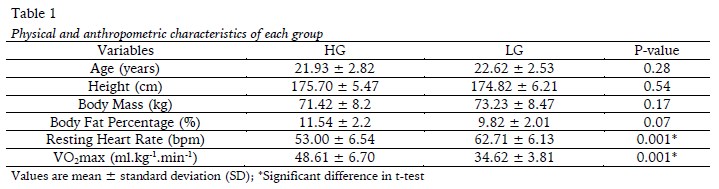
<body><![CDATA[<p>Following the original   proposal of Bauer et al. (2009), the decreasing and increasing phases of heart   rate were also analysed separately to better estimate the contributions of   parasympathetic and sympathetic control, respectively. In the present study, a   simplification was proposed. Firstly, it was created a vector of the   differences between successive elements of the RRi series; then, the   cardiac-deceleration rate (CDR) index was defined as the mean of the positive   values, and the cardiac acceleration rate (CAR) index as the mean of the negative values.</p> <b>Statistical Analysis</b>      <p>Descriptive statistical analyses of the data were expressed as mean ±   standard deviation.   The Kolmogorov-Smirnov test confirmed the normality of distribution. The   difference between groups in anthropometric and physical characteristics, the   resting heart rate, the VO<sub>2</sub>max, and the HRV parameters including CDR   and CAR indexes were tested using an independent sample T test. The model for predicting the VO<sub>2</sub>max values through the logistic distribution   function are probabilities where 0 corresponds to HG and 1 to LG. A   multivariate logistic regression (<i>stepwise</i>)   was applied, assuming as independent variables the HRV parameters, including   the CDR and CAR indices. The adjustment was selected by the least squared   error, and the Wald test results were examined for individual parameters (Hosmer &amp; Lemeshow, 2000).</p>     <p>Thus, it   was obtained a confusion matrix for plotting ROC curve with better sensitivity, specificity and global accuracy,   and the area   under the curve (AUC) with standard error was used for expressing the   overall discriminatory power with 95% confidence interval (95%CI)   (Hanley &amp; Mcneil, 1983).   All procedures assumed p&#8804; 0.05 for statistical significance and were processed in the SPSS 18.0 software (SPSS, USA).</p>     <p>&nbsp;</p> </font><font size="3" face="Verdana"><b>RESULTS</b></font><font face="Verdana" size="2">      <p>Anthropometric and physical characteristic of the participants were very   similar as well as the low values of standard deviation for each variable   (<a href="/img/revistas/mot/v14n1/14n1a06t1.jpg">Table 1</a>), showing no significant differences. The VO<sub>2</sub>max of participants with high aerobic   fitness was significantly higher than those from participants with low aerobic   fitness (48.61±6.70 vs 34.62±3.81ml.kg<sup>-1</sup>.min<sup>-1</sup>,   respectively), which made it possible to divide into two groups HG and LG.   Besides, the resting heart rate was lower in HG (53.00 ± 6.54 vs 62.71 ± 6.13, p = 0.001) than in LG. </p>     
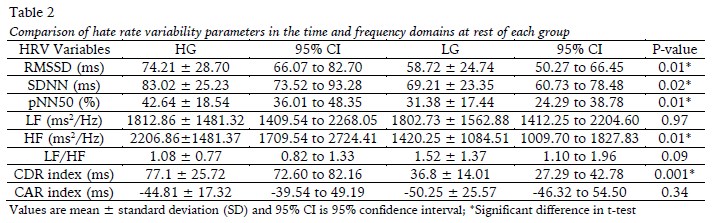
<p>Afterwards, the HRV parameters including CDR and CAR indexes were   estimated in both groups and respective inter-group comparison are showed in   <a href="/img/revistas/mot/v14n1/14n1a06t2.jpg">Table 2</a>. The HG showed significant higher values in all time domain parameters,   as well as in the high frequency (HF) contents in the frequency domain,   compared with LG. Besides, the CDR index of HG participants was significantly higher than those from LG (p= 0.001).</p>     
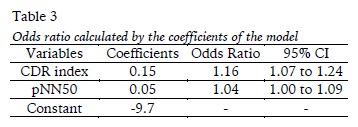
<p>The stepwise logistic regression   produced a model including only two variables: CDR index and pNN50. The model   showed 85.74% sensitivity,   88.51% specificity and 87.16% global accuracy with standard errors of 0.02   (p=&nbsp;0.04) and the AUC was obtained in 0.95 (0.87 to 0.99 with 95%CI), according to <a href="#e1">equation 1</a> for predicting probability of the VO<sub>2</sub>max (PVO<sub>2</sub>max):</p>     <p><a name="e1"></a></p>     <p>&nbsp;</p> </font>     <p align="center"><font face="Verdana" size="2"><img src="/img/revistas/mot/v14n1/14n1a06e1.jpg" width="354" height="61"> </font></p> <font face="Verdana" size="2">     
]]></body>
<body><![CDATA[<p>&nbsp;</p>     <p>where CDR is cardiac-deceleration rate   index and pNN50 is the   mean percentage of times in which the change in consecutive normal sinus intervals exceeds 50 ms.</p>     <p>The Odds   ratio were calculated by the coefficients presented in the equation are showed in <a href="#t3">Table 3</a>.</p>     <p><a name="t3"></a></p>     <p>&nbsp;</p>     <p align="center"><img src="/img/revistas/mot/v14n1/14n1a06t3.jpg" width="358" height="127"></p>     
<p>&nbsp;</p>     <p>&nbsp;</p> </font><font size="3" face="Verdana"><b>DISCUSSION</b></font><font face="Verdana" size="2">     <p>This study aimed to identify   participants with different maximum oxygen uptake based on resting HRV analysis   and the phase-rectified signal averaging method. The logistic regression model   was suitably adjusted to maximal aerobic power data from young healthy males,   previously dichotomized into two groups. This represented an important step for   stratifying the degree of aerobic fitness without the need of a maximum stress test,   with potential application to participants who could not be submitted to such exercise.</p>     <p>Previous studies (De Meersman, 1996;   Yataco, Fleisher, &amp; Katzel, 1997) have compared HRV between high and low   aerobic fitness participants, and high aerobic fitness subjects presented   higher values of HF power and increase in time domain parameters of the HRV   related to parasympathetic activity. Nevertheless, other studies failed to show   a relationship between the degree aerobic fitness and HRV in the time and frequency   domains (Grant et al<i>.,</i> 2009; Melanson &amp; Freedson, 2001). </p>     ]]></body>
<body><![CDATA[<p>Current findings indicated that   participants in HG showed significant higher values of HF power and time domain   HRV parameters than the LG. Although both groups contained healthy participants   with HRV parameters in the normal range, HG participants presented significant   lower resting heart rate. Previous studies have been conducted regarding the   mechanisms responsible for the resting bradycardia in high aerobic fitness   participants (Buchheit et al<i>.,</i> 2010; Plews   et al<i>.,</i> 2013; Sullo et al<i>.,</i> 2003). Changes in the intrinsic   mechanisms acting on the sinus node and changes in the autonomic nervous system   control of the heart have been reported to contribute to chronic effect of   cardiorespiratory training (Carter, Banister, &amp; Blaber, 2003). These   findings lead to the hypothesis that high aerobic conditioning is related to   high cardiac efficiency, with improved ejection fraction. In this condition,   lower heart rates are required to maintain the arterial blood pressure, and   this is obtained by increased vagal tonus. To better investigate this hypothesis, the phase rectified HRV analysis was performed.</p>     <p>In the original PRSA method proposed   by Bauer et al. (2009), each positive change of R-R time series was used as the   anchor for the coherent average of the surrounding R-R interval segment, and   the resulting step was defined as the decelerating capacity index. Similarly,   the accelerating capacity index corresponded to the respective step obtained   from the negative R-R changes. Furtherly, Nasario-Junior et al<i>.</i> (2014; 2015a) proposed a change to   this method, by considering as anchor for the coherent average only the   steepest change in each period of positive or negative changes of R-R time   series. This approach was successful for stratifying athletes with high aerobic   fitness from normal participants. In the present study, the proposal was to   simplify the method by avoiding the calculus of coherent averages, since the   only interest was on the height of the resulting step. Thus, the mean value of   positive changes was taken as a cardiac deceleration rate and the respective value of negative changes as a cardiac acceleration rate.</p>     <p>As the HG participants presented   lower resting heart rate when compared to LG, it was supposed they were   susceptible to higher vagal tonus, and thus able to present higher values of   CDR than LG, as observed. The absence of differences in CAR also supports this hypothesis, since both groups had similar sympathetic tonus at rest.</p>     <p>The result of the logistic regression   model supported the hypothesis that CDR index adequately represents the   parasympathetic control of the heart rate, and thus it could be applicable to   estimate the positive adaptation to cardiorespiratory fitness (Buchheit et al<i>.,</i> 2010; Bucheit &amp; Ginder, 2006; De   Meersman, 1996; Martinelli et al<i>.,</i>   2005; Moreira et al<i>.,</i> 2013; Plews et   al<i>.,</i> 2013; Yataco, Fleisher, &amp;   Katzel, 1997), or the autonomic control of post-exercise heart rate (Martinelli   et al<i>.,</i> 2005; Moreira et al<i>.,</i> 2013; Plews et al<i>.,</i> 2013) and the increasing vagal activity (Trevizani,   Belchimol-Barbosa, &amp; Nadal, 2012). Therefore, it is possible to speculate   that regular aerobic exercise, with enough intensity to cause further increase   in VO<sub>2</sub>max   could be evaluated by the CDR index. This variable express changes in heart   rate due to parasympathetic control (Buchheit et al<i>.,</i> 2010; Bucheit &amp; Ginder, 2006; Moreira et al<i>.,</i> 2013), in agreement with the higher   chance showed by CDR index through odds ratio analysis. However, CAR index did   not present statistical differences because this is related to the sympathetic   control of the heart rate, and not associated with physical fitness (Bauer et   al<i>.,</i> 2006; Nasario-Junior et al<i>.</i>, 2015a). Additionally, the pNN50 is   also associated with increased parasympathetic modulation, being directly   related to aerobic fitness (De Meersman, 1996; Yataco, Fleisher &amp; Katzel, 1997). </p>     <p>To the extent of our knowledge, the   presented model is the first to stratify the aerobic fitness from parameters   derived only from heart rate variability at rest. It was applied with a   homogeneous sample of young (18-27 years) health adult male participants,   physically active college students, but not athletes, since presented a limited   range of VO<sub>2</sub>maxvalues,   with levels of aerobic fitness (41.6 <i>± </i>8.2 ml.kg<sup>-1</sup>.min<sup>-1</sup>)   near the population mean for young people (40 ml.kg<sup>-1</sup>.min<sup>-1</sup>,   according to the American College of Sports Medicine) (ACSM, 2010). In fact,   the sample characteristics could be viewed as a limitation, and the potential   application to other samples, including both genders and participants who could not be submitted to a maximal cardiopulmonary test is still to be investigated.</p>     <p>&nbsp;</p> </font><font size="3" face="Verdana"><b>CONCLUSION</b></font><font face="Verdana" size="2">      <p>The use of the proposed CDR index   with the pNN50 parameter measured at rest seems to be able to stratify the   level of aerobic fitness in young healthy adult males. Thus, this is performed   without the need of applying a stress test and extends the HRV applicability in the evaluation of the physical performance. </p>     <p>&nbsp;</p> </font>     <p><font size="3" face="Verdana"><b>REFERENCES</b></font></p> <font face="Verdana" size="2">     <p>American   College of Sport Medicine. (2010). <i>ACSM’s Guidelines for Exercise Testing     and Prescription</i>. (W. R. Thompson, N. F. Gordon, &amp; L. S. Pescatello, Eds.) (8<sup>th</sup> Ed.). Philadelphia: Lippincott Williams &amp; Wilkins.</p>     ]]></body>
<body><![CDATA[<!-- ref --><p>Bauer, A., Kantelhardt, J. W., Barthel, P., Schneider, R., Mäkikallio,   T., Ulm, K., … Schmidt, G. (2006). Deceleration capacity of heart rate as a   predictor of mortality after myocardial infarction: cohort study. <i>Lancet, 20</i>(367), 1674-81. doi:10.1016/S0140-6736(06)68735-7&nbsp;&nbsp;&nbsp;&nbsp;&nbsp;&nbsp;&nbsp;&nbsp;[&#160;<a href="javascript:void(0);" onclick="javascript: window.open('/scielo.php?script=sci_nlinks&ref=374111&pid=S1646-107X201800010000600002&lng=','','width=640,height=500,resizable=yes,scrollbars=1,menubar=yes,');">Links</a>&#160;]<!-- end-ref --><!-- ref --><p>Bosquet,   L., Gamelin, F. X., &amp; Berthoin, S. (2007). Is aerobic endurance a   determinant of cardiac autonomic regulation? <i>European Journal of Applied Physiology,     100</i>(3), 363-9. doi:10.1007/s00421-007-0438-3&nbsp;&nbsp;&nbsp;&nbsp;&nbsp;&nbsp;&nbsp;&nbsp;[&#160;<a href="javascript:void(0);" onclick="javascript: window.open('/scielo.php?script=sci_nlinks&ref=374112&pid=S1646-107X201800010000600003&lng=','','width=640,height=500,resizable=yes,scrollbars=1,menubar=yes,');">Links</a>&#160;]<!-- end-ref --><!-- ref --><p>Buchheit, M., &amp; Gindre, C. (2006). Cardiac   parasympathetic regulation: respective associations with cardiorespiratory   fitness and training load. <i>American journal of physiology. Heart and Circulatory Physiology, 291</i>(1), H451-458. doi: 10.1152/ajpheart.00008.2006&nbsp;&nbsp;&nbsp;&nbsp;&nbsp;&nbsp;&nbsp;&nbsp;[&#160;<a href="javascript:void(0);" onclick="javascript: window.open('/scielo.php?script=sci_nlinks&ref=374113&pid=S1646-107X201800010000600004&lng=','','width=640,height=500,resizable=yes,scrollbars=1,menubar=yes,');">Links</a>&#160;]<!-- end-ref --><!-- ref --><p>Buchheit, M., Chivot, A., Parouty, J., Mercier, D., Al Haddad, H.,   Laursen, P. B., &amp; Ahmaidi, S. (2010). Monitoring endurance running performance   using cardiac parasympathetic function. <i>European     Journal of Applied Physiology</i>, <i>108</i>(6), 1153-1167. doi: 10.1007/s00421-009-1317-x&nbsp;&nbsp;&nbsp;&nbsp;&nbsp;&nbsp;&nbsp;&nbsp;[&#160;<a href="javascript:void(0);" onclick="javascript: window.open('/scielo.php?script=sci_nlinks&ref=374114&pid=S1646-107X201800010000600005&lng=','','width=640,height=500,resizable=yes,scrollbars=1,menubar=yes,');">Links</a>&#160;]<!-- end-ref --><!-- ref --><p>Carnevali, L., &amp;   Sgoifo, A. (2014). Vagal modulation of resting heart rate in rats: the role of stress, psychosocial factors, and physical exercise. <i>Frontiers in Physiology, 5</i>, 1-12. doi: 10.3389/fphys.2014.00118&nbsp;&nbsp;&nbsp;&nbsp;&nbsp;&nbsp;&nbsp;&nbsp;[&#160;<a href="javascript:void(0);" onclick="javascript: window.open('/scielo.php?script=sci_nlinks&ref=374115&pid=S1646-107X201800010000600006&lng=','','width=640,height=500,resizable=yes,scrollbars=1,menubar=yes,');">Links</a>&#160;]<!-- end-ref --><!-- ref --><p>Carter, J. B., Banister, E. W., &amp; Blaber, A. P. (2003). Effect of   endurance exercise on autonomic control of heart rate. <i>Sports Medicine</i>, <i>33</i>(1), 33-46.    &nbsp;&nbsp;&nbsp;&nbsp;&nbsp;&nbsp;&nbsp;&nbsp;[&#160;<a href="javascript:void(0);" onclick="javascript: window.open('/scielo.php?script=sci_nlinks&ref=374116&pid=S1646-107X201800010000600007&lng=','','width=640,height=500,resizable=yes,scrollbars=1,menubar=yes,');">Links</a>&#160;]<!-- end-ref -->  </p>     <!-- ref --><p>De Meersman, R. E. (1993). Heart rate variability and aerobic fitness. <i>American Heart Journal</i>, <i>125</i>(3), 726-731.    &nbsp;&nbsp;&nbsp;&nbsp;&nbsp;&nbsp;&nbsp;&nbsp;[&#160;<a href="javascript:void(0);" onclick="javascript: window.open('/scielo.php?script=sci_nlinks&ref=374118&pid=S1646-107X201800010000600008&lng=','','width=640,height=500,resizable=yes,scrollbars=1,menubar=yes,');">Links</a>&#160;]<!-- end-ref --> </p>     <!-- ref --><p>Grant, C. C., Clark, J. R., Janse van Rensburg, D. C., &amp; Viljoen, M.   (2009). Relationship between exercise capacity and heart rate variability: supine   and in response to an orthostatic stressor. <i>Autonomic     Neuroscience</i>, <i>151</i>(2), 186-188. doi: 10.1016/j.autneu.2009.08.015&nbsp;&nbsp;&nbsp;&nbsp;&nbsp;&nbsp;&nbsp;&nbsp;[&#160;<a href="javascript:void(0);" onclick="javascript: window.open('/scielo.php?script=sci_nlinks&ref=374120&pid=S1646-107X201800010000600009&lng=','','width=640,height=500,resizable=yes,scrollbars=1,menubar=yes,');">Links</a>&#160;]<!-- end-ref --><!-- ref --><p>Grant, C. C.,   Murray, C., Janse Van Rensburg, D. C., Fletcher, L. (2013). A comparison between   heart rate and heart rate variability as indicators of cardiac health and fitness, <i>Frontiers in Physiology</i>, <i>4</i>(337), 1-5. doi: 10.3389/fphys.2013.00337&nbsp;&nbsp;&nbsp;&nbsp;&nbsp;&nbsp;&nbsp;&nbsp;[&#160;<a href="javascript:void(0);" onclick="javascript: window.open('/scielo.php?script=sci_nlinks&ref=374121&pid=S1646-107X201800010000600010&lng=','','width=640,height=500,resizable=yes,scrollbars=1,menubar=yes,');">Links</a>&#160;]<!-- end-ref --><!-- ref --><p>Hanley, J. A., &amp;   Mcneil, B. J. (1983). A method of comparing the areas under receiver operating   characteristic curves derived from the same cases. <i>Radiology</i>, <i>148</i>(3), 839-43.    &nbsp;&nbsp;&nbsp;&nbsp;&nbsp;&nbsp;&nbsp;&nbsp;[&#160;<a href="javascript:void(0);" onclick="javascript: window.open('/scielo.php?script=sci_nlinks&ref=374122&pid=S1646-107X201800010000600011&lng=','','width=640,height=500,resizable=yes,scrollbars=1,menubar=yes,');">Links</a>&#160;]<!-- end-ref --></p>     <!-- ref --><p>Hosmer, D. W., &amp; Lemeshow, S. (2000). <i>Applied Logistic Regression</i>. New York: Wiley.    &nbsp;&nbsp;&nbsp;&nbsp;&nbsp;&nbsp;&nbsp;&nbsp;[&#160;<a href="javascript:void(0);" onclick="javascript: window.open('/scielo.php?script=sci_nlinks&ref=374124&pid=S1646-107X201800010000600012&lng=','','width=640,height=500,resizable=yes,scrollbars=1,menubar=yes,');">Links</a>&#160;]<!-- end-ref --></p>     <!-- ref --><p>Jackson,   A. S., &amp; Pollock, M. (1978). Generalized equations for predicting body   density of men. <i>The British Journal of Nutrition, 40</i>(3), 497-504.    &nbsp;&nbsp;&nbsp;&nbsp;&nbsp;&nbsp;&nbsp;&nbsp;[&#160;<a href="javascript:void(0);" onclick="javascript: window.open('/scielo.php?script=sci_nlinks&ref=374126&pid=S1646-107X201800010000600013&lng=','','width=640,height=500,resizable=yes,scrollbars=1,menubar=yes,');">Links</a>&#160;]<!-- end-ref --></p>     <!-- ref --><p>Kawaguchi, L. Y. A., Nascimento, A. C. P., Lima, M. S., Frigo, L.,   Júnior, P., De, A. R., … Lopes-Martins, R. A. B.   (2007). Characterization of heart rate variability and baroreflex sensitivity   in sedentary individuals and male athletes. <i>Revista Brasileira de Medicina Do Esporte</i>, <i>13</i>(4), 231–236. <a href="https://doi.org/10.1590/S1517-86922007000400004" target="_blank">https://doi.org/10.1590/S1517-86922007000400004</a>&nbsp;&nbsp;&nbsp;&nbsp;&nbsp;&nbsp;&nbsp;&nbsp;[&#160;<a href="javascript:void(0);" onclick="javascript: window.open('/scielo.php?script=sci_nlinks&ref=374128&pid=S1646-107X201800010000600014&lng=','','width=640,height=500,resizable=yes,scrollbars=1,menubar=yes,');">Links</a>&#160;]<!-- end-ref --><!-- ref --><p>Leite A., Silva, M. E., &amp; Rocha, A. P. (2013). Heart rate variability analysis in healthy subjects, patients suffering   from congestive heart failure and heart transplanted patients. <i>Motricidade</i>, <i>9</i>(4),54-63. doi: 10.6063/motricidade.9(4).1139 &nbsp;&nbsp;&nbsp;&nbsp;&nbsp;&nbsp;&nbsp;&nbsp;[&#160;<a href="javascript:void(0);" onclick="javascript: window.open('/scielo.php?script=sci_nlinks&ref=374129&pid=S1646-107X201800010000600015&lng=','','width=640,height=500,resizable=yes,scrollbars=1,menubar=yes,');">Links</a>&#160;]<!-- end-ref --><!-- ref --><p>Maroco, M., Nadal,   J., &amp; Barbosa, P. R. (2007). The effect of an aerobic training program on the   electrical remodelling of the heart: High-frequency components of the   signal-averaged electrocardiogram are predictors of the maximal aerobic power. <i>Brazilian </i><i>Journal</i> of <i>Medical </i><i>and Biological </i><i>Research</i><i>, 40</i>(2), 199-208. doi: 10.1590/S0100-879X2006005000068<b>&nbsp;    &nbsp;&nbsp;&nbsp;&nbsp;&nbsp;&nbsp;&nbsp;&nbsp;[&#160;<a href="javascript:void(0);" onclick="javascript: window.open('/scielo.php?script=sci_nlinks&ref=374130&pid=S1646-107X201800010000600016&lng=','','width=640,height=500,resizable=yes,scrollbars=1,menubar=yes,');">Links</a>&#160;]<!-- end-ref --></b></p>     <!-- ref --><p>Martinelli, F. S., Chacon-Mikahil, M. P. T., Martins, L. E. B.,   Lima-Filho, E. C., Golfetti, R., Paschoal, M. A., &amp; Gallo-Junior, L.   (2005). Heart rate variability in athletes and non-athletes at rest and during   head-up tilt. <i>Brazilian </i><i>Journal</i> of <i>Medical </i><i>and Biological </i><i>Research</i>, <i>38</i>(4), 639-647. doi: 10.1590/S0100-879X2005000400019&nbsp;    &nbsp;&nbsp;&nbsp;&nbsp;&nbsp;&nbsp;&nbsp;&nbsp;[&#160;<a href="javascript:void(0);" onclick="javascript: window.open('/scielo.php?script=sci_nlinks&ref=374132&pid=S1646-107X201800010000600017&lng=','','width=640,height=500,resizable=yes,scrollbars=1,menubar=yes,');">Links</a>&#160;]<!-- end-ref --> </p>     <!-- ref --><p>Melanson, E. L., &amp; Freedson, P. S. (2001). The effect of endurance   training on resting heart rate variability in sedentary adult males. <i>European Journal of Applied Physiology, 85</i>(5), 442-449. doi: 10.1007/s004210100479&nbsp;&nbsp;&nbsp;&nbsp;&nbsp;&nbsp;&nbsp;&nbsp;[&#160;<a href="javascript:void(0);" onclick="javascript: window.open('/scielo.php?script=sci_nlinks&ref=374134&pid=S1646-107X201800010000600018&lng=','','width=640,height=500,resizable=yes,scrollbars=1,menubar=yes,');">Links</a>&#160;]<!-- end-ref --><!-- ref --><p>Mezzani, A.,   Agostini, P., Cohen-Solal, A., Corrà, U., Jegier, A., Kouidi, E., ... Vanhees,   L. (2009). Standards for use of cardiopulmonary exercise testing for the   functional evaluation of cardiac patients: a report from the Exercise   Physiology Section of the European Association for Cardiovascular Prevention   and Rehabilitation. <i>European   </i><i>Association of   </i><i>Cardiovascular   </i><i>Prevention</i>   and <i>Rehabilitation, </i><i>16</i>(3), 249-267.  doi: 10.1097/HJR.0b013e32832914c8&nbsp;&nbsp;&nbsp;&nbsp;&nbsp;&nbsp;&nbsp;&nbsp;[&#160;<a href="javascript:void(0);" onclick="javascript: window.open('/scielo.php?script=sci_nlinks&ref=374135&pid=S1646-107X201800010000600019&lng=','','width=640,height=500,resizable=yes,scrollbars=1,menubar=yes,');">Links</a>&#160;]<!-- end-ref --><!-- ref --><p>Moreira, D. N., Peçanha, T., Guerra, Z. F., Silva, L. P., Nakamura, F. Y.,   Laterza, M. C., &amp; de Lima, J. R. P. (2013). Effects of aerobic fitness on cardiac autonomic modulation during supine and upright posture. <i>Journal of Exercise Physiology Online</i>, <i>16</i>(4), 92-100.    &nbsp;&nbsp;&nbsp;&nbsp;&nbsp;&nbsp;&nbsp;&nbsp;[&#160;<a href="javascript:void(0);" onclick="javascript: window.open('/scielo.php?script=sci_nlinks&ref=374136&pid=S1646-107X201800010000600020&lng=','','width=640,height=500,resizable=yes,scrollbars=1,menubar=yes,');">Links</a>&#160;]<!-- end-ref --> </p>     <!-- ref --><p>Nasario-Junior, O., Benchimol-Barbosa, P. R., Pedrosa, R. C., &amp;   Nadal, J. (2014). Refining the deceleration capacity index in phase-rectified   signal averaging to assess physical conditioning level. <i>Journal of Electrocardiology</i>, <i>47</i>(3), 306-310. doi: 10.1016/j.jelectrocard.2013.12.006 &nbsp;&nbsp;&nbsp;&nbsp;&nbsp;&nbsp;&nbsp;&nbsp;[&#160;<a href="javascript:void(0);" onclick="javascript: window.open('/scielo.php?script=sci_nlinks&ref=374138&pid=S1646-107X201800010000600021&lng=','','width=640,height=500,resizable=yes,scrollbars=1,menubar=yes,');">Links</a>&#160;]<!-- end-ref --><p>Nasario-Junior,   O., Benchimol-Barbosa, P. R., Pedrosa, R. C., &amp; Nadal, J. (2015a). Beat-to-beat   ventricular repolarization duration variability assessed by cardiac   acceleration and deceleration phases in athletes. <i>EC Cardiology</i>, <i>1</i>, 33-42.</p>     <p>Nasario-Junior, O., Benchimol-Barbosa, P. R., Pedrosa, R. C., &amp;   Nadal, J. (2015b). Assessment of autonomic function by phase rectification of RR-Interval   histogram analysis in Chagas disease. <i>Arquivos     Brasileiros de Cardiologia</i>, <i>104</i>(6), 450-456. doi: 10.5935/abc.20150032</p>     ]]></body>
<body><![CDATA[<!-- ref --><p>Peçanha, T., de   Paula-Ribeiro, M., Nasario-Junior, O., &amp; de Lima, J.R. (2013). Post-exercise heart rate variability recovery: a time-frequency analysis. <i>Acta Cardiologica, 68</i>(6), 607-613. doi: 10.2143/AC.68.6.8000008&nbsp;&nbsp;&nbsp;&nbsp;&nbsp;&nbsp;&nbsp;&nbsp;[&#160;<a href="javascript:void(0);" onclick="javascript: window.open('/scielo.php?script=sci_nlinks&ref=374141&pid=S1646-107X201800010000600024&lng=','','width=640,height=500,resizable=yes,scrollbars=1,menubar=yes,');">Links</a>&#160;]<!-- end-ref --><!-- ref --><p>Plews, D. J.,   Laursen, P. B., Stanley, J., Kilding, A. E., &amp; Bucheit, M. (2013). Training   adaptation and heart rate variability in elite endurance athletes: opening the door to effective monitoring. <i>Sports Medicine, 43</i>(9), 773-781. doi: 10.1007/s40279-013-0071-8&nbsp;&nbsp;&nbsp;&nbsp;&nbsp;&nbsp;&nbsp;&nbsp;[&#160;<a href="javascript:void(0);" onclick="javascript: window.open('/scielo.php?script=sci_nlinks&ref=374142&pid=S1646-107X201800010000600025&lng=','','width=640,height=500,resizable=yes,scrollbars=1,menubar=yes,');">Links</a>&#160;]<!-- end-ref --><!-- ref --><p>Rodríguez,   J. D., Pérez, A., &amp; Lozano, J. A. (2010). Sensitivity analysis of K-fold   Cross validation in prediction error estimation<i>. IEEE transactions on pattern analysis and machine intelligence, 32</i>(3), 569-575. doi: 10.1109/TPAMI.2009.187&nbsp;&nbsp;&nbsp;&nbsp;&nbsp;&nbsp;&nbsp;&nbsp;[&#160;<a href="javascript:void(0);" onclick="javascript: window.open('/scielo.php?script=sci_nlinks&ref=374143&pid=S1646-107X201800010000600026&lng=','','width=640,height=500,resizable=yes,scrollbars=1,menubar=yes,');">Links</a>&#160;]<!-- end-ref --><!-- ref --><p>Rosenwinkel, E. T., Bloomfield, D. M., Arwady, M. A., &amp; Goldsmith,   R. L. (2001). Exercise and autonomic function in health and cardiovascular disease. <i>Cardiology Clinics</i>, <i>19</i>(3), 369-87.    &nbsp;&nbsp;&nbsp;&nbsp;&nbsp;&nbsp;&nbsp;&nbsp;[&#160;<a href="javascript:void(0);" onclick="javascript: window.open('/scielo.php?script=sci_nlinks&ref=374144&pid=S1646-107X201800010000600027&lng=','','width=640,height=500,resizable=yes,scrollbars=1,menubar=yes,');">Links</a>&#160;]<!-- end-ref --></p>     <!-- ref --><p>Siri, W. E. (1961). Body composition from fluid spaces and density:   analysis of methods. In J. Brozek &amp; A. Henschel (Eds.), <i>Techniques for measuring body composition</i>. Washington: National Academy of Science.    &nbsp;&nbsp;&nbsp;&nbsp;&nbsp;&nbsp;&nbsp;&nbsp;[&#160;<a href="javascript:void(0);" onclick="javascript: window.open('/scielo.php?script=sci_nlinks&ref=374146&pid=S1646-107X201800010000600028&lng=','','width=640,height=500,resizable=yes,scrollbars=1,menubar=yes,');">Links</a>&#160;]<!-- end-ref --></p>     <!-- ref --><p>Task   Force of the European Society of Cardiology and the North American Society of   Pacing and Electrophysiology. (1996). Heart rate variability: standards of   measurement, physiological interpretation and clinical use. <i>Circulation Research, 93</i>, 1043–1065. doi:10.1161/01.CIR. 93.5.1043&nbsp;&nbsp;&nbsp;&nbsp;&nbsp;&nbsp;&nbsp;&nbsp;[&#160;<a href="javascript:void(0);" onclick="javascript: window.open('/scielo.php?script=sci_nlinks&ref=374148&pid=S1646-107X201800010000600029&lng=','','width=640,height=500,resizable=yes,scrollbars=1,menubar=yes,');">Links</a>&#160;]<!-- end-ref --><!-- ref --><p>Trevizani,   G. A., Belchimol-Barbosa, P. R., &amp; Nadal, J. (2012). Effects of age and   aerobic fitness on heart rate recovery in adult men. <i>Arquivos Brasileiros de Cardiologia</i>, <i>99</i>(3), 802-810. doi: 10.1590/S0066-782X2012005000069&nbsp;    &nbsp;&nbsp;&nbsp;&nbsp;&nbsp;&nbsp;&nbsp;&nbsp;[&#160;<a href="javascript:void(0);" onclick="javascript: window.open('/scielo.php?script=sci_nlinks&ref=374149&pid=S1646-107X201800010000600030&lng=','','width=640,height=500,resizable=yes,scrollbars=1,menubar=yes,');">Links</a>&#160;]<!-- end-ref --></p>     ]]></body>
<body><![CDATA[<!-- ref --><p>Wasserman,   K., &amp; Whipp, B. J. (1975). Exercise physiology in health and disease. <i>The American Review of Respiratory Disease</i>,   <i>112</i>, 219-249. doi:10.1164/arrd.1975.112.2.219&nbsp;&nbsp;&nbsp;&nbsp;&nbsp;&nbsp;&nbsp;&nbsp;[&#160;<a href="javascript:void(0);" onclick="javascript: window.open('/scielo.php?script=sci_nlinks&ref=374151&pid=S1646-107X201800010000600031&lng=','','width=640,height=500,resizable=yes,scrollbars=1,menubar=yes,');">Links</a>&#160;]<!-- end-ref --><!-- ref --><p>Yataco, A. R., Fleisher, L. A., &amp; Katzel, L. I. (1997). Heart rate   variability and cardiovascular fitness in senior athletes. <i>American College of Cardiology</i>, <i>80</i>(10), 1389-1391. doi:10.1016/S0002-9149(97)00697-8&nbsp;&nbsp;&nbsp;&nbsp;&nbsp;&nbsp;&nbsp;&nbsp;[&#160;<a href="javascript:void(0);" onclick="javascript: window.open('/scielo.php?script=sci_nlinks&ref=374152&pid=S1646-107X201800010000600032&lng=','','width=640,height=500,resizable=yes,scrollbars=1,menubar=yes,');">Links</a>&#160;]<!-- end-ref --><p>&nbsp;</p> </font>     <p><font size="2" face="Verdana"><b>Acknowledgments:</b>    <br>   This work was partially supported by the   Brazilian Research Council (CNPq) and CAPES Foundation.<b>    <br>   Conflict of interests:</b>    <br>   Nothing to   declare.<b>    <br>   Funding:    <br>   </b></font><font face="Verdana"><b></b><font size="2">Nothing to declare.</font></font></p>     <p><font size="2" face="Verdana">Manuscript received at May 25th 2017;  Accepted at October 30th 2017</font></p>     ]]></body>
<body><![CDATA[<p>&nbsp;</p>     <p>&nbsp;</p> <font size="2" face="Verdana"><i><a name="end"></a></i><a href="#top">Correspondence to:</a> Address: Rod. Juscelino Kubitschek km 2, Jardim Marco Zero, Macap&aacute;  city, AP. Zip Code: 68.903-419 <i>E-mail</i>:  <a href="mailto:wollner.materko@unifap.br">wollner.materko@unifap.br</a> </font>      ]]></body><back>
<ref-list>
<ref id="B1">
<nlm-citation citation-type="book">
<person-group person-group-type="author">
<name>
<surname><![CDATA[Thompson]]></surname>
<given-names><![CDATA[W. R.]]></given-names>
</name>
<name>
<surname><![CDATA[Gordon]]></surname>
<given-names><![CDATA[N. F.]]></given-names>
</name>
<name>
<surname><![CDATA[Pescatello]]></surname>
<given-names><![CDATA[L. S.]]></given-names>
</name>
</person-group>
<collab>American College of Sport Medicine</collab>
<source><![CDATA[ACSM’s Guidelines for Exercise Testing and Prescription]]></source>
<year>2010</year>
<edition>8</edition>
<publisher-loc><![CDATA[Philadelphia ]]></publisher-loc>
<publisher-name><![CDATA[Lippincott Williams & Wilkins]]></publisher-name>
</nlm-citation>
</ref>
<ref id="B2">
<nlm-citation citation-type="journal">
<person-group person-group-type="author">
<name>
<surname><![CDATA[Bauer]]></surname>
<given-names><![CDATA[A.]]></given-names>
</name>
<name>
<surname><![CDATA[Kantelhardt]]></surname>
<given-names><![CDATA[J. W.]]></given-names>
</name>
<name>
<surname><![CDATA[Barthel]]></surname>
<given-names><![CDATA[P.]]></given-names>
</name>
<name>
<surname><![CDATA[Schneider]]></surname>
<given-names><![CDATA[R.]]></given-names>
</name>
<name>
<surname><![CDATA[Mäkikallio]]></surname>
<given-names><![CDATA[T.]]></given-names>
</name>
<name>
<surname><![CDATA[Ulm]]></surname>
<given-names><![CDATA[K.]]></given-names>
</name>
<name>
<surname><![CDATA[Schmidt]]></surname>
<given-names><![CDATA[G.]]></given-names>
</name>
</person-group>
<article-title xml:lang="en"><![CDATA[Deceleration capacity of heart rate as a predictor of mortality after myocardial infarction: cohort study]]></article-title>
<source><![CDATA[Lancet]]></source>
<year>2006</year>
<volume>20</volume>
<numero>367</numero>
<issue>367</issue>
<page-range>1674-81</page-range></nlm-citation>
</ref>
<ref id="B3">
<nlm-citation citation-type="journal">
<person-group person-group-type="author">
<name>
<surname><![CDATA[Bosquet]]></surname>
<given-names><![CDATA[L.]]></given-names>
</name>
<name>
<surname><![CDATA[Gamelin]]></surname>
<given-names><![CDATA[F. X.]]></given-names>
</name>
<name>
<surname><![CDATA[Berthoin]]></surname>
<given-names><![CDATA[S.]]></given-names>
</name>
</person-group>
<article-title xml:lang="en"><![CDATA[Is aerobic endurance a determinant of cardiac autonomic regulation?]]></article-title>
<source><![CDATA[European Journal of Applied Physiology]]></source>
<year>2007</year>
<volume>100</volume>
<numero>3</numero>
<issue>3</issue>
<page-range>363-9</page-range></nlm-citation>
</ref>
<ref id="B4">
<nlm-citation citation-type="journal">
<person-group person-group-type="author">
<name>
<surname><![CDATA[Buchheit]]></surname>
<given-names><![CDATA[M.]]></given-names>
</name>
<name>
<surname><![CDATA[Gindre]]></surname>
<given-names><![CDATA[C.]]></given-names>
</name>
</person-group>
<article-title xml:lang="en"><![CDATA[Cardiac parasympathetic regulation: respective associations with cardiorespiratory fitness and training load]]></article-title>
<source><![CDATA[American journal of physiology. Heart and Circulatory Physiology]]></source>
<year>2006</year>
<volume>291</volume>
<numero>1</numero>
<issue>1</issue>
<page-range>H451-458</page-range></nlm-citation>
</ref>
<ref id="B5">
<nlm-citation citation-type="journal">
<person-group person-group-type="author">
<name>
<surname><![CDATA[Buchheit]]></surname>
<given-names><![CDATA[M.]]></given-names>
</name>
<name>
<surname><![CDATA[Chivot]]></surname>
<given-names><![CDATA[A.]]></given-names>
</name>
<name>
<surname><![CDATA[Parouty]]></surname>
<given-names><![CDATA[J.]]></given-names>
</name>
<name>
<surname><![CDATA[Mercier]]></surname>
<given-names><![CDATA[D.]]></given-names>
</name>
<name>
<surname><![CDATA[Al Haddad]]></surname>
<given-names><![CDATA[H.]]></given-names>
</name>
<name>
<surname><![CDATA[Laursen]]></surname>
<given-names><![CDATA[P. B.]]></given-names>
</name>
<name>
<surname><![CDATA[Ahmaidi]]></surname>
<given-names><![CDATA[S.]]></given-names>
</name>
</person-group>
<article-title xml:lang="en"><![CDATA[Monitoring endurance running performance using cardiac parasympathetic function]]></article-title>
<source><![CDATA[European Journal of Applied Physiology]]></source>
<year>2010</year>
<volume>108</volume>
<numero>6</numero>
<issue>6</issue>
<page-range>1153-1167</page-range></nlm-citation>
</ref>
<ref id="B6">
<nlm-citation citation-type="journal">
<person-group person-group-type="author">
<name>
<surname><![CDATA[Carnevali]]></surname>
<given-names><![CDATA[L.]]></given-names>
</name>
<name>
<surname><![CDATA[Sgoifo]]></surname>
<given-names><![CDATA[A.]]></given-names>
</name>
</person-group>
<article-title xml:lang="en"><![CDATA[Vagal modulation of resting heart rate in rats: the role of stress, psychosocial factors, and physical exercise]]></article-title>
<source><![CDATA[Frontiers in Physiology]]></source>
<year>2014</year>
<volume>5</volume>
<page-range>1-12</page-range></nlm-citation>
</ref>
<ref id="B7">
<nlm-citation citation-type="journal">
<person-group person-group-type="author">
<name>
<surname><![CDATA[Carter]]></surname>
<given-names><![CDATA[J. B.]]></given-names>
</name>
<name>
<surname><![CDATA[Banister]]></surname>
<given-names><![CDATA[E. W.]]></given-names>
</name>
<name>
<surname><![CDATA[Blaber]]></surname>
<given-names><![CDATA[A. P.]]></given-names>
</name>
</person-group>
<article-title xml:lang="en"><![CDATA[Effect of endurance exercise on autonomic control of heart rate]]></article-title>
<source><![CDATA[Sports Medicine]]></source>
<year>2003</year>
<volume>33</volume>
<numero>1</numero>
<issue>1</issue>
<page-range>33-46</page-range></nlm-citation>
</ref>
<ref id="B8">
<nlm-citation citation-type="journal">
<person-group person-group-type="author">
<name>
<surname><![CDATA[De Meersman]]></surname>
<given-names><![CDATA[R. E.]]></given-names>
</name>
</person-group>
<article-title xml:lang="en"><![CDATA[Heart rate variability and aerobic fitness]]></article-title>
<source><![CDATA[American Heart Journal]]></source>
<year>1993</year>
<volume>125</volume>
<numero>3</numero>
<issue>3</issue>
<page-range>726-731</page-range></nlm-citation>
</ref>
<ref id="B9">
<nlm-citation citation-type="journal">
<person-group person-group-type="author">
<name>
<surname><![CDATA[Grant]]></surname>
<given-names><![CDATA[C. C.]]></given-names>
</name>
<name>
<surname><![CDATA[Clark]]></surname>
<given-names><![CDATA[J. R.]]></given-names>
</name>
<name>
<surname><![CDATA[Janse van Rensburg]]></surname>
<given-names><![CDATA[D. C.]]></given-names>
</name>
<name>
<surname><![CDATA[Viljoen]]></surname>
<given-names><![CDATA[M.]]></given-names>
</name>
</person-group>
<article-title xml:lang="en"><![CDATA[Relationship between exercise capacity and heart rate variability: supine and in response to an orthostatic stressor]]></article-title>
<source><![CDATA[Autonomic Neuroscience]]></source>
<year>2009</year>
<volume>151</volume>
<numero>2</numero>
<issue>2</issue>
<page-range>186-188</page-range></nlm-citation>
</ref>
<ref id="B10">
<nlm-citation citation-type="journal">
<person-group person-group-type="author">
<name>
<surname><![CDATA[Grant]]></surname>
<given-names><![CDATA[C. C.]]></given-names>
</name>
<name>
<surname><![CDATA[Murray]]></surname>
<given-names><![CDATA[C.]]></given-names>
</name>
<name>
<surname><![CDATA[Janse Van Rensburg]]></surname>
<given-names><![CDATA[D. C.]]></given-names>
</name>
<name>
<surname><![CDATA[Fletcher]]></surname>
<given-names><![CDATA[L.]]></given-names>
</name>
</person-group>
<article-title xml:lang="en"><![CDATA[A comparison between heart rate and heart rate variability as indicators of cardiac health and fitness]]></article-title>
<source><![CDATA[Frontiers in Physiology]]></source>
<year>2013</year>
<volume>4</volume>
<numero>337</numero>
<issue>337</issue>
<page-range>1-5</page-range></nlm-citation>
</ref>
<ref id="B11">
<nlm-citation citation-type="journal">
<person-group person-group-type="author">
<name>
<surname><![CDATA[Hanley]]></surname>
<given-names><![CDATA[J. A.]]></given-names>
</name>
<name>
<surname><![CDATA[Mcneil]]></surname>
<given-names><![CDATA[B. J.]]></given-names>
</name>
</person-group>
<article-title xml:lang="en"><![CDATA[A method of comparing the areas under receiver operating characteristic curves derived from the same cases]]></article-title>
<source><![CDATA[Radiology]]></source>
<year>1983</year>
<volume>148</volume>
<numero>3</numero>
<issue>3</issue>
<page-range>839-43</page-range></nlm-citation>
</ref>
<ref id="B12">
<nlm-citation citation-type="book">
<person-group person-group-type="author">
<name>
<surname><![CDATA[Hosmer]]></surname>
<given-names><![CDATA[D. W.]]></given-names>
</name>
<name>
<surname><![CDATA[Lemeshow]]></surname>
<given-names><![CDATA[S.]]></given-names>
</name>
</person-group>
<source><![CDATA[Applied Logistic Regression]]></source>
<year>2000</year>
<publisher-loc><![CDATA[New York ]]></publisher-loc>
<publisher-name><![CDATA[Wiley]]></publisher-name>
</nlm-citation>
</ref>
<ref id="B13">
<nlm-citation citation-type="journal">
<person-group person-group-type="author">
<name>
<surname><![CDATA[Jackson]]></surname>
<given-names><![CDATA[A. S.]]></given-names>
</name>
<name>
<surname><![CDATA[Pollock]]></surname>
<given-names><![CDATA[M.]]></given-names>
</name>
</person-group>
<article-title xml:lang="en"><![CDATA[Generalized equations for predicting body density of men]]></article-title>
<source><![CDATA[The British Journal of Nutrition]]></source>
<year>1978</year>
<volume>40</volume>
<numero>3</numero>
<issue>3</issue>
<page-range>497-504</page-range></nlm-citation>
</ref>
<ref id="B14">
<nlm-citation citation-type="journal">
<person-group person-group-type="author">
<name>
<surname><![CDATA[Kawaguchi]]></surname>
<given-names><![CDATA[L. Y. A.]]></given-names>
</name>
<name>
<surname><![CDATA[Nascimento]]></surname>
<given-names><![CDATA[A. C. P.]]></given-names>
</name>
<name>
<surname><![CDATA[Lima]]></surname>
<given-names><![CDATA[M. S.]]></given-names>
</name>
<name>
<surname><![CDATA[Frigo]]></surname>
<given-names><![CDATA[L.]]></given-names>
</name>
<name>
<surname><![CDATA[Júnior]]></surname>
<given-names><![CDATA[P.]]></given-names>
</name>
<name>
<surname><![CDATA[De]]></surname>
<given-names><![CDATA[A. R.]]></given-names>
</name>
<name>
<surname><![CDATA[Lopes-Martins]]></surname>
<given-names><![CDATA[R. A. B.]]></given-names>
</name>
</person-group>
<article-title xml:lang="en"><![CDATA[Characterization of heart rate variability and baroreflex sensitivity in sedentary individuals and male athletes]]></article-title>
<source><![CDATA[Revista Brasileira de Medicina Do Esporte]]></source>
<year>2007</year>
<volume>13</volume>
<numero>4</numero>
<issue>4</issue>
<page-range>231-236</page-range></nlm-citation>
</ref>
<ref id="B15">
<nlm-citation citation-type="journal">
<person-group person-group-type="author">
<name>
<surname><![CDATA[Leite]]></surname>
<given-names><![CDATA[A.]]></given-names>
</name>
<name>
<surname><![CDATA[Silva]]></surname>
<given-names><![CDATA[M. E.]]></given-names>
</name>
<name>
<surname><![CDATA[Rocha]]></surname>
<given-names><![CDATA[A. P.]]></given-names>
</name>
</person-group>
<article-title xml:lang="en"><![CDATA[Heart rate variability analysis in healthy subjects, patients suffering from congestive heart failure and heart transplanted patients]]></article-title>
<source><![CDATA[Motricidade]]></source>
<year>2013</year>
<volume>9</volume>
<numero>4</numero>
<issue>4</issue>
<page-range>54-63</page-range></nlm-citation>
</ref>
<ref id="B16">
<nlm-citation citation-type="journal">
<person-group person-group-type="author">
<name>
<surname><![CDATA[Maroco]]></surname>
<given-names><![CDATA[M.]]></given-names>
</name>
<name>
<surname><![CDATA[Nadal]]></surname>
<given-names><![CDATA[J.]]></given-names>
</name>
<name>
<surname><![CDATA[Barbosa]]></surname>
<given-names><![CDATA[P. R.]]></given-names>
</name>
</person-group>
<article-title xml:lang="en"><![CDATA[The effect of an aerobic training program on the electrical remodelling of the heart: High-frequency components of the signal-averaged electrocardiogram are predictors of the maximal aerobic power]]></article-title>
<source><![CDATA[Brazilian Journal of Medical and Biological Research]]></source>
<year>2007</year>
<volume>40</volume>
<numero>2</numero>
<issue>2</issue>
<page-range>199-208</page-range></nlm-citation>
</ref>
<ref id="B17">
<nlm-citation citation-type="journal">
<person-group person-group-type="author">
<name>
<surname><![CDATA[Martinelli]]></surname>
<given-names><![CDATA[F. S.]]></given-names>
</name>
<name>
<surname><![CDATA[Chacon-Mikahil]]></surname>
<given-names><![CDATA[M. P. T.]]></given-names>
</name>
<name>
<surname><![CDATA[Martins]]></surname>
<given-names><![CDATA[L. E. B.]]></given-names>
</name>
<name>
<surname><![CDATA[Lima-Filho]]></surname>
<given-names><![CDATA[E. C.]]></given-names>
</name>
<name>
<surname><![CDATA[Golfetti]]></surname>
<given-names><![CDATA[R.]]></given-names>
</name>
<name>
<surname><![CDATA[Paschoal]]></surname>
<given-names><![CDATA[M. A.]]></given-names>
</name>
<name>
<surname><![CDATA[Gallo-Junior]]></surname>
<given-names><![CDATA[L.]]></given-names>
</name>
</person-group>
<article-title xml:lang="en"><![CDATA[Heart rate variability in athletes and non-athletes at rest and during head-up tilt]]></article-title>
<source><![CDATA[Brazilian Journal of Medical and Biological Research]]></source>
<year>2005</year>
<volume>38</volume>
<numero>4</numero>
<issue>4</issue>
<page-range>639-647</page-range></nlm-citation>
</ref>
<ref id="B18">
<nlm-citation citation-type="journal">
<person-group person-group-type="author">
<name>
<surname><![CDATA[Melanson]]></surname>
<given-names><![CDATA[E. L.]]></given-names>
</name>
<name>
<surname><![CDATA[Freedson]]></surname>
<given-names><![CDATA[P. S.]]></given-names>
</name>
</person-group>
<article-title xml:lang="en"><![CDATA[The effect of endurance training on resting heart rate variability in sedentary adult males]]></article-title>
<source><![CDATA[European Journal of Applied Physiology]]></source>
<year>2001</year>
<volume>85</volume>
<numero>5</numero>
<issue>5</issue>
<page-range>442-449</page-range></nlm-citation>
</ref>
<ref id="B19">
<nlm-citation citation-type="journal">
<person-group person-group-type="author">
<name>
<surname><![CDATA[Mezzani]]></surname>
<given-names><![CDATA[A.]]></given-names>
</name>
<name>
<surname><![CDATA[Agostini]]></surname>
<given-names><![CDATA[P.]]></given-names>
</name>
<name>
<surname><![CDATA[Cohen-Solal]]></surname>
<given-names><![CDATA[A.]]></given-names>
</name>
<name>
<surname><![CDATA[Corrà]]></surname>
<given-names><![CDATA[U.]]></given-names>
</name>
<name>
<surname><![CDATA[Jegier]]></surname>
<given-names><![CDATA[A.]]></given-names>
</name>
<name>
<surname><![CDATA[Kouidi]]></surname>
<given-names><![CDATA[E.]]></given-names>
</name>
<name>
<surname><![CDATA[Vanhees]]></surname>
<given-names><![CDATA[L.]]></given-names>
</name>
</person-group>
<article-title xml:lang="en"><![CDATA[Standards for use of cardiopulmonary exercise testing for the functional evaluation of cardiac patients: a report from the Exercise Physiology Section of the European Association for Cardiovascular Prevention and Rehabilitation]]></article-title>
<source><![CDATA[European Association of Cardiovascular Prevention and Rehabilitation]]></source>
<year>2009</year>
<volume>16</volume>
<numero>3</numero>
<issue>3</issue>
<page-range>249-267</page-range></nlm-citation>
</ref>
<ref id="B20">
<nlm-citation citation-type="journal">
<person-group person-group-type="author">
<name>
<surname><![CDATA[Moreira]]></surname>
<given-names><![CDATA[D. N.]]></given-names>
</name>
<name>
<surname><![CDATA[Peçanha]]></surname>
<given-names><![CDATA[T.]]></given-names>
</name>
<name>
<surname><![CDATA[Guerra]]></surname>
<given-names><![CDATA[Z. F.]]></given-names>
</name>
<name>
<surname><![CDATA[Silva]]></surname>
<given-names><![CDATA[L. P.]]></given-names>
</name>
<name>
<surname><![CDATA[Nakamura]]></surname>
<given-names><![CDATA[F. Y.]]></given-names>
</name>
<name>
<surname><![CDATA[Laterza]]></surname>
<given-names><![CDATA[M. C.]]></given-names>
</name>
<name>
<surname><![CDATA[de Lima]]></surname>
<given-names><![CDATA[J. R. P.]]></given-names>
</name>
</person-group>
<article-title xml:lang="en"><![CDATA[Effects of aerobic fitness on cardiac autonomic modulation during supine and upright posture]]></article-title>
<source><![CDATA[Journal of Exercise Physiology Online]]></source>
<year>2013</year>
<volume>16</volume>
<numero>4</numero>
<issue>4</issue>
<page-range>92-100</page-range></nlm-citation>
</ref>
<ref id="B21">
<nlm-citation citation-type="journal">
<person-group person-group-type="author">
<name>
<surname><![CDATA[Nasario-Junior]]></surname>
<given-names><![CDATA[O.]]></given-names>
</name>
<name>
<surname><![CDATA[Benchimol-Barbosa]]></surname>
<given-names><![CDATA[P. R.]]></given-names>
</name>
<name>
<surname><![CDATA[Pedrosa]]></surname>
<given-names><![CDATA[R. C.]]></given-names>
</name>
<name>
<surname><![CDATA[Nadal]]></surname>
<given-names><![CDATA[J.]]></given-names>
</name>
</person-group>
<article-title xml:lang="en"><![CDATA[Refining the deceleration capacity index in phase-rectified signal averaging to assess physical conditioning level]]></article-title>
<source><![CDATA[Journal of Electrocardiology]]></source>
<year>2014</year>
<volume>47</volume>
<numero>3</numero>
<issue>3</issue>
<page-range>306-310</page-range></nlm-citation>
</ref>
<ref id="B22">
<nlm-citation citation-type="journal">
<person-group person-group-type="author">
<name>
<surname><![CDATA[Nasario-Junior]]></surname>
<given-names><![CDATA[O.]]></given-names>
</name>
<name>
<surname><![CDATA[Benchimol-Barbosa]]></surname>
<given-names><![CDATA[P. R.]]></given-names>
</name>
<name>
<surname><![CDATA[Pedrosa]]></surname>
<given-names><![CDATA[R. C.]]></given-names>
</name>
<name>
<surname><![CDATA[Nadal]]></surname>
<given-names><![CDATA[J.]]></given-names>
</name>
</person-group>
<article-title xml:lang="en"><![CDATA[Beat-to-beat ventricular repolarization duration variability assessed by cardiac acceleration and deceleration phases in athletes]]></article-title>
<source><![CDATA[EC Cardiology]]></source>
<year>2015</year>
<volume>1</volume>
<page-range>33-42</page-range></nlm-citation>
</ref>
<ref id="B23">
<nlm-citation citation-type="journal">
<person-group person-group-type="author">
<name>
<surname><![CDATA[Nasario-Junior]]></surname>
<given-names><![CDATA[O.]]></given-names>
</name>
<name>
<surname><![CDATA[Benchimol-Barbosa]]></surname>
<given-names><![CDATA[P. R.]]></given-names>
</name>
<name>
<surname><![CDATA[Pedrosa]]></surname>
<given-names><![CDATA[R. C.]]></given-names>
</name>
<name>
<surname><![CDATA[Nadal]]></surname>
<given-names><![CDATA[J.]]></given-names>
</name>
</person-group>
<article-title xml:lang="en"><![CDATA[Assessment of autonomic function by phase rectification of RR-Interval histogram analysis in Chagas disease]]></article-title>
<source><![CDATA[Arquivos Brasileiros de Cardiologia]]></source>
<year>2015</year>
<volume>104</volume>
<numero>6</numero>
<issue>6</issue>
<page-range>450-456</page-range></nlm-citation>
</ref>
<ref id="B24">
<nlm-citation citation-type="journal">
<person-group person-group-type="author">
<name>
<surname><![CDATA[Peçanha]]></surname>
<given-names><![CDATA[T.]]></given-names>
</name>
<name>
<surname><![CDATA[de Paula-Ribeiro]]></surname>
<given-names><![CDATA[M.]]></given-names>
</name>
<name>
<surname><![CDATA[Nasario-Junior]]></surname>
<given-names><![CDATA[O.]]></given-names>
</name>
<name>
<surname><![CDATA[de Lima]]></surname>
<given-names><![CDATA[J.R.]]></given-names>
</name>
</person-group>
<article-title xml:lang="en"><![CDATA[Post-exercise heart rate variability recovery: a time-frequency analysis]]></article-title>
<source><![CDATA[Acta Cardiologica]]></source>
<year>2013</year>
<volume>68</volume>
<numero>6</numero>
<issue>6</issue>
<page-range>607-613</page-range></nlm-citation>
</ref>
<ref id="B25">
<nlm-citation citation-type="journal">
<person-group person-group-type="author">
<name>
<surname><![CDATA[Plews]]></surname>
<given-names><![CDATA[D. J.]]></given-names>
</name>
<name>
<surname><![CDATA[Laursen]]></surname>
<given-names><![CDATA[P. B.]]></given-names>
</name>
<name>
<surname><![CDATA[Stanley]]></surname>
<given-names><![CDATA[J.]]></given-names>
</name>
<name>
<surname><![CDATA[Kilding]]></surname>
<given-names><![CDATA[A. E.]]></given-names>
</name>
<name>
<surname><![CDATA[Bucheit]]></surname>
<given-names><![CDATA[M.]]></given-names>
</name>
</person-group>
<article-title xml:lang="en"><![CDATA[Training adaptation and heart rate variability in elite endurance athletes: opening the door to effective monitoring]]></article-title>
<source><![CDATA[Sports Medicine]]></source>
<year>2013</year>
<volume>43</volume>
<numero>9</numero>
<issue>9</issue>
<page-range>773-781</page-range></nlm-citation>
</ref>
<ref id="B26">
<nlm-citation citation-type="journal">
<person-group person-group-type="author">
<name>
<surname><![CDATA[Rodríguez]]></surname>
<given-names><![CDATA[J. D.]]></given-names>
</name>
<name>
<surname><![CDATA[Pérez]]></surname>
<given-names><![CDATA[A.]]></given-names>
</name>
<name>
<surname><![CDATA[Lozano]]></surname>
<given-names><![CDATA[J. A.]]></given-names>
</name>
</person-group>
<article-title xml:lang="en"><![CDATA[Sensitivity analysis of K-fold Cross validation in prediction error estimation]]></article-title>
<source><![CDATA[IEEE transactions on pattern analysis and machine intelligence]]></source>
<year>2010</year>
<volume>32</volume>
<numero>3</numero>
<issue>3</issue>
<page-range>569-575</page-range></nlm-citation>
</ref>
<ref id="B27">
<nlm-citation citation-type="journal">
<person-group person-group-type="author">
<name>
<surname><![CDATA[Rosenwinkel]]></surname>
<given-names><![CDATA[E. T.]]></given-names>
</name>
<name>
<surname><![CDATA[Bloomfield]]></surname>
<given-names><![CDATA[D. M.]]></given-names>
</name>
<name>
<surname><![CDATA[Arwady]]></surname>
<given-names><![CDATA[M. A.]]></given-names>
</name>
<name>
<surname><![CDATA[Goldsmith]]></surname>
<given-names><![CDATA[R. L.]]></given-names>
</name>
</person-group>
<article-title xml:lang="en"><![CDATA[Exercise and autonomic function in health and cardiovascular disease]]></article-title>
<source><![CDATA[Cardiology Clinics]]></source>
<year>2001</year>
<volume>19</volume>
<numero>3</numero>
<issue>3</issue>
<page-range>369-87</page-range></nlm-citation>
</ref>
<ref id="B28">
<nlm-citation citation-type="book">
<person-group person-group-type="author">
<name>
<surname><![CDATA[Siri]]></surname>
<given-names><![CDATA[W. E.]]></given-names>
</name>
</person-group>
<article-title xml:lang="en"><![CDATA[Body composition from fluid spaces and density: analysis of methods]]></article-title>
<person-group person-group-type="editor">
<name>
<surname><![CDATA[Brozek]]></surname>
<given-names><![CDATA[J.]]></given-names>
</name>
<name>
<surname><![CDATA[Henschel]]></surname>
<given-names><![CDATA[A.]]></given-names>
</name>
</person-group>
<source><![CDATA[Techniques for measuring body composition]]></source>
<year>1961</year>
<publisher-loc><![CDATA[Washington ]]></publisher-loc>
<publisher-name><![CDATA[National Academy of Science]]></publisher-name>
</nlm-citation>
</ref>
<ref id="B29">
<nlm-citation citation-type="journal">
<collab>Task Force of the European Society of Cardiology and the North American Society of Pacing and Electrophysiology</collab>
<article-title xml:lang="en"><![CDATA[Heart rate variability: standards of measurement, physiological interpretation and clinical use]]></article-title>
<source><![CDATA[Circulation Research]]></source>
<year>1996</year>
<volume>93</volume>
<page-range>1043-1065</page-range></nlm-citation>
</ref>
<ref id="B30">
<nlm-citation citation-type="journal">
<person-group person-group-type="author">
<name>
<surname><![CDATA[Trevizani]]></surname>
<given-names><![CDATA[G. A.]]></given-names>
</name>
<name>
<surname><![CDATA[Belchimol-Barbosa]]></surname>
<given-names><![CDATA[P. R.]]></given-names>
</name>
<name>
<surname><![CDATA[Nadal]]></surname>
<given-names><![CDATA[J.]]></given-names>
</name>
</person-group>
<article-title xml:lang="en"><![CDATA[Effects of age and aerobic fitness on heart rate recovery in adult men]]></article-title>
<source><![CDATA[Arquivos Brasileiros de Cardiologia]]></source>
<year>2012</year>
<volume>99</volume>
<numero>3</numero>
<issue>3</issue>
<page-range>802-810</page-range></nlm-citation>
</ref>
<ref id="B31">
<nlm-citation citation-type="journal">
<person-group person-group-type="author">
<name>
<surname><![CDATA[Wasserman]]></surname>
<given-names><![CDATA[K.]]></given-names>
</name>
<name>
<surname><![CDATA[Whipp]]></surname>
<given-names><![CDATA[B. J.]]></given-names>
</name>
</person-group>
<article-title xml:lang="en"><![CDATA[Exercise physiology in health and disease]]></article-title>
<source><![CDATA[The American Review of Respiratory Disease]]></source>
<year>1975</year>
<volume>112</volume>
<page-range>219-249</page-range></nlm-citation>
</ref>
<ref id="B32">
<nlm-citation citation-type="journal">
<person-group person-group-type="author">
<name>
<surname><![CDATA[Yataco]]></surname>
<given-names><![CDATA[A. R.]]></given-names>
</name>
<name>
<surname><![CDATA[Fleisher]]></surname>
<given-names><![CDATA[L. A.]]></given-names>
</name>
<name>
<surname><![CDATA[Katzel]]></surname>
<given-names><![CDATA[L. I.]]></given-names>
</name>
</person-group>
<article-title xml:lang="en"><![CDATA[Heart rate variability and cardiovascular fitness in senior athletes]]></article-title>
<source><![CDATA[American College of Cardiology]]></source>
<year>1997</year>
<volume>80</volume>
<numero>10</numero>
<issue>10</issue>
<page-range>1389-1391</page-range></nlm-citation>
</ref>
</ref-list>
</back>
</article>