<?xml version="1.0" encoding="ISO-8859-1"?><article xmlns:mml="http://www.w3.org/1998/Math/MathML" xmlns:xlink="http://www.w3.org/1999/xlink" xmlns:xsi="http://www.w3.org/2001/XMLSchema-instance">
<front>
<journal-meta>
<journal-id>1646-107X</journal-id>
<journal-title><![CDATA[Motricidade]]></journal-title>
<abbrev-journal-title><![CDATA[Motri.]]></abbrev-journal-title>
<issn>1646-107X</issn>
<publisher>
<publisher-name><![CDATA[Edições Desafio Singular]]></publisher-name>
</publisher>
</journal-meta>
<article-meta>
<article-id>S1646-107X2018000100007</article-id>
<title-group>
<article-title xml:lang="en"><![CDATA[High level of Brazilian men´s volleyball: characterization and difference of predictive factors of back row attack]]></article-title>
</title-group>
<contrib-group>
<contrib contrib-type="author">
<name>
<surname><![CDATA[Costa]]></surname>
<given-names><![CDATA[Gustavo De Conti Teixeira]]></given-names>
</name>
<xref ref-type="aff" rid="A1"/>
</contrib>
<contrib contrib-type="author">
<name>
<surname><![CDATA[Castro]]></surname>
<given-names><![CDATA[Henrique de Oliveira]]></given-names>
</name>
<xref ref-type="aff" rid="A2"/>
</contrib>
<contrib contrib-type="author">
<name>
<surname><![CDATA[Freire]]></surname>
<given-names><![CDATA[Auro Barreiros]]></given-names>
</name>
<xref ref-type="aff" rid="A3"/>
</contrib>
<contrib contrib-type="author">
<name>
<surname><![CDATA[Evangelista]]></surname>
<given-names><![CDATA[Breno Ferreira]]></given-names>
</name>
<xref ref-type="aff" rid="A4"/>
</contrib>
<contrib contrib-type="author">
<name>
<surname><![CDATA[Pedrosa]]></surname>
<given-names><![CDATA[Gustavo Ferreira]]></given-names>
</name>
<xref ref-type="aff" rid="A5 "/>
</contrib>
<contrib contrib-type="author">
<name>
<surname><![CDATA[Ugrinowitsch]]></surname>
<given-names><![CDATA[Herbert]]></given-names>
</name>
<xref ref-type="aff" rid="A5"/>
</contrib>
<contrib contrib-type="author">
<name>
<surname><![CDATA[Praça]]></surname>
<given-names><![CDATA[Gibson Moreira]]></given-names>
</name>
<xref ref-type="aff" rid="A5"/>
</contrib>
</contrib-group>
<aff id="AA1">
<institution><![CDATA[,Universidade Federal de Goiás  ]]></institution>
<addr-line><![CDATA[Goiânia Goiás]]></addr-line>
<country>Brasil</country>
</aff>
<aff id="AA2">
<institution><![CDATA[,Centro Universitário Estácio de Brasília  ]]></institution>
<addr-line><![CDATA[Brasília ]]></addr-line>
<country>Brasil</country>
</aff>
<aff id="AA3">
<institution><![CDATA[,Centro Universitário Estácio de Belo Horizonte  ]]></institution>
<addr-line><![CDATA[Belo Horizonte ]]></addr-line>
<country>Brasil</country>
</aff>
<aff id="AA4">
<institution><![CDATA[,Sesi  ]]></institution>
<addr-line><![CDATA[Itaúna ]]></addr-line>
<country>Brasil</country>
</aff>
<aff id="AA5">
<institution><![CDATA[,Universidade Federal de Minas Gerais  ]]></institution>
<addr-line><![CDATA[Belo Horizonte Minas Gerais]]></addr-line>
<country>Brasil</country>
</aff>
<aff id="AA6">
<institution><![CDATA[,Centro de Instrução e Adaptação da Aeronáutica  ]]></institution>
<addr-line><![CDATA[Belo Horizonte ]]></addr-line>
<country>Brasil</country>
</aff>
<pub-date pub-type="pub">
<day>00</day>
<month>05</month>
<year>2018</year>
</pub-date>
<pub-date pub-type="epub">
<day>00</day>
<month>05</month>
<year>2018</year>
</pub-date>
<volume>14</volume>
<numero>1</numero>
<fpage>58</fpage>
<lpage>65</lpage>
<copyright-statement/>
<copyright-year/>
<self-uri xlink:href="http://scielo.pt/scielo.php?script=sci_arttext&amp;pid=S1646-107X2018000100007&amp;lng=en&amp;nrm=iso"></self-uri><self-uri xlink:href="http://scielo.pt/scielo.php?script=sci_abstract&amp;pid=S1646-107X2018000100007&amp;lng=en&amp;nrm=iso"></self-uri><self-uri xlink:href="http://scielo.pt/scielo.php?script=sci_pdf&amp;pid=S1646-107X2018000100007&amp;lng=en&amp;nrm=iso"></self-uri><abstract abstract-type="short" xml:lang="en"><p><![CDATA[This study aimed to identify the predictive factors of attacks, performed from positions 1 and 6 according to the effect of reception in high level Brazilian male volleyball and to find the predictive factors that differentiate the game practiced from these positions. The sample consisted in the observation of 142 games of the Brazilian Men's Super League, totalling 2969 actions of reception, setting and attack from positions 1 and 6. The significance value adopted was 5% (p &#8804; 0.05). The analysis of the predictive factors of the game performed by the attacker of position 1 showed greater chances to score after an excellent (odds ratio adjusted - ORA = 1.48) and moderate effect of reception (ORA = 1.31), the second attack tempo (ORA = 1.32), the powerful attack in parallel (ORA = 1.91) and in diagonal (ORA =3.44). The attacker of position 6 showed higher chances of scoring after a high effect of reception (ORA = 3.39) and powerful attack in the parallel (ORA = 1.53). In conclusion, regardless the effect of reception, the use of the back-row attackers is recommended to increase the uncertainty on the opposing team and the chances to score.]]></p></abstract>
<kwd-group>
<kwd lng="en"><![CDATA[Game analysis]]></kwd>
<kwd lng="en"><![CDATA[Team preparation]]></kwd>
<kwd lng="en"><![CDATA[Sports team]]></kwd>
</kwd-group>
</article-meta>
</front><body><![CDATA[ <p align="right"><b><font face="Verdana" size="2">      ORIGINAL ARTICLE </font></b></p> <font face="Verdana" size="2">     <p>&nbsp;</p> </font>     <p><font size="4" face="Verdana"><b>High level of Brazilian men´s   volleyball: characterization and difference of predictive factors of back row   attack</b></font></p> <font face="Verdana" size="2">     <p>&nbsp;</p>     <p>&nbsp;</p> <b><a name="top"></a></b><b>Gustavo De Conti Teixeira Costa<sup>1</sup>; Henrique de Oliveira Castro<sup>2</sup>; Auro Barreiros Freire<sup>3</sup>; Breno Ferreira Evangelista<sup>4</sup>; Gustavo Ferreira Pedrosa<sup>5,6</sup>; Herbert Ugrinowitsch<sup>5</sup>; Gibson Moreira Praça<sup>5</sup></b></font>     <p><font face="Verdana" size="2"><sup>1</sup><i>Universidade Federal de Goi&aacute;s, Goi&acirc;nia,  Brasil</i>    <br>       <sup>2</sup><i>Centro Universit&aacute;rio Est&aacute;cio de Bras&iacute;lia,  Bras&iacute;lia, Brasil</i>    <br>       <sup>3</sup><i>Centro Universit&aacute;rio Est&aacute;cio de Belo  Horizonte, Belo Horizonte, Brasil</i>    <br>       <sup>4</sup><i>Sesi, Ita&uacute;na, Brasil</i>    <br>       <sup>5</sup><i>Universidade Federal de Minas Gerais, Belo Horizonte, Brasil</i>    ]]></body>
<body><![CDATA[<br>       <sup>6</sup><i>Centro de Instru&ccedil;&atilde;o e Adapta&ccedil;&atilde;o da  Aeron&aacute;utica, Belo Horizonte, Brasil </i> </font></p>     <p><font size="2" face="Verdana"><a href="#end">Correspondence to</a></font></p> <font face="Verdana" size="2">     <p>&nbsp;</p>     <p>&nbsp;</p> </font> <hr noshade size="1"> <font face="Verdana" size="2">     <p><b>ABSTRACT</b></p>     <p>This study aimed to identify the predictive   factors of attacks, performed from positions 1 and 6 according to the effect of   reception in high level Brazilian male volleyball and to find the predictive   factors that differentiate the game practiced from these positions. The sample   consisted in the observation of 142 games of the   Brazilian Men's Super League, totalling 2969 actions of reception, setting and   attack from positions 1 and 6. The significance value adopted was 5% (p &#8804;   0.05). The analysis of the predictive factors of the game performed by the   attacker of position 1 showed greater chances to score after an excellent (odds   ratio adjusted – ORA = 1.48) and moderate effect of reception (ORA = 1.31), the   second attack tempo (ORA = 1.32), the powerful attack in parallel (ORA = 1.91)   and in diagonal (ORA =3.44). The attacker of position 6 showed higher chances   of scoring after a high effect of reception (ORA = 3.39) and powerful attack in   the parallel (ORA = 1.53). In conclusion, regardless the effect of reception,   the use of the back-row attackers is recommended to increase the uncertainty on the opposing team and the chances to score. </p>     <p><b>Keywords:</b> Game analysis, Team preparation, Sports team</p> </font> <hr noshade size="1">     <p>&nbsp;</p>     <p>&nbsp;</p>     <p><font size="3" face="Verdana"><b>INTRODUCTION</b></font></p> <font face="Verdana" size="2">     ]]></body>
<body><![CDATA[<p>The studies on game analysis have the   premise of optimizing team preparation processes, as well as assisting in the   development of concepts and strategies that increase team effectiveness during   training and games (Fernandez-Navarro, Fradua, Zubillaga, Ford, &amp; McRobert,   2016; Gómez, Silva, Lorenzo, Kreivyte, &amp; Sampaio, 2016;). In volleyball, it   may be observed studies that opted for descriptive, correlational and   predictive analyses (Mesquita, Palao, Marcelino, &amp; Afonso, 2013; Silva,   Marcelino, Lacerda, &amp; João , 2016a), however, only the predictive studies   allowed to understand the interference of the game procedures in relation to the dependent variable in volleyball (Mesquita et al., 2013).</p>     <p>The analysis of the factors that influence   the final result of the game shows that, in male volleyball, the effect of the   attack is the factor that presents the highest predictive power in the victory   of the set (Drikos &amp; Vagenas, 2011), as well as the attack after the   reception (Marelic, Zufar, &amp; Omrcen, 2004) and the blocking (Rocha &amp; Barbanti,   2006). In this context, it is noticed that the performance in the attack   modulates the final result in the set and in the team performance. The analysis   of the predictive factors of the effect of the attack are related to the effect   of the reception (Afonso, Esteves, Araújo, Thomas, &amp; Mesquita, 2012; João   &amp; Pires, 2015, Silva, Lacerda, &amp; João, 2014b), the attack tempo (Nikos   &amp; Elissavet, 2011) and type of attack (Costa, Ferreira, Junqueira, &amp;   Afonso, 2011). Moreover, other studies that analysed the offensive structuring   showed that there are differences in the distribution of the game according to   the position of the setter (Silva et al., 2013, 2014a), the availability of the   middle hitter (Mesquita et al., 2013), the number of available attackers and the athlete who performed the reception (Afonso et al., 2012).</p>     <p>Although researches show that in male   volleyball the high effect of reception (Asterios, Kostantinos, Athanasios,   &amp; Dimitrios, 2009; Zetou, Tsigilis, Moustakidis, &amp; Komninakidou,   2007;), faster attack tempo (Palao, Santos, &amp; Ureña, 2007) and powerful   attacks (Costa et al., 2011; Costa, Barbosa, Freire, Matias, &amp; Greco, 2014)   are predictive factors of the point of attack, it was not observed in the   literature the analysis of these factors according to the position of the   attack. In addition, the studies did not distinguish the effect of the attack   according to the effect of reception, which may entail a decontextualized game   analysis, since the effect of reception limits the options of setting and the   construction of the attack (Costa et al. 2016b). In this way, it is necessary   to analyse the attack situations that present similar initial contexts,   allowing finding the predictive factors of the attack for each specific game   scenario. Furthermore, considering the emerging patterns of the game, it has   been noticed the claim of the offensive system to be composed of 4 attackers   (Silva, Sattler, Lacerda, &amp; João, 2016b), being essential the back row   attack, specifically from zone 1 and 6 (Costa et al., 2016a). Knowing that the   recent studies analysed, majority, the attack from the positions 2, 3 and 4   (Millán-Sanchez, Rábago, Hernández, Marzo, &amp; Ureña, 2015), the present   study has as objective to identify the predictive factors of the attacks   performed behind the 3 meters line, namely positions 1 and 6, according to the   effect of reception in high level male Brazilian volleyball, as well as, to   find the predictive factors that differ the type of game practiced from these positions.</p> </font>     <p>&nbsp;</p>     <p><font size="3" face="Verdana"><b>METHODS:</b></font></p>     <p><font face="Verdana" size="2">      <b>Sample:</b>    </font></p> <font face="Verdana" size="2">     <p>The sample consisted of the   observation of 142 games of the Brazilian Men’s Volleyball Super League, being analysed   all the 12 participating teams of the season 2014-2015, totalling 2969 actions   of reception, setting and attack from the positions 1 and 6, distinguishing   itself in 2045 attacks of positions 1 and 924 of position 6. Position 5 was not   considered because there was no attack from this zone. This is explained by the   fact that it corresponds to the position of permanence of the libero in the observed   teams. The failure receptions were excluded from the sample, since they did not   allow the continuation of the action and subsequent accomplishment of the   attack. The local ethics committee of the Federal University of Minas Gerais, Brazil, approved this study, which complies with international standards.</p> <b>Instruments</b>      <p><i>Effect of Reception</i></p>     <p>To evaluate the effect of reception,   the instrument proposed by Maia and Mesquita (2006) was adapted. The following rating scale was used:</p>     <p>• Reception of low effect (C):   reception that did not allow the organization of the attack, evidencing the location of the distribution of the attack.</p>     ]]></body>
<body><![CDATA[<p>• Reception of moderate effect (B):   Reception that allowed the organized attack, although not all the attackers   were available for the attack. More specifically, reduced the chances of rapid attacks.</p>     <p>• Reception of excellent effect (A):   reception that allowed an organized attack with all the attackers available for the attack.</p>     <p><i>Attack tempo</i></p>     <p>The categories that make up this   dimension were adapted from Afonso, Mesquita, Marcelino, and Silva (2010) and the following scale was used:</p>     <p>• 1<sup>st</sup> attack tempo: the   attacker jumped during or immediately after the setting, and a step may occur after the setting;</p>     <p>• 2<sup>nd</sup> attack tempo: the attacker made two or three steps after the setting;</p>     <p>• <sup>3rd</sup> attack tempo: the   attacker waited for the ball to reach the peak of the ascending trajectory and only then began the attack steps.</p>     <p><i>Types of attack</i></p>     <p>It corresponds to the technical   criteria related to the attack. To analyse the type of attack, an adaptation of   the instrument proposed by Costa et al. (2011, 2016b), was used. The   attacks that hit the blocking with power were grouped to strong attacks in   parallel or diagonal, according to the trajectory of the ball, while the soft   attacks that hit the blocking were grouped to the category off-speed attack. In this sense, the types of attack were divided into the following categories: </p>     <p>• Strong Attack in Parallel (SAP):   Attack performed in position 1 with downward trajectory, parallel to the   side-line with imposition of maximum power or attack performed in position 6   with downward trajectory, directed to zone 6 of the opposing team with imposition of maximum power.</p>     ]]></body>
<body><![CDATA[<p>• Strong Attack in Diagonal (SAD): Attack performed straight down, diagonally to the side-line with maximum power.</p>     <p>• Off-speed Attack (OSA): Attack performed against the ball with less force.</p>     <p><i>Effect of the attack</i></p>     <p>We used an adaptation of the   instruments proposed by Eom and Schutz (1992) and Marcelino, Mesquita, and Sampaio (2011), obtaining the following categories:</p>     <p>• Error: The attacker failed due to   1) the opponent's block, resulting in an opponent's point; 2) the ball hit the net; 3) the ball fallen out of line; 4) violation on the rules.</p>     <p>• Continuity: the attack action did not result in a terminal action and allowed the opponent counterattack.</p>     <p>• Point: the attack resulted in a   direct point as the ball touched the opponent's court or was deflected off the court by the blocking.</p> <b>Procedures</b>      <p>All games were recorded from top   perspective, about 7-9 meters behind the back-court line and a camera was   positioned approximately 3 meters above ground level for better viewing of   video scenes. A Sony camera with 1080p HD definition and a frequency rate of 60   Hz was used. Observers were physical education professionals and volleyball   statisticians with at least 5 years of experience in this specific function.   For the calculation of reliability, 20% of the actions were re-analysed,   exceeding the reference value of 10% (Tabachnick &amp; Fidell, 2013). The Cohen   values for inter and intra-observer reliability, respectively, were: reception   effect = 0.98 and 0.96; attack tempo = 0.90 and 0.92; type of attack = 1.00 and   1.00; attack effect = 1.00 and 1.00. In this sense, the reliability values are   above the reference value which is 0.75 (Fleiss, Levin, &amp; Paik, 2003).</p> <b>Statistical Procedures</b>      <p>For descriptive statistical analysis,   SPSS 20.0 for Windows was used. Subsequently, the multinomial logistic analysis   was performed (odds ratio adjusted - ORA), observing the relation of the   independent variables with the dependent variable one by one. For   characterization of the game practiced by the attackers of positions 1 and 6,   it was considered as dependent variable the effect attack, in which it was   re-coded into two categories: 1 – Did score in the attack; 2 – Did not score in   the attack. This adjustment was necessary due to the inconsistencies presented   in the model with the previously stipulated categories. As independent   variables we considered the effect of the reception, the attack tempo and the   type of attack. For the differentiation of the type of game practiced according   to the position of the attack, models were elaborated according to the effect   of reception. Thus, models were created from the reception A and B, since there   were no attacks from position 6 after the reception C. In this context, the   models presented as a dependent variable the position of the attack, that is,   position 1 or 6, and as independent variables the attack tempo, the type of   attack and the effect of the attack. In the treatment of the data the   significance level of 5% (p &#8804; 0.05) was adopted and the SPSS (Statistical Package for the Social Sciences) software version 20.0 for Windows was used.</p> </font>     <p>&nbsp;</p>     ]]></body>
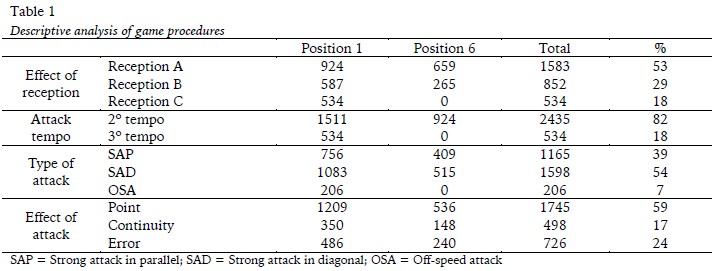
<body><![CDATA[<p><font size="3" face="Verdana"><b>RESULTS</b></font></p> <font face="Verdana" size="2">     <p>The descriptive results   of the game's procedures are shown in <a href="/img/revistas/mot/v14n1/14n1a07t1.jpg">Table 1</a>. The analysis of these results   shows that most of the attacks occurred after reception A and the second attack   tempo. In addition, the most recurrent type of attack was the strong diagonal attack, as well as the point of attack. </p>     
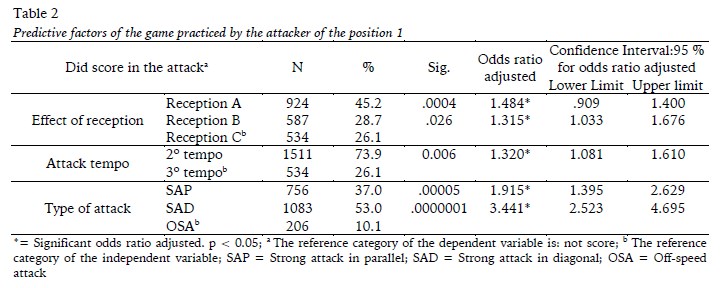
<p>The adjusted model of the   characterization of the game by the attacker of position 1 was statistically   significant (&#967;<sup>2</sup> = 87.14, p &lt;0.001) and the estimates   of the coefficients of the model, as well as the respective percentages of occurrence of the independent variables are found in the <a href="/img/revistas/mot/v14n1/14n1a07t2.jpg">Table 2</a>. </p>     
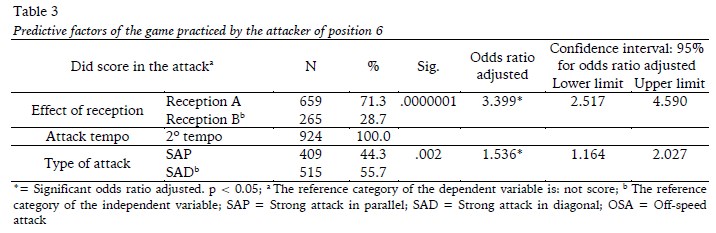
<p>The adjusted model of the   characterization of the game practiced by the attacker of position 6 was   statistically significant (&#967;<sup>2</sup> = 81.41, p &lt;0.001) and the estimates of the coefficients of the model, as   well as the respective percentages of occurrence of the independent variables are found in the <a href="/img/revistas/mot/v14n1/14n1a07t3.jpg">Table 3</a>.</p>     
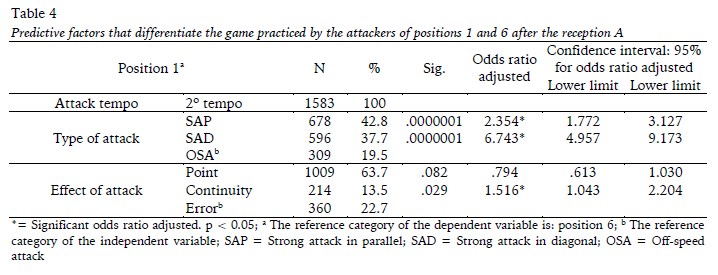
<p>The adjusted model that   distinguishes the game practiced by the attackers of positions 1 and 6 after   the reception A was statistically significant (&#967;<sup>2</sup> = 179.98, p &lt;0.001) and the coefficient estimates   of the model, as well as the respective percentages of occurrence of the variables are shown in <a href="/img/revistas/mot/v14n1/14n1a07t4.jpg">Table 4</a>.</p>     
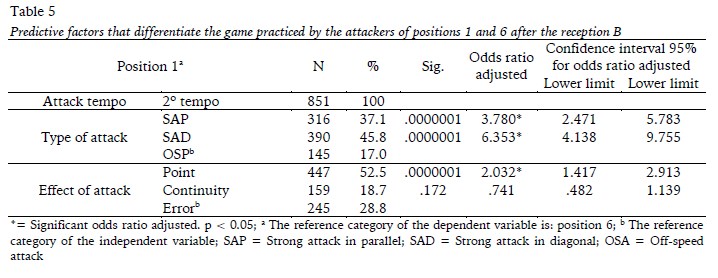
<p>The adjusted model that   distinguishes the game practiced by the attackers of positions 1 and 6 after   the reception B was statistically significant (&#967;<sup>2</sup> = 179.98, p &lt;0.001) and the coefficient estimates   of the model, as well as the respective percentages of occurrence of the variables Are shown in <a href="/img/revistas/mot/v14n1/14n1a07t5.jpg">Table 5</a>. </p>     
<p>&nbsp;</p> </font>     <p><font size="3" face="Verdana"><b>DISCUSSION</b></font></p> <font face="Verdana" size="2">     <p>The present study aimed to identify   the predictive factors of the attacks performed from positions 1 and 6,   according to the effect of reception in high level male Brazilian volleyball,   as well as to find the predictive factors that differentiate the game practiced   from these positions. The descriptive data showed that most of the attacks of   positions 1 and 6 occurred after the reception of high effect and the second   attack tempo. In addition, it was observed that the most used types of attacks   were the strong ones and the most recurrent effect of the attack was the point.   Although no articles were found in the literature that specifically analysed   the attacks performed from positions 1 and 6, it was observed that the results   found are in agreement with the literature, since high effect of receptions are   more recurrent and lead to the conquest of the point, while low effect of   receptions generate attack error (Costa et al., 2011) or continuity of the game   (Castro, Souza, &amp; Mesquita, 2011). Moreover, the strong attack is claimed   for the conquest of the point, evidencing the need to overlap with the opposing   defensive system (Castro et al., 2011; Costa, Afonso, Barbosa, Coutinho, &amp; Mesquita, 2014).</p>     <p>The analysis of the predictive   factors of the game practiced by the attacker from position 1 showed that this   attacker has more chance of scoring after an excellent (ORA =1.48) and moderate   reception effect (ORA =1.31), second attack tempo (ORA = 1.32), strong attack   in the parallel (ORA = 1.91) and diagonal (ORA = 3.44). The results corroborate   to the preceding findings, since the effect of the previous actions influence   the subsequent actions (Eom &amp; Schutz, 1992). In this perspective,   receptions with high effect allow the use of faster attack tempos (Asterios et   al., 2009), reduce the defensive organization (Costa et al., 2011) and,   consequently, predict the achievement of the point (Nikos &amp; Elissavet,   2011; Peña, Rodríguez-Guerra, &amp; Serra, 2013). In this context, Silva et al.   (2016b) have shown that the success in attack is related to the use of   attackers in positions 1 and 6, especially when the lifter is in positions 2, 3   and 4. In addition, it was noticed that the attacker of position 1 attacked at   the 2<sup>nd</sup> and 3<sup>rd</sup> tempo, allowing to infer that even in   receptions of moderate or low effect it was possible to perform the setting   with moderate speed, as the first attack tempo is associated to high effect   receptions, as it demand high precision from the setter (Afonso, Mesquita, &amp; Palao, 2005; Laios &amp; Moustakidis, 2011).</p>     ]]></body>
<body><![CDATA[<p>The analysis of the predictive   factors of the game practiced by the attacker of position 6 showed that this   attacker has more chance to score after the reception of high effect (ORA =   3.39) and the strong attack in the parallel (ORA =1.53). These results showed   that the game performed at the position 6 was effective under optimal   conditions of distribution, which can be attributed to attack combinations that   rely on high effect reception to increase the uncertainty of the opposing team,   as well as to increase the chances of success in attacking. Thus, according to   Silva et al. (2016b), an effective attack combination involving position 6 is   the pipe ball, where the attacker of position 6 performs the attack practically   in the same space as the attacker of position 3, however in different attack   tempo. Nevertheless, for this type of offensive to be effective, high effect   reception is required (Silva et al., 2013), since there is a dependence of the   attacker of position 3 and this shows association with high effect receptions and 1<sup>st</sup> attack tempo (Costa et al., 2016b).</p>     <p>The analysis of the predictive   factors of the difference of the game practiced by the attackers of positions 1   and 6 after the receptions of high effect, showed that the strong attacks of   position 1 are more likely to occur in the parallel and diagonal (ORA =2.35 and   6.74, respectively), as well as the occurrence of continuity (ORA =1.51). Thus,   according to the results found, it is possible to infer that in high-effect   receptions there is an underutilization of the back-row attacks, mainly from   the attacks of position 6, as pointed out by Costa et al. (2016a), making   possible the defensive system to anticipate the settings made for position 1,   giving greater continuity of the game. On the other hand, the less attacks from   position 6 occurs, more unpredictable they become being mostly used in a move   combined with the middle-hitter, the pipe, as pointed out by Silva et al. (2016), leading the conquest of the point of attack.</p>     <p>The analysis of the predictive   factors of the difference of the game practiced by the attackers of the   positions 1 and 6 after the receptions of moderate effect showed that the   strong attacks of the position 1 are more likely to occur in the parallel and   diagonal (ORA =3.78 and 6.35, respectively), leading to the point of attack   (ORA =2.03). In this context, it is noticed that when the effect of the   reception does not allow the use of all the attackers, being that this type of   reception usually does not allow the attack of the middle-hitter, the attacker   of the position 1 is effective in the conquest of the point by strong attacks.   In this bias, Afonso et al. (2012) point out that in high-level men's   volleyball, the opposite hitter, responsible for the attacks in positions 1 and   2, is increasingly requested in the actions of attack, a factor that can be   justified by the effectiveness obtained in the offensive actions by this   attacker. Besides, with the knowledge that the middle-hitter has limitations to   incorporate the offensive system upon receiving moderate effect, the opposite   hitter becomes an effective option for the attack. Another relevant factor in   this context is the high request of the attacker of position 4 (Silva et al.,   2013, 2014a, 2016b) promoting a tendency of anticipation of the block for this   attacker, letting the attacks made by the opposite hitter to occur against a defensive system less structured when compared to the attacks of position 4.</p>     <p>As limitation, we would like to   highlight the fact that this study analysed the attack of professionals’ male   Brazilian volleyball players and perhaps the results and discussion achieved   may not be extrapolated for other levels of volleyball players or to female   players. Besides, technical/tactical quality of the attackers, the quality of   the opponent and the difference between the teams are factors that may   influence the decision of the attack movement, however these factor were not   evaluated in the present study. Moreover, we recommend future investigations   aiming to compare the present results to other from national tournament and national selections.   </p> </font>     <p>&nbsp;</p>     <p><font size="3" face="Verdana"><b>CONCLUSION</b></font></p> <font face="Verdana" size="2">     <p>Based on data found it can be   concluded that, although most of the attacks of positions 1 and 6 occurred   after the reception of high effect, the reception of excellent and moderate   effect showed predictive power in the achievement of the point by the attacker   of position 1, suggesting that after the receptions that do or do not allow the   organized attack with all the options, it becomes important to use the back-row   attackers to increase the uncertainty on the opposing team and the chances to score.   It is still possible to infer that even in high effect receptions there is an underutilization of back-row attackers, mainly from position 6.</p>     <p>&nbsp;</p> </font><font size="3" face="Verdana"><b>REFERENCES</b></font><font face="Verdana" size="2">      <!-- ref --><p>Afonso, J., Esteves, F., Araújo, R., Thomas, L.,   &amp; Mesquita, I. (2012). Tactical determinants of setting zone in elite men's   volleyball. <i>Journal of Sports Science &amp; Medicine</i>, <i>11</i>(1), 64-70.    &nbsp;&nbsp;&nbsp;&nbsp;&nbsp;&nbsp;&nbsp;&nbsp;[&#160;<a href="javascript:void(0);" onclick="javascript: window.open('/scielo.php?script=sci_nlinks&ref=374267&pid=S1646-107X201800010000700001&lng=','','width=640,height=500,resizable=yes,scrollbars=1,menubar=yes,');">Links</a>&#160;]<!-- end-ref --></p>     ]]></body>
<body><![CDATA[<!-- ref --><p>Afonso,   J., Mesquita, I., Marcelino, J., &amp; Silva, J. (2010). Analysis of the setter’s tactical action in high-performance women’s volleyball. <i>Kinesiology</i>, <i>42</i>(1), 82-89.    &nbsp;&nbsp;&nbsp;&nbsp;&nbsp;&nbsp;&nbsp;&nbsp;[&#160;<a href="javascript:void(0);" onclick="javascript: window.open('/scielo.php?script=sci_nlinks&ref=374269&pid=S1646-107X201800010000700002&lng=','','width=640,height=500,resizable=yes,scrollbars=1,menubar=yes,');">Links</a>&#160;]<!-- end-ref --> </p>     <!-- ref --><p>Afonso,   J., Mesquita, I., &amp; Palao, J. M. (2005). Relationship between the use of   commit-block and the numbers of blockers and block effectiveness. <i>International Journal of Performance Analysis in Sport</i>, <i>5</i>(2), 36-45.    &nbsp;&nbsp;&nbsp;&nbsp;&nbsp;&nbsp;&nbsp;&nbsp;[&#160;<a href="javascript:void(0);" onclick="javascript: window.open('/scielo.php?script=sci_nlinks&ref=374271&pid=S1646-107X201800010000700003&lng=','','width=640,height=500,resizable=yes,scrollbars=1,menubar=yes,');">Links</a>&#160;]<!-- end-ref --></p>     <!-- ref --><p>Asterios,   P., Kostantinos, C., Athanasios, M., &amp; Dimitrios, K. (2009). Comparison of   technical skills effectiveness of men's National Volleyball teams. <i>International Journal of Performance Analysis in Sport</i>, <i>9</i>(1), 1-7.    &nbsp;&nbsp;&nbsp;&nbsp;&nbsp;&nbsp;&nbsp;&nbsp;[&#160;<a href="javascript:void(0);" onclick="javascript: window.open('/scielo.php?script=sci_nlinks&ref=374273&pid=S1646-107X201800010000700004&lng=','','width=640,height=500,resizable=yes,scrollbars=1,menubar=yes,');">Links</a>&#160;]<!-- end-ref --></p>     <!-- ref --><p>Castro, J., Souza, A., &amp; Mesquita, I. (2011). Attack efficacy in volleyball: elite male teams. <i>Perceptual and Motor Skills</i>, <i>113</i>(2), 395-408. doi: 10.2466/05.25.PMS.113.5.395-408.    &nbsp;&nbsp;&nbsp;&nbsp;&nbsp;&nbsp;&nbsp;&nbsp;[&#160;<a href="javascript:void(0);" onclick="javascript: window.open('/scielo.php?script=sci_nlinks&ref=374275&pid=S1646-107X201800010000700005&lng=','','width=640,height=500,resizable=yes,scrollbars=1,menubar=yes,');">Links</a>&#160;]<!-- end-ref --> </p>     <!-- ref --><p>Costa,   G. C. T., Ferreira, N., Junqueira, G., Afonso, J., &amp; Mesquita, I. (2011). Determinants of   attack tactics in youth male elite volleyball. <i>International Journal of Performance     Analysis in Sport</i>, <i>11</i>(1), 96-104.    &nbsp;&nbsp;&nbsp;&nbsp;&nbsp;&nbsp;&nbsp;&nbsp;[&#160;<a href="javascript:void(0);" onclick="javascript: window.open('/scielo.php?script=sci_nlinks&ref=374277&pid=S1646-107X201800010000700006&lng=','','width=640,height=500,resizable=yes,scrollbars=1,menubar=yes,');">Links</a>&#160;]<!-- end-ref --></p>     ]]></body>
<body><![CDATA[<!-- ref --><p>Costa,   G. C. T., Afonso, J., Barbosa, R. V., Coutinho, P., &amp; Mesquita, I. (2014). Predictors of attack efficacy and attack type in high-level Brazilian women’s volleyball. <i>Kinesiology</i>, <i>46</i>(2), 242-248.    &nbsp;&nbsp;&nbsp;&nbsp;&nbsp;&nbsp;&nbsp;&nbsp;[&#160;<a href="javascript:void(0);" onclick="javascript: window.open('/scielo.php?script=sci_nlinks&ref=374279&pid=S1646-107X201800010000700007&lng=','','width=640,height=500,resizable=yes,scrollbars=1,menubar=yes,');">Links</a>&#160;]<!-- end-ref --> </p>     <!-- ref --><p>Costa,   G. C. T., Barbosa, R. V., Freire A. B., Matias, C. J. A. S., &amp; Greco, P. J.   (2014). Analysis of the structures of side-out with the outcome set in women's volleyball. <i>Motricidade, 10</i>(3), 40-49. doi: 10.6063/motricidade.10(3).2899.    &nbsp;&nbsp;&nbsp;&nbsp;&nbsp;&nbsp;&nbsp;&nbsp;[&#160;<a href="javascript:void(0);" onclick="javascript: window.open('/scielo.php?script=sci_nlinks&ref=374281&pid=S1646-107X201800010000700008&lng=','','width=640,height=500,resizable=yes,scrollbars=1,menubar=yes,');">Links</a>&#160;]<!-- end-ref --></p>     <p>Costa,   G. C. T., Ceccato, J. S., Oliveira, A. S., Evangelista, B. F. B., Castro, H.   O., &amp; Ugrinowitsch, H. (2016b). Men’s high level volleyball: association between   game actions on the side-out. <i>Journal of     Physical Education</i>, <i>27</i>(1), 1-15. doi: 10.4025/jphyseduc.v27i1.2152.</p>     <p>Costa,   G. C. T., Maia, M. P., Campos, M. H., &amp; Ugrinowitsch, H. (2016a). Offensive   structuring in men’s high-level volleyball: analysis of the attack zone. <i>Brazilian Journal of Kinanthropometry and Human Performance</i>, <i>18</i>(5), 616-619. doi: 10.5007/1980-0037.2016v18n5p611.</p>     <!-- ref --><p>Drikos,   S., &amp; Vagenas, G. (2011). Multivariate assessment of selected performance   indicators in relation to the type and result of a typical set in men's elite   volleyball. <i>International Journal of Performance Analysis in Sport</i>, <i>11</i>(1), 85-95.    &nbsp;&nbsp;&nbsp;&nbsp;&nbsp;&nbsp;&nbsp;&nbsp;[&#160;<a href="javascript:void(0);" onclick="javascript: window.open('/scielo.php?script=sci_nlinks&ref=374285&pid=S1646-107X201800010000700011&lng=','','width=640,height=500,resizable=yes,scrollbars=1,menubar=yes,');">Links</a>&#160;]<!-- end-ref --></p>     <!-- ref --><p>Eom,   H. J., &amp; Schutz, R. W. (1992). Transition play in team performance of   volleyball: A log linear analysis. <i>Research Quarterly Exercise Sport, 63</i>(3), 261-269. doi: 10.1080/02701367.1992.10608741&nbsp;&nbsp;&nbsp;&nbsp;&nbsp;&nbsp;&nbsp;&nbsp;[&#160;<a href="javascript:void(0);" onclick="javascript: window.open('/scielo.php?script=sci_nlinks&ref=374287&pid=S1646-107X201800010000700012&lng=','','width=640,height=500,resizable=yes,scrollbars=1,menubar=yes,');">Links</a>&#160;]<!-- end-ref --><!-- ref --><p>Fleiss,   J. L., Levin, B., &amp; Paik, M. C. (2003). <i>Statistical methods for rates and proportions. </i>Wiley-Interscience.    &nbsp;&nbsp;&nbsp;&nbsp;&nbsp;&nbsp;&nbsp;&nbsp;[&#160;<a href="javascript:void(0);" onclick="javascript: window.open('/scielo.php?script=sci_nlinks&ref=374288&pid=S1646-107X201800010000700013&lng=','','width=640,height=500,resizable=yes,scrollbars=1,menubar=yes,');">Links</a>&#160;]<!-- end-ref --></p>     <!-- ref --><p>Fernandez-Navarro, J., Fradua,   L., Zubillaga, A., Ford, P., &amp; McRobert, A. (2016): Attacking and defensive   styles of play in soccer: analysis of Spanish and English elite teams. <i>Journal of Sports Sciences</i>, <i>34</i>(24), 2195-2204. doi: 10.1080/02640414.2016.1169309.    &nbsp;&nbsp;&nbsp;&nbsp;&nbsp;&nbsp;&nbsp;&nbsp;[&#160;<a href="javascript:void(0);" onclick="javascript: window.open('/scielo.php?script=sci_nlinks&ref=374290&pid=S1646-107X201800010000700014&lng=','','width=640,height=500,resizable=yes,scrollbars=1,menubar=yes,');">Links</a>&#160;]<!-- end-ref --></p>     <!-- ref --><p>Gómez, M., Silva, R., Lorenzo,   A., Kreivyte, R., &amp; Sampaio, J. (2016). Exploring the effects of   substituting basketball players in high-level teams. <i>Journal of Sports Sciences,</i> <i>35</i>(3), 247-254. doi: 10.1080/02640414.2016.1161217.    &nbsp;&nbsp;&nbsp;&nbsp;&nbsp;&nbsp;&nbsp;&nbsp;[&#160;<a href="javascript:void(0);" onclick="javascript: window.open('/scielo.php?script=sci_nlinks&ref=374292&pid=S1646-107X201800010000700015&lng=','','width=640,height=500,resizable=yes,scrollbars=1,menubar=yes,');">Links</a>&#160;]<!-- end-ref --></p>     <!-- ref --><p>João, P. V., &amp; Pires, P. M.   (2015). Effectiveness of Side-Out in the male senior volleyball according intervention player. <i>Motricidade</i>, <i>11</i>(4), 142-150. doi: 10.6063/motricidade.6302.    &nbsp;&nbsp;&nbsp;&nbsp;&nbsp;&nbsp;&nbsp;&nbsp;[&#160;<a href="javascript:void(0);" onclick="javascript: window.open('/scielo.php?script=sci_nlinks&ref=374294&pid=S1646-107X201800010000700016&lng=','','width=640,height=500,resizable=yes,scrollbars=1,menubar=yes,');">Links</a>&#160;]<!-- end-ref --></p>     <!-- ref --><p>Laios, A., &amp; Moustakidis A.   (2011). The setting pass and performance indices in Volleyball.<i> International Journal of Performance Analysis in Sport</i>,<i> 11</i>(1), 34-39.    &nbsp;&nbsp;&nbsp;&nbsp;&nbsp;&nbsp;&nbsp;&nbsp;[&#160;<a href="javascript:void(0);" onclick="javascript: window.open('/scielo.php?script=sci_nlinks&ref=374296&pid=S1646-107X201800010000700017&lng=','','width=640,height=500,resizable=yes,scrollbars=1,menubar=yes,');">Links</a>&#160;]<!-- end-ref --> </p>     <p>Maia, N., &amp; Mesquita I.   (2006). Estudo   das zonas e eficácia da recepção em função do jogador recebedor no voleibol   sênior feminino. [Studying of zones and reception efficiency in function of the senior   female volleyball digger]. <i>Revista Brasileira     de Educação Física e Esporte</i>, <i>20</i>(4), 257-270. doi: 10.1590/S1807-55092006000400004.</p>     ]]></body>
<body><![CDATA[<!-- ref --><p>Marelic,   N., Zufar, G., &amp; Omrcen, D. (1998). Influence   of some situation-related parameters on the score in volleyball. <i>Kinesiology</i>, <i>30</i>(2), 55-65.    &nbsp;&nbsp;&nbsp;&nbsp;&nbsp;&nbsp;&nbsp;&nbsp;[&#160;<a href="javascript:void(0);" onclick="javascript: window.open('/scielo.php?script=sci_nlinks&ref=374299&pid=S1646-107X201800010000700019&lng=','','width=640,height=500,resizable=yes,scrollbars=1,menubar=yes,');">Links</a>&#160;]<!-- end-ref --></p>     <!-- ref --><p>Marcelino,   R., Mesquita, I., &amp; Sampaio, J. (2011). Effects of effect of opposition and match status on technical and tactical performances in elite volleyball. <i>Journal of Sports Science</i>,<i> 29</i>(7), 733-741. doi: 10.1080/02640414.2011.552516.    &nbsp;&nbsp;&nbsp;&nbsp;&nbsp;&nbsp;&nbsp;&nbsp;[&#160;<a href="javascript:void(0);" onclick="javascript: window.open('/scielo.php?script=sci_nlinks&ref=374301&pid=S1646-107X201800010000700020&lng=','','width=640,height=500,resizable=yes,scrollbars=1,menubar=yes,');">Links</a>&#160;]<!-- end-ref --></p>     <!-- ref --><p>Mesquita, I., Palao, J.,   Marcelino, R., &amp; Afonso, J. (2013). Performance analysis in indoor   volleyball and beach volleyball. In T. McGarry, P. O’Donoghue, &amp; A. Sampaio   (Eds.), <i>Routledge Handbook of Sports Performance Analysis</i> (pp. 436–463). Oxon: Routledge, Taylor &amp; Francis Group.    &nbsp;&nbsp;&nbsp;&nbsp;&nbsp;&nbsp;&nbsp;&nbsp;[&#160;<a href="javascript:void(0);" onclick="javascript: window.open('/scielo.php?script=sci_nlinks&ref=374303&pid=S1646-107X201800010000700021&lng=','','width=640,height=500,resizable=yes,scrollbars=1,menubar=yes,');">Links</a>&#160;]<!-- end-ref --></p>     <!-- ref --><p>Millán-Sanchez,   A., Rábago, J. C. M., Hernández, M. A., Marzo, P. F., &amp; Ureña, A. (2015).   Participation in terminal actions according to the role of the player and his   location on the court in top-level men’s volleyball. <i>International Journal of Performance     Analysis in Sport</i>, 15(2), 608-19.    &nbsp;&nbsp;&nbsp;&nbsp;&nbsp;&nbsp;&nbsp;&nbsp;[&#160;<a href="javascript:void(0);" onclick="javascript: window.open('/scielo.php?script=sci_nlinks&ref=374305&pid=S1646-107X201800010000700022&lng=','','width=640,height=500,resizable=yes,scrollbars=1,menubar=yes,');">Links</a>&#160;]<!-- end-ref --></p>     <!-- ref --><p>Nikos,   B., &amp; Elissavet, N. M. (2011). Setter's performance and attack tempo as   determinants of attack efficacy in Olympic-level male volleyball teams. <i>International Journal of Performance Analysis in Sport, 11</i>(3), 535-544.    &nbsp;&nbsp;&nbsp;&nbsp;&nbsp;&nbsp;&nbsp;&nbsp;[&#160;<a href="javascript:void(0);" onclick="javascript: window.open('/scielo.php?script=sci_nlinks&ref=374307&pid=S1646-107X201800010000700023&lng=','','width=640,height=500,resizable=yes,scrollbars=1,menubar=yes,');">Links</a>&#160;]<!-- end-ref --></p>     ]]></body>
<body><![CDATA[<!-- ref --><p>Palao,   J. M., Santos, J. A., &amp; Ureña, A. (2007). Effect of the manner of spike execution on spike performance in volleyball. <i>International Journal of Performance Analysis in Sport</i>,<i> 7</i>(2), 126-38.    &nbsp;&nbsp;&nbsp;&nbsp;&nbsp;&nbsp;&nbsp;&nbsp;[&#160;<a href="javascript:void(0);" onclick="javascript: window.open('/scielo.php?script=sci_nlinks&ref=374309&pid=S1646-107X201800010000700024&lng=','','width=640,height=500,resizable=yes,scrollbars=1,menubar=yes,');">Links</a>&#160;]<!-- end-ref --> &nbsp;</p>     <!-- ref --><p>Peña,   J., Rodríguez-Guerra, J., &amp; Serra, N. (2013). Which skills and factors   better predict winning and losing in high-level men’s volleyball? <i>Journal of Strength and Conditioning Research</i>, 27(9), 2487-2493. doi: 10.1519/JSC.0b013e31827f4dbe.    &nbsp;&nbsp;&nbsp;&nbsp;&nbsp;&nbsp;&nbsp;&nbsp;[&#160;<a href="javascript:void(0);" onclick="javascript: window.open('/scielo.php?script=sci_nlinks&ref=374311&pid=S1646-107X201800010000700025&lng=','','width=640,height=500,resizable=yes,scrollbars=1,menubar=yes,');">Links</a>&#160;]<!-- end-ref --></p>     <!-- ref --><p>Rocha,   C. M., &amp; Barbanti, V. J. (2006). An analysis of the confrontations in the first sequence of game actions in Brazilian volleyball. <i>Journal of Human Movement Studies, 50</i>(4), 259-272.    &nbsp;&nbsp;&nbsp;&nbsp;&nbsp;&nbsp;&nbsp;&nbsp;[&#160;<a href="javascript:void(0);" onclick="javascript: window.open('/scielo.php?script=sci_nlinks&ref=374313&pid=S1646-107X201800010000700026&lng=','','width=640,height=500,resizable=yes,scrollbars=1,menubar=yes,');">Links</a>&#160;]<!-- end-ref --> </p>     <p>Silva,   M., Lacerda, D., &amp; João, P. V. (2014a). Game-Related volleyball skills   that influence victory. <i>Journal of Human Kinects</i>, <i>41</i>(1), 173-179. doi: 10.2478/hukin-2014-0045.</p>     <p>Silva,   M., Marcelino, R., Lacerda, D., &amp; João, P. V. (2016a). Match analysis in   volleyball: a systematic review. <i>Montenegrin     Journal of Sports Science Medicine</i>, <i>5</i>(1), 35-46.</p>     <p>Silva,   M. Sattler, T., Lacerda, D., &amp; João, P. V. (2016b). Match analysis   according to the performance of team rotations in volleyball. <i>International Journal of Performance Analysis in Sport, 16</i>(3), 1076-1086.</p>     <!-- ref --><p>Silva,   M., Lacerda, D., &amp; João, P. V. (2013). Match analysis of discrimination   skills according to the setter attack zone position in high level volleyball. <i>International Journal of Performance Analysis in Sport, 13</i>(2), 452-460.    &nbsp;&nbsp;&nbsp;&nbsp;&nbsp;&nbsp;&nbsp;&nbsp;[&#160;<a href="javascript:void(0);" onclick="javascript: window.open('/scielo.php?script=sci_nlinks&ref=374318&pid=S1646-107X201800010000700030&lng=','','width=640,height=500,resizable=yes,scrollbars=1,menubar=yes,');">Links</a>&#160;]<!-- end-ref --> </p>     <p>Silva,   M., Lacerda, D., &amp; João, P. V. (2014a). Match analysis of discrimination   skills according to the setter defence zone position in high level volleyball. <i>International Journal of Performance     Analysis in Sport</i>,<i> 14</i>(2), 463-472.</p>     <!-- ref --><p>Tabachnick, B., &amp; Fidell,   L. (2013). <i>Using multivariate statistics</i> (6th. Ed.). Boston: Allyn &amp; Bacon.    &nbsp;&nbsp;&nbsp;&nbsp;&nbsp;&nbsp;&nbsp;&nbsp;[&#160;<a href="javascript:void(0);" onclick="javascript: window.open('/scielo.php?script=sci_nlinks&ref=374321&pid=S1646-107X201800010000700032&lng=','','width=640,height=500,resizable=yes,scrollbars=1,menubar=yes,');">Links</a>&#160;]<!-- end-ref --></p>     <!-- ref --><p>Zetou,   E., Tsigilis, N., Moustakidis, A., &amp; Komninakidou, A. (2007). Does effectiveness   of skill in complex I predict win in men`s Olympic volleyball games? <i>Journal of Quantitative Analysis in Sports, 3</i>(4), 1-11. doi: 10.2202/1559-0410.1076.    &nbsp;&nbsp;&nbsp;&nbsp;&nbsp;&nbsp;&nbsp;&nbsp;[&#160;<a href="javascript:void(0);" onclick="javascript: window.open('/scielo.php?script=sci_nlinks&ref=374323&pid=S1646-107X201800010000700033&lng=','','width=640,height=500,resizable=yes,scrollbars=1,menubar=yes,');">Links</a>&#160;]<!-- end-ref --></p> </font>     <p>&nbsp;</p>     <p><font size="2" face="Verdana"><b>Acknowledgments:</b>    <br>   Nothing to declare<b>    <br>   Conflict   of interests:</b>    ]]></body>
<body><![CDATA[<br>   Nothing to declare.<b>    <br>   Funding:</b></font>    <br>   <font size="2" face="Verdana">Nothing to declare.</font></p>      <p><font size="2" face="Verdana">Manuscript received at June  23rd 2017; Accepted at September 28th 2017 </font></p>     <p>&nbsp;</p>     <p>&nbsp;</p>     <p><font size="2" face="Verdana"><i><a name="end"></a></i><a href="#top">Correspondence to:</a> Av. Esperan&ccedil;a, s/n - Ch&aacute;caras de Recreio  Samambaia, Goi&acirc;nia - GO, 74690-900, Brasil <i>E-mail</i>: <a href="mailto:conti02@hotmail.com">conti02@hotmail.com</a> </font></p>      ]]></body><back>
<ref-list>
<ref id="B1">
<nlm-citation citation-type="journal">
<person-group person-group-type="author">
<name>
<surname><![CDATA[Afonso]]></surname>
<given-names><![CDATA[J.]]></given-names>
</name>
<name>
<surname><![CDATA[Esteves]]></surname>
<given-names><![CDATA[F.]]></given-names>
</name>
<name>
<surname><![CDATA[Araújo]]></surname>
<given-names><![CDATA[R.]]></given-names>
</name>
<name>
<surname><![CDATA[Thomas]]></surname>
<given-names><![CDATA[L.]]></given-names>
</name>
<name>
<surname><![CDATA[Mesquita]]></surname>
<given-names><![CDATA[I.]]></given-names>
</name>
</person-group>
<article-title xml:lang="en"><![CDATA[Tactical determinants of setting zone in elite men's volleyball]]></article-title>
<source><![CDATA[Journal of Sports Science & Medicine]]></source>
<year>2012</year>
<volume>11</volume>
<numero>1</numero>
<issue>1</issue>
<page-range>64-70</page-range></nlm-citation>
</ref>
<ref id="B2">
<nlm-citation citation-type="journal">
<person-group person-group-type="author">
<name>
<surname><![CDATA[Afonso]]></surname>
<given-names><![CDATA[J.]]></given-names>
</name>
<name>
<surname><![CDATA[Mesquita]]></surname>
<given-names><![CDATA[I.]]></given-names>
</name>
<name>
<surname><![CDATA[Marcelino]]></surname>
<given-names><![CDATA[J.]]></given-names>
</name>
<name>
<surname><![CDATA[Silva]]></surname>
<given-names><![CDATA[J.]]></given-names>
</name>
</person-group>
<article-title xml:lang="en"><![CDATA[Analysis of the setter’s tactical action in high-performance women’s volleyball]]></article-title>
<source><![CDATA[Kinesiology]]></source>
<year>2010</year>
<volume>42</volume>
<numero>1</numero>
<issue>1</issue>
<page-range>82-89</page-range></nlm-citation>
</ref>
<ref id="B3">
<nlm-citation citation-type="journal">
<person-group person-group-type="author">
<name>
<surname><![CDATA[Afonso]]></surname>
<given-names><![CDATA[J.]]></given-names>
</name>
<name>
<surname><![CDATA[Mesquita]]></surname>
<given-names><![CDATA[I.]]></given-names>
</name>
<name>
<surname><![CDATA[Palao]]></surname>
<given-names><![CDATA[J. M.]]></given-names>
</name>
</person-group>
<article-title xml:lang="en"><![CDATA[Relationship between the use of commit-block and the numbers of blockers and block effectiveness]]></article-title>
<source><![CDATA[International Journal of Performance Analysis in Sport]]></source>
<year>2005</year>
<volume>5</volume>
<numero>2</numero>
<issue>2</issue>
<page-range>36-45</page-range></nlm-citation>
</ref>
<ref id="B4">
<nlm-citation citation-type="journal">
<person-group person-group-type="author">
<name>
<surname><![CDATA[Asterios]]></surname>
<given-names><![CDATA[P.]]></given-names>
</name>
<name>
<surname><![CDATA[Kostantinos]]></surname>
<given-names><![CDATA[C.]]></given-names>
</name>
<name>
<surname><![CDATA[Athanasios]]></surname>
<given-names><![CDATA[M.]]></given-names>
</name>
<name>
<surname><![CDATA[Dimitrios]]></surname>
<given-names><![CDATA[K.]]></given-names>
</name>
</person-group>
<article-title xml:lang="en"><![CDATA[Comparison of technical skills effectiveness of men's National Volleyball teams]]></article-title>
<source><![CDATA[International Journal of Performance Analysis in Sport]]></source>
<year>2009</year>
<volume>9</volume>
<numero>1</numero>
<issue>1</issue>
<page-range>1-7</page-range></nlm-citation>
</ref>
<ref id="B5">
<nlm-citation citation-type="journal">
<person-group person-group-type="author">
<name>
<surname><![CDATA[Castro]]></surname>
<given-names><![CDATA[J.]]></given-names>
</name>
<name>
<surname><![CDATA[Souza]]></surname>
<given-names><![CDATA[A.]]></given-names>
</name>
<name>
<surname><![CDATA[Mesquita]]></surname>
<given-names><![CDATA[I.]]></given-names>
</name>
</person-group>
<article-title xml:lang="en"><![CDATA[Attack efficacy in volleyball: elite male teams]]></article-title>
<source><![CDATA[Perceptual and Motor Skills]]></source>
<year>2011</year>
<volume>113</volume>
<numero>2</numero>
<issue>2</issue>
<page-range>395-408</page-range></nlm-citation>
</ref>
<ref id="B6">
<nlm-citation citation-type="journal">
<person-group person-group-type="author">
<name>
<surname><![CDATA[Costa]]></surname>
<given-names><![CDATA[G. C. T.]]></given-names>
</name>
<name>
<surname><![CDATA[Ferreira]]></surname>
<given-names><![CDATA[N.]]></given-names>
</name>
<name>
<surname><![CDATA[Junqueira]]></surname>
<given-names><![CDATA[G.]]></given-names>
</name>
<name>
<surname><![CDATA[Afonso]]></surname>
<given-names><![CDATA[J.]]></given-names>
</name>
<name>
<surname><![CDATA[Mesquita]]></surname>
<given-names><![CDATA[I.]]></given-names>
</name>
</person-group>
<article-title xml:lang="en"><![CDATA[Determinants of attack tactics in youth male elite volleyball]]></article-title>
<source><![CDATA[International Journal of Performance Analysis in Sport]]></source>
<year>2011</year>
<volume>11</volume>
<numero>1</numero>
<issue>1</issue>
<page-range>96-104</page-range></nlm-citation>
</ref>
<ref id="B7">
<nlm-citation citation-type="journal">
<person-group person-group-type="author">
<name>
<surname><![CDATA[Costa]]></surname>
<given-names><![CDATA[G. C. T.]]></given-names>
</name>
<name>
<surname><![CDATA[Afonso]]></surname>
<given-names><![CDATA[J.]]></given-names>
</name>
<name>
<surname><![CDATA[Barbosa]]></surname>
<given-names><![CDATA[R. V.]]></given-names>
</name>
<name>
<surname><![CDATA[Coutinho]]></surname>
<given-names><![CDATA[P.]]></given-names>
</name>
<name>
<surname><![CDATA[Mesquita]]></surname>
<given-names><![CDATA[I.]]></given-names>
</name>
</person-group>
<article-title xml:lang="en"><![CDATA[Predictors of attack efficacy and attack type in high-level Brazilian women’s volleyball]]></article-title>
<source><![CDATA[Kinesiology]]></source>
<year>2014</year>
<volume>46</volume>
<numero>2</numero>
<issue>2</issue>
<page-range>242-248</page-range></nlm-citation>
</ref>
<ref id="B8">
<nlm-citation citation-type="journal">
<person-group person-group-type="author">
<name>
<surname><![CDATA[Costa]]></surname>
<given-names><![CDATA[G. C. T.]]></given-names>
</name>
<name>
<surname><![CDATA[Barbosa]]></surname>
<given-names><![CDATA[R. V.]]></given-names>
</name>
<name>
<surname><![CDATA[Freire]]></surname>
<given-names><![CDATA[A. B.]]></given-names>
</name>
<name>
<surname><![CDATA[Matias]]></surname>
<given-names><![CDATA[C. J. A. S.]]></given-names>
</name>
<name>
<surname><![CDATA[Greco]]></surname>
<given-names><![CDATA[P. J.]]></given-names>
</name>
</person-group>
<article-title xml:lang="en"><![CDATA[Analysis of the structures of side-out with the outcome set in women's volleyball]]></article-title>
<source><![CDATA[Motricidade]]></source>
<year>2014</year>
<volume>10</volume>
<numero>3</numero>
<issue>3</issue>
<page-range>40-49</page-range></nlm-citation>
</ref>
<ref id="B9">
<nlm-citation citation-type="journal">
<person-group person-group-type="author">
<name>
<surname><![CDATA[Costa]]></surname>
<given-names><![CDATA[G. C. T.]]></given-names>
</name>
<name>
<surname><![CDATA[Ceccato]]></surname>
<given-names><![CDATA[J. S.]]></given-names>
</name>
<name>
<surname><![CDATA[Oliveira]]></surname>
<given-names><![CDATA[A. S.]]></given-names>
</name>
<name>
<surname><![CDATA[Evangelista]]></surname>
<given-names><![CDATA[B. F. B.]]></given-names>
</name>
<name>
<surname><![CDATA[Castro]]></surname>
<given-names><![CDATA[H. O.]]></given-names>
</name>
<name>
<surname><![CDATA[Ugrinowitsch]]></surname>
<given-names><![CDATA[H.]]></given-names>
</name>
</person-group>
<article-title xml:lang="en"><![CDATA[Men’s high level volleyball: association between game actions on the side-out]]></article-title>
<source><![CDATA[Journal of Physical Education]]></source>
<year>2016</year>
<volume>27</volume>
<numero>1</numero>
<issue>1</issue>
<page-range>1-15</page-range></nlm-citation>
</ref>
<ref id="B10">
<nlm-citation citation-type="journal">
<person-group person-group-type="author">
<name>
<surname><![CDATA[Costa]]></surname>
<given-names><![CDATA[G. C. T.]]></given-names>
</name>
<name>
<surname><![CDATA[Maia]]></surname>
<given-names><![CDATA[M. P.]]></given-names>
</name>
<name>
<surname><![CDATA[Campos]]></surname>
<given-names><![CDATA[M. H.]]></given-names>
</name>
<name>
<surname><![CDATA[Ugrinowitsch]]></surname>
<given-names><![CDATA[H.]]></given-names>
</name>
</person-group>
<article-title xml:lang="en"><![CDATA[Offensive structuring in men’s high-level volleyball: analysis of the attack zone]]></article-title>
<source><![CDATA[Brazilian Journal of Kinanthropometry and Human Performance]]></source>
<year>2016</year>
<volume>18</volume>
<numero>5</numero>
<issue>5</issue>
<page-range>616-619</page-range></nlm-citation>
</ref>
<ref id="B11">
<nlm-citation citation-type="journal">
<person-group person-group-type="author">
<name>
<surname><![CDATA[Drikos]]></surname>
<given-names><![CDATA[S.]]></given-names>
</name>
<name>
<surname><![CDATA[Vagenas]]></surname>
<given-names><![CDATA[G.]]></given-names>
</name>
</person-group>
<article-title xml:lang="en"><![CDATA[Multivariate assessment of selected performance indicators in relation to the type and result of a typical set in men's elite volleyball]]></article-title>
<source><![CDATA[International Journal of Performance Analysis in Sport]]></source>
<year>2011</year>
<volume>11</volume>
<numero>1</numero>
<issue>1</issue>
<page-range>85-95</page-range></nlm-citation>
</ref>
<ref id="B12">
<nlm-citation citation-type="journal">
<person-group person-group-type="author">
<name>
<surname><![CDATA[Eom]]></surname>
<given-names><![CDATA[H. J.]]></given-names>
</name>
<name>
<surname><![CDATA[Schutz]]></surname>
<given-names><![CDATA[R. W.]]></given-names>
</name>
</person-group>
<article-title xml:lang="en"><![CDATA[Transition play in team performance of volleyball: A log linear analysis]]></article-title>
<source><![CDATA[Research Quarterly Exercise Sport]]></source>
<year>1992</year>
<volume>63</volume>
<numero>3</numero>
<issue>3</issue>
<page-range>261-269</page-range></nlm-citation>
</ref>
<ref id="B13">
<nlm-citation citation-type="book">
<person-group person-group-type="author">
<name>
<surname><![CDATA[Fleiss]]></surname>
<given-names><![CDATA[J. L.]]></given-names>
</name>
<name>
<surname><![CDATA[Levin]]></surname>
<given-names><![CDATA[B.]]></given-names>
</name>
<name>
<surname><![CDATA[Paik]]></surname>
<given-names><![CDATA[M. C.]]></given-names>
</name>
</person-group>
<source><![CDATA[Statistical methods for rates and proportions]]></source>
<year>2003</year>
<publisher-name><![CDATA[Wiley-Interscience]]></publisher-name>
</nlm-citation>
</ref>
<ref id="B14">
<nlm-citation citation-type="journal">
<person-group person-group-type="author">
<name>
<surname><![CDATA[Fernandez-Navarro]]></surname>
<given-names><![CDATA[J.]]></given-names>
</name>
<name>
<surname><![CDATA[Fradua]]></surname>
<given-names><![CDATA[L.]]></given-names>
</name>
<name>
<surname><![CDATA[Zubillaga]]></surname>
<given-names><![CDATA[A.]]></given-names>
</name>
<name>
<surname><![CDATA[Ford]]></surname>
<given-names><![CDATA[P.]]></given-names>
</name>
<name>
<surname><![CDATA[McRobert]]></surname>
<given-names><![CDATA[A.]]></given-names>
</name>
</person-group>
<article-title xml:lang="en"><![CDATA[Attacking and defensive styles of play in soccer: analysis of Spanish and English elite teams]]></article-title>
<source><![CDATA[Journal of Sports Sciences]]></source>
<year>2016</year>
<volume>34</volume>
<numero>24</numero>
<issue>24</issue>
<page-range>2195-2204</page-range></nlm-citation>
</ref>
<ref id="B15">
<nlm-citation citation-type="journal">
<person-group person-group-type="author">
<name>
<surname><![CDATA[Gómez]]></surname>
<given-names><![CDATA[M.]]></given-names>
</name>
<name>
<surname><![CDATA[Silva]]></surname>
<given-names><![CDATA[R.]]></given-names>
</name>
<name>
<surname><![CDATA[Lorenzo]]></surname>
<given-names><![CDATA[A.]]></given-names>
</name>
<name>
<surname><![CDATA[Kreivyte]]></surname>
<given-names><![CDATA[R.]]></given-names>
</name>
<name>
<surname><![CDATA[Sampaio]]></surname>
<given-names><![CDATA[J.]]></given-names>
</name>
</person-group>
<article-title xml:lang="en"><![CDATA[Exploring the effects of substituting basketball players in high-level teams]]></article-title>
<source><![CDATA[Journal of Sports Sciences]]></source>
<year>2016</year>
<volume>35</volume>
<numero>3</numero>
<issue>3</issue>
<page-range>247-254</page-range></nlm-citation>
</ref>
<ref id="B16">
<nlm-citation citation-type="journal">
<person-group person-group-type="author">
<name>
<surname><![CDATA[João]]></surname>
<given-names><![CDATA[P. V.]]></given-names>
</name>
<name>
<surname><![CDATA[Pires]]></surname>
<given-names><![CDATA[P. M.]]></given-names>
</name>
</person-group>
<article-title xml:lang="en"><![CDATA[Effectiveness of Side-Out in the male senior volleyball according intervention player]]></article-title>
<source><![CDATA[Motricidade]]></source>
<year>2015</year>
<volume>11</volume>
<numero>4</numero>
<issue>4</issue>
<page-range>142-150</page-range></nlm-citation>
</ref>
<ref id="B17">
<nlm-citation citation-type="journal">
<person-group person-group-type="author">
<name>
<surname><![CDATA[Laios]]></surname>
<given-names><![CDATA[A.]]></given-names>
</name>
<name>
<surname><![CDATA[Moustakidis]]></surname>
<given-names><![CDATA[A.]]></given-names>
</name>
</person-group>
<article-title xml:lang="en"><![CDATA[The setting pass and performance indices in Volleyball]]></article-title>
<source><![CDATA[International Journal of Performance Analysis in Sport]]></source>
<year>2011</year>
<volume>11</volume>
<numero>1</numero>
<issue>1</issue>
<page-range>34-39</page-range></nlm-citation>
</ref>
<ref id="B18">
<nlm-citation citation-type="journal">
<person-group person-group-type="author">
<name>
<surname><![CDATA[Maia]]></surname>
<given-names><![CDATA[N.]]></given-names>
</name>
<name>
<surname><![CDATA[Mesquita]]></surname>
<given-names><![CDATA[I.]]></given-names>
</name>
</person-group>
<article-title xml:lang="pt"><![CDATA[Estudo das zonas e eficácia da recepção em função do jogador recebedor no voleibol sênior feminino]]></article-title>
<source><![CDATA[Revista Brasileira de Educação Física e Esporte]]></source>
<year>2006</year>
<volume>20</volume>
<numero>4</numero>
<issue>4</issue>
<page-range>257-270</page-range></nlm-citation>
</ref>
<ref id="B19">
<nlm-citation citation-type="journal">
<person-group person-group-type="author">
<name>
<surname><![CDATA[Marelic]]></surname>
<given-names><![CDATA[N.]]></given-names>
</name>
<name>
<surname><![CDATA[Zufar]]></surname>
<given-names><![CDATA[G.]]></given-names>
</name>
<name>
<surname><![CDATA[Omrcen]]></surname>
<given-names><![CDATA[D.]]></given-names>
</name>
</person-group>
<article-title xml:lang="en"><![CDATA[Influence of some situation-related parameters on the score in volleyball]]></article-title>
<source><![CDATA[Kinesiology]]></source>
<year>1998</year>
<volume>30</volume>
<numero>2</numero>
<issue>2</issue>
<page-range>55-65</page-range></nlm-citation>
</ref>
<ref id="B20">
<nlm-citation citation-type="journal">
<person-group person-group-type="author">
<name>
<surname><![CDATA[Marcelino]]></surname>
<given-names><![CDATA[R.]]></given-names>
</name>
<name>
<surname><![CDATA[Mesquita]]></surname>
<given-names><![CDATA[I.]]></given-names>
</name>
<name>
<surname><![CDATA[Sampaio]]></surname>
<given-names><![CDATA[J.]]></given-names>
</name>
</person-group>
<article-title xml:lang="en"><![CDATA[Effects of effect of opposition and match status on technical and tactical performances in elite volleyball]]></article-title>
<source><![CDATA[Journal of Sports Science]]></source>
<year>2011</year>
<volume>29</volume>
<numero>7</numero>
<issue>7</issue>
<page-range>733-741</page-range></nlm-citation>
</ref>
<ref id="B21">
<nlm-citation citation-type="book">
<person-group person-group-type="author">
<name>
<surname><![CDATA[Mesquita]]></surname>
<given-names><![CDATA[I.]]></given-names>
</name>
<name>
<surname><![CDATA[Palao]]></surname>
<given-names><![CDATA[J.]]></given-names>
</name>
<name>
<surname><![CDATA[Marcelino]]></surname>
<given-names><![CDATA[R.]]></given-names>
</name>
<name>
<surname><![CDATA[Afonso]]></surname>
<given-names><![CDATA[J.]]></given-names>
</name>
</person-group>
<article-title xml:lang="en"><![CDATA[Performance analysis in indoor volleyball and beach volleyball]]></article-title>
<person-group person-group-type="editor">
<name>
<surname><![CDATA[McGarry]]></surname>
<given-names><![CDATA[T.]]></given-names>
</name>
<name>
<surname><![CDATA[O’Donoghue]]></surname>
<given-names><![CDATA[P.]]></given-names>
</name>
<name>
<surname><![CDATA[Sampaio]]></surname>
<given-names><![CDATA[A.]]></given-names>
</name>
</person-group>
<source><![CDATA[Routledge Handbook of Sports Performance Analysis]]></source>
<year>2013</year>
<page-range>436-463</page-range><publisher-loc><![CDATA[Oxon ]]></publisher-loc>
<publisher-name><![CDATA[Routledge, Taylor & Francis Group]]></publisher-name>
</nlm-citation>
</ref>
<ref id="B22">
<nlm-citation citation-type="journal">
<person-group person-group-type="author">
<name>
<surname><![CDATA[Millán-Sanchez]]></surname>
<given-names><![CDATA[A.]]></given-names>
</name>
<name>
<surname><![CDATA[Rábago]]></surname>
<given-names><![CDATA[J. C. M.]]></given-names>
</name>
<name>
<surname><![CDATA[Hernández]]></surname>
<given-names><![CDATA[M. A.]]></given-names>
</name>
<name>
<surname><![CDATA[Marzo]]></surname>
<given-names><![CDATA[P. F.]]></given-names>
</name>
<name>
<surname><![CDATA[Ureña]]></surname>
<given-names><![CDATA[A.]]></given-names>
</name>
</person-group>
<article-title xml:lang="en"><![CDATA[Participation in terminal actions according to the role of the player and his location on the court in top-level men’s volleyball]]></article-title>
<source><![CDATA[International Journal of Performance Analysis in Sport]]></source>
<year>2015</year>
<volume>15</volume>
<numero>2</numero>
<issue>2</issue>
<page-range>608-19</page-range></nlm-citation>
</ref>
<ref id="B23">
<nlm-citation citation-type="journal">
<person-group person-group-type="author">
<name>
<surname><![CDATA[Nikos]]></surname>
<given-names><![CDATA[B.]]></given-names>
</name>
<name>
<surname><![CDATA[Elissavet]]></surname>
<given-names><![CDATA[N. M.]]></given-names>
</name>
</person-group>
<article-title xml:lang="en"><![CDATA[Setter's performance and attack tempo as determinants of attack efficacy in Olympic-level male volleyball teams]]></article-title>
<source><![CDATA[International Journal of Performance Analysis in Sport]]></source>
<year>2011</year>
<volume>11</volume>
<numero>3</numero>
<issue>3</issue>
<page-range>535-544</page-range></nlm-citation>
</ref>
<ref id="B24">
<nlm-citation citation-type="journal">
<person-group person-group-type="author">
<name>
<surname><![CDATA[Palao]]></surname>
<given-names><![CDATA[J. M.]]></given-names>
</name>
<name>
<surname><![CDATA[Santos]]></surname>
<given-names><![CDATA[J. A.]]></given-names>
</name>
<name>
<surname><![CDATA[Ureña]]></surname>
<given-names><![CDATA[A.]]></given-names>
</name>
</person-group>
<article-title xml:lang="en"><![CDATA[Effect of the manner of spike execution on spike performance in volleyball]]></article-title>
<source><![CDATA[International Journal of Performance Analysis in Sport]]></source>
<year>2007</year>
<volume>7</volume>
<numero>2</numero>
<issue>2</issue>
<page-range>126-38</page-range></nlm-citation>
</ref>
<ref id="B25">
<nlm-citation citation-type="journal">
<person-group person-group-type="author">
<name>
<surname><![CDATA[Peña]]></surname>
<given-names><![CDATA[J.]]></given-names>
</name>
<name>
<surname><![CDATA[Rodríguez-Guerra]]></surname>
<given-names><![CDATA[J.]]></given-names>
</name>
<name>
<surname><![CDATA[Serra]]></surname>
<given-names><![CDATA[N.]]></given-names>
</name>
</person-group>
<article-title xml:lang="en"><![CDATA[Which skills and factors better predict winning and losing in high-level men’s volleyball?]]></article-title>
<source><![CDATA[Journal of Strength and Conditioning Research]]></source>
<year>2013</year>
<volume>27</volume>
<numero>9</numero>
<issue>9</issue>
<page-range>2487-2493</page-range></nlm-citation>
</ref>
<ref id="B26">
<nlm-citation citation-type="journal">
<person-group person-group-type="author">
<name>
<surname><![CDATA[Rocha]]></surname>
<given-names><![CDATA[C. M.]]></given-names>
</name>
<name>
<surname><![CDATA[Barbanti]]></surname>
<given-names><![CDATA[V. J.]]></given-names>
</name>
</person-group>
<article-title xml:lang="en"><![CDATA[An analysis of the confrontations in the first sequence of game actions in Brazilian volleyball]]></article-title>
<source><![CDATA[Journal of Human Movement Studies]]></source>
<year>2006</year>
<volume>50</volume>
<numero>4</numero>
<issue>4</issue>
<page-range>259-272</page-range></nlm-citation>
</ref>
<ref id="B27">
<nlm-citation citation-type="journal">
<person-group person-group-type="author">
<name>
<surname><![CDATA[Silva]]></surname>
<given-names><![CDATA[M.]]></given-names>
</name>
<name>
<surname><![CDATA[Lacerda]]></surname>
<given-names><![CDATA[D.]]></given-names>
</name>
<name>
<surname><![CDATA[João]]></surname>
<given-names><![CDATA[P. V.]]></given-names>
</name>
</person-group>
<article-title xml:lang="en"><![CDATA[Game-Related volleyball skills that influence victory]]></article-title>
<source><![CDATA[Journal of Human Kinects]]></source>
<year>2014</year>
<volume>41</volume>
<numero>1</numero>
<issue>1</issue>
<page-range>173-179</page-range></nlm-citation>
</ref>
<ref id="B28">
<nlm-citation citation-type="journal">
<person-group person-group-type="author">
<name>
<surname><![CDATA[Silva]]></surname>
<given-names><![CDATA[M.]]></given-names>
</name>
<name>
<surname><![CDATA[Marcelino]]></surname>
<given-names><![CDATA[R.]]></given-names>
</name>
<name>
<surname><![CDATA[Lacerda]]></surname>
<given-names><![CDATA[D.]]></given-names>
</name>
<name>
<surname><![CDATA[João]]></surname>
<given-names><![CDATA[P. V.]]></given-names>
</name>
</person-group>
<article-title xml:lang="en"><![CDATA[Match analysis in volleyball: a systematic review]]></article-title>
<source><![CDATA[Montenegrin Journal of Sports Science Medicine]]></source>
<year>2016</year>
<volume>5</volume>
<numero>1</numero>
<issue>1</issue>
<page-range>35-46</page-range></nlm-citation>
</ref>
<ref id="B29">
<nlm-citation citation-type="journal">
<person-group person-group-type="author">
<name>
<surname><![CDATA[Silva]]></surname>
<given-names><![CDATA[M.]]></given-names>
</name>
<name>
<surname><![CDATA[Sattler]]></surname>
<given-names><![CDATA[T.]]></given-names>
</name>
<name>
<surname><![CDATA[Lacerda]]></surname>
<given-names><![CDATA[D.]]></given-names>
</name>
<name>
<surname><![CDATA[João]]></surname>
<given-names><![CDATA[P. V.]]></given-names>
</name>
</person-group>
<article-title xml:lang="en"><![CDATA[Match analysis according to the performance of team rotations in volleyball]]></article-title>
<source><![CDATA[International Journal of Performance Analysis in Sport]]></source>
<year>2016</year>
<volume>16</volume>
<numero>3</numero>
<issue>3</issue>
<page-range>1076-1086</page-range></nlm-citation>
</ref>
<ref id="B30">
<nlm-citation citation-type="journal">
<person-group person-group-type="author">
<name>
<surname><![CDATA[Silva]]></surname>
<given-names><![CDATA[M.]]></given-names>
</name>
<name>
<surname><![CDATA[Lacerda]]></surname>
<given-names><![CDATA[D.]]></given-names>
</name>
<name>
<surname><![CDATA[João]]></surname>
<given-names><![CDATA[P. V.]]></given-names>
</name>
</person-group>
<article-title xml:lang="en"><![CDATA[Match analysis of discrimination skills according to the setter attack zone position in high level volleyball]]></article-title>
<source><![CDATA[International Journal of Performance Analysis in Sport]]></source>
<year>2013</year>
<volume>13</volume>
<numero>2</numero>
<issue>2</issue>
<page-range>452-460</page-range></nlm-citation>
</ref>
<ref id="B31">
<nlm-citation citation-type="journal">
<person-group person-group-type="author">
<name>
<surname><![CDATA[Silva]]></surname>
<given-names><![CDATA[M.]]></given-names>
</name>
<name>
<surname><![CDATA[Lacerda]]></surname>
<given-names><![CDATA[D.]]></given-names>
</name>
<name>
<surname><![CDATA[João]]></surname>
<given-names><![CDATA[P. V.]]></given-names>
</name>
</person-group>
<article-title xml:lang="en"><![CDATA[Match analysis of discrimination skills according to the setter defence zone position in high level volleyball]]></article-title>
<source><![CDATA[International Journal of Performance Analysis in Sport]]></source>
<year>2014</year>
<volume>14</volume>
<numero>2</numero>
<issue>2</issue>
<page-range>463-472</page-range></nlm-citation>
</ref>
<ref id="B32">
<nlm-citation citation-type="book">
<person-group person-group-type="author">
<name>
<surname><![CDATA[Tabachnick]]></surname>
<given-names><![CDATA[B.]]></given-names>
</name>
<name>
<surname><![CDATA[Fidell]]></surname>
<given-names><![CDATA[L.]]></given-names>
</name>
</person-group>
<source><![CDATA[Using multivariate statistics]]></source>
<year>2013</year>
<edition>6</edition>
<publisher-loc><![CDATA[Boston ]]></publisher-loc>
<publisher-name><![CDATA[Allyn & Bacon]]></publisher-name>
</nlm-citation>
</ref>
<ref id="B33">
<nlm-citation citation-type="journal">
<person-group person-group-type="author">
<name>
<surname><![CDATA[Zetou]]></surname>
<given-names><![CDATA[E.]]></given-names>
</name>
<name>
<surname><![CDATA[Tsigilis]]></surname>
<given-names><![CDATA[N.]]></given-names>
</name>
<name>
<surname><![CDATA[Moustakidis]]></surname>
<given-names><![CDATA[A.]]></given-names>
</name>
<name>
<surname><![CDATA[Komninakidou]]></surname>
<given-names><![CDATA[A.]]></given-names>
</name>
</person-group>
<article-title xml:lang="en"><![CDATA[Does effectiveness of skill in complex I predict win in men`s Olympic volleyball games?]]></article-title>
<source><![CDATA[Journal of Quantitative Analysis in Sports]]></source>
<year>2007</year>
<volume>3</volume>
<numero>4</numero>
<issue>4</issue>
<page-range>1-11</page-range></nlm-citation>
</ref>
</ref-list>
</back>
</article>