<?xml version="1.0" encoding="ISO-8859-1"?><article xmlns:mml="http://www.w3.org/1998/Math/MathML" xmlns:xlink="http://www.w3.org/1999/xlink" xmlns:xsi="http://www.w3.org/2001/XMLSchema-instance">
<front>
<journal-meta>
<journal-id>1646-107X</journal-id>
<journal-title><![CDATA[Motricidade]]></journal-title>
<abbrev-journal-title><![CDATA[Motri.]]></abbrev-journal-title>
<issn>1646-107X</issn>
<publisher>
<publisher-name><![CDATA[Edições Desafio Singular]]></publisher-name>
</publisher>
</journal-meta>
<article-meta>
<article-id>S1646-107X2018000100008</article-id>
<title-group>
<article-title xml:lang="en"><![CDATA[The acquisition of aquatic skills in preschool children: deep versus shallow water swimming lessons]]></article-title>
</title-group>
<contrib-group>
<contrib contrib-type="author">
<name>
<surname><![CDATA[Rocha]]></surname>
<given-names><![CDATA[Helena A.]]></given-names>
</name>
<xref ref-type="aff" rid="A1"/>
</contrib>
<contrib contrib-type="author">
<name>
<surname><![CDATA[Marinho]]></surname>
<given-names><![CDATA[Daniel A.]]></given-names>
</name>
<xref ref-type="aff" rid="A1 "/>
</contrib>
<contrib contrib-type="author">
<name>
<surname><![CDATA[Garrido]]></surname>
<given-names><![CDATA[Nuno D.]]></given-names>
</name>
<xref ref-type="aff" rid="A2 "/>
</contrib>
<contrib contrib-type="author">
<name>
<surname><![CDATA[Morgado]]></surname>
<given-names><![CDATA[Liliane S.]]></given-names>
</name>
<xref ref-type="aff" rid="A4"/>
</contrib>
<contrib contrib-type="author">
<name>
<surname><![CDATA[Costa]]></surname>
<given-names><![CDATA[Aldo M.]]></given-names>
</name>
<xref ref-type="aff" rid="A1 "/>
<xref ref-type="aff" rid="A A"/>
</contrib>
</contrib-group>
<aff id="AA1">
<institution><![CDATA[,University of Beira Interior Department of Sports Sciences ]]></institution>
<addr-line><![CDATA[Covilhã ]]></addr-line>
<country>Portugal</country>
</aff>
<aff id="AA2">
<institution><![CDATA[,Research Centre in Sports, Health and Human Development  ]]></institution>
<addr-line><![CDATA[ ]]></addr-line>
<country>Portugal</country>
</aff>
<aff id="AA3">
<institution><![CDATA[,University of Trás-os-Montes e Alto Douro Department of Sports Sciences, Exercise and Health ]]></institution>
<addr-line><![CDATA[Vila Real ]]></addr-line>
<country>Portugal</country>
</aff>
<aff id="AA4">
<institution><![CDATA[,University of Liège  ]]></institution>
<addr-line><![CDATA[Liège ]]></addr-line>
<country>Belgium</country>
</aff>
<aff id="AA5">
<institution><![CDATA[,Health Science Research Center  ]]></institution>
<addr-line><![CDATA[Covilhã ]]></addr-line>
<country>Portugal</country>
</aff>
<pub-date pub-type="pub">
<day>00</day>
<month>05</month>
<year>2018</year>
</pub-date>
<pub-date pub-type="epub">
<day>00</day>
<month>05</month>
<year>2018</year>
</pub-date>
<volume>14</volume>
<numero>1</numero>
<fpage>66</fpage>
<lpage>72</lpage>
<copyright-statement/>
<copyright-year/>
<self-uri xlink:href="http://scielo.pt/scielo.php?script=sci_arttext&amp;pid=S1646-107X2018000100008&amp;lng=en&amp;nrm=iso"></self-uri><self-uri xlink:href="http://scielo.pt/scielo.php?script=sci_abstract&amp;pid=S1646-107X2018000100008&amp;lng=en&amp;nrm=iso"></self-uri><self-uri xlink:href="http://scielo.pt/scielo.php?script=sci_pdf&amp;pid=S1646-107X2018000100008&amp;lng=en&amp;nrm=iso"></self-uri><abstract abstract-type="short" xml:lang="en"><p><![CDATA[One of the key factors in the swimming teaching-learning process seems to be the variation of water’s depth. However, there are almost no studies about this topic and the existing ones usually follow a basic approach and with no control of the educational program used. It was our purpose to determine the effect of deep versus shallow water differences on developing pre-schoolers’ aquatic skills after 6 months of practice. Twenty-one Portuguese school-aged children of both genders (4.70 ± 0.51 yrs.), inexperienced in aquatic programs, participated in this study. The children were divided into two groups performing a similar aquatic program but in a different water depth: shallow water (n=10) and deep water (n=11). Each participant was evaluated twice for their aquatic readiness using an observation check list of 17 aquatic motor skills: during the first session (T0) and after six months of practice (two sessions per week with a total of 48 sessions) (T1). The aquatic proficiency on each skill was compared between the groups and a stepwise discriminant analysis was conducted to predict the conditions with higher or lower aquatic competence. Results suggested that swimming practice contributed positively to improvements on several basic aquatic skills, in both groups. The results showed that shallow water group managed to acquire a higher degree of aquatic competence particularly in five basic aquatic skills (p< .05): breath control combined with face immersion and eye opening; horizontal buoyancy; body position at ventral gliding; body position at dorsal gliding; leg kick with breath control at ventral body position, without any flutter device. The discriminant function revealed a significant association between both groups and four included factors (aquatic skills) (p< .001), accounting for 88% between group variability. The body position at ventral gliding was the main relevant predictor (r=0.535). Shallow water swimming lessons generated greater aquatic competence in preschool children after a period of 6 months of practice.]]></p></abstract>
<kwd-group>
<kwd lng="en"><![CDATA[Elite aquatic skills]]></kwd>
<kwd lng="en"><![CDATA[teaching methods]]></kwd>
<kwd lng="en"><![CDATA[children]]></kwd>
<kwd lng="en"><![CDATA[shallow water]]></kwd>
<kwd lng="en"><![CDATA[deep water]]></kwd>
</kwd-group>
</article-meta>
</front><body><![CDATA[ <p align="right"><b><font face="Verdana" size="2">      ORIGINAL ARTICLE </font></b></p> <font face="Verdana" size="2">     <p>&nbsp;</p> </font>     <p><font size="4" face="Verdana"><b>The acquisition   of aquatic skills in preschool children: deep versus shallow water swimming   lessons</b></font></p> <font face="Verdana" size="2">     <p>&nbsp;</p>     <p>&nbsp;</p> <b><a name="top"></a></b><b>Helena A. Rocha<sup>1</sup>; Daniel A. Marinho<sup>1,2</sup>; Nuno D. Garrido<sup>2,3</sup>; Liliane S. Morgado<sup>4</sup>; Aldo M. Costa<sup>1,2,5</sup></b>  </font>     <p><font face="Verdana" size="2"><sup>1</sup><i>Department of Sports  Sciences, University of Beira Interior, Covilh&atilde;, Portugal</i>    <br>       <sup>2</sup><i>Research Centre in  Sports, Health and Human Development, CIDESD, Portugal</i>    <br>       <sup>3</sup><i>Department  of Sports Sciences, Exercise and Health, University of Tr&aacute;s-os-Montes e Alto  Douro, Vila Real, Portugal</i>    <br>       <sup>4</sup><i>University  of Li&egrave;ge, Li&egrave;ge, Belgium</i>    <br>       <sup>5</sup><i>Health  Science Research Center, CICS-UBI, Covilh&atilde;, Portugal</i></font></p>     ]]></body>
<body><![CDATA[<p><font size="2" face="Verdana"><a href="#end">Correspondence to</a></font></p>     <p>&nbsp;</p>     <p>&nbsp;</p> <hr noshade size="1"> <font face="Verdana" size="2">     <p><b>ABSTRACT</b></p>     <p>One of the key factors in the swimming   teaching-learning process seems to be the variation of water’s depth. However, there   are almost no studies about this topic and the existing ones usually follow a   basic approach and with no control of the educational program used. It was our   purpose to determine the effect of deep versus shallow water differences on   developing pre-schoolers’ aquatic skills after 6 months of practice. Twenty-one   Portuguese school-aged children of both genders (4.70 ± 0.51 yrs.),   inexperienced in aquatic programs, participated in this study. The children   were divided into two groups performing a similar aquatic program but in a   different water depth: shallow water (n=10) and deep water (n=11). Each   participant was evaluated twice for their aquatic readiness using an   observation check list of 17 aquatic motor skills: during the first session   (T0) and after six months of practice (two sessions per week with a total of 48   sessions) (T1). The aquatic proficiency on each skill was compared between the   groups and a stepwise discriminant analysis was conducted to predict the   conditions with higher or lower aquatic competence. Results suggested that   swimming practice contributed positively to improvements on several basic   aquatic skills, in both groups. The results showed that shallow water group   managed to acquire a higher degree of aquatic competence particularly in five   basic aquatic skills (p&lt; .05): breath control combined with face immersion   and eye opening; horizontal buoyancy; body position at ventral gliding; body   position at dorsal gliding; leg kick with breath control at ventral body   position, without any flutter device. The discriminant function revealed a   significant association between both groups and four included factors (aquatic   skills) (p&lt; .001), accounting for 88% between group variability. The body   position at ventral gliding was the main relevant predictor (r=0.535). Shallow   water swimming lessons generated greater aquatic competence in preschool children after a period of 6 months of practice.</p>     <p><b>Keywords:</b> Elite aquatic skills, teaching methods, children; shallow water, deep water</p> </font> <hr noshade size="1">     <p>&nbsp;</p>     <p>&nbsp;</p>     <p><font size="3" face="Verdana"><b>INTRODUCTION</b></font></p> <font face="Verdana" size="2">     <p>Swimming is not considered a static   personal ability (Langendorfer, 2014); instead, it implies an acquisition   process, through practice and experience, which is built on a previous state of   autonomy, confidence and satisfaction in the aquatic environment. Hence,   aquatic competence is considered a bio-behavioural assumption of learning more   complex and specialized aquatic skills, which also includes swimming strokes   (Parker &amp; Blanksby, 1997; Warda, 2003). This conceptual understanding of   aquatic competence is perhaps the most important in recent decades regarding   swimming learning (Langerdorfer &amp; Bruya, 1995; Moreno &amp; Sanmartín,   1998). It provided a coherent pedagogical foundation to reshape the   &quot;thinking processes of teachers” and therefore on what is tough and how is   tough (Clark &amp; Peterson, 1986). However, there are still several   pedagogical issues unanswered, mainly related with the process of swimming teaching and its results. </p>     ]]></body>
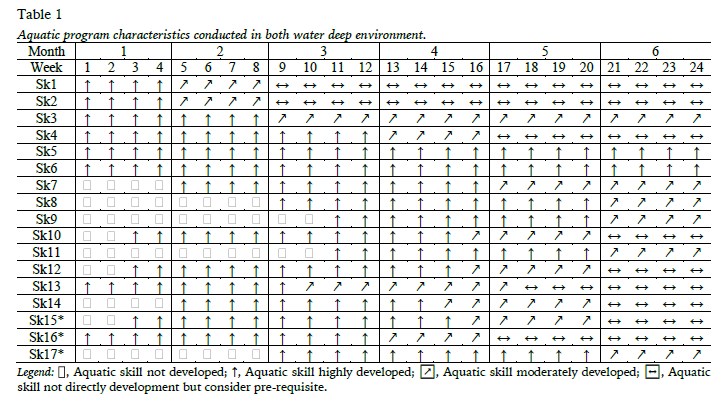
<body><![CDATA[<p>The uniqueness of the practice   environment makes swimming a challenge for initiation of a constructive   approach to teaching (Light &amp; Wallian, 2008). Although constructivism is   not a prescription for teaching (Fosnot &amp; Perry, 1996), it is necessary to   consider the teacher’s role to provide optimal opportunities for learning.   Therefore, proper environment conditions in a swimming pool can be particularly   crucial to learning with effectiveness. One determinant factor seems to be the   variation of the water depth (Costa et al., 2012). Indeed, aquatic readiness   programs for young children can be performed in shallow water (usually from   0.65 to 1.00 meter deep), usually in the beginning of the process, or in deep   water (usually from 1.00 meter to 2.00 meters deep), in the later stages. By   decision of the swimming instructor or mere lack of structural alternative,   there are aquatic programs for children (for utilitarian or formal educational   purposes) almost exclusively conducted in deep water. One of the few studies on   this subject compared the deep and shallow water effect on developing pre-schoolers’   aquatic skills after six, twelve and eighteen months of practice (Costa et al.,   2012). The results suggested that water depth might affect the acquisition of   some basic aquatic skills, at least up to six months practice. However, that   was a cross-sectional study, observational, which does not provide definitive information on the cause-effect of the conditions compared.</p>     <p>Therefore, the purpose of our study   was to analyse the differences on developing pre-schoolers’ aquatic skills   between deep and shallow water aquatic programs after six months of practice.   It is hypothesized that the shallow water program (while applying a controlled   methodological approach) may induce an acquisition of basic aquatic skills at a higher level of proficiency.</p> </font>     <p>&nbsp;</p> <b><font face="Verdana">METHOD</font></b>     <p><font face="Verdana" size="2"><b>Participants</b>    </font></p> <font face="Verdana" size="2">     <p>Participated in the present study 21   elementary school-aged children of both genders (4.70 ± 0.51 yrs.) with no   previous experience in aquatic programs. The children were divided into two   distinct classes with a similar aquatic program but performed on a different   water depth environment: ten and 11 children performed all the swimming lessons in shallow water and deep water, respectively. </p>     <p>The swimming school board and the   local Research Ethics Committee approved the experimental procedures, ensuring   compliance with the declaration of Helsinki. The children's parents were   informed about the study design and procedures and a written informed consent   was signed. Data confidentiality was guaranteed, as well as their anonymity during the treatment process and analysis.</p> <b>Aquatic readiness assessment</b>      <p>All children were evaluated twice for   their aquatic readiness using an observation checklist of 17 aquatic motor   skills based on Langerdorfer and Bruya (1995) and already applied by Costa et   al. (2012): during the first session (T0) and after six months of practice (two   sessions per week: 48 sessions; T1). The aquatic motor skills assessed were the   following: water entry (Sk1); water orientation and adjustment at vertical   position (Sk2); breath control - immersion of the face and eye opening (Sk3);   horizontal buoyancy (Sk4); body position at ventral gliding (Sk5); body   position at dorsal gliding (Sk6); body position at longitudinal rotation in   gliding (Sk7); body position at front and back somersaults (Sk8); leg kick with   breath control at ventral body position, with flutter boards (Sk9); and without   any flutter device, (Sk10); leg kick with breath control at dorsal body   position with flutter boards (Sk11); and without any flutter device (Sk12);   feet-first entry (Sk13); head-first entry (Sk14); Autonomous in deep water   (legs and arms displacement) (Sk15); vertical buoyancy at deep water (Sk16);   deep water immersion (Sk17). Each one of these skills was divided into   increasing levels of complexity (three, four or five levels, depending on the   categorical skill) as suggested by Langendorfer and Bruya (1995): enable to   perform at stage one, rudimentary movements at stage two (or three) and   fundamental movements at stage three (or even four or five) that precede the   specific motor skill acquisition. The children had three attempts to achieve the proposed exercises, as conducted by Costa et al. (2012).</p> <b>Swimming practice</b>      <p>At the beginning   of the study, all the children were in a state of total inaptness to the aquatic   environment. The swimming sessions took place at the same time of the day,   twice a week, with 45 min duration (between 6h45 and 7h30 p.m.). The shallow   water sessions were carried out in a 0.70 cm water depth, with the water   temperature at 31ºC, the air temperature at 29ºC and a relative humidity of   65%. The deep water sessions occurred in a 1.30 meter water depth, with a water   temperature of temperature 29ºC, air temperature of 29°C and the relative humidity was 65%. </p>     <p>Both aquatic programs aimed to improve   children’s aquatic readiness by teaching basic aquatic skills. The number of   students in each class was reduced to increase the useful time of the lesson   and minimize practice waiting time among students. The swimming teacher was the   same in both groups. Therefore, the teaching methods and the skills developed   in each class were similar and based on the literature guidelines (e.g., Canossa,   Fernandes, Carmo, Andrade, &amp; Soares, 2007; Langendorfer &amp; Bruya,   1995;). <a href="/img/revistas/mot/v14n1/14n1a08t1.jpg">Table 1</a> shows how the aquatic skills were sequenced over the six months of teaching.</p>     
<p>Teaching style shifted   from absolute control (command and task style) to more indirect teaching style,   best known as guided discovery (Mosston &amp; Ashworth, 1990). Indeed, the   students mostly performed analytical tasks to develop basic aquatics skills in   both aquatic environments. However, ludic tasks were also included, leading the   child to discover a predetermined “aquatic motor target” in response to a   sequence of “problems” presented by the teacher. Sometimes it was necessary to   adjust certain aquatic tasks due to physical embarrassment imposed by depth. As   such, we had to make minor changes to the task organization (i.e., smaller   groups and slight changes to certain rules of play) and use some floating   didactic material. The following didactic and floating material was used:   didactic-puzzles, towers, slides, mattresses, overflow arches, rings, floating-arches, balls, small boards and noodles.</p> <b>Statistical analysis</b>      ]]></body>
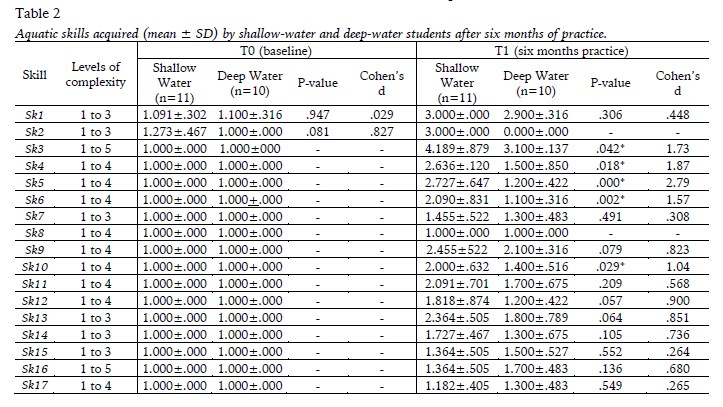
<body><![CDATA[<p>Standard statistical methods were used for   the calculation of means and standard deviations. The t test was used to   compare the differences in aquatic proficiency (on each skill) between groups.   The effect size was calculated using Cohen's d (Cohen, 1988). A stepwise   discriminant analysis was also conducted with &#923; wilk’s method to build a predictive model for group membership (aquatic   competence for shallow and deep water students). Predictor variables were the   17 aquatic motor skills previously described. Box's M variance-covariance   matrices were used to test the multivariate homogeneity. The level of statistical significance was set at p &#8804; .05.</p> </font>     <p>&nbsp;</p>     <p><font size="3" face="Verdana"><b>RESULTS</b></font></p> <font face="Verdana" size="2">     <p><a href="/img/revistas/mot/v14n1/14n1a08t2.jpg">Table 2</a> presents the aquatic skills   acquired by shallow water and deep water students during six months of practice. </p>     
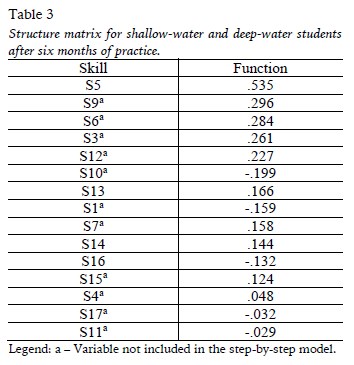
<p>At the beginning of this study (T0), no   differences were found in aquatic readiness between shallow and deep water. The   students were not adapted to the aquatic environment and their aquatic motor   proficiency was zero in all aquatic skills. After six months of practice there   were differences between the means of both groups in five aquatic skills: Sk3, Sk4, Sk5 Sk6 and Sk10. </p>     <p>The stepwise discriminant analysis was   used to determine which aquatic skills discriminate between both groups after   six months of practice. The step-by-step model of discrimination was built with   four steps, including the following aquatic skills: Sk5 (F=40.151, p&lt; .001);   Sk16 (F=34.254, p .001); Sk15 (F=29.237, p&lt; .001) and Sk13 (F=29.489, p&lt;   .001). The canonical discriminant function analysis revealed a significant   association between both groups and all included factors, accounting for   (0.938)&#094;2=88% between group variability (&#923;=0.119, Qui&#094;2=36.124, p&lt; .001). </p>     <p><a href="#t3">Table 3</a> shows the pooled within-groups   correlations between discriminating variables and standardized canonical   discriminant functions. The variables are ordered by absolute size of   correlation within function; Sk5 is the main predictor with a relevant absolute   size of correlation within function (r=0.535). The functions at groups’   centroids shows that shallow-water students have a mean of 2.46 (±1.064) while   deep-water students produce a mean of -2.71 (±0.924); 100% of students were correctly classified.</p>     <p><a name="t3"></a></p>     <p>&nbsp;</p>     <p align="center"><img src="/img/revistas/mot/v14n1/14n1a08t3.jpg" width="354" height="365"></p>     
]]></body>
<body><![CDATA[<p>&nbsp;</p>     <p>&nbsp;</p> </font>     <p><font size="3" face="Verdana"><b>DISCUSSION</b></font></p> <font face="Verdana" size="2">     <p>The first   aim of the present study was to analyse the development of basic aquatic skills   and to compare the effect of swimming practices in two distinct swimming pool   environments (deep and shallow swimming pools). Results showed positive effects   of swimming practice in children’s aquatic competence from both sessions’   types. However, shallow water students managed to acquire greater aquatic competence in nearly all aquatic skills measured after six months of practice. </p>     <p>The swimming programs were more than   just the simple acquisition of new motor patterns that allow moving inside the   aquatic environment (Langendorfer &amp; Bruya, 1995; Martins et al., 2010).   These are based on the need to adjust the motor behaviour of the child in the   water, helping to understand the particularities of the aquatic environment,   specifically the lower gravity and viscosity (Holmér, 1974). Therefore, the   enjoyment for swimming practice is associated with the notion of trust about   their own security in the new environment (Brenner, Saluja, &amp; Smith, 2003; Velasco, 1994). </p>     <p>In the initial phase, the confidence   of the child in the aquatic environment could be easily affected when, for   instance, the water depth of exercitation is changed. This constrain caused by   the depth of the pool could influence their autonomy. The current study did not   have the purpose to study the variability of the pedagogic intervention or of   the student´s motor behaviour in both pool environments (for that see Costa et   al., 2012). Nevertheless, it is our perception that the water depth seems to be   an inhibitory factor to discover the aquatic environment and its   particularities. Thus, the water depth could constrain the students’ creativity   in the resolution of major motor problems caused by the aquatic environment, at   least in the early stages of familiarization. Although our effort to provide   identical pedagogic experiences in both environments, for safety reasons it is   understandable that teaching in deep water could be less student-centred. There   is a need to adapt the swimming tasks due to the mandatory use of float   materials and the lack of confidence of the student. Therefore, the teaching   methods in this condition tended to be more traditional (Mosston, 1992). This   occurs at least in the initial phase of development, in which the students’   actions are always derived from the teacher decisions. Considering a complete   understanding of the concept of aquatic competence, it is not imperative that   there is only one response to similar situations (Moreno &amp; Sanmartín,   1998). Thus, we believe that different water depths during swimming lessons   inevitably provide different psychomotor experiences. Our results, as we discuss below, seem to support such reasoning. </p>     <p>As reported in <a href="/img/revistas/mot/v14n1/14n1a08t2.jpg">table 2</a>, those   children who attended to shallow water lessons presented greater level of aquatic   competence in several skills, namely: breath control - immersion of the face   and eye opening (Sk3), horizontal buoyancy (Sk4), body position at ventral   gliding (Sk5), body position at dorsal gliding (SK6), and leg kick with breath   control at ventral body position, without any flutter device (Sk10). These   results are consistent with the data reported by Costa et al. (2012); although   these authors reported differences between both session types after six months   of practices also in the following skills: water entry (Sk1); body position at   longitudinal rotation in gliding (Sk7); body position at front and back   somersaults (Sk8); leg kick with breath control at ventral body position, with   flutter boards (Sk9); leg kick with breath control at dorsal body position with   flutter boards (Sk11); and without any flutter device (Sk12); feet-first entry   (Sk13); head-first entry (Sk14); vertical buoyancy at deep water (Sk16); deep   water immersion (Sk17). These substantial differences in the acquired aquatic   competence as reported by Costa et al. (2012) can derive from the variability   of the teaching intervention, given that teachers were not the same in both sessions’ types. </p>     
<p>The discriminant analysis showed that   the Sk5 was the main predictor with significant correlation within function,   consistent with the data reported by Costa et al. (2012). This could be related   with the lower opportunity to develop the glide in ventral/dorsal position and   in different depths in the early learning stages in deep water condition. Probably,   the use of floating devices caused some changes in the horizontal position and an unreal sense of buoyancy (Blanksby, Parker, Bradley, &amp; Ong, 1995). </p>     <p>Our results showed that six months of   practices in both conditions allowed students to develop the aquatic readiness   of the majority of the aquatic basic skills, with exception <i>to body position at front and back     somersaults </i>(SK8), which is in accordance with the results presented by   Costa et al. (2012). Moreover, the <i>body     position at longitudinal rotation in gliding </i>(Sk7) was nearly learned in   both conditions probably because it is an aquatic motor skill conditioned by   the previous acquisition of other basic skills, as the water entry, glide,   respiration and static vertical balance in deep water. It would be also   important to refer that six months of practice in both swimming pool   environments were not sufficient to achieve mastery on all aquatic skills.   Similar data have been reported by Costa et al. (2012) after six and 12 months of aquatic practice. </p>     <p>Despite the importance of the results   presented to the scientific and technical community, some limitations should be   addressed to the current study. Firstly, it was only possible to access the   aquatic competence of the students after six months of practice, ensuring the   inclusion criterion of keeping the same teacher. Also, the limitation regarding   the number of participants observed, conditioning the conclusions and the   extrapolation of the results to other subjects. The effect size was used to   better control and analyse the differences obtained. Thirdly, no data about the   activity time devoted to swimming practice in both session types. Although the   number of students has been reduced to enable high activity time in both   sessions, we recognize that differences regarding this variable may exist.   Future studies should assess the variation of activity time regarding to   different learning contexts, number of students and teaching styles. Future   studies should also seek to analyse the effectiveness of concurrent water depth   environments programs (shallow and deep water) and the question of timing and dosing of swimming practice.</p> </font>     ]]></body>
<body><![CDATA[<p>&nbsp;</p>     <p><font size="3" face="Verdana"><b>CONCLUSIONS</b></font></p> <font face="Verdana" size="2">     <p>In conclusion, the present study   suggests that a shallow water environment is more suitable for the development   of basic aquatic skills in preschool children. The stepwise discriminant   analysis revealed a significant association between both session types and four   included aquatic skills for six months of practice; the body position at ventral   gliding seems to be the main significant predictor. This could mean that   aquatic skills at the children beginner’s level should be learnt in a shallow   water swimming pool and deep water programs should be carefully planned to   stimulate certain skills (i.e. body gliding) that seems to be differently exercised in both pool environments.</p>     <p>&nbsp;</p> </font>     <p><font size="3" face="Verdana"><b>REFERENCES</b></font></p> <font face="Verdana" size="2">     <!-- ref --><p>Blanksby,   B. A., Parker, H. E., Bradley, S., &amp; Ong, V. (1995). Children’s readiness   for learning front crawl swimming. <i>The Australian Journal of Science and     Medicine in Sport,</i> <i>27</i>(2), 34-37.    &nbsp;&nbsp;&nbsp;&nbsp;&nbsp;&nbsp;&nbsp;&nbsp;[&#160;<a href="javascript:void(0);" onclick="javascript: window.open('/scielo.php?script=sci_nlinks&ref=374428&pid=S1646-107X201800010000800001&lng=','','width=640,height=500,resizable=yes,scrollbars=1,menubar=yes,');">Links</a>&#160;]<!-- end-ref --></p>     <!-- ref --><p>Brenner,   R. A., Saluja, G., &amp; Smith, G. S. (2003). Swimming lessons, swimming   ability, and the risk of drowning. <i>Injury     Control and Safety Promotion,</i> <i>10</i>(4), 211-215.    &nbsp;&nbsp;&nbsp;&nbsp;&nbsp;&nbsp;&nbsp;&nbsp;[&#160;<a href="javascript:void(0);" onclick="javascript: window.open('/scielo.php?script=sci_nlinks&ref=374430&pid=S1646-107X201800010000800002&lng=','','width=640,height=500,resizable=yes,scrollbars=1,menubar=yes,');">Links</a>&#160;]<!-- end-ref --></p>     <!-- ref --><p>Canossa,   S., Fernandes, R. J., Carmo, C., Andrade, A., &amp; Soares, S. M. (2007).   Ensino multidisciplinar em natação: reflexão metodológica e proposta de lista   de verificação”. <i>Motricidade</i>, <i>3</i>(4), 82-99. doi: 10.6063/motricidade.3(4).656&nbsp;&nbsp;&nbsp;&nbsp;&nbsp;&nbsp;&nbsp;&nbsp;[&#160;<a href="javascript:void(0);" onclick="javascript: window.open('/scielo.php?script=sci_nlinks&ref=374432&pid=S1646-107X201800010000800003&lng=','','width=640,height=500,resizable=yes,scrollbars=1,menubar=yes,');">Links</a>&#160;]<!-- end-ref --><p>Clark, C., &amp; Peterson, P. (1986). Teacher´s   thought processes. In M. Wittrock  (Ed),<i> Handbook of Research on Teaching</i> (pp. 255-296). New York, NY: Macmillan Publishing Company.</p>     <p>Cohen, J. (1988). <i>Statistical power analysis for the behavioral sciences</i>. Hillsdale, NJ: Lawrence Earlbaum Associates.</p>     <!-- ref --><p>Costa,   A. M., Marinho, D. A., Rocha, H., Silva, A. J., Barbosa, T. M., Ferreira, S.   S., &amp; Martins, M. (2012). Deep and Shallow Water Effects on Developing   Preschoolers’ Aquatic Skills. <i>Journal of     Human Kinetics,</i> <i>32</i>, 211-219. doi: 10.2478/v10078-012-0037-1.    &nbsp;&nbsp;&nbsp;&nbsp;&nbsp;&nbsp;&nbsp;&nbsp;[&#160;<a href="javascript:void(0);" onclick="javascript: window.open('/scielo.php?script=sci_nlinks&ref=374435&pid=S1646-107X201800010000800006&lng=','','width=640,height=500,resizable=yes,scrollbars=1,menubar=yes,');">Links</a>&#160;]<!-- end-ref --></p>     <!-- ref --><p>Fosnot,   C. T., &amp; Perry, R. S. (1996). Constructivism: A psychological theory of   learning. In C. T. Fosnot (Ed.),<i> Constructivism: Theory, Perspectives, and Practice </i>(pp. 8-33). New York: Teachers College Press.    &nbsp;&nbsp;&nbsp;&nbsp;&nbsp;&nbsp;&nbsp;&nbsp;[&#160;<a href="javascript:void(0);" onclick="javascript: window.open('/scielo.php?script=sci_nlinks&ref=374437&pid=S1646-107X201800010000800007&lng=','','width=640,height=500,resizable=yes,scrollbars=1,menubar=yes,');">Links</a>&#160;]<!-- end-ref --></p>     <!-- ref --><p>Holmér,   I. (1974). <i>Physiology of swimming man</i>. <i>Acta Physiologica Scandinavica, Suplementum 407</i>, 1-55.    &nbsp;&nbsp;&nbsp;&nbsp;&nbsp;&nbsp;&nbsp;&nbsp;[&#160;<a href="javascript:void(0);" onclick="javascript: window.open('/scielo.php?script=sci_nlinks&ref=374439&pid=S1646-107X201800010000800008&lng=','','width=640,height=500,resizable=yes,scrollbars=1,menubar=yes,');">Links</a>&#160;]<!-- end-ref --></p>     <!-- ref --><p>Langendorfer,   S. (2014). <i>Swimming Learning Standards:     An International Perspective</i>.    &nbsp;&nbsp;&nbsp;&nbsp;&nbsp;&nbsp;&nbsp;&nbsp;[&#160;<a href="javascript:void(0);" onclick="javascript: window.open('/scielo.php?script=sci_nlinks&ref=374441&pid=S1646-107X201800010000800009&lng=','','width=640,height=500,resizable=yes,scrollbars=1,menubar=yes,');">Links</a>&#160;]<!-- end-ref --> 34º Congreso de la Asociación Española de Técnicos de Natación. Granada, Spain.</p>     ]]></body>
<body><![CDATA[<p>Langerdorfer,   S., &amp; Bruya, L. (1995). <i>Aquatic     Readiness: Developing Water Competence in Young Children.</i> Champaign, IL: Human Kinetics. </p>     <!-- ref --><p>Light,   R., &amp; Wallian, N. (2008). A Constructivist-Informed Approach to Teaching Swimming. <i>Quest,</i> <i>60</i>(3): 387-404. doi: 10.1080/00336297.2008.10483588&nbsp;&nbsp;&nbsp;&nbsp;&nbsp;&nbsp;&nbsp;&nbsp;[&#160;<a href="javascript:void(0);" onclick="javascript: window.open('/scielo.php?script=sci_nlinks&ref=374444&pid=S1646-107X201800010000800011&lng=','','width=640,height=500,resizable=yes,scrollbars=1,menubar=yes,');">Links</a>&#160;]<!-- end-ref --><!-- ref --><p>Martins, M., Silva, A. J., Marinho, D. A., Pereira, A., Moreira, A. M., Sarmento,   P., &amp; Barbosa, T. M. (2010). Assessment of heart rate during infants   swim session. <i>International SportsMed Journal,</i> <i>11</i>(3), 336-344.    &nbsp;&nbsp;&nbsp;&nbsp;&nbsp;&nbsp;&nbsp;&nbsp;[&#160;<a href="javascript:void(0);" onclick="javascript: window.open('/scielo.php?script=sci_nlinks&ref=374445&pid=S1646-107X201800010000800012&lng=','','width=640,height=500,resizable=yes,scrollbars=1,menubar=yes,');">Links</a>&#160;]<!-- end-ref --></p>     <!-- ref --><p>Moreno,   J., &amp; M. Sanmartín (1998). <i>Bases     metodológicas para el aprendizaje de las actividades acuáticas educativas</i>. Barcelona, Spain: INDE Publicaciones.    &nbsp;&nbsp;&nbsp;&nbsp;&nbsp;&nbsp;&nbsp;&nbsp;[&#160;<a href="javascript:void(0);" onclick="javascript: window.open('/scielo.php?script=sci_nlinks&ref=374447&pid=S1646-107X201800010000800013&lng=','','width=640,height=500,resizable=yes,scrollbars=1,menubar=yes,');">Links</a>&#160;]<!-- end-ref --> </p>     <!-- ref --><p>Mosston,   M. (1992). Tug-O-War, no more: Meeting teaching-learning objectives using the   spectrum of teaching styles. <i>Journal of Physical Education, Recreation &amp; Dance,</i> <i>63</i>(1), 27-56.    &nbsp;&nbsp;&nbsp;&nbsp;&nbsp;&nbsp;&nbsp;&nbsp;[&#160;<a href="javascript:void(0);" onclick="javascript: window.open('/scielo.php?script=sci_nlinks&ref=374449&pid=S1646-107X201800010000800014&lng=','','width=640,height=500,resizable=yes,scrollbars=1,menubar=yes,');">Links</a>&#160;]<!-- end-ref --></p>     <p>Mosston,   M., &amp; S. Ashworth (1990). <i>The     Spectrum of Teaching Styles. From Command to Discovery</i>. White Plains, NY: Longman. </p>     <p>Parker,   H. E., &amp; B. A. Blanksby (1997). Starting age and aquatic skill learning in   young children: mastery of prerequisite water confidence and basic aquatic   locomotion skills. <i>Australian Journal of Science and Medicine in Sport, 29</i>(3), 83-87.</p>     ]]></body>
<body><![CDATA[<!-- ref --><p>Velasco,   C.G. (1994). <i>Natação segundo a psicomotricidade</i>. Rio de Janeiro, Brasil: Editora Sprint.    &nbsp;&nbsp;&nbsp;&nbsp;&nbsp;&nbsp;&nbsp;&nbsp;[&#160;<a href="javascript:void(0);" onclick="javascript: window.open('/scielo.php?script=sci_nlinks&ref=374453&pid=S1646-107X201800010000800017&lng=','','width=640,height=500,resizable=yes,scrollbars=1,menubar=yes,');">Links</a>&#160;]<!-- end-ref --></p>     <!-- ref --><p>Warda,   L. (2003). Swimming lessons for infants and toddlers. <i>Pediatrics &amp; Child Health,</i> <i>8</i>(2), 113-114.    &nbsp;&nbsp;&nbsp;&nbsp;&nbsp;&nbsp;&nbsp;&nbsp;[&#160;<a href="javascript:void(0);" onclick="javascript: window.open('/scielo.php?script=sci_nlinks&ref=374455&pid=S1646-107X201800010000800018&lng=','','width=640,height=500,resizable=yes,scrollbars=1,menubar=yes,');">Links</a>&#160;]<!-- end-ref --> </p>     <p>&nbsp;</p>     <p><b>Acknowledgments:</b>    <br>   To all the parents and children, for their kind participation in this   research.To NanoSTIMA: Macro-to-Nano Human   Sensing: Towards Integrated Multimodal Health Monitoring and   Analytics(NORTE-01-0145-FEDER-000016), co-financed by the Fundo Europeu de   Desenvolvimento Regional (FEDER) through NORTE 2020<b>    <br>   Conflict of interests:</b>    <br> Nothing to declare.<b>    <br> Funding:    ]]></body>
<body><![CDATA[<br> </b>Nothing to declare.</p> </font>     <p><font size="2" face="Verdana">Manuscript  received at August 25th 2017; Accepted at December 10th  2017 </font></p>     <p>&nbsp;</p>     <p>&nbsp;</p> <font size="2" face="Verdana"><i><a name="end"></a></i><a href="#top">Correspondence to:</a> University of Beira  Interior, Department of Sports Sciences, Rua Marqu&ecirc;s d'&Aacute;vila e Bolama, 6201-001  Covilh&atilde;, Portugal <i>E-mail</i>: <a href="mailto:amcosta@ubi.pt">amcosta@ubi.pt</a> </font>      ]]></body><back>
<ref-list>
<ref id="B1">
<nlm-citation citation-type="journal">
<person-group person-group-type="author">
<name>
<surname><![CDATA[Blanksby]]></surname>
<given-names><![CDATA[B. A.]]></given-names>
</name>
<name>
<surname><![CDATA[Parker]]></surname>
<given-names><![CDATA[H. E.]]></given-names>
</name>
<name>
<surname><![CDATA[Bradley]]></surname>
<given-names><![CDATA[S.]]></given-names>
</name>
<name>
<surname><![CDATA[Ong]]></surname>
<given-names><![CDATA[V.]]></given-names>
</name>
</person-group>
<article-title xml:lang="en"><![CDATA[Children’s readiness for learning front crawl swimming]]></article-title>
<source><![CDATA[The Australian Journal of Science and Medicine in Sport]]></source>
<year>1995</year>
<volume>27</volume>
<numero>2</numero>
<issue>2</issue>
<page-range>34-37</page-range></nlm-citation>
</ref>
<ref id="B2">
<nlm-citation citation-type="journal">
<person-group person-group-type="author">
<name>
<surname><![CDATA[Brenner]]></surname>
<given-names><![CDATA[R. A.]]></given-names>
</name>
<name>
<surname><![CDATA[Saluja]]></surname>
<given-names><![CDATA[G.]]></given-names>
</name>
<name>
<surname><![CDATA[Smith]]></surname>
<given-names><![CDATA[G. S.]]></given-names>
</name>
</person-group>
<article-title xml:lang="en"><![CDATA[Swimming lessons, swimming ability, and the risk of drowning]]></article-title>
<source><![CDATA[Injury Control and Safety Promotion]]></source>
<year>2003</year>
<volume>10</volume>
<numero>4</numero>
<issue>4</issue>
<page-range>211-215</page-range></nlm-citation>
</ref>
<ref id="B3">
<nlm-citation citation-type="journal">
<person-group person-group-type="author">
<name>
<surname><![CDATA[Canossa]]></surname>
<given-names><![CDATA[S.]]></given-names>
</name>
<name>
<surname><![CDATA[Fernandes]]></surname>
<given-names><![CDATA[R. J.]]></given-names>
</name>
<name>
<surname><![CDATA[Carmo]]></surname>
<given-names><![CDATA[C.]]></given-names>
</name>
<name>
<surname><![CDATA[Andrade]]></surname>
<given-names><![CDATA[A.]]></given-names>
</name>
<name>
<surname><![CDATA[Soares]]></surname>
<given-names><![CDATA[S. M.]]></given-names>
</name>
</person-group>
<article-title xml:lang="pt"><![CDATA[Ensino multidisciplinar em natação: reflexão metodológica e proposta de lista de verificação”]]></article-title>
<source><![CDATA[Motricidade]]></source>
<year>2007</year>
<volume>3</volume>
<numero>4</numero>
<issue>4</issue>
<page-range>82-99</page-range></nlm-citation>
</ref>
<ref id="B4">
<nlm-citation citation-type="book">
<person-group person-group-type="author">
<name>
<surname><![CDATA[Clark]]></surname>
<given-names><![CDATA[C.]]></given-names>
</name>
<name>
<surname><![CDATA[Peterson]]></surname>
<given-names><![CDATA[P.]]></given-names>
</name>
</person-group>
<article-title xml:lang="en"><![CDATA[Teacher´s thought processes]]></article-title>
<person-group person-group-type="editor">
<name>
<surname><![CDATA[Wittrock]]></surname>
<given-names><![CDATA[M.]]></given-names>
</name>
</person-group>
<source><![CDATA[Handbook of Research on Teaching]]></source>
<year>1986</year>
<page-range>255-296</page-range><publisher-loc><![CDATA[New York ]]></publisher-loc>
<publisher-name><![CDATA[Macmillan Publishing Company]]></publisher-name>
</nlm-citation>
</ref>
<ref id="B5">
<nlm-citation citation-type="book">
<person-group person-group-type="author">
<name>
<surname><![CDATA[Cohen]]></surname>
<given-names><![CDATA[J.]]></given-names>
</name>
</person-group>
<source><![CDATA[Statistical power analysis for the behavioral sciences]]></source>
<year>1988</year>
<publisher-loc><![CDATA[Hillsdale ]]></publisher-loc>
<publisher-name><![CDATA[Lawrence Earlbaum Associates]]></publisher-name>
</nlm-citation>
</ref>
<ref id="B6">
<nlm-citation citation-type="journal">
<person-group person-group-type="author">
<name>
<surname><![CDATA[Costa]]></surname>
<given-names><![CDATA[A. M.]]></given-names>
</name>
<name>
<surname><![CDATA[Marinho]]></surname>
<given-names><![CDATA[D. A.]]></given-names>
</name>
<name>
<surname><![CDATA[Rocha]]></surname>
<given-names><![CDATA[H.]]></given-names>
</name>
<name>
<surname><![CDATA[Silva]]></surname>
<given-names><![CDATA[A. J.]]></given-names>
</name>
<name>
<surname><![CDATA[Barbosa]]></surname>
<given-names><![CDATA[T. M.]]></given-names>
</name>
<name>
<surname><![CDATA[Ferreira]]></surname>
<given-names><![CDATA[S. S.]]></given-names>
</name>
<name>
<surname><![CDATA[Martins]]></surname>
<given-names><![CDATA[M.]]></given-names>
</name>
</person-group>
<article-title xml:lang="en"><![CDATA[Deep and Shallow Water Effects on Developing Preschoolers’ Aquatic Skills]]></article-title>
<source><![CDATA[Journal of Human Kinetics]]></source>
<year>2012</year>
<volume>32</volume>
<page-range>211-219</page-range></nlm-citation>
</ref>
<ref id="B7">
<nlm-citation citation-type="book">
<person-group person-group-type="author">
<name>
<surname><![CDATA[Fosnot]]></surname>
<given-names><![CDATA[C. T.]]></given-names>
</name>
<name>
<surname><![CDATA[Perry]]></surname>
<given-names><![CDATA[R. S.]]></given-names>
</name>
</person-group>
<article-title xml:lang="en"><![CDATA[Constructivism: A psychological theory of learning]]></article-title>
<person-group person-group-type="editor">
<name>
<surname><![CDATA[Fosnot]]></surname>
<given-names><![CDATA[C. T.]]></given-names>
</name>
</person-group>
<source><![CDATA[Constructivism: Theory, Perspectives, and Practice]]></source>
<year>1996</year>
<page-range>8-33</page-range><publisher-loc><![CDATA[New York ]]></publisher-loc>
<publisher-name><![CDATA[Teachers College Press]]></publisher-name>
</nlm-citation>
</ref>
<ref id="B8">
<nlm-citation citation-type="journal">
<person-group person-group-type="author">
<name>
<surname><![CDATA[Holmér]]></surname>
<given-names><![CDATA[I.]]></given-names>
</name>
</person-group>
<article-title xml:lang="en"><![CDATA[Physiology of swimming man]]></article-title>
<source><![CDATA[Acta Physiologica Scandinavica]]></source>
<year>1974</year>
<volume>Suplementum 407</volume>
<page-range>1-55</page-range></nlm-citation>
</ref>
<ref id="B9">
<nlm-citation citation-type="">
<person-group person-group-type="author">
<name>
<surname><![CDATA[Langendorfer]]></surname>
<given-names><![CDATA[S.]]></given-names>
</name>
</person-group>
<article-title xml:lang="en"><![CDATA[Swimming Learning Standards: An International Perspective]]></article-title>
<source><![CDATA[]]></source>
<year>2014</year>
</nlm-citation>
</ref>
<ref id="B10">
<nlm-citation citation-type="book">
<person-group person-group-type="author">
<name>
<surname><![CDATA[Langerdorfer]]></surname>
<given-names><![CDATA[S.]]></given-names>
</name>
<name>
<surname><![CDATA[Bruya]]></surname>
<given-names><![CDATA[L.]]></given-names>
</name>
</person-group>
<source><![CDATA[Aquatic Readiness: Developing Water Competence in Young Children]]></source>
<year>1995</year>
<publisher-loc><![CDATA[Champaign ]]></publisher-loc>
<publisher-name><![CDATA[Human Kinetics]]></publisher-name>
</nlm-citation>
</ref>
<ref id="B11">
<nlm-citation citation-type="journal">
<person-group person-group-type="author">
<name>
<surname><![CDATA[Light]]></surname>
<given-names><![CDATA[R.]]></given-names>
</name>
<name>
<surname><![CDATA[Wallian]]></surname>
<given-names><![CDATA[N.]]></given-names>
</name>
</person-group>
<article-title xml:lang="en"><![CDATA[A Constructivist-Informed Approach to Teaching Swimming]]></article-title>
<source><![CDATA[Quest]]></source>
<year>2008</year>
<volume>60</volume>
<numero>3</numero>
<issue>3</issue>
<page-range>387-404</page-range></nlm-citation>
</ref>
<ref id="B12">
<nlm-citation citation-type="journal">
<person-group person-group-type="author">
<name>
<surname><![CDATA[Martins]]></surname>
<given-names><![CDATA[M.]]></given-names>
</name>
<name>
<surname><![CDATA[Silva]]></surname>
<given-names><![CDATA[A. J.]]></given-names>
</name>
<name>
<surname><![CDATA[Marinho]]></surname>
<given-names><![CDATA[D. A.]]></given-names>
</name>
<name>
<surname><![CDATA[Pereira]]></surname>
<given-names><![CDATA[A.]]></given-names>
</name>
<name>
<surname><![CDATA[Moreira]]></surname>
<given-names><![CDATA[A. M.]]></given-names>
</name>
<name>
<surname><![CDATA[Sarmento]]></surname>
<given-names><![CDATA[P.]]></given-names>
</name>
<name>
<surname><![CDATA[Barbosa]]></surname>
<given-names><![CDATA[T. M.]]></given-names>
</name>
</person-group>
<article-title xml:lang="en"><![CDATA[Assessment of heart rate during infants swim session]]></article-title>
<source><![CDATA[International SportsMed Journal]]></source>
<year>2010</year>
<volume>11</volume>
<numero>3</numero>
<issue>3</issue>
<page-range>336-344</page-range></nlm-citation>
</ref>
<ref id="B13">
<nlm-citation citation-type="book">
<person-group person-group-type="author">
<name>
<surname><![CDATA[Moreno]]></surname>
<given-names><![CDATA[J.]]></given-names>
</name>
<name>
<surname><![CDATA[Sanmartín]]></surname>
<given-names><![CDATA[M.]]></given-names>
</name>
</person-group>
<source><![CDATA[Bases metodológicas para el aprendizaje de las actividades acuáticas educativas]]></source>
<year>1998</year>
<publisher-loc><![CDATA[Barcelona ]]></publisher-loc>
<publisher-name><![CDATA[INDE Publicaciones]]></publisher-name>
</nlm-citation>
</ref>
<ref id="B14">
<nlm-citation citation-type="journal">
<person-group person-group-type="author">
<name>
<surname><![CDATA[Mosston]]></surname>
<given-names><![CDATA[M.]]></given-names>
</name>
</person-group>
<article-title xml:lang="en"><![CDATA[Tug-O-War, no more: Meeting teaching-learning objectives using the spectrum of teaching styles]]></article-title>
<source><![CDATA[Journal of Physical Education]]></source>
<year>1992</year>
<volume>Recreation & Dance, 63</volume>
<numero>1</numero>
<issue>1</issue>
<page-range>27-56</page-range></nlm-citation>
</ref>
<ref id="B15">
<nlm-citation citation-type="book">
<person-group person-group-type="author">
<name>
<surname><![CDATA[Mosston]]></surname>
<given-names><![CDATA[M.]]></given-names>
</name>
<name>
<surname><![CDATA[Ashworth]]></surname>
<given-names><![CDATA[S.]]></given-names>
</name>
</person-group>
<source><![CDATA[The Spectrum of Teaching Styles: From Command to Discovery]]></source>
<year>1990</year>
<publisher-loc><![CDATA[White Plains ]]></publisher-loc>
<publisher-name><![CDATA[Longman]]></publisher-name>
</nlm-citation>
</ref>
<ref id="B16">
<nlm-citation citation-type="journal">
<person-group person-group-type="author">
<name>
<surname><![CDATA[Parker]]></surname>
<given-names><![CDATA[H. E.]]></given-names>
</name>
<name>
<surname><![CDATA[Blanksby]]></surname>
<given-names><![CDATA[B. A.]]></given-names>
</name>
</person-group>
<article-title xml:lang="en"><![CDATA[Starting age and aquatic skill learning in young children: mastery of prerequisite water confidence and basic aquatic locomotion skills]]></article-title>
<source><![CDATA[Australian Journal of Science and Medicine in Sport]]></source>
<year>1997</year>
<volume>29</volume>
<numero>3</numero>
<issue>3</issue>
<page-range>83-87</page-range></nlm-citation>
</ref>
<ref id="B17">
<nlm-citation citation-type="book">
<person-group person-group-type="author">
<name>
<surname><![CDATA[Velasco]]></surname>
<given-names><![CDATA[C.G.]]></given-names>
</name>
</person-group>
<source><![CDATA[Natação segundo a psicomotricidade]]></source>
<year>1994</year>
<publisher-loc><![CDATA[Rio de Janeiro ]]></publisher-loc>
<publisher-name><![CDATA[Editora Sprint]]></publisher-name>
</nlm-citation>
</ref>
<ref id="B18">
<nlm-citation citation-type="journal">
<person-group person-group-type="author">
<name>
<surname><![CDATA[Warda]]></surname>
<given-names><![CDATA[L.]]></given-names>
</name>
</person-group>
<article-title xml:lang="en"><![CDATA[Swimming lessons for infants and toddlers]]></article-title>
<source><![CDATA[Pediatrics & Child Health]]></source>
<year>2003</year>
<volume>8</volume>
<numero>2</numero>
<issue>2</issue>
<page-range>113-114</page-range></nlm-citation>
</ref>
</ref-list>
</back>
</article>
