<?xml version="1.0" encoding="ISO-8859-1"?><article xmlns:mml="http://www.w3.org/1998/Math/MathML" xmlns:xlink="http://www.w3.org/1999/xlink" xmlns:xsi="http://www.w3.org/2001/XMLSchema-instance">
<front>
<journal-meta>
<journal-id>1646-107X</journal-id>
<journal-title><![CDATA[Motricidade]]></journal-title>
<abbrev-journal-title><![CDATA[Motri.]]></abbrev-journal-title>
<issn>1646-107X</issn>
<publisher>
<publisher-name><![CDATA[Edições Desafio Singular]]></publisher-name>
</publisher>
</journal-meta>
<article-meta>
<article-id>S1646-107X2018000100009</article-id>
<title-group>
<article-title xml:lang="en"><![CDATA[Sedentary behaviors and psychological outcomes among older adults: a systematic review]]></article-title>
</title-group>
<contrib-group>
<contrib contrib-type="author">
<name>
<surname><![CDATA[Ramalho]]></surname>
<given-names><![CDATA[André]]></given-names>
</name>
<xref ref-type="aff" rid="A1"/>
</contrib>
<contrib contrib-type="author">
<name>
<surname><![CDATA[Petrica]]></surname>
<given-names><![CDATA[João]]></given-names>
</name>
<xref ref-type="aff" rid="A1"/>
</contrib>
<contrib contrib-type="author">
<name>
<surname><![CDATA[Rosado]]></surname>
<given-names><![CDATA[António]]></given-names>
</name>
<xref ref-type="aff" rid="A2"/>
</contrib>
</contrib-group>
<aff id="AA1">
<institution><![CDATA[,Instituto Politécnico de Castelo Branco Sport, Health & Exercise Research Unit ]]></institution>
<addr-line><![CDATA[Castelo Branco ]]></addr-line>
<country>Portugal</country>
</aff>
<aff id="AA2">
<institution><![CDATA[,University of Lisbon Faculty of Human Kinetics ]]></institution>
<addr-line><![CDATA[Lisbon ]]></addr-line>
<country>Portugal</country>
</aff>
<pub-date pub-type="pub">
<day>00</day>
<month>05</month>
<year>2018</year>
</pub-date>
<pub-date pub-type="epub">
<day>00</day>
<month>05</month>
<year>2018</year>
</pub-date>
<volume>14</volume>
<numero>1</numero>
<fpage>73</fpage>
<lpage>85</lpage>
<copyright-statement/>
<copyright-year/>
<self-uri xlink:href="http://scielo.pt/scielo.php?script=sci_arttext&amp;pid=S1646-107X2018000100009&amp;lng=en&amp;nrm=iso"></self-uri><self-uri xlink:href="http://scielo.pt/scielo.php?script=sci_abstract&amp;pid=S1646-107X2018000100009&amp;lng=en&amp;nrm=iso"></self-uri><self-uri xlink:href="http://scielo.pt/scielo.php?script=sci_pdf&amp;pid=S1646-107X2018000100009&amp;lng=en&amp;nrm=iso"></self-uri><abstract abstract-type="short" xml:lang="en"><p><![CDATA[This systematic review aimed to synthesize the scientific evidence about the relationship between sedentary behaviours and various psychological outcomes in older adults. The study searches were conducted in the following databases: PubMed, PsycINFO, ISI Web of Knowledge and ScienceDirect. We selected 15 observational quantitative studies according to specific eligibility criteria. The data extraction was performed independently by different authors, including the evaluation of the risk of bias of the studies and the classification of the force of evidence. The results showed a tendency of showing no associations between the sedentary behaviours, the well-being and quality of life of the elderly. Concerning life satisfaction and perceived stress, it seems that active sedentary activities have positive effects on these indicators. Evidence has also suggested that some sedentary behaviours may help maintain some cognitive functions in the elderly population, namely in different types of memory. In other studies, it has been demonstrated a tendency that too much time in passive sedentary activities has been associated with depressive symptomatology. However, this review suggested that the evidence is not yet consistent in the relationship between the sedentary behaviours of the elderly and the indicators analysed, and more research is needed.]]></p></abstract>
<kwd-group>
<kwd lng="en"><![CDATA[sitting time]]></kwd>
<kwd lng="en"><![CDATA[psychosocial resources]]></kwd>
<kwd lng="en"><![CDATA[aging]]></kwd>
</kwd-group>
</article-meta>
</front><body><![CDATA[ <p align="right"><b><font face="Verdana" size="2">      REVIEW ARTICLE </font></b></p> <font face="Verdana" size="2">     <p>&nbsp;</p> </font>     <p><font size="4" face="Verdana"><b>Sedentary behaviors   and psychological outcomes among older adults: a systematic review</b></font></p> <font face="Verdana" size="2">     <p>&nbsp;</p>     <p>&nbsp;</p> <b><a name="top"></a></b><b>André Ramalho<sup>1</sup>; João Petrica<sup>1</sup>; António Rosado<sup>2</sup></b></font>    <p><font size="2" face="Verdana"><sup>1</sup><i>Sport, Health &amp; Exercise Research  Unit, SHERU, Instituto Polit&eacute;cnico de Castelo Branco, Castelo Branco, Portugal    <br> </i><sup>2</sup><i>Faculty of Human Kinetics -  University of Lisbon, Lisbon, Portugal</i></font></p>     <p><font size="2" face="Verdana"><a href="#end">Correspondence to</a></font></p>     <p>&nbsp;</p> <font face="Verdana" size="2">    <p>&nbsp;</p> </font> <hr noshade size="1"> <font face="Verdana" size="2">     ]]></body>
<body><![CDATA[<p><b>ABSTRACT</b></p>     <p>This systematic review aimed to synthesize the   scientific evidence about the relationship between sedentary behaviours and   various psychological outcomes in older adults. The study searches were   conducted in the following databases: PubMed, PsycINFO, ISI Web of Knowledge   and ScienceDirect. We selected 15 observational quantitative studies according   to specific eligibility criteria. The data extraction was performed   independently by different authors, including the evaluation of the risk of   bias of the studies and the classification of the force of evidence. The   results showed a tendency of showing no associations between the sedentary behaviours,   the well-being and quality of life of the elderly. Concerning life satisfaction   and perceived stress, it seems that active sedentary activities have positive   effects on these indicators. Evidence has also suggested that some sedentary behaviours   may help maintain some cognitive functions in the elderly population, namely in   different types of memory. In other studies, it has been demonstrated a   tendency that too much time in passive sedentary activities has been associated   with depressive symptomatology. However, this review suggested that the   evidence is not yet consistent in the relationship between the sedentary behaviours of the elderly and the indicators analysed, and more research is needed.</p>     <p><b>Keywords:</b> sitting time, psychosocial resources, aging.</p> </font> <hr noshade size="1">     <p>&nbsp;</p>     <p>&nbsp;</p>     <p><font face="Verdana" size="2"><b>INTRODUCTION</b>    </font></p> <font face="Verdana" size="2">     <p>Epidemiological research on sedentary   behaviours has shown that the consequences for health are independent of those attributed to lack of physical activity (Owen et al., 2011). </p>     <p>In order to obtain a better conceptual   understanding, it is important to highlight the differences between the   following concepts: sedentary behaviours and physical inactivity. The term   physical inactivity is used to describe individuals who do not meet the   recommended levels of moderate to vigorous intensity physical activity   (Sedentary Behaviour Research Network, 2012). On the other hand, the sedentary behaviours   are the wakeful activities characterized by an energy expenditure of less than   1,5 MET (metabolic   equivalents) when in the seated or reclined   position (Sedentary Behaviour Research Network, 2012). In this way, the   sedentary behaviours are the high volumes of time that adults spend seated in   the remaining &quot;no exercise&quot;, waking hours (Owen, Bauman, &amp; Brown,   2009). In this way, an individual can be sufficiently active according to the   recommendations of physical activity practice and yet have an extended time of   sitting time (Owen et al., 2011). Through the objective measurement   (accelerometers), it was concluded that most people's day is dedicated to low   intensity physical activity and 55% of the day in use in sedentary behaviours   (Matthews et al., 2008). In this way, understanding why people are physically   inactive contributes to evidence-based planning of public health interventions   (Bauman et al., 2012). In this sense, sedentary behaviours in the aging   population have been associated with premature death, and there is data showing   that the reduction of the total time spent in sedentary behaviours may be as   important as increased participation in physical activity in reducing health   risks (Katzmarzyk, Church, Craig, &amp; Bouchard, 2009). Effectively,   Stamatakis, Davis, Stathi, and Hamer (2012), concluded that sedentary behaviours   are associated with cardiometabolic risk factors. In fact, the elderly are too   long exposed to sedentary behaviour as Harvey, Chastin, and Skelton (2015)   reported. The results indicated that the elderly are sedentary on average 9.4 hours per day (Harvey et al., 2015). </p>     <p>The potential consequences of sedentary   behaviour in mental health is not well known and more research is needed   (Faulkner &amp; Biddle, 2013). Previous systematic reviews have aimed to analyse   the evidence of the association between sedentary behaviours and multiple   health indicators in the elderly population (Rezende, Rey-López, Matuso, &amp;   Luiz, 2014) and to understand the determinants of the sedentary behaviour of   the elderly (Chastin et al., 2015). However, the previous reviews did not have   as main objective to analyse in detail the evidence of the associations between   sedentary behaviours and several psychological factors in the elderly   population. In addition, other reviews verified the associations between   sedentary behaviour and mental health indicators in adolescents (Hoare, Milton,   Foster, &amp; Allender, 2016) and anxiety symptoms in the adult population   (Teychenne, Costigan, &amp; Parker, 2015). Thus, it seems useful to obtain   knowledge about the relationships between the sedentary behaviours of the   elderly and several psychological indicators, in order to identify which   indicators have a greater or lesser value of association with these behaviours.   Thus, this systematic review of literature aimed to synthesize the scientific   evidence about the relationship between diverse sedentary behaviours and various psychological outcomes in older adults.</p> </font>     <p>&nbsp;</p>     ]]></body>
<body><![CDATA[<p><font size="3" face="Verdana"><b>METHOD</b></font><font size="3" face="Verdana"></font></p> <font face="Verdana" size="2">    <p>The guidelines were followed from the   original checklist of the PRISMA - Preferred Reporting Items for Systematic Reviews and Meta-Analyses (Moher, Liberati, Tetzlaff, &amp; Altman, 2009).</p> <b>Literature research</b>      <p>The studies were conducted from September   1<sup>st</sup> to November 30<sup>th</sup> of 2016 in four electronic databases   (PubMed, PsycINFO, ISI Web of Knowledge and ScienceDirect). We used keywords   associated with three areas: 1) sedentary behaviour or related terms; 2) types   of sedentary behaviour; 3) possible psychological indicators related to   sedentary behaviour. The keywords were always associated with the following   words: &quot;elderly&quot; OR &quot;aging&quot; OR &quot;gerontology&quot;. In   addition to the searches in the electronic databases, reference lists of   studies found were analysed in order to identify new studies that could fit the intended.</p> <b>Eligibility criteria and selection of studies     </b>      <p>Regarding the selection criteria of   the studies, the following were considered: 1) empirical studies that   investigated sedentary  behaviours of the   elderly and several psychological indicators (studies published in congress   proceedings, theses, book chapters and unpublished manuscripts were not   considered) through observational (cross-sectional and longitudinal)   quantitative studies and experimental studies (randomized controlled trials and   quasi-experimental trials); 2) studies that investigated associations between   sedentary behaviours and several variables (e.g., physiological variables) but   which included psychological indicators; 3) studies whose average age of the   participants was equal to or greater than 65 years old and that the minimum age   of the subjects was from 60 years old; 4) studies published in English-language   and peer-reviewed journals; 5) studies published from January 2000 to November   2016; 6) studies that presented instruments of measurement on the total time of   sedentary  behaviours or the time spent   in specific sedentary  behaviours; 7)   studies whose instruments of psychological assessment presented adequate   evidence of psychometric validation. We excluded studies that investigated sedentary behaviours in the elderly with specific pathologies.</p>     <p>The studies were imported into the   software EndNote (ThompsonReuters, San Francisco, CA, EUA) and the duplicate   articles were removed using the &quot;duplicate&quot; function. The selection   process of the studies was performed in the following phases: in the initial   phase, two independent reviewers based on the titles performed the research of   the potentially relevant studies. In case of doubt about the inclusion of the   studies, these were selected for the next evaluation phase. In the second   phase, the abstracts of the studies selected in the initial phase were analysed   by two reviewers. In the event of disagreement over the inclusion of studies in   the next phase, these were resolved through mediation by a third reviewer. In   the third and final phase, the studies selected in the previous phases were   reviewed in their entirety by three independent reviewers, taking into account   the specific eligibility criteria. At this stage, disagreements among reviewers on the inclusion of studies were resolved by consensus.</p> <b>Extraction of data and risk of bias in individual studies</b>      <p>The three reviewers involved in the   selection of the studies participated independently in extracting the data from   the selected studies. The characteristics of the studies that included their   authors, the country where the study was carried out, the methodological   design, the characteristics of the participants, the instrument for assessing   the sedentary  behaviours, the   instruments for evaluating the psychological indicators, the results and the   conclusions of the studies were registered. At this stage the divergences about the extracted data were overcome by consensus among the reviewers.</p>     <p>Careful assessment of risk of bias is   required in each observational study that explains its unique context in order   to assess the validity of the estimates of studies (Vandenbroucke, 2011). The   risk of bias of the studies was estimated using the RTI item bank (Viswanathan,   Berkman, Dryden, &amp; Hartling, 2013). However, the RTI item bank was adapted   to meet the characteristics of the studies included in the review. In this way,   the following items of bias analysis were considered: selection bias, selection   bias confounding, detection bias confounding, attrition bias, selective outcome   reporting, confounding and overall assessment. The evaluation of the items was   based on the following responses: &quot;yes&quot;; &quot;no&quot;;   &quot;partial&quot;; &quot;impossible to determine&quot;; &quot;not   applicable&quot;. The text box included in each item was used to document the   explanations about the evaluations for further review (Viswanathan et al.,   2013). In this way, according to all the answers of the items and their   explanations, the studies were classified (good; fair; poor) by an adaptation   of the criteria suggested by Balk et al. (2006). In order to minimize possible   risk of bias in the risk assessment of bias of the studies, two reviewers   independently evaluated the results, calculating the inter-judge agreement   index using the kappa coefficient (Cohen, 1960). Afterwards, the reviewers   compared their scores and in the cases of disagreements a third reviewer was included to obtain a final consensus.</p> <b>Classification of strength of evidence</b>      <p>The goal of strength of evidence   assessments is to provide clearly explained, well-reasoned judgments about   reviewers' confidence in their systematic review conclusions (Atkins, Fink,   &amp; Slutsky, 2005). The classification of the strength of evidence of the   main results of the studies was performed through the Grading Strength of   Evidence system (Berkman et al., 2013). This system allowed to classify the   results of the studies in five domains (study limitations, directness,   consistency, precision, reporting bias). Subsequently, the strength of the   results was classified into one of four levels: high, moderate, low, or   insufficient (Berkman et al., 2013). Two reviewers individually assessed the   strength of evidence from the study results and calculated the inter-judge   agreement index using the kappa coefficient (Cohen, 1960). Subsequently both   reviewers compared their scores and in cases of divergence a third reviewer was included in obtaining a final consensus.</p>     <p>&nbsp;</p> </font>     <p><font size="3" face="Verdana"><b>RESULTS</b></font> </p>     ]]></body>
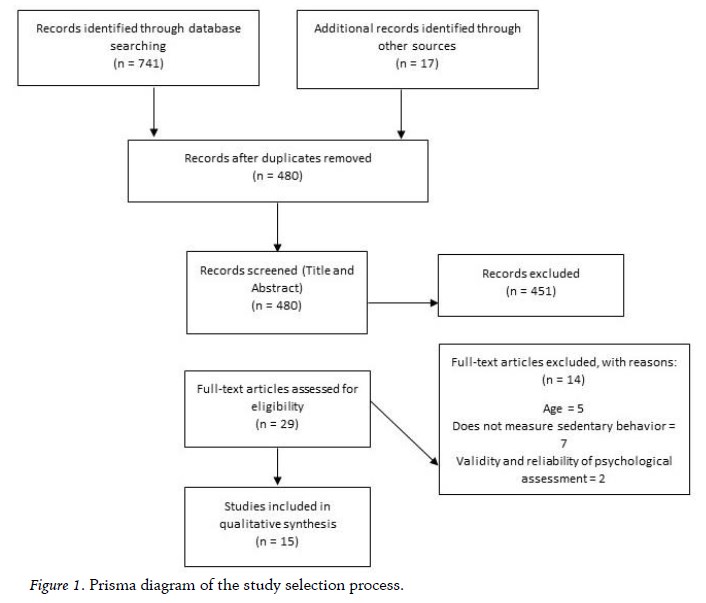
<body><![CDATA[<p><font face="Verdana" size="2"><b>Selection of studies</b>    </font></p>      <p><font size="2" face="Verdana">The   different stages of research with the number of studies reviewed in each phase   and the reasons for their exclusion are presented in <a href="/img/revistas/mot/v14n1/14n1a09f1.jpg">figure 1</a>. After the   removal of duplicate studies (n = 278), a total of 480 articles were reviewed based   on the title and abstract. This review allowed to exclude 451 studies where 426   articles were considered irrelevant, eighteen studies did not meet the defined   age criteria and 7 trials evaluated individuals with specific pathologies.   Thus, twenty-nine potentially relevant articles were selected for a full text   revision process. After the complete review of the studies a total of fourteen   articles were excluded, according to the defined eligibility criteria. Thus, fifteen studies were included in the review. </font></p>     
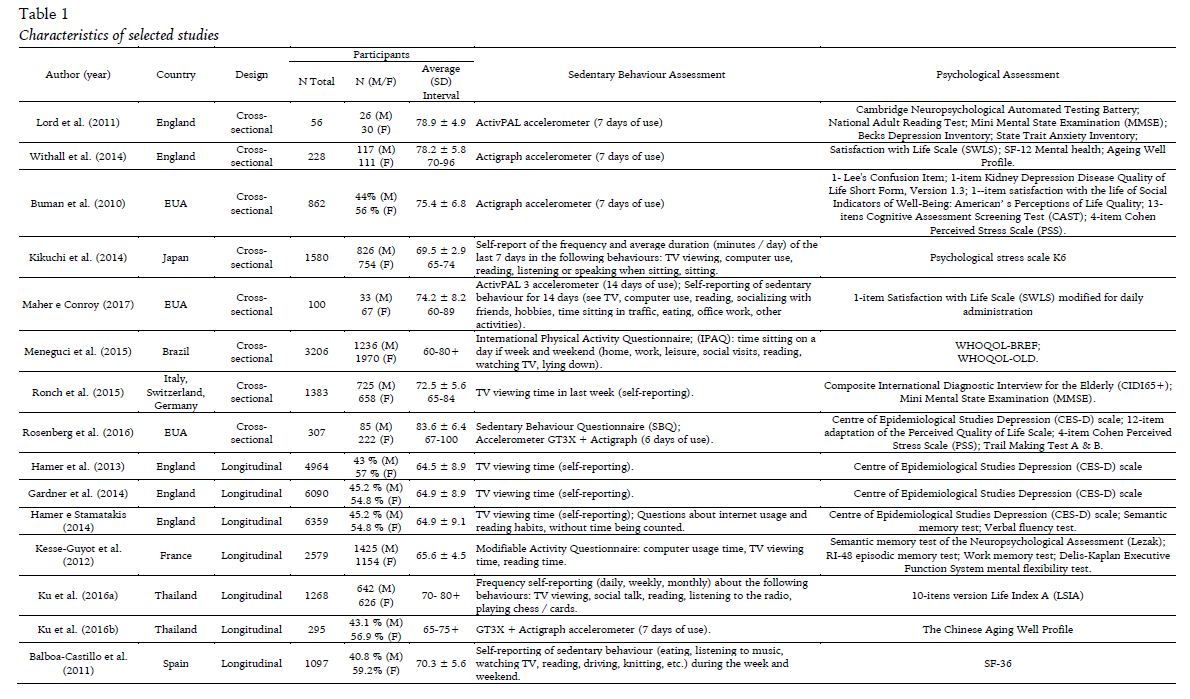
<p><font size="2" face="Verdana"><b>Characteristics of the studies</b></font></p> <font face="Verdana" size="2">    <p><a href="/img/revistas/mot/v14n1/14n1a09t1.jpg">Table 1</a>  shows an overview of the main features of the studies included in the review.   It was possible to verify that 8 studies followed a transversal design, whereas   7 articles used a longitudinal design. Regarding the follow-up period,   longitudinal studies ranged from 18 months (Ku, Fox, Liao, Sun, &amp; Chen,   2016b) to 8 years (Ku, Fox, &amp; Chen, 2016a). The study participants were   mostly recruited from specific communities in the countries where they were   conducted. However, some trials recruited individuals from national   representative samples (Gardner, Lliffe, Fox, Jefferis, &amp; Hamer, 2014; Hamer,   Poole, &amp; Messerli-Bürgy, 2013; Hamer &amp; Stamatakis, 2014; Ku et al.,   2016a; Ku et al., 2016b). The main criteria for selecting the participants were   age-based, from the age of 60 years old, and in the elderly who demonstrated   independence in performing daily life activities. Most of the studies selected   the participants by probabilistic sampling methods, and these belonged to urban   environments of different ethnicities. Regarding the evaluation of the   sedentary behaviour, it was verified that the studies used self-reporting and   objective measurement (accelerometers). With regard to psychological   assessment, the articles used different measures, using scales of evaluation of   different psychological indicators, tests of evaluation of cognitive functions and multidimensional scales that include psychological components. </p>     
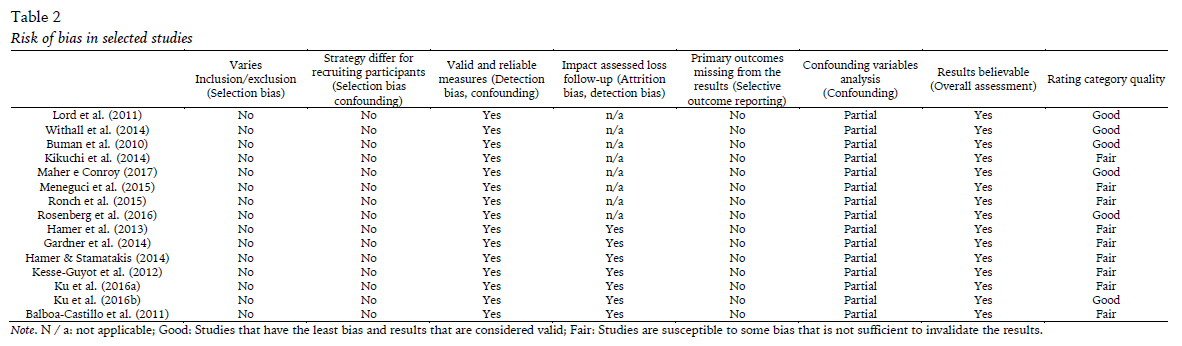
<p><b>Risk of bias in individual studies</b></p>     <p>The risk   assessment for the bias of the studies is shown in <a href="/img/revistas/mot/v14n1/14n1a09t2.jpg">table 2</a>. The index of   inter-judge agreement through the kappa coefficient (Cohen, 1960) was 0.70,   reason why it was considered good (Fleiss, 1981). Study rankings ranged from   the fair to good level (Balk et al., 2006). With regard to the   inclusion/exclusion criteria of study participants, it was found that they were   explicitly defined. Regarding the instruments of measurement of sedentary behaviours,   it was verified that they were valid as well as the psychological assessment.   Concerning the confounding variables, it was observed that the studies took   into account the analysis of some of these variables using statistical procedures to guarantee this control.</p> <b>Individual study results</b>      
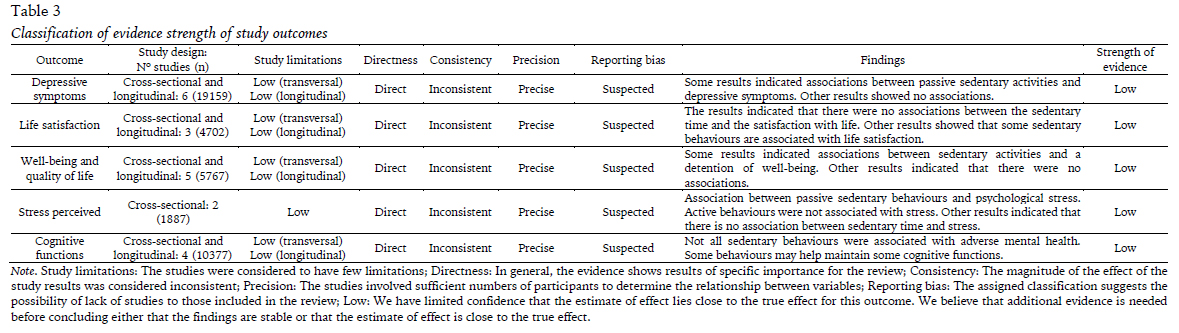
<p><a href="/img/revistas/mot/v14n1/14n1a09t3.jpg">Table 3</a>  shows the strength of evidence classification for each of the outcomes. All   outcomes were classified at the low level according to the Grading Strength of   Evidence criteria (Berkman et al., 2013). The index of inter-judges’ agreement   through the kappa coefficient (Cohen, 1960) was 0.60 and this value was considered good (Fleiss, 1981).</p>     
<p><i>Depressive symptoms</i></p>     <p>Six   articles (Gardner et al., 2014; Hamer &amp; Stamatakis, 2014; Hamer et al.,   2013; Lord et al., 2011; Ronch et al., 2015; Rosenberg et al., 2016)   investigated the relationship between sedentary  behaviours and depressive symptoms. In the   study by Lord et al. (2011), there were found no associations between sedentary   behaviours time measured by accelerometer and depressive symptoms. These   results appear to be in agreement with those of Rosenberg et al. (2016) who,   through objective and self-report of evaluation of sedentary behaviours time,   did not find associations between sedentary time and depressive symptoms. In   the same sense, the research of Ronch et al. (2015) did not reveal associations   between general diagnosis of depression and TV viewing time evaluated by   self-report method. It was also found that individuals with depressive   disorders tended to have less TV viewing time (Ronch et al., 2015). However, in   the article by Hamer et al. (2013), positive associations between TV viewing   time and depressive symptoms were observed. Also, the research of Gardner et   al. (2014) concluded that the increase in TV viewing time after follow-up was   associated with the presence of depressive symptoms. The longitudinal study by   Hamer and Stamatakis (2014) showed that, in the initial evaluation of the   participants, the TV viewing time was associated with high levels of   depression. It was also concluded that the elderly with more time of internet   use showed less depressive symptoms. These results suggested that different   sedentary behaviours were related in a different way to mental health   components. However, after follow-up, no associations were found between the   sedentary   behaviours time and depressive symptoms (Hamer &amp; Stamatakis, 2014)</p>     <p><i>Satisfaction with life</i></p>     ]]></body>
<body><![CDATA[<p>In the   research of Withall et al. (2014) no associations were found between the   sedentary time and satisfaction with life. However, through the longitudinal   study of Ku et al. (2016a), it was evidenced that some sedentary behaviours   (watch TV, social talk, reading) were positively associated with satisfaction   with life.  Behaviours such as listening   to radio and playing chess/cards were not associated with life satisfaction (Ku   et al., 2016a). In the study by Maher and Conroy (2017), sedentary behaviour   data objectively evaluated indicated that satisfaction with life was negatively   associated with sedentary time. The data obtained through self-report measures   revealed that the level of life satisfaction was not associated with sedentary behaviours time (Maher &amp; Conroy, 2017).</p>     <p><i>Well-being and quality of life</i></p>     <p>The study   by Buman et al. (2010) through different measures of psychological evaluation   concluded that the sedentary time in the elderly was negatively associated with   the psychosocial well-being. In the work of Balboa-Castillo, León-Muñoz,   Graciani, Rodríguez-Artalejo and Guallar-Castillón (2011), it was concluded   that the number of hours of seated time revealed an inverse relation with   regard to social functions and mental health. However, in the longitudinal   study of Ku et al. (2016b) it was verified that the sedentary time was not   associated to the psychological dimension of well-being. In the cross-sectional   investigation of Meneguci, Sasaki, Santos, Scatena and Damião (2015), it was   also verified that long periods of sitting time did not contribute to a   negative impact on psychological components in the quality of life of the elderly.   Also, the results of the work by Rosenberg et al. (2016) did not show   associations between the time of sedentary behaviours time and the quality of life of the elderly.</p>     <p><i>Stress perceived</i></p>     <p>The study   by Rosenberg et al. (2016) did not find associations between sedentary behaviours   time and perceived stress. The investigation by Kikuchi et al. (2014) showed   that too much time of passive sedentary  behaviours   (TV, talk sitting and sitting) were associated with a greater probability of   psychological stress. However, the time of active sedentary   behaviours (computer use and reading) was not associated with psychological stress (Kikuchi et al., 2014).</p>     <p><i>Cognitive functions</i></p>     <p>Four   studies have investigated the relationship between different cognitive   functions and sedentary behaviours of the elderly population (Hamer &amp;   Stamatakis, 2014; Kesse-Guyot et al., 2012; Lord et al., 2011; Ronch et al.,   2015). The investigation by Lord et al. (2011) did not find associations   between sedentary behaviours and cognitive functions of the elderly. However,   the cross-sectional study by Ronch et al. (2015) found significant inverse   correlations between the Mini Mental State Evaluation scores and the TV viewing   time of elderly people from different European countries (Germany, Italy and   Switzerland). The longitudinal investigation of Kesse-Guyot et al. (2012) concluded   that specific sedentary behaviours were differentially associated with   cognitive performance. In contrast to TV viewing, regular computer use can help   to maintain cognitive functions, namely verbal memory and working memory during   the aging process (Kesse-Guyot et al., 2012). In the same sense, the Hamer and   Stamatakis longitudinal test (2014) showed that TV viewing time was associated   with low levels of cognitive functions. However, the elderly with more time of   internet use showed higher rates of cognitive functions, suggesting that not   all sedentary behaviours are related to the adverse mental health of the   elderly. However, after follow-up, no associations were found between sedentary   behaviours and the cognitive functions evaluated, among them semantic memory (Hamer &amp; Stamatakis, 2014).</p> </font>     <p>&nbsp;</p>     <p><font size="3" face="Verdana"><b>DISCUSSION</b></font></p> <font face="Verdana" size="2">     <p>This systematic review aimed to   synthesize the scientific evidence about the relationship between sedentary behaviours   and various psychological outcomes in older adults. Most of the included   studies were cross-sectional design (n = 8) and longitudinal design studies (n   = 7). Regarding the psychological outcomes, the studies investigated depressive   symptoms, life satisfaction, well-being and quality of life, perceived stress   and certain cognitive functions. Evidences tended to show no association   between the time of sedentary behaviours and the well-being and quality of life   of the elderly. However, with regard to life satisfaction and perceived stress,   it appears that active sedentary activities (e.g. reading, chatting, computer   use) provided better life satisfaction and less psychological stress. In the   same sense, the evidences suggested that some sedentary behaviours (e.g.   computer use, reading) may help maintain some cognitive functions in the   elderly population, namely in different types of memory. In other studies, it   has also been shown a tendency that too much time of passive sedentary   activities (e.g. watching TV) is associated with the depressive symptomatology   of the elderly. However, each outcome was classified at the low level. This   means that we have limited confidence that the effect estimate is close to the   true effect for that result. We believe that additional evidence is needed   concluding that the results are stable or that the effect is close to the true effect (Berkman et al., 2013).</p>     ]]></body>
<body><![CDATA[<p>Regarding the association between   sedentary behaviours and depressive symptoms, the evidence seems to be in   agreement with Atkin, Adams, Bull, and Biddle (2012), where habits of reading   and internet use were associated with fewer depressive symptoms. In fact,   passive sedentary activities such as TV viewing may stimulate social isolation   and limit the development of social support networks being associated with   depression (Golden et al., 2009). Thus, it seems that internet use stimulates   social interaction, preventing the risk of deterioration of mental health in the elderly (Hamer &amp; Stamatakis, 2014). </p>     <p>In the relationship between different   sedentary behaviours with satisfaction with life and well-being, the results   found could be related to the representation of the use of time perceived by   the elderly. In this sense, this perception of time in different sedentary behaviours   can be determined by the values, interests and goals of the elderly, as well as   the level of pleasure (Salmon, Owen, Crawford, Bauman, &amp; Sallis, 2003). In   fact, some studies (Lu, 2011; Östlund, 2010) suggested that sedentary leisure   activities that contemplate cognitive and social components are beneficial to   subjective well-being, since they satisfy various aspects of psychological,   social and relaxation needs. Nature sedentary activity may be important in   understanding the relationships between sedentary behaviours and life satisfaction   (Maher &amp; Conroy, 2017). Thus, the sedentary time may be considered by the   elderly as an opportunity to rest and relax (Withall et al., 2014).   Effectively, active seniors also experienced high levels of sedentary time   (Davis et al., 2011). Also, the social norms of which being sedentary is normal   when one is old, may explain the absence of a negative impact of sedentary time   on life satisfaction (Withall et al., 2014). As verified by Hamer and   Stamatakis (2014), different sedentary behaviours may be related in a different   way to components of mental health. Therefore, it is also possible that,   through the total amount of sedentary time, it has not been possible to verify   associations consistent with psychological well-being dimensions (Ku et al.,   2016b). However, other studies have found that long periods of sitting had a   negative impact on the quality of life of the elderly. These associations can   be explained by the relationship between sedentary behaviour and the level of   physical fitness. According to some studies (Hamer &amp; Stamatakis, 2013;   Santos et al., 2012), individuals with high levels of sedentary  behaviours revealed poor physical fitness and   this is usually associated with a lower quality of life in the elderly   population (Olivares, Gusi, Prieto, &amp; Hernandez-Mocholi, 2011). Moreover,   psychological disturbances may also explain poorer quality of life associated with sedentary behaviours (Sloan et al., 2013).</p>     <p>Regarding the associations between   sedentary behaviours and perceived stress, the results found could be related   to the fact that active sedentary time is associated with greater social   interaction in the elderly (Cotten, Anderson, &amp; McCullough, 2013). In this   way, active sedentary activities, such as reading time, can provide a mental   stimulation and thus help the elderly in the participation of other activities   (Gallucci et al., 2009). Regarding the relationship between sedentary behaviours   and cognitive functions, the results are in agreement with those found in the   review by Rezende et al. (2014). It was verified that certain sedentary behaviours   were protective of the state of mental health of the elderly. Thus, it seems   that, for example, computer use may have mentally stimulating characteristics,   and may compensate for its relatively passive nature in relation to its impact on brain aging (Kesse-Guyot et al., 2012).</p> <b>Limitations</b>      <p>Fifteen studies were included in this   review, which may be considered as a basis of limited scientific evidence. In   this way, the analysis should be interpreted with caution. Due to a large   number of variables that may influence the results of the studies, it is   possible that they may influence the different domains of the sedentary behaviours   and the indicators analysed. For example, although the results suggested that   some sedentary behaviours were related to some analysed indicators, this review   has not determined the exact relevance of other variables such as demographic   factors, socioeconomic level, functional level and types of sedentary   activities, in these results. In this sense, it became difficult to determine a   direct cause and effect relationship between the sedentary behaviours and the   different indicators analysed. Thus, more studies will be needed in order to   elucidate how the moderating variables influence the relationships between   sedentary behaviours and psychological indicators of the elderly. The analysis   should also be made with caution given that not all the studies used   representative samples. Therefore, it would be advisable that future studies   with national representative samples should be considered. Another limitation   of this review concerns the risk of bias of the studies, especially in relation   to the instruments of measurement of the sedentary behaviours. The use of   self-reporting measures may present a greater risk of data bias, since they   estimated errors in the evaluation of the total time of sedentary behaviours   (Healy et al., 2011). Thus, it is suggested that future studies may include   self-reporting and objective measurement (accelerometers) simultaneously, as   recommended in the assessment of sedentary behaviours (Chastin, Scwartz, &amp;   Skelton, 2013). Another limitation was related to the research process of the   studies. Although this has been rigorous, the revision may be subject to   reporting bias that could be overcome through a funnel plot. Furthermore, study   research was delimited for studies published in peer-reviewed journals and   written in English only. Subsequently, other reviews may consider other languages in the selection process of the studies.</p> <b>Suggestion for future studies</b>      <p>Since it seems that the relationship   between sedentary behaviours and different psychological indicators is not a   simple linear coincidence, more complex designs should be used in the future.   In this way, it would be pertinent to find other investigations through   longitudinal and experimental designs, allowing to establish a more robust   causal relation between sedentary behaviours of the elderly and diverse   psychological indicators. In this respect, should be considered other studies   that investigate other psychological indicators such as resilience (Wagnild   &amp; Young, 1993), adjustment to aging (von Humboldt, Leal, Pimenta, &amp;   Maroco, 2014), manifestation of psychological well-being (Massé et al., 1998)   and imagery (Mendes et al., 2016), according to different sedentary  behaviours (active or passive) or the total   sedentary time. It would also be pertinent to consider conducting qualitative   investigations, with different methodological approaches, in order to   understand in greater depth the perceptions of the elderly and new psychological dimensions that may be associated with sedentary behaviours.</p>     <p>&nbsp;</p> </font><font size="3" face="Verdana"><b>CONCLUSION</b></font><font face="Verdana" size="2">      <p>There was a limited causal evidence   between the sedentary behaviours and the psychological indicators analysed,   since many conclusions came from cross-sectional studies. However, due to   longitudinal design studies, it was possible to deepen the knowledge about the   relationships between sedentary behaviour and the indicators analysed over   time. Because of the different psychological measurement instruments, as well   as the different methods of assessing sedentary behaviour, the existence of   differentiated populations, as well as the differences in the research designs,   there was a high heterogeneity of results, not allowing, consistently, to   establish strong evidence relationships between sedentary behaviours and   depression, well-being and quality of life, life satisfaction, perceived stress   and certain cognitive functions. Thus, this review suggested that the evidence   is not yet consistent in the relationship between the sedentary behaviours of the elderly and the analysed indicators, and more research is needed.</p>     <p>&nbsp;</p> </font><font size="3" face="Verdana"><b>REFERENCES</b></font><font face="Verdana" size="2">      <!-- ref --><p>Atkin,   A., Adams, E., Bull, F., &amp; Biddle, S. (2012). Non-occupational sitting and   mental well-being in employed adults. <i>Annals     of Behavioral Medicine</i>, <i>43</i>(2), 181–188. doi: 10.1007/s12160-011-9320-y.    &nbsp;&nbsp;&nbsp;&nbsp;&nbsp;&nbsp;&nbsp;&nbsp;[&#160;<a href="javascript:void(0);" onclick="javascript: window.open('/scielo.php?script=sci_nlinks&ref=374547&pid=S1646-107X201800010000900001&lng=','','width=640,height=500,resizable=yes,scrollbars=1,menubar=yes,');">Links</a>&#160;]<!-- end-ref --></p>     ]]></body>
<body><![CDATA[<!-- ref --><p>Atkins,   D., Fink, K., &amp; Slutsky, J. (2005). Better Information for Better Health   Care: The Evidence-based Practice Center Program and the Agency for Healthcare   Research and Quality. <i>Annals of Internal     Medicine</i>,   <i>142</i>, 1035-41. doi: 10.7326/0003-4819-142-12_Part_2-200506211-00002&nbsp;&nbsp;&nbsp;&nbsp;&nbsp;&nbsp;&nbsp;&nbsp;[&#160;<a href="javascript:void(0);" onclick="javascript: window.open('/scielo.php?script=sci_nlinks&ref=374549&pid=S1646-107X201800010000900002&lng=','','width=640,height=500,resizable=yes,scrollbars=1,menubar=yes,');">Links</a>&#160;]<!-- end-ref --><!-- ref --><p>Balboa-Castillo,   T., León-Muñoz, L., Graciani, A., Rodríguez-Artalejo, F., &amp;   Guallar-Castillón, A. (2011). Longitudinal association of physical activity and   sedentary behavior during leisure time with health-related quality of life in   community-dwelling older adults. <i>Health     and Quality of Life Outcomes</i>, <i>9</i>, 1-10. doi: 10.1186/1477-7525-9-47.    &nbsp;&nbsp;&nbsp;&nbsp;&nbsp;&nbsp;&nbsp;&nbsp;[&#160;<a href="javascript:void(0);" onclick="javascript: window.open('/scielo.php?script=sci_nlinks&ref=374550&pid=S1646-107X201800010000900003&lng=','','width=640,height=500,resizable=yes,scrollbars=1,menubar=yes,');">Links</a>&#160;]<!-- end-ref -->  </p>     <!-- ref --><p>Balk,   E., Raman, G., Chung, M., Ip, S., Tatsionl, A., Alonso, A., … Lau, J. (2006).   Effectiveness of Management Strategies for Renal Artery Stenosis: A Systematic Review. <i>Annals of Internal Medicine</i>, <i>145</i>, 901-912.    &nbsp;&nbsp;&nbsp;&nbsp;&nbsp;&nbsp;&nbsp;&nbsp;[&#160;<a href="javascript:void(0);" onclick="javascript: window.open('/scielo.php?script=sci_nlinks&ref=374552&pid=S1646-107X201800010000900004&lng=','','width=640,height=500,resizable=yes,scrollbars=1,menubar=yes,');">Links</a>&#160;]<!-- end-ref --></p>     <!-- ref --><p>Bauman,   A., Reis, R., Sallis, J., Wells, J., Loos, R., &amp; Martin, B. (2012).   Correlates of physical activity: Why are some people physically active and others not? <i>Lancet</i>, <i>380</i>, 258–271.    &nbsp;&nbsp;&nbsp;&nbsp;&nbsp;&nbsp;&nbsp;&nbsp;[&#160;<a href="javascript:void(0);" onclick="javascript: window.open('/scielo.php?script=sci_nlinks&ref=374554&pid=S1646-107X201800010000900005&lng=','','width=640,height=500,resizable=yes,scrollbars=1,menubar=yes,');">Links</a>&#160;]<!-- end-ref --></p>     <p>Berkman,   N., Lohr, K., Ansari, M., McDonagh, M., Balk, E., Whitlock, E., … Chang, S.   (2013). <i>Grading the Strength of a Body of     Evidence When Assessing Health Care Interventions for the Effective Health Care     Program of the Agency for Healthcare Research and Quality: An Update</i>. Rockville, MD: AHRQ Publication.</p>     <!-- ref --><p>Buman, M., Hekler, E., Haskell,   W., Pruitt, L., Conway, T., Cain, K., … King, A. (2010). Objective Light-Intensity Physical Activity Associations With Rated Health in Older Adults. <i>American Journal of Epidemiology</i>, <i>172</i>, 1155-1165. doi: 10.1093/aje/kwq249.    &nbsp;&nbsp;&nbsp;&nbsp;&nbsp;&nbsp;&nbsp;&nbsp;[&#160;<a href="javascript:void(0);" onclick="javascript: window.open('/scielo.php?script=sci_nlinks&ref=374557&pid=S1646-107X201800010000900007&lng=','','width=640,height=500,resizable=yes,scrollbars=1,menubar=yes,');">Links</a>&#160;]<!-- end-ref --></p>     ]]></body>
<body><![CDATA[<!-- ref --><p>Chastin,   S. F. M., Buck, C., Freiberger, E., Murphy, M., Brug, J., Cardon, G., … DEDIPAC   consortium. (2015). Systematic literature review of determinants of sedentary   behaviour in older adults: a DEDIPAC study. <i>The International Journal of Behavioral Nutrition and Physical Activity</i>, <i>12</i>, 127. <a href="https://doi.org/10.1186/s12966-015-0292-3" target="_blank">https://doi.org/10.1186/s12966-015-0292-3</a>&nbsp;&nbsp;&nbsp;&nbsp;&nbsp;&nbsp;&nbsp;&nbsp;[&#160;<a href="javascript:void(0);" onclick="javascript: window.open('/scielo.php?script=sci_nlinks&ref=374559&pid=S1646-107X201800010000900008&lng=','','width=640,height=500,resizable=yes,scrollbars=1,menubar=yes,');">Links</a>&#160;]<!-- end-ref --><!-- ref --><p>Chastin,   S. F. M., Schwarz, U., &amp; Skelton, D. A. (2013). Development of a Consensus   Taxonomy of Sedentary Behaviors (SIT): Report of Delphi Round 1. <i>PLoS One</i>, <i>8</i>(12), e82313. <a href="https://doi.org/10.1371/journal.pone.0082313" target="_blank">https://doi.org/10.1371/journal.pone.0082313</a>&nbsp;&nbsp;&nbsp;&nbsp;&nbsp;&nbsp;&nbsp;&nbsp;[&#160;<a href="javascript:void(0);" onclick="javascript: window.open('/scielo.php?script=sci_nlinks&ref=374560&pid=S1646-107X201800010000900009&lng=','','width=640,height=500,resizable=yes,scrollbars=1,menubar=yes,');">Links</a>&#160;]<!-- end-ref --><!-- ref --><p>Cohen, J. (1960). A coefficient   of agreement for nominal scales. <i>Educational     and Psychological Measurement</i>, <i>20</i>, 37-46.    &nbsp;&nbsp;&nbsp;&nbsp;&nbsp;&nbsp;&nbsp;&nbsp;[&#160;<a href="javascript:void(0);" onclick="javascript: window.open('/scielo.php?script=sci_nlinks&ref=374561&pid=S1646-107X201800010000900010&lng=','','width=640,height=500,resizable=yes,scrollbars=1,menubar=yes,');">Links</a>&#160;]<!-- end-ref --></p>     <!-- ref --><p>Cotten, S., Anderson, W., &amp;   McCullough, B. (2013). Impact of internet use on loneliness and contact with others among older adults: cross-sectional analysis. <i>Journal of Medical Internet Research</i>, <i>15</i>(2), e39. doi: 10.2196/jmir.2306.    &nbsp;&nbsp;&nbsp;&nbsp;&nbsp;&nbsp;&nbsp;&nbsp;[&#160;<a href="javascript:void(0);" onclick="javascript: window.open('/scielo.php?script=sci_nlinks&ref=374563&pid=S1646-107X201800010000900011&lng=','','width=640,height=500,resizable=yes,scrollbars=1,menubar=yes,');">Links</a>&#160;]<!-- end-ref --> </p>     <!-- ref --><p>Davis, M., Fox, K., Hillsdon,   M., Coulson, J., Sharp, D., Stathi, A., &amp; Thompson, J. (2011). Getting out   and about in older adults: The nature of daily trips and their association with   objectively assessed physical activity. <i>International Journal of Behavioral Nutrion and Physical Activity</i>, <i>8</i>, 116&#8722;125. doi: 10.1186/1479-5868-8-116&nbsp;&nbsp;&nbsp;&nbsp;&nbsp;&nbsp;&nbsp;&nbsp;[&#160;<a href="javascript:void(0);" onclick="javascript: window.open('/scielo.php?script=sci_nlinks&ref=374565&pid=S1646-107X201800010000900012&lng=','','width=640,height=500,resizable=yes,scrollbars=1,menubar=yes,');">Links</a>&#160;]<!-- end-ref --><!-- ref --><p>Faulkner, G., &amp; Biddle, S.   (2013). Standing on top of the world: Is sedentary behavior associated with   mental health? <i>Mental Health and Physical Activity</i>, <i>6</i>, 1-2. doi: 10.1016/j.mhpa.2013.02.003.    &nbsp;&nbsp;&nbsp;&nbsp;&nbsp;&nbsp;&nbsp;&nbsp;[&#160;<a href="javascript:void(0);" onclick="javascript: window.open('/scielo.php?script=sci_nlinks&ref=374566&pid=S1646-107X201800010000900013&lng=','','width=640,height=500,resizable=yes,scrollbars=1,menubar=yes,');">Links</a>&#160;]<!-- end-ref --></p>     <!-- ref --><p>Fleiss, J. (1981). <i>Statistical methods for rates and   proportions</i> (2<sup>th</sup> ed.). New York: John Wiley &amp; Sons.    &nbsp;&nbsp;&nbsp;&nbsp;&nbsp;&nbsp;&nbsp;&nbsp;[&#160;<a href="javascript:void(0);" onclick="javascript: window.open('/scielo.php?script=sci_nlinks&ref=374568&pid=S1646-107X201800010000900014&lng=','','width=640,height=500,resizable=yes,scrollbars=1,menubar=yes,');">Links</a>&#160;]<!-- end-ref --></p>     <!-- ref --><p>Gallucci, M., Antuono, P., Ongaro,   F., Forloni, P., Albani, D., Amici, G., &amp; Regini, C. (2009). Physical activity,   socialization and reading in the elderly over the age of seventy: what is the   relation with cognitive decline? Evidence from &quot;The Treviso Longeva   (TRELONG) study&quot;. <i>Archives of     Gerontology and Geriatrics</i>, <i>48</i>(3), 284–286. doi: 10.1016/j.archger.2008.02.006.    &nbsp;&nbsp;&nbsp;&nbsp;&nbsp;&nbsp;&nbsp;&nbsp;[&#160;<a href="javascript:void(0);" onclick="javascript: window.open('/scielo.php?script=sci_nlinks&ref=374570&pid=S1646-107X201800010000900015&lng=','','width=640,height=500,resizable=yes,scrollbars=1,menubar=yes,');">Links</a>&#160;]<!-- end-ref --></p>     <!-- ref --><p>Gardner, B., Iliffe, S., Fox,   K. R., Jefferis, B. J., &amp; Hamer, M. (2014). Sociodemographic, behavioural   and health factors associated with changes in older adults’ TV viewing over 2 years.   <i>International Journal of Behavioral Nutrition and Physical Activity</i>, <i>11</i>, 102. <a href="https://doi.org/10.1186/s12966-014-0102-3" target="_blank">https://doi.org/10.1186/s12966-014-0102-3</a>&nbsp;&nbsp;&nbsp;&nbsp;&nbsp;&nbsp;&nbsp;&nbsp;[&#160;<a href="javascript:void(0);" onclick="javascript: window.open('/scielo.php?script=sci_nlinks&ref=374572&pid=S1646-107X201800010000900016&lng=','','width=640,height=500,resizable=yes,scrollbars=1,menubar=yes,');">Links</a>&#160;]<!-- end-ref --><!-- ref --><p>Golden, J., Conroy, R., Bruce,   I., Denihan, A., Greene, E., Kirby, M., &amp; Lawlor, B. (2009). Loneliness,   social support networks, mood and wellbeing in community-dwelling elderly. <i>International Journal of Geriatric     Psychiatry</i>, <i>24</i>(7), 694–700. doi: 10.1002/gps.2181.    &nbsp;&nbsp;&nbsp;&nbsp;&nbsp;&nbsp;&nbsp;&nbsp;[&#160;<a href="javascript:void(0);" onclick="javascript: window.open('/scielo.php?script=sci_nlinks&ref=374573&pid=S1646-107X201800010000900017&lng=','','width=640,height=500,resizable=yes,scrollbars=1,menubar=yes,');">Links</a>&#160;]<!-- end-ref --></p>     <!-- ref --><p>Hamer, M., &amp; Stamatakis, E.   (2013). Screen-based sedentary behavior, physical activity, and muscle strength in the English longitudinal study of ageing. <i>PLoS One</i>, <i>8</i>(6), e66222. doi: 10.1371/journal.pone.0066222.    &nbsp;&nbsp;&nbsp;&nbsp;&nbsp;&nbsp;&nbsp;&nbsp;[&#160;<a href="javascript:void(0);" onclick="javascript: window.open('/scielo.php?script=sci_nlinks&ref=374575&pid=S1646-107X201800010000900018&lng=','','width=640,height=500,resizable=yes,scrollbars=1,menubar=yes,');">Links</a>&#160;]<!-- end-ref --> </p>     <!-- ref --><p>Hamer, M., &amp; Stamatakis, E.   (2014). Prospective Study of Sedentary Behaviour, Risk of Depression, and   Cognitive Impairment. <i>Medicine and     Science in Sports and Exercise</i>, <i>46</i>(4), 718-723. doi: 10.1249/MSS.0000000000000156.    &nbsp;&nbsp;&nbsp;&nbsp;&nbsp;&nbsp;&nbsp;&nbsp;[&#160;<a href="javascript:void(0);" onclick="javascript: window.open('/scielo.php?script=sci_nlinks&ref=374577&pid=S1646-107X201800010000900019&lng=','','width=640,height=500,resizable=yes,scrollbars=1,menubar=yes,');">Links</a>&#160;]<!-- end-ref --> </p>     ]]></body>
<body><![CDATA[<p>Hamer, M., Poole, L., &amp;   Messerli-Bürgy, N. (2013). Television viewing, C-reactive protein, and   depressive symptoms in older adults. <i>Brain,     Behavior, and Immunity</i>, <i>33</i>, 29–32. doi: 10.1016/j.bbi.2013.05.001.</p>     <!-- ref --><p>Harvey, J., Chastin, S., &amp;   Skelton, D. (2015). How sedentary are older people? A systematic review of the   amount of sedentary behavior. <i>Journal of     Aging and Physical Activity</i>, <i>23</i>(3), 471-487. doi: 10.1123/japa.2014-0164.    &nbsp;&nbsp;&nbsp;&nbsp;&nbsp;&nbsp;&nbsp;&nbsp;[&#160;<a href="javascript:void(0);" onclick="javascript: window.open('/scielo.php?script=sci_nlinks&ref=374580&pid=S1646-107X201800010000900021&lng=','','width=640,height=500,resizable=yes,scrollbars=1,menubar=yes,');">Links</a>&#160;]<!-- end-ref --></p>     <!-- ref --><p>Healy, G., Clark, B., Winkler,   E., Gardiner, P., Brown, W., &amp; Matthews, C. (2011). Measurement of adults’   sedentary time in population-based studies. <i>American     Journal of Preventive Medicine</i>, <i>41</i>(2), 216–27. doi: 10.1016/j.amepre.2011.05.005.    &nbsp;&nbsp;&nbsp;&nbsp;&nbsp;&nbsp;&nbsp;&nbsp;[&#160;<a href="javascript:void(0);" onclick="javascript: window.open('/scielo.php?script=sci_nlinks&ref=374582&pid=S1646-107X201800010000900022&lng=','','width=640,height=500,resizable=yes,scrollbars=1,menubar=yes,');">Links</a>&#160;]<!-- end-ref --></p>     <!-- ref --><p>Hoare, E., Milton, K., Foster,   C., &amp; Allender, S. (2016). The associations between sedentary behaviour and   mental health among adolescents: a systematic review. <i>International Journal of Behavioral Nutrition and Physical Activity, 13, </i>108. doi: 10.1186/s12966-016-0432-4.    &nbsp;&nbsp;&nbsp;&nbsp;&nbsp;&nbsp;&nbsp;&nbsp;[&#160;<a href="javascript:void(0);" onclick="javascript: window.open('/scielo.php?script=sci_nlinks&ref=374584&pid=S1646-107X201800010000900023&lng=','','width=640,height=500,resizable=yes,scrollbars=1,menubar=yes,');">Links</a>&#160;]<!-- end-ref --></p>     <!-- ref --><p>Katzmarzyk, P., Church, A.,   Craig, C., &amp; Bouchard, C. (2009). Sitting time and mortality from all   causes, cardiovascular disease, and cancer. <i>Medicine     and Science in Sports and Exercise</i>, <i>41</i>, 998–1005. doi: 10.1249/MSS.0b013e3181930355.    &nbsp;&nbsp;&nbsp;&nbsp;&nbsp;&nbsp;&nbsp;&nbsp;[&#160;<a href="javascript:void(0);" onclick="javascript: window.open('/scielo.php?script=sci_nlinks&ref=374586&pid=S1646-107X201800010000900024&lng=','','width=640,height=500,resizable=yes,scrollbars=1,menubar=yes,');">Links</a>&#160;]<!-- end-ref --></p>     <!-- ref --><p>Kesse-Guyot, E., Charreire, H.,   Andreeva, V., Touvier, M., Hercberg, S., Galan, P., &amp; Oppert, J. (2012).   Cross-Sectional and longitudinal associations of different sedentary behaviors   with cognitive performance in older adults. <i>PLoS     One</i>, <i>7</i>(10), e47831. doi: 10.1371/journal.pone.0047831.    &nbsp;&nbsp;&nbsp;&nbsp;&nbsp;&nbsp;&nbsp;&nbsp;[&#160;<a href="javascript:void(0);" onclick="javascript: window.open('/scielo.php?script=sci_nlinks&ref=374588&pid=S1646-107X201800010000900025&lng=','','width=640,height=500,resizable=yes,scrollbars=1,menubar=yes,');">Links</a>&#160;]<!-- end-ref --></p>     <!-- ref --><p>Kikuchi, H., Inoue, S.,   Sugiyama, T., Owen, N., Oka, K., Nakaya, T., &amp; Shimomitsu, T. (2014).   Distinct associations of different sedentary behaviors with health-related   attributes among older adults. <i>Preventive     Medicine</i>, <i>67</i>, 335–339. doi: 10.1016/j.ypmed.2014.08.011.    &nbsp;&nbsp;&nbsp;&nbsp;&nbsp;&nbsp;&nbsp;&nbsp;[&#160;<a href="javascript:void(0);" onclick="javascript: window.open('/scielo.php?script=sci_nlinks&ref=374590&pid=S1646-107X201800010000900026&lng=','','width=640,height=500,resizable=yes,scrollbars=1,menubar=yes,');">Links</a>&#160;]<!-- end-ref --></p>     <p>Ku, P., Fox, K., &amp; Chen, L.   (2016a). Leisure-Time Physical Activity, Sedentary Behaviors and Subjective   Well-Being in Older Adults: An Eight-Year Longitudinal Research. <i>Social Indicators Research</i>, <i>127</i>, 1349-1361. doi: 10.1007/s11205-015-1005-7.</p>     <p>Ku, P., Fox, K., Liao, Y., Sun,   W., &amp; Chen, L. (2016b). Prospective associations of objectively assessed   physical activity at different intensities with subjective well-being in older   adults. <i>Quality of Life Research</i>, <i>25</i>, 2909-2919. doi: 10.1007/s11136-016-1309-3.</p>     <!-- ref --><p>Lord, S., Chastin, S., Mclnnes,   L., Little, L., Briggs, P., &amp; Rochester, L. (2011). Exploring patterns of daily physical and sedentary behaviour in community-dwelling older adults. <i>Age and Ageing</i>, <i>40</i>, 205-210. doi: 10.1093/ageing/afq166.    &nbsp;&nbsp;&nbsp;&nbsp;&nbsp;&nbsp;&nbsp;&nbsp;[&#160;<a href="javascript:void(0);" onclick="javascript: window.open('/scielo.php?script=sci_nlinks&ref=374594&pid=S1646-107X201800010000900029&lng=','','width=640,height=500,resizable=yes,scrollbars=1,menubar=yes,');">Links</a>&#160;]<!-- end-ref --></p>     <!-- ref --><p>Lu, L. (2011). Leisure   experiences and depressive symptoms among Chinese older people: A national   survey in Taiwan. <i>Educational Gerontology</i>,   <i>37</i>, 753–771. doi: 10.1080/03601271003744632.    &nbsp;&nbsp;&nbsp;&nbsp;&nbsp;&nbsp;&nbsp;&nbsp;[&#160;<a href="javascript:void(0);" onclick="javascript: window.open('/scielo.php?script=sci_nlinks&ref=374596&pid=S1646-107X201800010000900030&lng=','','width=640,height=500,resizable=yes,scrollbars=1,menubar=yes,');">Links</a>&#160;]<!-- end-ref --></p>     <!-- ref --><p>Maher, J. P., &amp; Conroy, D.   E. (2017). Daily Life Satisfaction in Older Adults as a Function of   (In)Activity. <i>The Journals of Gerontology: Series B</i>, <i>72</i>(4), 593–602. doi:10.1093/geronb/gbv086&nbsp;&nbsp;&nbsp;&nbsp;&nbsp;&nbsp;&nbsp;&nbsp;[&#160;<a href="javascript:void(0);" onclick="javascript: window.open('/scielo.php?script=sci_nlinks&ref=374598&pid=S1646-107X201800010000900031&lng=','','width=640,height=500,resizable=yes,scrollbars=1,menubar=yes,');">Links</a>&#160;]<!-- end-ref --><!-- ref --><p>Massé, R., Poulin, C., Dassa,   C., Lambert, J., Bélair, S., &amp; Battaglini, A. (1998). Élaboration et validation d’un outil de mesure du bien-être psychologique: L’É.M.M.B.E.P. <i>Revue Canadienne de Santé Publique</i>, <i>89</i>, 352-357. doi: 10.17269/cjph.89.1014.    &nbsp;&nbsp;&nbsp;&nbsp;&nbsp;&nbsp;&nbsp;&nbsp;[&#160;<a href="javascript:void(0);" onclick="javascript: window.open('/scielo.php?script=sci_nlinks&ref=374599&pid=S1646-107X201800010000900032&lng=','','width=640,height=500,resizable=yes,scrollbars=1,menubar=yes,');">Links</a>&#160;]<!-- end-ref --></p>     <!-- ref --><p>Matthews, C., Chen, K.,   Freedson, P., Buchowski, M., Beech, B., Pate, R., &amp; Troiano, R. (2008).   Amount of time spent in sedentary behaviors in the United States, 2003-2004. <i>American Journal of Epidemiology</i>, <i>167</i>, 875-881. doi: 10.1093/aje/kwm390.    &nbsp;&nbsp;&nbsp;&nbsp;&nbsp;&nbsp;&nbsp;&nbsp;[&#160;<a href="javascript:void(0);" onclick="javascript: window.open('/scielo.php?script=sci_nlinks&ref=374601&pid=S1646-107X201800010000900033&lng=','','width=640,height=500,resizable=yes,scrollbars=1,menubar=yes,');">Links</a>&#160;]<!-- end-ref --></p>     <!-- ref --><p>Mendes, P., Marinho, D., Petrica, J., Silveira, P., Monteiro, D., &amp;   Cid, L. (2016). Tradução e Validação do Movement Imagery Questionnaire - 3   (MIQ-3) com Atletas Portugueses. <i>Motricidade</i>,   <i>12</i>(1), 149-158. doi: 10.6063/motricidade.7006.    &nbsp;&nbsp;&nbsp;&nbsp;&nbsp;&nbsp;&nbsp;&nbsp;[&#160;<a href="javascript:void(0);" onclick="javascript: window.open('/scielo.php?script=sci_nlinks&ref=374603&pid=S1646-107X201800010000900034&lng=','','width=640,height=500,resizable=yes,scrollbars=1,menubar=yes,');">Links</a>&#160;]<!-- end-ref --></p>     <!-- ref --><p>Meneguci, J., Sasaki, J., Santos, A., Scatena, L., &amp; Damião, R.   (2015). Sitting   Time and Quality of Life in Older Adults: A Population-Based Study. <i>Journal of Physical Activity and Health</i>,   <i>12</i>, 1513-1519. doi: 10.1123/jpah.2014-0233.    &nbsp;&nbsp;&nbsp;&nbsp;&nbsp;&nbsp;&nbsp;&nbsp;[&#160;<a href="javascript:void(0);" onclick="javascript: window.open('/scielo.php?script=sci_nlinks&ref=374605&pid=S1646-107X201800010000900035&lng=','','width=640,height=500,resizable=yes,scrollbars=1,menubar=yes,');">Links</a>&#160;]<!-- end-ref --></p>     <!-- ref --><p>Moher,   D., Liberati, A., Tetzlaff, J., Altman, D. G., &amp; PRISMA Group. (2009).   Preferred reporting items for systematic reviews and meta-analyses: the PRISMA   statement. <i>PLoS Medicine</i>, <i>6</i>(7), e1000097. <a href="https://doi.org/10.1371/journal.pmed.1000097" target="_blank">https://doi.org/10.1371/journal.pmed.1000097</a>&nbsp;&nbsp;&nbsp;&nbsp;&nbsp;&nbsp;&nbsp;&nbsp;[&#160;<a href="javascript:void(0);" onclick="javascript: window.open('/scielo.php?script=sci_nlinks&ref=374607&pid=S1646-107X201800010000900036&lng=','','width=640,height=500,resizable=yes,scrollbars=1,menubar=yes,');">Links</a>&#160;]<!-- end-ref --><!-- ref --><p>Olivares, P., Gusi, N., Prieto, J., &amp; Hernandez-Mocholi, M. (2011). Fitness and   health-related quality of life dimensions in community-dwelling middle aged and   older adults. <i>Health and Quality of Life     Outcomes</i>, <i>9</i>, 117. doi: 10.1186/1477-7525-9-117.    &nbsp;&nbsp;&nbsp;&nbsp;&nbsp;&nbsp;&nbsp;&nbsp;[&#160;<a href="javascript:void(0);" onclick="javascript: window.open('/scielo.php?script=sci_nlinks&ref=374608&pid=S1646-107X201800010000900037&lng=','','width=640,height=500,resizable=yes,scrollbars=1,menubar=yes,');">Links</a>&#160;]<!-- end-ref --></p>     <!-- ref --><p>Östlund, B. (2010). Watching   television in later life: A deeper understanding of TV viewing in the homes of   old people and in geriatric care contexts. <i>Scandinavian     Journal of Caring Sciences</i>, <i>24</i>, 233–243. doi: 10.1111/j.1471-6712.2009.00711.x.    &nbsp;&nbsp;&nbsp;&nbsp;&nbsp;&nbsp;&nbsp;&nbsp;[&#160;<a href="javascript:void(0);" onclick="javascript: window.open('/scielo.php?script=sci_nlinks&ref=374610&pid=S1646-107X201800010000900038&lng=','','width=640,height=500,resizable=yes,scrollbars=1,menubar=yes,');">Links</a>&#160;]<!-- end-ref --></p>     <!-- ref --><p>Owen, N., Sugiyama, T., Eakin,   E., Gardiner, P., Tremblay, M., &amp; Sallis, J. (2011). Adults‘ sedentary   behavior determinants and interventions. <i>American     Journal of Preventive Medicine</i>, <i>41</i>, 189–196. doi: 10.1016/j.amepre.2011.05.013.    &nbsp;&nbsp;&nbsp;&nbsp;&nbsp;&nbsp;&nbsp;&nbsp;[&#160;<a href="javascript:void(0);" onclick="javascript: window.open('/scielo.php?script=sci_nlinks&ref=374612&pid=S1646-107X201800010000900039&lng=','','width=640,height=500,resizable=yes,scrollbars=1,menubar=yes,');">Links</a>&#160;]<!-- end-ref --></p>     <!-- ref --><p>Owen, N., Bauman, A., &amp;   Brown, A. (2009). Too much sitting: a novel and important predictor of chronic   disease risk? <i>British Journal of Sports     Medicine</i>, <i>43</i>, 81-83. doi:10.1136/bjsm.2008.055269.    &nbsp;&nbsp;&nbsp;&nbsp;&nbsp;&nbsp;&nbsp;&nbsp;[&#160;<a href="javascript:void(0);" onclick="javascript: window.open('/scielo.php?script=sci_nlinks&ref=374614&pid=S1646-107X201800010000900040&lng=','','width=640,height=500,resizable=yes,scrollbars=1,menubar=yes,');">Links</a>&#160;]<!-- end-ref --></p>     <!-- ref --><p>Rezende, L., Rey-López, J., Matsudo, V., &amp; Carmo Luiz, O. (2014). Sedentary behavior   and health outcomes among older adults: a systematic review. <i>BMC Public Health</i>, <i>14</i>, 333. doi: 10.1186/1471-2458-14-333.    &nbsp;&nbsp;&nbsp;&nbsp;&nbsp;&nbsp;&nbsp;&nbsp;[&#160;<a href="javascript:void(0);" onclick="javascript: window.open('/scielo.php?script=sci_nlinks&ref=374616&pid=S1646-107X201800010000900041&lng=','','width=640,height=500,resizable=yes,scrollbars=1,menubar=yes,');">Links</a>&#160;]<!-- end-ref --> </p>     <!-- ref --><p>Ronch, C., Canuto, A., Volkert,   J., Massarenti, S., Weber, K., Dehoust, M., … Grassi, L. (2015). Association of   television viewing with mental health and mild cognitive impairment in the elderly in three European countries, data from the MentDis_ICF65þ project. <i>Mental Health and Physical Activity</i>, <i>8</i>, 8–14. doi: 10.1016/j.mhpa.2014.11.002.    &nbsp;&nbsp;&nbsp;&nbsp;&nbsp;&nbsp;&nbsp;&nbsp;[&#160;<a href="javascript:void(0);" onclick="javascript: window.open('/scielo.php?script=sci_nlinks&ref=374618&pid=S1646-107X201800010000900042&lng=','','width=640,height=500,resizable=yes,scrollbars=1,menubar=yes,');">Links</a>&#160;]<!-- end-ref --></p>     <!-- ref --><p>Rosenberg, D., Bellettiere, J.,   Gardiner, P., Villarreal, V., Crist, K., &amp; Kerr, J. (2016). Independent   Associations Between Sedentary Behaviors and Mental, Cognitive, Physical, and   Functional Health Among Older Adults in Retirement Communities. <i>The Journals of Gerontology: Series A, 71</i>(1), 78–83. doi: 10.1093/gerona/glv103.    &nbsp;&nbsp;&nbsp;&nbsp;&nbsp;&nbsp;&nbsp;&nbsp;[&#160;<a href="javascript:void(0);" onclick="javascript: window.open('/scielo.php?script=sci_nlinks&ref=374620&pid=S1646-107X201800010000900043&lng=','','width=640,height=500,resizable=yes,scrollbars=1,menubar=yes,');">Links</a>&#160;]<!-- end-ref --></p>     <!-- ref --><p>Salmon, J., Owen, N., Crawford,   D., Bauman, A., &amp; Sallis, J. (2003). Physical activity and sedentary   behavior: A population based study of barriers, enjoyment, and preference. <i>Health Psychology</i>, <i>22</i>, 178–188.    &nbsp;&nbsp;&nbsp;&nbsp;&nbsp;&nbsp;&nbsp;&nbsp;[&#160;<a href="javascript:void(0);" onclick="javascript: window.open('/scielo.php?script=sci_nlinks&ref=374622&pid=S1646-107X201800010000900044&lng=','','width=640,height=500,resizable=yes,scrollbars=1,menubar=yes,');">Links</a>&#160;]<!-- end-ref --></p>     <!-- ref --><p>Santos, D., Silva, A., Baptista, F., Santos, R., Vale, S., Mota, J.,   &amp; Sardinha, L. (2012). Sedentary behavior and physical activity are   independently related to functional fitness in older adults. <i>Experimental Gerontology</i>, <i>47</i>, 908–912. doi: 10.1016/j.exger.2012.07.011.    &nbsp;&nbsp;&nbsp;&nbsp;&nbsp;&nbsp;&nbsp;&nbsp;[&#160;<a href="javascript:void(0);" onclick="javascript: window.open('/scielo.php?script=sci_nlinks&ref=374624&pid=S1646-107X201800010000900045&lng=','','width=640,height=500,resizable=yes,scrollbars=1,menubar=yes,');">Links</a>&#160;]<!-- end-ref --></p>     <!-- ref --><p>Sedentary Behaviour Research   Network. (2012). Letter to the editor: Standardized use of the terms   “sedentary” and “sedentary behaviours”. <i>Applied     Physiology, Nutrition, and Metabolism</i>, <i>37</i>, 540–542. doi: 10.1001/jama.2011.812.    &nbsp;&nbsp;&nbsp;&nbsp;&nbsp;&nbsp;&nbsp;&nbsp;[&#160;<a href="javascript:void(0);" onclick="javascript: window.open('/scielo.php?script=sci_nlinks&ref=374626&pid=S1646-107X201800010000900046&lng=','','width=640,height=500,resizable=yes,scrollbars=1,menubar=yes,');">Links</a>&#160;]<!-- end-ref --></p>     <!-- ref --><p>Sloan, R., Sawada, S., Girdano,   D., Liu, Y., Biddle, S., &amp; Blair, S. (2013). Associations of sedentary   behavior and physical activity with psychological distress: a cross-sectional   study from Singapore. <i>BMC Public Health</i>,   <i>13</i>, 885. doi: 10.1186/1471-2458-13-885.    &nbsp;&nbsp;&nbsp;&nbsp;&nbsp;&nbsp;&nbsp;&nbsp;[&#160;<a href="javascript:void(0);" onclick="javascript: window.open('/scielo.php?script=sci_nlinks&ref=374628&pid=S1646-107X201800010000900047&lng=','','width=640,height=500,resizable=yes,scrollbars=1,menubar=yes,');">Links</a>&#160;]<!-- end-ref --></p>     <!-- ref --><p>Stamatakis, E., Davis, M.,   Stathi, A., &amp; Hamer, M. (2012). Associations between multiple indicators of   objectively-measured and self-reported sedentary behaviour and cardiometabolic   risk in adults. <i>Preventive Medicine</i>, <i>54</i>, 82-87.doi:10.1016/j.ypmed.2011.10.009.    &nbsp;&nbsp;&nbsp;&nbsp;&nbsp;&nbsp;&nbsp;&nbsp;[&#160;<a href="javascript:void(0);" onclick="javascript: window.open('/scielo.php?script=sci_nlinks&ref=374630&pid=S1646-107X201800010000900048&lng=','','width=640,height=500,resizable=yes,scrollbars=1,menubar=yes,');">Links</a>&#160;]<!-- end-ref --></p>     <!-- ref --><p>Teychenne, M., Costigan, S.,   &amp; Parker, K. (2015). The association between sedentary behavior and risk of   anxiety: a systematic review. <i>BMC Public Health</i>, 15:513. doi: 10.1186/s12889-015-1843-x.    &nbsp;&nbsp;&nbsp;&nbsp;&nbsp;&nbsp;&nbsp;&nbsp;[&#160;<a href="javascript:void(0);" onclick="javascript: window.open('/scielo.php?script=sci_nlinks&ref=374632&pid=S1646-107X201800010000900049&lng=','','width=640,height=500,resizable=yes,scrollbars=1,menubar=yes,');">Links</a>&#160;]<!-- end-ref --></p>     <!-- ref --><p>Vandenbroucke,   J. (2011). Why do the results of randomised and observational studies differ? <i>BMJ</i>, <i>343</i>, d7020. doi: 10.1136/bmj.d7020&nbsp;&nbsp;&nbsp;&nbsp;&nbsp;&nbsp;&nbsp;&nbsp;[&#160;<a href="javascript:void(0);" onclick="javascript: window.open('/scielo.php?script=sci_nlinks&ref=374634&pid=S1646-107X201800010000900050&lng=','','width=640,height=500,resizable=yes,scrollbars=1,menubar=yes,');">Links</a>&#160;]<!-- end-ref --><!-- ref --><p>Viswanathan, M., Berkman, N.,   Dryden, D., &amp; Hartling, L. (2013). <i>Assessing     Risk of Bias and Confounding in Observational Studies of Interventions or     Exposures: Further Development of the RTI Item Bank</i>. Rockville, MD: AHRQ Publication.    &nbsp;&nbsp;&nbsp;&nbsp;&nbsp;&nbsp;&nbsp;&nbsp;[&#160;<a href="javascript:void(0);" onclick="javascript: window.open('/scielo.php?script=sci_nlinks&ref=374635&pid=S1646-107X201800010000900051&lng=','','width=640,height=500,resizable=yes,scrollbars=1,menubar=yes,');">Links</a>&#160;]<!-- end-ref --></p>     <!-- ref --><p>von Humboldt, S., Leal, I., Pimenta, F., &amp; Maroco, J. (2014). Assessing Adjustment   to Aging: A Validation Study for the Adjustment to Aging Scale (AtAS). <i>Social Indicators Research</i>, <i>119</i>, 455-472. doi: 10.1007/s11205-013-0482-9.    &nbsp;&nbsp;&nbsp;&nbsp;&nbsp;&nbsp;&nbsp;&nbsp;[&#160;<a href="javascript:void(0);" onclick="javascript: window.open('/scielo.php?script=sci_nlinks&ref=374637&pid=S1646-107X201800010000900052&lng=','','width=640,height=500,resizable=yes,scrollbars=1,menubar=yes,');">Links</a>&#160;]<!-- end-ref --> </p>     ]]></body>
<body><![CDATA[<!-- ref --><p>Wagnild, G., &amp; Young, H.   (1993). Development and psychometric evaluation of the Resilience Scale. <i>Journal of Nursing Measurement</i>, <i>1</i>, 165-178.    &nbsp;&nbsp;&nbsp;&nbsp;&nbsp;&nbsp;&nbsp;&nbsp;[&#160;<a href="javascript:void(0);" onclick="javascript: window.open('/scielo.php?script=sci_nlinks&ref=374639&pid=S1646-107X201800010000900053&lng=','','width=640,height=500,resizable=yes,scrollbars=1,menubar=yes,');">Links</a>&#160;]<!-- end-ref --></p>     <!-- ref --><p>Withall, J., Stathi, A., Davis,   M., Coulson, J., Thompson, J., &amp; Fox, K. (2014). Objective indicators of   physical activity and sedentary time and associations with subjective   well-being in adults aged 70 and over. <i>International Journal of Environmental Research and Public Health</i>, <i>11</i>(1), 643–56. doi: 10.3390/ijerph110100643.    &nbsp;&nbsp;&nbsp;&nbsp;&nbsp;&nbsp;&nbsp;&nbsp;[&#160;<a href="javascript:void(0);" onclick="javascript: window.open('/scielo.php?script=sci_nlinks&ref=374641&pid=S1646-107X201800010000900054&lng=','','width=640,height=500,resizable=yes,scrollbars=1,menubar=yes,');">Links</a>&#160;]<!-- end-ref --></p> </font>     <p>&nbsp;</p>     <p><font size="2" face="Verdana"><b>Acknowledgments:</b>    <br>   Nothing to declare<b>    <br>   Conflict   of interests:</b>    <br>   Nothing to declare.<b>    <br>   Funding:    ]]></body>
<body><![CDATA[<br> </b></font><font size="2" face="Verdana">Nothing to declare.</font></p>     <p><font size="2" face="Verdana">Manuscript received at July  20th 2017; Accepted at September 20th 2017 </font></p>     <p>&nbsp;</p>     <p>&nbsp;</p> <font size="2" face="Verdana"><i><a name="end"></a></i><a href="#top">Correspondence to:</a> Av.  Pedro &Aacute;lvares Cabral 12, 6000-084 Castelo Branco <i>E-mail</i>:  <a href="mailto:andre.ramalho@ipcb.pt">andre.ramalho@ipcb.pt</a> </font>      ]]></body><back>
<ref-list>
<ref id="B1">
<nlm-citation citation-type="journal">
<person-group person-group-type="author">
<name>
<surname><![CDATA[Atkin]]></surname>
<given-names><![CDATA[A.]]></given-names>
</name>
<name>
<surname><![CDATA[Adams]]></surname>
<given-names><![CDATA[E.]]></given-names>
</name>
<name>
<surname><![CDATA[Bull]]></surname>
<given-names><![CDATA[F.]]></given-names>
</name>
<name>
<surname><![CDATA[Biddle]]></surname>
<given-names><![CDATA[S.]]></given-names>
</name>
</person-group>
<article-title xml:lang="en"><![CDATA[Non-occupational sitting and mental well-being in employed adults]]></article-title>
<source><![CDATA[Annals of Behavioral Medicine]]></source>
<year>2012</year>
<volume>43</volume>
<numero>2</numero>
<issue>2</issue>
<page-range>181-188</page-range></nlm-citation>
</ref>
<ref id="B2">
<nlm-citation citation-type="journal">
<person-group person-group-type="author">
<name>
<surname><![CDATA[Atkins]]></surname>
<given-names><![CDATA[D.]]></given-names>
</name>
<name>
<surname><![CDATA[Fink]]></surname>
<given-names><![CDATA[K.]]></given-names>
</name>
<name>
<surname><![CDATA[Slutsky]]></surname>
<given-names><![CDATA[J.]]></given-names>
</name>
</person-group>
<article-title xml:lang="en"><![CDATA[Better Information for Better Health Care: The Evidence-based Practice Center Program and the Agency for Healthcare Research and Quality]]></article-title>
<source><![CDATA[Annals of Internal Medicine]]></source>
<year>2005</year>
<volume>142</volume>
<page-range>1035-41</page-range></nlm-citation>
</ref>
<ref id="B3">
<nlm-citation citation-type="journal">
<person-group person-group-type="author">
<name>
<surname><![CDATA[Balboa-Castillo]]></surname>
<given-names><![CDATA[T.]]></given-names>
</name>
<name>
<surname><![CDATA[León-Muñoz]]></surname>
<given-names><![CDATA[L.]]></given-names>
</name>
<name>
<surname><![CDATA[Graciani]]></surname>
<given-names><![CDATA[A.]]></given-names>
</name>
<name>
<surname><![CDATA[Rodríguez-Artalejo]]></surname>
<given-names><![CDATA[F.]]></given-names>
</name>
<name>
<surname><![CDATA[Guallar-Castillón]]></surname>
<given-names><![CDATA[A.]]></given-names>
</name>
</person-group>
<article-title xml:lang="en"><![CDATA[Longitudinal association of physical activity and sedentary behavior during leisure time with health-related quality of life in community-dwelling older adults]]></article-title>
<source><![CDATA[Health and Quality of Life Outcomes]]></source>
<year>2011</year>
<volume>9</volume>
<page-range>1-10</page-range></nlm-citation>
</ref>
<ref id="B4">
<nlm-citation citation-type="journal">
<person-group person-group-type="author">
<name>
<surname><![CDATA[Balk]]></surname>
<given-names><![CDATA[E.]]></given-names>
</name>
<name>
<surname><![CDATA[Raman]]></surname>
<given-names><![CDATA[G.]]></given-names>
</name>
<name>
<surname><![CDATA[Chung]]></surname>
<given-names><![CDATA[M.]]></given-names>
</name>
<name>
<surname><![CDATA[Ip]]></surname>
<given-names><![CDATA[S.]]></given-names>
</name>
<name>
<surname><![CDATA[Tatsionl]]></surname>
<given-names><![CDATA[A.]]></given-names>
</name>
<name>
<surname><![CDATA[Alonso]]></surname>
<given-names><![CDATA[A.]]></given-names>
</name>
<name>
<surname><![CDATA[Lau]]></surname>
<given-names><![CDATA[J.]]></given-names>
</name>
</person-group>
<article-title xml:lang="en"><![CDATA[Effectiveness of Management Strategies for Renal Artery Stenosis: A Systematic Review]]></article-title>
<source><![CDATA[Annals of Internal Medicine]]></source>
<year>2006</year>
<volume>145</volume>
<page-range>901-912</page-range></nlm-citation>
</ref>
<ref id="B5">
<nlm-citation citation-type="journal">
<person-group person-group-type="author">
<name>
<surname><![CDATA[Bauman]]></surname>
<given-names><![CDATA[A.]]></given-names>
</name>
<name>
<surname><![CDATA[Reis]]></surname>
<given-names><![CDATA[R.]]></given-names>
</name>
<name>
<surname><![CDATA[Sallis]]></surname>
<given-names><![CDATA[J.]]></given-names>
</name>
<name>
<surname><![CDATA[Wells]]></surname>
<given-names><![CDATA[J.]]></given-names>
</name>
<name>
<surname><![CDATA[Loos]]></surname>
<given-names><![CDATA[R.]]></given-names>
</name>
<name>
<surname><![CDATA[Martin]]></surname>
<given-names><![CDATA[B.]]></given-names>
</name>
</person-group>
<article-title xml:lang="en"><![CDATA[Correlates of physical activity: Why are some people physically active and others not?]]></article-title>
<source><![CDATA[Lancet]]></source>
<year>2012</year>
<volume>380</volume>
<page-range>258-271</page-range></nlm-citation>
</ref>
<ref id="B6">
<nlm-citation citation-type="book">
<person-group person-group-type="author">
<name>
<surname><![CDATA[Berkman]]></surname>
<given-names><![CDATA[N.]]></given-names>
</name>
<name>
<surname><![CDATA[Lohr]]></surname>
<given-names><![CDATA[K.]]></given-names>
</name>
<name>
<surname><![CDATA[Ansari]]></surname>
<given-names><![CDATA[M.]]></given-names>
</name>
<name>
<surname><![CDATA[McDonagh]]></surname>
<given-names><![CDATA[M.]]></given-names>
</name>
<name>
<surname><![CDATA[Balk]]></surname>
<given-names><![CDATA[E.]]></given-names>
</name>
<name>
<surname><![CDATA[Whitlock]]></surname>
<given-names><![CDATA[E.]]></given-names>
</name>
<name>
<surname><![CDATA[Chang]]></surname>
<given-names><![CDATA[S.]]></given-names>
</name>
</person-group>
<source><![CDATA[Grading the Strength of a Body of Evidence When Assessing Health Care Interventions for the Effective Health Care Program of the Agency for Healthcare Research and Quality: An Update]]></source>
<year>2013</year>
<publisher-loc><![CDATA[Rockville ]]></publisher-loc>
<publisher-name><![CDATA[AHRQ Publication]]></publisher-name>
</nlm-citation>
</ref>
<ref id="B7">
<nlm-citation citation-type="journal">
<person-group person-group-type="author">
<name>
<surname><![CDATA[Buman]]></surname>
<given-names><![CDATA[M.]]></given-names>
</name>
<name>
<surname><![CDATA[Hekler]]></surname>
<given-names><![CDATA[E.]]></given-names>
</name>
<name>
<surname><![CDATA[Haskell]]></surname>
<given-names><![CDATA[W.]]></given-names>
</name>
<name>
<surname><![CDATA[Pruitt]]></surname>
<given-names><![CDATA[L.]]></given-names>
</name>
<name>
<surname><![CDATA[Conway]]></surname>
<given-names><![CDATA[T.]]></given-names>
</name>
<name>
<surname><![CDATA[Cain]]></surname>
<given-names><![CDATA[K.]]></given-names>
</name>
<name>
<surname><![CDATA[King]]></surname>
<given-names><![CDATA[A.]]></given-names>
</name>
</person-group>
<article-title xml:lang="en"><![CDATA[Objective Light-Intensity Physical Activity Associations With Rated Health in Older Adults]]></article-title>
<source><![CDATA[American Journal of Epidemiology]]></source>
<year>2010</year>
<volume>172</volume>
<page-range>1155-1165</page-range></nlm-citation>
</ref>
<ref id="B8">
<nlm-citation citation-type="journal">
<person-group person-group-type="author">
<name>
<surname><![CDATA[Chastin]]></surname>
<given-names><![CDATA[S. F. M.]]></given-names>
</name>
<name>
<surname><![CDATA[Buck]]></surname>
<given-names><![CDATA[C.]]></given-names>
</name>
<name>
<surname><![CDATA[Freiberger]]></surname>
<given-names><![CDATA[E.]]></given-names>
</name>
<name>
<surname><![CDATA[Murphy]]></surname>
<given-names><![CDATA[M.]]></given-names>
</name>
<name>
<surname><![CDATA[Brug]]></surname>
<given-names><![CDATA[J.]]></given-names>
</name>
<name>
<surname><![CDATA[Cardon]]></surname>
<given-names><![CDATA[G.]]></given-names>
</name>
</person-group>
<collab>DEDIPAC consortium</collab>
<article-title xml:lang="en"><![CDATA[Systematic literature review of determinants of sedentary behaviour in older adults: a DEDIPAC study]]></article-title>
<source><![CDATA[The International Journal of Behavioral Nutrition and Physical Activity]]></source>
<year>2015</year>
<volume>12</volume>
<page-range>127</page-range></nlm-citation>
</ref>
<ref id="B9">
<nlm-citation citation-type="journal">
<person-group person-group-type="author">
<name>
<surname><![CDATA[Chastin]]></surname>
<given-names><![CDATA[S. F. M.]]></given-names>
</name>
<name>
<surname><![CDATA[Schwarz]]></surname>
<given-names><![CDATA[U.]]></given-names>
</name>
<name>
<surname><![CDATA[Skelton]]></surname>
<given-names><![CDATA[D. A.]]></given-names>
</name>
</person-group>
<article-title xml:lang="en"><![CDATA[Development of a Consensus Taxonomy of Sedentary Behaviors (SIT): Report of Delphi Round 1]]></article-title>
<source><![CDATA[PLoS One]]></source>
<year>2013</year>
<volume>8</volume>
<numero>12</numero>
<issue>12</issue>
<page-range>e82313</page-range></nlm-citation>
</ref>
<ref id="B10">
<nlm-citation citation-type="journal">
<person-group person-group-type="author">
<name>
<surname><![CDATA[Cohen]]></surname>
<given-names><![CDATA[J.]]></given-names>
</name>
</person-group>
<article-title xml:lang="en"><![CDATA[A coefficient of agreement for nominal scales]]></article-title>
<source><![CDATA[Educational and Psychological Measurement]]></source>
<year>1960</year>
<volume>20</volume>
<page-range>37-46</page-range></nlm-citation>
</ref>
<ref id="B11">
<nlm-citation citation-type="journal">
<person-group person-group-type="author">
<name>
<surname><![CDATA[Cotten]]></surname>
<given-names><![CDATA[S.]]></given-names>
</name>
<name>
<surname><![CDATA[Anderson]]></surname>
<given-names><![CDATA[W.]]></given-names>
</name>
<name>
<surname><![CDATA[McCullough]]></surname>
<given-names><![CDATA[B.]]></given-names>
</name>
</person-group>
<article-title xml:lang="en"><![CDATA[Impact of internet use on loneliness and contact with others among older adults: cross-sectional analysis]]></article-title>
<source><![CDATA[Journal of Medical Internet Research]]></source>
<year>2013</year>
<volume>15</volume>
<numero>2</numero>
<issue>2</issue>
<page-range>e39</page-range></nlm-citation>
</ref>
<ref id="B12">
<nlm-citation citation-type="journal">
<person-group person-group-type="author">
<name>
<surname><![CDATA[Davis]]></surname>
<given-names><![CDATA[M.]]></given-names>
</name>
<name>
<surname><![CDATA[Fox]]></surname>
<given-names><![CDATA[K.]]></given-names>
</name>
<name>
<surname><![CDATA[Hillsdon]]></surname>
<given-names><![CDATA[M.]]></given-names>
</name>
<name>
<surname><![CDATA[Coulson]]></surname>
<given-names><![CDATA[J.]]></given-names>
</name>
<name>
<surname><![CDATA[Sharp]]></surname>
<given-names><![CDATA[D.]]></given-names>
</name>
<name>
<surname><![CDATA[Stathi]]></surname>
<given-names><![CDATA[A.]]></given-names>
</name>
<name>
<surname><![CDATA[Thompson]]></surname>
<given-names><![CDATA[J.]]></given-names>
</name>
</person-group>
<article-title xml:lang="en"><![CDATA[Getting out and about in older adults: The nature of daily trips and their association with objectively assessed physical activity]]></article-title>
<source><![CDATA[International Journal of Behavioral Nutrion and Physical Activity]]></source>
<year>2011</year>
<volume>8</volume>
<page-range>116&#8722;125</page-range></nlm-citation>
</ref>
<ref id="B13">
<nlm-citation citation-type="journal">
<person-group person-group-type="author">
<name>
<surname><![CDATA[Faulkner]]></surname>
<given-names><![CDATA[G.]]></given-names>
</name>
<name>
<surname><![CDATA[Biddle]]></surname>
<given-names><![CDATA[S.]]></given-names>
</name>
</person-group>
<article-title xml:lang="en"><![CDATA[Standing on top of the world: Is sedentary behavior associated with mental health?]]></article-title>
<source><![CDATA[Mental Health and Physical Activity]]></source>
<year>2013</year>
<volume>6</volume>
<page-range>1-2</page-range></nlm-citation>
</ref>
<ref id="B14">
<nlm-citation citation-type="book">
<person-group person-group-type="author">
<name>
<surname><![CDATA[Fleiss]]></surname>
<given-names><![CDATA[J.]]></given-names>
</name>
</person-group>
<source><![CDATA[Statistical methods for rates and proportions]]></source>
<year>1981</year>
<edition>2</edition>
<publisher-loc><![CDATA[New York ]]></publisher-loc>
<publisher-name><![CDATA[John Wiley & Sons]]></publisher-name>
</nlm-citation>
</ref>
<ref id="B15">
<nlm-citation citation-type="journal">
<person-group person-group-type="author">
<name>
<surname><![CDATA[Gallucci]]></surname>
<given-names><![CDATA[M.]]></given-names>
</name>
<name>
<surname><![CDATA[Antuono]]></surname>
<given-names><![CDATA[P.]]></given-names>
</name>
<name>
<surname><![CDATA[Ongaro]]></surname>
<given-names><![CDATA[F.]]></given-names>
</name>
<name>
<surname><![CDATA[Forloni]]></surname>
<given-names><![CDATA[P.]]></given-names>
</name>
<name>
<surname><![CDATA[Albani]]></surname>
<given-names><![CDATA[D.]]></given-names>
</name>
<name>
<surname><![CDATA[Amici]]></surname>
<given-names><![CDATA[G.]]></given-names>
</name>
<name>
<surname><![CDATA[Regini]]></surname>
<given-names><![CDATA[C.]]></given-names>
</name>
</person-group>
<article-title xml:lang="en"><![CDATA[Physical activity, socialization and reading in the elderly over the age of seventy: what is the relation with cognitive decline? Evidence from "The Treviso Longeva (TRELONG) study"]]></article-title>
<source><![CDATA[Archives of Gerontology and Geriatrics]]></source>
<year>2009</year>
<volume>48</volume>
<numero>3</numero>
<issue>3</issue>
<page-range>284-286</page-range></nlm-citation>
</ref>
<ref id="B16">
<nlm-citation citation-type="journal">
<person-group person-group-type="author">
<name>
<surname><![CDATA[Gardner]]></surname>
<given-names><![CDATA[B.]]></given-names>
</name>
<name>
<surname><![CDATA[Iliffe]]></surname>
<given-names><![CDATA[S.]]></given-names>
</name>
<name>
<surname><![CDATA[Fox]]></surname>
<given-names><![CDATA[K. R.]]></given-names>
</name>
<name>
<surname><![CDATA[Jefferis]]></surname>
<given-names><![CDATA[B. J.]]></given-names>
</name>
<name>
<surname><![CDATA[Hamer]]></surname>
<given-names><![CDATA[M.]]></given-names>
</name>
</person-group>
<article-title xml:lang="en"><![CDATA[Sociodemographic, behavioural and health factors associated with changes in older adults’ TV viewing over 2 years]]></article-title>
<source><![CDATA[International Journal of Behavioral Nutrition and Physical Activity]]></source>
<year>2014</year>
<volume>11</volume>
<page-range>102</page-range></nlm-citation>
</ref>
<ref id="B17">
<nlm-citation citation-type="journal">
<person-group person-group-type="author">
<name>
<surname><![CDATA[Golden]]></surname>
<given-names><![CDATA[J.]]></given-names>
</name>
<name>
<surname><![CDATA[Conroy]]></surname>
<given-names><![CDATA[R.]]></given-names>
</name>
<name>
<surname><![CDATA[Bruce]]></surname>
<given-names><![CDATA[I.]]></given-names>
</name>
<name>
<surname><![CDATA[Denihan]]></surname>
<given-names><![CDATA[A.]]></given-names>
</name>
<name>
<surname><![CDATA[Greene]]></surname>
<given-names><![CDATA[E.]]></given-names>
</name>
<name>
<surname><![CDATA[Kirby]]></surname>
<given-names><![CDATA[M.]]></given-names>
</name>
<name>
<surname><![CDATA[Lawlor]]></surname>
<given-names><![CDATA[B.]]></given-names>
</name>
</person-group>
<article-title xml:lang="en"><![CDATA[Loneliness, social support networks, mood and wellbeing in community-dwelling elderly]]></article-title>
<source><![CDATA[International Journal of Geriatric Psychiatry]]></source>
<year>2009</year>
<volume>24</volume>
<numero>7</numero>
<issue>7</issue>
<page-range>694-700</page-range></nlm-citation>
</ref>
<ref id="B18">
<nlm-citation citation-type="journal">
<person-group person-group-type="author">
<name>
<surname><![CDATA[Hamer]]></surname>
<given-names><![CDATA[M.]]></given-names>
</name>
<name>
<surname><![CDATA[Stamatakis]]></surname>
<given-names><![CDATA[E.]]></given-names>
</name>
</person-group>
<article-title xml:lang="en"><![CDATA[Screen-based sedentary behavior, physical activity, and muscle strength in the English longitudinal study of ageing]]></article-title>
<source><![CDATA[PLoS One]]></source>
<year>2013</year>
<volume>8</volume>
<numero>6</numero>
<issue>6</issue>
<page-range>e66222</page-range></nlm-citation>
</ref>
<ref id="B19">
<nlm-citation citation-type="journal">
<person-group person-group-type="author">
<name>
<surname><![CDATA[Hamer]]></surname>
<given-names><![CDATA[M.]]></given-names>
</name>
<name>
<surname><![CDATA[Stamatakis]]></surname>
<given-names><![CDATA[E.]]></given-names>
</name>
</person-group>
<article-title xml:lang="en"><![CDATA[Prospective Study of Sedentary Behaviour, Risk of Depression, and Cognitive Impairment]]></article-title>
<source><![CDATA[Medicine and Science in Sports and Exercise]]></source>
<year>2014</year>
<volume>46</volume>
<numero>4</numero>
<issue>4</issue>
<page-range>718-723</page-range></nlm-citation>
</ref>
<ref id="B20">
<nlm-citation citation-type="journal">
<person-group person-group-type="author">
<name>
<surname><![CDATA[Hamer]]></surname>
<given-names><![CDATA[M.]]></given-names>
</name>
<name>
<surname><![CDATA[Poole]]></surname>
<given-names><![CDATA[L.]]></given-names>
</name>
<name>
<surname><![CDATA[Messerli-Bürgy]]></surname>
<given-names><![CDATA[N.]]></given-names>
</name>
</person-group>
<article-title xml:lang="en"><![CDATA[Television viewing, C-reactive protein, and depressive symptoms in older adults]]></article-title>
<source><![CDATA[Brain, Behaviour and Immunity]]></source>
<year>2013</year>
<volume>33</volume>
<page-range>29-32</page-range></nlm-citation>
</ref>
<ref id="B21">
<nlm-citation citation-type="journal">
<person-group person-group-type="author">
<name>
<surname><![CDATA[Harvey]]></surname>
<given-names><![CDATA[J.]]></given-names>
</name>
<name>
<surname><![CDATA[Chastin]]></surname>
<given-names><![CDATA[S.]]></given-names>
</name>
<name>
<surname><![CDATA[Skelton]]></surname>
<given-names><![CDATA[D.]]></given-names>
</name>
</person-group>
<article-title xml:lang="en"><![CDATA[How sedentary are older people? A systematic review of the amount of sedentary behavior]]></article-title>
<source><![CDATA[Journal of Aging and Physical Activity]]></source>
<year>2015</year>
<volume>23</volume>
<numero>3</numero>
<issue>3</issue>
<page-range>471-487</page-range></nlm-citation>
</ref>
<ref id="B22">
<nlm-citation citation-type="journal">
<person-group person-group-type="author">
<name>
<surname><![CDATA[Healy]]></surname>
<given-names><![CDATA[G.]]></given-names>
</name>
<name>
<surname><![CDATA[Clark]]></surname>
<given-names><![CDATA[B.]]></given-names>
</name>
<name>
<surname><![CDATA[Winkler]]></surname>
<given-names><![CDATA[E.]]></given-names>
</name>
<name>
<surname><![CDATA[Gardiner]]></surname>
<given-names><![CDATA[P.]]></given-names>
</name>
<name>
<surname><![CDATA[Brown]]></surname>
<given-names><![CDATA[W.]]></given-names>
</name>
<name>
<surname><![CDATA[Matthews]]></surname>
<given-names><![CDATA[C.]]></given-names>
</name>
</person-group>
<article-title xml:lang="en"><![CDATA[Measurement of adults’ sedentary time in population-based studies]]></article-title>
<source><![CDATA[American Journal of Preventive Medicine]]></source>
<year>2011</year>
<volume>41</volume>
<numero>2</numero>
<issue>2</issue>
<page-range>216-27</page-range></nlm-citation>
</ref>
<ref id="B23">
<nlm-citation citation-type="journal">
<person-group person-group-type="author">
<name>
<surname><![CDATA[Hoare]]></surname>
<given-names><![CDATA[E.]]></given-names>
</name>
<name>
<surname><![CDATA[Milton]]></surname>
<given-names><![CDATA[K.]]></given-names>
</name>
<name>
<surname><![CDATA[Foster]]></surname>
<given-names><![CDATA[C.]]></given-names>
</name>
<name>
<surname><![CDATA[Allender]]></surname>
<given-names><![CDATA[S.]]></given-names>
</name>
</person-group>
<article-title xml:lang="en"><![CDATA[The associations between sedentary behaviour and mental health among adolescents: a systematic review]]></article-title>
<source><![CDATA[International Journal of Behavioral Nutrition and Physical Activity]]></source>
<year>2016</year>
<volume>13</volume>
<page-range>108</page-range></nlm-citation>
</ref>
<ref id="B24">
<nlm-citation citation-type="journal">
<person-group person-group-type="author">
<name>
<surname><![CDATA[Katzmarzyk]]></surname>
<given-names><![CDATA[P.]]></given-names>
</name>
<name>
<surname><![CDATA[Church]]></surname>
<given-names><![CDATA[A.]]></given-names>
</name>
<name>
<surname><![CDATA[Craig]]></surname>
<given-names><![CDATA[C.]]></given-names>
</name>
<name>
<surname><![CDATA[Bouchard]]></surname>
<given-names><![CDATA[C.]]></given-names>
</name>
</person-group>
<article-title xml:lang="en"><![CDATA[Sitting time and mortality from all causes, cardiovascular disease, and cancer]]></article-title>
<source><![CDATA[Medicine and Science in Sports and Exercise]]></source>
<year>2009</year>
<volume>41</volume>
<page-range>998-1005</page-range></nlm-citation>
</ref>
<ref id="B25">
<nlm-citation citation-type="journal">
<person-group person-group-type="author">
<name>
<surname><![CDATA[Kesse-Guyot]]></surname>
<given-names><![CDATA[E.]]></given-names>
</name>
<name>
<surname><![CDATA[Charreire]]></surname>
<given-names><![CDATA[H.]]></given-names>
</name>
<name>
<surname><![CDATA[Andreeva]]></surname>
<given-names><![CDATA[V.]]></given-names>
</name>
<name>
<surname><![CDATA[Touvier]]></surname>
<given-names><![CDATA[M.]]></given-names>
</name>
<name>
<surname><![CDATA[Hercberg]]></surname>
<given-names><![CDATA[S.]]></given-names>
</name>
<name>
<surname><![CDATA[Galan]]></surname>
<given-names><![CDATA[P.]]></given-names>
</name>
<name>
<surname><![CDATA[Oppert]]></surname>
<given-names><![CDATA[J.]]></given-names>
</name>
</person-group>
<article-title xml:lang="en"><![CDATA[Cross-Sectional and longitudinal associations of different sedentary behaviors with cognitive performance in older adults]]></article-title>
<source><![CDATA[PLoS One]]></source>
<year>2012</year>
<volume>7</volume>
<numero>10</numero>
<issue>10</issue>
<page-range>e47831</page-range></nlm-citation>
</ref>
<ref id="B26">
<nlm-citation citation-type="journal">
<person-group person-group-type="author">
<name>
<surname><![CDATA[Kikuchi]]></surname>
<given-names><![CDATA[H.]]></given-names>
</name>
<name>
<surname><![CDATA[Inoue]]></surname>
<given-names><![CDATA[S.]]></given-names>
</name>
<name>
<surname><![CDATA[Sugiyama]]></surname>
<given-names><![CDATA[T.]]></given-names>
</name>
<name>
<surname><![CDATA[Owen]]></surname>
<given-names><![CDATA[N.]]></given-names>
</name>
<name>
<surname><![CDATA[Oka]]></surname>
<given-names><![CDATA[K.]]></given-names>
</name>
<name>
<surname><![CDATA[Nakaya]]></surname>
<given-names><![CDATA[T.]]></given-names>
</name>
<name>
<surname><![CDATA[Shimomitsu]]></surname>
<given-names><![CDATA[T.]]></given-names>
</name>
</person-group>
<article-title xml:lang="en"><![CDATA[Distinct associations of different sedentary behaviors with health-related attributes among older adults]]></article-title>
<source><![CDATA[Preventive Medicine]]></source>
<year>2014</year>
<volume>67</volume>
<page-range>335-339</page-range></nlm-citation>
</ref>
<ref id="B27">
<nlm-citation citation-type="journal">
<person-group person-group-type="author">
<name>
<surname><![CDATA[Ku]]></surname>
<given-names><![CDATA[P.]]></given-names>
</name>
<name>
<surname><![CDATA[Fox]]></surname>
<given-names><![CDATA[K.]]></given-names>
</name>
<name>
<surname><![CDATA[Chen]]></surname>
<given-names><![CDATA[L.]]></given-names>
</name>
</person-group>
<article-title xml:lang="en"><![CDATA[Leisure-Time Physical Activity, Sedentary Behaviors and Subjective Well-Being in Older Adults: An Eight-Year Longitudinal Research]]></article-title>
<source><![CDATA[Social Indicators Research]]></source>
<year>2016</year>
<volume>127</volume>
<page-range>1349-1361</page-range></nlm-citation>
</ref>
<ref id="B28">
<nlm-citation citation-type="journal">
<person-group person-group-type="author">
<name>
<surname><![CDATA[Ku]]></surname>
<given-names><![CDATA[P.]]></given-names>
</name>
<name>
<surname><![CDATA[Fox]]></surname>
<given-names><![CDATA[K.]]></given-names>
</name>
<name>
<surname><![CDATA[Liao]]></surname>
<given-names><![CDATA[Y.]]></given-names>
</name>
<name>
<surname><![CDATA[Sun]]></surname>
<given-names><![CDATA[W.]]></given-names>
</name>
<name>
<surname><![CDATA[Chen]]></surname>
<given-names><![CDATA[L.]]></given-names>
</name>
</person-group>
<article-title xml:lang="en"><![CDATA[Prospective associations of objectively assessed physical activity at different intensities with subjective well-being in older adults]]></article-title>
<source><![CDATA[Quality of Life Research]]></source>
<year>2016</year>
<volume>25</volume>
<page-range>2909-2919</page-range></nlm-citation>
</ref>
<ref id="B29">
<nlm-citation citation-type="journal">
<person-group person-group-type="author">
<name>
<surname><![CDATA[Lord]]></surname>
<given-names><![CDATA[S.]]></given-names>
</name>
<name>
<surname><![CDATA[Chastin]]></surname>
<given-names><![CDATA[S.]]></given-names>
</name>
<name>
<surname><![CDATA[Mclnnes]]></surname>
<given-names><![CDATA[L.]]></given-names>
</name>
<name>
<surname><![CDATA[Little]]></surname>
<given-names><![CDATA[L.]]></given-names>
</name>
<name>
<surname><![CDATA[Briggs]]></surname>
<given-names><![CDATA[P.]]></given-names>
</name>
<name>
<surname><![CDATA[Rochester]]></surname>
<given-names><![CDATA[L.]]></given-names>
</name>
</person-group>
<article-title xml:lang="en"><![CDATA[Exploring patterns of daily physical and sedentary behaviour in community-dwelling older adults]]></article-title>
<source><![CDATA[Age and Ageing]]></source>
<year>2011</year>
<volume>40</volume>
<page-range>205-210</page-range></nlm-citation>
</ref>
<ref id="B30">
<nlm-citation citation-type="journal">
<person-group person-group-type="author">
<name>
<surname><![CDATA[Lu]]></surname>
<given-names><![CDATA[L.]]></given-names>
</name>
</person-group>
<article-title xml:lang="en"><![CDATA[Leisure experiences and depressive symptoms among Chinese older people: A national survey in Taiwan]]></article-title>
<source><![CDATA[Educational Gerontology]]></source>
<year>2011</year>
<volume>37</volume>
<page-range>753-771</page-range></nlm-citation>
</ref>
<ref id="B31">
<nlm-citation citation-type="journal">
<person-group person-group-type="author">
<name>
<surname><![CDATA[Maher]]></surname>
<given-names><![CDATA[J. P.]]></given-names>
</name>
<name>
<surname><![CDATA[Conroy]]></surname>
<given-names><![CDATA[D. E.]]></given-names>
</name>
</person-group>
<article-title xml:lang="en"><![CDATA[Daily Life Satisfaction in Older Adults as a Function of (In)Activity]]></article-title>
<source><![CDATA[The Journals of Gerontology: Series B]]></source>
<year>2017</year>
<volume>72</volume>
<numero>4</numero>
<issue>4</issue>
<page-range>593-602</page-range></nlm-citation>
</ref>
<ref id="B32">
<nlm-citation citation-type="journal">
<person-group person-group-type="author">
<name>
<surname><![CDATA[Massé]]></surname>
<given-names><![CDATA[R.]]></given-names>
</name>
<name>
<surname><![CDATA[Poulin]]></surname>
<given-names><![CDATA[C.]]></given-names>
</name>
<name>
<surname><![CDATA[Dassa]]></surname>
<given-names><![CDATA[C.]]></given-names>
</name>
<name>
<surname><![CDATA[Lambert]]></surname>
<given-names><![CDATA[J.]]></given-names>
</name>
<name>
<surname><![CDATA[Bélair]]></surname>
<given-names><![CDATA[S.]]></given-names>
</name>
<name>
<surname><![CDATA[Battaglini]]></surname>
<given-names><![CDATA[A.]]></given-names>
</name>
</person-group>
<article-title xml:lang="fr"><![CDATA[Élaboration et validation d’un outil de mesure du bien-être psychologique: L’É.M.M.B.E.P]]></article-title>
<source><![CDATA[Revue Canadienne de Santé Publique]]></source>
<year>1998</year>
<volume>89</volume>
<page-range>352-357</page-range></nlm-citation>
</ref>
<ref id="B33">
<nlm-citation citation-type="journal">
<person-group person-group-type="author">
<name>
<surname><![CDATA[Matthews]]></surname>
<given-names><![CDATA[C.]]></given-names>
</name>
<name>
<surname><![CDATA[Chen]]></surname>
<given-names><![CDATA[K.]]></given-names>
</name>
<name>
<surname><![CDATA[Freedson]]></surname>
<given-names><![CDATA[P.]]></given-names>
</name>
<name>
<surname><![CDATA[Buchowski]]></surname>
<given-names><![CDATA[M.]]></given-names>
</name>
<name>
<surname><![CDATA[Beech]]></surname>
<given-names><![CDATA[B.]]></given-names>
</name>
<name>
<surname><![CDATA[Pate]]></surname>
<given-names><![CDATA[R.]]></given-names>
</name>
<name>
<surname><![CDATA[Troiano]]></surname>
<given-names><![CDATA[R.]]></given-names>
</name>
</person-group>
<article-title xml:lang="en"><![CDATA[Amount of time spent in sedentary behaviors in the United States, 2003-2004]]></article-title>
<source><![CDATA[American Journal of Epidemiology]]></source>
<year>2008</year>
<volume>167</volume>
<page-range>875-881</page-range></nlm-citation>
</ref>
<ref id="B34">
<nlm-citation citation-type="journal">
<person-group person-group-type="author">
<name>
<surname><![CDATA[Mendes]]></surname>
<given-names><![CDATA[P.]]></given-names>
</name>
<name>
<surname><![CDATA[Marinho]]></surname>
<given-names><![CDATA[D.]]></given-names>
</name>
<name>
<surname><![CDATA[Petrica]]></surname>
<given-names><![CDATA[J.]]></given-names>
</name>
<name>
<surname><![CDATA[Silveira]]></surname>
<given-names><![CDATA[P.]]></given-names>
</name>
<name>
<surname><![CDATA[Monteiro]]></surname>
<given-names><![CDATA[D.]]></given-names>
</name>
<name>
<surname><![CDATA[Cid]]></surname>
<given-names><![CDATA[L.]]></given-names>
</name>
</person-group>
<article-title xml:lang="pt"><![CDATA[Tradução e Validação do Movement Imagery Questionnaire - 3 (MIQ-3) com Atletas Portugueses]]></article-title>
<source><![CDATA[Motricidade]]></source>
<year>2016</year>
<volume>12</volume>
<numero>1</numero>
<issue>1</issue>
<page-range>149-158</page-range></nlm-citation>
</ref>
<ref id="B35">
<nlm-citation citation-type="journal">
<person-group person-group-type="author">
<name>
<surname><![CDATA[Meneguci]]></surname>
<given-names><![CDATA[J.]]></given-names>
</name>
<name>
<surname><![CDATA[Sasaki]]></surname>
<given-names><![CDATA[J.]]></given-names>
</name>
<name>
<surname><![CDATA[Santos]]></surname>
<given-names><![CDATA[A.]]></given-names>
</name>
<name>
<surname><![CDATA[Scatena]]></surname>
<given-names><![CDATA[L.]]></given-names>
</name>
<name>
<surname><![CDATA[Damião]]></surname>
<given-names><![CDATA[R.]]></given-names>
</name>
</person-group>
<article-title xml:lang="pt"><![CDATA[Sitting Time and Quality of Life in Older Adults: A Population-Based Study]]></article-title>
<source><![CDATA[Journal of Physical Activity and Health]]></source>
<year>2015</year>
<volume>12</volume>
<page-range>1513-1519</page-range></nlm-citation>
</ref>
<ref id="B36">
<nlm-citation citation-type="journal">
<person-group person-group-type="author">
<name>
<surname><![CDATA[Moher]]></surname>
<given-names><![CDATA[D.]]></given-names>
</name>
<name>
<surname><![CDATA[Liberati]]></surname>
<given-names><![CDATA[A.]]></given-names>
</name>
<name>
<surname><![CDATA[Tetzlaff]]></surname>
<given-names><![CDATA[J.]]></given-names>
</name>
<name>
<surname><![CDATA[Altman]]></surname>
<given-names><![CDATA[D. G.]]></given-names>
</name>
</person-group>
<collab>PRISMA Group</collab>
<article-title xml:lang="en"><![CDATA[Preferred reporting items for systematic reviews and meta-analyses: the PRISMA statement]]></article-title>
<source><![CDATA[PLoS Medicine]]></source>
<year>2009</year>
<volume>6</volume>
<numero>7</numero>
<issue>7</issue>
<page-range>e1000097</page-range></nlm-citation>
</ref>
<ref id="B37">
<nlm-citation citation-type="journal">
<person-group person-group-type="author">
<name>
<surname><![CDATA[Olivares]]></surname>
<given-names><![CDATA[P.]]></given-names>
</name>
<name>
<surname><![CDATA[Gusi]]></surname>
<given-names><![CDATA[N.]]></given-names>
</name>
<name>
<surname><![CDATA[Prieto]]></surname>
<given-names><![CDATA[J.]]></given-names>
</name>
<name>
<surname><![CDATA[Hernandez-Mocholi]]></surname>
<given-names><![CDATA[M.]]></given-names>
</name>
</person-group>
<article-title xml:lang="en"><![CDATA[Fitness and health-related quality of life dimensions in community-dwelling middle aged and older adults]]></article-title>
<source><![CDATA[Health and Quality of Life Outcomes]]></source>
<year>2011</year>
<volume>9</volume>
<page-range>117</page-range></nlm-citation>
</ref>
<ref id="B38">
<nlm-citation citation-type="journal">
<person-group person-group-type="author">
<name>
<surname><![CDATA[Östlund]]></surname>
<given-names><![CDATA[B.]]></given-names>
</name>
</person-group>
<article-title xml:lang="en"><![CDATA[Watching television in later life: A deeper understanding of TV viewing in the homes of old people and in geriatric care contexts]]></article-title>
<source><![CDATA[Scandinavian Journal of Caring Sciences]]></source>
<year>2010</year>
<volume>24</volume>
<page-range>233-243</page-range></nlm-citation>
</ref>
<ref id="B39">
<nlm-citation citation-type="journal">
<person-group person-group-type="author">
<name>
<surname><![CDATA[Owen]]></surname>
<given-names><![CDATA[N.]]></given-names>
</name>
<name>
<surname><![CDATA[Sugiyama]]></surname>
<given-names><![CDATA[T.]]></given-names>
</name>
<name>
<surname><![CDATA[Eakin]]></surname>
<given-names><![CDATA[E.]]></given-names>
</name>
<name>
<surname><![CDATA[Gardiner]]></surname>
<given-names><![CDATA[P.]]></given-names>
</name>
<name>
<surname><![CDATA[Tremblay]]></surname>
<given-names><![CDATA[M.]]></given-names>
</name>
<name>
<surname><![CDATA[Sallis]]></surname>
<given-names><![CDATA[J.]]></given-names>
</name>
</person-group>
<article-title xml:lang="en"><![CDATA[Adults‘ sedentary behavior determinants and interventions]]></article-title>
<source><![CDATA[American Journal of Preventive Medicine]]></source>
<year>2011</year>
<volume>41</volume>
<page-range>189-196</page-range></nlm-citation>
</ref>
<ref id="B40">
<nlm-citation citation-type="journal">
<person-group person-group-type="author">
<name>
<surname><![CDATA[Owen]]></surname>
<given-names><![CDATA[N.]]></given-names>
</name>
<name>
<surname><![CDATA[Bauman]]></surname>
<given-names><![CDATA[A.]]></given-names>
</name>
<name>
<surname><![CDATA[Brown]]></surname>
<given-names><![CDATA[A.]]></given-names>
</name>
</person-group>
<article-title xml:lang="en"><![CDATA[Too much sitting: a novel and important predictor of chronic disease risk?]]></article-title>
<source><![CDATA[British Journal of Sports Medicine]]></source>
<year>2009</year>
<volume>43</volume>
<page-range>81-83</page-range></nlm-citation>
</ref>
<ref id="B41">
<nlm-citation citation-type="journal">
<person-group person-group-type="author">
<name>
<surname><![CDATA[Rezende]]></surname>
<given-names><![CDATA[L.]]></given-names>
</name>
<name>
<surname><![CDATA[Rey-López]]></surname>
<given-names><![CDATA[J.]]></given-names>
</name>
<name>
<surname><![CDATA[Matsudo]]></surname>
<given-names><![CDATA[V.]]></given-names>
</name>
<name>
<surname><![CDATA[Carmo Luiz]]></surname>
<given-names><![CDATA[O.]]></given-names>
</name>
</person-group>
<article-title xml:lang="en"><![CDATA[Sedentary behavior and health outcomes among older adults: a systematic review]]></article-title>
<source><![CDATA[BMC Public Health]]></source>
<year>2014</year>
<volume>14</volume>
<page-range>333</page-range></nlm-citation>
</ref>
<ref id="B42">
<nlm-citation citation-type="journal">
<person-group person-group-type="author">
<name>
<surname><![CDATA[Ronch]]></surname>
<given-names><![CDATA[C.]]></given-names>
</name>
<name>
<surname><![CDATA[Canuto]]></surname>
<given-names><![CDATA[A.]]></given-names>
</name>
<name>
<surname><![CDATA[Volkert]]></surname>
<given-names><![CDATA[J.]]></given-names>
</name>
<name>
<surname><![CDATA[Massarenti]]></surname>
<given-names><![CDATA[S.]]></given-names>
</name>
<name>
<surname><![CDATA[Weber]]></surname>
<given-names><![CDATA[K.]]></given-names>
</name>
<name>
<surname><![CDATA[Dehoust]]></surname>
<given-names><![CDATA[M.]]></given-names>
</name>
<name>
<surname><![CDATA[Grassi]]></surname>
<given-names><![CDATA[L.]]></given-names>
</name>
</person-group>
<article-title xml:lang="en"><![CDATA[Association of television viewing with mental health and mild cognitive impairment in the elderly in three European countries, data from the MentDis_ICF65þ project]]></article-title>
<source><![CDATA[Mental Health and Physical Activity]]></source>
<year>2015</year>
<volume>8</volume>
<page-range>8-14</page-range></nlm-citation>
</ref>
<ref id="B43">
<nlm-citation citation-type="journal">
<person-group person-group-type="author">
<name>
<surname><![CDATA[Rosenberg]]></surname>
<given-names><![CDATA[D.]]></given-names>
</name>
<name>
<surname><![CDATA[Bellettiere]]></surname>
<given-names><![CDATA[J.]]></given-names>
</name>
<name>
<surname><![CDATA[Gardiner]]></surname>
<given-names><![CDATA[P.]]></given-names>
</name>
<name>
<surname><![CDATA[Villarreal]]></surname>
<given-names><![CDATA[V.]]></given-names>
</name>
<name>
<surname><![CDATA[Crist]]></surname>
<given-names><![CDATA[K.]]></given-names>
</name>
<name>
<surname><![CDATA[Kerr]]></surname>
<given-names><![CDATA[J.]]></given-names>
</name>
</person-group>
<article-title xml:lang="en"><![CDATA[Independent Associations Between Sedentary Behaviors and Mental, Cognitive, Physical, and Functional Health Among Older Adults in Retirement Communities]]></article-title>
<source><![CDATA[The Journals of Gerontology: Series A]]></source>
<year>2016</year>
<volume>71</volume>
<numero>1</numero>
<issue>1</issue>
<page-range>78-83</page-range></nlm-citation>
</ref>
<ref id="B44">
<nlm-citation citation-type="journal">
<person-group person-group-type="author">
<name>
<surname><![CDATA[Salmon]]></surname>
<given-names><![CDATA[J.]]></given-names>
</name>
<name>
<surname><![CDATA[Owen]]></surname>
<given-names><![CDATA[N.]]></given-names>
</name>
<name>
<surname><![CDATA[Crawford]]></surname>
<given-names><![CDATA[D.]]></given-names>
</name>
<name>
<surname><![CDATA[Bauman]]></surname>
<given-names><![CDATA[A.]]></given-names>
</name>
<name>
<surname><![CDATA[Sallis]]></surname>
<given-names><![CDATA[J.]]></given-names>
</name>
</person-group>
<article-title xml:lang="en"><![CDATA[Physical activity and sedentary behavior: A population based study of barriers, enjoyment, and preference]]></article-title>
<source><![CDATA[Health Psychology]]></source>
<year>2003</year>
<volume>22</volume>
<page-range>178-188</page-range></nlm-citation>
</ref>
<ref id="B45">
<nlm-citation citation-type="journal">
<person-group person-group-type="author">
<name>
<surname><![CDATA[Santos]]></surname>
<given-names><![CDATA[D.]]></given-names>
</name>
<name>
<surname><![CDATA[Silva]]></surname>
<given-names><![CDATA[A.]]></given-names>
</name>
<name>
<surname><![CDATA[Baptista]]></surname>
<given-names><![CDATA[F.]]></given-names>
</name>
<name>
<surname><![CDATA[Santos]]></surname>
<given-names><![CDATA[R.]]></given-names>
</name>
<name>
<surname><![CDATA[Vale]]></surname>
<given-names><![CDATA[S.]]></given-names>
</name>
<name>
<surname><![CDATA[Mota]]></surname>
<given-names><![CDATA[J.]]></given-names>
</name>
<name>
<surname><![CDATA[Sardinha]]></surname>
<given-names><![CDATA[L.]]></given-names>
</name>
</person-group>
<article-title xml:lang="en"><![CDATA[Sedentary behavior and physical activity are independently related to functional fitness in older adults]]></article-title>
<source><![CDATA[Experimental Gerontology]]></source>
<year>2012</year>
<volume>47</volume>
<page-range>908-912</page-range></nlm-citation>
</ref>
<ref id="B46">
<nlm-citation citation-type="journal">
<collab>Sedentary Behaviour Research Network.</collab>
<article-title xml:lang="en"><![CDATA[Letter to the editor: Standardized use of the terms “sedentary” and “sedentary behaviours”]]></article-title>
<source><![CDATA[Applied Physiology, Nutrition and Metabolism]]></source>
<year>2012</year>
<volume>37</volume>
<page-range>540-542</page-range></nlm-citation>
</ref>
<ref id="B47">
<nlm-citation citation-type="journal">
<person-group person-group-type="author">
<name>
<surname><![CDATA[Sloan]]></surname>
<given-names><![CDATA[R.]]></given-names>
</name>
<name>
<surname><![CDATA[Sawada]]></surname>
<given-names><![CDATA[S.]]></given-names>
</name>
<name>
<surname><![CDATA[Girdano]]></surname>
<given-names><![CDATA[D.]]></given-names>
</name>
<name>
<surname><![CDATA[Liu]]></surname>
<given-names><![CDATA[Y.]]></given-names>
</name>
<name>
<surname><![CDATA[Biddle]]></surname>
<given-names><![CDATA[S.]]></given-names>
</name>
<name>
<surname><![CDATA[Blair]]></surname>
<given-names><![CDATA[S.]]></given-names>
</name>
</person-group>
<article-title xml:lang="en"><![CDATA[Associations of sedentary behavior and physical activity with psychological distress: a cross-sectional study from Singapore]]></article-title>
<source><![CDATA[BMC Public Health]]></source>
<year>2013</year>
<volume>13</volume>
<page-range>885</page-range></nlm-citation>
</ref>
<ref id="B48">
<nlm-citation citation-type="journal">
<person-group person-group-type="author">
<name>
<surname><![CDATA[Stamatakis]]></surname>
<given-names><![CDATA[E.]]></given-names>
</name>
<name>
<surname><![CDATA[Davis]]></surname>
<given-names><![CDATA[M.]]></given-names>
</name>
<name>
<surname><![CDATA[Stathi]]></surname>
<given-names><![CDATA[A.]]></given-names>
</name>
<name>
<surname><![CDATA[Hamer]]></surname>
<given-names><![CDATA[M.]]></given-names>
</name>
</person-group>
<article-title xml:lang="en"><![CDATA[Associations between multiple indicators of objectively-measured and self-reported sedentary behaviour and cardiometabolic risk in adults]]></article-title>
<source><![CDATA[Preventive Medicine]]></source>
<year>2012</year>
<volume>54</volume>
<page-range>82-87</page-range></nlm-citation>
</ref>
<ref id="B49">
<nlm-citation citation-type="journal">
<person-group person-group-type="author">
<name>
<surname><![CDATA[Teychenne]]></surname>
<given-names><![CDATA[M.]]></given-names>
</name>
<name>
<surname><![CDATA[Costigan]]></surname>
<given-names><![CDATA[S.]]></given-names>
</name>
<name>
<surname><![CDATA[Parker]]></surname>
<given-names><![CDATA[K.]]></given-names>
</name>
</person-group>
<article-title xml:lang="en"><![CDATA[The association between sedentary behavior and risk of anxiety: a systematic review]]></article-title>
<source><![CDATA[BMC Public Health]]></source>
<year>2015</year>
<volume>15</volume>
<page-range>513</page-range></nlm-citation>
</ref>
<ref id="B50">
<nlm-citation citation-type="journal">
<person-group person-group-type="author">
<name>
<surname><![CDATA[Vandenbroucke]]></surname>
<given-names><![CDATA[J.]]></given-names>
</name>
</person-group>
<article-title xml:lang="en"><![CDATA[Why do the results of randomised and observational studies differ?]]></article-title>
<source><![CDATA[BMJ]]></source>
<year>2011</year>
<volume>343</volume>
<page-range>d7020</page-range></nlm-citation>
</ref>
<ref id="B51">
<nlm-citation citation-type="book">
<person-group person-group-type="author">
<name>
<surname><![CDATA[Viswanathan]]></surname>
<given-names><![CDATA[M.]]></given-names>
</name>
<name>
<surname><![CDATA[Berkman]]></surname>
<given-names><![CDATA[N.]]></given-names>
</name>
<name>
<surname><![CDATA[Dryden]]></surname>
<given-names><![CDATA[D.]]></given-names>
</name>
<name>
<surname><![CDATA[Hartling]]></surname>
<given-names><![CDATA[L.]]></given-names>
</name>
</person-group>
<source><![CDATA[Assessing Risk of Bias and Confounding in Observational Studies of Interventions or Exposures: Further Development of the RTI Item Bank]]></source>
<year>2013</year>
<publisher-loc><![CDATA[Rockville, MD ]]></publisher-loc>
<publisher-name><![CDATA[AHRQ Publication]]></publisher-name>
</nlm-citation>
</ref>
<ref id="B52">
<nlm-citation citation-type="journal">
<person-group person-group-type="author">
<name>
<surname><![CDATA[von Humboldt]]></surname>
<given-names><![CDATA[S.]]></given-names>
</name>
<name>
<surname><![CDATA[Leal]]></surname>
<given-names><![CDATA[I.]]></given-names>
</name>
<name>
<surname><![CDATA[Pimenta]]></surname>
<given-names><![CDATA[F.]]></given-names>
</name>
<name>
<surname><![CDATA[Maroco]]></surname>
<given-names><![CDATA[J.]]></given-names>
</name>
</person-group>
<article-title xml:lang="en"><![CDATA[Assessing Adjustment to Aging: A Validation Study for the Adjustment to Aging Scale (AtAS)]]></article-title>
<source><![CDATA[Social Indicators Research]]></source>
<year>2014</year>
<volume>119</volume>
<page-range>455-472</page-range></nlm-citation>
</ref>
<ref id="B53">
<nlm-citation citation-type="journal">
<person-group person-group-type="author">
<name>
<surname><![CDATA[Wagnild]]></surname>
<given-names><![CDATA[G.]]></given-names>
</name>
<name>
<surname><![CDATA[Young]]></surname>
<given-names><![CDATA[H.]]></given-names>
</name>
</person-group>
<article-title xml:lang="en"><![CDATA[Development and psychometric evaluation of the Resilience Scale]]></article-title>
<source><![CDATA[Journal of Nursing Measurement]]></source>
<year>1993</year>
<volume>1</volume>
<page-range>165-178</page-range></nlm-citation>
</ref>
<ref id="B54">
<nlm-citation citation-type="journal">
<person-group person-group-type="author">
<name>
<surname><![CDATA[Withall]]></surname>
<given-names><![CDATA[J.]]></given-names>
</name>
<name>
<surname><![CDATA[Stathi]]></surname>
<given-names><![CDATA[A.]]></given-names>
</name>
<name>
<surname><![CDATA[Davis]]></surname>
<given-names><![CDATA[M.]]></given-names>
</name>
<name>
<surname><![CDATA[Coulson]]></surname>
<given-names><![CDATA[J.]]></given-names>
</name>
<name>
<surname><![CDATA[Thompson]]></surname>
<given-names><![CDATA[J.]]></given-names>
</name>
<name>
<surname><![CDATA[Fox]]></surname>
<given-names><![CDATA[K.]]></given-names>
</name>
</person-group>
<article-title xml:lang="en"><![CDATA[Objective indicators of physical activity and sedentary time and associations with subjective well-being in adults aged 70 and over]]></article-title>
<source><![CDATA[International Journal of Environmental Research and Public Health]]></source>
<year>2014</year>
<volume>11</volume>
<numero>1</numero>
<issue>1</issue>
<page-range>643-56</page-range></nlm-citation>
</ref>
</ref-list>
</back>
</article>