<?xml version="1.0" encoding="ISO-8859-1"?><article xmlns:mml="http://www.w3.org/1998/Math/MathML" xmlns:xlink="http://www.w3.org/1999/xlink" xmlns:xsi="http://www.w3.org/2001/XMLSchema-instance">
<front>
<journal-meta>
<journal-id>1646-107X</journal-id>
<journal-title><![CDATA[Motricidade]]></journal-title>
<abbrev-journal-title><![CDATA[Motri.]]></abbrev-journal-title>
<issn>1646-107X</issn>
<publisher>
<publisher-name><![CDATA[Edições Desafio Singular]]></publisher-name>
</publisher>
</journal-meta>
<article-meta>
<article-id>S1646-107X2018000300002</article-id>
<article-id pub-id-type="doi">10.6063/motricidade.13679</article-id>
<title-group>
<article-title xml:lang="en"><![CDATA[Perception of Competence in Physical Education in Spanish Children: Instrument Validation and Analysis]]></article-title>
</title-group>
<contrib-group>
<contrib contrib-type="author">
<name>
<surname><![CDATA[Gil-Madrona]]></surname>
<given-names><![CDATA[Pedro]]></given-names>
</name>
<xref ref-type="aff" rid="A1"/>
</contrib>
<contrib contrib-type="author">
<name>
<surname><![CDATA[Pita-Lozano]]></surname>
<given-names><![CDATA[Antonio]]></given-names>
</name>
<xref ref-type="aff" rid="A1"/>
</contrib>
<contrib contrib-type="author">
<name>
<surname><![CDATA[Díaz-Suárez]]></surname>
<given-names><![CDATA[Arturo]]></given-names>
</name>
<xref ref-type="aff" rid="A1"/>
</contrib>
<contrib contrib-type="author">
<name>
<surname><![CDATA[Sánchez]]></surname>
<given-names><![CDATA[Guillermo Felipe López]]></given-names>
</name>
<xref ref-type="aff" rid="A1"/>
</contrib>
</contrib-group>
<aff id="AA1">
<institution><![CDATA[,Universidad de Las Palmas de Gran Canaria  ]]></institution>
<addr-line><![CDATA[Las Palmas de Gran Canaria ]]></addr-line>
<country>Spain</country>
</aff>
<pub-date pub-type="pub">
<day>00</day>
<month>12</month>
<year>2018</year>
</pub-date>
<pub-date pub-type="epub">
<day>00</day>
<month>12</month>
<year>2018</year>
</pub-date>
<volume>14</volume>
<numero>4</numero>
<fpage>3</fpage>
<lpage>13</lpage>
<copyright-statement/>
<copyright-year/>
<self-uri xlink:href="http://scielo.pt/scielo.php?script=sci_arttext&amp;pid=S1646-107X2018000300002&amp;lng=en&amp;nrm=iso"></self-uri><self-uri xlink:href="http://scielo.pt/scielo.php?script=sci_abstract&amp;pid=S1646-107X2018000300002&amp;lng=en&amp;nrm=iso"></self-uri><self-uri xlink:href="http://scielo.pt/scielo.php?script=sci_pdf&amp;pid=S1646-107X2018000300002&amp;lng=en&amp;nrm=iso"></self-uri><abstract abstract-type="short" xml:lang="en"><p><![CDATA[It was our objective to analyze the perceived physical and motor competence in 10- to 13-year-old Spanish children and to validate to the Spanish language and context the questionnaire of Scrabis-Fletcher and Silverman (2010). The perception of competence was analyzed in 27 schools of Albacete (Spain), with a total of 389 boys and 391 girls, whose age ranged from 10 to 13 (average=11.08 and SD=0.43). Different analyses were performed, starting with a forward analysis of the items, using graphics and statistics. After this, an internal consistency study was performed, through Cronbach's alpha, using a multilevel package, version 2.3. Finally, the constructs structure was analyzed through a factorial confirmatory analysis (FCA), which used a Lavaan package, version 0.5-11. The consistency was high as a whole (Cronbach's alpha: 0.74). There was a high correlation between all items, even those from different factors. Regarding the analysis of students´ perceived physical and motor competence, the best values were obtained in the perceptions they had about their teachers and classmates, although they had worse values about their personal experiences. Two questionnaires of 2 and 3 factors, using 7 and 14 items, respectively were established. Therefore, the instrument Perception of Competence in Middle School Physical Education was validated within the Spanish social context. The main practical application is the possibility of using this questionnaire in the PE lessons in Spain to know and increase the perceived physical and motor competence of the children.]]></p></abstract>
<kwd-group>
<kwd lng="en"><![CDATA[perceived competence]]></kwd>
<kwd lng="en"><![CDATA[physical education]]></kwd>
<kwd lng="en"><![CDATA[primary education]]></kwd>
</kwd-group>
</article-meta>
</front><body><![CDATA[ <p align="right"><font size="2"><b>ARTIGOS ORIGINAIS</b></font></p>     <p><font size="4"><b>Perception of Competence in Physical Education in Spanish    Children: Instrument Validation and Analysis</b></font></p>     <p><b>Pedro Gil-Madrona, Antonio Pita-Lozano, Arturo Díaz-Suárez, Guillermo Felipe    López Sánchez1<sup>1</sup><a href="#*"><sup>[*]</sup></a><a name="top*"></a></b></p>     <p><sup>1</sup>Universidad de Las Palmas de Gran Canaria, Las Palmas de Gran Canaria,    Spain</p> <hr/>     <p>&nbsp;</p>     <p><b>ABSTRACT</b></p>     <p>It was our objective to analyze the perceived physical and motor competence    in 10- to 13-year-old Spanish children and to validate to the Spanish language    and context the questionnaire of Scrabis-Fletcher and Silverman (2010). The    perception of competence was analyzed in 27 schools of Albacete (Spain), with    a total of 389 boys and 391 girls, whose age ranged from 10 to 13 (average=11.08    and SD=0.43). Different analyses were performed, starting with a forward analysis    of the items, using graphics and statistics. After this, an internal consistency    study was performed, through Cronbach&rsquo;s alpha, using a multilevel package, version    2.3. Finally, the constructs structure was analyzed through a factorial confirmatory    analysis (FCA), which used a Lavaan package, version 0.5-11. The consistency    was high as a whole (Cronbach&rsquo;s alpha: 0.74). There was a high correlation between    all items, even those from different factors. Regarding the analysis of students´    perceived physical and motor competence, the best values were obtained in the    perceptions they had about their teachers and classmates, although they had    worse values about their personal experiences. Two questionnaires of 2 and 3    factors, using 7 and 14 items, respectively were established. Therefore, the    instrument <i>Perception of Competence in Middle School Physical Education </i>was    validated within the Spanish social context. The main practical application    is the possibility of using this questionnaire in the PE lessons in Spain to    know and increase the perceived physical and motor competence of the children.</p>     <p><b>Keywords: </b>perceived competence, physical education, primary education.</p> <hr/>     <p>&nbsp;</p>     <p><b>Introduction</b></p>     ]]></body>
<body><![CDATA[<p>According to the advice given by health experts, all school-aged children in    Elementary School and High School must perform daily, at least, 60 minutes of    physical exercise ranging from moderate to more vigorous activities (World Health    Organization, 2012). Being so that, besides the health benefits that daily exercise    provides which are necessary for the healthy development of children, it also    has a positive effect on young people in a social plane and makes them adhere    to the practice of physical activities, which leads them to create active lifestyles    in their youth as well as in their adulthood (Bouchard, Blair, &amp; Haskell,    2007; Donnelly, Blair, Jakicic, Manor, Rankin, &amp; Smith, 2009).</p>     <p>Despite this, many studies show that in the last few years children in First    World countries have become less active physically and that young people have    adopted a sedentary nature which keeps on increasing daily (Corbin, Pangrazi,    &amp; Le-Masurier, 2004; Currie et al., 2008; O’Donovan, Blazevich, Boreham,    Cooper, Crank, Hameret, 2010), and Spain is no exception (Beltrán, Beltrán,    &amp; Valenciano, 2008). This lack of participation may be due to limited ability    in motor skills or inadequate motor competence (Ennis, 1996, 2003; Standage,    Duda, &amp; Ntoumanis, 2005).</p>     <p>In the same manner, a high number of other studies have shown that motivation,    understood as the &ldquo;intensity in behavior, persistence, the choice of different    possibilities in action and performance&rdquo; (Roberts, 1992:6) is a crucial factor    which lies behind the participation in sports and physical activities (Ntoumanis,    Pensgaard, Martin, &amp; Pipe, 2004; Gónzalez-Cutre, Sicilia, &amp; Moreno,    2008; Yli-Piipari, Watt, Jaakola, Liukkonen, &amp; Nurmi, 2009). Motivation    makes pupils participate in physical activities, get involved and helps them    succeed in the fulfillment of motor skills.</p>     <p>On the one hand, enjoyment represents a key factor which underlies motivation    and participation in Physical Education (Cox, Smith, &amp; Williams, 2008; Cox,    Hagger et al., 2009; Ullrich-French, 2010). And, on the other hand, the understanding    of physical competence is connected to the proper realization of the motor skills    (Wallhead, &amp; Ntoumanis, 2004). Both factors are fundamental for individuals    to feel valued (Martens, 1996). From this, we can see the importance of the    role of the professor, whose influence is essential for students to improve    their motivation and perception of competence, which leads boys and girls to    improve their results in the practice of Physical Education (Sebastiani, 2010).</p>     <p>Perceived physical competition refers to the belief in the capacity that a    student has to excel in the development of a motor domain (Ferrer- Caja, &amp;    Weiss, 2000). Said competency is connected to the intrinsic motivation (Ommudsen,    2005), to the enjoyment (Biddle et al., 2003) and the level of participation    in physical and sportive activities (Fairclough, 2003). Recently enthusiasm,    excitement, and cognition have also been connected to the perception of competency    and the attitude towards the participation in physical education programs (Disham    et al., 2005; Hashim, Grove, &amp; Whipp, 2008). People who perceive themselves    as competent are more intrinsically motivated to pursue higher goals and are    more persistent during their participation (Harter, 1985). This is the reason    why perceived competency seems to have a more significant influence on intrinsic    motivation and is a decisive factor in children’s participation in physical    and sportive activities (Papaioannou, 1997). From there we can see that encouraging    feelings of competition in Physical Education in children will help them reach    higher goals in Physical Education (NASPE, 2004).</p>     <p>Rudisill et al. (1993) acknowledged that between the ages of 9 and 11 we could    reach a precise evaluation of the perceived motor competency in boys and girls.    Different studies (Hagger, Biddle, &amp; Wang, 2005; Moreno, &amp; Cervelló,    2005, among others), show that boys have better perception than girls of their    competency in Physical Education. Solmon, Lee, Belcher, Harrison, &amp; Wells    (2003) argue that said competency is due to girls perception of Physical Education    as a more appropriately male activity, which consequently makes them prove to    be less competent and derives in them avoiding any sort of connection to these    physical activities.</p>     <p>It also seems that previous negative experiences, in the practice of physical    activities, make people consider themselves as less competent (Gutiérrez, 2000).    In the same manner, pupils who feel respected and valued as equals tend to exhibit    more positive emotions connected to their self-esteem and performance (Duncan,    1993). To sum up, the positive opinion of the group helps the development of    the individual’s self-esteem.</p>     <p>On the other hand, pupils who receive positive feedback, fewer punishments    or critical comments, knowing that their teachers are aware of their performance,    tend to obtain more positive results along with higher levels of perceived competence    (Nicaire, Cogérino, Bois, &amp; Amorose, 2006). Now, it is clear that the teachers’    positive feedback is not the same for boys as for girls (Dunbar, &amp; O’Sullivan,    1986). In general, male pupils receive more attention from their teachers than    female pupils do (Duffy, Warren, &amp; Walsh, 2001). In addition, the type of    attention which boys receive varies. Drudy and UiChathian (2002) prove that    boys are acknowledged and accepted a lot more, along with being asked more questions    by their teachers’, in comparison to girls. Harter (1985) points out that perceived    competence rises from children’s social experiences in which the support and    feedback they receive be it positive or negative, from their peers and teachers    are internalized to form part of their perception of competence and motivational    orientation.</p>     <p>The circumstances in which the perception of competence is developed certainly    determine pupils’ judgment when it comes to their ability to reach high levels    of performance in physical activities (Moreno, &amp; Vera, 2008). This is why    previous experiences, along with the role of the teachers and peers, have an    important influence on the participation and persistence of pupils in the activities.    Effectively, more than two decades ago, Carreiro et al. (1988) made evident    the close relationship between the planning performed by Physical Education    teachers, the conduct of said teachers in the classroom and the students’ motivation    in the framework of Physical Education. Wilson, Williams, Evans, Mixon, &amp;    Rheaume (2005) also agree that children should participate in the design of    any form of intervention, as well as asking for responsibility between classmates    (Hastie, &amp; Siedentop, 2006). To this effect, it is necessary to be aware    of the different variables which affect the perception of competence in order    to have an impact on them. It is essential to employ valid and trustworthy instruments    to measure said variables as well as the population being analyzed. Given the    inexistence of instruments to evaluate the perception of competence in the field    of learning Physical Education, the validation of a new instrument in Spanish    is necessary to solve these limitations.</p>     <p>Starting with this approach, the goal of this study was to achieve the cultural    and linguistic adaptation to the two instruments developed by Scrabis-Fletcher    and Silverman (2010), as well as validate the Spanish educational context, especially    of boys and girls in the 6th grade.</p>     ]]></body>
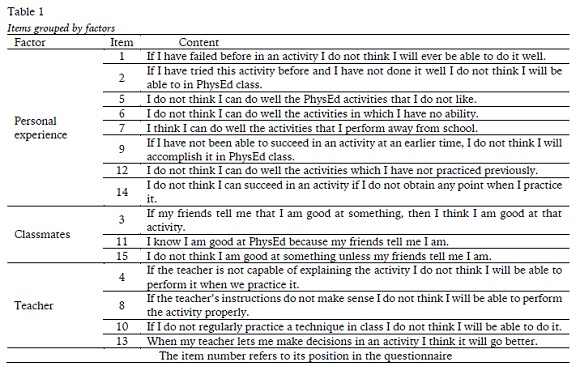
<body><![CDATA[<p><b>Method</b></p>     <p><b>Participants</b></p>     <p>Trained research assistants administered questionnaires in randomly-selected    Spanish schools of Albacete. Twenty-seven schools of Albacete were invited to    participate in the study. An official invitation letter was sent to the 27 schools    randomly-selected for the research and all of them agreed to take part in the    study. Also, all children invited agreed to take part in the study. A total    of 780 children (approximately 4% from each school), of 6th grade of Elementary    school, aged 10-13 years old participated in the study (389 boys and 391 girls,    average age= 11.08 and SD =.43).</p>     <p><b>Measures</b></p>     <p>The instrument developed by Scrabis-Fletcher and Silverman (2010) has been    used to calculate the perception of competence (POC). This instrument was verified    in a study made on a sample of 1.281 students (627 boys and 654 girls) from    urban and suburban public schools on the east coast of the United States ranging    from ages 11 to 15 (average = 12.5, sd =.95).</p>     <p>Said instrument presents two patterns of 7 to 15 items respectively, grouped    according to 3 factors: personal experience, classmates and the teacher, with    8, 3 and 4 items in each factor. Within the aspect of the personal experience,    we find items related to feelings perceived by the student when it comes to    failure, personal ability, and taste. In the classmate aspect, we find items    related to social relations with other classmates, and finally, in the teacher    aspect, we find items which show the way students see their teachers’ actions.    In <a href="#t1">Table 1</a> we can see the items, divided by factors, which    form part of the questionnaire. As the study performed by Scarbis-Fletcher and    Silverman, the first pattern (M2F) only includes the classmates and teacher    factors, meanwhile in the second pattern (M3F) all three factors are included.    Each item has been evaluated following a 5-point Likert scale (1-In complete    disagreement, 5-In complete agreement). In our study, we included a third pattern    (M3FM), a modified version of the second pattern which better adjusts itself    to the reality of 11-year-old Elementary School students in Albacete (Spain).</p>     <p>&nbsp;</p>     <p align="center"><a name="t1"></a><img src="/img/revistas/mot/v14n4/14n4a02t1.jpg"/></p>     
<p>&nbsp;</p>     <p><b>Procedures</b></p>     ]]></body>
<body><![CDATA[<p>A literal translation of the article was carried out which included the questionnaire    (Scrabis- Fletcher and Silverman, 2010). Consequently, the translation of the    instrument was verified by a jury of experts made up of four university professors    of Expression and Body Language Didactics and the validation of this instrument    was carried out through a confirmatory factorial analysis.</p>     <p>For the quantitative study, a random selection was performed of 27 Elementary    school education centers in the province of Albacete (Spain). In order to collect    the information, all teachers in each center were asked for consent to collaborate    in this study. The handing out of the questionnaire was done collectively in    each classroom.</p>     <p>The study previously received the approval from the part of the parents, along    with permission from the education centers and the consent of the Physical Education    teachers, who were all informed through a letter of agreement of the different    objectives of the study. In order to make sure that each participant received    the same amount of information, a performance protocol was created in which    the different timetables were pointed out along with the information that was    to be given at every moment. In December of 2012, the instrument was completed    in the Physical Education classroom, and it was done in the presence of a researcher    who informed the students and teacher of the goal of this study. Upon handing    out the questionnaire to the students, they were asked to first of all pay close    attention to the instructions, which pointed out what they had to do, in order    to solve any doubts they may have. Utmost discretion was used at every moment,    assuring the participants of their anonymity in their participation in the study.    They were asked to avoid putting their names on the questionnaire; in the event    of this happening the questionnaire would be discarded. The completion of both    instruments was carried out in a single period of around 15 minutes.</p>     <p><b>Statistical analysis</b></p>     <p>Different R-programmed version 2.15.2 (2012-10-26) language packages have been    used (R Project, 2012). Initially, an exploratory analysis was carried out of    the different items with the help of statistics and graphs. Next, a study of    the internal consistency was carried out through the Cronbach alfa, using the    multilevel package version 2.5 (Bliese, 2012). Finally, the structuring of the    studied constructs was carried out through a confirmatory factorial analysis    (AFC). For this, the Lavaan version 0.5-11 package was used (Rosseel, 2012).    For the normality tests, packages stats 2.15.2, nortest 1.0-2 and psych 1.2.12    were used.</p>     <p>To evaluate all three models, confirmatory data analysis was carried out. Given    the categorical nature of the data and the lack of normality in the multivariant    distribution, confirmatory data analysis was chosen using a consistent estimator,    with the minimum squares analyzed (WLSMW - diagonally least squares with robust    standard errors and a mean-and- variance-adjusted test statistic).</p>     <p><b>Results</b></p>     <p>The In the exploratory analysis of the items, the normality of all items was    rejected with the Shapiro-Wilk tests (p-value&lt;2.2e-16 for all items) and    the Lilliefors test (p-value&lt;2.2e-16 for all items). In the joint study,    the Mardia test had elevated results in asymmetry 2537.5 as well as in the kurtosis    18.93 which is why the multivariant distribution that is formed cannot be considered    normal.</p>     <p>The internal consistency of the factors was calculated with the Cronbach IQ    alfa (Cronbach, 1951). In personal experience, a score of 0.67 was obtained,    0.42 in the classmates’ factor and 0.45 in the teacher factor. Despite not being    internally consistent on an individual level, all the charges are internally    consistent as a whole (alfa: 0.74).</p>     <p>Given the categorical nature of the data and the lack of normality in the multivariant    distribution, a confirmatory analysis of the data was chosen using a consistent    estimator of minimum squares analyzed (WLSMV).</p>     ]]></body>
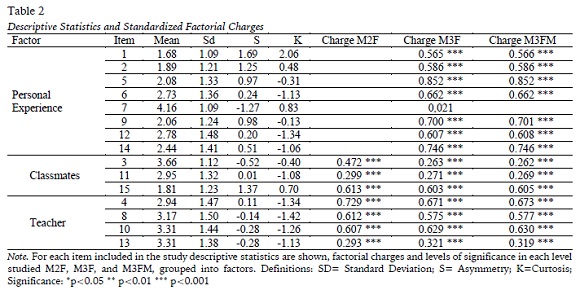
<body><![CDATA[<p>The factorial charges are presented in <a href="#t2">Table 2</a> along with    the main statistics of the different items.</p>     <p>&nbsp;</p>     <p align="center"><a name="t2"></a><img src="/img/revistas/mot/v14n4/14n4a02t2.jpg"/></p>     
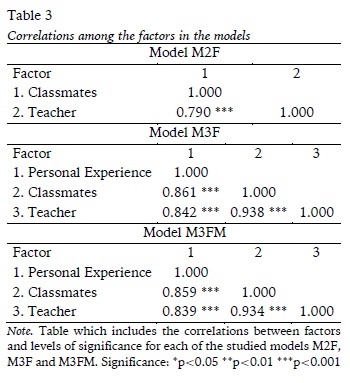
<p>&nbsp;</p>     <p>The factorial charges of the two-factor model (M2F) are all significant statistically    (p&lt;0.001), whereas the ones pertaining to the 3-factor model (M3F) are significant    statistically (p&lt;0.001) with the exception of item 7 which does not contribute    anything to this model, which is why we will create a new model with the elimination    of item 7 (M3FM), in this model all items are statistically significant. We    will develop the incentive for this process in the discussion.</p>     <p>We can appreciate a strong correlation between the latent variables in the    3 models since all are positive and very significant (p&lt;0.001) as shown in    <a href="#t3">table 3</a>.</p>     <p>&nbsp;</p>     <p align="center"><a name="t3"></a><img src="/img/revistas/mot/v14n4/14n4a02t3.jpg"/></p>     
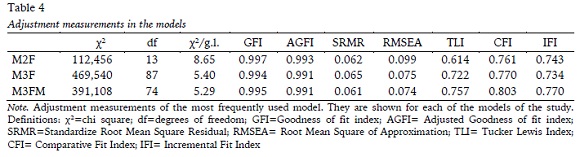
<p>&nbsp;</p>     <p>Due to the size of the sample, it is not convenient to use the Chi-Square &#967;²    test since it is sensitive to the size of the sample. Therefore, it is advisable    to use other indexes which are more reliable for testing large samples. Due    to this, as Bentler advises (1995), a combination of indexes, such as the ones    used by Scrabis- Fletcher and Silverman (2010) have been taken into consideration    to be able to demonstrate the results. The indexes recommended by Jackson, Gillaspy    and Purc-Stephenson (2009) and Byrne (2008) have been included, representing:    &#967;², &#967;²/g.1., GFI (Goodness of fit index), AGFI (Adjusted Goodness    of fit index), SRMR (Standardized Root Mean Square Residual), RMSEA (Root Mean    Square of Approximation), TLI (Tucker Lewis Index), CFI (Comparative Fit Index)    and IFI (Incremental Fit Index). In <a href="#t4">table 4</a> we can see the    global results acquired from the first analysis upon applying the different    adjustments to the models (the measurements y2, RMSEA, TLI, CFI and IFI shown    in <a href="#t4">table 4</a> are consistent).</p>     ]]></body>
<body><![CDATA[<p>&nbsp;</p>     <p align="center"><a name="t4"></a><img src="/img/revistas/mot/v14n4/14n4a02t4.jpg"/></p>     
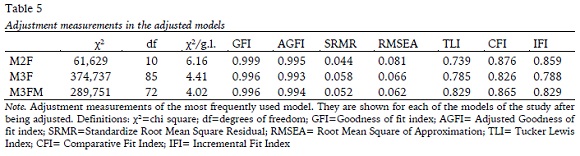
<p>&nbsp;</p>     <p>The confidence measurements at 90% in RMSEA are (0.083, 0.116) in model M2F,    (0.069,0.082) in model M3F and (0,067,0,081) in model M3FM.</p>     <p>With the goal of improving this adjustment, an analysis of the correlations    between the residual items was done, verifying that the residual items 3 and    11 (classmates opinion, within the Classmate aspect) and 4 and 8 (teachers orders,    within the Teacher aspect) were very correlated, besides in the 2-factor model    the errors in items 3 and 15 (classmates opinion, within the Classmate aspect)    were very correlated. All three models improved upon inserting said corrections    to the levels of adjustment, the levels of adjustment are shown in <a href="#t5">table    5</a> (the measurements of &#967;², RMSEA, TLI, CFI, and IFI showed in <a href="#t5">table    5</a> are consistent).</p>     <p>&nbsp;</p>     <p align="center"><a name="t5"></a><img src="/img/revistas/mot/v14n4/14n4a02t5.jpg"/></p>     
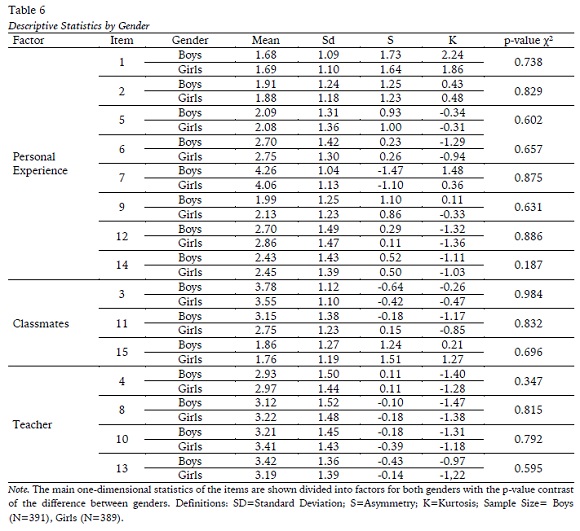
<p>&nbsp;</p>     <p>The confidence measurements at 90% in RMSEA are (0.066,0.101) in model M2F,    (0.059,0.073) in model M3F and (0.055, 0.070) in model M3FM.</p>     <p>A gender study has been carried out to figure out if there are significant    differences in the different items of the questionnaire. In order to do this    a level of significance has been established &#945;=0.05 and Bonferroni’s corrections    have been taken into account to make multiple contrasts. The results of the    descriptive statistics and the p- value of the Chi contrast are shown in <a href="#t6">Table    6</a>; this contrast proves that significant differences do not exist in any    items between the boys and girls from our study.</p>     ]]></body>
<body><![CDATA[<p>&nbsp;</p>     <p align="center"><a name="t6"></a><img src="/img/revistas/mot/v14n4/14n4a02t6.jpg"/></p>     
<p>&nbsp;</p>     <p><b>Discussion</b></p>     <p>In relation to the different factors in the instrument, Personal Experience,    Classmates and Teacher, theory shows that all three factors are fundamental    in the development of Physical Education by the students (Scrabis-Fletcher,    &amp; Silverman, 2010). In our study we have verified this fact, proving that    the perception of competence in Physical Education is strongly influenced by    the classmates (correlation of 0.980), followed by that of the teacher (correlation    of .958) and finally by personal experience (correlation of 0.879). The three    factors also show positive and elevated correlations between each other, proving    that the three factors are important and positive, but when joined together    their influence is intensified. To this effect, it is important to establish    joint performances with the goal of improving the competence of students in    Physical Education. Specifically, the strongest correlation is that between    the factors Classmates and Teacher, given that both occur in the same environment.</p>     <p>Due to all the above, it is fundamental that classmates and the personal experience    of the student be taken into account in the planning and development of motor    tasks in Physical Education, geared to 6th-grade Elementary school students    (Contreras, &amp; Gil, 2010).</p>     <p>When it comes to the items in the questionnaire, the ones that are most influenced    by the Perception of Competence are numbers 5, 9 and 14 in the Personal Experience    factor, number 15 in the Classmate factor and numbers 4 and 10 in the Teacher    factor. Their knowledge is fundamental, as by promoting an interest in these    activities along with feelings of competence, this will help the student reach    the goal of this subject since according to Bandura’s theory on social cognitivism    (1986), it is necessary to recognize:</p>     <p>1. The interactive effect of students’ feelings and thoughts (previous experience,    attitudes, the importance of the subject).</p>     <p>2. Environmental factors (context, teacher, classmates).</p>     <p>3. Performance (level of commitment, dedication to study).</p>     ]]></body>
<body><![CDATA[<p>We must point out that the consistency among the different items from the instrument    is high as a whole (Cronbach’s alfa: 0.74), despite the low consistency of the    items of each factor, having 0.67 for personal experience, 0.42 in the classmate    factor and 0.45 in the teacher factor.</p>     <p>There is a high correlation between all items, including those in different    factors, due to the inter-correlation between all three factors. Item 7 stands    out because of the irrelevant information it provides; this is not the case    in the original study. This lack of information given in item 7 (I think I can    do well the activities that I perform away from school) describes perfectly    the current social context among 11-year-olds in Spain. Arguments such as &ldquo;lack    of time&rdquo; and &ldquo;homework&rdquo; make that around 70% of students do not do regular physical    activities in their free time, this is especially the case for girls (Román,    Serra, Ribas, Pérez-Rodrigo, &amp; Aranceta, 2006 and Granda, Montilla, Barbero,    Mingorance, &amp; Alemany, 2010). Like Papaioannou (1997) points out, children    without previous experiences in physical and sports activities in their free    time have lower perceived competence when it comes to participating in Physical    Education school programs. Because of this, we think the Spanish version of    this model should not include item number 7 due to the lack of using it has    in reaching the goal of calculating the perception of competence of students.</p>     <p>It is convenient to point out that items 12 and 14 have a high correlation    with item 10. After a detailed study of the questions, this connection may be    due to the circumstances of the questionnaire (Bollen 1989), in this case to    the double negative of the question.</p>     <p>If we compare the adjustment of the different models with the data obtained    from Scrabis- Fletcher and Silverman’s (2010) original study, in this study    the questionnaire is validated by associating models M2F and M3F with the following    results: the 2-factor model (AGI=0.98, AGFI=0.97, SRMR=0.03, and RMSEA=0.05)    is a lot better adjusted than the 3-factor model (AGI=.90, AGFI=.86, SRMR=0.07,    and RMSEA=0.09), in the present study both models prove to be very similar.    Comparing both studies, the 2-factor model of the present study presents a worse    adjustment than that of the original study (AGI=0.999, AGFI=0.995, SRMR=0.044    and RMSEA=0.081, confidence interval RMSEA 0.063-0.101), but the 3-factor model    is better adjusted (AGI=0.996, AGFI=0.993, SRMR=0.058 and RMSEA=0.066, confidence    interval RMSEA 0.059-0.073) than in the original study, having this study verify    the construct presented in the field of the current study. But we can see that    by eliminating item 7 we get a better adjustment (AGI=0.996, AGFI=0.994, SRMR=0.052    and RMSEA=0.062, the confidence interval RMSEA 0.055-0.070). The three models    present an adequate global adjustment proven by Hu &amp; Bentler (1999).</p>     <p>The main limitations of this study were that the sample came from only one    region of Spain (Albacete) and the sample was composed only by children of the    sixth year of Primary Education. Therefore, future research should study children    of other Spanish regions and with different ages.</p>     <p><b>Conclusion</b></p>     <p>Game This study allows Physical Education teachers the possibility of comparing    the results when the validated tool is used with the end goal of finding deficiencies    in any of the factors or items included in the instrument.</p>     <p>Since this study was carried out exclusively on children in 6th grade Elementary    School in the province of Albacete (Spain), and given that there are no great    differences in the school curriculum of Physical Education in the third cycle    of Elementary School between autonomous communities in the Spanish education    system, said instrument can be used on a national level. Other provinces can    carry out similar studies, in other levels of the Spanish education system,    with the goal of proving the results shown here. And through this establish    a joint timetable between the teachers of all levels and use a tracking construct    which would allow the correction of any deficiencies which are detected and    have an impact on them in the best way possible which will allow the improvement    of the teaching of Physical Education within the education systems. The construct    has also been proven to be equally valid for boys as for girls, not showing    any significant differences in any of the items.</p>     <p>We can conclude the verification of the Perception of Competence in Middle    School Physical Education instrument in a Spanish social context, specifically    6th grade Elementary School students in the province of Albacete, as well as    that of the 2-factor and 3-factor constructs, with the exception of item 7,    to be used to determine the perception of competence in Elementary School 6th    graders. The first, includes the factors teacher and classmates, which can be    used to determine the programming of the subject of Physical Education, leaving    out the 3-factor questionnaire which besides the Personal Experience factor,    also includes to establish the details (intensity, difficulty, etc&hellip;) of motor    tasks to realize the function of the personal experiences of students.</p>     <p>&nbsp;</p>     ]]></body>
<body><![CDATA[<p><b>REFERENCES</b></p>     <!-- ref --><p>Bandura, A. (1986). <i>Social foundations of thought and action</i>. Englewood    Cliffs, N.J: Prentice-Hall. DOI: <a href="https://dx.doi.org/10.4135/9781446221129.n6" target="_blank">10.4135/9781446221129.n6</a>.    &nbsp;&nbsp;&nbsp;&nbsp;&nbsp;&nbsp;&nbsp;&nbsp;[&#160;<a href="javascript:void(0);" onclick="javascript: window.open('/scielo.php?script=sci_nlinks&ref=384412&pid=S1646-107X201800030000200001&lng=','','width=640,height=500,resizable=yes,scrollbars=1,menubar=yes,');">Links</a>&#160;]<!-- end-ref --></p>     <p>Beltrán Carrillo, V. J., Beltrán Carrillo, J. I. &amp; Valenciano Valcárcel,    J. (2008). Niveles de actividad física en niños y adolescentes españoles: evolución    de la práctica en los últimos años y diferencias según zona geográfica. <i>IV    Congreso internacional y XXV Nacional de Educación Física</i>. Córdoba. <a href="http://www.uco.es/IVCongresoInternacionalEducacionFisica/congreso/Documentos/001-140-464-002-001.html" target="_blank">http://www.uco.es/IVCongresoInternacionalEducacionFisica/congreso/Documentos/001-140-464-002-001.html</a></p>     <!-- ref --><p>Bentler, P. M. (1990). Comparative fit indices in structural models. <i>Psychological    Bulletin, 107, </i>238-246. DOI: <a href="https://dx.doi.org/ 10.1037//0033-2909.107.2.238" target="_blank"> 10.1037//0033-2909.107.2.238</a>.    &nbsp;&nbsp;&nbsp;&nbsp;&nbsp;&nbsp;&nbsp;&nbsp;[&#160;<a href="javascript:void(0);" onclick="javascript: window.open('/scielo.php?script=sci_nlinks&ref=384415&pid=S1646-107X201800030000200003&lng=','','width=640,height=500,resizable=yes,scrollbars=1,menubar=yes,');">Links</a>&#160;]<!-- end-ref --></p>     <!-- ref --><p>Biddle, S., Wang, C., Chatzisarantis, N. &amp; Spray, C. (2003). Motivation    for physical activity in young people: Entity and incremental beliefs about    athletic ability. <i>Journal of Sport Sciences, 21, </i>973- 989. DOI: <a href="https://dx.doi.org/10.1080/02640410310001641377" target="_blank">10.1080/02640410310001641377</a>.    &nbsp;&nbsp;&nbsp;&nbsp;&nbsp;&nbsp;&nbsp;&nbsp;[&#160;<a href="javascript:void(0);" onclick="javascript: window.open('/scielo.php?script=sci_nlinks&ref=384417&pid=S1646-107X201800030000200004&lng=','','width=640,height=500,resizable=yes,scrollbars=1,menubar=yes,');">Links</a>&#160;]<!-- end-ref --></p>     <!-- ref --><p>Bliese, P. (2012). Multilevel package, designed to be used in the analysis    of multilevel data by applied psychologists. <a href="http://cran.r-project.org/web/packages/multilevel/index.html" target="_blank">http://cran.r-project.org/web/packages/multilevel/index.html</a>&nbsp;&nbsp;&nbsp;&nbsp;&nbsp;&nbsp;&nbsp;&nbsp;[&#160;<a href="javascript:void(0);" onclick="javascript: window.open('/scielo.php?script=sci_nlinks&ref=384419&pid=S1646-107X201800030000200005&lng=','','width=640,height=500,resizable=yes,scrollbars=1,menubar=yes,');">Links</a>&#160;]<!-- end-ref --><!-- ref --><p>Bollen, K. A. (1989). <i>Structural equations with latent variables. </i>New    York: John Wiley y Sons. DOI: <a href="https://dx.doi.org/10.1002/9781118619179" target="_blank">10.1002/9781118619179</a>.    &nbsp;&nbsp;&nbsp;&nbsp;&nbsp;&nbsp;&nbsp;&nbsp;[&#160;<a href="javascript:void(0);" onclick="javascript: window.open('/scielo.php?script=sci_nlinks&ref=384420&pid=S1646-107X201800030000200006&lng=','','width=640,height=500,resizable=yes,scrollbars=1,menubar=yes,');">Links</a>&#160;]<!-- end-ref --></p>     <!-- ref --><p>Bouchard, C., Blair, S. N. &amp; Haskell, W. L. (2007). <i>Physical activity    and health. Champaign, </i>IL: Human Kinetics.    &nbsp;&nbsp;&nbsp;&nbsp;&nbsp;&nbsp;&nbsp;&nbsp;[&#160;<a href="javascript:void(0);" onclick="javascript: window.open('/scielo.php?script=sci_nlinks&ref=384422&pid=S1646-107X201800030000200007&lng=','','width=640,height=500,resizable=yes,scrollbars=1,menubar=yes,');">Links</a>&#160;]<!-- end-ref --></p>     <!-- ref --><p>Byrne, B. M. (2008). Testing for multigroup equivalence of a measuring instrument:    Awalk through the process. <i>Psichothema, 20</i>, 872-882. DOI: <a href="https://dx.doi.org/10.1037/e508732013-001" target="_blank">10.1037/e508732013-001</a>.    &nbsp;&nbsp;&nbsp;&nbsp;&nbsp;&nbsp;&nbsp;&nbsp;[&#160;<a href="javascript:void(0);" onclick="javascript: window.open('/scielo.php?script=sci_nlinks&ref=384424&pid=S1646-107X201800030000200008&lng=','','width=640,height=500,resizable=yes,scrollbars=1,menubar=yes,');">Links</a>&#160;]<!-- end-ref --></p>     <!-- ref --><p>Carreiro, F., Januário, C., Dinis, A., Bom, L., Jacinto, J., &amp; Onofre,    M. (1988). Caracterização da Educação Física como Projecto Educativo. <i>Horizont,    25</i>, 13- 17.    &nbsp;&nbsp;&nbsp;&nbsp;&nbsp;&nbsp;&nbsp;&nbsp;[&#160;<a href="javascript:void(0);" onclick="javascript: window.open('/scielo.php?script=sci_nlinks&ref=384426&pid=S1646-107X201800030000200009&lng=','','width=640,height=500,resizable=yes,scrollbars=1,menubar=yes,');">Links</a>&#160;]<!-- end-ref --></p>     <p>Contreras Jordán, O. R. &amp; Gil Madrona, P. (2010). &ldquo;Estrategias didácticas    en Educación Física&rdquo;, En González, C. y Lleixá, T. (coord.). <i>Didáctica de    la Educación Física</i>. Grao, Vol. II. Barcelona.</p>     <p>Corbin, C. B., Pangrazi, R. P. and Le-Masurier, G. C. (2004). Physical activity    for children: Current patterns and guidelines. <i>The President’s Council of    </i><i>Physical Fitness and Sports Research Digest, 52</i>, 1-8. DOI: <a href="https://dx.doi.org/10.1037/e603362007-001" target="_blank">10.1037/e603362007-001</a>.</p>     <!-- ref --><p>Cox, A. E., Smith, A. L., &amp; Williams, L.(2008).Change in physical education    motivation and physical activity behavior during middle school<i>. Journal of    Adolescent Health, 43</i>, 506-513. DOI: <a href="https://dx.doi.org/10.1016/j.jadohealth.2008.04.020" target="_blank">10.1016/j.jadohealth.2008.04.020</a>.    &nbsp;&nbsp;&nbsp;&nbsp;&nbsp;&nbsp;&nbsp;&nbsp;[&#160;<a href="javascript:void(0);" onclick="javascript: window.open('/scielo.php?script=sci_nlinks&ref=384430&pid=S1646-107X201800030000200012&lng=','','width=640,height=500,resizable=yes,scrollbars=1,menubar=yes,');">Links</a>&#160;]<!-- end-ref --></p>     <!-- ref --><p>Cox, A. E. &amp; Ullrich-French, S. (2010). The motivational relevance of peer    and teacher relationship profiles in physical education. <i>Psychology of Sport    and Exercise, 11</i>, 337-344. DOI: <a href="https://dx.doi.org/10.1016/j.psychsport.2010.04.001" target="_blank">10.1016/j.psychsport.2010.04.001</a>.    &nbsp;&nbsp;&nbsp;&nbsp;&nbsp;&nbsp;&nbsp;&nbsp;[&#160;<a href="javascript:void(0);" onclick="javascript: window.open('/scielo.php?script=sci_nlinks&ref=384432&pid=S1646-107X201800030000200013&lng=','','width=640,height=500,resizable=yes,scrollbars=1,menubar=yes,');">Links</a>&#160;]<!-- end-ref --></p>     <!-- ref --><p>Cronbach, I. (1951). Coefficient alpha and the internal structure of tests.    <i>Psychometrika, 16</i>, 297-334. DOI: <a href="https://dx.doi.org/10.1007/bf02310555" target="_blank">10.1007/bf02310555</a>.    &nbsp;&nbsp;&nbsp;&nbsp;&nbsp;&nbsp;&nbsp;&nbsp;[&#160;<a href="javascript:void(0);" onclick="javascript: window.open('/scielo.php?script=sci_nlinks&ref=384434&pid=S1646-107X201800030000200014&lng=','','width=640,height=500,resizable=yes,scrollbars=1,menubar=yes,');">Links</a>&#160;]<!-- end-ref --></p>     <p>Currie, C., Gabhainn, S.N., Godeau, E., Roberts, C., Smith, R., Picket, W.    &amp; Barnekow, V. (2008). <i>Inequalities in young people&rsquo;s health. Health    behaviour in school-aged children. </i>International report from the 2005/2006    survey. Available from URL: <a href="http://www.euro.who.int/data/assets/pdf_file/0005/53852/E91416.pdf" target="_blank">http://www.euro.who.int/data/assets/pdf_file/0005/53852/E91416.pdf</a></p>     <!-- ref --><p>Dishman, R., Motl, R., Saunders, R., Felton, G., Ward, D. &amp; Pate, R. (2005).    Enjoyment mediates the effects of a school-based physical activity intervention    among adolescent girls. <i>Medicine and Science in Sports and Exercise 37</i>,    478-487.    &nbsp;&nbsp;&nbsp;&nbsp;&nbsp;&nbsp;&nbsp;&nbsp;[&#160;<a href="javascript:void(0);" onclick="javascript: window.open('/scielo.php?script=sci_nlinks&ref=384437&pid=S1646-107X201800030000200016&lng=','','width=640,height=500,resizable=yes,scrollbars=1,menubar=yes,');">Links</a>&#160;]<!-- end-ref --></p>     <!-- ref --><p>Donnelly, J. E., Blair, S. N., Jakicic, J. M., Manor, M. M., Rankin, J. W.    &amp; Smith, B. K. (2009). Appropriate physical activity intervention strategies    for weight loss and prevention of weight regain for adults. <i>Medicine and    Science in Sports and Exercise, 41</i>(2), 459-471. DOI: <a href="https://dx.doi.org/10.1249/mss.0b013e3181ae46a1" target="_blank">10.1249/mss.0b013e3181ae46a1</a>.    &nbsp;&nbsp;&nbsp;&nbsp;&nbsp;&nbsp;&nbsp;&nbsp;[&#160;<a href="javascript:void(0);" onclick="javascript: window.open('/scielo.php?script=sci_nlinks&ref=384439&pid=S1646-107X201800030000200017&lng=','','width=640,height=500,resizable=yes,scrollbars=1,menubar=yes,');">Links</a>&#160;]<!-- end-ref --></p>     ]]></body>
<body><![CDATA[<!-- ref --><p>Drudy, S., &amp; ÚiChatháin, M. (2002). Gender effects in classroom interaction:    Data collection, self- analysis, and reflection. <i>Evaluation and Research    in Education, 16, </i>34-50. DOI: <a href="https://dx.doi.org/10.1080/09500790208667005" target="_blank">10.1080/09500790208667005</a>.    &nbsp;&nbsp;&nbsp;&nbsp;&nbsp;&nbsp;&nbsp;&nbsp;[&#160;<a href="javascript:void(0);" onclick="javascript: window.open('/scielo.php?script=sci_nlinks&ref=384441&pid=S1646-107X201800030000200018&lng=','','width=640,height=500,resizable=yes,scrollbars=1,menubar=yes,');">Links</a>&#160;]<!-- end-ref --></p>     <!-- ref --><p>Duffy, J., Warren, K., &amp; Walsh, M. (2001). Classroom interactions: Gender    of teacher, gender of student, and classroom subject. <i>Sex Roles</i>, <i>45</i>,    579-593.    &nbsp;&nbsp;&nbsp;&nbsp;&nbsp;&nbsp;&nbsp;&nbsp;[&#160;<a href="javascript:void(0);" onclick="javascript: window.open('/scielo.php?script=sci_nlinks&ref=384443&pid=S1646-107X201800030000200019&lng=','','width=640,height=500,resizable=yes,scrollbars=1,menubar=yes,');">Links</a>&#160;]<!-- end-ref --></p>     <!-- ref --><p>Dunbar, R., &amp; O’Sullivan, M. (1986). Effects of intervention on differential    treatment of boys and girls in elementary physical education lessons. <i>Journal    of Teaching Physical Education</i>, <i>5, </i>166-175. DOI: <a href="https://dx.doi.org/10.1123/jtpe.5.3.166" target="_blank">10.1123/jtpe.5.3.166</a>.    &nbsp;&nbsp;&nbsp;&nbsp;&nbsp;&nbsp;&nbsp;&nbsp;[&#160;<a href="javascript:void(0);" onclick="javascript: window.open('/scielo.php?script=sci_nlinks&ref=384445&pid=S1646-107X201800030000200020&lng=','','width=640,height=500,resizable=yes,scrollbars=1,menubar=yes,');">Links</a>&#160;]<!-- end-ref --></p>     <!-- ref --><p>Duncan, S. C. (1993). The role of cognitive appraisal and friendship provisions    in adolescents’ affect and motivation toward activity in physical education.    <i>Research Quarterly for Exercise and Sport, 64, </i>314-323. DOI: <a href="https://dx.doi.org/10.1080/02701367.1993.10608816" target="_blank">10.1080/02701367.1993.10608816</a>.    &nbsp;&nbsp;&nbsp;&nbsp;&nbsp;&nbsp;&nbsp;&nbsp;[&#160;<a href="javascript:void(0);" onclick="javascript: window.open('/scielo.php?script=sci_nlinks&ref=384447&pid=S1646-107X201800030000200021&lng=','','width=640,height=500,resizable=yes,scrollbars=1,menubar=yes,');">Links</a>&#160;]<!-- end-ref --></p>     <!-- ref --><p>Ennis, C. (1996). Students’ experiences in sport based physical education:    [More than] apologies are necessary. <i>Quest, 48, </i>453-456. DOI: <a href="https://dx.doi.org/10.1080/00336297.1996.10484211" target="_blank">10.1080/00336297.1996.10484211</a>.    &nbsp;&nbsp;&nbsp;&nbsp;&nbsp;&nbsp;&nbsp;&nbsp;[&#160;<a href="javascript:void(0);" onclick="javascript: window.open('/scielo.php?script=sci_nlinks&ref=384449&pid=S1646-107X201800030000200022&lng=','','width=640,height=500,resizable=yes,scrollbars=1,menubar=yes,');">Links</a>&#160;]<!-- end-ref --></p>     ]]></body>
<body><![CDATA[<p>Ennis, C. (2003). Using Curriculum to Enhance Student Learning. In: S. J. Silverman    &amp; C. D. Ennis (Eds.), <i>Student learning in physical education: Applying    research to enhance instruction </i>(2nd ed., pp. 109-127). Champaign, IL: Human    Kinetics.</p>     <!-- ref --><p>Fairclough, S. (2003). Physical activity, perceived competence and enjoyment    during secondary school physical education. <i>The European Journal of Physical    Education 8, </i>5-18. DOI: <a href="https://dx.doi.org/10.1080/1740898030080102" target="_blank">10.1080/1740898030080102</a>.    &nbsp;&nbsp;&nbsp;&nbsp;&nbsp;&nbsp;&nbsp;&nbsp;[&#160;<a href="javascript:void(0);" onclick="javascript: window.open('/scielo.php?script=sci_nlinks&ref=384452&pid=S1646-107X201800030000200024&lng=','','width=640,height=500,resizable=yes,scrollbars=1,menubar=yes,');">Links</a>&#160;]<!-- end-ref --></p>     <!-- ref --><p>Ferrer-Caja, E. &amp; Weiss, M. R. (2000). Predictors of intrinsic motivation    among adolescent students in physical education. <i>Research Quarterly for Exercise    and Sport 71</i>, 267-279. DOI: <a href="https://dx.doi.org/10.1080/02701367.2000.10608907" target="_blank">10.1080/02701367.2000.10608907</a>.    &nbsp;&nbsp;&nbsp;&nbsp;&nbsp;&nbsp;&nbsp;&nbsp;[&#160;<a href="javascript:void(0);" onclick="javascript: window.open('/scielo.php?script=sci_nlinks&ref=384454&pid=S1646-107X201800030000200025&lng=','','width=640,height=500,resizable=yes,scrollbars=1,menubar=yes,');">Links</a>&#160;]<!-- end-ref --></p>     <!-- ref --><p>González-Cutre, D., Sicilia, A. &amp; Moreno, J. A. (2008). Modelo cognitivo-social    de la motivación de logro en educación física<b>. </b><i>Psicothema</i>, <i>20(4)</i>,    642-651.    &nbsp;&nbsp;&nbsp;&nbsp;&nbsp;&nbsp;&nbsp;&nbsp;[&#160;<a href="javascript:void(0);" onclick="javascript: window.open('/scielo.php?script=sci_nlinks&ref=384456&pid=S1646-107X201800030000200026&lng=','','width=640,height=500,resizable=yes,scrollbars=1,menubar=yes,');">Links</a>&#160;]<!-- end-ref --></p>     <!-- ref --><p>Granda, J., Montilla, M., Barbero, J. C., Mingorance, A., &amp; Alemany, I.    (2010). Frecuencia de práctica y motivos de participación/no participación en    actividades físicas en función del género de escolares de 10-12 años de Melilla.    <i>Revista</i><i>Internacional de Ciencias del Deporte</i>, <i>21(</i>6), 280-    296. DOI: <a href="https://dx.doi.org/10.5232/ricyde2010.02103" target="_blank">10.5232/ricyde2010.02103</a>.    &nbsp;&nbsp;&nbsp;&nbsp;&nbsp;&nbsp;&nbsp;&nbsp;[&#160;<a href="javascript:void(0);" onclick="javascript: window.open('/scielo.php?script=sci_nlinks&ref=384458&pid=S1646-107X201800030000200027&lng=','','width=640,height=500,resizable=yes,scrollbars=1,menubar=yes,');">Links</a>&#160;]<!-- end-ref --></p>     <!-- ref --><p>Gutiérrez, M. (2000). Actividad física, estilos de vida y calidad de vida.    <i>Revista de Educación</i>, <i>77</i>, 5-14.    &nbsp;&nbsp;&nbsp;&nbsp;&nbsp;&nbsp;&nbsp;&nbsp;[&#160;<a href="javascript:void(0);" onclick="javascript: window.open('/scielo.php?script=sci_nlinks&ref=384460&pid=S1646-107X201800030000200028&lng=','','width=640,height=500,resizable=yes,scrollbars=1,menubar=yes,');">Links</a>&#160;]<!-- end-ref --></p>     <!-- ref --><p>Hagger, M., Biddle, S. &amp; Wang, C. K. (2005). Physical Self-Concept in Adolescence:    Generalizability of a Multidimensional, Hierarchical Model Across Gender and    Grade. <i>Educational and Psychology </i><i>Measurement, 65(2), </i>297-322.    DOI: <a href="https://dx.doi.org/10.1177/0013164404272484" target="_blank">10.1177/0013164404272484</a>.    &nbsp;&nbsp;&nbsp;&nbsp;&nbsp;&nbsp;&nbsp;&nbsp;[&#160;<a href="javascript:void(0);" onclick="javascript: window.open('/scielo.php?script=sci_nlinks&ref=384462&pid=S1646-107X201800030000200029&lng=','','width=640,height=500,resizable=yes,scrollbars=1,menubar=yes,');">Links</a>&#160;]<!-- end-ref --></p>     <!-- ref --><p>Hagger, M., Chatzisarantis, N. L., Hein, V., Soós, I., Karsai, I., Lintunen,    T., &amp; Leemans, S. (2009). Teacher, peer and parent autonomy support in physical    education and leisure time physical activity: a trans-contextual model of motivation    in four nations. <i>Psychology &amp; Health, 24, </i>689-711. DOI: <a href="https://dx.doi.org/10.1080/08870440801956192" target="_blank">10.1080/08870440801956192</a>.    &nbsp;&nbsp;&nbsp;&nbsp;&nbsp;&nbsp;&nbsp;&nbsp;[&#160;<a href="javascript:void(0);" onclick="javascript: window.open('/scielo.php?script=sci_nlinks&ref=384464&pid=S1646-107X201800030000200030&lng=','','width=640,height=500,resizable=yes,scrollbars=1,menubar=yes,');">Links</a>&#160;]<!-- end-ref --></p>     <!-- ref --><p>Harter, S. (1985). <i>Competence as a dimension of self- evaluation: toward    a comprehensive model of self- worth. </i>In: Leahy R, (ed.). The Development    of the Self. New York: <i>Academic Press, </i>55-121.    &nbsp;&nbsp;&nbsp;&nbsp;&nbsp;&nbsp;&nbsp;&nbsp;[&#160;<a href="javascript:void(0);" onclick="javascript: window.open('/scielo.php?script=sci_nlinks&ref=384466&pid=S1646-107X201800030000200031&lng=','','width=640,height=500,resizable=yes,scrollbars=1,menubar=yes,');">Links</a>&#160;]<!-- end-ref --></p>     <!-- ref --><p>Hashim, H., Grove, J.R. &amp; Whipp, P. (2008). Validating the youth sport    enjoyment construct in high school physical education. <i>Research Quarterly    for Exercise and Sport, 79, </i>183-195. DOI: <a href="https://dx.doi.org/10.1080/02701367.2008.10599482" target="_blank">10.1080/02701367.2008.10599482</a>.    &nbsp;&nbsp;&nbsp;&nbsp;&nbsp;&nbsp;&nbsp;&nbsp;[&#160;<a href="javascript:void(0);" onclick="javascript: window.open('/scielo.php?script=sci_nlinks&ref=384468&pid=S1646-107X201800030000200032&lng=','','width=640,height=500,resizable=yes,scrollbars=1,menubar=yes,');">Links</a>&#160;]<!-- end-ref --></p>     <!-- ref --><p>Hastie, P. A., &amp; Siedentop, D. (2006). <i>The classroom ecology paradigm.    </i>In D. Kirk, D. Macdonald, y M. O´Sullivan (Eds.), <i>The Handbook of Physical    Education. </i>London, England: Sage, 214-223.    &nbsp;&nbsp;&nbsp;&nbsp;&nbsp;&nbsp;&nbsp;&nbsp;[&#160;<a href="javascript:void(0);" onclick="javascript: window.open('/scielo.php?script=sci_nlinks&ref=384470&pid=S1646-107X201800030000200033&lng=','','width=640,height=500,resizable=yes,scrollbars=1,menubar=yes,');">Links</a>&#160;]<!-- end-ref --></p>     <!-- ref --><p>Hu, L. &amp; Bentler, P. (1999). Cutoff criteria for fit indexes in covariance    structure analysis: Conventional criteria versus new alternatives. <i>Structural    Equation Modeling, 6, </i>1-55. DOI: <a href="https://dx.doi.org/10.1080/10705519909540118" target="_blank">10.1080/10705519909540118</a>.    &nbsp;&nbsp;&nbsp;&nbsp;&nbsp;&nbsp;&nbsp;&nbsp;[&#160;<a href="javascript:void(0);" onclick="javascript: window.open('/scielo.php?script=sci_nlinks&ref=384472&pid=S1646-107X201800030000200034&lng=','','width=640,height=500,resizable=yes,scrollbars=1,menubar=yes,');">Links</a>&#160;]<!-- end-ref --></p>     <!-- ref --><p>Jackson, D. L., Gillaspy, J.A., &amp; Purc-Stephenson, R. (2009). Reporting    practices in confirmatory factor analysis: An overview and some recommendations.    <i>Psychological Methods, 14, </i>6-23.    &nbsp;&nbsp;&nbsp;&nbsp;&nbsp;&nbsp;&nbsp;&nbsp;[&#160;<a href="javascript:void(0);" onclick="javascript: window.open('/scielo.php?script=sci_nlinks&ref=384474&pid=S1646-107X201800030000200035&lng=','','width=640,height=500,resizable=yes,scrollbars=1,menubar=yes,');">Links</a>&#160;]<!-- end-ref --> </p>     <!-- ref --><p>Martens, R. (1996). Turning Kids on to Physical Activity Life Time. <i>Quest,    48(3)</i>, 303-310. DOI: <a href="https://dx.doi.org/10.1080/00336297.1996.10484199" target="_blank">10.1080/00336297.1996.10484199</a>.    &nbsp;&nbsp;&nbsp;&nbsp;&nbsp;&nbsp;&nbsp;&nbsp;[&#160;<a href="javascript:void(0);" onclick="javascript: window.open('/scielo.php?script=sci_nlinks&ref=384476&pid=S1646-107X201800030000200036&lng=','','width=640,height=500,resizable=yes,scrollbars=1,menubar=yes,');">Links</a>&#160;]<!-- end-ref --></p>     <!-- ref --><p>Moreno, J. A. &amp; Cervelló, E. (2005). Physical Self- Perception in Spanish    Adolescents: Gender and Involvement in Physical Activity Effects. <i>Journal    of Human Movement Studies, 48, </i>291-311<i>.    &nbsp;&nbsp;&nbsp;&nbsp;&nbsp;&nbsp;&nbsp;&nbsp;[&#160;<a href="javascript:void(0);" onclick="javascript: window.open('/scielo.php?script=sci_nlinks&ref=384478&pid=S1646-107X201800030000200037&lng=','','width=640,height=500,resizable=yes,scrollbars=1,menubar=yes,');">Links</a>&#160;]<!-- end-ref --></i></p>     <!-- ref --><p>Moreno, J. A. &amp; Vera, J. A. (2008). Un estudio experimental de las diferencias    por género en la percepción de competencia a partir de la cesión de responsabilidad    en las clases de educación física. <i>Revista Iberoamericana de Educación, 46,    </i>8-15<i>.    &nbsp;&nbsp;&nbsp;&nbsp;&nbsp;&nbsp;&nbsp;&nbsp;[&#160;<a href="javascript:void(0);" onclick="javascript: window.open('/scielo.php?script=sci_nlinks&ref=384480&pid=S1646-107X201800030000200038&lng=','','width=640,height=500,resizable=yes,scrollbars=1,menubar=yes,');">Links</a>&#160;]<!-- end-ref --></i></p>     <p>National Association for Sport and Physical Education (2004). <i>Moving into    the future: National standards for physical education (2</i><i>nd</i><i>ed).    </i>Reston, VA: Author.</p>     <!-- ref --><p>Nicaise, V., Cogérino, G., Bois, J., &amp; Amorose, A. J. (2006). Students´    Perceptions of Teacher Feedback and Physical competence in Physical Education    classes: Gender Effects<i>. Journal of Teaching in Physical Education, 25, </i>36-57.    DOI: <a href="https://dx.doi.org/10.1123/jtpe.25.1.36" target="_blank">10.1123/jtpe.25.1.36</a>.    &nbsp;&nbsp;&nbsp;&nbsp;&nbsp;&nbsp;&nbsp;&nbsp;[&#160;<a href="javascript:void(0);" onclick="javascript: window.open('/scielo.php?script=sci_nlinks&ref=384483&pid=S1646-107X201800030000200040&lng=','','width=640,height=500,resizable=yes,scrollbars=1,menubar=yes,');">Links</a>&#160;]<!-- end-ref --></p>     <!-- ref --><p>Ntoumanis, N., Pensgaard, A. M., Martin, C., &amp; Pipe, K. (2004). An ideographic    analysis of amotivation in compulsory school physical education. <i>Journal    of Sport and Exercise Psychology, 26, </i>197-214. DOI: <a href="https://dx.doi.org/10.1123/jsep.26.2.197" target="_blank">10.1123/jsep.26.2.197</a>.    &nbsp;&nbsp;&nbsp;&nbsp;&nbsp;&nbsp;&nbsp;&nbsp;[&#160;<a href="javascript:void(0);" onclick="javascript: window.open('/scielo.php?script=sci_nlinks&ref=384485&pid=S1646-107X201800030000200041&lng=','','width=640,height=500,resizable=yes,scrollbars=1,menubar=yes,');">Links</a>&#160;]<!-- end-ref --></p>     <p>O’Donovan, G., Blazevich, A, J., Boreham, C., Cooper, A. R., Crank, H., Hamer,    M., &hellip; &amp; Stamatakis, E. (2010). The ABC of Physical Activity for Health:    A consensus statement from the British. Association of Sport and Exercise Sciences.    <i>Journal of Sports Sciences</i>, <i>28</i>(6), 573-591. DOI: <a href="https://dx.doi.org/10.1080/02640411003671212" target="_blank">10.1080/02640411003671212</a>.</p>     <!-- ref --><p>Ommundsen, Y. (2005). Motivation and affect in physical education classes-    a self-determination perspective. Active lifestyles: The impact of education    and sport. In: <i>AIESEP World Congress Lisbon, </i>Book of Abstract. <a href="http://ask.bibsys.no/ask/action/show?pid=r05013464&kid=forskpub" target="_blank">http://ask.bibsys.no/ask/action/show?pid=r05013464&amp;kid=forskpub</a>&nbsp;&nbsp;&nbsp;&nbsp;&nbsp;&nbsp;&nbsp;&nbsp;[&#160;<a href="javascript:void(0);" onclick="javascript: window.open('/scielo.php?script=sci_nlinks&ref=384488&pid=S1646-107X201800030000200043&lng=','','width=640,height=500,resizable=yes,scrollbars=1,menubar=yes,');">Links</a>&#160;]<!-- end-ref --><!-- ref --><p>Papaioannou, A. (1997). Perceptions of motivational climate, perceived competence,    and motivation of students of varying age and sport experience. Perceptual Motor    Skills, <i>85</i>, 419-430. DOI: <a href="https://dx.doi.org/10.2466/pms.1997.85.2.419" target="_blank">10.2466/pms.1997.85.2.419</a>.    &nbsp;&nbsp;&nbsp;&nbsp;&nbsp;&nbsp;&nbsp;&nbsp;[&#160;<a href="javascript:void(0);" onclick="javascript: window.open('/scielo.php?script=sci_nlinks&ref=384489&pid=S1646-107X201800030000200044&lng=','','width=640,height=500,resizable=yes,scrollbars=1,menubar=yes,');">Links</a>&#160;]<!-- end-ref --></p>     ]]></body>
<body><![CDATA[<!-- ref --><p>Project, R. (2012). Free software environment for statistical computing and    graphics. <a href="http://www.r-project.org/" target="_blank">http://www.r-project.org/</a>&nbsp;&nbsp;&nbsp;&nbsp;&nbsp;&nbsp;&nbsp;&nbsp;[&#160;<a href="javascript:void(0);" onclick="javascript: window.open('/scielo.php?script=sci_nlinks&ref=384491&pid=S1646-107X201800030000200045&lng=','','width=640,height=500,resizable=yes,scrollbars=1,menubar=yes,');">Links</a>&#160;]<!-- end-ref --><p>Roberts, G. (1992). Motivacion in sport and exercise: Conceptual constraints    and convergence. In G. Roberts (Ed), <i>Motivation in sport and exercise </i>(pp.    3-29). Champaign, IL: Human Kinetics.</p>     <p>Roman, B., Serra, L., Ribas, L., Pérez-Rodrigo, C., &amp; Aranceta, J. (2006).    Actividad física en la población infantil y juvenil española en el tiempo libre.    EstudioenKid (1998-2000). <i>Apunts. Medicina de l&rsquo;Esport</i>.<i>41</i>, 86-94.    DOI: <a href="https://dx.doi.org/10.1016/s1886-6581(06)70016-0" target="_blank">10.1016/s1886-6581(06)70016-0</a>.</p>     <!-- ref --><p>Rosseel, Y. (2012). Lavaan: An R Package for Structural Equation Modeling.    <i>Journal of Statistical Software</i>, <i>48 </i>(2), 36-43. DOI: <a href="https://dx.doi.org/10.18637/jss.v048.i02" target="_blank">10.18637/jss.v048.i02</a>.    &nbsp;&nbsp;&nbsp;&nbsp;&nbsp;&nbsp;&nbsp;&nbsp;[&#160;<a href="javascript:void(0);" onclick="javascript: window.open('/scielo.php?script=sci_nlinks&ref=384494&pid=S1646-107X201800030000200048&lng=','','width=640,height=500,resizable=yes,scrollbars=1,menubar=yes,');">Links</a>&#160;]<!-- end-ref --></p>     <!-- ref --><p>Rudisill, M. E., Mahar, M. T., &amp; Meaney, K. S. (1993). The relationship    between children’s perceived and actual motor competence. <i>Perceptual and    Motor Skills, 76</i>, 895-906. DOI: <a href="https://dx.doi.org/10.2466/pms.1993.76.3.895" target="_blank">10.2466/pms.1993.76.3.895</a>.    &nbsp;&nbsp;&nbsp;&nbsp;&nbsp;&nbsp;&nbsp;&nbsp;[&#160;<a href="javascript:void(0);" onclick="javascript: window.open('/scielo.php?script=sci_nlinks&ref=384496&pid=S1646-107X201800030000200049&lng=','','width=640,height=500,resizable=yes,scrollbars=1,menubar=yes,');">Links</a>&#160;]<!-- end-ref --></p>     <!-- ref --><p>Sallis, J. F., Prochaska, J. J. &amp; Taylor, W. C. (2000). A review of correlates    of physical activity of children and adolescents. <i>Medicine and Science in    Sports and Exercise, 32</i>, 963-975. DOI: <a href="https://dx.doi.org/10.1097/00005768-200005000-00014" target="_blank">10.1097/00005768-200005000-00014</a>.    &nbsp;&nbsp;&nbsp;&nbsp;&nbsp;&nbsp;&nbsp;&nbsp;[&#160;<a href="javascript:void(0);" onclick="javascript: window.open('/scielo.php?script=sci_nlinks&ref=384498&pid=S1646-107X201800030000200050&lng=','','width=640,height=500,resizable=yes,scrollbars=1,menubar=yes,');">Links</a>&#160;]<!-- end-ref --></p>     <!-- ref --><p>Scrabis-Fletcher, K. &amp; Silverman, S. (2010). Perception of Competence in    Middle School Physical Education: Instrument Development and Validation. <i>Research    Quarterly for Exercise and Sport, 81</i>(1), 53-61. DOI: <a href="https://dx.doi.org/10.5641/027013610x13352775119637" target="_blank">10.5641/027013610x13352775119637</a>.    &nbsp;&nbsp;&nbsp;&nbsp;&nbsp;&nbsp;&nbsp;&nbsp;[&#160;<a href="javascript:void(0);" onclick="javascript: window.open('/scielo.php?script=sci_nlinks&ref=384500&pid=S1646-107X201800030000200051&lng=','','width=640,height=500,resizable=yes,scrollbars=1,menubar=yes,');">Links</a>&#160;]<!-- end-ref --></p>     <!-- ref --><p>Sebastíani, E. (2010). La gestión de la sesión de Educación Física. En González,    C. y Lleixá, T. (coord.). <i>Didáctica de la Educación Física</i>. Grao: Barcelona.    &nbsp;&nbsp;&nbsp;&nbsp;&nbsp;&nbsp;&nbsp;&nbsp;[&#160;<a href="javascript:void(0);" onclick="javascript: window.open('/scielo.php?script=sci_nlinks&ref=384502&pid=S1646-107X201800030000200052&lng=','','width=640,height=500,resizable=yes,scrollbars=1,menubar=yes,');">Links</a>&#160;]<!-- end-ref --></p>     <!-- ref --><p>Solmon, M. A., Lee, A. M., Belcher, D., Harrison, L., &amp; Wells, L. (2003).    Beliefs About Gender Appropriateness, Ability, and Competence In Physical Activity.    <i>Journal of Teaching in Physical Education, 22, </i>261-279. DOI: <a href="https://dx.doi.org/10.1123/jtpe.22.3.261" target="_blank">10.1123/jtpe.22.3.261</a>.    &nbsp;&nbsp;&nbsp;&nbsp;&nbsp;&nbsp;&nbsp;&nbsp;[&#160;<a href="javascript:void(0);" onclick="javascript: window.open('/scielo.php?script=sci_nlinks&ref=384504&pid=S1646-107X201800030000200053&lng=','','width=640,height=500,resizable=yes,scrollbars=1,menubar=yes,');">Links</a>&#160;]<!-- end-ref --></p>     <!-- ref --><p>Standage, M., Duda, J. L., &amp; Ntoumanis, N. (2005). A test of self-determination    theory in school physical education. <i>British Journal of Educational Psychology,    75, </i>411-433. DOI: <a href="https://dx.doi.org/10.1348/000709904x22359" target="_blank">10.1348/000709904x22359</a>.    &nbsp;&nbsp;&nbsp;&nbsp;&nbsp;&nbsp;&nbsp;&nbsp;[&#160;<a href="javascript:void(0);" onclick="javascript: window.open('/scielo.php?script=sci_nlinks&ref=384506&pid=S1646-107X201800030000200054&lng=','','width=640,height=500,resizable=yes,scrollbars=1,menubar=yes,');">Links</a>&#160;]<!-- end-ref --></p>     <!-- ref --><p>Wallhead, T. L. &amp; Ntoumanis, N. (2004). Effects of a sport education intervention    on students’ motivational responses in physical education. <i>Journal of Teaching    in Physical Education 23</i>, 4-18. DOI: <a href="https://dx.doi.org/10.1123/jtpe.23.1.4" target="_blank">10.1123/jtpe.23.1.4</a>.    &nbsp;&nbsp;&nbsp;&nbsp;&nbsp;&nbsp;&nbsp;&nbsp;[&#160;<a href="javascript:void(0);" onclick="javascript: window.open('/scielo.php?script=sci_nlinks&ref=384508&pid=S1646-107X201800030000200055&lng=','','width=640,height=500,resizable=yes,scrollbars=1,menubar=yes,');">Links</a>&#160;]<!-- end-ref --></p>     <p>Wilson, D. K., Williams, J., Evans, A., Mixon, G., y Rheaume, C. (2005). Brief    report: A qualitative study of gender preference and motivational factors for    physical activity in underserved adolescents. <i>Journal of Pediatric Psychology,    30, </i><i>293-297. </i>DOI: <a href="https://dx.doi.org/10.1093/jpepsy/jsi039" target="_blank">10.1093/jpepsy/jsi039</a>.</p>     ]]></body>
<body><![CDATA[<!-- ref --><p>World Health Organization (2012). <i>Recommended levels of physical activity    for children aged 5-17 years. </i><a href="http://www.who.int/dietphysicalactivity/factsheet_young_people/en/index/html" target="_blank">http://www.who.int/dietphysicalactivity/factsheet_young_people/en/index/html</a>&nbsp;&nbsp;&nbsp;&nbsp;&nbsp;&nbsp;&nbsp;&nbsp;[&#160;<a href="javascript:void(0);" onclick="javascript: window.open('/scielo.php?script=sci_nlinks&ref=384511&pid=S1646-107X201800030000200057&lng=','','width=640,height=500,resizable=yes,scrollbars=1,menubar=yes,');">Links</a>&#160;]<!-- end-ref --><!-- ref --><p>Yli-Piipari, S., Watt, A., Jaakkola, T., Liukkonen, J., &amp; Nurmi, J. E.    (2009). Relationships between physical education students’ motivational profiles,    enjoyment, state anxiety, and self reported physical activity. <i>Journal of    Sports Science and Journal and Medicine, 8, </i>327-336.    &nbsp;&nbsp;&nbsp;&nbsp;&nbsp;&nbsp;&nbsp;&nbsp;[&#160;<a href="javascript:void(0);" onclick="javascript: window.open('/scielo.php?script=sci_nlinks&ref=384512&pid=S1646-107X201800030000200058&lng=','','width=640,height=500,resizable=yes,scrollbars=1,menubar=yes,');">Links</a>&#160;]<!-- end-ref --></p>     <p>&nbsp;</p>     <p>Acknowledgments: Nothing to declare.&nbsp; </p>     <p>Conflict of interests: Nothing to declare.&nbsp;      <p>Funding: Nothing to declare.      <p>&nbsp;</p>     <p>Manuscript received at December 26th 2017; Accepted at October 29th 2018</p>     <p>&nbsp;</p>     ]]></body>
<body><![CDATA[<p><a href="#top*"><sup>[*]</sup></a><a name="*"></a>Corresponding author: E-mail:    <a href="mailto:gfls@um.es">gfls@um.es</a></p>      ]]></body><back>
<ref-list>
<ref id="B1">
<nlm-citation citation-type="book">
<person-group person-group-type="author">
<name>
<surname><![CDATA[Bandura]]></surname>
<given-names><![CDATA[A.]]></given-names>
</name>
</person-group>
<source><![CDATA[Social foundations of thought and action]]></source>
<year>1986</year>
<publisher-loc><![CDATA[Englewood Cliffs, N.J ]]></publisher-loc>
<publisher-name><![CDATA[Prentice-Hall]]></publisher-name>
</nlm-citation>
</ref>
<ref id="B2">
<nlm-citation citation-type="">
<person-group person-group-type="author">
<name>
<surname><![CDATA[Beltrán Carrillo]]></surname>
<given-names><![CDATA[V. J.]]></given-names>
</name>
<name>
<surname><![CDATA[Beltrán Carrillo]]></surname>
<given-names><![CDATA[J. I.]]></given-names>
</name>
<name>
<surname><![CDATA[Valenciano Valcárcel]]></surname>
<given-names><![CDATA[J.]]></given-names>
</name>
</person-group>
<article-title xml:lang="es"><![CDATA[Niveles de actividad física en niños y adolescentes españoles: evolución de la práctica en los últimos años y diferencias según zona geográfica]]></article-title>
<source><![CDATA[]]></source>
<year>2008</year>
</nlm-citation>
</ref>
<ref id="B3">
<nlm-citation citation-type="journal">
<person-group person-group-type="author">
<name>
<surname><![CDATA[Bentler]]></surname>
<given-names><![CDATA[P. M.]]></given-names>
</name>
</person-group>
<article-title xml:lang="en"><![CDATA[Comparative fit indices in structural models]]></article-title>
<source><![CDATA[Psychological Bulletin]]></source>
<year>1990</year>
<volume>107</volume>
<page-range>238-246</page-range></nlm-citation>
</ref>
<ref id="B4">
<nlm-citation citation-type="journal">
<person-group person-group-type="author">
<name>
<surname><![CDATA[Biddle]]></surname>
<given-names><![CDATA[S.]]></given-names>
</name>
<name>
<surname><![CDATA[Wang]]></surname>
<given-names><![CDATA[C.]]></given-names>
</name>
<name>
<surname><![CDATA[Chatzisarantis]]></surname>
<given-names><![CDATA[N.]]></given-names>
</name>
<name>
<surname><![CDATA[Spray]]></surname>
<given-names><![CDATA[C.]]></given-names>
</name>
</person-group>
<article-title xml:lang="en"><![CDATA[Motivation for physical activity in young people: Entity and incremental beliefs about athletic ability]]></article-title>
<source><![CDATA[Journal of Sport Sciences]]></source>
<year>2003</year>
<volume>21</volume>
<page-range>973- 989</page-range></nlm-citation>
</ref>
<ref id="B5">
<nlm-citation citation-type="">
<person-group person-group-type="author">
<name>
<surname><![CDATA[Bliese]]></surname>
<given-names><![CDATA[P.]]></given-names>
</name>
</person-group>
<source><![CDATA[Multilevel package, designed to be used in the analysis of multilevel data by applied psychologists]]></source>
<year>2012</year>
</nlm-citation>
</ref>
<ref id="B6">
<nlm-citation citation-type="book">
<person-group person-group-type="author">
<name>
<surname><![CDATA[Bollen]]></surname>
<given-names><![CDATA[K. A.]]></given-names>
</name>
</person-group>
<source><![CDATA[Structural equations with latent variables]]></source>
<year>1989</year>
<publisher-loc><![CDATA[New York ]]></publisher-loc>
<publisher-name><![CDATA[John Wiley y Sons]]></publisher-name>
</nlm-citation>
</ref>
<ref id="B7">
<nlm-citation citation-type="book">
<person-group person-group-type="author">
<name>
<surname><![CDATA[Bouchard]]></surname>
<given-names><![CDATA[C.]]></given-names>
</name>
<name>
<surname><![CDATA[Blair]]></surname>
<given-names><![CDATA[S. N.]]></given-names>
</name>
<name>
<surname><![CDATA[Haskell]]></surname>
<given-names><![CDATA[W. L.]]></given-names>
</name>
</person-group>
<source><![CDATA[Physical activity and health]]></source>
<year>2007</year>
<publisher-loc><![CDATA[Champaign, IL ]]></publisher-loc>
<publisher-name><![CDATA[Human Kinetics]]></publisher-name>
</nlm-citation>
</ref>
<ref id="B8">
<nlm-citation citation-type="journal">
<person-group person-group-type="author">
<name>
<surname><![CDATA[Byrne]]></surname>
<given-names><![CDATA[B. M.]]></given-names>
</name>
</person-group>
<article-title xml:lang="en"><![CDATA[Testing for multigroup equivalence of a measuring instrument: Awalk through the process]]></article-title>
<source><![CDATA[Psichothema]]></source>
<year>2008</year>
<volume>20</volume>
<page-range>872-882</page-range></nlm-citation>
</ref>
<ref id="B9">
<nlm-citation citation-type="journal">
<person-group person-group-type="author">
<name>
<surname><![CDATA[Carreiro]]></surname>
<given-names><![CDATA[F.]]></given-names>
</name>
<name>
<surname><![CDATA[Januário]]></surname>
<given-names><![CDATA[C.]]></given-names>
</name>
<name>
<surname><![CDATA[Dinis]]></surname>
<given-names><![CDATA[A.]]></given-names>
</name>
<name>
<surname><![CDATA[Bom]]></surname>
<given-names><![CDATA[L.]]></given-names>
</name>
<name>
<surname><![CDATA[Jacinto]]></surname>
<given-names><![CDATA[J.]]></given-names>
</name>
<name>
<surname><![CDATA[Onofre]]></surname>
<given-names><![CDATA[M.]]></given-names>
</name>
</person-group>
<article-title xml:lang="pt"><![CDATA[Caracterização da Educação Física como Projecto Educativo]]></article-title>
<source><![CDATA[Horizont]]></source>
<year>1988</year>
<volume>25</volume>
<page-range>13- 17</page-range></nlm-citation>
</ref>
<ref id="B10">
<nlm-citation citation-type="">
<person-group person-group-type="author">
<name>
<surname><![CDATA[Contreras Jordán]]></surname>
<given-names><![CDATA[O. R.]]></given-names>
</name>
<name>
<surname><![CDATA[Gil Madrona]]></surname>
<given-names><![CDATA[P.]]></given-names>
</name>
</person-group>
<article-title xml:lang="es"><![CDATA[Estrategias didácticas en Educación Física]]></article-title>
<person-group person-group-type="editor">
<name>
<surname><![CDATA[González]]></surname>
<given-names><![CDATA[C.]]></given-names>
</name>
<name>
<surname><![CDATA[Lleixá]]></surname>
<given-names><![CDATA[T.]]></given-names>
</name>
</person-group>
<source><![CDATA[Didáctica de la Educación Física]]></source>
<year>2010</year>
<volume>II</volume>
<publisher-loc><![CDATA[Barcelona ]]></publisher-loc>
</nlm-citation>
</ref>
<ref id="B11">
<nlm-citation citation-type="journal">
<person-group person-group-type="author">
<name>
<surname><![CDATA[Corbin]]></surname>
<given-names><![CDATA[C. B.]]></given-names>
</name>
<name>
<surname><![CDATA[Pangrazi]]></surname>
<given-names><![CDATA[R. P.]]></given-names>
</name>
<name>
<surname><![CDATA[Le-Masurier]]></surname>
<given-names><![CDATA[G. C.]]></given-names>
</name>
</person-group>
<article-title xml:lang="en"><![CDATA[Physical activity for children: Current patterns and guidelines]]></article-title>
<source><![CDATA[The President’s Council of Physical Fitness and Sports Research Digest]]></source>
<year>2004</year>
<volume>52</volume>
<page-range>1-8</page-range></nlm-citation>
</ref>
<ref id="B12">
<nlm-citation citation-type="journal">
<person-group person-group-type="author">
<name>
<surname><![CDATA[Cox]]></surname>
<given-names><![CDATA[A. E.]]></given-names>
</name>
<name>
<surname><![CDATA[Smith]]></surname>
<given-names><![CDATA[A. L.]]></given-names>
</name>
<name>
<surname><![CDATA[Williams]]></surname>
<given-names><![CDATA[L.]]></given-names>
</name>
</person-group>
<article-title xml:lang="en"><![CDATA[Change in physical education motivation and physical activity behavior during middle school]]></article-title>
<source><![CDATA[Journal of Adolescent Health]]></source>
<year>2008</year>
<volume>43</volume>
<page-range>506-513</page-range></nlm-citation>
</ref>
<ref id="B13">
<nlm-citation citation-type="journal">
<person-group person-group-type="author">
<name>
<surname><![CDATA[Cox]]></surname>
<given-names><![CDATA[A. E.]]></given-names>
</name>
<name>
<surname><![CDATA[Ullrich-French]]></surname>
<given-names><![CDATA[S.]]></given-names>
</name>
</person-group>
<article-title xml:lang="en"><![CDATA[The motivational relevance of peer and teacher relationship profiles in physical education]]></article-title>
<source><![CDATA[Psychology of Sport and Exercise]]></source>
<year>2010</year>
<volume>11</volume>
<page-range>337-344</page-range></nlm-citation>
</ref>
<ref id="B14">
<nlm-citation citation-type="journal">
<person-group person-group-type="author">
<name>
<surname><![CDATA[Cronbach]]></surname>
<given-names><![CDATA[I.]]></given-names>
</name>
</person-group>
<article-title xml:lang="en"><![CDATA[Coefficient alpha and the internal structure of tests]]></article-title>
<source><![CDATA[Psychometrika]]></source>
<year>1951</year>
<volume>16</volume>
<page-range>297-334</page-range></nlm-citation>
</ref>
<ref id="B15">
<nlm-citation citation-type="">
<person-group person-group-type="author">
<name>
<surname><![CDATA[Currie]]></surname>
<given-names><![CDATA[C.]]></given-names>
</name>
<name>
<surname><![CDATA[Gabhainn]]></surname>
<given-names><![CDATA[S.N.]]></given-names>
</name>
<name>
<surname><![CDATA[Godeau]]></surname>
<given-names><![CDATA[E.]]></given-names>
</name>
<name>
<surname><![CDATA[Roberts]]></surname>
<given-names><![CDATA[C.]]></given-names>
</name>
<name>
<surname><![CDATA[Smith]]></surname>
<given-names><![CDATA[R.]]></given-names>
</name>
<name>
<surname><![CDATA[Picket]]></surname>
<given-names><![CDATA[W.]]></given-names>
</name>
<name>
<surname><![CDATA[Barnekow]]></surname>
<given-names><![CDATA[V.]]></given-names>
</name>
</person-group>
<source><![CDATA[Inequalities in young people's health: Health behaviour in school-aged children. International report from the 2005/2006 survey]]></source>
<year>2008</year>
</nlm-citation>
</ref>
<ref id="B16">
<nlm-citation citation-type="journal">
<person-group person-group-type="author">
<name>
<surname><![CDATA[Dishman]]></surname>
<given-names><![CDATA[R.]]></given-names>
</name>
<name>
<surname><![CDATA[Motl]]></surname>
<given-names><![CDATA[R.]]></given-names>
</name>
<name>
<surname><![CDATA[Saunders]]></surname>
<given-names><![CDATA[R.]]></given-names>
</name>
<name>
<surname><![CDATA[Felton]]></surname>
<given-names><![CDATA[G.]]></given-names>
</name>
<name>
<surname><![CDATA[Ward]]></surname>
<given-names><![CDATA[D.]]></given-names>
</name>
<name>
<surname><![CDATA[Pate]]></surname>
<given-names><![CDATA[R.]]></given-names>
</name>
</person-group>
<article-title xml:lang="en"><![CDATA[Enjoyment mediates the effects of a school-based physical activity intervention among adolescent girls]]></article-title>
<source><![CDATA[Medicine and Science in Sports and Exercise]]></source>
<year>2005</year>
<volume>37</volume>
<page-range>478-487</page-range></nlm-citation>
</ref>
<ref id="B17">
<nlm-citation citation-type="journal">
<person-group person-group-type="author">
<name>
<surname><![CDATA[Donnelly]]></surname>
<given-names><![CDATA[J. E.]]></given-names>
</name>
<name>
<surname><![CDATA[Blair]]></surname>
<given-names><![CDATA[S. N.]]></given-names>
</name>
<name>
<surname><![CDATA[Jakicic]]></surname>
<given-names><![CDATA[J. M.]]></given-names>
</name>
<name>
<surname><![CDATA[Manor]]></surname>
<given-names><![CDATA[M. M.]]></given-names>
</name>
<name>
<surname><![CDATA[Rankin]]></surname>
<given-names><![CDATA[J. W.]]></given-names>
</name>
<name>
<surname><![CDATA[Smith]]></surname>
<given-names><![CDATA[B. K.]]></given-names>
</name>
</person-group>
<article-title xml:lang="en"><![CDATA[Appropriate physical activity intervention strategies for weight loss and prevention of weight regain for adults]]></article-title>
<source><![CDATA[Medicine and Science in Sports and Exercise]]></source>
<year>2009</year>
<volume>41</volume>
<numero>2</numero>
<issue>2</issue>
<page-range>459-471</page-range></nlm-citation>
</ref>
<ref id="B18">
<nlm-citation citation-type="journal">
<person-group person-group-type="author">
<name>
<surname><![CDATA[Drudy]]></surname>
<given-names><![CDATA[S.]]></given-names>
</name>
<name>
<surname><![CDATA[ÚiChatháin]]></surname>
<given-names><![CDATA[M.]]></given-names>
</name>
</person-group>
<article-title xml:lang="en"><![CDATA[Gender effects in classroom interaction: Data collection, self- analysis, and reflection]]></article-title>
<source><![CDATA[Evaluation and Research in Education]]></source>
<year>2002</year>
<volume>16</volume>
<page-range>34-50</page-range></nlm-citation>
</ref>
<ref id="B19">
<nlm-citation citation-type="journal">
<person-group person-group-type="author">
<name>
<surname><![CDATA[Duffy]]></surname>
<given-names><![CDATA[J.]]></given-names>
</name>
<name>
<surname><![CDATA[Warren]]></surname>
<given-names><![CDATA[K.]]></given-names>
</name>
<name>
<surname><![CDATA[Walsh]]></surname>
<given-names><![CDATA[M.]]></given-names>
</name>
</person-group>
<article-title xml:lang="en"><![CDATA[Classroom interactions: Gender of teacher, gender of student, and classroom subject]]></article-title>
<source><![CDATA[Sex Roles]]></source>
<year>2001</year>
<volume>45</volume>
<page-range>579-593</page-range></nlm-citation>
</ref>
<ref id="B20">
<nlm-citation citation-type="journal">
<person-group person-group-type="author">
<name>
<surname><![CDATA[Dunbar]]></surname>
<given-names><![CDATA[R.]]></given-names>
</name>
<name>
<surname><![CDATA[O’Sullivan]]></surname>
<given-names><![CDATA[M.]]></given-names>
</name>
</person-group>
<article-title xml:lang="en"><![CDATA[Effects of intervention on differential treatment of boys and girls in elementary physical education lessons]]></article-title>
<source><![CDATA[Journal of Teaching Physical Education]]></source>
<year>1986</year>
<volume>5</volume>
<page-range>166-175</page-range></nlm-citation>
</ref>
<ref id="B21">
<nlm-citation citation-type="journal">
<person-group person-group-type="author">
<name>
<surname><![CDATA[Duncan]]></surname>
<given-names><![CDATA[S. C.]]></given-names>
</name>
</person-group>
<article-title xml:lang="en"><![CDATA[The role of cognitive appraisal and friendship provisions in adolescents’ affect and motivation toward activity in physical education]]></article-title>
<source><![CDATA[Research Quarterly for Exercise and Sport]]></source>
<year>1993</year>
<volume>64</volume>
<page-range>314-323</page-range></nlm-citation>
</ref>
<ref id="B22">
<nlm-citation citation-type="journal">
<person-group person-group-type="author">
<name>
<surname><![CDATA[Ennis]]></surname>
<given-names><![CDATA[C.]]></given-names>
</name>
</person-group>
<article-title xml:lang="en"><![CDATA[Students’ experiences in sport based physical education: [More than] apologies are necessary]]></article-title>
<source><![CDATA[Quest]]></source>
<year>1996</year>
<volume>48</volume>
<page-range>453-456</page-range></nlm-citation>
</ref>
<ref id="B23">
<nlm-citation citation-type="book">
<person-group person-group-type="author">
<name>
<surname><![CDATA[Ennis]]></surname>
<given-names><![CDATA[C.]]></given-names>
</name>
</person-group>
<article-title xml:lang="en"><![CDATA[Using Curriculum to Enhance Student Learning]]></article-title>
<person-group person-group-type="editor">
<name>
<surname><![CDATA[Silverman]]></surname>
<given-names><![CDATA[S. J.]]></given-names>
</name>
<name>
<surname><![CDATA[Ennis]]></surname>
<given-names><![CDATA[C. D.]]></given-names>
</name>
</person-group>
<source><![CDATA[Student learning in physical education: Applying research to enhance instruction]]></source>
<year>2003</year>
<edition>2</edition>
<page-range>109-127</page-range><publisher-loc><![CDATA[Champaign ]]></publisher-loc>
<publisher-name><![CDATA[Human Kinetics]]></publisher-name>
</nlm-citation>
</ref>
<ref id="B24">
<nlm-citation citation-type="journal">
<person-group person-group-type="author">
<name>
<surname><![CDATA[Fairclough]]></surname>
<given-names><![CDATA[S.]]></given-names>
</name>
</person-group>
<article-title xml:lang="en"><![CDATA[Physical activity, perceived competence and enjoyment during secondary school physical education]]></article-title>
<source><![CDATA[The European Journal of Physical Education]]></source>
<year>2003</year>
<volume>8</volume>
<page-range>5-18</page-range></nlm-citation>
</ref>
<ref id="B25">
<nlm-citation citation-type="journal">
<person-group person-group-type="author">
<name>
<surname><![CDATA[Ferrer-Caja]]></surname>
<given-names><![CDATA[E.]]></given-names>
</name>
<name>
<surname><![CDATA[Weiss]]></surname>
<given-names><![CDATA[M. R.]]></given-names>
</name>
</person-group>
<article-title xml:lang="en"><![CDATA[Predictors of intrinsic motivation among adolescent students in physical education]]></article-title>
<source><![CDATA[Research Quarterly for Exercise and Sport]]></source>
<year>2000</year>
<volume>71</volume>
<page-range>267-279</page-range></nlm-citation>
</ref>
<ref id="B26">
<nlm-citation citation-type="journal">
<person-group person-group-type="author">
<name>
<surname><![CDATA[González-Cutre]]></surname>
<given-names><![CDATA[D.]]></given-names>
</name>
<name>
<surname><![CDATA[Sicilia]]></surname>
<given-names><![CDATA[A.]]></given-names>
</name>
<name>
<surname><![CDATA[Moreno]]></surname>
<given-names><![CDATA[J. A.]]></given-names>
</name>
</person-group>
<article-title xml:lang="es"><![CDATA[Modelo cognitivo-social de la motivación de logro en educación física]]></article-title>
<source><![CDATA[Psicothema]]></source>
<year>2008</year>
<volume>20</volume>
<numero>4</numero>
<issue>4</issue>
<page-range>642-651</page-range></nlm-citation>
</ref>
<ref id="B27">
<nlm-citation citation-type="journal">
<person-group person-group-type="author">
<name>
<surname><![CDATA[Granda]]></surname>
<given-names><![CDATA[J.]]></given-names>
</name>
<name>
<surname><![CDATA[Montilla]]></surname>
<given-names><![CDATA[M.]]></given-names>
</name>
<name>
<surname><![CDATA[Barbero]]></surname>
<given-names><![CDATA[J. C.]]></given-names>
</name>
<name>
<surname><![CDATA[Mingorance]]></surname>
<given-names><![CDATA[A.]]></given-names>
</name>
<name>
<surname><![CDATA[Alemany]]></surname>
<given-names><![CDATA[I.]]></given-names>
</name>
</person-group>
<article-title xml:lang="es"><![CDATA[Frecuencia de práctica y motivos de participación/no participación en actividades físicas en función del género de escolares de 10-12 años de Melilla]]></article-title>
<source><![CDATA[RevistaInternacional de Ciencias del Deporte]]></source>
<year>2010</year>
<volume>21</volume>
<numero>6</numero>
<issue>6</issue>
<page-range>280- 296</page-range></nlm-citation>
</ref>
<ref id="B28">
<nlm-citation citation-type="journal">
<person-group person-group-type="author">
<name>
<surname><![CDATA[Gutiérrez]]></surname>
<given-names><![CDATA[M.]]></given-names>
</name>
</person-group>
<article-title xml:lang="es"><![CDATA[Actividad física, estilos de vida y calidad de vida]]></article-title>
<source><![CDATA[Revista de Educación]]></source>
<year>2000</year>
<volume>77</volume>
<page-range>5-14</page-range></nlm-citation>
</ref>
<ref id="B29">
<nlm-citation citation-type="journal">
<person-group person-group-type="author">
<name>
<surname><![CDATA[Hagger]]></surname>
<given-names><![CDATA[M.]]></given-names>
</name>
<name>
<surname><![CDATA[Biddle]]></surname>
<given-names><![CDATA[S.]]></given-names>
</name>
<name>
<surname><![CDATA[Wang]]></surname>
<given-names><![CDATA[C. K.]]></given-names>
</name>
</person-group>
<article-title xml:lang="en"><![CDATA[Physical Self-Concept in Adolescence: Generalizability of a Multidimensional, Hierarchical Model Across Gender and Grade]]></article-title>
<source><![CDATA[Educational and Psychology Measurement]]></source>
<year>2005</year>
<volume>65</volume>
<numero>2</numero>
<issue>2</issue>
<page-range>297-322</page-range></nlm-citation>
</ref>
<ref id="B30">
<nlm-citation citation-type="journal">
<person-group person-group-type="author">
<name>
<surname><![CDATA[Hagger]]></surname>
<given-names><![CDATA[M.]]></given-names>
</name>
<name>
<surname><![CDATA[Chatzisarantis]]></surname>
<given-names><![CDATA[N. L.]]></given-names>
</name>
<name>
<surname><![CDATA[Hein]]></surname>
<given-names><![CDATA[V.]]></given-names>
</name>
<name>
<surname><![CDATA[Soós]]></surname>
<given-names><![CDATA[I.]]></given-names>
</name>
<name>
<surname><![CDATA[Karsai]]></surname>
<given-names><![CDATA[I.]]></given-names>
</name>
<name>
<surname><![CDATA[Lintunen]]></surname>
<given-names><![CDATA[T.]]></given-names>
</name>
<name>
<surname><![CDATA[Leemans]]></surname>
<given-names><![CDATA[S.]]></given-names>
</name>
</person-group>
<article-title xml:lang="en"><![CDATA[Teacher, peer and parent autonomy support in physical education and leisure time physical activity: a trans-contextual model of motivation in four nations]]></article-title>
<source><![CDATA[Psychology & Health]]></source>
<year>2009</year>
<volume>24</volume>
<page-range>689-711</page-range></nlm-citation>
</ref>
<ref id="B31">
<nlm-citation citation-type="book">
<person-group person-group-type="author">
<name>
<surname><![CDATA[Harter]]></surname>
<given-names><![CDATA[S.]]></given-names>
</name>
</person-group>
<article-title xml:lang="en"><![CDATA[Competence as a dimension of self- evaluation: toward a comprehensive model of self- worth]]></article-title>
<person-group person-group-type="editor">
<name>
<surname><![CDATA[Leahy]]></surname>
<given-names><![CDATA[R]]></given-names>
</name>
</person-group>
<source><![CDATA[The Development of the Self]]></source>
<year>1985</year>
<page-range>55-121</page-range><publisher-loc><![CDATA[New York ]]></publisher-loc>
<publisher-name><![CDATA[Academic Press]]></publisher-name>
</nlm-citation>
</ref>
<ref id="B32">
<nlm-citation citation-type="journal">
<person-group person-group-type="author">
<name>
<surname><![CDATA[Hashim]]></surname>
<given-names><![CDATA[H.]]></given-names>
</name>
<name>
<surname><![CDATA[Grove]]></surname>
<given-names><![CDATA[J.R.]]></given-names>
</name>
<name>
<surname><![CDATA[Whipp]]></surname>
<given-names><![CDATA[P.]]></given-names>
</name>
</person-group>
<article-title xml:lang="en"><![CDATA[Validating the youth sport enjoyment construct in high school physical education]]></article-title>
<source><![CDATA[Research Quarterly for Exercise and Sport]]></source>
<year>2008</year>
<volume>79</volume>
<page-range>183-195</page-range></nlm-citation>
</ref>
<ref id="B33">
<nlm-citation citation-type="book">
<person-group person-group-type="author">
<name>
<surname><![CDATA[Hastie]]></surname>
<given-names><![CDATA[P. A.]]></given-names>
</name>
<name>
<surname><![CDATA[Siedentop]]></surname>
<given-names><![CDATA[D.]]></given-names>
</name>
</person-group>
<article-title xml:lang="en"><![CDATA[The classroom ecology paradigm]]></article-title>
<person-group person-group-type="editor">
<name>
<surname><![CDATA[Kirk]]></surname>
<given-names><![CDATA[D.]]></given-names>
</name>
<name>
<surname><![CDATA[Macdonald]]></surname>
<given-names><![CDATA[D.]]></given-names>
</name>
<name>
<surname><![CDATA[O´Sullivan]]></surname>
<given-names><![CDATA[M.]]></given-names>
</name>
</person-group>
<source><![CDATA[The Handbook of Physical Education]]></source>
<year>2006</year>
<page-range>214-223</page-range><publisher-loc><![CDATA[London ]]></publisher-loc>
<publisher-name><![CDATA[Sage]]></publisher-name>
</nlm-citation>
</ref>
<ref id="B34">
<nlm-citation citation-type="journal">
<person-group person-group-type="author">
<name>
<surname><![CDATA[Hu]]></surname>
<given-names><![CDATA[L.]]></given-names>
</name>
<name>
<surname><![CDATA[Bentler]]></surname>
<given-names><![CDATA[P.]]></given-names>
</name>
</person-group>
<article-title xml:lang="en"><![CDATA[Cutoff criteria for fit indexes in covariance structure analysis: Conventional criteria versus new alternatives]]></article-title>
<source><![CDATA[Structural Equation Modeling]]></source>
<year>1999</year>
<volume>6</volume>
<page-range>1-55</page-range></nlm-citation>
</ref>
<ref id="B35">
<nlm-citation citation-type="journal">
<person-group person-group-type="author">
<name>
<surname><![CDATA[Jackson]]></surname>
<given-names><![CDATA[D. L.]]></given-names>
</name>
<name>
<surname><![CDATA[Gillaspy]]></surname>
<given-names><![CDATA[J.A.]]></given-names>
</name>
<name>
<surname><![CDATA[Purc-Stephenson]]></surname>
<given-names><![CDATA[R.]]></given-names>
</name>
</person-group>
<article-title xml:lang="en"><![CDATA[Reporting practices in confirmatory factor analysis: An overview and some recommendations]]></article-title>
<source><![CDATA[Psychological Methods]]></source>
<year>2009</year>
<volume>14</volume>
<page-range>6-23</page-range></nlm-citation>
</ref>
<ref id="B36">
<nlm-citation citation-type="journal">
<person-group person-group-type="author">
<name>
<surname><![CDATA[Martens]]></surname>
<given-names><![CDATA[R.]]></given-names>
</name>
</person-group>
<article-title xml:lang="en"><![CDATA[Turning Kids on to Physical Activity Life Time]]></article-title>
<source><![CDATA[Quest]]></source>
<year>1996</year>
<volume>48</volume>
<numero>3</numero>
<issue>3</issue>
<page-range>303-310</page-range></nlm-citation>
</ref>
<ref id="B37">
<nlm-citation citation-type="journal">
<person-group person-group-type="author">
<name>
<surname><![CDATA[Moreno]]></surname>
<given-names><![CDATA[J. A.]]></given-names>
</name>
<name>
<surname><![CDATA[Cervelló]]></surname>
<given-names><![CDATA[E.]]></given-names>
</name>
</person-group>
<article-title xml:lang="en"><![CDATA[Physical Self- Perception in Spanish Adolescents: Gender and Involvement in Physical Activity Effects]]></article-title>
<source><![CDATA[Journal of Human Movement Studies]]></source>
<year>2005</year>
<volume>48</volume>
<page-range>291-311</page-range></nlm-citation>
</ref>
<ref id="B38">
<nlm-citation citation-type="journal">
<person-group person-group-type="author">
<name>
<surname><![CDATA[Moreno]]></surname>
<given-names><![CDATA[J. A.]]></given-names>
</name>
<name>
<surname><![CDATA[Vera]]></surname>
<given-names><![CDATA[J. A.]]></given-names>
</name>
</person-group>
<article-title xml:lang="es"><![CDATA[Un estudio experimental de las diferencias por género en la percepción de competencia a partir de la cesión de responsabilidad en las clases de educación física]]></article-title>
<source><![CDATA[Revista Iberoamericana de Educación]]></source>
<year>2008</year>
<volume>46</volume>
<page-range>8-15</page-range></nlm-citation>
</ref>
<ref id="B39">
<nlm-citation citation-type="book">
<collab>National Association for Sport and Physical Education</collab>
<source><![CDATA[Moving into the future: National standards for physical education]]></source>
<year>2004</year>
<edition>2</edition>
<publisher-loc><![CDATA[Reston ]]></publisher-loc>
<publisher-name><![CDATA[Author]]></publisher-name>
</nlm-citation>
</ref>
<ref id="B40">
<nlm-citation citation-type="journal">
<person-group person-group-type="author">
<name>
<surname><![CDATA[Nicaise]]></surname>
<given-names><![CDATA[V.]]></given-names>
</name>
<name>
<surname><![CDATA[Cogérino]]></surname>
<given-names><![CDATA[G.]]></given-names>
</name>
<name>
<surname><![CDATA[Bois]]></surname>
<given-names><![CDATA[J.]]></given-names>
</name>
<name>
<surname><![CDATA[Amorose]]></surname>
<given-names><![CDATA[A. J.]]></given-names>
</name>
</person-group>
<article-title xml:lang="en"><![CDATA[Students´ Perceptions of Teacher Feedback and Physical competence in Physical Education classes: Gender Effects]]></article-title>
<source><![CDATA[Journal of Teaching in Physical Education]]></source>
<year>2006</year>
<volume>25</volume>
<page-range>36-57</page-range></nlm-citation>
</ref>
<ref id="B41">
<nlm-citation citation-type="journal">
<person-group person-group-type="author">
<name>
<surname><![CDATA[Ntoumanis]]></surname>
<given-names><![CDATA[N.]]></given-names>
</name>
<name>
<surname><![CDATA[Pensgaard]]></surname>
<given-names><![CDATA[A. M.]]></given-names>
</name>
<name>
<surname><![CDATA[Martin]]></surname>
<given-names><![CDATA[C.]]></given-names>
</name>
<name>
<surname><![CDATA[Pipe]]></surname>
<given-names><![CDATA[K.]]></given-names>
</name>
</person-group>
<article-title xml:lang="en"><![CDATA[An ideographic analysis of amotivation in compulsory school physical education]]></article-title>
<source><![CDATA[Journal of Sport and Exercise Psychology]]></source>
<year>2004</year>
<volume>26</volume>
<page-range>197-214</page-range></nlm-citation>
</ref>
<ref id="B42">
<nlm-citation citation-type="journal">
<person-group person-group-type="author">
<name>
<surname><![CDATA[O’Donovan]]></surname>
<given-names><![CDATA[G.]]></given-names>
</name>
<name>
<surname><![CDATA[Blazevich]]></surname>
<given-names><![CDATA[A. J.]]></given-names>
</name>
<name>
<surname><![CDATA[Boreham]]></surname>
<given-names><![CDATA[C.]]></given-names>
</name>
<name>
<surname><![CDATA[Cooper]]></surname>
<given-names><![CDATA[A. R.]]></given-names>
</name>
<name>
<surname><![CDATA[Crank]]></surname>
<given-names><![CDATA[H.]]></given-names>
</name>
<name>
<surname><![CDATA[Hamer]]></surname>
<given-names><![CDATA[M.]]></given-names>
</name>
<name>
<surname><![CDATA[Stamatakis]]></surname>
<given-names><![CDATA[E.]]></given-names>
</name>
</person-group>
<article-title xml:lang="en"><![CDATA[The ABC of Physical Activity for Health: A consensus statement from the British]]></article-title>
<source><![CDATA[Association of Sport and Exercise Sciences. Journal of Sports Sciences]]></source>
<year>2010</year>
<volume>28</volume>
<numero>6</numero>
<issue>6</issue>
<page-range>573-591</page-range></nlm-citation>
</ref>
<ref id="B43">
<nlm-citation citation-type="">
<person-group person-group-type="author">
<name>
<surname><![CDATA[Ommundsen]]></surname>
<given-names><![CDATA[Y.]]></given-names>
</name>
</person-group>
<article-title xml:lang="en"><![CDATA[Motivation and affect in physical education classes- a self-determination perspective: Active lifestyles: The impact of education and sport]]></article-title>
<source><![CDATA[AIESEP World Congress Lisbon: Book of Abstract]]></source>
<year>2005</year>
</nlm-citation>
</ref>
<ref id="B44">
<nlm-citation citation-type="journal">
<person-group person-group-type="author">
<name>
<surname><![CDATA[Papaioannou]]></surname>
<given-names><![CDATA[A.]]></given-names>
</name>
</person-group>
<article-title xml:lang="en"><![CDATA[Perceptions of motivational climate, perceived competence, and motivation of students of varying age and sport experience]]></article-title>
<source><![CDATA[Perceptual Motor Skills]]></source>
<year>1997</year>
<volume>85</volume>
<page-range>419-430</page-range></nlm-citation>
</ref>
<ref id="B45">
<nlm-citation citation-type="">
<person-group person-group-type="author">
<name>
<surname><![CDATA[Project]]></surname>
<given-names><![CDATA[R.]]></given-names>
</name>
</person-group>
<source><![CDATA[Free software environment for statistical computing and graphics]]></source>
<year>2012</year>
</nlm-citation>
</ref>
<ref id="B46">
<nlm-citation citation-type="book">
<person-group person-group-type="author">
<name>
<surname><![CDATA[Roberts]]></surname>
<given-names><![CDATA[G.]]></given-names>
</name>
</person-group>
<article-title xml:lang="en"><![CDATA[Motivacion in sport and exercise: Conceptual constraints and convergence]]></article-title>
<person-group person-group-type="editor">
<name>
<surname><![CDATA[Roberts]]></surname>
<given-names><![CDATA[G.]]></given-names>
</name>
</person-group>
<source><![CDATA[Motivation in sport and exercise]]></source>
<year>1992</year>
<page-range>3-29</page-range><publisher-loc><![CDATA[Champaign ]]></publisher-loc>
<publisher-name><![CDATA[Human Kinetics]]></publisher-name>
</nlm-citation>
</ref>
<ref id="B47">
<nlm-citation citation-type="journal">
<person-group person-group-type="author">
<name>
<surname><![CDATA[Roman]]></surname>
<given-names><![CDATA[B.]]></given-names>
</name>
<name>
<surname><![CDATA[Serra]]></surname>
<given-names><![CDATA[L.]]></given-names>
</name>
<name>
<surname><![CDATA[Ribas]]></surname>
<given-names><![CDATA[L.]]></given-names>
</name>
<name>
<surname><![CDATA[Pérez-Rodrigo]]></surname>
<given-names><![CDATA[C.]]></given-names>
</name>
<name>
<surname><![CDATA[Aranceta]]></surname>
<given-names><![CDATA[J.]]></given-names>
</name>
</person-group>
<article-title xml:lang="es"><![CDATA[Actividad física en la población infantil y juvenil española en el tiempo libre: EstudioenKid (1998-2000)]]></article-title>
<source><![CDATA[Apunts. Medicina de l'Esport]]></source>
<year>2006</year>
<volume>41</volume>
<page-range>86-94</page-range></nlm-citation>
</ref>
<ref id="B48">
<nlm-citation citation-type="journal">
<person-group person-group-type="author">
<name>
<surname><![CDATA[Rosseel]]></surname>
<given-names><![CDATA[Y.]]></given-names>
</name>
</person-group>
<article-title xml:lang="en"><![CDATA[Lavaan: An R Package for Structural Equation Modeling]]></article-title>
<source><![CDATA[Journal of Statistical Software]]></source>
<year>2012</year>
<volume>48</volume>
<numero>2</numero>
<issue>2</issue>
<page-range>36-43</page-range></nlm-citation>
</ref>
<ref id="B49">
<nlm-citation citation-type="journal">
<person-group person-group-type="author">
<name>
<surname><![CDATA[Rudisill]]></surname>
<given-names><![CDATA[M. E.]]></given-names>
</name>
<name>
<surname><![CDATA[Mahar]]></surname>
<given-names><![CDATA[M. T.]]></given-names>
</name>
<name>
<surname><![CDATA[Meaney]]></surname>
<given-names><![CDATA[K. S.]]></given-names>
</name>
</person-group>
<article-title xml:lang="en"><![CDATA[The relationship between children’s perceived and actual motor competence]]></article-title>
<source><![CDATA[Perceptual and Motor Skills]]></source>
<year>1993</year>
<volume>76</volume>
<page-range>895-906</page-range></nlm-citation>
</ref>
<ref id="B50">
<nlm-citation citation-type="journal">
<person-group person-group-type="author">
<name>
<surname><![CDATA[Sallis]]></surname>
<given-names><![CDATA[J. F.]]></given-names>
</name>
<name>
<surname><![CDATA[Prochaska]]></surname>
<given-names><![CDATA[J. J.]]></given-names>
</name>
<name>
<surname><![CDATA[Taylor]]></surname>
<given-names><![CDATA[W. C.]]></given-names>
</name>
</person-group>
<article-title xml:lang="en"><![CDATA[A review of correlates of physical activity of children and adolescents]]></article-title>
<source><![CDATA[Medicine and Science in Sports and Exercise]]></source>
<year>2000</year>
<volume>32</volume>
<page-range>963-975</page-range></nlm-citation>
</ref>
<ref id="B51">
<nlm-citation citation-type="journal">
<person-group person-group-type="author">
<name>
<surname><![CDATA[Scrabis-Fletcher]]></surname>
<given-names><![CDATA[K.]]></given-names>
</name>
<name>
<surname><![CDATA[Silverman]]></surname>
<given-names><![CDATA[S.]]></given-names>
</name>
</person-group>
<article-title xml:lang="en"><![CDATA[Perception of Competence in Middle School Physical Education: Instrument Development and Validation]]></article-title>
<source><![CDATA[Research Quarterly for Exercise and Sport]]></source>
<year>2010</year>
<volume>81</volume>
<numero>1</numero>
<issue>1</issue>
<page-range>53-61</page-range></nlm-citation>
</ref>
<ref id="B52">
<nlm-citation citation-type="book">
<person-group person-group-type="author">
<name>
<surname><![CDATA[Sebastíani]]></surname>
<given-names><![CDATA[E.]]></given-names>
</name>
</person-group>
<article-title xml:lang="es"><![CDATA[La gestión de la sesión de Educación Física]]></article-title>
<person-group person-group-type="editor">
<name>
<surname><![CDATA[González]]></surname>
<given-names><![CDATA[C.]]></given-names>
</name>
<name>
<surname><![CDATA[Lleixá]]></surname>
<given-names><![CDATA[T.]]></given-names>
</name>
</person-group>
<source><![CDATA[Didáctica de la Educación Física]]></source>
<year>2010</year>
<publisher-loc><![CDATA[Barcelona ]]></publisher-loc>
<publisher-name><![CDATA[Grao]]></publisher-name>
</nlm-citation>
</ref>
<ref id="B53">
<nlm-citation citation-type="journal">
<person-group person-group-type="author">
<name>
<surname><![CDATA[Solmon]]></surname>
<given-names><![CDATA[M. A.]]></given-names>
</name>
<name>
<surname><![CDATA[Lee]]></surname>
<given-names><![CDATA[A. M.]]></given-names>
</name>
<name>
<surname><![CDATA[Belcher]]></surname>
<given-names><![CDATA[D.]]></given-names>
</name>
<name>
<surname><![CDATA[Harrison]]></surname>
<given-names><![CDATA[L.]]></given-names>
</name>
<name>
<surname><![CDATA[Wells]]></surname>
<given-names><![CDATA[L.]]></given-names>
</name>
</person-group>
<article-title xml:lang="en"><![CDATA[Beliefs About Gender Appropriateness, Ability, and Competence In Physical Activity]]></article-title>
<source><![CDATA[Journal of Teaching in Physical Education]]></source>
<year>2003</year>
<volume>22</volume>
<page-range>261-279</page-range></nlm-citation>
</ref>
<ref id="B54">
<nlm-citation citation-type="journal">
<person-group person-group-type="author">
<name>
<surname><![CDATA[Standage]]></surname>
<given-names><![CDATA[M.]]></given-names>
</name>
<name>
<surname><![CDATA[Duda]]></surname>
<given-names><![CDATA[J. L.]]></given-names>
</name>
<name>
<surname><![CDATA[Ntoumanis]]></surname>
<given-names><![CDATA[N.]]></given-names>
</name>
</person-group>
<article-title xml:lang="en"><![CDATA[A test of self-determination theory in school physical education]]></article-title>
<source><![CDATA[British Journal of Educational Psychology]]></source>
<year>2005</year>
<volume>75</volume>
<page-range>411-433</page-range></nlm-citation>
</ref>
<ref id="B55">
<nlm-citation citation-type="journal">
<person-group person-group-type="author">
<name>
<surname><![CDATA[Wallhead]]></surname>
<given-names><![CDATA[T. L.]]></given-names>
</name>
<name>
<surname><![CDATA[Ntoumanis]]></surname>
<given-names><![CDATA[N.]]></given-names>
</name>
</person-group>
<article-title xml:lang="en"><![CDATA[Effects of a sport education intervention on students’ motivational responses in physical education]]></article-title>
<source><![CDATA[Journal of Teaching in Physical Education]]></source>
<year>2004</year>
<volume>23</volume>
<page-range>4-18</page-range></nlm-citation>
</ref>
<ref id="B56">
<nlm-citation citation-type="journal">
<person-group person-group-type="author">
<name>
<surname><![CDATA[Wilson]]></surname>
<given-names><![CDATA[D. K.]]></given-names>
</name>
<name>
<surname><![CDATA[Williams]]></surname>
<given-names><![CDATA[J.]]></given-names>
</name>
<name>
<surname><![CDATA[Evans]]></surname>
<given-names><![CDATA[A.]]></given-names>
</name>
<name>
<surname><![CDATA[Mixon]]></surname>
<given-names><![CDATA[G.]]></given-names>
</name>
<name>
<surname><![CDATA[Rheaume]]></surname>
<given-names><![CDATA[C.]]></given-names>
</name>
</person-group>
<article-title xml:lang="en"><![CDATA[Brief report: A qualitative study of gender preference and motivational factors for physical activity in underserved adolescents]]></article-title>
<source><![CDATA[Journal of Pediatric Psychology]]></source>
<year>2005</year>
<volume>30</volume>
<page-range>293-297</page-range></nlm-citation>
</ref>
<ref id="B57">
<nlm-citation citation-type="">
<collab>World Health Organization</collab>
<source><![CDATA[Recommended levels of physical activity for children aged 5-17 years]]></source>
<year>2012</year>
</nlm-citation>
</ref>
<ref id="B58">
<nlm-citation citation-type="journal">
<person-group person-group-type="author">
<name>
<surname><![CDATA[Yli-Piipari]]></surname>
<given-names><![CDATA[S.]]></given-names>
</name>
<name>
<surname><![CDATA[Watt]]></surname>
<given-names><![CDATA[A.]]></given-names>
</name>
<name>
<surname><![CDATA[Jaakkola]]></surname>
<given-names><![CDATA[T.]]></given-names>
</name>
<name>
<surname><![CDATA[Liukkonen]]></surname>
<given-names><![CDATA[J.]]></given-names>
</name>
<name>
<surname><![CDATA[Nurmi]]></surname>
<given-names><![CDATA[J. E.]]></given-names>
</name>
</person-group>
<article-title xml:lang="en"><![CDATA[Relationships between physical education students’ motivational profiles, enjoyment, state anxiety, and self reported physical activity]]></article-title>
<source><![CDATA[Journal of Sports Science and Journal and Medicine]]></source>
<year>2009</year>
<volume>8</volume>
<page-range>327-336</page-range></nlm-citation>
</ref>
</ref-list>
</back>
</article>