<?xml version="1.0" encoding="ISO-8859-1"?><article xmlns:mml="http://www.w3.org/1998/Math/MathML" xmlns:xlink="http://www.w3.org/1999/xlink" xmlns:xsi="http://www.w3.org/2001/XMLSchema-instance">
<front>
<journal-meta>
<journal-id>1646-107X</journal-id>
<journal-title><![CDATA[Motricidade]]></journal-title>
<abbrev-journal-title><![CDATA[Motri.]]></abbrev-journal-title>
<issn>1646-107X</issn>
<publisher>
<publisher-name><![CDATA[Edições Desafio Singular]]></publisher-name>
</publisher>
</journal-meta>
<article-meta>
<article-id>S1646-107X2018000300004</article-id>
<article-id pub-id-type="doi">10.6063/motricidade.14094</article-id>
<title-group>
<article-title xml:lang="en"><![CDATA[Neuromuscular efficiency of the knee joint muscles in the early- phase of resistance training: effects of antagonist’s muscles pre-activation]]></article-title>
</title-group>
<contrib-group>
<contrib contrib-type="author">
<name>
<surname><![CDATA[Cardoso]]></surname>
<given-names><![CDATA[Euler Alves]]></given-names>
</name>
<xref ref-type="aff" rid="A1"/>
</contrib>
<contrib contrib-type="author">
<name>
<surname><![CDATA[Neto]]></surname>
<given-names><![CDATA[Frederico Ribeiro]]></given-names>
</name>
<xref ref-type="aff" rid="A1"/>
</contrib>
<contrib contrib-type="author">
<name>
<surname><![CDATA[Martins]]></surname>
<given-names><![CDATA[Wagner Rodrigues]]></given-names>
</name>
<xref ref-type="aff" rid="A2"/>
</contrib>
<contrib contrib-type="author">
<name>
<surname><![CDATA[Bottaro]]></surname>
<given-names><![CDATA[Martim]]></given-names>
</name>
<xref ref-type="aff" rid="A1"/>
</contrib>
<contrib contrib-type="author">
<name>
<surname><![CDATA[Carregaro]]></surname>
<given-names><![CDATA[Rodrigo Luiz]]></given-names>
</name>
<xref ref-type="aff" rid="A2"/>
</contrib>
</contrib-group>
<aff id="AA1">
<institution><![CDATA[,Universidade de Brasília College of Physical Education ]]></institution>
<addr-line><![CDATA[Brasília DF]]></addr-line>
<country>Brazil</country>
</aff>
<aff id="AA2">
<institution><![CDATA[,Universidade de Brasília School of Physical Therapy ]]></institution>
<addr-line><![CDATA[Brasília DF]]></addr-line>
<country>Brazil</country>
</aff>
<pub-date pub-type="pub">
<day>00</day>
<month>12</month>
<year>2018</year>
</pub-date>
<pub-date pub-type="epub">
<day>00</day>
<month>12</month>
<year>2018</year>
</pub-date>
<volume>14</volume>
<numero>4</numero>
<fpage>24</fpage>
<lpage>32</lpage>
<copyright-statement/>
<copyright-year/>
<self-uri xlink:href="http://scielo.pt/scielo.php?script=sci_arttext&amp;pid=S1646-107X2018000300004&amp;lng=en&amp;nrm=iso"></self-uri><self-uri xlink:href="http://scielo.pt/scielo.php?script=sci_abstract&amp;pid=S1646-107X2018000300004&amp;lng=en&amp;nrm=iso"></self-uri><self-uri xlink:href="http://scielo.pt/scielo.php?script=sci_pdf&amp;pid=S1646-107X2018000300004&amp;lng=en&amp;nrm=iso"></self-uri><abstract abstract-type="short" xml:lang="en"><p><![CDATA[It was our objective to compare the neuromuscular efficiency (NME) adaptations between resistance exercise methods (with and without pre-activation of the antagonist’s muscles) after six-weeks training. This randomized controlled trial assigned forty-nine men (mean age 20.9 ± 2.2 years; height 1.80 ± 0.1 m; body mass 75.0 ± 8.2 kg) into two groups: 1) Reciprocal Training group (RT, concentric knee flexion immediately followed by concentric knee extension at 60°.s-1); and Conventional Training (CT, concentric knee extension exercise). Both training adopted three sets, 10 repetitions at 60°.s-1, 2 days/week for 6 weeks. NME of knee extension and flexion were assessed pre and post-training. The groups were similar at baseline, for all variables. We found significant effects on NME only for the rectus femoris muscle in the RT group (ES = 0.31; 95%CI [0.30-0,92]; p<0.01). There were no significant differences at NME pre- and post-training in CT and Total Work did not differ between groups. Reciprocal training provided better neuromuscular efficiency, but effects were limited to the rectus femoris muscle. The small effect sizes suggest caution in the results.]]></p></abstract>
<kwd-group>
<kwd lng="en"><![CDATA[athletic performance]]></kwd>
<kwd lng="en"><![CDATA[electromyography]]></kwd>
<kwd lng="en"><![CDATA[muscle strength]]></kwd>
<kwd lng="en"><![CDATA[strength training]]></kwd>
</kwd-group>
</article-meta>
</front><body><![CDATA[ <p align="right"><font size="2"><b>ARTIGOS ORIGINAIS</b></font></p>     <p><font size="4"><b>Neuromuscular efficiency of the knee joint muscles in the    early- phase of resistance training: effects of antagonist&rsquo;s muscles pre- activation</b></font></p>     <p><b>Euler Alves Cardoso<sup>1</sup><a href="#*"><sup>[*]</sup></a><a name="top*"></a>,    Frederico Ribeiro Neto<sup>1</sup>, Wagner Rodrigues Martins<sup>2</sup>, Martim    Bottaro<sup>1</sup>, Rodrigo Luiz Carregaro<sup>2</sup></b></p>     <p><sup>1</sup>College of Physical Education, Universidade de Brasília, UnB, Brasília/DF,    Brazil.</p>     <p><sup>2</sup>School of Physical Therapy, Campus UnB Ceilândia, Universidade    de Brasília, UnB, Brasília/DF, Brazil.</p> <hr/>     <p>&nbsp;</p>     <p><b>ABSTRACT</b></p>     <p>It was our objective to compare the neuromuscular efficiency (NME) adaptations    between resistance exercise methods (with and without pre-activation of the    antagonist&rsquo;s muscles) after six-weeks training. This randomized controlled trial    assigned forty-nine men (mean age 20.9 ± 2.2 years; height 1.80 ± 0.1 m; body    mass 75.0 ± 8.2 kg) into two groups: 1) Reciprocal Training group (RT, concentric    knee flexion immediately followed by concentric knee extension at 60°.s-1);    and Conventional Training (CT, concentric knee extension exercise). Both training    adopted three sets, 10 repetitions at 60°.s-1, 2 days/week for 6 weeks. NME    of knee extension and flexion were assessed pre and post-training. The groups    were similar at baseline, for all variables. We found significant effects on    NME only for the rectus femoris muscle in the RT group (ES = 0.31; 95%CI [0.30-0,92];    <i>p</i>&lt;0.01). There were no significant differences at NME pre- and post-training    in CT and Total Work did not differ between groups. Reciprocal training provided    better neuromuscular efficiency, but effects were limited to the rectus femoris    muscle. The small effect sizes suggest caution in the results.</p>     <p><b>Keywords:</b> athletic performance, electromyography, muscle strength, strength    training<i>.</i></p> <hr/>     <p>&nbsp;</p>     ]]></body>
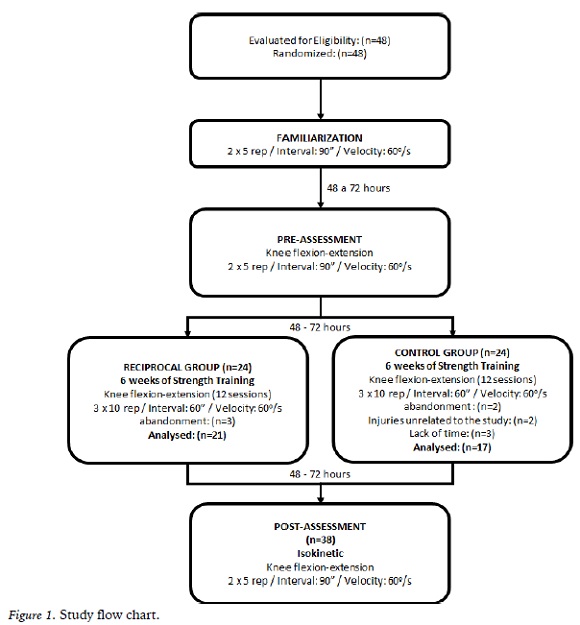
<body><![CDATA[<p><b>Introduction</b></p>     <p>Resistance training programs have long been recognized as one of the most useful    intervention strategies in the context of rehabilitation (Kannus, 1994), for    improving health-related outcomes (Garber et al., 2011) and sports performance    (Brill, Macera, Davis, Blair, &amp; Gordon, 2000). Moreover, there is high-quality    evidence demonstrating positive strength training effects on balance (Costill,    Wilmore, &amp; Kenney, 2012), increased muscle strength (Deschenes et al., 2002;    Harvey, Lin, Glinsky, &amp; De Wolf, 2009) and functionality (Serra-Añó et al.,    2012). In this context, previous studies (Beck et al., 2007; Coburn et al.,    2006; Holtermann, Roeleveld, Vereijken, &amp; Ettema, 2005) have shown that    the adoption of short-term training generates acute effects on muscle strength    which, consequently, represent an interesting alternative if the aim is to improve    the muscle function in a short period of time. Likewise (Coburn et al.,2006;    Holtermann et al., 2005), early phase strength training showed improvements    in the muscle strength and rate of force development (Brown &amp; Whitehurst,    2003). An interesting strategy to potentiate the functional performance in the    acute phases is the adoption of antagonist muscle&rsquo;s pre-activation (Cunha et    al., 2013).</p>     <p>The adoption of the pre-activation of antagonist&rsquo;s muscles has been recognized    as an interesting strategy to improve the muscle function and performance (Baker    &amp; Newton, 2005; Jeon, Trimble, Brunt, &amp; Robinson, 2001). One exercise    modality that uses the pre- activation of the antagonist&rsquo;s muscles is referred    to as reciprocal training (RT) and consists of a pre-activation immediately    prior to the agonist muscle contraction. Previous studies demonstrated larger    increments of muscle work and force generation (Carregaro, Gentil, Brown, Pinto,    &amp; Bottaro, 2011; Robbins, Young, Behm, &amp; Payne, 2010) influenced by    pre-activation exercises when compared to conditions without the pre-activation.    Additional studies using surface electromyography (sEMG) during pre- activation    of antagonist muscles also demonstrated neural responses after the resistance    training, such as an increased EMG activity of the agonist muscle after the    activation of the antagonists (Jeon et al., 2001; Maynard &amp; Ebben, 2003;    Robbins et al., 2010). It is worth mentioning that the EMG signal amplitude    is related to motor units activation by neural firing rate and, consequently,    could be associated with the values of maximum torque (David, Mora, &amp; Perot,    2008; Hassani et al., 2006). <a href="#_bookmark0">_</a>For instance, Baker    and Newton (2005) demonstrated increases of 4.7% of the capacity to generate    power after bouts of eight repetitions using the pre-activation of upper limbs    antagonist muscles. According to the authors, the results were explained by    an increased firing rate of the agonist muscles, influenced by a neural stimulation    of the prior antagonistic contraction.</p>     <p>Neuromuscular Efficiency (NME) is defined as the individual ability to generate    force in relation to its muscle activation level, and improvements in NME are    obtained when muscle contractions against high loads are sustained by a lower    neural recruitment (Aragão et al., 2015; David et al., 2008; Deschenes et al.,    2002). Thus, NME is an index that evaluates a muscle group functional status    (David et al., 2008), and it is related to muscle responsiveness and neural    excitability (Deschenes et al., 2002). Hence, this index is an important screening    tool that can allow athletic trainers and health professionals to evaluate the    muscle responsiveness and functional performance arising from specific sports    training programs and/or specific rehabilitation processes (Aragão et al., 2015;    Deschenes et al., 2002). For instance, Deschenes et al. (2002) adopted the NME    to verify if strength reductions resulting from 14-day muscle immobilization    occurred due to decreases in the neural input. Their results demonstrated a    decrease in total work and EMG activity of the knee extensors and flexors, though    with no changes in the NME. These findings suggested that decreases of muscle    work and EMG were primarily due to neural effects, not to contractile or morphological    factors. These findings demonstrated that the NME could be more sensitive to    the neural aspects and might be useful to the assessment of early-phase resistance    training. Notwithstanding, despite the usefulness of this index, to the best    of our knowledge there is a lack of studies addressing the NME across different    modalities of resistance training exercises. Therefore, this study aimed to    compare the NME adaptations between two resistance exercise methods (with and    without pre- activation of the antagonist&rsquo;s muscles) after a six- week training    program. Our hypothesis is that Reciprocal Training will lead to greater improvements    in NME than Traditional Training, without pre-activation.</p>     <p><b>Method</b></p>     <p>This is a randomized controlled trial reported in accordance with the Consort    Statement (Schulz, Altman, &amp; Moher, 2010). The study flowchart is depicted    in <a href="#f1">Figure 1</a>. The participants underwent a resistance-training    program two times a week for six weeks.</p>     <p>&nbsp;</p>     <p align="center"><a name="f1"></a><img src="/img/revistas/mot/v14n4/14n4a04f1.jpg"/></p>     
<p>&nbsp;</p>     <p><b>Participants</b></p>     ]]></body>
<body><![CDATA[<p>Forty-eight healthy young males were consecutively enrolled in the study (mean    age 20.9 ± 2.2 years; height 1.80 ± 0.1 m; body mass 75.0 ± 8.2 kg). All participants    were recruited through posters and verbal contacts in the University Campus.    All volunteers were notified of the research procedures and were invited to    participate by signing informed consent. The Institutional Research Ethics Committee    approved the study (Protocol n. 112/12).</p>     <p>Participants were interviewed with a questionnaire containing personal and    demographic information; and clinical history. The inclusion criteria were:    1) age between 18 to 30 years; 2) no physical training in the past six months    prior to the study. Participants were excluded if presented any cardiorespiratory    impairment, metabolic diseases, ligament ankle and/or knee injury, diseases    or neurological signal and/or proprioceptive deficits.</p>     <p>Participants were randomly divided into two groups: Conventional Training -    with no pre-activation (CT) and Reciprocal Training group - with pre-activation    (RT). For the randomization process, a table with random numbers was generated    in the website &ldquo;<a href="http://www.random.org/" target="_blank">www.random.org</a>&rdquo;. Sequentially    sealed opaque envelopes were used, containing the intervention groups´ name.    A researcher, blinded to the purposes of the research, was responsible for this    procedure.</p>     <p><b>Familiarization and evaluation procedure</b></p>     <p>Participants attended the laboratory on three different occasions. On the first    visit, all participants performed a familiarization procedure, composed by two    sets of five sub- maximum concentric isokinetic repetitions of knee flexion-extension    with using the speed of 60°.s-1 and an interval of 90 seconds between sets.    On the second visit, and after an interval of at least 24 hours, the pre-training    (baseline) assessment was performed. Participants performed the same protocol    as the familiarization visit; except during the pre- and post-training evaluations,    in which maximum effort was adopted, in two sets of five repetitions. For the    pre-training assessment, the electromyographic activity of the vastus medialis,    rectus femoris and biceps femoris was acquired. On the third visit (post-training),    the assessment was performed with the same procedures of the previous evaluations    (with a time lag of 72hs from the last training session). During testing and    intervention, participants were instructed to position their arms against their    chest. Participants were instructed to perform maximum strength throughout all    range of motion. For all participants, visual feedback on the computer screen    and verbal encouragement were given, in an attempt to reach the maximum effort    level. The testing sessions were performed in the morning period, for all participants.</p>     <p><b>Isokinetic Dynamometry</b></p>     <p>For the present study, an isokinetic dynamometer was used (Biodex System 4,    Biodex Medical, Shirley, NY). Calibration and positioning procedures followed    the manufacturer&rsquo;s specifications. The hip position was standardized to 100º    flexion. A range of motion of 80º was used (excursion from 90° flexion to 10°,    using knee extension parameter as 0°) to prevent knee hyperextension. During    testing, participants were asked to keep their arms crossed over their thoracic    region. Verbal encouragement and visual feedback were provided to encourage    participants to reach their maximal exertion level. The participants were stabilized    in the equipment using restraints on their thighs, pelvis, and trunk to prevent    unwanted movement. The same investigator performed all tests for all participants    and was not blind to group allocation.</p>     <p><b>Surface Electromyography</b></p>     <p>Portable 4-channel surface electromyography (Miotec Biomedical Equipment LTDA,    Brazil) was used. The equipment has a resolution of 14 bits, noise level &lt;    2 LBS and common mode rejection of 110 dB. The simple differential active electrodes    (input impedance of 1010 ohms) have polyethylene foam with hypoallergenic medical    adhesive, adherent solid gel to contact bipolar Ag/AgCl (silver/silver chloride)    with a distance of 20 mm between poles.</p>     <p>Electrodes Placement was based on SENIAM guidelines (Hermens, Freriks, Disselhorst-Klug,    &amp; Rau, 2000). The reference electrode was connected to the bony prominence    of the seventh cervical vertebra (C7) to measure the EMG signal. A specific    seat was positioned on dynamometer chair so that the electrodes would not remain    in contact with the seat surface to measure the EMG signal from biceps femoris.    Electrodes were positioned over the muscle belly of the vastus medialis, rectus    femoris, and biceps femoris, in parallel to the muscle fibers. Before placing    electrodes, the area was shaved and lightly abraded with 70% alcohol.</p>     ]]></body>
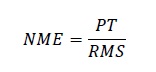
<body><![CDATA[<p><b>Signal Processing</b></p>     <p>Total work and peak torque were processed by the Biodex Advantage software    and used to calculate the NME. The EMG signal amplitude was calculated using    the RMS (root mean square) during the repetition in which the peak torque occurred.    Electromyography analysis was performed in the Miograph Software (Miotec- Biomedical    equipment®). The signal was filtered with a band-pass frequency of 20 Hz and    450 Hz (4th order Butterworth filter). The EMG and dynamometer signals were    synchronized in time. Neuromuscular Efficiency was calculated according to the    following equation (Deschenes et al., 2002):</p>     <p>&nbsp;</p>     <p align="center"><a name="e1"></a><img src="/img/revistas/mot/v14n4/14n4a04e1.jpg"/></p>     
<p>&nbsp;</p>     <p>In which PT is the Peak torque in N.m and RMS is the Root mean square in &#956;V.</p>     <p><b>Intervention protocol</b></p>     <p>Participants underwent an exercise program twice a week over six weeks (at    a minimum interval of at least 48 hours between each session). Training sessions    consisted of three sets of ten maximal concentric isokinetic repetitions at    60°.s-1 with 1-minute rest interval (Parcell, Sawyer, Tricoli, &amp; Chinevere,    2002). One group performed the reciprocal exercise sessions (RT), characterized    by agonist and antagonist knee extensors and flexors muscles contractions at    60º.s-1 (knee flexion immediately followed by knee extension, at each repetition).    The Conventional Training (CT) performed sessions characterized by a concentric    knee extension at 60º.s-1, while the knee flexion was performed passively (without    pre-activation of the antagonist&rsquo;s muscles). For both groups, there was a warm-up    on the isokinetic dynamometer characterized by two sets of five concentric isokinetic    repetitions (50% of the maximum strength of knee flexion-extension at 60°.s-1,    with 45 seconds interval between sets). The training was performed bilaterally,    however, as there were no significant differences between the dominant vs non-dominant    limb before and after the resistance training for both groups, we chose to present    the data of the dominant limb only (leg used to kick a ball). The same researcher    trained and evaluated all participants. During the study period, participants    were advised not to do any additional resistance exercises. The training sessions    were performed in the morning or afternoon period, according the participant&rsquo;s    availability. However, the weekly sessions remained at the same period (2 morning    sessions or 2 afternoon sessions per week) from the beginning until the end    of the training program.</p>     <p><b>Statistical analysis</b></p>     <p>The sample size calculation was based on a pilot study. We used the G*Power    software (version 3.1.9). The statistical power was stablished at 80% (1-&#946;),    &#945; value of 5%, and an effect size of 0.25, considering differences on neuromotor    variables between groups (RT and CT). The calculation demonstrated a required    sample size of 34 participants.</p>     ]]></body>
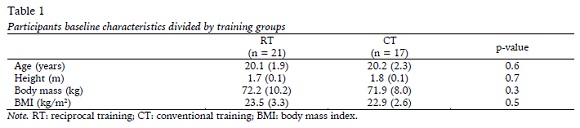
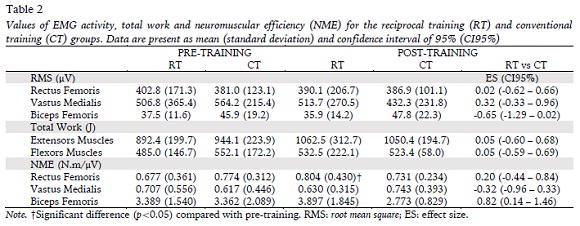
<body><![CDATA[<p>Data normality assumptions were confirmed by the Shapiro-Wilk test. The independent    variable was the training group (RT and CT), and the dependent variables were:    NME, total work (in Joules) and RMS (root mean square). A mixed model ANOVA    for repeated measures (group [RT and CT] x time [pre and post]) was adopted    to verify differences between groups, with the Bonferroni <i>post hoc </i>test.    The effect size was calculated, in order to determine the magnitude of the intervention,    based on the Cohen´s <i>d </i>and classified according to Rhea (2004) as: trivial    (&lt;0.35); small (&gt;0.35 and &lt;0.80); moderate (&gt;0.81 and &lt;1.50)    and large (&gt;1.50). The confidence interval of 95% was determined, and the    statistical significance was set at 5% (<i>P</i>&lt;0.05, two-tailed).</p>     <p><b>Results</b></p>     <p>Throughout the study, ten participants dropped out (n=3 due to injury in daily    activities; n=7 not able to participate in all assessments). Thus, the final    sample was composed by 38 participants (17 participants allocated in the CT    group and 21 participants in the RT group) (<a href="#f1">Figure 1</a>).</p>     <p>There were no significant differences between groups for age, height, and body    mass index (<a href="#t1">Table 1</a>). Also, groups presented no significant    differences in pre-training assessment for all variables (<a href="#t2">Table    2</a>).</p>     <p>&nbsp;</p>     <p align="center"><a name="t1"></a><img src="/img/revistas/mot/v14n4/14n4a04t1.jpg"/></p>     
<p>&nbsp;</p>     <p align="center"><a name="t2"></a><img src="/img/revistas/mot/v14n4/14n4a04t2.jpg"/></p>     
<p>&nbsp;</p>     <p>For the RT group, the NME of the rectus femoris presented a significant increase    after six weeks of training, with a small effect size (ES = 0.31; 95%CI [-0.30;    0.92]; F = 4,92) <i>p</i>&lt;0.05).</p>     ]]></body>
<body><![CDATA[<p>However, there were no significant differences in the NME of the vastus medialis    and biceps femoris muscles (ES = - 0.17, 95% CI [0.78;0.44]; ES = 0.30, 95%CI    [0.31-0.91], respectively, <i>p</i>&gt;0.05).</p>     <p>The CT presented no significant differences after the training program for    neither of the muscles groups, and the effect sizes were trivial for the rectus    femoris (ES = 0.16; 95%CI [0.83; 0.52]; <i>p</i>=0.08), vastus medialis (ES    = 0.30; 95%CI [0.38; 0.98]; <i>p</i>=0.10) and biceps femoris (ES = 0.37; 95%CI    [1.05; 0.37]; <i>p</i>=0.13) (<a href="#t2">Table 2</a>).</p>     <p>No significant differences were found for the Total Work (between and within    groups), considering the knee extensor and knee flexor muscles (<a href="#t2">Table    2</a>).</p>     <p><b>Discussion</b></p>     <p>The present study hypothesized that the Reciprocal Training would lead to greater    improvements in NME than conventional training without pre-activation. The comparison    between the modalities showed that the exercise performed with reciprocal contractions    presented a higher NME for the rectus femoris muscle after six-weeks of training,    though with small effect size. The total work did not differ between groups    or after six weeks of training.</p>     <p>The present findings demonstrated that the rectus femoris presented a higher    NME after six- weeks of training. Hence, it could be assumed that smaller neural    recruitment was necessary to achieve an equal or higher amount of muscle strength.    These results may be explained by the influence of varied resistance and concentric    antagonist speed contractions on subsequent concentric agonist efforts (Burke,    Pelham, &amp; Holt, 1999), in which the contraction of the flexor muscles activates    Golgi tendon organs, depolarizing Ib axon and firing nerve impulses that are    propagated to the spinal cord (Purves et al., 2001). The consequence of this    mechanism could be a strength reduction of the flexor muscles associated with    the extensor muscle spindles depolarization, thus leading to a more efficient    contraction of the rectus femoris. Although the classical findings of Moritani    and deVries (1979) showed a prevalence of neural factors responsible for strength    gains up to four weeks of training, recent studies (Bickel et al., 2005; Seynnes,    de Boer, &amp; Narici, 2007) have reported earlier involvements of hypertrophic    components. Accordingly, muscle stimuli arising from the training with duration    of six weeks may have provided a morphological adaptation in the skeletal muscle    (Bickel et al., 2005; Seynnes et al., 2007). The authors assumed that an increased    cross-sectional area, the increment of muscle fibers contractile capacity and    molecular adaptations could have led to neuromuscular performance improvement.    Hence, our rectus femoris NME findings may also be explained by a hypertrophy    mechanism, which can be related to an increased strength gain associated with    a stabilization of the electromyography signal at the post-training. The study    of Seynnes et al. (2007) demonstrated that physically active male participants    submitted to leg extension exercises during 20 days of training, significantly    increased their rectus femoris cross-sectional area, concomitant to small or    no changes in the electromyographic activity, and could also corroborate our    NME findings. Additionally, it is possible to assume that the performance of    the rectus femoris muscle was augmented due to post activation potentiation    enhancements and by increases in the rate of force development, leading to a    better contractile capacity (Sale, 2002). The use of a pre-activation strategy    (knee flexors movements prior to the knee extension) may have been able to induce    this post activation potentiation, corroborating the study of Batista et al.    (2007), in which intermittent contractions were able to improve the neuromuscular    performance during knee extension exercises.</p>     <p>A surprising finding was that the biceps femoris NME did not present a significant    improvement for the RT group after six weeks of training. Apparently, the flexor    muscles need a higher training volume or greater intervention period compared    to the extensor muscles. However, no results were found in the literature to    support this hypothesis, and further studies are necessary to elucidate the    influence of different training volume on flexor muscles early phase-adaptations.    Even though our study did not measure morphological variables, the mechanisms    underlying our findings seem to be different for different muscle groups. EMG    augmentation is attributed to synchronization of motor units (De Luca, 1984;    Milner-Brown, Mellenthin, &amp; Miller, 1986) and conduction velocity increases    (De Luca, 1984). For the rectus femoris, it is possible to assume that hypertrophy    and cross-bridges increases were more prevalent compared to neural adaptations    (Moritani &amp; deVries, 1979), as there was an increased NME. It is suggested    that a specific assessment of cross- sectional muscle area could contribute    to better comprehension and are warranted in future research. Moreover, the    NME of the flexor muscles did not change compared to the pre- training, though    it was higher in RT compared to the CT at the post-training. Thus, it is assumed    that the NME was reduced in the CT group by a probable increase of the muscle    fibers recruitment despite an equal muscle strength production, leading to decreased    muscle efficiency at the post-training. Also, the characteristic of the exercise    program adopted in the present study (three sets of ten repetitions), may have    been insufficient to generate adequate strength gains. Accordingly, Robbins    et al. (2010) compared three groups with different training volumes of lower    limbs exercises after six weeks. Their findings demonstrated that the group    with eight sets had a significantly greater strength gain compared to groups    that adopted one and four sets. Also, the group with four sets was not significantly    different from the one set group. Thus, it is hypothesized that if we had adopted    a biceps femoris training periodization, perhaps this would enhance the training    volume and would have led to significant results of the NME for the RT group.    In addition, we recommend that future studies investigate the effects of the    reciprocal training on the knee flexors muscles adaptations and compare the    effects of this training between knee&rsquo;s flexor and extensors muscles.</p>     <p>Neuromuscular efficiency is an interesting muscle responsiveness measure toward    neural excitation (Deschenes et al., 2002). Typically, NME is used in isometric    contractions (Arabadzhiev, Dimitrov, Dimitrova, &amp; Dimitrov, 2010; Aragão    et al., 2015; Milner-Brown et al., 1986; Schimidt, Machado, Vaz, &amp; Carpes,    2014) for muscle fatigue evaluation (Remaud, Cornu, &amp; Guevel, 2005) for    different cross-sectional studies outcomes (David et al., 2008; Schimidt et    al., 2014) or even to compare isokinetic exercises and dynamic protocols (Remaud    et al., 2005). However, we did not find in the literature studies that have    used NME to compare training methods in an experimental design. Thus, it is    suggested that future resistance training studies address the NME as a dependent    variable.</p>     <p><b>Limitations</b></p>     <p>Our study presented some limitations. Firstly, the lack of a proper periodization    (characterized by an increase in training volume throughout the training) might    have influenced our findings. Secondly, the outcome assessor was not blind to    group allocation; therefore, estimates of intervention effects might have been    influenced by some bias (Chess &amp; Gagnier, 2013).</p>     ]]></body>
<body><![CDATA[<p><b>Practical applications</b></p>     <p>Our findings demonstrated that if the aim is to improve the neuromuscular efficiency    of the knee muscles during a short-term training period, the adoption of reciprocal    contractions could be recommended.</p>     <p><b>CONCLUSION</b></p>     <p>Our study demonstrated that the use of reciprocal muscle contractions training    presented a better rectus femoris neuromuscular efficiency after six weeks of    resistance training of young and healthy men. However, we recommended caution    considering the small effect sizes.</p>     <p>&nbsp;</p>     <p><b>REFERENCES</b></p>     <!-- ref --><p>Arabadzhiev, T. I., Dimitrov, V. G., Dimitrova, N. A., &amp; Dimitrov, G. V.    (2010). Interpretation of EMG integra or RMS and estimates of &quot;neuromuscular    efficiency&quot; can be misleading in fatiguing contraction. <i>Journal of electromyography    and kinesiology, 20</i>(2), 223-232. DOI: <a href="https://dx.doi.org/10.1016/j.jelekin.2009.01.008" target="_blank">10.1016/j.jelekin.2009.01.008</a>.    &nbsp;&nbsp;&nbsp;&nbsp;&nbsp;&nbsp;&nbsp;&nbsp;[&#160;<a href="javascript:void(0);" onclick="javascript: window.open('/scielo.php?script=sci_nlinks&ref=384836&pid=S1646-107X201800030000400001&lng=','','width=640,height=500,resizable=yes,scrollbars=1,menubar=yes,');">Links</a>&#160;]<!-- end-ref --></p>     <p>Aragão, F. A., Schäfer, G. S., Albuquerque, C. E. d., Vituri, R. F., Mícolis    de Azevedo, F., &amp; Bertolini,G. R. F. (2015). Eficiência neuromuscular dos    músculos vasto lateral e bíceps femoral em indivíduos com lesão de ligamento    cruzado anterior. <i>Revista Brasileira de Ortopedia, 50</i>(2), 180-185. DOI:    <a href="https://doi.org/10.1016/j.rbo.2014.03.004" target="_blank">https://doi.org/10.1016/j.rbo.2014.03.004</a>.</p>     <!-- ref --><p>Baker, D., &amp; Newton, R. U. (2005). Acute effect on power output of alternating    an agonist and antagonist muscle exercise during complex training. <i>Journal    of Strength and Conditioning Research, 19</i>(1), 202-205. DOI: <a href="https://dx.doi.org/10.1519/1533- 4287(2005)19&lt;202:Aeopoo&gt;2.0.Co;2" target="_blank">10.1519/1533- 4287(2005)19&lt;202:Aeopoo&gt;2.0.Co;2</a>.    &nbsp;&nbsp;&nbsp;&nbsp;&nbsp;&nbsp;&nbsp;&nbsp;[&#160;<a href="javascript:void(0);" onclick="javascript: window.open('/scielo.php?script=sci_nlinks&ref=384839&pid=S1646-107X201800030000400003&lng=','','width=640,height=500,resizable=yes,scrollbars=1,menubar=yes,');">Links</a>&#160;]<!-- end-ref --></p>     <!-- ref --><p>Batista, M. A., Ugrinowitsch, C., Roschel, H., Lotufo, R., Ricard, M. D., &amp;    Tricoli, V. A. (2007). Intermittent exercise as a conditioning activity to induce    postactivation potentiation. <i>Journal of Strength and Conditioning Research,    21</i>(3), 837-840. DOI: <a href="https://dx.doi.org/10.1519/r-20586.1" target="_blank">10.1519/r-20586.1</a>.    &nbsp;&nbsp;&nbsp;&nbsp;&nbsp;&nbsp;&nbsp;&nbsp;[&#160;<a href="javascript:void(0);" onclick="javascript: window.open('/scielo.php?script=sci_nlinks&ref=384841&pid=S1646-107X201800030000400004&lng=','','width=640,height=500,resizable=yes,scrollbars=1,menubar=yes,');">Links</a>&#160;]<!-- end-ref --></p>     <!-- ref --><p>Beck, T. W., Housh, T. J., Johnson, G. O., Weir, J. P., Cramer, J. T., Coburn,    J. W., . . . Mielke, M. (2007). Effects of two days of isokinetic training on    strength and electromyographic amplitude in the agonist and antagonist muscles.    <i>Journal of Strength and Conditioning Research, 21</i>(3), 757-762. DOI: <a href="https://dx.doi.org/10.1519/r-20536.1" target="_blank">10.1519/r-20536.1</a>.    &nbsp;&nbsp;&nbsp;&nbsp;&nbsp;&nbsp;&nbsp;&nbsp;[&#160;<a href="javascript:void(0);" onclick="javascript: window.open('/scielo.php?script=sci_nlinks&ref=384843&pid=S1646-107X201800030000400005&lng=','','width=640,height=500,resizable=yes,scrollbars=1,menubar=yes,');">Links</a>&#160;]<!-- end-ref --></p>     <!-- ref --><p>Bickel, C. S., Slade, J., Mahoney, E., Haddad, F., Dudley, G. A., &amp; Adams,    G. R. (2005). Time course of molecular responses of human skeletal muscle to    acute bouts of resistance exercise. <i>Journal of applied physiology, 98</i>(2),    482-488. DOI: <a href="https://dx.doi.org/10.1152/japplphysiol.00895.2004" target="_blank">10.1152/japplphysiol.00895.2004</a>.    &nbsp;&nbsp;&nbsp;&nbsp;&nbsp;&nbsp;&nbsp;&nbsp;[&#160;<a href="javascript:void(0);" onclick="javascript: window.open('/scielo.php?script=sci_nlinks&ref=384845&pid=S1646-107X201800030000400006&lng=','','width=640,height=500,resizable=yes,scrollbars=1,menubar=yes,');">Links</a>&#160;]<!-- end-ref --></p>     <!-- ref --><p>Brill, P., Macera, C., Davis, D., Blair, S., &amp; Gordon, N. (2000). Muscular    strength and physical function. <i>Medicine and Science in Sports and Exercise,    32</i>, 412- 416.    &nbsp;&nbsp;&nbsp;&nbsp;&nbsp;&nbsp;&nbsp;&nbsp;[&#160;<a href="javascript:void(0);" onclick="javascript: window.open('/scielo.php?script=sci_nlinks&ref=384847&pid=S1646-107X201800030000400007&lng=','','width=640,height=500,resizable=yes,scrollbars=1,menubar=yes,');">Links</a>&#160;]<!-- end-ref --></p>     <!-- ref --><p>Brown, L., &amp; Whitehurst, M. (2003). The effect of short-term isokinetic    training on force and rate of velocity development. <i>Journal of Strength and    Conditioning Research, 17</i>(1), 88-94.    &nbsp;&nbsp;&nbsp;&nbsp;&nbsp;&nbsp;&nbsp;&nbsp;[&#160;<a href="javascript:void(0);" onclick="javascript: window.open('/scielo.php?script=sci_nlinks&ref=384849&pid=S1646-107X201800030000400008&lng=','','width=640,height=500,resizable=yes,scrollbars=1,menubar=yes,');">Links</a>&#160;]<!-- end-ref --></p>     <!-- ref --><p>Burke, D. G., Pelham, T. W., &amp; Holt, L. E. (1999). The influence of varied    resistance and speed of concentric antagonistic contractions on subsequent concentric    agonistic efforts. <i>Journal of Strength and Conditioning Research, 13</i>(3),    193-197.    &nbsp;&nbsp;&nbsp;&nbsp;&nbsp;&nbsp;&nbsp;&nbsp;[&#160;<a href="javascript:void(0);" onclick="javascript: window.open('/scielo.php?script=sci_nlinks&ref=384851&pid=S1646-107X201800030000400009&lng=','','width=640,height=500,resizable=yes,scrollbars=1,menubar=yes,');">Links</a>&#160;]<!-- end-ref --></p>      <!-- ref --><p>Carregaro, R. L., Gentil, P., Brown, L. E., Pinto, R. S., &amp; Bottaro,    M. (2011). Effects of antagonist pre-load on knee extensor isokinetic muscle    performance. <i>Journal of sports sciences, 29</i>(3), 271- 278. DOI: <a href="https://dx.doi.org/10.1080/02640414.2010.529455" target="_blank">10.1080/02640414.2010.529455</a>.    &nbsp;&nbsp;&nbsp;&nbsp;&nbsp;&nbsp;&nbsp;&nbsp;[&#160;<a href="javascript:void(0);" onclick="javascript: window.open('/scielo.php?script=sci_nlinks&ref=384853&pid=S1646-107X201800030000400010&lng=','','width=640,height=500,resizable=yes,scrollbars=1,menubar=yes,');">Links</a>&#160;]<!-- end-ref --></p>     <!-- ref --><p>Chess, L. E., &amp; Gagnier, J. (2013). Risk of bias of randomized controlled    trials published in orthopaedic journals. <i>BMC Medical Research Methodology,    13</i>, 76. DOI: <a href="https://dx.doi.org/10.1186/1471-2288-13-76" target="_blank">10.1186/1471-2288-13-76</a>.    &nbsp;&nbsp;&nbsp;&nbsp;&nbsp;&nbsp;&nbsp;&nbsp;[&#160;<a href="javascript:void(0);" onclick="javascript: window.open('/scielo.php?script=sci_nlinks&ref=384855&pid=S1646-107X201800030000400011&lng=','','width=640,height=500,resizable=yes,scrollbars=1,menubar=yes,');">Links</a>&#160;]<!-- end-ref --></p>     <!-- ref --><p>Coburn, J. W., Housh, T. J., Malek, M. H., Weir, J. P., Cramer, J. T., Beck,    T. W., &amp; Johnson, G. O. (2006). Neuromuscular responses to three days of    velocity-specific isokinetic training. <i>Journal of Strength and Conditioning    Research, 20</i>(4), 892-898. DOI: <a href="https://dx.doi.org/10.1519/r-18745.1" target="_blank">10.1519/r-18745.1</a>.    &nbsp;&nbsp;&nbsp;&nbsp;&nbsp;&nbsp;&nbsp;&nbsp;[&#160;<a href="javascript:void(0);" onclick="javascript: window.open('/scielo.php?script=sci_nlinks&ref=384857&pid=S1646-107X201800030000400012&lng=','','width=640,height=500,resizable=yes,scrollbars=1,menubar=yes,');">Links</a>&#160;]<!-- end-ref --></p>     <p>Costill, D., Wilmore, D., &amp; Kenney, W. (2012). <i>Physiology of sport and    exercise </i>(6th ed.): Human Kinetics.</p>     ]]></body>
<body><![CDATA[<!-- ref --><p>Cunha, R., Carregaro, R. L., Martorelli, A., Vieira, A., Oliveira, A. B., &amp;    Bottaro, M. (2013). Effects of short-term isokinetic training with reciprocal    knee extensors agonist and antagonist muscle actions: a controlled and randomized    trial. <i>Brazilian Journal of physical therapy, 17</i>(2), 137- 145. DOI: <a href="https://dx.doi.org/10.1590/s1413-35552012005000077" target="_blank">10.1590/s1413-35552012005000077</a>.    &nbsp;&nbsp;&nbsp;&nbsp;&nbsp;&nbsp;&nbsp;&nbsp;[&#160;<a href="javascript:void(0);" onclick="javascript: window.open('/scielo.php?script=sci_nlinks&ref=384860&pid=S1646-107X201800030000400014&lng=','','width=640,height=500,resizable=yes,scrollbars=1,menubar=yes,');">Links</a>&#160;]<!-- end-ref --></p>     <!-- ref --><p>David, P., Mora, I., &amp; Perot, C. (2008). Neuromuscular efficiency of the    rectus abdominis differs with gender and sport practice. <i>Journal of Strength    and Conditioning Research, 22</i>(6), 1855-1861. DOI: <a href="https://dx.doi.org/10.1519/JSC.0b013e31817bd529" target="_blank">10.1519/JSC.0b013e31817bd529</a>.    &nbsp;&nbsp;&nbsp;&nbsp;&nbsp;&nbsp;&nbsp;&nbsp;[&#160;<a href="javascript:void(0);" onclick="javascript: window.open('/scielo.php?script=sci_nlinks&ref=384862&pid=S1646-107X201800030000400015&lng=','','width=640,height=500,resizable=yes,scrollbars=1,menubar=yes,');">Links</a>&#160;]<!-- end-ref --></p>     <!-- ref --><p>De Luca, C. J. (1984). Myoelectrical manifestations of localized muscular fatigue    in humans. <i>Critical reviews in biomedical engineering, 11</i>(4), 251-279.    &nbsp;&nbsp;&nbsp;&nbsp;&nbsp;&nbsp;&nbsp;&nbsp;[&#160;<a href="javascript:void(0);" onclick="javascript: window.open('/scielo.php?script=sci_nlinks&ref=384864&pid=S1646-107X201800030000400016&lng=','','width=640,height=500,resizable=yes,scrollbars=1,menubar=yes,');">Links</a>&#160;]<!-- end-ref --></p>     <!-- ref --><p>Deschenes, M., Giles, J., McCoy, R., Volek, J., Gomez, A., &amp; Kraemer, W.    (2002). Neural factors account for strength decrements observed after short-term    muscle unloading <i>American Journal of Physiology. Regulatory, Integrative    and Comparative Physiology, 282</i>, R578-R583.    &nbsp;&nbsp;&nbsp;&nbsp;&nbsp;&nbsp;&nbsp;&nbsp;[&#160;<a href="javascript:void(0);" onclick="javascript: window.open('/scielo.php?script=sci_nlinks&ref=384866&pid=S1646-107X201800030000400017&lng=','','width=640,height=500,resizable=yes,scrollbars=1,menubar=yes,');">Links</a>&#160;]<!-- end-ref --></p>     <!-- ref --><p>Garber, C., Blissmer, B., Deschenes, M., Franklin, B., Lamonte, M., Lee, I.,    . . . Swain, D. (2011). Quantity and quality of exercise for developing and    maintaining cardiorespiratory, musculoskeletal, and neuromotor fitness in apparently    healthy adults: Guidance for prescribing exercise. <i>Medicine and Science in    Sports and Exercise, 43</i>(1), 334-1359.    &nbsp;&nbsp;&nbsp;&nbsp;&nbsp;&nbsp;&nbsp;&nbsp;[&#160;<a href="javascript:void(0);" onclick="javascript: window.open('/scielo.php?script=sci_nlinks&ref=384868&pid=S1646-107X201800030000400018&lng=','','width=640,height=500,resizable=yes,scrollbars=1,menubar=yes,');">Links</a>&#160;]<!-- end-ref --></p>     ]]></body>
<body><![CDATA[<!-- ref --><p>Harvey, L., Lin, C., Glinsky, J. V., &amp; De Wolf, A. (2009). The effectiveness    of physical interventions for people with spinal cord injuries: A systematic    review. <i>Spinal Cord, 47</i>, 184-195.    &nbsp;&nbsp;&nbsp;&nbsp;&nbsp;&nbsp;&nbsp;&nbsp;[&#160;<a href="javascript:void(0);" onclick="javascript: window.open('/scielo.php?script=sci_nlinks&ref=384870&pid=S1646-107X201800030000400019&lng=','','width=640,height=500,resizable=yes,scrollbars=1,menubar=yes,');">Links</a>&#160;]<!-- end-ref --></p>     <!-- ref --><p>Hassani, A., Patikas, D., Bassa, E., Hatzikotoulas, K., Kellis, E., &amp; Kotzamanidis,    C. (2006). Agonist and antagonist muscle activation during maximal and submaximal    isokinetic fatigue tests of the knee extensors. <i>Journal of electromyography    and kinesiology, 16</i>(6), 661-668. DOI: <a href="https://dx.doi.org/10.1016/j.jelekin.2005.11.006" target="_blank">10.1016/j.jelekin.2005.11.006</a>.    &nbsp;&nbsp;&nbsp;&nbsp;&nbsp;&nbsp;&nbsp;&nbsp;[&#160;<a href="javascript:void(0);" onclick="javascript: window.open('/scielo.php?script=sci_nlinks&ref=384872&pid=S1646-107X201800030000400020&lng=','','width=640,height=500,resizable=yes,scrollbars=1,menubar=yes,');">Links</a>&#160;]<!-- end-ref --></p>     <!-- ref --><p>Hermens, H. J., Freriks, B., Disselhorst-Klug, C., &amp; Rau, G. (2000). Development    of recommendations for SEMG sensors and sensor placement procedures. <i>Journal    of electromyography and kinesiology, 10</i>(5), 361-374.    &nbsp;&nbsp;&nbsp;&nbsp;&nbsp;&nbsp;&nbsp;&nbsp;[&#160;<a href="javascript:void(0);" onclick="javascript: window.open('/scielo.php?script=sci_nlinks&ref=384874&pid=S1646-107X201800030000400021&lng=','','width=640,height=500,resizable=yes,scrollbars=1,menubar=yes,');">Links</a>&#160;]<!-- end-ref --></p>     <!-- ref --><p>Holtermann, A., Roeleveld, K., Vereijken, B., &amp; Ettema, G. (2005). Changes    in agonist EMG activation level during MVC cannot explain early strength improvement.    <i>European Journal of Applied Physiology, 94</i>, 593-601.    &nbsp;&nbsp;&nbsp;&nbsp;&nbsp;&nbsp;&nbsp;&nbsp;[&#160;<a href="javascript:void(0);" onclick="javascript: window.open('/scielo.php?script=sci_nlinks&ref=384876&pid=S1646-107X201800030000400022&lng=','','width=640,height=500,resizable=yes,scrollbars=1,menubar=yes,');">Links</a>&#160;]<!-- end-ref --></p>     <!-- ref --><p>Jeon, H. S., Trimble, M. H., Brunt, D., &amp; Robinson, M. E. (2001). Facilitation    of quadriceps activation following a concentrically controlled knee flexion    movement: the influence of transition rate. <i>The Journal of orthopaedic and    sports physical therapy, 31</i>(3), 122-129. DOI: <a href="https://dx.doi.org/10.2519/jospt.2001.31.3.122" target="_blank">10.2519/jospt.2001.31.3.122</a>.    &nbsp;&nbsp;&nbsp;&nbsp;&nbsp;&nbsp;&nbsp;&nbsp;[&#160;<a href="javascript:void(0);" onclick="javascript: window.open('/scielo.php?script=sci_nlinks&ref=384878&pid=S1646-107X201800030000400023&lng=','','width=640,height=500,resizable=yes,scrollbars=1,menubar=yes,');">Links</a>&#160;]<!-- end-ref --></p>     ]]></body>
<body><![CDATA[<!-- ref --><p>Kannus, P. (1994). Isokinetic Evaluation of Muscular Performance. <i>International    Journal of Sports Medicine, 15</i>, S11-S18.    &nbsp;&nbsp;&nbsp;&nbsp;&nbsp;&nbsp;&nbsp;&nbsp;[&#160;<a href="javascript:void(0);" onclick="javascript: window.open('/scielo.php?script=sci_nlinks&ref=384880&pid=S1646-107X201800030000400024&lng=','','width=640,height=500,resizable=yes,scrollbars=1,menubar=yes,');">Links</a>&#160;]<!-- end-ref --></p>     <!-- ref --><p>Maynard, J., &amp; Ebben, W. P. (2003). The effects of antagonist prefatigue    on agonist torque and electromyography. <i>Journal of Strength and Conditioning    Research, 17</i>(3), 469-474.    &nbsp;&nbsp;&nbsp;&nbsp;&nbsp;&nbsp;&nbsp;&nbsp;[&#160;<a href="javascript:void(0);" onclick="javascript: window.open('/scielo.php?script=sci_nlinks&ref=384882&pid=S1646-107X201800030000400025&lng=','','width=640,height=500,resizable=yes,scrollbars=1,menubar=yes,');">Links</a>&#160;]<!-- end-ref --></p>     <!-- ref --><p>Milner-Brown, H. S., Mellenthin, M., &amp; Miller, R. G. (1986). Quantifying    human muscle strength, endurance and fatigue. <i>Archives of physical medicine    and rehabilitation, 67</i>(8), 530-535.    &nbsp;&nbsp;&nbsp;&nbsp;&nbsp;&nbsp;&nbsp;&nbsp;[&#160;<a href="javascript:void(0);" onclick="javascript: window.open('/scielo.php?script=sci_nlinks&ref=384884&pid=S1646-107X201800030000400026&lng=','','width=640,height=500,resizable=yes,scrollbars=1,menubar=yes,');">Links</a>&#160;]<!-- end-ref --></p>     <!-- ref --><p>Moritani, T., &amp; deVries, H. A. (1979). Neural factors versus hypertrophy    in the time course of muscle strength gain. <i>American journal of physical    medicine, 58</i>(3), 115-130.    &nbsp;&nbsp;&nbsp;&nbsp;&nbsp;&nbsp;&nbsp;&nbsp;[&#160;<a href="javascript:void(0);" onclick="javascript: window.open('/scielo.php?script=sci_nlinks&ref=384886&pid=S1646-107X201800030000400027&lng=','','width=640,height=500,resizable=yes,scrollbars=1,menubar=yes,');">Links</a>&#160;]<!-- end-ref --></p>     <!-- ref --><p>Parcell, A. C., Sawyer, R. D., Tricoli, V. A., &amp; Chinevere, T. D. (2002).    Minimum rest period for strength recovery during a common isokinetic testing    protocol. <i>Medicine and Science in Sports and Exercise, 34</i>(6), 1018-1022.    &nbsp;&nbsp;&nbsp;&nbsp;&nbsp;&nbsp;&nbsp;&nbsp;[&#160;<a href="javascript:void(0);" onclick="javascript: window.open('/scielo.php?script=sci_nlinks&ref=384888&pid=S1646-107X201800030000400028&lng=','','width=640,height=500,resizable=yes,scrollbars=1,menubar=yes,');">Links</a>&#160;]<!-- end-ref --></p>     ]]></body>
<body><![CDATA[<p>Purves, D., Augustine, G., Itzpatrick, F., Hall, W., LaMantia, A., McNamara,    J., &amp; Williams, S. (2001). <i>Neuroscience </i>(4th ed.). Sunderland (MA):    Sinauer Associates.</p>     <!-- ref --><p>Remaud, A., Cornu, C., &amp; Guevel, A. (2005). A methodologic approach for    the comparison between dynamic contractions: Influences on the neuromuscular    system. <i>Journal of Athletic Training, 40</i>(4), 281-287.    &nbsp;&nbsp;&nbsp;&nbsp;&nbsp;&nbsp;&nbsp;&nbsp;[&#160;<a href="javascript:void(0);" onclick="javascript: window.open('/scielo.php?script=sci_nlinks&ref=384891&pid=S1646-107X201800030000400030&lng=','','width=640,height=500,resizable=yes,scrollbars=1,menubar=yes,');">Links</a>&#160;]<!-- end-ref --></p>     <!-- ref --><p>Rhea, M. R. (2004). Determining the magnitude of treatment effects in strength    training research through the use of the effect size. <i>Journal of Strength    and Conditioning Research, 18</i>(4), 918-920. DOI: <a href="https://dx.doi.org/10.1519/14403.1" target="_blank">10.1519/14403.1</a>.    &nbsp;&nbsp;&nbsp;&nbsp;&nbsp;&nbsp;&nbsp;&nbsp;[&#160;<a href="javascript:void(0);" onclick="javascript: window.open('/scielo.php?script=sci_nlinks&ref=384893&pid=S1646-107X201800030000400031&lng=','','width=640,height=500,resizable=yes,scrollbars=1,menubar=yes,');">Links</a>&#160;]<!-- end-ref --></p>     <!-- ref --><p>Robbins, D. W., Young, W. B., Behm, D. G., &amp; Payne, W. R. (2010). The effect    of a complex agonist and antagonist resistance training protocol on volume load,    power output, electromyographic responses, and efficiency. <i>Journal of Strength    and Conditioning Research, 24</i>(7), 1782-1789. DOI: <a href="https://dx.doi.org/10.1519/JSC.0b013e3181dc3a53" target="_blank">10.1519/JSC.0b013e3181dc3a53</a>.    &nbsp;&nbsp;&nbsp;&nbsp;&nbsp;&nbsp;&nbsp;&nbsp;[&#160;<a href="javascript:void(0);" onclick="javascript: window.open('/scielo.php?script=sci_nlinks&ref=384895&pid=S1646-107X201800030000400032&lng=','','width=640,height=500,resizable=yes,scrollbars=1,menubar=yes,');">Links</a>&#160;]<!-- end-ref --></p>     <!-- ref --><p>Sale, D. G. (2002). Postactivation potentiation: role in human performance.    <i>Exerc Sport Sci Rev, 30</i>(3), 138-143.    &nbsp;&nbsp;&nbsp;&nbsp;&nbsp;&nbsp;&nbsp;&nbsp;[&#160;<a href="javascript:void(0);" onclick="javascript: window.open('/scielo.php?script=sci_nlinks&ref=384897&pid=S1646-107X201800030000400033&lng=','','width=640,height=500,resizable=yes,scrollbars=1,menubar=yes,');">Links</a>&#160;]<!-- end-ref --></p>     <!-- ref --><p>Schimidt, H. L., Machado, Á. S., Vaz, M. A., &amp; Carpes, F. P. (2014). Isometric    muscle force, rate of force development and knee extensor neuromuscular efficiency    asymmetries at different age groups. <i>Revista Brasileira de Cineantropometria    &amp; Desempenho Humano, 16</i>, 307-315.    &nbsp;&nbsp;&nbsp;&nbsp;&nbsp;&nbsp;&nbsp;&nbsp;[&#160;<a href="javascript:void(0);" onclick="javascript: window.open('/scielo.php?script=sci_nlinks&ref=384899&pid=S1646-107X201800030000400034&lng=','','width=640,height=500,resizable=yes,scrollbars=1,menubar=yes,');">Links</a>&#160;]<!-- end-ref --></p>     <!-- ref --><p>Schulz, K. F., Altman, D. G., &amp; Moher, D. (2010). CONSORT 2010 statement:    updated guidelines for reporting parallel group randomised trials. <i>BMJ, 340</i>,    c332. DOI: <a href="https://dx.doi.org/10.1136/bmj.c332" target="_blank">10.1136/bmj.c332</a>.    &nbsp;&nbsp;&nbsp;&nbsp;&nbsp;&nbsp;&nbsp;&nbsp;[&#160;<a href="javascript:void(0);" onclick="javascript: window.open('/scielo.php?script=sci_nlinks&ref=384901&pid=S1646-107X201800030000400035&lng=','','width=640,height=500,resizable=yes,scrollbars=1,menubar=yes,');">Links</a>&#160;]<!-- end-ref --></p>     <!-- ref --><p>Serra-Añó, P., Pellicer-Chenoll, M., García-Massó, X., Morales, J., Giner-Pascual,    M., &amp; González, L. (2012). Effects of resistance training on strength, pain    and shoulder functionality in paraplegics. <i>Spinal Cord, 50</i>, 827-831.    &nbsp;&nbsp;&nbsp;&nbsp;&nbsp;&nbsp;&nbsp;&nbsp;[&#160;<a href="javascript:void(0);" onclick="javascript: window.open('/scielo.php?script=sci_nlinks&ref=384903&pid=S1646-107X201800030000400036&lng=','','width=640,height=500,resizable=yes,scrollbars=1,menubar=yes,');">Links</a>&#160;]<!-- end-ref --></p>     <!-- ref --><p>Seynnes, O. R., de Boer, M., &amp; Narici, M. V. (2007). Early skeletal muscle    hypertrophy and architectural changes in response to high- intensity resistance    training. <i>Journal of applied, 102</i>(1), 368-373. DOI: <a href="https://dx.doi.org/10.1152/japplphysiol.00789.2006" target="_blank">10.1152/japplphysiol.00789.2006</a>.    &nbsp;&nbsp;&nbsp;&nbsp;&nbsp;&nbsp;&nbsp;&nbsp;[&#160;<a href="javascript:void(0);" onclick="javascript: window.open('/scielo.php?script=sci_nlinks&ref=384905&pid=S1646-107X201800030000400037&lng=','','width=640,height=500,resizable=yes,scrollbars=1,menubar=yes,');">Links</a>&#160;]<!-- end-ref --></p>     <p>&nbsp;</p>     <p>Acknowledgments: Nothing to declare.&nbsp; </p>     <p>Conflict of interests: Nothing to declare.&nbsp;      ]]></body>
<body><![CDATA[<p>Funding: Nothing to declare.      <p>      <p>Manuscript received at March 20th 2018; Accepted at December 10th 2018</p>     <p>&nbsp;</p>     <p><a href="#top*"><sup>[*]</sup></a><a name="*"></a><i>Corresponding author</i>:    <i>Email: </i><a href="mailto:prof.euleralves@gmail.com">prof.euleralves@gmail.com</a></p>      ]]></body><back>
<ref-list>
<ref id="B1">
<nlm-citation citation-type="journal">
<person-group person-group-type="author">
<name>
<surname><![CDATA[Arabadzhiev]]></surname>
<given-names><![CDATA[T. I.]]></given-names>
</name>
<name>
<surname><![CDATA[Dimitrov]]></surname>
<given-names><![CDATA[V. G.]]></given-names>
</name>
<name>
<surname><![CDATA[Dimitrova]]></surname>
<given-names><![CDATA[N. A.]]></given-names>
</name>
<name>
<surname><![CDATA[Dimitrov]]></surname>
<given-names><![CDATA[G. V.]]></given-names>
</name>
</person-group>
<article-title xml:lang="en"><![CDATA[Interpretation of EMG integra or RMS and estimates of "neuromuscular efficiency" can be misleading in fatiguing contraction]]></article-title>
<source><![CDATA[Journal of electromyography and kinesiology]]></source>
<year>2010</year>
<volume>20</volume>
<numero>2</numero>
<issue>2</issue>
<page-range>223-232</page-range></nlm-citation>
</ref>
<ref id="B2">
<nlm-citation citation-type="journal">
<person-group person-group-type="author">
<name>
<surname><![CDATA[Aragão]]></surname>
<given-names><![CDATA[F. A.]]></given-names>
</name>
<name>
<surname><![CDATA[Schäfer]]></surname>
<given-names><![CDATA[G. S.]]></given-names>
</name>
<name>
<surname><![CDATA[Albuquerque]]></surname>
<given-names><![CDATA[C. E.]]></given-names>
</name>
<name>
<surname><![CDATA[Vituri]]></surname>
<given-names><![CDATA[R. F.]]></given-names>
</name>
<name>
<surname><![CDATA[Mícolis de Azevedo]]></surname>
<given-names><![CDATA[F.]]></given-names>
</name>
<name>
<surname><![CDATA[Bertolini]]></surname>
<given-names><![CDATA[G. R. F.]]></given-names>
</name>
</person-group>
<article-title xml:lang="pt"><![CDATA[Eficiência neuromuscular dos músculos vasto lateral e bíceps femoral em indivíduos com lesão de ligamento cruzado anterior]]></article-title>
<source><![CDATA[Revista Brasileira de Ortopedia]]></source>
<year>2015</year>
<volume>50</volume>
<numero>2</numero>
<issue>2</issue>
<page-range>180-185</page-range></nlm-citation>
</ref>
<ref id="B3">
<nlm-citation citation-type="journal">
<person-group person-group-type="author">
<name>
<surname><![CDATA[Baker]]></surname>
<given-names><![CDATA[D.]]></given-names>
</name>
<name>
<surname><![CDATA[Newton]]></surname>
<given-names><![CDATA[R. U.]]></given-names>
</name>
</person-group>
<article-title xml:lang="en"><![CDATA[Acute effect on power output of alternating an agonist and antagonist muscle exercise during complex training]]></article-title>
<source><![CDATA[Journal of Strength and Conditioning Research]]></source>
<year>2005</year>
<volume>19</volume>
<numero>1</numero>
<issue>1</issue>
<page-range>202-205</page-range></nlm-citation>
</ref>
<ref id="B4">
<nlm-citation citation-type="journal">
<person-group person-group-type="author">
<name>
<surname><![CDATA[Batista]]></surname>
<given-names><![CDATA[M. A.]]></given-names>
</name>
<name>
<surname><![CDATA[Ugrinowitsch]]></surname>
<given-names><![CDATA[C.]]></given-names>
</name>
<name>
<surname><![CDATA[Roschel]]></surname>
<given-names><![CDATA[H.]]></given-names>
</name>
<name>
<surname><![CDATA[Lotufo]]></surname>
<given-names><![CDATA[R.]]></given-names>
</name>
<name>
<surname><![CDATA[Ricard]]></surname>
<given-names><![CDATA[M. D.]]></given-names>
</name>
<name>
<surname><![CDATA[Tricoli]]></surname>
<given-names><![CDATA[V. A.]]></given-names>
</name>
</person-group>
<article-title xml:lang="en"><![CDATA[Intermittent exercise as a conditioning activity to induce postactivation potentiation]]></article-title>
<source><![CDATA[Journal of Strength and Conditioning Research]]></source>
<year>2007</year>
<volume>21</volume>
<numero>3</numero>
<issue>3</issue>
<page-range>837-840</page-range></nlm-citation>
</ref>
<ref id="B5">
<nlm-citation citation-type="journal">
<person-group person-group-type="author">
<name>
<surname><![CDATA[Beck]]></surname>
<given-names><![CDATA[T. W.]]></given-names>
</name>
<name>
<surname><![CDATA[Housh]]></surname>
<given-names><![CDATA[T. J.]]></given-names>
</name>
<name>
<surname><![CDATA[Johnson]]></surname>
<given-names><![CDATA[G. O.]]></given-names>
</name>
<name>
<surname><![CDATA[Weir]]></surname>
<given-names><![CDATA[J. P.]]></given-names>
</name>
<name>
<surname><![CDATA[Cramer]]></surname>
<given-names><![CDATA[J. T.]]></given-names>
</name>
<name>
<surname><![CDATA[Coburn]]></surname>
<given-names><![CDATA[J. W.]]></given-names>
</name>
<name>
<surname><![CDATA[Mielke]]></surname>
<given-names><![CDATA[M.]]></given-names>
</name>
</person-group>
<article-title xml:lang="en"><![CDATA[Effects of two days of isokinetic training on strength and electromyographic amplitude in the agonist and antagonist muscles]]></article-title>
<source><![CDATA[Journal of Strength and Conditioning Research]]></source>
<year>2007</year>
<volume>21</volume>
<numero>3</numero>
<issue>3</issue>
<page-range>757-762</page-range></nlm-citation>
</ref>
<ref id="B6">
<nlm-citation citation-type="journal">
<person-group person-group-type="author">
<name>
<surname><![CDATA[Bickel]]></surname>
<given-names><![CDATA[C. S.]]></given-names>
</name>
<name>
<surname><![CDATA[Slade]]></surname>
<given-names><![CDATA[J.]]></given-names>
</name>
<name>
<surname><![CDATA[Mahoney]]></surname>
<given-names><![CDATA[E.]]></given-names>
</name>
<name>
<surname><![CDATA[Haddad]]></surname>
<given-names><![CDATA[F.]]></given-names>
</name>
<name>
<surname><![CDATA[Dudley]]></surname>
<given-names><![CDATA[G. A.]]></given-names>
</name>
<name>
<surname><![CDATA[Adams]]></surname>
<given-names><![CDATA[G. R.]]></given-names>
</name>
</person-group>
<article-title xml:lang="en"><![CDATA[Time course of molecular responses of human skeletal muscle to acute bouts of resistance exercise]]></article-title>
<source><![CDATA[Journal of applied physiology]]></source>
<year>2005</year>
<volume>98</volume>
<numero>2</numero>
<issue>2</issue>
<page-range>482-488</page-range></nlm-citation>
</ref>
<ref id="B7">
<nlm-citation citation-type="journal">
<person-group person-group-type="author">
<name>
<surname><![CDATA[Brill]]></surname>
<given-names><![CDATA[P.]]></given-names>
</name>
<name>
<surname><![CDATA[Macera]]></surname>
<given-names><![CDATA[C.]]></given-names>
</name>
<name>
<surname><![CDATA[Davis]]></surname>
<given-names><![CDATA[D.]]></given-names>
</name>
<name>
<surname><![CDATA[Blair]]></surname>
<given-names><![CDATA[S.]]></given-names>
</name>
<name>
<surname><![CDATA[Gordon]]></surname>
<given-names><![CDATA[N.]]></given-names>
</name>
</person-group>
<article-title xml:lang="en"><![CDATA[Muscular strength and physical function]]></article-title>
<source><![CDATA[Medicine and Science in Sports and Exercise]]></source>
<year>2000</year>
<volume>32</volume>
<page-range>412- 416</page-range></nlm-citation>
</ref>
<ref id="B8">
<nlm-citation citation-type="journal">
<person-group person-group-type="author">
<name>
<surname><![CDATA[Brown]]></surname>
<given-names><![CDATA[L.]]></given-names>
</name>
<name>
<surname><![CDATA[Whitehurst]]></surname>
<given-names><![CDATA[M.]]></given-names>
</name>
</person-group>
<article-title xml:lang="en"><![CDATA[The effect of short-term isokinetic training on force and rate of velocity development]]></article-title>
<source><![CDATA[Journal of Strength and Conditioning Research]]></source>
<year>2003</year>
<volume>17</volume>
<numero>1</numero>
<issue>1</issue>
<page-range>88-94</page-range></nlm-citation>
</ref>
<ref id="B9">
<nlm-citation citation-type="journal">
<person-group person-group-type="author">
<name>
<surname><![CDATA[Burke]]></surname>
<given-names><![CDATA[D. G.]]></given-names>
</name>
<name>
<surname><![CDATA[Pelham]]></surname>
<given-names><![CDATA[T. W.]]></given-names>
</name>
<name>
<surname><![CDATA[Holt]]></surname>
<given-names><![CDATA[L. E.]]></given-names>
</name>
</person-group>
<article-title xml:lang="en"><![CDATA[The influence of varied resistance and speed of concentric antagonistic contractions on subsequent concentric agonistic efforts]]></article-title>
<source><![CDATA[Journal of Strength and Conditioning Research]]></source>
<year>1999</year>
<volume>13</volume>
<numero>3</numero>
<issue>3</issue>
<page-range>193-197</page-range></nlm-citation>
</ref>
<ref id="B10">
<nlm-citation citation-type="journal">
<person-group person-group-type="author">
<name>
<surname><![CDATA[Carregaro]]></surname>
<given-names><![CDATA[R. L.]]></given-names>
</name>
<name>
<surname><![CDATA[Gentil]]></surname>
<given-names><![CDATA[P.]]></given-names>
</name>
<name>
<surname><![CDATA[Brown]]></surname>
<given-names><![CDATA[L. E.]]></given-names>
</name>
<name>
<surname><![CDATA[Pinto]]></surname>
<given-names><![CDATA[R. S.]]></given-names>
</name>
<name>
<surname><![CDATA[Bottaro]]></surname>
<given-names><![CDATA[M.]]></given-names>
</name>
</person-group>
<article-title xml:lang="en"><![CDATA[Effects of antagonist pre-load on knee extensor isokinetic muscle performance]]></article-title>
<source><![CDATA[Journal of sports sciences]]></source>
<year>2011</year>
<volume>29</volume>
<numero>3</numero>
<issue>3</issue>
<page-range>271- 278</page-range></nlm-citation>
</ref>
<ref id="B11">
<nlm-citation citation-type="journal">
<person-group person-group-type="author">
<name>
<surname><![CDATA[Chess]]></surname>
<given-names><![CDATA[L. E.]]></given-names>
</name>
<name>
<surname><![CDATA[Gagnier]]></surname>
<given-names><![CDATA[J.]]></given-names>
</name>
</person-group>
<article-title xml:lang="en"><![CDATA[Risk of bias of randomized controlled trials published in orthopaedic journals]]></article-title>
<source><![CDATA[BMC Medical Research Methodology]]></source>
<year>2013</year>
<volume>13</volume>
<page-range>76</page-range></nlm-citation>
</ref>
<ref id="B12">
<nlm-citation citation-type="journal">
<person-group person-group-type="author">
<name>
<surname><![CDATA[Coburn]]></surname>
<given-names><![CDATA[J. W.]]></given-names>
</name>
<name>
<surname><![CDATA[Housh]]></surname>
<given-names><![CDATA[T. J.]]></given-names>
</name>
<name>
<surname><![CDATA[Malek]]></surname>
<given-names><![CDATA[M. H.]]></given-names>
</name>
<name>
<surname><![CDATA[Weir]]></surname>
<given-names><![CDATA[J. P.]]></given-names>
</name>
<name>
<surname><![CDATA[Cramer]]></surname>
<given-names><![CDATA[J. T.]]></given-names>
</name>
<name>
<surname><![CDATA[Beck]]></surname>
<given-names><![CDATA[T. W.]]></given-names>
</name>
<name>
<surname><![CDATA[Johnson]]></surname>
<given-names><![CDATA[G. O.]]></given-names>
</name>
</person-group>
<article-title xml:lang="en"><![CDATA[Neuromuscular responses to three days of velocity-specific isokinetic training]]></article-title>
<source><![CDATA[Journal of Strength and Conditioning Research]]></source>
<year>2006</year>
<volume>20</volume>
<numero>4</numero>
<issue>4</issue>
<page-range>892-898</page-range></nlm-citation>
</ref>
<ref id="B13">
<nlm-citation citation-type="book">
<person-group person-group-type="author">
<name>
<surname><![CDATA[Costill]]></surname>
<given-names><![CDATA[D.]]></given-names>
</name>
<name>
<surname><![CDATA[Wilmore]]></surname>
<given-names><![CDATA[D.]]></given-names>
</name>
<name>
<surname><![CDATA[Kenney]]></surname>
<given-names><![CDATA[W.]]></given-names>
</name>
</person-group>
<source><![CDATA[Physiology of sport and exercise]]></source>
<year>2012</year>
<publisher-name><![CDATA[Human Kinetics]]></publisher-name>
</nlm-citation>
</ref>
<ref id="B14">
<nlm-citation citation-type="journal">
<person-group person-group-type="author">
<name>
<surname><![CDATA[Cunha]]></surname>
<given-names><![CDATA[R.]]></given-names>
</name>
<name>
<surname><![CDATA[Carregaro]]></surname>
<given-names><![CDATA[R. L.]]></given-names>
</name>
<name>
<surname><![CDATA[Martorelli]]></surname>
<given-names><![CDATA[A.]]></given-names>
</name>
<name>
<surname><![CDATA[Vieira]]></surname>
<given-names><![CDATA[A.]]></given-names>
</name>
<name>
<surname><![CDATA[Oliveira]]></surname>
<given-names><![CDATA[A. B.]]></given-names>
</name>
<name>
<surname><![CDATA[Bottaro]]></surname>
<given-names><![CDATA[M.]]></given-names>
</name>
</person-group>
<article-title xml:lang="en"><![CDATA[Effects of short-term isokinetic training with reciprocal knee extensors agonist and antagonist muscle actions: a controlled and randomized trial]]></article-title>
<source><![CDATA[Brazilian Journal of physical therapy]]></source>
<year>2013</year>
<volume>17</volume>
<numero>2</numero>
<issue>2</issue>
<page-range>137- 145</page-range></nlm-citation>
</ref>
<ref id="B15">
<nlm-citation citation-type="journal">
<person-group person-group-type="author">
<name>
<surname><![CDATA[David]]></surname>
<given-names><![CDATA[P.]]></given-names>
</name>
<name>
<surname><![CDATA[Mora]]></surname>
<given-names><![CDATA[I.]]></given-names>
</name>
<name>
<surname><![CDATA[Perot]]></surname>
<given-names><![CDATA[C.]]></given-names>
</name>
</person-group>
<article-title xml:lang="en"><![CDATA[Neuromuscular efficiency of the rectus abdominis differs with gender and sport practice]]></article-title>
<source><![CDATA[Journal of Strength and Conditioning Research]]></source>
<year>2008</year>
<volume>22</volume>
<numero>6</numero>
<issue>6</issue>
<page-range>1855-1861</page-range></nlm-citation>
</ref>
<ref id="B16">
<nlm-citation citation-type="journal">
<person-group person-group-type="author">
<name>
<surname><![CDATA[De Luca]]></surname>
<given-names><![CDATA[C. J.]]></given-names>
</name>
</person-group>
<article-title xml:lang="en"><![CDATA[Myoelectrical manifestations of localized muscular fatigue in humans]]></article-title>
<source><![CDATA[Critical reviews in biomedical engineering]]></source>
<year>1984</year>
<volume>11</volume>
<numero>4</numero>
<issue>4</issue>
<page-range>251-279</page-range></nlm-citation>
</ref>
<ref id="B17">
<nlm-citation citation-type="journal">
<person-group person-group-type="author">
<name>
<surname><![CDATA[Deschenes]]></surname>
<given-names><![CDATA[M.]]></given-names>
</name>
<name>
<surname><![CDATA[Giles]]></surname>
<given-names><![CDATA[J.]]></given-names>
</name>
<name>
<surname><![CDATA[McCoy]]></surname>
<given-names><![CDATA[R.]]></given-names>
</name>
<name>
<surname><![CDATA[Volek]]></surname>
<given-names><![CDATA[J.]]></given-names>
</name>
<name>
<surname><![CDATA[Gomez]]></surname>
<given-names><![CDATA[A.]]></given-names>
</name>
<name>
<surname><![CDATA[Kraemer]]></surname>
<given-names><![CDATA[W.]]></given-names>
</name>
</person-group>
<article-title xml:lang="en"><![CDATA[Neural factors account for strength decrements observed after short-term muscle unloading]]></article-title>
<source><![CDATA[American Journal of Physiology: Regulatory, Integrative and Comparative Physiology]]></source>
<year>2002</year>
<volume>282</volume>
<page-range>R578-R583</page-range></nlm-citation>
</ref>
<ref id="B18">
<nlm-citation citation-type="journal">
<person-group person-group-type="author">
<name>
<surname><![CDATA[Garber]]></surname>
<given-names><![CDATA[C.]]></given-names>
</name>
<name>
<surname><![CDATA[Blissmer]]></surname>
<given-names><![CDATA[B.]]></given-names>
</name>
<name>
<surname><![CDATA[Deschenes]]></surname>
<given-names><![CDATA[M.]]></given-names>
</name>
<name>
<surname><![CDATA[Franklin]]></surname>
<given-names><![CDATA[B.]]></given-names>
</name>
<name>
<surname><![CDATA[Lamonte]]></surname>
<given-names><![CDATA[M.]]></given-names>
</name>
<name>
<surname><![CDATA[Lee]]></surname>
<given-names><![CDATA[I.]]></given-names>
</name>
<name>
<surname><![CDATA[Swain]]></surname>
<given-names><![CDATA[D.]]></given-names>
</name>
</person-group>
<article-title xml:lang="en"><![CDATA[Quantity and quality of exercise for developing and maintaining cardiorespiratory, musculoskeletal, and neuromotor fitness in apparently healthy adults: Guidance for prescribing exercise]]></article-title>
<source><![CDATA[Medicine and Science in Sports and Exercise]]></source>
<year>2011</year>
<volume>43</volume>
<numero>1</numero>
<issue>1</issue>
<page-range>334-1359</page-range></nlm-citation>
</ref>
<ref id="B19">
<nlm-citation citation-type="journal">
<person-group person-group-type="author">
<name>
<surname><![CDATA[Harvey]]></surname>
<given-names><![CDATA[L.]]></given-names>
</name>
<name>
<surname><![CDATA[Lin]]></surname>
<given-names><![CDATA[C.]]></given-names>
</name>
<name>
<surname><![CDATA[Glinsky]]></surname>
<given-names><![CDATA[J. V.]]></given-names>
</name>
<name>
<surname><![CDATA[De Wolf]]></surname>
<given-names><![CDATA[A.]]></given-names>
</name>
</person-group>
<article-title xml:lang="en"><![CDATA[The effectiveness of physical interventions for people with spinal cord injuries: A systematic review]]></article-title>
<source><![CDATA[Spinal Cord]]></source>
<year>2009</year>
<volume>47</volume>
<page-range>184-195</page-range></nlm-citation>
</ref>
<ref id="B20">
<nlm-citation citation-type="journal">
<person-group person-group-type="author">
<name>
<surname><![CDATA[Hassani]]></surname>
<given-names><![CDATA[A.]]></given-names>
</name>
<name>
<surname><![CDATA[Patikas]]></surname>
<given-names><![CDATA[D.]]></given-names>
</name>
<name>
<surname><![CDATA[Bassa]]></surname>
<given-names><![CDATA[E.]]></given-names>
</name>
<name>
<surname><![CDATA[Hatzikotoulas]]></surname>
<given-names><![CDATA[K.]]></given-names>
</name>
<name>
<surname><![CDATA[Kellis]]></surname>
<given-names><![CDATA[E.]]></given-names>
</name>
<name>
<surname><![CDATA[Kotzamanidis]]></surname>
<given-names><![CDATA[C.]]></given-names>
</name>
</person-group>
<article-title xml:lang="en"><![CDATA[Agonist and antagonist muscle activation during maximal and submaximal isokinetic fatigue tests of the knee extensors]]></article-title>
<source><![CDATA[Journal of electromyography and kinesiology]]></source>
<year>2006</year>
<volume>16</volume>
<numero>6</numero>
<issue>6</issue>
<page-range>661-668</page-range></nlm-citation>
</ref>
<ref id="B21">
<nlm-citation citation-type="journal">
<person-group person-group-type="author">
<name>
<surname><![CDATA[Hermens]]></surname>
<given-names><![CDATA[H. J.]]></given-names>
</name>
<name>
<surname><![CDATA[Freriks]]></surname>
<given-names><![CDATA[B.]]></given-names>
</name>
<name>
<surname><![CDATA[Disselhorst-Klug]]></surname>
<given-names><![CDATA[C.]]></given-names>
</name>
<name>
<surname><![CDATA[Rau]]></surname>
<given-names><![CDATA[G.]]></given-names>
</name>
</person-group>
<article-title xml:lang="en"><![CDATA[Development of recommendations for SEMG sensors and sensor placement procedures]]></article-title>
<source><![CDATA[Journal of electromyography and kinesiology]]></source>
<year>2000</year>
<volume>10</volume>
<numero>5</numero>
<issue>5</issue>
<page-range>361-374</page-range></nlm-citation>
</ref>
<ref id="B22">
<nlm-citation citation-type="journal">
<person-group person-group-type="author">
<name>
<surname><![CDATA[Holtermann]]></surname>
<given-names><![CDATA[A.]]></given-names>
</name>
<name>
<surname><![CDATA[Roeleveld]]></surname>
<given-names><![CDATA[K.]]></given-names>
</name>
<name>
<surname><![CDATA[Vereijken]]></surname>
<given-names><![CDATA[B.]]></given-names>
</name>
<name>
<surname><![CDATA[Ettema]]></surname>
<given-names><![CDATA[G.]]></given-names>
</name>
</person-group>
<article-title xml:lang="en"><![CDATA[Changes in agonist EMG activation level during MVC cannot explain early strength improvement]]></article-title>
<source><![CDATA[European Journal of Applied Physiology]]></source>
<year>2005</year>
<volume>94</volume>
<page-range>593-601</page-range></nlm-citation>
</ref>
<ref id="B23">
<nlm-citation citation-type="journal">
<person-group person-group-type="author">
<name>
<surname><![CDATA[Jeon]]></surname>
<given-names><![CDATA[H. S.]]></given-names>
</name>
<name>
<surname><![CDATA[Trimble]]></surname>
<given-names><![CDATA[M. H.]]></given-names>
</name>
<name>
<surname><![CDATA[Brunt]]></surname>
<given-names><![CDATA[D.]]></given-names>
</name>
<name>
<surname><![CDATA[Robinson]]></surname>
<given-names><![CDATA[M. E.]]></given-names>
</name>
</person-group>
<article-title xml:lang="en"><![CDATA[Facilitation of quadriceps activation following a concentrically controlled knee flexion movement: the influence of transition rate]]></article-title>
<source><![CDATA[The Journal of orthopaedic and sports physical therapy]]></source>
<year>2001</year>
<volume>31</volume>
<numero>3</numero>
<issue>3</issue>
<page-range>122-129</page-range></nlm-citation>
</ref>
<ref id="B24">
<nlm-citation citation-type="journal">
<person-group person-group-type="author">
<name>
<surname><![CDATA[Kannus]]></surname>
<given-names><![CDATA[P.]]></given-names>
</name>
</person-group>
<article-title xml:lang="en"><![CDATA[Isokinetic Evaluation of Muscular Performance]]></article-title>
<source><![CDATA[International Journal of Sports Medicine]]></source>
<year>1994</year>
<volume>15</volume>
<page-range>S11-S18</page-range></nlm-citation>
</ref>
<ref id="B25">
<nlm-citation citation-type="journal">
<person-group person-group-type="author">
<name>
<surname><![CDATA[Maynard]]></surname>
<given-names><![CDATA[J.]]></given-names>
</name>
<name>
<surname><![CDATA[Ebben]]></surname>
<given-names><![CDATA[W. P.]]></given-names>
</name>
</person-group>
<article-title xml:lang="en"><![CDATA[The effects of antagonist prefatigue on agonist torque and electromyography]]></article-title>
<source><![CDATA[Journal of Strength and Conditioning Research]]></source>
<year>2003</year>
<volume>17</volume>
<numero>3</numero>
<issue>3</issue>
<page-range>469-474</page-range></nlm-citation>
</ref>
<ref id="B26">
<nlm-citation citation-type="journal">
<person-group person-group-type="author">
<name>
<surname><![CDATA[Milner-Brown]]></surname>
<given-names><![CDATA[H. S.]]></given-names>
</name>
<name>
<surname><![CDATA[Mellenthin]]></surname>
<given-names><![CDATA[M.]]></given-names>
</name>
<name>
<surname><![CDATA[Miller]]></surname>
<given-names><![CDATA[R. G.]]></given-names>
</name>
</person-group>
<article-title xml:lang="en"><![CDATA[Quantifying human muscle strength, endurance and fatigue]]></article-title>
<source><![CDATA[Archives of physical medicine and rehabilitation]]></source>
<year>1986</year>
<volume>67</volume>
<numero>8</numero>
<issue>8</issue>
<page-range>530-535</page-range></nlm-citation>
</ref>
<ref id="B27">
<nlm-citation citation-type="journal">
<person-group person-group-type="author">
<name>
<surname><![CDATA[Moritani]]></surname>
<given-names><![CDATA[T.]]></given-names>
</name>
<name>
<surname><![CDATA[deVries]]></surname>
<given-names><![CDATA[H. A.]]></given-names>
</name>
</person-group>
<article-title xml:lang="en"><![CDATA[Neural factors versus hypertrophy in the time course of muscle strength gain]]></article-title>
<source><![CDATA[American journal of physical medicine]]></source>
<year>1979</year>
<volume>58</volume>
<numero>3</numero>
<issue>3</issue>
<page-range>115-130</page-range></nlm-citation>
</ref>
<ref id="B28">
<nlm-citation citation-type="journal">
<person-group person-group-type="author">
<name>
<surname><![CDATA[Parcell]]></surname>
<given-names><![CDATA[A. C.]]></given-names>
</name>
<name>
<surname><![CDATA[Sawyer]]></surname>
<given-names><![CDATA[R. D.]]></given-names>
</name>
<name>
<surname><![CDATA[Tricoli]]></surname>
<given-names><![CDATA[V. A.]]></given-names>
</name>
<name>
<surname><![CDATA[Chinevere]]></surname>
<given-names><![CDATA[T. D.]]></given-names>
</name>
</person-group>
<article-title xml:lang="en"><![CDATA[Minimum rest period for strength recovery during a common isokinetic testing protocol]]></article-title>
<source><![CDATA[Medicine and Science in Sports and Exercise]]></source>
<year>2002</year>
<volume>34</volume>
<numero>6</numero>
<issue>6</issue>
<page-range>1018-1022</page-range></nlm-citation>
</ref>
<ref id="B29">
<nlm-citation citation-type="book">
<person-group person-group-type="author">
<name>
<surname><![CDATA[Purves]]></surname>
<given-names><![CDATA[D.]]></given-names>
</name>
<name>
<surname><![CDATA[Augustine]]></surname>
<given-names><![CDATA[G.]]></given-names>
</name>
<name>
<surname><![CDATA[Itzpatrick]]></surname>
<given-names><![CDATA[F.]]></given-names>
</name>
<name>
<surname><![CDATA[Hall]]></surname>
<given-names><![CDATA[W.]]></given-names>
</name>
<name>
<surname><![CDATA[LaMantia]]></surname>
<given-names><![CDATA[A.]]></given-names>
</name>
<name>
<surname><![CDATA[McNamara]]></surname>
<given-names><![CDATA[J.]]></given-names>
</name>
<name>
<surname><![CDATA[Williams]]></surname>
<given-names><![CDATA[S.]]></given-names>
</name>
</person-group>
<source><![CDATA[Neuroscience]]></source>
<year>2001</year>
<publisher-loc><![CDATA[Sunderland ]]></publisher-loc>
<publisher-name><![CDATA[Sinauer Associates]]></publisher-name>
</nlm-citation>
</ref>
<ref id="B30">
<nlm-citation citation-type="journal">
<person-group person-group-type="author">
<name>
<surname><![CDATA[Remaud]]></surname>
<given-names><![CDATA[A.]]></given-names>
</name>
<name>
<surname><![CDATA[Cornu]]></surname>
<given-names><![CDATA[C.]]></given-names>
</name>
<name>
<surname><![CDATA[Guevel]]></surname>
<given-names><![CDATA[A.]]></given-names>
</name>
</person-group>
<article-title xml:lang="en"><![CDATA[A methodologic approach for the comparison between dynamic contractions: Influences on the neuromuscular system]]></article-title>
<source><![CDATA[Journal of Athletic Training]]></source>
<year>2005</year>
<volume>40</volume>
<numero>4</numero>
<issue>4</issue>
<page-range>281-287</page-range></nlm-citation>
</ref>
<ref id="B31">
<nlm-citation citation-type="journal">
<person-group person-group-type="author">
<name>
<surname><![CDATA[Rhea]]></surname>
<given-names><![CDATA[M. R.]]></given-names>
</name>
</person-group>
<article-title xml:lang="en"><![CDATA[Determining the magnitude of treatment effects in strength training research through the use of the effect size]]></article-title>
<source><![CDATA[Journal of Strength and Conditioning Research]]></source>
<year>2004</year>
<volume>18</volume>
<numero>4</numero>
<issue>4</issue>
<page-range>918-920</page-range></nlm-citation>
</ref>
<ref id="B32">
<nlm-citation citation-type="journal">
<person-group person-group-type="author">
<name>
<surname><![CDATA[Robbins]]></surname>
<given-names><![CDATA[D. W.]]></given-names>
</name>
<name>
<surname><![CDATA[Young]]></surname>
<given-names><![CDATA[W. B.]]></given-names>
</name>
<name>
<surname><![CDATA[Behm]]></surname>
<given-names><![CDATA[D. G.]]></given-names>
</name>
<name>
<surname><![CDATA[Payne]]></surname>
<given-names><![CDATA[W. R.]]></given-names>
</name>
</person-group>
<article-title xml:lang="en"><![CDATA[The effect of a complex agonist and antagonist resistance training protocol on volume load, power output, electromyographic responses, and efficiency]]></article-title>
<source><![CDATA[Journal of Strength and Conditioning Research]]></source>
<year>2010</year>
<volume>24</volume>
<numero>7</numero>
<issue>7</issue>
<page-range>1782-1789</page-range></nlm-citation>
</ref>
<ref id="B33">
<nlm-citation citation-type="journal">
<person-group person-group-type="author">
<name>
<surname><![CDATA[Sale]]></surname>
<given-names><![CDATA[D. G.]]></given-names>
</name>
</person-group>
<article-title xml:lang="en"><![CDATA[Postactivation potentiation: role in human performance]]></article-title>
<source><![CDATA[Exerc Sport Sci Rev]]></source>
<year>2002</year>
<volume>30</volume>
<numero>3</numero>
<issue>3</issue>
<page-range>138-143</page-range></nlm-citation>
</ref>
<ref id="B34">
<nlm-citation citation-type="journal">
<person-group person-group-type="author">
<name>
<surname><![CDATA[Schimidt]]></surname>
<given-names><![CDATA[H. L.]]></given-names>
</name>
<name>
<surname><![CDATA[Machado]]></surname>
<given-names><![CDATA[Á. S.]]></given-names>
</name>
<name>
<surname><![CDATA[Vaz]]></surname>
<given-names><![CDATA[M. A.]]></given-names>
</name>
<name>
<surname><![CDATA[Carpes]]></surname>
<given-names><![CDATA[F. P.]]></given-names>
</name>
</person-group>
<article-title xml:lang="en"><![CDATA[Isometric muscle force, rate of force development and knee extensor neuromuscular efficiency asymmetries at different age groups]]></article-title>
<source><![CDATA[Revista Brasileira de Cineantropometria & Desempenho Humano]]></source>
<year>2014</year>
<volume>16</volume>
<page-range>307-315</page-range></nlm-citation>
</ref>
<ref id="B35">
<nlm-citation citation-type="journal">
<person-group person-group-type="author">
<name>
<surname><![CDATA[Schulz]]></surname>
<given-names><![CDATA[K. F.]]></given-names>
</name>
<name>
<surname><![CDATA[Altman]]></surname>
<given-names><![CDATA[D. G.]]></given-names>
</name>
<name>
<surname><![CDATA[Moher]]></surname>
<given-names><![CDATA[D.]]></given-names>
</name>
</person-group>
<article-title xml:lang="en"><![CDATA[CONSORT 2010 statement: updated guidelines for reporting parallel group randomised trials]]></article-title>
<source><![CDATA[BMJ]]></source>
<year>2010</year>
<volume>340</volume>
<page-range>c332</page-range></nlm-citation>
</ref>
<ref id="B36">
<nlm-citation citation-type="journal">
<person-group person-group-type="author">
<name>
<surname><![CDATA[Serra-Añó]]></surname>
<given-names><![CDATA[P.]]></given-names>
</name>
<name>
<surname><![CDATA[Pellicer-Chenoll]]></surname>
<given-names><![CDATA[M.]]></given-names>
</name>
<name>
<surname><![CDATA[García-Massó]]></surname>
<given-names><![CDATA[X.]]></given-names>
</name>
<name>
<surname><![CDATA[Morales]]></surname>
<given-names><![CDATA[J.]]></given-names>
</name>
<name>
<surname><![CDATA[Giner-Pascual]]></surname>
<given-names><![CDATA[M.]]></given-names>
</name>
<name>
<surname><![CDATA[González]]></surname>
<given-names><![CDATA[L.]]></given-names>
</name>
</person-group>
<article-title xml:lang="en"><![CDATA[Effects of resistance training on strength, pain and shoulder functionality in paraplegics]]></article-title>
<source><![CDATA[Spinal Cord]]></source>
<year>2012</year>
<volume>50</volume>
<page-range>827-831</page-range></nlm-citation>
</ref>
<ref id="B37">
<nlm-citation citation-type="journal">
<person-group person-group-type="author">
<name>
<surname><![CDATA[Seynnes]]></surname>
<given-names><![CDATA[O. R.]]></given-names>
</name>
<name>
<surname><![CDATA[de Boer]]></surname>
<given-names><![CDATA[M.]]></given-names>
</name>
<name>
<surname><![CDATA[Narici]]></surname>
<given-names><![CDATA[M. V.]]></given-names>
</name>
</person-group>
<article-title xml:lang="en"><![CDATA[Early skeletal muscle hypertrophy and architectural changes in response to high- intensity resistance training]]></article-title>
<source><![CDATA[Journal of applied]]></source>
<year>2007</year>
<volume>102</volume>
<numero>1</numero>
<issue>1</issue>
<page-range>368-373</page-range></nlm-citation>
</ref>
</ref-list>
</back>
</article>