<?xml version="1.0" encoding="ISO-8859-1"?><article xmlns:mml="http://www.w3.org/1998/Math/MathML" xmlns:xlink="http://www.w3.org/1999/xlink" xmlns:xsi="http://www.w3.org/2001/XMLSchema-instance">
<front>
<journal-meta>
<journal-id>1646-107X</journal-id>
<journal-title><![CDATA[Motricidade]]></journal-title>
<abbrev-journal-title><![CDATA[Motri.]]></abbrev-journal-title>
<issn>1646-107X</issn>
<publisher>
<publisher-name><![CDATA[Edições Desafio Singular]]></publisher-name>
</publisher>
</journal-meta>
<article-meta>
<article-id>S1646-107X2018000300005</article-id>
<article-id pub-id-type="doi">10.6063/motricidade.14306</article-id>
<title-group>
<article-title xml:lang="en"><![CDATA[The role of hand dominance in padel: performance profiles of professional players]]></article-title>
</title-group>
<contrib-group>
<contrib contrib-type="author">
<name>
<surname><![CDATA[Courel-Ibáñez]]></surname>
<given-names><![CDATA[Javier]]></given-names>
</name>
<xref ref-type="aff" rid="A1"/>
</contrib>
<contrib contrib-type="author">
<name>
<surname><![CDATA[Alcaraz-Martínez]]></surname>
<given-names><![CDATA[Bernardino Javier Sánchez]]></given-names>
</name>
<xref ref-type="aff" rid="A1"/>
</contrib>
</contrib-group>
<aff id="AA1">
<institution><![CDATA[,University of Murcia Faculty of Sport Sciences ]]></institution>
<addr-line><![CDATA[Murcia ]]></addr-line>
<country>Spain</country>
</aff>
<pub-date pub-type="pub">
<day>00</day>
<month>12</month>
<year>2018</year>
</pub-date>
<pub-date pub-type="epub">
<day>00</day>
<month>12</month>
<year>2018</year>
</pub-date>
<volume>14</volume>
<numero>4</numero>
<fpage>33</fpage>
<lpage>41</lpage>
<copyright-statement/>
<copyright-year/>
<self-uri xlink:href="http://scielo.pt/scielo.php?script=sci_arttext&amp;pid=S1646-107X2018000300005&amp;lng=en&amp;nrm=iso"></self-uri><self-uri xlink:href="http://scielo.pt/scielo.php?script=sci_abstract&amp;pid=S1646-107X2018000300005&amp;lng=en&amp;nrm=iso"></self-uri><self-uri xlink:href="http://scielo.pt/scielo.php?script=sci_pdf&amp;pid=S1646-107X2018000300005&amp;lng=en&amp;nrm=iso"></self-uri><abstract abstract-type="short" xml:lang="en"><p><![CDATA[Profiling methods allow coaches to determine players’ profiles for designing training programs as specific as possible to maximize performance. We aimed to define the distinctive performance profiles for professional padel players according to technical, spatial, effectiveness and hand dominance characteristics. A multivariate decision tree approach was used to identify and classify players’ profiles. Hand dominance comparison revealed a similar technical game pattern along the match (p = 0.330) but different effectiveness rates (p = 0.012). Left-handed scored more points using smashes (63.3 % vs. 40.7 %) but made more errors using the wall (37.7 % vs. 19.5 %); right-handed secured the ball with fewer errors (11.2 % vs. 8.2 %) and more continuity actions (84.9 % vs. 79.9 %). According to these findings, the hand dominance has an important role in players’ game style and effectiveness. These differences should be taken into account for designing optimal training programs in padel.]]></p></abstract>
<kwd-group>
<kwd lng="en"><![CDATA[training]]></kwd>
<kwd lng="en"><![CDATA[motion analysis]]></kwd>
<kwd lng="en"><![CDATA[exercise]]></kwd>
<kwd lng="en"><![CDATA[racket sports]]></kwd>
<kwd lng="en"><![CDATA[laterality]]></kwd>
<kwd lng="en"><![CDATA[teaching]]></kwd>
</kwd-group>
</article-meta>
</front><body><![CDATA[ <p align="right"><font size="2"><b>ARTIGOS ORIGINAIS</b></font></p>     <p><font size="4"><b>The role of hand dominance in padel: performance profiles    of professional players</b></font></p>     <p><b>Javier Courel-Ibáñez<sup>1</sup><a href="#*"><sup>[*]</sup></a><a name="top*"></a>,    Bernardino Javier Sánchez Alcaraz-Martínez<sup>1</sup></b></p>     <p><sup>1</sup>Faculty of Sport Sciences, University of Murcia, Murcia, Spain</p> <hr/>     <p>&nbsp;</p>     <p><b>ABSTRACT</b></p>     <p>Profiling methods allow coaches to determine players&rsquo; profiles for designing    training programs as specific as possible to maximize performance. We aimed    to define the distinctive performance profiles for professional padel players    according to technical, spatial, effectiveness and hand dominance characteristics.    A multivariate decision tree approach was used to identify and classify players&rsquo;    profiles. Hand dominance comparison revealed a similar technical game pattern    along the match (<i>p </i>= 0.330) but different effectiveness rates (<i>p </i>=    0.012). Left-handed scored more points using smashes (63.3 % vs. 40.7 %) but    made more errors using the wall (37.7 % vs. 19.5 %); right-handed secured the    ball with fewer errors (11.2 % vs. 8.2 %) and more continuity actions (84.9    % vs. 79.9 %). According to these findings, the hand dominance has an important    role in players&rsquo; game style and effectiveness. These differences should be taken    into account for designing optimal training programs in padel.</p>     <p><b>Keywords:</b> training, motion analysis, exercise, racket sports, laterality,    teaching.</p> <hr/>     <p>&nbsp;</p>     <p><b>Introduction</b></p>     ]]></body>
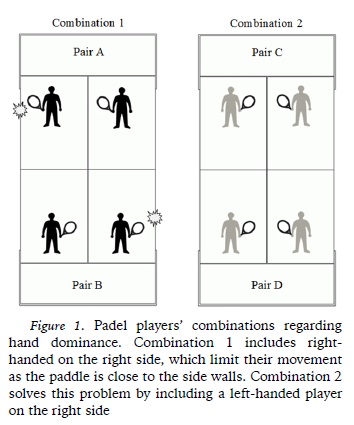
<body><![CDATA[<p>In sports practice, the assessment of players&rsquo; behaviours is widely accepted    since it allows the identification of strengths and weaknesses to support the    training process and preparation for the match (Lames &amp; McGarry, 2007).    A better understanding of effective technical-tactical patterns is essential    to help coaches and players making better decisions (Garganta, 2008). In this    task, players&rsquo; performance profiling stands as a helpful tool to determine players&rsquo;    attributes and measure their progress towards set goals (Newman &amp; Crespo,    2008; O&rsquo;Donoghue, 2013).</p>     <p>Players&rsquo; performance in unilateral swinging sports such as tennis, baseball    or padel is strongly determined by the competitors&rsquo; hand dominance (Grouios,    Tsorbatzoudis, Alexandris, &amp; Barkoukis, 2000). Particularly in racket sports    such as tennis, evidence reveals certain innate superiority in left-handed athletes    (Hagemann, 2009) given a better neuroanatomical condition and visuospatial and    visuomotor ability (Holtzen, 2000). Specifically, actions performed with the    left hand are under control of the right hemisphere, which is also functionally    dominant for visuospatial (Toga &amp; Thompson, 2003) and spatiotemporal skills    (Boulinguez, Ferrois, &amp; Graumer, 2003). Thus, neural processes may be more    efficient (e.g., lower delay or less loss of information) in manual task requiring    such skills for left compared to right hand actions (Bisiacchi, Ripoll, Stein,    Simonet, &amp; Azemar, 1985; Dane &amp; Erzurumluo&#487;lu, 2003). In a more    practical term, left-handed hits impose a different spin on balls, which force    the opponents (commonly right- handed) to adjust their return stroke reducing    the anticipation (Loffing, Hagemann, &amp; Strauss, 2009, 2010). This apparent    handedness influence has raised the attention of racket sports research and    coaches towards detecting performance differences between left- and right handed    athletes (Loffing &amp; Hagemann, 2016). However, there is very limited information    available about emerging racket sports such as padel, which particularities    (two-on-two, enclosed small-size court) suggest a critical influence of players&rsquo;    handedness in performance.</p>     <p>Padel is a young racket sport, played in doubles on a small size (10 x 20 m)    and enclosed court (International Padel Federation, 2017).</p>     <p>With only three decades of history, padel has become a mass phenomenon in Spain    (counting with over four million regular practitioners) and rapidly spreading    in over 27 countries around the world (Courel-Ibáñez, Sánchez-Alcaraz, García    Benítez, &amp; Echegaray, 2017). Research in padel has been mainly focused on    describing the match activity and detecting effective performance indicators    (Courel-Ibáñez, Sánchez-Alcaraz, &amp; Cañas, 2015, 2017; Muñoz et al., 2017).    These works provided primary information such as the rally duration (3 to 11    s), the most common actions in offence (volley and smash) and defence (lob),    and highlighted the importance of the net game (involving 80 % of the points).    These game dynamics and its effectiveness however could be determined by players&rsquo;    hand dominance (Loffing &amp; Hagemann, 2016), performance profiles (O&rsquo;Donoghue,    2013) and game-styles (Courel- Ibáñez, Sanchez-Alcaraz, &amp; Muñoz Marín, 2017).    Particularly in padel, the optimal use of space and the domain of overhead strokes    are essential to enhance performance and increase scoring rate (Courel-Ibáñez,    Sanchez-Alcaraz, et al., 2017). In this sense, the players&rsquo; hand dominance is    critical due to the existence of walls surrounding the court that limit players&rsquo;    displacements and actions. For instance, if the pair of players included two    right-handed, the one on the right side has the paddle near the sidewall, which    sometimes constitutes a limiting factor when returning a ball (<a href="#f1">Figure    1</a>, <a href="#f1">Combination 1</a>). This does not happen if including a    left-handed on the right side (<a href="#f1">Figure 1</a>, <a href="#f1">Combination    2</a>).</p>     <p>&nbsp;</p>     <p align="center"><a name="f1"></a><img src="/img/revistas/mot/v14n4/14n4a05f1.jpg"/></p>     
<p>&nbsp;</p>     <p>This game combination including a left- handed on the right side allows both    players defending the centre line in better conditions (i.e., both using quick    and balanced forehand strokes) and makes easy the use of overhead strokes for    returning balls near the sidewall (Courel-Ibáñez, Sanchez-Alcaraz, et al., 2017;    Muñoz et al., 2017). It is remarkable that the best pair of players in padel    history (lasted 13 years on the number one of the ranking winning 170 of 191    finals contested) included this particular game combination (Aguilar-Amat, 2014).    Given the apparent advantage of playing with a left- handed on the right side    in padel, a better knowledge on players&rsquo; performance profiles regarding the    players&rsquo; handedness and the game combination is required to set optimal training    plans and goals.</p>     <p>Therefore, the aim of this study was to define performance profiles of professional    padel players including a left-handed playing on the right side of the court.    This information would shed some light on the role of hand dominance in padel    and may have implications in designing specific training and conditioning programs    according to players&rsquo; characteristics in real competitive situations.</p>     <p><b>Method</b></p>     ]]></body>
<body><![CDATA[<p>Evidence suggest that hand dominance is a determinant factor in racket sports.    Previous studies in padel have described game dynamics and competition demands    regardless players&rsquo; laterality. This seems to be important in padel given that    during a decade, the top-2 padel pairs in the world included a combination of    a right- handed playing in the left and a left-handed playing in the right.    In this investigation, we assessed professional players&rsquo; performance by means    of technical (groundstroke type), spatial (court depth and court width), and    effectiveness (continuity, error and winner) indicators through systematic observation    of the competition.</p>     <p>Besides, a combination of an automated classification method like the decision    tree analysis and a visual and practical reporting tool like radar chart were    used to define right- and left-handed players&rsquo; performance profiles.</p>     <p><b>Participants</b></p>     <p>Four professional players (mean (SD) age: 31.7 [4.6] years; height: 181.1 [2.0]    cm; weight: 76.4 [3.7] kg) from the 2014 padel championship World Padel Tour    (WPT) took part in this study and voluntary provided written informed consent.    In these pairs, players from the right side were left-handed and players from    the left side were right-handed (<a href="#f1">Figure 1</a>, <a href="#f1">Combination    2</a>). In total 2,016 groundstroke-by-groundstroke actions were recorded from    three official final games of the WPT circuit, played in different weekends    with two weeks between each game, according to the official calendar. No injuries    were reported. The matches took place during the autumn season in the late afternoon    in official indoor padel clubs.</p>     <p><b>Procedures</b></p>     <p>Game dynamics were analyzed regarding the technical (groundstroke type), spatial    (court depth and court width), and effectiveness indicators (continuity, error    and winner) as described elsewhere (Courel-Ibáñez, Sanchez- Alcaraz, et al.,    2017). Groundstroke types included direct (hit after bouncing in the ground),    volley (hit before bouncing in the ground), wall (hit after bouncing in the    back or side walls), smash (overhead shot with the racket facing the ground)    and bandeja (a sliced smash with the racket facing up). Spatial data were obtained    by dividing the court into nine areas and recording the position from where    the action was made. Court depth included the net (from the net to the grille    zone, 4 m long), middle (from the 4- m grille zone to the baseline, 3 m long)    and baseline (from the baseline to the back wall, 3 m long). Court width included    the right side (closest area to the right wall, 3 m width), centre (central    lane, 4 m long width) and left side (closest area to the left wall, 3 m width).    Data were collected by four observers through systematic observation using the    specific video software analysis Lince (Gabin, Camerino, Anguera, &amp; Castañer,    2012). Then, the Kinovea software (V.0.8.15; Kinovea open source project,    <a href="http://www.kinovea.org" target="_blank">www.kinovea.org</a>)    was used to place a visual grid over the video image to for the court depth    data recording. The four observers were coaches specialized in padel (over 5-year    experience) and followed a 4-week training program, which include an inter-rater    evaluation at the end prior to the observation process. To check inter-rater    reliability each observer analyzed a training set of one official padel match,    which was not included in the final sample. Consistency of records was analyzed    using the free-marginal multirater kappa (Randolph, 2008) and the weighted kappa    (Robinson &amp; O&rsquo;Donoghue, 2007) obtaining a minimum score of <i>k</i>=0.82.    Finally, intra-observer evaluation was done at the end of the observation process    by Cohen&rsquo;s Kappa calculation, yielding a very good strength of agreement with    scores over 0.90 (Altman, 1991). The present study was conducted according to    the ethical standards in sport and exercise science research (Harriss &amp;    Atkinson, 2015) and the local Ethics Commission.</p>     <p><b>Statistical analysis</b></p>     <p>Chi-Squared analyses and multivariate decision tree analysis were conducted    to identify and classify technical (groundstroke type), spatial (court depth    and court width), and effectiveness indicators (continuity, error and winner)    regarding players&rsquo; hand dominance. Significance of associations was identified    using the exhaustive CHAID algorithm with following inclusion criteria: (i)    nodes with more than 100 iterations, (ii) minimum change in expected cell frequencies    of 0.001, and (iii) Pearson chi-square significance level set at <i>p </i>&lt;    0.05 with Bonferroni&rsquo;s correction (<i>Adj. p</i>). Strength of associations    were measured by calculating the Adjusted Standardised Residuals (ASRs) considering    values from 1.96 to 2.58 as weak, 2.58 to 3.29 as medium and over 3.29 as strong    associations (Field, 2007). Effect size (ES) was estimated by calculating Phi    (<i>&#966;</i>) and Cramer&rsquo;s V (<i>V</i>) correlation coefficients<i>, </i>considering    0.10 = small effect, 0.30 = medium effect, and 0.50 = large effect (Fritz, Morris,    &amp; Richler, 2012).</p>     <p>Statistical analyses were conducted in IBM SPSS v. 20.0 for Windows (Armonk,    NY: IBM Corp.).</p>     <p><b>Results</b></p>     ]]></body>
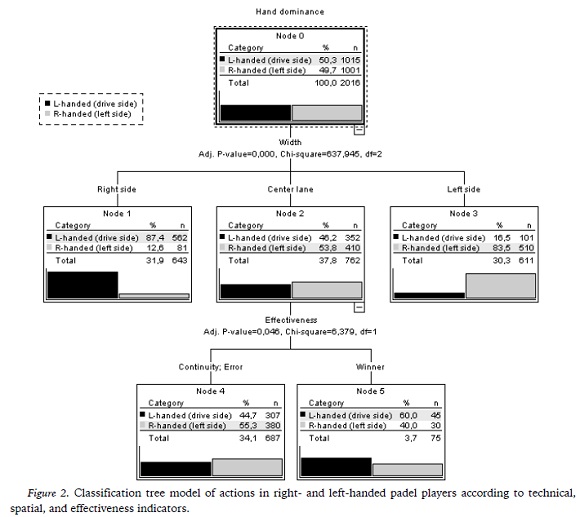
<body><![CDATA[<p>The decision tree analysis (<a href="#f2">Figure 2</a>) showed that 80% of    actions comes from players&rsquo; own court sides (i.e., right-handed on the left,    left- handed on the right), while the distribution on the centre was more similar.    However, the second branch of the tree revealed 20% more winning actions made    by the left-handed on the central lane (<i>Adj. p </i>&lt; 0.046).</p>     <p>&nbsp;</p>     <p align="center"><a name="f2"></a><img src="/img/revistas/mot/v14n4/14n4a05f2.jpg"/></p>     
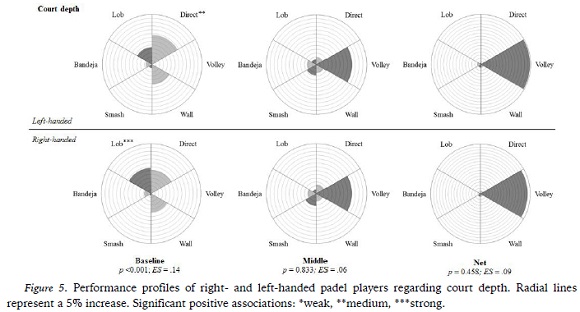
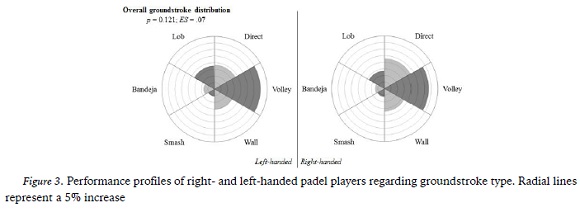
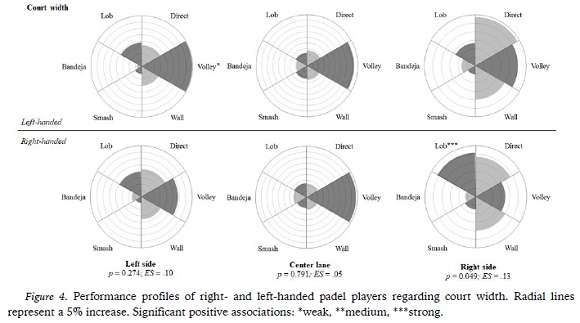
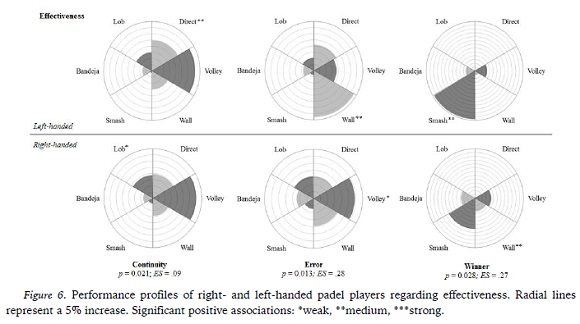
<p>&nbsp;</p>     <p><a href="#f3">Figures 3</a>, <a href="#f4">4</a>, <a href="#f5">5</a> and <a href="#f6">6</a>    depicted the performance profiles of right- and left-handed padel players in    radial charts according to technical (groundstroke type), spatial (court depth    and court width), and effectiveness indicators (continuity, error and winner).    Groundstroke profile (<a href="#f3">Figure 3</a>) showed a similar use of technical    actions between right- and left-handed players (<i>p </i>= 0.121).</p>     <p>&nbsp;</p>     <p align="center"><a name="f3"></a><img src="/img/revistas/mot/v14n4/14n4a05f3.jpg"/></p>     
<p>&nbsp;</p>     <p align="center"><a name="f4"></a><img src="/img/revistas/mot/v14n4/14n4a05f4.jpg"/></p>     
<p>&nbsp;</p>     ]]></body>
<body><![CDATA[<p align="center"><a name="f5"></a><img src="/img/revistas/mot/v14n4/14n4a05f5.jpg"/></p>     
<p>&nbsp;</p>     <p align="center"><a name="f6"></a><img src="/img/revistas/mot/v14n4/14n4a05f6.jpg"/></p>     
<p>&nbsp;</p>     <p>Court width profiles (<a href="#f4">Figure 4</a>) revealed a similar pattern    on the centre lane (<i>p </i>= 0.791). On the sides, right-handed made more    lobs on the right side (25.9 % vs. 13.3 %; <i>p </i>= 0.049). Conversely, left-handed    made slightly more volleys on the left (39.6 % vs. 28.8 %), although differences    were not statistically significant (<i>p </i>= 0.274).</p>     <p>Court depth profiles (<a href="#f5">Figure 5</a>) drew an extremely similar    groundstroke distribution on middle (p = 0.833) and net (p = 0.458) areas. Contrariwise,    differences were found on the baseline (p &lt; 0.001; ES = .14), in where right-    handed made more lobs (33.3 % vs. 22.5 %) and left-handed made more directs    (38.4 % vs. 30.9%).</p>     <p>Effectiveness profiles (<a href="#f6">Figure 6</a>) showed the largest disparities    regarding players&rsquo; hand dominance both in continuity (p = 0.021; ES = .09),    error (p = 0.013; ES = .28) and winning (p = 0.028; ES = .27) actions. Left-handed    profile is characterized by using direct to continue the rally (24.8 % vs. 19.4    %) and smash to score (63.3 % vs. 40.6 %) with larger errors in wall groundstrokes    (37.7 % vs. 19.5 %). In comparison, right-handed used more lob to continue the    rally (18.7 % vs. 14.9 %) and wall groundstrokes to score (17.4 % vs. 5.6 %)    with larger errors in volleys (29.3 % vs. 18.4 %).</p>     <p><b>Discussion</b></p>     <p>This study aimed at defining distinctive performance profiles of professional    padel players with respect to their hand dominance. We explored two professional    pair of players who used a particular combination including a left- handed on    the right side and a right-handed on the left (<a href="#f1">Figure 1</a>, <a href="#f1">combination    2</a>). A similar use of technical actions (i.e., groundstroke type distribution)    was found between right- and left- handed players. This reveals a solid structure    of padel game dynamics when using this combination, which can be explained by    the fact that both players have the same disposition (i.e., playing with the    paddle on their dominant hand and away the side walls). However, effectiveness    differed substantially between players: left- handed were highly more effective    using smashes (63.3 % vs. 40.7 %) but made more errors when hitting the ball    after bouncing on the wall (37.7 % vs. 19.5 %); in turn, right-handed made more    lobs (17.2 % vs. 13.2%) and committed fewer errors (11.2 % vs. 8.2 %). This    seems to indicate a specialization of left-handed as ‘scorers&rsquo; and right-handed    as ‘defenders&rsquo; when using this combination, which could explain why including    a left-handed on the right side has been extremely effective in padel during    the last decade. These novel results open the debate about the importance of    hand dominance in padel and the risks and benefits of each combination.</p>     <p>Interestingly, our findings showed a very much alike overall game pattern in    both right- and left-handed players (<a href="#f3">Figure 3</a>). This is in    line with previous researches (Courel-Ibáñez, Sanchez-Alcaraz, et al., 2017;    Lupo et al., 2018; Torres-Luque, Ramirez, Cabello-Manrique, Nikolaidis, &amp;    Alvero-Cruz, 2015) suggesting that padel technical actions are quite solidly    distributed along a professional padel match. For example, one can expect around    25-35% of volleys, 20-30% of directs, 15-25% of overhead groundstrokes (smashes    and bandeja), 15-20% of walls, and 10-15% of lobs. However, this distribution    seems to be importantly altered regarding the court space, in terms of depth    and width (Courel-Ibáñez, Sanchez-Alcaraz, et al., 2017). These authors classified    three main game styles according to the court depth: defensive (baseline), transition    (middle) and offensive (net). Regarding the width, the centre lane was relevant    during the transition and offensive phases, while the sides were more important    during the defence. Our findings partly supported this trend during the offence,    by identifying a similar groundstroke pattern in right- and left-handed players    on net and middle areas (<a href="#f5">Figure 5</a>). However, from a defensive    point of view (i.e., baseline), right-handed made more lobs and left-handed    made more directs (<a href="#f5">Figure 5</a>). The lob is the most common defensive    action used in padel, as allow players sending the opponents back while moving    to the net to score. Directs are mainly used to speed-up the game and overpass    the opponents thorough a low ball crossing the centre lane (Muñoz et al., 2017).    In light of this observation, the players&rsquo; defensive specialization identified    in the present study might result beneficial by: a) reducing the risks derived    from a short/low lob (i.e., let the opponents returning a smash) and b) using    directs to speed-up the game and increase the opponents&rsquo; errors rate (Courel-Ibáñez    &amp; Sanchez-Alcaraz, 2017; Courel-Ibáñez, Sánchez- Alcaraz, &amp; Cañas, 2017).    In support of this argument, the exploration of players&rsquo; opposite sides revealed    that right-handed made more lobs on the right side (25.9 % vs. 13.3 %) and left-    handed made more volleys on the left-side (39.6 % vs. 28.8 %) (<a href="#f5">Figure    5</a>); this likely indicates an anticipation of actions because of a predefined    strategy against lobs or deep balls, in which the left-handed (scorer) keeps    closer the net searching for scoring options while the right- handed (defender)    moves back to the baseline, regardless the court side.</p>     ]]></body>
<body><![CDATA[<p>A main contribution of the current study is the description of distinctive    performance profiles regarding effectiveness and hand dominance in padel (<a href="#f6">Figure    6</a>). In line with the above-mentioned results, the greater effectiveness    reported in left handed smashes (63.3 % vs. 40.7 %) may indicate an offensive    specialization in these players; right-handed, however, were highly effective    on the baseline when attacking using the wall (17.4 % vs. 5.6 %). Previous investigations    pointed out the importance of overhead strokes to score in padel, mainly from    the middle area of the court - up to seven meters from the net (Courel-Ibáñez,    Sanchez-Alcaraz, et al., 2017). This is remarkable considering the high frequency    of actions during a padel match including around one stroke per second in long-    duration rallies (Courel-Ibáñez, Sánchez-Alcaraz, &amp; Cañas, 2017; Torres-Luque    et al., 2015). As so, padel players are required to overcome local fatigue on    their upper-body dominant side, particularly on shoulders, elbows and wrists    during the game, as reported in similar racket sports (Maquirriain, Baglione,    &amp; Cardey, 2016; Ulbricht, Fernandez-Fernandez, Mendez- Villanueva, &amp;    Ferrauti, 2016). From the variety of padel strokes, the smash implies the highest    velocity joint rotation to hit at the maximum speed, which alarmingly increase    the probability of suffering an injury in padel (Castillo-Lozano &amp; Casuso-Holgado,    2017). In light of our findings, future research should address the study of    padel players&rsquo; physical condition to identify the extent to which their performance    profile could be related with particular training adaptations (e.g., upper-body    power to smash, change of directions to better react after the ball hits the    wall).</p>     <p>The generalizability of these findings could be limited because of the reduced    size and specificity of the sample. Nevertheless, it is important noted that    padel world ranking has been led by pairs of players using a right-left handed    combination since the last 15 years. Besides, we are not able to provide data    from players&rsquo; interactions (e.g., <i>if-then </i>rules) and quality of decision    making. Future research exploring hand dominance differences in padel is warranted    to a better understanding of game dynamics and the subsequent designing of training    tasks and conditioning programs according to players&rsquo; characteristics.</p>     <p><b>Conclusion</b></p>     <p>Our data suggest distinctive performance profiles in padel players according    to their hand dominance. Besides, two player&rsquo;s roles were clearly distinguished:    scorer (specialist in direct and volley and smash) and defender (specialist    in lob and wall actions). Based on current players&rsquo; specialization reported,    coaches should design specific game plans when competing against right-right    or right-left handed pairs in padel. For instance, using lobs against a left-handed    opponent appears to be risky if bad performed (increase smash chances) but more    effective if succeed (send the offensive player far from scoring areas). Likewise,    players should keep an eye on the right-handed when using the wall. In terms    of conditioning and skills, it is remarkable the importance of volley (high-frequency,    low- velocity) and smash (low-frequency, high- velocity) actions in padel offence.    Physical conditioning and prevention programs in padel are required to reduce    injury rates caused by cumulative elbow and wrist vibration in volleys and high    velocities of joint rotation in smashed, particularly in left-handed and ‘scorer&rsquo;    role players.</p>     <p>&nbsp;</p>     <p><b>REFERENCES</b></p>     <!-- ref --><p>Aguilar-Amat, D. (2014). El último partido de Juan y Bela [The last match of    Juan and Bela]. <i>El Mundo</i>. Retrieved from <a href="http://www.elmundo.es/deportes/2014/12/22/549848d9ca4741e8018b4571.html" target="_blank">http://www.elmundo.es/deportes/2014/12/22/549848d9ca4741e8018b4571.html</a>&nbsp;&nbsp;&nbsp;&nbsp;&nbsp;&nbsp;&nbsp;&nbsp;[&#160;<a href="javascript:void(0);" onclick="javascript: window.open('/scielo.php?script=sci_nlinks&ref=385012&pid=S1646-107X201800030000500001&lng=','','width=640,height=500,resizable=yes,scrollbars=1,menubar=yes,');">Links</a>&#160;]<!-- end-ref --><!-- ref --><p>Altman, D. G. (1991). <i>Practical statistics for medical research</i>. London:    Chapman &amp; Hall.    &nbsp;&nbsp;&nbsp;&nbsp;&nbsp;&nbsp;&nbsp;&nbsp;[&#160;<a href="javascript:void(0);" onclick="javascript: window.open('/scielo.php?script=sci_nlinks&ref=385013&pid=S1646-107X201800030000500002&lng=','','width=640,height=500,resizable=yes,scrollbars=1,menubar=yes,');">Links</a>&#160;]<!-- end-ref --> </p>     <!-- ref --><p>Bisiacchi, P. S., Ripoll, H., Stein, J. F., Simonet, P., &amp; Azemar, G. (1985).    Left-Handedness in Fencers: An Attentional Advantage? <i>Perceptual and Motor    Skills</i>, <i>61</i>(2), 507-513.<a href="https://doi.org/10.2466/pms.1985.61.2.507" target="_blank">https://doi.org/10.2466/pms.1985.61.2.507</a>&nbsp;&nbsp;&nbsp;&nbsp;&nbsp;&nbsp;&nbsp;&nbsp;[&#160;<a href="javascript:void(0);" onclick="javascript: window.open('/scielo.php?script=sci_nlinks&ref=385015&pid=S1646-107X201800030000500003&lng=','','width=640,height=500,resizable=yes,scrollbars=1,menubar=yes,');">Links</a>&#160;]<!-- end-ref --><!-- ref --><p>Boulinguez, P., Ferrois, M., &amp; Graumer, G. (2003).Hemispheric asymmetry    for trajectory perception. <i>Cognitive Brain Research</i>, <i>16</i>(2), 219-225.    <a href="https://doi.org/10.1016/S0926-6410(02)00276-8" target="_blank">https://doi.org/10.1016/S0926-6410(02)00276-8</a>&nbsp;&nbsp;&nbsp;&nbsp;&nbsp;&nbsp;&nbsp;&nbsp;[&#160;<a href="javascript:void(0);" onclick="javascript: window.open('/scielo.php?script=sci_nlinks&ref=385016&pid=S1646-107X201800030000500004&lng=','','width=640,height=500,resizable=yes,scrollbars=1,menubar=yes,');">Links</a>&#160;]<!-- end-ref --><!-- ref --><p>Castillo-Lozano, R., &amp; Casuso-Holgado, M. J. (2017). Incidence of musculoskeletal    sport injuries in a sample of male and female recreational paddle- tennis players.    <i>Journal of Sports Medicine and Physical Fitness</i>, <i>57</i>(6), 816-721.    <a href="https://doi.org/10.23736/S0022-4707.16.06240-X" target="_blank">https://doi.org/10.23736/S0022-4707.16.06240-X</a>&nbsp;&nbsp;&nbsp;&nbsp;&nbsp;&nbsp;&nbsp;&nbsp;[&#160;<a href="javascript:void(0);" onclick="javascript: window.open('/scielo.php?script=sci_nlinks&ref=385017&pid=S1646-107X201800030000500005&lng=','','width=640,height=500,resizable=yes,scrollbars=1,menubar=yes,');">Links</a>&#160;]<!-- end-ref --><!-- ref --><p>Courel-Ibáñez, J., &amp; Sanchez-Alcaraz, B. J. (2017). Efecto de las variables    situacionales sobre los puntos en jugadores de pádel de élite. <i>Apunts. Educación    Física y Deportes</i>, <i>121</i>, 72-78. <a href="http://dx.doi.org/10.5672/apunts.2014-0983.es.%282017/1%29.127.07" target="_blank">https://doi.org/http://dx.doi.org/10.5672/apunts.2014-0983.es.%282017/1%29.127.07</a>&nbsp;&nbsp;&nbsp;&nbsp;&nbsp;&nbsp;&nbsp;&nbsp;[&#160;<a href="javascript:void(0);" onclick="javascript: window.open('/scielo.php?script=sci_nlinks&ref=385018&pid=S1646-107X201800030000500006&lng=','','width=640,height=500,resizable=yes,scrollbars=1,menubar=yes,');">Links</a>&#160;]<!-- end-ref --><!-- ref --><p>Courel-Ibáñez, J., Sánchez-Alcaraz, B. J., &amp; Cañas, J. (2015). Effectiveness    at the net as a predictor of final match outcome in professional padel players.    <i>International Journal of Performance Analysis in Sport</i>, <i>15</i>(2),    632-640.    &nbsp;&nbsp;&nbsp;&nbsp;&nbsp;&nbsp;&nbsp;&nbsp;[&#160;<a href="javascript:void(0);" onclick="javascript: window.open('/scielo.php?script=sci_nlinks&ref=385019&pid=S1646-107X201800030000500007&lng=','','width=640,height=500,resizable=yes,scrollbars=1,menubar=yes,');">Links</a>&#160;]<!-- end-ref --></p>     <!-- ref --><p>Courel-Ibáñez, J., Sánchez-Alcaraz, B. J., &amp; Cañas, J. (2017). Game performance    and length of rally in professional padel player. <i>Journal of Human Kinetics</i>,    <i>55</i>, 161-169. <a href="https://doi.org/10.1515/hukin-2016-0045" target="_blank">https://doi.org/10.1515/hukin-2016-0045</a>  &nbsp;&nbsp;&nbsp;&nbsp;&nbsp;&nbsp;&nbsp;&nbsp;[&#160;<a href="javascript:void(0);" onclick="javascript: window.open('/scielo.php?script=sci_nlinks&ref=385021&pid=S1646-107X201800030000500008&lng=','','width=640,height=500,resizable=yes,scrollbars=1,menubar=yes,');">Links</a>&#160;]<!-- end-ref --><p>Courel-Ibáñez, J., Sánchez-Alcaraz, B. J., García Benítez, S., &amp; Echegaray,    M. (2017). Evolution of padel in Spain according to practitioners&rsquo; gender and    age. <i>Cultura, Ciencia y Deporte</i>, <i>34</i>(12), 39-46.</p>     <!-- ref --><p>Courel-Ibáñez, J., Sanchez-Alcaraz, B. J., &amp; Muñoz Marín, D. (2017). Exploring    game dynamics in padel. Implications for assessment and training. <i>Journal    of Strength and Conditioning Research</i>. <a href="http://dx.doi.org/10.1519/JSC.0000000000002126" target="_blank">https://doi.org/http://dx.doi.org/10.1519/JSC.0000000000002126</a>.    &nbsp;&nbsp;&nbsp;&nbsp;&nbsp;&nbsp;&nbsp;&nbsp;[&#160;<a href="javascript:void(0);" onclick="javascript: window.open('/scielo.php?script=sci_nlinks&ref=385023&pid=S1646-107X201800030000500010&lng=','','width=640,height=500,resizable=yes,scrollbars=1,menubar=yes,');">Links</a>&#160;]<!-- end-ref --></p>     <p>Dane, &#350;., &amp; Erzurumluo&#487;lu, A. (2003). Sex and handedness differences    in eye-hand visual reaction times in handball players. <i>International Journal    of Neuroscience</i>, <i>113</i>(7), 923-929. <a href="https://doi.org/10.1080/00207450390220367" target="_blank">https://doi.org/10.1080/00207450390220367</a></p>     ]]></body>
<body><![CDATA[<!-- ref --><p>Field, A. (2007). <i>Discovering Statistics Using SPSS</i>. London: SAGE Publications    Ltd.    &nbsp;&nbsp;&nbsp;&nbsp;&nbsp;&nbsp;&nbsp;&nbsp;[&#160;<a href="javascript:void(0);" onclick="javascript: window.open('/scielo.php?script=sci_nlinks&ref=385026&pid=S1646-107X201800030000500012&lng=','','width=640,height=500,resizable=yes,scrollbars=1,menubar=yes,');">Links</a>&#160;]<!-- end-ref --></p>     <!-- ref --><p>Fritz, C. O., Morris, P. E., &amp; Richler, J. J. (2012). Effect size estimates:    current use, calculations, and interpretation. <i>Journal of Experimental Psychology:    General</i>, <i>141</i>(1), 2-18.    &nbsp;&nbsp;&nbsp;&nbsp;&nbsp;&nbsp;&nbsp;&nbsp;[&#160;<a href="javascript:void(0);" onclick="javascript: window.open('/scielo.php?script=sci_nlinks&ref=385028&pid=S1646-107X201800030000500013&lng=','','width=640,height=500,resizable=yes,scrollbars=1,menubar=yes,');">Links</a>&#160;]<!-- end-ref --></p>     <!-- ref --><p>Gabin, B., Camerino, O., Anguera, M. T., &amp; Castañer, M. (2012). Lince:    Multiplatform sport analysis software. <i>Procedia - Social and Behavioral Sciences</i>,    <i>46</i>, 4692-4694. <a href="https://doi.org/10.1016/j.sbspro.2012.06.320" target="_blank">https://doi.org/10.1016/j.sbspro.2012.06.320</a>&nbsp;&nbsp;&nbsp;&nbsp;&nbsp;&nbsp;&nbsp;&nbsp;[&#160;<a href="javascript:void(0);" onclick="javascript: window.open('/scielo.php?script=sci_nlinks&ref=385030&pid=S1646-107X201800030000500014&lng=','','width=640,height=500,resizable=yes,scrollbars=1,menubar=yes,');">Links</a>&#160;]<!-- end-ref --><p>Garganta, J. (2008). Modelação tática em jogos desportivos: A desejável cumplicidade    entre pesquisa, treino e competição. <i>F. Tavares, A.</i> <i>Graça, J. Garganta    &amp; I. Mesquita (Eds.), Olhares e Contextos Da Performance Nos Jogos Desportivos</i>,    <i>7</i>((pp. 108-121)), 108-121. <a href="https://doi.org/10.1007/s00299-004-0843-6" target="_blank">https://doi.org/10.1007/s00299-004-0843-6</a></p>     <!-- ref --><p>Grouios, G., Tsorbatzoudis, H., Alexandris, K., &amp; Barkoukis, V. (2000).    Do Left-Handed Competitors Have an Innate Superiority in Sports? <i>Perceptual    and Motor Skills</i>, <i>90</i>(3 suppl), 1273-1282. <a href="https://doi.org/10.2466/pms.2000.90.3c.1273" target="_blank">https://doi.org/10.2466/pms.2000.90.3c.1273</a>&nbsp;&nbsp;&nbsp;&nbsp;&nbsp;&nbsp;&nbsp;&nbsp;[&#160;<a href="javascript:void(0);" onclick="javascript: window.open('/scielo.php?script=sci_nlinks&ref=385032&pid=S1646-107X201800030000500016&lng=','','width=640,height=500,resizable=yes,scrollbars=1,menubar=yes,');">Links</a>&#160;]<!-- end-ref --><!-- ref --><p>Hagemann, N. (2009). The advantage of being left-handed in interactive sports.    <i>Attention, Perception, &amp; Psychophysics</i>, <i>71</i>(7), 1641-1648.    <a href="https://doi.org/10.3758/APP.71.7.1641" target="_blank">https://doi.org/10.3758/APP.71.7.1641</a>&nbsp;&nbsp;&nbsp;&nbsp;&nbsp;&nbsp;&nbsp;&nbsp;[&#160;<a href="javascript:void(0);" onclick="javascript: window.open('/scielo.php?script=sci_nlinks&ref=385033&pid=S1646-107X201800030000500017&lng=','','width=640,height=500,resizable=yes,scrollbars=1,menubar=yes,');">Links</a>&#160;]<!-- end-ref --><!-- ref --><p>Harriss, D. J., &amp; Atkinson, G. (2015). Ethical Standards in Sport and Exercise    Science Research: 2016 Update. <i>Interational Journal of Sports Medicine</i>,    <i>36</i>(14), 1121-1124. <a href="https://doi.org/10.1055/s-0035-1565186" target="_blank">https://doi.org/10.1055/s-0035-1565186</a>&nbsp;&nbsp;&nbsp;&nbsp;&nbsp;&nbsp;&nbsp;&nbsp;[&#160;<a href="javascript:void(0);" onclick="javascript: window.open('/scielo.php?script=sci_nlinks&ref=385034&pid=S1646-107X201800030000500018&lng=','','width=640,height=500,resizable=yes,scrollbars=1,menubar=yes,');">Links</a>&#160;]<!-- end-ref --><!-- ref --><p>Holtzen, D. W. (2000). Handedness and Professional Tennis. <i>International    Journal of Neuroscience</i>, <i>105</i>(1-4), 101-119. <a href="https://doi.org/10.3109/00207450009003270" target="_blank">https://doi.org/10.3109/00207450009003270</a>&nbsp;&nbsp;&nbsp;&nbsp;&nbsp;&nbsp;&nbsp;&nbsp;[&#160;<a href="javascript:void(0);" onclick="javascript: window.open('/scielo.php?script=sci_nlinks&ref=385035&pid=S1646-107X201800030000500019&lng=','','width=640,height=500,resizable=yes,scrollbars=1,menubar=yes,');">Links</a>&#160;]<!-- end-ref --><!-- ref --><p>International Padel Federation. (2017). Regulations of the padel game. Retrieved    May 17, 2017, from <a href="https://media.wix.com/ugd/b602c3_f2cea9c6d1fe4caea85d35f7ea396eb9.pdf" target="_blank">https://media.wix.com/ugd/b602c3_f2cea9c6d1fe4caea85d35f7ea396eb9.pdf</a>&nbsp;&nbsp;&nbsp;&nbsp;&nbsp;&nbsp;&nbsp;&nbsp;[&#160;<a href="javascript:void(0);" onclick="javascript: window.open('/scielo.php?script=sci_nlinks&ref=385036&pid=S1646-107X201800030000500020&lng=','','width=640,height=500,resizable=yes,scrollbars=1,menubar=yes,');">Links</a>&#160;]<!-- end-ref --><!-- ref --><p>Lames, M., &amp; McGarry, T. (2007). On the search for reliable performance    indicators in game sports. <i>International Journal of Performance Analysis    in Sport</i>, <i>7</i>(1), 62-79. <a href="https://doi.org/10.1080/24748668.2007.11868388" target="_blank">https://doi.org/10.1080/24748668.2007.11868388</a>&nbsp;&nbsp;&nbsp;&nbsp;&nbsp;&nbsp;&nbsp;&nbsp;[&#160;<a href="javascript:void(0);" onclick="javascript: window.open('/scielo.php?script=sci_nlinks&ref=385037&pid=S1646-107X201800030000500021&lng=','','width=640,height=500,resizable=yes,scrollbars=1,menubar=yes,');">Links</a>&#160;]<!-- end-ref --><!-- ref --><p>Loffing, F., &amp; Hagemann, N. (2016). Performance Differences Between Left-    and Right-Sided Athletes in One-on-One Interactive Sports. In <i>Laterality    in Sports: Theories and Applications </i>(pp. 249-277). Elsevier. <a href="https://doi.org/10.1016/B978-0-12-801426-4.00012-2" target="_blank">https://doi.org/10.1016/B978-0-12-801426-4.00012-2</a>&nbsp;&nbsp;&nbsp;&nbsp;&nbsp;&nbsp;&nbsp;&nbsp;[&#160;<a href="javascript:void(0);" onclick="javascript: window.open('/scielo.php?script=sci_nlinks&ref=385038&pid=S1646-107X201800030000500022&lng=','','width=640,height=500,resizable=yes,scrollbars=1,menubar=yes,');">Links</a>&#160;]<!-- end-ref --><p>Loffing, F., Hagemann, N., &amp; Strauss, B. (2009). The Serve in Professional    Men&rsquo;s Tennis: Effects of Players&rsquo; Handedness. <i>International Journal of Performance    Analysis in Sport</i>, <i>9</i>(2), 255-274. <a href="https://doi.org/10.1080/24748668.2009.11868482" target="_blank">https://doi.org/10.1080/24748668.2009.11868482</a></p>     <!-- ref --><p>Loffing, F., Hagemann, N., &amp; Strauss, B. (2010). Automated processes in    tennis: do left-handed players benefit from the tactical preferences of their    opponents? <i>Journal of Sports Sciences</i>, <i>28</i>(4), 435-443. <a href="https://doi.org/10.1080/02640410903536459" target="_blank">https://doi.org/10.1080/02640410903536459</a>&nbsp;&nbsp;&nbsp;&nbsp;&nbsp;&nbsp;&nbsp;&nbsp;[&#160;<a href="javascript:void(0);" onclick="javascript: window.open('/scielo.php?script=sci_nlinks&ref=385040&pid=S1646-107X201800030000500024&lng=','','width=640,height=500,resizable=yes,scrollbars=1,menubar=yes,');">Links</a>&#160;]<!-- end-ref --><!-- ref --><p>Lupo, C., Condello, G., Courel-Ibáñez, J., Gallo, C., Conte, D., &amp; Tessitore,    A. (2018). Effect of gender and match outcome on professional padel competition.    <i>RICYDE: Revista Internacional de Ciencias Del Deporte</i>, <i>14</i>(51),    29-41. <a href="https://doi.org/10.5232/ricyde2018.05103" target="_blank">https://doi.org/10.5232/ricyde2018.05103</a>&nbsp;&nbsp;&nbsp;&nbsp;&nbsp;&nbsp;&nbsp;&nbsp;[&#160;<a href="javascript:void(0);" onclick="javascript: window.open('/scielo.php?script=sci_nlinks&ref=385041&pid=S1646-107X201800030000500025&lng=','','width=640,height=500,resizable=yes,scrollbars=1,menubar=yes,');">Links</a>&#160;]<!-- end-ref --><!-- ref --><p>Maquirriain, J., Baglione, R., &amp; Cardey, M. (2016). Male professional tennis    players maintain constant serve speed and accuracy over long matches on grass    courts. <i>European Journal of Sport Science</i>, <i>16</i>(7), 845-849. <a href="https://doi.org/10.1080/17461391.2016.1156163" target="_blank">https://doi.org/10.1080/17461391.2016.1156163</a>&nbsp;&nbsp;&nbsp;&nbsp;&nbsp;&nbsp;&nbsp;&nbsp;[&#160;<a href="javascript:void(0);" onclick="javascript: window.open('/scielo.php?script=sci_nlinks&ref=385042&pid=S1646-107X201800030000500026&lng=','','width=640,height=500,resizable=yes,scrollbars=1,menubar=yes,');">Links</a>&#160;]<!-- end-ref --><p>Muñoz, D., Courel-Ibáñez, J., Sánchez-Alcaraz, B. J., Díaz, J., Grijota, F.    J., &amp; Muñoz, J. (2017). Análisis del uso y eficacia del globo para recuperar    la red en función del contexto de juego en pádel [Analysis of the use and effectiveness    of lobs to recover the net regarding game context in padel]. <i>Retos</i>, <i>31</i>,    19-22.</p>     <p>Newman, J., &amp; Crespo, M. (2008). Performance Profiling in Tennis. <i>ITF    Coaching and Sport Science Review</i>, <i>15</i>(44), 12-16.</p>     <p>O&rsquo;Donoghue, P. (2013). <i>Sports Performance Profiling</i>. (T. McGarry, P.    O&rsquo;Donoghue, &amp; J. Sampaio, Eds.), <i>Routledge Handbook of Sports Performance    Analysis</i>. London: Routledge.</p>     ]]></body>
<body><![CDATA[<!-- ref --><p>Randolph, J. J. (2008). Online Kappa Calculator [Computer software]. Retrieved    November 29, 2016, from <a href="http://justus.randolph.name/kappa" target="_blank">http://justus.randolph.name/kappa</a>&nbsp;&nbsp;&nbsp;&nbsp;&nbsp;&nbsp;&nbsp;&nbsp;[&#160;<a href="javascript:void(0);" onclick="javascript: window.open('/scielo.php?script=sci_nlinks&ref=385046&pid=S1646-107X201800030000500029&lng=','','width=640,height=500,resizable=yes,scrollbars=1,menubar=yes,');">Links</a>&#160;]<!-- end-ref --><p>Robinson, G., &amp; O&rsquo;Donoghue, P. (2007). A weighted kappa statistic for reliability    testing in performance analysis of sport. <i>International Journal of Performance    Analysis in Sport</i>, <i>7</i>(1), 12-19.</p>     <!-- ref --><p>Toga, A. W., &amp; Thompson, P. M. (2003). Mapping brain asymmetry. <i>Nature    Reviews Neuroscience</i>, <i>4</i>(1), 37-48. <a href="https://doi.org/10.1038/nrn1009" target="_blank">https://doi.org/10.1038/nrn1009</a>&nbsp;&nbsp;&nbsp;&nbsp;&nbsp;&nbsp;&nbsp;&nbsp;[&#160;<a href="javascript:void(0);" onclick="javascript: window.open('/scielo.php?script=sci_nlinks&ref=385048&pid=S1646-107X201800030000500031&lng=','','width=640,height=500,resizable=yes,scrollbars=1,menubar=yes,');">Links</a>&#160;]<!-- end-ref --><!-- ref --><p>Torres-Luque, G., Ramirez, A., Cabello-Manrique, D., Nikolaidis, P. T., &amp;    Alvero-Cruz, J. R. (2015). Match analysis of elite players during paddle tennis    competition. <i>International Journal of Performance Analysis in Sport</i>,    <i>15</i>(3), 1135-1144.    &nbsp;&nbsp;&nbsp;&nbsp;&nbsp;&nbsp;&nbsp;&nbsp;[&#160;<a href="javascript:void(0);" onclick="javascript: window.open('/scielo.php?script=sci_nlinks&ref=385049&pid=S1646-107X201800030000500032&lng=','','width=640,height=500,resizable=yes,scrollbars=1,menubar=yes,');">Links</a>&#160;]<!-- end-ref --></p>     <!-- ref --><p>Ulbricht, A., Fernandez-Fernandez, J., Mendez- Villanueva, A., &amp; Ferrauti,    A. (2016). Impact of Fitness Characteristics on Tennis Performance in Elite    Junior Tennis Players. <i>Journal of Strength and Conditioning Research</i>,    <i>30</i>(4), 989-998. <a href="https://doi.org/10.1519/JSC.0000000000001267" target="_blank">https://doi.org/10.1519/JSC.0000000000001267</a>&nbsp;&nbsp;&nbsp;&nbsp;&nbsp;&nbsp;&nbsp;&nbsp;[&#160;<a href="javascript:void(0);" onclick="javascript: window.open('/scielo.php?script=sci_nlinks&ref=385051&pid=S1646-107X201800030000500033&lng=','','width=640,height=500,resizable=yes,scrollbars=1,menubar=yes,');">Links</a>&#160;]<!-- end-ref --><p>&nbsp;</p>     <p>Acknowledgments: Nothing to declare.&nbsp; </p>     <p>Conflict of interests: Nothing to declare.&nbsp;      <p>Funding: Nothing to declare.      ]]></body>
<body><![CDATA[<p>      <p>Manuscript received at May 10th 2018; Accepted at December 10th 2018</p>     <p>&nbsp;</p>     <p><a href="#top*"><sup>[*]</sup></a><a name="*"></a>Corresponding author: <a href="mailto:javier.courel.ibanez@gmail.com">javier.courel.ibanez@gmail.com</a></p>      ]]></body><back>
<ref-list>
<ref id="B1">
<nlm-citation citation-type="book">
<person-group person-group-type="author">
<name>
<surname><![CDATA[Aguilar-Amat]]></surname>
<given-names><![CDATA[D.]]></given-names>
</name>
</person-group>
<source><![CDATA[El último partido de Juan y Bela]]></source>
<year>2014</year>
<publisher-name><![CDATA[El Mundo]]></publisher-name>
</nlm-citation>
</ref>
<ref id="B2">
<nlm-citation citation-type="book">
<person-group person-group-type="author">
<name>
<surname><![CDATA[Altman]]></surname>
<given-names><![CDATA[D. G.]]></given-names>
</name>
</person-group>
<source><![CDATA[Practical statistics for medical research]]></source>
<year>1991</year>
<publisher-loc><![CDATA[London ]]></publisher-loc>
<publisher-name><![CDATA[Chapman & Hall]]></publisher-name>
</nlm-citation>
</ref>
<ref id="B3">
<nlm-citation citation-type="journal">
<person-group person-group-type="author">
<name>
<surname><![CDATA[Bisiacchi]]></surname>
<given-names><![CDATA[P. S.]]></given-names>
</name>
<name>
<surname><![CDATA[Ripoll]]></surname>
<given-names><![CDATA[H.]]></given-names>
</name>
<name>
<surname><![CDATA[Stein]]></surname>
<given-names><![CDATA[J. F.]]></given-names>
</name>
<name>
<surname><![CDATA[Simonet]]></surname>
<given-names><![CDATA[P.]]></given-names>
</name>
<name>
<surname><![CDATA[Azemar]]></surname>
<given-names><![CDATA[G.]]></given-names>
</name>
</person-group>
<article-title xml:lang="en"><![CDATA[Left-Handedness in Fencers: An Attentional Advantage?]]></article-title>
<source><![CDATA[Perceptual and Motor Skills]]></source>
<year>1985</year>
<volume>61</volume>
<numero>2</numero>
<issue>2</issue>
<page-range>507-513</page-range></nlm-citation>
</ref>
<ref id="B4">
<nlm-citation citation-type="journal">
<person-group person-group-type="author">
<name>
<surname><![CDATA[Boulinguez]]></surname>
<given-names><![CDATA[P.]]></given-names>
</name>
<name>
<surname><![CDATA[Ferrois]]></surname>
<given-names><![CDATA[M.]]></given-names>
</name>
<name>
<surname><![CDATA[Graumer]]></surname>
<given-names><![CDATA[G.]]></given-names>
</name>
</person-group>
<article-title xml:lang="en"><![CDATA[Hemispheric asymmetry for trajectory perception]]></article-title>
<source><![CDATA[Cognitive Brain Research]]></source>
<year>2003</year>
<volume>16</volume>
<numero>2</numero>
<issue>2</issue>
<page-range>219-225</page-range></nlm-citation>
</ref>
<ref id="B5">
<nlm-citation citation-type="journal">
<person-group person-group-type="author">
<name>
<surname><![CDATA[Castillo-Lozano]]></surname>
<given-names><![CDATA[R.]]></given-names>
</name>
<name>
<surname><![CDATA[Casuso-Holgado]]></surname>
<given-names><![CDATA[M. J.]]></given-names>
</name>
</person-group>
<article-title xml:lang="en"><![CDATA[Incidence of musculoskeletal sport injuries in a sample of male and female recreational paddle- tennis players]]></article-title>
<source><![CDATA[Journal of Sports Medicine and Physical Fitness]]></source>
<year>2017</year>
<volume>57</volume>
<numero>6</numero>
<issue>6</issue>
<page-range>816-721</page-range></nlm-citation>
</ref>
<ref id="B6">
<nlm-citation citation-type="journal">
<person-group person-group-type="author">
<name>
<surname><![CDATA[Courel-Ibáñez]]></surname>
<given-names><![CDATA[J.]]></given-names>
</name>
<name>
<surname><![CDATA[Sanchez-Alcaraz]]></surname>
<given-names><![CDATA[B. J.]]></given-names>
</name>
</person-group>
<article-title xml:lang="es"><![CDATA[Efecto de las variables situacionales sobre los puntos en jugadores de pádel de élite]]></article-title>
<source><![CDATA[Apunts. Educación Física y Deportes]]></source>
<year>2017</year>
<volume>121</volume>
<page-range>72-78</page-range></nlm-citation>
</ref>
<ref id="B7">
<nlm-citation citation-type="journal">
<person-group person-group-type="author">
<name>
<surname><![CDATA[Courel-Ibáñez]]></surname>
<given-names><![CDATA[J.]]></given-names>
</name>
<name>
<surname><![CDATA[Sánchez-Alcaraz]]></surname>
<given-names><![CDATA[B. J.]]></given-names>
</name>
<name>
<surname><![CDATA[Cañas]]></surname>
<given-names><![CDATA[J.]]></given-names>
</name>
</person-group>
<article-title xml:lang="es"><![CDATA[Effectiveness at the net as a predictor of final match outcome in professional padel players]]></article-title>
<source><![CDATA[International Journal of Performance Analysis in Sport]]></source>
<year>2015</year>
<volume>15</volume>
<numero>2</numero>
<issue>2</issue>
<page-range>632-640</page-range></nlm-citation>
</ref>
<ref id="B8">
<nlm-citation citation-type="journal">
<person-group person-group-type="author">
<name>
<surname><![CDATA[Courel-Ibáñez]]></surname>
<given-names><![CDATA[J.]]></given-names>
</name>
<name>
<surname><![CDATA[Sánchez-Alcaraz]]></surname>
<given-names><![CDATA[B. J.]]></given-names>
</name>
<name>
<surname><![CDATA[Cañas]]></surname>
<given-names><![CDATA[J.]]></given-names>
</name>
</person-group>
<article-title xml:lang="en"><![CDATA[Game performance and length of rally in professional padel player]]></article-title>
<source><![CDATA[Journal of Human Kinetics]]></source>
<year>2017</year>
<volume>55</volume>
<page-range>161-169</page-range></nlm-citation>
</ref>
<ref id="B9">
<nlm-citation citation-type="journal">
<person-group person-group-type="author">
<name>
<surname><![CDATA[Courel-Ibáñez]]></surname>
<given-names><![CDATA[J.]]></given-names>
</name>
<name>
<surname><![CDATA[Sánchez-Alcaraz]]></surname>
<given-names><![CDATA[B. J.]]></given-names>
</name>
<name>
<surname><![CDATA[García Benítez]]></surname>
<given-names><![CDATA[S.]]></given-names>
</name>
<name>
<surname><![CDATA[Echegaray]]></surname>
<given-names><![CDATA[M.]]></given-names>
</name>
</person-group>
<article-title xml:lang="en"><![CDATA[Evolution of padel in Spain according to practitioners’ gender and age]]></article-title>
<source><![CDATA[Cultura]]></source>
<year>2017</year>
<volume>Ciencia y Deporte, 34</volume>
<numero>12</numero>
<issue>12</issue>
<page-range>39-46</page-range></nlm-citation>
</ref>
<ref id="B10">
<nlm-citation citation-type="journal">
<person-group person-group-type="author">
<name>
<surname><![CDATA[Courel-Ibáñez]]></surname>
<given-names><![CDATA[J.]]></given-names>
</name>
<name>
<surname><![CDATA[Sanchez-Alcaraz]]></surname>
<given-names><![CDATA[B. J.]]></given-names>
</name>
<name>
<surname><![CDATA[Muñoz Marín]]></surname>
<given-names><![CDATA[D.]]></given-names>
</name>
</person-group>
<article-title xml:lang="en"><![CDATA[Exploring game dynamics in padel]]></article-title>
<source><![CDATA[Implications for assessment and training. Journal of Strength and Conditioning Research]]></source>
<year>2017</year>
</nlm-citation>
</ref>
<ref id="B11">
<nlm-citation citation-type="journal">
<person-group person-group-type="author">
<name>
<surname><![CDATA[Dane]]></surname>
<given-names><![CDATA[S.]]></given-names>
</name>
<name>
<surname><![CDATA[Erzurumluoglu]]></surname>
<given-names><![CDATA[A.]]></given-names>
</name>
</person-group>
<article-title xml:lang="en"><![CDATA[Sex and handedness differences in eye-hand visual reaction times in handball players]]></article-title>
<source><![CDATA[International Journal of Neuroscience]]></source>
<year>2003</year>
<volume>113</volume>
<numero>7</numero>
<issue>7</issue>
<page-range>923-929</page-range></nlm-citation>
</ref>
<ref id="B12">
<nlm-citation citation-type="book">
<person-group person-group-type="author">
<name>
<surname><![CDATA[Field]]></surname>
<given-names><![CDATA[A.]]></given-names>
</name>
</person-group>
<source><![CDATA[Discovering Statistics Using SPSS]]></source>
<year>2007</year>
<publisher-loc><![CDATA[London ]]></publisher-loc>
<publisher-name><![CDATA[SAGE Publications Ltd]]></publisher-name>
</nlm-citation>
</ref>
<ref id="B13">
<nlm-citation citation-type="journal">
<person-group person-group-type="author">
<name>
<surname><![CDATA[Fritz]]></surname>
<given-names><![CDATA[C. O.]]></given-names>
</name>
<name>
<surname><![CDATA[Morris]]></surname>
<given-names><![CDATA[P. E.]]></given-names>
</name>
<name>
<surname><![CDATA[Richler]]></surname>
<given-names><![CDATA[J. J.]]></given-names>
</name>
</person-group>
<article-title xml:lang="en"><![CDATA[Effect size estimates: current use, calculations, and interpretation]]></article-title>
<source><![CDATA[Journal of Experimental Psychology: General]]></source>
<year>2012</year>
<volume>141</volume>
<numero>1</numero>
<issue>1</issue>
<page-range>2-18</page-range></nlm-citation>
</ref>
<ref id="B14">
<nlm-citation citation-type="journal">
<person-group person-group-type="author">
<name>
<surname><![CDATA[Gabin]]></surname>
<given-names><![CDATA[B.]]></given-names>
</name>
<name>
<surname><![CDATA[Camerino]]></surname>
<given-names><![CDATA[O.]]></given-names>
</name>
<name>
<surname><![CDATA[Anguera]]></surname>
<given-names><![CDATA[M. T.]]></given-names>
</name>
<name>
<surname><![CDATA[Castañer]]></surname>
<given-names><![CDATA[M.]]></given-names>
</name>
</person-group>
<article-title xml:lang="en"><![CDATA[Lince: Multiplatform sport analysis software]]></article-title>
<source><![CDATA[Procedia - Social and Behavioral Sciences]]></source>
<year>2012</year>
<volume>46</volume>
<page-range>4692-4694</page-range></nlm-citation>
</ref>
<ref id="B15">
<nlm-citation citation-type="">
<person-group person-group-type="author">
<name>
<surname><![CDATA[Garganta]]></surname>
<given-names><![CDATA[J.]]></given-names>
</name>
</person-group>
<article-title xml:lang="pt"><![CDATA[Modelação tática em jogos desportivos: A desejável cumplicidade entre pesquisa, treino e competição]]></article-title>
<person-group person-group-type="editor">
<name>
<surname><![CDATA[Tavares]]></surname>
<given-names><![CDATA[F.]]></given-names>
</name>
<name>
<surname><![CDATA[Graça]]></surname>
<given-names><![CDATA[A.]]></given-names>
</name>
<name>
<surname><![CDATA[Garganta]]></surname>
<given-names><![CDATA[J.]]></given-names>
</name>
<name>
<surname><![CDATA[Mesquita]]></surname>
<given-names><![CDATA[I.]]></given-names>
</name>
</person-group>
<source><![CDATA[Olhares e Contextos Da Performance Nos Jogos Desportivos]]></source>
<year>2008</year>
<volume>7</volume>
<page-range>108-121</page-range></nlm-citation>
</ref>
<ref id="B16">
<nlm-citation citation-type="journal">
<person-group person-group-type="author">
<name>
<surname><![CDATA[Grouios]]></surname>
<given-names><![CDATA[G.]]></given-names>
</name>
<name>
<surname><![CDATA[Tsorbatzoudis]]></surname>
<given-names><![CDATA[H.]]></given-names>
</name>
<name>
<surname><![CDATA[Alexandris]]></surname>
<given-names><![CDATA[K.]]></given-names>
</name>
<name>
<surname><![CDATA[Barkoukis]]></surname>
<given-names><![CDATA[V.]]></given-names>
</name>
</person-group>
<article-title xml:lang="en"><![CDATA[Do Left-Handed Competitors Have an Innate Superiority in Sports?]]></article-title>
<source><![CDATA[Perceptual and Motor Skills]]></source>
<year>2000</year>
<volume>90</volume>
<numero>3 suppl</numero>
<issue>3 suppl</issue>
<page-range>1273-1282</page-range></nlm-citation>
</ref>
<ref id="B17">
<nlm-citation citation-type="journal">
<person-group person-group-type="author">
<name>
<surname><![CDATA[Hagemann]]></surname>
<given-names><![CDATA[N.]]></given-names>
</name>
</person-group>
<article-title xml:lang="en"><![CDATA[The advantage of being left-handed in interactive sports]]></article-title>
<source><![CDATA[Attention]]></source>
<year>2009</year>
<volume>Perception, & Psychophysics, 71</volume>
<numero>7</numero>
<issue>7</issue>
<page-range>1641-1648</page-range></nlm-citation>
</ref>
<ref id="B18">
<nlm-citation citation-type="journal">
<person-group person-group-type="author">
<name>
<surname><![CDATA[Harriss]]></surname>
<given-names><![CDATA[D. J.]]></given-names>
</name>
<name>
<surname><![CDATA[Atkinson]]></surname>
<given-names><![CDATA[G.]]></given-names>
</name>
</person-group>
<article-title xml:lang="en"><![CDATA[Ethical Standards in Sport and Exercise Science Research: 2016 Update]]></article-title>
<source><![CDATA[Interational Journal of Sports Medicine]]></source>
<year>2015</year>
<volume>36</volume>
<numero>14</numero>
<issue>14</issue>
<page-range>1121-1124</page-range></nlm-citation>
</ref>
<ref id="B19">
<nlm-citation citation-type="journal">
<person-group person-group-type="author">
<name>
<surname><![CDATA[Holtzen]]></surname>
<given-names><![CDATA[D. W.]]></given-names>
</name>
</person-group>
<article-title xml:lang="en"><![CDATA[Handedness and Professional Tennis]]></article-title>
<source><![CDATA[International Journal of Neuroscience]]></source>
<year>2000</year>
<volume>105</volume>
<numero>1-4</numero>
<issue>1-4</issue>
<page-range>101-119</page-range></nlm-citation>
</ref>
<ref id="B20">
<nlm-citation citation-type="">
<collab>International Padel Federation</collab>
<source><![CDATA[Regulations of the padel game]]></source>
<year>2017</year>
</nlm-citation>
</ref>
<ref id="B21">
<nlm-citation citation-type="journal">
<person-group person-group-type="author">
<name>
<surname><![CDATA[Lames]]></surname>
<given-names><![CDATA[M.]]></given-names>
</name>
<name>
<surname><![CDATA[McGarry]]></surname>
<given-names><![CDATA[T.]]></given-names>
</name>
</person-group>
<article-title xml:lang="en"><![CDATA[On the search for reliable performance indicators in game sports]]></article-title>
<source><![CDATA[International Journal of Performance Analysis in Sport]]></source>
<year>2007</year>
<volume>7</volume>
<numero>1</numero>
<issue>1</issue>
<page-range>62-79</page-range></nlm-citation>
</ref>
<ref id="B22">
<nlm-citation citation-type="book">
<person-group person-group-type="author">
<name>
<surname><![CDATA[Loffing]]></surname>
<given-names><![CDATA[F.]]></given-names>
</name>
<name>
<surname><![CDATA[Hagemann]]></surname>
<given-names><![CDATA[N.]]></given-names>
</name>
</person-group>
<article-title xml:lang="en"><![CDATA[Performance Differences Between Left- and Right-Sided Athletes in One-on-One Interactive Sports]]></article-title>
<source><![CDATA[Laterality in Sports: Theories and Applications]]></source>
<year>2016</year>
<page-range>249-277</page-range><publisher-name><![CDATA[Elsevier]]></publisher-name>
</nlm-citation>
</ref>
<ref id="B23">
<nlm-citation citation-type="journal">
<person-group person-group-type="author">
<name>
<surname><![CDATA[Loffing]]></surname>
<given-names><![CDATA[F.]]></given-names>
</name>
<name>
<surname><![CDATA[Hagemann]]></surname>
<given-names><![CDATA[N.]]></given-names>
</name>
<name>
<surname><![CDATA[Strauss]]></surname>
<given-names><![CDATA[B.]]></given-names>
</name>
</person-group>
<article-title xml:lang="en"><![CDATA[The Serve in Professional Men’s Tennis: Effects of Players’ Handedness]]></article-title>
<source><![CDATA[International Journal of Performance Analysis in Sport]]></source>
<year>2009</year>
<volume>9</volume>
<numero>2</numero>
<issue>2</issue>
<page-range>255-274</page-range></nlm-citation>
</ref>
<ref id="B24">
<nlm-citation citation-type="journal">
<person-group person-group-type="author">
<name>
<surname><![CDATA[Loffing]]></surname>
<given-names><![CDATA[F.]]></given-names>
</name>
<name>
<surname><![CDATA[Hagemann]]></surname>
<given-names><![CDATA[N.]]></given-names>
</name>
<name>
<surname><![CDATA[Strauss]]></surname>
<given-names><![CDATA[B.]]></given-names>
</name>
</person-group>
<article-title xml:lang="en"><![CDATA[Automated processes in tennis: do left-handed players benefit from the tactical preferences of their opponents?]]></article-title>
<source><![CDATA[Journal of Sports Sciences]]></source>
<year>2010</year>
<volume>28</volume>
<numero>4</numero>
<issue>4</issue>
<page-range>435-443</page-range></nlm-citation>
</ref>
<ref id="B25">
<nlm-citation citation-type="journal">
<person-group person-group-type="author">
<name>
<surname><![CDATA[Lupo]]></surname>
<given-names><![CDATA[C.]]></given-names>
</name>
<name>
<surname><![CDATA[Condello]]></surname>
<given-names><![CDATA[G.]]></given-names>
</name>
<name>
<surname><![CDATA[Courel-Ibáñez]]></surname>
<given-names><![CDATA[J.]]></given-names>
</name>
<name>
<surname><![CDATA[Gallo]]></surname>
<given-names><![CDATA[C.]]></given-names>
</name>
<name>
<surname><![CDATA[Conte]]></surname>
<given-names><![CDATA[D.]]></given-names>
</name>
<name>
<surname><![CDATA[Tessitore]]></surname>
<given-names><![CDATA[A.]]></given-names>
</name>
</person-group>
<article-title xml:lang="en"><![CDATA[Effect of gender and match outcome on professional padel competition]]></article-title>
<source><![CDATA[RICYDE: Revista Internacional de Ciencias Del Deporte]]></source>
<year>2018</year>
<volume>14</volume>
<numero>51</numero>
<issue>51</issue>
<page-range>29-41</page-range></nlm-citation>
</ref>
<ref id="B26">
<nlm-citation citation-type="journal">
<person-group person-group-type="author">
<name>
<surname><![CDATA[Maquirriain]]></surname>
<given-names><![CDATA[J.]]></given-names>
</name>
<name>
<surname><![CDATA[Baglione]]></surname>
<given-names><![CDATA[R.]]></given-names>
</name>
<name>
<surname><![CDATA[Cardey]]></surname>
<given-names><![CDATA[M.]]></given-names>
</name>
</person-group>
<article-title xml:lang="en"><![CDATA[Male professional tennis players maintain constant serve speed and accuracy over long matches on grass courts]]></article-title>
<source><![CDATA[European Journal of Sport Science]]></source>
<year>2016</year>
<volume>16</volume>
<numero>7</numero>
<issue>7</issue>
<page-range>845-849</page-range></nlm-citation>
</ref>
<ref id="B27">
<nlm-citation citation-type="journal">
<person-group person-group-type="author">
<name>
<surname><![CDATA[Muñoz]]></surname>
<given-names><![CDATA[D.]]></given-names>
</name>
<name>
<surname><![CDATA[Courel-Ibáñez]]></surname>
<given-names><![CDATA[J.]]></given-names>
</name>
<name>
<surname><![CDATA[Sánchez-Alcaraz]]></surname>
<given-names><![CDATA[B. J.]]></given-names>
</name>
<name>
<surname><![CDATA[Díaz]]></surname>
<given-names><![CDATA[J.]]></given-names>
</name>
<name>
<surname><![CDATA[Grijota]]></surname>
<given-names><![CDATA[F. J.]]></given-names>
</name>
<name>
<surname><![CDATA[Muñoz]]></surname>
<given-names><![CDATA[J.]]></given-names>
</name>
</person-group>
<article-title xml:lang="es"><![CDATA[Análisis del uso y eficacia del globo para recuperar la red en función del contexto de juego en pádel]]></article-title>
<source><![CDATA[Retos]]></source>
<year>2017</year>
<volume>31</volume>
<page-range>19-22</page-range></nlm-citation>
</ref>
<ref id="B28">
<nlm-citation citation-type="book">
<person-group person-group-type="author">
<name>
<surname><![CDATA[O’Donoghue]]></surname>
<given-names><![CDATA[P.]]></given-names>
</name>
</person-group>
<article-title xml:lang="en"><![CDATA[Sports Performance Profiling]]></article-title>
<person-group person-group-type="editor">
<name>
<surname><![CDATA[McGarry]]></surname>
<given-names><![CDATA[T.]]></given-names>
</name>
<name>
<surname><![CDATA[O’Donoghue]]></surname>
<given-names><![CDATA[P.]]></given-names>
</name>
<name>
<surname><![CDATA[Sampaio]]></surname>
<given-names><![CDATA[J.]]></given-names>
</name>
</person-group>
<source><![CDATA[Routledge Handbook of Sports Performance Analysis]]></source>
<year>2013</year>
<publisher-loc><![CDATA[London ]]></publisher-loc>
<publisher-name><![CDATA[Routledge]]></publisher-name>
</nlm-citation>
</ref>
<ref id="B29">
<nlm-citation citation-type="">
<person-group person-group-type="author">
<name>
<surname><![CDATA[Randolph]]></surname>
<given-names><![CDATA[J. J.]]></given-names>
</name>
</person-group>
<source><![CDATA[Online Kappa Calculator]]></source>
<year>2008</year>
</nlm-citation>
</ref>
<ref id="B30">
<nlm-citation citation-type="journal">
<person-group person-group-type="author">
<name>
<surname><![CDATA[Robinson]]></surname>
<given-names><![CDATA[G.]]></given-names>
</name>
<name>
<surname><![CDATA[O’Donoghue]]></surname>
<given-names><![CDATA[P.]]></given-names>
</name>
</person-group>
<article-title xml:lang="en"><![CDATA[A weighted kappa statistic for reliability testing in performance analysis of sport]]></article-title>
<source><![CDATA[International Journal of Performance Analysis in Sport]]></source>
<year>2007</year>
<volume>7</volume>
<numero>1</numero>
<issue>1</issue>
<page-range>12-19</page-range></nlm-citation>
</ref>
<ref id="B31">
<nlm-citation citation-type="journal">
<person-group person-group-type="author">
<name>
<surname><![CDATA[Toga]]></surname>
<given-names><![CDATA[A. W.]]></given-names>
</name>
<name>
<surname><![CDATA[Thompson]]></surname>
<given-names><![CDATA[P. M.]]></given-names>
</name>
</person-group>
<article-title xml:lang="en"><![CDATA[Mapping brain asymmetry]]></article-title>
<source><![CDATA[Nature Reviews Neuroscience]]></source>
<year>2003</year>
<volume>4</volume>
<numero>1</numero>
<issue>1</issue>
<page-range>37-48</page-range></nlm-citation>
</ref>
<ref id="B32">
<nlm-citation citation-type="journal">
<person-group person-group-type="author">
<name>
<surname><![CDATA[Torres-Luque]]></surname>
<given-names><![CDATA[G.]]></given-names>
</name>
<name>
<surname><![CDATA[Ramirez]]></surname>
<given-names><![CDATA[A.]]></given-names>
</name>
<name>
<surname><![CDATA[Cabello-Manrique]]></surname>
<given-names><![CDATA[D.]]></given-names>
</name>
<name>
<surname><![CDATA[Nikolaidis]]></surname>
<given-names><![CDATA[P. T.]]></given-names>
</name>
<name>
<surname><![CDATA[Alvero-Cruz]]></surname>
<given-names><![CDATA[J. R.]]></given-names>
</name>
</person-group>
<article-title xml:lang="en"><![CDATA[Match analysis of elite players during paddle tennis competition]]></article-title>
<source><![CDATA[International Journal of Performance Analysis in Sport]]></source>
<year>2015</year>
<volume>15</volume>
<numero>3</numero>
<issue>3</issue>
<page-range>1135-1144</page-range></nlm-citation>
</ref>
<ref id="B33">
<nlm-citation citation-type="journal">
<person-group person-group-type="author">
<name>
<surname><![CDATA[Ulbricht]]></surname>
<given-names><![CDATA[A.]]></given-names>
</name>
<name>
<surname><![CDATA[Fernandez-Fernandez]]></surname>
<given-names><![CDATA[J.]]></given-names>
</name>
<name>
<surname><![CDATA[Mendez- Villanueva]]></surname>
<given-names><![CDATA[A.]]></given-names>
</name>
<name>
<surname><![CDATA[Ferrauti]]></surname>
<given-names><![CDATA[A.]]></given-names>
</name>
</person-group>
<article-title xml:lang="en"><![CDATA[Impact of Fitness Characteristics on Tennis Performance in Elite Junior Tennis Players]]></article-title>
<source><![CDATA[Journal of Strength and Conditioning Research]]></source>
<year>2016</year>
<volume>30</volume>
<numero>4</numero>
<issue>4</issue>
<page-range>989-998</page-range></nlm-citation>
</ref>
</ref-list>
</back>
</article>