<?xml version="1.0" encoding="ISO-8859-1"?><article xmlns:mml="http://www.w3.org/1998/Math/MathML" xmlns:xlink="http://www.w3.org/1999/xlink" xmlns:xsi="http://www.w3.org/2001/XMLSchema-instance">
<front>
<journal-meta>
<journal-id>1646-107X</journal-id>
<journal-title><![CDATA[Motricidade]]></journal-title>
<abbrev-journal-title><![CDATA[Motri.]]></abbrev-journal-title>
<issn>1646-107X</issn>
<publisher>
<publisher-name><![CDATA[Edições Desafio Singular]]></publisher-name>
</publisher>
</journal-meta>
<article-meta>
<article-id>S1646-107X2018000300006</article-id>
<article-id pub-id-type="doi">10.6063/motricidade.14602</article-id>
<title-group>
<article-title xml:lang="en"><![CDATA[Physical fitness of amateur paddle tennis players: comparisons between different competitive levels]]></article-title>
</title-group>
<contrib-group>
<contrib contrib-type="author">
<name>
<surname><![CDATA[Müller]]></surname>
<given-names><![CDATA[Camila Borges]]></given-names>
</name>
<xref ref-type="aff" rid="A1"/>
</contrib>
<contrib contrib-type="author">
<name>
<surname><![CDATA[Vecchio]]></surname>
<given-names><![CDATA[Fabricio Boscolo Del]]></given-names>
</name>
<xref ref-type="aff" rid="A1"/>
</contrib>
</contrib-group>
<aff id="AA1">
<institution><![CDATA[,Federal University of Pelotas  ]]></institution>
<addr-line><![CDATA[Pelotas ]]></addr-line>
<country>Brazil</country>
</aff>
<pub-date pub-type="pub">
<day>00</day>
<month>12</month>
<year>2018</year>
</pub-date>
<pub-date pub-type="epub">
<day>00</day>
<month>12</month>
<year>2018</year>
</pub-date>
<volume>14</volume>
<numero>4</numero>
<fpage>42</fpage>
<lpage>51</lpage>
<copyright-statement/>
<copyright-year/>
<self-uri xlink:href="http://scielo.pt/scielo.php?script=sci_arttext&amp;pid=S1646-107X2018000300006&amp;lng=en&amp;nrm=iso"></self-uri><self-uri xlink:href="http://scielo.pt/scielo.php?script=sci_abstract&amp;pid=S1646-107X2018000300006&amp;lng=en&amp;nrm=iso"></self-uri><self-uri xlink:href="http://scielo.pt/scielo.php?script=sci_pdf&amp;pid=S1646-107X2018000300006&amp;lng=en&amp;nrm=iso"></self-uri><abstract abstract-type="short" xml:lang="en"><p><![CDATA[Paddle tennis is widely practiced racket sport, although there is scanty data comparing competitive levels and differences between the sexes. Physical fitness of paddle tennis players was compared, according to sex and level. The research involved 35 people (age = 29.6 ± 2.9 years, practice = 6.8 ± 4.9 years), 13 of the first, 15 of the second and 7 of the third category. Traveled distance with Yo-Yo IR1 (YOYOIR1), agility with handball agility specific test (HAST), vertical jump height (VJ) and 3kg medicine ball throwing distance (MBT), and handgrip endurance strength (HES) with dynamometer were measured. The variables YOYOIR1, HAST, VJ, MBT and FIPM were statistically different between sexes. In addition, in the male category, players in the first category had lower heart rate scores after YOYOIR1 as well as distance traveled, throttle and FIPM maximum, while in females the superior category was better in the variables in YOYOIR1 (293±54 m) and VJ (28,4±5,3 cm). On the other hand, in both sexes, players of superior categories presented greater time of practice. Amateur paddle tennis players with a higher competitive level do not present higher physical fitness, but present longer practice time.]]></p></abstract>
<kwd-group>
<kwd lng="en"><![CDATA[racquet sports]]></kwd>
<kwd lng="en"><![CDATA[physical effort]]></kwd>
<kwd lng="en"><![CDATA[athletic performance]]></kwd>
</kwd-group>
</article-meta>
</front><body><![CDATA[ <p align="right"><font size="2"><b>ARTIGOS ORIGINAIS</b></font></p>     <p><font size="4"><b>Physical fitness of amateur paddle tennis players: comparisons    between different competitive levels</b></font></p>     <p>Camila Borges Müller<b><sup>1</sup><a href="#*"><sup>[*]</sup></a><a name="top*"></a></b>,    Fabricio Boscolo Del Vecchio<sup>1</sup></p>     <p><sup>1</sup>Federal University of Pelotas, Pelotas, Brazil</p> <hr/>     <p>&nbsp;</p>     <p><b>ABSTRACT</b></p>     <p>Paddle tennis is widely practiced racket sport, although there is scanty data    comparing competitive levels and differences between the sexes. Physical fitness    of paddle tennis players was compared, according to sex and level. The research    involved 35 people (age = 29.6 ± 2.9 years, practice = 6.8 ± 4.9 years), 13    of the first, 15 of the second and 7 of the third category. Traveled distance    with Yo-Yo IR1 (YOYOIR1), agility with handball agility specific test (HAST),    vertical jump height (VJ) and 3kg medicine ball throwing distance (MBT), and    handgrip endurance strength (HES) with dynamometer were measured. The variables    YOYOIR1, HAST, VJ, MBT and FIPM were statistically different between sexes.    In addition, in the male category, players in the first category had lower heart    rate scores after YOYOIR1 as well as distance traveled, throttle and FIPM maximum,    while in females the superior category was better in the variables in YOYOIR1    (293±54 m) and VJ (28,4±5,3 cm). On the other hand, in both sexes, players of    superior categories presented greater time of practice. Amateur paddle tennis    players with a higher competitive level do not present higher physical fitness,    but present longer practice time.</p>     <p><b>Keywords: </b>racquet sports, physical effort, athletic performance.</p> <hr/>     <p>&nbsp;</p>     <p><b>Introduction</b></p>     ]]></body>
<body><![CDATA[<p>Paddle tennis is an intermittent racket sport (Castillo-Rodríguez, Hernández-Mendo    &amp; Alvero-Cruz, 2014) and it is characterized by repeated short sprints,    with brief recovery periods (Castillo-Rodríguez, 2011). The paddle tennis game    intensity is similar to the tennis practice (Hoyo, Sañudo, &amp; Carrasco, 2007),    with mean oxygen uptake (VO2) during the game less than 50% of maximum oxygen    uptake (VO2max) obtained in incremental treadmill test. In games, about mean    cardiac demands are near from 75% of the maximal heart rate (HRmax) (Hoyo et    al., 2007), but there are variations with values reaching 190 bpm in high intensity    actions and 120 bpm in recovery intervals (Sa&#769;nchez-Alcaraz, 2014). In    paddle tennis players, no significant increase in blood lactate concentration    was observed from the beginning to the end of a match (1.9±0.6 and 2.88±1.3    mmol/l, respectively), indicating low glycolytic participation during practice    (Amieba &amp; Salinero, 2013). Despite the low number of studies related to    paddle tennis, it seems that physical fitness may contribute to the game, and    athletes from higher competitive level could exhibit differences in physical    fitness when compared to lower level players (Novas, Rowbottom &amp; Jenkins,    2003; Sa&#769;nchez-Alcaraz, 2014). However, there is no information available    on comparisons between competitive levels and between sexes in the sport, and    these data could contribute to the training organization.</p>     <p>The playing time in paddle tennis tends to be shorter than the rest time, and    the average duration of the activities that generate points is, approximately,    11,62 s for men and 18,65 s for women (Sa&#769;nchez-Alcaraz, 2014). In addition,    it was observed that the effective playing time corresponds to 45,92% of the    total game time (García, Bartolomé, Díaz, Muñoz, &amp; Muñoz, 2014). In this    context, among the physical fitness components, a previous study indicates that    body composition is determinant for racket sports players performance, and paddle    tennis players have a mean of 18.3 ± 6.2% of body fat (Martinez-Rodriguez, Collado    &amp; Vicente-Salar, 2015). It is important to point that the ability to produce    muscular strength at high speed is essential for racket sports and anaerobic    power is required in highly explosive movements (Groppel &amp; Roetert, 1992).    For the paddle tennis match, the handgrip isometric strength is also relevant,    especially to execute successive actions holding the racket (Zanchet &amp; Del    Vecchio, 2013), and has been associated with a greater chance of success in    some sports modalities (Bonitch- Góngora &amp; Almeida, 2014). From the aerobic    point of view, the game intensity is close to the demand of individual tennis,    as well as the VO2 of players from both sports is similar in both maximum (55.64    ± 8.84 ml-1·kg-1·min) and mean values during the game (Hoyo et al, 2007). However,    the actual physical requirements during matches are different, due to the shorter    distance covered by the paddle tennis player and greater number of actions in    individual tennis (Hoyo et al, 2007). As in tennis (Kovacs, 2007), paddle tennis    requires efforts characterized by quick starts, braking and repeated strokes    ranging from moderate to sub-maximal intensities (Amieba &amp; Salinero, 2013).    Additionally, in Brazil, competitors are organized into five categories in both    sexes, due to competitive success.</p>     <p>Practitioners of racket sports need to know and develop their physical abilities    in order to increase the competitive level (Sa&#769;nchez-Alcaraz, 2014). Due    to the growth of paddle tennis in the last years, the analysis of physical aspects    is relevant to improve the players&rsquo; training programs (Hoyo et al., 2007). In    addition, new studies are needed to explore field tests that are adequate to    the modality (Priego Quesada et al., 2013). Still, despite the paddle tennis’    popularity in some countries and athletes&rsquo; performance is developing, the scientific    literature on this sport is rather scarce (Castillo-Rodríguez et al., 2014),    which reflects less information for the design of more effective interventions.    It should be emphasized that sports performance in the paddle tennis could be    determined by physical aspects, specific skills and competitive strategies (Amieba    &amp; Salinero, 2013), and it is relevant to investigate the physical performance    of its athletes. Considering that in different modalities the competitive level    differs by tactical-technical and physical aspects, this investigation expected    better performance in physical fitness tests in individuals of higher categories.    Thus, the aim of the present study was to compare and correlate the physical    fitness of male and female players from different competitive paddle tennis    categories.</p>     <p><b>Method</b></p>     <p><b>Participants</b></p>     <p>This is a cross-sectional observational study involving paddle tennis players    from different categories. For the sample recruitment process, during the first    half of 2015 all participants of paddle tennis competitions in the southern    region of Rio Grande do Sul, Brazil, were invited. They should be willing to    participate in data collection during the second half of 2015, be a regular    practitioner of the sport (twice or more per week), with 24 to 35 years old.    Sports injuries, cadiometabolic problems or locomotor injuries that did not    allow maximum efforts were assumed as exclusion criteria. After successive publicity    efforts at the events and contact with practice centers in the city of Pelotas,    the final sample consisted of 35 players from the first, second and third male    categories and first and second female categories. Seven men in each male category,    six women in the first category and eight women in the second category were    included. To participate in the sample, individuals should read and sign a free    and informed consent form, and the research project was approved by the local    ethics committee (Protocol number 008/2011).</p>     <p><b>Measures</b></p>     <p>The physical fitness components were evaluated for upper and lower limbs power,    handgrip endurance, agility, and aerobic fitness. Upper limbs power was evaluated    by 3kg medicine ball throwing (Silva, Penido, Junior, Souza, &amp; Villaverde,    2014), lower limbs power by Squat Jump (Markovic, Dizdar, Jukic, &amp; Cardinale,    2004) with a contact mat (Jump System, CEFISE®, Nova Odessa, Brazil), handgrip    endurance strength hold from a validated protocol with hidraulic dynamometer    (Bonitch-Góngora, Almeida, Padial, Bonitch-Domínguez, &amp; Feriche, 2013),    agility by Handball Agility Specific Test (Iacono, Eliakim, &amp; Meckel, 2015)    registered by photocells (MultiSprint Full Kit, HidroFit®, Belo Horizonte, Brazil)    and aerobic fitness by Yo-Yo Intermittente Recovery Test Level 1 in a multi-sport    court (Krustrup et al., 2003).The routines were conducted by two previously    trained evaluators, under continuous and proximal supervision, realized in a    single session.</p>     <p><b>Procedures</b></p>     <p>For evaluation, the subjects were advised to did not perform physical exercises    24h before the data collection. The nutritional habits and caffeine ingestion    were not controlled; however, the subjects did not eat food for at least 2 hours    before to the evaluation. The data collection were performed between 3 p.m.    and 6 p.m. on a parquet court and temperature between 22° and 28°C. Prior to    application, subjects were adequately familiarized with the tests.</p>     ]]></body>
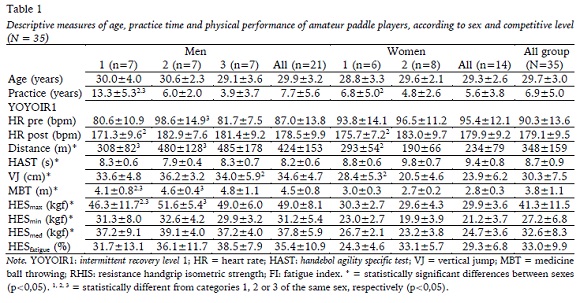
<body><![CDATA[<p>Firstly, the Yo-Yo Intermittent Recovery Test Level 1 (YOYOIR1) was used to    evaluate the aerobic fitness, and it consists of 20m displacements with speed    controlled by beeps from an audio tape. Between each bout of 20m there is a    recovery of 10 seconds (Krustrup et al., 2003). When the person was unable to    cover the 20m twice, the test was finished and the whole distance covered was    registered (Krustrup et al., 2003). The test was performed in a sport’s court    marked by cones, being 2m wide and 20m long, and a cone marking the active recovery    space was placed 5m from the finish line (Krustrup et al., 2003). The subjects    were familiarized with an immediate pre-test, and the relative VO2max was estimated    with the equation: VO2max (ml-1·kg- 1·min) = distance (m) × 0.0084 + 36.4 (Bangsbo,    Iaia, &amp; Krustrup, 2008). Heart rate (HR) values were recorded before and    after with cardiofrequencimeters (POLAR™ RS800CX). The final HR was considered    as maximal HR (HRmax), and previous data indicate that this HR value tends to    be similar in 99-100% when compared to the treadmill test, besides showing correlation    coefficient test-retest of 0.99 and coefficient of variation of 8.5% (Krustrup    et al., 2003).</p>     <p>Agility was measured by the Handball Agility Specific Test (HAST), which was    chosen because it exhibited five changes of direction at short distances, and    included back and forth races, as well as lateral displacements (Iacono et al.,    2015), which were very frequent in paddle tennis. For its realization, subject    starts from cone 1 and runs in a straight line from 5m to cone 2, where it carries    out lateral displacement of 3.5m to cone 3, again moves laterally 3.5m to the    cone 4, runs from the back 5m to the cone 5, carries out the lateral displacement    of 3.5m to the cone 3 and finally moves laterally by 3.5m to the cone 1. Two    attempts have been made, with five minutes of interval between them, and the    faster attempt was recorded as valid (Iacono et al., 2015). The timing was registered    from photocells arranged in the first cone. The intra-class correlation coefficient    of the HAST described is 0.92 and the typical measurement error of 2.3% (Iacono    et al., 2015).</p>     <p>Squat Jump (SJ) was used to evaluate lower limbs power, and the procedures    were performed on a contact mat. Subjects performed three vertical jump attempts    with hands at the waist, maintaining initial position with 90° knee flexion,    evaluated with a goniometer. Then, after three seconds in the described position,    the individuals performed triple extension, propelling themselves in the highest    speed and force possible, and during the flight phase the knees should be fully    extended (Markovic et al., 2004). Three trials were carried out with a five-minute    interval between them and the best was considered. SJ exhibits Cronbach&rsquo;s alpha    of 0.97, with a coefficient of variation of 2.4% to 4.6% (Markovic et al., 2004).</p>     <p>The upper limbs power was evaluated through Medicine Ball Throwing (MBT), which    was performed with the dominant hand, with the participant sitting in a chair    leaning against a wall with his feet on the ground (Silva et al., 2014). The    subjects positioned themselves with the trunk resting on the back of the chair    held by a strip below the chest. The 3kg medicine ball was held by the subject    with a 90° elbow flexion and abduction and then thrown as far as possible over    an inextensible demarcation (Silva et al., 2014). The performance was evaluated    by the distance in meters between the front feet of the chair and the first    contact of the ball on the ground. Three trials were performed with a three    minutes interval between them and the mean value for the final result of the    test, which showed a statistically significant correlation of 0,73 (p&lt;0,001)    with power produced in isokinetic dynamometry at 180°/s (Silva et al., 2014).</p>     <p>The test used for handgrip endurance strength (HES) measurement consists of    eight 10-s maximum isometric contractions with a passive interval of 10 seconds,    which is sensitive to detect differences between different competitive levels    (Bonitch-Góngora et al., 2013). The subject sited in a chair with the back supported    and feet on the floor, with neutral shoulder adduction and rotation, 90° elbow    flexion, forearm in neutral position and extended wrist between 0 and 30°, with    an ulnar deviation between 0 and 15°. The subjects were instructed to apply    the highest strength during each repetition (Bonitch- Góngora, Almeida, Padial,    Bonitch-Domínguez, &amp; Feriche, 2013), and the highest value of each contraction    was recorded. Although the psychometric characteristics of the validation of    the test were not localized, it closely resembles the paddle tennis demands.    The highest value of eight measures of HES was considered as the maximum (HESmax),    the lowest value was assumed as the minimum (HESmin), as well as the mean (HESmed)    and the index of fatigue (HESfatigue, in %).</p>     <p><b>Statistical analysis</b></p>     <p>In statistical analysis, normality verification was checked by Shapiro-Wilk    test. Data are presented as mean and standard deviation and, after testing the    homogeneity of variances with Levene test, comparisons between sex and level    were performed with two-way analysis of variance (sex x category). When significant    differences were observed, Tukey post-hoc was used to locate them. Comparisons    of the values of HRmax obtained directly versus age-predicted (220&#8722;age,    TANAKA, HUNT-generic or HUNT&#8722;age; Nes, Janszky, Wisloff, Stoylen, &amp;    Karlsen, 2013) were performed with t-test for paired samples, and the 95% confidence    intervals of differences IC 95% (dif) are given in bpm. Correlations were performed    using the Pearson test. 5% was assumed as the level of statistical significance    and in analyzes of variance the value of partial square eta (&#414;2p) was presented.    The analysis routines were performed in SPSS, version 20.0.</p>     <p><b>Results</b></p>     <p>The group had 29.7 ± 3 years old, with no differences between sexes (F = 0.80;    <i>p </i>= 0.38; &#414;2p = 0.02) or categories (F = 0.48; <i>p </i>= 0.61;    &#414;2p = 0.03), and 6.9 ± 5 years of practice, with a longer time of exposure    (F = 6.9; <i>p </i>= 0.01; &#414;2p = 0.19), and with differences between categories    (F = 10.35; <i>p </i>&lt;0.001; &#414;2p = 0.41). Of the entire sample (N =    35), only two men were left-handed, one in the 1st category and the other in    the 2nd category. The data related to the execution time and the effectiveness    of the physical tests are presented in <a href="#t1">table 1</a>.</p>     <p>&nbsp;</p>     ]]></body>
<body><![CDATA[<p align="center"><a name="t1"></a><img src="/img/revistas/mot/v14n4/14n4a06t1.jpg"/></p>     
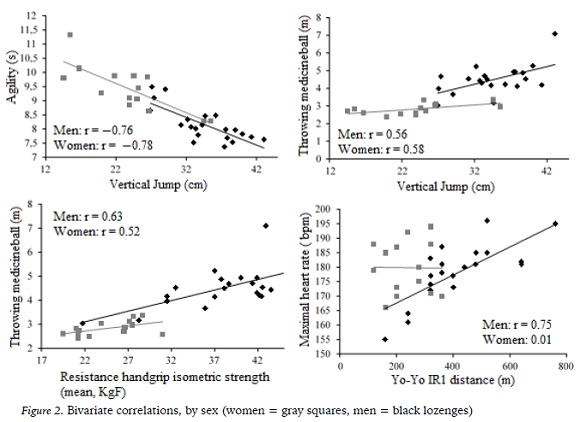
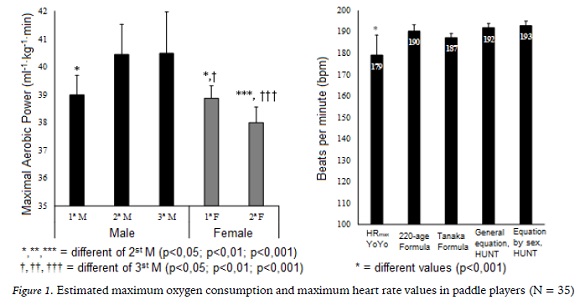
<p>&nbsp;</p>     <p>The multivariate statistical analysis revealed significant differences between    sexes (F = 10.61; <i>p </i>&lt; 0.001; &#414;2p = 0.87), categories (F = 2.43;    <i>p </i>= 0.006; &#414;2p = 0.59) and significant interactions between sex    and category (F = 4.03; <i>p </i>= 0.003; &#414;2p = 0.72). Sex differences    were identified in YoYo IRL1-related variables (F = 12.89; p = 0.01; &#414;2p    = 0.30), HAST agility tests (F = 26.98; <i>p </i>&lt; 0.001; &#414;2p = 0.47),    SJ (F = 32.87; <i>p </i>&lt; 0.001; &#414;2p = 0.52), MBT (F = 36.73; <i>p </i>&lt;    0.001; &#414;2p=0.55); HESmax (F = 53.98; <i>p </i>&lt; 0.001; &#414;2p = 0.64),    HESmin (F = 33.11, <i>p </i>&lt; 0.001, &#414;2p = 0.52) and HESmed (F = 44.57;    <i>p </i>&lt; 0.001; &#414;2p = 0.60), but not in HESfatigue (F = 2.20, <i>p    </i>= 0.15; &#414;2p = 0.07). Among the categories, differences were found only    in the HR pre and post YoYo IRL1 (respectively F = 3.61; <i>p </i>= 0.04; &#414;2p    = 0.19 and F = 4.57; <i>p </i>= 0.02; &#414;2p = 0.23). Finally, significant    interactions were identified in the variables associated with YoYo IRL1 (F =    10.43; <i>p </i>= 0.003; &#414;2p = 0.26); HAST (F = 7.9; <i>p </i>= 0.009;    &#414;2p = 0.21) and SJ (F = 8.14; <i>p </i>= 0.008; &#414;2p = 0.21), which    are shown in <a href="#t1">table 1</a>.</p>     <p>The estimated VO2max for men was 40.0 ± 1.3 mL-1·Kg-1·min and 38.4 ± 0.7 mL-1·Kg-1·min    for women, with significant differences between sexes (F = 11.38; <i>p </i>&lt;    0.001; &#414;2p = 0.30).</p>     <p>However, no differences were found between categories (F = 1.8; <i>p </i>=    0.17; &#414;2p = 0.11), but were identified interactions between sex and category    (F = 10.4; <i>p </i>= 0.003; &#414;2p = 0.26). The third category was different    from the 1st (<i>p </i>= 0.004) and 2nd (<i>p </i>= 0.01), which are presented    in <a href="#f1">figure 1</a> (<a href="#f1">panel A</a>). Regarding the HRmax    obtained in Yo-Yo IRL1 (<a href="#f1">figure 1</a>, <a href="#f1">panel B</a>),    statistically significant differences were observed when compared to the prediction    using 220-age (t = 7.08; <i>p </i>&lt; 0.001; 95%CI = 8-14 bpm), TANAKA equation    (t = 5.17; <i>p </i>&lt; 0.001; CI95%dif = 5-11 bpm), and general (t = 8.2;    <i>p </i>&lt; 0.001; CI95% = 10-16 bpm) and sex-specific equations (t = 8.6;    <i>p</i>&lt; 0.001; CI95% = 10-17 bpm) from the HUNT study (<a href="#f2">figure    2</a>). There were no significant correlations between the four procedures (220&#8722;age:    r = 0.18; p = 0.28; TANAKA: r = 0.18; p = 0.29; HUNT general: r = 0.18; p =    0.28 and HUNT considering sexes: r = 0.14; p = 0.43) (Nes, Janszky, Wisloff,    Stoylen, &amp; Karlsen, 2013).</p>     <p>&nbsp;</p>     <p align="center"><a name="f1"></a><img src="/img/revistas/mot/v14n4/14n4a06f1.jpg"/></p>     
<p>&nbsp;</p>     <p align="center"><a name="f2"></a><img src="/img/revistas/mot/v14n4/14n4a06f2.jpg"/></p>     
<p>&nbsp;</p>     ]]></body>
<body><![CDATA[<p>Bivariate correlations were tested, which were controlled by sex and competitive    category due to significant differences previously presented. Significant values    of the HRmax in the Yo-Yo IR L1 test with distance in the same test (r = 0.50;    <i>p </i>= 0.003), performance in the HAST agility test (r = &#8722;0.47; <i>p    </i>= 0.006) and HESfatigue index (r = 0.34; <i>p </i>= 0.05). The distance    in YOYOIR1 correlated negatively with performance in the HAST (r = &#8722;0.46;    <i>p </i>= 0.006) and in a positive way with height in the SJ (r = 0.57; <i>p    </i>= 0.001). Agility in HAST correlated negatively with the upper limbs power    in MBT (r = &#8722;0,44; <i>p </i>= 0.01), HESmax (r = &#8722;0.48; <i>p </i>=    0.005), HESmed (r = &#8722;0.39; <i>p </i>= 0.02) and SJ (r = &#8722;0.76; <i>p    </i>&lt; 0.001). The height in SJ, in turn, correlated with the upper limbs    power in MBT (r = 0.57; <i>p </i>= 0.001), HESmax (r = 0.45; <i>p </i>= 0.009),    HESmin (r = 0.41; <i>p </i>= 0.02) and HESmed (r = 0.50; <i>p </i>= 0.003).    Finally, MBTshowed significant correlations with HESmax (r = 0.53; p = 0.001),    RHIS (r = 0.56; p = 0.001) and HESmed (r = 0.66; <i>p </i>&lt; 0.001). The data    of the correlations of interest, by sex, are presented in <a href="#f2">figure    2</a>.</p>     <p><b>Discussion</b></p>     <p>The present study aimed to evaluate and compare the physical fitness level    of amateur paddle tennis players. The main findings were: i) sex differences    in YOYOIR1, HAST, SJ, MBT, as well as in the HES and ii) absence of statistically    superior values in the categories of higher competitive level, being that among    men, category 2 and/or 3 athletes were better than those of category 1 in the    YOYOIR1, MBT and HES tests.</p>     <p>It is indicated that the aerobic fitness was not statistically different between    categories, and this can be explained because this variable, perhaps, does not    determine amateur success in paddle tennis. Furthermore, it was observed that,    in addition to the technical level, the time of practice could be associated    with higher categories than the cardiorespiratory fitness level. However, it    is pointed out that high aerobic power can be beneficial because it delays the    fatigue appearance in of high intensity moments (Nakamura, Brunetto, Hirai,    Roseguini &amp; Kokubun, 2005), which could be important in the paddle tennis,    since the intermittent demand should be maintained during the whole time of    the match (Amieba e Salinero, 2013). Elite tennis players have VO2max values    greater than 50 ml- 1·kg-1·min in males and 42 ml-1·kg-1·min in females (Kovacs,    2007). In young players of the 2008 Brazilian badminton team (women = 15.2 ±    2.06 years old and men = 17.2 ± 1.2 years old) VO2max was also evaluated through    Yo-Yo IR1, and women reached 43.23 ± 2.98 ml-1·kg-1·min and the men reached    50.15 ± 2.51 ml-1·kg-1·min (Durigan, Dourado, &amp; Stanganelli, 2013). Among    young Spanish paddle tennis players (16.57 ± 1,51 years old), VO2max values    of 55.64 ± 8.84 ml- 1·kg-1·min were found in incremental treadmill test, and    maximum heart rate of 200.43 ± 15.76 bpm (Hoyo et al., 2007). In the incremental    maximal treadmill test, elite female paddle tennis athletes (28.2 ± 0.6 years    old) achieved a VO2max of 47 ± 33 ml-1·kg-1·min (Fuente et al., 2014), higher    than the observed in the present study. In the present study, the use of Yo-Yo    IR1 was chosen because it presented intermittent characteristics and could be    performed on a court, similar to the requirements of the padle tennis game (Castillo-Rodríguez    et al., 2014). In this sense, the mean values of VO2max were lower than those    found in the literature, probably because the sample was composed of recreational    and non-professionalprofile of our sample. The absence of significant differences    between categories may be due to the fact that aerobic fitness is not determinant    for sports success in paddle tennis, at least when played at regional level.    The HRmax values obtained in the present study were statistically lower than    those calculated by predictive equations (Nes et al., 2013). Probably for the    following reasons: (i) peripheral fatigue may have caused early withdrawal of    the YOYOIR1 test; (ii) the participants were not accustomed to such long and    successive linear races (20m + 20m) despite its intermittent routine; and (iii)    athletes did not exercise until their maximum capacity. However, the third item    can be discarded due to the sample’s dedication and involvement, which would    increase the probability of having happened the first one. Complementarily,    the paddle tennis court is 20 meters by 10 meters, which also reinforces the    possibility of not adjusting the YOYOIR1 of 20m + 20m for this racket modality    (Bangsbo et al., 2008).</p>     <p>In agreement with the well-developed aerobic component, paddle tennis practitioners    need agility, which is a very relevant variable for adequate movement and correct    positioning in the court (Groppel &amp; Roetert, 1992). Agility is required,    especially during acceleration, deceleration and displacement (Amieba &amp;    Salinero, 2013; Durigan et al., 2013). In the present study, it was decided    to employ HAST, since it involves paddle tennis-like displacements such as pull    out and rapid braking, with successive changes of direction (Amieba &amp; Salinero,    2013). In this context, Iacono et al. (2015) evaluated elite handball players,    and found better values (6.72 ± 0.22 s) than those of amateur players in this    study (8.2 ± 0.6 s for men and 9.4 ± 0.8 s for women). However, we reinforced    the need for additional strategies to assess agility, including the use of racket.</p>     <p>In paddle tennis, some gestures require repeated and frequent use of hand grip    strength, as in subsequent volleys (Zanchet &amp; Del Vecchio, 2013). A previous    study with paddle tennis athletes, it was found HESmax of 40.41 ± 10.98 kgf    (Zanchet &amp; Del Vecchio, 2013), similar to the results obtained in the present    study (41.3 ± 11.5 kgf) for the higher effort performed within a series of eight    successive actions of 10s each, with 10s intervals. Currently, there are two    more frequent procedures for evaluating isometric handgrip strength. The first    uses a maximum isometric handgrip strength percentage, such as 70% of this value,    and records the time in which the assessed person can maintain continuously    the determined value. This was done previously with tennis players and values    of 33.46 ± 10.45 seconds were found (Zanchet &amp; Del Vecchio, 2013). In contrast,    maintaining maximum percentage values does not seem to be the best strategy    for assessing strength endurance in racket sports, given the intermittent nature    of practice and racket strokes. Thus, in the present study, successive contractions    were performed, which appear to be more suited to the sport’s specificity (Bonitch-Góngora    et al., 2013). In addition, in the present study, the fatigue index was evaluated    and, although there were differences between the sexes for HES, with higher    values among men, the fatigue rate was similar to that of women, with a 33 ±    9.9% fall in the whole group.</p>     <p>The lower limbs power is important in the paddle tennis, as the strength transfers    the reaction force from the ground to the trunk and generates greater power    in some blows (Girard, Micallef, &amp; Millet, 2005). In addition, power is    relevant to perform multiple changes of direction and efficient strokes with    the racket (Sánchez- Alcaraz &amp; Sánchez-Pay, 2010). In the present study,    in addition to men performing better than women, second-category male players    presented higher values than those of the third category, but were not inferior    to those of the first ones. On the other hand, the first category women practitioners    exhibited higher values than those of the second category. In general, there    are no significant differences in the jump against movement among beginning,    intermediate and elite tennis players (Girard et al., 2005). A study of elite    and sub-elite badminton players found squat jump values of 42.7 ± 5.2 and 41.5    ± 5.2 cm, respectively (Ooi et al., 2009). Professional male and female badminton    athletes reached 27.20 ± 2.14 cm and 36.73 ± 6.03 cm, respectively (Durigan,    Dourado &amp; Stanganelli, 2013), and were higher than the findings of the present    study (men = 34.6 ± 4.7 cm, women = 23.9 ± 6.2 cm, whole group = 30.3 ± 7.5    cm); however, the present investigation corroborates a study that involved different    levels of tennis (Girard et al., 2005), indicating that there were no differences    in the lower limbs power between categories.</p>     <p>Due to the need to apply strokes with the racket that cannot be received or    countered by opponents in a small play area on the paddle, the upper limbs power    could be relevant variable for competitive success (Signorile, Sandler, Smith,    Stoutenberg, &amp; Perry, 2005). However, among amateur level players of the    present study, despite differences between sexes, probably due to the technical    influence (Shim, Carlton, Chow, &amp; Chae, 2005), superior performances were    not observed among athletes of the higher categories.</p>     <p>Among athletes from Brazilian junior male and female badminton team, aged 17.24    ± 1.18 years old and 15.21 ± 2.06 years old, respectively, the values were 7.54    ± 1.01 m for men, with medicine ball of 3kg, and 6.98 ± 0.78 m for women, with    medicine ball of 2kg (Campos, Daros, Mastrascusa, Dourado, &amp; Stanganelli,    2009). These values are also higher than the present study (all = 3.8 ± 1.1    m, men = 4.8 m and women = 2.8 m), which can be explained by the mass of the    implement, difference of competitive level and the age range of the samples.</p>     <p>Regarding the main correlations between variables, it seems that the positive    value between HRmax and distance in the YOYOIR1 among men results from the fact    that these male athletes exhibit better physical fitness and, therefore, achieve    higher HR until exhaustion in the test (Bangsbo et al., 2008). Data from the    present study corroborate Silva et al. (2011), who found a high correlation    (r = 0.71) between Yo- Yo IR2 and HRmax in soccer players. However, as shown    in the last panel (figure 3, panel D), the women did not present a significant    correlation (r = 0.01), and the distance reached by them may have been insufficient    to reach HRmax, and this can be explained by the fact that most have never performed    maximal aerobic efforts. The relationship between performance in YOYOIRL1 and    HAST may result from greater muscle aptitude, given the difference in energy    substrates from the tests performed (Hermassi et al., 2014). There was also    a significant correlation between HAST and vertical jump, which can be explained    by the fact that the shortest time reached in agility tests is related to better    performance in the power test, probably due to the similarity in the physical    demands for the tests, especially for the elongation-shortening cycle (Picanço,    Silva, &amp; Del Vecchio, 2012).</p>     ]]></body>
<body><![CDATA[<p>In this study, physical activity level performed by the subjects was not recorded,    so the amount and time of weekly exercise can be considered as a limitation.    However, all were regular practitioners of the sport and exceeded 150 minutes    per week of physical activity during leisure time. It is also indicated that    the tests performed were not very specific for the paddle tennis, because no    validated tests specific to the modality were found, which provokes new investigations.    However, as practical application, these results may be used to identify characteristics    of paddle tennis players in different levels.</p>     <p><b>Conclusion</b></p>     <p>In conclusion, among these amateur paddle tennis practitioners, it seems that    high physical fitness is not a discriminating factor of competitive level. Possibly,    players with less physical conditioning compensate this limitation with better    technical and tactical development, which, in an amateur context, seems to be    enough for the competitive success. This study found lower values of VO2max,    agility and powerless to those presented in other studies that analyzed elite    and professional players, probably due to the amateur nature of the participants.    Therefore, future studies can be carried out with paddle tennis players with    a higher competitive level (national or continental), for possible comparisons    and inferences. Small and few significant differences were found between categories    in the analyzed variables, with this, it can be affirmed that in amateur sports    such variables do not interfere in the competitive level. Therefore, it is suggested    that new investigations involving the categories studied here investigate other    variables of the physical fitness that could be determinant for the success    in the sport, as well as technical-tactical patterns of the players.</p>     <p>&nbsp;</p>     <p><b>REFERENCES</b></p>     <!-- ref --><p>Amieba, C., &amp; Salinero, J.J. (2013). Aspectos generales de la competicio&#769;n    em pa&#769;del y sus demandas fisiolo&#769;gicas. <i>AGON International Journal    of Sport Science</i>, 3(2): 60-67.    &nbsp;&nbsp;&nbsp;&nbsp;&nbsp;&nbsp;&nbsp;&nbsp;[&#160;<a href="javascript:void(0);" onclick="javascript: window.open('/scielo.php?script=sci_nlinks&ref=385152&pid=S1646-107X201800030000600001&lng=','','width=640,height=500,resizable=yes,scrollbars=1,menubar=yes,');">Links</a>&#160;]<!-- end-ref --></p>     <!-- ref --><p>Bangsbo, J., Iaia, F.M., &amp; Krustrup, P. (2008). The yo- yo intermittent    recovery test: a useful tool for evaluation of physical performance in intermittent    sports. <i>Sports Medicine</i>, 38: 37-51. DOI: <a href="https://dx.doi.org/10.2165/00007256-200838010-00004" target="_blank">10.2165/00007256-200838010-00004</a>.    &nbsp;&nbsp;&nbsp;&nbsp;&nbsp;&nbsp;&nbsp;&nbsp;[&#160;<a href="javascript:void(0);" onclick="javascript: window.open('/scielo.php?script=sci_nlinks&ref=385154&pid=S1646-107X201800030000600002&lng=','','width=640,height=500,resizable=yes,scrollbars=1,menubar=yes,');">Links</a>&#160;]<!-- end-ref --></p>     <!-- ref --><p>Bonitch-Góngora, J.G., &amp; Almeida, F. (2014). La fuerza isométrica del agarre    em judô. <i>Revista de Artes Marciales Asiáticas</i>, 9: 9-19. DOI: <a href="https://dx.doi.org/10.18002/rama.v9i1.1030" target="_blank">10.18002/rama.v9i1.1030</a>.    &nbsp;&nbsp;&nbsp;&nbsp;&nbsp;&nbsp;&nbsp;&nbsp;[&#160;<a href="javascript:void(0);" onclick="javascript: window.open('/scielo.php?script=sci_nlinks&ref=385156&pid=S1646-107X201800030000600003&lng=','','width=640,height=500,resizable=yes,scrollbars=1,menubar=yes,');">Links</a>&#160;]<!-- end-ref --></p>     <!-- ref --><p>Bonitch-Góngora, J.G., Almeida, F., Padial, P., Bonitch- Domínguez, J.G., &amp;    Feriche B. (2013). Maximal isometric handgrip strength and endurance differences    between elite and non-elite young judo athletes. <i>Archives of Budo</i>, 4:    239-248.    &nbsp;&nbsp;&nbsp;&nbsp;&nbsp;&nbsp;&nbsp;&nbsp;[&#160;<a href="javascript:void(0);" onclick="javascript: window.open('/scielo.php?script=sci_nlinks&ref=385158&pid=S1646-107X201800030000600004&lng=','','width=640,height=500,resizable=yes,scrollbars=1,menubar=yes,');">Links</a>&#160;]<!-- end-ref --></p>     <!-- ref --><p>Campos, F.A.D., Daros, L.B., Mastrascusa, V., Dourado, A.C., &amp; Stanganelli,    L.C.R. (2009). Anthopometric profile and motor performance of junior badminton    players. <i>Brazilian Journal of Biomotricity</i>, 3: 146-151.    &nbsp;&nbsp;&nbsp;&nbsp;&nbsp;&nbsp;&nbsp;&nbsp;[&#160;<a href="javascript:void(0);" onclick="javascript: window.open('/scielo.php?script=sci_nlinks&ref=385160&pid=S1646-107X201800030000600005&lng=','','width=640,height=500,resizable=yes,scrollbars=1,menubar=yes,');">Links</a>&#160;]<!-- end-ref --></p>     <!-- ref --><p>Castillo-Rodríguez, A. (2011). Evaluación fisiológica através del método de    entrenamiento integral em deportistas de pádel de 2ª categoria. <i>Comunicación    Del Congreso Internacional em Ciencias de La Actividad Física y del Deporte:    Investigación, desarrollo e innovación</i>, UPV-EHU.    &nbsp;&nbsp;&nbsp;&nbsp;&nbsp;&nbsp;&nbsp;&nbsp;[&#160;<a href="javascript:void(0);" onclick="javascript: window.open('/scielo.php?script=sci_nlinks&ref=385162&pid=S1646-107X201800030000600006&lng=','','width=640,height=500,resizable=yes,scrollbars=1,menubar=yes,');">Links</a>&#160;]<!-- end-ref --></p>     <!-- ref --><p>Castillo-Rodríguez, A., Hernández-Mendo, A., &amp; Alvero-Cruz, J.R. (2014).    Morfología del jugador de élite de pádel - Comparación con otros deportes de    raqueta. <i>International Journal of Morphology</i>, 32(1), 177-182. DOI: <a href="https://dx.doi.org/10.4067/S0717-95022014000100030" target="_blank">10.4067/S0717-95022014000100030</a>.    &nbsp;&nbsp;&nbsp;&nbsp;&nbsp;&nbsp;&nbsp;&nbsp;[&#160;<a href="javascript:void(0);" onclick="javascript: window.open('/scielo.php?script=sci_nlinks&ref=385164&pid=S1646-107X201800030000600007&lng=','','width=640,height=500,resizable=yes,scrollbars=1,menubar=yes,');">Links</a>&#160;]<!-- end-ref --></p>     <!-- ref --><p>Durigan, J.Z., Dourado, A.C., &amp; Stanganelli, L.C.R. (2013). Características    antropométricas e de desempenho motor de atletas da seleção brasileira de badminton.    <i>Revista Brasileira de Prescrição &amp; Fisiologia do Exercício</i>, 7: 161-166.    &nbsp;&nbsp;&nbsp;&nbsp;&nbsp;&nbsp;&nbsp;&nbsp;[&#160;<a href="javascript:void(0);" onclick="javascript: window.open('/scielo.php?script=sci_nlinks&ref=385166&pid=S1646-107X201800030000600008&lng=','','width=640,height=500,resizable=yes,scrollbars=1,menubar=yes,');">Links</a>&#160;]<!-- end-ref --></p>     <!-- ref --><p>Fuente, F.P., Zagalaz, J.C., Benedí, D.O., Hijós, A.Q., Castellar, S.A.I.,    &amp; Otín, C.C. (2014). Análisis antropométrico, fisiológico y temporal em    jugadoras de pádel de elite. <i>Retos, </i>25: 107-112.    &nbsp;&nbsp;&nbsp;&nbsp;&nbsp;&nbsp;&nbsp;&nbsp;[&#160;<a href="javascript:void(0);" onclick="javascript: window.open('/scielo.php?script=sci_nlinks&ref=385168&pid=S1646-107X201800030000600009&lng=','','width=640,height=500,resizable=yes,scrollbars=1,menubar=yes,');">Links</a>&#160;]<!-- end-ref --></p>     <!-- ref --><p>García, A., Bartolomé, I., Díaz, J., Muñoz, J., &amp; Muñoz, D. (2014). Análisis    de variables temporales en pádel y surelación com otras variables contextuales.    Facultad de Ciencias del Deporte, Universidad de Extremadura.    &nbsp;&nbsp;&nbsp;&nbsp;&nbsp;&nbsp;&nbsp;&nbsp;[&#160;<a href="javascript:void(0);" onclick="javascript: window.open('/scielo.php?script=sci_nlinks&ref=385170&pid=S1646-107X201800030000600010&lng=','','width=640,height=500,resizable=yes,scrollbars=1,menubar=yes,');">Links</a>&#160;]<!-- end-ref --></p>     <!-- ref --><p>Girard, O., Micallef, J.P., &amp; Millet, G.P. (2005). Lower- Limb activity    during the power serve in tennis: effects of performance level. <i>Medicine    &amp; Science in Sports &amp; Exercise</i>, 37: 1021-1029. DOI: <a href="https://dx.doi.org/10.1249/01.mss.0000171619.99391" target="_blank">10.1249/01.mss.0000171619.99391</a>.    &nbsp;&nbsp;&nbsp;&nbsp;&nbsp;&nbsp;&nbsp;&nbsp;[&#160;<a href="javascript:void(0);" onclick="javascript: window.open('/scielo.php?script=sci_nlinks&ref=385172&pid=S1646-107X201800030000600011&lng=','','width=640,height=500,resizable=yes,scrollbars=1,menubar=yes,');">Links</a>&#160;]<!-- end-ref --></p>     <!-- ref --><p>Groppel, J.L., &amp; Roetert, E.P. (1992). Applied physiology of tennis. <i>Sports    Medicine</i>, 14(4): 260- 268. DOI: <a href="https://dx.doi.org/10.1136/bjsm.2005.023309" target="_blank">10.1136/bjsm.2005.023309</a>.    &nbsp;&nbsp;&nbsp;&nbsp;&nbsp;&nbsp;&nbsp;&nbsp;[&#160;<a href="javascript:void(0);" onclick="javascript: window.open('/scielo.php?script=sci_nlinks&ref=385174&pid=S1646-107X201800030000600012&lng=','','width=640,height=500,resizable=yes,scrollbars=1,menubar=yes,');">Links</a>&#160;]<!-- end-ref --></p>     <!-- ref --><p>Hermassi, S., Aouadi, R., Khalifa, R., Tillaar, R.V.D., Shephard, R.J., Chelly,    M.S. (2014). Relationships between the yo-yo intermittent recovery test and    anaerobic performance tests in adolescent handball players. <i>Journal of Human</i>    <i>Kinetics</i>, 42: 197-205. DOI: <a href="https://dx.doi.org/10.1515/hukin-2015-0020197" target="_blank">10.1515/hukin-2015-0020197</a>.    &nbsp;&nbsp;&nbsp;&nbsp;&nbsp;&nbsp;&nbsp;&nbsp;[&#160;<a href="javascript:void(0);" onclick="javascript: window.open('/scielo.php?script=sci_nlinks&ref=385176&pid=S1646-107X201800030000600013&lng=','','width=640,height=500,resizable=yes,scrollbars=1,menubar=yes,');">Links</a>&#160;]<!-- end-ref --></p>     <!-- ref --><p>Hoyo, M., Sañudo, B., &amp; Carrasco, L. (2007). Demandas fisiológicas de la    competición em pádel. <i>Revista Internacional de Ciencias del Deporte</i>,    3(8): 53-58. DOI: <a href="https://dx.doi.org/10.5232/ricyde2007.00805" target="_blank">10.5232/ricyde2007.00805</a>.    &nbsp;&nbsp;&nbsp;&nbsp;&nbsp;&nbsp;&nbsp;&nbsp;[&#160;<a href="javascript:void(0);" onclick="javascript: window.open('/scielo.php?script=sci_nlinks&ref=385178&pid=S1646-107X201800030000600014&lng=','','width=640,height=500,resizable=yes,scrollbars=1,menubar=yes,');">Links</a>&#160;]<!-- end-ref --></p>     <!-- ref --><p>Iacono, A.D., Eliakim, A., &amp; Meckel, Y. (2015). Improving fitness of elite    handball players: small- sided games vs. high-intensity intermittent training.    <i>Journal of Strength &amp; Conditioning Research</i>, 29(3): 835-843. DOI:    <a href="https://dx.doi.org/10.1519/JSC.0000000000000686" target="_blank">10.1519/JSC.0000000000000686</a>.    &nbsp;&nbsp;&nbsp;&nbsp;&nbsp;&nbsp;&nbsp;&nbsp;[&#160;<a href="javascript:void(0);" onclick="javascript: window.open('/scielo.php?script=sci_nlinks&ref=385180&pid=S1646-107X201800030000600015&lng=','','width=640,height=500,resizable=yes,scrollbars=1,menubar=yes,');">Links</a>&#160;]<!-- end-ref --></p>     <!-- ref --><p>Kovacs, M.S. (2007). Tennis physiology: Training the competitive athlete. <i>Sports    Medicine</i>, 37: 189-198.    &nbsp;&nbsp;&nbsp;&nbsp;&nbsp;&nbsp;&nbsp;&nbsp;[&#160;<a href="javascript:void(0);" onclick="javascript: window.open('/scielo.php?script=sci_nlinks&ref=385182&pid=S1646-107X201800030000600016&lng=','','width=640,height=500,resizable=yes,scrollbars=1,menubar=yes,');">Links</a>&#160;]<!-- end-ref --> </p>     <p>Krustrup, P., Mohr, M., Amstrup, T., Rysgaard, T., Johansen, J., Steensberg,    A., &hellip; Bangsbo J. (2003). The yo-yo intermittent recovery test: physiological    response, reliability, and validity. <i>Medicine &amp; Science in Sports &amp;    Exercise</i>, 35(4): 697- 705. DOI: <a href="https://dx.doi.org/10.1249/01.MSS.0000058441.94520.32" target="_blank">10.1249/01.MSS.0000058441.94520.32</a>.</p>     <!-- ref --><p>Markovic, G., Dizdar, D., Jukic, I. &amp; Cardinale, M. (2004). Reliability    and factorial validity of squat and countermovement jump tests. <i>Journal of    Strength &amp; Conditioning Research, </i>18: 551-555. DOI: <a href="https://www.researchgate.net/publication/278170367_Reliability_and_factorial_validity_of_squat_and_counter_movement_jump_tests" target="_blank">10.1519/1533-4287</a>.    &nbsp;&nbsp;&nbsp;&nbsp;&nbsp;&nbsp;&nbsp;&nbsp;[&#160;<a href="javascript:void(0);" onclick="javascript: window.open('/scielo.php?script=sci_nlinks&ref=385185&pid=S1646-107X201800030000600018&lng=','','width=640,height=500,resizable=yes,scrollbars=1,menubar=yes,');">Links</a>&#160;]<!-- end-ref --></p>     ]]></body>
<body><![CDATA[<!-- ref --><p>Martinez-Rodriguez, A., Collado, E.R., &amp; Vicente- Salar, N. (2015). Body    composition assessment of paddle and tennis adult male players. <i>Nutricion    Hospitalaria</i>, 31: 1294-1301. DOI: <a href="https://dx.doi.org/10.3305/nh.2015.31.3.8004" target="_blank">10.3305/nh.2015.31.3.8004</a>.    &nbsp;&nbsp;&nbsp;&nbsp;&nbsp;&nbsp;&nbsp;&nbsp;[&#160;<a href="javascript:void(0);" onclick="javascript: window.open('/scielo.php?script=sci_nlinks&ref=385187&pid=S1646-107X201800030000600019&lng=','','width=640,height=500,resizable=yes,scrollbars=1,menubar=yes,');">Links</a>&#160;]<!-- end-ref --></p>     <!-- ref --><p>Fábio Yuzo Nakamura, F.Y., Brunetto, A.F., Hirai, D.M., Roseguini, B.T., &amp;    Kokubun, K. (2005). The perceived exertion threshold (PET) corresponds to the    critical power and to na indicator of maximal oxygen uptake steady state. <i>Revista    Brasileira de Medicina do Esporte</i>, 31(3): 189e-194e. DOI: <a href="https://dx.doi.org/10.1590/S1517-86922005000300009" target="_blank">10.1590/S1517-86922005000300009</a>.    &nbsp;&nbsp;&nbsp;&nbsp;&nbsp;&nbsp;&nbsp;&nbsp;[&#160;<a href="javascript:void(0);" onclick="javascript: window.open('/scielo.php?script=sci_nlinks&ref=385189&pid=S1646-107X201800030000600020&lng=','','width=640,height=500,resizable=yes,scrollbars=1,menubar=yes,');">Links</a>&#160;]<!-- end-ref --></p>     <!-- ref --><p>Nes, B.M., Janszky, I., Wisloff, U., Stoylen, A., &amp; Karlsen, T. (2013).    Age-predicted maximal heart rate in healthy subjects: The HUNT fitness study.    <i>Scandinavian Journal of Medicine &amp; Science in Sports</i>, 23(6): 697-704.    DOI: <a href="https://dx.doi.org/10.1111/j.1600-0838.2012.01445.x" target="_blank">10.1111/j.1600-0838.2012.01445.x</a>.    &nbsp;&nbsp;&nbsp;&nbsp;&nbsp;&nbsp;&nbsp;&nbsp;[&#160;<a href="javascript:void(0);" onclick="javascript: window.open('/scielo.php?script=sci_nlinks&ref=385191&pid=S1646-107X201800030000600021&lng=','','width=640,height=500,resizable=yes,scrollbars=1,menubar=yes,');">Links</a>&#160;]<!-- end-ref --></p>     <!-- ref --><p>Novas, A.M.P., Rowbottom, D.G., &amp; Jenkins, D.G. (2003). A practical method    of estimating energy expenditure during tennis play<i>. Journal of Science &amp;    Medicine in Sport, </i>6: 40-50. DOI: <a href="https://dx.doi.org/10.1016/S1440-2440(03)80007-5" target="_blank">10.1016/S1440-2440(03)80007-5</a>.    &nbsp;&nbsp;&nbsp;&nbsp;&nbsp;&nbsp;&nbsp;&nbsp;[&#160;<a href="javascript:void(0);" onclick="javascript: window.open('/scielo.php?script=sci_nlinks&ref=385193&pid=S1646-107X201800030000600022&lng=','','width=640,height=500,resizable=yes,scrollbars=1,menubar=yes,');">Links</a>&#160;]<!-- end-ref --></p>     <p>Ooi, C.H. et al. (2009). Physiological characteristics of elite and sub-elite    badminton players. <i>Journal of Sports &amp; Science</i>, 27: 1591-1599. DOI:    <a href="https://dx.doi.org/10.1080/02640410903352907" target="_blank">10.1080/02640410903352907</a>.</p>     <!-- ref --><p>Picanço, L.M., Silva, J.J.R., &amp; Del Vecchio, F.B. (2012). Relação entre    força e agilidade avaliadas em jogadores de futsal. <i>Revista Brasileira de    Futsal e Futebol</i>, 4: 77-86.    &nbsp;&nbsp;&nbsp;&nbsp;&nbsp;&nbsp;&nbsp;&nbsp;[&#160;<a href="javascript:void(0);" onclick="javascript: window.open('/scielo.php?script=sci_nlinks&ref=385196&pid=S1646-107X201800030000600024&lng=','','width=640,height=500,resizable=yes,scrollbars=1,menubar=yes,');">Links</a>&#160;]<!-- end-ref --></p>     <!-- ref --><p>Priego Quesada, J.I., Olaso Melis, J., Llana Belloch, S., Pérez Soriano, P.,    González García, J.C., &amp; Sanchís Almenara, M. (2013). Padel: a quantitative    study of the shots and movements in the high-performance. <i>Journal of Human    Sport &amp; Exercise</i>, 8(4): 925-931. DOI: <a href="https://dx.doi.org/10.4100/jhse.2013.84.04" target="_blank">10.4100/jhse.2013.84.04</a>.    &nbsp;&nbsp;&nbsp;&nbsp;&nbsp;&nbsp;&nbsp;&nbsp;[&#160;<a href="javascript:void(0);" onclick="javascript: window.open('/scielo.php?script=sci_nlinks&ref=385198&pid=S1646-107X201800030000600025&lng=','','width=640,height=500,resizable=yes,scrollbars=1,menubar=yes,');">Links</a>&#160;]<!-- end-ref --></p>     <!-- ref --><p>Sa&#769;nchez-Alcaraz, B. (2014a). Análisis de la exigencia competitiva del    pádel en jóvenes jugadores. <i>Kronos</i>, 13(1), available in:    <a href="http://g-se.com/es/journals/kronos/articulos/analisis-de-la-exigencia-competitiva-del-padel-en-jovenes-jugadores-1707" target="_blank">http://g-se.com/es/journals/kronos/articulos/analisis-de-la-exigencia-competitiva-del-padel-en-jovenes-jugadores-1707</a> [2015 mai 20].    &nbsp;&nbsp;&nbsp;&nbsp;&nbsp;&nbsp;&nbsp;&nbsp;[&#160;<a href="javascript:void(0);" onclick="javascript: window.open('/scielo.php?script=sci_nlinks&ref=385200&pid=S1646-107X201800030000600026&lng=','','width=640,height=500,resizable=yes,scrollbars=1,menubar=yes,');">Links</a>&#160;]<!-- end-ref --></p>     <p>Sa&#769;nchez-Alcaraz, B. (2014b). Diferencias em las acciones de juego y la    estructura temporal en el pa&#769;del masculino y femenino de competicio&#769;n.    <i>Acción Motriz</i>, 12(1): 17-22.</p>     <!-- ref --><p>Sánchez-Alcaraz, B.J., &amp; Sánchez-Pay, A. (2010). Medición de la condición    física del jugador de pádel a través de tests. <i>Trances</i>, 6: 45-62.    &nbsp;&nbsp;&nbsp;&nbsp;&nbsp;&nbsp;&nbsp;&nbsp;[&#160;<a href="javascript:void(0);" onclick="javascript: window.open('/scielo.php?script=sci_nlinks&ref=385203&pid=S1646-107X201800030000600028&lng=','','width=640,height=500,resizable=yes,scrollbars=1,menubar=yes,');">Links</a>&#160;]<!-- end-ref --></p>     <!-- ref --><p>Shim, J., Carlton, L.G., Chow, J.W., &amp; Chae, W.S. (2005). The use of anticipatory    visual cues by highly skilled tennis players. <i>Journal of Motor Behavior</i>,    37: 164-175. DOI: <a href="https://dx.doi.org/10.3200/JMBR.37.2.164-175" target="_blank">10.3200/JMBR.37.2.164-175</a>.    &nbsp;&nbsp;&nbsp;&nbsp;&nbsp;&nbsp;&nbsp;&nbsp;[&#160;<a href="javascript:void(0);" onclick="javascript: window.open('/scielo.php?script=sci_nlinks&ref=385205&pid=S1646-107X201800030000600029&lng=','','width=640,height=500,resizable=yes,scrollbars=1,menubar=yes,');">Links</a>&#160;]<!-- end-ref --></p>     ]]></body>
<body><![CDATA[<!-- ref --><p>Signorile, J.F., Sandler, D.J., Smith, W.N., Stoutenberg, M., &amp; Perry,    A.C. (2005). Correlation analyses and regression modeling between isokinetic    testing and on-court performance in competitive adolescent tennis players. <i>Jounal    of Strength &amp; Conditioning Research, </i>19: 519-526. DOI: <a href="https://dx.doi.org/10.1519/R-15514.1" target="_blank">10.1519/R-15514.1</a>.    &nbsp;&nbsp;&nbsp;&nbsp;&nbsp;&nbsp;&nbsp;&nbsp;[&#160;<a href="javascript:void(0);" onclick="javascript: window.open('/scielo.php?script=sci_nlinks&ref=385207&pid=S1646-107X201800030000600030&lng=','','width=640,height=500,resizable=yes,scrollbars=1,menubar=yes,');">Links</a>&#160;]<!-- end-ref --></p>     <!-- ref --><p>Silva, C.D., Natali, A.J., Lima, J.R.P., Bara Filho, M.G., Garcia, E.S., &amp;    Marins, J.C.B. (2011). Yo-Yo IR2 test e teste de margaria: validade, confiabilidade    e obtenção da frequência cardíaca máxima em jogadores jovens de futebol. <i>Revista    Brasileira de Medicina do Esporte, </i>17: 344-349. DOI: <a href="https://dx.doi.org/10.1590/S1517-86922011000500010" target="_blank">10.1590/S1517-86922011000500010</a>.    &nbsp;&nbsp;&nbsp;&nbsp;&nbsp;&nbsp;&nbsp;&nbsp;[&#160;<a href="javascript:void(0);" onclick="javascript: window.open('/scielo.php?script=sci_nlinks&ref=385209&pid=S1646-107X201800030000600031&lng=','','width=640,height=500,resizable=yes,scrollbars=1,menubar=yes,');">Links</a>&#160;]<!-- end-ref --></p>     <!-- ref --><p>Silva, F.F., Penido, C.A., Junior, V.L., Souza, R.A., &amp; Villaverde, A.B.    (2014). Correlação entre a dinamometria e teste funcional em atletas de handebol.    <i>Revista Brasileira de Medicina do Esporte</i>, 20(3): 172-175. DOI:    <a href="https://dx.doi.org/10.1590/1517-86922014200301872" target="_blank">10.1590/1517-86922014200301872</a>.    &nbsp;&nbsp;&nbsp;&nbsp;&nbsp;&nbsp;&nbsp;&nbsp;[&#160;<a href="javascript:void(0);" onclick="javascript: window.open('/scielo.php?script=sci_nlinks&ref=385211&pid=S1646-107X201800030000600032&lng=','','width=640,height=500,resizable=yes,scrollbars=1,menubar=yes,');">Links</a>&#160;]<!-- end-ref --></p>     <!-- ref --><p>Zanchet, M.A., &amp; Del Vecchio, F.B. (2013). Efeito da kinesiotaping sobre    força máxima e resistência de força em padelistas. <i>Fisioterapia e Movimento</i>,    26: 115-121.    &nbsp;&nbsp;&nbsp;&nbsp;&nbsp;&nbsp;&nbsp;&nbsp;[&#160;<a href="javascript:void(0);" onclick="javascript: window.open('/scielo.php?script=sci_nlinks&ref=385213&pid=S1646-107X201800030000600033&lng=','','width=640,height=500,resizable=yes,scrollbars=1,menubar=yes,');">Links</a>&#160;]<!-- end-ref --></p>     <p>&nbsp;</p>     <p>Acknowledgments: The authors are grateful to the subjects who kindly volunteered    to participate in this study.</p>     ]]></body>
<body><![CDATA[<p>Conflict of interests: Nothing to declare.&nbsp;      <p>Funding: Nothing to declare.      <p>&nbsp;</p>     <p>Manuscript received at June 2nd 2018; Accepted at November 14th 2018</p>     <p>&nbsp;</p>     <p><a href="#top*"><sup>[*]</sup></a><a name="*"></a><i>Corresponding author</i>:    R. Gomes Carneiro, 1 - Centro, Pelotas - RS, 96010-610, Brasil, Email: <a href="mailto:camila_sls_@hotmail.com">camila_sls_@hotmail.com</a></p>      ]]></body><back>
<ref-list>
<ref id="B1">
<nlm-citation citation-type="book">
<person-group person-group-type="author">
<name>
<surname><![CDATA[Amieba]]></surname>
<given-names><![CDATA[C.]]></given-names>
</name>
<name>
<surname><![CDATA[Salinero]]></surname>
<given-names><![CDATA[J.J.]]></given-names>
</name>
</person-group>
<source><![CDATA[Aspectos generales de la competicio´n em pa´del y sus demandas fisiolo´gicas]]></source>
<year>2013</year>
<publisher-loc><![CDATA[AGON International Journal of Sport Science, 3(2) ]]></publisher-loc>
<publisher-name><![CDATA[60-67]]></publisher-name>
</nlm-citation>
</ref>
<ref id="B2">
<nlm-citation citation-type="journal">
<person-group person-group-type="author">
<name>
<surname><![CDATA[Bangsbo]]></surname>
<given-names><![CDATA[J.]]></given-names>
</name>
<name>
<surname><![CDATA[Iaia]]></surname>
<given-names><![CDATA[F.M.]]></given-names>
</name>
<name>
<surname><![CDATA[Krustrup]]></surname>
<given-names><![CDATA[P.]]></given-names>
</name>
</person-group>
<article-title xml:lang="en"><![CDATA[The yo- yo intermittent recovery test: a useful tool for evaluation of physical performance in intermittent sports]]></article-title>
<source><![CDATA[Sports Medicine]]></source>
<year>2008</year>
<volume>38</volume>
<page-range>37-51</page-range></nlm-citation>
</ref>
<ref id="B3">
<nlm-citation citation-type="journal">
<person-group person-group-type="author">
<name>
<surname><![CDATA[Bonitch-Góngora]]></surname>
<given-names><![CDATA[J.G.]]></given-names>
</name>
<name>
<surname><![CDATA[Almeida]]></surname>
<given-names><![CDATA[F.]]></given-names>
</name>
</person-group>
<article-title xml:lang="es"><![CDATA[La fuerza isométrica del agarre em judô]]></article-title>
<source><![CDATA[Revista de Artes Marciales Asiáticas]]></source>
<year>2014</year>
<volume>9</volume>
<page-range>9-19</page-range></nlm-citation>
</ref>
<ref id="B4">
<nlm-citation citation-type="journal">
<person-group person-group-type="author">
<name>
<surname><![CDATA[Bonitch-Góngora]]></surname>
<given-names><![CDATA[J.G.]]></given-names>
</name>
<name>
<surname><![CDATA[Almeida]]></surname>
<given-names><![CDATA[F.]]></given-names>
</name>
<name>
<surname><![CDATA[Padial]]></surname>
<given-names><![CDATA[P.]]></given-names>
</name>
<name>
<surname><![CDATA[Bonitch- Domínguez]]></surname>
<given-names><![CDATA[J.G.]]></given-names>
</name>
<name>
<surname><![CDATA[Feriche]]></surname>
<given-names><![CDATA[B.]]></given-names>
</name>
</person-group>
<article-title xml:lang="en"><![CDATA[Maximal isometric handgrip strength and endurance differences between elite and non-elite young judo athletes]]></article-title>
<source><![CDATA[Archives of Budo]]></source>
<year>2013</year>
<volume>4</volume>
<page-range>239-248</page-range></nlm-citation>
</ref>
<ref id="B5">
<nlm-citation citation-type="journal">
<person-group person-group-type="author">
<name>
<surname><![CDATA[Campos]]></surname>
<given-names><![CDATA[F.A.D.]]></given-names>
</name>
<name>
<surname><![CDATA[Daros]]></surname>
<given-names><![CDATA[L.B.]]></given-names>
</name>
<name>
<surname><![CDATA[Mastrascusa]]></surname>
<given-names><![CDATA[V.]]></given-names>
</name>
<name>
<surname><![CDATA[Dourado]]></surname>
<given-names><![CDATA[A.C.]]></given-names>
</name>
<name>
<surname><![CDATA[Stanganelli]]></surname>
<given-names><![CDATA[L.C.R.]]></given-names>
</name>
</person-group>
<article-title xml:lang="en"><![CDATA[Anthopometric profile and motor performance of junior badminton players]]></article-title>
<source><![CDATA[Brazilian Journal of Biomotricity]]></source>
<year>2009</year>
<volume>3</volume>
<page-range>146-151</page-range></nlm-citation>
</ref>
<ref id="B6">
<nlm-citation citation-type="book">
<person-group person-group-type="author">
<name>
<surname><![CDATA[Castillo-Rodríguez]]></surname>
<given-names><![CDATA[A.]]></given-names>
</name>
</person-group>
<article-title xml:lang="es"><![CDATA[Evaluación fisiológica através del método de entrenamiento integral em deportistas de pádel de 2ª categoria]]></article-title>
<source><![CDATA[Comunicación Del Congreso Internacional em Ciencias de La Actividad Física y del Deporte: Investigación, desarrollo e innovación]]></source>
<year>2011</year>
<publisher-name><![CDATA[UPV-EHU]]></publisher-name>
</nlm-citation>
</ref>
<ref id="B7">
<nlm-citation citation-type="journal">
<person-group person-group-type="author">
<name>
<surname><![CDATA[Castillo-Rodríguez]]></surname>
<given-names><![CDATA[A.]]></given-names>
</name>
<name>
<surname><![CDATA[Hernández-Mendo]]></surname>
<given-names><![CDATA[A.]]></given-names>
</name>
<name>
<surname><![CDATA[Alvero-Cruz]]></surname>
<given-names><![CDATA[J.R.]]></given-names>
</name>
</person-group>
<article-title xml:lang="es"><![CDATA[Morfología del jugador de élite de pádel - Comparación con otros deportes de raqueta]]></article-title>
<source><![CDATA[International Journal of Morphology]]></source>
<year>2014</year>
<volume>32</volume>
<numero>1</numero>
<issue>1</issue>
<page-range>177-182</page-range></nlm-citation>
</ref>
<ref id="B8">
<nlm-citation citation-type="journal">
<person-group person-group-type="author">
<name>
<surname><![CDATA[Durigan]]></surname>
<given-names><![CDATA[J.Z.]]></given-names>
</name>
<name>
<surname><![CDATA[Dourado]]></surname>
<given-names><![CDATA[A.C.]]></given-names>
</name>
<name>
<surname><![CDATA[Stanganelli]]></surname>
<given-names><![CDATA[L.C.R.]]></given-names>
</name>
</person-group>
<article-title xml:lang="pt"><![CDATA[Características antropométricas e de desempenho motor de atletas da seleção brasileira de badminton]]></article-title>
<source><![CDATA[Revista Brasileira de Prescrição & Fisiologia do Exercício]]></source>
<year>2013</year>
<volume>7</volume>
<page-range>161-166</page-range></nlm-citation>
</ref>
<ref id="B9">
<nlm-citation citation-type="journal">
<person-group person-group-type="author">
<name>
<surname><![CDATA[Fuente]]></surname>
<given-names><![CDATA[F.P.]]></given-names>
</name>
<name>
<surname><![CDATA[Zagalaz]]></surname>
<given-names><![CDATA[J.C.]]></given-names>
</name>
<name>
<surname><![CDATA[Benedí]]></surname>
<given-names><![CDATA[D.O.]]></given-names>
</name>
<name>
<surname><![CDATA[Hijós]]></surname>
<given-names><![CDATA[A.Q.]]></given-names>
</name>
<name>
<surname><![CDATA[Castellar]]></surname>
<given-names><![CDATA[S.A.I.]]></given-names>
</name>
<name>
<surname><![CDATA[Otín]]></surname>
<given-names><![CDATA[C.C.]]></given-names>
</name>
</person-group>
<article-title xml:lang="es"><![CDATA[Análisis antropométrico, fisiológico y temporal em jugadoras de pádel de elite]]></article-title>
<source><![CDATA[Retos]]></source>
<year>2014</year>
<volume>25</volume>
<page-range>107-112</page-range></nlm-citation>
</ref>
<ref id="B10">
<nlm-citation citation-type="book">
<person-group person-group-type="author">
<name>
<surname><![CDATA[García]]></surname>
<given-names><![CDATA[A.]]></given-names>
</name>
<name>
<surname><![CDATA[Bartolomé]]></surname>
<given-names><![CDATA[I.]]></given-names>
</name>
<name>
<surname><![CDATA[Díaz]]></surname>
<given-names><![CDATA[J.]]></given-names>
</name>
<name>
<surname><![CDATA[Muñoz]]></surname>
<given-names><![CDATA[J.]]></given-names>
</name>
<name>
<surname><![CDATA[Muñoz]]></surname>
<given-names><![CDATA[D.]]></given-names>
</name>
</person-group>
<source><![CDATA[Análisis de variables temporales en pádel y surelación com otras variables contextuales]]></source>
<year>2014</year>
<publisher-name><![CDATA[Facultad de Ciencias del Deporte, Universidad de Extremadura]]></publisher-name>
</nlm-citation>
</ref>
<ref id="B11">
<nlm-citation citation-type="journal">
<person-group person-group-type="author">
<name>
<surname><![CDATA[Girard]]></surname>
<given-names><![CDATA[O.]]></given-names>
</name>
<name>
<surname><![CDATA[Micallef]]></surname>
<given-names><![CDATA[J.P.]]></given-names>
</name>
<name>
<surname><![CDATA[Millet]]></surname>
<given-names><![CDATA[G.P.]]></given-names>
</name>
</person-group>
<article-title xml:lang="en"><![CDATA[Lower- Limb activity during the power serve in tennis: effects of performance level]]></article-title>
<source><![CDATA[Medicine & Science in Sports & Exercise]]></source>
<year>2005</year>
<volume>37</volume>
<page-range>1021-1029</page-range></nlm-citation>
</ref>
<ref id="B12">
<nlm-citation citation-type="journal">
<person-group person-group-type="author">
<name>
<surname><![CDATA[Groppel]]></surname>
<given-names><![CDATA[J.L.]]></given-names>
</name>
<name>
<surname><![CDATA[Roetert]]></surname>
<given-names><![CDATA[E.P.]]></given-names>
</name>
</person-group>
<article-title xml:lang="en"><![CDATA[Applied physiology of tennis]]></article-title>
<source><![CDATA[Sports Medicine]]></source>
<year>1992</year>
<volume>14</volume>
<numero>4</numero>
<issue>4</issue>
<page-range>260- 268</page-range></nlm-citation>
</ref>
<ref id="B13">
<nlm-citation citation-type="journal">
<person-group person-group-type="author">
<name>
<surname><![CDATA[Hermassi]]></surname>
<given-names><![CDATA[S.]]></given-names>
</name>
<name>
<surname><![CDATA[Aouadi]]></surname>
<given-names><![CDATA[R.]]></given-names>
</name>
<name>
<surname><![CDATA[Khalifa]]></surname>
<given-names><![CDATA[R.]]></given-names>
</name>
<name>
<surname><![CDATA[Tillaar]]></surname>
<given-names><![CDATA[R.V.D.]]></given-names>
</name>
<name>
<surname><![CDATA[Shephard]]></surname>
<given-names><![CDATA[R.J.]]></given-names>
</name>
<name>
<surname><![CDATA[Chelly]]></surname>
<given-names><![CDATA[M.S.]]></given-names>
</name>
</person-group>
<article-title xml:lang="en"><![CDATA[Relationships between the yo-yo intermittent recovery test and anaerobic performance tests in adolescent handball players]]></article-title>
<source><![CDATA[Journal of Human Kinetics]]></source>
<year>2014</year>
<volume>42</volume>
<page-range>197-205</page-range></nlm-citation>
</ref>
<ref id="B14">
<nlm-citation citation-type="journal">
<person-group person-group-type="author">
<name>
<surname><![CDATA[Hoyo]]></surname>
<given-names><![CDATA[M.]]></given-names>
</name>
<name>
<surname><![CDATA[Sañudo]]></surname>
<given-names><![CDATA[B.]]></given-names>
</name>
<name>
<surname><![CDATA[Carrasco]]></surname>
<given-names><![CDATA[L.]]></given-names>
</name>
</person-group>
<article-title xml:lang="es"><![CDATA[Demandas fisiológicas de la competición em pádel]]></article-title>
<source><![CDATA[Revista Internacional de Ciencias del Deporte]]></source>
<year>2007</year>
<volume>3</volume>
<numero>8</numero>
<issue>8</issue>
<page-range>53-58</page-range></nlm-citation>
</ref>
<ref id="B15">
<nlm-citation citation-type="journal">
<person-group person-group-type="author">
<name>
<surname><![CDATA[Iacono]]></surname>
<given-names><![CDATA[A.D.]]></given-names>
</name>
<name>
<surname><![CDATA[Eliakim]]></surname>
<given-names><![CDATA[A.]]></given-names>
</name>
<name>
<surname><![CDATA[Meckel]]></surname>
<given-names><![CDATA[Y.]]></given-names>
</name>
</person-group>
<article-title xml:lang="en"><![CDATA[Improving fitness of elite handball players: small- sided games vs high-intensity intermittent training]]></article-title>
<source><![CDATA[Journal of Strength & Conditioning Research]]></source>
<year>2015</year>
<volume>29</volume>
<numero>3</numero>
<issue>3</issue>
<page-range>835-843</page-range></nlm-citation>
</ref>
<ref id="B16">
<nlm-citation citation-type="journal">
<person-group person-group-type="author">
<name>
<surname><![CDATA[Kovacs]]></surname>
<given-names><![CDATA[M.S.]]></given-names>
</name>
</person-group>
<article-title xml:lang="en"><![CDATA[Tennis physiology: Training the competitive athlete]]></article-title>
<source><![CDATA[Sports Medicine]]></source>
<year>2007</year>
<volume>37</volume>
<page-range>189-198</page-range></nlm-citation>
</ref>
<ref id="B17">
<nlm-citation citation-type="journal">
<person-group person-group-type="author">
<name>
<surname><![CDATA[Krustrup]]></surname>
<given-names><![CDATA[P.]]></given-names>
</name>
<name>
<surname><![CDATA[Mohr]]></surname>
<given-names><![CDATA[M.]]></given-names>
</name>
<name>
<surname><![CDATA[Amstrup]]></surname>
<given-names><![CDATA[T.]]></given-names>
</name>
<name>
<surname><![CDATA[Rysgaard]]></surname>
<given-names><![CDATA[T.]]></given-names>
</name>
<name>
<surname><![CDATA[Johansen]]></surname>
<given-names><![CDATA[J.]]></given-names>
</name>
<name>
<surname><![CDATA[Steensberg]]></surname>
<given-names><![CDATA[A.]]></given-names>
</name>
<name>
<surname><![CDATA[Bangsbo]]></surname>
<given-names><![CDATA[J.]]></given-names>
</name>
</person-group>
<article-title xml:lang="en"><![CDATA[The yo-yo intermittent recovery test: physiological response, reliability, and validity]]></article-title>
<source><![CDATA[Medicine & Science in Sports & Exercise]]></source>
<year>2003</year>
<volume>35</volume>
<numero>4</numero>
<issue>4</issue>
<page-range>697- 705</page-range></nlm-citation>
</ref>
<ref id="B18">
<nlm-citation citation-type="journal">
<person-group person-group-type="author">
<name>
<surname><![CDATA[Markovic]]></surname>
<given-names><![CDATA[G.]]></given-names>
</name>
<name>
<surname><![CDATA[Dizdar]]></surname>
<given-names><![CDATA[D.]]></given-names>
</name>
<name>
<surname><![CDATA[Jukic]]></surname>
<given-names><![CDATA[I.]]></given-names>
</name>
<name>
<surname><![CDATA[Cardinale]]></surname>
<given-names><![CDATA[M.]]></given-names>
</name>
</person-group>
<article-title xml:lang="en"><![CDATA[Reliability and factorial validity of squat and countermovement jump tests]]></article-title>
<source><![CDATA[Journal of Strength & Conditioning Research]]></source>
<year>2004</year>
<volume>18</volume>
<page-range>551-555</page-range></nlm-citation>
</ref>
<ref id="B19">
<nlm-citation citation-type="journal">
<person-group person-group-type="author">
<name>
<surname><![CDATA[Martinez-Rodriguez]]></surname>
<given-names><![CDATA[A.]]></given-names>
</name>
<name>
<surname><![CDATA[Collado]]></surname>
<given-names><![CDATA[E.R.]]></given-names>
</name>
<name>
<surname><![CDATA[Vicente- Salar]]></surname>
<given-names><![CDATA[N.]]></given-names>
</name>
</person-group>
<article-title xml:lang="en"><![CDATA[Body composition assessment of paddle and tennis adult male players]]></article-title>
<source><![CDATA[Nutricion Hospitalaria]]></source>
<year>2015</year>
<volume>31</volume>
<page-range>1294-1301</page-range></nlm-citation>
</ref>
<ref id="B20">
<nlm-citation citation-type="journal">
<person-group person-group-type="author">
<name>
<surname><![CDATA[Fábio Yuzo Nakamura]]></surname>
<given-names><![CDATA[F.Y.]]></given-names>
</name>
<name>
<surname><![CDATA[Brunetto]]></surname>
<given-names><![CDATA[A.F.]]></given-names>
</name>
<name>
<surname><![CDATA[Hirai]]></surname>
<given-names><![CDATA[D.M.]]></given-names>
</name>
<name>
<surname><![CDATA[Roseguini]]></surname>
<given-names><![CDATA[B.T.]]></given-names>
</name>
<name>
<surname><![CDATA[Kokubun]]></surname>
<given-names><![CDATA[K.]]></given-names>
</name>
</person-group>
<article-title xml:lang="en"><![CDATA[The perceived exertion threshold (PET) corresponds to the critical power and to na indicator of maximal oxygen uptake steady state]]></article-title>
<source><![CDATA[Revista Brasileira de Medicina do Esporte]]></source>
<year>2005</year>
<volume>31</volume>
<numero>3</numero>
<issue>3</issue>
<page-range>189e-194e</page-range></nlm-citation>
</ref>
<ref id="B21">
<nlm-citation citation-type="journal">
<person-group person-group-type="author">
<name>
<surname><![CDATA[Nes]]></surname>
<given-names><![CDATA[B.M.]]></given-names>
</name>
<name>
<surname><![CDATA[Janszky]]></surname>
<given-names><![CDATA[I.]]></given-names>
</name>
<name>
<surname><![CDATA[Wisloff]]></surname>
<given-names><![CDATA[U.]]></given-names>
</name>
<name>
<surname><![CDATA[Stoylen]]></surname>
<given-names><![CDATA[A.]]></given-names>
</name>
<name>
<surname><![CDATA[Karlsen]]></surname>
<given-names><![CDATA[T.]]></given-names>
</name>
</person-group>
<article-title xml:lang="en"><![CDATA[Age-predicted maximal heart rate in healthy subjects: The HUNT fitness study]]></article-title>
<source><![CDATA[Scandinavian Journal of Medicine & Science in Sports]]></source>
<year>2013</year>
<volume>23</volume>
<numero>6</numero>
<issue>6</issue>
<page-range>697-704</page-range></nlm-citation>
</ref>
<ref id="B22">
<nlm-citation citation-type="journal">
<person-group person-group-type="author">
<name>
<surname><![CDATA[Novas]]></surname>
<given-names><![CDATA[A.M.P.]]></given-names>
</name>
<name>
<surname><![CDATA[Rowbottom]]></surname>
<given-names><![CDATA[D.G.]]></given-names>
</name>
<name>
<surname><![CDATA[Jenkins]]></surname>
<given-names><![CDATA[D.G.]]></given-names>
</name>
</person-group>
<article-title xml:lang="en"><![CDATA[A practical method of estimating energy expenditure during tennis play]]></article-title>
<source><![CDATA[Journal of Science & Medicine in Sport]]></source>
<year>2003</year>
<volume>6</volume>
<page-range>40-50</page-range></nlm-citation>
</ref>
<ref id="B23">
<nlm-citation citation-type="journal">
<person-group person-group-type="author">
<name>
<surname><![CDATA[Ooi]]></surname>
<given-names><![CDATA[C.H.]]></given-names>
</name>
</person-group>
<article-title xml:lang="en"><![CDATA[Physiological characteristics of elite and sub-elite badminton players]]></article-title>
<source><![CDATA[Journal of Sports & Science]]></source>
<year>2009</year>
<volume>27</volume>
<page-range>1591-1599</page-range></nlm-citation>
</ref>
<ref id="B24">
<nlm-citation citation-type="journal">
<person-group person-group-type="author">
<name>
<surname><![CDATA[Picanço]]></surname>
<given-names><![CDATA[L.M.]]></given-names>
</name>
<name>
<surname><![CDATA[Silva]]></surname>
<given-names><![CDATA[J.J.R.]]></given-names>
</name>
<name>
<surname><![CDATA[Del Vecchio]]></surname>
<given-names><![CDATA[F.B.]]></given-names>
</name>
</person-group>
<article-title xml:lang="pt"><![CDATA[Relação entre força e agilidade avaliadas em jogadores de futsal]]></article-title>
<source><![CDATA[Revista Brasileira de Futsal e Futebol]]></source>
<year>2012</year>
<volume>4</volume>
<page-range>77-86</page-range></nlm-citation>
</ref>
<ref id="B25">
<nlm-citation citation-type="journal">
<person-group person-group-type="author">
<name>
<surname><![CDATA[Priego Quesada]]></surname>
<given-names><![CDATA[J.I.]]></given-names>
</name>
<name>
<surname><![CDATA[Olaso Melis]]></surname>
<given-names><![CDATA[J.]]></given-names>
</name>
<name>
<surname><![CDATA[Llana Belloch]]></surname>
<given-names><![CDATA[S.]]></given-names>
</name>
<name>
<surname><![CDATA[Pérez Soriano]]></surname>
<given-names><![CDATA[P.]]></given-names>
</name>
<name>
<surname><![CDATA[González García]]></surname>
<given-names><![CDATA[J.C.]]></given-names>
</name>
<name>
<surname><![CDATA[Sanchís Almenara]]></surname>
<given-names><![CDATA[M.]]></given-names>
</name>
</person-group>
<article-title xml:lang="en"><![CDATA[Padel: a quantitative study of the shots and movements in the high-performance]]></article-title>
<source><![CDATA[Journal of Human Sport & Exercise]]></source>
<year>2013</year>
<volume>8</volume>
<numero>4</numero>
<issue>4</issue>
<page-range>925-931</page-range></nlm-citation>
</ref>
<ref id="B26">
<nlm-citation citation-type="journal">
<person-group person-group-type="author">
<name>
<surname><![CDATA[Sa´nchez-Alcaraz]]></surname>
<given-names><![CDATA[B.]]></given-names>
</name>
</person-group>
<article-title xml:lang="es"><![CDATA[Análisis de la exigencia competitiva del pádel en jóvenes jugadores]]></article-title>
<source><![CDATA[Kronos]]></source>
<year>2014</year>
<volume>13</volume>
<numero>1</numero>
<issue>1</issue>
</nlm-citation>
</ref>
<ref id="B27">
<nlm-citation citation-type="journal">
<person-group person-group-type="author">
<name>
<surname><![CDATA[Sa´nchez-Alcaraz]]></surname>
<given-names><![CDATA[B.]]></given-names>
</name>
</person-group>
<article-title xml:lang="es"><![CDATA[Diferencias em las acciones de juego y la estructura temporal en el pa´del masculino y femenino de competicio´n]]></article-title>
<source><![CDATA[Acción Motriz]]></source>
<year>2014</year>
<volume>12</volume>
<numero>1</numero>
<issue>1</issue>
<page-range>17-22</page-range></nlm-citation>
</ref>
<ref id="B28">
<nlm-citation citation-type="journal">
<person-group person-group-type="author">
<name>
<surname><![CDATA[Sánchez-Alcaraz]]></surname>
<given-names><![CDATA[B.J.]]></given-names>
</name>
<name>
<surname><![CDATA[Sánchez-Pay]]></surname>
<given-names><![CDATA[A.]]></given-names>
</name>
</person-group>
<article-title xml:lang="es"><![CDATA[Medición de la condición física del jugador de pádel a través de tests]]></article-title>
<source><![CDATA[Trances]]></source>
<year>2010</year>
<volume>6</volume>
<page-range>45-62</page-range></nlm-citation>
</ref>
<ref id="B29">
<nlm-citation citation-type="journal">
<person-group person-group-type="author">
<name>
<surname><![CDATA[Shim]]></surname>
<given-names><![CDATA[J.]]></given-names>
</name>
<name>
<surname><![CDATA[Carlton]]></surname>
<given-names><![CDATA[L.G.]]></given-names>
</name>
<name>
<surname><![CDATA[Chow]]></surname>
<given-names><![CDATA[J.W.]]></given-names>
</name>
<name>
<surname><![CDATA[Chae]]></surname>
<given-names><![CDATA[W.S.]]></given-names>
</name>
</person-group>
<article-title xml:lang="en"><![CDATA[The use of anticipatory visual cues by highly skilled tennis players]]></article-title>
<source><![CDATA[Journal of Motor Behavior]]></source>
<year>2005</year>
<volume>37</volume>
<page-range>164-175</page-range></nlm-citation>
</ref>
<ref id="B30">
<nlm-citation citation-type="journal">
<person-group person-group-type="author">
<name>
<surname><![CDATA[Signorile]]></surname>
<given-names><![CDATA[J.F.]]></given-names>
</name>
<name>
<surname><![CDATA[Sandler]]></surname>
<given-names><![CDATA[D.J.]]></given-names>
</name>
<name>
<surname><![CDATA[Smith]]></surname>
<given-names><![CDATA[W.N.]]></given-names>
</name>
<name>
<surname><![CDATA[Stoutenberg]]></surname>
<given-names><![CDATA[M.]]></given-names>
</name>
<name>
<surname><![CDATA[Perry]]></surname>
<given-names><![CDATA[A.C.]]></given-names>
</name>
</person-group>
<article-title xml:lang="en"><![CDATA[Correlation analyses and regression modeling between isokinetic testing and on-court performance in competitive adolescent tennis players]]></article-title>
<source><![CDATA[Jounal of Strength & Conditioning Research]]></source>
<year>2005</year>
<volume>19</volume>
<page-range>519-526</page-range></nlm-citation>
</ref>
<ref id="B31">
<nlm-citation citation-type="journal">
<person-group person-group-type="author">
<name>
<surname><![CDATA[Silva]]></surname>
<given-names><![CDATA[C.D.]]></given-names>
</name>
<name>
<surname><![CDATA[Natali]]></surname>
<given-names><![CDATA[A.J.]]></given-names>
</name>
<name>
<surname><![CDATA[Lima]]></surname>
<given-names><![CDATA[J.R.P.]]></given-names>
</name>
<name>
<surname><![CDATA[Bara Filho]]></surname>
<given-names><![CDATA[M.G.]]></given-names>
</name>
<name>
<surname><![CDATA[Garcia]]></surname>
<given-names><![CDATA[E.S.]]></given-names>
</name>
<name>
<surname><![CDATA[Marins]]></surname>
<given-names><![CDATA[J.C.B.]]></given-names>
</name>
</person-group>
<article-title xml:lang="pt"><![CDATA[Yo-Yo IR2 test e teste de margaria: validade, confiabilidade e obtenção da frequência cardíaca máxima em jogadores jovens de futebol]]></article-title>
<source><![CDATA[Revista Brasileira de Medicina do Esporte]]></source>
<year>2011</year>
<volume>17</volume>
<page-range>344-349</page-range></nlm-citation>
</ref>
<ref id="B32">
<nlm-citation citation-type="journal">
<person-group person-group-type="author">
<name>
<surname><![CDATA[Silva]]></surname>
<given-names><![CDATA[F.F.]]></given-names>
</name>
<name>
<surname><![CDATA[Penido]]></surname>
<given-names><![CDATA[C.A.]]></given-names>
</name>
<name>
<surname><![CDATA[Junior]]></surname>
<given-names><![CDATA[V.L.]]></given-names>
</name>
<name>
<surname><![CDATA[Souza]]></surname>
<given-names><![CDATA[R.A.]]></given-names>
</name>
<name>
<surname><![CDATA[Villaverde]]></surname>
<given-names><![CDATA[A.B.]]></given-names>
</name>
</person-group>
<article-title xml:lang="pt"><![CDATA[Correlação entre a dinamometria e teste funcional em atletas de handebol]]></article-title>
<source><![CDATA[Revista Brasileira de Medicina do Esporte]]></source>
<year>2014</year>
<volume>20</volume>
<numero>3</numero>
<issue>3</issue>
<page-range>172-175</page-range></nlm-citation>
</ref>
<ref id="B33">
<nlm-citation citation-type="journal">
<person-group person-group-type="author">
<name>
<surname><![CDATA[Zanchet]]></surname>
<given-names><![CDATA[M.A.]]></given-names>
</name>
<name>
<surname><![CDATA[Del Vecchio]]></surname>
<given-names><![CDATA[F.B.]]></given-names>
</name>
</person-group>
<article-title xml:lang="pt"><![CDATA[Efeito da kinesiotaping sobre força máxima e resistência de força em padelistas]]></article-title>
<source><![CDATA[Fisioterapia e Movimento]]></source>
<year>2013</year>
<volume>26</volume>
<page-range>115-121</page-range></nlm-citation>
</ref>
</ref-list>
</back>
</article>