<?xml version="1.0" encoding="ISO-8859-1"?><article xmlns:mml="http://www.w3.org/1998/Math/MathML" xmlns:xlink="http://www.w3.org/1999/xlink" xmlns:xsi="http://www.w3.org/2001/XMLSchema-instance">
<front>
<journal-meta>
<journal-id>1646-107X</journal-id>
<journal-title><![CDATA[Motricidade]]></journal-title>
<abbrev-journal-title><![CDATA[Motri.]]></abbrev-journal-title>
<issn>1646-107X</issn>
<publisher>
<publisher-name><![CDATA[Edições Desafio Singular]]></publisher-name>
</publisher>
</journal-meta>
<article-meta>
<article-id>S1646-107X2018000300007</article-id>
<article-id pub-id-type="doi">10.6063/motricidade.14727</article-id>
<title-group>
<article-title xml:lang="en"><![CDATA[Blood Pressure Responses in Isokinetic Dynamometry Test in Elderly Community Women: An Exploratory Study]]></article-title>
</title-group>
<contrib-group>
<contrib contrib-type="author">
<name>
<surname><![CDATA[Letieri]]></surname>
<given-names><![CDATA[Rubens Vinícius]]></given-names>
</name>
<xref ref-type="aff" rid="A1 "/>
</contrib>
<contrib contrib-type="author">
<name>
<surname><![CDATA[Furtado]]></surname>
<given-names><![CDATA[Guilherme Eustáquio]]></given-names>
</name>
<xref ref-type="aff" rid="A3"/>
</contrib>
<contrib contrib-type="author">
<name>
<surname><![CDATA[Rieping]]></surname>
<given-names><![CDATA[Taís]]></given-names>
</name>
<xref ref-type="aff" rid="A4"/>
</contrib>
<contrib contrib-type="author">
<name>
<surname><![CDATA[Farias]]></surname>
<given-names><![CDATA[Mayrhon José Abrantes]]></given-names>
</name>
<xref ref-type="aff" rid="A1"/>
</contrib>
<contrib contrib-type="author">
<name>
<surname><![CDATA[Teixeira]]></surname>
<given-names><![CDATA[Ana Maria Miranda Botelho]]></given-names>
</name>
<xref ref-type="aff" rid="A3"/>
</contrib>
</contrib-group>
<aff id="AA1">
<institution><![CDATA[,Federal University of Tocantins Physical Education Department ]]></institution>
<addr-line><![CDATA[Tocantins ]]></addr-line>
<country>Brazil</country>
</aff>
<aff id="AA2">
<institution><![CDATA[,University of Coimbra Faculty of Sport Science and Physical Education ]]></institution>
<addr-line><![CDATA[Coimbra ]]></addr-line>
<country>Portugal</country>
</aff>
<aff id="AA3">
<institution><![CDATA[,University of Coimbra Faculty of Sport Science and Physical Education Research Unit for Sport and Physical Activity, CIDAF]]></institution>
<addr-line><![CDATA[Coimbra ]]></addr-line>
<country>Portugal</country>
</aff>
<aff id="AA4">
<institution><![CDATA[,University of Coimbra Faculty of Sport Science and Physical Education Laboratory of Sport and Exercise Psychology]]></institution>
<addr-line><![CDATA[Coimbra ]]></addr-line>
<country>Portugal</country>
</aff>
<pub-date pub-type="pub">
<day>00</day>
<month>12</month>
<year>2018</year>
</pub-date>
<pub-date pub-type="epub">
<day>00</day>
<month>12</month>
<year>2018</year>
</pub-date>
<volume>14</volume>
<numero>4</numero>
<fpage>52</fpage>
<lpage>56</lpage>
<copyright-statement/>
<copyright-year/>
<self-uri xlink:href="http://scielo.pt/scielo.php?script=sci_arttext&amp;pid=S1646-107X2018000300007&amp;lng=en&amp;nrm=iso"></self-uri><self-uri xlink:href="http://scielo.pt/scielo.php?script=sci_abstract&amp;pid=S1646-107X2018000300007&amp;lng=en&amp;nrm=iso"></self-uri><self-uri xlink:href="http://scielo.pt/scielo.php?script=sci_pdf&amp;pid=S1646-107X2018000300007&amp;lng=en&amp;nrm=iso"></self-uri><abstract abstract-type="short" xml:lang="en"><p><![CDATA[The aim of the study was to verify the systolic, diastolic and mean arterial pressure response in elderly women during isokinetic test. The study included 54 females (68.8 ± 5.9 years) divided into two age groups (Group 1: 60 to 70 and group 2: above 71 years). BP was measured before and immediately after the isokinetic knee extension / flexion test in the concentric-concentric mode. After the test, significant elevations were observed in relation to the pre-test in SBP (G1: ?% = 29.7%, G2: ?% = 20.6%, p <.01, respectively) and in MAP (G1: ?% = 7.6 %, G2: ?% = 8.4%, p <.01, respectively). The use of isokinetic tests produces elevations in systolic blood pressure and mean arterial pressure in elderly women. Increases occur independently of the age group studied. However, the increases detected do not appear to be of sufficient magnitude to constitute a health hazard whereby isokinetic tests can be safely applied in this population.]]></p></abstract>
<kwd-group>
<kwd lng="en"><![CDATA[muscle strength dynamometer]]></kwd>
<kwd lng="en"><![CDATA[blood pressure]]></kwd>
<kwd lng="en"><![CDATA[stress test]]></kwd>
</kwd-group>
</article-meta>
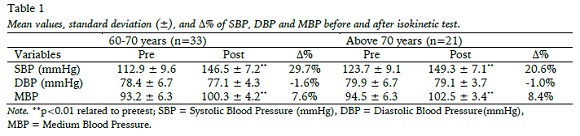
</front><body><![CDATA[ <p align="right"><font size="2"><b>ARTIGOS ORIGINAIS</b></font></p>     <p><font size="4"><b>Blood Pressure Responses in Isokinetic Dynamometry Test in    Elderly Community Women: An Exploratory Study</b></font></p>     <p><b>Rubens Vinícius Letieri,<sup>1, 2</sup><a href="#*"><sup>[*]</sup></a><a name="top*"></a>,    Guilherme Eustáquio Furtado<sup>3</sup>, Taís Rieping<sup>4</sup>, Mayrhon José    Abrantes Farias<sup>1</sup>, Ana Maria Miranda Botelho Teixeira<sup>3</sup></b></p>     <p><sup>1</sup>Physical Education Department, Federal University of Tocantins,    UFT, Tocantins, Brazil</p>     <p><sup>2</sup>Faculty of Sport Science and Physical Education, University of    Coimbra, Coimbra, Portugal</p>     <p><sup>3</sup>Research Unit for Sport and Physical Activity, CIDAF, Faculty of    Sport Science and Physical Education, University of Coimbra, Coimbra, Portugal</p>     <p><sup>4</sup>Laboratory of Sport and Exercise Psychology, Faculty of Sport Science    and Physical Education, University Coimbra, Coimbra, Portugal</p> <hr/>     <p>&nbsp;</p>     <p><b>ABSTRACT</b></p>     <p>The aim of the study was to verify the systolic, diastolic and mean arterial    pressure response in elderly women during isokinetic test. The study included    54 females (68.8 ± 5.9 years) divided into two age groups (Group 1: 60 to 70    and group 2: above 71 years). BP was measured before and immediately after the    isokinetic knee extension / flexion test in the concentric-concentric mode.    After the test, significant elevations were observed in relation to the pre-test    in SBP (G1: &#916;% = 29.7%, G2: &#916;% = 20.6%, p &lt;.01, respectively) and    in MAP (G1: &#916;% = 7.6 %, G2: &#916;% = 8.4%, p &lt;.01, respectively). The    use of isokinetic tests produces elevations in systolic blood pressure and mean    arterial pressure in elderly women. Increases occur independently of the age    group studied. However, the increases detected do not appear to be of sufficient    magnitude to constitute a health hazard whereby isokinetic tests can be safely    applied in this population.</p>     ]]></body>
<body><![CDATA[<p><b>Keywords: </b>muscle strength dynamometer, blood pressure, stress test.</p> <hr/>     <p>&nbsp;</p>     <p><b>Introduction</b></p>     <p>Muscle strength is one of the most important physical capacity, since it is    fundamental for any movement. With the aging process, the body suffer many losses    including the muscle strength capacity, which is related to sarcopenia and neuromuscular    atrophy (Aagaard, Suetta, Caserotti, Magnusson, &amp; Kjær, 2010)<b>. </b>The    study of muscle strength has largely contributed to the prescription of physical    exercise in elderly individuals, aiming to attenuate the losses of advancing    age (Haraldstad et al., 2017; Walston, 2012). In addition, arterial hypertension    also have been investigate in the aging field, because it has a high prevalence    in the elderly population, generating a need for greater targeting of strategies    to assist in the control of this variable in the elderly. The increase in blood    pressure (BP) during the aging process is a contributor to the development of    cardiovascular disease and hypertension (Da Cunha Nascimento et al., 2018).</p>     <p>The benefits of having an active life, doing exercise and avoiding the sedentarism    is well known and recommended by important health organizations in the world    (Chodzko-Zajko et al., 2009). Lately the recommendations not only focus in aerobic    capacity but also to strength capacity (Peterson, Rhea, Sen, &amp; Gordon, 2010).    Nowadays the combined exercise is the best option to preserve the functional    capacity and prolong an independent life (Teixeira et al., 2016). Exercise plays    an important role in the aid process in control of age-related disorders, however,    to be able to assess whether the exercise was effective, it is necessary that    individuals who undergo training programs do an assessment test of strength    maximum muscle mass.</p>     <p>Some tests can be run to evaluate the strength capacity however, the gold test    (Maximum muscular strength test) can be tricky for the elderly population, once    it is associate with increased BP during the test. The test is associate with    physiological changes that can, in fact, influence the responses to exercise    (Levinger et al., 2009), including the BP (Featherstone, Holly, &amp; Amsterdam,    1993). In the study by Blanchard et al. (2018), the authors hypothesized that    individuals with high resting BP would exhibit lower rates of isokinetic muscle    strength than individuals with normal BP. Contrary to the initial hypothesis,    individuals with higher resting BP had higher values of muscular strength. BP    responses during maximal muscle strength tests at different stages of aging    need to be further clarified. We hypothesized that older women with more advanced    ages may exhibit higher rates of BP and lower rates of muscle strength than    those with the lower age range after isokinetic test.</p>     <p>Thus, to help clarify and reinforce the safety of isokinetic test application    in this specific population the aim of the present study was to verify the acute    response of BP in elderly women during the assessment of maximal muscle strength<b>.</b></p>     <p><b>Method</b></p>     <p><b>Participants</b></p>     <p>The study is characterized as descriptive, transversal and <i>quasi</i>-experimental.    The sample consisted of 54 females (68.58 ± .09 years) participants in a university    program of physical exercise. The subjects were categorized into two age groups,    Group 1: 60 to 70 years old (65.45 ± 2.62 years) And Group 2: above 71 years    (74.14 ± 3.07 years). The inclusion criteria were: a) age equal to or greater    than 60 years; b) have no muscle-articular limitations in the involved segments;    c) have medical release for participation. The exclusion criteria were: a) complete    the test by voluntary / involuntary interruption; b) BP at rest above 140x90mmHg.    Participants were given medical release for the practice and were advised to    follow the usual medical advice regarding medications. All participants were    informed about the methodological procedures and signed a Free and Clarified    Consent Term (FCCT). The study respected the ethical procedures for research    in humans (Res. 466/2012 of the National Health Council) and the Declaration    of Helsinki. The protocol was approved by the Ethics and Research Committee    of Unicatólica (nº 1175.175).</p>     ]]></body>
<body><![CDATA[<p><b>Measures</b></p>     <p>The evaluation of lower limb muscle strength was performed on a Biodex 3 System    Pro® Isokinetic Dynamometer (Biodex Biomedical Systems, Inc., Shirley, NY) and    preliminary cycle ergometer heating (Monark Ergomedic 828). The maximum isokinetic    torque (Nm) was measured in the concentric-concentric mode at 60o/s and three    repetitions maximum extension/flexion of the knee dominant (Aquino Amorim &amp;    Helm, 2006). Familiarization with the isokinetic test was performed in the week    prior to the tests.</p>     <p><b>Procedures</b></p>     <p>The SBP and DBP were measured at rest and immediately after the test was performed    using an automatic sphygmomanometer (Omron HEM 7113®). During the resting measurement,    participants were instructed to remain seated for a period of 3 to 5 minutes    in a calm environment and were instructed not to talk during the measurement.    Participants were instructed to stand with uncrossed legs, feet flat on the    floor, backslid in the chair and relaxed; The arm was positioned at the level    of the heart, supported, with the palm of the hand turned upwards and the clothes    relaxed. The procedures for the measurement of Blood Pressure followed the recommendations    of the 7th Brazilian Guideline of Arterial Hypertension (Malachias et al., 2016).</p>     <p><b>Statistical analysis</b></p>     <p>A descriptive analysis of the data was performed (mean and standard deviation    (±)). Normality was verified by the Shapiro-Wilk test and independent <i>student    </i>t tests for the Torque Peak and paired for the variables SBP, DBP and MBP.    MBP was calculated using the formula: <i>MBP</i><i>= [(2DBP) + SBP] / 3. </i>The    percentage of change (&#916;%) was calculated using the formula: &#916;% = ((pos-pre)    / pre) * 100. The level of significance was 95% (p &lt; 0.05). For all statistical    analysis, <i>Statistical Package for the Social Sciences </i>version 23.0 was    used (Armonk: NY, IBM Corporation).</p>     <p><b>Results</b></p>     <p>&nbsp;</p>     <p align="center"><a name="t1"></a><img src="/img/revistas/mot/v14n4/14n4a07t1.jpg"/></p>     
<p>&nbsp;</p>     ]]></body>
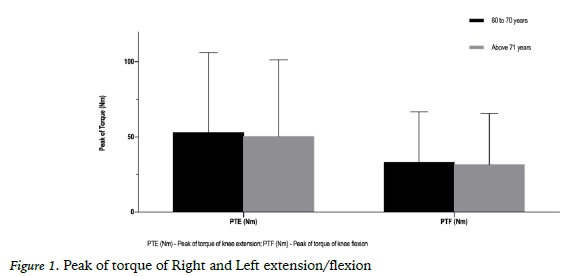
<body><![CDATA[<p>The peak torque values (Nm) showed no significant differences between the groups    (EPT Group 1 vs. Group 2. <i>P </i>= .357; 95% CI: -4. 1 to 12.6; FPT. <i>P    </i>= .609; 95% CI: -3.5 to 6.06, respectively).</p>     <p>&nbsp;</p>     <p align="center"><a name="f1"></a><img src="/img/revistas/mot/v14n4/14n4a07f1.jpg"/></p>     
<p>&nbsp;</p>     <p><b>Discussion</b></p>     <p>In this paper, we describe BP responses to maximum isokinetic test in elderly    women. This report is unique because it is a study that analyzes the BP at different    stages of aging for maximum concentric effort in women of the community.</p>     <p>The responses in SBP, DBP and MBP observed in our study can be considered similar    in both age groups. However, the mean values of MBP were significantly higher    after the isokinetic test in the two age groups. It is possible that such elevation    was influenced by increases in SBP. The observed increase in SBP in both groups    can be explained by the type of muscle contraction used in the test. Concentric    contractions may induce elevated responses in cardiovascular variables when    compared to eccentric contractions (Okamoto, Masuhara, &amp; Ikuta, 2006). Isokinetic    contractions, when compared to isotonic and isometric contractions, may also    present higher acute values in both SBP and DBP (Iellamo et al., 1997). Besides    the type of contraction, the amount of muscle mass involved during muscle contractions    can directly influence the pressure responses during exercise (House et al.,    2010). Our study focused on the immediate acute response of BP during maximal    isokinetic testing. Unlike acute responses, resistance exercise, when performed    chronically, for example at 28 weeks, SBP and DBP may show significant reductions    (Reichert et al., 2016). The results showed that the proposed exercises are    safe, since they did not increase the BP values exaggerated. Our study shows,    in agreement with other authors, that, from the cardiovascular point of view,    strength exercises are well tolerated by the elderly (Bakke, Hisdal, Kroese,    Jørgensen, &amp; Stranden, 2007; Blanchard et al., 2018; Overend, Versteegh,    Thompson, Birmingham, &amp; Vandervoort, 2000; Symons, Vandervoort, Rice, Overend,    &amp; Marsh, 2005; Vallejo, Schroeder, Zheng, Jensky, &amp; Sattler, 2006).    The observation of blood pressure values, from maximal work up to the end of    the exercise, may be due to the more or less constant intensity of the effort    and the progressive vasodilatation (decrease of the peripheral resistances).    Thus, at this point, blood flow seems to have been sufficient to meet the metabolic    needs of exercise (Carvalho, Marques, &amp; Mota, 2008).</p>     <p>The present study presents some limitations: the first is that the BP response    was not controlled in the recovery period after exercise. The second is that    the sample was composed only of women. Therefore, studies with different methodological    designs are recommended.</p>     <p><b>Conclusion</b></p>     <p>The use of isokinetic tests produces elevations in systolic blood pressure    and mean arterial pressure in elderly women. The increases occur independently    of the studied age group, requiring a control for each applied test. However,    the increases detected do not appear to be of sufficient magnitude to constitute    a health hazard, so that isokinetic tests can be safely applied in this population.</p>     ]]></body>
<body><![CDATA[<p>&nbsp;</p>     <p><b>REFERENCES</b></p>     <!-- ref --><p>Aagaard, P., Suetta, C., Caserotti, P., Magnusson, S. P., &amp; Kjær, M. (2010).    Role of the nervous system in sarcopenia and muscle atrophy with aging: Strength    training as a countermeasure. <i>Scandinavian Journal of Medicine and Science    in Sports</i>, <i>20</i>(1), 49-64. <a href="https://doi.org/10.1111/j.1600-0838.2009.01084.x" target="_blank">https://doi.org/10.1111/j.1600-0838.2009.01084.x</a>&nbsp;&nbsp;&nbsp;&nbsp;&nbsp;&nbsp;&nbsp;&nbsp;[&#160;<a href="javascript:void(0);" onclick="javascript: window.open('/scielo.php?script=sci_nlinks&ref=385302&pid=S1646-107X201800030000700001&lng=','','width=640,height=500,resizable=yes,scrollbars=1,menubar=yes,');">Links</a>&#160;]<!-- end-ref --><!-- ref --><p>Bakke, E. F., Hisdal, J., Kroese, A. J., Jørgensen, J. J., &amp; Stranden,    E. (2007). Blood pressure response to isometric exercise in patients with peripheral    atherosclerotic disease. Clinical Physiology and Functional Imaging, 27(2),    109-115. <a href="https://doi.org/10.1111/j.1475-097X.2007.00720.x" target="_blank">https://doi.org/10.1111/j.1475-097X.2007.00720.x</a>&nbsp;&nbsp;&nbsp;&nbsp;&nbsp;&nbsp;&nbsp;&nbsp;[&#160;<a href="javascript:void(0);" onclick="javascript: window.open('/scielo.php?script=sci_nlinks&ref=385303&pid=S1646-107X201800030000700002&lng=','','width=640,height=500,resizable=yes,scrollbars=1,menubar=yes,');">Links</a>&#160;]<!-- end-ref --><p>Blanchard, A. R., Taylor, B. A., Thompson, P. D., Lepley, L. K., White, C.    M., Corso, L. M., &hellip; Pescatello, L. S. (2018). The influence of resting blood    pressure on muscle strength in healthy adults. <i>Blood Pressure Monitoring</i>,    <i>23</i>(4), 185-190. <a href="https://doi.org/10.1097/MBP.0000000000000325" target="_blank">https://doi.org/10.1097/MBP.0000000000000325</a></p>     <p>Câmara, L. C., Ritti-Dias, R. M., Forjaz, C. L. de M., Greve, J. M., Santarém,    J. M., Jacob-Filho, W., &hellip; Wolosker, N. (2010). Respostas cardiovasculares durante    avaliação muscular isocinética em claudicantes. Arquivos Brasileiros de Cardiologia,    95(5), 571-576. <a href="http://doi.org/10.1590/S0066-782X2010005000147" target="_blank">http://doi.org/10.1590/S0066-782X2010005000147</a></p>     <!-- ref --><p>Carvalho, J., Marques, E., &amp; Mota, J. (2008). Resposta hemodinâmica aguda    a uma sessão de exercício físico multicomponente em idosos. Revista Portuguesa    de Ciências Do Desporto, 8(1), 103-113. Retrieved from <a href="http://www.scielo.mec.pt/scielo.php?script=sci_arttext&pid=S1645-05232008000100011&lng=pt&nrm=iso&tlng= pt" target="_blank">http://www.scielo.mec.pt/scielo.php?script=sci_arttext&amp;pid=S1645-05232008000100011&amp;lng=pt&amp;nrm=iso&amp;tlng=    pt</a>&nbsp;&nbsp;&nbsp;&nbsp;&nbsp;&nbsp;&nbsp;&nbsp;[&#160;<a href="javascript:void(0);" onclick="javascript: window.open('/scielo.php?script=sci_nlinks&ref=385306&pid=S1646-107X201800030000700005&lng=','','width=640,height=500,resizable=yes,scrollbars=1,menubar=yes,');">Links</a>&#160;]<!-- end-ref --><!-- ref --><p>Chodzko-Zajko, W. J., Proctor, D. N., Fiatarone Singh,M. A., Minson, C. T.,    Nigg, C. R., Salem, G. J., &amp; Skinner, J. S. (2009). Exercise and physical    activity for older adults. <i>Medicine and Science in Sports and Exercise</i>,    <i>41</i>(7), 1510-1530. <a href="https://doi.org/10.1249/MSS.0b013e3181a0c95c" target="_blank">https://doi.org/10.1249/MSS.0b013e3181a0c95c</a>&nbsp;&nbsp;&nbsp;&nbsp;&nbsp;&nbsp;&nbsp;&nbsp;[&#160;<a href="javascript:void(0);" onclick="javascript: window.open('/scielo.php?script=sci_nlinks&ref=385307&pid=S1646-107X201800030000700006&lng=','','width=640,height=500,resizable=yes,scrollbars=1,menubar=yes,');">Links</a>&#160;]<!-- end-ref --><!-- ref --><p>de Amorim Aquino, M., &amp; Leme, L. E. G. (2006). Isokinetic dynamometry in    elderly women undergoing total knee arthroplasty: a comparative study. Clinics    (Sao Paulo, Brazil), 61(3), 215-22. <a href="http://www.scielo.br/scielo.php?script=sci_arttext&pid=S1807-59322006000300006" target="_blank">http://doi.org//S1807-59322006000300006</a>&nbsp;&nbsp;&nbsp;&nbsp;&nbsp;&nbsp;&nbsp;&nbsp;[&#160;<a href="javascript:void(0);" onclick="javascript: window.open('/scielo.php?script=sci_nlinks&ref=385308&pid=S1646-107X201800030000700007&lng=','','width=640,height=500,resizable=yes,scrollbars=1,menubar=yes,');">Links</a>&#160;]<!-- end-ref --><!-- ref --><p>Featherstone, J. F., Holly, R. G., &amp; Amsterdam, E. A. (1993). Physiologic    responses to weight lifting in coronary artery disease. The American Journal    of Cardiology, 71(4), 287-92. Retrieved from <a href="http://www.ncbi.nlm.nih.gov/pubmed/8427169" target="_blank">http://www.ncbi.nlm.nih.gov/pubmed/8427169</a>  &nbsp;&nbsp;&nbsp;&nbsp;&nbsp;&nbsp;&nbsp;&nbsp;[&#160;<a href="javascript:void(0);" onclick="javascript: window.open('/scielo.php?script=sci_nlinks&ref=385309&pid=S1646-107X201800030000700008&lng=','','width=640,height=500,resizable=yes,scrollbars=1,menubar=yes,');">Links</a>&#160;]<!-- end-ref --><!-- ref --><p>Haraldstad, K., Rohde, G., Stea, T. H., Lohne-Seiler, H., Hetlelid, K., Paulsen,    G., &amp; Berntsen, S. (2017).Changes in health-related quality of life in elderly    men after 12 weeks of strength training. European Review of Aging and Physical    Activity, 14(1), 8. <a href="http://doi.org/10.1186/s11556-017-0177-3" target="_blank">http://doi.org/10.1186/s11556-017-0177-3</a>&nbsp;&nbsp;&nbsp;&nbsp;&nbsp;&nbsp;&nbsp;&nbsp;[&#160;<a href="javascript:void(0);" onclick="javascript: window.open('/scielo.php?script=sci_nlinks&ref=385310&pid=S1646-107X201800030000700009&lng=','','width=640,height=500,resizable=yes,scrollbars=1,menubar=yes,');">Links</a>&#160;]<!-- end-ref --><p>Iellamo, F., Legramante, J. M., Raimondi, G., Castrucci, F., Damiani, C., Foti,    C., &hellip; Caruso, I. (1997). Effects of isokinetic, isotonic and isometric submaximal    exercise on heart rate and blood pressure. European Journal of Applied Physiology,    75(2), 89-96. <a href="http://doi.org/10.1007/s004210050131" target="_blank">http://doi.org/10.1007/s004210050131</a>  </p>     <p>Levinger, I., Goodman, C., Hare, D. L., Jerums, G.,Toia, D., &amp; Selig, S.    (2009). The reliability of the 1RM strength test for untrained middle-aged individuals.    Journal of Science and Medicine in Sport, 12(2), 310-6. <a href="http://doi.org/10.1016/j.jsams.2007.10.007" target="_blank">http://doi.org/10.1016/j.jsams.2007.10.007</a>  </p>     <p>Malachias, M., Souza, W., Plavnik, F., Rodrigues, C.,Brandão, A., Neves, M.,    &hellip; Moreno Júnior, H. (2016). Capítulo 1 - Conceituação, Epidemiologia e Prevenção    Primária. Arquivos Brasileiros de Cardiologia, 107(3), 1-6. <a href="http://doi.org/10.5935/abc.20160151" target="_blank">http://doi.org/10.5935/abc.20160151</a></p>     <!-- ref --><p>Okamoto, T., Masuhara, M., &amp; Ikuta, K. (2006). Cardiovascular responses    induced during high- intensity eccentric and concentric isokinetic muscle contraction    in healthy young adults. Clinical Physiology and Functional Imaging, 26(1),    39-44. <a href="http://doi.org/10.1111/j.1475-097X.2005.00651.x" target="_blank">http://doi.org/10.1111/j.1475-097X.2005.00651.x</a>&nbsp;&nbsp;&nbsp;&nbsp;&nbsp;&nbsp;&nbsp;&nbsp;[&#160;<a href="javascript:void(0);" onclick="javascript: window.open('/scielo.php?script=sci_nlinks&ref=385314&pid=S1646-107X201800030000700013&lng=','','width=640,height=500,resizable=yes,scrollbars=1,menubar=yes,');">Links</a>&#160;]<!-- end-ref --><!-- ref --><p>Overend, T. J., Versteegh, T. H., Thompson, E., Birmingham, T. B., &amp; Vandervoort,    A. A. (2000). Cardiovascular Stress Associated With Concentric and Eccentric    Isokinetic Exercise in Young and Older Adults. The Journals of Gerontology Series    A: Biological Sciences and Medical Sciences, 55(4), B177-B182. <a href="https://doi.org/10.1093/gerona/55.4.B177" target="_blank">https://doi.org/10.1093/gerona/55.4.B177</a>&nbsp;&nbsp;&nbsp;&nbsp;&nbsp;&nbsp;&nbsp;&nbsp;[&#160;<a href="javascript:void(0);" onclick="javascript: window.open('/scielo.php?script=sci_nlinks&ref=385315&pid=S1646-107X201800030000700014&lng=','','width=640,height=500,resizable=yes,scrollbars=1,menubar=yes,');">Links</a>&#160;]<!-- end-ref --><!-- ref --><p>Peterson, M. D., Rhea, M. R., Sen, A., &amp; Gordon, P. M. (2010). Resistance    exercise for muscular strength in older adults: A meta-analysis. <i>Ageing Research    Reviews</i>, <i>9</i>(3), 226-237. <a href="https://doi.org/10.1016/j.arr.2010.03.004" target="_blank">https://doi.org/10.1016/j.arr.2010.03.004</a>&nbsp;&nbsp;&nbsp;&nbsp;&nbsp;&nbsp;&nbsp;&nbsp;[&#160;<a href="javascript:void(0);" onclick="javascript: window.open('/scielo.php?script=sci_nlinks&ref=385316&pid=S1646-107X201800030000700015&lng=','','width=640,height=500,resizable=yes,scrollbars=1,menubar=yes,');">Links</a>&#160;]<!-- end-ref --><!-- ref --><p>Symons, T. B., Vandervoort, A. A., Rice, C. L.,Overend, T. J., &amp; Marsh,    G. D. (2005). Effects of maximal isometric and isokinetic resistance training    on strength and functional mobility in older adults. The Journals of Gerontology.    Series A, Biological Sciences and Medical Sciences, 60(6), 777-781. Retrieved    from <a href="http://www.ncbi.nlm.nih.gov/pubmed/15983182" target="_blank">http://www.ncbi.nlm.nih.gov/pubmed/15983182</a>&nbsp;&nbsp;&nbsp;&nbsp;&nbsp;&nbsp;&nbsp;&nbsp;[&#160;<a href="javascript:void(0);" onclick="javascript: window.open('/scielo.php?script=sci_nlinks&ref=385317&pid=S1646-107X201800030000700016&lng=','','width=640,height=500,resizable=yes,scrollbars=1,menubar=yes,');">Links</a>&#160;]<!-- end-ref --><!-- ref --><p>Reichert, T., Kanitz, A. C., Delevatti, R. S., Bagatini, N. C., Barroso, B.    M., &amp; Kruel, L. F. M. (2016). Continuous and interval training programs    using deep water running improves functional fitness and blood pressure in the    older adults. Age (Dordrecht, Netherlands), 38(1), 20. <a href="http://doi.org/10.1007/s11357-016-9882-5" target="_blank">http://doi.org/10.1007/s11357-016-9882-5</a>&nbsp;&nbsp;&nbsp;&nbsp;&nbsp;&nbsp;&nbsp;&nbsp;[&#160;<a href="javascript:void(0);" onclick="javascript: window.open('/scielo.php?script=sci_nlinks&ref=385318&pid=S1646-107X201800030000700017&lng=','','width=640,height=500,resizable=yes,scrollbars=1,menubar=yes,');">Links</a>&#160;]<!-- end-ref --><p>Teixeira, A. M., Ferreira, J. P., Hogervorst, E., Braga, M. F., Bandelow, S.,    Rama, L., &hellip; Pedrosa, F. M. (2016). Study Protocol on Hormonal Mediation of Exercise    on Cognition, Stress and Immunity (PRO-HMECSI): Effects of Different Exercise    Programmes in Institutionalized Elders. <i>Frontiers in Public Health</i>, <i>4</i>,    133. <a href="https://doi.org/10.3389/fpubh.2016.00133" target="_blank">https://doi.org/10.3389/fpubh.2016.00133</a></p>     ]]></body>
<body><![CDATA[<!-- ref --><p>Vallejo, A. F., Schroeder, E. T., Zheng, L., Jensky, N. E., &amp; Sattler,    F. R. (2006). Cardiopulmonary responses to eccentric and concentric resistance    exercise in older adults. Age and Ageing, 35(3), 291-297. <a href="https://doi.org/10.1093/ageing/afj082" target="_blank">https://doi.org/10.1093/ageing/afj082</a>&nbsp;&nbsp;&nbsp;&nbsp;&nbsp;&nbsp;&nbsp;&nbsp;[&#160;<a href="javascript:void(0);" onclick="javascript: window.open('/scielo.php?script=sci_nlinks&ref=385320&pid=S1646-107X201800030000700019&lng=','','width=640,height=500,resizable=yes,scrollbars=1,menubar=yes,');">Links</a>&#160;]<!-- end-ref --><!-- ref --><p>Walston, J. D. (2012). Sarcopenia in older adults. Current Opinion in Rheumatology,    24(6), 623-627.<a href="http://doi.org/10.1097/BOR.0b013e328358d59b" target="_blank">http://doi.org/10.1097/BOR.0b013e328358d59b</a>&nbsp;&nbsp;&nbsp;&nbsp;&nbsp;&nbsp;&nbsp;&nbsp;[&#160;<a href="javascript:void(0);" onclick="javascript: window.open('/scielo.php?script=sci_nlinks&ref=385321&pid=S1646-107X201800030000700020&lng=','','width=640,height=500,resizable=yes,scrollbars=1,menubar=yes,');">Links</a>&#160;]<!-- end-ref --><p>&nbsp;</p>     <p>Acknowledgments: Nothing to declare.&nbsp; </p>     <p>Conflict of interests: Nothing to declare.&nbsp;      <p>Funding: Nothing to declare.      <p>&nbsp;</p>     <p>Manuscript received at June 26th 2018; Accepted at November 27th 2018</p>     <p>&nbsp;</p>     <p><a href="#top*"><sup>[*]</sup></a><a name="*"></a>Corresponding author: Email:    <a href="mailto:rubens.letieri@gmail.com">rubens.letieri@gmail.com</a></p>     ]]></body>
<body><![CDATA[ ]]></body><back>
<ref-list>
<ref id="B1">
<nlm-citation citation-type="journal">
<person-group person-group-type="author">
<name>
<surname><![CDATA[Aagaard]]></surname>
<given-names><![CDATA[P.]]></given-names>
</name>
<name>
<surname><![CDATA[Suetta]]></surname>
<given-names><![CDATA[C.]]></given-names>
</name>
<name>
<surname><![CDATA[Caserotti]]></surname>
<given-names><![CDATA[P.]]></given-names>
</name>
<name>
<surname><![CDATA[Magnusson]]></surname>
<given-names><![CDATA[S. P.]]></given-names>
</name>
<name>
<surname><![CDATA[Kjær]]></surname>
<given-names><![CDATA[M.]]></given-names>
</name>
</person-group>
<article-title xml:lang="en"><![CDATA[Role of the nervous system in sarcopenia and muscle atrophy with aging: Strength training as a countermeasure]]></article-title>
<source><![CDATA[Scandinavian Journal of Medicine and Science in Sports]]></source>
<year>2010</year>
<volume>20</volume>
<numero>1</numero>
<issue>1</issue>
<page-range>49-64</page-range></nlm-citation>
</ref>
<ref id="B2">
<nlm-citation citation-type="journal">
<person-group person-group-type="author">
<name>
<surname><![CDATA[Bakke]]></surname>
<given-names><![CDATA[E. F.]]></given-names>
</name>
<name>
<surname><![CDATA[Hisdal]]></surname>
<given-names><![CDATA[J.]]></given-names>
</name>
<name>
<surname><![CDATA[Kroese]]></surname>
<given-names><![CDATA[A. J.]]></given-names>
</name>
<name>
<surname><![CDATA[Jørgensen]]></surname>
<given-names><![CDATA[J. J.]]></given-names>
</name>
<name>
<surname><![CDATA[Stranden]]></surname>
<given-names><![CDATA[E.]]></given-names>
</name>
</person-group>
<article-title xml:lang="en"><![CDATA[Blood pressure response to isometric exercise in patients with peripheral atherosclerotic disease]]></article-title>
<source><![CDATA[Clinical Physiology and Functional Imaging]]></source>
<year>2007</year>
<volume>27</volume>
<numero>2</numero>
<issue>2</issue>
<page-range>109-115</page-range></nlm-citation>
</ref>
<ref id="B3">
<nlm-citation citation-type="journal">
<person-group person-group-type="author">
<name>
<surname><![CDATA[Blanchard]]></surname>
<given-names><![CDATA[A. R.]]></given-names>
</name>
<name>
<surname><![CDATA[Taylor]]></surname>
<given-names><![CDATA[B. A.]]></given-names>
</name>
<name>
<surname><![CDATA[Thompson]]></surname>
<given-names><![CDATA[P. D.]]></given-names>
</name>
<name>
<surname><![CDATA[Lepley]]></surname>
<given-names><![CDATA[L. K.]]></given-names>
</name>
<name>
<surname><![CDATA[White]]></surname>
<given-names><![CDATA[C. M.]]></given-names>
</name>
<name>
<surname><![CDATA[Corso]]></surname>
<given-names><![CDATA[L. M.]]></given-names>
</name>
<name>
<surname><![CDATA[Pescatello]]></surname>
<given-names><![CDATA[L. S.]]></given-names>
</name>
</person-group>
<article-title xml:lang="en"><![CDATA[The influence of resting blood pressure on muscle strength in healthy adults]]></article-title>
<source><![CDATA[Blood Pressure Monitoring]]></source>
<year>2018</year>
<volume>23</volume>
<numero>4</numero>
<issue>4</issue>
<page-range>185-190</page-range></nlm-citation>
</ref>
<ref id="B4">
<nlm-citation citation-type="journal">
<person-group person-group-type="author">
<name>
<surname><![CDATA[Câmara]]></surname>
<given-names><![CDATA[L. C.]]></given-names>
</name>
<name>
<surname><![CDATA[Ritti-Dias]]></surname>
<given-names><![CDATA[R. M.]]></given-names>
</name>
<name>
<surname><![CDATA[Forjaz]]></surname>
<given-names><![CDATA[C. L. de M.]]></given-names>
</name>
<name>
<surname><![CDATA[Greve]]></surname>
<given-names><![CDATA[J. M.]]></given-names>
</name>
<name>
<surname><![CDATA[Santarém]]></surname>
<given-names><![CDATA[J. M.]]></given-names>
</name>
<name>
<surname><![CDATA[Jacob-Filho]]></surname>
<given-names><![CDATA[W.]]></given-names>
</name>
<name>
<surname><![CDATA[Wolosker]]></surname>
<given-names><![CDATA[N.]]></given-names>
</name>
</person-group>
<article-title xml:lang="pt"><![CDATA[Respostas cardiovasculares durante avaliação muscular isocinética em claudicantes]]></article-title>
<source><![CDATA[Arquivos Brasileiros de Cardiologia]]></source>
<year>2010</year>
<volume>95</volume>
<numero>5</numero>
<issue>5</issue>
<page-range>571-576</page-range></nlm-citation>
</ref>
<ref id="B5">
<nlm-citation citation-type="journal">
<person-group person-group-type="author">
<name>
<surname><![CDATA[Carvalho]]></surname>
<given-names><![CDATA[J.]]></given-names>
</name>
<name>
<surname><![CDATA[Marques]]></surname>
<given-names><![CDATA[E.]]></given-names>
</name>
<name>
<surname><![CDATA[Mota]]></surname>
<given-names><![CDATA[J.]]></given-names>
</name>
</person-group>
<article-title xml:lang="pt"><![CDATA[Resposta hemodinâmica aguda a uma sessão de exercício físico multicomponente em idosos]]></article-title>
<source><![CDATA[Revista Portuguesa de Ciências Do Desporto]]></source>
<year>2008</year>
<volume>8</volume>
<numero>1</numero>
<issue>1</issue>
<page-range>103-113</page-range></nlm-citation>
</ref>
<ref id="B6">
<nlm-citation citation-type="journal">
<person-group person-group-type="author">
<name>
<surname><![CDATA[Chodzko-Zajko]]></surname>
<given-names><![CDATA[W. J.]]></given-names>
</name>
<name>
<surname><![CDATA[Proctor]]></surname>
<given-names><![CDATA[D. N.]]></given-names>
</name>
<name>
<surname><![CDATA[Fiatarone Singh]]></surname>
<given-names><![CDATA[M. A.]]></given-names>
</name>
<name>
<surname><![CDATA[Minson]]></surname>
<given-names><![CDATA[C. T.]]></given-names>
</name>
<name>
<surname><![CDATA[Nigg]]></surname>
<given-names><![CDATA[C. R.]]></given-names>
</name>
<name>
<surname><![CDATA[Salem]]></surname>
<given-names><![CDATA[G. J.]]></given-names>
</name>
<name>
<surname><![CDATA[Skinner]]></surname>
<given-names><![CDATA[J. S.]]></given-names>
</name>
</person-group>
<article-title xml:lang="en"><![CDATA[Exercise and physical activity for older adults]]></article-title>
<source><![CDATA[Medicine and Science in Sports and Exercise]]></source>
<year>2009</year>
<volume>41</volume>
<numero>7</numero>
<issue>7</issue>
<page-range>1510-1530</page-range></nlm-citation>
</ref>
<ref id="B7">
<nlm-citation citation-type="journal">
<person-group person-group-type="author">
<name>
<surname><![CDATA[de Amorim Aquino]]></surname>
<given-names><![CDATA[M.]]></given-names>
</name>
<name>
<surname><![CDATA[Leme]]></surname>
<given-names><![CDATA[L. E. G.]]></given-names>
</name>
</person-group>
<article-title xml:lang="en"><![CDATA[Isokinetic dynamometry in elderly women undergoing total knee arthroplasty: a comparative study]]></article-title>
<source><![CDATA[Clinics (Sao Paulo]]></source>
<year>2006</year>
<volume>Brazil), 61</volume>
<numero>3</numero>
<issue>3</issue>
<page-range>215-22</page-range></nlm-citation>
</ref>
<ref id="B8">
<nlm-citation citation-type="journal">
<person-group person-group-type="author">
<name>
<surname><![CDATA[Featherstone]]></surname>
<given-names><![CDATA[J. F.]]></given-names>
</name>
<name>
<surname><![CDATA[Holly]]></surname>
<given-names><![CDATA[R. G.]]></given-names>
</name>
<name>
<surname><![CDATA[Amsterdam]]></surname>
<given-names><![CDATA[E. A.]]></given-names>
</name>
</person-group>
<article-title xml:lang="en"><![CDATA[Physiologic responses to weight lifting in coronary artery disease]]></article-title>
<source><![CDATA[The American Journal of Cardiology]]></source>
<year>1993</year>
<volume>71</volume>
<numero>4</numero>
<issue>4</issue>
<page-range>287-92</page-range></nlm-citation>
</ref>
<ref id="B9">
<nlm-citation citation-type="journal">
<person-group person-group-type="author">
<name>
<surname><![CDATA[Haraldstad]]></surname>
<given-names><![CDATA[K.]]></given-names>
</name>
<name>
<surname><![CDATA[Rohde]]></surname>
<given-names><![CDATA[G.]]></given-names>
</name>
<name>
<surname><![CDATA[Stea]]></surname>
<given-names><![CDATA[T. H.]]></given-names>
</name>
<name>
<surname><![CDATA[Lohne-Seiler]]></surname>
<given-names><![CDATA[H.]]></given-names>
</name>
<name>
<surname><![CDATA[Hetlelid]]></surname>
<given-names><![CDATA[K.]]></given-names>
</name>
<name>
<surname><![CDATA[Paulsen]]></surname>
<given-names><![CDATA[G.]]></given-names>
</name>
<name>
<surname><![CDATA[Berntsen]]></surname>
<given-names><![CDATA[S.]]></given-names>
</name>
</person-group>
<article-title xml:lang="en"><![CDATA[Changes in health-related quality of life in elderly men after 12 weeks of strength training]]></article-title>
<source><![CDATA[European Review of Aging and Physical Activity]]></source>
<year>2017</year>
<volume>14</volume>
<numero>1</numero>
<issue>1</issue>
<page-range>8</page-range></nlm-citation>
</ref>
<ref id="B10">
<nlm-citation citation-type="journal">
<person-group person-group-type="author">
<name>
<surname><![CDATA[Iellamo]]></surname>
<given-names><![CDATA[F.]]></given-names>
</name>
<name>
<surname><![CDATA[Legramante]]></surname>
<given-names><![CDATA[J. M.]]></given-names>
</name>
<name>
<surname><![CDATA[Raimondi]]></surname>
<given-names><![CDATA[G.]]></given-names>
</name>
<name>
<surname><![CDATA[Castrucci]]></surname>
<given-names><![CDATA[F.]]></given-names>
</name>
<name>
<surname><![CDATA[Damiani]]></surname>
<given-names><![CDATA[C.]]></given-names>
</name>
<name>
<surname><![CDATA[Foti]]></surname>
<given-names><![CDATA[C.]]></given-names>
</name>
<name>
<surname><![CDATA[Caruso]]></surname>
<given-names><![CDATA[I.]]></given-names>
</name>
</person-group>
<article-title xml:lang="en"><![CDATA[Effects of isokinetic, isotonic and isometric submaximal exercise on heart rate and blood pressure]]></article-title>
<source><![CDATA[European Journal of Applied Physiology]]></source>
<year>1997</year>
<volume>75</volume>
<numero>2</numero>
<issue>2</issue>
<page-range>89-96</page-range></nlm-citation>
</ref>
<ref id="B11">
<nlm-citation citation-type="journal">
<person-group person-group-type="author">
<name>
<surname><![CDATA[Levinger]]></surname>
<given-names><![CDATA[I.]]></given-names>
</name>
<name>
<surname><![CDATA[Goodman]]></surname>
<given-names><![CDATA[C.]]></given-names>
</name>
<name>
<surname><![CDATA[Hare]]></surname>
<given-names><![CDATA[D. L.]]></given-names>
</name>
<name>
<surname><![CDATA[Jerums]]></surname>
<given-names><![CDATA[G.]]></given-names>
</name>
<name>
<surname><![CDATA[Selig]]></surname>
<given-names><![CDATA[S.]]></given-names>
</name>
</person-group>
<article-title xml:lang="en"><![CDATA[The reliability of the 1RM strength test for untrained middle-aged individuals]]></article-title>
<source><![CDATA[Journal of Science and Medicine in Sport]]></source>
<year>2009</year>
<volume>12</volume>
<numero>2</numero>
<issue>2</issue>
<page-range>310-6</page-range></nlm-citation>
</ref>
<ref id="B12">
<nlm-citation citation-type="journal">
<person-group person-group-type="author">
<name>
<surname><![CDATA[Malachias]]></surname>
<given-names><![CDATA[M.]]></given-names>
</name>
<name>
<surname><![CDATA[Souza]]></surname>
<given-names><![CDATA[W.]]></given-names>
</name>
<name>
<surname><![CDATA[Plavnik]]></surname>
<given-names><![CDATA[F.]]></given-names>
</name>
<name>
<surname><![CDATA[Rodrigues]]></surname>
<given-names><![CDATA[C.]]></given-names>
</name>
<name>
<surname><![CDATA[Brandão]]></surname>
<given-names><![CDATA[A.]]></given-names>
</name>
<name>
<surname><![CDATA[Neves]]></surname>
<given-names><![CDATA[M.]]></given-names>
</name>
<name>
<surname><![CDATA[Moreno Júnior]]></surname>
<given-names><![CDATA[H.]]></given-names>
</name>
</person-group>
<article-title xml:lang="pt"><![CDATA[Capítulo 1 - Conceituação, Epidemiologia e Prevenção Primária]]></article-title>
<source><![CDATA[Arquivos Brasileiros de Cardiologia]]></source>
<year>2016</year>
<volume>107</volume>
<numero>3</numero>
<issue>3</issue>
<page-range>1-6</page-range></nlm-citation>
</ref>
<ref id="B13">
<nlm-citation citation-type="journal">
<person-group person-group-type="author">
<name>
<surname><![CDATA[Okamoto]]></surname>
<given-names><![CDATA[T.]]></given-names>
</name>
<name>
<surname><![CDATA[Masuhara]]></surname>
<given-names><![CDATA[M.]]></given-names>
</name>
<name>
<surname><![CDATA[Ikuta]]></surname>
<given-names><![CDATA[K.]]></given-names>
</name>
</person-group>
<article-title xml:lang="en"><![CDATA[Cardiovascular responses induced during high- intensity eccentric and concentric isokinetic muscle contraction in healthy young adults]]></article-title>
<source><![CDATA[Clinical Physiology and Functional Imaging]]></source>
<year>2006</year>
<volume>26</volume>
<numero>1</numero>
<issue>1</issue>
<page-range>39-44</page-range></nlm-citation>
</ref>
<ref id="B14">
<nlm-citation citation-type="journal">
<person-group person-group-type="author">
<name>
<surname><![CDATA[Overend]]></surname>
<given-names><![CDATA[T. J.]]></given-names>
</name>
<name>
<surname><![CDATA[Versteegh]]></surname>
<given-names><![CDATA[T. H.]]></given-names>
</name>
<name>
<surname><![CDATA[Thompson]]></surname>
<given-names><![CDATA[E.]]></given-names>
</name>
<name>
<surname><![CDATA[Birmingham]]></surname>
<given-names><![CDATA[T. B.]]></given-names>
</name>
<name>
<surname><![CDATA[Vandervoort]]></surname>
<given-names><![CDATA[A. A.]]></given-names>
</name>
</person-group>
<article-title xml:lang="en"><![CDATA[Cardiovascular Stress Associated With Concentric and Eccentric Isokinetic Exercise in Young and Older Adults]]></article-title>
<source><![CDATA[The Journals of Gerontology Series A: Biological Sciences and Medical Sciences]]></source>
<year>2000</year>
<volume>55</volume>
<numero>4</numero>
<issue>4</issue>
<page-range>B177-B182</page-range></nlm-citation>
</ref>
<ref id="B15">
<nlm-citation citation-type="journal">
<person-group person-group-type="author">
<name>
<surname><![CDATA[Peterson]]></surname>
<given-names><![CDATA[M. D.]]></given-names>
</name>
<name>
<surname><![CDATA[Rhea]]></surname>
<given-names><![CDATA[M. R.]]></given-names>
</name>
<name>
<surname><![CDATA[Sen]]></surname>
<given-names><![CDATA[A.]]></given-names>
</name>
<name>
<surname><![CDATA[Gordon]]></surname>
<given-names><![CDATA[P. M.]]></given-names>
</name>
</person-group>
<article-title xml:lang="en"><![CDATA[Resistance exercise for muscular strength in older adults: A meta-analysis]]></article-title>
<source><![CDATA[Ageing Research Reviews]]></source>
<year>2010</year>
<volume>9</volume>
<numero>3</numero>
<issue>3</issue>
<page-range>226-237</page-range></nlm-citation>
</ref>
<ref id="B16">
<nlm-citation citation-type="journal">
<person-group person-group-type="author">
<name>
<surname><![CDATA[Symons]]></surname>
<given-names><![CDATA[T. B.]]></given-names>
</name>
<name>
<surname><![CDATA[Vandervoort]]></surname>
<given-names><![CDATA[A. A.]]></given-names>
</name>
<name>
<surname><![CDATA[Rice]]></surname>
<given-names><![CDATA[C. L.]]></given-names>
</name>
<name>
<surname><![CDATA[Overend]]></surname>
<given-names><![CDATA[T. J.]]></given-names>
</name>
<name>
<surname><![CDATA[Marsh]]></surname>
<given-names><![CDATA[G. D.]]></given-names>
</name>
</person-group>
<article-title xml:lang="en"><![CDATA[Effects of maximal isometric and isokinetic resistance training on strength and functional mobility in older adults]]></article-title>
<source><![CDATA[The Journals of Gerontology: Series A, Biological Sciences and Medical Sciences]]></source>
<year>2005</year>
<volume>60</volume>
<numero>6</numero>
<issue>6</issue>
<page-range>777-781</page-range></nlm-citation>
</ref>
<ref id="B17">
<nlm-citation citation-type="journal">
<person-group person-group-type="author">
<name>
<surname><![CDATA[Reichert]]></surname>
<given-names><![CDATA[T.]]></given-names>
</name>
<name>
<surname><![CDATA[Kanitz]]></surname>
<given-names><![CDATA[A. C.]]></given-names>
</name>
<name>
<surname><![CDATA[Delevatti]]></surname>
<given-names><![CDATA[R. S.]]></given-names>
</name>
<name>
<surname><![CDATA[Bagatini]]></surname>
<given-names><![CDATA[N. C.]]></given-names>
</name>
<name>
<surname><![CDATA[Barroso]]></surname>
<given-names><![CDATA[B. M.]]></given-names>
</name>
<name>
<surname><![CDATA[Kruel]]></surname>
<given-names><![CDATA[L. F. M.]]></given-names>
</name>
</person-group>
<article-title xml:lang="en"><![CDATA[Continuous and interval training programs using deep water running improves functional fitness and blood pressure in the older adults]]></article-title>
<source><![CDATA[Age (Dordrecht]]></source>
<year>2016</year>
<volume>Netherlands), 38</volume>
<numero>1</numero>
<issue>1</issue>
<page-range>20</page-range></nlm-citation>
</ref>
<ref id="B18">
<nlm-citation citation-type="journal">
<person-group person-group-type="author">
<name>
<surname><![CDATA[Teixeira]]></surname>
<given-names><![CDATA[A. M.]]></given-names>
</name>
<name>
<surname><![CDATA[Ferreira]]></surname>
<given-names><![CDATA[J. P.]]></given-names>
</name>
<name>
<surname><![CDATA[Hogervorst]]></surname>
<given-names><![CDATA[E.]]></given-names>
</name>
<name>
<surname><![CDATA[Braga]]></surname>
<given-names><![CDATA[M. F.]]></given-names>
</name>
<name>
<surname><![CDATA[Bandelow]]></surname>
<given-names><![CDATA[S.]]></given-names>
</name>
<name>
<surname><![CDATA[Rama]]></surname>
<given-names><![CDATA[L.]]></given-names>
</name>
<name>
<surname><![CDATA[Pedrosa]]></surname>
<given-names><![CDATA[F. M.]]></given-names>
</name>
</person-group>
<article-title xml:lang="en"><![CDATA[Study Protocol on Hormonal Mediation of Exercise on Cognition, Stress and Immunity (PRO-HMECSI): Effects of Different Exercise Programmes in Institutionalized Elders]]></article-title>
<source><![CDATA[Frontiers in Public Health]]></source>
<year>2016</year>
<volume>4</volume>
<page-range>133</page-range></nlm-citation>
</ref>
<ref id="B19">
<nlm-citation citation-type="journal">
<person-group person-group-type="author">
<name>
<surname><![CDATA[Vallejo]]></surname>
<given-names><![CDATA[A. F.]]></given-names>
</name>
<name>
<surname><![CDATA[Schroeder]]></surname>
<given-names><![CDATA[E. T.]]></given-names>
</name>
<name>
<surname><![CDATA[Zheng]]></surname>
<given-names><![CDATA[L.]]></given-names>
</name>
<name>
<surname><![CDATA[Jensky]]></surname>
<given-names><![CDATA[N. E.]]></given-names>
</name>
<name>
<surname><![CDATA[Sattler]]></surname>
<given-names><![CDATA[F. R.]]></given-names>
</name>
</person-group>
<article-title xml:lang="en"><![CDATA[Cardiopulmonary responses to eccentric and concentric resistance exercise in older adults]]></article-title>
<source><![CDATA[Age and Ageing]]></source>
<year>2006</year>
<volume>35</volume>
<numero>3</numero>
<issue>3</issue>
<page-range>291-297</page-range></nlm-citation>
</ref>
<ref id="B20">
<nlm-citation citation-type="journal">
<person-group person-group-type="author">
<name>
<surname><![CDATA[Walston]]></surname>
<given-names><![CDATA[J. D.]]></given-names>
</name>
</person-group>
<article-title xml:lang="en"><![CDATA[Sarcopenia in older adults]]></article-title>
<source><![CDATA[Current Opinion in Rheumatology]]></source>
<year>2012</year>
<volume>24</volume>
<numero>6</numero>
<issue>6</issue>
<page-range>623-627</page-range></nlm-citation>
</ref>
</ref-list>
</back>
</article>