<?xml version="1.0" encoding="ISO-8859-1"?><article xmlns:mml="http://www.w3.org/1998/Math/MathML" xmlns:xlink="http://www.w3.org/1999/xlink" xmlns:xsi="http://www.w3.org/2001/XMLSchema-instance">
<front>
<journal-meta>
<journal-id>1646-107X</journal-id>
<journal-title><![CDATA[Motricidade]]></journal-title>
<abbrev-journal-title><![CDATA[Motri.]]></abbrev-journal-title>
<issn>1646-107X</issn>
<publisher>
<publisher-name><![CDATA[Edições Desafio Singular]]></publisher-name>
</publisher>
</journal-meta>
<article-meta>
<article-id>S1646-107X2018000300008</article-id>
<article-id pub-id-type="doi">10.6063/motricidade.14877</article-id>
<title-group>
<article-title xml:lang="en"><![CDATA[Effects of Rio de Janeiro Ar Livre program on the autonomy of octogenarian elderly women]]></article-title>
</title-group>
<contrib-group>
<contrib contrib-type="author">
<name>
<surname><![CDATA[Aguirres]]></surname>
<given-names><![CDATA[Larissa]]></given-names>
</name>
</contrib>
<contrib contrib-type="author">
<name>
<surname><![CDATA[Furtado]]></surname>
<given-names><![CDATA[Helio]]></given-names>
</name>
</contrib>
<contrib contrib-type="author">
<name>
<surname><![CDATA[Venturini]]></surname>
<given-names><![CDATA[Gabriela Rezende de Oliveira]]></given-names>
</name>
</contrib>
<contrib contrib-type="author">
<name>
<surname><![CDATA[Porto]]></surname>
<given-names><![CDATA[Flavia]]></given-names>
</name>
</contrib>
<contrib contrib-type="author">
<name>
<surname><![CDATA[Maio-Alves]]></surname>
<given-names><![CDATA[José Manuel Vilaça]]></given-names>
</name>
</contrib>
<contrib contrib-type="author">
<name>
<surname><![CDATA[Silva]]></surname>
<given-names><![CDATA[Nádia Souza Lima da]]></given-names>
</name>
</contrib>
</contrib-group>
<aff id="A">
<institution><![CDATA[,  ]]></institution>
<addr-line><![CDATA[ ]]></addr-line>
</aff>
<pub-date pub-type="pub">
<day>00</day>
<month>12</month>
<year>2018</year>
</pub-date>
<pub-date pub-type="epub">
<day>00</day>
<month>12</month>
<year>2018</year>
</pub-date>
<volume>14</volume>
<numero>4</numero>
<fpage>57</fpage>
<lpage>65</lpage>
<copyright-statement/>
<copyright-year/>
<self-uri xlink:href="http://scielo.pt/scielo.php?script=sci_arttext&amp;pid=S1646-107X2018000300008&amp;lng=en&amp;nrm=iso"></self-uri><self-uri xlink:href="http://scielo.pt/scielo.php?script=sci_abstract&amp;pid=S1646-107X2018000300008&amp;lng=en&amp;nrm=iso"></self-uri><self-uri xlink:href="http://scielo.pt/scielo.php?script=sci_pdf&amp;pid=S1646-107X2018000300008&amp;lng=en&amp;nrm=iso"></self-uri><abstract abstract-type="short" xml:lang="en"><p><![CDATA[With the increase in life expectancy, it is important to acknowledge the impact of health promotion programs on the elderly. The aimed of this study was to evaluate the influence of the Rio de Janeiro Ar Livre physical program on the functional autonomy of octogenarian elderly women´s. To this end, elderly women´s from 19 Rio de Janeiro Ar Livre program gyms were selected for the experimental group (EG) (n=23; 82.57±3.78 years), and for the Control Group (CG) (n=17; 82.88±2.23 years) from the attending cohabitation houses of the City of Rio de Janeiro. To access the functional autonomy was used Rikli and Jones (1999) protocol in two times separated by (28 weeks). It was observed in the EG a significant (p=0.010) increase in Upper limbs' strength test (13.00±3.41 to 15.09±3.60 times, pre and post innervation, respectively) and a significant (p=0.002) increase in 2 minutes Step test in the CG (36.59±15.00 to 47.24±10.96 times, pre and post, respectively). However, any significant differences between groups were observed in all variables analysed. Based in the present data we can conclude that the training program was only effective in the promotions of the functional strength of the upper limbs and to maintain the functional autonomy of octogenarian elderly women.]]></p></abstract>
<kwd-group>
<kwd lng="en"><![CDATA[elderly]]></kwd>
<kwd lng="en"><![CDATA[public health]]></kwd>
<kwd lng="en"><![CDATA[functional autonomy]]></kwd>
</kwd-group>
</article-meta>
</front><body><![CDATA[ <p align="right"><font size="2"><b>ARTIGOS ORIGINAIS</b></font></p>     <p><font size="4"><b>Effects of Rio de Janeiro <i>Ar Livre </i>program on the    autonomy of octogenarian elderly women</b></font></p>     <p><b>Larissa Aguirres, Helio Furtado, Gabriela Rezende de Oliveira Venturini,    Flavia Porto, José Manuel Vilaça Maio-Alves, Nádia Souza Lima da Silva<sup>1</sup><a href="#*"><sup>[*]</sup></a><a name="top*"></a></b></p> <hr/>     <p>&nbsp;</p>     <p><b>ABSTRACT</b></p>     <p>With the increase in life expectancy, it is important to acknowledge the impact    of health promotion programs on the elderly. The aimed of this study was to    evaluate the influence of the Rio de Janeiro <i>Ar Livre </i>physical program    on the functional autonomy of octogenarian elderly women´s. To this end, elderly    women´s from 19 Rio de Janeiro <i>Ar Livre </i>program gyms were selected for    the experimental group (EG) (n=23; 82.57±3.78 years), and for the Control Group    (CG) (n=17; 82.88±2.23 years) from the attending cohabitation houses of the    City of Rio de Janeiro. To access the functional autonomy was used Rikli and    Jones (1999) protocol in two times separated by (28 weeks). It was observed    in the EG a significant (p=0.010) increase in Upper limbs&rsquo; strength test (13.00±3.41    to 15.09±3.60 times, pre and post innervation, respectively) and a significant    (p=0.002) increase in 2 minutes Step test in the CG (36.59±15.00 to 47.24±10.96    times, pre and post, respectively). However, any significant differences between    groups were observed in all variables analysed. Based in the present data we    can conclude that the training program was only effective in the promotions    of the functional strength of the upper limbs and to maintain the functional    autonomy of octogenarian elderly women.</p>     <p><b>Keywords:</b> elderly, public health, functional autonomy.</p> <hr/>     <p>&nbsp;</p>     <p><b>Introduction</b></p>     <p>The In Brazil, since the implantation of the Global health system (SUS), which    offered free healthcare to every citizen, the concern about not-transmissible    chronic diseases (DCNT) became clear, mainly because the natality index lowered    while life expectancy (Ribeiro, 2014). With this issue in mind, one of the Health    Ministry’s actions was the creation of the National Policy of the Elderly Person    (PNSPI), whose principles, among others, are active and healthy aging and full    and integrated attention to the elderly person (Ministério da Saúde, 2006).    Based on the PNSPI, other public policies have been created in order to attain    health and quality of life in the elderly population, stimulating their autonomy    (World Health Organization [WHO], 2015).</p>     ]]></body>
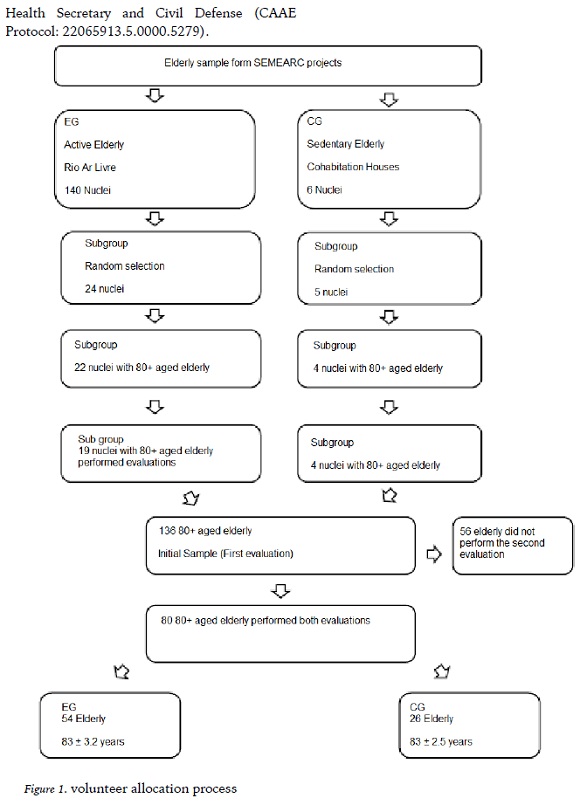
<body><![CDATA[<p>There are different definitions of functional autonomy. Nevertheless, it is    frequently described as the ability to execute predetermined domestic tasks,    or similar concepts, being strictly related to an individual’s capacity to control    its life. Therefore, it directly linked to quality of life (Farinatti, Assis,    &amp; Silva, 2008). Regular practice of physical exercises is way of reducing    the detrimental effects of aging in the body, as well as frailty installation,    positively influencing functional autonomy (Jankovic et al., 2015).</p>     <p>In the city of Rio de Janeiro, &ldquo;Rio Ar Livre &ldquo; (RAL) was created as a public    policy to address this particular issue, by the Municipal Secretary of Healthy    Aging, Resilience and Care (SEMEARC/RJ), mostly dedicated to the elderly population.    RAL consists in the offer of physical exercises under orientation of Physical    Education professionals, in gyms installed in public squares scattered around    the city neighborhoods (Special Secretariat for Healthy aging and quality of    life [SESQV], 2010). This facilitates both access and adhesion of the population    regarding the regular practice of physical exercise. Rio de Janeiro, at the    time of writing, had 143 of such units around the town (SESQV, 2010).</p>     <p>Due to its characteristics and objectives, RAL represents an important public    policy. However, owning to the fact that the gyms are composed of adapted gym    equipment, which can not be adjusted to control increment and training overload    (Silva, Brasil, Furtado, Costa, &amp; Farinatti, 2014), there is still doubt    about its impact, mainly around the maintenance or improvement in functional    autonomy of the elderly who perform these activities. The doubt is even bigger    when it is taken into account the attending public whose age is equal or greater    than 80 years, a population that lacks studies in this type of program.</p>     <p>In the RAL the female public were presented in greater quantity. This preponderance    of the female sex reflects what is observed in the global elderly population    (Küchemann, 2012). Küchemann (2012) describes a feminization process upon aging,    stating that as the older a population gets, the more feminine it becomes. Among    the factors which influence this phenomenon, it is important to mention the    greater continuous medical attention sought by women and less violent deaths,    which affect young men in 90% of the cases (Bandeira, Melo, &amp; Pinheiro,    2010).</p>     <p>If the Brazil the female elder population and life expectancy increase, it    is important to know this particular public’s needs and the impact of health    promotion public policies towards it. So, the aim of the present study was to    evaluate the effects of the training program performed in the RAL gyms on the    functional autonomy of octogenarian elderly women.</p>     <p><b>Method</b></p>     <p>The present study is experimental, majorly of quantitative nature, inferential    in depth (Appolinário, 2012).</p>     <p><b>Participants</b></p>     <p>The amount of participating RAL gyms was statistically determined, designed    to cover all of the city regions, to adequately represent the city’s situation.    Gym selection was random, being selected, of the 143 existent when data collection    was performed, 24 to be included in the study. However, only 22 of the 24 selected    gyms had 80 years or older members of feminine sex, and of those only in 19    the subjects attended to both evaluations.</p>     <p>Subjects from each RAL included were sampled by probabilistic method, to ensure    any individual could be part of the sample, thus assuring the investigated population’s    representativeness and the statistical test’s potency (Thomas, Nelson, &amp;    Silverman, 2012).</p>     ]]></body>
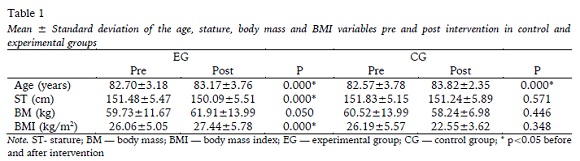
<body><![CDATA[<p>The inclusion in each of the experiment’s groups was also randomly made among    those who fulfilled the inclusion criteria. The experiment started with a total    of 96 subjects, however, 56 did not attend on the agreed date, abandoned the    project or preferred not to take part in the second evaluation. Therefore, the    research was carried out with 40 subjects, which composed the Experimental Group    (EG) and the Control Group (CG).</p>     <p>The experimental group (EG) was composed of 23 elderly women (82.57±3.78 years).    The inclusion criteria of this group was as following:</p>     <p>a) having age equal to or greater than 80 years; b) being registered in RAL;    c) having no restriction to perform the tests utilized in the research; d) having    signed the Informed Consent Terms, as determined by National Health Council    Resolution 466/12 (Ministério da Saúde, 2012).</p>     <p>The CG was composed of 17 elderly (82.88±2.23 years), all who attended to Rio    de Janeiro City Hall’s cohabitation houses. The following criteria was adopted    in this group: a) having age equal to or greater than 80 years; b) being enrolled    in cohabitation houses; c) having no restrictions to perform the tests utilized    in the research; d) having signed the Informed Consent Form.</p>     <p>Cohabitation houses were selected as the CG due to the ease of programming    visits to perform the evaluations and attain a reasonable amount of subjects.    Furthermore, it is also a governmental program with a similar public as the    RAL. All of the six houses existent in Rio de Janeiro were evaluated (Penha,    Tijuca, Gávea, Lagoa, São Conrado and Botafogo. <a href="#f1">Figure 1</a> illustrates    volunteer allocation process.</p>     <p>&nbsp;</p>     <p align="center"><a name="f1"></a><img src="/img/revistas/mot/v14n4/14n4a08f1.jpg"/></p>     
<p>&nbsp;</p>     <p>The period of intervention in the EG was 28 weeks and the Functional tests    were performed pre and post intervention in both groups.</p>     <p>The research project was previously approved by the Human Being Research Ethical    Committee, part of the Rio de Janeiro’s Municipal Health Secretary and Civil    Defense (CAAE Protocol: 22065913.5.0000.5279).</p>     ]]></body>
<body><![CDATA[<p><b>Measures and Procedures</b></p>     <p><i>Competition Training protocol</i></p>     <p>The training protocol consisted in a mixed circuit, interspersing aerobic and    muscular resistance exercises. The circuit utilized the walking and the ski    stimulator; resisted exercises were performed in machines: seated leg press,    vertical bench press, leg extension, shoulder press, leg flexion, lat pulldown    and seated row. The circuit was divided into seven stations: 1st - walking simulator;    2nd - muscular resistance exercises; 3rd - Ski stimulator; 4th - muscular resistance    exercises; 5th -walking stimulator; 6th - muscular resistance exercises; and    7th - Ski stimulator. In the 1st, 3rd, 5th and 7th stations the aerobic exercises    were performed for 5 minutes. In the 2nd, 4th and 6th stations were performed    one set of fifteen repetitions of each resistance exercises. The time rest between    stations and resistance exercises sets was 20 seconds and all exercises used    the body and machine weight as load.</p>     <p><i>Anthropometric measuring</i></p>     <p>Subject profiling was made according to the groups’ Body Mass Index (BMI) and    age. To determine the BMI, mass was measured with a Techline brand digital scale    (São Paulo, Brazil), and height with a Sanny stadiometer (São Paulo, Brazil),    using the standardization described by Gordon et al. (1988) and Martin et al.    (1988), respectively. To calculate the BMI, subject mass in kilograms (kg) was    divided by its height squared, in meters (m).</p>     <p><i>Functional Autonomy Evaluation</i></p>     <p>To evaluate functional autonomy, the Rikli and Jones (1999, 2002) test protocol    was used, aiming to analyze fitness status associated to mobility and self-government    in the program participants.</p>     <p>The Rikli and Jones (1999, 2002) protocol consists in easy-to-use battery of    test items that assess the functional fitness of older adults. The test describes    easy to understand and effective tests to measure aerobic fitness, muscular    strength and range of movement capacity of upper and lower limbs, agility and    dynamic balance (Rikli &amp; Jones, 1999, 2002), using minimal and inexpensive    equipment enabling the testing to occur in the same public plazas where the    program took place.</p>     <p>The tests were conduced in the morning by a properly certified and trained    team to ensure reliability of the gathered data. The tests were divided in stations    to speed the gathering process, each examiner being responsible for one station.    In each station one subject was evaluated at a time, and a five-minute rest    interval was given between the tests.</p>     <p>Stations were organized as follows: 1) measuring and weighing; 2) sitting and    standing (SS), elbow flexion (EF), sit and reach test (SRT), back reach (BR)    and Time Up and Go tests (TUG) ; 3) 2 minute Step test (2MST).</p>     ]]></body>
<body><![CDATA[<p>According to Rikli and Jones’s Senior Fitness Test, tests were performed in    the described manner:</p>     <p><i>Sitting and Standing</i></p>     <p>The subject started sitting in a chair without arm rests, with its back lying    on the chair and feet completely bound to the ground. At the examiner&rsquo;s command,    it was instructed to stand um and sit down again the maximum amount it could    in 30 s. Time was measured by a chronometer Vollo VL237 (São Paulo, Brazil).</p>     <p><i>Elbow Flexion</i></p>     <p>The subject started sitting in a chair without arm rests, with its back lying    on the chair and feet completely bound to the ground. At the examiner&rsquo;s command,    it was instructed to perform the maximum amount possible of elbow flexions in    30 s. Flexion started in neutral position and ended in supine position. In this    test a 2.27 kg dumbbell was used.</p>     <p><i>Sit and reach</i></p>     <p>The subject started sitting in a chair without arm rests, with one knee bent    with the ipsilateral foot totally bound to the ground, while the other leg was    extended and with the heel leaning on the floor and ankle flexed at approximately    90º. At the examiner&rsquo;s command, the subject took both hands superposed towards    the extended foot, without flexing the knee. In this test, a 45 cm ruler was    used to measure the distance from the foot to the hand. The test was performed    three times, being the best result computed.</p>     <p><i>Back reach</i></p>     <p>The subject started standing and at the examiner’s command placed one hand    over the scapular girdle, behind the neck towards the back, as low as possible,    and the with the other hand tried to meet the contralateral fingers from below.    In this test, a 45 cm ruler was used to measure the distance from the foot to    the hand.</p>     <p>The test was performed three times, being the best result computed.</p>     ]]></body>
<body><![CDATA[<p><i>Time Up and Go</i></p>     <p>The subject started sitting in a chair without arm rests, without leaning its    back on the chair, hands rested on the thighs and feet bound to the ground.    At the examiner’s command, it was instructed to get up, walk a distance of 2.44    m and return to the chair, this time sitting with the back leaning against it.    This process had to be done as fast as possible, without actual running. In    this evaluation, a plastic cone was used to mark the distance, and a Vollo VL237    chronometer (São Paulo, Brazil) was used to track time. The test was performed    three times, being the best result computed.</p>     <p><i>2 minute Step test</i></p>     <p>Beginning with the subject standing, the examiner marked the mean point of    the subject’s thigh (half distance between the kneecap apex and the iliac crest),    using a metallic and flexible measuring tape of the Sanny brand (São Paulo,    Brazil). Afterwards, this point was transferred to a Sanny stadiometer (São    Paulo, Brazil), which was kept next to the subject throughout the evaluation.    Starting from the standing position, at the examiner’s command, the subject    should march in place for two minutes. To be taken into account, the steps should    be performed with the knee reaching at least the point determined by the stadiometer.    Time was measured using a Vollo VL237 chronometer (São Paulo, Brazil).</p>     <p>The EG data were collected during the activity period in RALs, in the morning    shift, while in the cohabitation houses the tests were performed in usable indoor    locations. The testes were performed in the moments before and after intervention    with an interval of three months between them.</p>     <p><b>Statistical analysis</b></p>     <p>The mean ± standard deviation was used to characterize the variables in terms    of central tendency and dispersion. To perform the inferential analysis, the    normality and homogeneity were assessed with <i>Shapiro-Wilk </i>and <i>Levene    </i>respectively. After parametric statistic was assured, a <i>t-test </i>for    independent measures was used to detect possible differences in the initial    values between groups. To assess possible disagreements among the analysis moments    and between the different groups, an ANOVA for repeated measures with the 2    models x 2 groups model was used. When a variable registered significant changes    in the initial values, an ANCOVA was used between groups, with the initial values    as covariables. The partial eta squared was used to estimate the second effect    (Cohen, 1998). The adopted significance level was 5%.</p>     <p><b>Results</b></p>     <p>The To the anthropometric variables the ANOVA indicated a significant moment    effect for the stature (F(1.38)=7.815; p=0.008; &#951;p =0.171) and BMI (F(1.38)=4.204;    p=0.047; &#951;p =0.100), a moment x group interaction for the age (F(1.38)=4.877;    p=0.033; &#951;p =0.114), stature (F(1.38)=13.471; p=0.001; &#951;p =0.262)    and BMI (F(1.38)=12.156; p=0.001; &#951;p =0.242) variables.</p>     <p></p>     ]]></body>
<body><![CDATA[<p>No group effect was noted in these variables.</p>     <p>When each group is individually analyzed (see <a href="#t1">table 1</a>), there    is a significant increase in the BMI (F(1.22)=17.501; p&lt;0.0001; &#951;p =0.443),    stature, by contrast, was significantly reduced (F(1.22)=24.513; p&lt;0.0001;    &#951;p =0.527). In the CG, only age appeared to increase significantly (F(1.22)=81.920;    p&lt;0.0001; ?p2=0.837).</p>     <p>&nbsp;</p>     <p align="center"><a name="t1"></a><img src="/img/revistas/mot/v14n4/14n4a08t1.jpg"/></p>     
<p>&nbsp;</p>     <p align="center"><a name="t2"></a><img src="/img/revistas/mot/v14n4/14n4a08t2.jpg"/></p>     
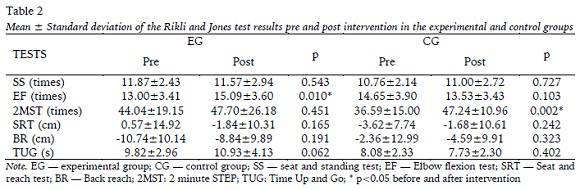
<p>&nbsp;</p>     <p> To the functional variables the ANOVA indicated a significant moment effect    for the 2MST (F(1.38)=5.505; p=0.024; &#951;p =0.127) and in BR; &#951;p =0.296).    A moment x group interaction was also perceived in the EF (F(1.38)=9.692; p=0.004;    &#951;p =0.203). None of the analyzed variables showed a group effect.</p>     <p> When observed individually, there was significant increase in EF in the EG    (F(1.22)=7.876; p=0.010; &#951;p =0.264). In the CG there was a significant    increase in the 2MST (F(1.22)=13.200; p=0.002; &#951;p =0.452).</p>     <p><b>Discussion</b></p>     ]]></body>
<body><![CDATA[<p>The present study aimed to evaluate the effects of training program practiced    in the RAL- RJ program on the functional autonomy of octogenarian elderly women,    as it is a gradually declining variable occurring with aging, thus negatively    impacting the elderly population wellbeing (Martinho et al., 2013; Rubbieri,    2013).</p>     <p>The sample presented was homogeneous regarding age and BMI in the CG and EG.    It should be noted that the average BMI of both groups is in the normal range,    staying below the obesity level (Pan-Americana Organization [OPAS], 2001). Changes    in BMI reflect age related changes in body composition; nevertheless, the regular    practice of physical activities throughout life may contribute to the maintenance    of ideal patterns (OPAS, 2001; Kura, Ribeiro, Niquetti, &amp; Tourinho Filho,    2004; Koochek, Johansson, Kocturk, Sundquist, &amp; Sundquist, 2008). Although    the CG present the same changes, this may indicate that the training program    in question could be contribute to the maintenance of corporal mass among the    assessed subjects. High values of this index may imply when correlated with    the risk of death due to cardiovascular disease and diabetes, an increased risk    of premature death (Sugimoto et al., 2016; Ko&#322;tuniuk, &amp; Rosi&#324;czuk,    2016).</p>     <p>Comparing our results with the Rikli and Jones test scores, it is clear that    the values of the functional strength test in the lower limbs (9 to 14) and    upper limbs (10 a 16) of both groups are within the expected range for their    age. The same is not true for the lower limb (-2.0 to +3.0) and upper limb mobility    (-5.5 to +0.0), TUG (8.7 to 5.7) and 2MST (60 to 91), whose values were below    the appropriate levels for both groups. It was expected that the EG sample would    have better results, closer to the adequate values for the age range, thus showing    improved functional autonomy due to physical activity. This was demonstrated    in several studies, including Zago and Gobbi (2003) and Borges and Moreira (2009),    among others.</p>     <p>When analyzing the results before and after intervention in the EG, minor improvements    in the upper limbs&rsquo; functional strength and mobility tests are notes, while    in the CG there is a slim improvement in the lower limbs&rsquo; functional strength,    2MST and lower limb mobility tests.</p>     <p>A significant improvement across every test result was expected in the EG.    However, some factors may have interfered in this result. Throughout data collection,    which took eight months, there was no attendance control among the subjects,    and frequency is fundamental to achieve results in a training program. According    to American College of Sports Medicine (ACSM, 2009) and Brentano and Pinto (2001),    to occur chronic effects due to the accumulation of the acute effects of training    program, it is necessary to perform physical exercise regularly.</p>     <p>Another factor which could have influenced the present results is the fact    that the available gym equipment present in the program&rsquo;s venues does not allow    for load increment, which can limit the subject&rsquo;s progression, given that to    promote new adaptive changes the training load should progressively increase    in order to achieve gains (Carvalho et al., 2012).</p>     <p>Nevertheless, the results without significant difference between the tests    of the EG are still relevant because they indicate maintenance of variables    related to physical aptitude levels, such as strength, mobility, dynamic balance    and <u> </u>agility. This result is important to outbalance the natural loss    of physical aptitude secondary to morphological, functional and biochemical    changes that affect the body with aging (Hao et al., 2015; Carvalho et al.,    2012, ACSM, 2009) and directly impair functional autonomy and wellbeing (Martinho    et al., 2013). Regarding octogenarian individuals, our results are even more    significant, because the decay is greater with age (Hao et al., 2015), demonstrating    that the practice of exercise in the RALs can be a good strategy in the public    policies toward functional autonomy and quality of life in this population.</p>     <p>The American College of Sports Medicine (ACSM, 2009), as well as research form    Gill et al. (2016) state that the more active a person is, the least physical    limitations it will have. Furthermore, studies like that of Borges and Moreira    (2009) affirm that sedentary individuals have inferior autonomy to perform daily    activities, when compared to physically active individuals. This brings us to    believe that without physical exercise interference there could have been a    greater decline in the results.</p>     <p>Despite this scenario, the CG behaved very similarly to the EG. To that extent,    it is plausible to assume that the activities performed in the cohabitation    houses, as well as any other extra activities, had a positive impact in the    CG. The lack of control of such activities as well as the attendance control    among subjects of EG configures a limitation in this study.</p>     <p><b>Conclusion</b></p>     ]]></body>
<body><![CDATA[<p>The presented results allow us to conclude that the training program developed    in Rio de Janeiro&rsquo;s RALs only promote the functional strength of the upper limbs    and maintain the functional autonomy of octogenarian elders women’s.</p>     <p>In face of the limitations exposed in the present research, it is suggested    that more studies are developed to confirm if the methodology utilized by the    program, as well as the use of equipment without load control, are really efficient    in the physical training of the elderly women.</p>     <p>&nbsp;</p>     <p><b>REFERENCES</b></p>     <p></p> American College of Sports Medicine (ACSM). (2009). Position Stand. Exercise and  phisycal activity for older adults. <i>Med Sci Sports Exerc</i>, 41(7), 1510-  1530. DOI: <a href="https://dx.doi.org/10.1249/MSS.0b013e3181a0c95c" target="_blank">10.1249/MSS.0b013e3181a0c95c</a>.     <p>Appolinário, F. (2012). As dimensões da pesquisa. In F. Appolinário, <i>Metodologia    da ciência: filosofia e prática da pesquisa </i>(2ª ed. pp. 59-71). São Paulo,    SP: Cengage Learning.</p>     <p>Bandeira, L. M., Melo, H. P, &amp; Pinheiro, L. S. (2010). Mulheres em dados:    o que informa a Pnad/IBGE, 2008. In Brasil, Presidência da República, Secretaria    de políticas para as mulheres (Eds). <i>Observatório Brasil da Igualdade de    Gênero </i>(1ª ed., pp 107- 119). Brasília, DF: Secretaria de Políticas Públicas    para as Mulheres.</p>     <!-- ref --><p>Borges, M. R. D., &amp; Moreira, A. K. (2009). The Influences of the physical    activity practice on aging: A comparative study on the autonomy level for performance    on DLAs and IADLs between the physically active and sedentary elderly. <i>Motriz</i>,    15(3), 562-573.    &nbsp;&nbsp;&nbsp;&nbsp;&nbsp;&nbsp;&nbsp;&nbsp;[&#160;<a href="javascript:void(0);" onclick="javascript: window.open('/scielo.php?script=sci_nlinks&ref=385441&pid=S1646-107X201800030000800004&lng=','','width=640,height=500,resizable=yes,scrollbars=1,menubar=yes,');">Links</a>&#160;]<!-- end-ref --></p>     <!-- ref --><p><i> </i>Brentano, M. A., &amp; Pinto, R. S. (2001). Neural adaptations to strengthttraining.    <i>Revista Brasileira de Atividade Física e Saúde</i>, 6(3), 65-77. DOI: <a href="https://dx.doi.org/10.12820/rbafs.v.6n3p65-77" target="_blank">10.12820/rbafs.v.6n3p65-77</a>.    &nbsp;&nbsp;&nbsp;&nbsp;&nbsp;&nbsp;&nbsp;&nbsp;[&#160;<a href="javascript:void(0);" onclick="javascript: window.open('/scielo.php?script=sci_nlinks&ref=385443&pid=S1646-107X201800030000800005&lng=','','width=640,height=500,resizable=yes,scrollbars=1,menubar=yes,');">Links</a>&#160;]<!-- end-ref --></p>     <!-- ref --><p>Carvalho, T. B., Yamada, A. K., Crepaldi, M. D, Souza, J. C, Prestes, J., &amp;    Verlengia, R. (2012). Eccentric resistance training in elderly: review on the    acute and chronic physiological adaptations. <i>Revista Brasileira de Ciências    e Movimento</i>, 20(4): 112-121.    &nbsp;&nbsp;&nbsp;&nbsp;&nbsp;&nbsp;&nbsp;&nbsp;[&#160;<a href="javascript:void(0);" onclick="javascript: window.open('/scielo.php?script=sci_nlinks&ref=385445&pid=S1646-107X201800030000800006&lng=','','width=640,height=500,resizable=yes,scrollbars=1,menubar=yes,');">Links</a>&#160;]<!-- end-ref --></p>     <!-- ref --><p>Cohen, J. (1988). <i>Statistical power analysis for the behavioral sciences    </i>(2ª ed). New Jersey: Lawrence Erlbaum Associates.    &nbsp;&nbsp;&nbsp;&nbsp;&nbsp;&nbsp;&nbsp;&nbsp;[&#160;<a href="javascript:void(0);" onclick="javascript: window.open('/scielo.php?script=sci_nlinks&ref=385447&pid=S1646-107X201800030000800007&lng=','','width=640,height=500,resizable=yes,scrollbars=1,menubar=yes,');">Links</a>&#160;]<!-- end-ref --></p>     <!-- ref --><p>Farinatti, P. T. V., Assis, B. F. C. B., &amp; Silva, N. S. L. (2008). Autonomy    of action among elderly women on physical activity programs in Brazil and Belgium:    a comparative study. <i>Revista Brasileira de Cineantropometria e Desempenho    Humano</i>, 10(2), 107-114.    &nbsp;&nbsp;&nbsp;&nbsp;&nbsp;&nbsp;&nbsp;&nbsp;[&#160;<a href="javascript:void(0);" onclick="javascript: window.open('/scielo.php?script=sci_nlinks&ref=385449&pid=S1646-107X201800030000800008&lng=','','width=640,height=500,resizable=yes,scrollbars=1,menubar=yes,');">Links</a>&#160;]<!-- end-ref --></p>     <p>Gill, T. M., Pahor, M., Guralnik, J. M., Mcdermott, M. M., King, A. C., Buford,    T. W., &hellip; Miller, M. E. (2016). Life Study Investigators. Effect of structured    physical activity on prevention of serious fall injuries in adults aged 70-89:    randomized clinical trial (LIFE Study). <i>British</i><i> </i><i>Medical Journal</i>,    352, i245. DOI: <a href="https://dx.doi.org/10.1136/bmj.i245" target="_blank">10.1136/bmj.i245</a>.</p>     <!-- ref --><p>Gordon, C., Chunlea, W. C, &amp; Roche, A. F. (1988). <i>Stature, recumbent    length, and weight</i>. Champaign: Human Kinetics.    &nbsp;&nbsp;&nbsp;&nbsp;&nbsp;&nbsp;&nbsp;&nbsp;[&#160;<a href="javascript:void(0);" onclick="javascript: window.open('/scielo.php?script=sci_nlinks&ref=385452&pid=S1646-107X201800030000800010&lng=','','width=640,height=500,resizable=yes,scrollbars=1,menubar=yes,');">Links</a>&#160;]<!-- end-ref --></p>     ]]></body>
<body><![CDATA[<!-- ref --><p>Hao, Q., Yang, M., Luo, L., Hai, S., Ding, X., &amp; Dong, B. (2015). The association    of falls and various physical activities in Chinese nonagenarians/centenarians.    <i>Archives of Gerontology and Geriatrics</i>, 61(1), 21-26. DOI: <a href="https://dx.doi.org/10.1016/j.archger.2015.04.008" target="_blank">10.1016/j.archger.2015.04.008</a>.    &nbsp;&nbsp;&nbsp;&nbsp;&nbsp;&nbsp;&nbsp;&nbsp;[&#160;<a href="javascript:void(0);" onclick="javascript: window.open('/scielo.php?script=sci_nlinks&ref=385454&pid=S1646-107X201800030000800011&lng=','','width=640,height=500,resizable=yes,scrollbars=1,menubar=yes,');">Links</a>&#160;]<!-- end-ref --></p>     <!-- ref --><p>Jankovic, N., Geelen, A., Streppel, M. T, Groot, L. C. P. G. M., Jong, J. C.    K., Orfanos P., ... Feskens, E. J. (2015). WHO guidelines for a healthy diet    and mortality from cardiovascular disease in European and american elderly:    the chances project. <i>American Journal of Clinical Nutrition, </i>102(4),    745-756. DOI: <a href="https://dx.doi.org/10.3945/ajcn.114.095117" target="_blank">10.3945/ajcn.114.095117</a>.    &nbsp;&nbsp;&nbsp;&nbsp;&nbsp;&nbsp;&nbsp;&nbsp;[&#160;<a href="javascript:void(0);" onclick="javascript: window.open('/scielo.php?script=sci_nlinks&ref=385456&pid=S1646-107X201800030000800012&lng=','','width=640,height=500,resizable=yes,scrollbars=1,menubar=yes,');">Links</a>&#160;]<!-- end-ref --></p>     <p>Ko&#322;tuniuk, A., &amp; Rosi&#324;czuk, J. (2016). The prevalence of risk    factors for cardiovascular diseases among Polish surgical patients over 65 years<i>.    Clinical Interventions in Aging</i>, 13(11), 631-639. DOI: <a href="https://dx.doi.org/10.2147/CIA.S105201" target="_blank">10.2147/CIA.S105201</a>.</p>     <!-- ref --><p>Koochek, A., Johansson, S. E., Kocturk, T. O., Sundquist, J., &amp; Sundquist,    K. (2008). Physical activity and body mass index in elderly Iranians in Sweden:    a population-based study. <i>European Journal of Clinical Nutrition</i>, 62(11),    1326-1332. DOI: <a href="https://dx.doi.org/10.1038/sj.ejcn.1602851" target="_blank">10.1038/sj.ejcn.1602851</a>.    &nbsp;&nbsp;&nbsp;&nbsp;&nbsp;&nbsp;&nbsp;&nbsp;[&#160;<a href="javascript:void(0);" onclick="javascript: window.open('/scielo.php?script=sci_nlinks&ref=385459&pid=S1646-107X201800030000800014&lng=','','width=640,height=500,resizable=yes,scrollbars=1,menubar=yes,');">Links</a>&#160;]<!-- end-ref --></p>     <!-- ref --><p>Küchemann, B. A. (2012) Envelhecimento populacional, cuidado e cidadania: velhos    dilemas e novos desafios. <i>Sociedade e Estado</i>, 27(1): 165-180. DOI: <a href="https://dx.doi.org/10.1590/S0102-69922012000100010" target="_blank">10.1590/S0102-69922012000100010</a>.    &nbsp;&nbsp;&nbsp;&nbsp;&nbsp;&nbsp;&nbsp;&nbsp;[&#160;<a href="javascript:void(0);" onclick="javascript: window.open('/scielo.php?script=sci_nlinks&ref=385461&pid=S1646-107X201800030000800015&lng=','','width=640,height=500,resizable=yes,scrollbars=1,menubar=yes,');">Links</a>&#160;]<!-- end-ref --></p>     <!-- ref --><p>Kura, G. G., Ribeiro, L. S. P., Niquetti, R., &amp; Tourinho Filho H. (2004).    Physical activity level, ICM and indexes of static muscular strength between    hydro gymnastic and elderly gymnastic practitioner. <i>Revista Brasileira de    Ciência e</i><i>Envelhecimento Humano</i>, 1(2), 30-40. DOI: <a href="https://dx.doi.org/10.5335/rbceh.2012.12" target="_blank">10.5335/rbceh.2012.12</a>.    &nbsp;&nbsp;&nbsp;&nbsp;&nbsp;&nbsp;&nbsp;&nbsp;[&#160;<a href="javascript:void(0);" onclick="javascript: window.open('/scielo.php?script=sci_nlinks&ref=385463&pid=S1646-107X201800030000800016&lng=','','width=640,height=500,resizable=yes,scrollbars=1,menubar=yes,');">Links</a>&#160;]<!-- end-ref --></p>     <!-- ref --><p>Martin, A. D., Carter, J. E. L., Hendy, K. C., &amp; Malina, R. M. (1988).    <i>Segment lengths</i>. Champaign: Human Kinetics.    &nbsp;&nbsp;&nbsp;&nbsp;&nbsp;&nbsp;&nbsp;&nbsp;[&#160;<a href="javascript:void(0);" onclick="javascript: window.open('/scielo.php?script=sci_nlinks&ref=385465&pid=S1646-107X201800030000800017&lng=','','width=640,height=500,resizable=yes,scrollbars=1,menubar=yes,');">Links</a>&#160;]<!-- end-ref --></p>     <!-- ref --><p>Martinho, K. O, Dantas, E. H, Longo, G. Z, Ribeiro, A. Q, Pereira, E. T, Franco,    F. S, ... Tinôco, A. L. (2013). Comparison of functional autonomy with associated    sociodemographic factors, lifestyle, chronic diseases (CD) and neuropsychiatric    factors in elderly patients with or without the metabolic syndrome (MS). <i>Archives    of Gerontology and Geriatrics</i>, 57(2), 151-155. DOI: <a href="https://dx.doi.org/10.1016/j.archger.2013.04.005" target="_blank">10.1016/j.archger.2013.04.005</a>.    &nbsp;&nbsp;&nbsp;&nbsp;&nbsp;&nbsp;&nbsp;&nbsp;[&#160;<a href="javascript:void(0);" onclick="javascript: window.open('/scielo.php?script=sci_nlinks&ref=385467&pid=S1646-107X201800030000800018&lng=','','width=640,height=500,resizable=yes,scrollbars=1,menubar=yes,');">Links</a>&#160;]<!-- end-ref --></p>     <!-- ref --><p>Ministério da Saúde. (2006). <i>Portaria nº 2.528 de 19 de outubro de 2006.    Aprova a Política Nacional de Saúde da Pessoa Idosa. </i>Acessado em: 01/06/2018.    Disponível em: <a href="http://bvsms.saude.gov.br/bvs/saudelegis/gm/2006/prt2528_19_10_2006.html" target="_blank">http://bvsms.saude.gov.br/bvs/saudelegis/gm/2006/prt2528_19_10_2006.html</a>&nbsp;&nbsp;&nbsp;&nbsp;&nbsp;&nbsp;&nbsp;&nbsp;[&#160;<a href="javascript:void(0);" onclick="javascript: window.open('/scielo.php?script=sci_nlinks&ref=385469&pid=S1646-107X201800030000800019&lng=','','width=640,height=500,resizable=yes,scrollbars=1,menubar=yes,');">Links</a>&#160;]<!-- end-ref --><!-- ref --><p>Ministério da Saúde. (2012). <i>Resolução n° 466, de 12 de dezembro de 2012</i>.    <i>Aprova normas regulamentadoras de Pesquisas envolvendo seres humanos</i>.    Acessado em: 01/06/2018. Disponível em: <a href="http://bvsms.saude.gov.br/bvs/saudelegis/cns/ 2013/res0466_12_12_2012.html" target="_blank">http://bvsms.saude.gov.br/bvs/saudelegis/cns/    2013/res0466_12_12_2012.html</a>.    &nbsp;&nbsp;&nbsp;&nbsp;&nbsp;&nbsp;&nbsp;&nbsp;[&#160;<a href="javascript:void(0);" onclick="javascript: window.open('/scielo.php?script=sci_nlinks&ref=385470&pid=S1646-107X201800030000800020&lng=','','width=640,height=500,resizable=yes,scrollbars=1,menubar=yes,');">Links</a>&#160;]<!-- end-ref --></p>     <p>Organização Pan-Americana (OPAS). (2001)<i>. XXXVI Reunión del Comité Asesor    de Investigaciones em Salud</i> - Encuestra Multicêntrica - Salud Bienestar    y Envejecimiento (SABE) en América Latina e el Caribe - Informe preliminar.    Acessado em: 10/03/2002. Disponível em:    <a href="http://www.opas.org/program/sabe.htm" target="_blank">http://www.opas.org/program/sabe.htm</a>.</p>     <p>Ribeiro, G. S. Problemas de saúde da população brasileira e seus determinantes.    (2014). In J. S. Paim &amp; N. Almeida-Filho (Eds), <i>Saúde Coletiva: Teoria    e Prática</i>. (1ª ed. pp. 97-119) Rio de Janeiro, RJ: Medbook.</p>     ]]></body>
<body><![CDATA[<!-- ref --><p>Rikli, E. R. &amp; Jones, C. J. (1999). Development and Validation of a Functional    fitness test for Community Residing Older Adults. <i>Journal of Aging and Physical    Activity</i>, 7(2), 129-161.    &nbsp;&nbsp;&nbsp;&nbsp;&nbsp;&nbsp;&nbsp;&nbsp;[&#160;<a href="javascript:void(0);" onclick="javascript: window.open('/scielo.php?script=sci_nlinks&ref=385474&pid=S1646-107X201800030000800023&lng=','','width=640,height=500,resizable=yes,scrollbars=1,menubar=yes,');">Links</a>&#160;]<!-- end-ref --></p>     <!-- ref --><p>Rikli, E. R., &amp; Jones, C. J. (2002). Measuring functional fitness of older    adults. <i>Journal of Aging and Physical Activity</i>, 24-30.    &nbsp;&nbsp;&nbsp;&nbsp;&nbsp;&nbsp;&nbsp;&nbsp;[&#160;<a href="javascript:void(0);" onclick="javascript: window.open('/scielo.php?script=sci_nlinks&ref=385476&pid=S1646-107X201800030000800024&lng=','','width=640,height=500,resizable=yes,scrollbars=1,menubar=yes,');">Links</a>&#160;]<!-- end-ref --></p>     <!-- ref --><p>Rubbieri, G. (2013). Comorbidity, disability, frailty. <i>Giornale Italiano    Di Cardiologia</i>, 14(3 Suppl 1): 6-11. DOI: <a href="https://dx.doi.org/10.1714/1261.13933" target="_blank">10.1714/1261.13933</a>.    &nbsp;&nbsp;&nbsp;&nbsp;&nbsp;&nbsp;&nbsp;&nbsp;[&#160;<a href="javascript:void(0);" onclick="javascript: window.open('/scielo.php?script=sci_nlinks&ref=385478&pid=S1646-107X201800030000800025&lng=','','width=640,height=500,resizable=yes,scrollbars=1,menubar=yes,');">Links</a>&#160;]<!-- end-ref --></p>     <!-- ref --><p>Secretaria Especial de Envelhecimento Saudável e Qualidade de Vida - SESQV.    (2010) <i>Rio ao Ar Livre</i>. Acessado em: 08/12/2015. Disponível em: <a href="http://www.rio.rj.gov.br/web/sesqv/exibeconteudo?id=126401" target="_blank">http://www.rio.rj.gov.br/web/sesqv/exibeconteudo?id=126401</a>.    &nbsp;&nbsp;&nbsp;&nbsp;&nbsp;&nbsp;&nbsp;&nbsp;[&#160;<a href="javascript:void(0);" onclick="javascript: window.open('/scielo.php?script=sci_nlinks&ref=385480&pid=S1646-107X201800030000800026&lng=','','width=640,height=500,resizable=yes,scrollbars=1,menubar=yes,');">Links</a>&#160;]<!-- end-ref --></p>     <!-- ref --><p>Silva, N. L., Brasil, C., Furtado, H., Costa, J., Farinatti, P. (2014). Exercise    and aging: health benefits and characteristics of the intervention programs    at LABSAU/IEFD/UERJ. <i>Revista HUPE</i>, 13(2), 75- 85. DOI: <a href="https://dx.doi.org/10.12957/rhupe.2014.10129" target="_blank">10.12957/rhupe.2014.10129</a>.    &nbsp;&nbsp;&nbsp;&nbsp;&nbsp;&nbsp;&nbsp;&nbsp;[&#160;<a href="javascript:void(0);" onclick="javascript: window.open('/scielo.php?script=sci_nlinks&ref=385482&pid=S1646-107X201800030000800027&lng=','','width=640,height=500,resizable=yes,scrollbars=1,menubar=yes,');">Links</a>&#160;]<!-- end-ref --></p>     ]]></body>
<body><![CDATA[<!-- ref --><p>Sugimoto, T., Tsutsumimoto, K., Nakakubo, S., Murata, S., Doi, T., &amp; Ono,    R. (2016). Abdominal obesity mediates the association between a low physical    activity and a decline in gait speed in community-dwelling elderly people: A    cross- sectional study. <i>Japanese Journal of Geriatric</i>, 53(1), 54-61.    DOI: <a href="https://dx.doi.org/10.3143/geriatrics.53.54" target="_blank">10.3143/geriatrics.53.54</a>.    &nbsp;&nbsp;&nbsp;&nbsp;&nbsp;&nbsp;&nbsp;&nbsp;[&#160;<a href="javascript:void(0);" onclick="javascript: window.open('/scielo.php?script=sci_nlinks&ref=385484&pid=S1646-107X201800030000800028&lng=','','width=640,height=500,resizable=yes,scrollbars=1,menubar=yes,');">Links</a>&#160;]<!-- end-ref --></p>     <!-- ref --><p>Thomas, J. R., Nelson, J. K., &amp; Silverman, S. J. (2012). <i>Métodos de    pesquisa em atividade física </i>(6ª ed.). Porto Alegre, RS: Artmed.    &nbsp;&nbsp;&nbsp;&nbsp;&nbsp;&nbsp;&nbsp;&nbsp;[&#160;<a href="javascript:void(0);" onclick="javascript: window.open('/scielo.php?script=sci_nlinks&ref=385486&pid=S1646-107X201800030000800029&lng=','','width=640,height=500,resizable=yes,scrollbars=1,menubar=yes,');">Links</a>&#160;]<!-- end-ref --></p>     <!-- ref --><p>World Health Organization (WHO). (2015). <i>World report on ageing and health</i>.    Acessado em: 01/06/2018. Disponível em: <a href="http://www.who.int/ageing/publications/world-report-2015/en/" target="_blank">http://www.who.int/ageing/publications/world-report-2015/en/</a>.    &nbsp;&nbsp;&nbsp;&nbsp;&nbsp;&nbsp;&nbsp;&nbsp;[&#160;<a href="javascript:void(0);" onclick="javascript: window.open('/scielo.php?script=sci_nlinks&ref=385488&pid=S1646-107X201800030000800030&lng=','','width=640,height=500,resizable=yes,scrollbars=1,menubar=yes,');">Links</a>&#160;]<!-- end-ref --></p>     <!-- ref --><p>Zago, A. S., &amp; Gobbi, S. (2003). Normative values of functional fitness    in 60-to-70 year-old women. <i>Revista Brasileira de Ciência e Movimento, </i>11(2),    77- 86.    &nbsp;&nbsp;&nbsp;&nbsp;&nbsp;&nbsp;&nbsp;&nbsp;[&#160;<a href="javascript:void(0);" onclick="javascript: window.open('/scielo.php?script=sci_nlinks&ref=385490&pid=S1646-107X201800030000800031&lng=','','width=640,height=500,resizable=yes,scrollbars=1,menubar=yes,');">Links</a>&#160;]<!-- end-ref --></p>     <p>&nbsp;</p>     <p>Acknowledgments: Nothing to declare.&nbsp; </p>     ]]></body>
<body><![CDATA[<p>Conflict of interests: Nothing to declare.&nbsp;      <p>Funding: Nothing to declare.      <p>&nbsp;</p>     <p>Manuscript received at August 4th 2018; Accepted at December 12th 2018</p>     <p>&nbsp;</p>     <p><a href="#top*"><sup>[*]</sup></a><a name="*"></a>Corresponding author: <a href="mailto:nadiaslimas@gmail.com">nadiaslimas@gmail.com</a></p>      ]]></body><back>
<ref-list>
<ref id="B1">
<nlm-citation citation-type="journal">
<collab>American College of Sports Medicine</collab>
<article-title xml:lang="en"><![CDATA[Position Stand]]></article-title>
<source><![CDATA[Exercise and phisycal activity for older adults. Med Sci Sports Exerc]]></source>
<year>2009</year>
<volume>41</volume>
<numero>7</numero>
<issue>7</issue>
<page-range>1510- 1530</page-range></nlm-citation>
</ref>
<ref id="B2">
<nlm-citation citation-type="book">
<person-group person-group-type="author">
<name>
<surname><![CDATA[Appolinário]]></surname>
<given-names><![CDATA[F.]]></given-names>
</name>
</person-group>
<article-title xml:lang="pt"><![CDATA[As dimensões da pesquisa]]></article-title>
<person-group person-group-type="editor">
<name>
<surname><![CDATA[Appolinário]]></surname>
<given-names><![CDATA[F.]]></given-names>
</name>
</person-group>
<source><![CDATA[Metodologia da ciência: filosofia e prática da pesquisa]]></source>
<year>2012</year>
<edition>2</edition>
<page-range>59-71</page-range><publisher-loc><![CDATA[São Paulo ]]></publisher-loc>
<publisher-name><![CDATA[Cengage Learning]]></publisher-name>
</nlm-citation>
</ref>
<ref id="B3">
<nlm-citation citation-type="book">
<person-group person-group-type="author">
<name>
<surname><![CDATA[Bandeira]]></surname>
<given-names><![CDATA[L. M.]]></given-names>
</name>
<name>
<surname><![CDATA[Melo]]></surname>
<given-names><![CDATA[H. P.]]></given-names>
</name>
<name>
<surname><![CDATA[Pinheiro]]></surname>
<given-names><![CDATA[L. S.]]></given-names>
</name>
</person-group>
<article-title xml:lang="pt"><![CDATA[Mulheres em dados: o que informa a Pnad/IBGE, 2008]]></article-title>
<collab>Brasil, Presidência da República^dSecretaria de políticas para as mulheres</collab>
<source><![CDATA[Observatório Brasil da Igualdade de Gênero]]></source>
<year>2010</year>
<edition>1</edition>
<page-range>107- 119</page-range><publisher-loc><![CDATA[Brasília ]]></publisher-loc>
<publisher-name><![CDATA[Secretaria de Políticas Públicas para as Mulheres]]></publisher-name>
</nlm-citation>
</ref>
<ref id="B4">
<nlm-citation citation-type="journal">
<person-group person-group-type="author">
<name>
<surname><![CDATA[Borges]]></surname>
<given-names><![CDATA[M. R. D.]]></given-names>
</name>
<name>
<surname><![CDATA[Moreira]]></surname>
<given-names><![CDATA[A. K.]]></given-names>
</name>
</person-group>
<article-title xml:lang="en"><![CDATA[The Influences of the physical activity practice on aging: A comparative study on the autonomy level for performance on DLAs and IADLs between the physically active and sedentary elderly]]></article-title>
<source><![CDATA[Motriz]]></source>
<year>2009</year>
<volume>15</volume>
<numero>3</numero>
<issue>3</issue>
<page-range>562-573</page-range></nlm-citation>
</ref>
<ref id="B5">
<nlm-citation citation-type="journal">
<person-group person-group-type="author">
<name>
<surname><![CDATA[Brentano]]></surname>
<given-names><![CDATA[M. A.]]></given-names>
</name>
<name>
<surname><![CDATA[Pinto]]></surname>
<given-names><![CDATA[R. S.]]></given-names>
</name>
</person-group>
<article-title xml:lang="en"><![CDATA[Neural adaptations to strengthttraining]]></article-title>
<source><![CDATA[Revista Brasileira de Atividade Física e Saúde]]></source>
<year>2001</year>
<volume>6</volume>
<numero>3</numero>
<issue>3</issue>
<page-range>65-77</page-range></nlm-citation>
</ref>
<ref id="B6">
<nlm-citation citation-type="journal">
<person-group person-group-type="author">
<name>
<surname><![CDATA[Carvalho]]></surname>
<given-names><![CDATA[T. B.]]></given-names>
</name>
<name>
<surname><![CDATA[Yamada]]></surname>
<given-names><![CDATA[A. K.]]></given-names>
</name>
<name>
<surname><![CDATA[Crepaldi]]></surname>
<given-names><![CDATA[M. D]]></given-names>
</name>
<name>
<surname><![CDATA[Souza]]></surname>
<given-names><![CDATA[J. C]]></given-names>
</name>
<name>
<surname><![CDATA[Prestes]]></surname>
<given-names><![CDATA[J.]]></given-names>
</name>
<name>
<surname><![CDATA[Verlengia]]></surname>
<given-names><![CDATA[R.]]></given-names>
</name>
</person-group>
<article-title xml:lang="en"><![CDATA[Eccentric resistance training in elderly: review on the acute and chronic physiological adaptations]]></article-title>
<source><![CDATA[Revista Brasileira de Ciências e Movimento]]></source>
<year>2012</year>
<volume>20</volume>
<numero>4</numero>
<issue>4</issue>
<page-range>112-121</page-range></nlm-citation>
</ref>
<ref id="B7">
<nlm-citation citation-type="book">
<person-group person-group-type="author">
<name>
<surname><![CDATA[Cohen]]></surname>
<given-names><![CDATA[J.]]></given-names>
</name>
</person-group>
<source><![CDATA[Statistical power analysis for the behavioral sciences]]></source>
<year>1988</year>
<edition>2</edition>
<publisher-loc><![CDATA[New Jersey ]]></publisher-loc>
<publisher-name><![CDATA[Lawrence Erlbaum Associates]]></publisher-name>
</nlm-citation>
</ref>
<ref id="B8">
<nlm-citation citation-type="journal">
<person-group person-group-type="author">
<name>
<surname><![CDATA[Farinatti]]></surname>
<given-names><![CDATA[P. T. V.]]></given-names>
</name>
<name>
<surname><![CDATA[Assis]]></surname>
<given-names><![CDATA[B. F. C. B.]]></given-names>
</name>
<name>
<surname><![CDATA[Silva]]></surname>
<given-names><![CDATA[N. S. L.]]></given-names>
</name>
</person-group>
<article-title xml:lang="en"><![CDATA[Autonomy of action among elderly women on physical activity programs in Brazil and Belgium: a comparative study]]></article-title>
<source><![CDATA[Revista Brasileira de Cineantropometria e Desempenho Humano]]></source>
<year>2008</year>
<volume>10</volume>
<numero>2</numero>
<issue>2</issue>
<page-range>107-114</page-range></nlm-citation>
</ref>
<ref id="B9">
<nlm-citation citation-type="journal">
<person-group person-group-type="author">
<name>
<surname><![CDATA[Gill]]></surname>
<given-names><![CDATA[T. M.]]></given-names>
</name>
<name>
<surname><![CDATA[Pahor]]></surname>
<given-names><![CDATA[M.]]></given-names>
</name>
<name>
<surname><![CDATA[Guralnik]]></surname>
<given-names><![CDATA[J. M.]]></given-names>
</name>
<name>
<surname><![CDATA[Mcdermott]]></surname>
<given-names><![CDATA[M. M.]]></given-names>
</name>
<name>
<surname><![CDATA[King]]></surname>
<given-names><![CDATA[A. C.]]></given-names>
</name>
<name>
<surname><![CDATA[Buford]]></surname>
<given-names><![CDATA[T. W.]]></given-names>
</name>
<name>
<surname><![CDATA[Miller]]></surname>
<given-names><![CDATA[M. E.]]></given-names>
</name>
</person-group>
<article-title xml:lang="en"><![CDATA[Life Study Investigators. Effect of structured physical activity on prevention of serious fall injuries in adults aged 70-89: randomized clinical trial (LIFE Study)]]></article-title>
<source><![CDATA[British Medical Journal]]></source>
<year>2016</year>
<volume>352</volume>
<page-range>i245</page-range></nlm-citation>
</ref>
<ref id="B10">
<nlm-citation citation-type="book">
<person-group person-group-type="author">
<name>
<surname><![CDATA[Gordon]]></surname>
<given-names><![CDATA[C.]]></given-names>
</name>
<name>
<surname><![CDATA[Chunlea]]></surname>
<given-names><![CDATA[W. C]]></given-names>
</name>
<name>
<surname><![CDATA[Roche]]></surname>
<given-names><![CDATA[A. F.]]></given-names>
</name>
</person-group>
<source><![CDATA[Stature, recumbent length, and weight]]></source>
<year>1988</year>
<publisher-loc><![CDATA[Champaign ]]></publisher-loc>
<publisher-name><![CDATA[Human Kinetics]]></publisher-name>
</nlm-citation>
</ref>
<ref id="B11">
<nlm-citation citation-type="journal">
<person-group person-group-type="author">
<name>
<surname><![CDATA[Hao]]></surname>
<given-names><![CDATA[Q.]]></given-names>
</name>
<name>
<surname><![CDATA[Yang]]></surname>
<given-names><![CDATA[M.]]></given-names>
</name>
<name>
<surname><![CDATA[Luo]]></surname>
<given-names><![CDATA[L.]]></given-names>
</name>
<name>
<surname><![CDATA[Hai]]></surname>
<given-names><![CDATA[S.]]></given-names>
</name>
<name>
<surname><![CDATA[Ding]]></surname>
<given-names><![CDATA[X.]]></given-names>
</name>
<name>
<surname><![CDATA[Dong]]></surname>
<given-names><![CDATA[B.]]></given-names>
</name>
</person-group>
<article-title xml:lang="en"><![CDATA[The association of falls and various physical activities in Chinese nonagenarians/centenarians]]></article-title>
<source><![CDATA[Archives of Gerontology and Geriatrics]]></source>
<year>2015</year>
<volume>61</volume>
<numero>1</numero>
<issue>1</issue>
<page-range>21-26</page-range></nlm-citation>
</ref>
<ref id="B12">
<nlm-citation citation-type="journal">
<person-group person-group-type="author">
<name>
<surname><![CDATA[Jankovic]]></surname>
<given-names><![CDATA[N.]]></given-names>
</name>
<name>
<surname><![CDATA[Geelen]]></surname>
<given-names><![CDATA[A.]]></given-names>
</name>
<name>
<surname><![CDATA[Streppel]]></surname>
<given-names><![CDATA[M. T]]></given-names>
</name>
<name>
<surname><![CDATA[Groot]]></surname>
<given-names><![CDATA[L. C. P. G. M.]]></given-names>
</name>
<name>
<surname><![CDATA[Jong]]></surname>
<given-names><![CDATA[J. C. K., Orfanos P.]]></given-names>
</name>
<name>
<surname><![CDATA[Feskens]]></surname>
<given-names><![CDATA[E. J.]]></given-names>
</name>
</person-group>
<article-title xml:lang="en"><![CDATA[WHO guidelines for a healthy diet and mortality from cardiovascular disease in European and american elderly: the chances project]]></article-title>
<source><![CDATA[American Journal of Clinical Nutrition]]></source>
<year>2015</year>
<volume>102</volume>
<numero>4</numero>
<issue>4</issue>
<page-range>745-756</page-range></nlm-citation>
</ref>
<ref id="B13">
<nlm-citation citation-type="journal">
<person-group person-group-type="author">
<name>
<surname><![CDATA[Koltuniuk]]></surname>
<given-names><![CDATA[A.]]></given-names>
</name>
<name>
<surname><![CDATA[Rosinczuk]]></surname>
<given-names><![CDATA[J.]]></given-names>
</name>
</person-group>
<article-title xml:lang="en"><![CDATA[The prevalence of risk factors for cardiovascular diseases among Polish surgical patients over 65 years]]></article-title>
<source><![CDATA[Clinical Interventions in Aging]]></source>
<year>2016</year>
<volume>13</volume>
<numero>11</numero>
<issue>11</issue>
<page-range>631-639</page-range></nlm-citation>
</ref>
<ref id="B14">
<nlm-citation citation-type="journal">
<person-group person-group-type="author">
<name>
<surname><![CDATA[Koochek]]></surname>
<given-names><![CDATA[A.]]></given-names>
</name>
<name>
<surname><![CDATA[Johansson]]></surname>
<given-names><![CDATA[S. E.]]></given-names>
</name>
<name>
<surname><![CDATA[Kocturk]]></surname>
<given-names><![CDATA[T. O.]]></given-names>
</name>
<name>
<surname><![CDATA[Sundquist]]></surname>
<given-names><![CDATA[J.]]></given-names>
</name>
<name>
<surname><![CDATA[Sundquist]]></surname>
<given-names><![CDATA[K.]]></given-names>
</name>
</person-group>
<article-title xml:lang="en"><![CDATA[Physical activity and body mass index in elderly Iranians in Sweden: a population-based study]]></article-title>
<source><![CDATA[European Journal of Clinical Nutrition]]></source>
<year>2008</year>
<volume>62</volume>
<numero>11</numero>
<issue>11</issue>
<page-range>1326-1332</page-range></nlm-citation>
</ref>
<ref id="B15">
<nlm-citation citation-type="journal">
<person-group person-group-type="author">
<name>
<surname><![CDATA[Küchemann]]></surname>
<given-names><![CDATA[B. A.]]></given-names>
</name>
</person-group>
<article-title xml:lang="pt"><![CDATA[Envelhecimento populacional, cuidado e cidadania: velhos dilemas e novos desafios]]></article-title>
<source><![CDATA[Sociedade e Estado]]></source>
<year>2012</year>
<volume>27</volume>
<numero>1</numero>
<issue>1</issue>
<page-range>165-180</page-range></nlm-citation>
</ref>
<ref id="B16">
<nlm-citation citation-type="journal">
<person-group person-group-type="author">
<name>
<surname><![CDATA[Kura]]></surname>
<given-names><![CDATA[G. G.]]></given-names>
</name>
<name>
<surname><![CDATA[Ribeiro]]></surname>
<given-names><![CDATA[L. S. P.]]></given-names>
</name>
<name>
<surname><![CDATA[Niquetti]]></surname>
<given-names><![CDATA[R.]]></given-names>
</name>
<name>
<surname><![CDATA[Tourinho Filho]]></surname>
<given-names><![CDATA[H.]]></given-names>
</name>
</person-group>
<article-title xml:lang="en"><![CDATA[Physical activity level, ICM and indexes of static muscular strength between hydro gymnastic and elderly gymnastic practitioner]]></article-title>
<source><![CDATA[Revista Brasileira de Ciência eEnvelhecimento Humano]]></source>
<year>2004</year>
<volume>1</volume>
<numero>2</numero>
<issue>2</issue>
<page-range>30-40</page-range></nlm-citation>
</ref>
<ref id="B17">
<nlm-citation citation-type="book">
<person-group person-group-type="author">
<name>
<surname><![CDATA[Martin]]></surname>
<given-names><![CDATA[A. D.]]></given-names>
</name>
<name>
<surname><![CDATA[Carter]]></surname>
<given-names><![CDATA[J. E. L.]]></given-names>
</name>
<name>
<surname><![CDATA[Hendy]]></surname>
<given-names><![CDATA[K. C.]]></given-names>
</name>
<name>
<surname><![CDATA[Malina]]></surname>
<given-names><![CDATA[R. M.]]></given-names>
</name>
</person-group>
<source><![CDATA[Segment lengths]]></source>
<year>1988</year>
<publisher-loc><![CDATA[Champaign ]]></publisher-loc>
<publisher-name><![CDATA[Human Kinetics]]></publisher-name>
</nlm-citation>
</ref>
<ref id="B18">
<nlm-citation citation-type="journal">
<person-group person-group-type="author">
<name>
<surname><![CDATA[Martinho]]></surname>
<given-names><![CDATA[K. O]]></given-names>
</name>
<name>
<surname><![CDATA[Dantas]]></surname>
<given-names><![CDATA[E. H]]></given-names>
</name>
<name>
<surname><![CDATA[Longo]]></surname>
<given-names><![CDATA[G. Z]]></given-names>
</name>
<name>
<surname><![CDATA[Ribeiro]]></surname>
<given-names><![CDATA[A. Q]]></given-names>
</name>
<name>
<surname><![CDATA[Pereira]]></surname>
<given-names><![CDATA[E. T]]></given-names>
</name>
<name>
<surname><![CDATA[Franco]]></surname>
<given-names><![CDATA[F. S]]></given-names>
</name>
<name>
<surname><![CDATA[Tinôco]]></surname>
<given-names><![CDATA[A. L.]]></given-names>
</name>
</person-group>
<article-title xml:lang="en"><![CDATA[Comparison of functional autonomy with associated sociodemographic factors, lifestyle, chronic diseases (CD) and neuropsychiatric factors in elderly patients with or without the metabolic syndrome (MS)]]></article-title>
<source><![CDATA[Archives of Gerontology and Geriatrics]]></source>
<year>2013</year>
<volume>57</volume>
<numero>2</numero>
<issue>2</issue>
<page-range>151-155</page-range></nlm-citation>
</ref>
<ref id="B19">
<nlm-citation citation-type="">
<collab>Ministério da Saúde</collab>
<source><![CDATA[Portaria nº 2.528 de 19 de outubro de 2006: Aprova a Política Nacional de Saúde da Pessoa Idosa]]></source>
<year>2006</year>
</nlm-citation>
</ref>
<ref id="B20">
<nlm-citation citation-type="">
<collab>Ministério da Saúde</collab>
<source><![CDATA[Resolução n° 466, de 12 de dezembro de 2012: Aprova normas regulamentadoras de Pesquisas envolvendo seres humanos]]></source>
<year>2012</year>
</nlm-citation>
</ref>
<ref id="B21">
<nlm-citation citation-type="">
<collab>Organização Pan-Americana</collab>
<source><![CDATA[XXXVI Reunión del Comité Asesor de Investigaciones em Salud: - Encuestra Multicêntrica - Salud Bienestar y Envejecimiento (SABE) en América Latina e el Caribe - Informe preliminar]]></source>
<year>2001</year>
</nlm-citation>
</ref>
<ref id="B22">
<nlm-citation citation-type="book">
<person-group person-group-type="author">
<name>
<surname><![CDATA[Ribeiro]]></surname>
<given-names><![CDATA[G. S.]]></given-names>
</name>
</person-group>
<article-title xml:lang="pt"><![CDATA[Problemas de saúde da população brasileira e seus determinantes]]></article-title>
<person-group person-group-type="editor">
<name>
<surname><![CDATA[Paim]]></surname>
<given-names><![CDATA[J. S.]]></given-names>
</name>
<name>
<surname><![CDATA[Almeida-Filho]]></surname>
<given-names><![CDATA[N.]]></given-names>
</name>
</person-group>
<source><![CDATA[Saúde Coletiva: Teoria e Prática]]></source>
<year>2014</year>
<edition>1</edition>
<page-range>97-119</page-range><publisher-loc><![CDATA[Rio de Janeiro ]]></publisher-loc>
<publisher-name><![CDATA[Medbook]]></publisher-name>
</nlm-citation>
</ref>
<ref id="B23">
<nlm-citation citation-type="journal">
<person-group person-group-type="author">
<name>
<surname><![CDATA[Rikli]]></surname>
<given-names><![CDATA[E. R.]]></given-names>
</name>
<name>
<surname><![CDATA[Jones]]></surname>
<given-names><![CDATA[C. J.]]></given-names>
</name>
</person-group>
<article-title xml:lang="en"><![CDATA[Development and Validation of a Functional fitness test for Community Residing Older Adults]]></article-title>
<source><![CDATA[Journal of Aging and Physical Activity]]></source>
<year>1999</year>
<volume>7</volume>
<numero>2</numero>
<issue>2</issue>
<page-range>129-161</page-range></nlm-citation>
</ref>
<ref id="B24">
<nlm-citation citation-type="journal">
<person-group person-group-type="author">
<name>
<surname><![CDATA[Rikli]]></surname>
<given-names><![CDATA[E. R.]]></given-names>
</name>
<name>
<surname><![CDATA[Jones]]></surname>
<given-names><![CDATA[C. J.]]></given-names>
</name>
</person-group>
<article-title xml:lang="en"><![CDATA[Measuring functional fitness of older adults]]></article-title>
<source><![CDATA[Journal of Aging and Physical Activity]]></source>
<year>2002</year>
<page-range>24-30</page-range></nlm-citation>
</ref>
<ref id="B25">
<nlm-citation citation-type="journal">
<person-group person-group-type="author">
<name>
<surname><![CDATA[Rubbieri]]></surname>
<given-names><![CDATA[G.]]></given-names>
</name>
</person-group>
<article-title xml:lang="it"><![CDATA[Comorbidity, disability, frailty]]></article-title>
<source><![CDATA[Giornale Italiano Di Cardiologia]]></source>
<year>2013</year>
<volume>14</volume>
<numero>3 Suppl 1</numero>
<issue>3 Suppl 1</issue>
<page-range>6-11</page-range></nlm-citation>
</ref>
<ref id="B26">
<nlm-citation citation-type="">
<collab>Secretaria Especial de Envelhecimento Saudável e Qualidade de Vida</collab>
<source><![CDATA[Rio ao Ar Livre]]></source>
<year>2010</year>
</nlm-citation>
</ref>
<ref id="B27">
<nlm-citation citation-type="journal">
<person-group person-group-type="author">
<name>
<surname><![CDATA[Silva]]></surname>
<given-names><![CDATA[N. L.]]></given-names>
</name>
<name>
<surname><![CDATA[Brasil]]></surname>
<given-names><![CDATA[C.]]></given-names>
</name>
<name>
<surname><![CDATA[Furtado]]></surname>
<given-names><![CDATA[H.]]></given-names>
</name>
<name>
<surname><![CDATA[Costa]]></surname>
<given-names><![CDATA[J.]]></given-names>
</name>
<name>
<surname><![CDATA[Farinatti]]></surname>
<given-names><![CDATA[P.]]></given-names>
</name>
</person-group>
<article-title xml:lang="en"><![CDATA[Exercise and aging: health benefits and characteristics of the intervention programs at LABSAU/IEFD/UERJ]]></article-title>
<source><![CDATA[Revista HUPE]]></source>
<year>2014</year>
<volume>13</volume>
<numero>2</numero>
<issue>2</issue>
<page-range>75- 85</page-range></nlm-citation>
</ref>
<ref id="B28">
<nlm-citation citation-type="journal">
<person-group person-group-type="author">
<name>
<surname><![CDATA[Sugimoto]]></surname>
<given-names><![CDATA[T.]]></given-names>
</name>
<name>
<surname><![CDATA[Tsutsumimoto]]></surname>
<given-names><![CDATA[K.]]></given-names>
</name>
<name>
<surname><![CDATA[Nakakubo]]></surname>
<given-names><![CDATA[S.]]></given-names>
</name>
<name>
<surname><![CDATA[Murata]]></surname>
<given-names><![CDATA[S.]]></given-names>
</name>
<name>
<surname><![CDATA[Doi]]></surname>
<given-names><![CDATA[T.]]></given-names>
</name>
<name>
<surname><![CDATA[Ono]]></surname>
<given-names><![CDATA[R.]]></given-names>
</name>
</person-group>
<article-title xml:lang="en"><![CDATA[Abdominal obesity mediates the association between a low physical activity and a decline in gait speed in community-dwelling elderly people: A cross- sectional study]]></article-title>
<source><![CDATA[Japanese Journal of Geriatric]]></source>
<year>2016</year>
<volume>53</volume>
<numero>1</numero>
<issue>1</issue>
<page-range>54-61</page-range></nlm-citation>
</ref>
<ref id="B29">
<nlm-citation citation-type="book">
<person-group person-group-type="author">
<name>
<surname><![CDATA[Thomas]]></surname>
<given-names><![CDATA[J. R.]]></given-names>
</name>
<name>
<surname><![CDATA[Nelson]]></surname>
<given-names><![CDATA[J. K.]]></given-names>
</name>
<name>
<surname><![CDATA[Silverman]]></surname>
<given-names><![CDATA[S. J.]]></given-names>
</name>
</person-group>
<source><![CDATA[Métodos de pesquisa em atividade física]]></source>
<year>2012</year>
<edition>6</edition>
<publisher-loc><![CDATA[Porto Alegre, RS ]]></publisher-loc>
<publisher-name><![CDATA[Artmed]]></publisher-name>
</nlm-citation>
</ref>
<ref id="B30">
<nlm-citation citation-type="">
<collab>World Health Organization</collab>
<source><![CDATA[World report on ageing and health]]></source>
<year>2015</year>
</nlm-citation>
</ref>
<ref id="B31">
<nlm-citation citation-type="journal">
<person-group person-group-type="author">
<name>
<surname><![CDATA[Zago]]></surname>
<given-names><![CDATA[A. S.]]></given-names>
</name>
<name>
<surname><![CDATA[Gobbi]]></surname>
<given-names><![CDATA[S.]]></given-names>
</name>
</person-group>
<article-title xml:lang="en"><![CDATA[Normative values of functional fitness in 60-to-70 year-old women]]></article-title>
<source><![CDATA[Revista Brasileira de Ciência e Movimento]]></source>
<year>2003</year>
<volume>11</volume>
<numero>2</numero>
<issue>2</issue>
<page-range>77- 86</page-range></nlm-citation>
</ref>
</ref-list>
</back>
</article>