<?xml version="1.0" encoding="ISO-8859-1"?><article xmlns:mml="http://www.w3.org/1998/Math/MathML" xmlns:xlink="http://www.w3.org/1999/xlink" xmlns:xsi="http://www.w3.org/2001/XMLSchema-instance">
<front>
<journal-meta>
<journal-id>1646-107X</journal-id>
<journal-title><![CDATA[Motricidade]]></journal-title>
<abbrev-journal-title><![CDATA[Motri.]]></abbrev-journal-title>
<issn>1646-107X</issn>
<publisher>
<publisher-name><![CDATA[Edições Desafio Singular]]></publisher-name>
</publisher>
</journal-meta>
<article-meta>
<article-id>S1646-107X2018000300009</article-id>
<article-id pub-id-type="doi">10.6063/motricidade.14914</article-id>
<title-group>
<article-title xml:lang="en"><![CDATA[Body-image and -size perception after a single session of HIIT body work in healthy adult men]]></article-title>
</title-group>
<contrib-group>
<contrib contrib-type="author">
<name>
<surname><![CDATA[Rica]]></surname>
<given-names><![CDATA[Roberta Luksevicius]]></given-names>
</name>
<xref ref-type="aff" rid="A1 "/>
</contrib>
<contrib contrib-type="author">
<name>
<surname><![CDATA[Miranda]]></surname>
<given-names><![CDATA[João Marcelo de Queiroz]]></given-names>
</name>
<xref ref-type="aff" rid="A1"/>
</contrib>
<contrib contrib-type="author">
<name>
<surname><![CDATA[Machado]]></surname>
<given-names><![CDATA[Alexandre Fernandes]]></given-names>
</name>
<xref ref-type="aff" rid="A1"/>
</contrib>
<contrib contrib-type="author">
<name>
<surname><![CDATA[Evangelista]]></surname>
<given-names><![CDATA[Alexandre Lopes]]></given-names>
</name>
<xref ref-type="aff" rid="A3"/>
</contrib>
<contrib contrib-type="author">
<name>
<surname><![CDATA[Teixeira]]></surname>
<given-names><![CDATA[Cauê Vazquez La Scala]]></given-names>
</name>
<xref ref-type="aff" rid="A4"/>
</contrib>
<contrib contrib-type="author">
<name>
<surname><![CDATA[Gama]]></surname>
<given-names><![CDATA[Eliane Florencio]]></given-names>
</name>
<xref ref-type="aff" rid="A1"/>
</contrib>
<contrib contrib-type="author">
<name>
<surname><![CDATA[Pinto]]></surname>
<given-names><![CDATA[Graça]]></given-names>
</name>
<xref ref-type="aff" rid="A5"/>
</contrib>
<contrib contrib-type="author">
<name>
<surname><![CDATA[Reis]]></surname>
<given-names><![CDATA[Victor Machado]]></given-names>
</name>
<xref ref-type="aff" rid="A5"/>
</contrib>
<contrib contrib-type="author">
<name>
<surname><![CDATA[Bocalini]]></surname>
<given-names><![CDATA[Danilo Sales]]></given-names>
</name>
<xref ref-type="aff" rid="A6"/>
</contrib>
</contrib-group>
<aff id="AA1">
<institution><![CDATA[,Universidade São Judas Tadeu  ]]></institution>
<addr-line><![CDATA[São Paulo SP]]></addr-line>
<country>Brasil</country>
</aff>
<aff id="AA2">
<institution><![CDATA[,Universidade Cidade de São Paulo Grupo de Estudo em Pedagogia do Esporte e Movimento ]]></institution>
<addr-line><![CDATA[São Paulo SP]]></addr-line>
<country>Brasil</country>
</aff>
<aff id="AA3">
<institution><![CDATA[,Universidade Nove de Julho Departamento de Educação ]]></institution>
<addr-line><![CDATA[São Paulo SP]]></addr-line>
<country>Brasil</country>
</aff>
<aff id="AA4">
<institution><![CDATA[,Faculdade Praia Grande Faculdade de Educação Física ]]></institution>
<addr-line><![CDATA[Praia Grande SP]]></addr-line>
<country>Brasil</country>
</aff>
<aff id="AA5">
<institution><![CDATA[,Universidade de Trás-os-Montes e Alto Douro Centro de Investigação em Desporto, Saúde e Desenvolvimento Humano ]]></institution>
<addr-line><![CDATA[Vila Real ]]></addr-line>
<country>Portugal</country>
</aff>
<aff id="AA6">
<institution><![CDATA[,Universidade Federal do Espírito Santo Centro de Educação Física e Desporto Laboratorio de Fisiologia e Bioquimia Experimental]]></institution>
<addr-line><![CDATA[Vitória ES]]></addr-line>
<country>Brasil</country>
</aff>
<pub-date pub-type="pub">
<day>00</day>
<month>12</month>
<year>2018</year>
</pub-date>
<pub-date pub-type="epub">
<day>00</day>
<month>12</month>
<year>2018</year>
</pub-date>
<volume>14</volume>
<numero>4</numero>
<fpage>66</fpage>
<lpage>73</lpage>
<copyright-statement/>
<copyright-year/>
<self-uri xlink:href="http://scielo.pt/scielo.php?script=sci_arttext&amp;pid=S1646-107X2018000300009&amp;lng=en&amp;nrm=iso"></self-uri><self-uri xlink:href="http://scielo.pt/scielo.php?script=sci_abstract&amp;pid=S1646-107X2018000300009&amp;lng=en&amp;nrm=iso"></self-uri><self-uri xlink:href="http://scielo.pt/scielo.php?script=sci_pdf&amp;pid=S1646-107X2018000300009&amp;lng=en&amp;nrm=iso"></self-uri><abstract abstract-type="short" xml:lang="en"><p><![CDATA[It was our objective to analyze the effects of a single session of whole body HIIT on body-image and -scheme parameters of healthy adult men. Twenty-one active, healthy adults performed high-intensity intermittent training based on full body exercise. The training session involved 20 sets of 30?second all-out exercise and 30 seconds of passive recovery between sets. All subjects underwent blood lactate measurement, rate of perceived exertion, feeling scale and body image assessment and perception of body size measurements. Significant differences (p<0.001) were found on blood lactate but not in feeling scale. The values of current and adequate silhouette did not differ between each other and the real silhouette. Significant differences were found on Image Marking Procedure (IMP) (p< 0.003). Additionally, significant differences (p= 0.009) were found on prevalence of adequate, hypoeschematic and hypeschematic. Although alteration was not found on self-perception of body image, a single session of HIIT body work promoted alteration on body size perception in healthy adult men.]]></p></abstract>
<kwd-group>
<kwd lng="en"><![CDATA[whole-body]]></kwd>
<kwd lng="en"><![CDATA[HIIT]]></kwd>
<kwd lng="en"><![CDATA[body scheme]]></kwd>
<kwd lng="en"><![CDATA[body image]]></kwd>
</kwd-group>
</article-meta>
</front><body><![CDATA[ <p align="right"><font size="2"><b>ARTIGOS ORIGINAIS</b></font></p>     <p><font size="4"><b>Body-image and -size perception after a single session of    HIIT body work in healthy adult men</b></font></p>     <p><b>Roberta Luksevicius Rica,<sup>1, 2</sup><a href="#*"><sup>[*]</sup></a><a name="top*"></a>,    João Marcelo de Queiroz Miranda<sup>1</sup>, Alexandre Fernandes Machado<sup>1</sup>,    Alexandre Lopes Evangelista<sup>3</sup>, Cauê Vazquez La Scala Teixeira<sup>4</sup>,    Eliane Florencio Gama<sup>1</sup>, Graça Pinto<sup>5</sup>, Victor Machado Reis<sup>5</sup>,    Danilo Sales Bocalini<sup>6</sup></b></p>     <p><sup>1</sup>Programa de Pós-Graduação em Educação Física, Universidade São    Judas Tadeu, São Paulo, SP, Brasil.</p>     <p><sup>2</sup>Universidade Cidade de São Paulo. Grupo de Estudo em Pedagogia    do Esporte e Movimento. São Paulo, SP, Brasil.</p>     <p><sup>3</sup>Universidade Nove de Julho. Departamento de Educação, Curso de    Educação Física, São Paulo, SP, Brasil.</p>     <p><sup>4</sup>Faculdade Praia Grande. Faculdade de Educação Física, Praia Grande,    SP, Brasil.</p>     <p><sup>5</sup>Universidade de Trás-os-Montes e Alto Douro. Centro de Investigação    em Desporto, Saúde e Desenvolvimento Humano, CIDESD, Vila Real, Portugal</p>     <p><sup>6</sup>Universidade Federal do Espírito Santo. Laboratorio de Fisiologia    e Bioquimia Experimental do Centro de Educação Física e Desporto, Vitória, ES,    Brasil.</p> <hr/>     <p>&nbsp;</p>     ]]></body>
<body><![CDATA[<p><b>ABSTRACT</b></p>     <p>It was our objective to analyze the effects of a single session of whole body    HIIT on body-image and -scheme parameters of healthy adult men. Twenty-one active,    healthy adults performed high-intensity intermittent training based on full    body exercise. The training session involved 20 sets of 30&#8201;second all-out    exercise and 30 seconds of passive recovery between sets. All subjects underwent    blood lactate measurement, rate of perceived exertion, feeling scale and body    image assessment and perception of body size measurements. Significant differences    (<i>p</i>&lt;0.001) were found on blood lactate but not in feeling scale. The    values of current and adequate silhouette did not differ between each other    and the real silhouette. Significant differences were found on Image Marking    Procedure (IMP) (<i>p</i>&lt; 0.003). Additionally, significant differences    (<i>p</i>= 0.009) were found on prevalence of adequate, hypoeschematic and hypeschematic.    Although alteration was not found on self-perception of body image, a single    session of HIIT body work promoted alteration on body size perception in healthy    adult men.</p>     <p><b>Keywords: </b>whole-body, HIIT, body scheme, body image.</p> <hr/>     <p>&nbsp;</p>     <p><b>Introduction</b></p>     <p>Body perception (BP) can be conceptualized as the integration of sensory, conceptual    and idea information that the subject has about their body in a dynamic process    that inter-relates the body with the environment (De Vignemont, 2010). To Ivanenko    et al. (2011), the perception of the dimensions of the body and its segments    is essential to adequate movement in space. In addition, it is also necessary    to perceive the position of each segment and the body as a whole, to elaborate    a program of action and to recognize the position of the body in relation to    space and movable and immovable objects (Ivanenko et al. 2011). Studies (Tsakiris    et al., 2005; Tsakiris, Prabhu &amp; Haggard, 2006) suggest that tactile stimulation,    passive movement and active movement are important sources of stimulus for the    development of the body perception; however, sensorial information contributes    with the construction of representations of individual parts of the body while    the active movement contributes with an overall corporal representation. This    information suggests that BP, as a whole, depends fundamentally more on the    movement and on the sensation (Tsakiris et al., 2005; Tsakiris, Prabhu &amp;    Haggard, 2006). In addition to being one of the important elements in the construction    of body representation, participation in regular physical activity is associated    with benefits in the variation of health status (Coratella &amp; Schena, 2016;    Distefano et al., 2013).</p>     <p>Among the currently available physical activity strategies, high intensity    interval training (HIIT) has been considered an efficient approach to reduce    cardiometabolic risk (Falcone et al., 2015; Shaban, Kenno &amp; Milne, 2014)    and increase in sports performance (Naimo et al., 2015). Recently, Machado et    al. (2017) proposed the use of exercises using whole body in HIIT (HIIT body    work) programs. According to Thompson (2017) the training programs using body    weight have been identified as a strong trend in recent years, mainly for providing    independence for exercise performance, low operating cost and freedom of three-dimensional    movement. Previous studies (Bellenger et al., 2016; Gist et al., 2015;) have    suggested that HIIT body work offers physiological benefits similar to those    observed in traditional HIIT protocols.</p>     <p>Although, physical activity has been considered a key element of health promotion    and improvement of overall physical fitness as well as an approach to increase    body self- knowledge, self-esteem, self-perception and effectiveness, which    are important factors for a positive body image in different populations (Bizerra    &amp; Gama 2017; Fonseca et al., 2014; Pereira &amp; Gama, 2017; Rica et al.,    2018a; Rica et al., 2018b). However, to the best of our knowledge, there is    a paucity of information between HIIT and self-perception of body image. Thus,    the aim of this study was to evaluate the influence of a single session of HIIT    body work in self-perception of body image in adult men.</p>     <p><b>Method</b></p>     <p><b>Participants</b></p>     ]]></body>
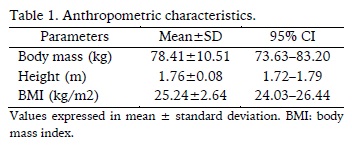
<body><![CDATA[<p>After the approval of the São Judas Tadeu University Research Ethics Committee    (nº 1.738.246/2016), a consent document was signed by twenty healthy adult men    (28 ± 5 years), who were physically independent and volunteered to participate    in this study. The following parameters were used as exclusion criteria: positive    clinical diagnosis of diabetes mellitus, smoking, musculoskeletal complications    and/or cardiovascular alterations confirmed by medical evaluation. All the procedures    were in accordance with the ethical standards of the responsible committee on    human experimentation (institutional or regional) and with the Helsinki Declaration    of 1975, as revised in 1983.</p>     <p><b>Procedures</b></p>     <p>A single acute bout of high-intensity interval training based on full body    exercise was performed according previously studies (Machado et al., 2018a;    Machado et al., 2018b). Briefly, the training session involved a 5 min warm-up    followed by 20 sets of 30&#8201;seconds of all- out exercise and 30 seconds    of passive recovery between sets, totaling 25 minutes of exercise. The following    exercise order (5 sets for each exercise) was used for the jumping jack, burpee,    mountain climb and squat jump.</p>     <p>Height was measured by a Cardiomed (WCS model) stadiometer, with an accuracy    of 115/220 cm. The measurement was performed with the cursor at an angle of    90° with the patient in a standing position with feet together in contact with    the Stadiometer. The subjects were instructed to stay in inspiratory apnea,    with the head parallel to the ground. Total body mass was measured by a calibrated    Filizola electronic scale (Personal Line Model 150) with a 100g scale and a    maximum capacity of 150 kg. Body mass index (BMI, kg/m2) was calculated using    the equation BMI = weight/height2. The general sample characteristic parameters    assessed are described in <a href="#t1">Table 1</a>.</p>     <p>&nbsp;</p>     <p align="center"><a name="t1"></a><img src="/img/revistas/mot/v14n4/14n4a09t1.jpg"/></p>     
<p>&nbsp;</p>     <p>The total exercise movement amount realized for each set was used as external    training load, as suggested by Machado et al. (2017a) and utilized in other    studies (Machado et al. 2018a, Machado et al., 2018b). The number of movements    realized for each set were counted and summed at final exercise session.</p>     <p>Capillary blood samples were taken from a sterile fingertip using a sterile    lancet before and after the exercise session according to previous publication    of our group (Machado et al., 2018a; Machado et al., 2018b). The first drop    of blood was discarded, and free&#64258;ow blood was collected in glass capillary    tubes. All blood samples (25 ml) for lactate analysis were evaluated using an    Accutrend® (Roche - Basel, Switzerland) lactate analyzer.</p>     <p>Subjects reported their rating of perceived exertion (RPE) using a Borg (0-10    scale) after a single session of HIIT body work according previously studies    (Machado et al., 2018a; Machado et al., 2018b). To guarantee that the RPE mean    data obtained refers to the total training, subjects were asked to answer a    question 20 to 30 minutes after the end of the session: &ldquo;How was your training    today&rdquo;?</p>     ]]></body>
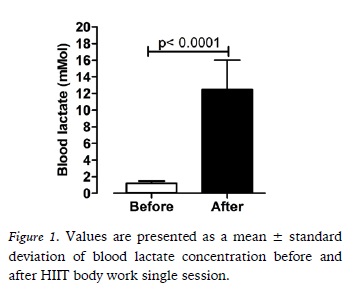
<body><![CDATA[<p>The body-image and -satisfaction was analyzed utilizing previously study (Kakeshita    et al, 2009). This task consists of 12 silhouettes on a progressive scale, been    the discrepancy between the current (CS) and ideal silhouettes (IS) was analyzed    after the figures were presented to the subjects. According to study of four    group (Rica et al. 2018a) the following questions were directed to the men:    (1) What is the silhouette that best represents your current physical appearance?    (2) What silhouette would you like to have?</p>     <p>Body schema was measured according to previously publications (Fonseca et al.,    2012). Briefly, using the Image Marking Procedure (IMP), evaluation was made    through the sense of touch at certain spots. Before and after whole body HIIT    single session, all participants were marked with masking tape on the right    and left acromioclavicular joint, right and left waist curves, and greater trochanter    of the right and left femur with green, blue, red, and black round stickers    to ensure that the same points were always touched by the researcher in all    three trials. Participants remained in standing position near a wall. The wall    had a measuring tape placed vertically for the researcher's use as reference.    The test was performed blindfolded. The researcher touched the points marked    on the participant&rsquo;s body and the participants had to point the orthogonal projection    of the touched point on the wall. The researcher marked each indicated point    with a colored label. The first point touched was the top of the head, followed    by the right shoulder, waist, and hip, and then the left shoulder, waist, and    hip. The test was repeated three times, and the participant could not see the    previous markings. After collecting the perceived measurements, the examiner    guided the individual close to the wall, so that the anterior foot alignment    was maintained. In this position, the marking of veridical heights of body points    was performed using the measuring tape. The labels and measuring tape on the    wall were photographed with a digital camera for further analysis using AxioVision    Version 3.1.</p>     <p>The quantitative analyses of IMP were evaluated by distances of the points    identified by the subject and the evaluator for body height and width in the    horizontal plane. Data were organized in tables and the overall body perception    index (BPI) was calculated. First, the BPI of each region was analyzed. From    the three attempts of perceived measures for each region, perceived size was    calculated as the mean response divided by actual measurement, multiplied by    100. Overall BPI (oBPI) was calculated as the mean BPI of measurement sites    [(head BPI + shoulder BPI + waist BPI + hip BPI) / 4]. Perception was defined    as when the actual and perceived measures were very similar, with BPI between    99.4% and 112.3%. Overall body awareness was defined as adequate, i.e., when    the perceived measures are very close to the actual measurements, with BPI between    99.4% and 112.3%. When the perceived measure differed from the actual measurement,    individuals were classified as hyperschematic (oBPI greater than 112.3%) or    as hyposchematic (oBPI less than 99.4%).</p>     <p><b>Statistical analysis</b></p>     <p>The D&rsquo;Agostino-Pearson test was applied to Gaussian distribution analysis.    The paired Student&rsquo;s t-test was performed to compare differences before and    after whole body HIIT single session. An alpha of 0.05 was used to determine    statistical significance. All data values were expressed as a mean ± standard    deviation. All analyses were performed using SPSS software (v 15.0; IBM, Armonk,    NY, USA).</p>     <p><b>Results</b></p>     <p>The participants presented no injuries as a result of the workout during and    after the exercise session. As foreseen, due to high exercise intensity, the    values of the rate of perceived exertion (9 ± 1) and total amount of movements    (503 ± 123 numbers) were highest. Additionally, the blood lactate concentration    increased (953 ± 338 %) after whole body HIIT single session. As shown in <a href="#f1">Figure    1</a>, significant differences (<i>p</i>&lt;0.001) were found between (Before:    1.22 ± 0.25, After: 12.45 C 3.47; mMol/L) of blood lactate.</p>     <p>&nbsp;</p>     <p align="center"><a name="f1"></a><img src="/img/revistas/mot/v14n4/14n4a09f1.jpg"/></p>     
<p>&nbsp;</p>     ]]></body>
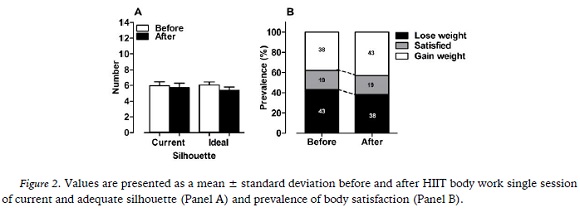
<body><![CDATA[<p>The values of actual (Before: 5.95 ± 2.22, After: 5.71 ± 2.53, <i>p</i>= 0.6339)    and ideal (Before: 6.04 ± 1.71, After: 5.33 ± 1.90, <i>p</i>= 0.0744) did not    differ each other (<a href="#f2">Figure 2A</a>) and real silhouette (6.09 ±    1.04). Similar results were found (<i>p</i>= 0.3114) on the body satisfaction    (Before: -0.09 ± 1.99, After: 0.47 ± 3.31) and prevalence of body satisfaction    as showed at <a href="#f2">Figure 2B</a>.</p>     <p>&nbsp;</p>     <p align="center"><a name="f2"></a><img src="/img/revistas/mot/v14n4/14n4a09f2.jpg"/></p>     
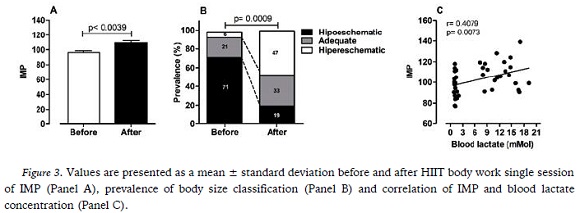
<p>&nbsp;</p>     <p>The values of IMP increase (13.46 ± 17.72 %) after whole body HIIT single session.    As showed in <a href="#f3">Figure 3A</a> significant differences was found (Before:    96.18 ± 11.57, After: 109.65 ± 12.13, p&lt; 0.003), moreover, significant differences    (<i>p</i>=0.009) were found on prevalence of body size classification as showed    in <a href="#f3">Figure 3B</a>. Additionally, a significant correlation (p=    0.0073, r= 0.4079) was found on IMP and blood lactate concentration (<a href="#f3">Figure    3C</a>).</p>     <p>&nbsp;</p>     <p align="center"><a name="f3"></a><img src="/img/revistas/mot/v14n4/14n4a09f3.jpg"/></p>     
<p>&nbsp;</p>     <p><b>Discussion</b></p>     <p>With the increase in popularity of HIIT and exercise with body weight, there    is a growing need for studies to analyze the effects of interventions that combine    the two strategies on the psychobiological variables (Evangelista et al., 2017;    Machado et al., 2018a; Machado et al., 2018b; Machado et al., 2018c,). In this    study, the main results were no self-perception of body image change, statistical    difference on perception of body size and a positive correlation between IMP    and blood lactate after HIIT bodywork. To the best of our knowledge, this is    the first report to describe self-perception of body-image and - size after    HIIT approach in adult men.</p>     ]]></body>
<body><![CDATA[<p>In our study the blood lactate concentration, total amount of movement and    rate of perceived exertion increased significantly, which has been shown in    previous studies (Machado el al., 2018a; Machado et al., 2018c; Evangelista    et al., 2017) confirming that this exercise protocol is able to promote fatigue    and metabolic acidosis such as other HIIT protocols (Wahl et al., 2010; Nalbandian,    Radak &amp; Takeda, 2017).</p>     <p>The greatest determinants for negative or positive body image are satisfaction    with weight, accuracy of size perception, body satisfaction, appearance evaluation    and orientation, body esteem, ideal body, body schema and body awareness (Rica    et al., 2018a). Further factors also include sex, age, mean and the relationship    of the body with cognitive processes such as cultural and social beliefs, values    and attitudes (Rica et al., 2018a; Gardner, 2011). In relationship to body image    and exercise, studies have shown improvement on body image after acute (Béres,    Czeglédi &amp; Babusa, 2017; Carraro, Nart &amp; Scarpa, 2010) and chronic (Ba&#351;tu&#287;    et al., 2016; Vocks et al., 2009) protocols. However, no significant differences    were found in our study after a single session of HIIT body work. Similar results    have been shown in a meta-analysis study by Alleva et al. (2015), with interventions    inducing only small improvements in body image and underline the need for large-scale,    high- quality trials in this area.</p>     <p>In addition, other important points of view should be addressed for a male    sample, exercise modality and session. The silhoute choice by male subjects    has been shown to be higher than that of women (Damasceno et al., 2005; Haines    &amp; Neumark-Sztainer, 2006). However, in our study no diffeterences were found    on current, ideal and real silhouettes, different than others. Additionally,    to the best of our knowledge, this is the first study that evaluates body image    after whole body HIIT session.</p>     <p>There are few studies (Pereira 2017) that have investigated the influence of    high intensity exercises and BP. In our study, the HIIT body work session changed    13.46% on perception of body size, different than that of Pereira (2017), evaluating    Cross Fit practitioners after a 9- minute session of high intensity exercises,    who evidenced an increase of 3% in the perception of the body. However, unlike    the study by Pereira (2017), we showed a significant difference in the classification    of body perception. There are reports in the literature that body activities    are capable of modifying body dimensional perception (Catalan-Matamoros et al.,    2011; Hedlund &amp; Gyllensten, 2010), but using high- intensity exercises,    the possible mechanisms still remain scarce.</p>     <p>To Pereira (2017), training can provide neural stimuli necessary to promote    the modification of the perception of the dimension after training, mainly by    the increase of muscular tone and in regions in which it does not have bony    limits or when the musculature undergoes constant stimuli. The findings of previously    studies (Tsakiris et al., 2005; Tsakiris, Prabhu &amp; Haggard, 2006) may help    us in understanding the data obtained in this study. These studies (Tsakiris    et al., 2005; Tsakiris, Prabhu &amp; Haggard, 2006) suggest different mechanisms    of body information processing in the primary somesthetic cortex and the primary    motor cortex. While the somesthetic cortex corresponds to the representation    of a well delimited cutaneous segment, the representations of different parts    of the body overlap in the motor cortex. According to Lemon (1998) the primary    motor cortex seems to organize itself to represent muscle groups and synergies    of movement rather than individual muscles. It is speculated that given the    multi-articular and synergistic characteristic of HIIT, a large motor cortical    area is stimulated, which may explain the overestimation of body size (hyperskema).</p>     <p>Another possible explanation for the changes in the perception of the dimension    can be directed to the acute modifications derived from the practice of exercise,    thus, it is possible to hypothesize that the exercises selected in the present    study, because they are performed with the whole body and with all-out intensity,    can induce systemic changes, especially when associated with metabolic demand.    Among the acute mechanisms we can highlight is the hyperemia induced by the    exercise. Hyperemia can conceptually be considered as an increase in blood flow    in a given region, provided by vasodilation mainly for maintenance of function,    nutrition and tissue oxygenation (Joyner &amp; Casey, 2015; Wunsch, Muller-Delp    &amp; Delp, 2000), in addition, the magnitude of hyperemia is associated with    intensity of the exercise, and thus, of the request of activity and muscular    action and metabolic alterations as showed on <a href="#f2">figure 2C</a>.</p>     <p><b>Conclusion</b></p>     <p>The results of present study suggest that although the single session of HIIT    body work exercise does not promote self-perception of body image change, it    induces alterations on perception of body size in healthy adult men with association    of blood lactate concentration.</p>     <p>&nbsp;</p>     <p><b>REFERENCES</b></p>     ]]></body>
<body><![CDATA[<!-- ref --><p>Alleva, J. M., Sheeran, P., Webb, T. L., Martijn, C., &amp; Miles, E. (2015).    A meta-analytic review of stand- alone interventions to improve body image.    <i>PLoS One</i>, <i>10</i>(9), e0139177.    &nbsp;&nbsp;&nbsp;&nbsp;&nbsp;&nbsp;&nbsp;&nbsp;[&#160;<a href="javascript:void(0);" onclick="javascript: window.open('/scielo.php?script=sci_nlinks&ref=385595&pid=S1646-107X201800030000900001&lng=','','width=640,height=500,resizable=yes,scrollbars=1,menubar=yes,');">Links</a>&#160;]<!-- end-ref --></p>     <p>Ba&#351;tu&#287;, G., Özcan, R., Gültekin, D., &amp; Günay, Ö. (2016). The    effects of cross-fit, pilates and zumba exercise on body composition and body    image of women. <i>International Journal of Sports, Exercise and Training Science</i>,    <i>2</i>(1), 22-29.</p>     <!-- ref --><p>Bellenger, C. R., Thomson, R. L., Howe, P. R., Karavirta, L., &amp; Buckley,    J. D. (2016). Monitoring athletic training status using the maximal rate of    heart rate increase. <i>Journal of science and medicine in sport</i>, <i>19</i>(7),    590-595.    &nbsp;&nbsp;&nbsp;&nbsp;&nbsp;&nbsp;&nbsp;&nbsp;[&#160;<a href="javascript:void(0);" onclick="javascript: window.open('/scielo.php?script=sci_nlinks&ref=385598&pid=S1646-107X201800030000900003&lng=','','width=640,height=500,resizable=yes,scrollbars=1,menubar=yes,');">Links</a>&#160;]<!-- end-ref --></p>     <!-- ref --><p>Béres, A., Czeglédi, E., &amp; Babusa, B. (2017). Effects of a single aerobic    exercise session on body image. <i>Mentálhigiéné és Pszichoszomatika</i>, <i>18</i>(1),    84-104.    &nbsp;&nbsp;&nbsp;&nbsp;&nbsp;&nbsp;&nbsp;&nbsp;[&#160;<a href="javascript:void(0);" onclick="javascript: window.open('/scielo.php?script=sci_nlinks&ref=385600&pid=S1646-107X201800030000900004&lng=','','width=640,height=500,resizable=yes,scrollbars=1,menubar=yes,');">Links</a>&#160;]<!-- end-ref --></p>     <!-- ref --><p>Bizerra, A., &amp; Gama, E. F. (2017). Neurocognitive aspects of body size    estimation-A study of contemporary dancers. <i>Motriz: Revista de Educação Física</i>,    <i>23</i>(1), 33-39.    &nbsp;&nbsp;&nbsp;&nbsp;&nbsp;&nbsp;&nbsp;&nbsp;[&#160;<a href="javascript:void(0);" onclick="javascript: window.open('/scielo.php?script=sci_nlinks&ref=385602&pid=S1646-107X201800030000900005&lng=','','width=640,height=500,resizable=yes,scrollbars=1,menubar=yes,');">Links</a>&#160;]<!-- end-ref --></p>     <!-- ref --><p>Catalan-Matamoros, D., Helvik-Skjaerven, L., Labajos- Manzanares, M. T., Martínez-de-Salazar-    Arboleas, A., &amp; Sánchez-Guerrero, E. (2011). A pilot study on the effect    of Basic Body Awareness Therapy in patients with eating disorders: a randomized    controlled trial. <i>Clinical Rehabilitation</i>, <i>25</i>(7), 617-626.    &nbsp;&nbsp;&nbsp;&nbsp;&nbsp;&nbsp;&nbsp;&nbsp;[&#160;<a href="javascript:void(0);" onclick="javascript: window.open('/scielo.php?script=sci_nlinks&ref=385604&pid=S1646-107X201800030000900006&lng=','','width=640,height=500,resizable=yes,scrollbars=1,menubar=yes,');">Links</a>&#160;]<!-- end-ref --></p>     <!-- ref --><p>Carraro, A., Nart, A., &amp; Scarpa, S. (2010). Effects of a single session    of physical exercise on body state image. <i>Revista Brasileira de Ciências    do Esporte</i>, <i>32</i>(1), 173-184.    &nbsp;&nbsp;&nbsp;&nbsp;&nbsp;&nbsp;&nbsp;&nbsp;[&#160;<a href="javascript:void(0);" onclick="javascript: window.open('/scielo.php?script=sci_nlinks&ref=385606&pid=S1646-107X201800030000900007&lng=','','width=640,height=500,resizable=yes,scrollbars=1,menubar=yes,');">Links</a>&#160;]<!-- end-ref --></p>     <!-- ref --><p>Coratella, G., &amp; Schena, F. (2016). Eccentric resistance training increases    and retains maximal strength, muscle endurance, and hypertrophy in trained men.    <i>Applied Physiology, Nutrition, and Metabolism, 41</i>(11), 1184-1189.    &nbsp;&nbsp;&nbsp;&nbsp;&nbsp;&nbsp;&nbsp;&nbsp;[&#160;<a href="javascript:void(0);" onclick="javascript: window.open('/scielo.php?script=sci_nlinks&ref=385608&pid=S1646-107X201800030000900008&lng=','','width=640,height=500,resizable=yes,scrollbars=1,menubar=yes,');">Links</a>&#160;]<!-- end-ref --></p>     <!-- ref --><p>Damasceno, V. O., Lima, J. R. P., Vianna, J. M., Vianna,V. R. Á., &amp; Novaes,    J. S. (2005). Tipo físico ideal e satisfação com a imagem corporal de praticantes    de caminhada. <i>Revista braileira de medicina do esporte</i>, <i>11</i>(3),    181-6.    &nbsp;&nbsp;&nbsp;&nbsp;&nbsp;&nbsp;&nbsp;&nbsp;[&#160;<a href="javascript:void(0);" onclick="javascript: window.open('/scielo.php?script=sci_nlinks&ref=385610&pid=S1646-107X201800030000900009&lng=','','width=640,height=500,resizable=yes,scrollbars=1,menubar=yes,');">Links</a>&#160;]<!-- end-ref --></p>     <!-- ref --><p>De Vignemont, F. (2010). Body schema and body image-Pros and cons. <i>Neuropsychologia,    48</i>(3), 669-680.    &nbsp;&nbsp;&nbsp;&nbsp;&nbsp;&nbsp;&nbsp;&nbsp;[&#160;<a href="javascript:void(0);" onclick="javascript: window.open('/scielo.php?script=sci_nlinks&ref=385612&pid=S1646-107X201800030000900010&lng=','','width=640,height=500,resizable=yes,scrollbars=1,menubar=yes,');">Links</a>&#160;]<!-- end-ref --></p>     <!-- ref --><p>DiStefano, L. J., DiStefano, M. J., Frank, B. S., Clark, M. A., &amp; Padua,    D. A. (2013). Comparison of integrated and isolated training on performance    measures and neuromuscular control. <i>The Journal of Strength &amp; Conditioning    Research</i>, <i>27</i>(4), 1083- 1090.    &nbsp;&nbsp;&nbsp;&nbsp;&nbsp;&nbsp;&nbsp;&nbsp;[&#160;<a href="javascript:void(0);" onclick="javascript: window.open('/scielo.php?script=sci_nlinks&ref=385614&pid=S1646-107X201800030000900011&lng=','','width=640,height=500,resizable=yes,scrollbars=1,menubar=yes,');">Links</a>&#160;]<!-- end-ref --></p>     <!-- ref --><p>Evangelista, A. L., de Toledo, R. A. G., Evangelista, R. L. R., Fernandes,    A., Machado, J. M. Q., &amp; La Scala, C. V. (2017). Effects of High-Intensity    Calisthenic Training on Mood and Affective Responses. <i>Journal of Exercise    Physiology Online</i>, <i>20</i>(6), 15-24.    &nbsp;&nbsp;&nbsp;&nbsp;&nbsp;&nbsp;&nbsp;&nbsp;[&#160;<a href="javascript:void(0);" onclick="javascript: window.open('/scielo.php?script=sci_nlinks&ref=385616&pid=S1646-107X201800030000900012&lng=','','width=640,height=500,resizable=yes,scrollbars=1,menubar=yes,');">Links</a>&#160;]<!-- end-ref --></p>     <p>Falcone, P. H., Tai, C. Y., Carson, L. R., Joy, J. M.,Mosman, M. M., McCann,    T. R., &hellip; &amp; Moon, J. R. (2015). Caloric expenditure of aerobic, resistance,    or combined high-intensity interval training using a hydraulic resistance system    in healthy men. <i>The Journal of Strength &amp; Conditioning Research</i>,    <i>29</i>(3), 779-785.</p>     <!-- ref --><p>Fonseca, C. C., Gama, E. F., Thurm, B. E., Pereira, E.S., Limongelli, A. M.    D. A., &amp; Miranda, M. L. D.<i> </i>J. (2012). Benefits of body perception    stimulation on body scheme among the elderly. <i>Revista Brasileira de Geriatria    e Gerontologia</i>, <i>15</i>(2), 353- 364.    &nbsp;&nbsp;&nbsp;&nbsp;&nbsp;&nbsp;&nbsp;&nbsp;[&#160;<a href="javascript:void(0);" onclick="javascript: window.open('/scielo.php?script=sci_nlinks&ref=385619&pid=S1646-107X201800030000900014&lng=','','width=640,height=500,resizable=yes,scrollbars=1,menubar=yes,');">Links</a>&#160;]<!-- end-ref --></p>     <!-- ref --><p>Fonseca, C. C., Thurm, B. E., Vecchi, R. L., &amp; Gama, E.F. (2014). Ballroom    dance and body size perception. <i>Perceptual and motor skills</i>, <i>119</i>(2),    495- 503.    &nbsp;&nbsp;&nbsp;&nbsp;&nbsp;&nbsp;&nbsp;&nbsp;[&#160;<a href="javascript:void(0);" onclick="javascript: window.open('/scielo.php?script=sci_nlinks&ref=385621&pid=S1646-107X201800030000900015&lng=','','width=640,height=500,resizable=yes,scrollbars=1,menubar=yes,');">Links</a>&#160;]<!-- end-ref --></p>     <!-- ref --><p>Gardner, R. M. (2011). what Affects Body Size Estimation? The Role of Eating    Disorders, Obesity, Weight Loss, Hunger, Restrained Eating, Mood, Depression,    Sexual Abuse, Menstrual Cycle, Media Influences, and Gender. <i>Current Psychiatry    Reviews, 7</i>(2), 96-103.    &nbsp;&nbsp;&nbsp;&nbsp;&nbsp;&nbsp;&nbsp;&nbsp;[&#160;<a href="javascript:void(0);" onclick="javascript: window.open('/scielo.php?script=sci_nlinks&ref=385623&pid=S1646-107X201800030000900016&lng=','','width=640,height=500,resizable=yes,scrollbars=1,menubar=yes,');">Links</a>&#160;]<!-- end-ref --></p>     ]]></body>
<body><![CDATA[<!-- ref --><p>Gist, N. H., Freese, E. C., Ryan, T. E., &amp; Cureton, K. J. (2015). Effects    of low-volume, high-intensity whole-body calisthenics on army ROTC cadets. <i>Military    medicine</i>, <i>180</i>(5), 492-498.    &nbsp;&nbsp;&nbsp;&nbsp;&nbsp;&nbsp;&nbsp;&nbsp;[&#160;<a href="javascript:void(0);" onclick="javascript: window.open('/scielo.php?script=sci_nlinks&ref=385625&pid=S1646-107X201800030000900017&lng=','','width=640,height=500,resizable=yes,scrollbars=1,menubar=yes,');">Links</a>&#160;]<!-- end-ref --></p>     <!-- ref --><p>Haines, J., &amp; Neumark-Sztainer, D. (2006). Prevention of obesity and eating    disorders: a consideration of shared risk factors. <i>Health education research</i>,    <i>21</i>(6), 770-782.    &nbsp;&nbsp;&nbsp;&nbsp;&nbsp;&nbsp;&nbsp;&nbsp;[&#160;<a href="javascript:void(0);" onclick="javascript: window.open('/scielo.php?script=sci_nlinks&ref=385627&pid=S1646-107X201800030000900018&lng=','','width=640,height=500,resizable=yes,scrollbars=1,menubar=yes,');">Links</a>&#160;]<!-- end-ref --></p>     <!-- ref --><p>Hedlund, L., &amp; Gyllensten, A. L. (2010). The experiences of basic body    awareness therapy in patients with schizophrenia. <i>Journal of bodywork and    movement therapies</i>, <i>14</i>(3), 245-254.    &nbsp;&nbsp;&nbsp;&nbsp;&nbsp;&nbsp;&nbsp;&nbsp;[&#160;<a href="javascript:void(0);" onclick="javascript: window.open('/scielo.php?script=sci_nlinks&ref=385629&pid=S1646-107X201800030000900019&lng=','','width=640,height=500,resizable=yes,scrollbars=1,menubar=yes,');">Links</a>&#160;]<!-- end-ref --></p>     <!-- ref --><p>Ivanenko, Y. P., Dominici, N., Daprati, E., Nico, D., Cappellini, G., &amp;    Lacquaniti, F. (2011). Locomotor body scheme. <i>Human movement science</i>,    <i>30</i>(2), 341-351.    &nbsp;&nbsp;&nbsp;&nbsp;&nbsp;&nbsp;&nbsp;&nbsp;[&#160;<a href="javascript:void(0);" onclick="javascript: window.open('/scielo.php?script=sci_nlinks&ref=385631&pid=S1646-107X201800030000900020&lng=','','width=640,height=500,resizable=yes,scrollbars=1,menubar=yes,');">Links</a>&#160;]<!-- end-ref --></p>     <!-- ref --><p>Joyner, M. J., &amp; Casey, D. P. (2015). Regulation of increased blood flow    (hyperemia) to muscles during exercise: a hierarchy of competing physiological    needs. <i>Physiological reviews</i>, <i>95</i>(2), 549-601.    &nbsp;&nbsp;&nbsp;&nbsp;&nbsp;&nbsp;&nbsp;&nbsp;[&#160;<a href="javascript:void(0);" onclick="javascript: window.open('/scielo.php?script=sci_nlinks&ref=385633&pid=S1646-107X201800030000900021&lng=','','width=640,height=500,resizable=yes,scrollbars=1,menubar=yes,');">Links</a>&#160;]<!-- end-ref --></p>     ]]></body>
<body><![CDATA[<!-- ref --><p>Kakeshita, I. S., Silva, A. I. P., Zanatta, D. P., &amp; Almeida, S. S. (2009).    Construção e fidedignidade teste-reteste de escalas de silhuetas brasileiras    para adultos e crianças. <i>Psicologia: Teoria e Pesquisa</i>, 25(2), 263-270.    &nbsp;&nbsp;&nbsp;&nbsp;&nbsp;&nbsp;&nbsp;&nbsp;[&#160;<a href="javascript:void(0);" onclick="javascript: window.open('/scielo.php?script=sci_nlinks&ref=385635&pid=S1646-107X201800030000900022&lng=','','width=640,height=500,resizable=yes,scrollbars=1,menubar=yes,');">Links</a>&#160;]<!-- end-ref --></p>     <!-- ref --><p>Lemon, R. (1988). The output map of the primate motor cortex. <i>Trends in    Neuroscience, 11</i>(11), 501- 506.    &nbsp;&nbsp;&nbsp;&nbsp;&nbsp;&nbsp;&nbsp;&nbsp;[&#160;<a href="javascript:void(0);" onclick="javascript: window.open('/scielo.php?script=sci_nlinks&ref=385637&pid=S1646-107X201800030000900023&lng=','','width=640,height=500,resizable=yes,scrollbars=1,menubar=yes,');">Links</a>&#160;]<!-- end-ref --></p>     <!-- ref --><p>Machado, A. F., Baker, J. S., Figueira-Júnior, A. J., &amp; Bocalini, D. S.    (2017). High-intensity interval training using whole-body exercises: training    recommendations and methodological overview. <i>Clinical Physiology and Functional    Imaging. </i>Ahead of print.    &nbsp;&nbsp;&nbsp;&nbsp;&nbsp;&nbsp;&nbsp;&nbsp;[&#160;<a href="javascript:void(0);" onclick="javascript: window.open('/scielo.php?script=sci_nlinks&ref=385639&pid=S1646-107X201800030000900024&lng=','','width=640,height=500,resizable=yes,scrollbars=1,menubar=yes,');">Links</a>&#160;]<!-- end-ref --></p>     <p>Machado, A. F., Evangelista, A. L., Miranda, J. M. D. Q., Teixeira, C. V. L.    S., Leite, G. D. S., Rica, R. L., &amp; Bocalini, D. S. (2018a). Sweat rate    measurements after high intensity interval training using body weight. <i>Revista    Brasileira de Medicina do Esporte</i>, <i>24</i>(3), 197-201.</p>     <p>Machado, A. F., Miranda, M. L. D. J., Rica, R. L., Figueira Junior, A., &amp;    Bocalini, D. S. (2018b). Bodyweight high-intensity interval training: a systematic    review. <i>Revista Brasileira de Medicina do Esporte</i>, <i>24</i>(3), 234-237.</p>     <p>Machado, A. F., Evangelista, A., Miranda, J. M., Teixeira, C., Rica, R. L.,    Lopes, C. R., Junior, A.F., Baker, J. S., Bocalini, D. S. (2018c). Description    of training loads using whole body exercise during high-intensity-interval-training    interval training. <i>Clinics, </i>Ahead of print.</p>     <!-- ref --><p>Naimo, M. A., de Souza, E. O., Wilson, J. M., Carpenter, A. L., Gilchrist,    P., Lowery, R. P., Averbuch, B., White, T. M., &amp; Joy, J. (2015). High-intensity    interval training has positive effects on performance in ice hockey players.    <i>International Journal of Sports Medicine, 36</i>(1), 61- 66.    &nbsp;&nbsp;&nbsp;&nbsp;&nbsp;&nbsp;&nbsp;&nbsp;[&#160;<a href="javascript:void(0);" onclick="javascript: window.open('/scielo.php?script=sci_nlinks&ref=385644&pid=S1646-107X201800030000900028&lng=','','width=640,height=500,resizable=yes,scrollbars=1,menubar=yes,');">Links</a>&#160;]<!-- end-ref --></p>     <!-- ref --><p>Nalbandian, H. M., Radak, Z., &amp; Takeda, M. (2017). Active Recovery between    Interval Bouts Reduces Blood Lactate While Improving Subsequent Exercise Performance    in Trained Men. <i>Sports</i>, <i>5</i>(2), pii: E40.    &nbsp;&nbsp;&nbsp;&nbsp;&nbsp;&nbsp;&nbsp;&nbsp;[&#160;<a href="javascript:void(0);" onclick="javascript: window.open('/scielo.php?script=sci_nlinks&ref=385646&pid=S1646-107X201800030000900029&lng=','','width=640,height=500,resizable=yes,scrollbars=1,menubar=yes,');">Links</a>&#160;]<!-- end-ref --></p>     <!-- ref --><p>Pereira, E. S., &amp; Gama, E. F. (2017). Imagem corporal da mulher praticante    de exercício físico. <i>HU Revista</i>, <i>43</i>(1), 5-11.    &nbsp;&nbsp;&nbsp;&nbsp;&nbsp;&nbsp;&nbsp;&nbsp;[&#160;<a href="javascript:void(0);" onclick="javascript: window.open('/scielo.php?script=sci_nlinks&ref=385648&pid=S1646-107X201800030000900030&lng=','','width=640,height=500,resizable=yes,scrollbars=1,menubar=yes,');">Links</a>&#160;]<!-- end-ref --></p>     <!-- ref --><p>Pereira, E. S. (2017). Acute effect of a CrossFit training session on serum    BDNF levels, mood states and body perception in active individuals Thesis (doctorate    degree) - São Judas Tadeu University, São Paulo.    &nbsp;&nbsp;&nbsp;&nbsp;&nbsp;&nbsp;&nbsp;&nbsp;[&#160;<a href="javascript:void(0);" onclick="javascript: window.open('/scielo.php?script=sci_nlinks&ref=385650&pid=S1646-107X201800030000900031&lng=','','width=640,height=500,resizable=yes,scrollbars=1,menubar=yes,');">Links</a>&#160;]<!-- end-ref --></p>     <p>Rica, R. L., Gama E. F., Machado, A. F., Angelica Castilho Alonso, A. C., Evangelista,    A. L., Figueira-Junior, A. I, Zanetti, M., Brandão, R. M., Miranda, M. L. J.,    Alves, J. V., Bergamin, M., Bocalini, D. S. (2018a) Does resistance training    improve body image satisfaction among the elderly? A cross-sectional study.    <i>Clinics</i>, ahead of print</p>     <p>Rica, R. L., Bocalini, D. S., de Jesus Miranda, M. L., Valenti, V. E., &amp;    Gama, E. F. (2018b) Imagem corporal de adolescentes do sexo feminino saudáveis    e sua associação com a atividade física: revisão sistemática. Body image of    healthy adolescent women and its association with physical activity: a systematic    review. <i>Ciencia e Saude Coletiva</i>, Ahead of print.</p>     <!-- ref --><p>Souza, A. L. L., Gama, E.F., Pereira, E. S., Santiago, F. G., Bandeira, L.    J. S. (2015). Relação entre a imagem corporal e o índice de massa corporal de    mulheres obesas candidatas à cirurgia de redução do estômago. <i>Motricidade</i>,    <i>11</i>(S1): 20-25.    &nbsp;&nbsp;&nbsp;&nbsp;&nbsp;&nbsp;&nbsp;&nbsp;[&#160;<a href="javascript:void(0);" onclick="javascript: window.open('/scielo.php?script=sci_nlinks&ref=385654&pid=S1646-107X201800030000900034&lng=','','width=640,height=500,resizable=yes,scrollbars=1,menubar=yes,');">Links</a>&#160;]<!-- end-ref --></p>     <!-- ref --><p>Shaban, N., Kenno, K. A., &amp; Milne, K. J. (2014). The effects of a 2 week    modified high intensity interval training program on the homeostatic model of    insulin resistance (HOMA-IR) in adults with type 2 diabetes. <i>The Journal    of sports medicine and physical fitness</i>, 54(2), 203-209.    &nbsp;&nbsp;&nbsp;&nbsp;&nbsp;&nbsp;&nbsp;&nbsp;[&#160;<a href="javascript:void(0);" onclick="javascript: window.open('/scielo.php?script=sci_nlinks&ref=385656&pid=S1646-107X201800030000900035&lng=','','width=640,height=500,resizable=yes,scrollbars=1,menubar=yes,');">Links</a>&#160;]<!-- end-ref --></p>     <!-- ref --><p>Thompson, W. R. (2017). Worldwide survey of fitness trends for 2018: the CREP    edition. ACSM's Health &amp; Fitness Journal, <i>21</i>(6), 10-19.    &nbsp;&nbsp;&nbsp;&nbsp;&nbsp;&nbsp;&nbsp;&nbsp;[&#160;<a href="javascript:void(0);" onclick="javascript: window.open('/scielo.php?script=sci_nlinks&ref=385658&pid=S1646-107X201800030000900036&lng=','','width=640,height=500,resizable=yes,scrollbars=1,menubar=yes,');">Links</a>&#160;]<!-- end-ref --></p>     <!-- ref --><p>Tsakiris, M., Haggard, P., Franck, N., Mainy, N., &amp; Sirigu, A. (2005).    A specific role for efferent information in self-recognition. <i>Cognition</i>,    <i>96</i>(3), 215-231.    &nbsp;&nbsp;&nbsp;&nbsp;&nbsp;&nbsp;&nbsp;&nbsp;[&#160;<a href="javascript:void(0);" onclick="javascript: window.open('/scielo.php?script=sci_nlinks&ref=385660&pid=S1646-107X201800030000900037&lng=','','width=640,height=500,resizable=yes,scrollbars=1,menubar=yes,');">Links</a>&#160;]<!-- end-ref --></p>     <!-- ref --><p>Tsakiris, M., Prabhu, G., &amp; Haggard, P. (2006). Having a body versus moving    your body: How agency structures body-ownership. <i>Consciousness and cognition</i>,    <i>15</i>(2), 423-432.    &nbsp;&nbsp;&nbsp;&nbsp;&nbsp;&nbsp;&nbsp;&nbsp;[&#160;<a href="javascript:void(0);" onclick="javascript: window.open('/scielo.php?script=sci_nlinks&ref=385662&pid=S1646-107X201800030000900038&lng=','','width=640,height=500,resizable=yes,scrollbars=1,menubar=yes,');">Links</a>&#160;]<!-- end-ref --></p>     <!-- ref --><p>Vocks, S., Hechler, T., Rohrig, S., &amp; Legenbauer, T. (2009). Effects of    a physical exercise session on state body image: The influence of pre- experimental    body dissatisfaction and concerns about weight and shape. <i>Psychology and    Health</i>, <i>24</i>(6), 713-728.    &nbsp;&nbsp;&nbsp;&nbsp;&nbsp;&nbsp;&nbsp;&nbsp;[&#160;<a href="javascript:void(0);" onclick="javascript: window.open('/scielo.php?script=sci_nlinks&ref=385664&pid=S1646-107X201800030000900039&lng=','','width=640,height=500,resizable=yes,scrollbars=1,menubar=yes,');">Links</a>&#160;]<!-- end-ref --></p>     <!-- ref --><p>Wahl, P., Zinner, C., Achtzehn, S., Bloch, W., &amp; Mester, J. (2010). Effect    of high-and low-intensity exercise and metabolic acidosis on levels of GH, IGF-I,    IGFBP-3 and cortisol. <i>Growth Hormone &amp; IGF Research</i>, <i>20</i>(5),    380-385.    &nbsp;&nbsp;&nbsp;&nbsp;&nbsp;&nbsp;&nbsp;&nbsp;[&#160;<a href="javascript:void(0);" onclick="javascript: window.open('/scielo.php?script=sci_nlinks&ref=385666&pid=S1646-107X201800030000900040&lng=','','width=640,height=500,resizable=yes,scrollbars=1,menubar=yes,');">Links</a>&#160;]<!-- end-ref --></p>     <!-- ref --><p>Wunsch, S. A., Muller-Delp, J., &amp; Delp, M. D. (2000). Time course of vasodilatory    responses in skeletal muscle arterioles: role in hyperemia at onset of exercise.    <i>American Journal of Physiology-Heart and Circulatory Physiology</i>, <i>279</i>(4),    H1715-H1723.    &nbsp;&nbsp;&nbsp;&nbsp;&nbsp;&nbsp;&nbsp;&nbsp;[&#160;<a href="javascript:void(0);" onclick="javascript: window.open('/scielo.php?script=sci_nlinks&ref=385668&pid=S1646-107X201800030000900041&lng=','','width=640,height=500,resizable=yes,scrollbars=1,menubar=yes,');">Links</a>&#160;]<!-- end-ref --></p>     <p>&nbsp;</p>     <p>Acknowledgments: Nothing to declare.&nbsp; </p>     <p>Conflict of interests: Nothing to declare.&nbsp;      <p>Funding: Nothing to declare.      <p>&nbsp;</p>     ]]></body>
<body><![CDATA[<p>Manuscript received at April 15th 2016; Accepted at December 8th 2016</p>     <p>&nbsp;</p>     <p><a href="#top*"><sup>[*]</sup></a><a name="*"></a>Corresponding author: Rua    Militão Barbosa de Lima, 56, 09720-420, Centro, SBC, SP, Brasil, email: <a href="mailto:robertarica@hotmail.com">robertarica@hotmail.com</a></p>      ]]></body><back>
<ref-list>
<ref id="B1">
<nlm-citation citation-type="journal">
<person-group person-group-type="author">
<name>
<surname><![CDATA[Alleva]]></surname>
<given-names><![CDATA[J. M.]]></given-names>
</name>
<name>
<surname><![CDATA[Sheeran]]></surname>
<given-names><![CDATA[P.]]></given-names>
</name>
<name>
<surname><![CDATA[Webb]]></surname>
<given-names><![CDATA[T. L.]]></given-names>
</name>
<name>
<surname><![CDATA[Martijn]]></surname>
<given-names><![CDATA[C.]]></given-names>
</name>
<name>
<surname><![CDATA[Miles]]></surname>
<given-names><![CDATA[E.]]></given-names>
</name>
</person-group>
<article-title xml:lang="en"><![CDATA[A meta-analytic review of stand- alone interventions to improve body image]]></article-title>
<source><![CDATA[PLoS One]]></source>
<year>2015</year>
<volume>10</volume>
<numero>9</numero>
<issue>9</issue>
<page-range>e0139177</page-range></nlm-citation>
</ref>
<ref id="B2">
<nlm-citation citation-type="journal">
<person-group person-group-type="author">
<name>
<surname><![CDATA[Bastug]]></surname>
<given-names><![CDATA[G.]]></given-names>
</name>
<name>
<surname><![CDATA[Özcan]]></surname>
<given-names><![CDATA[R.]]></given-names>
</name>
<name>
<surname><![CDATA[Gültekin]]></surname>
<given-names><![CDATA[D.]]></given-names>
</name>
<name>
<surname><![CDATA[Günay]]></surname>
<given-names><![CDATA[Ö.]]></given-names>
</name>
</person-group>
<article-title xml:lang="en"><![CDATA[The effects of cross-fit, pilates and zumba exercise on body composition and body image of women]]></article-title>
<source><![CDATA[International Journal of Sports]]></source>
<year>2016</year>
<volume>Exercise and Training Science, 2</volume>
<numero>1</numero>
<issue>1</issue>
<page-range>22-29</page-range></nlm-citation>
</ref>
<ref id="B3">
<nlm-citation citation-type="journal">
<person-group person-group-type="author">
<name>
<surname><![CDATA[Bellenger]]></surname>
<given-names><![CDATA[C. R.]]></given-names>
</name>
<name>
<surname><![CDATA[Thomson]]></surname>
<given-names><![CDATA[R. L.]]></given-names>
</name>
<name>
<surname><![CDATA[Howe]]></surname>
<given-names><![CDATA[P. R.]]></given-names>
</name>
<name>
<surname><![CDATA[Karavirta]]></surname>
<given-names><![CDATA[L.]]></given-names>
</name>
<name>
<surname><![CDATA[Buckley]]></surname>
<given-names><![CDATA[J. D.]]></given-names>
</name>
</person-group>
<article-title xml:lang="en"><![CDATA[Monitoring athletic training status using the maximal rate of heart rate increase]]></article-title>
<source><![CDATA[Journal of science and medicine in sport]]></source>
<year>2016</year>
<volume>19</volume>
<numero>7</numero>
<issue>7</issue>
<page-range>590-595</page-range></nlm-citation>
</ref>
<ref id="B4">
<nlm-citation citation-type="journal">
<person-group person-group-type="author">
<name>
<surname><![CDATA[Béres]]></surname>
<given-names><![CDATA[A.]]></given-names>
</name>
<name>
<surname><![CDATA[Czeglédi]]></surname>
<given-names><![CDATA[E.]]></given-names>
</name>
<name>
<surname><![CDATA[Babusa]]></surname>
<given-names><![CDATA[B.]]></given-names>
</name>
</person-group>
<article-title xml:lang="en"><![CDATA[Effects of a single aerobic exercise session on body image]]></article-title>
<source><![CDATA[Mentálhigiéné és Pszichoszomatika]]></source>
<year>2017</year>
<volume>18</volume>
<numero>1</numero>
<issue>1</issue>
<page-range>84-104</page-range></nlm-citation>
</ref>
<ref id="B5">
<nlm-citation citation-type="journal">
<person-group person-group-type="author">
<name>
<surname><![CDATA[Bizerra]]></surname>
<given-names><![CDATA[A.]]></given-names>
</name>
<name>
<surname><![CDATA[Gama]]></surname>
<given-names><![CDATA[E. F.]]></given-names>
</name>
</person-group>
<article-title xml:lang="en"><![CDATA[Neurocognitive aspects of body size estimation-A study of contemporary dancers]]></article-title>
<source><![CDATA[Motriz: Revista de Educação Física]]></source>
<year>2017</year>
<volume>23</volume>
<numero>1</numero>
<issue>1</issue>
<page-range>33-39</page-range></nlm-citation>
</ref>
<ref id="B6">
<nlm-citation citation-type="journal">
<person-group person-group-type="author">
<name>
<surname><![CDATA[Catalan-Matamoros]]></surname>
<given-names><![CDATA[D.]]></given-names>
</name>
<name>
<surname><![CDATA[Helvik-Skjaerven]]></surname>
<given-names><![CDATA[L.]]></given-names>
</name>
<name>
<surname><![CDATA[Labajos- Manzanares]]></surname>
<given-names><![CDATA[M. T.]]></given-names>
</name>
<name>
<surname><![CDATA[Martínez-de-Salazar- Arboleas]]></surname>
<given-names><![CDATA[A.]]></given-names>
</name>
<name>
<surname><![CDATA[Sánchez-Guerrero]]></surname>
<given-names><![CDATA[E.]]></given-names>
</name>
</person-group>
<article-title xml:lang="en"><![CDATA[A pilot study on the effect of Basic Body Awareness Therapy in patients with eating disorders: a randomized controlled trial]]></article-title>
<source><![CDATA[Clinical Rehabilitation]]></source>
<year>2011</year>
<volume>25</volume>
<numero>7</numero>
<issue>7</issue>
<page-range>617-626</page-range></nlm-citation>
</ref>
<ref id="B7">
<nlm-citation citation-type="journal">
<person-group person-group-type="author">
<name>
<surname><![CDATA[Carraro]]></surname>
<given-names><![CDATA[A.]]></given-names>
</name>
<name>
<surname><![CDATA[Nart]]></surname>
<given-names><![CDATA[A.]]></given-names>
</name>
<name>
<surname><![CDATA[Scarpa]]></surname>
<given-names><![CDATA[S.]]></given-names>
</name>
</person-group>
<article-title xml:lang="en"><![CDATA[Effects of a single session of physical exercise on body state image]]></article-title>
<source><![CDATA[Revista Brasileira de Ciências do Esporte]]></source>
<year>2010</year>
<volume>32</volume>
<numero>1</numero>
<issue>1</issue>
<page-range>173-184</page-range></nlm-citation>
</ref>
<ref id="B8">
<nlm-citation citation-type="journal">
<person-group person-group-type="author">
<name>
<surname><![CDATA[Coratella]]></surname>
<given-names><![CDATA[G.]]></given-names>
</name>
<name>
<surname><![CDATA[Schena]]></surname>
<given-names><![CDATA[F.]]></given-names>
</name>
</person-group>
<article-title xml:lang="en"><![CDATA[Eccentric resistance training increases and retains maximal strength, muscle endurance, and hypertrophy in trained men]]></article-title>
<source><![CDATA[Applied Physiology, Nutrition, and Metabolism,]]></source>
<year>2016</year>
<volume>41</volume>
<numero>11</numero>
<issue>11</issue>
<page-range>1184-1189</page-range></nlm-citation>
</ref>
<ref id="B9">
<nlm-citation citation-type="journal">
<person-group person-group-type="author">
<name>
<surname><![CDATA[Damasceno]]></surname>
<given-names><![CDATA[V. O.]]></given-names>
</name>
<name>
<surname><![CDATA[Lima]]></surname>
<given-names><![CDATA[J. R. P.]]></given-names>
</name>
<name>
<surname><![CDATA[Vianna]]></surname>
<given-names><![CDATA[J. M.]]></given-names>
</name>
<name>
<surname><![CDATA[Vianna]]></surname>
<given-names><![CDATA[V. R. Á.]]></given-names>
</name>
<name>
<surname><![CDATA[Novaes]]></surname>
<given-names><![CDATA[J. S.]]></given-names>
</name>
</person-group>
<article-title xml:lang="pt"><![CDATA[Tipo físico ideal e satisfação com a imagem corporal de praticantes de caminhada]]></article-title>
<source><![CDATA[Revista braileira de medicina do esporte]]></source>
<year>2005</year>
<volume>11</volume>
<numero>3</numero>
<issue>3</issue>
<page-range>181-6</page-range></nlm-citation>
</ref>
<ref id="B10">
<nlm-citation citation-type="journal">
<person-group person-group-type="author">
<name>
<surname><![CDATA[De Vignemont]]></surname>
<given-names><![CDATA[F.]]></given-names>
</name>
</person-group>
<article-title xml:lang="en"><![CDATA[Body schema and body image-Pros and cons]]></article-title>
<source><![CDATA[Neuropsychologia]]></source>
<year>2010</year>
<volume>48</volume>
<numero>3</numero>
<issue>3</issue>
<page-range>669-680</page-range></nlm-citation>
</ref>
<ref id="B11">
<nlm-citation citation-type="journal">
<person-group person-group-type="author">
<name>
<surname><![CDATA[DiStefano]]></surname>
<given-names><![CDATA[L. J.]]></given-names>
</name>
<name>
<surname><![CDATA[DiStefano]]></surname>
<given-names><![CDATA[M. J.]]></given-names>
</name>
<name>
<surname><![CDATA[Frank]]></surname>
<given-names><![CDATA[B. S.]]></given-names>
</name>
<name>
<surname><![CDATA[Clark]]></surname>
<given-names><![CDATA[M. A.]]></given-names>
</name>
<name>
<surname><![CDATA[Padua]]></surname>
<given-names><![CDATA[D. A.]]></given-names>
</name>
</person-group>
<article-title xml:lang="en"><![CDATA[Comparison of integrated and isolated training on performance measures and neuromuscular control]]></article-title>
<source><![CDATA[The Journal of Strength & Conditioning Research]]></source>
<year>2013</year>
<volume>27</volume>
<numero>4</numero>
<issue>4</issue>
<page-range>1083- 1090</page-range></nlm-citation>
</ref>
<ref id="B12">
<nlm-citation citation-type="journal">
<person-group person-group-type="author">
<name>
<surname><![CDATA[Evangelista]]></surname>
<given-names><![CDATA[A. L.]]></given-names>
</name>
<name>
<surname><![CDATA[de Toledo]]></surname>
<given-names><![CDATA[R. A. G.]]></given-names>
</name>
<name>
<surname><![CDATA[Evangelista]]></surname>
<given-names><![CDATA[R. L. R.]]></given-names>
</name>
<name>
<surname><![CDATA[Fernandes]]></surname>
<given-names><![CDATA[A.]]></given-names>
</name>
<name>
<surname><![CDATA[Machado]]></surname>
<given-names><![CDATA[J. M. Q.]]></given-names>
</name>
<name>
<surname><![CDATA[La Scala]]></surname>
<given-names><![CDATA[C. V.]]></given-names>
</name>
</person-group>
<article-title xml:lang="en"><![CDATA[Effects of High-Intensity Calisthenic Training on Mood and Affective Responses]]></article-title>
<source><![CDATA[Journal of Exercise Physiology Online]]></source>
<year>2017</year>
<volume>20</volume>
<numero>6</numero>
<issue>6</issue>
<page-range>15-24</page-range></nlm-citation>
</ref>
<ref id="B13">
<nlm-citation citation-type="journal">
<person-group person-group-type="author">
<name>
<surname><![CDATA[Falcone]]></surname>
<given-names><![CDATA[P. H.]]></given-names>
</name>
<name>
<surname><![CDATA[Tai]]></surname>
<given-names><![CDATA[C. Y.]]></given-names>
</name>
<name>
<surname><![CDATA[Carson]]></surname>
<given-names><![CDATA[L. R.]]></given-names>
</name>
<name>
<surname><![CDATA[Joy]]></surname>
<given-names><![CDATA[J. M.]]></given-names>
</name>
<name>
<surname><![CDATA[Mosman]]></surname>
<given-names><![CDATA[M. M.]]></given-names>
</name>
<name>
<surname><![CDATA[McCann]]></surname>
<given-names><![CDATA[T. R.]]></given-names>
</name>
<name>
<surname><![CDATA[Moon]]></surname>
<given-names><![CDATA[J. R.]]></given-names>
</name>
</person-group>
<article-title xml:lang="en"><![CDATA[Caloric expenditure of aerobic, resistance, or combined high-intensity interval training using a hydraulic resistance system in healthy men]]></article-title>
<source><![CDATA[The Journal of Strength & Conditioning Research]]></source>
<year>2015</year>
<volume>29</volume>
<numero>3</numero>
<issue>3</issue>
<page-range>779-785</page-range></nlm-citation>
</ref>
<ref id="B14">
<nlm-citation citation-type="journal">
<person-group person-group-type="author">
<name>
<surname><![CDATA[Fonseca]]></surname>
<given-names><![CDATA[C. C.]]></given-names>
</name>
<name>
<surname><![CDATA[Gama]]></surname>
<given-names><![CDATA[E. F.]]></given-names>
</name>
<name>
<surname><![CDATA[Thurm]]></surname>
<given-names><![CDATA[B. E.]]></given-names>
</name>
<name>
<surname><![CDATA[Pereira]]></surname>
<given-names><![CDATA[E.S.]]></given-names>
</name>
<name>
<surname><![CDATA[Limongelli]]></surname>
<given-names><![CDATA[A. M. D. A.]]></given-names>
</name>
<name>
<surname><![CDATA[Miranda]]></surname>
<given-names><![CDATA[M. L. D. J.]]></given-names>
</name>
</person-group>
<article-title xml:lang="en"><![CDATA[Benefits of body perception stimulation on body scheme among the elderly]]></article-title>
<source><![CDATA[Revista Brasileira de Geriatria e Gerontologia]]></source>
<year>2012</year>
<volume>15</volume>
<numero>2</numero>
<issue>2</issue>
<page-range>353- 364</page-range></nlm-citation>
</ref>
<ref id="B15">
<nlm-citation citation-type="journal">
<person-group person-group-type="author">
<name>
<surname><![CDATA[Fonseca]]></surname>
<given-names><![CDATA[C. C.]]></given-names>
</name>
<name>
<surname><![CDATA[Thurm]]></surname>
<given-names><![CDATA[B. E.]]></given-names>
</name>
<name>
<surname><![CDATA[Vecchi]]></surname>
<given-names><![CDATA[R. L.]]></given-names>
</name>
<name>
<surname><![CDATA[Gama]]></surname>
<given-names><![CDATA[E.F.]]></given-names>
</name>
</person-group>
<article-title xml:lang="en"><![CDATA[Ballroom dance and body size perception]]></article-title>
<source><![CDATA[Perceptual and motor skills]]></source>
<year>2014</year>
<volume>119</volume>
<numero>2</numero>
<issue>2</issue>
<page-range>495- 503</page-range></nlm-citation>
</ref>
<ref id="B16">
<nlm-citation citation-type="journal">
<person-group person-group-type="author">
<name>
<surname><![CDATA[Gardner]]></surname>
<given-names><![CDATA[R. M.]]></given-names>
</name>
</person-group>
<article-title xml:lang="en"><![CDATA[What Affects Body Size Estimation?: The Role of Eating Disorders, Obesity, Weight Loss, Hunger, Restrained Eating, Mood, Depression, Sexual Abuse, Menstrual Cycle, Media Influences, and Gender]]></article-title>
<source><![CDATA[Current Psychiatry Reviews]]></source>
<year>2011</year>
<volume>7</volume>
<numero>2</numero>
<issue>2</issue>
<page-range>96-103</page-range></nlm-citation>
</ref>
<ref id="B17">
<nlm-citation citation-type="journal">
<person-group person-group-type="author">
<name>
<surname><![CDATA[Gist]]></surname>
<given-names><![CDATA[N. H.]]></given-names>
</name>
<name>
<surname><![CDATA[Freese]]></surname>
<given-names><![CDATA[E. C.]]></given-names>
</name>
<name>
<surname><![CDATA[Ryan]]></surname>
<given-names><![CDATA[T. E.]]></given-names>
</name>
<name>
<surname><![CDATA[Cureton]]></surname>
<given-names><![CDATA[K. J.]]></given-names>
</name>
</person-group>
<article-title xml:lang="en"><![CDATA[Effects of low-volume, high-intensity whole-body calisthenics on army ROTC cadets]]></article-title>
<source><![CDATA[Military medicine]]></source>
<year>2015</year>
<volume>180</volume>
<numero>5</numero>
<issue>5</issue>
<page-range>492-498</page-range></nlm-citation>
</ref>
<ref id="B18">
<nlm-citation citation-type="journal">
<person-group person-group-type="author">
<name>
<surname><![CDATA[Haines]]></surname>
<given-names><![CDATA[J.]]></given-names>
</name>
<name>
<surname><![CDATA[Neumark-Sztainer]]></surname>
<given-names><![CDATA[D.]]></given-names>
</name>
</person-group>
<article-title xml:lang="en"><![CDATA[Prevention of obesity and eating disorders: a consideration of shared risk factors]]></article-title>
<source><![CDATA[Health education research]]></source>
<year>2006</year>
<volume>21</volume>
<numero>6</numero>
<issue>6</issue>
<page-range>770-782</page-range></nlm-citation>
</ref>
<ref id="B19">
<nlm-citation citation-type="journal">
<person-group person-group-type="author">
<name>
<surname><![CDATA[Hedlund]]></surname>
<given-names><![CDATA[L.]]></given-names>
</name>
<name>
<surname><![CDATA[Gyllensten]]></surname>
<given-names><![CDATA[A. L.]]></given-names>
</name>
</person-group>
<article-title xml:lang="en"><![CDATA[The experiences of basic body awareness therapy in patients with schizophrenia]]></article-title>
<source><![CDATA[Journal of bodywork and movement therapies]]></source>
<year>2010</year>
<volume>14</volume>
<numero>3</numero>
<issue>3</issue>
<page-range>245-254</page-range></nlm-citation>
</ref>
<ref id="B20">
<nlm-citation citation-type="journal">
<person-group person-group-type="author">
<name>
<surname><![CDATA[Ivanenko]]></surname>
<given-names><![CDATA[Y. P.]]></given-names>
</name>
<name>
<surname><![CDATA[Dominici]]></surname>
<given-names><![CDATA[N.]]></given-names>
</name>
<name>
<surname><![CDATA[Daprati]]></surname>
<given-names><![CDATA[E.]]></given-names>
</name>
<name>
<surname><![CDATA[Nico]]></surname>
<given-names><![CDATA[D.]]></given-names>
</name>
<name>
<surname><![CDATA[Cappellini]]></surname>
<given-names><![CDATA[G.]]></given-names>
</name>
<name>
<surname><![CDATA[Lacquaniti]]></surname>
<given-names><![CDATA[F.]]></given-names>
</name>
</person-group>
<article-title xml:lang="en"><![CDATA[Locomotor body scheme]]></article-title>
<source><![CDATA[Human movement science]]></source>
<year>2011</year>
<volume>30</volume>
<numero>2</numero>
<issue>2</issue>
<page-range>341-351</page-range></nlm-citation>
</ref>
<ref id="B21">
<nlm-citation citation-type="journal">
<person-group person-group-type="author">
<name>
<surname><![CDATA[Joyner]]></surname>
<given-names><![CDATA[M. J.]]></given-names>
</name>
<name>
<surname><![CDATA[Casey]]></surname>
<given-names><![CDATA[D. P.]]></given-names>
</name>
</person-group>
<article-title xml:lang="en"><![CDATA[Regulation of increased blood flow (hyperemia) to muscles during exercise: a hierarchy of competing physiological needs]]></article-title>
<source><![CDATA[Physiological reviews]]></source>
<year>2015</year>
<volume>95</volume>
<numero>2</numero>
<issue>2</issue>
<page-range>549-601</page-range></nlm-citation>
</ref>
<ref id="B22">
<nlm-citation citation-type="journal">
<person-group person-group-type="author">
<name>
<surname><![CDATA[Kakeshita]]></surname>
<given-names><![CDATA[I. S.]]></given-names>
</name>
<name>
<surname><![CDATA[Silva]]></surname>
<given-names><![CDATA[A. I. P.]]></given-names>
</name>
<name>
<surname><![CDATA[Zanatta]]></surname>
<given-names><![CDATA[D. P.]]></given-names>
</name>
<name>
<surname><![CDATA[Almeida]]></surname>
<given-names><![CDATA[S. S.]]></given-names>
</name>
</person-group>
<article-title xml:lang="pt"><![CDATA[Construção e fidedignidade teste-reteste de escalas de silhuetas brasileiras para adultos e crianças]]></article-title>
<source><![CDATA[Psicologia: Teoria e Pesquisa]]></source>
<year>2009</year>
<volume>25</volume>
<numero>2</numero>
<issue>2</issue>
<page-range>263-270</page-range></nlm-citation>
</ref>
<ref id="B23">
<nlm-citation citation-type="journal">
<person-group person-group-type="author">
<name>
<surname><![CDATA[Lemon]]></surname>
<given-names><![CDATA[R.]]></given-names>
</name>
</person-group>
<article-title xml:lang="en"><![CDATA[The output map of the primate motor cortex]]></article-title>
<source><![CDATA[Trends in Neuroscience]]></source>
<year>1988</year>
<volume>11</volume>
<numero>11</numero>
<issue>11</issue>
<page-range>501- 506</page-range></nlm-citation>
</ref>
<ref id="B24">
<nlm-citation citation-type="journal">
<person-group person-group-type="author">
<name>
<surname><![CDATA[Machado]]></surname>
<given-names><![CDATA[A. F.]]></given-names>
</name>
<name>
<surname><![CDATA[Baker]]></surname>
<given-names><![CDATA[J. S.]]></given-names>
</name>
<name>
<surname><![CDATA[Figueira-Júnior]]></surname>
<given-names><![CDATA[A. J.]]></given-names>
</name>
<name>
<surname><![CDATA[Bocalini]]></surname>
<given-names><![CDATA[D. S.]]></given-names>
</name>
</person-group>
<article-title xml:lang="en"><![CDATA[High-intensity interval training using whole-body exercises: training recommendations and methodological overview]]></article-title>
<source><![CDATA[Clinical Physiology and Functional Imaging]]></source>
<year>2017</year>
</nlm-citation>
</ref>
<ref id="B25">
<nlm-citation citation-type="journal">
<person-group person-group-type="author">
<name>
<surname><![CDATA[Machado]]></surname>
<given-names><![CDATA[A. F.]]></given-names>
</name>
<name>
<surname><![CDATA[Evangelista]]></surname>
<given-names><![CDATA[A. L.]]></given-names>
</name>
<name>
<surname><![CDATA[Miranda]]></surname>
<given-names><![CDATA[J. M. D. Q.]]></given-names>
</name>
<name>
<surname><![CDATA[Teixeira]]></surname>
<given-names><![CDATA[C. V. L. S.]]></given-names>
</name>
<name>
<surname><![CDATA[Leite]]></surname>
<given-names><![CDATA[G. D. S.]]></given-names>
</name>
<name>
<surname><![CDATA[Rica]]></surname>
<given-names><![CDATA[R. L.]]></given-names>
</name>
<name>
<surname><![CDATA[Bocalini]]></surname>
<given-names><![CDATA[D. S.]]></given-names>
</name>
</person-group>
<article-title xml:lang="en"><![CDATA[Sweat rate measurements after high intensity interval training using body weight]]></article-title>
<source><![CDATA[Revista Brasileira de Medicina do Esporte]]></source>
<year>2018</year>
<volume>24</volume>
<numero>3</numero>
<issue>3</issue>
<page-range>197-201</page-range></nlm-citation>
</ref>
<ref id="B26">
<nlm-citation citation-type="journal">
<person-group person-group-type="author">
<name>
<surname><![CDATA[Machado]]></surname>
<given-names><![CDATA[A. F.]]></given-names>
</name>
<name>
<surname><![CDATA[Miranda]]></surname>
<given-names><![CDATA[M. L. D. J.]]></given-names>
</name>
<name>
<surname><![CDATA[Rica]]></surname>
<given-names><![CDATA[R. L.]]></given-names>
</name>
<name>
<surname><![CDATA[Figueira Junior]]></surname>
<given-names><![CDATA[A.]]></given-names>
</name>
<name>
<surname><![CDATA[Bocalini]]></surname>
<given-names><![CDATA[D. S.]]></given-names>
</name>
</person-group>
<article-title xml:lang="en"><![CDATA[Bodyweight high-intensity interval training: a systematic review]]></article-title>
<source><![CDATA[Revista Brasileira de Medicina do Esporte]]></source>
<year>2018</year>
<volume>24</volume>
<numero>3</numero>
<issue>3</issue>
<page-range>234-237</page-range></nlm-citation>
</ref>
<ref id="B27">
<nlm-citation citation-type="journal">
<person-group person-group-type="author">
<name>
<surname><![CDATA[Machado]]></surname>
<given-names><![CDATA[A. F.]]></given-names>
</name>
<name>
<surname><![CDATA[Evangelista]]></surname>
<given-names><![CDATA[A.]]></given-names>
</name>
<name>
<surname><![CDATA[Miranda]]></surname>
<given-names><![CDATA[J. M.]]></given-names>
</name>
<name>
<surname><![CDATA[Teixeira]]></surname>
<given-names><![CDATA[C.]]></given-names>
</name>
<name>
<surname><![CDATA[Rica]]></surname>
<given-names><![CDATA[R. L.]]></given-names>
</name>
<name>
<surname><![CDATA[Lopes]]></surname>
<given-names><![CDATA[C. R.]]></given-names>
</name>
<name>
<surname><![CDATA[Junior]]></surname>
<given-names><![CDATA[A.F.]]></given-names>
</name>
<name>
<surname><![CDATA[Baker]]></surname>
<given-names><![CDATA[J. S.]]></given-names>
</name>
<name>
<surname><![CDATA[Bocalini]]></surname>
<given-names><![CDATA[D. S.]]></given-names>
</name>
</person-group>
<article-title xml:lang="en"><![CDATA[Description of training loads using whole body exercise during high-intensity-interval-training interval training]]></article-title>
<source><![CDATA[Clinics]]></source>
<year>2018</year>
</nlm-citation>
</ref>
<ref id="B28">
<nlm-citation citation-type="journal">
<person-group person-group-type="author">
<name>
<surname><![CDATA[Naimo]]></surname>
<given-names><![CDATA[M. A.]]></given-names>
</name>
<name>
<surname><![CDATA[de Souza]]></surname>
<given-names><![CDATA[E. O.]]></given-names>
</name>
<name>
<surname><![CDATA[Wilson]]></surname>
<given-names><![CDATA[J. M.]]></given-names>
</name>
<name>
<surname><![CDATA[Carpenter]]></surname>
<given-names><![CDATA[A. L.]]></given-names>
</name>
<name>
<surname><![CDATA[Gilchrist]]></surname>
<given-names><![CDATA[P.]]></given-names>
</name>
<name>
<surname><![CDATA[Lowery]]></surname>
<given-names><![CDATA[R. P.]]></given-names>
</name>
<name>
<surname><![CDATA[Averbuch]]></surname>
<given-names><![CDATA[B.]]></given-names>
</name>
<name>
<surname><![CDATA[White]]></surname>
<given-names><![CDATA[T. M.]]></given-names>
</name>
<name>
<surname><![CDATA[Joy]]></surname>
<given-names><![CDATA[J.]]></given-names>
</name>
</person-group>
<article-title xml:lang="en"><![CDATA[High-intensity interval training has positive effects on performance in ice hockey players]]></article-title>
<source><![CDATA[International Journal of Sports Medicine]]></source>
<year>2015</year>
<volume>36</volume>
<numero>1</numero>
<issue>1</issue>
<page-range>61- 66</page-range></nlm-citation>
</ref>
<ref id="B29">
<nlm-citation citation-type="journal">
<person-group person-group-type="author">
<name>
<surname><![CDATA[Nalbandian]]></surname>
<given-names><![CDATA[H. M.]]></given-names>
</name>
<name>
<surname><![CDATA[Radak]]></surname>
<given-names><![CDATA[Z.]]></given-names>
</name>
<name>
<surname><![CDATA[Takeda]]></surname>
<given-names><![CDATA[M.]]></given-names>
</name>
</person-group>
<article-title xml:lang="en"><![CDATA[Active Recovery between Interval Bouts Reduces Blood Lactate While Improving Subsequent Exercise Performance in Trained Men]]></article-title>
<source><![CDATA[Sports]]></source>
<year>2017</year>
<volume>5</volume>
<numero>2</numero>
<issue>2</issue>
<page-range>pii-E40</page-range></nlm-citation>
</ref>
<ref id="B30">
<nlm-citation citation-type="journal">
<person-group person-group-type="author">
<name>
<surname><![CDATA[Pereira]]></surname>
<given-names><![CDATA[E. S.]]></given-names>
</name>
<name>
<surname><![CDATA[Gama]]></surname>
<given-names><![CDATA[E. F.]]></given-names>
</name>
</person-group>
<article-title xml:lang="pt"><![CDATA[Imagem corporal da mulher praticante de exercício físico]]></article-title>
<source><![CDATA[HU Revista]]></source>
<year>2017</year>
<volume>43</volume>
<numero>1</numero>
<issue>1</issue>
<page-range>5-11</page-range></nlm-citation>
</ref>
<ref id="B31">
<nlm-citation citation-type="">
<person-group person-group-type="author">
<name>
<surname><![CDATA[Pereira]]></surname>
<given-names><![CDATA[E. S.]]></given-names>
</name>
</person-group>
<source><![CDATA[Acute effect of a CrossFit training session on serum BDNF levels, mood states and body perception in active individuals]]></source>
<year>2017</year>
</nlm-citation>
</ref>
<ref id="B32">
<nlm-citation citation-type="journal">
<person-group person-group-type="author">
<name>
<surname><![CDATA[Rica]]></surname>
<given-names><![CDATA[R. L.]]></given-names>
</name>
<name>
<surname><![CDATA[Gama]]></surname>
<given-names><![CDATA[E. F.]]></given-names>
</name>
<name>
<surname><![CDATA[Machado]]></surname>
<given-names><![CDATA[A. F.]]></given-names>
</name>
<name>
<surname><![CDATA[Alonso]]></surname>
<given-names><![CDATA[A. C.]]></given-names>
</name>
<name>
<surname><![CDATA[Evangelista]]></surname>
<given-names><![CDATA[A. L.]]></given-names>
</name>
<name>
<surname><![CDATA[Figueira-Junior]]></surname>
<given-names><![CDATA[A. I]]></given-names>
</name>
<name>
<surname><![CDATA[Zanetti]]></surname>
<given-names><![CDATA[M.]]></given-names>
</name>
<name>
<surname><![CDATA[Brandão]]></surname>
<given-names><![CDATA[R. M.]]></given-names>
</name>
<name>
<surname><![CDATA[Miranda]]></surname>
<given-names><![CDATA[M. L. J.]]></given-names>
</name>
<name>
<surname><![CDATA[Alves]]></surname>
<given-names><![CDATA[J. V.]]></given-names>
</name>
<name>
<surname><![CDATA[Bergamin]]></surname>
<given-names><![CDATA[M.]]></given-names>
</name>
<name>
<surname><![CDATA[Bocalini]]></surname>
<given-names><![CDATA[D. S.]]></given-names>
</name>
</person-group>
<article-title xml:lang="en"><![CDATA[Does resistance training improve body image satisfaction among the elderly?: A cross-sectional study]]></article-title>
<source><![CDATA[Clinics]]></source>
<year>2018</year>
</nlm-citation>
</ref>
<ref id="B33">
<nlm-citation citation-type="journal">
<person-group person-group-type="author">
<name>
<surname><![CDATA[Rica]]></surname>
<given-names><![CDATA[R. L.]]></given-names>
</name>
<name>
<surname><![CDATA[Bocalini]]></surname>
<given-names><![CDATA[D. S.]]></given-names>
</name>
<name>
<surname><![CDATA[de Jesus Miranda]]></surname>
<given-names><![CDATA[M. L.]]></given-names>
</name>
<name>
<surname><![CDATA[Valenti]]></surname>
<given-names><![CDATA[V. E.]]></given-names>
</name>
<name>
<surname><![CDATA[Gama]]></surname>
<given-names><![CDATA[E. F.]]></given-names>
</name>
</person-group>
<article-title xml:lang="pt"><![CDATA[Imagem corporal de adolescentes do sexo feminino saudáveis e sua associação com a atividade física: revisão sistemática.]]></article-title>
<source><![CDATA[Ciencia e Saude Coletiva]]></source>
<year>2018</year>
</nlm-citation>
</ref>
<ref id="B34">
<nlm-citation citation-type="book">
<person-group person-group-type="author">
<name>
<surname><![CDATA[Souza]]></surname>
<given-names><![CDATA[A. L. L.]]></given-names>
</name>
<name>
<surname><![CDATA[Gama]]></surname>
<given-names><![CDATA[E.F.]]></given-names>
</name>
<name>
<surname><![CDATA[Pereira]]></surname>
<given-names><![CDATA[E. S.]]></given-names>
</name>
<name>
<surname><![CDATA[Santiago]]></surname>
<given-names><![CDATA[F. G.]]></given-names>
</name>
<name>
<surname><![CDATA[Bandeira]]></surname>
<given-names><![CDATA[L. J. S.]]></given-names>
</name>
</person-group>
<source><![CDATA[Relação entre a imagem corporal e o índice de massa corporal de mulheres obesas candidatas à cirurgia de redução do estômago]]></source>
<year>2015</year>
<publisher-loc><![CDATA[Motricidade, 11(S1) ]]></publisher-loc>
<publisher-name><![CDATA[20-25]]></publisher-name>
</nlm-citation>
</ref>
<ref id="B35">
<nlm-citation citation-type="journal">
<person-group person-group-type="author">
<name>
<surname><![CDATA[Shaban]]></surname>
<given-names><![CDATA[N.]]></given-names>
</name>
<name>
<surname><![CDATA[Kenno]]></surname>
<given-names><![CDATA[K. A.]]></given-names>
</name>
<name>
<surname><![CDATA[Milne]]></surname>
<given-names><![CDATA[K. J.]]></given-names>
</name>
</person-group>
<article-title xml:lang="en"><![CDATA[The effects of a 2 week modified high intensity interval training program on the homeostatic model of insulin resistance (HOMA-IR) in adults with type 2 diabetes]]></article-title>
<source><![CDATA[The Journal of sports medicine and physical fitness]]></source>
<year>2014</year>
<volume>54</volume>
<numero>2</numero>
<issue>2</issue>
<page-range>203-209</page-range></nlm-citation>
</ref>
<ref id="B36">
<nlm-citation citation-type="journal">
<person-group person-group-type="author">
<name>
<surname><![CDATA[Thompson]]></surname>
<given-names><![CDATA[W. R.]]></given-names>
</name>
</person-group>
<article-title xml:lang="en"><![CDATA[Worldwide survey of fitness trends for 2018: the CREP edition]]></article-title>
<source><![CDATA[ACSM's Health & Fitness Journal]]></source>
<year>2017</year>
<volume>21</volume>
<numero>6</numero>
<issue>6</issue>
<page-range>10-19</page-range></nlm-citation>
</ref>
<ref id="B37">
<nlm-citation citation-type="journal">
<person-group person-group-type="author">
<name>
<surname><![CDATA[Tsakiris]]></surname>
<given-names><![CDATA[M.]]></given-names>
</name>
<name>
<surname><![CDATA[Haggard]]></surname>
<given-names><![CDATA[P.]]></given-names>
</name>
<name>
<surname><![CDATA[Franck]]></surname>
<given-names><![CDATA[N.]]></given-names>
</name>
<name>
<surname><![CDATA[Mainy]]></surname>
<given-names><![CDATA[N.]]></given-names>
</name>
<name>
<surname><![CDATA[Sirigu]]></surname>
<given-names><![CDATA[A.]]></given-names>
</name>
</person-group>
<article-title xml:lang="en"><![CDATA[A specific role for efferent information in self-recognition]]></article-title>
<source><![CDATA[Cognition]]></source>
<year>2005</year>
<volume>96</volume>
<numero>3</numero>
<issue>3</issue>
<page-range>215-231</page-range></nlm-citation>
</ref>
<ref id="B38">
<nlm-citation citation-type="journal">
<person-group person-group-type="author">
<name>
<surname><![CDATA[Tsakiris]]></surname>
<given-names><![CDATA[M.]]></given-names>
</name>
<name>
<surname><![CDATA[Prabhu]]></surname>
<given-names><![CDATA[G.]]></given-names>
</name>
<name>
<surname><![CDATA[Haggard]]></surname>
<given-names><![CDATA[P.]]></given-names>
</name>
</person-group>
<article-title xml:lang="en"><![CDATA[Having a body versus moving your body: How agency structures body-ownership]]></article-title>
<source><![CDATA[Consciousness and cognition]]></source>
<year>2006</year>
<volume>15</volume>
<numero>2</numero>
<issue>2</issue>
<page-range>423-432</page-range></nlm-citation>
</ref>
<ref id="B39">
<nlm-citation citation-type="journal">
<person-group person-group-type="author">
<name>
<surname><![CDATA[Vocks]]></surname>
<given-names><![CDATA[S.]]></given-names>
</name>
<name>
<surname><![CDATA[Hechler]]></surname>
<given-names><![CDATA[T.]]></given-names>
</name>
<name>
<surname><![CDATA[Rohrig]]></surname>
<given-names><![CDATA[S.]]></given-names>
</name>
<name>
<surname><![CDATA[Legenbauer]]></surname>
<given-names><![CDATA[T.]]></given-names>
</name>
</person-group>
<article-title xml:lang="en"><![CDATA[Effects of a physical exercise session on state body image: The influence of pre- experimental body dissatisfaction and concerns about weight and shape]]></article-title>
<source><![CDATA[Psychology and Health]]></source>
<year>2009</year>
<volume>24</volume>
<numero>6</numero>
<issue>6</issue>
<page-range>713-728</page-range></nlm-citation>
</ref>
<ref id="B40">
<nlm-citation citation-type="journal">
<person-group person-group-type="author">
<name>
<surname><![CDATA[Wahl]]></surname>
<given-names><![CDATA[P.]]></given-names>
</name>
<name>
<surname><![CDATA[Zinner]]></surname>
<given-names><![CDATA[C.]]></given-names>
</name>
<name>
<surname><![CDATA[Achtzehn]]></surname>
<given-names><![CDATA[S.]]></given-names>
</name>
<name>
<surname><![CDATA[Bloch]]></surname>
<given-names><![CDATA[W.]]></given-names>
</name>
<name>
<surname><![CDATA[Mester]]></surname>
<given-names><![CDATA[J.]]></given-names>
</name>
</person-group>
<article-title xml:lang="en"><![CDATA[Effect of high-and low-intensity exercise and metabolic acidosis on levels of GH, IGF-I, IGFBP-3 and cortisol]]></article-title>
<source><![CDATA[Growth Hormone & IGF Research]]></source>
<year>2010</year>
<volume>20</volume>
<numero>5</numero>
<issue>5</issue>
<page-range>380-385</page-range></nlm-citation>
</ref>
<ref id="B41">
<nlm-citation citation-type="journal">
<person-group person-group-type="author">
<name>
<surname><![CDATA[Wunsch]]></surname>
<given-names><![CDATA[S. A.]]></given-names>
</name>
<name>
<surname><![CDATA[Muller-Delp]]></surname>
<given-names><![CDATA[J.]]></given-names>
</name>
<name>
<surname><![CDATA[Delp]]></surname>
<given-names><![CDATA[M. D.]]></given-names>
</name>
</person-group>
<article-title xml:lang="en"><![CDATA[Time course of vasodilatory responses in skeletal muscle arterioles: role in hyperemia at onset of exercise]]></article-title>
<source><![CDATA[American Journal of Physiology-Heart and Circulatory Physiology]]></source>
<year>2000</year>
<volume>279</volume>
<numero>4</numero>
<issue>4</issue>
<page-range>H1715-H1723</page-range></nlm-citation>
</ref>
</ref-list>
</back>
</article>