<?xml version="1.0" encoding="ISO-8859-1"?><article xmlns:mml="http://www.w3.org/1998/Math/MathML" xmlns:xlink="http://www.w3.org/1999/xlink" xmlns:xsi="http://www.w3.org/2001/XMLSchema-instance">
<front>
<journal-meta>
<journal-id>1646-107X</journal-id>
<journal-title><![CDATA[Motricidade]]></journal-title>
<abbrev-journal-title><![CDATA[Motri.]]></abbrev-journal-title>
<issn>1646-107X</issn>
<publisher>
<publisher-name><![CDATA[Edições Desafio Singular]]></publisher-name>
</publisher>
</journal-meta>
<article-meta>
<article-id>S1646-107X2018000300011</article-id>
<article-id pub-id-type="doi">10.6063/motricidade.15983</article-id>
<title-group>
<article-title xml:lang="en"><![CDATA[Validation of automated apparatus for upper limb velocity testing]]></article-title>
</title-group>
<contrib-group>
<contrib contrib-type="author">
<name>
<surname><![CDATA[Silva]]></surname>
<given-names><![CDATA[Leandro Medeiros da]]></given-names>
</name>
<xref ref-type="aff" rid="A1"/>
</contrib>
<contrib contrib-type="author">
<name>
<surname><![CDATA[Aidar]]></surname>
<given-names><![CDATA[Felipe José]]></given-names>
</name>
<xref ref-type="aff" rid="A2"/>
</contrib>
<contrib contrib-type="author">
<name>
<surname><![CDATA[Matos]]></surname>
<given-names><![CDATA[Dihogo Gama de]]></given-names>
</name>
<xref ref-type="aff" rid="A2"/>
</contrib>
<contrib contrib-type="author">
<name>
<surname><![CDATA[Santana]]></surname>
<given-names><![CDATA[Eduardo Estevan]]></given-names>
</name>
<xref ref-type="aff" rid="A2"/>
</contrib>
<contrib contrib-type="author">
<name>
<surname><![CDATA[Dantas]]></surname>
<given-names><![CDATA[Matheus Peixoto]]></given-names>
</name>
<xref ref-type="aff" rid="A1"/>
</contrib>
<contrib contrib-type="author">
<name>
<surname><![CDATA[Santos]]></surname>
<given-names><![CDATA[Petrus Gantois Massa Dias dos]]></given-names>
</name>
<xref ref-type="aff" rid="A3"/>
</contrib>
<contrib contrib-type="author">
<name>
<surname><![CDATA[Dantas]]></surname>
<given-names><![CDATA[Paulo Moreira]]></given-names>
</name>
<xref ref-type="aff" rid="A2"/>
</contrib>
<contrib contrib-type="author">
<name>
<surname><![CDATA[Cabra]]></surname>
<given-names><![CDATA[Breno Guilherme de Araújo Tinôco]]></given-names>
</name>
<xref ref-type="aff" rid="A1 "/>
</contrib>
</contrib-group>
<aff id="AA1">
<institution><![CDATA[,Federal University of Rio Grande do Norte  ]]></institution>
<addr-line><![CDATA[Natal Rio Grande do Norte]]></addr-line>
<country>Brazil</country>
</aff>
<aff id="AA2">
<institution><![CDATA[,Federal University of Sergipe  ]]></institution>
<addr-line><![CDATA[São Cristovão Sergipe]]></addr-line>
<country>Brazil</country>
</aff>
<aff id="AA3">
<institution><![CDATA[,Federal University of Paraiba  ]]></institution>
<addr-line><![CDATA[João Pessoa ]]></addr-line>
<country>Brazil</country>
</aff>
<pub-date pub-type="pub">
<day>00</day>
<month>12</month>
<year>2018</year>
</pub-date>
<pub-date pub-type="epub">
<day>00</day>
<month>12</month>
<year>2018</year>
</pub-date>
<volume>14</volume>
<numero>4</numero>
<fpage>86</fpage>
<lpage>93</lpage>
<copyright-statement/>
<copyright-year/>
<self-uri xlink:href="http://scielo.pt/scielo.php?script=sci_arttext&amp;pid=S1646-107X2018000300011&amp;lng=en&amp;nrm=iso"></self-uri><self-uri xlink:href="http://scielo.pt/scielo.php?script=sci_abstract&amp;pid=S1646-107X2018000300011&amp;lng=en&amp;nrm=iso"></self-uri><self-uri xlink:href="http://scielo.pt/scielo.php?script=sci_pdf&amp;pid=S1646-107X2018000300011&amp;lng=en&amp;nrm=iso"></self-uri><abstract abstract-type="short" xml:lang="en"><p><![CDATA[The purpose of this paper was to validate the ability of automated devices to measure the velocity of the upper limbs. Thus, 144 students, from 8 to 17 years old, both sexes, participated in the study in a social project in the city of Natal/RN. The Automated Tapping Test (AATT) was developed following the dimensions of the original EUROFIT test, but built out of metal parts, so that the calibration was more accurate and could be read as an electronic signal by the integrated circuit. The upper limb velocity test was applied in three steps: before performing the original test, all participants underwent a laterality check and then motor practice similar to the original test. After 30 minutes, the first step in the pattern established by the EUROFIT test battery was performed and 30 minutes later, the third stage, with the AATT. The measurement reliability of the automated apparatus was tested through intraclass correlations and a strong intraclass interaction coefficient of r = 0.901 was found. In conclusion, the AATT was found to be accurate and efficient as to what it is proposed to evaluate, being able to minimize the intra-evaluator error and to assist professionals in the sports.]]></p></abstract>
<kwd-group>
<kwd lng="en"><![CDATA[device validation]]></kwd>
<kwd lng="en"><![CDATA[motor evaluation]]></kwd>
<kwd lng="en"><![CDATA[plate strike]]></kwd>
<kwd lng="en"><![CDATA[tapping test]]></kwd>
<kwd lng="en"><![CDATA[velocity of upper limbs]]></kwd>
</kwd-group>
</article-meta>
</front><body><![CDATA[ <p align="right"><font size="2"><b>ARTIGOS ORIGINAIS</b></font></p>     <p><font size="4"><b>Validation of automated apparatus for upper limb velocity    testing</b></font></p>     <p><b>Leandro Medeiros da Silva<sup>1</sup><a href="#*"><sup>[*]</sup></a><a name="top*"></a>,    Felipe José Aidar<sup>2</sup>, Dihogo Gama de Matos<sup>2</sup>, Eduardo Estevan    Santana<sup>2</sup>, Matheus Peixoto Dantas<sup>1</sup>, Petrus Gantois Massa    Dias dos Santos<sup>3</sup>, Paulo Moreira Dantas<sup>2</sup>, Breno Guilherme    de Araújo Tinôco Cabra<sup>1,2</sup></b></p>     <p><sup>1</sup>Federal University of Rio Grande do Norte, Natal, Rio Grande do    Norte, Brazil</p>     <p><sup>2</sup>Federal University of Sergipe, São Cristovão, Sergipe, Brazil</p>     <p><sup>3</sup>Federal University of Paraiba, João Pessoa, Brazil</p> <hr/>     <p>&nbsp;</p>     <p><b>ABSTRACT</b></p>     <p>The purpose of this paper was to validate the ability of automated devices    to measure the velocity of the upper limbs. Thus, 144 students, from 8 to 17    years old, both sexes, participated in the study in a social project in the    city of Natal/RN. The Automated Tapping Test (AATT) was developed following    the dimensions of the original EUROFIT test, but built out of metal parts, so    that the calibration was more accurate and could be read as an electronic signal    by the integrated circuit. The upper limb velocity test was applied in three    steps: before performing the original test, all participants underwent a laterality    check and then motor practice similar to the original test. After 30 minutes,    the first step in the pattern established by the EUROFIT test battery was performed    and 30 minutes later, the third stage, with the AATT. The measurement reliability    of the automated apparatus was tested through intraclass correlations and a    strong intraclass interaction coefficient of r = 0.901 was found. In conclusion,    the AATT was found to be accurate and efficient as to what it is proposed to    evaluate, being able to minimize the intra-evaluator error and to assist professionals    in the sports.</p>     <p><b>Keywords: </b>device validation, motor evaluation, plate strike, tapping    test, velocity of upper limbs.</p> <hr/>     ]]></body>
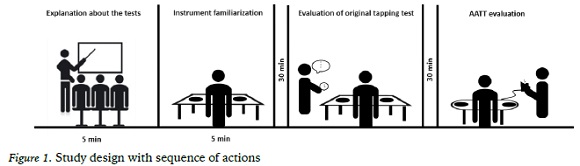
<body><![CDATA[<p>&nbsp;</p>     <p><b>Introduction</b></p>     <p>There has been increasing use of test batteries to evaluate physical conditions    in the elderly (Rickli &amp; Jones, 1999), adults (Marques et al., 2014) and    children (Alves et al., 2014). However, some criteria have to be observed, and    among them establishing the reliability and objectivity of the tests stands    out. Regarding the objectivity of a measuring instrument, this can be defined    as the degree of precision of the results even when it is applied by different    evaluators to the same individuals. In addition, the reliability or reproducibility    of a measuring instrument is the degree to which the results are expected to    be consistent or reproducible when performed in similar situations by the same    observer at different times (Falzon et al., 2014; Wang et al., 2014).</p>     <p>The EUROFIT battery test (Eurofit, 1990) was developed to evaluate the velocity    of the upper limbs and, according to Schmidt and Wrisberg (2001), is classified    as a continuous and closed motor task. The measurement is usually done by an    evaluator and the time is recorded by a second person with a timer (Eurofit,    1990).</p>     <p>Researchers have focused on motor evaluation for different sports under different    conditions (Brasile, 1990; Brasile, 1986, Kilkens et al., 2003), besides other    physical qualities and field activities (Kilkens et al., 2003; Yilla &amp; Sherril,    1998), where the wide range of tasks and measurement parameters has made it    difficult to analyze the evaluation process. Thus, the purpose of using an electronic    touch measurement system is to visualize the intrinsic information of the test,    which can only be observed with the final results. The aim of this study was    to validate an automated upper limb velocity evaluation apparatus in order to    apply the test validated by EUROFIT (Eurofit, 1990) more efficiently, facilitating    motor assessments by professionals and minimizing any human error.</p>     <p><b>Method</b></p>     <p><b>Participants</b></p>     <p>A cross-sectional study was carried out in which children and adolescents participating    in a sports initiation project were enrolled in the study. The population was    composed of 144 children and adolescents of both sexes (n = 144; 76 boys and    68 girls), aged 8 to 17 years. The criteria for inclusion were: age compatible    with the age established for the research (8-18 years), presented the Terms    of Consent and Free Clarification (TCLE) signed by the responsible adult and    the term of assent (TIC) signed by the child or adolescent. Exclusion criteria    were: refusal to participate in the physical tests, failure to present the signed    TIC or TALE, or presenting any motor or cognitive impairment that would make    performing the tests impossible.</p>     <p>All participants were given an explanation about the performance of the tests    and use of the device. A test familiarization session was carried out, consisting    of (a) Original plate striking test and (b) the Automated Tapping Test (AATT),    with a 30 min interval between them. Then, data collection was performed in    two stages, with initially the participants performing the test according to    the original protocol (Eurofit, 1990) and 30 min after the first test they performed    the AATT. All participants received verbal stimuli during the tests.</p>     <p>The study was approved by the Ethics and Research Committee of the Health Sciences    Center of the Federal University of Rio Grande do Norte (Opinion No. 1249937/2015),    following the guidelines for data collection in human beings, according to resolution    no. 466/12, of 12/12/12, of the National Health Council, as well as the ethical    principles in the Declaration of Helsinki (2008) that were strictly observed    and adopted according to the drawing shown in <a href="#f1">Figure 1</a>.</p>     ]]></body>
<body><![CDATA[<p>&nbsp;</p>     <p align="center"><a name="f1"></a><img src="/img/revistas/mot/v14n4/14n4a11f1.jpg"/></p>     
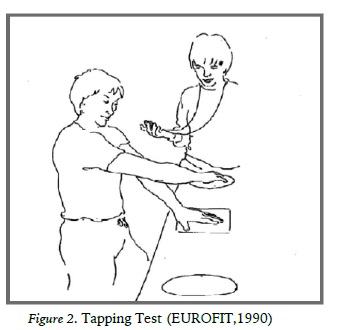
<p>&nbsp;</p>     <p><b>Measures</b></p>     <p>The data collection was performed on the conditions of manual dominance and    motor performance of the participants. Manual dominance was determined by means    of the hand preference diagnostic test, in which the participant throws a tennis    ball, writes or draws (using pen and paper), and makes a square with matchsticks,    and each participant was characterizing as right handed, left-handed or undefined    (Neto et al., 2013). Stroke of EUROFIT plates: The following equipment is required    for the test: a) An adjustable table: the table height must be adjusted to the    height of the participant&rsquo;s navel; b) Two disks (diameter of 20 centimeters),    positioned 60 centimeters apart in a line parallel to the subject; c) A rectangle    (30 × 20 centimeters), positioned equidistant between both disks; the setup    is shown in <a href="#f2">Figure 2</a>.</p>     <p>&nbsp;</p>     <p align="center"><a name="f2"></a><img src="/img/revistas/mot/v14n4/14n4a11f2.jpg"/></p>     
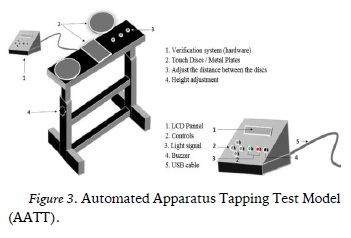
<p>&nbsp;</p>     <p>Automated Tapping Test (AATT): this apparatus (see <a href="#f3">Figure 3</a>)    was built with the purpose of measuring data that allows for the optimization    of the EUROFIT test (Eurofit, 1990). The AATT has the same dimensions as the    original test, is composed of metal parts with adjustable height and distance    between plates for fixed-time and age-time protocols. An electronic system of    measurement and software developed for the same purposes. In this way, the system    registers the performance of the touch-to-touch performer, considering the accelerations    and decelerations, from the beginning of the test until the end of the test,    making possible other inferences, such as contact time with the plates and the    time of flight between the plates for each cycle, and the total test time with    millisecond precision. The apparatus presents sound and luminous signals that    aid the evaluator and signals the beginning and end of the test and automatically    counts the time of accomplishment according to methodology validated in the    original test.</p>     <p>&nbsp;</p>     ]]></body>
<body><![CDATA[<p align="center"><a name="f3"></a><img src="/img/revistas/mot/v14n4/14n4a11f3.jpg"/></p>     
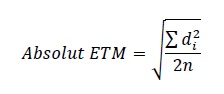
<p>&nbsp;</p>     <p>The same evaluator carried out the evaluations and the importance of this is    the smaller difference makes it possible to minimize any errors in the measurement,    namely the intra- evaluator technical error of measurement (ETM). In order to    measure the results between the different types of application of the plate    striking protocol (AATT and original EUROFIT), the following equation was used    to perform the calculations (Perini et al., 2005).</p>     <p>&nbsp;</p>     <p align="center"><a name="e1"></a><img src="/img/revistas/mot/v14n4/14n4a11e1.jpg"/></p>     
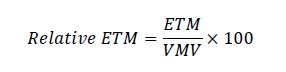
<p>&nbsp;</p>     <p>Where: &#931;= Sum of deviation squared; n = number of volunteers measured;    i = how many deviation</p>     <p>&nbsp;</p>     <p align="center"><a name="e2"></a><img src="/img/revistas/mot/v14n4/14n4a11e2.jpg"/></p>     
<p>&nbsp;</p>     ]]></body>
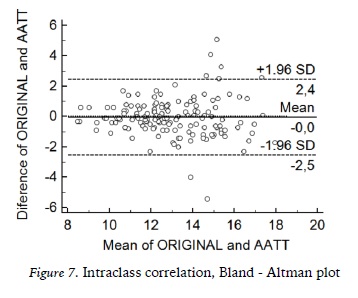
<body><![CDATA[<p>Where: ETM = Technical error measurement, expressed in %; VMV = Average value    of the variable.</p>     <p><b>Procedures</b></p>     <p><i>Test stroke of EUROFIT plates</i></p>     <p>The participants&rsquo; motor performance was verified through a velocity test of    the upper limbs by means of the Plate Strike test, following the protocol of    EUROFIT (Eurofit, 1990) and then evaluated using the AATT.</p>     <p>For the performance of the test, the evaluator controls the cycles, the total    time, the beginning and the end of the test. The non-dominant hand of the appraised    is supported in the central rectangle, and the appraised hand moves from one    side to the other, as fast as possible to place the dominant hand on either    side of the non- dominant hand. This action is repeated for 25 cycles, or 50    touches on the plates (Eurofit, 1990).</p>     <p>For the original test, the Council of Europe recommends that in order to carry    out the EUROFIT Plate Strike test, to take into account some important additional    points such as the counting of the cycles, which should be out loud and done    by the evaluator; the table should be at the navel height of the child; the    evaluator should stand on the side of the hand for which the child will start    the test; the hand in the rectangle must remain in it and the other must always    touch the disks; two evaluators are recommended during the test, one to time    and another to count the cycles; in case the child does not touch the disk,    an extra touch must be added in order for it to reach the full 25 cycles (Eurofit,    1990).</p>     <p><i>Performance of the Automated Tapping Test (AATT) </i>To perform the Plate    Strike test using the Automated Tapping Test (AATT), the methodological procedure    was identical to the original test (EUROFIT); however, the count of the cycles    and touches is performed by the software developed for the AATT. To perform    the counting of the taps, the automated system of the AATT consists of an Arduino    Uno microcontroller platform that sends an electric signal of 5V to the central    metal plate of the mechanical system, and a voltage comparison circuit using    an integrated circuit connected to the two metal plates at the ends of the mechanical    system. The end plates meet at a voltage of 0V. The test is initiated when the    user positions the non-dominant hand on the center plate of the platform and    touches the other hand on the end plate of the dominant hand side. The user    has an important role because the user&rsquo;s body makes a connection bridge between    the two boards by sending a 5V voltage to the end plate to perform the voltage    comparison. The voltage comparison circuit sends a voltage signal to the Arduino    microcontroller platform when the end plate receives a voltage of 4V ~ 5V, so    the microcontroller counts the taps, the time interval and the total time of    the test.</p>     <p>Even if the user touches the same disk twice the count only continues if there    is an alternation between the touches on the disks that will send the data to    the software installed on the computer connected to it. The beginning and end    of the test will also be signaled by the device through a sound and luminous    signal guaranteeing the attention of the evaluated by using different stimuli.    In this way, only one evaluator is required to adjust the start of the procedure    on the computer connected to the device.</p>     <p><b>Statistical analysis</b></p>     <p>The Kolmogorov-Smirnov test was applied to verify the assumption of normal    data distribution, which was confirmed for all variables. The descriptive analysis    consisted of measures of mean and standard deviation of all variables of the    study. To verify the validity of the apparatus the results were evaluated compared    to the mean results by Pearson's correlation coefficient test (r), the coefficient    of determination (r2). The correlation was proposed by (Lin, 1989) for an analysis    of the Concordance Correlation Coefficient (CCC), in order to verify the accuracy    (Cb) and the precision (&#961;) between the estimated and average values in    the validation. Intracanal correlation coefficient (ICC), table. The Bland-Altman    plot was published to verify the result and a concordance between the original    test and the AATT, with the limits of agreement (LC) defined as a mean of the    differences + 1.96 standard deviations. Abstract Software for the Social Sciences    (SPSS), version 20.0 and MedCalc v.12.5.0.</p>     ]]></body>
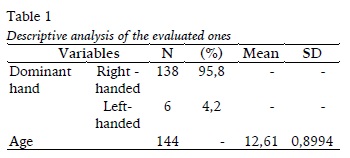
<body><![CDATA[<p><b>Results</b></p>     <p><a href="#t1">Table 1</a> shows the descriptive results of the evaluations.</p>     <p>&nbsp;</p>     <p align="center"><a name="t1"></a><img src="/img/revistas/mot/v14n4/14n4a11t1.jpg"/></p>     
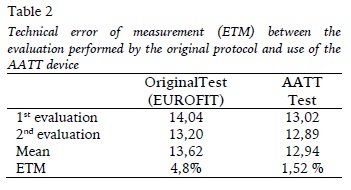
<p>&nbsp;</p>     <p>The mean comparison test did not identify a significant difference between    the two assessment methods (p = 0.647).</p>     <p>&nbsp;</p>     <p align="center"><a name="t2"></a><img src="/img/revistas/mot/v14n4/14n4a11t2.jpg"/></p>     
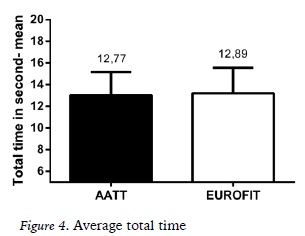
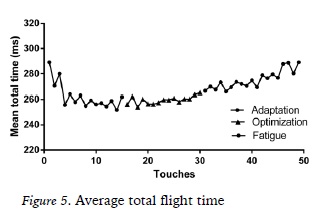
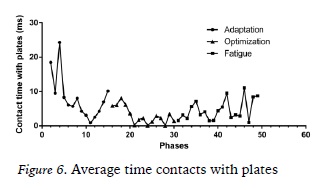
<p>&nbsp;</p>     <p>The technical error of intra-rater measurement was verified between the two    evaluations carried out through each test, being the verified difference between    them, with significantly better results for AATT, although the original test    presented an acceptable classification. In order to demonstrate the ability    to calibrate the instrument, with variables intrinsic to the test, three graphs    were developed that demonstrate the total test time for the 50 taps, the flight    time and the contact time with the plates. The mean total test time was 12.89    seconds for the original test and 12.77 seconds for the AATT. It was identified    that about 67.84% of the total time is composed of flight time, and 32.15% of    contact with the metal plates.</p>     ]]></body>
<body><![CDATA[<p>The data found in the validation analyzes show quite significant indices. A    coefficient of determination (r²) 0.716, in the analysis of the Coefficient    of Correlation of Concordance (CCC) 0,823, validity (cb) 0,999 and precision    (&#961;) 0,820; The Bland and Altman model was used to demonstrate the intraclass    correlation ICC (0.901) of the applied tests.</p>     <p>The Bland and Altman model was used to demonstrate the intraclass correlation    of the applied tests, for which an r = -0.901 was found to be very high, which    is presented as an r² of 0.711.</p>     <p><b>Discussion</b></p>     <p>The aim of the present study was to validate an automated upper limb velocity    evaluation apparatus in order to make the application of the test validated    by EUROFIT (Eurofit, 1990) more efficient, facilitating motor assessments for    professionals and minimizing human error.</p>     <p>Thus, we validated the AATT, which proposes to assess the velocity of upper    limbs, through the original Strike Plate protocol published by EUROFIT (Eurofit,    1990) after considering that the original methodology applied could be improved    and optimized, facilitating the collection of data from large groups in the    sports and health area. The developed device demonstrates efficiency in its    results when compared with the original test.</p>     <p>In the development of unilateral limb protocols it is important to observe    the motor preference of the individuals evaluated. There is a general preference    in the population for the use of the right hemisphere to perform these tests    (Neto et al., 2013).</p>     <p>When observing the total time of the tests, with the means presented in <a href="#f4">Figure    4</a>, (EUROFIT 12.892 s and AATT 12.772 s) do not present significant differences    and are quite close to those of studies that used the same testing protocol.    Santos (2009) presented similar averages in his studies when he performed pre    and post intervention tests in youngsters between 12 and 15 years old with averages    of 12.99 s for the group with three training days, 13.73 s for the group with    one training day, and 13.24 s for the control group. Dantas et al., (2016),    using the original protocol for groups between 12 and 15 years old, in a study    that verified the relationship of bone and chronological age with physical abilities    in sports initiation, found means ranging from 15.72 to 15.16s. These variations    can be explained based on factors such as motor coordination that can suffer    a deficit in the pubertal period due to the peak of physical growth that is    not accompanied at the same speed by neural development, being then balanced    with the somatic aspects (Dantas et al., 2016). In another study by Cabral (2013)    presented similar results (mean 13.2 s) in a population in the same age group.</p>     <p>&nbsp;</p>     <p align="center"><a name="f4"></a><img src="/img/revistas/mot/v14n4/14n4a11f4.jpg"/></p>     
<p>&nbsp;</p>     ]]></body>
<body><![CDATA[<p>In the original EUROFIT test, the responsibility for measuring time and cycles    by one or two evaluators requires unnecessary wear, since they must count aloud    and be synchronized to the time/touch during the test. This may compromise the    data in collections from large groups and may increase the intra-evaluative    error or inter-rater errors. We verified the difference in the results between    the two types of procedure evaluated in this study, with the MES in the original    procedure 4.8 vs. 1.52 s in the protocol evaluated by the AATT apparatus. Therefore,    the creation of an automated device reduces the chances of human error. In addition,    it allows for standardization of the processes, greater efficiency in testing,    and, often, reductions in costs and time (Cabral, 2013).</p>     <p>In this context, Santos (2009) presented a device intended to measure upper    limb velocity measurements. According to these authors, the creation of a device    used to measure the velocity of upper limbs proved to be very efficient because    with the instrument developed for their research it was possible to record performance    curves of the test for each subject, and these curves could be analyzed in relation    to the total test time, flight time between the touches on the plates, and the    contact time of the hand with each plate.</p>     <p>The use of other devices for measuring upper limb velocity has been shown to    be efficient when used in collection of data from children of different ages    (Santos et al., 2007; Krebs, Borges Junior &amp; Santos, 2008; Krebs, Lucas    &amp; Saens, 2000), demonstrating the effectiveness of the measures recorded.    Krebs et al., (2008) used an apparatus for measuring the upper limb velocity    of six university basketball players, with a system of plates and an analog    converter following the protocol of EUROFIT (Eurofit, 1990). Although it was    not completely objective, the equipment used proved to have been quite efficient    in the data collection, and they had the intention to also verify proprioceptive    visual ability.</p>     <p>It is important to emphasize that the application of the AATT follows the same    protocol and requirements proposed by the European Commission (Eurofit, 1990)    to evaluate the velocity of upper limbs, following the height adjustment of    the support table, the proposed dimensions and an execution identical to the    original protocol. In addition, the AATT allows for adjustment of the distance    between the disks as well as the table height, which corroborates Finamor's    studies. Krebs et al., (2008) analyzed aspects of physical development (size    and height) related to structural dimensions, execution and performance in the    Plate Strike test. In addition, they evaluated the correlation of plate distances    in indoor soccer and basketball practitioners and identified a moderate negative    relationship between the original plate striking test and the fit test between    plate distances in three groups: female basketball (r= - 0.772); male basketball    (r = -0.768); and male indoor soccer (r = -0.712), for p &lt;0.01, and this    good correlation could be considered to validate the test with distance adjustments    between the plates. The intraclass correlation analyzed for the same population    between the original test and the automated apparatus presented in <a href="#f5">Figure    5</a> shows satisfactory and significant results (0.901) for the validation    of the AATT. In addition, the use of electronic equipment has been increasingly    preferred with a view to avoid the interference that human evaluation may provoke    (Balsalobre- Frenadez et al., 2016; Garnacho-Castaño et al., 2015; González-Badillo    &amp; Sánchez-Medina, 2010; Jidovtseff et al., 2011; Sanchez-Medina et al.,    2014), being an important form of test control.</p>     <p>&nbsp;</p>     <p align="center"><a name="f5"></a><img src="/img/revistas/mot/v14n4/14n4a11f5.jpg"/></p>     
<p>&nbsp;</p>     <p align="center"><a name="f6"></a><img src="/img/revistas/mot/v14n4/14n4a11f6.jpg"/></p>     
<p>&nbsp;</p>     <p align="center"><a name="f7"></a><img src="/img/revistas/mot/v14n4/14n4a11f7.jpg"/></p>     
]]></body>
<body><![CDATA[<p>&nbsp;</p>     <p><b>Conclusion</b></p>     <p>We can conclude from the present study that the automated apparatus for evaluation    of upper limb velocity has been shown to be compatible with what it intends    to evaluate, demonstrated that there is no significant difference between the    results evaluated by the device and the original form in the same population.    The use of the AATT presented advantages over the application of the original    EUROFIT test applied manually, presenting a lower technical error of intra-rater    measurement and it can be applied with only one evaluator, reducing the time    required and the efficiency of the evaluations. Thus, it is an important and    efficient piece of equipment that can be used by professionals for physical    evaluations of children and adolescents in sports initiation.</p>     <p>&nbsp;</p>     <p><b>REFERENCES</b></p>     <!-- ref --><p>Alves, M., Ramos, D., Oliveira, G., Alves, H., Anderson, I., Magalhães, I.    &amp; Ferreira, P.L. (2014). European Portuguese EARS test battery adaptation.    <i>Acta Medica Portuguesa</i>, <i>27</i>(1), 23-32.    &nbsp;&nbsp;&nbsp;&nbsp;&nbsp;&nbsp;&nbsp;&nbsp;[&#160;<a href="javascript:void(0);" onclick="javascript: window.open('/scielo.php?script=sci_nlinks&ref=386026&pid=S1646-107X201800030001100001&lng=','','width=640,height=500,resizable=yes,scrollbars=1,menubar=yes,');">Links</a>&#160;]<!-- end-ref --></p>     <!-- ref --><p>Balsalobre-Fernández, C., Kuzdub, M., Poveda-Ortiz, P. &amp; Campo-Vecino,    J. (2016). Validity and Reliability of the PUSH Wearable Device to Measure Movement    Velocity During the Back Squat Exercise. <i>Journal of Strength Conditioning    Research</i>, <i>30</i>(7), 1968-74.    &nbsp;&nbsp;&nbsp;&nbsp;&nbsp;&nbsp;&nbsp;&nbsp;[&#160;<a href="javascript:void(0);" onclick="javascript: window.open('/scielo.php?script=sci_nlinks&ref=386028&pid=S1646-107X201800030001100002&lng=','','width=640,height=500,resizable=yes,scrollbars=1,menubar=yes,');">Links</a>&#160;]<!-- end-ref --></p>     <!-- ref --><p>Brasile, F. (1990). Performance evaluation of wheelchair athletes: more than    a disability classification level issue. <i>Adapted Physical Activity Quarterly</i>,    7, 289-97.    &nbsp;&nbsp;&nbsp;&nbsp;&nbsp;&nbsp;&nbsp;&nbsp;[&#160;<a href="javascript:void(0);" onclick="javascript: window.open('/scielo.php?script=sci_nlinks&ref=386030&pid=S1646-107X201800030001100003&lng=','','width=640,height=500,resizable=yes,scrollbars=1,menubar=yes,');">Links</a>&#160;]<!-- end-ref --></p>     <!-- ref --><p>Brasile, F. (1986). Wheelchair basketball skills proficiencies versus NWBA    classifications. <i>Adapted Physical Activity Quarterly</i>, <i>3</i>, 6-13.    &nbsp;&nbsp;&nbsp;&nbsp;&nbsp;&nbsp;&nbsp;&nbsp;[&#160;<a href="javascript:void(0);" onclick="javascript: window.open('/scielo.php?script=sci_nlinks&ref=386032&pid=S1646-107X201800030001100004&lng=','','width=640,height=500,resizable=yes,scrollbars=1,menubar=yes,');">Links</a>&#160;]<!-- end-ref --></p>     <!-- ref --><p>Cabral, B. G. A. T. (2013). Predictive equation of bone age in sports initiation    through anthropometric variables. <i>Brazilian Journal of Sport Medicine, 19</i>(2),    99-103.    &nbsp;&nbsp;&nbsp;&nbsp;&nbsp;&nbsp;&nbsp;&nbsp;[&#160;<a href="javascript:void(0);" onclick="javascript: window.open('/scielo.php?script=sci_nlinks&ref=386034&pid=S1646-107X201800030001100005&lng=','','width=640,height=500,resizable=yes,scrollbars=1,menubar=yes,');">Links</a>&#160;]<!-- end-ref --></p>     <!-- ref --><p>Dantas, M. P., Barbosa, P. R. S., Silva, L. M. &amp; Cabral, B. G. A. T. (2016)    Relationship of bone and chronological age with physical abilities in sports    initiation. <i>Motricidade, 12</i>(2), 28-34.    &nbsp;&nbsp;&nbsp;&nbsp;&nbsp;&nbsp;&nbsp;&nbsp;[&#160;<a href="javascript:void(0);" onclick="javascript: window.open('/scielo.php?script=sci_nlinks&ref=386036&pid=S1646-107X201800030001100006&lng=','','width=640,height=500,resizable=yes,scrollbars=1,menubar=yes,');">Links</a>&#160;]<!-- end-ref --></p>     <!-- ref --><p>Eurofit Council of Europe. (1990). <i>Commission for the Development of Sport</i>,    Eurofit: a test manual.    &nbsp;&nbsp;&nbsp;&nbsp;&nbsp;&nbsp;&nbsp;&nbsp;[&#160;<a href="javascript:void(0);" onclick="javascript: window.open('/scielo.php?script=sci_nlinks&ref=386038&pid=S1646-107X201800030001100007&lng=','','width=640,height=500,resizable=yes,scrollbars=1,menubar=yes,');">Links</a>&#160;]<!-- end-ref --></p>     <!-- ref --><p>Falzon, C., Sabiston, C., Bergamaschi, A., Corrion, K., Chalabaev, A. &amp;    D'Arripe-Longueville F. (2014) Development and validation of the Cancer Exercise    Stereotypes Scale. <i>Journal of Psychosocial Oncology, 32</i>(6), 708-26.    &nbsp;&nbsp;&nbsp;&nbsp;&nbsp;&nbsp;&nbsp;&nbsp;[&#160;<a href="javascript:void(0);" onclick="javascript: window.open('/scielo.php?script=sci_nlinks&ref=386040&pid=S1646-107X201800030001100008&lng=','','width=640,height=500,resizable=yes,scrollbars=1,menubar=yes,');">Links</a>&#160;]<!-- end-ref --></p>     <p>Garnacho-Castaño, M. V., López-Lastra, S., Sanches, A. R. &amp; Mate-Muñoz,    J. L. Reliability and validity assessment of a linear position transducer. <i>Journal    of Sports Science and Medicine, 14</i>, 128-36.</p>     <!-- ref --><p>González-Badillo, J. J. &amp; Sánchez-Medina, L. (2010). Movement velocity    as a measure of loading intensity in resistance training. <i>International Journal    of Sports Medicine, 31</i>, 347-352.    &nbsp;&nbsp;&nbsp;&nbsp;&nbsp;&nbsp;&nbsp;&nbsp;[&#160;<a href="javascript:void(0);" onclick="javascript: window.open('/scielo.php?script=sci_nlinks&ref=386043&pid=S1646-107X201800030001100010&lng=','','width=640,height=500,resizable=yes,scrollbars=1,menubar=yes,');">Links</a>&#160;]<!-- end-ref --></p>     <!-- ref --><p>Jidovtseff, B., Harris, N. K., Crielaard, J. M. &amp; Cronin, J. B. (2011).    Using the load-velocity relationship for 1RM prediction. <i>Journal of Strength    Conditioning Research</i>, <i>25</i>, 267-270.    &nbsp;&nbsp;&nbsp;&nbsp;&nbsp;&nbsp;&nbsp;&nbsp;[&#160;<a href="javascript:void(0);" onclick="javascript: window.open('/scielo.php?script=sci_nlinks&ref=386045&pid=S1646-107X201800030001100011&lng=','','width=640,height=500,resizable=yes,scrollbars=1,menubar=yes,');">Links</a>&#160;]<!-- end-ref --></p>     <!-- ref --><p>Kilkens, O. J. E., Post, M. W. M., Dallmeijer, A. J., Seelem, H. A. M. &amp;    Van Der Woulde L. H. V. (2003). Wheelchair Skills tests: a systematic review.    <i>Clinical Rehabilitation, 17</i>, 418-30.    &nbsp;&nbsp;&nbsp;&nbsp;&nbsp;&nbsp;&nbsp;&nbsp;[&#160;<a href="javascript:void(0);" onclick="javascript: window.open('/scielo.php?script=sci_nlinks&ref=386047&pid=S1646-107X201800030001100012&lng=','','width=640,height=500,resizable=yes,scrollbars=1,menubar=yes,');">Links</a>&#160;]<!-- end-ref --></p>     <!-- ref --><p>Krebs, R. J., Borges Junior, N. G. &amp; Santos, M. B. (2008). Implications    of visual and proprioceptive perception in the performance of a continuous and    closed motor task. <i>Brazilian Journal of Motor Behavior, 1</i>(4), 35-9.    &nbsp;&nbsp;&nbsp;&nbsp;&nbsp;&nbsp;&nbsp;&nbsp;[&#160;<a href="javascript:void(0);" onclick="javascript: window.open('/scielo.php?script=sci_nlinks&ref=386049&pid=S1646-107X201800030001100013&lng=','','width=640,height=500,resizable=yes,scrollbars=1,menubar=yes,');">Links</a>&#160;]<!-- end-ref --></p>     ]]></body>
<body><![CDATA[<p>Krebs, R. J., Lucas, M. A. &amp; Saenz, G. C. Criteria for calculating the    adjusted distances of the Eurofit battery. <i>Cinergis, 1</i>, 189-202.</p>     <!-- ref --><p>Marques, E. A., Baptista, F., Santos, R., Vale, S., Santos, D. A. &amp; Silva,    A. M. (2014). Normative functional fitness standards and trends of Portuguese    older adults: cross-cultural comparisons. <i>Journal of Aging Physical Activity</i>,    <i>22</i>(1), 126-37.    &nbsp;&nbsp;&nbsp;&nbsp;&nbsp;&nbsp;&nbsp;&nbsp;[&#160;<a href="javascript:void(0);" onclick="javascript: window.open('/scielo.php?script=sci_nlinks&ref=386052&pid=S1646-107X201800030001100015&lng=','','width=640,height=500,resizable=yes,scrollbars=1,menubar=yes,');">Links</a>&#160;]<!-- end-ref --></p>     <!-- ref --><p>Neto Francisco, R., Xavier, R. F. C., Santos, A. P. M., &amp; Amaro, K. N.,    Florêncio, R., Poeta, L. S. (2013). Cross-laterality and reading and writing    performance in schoolchildren. <i>Cefac Journal</i>, <i>15</i>(4), 864-872.    &nbsp;&nbsp;&nbsp;&nbsp;&nbsp;&nbsp;&nbsp;&nbsp;[&#160;<a href="javascript:void(0);" onclick="javascript: window.open('/scielo.php?script=sci_nlinks&ref=386054&pid=S1646-107X201800030001100016&lng=','','width=640,height=500,resizable=yes,scrollbars=1,menubar=yes,');">Links</a>&#160;]<!-- end-ref --></p>     <!-- ref --><p>Perini, T. A., Oliveira, G. L. , Ornellas, J. S. &amp; Oliveira, F. P. (2005).    Calculation of the technical error of measurement in anthropometry. <i>Brazilian    Journal of Sports Medicine, 11</i>(1), 81-85.    &nbsp;&nbsp;&nbsp;&nbsp;&nbsp;&nbsp;&nbsp;&nbsp;[&#160;<a href="javascript:void(0);" onclick="javascript: window.open('/scielo.php?script=sci_nlinks&ref=386056&pid=S1646-107X201800030001100017&lng=','','width=640,height=500,resizable=yes,scrollbars=1,menubar=yes,');">Links</a>&#160;]<!-- end-ref --></p>     <p>Rikli, R. E. &amp; Jones, C. J. (199). Development and validation of a functional    fitness test for community residing older adults. <i>Journal of Aging Physical    Activity</i>, <i>7</i>(2), 129-61.</p>     <!-- ref --><p>Sanchez-Medina, L., Gonzalez-Badillo, J. J., Perez, C. E. &amp; Pallares, J.    G. (2014). Velocity- and power-load relationships of the bench pull vs. bench    press exercises. <i>International Journal of Sports Medicine</i>, <i>35</i>,    209-216.    &nbsp;&nbsp;&nbsp;&nbsp;&nbsp;&nbsp;&nbsp;&nbsp;[&#160;<a href="javascript:void(0);" onclick="javascript: window.open('/scielo.php?script=sci_nlinks&ref=386059&pid=S1646-107X201800030001100019&lng=','','width=640,height=500,resizable=yes,scrollbars=1,menubar=yes,');">Links</a>&#160;]<!-- end-ref --></p>     ]]></body>
<body><![CDATA[<!-- ref --><p>Santos, M. B., Keulen, G. E., Braga, R. K., Dias, J. A., Afonso, C. A. &amp;    Krebs RJ. (2007) <i>System of evaluation of the speed of upper limbs</i>. International    Symposium on Sport Sciences; São Caetano - Brazil.    &nbsp;&nbsp;&nbsp;&nbsp;&nbsp;&nbsp;&nbsp;&nbsp;[&#160;<a href="javascript:void(0);" onclick="javascript: window.open('/scielo.php?script=sci_nlinks&ref=386061&pid=S1646-107X201800030001100020&lng=','','width=640,height=500,resizable=yes,scrollbars=1,menubar=yes,');">Links</a>&#160;]<!-- end-ref --></p>     <!-- ref --><p>Santos, M. B. (2009). <i>Impact of a motor intervention program on the performance    of schoolchildren in performing the upper limb agility test - Plate Strikes</i>.    Florianópolis: UDESC.    &nbsp;&nbsp;&nbsp;&nbsp;&nbsp;&nbsp;&nbsp;&nbsp;[&#160;<a href="javascript:void(0);" onclick="javascript: window.open('/scielo.php?script=sci_nlinks&ref=386063&pid=S1646-107X201800030001100021&lng=','','width=640,height=500,resizable=yes,scrollbars=1,menubar=yes,');">Links</a>&#160;]<!-- end-ref --></p>     <!-- ref --><p>Schmidt, R. &amp; Wrisberg, C. (2001) <i>Learning and motor performance: a    problem-based approach to learning</i>. Porto Alegre: Artmed.    &nbsp;&nbsp;&nbsp;&nbsp;&nbsp;&nbsp;&nbsp;&nbsp;[&#160;<a href="javascript:void(0);" onclick="javascript: window.open('/scielo.php?script=sci_nlinks&ref=386065&pid=S1646-107X201800030001100022&lng=','','width=640,height=500,resizable=yes,scrollbars=1,menubar=yes,');">Links</a>&#160;]<!-- end-ref --></p>     <!-- ref --><p>Wang, H. C., Chao, Y. F., Tsai, J. C., Yu, Y. H., Hang, L. W. &amp; Lee, S.    D. (2014). Development and preliminar validation of a questionnaire on regular    exercise beliefs among patients with chronic obstructive pulmonary disease.    <i>Journal of Clinical Nurse</i>, <i>23</i>(7-8), 1133-43.    &nbsp;&nbsp;&nbsp;&nbsp;&nbsp;&nbsp;&nbsp;&nbsp;[&#160;<a href="javascript:void(0);" onclick="javascript: window.open('/scielo.php?script=sci_nlinks&ref=386067&pid=S1646-107X201800030001100023&lng=','','width=640,height=500,resizable=yes,scrollbars=1,menubar=yes,');">Links</a>&#160;]<!-- end-ref --></p>     <!-- ref --><p>Yilla, A. B., Sherril, C. (1998). Validating the Beck battery of quad rugby    skills tests. <i>Adapted Physical Activity Quarterly, 15</i>(2), 155-67.    &nbsp;&nbsp;&nbsp;&nbsp;&nbsp;&nbsp;&nbsp;&nbsp;[&#160;<a href="javascript:void(0);" onclick="javascript: window.open('/scielo.php?script=sci_nlinks&ref=386069&pid=S1646-107X201800030001100024&lng=','','width=640,height=500,resizable=yes,scrollbars=1,menubar=yes,');">Links</a>&#160;]<!-- end-ref --></p>     ]]></body>
<body><![CDATA[<p>&nbsp;</p>     <p>Acknowledgments: Nothing to declare.&nbsp; </p>     <p>Conflict of interests: Nothing to declare.&nbsp;      <p>Funding: Nothing to declare.      <p>      <p>Manuscript received at April 14th 2018; Accepted at November 8th 2018</p>     <p>&nbsp;</p>     <p><a href="#top*"><sup>[*]</sup></a><a name="*"></a><i>Corresponding author</i>:    <i>Email</i>: <a href="mailto:lndrmedeiros@gmail.com">lndrmedeiros@gmail.com</a></p>      ]]></body><back>
<ref-list>
<ref id="B1">
<nlm-citation citation-type="journal">
<person-group person-group-type="author">
<name>
<surname><![CDATA[Alves]]></surname>
<given-names><![CDATA[M.]]></given-names>
</name>
<name>
<surname><![CDATA[Ramos]]></surname>
<given-names><![CDATA[D.]]></given-names>
</name>
<name>
<surname><![CDATA[Oliveira]]></surname>
<given-names><![CDATA[G.]]></given-names>
</name>
<name>
<surname><![CDATA[Alves]]></surname>
<given-names><![CDATA[H.]]></given-names>
</name>
<name>
<surname><![CDATA[Anderson]]></surname>
<given-names><![CDATA[I.]]></given-names>
</name>
<name>
<surname><![CDATA[Magalhães]]></surname>
<given-names><![CDATA[I.]]></given-names>
</name>
<name>
<surname><![CDATA[Ferreira]]></surname>
<given-names><![CDATA[P.L.]]></given-names>
</name>
</person-group>
<article-title xml:lang="en"><![CDATA[European Portuguese EARS test battery adaptation]]></article-title>
<source><![CDATA[Acta Medica Portuguesa]]></source>
<year>2014</year>
<volume>27</volume>
<numero>1</numero>
<issue>1</issue>
<page-range>23-32</page-range></nlm-citation>
</ref>
<ref id="B2">
<nlm-citation citation-type="journal">
<person-group person-group-type="author">
<name>
<surname><![CDATA[Balsalobre-Fernández]]></surname>
<given-names><![CDATA[C.]]></given-names>
</name>
<name>
<surname><![CDATA[Kuzdub]]></surname>
<given-names><![CDATA[M.]]></given-names>
</name>
<name>
<surname><![CDATA[Poveda-Ortiz]]></surname>
<given-names><![CDATA[P.]]></given-names>
</name>
<name>
<surname><![CDATA[Campo-Vecino]]></surname>
<given-names><![CDATA[J.]]></given-names>
</name>
</person-group>
<article-title xml:lang="en"><![CDATA[Validity and Reliability of the PUSH Wearable Device to Measure Movement Velocity During the Back Squat Exercise]]></article-title>
<source><![CDATA[Journal of Strength Conditioning Research]]></source>
<year>2016</year>
<volume>30</volume>
<numero>7</numero>
<issue>7</issue>
<page-range>1968-74</page-range></nlm-citation>
</ref>
<ref id="B3">
<nlm-citation citation-type="journal">
<person-group person-group-type="author">
<name>
<surname><![CDATA[Brasile]]></surname>
<given-names><![CDATA[F.]]></given-names>
</name>
</person-group>
<article-title xml:lang="en"><![CDATA[Performance evaluation of wheelchair athletes: more than a disability classification level issue]]></article-title>
<source><![CDATA[Adapted Physical Activity Quarterly]]></source>
<year>1990</year>
<volume>7</volume>
<page-range>289-97</page-range></nlm-citation>
</ref>
<ref id="B4">
<nlm-citation citation-type="journal">
<person-group person-group-type="author">
<name>
<surname><![CDATA[Brasile]]></surname>
<given-names><![CDATA[F.]]></given-names>
</name>
</person-group>
<article-title xml:lang="en"><![CDATA[Wheelchair basketball skills proficiencies versus NWBA classifications]]></article-title>
<source><![CDATA[Adapted Physical Activity Quarterly]]></source>
<year>1986</year>
<volume>3</volume>
<page-range>6-13</page-range></nlm-citation>
</ref>
<ref id="B5">
<nlm-citation citation-type="journal">
<person-group person-group-type="author">
<name>
<surname><![CDATA[Cabral]]></surname>
<given-names><![CDATA[B. G. A. T.]]></given-names>
</name>
</person-group>
<article-title xml:lang="en"><![CDATA[Predictive equation of bone age in sports initiation through anthropometric variables]]></article-title>
<source><![CDATA[Brazilian Journal of Sport Medicine]]></source>
<year>2013</year>
<volume>19</volume>
<numero>2</numero>
<issue>2</issue>
<page-range>99-103</page-range></nlm-citation>
</ref>
<ref id="B6">
<nlm-citation citation-type="journal">
<person-group person-group-type="author">
<name>
<surname><![CDATA[Dantas]]></surname>
<given-names><![CDATA[M. P.]]></given-names>
</name>
<name>
<surname><![CDATA[Barbosa]]></surname>
<given-names><![CDATA[P. R. S.]]></given-names>
</name>
<name>
<surname><![CDATA[Silva]]></surname>
<given-names><![CDATA[L. M.]]></given-names>
</name>
<name>
<surname><![CDATA[Cabral]]></surname>
<given-names><![CDATA[B. G. A. T.]]></given-names>
</name>
</person-group>
<article-title xml:lang="en"><![CDATA[Relationship of bone and chronological age with physical abilities in sports initiation]]></article-title>
<source><![CDATA[Motricidade]]></source>
<year>2016</year>
<volume>12</volume>
<numero>2</numero>
<issue>2</issue>
<page-range>28-34</page-range></nlm-citation>
</ref>
<ref id="B7">
<nlm-citation citation-type="">
<collab>Eurofit Council of Europe</collab>
<source><![CDATA[Commission for the Development of Sport, Eurofit: a test manual]]></source>
<year>1990</year>
</nlm-citation>
</ref>
<ref id="B8">
<nlm-citation citation-type="journal">
<person-group person-group-type="author">
<name>
<surname><![CDATA[Falzon]]></surname>
<given-names><![CDATA[C.]]></given-names>
</name>
<name>
<surname><![CDATA[Sabiston]]></surname>
<given-names><![CDATA[C.]]></given-names>
</name>
<name>
<surname><![CDATA[Bergamaschi]]></surname>
<given-names><![CDATA[A.]]></given-names>
</name>
<name>
<surname><![CDATA[Corrion]]></surname>
<given-names><![CDATA[K.]]></given-names>
</name>
<name>
<surname><![CDATA[Chalabaev]]></surname>
<given-names><![CDATA[A.]]></given-names>
</name>
<name>
<surname><![CDATA[D'Arripe-Longueville]]></surname>
<given-names><![CDATA[F.]]></given-names>
</name>
</person-group>
<article-title xml:lang="en"><![CDATA[Development and validation of the Cancer Exercise Stereotypes Scale]]></article-title>
<source><![CDATA[Journal of Psychosocial Oncology]]></source>
<year>2014</year>
<volume>32</volume>
<numero>6</numero>
<issue>6</issue>
<page-range>708-26</page-range></nlm-citation>
</ref>
<ref id="B9">
<nlm-citation citation-type="journal">
<person-group person-group-type="author">
<name>
<surname><![CDATA[Garnacho-Castaño]]></surname>
<given-names><![CDATA[M. V.]]></given-names>
</name>
<name>
<surname><![CDATA[López-Lastra]]></surname>
<given-names><![CDATA[S.]]></given-names>
</name>
<name>
<surname><![CDATA[Sanches]]></surname>
<given-names><![CDATA[A. R.]]></given-names>
</name>
<name>
<surname><![CDATA[Mate-Muñoz]]></surname>
<given-names><![CDATA[J. L.]]></given-names>
</name>
</person-group>
<article-title xml:lang="en"><![CDATA[Reliability and validity assessment of a linear position transducer]]></article-title>
<source><![CDATA[Journal of Sports Science and Medicine]]></source>
<year>2015</year>
<volume>14</volume>
<page-range>128-36</page-range></nlm-citation>
</ref>
<ref id="B10">
<nlm-citation citation-type="journal">
<person-group person-group-type="author">
<name>
<surname><![CDATA[González-Badillo]]></surname>
<given-names><![CDATA[J. J.]]></given-names>
</name>
<name>
<surname><![CDATA[Sánchez-Medina]]></surname>
<given-names><![CDATA[L.]]></given-names>
</name>
</person-group>
<article-title xml:lang="en"><![CDATA[Movement velocity as a measure of loading intensity in resistance training]]></article-title>
<source><![CDATA[International Journal of Sports Medicine]]></source>
<year>2010</year>
<volume>31</volume>
<page-range>347-352</page-range></nlm-citation>
</ref>
<ref id="B11">
<nlm-citation citation-type="journal">
<person-group person-group-type="author">
<name>
<surname><![CDATA[Jidovtseff]]></surname>
<given-names><![CDATA[B.]]></given-names>
</name>
<name>
<surname><![CDATA[Harris]]></surname>
<given-names><![CDATA[N. K.]]></given-names>
</name>
<name>
<surname><![CDATA[Crielaard]]></surname>
<given-names><![CDATA[J. M.]]></given-names>
</name>
<name>
<surname><![CDATA[Cronin]]></surname>
<given-names><![CDATA[J. B.]]></given-names>
</name>
</person-group>
<article-title xml:lang="en"><![CDATA[Using the load-velocity relationship for 1RM prediction]]></article-title>
<source><![CDATA[Journal of Strength Conditioning Research]]></source>
<year>2011</year>
<volume>25</volume>
<page-range>267-270</page-range></nlm-citation>
</ref>
<ref id="B12">
<nlm-citation citation-type="journal">
<person-group person-group-type="author">
<name>
<surname><![CDATA[Kilkens]]></surname>
<given-names><![CDATA[O. J. E.]]></given-names>
</name>
<name>
<surname><![CDATA[Post]]></surname>
<given-names><![CDATA[M. W. M.]]></given-names>
</name>
<name>
<surname><![CDATA[Dallmeijer]]></surname>
<given-names><![CDATA[A. J.]]></given-names>
</name>
<name>
<surname><![CDATA[Seelem]]></surname>
<given-names><![CDATA[H. A. M.]]></given-names>
</name>
<name>
<surname><![CDATA[Van Der Woulde]]></surname>
<given-names><![CDATA[L. H. V.]]></given-names>
</name>
</person-group>
<article-title xml:lang="en"><![CDATA[Wheelchair Skills tests: a systematic review]]></article-title>
<source><![CDATA[Clinical Rehabilitation]]></source>
<year>2003</year>
<volume>17</volume>
<page-range>418-30</page-range></nlm-citation>
</ref>
<ref id="B13">
<nlm-citation citation-type="journal">
<person-group person-group-type="author">
<name>
<surname><![CDATA[Krebs]]></surname>
<given-names><![CDATA[R. J.]]></given-names>
</name>
<name>
<surname><![CDATA[Borges Junior]]></surname>
<given-names><![CDATA[N. G.]]></given-names>
</name>
<name>
<surname><![CDATA[Santos]]></surname>
<given-names><![CDATA[M. B.]]></given-names>
</name>
</person-group>
<article-title xml:lang="en"><![CDATA[Implications of visual and proprioceptive perception in the performance of a continuous and closed motor task]]></article-title>
<source><![CDATA[Brazilian Journal of Motor Behavior]]></source>
<year>2008</year>
<volume>1</volume>
<numero>4</numero>
<issue>4</issue>
<page-range>35-9</page-range></nlm-citation>
</ref>
<ref id="B14">
<nlm-citation citation-type="journal">
<person-group person-group-type="author">
<name>
<surname><![CDATA[Krebs]]></surname>
<given-names><![CDATA[R. J.]]></given-names>
</name>
<name>
<surname><![CDATA[Lucas]]></surname>
<given-names><![CDATA[M. A.]]></given-names>
</name>
<name>
<surname><![CDATA[Saenz]]></surname>
<given-names><![CDATA[G. C.]]></given-names>
</name>
</person-group>
<article-title xml:lang="en"><![CDATA[Criteria for calculating the adjusted distances of the Eurofit battery]]></article-title>
<source><![CDATA[Cinergis]]></source>
<year>2010</year>
<volume>1</volume>
<page-range>189-202</page-range></nlm-citation>
</ref>
<ref id="B15">
<nlm-citation citation-type="journal">
<person-group person-group-type="author">
<name>
<surname><![CDATA[Marques]]></surname>
<given-names><![CDATA[E. A.]]></given-names>
</name>
<name>
<surname><![CDATA[Baptista]]></surname>
<given-names><![CDATA[F.]]></given-names>
</name>
<name>
<surname><![CDATA[Santos]]></surname>
<given-names><![CDATA[R.]]></given-names>
</name>
<name>
<surname><![CDATA[Vale]]></surname>
<given-names><![CDATA[S.]]></given-names>
</name>
<name>
<surname><![CDATA[Santos]]></surname>
<given-names><![CDATA[D. A.]]></given-names>
</name>
<name>
<surname><![CDATA[Silva]]></surname>
<given-names><![CDATA[A. M.]]></given-names>
</name>
</person-group>
<article-title xml:lang="en"><![CDATA[Normative functional fitness standards and trends of Portuguese older adults: cross-cultural comparisons]]></article-title>
<source><![CDATA[Journal of Aging Physical Activity]]></source>
<year>2014</year>
<volume>22</volume>
<numero>1</numero>
<issue>1</issue>
<page-range>126-37</page-range></nlm-citation>
</ref>
<ref id="B16">
<nlm-citation citation-type="journal">
<person-group person-group-type="author">
<name>
<surname><![CDATA[Neto Francisco]]></surname>
<given-names><![CDATA[R.]]></given-names>
</name>
<name>
<surname><![CDATA[Xavier]]></surname>
<given-names><![CDATA[R. F. C.]]></given-names>
</name>
<name>
<surname><![CDATA[Santos]]></surname>
<given-names><![CDATA[A. P. M.]]></given-names>
</name>
<name>
<surname><![CDATA[Amaro]]></surname>
<given-names><![CDATA[K. N.]]></given-names>
</name>
<name>
<surname><![CDATA[Florêncio]]></surname>
<given-names><![CDATA[R.]]></given-names>
</name>
<name>
<surname><![CDATA[Poeta]]></surname>
<given-names><![CDATA[L. S.]]></given-names>
</name>
</person-group>
<article-title xml:lang="en"><![CDATA[Cross-laterality and reading and writing performance in schoolchildren]]></article-title>
<source><![CDATA[Cefac Journal]]></source>
<year>2013</year>
<volume>15</volume>
<numero>4</numero>
<issue>4</issue>
<page-range>864-872</page-range></nlm-citation>
</ref>
<ref id="B17">
<nlm-citation citation-type="journal">
<person-group person-group-type="author">
<name>
<surname><![CDATA[Perini]]></surname>
<given-names><![CDATA[T. A.]]></given-names>
</name>
<name>
<surname><![CDATA[Oliveira]]></surname>
<given-names><![CDATA[G. L.]]></given-names>
</name>
<name>
<surname><![CDATA[Ornellas]]></surname>
<given-names><![CDATA[J. S.]]></given-names>
</name>
<name>
<surname><![CDATA[Oliveira]]></surname>
<given-names><![CDATA[F. P.]]></given-names>
</name>
</person-group>
<article-title xml:lang="en"><![CDATA[Calculation of the technical error of measurement in anthropometry]]></article-title>
<source><![CDATA[Brazilian Journal of Sports Medicine]]></source>
<year>2005</year>
<volume>11</volume>
<numero>1</numero>
<issue>1</issue>
<page-range>81-85</page-range></nlm-citation>
</ref>
<ref id="B18">
<nlm-citation citation-type="journal">
<person-group person-group-type="author">
<name>
<surname><![CDATA[Rikli]]></surname>
<given-names><![CDATA[R. E.]]></given-names>
</name>
<name>
<surname><![CDATA[Jones]]></surname>
<given-names><![CDATA[C. J.]]></given-names>
</name>
</person-group>
<article-title xml:lang="en"><![CDATA[Development and validation of a functional fitness test for community residing older adults]]></article-title>
<source><![CDATA[Journal of Aging Physical Activity]]></source>
<year>1999</year>
<volume>7</volume>
<numero>2</numero>
<issue>2</issue>
<page-range>129-61</page-range></nlm-citation>
</ref>
<ref id="B19">
<nlm-citation citation-type="journal">
<person-group person-group-type="author">
<name>
<surname><![CDATA[Sanchez-Medina]]></surname>
<given-names><![CDATA[L.]]></given-names>
</name>
<name>
<surname><![CDATA[Gonzalez-Badillo]]></surname>
<given-names><![CDATA[J. J.]]></given-names>
</name>
<name>
<surname><![CDATA[Perez]]></surname>
<given-names><![CDATA[C. E.]]></given-names>
</name>
<name>
<surname><![CDATA[Pallares]]></surname>
<given-names><![CDATA[J. G.]]></given-names>
</name>
</person-group>
<article-title xml:lang="en"><![CDATA[Velocity- and power-load relationships of the bench pull vs bench press exercises]]></article-title>
<source><![CDATA[International Journal of Sports Medicine]]></source>
<year>2014</year>
<volume>35</volume>
<page-range>209-216</page-range></nlm-citation>
</ref>
<ref id="B20">
<nlm-citation citation-type="">
<person-group person-group-type="author">
<name>
<surname><![CDATA[Santos]]></surname>
<given-names><![CDATA[M. B.]]></given-names>
</name>
<name>
<surname><![CDATA[Keulen]]></surname>
<given-names><![CDATA[G. E.]]></given-names>
</name>
<name>
<surname><![CDATA[Braga]]></surname>
<given-names><![CDATA[R. K.]]></given-names>
</name>
<name>
<surname><![CDATA[Dias]]></surname>
<given-names><![CDATA[J. A.]]></given-names>
</name>
<name>
<surname><![CDATA[Afonso]]></surname>
<given-names><![CDATA[C. A.]]></given-names>
</name>
<name>
<surname><![CDATA[Krebs]]></surname>
<given-names><![CDATA[RJ.]]></given-names>
</name>
</person-group>
<article-title xml:lang="en"><![CDATA[System of evaluation of the speed of upper limbs]]></article-title>
<source><![CDATA[International Symposium on Sport Sciences]]></source>
<year>2007</year>
<publisher-loc><![CDATA[São Caetano ]]></publisher-loc>
</nlm-citation>
</ref>
<ref id="B21">
<nlm-citation citation-type="book">
<person-group person-group-type="author">
<name>
<surname><![CDATA[Santos]]></surname>
<given-names><![CDATA[M. B.]]></given-names>
</name>
</person-group>
<source><![CDATA[Impact of a motor intervention program on the performance of schoolchildren in performing the upper limb agility test - Plate Strikes]]></source>
<year>2009</year>
<publisher-loc><![CDATA[Florianópolis ]]></publisher-loc>
<publisher-name><![CDATA[UDESC]]></publisher-name>
</nlm-citation>
</ref>
<ref id="B22">
<nlm-citation citation-type="book">
<person-group person-group-type="author">
<name>
<surname><![CDATA[Schmidt]]></surname>
<given-names><![CDATA[R.]]></given-names>
</name>
<name>
<surname><![CDATA[Wrisberg]]></surname>
<given-names><![CDATA[C.]]></given-names>
</name>
</person-group>
<source><![CDATA[Learning and motor performance: a problem-based approach to learning]]></source>
<year>2001</year>
<publisher-loc><![CDATA[Porto Alegre ]]></publisher-loc>
<publisher-name><![CDATA[Artmed]]></publisher-name>
</nlm-citation>
</ref>
<ref id="B23">
<nlm-citation citation-type="journal">
<person-group person-group-type="author">
<name>
<surname><![CDATA[Wang]]></surname>
<given-names><![CDATA[H. C.]]></given-names>
</name>
<name>
<surname><![CDATA[Chao]]></surname>
<given-names><![CDATA[Y. F.]]></given-names>
</name>
<name>
<surname><![CDATA[Tsai]]></surname>
<given-names><![CDATA[J. C.]]></given-names>
</name>
<name>
<surname><![CDATA[Yu]]></surname>
<given-names><![CDATA[Y. H.]]></given-names>
</name>
<name>
<surname><![CDATA[Hang]]></surname>
<given-names><![CDATA[L. W.]]></given-names>
</name>
<name>
<surname><![CDATA[Lee]]></surname>
<given-names><![CDATA[S. D.]]></given-names>
</name>
</person-group>
<article-title xml:lang="en"><![CDATA[Development and preliminar validation of a questionnaire on regular exercise beliefs among patients with chronic obstructive pulmonary disease]]></article-title>
<source><![CDATA[Journal of Clinical Nurse]]></source>
<year>2014</year>
<volume>23</volume>
<numero>7-8</numero>
<issue>7-8</issue>
<page-range>1133-43</page-range></nlm-citation>
</ref>
<ref id="B24">
<nlm-citation citation-type="journal">
<person-group person-group-type="author">
<name>
<surname><![CDATA[Yilla]]></surname>
<given-names><![CDATA[A. B.]]></given-names>
</name>
<name>
<surname><![CDATA[Sherril]]></surname>
<given-names><![CDATA[C.]]></given-names>
</name>
</person-group>
<article-title xml:lang="en"><![CDATA[Validating the Beck battery of quad rugby skills tests]]></article-title>
<source><![CDATA[Adapted Physical Activity Quarterly]]></source>
<year>1998</year>
<volume>15</volume>
<numero>2</numero>
<issue>2</issue>
<page-range>155-67</page-range></nlm-citation>
</ref>
</ref-list>
</back>
</article>