<?xml version="1.0" encoding="ISO-8859-1"?><article xmlns:mml="http://www.w3.org/1998/Math/MathML" xmlns:xlink="http://www.w3.org/1999/xlink" xmlns:xsi="http://www.w3.org/2001/XMLSchema-instance">
<front>
<journal-meta>
<journal-id>1646-107X</journal-id>
<journal-title><![CDATA[Motricidade]]></journal-title>
<abbrev-journal-title><![CDATA[Motri.]]></abbrev-journal-title>
<issn>1646-107X</issn>
<publisher>
<publisher-name><![CDATA[Edições Desafio Singular]]></publisher-name>
</publisher>
</journal-meta>
<article-meta>
<article-id>S1646-107X2018000300012</article-id>
<article-id pub-id-type="doi">10.6063/motricidade.15984</article-id>
<title-group>
<article-title xml:lang="en"><![CDATA[Data’s Hidden Data: Qualitative Revelations of Sports Efficiency. Analysis brought by Neural Network Performance Metrics]]></article-title>
</title-group>
<contrib-group>
<contrib contrib-type="author">
<name>
<surname><![CDATA[Campaniço]]></surname>
<given-names><![CDATA[Ana Teresa]]></given-names>
</name>
<xref ref-type="aff" rid="A1"/>
</contrib>
<contrib contrib-type="author">
<name>
<surname><![CDATA[Valente]]></surname>
<given-names><![CDATA[António]]></given-names>
</name>
<xref ref-type="aff" rid="A1"/>
</contrib>
<contrib contrib-type="author">
<name>
<surname><![CDATA[Serôdio]]></surname>
<given-names><![CDATA[Rogério]]></given-names>
</name>
<xref ref-type="aff" rid="A2"/>
</contrib>
<contrib contrib-type="author">
<name>
<surname><![CDATA[Escalera]]></surname>
<given-names><![CDATA[Sérgio]]></given-names>
</name>
<xref ref-type="aff" rid="A3"/>
</contrib>
</contrib-group>
<aff id="AA1">
<institution><![CDATA[,University Trás-os-Montes and Alto Douro INESC Technology and Science and School of Science and Technology ]]></institution>
<addr-line><![CDATA[Vila Real ]]></addr-line>
<country>Portugal</country>
</aff>
<aff id="AA2">
<institution><![CDATA[,University of Beira Interior Department of Matematics ]]></institution>
<addr-line><![CDATA[Covilhã ]]></addr-line>
<country>Portugal</country>
</aff>
<aff id="AA3">
<institution><![CDATA[,University of Barcelona Computer Vision Center ]]></institution>
<addr-line><![CDATA[Barcelona ]]></addr-line>
<country>Spain</country>
</aff>
<pub-date pub-type="pub">
<day>00</day>
<month>12</month>
<year>2018</year>
</pub-date>
<pub-date pub-type="epub">
<day>00</day>
<month>12</month>
<year>2018</year>
</pub-date>
<volume>14</volume>
<numero>4</numero>
<fpage>94</fpage>
<lpage>102</lpage>
<copyright-statement/>
<copyright-year/>
<self-uri xlink:href="http://scielo.pt/scielo.php?script=sci_arttext&amp;pid=S1646-107X2018000300012&amp;lng=en&amp;nrm=iso"></self-uri><self-uri xlink:href="http://scielo.pt/scielo.php?script=sci_abstract&amp;pid=S1646-107X2018000300012&amp;lng=en&amp;nrm=iso"></self-uri><self-uri xlink:href="http://scielo.pt/scielo.php?script=sci_pdf&amp;pid=S1646-107X2018000300012&amp;lng=en&amp;nrm=iso"></self-uri><abstract abstract-type="short" xml:lang="en"><p><![CDATA[The study explores the technical optimization of an athlete through the use of intelligent system performance metrics that produce information obtained from inertial sensors associated to the coach's technical qualifications in real time, using Mixed Methods and Machine Learning. The purpose of this study is to illustrate, from the confusion matrices, the different performance metrics that provide information of high pertinence for the sports training in context. 2000 technical fencing actions with two levels of complexity were performed, captured through a single sensor applied in the armed hand and, simultaneously, the gesture’s qualification through a dichotomous way by the coach. The signals were divided into segments through Dynamic Time Warping, with the resulting extracted characteristics and qualitative assessments being fed to a Neural Network to learn the patterns inherent to a good or poor execution. The performance analysis of the resulting models returned a prediction accuracy of 76.6% and 72.7% for each exercise, but other metrics indicate the existence of high bias in the data. The study demonstrates the potential of intelligent algorithms to uncover trends not captured by other statistical methods.]]></p></abstract>
<kwd-group>
<kwd lng="en"><![CDATA[artificial neural networks]]></kwd>
<kwd lng="en"><![CDATA[confusion matrix]]></kwd>
<kwd lng="en"><![CDATA[performance analysis]]></kwd>
<kwd lng="en"><![CDATA[mixed methods]]></kwd>
<kwd lng="en"><![CDATA[sports]]></kwd>
</kwd-group>
</article-meta>
</front><body><![CDATA[ <p align="right"><font size="2"><b>ARTIGOS ORIGINAIS</b></font></p>     <p><font size="4"><b>Data&rsquo;s Hidden Data: Qualitative Revelations of Sports Efficiency.    Analysis brought by Neural Network Performance Metrics</b></font></p>     <p><b>Ana Teresa Campaniço<sup>1</sup><a href="#*"><sup>[*]</sup></a><a name="top*"></a>,    António Valente<sup>1</sup>, Rogério Serôdio<sup>2</sup>, Sérgio Escalera<sup>3</sup></b></p>     <p><sup>1</sup>INESC TEC - INESC Technology and Science and School of Science    and Technology, University Trás-os-Montes and Alto Douro, Vila Real, Portugal</p>     <p><sup>2</sup>Department of Matematics, University of Beira Interior, Covilhã,    Portugal</p>     <p><sup>3</sup>University of Barcelona and Computer Vision Center, Barcelona,    Spain</p> <hr/>     <p>&nbsp;</p>     <p><b>ABSTRACT</b></p>     <p>The study explores the technical optimization of an athlete through the use    of intelligent system performance metrics that produce information obtained    from inertial sensors associated to the coach's technical qualifications in    real time, using Mixed Methods and Machine Learning. The purpose of this study    is to illustrate, from the confusion matrices, the different performance metrics    that provide information of high pertinence for the sports training in context.    2000 technical fencing actions with two levels of complexity were performed,    captured through a single sensor applied in the armed hand and, simultaneously,    the gesture&rsquo;s qualification through a dichotomous way by the coach. The signals    were divided into segments through Dynamic Time Warping, with the resulting    extracted characteristics and qualitative assessments being fed to a Neural    Network to learn the patterns inherent to a good or poor execution. The performance    analysis of the resulting models returned a prediction accuracy of 76.6% and    72.7% for each exercise, but other metrics indicate the existence of high bias    in the data. The study demonstrates the potential of intelligent algorithms    to uncover trends not captured by other statistical methods.</p>     <p><b>Keywords: </b>artificial neural networks, confusion matrix, performance    analysis, mixed methods, sports.</p> <hr/>     ]]></body>
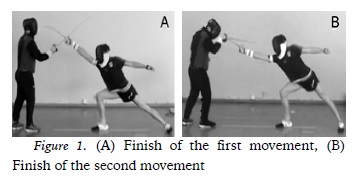
<body><![CDATA[<p>&nbsp;</p>     <p><b>Introduction</b></p>     <p>When it comes to the study of the effectiveness and efficiency of an athlete&rsquo;s    performance, technology provides us with invaluable tools for the treatment    and analysis of large amount of data with relative ease. Intelligent systems    are particularly useful in the detection of patterns and extraction of other    highly relevant information that cannot easily be determined through normal    statistical means (de Souza et al., 2013; Whiteside et al., 2017). However these    systems are not limited to work exclusively with purely quantitative, biometric    data.</p>     <p>Machine learning algorithms are often used to automatically identify systems    of movements, actions and behaviors based on a classification approach. Classes    which can be defined not only by the distinct differences in the collected metrics,    but by more abstract definitions of what they intend to teach the system how    to identify (e.g.: detecting if the subject is standing, sitting or lying down)    (Alpaydin, 2014; Lara &amp; Labrador, 2013; Sammut &amp; Webb, 2017; Taylor    et al., 1994).</p>     <p>The same approach can be applied to the coach&rsquo;s assessment. When performing    a study in context of the actions performed by the athlete and measuring their    performance, either during the competition or during practice, a coach performs    a qualitative evaluation based on their highly honed, but ultimately subjective    and empirical knowledge (de Souza <i>et al.</i>, 2013; Whiteside <i>et al.</i>,    2017). Which can be translated to a nominal measurement unit the intelligent    system can use as an input variable. As such the performance analysis metrics    used to evaluate the algorithm&rsquo;s predictive ability can be used to analyze not    only how well the system was able to correctly classify the given data, but    those results provide important insight on the quality of the data itself (Alpaydin,    2014; Fawcett, 2006; Hlavá&#269;, 2016; Lara &amp; Labrador, 2013; Powers,2011).</p>     <p>In this article it&rsquo;s exemplified the application of these metrics by using    this system in the observation of the fencing practice, a sport highly characterized    by its sudden, explosive speeds, wide range of position combinations and constant    adjustment of the strategic, tactical and technical decisions to the surrounding    context (Araújo, 2006; Barth et al., 2007; Czajkowski, 2005; José, 2018; Kimm    &amp; Thiel, 2015; Saucedo, 2000; Tarragó, et al., 2015; Torrents, 2005). Through    a novel combination of the master&rsquo;s (coach) qualitative assessment of the fencer&rsquo;s    efficiency and the data collected by an inertial sensor placed on the weapon    hand, this Mixed-Method design approach (Anguera <i>et al., </i>2018; Creswell    &amp; Plano Clark, 2011) allows the system to observe this highly variable sport    and learn from the patterns hidden within the data what sets a good from a bad    execution apart. Therefore the evaluation of its qualitative predictions, which    were guided by the master&rsquo;s observation criteria, reflect the behavioral patterns    and cognitive biases and thus point out fallacies in the criteria items and    the direction in which they should be fixed.</p>     <p><b>Method</b></p>     <p>The study of the effectiveness of a single fencer&rsquo;s training movements while    in context was performed on two technical-tactical actions, a simple attack    (sixth engagement lunge with point contact on the chest) (<a href="#f1">figure    1A</a>) and a compound one (sixth engagement with a counter-action of the master    with disengagement to low line, with an octave engagement and a lunge with point    contact on the chest) (<a href="#f1">figure 1B</a>), both falling within the    Federation International Escrime (FIE, 2017) technical rules.</p>     <p>&nbsp;</p>     <p align="center"><a name="f1"></a><img src="/img/revistas/mot/v14n4/14n4a12f1.jpg"/></p>     
]]></body>
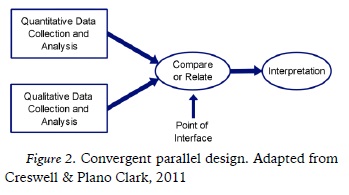
<body><![CDATA[<p>&nbsp;</p>     <p>It follows a Nomothetic/Follow- up/Multidimensional design, focusing on the    plurality of the units (actions performed by the fencer), adding the differentiation    generated by the qualification introduced by the master (good and bad), as observed    through specific actions in the <i>ad-hoc </i>instrument constructed through    field formats. The observation registers the actions over several sessions carried    out over time, with a multidimensionality of response levels co- occurring at    the same time (Anguera et al., 2001, 2011; Anguera &amp; Mendo, 2013; Portell    et al., 2015).</p>     <p>Its focus is to combine the qualitative (QUAL) evaluations obtained from Observational    Methodology performed by the master and the quantitative (QUAN) information    obtained from the inertial sensors through a QUAL/QUAN/QUAL Mixed-Methods approach    (Anguera <i>et al., </i>2017), as seen in <a href="#f2">figure 2</a>.</p>     <p>&nbsp;</p>     <p align="center"><a name="f2"></a><img src="/img/revistas/mot/v14n4/14n4a12f2.jpg"/></p>     
<p>&nbsp;</p>     <p>This is achieved by training an Artificial Neural Network (ANN) on how to recognize    the patterns that form the master&rsquo;s decision process and thus provide us with    valuable revelations that otherwise we would not normally be able to infer from    the data (Hlavá&#269;, 2016; Powers, 2011; Sammut &amp; Webb, 2017).</p>     <p><b>Participants</b></p>     <p>Each exercise was performed 1000 and 700 times respectively in 2 daily sessions,    with a 15 minute interval every 100 executions, by a single fencer. The inertial    data was collected at a 100 Hz sample rate, while the qualitative evaluation    of each execution was provided as a good/bad dichotomic variable, according    to an <i>ad-hoc </i>observational instrument. The collected data (the sample)    was conditioned to have a rate of ±60- 40% of good and bad executions respectively,    in order to provide proper representation of either category to the learning    system.</p>     <p>The fencer is among the top 20 of Youth (U19) World Ranking UIPM, with international    level in Modern Pentathlon, while the master has 10 years of experience as a    coach, with 6 of international level, teaching athletes of world level. The    sensor was placed on a non-intrusive location on top of the glove and the whole    data collection took place during the normal training context. Therefore the    procedures performed in this study did not require an ethics approval at the    time of the research, as per by the UTAD Ethics Committee&rsquo;s rules and guidelines.    All subjects gave written informed consent in accordance with the Declaration    of Helsinki.</p>     ]]></body>
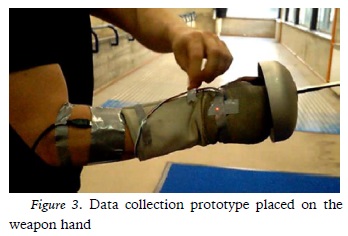
<body><![CDATA[<p><b>Measures</b></p>     <p>Competition The data was collected by a university laboratory developed device    placed on top of the glove of the weapon hand of the fencer (<a href="#f3">figure    3</a>), which respects the FIE technical regulations (FIE, 2017), created specifically    for the purpose of this research.</p>     <p>&nbsp;</p>     <p align="center"><a name="f3"></a><img src="/img/revistas/mot/v14n4/14n4a12f3.jpg"/></p>     
<p>&nbsp;</p>     <p>The hardware is composed by an Arduino Nano and a single MPU-6050 inertial    sensor, which contains an accelerometer and a gyroscope, set on a multi-sensor    board GY-521 of 21.2 x 16.4mm. The 3-axis accelerometer was set at a range of    16g, with a corresponding sensitivity factor of 2,048 LSB/g, calibration tolerance    of ±3% and cross-axis sensitivity of ±2%. The 3- axis gyroscope was set at a    range of 2000 °/s, with a corresponding sensitivity factor of 16.4 LSB/(°/s),    sensitivity tolerance of ±3% and cross-axis sensitivity of ±2% (Invensense,    2013).</p>     <p>The system is powered by, and transfers data through, an USB link to the computer.</p>     <p>The software is composed by a custom data collection application developed    with C# in Unity3D (Unity®, 2017), while all the data processing was done in    Matlab (Mathworks, 2017). A complementary data collection system, used exclusively    to register the fencing context and allow a visual confirmation of the performed    actions, was a Sony P250 camera positioned at a distance to allow enough zoom    to capture the whole image plane. The recordings were made in the natural light    conditions of the room.</p>     <p><b>Procedures</b></p>     <p>Because each exercise is composed by several independent actions that follow    the same set sequence in every observed execution, but with different durations    and levels of expression, each signal was divided into 6 key segments through    the use of Dynamic Time Warping (DTW). This is a time series analysis method    that can find the optimal alignment between two given sequences, independently    of any time distortions between them, by determining the warping path that provides    us with the smallest possible distance between all the points of both time series    (Bautista et al., 2016; Kivikunnas, 1998; Ratanamahatana &amp; Keogh, 2004;    Reyes et al., 2011; Tang et al., 2018).</p>     ]]></body>
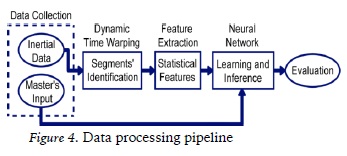
<body><![CDATA[<p>As seen in <a href="#f4">figure 4</a>, this step is followed by Feature Extraction,    a dimensionality reduction method that removes the redundant information in    the data by extracting all the relevant statistical and structural features    that describe the underlying phenomena without any loss of important information    (Alpaydin, 2014; Bishop, 1995; Lara &amp; Labrador, 2013; Rojas, 1996; Sammut    &amp; Webb, 2017). Each context requires different types of features, as there    is no universal solution that portrays every single problem with the same level    of relevance. Likewise some only become relevant descriptors when paired with    other features, while others become irrelevant under certain combinations (Guyon    &amp; Elisseeff, 2006). There are multiple methods in this field of science    regarding the feature selection process, but this is not the goal of this article.</p>     <p>&nbsp;</p>     <p align="center"><a name="f4"></a><img src="/img/revistas/mot/v14n4/14n4a12f4.jpg"/></p>     
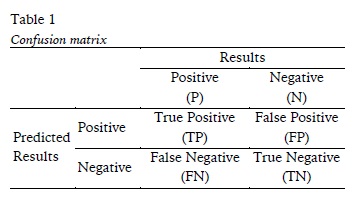
<p>&nbsp;</p>     <p>Taking into account this signal observes human activity through an IMU, which    is prone to high oscillation and fluctuations (Erdas et al., 2016; Lara &amp;    Labrador, 2013; Preece et al., 2009; Vital, 2015), and the resulting information    will aid the ANN in its analysis of each execution, the combination of features    that produced the best results this specific study were the median, root mean    square, kurtosis, fast Fourier transform and principal component analysis. Which,    combined with the duration of each segment, produced a total of 72 features    for each of the two exercises. The next step in the data processing is the selection    of the intelligent algorithm that will merge the QUAN and QUAL data through    a Mixed Method approach in order to reach a QUAL output. Of the several branches    of artificial intelligence, a machine learning approach works by acquiring new    knowledge or understanding from its &ldquo;past experiences&rdquo; in order to form a &ldquo;decision    making&rdquo; model that will give it the ability to predict future outcomes with    increasing reliability (Alpaydin, 2014; Kim, 2017). Supervised learning specifically    learning learns how to perform its task from not just the inherent patterns    within the training data, but also from direct observation the desired output    it must strive to achieve during its learning stage (Alpaydin, 2014; Bishop,    1995; Rojas, 1996; Taylor <i>et al., </i>1994). Classification systems are a    subgroup that takes the already known relationships (the classes) and predicts    which of the discrete, or categorical, labels a new observation should fall    into (Alpaydin, 2014;Taylor <i>et al., </i>1994).</p>     <p>The ANN is a versatile artificial intelligent algorithm that uses multiple    layers of interconnected artificial neurons to receive, process and transmit    the provided input (the quantitative signal) based on a weight bias (the qualitative    evaluation) and activation function that determine if each neuron is allowed    to pass the information to the next layer or not (Alpaydin, 2014; Bishop, 1995;    Rojas, 1996). As the weight of each neuron is adjusted over time based on their    activation states, the desired connections between the neurons are reinforced,    while the undesirable ones are suppressed. This leads to the ANN to adapt to    the provided information and thus learn the patterns that lead to the sorting    into each category (Alpaydin, 2014; Bishop, 1995; Rojas, 1996).</p>     <p>Depending on the quality of the selected training data in representing the    problem the system is aiming to solve, in this case a wide variety of examples    of both good and bad executions and their inherent variability, the model produced    by the ANN may suffer from prediction errors that lead to Overfitting or Underfitting    (Alpaydin, 2014; Fortmann-Roe, 2012; Kim, 2017; Kuhn &amp; Johnson, 2013). The    confusion matrix (<a href="#t1">table 1</a>) allows us to detect such occurrences    by measuring the performance of a classification model through how well it predicted    the correct outcomes (Fawcett, 2006; Hlavá&#269;, 2016; Lara &amp; Labrador,    2013; Powers, 2011). In our case this also translates into insights on the master&rsquo;s    evaluation process.</p>     <p>&nbsp;</p>     <p align="center"><a name="t1"></a><img src="/img/revistas/mot/v14n4/14n4a12t1.jpg"/></p>     
<p>&nbsp;</p>     ]]></body>
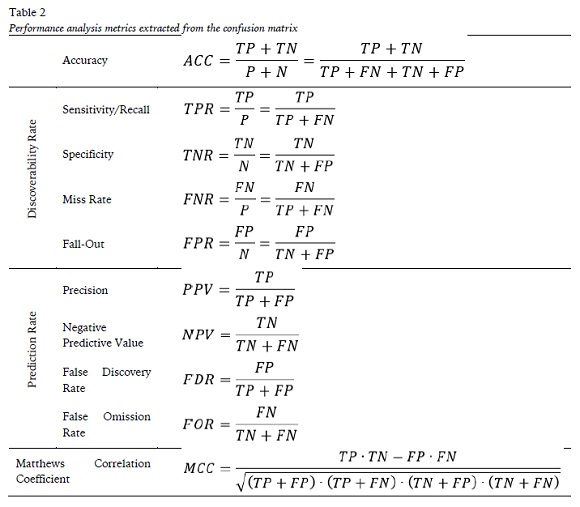
<body><![CDATA[<p>Multiple metrics can be calculated from this matrix beyond just the accuracy,    a highly misleading metric of the model&rsquo;s performance when dealing with an unbalanced    dataset if not paired up with others to provide a full insight (Hlavá&#269;,    2016; Powers, 2011).</p>     <p><i> </i>As seen in <a href="#t2">table 2</a>, the discoverability rate formulas    focus on the classifier&rsquo;s ability to identify the actual results, while the    prediction rate ones measure the overall performance of the predictions themselves.    The Matthews correlation coefficient measures the quality of the model, with    the values ranging between -1 and +1, or complete disagreement between the variables    and perfect prediction respectively (Fawcett, 2004, 2006; Powers, 2011; Sammut    &amp; Webb, 2017).</p>     <p>&nbsp;</p>     <p align="center"><a name="t2"></a><img src="/img/revistas/mot/v14n4/14n4a12t2.jpg"/></p>     
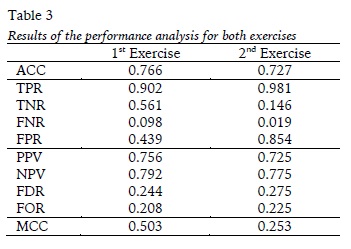
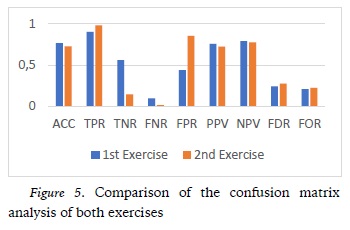
<p>&nbsp;</p>     <p><b>Results</b></p>     <p>As it can be seen in <a href="#t3">table 3</a> our model has a prediction accuracy    of 76.6% and 72.7% for the first and second exercise respectively, with a discoverability    rate of 90.2% and 98.1% of the positive executions and 56.1% and 14.6% for the    negative ones. However it also tends to misclassify good executions as bad 9.8%    and 1.9% of the time, and 43.9% and 85.4% for the negative ones.</p>     <p>&nbsp;</p>     <p align="center"><a name="t3"></a><img src="/img/revistas/mot/v14n4/14n4a12t3.jpg"/></p>     
<p>&nbsp;</p>     ]]></body>
<body><![CDATA[<p>But in terms of prediction rate, the model has a 75.6% and 72.5% probability    of predicting a good execution correctly for the first and second exercise respectively,    and a 79.2% and 77.5% for the bad ones. In terms of misclassifications it has    a 24.4% and 26.5% chance of mistaking a negative result for a positive one,    and 20.8% and 22.5% for opposite outcome.</p>     <p>&nbsp;</p>     <p align="center"><a name="f5"></a><img src="/img/revistas/mot/v14n4/14n4a12f5.jpg"/></p>     
<p>&nbsp;</p>     <p><b>Discussion</b></p>     <p>For a qualitative focused tool, where high variability is to be expected, an    ACC of ±80% is considered acceptable from an Observational Methodology perspective.    Paired up with a high discovery rate of the positive results (TPR), which in    a sport context is often the desired outcome, these metrics would point towards    this model having a desirable performance. However the high FPR hints us towards    some issues in the prediction of the good executions, especially in the second    exercise.</p>     <p>The model having such a disproportionate high tendency to detect the positive    results, including misclassifying negative ones as such, reveals an imbalance    in the data which in turn led to the ANN to produce an Underfitting model that    suffers from high bias. That is, the data lacks enough complexity for the system    to properly capture the underlying relationships within the data that dictate    what forms a bad execution (Alpaydin, 2014; Bishop, 1995; Fortmann-Roe, 2012).    However the prediction rates have a similar performance when it comes to detecting    either the good or the bad executions correctly, meaning the model has a low    variance (Fortmann-Roe, 2012).</p>     <p>Such behaviors are often the result of an insufficient data sample size or    an imbalance in the percentage of both types of executions. The ANN require    a high volume of data and, more importantly, a proper representation of all    categories to detect the underlying patterns accurately (Alpaydin, 2014; Bishop,    1995), as shown by the FPR. But it is important to remember these qualifications    that guided the learning process of both models are the result of a human-made,    empirical evaluation that has a natural tendency to adjust over time to fit    the athlete&rsquo;s level, especially when perception is under variations brought    by fatigue.</p>     <p>The fact a traditional observation instrument is designed towards outlining    all the items that form a correct execution also explains the behavior of both    models. Besides fencing being a sport with an inherent high degree of variability    in what is considered a correct execution, even when defined by strict qualitative    criteria and the scope narrowed to a specific training exercise, with minimal    external interaction brought by the opponent, any unfulfilled criteria within    the full length of the execution automatically categorizes it as incorrectly    performed.</p>     <p>This can be a strong source of confusion for the system in understanding what    are the minute characteristics that set both categories apart, if for example    an execution is correct by all accounts but one. And it explains why both models    have such a strong tendency to signal so many results as positive, especially    when the complexity was increased and thus the level of scrutiny followed, in    order to pay attention to the growing amount of details taking place in the    same amount of very short time. When no additional information is provided on    where the fencer erred, as how it normally occurs in a training session, this    dichotomic evaluation does not provide sufficient detail and complexity for    the system to detect the nuances that set the categories apart.</p>     ]]></body>
<body><![CDATA[<p>However there is an external source of error within the evaluations that could    not be accurately measured and thus removed that is likely playing a role in    these results. Even if the study only focused the observation of the hand in    context, information from other body segments was admitted to have been introduced.    So, while the use of an inertial sensor can clearly capture valuable information    from the hardest segment of the body to keep track of within fencing without    the aid of a vision based approach, which is far more complex and demanding    from a computational standpoint (Bradski, 1998; Diamant, 2008; Polak <i>et al.,    </i>2015), this coupled with the metrics pointing to a lack of complexity means    a lone sensor does not possess enough resolution to fully describe the context    on its own.</p>     <p>The reason only a single sensor was used was because of the notion that any    motions performed by the body will be expressed in the suspended hand, thanks    to the sensor&rsquo;s high sensibility. How much impact the fencer&rsquo;s compensatory    actions have in dampening such readings was not part of our focus, but the addition    of another sensor to the leg would most certainly increase the level of resolution    of the observational instruments&rsquo; criteria (Malawski and Kwolek, 2016) and allow    easier creation of new categories, based on the discrimination of the location    of the incorrect action.</p>     <p>As for the performance of the system itself, the prediction rates indicate    both models have a fairly good probability of correctly predicting the class    each execution belongs to, for both the positive and negative outcomes and in    both exercises. That is, despite the data suffering from a high positive bias,    or quantitively having a high selection of positive predictions, qualitatively    both good and bad executions were fairly well distributed between both classes    (Hlavá&#269;, 2016; Powers, 2011; Sammut &amp; Webb, 2017). Depending of the    problem being solved often more relevance is given to one of either sides, although    this only matters when the data is balanced (Fawcett, 2004, 2006). What this    does show however is the data suffers from low variability and that this tool    has potential in detecting the patterns that form the qualitative evaluations.</p>     <p>As for the Matthews correlation coefficient, while it is hard to pinpoint which    of the multiple causes are affecting its measurement of the quality of the model    itself without further investigation and experimentation, we can say with some    certainty the clear difference between both exercises is tied to their respective    levels of complexity and the impact of how hard it is to completely divorce    the actions of the different body segments. It also serves as an illustration    at how complex it is, in such a nuanced sport, to translate such qualitative    criteria occurring in context into a more &ldquo;transparent&rdquo; format.</p>     <p><b>Conclusion</b></p>     <p>Our study showed how an artificial intelligence based system can be applied    in fencing and, through the use of a single inertial sensor and a mixed methods    approach, can capture information often not visible to the naked eye. More importantly    it also provides vital insight on the quality of the data in regard to the qualitative    observations performed by the master in context, achieved through a confusion    matrix and several performance analysis metrics of the intelligent system.</p>     <p>Although the system has a 76.6% and 72.7% prediction accuracy rate, the performance    analysis metrics revealed the data suffers from a high bias towards the positive    results. That is, the data lacks enough complexity for the ANN to detect the    patterns that distinguishes a good execution from a bad one, especially for    the harder exercise. This points towards an imbalance in the representation    of the bad executions in particular, as their definition is too broad in comparison    to the good ones. This strongly suggests that a single sensor is unable to fully    capture the context of the fencer&rsquo;s weapon hand without taking the actions of    the other key body segments into account.</p>     <p>Further research is needed by adding new sources of information, adjusting    the observation criteria, increasing the data sample and likely also incorporating    evaluations performed by other masters and patterns performed by other fencers,    as to detect different behavioral and decision patterns.</p>     <p>&nbsp;</p>     <p><b>REFERENCES</b></p>     ]]></body>
<body><![CDATA[<p>Alpaydin, E. (2014). <i>Introduction to Machine Learning</i>. Adaptive Computation    and Machine Learning (Cambridge, Massachusetts: The MIT Press), third edn.</p>     <!-- ref --><p>Anguera, M.T., Blanco-Villaseñor, Á. &amp; Losada, J.L. (2001). Diseños observacionales,    cuestión clave en el processo de la metodologia observacional. <i>Metodología    de las Ciencias del Comportamiento</i>, 3 (2), 135-160.    &nbsp;&nbsp;&nbsp;&nbsp;&nbsp;&nbsp;&nbsp;&nbsp;[&#160;<a href="javascript:void(0);" onclick="javascript: window.open('/scielo.php?script=sci_nlinks&ref=386188&pid=S1646-107X201800030001200002&lng=','','width=640,height=500,resizable=yes,scrollbars=1,menubar=yes,');">Links</a>&#160;]<!-- end-ref --></p>     <!-- ref --><p>Anguera, M. T., Blanco-Villaseñor, A., Hernández- Mendo, A., &amp; Losada,    J. L. (2011). Diseños observacionales: ajuste y aplicación en psicología del    deporte. <i>Cuadernos de Psicología del Deporte, </i>11(2), 63-76.    &nbsp;&nbsp;&nbsp;&nbsp;&nbsp;&nbsp;&nbsp;&nbsp;[&#160;<a href="javascript:void(0);" onclick="javascript: window.open('/scielo.php?script=sci_nlinks&ref=386190&pid=S1646-107X201800030001200003&lng=','','width=640,height=500,resizable=yes,scrollbars=1,menubar=yes,');">Links</a>&#160;]<!-- end-ref --></p>     <!-- ref --><p>Anguera, M. T., &amp; Hernández Mendo, A. (2013). Observational methodology    in sport sciences. Observational methodology in the field of sport. <i>E-balonmano.com:    Revista de Ciencias del Deporte </i>9(3), 135-160.    &nbsp;&nbsp;&nbsp;&nbsp;&nbsp;&nbsp;&nbsp;&nbsp;[&#160;<a href="javascript:void(0);" onclick="javascript: window.open('/scielo.php?script=sci_nlinks&ref=386192&pid=S1646-107X201800030001200004&lng=','','width=640,height=500,resizable=yes,scrollbars=1,menubar=yes,');">Links</a>&#160;]<!-- end-ref --></p>     <!-- ref --><p>Anguera, M. T., Camerino, O., Castañer, M., Sánchez- Algarra, P., &amp; Onwuegzbuzie,    A. J. (2017). The specificity of observational studies in physical activity    and sports sciences: moving forward in mixed methods research and proposals    for achieving quantitative and qualitative symmetry. <i>Frontiers in psychology    </i>8, 2196. DOI: <a href="https://dx.doi.org/10.3389/fpsyg.2017.02196" target="_blank">10.3389/fpsyg.2017.02196</a>.    &nbsp;&nbsp;&nbsp;&nbsp;&nbsp;&nbsp;&nbsp;&nbsp;[&#160;<a href="javascript:void(0);" onclick="javascript: window.open('/scielo.php?script=sci_nlinks&ref=386194&pid=S1646-107X201800030001200005&lng=','','width=640,height=500,resizable=yes,scrollbars=1,menubar=yes,');">Links</a>&#160;]<!-- end-ref --></p>     <p>Anguera, M. T., Blanco-Villaseñor, A., Losada, J. L., Sánchez-Algarra, P.,    &amp; Onwuegbuzie, A. J. (2018). Revisiting the difference between mixed methods    and multimethods: Is it all in the name?. <i>Quality &amp; Quantity</i>, 1-14.</p>     ]]></body>
<body><![CDATA[<!-- ref --><p>Araújo, D. (2006). <i>Tomada de decisão no desporto</i>. Cruz Quebrada: Edições    FMH.    &nbsp;&nbsp;&nbsp;&nbsp;&nbsp;&nbsp;&nbsp;&nbsp;[&#160;<a href="javascript:void(0);" onclick="javascript: window.open('/scielo.php?script=sci_nlinks&ref=386197&pid=S1646-107X201800030001200007&lng=','','width=640,height=500,resizable=yes,scrollbars=1,menubar=yes,');">Links</a>&#160;]<!-- end-ref --></p>     <p>Barth, B. (2007) <i>The complete guide to fencing</i>. Becks, Emil, Barth,    Berndt Binding (Eds.) UK. Meyer &amp; Meyer Sport Ltd.</p>     <!-- ref --><p>Bautista, M. A., Hernández-Vela, A., Escalera, S., Igual, L., Pujol, O., Moya,    J., &amp; Anguera, M. T. (2016). A gesture recognition system for detecting    behavioral patterns of ADHD. <i>IEEE transactions on cybernetics</i>, 46(1),    136-147.    &nbsp;&nbsp;&nbsp;&nbsp;&nbsp;&nbsp;&nbsp;&nbsp;[&#160;<a href="javascript:void(0);" onclick="javascript: window.open('/scielo.php?script=sci_nlinks&ref=386200&pid=S1646-107X201800030001200009&lng=','','width=640,height=500,resizable=yes,scrollbars=1,menubar=yes,');">Links</a>&#160;]<!-- end-ref --> </p>     <p>Bishop, C. M. (1995). <i>Neural networks for pattern recognition</i>. Oxford    university press.</p>     <p>Bradski, G. R. (1998) Computer Vision Face Tracking for Use in a Perceptual    User Interface. <i>Citeseer, </i>pp.1-15. DOI: <a href="http://citeseerx.ist.psu.edu/viewdoc/summary?doi=10.1.1.14.7673" target="_blank">10.1.1.14.7673</a>.</p>     <!-- ref --><p>Creswell, J. W., &amp; Plano Clark, V. L. (2011). Choosing a mixed methods    design. <i>Designing and conducting mixed methods research</i>, 53-106.    &nbsp;&nbsp;&nbsp;&nbsp;&nbsp;&nbsp;&nbsp;&nbsp;[&#160;<a href="javascript:void(0);" onclick="javascript: window.open('/scielo.php?script=sci_nlinks&ref=386204&pid=S1646-107X201800030001200012&lng=','','width=640,height=500,resizable=yes,scrollbars=1,menubar=yes,');">Links</a>&#160;]<!-- end-ref --></p>     <p>Czajkowski, Z. (2005). <i>Understanding Fencing: The Unity</i> <i>and Practice</i>.    Staten Island, NY: SKA Swordplay Books.</p>     ]]></body>
<body><![CDATA[<!-- ref --><p>Diamant, E. (2008). <i>I'm sorry to say, but your understanding of image processing    fundamentals is absolutely wrong</i>.    &nbsp;&nbsp;&nbsp;&nbsp;&nbsp;&nbsp;&nbsp;&nbsp;[&#160;<a href="javascript:void(0);" onclick="javascript: window.open('/scielo.php?script=sci_nlinks&ref=386207&pid=S1646-107X201800030001200014&lng=','','width=640,height=500,resizable=yes,scrollbars=1,menubar=yes,');">Links</a>&#160;]<!-- end-ref --> </p>     <p>Erda&#351;, Ç. B., Atasoy, I., Aç&#305;c&#305;, K., &amp; O&#287;ul, H. (2016).    Integrating features for accelerometer-based activity recognition. <i>Procedia    Computer Science, </i>98, 522-527.</p>     <!-- ref --><p>Fawcett, T. (2004). ROC graphs: Notes and practical considerations for researchers.    <i>Machine learning, </i>31(1), 1-38.    &nbsp;&nbsp;&nbsp;&nbsp;&nbsp;&nbsp;&nbsp;&nbsp;[&#160;<a href="javascript:void(0);" onclick="javascript: window.open('/scielo.php?script=sci_nlinks&ref=386210&pid=S1646-107X201800030001200016&lng=','','width=640,height=500,resizable=yes,scrollbars=1,menubar=yes,');">Links</a>&#160;]<!-- end-ref --></p>     <!-- ref --><p>Fawcett, T. (2006). An introduction to ROC analysis. <i>Pattern recognition    letters, </i>27(8), 861-874.    &nbsp;&nbsp;&nbsp;&nbsp;&nbsp;&nbsp;&nbsp;&nbsp;[&#160;<a href="javascript:void(0);" onclick="javascript: window.open('/scielo.php?script=sci_nlinks&ref=386212&pid=S1646-107X201800030001200017&lng=','','width=640,height=500,resizable=yes,scrollbars=1,menubar=yes,');">Links</a>&#160;]<!-- end-ref --></p>     <!-- ref --><p>FIE (2017). <i>Technical Rules for competitions.</i><a href="http://fie.org/fie/documents" target="_blank">http://fie.org/fie/documents</a>.    &nbsp;&nbsp;&nbsp;&nbsp;&nbsp;&nbsp;&nbsp;&nbsp;[&#160;<a href="javascript:void(0);" onclick="javascript: window.open('/scielo.php?script=sci_nlinks&ref=386214&pid=S1646-107X201800030001200018&lng=','','width=640,height=500,resizable=yes,scrollbars=1,menubar=yes,');">Links</a>&#160;]<!-- end-ref --></p>     <!-- ref --><p>Fortmann-Roe, S. (2012) <i>Understanding the Bias- Variance Tradeoff</i>. Available:    <a href="http://scott.fortmann-roe.com/docs/BiasVariance.html" target="_blank">http://scott.fortmann-roe.com/docs/BiasVariance.html</a>.    &nbsp;&nbsp;&nbsp;&nbsp;&nbsp;&nbsp;&nbsp;&nbsp;[&#160;<a href="javascript:void(0);" onclick="javascript: window.open('/scielo.php?script=sci_nlinks&ref=386216&pid=S1646-107X201800030001200019&lng=','','width=640,height=500,resizable=yes,scrollbars=1,menubar=yes,');">Links</a>&#160;]<!-- end-ref --></p>     <p>Guyon, I., &amp; Elisseeff, A. (2006). <i>An introduction to feature extraction.    In Feature extraction </i>(pp. 1-25). Springer, Berlin, Heidelberg.</p>     <p>Hlavá&#269;, V. (2016). <i>Classifier performance evaluation</i>. Czech Technical    University. </p>     <!-- ref --><p>InvenSense (2013) <i>MPU-6000 and MPU-6050 Product Specification Revision 3.4.</i>    <a href="https://www.invensense.com" target="_blank">https://www.invensense.com</a>.    &nbsp;&nbsp;&nbsp;&nbsp;&nbsp;&nbsp;&nbsp;&nbsp;[&#160;<a href="javascript:void(0);" onclick="javascript: window.open('/scielo.php?script=sci_nlinks&ref=386220&pid=S1646-107X201800030001200022&lng=','','width=640,height=500,resizable=yes,scrollbars=1,menubar=yes,');">Links</a>&#160;]<!-- end-ref --></p>     <!-- ref --><p>José, J.P.R. (2018). As ações táticas da esgrima em contexto competitivo: Métodos    de observação de padrões temporais de ação e caracterização da variabilidade    de execução. Dissertação Mestrado. (obra não publicada). Repositório UTAD. Vila    Real.    &nbsp;&nbsp;&nbsp;&nbsp;&nbsp;&nbsp;&nbsp;&nbsp;[&#160;<a href="javascript:void(0);" onclick="javascript: window.open('/scielo.php?script=sci_nlinks&ref=386222&pid=S1646-107X201800030001200023&lng=','','width=640,height=500,resizable=yes,scrollbars=1,menubar=yes,');">Links</a>&#160;]<!-- end-ref --></p>     <!-- ref --><p>Kim, P. (2017). <i>MATLAB Deep Learning: With Machine Learning, Neural Networks    and Artificial Intelligence. </i>Apress.    &nbsp;&nbsp;&nbsp;&nbsp;&nbsp;&nbsp;&nbsp;&nbsp;[&#160;<a href="javascript:void(0);" onclick="javascript: window.open('/scielo.php?script=sci_nlinks&ref=386224&pid=S1646-107X201800030001200024&lng=','','width=640,height=500,resizable=yes,scrollbars=1,menubar=yes,');">Links</a>&#160;]<!-- end-ref --></p>     <!-- ref --><p>Kimm, D., &amp; Thiel, D. (2015). Hand speed measurements in boxing. <i>Procedia    Engineering </i>112, 502-506. DOI: <a href="https://dx.doi.org/10.1016/j.proeng.2015.07.232" target="_blank">10.1016/j.proeng.2015.07.232</a>.    &nbsp;&nbsp;&nbsp;&nbsp;&nbsp;&nbsp;&nbsp;&nbsp;[&#160;<a href="javascript:void(0);" onclick="javascript: window.open('/scielo.php?script=sci_nlinks&ref=386226&pid=S1646-107X201800030001200025&lng=','','width=640,height=500,resizable=yes,scrollbars=1,menubar=yes,');">Links</a>&#160;]<!-- end-ref --></p>     <!-- ref --><p>Kivikunnas, S. (1998). <i>Overview of process trend analysis methods and applications</i>.    In ERUDIT Workshop on Applications in Pulp and Paper Industry (pp. 395- 408).    &nbsp;&nbsp;&nbsp;&nbsp;&nbsp;&nbsp;&nbsp;&nbsp;[&#160;<a href="javascript:void(0);" onclick="javascript: window.open('/scielo.php?script=sci_nlinks&ref=386228&pid=S1646-107X201800030001200026&lng=','','width=640,height=500,resizable=yes,scrollbars=1,menubar=yes,');">Links</a>&#160;]<!-- end-ref --></p>     <p>Kuhn, M., &amp; Johnson, K. (2013). <i>Applied predictive modeling </i>(Vol.    26). New York: Springer.</p>     <!-- ref --><p>Lara, O. D., &amp; Labrador, M. A. (2013). A survey on human activity recognition    using wearable sensors. <i>IEEE Communications Surveys and Tutorials</i>, 15(3),    1192-1209.    &nbsp;&nbsp;&nbsp;&nbsp;&nbsp;&nbsp;&nbsp;&nbsp;[&#160;<a href="javascript:void(0);" onclick="javascript: window.open('/scielo.php?script=sci_nlinks&ref=386231&pid=S1646-107X201800030001200028&lng=','','width=640,height=500,resizable=yes,scrollbars=1,menubar=yes,');">Links</a>&#160;]<!-- end-ref --></p>     <!-- ref --><p>Malawski, F., &amp; Kwolek, B. (2016). Classification of basic footwork in    fencing using accelerometer. <i>measurements</i>, 6, 20.    &nbsp;&nbsp;&nbsp;&nbsp;&nbsp;&nbsp;&nbsp;&nbsp;[&#160;<a href="javascript:void(0);" onclick="javascript: window.open('/scielo.php?script=sci_nlinks&ref=386233&pid=S1646-107X201800030001200029&lng=','','width=640,height=500,resizable=yes,scrollbars=1,menubar=yes,');">Links</a>&#160;]<!-- end-ref --></p>     <p>Mathworks (2017) <i>Global Optimization Toolbox: User&rsquo;s</i><i>Guide (r2017a)</i>.</p>     <!-- ref --><p>Polak, E., Kulasa, J., VencesBrito, A., Castro, M. A., &amp; Fernandes, O.    (2015). Motion analysis systems as optimization training tools in combat sports    and martial arts. <i>Revista de Artes Marciales Asiáticas</i>, 10(2), 105-123.    &nbsp;&nbsp;&nbsp;&nbsp;&nbsp;&nbsp;&nbsp;&nbsp;[&#160;<a href="javascript:void(0);" onclick="javascript: window.open('/scielo.php?script=sci_nlinks&ref=386236&pid=S1646-107X201800030001200031&lng=','','width=640,height=500,resizable=yes,scrollbars=1,menubar=yes,');">Links</a>&#160;]<!-- end-ref --></p>     <!-- ref --><p>Portell, M., Anguera, M. T., Chacón-Moscoso, S., &amp; Sanduvete-Chaves, S.    (2015). Guidelines for reporting evaluations based on observational methodology.    <i>Psicothema, </i>27(3), 283-289.    &nbsp;&nbsp;&nbsp;&nbsp;&nbsp;&nbsp;&nbsp;&nbsp;[&#160;<a href="javascript:void(0);" onclick="javascript: window.open('/scielo.php?script=sci_nlinks&ref=386238&pid=S1646-107X201800030001200032&lng=','','width=640,height=500,resizable=yes,scrollbars=1,menubar=yes,');">Links</a>&#160;]<!-- end-ref --></p>     <!-- ref --><p>Powers, D.M. (2011). Evaluation: from precision, recall and F-measure to ROC,    informedness, markedness and correlation. <i>International Journal of Machine    Learning Technology </i>2, 37-63.    &nbsp;&nbsp;&nbsp;&nbsp;&nbsp;&nbsp;&nbsp;&nbsp;[&#160;<a href="javascript:void(0);" onclick="javascript: window.open('/scielo.php?script=sci_nlinks&ref=386240&pid=S1646-107X201800030001200033&lng=','','width=640,height=500,resizable=yes,scrollbars=1,menubar=yes,');">Links</a>&#160;]<!-- end-ref --></p>     <!-- ref --><p>Preece, S., Goulermas, J. Y., Kenney, L. P., &amp; Howard, D. (2009). A comparison    of feature extraction methods for the classification of dynamic activities from    accelerometer data. <i>IEEE </i><i>Transactions on Biomedical Engineering</i>,    56, 871-879.    &nbsp;&nbsp;&nbsp;&nbsp;&nbsp;&nbsp;&nbsp;&nbsp;[&#160;<a href="javascript:void(0);" onclick="javascript: window.open('/scielo.php?script=sci_nlinks&ref=386242&pid=S1646-107X201800030001200034&lng=','','width=640,height=500,resizable=yes,scrollbars=1,menubar=yes,');">Links</a>&#160;]<!-- end-ref --> </p>     <p>Ratanamahatana, C. A. and Keogh, E. (2004). Everything you know about dynamic    time warping is wrong. <i>In 3rd Workshop on Mining Temporal and Sequential    Data, in conjunction with</i><i>10th ACM SIGKDD Int. Conf. Knowledge Discovery    and Data Mining </i>(KDD-2004) (Seattle, WA: Citeseer).</p>     <!-- ref --><p>Reyes, M., Dominguez, G., &amp; Escalera, S. (2011). Featureweighting in dynamic    timewarping for gesture recognition in depth data. <i>In Computer Vision Workshops    (ICCV Workshops), 2011 IEEE International Conference on </i>(pp. 1182-1188).    IEEE.    &nbsp;&nbsp;&nbsp;&nbsp;&nbsp;&nbsp;&nbsp;&nbsp;[&#160;<a href="javascript:void(0);" onclick="javascript: window.open('/scielo.php?script=sci_nlinks&ref=386245&pid=S1646-107X201800030001200036&lng=','','width=640,height=500,resizable=yes,scrollbars=1,menubar=yes,');">Links</a>&#160;]<!-- end-ref --> </p>     ]]></body>
<body><![CDATA[<!-- ref --><p>Rojas, R. (1996). <i>Neural networks: a systematic introduction </i>(Berlin,    Heidelberg: Springer-Verlag). DOI: <a href="https://dx.doi.org/10.1007/978-3-642-61068-4" target="_blank">10.1007/978-3-642-61068-4</a>.    &nbsp;&nbsp;&nbsp;&nbsp;&nbsp;&nbsp;&nbsp;&nbsp;[&#160;<a href="javascript:void(0);" onclick="javascript: window.open('/scielo.php?script=sci_nlinks&ref=386247&pid=S1646-107X201800030001200037&lng=','','width=640,height=500,resizable=yes,scrollbars=1,menubar=yes,');">Links</a>&#160;]<!-- end-ref --></p>     <!-- ref --><p>Sammut, C. &amp; Webb, G. I. (2017). <i>Encyclopedia of machine learning and    data mining </i>(New York: Springer Publishing Company, Incorporated).    &nbsp;&nbsp;&nbsp;&nbsp;&nbsp;&nbsp;&nbsp;&nbsp;[&#160;<a href="javascript:void(0);" onclick="javascript: window.open('/scielo.php?script=sci_nlinks&ref=386249&pid=S1646-107X201800030001200038&lng=','','width=640,height=500,resizable=yes,scrollbars=1,menubar=yes,');">Links</a>&#160;]<!-- end-ref --></p>     <!-- ref --><p>Saucedo, M. F. (2000). Deporte: Mecánica, Táctica o Metodología.    &nbsp;&nbsp;&nbsp;&nbsp;&nbsp;&nbsp;&nbsp;&nbsp;[&#160;<a href="javascript:void(0);" onclick="javascript: window.open('/scielo.php?script=sci_nlinks&ref=386251&pid=S1646-107X201800030001200039&lng=','','width=640,height=500,resizable=yes,scrollbars=1,menubar=yes,');">Links</a>&#160;]<!-- end-ref --> <i>I Congreso    de la Asociación Española de Ciencias del Deporte</i>. Cáceres.</p>     <p>Tang, J., Cheng, H., Zhao, Y., and Guo, H. (2018). Structured dynamic time    warping for continuous hand trajectory gesture recognition. <i>Pattern Recognition    </i>80, 21-31. DOI: <a href="https://dx.doi.org/10.1016/j.patcog.2018.02.011" target="_blank">10.1016/j.patcog.2018.02.011</a>.</p>     <!-- ref --><p>Tarragó, R., Iglesias, X., Michavila, J. J., Chaverri, D., Ruiz-Sanchis, L.,    &amp; Anguera, M. T. (2015). Análisis de patrones en asaltos de espada de alto    nivel. <i>Cuadernos de Psicología del Deporte</i>,15(1), 151-160.    &nbsp;&nbsp;&nbsp;&nbsp;&nbsp;&nbsp;&nbsp;&nbsp;[&#160;<a href="javascript:void(0);" onclick="javascript: window.open('/scielo.php?script=sci_nlinks&ref=386254&pid=S1646-107X201800030001200041&lng=','','width=640,height=500,resizable=yes,scrollbars=1,menubar=yes,');">Links</a>&#160;]<!-- end-ref --></p>     <!-- ref --><p>Taylor, C., Michie, D., &amp; Spiegalhalter, D. (1994) <i>Machine Learning,    Neural and Statistical Classification. </i>Ellis Horward Series in Artifical    Intelligence 1994, New York.    &nbsp;&nbsp;&nbsp;&nbsp;&nbsp;&nbsp;&nbsp;&nbsp;[&#160;<a href="javascript:void(0);" onclick="javascript: window.open('/scielo.php?script=sci_nlinks&ref=386256&pid=S1646-107X201800030001200042&lng=','','width=640,height=500,resizable=yes,scrollbars=1,menubar=yes,');">Links</a>&#160;]<!-- end-ref --> ISBN 0-13-106360- X.</p>     <p>Torrents, C. (2005). <i>La teoría de los sistemas dinámicos y el entrenamiento    deportivo</i>. Unpublished. Doctoral dissertation. INEFC. Universidad Barcelona,    Lleida.</p>     <!-- ref --><p>Unity® (2017). <i>Technologies, Unity</i>. <a href="https://unity3d.com/" target="_blank">https://unity3d.com/</a>&nbsp;&nbsp;&nbsp;&nbsp;&nbsp;&nbsp;&nbsp;&nbsp;[&#160;<a href="javascript:void(0);" onclick="javascript: window.open('/scielo.php?script=sci_nlinks&ref=386259&pid=S1646-107X201800030001200044&lng=','','width=640,height=500,resizable=yes,scrollbars=1,menubar=yes,');">Links</a>&#160;]<!-- end-ref --><!-- ref --><p>Vital, J. P. M. (2015). <i>Análise do movimento humano: classificação temporal    de ações humanas </i>(Doctoral dissertation).    &nbsp;&nbsp;&nbsp;&nbsp;&nbsp;&nbsp;&nbsp;&nbsp;[&#160;<a href="javascript:void(0);" onclick="javascript: window.open('/scielo.php?script=sci_nlinks&ref=386260&pid=S1646-107X201800030001200045&lng=','','width=640,height=500,resizable=yes,scrollbars=1,menubar=yes,');">Links</a>&#160;]<!-- end-ref --></p>     <p>&nbsp;</p>     <p>Acknowledgments: </p>     <p>We are grateful for the support of the Spanish Government&rsquo;s projects: The role    of physical activity and sport in the promotion of healthy lifestyle babits:    The evaluation of sport behaviour using non-intrusive methods (Secretary of    State for Research, Development and Innovation of the Ministry of Economy and    Competitiveness) during the period 2016-2018 [DEP2015-66069-P; MINE-CO / FEDER,    EU]. This work has been partially supported by the Spanish project TIN2016-74946-P    (MINECO/FEDER, EU) and CERCA Programme/Generalitat de Catalunya.</p>     <p>We also thank the collaboration of Fencing Master João José and fencer Hugo    Morais who have made themselves available for the different phases of this work.</p>     <p>Conflict of interests: Nothing to declare.      ]]></body>
<body><![CDATA[<p>Funding: Nothing to declare.</p>     <p>&nbsp;</p>     <p>Manuscript received at October 20th 2018; Accepted at December 19th 2018      <p>&nbsp;</p>     <p><a href="#top*"><sup>[*]</sup></a><a name="*"></a><i>Corresponding author</i>:    Email: <a href="mailto:catpixels.studios@gmail.com">catpixels.studios@gmail.com</a></p>      ]]></body><back>
<ref-list>
<ref id="B1">
<nlm-citation citation-type="book">
<person-group person-group-type="author">
<name>
<surname><![CDATA[Alpaydin]]></surname>
<given-names><![CDATA[E.]]></given-names>
</name>
</person-group>
<source><![CDATA[Introduction to Machine Learning: Adaptive Computation and Machine Learning, third ed]]></source>
<year>2014</year>
<publisher-loc><![CDATA[Cambridge ]]></publisher-loc>
<publisher-name><![CDATA[The MIT Press]]></publisher-name>
</nlm-citation>
</ref>
<ref id="B2">
<nlm-citation citation-type="journal">
<person-group person-group-type="author">
<name>
<surname><![CDATA[Anguera]]></surname>
<given-names><![CDATA[M.T.]]></given-names>
</name>
<name>
<surname><![CDATA[Blanco-Villaseñor]]></surname>
<given-names><![CDATA[Á.]]></given-names>
</name>
<name>
<surname><![CDATA[Losada]]></surname>
<given-names><![CDATA[J.L.]]></given-names>
</name>
</person-group>
<article-title xml:lang="es"><![CDATA[Diseños observacionales, cuestión clave en el processo de la metodologia observacional]]></article-title>
<source><![CDATA[Metodología de las Ciencias del Comportamiento]]></source>
<year>2001</year>
<volume>3</volume>
<numero>2</numero>
<issue>2</issue>
<page-range>135-160</page-range></nlm-citation>
</ref>
<ref id="B3">
<nlm-citation citation-type="journal">
<person-group person-group-type="author">
<name>
<surname><![CDATA[Anguera]]></surname>
<given-names><![CDATA[M. T.]]></given-names>
</name>
<name>
<surname><![CDATA[Blanco-Villaseñor]]></surname>
<given-names><![CDATA[A.]]></given-names>
</name>
<name>
<surname><![CDATA[Hernández- Mendo]]></surname>
<given-names><![CDATA[A.]]></given-names>
</name>
<name>
<surname><![CDATA[Losada]]></surname>
<given-names><![CDATA[J. L.]]></given-names>
</name>
</person-group>
<article-title xml:lang="es"><![CDATA[Diseños observacionales: ajuste y aplicación en psicología del deporte]]></article-title>
<source><![CDATA[Cuadernos de Psicología del Deporte]]></source>
<year>2011</year>
<volume>11</volume>
<numero>2</numero>
<issue>2</issue>
<page-range>63-76</page-range></nlm-citation>
</ref>
<ref id="B4">
<nlm-citation citation-type="journal">
<person-group person-group-type="author">
<name>
<surname><![CDATA[Anguera]]></surname>
<given-names><![CDATA[M. T.]]></given-names>
</name>
<name>
<surname><![CDATA[Hernández Mendo]]></surname>
<given-names><![CDATA[A.]]></given-names>
</name>
</person-group>
<article-title xml:lang="en"><![CDATA[Observational methodology in sport sciences: Observational methodology in the field of sport]]></article-title>
<source><![CDATA[E-balonmano.com Revista de Ciencias del Deporte]]></source>
<year>2013</year>
<volume>9</volume>
<numero>3</numero>
<issue>3</issue>
<page-range>135-160</page-range></nlm-citation>
</ref>
<ref id="B5">
<nlm-citation citation-type="journal">
<person-group person-group-type="author">
<name>
<surname><![CDATA[Anguera]]></surname>
<given-names><![CDATA[M. T.]]></given-names>
</name>
<name>
<surname><![CDATA[Camerino]]></surname>
<given-names><![CDATA[O.]]></given-names>
</name>
<name>
<surname><![CDATA[Castañer]]></surname>
<given-names><![CDATA[M.]]></given-names>
</name>
<name>
<surname><![CDATA[Sánchez- Algarra]]></surname>
<given-names><![CDATA[P.]]></given-names>
</name>
<name>
<surname><![CDATA[Onwuegzbuzie]]></surname>
<given-names><![CDATA[A. J.]]></given-names>
</name>
</person-group>
<article-title xml:lang="en"><![CDATA[The specificity of observational studies in physical activity and sports sciences: moving forward in mixed methods research and proposals for achieving quantitative and qualitative symmetry]]></article-title>
<source><![CDATA[Frontiers in psychology]]></source>
<year>2017</year>
<volume>8</volume>
<page-range>2196</page-range></nlm-citation>
</ref>
<ref id="B6">
<nlm-citation citation-type="journal">
<person-group person-group-type="author">
<name>
<surname><![CDATA[Anguera]]></surname>
<given-names><![CDATA[M. T.]]></given-names>
</name>
<name>
<surname><![CDATA[Blanco-Villaseñor]]></surname>
<given-names><![CDATA[A.]]></given-names>
</name>
<name>
<surname><![CDATA[Losada]]></surname>
<given-names><![CDATA[J. L.]]></given-names>
</name>
<name>
<surname><![CDATA[Sánchez-Algarra]]></surname>
<given-names><![CDATA[P.]]></given-names>
</name>
<name>
<surname><![CDATA[Onwuegbuzie]]></surname>
<given-names><![CDATA[A. J.]]></given-names>
</name>
</person-group>
<article-title xml:lang="en"><![CDATA[Revisiting the difference between mixed methods and multimethods: Is it all in the name?]]></article-title>
<source><![CDATA[Quality & Quantity]]></source>
<year>2018</year>
<volume>0</volume>
<page-range>1-14</page-range></nlm-citation>
</ref>
<ref id="B7">
<nlm-citation citation-type="book">
<person-group person-group-type="author">
<name>
<surname><![CDATA[Araújo]]></surname>
<given-names><![CDATA[D.]]></given-names>
</name>
</person-group>
<source><![CDATA[Tomada de decisão no desporto]]></source>
<year>2006</year>
<publisher-loc><![CDATA[Cruz Quebrada ]]></publisher-loc>
<publisher-name><![CDATA[Edições FMH]]></publisher-name>
</nlm-citation>
</ref>
<ref id="B8">
<nlm-citation citation-type="book">
<person-group person-group-type="author">
<name>
<surname><![CDATA[Barth]]></surname>
<given-names><![CDATA[B.]]></given-names>
</name>
</person-group>
<source><![CDATA[The complete guide to fencing]]></source>
<year>2007</year>
<publisher-loc><![CDATA[UK ]]></publisher-loc>
<publisher-name><![CDATA[Meyer & Meyer Sport Ltd]]></publisher-name>
</nlm-citation>
</ref>
<ref id="B9">
<nlm-citation citation-type="journal">
<person-group person-group-type="author">
<name>
<surname><![CDATA[Bautista]]></surname>
<given-names><![CDATA[M. A.]]></given-names>
</name>
<name>
<surname><![CDATA[Hernández-Vela]]></surname>
<given-names><![CDATA[A.]]></given-names>
</name>
<name>
<surname><![CDATA[Escalera]]></surname>
<given-names><![CDATA[S.]]></given-names>
</name>
<name>
<surname><![CDATA[Igual]]></surname>
<given-names><![CDATA[L.]]></given-names>
</name>
<name>
<surname><![CDATA[Pujol]]></surname>
<given-names><![CDATA[O.]]></given-names>
</name>
<name>
<surname><![CDATA[Moya]]></surname>
<given-names><![CDATA[J.]]></given-names>
</name>
<name>
<surname><![CDATA[Anguera]]></surname>
<given-names><![CDATA[M. T.]]></given-names>
</name>
</person-group>
<article-title xml:lang="en"><![CDATA[A gesture recognition system for detecting behavioral patterns of ADHD]]></article-title>
<source><![CDATA[IEEE transactions on cybernetics]]></source>
<year>2016</year>
<volume>46</volume>
<numero>1</numero>
<issue>1</issue>
<page-range>136-147</page-range></nlm-citation>
</ref>
<ref id="B10">
<nlm-citation citation-type="book">
<person-group person-group-type="author">
<name>
<surname><![CDATA[Bishop]]></surname>
<given-names><![CDATA[C. M.]]></given-names>
</name>
</person-group>
<source><![CDATA[Neural networks for pattern recognition]]></source>
<year>1995</year>
<publisher-loc><![CDATA[Cambridge ]]></publisher-loc>
<publisher-name><![CDATA[Oxford university press]]></publisher-name>
</nlm-citation>
</ref>
<ref id="B11">
<nlm-citation citation-type="journal">
<person-group person-group-type="author">
<name>
<surname><![CDATA[Bradski]]></surname>
<given-names><![CDATA[G. R.]]></given-names>
</name>
</person-group>
<article-title xml:lang="en"><![CDATA[Computer Vision Face Tracking for Use in a Perceptual User Interface]]></article-title>
<source><![CDATA[Citeseer]]></source>
<year>1998</year>
<page-range>1-15</page-range></nlm-citation>
</ref>
<ref id="B12">
<nlm-citation citation-type="journal">
<person-group person-group-type="author">
<name>
<surname><![CDATA[Creswell]]></surname>
<given-names><![CDATA[J. W.]]></given-names>
</name>
<name>
<surname><![CDATA[Plano Clark]]></surname>
<given-names><![CDATA[V. L.]]></given-names>
</name>
</person-group>
<article-title xml:lang="en"><![CDATA[Choosing a mixed methods design]]></article-title>
<source><![CDATA[Designing and conducting mixed methods research]]></source>
<year>2011</year>
<page-range>53-106</page-range></nlm-citation>
</ref>
<ref id="B13">
<nlm-citation citation-type="book">
<person-group person-group-type="author">
<name>
<surname><![CDATA[Czajkowski]]></surname>
<given-names><![CDATA[Z.]]></given-names>
</name>
</person-group>
<source><![CDATA[Understanding Fencing: The Unity and Practice]]></source>
<year>2005</year>
<publisher-loc><![CDATA[Staten Island ]]></publisher-loc>
<publisher-name><![CDATA[SKA Swordplay Books]]></publisher-name>
</nlm-citation>
</ref>
<ref id="B14">
<nlm-citation citation-type="">
<person-group person-group-type="author">
<name>
<surname><![CDATA[Diamant]]></surname>
<given-names><![CDATA[E.]]></given-names>
</name>
</person-group>
<source><![CDATA[I'm sorry to say, but your understanding of image processing fundamentals is absolutely wrong]]></source>
<year>2008</year>
</nlm-citation>
</ref>
<ref id="B15">
<nlm-citation citation-type="journal">
<person-group person-group-type="author">
<name>
<surname><![CDATA[Erdas]]></surname>
<given-names><![CDATA[Ç. B.]]></given-names>
</name>
<name>
<surname><![CDATA[Atasoy]]></surname>
<given-names><![CDATA[I.]]></given-names>
</name>
<name>
<surname><![CDATA[Açici]]></surname>
<given-names><![CDATA[K.]]></given-names>
</name>
<name>
<surname><![CDATA[Ogul]]></surname>
<given-names><![CDATA[H.]]></given-names>
</name>
</person-group>
<article-title xml:lang="en"><![CDATA[Integrating features for accelerometer-based activity recognition]]></article-title>
<source><![CDATA[Procedia Computer Science]]></source>
<year>2016</year>
<volume>98</volume>
<page-range>522-527</page-range></nlm-citation>
</ref>
<ref id="B16">
<nlm-citation citation-type="journal">
<person-group person-group-type="author">
<name>
<surname><![CDATA[Fawcett]]></surname>
<given-names><![CDATA[T.]]></given-names>
</name>
</person-group>
<article-title xml:lang="en"><![CDATA[ROC graphs: Notes and practical considerations for researchers]]></article-title>
<source><![CDATA[Machine learning]]></source>
<year>2004</year>
<volume>31</volume>
<numero>1</numero>
<issue>1</issue>
<page-range>1-38</page-range></nlm-citation>
</ref>
<ref id="B17">
<nlm-citation citation-type="journal">
<person-group person-group-type="author">
<name>
<surname><![CDATA[Fawcett]]></surname>
<given-names><![CDATA[T.]]></given-names>
</name>
</person-group>
<article-title xml:lang="en"><![CDATA[An introduction to ROC analysis]]></article-title>
<source><![CDATA[Pattern recognition letters]]></source>
<year>2006</year>
<volume>27</volume>
<numero>8</numero>
<issue>8</issue>
<page-range>861-874</page-range></nlm-citation>
</ref>
<ref id="B18">
<nlm-citation citation-type="">
<collab>FIE</collab>
<source><![CDATA[Technical Rules for competitions]]></source>
<year>2017</year>
</nlm-citation>
</ref>
<ref id="B19">
<nlm-citation citation-type="">
<person-group person-group-type="author">
<name>
<surname><![CDATA[Fortmann-Roe]]></surname>
<given-names><![CDATA[S.]]></given-names>
</name>
</person-group>
<source><![CDATA[Understanding the Bias- Variance Tradeoff]]></source>
<year>2012</year>
</nlm-citation>
</ref>
<ref id="B20">
<nlm-citation citation-type="book">
<person-group person-group-type="author">
<name>
<surname><![CDATA[Guyon]]></surname>
<given-names><![CDATA[I.]]></given-names>
</name>
<name>
<surname><![CDATA[Elisseeff]]></surname>
<given-names><![CDATA[A.]]></given-names>
</name>
</person-group>
<source><![CDATA[An introduction to feature extraction: In Feature extraction]]></source>
<year>2006</year>
<page-range>1-25</page-range><publisher-loc><![CDATA[Berlin, Heidelberg ]]></publisher-loc>
<publisher-name><![CDATA[Springer]]></publisher-name>
</nlm-citation>
</ref>
<ref id="B21">
<nlm-citation citation-type="book">
<person-group person-group-type="author">
<name>
<surname><![CDATA[Hlavác]]></surname>
<given-names><![CDATA[V.]]></given-names>
</name>
</person-group>
<source><![CDATA[Classifier performance evaluation]]></source>
<year>2016</year>
<publisher-name><![CDATA[Czech Technical University]]></publisher-name>
</nlm-citation>
</ref>
<ref id="B22">
<nlm-citation citation-type="">
<collab>InvenSense</collab>
<source><![CDATA[MPU-6000 and MPU-6050 Product Specification Revision 3.4]]></source>
<year>2013</year>
</nlm-citation>
</ref>
<ref id="B23">
<nlm-citation citation-type="">
<person-group person-group-type="author">
<name>
<surname><![CDATA[José]]></surname>
<given-names><![CDATA[J.P.R.]]></given-names>
</name>
</person-group>
<source><![CDATA[As ações táticas da esgrima em contexto competitivo: Métodos de observação de padrões temporais de ação e caracterização da variabilidade de execução]]></source>
<year>2018</year>
</nlm-citation>
</ref>
<ref id="B24">
<nlm-citation citation-type="book">
<person-group person-group-type="author">
<name>
<surname><![CDATA[Kim]]></surname>
<given-names><![CDATA[P.]]></given-names>
</name>
</person-group>
<source><![CDATA[MATLAB Deep Learning: With Machine Learning, Neural Networks and Artificial Intelligence]]></source>
<year>2017</year>
<publisher-name><![CDATA[Apress]]></publisher-name>
</nlm-citation>
</ref>
<ref id="B25">
<nlm-citation citation-type="journal">
<person-group person-group-type="author">
<name>
<surname><![CDATA[Kimm]]></surname>
<given-names><![CDATA[D.]]></given-names>
</name>
<name>
<surname><![CDATA[Thiel]]></surname>
<given-names><![CDATA[D.]]></given-names>
</name>
</person-group>
<article-title xml:lang="en"><![CDATA[Hand speed measurements in boxing]]></article-title>
<source><![CDATA[Procedia Engineering]]></source>
<year>2015</year>
<volume>112</volume>
<page-range>502-506</page-range></nlm-citation>
</ref>
<ref id="B26">
<nlm-citation citation-type="">
<person-group person-group-type="author">
<name>
<surname><![CDATA[Kivikunnas]]></surname>
<given-names><![CDATA[S.]]></given-names>
</name>
</person-group>
<article-title xml:lang="en"><![CDATA[Overview of process trend analysis methods and applications]]></article-title>
<source><![CDATA[ERUDIT Workshop on Applications in Pulp and Paper Industry]]></source>
<year>1998</year>
<page-range>395- 408</page-range></nlm-citation>
</ref>
<ref id="B27">
<nlm-citation citation-type="book">
<person-group person-group-type="author">
<name>
<surname><![CDATA[Kuhn]]></surname>
<given-names><![CDATA[M.]]></given-names>
</name>
<name>
<surname><![CDATA[Johnson]]></surname>
<given-names><![CDATA[K.]]></given-names>
</name>
</person-group>
<source><![CDATA[Applied predictive modeling]]></source>
<year>2013</year>
<publisher-loc><![CDATA[New York ]]></publisher-loc>
<publisher-name><![CDATA[Springer]]></publisher-name>
</nlm-citation>
</ref>
<ref id="B28">
<nlm-citation citation-type="journal">
<person-group person-group-type="author">
<name>
<surname><![CDATA[Lara]]></surname>
<given-names><![CDATA[O. D.]]></given-names>
</name>
<name>
<surname><![CDATA[Labrador]]></surname>
<given-names><![CDATA[M. A.]]></given-names>
</name>
</person-group>
<article-title xml:lang="en"><![CDATA[A survey on human activity recognition using wearable sensors]]></article-title>
<source><![CDATA[IEEE Communications Surveys and Tutorials]]></source>
<year>2013</year>
<volume>15</volume>
<numero>3</numero>
<issue>3</issue>
<page-range>1192-1209</page-range></nlm-citation>
</ref>
<ref id="B29">
<nlm-citation citation-type="journal">
<person-group person-group-type="author">
<name>
<surname><![CDATA[Malawski]]></surname>
<given-names><![CDATA[F.]]></given-names>
</name>
<name>
<surname><![CDATA[Kwolek]]></surname>
<given-names><![CDATA[B.]]></given-names>
</name>
</person-group>
<article-title xml:lang="en"><![CDATA[Classification of basic footwork in fencing using accelerometer]]></article-title>
<source><![CDATA[Measurements]]></source>
<year>2016</year>
<volume>6</volume>
<page-range>20</page-range></nlm-citation>
</ref>
<ref id="B30">
<nlm-citation citation-type="">
<collab>Mathworks</collab>
<source><![CDATA[Global Optimization Toolbox: User’sGuide (r2017a)]]></source>
<year>2017</year>
</nlm-citation>
</ref>
<ref id="B31">
<nlm-citation citation-type="journal">
<person-group person-group-type="author">
<name>
<surname><![CDATA[Polak]]></surname>
<given-names><![CDATA[E.]]></given-names>
</name>
<name>
<surname><![CDATA[Kulasa]]></surname>
<given-names><![CDATA[J.]]></given-names>
</name>
<name>
<surname><![CDATA[VencesBrito]]></surname>
<given-names><![CDATA[A.]]></given-names>
</name>
<name>
<surname><![CDATA[Castro]]></surname>
<given-names><![CDATA[M. A.]]></given-names>
</name>
<name>
<surname><![CDATA[Fernandes]]></surname>
<given-names><![CDATA[O.]]></given-names>
</name>
</person-group>
<article-title xml:lang="en"><![CDATA[Motion analysis systems as optimization training tools in combat sports and martial arts]]></article-title>
<source><![CDATA[Revista de Artes Marciales Asiáticas]]></source>
<year>2015</year>
<volume>10</volume>
<numero>2</numero>
<issue>2</issue>
<page-range>105-123</page-range></nlm-citation>
</ref>
<ref id="B32">
<nlm-citation citation-type="journal">
<person-group person-group-type="author">
<name>
<surname><![CDATA[Portell]]></surname>
<given-names><![CDATA[M.]]></given-names>
</name>
<name>
<surname><![CDATA[Anguera]]></surname>
<given-names><![CDATA[M. T.]]></given-names>
</name>
<name>
<surname><![CDATA[Chacón-Moscoso]]></surname>
<given-names><![CDATA[S.]]></given-names>
</name>
<name>
<surname><![CDATA[Sanduvete-Chaves]]></surname>
<given-names><![CDATA[S.]]></given-names>
</name>
</person-group>
<article-title xml:lang="en"><![CDATA[Guidelines for reporting evaluations based on observational methodology]]></article-title>
<source><![CDATA[Psicothema]]></source>
<year>2015</year>
<volume>27</volume>
<numero>3</numero>
<issue>3</issue>
<page-range>283-289</page-range></nlm-citation>
</ref>
<ref id="B33">
<nlm-citation citation-type="journal">
<person-group person-group-type="author">
<name>
<surname><![CDATA[Powers]]></surname>
<given-names><![CDATA[D.M.]]></given-names>
</name>
</person-group>
<article-title xml:lang="en"><![CDATA[Evaluation: from precision, recall and F-measure to ROC, informedness, markedness and correlation]]></article-title>
<source><![CDATA[International Journal of Machine Learning Technology]]></source>
<year>2011</year>
<volume>2</volume>
<page-range>37-63</page-range></nlm-citation>
</ref>
<ref id="B34">
<nlm-citation citation-type="journal">
<person-group person-group-type="author">
<name>
<surname><![CDATA[Preece]]></surname>
<given-names><![CDATA[S.]]></given-names>
</name>
<name>
<surname><![CDATA[Goulermas]]></surname>
<given-names><![CDATA[J. Y.]]></given-names>
</name>
<name>
<surname><![CDATA[Kenney]]></surname>
<given-names><![CDATA[L. P.]]></given-names>
</name>
<name>
<surname><![CDATA[Howard]]></surname>
<given-names><![CDATA[D.]]></given-names>
</name>
</person-group>
<article-title xml:lang="en"><![CDATA[A comparison of feature extraction methods for the classification of dynamic activities from accelerometer data]]></article-title>
<source><![CDATA[IEEE Transactions on Biomedical Engineering]]></source>
<year>2009</year>
<volume>56</volume>
<page-range>871-879</page-range></nlm-citation>
</ref>
<ref id="B35">
<nlm-citation citation-type="book">
<person-group person-group-type="author">
<name>
<surname><![CDATA[Ratanamahatana]]></surname>
<given-names><![CDATA[C. A.]]></given-names>
</name>
<name>
<surname><![CDATA[Keogh]]></surname>
<given-names><![CDATA[E.]]></given-names>
</name>
</person-group>
<article-title xml:lang="en"><![CDATA[Everything you know about dynamic time warping is wrong]]></article-title>
<source><![CDATA[3rd Workshop on Mining Temporal and Sequential Data, in conjunction with10th ACM SIGKDD Int. Conf. Knowledge Discovery and Data Mining (KDD-2004)]]></source>
<year>2004</year>
<publisher-loc><![CDATA[Seattle ]]></publisher-loc>
<publisher-name><![CDATA[Citeseer]]></publisher-name>
</nlm-citation>
</ref>
<ref id="B36">
<nlm-citation citation-type="book">
<person-group person-group-type="author">
<name>
<surname><![CDATA[Reyes]]></surname>
<given-names><![CDATA[M.]]></given-names>
</name>
<name>
<surname><![CDATA[Dominguez]]></surname>
<given-names><![CDATA[G.]]></given-names>
</name>
<name>
<surname><![CDATA[Escalera]]></surname>
<given-names><![CDATA[S.]]></given-names>
</name>
</person-group>
<article-title xml:lang="en"><![CDATA[Featureweighting in dynamic timewarping for gesture recognition in depth data]]></article-title>
<source><![CDATA[Computer Vision Workshops (ICCV Workshops), 2011 IEEE International Conference on]]></source>
<year>2011</year>
<page-range>1182-1188</page-range><publisher-name><![CDATA[IEEE]]></publisher-name>
</nlm-citation>
</ref>
<ref id="B37">
<nlm-citation citation-type="book">
<person-group person-group-type="author">
<name>
<surname><![CDATA[Rojas]]></surname>
<given-names><![CDATA[R.]]></given-names>
</name>
</person-group>
<source><![CDATA[Neural networks: a systematic introduction]]></source>
<year>1996</year>
<publisher-loc><![CDATA[Berlin, Heidelberg ]]></publisher-loc>
<publisher-name><![CDATA[Springer-Verlag]]></publisher-name>
</nlm-citation>
</ref>
<ref id="B38">
<nlm-citation citation-type="book">
<person-group person-group-type="author">
<name>
<surname><![CDATA[Sammut]]></surname>
<given-names><![CDATA[C.]]></given-names>
</name>
<name>
<surname><![CDATA[Webb]]></surname>
<given-names><![CDATA[G. I.]]></given-names>
</name>
</person-group>
<source><![CDATA[Encyclopedia of machine learning and data mining]]></source>
<year>2017</year>
<publisher-loc><![CDATA[New York ]]></publisher-loc>
<publisher-name><![CDATA[Springer Publishing Company, Incorporated]]></publisher-name>
</nlm-citation>
</ref>
<ref id="B39">
<nlm-citation citation-type="">
<person-group person-group-type="author">
<name>
<surname><![CDATA[Saucedo]]></surname>
<given-names><![CDATA[M. F.]]></given-names>
</name>
</person-group>
<article-title xml:lang="es"><![CDATA[Deporte: Mecánica, Táctica o Metodología]]></article-title>
<source><![CDATA[]]></source>
<year>2000</year>
</nlm-citation>
</ref>
<ref id="B40">
<nlm-citation citation-type="journal">
<person-group person-group-type="author">
<name>
<surname><![CDATA[Tang]]></surname>
<given-names><![CDATA[J.]]></given-names>
</name>
<name>
<surname><![CDATA[Cheng]]></surname>
<given-names><![CDATA[H.]]></given-names>
</name>
<name>
<surname><![CDATA[Zhao]]></surname>
<given-names><![CDATA[Y.]]></given-names>
</name>
<name>
<surname><![CDATA[Guo]]></surname>
<given-names><![CDATA[H.]]></given-names>
</name>
</person-group>
<article-title xml:lang="en"><![CDATA[Structured dynamic time warping for continuous hand trajectory gesture recognition]]></article-title>
<source><![CDATA[Pattern Recognition]]></source>
<year>2018</year>
<volume>80</volume>
<page-range>21-31</page-range></nlm-citation>
</ref>
<ref id="B41">
<nlm-citation citation-type="journal">
<person-group person-group-type="author">
<name>
<surname><![CDATA[Tarragó]]></surname>
<given-names><![CDATA[R.]]></given-names>
</name>
<name>
<surname><![CDATA[Iglesias]]></surname>
<given-names><![CDATA[X.]]></given-names>
</name>
<name>
<surname><![CDATA[Michavila]]></surname>
<given-names><![CDATA[J. J.]]></given-names>
</name>
<name>
<surname><![CDATA[Chaverri]]></surname>
<given-names><![CDATA[D.]]></given-names>
</name>
<name>
<surname><![CDATA[Ruiz-Sanchis]]></surname>
<given-names><![CDATA[L.]]></given-names>
</name>
<name>
<surname><![CDATA[Anguera]]></surname>
<given-names><![CDATA[M. T.]]></given-names>
</name>
</person-group>
<article-title xml:lang="es"><![CDATA[Análisis de patrones en asaltos de espada de alto nivel]]></article-title>
<source><![CDATA[Cuadernos de Psicología del Deporte]]></source>
<year>2015</year>
<volume>15</volume>
<numero>1</numero>
<issue>1</issue>
<page-range>151-160</page-range></nlm-citation>
</ref>
<ref id="B42">
<nlm-citation citation-type="">
<person-group person-group-type="author">
<name>
<surname><![CDATA[Taylor]]></surname>
<given-names><![CDATA[C.]]></given-names>
</name>
<name>
<surname><![CDATA[Michie]]></surname>
<given-names><![CDATA[D.]]></given-names>
</name>
<name>
<surname><![CDATA[Spiegalhalter]]></surname>
<given-names><![CDATA[D.]]></given-names>
</name>
</person-group>
<source><![CDATA[Machine Learning, Neural and Statistical Classification: Ellis Horward Series in Artifical Intelligence 1994]]></source>
<year>1994</year>
<publisher-loc><![CDATA[New York ]]></publisher-loc>
</nlm-citation>
</ref>
<ref id="B43">
<nlm-citation citation-type="">
<person-group person-group-type="author">
<name>
<surname><![CDATA[Torrents]]></surname>
<given-names><![CDATA[C.]]></given-names>
</name>
</person-group>
<source><![CDATA[La teoría de los sistemas dinámicos y el entrenamiento deportivo]]></source>
<year>2005</year>
</nlm-citation>
</ref>
<ref id="B44">
<nlm-citation citation-type="">
<collab>Unity®</collab>
<source><![CDATA[Technologies, Unity]]></source>
<year>2017</year>
</nlm-citation>
</ref>
<ref id="B45">
<nlm-citation citation-type="">
<person-group person-group-type="author">
<name>
<surname><![CDATA[Vital]]></surname>
<given-names><![CDATA[J. P. M.]]></given-names>
</name>
</person-group>
<source><![CDATA[Análise do movimento humano: classificação temporal de ações humanas]]></source>
<year>2015</year>
</nlm-citation>
</ref>
</ref-list>
</back>
</article>