<?xml version="1.0" encoding="ISO-8859-1"?><article xmlns:mml="http://www.w3.org/1998/Math/MathML" xmlns:xlink="http://www.w3.org/1999/xlink" xmlns:xsi="http://www.w3.org/2001/XMLSchema-instance">
<front>
<journal-meta>
<journal-id>1646-107X</journal-id>
<journal-title><![CDATA[Motricidade]]></journal-title>
<abbrev-journal-title><![CDATA[Motri.]]></abbrev-journal-title>
<issn>1646-107X</issn>
<publisher>
<publisher-name><![CDATA[Edições Desafio Singular]]></publisher-name>
</publisher>
</journal-meta>
<article-meta>
<article-id>S1646-107X2019000100004</article-id>
<article-id pub-id-type="doi">10.6063/motricidade.14721</article-id>
<title-group>
<article-title xml:lang="en"><![CDATA[Quality of life is associated with fatigue among Brazilian professional dancers]]></article-title>
</title-group>
<contrib-group>
<contrib contrib-type="author">
<name>
<surname><![CDATA[Reis]]></surname>
<given-names><![CDATA[Nycolle M]]></given-names>
</name>
<xref ref-type="aff" rid="A1"/>
</contrib>
<contrib contrib-type="author">
<name>
<surname><![CDATA[Cardoso]]></surname>
<given-names><![CDATA[Allana A]]></given-names>
</name>
<xref ref-type="aff" rid="A2"/>
</contrib>
<contrib contrib-type="author">
<name>
<surname><![CDATA[Araújo]]></surname>
<given-names><![CDATA[Camila R]]></given-names>
</name>
<xref ref-type="aff" rid="A1"/>
</contrib>
<contrib contrib-type="author">
<name>
<surname><![CDATA[Moratelli]]></surname>
<given-names><![CDATA[Jéssica]]></given-names>
</name>
<xref ref-type="aff" rid="A1"/>
</contrib>
<contrib contrib-type="author">
<name>
<surname><![CDATA[Boing]]></surname>
<given-names><![CDATA[Leonessa]]></given-names>
</name>
<xref ref-type="aff" rid="A1"/>
</contrib>
<contrib contrib-type="author">
<name>
<surname><![CDATA[Borgatto]]></surname>
<given-names><![CDATA[Adriano F]]></given-names>
</name>
<xref ref-type="aff" rid="A2"/>
</contrib>
<contrib contrib-type="author">
<name>
<surname><![CDATA[Guimarães]]></surname>
<given-names><![CDATA[Adriana CA]]></given-names>
</name>
<xref ref-type="aff" rid="A1"/>
</contrib>
</contrib-group>
<aff id="AA1">
<institution><![CDATA[,Universidade do Estado de Santa Catarina  ]]></institution>
<addr-line><![CDATA[Florianópolis ]]></addr-line>
<country>Brazil</country>
</aff>
<aff id="AA2">
<institution><![CDATA[,Universidade Federal de Santa Catarina  ]]></institution>
<addr-line><![CDATA[Florianópolis ]]></addr-line>
<country>Brazil</country>
</aff>
<pub-date pub-type="pub">
<day>00</day>
<month>03</month>
<year>2019</year>
</pub-date>
<pub-date pub-type="epub">
<day>00</day>
<month>03</month>
<year>2019</year>
</pub-date>
<volume>15</volume>
<numero>1</numero>
<fpage>33</fpage>
<lpage>38</lpage>
<copyright-statement/>
<copyright-year/>
<self-uri xlink:href="http://scielo.pt/scielo.php?script=sci_arttext&amp;pid=S1646-107X2019000100004&amp;lng=en&amp;nrm=iso"></self-uri><self-uri xlink:href="http://scielo.pt/scielo.php?script=sci_abstract&amp;pid=S1646-107X2019000100004&amp;lng=en&amp;nrm=iso"></self-uri><self-uri xlink:href="http://scielo.pt/scielo.php?script=sci_pdf&amp;pid=S1646-107X2019000100004&amp;lng=en&amp;nrm=iso"></self-uri><abstract abstract-type="short" xml:lang="en"><p><![CDATA[This cross-sectional study aimed to analyze the relationship between quality of life and levels of fatigue among Brazilian professional dancers. A total of 127 professional classical ballet and contemporary dancers, both male and female, from professional dance companies of the Brazilian South-Southeast region, participated in the study. Data were collected using online self-administered questionnaires, the World Health Organization Quality of Life - Biomedical Research and Education Foundation (WHOQOL - BREF) and the Fatigue Symptom Checklist (FSC), to characterize the participants. Multiple linear regressions were used for data analysis. The results showed that worsened psychological health, social relationships, environment, and total quality of life domains were associated with the drowsiness and dullness scale. Worsened physical health, psychological, and total quality of life domains were also associated with the inability to concentrate scale. However, improvement in social relationships and total quality of life domains were associated with the awareness of physical discomfort scale. These results indicate that fatigue affects the quality of life of professional dancers differently based on the scales used to measure fatigue, which highlights the importance of studies empirically testing specific fatigue-modifying factors in professional dance contexts.]]></p></abstract>
<kwd-group>
<kwd lng="en"><![CDATA[dance]]></kwd>
<kwd lng="en"><![CDATA[professional performance]]></kwd>
<kwd lng="en"><![CDATA[fatigue]]></kwd>
<kwd lng="en"><![CDATA[quality of life]]></kwd>
<kwd lng="en"><![CDATA[work]]></kwd>
</kwd-group>
</article-meta>
</front><body><![CDATA[ <p align="right"><font size="2"><b>ARTIGOS ORIGINAIS</b></font></p>     <p><font size="4"><b>Quality of life is associated with fatigue among Brazilian    professional dancers</b></font></p>     <p><b>Nycolle M Reis<sup>1</sup>, Allana A Cardoso<sup>2</sup>, Camila R Araújo<sup>1</sup>,    Jéssica Moratelli<sup>1</sup><a href="#*"><sup>[*]</sup></a><a name="top*"></a>,    Leonessa Boing<sup>1</sup>, Adriano F Borgatto<sup>2</sup>, Adriana CA Guimarães<sup>1</sup></b></p>     <p><sup>1</sup>Universidade do Estado de Santa Catarina (UDESC), Florianópolis,    Brazil.</p>     <p><sup>2</sup>Universidade Federal de Santa Catarina (UFSC), Florianópolis, Brazil.</p> <hr/>     <p>&nbsp;</p>     <p><b>ABSTRACT</b></p>     <p>This cross-sectional study aimed to analyze the relationship between quality    of life and levels of fatigue among Brazilian professional dancers. A total    of 127 professional classical ballet and contemporary dancers, both male and    female, from professional dance companies of the Brazilian South-Southeast region,    participated in the study. Data were collected using online self-administered    questionnaires, the World Health Organization Quality of Life - Biomedical Research    and Education Foundation (WHOQOL - BREF) and the Fatigue Symptom Checklist (FSC),    to characterize the participants. Multiple linear regressions were used for    data analysis. The results showed that worsened psychological health, social    relationships, environment, and total quality of life domains were associated    with the drowsiness and dullness scale. Worsened physical health, psychological,    and total quality of life domains were also associated with the inability to    concentrate scale. However, improvement in social relationships and total quality    of life domains were associated with the awareness of physical discomfort scale.    These results indicate that fatigue affects the quality of life of professional    dancers differently based on the scales used to measure fatigue, which highlights    the importance of studies empirically testing specific fatigue-modifying factors    in professional dance contexts.</p>     <p><b>Keywords: </b>dance, professional performance, fatigue, quality of life,    work.</p> <hr/>     <p>&nbsp;</p>     ]]></body>
<body><![CDATA[<p>INTRODUCTION </p>     <p>Having started their careers in childhood and facing expectations to meet predetermined    aesthetic standards (Bolling &amp; Pinheiro, 2010), professional dancers are    subjected to highly demanding training on a daily basis, which exposes them    to possible injuries, pain, and fatigue (Dore &amp; Guerra, 2007). Training    schedules and the intensity of training sessions, rehearsals and shows are defined    by the directors of professional dance companies (De Almeida &amp; Flores-Pereira,    2013). Due to this intense training, professional dancers are able to interpret,    perform, and incorporate movements to achieve perfection, regardless of physical    pain (De Almeida &amp; Flores-Pereira, 2013; Neves, 2013; Jacobs et al., 2016).    Furthermore, they are required to have adaptable bodies and technical perfection,    as well as to easily transition between different dance modalities, such as    classical ballet and contemporary dance (Segnini &amp; Lancman, 2011; De Almeida    &amp; Flores-Pereira, 2013).</p>     <p>Professional dancers are workers with a high pain tolerance threshold (Dore    &amp; Guerra, 2007), requiring great memory and technique to perform choreographies    (Leite, Mello, Dáttilo, &amp; Antunes, 2011) and daily technical training sessions    (Kuwae &amp; Silva, 2007); however, no consensus on the necessary number of    training hours has been established, and the reported data ranges from 3 to    6 hours (Kuwae &amp; Silva, 2007) and from 8 to 10 hours (Picon &amp; Franchi,    2007). Moreover, according to the Brazilian Classification of Occupations (Classificação    Brasileira de Ocupações - CBO) of the Ministry of Labor and Employment (Ministério    do Trabalho e Emprego; CBO, 2002), the role of the professional dancer consists    of preparing the body, researching movements, and rehearsing choreographies,    among other functions.</p>     <p>To maintain the fitness and technical skills required for their profession,    professional dancers must endure a training routine involving memorization,    repetition, and execution of their own dance moves (Neves, 2013), wherein injured,    tired and sore bodies become routine aspect of their work (De Almeida &amp;    Flores- Pereira, 2013). These professionals are used to performing intense movements    in a state of fatigue, which leads to routine training in situations of fatigue    in order to develop the necessary fitness for dance (Mceldowney, Hopper, Etlin-Stein,    &amp; Redding, 2013). Furthermore, the length and intensity of dance sequences    differ between training sessions and performances according to the schedule    of each company, which may lead to physical and psychological problems (Da Silva    &amp; Enumo, 2016), including fatigue (Liederbach, Kremenic, Orishimo, Pappas,    &amp; Hagins, 2014). Fatigue is caused by cumulative or prolonged training activities,    which can lead to injuries (Liederbach et al., 2014).</p>     <p>In addition to the long and heavy daily routine (Liederbach et al., 2014),    dancers must cope with stress and pre-performance anxiety before shows (Adam,    Brassington, Steiner, &amp; Matheson, 2004; Bolling &amp; Pinheiro, 2010). Under    the pressure to achieve specific goals, they may introduce drastic changes in    their diet (Brown, Howatson, Quin, Redding, &amp; Stevenson, 2017), medication    use and lengthen the workday, which may affect sleep and, therefore, the quality    of life of professional dancers (Fietze et al., 2009). It should be noted that    professional dancers include other activities in their daily routines, in addition    to dancing (Batista &amp; Martins, 2010; Macedo &amp; Vieira, 2007), which complement    their physical training, including strength training, Pilates (Kuwae &amp; Silva,    2007), and walking (Macedo &amp; Vieira, 2007); however, in excess or without    guidance, these activities can lead to anxiety, stress and pain, among other    problems (Dore &amp; Guerra, 2007), impairing quality of life rather than helping    these professionals.</p>     <p>Considering the above and that fatigue is related to physical variables that    may facilitate the occurrence of injuries (Mceldoney et al., 2013) or generate    postural adaptations for professional performance, studying the relationship    between quality of life and fatigue could indicate some strategies to improve    dance training and generate scientific data on this population, thereby contributing    knowledge to the academic and dance communities. Accordingly, the present study    aimed to analyze the relationship between quality of life and levels of fatigue    among Brazilian professional dancers.</p>     <p>METHOD</p>     <p>This cross-sectional study, approved by the Human Research Ethics Committee    of Santa Catarina State University (Universidade do Estado de Santa Catarina    - UDESC; Number 1.152.774) on July 17, 2015, consisted of an intentional, non-probabilistic    sample of 127 professional classical ballet (n = 37) and contemporary (n = 90)    dancers, both male and female, with a mean age of 29.57 ± 8.9 years, from Brazilian    professional dance companies.</p>     <p>Professional dancers over 18 years of age, who were paid to dance by their    dance company and who signed the informed consent form and adequately filled    out the entire study questionnaire were included in the sample.</p>     <p>Professional dance companies were selected by convenience using Brazilian regions    with the highest concentration of companies, more specifically, the South-Southeast    axis (states: Minas Gerais, Rio de Janeiro, Rio Grande do Sul and São Paulo).    Companies were initially contacted by telephone, email, mail and through social    networks, using their contact information available online. The link to the    online questionnaire was only sent to the professional dancers following consent    from the directors and choreographers of the dance companies, who, in some cases,    requested on-site data collection using paper questionnaires. Therefore, 70    questionnaires were answered using the online link, and 57 using the paper questionnaires.</p>     ]]></body>
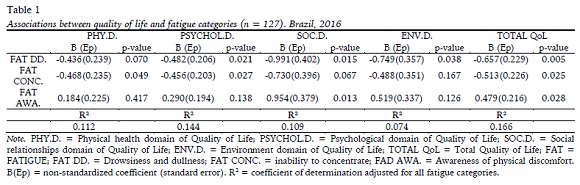
<body><![CDATA[<p>Regarding sample loss, the total number of dancers lost could not be determined    because of the 64 professional companies contacted, only 31 reported the number    of members in the dance company (n = 397 dancers). Therefore, only professional    dancers from the lists provided by the dance companies were contacted, reducing    the scope of the study and resulting in a final sample size of 127 professional    dancers.</p>     <p>The following variables were used to characterize the sample: age (years),    sex (female, male), marital status (with or without partner), practice of physical    activity other than dance (yes or no), type of physical activity practiced (strength    training or sports in general).</p>     <p>Quality of life was assessed using the abbreviated World Health Organization    Quality of Life - Biomedical Research and Education Foundation (WHOQOL - BREF)    questionnaire, which was adapted for Brazilian Portuguese by Fleck et al. (2000).    This questionnaire consists of 26 of the 100 questions from the original WHOQOL    questionnaire. Participants were asked to respond based on their experiences    within the last two weeks and their answers were scored on a scale of intensity    (not at all - extremely), ability (not at all - completely), frequency (never    - always), or satisfaction (very dissatisfied - very satisfied; very poor -    very good). Responses were tallied into scores ranging from 0 to 100%, with    a higher percentage reflecting better quality of life. The questionnaire included    24 questions, that encompassed the following domains: (1) physical health (physical    pain; energy; mobility; activities of daily living; dependence on medical substances    and medical aids; work capacity), (2) psychological (positive feelings; thinking,    learning, memory, and concentration; self-esteem; bodily image and appearance;    negative feelings; spirituality/religion/personal beliefs), (3) social relationships    (personal relationships; social support; sexual activity), (4) environment (freedom,    physical safety and security; home environment; financial resources; health    and social care: accessibility and quality; opportunities for acquiring new    information and skills; participation in and opportunities for recreation/leisure    activities; physical environment (pollution/noise/traffic/climate); transport)    and two more general questions about quality of life.</p>     <p>Fatigue was assessed using the Fatigue Symptom Checklist (FSC) developed by    Yoshitake and translated into Brazilian Portuguese by Fischer et al. (1991).    The questionnaire consists of 30 multiple-choice questions divided into 3 assessment    scales: drowsiness and dullness, inability to concentrate, and awareness of    physical discomfort. Each fatigue scale has a score ranging from 10 to 50 points,    and a final overall score may also be calculated by adding the scores from the    3 scales. The higher the score is, the higher the fatigue is (Welle, 2008).    This questionnaire is used to assess fatigue among workers and is, therefore,    suitable for the sample of this study.</p>     <p>Statistical analysis</p>     <p>Descriptive analysis of the sample was performed (frequency, mean, and standard    deviation), in addition to multiple linear regressions in each domain to assess    the relationship between the quality of life domains and fatigue scales. The    statistical package SPSS version 20.0 (Armonk, NY: IBM Corp.) was used for all    tests, and the adopted significance level was 5%.</p>     <p>RESULTS</p>     <p>One hundred and twenty-seven professional classical ballet (27.4%) and contemporary    (72.6%) dancers, which were mostly female (58.3%), participated in this study.    57.5% of them had no partner when the data were collected and 64.2% practiced    some type of physical activity in addition to dance, primarily strength training    (70.1%; data not shown).</p>     <p><a href="#t1">Table 1</a> outlines the associations between the psychological,    social relationships, environment and total quality of life domains and the    drowsiness and dullness scale. The domains showed a predicted decreased of 0.456    (<i>p </i>= 0.021), 0.991 (<i>p </i>= 0.015), 0.749 (<i>p </i>= 0.038) and 0.657    (<i>p </i>= 0.005) for each score of the aforementioned fatigue scale, respectively.</p>     <p>&nbsp;</p>     ]]></body>
<body><![CDATA[<p align="center"><a name="t1"></a><img src="/img/revistas/mot/v15n1/15n1a04t1.jpg"/></p>     
<p>&nbsp;</p>     <p><a href="#t1">Table 1</a> also outlines the association between the physical    health, psychological, and total quality of life domains and the inability to    concentrate scale. The domains showed a predicted increase of 0.468 (<i>p </i>=    0.049), 0.482 (<i>p</i>= 0.027), 0.513 (<i>p </i>= 0.025) for each score of    the aforementioned fatigue scale, respectively.</p>     <p>Furthermore, the results showed an association between the social relationships    and total quality of life domains and the awareness of physical discomfort scale.    The domains showed a predicted increase of 0.954 (<i>p </i>= 0.013) and 0.479    (<i>p </i>= 0.028) for each score of the aforementioned fatigue scale, respectively    (<a href="#t1">Table 1</a>).</p>     <p>DISCUSSION</p>     <p>The present study found a relationship between quality of life and levels of    fatigue among Brazilian professional dancers, as was proposed in its objective.    The results showed that worsened psychological, social relationships, environment,    and total quality of life domains were associated with the drowsiness and dullness    scale indicating that this fatigue category is linked to both physical and mental    fatigue (&ldquo;ideas are unclear,&rdquo; &ldquo;I am sleepy,&rdquo; &ldquo;tired head,&rdquo; &ldquo;weakness&rdquo;). These    findings may be directly linked to the component of daily living &ldquo;sleep&rdquo; among    professional dancers who lack good-quality sleep, are unable to concentrate    and feel weak.</p>     <p>Accordingly, a study conducted with professional classical ballet dancers reported    that those who had poor sleep quality also had lower quality of life scores    in the mental health component (Fietze et al., 2009). Furthermore, the same    authors stated that the increase in the number of daily work hours before premieres    affects the sleep-wakefulness cycle of these professionals (Fietze et al., 2009).    Therefore, psychological problems (depression, anxiety, and poor sleep) are    associated with decreased concentrations, inadequate nutrition, and fatigue,    among other problems (Adam et al., 2004).</p>     <p>The current study showed that worsened physical health, psychological, and    total quality of life domains were associated with the inability to concentrate    scale. This fatigue category is related to concentration and concerns that affect    work, as well as fitness requirements for work and tiredness, albeit without    discontinuing work. Therefore, a hypothesis for this association is related    to the internalized physical characteristics of dance modalities, which advocate    lean bodies and encourage these professionals to follow specific dietary restrictions    (Hidayah &amp; Bariah, 2011).</p>     <p>In the same context, a study on contemporary dancers found that they have an    energy-balance deficit; that is, during the period of training and classes,    these dancers consume less than the necessary quantity of energy substrates    (Brown et al., 2017). If dancers also adopt inappropriate weight loss methods,    their psychological domain may be directly affected, resulting in an obsessive    fear of body changes (Hidayah &amp; Bariah, 2011).</p>     <p>Another hypothesis for this association with the inability to concentrate scale    would be linked to negative feelings. Accordingly, a literature review found    that professional dancers are often concerned with the possibility of injury,    leave, and retirement (Bolling &amp; Pinheiro, 2010), and that these negative    feelings, here emphasized as fear of early retirement, may cause some contradictory    feelings among professional dancers, impairing their concentration on the work    routine.</p>     ]]></body>
<body><![CDATA[<p>Another factor possibly linked to this association is the fear of losing the    position in the dance company, which may cause stress and sleep disorders among    professional dancers (Adam et al., 2004). Age and seeking higher wages are also    important determinants that influence if dancers stay in dance companies (Teixeira,    2011). Turner and Wainwright (2004) discuss this topic, emphasizing that professional    dancing is a short career and that social relationships play a key role in determining    when to retire and leave the stage.</p>     <p>Studies have shown that social support and a higher number of sleep hours help    decrease the occurrence of injuries among professional dancers (Adam et al.,    2004). Accordingly, the present study showed that improved social relationships    and total quality of life domains were associated with the awareness of physical    discomfort scale. Because the last fatigue category is related to physical tiredness    (pain, dizziness, feeling sick&hellip;), support from family, friends, and co-workers    may also ease the physical symptoms of fatigue. It should be noted that fatigue    is commonly found in the daily routine of professional dancers (De Almeida &amp;    Flores-Pereira, 2013; Mceldowney et al., 2013). Therefore, interpersonal relations    within the dance environment, particularly peer competition, could stimulate    overachievement. Thus, physical fatigue (pain, discomfort, and tiredness) would    not be an obstacle to continue dancing, but rather an incentive to conquer their    place within the dance company.</p>     <p>Accordingly, Neves (2013) discusses in her study that resilience, persistence,    and competitiveness are determining qualities for continuing to work as a professional    dancer. When reaching more challenging roles within dance companies, such as    soloists or first dancers, these professional dancers tend to push harder to    dance, even if injured (Jacobs et al., 2016), because they reached the position    they always wanted.</p>     <p>CONCLUSION</p>     <p>Lastly, fatigue apparently affects the quality of life of these professional    dancers, and drowsiness and dullness as well as the inability to concentrate    are associated with worsened quality of life. In contrast, awareness of physical    discomfort is associated with improved quality of life when associated with    the social relationships&rsquo; domain. Therefore, empirical studies should be conducted    to assess the causes and effects of the associations between these variables.</p>     <p>The limitations of this study include the two methods of data collection, as    previously explained in the method section. Although ideally only one method    of data collection should have been used, data were also collected in person    (using paper questionnaires), at the request of some company directors, to avoid    a larger sample loss.</p>     <p>&nbsp;</p>     <p><b>REFERENCES</b></p>     <!-- ref --><p>Adam, M. U., Brassington, G. S., Steiner, H., &amp; Matheson, G. O. (2004).    Psychological factors associated with performance-limiting injuries in professional    ballet dancers. <i>Journal of Dance Medicine &amp; Science</i>, <i>8</i>(2),    43-46.    &nbsp;&nbsp;&nbsp;&nbsp;&nbsp;&nbsp;&nbsp;&nbsp;[&#160;<a href="javascript:void(0);" onclick="javascript: window.open('/scielo.php?script=sci_nlinks&ref=387020&pid=S1646-107X201900010000400001&lng=','','width=640,height=500,resizable=yes,scrollbars=1,menubar=yes,');">Links</a>&#160;]<!-- end-ref --></p>     ]]></body>
<body><![CDATA[<!-- ref --><p>Batista, C. G., &amp; Martins, E. O. (2010). A prevalência de dor em bailarinas    clássicas. <i>Journal of Health Science Institute</i>, <i>28</i>(1), 47-49.    &nbsp;&nbsp;&nbsp;&nbsp;&nbsp;&nbsp;&nbsp;&nbsp;[&#160;<a href="javascript:void(0);" onclick="javascript: window.open('/scielo.php?script=sci_nlinks&ref=387022&pid=S1646-107X201900010000400002&lng=','','width=640,height=500,resizable=yes,scrollbars=1,menubar=yes,');">Links</a>&#160;]<!-- end-ref --></p>     <!-- ref --><p>Bolling, C.S., &amp; Pinheiro, T.M.M. (2010). Bailarinos profissionais e saúde:    uma revisão da literatura. <i>Revista Médica de Minas Gerais</i>, 20(2), 75-83.    &nbsp;&nbsp;&nbsp;&nbsp;&nbsp;&nbsp;&nbsp;&nbsp;[&#160;<a href="javascript:void(0);" onclick="javascript: window.open('/scielo.php?script=sci_nlinks&ref=387024&pid=S1646-107X201900010000400003&lng=','','width=640,height=500,resizable=yes,scrollbars=1,menubar=yes,');">Links</a>&#160;]<!-- end-ref --></p>     <!-- ref --><p>Brown, M. A., Howatson, G., Quin, E., Redding, E., &amp; Stevenson, E. J. (2017).    Energy intake and energy expenditure of pre-professional female contemporary    dancers. <i>PloS One, 12</i>(2), 1-13. DOI: <a href="https://dx.doi.org/10.1371/journal.pone.0171998" target="_blank">10.1371/journal.pone.0171998</a>.    &nbsp;&nbsp;&nbsp;&nbsp;&nbsp;&nbsp;&nbsp;&nbsp;[&#160;<a href="javascript:void(0);" onclick="javascript: window.open('/scielo.php?script=sci_nlinks&ref=387026&pid=S1646-107X201900010000400004&lng=','','width=640,height=500,resizable=yes,scrollbars=1,menubar=yes,');">Links</a>&#160;]<!-- end-ref --></p>     <!-- ref --><p>Da Silva, A. M. B., &amp; Enumo, S. R. F. (2016). Efeitos do treinamento físico    na dança: uma revisão sistemática da literatura (1995-2015). <i>Pensar a Prática,    19</i>(4), 964-977. DOI: <a href="https://dx.doi.org/10.5216/rpp.v19i4.39466" target="_blank">10.5216/rpp.v19i4.39466</a>.    &nbsp;&nbsp;&nbsp;&nbsp;&nbsp;&nbsp;&nbsp;&nbsp;[&#160;<a href="javascript:void(0);" onclick="javascript: window.open('/scielo.php?script=sci_nlinks&ref=387028&pid=S1646-107X201900010000400005&lng=','','width=640,height=500,resizable=yes,scrollbars=1,menubar=yes,');">Links</a>&#160;]<!-- end-ref --></p>     <!-- ref --><p>De Almeida, D. D., &amp; Flores-Pereira, M. T. (2013). As Corporalidades do    Trabalho Bailarino: Entre a Exigência Extrema e o Dançar com a Alma. <i>RAC-    Revista de Administração Contemporânea, 17</i>(6), 720-738.    &nbsp;&nbsp;&nbsp;&nbsp;&nbsp;&nbsp;&nbsp;&nbsp;[&#160;<a href="javascript:void(0);" onclick="javascript: window.open('/scielo.php?script=sci_nlinks&ref=387030&pid=S1646-107X201900010000400006&lng=','','width=640,height=500,resizable=yes,scrollbars=1,menubar=yes,');">Links</a>&#160;]<!-- end-ref --></p>     ]]></body>
<body><![CDATA[<!-- ref --><p>Dore, B. F., &amp; Guerra, R. O. (2007). Sintomatologia dolorosa e fatores    associados em bailarinos profissionais. <i>Revista Brasileira de Medicina do    Esporte</i>, <i>13</i>(2), 77-80.    &nbsp;&nbsp;&nbsp;&nbsp;&nbsp;&nbsp;&nbsp;&nbsp;[&#160;<a href="javascript:void(0);" onclick="javascript: window.open('/scielo.php?script=sci_nlinks&ref=387032&pid=S1646-107X201900010000400007&lng=','','width=640,height=500,resizable=yes,scrollbars=1,menubar=yes,');">Links</a>&#160;]<!-- end-ref --></p>     <!-- ref --><p>Fietze, I., Strauch, J., Holzhausen, M., Glos, M., Theobald, C., Lehnkering,    H., &amp; Penzel, T. (2009). Sleep quality in professional ballet dancers. <i>Chronobiology    International, 26</i>(6), 1249-1262. DOI: <a href="https://dx.doi.org/10.3109/07420520903221319" target="_blank">10.3109/07420520903221319</a>.    &nbsp;&nbsp;&nbsp;&nbsp;&nbsp;&nbsp;&nbsp;&nbsp;[&#160;<a href="javascript:void(0);" onclick="javascript: window.open('/scielo.php?script=sci_nlinks&ref=387034&pid=S1646-107X201900010000400008&lng=','','width=640,height=500,resizable=yes,scrollbars=1,menubar=yes,');">Links</a>&#160;]<!-- end-ref --></p>     <!-- ref --><p>Fischer, F. M., Borges, N. S., Rotenberg, L., Latorre, M.R. D. O., Soares,    N. S., Rosa, P. L. F. S., Nagai, R., &amp; Landsbergis, P. (2005). (in)capacidade    para o trabalho em trabalhadores de enfermagem. <i>Revista Brasileira de Medicina    do Trabalho</i>, <i>3</i>(2), 97- 103.    &nbsp;&nbsp;&nbsp;&nbsp;&nbsp;&nbsp;&nbsp;&nbsp;[&#160;<a href="javascript:void(0);" onclick="javascript: window.open('/scielo.php?script=sci_nlinks&ref=387036&pid=S1646-107X201900010000400009&lng=','','width=640,height=500,resizable=yes,scrollbars=1,menubar=yes,');">Links</a>&#160;]<!-- end-ref --></p>     <!-- ref --><p>Fleck, M. P. A., Louzada, S., Xavier, M., Chachamovich, E., Vieira, G., Santos,    L., &amp; Pinzon, V. (2000). Aplicação da versão em português do instrumento    abreviado de avaliação da qualidade de vida&quot; WHOQOL-bref. <i>Revista de    Saúde Pública</i>, <i>34</i>(2), 178-183. DOI: <a href="https://dx.doi.org/10.1590/S0034-89102000000200012" target="_blank">10.1590/S0034-89102000000200012</a>.    &nbsp;&nbsp;&nbsp;&nbsp;&nbsp;&nbsp;&nbsp;&nbsp;[&#160;<a href="javascript:void(0);" onclick="javascript: window.open('/scielo.php?script=sci_nlinks&ref=387038&pid=S1646-107X201900010000400010&lng=','','width=640,height=500,resizable=yes,scrollbars=1,menubar=yes,');">Links</a>&#160;]<!-- end-ref --></p>     <!-- ref --><p>Hidayah, G. N., &amp; Bariah, A. S. (2011). Eating Attitude, Body Image, Body    Composition and Dieting Behavior among Dancers. <i>Asian Journal of Clinical    Nutrition</i>, <i>3</i>(3), 92-102. DOI: <a href="https://dx.doi.org/10.3923/ajcn.2011.92.102" target="_blank">10.3923/ajcn.2011.92.102</a>.    &nbsp;&nbsp;&nbsp;&nbsp;&nbsp;&nbsp;&nbsp;&nbsp;[&#160;<a href="javascript:void(0);" onclick="javascript: window.open('/scielo.php?script=sci_nlinks&ref=387040&pid=S1646-107X201900010000400011&lng=','','width=640,height=500,resizable=yes,scrollbars=1,menubar=yes,');">Links</a>&#160;]<!-- end-ref --></p>     ]]></body>
<body><![CDATA[<!-- ref --><p>Hincapié, C. A., Morton, E. J., &amp; Cassidy, J. D. (2008). Musculoskeletal    injuries and pain in dancers: a systematic review. <i>Archives of physical medicine    and rehabilitation, 89</i>(9), 1819-1829. DOI: <a href="https://dx.doi.org/ 10.1016/j.apmr.2008.02.020" target="_blank"> 10.1016/j.apmr.2008.02.020</a>.    &nbsp;&nbsp;&nbsp;&nbsp;&nbsp;&nbsp;&nbsp;&nbsp;[&#160;<a href="javascript:void(0);" onclick="javascript: window.open('/scielo.php?script=sci_nlinks&ref=387042&pid=S1646-107X201900010000400012&lng=','','width=640,height=500,resizable=yes,scrollbars=1,menubar=yes,');">Links</a>&#160;]<!-- end-ref --></p>     <!-- ref --><p>Jacobs, C. L., Cassidy, J. D., Côté, P., Boyle, E., Ramel, E., Ammendolia,    C., Hartvigsen, J., &amp; Schwartz,I. (2017). Musculoskeletal injury in professional    dancers: Prevalence and associated factors: An international cross-sectional    study. <i>Clinical Journal of Sport Medicine</i>, <i>27</i>(2), 153-160. DOI:    <a href="https://dx.doi.org/10.1097/JSM.0000000000000314" target="_blank">10.1097/JSM.0000000000000314</a>.    &nbsp;&nbsp;&nbsp;&nbsp;&nbsp;&nbsp;&nbsp;&nbsp;[&#160;<a href="javascript:void(0);" onclick="javascript: window.open('/scielo.php?script=sci_nlinks&ref=387044&pid=S1646-107X201900010000400013&lng=','','width=640,height=500,resizable=yes,scrollbars=1,menubar=yes,');">Links</a>&#160;]<!-- end-ref --></p>     <!-- ref --><p>Kuwae, C. A., &amp; Silva, M. S. (2007). Hábito alimentar e composição corporal    de bailarinos contemporâneos e do balé clássico. <i>Goiânia. Universidade Federal    de Goiás</i>,    &nbsp;&nbsp;&nbsp;&nbsp;&nbsp;&nbsp;&nbsp;&nbsp;[&#160;<a href="javascript:void(0);" onclick="javascript: window.open('/scielo.php?script=sci_nlinks&ref=387046&pid=S1646-107X201900010000400014&lng=','','width=640,height=500,resizable=yes,scrollbars=1,menubar=yes,');">Links</a>&#160;]<!-- end-ref --> 1-6.</p>     <!-- ref --><p>Lai, I. (2016). No Time to Eat? Think twice about taking shortcuts with your    health, or your dancing will suffer. <i>Dance Major Journal, 4</i>(1).    &nbsp;&nbsp;&nbsp;&nbsp;&nbsp;&nbsp;&nbsp;&nbsp;[&#160;<a href="javascript:void(0);" onclick="javascript: window.open('/scielo.php?script=sci_nlinks&ref=387048&pid=S1646-107X201900010000400015&lng=','','width=640,height=500,resizable=yes,scrollbars=1,menubar=yes,');">Links</a>&#160;]<!-- end-ref --></p>     <!-- ref --><p>Leite, G., Mello, M., Dáttilo, M., &amp; Antunes, H. (2011). Influência do    estresse em eventos competitivos relacionados à dança. <i>EFDeportes, 5</i>(153).    &nbsp;&nbsp;&nbsp;&nbsp;&nbsp;&nbsp;&nbsp;&nbsp;[&#160;<a href="javascript:void(0);" onclick="javascript: window.open('/scielo.php?script=sci_nlinks&ref=387050&pid=S1646-107X201900010000400016&lng=','','width=640,height=500,resizable=yes,scrollbars=1,menubar=yes,');">Links</a>&#160;]<!-- end-ref --></p>     ]]></body>
<body><![CDATA[<!-- ref --><p>Liederbach, M., Kremenic, I. J., Orishimo, K. F., Pappas, E., &amp; Hagins,    M. (2014). Comparison of Landing Biomechanics Between Male and Female Dancers    and Athletes, Part 2 Influence of Fatigue and Implications for Anterior Cruciate    Ligament Injury. <i>The American Journal of Sports Medicine</i>, <i>42</i>(5),    1089-1095. DOI: <a href="https://dx.doi.org/10.1177/0363546514524525" target="_blank">10.1177/0363546514524525</a>.    &nbsp;&nbsp;&nbsp;&nbsp;&nbsp;&nbsp;&nbsp;&nbsp;[&#160;<a href="javascript:void(0);" onclick="javascript: window.open('/scielo.php?script=sci_nlinks&ref=387052&pid=S1646-107X201900010000400017&lng=','','width=640,height=500,resizable=yes,scrollbars=1,menubar=yes,');">Links</a>&#160;]<!-- end-ref --></p>     <!-- ref --><p>Macedo, C. G., &amp; Vieira, C. A. (2007). Caracterização do treinamento e    do gasto energético de praticantes da dança contemporânea. In: <i>Anais do XV    Congresso Brasileiro de Ciências do Esporte</i>, 21- 26.    &nbsp;&nbsp;&nbsp;&nbsp;&nbsp;&nbsp;&nbsp;&nbsp;[&#160;<a href="javascript:void(0);" onclick="javascript: window.open('/scielo.php?script=sci_nlinks&ref=387054&pid=S1646-107X201900010000400018&lng=','','width=640,height=500,resizable=yes,scrollbars=1,menubar=yes,');">Links</a>&#160;]<!-- end-ref --></p>     <!-- ref --><p>McEldowney, K. M., Hopper, L. S., Etlin-Stein, H., &amp; Redding, E. (2013).    Fatigue effects on quadriceps and hamstrings activation in dancers performing    drop landings. <i>Journal of Dance Medicine &amp; Science</i>, <i>17</i>(3),    109-114.    &nbsp;&nbsp;&nbsp;&nbsp;&nbsp;&nbsp;&nbsp;&nbsp;[&#160;<a href="javascript:void(0);" onclick="javascript: window.open('/scielo.php?script=sci_nlinks&ref=387056&pid=S1646-107X201900010000400019&lng=','','width=640,height=500,resizable=yes,scrollbars=1,menubar=yes,');">Links</a>&#160;]<!-- end-ref --></p>     <!-- ref --><p>Neves, J. C. L. (2013). Bailarinas e bailarinos: uma etnografia da dança como    profissão. <i>Cadernos pagu</i><b>, </b><i>41</i>, 201-238. DOI: <a href="https://dx.doi.org/10.1590/S0104-83332013000200013" target="_blank">10.1590/S0104-83332013000200013</a>.    &nbsp;&nbsp;&nbsp;&nbsp;&nbsp;&nbsp;&nbsp;&nbsp;[&#160;<a href="javascript:void(0);" onclick="javascript: window.open('/scielo.php?script=sci_nlinks&ref=387058&pid=S1646-107X201900010000400020&lng=','','width=640,height=500,resizable=yes,scrollbars=1,menubar=yes,');">Links</a>&#160;]<!-- end-ref --></p>     <!-- ref --><p>Picon, A. P., &amp; Franchi, S. S. (2007). Análise antropométrica dos pés de    praticantes de ballet clássico que utilizam sapatilhas de ponta. <i>Revista    Uniara, 20</i>, 177-187.    &nbsp;&nbsp;&nbsp;&nbsp;&nbsp;&nbsp;&nbsp;&nbsp;[&#160;<a href="javascript:void(0);" onclick="javascript: window.open('/scielo.php?script=sci_nlinks&ref=387060&pid=S1646-107X201900010000400021&lng=','','width=640,height=500,resizable=yes,scrollbars=1,menubar=yes,');">Links</a>&#160;]<!-- end-ref --></p>     ]]></body>
<body><![CDATA[<!-- ref --><p>Rocha, M. D., &amp; De Almeida, C. M. (2007). Dança de Salão, instrumento para    qualidade de vida. <i>Movimento e Percepção, 7</i>(10), 76-89.    &nbsp;&nbsp;&nbsp;&nbsp;&nbsp;&nbsp;&nbsp;&nbsp;[&#160;<a href="javascript:void(0);" onclick="javascript: window.open('/scielo.php?script=sci_nlinks&ref=387062&pid=S1646-107X201900010000400022&lng=','','width=640,height=500,resizable=yes,scrollbars=1,menubar=yes,');">Links</a>&#160;]<!-- end-ref --></p>     <!-- ref --><p>Segnini, M. P., &amp; Lancman, S. (2011). Investigaciones Empíricas: Sofrimento    psíquico do bailarino: um olhar da psicodinâmica do trabalho. <i>Laboreal</i>,    <i>7</i>(1), 42-55.    &nbsp;&nbsp;&nbsp;&nbsp;&nbsp;&nbsp;&nbsp;&nbsp;[&#160;<a href="javascript:void(0);" onclick="javascript: window.open('/scielo.php?script=sci_nlinks&ref=387064&pid=S1646-107X201900010000400023&lng=','','width=640,height=500,resizable=yes,scrollbars=1,menubar=yes,');">Links</a>&#160;]<!-- end-ref --></p>     <!-- ref --><p>Silva, T. M. G. (2010). Qualidade de vida de bailarinos de dança hip hop. Dissertação    de Mestrado<i>, Universidade do Estado de Santa Catarina</i>, Florianópolis,    &nbsp;&nbsp;&nbsp;&nbsp;&nbsp;&nbsp;&nbsp;&nbsp;[&#160;<a href="javascript:void(0);" onclick="javascript: window.open('/scielo.php?script=sci_nlinks&ref=387066&pid=S1646-107X201900010000400024&lng=','','width=640,height=500,resizable=yes,scrollbars=1,menubar=yes,');">Links</a>&#160;]<!-- end-ref -->    SC, Brasil.</p>     <!-- ref --><p>Turner, B. S., &amp; Wainwright, S. P. (2004). Corpos de Ballet: o caso dos    bailarinos lesionados. <i>Revista De Ciências Sociais-Política &amp; Trabalho</i>,    <i>20</i>(20), 15-33.    &nbsp;&nbsp;&nbsp;&nbsp;&nbsp;&nbsp;&nbsp;&nbsp;[&#160;<a href="javascript:void(0);" onclick="javascript: window.open('/scielo.php?script=sci_nlinks&ref=387068&pid=S1646-107X201900010000400025&lng=','','width=640,height=500,resizable=yes,scrollbars=1,menubar=yes,');">Links</a>&#160;]<!-- end-ref --> </p>     <p>Welle, M. C. S. (2008). Fadiga e capacidade para o trabalho entre trabalhadores    rurais de flores e plantas da região de Holambra - SP. Dissertação de Mestrado,    Universidade Estadual de Campinas. <i>Faculdade de Ciências Médicas</i>. Campinas,    SP.</p>     <p>&nbsp;</p>     ]]></body>
<body><![CDATA[<p>Acknowledgments: Nothing to declare.</p>     <p>Conflict of interests: Nothing to declare.</p>     <p>Funding: Nothing to declare.</p>     <p>&nbsp;</p>     <p>Manuscript received at June 27th 2018; Accepted at February 12th 2019</p>     <p>&nbsp;</p>     <p><a href="#top*"><sup>[*]</sup></a><a name="*"></a>Corresponding author: Pascoal    Simone, 358 - Florianópolis, Santa Catarina, 88080-350, Brazil</p>     <p><i>Email: </i><a href="mailto:jessica.moratelli@hotmail.com">jessica.moratelli@hotmail.com</a></p>      ]]></body><back>
<ref-list>
<ref id="B1">
<nlm-citation citation-type="journal">
<person-group person-group-type="author">
<name>
<surname><![CDATA[Adam]]></surname>
<given-names><![CDATA[M. U.]]></given-names>
</name>
<name>
<surname><![CDATA[Brassington]]></surname>
<given-names><![CDATA[G. S.]]></given-names>
</name>
<name>
<surname><![CDATA[Steiner]]></surname>
<given-names><![CDATA[H.]]></given-names>
</name>
<name>
<surname><![CDATA[Matheson]]></surname>
<given-names><![CDATA[G. O.]]></given-names>
</name>
</person-group>
<article-title xml:lang="en"><![CDATA[Psychological factors associated with performance-limiting injuries in professional ballet dancers]]></article-title>
<source><![CDATA[Journal of Dance Medicine & Science]]></source>
<year>2004</year>
<volume>8</volume>
<numero>2</numero>
<issue>2</issue>
<page-range>43-46</page-range></nlm-citation>
</ref>
<ref id="B2">
<nlm-citation citation-type="journal">
<person-group person-group-type="author">
<name>
<surname><![CDATA[Batista]]></surname>
<given-names><![CDATA[C. G.]]></given-names>
</name>
<name>
<surname><![CDATA[Martins]]></surname>
<given-names><![CDATA[E. O.]]></given-names>
</name>
</person-group>
<article-title xml:lang="pt"><![CDATA[A prevalência de dor em bailarinas clássicas]]></article-title>
<source><![CDATA[Journal of Health Science Institute]]></source>
<year>2010</year>
<volume>28</volume>
<numero>1</numero>
<issue>1</issue>
<page-range>47-49</page-range></nlm-citation>
</ref>
<ref id="B3">
<nlm-citation citation-type="journal">
<person-group person-group-type="author">
<name>
<surname><![CDATA[Bolling]]></surname>
<given-names><![CDATA[C.S.]]></given-names>
</name>
<name>
<surname><![CDATA[Pinheiro]]></surname>
<given-names><![CDATA[T.M.M.]]></given-names>
</name>
</person-group>
<article-title xml:lang="pt"><![CDATA[Bailarinos profissionais e saúde: uma revisão da literatura]]></article-title>
<source><![CDATA[Revista Médica de Minas Gerais]]></source>
<year>2010</year>
<volume>20</volume>
<numero>2</numero>
<issue>2</issue>
<page-range>75-83</page-range></nlm-citation>
</ref>
<ref id="B4">
<nlm-citation citation-type="journal">
<person-group person-group-type="author">
<name>
<surname><![CDATA[Brown]]></surname>
<given-names><![CDATA[M. A.]]></given-names>
</name>
<name>
<surname><![CDATA[Howatson]]></surname>
<given-names><![CDATA[G.]]></given-names>
</name>
<name>
<surname><![CDATA[Quin]]></surname>
<given-names><![CDATA[E.]]></given-names>
</name>
<name>
<surname><![CDATA[Redding]]></surname>
<given-names><![CDATA[E.]]></given-names>
</name>
<name>
<surname><![CDATA[Stevenson]]></surname>
<given-names><![CDATA[E. J.]]></given-names>
</name>
</person-group>
<article-title xml:lang="en"><![CDATA[Energy intake and energy expenditure of pre-professional female contemporary dancers]]></article-title>
<source><![CDATA[PloS One]]></source>
<year>2017</year>
<volume>12</volume>
<numero>2</numero>
<issue>2</issue>
<page-range>1-13</page-range></nlm-citation>
</ref>
<ref id="B5">
<nlm-citation citation-type="journal">
<person-group person-group-type="author">
<name>
<surname><![CDATA[Da Silva]]></surname>
<given-names><![CDATA[A. M. B.]]></given-names>
</name>
<name>
<surname><![CDATA[Enumo]]></surname>
<given-names><![CDATA[S. R. F.]]></given-names>
</name>
</person-group>
<article-title xml:lang="pt"><![CDATA[Efeitos do treinamento físico na dança: uma revisão sistemática da literatura (1995-2015)]]></article-title>
<source><![CDATA[Pensar a Prática]]></source>
<year>2016</year>
<volume>19</volume>
<numero>4</numero>
<issue>4</issue>
<page-range>964-977</page-range></nlm-citation>
</ref>
<ref id="B6">
<nlm-citation citation-type="journal">
<person-group person-group-type="author">
<name>
<surname><![CDATA[De Almeida]]></surname>
<given-names><![CDATA[D. D.]]></given-names>
</name>
<name>
<surname><![CDATA[Flores-Pereira]]></surname>
<given-names><![CDATA[M. T.]]></given-names>
</name>
</person-group>
<article-title xml:lang="pt"><![CDATA[As Corporalidades do Trabalho Bailarino: Entre a Exigência Extrema e o Dançar com a Alma]]></article-title>
<source><![CDATA[RAC- Revista de Administração Contemporânea]]></source>
<year>2013</year>
<volume>17</volume>
<numero>6</numero>
<issue>6</issue>
<page-range>720-738</page-range></nlm-citation>
</ref>
<ref id="B7">
<nlm-citation citation-type="journal">
<person-group person-group-type="author">
<name>
<surname><![CDATA[Dore]]></surname>
<given-names><![CDATA[B. F.]]></given-names>
</name>
<name>
<surname><![CDATA[Guerra]]></surname>
<given-names><![CDATA[R. O.]]></given-names>
</name>
</person-group>
<article-title xml:lang="pt"><![CDATA[Sintomatologia dolorosa e fatores associados em bailarinos profissionais]]></article-title>
<source><![CDATA[Revista Brasileira de Medicina do Esporte]]></source>
<year>2007</year>
<volume>13</volume>
<numero>2</numero>
<issue>2</issue>
<page-range>77-80</page-range></nlm-citation>
</ref>
<ref id="B8">
<nlm-citation citation-type="journal">
<person-group person-group-type="author">
<name>
<surname><![CDATA[Fietze]]></surname>
<given-names><![CDATA[I.]]></given-names>
</name>
<name>
<surname><![CDATA[Strauch]]></surname>
<given-names><![CDATA[J.]]></given-names>
</name>
<name>
<surname><![CDATA[Holzhausen]]></surname>
<given-names><![CDATA[M.]]></given-names>
</name>
<name>
<surname><![CDATA[Glos]]></surname>
<given-names><![CDATA[M.]]></given-names>
</name>
<name>
<surname><![CDATA[Theobald]]></surname>
<given-names><![CDATA[C.]]></given-names>
</name>
<name>
<surname><![CDATA[Lehnkering]]></surname>
<given-names><![CDATA[H.]]></given-names>
</name>
<name>
<surname><![CDATA[Penzel]]></surname>
<given-names><![CDATA[T.]]></given-names>
</name>
</person-group>
<article-title xml:lang="en"><![CDATA[Sleep quality in professional ballet dancers]]></article-title>
<source><![CDATA[Chronobiology International]]></source>
<year>2009</year>
<volume>26</volume>
<numero>6</numero>
<issue>6</issue>
<page-range>1249-1262</page-range></nlm-citation>
</ref>
<ref id="B9">
<nlm-citation citation-type="journal">
<person-group person-group-type="author">
<name>
<surname><![CDATA[Fischer]]></surname>
<given-names><![CDATA[F. M.]]></given-names>
</name>
<name>
<surname><![CDATA[Borges]]></surname>
<given-names><![CDATA[N. S.]]></given-names>
</name>
<name>
<surname><![CDATA[Rotenberg]]></surname>
<given-names><![CDATA[L.]]></given-names>
</name>
<name>
<surname><![CDATA[Latorre]]></surname>
<given-names><![CDATA[M.R. D. O.]]></given-names>
</name>
<name>
<surname><![CDATA[Soares]]></surname>
<given-names><![CDATA[N. S.]]></given-names>
</name>
<name>
<surname><![CDATA[Rosa]]></surname>
<given-names><![CDATA[P. L. F. S.]]></given-names>
</name>
<name>
<surname><![CDATA[Nagai]]></surname>
<given-names><![CDATA[R.]]></given-names>
</name>
<name>
<surname><![CDATA[Landsbergis]]></surname>
<given-names><![CDATA[P.]]></given-names>
</name>
</person-group>
<article-title xml:lang="en"><![CDATA[(in)capacidade para o trabalho em trabalhadores de enfermagem]]></article-title>
<source><![CDATA[Revista Brasileira de Medicina do Trabalho]]></source>
<year>2005</year>
<volume>3</volume>
<numero>2</numero>
<issue>2</issue>
<page-range>97- 103</page-range></nlm-citation>
</ref>
<ref id="B10">
<nlm-citation citation-type="journal">
<person-group person-group-type="author">
<name>
<surname><![CDATA[Fleck]]></surname>
<given-names><![CDATA[M. P. A.]]></given-names>
</name>
<name>
<surname><![CDATA[Louzada]]></surname>
<given-names><![CDATA[S.]]></given-names>
</name>
<name>
<surname><![CDATA[Xavier]]></surname>
<given-names><![CDATA[M.]]></given-names>
</name>
<name>
<surname><![CDATA[Chachamovich]]></surname>
<given-names><![CDATA[E.]]></given-names>
</name>
<name>
<surname><![CDATA[Vieira]]></surname>
<given-names><![CDATA[G.]]></given-names>
</name>
<name>
<surname><![CDATA[Santos]]></surname>
<given-names><![CDATA[L.]]></given-names>
</name>
<name>
<surname><![CDATA[Pinzon]]></surname>
<given-names><![CDATA[V.]]></given-names>
</name>
</person-group>
<article-title xml:lang="en"><![CDATA[Aplicação da versão em português do instrumento abreviado de avaliação da qualidade de vida" WHOQOL-bref]]></article-title>
<source><![CDATA[Revista de Saúde Pública]]></source>
<year>2000</year>
<volume>34</volume>
<numero>2</numero>
<issue>2</issue>
<page-range>178-183</page-range></nlm-citation>
</ref>
<ref id="B11">
<nlm-citation citation-type="journal">
<person-group person-group-type="author">
<name>
<surname><![CDATA[Hidayah]]></surname>
<given-names><![CDATA[G. N.]]></given-names>
</name>
<name>
<surname><![CDATA[Bariah]]></surname>
<given-names><![CDATA[A. S.]]></given-names>
</name>
</person-group>
<article-title xml:lang="en"><![CDATA[Eating Attitude, Body Image, Body Composition and Dieting Behavior among Dancers]]></article-title>
<source><![CDATA[Asian Journal of Clinical Nutrition]]></source>
<year>2011</year>
<volume>3</volume>
<numero>3</numero>
<issue>3</issue>
<page-range>92-102</page-range></nlm-citation>
</ref>
<ref id="B12">
<nlm-citation citation-type="journal">
<person-group person-group-type="author">
<name>
<surname><![CDATA[Hincapié]]></surname>
<given-names><![CDATA[C. A.]]></given-names>
</name>
<name>
<surname><![CDATA[Morton]]></surname>
<given-names><![CDATA[E. J.]]></given-names>
</name>
<name>
<surname><![CDATA[Cassidy]]></surname>
<given-names><![CDATA[J. D.]]></given-names>
</name>
</person-group>
<article-title xml:lang="en"><![CDATA[Musculoskeletal injuries and pain in dancers: a systematic review]]></article-title>
<source><![CDATA[Archives of physical medicine and rehabilitation]]></source>
<year>2008</year>
<volume>89</volume>
<numero>9</numero>
<issue>9</issue>
<page-range>1819-1829</page-range></nlm-citation>
</ref>
<ref id="B13">
<nlm-citation citation-type="journal">
<person-group person-group-type="author">
<name>
<surname><![CDATA[Jacobs]]></surname>
<given-names><![CDATA[C. L.]]></given-names>
</name>
<name>
<surname><![CDATA[Cassidy]]></surname>
<given-names><![CDATA[J. D.]]></given-names>
</name>
<name>
<surname><![CDATA[Côté]]></surname>
<given-names><![CDATA[P.]]></given-names>
</name>
<name>
<surname><![CDATA[Boyle]]></surname>
<given-names><![CDATA[E.]]></given-names>
</name>
<name>
<surname><![CDATA[Ramel]]></surname>
<given-names><![CDATA[E.]]></given-names>
</name>
<name>
<surname><![CDATA[Ammendolia]]></surname>
<given-names><![CDATA[C.]]></given-names>
</name>
<name>
<surname><![CDATA[Hartvigsen]]></surname>
<given-names><![CDATA[J.]]></given-names>
</name>
<name>
<surname><![CDATA[Schwartz]]></surname>
<given-names><![CDATA[I.]]></given-names>
</name>
</person-group>
<article-title xml:lang="en"><![CDATA[Musculoskeletal injury in professional dancers: Prevalence and associated factors: An international cross-sectional study]]></article-title>
<source><![CDATA[Clinical Journal of Sport Medicine]]></source>
<year>2017</year>
<volume>27</volume>
<numero>2</numero>
<issue>2</issue>
<page-range>153-160</page-range></nlm-citation>
</ref>
<ref id="B14">
<nlm-citation citation-type="book">
<person-group person-group-type="author">
<name>
<surname><![CDATA[Kuwae]]></surname>
<given-names><![CDATA[C. A.]]></given-names>
</name>
<name>
<surname><![CDATA[Silva]]></surname>
<given-names><![CDATA[M. S.]]></given-names>
</name>
</person-group>
<source><![CDATA[Hábito alimentar e composição corporal de bailarinos contemporâneos e do balé clássico]]></source>
<year>2007</year>
<publisher-loc><![CDATA[Goiânia ]]></publisher-loc>
<publisher-name><![CDATA[Universidade Federal de Goiás]]></publisher-name>
</nlm-citation>
</ref>
<ref id="B15">
<nlm-citation citation-type="journal">
<person-group person-group-type="author">
<name>
<surname><![CDATA[Lai]]></surname>
<given-names><![CDATA[I.]]></given-names>
</name>
</person-group>
<article-title xml:lang="en"><![CDATA[No Time to Eat?: Think twice about taking shortcuts with your health, or your dancing will suffer]]></article-title>
<source><![CDATA[Dance Major Journal]]></source>
<year>2016</year>
<volume>4</volume>
<numero>1</numero>
<issue>1</issue>
</nlm-citation>
</ref>
<ref id="B16">
<nlm-citation citation-type="journal">
<person-group person-group-type="author">
<name>
<surname><![CDATA[Leite]]></surname>
<given-names><![CDATA[G.]]></given-names>
</name>
<name>
<surname><![CDATA[Mello]]></surname>
<given-names><![CDATA[M.]]></given-names>
</name>
<name>
<surname><![CDATA[Dáttilo]]></surname>
<given-names><![CDATA[M.]]></given-names>
</name>
<name>
<surname><![CDATA[Antunes]]></surname>
<given-names><![CDATA[H.]]></given-names>
</name>
</person-group>
<article-title xml:lang="pt"><![CDATA[Influência do estresse em eventos competitivos relacionados à dança]]></article-title>
<source><![CDATA[EFDeportes]]></source>
<year>2011</year>
<volume>5</volume>
<numero>153</numero>
<issue>153</issue>
</nlm-citation>
</ref>
<ref id="B17">
<nlm-citation citation-type="journal">
<person-group person-group-type="author">
<name>
<surname><![CDATA[Liederbach]]></surname>
<given-names><![CDATA[M.]]></given-names>
</name>
<name>
<surname><![CDATA[Kremenic]]></surname>
<given-names><![CDATA[I. J.]]></given-names>
</name>
<name>
<surname><![CDATA[Orishimo]]></surname>
<given-names><![CDATA[K. F.]]></given-names>
</name>
<name>
<surname><![CDATA[Pappas]]></surname>
<given-names><![CDATA[E.]]></given-names>
</name>
<name>
<surname><![CDATA[Hagins]]></surname>
<given-names><![CDATA[M.]]></given-names>
</name>
</person-group>
<article-title xml:lang="en"><![CDATA[Comparison of Landing Biomechanics Between Male and Female Dancers and Athletes, Part 2 Influence of Fatigue and Implications for Anterior Cruciate Ligament Injury]]></article-title>
<source><![CDATA[The American Journal of Sports Medicine]]></source>
<year>2014</year>
<volume>42</volume>
<numero>5</numero>
<issue>5</issue>
<page-range>1089-1095</page-range></nlm-citation>
</ref>
<ref id="B18">
<nlm-citation citation-type="journal">
<person-group person-group-type="author">
<name>
<surname><![CDATA[Macedo]]></surname>
<given-names><![CDATA[C. G.]]></given-names>
</name>
<name>
<surname><![CDATA[Vieira]]></surname>
<given-names><![CDATA[C. A.]]></given-names>
</name>
</person-group>
<article-title xml:lang="pt"><![CDATA[Caracterização do treinamento e do gasto energético de praticantes da dança contemporânea]]></article-title>
<source><![CDATA[In: Anais do XV Congresso Brasileiro de Ciências do Esporte]]></source>
<year>2007</year>
<page-range>21-26</page-range></nlm-citation>
</ref>
<ref id="B19">
<nlm-citation citation-type="journal">
<person-group person-group-type="author">
<name>
<surname><![CDATA[McEldowney]]></surname>
<given-names><![CDATA[K. M.]]></given-names>
</name>
<name>
<surname><![CDATA[Hopper]]></surname>
<given-names><![CDATA[L. S.]]></given-names>
</name>
<name>
<surname><![CDATA[Etlin-Stein]]></surname>
<given-names><![CDATA[H.]]></given-names>
</name>
<name>
<surname><![CDATA[Redding]]></surname>
<given-names><![CDATA[E.]]></given-names>
</name>
</person-group>
<article-title xml:lang="en"><![CDATA[Fatigue effects on quadriceps and hamstrings activation in dancers performing drop landings]]></article-title>
<source><![CDATA[Journal of Dance Medicine & Science]]></source>
<year>2013</year>
<volume>17</volume>
<numero>3</numero>
<issue>3</issue>
<page-range>109-114</page-range></nlm-citation>
</ref>
<ref id="B20">
<nlm-citation citation-type="journal">
<person-group person-group-type="author">
<name>
<surname><![CDATA[Neves]]></surname>
<given-names><![CDATA[J. C. L.]]></given-names>
</name>
</person-group>
<article-title xml:lang="pt"><![CDATA[Bailarinas e bailarinos: uma etnografia da dança como profissão]]></article-title>
<source><![CDATA[Cadernos pagu]]></source>
<year>2013</year>
<volume>41</volume>
<page-range>201-238</page-range></nlm-citation>
</ref>
<ref id="B21">
<nlm-citation citation-type="journal">
<person-group person-group-type="author">
<name>
<surname><![CDATA[Picon]]></surname>
<given-names><![CDATA[A. P.]]></given-names>
</name>
<name>
<surname><![CDATA[Franchi]]></surname>
<given-names><![CDATA[S. S.]]></given-names>
</name>
</person-group>
<article-title xml:lang="pt"><![CDATA[Análise antropométrica dos pés de praticantes de ballet clássico que utilizam sapatilhas de ponta]]></article-title>
<source><![CDATA[Revista Uniara]]></source>
<year>2007</year>
<volume>20</volume>
<page-range>177-187</page-range></nlm-citation>
</ref>
<ref id="B22">
<nlm-citation citation-type="journal">
<person-group person-group-type="author">
<name>
<surname><![CDATA[Rocha]]></surname>
<given-names><![CDATA[M. D.]]></given-names>
</name>
<name>
<surname><![CDATA[De Almeida]]></surname>
<given-names><![CDATA[C. M.]]></given-names>
</name>
</person-group>
<article-title xml:lang="pt"><![CDATA[Dança de Salão, instrumento para qualidade de vida]]></article-title>
<source><![CDATA[Movimento e Percepção]]></source>
<year>2007</year>
<volume>7</volume>
<numero>10</numero>
<issue>10</issue>
<page-range>76-89</page-range></nlm-citation>
</ref>
<ref id="B23">
<nlm-citation citation-type="journal">
<person-group person-group-type="author">
<name>
<surname><![CDATA[Segnini]]></surname>
<given-names><![CDATA[M. P.]]></given-names>
</name>
<name>
<surname><![CDATA[Lancman]]></surname>
<given-names><![CDATA[S.]]></given-names>
</name>
</person-group>
<article-title xml:lang="pt"><![CDATA[Investigaciones Empíricas: Sofrimento psíquico do bailarino: um olhar da psicodinâmica do trabalho]]></article-title>
<source><![CDATA[Laboreal]]></source>
<year>2011</year>
<volume>7</volume>
<numero>1</numero>
<issue>1</issue>
<page-range>42-55</page-range></nlm-citation>
</ref>
<ref id="B24">
<nlm-citation citation-type="">
<person-group person-group-type="author">
<name>
<surname><![CDATA[Silva]]></surname>
<given-names><![CDATA[T. M. G.]]></given-names>
</name>
</person-group>
<source><![CDATA[Qualidade de vida de bailarinos de dança hip hop]]></source>
<year>2010</year>
</nlm-citation>
</ref>
<ref id="B25">
<nlm-citation citation-type="journal">
<person-group person-group-type="author">
<name>
<surname><![CDATA[Turner]]></surname>
<given-names><![CDATA[B. S.]]></given-names>
</name>
<name>
<surname><![CDATA[Wainwright]]></surname>
<given-names><![CDATA[S. P.]]></given-names>
</name>
</person-group>
<article-title xml:lang="pt"><![CDATA[Corpos de Ballet: o caso dos bailarinos lesionados]]></article-title>
<source><![CDATA[Revista De Ciências Sociais-Política & Trabalho]]></source>
<year>2004</year>
<volume>20</volume>
<numero>20</numero>
<issue>20</issue>
<page-range>15-33</page-range></nlm-citation>
</ref>
<ref id="B26">
<nlm-citation citation-type="">
<person-group person-group-type="author">
<name>
<surname><![CDATA[Welle]]></surname>
<given-names><![CDATA[M. C. S.]]></given-names>
</name>
</person-group>
<source><![CDATA[Fadiga e capacidade para o trabalho entre trabalhadores rurais de flores e plantas da região de Holambra- SP]]></source>
<year>2008</year>
</nlm-citation>
</ref>
</ref-list>
</back>
</article>