<?xml version="1.0" encoding="ISO-8859-1"?><article xmlns:mml="http://www.w3.org/1998/Math/MathML" xmlns:xlink="http://www.w3.org/1999/xlink" xmlns:xsi="http://www.w3.org/2001/XMLSchema-instance">
<front>
<journal-meta>
<journal-id>1646-107X</journal-id>
<journal-title><![CDATA[Motricidade]]></journal-title>
<abbrev-journal-title><![CDATA[Motri.]]></abbrev-journal-title>
<issn>1646-107X</issn>
<publisher>
<publisher-name><![CDATA[Edições Desafio Singular]]></publisher-name>
</publisher>
</journal-meta>
<article-meta>
<article-id>S1646-107X2019000100007</article-id>
<article-id pub-id-type="doi">10.6063/motricidade.16653</article-id>
<title-group>
<article-title xml:lang="en"><![CDATA[Knee joint forces in the “Serra da Estrela” territory: the Trails4Health project]]></article-title>
</title-group>
<contrib-group>
<contrib contrib-type="author">
<name>
<surname><![CDATA[Costa]]></surname>
<given-names><![CDATA[Mário J.]]></given-names>
</name>
<xref ref-type="aff" rid="A1 "/>
<xref ref-type="aff" rid="A A"/>
</contrib>
<contrib contrib-type="author">
<name>
<surname><![CDATA[Bragada]]></surname>
<given-names><![CDATA[José]]></given-names>
</name>
<xref ref-type="aff" rid="A2"/>
</contrib>
<contrib contrib-type="author">
<name>
<surname><![CDATA[Santos]]></surname>
<given-names><![CDATA[Catarina]]></given-names>
</name>
<xref ref-type="aff" rid="A5"/>
</contrib>
<contrib contrib-type="author">
<name>
<surname><![CDATA[Casanova]]></surname>
<given-names><![CDATA[Natalina]]></given-names>
</name>
<xref ref-type="aff" rid="A1 "/>
</contrib>
<contrib contrib-type="author">
<name>
<surname><![CDATA[Casanova]]></surname>
<given-names><![CDATA[Jorge]]></given-names>
</name>
<xref ref-type="aff" rid="A1 "/>
</contrib>
<contrib contrib-type="author">
<name>
<surname><![CDATA[Bartolomeu]]></surname>
<given-names><![CDATA[Raúl]]></given-names>
</name>
<xref ref-type="aff" rid="A3 "/>
</contrib>
</contrib-group>
<aff id="AA1">
<institution><![CDATA[,Polytechnic Institute of Guarda  ]]></institution>
<addr-line><![CDATA[Guarda ]]></addr-line>
<country>Portugal</country>
</aff>
<aff id="AA2">
<institution><![CDATA[,Polytechnic Institute of Bragança  ]]></institution>
<addr-line><![CDATA[Bragança ]]></addr-line>
<country>Portugal</country>
</aff>
<aff id="AA3">
<institution><![CDATA[,University of Trás-os-Montes and Alto Douro  ]]></institution>
<addr-line><![CDATA[ ]]></addr-line>
<country>Portugal</country>
</aff>
<aff id="AA4">
<institution><![CDATA[,Research Center in Sport Sciences, Health Sciences and Human Development  ]]></institution>
<addr-line><![CDATA[ ]]></addr-line>
<country>Portugal</country>
</aff>
<aff id="AA5">
<institution><![CDATA[,Research Unit for Inland Development  ]]></institution>
<addr-line><![CDATA[ ]]></addr-line>
<country>Portugal</country>
</aff>
<pub-date pub-type="pub">
<day>00</day>
<month>03</month>
<year>2019</year>
</pub-date>
<pub-date pub-type="epub">
<day>00</day>
<month>03</month>
<year>2019</year>
</pub-date>
<volume>15</volume>
<numero>1</numero>
<fpage>62</fpage>
<lpage>67</lpage>
<copyright-statement/>
<copyright-year/>
<self-uri xlink:href="http://scielo.pt/scielo.php?script=sci_arttext&amp;pid=S1646-107X2019000100007&amp;lng=en&amp;nrm=iso"></self-uri><self-uri xlink:href="http://scielo.pt/scielo.php?script=sci_abstract&amp;pid=S1646-107X2019000100007&amp;lng=en&amp;nrm=iso"></self-uri><self-uri xlink:href="http://scielo.pt/scielo.php?script=sci_pdf&amp;pid=S1646-107X2019000100007&amp;lng=en&amp;nrm=iso"></self-uri><abstract abstract-type="short" xml:lang="en"><p><![CDATA[This study aimed to characterize knee joint forces in different trails from the Serra da Estrela with distinct characteristics. Twenty-nine subjects (20 males and 9 females), mean of 28.04±10.79 years, 1.73±0.09 m of height and 69.59±11.00 kg of body mass volunteered for this study. In separate days, all subjects underwent three hikes (trail 1: circular, 10970m; trail 2: linear, 9053m; trail 3: circular, 7536m). A GPS device (Fenix 5, Garmin, USA) was used to ensure a consistent 5 km.h-1 pace and tracking the slopes. The knee joint forces, namely the maximum patellofemoral compressive force (MaxPcF), the maximum tibiofemoral shear force (MaxTsF) expressed as times the body weight (xBW) and the load equivalent (LE) were estimated. The MaxPcF was 2.1, 1.8 and 2.1, and the MaxTsF was 0.83, 0.80 and 0.83 for trails 1, 2 and 3, respectively. The MaxPcF for trail 1 is equivalent to a flat 17386 m walk, and MaxTsF is equivalent to a 10980 m walk. The MaxPcF for trail 2 is equivalent to a flat 12605 m walk, and MaxTsF is equivalent to an 8320 m walk. The MaxPcF for trail 3 is equivalent to a flat 12357 m walk, and MaxTsF is equivalent to a 7532 m walk. According to the LE, trail 1 can be classified as “moderate”, and trails number 2 and 3 are classified as “pleasant”. Main data suggests that trail number 2 elicited less knee compression and shear forces. In contrast, trails number 1 and 3 are less appropriate for those who suffered from previous knee pain.]]></p></abstract>
<kwd-group>
<kwd lng="en"><![CDATA[hiking]]></kwd>
<kwd lng="en"><![CDATA[active tourism]]></kwd>
<kwd lng="en"><![CDATA[biomechanics]]></kwd>
<kwd lng="en"><![CDATA[load]]></kwd>
</kwd-group>
</article-meta>
</front><body><![CDATA[ <p align="right"><font size="2"><b>ARTIGOS ORIGINAIS</b></font></p>     <p><font size="4"><b>Knee joint forces in the &ldquo;Serra da Estrela&rdquo; territory: the    Trails4Health project</b></font></p>     <p><b>Mário J. Costa<sup>1,4,5</sup><a href="#*"><sup>[*]</sup></a><a name="top*"></a>,    José Bragada<sup>2</sup>, Catarina Santos<sup>5</sup>, Natalina Casanova<sup>1,5</sup>    Jorge Casanova<sup>1,5</sup>, Raúl Bartolomeu<sup>3,5</sup></b></p>     <p><sup>1</sup>Polytechnic Institute of Guarda, Portugal</p>     <p><sup>2</sup>Polytechnic Institute of Bragança, Portugal</p>     <p><sup>3</sup>University of Trás-os-Montes and Alto Douro, Portugal</p>     <p><sup>4</sup>Research Center in Sport Sciences, Health Sciences and Human Development,    CIDESD, Portugal</p>     <p><sup>5</sup>Research Unit for Inland Development, UDI, Portugal</p> <hr/>     <p>&nbsp;</p>     <p><b>ABSTRACT</b></p>     ]]></body>
<body><![CDATA[<p>This study aimed to characterize knee joint forces in different trails from    the Serra da Estrela with distinct characteristics. Twenty-nine subjects (20    males and 9 females), mean of 28.04±10.79 years, 1.73±0.09 m of height and 69.59±11.00    kg of body mass volunteered for this study. In separate days, all subjects underwent    three hikes (trail 1: circular, 10970m; trail 2: linear, 9053m; trail 3: circular,    7536m). A GPS device (Fenix 5, Garmin, USA) was used to ensure a consistent    5 km.h-1 pace and tracking the slopes. The knee joint forces, namely the maximum    patellofemoral compressive force (MaxPcF), the maximum tibiofemoral shear force    (MaxTsF) expressed as times the body weight (xBW) and the load equivalent (LE)    were estimated. The MaxPcF was 2.1, 1.8 and 2.1, and the MaxTsF was 0.83, 0.80    and 0.83 for trails 1, 2 and 3, respectively. The MaxPcF for trail 1 is equivalent    to a flat 17386 m walk, and MaxTsF is equivalent to a 10980 m walk. The MaxPcF    for trail 2 is equivalent to a flat 12605 m walk, and MaxTsF is equivalent to    an 8320 m walk. The MaxPcF for trail 3 is equivalent to a flat 12357 m walk,    and MaxTsF is equivalent to a 7532 m walk. According to the LE, trail 1 can    be classified as &ldquo;moderate&rdquo;, and trails number 2 and 3 are classified as &ldquo;pleasant&rdquo;.    Main data suggests that trail number 2 elicited less knee compression and shear    forces. In contrast, trails number 1 and 3 are less appropriate for those who    suffered from previous knee pain.</p>     <p><b>Keywords: </b>hiking, active tourism, biomechanics, load.</p> <hr/>     <p>&nbsp;</p>     <p>INTRODUCTION</p>     <p>The practice of physical activity using natural resources has been pointed    out as a new slope to increase the knowledge of protected green areas, and develop    social/economic backgrounds of less populated villages (Brymer and Gray, 2010).    This quest for physical activity in natural places seems determined by financial    status, seasonality, gender, social conditions and a new trend of practice or    mode (Hall and Page, 1999). With this in mind, companies of active tourism,    are working strongly with a wide range of outdoor activities, in an attempt    to satisfy new groups of people and loyalty their regular customers. Moreover,    they are using natural resources from less developed areas to promote geographical    wealth and economic development.</p>     <p>One of those areas is the highest mountain in Portugal called &ldquo;Serra da Estrela&rdquo;.    This is the largest protected green space that comprises unique natural characteristics,    making it a prime spot for outdoor challenges. The mountain range is situated    between the villages of Seia, Manteigas, Gouveia, Guarda and Covilhã comprising    about 100km long and 30km across at its widest point. It is formed from a huge    granite ridge that once formed the southern frontier of the country. Due to    its bizarrely shaped crags and gorges, mountain streams and lakes, beautiful    forest and magnificent views, the area rank among Portugal&rsquo;s outstanding scenic    attractions. However, it exhibits a seasonal choice because restricts active    tourism to winter sports, failing to offer other activities that may be extended    to the summer calendar. So, there is a need to find additional strategies giving    to the highest mountain of Portugal an annual forecast. &ldquo;Hiking&rdquo; or &ldquo;rambling&rdquo;    is one of the outdoor activities and has been defined as the act of walking    in non-flagged trails through countryside or mountain over a long period (Funollet,    1994). Hiking in Portugal is increasing with approximately 34 organized activities    each weekend in the national territory (Tovar and Carvalho, 2010). The highest    number of activities take place in the North (28%) followed by Coast centre    (26%), and only a reduced number of activities arevisible in the Inland centre    (21%). Recent reports state that hiking promotes a reasonable improvement in    perceived health, fitness level and mood state (Strauss-Blasche et al., 2004).    It is also beneficial for elderly with increased cardiac risk (Gatterer et al.,    2015) or metabolic syndrome (Mair et al., 2008). However, long-term hiking can    sometimes induce postural deficits (Vieira, de Avelar, Silva, Soares, and Lobo    da Costa, 2015) and traumatic lower extremity injuries (Loob, 2004). Indeed,    previous studies reported that lower extremity joint loads change substantially    with slope (e.g., Schwameder, Roithner, Burgstaller, and Muller,2001).</p>     <p>The missing information about uphill and downhill effects from some territories    can lead to overload in knee joints, transducing to pain to daily activities.    This justifies the definition of well-planned and scientifically tested hiking    trails, to set the most appropriate paths for people&rsquo;s plan their hike, always    taking into consideration their fitness level and/or musculoskeletal limitations.    Moreover, it is necessary to adopt preventive measures to reduce the gap of    the inland territory in terms of demand for hiking practice. In this sense,    this study aimed to characterize the knee joint forces in three trails from    the Serra da Estrela territory with distinct characteristics.</p>     <p>METHOD</p>     <p>volunteered for this study. All the participants signed a consent form after    an explanation about the study design. The inclusion criteria were: i) not having    any skeletal muscle injury in the previous 6 months; ii) being clinically healthy;    iii) have completed at least two hikes in the past year. All procedures were    in accordance with the Declaration of Helsinki with respect to Human research.    The University Ethics Committee approved the experimental procedures.</p>     <p>Procedures</p>     ]]></body>
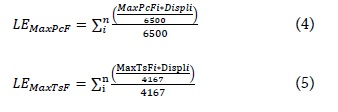
<body><![CDATA[<p>In separate days, all subjects underwent three hikes corresponding to different    trails. The trail 1 called &ldquo;Tintinolho&rdquo; was circular, with 10970m length, and    was located in the city of Guarda. The trail 2 called &ldquo;Vale Glaciário do Zêzere&rdquo;    was linear, with 9030m length and located in the village of Manteigas. The trail    3 called &ldquo;Lapa dos Dinheiros&rdquo; was circular, with 7536m length and was located    in the village of Seia. All trails were divided into stages according to the    terrain characteristics. The velocity was continuously set and monitored by    an expert hiker, ensuring a consistent 5 km·h-1 pace. During the hike, no stops    were allowed, and the participants informed that those who stopped for more    than one min for any reason, would be removed from the sample. Every subject    used a watch with GPS tracking (Fenix 5, Garmin, USA) throughout the hike for    tracking the gradient, and to set altimetry information.</p>     <p>The knee joint forces were determined for each stage of the trail computing:    (i) the maximum patellofemoral compressive force (MaxPcF), and; (ii) the maximum    tibiofemoral shear force (MaxTsF). The MaxPcF was estimated according to the    equations proposed by Gabriel, Moreira, and Faria (2010) according to the slope:</p>     <p>MaxPcF = &#8722;0.1106 * S + 1.3, if slope &lt; 0 (1) </p>     <p>or</p>     <p>MaxPcF = 0.0786 * S + 1.3, if slope &gt; 0 (2)</p>     <p>Participants</p>     <p>Twenty-nine subjects (20 males and 9 females), mean of 28.04±10.79 years, 1.73±0.09    m of height, 69.59 ±11.00 kg of body mass where S represents the slope of the    stage (in percentage). The MaxTsF was estimated based on the equation (Gabriel    et al., 2010):</p>     <p>MaxTsF = &#8722;0.0104 * S + 0.8333 (3)</p>     <p>where S represents the slope of the stage (in percentage). Data were expressed    as times the body weight (xBW) for both MaxPcF and MaxTsF. Those values were    then converted into multiples of a 5km flat walk in order to set the trail difficulty.    This procedure was originally described by Hugo (1999) and adapted by Gabriel,    Moreira, and Faria (2011). The retrieved data was then interpreted as the load    equivalent (LE). The LE was calculated based on the equations:</p>     <p>&nbsp;</p>     ]]></body>
<body><![CDATA[<p align="center"><a name="e1"></a><img src="/img/revistas/mot/v15n1/15n1a07e1.jpg"/></p>     
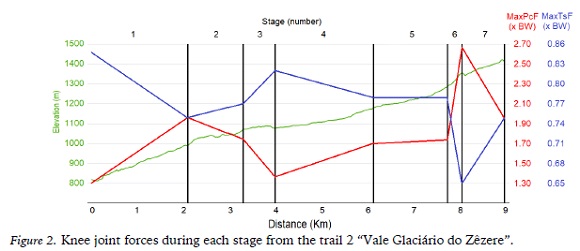
<p>&nbsp;</p>     <p>where MaxPcF<b ><i>i</i></b> and MaxTsF<b ><i>i</i></b> represents all the maximum patellofemoral compressive and maximum    tibiofemoral shear forces, and Displ<b ><i>i</i></b> represents the horizontal displacement in each stage.</p>     <p><a href="#f2">Figura 2</a> presents the knee joint forces during each stage    from the trail 2 &ldquo;Vale Glaciário do Zêzere&rdquo;. The highest MaxPcF was 2.67, and    the lowest was 1.36 in stages 6 and 3, respectively. The highest MaxTsF 0.82    and the lowest was 0.65 in stages 3 and 6, respectively.</p>     <p>&nbsp;</p>     <p align="center"><a name="f1"></a><img src="/img/revistas/mot/v15n1/15n1a07f1.jpg"/></p>     
<p>&nbsp;</p>     <p align="center"><a name="f2"></a><img src="/img/revistas/mot/v15n1/15n1a07f2.jpg"/></p>     
<p>&nbsp;</p>     <p>Statistical analysis</p>     ]]></body>
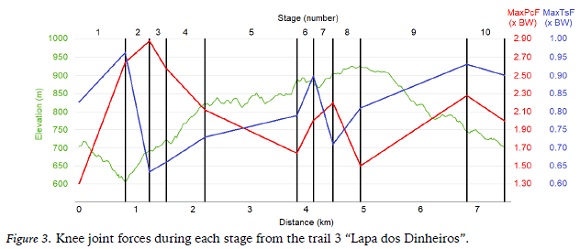
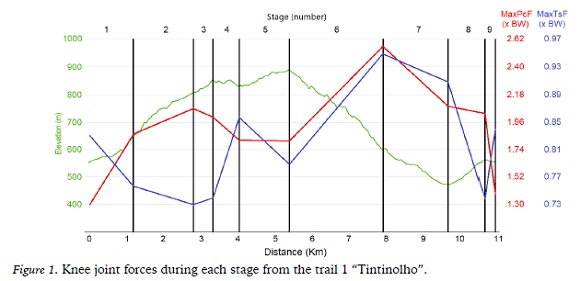
<body><![CDATA[<p>Data were expressed as mean, maximum and minimum for each stage of the three    trails. Because this was a recommendation study with a characterization purpose,    no inferential statistics were conducted. The qualitative interpretation of    the trails difficulty was made using the LE, and interpreted according to the    suggestion of Gabriel, Moreira, and Faria (2010) as: (i) &ldquo;very easy&rdquo; if -&#8734;    &lt; LE &lt; 1; (ii) &ldquo;easy&rdquo; if 1 &#8804; LE &lt; 2; (iii) &ldquo;pleasant&rdquo; if 2 &#8804;    LE &lt; 3; (iv) &ldquo;moderate&rdquo; if 3 &#8804; LE &lt; 4; (v) &ldquo;hard&rdquo; if 4 &#8804; LE    &lt; 5; (vi) &ldquo;severe&rdquo; if 5 &#8804; LE &lt; 6; and (vii) &ldquo;extreme&rdquo; if 6 &#8804;    LE &lt; +&#8734;.</p>     <p>RESULTS</p>     <p><a href="#f1">Figura 1</a> presents the knee joint forces during each stage    from the trail 1 &ldquo;Tintinolho&rdquo;. The highest MaxPcF was 2.59, and the lowest was    1.38 in stages 6 and 9, respectively. The highest MaxTsF 0.95 and the lowest    was 0.73 in the stages 6 and 2, respectively.      <p><a href="#f3">Figura 3</a> presents the knee joint forces during each stage    from trail 3 &ldquo;Lapa dos Dinheiros&rdquo;. The highest MaxPcF was 2.87, and the lowest    was 1.50 in stages 2 and 8, respectively. The highest MaxTsF 0.96 and the lowest    was 0.63 in stages 1 and 2, respectively.</p>     <p>&nbsp;</p>     <p align="center"><a name="f3"></a><img src="/img/revistas/mot/v15n1/15n1a07f3.jpg"/></p>     
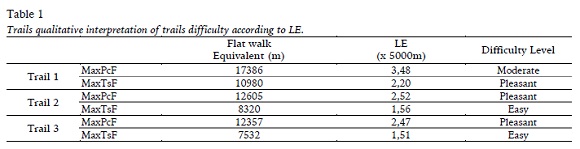
<p>&nbsp;</p>     <p><a href="#t1">Table 1</a> presents the qualitative interpretation of the difficulty    of the trails considering the LE. The MaxPcF for trail 1 is equivalent to a    flat 17386m walk, and MaxTsF is equivalent to a 10980m walk. The MaxPcF for    trail 2 is equivalent to a flat 12605m walk, and MaxTsF is equivalent to an    8320m walk. The MaxPcF for trail 3 is equivalent to a flat 12357 m walk, and    MaxTsF is equivalent to a 7532 m walk. So, the trail 1 can be classified as    having a &ldquo;pleasant- moderate&rdquo; difficulty, while the trails number 2 and 3 are    classified as &ldquo;easy-pleasant&rdquo;.</p>     <p>&nbsp;</p>     <p align="center"><a name="t1"></a><img src="/img/revistas/mot/v15n1/15n1a07t1.jpg"/></p>     
]]></body>
<body><![CDATA[<p>&nbsp;</p>     <p>DISCUSSION</p>     <p>The aim of this study was to characterize knee joint forces while walking in    Serra da Estrela in trails with distinct characteristics. Overall, the knee    joint forces were no higher than 3 xBW which classifies the difficulty of the    trails as &ldquo;easy&rdquo; or &ldquo;moderate&rdquo;.</p>     <p>Most of the previous approaches used a standard trails classification as &ldquo;easy&rdquo;,    &ldquo;medium&rdquo; or &ldquo;hard&rdquo;. Despite this qualitative interpretation, previous interventions    just used geographical and/or spatial-temporal information to set the trail    difficulty. With this in mind, we tried to go deeper and set difficulty by quantifying    knee aggression. Some successful attempts were already made in other regions    of Portugal, such as Douro International (p.e. Gabriel et al., 2011), but not    in the Serra da Estrela territory.</p>     <p>The patellofemoral compressive forces happen when two body sections are aligned    into each other. Those are expected to increase continuously with the slope    both in uphill and downhill walking (Schwameder et al., 2001). However, on the    same slope, the patellofemoral compressive forces tend to be more aggressive    in downhill. In this study, the participants experienced near 3 xBW when downhill    at 12%. For our group, with a mean of 69.59 of body weight, this represents    approximately 210 kg of force experienced at each step during the descent. Schwameder    et al. (2001) found patellofemoral compressive forces of 2.3 xBW when downhill    at a 10.5% grade. Normally, the high patellofemoral compression forces are dominant    in the entire stance phase at downhill. Those tend to increase when considering    the effect of body weight (as higher the body weight, higher is the compression    force), which may require some attention from hikers when choosing their paths.    In practical terms, each hiker should multiply his body weight by the downhill    factor (i.e., 3xBW) to know the exact compression force that will be induced    in that specific joint.</p>     <p>The tibiofemoral shear forces are unaligned forces pushing tibia and femur    in the opposite direction. Those are expected to decrease as the grade increases.    The more challenging uphill was found in stage 2 of the trail 3 &ldquo;Lapa dos Dinheiros&rdquo;,    showing tibiofemoral shear forces of 0.63 xBW at a 20% climb. Schwameder et    al. (2001) found values near 0.7 at slopes near 20% grade. At uphill, the stance    phase happens step by step at higher ground promoting a lower relative knee    angle and range of motion. Although most of the structures are highly loaded    at uphill, there is only a little stress in the inner knee as the shear forces    are small. That is the reason why there are recommending uphill walking for    hikers that finished recovering from an anterior cruciate ligament injury.</p>     <p>The non-uniform distribution of joint forces during up and downhill may require    learning new walking patterns. Using kinematics analysis, Lay, Hass, and Gregor    (2006) found several postural changes during locomotion in sloped surfaces.    The authors reported the need to raise the limb for toe clearance and heel strike,    and to lift the body during uphill walking, and to control the descent of the    body during downhill walking. So, people that want to begin hiking in mountain    paths should be aware of adaptations in critical aspects of posture for a more    efficient and less aggressive walk.</p>     <p>Considering a healthy outcome, hikers must have information about the overall    knee aggression that each path will trigger. With that in mind, previous studies    started to use the load equivalent as a measure to rate the trails difficulty    considering the energetic expenditure (Hugo, 1999) and knee joint loads (Gabriel    et al., 2010). The load equivalent represents the overall load in the knee during    the hike and its equivalent in a 5000 m flat walk. For instance, a 10000 m hike    that elicits an overall load of three times the load predicted to a 5000 m walk    in flat terrain, has a load equivalent of three points (being classified as    moderate). It means that, for an extent of 10000 m mountain hike, the knee load    will represent a 15000 m flat walk. Therefore, participants are free to choose,    if a &ldquo;15000 m flat walk&rdquo; is suitable for them according to their health status,    or choose another path accordingly. In the present study, the trail 1, &ldquo;Tintinolho&rdquo;,    presented the highest load equivalent, being the overall MaxPcF equivalent to    a 17386 m flat walk (LE = 3.48), and the overall MaxTsF equivalent to a 10980    m flat walk (LE = 2.20).</p>     <p>CONCLUSION</p>     <p>Our findings suggest that trail 2 &ldquo;Vale Glaciário do Zêzere&rdquo; elicited less    knee compression and shear forces. In contrast, trails number 1 &ldquo;Tintinolho&rdquo;    and 3 &ldquo;Lapa dos Dinheiros&rdquo; are less appropriate for those who suffered from    previous knee pain or are in a recovery process. This approach can help participants    making the most appropriate choice about hikes, taking into consideration their    physical level and/or history of skeletal muscle injury.</p>     ]]></body>
<body><![CDATA[<p>&nbsp;</p>     <p><b>REFERENCES</b></p>     <!-- ref --><p>Brymer, E., &amp; Gray, T. (2010). Developing an intimate &quot;relationship&quot;    with nature through extreme sports participation. <i>Leisure</i>, <i>34(4)</i>,    361-374.    &nbsp;&nbsp;&nbsp;&nbsp;&nbsp;&nbsp;&nbsp;&nbsp;[&#160;<a href="javascript:void(0);" onclick="javascript: window.open('/scielo.php?script=sci_nlinks&ref=387547&pid=S1646-107X201900010000700001&lng=','','width=640,height=500,resizable=yes,scrollbars=1,menubar=yes,');">Links</a>&#160;]<!-- end-ref --></p>     <p>Funollet, F. (1994). Actividades En El Médio Natural. Tipos, Clasificaciones    Y Recursos. in <i>Organización</i><i > De Actividades Físicas En La Naturaleza</i>. Tema 14, Barcelona: Inde.</p>     <!-- ref --><p>Gabriel, R., Moreira, M., &amp; Faria, J. (2010). Pedestrianismo, biomecânica    e prevenção de lesões. In A. Alencoão, E. Rosa, H. Moreira, J. Santos, &amp;    R. Gabriel (Eds.), <i >Pedestrianismo</i><i > uma abordagem multidisciplinar: ambiente, aptidão física e saúde</i>. Vila Real:    Universidade de Trás-os-Montes e Alto Douro&nbsp;&nbsp;&nbsp;&nbsp;&nbsp;&nbsp;&nbsp;&nbsp;[&#160;<a href="javascript:void(0);" onclick="javascript: window.open('/scielo.php?script=sci_nlinks&ref=387550&pid=S1646-107X201900010000700003&lng=','','width=640,height=500,resizable=yes,scrollbars=1,menubar=yes,');">Links</a>&#160;]<!-- end-ref --><!-- ref --><p>Gabriel, R., Moreira, M., &amp; Faria, J. (2011). Percursos Pedestres: Equivalente    de Carga como Medida de Dificuldade. In A. Alencoão, E. Gomes, L. Quaresma,    L. Sousa, &amp; R. Gabriel (Eds.). <i>Percursos</i><i > Pedestres. O valor natural ea promoção da saúde</i>. Vila Real: Universidade    de Trás-os-Montes e Alto Douro&nbsp;&nbsp;&nbsp;&nbsp;&nbsp;&nbsp;&nbsp;&nbsp;[&#160;<a href="javascript:void(0);" onclick="javascript: window.open('/scielo.php?script=sci_nlinks&ref=387551&pid=S1646-107X201900010000700004&lng=','','width=640,height=500,resizable=yes,scrollbars=1,menubar=yes,');">Links</a>&#160;]<!-- end-ref --><!-- ref --><p>Gatterer, H., Raab, C., Pramsohler, S., Faulhaber, M., Burtscher, M., &amp;    Netzer, N. (2015). Effect of weekly hiking on cardiovascular risk factors in    the elderly. <i>Zeitschrift</i><i > Gerontologie Geriatrics, 48</i>, 150-153.    &nbsp;&nbsp;&nbsp;&nbsp;&nbsp;&nbsp;&nbsp;&nbsp;[&#160;<a href="javascript:void(0);" onclick="javascript: window.open('/scielo.php?script=sci_nlinks&ref=387552&pid=S1646-107X201900010000700005&lng=','','width=640,height=500,resizable=yes,scrollbars=1,menubar=yes,');">Links</a>&#160;]<!-- end-ref --></p>     <!-- ref --><p>Hall, C., &amp; PageE, S. (1999). <i>The Geography of Tourism and Recreation    </i><i>- </i><i >environment, place and space</i>. London and New York, Routdlege.    &nbsp;&nbsp;&nbsp;&nbsp;&nbsp;&nbsp;&nbsp;&nbsp;[&#160;<a href="javascript:void(0);" onclick="javascript: window.open('/scielo.php?script=sci_nlinks&ref=387554&pid=S1646-107X201900010000700006&lng=','','width=640,height=500,resizable=yes,scrollbars=1,menubar=yes,');">Links</a>&#160;]<!-- end-ref --></p>     <!-- ref --><p>Hugo, M.L. (1999). Energy equivalent as a measure of the difficulty rating    of hiking trails. <i >Tourism Geographies, 1(3)</i>, 358-373.    &nbsp;&nbsp;&nbsp;&nbsp;&nbsp;&nbsp;&nbsp;&nbsp;[&#160;<a href="javascript:void(0);" onclick="javascript: window.open('/scielo.php?script=sci_nlinks&ref=387556&pid=S1646-107X201900010000700007&lng=','','width=640,height=500,resizable=yes,scrollbars=1,menubar=yes,');">Links</a>&#160;]<!-- end-ref --></p>     <!-- ref --><p>Lay, A.N., Hass, C.J., &amp; Gregor, R.J. (2006). The effects of sloped surfaces    on locomotion: a kinematic and kinetic analysis. <i>Journal of Biomechanics,    39(9)</i>, 1621-1628.    &nbsp;&nbsp;&nbsp;&nbsp;&nbsp;&nbsp;&nbsp;&nbsp;[&#160;<a href="javascript:void(0);" onclick="javascript: window.open('/scielo.php?script=sci_nlinks&ref=387558&pid=S1646-107X201900010000700008&lng=','','width=640,height=500,resizable=yes,scrollbars=1,menubar=yes,');">Links</a>&#160;]<!-- end-ref --></p>     <!-- ref --><p>Loob, B. (2004). Load Carriage For Fun: A Survey Of New Zealand Trampers: their    activities and injuries. <i>Applied Ergonomics</i><i>, 35(6)</i>, 541-547.    &nbsp;&nbsp;&nbsp;&nbsp;&nbsp;&nbsp;&nbsp;&nbsp;[&#160;<a href="javascript:void(0);" onclick="javascript: window.open('/scielo.php?script=sci_nlinks&ref=387560&pid=S1646-107X201900010000700009&lng=','','width=640,height=500,resizable=yes,scrollbars=1,menubar=yes,');">Links</a>&#160;]<!-- end-ref --></p>     <!-- ref --><p>Mair, J., Hammerer-Lercher, A., Mittermayr, M., Klingler, A., Humpeler, E.,    Pachinger, O., &amp; Schobersberger, W. (2008). 3- week hiking holidays at moderate    altitude do not impair cardiac function in individuals with metabolic syndrome.    <i>International Journal of Cardiology, 123(2)</i>, 186-188.    &nbsp;&nbsp;&nbsp;&nbsp;&nbsp;&nbsp;&nbsp;&nbsp;[&#160;<a href="javascript:void(0);" onclick="javascript: window.open('/scielo.php?script=sci_nlinks&ref=387562&pid=S1646-107X201900010000700010&lng=','','width=640,height=500,resizable=yes,scrollbars=1,menubar=yes,');">Links</a>&#160;]<!-- end-ref --></p>     <!-- ref --><p>Schwameder, H., Roithner, R., Burgstaller, R., &amp; Müller, E. (2001). Knee    joint forces in uphill, downhill and level walking at different gradients. In    : Muller R, Gerber H and Stacoff A (editors). <i >Proceedings of ISB 2001</i>. ETH. Zurich, Switzerland. O79.    &nbsp;&nbsp;&nbsp;&nbsp;&nbsp;&nbsp;&nbsp;&nbsp;[&#160;<a href="javascript:void(0);" onclick="javascript: window.open('/scielo.php?script=sci_nlinks&ref=387564&pid=S1646-107X201900010000700011&lng=','','width=640,height=500,resizable=yes,scrollbars=1,menubar=yes,');">Links</a>&#160;]<!-- end-ref --></p>     <!-- ref --><p>Strauss-Blasche, G., Riedmann, B., Schobersberger, W., Ekmekcioglu, C., Riedmann,    G., Waanders, R., Fries, D., Mittermayr, M., Marktl, W., &amp; Humpeler, E.    (2004). Vacation at moderate and low altitude improves perceived health in individuals    with metabolic syndrome. <i>Journal of Travel Medicine, 11(5)</i>, 300-304.    &nbsp;&nbsp;&nbsp;&nbsp;&nbsp;&nbsp;&nbsp;&nbsp;[&#160;<a href="javascript:void(0);" onclick="javascript: window.open('/scielo.php?script=sci_nlinks&ref=387566&pid=S1646-107X201900010000700012&lng=','','width=640,height=500,resizable=yes,scrollbars=1,menubar=yes,');">Links</a>&#160;]<!-- end-ref --></p>     <!-- ref --><p>Tovar, Z., &amp; Carvalho, C. (2010). Pedestrianismo e Percursos Pedestres    em Portugal<i>: </i>paisagens, património e desenvolvimento. <i>In, Actas do    XII Colóquio Ibério de Geografia</i>, 1-11.    &nbsp;&nbsp;&nbsp;&nbsp;&nbsp;&nbsp;&nbsp;&nbsp;[&#160;<a href="javascript:void(0);" onclick="javascript: window.open('/scielo.php?script=sci_nlinks&ref=387568&pid=S1646-107X201900010000700013&lng=','','width=640,height=500,resizable=yes,scrollbars=1,menubar=yes,');">Links</a>&#160;]<!-- end-ref --></p>     <!-- ref --><p>Vieira, M., de Avelar, I., Silva M., Soares, V., &amp; Lobo da Costa P. (2015).    Effects of four days hiking on postural control. <i>PLoS</i><i> One, 10(4)</i>,    e0123214.    &nbsp;&nbsp;&nbsp;&nbsp;&nbsp;&nbsp;&nbsp;&nbsp;[&#160;<a href="javascript:void(0);" onclick="javascript: window.open('/scielo.php?script=sci_nlinks&ref=387570&pid=S1646-107X201900010000700014&lng=','','width=640,height=500,resizable=yes,scrollbars=1,menubar=yes,');">Links</a>&#160;]<!-- end-ref --></p>     <p>&nbsp;</p>     <p>Acknowledgments: Authors would like to acknowledge to all members of the Association    Geopark Estrela for their helpful contribution in setting the most appropriate    paths to be part of the project.</p>     <p>Conflict of interests: Nothing to declare.</p>     ]]></body>
<body><![CDATA[<p>Funding: Project funded by the Portuguese Science and Technology Foundation    (SAICT-POL/023604/2016). </p>     <p>&nbsp;</p>     <p>Manuscript received at January 15th 2019; Accepted at March 6th 2019</p>     <p>&nbsp;</p>     <p><a href="#top*"><sup>[*]</sup></a><a name="*"></a>Corresponding author: Av.    Dr. Francisco Sá Carneiro, nº 50, 6300-550, Guarda. Email: <a href="mailto:mario.costa@ipg.pt">mario.costa@ipg.pt</a></p>      ]]></body><back>
<ref-list>
<ref id="B1">
<nlm-citation citation-type="journal">
<person-group person-group-type="author">
<name>
<surname><![CDATA[Brymer]]></surname>
<given-names><![CDATA[E.]]></given-names>
</name>
<name>
<surname><![CDATA[Gray]]></surname>
<given-names><![CDATA[T.]]></given-names>
</name>
</person-group>
<article-title xml:lang="en"><![CDATA[Developing an intimate "relationship" with nature through extreme sports participation]]></article-title>
<source><![CDATA[Leisure]]></source>
<year>2010</year>
<volume>34</volume>
<numero>4</numero>
<issue>4</issue>
<page-range>361-374</page-range></nlm-citation>
</ref>
<ref id="B2">
<nlm-citation citation-type="book">
<person-group person-group-type="author">
<name>
<surname><![CDATA[Funollet]]></surname>
<given-names><![CDATA[F.]]></given-names>
</name>
</person-group>
<source><![CDATA[Actividades En El Médio Natural]]></source>
<year>1994</year>
<publisher-loc><![CDATA[Tipos, Clasificaciones Y Recursos. in Organización De Actividades Físicas En La Naturaleza. Barcelona ]]></publisher-loc>
<publisher-name><![CDATA[Inde]]></publisher-name>
</nlm-citation>
</ref>
<ref id="B3">
<nlm-citation citation-type="book">
<person-group person-group-type="author">
<name>
<surname><![CDATA[Gabriel]]></surname>
<given-names><![CDATA[R.]]></given-names>
</name>
<name>
<surname><![CDATA[Moreira]]></surname>
<given-names><![CDATA[M.]]></given-names>
</name>
<name>
<surname><![CDATA[Faria]]></surname>
<given-names><![CDATA[J.]]></given-names>
</name>
</person-group>
<article-title xml:lang="pt"><![CDATA[Pedestrianismo, biomecânica e prevenção de lesões]]></article-title>
<person-group person-group-type="editor">
<name>
<surname><![CDATA[Alencoão]]></surname>
<given-names><![CDATA[A.]]></given-names>
</name>
<name>
<surname><![CDATA[Rosa]]></surname>
<given-names><![CDATA[E.]]></given-names>
</name>
<name>
<surname><![CDATA[Moreira]]></surname>
<given-names><![CDATA[H.]]></given-names>
</name>
<name>
<surname><![CDATA[Santos]]></surname>
<given-names><![CDATA[J.]]></given-names>
</name>
<name>
<surname><![CDATA[Gabriel]]></surname>
<given-names><![CDATA[R.]]></given-names>
</name>
</person-group>
<source><![CDATA[Pedestrianismo uma abordagem multidisciplinar: ambiente, aptidão física e saúde]]></source>
<year>2010</year>
<publisher-loc><![CDATA[Vila Real ]]></publisher-loc>
<publisher-name><![CDATA[Universidade de Trás-os-Montes e Alto Douro]]></publisher-name>
</nlm-citation>
</ref>
<ref id="B4">
<nlm-citation citation-type="book">
<person-group person-group-type="author">
<name>
<surname><![CDATA[Gabriel]]></surname>
<given-names><![CDATA[R.]]></given-names>
</name>
<name>
<surname><![CDATA[Moreira]]></surname>
<given-names><![CDATA[M.]]></given-names>
</name>
<name>
<surname><![CDATA[Faria]]></surname>
<given-names><![CDATA[J.]]></given-names>
</name>
</person-group>
<article-title xml:lang="pt"><![CDATA[Percursos Pedestres: Equivalente de Carga como Medida de Dificuldade]]></article-title>
<person-group person-group-type="editor">
<name>
<surname><![CDATA[Alencoão]]></surname>
<given-names><![CDATA[A.]]></given-names>
</name>
<name>
<surname><![CDATA[Gomes]]></surname>
<given-names><![CDATA[E.]]></given-names>
</name>
<name>
<surname><![CDATA[Quaresma]]></surname>
<given-names><![CDATA[L.]]></given-names>
</name>
<name>
<surname><![CDATA[Sousa]]></surname>
<given-names><![CDATA[L.]]></given-names>
</name>
<name>
<surname><![CDATA[Gabriel]]></surname>
<given-names><![CDATA[R.]]></given-names>
</name>
</person-group>
<source><![CDATA[Percursos Pedestres: O valor natural ea promoção da saúde]]></source>
<year>2011</year>
<publisher-loc><![CDATA[Vila Real ]]></publisher-loc>
<publisher-name><![CDATA[Universidade de Trás-os-Montes e Alto Douro]]></publisher-name>
</nlm-citation>
</ref>
<ref id="B5">
<nlm-citation citation-type="journal">
<person-group person-group-type="author">
<name>
<surname><![CDATA[Gatterer]]></surname>
<given-names><![CDATA[H.]]></given-names>
</name>
<name>
<surname><![CDATA[Raab]]></surname>
<given-names><![CDATA[C.]]></given-names>
</name>
<name>
<surname><![CDATA[Pramsohler]]></surname>
<given-names><![CDATA[S.]]></given-names>
</name>
<name>
<surname><![CDATA[Faulhaber]]></surname>
<given-names><![CDATA[M.]]></given-names>
</name>
<name>
<surname><![CDATA[Burtscher]]></surname>
<given-names><![CDATA[M.]]></given-names>
</name>
<name>
<surname><![CDATA[Netzer]]></surname>
<given-names><![CDATA[N.]]></given-names>
</name>
</person-group>
<article-title xml:lang="en"><![CDATA[Effect of weekly hiking on cardiovascular risk factors in the elderly]]></article-title>
<source><![CDATA[Zeitschrift Gerontologie Geriatrics]]></source>
<year>2015</year>
<volume>48</volume>
<page-range>150-153</page-range></nlm-citation>
</ref>
<ref id="B6">
<nlm-citation citation-type="book">
<person-group person-group-type="author">
<name>
<surname><![CDATA[Hall]]></surname>
<given-names><![CDATA[C.]]></given-names>
</name>
<name>
<surname><![CDATA[Page]]></surname>
<given-names><![CDATA[E. S.]]></given-names>
</name>
</person-group>
<source><![CDATA[The Geography of Tourism and Recreation - environment, place and space]]></source>
<year>1999</year>
<publisher-loc><![CDATA[London and New York ]]></publisher-loc>
<publisher-name><![CDATA[Routdlege]]></publisher-name>
</nlm-citation>
</ref>
<ref id="B7">
<nlm-citation citation-type="journal">
<person-group person-group-type="author">
<name>
<surname><![CDATA[Hugo]]></surname>
<given-names><![CDATA[M.L.]]></given-names>
</name>
</person-group>
<article-title xml:lang="en"><![CDATA[Energy equivalent as a measure of the difficulty rating of hiking trails]]></article-title>
<source><![CDATA[Tourism Geographies]]></source>
<year>1999</year>
<volume>1</volume>
<numero>3</numero>
<issue>3</issue>
<page-range>358-373</page-range></nlm-citation>
</ref>
<ref id="B8">
<nlm-citation citation-type="journal">
<person-group person-group-type="author">
<name>
<surname><![CDATA[Lay]]></surname>
<given-names><![CDATA[A.N.]]></given-names>
</name>
<name>
<surname><![CDATA[Hass]]></surname>
<given-names><![CDATA[C.J.]]></given-names>
</name>
<name>
<surname><![CDATA[Gregor]]></surname>
<given-names><![CDATA[R.J.]]></given-names>
</name>
</person-group>
<article-title xml:lang="en"><![CDATA[The effects of sloped surfaces on locomotion: a kinematic and kinetic analysis]]></article-title>
<source><![CDATA[Journal of Biomechanics]]></source>
<year>2006</year>
<volume>39</volume>
<numero>9</numero>
<issue>9</issue>
<page-range>1621-1628</page-range></nlm-citation>
</ref>
<ref id="B9">
<nlm-citation citation-type="journal">
<person-group person-group-type="author">
<name>
<surname><![CDATA[Loob]]></surname>
<given-names><![CDATA[B.]]></given-names>
</name>
</person-group>
<article-title xml:lang="en"><![CDATA[Load Carriage For Fun: A Survey Of New Zealand Trampers: their activities and injuries]]></article-title>
<source><![CDATA[Applied Ergonomics]]></source>
<year>2004</year>
<volume>35</volume>
<numero>6</numero>
<issue>6</issue>
<page-range>541-547</page-range></nlm-citation>
</ref>
<ref id="B10">
<nlm-citation citation-type="journal">
<person-group person-group-type="author">
<name>
<surname><![CDATA[Mair]]></surname>
<given-names><![CDATA[J.]]></given-names>
</name>
<name>
<surname><![CDATA[Hammerer-Lercher]]></surname>
<given-names><![CDATA[A.]]></given-names>
</name>
<name>
<surname><![CDATA[Mittermayr]]></surname>
<given-names><![CDATA[M.]]></given-names>
</name>
<name>
<surname><![CDATA[Klingler]]></surname>
<given-names><![CDATA[A.]]></given-names>
</name>
<name>
<surname><![CDATA[Humpeler]]></surname>
<given-names><![CDATA[E.]]></given-names>
</name>
<name>
<surname><![CDATA[Pachinger]]></surname>
<given-names><![CDATA[O.]]></given-names>
</name>
<name>
<surname><![CDATA[Schobersberger]]></surname>
<given-names><![CDATA[W.]]></given-names>
</name>
</person-group>
<article-title xml:lang="en"><![CDATA[3- week hiking holidays at moderate altitude do not impair cardiac function in individuals with metabolic syndrome]]></article-title>
<source><![CDATA[International Journal of Cardiology]]></source>
<year>2008</year>
<volume>123</volume>
<numero>2</numero>
<issue>2</issue>
<page-range>186-188</page-range></nlm-citation>
</ref>
<ref id="B11">
<nlm-citation citation-type="book">
<person-group person-group-type="author">
<name>
<surname><![CDATA[Schwameder]]></surname>
<given-names><![CDATA[H.]]></given-names>
</name>
<name>
<surname><![CDATA[Roithner]]></surname>
<given-names><![CDATA[R.]]></given-names>
</name>
<name>
<surname><![CDATA[Burgstaller]]></surname>
<given-names><![CDATA[R.]]></given-names>
</name>
<name>
<surname><![CDATA[Müller]]></surname>
<given-names><![CDATA[E.]]></given-names>
</name>
</person-group>
<article-title xml:lang="en"><![CDATA[Knee joint forces in uphill, downhill and level walking at different gradients]]></article-title>
<person-group person-group-type="editor">
<name>
<surname><![CDATA[Muller]]></surname>
<given-names><![CDATA[R]]></given-names>
</name>
<name>
<surname><![CDATA[Gerber]]></surname>
<given-names><![CDATA[H]]></given-names>
</name>
<name>
<surname><![CDATA[Stacoff]]></surname>
<given-names><![CDATA[A]]></given-names>
</name>
</person-group>
<source><![CDATA[Proceedings of ISB 2001]]></source>
<year>2001</year>
<publisher-loc><![CDATA[Zurich ]]></publisher-loc>
<publisher-name><![CDATA[ETH]]></publisher-name>
</nlm-citation>
</ref>
<ref id="B12">
<nlm-citation citation-type="journal">
<person-group person-group-type="author">
<name>
<surname><![CDATA[Strauss-Blasche]]></surname>
<given-names><![CDATA[G.]]></given-names>
</name>
<name>
<surname><![CDATA[Riedmann]]></surname>
<given-names><![CDATA[B.]]></given-names>
</name>
<name>
<surname><![CDATA[Schobersberger]]></surname>
<given-names><![CDATA[W.]]></given-names>
</name>
<name>
<surname><![CDATA[Ekmekcioglu]]></surname>
<given-names><![CDATA[C.]]></given-names>
</name>
<name>
<surname><![CDATA[Riedmann]]></surname>
<given-names><![CDATA[G.]]></given-names>
</name>
<name>
<surname><![CDATA[Waanders]]></surname>
<given-names><![CDATA[R.]]></given-names>
</name>
<name>
<surname><![CDATA[Fries]]></surname>
<given-names><![CDATA[D.]]></given-names>
</name>
<name>
<surname><![CDATA[Mittermayr]]></surname>
<given-names><![CDATA[M.]]></given-names>
</name>
<name>
<surname><![CDATA[Marktl]]></surname>
<given-names><![CDATA[W.]]></given-names>
</name>
<name>
<surname><![CDATA[Humpeler]]></surname>
<given-names><![CDATA[E.]]></given-names>
</name>
</person-group>
<article-title xml:lang="en"><![CDATA[Vacation at moderate and low altitude improves perceived health in individuals with metabolic syndrome]]></article-title>
<source><![CDATA[Journal of Travel Medicine]]></source>
<year>2004</year>
<volume>11</volume>
<numero>5</numero>
<issue>5</issue>
<page-range>300-304</page-range></nlm-citation>
</ref>
<ref id="B13">
<nlm-citation citation-type="journal">
<person-group person-group-type="author">
<name>
<surname><![CDATA[Tovar]]></surname>
<given-names><![CDATA[Z.]]></given-names>
</name>
<name>
<surname><![CDATA[Carvalho]]></surname>
<given-names><![CDATA[C.]]></given-names>
</name>
</person-group>
<article-title xml:lang="pt"><![CDATA[Pedestrianismo e Percursos Pedestres em Portugal: paisagens, património e desenvolvimento]]></article-title>
<source><![CDATA[In]]></source>
<year>2010</year>
<volume>Actas do XII Colóquio Ibério de Geografia</volume>
<page-range>1-11</page-range></nlm-citation>
</ref>
<ref id="B14">
<nlm-citation citation-type="journal">
<person-group person-group-type="author">
<name>
<surname><![CDATA[Vieira]]></surname>
<given-names><![CDATA[M.]]></given-names>
</name>
<name>
<surname><![CDATA[de Avelar]]></surname>
<given-names><![CDATA[I.]]></given-names>
</name>
<name>
<surname><![CDATA[Silva M.]]></surname>
<given-names><![CDATA[Soares, V.]]></given-names>
</name>
<name>
<surname><![CDATA[Lobo da Costa]]></surname>
<given-names><![CDATA[P.]]></given-names>
</name>
</person-group>
<article-title xml:lang="en"><![CDATA[Effects of four days hiking on postural control]]></article-title>
<source><![CDATA[PLoS One]]></source>
<year>2015</year>
<volume>10</volume>
<numero>4</numero>
<issue>4</issue>
<page-range>e0123214</page-range></nlm-citation>
</ref>
</ref-list>
</back>
</article>