<?xml version="1.0" encoding="ISO-8859-1"?><article xmlns:mml="http://www.w3.org/1998/Math/MathML" xmlns:xlink="http://www.w3.org/1999/xlink" xmlns:xsi="http://www.w3.org/2001/XMLSchema-instance">
<front>
<journal-meta>
<journal-id>1646-107X</journal-id>
<journal-title><![CDATA[Motricidade]]></journal-title>
<abbrev-journal-title><![CDATA[Motri.]]></abbrev-journal-title>
<issn>1646-107X</issn>
<publisher>
<publisher-name><![CDATA[Edições Desafio Singular]]></publisher-name>
</publisher>
</journal-meta>
<article-meta>
<article-id>S1646-107X2019000100009</article-id>
<article-id pub-id-type="doi">10.6063/motricidade.14910</article-id>
<title-group>
<article-title xml:lang="en"><![CDATA[Acute and subacute effects of resistance training with and without blood flow restriction on muscle thickness and cytokines]]></article-title>
</title-group>
<contrib-group>
<contrib contrib-type="author">
<name>
<surname><![CDATA[Evangelista]]></surname>
<given-names><![CDATA[Alexandre L.]]></given-names>
</name>
<xref ref-type="aff" rid="A1"/>
</contrib>
<contrib contrib-type="author">
<name>
<surname><![CDATA[Rica]]></surname>
<given-names><![CDATA[Roberta L.]]></given-names>
</name>
<xref ref-type="aff" rid="A2"/>
</contrib>
<contrib contrib-type="author">
<name>
<surname><![CDATA[Paulo]]></surname>
<given-names><![CDATA[Anderson C.]]></given-names>
</name>
<xref ref-type="aff" rid="A3"/>
</contrib>
<contrib contrib-type="author">
<name>
<surname><![CDATA[Vieira]]></surname>
<given-names><![CDATA[Rodolfo P.]]></given-names>
</name>
<xref ref-type="aff" rid="A4 "/>
</contrib>
<contrib contrib-type="author">
<name>
<surname><![CDATA[Corso]]></surname>
<given-names><![CDATA[Simone D.]]></given-names>
</name>
<xref ref-type="aff" rid="A8"/>
</contrib>
<contrib contrib-type="author">
<name>
<surname><![CDATA[S-Dias]]></surname>
<given-names><![CDATA[Alana]]></given-names>
</name>
<xref ref-type="aff" rid="A4 "/>
</contrib>
<contrib contrib-type="author">
<name>
<surname><![CDATA[Pereira]]></surname>
<given-names><![CDATA[Paulo E. de Assis]]></given-names>
</name>
<xref ref-type="aff" rid="A9"/>
</contrib>
<contrib contrib-type="author">
<name>
<surname><![CDATA[Teixeira]]></surname>
<given-names><![CDATA[Cauê V. La Scala]]></given-names>
</name>
<xref ref-type="aff" rid="A9 "/>
<xref ref-type="aff" rid="A0"/>
</contrib>
<contrib contrib-type="author">
<name>
<surname><![CDATA[Reis]]></surname>
<given-names><![CDATA[Victor M.]]></given-names>
</name>
<xref ref-type="aff" rid="A11"/>
</contrib>
<contrib contrib-type="author">
<name>
<surname><![CDATA[Bocalini]]></surname>
<given-names><![CDATA[Danilo S.]]></given-names>
</name>
<xref ref-type="aff" rid="A12"/>
</contrib>
</contrib-group>
<aff id="AA1">
<institution><![CDATA[,Nove de Julho University Department of Physical Education ]]></institution>
<addr-line><![CDATA[São Paulo SP]]></addr-line>
<country>Brazil</country>
</aff>
<aff id="AA2">
<institution><![CDATA[,Estacio de Sá University Department of Post-Graduation in Physical Education ]]></institution>
<addr-line><![CDATA[Vitoria ES]]></addr-line>
<country>Brazil</country>
</aff>
<aff id="AA3">
<institution><![CDATA[,Technological Federal University Department of Physical Education ]]></institution>
<addr-line><![CDATA[Curitiba PR]]></addr-line>
<country>Brazil</country>
</aff>
<aff id="AA4">
<institution><![CDATA[,Universidade Brasil  ]]></institution>
<addr-line><![CDATA[São Paulo SP]]></addr-line>
<country>Brazil</country>
</aff>
<aff id="AA5">
<institution><![CDATA[,Federal University of São Paulo  ]]></institution>
<addr-line><![CDATA[Santos SP]]></addr-line>
<country>Brazil</country>
</aff>
<aff id="AA6">
<institution><![CDATA[,Anhembi Morumbi University School of Medicine ]]></institution>
<addr-line><![CDATA[São José dos Campos SP]]></addr-line>
<country>Brazil</country>
</aff>
<aff id="AA7">
<institution><![CDATA[,Brazilian Institute of Teaching and Research in Pulmonary and Exercise Immunology  ]]></institution>
<addr-line><![CDATA[São Paulo SP]]></addr-line>
<country>Brazil</country>
</aff>
<aff id="AA8">
<institution><![CDATA[,Nove de Julho University  ]]></institution>
<addr-line><![CDATA[São Paulo SP]]></addr-line>
<country>Brazil</country>
</aff>
<aff id="AA9">
<institution><![CDATA[,Faculty of Physical Education  ]]></institution>
<addr-line><![CDATA[Praia Grande SP]]></addr-line>
<country>Brazil</country>
</aff>
<aff id="A10">
<institution><![CDATA[,Federal University of São Paulo Obesity Study Group ]]></institution>
<addr-line><![CDATA[Santos SP]]></addr-line>
<country>Brazil</country>
</aff>
<aff id="A11">
<institution><![CDATA[,Universidade de Trás-os-Montes e Alto Douro Research Center in Sports Sciences, Health Sciences and Human Development ]]></institution>
<addr-line><![CDATA[Vila Real ]]></addr-line>
<country>Portugal</country>
</aff>
<aff id="A12">
<institution><![CDATA[,Federal University of Espírito Santo Exprimental Physiology and Biochemistry Laboratory of Physical Education and Sport Center ]]></institution>
<addr-line><![CDATA[Vitoria ES]]></addr-line>
<country>Brazil</country>
</aff>
<pub-date pub-type="pub">
<day>00</day>
<month>03</month>
<year>2019</year>
</pub-date>
<pub-date pub-type="epub">
<day>00</day>
<month>03</month>
<year>2019</year>
</pub-date>
<volume>15</volume>
<numero>1</numero>
<fpage>79</fpage>
<lpage>86</lpage>
<copyright-statement/>
<copyright-year/>
<self-uri xlink:href="http://scielo.pt/scielo.php?script=sci_arttext&amp;pid=S1646-107X2019000100009&amp;lng=en&amp;nrm=iso"></self-uri><self-uri xlink:href="http://scielo.pt/scielo.php?script=sci_abstract&amp;pid=S1646-107X2019000100009&amp;lng=en&amp;nrm=iso"></self-uri><self-uri xlink:href="http://scielo.pt/scielo.php?script=sci_pdf&amp;pid=S1646-107X2019000100009&amp;lng=en&amp;nrm=iso"></self-uri><abstract abstract-type="short" xml:lang="en"><p><![CDATA[It was our objective to verify the time course of muscle thickness and cytokine concentration after a resistance training session. In one of the experimental conditions, the training session was performed with low load (20% 1RM) and restriction of blood flow. In the other experimental condition, the same training was performed with high load (80% 1RM) and without blood flow restriction. Femoral rectus muscle, vastus lateralis, brachial biceps and triceps brachii muscle thickness and the serum cytokine dosage were analyzed pré, 0h, 24h and 48h after the training sessions. For the upper and lower limbs, the main results showed significant (p< 0.05) effect on time for the thickness in all muscle but not (p&gt; 0.05) to experimental condition. To cytokines concentrations, a significant (p= 0.004) interaction between the time and conduction for IL10. Conversely, there was no difference between the weeks (p= 0.698) or time (p= 0.142) in the means of TNF. In conclusion both experimental conductions promoted similar changes on muscular swelling without alterations on TNFa, however, the RST protocol induced increase on IL-10 concentration after 24 hours of exercise session.]]></p></abstract>
<kwd-group>
<kwd lng="en"><![CDATA[resistance training]]></kwd>
<kwd lng="en"><![CDATA[metabolic profile]]></kwd>
<kwd lng="en"><![CDATA[inflammatory profile]]></kwd>
<kwd lng="en"><![CDATA[muscle thickness]]></kwd>
<kwd lng="en"><![CDATA[blood flow restriction]]></kwd>
<kwd lng="en"><![CDATA[cytokines]]></kwd>
</kwd-group>
</article-meta>
</front><body><![CDATA[ <p align="right"><font size="2"><b>ARTIGOS ORIGINAIS</b></font></p>     <p><font size="4"><b>Acute and subacute effects of resistance training with and    without blood flow restriction on muscle thickness and cytokines</b></font></p>     <p><b>Alexandre L. Evangelista<sup>1</sup><a href="#*"><sup>[*]</sup></a><a name="top*"></a>,    Roberta L. Rica<sup>2</sup>, Anderson C. Paulo<sup>3</sup>, Rodolfo P. Vieira<sup>4-7</sup>,    Simone D. Corso<sup>8</sup>, Alana S-Dias<sup>4-7</sup>, Paulo E. de Assis Pereira<sup>9</sup>,    Cauê V. La Scala Teixeira<sup>9-10</sup>, Victor M. Reis<sup>11</sup>, Danilo    S. Bocalini<sup>12</sup></b></p>     <p><sup>1</sup>Department of Physical Education of Nove de Julho University, São    Paulo, SP, Brazil</p>     <p><sup>2</sup>Department of Post-Graduation in Physical Education of Estacio    de Sá University, Vitoria, ES, Brazil</p>     <p><sup>3</sup>Department of Physical Education of Technological Federal University,    Curitiba, PR, Brazil</p>     <p><sup>4</sup>Universidade Brasil, Post-graduation Program in Bioengineering    and in Biomedical Engineering, São Paulo, SP, Brazil</p>     <p><sup>5</sup>Federal University of São Paulo (UNIFESP), Post-graduation Program    in Sciences of Human Movement and Rehabilitation, Santos, SP, Brazi</p>     <p><sup>6</sup>Anhembi Morumbi University, School of Medicine, São José dos Campos,    SP, Brazil.</p>     <p><sup>7</sup>Brazilian Institute of Teaching and Research in Pulmonary and Exercise    Immunology (IBEPIPE), São Paulo, SP, Brazil</p>     ]]></body>
<body><![CDATA[<p><sup>8</sup>Post-graduation Program in Sciences of Rehabilitation, Nove de    Julho University, São Paulo-SP, Brazil</p>     <p><sup>9</sup>Faculty of Physical Education, Praia Grande College, Praia Grande,    SP, Brazil</p>     <p><sup>10</sup>Obesity Study Group, Federal University of São Paulo, Santos,    SP, Brazil</p>     <p><sup>11</sup>Research Center in Sports Sciences, Health Sciences and Human    Development, Universidade de Trás-os-Montes e Alto Douro (UTAD), Vila Real,    VR, Portugal</p>     <p><sup>12</sup>Exprimental Physiology and Biochemistry Laboratory of Physical    Education and Sport Center of Federal University of Espírito Santo (UFES), Vitoria,    ES, Brazil</p> <hr/>     <p>&nbsp;</p>     <p><b>ABSTRACT</b></p>     <p>It was our objective to verify the time course of muscle thickness and cytokine    concentration after a resistance training session. In one of the experimental    conditions, the training session was performed with low load (20% 1RM) and restriction    of blood flow. In the other experimental condition, the same training was performed    with high load (80% 1RM) and without blood flow restriction. Femoral rectus    muscle, vastus lateralis, brachial biceps and triceps brachii muscle thickness    and the serum cytokine dosage were analyzed pré, 0h, 24h and 48h after the training    sessions. For the upper and lower limbs, the main results showed significant    (p&lt; 0.05) effect on time for the thickness in all muscle but not (p&gt; 0.05)    to experimental condition. To cytokines concentrations, a significant (p= 0.004)    interaction between the time and conduction for IL10. Conversely, there was    no difference between the weeks (p= 0.698) or time (p= 0.142) in the means of    TNF. In conclusion both experimental conductions promoted similar changes on    muscular swelling without alterations on TNF&#945;, however, the RST protocol    induced increase on IL-10 concentration after 24 hours of exercise session.</p>     <p><b>Keywords: </b>resistance training, metabolic profile, inflammatory profile,    muscle thickness, blood flow restriction, cytokines.</p> <hr/>     <p>&nbsp;</p>     ]]></body>
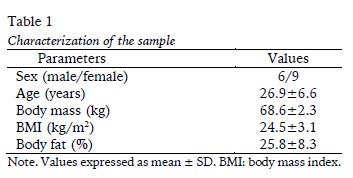
<body><![CDATA[<p>INTRODUCTION</p>     <p>Resistance training has been indicated for decades as the most effective intervention    to promote muscle mass increase in subjects of different sexes, ages and levels    of physical conditioning (Kraemer, Ratamess, &amp; French 2002; Garber et al.    2011). In this sense, the model of traditional resistance training with high    loads (&#8805; 70% 1RM) has been effective, well recommended in the scientific    literature (ACSM, 2010) and well accepted by professionals and practitioners.    However, recent research has shown that resistance training with low loads associated    with blood flow restriction has a similar potential to promote muscle hypertrophy    (Lixandrão et al. 2018; Pope, Willardson, &amp; Schoenfeld 2013) making it an    interesting option for people with restrictions on the use of high external    loads.</p>     <p>Participants</p>     <p><b>METHOD</b></p>     <p>In resistance training with low loads and blood flow restriction the decrease    in the supply of oxygen to muscle tissue (hypoxia) seems to be the primary effect    that contributes to the maximization of metabolic stress, and the latter seems    to stimulate the process of myofibrillar protein synthesis by other vessels    (Laurentino et al. 2008, Laurentino et al. 2012). The high concentrations of    metabolites in the intracellular environment modify the pressure gradient in    the membrane, favoring the infusion of fluids from the extra medium to the intracellular    environment, contributing to cellular swelling. Additionally, cellular swelling    is associated with increased protein synthesis rate. In addition, high concentrations    of metabolites, especially lactate and hydrogen, when released into the bloodstream,    appear to stimulate the production of growth hormone (GH) and insulin-like growth    factor (IGF-1) positively impacting the rate of myofibrillar protein synthesis    (Loenneke, Wilson, &amp; Wilson 2010; Schoenfeld 2013).</p>     <p>Although the traditional training and low loads and blood flow restriction    models show similar potential for inducing muscle hypertrophy, but emphasizing    different ways of stimulating protein synthesis, few studies compare the acute    and subacute effects between traditional methods and vascular occlusion on muscle    thickness (indirect indicative of cell swelling) and cytokines. Evidence suggests    that cellular swelling is greater in sessions with restricted blood flow post-exercise    when compared to traditional sessions, but this difference disappears after    24 hours (Freitas et al. 2017).</p>     <p>However, this finding is limited to the execution of a single exercise, it    is questioned whether these acute and subacute changes present a similar time    course subsequent to the exercise combination. Thus, the objective of this study    was to verify the time course of muscle thickness and cytokine concentration    after a resistance training session with and without restriction of blood flow.</p>     <p>After approval by the Ethics and Research</p>     <p>Committee (CEP) of the Nove de Julho University (protocol number: 1.861.919/16)    22 volunteers were recruited, but 7 were excluded for the following reasons:    lack of time to complete the study routine (n = 6) and personal commitments    that made it impossible to follow the routine of the study (n = 1), thus, 15    young adults (6 males and 9 women) underwent two experimental strength training    condition (session): traditional strength training (TST) and blood flow restriction    strength training (RST). The following inclusion criteria were adopted: volunteers    were not routinely involved in regular physical exercise in the last six months,    had no recent history of joint, bone or muscle injuries and did not use dietary    supplements or medications during the study period. In the specific case of    women, all had to be in the luteal phase of the menstrual cycle to participate    in the study. In addition, volunteers were instructed not to perform any vigorous    physical activity during these two weeks of collection.</p>     <p>&nbsp;</p>     ]]></body>
<body><![CDATA[<p align="center"><a name="t1"></a><img src="/img/revistas/mot/v15n1/15n1a09t1.jpg"/></p>     
<p>&nbsp;</p>     <p>Procedures</p>     <p>The Before the start of the interventions, the maximum dynamic force was evaluated    to allow the quantification of the training loads of the interventions. For    maximal strength evaluation, a maximal repetition test (1RM) was used, following    a protocol established by Serra et al. (2013) referring to the maximum amount    of weight lifted in a correct movement of a standardized exercise. The tests    were performed with the 3 exercises in a single day and were repeated after    48 hours for confirmation. The following exercises were selected: leg press,    bilateral flexion and bilateral extension of the elbow in the pulley.</p>     <p>After experimental randomization the blood flow restriction condition, the    volunteers performed three resisted exercises: horizontal leg press, elbow flexion    in the low pulley, and elbow extension in the high pulley with load of 20% of    1RM. In the TST condition, the volunteers performed the same exercises, but    with load corresponding to 80% of 1RM.</p>     <p>The training volume was similar in both experimental conditions, with 4 sets    per exercise until voluntary failure, free speed, with 1-minute interval between    sets and 10 minutes between exercises. No differences in training volume were    found between the experimental conditions.</p>     <p>To perform blood flow restriction, during the series in session 3, the volunteers    used an inflatable cuff, model Clinic Arm (WCS, CARDIOMED, Brazil) positioned    proximal portion of the exercised limbs (arms: near the armpits; gluteal fold).    The equipment pressure was then adjusted to 50% of the total occlusion value    according to the previously published protocol (Scott et al., 2015). The occlusion    pressure was estimated through the palpatory method according to previous publications    (Dankel, Jessee, Abe, &amp; Loenneke 2016; Fahs, Loenneke, Lindy, Thiebaud,    &amp; Bembem 2012). To estimate the total occlusion pressure of the upper limb,    the equipment was positioned in the proximal part of the arm and the radial    artery pulse was found. For the lower limb, the cuff was positioned below the    gluteal fold and the popliteal artery pulse was found. In both conditions the    equipment was then inflated, with the valve closed, until the arterial pulse    disappeared. At that time, the pressure value recorded on the pressure gauge    represented an estimate of the total occlusion pressure. The pressure remained    fixed during all the series and pauses of the same exercise, being withdrawn    between one exercise and another with (1-minute interval).</p>     <p>For cytokine analysis, 5 ml of venous blood was collected in a vacuum tube    containing sodium heparin as an anticoagulant. The tube was centrifuged at 1000    g, at 4° C for 7 minutes. Serum was collected and stored at -80° C until the    cytokine dosages were reached. The cytokines dosed were interleukin 10 (IL-10)    and tumor necrosis factor alpha (TNF-&#945;). Dosages were performed using the    ELISA technique using commercial kits (R &amp; D Systems), following the manufacturer&rsquo;s    instructions. The plates were read on a multi-plate reader (SpecraMax i3, Molecular    Devices, USA) at 450 nm. Blood samples were taken before the training session    (pre), immediately after (0h) and 24 (24h) and 48 hours (48h) after both experimental    conditions.</p>     <p>Muscular thickness performed by the ultrasound method was used in this study    with the purpose of analyzing the muscular edema according to previous publications    (Abe, DeHoyos, Pollock, &amp; Garzarella 2000) All evaluations were performed    using portable ultrasound imaging unit (Bodymetrix, BodyMetrix, BX2000, IntelaMetrix,    Inc., Livermore, CA). With individuals in the orthostatic position, water-soluble    transmission gel (Aquasonic 100 Ultrasound Transmission Gel, Parker Laboratories    Inc., Fairfield, NJ, USA) was applied at each measurement site and a 2.5 MHz    ultrasound wave was applied perpendicularly, on the skin, referring to the measurement    site according to previous publications (Abe et al. 2000). When image quality    was considered satisfactory, it was saved to obtain muscle thickness dimensions    by measuring the distance from the subcutaneous- muscle adipose tissue interface    to the muscle- bone interface. Measurements were made on the right side of the    body, at the midpoint of the arm (between acromion and elbow) and the thigh    (between the patella and the inguinal ligament). Locations were measured with    a vinyl measuring tape and then marked with a felt pen to ensure session-to-session    accuracy. During upper extremity measurements, participants sat with arms relaxed    and in an extended position. In the measurement of lower limbs, the individuals    remained standing, with the body weight distributed in both lower segments.    To ensure good accuracy, 3 measures were taken from the segments. When a difference    greater than 10% was found, a fourth measurement was performed, and the mean    of the measures was used. The thicknesses were performed before the training    session (pre), immediately after (0h) and 24 (24h) and 48 hours (48h) after    both experimental conditions.</p>     <p>Statistical analysis</p>     ]]></body>
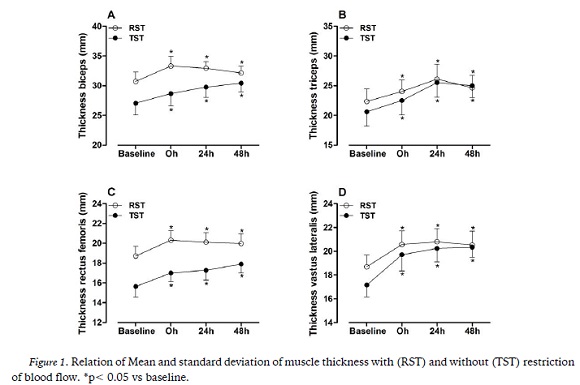
<body><![CDATA[<p>The descriptive analysis is presented as mean and standard deviation. The normality    of the data was verified with the application of the Shapiro Wilk test. Since    the data presented normal distribution, the parametric statistic was used. Analysis    of variance (ANOVA-two way) for repeated measures was used to identify interaction    between interventions and time. In the occurrence of significant F values, the    multiple comparison test with Bonferroni adjustments was used. The significance    level adopted for all comparisons was p&#8804; 0.05.</p>     <p>RESULTS</p>     <p>Such visualized at <a href="#f1">figure 1</a> (Panels A and B), a main effect    of time were found to biceps (F= 10.3; p= 0.001) and triceps (F= 3.6, p= 0.020)    thickness, however, not difference were found to both experimental condition    (F= 0.00, p= 0.989; F= 0.08, p= 0.783). Similar results were found on muscular    thickness for the lower limbs (Panel C and D), were found the main effect of    time for the rectus femoris thickness (F= 9.394; p = 0.001) and vastus medial    (F= 11.959; p&lt; 0.001) but not to experimental condition (F= 0.012, p= 0.913;    F= 0.61, p= 0.617) respectively.</p>     <p>&nbsp;</p>     <p align="center"><a name="f1"></a><img src="/img/revistas/mot/v15n1/15n1a09f1.jpg"/></p>     
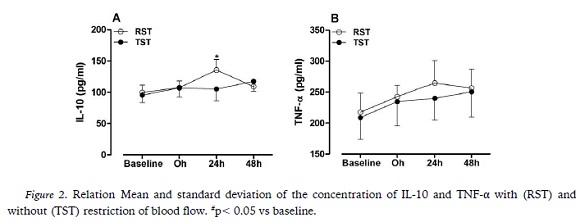
<p>&nbsp;</p>     <p>Significant interaction between experimental conditions and time were found    to IL-10 (F= 5.3, p= 0.004). The mean 24h of RST condition was higher than TST    at the same time. There was no difference between the intervention (F= 0.157,    p= 0.698) or time (F= 1.911; p= 0.142) in the averages of TNF-&#945; as showed    at <a href="#f2">Figure 2</a>.</p>     <p>&nbsp;</p>     <p align="center"><a name="f2"></a><img src="/img/revistas/mot/v15n1/15n1a09f2.jpg"/></p>     
<p>&nbsp;</p>     ]]></body>
<body><![CDATA[<p>DISCUSSION</p>     <p>The aim of this study was to verify the time course of lower and upper limb    muscle swelling and the concentration of cytokines, IL-10 and TNF-&#945;, at    different times after an acute strength training session with and without restriction    of blood flow. The main findings were that the thickness of the biceps brachii,    rectus femoris and vastus lateralis muscles remained increased for 48 hours    regardless of the condition. In addition, IL10 showed a significant increase    after 24 hours in RST when compared to TST condition.</p>     <p>Our results corroborate with the other study (Loenneke et al. 2012) that demonstrated    increase in post-exercise muscle thickness with no difference between RST and    TST conditions. In fact, there are divergences of results on muscle post-exercise    thickness in RST and TST conditions. On the one hand, Yasuda, Fukumura, Iida,    &amp; Nakajima (2015) underwent 4 sets of elbow flexion until exhaustion at    20% 1RM with and without restriction of blood flow and also found no difference    in brachial biceps swelling between the conditions. Although the charge intensity    was identical, this study demonstrated that simple flow restriction may not    potentiate swelling. On the other hand, Freitas et al. (2017) and Jenkins et    al. (2015) demonstrated that RST potentiated quadriceps thickness when compared    to TST immediately after a single exercise. It is suggested that part of the    increase in muscle thickness occurs through extravasation of substances through    the membrane of muscle fibers (Loenneke et al. 2012) and its time course is    not well known. In this sense, our results indicate that there is no difference    between RST and TST shortly after performing several exercises in the same session.</p>     <p>The choice to perform three exercises in a single experimental session was    verified by the fact that muscle swelling would remain longer when compared    to other studies, and this hypothesis was corroborated. In fact, the exception    of the triceps muscle, muscle swelling of the rectus femoris, vastus lateralis    and biceps brachii lasted for 24 hours after the experimental session. And the    vastus lateralis and biceps continued to increase after 48 hours. Freitas et    al. (2017) previously demonstrated that the values of the quadriceps area returned    to pre-exercise conditions. An atypical result was observed in the time course    of brachial triceps muscle swelling, as there was no increase in post-exercise    swelling, regardless of the condition, and the swelling showed a significant    reduction 48 hours after the RST protocol compared to the pre and TST conditions.    Freitas et al. (2017) also demonstrated that the hamstring muscles were less    responsive than the quadriceps muscle for RST and TST conditions. Therefore,    it seems that the muscle type would respond differently to RST or TST training    and to our knowledge this is the first study to analyze the brachial triceps.</p>     <p>In addition to the timing of the measurement, delimitation of the criterion    for the measure of swelling could also explain these differences. Our study    verified the isolated swelling of the agonist muscles (rectus femoris, vastus    lateralis, biceps and triceps) at 0h, 24h and 48h post exercise, while Freitas    et al. (2017) selected the entire thigh cross-sectional area at 15min, 75min,    24h, 48h, 72h and 96h. A sweep of a larger area could capture the presence of    more extramuscular substances and mask the actual intramuscular changes.</p>     <p>The mechanism of post-exercise swelling of force was not part of the scope    of our research, but it could be different between RST and TST conditions. On    the one hand, the accumulation of metabolites within the muscle caused by flow    restriction may also induce a shift of fluid from the extracellular space to    the intracellular space, which could also have contributed in some way to the    increased response of muscle swelling (Freitas et al., 2017) In fact, previous    studies have demonstrated that the application of blood flow restriction in    the absence of exercise is effective in attenuating both muscle atrophy of immobilized    limbs (Kubota, Sakuraba, Koh, Ogura, &amp; Tamura, 2011; Takarada, Takazawa,    &amp; Ishii, 2000). Therefore, this mechanism would increase the volume of muscle    fibers. On the other hand, in TST there is a high mechanical stress and there    could be more microleafs in the muscle fibers that would leak fluids and substance    into the extracellular environment, resulting in a greater venous accumulation.    This would increase muscle volume, but would compromise the volume of muscle    fibers. Therefore, a direct measurement, such as muscle biopsy, is necessary    to shape these conjectures and examine what is happening at the cellular level.    But until this outcome, cytosine analysis may help in the search for these responses.</p>     <p>Cytokines play an important role in the inflammatory response (Calee &amp;    Fernandez 2010). In the present study TNF-&#945;, a proinflammatory cytokine,    did not show a significant increase in response to RST and STT. These results    are consistent with other studies (Suzuki, Kobayashi, Uruma, &amp; Koyama 2000)    that did not show significant elevations in TNF- &#945; after a training session.</p>     <p>Conversely, IL-10, an anti-inflammatory cytokine (Petersen &amp; Pedersen 2005)    increased significantly post24h in the BFR group. These results associated with    thickens results indicate that RST provides the same benefits as TST, however,    providing an attenuated inflammatory response.</p>     <p>Muscle activation has been shown to be increased with restriction blood flow    exercise, due to early fatigue of slow-twitch muscle fibers and early recruitment    of fast-twitch muscle fibers due to increased sympathetic response and increased    norepinephrine, which stimulates B2 adrenergic receptors, and results in selective    hypertrophy of type II fibers. In the case of lactate, it is believed that the    accumulation of <u> </u>hydrogen ions initiates a cascade of events that ultimately    leads to the secretion of anabolic hormones, such as testosterone, GH and IGF-1.    <u> </u>Our results demonstrated that prolonged muscle swelling for 48 hours    occurred in both RST and TST. This result was similar to the conclusion of a    recent literature review (Loenneke, Thiebaud, &amp; Abe 2014). However, our    results demonstrated that IL-10 was potentiated in the RST condition, although    part of the literature points out similar effects on inflammatory markers (Loenneke    et al. 2014).</p>     <p>The current study contains limitations that can be discussed. First there is    a plethora of combinations between blood flow restriction level, organization    of the training protocol, choice of load, location of measurements, presence    of comorbidities and use of drugs, for example. Therefore, our results are limited    to conditions similar to our research design. Although instructed to maintain    the same eating routine and not carry out strenuous efforts during the two weeks    of study, we did not perform a food reimbursement or measure the level of physical    activity of the participants during the study period. Recent evidence suggests    that blood flow restriction pressure should be determined individually for each    participant (Laurentino et al. 2018) and our study took such care. However,    the palpatory method has limitations when compared to Doppler (Laurentino et    al. 2018). In addition, there was no direct evaluation of muscle tissue in the    present study; so, without this measure we can only speculate what happens at    the cellular level.</p>     ]]></body>
<body><![CDATA[<p>CONCLUSION</p>     <p>In conclusion both experimental conductions promoted similar changes on muscular    swelling without alterations on TNF&#945;, however, the RST protocol induced    increase on IL-10 concentration after 24 hours of exercise session.</p>     <p>&nbsp;</p>     <p><b>REFERENCES</b></p>     <!-- ref --><p>Abe, T., DeHoyos, D. V., Pollock, M. L., &amp; Garzarella, L. (2008). Time    course for strength and muscle thickness changes following upper and lower body    resistance training in men and women. <i>European journal of applied physiology,    81</i>(3), 174- 180.    &nbsp;&nbsp;&nbsp;&nbsp;&nbsp;&nbsp;&nbsp;&nbsp;[&#160;<a href="javascript:void(0);" onclick="javascript: window.open('/scielo.php?script=sci_nlinks&ref=387819&pid=S1646-107X201900010000900001&lng=','','width=640,height=500,resizable=yes,scrollbars=1,menubar=yes,');">Links</a>&#160;]<!-- end-ref --></p>     <!-- ref --><p>ACSM. (2010). <i>ACSM’s Guidelines for Exercise and</i><i>Prescription.    &nbsp;&nbsp;&nbsp;&nbsp;&nbsp;&nbsp;&nbsp;&nbsp;[&#160;<a href="javascript:void(0);" onclick="javascript: window.open('/scielo.php?script=sci_nlinks&ref=387821&pid=S1646-107X201900010000900002&lng=','','width=640,height=500,resizable=yes,scrollbars=1,menubar=yes,');">Links</a>&#160;]<!-- end-ref --></i></p>     <!-- ref --><p>Dankel, S. J., Jessee, M. B., Abe, T., &amp; Loenneke, J. P. (2016). The Effects    of Blood Flow Restriction on Upper-Body Musculature Located Distal and Proximal    to Applied Pressure. Sports Medicine, <i>46</i>(1), 23-33.    &nbsp;&nbsp;&nbsp;&nbsp;&nbsp;&nbsp;&nbsp;&nbsp;[&#160;<a href="javascript:void(0);" onclick="javascript: window.open('/scielo.php?script=sci_nlinks&ref=387823&pid=S1646-107X201900010000900003&lng=','','width=640,height=500,resizable=yes,scrollbars=1,menubar=yes,');">Links</a>&#160;]<!-- end-ref --></p>     ]]></body>
<body><![CDATA[<!-- ref --><p>Fahs, C. A., Loenneke, J. P., Lindy, M. R., Thiebaud, R. S., &amp; Bembem,    M. G. (2012). Methodological considerations for blood flow restricted resistance    exercise. <i>Journal of Trainology, 1</i>, 14-22.    &nbsp;&nbsp;&nbsp;&nbsp;&nbsp;&nbsp;&nbsp;&nbsp;[&#160;<a href="javascript:void(0);" onclick="javascript: window.open('/scielo.php?script=sci_nlinks&ref=387825&pid=S1646-107X201900010000900004&lng=','','width=640,height=500,resizable=yes,scrollbars=1,menubar=yes,');">Links</a>&#160;]<!-- end-ref --> </p>     <!-- ref --><p>Freitas, E. D. S., Poole, C., Miller, R. M., Heishman, A. D., Kaur, J., Bemben,    D. A., &amp; Bemben, M. (2017). Time Course Change in Muscle Swelling: High-Intensity    vs. Blood Flow Restriction Exercise. <i>International journal of sports medicine,</i><i>38</i>(13),    1009-1016.    &nbsp;&nbsp;&nbsp;&nbsp;&nbsp;&nbsp;&nbsp;&nbsp;[&#160;<a href="javascript:void(0);" onclick="javascript: window.open('/scielo.php?script=sci_nlinks&ref=387827&pid=S1646-107X201900010000900005&lng=','','width=640,height=500,resizable=yes,scrollbars=1,menubar=yes,');">Links</a>&#160;]<!-- end-ref --></p>     <!-- ref --><p>Garber, C. E., Blissmer, B., Deschenes, M. R., Franklin, B. A., Lamonte, M.    J., Lee, I. M.(2011). American College of Sports Medicine position stand, Quantity    and quality of exercise for developing and maintaining cardiorespiratory, musculoskeletal,    and neuromotor fitness in apparently healthy adults: guidance for prescribing    exercise. <i>Medicine and science in sports and exercise, 43</i>(7), 1334-1359.    &nbsp;&nbsp;&nbsp;&nbsp;&nbsp;&nbsp;&nbsp;&nbsp;[&#160;<a href="javascript:void(0);" onclick="javascript: window.open('/scielo.php?script=sci_nlinks&ref=387829&pid=S1646-107X201900010000900006&lng=','','width=640,height=500,resizable=yes,scrollbars=1,menubar=yes,');">Links</a>&#160;]<!-- end-ref --></p>     <p>Jenkins, N. D., Housh, T. J., Bergstrom, H. C.,Cochrane, K. C., Hill, E. C.,    Smith C. M., &hellip; Cramer, J. T. (2015). Muscle activation during three sets to    failure at 80 vs. 30% 1RM resistance exercise. <i>European journal of applied    physiology, 115</i>(11), 2335-47.</p>     <p>Kraemer, W. J., Ratamess N. A., &amp; French, D. N. (2002). Resistance training    for health and performance. <i>Current sports medicine reports</i>, <i>1</i>(3),    165-171.</p>     <!-- ref --><p>Kubota, A., Sakuraba, K., Koh, S., Ogura, Y., &amp; Tamura, Y. (2011). Blood    flow restriction by low compressive force prevents disuse muscular weakness.    <i>Journal of science and medicine in sport, 14</i>(2), 95-99.    &nbsp;&nbsp;&nbsp;&nbsp;&nbsp;&nbsp;&nbsp;&nbsp;[&#160;<a href="javascript:void(0);" onclick="javascript: window.open('/scielo.php?script=sci_nlinks&ref=387833&pid=S1646-107X201900010000900009&lng=','','width=640,height=500,resizable=yes,scrollbars=1,menubar=yes,');">Links</a>&#160;]<!-- end-ref --></p>     ]]></body>
<body><![CDATA[<!-- ref --><p>Laurentino, G., Ugrinowitsch, C., Aihara, A. Y., Fernandes, A. R., Parcell,    A. C., Ricard, M., &amp; Tricoli, V. (2008). Effects of strength training and    vascular occlusion. <i>International Journal of Sports Medicine, 29</i>(8),    664-667.    &nbsp;&nbsp;&nbsp;&nbsp;&nbsp;&nbsp;&nbsp;&nbsp;[&#160;<a href="javascript:void(0);" onclick="javascript: window.open('/scielo.php?script=sci_nlinks&ref=387835&pid=S1646-107X201900010000900010&lng=','','width=640,height=500,resizable=yes,scrollbars=1,menubar=yes,');">Links</a>&#160;]<!-- end-ref --></p>     <p>Laurentino, G. C., Ugrinowitsch, C., Roschel, H., Aoki, M. S., Soares, A. G.,    M., N. J., ... Tricoli, V. (2012). Strength training with blood flow restriction    diminishes myostatin gene expression. <i>Medicine and Science in Sports and    Exercise, 44</i>(3), 406-412.</p>     <p>Laurentino, G. C., Loenneke, J. P., Mouser, J. G., Buckner, S. L., Counts,    B. R., Dankel, S. J., &hellip;Tricoli, V. (2018). Validity of the Handheld Doppler    to Determine Lower-Limb Blood Flow Restriction Pressure for Exercise Protocols.    <i>Journal of strength and conditioning research</i>, [Epub ahead of print].</p>     <p>Lixandrão, M. E., Ugrinowitsch, C., Berton, R., Vechin,F. C., Conceição, M.    S., Damas, F., &hellip; Roschel, H. (2018). Magnitude of Muscle Strength and Mass Adaptations    Between High-Load Resistance Training Versus Low-Load Resistance Training Associated    with Blood-Flow Restriction: A Systematic Review and Meta-Analysis. <i>Sports    medicine ,48</i>(2), 361-378.</p>     <p>Loenneke, J. P., Fahs, C. A., Thiebaud, R. S., Rossow, L. M., Abe, T., Ye,    X., &hellip; Bemben, M. G. (2012). The acute muscle swelling effects of blood flow    restriction. <i>Acta physiologica Hungarica, 99</i>(4), 400-410.</p>     <!-- ref --><p>Loenneke, J. P., Thiebaud, R. S., &amp; Abe, T. (2014). Does blood flow restriction    result in skeletal muscle damage? A critical review of available evidence. <i>Scandinavian    journal of medicine &amp; science in sports, 24</i>(6), e415-422.    &nbsp;&nbsp;&nbsp;&nbsp;&nbsp;&nbsp;&nbsp;&nbsp;[&#160;<a href="javascript:void(0);" onclick="javascript: window.open('/scielo.php?script=sci_nlinks&ref=387841&pid=S1646-107X201900010000900015&lng=','','width=640,height=500,resizable=yes,scrollbars=1,menubar=yes,');">Links</a>&#160;]<!-- end-ref --></p>     <!-- ref --><p>Loenneke, J. P., Wilson, G. J., &amp; Wilson, J. M. (2010). A mechanistic approach    to blood flow occlusion. <i>International journal of sports medicine, 31</i>(1),    1-4.    &nbsp;&nbsp;&nbsp;&nbsp;&nbsp;&nbsp;&nbsp;&nbsp;[&#160;<a href="javascript:void(0);" onclick="javascript: window.open('/scielo.php?script=sci_nlinks&ref=387843&pid=S1646-107X201900010000900016&lng=','','width=640,height=500,resizable=yes,scrollbars=1,menubar=yes,');">Links</a>&#160;]<!-- end-ref --></p>     ]]></body>
<body><![CDATA[<!-- ref --><p>Mangine, G. T., Hoffman, J. R., Fukuda, D. H., Stout, J. R., &amp; Ratamess,    N. A. (2015). Improving muscle strength and size: the importance of training    volume, intensity, and status. <i>Kinesiology, 47</i>(2), 131-138.    &nbsp;&nbsp;&nbsp;&nbsp;&nbsp;&nbsp;&nbsp;&nbsp;[&#160;<a href="javascript:void(0);" onclick="javascript: window.open('/scielo.php?script=sci_nlinks&ref=387845&pid=S1646-107X201900010000900017&lng=','','width=640,height=500,resizable=yes,scrollbars=1,menubar=yes,');">Links</a>&#160;]<!-- end-ref --></p>     <!-- ref --><p>Petersen, A. M., Pedersen, B. K. (1985). The anti- inflammatory effect of exercise.    (2005). <i>Journal of Appllied Physiology</i>, <i>98</i>(4), 1154-1162.    &nbsp;&nbsp;&nbsp;&nbsp;&nbsp;&nbsp;&nbsp;&nbsp;[&#160;<a href="javascript:void(0);" onclick="javascript: window.open('/scielo.php?script=sci_nlinks&ref=387847&pid=S1646-107X201900010000900018&lng=','','width=640,height=500,resizable=yes,scrollbars=1,menubar=yes,');">Links</a>&#160;]<!-- end-ref --></p>     <!-- ref --><p>Pope, Z. K., Willardson, J. M., &amp; Schoenfeld, B. J. (2013). Exercise and    blood flow restriction. <i>Journal of strength and conditioning research, 27</i>(10),    2914-2926.    &nbsp;&nbsp;&nbsp;&nbsp;&nbsp;&nbsp;&nbsp;&nbsp;[&#160;<a href="javascript:void(0);" onclick="javascript: window.open('/scielo.php?script=sci_nlinks&ref=387849&pid=S1646-107X201900010000900019&lng=','','width=640,height=500,resizable=yes,scrollbars=1,menubar=yes,');">Links</a>&#160;]<!-- end-ref --></p>     <!-- ref --><p>Schoenfeld, B. J. (2010). The mechanisms of muscle hypertrophy and their application    to resistance training. <i>Journal of strength and conditioning research, 24</i>(10),    2857-2872.    &nbsp;&nbsp;&nbsp;&nbsp;&nbsp;&nbsp;&nbsp;&nbsp;[&#160;<a href="javascript:void(0);" onclick="javascript: window.open('/scielo.php?script=sci_nlinks&ref=387851&pid=S1646-107X201900010000900020&lng=','','width=640,height=500,resizable=yes,scrollbars=1,menubar=yes,');">Links</a>&#160;]<!-- end-ref --></p>     <!-- ref --><p>Scott, B. R., Loenneke, J. P., Slattery, K. M., &amp; Dascombe, B. J. (2015).    Exercise with blood flow restriction: an updated evidence-based approach for    enhanced muscular development. <i>Sports Medicine, 45</i>(3), 313-325.    &nbsp;&nbsp;&nbsp;&nbsp;&nbsp;&nbsp;&nbsp;&nbsp;[&#160;<a href="javascript:void(0);" onclick="javascript: window.open('/scielo.php?script=sci_nlinks&ref=387853&pid=S1646-107X201900010000900021&lng=','','width=640,height=500,resizable=yes,scrollbars=1,menubar=yes,');">Links</a>&#160;]<!-- end-ref --></p>     ]]></body>
<body><![CDATA[<!-- ref --><p>Serra, A. J., Silva, J. A. Jr., Marcolongo, A. A., Manchini, M. T., Oliveira,    J. V., Santos, L. F., ... Bocalini, D. S. (2013). Experience in resistance training    does not prevent reduction in muscle strength evoked by passive static stretching.    <i>Journal of Strength and Conditioning Research, 27</i>(8), 2304-2308.    &nbsp;&nbsp;&nbsp;&nbsp;&nbsp;&nbsp;&nbsp;&nbsp;[&#160;<a href="javascript:void(0);" onclick="javascript: window.open('/scielo.php?script=sci_nlinks&ref=387855&pid=S1646-107X201900010000900022&lng=','','width=640,height=500,resizable=yes,scrollbars=1,menubar=yes,');">Links</a>&#160;]<!-- end-ref --></p>     <!-- ref --><p>Suzuki, J., Kobayashi, T., Uruma, T., &amp; Koyama, T. (2000). Strength training    with partial ischaemia stimulates microvascular remodelling in rat calf muscles.    <i>European Journal of Applied Physiology 82</i>, 215-222.    &nbsp;&nbsp;&nbsp;&nbsp;&nbsp;&nbsp;&nbsp;&nbsp;[&#160;<a href="javascript:void(0);" onclick="javascript: window.open('/scielo.php?script=sci_nlinks&ref=387857&pid=S1646-107X201900010000900023&lng=','','width=640,height=500,resizable=yes,scrollbars=1,menubar=yes,');">Links</a>&#160;]<!-- end-ref --></p>     <!-- ref --><p>Takarada, Y., Takazawa, H., &amp; Ishii, N. (2000). Applications of vascular    occlusion diminish disuse atrophy of knee extensor muscles. <i>Medicine</i><i>    </i><i>and science in sports and exercise, 32</i>(12), 2035- 2039.    &nbsp;&nbsp;&nbsp;&nbsp;&nbsp;&nbsp;&nbsp;&nbsp;[&#160;<a href="javascript:void(0);" onclick="javascript: window.open('/scielo.php?script=sci_nlinks&ref=387859&pid=S1646-107X201900010000900024&lng=','','width=640,height=500,resizable=yes,scrollbars=1,menubar=yes,');">Links</a>&#160;]<!-- end-ref --></p>     <!-- ref --><p>Yasuda, T., Fukumura, K., Iida, H., &amp; Nakajima, T. (2015). Effect of low-load    resistance exercise with and without blood flow restriction to volitional fatigue    on muscle swelling. <i>European journal of applied physiology, 115</i>(5), 919-926.    &nbsp;&nbsp;&nbsp;&nbsp;&nbsp;&nbsp;&nbsp;&nbsp;[&#160;<a href="javascript:void(0);" onclick="javascript: window.open('/scielo.php?script=sci_nlinks&ref=387861&pid=S1646-107X201900010000900025&lng=','','width=640,height=500,resizable=yes,scrollbars=1,menubar=yes,');">Links</a>&#160;]<!-- end-ref --></p>     <p>&nbsp;</p>     <p>Acknowledgments: We want to thank the scholarships provided by FAPES (590/19    - no. 84417625/2018) and the support of the CAPES and CNPQ. </p>     ]]></body>
<body><![CDATA[<p>Conflict of interests: Nothing to declare.</p>     <p>Funding: Nothing to declare. </p>     <p>&nbsp;</p>     <p>Manuscript received at Augut 10th 2018; Accepted at December 27th 2018</p>     <p>&nbsp;</p>     <p><a href="#top*"><sup>[*]</sup></a><a name="*"></a>Corresponding author: Rua    Ludwik Macal, 403, apto 101, Jd. da Penha, CEP: 29060-030, Vitoria, Espirito    Santo, Brazil. <i>Email: </i><a href="mailto:contato@alexandrelevangelista.com.br">contato@alexandrelevangelista.com.br</a></p>      ]]></body><back>
<ref-list>
<ref id="B1">
<nlm-citation citation-type="journal">
<person-group person-group-type="author">
<name>
<surname><![CDATA[Abe]]></surname>
<given-names><![CDATA[T.]]></given-names>
</name>
<name>
<surname><![CDATA[DeHoyos]]></surname>
<given-names><![CDATA[D. V.]]></given-names>
</name>
<name>
<surname><![CDATA[Pollock]]></surname>
<given-names><![CDATA[M. L.]]></given-names>
</name>
<name>
<surname><![CDATA[Garzarella]]></surname>
<given-names><![CDATA[L.]]></given-names>
</name>
</person-group>
<article-title xml:lang="en"><![CDATA[Time course for strength and muscle thickness changes following upper and lower body resistance training in men and women]]></article-title>
<source><![CDATA[European journal of applied physiology]]></source>
<year>2008</year>
<volume>81</volume>
<numero>3</numero>
<issue>3</issue>
<page-range>174- 180</page-range></nlm-citation>
</ref>
<ref id="B2">
<nlm-citation citation-type="">
<collab>ACSM</collab>
<source><![CDATA[ACSM’s Guidelines for Exercise andPrescription]]></source>
<year>2010</year>
</nlm-citation>
</ref>
<ref id="B3">
<nlm-citation citation-type="journal">
<person-group person-group-type="author">
<name>
<surname><![CDATA[Dankel]]></surname>
<given-names><![CDATA[S. J.]]></given-names>
</name>
<name>
<surname><![CDATA[Jessee]]></surname>
<given-names><![CDATA[M. B.]]></given-names>
</name>
<name>
<surname><![CDATA[Abe]]></surname>
<given-names><![CDATA[T.]]></given-names>
</name>
<name>
<surname><![CDATA[Loenneke]]></surname>
<given-names><![CDATA[J. P.]]></given-names>
</name>
</person-group>
<article-title xml:lang="en"><![CDATA[The Effects of Blood Flow Restriction on Upper-Body Musculature Located Distal and Proximal to Applied Pressure]]></article-title>
<source><![CDATA[Sports Medicine]]></source>
<year>2016</year>
<volume>46</volume>
<numero>1</numero>
<issue>1</issue>
<page-range>23-33</page-range></nlm-citation>
</ref>
<ref id="B4">
<nlm-citation citation-type="journal">
<person-group person-group-type="author">
<name>
<surname><![CDATA[Fahs]]></surname>
<given-names><![CDATA[C. A.]]></given-names>
</name>
<name>
<surname><![CDATA[Loenneke]]></surname>
<given-names><![CDATA[J. P.]]></given-names>
</name>
<name>
<surname><![CDATA[Lindy]]></surname>
<given-names><![CDATA[M. R.]]></given-names>
</name>
<name>
<surname><![CDATA[Thiebaud]]></surname>
<given-names><![CDATA[R. S.]]></given-names>
</name>
<name>
<surname><![CDATA[Bembem]]></surname>
<given-names><![CDATA[M. G.]]></given-names>
</name>
</person-group>
<article-title xml:lang="en"><![CDATA[Methodological considerations for blood flow restricted resistance exercise]]></article-title>
<source><![CDATA[Journal of Trainology]]></source>
<year>2012</year>
<volume>1</volume>
<page-range>14-22</page-range></nlm-citation>
</ref>
<ref id="B5">
<nlm-citation citation-type="journal">
<person-group person-group-type="author">
<name>
<surname><![CDATA[Freitas]]></surname>
<given-names><![CDATA[E. D. S.]]></given-names>
</name>
<name>
<surname><![CDATA[Poole]]></surname>
<given-names><![CDATA[C.]]></given-names>
</name>
<name>
<surname><![CDATA[Miller]]></surname>
<given-names><![CDATA[R. M.]]></given-names>
</name>
<name>
<surname><![CDATA[Heishman]]></surname>
<given-names><![CDATA[A. D.]]></given-names>
</name>
<name>
<surname><![CDATA[Kaur]]></surname>
<given-names><![CDATA[J.]]></given-names>
</name>
<name>
<surname><![CDATA[Bemben]]></surname>
<given-names><![CDATA[D. A.]]></given-names>
</name>
<name>
<surname><![CDATA[Bemben]]></surname>
<given-names><![CDATA[M.]]></given-names>
</name>
</person-group>
<article-title xml:lang="en"><![CDATA[Time Course Change in Muscle Swelling: High-Intensity vs]]></article-title>
<source><![CDATA[Blood Flow Restriction Exercise. International journal of sports medicine]]></source>
<year>2017</year>
<volume>38</volume>
<numero>13</numero>
<issue>13</issue>
<page-range>1009-1016</page-range></nlm-citation>
</ref>
<ref id="B6">
<nlm-citation citation-type="journal">
<person-group person-group-type="author">
<name>
<surname><![CDATA[Garber]]></surname>
<given-names><![CDATA[C. E.]]></given-names>
</name>
<name>
<surname><![CDATA[Blissmer]]></surname>
<given-names><![CDATA[B.]]></given-names>
</name>
<name>
<surname><![CDATA[Deschenes]]></surname>
<given-names><![CDATA[M. R.]]></given-names>
</name>
<name>
<surname><![CDATA[Franklin]]></surname>
<given-names><![CDATA[B. A.]]></given-names>
</name>
<name>
<surname><![CDATA[Lamonte]]></surname>
<given-names><![CDATA[M. J.]]></given-names>
</name>
<name>
<surname><![CDATA[Lee]]></surname>
<given-names><![CDATA[I. M.]]></given-names>
</name>
</person-group>
<article-title xml:lang="en"><![CDATA[American College of Sports Medicine position stand, Quantity and quality of exercise for developing and maintaining cardiorespiratory, musculoskeletal, and neuromotor fitness in apparently healthy adults: guidance for prescribing exercise]]></article-title>
<source><![CDATA[Medicine and science in sports and exercise]]></source>
<year>2011</year>
<volume>43</volume>
<numero>7</numero>
<issue>7</issue>
<page-range>1334-1359</page-range></nlm-citation>
</ref>
<ref id="B7">
<nlm-citation citation-type="journal">
<person-group person-group-type="author">
<name>
<surname><![CDATA[Jenkins]]></surname>
<given-names><![CDATA[N. D.]]></given-names>
</name>
<name>
<surname><![CDATA[Housh]]></surname>
<given-names><![CDATA[T. J.]]></given-names>
</name>
<name>
<surname><![CDATA[Bergstrom]]></surname>
<given-names><![CDATA[H. C.]]></given-names>
</name>
<name>
<surname><![CDATA[Cochrane]]></surname>
<given-names><![CDATA[K. C.]]></given-names>
</name>
<name>
<surname><![CDATA[Hill]]></surname>
<given-names><![CDATA[E. C.]]></given-names>
</name>
<name>
<surname><![CDATA[Cramer]]></surname>
<given-names><![CDATA[J. T.]]></given-names>
</name>
</person-group>
<article-title xml:lang="en"><![CDATA[Muscle activation during three sets to failure at 80 vs]]></article-title>
<source><![CDATA[30% 1RM resistance exercise. European journal of applied physiology]]></source>
<year>2015</year>
<volume>115</volume>
<numero>11</numero>
<issue>11</issue>
<page-range>2335-47</page-range></nlm-citation>
</ref>
<ref id="B8">
<nlm-citation citation-type="journal">
<person-group person-group-type="author">
<name>
<surname><![CDATA[Kraemer]]></surname>
<given-names><![CDATA[W. J.]]></given-names>
</name>
<name>
<surname><![CDATA[French]]></surname>
<given-names><![CDATA[D. N.]]></given-names>
</name>
</person-group>
<article-title xml:lang="en"><![CDATA[Resistance training for health and performance]]></article-title>
<source><![CDATA[Current sports medicine reports]]></source>
<year>2002</year>
<volume>1</volume>
<numero>3</numero>
<issue>3</issue>
<page-range>165-171</page-range></nlm-citation>
</ref>
<ref id="B9">
<nlm-citation citation-type="journal">
<person-group person-group-type="author">
<name>
<surname><![CDATA[Kubota]]></surname>
<given-names><![CDATA[A.]]></given-names>
</name>
<name>
<surname><![CDATA[Sakuraba]]></surname>
<given-names><![CDATA[K.]]></given-names>
</name>
<name>
<surname><![CDATA[Koh]]></surname>
<given-names><![CDATA[S.]]></given-names>
</name>
<name>
<surname><![CDATA[Ogura]]></surname>
<given-names><![CDATA[Y.]]></given-names>
</name>
<name>
<surname><![CDATA[Tamura]]></surname>
<given-names><![CDATA[Y.]]></given-names>
</name>
</person-group>
<article-title xml:lang="en"><![CDATA[Blood flow restriction by low compressive force prevents disuse muscular weakness]]></article-title>
<source><![CDATA[Journal of science and medicine in sport]]></source>
<year>2011</year>
<volume>14</volume>
<numero>2</numero>
<issue>2</issue>
<page-range>95-99</page-range></nlm-citation>
</ref>
<ref id="B10">
<nlm-citation citation-type="journal">
<person-group person-group-type="author">
<name>
<surname><![CDATA[Laurentino]]></surname>
<given-names><![CDATA[G.]]></given-names>
</name>
<name>
<surname><![CDATA[Ugrinowitsch]]></surname>
<given-names><![CDATA[C.]]></given-names>
</name>
<name>
<surname><![CDATA[Aihara]]></surname>
<given-names><![CDATA[A. Y.]]></given-names>
</name>
<name>
<surname><![CDATA[Fernandes]]></surname>
<given-names><![CDATA[A. R.]]></given-names>
</name>
<name>
<surname><![CDATA[Parcell]]></surname>
<given-names><![CDATA[A. C.]]></given-names>
</name>
<name>
<surname><![CDATA[Ricard]]></surname>
<given-names><![CDATA[M.]]></given-names>
</name>
<name>
<surname><![CDATA[Tricoli]]></surname>
<given-names><![CDATA[V.]]></given-names>
</name>
</person-group>
<article-title xml:lang="en"><![CDATA[Effects of strength training and vascular occlusion]]></article-title>
<source><![CDATA[International Journal of Sports Medicine]]></source>
<year>2008</year>
<volume>29</volume>
<numero>8</numero>
<issue>8</issue>
<page-range>664-667</page-range></nlm-citation>
</ref>
<ref id="B11">
<nlm-citation citation-type="journal">
<person-group person-group-type="author">
<name>
<surname><![CDATA[Laurentino]]></surname>
<given-names><![CDATA[G. C.]]></given-names>
</name>
<name>
<surname><![CDATA[Ugrinowitsch]]></surname>
<given-names><![CDATA[C.]]></given-names>
</name>
<name>
<surname><![CDATA[Roschel]]></surname>
<given-names><![CDATA[H.]]></given-names>
</name>
<name>
<surname><![CDATA[Aoki]]></surname>
<given-names><![CDATA[M. S.]]></given-names>
</name>
<name>
<surname><![CDATA[Soares]]></surname>
<given-names><![CDATA[A. G.]]></given-names>
</name>
<name>
<surname><![CDATA[Tricoli]]></surname>
<given-names><![CDATA[V.]]></given-names>
</name>
</person-group>
<article-title xml:lang="en"><![CDATA[Strength training with blood flow restriction diminishes myostatin gene expression]]></article-title>
<source><![CDATA[Medicine and Science in Sports and Exercise]]></source>
<year>2012</year>
<volume>44</volume>
<numero>3</numero>
<issue>3</issue>
<page-range>406-412</page-range></nlm-citation>
</ref>
<ref id="B12">
<nlm-citation citation-type="journal">
<person-group person-group-type="author">
<name>
<surname><![CDATA[Laurentino]]></surname>
<given-names><![CDATA[G. C.]]></given-names>
</name>
<name>
<surname><![CDATA[Loenneke]]></surname>
<given-names><![CDATA[J. P.]]></given-names>
</name>
<name>
<surname><![CDATA[Mouser]]></surname>
<given-names><![CDATA[J. G.]]></given-names>
</name>
<name>
<surname><![CDATA[Buckner]]></surname>
<given-names><![CDATA[S. L.]]></given-names>
</name>
<name>
<surname><![CDATA[Counts]]></surname>
<given-names><![CDATA[B. R.]]></given-names>
</name>
<name>
<surname><![CDATA[Dankel]]></surname>
<given-names><![CDATA[S. J.]]></given-names>
</name>
<name>
<surname><![CDATA[Tricoli]]></surname>
<given-names><![CDATA[V.]]></given-names>
</name>
</person-group>
<article-title xml:lang="en"><![CDATA[Validity of the Handheld Doppler to Determine Lower-Limb Blood Flow Restriction Pressure for Exercise Protocols]]></article-title>
<source><![CDATA[Journal of strength and conditioning research]]></source>
<year>2018</year>
</nlm-citation>
</ref>
<ref id="B13">
<nlm-citation citation-type="journal">
<person-group person-group-type="author">
<name>
<surname><![CDATA[Lixandrão]]></surname>
<given-names><![CDATA[M. E.]]></given-names>
</name>
<name>
<surname><![CDATA[Ugrinowitsch]]></surname>
<given-names><![CDATA[C.]]></given-names>
</name>
<name>
<surname><![CDATA[Berton]]></surname>
<given-names><![CDATA[R.]]></given-names>
</name>
<name>
<surname><![CDATA[Vechin]]></surname>
<given-names><![CDATA[F. C.]]></given-names>
</name>
<name>
<surname><![CDATA[Conceição]]></surname>
<given-names><![CDATA[M. S.]]></given-names>
</name>
<name>
<surname><![CDATA[Damas]]></surname>
<given-names><![CDATA[F.]]></given-names>
</name>
<name>
<surname><![CDATA[Roschel]]></surname>
<given-names><![CDATA[H.]]></given-names>
</name>
</person-group>
<article-title xml:lang="en"><![CDATA[Magnitude of Muscle Strength and Mass Adaptations Between High-Load Resistance Training Versus Low-Load Resistance Training Associated with Blood-Flow Restriction: A Systematic Review and Meta-Analysis]]></article-title>
<source><![CDATA[Sports medicine]]></source>
<year>2018</year>
<volume>48</volume>
<numero>2</numero>
<issue>2</issue>
<page-range>361-378</page-range></nlm-citation>
</ref>
<ref id="B14">
<nlm-citation citation-type="journal">
<person-group person-group-type="author">
<name>
<surname><![CDATA[Loenneke]]></surname>
<given-names><![CDATA[J. P.]]></given-names>
</name>
<name>
<surname><![CDATA[Fahs]]></surname>
<given-names><![CDATA[C. A.]]></given-names>
</name>
<name>
<surname><![CDATA[Thiebaud]]></surname>
<given-names><![CDATA[R. S.]]></given-names>
</name>
<name>
<surname><![CDATA[Rossow]]></surname>
<given-names><![CDATA[L. M.]]></given-names>
</name>
<name>
<surname><![CDATA[Abe]]></surname>
<given-names><![CDATA[T.]]></given-names>
</name>
<name>
<surname><![CDATA[Ye]]></surname>
<given-names><![CDATA[X.]]></given-names>
</name>
<name>
<surname><![CDATA[Bemben]]></surname>
<given-names><![CDATA[M. G.]]></given-names>
</name>
</person-group>
<article-title xml:lang="en"><![CDATA[The acute muscle swelling effects of blood flow restriction]]></article-title>
<source><![CDATA[Acta physiologica Hungarica]]></source>
<year>2012</year>
<volume>99</volume>
<numero>4</numero>
<issue>4</issue>
<page-range>400-410</page-range></nlm-citation>
</ref>
<ref id="B15">
<nlm-citation citation-type="journal">
<person-group person-group-type="author">
<name>
<surname><![CDATA[Loenneke]]></surname>
<given-names><![CDATA[J. P.]]></given-names>
</name>
<name>
<surname><![CDATA[Thiebaud]]></surname>
<given-names><![CDATA[R. S.]]></given-names>
</name>
<name>
<surname><![CDATA[Abe]]></surname>
<given-names><![CDATA[T.]]></given-names>
</name>
</person-group>
<article-title xml:lang="en"><![CDATA[Does blood flow restriction result in skeletal muscle damage?: A critical review of available evidence]]></article-title>
<source><![CDATA[Scandinavian journal of medicine & science in sports]]></source>
<year>2014</year>
<volume>24</volume>
<numero>6</numero>
<issue>6</issue>
<page-range>e415-422</page-range></nlm-citation>
</ref>
<ref id="B16">
<nlm-citation citation-type="journal">
<person-group person-group-type="author">
<name>
<surname><![CDATA[Loenneke]]></surname>
<given-names><![CDATA[J. P.]]></given-names>
</name>
<name>
<surname><![CDATA[Wilson]]></surname>
<given-names><![CDATA[G. J.]]></given-names>
</name>
<name>
<surname><![CDATA[Wilson]]></surname>
<given-names><![CDATA[J. M.]]></given-names>
</name>
</person-group>
<article-title xml:lang="en"><![CDATA[A mechanistic approach to blood flow occlusion]]></article-title>
<source><![CDATA[International journal of sports medicine]]></source>
<year>2010</year>
<volume>31</volume>
<numero>1</numero>
<issue>1</issue>
<page-range>1-4</page-range></nlm-citation>
</ref>
<ref id="B17">
<nlm-citation citation-type="journal">
<person-group person-group-type="author">
<name>
<surname><![CDATA[Mangine]]></surname>
<given-names><![CDATA[G. T.]]></given-names>
</name>
<name>
<surname><![CDATA[Hoffman]]></surname>
<given-names><![CDATA[J. R.]]></given-names>
</name>
<name>
<surname><![CDATA[Fukuda]]></surname>
<given-names><![CDATA[D. H.]]></given-names>
</name>
<name>
<surname><![CDATA[Stout]]></surname>
<given-names><![CDATA[J. R.]]></given-names>
</name>
<name>
<surname><![CDATA[Ratamess]]></surname>
<given-names><![CDATA[N. A.]]></given-names>
</name>
</person-group>
<article-title xml:lang="en"><![CDATA[Improving muscle strength and size: the importance of training volume, intensity, and status]]></article-title>
<source><![CDATA[Kinesiology]]></source>
<year>2015</year>
<volume>47</volume>
<numero>2</numero>
<issue>2</issue>
<page-range>131-138</page-range></nlm-citation>
</ref>
<ref id="B18">
<nlm-citation citation-type="journal">
<person-group person-group-type="author">
<name>
<surname><![CDATA[Petersen]]></surname>
<given-names><![CDATA[A. M.]]></given-names>
</name>
<name>
<surname><![CDATA[Pedersen]]></surname>
<given-names><![CDATA[B. K.]]></given-names>
</name>
</person-group>
<article-title xml:lang="en"><![CDATA[The anti- inflammatory effect of exercise]]></article-title>
<source><![CDATA[(2005). Journal of Appllied Physiology]]></source>
<year>1985</year>
<volume>98</volume>
<numero>4</numero>
<issue>4</issue>
<page-range>1154-1162</page-range></nlm-citation>
</ref>
<ref id="B19">
<nlm-citation citation-type="journal">
<person-group person-group-type="author">
<name>
<surname><![CDATA[Pope]]></surname>
<given-names><![CDATA[Z. K.]]></given-names>
</name>
<name>
<surname><![CDATA[Willardson]]></surname>
<given-names><![CDATA[J. M.]]></given-names>
</name>
<name>
<surname><![CDATA[Schoenfeld]]></surname>
<given-names><![CDATA[B. J.]]></given-names>
</name>
</person-group>
<article-title xml:lang="en"><![CDATA[Exercise and blood flow restriction]]></article-title>
<source><![CDATA[Journal of strength and conditioning research]]></source>
<year>2013</year>
<volume>27</volume>
<numero>10</numero>
<issue>10</issue>
<page-range>2914-2926</page-range></nlm-citation>
</ref>
<ref id="B20">
<nlm-citation citation-type="journal">
<person-group person-group-type="author">
<name>
<surname><![CDATA[Schoenfeld]]></surname>
<given-names><![CDATA[B. J.]]></given-names>
</name>
</person-group>
<article-title xml:lang="en"><![CDATA[The mechanisms of muscle hypertrophy and their application to resistance training]]></article-title>
<source><![CDATA[Journal of strength and conditioning research]]></source>
<year>2010</year>
<volume>24</volume>
<numero>10</numero>
<issue>10</issue>
<page-range>2857-2872</page-range></nlm-citation>
</ref>
<ref id="B21">
<nlm-citation citation-type="journal">
<person-group person-group-type="author">
<name>
<surname><![CDATA[Scott]]></surname>
<given-names><![CDATA[B. R.]]></given-names>
</name>
<name>
<surname><![CDATA[Loenneke]]></surname>
<given-names><![CDATA[J. P.]]></given-names>
</name>
<name>
<surname><![CDATA[Slattery]]></surname>
<given-names><![CDATA[K. M.]]></given-names>
</name>
<name>
<surname><![CDATA[Dascombe]]></surname>
<given-names><![CDATA[B. J.]]></given-names>
</name>
</person-group>
<article-title xml:lang="en"><![CDATA[Exercise with blood flow restriction: an updated evidence-based approach for enhanced muscular development]]></article-title>
<source><![CDATA[Sports Medicine]]></source>
<year>2015</year>
<volume>45</volume>
<numero>3</numero>
<issue>3</issue>
<page-range>313-325</page-range></nlm-citation>
</ref>
<ref id="B22">
<nlm-citation citation-type="journal">
<person-group person-group-type="author">
<name>
<surname><![CDATA[Serra]]></surname>
<given-names><![CDATA[A. J.]]></given-names>
</name>
<name>
<surname><![CDATA[Silva]]></surname>
<given-names><![CDATA[J. A. Jr.]]></given-names>
</name>
<name>
<surname><![CDATA[Marcolongo]]></surname>
<given-names><![CDATA[A. A.]]></given-names>
</name>
<name>
<surname><![CDATA[Manchini]]></surname>
<given-names><![CDATA[M. T.]]></given-names>
</name>
<name>
<surname><![CDATA[Oliveira]]></surname>
<given-names><![CDATA[J. V.]]></given-names>
</name>
<name>
<surname><![CDATA[Santos]]></surname>
<given-names><![CDATA[L. F.]]></given-names>
</name>
<name>
<surname><![CDATA[Bocalini]]></surname>
<given-names><![CDATA[D. S.]]></given-names>
</name>
</person-group>
<article-title xml:lang="en"><![CDATA[Experience in resistance training does not prevent reduction in muscle strength evoked by passive static stretching]]></article-title>
<source><![CDATA[Journal of Strength and Conditioning Research]]></source>
<year>2013</year>
<volume>27</volume>
<numero>8</numero>
<issue>8</issue>
<page-range>2304-2308</page-range></nlm-citation>
</ref>
<ref id="B23">
<nlm-citation citation-type="journal">
<person-group person-group-type="author">
<name>
<surname><![CDATA[Suzuki]]></surname>
<given-names><![CDATA[J.]]></given-names>
</name>
<name>
<surname><![CDATA[Kobayashi]]></surname>
<given-names><![CDATA[T.]]></given-names>
</name>
<name>
<surname><![CDATA[Uruma]]></surname>
<given-names><![CDATA[T.]]></given-names>
</name>
<name>
<surname><![CDATA[Koyama]]></surname>
<given-names><![CDATA[T.]]></given-names>
</name>
</person-group>
<article-title xml:lang="en"><![CDATA[Strength training with partial ischaemia stimulates microvascular remodelling in rat calf muscles]]></article-title>
<source><![CDATA[European Journal of Applied Physiology]]></source>
<year>2000</year>
<volume>82</volume>
<page-range>215-222</page-range></nlm-citation>
</ref>
<ref id="B24">
<nlm-citation citation-type="journal">
<person-group person-group-type="author">
<name>
<surname><![CDATA[Takarada]]></surname>
<given-names><![CDATA[Y.]]></given-names>
</name>
<name>
<surname><![CDATA[Takazawa]]></surname>
<given-names><![CDATA[H.]]></given-names>
</name>
<name>
<surname><![CDATA[Ishii]]></surname>
<given-names><![CDATA[N.]]></given-names>
</name>
</person-group>
<article-title xml:lang="en"><![CDATA[Applications of vascular occlusion diminish disuse atrophy of knee extensor muscles]]></article-title>
<source><![CDATA[Medicine and science in sports and exercise]]></source>
<year>2000</year>
<volume>32</volume>
<numero>12</numero>
<issue>12</issue>
<page-range>2035- 2039</page-range></nlm-citation>
</ref>
<ref id="B25">
<nlm-citation citation-type="journal">
<person-group person-group-type="author">
<name>
<surname><![CDATA[Yasuda]]></surname>
<given-names><![CDATA[T.]]></given-names>
</name>
<name>
<surname><![CDATA[Fukumura]]></surname>
<given-names><![CDATA[K.]]></given-names>
</name>
<name>
<surname><![CDATA[Iida]]></surname>
<given-names><![CDATA[H.]]></given-names>
</name>
<name>
<surname><![CDATA[Nakajima]]></surname>
<given-names><![CDATA[T.]]></given-names>
</name>
</person-group>
<article-title xml:lang="en"><![CDATA[Effect of low-load resistance exercise with and without blood flow restriction to volitional fatigue on muscle swelling]]></article-title>
<source><![CDATA[European journal of applied physiology]]></source>
<year>2015</year>
<volume>115</volume>
<numero>5</numero>
<issue>5</issue>
<page-range>919-926</page-range></nlm-citation>
</ref>
</ref-list>
</back>
</article>