<?xml version="1.0" encoding="ISO-8859-1"?><article xmlns:mml="http://www.w3.org/1998/Math/MathML" xmlns:xlink="http://www.w3.org/1999/xlink" xmlns:xsi="http://www.w3.org/2001/XMLSchema-instance">
<front>
<journal-meta>
<journal-id>1646-107X</journal-id>
<journal-title><![CDATA[Motricidade]]></journal-title>
<abbrev-journal-title><![CDATA[Motri.]]></abbrev-journal-title>
<issn>1646-107X</issn>
<publisher>
<publisher-name><![CDATA[Edições Desafio Singular]]></publisher-name>
</publisher>
</journal-meta>
<article-meta>
<article-id>S1646-107X2019000200005</article-id>
<article-id pub-id-type="doi">10.6063/motricidade.8708</article-id>
<title-group>
<article-title xml:lang="en"><![CDATA[Correlation of arm cross-section areas with strength performance in practitioners of resistance training]]></article-title>
</title-group>
<contrib-group>
<contrib contrib-type="author">
<name>
<surname><![CDATA[Lustosa]]></surname>
<given-names><![CDATA[Romário Pinheiro]]></given-names>
</name>
<xref ref-type="aff" rid="A1"/>
</contrib>
<contrib contrib-type="author">
<name>
<surname><![CDATA[Andrade]]></surname>
<given-names><![CDATA[Joaquim Huaina Cintra]]></given-names>
</name>
<xref ref-type="aff" rid="A1"/>
</contrib>
<contrib contrib-type="author">
<name>
<surname><![CDATA[Neto]]></surname>
<given-names><![CDATA[João Valter Gomes]]></given-names>
</name>
<xref ref-type="aff" rid="A1"/>
</contrib>
<contrib contrib-type="author">
<name>
<surname><![CDATA[Godinho]]></surname>
<given-names><![CDATA[Welton Daniel Nogueira]]></given-names>
</name>
<xref ref-type="aff" rid="A1"/>
</contrib>
<contrib contrib-type="author">
<name>
<surname><![CDATA[Uchôa]]></surname>
<given-names><![CDATA[Francisco Nataniel Macedo]]></given-names>
</name>
<xref ref-type="aff" rid="A2"/>
</contrib>
<contrib contrib-type="author">
<name>
<surname><![CDATA[Deana]]></surname>
<given-names><![CDATA[Naira Figueiredo]]></given-names>
</name>
<xref ref-type="aff" rid="A3"/>
</contrib>
<contrib contrib-type="author">
<name>
<surname><![CDATA[Alves]]></surname>
<given-names><![CDATA[Nilton]]></given-names>
</name>
<xref ref-type="aff" rid="A4 "/>
</contrib>
</contrib-group>
<aff id="AA1">
<institution><![CDATA[,State University of Ceará  ]]></institution>
<addr-line><![CDATA[Fortaleza ]]></addr-line>
<country>Brazil</country>
</aff>
<aff id="AA2">
<institution><![CDATA[,Integrated Faculty of Grande Fortaleza  ]]></institution>
<addr-line><![CDATA[Fortaleza ]]></addr-line>
<country>Brazil</country>
</aff>
<aff id="AA3">
<institution><![CDATA[,Universidad de La Frontera Faculty of Dentistry Center for Research in Epidemiology, Economics and Oral Public Health]]></institution>
<addr-line><![CDATA[Temuco ]]></addr-line>
<country>Chile</country>
</aff>
<aff id="AA4">
<institution><![CDATA[,Universidad de La Frontera Center of Research in Applied Morphology ]]></institution>
<addr-line><![CDATA[Temuco ]]></addr-line>
<country>Chile</country>
</aff>
<aff id="AA5">
<institution><![CDATA[,Universidad de La Frontera Faculty of Medicine Center of Excellence in Surgical and Morphological Studies]]></institution>
<addr-line><![CDATA[Temuco ]]></addr-line>
<country>Chile</country>
</aff>
<pub-date pub-type="pub">
<day>00</day>
<month>09</month>
<year>2019</year>
</pub-date>
<pub-date pub-type="epub">
<day>00</day>
<month>09</month>
<year>2019</year>
</pub-date>
<volume>15</volume>
<numero>2-3</numero>
<fpage>40</fpage>
<lpage>45</lpage>
<copyright-statement/>
<copyright-year/>
<self-uri xlink:href="http://scielo.pt/scielo.php?script=sci_arttext&amp;pid=S1646-107X2019000200005&amp;lng=en&amp;nrm=iso"></self-uri><self-uri xlink:href="http://scielo.pt/scielo.php?script=sci_abstract&amp;pid=S1646-107X2019000200005&amp;lng=en&amp;nrm=iso"></self-uri><self-uri xlink:href="http://scielo.pt/scielo.php?script=sci_pdf&amp;pid=S1646-107X2019000200005&amp;lng=en&amp;nrm=iso"></self-uri><abstract abstract-type="short" xml:lang="en"><p><![CDATA[It was our objective to analyse the correlation of the total, adipose, and muscular cross-section areas of the arm with the maximum voluntary strength performance of upper segments in practitioners of resistance training. A cross-sectional study was carried out with 32 healthy male subjects, right-handed and aged between 18 and 30 years at a fitness centre in the city of Fortaleza, Brazil. The maximum voluntary strength was measured by the maximal repetition test (1-MR) in unilateral exercises. A linear correlation was analysed using the Spearman test. Student's t-test was used for the quantitative analysis. A high correlation was obtained of the total cross-section area of the arm with the maximum voluntary biceps force (r= 0.72, p= 0.00) and the sum of loads (r= 0.73, p= 0.00). The muscle cross-section area of the arm showed moderate correlation with the maximum voluntary biceps force (r = 0.57, p= 0.00), triceps (r= 0.53, p= 0.00) and sum of loads (r= 0.59, p= 0.00). A low correlation was observed between the adipose cross-section area of the arm and the variables under analysis. In practitioners of resistance training, the increase in the total and muscle cross-section areas of the arm determines the increase in maximum voluntary strength in the upper segments.]]></p></abstract>
<kwd-group>
<kwd lng="en"><![CDATA[anthropometry]]></kwd>
<kwd lng="en"><![CDATA[muscle cross-section area]]></kwd>
<kwd lng="en"><![CDATA[muscle strength]]></kwd>
<kwd lng="en"><![CDATA[resistance training]]></kwd>
</kwd-group>
</article-meta>
</front><body><![CDATA[ <p align="right"><font size="2"><b>ORIGINAL ARTICLE</b></font></p>     <p><font size="4"><b>Correlation of arm   cross-section areas with strength performance in practitioners of resistance   training</b></font></p>     <p><b>Romário Pinheiro Lustosa<sup>1</sup>, Joaquim Huaina Cintra Andrade<sup>1</sup>, João Valter Gomes Neto<sup>1</sup>, Welton Daniel Nogueira Godinho<sup>1</sup>, Francisco Nataniel Macedo Uchôa<sup>2</sup>, Naira Figueiredo Deana<sup>3</sup>, Nilton Alves<sup>4,5*</sup></b></p>     <p> <sup>1</sup> State University of Cear&aacute;, Fortaleza, Brazil</p>     <p><sup>2</sup> Integrated Faculty of Grande Fortaleza, FGF,  Fortaleza, Brazil</p>     <p><sup>3</sup> Center for Research in Epidemiology, Economics  and Oral Public Health (CIEESPO), Faculty of Dentistry, Universidad de La  Frontera, Temuco, Chile</p>     <p><sup>4</sup> Center of Research in Applied Morphology (CIMA),  Universidad de La Frontera, Temuco, Chile</p>     <p><sup>5</sup> Center of Excellence in Surgical and  Morphological Studies, CEMyQ, Faculty of Medicine, Universidad de La Frontera,  Temuco, Chile</p>     <p><a href="#c0">Endere&ccedil;o para correspond&ecirc;ncia</a> | <a href="#c0">Direcci&oacute;n para correspondencia</a> | <a href="#c0">Correspondence</a><a name="topc0"></a></p> <hr/>     <p>&nbsp;</p>     ]]></body>
<body><![CDATA[<p><b>ABSTRACT</b></p>     <p>It was our objective to analyse the correlation of the total, adipose, and muscular cross-section areas of the arm with the maximum voluntary strength performance of upper segments in practitioners of resistance training. A cross-sectional study was carried out with 32 healthy male subjects, right-handed and aged between 18 and 30 years at a fitness centre in the city of Fortaleza, Brazil. The maximum voluntary strength was measured by the maximal repetition test (1-MR) in unilateral exercises. A linear correlation was analysed using the Spearman test. Student's t-test was used for the quantitative analysis. A high correlation was obtained of the total cross-section area of the arm with the maximum voluntary biceps force (<i>r</i>= 0.72, p= 0.00) and the sum of loads (r= 0.73, p= 0.00). The muscle cross-section area of the arm showed moderate correlation with the maximum voluntary biceps force (<i>r </i>= 0.57, p= 0.00), triceps (<i>r</i>= 0.53, p= 0.00) and sum of loads (<i>r</i>= 0.59, p= 0.00). A low correlation was observed between the adipose cross-section area of the arm and the variables under analysis. In practitioners of resistance training, the increase in the total and muscle cross-section areas of the arm determines the increase in maximum voluntary strength in the upper segments.</p>     <p><b>Keywords</b>: anthropometry, muscle cross-section area, muscle strength, resistance training.</p> <hr/>     <p>&nbsp;</p>     <p><b>Introduction</b></p>     <p>Resistance training is recommended for optimising components of physical fitness (Kraemer &amp; Ratamess, 2004). The development of manifestations of strength (maximum strength, power, and resistance strength) is the neuromuscular adaptation most frequently observed to result from the frequency of resistance exercises (Okano et al., 2008) executed unilaterally or bilaterally (Simão, Monteiro, &amp; Araújo, 2001). It is remarked that there is greater recruitment of motor units, and consequently strength gain, in unilateral than bilateral exercises (Vandervoot, Sale, &amp; Moroz, 1987).</p>      <p>In different individual and collective sports, the dominant side participates principally, but not exclusively, in the execution of specific technical movements. In an earlier study carried out in female gymnasts, it was observed that the dominant side presented higher scores for muscular torque and strength than the non-dominant side (Benck, David, &amp; Carmo, 2016). The specialist literature in kinanthropometry states that there are no expressive morphological differences between body halves, and therefore there is consensus that measurements should be standardised to the right body half (Stewart, Marfell-Jones, Olds, &amp; Ridder, 2011). </p>      <p>The morphological evaluation of the musculoskeletal system is carried out using precise, validated techniques such as magnetic resonance and ultrasound (Lieber &amp; Ward, 2011); however, the availability of these two procedures is limited due to the high financial cost. In pursuit of greater accessibility and reproducibility, the anthropometric technique of inferring cross-section areas of appendicular segments is recommended as an effective strategy, based on abstractions resulting from the calculation of the areas of concentric circles (Pompeu, Gabriel, Pena, &amp; Ribeiro, 2004). </p>      <p>The estimated muscle cross-section area of appendicular segments represents a good indicator of muscularity (Kim, Wang, Heymsfield, Baumgartner, &amp; Gallagher, 2002). It should be noted that maximum voluntary strength is related to muscle volume; therefore, factors like neuromuscular coordination and the muscle cross-section area may influence the optimisation of strength performance (Bamman, Newcomer, Larson-Meyer, Weinsier, &amp; Hunter, 2000). The object of this study was, therefore, to analyse the correlation between the total, adipose and muscle cross-section areas in the arm, and the maximum voluntary strength performance and power of upper segments, in practitioners of resistance training.</p>     <p><b>Method</b></p>      ]]></body>
<body><![CDATA[<p><b>Ethical aspects:</b></p>      <p>As per Resolution 466/12 of the National Health Council, the present study was approved by the Research Ethics Committee, decision number: 2.490.900. Each participant signed an Informed Consent form containing a description of the procedures adopted and the possible risks of the study.</p>        <p><b>Participants</b></p>      <p>Cross-sectional study. The study included 32 healthy, right-handed, male participants aged between 18 and 30 years, who had been practising resistance training for at least one year. Participants were excluded who presented a history of unhealed osteomioarticular injury in at least the last three months and/or use of drugs to optimise physical performance.</p>      <p><b>Instruments</b></p>      <p>The predictive neuromuscular test of one maximal repetition (1-MR) executed with the biceps curl (unilateral low pulley) in the right body half was defined as the evaluation criterion for maximum voluntary strength of the upper appendicular segment. The test was performed following the procedures described by Brown and Weir (2001), adapted to the specific conditions of the present study. The equipment used for the test was a crossover cable (Techno Gym®, Italy). The test was applied previously in a structured preparatory activity with a specific joint warm-up for the region to be used.</p>        <p><b>Procedures</b></p>      <p>The anthropometric variables were measured following the technical guidelines of the International Standards for Anthropometric Assessment (Stewart et al., 2011) by an experienced anthropometrist with level three accreditation by the International Society for the Advancement of Kinanthropometry (ISAK). Body mass was measured using an electronic scale, accuracy 50 grams (Toledo®, Brazil). Height was measured using a standard stadiometer, resolution in millimetres (Sanny®, Brazil). The relaxed arm circumference was measured with an anthropometric tape measure, resolution in millimetres (Cescorf®, Brazil). The triceps skinfold was measured with a Harpenden® plicometer (John Bull, England) resolution in tenths of a millimetre. </p>      <p>The accuracy of the measurements of the anthropometric variables was reproduced by estimating the relative intra-evaluator technical error of measurement (TEM) (%) (Pederson &amp; Gore, 2005); a TEM of 3% was found for the skinfold measurements.</p>      <p>The estimated total, adipose, and muscle cross-section areas of the arm were calculated based on the geometrical procedures described by Frisancho (1981). </p>      ]]></body>
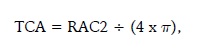
<body><![CDATA[<p>Calculation of the total cross-section area of the arm (TCA): </p>     <p>&nbsp;</p>    <p align="center"><a name="e1"></a><img src="/img/revistas/mot/v15n2-3/15n2-3a05e1.jpg"/></p>    
<p>&nbsp;</p>     <p>where TCA is the total cross-section area of the arm (cm<sup>2</sup>), and RAC is the relaxed arm circumference (cm).</p>      <p>Calculation of the muscle cross-section area of the arm (MCA): </p>     <p>&nbsp;</p>    <p align="center"><a name="e2"></a><img src="/img/revistas/mot/v15n2-3/15n2-3a05e2.jpg"/></p>    
<p>&nbsp;</p>     <p>where MCA is the muscle cross-section area of the arm (cm<sup>2</sup>), RAC is the relaxed arm circumference (cm), and TRS is the triceps skinfold (cm).</p>      ]]></body>
<body><![CDATA[<p>Calculation of the adipose cross-section area of the arm (ACA): </p>     <p>&nbsp;</p>    <p align="center"><a name="e3"></a><img src="/img/revistas/mot/v15n2-3/15n2-3a05e3.jpg"/></p>    
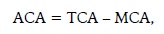
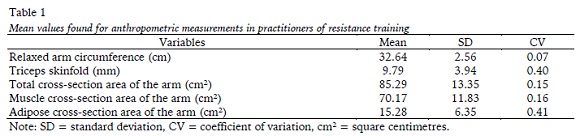
<p>&nbsp;</p>     <p>where ACA is the adipose cross-section area of the arm (cm<sup>2</sup>), TCA is the total cross-section area of the arm (cm<sup>2</sup>), and MCA is the muscle cross-section area of the arm (cm<sup>2</sup>).</p>      <p>The neuromuscular evaluation procedures were systematised in two consecutive sessions, separated by an interval of 72 hours. </p>        <p><b>Statistical analysis</b></p>      <p>The Shapiro-Wilk test was used to evaluate the distribution of all the variables in order to verify the assumption of normality, and Levene's test was used to check the homoscedasticity of the variances. SPSS® statistical software, version 21.0, was used for the calculations and to interpret the results. The Student's t-test was used for paired samples. The significance threshold was set at p&lt;0.05. Spearman's coefficient (r) was used to analyse the degree of correlation between the variables, which were classified into five categories: very weak (0.00 to 0.30); weak (0.30 to 0.50); moderate (0.50 to 0.70); strong (0.70 to 0.90) and very strong (0.90 to 1.00).</p>     <p><b>Results</b></p>      <p>The mean age of the participants was 25.4±6.64 years. The height and body mass measurements were respectively 1.72±0.05 m and 72.86±9.39 kg. The means of the anthropometric variables and the cross-section areas are shown in <a href="#t1">Table 1</a>. </p>     ]]></body>
<body><![CDATA[<p>&nbsp;</p>    <p align="center"><a name="t1"></a><img src="/img/revistas/mot/v15n2-3/15n2-3a05t1.jpg"/></p>    
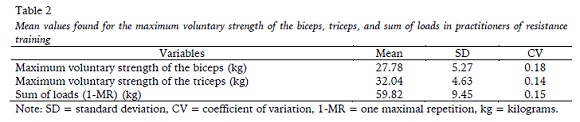
<p>&nbsp;</p>      <p>The coefficients of variation obtained were sufficient for sample analysis. Low dispersal was found between the experimental variables, showing that the maximum voluntary strength and power of the upper segments of the individuals were homogeneous (<a href="#t2">Table 2</a>).</p>     <p>&nbsp;</p>    <p align="center"><a name="t2"></a><img src="/img/revistas/mot/v15n2-3/15n2-3a05t2.jpg"/></p>    
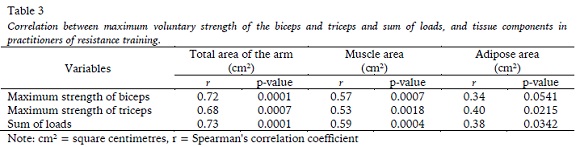
<p>&nbsp;</p>     <p>The correlation between the neuromuscular variables   and the tissue components is shown in <a href="#t3">Table 3</a>. The total cross-section area of   the arm was the variable indicating the best correlation (strong positive),   followed by the muscle cross-section area of the arm (moderate positive). The   adipose cross-section area of the arm presented a low correlation coefficient. Regarding   the morphological variables and the maximum voluntary strength of the triceps,   a moderate positive correlation was found for the total cross-section area of   the arm and the muscle cross-section area of the arm. The adipose cross-section area of the arm presented a weak positive correlation. </p>     <p>&nbsp;</p>    <p align="center"><a name="t3"></a><img src="/img/revistas/mot/v15n2-3/15n2-3a05t3.jpg"/></p>    
]]></body>
<body><![CDATA[<p>&nbsp;</p>     <p>The score obtained from the sum of the loads correlated with the variables of the tissue components; the correlation found with the total cross-section area of the arm was strong positive. Regarding the muscle cross-section area, the correlation was moderate and for the adipose cross-section area, the correlation was weak (<a href="#t3">Table 3</a>).</p>     <p><b>Discussion</b></p>      <p>The present study analysed the correlation between muscle and adipose cross-section areas and the maximum voluntary strength of the upper limb in men who practised resistance exercises. Muscular strength is influenced by a series of factors, such as age, sex, anthropometric characteristics, and the degree of physical activity practised (Sunnergårdh, Bratteby, Nodesjö, &amp; Nordgren, 1988). The present study analysed participants with similar basic characteristics: young males (18-30 years) who had practised resistance training for at least one year. Resistance training tends to increase the cross-section area, with a corresponding increase in the maximum strength of the muscle subjected to high mechanical tension (Campos et al., 2002; Kanehisa et al., 2002). Studies analysing the relation between strength and muscular development observe concomitant adaptive progression in these variables (Bonganha, Botelho, Conceição, Chacon-Mikahil, &amp; Madruga, 2010; Okano et al., 2008). Moritani and de Vries (1979) note that there are two specific adaptation periods: greater neural adaptation (strength) and greater morphological adaptation (hypertrophy). Subsequent to the adaptation peak of these variables, developing greater strength depends on optimising training since the musculoskeletal tissue has structural limitations. </p>      <p>In the present study, we observed that the maximum voluntary strength of the biceps, triceps and the sum of the loads was higher in participants who presented higher values for the total and muscle cross-section areas of the arm, corroborating the study of Menezes and Marucci (2007), who say that a greater magnitude of the muscle cross-section area of the arm can optimise maximum voluntary strength. Similar findings were reported by Maughan Watson and Weir (1984) in the application of strength by physically active adult men. In an earlier study of healthy postmenopausal women, a moderate positive correlation was reported between the muscle cross-section area of the arm and the maximum voluntary strength (right curl) (Bonganha et al., 2010). In another study in healthy women, Westphal, Baptista and Oliveira (2006) reported a strong correlation between the muscle cross-section area of the arm and the maximum voluntary strength (flat bench press). In sedentary males, Pinto, Rodolfi, and Bohn (2001) reported that no correlation was found between the muscle cross-section area and the maximum voluntary strength of the biceps; however it should be noted that the study was carried out with a very small number of participants, which may have affected the results. The expressive results between the variables cited above may possibly be explained by the relevant fact that the cross-section area is directly proportional to the musculoskeletal ability to produce strength (Schantz, Randall-FoxHutchison, &amp; Tydén 1983). </p>      <p>The present study contributes to the areas of kinanthropometry and strength training, since the periodic estimation of the cross-section area of anatomical segments may support morphological monitoring of hypertrophic musculoskeletal adaptation in individuals undergoing resistance training.</p>      <p>One limitation of the present study is the small sample size, which reduces its significance as a representation of the population; however, we note that the importance of this limitation was diminished by the fact that the participants all presented similar characteristics, increasing the representativeness of the results reported for a population of this kind.</p>     <p><b>Conclusion</b></p>     <p>In practitioners of resistance training, the increase in the total and muscle cross-section areas of the arm determines the increase in maximum voluntary strength in the upper segments.</p>     <p>&nbsp;</p>     ]]></body>
<body><![CDATA[<p><b>REFERENCES</b></p>      <!-- ref --><p>Bamman, M. M., Newcomer, B. R., Larson-Meyer, D. E., Weinsier, R. L., &amp; Hunter, G. R. (2000). Evaluation of the strength-size relationship in vivo using various muscle size Indices. <i>Medicine and Science in Sports and Exercise</i>, <i>32</i>(7), 1307-1313.    &nbsp;&nbsp;&nbsp;&nbsp;&nbsp;&nbsp;&nbsp;&nbsp;[&#160;<a href="javascript:void(0);" onclick="javascript: window.open('/scielo.php?script=sci_nlinks&ref=388887&pid=S1646-107X201900020000500001&lng=','','width=640,height=500,resizable=yes,scrollbars=1,menubar=yes,');">Links</a>&#160;]<!-- end-ref --></p>      <!-- ref --><p>Benck, B. T., David, A. C., &amp; Carmo, J. C. (2016). Déficits no equilíbrio muscular em jovens atletas de ginástica feminina. <i>Revista Brasileira de Ciência do Esporte,</i> <i>38</i>(4), 342-348.    &nbsp;&nbsp;&nbsp;&nbsp;&nbsp;&nbsp;&nbsp;&nbsp;[&#160;<a href="javascript:void(0);" onclick="javascript: window.open('/scielo.php?script=sci_nlinks&ref=388889&pid=S1646-107X201900020000500002&lng=','','width=640,height=500,resizable=yes,scrollbars=1,menubar=yes,');">Links</a>&#160;]<!-- end-ref --> </p>      <!-- ref --><p>Bonganha, V., Botelho, R. M. O., Conceição, M. S., Chacon-Mikahil, M. P. T., &amp; Madruga, V. A. (2010). Relações da força muscular com indicadores de hipertrofia após 32 semanas de treinamento com pesos em mulheres na pós-menopausa. <i>Motricidade</i>, <i>6</i>(2), 23-33.    &nbsp;&nbsp;&nbsp;&nbsp;&nbsp;&nbsp;&nbsp;&nbsp;[&#160;<a href="javascript:void(0);" onclick="javascript: window.open('/scielo.php?script=sci_nlinks&ref=388891&pid=S1646-107X201900020000500003&lng=','','width=640,height=500,resizable=yes,scrollbars=1,menubar=yes,');">Links</a>&#160;]<!-- end-ref --></p>      <!-- ref --><p>Brown, L. E., &amp; Weir, J. P. (2001). ASEP Procedures Recommendation I: Accurate Assessment Of Muscular Strength And Power. <i>Journal of Exercise Physiology</i>, <i>4</i>(3), 1-21.    &nbsp;&nbsp;&nbsp;&nbsp;&nbsp;&nbsp;&nbsp;&nbsp;[&#160;<a href="javascript:void(0);" onclick="javascript: window.open('/scielo.php?script=sci_nlinks&ref=388893&pid=S1646-107X201900020000500004&lng=','','width=640,height=500,resizable=yes,scrollbars=1,menubar=yes,');">Links</a>&#160;]<!-- end-ref --></p>      <!-- ref --><p>Campos, G. E., Luecke, T. J., Wendeln, H. K., Toma, K., Hagerman, F. C., Murray, T. F., ... Staron, R. S. (2002). Muscular adaptations in response to three different resistance training regimens: specificity of repetition maximum training zones. <i>European Journal of Applied Physiology</i>, <i>88</i>(1-2), 50-60.    &nbsp;&nbsp;&nbsp;&nbsp;&nbsp;&nbsp;&nbsp;&nbsp;[&#160;<a href="javascript:void(0);" onclick="javascript: window.open('/scielo.php?script=sci_nlinks&ref=388895&pid=S1646-107X201900020000500005&lng=','','width=640,height=500,resizable=yes,scrollbars=1,menubar=yes,');">Links</a>&#160;]<!-- end-ref --> </p>      <!-- ref --><p>Frisancho, A. R. (1981). New norms of upper limb fat and muscle areas for assessment of nutritional status. <i>American Journal of Clinical Nutrition</i>, <i>34</i>(11), 2540-2545.    &nbsp;&nbsp;&nbsp;&nbsp;&nbsp;&nbsp;&nbsp;&nbsp;[&#160;<a href="javascript:void(0);" onclick="javascript: window.open('/scielo.php?script=sci_nlinks&ref=388897&pid=S1646-107X201900020000500006&lng=','','width=640,height=500,resizable=yes,scrollbars=1,menubar=yes,');">Links</a>&#160;]<!-- end-ref --></p>      <!-- ref --><p>Kanehisa, H., Nagareda, H., Kawakami, Y., Akima, H., Masani, K., Kouzaki, M., &amp; Fukunaga, T. (2002). Effects of equivolume isometric training programs comprising medium or high resistance on muscle size and strength. <i>European Journal of Applied Physiology</i>, <i>87</i>(2), 112-119.    &nbsp;&nbsp;&nbsp;&nbsp;&nbsp;&nbsp;&nbsp;&nbsp;[&#160;<a href="javascript:void(0);" onclick="javascript: window.open('/scielo.php?script=sci_nlinks&ref=388899&pid=S1646-107X201900020000500007&lng=','','width=640,height=500,resizable=yes,scrollbars=1,menubar=yes,');">Links</a>&#160;]<!-- end-ref --></p>      <!-- ref --><p>Kim, J., Wang, Z., Heymsfield, S. B., Baumgartner, R. N., &amp; Gallagher, D. (2002). Total-body skeletal muscle mass: estimation by a new dual-energy x-ray absorptiometry method. <i>American Journal of Clinical Nutrition</i>, <i>76</i>(2), 378-383.    &nbsp;&nbsp;&nbsp;&nbsp;&nbsp;&nbsp;&nbsp;&nbsp;[&#160;<a href="javascript:void(0);" onclick="javascript: window.open('/scielo.php?script=sci_nlinks&ref=388901&pid=S1646-107X201900020000500008&lng=','','width=640,height=500,resizable=yes,scrollbars=1,menubar=yes,');">Links</a>&#160;]<!-- end-ref --> </p>      <!-- ref --><p>Kraemer, W. J., &amp; Ratamess, N. A. (2004). Fundamental of resistance training: progression and exercise prescription. <i>Medicine and Science in Sports and Exercise</i>, <i>36</i>(4): 674-688.    &nbsp;&nbsp;&nbsp;&nbsp;&nbsp;&nbsp;&nbsp;&nbsp;[&#160;<a href="javascript:void(0);" onclick="javascript: window.open('/scielo.php?script=sci_nlinks&ref=388903&pid=S1646-107X201900020000500009&lng=','','width=640,height=500,resizable=yes,scrollbars=1,menubar=yes,');">Links</a>&#160;]<!-- end-ref --></p>      <!-- ref --><p>Lieber, R. L., &amp; Ward, S. R. (2011). Skeletal muscle design to meet functional demands. <i>Philosophical Transactions of the Royal Society Biological</i>, <i>366</i>(1570), 1466-1476.    &nbsp;&nbsp;&nbsp;&nbsp;&nbsp;&nbsp;&nbsp;&nbsp;[&#160;<a href="javascript:void(0);" onclick="javascript: window.open('/scielo.php?script=sci_nlinks&ref=388905&pid=S1646-107X201900020000500010&lng=','','width=640,height=500,resizable=yes,scrollbars=1,menubar=yes,');">Links</a>&#160;]<!-- end-ref --> </p>      <!-- ref --><p>Maughan, R. J., Watson, J. S., &amp; Weir, J. (1984). Muscle strength and cross-sectional area in man: a comparison of strength-trained and untrained subjects. <i>British Journal of Sports Medicine,</i> <i>18</i>(3), 149-157.    &nbsp;&nbsp;&nbsp;&nbsp;&nbsp;&nbsp;&nbsp;&nbsp;[&#160;<a href="javascript:void(0);" onclick="javascript: window.open('/scielo.php?script=sci_nlinks&ref=388907&pid=S1646-107X201900020000500011&lng=','','width=640,height=500,resizable=yes,scrollbars=1,menubar=yes,');">Links</a>&#160;]<!-- end-ref --> </p>      <!-- ref --><p>Menezes, T. N., &amp; Marucci, M. F. N. (2007). Trends in body fat and muscle mass among elderly individuals in Fortaleza, Ceará State, Brazil. <i>Caderno de Saúde Pública</i>, <i>23</i>(12), 2887-2895.    &nbsp;&nbsp;&nbsp;&nbsp;&nbsp;&nbsp;&nbsp;&nbsp;[&#160;<a href="javascript:void(0);" onclick="javascript: window.open('/scielo.php?script=sci_nlinks&ref=388909&pid=S1646-107X201900020000500012&lng=','','width=640,height=500,resizable=yes,scrollbars=1,menubar=yes,');">Links</a>&#160;]<!-- end-ref --></p>      <!-- ref --><p>Moritani, T., &amp; deVries, H. A. (1979). Neural factors versus hypertrophy in the time course of muscle strength gain. <i>American Journal of Physiology Medicine</i>, <i>58</i>(3), 115-130.    &nbsp;&nbsp;&nbsp;&nbsp;&nbsp;&nbsp;&nbsp;&nbsp;[&#160;<a href="javascript:void(0);" onclick="javascript: window.open('/scielo.php?script=sci_nlinks&ref=388911&pid=S1646-107X201900020000500013&lng=','','width=640,height=500,resizable=yes,scrollbars=1,menubar=yes,');">Links</a>&#160;]<!-- end-ref --></p>      <!-- ref --><p>Okano, A. H., Cyrino, E. S., Nakamura, F. Y., Guariglia, D. A., Nascimento, M. A., Avelar, A., &amp; Moraes, A. C. (2008). Comportamento da força muscular e da área muscular do braço durante 24 semanas de treinamento com pesos. <i>Revista Brasileira de Cineantropometria e Desempenho Humano, 10</i>(4),379-385.    &nbsp;&nbsp;&nbsp;&nbsp;&nbsp;&nbsp;&nbsp;&nbsp;[&#160;<a href="javascript:void(0);" onclick="javascript: window.open('/scielo.php?script=sci_nlinks&ref=388913&pid=S1646-107X201900020000500014&lng=','','width=640,height=500,resizable=yes,scrollbars=1,menubar=yes,');">Links</a>&#160;]<!-- end-ref --></p>      <!-- ref --><p>Pederson, D. &amp; Gore, C. (2005). Erro em medição antropométrica. In: Norton, K.; Olds, T. <i>Anthropométrica: um livro sobre medidas corporais para o esporte e cursos da área da saúde</i>. Porto Alegre: Artmed, p.39-87.    &nbsp;&nbsp;&nbsp;&nbsp;&nbsp;&nbsp;&nbsp;&nbsp;[&#160;<a href="javascript:void(0);" onclick="javascript: window.open('/scielo.php?script=sci_nlinks&ref=388915&pid=S1646-107X201900020000500015&lng=','','width=640,height=500,resizable=yes,scrollbars=1,menubar=yes,');">Links</a>&#160;]<!-- end-ref --></p>      <!-- ref --><p>Pinto, R. S., Rodolfi, G., &amp; Bohn, L. (2001). Relação entre força muscular e área de secção transversa muscular em adultos jovens sedentários. <i>Movimento</i>, <i>7</i>(15), 35-42.    &nbsp;&nbsp;&nbsp;&nbsp;&nbsp;&nbsp;&nbsp;&nbsp;[&#160;<a href="javascript:void(0);" onclick="javascript: window.open('/scielo.php?script=sci_nlinks&ref=388917&pid=S1646-107X201900020000500016&lng=','','width=640,height=500,resizable=yes,scrollbars=1,menubar=yes,');">Links</a>&#160;]<!-- end-ref --> </p>      <!-- ref --><p>Pompeu, F. A. M. S., Gabriel, D., Pena, B. G., &amp; Ribeiro, P. (2004). Arm cross-section areas: technical implications and applications for body composition and maximal dynamic strength evaluation. <i>Revista Brasileira de Medicina do Esporte</i>, <i>10</i>(3), 202-206.    &nbsp;&nbsp;&nbsp;&nbsp;&nbsp;&nbsp;&nbsp;&nbsp;[&#160;<a href="javascript:void(0);" onclick="javascript: window.open('/scielo.php?script=sci_nlinks&ref=388919&pid=S1646-107X201900020000500017&lng=','','width=640,height=500,resizable=yes,scrollbars=1,menubar=yes,');">Links</a>&#160;]<!-- end-ref --></p>      <!-- ref --><p> Simão, R., Monteiro, W. D. &amp; Araújo, C. G. S. (2001). Potência muscular máxima na flexão do cotovelo uni e bilateral. <i>Revista Brasileira de Medicina do Esporte</i>, <i>7</i>(5), 157-162.    &nbsp;&nbsp;&nbsp;&nbsp;&nbsp;&nbsp;&nbsp;&nbsp;[&#160;<a href="javascript:void(0);" onclick="javascript: window.open('/scielo.php?script=sci_nlinks&ref=388921&pid=S1646-107X201900020000500018&lng=','','width=640,height=500,resizable=yes,scrollbars=1,menubar=yes,');">Links</a>&#160;]<!-- end-ref --> </p>      <!-- ref --><p>Stewart, A., Marfell-Jones, M., Olds, T. &amp; Ridder, H. (2011). <i>Padrões Internacionais para Avaliação Antropométrica</i>. ISAK.    &nbsp;&nbsp;&nbsp;&nbsp;&nbsp;&nbsp;&nbsp;&nbsp;[&#160;<a href="javascript:void(0);" onclick="javascript: window.open('/scielo.php?script=sci_nlinks&ref=388923&pid=S1646-107X201900020000500019&lng=','','width=640,height=500,resizable=yes,scrollbars=1,menubar=yes,');">Links</a>&#160;]<!-- end-ref --></p>      <!-- ref --><p>Schantz, P., Randall-Fox, E., Hutchison, W., &amp; Tydén, Å. P. O. (1983). Muscle fibre type distribution, muscle cross-sectional area and maximal voluntary strength in humans. <i>Acta Physiologica Scandinavica</i>, <i>117</i>(2), 219-226.    &nbsp;&nbsp;&nbsp;&nbsp;&nbsp;&nbsp;&nbsp;&nbsp;[&#160;<a href="javascript:void(0);" onclick="javascript: window.open('/scielo.php?script=sci_nlinks&ref=388925&pid=S1646-107X201900020000500020&lng=','','width=640,height=500,resizable=yes,scrollbars=1,menubar=yes,');">Links</a>&#160;]<!-- end-ref --></p>      <!-- ref --><p>Sunnergårdh, J., Bratteby, L. E., Nodesjö, L.O., &amp; Nordgren, B. (1988). Isometric and isokinetic muscle strength, antropometry and physical activity in 8 and 13 oíd Swedish children. <i>European Journal of Applied Physiology and Occupational Physiology, 58</i>(3), 291-297.    &nbsp;&nbsp;&nbsp;&nbsp;&nbsp;&nbsp;&nbsp;&nbsp;[&#160;<a href="javascript:void(0);" onclick="javascript: window.open('/scielo.php?script=sci_nlinks&ref=388927&pid=S1646-107X201900020000500021&lng=','','width=640,height=500,resizable=yes,scrollbars=1,menubar=yes,');">Links</a>&#160;]<!-- end-ref --></p>      <!-- ref --><p>Vandervoot, A. A., Sale, D. G., &amp; Moroz, J. R. (1987). Strength velocity relation and fatiguebility of unilateral versus bilateral arm extension. <i>European Journal of Applied Physiology and Occupational Physiology</i>, <i>56</i>(1), 201-205.    &nbsp;&nbsp;&nbsp;&nbsp;&nbsp;&nbsp;&nbsp;&nbsp;[&#160;<a href="javascript:void(0);" onclick="javascript: window.open('/scielo.php?script=sci_nlinks&ref=388929&pid=S1646-107X201900020000500022&lng=','','width=640,height=500,resizable=yes,scrollbars=1,menubar=yes,');">Links</a>&#160;]<!-- end-ref --> </p>      <!-- ref --><p>Westphal, M., Baptista, R. R., &amp; Oliveira, A. R. (2006). Relações entre massa corporal total, massa corporal magra, área de seção transversa e 1 RM em mulheres. <i>Revista Brasileira de Cineantropometria e Desempenho Humano</i>, <i>8</i>(1), 52-57.    &nbsp;&nbsp;&nbsp;&nbsp;&nbsp;&nbsp;&nbsp;&nbsp;[&#160;<a href="javascript:void(0);" onclick="javascript: window.open('/scielo.php?script=sci_nlinks&ref=388931&pid=S1646-107X201900020000500023&lng=','','width=640,height=500,resizable=yes,scrollbars=1,menubar=yes,');">Links</a>&#160;]<!-- end-ref --></p>     <p>&nbsp;</p>     <p><a href="#topc0">Endere&ccedil;o para correspond&ecirc;ncia</a> | <a href="#topc0">Direcci&oacute;n para correspondencia</a> | <a href="#topc0">Correspondence</a><a name="c0"></a></p>     <p>* Universidad de La Frontera, Facultad de Odontolog&iacute;a, Avenida  Francisco Salazar, 1145. Casilla 54-D, Temuco-Chile E-mail: <a href="mailto:nilton.alves@ufrontera.cl">nilton.alves@ufrontera.cl</a></p>     ]]></body>
<body><![CDATA[<p>&nbsp;</p>     <p><b>Acknowledgments:</b></p>     <p>Nothing to declare.</p>     <p><b>Conflict of   interests:</b></p>     <p>Nothing to declare.</p>     <p><b>Funding:</b></p>     <p>Nothing to declare.</p>     <p>&nbsp;</p>     <p>Manuscript  received at April 15th 2016; Accepted at December 8th  2016 </p>      ]]></body><back>
<ref-list>
<ref id="B1">
<nlm-citation citation-type="journal">
<person-group person-group-type="author">
<name>
<surname><![CDATA[Bamman]]></surname>
<given-names><![CDATA[M. M.]]></given-names>
</name>
<name>
<surname><![CDATA[Newcomer]]></surname>
<given-names><![CDATA[B. R.]]></given-names>
</name>
<name>
<surname><![CDATA[Larson-Meyer]]></surname>
<given-names><![CDATA[D. E.]]></given-names>
</name>
<name>
<surname><![CDATA[Weinsier]]></surname>
<given-names><![CDATA[R. L.]]></given-names>
</name>
<name>
<surname><![CDATA[Hunter]]></surname>
<given-names><![CDATA[G. R.]]></given-names>
</name>
</person-group>
<article-title xml:lang="en"><![CDATA[Evaluation of the strength-size relationship in vivo using various muscle size Indices]]></article-title>
<source><![CDATA[Medicine and Science in Sports and Exercise]]></source>
<year>2000</year>
<volume>32</volume>
<numero>7</numero>
<issue>7</issue>
<page-range>1307-1313</page-range></nlm-citation>
</ref>
<ref id="B2">
<nlm-citation citation-type="journal">
<person-group person-group-type="author">
<name>
<surname><![CDATA[Benck]]></surname>
<given-names><![CDATA[B. T.]]></given-names>
</name>
<name>
<surname><![CDATA[David]]></surname>
<given-names><![CDATA[A. C.]]></given-names>
</name>
<name>
<surname><![CDATA[Carmo]]></surname>
<given-names><![CDATA[J. C.]]></given-names>
</name>
</person-group>
<article-title xml:lang="pt"><![CDATA[Déficits no equilíbrio muscular em jovens atletas de ginástica feminina]]></article-title>
<source><![CDATA[Revista Brasileira de Ciência do Esporte]]></source>
<year>2016</year>
<volume>38</volume>
<numero>4</numero>
<issue>4</issue>
<page-range>342-348</page-range></nlm-citation>
</ref>
<ref id="B3">
<nlm-citation citation-type="journal">
<person-group person-group-type="author">
<name>
<surname><![CDATA[Bonganha]]></surname>
<given-names><![CDATA[V.]]></given-names>
</name>
<name>
<surname><![CDATA[Botelho]]></surname>
<given-names><![CDATA[R. M. O.]]></given-names>
</name>
<name>
<surname><![CDATA[Conceição]]></surname>
<given-names><![CDATA[M. S.]]></given-names>
</name>
<name>
<surname><![CDATA[Chacon-Mikahil]]></surname>
<given-names><![CDATA[M. P. T.]]></given-names>
</name>
<name>
<surname><![CDATA[Madruga]]></surname>
<given-names><![CDATA[V. A.]]></given-names>
</name>
</person-group>
<article-title xml:lang="pt"><![CDATA[Relações da força muscular com indicadores de hipertrofia após 32 semanas de treinamento com pesos em mulheres na pós-menopausa]]></article-title>
<source><![CDATA[Motricidade]]></source>
<year>2010</year>
<volume>6</volume>
<numero>2</numero>
<issue>2</issue>
<page-range>23-33</page-range></nlm-citation>
</ref>
<ref id="B4">
<nlm-citation citation-type="journal">
<person-group person-group-type="author">
<name>
<surname><![CDATA[Brown]]></surname>
<given-names><![CDATA[L. E.]]></given-names>
</name>
<name>
<surname><![CDATA[Weir]]></surname>
<given-names><![CDATA[J. P.]]></given-names>
</name>
</person-group>
<article-title xml:lang="en"><![CDATA[ASEP Procedures Recommendation I: Accurate Assessment Of Muscular Strength And Power]]></article-title>
<source><![CDATA[Journal of Exercise Physiology]]></source>
<year>2001</year>
<volume>4</volume>
<numero>3</numero>
<issue>3</issue>
<page-range>1-21</page-range></nlm-citation>
</ref>
<ref id="B5">
<nlm-citation citation-type="journal">
<person-group person-group-type="author">
<name>
<surname><![CDATA[Campos]]></surname>
<given-names><![CDATA[G. E.]]></given-names>
</name>
<name>
<surname><![CDATA[Luecke]]></surname>
<given-names><![CDATA[T. J.]]></given-names>
</name>
<name>
<surname><![CDATA[Wendeln]]></surname>
<given-names><![CDATA[H. K.]]></given-names>
</name>
<name>
<surname><![CDATA[Toma]]></surname>
<given-names><![CDATA[K.]]></given-names>
</name>
<name>
<surname><![CDATA[Hagerman]]></surname>
<given-names><![CDATA[F. C.]]></given-names>
</name>
<name>
<surname><![CDATA[Murray]]></surname>
<given-names><![CDATA[T. F.]]></given-names>
</name>
<name>
<surname><![CDATA[Staron]]></surname>
<given-names><![CDATA[R. S.]]></given-names>
</name>
</person-group>
<article-title xml:lang="en"><![CDATA[Muscular adaptations in response to three different resistance training regimens: specificity of repetition maximum training zones]]></article-title>
<source><![CDATA[European Journal of Applied Physiology]]></source>
<year>2002</year>
<volume>88</volume>
<numero>1-2</numero>
<issue>1-2</issue>
<page-range>50-60</page-range></nlm-citation>
</ref>
<ref id="B6">
<nlm-citation citation-type="journal">
<person-group person-group-type="author">
<name>
<surname><![CDATA[Frisancho]]></surname>
<given-names><![CDATA[A. R.]]></given-names>
</name>
</person-group>
<article-title xml:lang="en"><![CDATA[New norms of upper limb fat and muscle areas for assessment of nutritional status]]></article-title>
<source><![CDATA[American Journal of Clinical Nutrition]]></source>
<year>1981</year>
<volume>34</volume>
<numero>11</numero>
<issue>11</issue>
<page-range>2540-2545</page-range></nlm-citation>
</ref>
<ref id="B7">
<nlm-citation citation-type="journal">
<person-group person-group-type="author">
<name>
<surname><![CDATA[Kanehisa]]></surname>
<given-names><![CDATA[H.]]></given-names>
</name>
<name>
<surname><![CDATA[Nagareda]]></surname>
<given-names><![CDATA[H.]]></given-names>
</name>
<name>
<surname><![CDATA[Kawakami]]></surname>
<given-names><![CDATA[Y.]]></given-names>
</name>
<name>
<surname><![CDATA[Akima]]></surname>
<given-names><![CDATA[H.]]></given-names>
</name>
<name>
<surname><![CDATA[Masani]]></surname>
<given-names><![CDATA[K.]]></given-names>
</name>
<name>
<surname><![CDATA[Kouzaki]]></surname>
<given-names><![CDATA[M.]]></given-names>
</name>
<name>
<surname><![CDATA[Fukunaga]]></surname>
<given-names><![CDATA[T.]]></given-names>
</name>
</person-group>
<article-title xml:lang="en"><![CDATA[Effects of equivolume isometric training programs comprising medium or high resistance on muscle size and strength]]></article-title>
<source><![CDATA[European Journal of Applied Physiology]]></source>
<year>2002</year>
<volume>87</volume>
<numero>2</numero>
<issue>2</issue>
<page-range>112-119</page-range></nlm-citation>
</ref>
<ref id="B8">
<nlm-citation citation-type="journal">
<person-group person-group-type="author">
<name>
<surname><![CDATA[Kim]]></surname>
<given-names><![CDATA[J.]]></given-names>
</name>
<name>
<surname><![CDATA[Wang]]></surname>
<given-names><![CDATA[Z.]]></given-names>
</name>
<name>
<surname><![CDATA[Heymsfield]]></surname>
<given-names><![CDATA[S. B.]]></given-names>
</name>
<name>
<surname><![CDATA[Baumgartner]]></surname>
<given-names><![CDATA[R. N.]]></given-names>
</name>
<name>
<surname><![CDATA[Gallagher]]></surname>
<given-names><![CDATA[D.]]></given-names>
</name>
</person-group>
<article-title xml:lang="en"><![CDATA[Total-body skeletal muscle mass: estimation by a new dual-energy x-ray absorptiometry method]]></article-title>
<source><![CDATA[American Journal of Clinical Nutrition]]></source>
<year>2002</year>
<volume>76</volume>
<numero>2</numero>
<issue>2</issue>
<page-range>378-383</page-range></nlm-citation>
</ref>
<ref id="B9">
<nlm-citation citation-type="book">
<person-group person-group-type="author">
<name>
<surname><![CDATA[Kraemer]]></surname>
<given-names><![CDATA[W. J.]]></given-names>
</name>
<name>
<surname><![CDATA[Ratamess]]></surname>
<given-names><![CDATA[N. A.]]></given-names>
</name>
</person-group>
<source><![CDATA[Fundamental of resistance training: progression and exercise prescription]]></source>
<year>2004</year>
<publisher-loc><![CDATA[Medicine and Science in Sports and Exercise, 36(4) ]]></publisher-loc>
<publisher-name><![CDATA[674-688]]></publisher-name>
</nlm-citation>
</ref>
<ref id="B10">
<nlm-citation citation-type="journal">
<person-group person-group-type="author">
<name>
<surname><![CDATA[Lieber]]></surname>
<given-names><![CDATA[R. L.]]></given-names>
</name>
<name>
<surname><![CDATA[Ward]]></surname>
<given-names><![CDATA[S. R.]]></given-names>
</name>
</person-group>
<article-title xml:lang="en"><![CDATA[Skeletal muscle design to meet functional demands]]></article-title>
<source><![CDATA[Philosophical Transactions of the Royal Society Biological]]></source>
<year>2011</year>
<volume>366</volume>
<numero>1570</numero>
<issue>1570</issue>
<page-range>1466-1476</page-range></nlm-citation>
</ref>
<ref id="B11">
<nlm-citation citation-type="journal">
<person-group person-group-type="author">
<name>
<surname><![CDATA[Maughan]]></surname>
<given-names><![CDATA[R. J.]]></given-names>
</name>
<name>
<surname><![CDATA[Watson]]></surname>
<given-names><![CDATA[J. S.]]></given-names>
</name>
<name>
<surname><![CDATA[Weir]]></surname>
<given-names><![CDATA[J.]]></given-names>
</name>
</person-group>
<article-title xml:lang="en"><![CDATA[Muscle strength and cross-sectional area in man: a comparison of strength-trained and untrained subjects]]></article-title>
<source><![CDATA[British Journal of Sports Medicine]]></source>
<year>1984</year>
<volume>18</volume>
<numero>3</numero>
<issue>3</issue>
<page-range>149-157</page-range></nlm-citation>
</ref>
<ref id="B12">
<nlm-citation citation-type="journal">
<person-group person-group-type="author">
<name>
<surname><![CDATA[Menezes]]></surname>
<given-names><![CDATA[T. N.]]></given-names>
</name>
<name>
<surname><![CDATA[Marucci]]></surname>
<given-names><![CDATA[M. F. N.]]></given-names>
</name>
</person-group>
<article-title xml:lang="en"><![CDATA[Trends in body fat and muscle mass among elderly individuals in Fortaleza, Ceará State, Brazil]]></article-title>
<source><![CDATA[Caderno de Saúde Pública]]></source>
<year>2007</year>
<volume>23</volume>
<numero>12</numero>
<issue>12</issue>
<page-range>2887-2895</page-range></nlm-citation>
</ref>
<ref id="B13">
<nlm-citation citation-type="journal">
<person-group person-group-type="author">
<name>
<surname><![CDATA[Moritani]]></surname>
<given-names><![CDATA[T.]]></given-names>
</name>
<name>
<surname><![CDATA[deVries]]></surname>
<given-names><![CDATA[H. A.]]></given-names>
</name>
</person-group>
<article-title xml:lang="en"><![CDATA[Neural factors versus hypertrophy in the time course of muscle strength gain]]></article-title>
<source><![CDATA[American Journal of Physiology Medicine]]></source>
<year>1979</year>
<volume>58</volume>
<numero>3</numero>
<issue>3</issue>
<page-range>115-130</page-range></nlm-citation>
</ref>
<ref id="B14">
<nlm-citation citation-type="journal">
<person-group person-group-type="author">
<name>
<surname><![CDATA[Okano]]></surname>
<given-names><![CDATA[A. H.]]></given-names>
</name>
<name>
<surname><![CDATA[Cyrino]]></surname>
<given-names><![CDATA[E. S.]]></given-names>
</name>
<name>
<surname><![CDATA[Nakamura]]></surname>
<given-names><![CDATA[F. Y.]]></given-names>
</name>
<name>
<surname><![CDATA[Guariglia]]></surname>
<given-names><![CDATA[D. A.]]></given-names>
</name>
<name>
<surname><![CDATA[Nascimento]]></surname>
<given-names><![CDATA[M. A.]]></given-names>
</name>
<name>
<surname><![CDATA[Avelar]]></surname>
<given-names><![CDATA[A.]]></given-names>
</name>
<name>
<surname><![CDATA[Moraes]]></surname>
<given-names><![CDATA[A. C.]]></given-names>
</name>
</person-group>
<article-title xml:lang="en"><![CDATA[Comportamento da força muscular e da área muscular do braço durante 24 semanas de treinamento com pesos]]></article-title>
<source><![CDATA[Revista Brasileira de Cineantropometria e Desempenho Humano]]></source>
<year>2008</year>
<volume>10</volume>
<numero>4</numero>
<issue>4</issue>
<page-range>379-385</page-range></nlm-citation>
</ref>
<ref id="B15">
<nlm-citation citation-type="book">
<person-group person-group-type="author">
<name>
<surname><![CDATA[Pederson]]></surname>
<given-names><![CDATA[D.]]></given-names>
</name>
<name>
<surname><![CDATA[Gore]]></surname>
<given-names><![CDATA[C.]]></given-names>
</name>
</person-group>
<article-title xml:lang="pt"><![CDATA[Erro em medição antropométrica]]></article-title>
<person-group person-group-type="editor">
<name>
<surname><![CDATA[Norton]]></surname>
<given-names><![CDATA[K.]]></given-names>
</name>
<name>
<surname><![CDATA[Olds]]></surname>
<given-names><![CDATA[T.]]></given-names>
</name>
</person-group>
<source><![CDATA[Anthropométrica: um livro sobre medidas corporais para o esporte e cursos da área da saúde]]></source>
<year>2005</year>
<page-range>39-87</page-range><publisher-loc><![CDATA[Porto Alegre ]]></publisher-loc>
<publisher-name><![CDATA[Artmed]]></publisher-name>
</nlm-citation>
</ref>
<ref id="B16">
<nlm-citation citation-type="journal">
<person-group person-group-type="author">
<name>
<surname><![CDATA[Pinto]]></surname>
<given-names><![CDATA[R. S.]]></given-names>
</name>
<name>
<surname><![CDATA[Rodolfi]]></surname>
<given-names><![CDATA[G.]]></given-names>
</name>
<name>
<surname><![CDATA[Bohn]]></surname>
<given-names><![CDATA[L.]]></given-names>
</name>
</person-group>
<article-title xml:lang="pt"><![CDATA[Relação entre força muscular e área de secção transversa muscular em adultos jovens sedentários]]></article-title>
<source><![CDATA[Movimento]]></source>
<year>2001</year>
<volume>7</volume>
<numero>15</numero>
<issue>15</issue>
<page-range>35-42</page-range></nlm-citation>
</ref>
<ref id="B17">
<nlm-citation citation-type="journal">
<person-group person-group-type="author">
<name>
<surname><![CDATA[Pompeu]]></surname>
<given-names><![CDATA[F. A. M. S.]]></given-names>
</name>
<name>
<surname><![CDATA[Gabriel]]></surname>
<given-names><![CDATA[D.]]></given-names>
</name>
<name>
<surname><![CDATA[Pena]]></surname>
<given-names><![CDATA[B. G.]]></given-names>
</name>
<name>
<surname><![CDATA[Ribeiro]]></surname>
<given-names><![CDATA[P.]]></given-names>
</name>
</person-group>
<article-title xml:lang="en"><![CDATA[Arm cross-section areas: technical implications and applications for body composition and maximal dynamic strength evaluation]]></article-title>
<source><![CDATA[Revista Brasileira de Medicina do Esporte]]></source>
<year>2004</year>
<volume>10</volume>
<numero>3</numero>
<issue>3</issue>
<page-range>202-206</page-range></nlm-citation>
</ref>
<ref id="B18">
<nlm-citation citation-type="journal">
<person-group person-group-type="author">
<name>
<surname><![CDATA[Simão]]></surname>
<given-names><![CDATA[R.]]></given-names>
</name>
<name>
<surname><![CDATA[Monteiro]]></surname>
<given-names><![CDATA[W. D.]]></given-names>
</name>
<name>
<surname><![CDATA[Araújo]]></surname>
<given-names><![CDATA[C. G. S.]]></given-names>
</name>
</person-group>
<article-title xml:lang="pt"><![CDATA[Potência muscular máxima na flexão do cotovelo uni e bilateral]]></article-title>
<source><![CDATA[Revista Brasileira de Medicina do Esporte]]></source>
<year>2001</year>
<volume>7</volume>
<numero>5</numero>
<issue>5</issue>
<page-range>157-162</page-range></nlm-citation>
</ref>
<ref id="B19">
<nlm-citation citation-type="book">
<person-group person-group-type="author">
<name>
<surname><![CDATA[Stewart]]></surname>
<given-names><![CDATA[A.]]></given-names>
</name>
<name>
<surname><![CDATA[Marfell-Jones]]></surname>
<given-names><![CDATA[M.]]></given-names>
</name>
<name>
<surname><![CDATA[Olds]]></surname>
<given-names><![CDATA[T.]]></given-names>
</name>
<name>
<surname><![CDATA[Ridder]]></surname>
<given-names><![CDATA[H.]]></given-names>
</name>
</person-group>
<source><![CDATA[Padrões Internacionais para Avaliação Antropométrica]]></source>
<year>2011</year>
<publisher-name><![CDATA[ISAK]]></publisher-name>
</nlm-citation>
</ref>
<ref id="B20">
<nlm-citation citation-type="journal">
<person-group person-group-type="author">
<name>
<surname><![CDATA[Schantz]]></surname>
<given-names><![CDATA[P.]]></given-names>
</name>
<name>
<surname><![CDATA[Randall-Fox]]></surname>
<given-names><![CDATA[E.]]></given-names>
</name>
<name>
<surname><![CDATA[Hutchison]]></surname>
<given-names><![CDATA[W.]]></given-names>
</name>
<name>
<surname><![CDATA[Tydén]]></surname>
<given-names><![CDATA[Å. P. O.]]></given-names>
</name>
</person-group>
<article-title xml:lang="en"><![CDATA[Muscle fibre type distribution, muscle cross-sectional area and maximal voluntary strength in humans]]></article-title>
<source><![CDATA[Acta Physiologica Scandinavica]]></source>
<year>1983</year>
<volume>117</volume>
<numero>2</numero>
<issue>2</issue>
<page-range>219-226</page-range></nlm-citation>
</ref>
<ref id="B21">
<nlm-citation citation-type="journal">
<person-group person-group-type="author">
<name>
<surname><![CDATA[Sunnergårdh]]></surname>
<given-names><![CDATA[J.]]></given-names>
</name>
<name>
<surname><![CDATA[Bratteby]]></surname>
<given-names><![CDATA[L. E.]]></given-names>
</name>
<name>
<surname><![CDATA[Nodesjö]]></surname>
<given-names><![CDATA[L.O.]]></given-names>
</name>
<name>
<surname><![CDATA[Nordgren]]></surname>
<given-names><![CDATA[B.]]></given-names>
</name>
</person-group>
<article-title xml:lang="en"><![CDATA[Isometric and isokinetic muscle strength, antropometry and physical activity in 8 and 13 oíd Swedish children]]></article-title>
<source><![CDATA[European Journal of Applied Physiology and Occupational Physiology]]></source>
<year>1988</year>
<volume>58</volume>
<numero>3</numero>
<issue>3</issue>
<page-range>291-297</page-range></nlm-citation>
</ref>
<ref id="B22">
<nlm-citation citation-type="journal">
<person-group person-group-type="author">
<name>
<surname><![CDATA[Vandervoot]]></surname>
<given-names><![CDATA[A. A.]]></given-names>
</name>
<name>
<surname><![CDATA[Sale]]></surname>
<given-names><![CDATA[D. G.]]></given-names>
</name>
<name>
<surname><![CDATA[Moroz]]></surname>
<given-names><![CDATA[J. R.]]></given-names>
</name>
</person-group>
<article-title xml:lang="en"><![CDATA[Strength velocity relation and fatiguebility of unilateral versus bilateral arm extension]]></article-title>
<source><![CDATA[European Journal of Applied Physiology and Occupational Physiology]]></source>
<year>1987</year>
<volume>56</volume>
<numero>1</numero>
<issue>1</issue>
<page-range>201-205</page-range></nlm-citation>
</ref>
<ref id="B23">
<nlm-citation citation-type="journal">
<person-group person-group-type="author">
<name>
<surname><![CDATA[Westphal]]></surname>
<given-names><![CDATA[M.]]></given-names>
</name>
<name>
<surname><![CDATA[Baptista]]></surname>
<given-names><![CDATA[R. R.]]></given-names>
</name>
<name>
<surname><![CDATA[Oliveira]]></surname>
<given-names><![CDATA[A. R.]]></given-names>
</name>
</person-group>
<article-title xml:lang="pt"><![CDATA[Relações entre massa corporal total, massa corporal magra, área de seção transversa e 1 RM em mulheres]]></article-title>
<source><![CDATA[Revista Brasileira de Cineantropometria e Desempenho Humano]]></source>
<year>2006</year>
<volume>8</volume>
<numero>1</numero>
<issue>1</issue>
<page-range>52-57</page-range></nlm-citation>
</ref>
</ref-list>
</back>
</article>