<?xml version="1.0" encoding="ISO-8859-1"?><article xmlns:mml="http://www.w3.org/1998/Math/MathML" xmlns:xlink="http://www.w3.org/1999/xlink" xmlns:xsi="http://www.w3.org/2001/XMLSchema-instance">
<front>
<journal-meta>
<journal-id>1646-107X</journal-id>
<journal-title><![CDATA[Motricidade]]></journal-title>
<abbrev-journal-title><![CDATA[Motri.]]></abbrev-journal-title>
<issn>1646-107X</issn>
<publisher>
<publisher-name><![CDATA[Edições Desafio Singular]]></publisher-name>
</publisher>
</journal-meta>
<article-meta>
<article-id>S1646-107X2020000100001</article-id>
<article-id pub-id-type="doi">10.6063/motricidade.20189</article-id>
<title-group>
<article-title xml:lang="en"><![CDATA[Significant bivariate correlations: to be or not to be?]]></article-title>
</title-group>
<contrib-group>
<contrib contrib-type="author">
<name>
<surname><![CDATA[Morouço]]></surname>
<given-names><![CDATA[Pedro]]></given-names>
</name>
<xref ref-type="aff" rid="A1 "/>
</contrib>
</contrib-group>
<aff id="AA1">
<institution><![CDATA[,Polytechnic of Leiria  ]]></institution>
<addr-line><![CDATA[Leiria ]]></addr-line>
<country>Portugal</country>
</aff>
<aff id="AA2">
<institution><![CDATA[,Universidade de Lisboa Faculdade de Motricidade Humana Neuromechanics in Human Movement]]></institution>
<addr-line><![CDATA[Lisboa ]]></addr-line>
</aff>
<pub-date pub-type="pub">
<day>00</day>
<month>03</month>
<year>2020</year>
</pub-date>
<pub-date pub-type="epub">
<day>00</day>
<month>03</month>
<year>2020</year>
</pub-date>
<volume>16</volume>
<numero>1</numero>
<fpage>1</fpage>
<lpage>2</lpage>
<copyright-statement/>
<copyright-year/>
<self-uri xlink:href="http://scielo.pt/scielo.php?script=sci_arttext&amp;pid=S1646-107X2020000100001&amp;lng=en&amp;nrm=iso"></self-uri><self-uri xlink:href="http://scielo.pt/scielo.php?script=sci_abstract&amp;pid=S1646-107X2020000100001&amp;lng=en&amp;nrm=iso"></self-uri><self-uri xlink:href="http://scielo.pt/scielo.php?script=sci_pdf&amp;pid=S1646-107X2020000100001&amp;lng=en&amp;nrm=iso"></self-uri></article-meta>
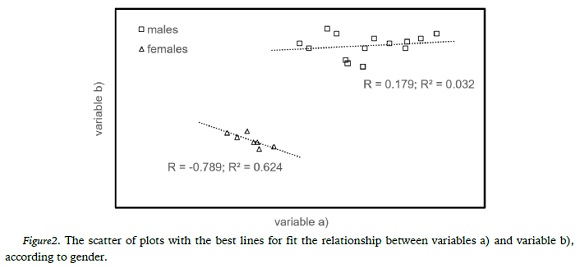
</front><body><![CDATA[ <p align="right"><font size="2"><b>EDITORIAL</b></font></p>     <p><font size="4"><b>Significant bivariate correlations: to be or not to be?</b></font></p>     <p><b>Pedro Morouço<sup>1,2,3</sup></b></p>     <p><sup>1</sup>Associated Editor of journal Motricidade</p>     <p><sup>2</sup>Polytechnic of Leiria, Leiria, Portugal</p>     <p><sup>3</sup>Neuromechanics in Human Movement, Ciper,   Faculdade de Motricidade Humana, Universidade de Lisboa</p>     <p><a href="#c0">Endere&ccedil;o para correspond&ecirc;ncia</a> | <a href="#c0">Direcci&oacute;n para correspondencia</a> | <a href="#c0">Correspondence</a><a name="topc0"></a></p> <hr/>     <p>&nbsp;</p>    <p>Just like in many   other fields of research, sport sciences use statistics to infer about the   associations between variables. For example, aiming to examine the relationship   between squat jump with sprint running velocity has brought several   experiments, demonstrating a strong to very strong association between   variables (e.g., Sleivert   &amp; Taingahue, 2004; Wisløff et al., 2004). From there on, there have been researchers proposing   training programs for improving the squat jump, and consequently, the sprint   running (e.g., Chelly et al.,   2009). While this example seems unanimous, other emerging ideas may be questionable. </p>      <p>In a recent review of a manuscript, authors aimed to examine possible correlations between measurement in a dry-land exercise and swimming velocity (non-specified data is used to maintain the anonymity of the study). I was confronted with a very strong correlation between variable a) and variable b), suggesting that exercise on dry-land would be &#8220;extremely useful&#8221; to increase swimming performance. Apart from not proving causality, bivariate correlations may be carefully useful in deducing about the inference that a variable has over the other; may the effects be controlled. Thus, I started struggling to imagine how those two variables would relate. I decided to ask the authors for the plot with the data. After a first deny, authors submitted the revised version including <a href="#f1">Figure 1</a> (adapted from the original to maintain the anonymity).</p>     ]]></body>
<body><![CDATA[<p>&nbsp;</p>    <p align="center"><a name="f1"></a><img src="/img/revistas/mot/v16n1/16n1a01f1.jpg"/></p>    
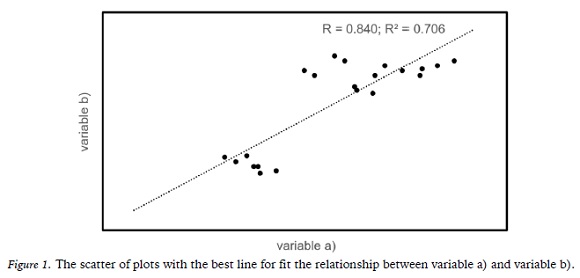
<p>&nbsp;</p>     <p>Knowing that the sample were composed by 21 swimmers (7 female and 14 male) it was clear to me that grouping those subjects induced a fake correlation. I cannot assure (as the authors did not confirm or disconfirm), but it seems that data were plotted according to <a href="#f2">Figure 2</a> (an adaptation from the original, based on my knowledge on dry-land training and swimming biomechanics). From <a href="#f2">Figure 2</a> it is possible to state that the authors aimed to induce fake tools for training prescription. The tested dry-land exercise was not strongly correlated with swimming performance, and in female swimmers, a negative correlation was calculated; suggesting, that the tested exercise is (at least) very questionable to be useful for swimmers. </p>     <p>&nbsp;</p>    <p align="center"><a name="f2"></a><img src="/img/revistas/mot/v16n1/16n1a01f2.jpg"/></p>    
<p>&nbsp;</p>     <p>As you can imagine, I had to suggest the manuscript rejection. But what will happen from there? Will the authors be humble to recognize the flaws and make a manuscript stating that the tested exercise is not related to performance improvement? Or will they keep their idea, and if they find a reviewer that does not ask for the plotted data, we will soon have a new &#8220;extremely useful&#8221; exercise for swimmers to increase their swimming velocity? Those are the questions.</p>     <p>Final remarks:</p>     <p>Bivariate correlations can be extremely useful to examine possible associations between variables. However, more than stating on a ranging interpretation (which is quite arbitrary) or in a significance level, be humble and cautious when interpreting your results. First, look at them. Plot it and examine it. Ask others for their interpretations. As I was taught at my first degree:     ]]></body>
<body><![CDATA[<blockquote><i>&#8220;Older people tend to prefer darker socks. Accordingly, if we go to the hospital, we may find a very strong and significant correlation between darker socks and cardiovascular problems. But, please, do not go to the media stating that if you want to prevent yourself from cardiovascular problems, use lighter socks!&#8221;</i></p></blockquote>      <p>We, at Revista Motricidade, wish you a 2020 full of success, both academically and personally. We look forward for your manuscripts. Stay Safe!</p>     <p>&nbsp;</p>     <p><b>REFERENCES</b></p>      <!-- ref --><p>Chelly, M. S., Fathloun, M., Cherif, N., Amar, M. B., Tabka, Z., &amp; Van Praagh, E. (2009). Effects of a back-squat training program on leg power, jump, and sprint performances in junior soccer players. The Journal of Strength &amp; Conditioning Research, 23(8), 2241-2249&nbsp;&nbsp;&nbsp;&nbsp;&nbsp;&nbsp;&nbsp;&nbsp;[&#160;<a href="javascript:void(0);" onclick="javascript: window.open('/scielo.php?script=sci_nlinks&ref=391166&pid=S1646-107X202000010000100001&lng=','','width=640,height=500,resizable=yes,scrollbars=1,menubar=yes,');">Links</a>&#160;]<!-- end-ref --><!-- ref --><p>Sleivert, G., &amp; Taingahue, M. (2004). The relationship between maximal jump-squat power and sprint acceleration in athletes. European journal of applied physiology, 91(1), 46-52&nbsp;&nbsp;&nbsp;&nbsp;&nbsp;&nbsp;&nbsp;&nbsp;[&#160;<a href="javascript:void(0);" onclick="javascript: window.open('/scielo.php?script=sci_nlinks&ref=391167&pid=S1646-107X202000010000100002&lng=','','width=640,height=500,resizable=yes,scrollbars=1,menubar=yes,');">Links</a>&#160;]<!-- end-ref --><!-- ref --><p>Wisløff, U., Castagna, C., Helgerud, J., Jones, R., &amp; Hoff, J. (2004). Strong correlation of maximal squat strength with sprint performance and vertical jump height in elite soccer players. British journal of sports medicine, 38(3), 285-288&nbsp;&nbsp;&nbsp;&nbsp;&nbsp;&nbsp;&nbsp;&nbsp;[&#160;<a href="javascript:void(0);" onclick="javascript: window.open('/scielo.php?script=sci_nlinks&ref=391168&pid=S1646-107X202000010000100003&lng=','','width=640,height=500,resizable=yes,scrollbars=1,menubar=yes,');">Links</a>&#160;]<!-- end-ref --><p>&nbsp;</p>     <p><a href="#topc0">Endere&ccedil;o para correspond&ecirc;ncia</a> | <a href="#topc0">Direcci&oacute;n para correspondencia</a> | <a href="#topc0">Correspondence</a><a name="c0"></a></p>     <p>ESECS, R. Dr. João Soares, 2411-901 Leiria Email: <a href="mailto:pedro.morouco@ipleiria.pt">pedro.morouco@ipleiria.pt</a></p>     ]]></body>
<body><![CDATA[ ]]></body><back>
<ref-list>
<ref id="B1">
<nlm-citation citation-type="journal">
<person-group person-group-type="author">
<name>
<surname><![CDATA[Chelly]]></surname>
<given-names><![CDATA[M. S.]]></given-names>
</name>
<name>
<surname><![CDATA[Fathloun]]></surname>
<given-names><![CDATA[M.]]></given-names>
</name>
<name>
<surname><![CDATA[Cherif]]></surname>
<given-names><![CDATA[N.]]></given-names>
</name>
<name>
<surname><![CDATA[Amar]]></surname>
<given-names><![CDATA[M. B.]]></given-names>
</name>
<name>
<surname><![CDATA[Tabka]]></surname>
<given-names><![CDATA[Z.]]></given-names>
</name>
<name>
<surname><![CDATA[Van Praagh]]></surname>
<given-names><![CDATA[E.]]></given-names>
</name>
</person-group>
<article-title xml:lang="en"><![CDATA[Effects of a back-squat training program on leg power, jump, and sprint performances in junior soccer players]]></article-title>
<source><![CDATA[The Journal of Strength & Conditioning Research]]></source>
<year>2009</year>
<volume>23</volume>
<numero>8</numero>
<issue>8</issue>
<page-range>2241-2249</page-range></nlm-citation>
</ref>
<ref id="B2">
<nlm-citation citation-type="journal">
<person-group person-group-type="author">
<name>
<surname><![CDATA[Sleivert]]></surname>
<given-names><![CDATA[G.]]></given-names>
</name>
<name>
<surname><![CDATA[Taingahue]]></surname>
<given-names><![CDATA[M.]]></given-names>
</name>
</person-group>
<article-title xml:lang="en"><![CDATA[The relationship between maximal jump-squat power and sprint acceleration in athletes]]></article-title>
<source><![CDATA[European journal of applied physiology]]></source>
<year>2004</year>
<volume>91</volume>
<numero>1</numero>
<issue>1</issue>
<page-range>46-52</page-range></nlm-citation>
</ref>
<ref id="B3">
<nlm-citation citation-type="journal">
<person-group person-group-type="author">
<name>
<surname><![CDATA[Wisløff]]></surname>
<given-names><![CDATA[U.]]></given-names>
</name>
<name>
<surname><![CDATA[Castagna]]></surname>
<given-names><![CDATA[C.]]></given-names>
</name>
<name>
<surname><![CDATA[Helgerud]]></surname>
<given-names><![CDATA[J.]]></given-names>
</name>
<name>
<surname><![CDATA[Jones]]></surname>
<given-names><![CDATA[R.]]></given-names>
</name>
<name>
<surname><![CDATA[Hoff]]></surname>
<given-names><![CDATA[J.]]></given-names>
</name>
</person-group>
<article-title xml:lang="en"><![CDATA[Strong correlation of maximal squat strength with sprint performance and vertical jump height in elite soccer players]]></article-title>
<source><![CDATA[British journal of sports medicine]]></source>
<year>2004</year>
<volume>38</volume>
<numero>3</numero>
<issue>3</issue>
<page-range>285-288</page-range></nlm-citation>
</ref>
</ref-list>
</back>
</article>