<?xml version="1.0" encoding="ISO-8859-1"?><article xmlns:mml="http://www.w3.org/1998/Math/MathML" xmlns:xlink="http://www.w3.org/1999/xlink" xmlns:xsi="http://www.w3.org/2001/XMLSchema-instance">
<front>
<journal-meta>
<journal-id>1646-2122</journal-id>
<journal-title><![CDATA[Revista Portuguesa de Ortopedia e Traumatologia]]></journal-title>
<abbrev-journal-title><![CDATA[Rev. Port. Ortop. Traum.]]></abbrev-journal-title>
<issn>1646-2122</issn>
<publisher>
<publisher-name><![CDATA[Sociedade Portuguesa de Ortopedia e Traumatologia]]></publisher-name>
</publisher>
</journal-meta>
<article-meta>
<article-id>S1646-21222013000300005</article-id>
<title-group>
<article-title xml:lang="pt"><![CDATA[Indicações para a abordagem cirúrgica da instabilidade anterior do ombro]]></article-title>
</title-group>
<contrib-group>
<contrib contrib-type="author">
<name>
<surname><![CDATA[Nunes]]></surname>
<given-names><![CDATA[Bernardo]]></given-names>
</name>
<xref ref-type="aff" rid="A01"/>
</contrib>
<contrib contrib-type="author">
<name>
<surname><![CDATA[Gutierres]]></surname>
<given-names><![CDATA[Manuel]]></given-names>
</name>
<xref ref-type="aff" rid="A01"/>
</contrib>
</contrib-group>
<aff id="A01">
<institution><![CDATA[,Universidade do Porto Faculdade de Medicina ]]></institution>
<addr-line><![CDATA[Porto ]]></addr-line>
<country>Portugal</country>
</aff>
<pub-date pub-type="pub">
<day>00</day>
<month>09</month>
<year>2013</year>
</pub-date>
<pub-date pub-type="epub">
<day>00</day>
<month>09</month>
<year>2013</year>
</pub-date>
<volume>21</volume>
<numero>3</numero>
<fpage>285</fpage>
<lpage>295</lpage>
<copyright-statement/>
<copyright-year/>
<self-uri xlink:href="http://scielo.pt/scielo.php?script=sci_arttext&amp;pid=S1646-21222013000300005&amp;lng=en&amp;nrm=iso"></self-uri><self-uri xlink:href="http://scielo.pt/scielo.php?script=sci_abstract&amp;pid=S1646-21222013000300005&amp;lng=en&amp;nrm=iso"></self-uri><self-uri xlink:href="http://scielo.pt/scielo.php?script=sci_pdf&amp;pid=S1646-21222013000300005&amp;lng=en&amp;nrm=iso"></self-uri><abstract abstract-type="short" xml:lang="pt"><p><![CDATA[A Instabilidade Anterior do Ombro é uma lesão frequente e potencialmente incapacitante. Este trabalho visa compilar informação atualizada sobre a abordagem terapêutica desta patologia, visto que se trata de uma permanente fonte de controvérsia. Os avanços da artroscopia permitiram uma abordagem cirúrgica mini-invasiva, inicialmente apenas com o recurso à técnica de Bankart. Quando aplicada em pacientes com indicações precisas, apresenta taxas de recorrência relativamente baixas. Para a sistematização destas indicações, foi proposto o Instability and Severity Index Score (ISIS) que integra parâmetros como a idade, tipo de atividade desportiva, hiperlaxidex articular, assim como de lesões ósseas glenoidais ou umerais significativas. Um score <4 é habitualmente considerado como um valor limite para a utilização desta técnica, sendo no entanto possível, adicionar técnicas de plicatura ou capsulorrafia, com a finalidade de melhorar os resultados em casos selecionados. Sendo assim, as técnicas de transferência da coracoide (como o Bristow-Latarjet), realizadas por via aberta ou artroscópica, continuam a ter um papel fundamental na maioria das situações onde a reconstrução anatómica não é suficiente para assegurar a prevenção desta recorrência. Este trabalho realça a importância da seleção rigorosa da abordagem adequada a cada paciente de acordo com critérios clínicos e imagiológicos, em consonância com a diferenciação técnica do cirurgião. Mais do que uma opção entre cirurgia aberta vs artroscópica, a principal questão que se coloca é a decisão entre cirurgia de reconstrução anatómica das partes moles e as técnicas de batente ósseo. Não obstante, esta área carece de estudos mais homogéneos que permitam a comparação direta e a realização de meta-análises com maior acuidade.]]></p></abstract>
<abstract abstract-type="short" xml:lang="en"><p><![CDATA[Anterior Shoulder Instability is a frequent and potentially incapacitating injury. This paper aims to gather up to date information regarding the therapeutic approach of this pathology, as it is permanent matter of controversy. Arthroscopy’s advances have allowed a mini-invasive surgical approach, initially only regarding Bankart technique. When used in patients with precise indications, it has revealed low recurrence rates. To allow for the systematization of these indications, the Instability and Severity Index Score was proposed, integrating criteria such as age, type of sports activity, shoulder hyperlaxity, as well as significant glenoid or umeral bony injuries. A score <4 is usually considered as the cut-off value for the use of this surgical technique. Nevertheless, it is also possible to add plicature or capsuloraphy techniques, in order to improve results in selected cases. As such, coracoid transfer techniques (like Bristow-Latarjet), performed either via open surgery or arthroscopically, have remained to be fundamental in most situations where anatomical reconstruction is not enough to assure the prevention of recurrences. This paper highlights the importance of judicious selection of the appropriate approach to each patient, according to clinical and imaging criteria, and matching the surgeon’s technical differentiation. The main issue, more than an option between open or arthroscopic surgery, is deciding between anatomical reconstruction of soft tissue or bone-transfer techniques. Despite this, more homogeneous studies are lacking, to allow for direct comparisons and more accurate meta-analysis.]]></p></abstract>
<kwd-group>
<kwd lng="pt"><![CDATA[Luxação anterior do ombro]]></kwd>
<kwd lng="pt"><![CDATA[instabilidade anterior do ombro]]></kwd>
<kwd lng="pt"><![CDATA[reconstrução capsulolabral]]></kwd>
<kwd lng="pt"><![CDATA[Bankart]]></kwd>
<kwd lng="pt"><![CDATA[artroscopia]]></kwd>
<kwd lng="pt"><![CDATA[Bristow-Latarjet]]></kwd>
<kwd lng="pt"><![CDATA[indicações cirúrgicas]]></kwd>
<kwd lng="en"><![CDATA[Anterior dislocation of the shoulder]]></kwd>
<kwd lng="en"><![CDATA[anterior instability of the shoulder]]></kwd>
<kwd lng="en"><![CDATA[capsulolabral reconstruction]]></kwd>
<kwd lng="en"><![CDATA[Bankart]]></kwd>
<kwd lng="en"><![CDATA[Bristow-Latarjet]]></kwd>
<kwd lng="en"><![CDATA[surgical indications]]></kwd>
</kwd-group>
</article-meta>
</front><body><![CDATA[ <p align="right"><b><font face="Verdana" size="2">ARTIGO DE REVISÃO</font></b></p>    <p>&nbsp;</p>    <p><b><font face="Verdana" size="4">Indicações para a abordagem cirúrgica da instabilidade anterior do ombro</font></b></p>    <p>&nbsp;</p>    <p><font face="Verdana" size="2"><b>Bernardo Nunes<sup>I</sup></b>; <b>Manuel Gutierres<sup>I</sup></b></font></p>    <p><font face="Verdana" size="2">I. Faculdade de Medicina da Universidade do Porto. Porto. Portugal.<br /></font></p>    <p>&nbsp;</p>    <p><font face="Verdana" size="2"><a name="topc"></a><a href="#c">Endereço para correspondência</a></font></p>    <p>&nbsp;</p>    <p><b><font face="Verdana" size="2">RESUMO</font></b></p><font face="verdana" size="2">    ]]></body>
<body><![CDATA[<p>A Instabilidade Anterior do Ombro &eacute; uma les&atilde;o frequente e potencialmente incapacitante. Este trabalho visa compilar informa&ccedil;&atilde;o atualizada sobre a abordagem terap&ecirc;utica desta patologia, visto que se trata de uma permanente fonte de controv&eacute;rsia.</p>     <p>Os avan&ccedil;os da artroscopia permitiram uma abordagem cir&uacute;rgica mini-invasiva, inicialmente apenas com o recurso &agrave; t&eacute;cnica de Bankart. Quando aplicada em pacientes com indica&ccedil;&otilde;es precisas, apresenta taxas de recorr&ecirc;ncia relativamente baixas. Para a sistematiza&ccedil;&atilde;o destas indica&ccedil;&otilde;es, foi proposto o Instability and Severity Index Score (ISIS) que integra par&acirc;metros como a idade, tipo de atividade desportiva, hiperlaxidex articular, assim como de les&otilde;es &oacute;sseas glenoidais ou umerais significativas. Um score &lt;4 &eacute; habitualmente considerado como um valor limite para a utiliza&ccedil;&atilde;o desta t&eacute;cnica, sendo no entanto poss&iacute;vel, adicionar t&eacute;cnicas de plicatura ou capsulorrafia, com a finalidade de melhorar os resultados em casos selecionados.</p>     <p>Sendo assim, as t&eacute;cnicas de transfer&ecirc;ncia da coracoide (como o Bristow-Latarjet), realizadas por via aberta ou artrosc&oacute;pica, continuam a ter um papel fundamental na maioria das situa&ccedil;&otilde;es onde a reconstru&ccedil;&atilde;o anat&oacute;mica n&atilde;o &eacute; suficiente para assegurar a preven&ccedil;&atilde;o desta recorr&ecirc;ncia.</p>     <p>Este trabalho real&ccedil;a a import&acirc;ncia da sele&ccedil;&atilde;o rigorosa da abordagem adequada a cada paciente de acordo com crit&eacute;rios cl&iacute;nicos e imagiol&oacute;gicos, em conson&acirc;ncia com a diferencia&ccedil;&atilde;o t&eacute;cnica do cirurgi&atilde;o. Mais do que uma op&ccedil;&atilde;o entre cirurgia aberta vs artrosc&oacute;pica, a principal quest&atilde;o que se coloca &eacute; a decis&atilde;o entre cirurgia de reconstru&ccedil;&atilde;o anat&oacute;mica das partes moles e as t&eacute;cnicas de batente &oacute;sseo. N&atilde;o obstante, esta &aacute;rea carece de estudos mais homog&eacute;neos que permitam a compara&ccedil;&atilde;o direta e a realiza&ccedil;&atilde;o de meta-an&aacute;lises com maior acuidade.</p></font>    <p><font face="verdana" size="2"><b>Palavras chave</b>: Luxação anterior do ombro, instabilidade anterior do ombro, reconstrução capsulolabral, Bankart, artroscopia, Bristow-Latarjet, indicações cirúrgicas. </font></p>    <p>&nbsp;</p>    <p><b><font face="Verdana" size="2">ABSTRACT</font></b></p><font face="verdana" size="2">    <p>Anterior Shoulder Instability is a frequent and potentially incapacitating injury. This paper aims to gather up to date information regarding the therapeutic approach of this pathology, as it is permanent matter of controversy.</p>     <p>Arthroscopy&rsquo;s advances have allowed a mini-invasive surgical approach, initially only regarding Bankart technique. When used in patients with precise indications, it has revealed low recurrence rates. To allow for the systematization of these indications, the Instability and Severity Index Score was proposed, integrating criteria such as age, type of sports activity, shoulder hyperlaxity, as well as significant glenoid or umeral bony injuries. A score &lt;4 is usually considered as the cut-off value for the use of this surgical technique. Nevertheless, it is also possible to add plicature or capsuloraphy techniques, in order to improve results in selected cases.</p>     <p>As such, coracoid transfer techniques (like Bristow-Latarjet), performed either via open surgery or arthroscopically, have remained to be fundamental in most situations where anatomical reconstruction is not enough to assure the prevention of recurrences.</p>     ]]></body>
<body><![CDATA[<p>This paper highlights the importance of judicious selection of the appropriate approach to each patient, according to clinical and imaging criteria, and matching the surgeon&rsquo;s technical differentiation. The main issue, more than an option between open or arthroscopic surgery, is deciding between anatomical reconstruction of soft tissue or bone-transfer techniques. Despite this, more homogeneous studies are lacking, to allow for direct comparisons and more accurate meta-analysis.</p></font>    <p><font face="verdana" size="2"><b>Key words</b>: Anterior dislocation of the shoulder, anterior instability of the shoulder, capsulolabral reconstruction, Bankart, Bristow-Latarjet, surgical indications. </font></p>    <p>&nbsp;</p>    <p><b><font face="Verdana" size="2">INTRODUÇÃO</font></b></p><font face="verdana" size="2">    <p>O ombro &eacute; a articula&ccedil;&atilde;o mais m&oacute;vel do corpo humano, sendo que este facto adv&eacute;m dum relativo sacrif&iacute;cio da estabilidade articular, tornando-a mais propensa a les&otilde;es que resultam em instabilidade articular[1,2], principalmente sob a forma de instabilidade anterior do ombro[3-5].</p>
    <p>Ap&oacute;s a recolha da hist&oacute;ria cl&iacute;nica e realiza&ccedil;&atilde;o do exame f&iacute;sico, a caracteriza&ccedil;&atilde;o imagiol&oacute;gica revela-se cada vez mais importante na defini&ccedil;&atilde;o da estrat&eacute;gia de repara&ccedil;&atilde;o cir&uacute;rgica. Na maior parte dos casos, o recurso &agrave; radiografia simples complementa a avalia&ccedil;&atilde;o da instabilidade para esclarecimento da dire&ccedil;&atilde;o da luxa&ccedil;&atilde;o e presen&ccedil;a de les&otilde;es &oacute;sseas associadas[2,4]. Recomenda-se o uso de um conjunto de pelo menos 2 incid&ecirc;ncias (anteroposterior e lateral)[2], havendo no entanto alguns autores que sugerem um agrupado standard de 3 incid&ecirc;ncias (anteroposterior no plano escapular, axilar e apical obl&iacute;qua &ndash; incid&ecirc;ncia de Garth) [6]. A radiografia &eacute; frequentemente suficiente para o diagn&oacute;stico da les&atilde;o de Hill-Sachs, (descrita adiante). Neste caso, a incid&ecirc;ncia de Stryker &eacute; a que melhor avalia a presen&ccedil;a, tamanho e orienta&ccedil;&atilde;o da les&atilde;o[7].</p>
    <p>Outros meios auxiliares de diagn&oacute;stico podem caracterizar com maior precis&atilde;o as les&otilde;es associadas, mas a sua utiliza&ccedil;&atilde;o deve ser criteriosa. A Tomografia Computadorizada (TAC) destina-se a determinar a magnitude da perda &oacute;ssea8, havendo autores que sugerem o recurso &agrave; TAC tridimensional com subtra&ccedil;&atilde;o digital da cabe&ccedil;a umeral[9-11]. Essa quantifica&ccedil;&atilde;o nomeadamente no que diz respeito &agrave; glenoide tem sido descrita de diversas formas: percentagem de Bankart &oacute;sseo em rela&ccedil;&atilde;o &aacute; &aacute;rea total de glenoide[12]; da &aacute;rea da sua por&ccedil;&atilde;o inferior9; ou ent&atilde;o simplesmente em rela&ccedil;&atilde;o ao di&acirc;metro anteroposterior[13].</p>
    <p>A Resson&acirc;ncia Magn&eacute;tica (RMN) &eacute; uma ferramenta &uacute;til para avaliar a integridade da coifa dos rotadores e estruturas ligamentares[9], como descrito mais &agrave; frente. J&aacute; o recurso a exames complementares com inje&ccedil;&atilde;o de contraste &ndash; artroscanner ou artro-RMN &ndash; justificam-se em caso de necessidade de explora&ccedil;&atilde;o adicional de determinadas variantes anat&oacute;micas ou laxidez capsular. No entanto, ainda que tanto a RMN como a artro-RMN sejam t&eacute;cnicas com grande precis&atilde;o imagiol&oacute;gica no diagn&oacute;stico de les&otilde;es labrais e capsulares[14], a artroscopia continua a ser um importante complemento para uma correta decis&atilde;o terap&ecirc;utica[6].</p></font>    <p>&nbsp;</p>    <p><b><font face="Verdana" size="2">LESÕES ARTICULARES ASSOCIADAS À INSTABILIDADE ANTERIOR</font></b></p><font face="verdana" size="2">    ]]></body>
<body><![CDATA[<p>A presen&ccedil;a de les&otilde;es articulares associadas &agrave; instabilidade anterior do ombro &eacute; determinante na sua abordagem[2,4,15,16]. A les&atilde;o de Bankart - avuls&atilde;o do labrum glenoidal, normalmente anteroinferior[4,17,18] - &eacute; a sequela mais comum[19]. Pode envolver apenas tecidos moles &ndash; Bankart &ldquo;t&iacute;pico&rdquo; &ndash; ou comprometer tamb&eacute;m uma fratura do bordo glenoidal anteroinferior, &ldquo;arrancado&rdquo; conjuntamente com a por&ccedil;&atilde;o labral &ndash; Bankart &oacute;sseo &ndash; levando ao aspeto de &ldquo;pera invertida&rdquo; [8,20]. Apesar de ainda n&atilde;o haver um consenso na quantidade exata de perda &oacute;ssea para uma les&atilde;o ser considerada significante, a maioria dos especialistas sugere entre 20% a 30% 8, com base nos resultados do desenvolvimento de instabilidade recidivante ap&oacute;s a cirurgia de Bankart, reconstrutiva dos tecidos moles afetados. Ainda relacionada com as les&otilde;es de perda &oacute;ssea glenoideia, Boileau et al descrevem um defeito &oacute;sseo por desgaste no rebordo glenoide anterior, que est&aacute; associado a uma maior taxa de recidiva ap&oacute;s a reconstru&ccedil;&atilde;o de tecidos moles com a t&eacute;cnica de Bankart[21].</p>
    <p>Se ocorrer a avuls&atilde;o da bainha periosteal do labrum anterior, ficamos perante uma variante da les&atilde;o de Bankart (les&atilde;o ALPSA), que condiciona um deslocamento inferomedial do labrum, com diminui&ccedil;&atilde;o da restri&ccedil;&atilde;o ao movimento de transla&ccedil;&atilde;o anterior da cabe&ccedil;a umeral e consequente luxa&ccedil;&atilde;o recidivante[16,20]. Esta &uacute;ltima les&atilde;o pode ser eficazmente corrigida utilizando uma t&eacute;cnica artrosc&oacute;pica de mobiliza&ccedil;&atilde;o de tecido do colo glenoidal, convertendo-a em les&atilde;o de Bankart &ldquo;cl&aacute;ssica&rdquo;, com repara&ccedil;&atilde;o e capsulorrafias subsequentes[16].</p>
    <p>Por outro lado, a les&atilde;o de Bankart pode envolver estruturas mais superiores, acometendo a rutura do ligamento glenoumeral m&eacute;dio, o que resulta numa cicatriza&ccedil;&atilde;o mais fr&aacute;gil das estruturas, condicionando luxa&ccedil;&otilde;es recidivantes[4].</p>
    <p>A les&atilde;o de Hill-Sachs[4,8,20] &eacute; a segunda les&atilde;o mais comum associada &agrave; instabilidade anterior do ombro [20], cuja extens&atilde;o tem igualmente implica&ccedil;&otilde;es progn&oacute;sticas e na abordagem cir&uacute;rgica: les&otilde;es que afetem menos de 20% da curvatura da cabe&ccedil;a umeral n&atilde;o s&atilde;o normalmente causa significativa de instabilidade ap&oacute;s t&eacute;cnica de repara&ccedil;&atilde;o anat&oacute;mica de tecidos moles[22, 23]; les&otilde;es com perda &oacute;ssea superior a 40% est&atilde;o diretamente relacionadas com instabilidade recidivante[21, 22]. A les&atilde;o de Hill-Sachs com 20% a 40% de perda &oacute;ssea que cuja localiza&ccedil;&atilde;o, orienta&ccedil;&atilde;o e &ldquo;encaixe&rdquo; da les&atilde;o no bordo glenoidal anteroinferior leve ao bloqueio da cabe&ccedil;a umeral na glenoide, conduz a instabilidade recidivante, e foi demonstrada uma alta taxa de fal&ecirc;ncias ap&oacute;s a reconstru&ccedil;&atilde;o cir&uacute;rgica envolvendo apenas os tecidos moles anteriores[24].</p>
    <p>Na avalia&ccedil;&atilde;o da instabilidade anterior do ombro &eacute; tamb&eacute;m frequente encontrar algum grau de hiperlaxidez capsular, tanto anterior como posterior, resultante do movimento de transla&ccedil;&atilde;o excessivo que ocorre no evento inicial traum&aacute;tico, e sempre que as fibras constituintes n&atilde;o consigam retomar a tens&atilde;o inicial[25,26].</p>
    <p>A avuls&atilde;o umeral dos ligamentos glenoumerais (HAGL) &eacute; outra les&atilde;o encontrada na instabilidade anterior e, caso presente, pode condicionar uma abordagem terap&ecirc;utica especifica[27].</p>
    <p>Para al&eacute;m do labrum inferior, tamb&eacute;m o labrum superior pode ser comprometido numa luxa&ccedil;&atilde;o anterior do ombro &ndash; a les&atilde;o SLAP (rutura do labrum superior anterior e posterior) [1]. O diagn&oacute;stico cl&iacute;nico desta les&atilde;o &eacute; ainda controverso. Apesar de haver alguma evid&ecirc;ncia que suporta que os testes de &ldquo;Biceps Load I e II&rdquo; [28], O&acute;Brien e outros apresentam elevada especificidade e sensibilidade para esta les&atilde;o, outra revis&atilde;o recente considera que apenas a combina&ccedil;&atilde;o de v&aacute;rios destes testes permite a melhor acuidade deste diagn&oacute;stico[29].</p></font>    <p>&nbsp;</p>    <p><b><font face="Verdana" size="2">TRATAMENTO CIRÚRGICO DA INSTABILIDADE ANTERIOR DO OMBRO</font></b></p><font face="verdana" size="2">    <p>A abordagem cir&uacute;rgica da instabilidade anterior do ombro &eacute; feita, essencialmente, atrav&eacute;s de t&eacute;cnicas de reconstru&ccedil;&atilde;o anat&oacute;mica de tecidos moles, ou recorrendo a t&eacute;cnicas de batente &oacute;sseo.</p>
    ]]></body>
<body><![CDATA[<p>O procedimento de Bankart &eacute; um dos mais antigos na terap&ecirc;utica desta patologia, consistindo na reconstitui&ccedil;&atilde;o anat&oacute;mica do complexo capsulolabral[29,30]. A abordagem por cirurgia aberta com recurso a esta t&eacute;cnica foi considerada durante muitos anos o &ldquo;gold-standard&rdquo; para a corre&ccedil;&atilde;o cir&uacute;rgica da instabilidade glenoumeral, mas a sua adapta&ccedil;&atilde;o para a via artrosc&oacute;pica e posterior desenvolvimento levaram &agrave; dissemina&ccedil;&atilde;o do uso da artroscopia nesta patologia[31,32]. Este procedimento permite tamb&eacute;m diminuir a laxidez capsular excessiva causada pela instabilidade recidivante adicionando uma capsulorrafia descrita por Neer[33]. A plicatura capsular posterior pode ser associada ao procedimento de Bankart, de forma a diminuir a laxidez do complexo capsulo-labral inferior, uma vez que tamb&eacute;m o feixe posterior do ligamento gleoumeral inferior &eacute; lesado no evento que leva &agrave; instabilidade anterior, com resultante redund&acirc;ncia capsular[34]. Tenta-se assim obter um correto balan&ccedil;o ligamentar das estruturas n&atilde;o s&oacute; anteriores como da regi&atilde;o posterior.</p>
    <p>As t&eacute;cnicas de Latarjet e Bristow, dantes tipicamente usadas por via aberta atrav&eacute;s duma incis&atilde;o deltopeitoral, assemelham-se na medida em que ambas recorrem &agrave; osteotomia e transfer&ecirc;ncia da ponta da ap&oacute;fise coracoide e tend&otilde;es nela inseridos, para a superf&iacute;cie anterior do colo glenoidal, atrav&eacute;s do recurso a parafusos. A diferen&ccedil;a entre ambas situa-se na posi&ccedil;&atilde;o do enxerto coracoide, uma vez que a t&eacute;cnica de Bristow posiciona o maior eixo do enxerto perpendicularmente[35], enquanto a de Latarjet o posiciona paralelamente &agrave; glenoide[36]. Atualmente &eacute; j&aacute; poss&iacute;vel efetuar artroscopicamente estas t&eacute;cnicas de enxerto &oacute;sseo[36, 37]. No entanto, mant&eacute;m ainda elevada dificuldade t&eacute;cnica, mesmo com recurso a instrumentais especificos, e carecem de resultados a m&eacute;dio e longo prazo. N&atilde;o obstante, &eacute; aguardado com expectativa o desenvolvimento da experi&ecirc;ncia e adequa&ccedil;&atilde;o do hardware, existindo possibilidades para a generaliza&ccedil;&atilde;o do seu uso num futuro pr&oacute;ximo[36].</p>
    <p>Em casos de les&otilde;es de Hill-Sachs com perda &oacute;ssea significativa e consequente &ldquo;encaixe&rdquo;, foi recentemente desenvolvida uma t&eacute;cnica denominada de &ldquo;remplissage&rdquo; [6], que consiste no preenchimento do defeito da cabe&ccedil;a umeral por c&aacute;psula posterior e &ldquo;tenodesis&rdquo; do infraespinhoso, por via artrosc&oacute;pica[38].</p>
    <p>O procedimento de Putti-Platt e a t&eacute;cnica de Magnuson-Stack estiveram associadas a taxas de complica&ccedil;&otilde;es e recidiva elevadas que conduziram ao seu abandono[39-43].</p>
    <p>At&eacute; ao momento, continua a existir muita controv&eacute;rsia em rela&ccedil;&atilde;o a qual o melhor procedimento para a abordagem cir&uacute;rgica da instabilidade anterior do ombro &ndash; reconstru&ccedil;&atilde;o anat&oacute;mica ou uso de batente &oacute;sseo &ndash; assim como o momento em que este deve ser considerado.</p>
    <p>Em rela&ccedil;&atilde;o ao momento da cirurgia, alguns autores recomendam a interven&ccedil;&atilde;o precoce em pacientes jovens e ativos (ap&oacute;s o 1&ordm; epis&oacute;dio de luxa&ccedil;&atilde;o), devido &agrave; elevada taxa de reincid&ecirc;ncias neste grupo, ao maior desgaste das estruturas ligamentares, e &agrave; eventual presen&ccedil;a de les&otilde;es de Hill-Sachs com o decorrer do tempo[4,44,45]. No entanto, dois argumentos contra esta abordagem parecem ganhar maior consenso entre os cl&iacute;nicos. O primeiro consiste na interpreta&ccedil;&atilde;o das taxas de recidiva, sem tratamento cir&uacute;rgico, ap&oacute;s o evento inicial: cerca de 50-60%. Isto significa que seriam operados metade dos pacientes sem que estes fossem desenvolver instabilidade recidivante no futuro, aumentando o risco iatrog&eacute;nico[46]. O segundo argumento prende-se com a possibilidade de ocorr&ecirc;ncia de complica&ccedil;&otilde;es cir&uacute;rgicas tardias, como a perda de amplitude de movimentos, que condicionam e exigem pondera&ccedil;&atilde;o na decis&atilde;o de avan&ccedil;ar com a cirurgia[2].</p></font>    <p>&nbsp;</p>    <p><b><font face="Verdana" size="2">RECONSTRUÇÃO ANATÓMICA vs BATENTE ÓSSEO</font></b></p><font face="verdana" size="2">    <p>A cirurgia de Bankart, atualmente realizada quase exclusivamente por artroscopia, re&uacute;ne as vantagens desta abordagem, como a sua natureza relativamente atraum&aacute;tica que dispensa a incis&atilde;o do subscapular,; tempo de internamento e recupera&ccedil;&atilde;o mais curtos, com retorno mais r&aacute;pido ao trabalho e &agrave; atividade f&iacute;sica; incis&otilde;es menores com melhor resultado cosm&eacute;tico; menor dor; e melhor recupera&ccedil;&atilde;o da amplitude de movimento e fun&ccedil;&atilde;o[2,32,47,48].</p>
    <p>As desvantagens apontadas a este procedimento s&atilde;o taxas de recidiva possivelmente superiores &agrave;s das cirurgias de batente &oacute;sseo[2], justificadas por uma curva de aprendizagem morosa e indica&ccedil;&otilde;es erradas, como sejam a incapacidade de reconhecer a presen&ccedil;a de les&otilde;es &oacute;sseas significativas[48]. Estudos recentes mostram taxas de recidiva significativamente baixas, ap&oacute;s aplicarem crit&eacute;rios de sele&ccedil;&atilde;o para incluir os pacientes numa interven&ccedil;&atilde;o artrosc&oacute;pica de repara&ccedil;&atilde;o anat&oacute;mica[15]. Thomazeau et al obtiveram um resultado de 3.2% de recidivas, ao fim de 18 meses[15]. Porcellini, com um follow-up m&eacute;dio de 3 anos, n&atilde;o encontrou nenhum caso de recidiva, ap&oacute;s ter utilizado a artroscopia apenas em pacientes com Bankart &oacute;sseo inferior a 25%[49], o que refor&ccedil;a as conclus&otilde;es de Mologne et al e Burkhartt et al. No primeiro, a taxa de recidiva de 14,3% encontrada ap&oacute;s artroscopia p&ocirc;de ser reduzida a 0% caso se considerassem apenas os casos em que o fragmento &oacute;sseo foi incorporado na repara&ccedil;&atilde;o[50]. No segundo, a taxa de recidiva ap&oacute;s artroscopia variou entre 67%, em pacientes com perda &oacute;ssea significativa, e 4%, em pacientes com diminuta les&atilde;o &oacute;ssea glenoidal[24]. A meta-an&aacute;lise recente de Petrera &eacute; cabal neste aspeto: a taxa de recidiva diminui de um total de 4.7% - considerando todos os estudos analisados- para 2.9% na artroscopia se atentarmos apenas aos estudos com data posterior a 2002 (que incluem j&aacute; algumas indica&ccedil;&otilde;es para cada procedimento) [48].</p>
    ]]></body>
<body><![CDATA[<p>Em rela&ccedil;&atilde;o aos &iacute;ndices de satisfa&ccedil;&atilde;o do paciente, averiguados por diferentes escalas (Rowe, Walch-Duplay, escala de dor VAS), a an&aacute;lise da literatura permite concluir que o Bankart artrosc&oacute;pico apresenta scores equivalentes ou superiores &agrave;s t&eacute;cnicas de cirurgia aberta (de Bankart ou batente &oacute;sseo) [15,32,51]. Ressalva-se, no entanto, que as diferentes escalas utilizadas nos v&aacute;rios artigos dificultam a compara&ccedil;&atilde;o do grau de satisfa&ccedil;&atilde;o dos pacientes ap&oacute;s a cirurgia[48]. Complementarmente, o estudo de Porcellini demonstrou um regresso de 92% dos pacientes ao mesmo n&iacute;vel de competi&ccedil;&atilde;o pr&eacute;vio &agrave; interven&ccedil;&atilde;o artrosc&oacute;pica, em atletas com Bankart &oacute;sseo inferior a 25%[49].</p>
    <p>A cirurgia de batente &oacute;sseo tem como vantagens uma taxa de recidivas reconhecidamente baixa[4], mas apresenta-se com uma maior taxa de complica&ccedil;&otilde;es p&oacute;s-operat&oacute;rias, nas quais se inclui alguma perda de amplitude de movimentos[6,20,48], maior tempo de internamento e recupera&ccedil;&atilde;o[20], e incid&ecirc;ncia superior de artrose glenoumeral[6]. Isto foi descrito para procedimentos realizados pela via aberta convencional, aguardando-se com expectativa os resultados a longo prazo dos estudos efetuados em pacientes sujeitos a esta interven&ccedil;&atilde;o por artroscopia[36, 37].</p>
    <p>As t&eacute;cnicas n&atilde;o-anat&oacute;micas de corre&ccedil;&atilde;o de instabilidade (Bristow-Latarjet) apresentam baixas taxas de recidiva, mesmo em estudos com longos per&iacute;odos de seguimento. Young et al demonstraram menos de 1% de recidivas em mais de 2000 procedimentos[52], e o estudo randomizado de Fabricciani n&atilde;o encontrou recidivas ap&oacute;s 2 anos[53]. Com maior per&iacute;odo de seguimento, destacam-se os valores de 13,6% aos 15 anos, com apenas um caso que necessitou de cirurgia de revis&atilde;o[54], 5% ap&oacute;s 6 anos, em pacientes com perda &oacute;ssea glenoidal significativa[55], e de 0% ap&oacute;s uma m&eacute;dia de 14,3 anos de follow-up, em que 96% dos ombros tinham les&atilde;o &oacute;ssea significativa[56].</p>
    <p>As escalas de subjetividade analisadas demonstram resultados semelhantes ou inferiores &agrave; cirurgia artrosc&oacute;pica, com resultados bons ou excelentes de 70-98%, dependendo tamb&eacute;m da escala utilizada[52,53,56,57].</p>
    <p>Em rela&ccedil;&atilde;o &agrave;s complica&ccedil;&otilde;es, verificou-se uma alta incid&ecirc;ncia de artrose (40-60%) em alguns estudos que avaliaram os resultados das t&eacute;cnicas de Bristow-Latarjet[54, 56, 67,69], mas outros mais recentes demonstraram uma incid&ecirc;ncia desta semelhante &agrave; da reconstru&ccedil;&atilde;o anat&oacute;mica por via aberta[65]. Ambas as t&eacute;cnicas est&atilde;o associadas &agrave; perda de algum grau de amplitude de movimentos do ombro, principalmente da rota&ccedil;&atilde;o externa (entre 5-11&ordm;) [68,69,71].</p>
    <p>O regresso ao mesmo n&iacute;vel competitivo pr&eacute;vio &agrave; cirurgia foi verificado em 83% dos casos, segundo a revis&atilde;o de Young et al[52].</p>
    <p>Por estas raz&otilde;es torna-se importante definir com maior exatid&atilde;o os crit&eacute;rios e situa&ccedil;&otilde;es nas quais a reconstru&ccedil;&atilde;o anat&oacute;mica pode ser maximizada, e aquelas onde esta &eacute; insuficiente para assegurar a estabilidade articular, devido &agrave; presen&ccedil;a de outras les&otilde;es associadas.</p></font>    <p>&nbsp;</p>    <p><b><font face="Verdana" size="2">INDICAÇÕES PARA REPARAÇÃO DA INSTABILIDADE ANTERIOR DO OMBRO</font></b></p><font face="verdana" size="2">    <p>A interven&ccedil;&atilde;o cir&uacute;rgica deve ser recomendada, em geral, a pacientes com instabilidade recidivante, dor, ou limita&ccedil;&otilde;es da atividade (desportiva ou ocupacional), ap&oacute;s um per&iacute;odo de tratamento conservador que se revelou incapaz de debelar estas condicionantes[2].</p>
    ]]></body>
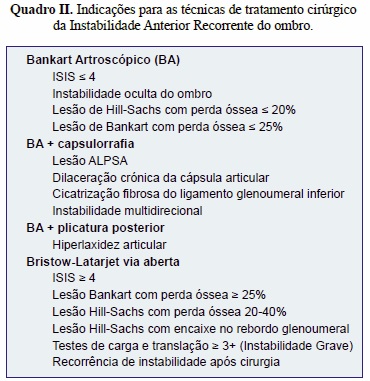
<body><![CDATA[<p>Com o objetivo de apresentar indica&ccedil;&otilde;es espec&iacute;ficas para a escolha da t&eacute;cnica de Bankart artrosc&oacute;pica, foram estabelecidos os crit&eacute;rios ISIS (Instability Severity Index Score) [58], que se revelaram fi&aacute;veis nos seus resultados iniciais, uma vez que a sua aplica&ccedil;&atilde;o revelou uma baixa recidiva (3,2%) nos pacientes selecionados para a repara&ccedil;&atilde;o de Bankart artrosc&oacute;pica, assim como elevados valores de satisfa&ccedil;&atilde;o subjetiva do paciente, como avaliado pelas escalas de Rowe e Walch-Duplay[15].</p>
    <p>Os crit&eacute;rios ISIS consistem num sistema de pontua&ccedil;&atilde;o com um valor m&aacute;ximo de 10 pontos, conferidos pela presen&ccedil;a de determinados fatores. Os dados da hist&oacute;ria e exame f&iacute;sico consistem em: idade na altura da cirurgia, n&iacute;vel de atividade f&iacute;sica, tipo de desporto praticado antes da cirurgia e hiperlaxidez do ombro (definida pela rota&ccedil;&atilde;o externa superior a 85&ordm; com o cotovelo encostado ao corpo e/ ou teste de hiperabdu&ccedil;&atilde;o maior que 90&ordm;). Os achados imagiol&oacute;gicos relevantes s&atilde;o a presen&ccedil;a de les&atilde;o de Hill-Sachs no RX e perda do contorno &oacute;sseo subcondral (<a name="topq1"></a><a href="#q1">Quadro I</a>) [58]. Inicialmente, a atribui&ccedil;&atilde;o de um score superior a 6 valores recomendava a op&ccedil;&atilde;o por uma t&eacute;cnica de reconstru&ccedil;&atilde;o n&atilde;o-anat&oacute;mica, nomeadamente a transfer&ecirc;ncia de coracoide de Bristow-Latarjet, uma vez que, nestes casos, a simples reconstru&ccedil;&atilde;o dos tecidos moles parece insuficiente para assegurar a estabilidade articular sem recidivas. Esta indica&ccedil;&atilde;o foi posteriormente adaptada e o estudo de Thomazeau et al, publicado em 2010 demonstrou excelentes resultados ao atribuir a via artrosc&oacute;pica a pacientes com ISIS &le; 4 e a t&eacute;cnica de Bristow-Latarjet nos restantes[15].</p>    <p>&nbsp;</p><a name="q1"></a>     <p>    <center><img src="/img/revistas/rpot/v21n3/21n3a04q1.jpg" width="372" height="358" border="0" /></center></p>    
<p>&nbsp;</p>
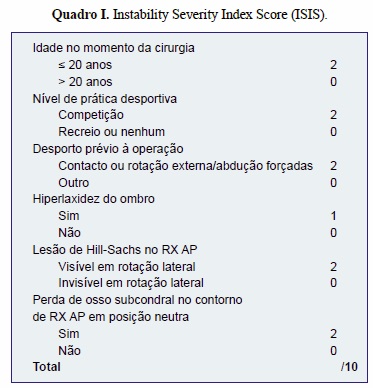
    <p>No entanto, fazendo uma an&aacute;lise atenta da literatura, parece ser poss&iacute;vel identificar algum consenso entre os artigos de revis&atilde;o, permitindo reunir indica&ccedil;&otilde;es complementares &agrave;quelas dos crit&eacute;rios ISIS, e que est&atilde;o resumidas no <a name="topq1"></a><a href="#q2">Quadro II</a>. Assim, a reconstru&ccedil;&atilde;o de Bankart artrosc&oacute;pica deve ser utilizada em pacientes que apresentem instabilidade oculta do ombro (vide-supra) [4], les&otilde;es de Hill-Sachs com perda &oacute;ssea quantificada como inferior a 20%[21,24,59-61] e les&otilde;es de Bankart &oacute;sseas com perda &oacute;ssea inferior a 25% da largura glenoidal, sendo que neste caso, &eacute; necess&aacute;ria a reintegra&ccedil;&atilde;o do fragmento &oacute;sseo original. Caso contr&aacute;rio a reconstru&ccedil;&atilde;o n&atilde;o-anat&oacute;mica &eacute; a mais recomendada[6].</p>    <p>&nbsp;</p><a name="q2"></a>     <p>    <center><img src="/img/revistas/rpot/v21n3/21n3a04q2.jpg" width="372" height="358" border="0" /></center></p>    
]]></body>
<body><![CDATA[<p>&nbsp;</p>
    <p>Existem outras situa&ccedil;&otilde;es onde a reconstru&ccedil;&atilde;o de Bankart necessita ser complementada com uma capsulorrafia de Neer (&ldquo;Neer capsular shift&rdquo;). Nestas incluem-se:<br />1) as les&otilde;es ALPSA (suprarreferidas), com mobiliza&ccedil;&atilde;o do tecido do colo glenoidal, convertendo a les&atilde;o num &ldquo;Bankart t&iacute;pico&rdquo;, e posterior reconstru&ccedil;&atilde;o e capsulorrafia[16].<br />2) a dilacera&ccedil;&atilde;o cr&oacute;nica da c&aacute;psula ou a cicatriza&ccedil;&atilde;o fibrosa do ligamento glenoumeral inferior[4];<br />3) instabilidade multidirecional[2].<br />Como j&aacute; referido neste artigo, a resolu&ccedil;&atilde;o do problema da distens&atilde;o posterior da c&aacute;psula aquando da sua luxa&ccedil;&atilde;o anterior passa pela utiliza&ccedil;&atilde;o da t&eacute;cnica de plicatura posterior, como complemento &agrave; t&eacute;cnica de Bankart, por via artrosc&oacute;pica. Estudos efetuados mostram uma melhoria dos scores subjetivos &ndash; ASES &ndash; mas carecem ainda de mais evid&ecirc;ncia que o comprovem de forma categ&oacute;rica[34].</p>
    <p>N&atilde;o obstante um alargado leque de recomenda&ccedil;&otilde;es que aconselham quais os pacientes a incluir numa repara&ccedil;&atilde;o anat&oacute;mica, as t&eacute;cnicas de &ldquo;batente &oacute;sseo&rdquo; &ndash; Bristow e Latarjet &ndash; s&atilde;o tamb&eacute;m bastante relevantes.</p>
    <p>O ISIS aponta o recurso a estas t&eacute;cnicas caso se verifique um score superior a 4[15]. Complementarmente, as revis&otilde;es efetuadas neste &acirc;mbito quantificam as perdas &oacute;sseas que justifiquem esta interven&ccedil;&atilde;o e acrescentam algumas indica&ccedil;&otilde;es:<br />1) perda &oacute;ssea glenoidal superior a 25% (aspeto da &ldquo;pera invertida) [8];<br />2) les&otilde;es de Hill-Sachs com perda &oacute;ssea entre 20- 40% ou &ldquo;engaging&rdquo; [8, 52];<br />3) les&otilde;es &oacute;sseas glenoidais e umerais conjuntas[52]; 4) recidiva da instabilidade, mesmo ap&oacute;s cirurgia artrosc&oacute;pica[20].<br />Relativamente &agrave;s les&otilde;es de Hill-Sachs, a literatura mais recente aconselha que nas situa&ccedil;&otilde;es em que se verifique uma perda &oacute;ssea de 20-40% se complemente a t&eacute;cnica de Bristow-Latarjet com uma &ldquo;remplissage&rdquo; efetuada artroscopicamente, ou atrav&eacute;s do preenchimento da les&atilde;o com auto ou aloenxertos[8,10,38,62,63]. As perdas &oacute;sseas superiores a 40%, s&atilde;o de dif&iacute;cil solu&ccedil;&atilde;o, podendo ser ponderada a realiza&ccedil;&atilde;o de uma hemi-artroplastia[6,8].</p></font>    <p>&nbsp;</p>    <p><b><font face="Verdana" size="2">CONCLUSÃO</font></b></p><font face="verdana" size="2">    <p>A Instabilidade Anterior Recorrente do Ombro &eacute; um problema comum e alvo de grande investiga&ccedil;&atilde;o. De facto, a sua abordagem cir&uacute;rgica &eacute; um tema vasto e controverso, existindo um sem n&uacute;mero de estudos sobre o assunto. No entanto, da an&aacute;lise objetiva destas publica&ccedil;&otilde;es resulta que a maior parte destas se tratam de estudos retrospetivos com muitas falhas metodol&oacute;gicas, que tornam dif&iacute;cil a sua compara&ccedil;&atilde;o e extrapola&ccedil;&atilde;o de resultados.</p>
    <p>Desta forma, a pesquisa bibliogr&aacute;fica teve de ser efetuada criteriosamente, atentando aos m&eacute;todos utilizados e analisando criticamente as conclus&otilde;es apresentadas.</p>
    <p>A mais-valia desta revis&atilde;o &eacute; a compila&ccedil;&atilde;o num s&oacute; artigo de informa&ccedil;&atilde;o recente no que concerne &agrave;s indica&ccedil;&otilde;es para a abordagem cir&uacute;rgica da instabilidade anterior do ombro. De facto, existem j&aacute; evid&ecirc;ncias que recomendam a cirurgia de Bankart artrosc&oacute;pica para determinados subgrupos de doentes, com resultados iguais ou superiores &agrave; cirurgia com recurso a batente &oacute;sseo, aos quais se juntam as vantagens da abordagem mini-invasiva da artroscopia. Para al&eacute;m disso, neste artigo tamb&eacute;m se conclu&iacute;ram quais as les&otilde;es que devem ser encaminhadas diretamente para uma interven&ccedil;&atilde;o de reconstru&ccedil;&atilde;o n&atilde;o-anat&oacute;mica - Bristow-Latarjet - esclarecendo assim o papel de ambas as abordagens para a obten&ccedil;&atilde;o dos melhores resultados, suportados pelas evid&ecirc;ncias cient&iacute;ficas. Percebe-se assim a import&acirc;ncia da correta avalia&ccedil;&atilde;o pr&eacute;operat&oacute;ria na defini&ccedil;&atilde;o do tipo de abordagem a efetuar. Com o aprimoramento dos sistemas de classifica&ccedil;&atilde;o como o ISIS, poderemos assistir a uma melhoria ainda maior dos resultados dos procedimentos artrosc&oacute;picos, como se depreende dos estudos efetuados para definir estes valores de &ldquo;cut-off&rdquo;, e assim potenciar as vantagens da cirurgia artrosc&oacute;pica com um menor n&uacute;mero de recidivas &ndash; escolher o procedimento certo, para o paciente certo. Desta forma, assistimos a uma mudan&ccedil;a do paradigma de controv&eacute;rsia de cirurgia aberta ou artrosc&oacute;pica, para uma dicotomia entre reconstru&ccedil;&atilde;o anat&oacute;mica ou de batente &oacute;sseo, com o eventual recurso, em ambas, &agrave; abordagem artrosc&oacute;pica.</p>
    <p>Em suma, &eacute; atualmente poss&iacute;vel identificar crit&eacute;rios cl&iacute;nicos e imagiol&oacute;gicos objetivos que permitam selecionar uma abordagem cir&uacute;rgica para cada situa&ccedil;&atilde;o de instabilidade anterior recorrente do ombro, no sentido de maximizar os resultados e satisfa&ccedil;&atilde;o dos pacientes.</p>
    ]]></body>
<body><![CDATA[<p>Importa salientar que &eacute; ainda necess&aacute;ria uma maior uniformiza&ccedil;&atilde;o no desenho dos estudos neste campo, para que da sua compara&ccedil;&atilde;o seja poss&iacute;vel extrair n&iacute;veis m&aacute;ximos de evid&ecirc;ncia.</p></font>    <p>&nbsp;</p>    <p><b><font face="Verdana" size="2">REFERÊNCIAS BIBLIOGRÁFICAS</font></b></p>    <!-- ref --><p><font face="verdana" size="2">1. Prescher A. Anatomical basics, variations, and degenerative changes of the shoulder joint and shoulder girdle. European journal of radiology. 2000; 35: 88-102</font>&nbsp;&nbsp;&nbsp;&nbsp;&nbsp;&nbsp;&nbsp;&nbsp;[&#160;<a href="javascript:void(0);" onclick="javascript: window.open('/scielo.php?script=sci_nlinks&ref=000086&pid=S1646-2122201300030000500001&lng=','','width=640,height=500,resizable=yes,scrollbars=1,menubar=yes,');">Links</a>&#160;]<!-- end-ref --><!-- ref --><p><font face="verdana" size="2">2. Wen D. Y.. Current concepts in the treatment of anterior shoulder dislocations. The American journal of emergency medicine. 1999; 17: 401-407</font>&nbsp;&nbsp;&nbsp;&nbsp;&nbsp;&nbsp;&nbsp;&nbsp;[&#160;<a href="javascript:void(0);" onclick="javascript: window.open('/scielo.php?script=sci_nlinks&ref=000087&pid=S1646-2122201300030000500002&lng=','','width=640,height=500,resizable=yes,scrollbars=1,menubar=yes,');">Links</a>&#160;]<!-- end-ref --><!-- ref --><p><font face="verdana" size="2">3. Chalidis B.. Has the management of shoulder dislocation changed over time?. International orthopaedics. 2007; 31: 385-389</font>&nbsp;&nbsp;&nbsp;&nbsp;&nbsp;&nbsp;&nbsp;&nbsp;[&#160;<a href="javascript:void(0);" onclick="javascript: window.open('/scielo.php?script=sci_nlinks&ref=000088&pid=S1646-2122201300030000500003&lng=','','width=640,height=500,resizable=yes,scrollbars=1,menubar=yes,');">Links</a>&#160;]<!-- end-ref --><!-- ref --><p><font face="verdana" size="2">4. Blum A., Coudane H., Molé D.. Gleno-humeral instabilities. European radiology. 2000; 10: 63-82</font>&nbsp;&nbsp;&nbsp;&nbsp;&nbsp;&nbsp;&nbsp;&nbsp;[&#160;<a href="javascript:void(0);" onclick="javascript: window.open('/scielo.php?script=sci_nlinks&ref=000089&pid=S1646-2122201300030000500004&lng=','','width=640,height=500,resizable=yes,scrollbars=1,menubar=yes,');">Links</a>&#160;]<!-- end-ref --><!-- ref --><p><font face="verdana" size="2">5. Rowe C. R.. Acute and recurrent anterior dislocations of the shoulder. The Orthopedic clinics of North America. 1980; 11: 253-270</font>&nbsp;&nbsp;&nbsp;&nbsp;&nbsp;&nbsp;&nbsp;&nbsp;[&#160;<a href="javascript:void(0);" onclick="javascript: window.open('/scielo.php?script=sci_nlinks&ref=000090&pid=S1646-2122201300030000500005&lng=','','width=640,height=500,resizable=yes,scrollbars=1,menubar=yes,');">Links</a>&#160;]<!-- end-ref --><!-- ref --><p><font face="verdana" size="2">6. Lynch J. R., Clinton J. M., Dewing C. B., Warme W. J., Matsen F. A.. Treatment of osseous defects associated with anterior shoulder instability. Journal of shoulder and elbow surgery / American Shoulder and Elbow Surgeons. 18: 317-328</font>&nbsp;&nbsp;&nbsp;&nbsp;&nbsp;&nbsp;&nbsp;&nbsp;[&#160;<a href="javascript:void(0);" onclick="javascript: window.open('/scielo.php?script=sci_nlinks&ref=000091&pid=S1646-2122201300030000500006&lng=','','width=640,height=500,resizable=yes,scrollbars=1,menubar=yes,');">Links</a>&#160;]<!-- end-ref --><!-- ref --><p><font face="verdana" size="2">7. HALL R. H., ISAAC F., BOOTH C. R.. Dislocations of the shoulder with special reference to accompanying small fractures. The Journal of bone and joint surgery American. 1959; 41-A: 489-494</font>&nbsp;&nbsp;&nbsp;&nbsp;&nbsp;&nbsp;&nbsp;&nbsp;[&#160;<a href="javascript:void(0);" onclick="javascript: window.open('/scielo.php?script=sci_nlinks&ref=000092&pid=S1646-2122201300030000500007&lng=','','width=640,height=500,resizable=yes,scrollbars=1,menubar=yes,');">Links</a>&#160;]<!-- end-ref --><!-- ref --><p><font face="verdana" size="2">8. Bollier M. J., Arciero R.. Management of glenoid and humeral bone loss. Sports medicine and arthroscopy review. 2010; 18: 140-148</font>&nbsp;&nbsp;&nbsp;&nbsp;&nbsp;&nbsp;&nbsp;&nbsp;[&#160;<a href="javascript:void(0);" onclick="javascript: window.open('/scielo.php?script=sci_nlinks&ref=000093&pid=S1646-2122201300030000500008&lng=','','width=640,height=500,resizable=yes,scrollbars=1,menubar=yes,');">Links</a>&#160;]<!-- end-ref --><!-- ref --><p><font face="verdana" size="2">9. Piasecki D. P.. Glenoid bone deficiency in recurrent anterior shoulder instability: diagnosis and management. The Journal of the American Academy of Orthopaedic Surgeons. 2009; 17: 482-493</font>&nbsp;&nbsp;&nbsp;&nbsp;&nbsp;&nbsp;&nbsp;&nbsp;[&#160;<a href="javascript:void(0);" onclick="javascript: window.open('/scielo.php?script=sci_nlinks&ref=000094&pid=S1646-2122201300030000500009&lng=','','width=640,height=500,resizable=yes,scrollbars=1,menubar=yes,');">Links</a>&#160;]<!-- end-ref --><!-- ref --><p><font face="verdana" size="2">10. Bushnell B. D., Creighton R. A., Herring M. M.. Bony instability of the shoulder. Arthroscopy : the journal of arthroscopic & related surgery : official publication of the Arthroscopy Association of North America and the International Arthroscopy Association. 2008; 24: 1061-1073</font>&nbsp;&nbsp;&nbsp;&nbsp;&nbsp;&nbsp;&nbsp;&nbsp;[&#160;<a href="javascript:void(0);" onclick="javascript: window.open('/scielo.php?script=sci_nlinks&ref=000095&pid=S1646-2122201300030000500010&lng=','','width=640,height=500,resizable=yes,scrollbars=1,menubar=yes,');">Links</a>&#160;]<!-- end-ref --><!-- ref --><p><font face="verdana" size="2">11. Chuang T.-Y., Adams C. R., Burkhart S. S.. Use of preoperative three-dimensional computed tomography to quantify glenoid bone loss in shoulder instability. Arthroscopy : the journal of arthroscopic & related surgery : official publication of the Arthroscopy Association of North America and the International Arthroscopy Association. 2008; 24: 376-382</font>&nbsp;&nbsp;&nbsp;&nbsp;&nbsp;&nbsp;&nbsp;&nbsp;[&#160;<a href="javascript:void(0);" onclick="javascript: window.open('/scielo.php?script=sci_nlinks&ref=000096&pid=S1646-2122201300030000500011&lng=','','width=640,height=500,resizable=yes,scrollbars=1,menubar=yes,');">Links</a>&#160;]<!-- end-ref --><!-- ref --><p><font face="verdana" size="2">12. Provencher M. T.. Recurrent shoulder instability: current concepts for evaluation and management of glenoid bone loss. The Journal of bone and joint surgery American. 2010; 92 (2): 133-51</font>&nbsp;&nbsp;&nbsp;&nbsp;&nbsp;&nbsp;&nbsp;&nbsp;[&#160;<a href="javascript:void(0);" onclick="javascript: window.open('/scielo.php?script=sci_nlinks&ref=000097&pid=S1646-2122201300030000500012&lng=','','width=640,height=500,resizable=yes,scrollbars=1,menubar=yes,');">Links</a>&#160;]<!-- end-ref --><!-- ref --><p><font face="verdana" size="2">13. Gerber C., Nyffeler R. W.. Classification of glenohumeral joint instability. Clinical orthopaedics and related research. 2002; : 65-76</font>&nbsp;&nbsp;&nbsp;&nbsp;&nbsp;&nbsp;&nbsp;&nbsp;[&#160;<a href="javascript:void(0);" onclick="javascript: window.open('/scielo.php?script=sci_nlinks&ref=000098&pid=S1646-2122201300030000500013&lng=','','width=640,height=500,resizable=yes,scrollbars=1,menubar=yes,');">Links</a>&#160;]<!-- end-ref --><!-- ref --><p><font face="verdana" size="2">14. Steinbach L. S.. MRI of shoulder instability. European journal of radiology. 2008; 68: 57-71</font>&nbsp;&nbsp;&nbsp;&nbsp;&nbsp;&nbsp;&nbsp;&nbsp;[&#160;<a href="javascript:void(0);" onclick="javascript: window.open('/scielo.php?script=sci_nlinks&ref=000099&pid=S1646-2122201300030000500014&lng=','','width=640,height=500,resizable=yes,scrollbars=1,menubar=yes,');">Links</a>&#160;]<!-- end-ref --><!-- ref --><p><font face="verdana" size="2">15. Thomazeau H.. Can we improve the indication for Bankart arthroscopic repair? A preliminary clinical study using the ISIS score. Orthopaedics & traumatology, surgery & research : OTSR. 2010; 96: 77-83</font>&nbsp;&nbsp;&nbsp;&nbsp;&nbsp;&nbsp;&nbsp;&nbsp;[&#160;<a href="javascript:void(0);" onclick="javascript: window.open('/scielo.php?script=sci_nlinks&ref=000100&pid=S1646-2122201300030000500015&lng=','','width=640,height=500,resizable=yes,scrollbars=1,menubar=yes,');">Links</a>&#160;]<!-- end-ref --><!-- ref --><p><font face="verdana" size="2">16. Neviaser T. J.. The anterior labroligamentous periosteal sleeve avulsion lesion: a cause of anterior instability of the shoulder. Arthroscopy : the journal of arthroscopic & related surgery : official publication of the Arthroscopy Association of North America and the International Arthroscopy Association. 1993; 9: 17-21</font>&nbsp;&nbsp;&nbsp;&nbsp;&nbsp;&nbsp;&nbsp;&nbsp;[&#160;<a href="javascript:void(0);" onclick="javascript: window.open('/scielo.php?script=sci_nlinks&ref=000101&pid=S1646-2122201300030000500016&lng=','','width=640,height=500,resizable=yes,scrollbars=1,menubar=yes,');">Links</a>&#160;]<!-- end-ref --><!-- ref --><p><font face="verdana" size="2">17. Rowe C. R., Patel D., Southmayd W. W.. The Bankart procedure: a long-term end-result study. The Journal of bone and joint surgery American. 1978; 60: 1-16</font>&nbsp;&nbsp;&nbsp;&nbsp;&nbsp;&nbsp;&nbsp;&nbsp;[&#160;<a href="javascript:void(0);" onclick="javascript: window.open('/scielo.php?script=sci_nlinks&ref=000102&pid=S1646-2122201300030000500017&lng=','','width=640,height=500,resizable=yes,scrollbars=1,menubar=yes,');">Links</a>&#160;]<!-- end-ref --><!-- ref --><p><font face="verdana" size="2">18. Urayama M., Itoi E., Sashi R., Minagawa H., Sato K.. Capsular elongation in shoulders with recurrent anterior dislocation. Quantitative assessment with magnetic resonance arthrography. The American journal of sports medicine. 31: 64-67</font>&nbsp;&nbsp;&nbsp;&nbsp;&nbsp;&nbsp;&nbsp;&nbsp;[&#160;<a href="javascript:void(0);" onclick="javascript: window.open('/scielo.php?script=sci_nlinks&ref=000103&pid=S1646-2122201300030000500018&lng=','','width=640,height=500,resizable=yes,scrollbars=1,menubar=yes,');">Links</a>&#160;]<!-- end-ref --><!-- ref --><p><font face="verdana" size="2">19. Rockwood Charles A, Jr., Matsen Frederick A, III, Wirth Michael A., Lippit Steven B., Fehringer Edward V., Sperling J. W.. Rockwood: The Shoulder. Philadelphia: Saunders Elsevier; 2009.    &nbsp;&nbsp;&nbsp;&nbsp;&nbsp;&nbsp;&nbsp;&nbsp;[&#160;<a href="javascript:void(0);" onclick="javascript: window.open('/scielo.php?script=sci_nlinks&ref=000104&pid=S1646-2122201300030000500019&lng=','','width=640,height=500,resizable=yes,scrollbars=1,menubar=yes,');">Links</a>&#160;]<!-- end-ref --> </font></p>    <!-- ref --><p><font face="verdana" size="2">20. Pope E. J., Ward J. P., Rokito A. S.. Anterior shoulder instability - a history of arthroscopic treatment. Bulletin of the NYU hospital for joint diseases. 2011; 69: 44-49</font>&nbsp;&nbsp;&nbsp;&nbsp;&nbsp;&nbsp;&nbsp;&nbsp;[&#160;<a href="javascript:void(0);" onclick="javascript: window.open('/scielo.php?script=sci_nlinks&ref=000106&pid=S1646-2122201300030000500020&lng=','','width=640,height=500,resizable=yes,scrollbars=1,menubar=yes,');">Links</a>&#160;]<!-- end-ref --><!-- ref --><p><font face="verdana" size="2">21. Boileau P.. Risk factors for recurrence of shoulder instability after arthroscopic Bankart repair. The Journal of bone and joint surgery. American volume. 2006; 88: 1755-1763</font>&nbsp;&nbsp;&nbsp;&nbsp;&nbsp;&nbsp;&nbsp;&nbsp;[&#160;<a href="javascript:void(0);" onclick="javascript: window.open('/scielo.php?script=sci_nlinks&ref=000107&pid=S1646-2122201300030000500021&lng=','','width=640,height=500,resizable=yes,scrollbars=1,menubar=yes,');">Links</a>&#160;]<!-- end-ref --><!-- ref --><p><font face="verdana" size="2">22. Chen A. L., Hunt S. A., Hawkins R. J., Zuckerman J. D.. Management of bone loss associated with recurrent anterior glenohumeral instability. The American journal of sports medicine. 2005; 33: 912-925</font>&nbsp;&nbsp;&nbsp;&nbsp;&nbsp;&nbsp;&nbsp;&nbsp;[&#160;<a href="javascript:void(0);" onclick="javascript: window.open('/scielo.php?script=sci_nlinks&ref=000108&pid=S1646-2122201300030000500022&lng=','','width=640,height=500,resizable=yes,scrollbars=1,menubar=yes,');">Links</a>&#160;]<!-- end-ref --><!-- ref --><p><font face="verdana" size="2">23. Taylor D. C., Arciero R. A.. Pathologic changes associated with shoulder dislocations. Arthroscopic and physical examination findings in first-time, traumatic anterior dislocations. The American journal of sports medicine. 25: 306-311</font>&nbsp;&nbsp;&nbsp;&nbsp;&nbsp;&nbsp;&nbsp;&nbsp;[&#160;<a href="javascript:void(0);" onclick="javascript: window.open('/scielo.php?script=sci_nlinks&ref=000109&pid=S1646-2122201300030000500023&lng=','','width=640,height=500,resizable=yes,scrollbars=1,menubar=yes,');">Links</a>&#160;]<!-- end-ref --><p><font face="verdana" size="2">24. Burkhart S. S., De Beer J. F.. Traumatic glenohumeral bone defects and their relationship to failure of arthroscopic Bankart repairs: significance of the inverted-pear glenoid and the humeral engaging Hill-Sachs lesion. Arthroscopy : the journal of arthroscopic & related surgery : official publication of the Arthroscopy Association of North America and the International Arthroscopy Association. 2000; 16: 677-694</font></p>    <!-- ref --><p><font face="verdana" size="2">25. Bigliani L. U.. Tensile properties of the inferior glenohumeral ligament. Journal of orthopaedic research : official publication of the Orthopaedic Research Society. 1992; 10: 187-197</font>&nbsp;&nbsp;&nbsp;&nbsp;&nbsp;&nbsp;&nbsp;&nbsp;[&#160;<a href="javascript:void(0);" onclick="javascript: window.open('/scielo.php?script=sci_nlinks&ref=000111&pid=S1646-2122201300030000500025&lng=','','width=640,height=500,resizable=yes,scrollbars=1,menubar=yes,');">Links</a>&#160;]<!-- end-ref --><!-- ref --><p><font face="verdana" size="2">26. Speer K. P.. Biomechanical evaluation of a simulated Bankart lesion. The Journal of bone and joint surgery. American volume. 1994; 76: 1819-1826</font>&nbsp;&nbsp;&nbsp;&nbsp;&nbsp;&nbsp;&nbsp;&nbsp;[&#160;<a href="javascript:void(0);" onclick="javascript: window.open('/scielo.php?script=sci_nlinks&ref=000112&pid=S1646-2122201300030000500026&lng=','','width=640,height=500,resizable=yes,scrollbars=1,menubar=yes,');">Links</a>&#160;]<!-- end-ref --><!-- ref --><p><font face="verdana" size="2">27. Matsen F. A., Chebli C., Lippitt S.. Principles for the evaluation and management of shoulder instability. The Journal of bone and joint surgery. American volume. 2006; 88: 648-659</font>&nbsp;&nbsp;&nbsp;&nbsp;&nbsp;&nbsp;&nbsp;&nbsp;[&#160;<a href="javascript:void(0);" onclick="javascript: window.open('/scielo.php?script=sci_nlinks&ref=000113&pid=S1646-2122201300030000500027&lng=','','width=640,height=500,resizable=yes,scrollbars=1,menubar=yes,');">Links</a>&#160;]<!-- end-ref --><!-- ref --><p><font face="verdana" size="2">28. Munro W., Healy R.. The validity and accuracy of clinical tests used to detect labral pathology of the shoulder - a systematic review. Manual therapy. 2009; 14: 119-130</font>&nbsp;&nbsp;&nbsp;&nbsp;&nbsp;&nbsp;&nbsp;&nbsp;[&#160;<a href="javascript:void(0);" onclick="javascript: window.open('/scielo.php?script=sci_nlinks&ref=000114&pid=S1646-2122201300030000500028&lng=','','width=640,height=500,resizable=yes,scrollbars=1,menubar=yes,');">Links</a>&#160;]<!-- end-ref --><!-- ref --><p><font face="verdana" size="2">29. Bankart A. S.. RECURRENTOR HABITUAL DISLOCATION OF THE SHOULDER-JOINT. British medical journal. 1923; 2: 1132-1133</font>&nbsp;&nbsp;&nbsp;&nbsp;&nbsp;&nbsp;&nbsp;&nbsp;[&#160;<a href="javascript:void(0);" onclick="javascript: window.open('/scielo.php?script=sci_nlinks&ref=000115&pid=S1646-2122201300030000500029&lng=','','width=640,height=500,resizable=yes,scrollbars=1,menubar=yes,');">Links</a>&#160;]<!-- end-ref --><!-- ref --><p><font face="verdana" size="2">30. Bankart A. S. B.. The pathology and treatment of recurrent dislocation of the shoulder-joint. British Journal of Surgery. 1938; 26: 23-29</font>&nbsp;&nbsp;&nbsp;&nbsp;&nbsp;&nbsp;&nbsp;&nbsp;[&#160;<a href="javascript:void(0);" onclick="javascript: window.open('/scielo.php?script=sci_nlinks&ref=000116&pid=S1646-2122201300030000500030&lng=','','width=640,height=500,resizable=yes,scrollbars=1,menubar=yes,');">Links</a>&#160;]<!-- end-ref --><!-- ref --><p><font face="verdana" size="2">31. Cole B. J., Insalata J. L., Irrgang J., Warner J. J. P.. Comparison of Arthroscopic and Open Anterior Shoulder Stabilization : A Two to Six-Year Follow-up Study Comparison of Arthroscopic and Open Anterior Shoulder Stabilization. 2011;    &nbsp;&nbsp;&nbsp;&nbsp;&nbsp;&nbsp;&nbsp;&nbsp;[&#160;<a href="javascript:void(0);" onclick="javascript: window.open('/scielo.php?script=sci_nlinks&ref=000117&pid=S1646-2122201300030000500031&lng=','','width=640,height=500,resizable=yes,scrollbars=1,menubar=yes,');">Links</a>&#160;]<!-- end-ref --> </font></p>    <!-- ref --><p><font face="verdana" size="2">32. Mahiro&#287;ullar&#305; M.. Comparison between the results of open and arthroscopic repair of isolated traumatic anterior instability of the shoulder. Acta orthopaedica et traumatologica turcica. 2010; 44: 180-185</font>&nbsp;&nbsp;&nbsp;&nbsp;&nbsp;&nbsp;&nbsp;&nbsp;[&#160;<a href="javascript:void(0);" onclick="javascript: window.open('/scielo.php?script=sci_nlinks&ref=000119&pid=S1646-2122201300030000500032&lng=','','width=640,height=500,resizable=yes,scrollbars=1,menubar=yes,');">Links</a>&#160;]<!-- end-ref --><!-- ref --><p><font face="verdana" size="2">33. Neer C. S., Foster C. R.. Inferior capsular shift for involuntary inferior and multidirectional instability of the shoulder. A preliminary report. The Journal of bone and joint surgery. American volume. 1980; 62: 897-908</font>&nbsp;&nbsp;&nbsp;&nbsp;&nbsp;&nbsp;&nbsp;&nbsp;[&#160;<a href="javascript:void(0);" onclick="javascript: window.open('/scielo.php?script=sci_nlinks&ref=000120&pid=S1646-2122201300030000500033&lng=','','width=640,height=500,resizable=yes,scrollbars=1,menubar=yes,');">Links</a>&#160;]<!-- end-ref --><!-- ref --><p><font face="verdana" size="2">34. Westerheide K. J., Dopirak R. M., Snyder S. J.. Arthroscopic anterior stabilization and posterior capsular plication for anterior glenohumeral instability: a report of 71 cases. Arthroscopy : the journal of arthroscopic & related surgery : official publication of the Arthroscopy Association of North America and the International Arthroscopy Association. 2006; 22: 539-547</font>&nbsp;&nbsp;&nbsp;&nbsp;&nbsp;&nbsp;&nbsp;&nbsp;[&#160;<a href="javascript:void(0);" onclick="javascript: window.open('/scielo.php?script=sci_nlinks&ref=000121&pid=S1646-2122201300030000500034&lng=','','width=640,height=500,resizable=yes,scrollbars=1,menubar=yes,');">Links</a>&#160;]<!-- end-ref --><!-- ref --><p><font face="verdana" size="2">35. HELFET A. J.. Coracoid transplantation for recurring dislocation of the shoulder. The Journal of bone and joint surgery. British volume. 1958; 40-B: 198-202</font>&nbsp;&nbsp;&nbsp;&nbsp;&nbsp;&nbsp;&nbsp;&nbsp;[&#160;<a href="javascript:void(0);" onclick="javascript: window.open('/scielo.php?script=sci_nlinks&ref=000122&pid=S1646-2122201300030000500035&lng=','','width=640,height=500,resizable=yes,scrollbars=1,menubar=yes,');">Links</a>&#160;]<!-- end-ref --><!-- ref --><p><font face="verdana" size="2">36. Lafosse L., Boyle S.. Arthroscopic Latarjet procedure. Journal of shoulder and elbow surgery / American Shoulder and Elbow Surgeons. 2010; 19: 2-12</font>&nbsp;&nbsp;&nbsp;&nbsp;&nbsp;&nbsp;&nbsp;&nbsp;[&#160;<a href="javascript:void(0);" onclick="javascript: window.open('/scielo.php?script=sci_nlinks&ref=000123&pid=S1646-2122201300030000500036&lng=','','width=640,height=500,resizable=yes,scrollbars=1,menubar=yes,');">Links</a>&#160;]<!-- end-ref --><!-- ref --><p><font face="verdana" size="2">37. Taverna E., Golanò P., Pascale V., Battistella F.. An arthroscopic bone graft procedure for treating anterior-inferior glenohumeral instability. Knee surgery, sports traumatology, arthroscopy : official journal of the ESSKA. 2008; 16: 872-875</font>&nbsp;&nbsp;&nbsp;&nbsp;&nbsp;&nbsp;&nbsp;&nbsp;[&#160;<a href="javascript:void(0);" onclick="javascript: window.open('/scielo.php?script=sci_nlinks&ref=000124&pid=S1646-2122201300030000500037&lng=','','width=640,height=500,resizable=yes,scrollbars=1,menubar=yes,');">Links</a>&#160;]<!-- end-ref --><!-- ref --><p><font face="verdana" size="2">38. Purchase R. J., Wolf E. M., Hobgood E. R., Pollock M. E., Smalley C. C.. Hill-sachs "remplissage": an arthroscopic solution for the engaging hill-sachs lesion. Arthroscopy : the journal of arthroscopic & related surgery : official publication of the Arthroscopy Association of North America and the International Arthroscopy Association. 2008; 24: 723-726</font>&nbsp;&nbsp;&nbsp;&nbsp;&nbsp;&nbsp;&nbsp;&nbsp;[&#160;<a href="javascript:void(0);" onclick="javascript: window.open('/scielo.php?script=sci_nlinks&ref=000125&pid=S1646-2122201300030000500038&lng=','','width=640,height=500,resizable=yes,scrollbars=1,menubar=yes,');">Links</a>&#160;]<!-- end-ref --><!-- ref --><p><font face="verdana" size="2">39. Leach R. E., Corbett M., Schepsis A., Stockel J.. Results of a modified Putti-Platt operation for recurrent shoulder dislocations and subluxations. Clinical orthopaedics and related research. 1982; : 20-5</font>&nbsp;&nbsp;&nbsp;&nbsp;&nbsp;&nbsp;&nbsp;&nbsp;[&#160;<a href="javascript:void(0);" onclick="javascript: window.open('/scielo.php?script=sci_nlinks&ref=000126&pid=S1646-2122201300030000500039&lng=','','width=640,height=500,resizable=yes,scrollbars=1,menubar=yes,');">Links</a>&#160;]<!-- end-ref --><!-- ref --><p><font face="verdana" size="2">40. Collins K. A., Capito C., Cross M.. The use of the Putti-Platt procedure in the treatment of recurrent anterior dislocation. With special reference to the young athlete. The American journal of sports medicine. 14: 380-382</font>&nbsp;&nbsp;&nbsp;&nbsp;&nbsp;&nbsp;&nbsp;&nbsp;[&#160;<a href="javascript:void(0);" onclick="javascript: window.open('/scielo.php?script=sci_nlinks&ref=000127&pid=S1646-2122201300030000500040&lng=','','width=640,height=500,resizable=yes,scrollbars=1,menubar=yes,');">Links</a>&#160;]<!-- end-ref --><!-- ref --><p><font face="verdana" size="2">41. Fredriksson A. S., Tegner Y.. Results of the Putti-Platt operation for recurrent anterior dislocation of the shoulder. International orthopaedics. 1991; 15: 185-188</font>&nbsp;&nbsp;&nbsp;&nbsp;&nbsp;&nbsp;&nbsp;&nbsp;[&#160;<a href="javascript:void(0);" onclick="javascript: window.open('/scielo.php?script=sci_nlinks&ref=000128&pid=S1646-2122201300030000500041&lng=','','width=640,height=500,resizable=yes,scrollbars=1,menubar=yes,');">Links</a>&#160;]<!-- end-ref --><!-- ref --><p><font face="verdana" size="2">42. Hawkins R. J., Angelo R. L.. Glenohumeral osteoarthrosis. A late complication of the Putti-Platt repair. The Journal of bone and joint surgery. American volume. 1990; 72: 1193-1197</font>&nbsp;&nbsp;&nbsp;&nbsp;&nbsp;&nbsp;&nbsp;&nbsp;[&#160;<a href="javascript:void(0);" onclick="javascript: window.open('/scielo.php?script=sci_nlinks&ref=000129&pid=S1646-2122201300030000500042&lng=','','width=640,height=500,resizable=yes,scrollbars=1,menubar=yes,');">Links</a>&#160;]<!-- end-ref --><!-- ref --><p><font face="verdana" size="2">43. Hale J., Rokito A. S., Chu J.. Anterior capsulolabral reconstruction for traumatic recurrent anterior shoulder dislocation. Bulletin (Hospital for Joint Diseases (New York, N.Y.)). 2005; 62: 94-98</font>&nbsp;&nbsp;&nbsp;&nbsp;&nbsp;&nbsp;&nbsp;&nbsp;[&#160;<a href="javascript:void(0);" onclick="javascript: window.open('/scielo.php?script=sci_nlinks&ref=000130&pid=S1646-2122201300030000500043&lng=','','width=640,height=500,resizable=yes,scrollbars=1,menubar=yes,');">Links</a>&#160;]<!-- end-ref --><!-- ref --><p><font face="verdana" size="2">44. Spatschil A. Posttraumatic anterior-inferior instability of the shoulder: arthroscopic findings and clinical correlations. Archives of orthopaedic and trauma surgery. 2006; 126: 217-222</font>&nbsp;&nbsp;&nbsp;&nbsp;&nbsp;&nbsp;&nbsp;&nbsp;[&#160;<a href="javascript:void(0);" onclick="javascript: window.open('/scielo.php?script=sci_nlinks&ref=000131&pid=S1646-2122201300030000500044&lng=','','width=640,height=500,resizable=yes,scrollbars=1,menubar=yes,');">Links</a>&#160;]<!-- end-ref --><!-- ref --><p><font face="verdana" size="2">45. Boone J. L., Arciero R. A.. First-time anterior shoulder dislocations: has the standard changed?. British journal of sports medicine. 2010; 44: 355-360</font>&nbsp;&nbsp;&nbsp;&nbsp;&nbsp;&nbsp;&nbsp;&nbsp;[&#160;<a href="javascript:void(0);" onclick="javascript: window.open('/scielo.php?script=sci_nlinks&ref=000132&pid=S1646-2122201300030000500045&lng=','','width=640,height=500,resizable=yes,scrollbars=1,menubar=yes,');">Links</a>&#160;]<!-- end-ref --><p><font face="verdana" size="2">46. Kuhn J. E.. Treating the initial anterior shoulder dislocation- -an evidence-based medicine approach. Treating the initial anterior shoulder dislocation - an evidence-based medicine approach. 2006; 14: 192-198</font></p>    <!-- ref --><p><font face="verdana" size="2">47. Cole B. J., L'Insalata J., Warner J. J.. Comparison of arthroscopic and open anterior shoulder stabilization. A two to six-year follow-up study. The Journal of bone and joint surgery. American volume. 2000; 82-A: 1108-1114</font>&nbsp;&nbsp;&nbsp;&nbsp;&nbsp;&nbsp;&nbsp;&nbsp;[&#160;<a href="javascript:void(0);" onclick="javascript: window.open('/scielo.php?script=sci_nlinks&ref=000134&pid=S1646-2122201300030000500047&lng=','','width=640,height=500,resizable=yes,scrollbars=1,menubar=yes,');">Links</a>&#160;]<!-- end-ref --><!-- ref --><p><font face="verdana" size="2">48. Petrera M., Patella V., Patella S., Theodoropoulos J.. A meta-analysis of open versus arthroscopic Bankart repair using suture anchors. Knee surgery, sports traumatology, arthroscopy : official journal of the ESSKA. 2010; 18: 1742-1747</font>&nbsp;&nbsp;&nbsp;&nbsp;&nbsp;&nbsp;&nbsp;&nbsp;[&#160;<a href="javascript:void(0);" onclick="javascript: window.open('/scielo.php?script=sci_nlinks&ref=000135&pid=S1646-2122201300030000500048&lng=','','width=640,height=500,resizable=yes,scrollbars=1,menubar=yes,');">Links</a>&#160;]<!-- end-ref --><!-- ref --><p><font face="verdana" size="2">49. Porcellini G., Campi F., Paladini P.. Arthroscopic approach to acute bony Bankart lesion. Arthroscopy : the journal of arthroscopic & related surgery : official publication of the Arthroscopy Association of North America and the International Arthroscopy Association. 2002; 18: 764-769</font>&nbsp;&nbsp;&nbsp;&nbsp;&nbsp;&nbsp;&nbsp;&nbsp;[&#160;<a href="javascript:void(0);" onclick="javascript: window.open('/scielo.php?script=sci_nlinks&ref=000136&pid=S1646-2122201300030000500049&lng=','','width=640,height=500,resizable=yes,scrollbars=1,menubar=yes,');">Links</a>&#160;]<!-- end-ref --><!-- ref --><p><font face="verdana" size="2">50. Mologne T. S., Provencher M. T., Menzel K. A., Vachon T. A., Dewing C. B.. Arthroscopic stabilization in patients with an inverted pear glenoid: results in patients with bone loss of the anterior glenoid. The American journal of sports medicine. 2007; 35: 1276-1283</font>&nbsp;&nbsp;&nbsp;&nbsp;&nbsp;&nbsp;&nbsp;&nbsp;[&#160;<a href="javascript:void(0);" onclick="javascript: window.open('/scielo.php?script=sci_nlinks&ref=000137&pid=S1646-2122201300030000500050&lng=','','width=640,height=500,resizable=yes,scrollbars=1,menubar=yes,');">Links</a>&#160;]<!-- end-ref --><!-- ref --><p><font face="verdana" size="2">51. Lenters T. R., Franta A. K., Wolf F. M., Leopold S. S., Matsen F. A.. Arthroscopic compared with open repairs for recurrent anterior shoulder instability. A systematic review and meta-analysis of the literature. The Journal of bone and joint surgery. American volume. 2007; 89: 244-254</font>&nbsp;&nbsp;&nbsp;&nbsp;&nbsp;&nbsp;&nbsp;&nbsp;[&#160;<a href="javascript:void(0);" onclick="javascript: window.open('/scielo.php?script=sci_nlinks&ref=000138&pid=S1646-2122201300030000500051&lng=','','width=640,height=500,resizable=yes,scrollbars=1,menubar=yes,');">Links</a>&#160;]<!-- end-ref --><!-- ref --><p><font face="verdana" size="2">52. Young A. A., Maia R., Berhouet J., Walch G.. Open Latarjet procedure for management of bone loss in anterior instability of the glenohumeral joint. Journal of shoulder and elbow surgery / American Shoulder and Elbow Surgeons. 2011; 20: 61-69</font>&nbsp;&nbsp;&nbsp;&nbsp;&nbsp;&nbsp;&nbsp;&nbsp;[&#160;<a href="javascript:void(0);" onclick="javascript: window.open('/scielo.php?script=sci_nlinks&ref=000139&pid=S1646-2122201300030000500052&lng=','','width=640,height=500,resizable=yes,scrollbars=1,menubar=yes,');">Links</a>&#160;]<!-- end-ref --><!-- ref --><p><font face="verdana" size="2">53. Fabbriciani C.. Arthroscopic versus open treatment of Bankart lesion of the shoulder: a prospective randomized study. Arthroscopy : the journal of arthroscopic & related surgery : official publication of the Arthroscopy Association of North America and the International Arthroscopy Association. 2004; 20: 456-462</font>&nbsp;&nbsp;&nbsp;&nbsp;&nbsp;&nbsp;&nbsp;&nbsp;[&#160;<a href="javascript:void(0);" onclick="javascript: window.open('/scielo.php?script=sci_nlinks&ref=000140&pid=S1646-2122201300030000500053&lng=','','width=640,height=500,resizable=yes,scrollbars=1,menubar=yes,');">Links</a>&#160;]<!-- end-ref --><!-- ref --><p><font face="verdana" size="2">54. Hovelius L.. Recurrences after initial dislocation of the shoulder. Results of a prospective study of treatment. The Journal of bone and joint surgery. American volume. 1983; 65: 343-349</font>&nbsp;&nbsp;&nbsp;&nbsp;&nbsp;&nbsp;&nbsp;&nbsp;[&#160;<a href="javascript:void(0);" onclick="javascript: window.open('/scielo.php?script=sci_nlinks&ref=000141&pid=S1646-2122201300030000500054&lng=','','width=640,height=500,resizable=yes,scrollbars=1,menubar=yes,');">Links</a>&#160;]<!-- end-ref --><!-- ref --><p><font face="verdana" size="2">55. Burkhart S. S.. Results of modified Latarjet reconstruction in patients with anteroinferior instability and significant bone loss. Arthroscopy : the journal of arthroscopic & related surgery : official publication of the Arthroscopy Association of North America and the International Arthroscopy Association. 2007; 23: 1033-1041</font>&nbsp;&nbsp;&nbsp;&nbsp;&nbsp;&nbsp;&nbsp;&nbsp;[&#160;<a href="javascript:void(0);" onclick="javascript: window.open('/scielo.php?script=sci_nlinks&ref=000142&pid=S1646-2122201300030000500055&lng=','','width=640,height=500,resizable=yes,scrollbars=1,menubar=yes,');">Links</a>&#160;]<!-- end-ref --><!-- ref --><p><font face="verdana" size="2">56. Allain J., Goutallier D., Glorion C.. Long-term results of the Latarjet procedure for the treatment of anterior instability of the shoulder. The Journal of bone and joint surgery. American volume. 1998; 80: 841-852</font>&nbsp;&nbsp;&nbsp;&nbsp;&nbsp;&nbsp;&nbsp;&nbsp;[&#160;<a href="javascript:void(0);" onclick="javascript: window.open('/scielo.php?script=sci_nlinks&ref=000143&pid=S1646-2122201300030000500056&lng=','','width=640,height=500,resizable=yes,scrollbars=1,menubar=yes,');">Links</a>&#160;]<!-- end-ref --><!-- ref --><p><font face="verdana" size="2">57. Schroder D. T., Provencher M. T., Mologne T. S., Muldoon M. P., Cox J. S.. The modified Bristow procedure for anterior shoulder instability: 26-year outcomes in Naval Academy midshipmen. The American journal of sports medicine. 2006; 34: 778-786</font>&nbsp;&nbsp;&nbsp;&nbsp;&nbsp;&nbsp;&nbsp;&nbsp;[&#160;<a href="javascript:void(0);" onclick="javascript: window.open('/scielo.php?script=sci_nlinks&ref=000144&pid=S1646-2122201300030000500057&lng=','','width=640,height=500,resizable=yes,scrollbars=1,menubar=yes,');">Links</a>&#160;]<!-- end-ref --><!-- ref --><p><font face="verdana" size="2">58. Balg F., Boileau P.. The instability severity index score. A simple pre-operative score to select patients for arthroscopic or open shoulder stabilisation. The Journal of bone and joint surgery. British volume. 2007; 89: 1470-1477</font>&nbsp;&nbsp;&nbsp;&nbsp;&nbsp;&nbsp;&nbsp;&nbsp;[&#160;<a href="javascript:void(0);" onclick="javascript: window.open('/scielo.php?script=sci_nlinks&ref=000145&pid=S1646-2122201300030000500058&lng=','','width=640,height=500,resizable=yes,scrollbars=1,menubar=yes,');">Links</a>&#160;]<!-- end-ref --><!-- ref --><p><font face="verdana" size="2">59. Itoi E.. A new method of immobilization after traumatic anterior dislocation of the shoulder: a preliminary study. Journal of shoulder and elbow surgery / American Shoulder and Elbow Surgeons. 12: 413-415</font>&nbsp;&nbsp;&nbsp;&nbsp;&nbsp;&nbsp;&nbsp;&nbsp;[&#160;<a href="javascript:void(0);" onclick="javascript: window.open('/scielo.php?script=sci_nlinks&ref=000146&pid=S1646-2122201300030000500059&lng=','','width=640,height=500,resizable=yes,scrollbars=1,menubar=yes,');">Links</a>&#160;]<!-- end-ref --><!-- ref --><p><font face="verdana" size="2">60. Yamamoto N.. Effect of an anterior glenoid defect on anterior shoulder stability: a cadaveric study. The American journal of sports medicine. 2009; 37: 949-954</font>&nbsp;&nbsp;&nbsp;&nbsp;&nbsp;&nbsp;&nbsp;&nbsp;[&#160;<a href="javascript:void(0);" onclick="javascript: window.open('/scielo.php?script=sci_nlinks&ref=000147&pid=S1646-2122201300030000500060&lng=','','width=640,height=500,resizable=yes,scrollbars=1,menubar=yes,');">Links</a>&#160;]<!-- end-ref --><!-- ref --><p><font face="verdana" size="2">61. Abrams J. S.. Role of arthroscopy in treating anterior instability of the athlete's shoulder. Sports medicine and arthroscopy review. 2007; 15: 230-238</font>&nbsp;&nbsp;&nbsp;&nbsp;&nbsp;&nbsp;&nbsp;&nbsp;[&#160;<a href="javascript:void(0);" onclick="javascript: window.open('/scielo.php?script=sci_nlinks&ref=000148&pid=S1646-2122201300030000500061&lng=','','width=640,height=500,resizable=yes,scrollbars=1,menubar=yes,');">Links</a>&#160;]<!-- end-ref --><!-- ref --><p><font face="verdana" size="2">62. Ochoa E., Burkhart S. S.. Glenohumeral bone defects in the treatment of anterior shoulder instability. Instructional course lectures. 2009; 58: 323-336</font>&nbsp;&nbsp;&nbsp;&nbsp;&nbsp;&nbsp;&nbsp;&nbsp;[&#160;<a href="javascript:void(0);" onclick="javascript: window.open('/scielo.php?script=sci_nlinks&ref=000149&pid=S1646-2122201300030000500062&lng=','','width=640,height=500,resizable=yes,scrollbars=1,menubar=yes,');">Links</a>&#160;]<!-- end-ref --><!-- ref --><p><font face="verdana" size="2">63. Toro F.. Remplissage: Infraspinatus Tenodesis and Posterior Capsulodesis for the Treatment of Hill Sachs Lesions. Techniques in Shoulder and Elbow Surgery. 2008; 9: 188-192</font>&nbsp;&nbsp;&nbsp;&nbsp;&nbsp;&nbsp;&nbsp;&nbsp;[&#160;<a href="javascript:void(0);" onclick="javascript: window.open('/scielo.php?script=sci_nlinks&ref=000150&pid=S1646-2122201300030000500063&lng=','','width=640,height=500,resizable=yes,scrollbars=1,menubar=yes,');">Links</a>&#160;]<!-- end-ref --><p>&nbsp;</p>    <p><b><font face="Verdana" size="2">Conflito de interesse: </font></b></p><font face="verdana" size="2">    ]]></body>
<body><![CDATA[<p>Nada a declarar.</p></font>    <p>&nbsp;</p><a name="c"></a>    <p><b><font face="Verdana" size="2"><a href="#topc">Endereço para correspondência</a></font></b></p>    <p><font face="Verdana" size="2">Bernardo Nunes    <br>Faculdade de Medicina da Universidade    <br>do Porto    <br>Alameda Prof. Hernâni Monteiro    <br>4200 - 319 Porto    <br>Portugal    <br><a href="mailto:jbernardo.m.nunes@gmail.com">jbernardo.m.nunes@gmail.com</a></font></p>    ]]></body>
<body><![CDATA[<p>&nbsp;</p>    <p><font face="verdana" size="2"><b>Data de Submissão: </b> 2013-02-01</font></p>    <p><font face="verdana" size="2"><b>Data de Revisão: </b> 2013-08-09</font></p>    <p><font face="verdana" size="2"><b>Data de Aceitação: </b> 2013-08-19</font></p>     ]]></body><back>
<ref-list>
<ref id="B1">
<label>1</label><nlm-citation citation-type="journal">
<person-group person-group-type="author">
<name>
<surname><![CDATA[Prescher]]></surname>
<given-names><![CDATA[A]]></given-names>
</name>
</person-group>
<article-title xml:lang="en"><![CDATA[Anatomical basics, variations, and degenerative changes of the shoulder joint and shoulder girdle]]></article-title>
<source><![CDATA[European journal of radiology]]></source>
<year>2000</year>
<volume>35</volume>
<page-range>88-102</page-range></nlm-citation>
</ref>
<ref id="B2">
<label>2</label><nlm-citation citation-type="journal">
<person-group person-group-type="author">
<name>
<surname><![CDATA[Wen]]></surname>
<given-names><![CDATA[D. Y.]]></given-names>
</name>
</person-group>
<article-title xml:lang="en"><![CDATA[Current concepts in the treatment of anterior shoulder dislocations]]></article-title>
<source><![CDATA[The American journal of emergency medicine]]></source>
<year>1999</year>
<volume>17</volume>
<page-range>401-407</page-range></nlm-citation>
</ref>
<ref id="B3">
<label>3</label><nlm-citation citation-type="journal">
<person-group person-group-type="author">
<name>
<surname><![CDATA[Chalidis]]></surname>
<given-names><![CDATA[B.]]></given-names>
</name>
</person-group>
<article-title xml:lang="en"><![CDATA[Has the management of shoulder dislocation changed over time?]]></article-title>
<source><![CDATA[International orthopaedics]]></source>
<year>2007</year>
<volume>31</volume>
<page-range>385-389</page-range></nlm-citation>
</ref>
<ref id="B4">
<label>4</label><nlm-citation citation-type="journal">
<person-group person-group-type="author">
<name>
<surname><![CDATA[Blum]]></surname>
<given-names><![CDATA[A.]]></given-names>
</name>
<name>
<surname><![CDATA[Coudane]]></surname>
<given-names><![CDATA[H.]]></given-names>
</name>
<name>
<surname><![CDATA[Molé]]></surname>
<given-names><![CDATA[D.]]></given-names>
</name>
</person-group>
<article-title xml:lang="en"><![CDATA[Gleno-humeral instabilities]]></article-title>
<source><![CDATA[European radiology]]></source>
<year>2000</year>
<volume>10</volume>
<page-range>63-82</page-range></nlm-citation>
</ref>
<ref id="B5">
<label>5</label><nlm-citation citation-type="journal">
<person-group person-group-type="author">
<name>
<surname><![CDATA[Rowe]]></surname>
<given-names><![CDATA[C. R.]]></given-names>
</name>
</person-group>
<article-title xml:lang="en"><![CDATA[Acute and recurrent anterior dislocations of the shoulder]]></article-title>
<source><![CDATA[The Orthopedic clinics of North America]]></source>
<year>1980</year>
<volume>11</volume>
<page-range>253-270</page-range></nlm-citation>
</ref>
<ref id="B6">
<label>6</label><nlm-citation citation-type="journal">
<person-group person-group-type="author">
<name>
<surname><![CDATA[Lynch]]></surname>
<given-names><![CDATA[J. R.]]></given-names>
</name>
<name>
<surname><![CDATA[Clinton]]></surname>
<given-names><![CDATA[J. M.]]></given-names>
</name>
<name>
<surname><![CDATA[Dewing]]></surname>
<given-names><![CDATA[C. B.]]></given-names>
</name>
<name>
<surname><![CDATA[Warme]]></surname>
<given-names><![CDATA[W. J.]]></given-names>
</name>
<name>
<surname><![CDATA[Matsen]]></surname>
<given-names><![CDATA[F. A.]]></given-names>
</name>
</person-group>
<article-title xml:lang="en"><![CDATA[Treatment of osseous defects associated with anterior shoulder instability]]></article-title>
<source><![CDATA[Journal of shoulder and elbow surgery / American Shoulder and Elbow Surgeons]]></source>
<year></year>
<volume>18</volume>
<page-range>317-328</page-range></nlm-citation>
</ref>
<ref id="B7">
<label>7</label><nlm-citation citation-type="journal">
<person-group person-group-type="author">
<name>
<surname><![CDATA[HALL]]></surname>
<given-names><![CDATA[R. H.]]></given-names>
</name>
<name>
<surname><![CDATA[ISAAC]]></surname>
<given-names><![CDATA[F.]]></given-names>
</name>
<name>
<surname><![CDATA[BOOTH]]></surname>
<given-names><![CDATA[C. R.]]></given-names>
</name>
</person-group>
<article-title xml:lang="en"><![CDATA[Dislocations of the shoulder with special reference to accompanying small fractures]]></article-title>
<source><![CDATA[The Journal of bone and joint surgery American]]></source>
<year>1959</year>
<volume>41-A</volume>
<page-range>489-494</page-range></nlm-citation>
</ref>
<ref id="B8">
<label>8</label><nlm-citation citation-type="journal">
<person-group person-group-type="author">
<name>
<surname><![CDATA[Bollier]]></surname>
<given-names><![CDATA[M. J.]]></given-names>
</name>
<name>
<surname><![CDATA[Arciero]]></surname>
<given-names><![CDATA[R.]]></given-names>
</name>
</person-group>
<article-title xml:lang="en"><![CDATA[Management of glenoid and humeral bone loss]]></article-title>
<source><![CDATA[Sports medicine and arthroscopy review]]></source>
<year>2010</year>
<volume>18</volume>
<page-range>140-148</page-range></nlm-citation>
</ref>
<ref id="B9">
<label>9</label><nlm-citation citation-type="journal">
<person-group person-group-type="author">
<name>
<surname><![CDATA[Piasecki]]></surname>
<given-names><![CDATA[D. P.]]></given-names>
</name>
</person-group>
<article-title xml:lang="en"><![CDATA[Glenoid bone deficiency in recurrent anterior shoulder instability: diagnosis and management]]></article-title>
<source><![CDATA[The Journal of the American Academy of Orthopaedic Surgeons]]></source>
<year>2009</year>
<volume>17</volume>
<page-range>482-493</page-range></nlm-citation>
</ref>
<ref id="B10">
<label>10</label><nlm-citation citation-type="journal">
<person-group person-group-type="author">
<name>
<surname><![CDATA[Bushnell]]></surname>
<given-names><![CDATA[B. D.]]></given-names>
</name>
<name>
<surname><![CDATA[Creighton]]></surname>
<given-names><![CDATA[R. A.]]></given-names>
</name>
<name>
<surname><![CDATA[Herring]]></surname>
<given-names><![CDATA[M. M.]]></given-names>
</name>
</person-group>
<article-title xml:lang="en"><![CDATA[Bony instability of the shoulder]]></article-title>
<source><![CDATA[Arthroscopy : the journal of arthroscopic & related surgery : official publication of the Arthroscopy Association of North America and the International Arthroscopy Association]]></source>
<year>2008</year>
<volume>24</volume>
<page-range>1061-1073</page-range></nlm-citation>
</ref>
<ref id="B11">
<label>11</label><nlm-citation citation-type="journal">
<person-group person-group-type="author">
<name>
<surname><![CDATA[Chuang]]></surname>
<given-names><![CDATA[T.-Y.]]></given-names>
</name>
<name>
<surname><![CDATA[Adams]]></surname>
<given-names><![CDATA[C. R.]]></given-names>
</name>
<name>
<surname><![CDATA[Burkhart]]></surname>
<given-names><![CDATA[S. S.]]></given-names>
</name>
</person-group>
<article-title xml:lang="en"><![CDATA[Use of preoperative three-dimensional computed tomography to quantify glenoid bone loss in shoulder instability]]></article-title>
<source><![CDATA[Arthroscopy : the journal of arthroscopic & related surgery : official publication of the Arthroscopy Association of North America and the International Arthroscopy Association]]></source>
<year>2008</year>
<volume>24</volume>
<page-range>376-382</page-range></nlm-citation>
</ref>
<ref id="B12">
<label>12</label><nlm-citation citation-type="journal">
<person-group person-group-type="author">
<name>
<surname><![CDATA[Provencher]]></surname>
<given-names><![CDATA[M. T.]]></given-names>
</name>
</person-group>
<article-title xml:lang="en"><![CDATA[Recurrent shoulder instability: current concepts for evaluation and management of glenoid bone loss]]></article-title>
<source><![CDATA[The Journal of bone and joint surgery American]]></source>
<year>2010</year>
<volume>92</volume>
<numero>2</numero>
<issue>2</issue>
<page-range>133-51</page-range></nlm-citation>
</ref>
<ref id="B13">
<label>13</label><nlm-citation citation-type="journal">
<person-group person-group-type="author">
<name>
<surname><![CDATA[Gerber]]></surname>
<given-names><![CDATA[C.]]></given-names>
</name>
<name>
<surname><![CDATA[Nyffeler]]></surname>
<given-names><![CDATA[R. W.]]></given-names>
</name>
</person-group>
<article-title xml:lang="en"><![CDATA[Classification of glenohumeral joint instability]]></article-title>
<source><![CDATA[Clinical orthopaedics and related research]]></source>
<year>2002</year>
<page-range>65-76</page-range></nlm-citation>
</ref>
<ref id="B14">
<label>14</label><nlm-citation citation-type="journal">
<person-group person-group-type="author">
<name>
<surname><![CDATA[Steinbach]]></surname>
<given-names><![CDATA[L. S.]]></given-names>
</name>
</person-group>
<article-title xml:lang="en"><![CDATA[MRI of shoulder instability]]></article-title>
<source><![CDATA[European journal of radiology]]></source>
<year>2008</year>
<volume>68</volume>
<page-range>57-71</page-range></nlm-citation>
</ref>
<ref id="B15">
<label>15</label><nlm-citation citation-type="journal">
<person-group person-group-type="author">
<name>
<surname><![CDATA[Thomazeau]]></surname>
<given-names><![CDATA[H.]]></given-names>
</name>
</person-group>
<article-title xml:lang="en"><![CDATA[Can we improve the indication for Bankart arthroscopic repair? A preliminary clinical study using the ISIS score]]></article-title>
<source><![CDATA[Orthopaedics & traumatology, surgery & research : OTSR]]></source>
<year>2010</year>
<volume>96</volume>
<page-range>77-83</page-range></nlm-citation>
</ref>
<ref id="B16">
<label>16</label><nlm-citation citation-type="journal">
<person-group person-group-type="author">
<name>
<surname><![CDATA[Neviaser]]></surname>
<given-names><![CDATA[T. J.]]></given-names>
</name>
</person-group>
<article-title xml:lang="en"><![CDATA[The anterior labroligamentous periosteal sleeve avulsion lesion: a cause of anterior instability of the shoulder]]></article-title>
<source><![CDATA[Arthroscopy : the journal of arthroscopic & related surgery : official publication of the Arthroscopy Association of North America and the International Arthroscopy Association]]></source>
<year>1993</year>
<volume>9</volume>
<page-range>17-21</page-range></nlm-citation>
</ref>
<ref id="B17">
<label>17</label><nlm-citation citation-type="journal">
<person-group person-group-type="author">
<name>
<surname><![CDATA[Rowe]]></surname>
<given-names><![CDATA[C. R.]]></given-names>
</name>
<name>
<surname><![CDATA[Patel]]></surname>
<given-names><![CDATA[D.]]></given-names>
</name>
<name>
<surname><![CDATA[Southmayd]]></surname>
<given-names><![CDATA[W. W.]]></given-names>
</name>
</person-group>
<article-title xml:lang="en"><![CDATA[The Bankart procedure: a long-term end-result study]]></article-title>
<source><![CDATA[The Journal of bone and joint surgery American]]></source>
<year>1978</year>
<volume>60</volume>
<page-range>1-16</page-range></nlm-citation>
</ref>
<ref id="B18">
<label>18</label><nlm-citation citation-type="journal">
<person-group person-group-type="author">
<name>
<surname><![CDATA[Urayama]]></surname>
<given-names><![CDATA[M.]]></given-names>
</name>
<name>
<surname><![CDATA[Itoi]]></surname>
<given-names><![CDATA[E.]]></given-names>
</name>
<name>
<surname><![CDATA[Sashi]]></surname>
<given-names><![CDATA[R.]]></given-names>
</name>
<name>
<surname><![CDATA[Minagawa]]></surname>
<given-names><![CDATA[H.]]></given-names>
</name>
<name>
<surname><![CDATA[Sato]]></surname>
<given-names><![CDATA[K.]]></given-names>
</name>
</person-group>
<article-title xml:lang="en"><![CDATA[Capsular elongation in shoulders with recurrent anterior dislocation: Quantitative assessment with magnetic resonance arthrography]]></article-title>
<source><![CDATA[The American journal of sports medicine]]></source>
<year></year>
<volume>31</volume>
<page-range>64-67</page-range></nlm-citation>
</ref>
<ref id="B19">
<label>19</label><nlm-citation citation-type="book">
<person-group person-group-type="author">
<name>
<surname><![CDATA[Rockwood]]></surname>
<given-names><![CDATA[Charles A, Jr.]]></given-names>
</name>
<name>
<surname><![CDATA[Matsen]]></surname>
<given-names><![CDATA[Frederick A, III]]></given-names>
</name>
<name>
<surname><![CDATA[Wirth]]></surname>
<given-names><![CDATA[Michael A.]]></given-names>
</name>
<name>
<surname><![CDATA[Lippit]]></surname>
<given-names><![CDATA[Steven B.]]></given-names>
</name>
<name>
<surname><![CDATA[Fehringer]]></surname>
<given-names><![CDATA[Edward V.]]></given-names>
</name>
<name>
<surname><![CDATA[Sperling]]></surname>
<given-names><![CDATA[J. W.]]></given-names>
</name>
</person-group>
<source><![CDATA[Rockwood: The Shoulder]]></source>
<year>2009</year>
<publisher-loc><![CDATA[Philadelphia ]]></publisher-loc>
<publisher-name><![CDATA[Saunders Elsevier]]></publisher-name>
</nlm-citation>
</ref>
<ref id="B20">
<label>20</label><nlm-citation citation-type="journal">
<person-group person-group-type="author">
<name>
<surname><![CDATA[Pope]]></surname>
<given-names><![CDATA[E. J.]]></given-names>
</name>
<name>
<surname><![CDATA[Ward]]></surname>
<given-names><![CDATA[J. P.]]></given-names>
</name>
<name>
<surname><![CDATA[Rokito]]></surname>
<given-names><![CDATA[A. S.]]></given-names>
</name>
</person-group>
<article-title xml:lang="en"><![CDATA[Anterior shoulder instability: a history of arthroscopic treatment]]></article-title>
<source><![CDATA[Bulletin of the NYU hospital for joint diseases]]></source>
<year>2011</year>
<volume>69</volume>
<page-range>44-49</page-range></nlm-citation>
</ref>
<ref id="B21">
<label>21</label><nlm-citation citation-type="journal">
<person-group person-group-type="author">
<name>
<surname><![CDATA[Boileau]]></surname>
<given-names><![CDATA[P.]]></given-names>
</name>
</person-group>
<article-title xml:lang="en"><![CDATA[Risk factors for recurrence of shoulder instability after arthroscopic Bankart repair]]></article-title>
<source><![CDATA[The Journal of bone and joint surgery. American volume]]></source>
<year>2006</year>
<volume>88</volume>
<page-range>1755-1763</page-range></nlm-citation>
</ref>
<ref id="B22">
<label>22</label><nlm-citation citation-type="journal">
<person-group person-group-type="author">
<name>
<surname><![CDATA[Chen]]></surname>
<given-names><![CDATA[A. L.]]></given-names>
</name>
<name>
<surname><![CDATA[Hunt]]></surname>
<given-names><![CDATA[S. A.]]></given-names>
</name>
<name>
<surname><![CDATA[Hawkins]]></surname>
<given-names><![CDATA[R. J.]]></given-names>
</name>
<name>
<surname><![CDATA[Zuckerman]]></surname>
<given-names><![CDATA[J. D.]]></given-names>
</name>
</person-group>
<article-title xml:lang="en"><![CDATA[Management of bone loss associated with recurrent anterior glenohumeral instability]]></article-title>
<source><![CDATA[The American journal of sports medicine]]></source>
<year>2005</year>
<volume>33</volume>
<page-range>912-925</page-range></nlm-citation>
</ref>
<ref id="B23">
<label>23</label><nlm-citation citation-type="journal">
<person-group person-group-type="author">
<name>
<surname><![CDATA[Taylor]]></surname>
<given-names><![CDATA[D. C.]]></given-names>
</name>
<name>
<surname><![CDATA[Arciero]]></surname>
<given-names><![CDATA[R. A.]]></given-names>
</name>
</person-group>
<article-title xml:lang="en"><![CDATA[Pathologic changes associated with shoulder dislocations: Arthroscopic and physical examination findings in first-time traumatic anterior dislocations]]></article-title>
<source><![CDATA[The American journal of sports medicine]]></source>
<year></year>
<volume>25</volume>
<page-range>306-311</page-range></nlm-citation>
</ref>
<ref id="B24">
<label>24</label><nlm-citation citation-type="journal">
<person-group person-group-type="author">
<name>
<surname><![CDATA[Burkhart]]></surname>
<given-names><![CDATA[S. S.]]></given-names>
</name>
<name>
<surname><![CDATA[Beer]]></surname>
<given-names><![CDATA[J. F. De]]></given-names>
</name>
</person-group>
<article-title xml:lang="en"><![CDATA[Traumatic glenohumeral bone defects and their relationship to failure of arthroscopic Bankart repairs: significance of the inverted-pear glenoid and the humeral engaging Hill-Sachs lesion]]></article-title>
<source><![CDATA[Arthroscopy : the journal of arthroscopic & related surgery : official publication of the Arthroscopy Association of North America and the International Arthroscopy Association]]></source>
<year>2000</year>
<volume>16</volume>
<page-range>677-694</page-range></nlm-citation>
</ref>
<ref id="B25">
<label>25</label><nlm-citation citation-type="journal">
<person-group person-group-type="author">
<name>
<surname><![CDATA[Bigliani]]></surname>
<given-names><![CDATA[L. U.]]></given-names>
</name>
</person-group>
<article-title xml:lang="en"><![CDATA[Tensile properties of the inferior glenohumeral ligament]]></article-title>
<source><![CDATA[Journal of orthopaedic research : official publication of the Orthopaedic Research Society]]></source>
<year>1992</year>
<volume>10</volume>
<page-range>187-197</page-range></nlm-citation>
</ref>
<ref id="B26">
<label>26</label><nlm-citation citation-type="journal">
<person-group person-group-type="author">
<name>
<surname><![CDATA[Speer]]></surname>
<given-names><![CDATA[K. P.]]></given-names>
</name>
</person-group>
<article-title xml:lang="en"><![CDATA[Biomechanical evaluation of a simulated Bankart lesion]]></article-title>
<source><![CDATA[The Journal of bone and joint surgery. American volume]]></source>
<year>1994</year>
<volume>76</volume>
<page-range>1819-1826</page-range></nlm-citation>
</ref>
<ref id="B27">
<label>27</label><nlm-citation citation-type="journal">
<person-group person-group-type="author">
<name>
<surname><![CDATA[Matsen]]></surname>
<given-names><![CDATA[F. A.]]></given-names>
</name>
<name>
<surname><![CDATA[Chebli]]></surname>
<given-names><![CDATA[C.]]></given-names>
</name>
<name>
<surname><![CDATA[Lippitt]]></surname>
<given-names><![CDATA[S.]]></given-names>
</name>
</person-group>
<article-title xml:lang="en"><![CDATA[Principles for the evaluation and management of shoulder instability]]></article-title>
<source><![CDATA[The Journal of bone and joint surgery. American volume]]></source>
<year>2006</year>
<volume>88</volume>
<page-range>648-659</page-range></nlm-citation>
</ref>
<ref id="B28">
<label>28</label><nlm-citation citation-type="journal">
<person-group person-group-type="author">
<name>
<surname><![CDATA[Munro]]></surname>
<given-names><![CDATA[W.]]></given-names>
</name>
<name>
<surname><![CDATA[Healy]]></surname>
<given-names><![CDATA[R.]]></given-names>
</name>
</person-group>
<article-title xml:lang="en"><![CDATA[The validity and accuracy of clinical tests used to detect labral pathology of the shoulder: a systematic review]]></article-title>
<source><![CDATA[Manual therapy]]></source>
<year>2009</year>
<volume>14</volume>
<page-range>119-130</page-range></nlm-citation>
</ref>
<ref id="B29">
<label>29</label><nlm-citation citation-type="journal">
<person-group person-group-type="author">
<name>
<surname><![CDATA[Bankart]]></surname>
<given-names><![CDATA[A. S.]]></given-names>
</name>
</person-group>
<article-title xml:lang="en"><![CDATA[RECURRENTOR HABITUAL DISLOCATION OF THE SHOULDER-JOINT]]></article-title>
<source><![CDATA[British medical journal]]></source>
<year>1923</year>
<volume>2</volume>
<page-range>1132-1133</page-range></nlm-citation>
</ref>
<ref id="B30">
<label>30</label><nlm-citation citation-type="journal">
<person-group person-group-type="author">
<name>
<surname><![CDATA[Bankart]]></surname>
<given-names><![CDATA[A. S. B.]]></given-names>
</name>
</person-group>
<article-title xml:lang="en"><![CDATA[The pathology and treatment of recurrent dislocation of the shoulder-joint]]></article-title>
<source><![CDATA[British Journal of Surgery]]></source>
<year>1938</year>
<volume>26</volume>
<page-range>23-29</page-range></nlm-citation>
</ref>
<ref id="B31">
<label>31</label><nlm-citation citation-type="">
<person-group person-group-type="author">
<name>
<surname><![CDATA[Cole]]></surname>
<given-names><![CDATA[B. J.]]></given-names>
</name>
<name>
<surname><![CDATA[Insalata]]></surname>
<given-names><![CDATA[J. L.]]></given-names>
</name>
<name>
<surname><![CDATA[Irrgang]]></surname>
<given-names><![CDATA[J.]]></given-names>
</name>
<name>
<surname><![CDATA[Warner]]></surname>
<given-names><![CDATA[J. J. P.]]></given-names>
</name>
</person-group>
<article-title xml:lang="en"><![CDATA[Comparison of Arthroscopic and Open Anterior Shoulder Stabilization: A Two to Six-Year Follow-up Study Comparison of Arthroscopic and Open Anterior Shoulder Stabilization]]></article-title>
<source><![CDATA[]]></source>
<year>2011</year>
</nlm-citation>
</ref>
<ref id="B32">
<label>32</label><nlm-citation citation-type="journal">
<person-group person-group-type="author">
<name>
<surname><![CDATA[Mahiro&#287;ullar&#305;]]></surname>
<given-names><![CDATA[M.]]></given-names>
</name>
</person-group>
<article-title xml:lang="en"><![CDATA[Comparison between the results of open and arthroscopic repair of isolated traumatic anterior instability of the shoulder]]></article-title>
<source><![CDATA[Acta orthopaedica et traumatologica turcica]]></source>
<year>2010</year>
<volume>44</volume>
<page-range>180-185</page-range></nlm-citation>
</ref>
<ref id="B33">
<label>33</label><nlm-citation citation-type="journal">
<person-group person-group-type="author">
<name>
<surname><![CDATA[Neer]]></surname>
<given-names><![CDATA[C. S.]]></given-names>
</name>
<name>
<surname><![CDATA[Foster]]></surname>
<given-names><![CDATA[C. R.]]></given-names>
</name>
</person-group>
<article-title xml:lang="en"><![CDATA[Inferior capsular shift for involuntary inferior and multidirectional instability of the shoulder: A preliminary report]]></article-title>
<source><![CDATA[The Journal of bone and joint surgery. American volume]]></source>
<year>1980</year>
<volume>62</volume>
<page-range>897-908</page-range></nlm-citation>
</ref>
<ref id="B34">
<label>34</label><nlm-citation citation-type="journal">
<person-group person-group-type="author">
<name>
<surname><![CDATA[Westerheide]]></surname>
<given-names><![CDATA[K. J.]]></given-names>
</name>
<name>
<surname><![CDATA[Dopirak]]></surname>
<given-names><![CDATA[R. M.]]></given-names>
</name>
<name>
<surname><![CDATA[Snyder]]></surname>
<given-names><![CDATA[S. J.]]></given-names>
</name>
</person-group>
<article-title xml:lang="en"><![CDATA[Arthroscopic anterior stabilization and posterior capsular plication for anterior glenohumeral instability: a report of 71 cases]]></article-title>
<source><![CDATA[Arthroscopy : the journal of arthroscopic & related surgery : official publication of the Arthroscopy Association of North America and the International Arthroscopy Association]]></source>
<year>2006</year>
<volume>22</volume>
<page-range>539-547</page-range></nlm-citation>
</ref>
<ref id="B35">
<label>35</label><nlm-citation citation-type="journal">
<person-group person-group-type="author">
<name>
<surname><![CDATA[HELFET]]></surname>
<given-names><![CDATA[A. J.]]></given-names>
</name>
</person-group>
<article-title xml:lang="en"><![CDATA[Coracoid transplantation for recurring dislocation of the shoulder]]></article-title>
<source><![CDATA[The Journal of bone and joint surgery. British volume]]></source>
<year>1958</year>
<volume>40-B</volume>
<page-range>198-202</page-range></nlm-citation>
</ref>
<ref id="B36">
<label>36</label><nlm-citation citation-type="journal">
<person-group person-group-type="author">
<name>
<surname><![CDATA[Lafosse]]></surname>
<given-names><![CDATA[L.]]></given-names>
</name>
<name>
<surname><![CDATA[Boyle]]></surname>
<given-names><![CDATA[S.]]></given-names>
</name>
</person-group>
<article-title xml:lang="en"><![CDATA[Arthroscopic Latarjet procedure]]></article-title>
<source><![CDATA[Journal of shoulder and elbow surgery / American Shoulder and Elbow Surgeons]]></source>
<year>2010</year>
<volume>19</volume>
<page-range>2-12</page-range></nlm-citation>
</ref>
<ref id="B37">
<label>37</label><nlm-citation citation-type="journal">
<person-group person-group-type="author">
<name>
<surname><![CDATA[Taverna]]></surname>
<given-names><![CDATA[E.]]></given-names>
</name>
<name>
<surname><![CDATA[Golanò]]></surname>
<given-names><![CDATA[P.]]></given-names>
</name>
<name>
<surname><![CDATA[Pascale]]></surname>
<given-names><![CDATA[V.]]></given-names>
</name>
<name>
<surname><![CDATA[Battistella]]></surname>
<given-names><![CDATA[F.]]></given-names>
</name>
</person-group>
<article-title xml:lang="en"><![CDATA[An arthroscopic bone graft procedure for treating anterior-inferior glenohumeral instability]]></article-title>
<source><![CDATA[Knee surgery, sports traumatology, arthroscopy : official journal of the ESSKA]]></source>
<year>2008</year>
<volume>16</volume>
<page-range>872-875</page-range></nlm-citation>
</ref>
<ref id="B38">
<label>38</label><nlm-citation citation-type="journal">
<person-group person-group-type="author">
<name>
<surname><![CDATA[Purchase]]></surname>
<given-names><![CDATA[R. J.]]></given-names>
</name>
<name>
<surname><![CDATA[Wolf]]></surname>
<given-names><![CDATA[E. M.]]></given-names>
</name>
<name>
<surname><![CDATA[Hobgood]]></surname>
<given-names><![CDATA[E. R.]]></given-names>
</name>
<name>
<surname><![CDATA[Pollock]]></surname>
<given-names><![CDATA[M. E.]]></given-names>
</name>
<name>
<surname><![CDATA[Smalley]]></surname>
<given-names><![CDATA[C. C.]]></given-names>
</name>
</person-group>
<article-title xml:lang="en"><![CDATA[Hill-sachs "remplissage": an arthroscopic solution for the engaging hill-sachs lesion]]></article-title>
<source><![CDATA[Arthroscopy : the journal of arthroscopic & related surgery : official publication of the Arthroscopy Association of North America and the International Arthroscopy Association]]></source>
<year>2008</year>
<volume>24</volume>
<page-range>723-726</page-range></nlm-citation>
</ref>
<ref id="B39">
<label>39</label><nlm-citation citation-type="journal">
<person-group person-group-type="author">
<name>
<surname><![CDATA[Leach]]></surname>
<given-names><![CDATA[R. E.]]></given-names>
</name>
<name>
<surname><![CDATA[Corbett]]></surname>
<given-names><![CDATA[M.]]></given-names>
</name>
<name>
<surname><![CDATA[Schepsis]]></surname>
<given-names><![CDATA[A.]]></given-names>
</name>
<name>
<surname><![CDATA[Stockel]]></surname>
<given-names><![CDATA[J.]]></given-names>
</name>
</person-group>
<article-title xml:lang="en"><![CDATA[Results of a modified Putti-Platt operation for recurrent shoulder dislocations and subluxations]]></article-title>
<source><![CDATA[Clinical orthopaedics and related research]]></source>
<year>1982</year>
<page-range>20-5</page-range></nlm-citation>
</ref>
<ref id="B40">
<label>40</label><nlm-citation citation-type="journal">
<person-group person-group-type="author">
<name>
<surname><![CDATA[Collins]]></surname>
<given-names><![CDATA[K. A.]]></given-names>
</name>
<name>
<surname><![CDATA[Capito]]></surname>
<given-names><![CDATA[C.]]></given-names>
</name>
<name>
<surname><![CDATA[Cross]]></surname>
<given-names><![CDATA[M.]]></given-names>
</name>
</person-group>
<article-title xml:lang="en"><![CDATA[The use of the Putti-Platt procedure in the treatment of recurrent anterior dislocation: With special reference to the young athlete]]></article-title>
<source><![CDATA[The American journal of sports medicine]]></source>
<year></year>
<volume>14</volume>
<page-range>380-382</page-range></nlm-citation>
</ref>
<ref id="B41">
<label>41</label><nlm-citation citation-type="journal">
<person-group person-group-type="author">
<name>
<surname><![CDATA[Fredriksson]]></surname>
<given-names><![CDATA[A. S.]]></given-names>
</name>
<name>
<surname><![CDATA[Tegner]]></surname>
<given-names><![CDATA[Y.]]></given-names>
</name>
</person-group>
<article-title xml:lang="en"><![CDATA[Results of the Putti-Platt operation for recurrent anterior dislocation of the shoulder]]></article-title>
<source><![CDATA[International orthopaedics]]></source>
<year>1991</year>
<volume>15</volume>
<page-range>185-188</page-range></nlm-citation>
</ref>
<ref id="B42">
<label>42</label><nlm-citation citation-type="journal">
<person-group person-group-type="author">
<name>
<surname><![CDATA[Hawkins]]></surname>
<given-names><![CDATA[R. J.]]></given-names>
</name>
<name>
<surname><![CDATA[Angelo]]></surname>
<given-names><![CDATA[R. L.]]></given-names>
</name>
</person-group>
<article-title xml:lang="en"><![CDATA[Glenohumeral osteoarthrosis: A late complication of the Putti-Platt repair]]></article-title>
<source><![CDATA[The Journal of bone and joint surgery. American volume]]></source>
<year>1990</year>
<volume>72</volume>
<page-range>1193-1197</page-range></nlm-citation>
</ref>
<ref id="B43">
<label>43</label><nlm-citation citation-type="journal">
<person-group person-group-type="author">
<name>
<surname><![CDATA[Hale]]></surname>
<given-names><![CDATA[J.]]></given-names>
</name>
<name>
<surname><![CDATA[Rokito]]></surname>
<given-names><![CDATA[A. S.]]></given-names>
</name>
<name>
<surname><![CDATA[Chu]]></surname>
<given-names><![CDATA[J.]]></given-names>
</name>
</person-group>
<article-title xml:lang="en"><![CDATA[Anterior capsulolabral reconstruction for traumatic recurrent anterior shoulder dislocation]]></article-title>
<source><![CDATA[Bulletin (Hospital for Joint Diseases (New York, N.Y.))]]></source>
<year>2005</year>
<volume>62</volume>
<page-range>94-98</page-range></nlm-citation>
</ref>
<ref id="B44">
<label>44</label><nlm-citation citation-type="journal">
<person-group person-group-type="author">
<name>
<surname><![CDATA[Spatschil]]></surname>
<given-names><![CDATA[A]]></given-names>
</name>
</person-group>
<article-title xml:lang="en"><![CDATA[Posttraumatic anterior-inferior instability of the shoulder: arthroscopic findings and clinical correlations]]></article-title>
<source><![CDATA[Archives of orthopaedic and trauma surgery]]></source>
<year>2006</year>
<volume>126</volume>
<page-range>217-222</page-range></nlm-citation>
</ref>
<ref id="B45">
<label>45</label><nlm-citation citation-type="journal">
<person-group person-group-type="author">
<name>
<surname><![CDATA[Boone]]></surname>
<given-names><![CDATA[J. L.]]></given-names>
</name>
<name>
<surname><![CDATA[Arciero]]></surname>
<given-names><![CDATA[R. A.]]></given-names>
</name>
</person-group>
<article-title xml:lang="en"><![CDATA[First-time anterior shoulder dislocations: has the standard changed?]]></article-title>
<source><![CDATA[British journal of sports medicine]]></source>
<year>2010</year>
<volume>44</volume>
<page-range>355-360</page-range></nlm-citation>
</ref>
<ref id="B46">
<label>46</label><nlm-citation citation-type="journal">
<person-group person-group-type="author">
<name>
<surname><![CDATA[Kuhn]]></surname>
<given-names><![CDATA[J. E.]]></given-names>
</name>
</person-group>
<article-title xml:lang="en"><![CDATA[Treating the initial anterior shoulder dislocation: -an evidence-based medicine approach]]></article-title>
<source><![CDATA[Sports medicine and arthroscopy review]]></source>
<year>2006</year>
<volume>14</volume>
<page-range>192-198</page-range></nlm-citation>
</ref>
<ref id="B47">
<label>47</label><nlm-citation citation-type="journal">
<person-group person-group-type="author">
<name>
<surname><![CDATA[Cole]]></surname>
<given-names><![CDATA[B. J.]]></given-names>
</name>
<name>
<surname><![CDATA[L'Insalata]]></surname>
<given-names><![CDATA[J.]]></given-names>
</name>
<name>
<surname><![CDATA[Warner]]></surname>
<given-names><![CDATA[J. J.]]></given-names>
</name>
</person-group>
<article-title xml:lang="en"><![CDATA[Comparison of arthroscopic and open anterior shoulder stabilization: A two to six-year follow-up study]]></article-title>
<source><![CDATA[The Journal of bone and joint surgery. American volume]]></source>
<year>2000</year>
<volume>82-A</volume>
<page-range>1108-1114</page-range></nlm-citation>
</ref>
<ref id="B48">
<label>48</label><nlm-citation citation-type="journal">
<person-group person-group-type="author">
<name>
<surname><![CDATA[Petrera]]></surname>
<given-names><![CDATA[M.]]></given-names>
</name>
<name>
<surname><![CDATA[Patella]]></surname>
<given-names><![CDATA[V.]]></given-names>
</name>
<name>
<surname><![CDATA[Patella]]></surname>
<given-names><![CDATA[S.]]></given-names>
</name>
<name>
<surname><![CDATA[Theodoropoulos]]></surname>
<given-names><![CDATA[J.]]></given-names>
</name>
</person-group>
<article-title xml:lang="en"><![CDATA[A meta-analysis of open versus arthroscopic Bankart repair using suture anchors]]></article-title>
<source><![CDATA[Knee surgery, sports traumatology, arthroscopy : official journal of the ESSKA]]></source>
<year>2010</year>
<volume>18</volume>
<page-range>1742-1747</page-range></nlm-citation>
</ref>
<ref id="B49">
<label>49</label><nlm-citation citation-type="journal">
<person-group person-group-type="author">
<name>
<surname><![CDATA[Porcellini]]></surname>
<given-names><![CDATA[G.]]></given-names>
</name>
<name>
<surname><![CDATA[Campi]]></surname>
<given-names><![CDATA[F.]]></given-names>
</name>
<name>
<surname><![CDATA[Paladini]]></surname>
<given-names><![CDATA[P.]]></given-names>
</name>
</person-group>
<article-title xml:lang="en"><![CDATA[Arthroscopic approach to acute bony Bankart lesion]]></article-title>
<source><![CDATA[Arthroscopy : the journal of arthroscopic & related surgery : official publication of the Arthroscopy Association of North America and the International Arthroscopy Association]]></source>
<year>2002</year>
<volume>18</volume>
<page-range>764-769</page-range></nlm-citation>
</ref>
<ref id="B50">
<label>50</label><nlm-citation citation-type="journal">
<person-group person-group-type="author">
<name>
<surname><![CDATA[Mologne]]></surname>
<given-names><![CDATA[T. S.]]></given-names>
</name>
<name>
<surname><![CDATA[Provencher]]></surname>
<given-names><![CDATA[M. T.]]></given-names>
</name>
<name>
<surname><![CDATA[Menzel]]></surname>
<given-names><![CDATA[K. A.]]></given-names>
</name>
<name>
<surname><![CDATA[Vachon]]></surname>
<given-names><![CDATA[T. A.]]></given-names>
</name>
<name>
<surname><![CDATA[Dewing]]></surname>
<given-names><![CDATA[C. B.]]></given-names>
</name>
</person-group>
<article-title xml:lang="en"><![CDATA[Arthroscopic stabilization in patients with an inverted pear glenoid: results in patients with bone loss of the anterior glenoid]]></article-title>
<source><![CDATA[The American journal of sports medicine]]></source>
<year>2007</year>
<volume>35</volume>
<page-range>1276-1283</page-range></nlm-citation>
</ref>
<ref id="B51">
<label>51</label><nlm-citation citation-type="journal">
<person-group person-group-type="author">
<name>
<surname><![CDATA[Lenters]]></surname>
<given-names><![CDATA[T. R.]]></given-names>
</name>
<name>
<surname><![CDATA[Franta]]></surname>
<given-names><![CDATA[A. K.]]></given-names>
</name>
<name>
<surname><![CDATA[Wolf]]></surname>
<given-names><![CDATA[F. M.]]></given-names>
</name>
<name>
<surname><![CDATA[Leopold]]></surname>
<given-names><![CDATA[S. S.]]></given-names>
</name>
<name>
<surname><![CDATA[Matsen]]></surname>
<given-names><![CDATA[F. A.]]></given-names>
</name>
</person-group>
<article-title xml:lang="en"><![CDATA[Arthroscopic compared with open repairs for recurrent anterior shoulder instability: A systematic review and meta-analysis of the literature]]></article-title>
<source><![CDATA[The Journal of bone and joint surgery. American volume]]></source>
<year>2007</year>
<volume>89</volume>
<page-range>244-254</page-range></nlm-citation>
</ref>
<ref id="B52">
<label>52</label><nlm-citation citation-type="journal">
<person-group person-group-type="author">
<name>
<surname><![CDATA[Young]]></surname>
<given-names><![CDATA[A. A.]]></given-names>
</name>
<name>
<surname><![CDATA[Maia]]></surname>
<given-names><![CDATA[R.]]></given-names>
</name>
<name>
<surname><![CDATA[Berhouet]]></surname>
<given-names><![CDATA[J.]]></given-names>
</name>
<name>
<surname><![CDATA[Walch]]></surname>
<given-names><![CDATA[G.]]></given-names>
</name>
</person-group>
<article-title xml:lang="en"><![CDATA[Open Latarjet procedure for management of bone loss in anterior instability of the glenohumeral joint]]></article-title>
<source><![CDATA[Journal of shoulder and elbow surgery / American Shoulder and Elbow Surgeons]]></source>
<year>2011</year>
<volume>20</volume>
<page-range>61-69</page-range></nlm-citation>
</ref>
<ref id="B53">
<label>53</label><nlm-citation citation-type="journal">
<person-group person-group-type="author">
<name>
<surname><![CDATA[Fabbriciani]]></surname>
<given-names><![CDATA[C.]]></given-names>
</name>
</person-group>
<article-title xml:lang="en"><![CDATA[Arthroscopic versus open treatment of Bankart lesion of the shoulder: a prospective randomized study]]></article-title>
<source><![CDATA[Arthroscopy : the journal of arthroscopic & related surgery : official publication of the Arthroscopy Association of North America and the International Arthroscopy Association]]></source>
<year>2004</year>
<volume>20</volume>
<page-range>456-462</page-range></nlm-citation>
</ref>
<ref id="B54">
<label>54</label><nlm-citation citation-type="journal">
<person-group person-group-type="author">
<name>
<surname><![CDATA[Hovelius]]></surname>
<given-names><![CDATA[L.]]></given-names>
</name>
</person-group>
<article-title xml:lang="en"><![CDATA[Recurrences after initial dislocation of the shoulder: Results of a prospective study of treatment]]></article-title>
<source><![CDATA[The Journal of bone and joint surgery. American volume]]></source>
<year>1983</year>
<volume>65</volume>
<page-range>343-349</page-range></nlm-citation>
</ref>
<ref id="B55">
<label>55</label><nlm-citation citation-type="journal">
<person-group person-group-type="author">
<name>
<surname><![CDATA[Burkhart]]></surname>
<given-names><![CDATA[S. S.]]></given-names>
</name>
</person-group>
<article-title xml:lang="en"><![CDATA[Results of modified Latarjet reconstruction in patients with anteroinferior instability and significant bone loss]]></article-title>
<source><![CDATA[Arthroscopy : the journal of arthroscopic & related surgery : official publication of the Arthroscopy Association of North America and the International Arthroscopy Association]]></source>
<year>2007</year>
<volume>23</volume>
<page-range>1033-1041</page-range></nlm-citation>
</ref>
<ref id="B56">
<label>56</label><nlm-citation citation-type="journal">
<person-group person-group-type="author">
<name>
<surname><![CDATA[Allain]]></surname>
<given-names><![CDATA[J.]]></given-names>
</name>
<name>
<surname><![CDATA[Goutallier]]></surname>
<given-names><![CDATA[D.]]></given-names>
</name>
<name>
<surname><![CDATA[Glorion]]></surname>
<given-names><![CDATA[C.]]></given-names>
</name>
</person-group>
<article-title xml:lang="en"><![CDATA[Long-term results of the Latarjet procedure for the treatment of anterior instability of the shoulder]]></article-title>
<source><![CDATA[The Journal of bone and joint surgery. American volume]]></source>
<year>1998</year>
<volume>80</volume>
<page-range>841-852</page-range></nlm-citation>
</ref>
<ref id="B57">
<label>57</label><nlm-citation citation-type="journal">
<person-group person-group-type="author">
<name>
<surname><![CDATA[Schroder]]></surname>
<given-names><![CDATA[D. T.]]></given-names>
</name>
<name>
<surname><![CDATA[Provencher]]></surname>
<given-names><![CDATA[M. T.]]></given-names>
</name>
<name>
<surname><![CDATA[Mologne]]></surname>
<given-names><![CDATA[T. S.]]></given-names>
</name>
<name>
<surname><![CDATA[Muldoon]]></surname>
<given-names><![CDATA[M. P.]]></given-names>
</name>
<name>
<surname><![CDATA[Cox]]></surname>
<given-names><![CDATA[J. S.]]></given-names>
</name>
</person-group>
<article-title xml:lang="en"><![CDATA[The modified Bristow procedure for anterior shoulder instability: 26-year outcomes in Naval Academy midshipmen]]></article-title>
<source><![CDATA[The American journal of sports medicine]]></source>
<year>2006</year>
<volume>34</volume>
<page-range>778-786</page-range></nlm-citation>
</ref>
<ref id="B58">
<label>58</label><nlm-citation citation-type="journal">
<person-group person-group-type="author">
<name>
<surname><![CDATA[Balg]]></surname>
<given-names><![CDATA[F.]]></given-names>
</name>
<name>
<surname><![CDATA[Boileau]]></surname>
<given-names><![CDATA[P.]]></given-names>
</name>
</person-group>
<article-title xml:lang="en"><![CDATA[The instability severity index score: A simple pre-operative score to select patients for arthroscopic or open shoulder stabilisation]]></article-title>
<source><![CDATA[The Journal of bone and joint surgery. British volume]]></source>
<year>2007</year>
<volume>89</volume>
<page-range>1470-1477</page-range></nlm-citation>
</ref>
<ref id="B59">
<label>59</label><nlm-citation citation-type="journal">
<person-group person-group-type="author">
<name>
<surname><![CDATA[Itoi]]></surname>
<given-names><![CDATA[E.]]></given-names>
</name>
</person-group>
<article-title xml:lang="en"><![CDATA[A new method of immobilization after traumatic anterior dislocation of the shoulder: a preliminary study]]></article-title>
<source><![CDATA[Journal of shoulder and elbow surgery / American Shoulder and Elbow Surgeons]]></source>
<year></year>
<volume>12</volume>
<page-range>413-415</page-range></nlm-citation>
</ref>
<ref id="B60">
<label>60</label><nlm-citation citation-type="journal">
<person-group person-group-type="author">
<name>
<surname><![CDATA[Yamamoto]]></surname>
<given-names><![CDATA[N.]]></given-names>
</name>
</person-group>
<article-title xml:lang="en"><![CDATA[Effect of an anterior glenoid defect on anterior shoulder stability: a cadaveric study]]></article-title>
<source><![CDATA[The American journal of sports medicine]]></source>
<year>2009</year>
<volume>37</volume>
<page-range>949-954</page-range></nlm-citation>
</ref>
<ref id="B61">
<label>61</label><nlm-citation citation-type="journal">
<person-group person-group-type="author">
<name>
<surname><![CDATA[Abrams]]></surname>
<given-names><![CDATA[J. S.]]></given-names>
</name>
</person-group>
<article-title xml:lang="en"><![CDATA[Role of arthroscopy in treating anterior instability of the athlete's shoulder]]></article-title>
<source><![CDATA[Sports medicine and arthroscopy review]]></source>
<year>2007</year>
<volume>15</volume>
<page-range>230-238</page-range></nlm-citation>
</ref>
<ref id="B62">
<label>62</label><nlm-citation citation-type="journal">
<person-group person-group-type="author">
<name>
<surname><![CDATA[Ochoa]]></surname>
<given-names><![CDATA[E.]]></given-names>
</name>
<name>
<surname><![CDATA[Burkhart]]></surname>
<given-names><![CDATA[S. S.]]></given-names>
</name>
</person-group>
<article-title xml:lang="en"><![CDATA[Glenohumeral bone defects in the treatment of anterior shoulder instability]]></article-title>
<source><![CDATA[Instructional course lectures]]></source>
<year>2009</year>
<volume>58</volume>
<page-range>323-336</page-range></nlm-citation>
</ref>
<ref id="B63">
<label>63</label><nlm-citation citation-type="journal">
<person-group person-group-type="author">
<name>
<surname><![CDATA[Toro]]></surname>
<given-names><![CDATA[F.]]></given-names>
</name>
</person-group>
<article-title xml:lang="en"><![CDATA[Remplissage: Infraspinatus Tenodesis and Posterior Capsulodesis for the Treatment of Hill Sachs Lesions]]></article-title>
<source><![CDATA[Techniques in Shoulder and Elbow Surgery]]></source>
<year>2008</year>
<volume>9</volume>
<page-range>188-192</page-range></nlm-citation>
</ref>
</ref-list>
</back>
</article>