<?xml version="1.0" encoding="ISO-8859-1"?><article xmlns:mml="http://www.w3.org/1998/Math/MathML" xmlns:xlink="http://www.w3.org/1999/xlink" xmlns:xsi="http://www.w3.org/2001/XMLSchema-instance">
<front>
<journal-meta>
<journal-id>1646-2122</journal-id>
<journal-title><![CDATA[Revista Portuguesa de Ortopedia e Traumatologia]]></journal-title>
<abbrev-journal-title><![CDATA[Rev. Port. Ortop. Traum.]]></abbrev-journal-title>
<issn>1646-2122</issn>
<publisher>
<publisher-name><![CDATA[Sociedade Portuguesa de Ortopedia e Traumatologia]]></publisher-name>
</publisher>
</journal-meta>
<article-meta>
<article-id>S1646-21222018000300004</article-id>
<title-group>
<article-title xml:lang="pt"><![CDATA[Mecanismos imunológicos na reabsorção espontânea de hérnias do disco intervertebral]]></article-title>
</title-group>
<contrib-group>
<contrib contrib-type="author">
<name>
<surname><![CDATA[Alves]]></surname>
<given-names><![CDATA[Belmiro M. K. O.]]></given-names>
</name>
<xref ref-type="aff" rid="A01"/>
</contrib>
<contrib contrib-type="author">
<name>
<surname><![CDATA[Alves]]></surname>
<given-names><![CDATA[Jorge M. S. R. O.]]></given-names>
</name>
<xref ref-type="aff" rid="A01"/>
</contrib>
</contrib-group>
<aff id="A01">
<institution><![CDATA[,Universidade do Porto Faculdade de Medicina ]]></institution>
<addr-line><![CDATA[ ]]></addr-line>
</aff>
<pub-date pub-type="pub">
<day>00</day>
<month>09</month>
<year>2018</year>
</pub-date>
<pub-date pub-type="epub">
<day>00</day>
<month>09</month>
<year>2018</year>
</pub-date>
<volume>26</volume>
<numero>3</numero>
<fpage>210</fpage>
<lpage>227</lpage>
<copyright-statement/>
<copyright-year/>
<self-uri xlink:href="http://scielo.pt/scielo.php?script=sci_arttext&amp;pid=S1646-21222018000300004&amp;lng=en&amp;nrm=iso"></self-uri><self-uri xlink:href="http://scielo.pt/scielo.php?script=sci_abstract&amp;pid=S1646-21222018000300004&amp;lng=en&amp;nrm=iso"></self-uri><self-uri xlink:href="http://scielo.pt/scielo.php?script=sci_pdf&amp;pid=S1646-21222018000300004&amp;lng=en&amp;nrm=iso"></self-uri><abstract abstract-type="short" xml:lang="pt"><p><![CDATA[Está comprovado que as hérnias do disco intervertebral podem sofrer um fenómeno de reabsorção espontânea e existe evidência na literatura que este processo ocorre por mecanismos imunológicos. O disco intervertebral é o maior órgão avascular do organismo, sendo considerado um dos locais imunologicamente privilegiados do ser humano. Perspetiva-se que a violação deste estado imunologicamente privilegiado ocorrida durante a herniação poderá expor o conteúdo do disco intervertebral ao sistema imune e assim ser desencadeada uma resposta imunológica a fim de proceder à sua reabsorção. O objetivo desta “monografia” visa a revisão da literatura e a sistematização dos possíveis mecanismos pelos quais a reabsorção das hérnias do disco intervertebral acontece. A base de dados utilizada foi a PUBMED, onde foram selecionados artigos completos e revisões escritas em língua inglesa publicados entre 1953 e 2017. Os termos MeSH usados foram “intervertebral disc”, “intervertebral disc displacement”, “spontaneous resorption” “immune system”, isoladamente ou em combinação. A lista de referências dos artigos identificados foi também analisada na procura de mais artigos relevantes associados ao tema. É consensualmente aceite que no processo de reabsorção das hérnias do disco intervertebral estão envolvidos fenómenos de neovascularização, quimiotaxia de células imunes e formação de um tecido de granulação, culminando num processo fagocitose do material herniado. Contudo, ainda existe controvérsia quanto ao tipo de imunidade implicada neste processo, pelo que quer a imunidade inata, quer a imunidade adaptativa poderão estar ambas implicadas.]]></p></abstract>
<abstract abstract-type="short" xml:lang="en"><p><![CDATA[It has been proven that the intervertebral disc hernia may suffer a phenomenon of spontaneous resorption and there is evidence in literature that this is mediated by immunological mechanisms. The intervertebral disc is considered one of the human immunological privileged sites, being also the largest avascular organ in the human body. It is foreseen that the invasion of this immunologically privileged state that occurs during herniation may expose the IVD to the immune system hence triggering an immune response in order to promote its resorption. The aim of this “monography” is to review literature and systematize the possible mechanisms by which the resorption of the intervertebral disc hernia occurs. The database used was PUBMED where full text articles and English-written reviews published between 1953 and 2017 were preferred. The MeSH terms used were ‘intervertebral disc’, ‘intervertebral disc displacement’, ‘spontaneous resorption’ and ‘immune system’ either alone or in combination. The references of the articles were also considered when searching for the most relevant articles. It is widely accepted that the resorption process of the herniated disc implies mechanisms such as neovascularization, chemotaxis of immune cells and synthesis of a granulated tissue culminating in the phagocytosis of the herniated material. However, there is controversy as to which immunity is implicated in this process thus both innate immunity and adaptive immunity may be involved.]]></p></abstract>
<kwd-group>
<kwd lng="pt"><![CDATA[Hérnia de Disco Intervertebral]]></kwd>
<kwd lng="pt"><![CDATA[Disco Intervertebral]]></kwd>
<kwd lng="pt"><![CDATA[Sistema imunológico]]></kwd>
<kwd lng="pt"><![CDATA[Imunologia]]></kwd>
<kwd lng="en"><![CDATA[Intervertebral Disc Displacement]]></kwd>
<kwd lng="en"><![CDATA[Intervertebral Disc]]></kwd>
<kwd lng="en"><![CDATA[Immune System]]></kwd>
<kwd lng="en"><![CDATA[Immunology]]></kwd>
</kwd-group>
</article-meta>
</front><body><![CDATA[ <p align="right"><b><font face="Verdana" size="2">ARTIGO DE REVISÃO</font></b></p>    <p>&nbsp;</p>    <p><b><font face="Verdana" size="4">Mecanismos imunológicos na reabsorção espontânea de hérnias do disco intervertebral</font></b></p>    <p>&nbsp;</p>    <p><font face="Verdana" size="2"><b>Belmiro M. K. O. Alves<sup>I</sup></b>; <b>Jorge M. S. R. O. Alves<sup>I</sup></b></font></p>    <p><font face="Verdana" size="2">I. Faculdade de Medicina da Universidade do Porto.<br /></font></p>    <p>&nbsp;</p>    <p><font face="Verdana" size="2"><a name="topc"></a><a href="#c">Endereço para correspondência</a></font></p>    <p>&nbsp;</p>    <p><b><font face="Verdana" size="2">RESUMO</font></b></p><font face="verdana" size="2">    ]]></body>
<body><![CDATA[<p>Est&aacute; comprovado que as h&eacute;rnias do disco intervertebral podem sofrer um fen&oacute;meno de reabsor&ccedil;&atilde;o espont&acirc;nea e existe evid&ecirc;ncia na literatura que este processo ocorre por mecanismos imunol&oacute;gicos. O disco intervertebral &eacute; o maior &oacute;rg&atilde;o avascular do organismo, sendo considerado um dos locais imunologicamente privilegiados do ser humano. Perspetiva-se que a viola&ccedil;&atilde;o deste estado imunologicamente privilegiado ocorrida durante a hernia&ccedil;&atilde;o poder&aacute; expor o conte&uacute;do do disco intervertebral ao sistema imune e assim ser desencadeada uma resposta imunol&oacute;gica a fim de proceder &agrave; sua reabsor&ccedil;&atilde;o.</p>     <p>O objetivo desta &ldquo;monografia&rdquo; visa a revis&atilde;o da literatura e a sistematiza&ccedil;&atilde;o dos poss&iacute;veis mecanismos pelos quais a reabsor&ccedil;&atilde;o das h&eacute;rnias do disco intervertebral acontece.&nbsp; A base de dados utilizada foi a PUBMED, onde foram selecionados artigos completos e revis&otilde;es escritas em l&iacute;ngua inglesa publicados entre 1953 e 2017. Os termos MeSH usados foram &ldquo;<em>intervertebral disc</em>&rdquo;, &ldquo;<em>intervertebral disc displacement</em>&rdquo;, &ldquo;<em>spontaneous resorption</em>&rdquo; &ldquo;<em>immune system</em>&rdquo;, isoladamente ou em combina&ccedil;&atilde;o. A lista de refer&ecirc;ncias dos artigos identificados foi tamb&eacute;m analisada na procura de mais artigos relevantes associados ao tema.</p>     <p>&Eacute; consensualmente aceite que no processo de reabsor&ccedil;&atilde;o das h&eacute;rnias do disco intervertebral est&atilde;o envolvidos fen&oacute;menos de neovasculariza&ccedil;&atilde;o, quimiotaxia de c&eacute;lulas imunes e forma&ccedil;&atilde;o de um tecido de granula&ccedil;&atilde;o, culminando num processo fagocitose do material herniado. Contudo, ainda existe controv&eacute;rsia quanto ao tipo de imunidade implicada neste processo, pelo que quer a imunidade inata, quer a imunidade adaptativa poder&atilde;o estar ambas implicadas.</p></font>    <p><font face="verdana" size="2"><b>Palavras chave</b>: Hérnia de Disco Intervertebral, Disco Intervertebral, Sistema imunológico, Imunologia. </font></p>    <p>&nbsp;</p>    <p><b><font face="Verdana" size="2">ABSTRACT</font></b></p><font face="verdana" size="2">    <p>It has been proven that the intervertebral disc hernia may suffer a phenomenon of spontaneous resorption and there is evidence in literature that this is mediated by immunological mechanisms. The intervertebral disc is considered one of the human immunological privileged sites, being also the largest avascular organ in the human body. It is foreseen that the invasion of this immunologically privileged state that occurs during herniation may expose the IVD to the immune system hence triggering an immune response in order to promote its resorption.</p>     <p>The aim of this &ldquo;monography&rdquo; is to review literature and systematize the possible mechanisms by which the resorption of the intervertebral disc hernia occurs.</p>     <p>The database used was PUBMED where full text articles and English-written reviews published between 1953 and 2017 were preferred. The MeSH terms used were &lsquo;intervertebral disc&rsquo;, &lsquo;intervertebral disc displacement&rsquo;, &lsquo;spontaneous resorption&rsquo; and &lsquo;immune system&rsquo; either alone or in combination. The references of the articles were also considered when searching for the most relevant articles.</p>     <p>It is widely accepted that the resorption process of the herniated disc implies mechanisms such as neovascularization, chemotaxis of immune cells and synthesis of a granulated tissue culminating in the phagocytosis of the herniated material. However, there is controversy as to which immunity is implicated in this process thus both innate immunity and adaptive immunity may be involved.</p></font>    ]]></body>
<body><![CDATA[<p><font face="verdana" size="2"><b>Key words</b>: Intervertebral Disc Displacement, Intervertebral Disc, Immune System, Immunology. </font></p>    <p>&nbsp;</p>    <p><b><font face="Verdana" size="2">INTRODUÇÃO</font></b></p><font face="verdana" size="2">    <p>A lombalgia e a dor ci&aacute;tica s&atilde;o uma das principais causas de incapacidade da popula&ccedil;&atilde;o mundial, observando-se uma preval&ecirc;ncia de 11,9%<sup>1</sup>. Aproximadamente 84% da popula&ccedil;&atilde;o experiencia pelo menos um epis&oacute;dio de lombalgia ao longo da sua vida<sup>2</sup>. A h&eacute;rnia do disco intervertebral (HDIV) &eacute; considerada como a principal causa de lombalgia e dor ci&aacute;tica<sup>3</sup>.</p>
    <p>A evolu&ccedil;&atilde;o dos meios auxiliares de diagn&oacute;stico permitiu uma melhoria na avalia&ccedil;&atilde;o e orienta&ccedil;&atilde;o de doentes com HDIV. Tornou-se evidente que em certos doentes estas regridem espontaneamente<sup>4-6</sup>. Numa meta-an&aacute;lise que inclu&iacute;a 11 estudos, <em>Zhong et al.</em> verificou que 67% das h&eacute;rnias discais lombares s&atilde;o reabsorvidas espontaneamente<sup>7</sup>.</p>
    <p>Normalmente a regress&atilde;o espont&acirc;nea associa-se ao al&iacute;vio sintom&aacute;tico<sup>6</sup>. A capacidade de prever quais os doentes com maior probabilidade de regress&atilde;o das HDIV vai permitir melhorar o aconselhamento do doente relativamente ao tratamento, evitando cirurgias desnecess&aacute;rias, com morbilidade, riscos e custos conhecidos.</p>
    <p>O disco intervertebral (DIV) &eacute; uma estrutura &uacute;nica, com capacidade de absorver choques e de resistir &agrave; deforma&ccedil;&atilde;o induzida pela carga. &Eacute; composto por uma estrutura externa r&iacute;gida, designada anel fibroso (AF), e uma estrutura interna gelatinosa, chamada n&uacute;cleo pulposo (NP). O AF &eacute; composto principalmente por colag&eacute;nio, enquanto o NP &eacute; constitu&iacute;do por proteoglicanos, maioritariamente agrecanos. Tem sido sugerido que o processo degenerativo se inicia no NP e depende da perda de proteoglicanos<sup>8</sup>. Geralmente, as HDIV ocorrem no contexto da degenera&ccedil;&atilde;o do DIV<sup>9</sup>. Com as recorrentes agress&otilde;es biomec&acirc;nicas, aliadas &agrave; perda da homeostasia na composi&ccedil;&atilde;o do DIV, o AF acaba por romper, ocorrendo a fal&ecirc;ncia da sua integridade e permitindo o extravasamento do NP<sup>10</sup>.</p>
    <p>Ainda s&atilde;o desconhecidos os mecanismos concretos respons&aacute;veis pelo processo de reabsor&ccedil;&atilde;o espont&acirc;nea das HDIV. V&aacute;rias hip&oacute;teses foram sugeridas, das quais real&ccedil;amos a desidrata&ccedil;&atilde;o do tecido herniado, o repuxamento pelo ligamento longitudinal posterior (LLP) e o envolvimento de uma resposta imune. Independentemente destas hip&oacute;teses, foram encontrados v&aacute;rios fatores associados &agrave; maior probabilidade da ocorr&ecirc;ncia a regress&atilde;o espont&acirc;nea das HDIV.</p></font>    <p>&nbsp;</p>    <p><b><font face="Verdana" size="2">MATERIAL E MÉTODOS</font></b></p><font face="verdana" size="2">    ]]></body>
<body><![CDATA[<p>A base de dados utilizada foi a PUBMED, onde foram selecionados artigos completos e revis&otilde;es escritas em l&iacute;ngua inglesa publicados entre 1953 e 2017. Os termos usados foram &ldquo;<em>intervertebral disc</em>&rdquo;, &ldquo;<em>intervertebral disc displacement</em>&rdquo;, &ldquo;<em>spontaneous resorption</em>&rdquo; &ldquo;<em>immune system</em>&rdquo;, isoladamente ou em combina&ccedil;&atilde;o. A lista de refer&ecirc;ncias dos artigos identificados foi tamb&eacute;m analisada na procura de mais artigos relevantes associados ao tema.</p></font>    <p>&nbsp;</p>    <p><b><font face="Verdana" size="2">DISCUSSÃO</font></b></p><font face="verdana" size="2"></font>    <p><b><font face="Verdana" size="2">1. Mecanismos de reabsorção hipotéticos</font></b></p><font face="verdana" size="2">    <p>Uma das hip&oacute;teses propostas na literatura para a regress&atilde;o espont&acirc;nea das HDIV &eacute; a da desidrata&ccedil;&atilde;o, ocorrendo uma redu&ccedil;&atilde;o do tamanho do NP herniado ap&oacute;s esse fen&oacute;meno<sup>11</sup>. Atrav&eacute;s de RMN, observa-se numa fase inicial que a intensidade de sinal do NP herniado aumenta em rela&ccedil;&atilde;o &agrave; do NP original, diminuindo de seguida com o tempo<sup>12</sup>. Esta perda de intensidade de sinal nas pondera&ccedil;&otilde;es em T2 da RMN suporta a hip&oacute;tese da desidrata&ccedil;&atilde;o<sup>12,13</sup>. Quando a intensidade de sinal &eacute; inicialmente elevada nas imagens em T2, a probabilidade da regress&atilde;o do tamanho da h&eacute;rnia &eacute; maior, comparativamente aos casos em que a intensidade de sinal inicialmente &eacute; baixa. Isto leva a inferir que a intensidade de sinal pode ser um bom preditor da redu&ccedil;&atilde;o espont&acirc;nea do HDIV<sup>12,14</sup>. No entanto, a desidrata&ccedil;&atilde;o ao contribuir para uma redu&ccedil;&atilde;o do tamanho da HDIV, n&atilde;o explica os casos de desaparecimento completo do fragmento livre<sup>11</sup>.</p>
    <p>Outra hip&oacute;tese sugerida pressup&otilde;e a ocorr&ecirc;ncia de um fen&oacute;meno de retra&ccedil;&atilde;o mec&acirc;nica do material herniado, retornando para o interior do DIV,<sup>4,15</sup> possivelmente atrav&eacute;s de uma varia&ccedil;&atilde;o de tens&atilde;o no LLP<sup>13</sup> e tamb&eacute;m por um poss&iacute;vel fen&oacute;meno de negativiza&ccedil;&atilde;o da press&atilde;o do espa&ccedil;o intradiscal, levando ao repuxamento espont&acirc;neo do material herniado<sup>13,15</sup>. Contudo, como descreveremos mais &agrave; frente, a reabsor&ccedil;&atilde;o espont&acirc;nea das HDIV ocorre mais frequentemente quando estas se encontram sequestradas, estando neste caso totalmente separadas do pr&oacute;prio LLP<sup>16</sup>. Estes achados sugerem que a teoria do repuxamento do conte&uacute;do herniado pelo LLP n&atilde;o se adequa na fundamenta&ccedil;&atilde;o de um mecanismo para a regress&atilde;o espont&acirc;nea de todas as HDIV.</p>
    <p>Por &uacute;ltimo, a hip&oacute;tese que relaciona o envolvimento do sistema imune no processo de reabsor&ccedil;&atilde;o espont&acirc;neo das HDIV permanece a mais aceite pela comunidade cient&iacute;fica. Conquanto, o pr&oacute;prio sistema imune &eacute; um vasto e complexo dom&iacute;nio gerador de m&uacute;ltiplas e distintas respostas, muitas vezes interligadas, que iremos relacionar com o seu poss&iacute;vel envolvimento naquele processo. De um modo geral, permanece controv&eacute;rsia na abordagem a este assunto pelos v&aacute;rios autores. A diverg&ecirc;ncia de opini&otilde;es centra-se em duas hip&oacute;teses para o mecanismo imunomediado respons&aacute;vel pela reabsor&ccedil;&atilde;o espont&acirc;nea do DIV. Uma considera o envolvimento da imunidade inata, com a forma&ccedil;&atilde;o de uma resposta inflamat&oacute;ria direcionada ao NP. Outra foca a resposta secund&aacute;ria da imunidade adaptativa, com a forma&ccedil;&atilde;o de uma resposta autoimune direcionada ao NP.</p></font>    <p><b><font face="Verdana" size="2">2. DIV imunoprivilegiado</font></b></p><font face="verdana" size="2">    <p>O DIV &eacute; a maior por&ccedil;&atilde;o de tecido avascular do adulto, estando por esse motivo isolado do sistema imune do hospedeiro<sup>16,17</sup>. Ao ser considerado um dos locais imunoprivilegiados do ser humano, a exist&ecirc;ncia de c&eacute;lulas imunol&oacute;gicas no seu interior &eacute; sinal de rotura da barreira imunol&oacute;gica. O ambiente imunologicamente privilegiado do DIV n&atilde;o se deve apenas a uma simples barreira f&iacute;sica entre os tecidos do DIV e a circula&ccedil;&atilde;o sangu&iacute;nea, mas tamb&eacute;m &agrave; envolv&ecirc;ncia de uma s&eacute;rie de mecanismos moleculares contribuidores para uma barreira fisiol&oacute;gica<sup>17,18</sup>.</p>
    <p>O Fas Ligando (FasL) &eacute; expresso na superf&iacute;cie celular de linf&oacute;citos T citot&oacute;xicos (CTL), c&eacute;lulas <em>Natural Killer</em> (NK) e em locais imunologicamente privilegiados<sup>17</sup>. Atua causando a morte ap&oacute;ptica de c&eacute;lulas que expressam o seu recetor, por meio da ativa&ccedil;&atilde;o de uma cascata de caspases<sup>19</sup>. Foi comprovado que o FasL existe nas c&eacute;lulas do DIV, particularmente nas c&eacute;lulas do NP<sup>20</sup>. As c&eacute;lulas do NP saud&aacute;veis sobreregulam o FasL, induzindo a apoptose de c&eacute;lulas endoteliais vasculares, macr&oacute;fagos e CTL que invadem o DIV<sup>17,18</sup>. Outro dado tamb&eacute;m relevante &eacute; que a express&atilde;o do FasL nas c&eacute;lulas do NP saud&aacute;vel &eacute; significativamente superior em rela&ccedil;&atilde;o ao NP degenerado<sup>17</sup>. Por outro lado, a express&atilde;o de FasL nas c&eacute;lulas do NP de HDIV contidas foi significativamente superior em rela&ccedil;&atilde;o &agrave;s HDIV extrusas<sup>20</sup>.</p>
    ]]></body>
<body><![CDATA[<p>Portanto, a express&atilde;o do FasL nas c&eacute;lulas do NP humano ao prevenir a neovasculariza&ccedil;&atilde;o<sup>18</sup> e a infiltra&ccedil;&atilde;o de c&eacute;lulas inflamat&oacute;rias no DIV, atrav&eacute;s da indu&ccedil;&atilde;o da apoptose Fas-mediada<sup>17</sup>, mantem o estado avascular do NP e, consequentemente, a preserva&ccedil;&atilde;o do estado imunologicamente privilegiado, comprovando que existe uma barreira fisiol&oacute;gica suportada pela rede FasL-RecetorFas.</p>
    <p>Outro fator que pode contribuir para um estado imunoprivilegiado do DIV &eacute; uma express&atilde;o de citocinas t&iacute;picas de uma resposta do tipo Th2 pelas c&eacute;lulas do DIV. Esta evid&ecirc;ncia foi encontrada num estudo imunohistoqu&iacute;mico onde foi observado que as pr&oacute;prias c&eacute;lulas do DIV s&atilde;o positivas para os marcadores de linf&oacute;citos T e expressam citocinas t&iacute;picas de uma resposta do tipo Th2 em HDIV contidas<sup>21</sup>.</p>
    <p>Por outro lado, tamb&eacute;m foi descoberto que rea&ccedil;&otilde;es oxidativas em NP desnutridos podem levar &agrave; altera&ccedil;&atilde;o fenot&iacute;pica precoce das c&eacute;lulas residentes do NP, levando &agrave; express&atilde;o de propriedades fagoc&iacute;ticas. <em>Nerlich et al.</em> detetou c&eacute;lulas CD68+ em DIV degenerados sem h&eacute;rnia associada, particularmente no NP e, em menor frequ&ecirc;ncia, no AF. Morfologicamente, estas c&eacute;lulas CD68+ n&atilde;o diferem dos condr&oacute;citos do NP, assemelhando-se a c&eacute;lulas residentes transformadas com potencial fagoc&iacute;tico. &Eacute; de destacar que foram observados aglomerados destas c&eacute;lulas particularmente em &aacute;reas de crescimento vascular<sup>22</sup>. Num outro estudo, <em>Chen et al.</em> observou c&eacute;lulas do NP fagoc&iacute;ticas com caracter&iacute;sticas interm&eacute;dias entre macr&oacute;fagos e c&eacute;lulas NP, possuindo uma maior quantidade de lisossomas que as c&eacute;lulas t&iacute;picas do NP, assemelhando-se a histi&oacute;citos. Estes resultados sugerem que as c&eacute;lulas do NP, ao possu&iacute;rem um potencial fagoc&iacute;tico capaz de eliminar c&eacute;lulas apopt&oacute;ticas e por&ccedil;&otilde;es de matriz extracelular danificada, podem contribuir para a manuten&ccedil;&atilde;o do estado imunologicamente privilegiado do DIV<sup>23</sup>.</p></font>    <p><b><font face="Verdana" size="2">3. Grau da Herniação</font></b></p><font face="verdana" size="2">    <p>Na tentativa de compreender os mecanismos respons&aacute;veis pela reabsor&ccedil;&atilde;o espont&acirc;nea das HDIV, diversos estudos procuraram estabelecer padr&otilde;es e relacionar fatores que contribuem para este fen&oacute;meno.</p>
    <p>Estudos recentes sugerem que o dano da plataforma cartilag&iacute;nea predisp&otilde;e o DIV &agrave; degenera&ccedil;&atilde;o<sup>24</sup>, sendo mais severo nos DIV herniados comparativamente &agrave;queles em que n&atilde;o ocorre hernia&ccedil;&atilde;o, sugerindo o poss&iacute;vel envolvimento das plataformas cartilag&iacute;neas na patogenia das HDIV. Neste sentido, verificaram que a fal&ecirc;ncia na HDIV ocorreria mais frequentemente devido a avuls&atilde;o da plataforma cartilag&iacute;nea do que por rotura do AF. O tamanho da por&ccedil;&atilde;o avulsa n&atilde;o se correlacionou com o tamanho da hernia&ccedil;&atilde;o, podendo pequenas avuls&otilde;es originar h&eacute;rnias de grandes dimens&otilde;es<sup>25</sup>. As les&otilde;es da plataforma cartilag&iacute;nea s&atilde;o mais comuns em doentes com HDIV sintom&aacute;ticas, estando associadas a uma maior percentagem de doentes com d&eacute;fices neurol&oacute;gicos e &agrave; diminui&ccedil;&atilde;o das hip&oacute;teses de recupera&ccedil;&atilde;o pelo tratamento conservador<sup>26</sup>.</p>
    <p>As HDIV podem ser classificadas de acordo com o seu grau de severidade. Numa perspetiva crescente de gravidade, podem ser consideradas abaulamentos de disco, protus&otilde;es (P), extrus&otilde;es subligamentares (ES), extrus&otilde;es transligamentares (ET) ou sequestros (S). De um modo geral, h&aacute; uma maior tend&ecirc;ncia para a reabsor&ccedil;&atilde;o espont&acirc;nea com a evolu&ccedil;&atilde;o do grau da HDIV, sendo esta mais evidente nas ET e S<sup>5,16,27,28</sup>.</p>
    <p>Fatores como o tamanho da h&eacute;rnia, o grau de preserva&ccedil;&atilde;o do LLP, a extens&atilde;o e a migra&ccedil;&atilde;o do seu conte&uacute;do correlacionam-se significativamente com a diminui&ccedil;&atilde;o do volume dos DIV herniados e a consequente reabsor&ccedil;&atilde;o<sup>28</sup>. Dentro destes, o grau de preserva&ccedil;&atilde;o do LLP parece ser o que tem maior impacto como fator contributivo para a regress&atilde;o espont&acirc;nea da HDIV, distinguindo as ET e S das restantes<sup>27</sup>. Deste modo, tendo em conta a integridade do LLP, ao longo do presente trabalho consideraremos as P e ES como HDIV contidas (HDIVC), enquanto as ET e as S ser&atilde;o consideradas como HDIV extrusas (HDIVE), de modo a facilitar a compreens&atilde;o das tem&aacute;ticas abordadas.</p></font>    <p><b><font face="Verdana" size="2">4. Neovascularização</font></b></p><font face="verdana" size="2">    <p>A exist&ecirc;ncia de neovasculariza&ccedil;&atilde;o na periferia do NP herniado parece ser o maior determinante na reabsor&ccedil;&atilde;o espont&acirc;nea da HDIV<sup>29,30</sup>.</p>
    ]]></body>
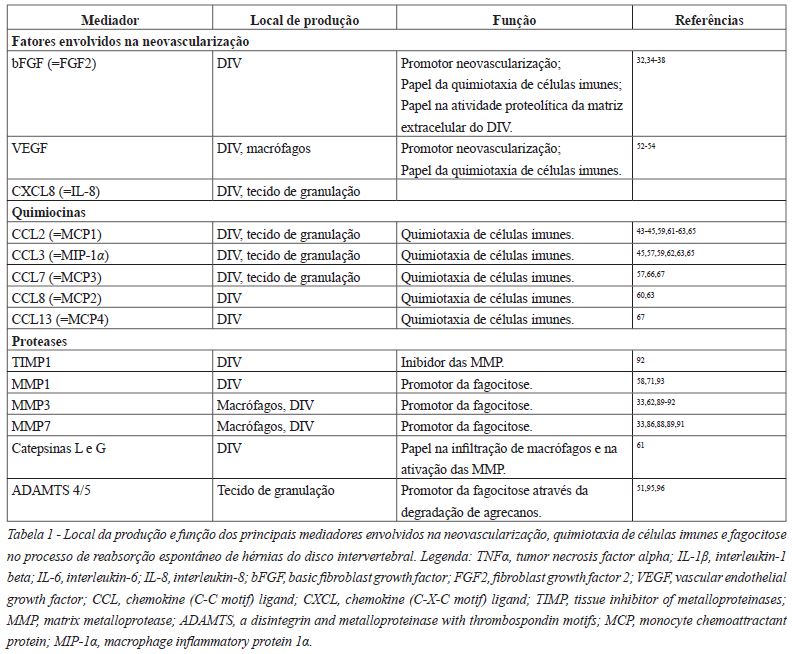
<body><![CDATA[<p>No sentido de compreender como ocorre o processo de neovasculariza&ccedil;&atilde;o foram estudados os fatores angiog&eacute;nicos respons&aacute;veis. Entre os quais damos um especial destaque ao bFGF e ao VEGF, deixando algumas notas acerca do CXCL8. De real&ccedil;ar que foram observadas associa&ccedil;&otilde;es entre as citocinas inflamat&oacute;rias, nomeadamente o TNF&alpha;, a IL-1&szlig; e a IL-6, e os fatores angiog&eacute;nicos descritos<sup>30-33</sup> (<a href="/img/revistas/rpot/v26n3/26n3a04f1.jpg">Figura 1</a>) (<a href="/img/revistas/rpot/v26n3/26n3a04t1.jpg">Tabela 1</a>).</p>    
<p>&nbsp;</p>    <p>    <center><a href="/img/revistas/rpot/v26n3/26n3a04f1.jpg">Figura 1</a></center></p>    
<p>&nbsp;</p>    <p>    <center><a href="/img/revistas/rpot/v26n3/26n3a04t1.jpg">Tabela 1</a></center></p>    
<p>&nbsp;</p>
    <p>O bFGF &eacute; expresso em condr&oacute;citos degenerados e em vasos sangu&iacute;neos formados nos tecidos de granula&ccedil;&atilde;o<sup>32,34,35</sup>. O bFGF estimula a neovasculariza&ccedil;&atilde;o e a quimiotaxia de macr&oacute;fagos, linf&oacute;citos e fibroblastos<sup>32,36-38</sup>. Os n&iacute;veis de bFGF relacionam-se diretamente com a neovasculariza&ccedil;&atilde;o, sendo este um potente promotor da angiog&eacute;nese<sup>32</sup>. Na verdade, promove o crescimento de vasos sangu&iacute;neos para o interior dos DIV lesados<sup>36</sup>, atrav&eacute;s da indu&ccedil;&atilde;o das c&eacute;lulas endoteliais capilares a invadir matrizes de colag&eacute;nio, formando t&uacute;bulos caracter&iacute;sticos de capilares sangu&iacute;neos<sup>38</sup>. A angiog&eacute;nese dependente deste fator parece atuar em resposta &agrave; agress&atilde;o ao DIV<sup>34</sup>. De facto, a express&atilde;o de bFGF associa-se &agrave; atividade proteol&iacute;tica da matriz extracelular do DIV,<sup>34,35</sup> pelo que &eacute; um dos mediadores no processo de reabsor&ccedil;&atilde;o da HDIV<sup>37</sup>.</p>
    <p>Relativamente ao VEGF foi demonstrado que ocorre um aumento da sua express&atilde;o em est&aacute;dios precoces da HDIV<sup>39</sup>. Este &eacute; produzido pelas c&eacute;lulas do DIV e por macr&oacute;fagos, enquanto as c&eacute;lulas endoteliais vasculares expressam os seus recetores<sup>40</sup>. A intera&ccedil;&atilde;o entre os macr&oacute;fagos e os tecidos do DIV levam &agrave; indu&ccedil;&atilde;o do VEGF e &agrave; consequente estimula&ccedil;&atilde;o da forma&ccedil;&atilde;o de mais vasos sangu&iacute;neos. Este fen&oacute;meno foi observado num estudo de cocultura de macr&oacute;fagos e c&eacute;lulas do DIV onde a neovasculariza&ccedil;&atilde;o foi mais abundante, em compara&ccedil;&atilde;o &agrave; sua cultura isolada, o que demonstra a exist&ecirc;ncia de uma sinergia entre elas para a sobreregula&ccedil;&atilde;o daquele fator angiog&eacute;nico<sup>40</sup>. Os macr&oacute;fagos surgem no tecido de granula&ccedil;&atilde;o decorrente do processo inflamat&oacute;rio verificando-se a exist&ecirc;ncia de vasos sangu&iacute;neos a proliferar em seu redor. A angiog&eacute;nese e a infiltra&ccedil;&atilde;o macrof&aacute;gica aumentam com a prolifera&ccedil;&atilde;o de c&eacute;lulas produtoras de VEGF<sup>41</sup>, levando a concluir que o VEGF promove a quimiotaxia de mon&oacute;citos<sup>40</sup>, originando um feedback positivo entre o n&uacute;mero de macr&oacute;fagos e a sua produ&ccedil;&atilde;o.</p>
    ]]></body>
<body><![CDATA[<p>A express&atilde;o de c&eacute;lulas positivas para o VEGF e seus recetores no NP humano foi superior nos grupos de doentes com HDIV, sendo que nestes a express&atilde;o foi m&aacute;xima em doentes com HDIV extrusa para o espa&ccedil;o epidural<sup>40</sup>.</p>
    <p>A IL-6 &eacute; uma citocina proinflamat&oacute;ria que estimula o crescimento e a prolifera&ccedil;&atilde;o de v&aacute;rios tipos de c&eacute;lulas imunes durante as respostas imunol&oacute;gicas de defesa do organismo<sup>42</sup> e contribui na neovasculariza&ccedil;&atilde;o, nomeadamente atrav&eacute;s da sobreregula&ccedil;&atilde;o do VEGF<sup>31</sup>, sendo produzida tanto pelo DIV como pelas c&eacute;lulas infiltradas no tecido de granula&ccedil;&atilde;o<sup>43,44</sup>.</p>
    <p>A CXCL8 produzida no DIV tamb&eacute;m parece ter um papel estimulador no crescimento de capilares sangu&iacute;neos para o interior dos tecidos da HDIV, facilitando a sua reabsor&ccedil;&atilde;o, sendo que a sua produ&ccedil;&atilde;o &eacute; significativamente superior em doentes com HDIVE, principalmente nos S<sup>45</sup>.</p>
    <p>Do ponto de vista anat&oacute;mico, ao nascimento, o DIV &eacute; dotado de suprimento vascular, principalmente ao n&iacute;vel da plataforma cartilag&iacute;nea e do AF. Contudo, esses vasos cedo sofrem regress&atilde;o, deixando o DIV com um escasso ou nulo suprimento sangu&iacute;neo direto no adulto saud&aacute;vel<sup>46,47</sup>. A invas&atilde;o do espa&ccedil;o do DIV por vasos sangu&iacute;neos pode facilitar a introdu&ccedil;&atilde;o de citocinas, fatores de crescimento, c&eacute;lulas e outras subst&acirc;ncias que influenciam a reabsor&ccedil;&atilde;o tecidular e os subsequentes processos de repara&ccedil;&atilde;o do DIV lesado<sup>36</sup>.</p>
    <p>Por&eacute;m, esta neovasculariza&ccedil;&atilde;o n&atilde;o parece ser apenas produzida pela resposta inflamat&oacute;ria, mas tamb&eacute;m durante o processo degenerativo que precede em muitos casos a hernia&ccedil;&atilde;o<sup>9</sup>. Durante a degenera&ccedil;&atilde;o do DIV ocorre um processo de neovasculariza&ccedil;&atilde;o nas &aacute;reas circundantes do AF<sup>47,48</sup>, sendo este capaz de a induzir possivelmente devido ao seu conte&uacute;do em subst&acirc;ncias sol&uacute;veis indutoras da angiog&eacute;nese. Tal n&atilde;o se constata na plataforma cartilag&iacute;nea, o que pode ser o motivo pelo qual as HDIV com grande quantidade de plataforma cartilag&iacute;nea n&atilde;o serem t&atilde;o eficazmente absorvidas<sup>49</sup>. Esta evid&ecirc;ncia &eacute; suportada pelo estudo de <em>Shan et al.</em>, que recorrendo &agrave; classifica&ccedil;&atilde;o de <em>Modic</em><sup>50</sup>, onde s&atilde;o usadas as diferen&ccedil;as de intensidade de sinal das plataformas cartilag&iacute;neas na visualiza&ccedil;&atilde;o por RMN, descreveu as diferen&ccedil;as na tend&ecirc;ncia para a reabsor&ccedil;&atilde;o nas HDIV e os seus poss&iacute;veis intervenientes. As h&eacute;rnias dos grupos <em>Modic Changes</em> (MC) possuem mais cartilagem hialina, com menor conte&uacute;do em NP e invas&atilde;o vascular que os grupos n&atilde;o-MC. Nesse estudo foi tamb&eacute;m verificado uma maior abund&acirc;ncia de capilares e macr&oacute;fagos nas amostras de tecido herniado dos grupos n&atilde;o-MC. Os proteoglicanos, presentes em maior quantidade nos tecidos cartilaginosos, inibem a angiog&eacute;nese, pelo que a sua perda encoraja a neovasculariza&ccedil;&atilde;o e a tend&ecirc;ncia para a reabsor&ccedil;&atilde;o do tecido herniado, demonstrada nos grupos n&atilde;o-MC<sup>48</sup>.</p>
    <p>Na verdade, verifica-se a diminui&ccedil;&atilde;o de proteoglicanos na maioria das HDIV, particularmente nas HDIVE, sendo esta mais proeminente nas por&ccedil;&otilde;es adjacentes ao tecido de granula&ccedil;&atilde;o<sup>51</sup> e estando fortemente associada &agrave; neovasculariza&ccedil;&atilde;o<sup>36,48</sup>.</p>
    <p>Ap&oacute;s a exposi&ccedil;&atilde;o do NP verifica-se uma neoforma&ccedil;&atilde;o de vasos sangu&iacute;neos, provavelmente devido &agrave; sua continuidade com o plexo venoso e tecido adiposo presentes no espa&ccedil;o epidural<sup>16,52</sup>. Mas o grau de neovasculariza&ccedil;&atilde;o parece estar intimamente ligado com o tipo de HDIV<sup>53</sup>. As HDIVE s&atilde;o expostas com maior facilidade &agrave; circula&ccedil;&atilde;o sangu&iacute;nea e, consequentemente, a uma maior quantidade de c&eacute;lulas imunes, o que provavelmente leva &agrave; reabsor&ccedil;&atilde;o por fagocitose dos tecidos herniados, existindo uma maior probabilidade de regress&atilde;o espont&acirc;nea da HDIV<sup>9,16,27,54,55</sup>. A infiltra&ccedil;&atilde;o no conte&uacute;do herniado por vasos sangu&iacute;neos pode ocorrer atrav&eacute;s do LLP<sup>55</sup>, mas na verdade, quando a por&ccedil;&atilde;o do NP da massa herniada perfura o LLP ocorre uma rea&ccedil;&atilde;o de neovasculariza&ccedil;&atilde;o mais exuberante<sup>56</sup>. O conte&uacute;do herniado &eacute; rodeado e infiltrado por vasos rec&eacute;m-formados a partir do tecido adiposo epidural, sendo posteriormente invadido por macr&oacute;fagos e outras c&eacute;lulas do sistema imune<sup>27,37,55</sup>. Nesta perspetiva v&aacute;rios autores especulam que a neovasculariza&ccedil;&atilde;o e a infiltra&ccedil;&atilde;o de c&eacute;lulas imunes na periferia de tecidos herniados, estejam implicadas nas diferen&ccedil;as observados entre os v&aacute;rios tipos de HDIV e no consequente processo de reabsor&ccedil;&atilde;o<sup>5,9,16,27,37,51,54,55,57</sup>.</p></font>    <p><b><font face="Verdana" size="2">5. Quimiotaxia de células imunes</font></b></p><font face="verdana" size="2">    <p>Na sequ&ecirc;ncia do que foi descrito para a neovasculariza&ccedil;&atilde;o e forma&ccedil;&atilde;o de tecido de granula&ccedil;&atilde;o, <em>Doita et al.</em> verificou que ocorreria um aumento do n&uacute;mero de c&eacute;lulas mononucleadas do sangue perif&eacute;rico ligadas &agrave; superf&iacute;cie de HDIVE, em compara&ccedil;&atilde;o com HDIVC. Conclui que estas c&eacute;lulas mononucleadas, sobretudo mon&oacute;citos, seriam essenciais no despoletar de uma resposta imunol&oacute;gica ao exercer um papel regulat&oacute;rio na produ&ccedil;&atilde;o de uma variedade de mediadores capazes de recrutar novos mon&oacute;citos para as HDIV<sup>32,58</sup>. O DIV humano tamb&eacute;m parece ser dotado de propriedades quimiot&aacute;xicas, produzindo muitos destes fatores promotores do recrutamento de v&aacute;rias&nbsp; c&eacute;lulas imunes, chamados de quimiocinas<sup>45,59</sup>. Assim, o recrutamento de mon&oacute;citos circulat&oacute;rios para material herniado resulta da intera&ccedil;&atilde;o entre as quimiocinas produzidas pelo pr&oacute;prio IVD e a sua liga&ccedil;&atilde;o a recetores da superf&iacute;cie dos mon&oacute;citos. Os mon&oacute;citos s&atilde;o assim ativados localmente, diferenciando-se em macr&oacute;fagos<sup>19,60</sup>.</p>
    <p>Portanto, numa primeira fase s&atilde;o as pr&oacute;prias c&eacute;lulas do NP a recrutar macr&oacute;fagos atrav&eacute;s da produ&ccedil;&atilde;o de quimiocinas. &Eacute; de destacar que a presen&ccedil;a de macr&oacute;fagos no tecido de granula&ccedil;&atilde;o, na periferia do material herniado ou mesmo invadindo o NP e o AF, surge apenas ap&oacute;s a express&atilde;o de quimiocinas sugerindo a necessidade destas no recrutamento de macr&oacute;fagos<sup>59,61,62</sup>. Ap&oacute;s infiltra&ccedil;&atilde;o nos fragmentos de disco herniado, os macr&oacute;fagos v&atilde;o tamb&eacute;m produzir quimiocinas com consequente aumento da sua popula&ccedil;&atilde;o<sup>63</sup>. A produ&ccedil;&atilde;o conjunta dos fatores entre as c&eacute;lulas do NP e os macr&oacute;fagos &eacute; mais relevante do que quando isolados, o que leva a crer que existe um feedback positivo entre ambos os elementos celulares, &agrave; semelhan&ccedil;a do que j&aacute; foi descrito para os fatores angiog&eacute;nicos.</p>
    ]]></body>
<body><![CDATA[<p>Estas quimiocinas parecem ser primariamente reguladas por citocinas proinflamat&oacute;rias em resposta &agrave; agress&atilde;o. A produ&ccedil;&atilde;o local de citocinas como a IL-1&szlig; e o TNF&alpha; parece ser parte essencial do processo ao mediar indiretamente a regula&ccedil;&atilde;o das quimiocinas envolvidas na quimiotaxia de c&eacute;lulas imunes<sup>63,64</sup>. Ap&oacute;s a extrus&atilde;o da HDIV, numa fase anterior &agrave; express&atilde;o de quimiocinas, o TNF&alpha; e a IL-1&szlig; s&atilde;o produzidos de novo nas c&eacute;lulas do DIV, estimulando a express&atilde;o de quimiocinas<sup>43,62</sup> (<a href="/img/revistas/rpot/v26n3/26n3a04f1.jpg">Figura 1</a>).</p>
    
<p>Relativamente &agrave;s quimiocinas propriamente ditas, tanto as c&eacute;lulas imunes infiltradas nos tecidos de granula&ccedil;&atilde;o como as c&eacute;lulas do DIV s&atilde;o capazes de expressar CCL2<sup>45,57,59,62,63,65</sup>, CCL3<sup>57,66</sup>, CCL7<sup>60,63</sup> e CXCL8<sup>43-45,63</sup>. Isoladamente as c&eacute;lulas do DIV expressam CCL8<sup>63</sup> e CCL13<sup>60</sup> (<a href="/img/revistas/rpot/v26n3/26n3a04t1.jpg">Tabela 1</a>).</p>
    
<p>Efetivamente, est&aacute; comprovado o papel do CCL2<sup>45,59,61,62,65</sup>, CCL3<sup>57,66</sup>, CCL7<sup>67</sup>, CCL8<sup>67</sup> e CCL13<sup>67</sup> na capacidade de provocar o recrutamento e migra&ccedil;&atilde;o de c&eacute;lulas inflamat&oacute;rias, pelo que as restantes quimiocinas poder&atilde;o ter um papel regulat&oacute;rio intermedi&aacute;rio no processo quimiot&aacute;tico. H&aacute; um aumento da express&atilde;o de CCL2<sup>45,57</sup>, CCL3<sup>57,66</sup> e CXCL8<sup>45</sup> nas HDIV, pelo que estas parecem aumentar ainda mais com a severidade da HDIV<sup>57</sup>.</p></font>    <p><b><font face="Verdana" size="2">6. Resposta Imune</font></b></p><font face="verdana" size="2">    <p>Os primeiros passos foram dados em 1952, quando <em>Hirch et al.</em> verificou a forma&ccedil;&atilde;o de um tecido de granula&ccedil;&atilde;o altamente vascularizado ap&oacute;s a rotura do AF com extrus&atilde;o do seu conte&uacute;do al&eacute;m do LLP. Observou a posterior constitui&ccedil;&atilde;o de uma cicatriz fibrosa no local lesado do AF<sup>46</sup>. Posteriormente em 1965, <em>Bobechko et al.</em> observou a ocorr&ecirc;ncia de uma rea&ccedil;&atilde;o imune do tipo corpo estranho &agrave; coloca&ccedil;&atilde;o de fragmentos de NP aut&oacute;geno em locais vascularizados, com a produ&ccedil;&atilde;o de anticorpos<sup>68</sup>. Efetivamente, o perfil da ativa&ccedil;&atilde;o inflamat&oacute;ria e imunol&oacute;gica apresentada pelo HDIV parece variar desde a degenera&ccedil;&atilde;o aos diversos graus de hernia&ccedil;&atilde;o<sup>69</sup>.</p></font>    <p><b><font face="Verdana" size="2">a. Imunidade Inata: perspetiva inflamatória</font></b></p><font face="verdana" size="2">    <p>A resposta imune inata parece relacionar-se numap rimeira fase com uma rea&ccedil;&atilde;o inflamat&oacute;ria t&iacute;pica de corpo estranho em resposta &agrave; exposi&ccedil;&atilde;o do conte&uacute;do&nbsp; do DIV. Como j&aacute; foi referenciado previamente, o contacto entre o fragmento herniado do DIV e o espa&ccedil;o epidural parece ser o gatilho para despoletar a resposta imunol&oacute;gica atrav&eacute;s da&nbsp; infiltra&ccedil;&atilde;o de&nbsp; c&eacute;lulas inflamat&oacute;rias e da neovasculariza&ccedil;&atilde;o no local, com consequente forma&ccedil;&atilde;o de um tecido de granula&ccedil;&atilde;o na periferia do tecido herniado<sup>54,61,65,70,71</sup>. Os vasos rec&eacute;m-formados t&ecirc;m um papel essencial na passagem de c&eacute;lulas inflamat&oacute;rias infiltrativas. Os infiltrados celulares foram mais proeminentes no NP do que no AF<sup>54</sup>. Esta infiltra&ccedil;&atilde;o celular &eacute; composta por macr&oacute;fagos<sup>54,57,62,65,72</sup>, neutr&oacute;filos<sup>62</sup> e alguns linf&oacute;citos T<sup>54,57,62,65</sup>. Nestes estudos, raramente foram encontrados linf&oacute;citos B<sup>54,57,62,65</sup>.</p>
    <p><em>Kagawachi et al.</em> atrav&eacute;s de uma an&aacute;lise imunofenot&iacute;pica de infiltrados inflamat&oacute;rios de HDIV verificou que nenhum dos infiltrados continha linf&oacute;citos, mon&oacute;citos ou c&eacute;lulas dendr&iacute;ticas, enquanto todos os infiltrados examinados continham macr&oacute;fagos em abund&acirc;ncia<sup>73</sup>.</p>
    <p>A infiltra&ccedil;&atilde;o celular com forma&ccedil;&atilde;o do tecido de granula&ccedil;&atilde;o &eacute; acompanhada de fibrose e relaciona-se inversamente com o tamanho dos DIV herniados<sup>62</sup>, existindo uma tend&ecirc;ncia na redu&ccedil;&atilde;o de tamanho com o tempo<sup>65</sup>.</p>
    <p>A citotoxicidade das c&eacute;lulas imunes em rela&ccedil;&atilde;o &agrave;s c&eacute;lulas do NP tamb&eacute;m foi alvo de estudo. <em>Murai et al.</em>, cultivou c&eacute;lulas aut&oacute;logas de NP juntamente com c&eacute;lulas imunes do mesmo indiv&iacute;duo e verificou que a citotoxicidade para as c&eacute;lulas aut&oacute;logas do NP foi proporcional &agrave; quantidade de c&eacute;lulas NK e macr&oacute;fagos. Linf&oacute;citos T CD4+ e linf&oacute;citos T CD8+ n&atilde;o obtiveram efeitos citot&oacute;xicos nas c&eacute;lulas NP. Tendo em conta a citotoxicidade das c&eacute;lulas imunes, os alvos moleculares e a sua localiza&ccedil;&atilde;o nas c&eacute;lulas NP permanecem indefinidos. De seguida, testaram a sobreviv&ecirc;ncia das c&eacute;lulas NP transplantadas em ratinhos imunocomprometidos e em ratinhos com o sistema imune preservado. Constataram que passados 3 meses um pequeno n&uacute;mero c&eacute;lulas transplantadas sobreviveu no grupo imunocomprometido, enquanto nenhuma sobreviveu passadas 3 semanas no grupo com o sistema imune preservado. N&atilde;o se verificou a migra&ccedil;&atilde;o de linf&oacute;citos T para as c&eacute;lulas NP, contudo observou-se a migra&ccedil;&atilde;o de c&eacute;lulas NK e macr&oacute;fagos. Esta evid&ecirc;ncia demonstra que o NP &eacute; sens&iacute;vel a c&eacute;lulas imunes. Neste estudo os macr&oacute;fagos n&atilde;o mostraram ser c&eacute;lulas residentes transformadas, mas c&eacute;lulas infiltrativas. Em conclus&atilde;o, as c&eacute;lulas do NP provocam uma resposta imune inata, pelo que ao reconhecer o NP aut&oacute;logo transplantado os macr&oacute;fagos e as c&eacute;lulas NK parecem ter uma fun&ccedil;&atilde;o imunol&oacute;gica precoce quando o NP &eacute; exposto ao sistema imune<sup>74</sup>.</p>
    ]]></body>
<body><![CDATA[<p>Est&aacute; demonstrado que h&aacute; uma implica&ccedil;&atilde;o da imunidade inata, nomeadamente atrav&eacute;s de uma resposta inflamat&oacute;ria no processo de reabsor&ccedil;&atilde;o das HDIV. A maioria dos autores considera que esta rea&ccedil;&atilde;o inflamat&oacute;ria se deve &agrave; exposi&ccedil;&atilde;o do NP ao sistema imune, com uma consequente rea&ccedil;&atilde;o tipo corpo-estranho. Contudo alguns autores sugerem que aquela rea&ccedil;&atilde;o &eacute; uma resposta inflamat&oacute;ria normal a um tecido lesado, envolvida no processo geral de repara&ccedil;&atilde;o e reconstru&ccedil;&atilde;o tecidular, rejeitando a hip&oacute;tese de existir um fen&oacute;meno de autoimunidade na regress&atilde;o espont&acirc;nea das HDIV<sup>73,75</sup>.</p></font>    <p><b><font face="Verdana" size="2">b. Imunidade Adquirida: perspetiva autoimune</font></b></p><font face="verdana" size="2">    <p>O reconhecimento de antig&eacute;nios por c&eacute;lulas apresentadoras de antig&eacute;nios (APC) representa um passo importante no despoletar de uma resposta imune adaptativa. Ap&oacute;s a captura do antig&eacute;nio, as APC migram para os tecidos linfoides perif&eacute;ricos apresentando o antig&eacute;nio aos linf&oacute;citos T CD4+ <em>na&iuml;ve</em><sup>19,76</sup>. O NP herniado parece representar o local onde os antig&eacute;nios s&atilde;o expostos ao sistema imune. Deste modo, dado o DIV ser avascular, apenas quando ele &eacute; exposto &agrave; circula&ccedil;&atilde;o sangu&iacute;nea e, por sua vez, ao sistema imune, &eacute; que os ant&iacute;genos derivados do NP podem migrar para os tecidos linfoides e sofrer a toler&acirc;ncia imunol&oacute;gica<sup>77</sup>. Quando esta toler&acirc;ncia imunol&oacute;gica n&atilde;o ocorre, &eacute; iniciada uma resposta imune adaptativa mediada por c&eacute;lulas. Os macr&oacute;fagos e as c&eacute;lulas dendr&iacute;ticas s&atilde;o exemplos de APC<sup>19,76</sup>.</p>
    <p><em>Geiss et al.</em> observou que nos infiltrados de sequestros de HDIV as c&eacute;lulas dendr&iacute;ticas plasmocit&oacute;ides (PDC) e os linf&oacute;citos T de mem&oacute;ria eram detetados em propor&ccedil;&otilde;es significativamente superiores em rela&ccedil;&atilde;o aos macr&oacute;fagos, revelando a predomin&acirc;ncia das PDC neste tipo de h&eacute;rnia. Concluindo, estas descobertas s&atilde;o indicativas que as PDC est&atilde;o envolvidas na inicia&ccedil;&atilde;o de uma resposta autoimune espec&iacute;fica direcionada ao NP herniado, enquanto os macr&oacute;fagos, al&eacute;m de refor&ccedil;arem esta resposta pelas suas propriedades enquanto APC, medeiam a reabsor&ccedil;&atilde;o do DIV atrav&eacute;s das suas propriedades fagoc&iacute;ticas<sup>78</sup>.</p>
    <p>Em estudos imunohistoqu&iacute;micos de material herniado proveniente de discectomia, a infiltra&ccedil;&atilde;o de c&eacute;lulas inflamat&oacute;rias mostrou ser formada por macr&oacute;fagos e linf&oacute;citos T, sendo estes origin&aacute;rios dos vasos sangu&iacute;neos presentes na periferia das HDIV<sup>9</sup>.</p>
    <p>O corpo humano encontra-se num balan&ccedil;o imune de linf&oacute;citos T efetores, regulando positiva ou negativamente as respostas imunes espec&iacute;ficas, respetivamente atrav&eacute;s de linf&oacute;citos T CD4+ e linf&oacute;citos T CD8+. O r&aacute;cio linf&oacute;citos T CD4+/CD8+ representa o balan&ccedil;o da imunidade, pelo que qualquer altera&ccedil;&atilde;o deste corresponde a uma prov&aacute;vel desregula&ccedil;&atilde;o da resposta imune espec&iacute;fica<sup>19,79,80</sup>.</p>
    <p><em>Tian et al.</em> atrav&eacute;s da realiza&ccedil;&atilde;o de citometria de fluxo do sangue perif&eacute;rico colhido em doentes com HDIV, observou que ocorreria um aumento significativo da quantidade de linf&oacute;citos T CD4+, assim como o aumento do r&aacute;cio de linf&oacute;citos T CD4+/CD8+, acompanhados de uma diminui&ccedil;&atilde;o da quantidade de linf&oacute;citos T CD8+, em compara&ccedil;&atilde;o a doentes sem HDIV<sup>79,80</sup>. No caso dos linf&oacute;citos T CD4+ e do r&aacute;cio linf&oacute;citos T CD4+/CD8+ a sua quantidade era significativamente superior nas HDIVE em rela&ccedil;&atilde;o &agrave;s HDIVC e aos controlos, respetivamente<sup>79</sup>. Estas evid&ecirc;ncias indicam que ocorrem altera&ccedil;&otilde;es no sistema imune ap&oacute;s a HDIV, principalmente quando ocorre extrus&atilde;o do conte&uacute;do herniado atrav&eacute;s do LLP, apoiando a hip&oacute;tese relacionada com a resposta autoimune espec&iacute;fica<sup>79,80</sup>.</p>
    <p>A HDIV ao sofrer extrus&atilde;o &eacute; invadida por c&eacute;lulas inflamat&oacute;rias, que atrav&eacute;s da liberta&ccedil;&atilde;o de citocinas e quimiocinas, parecem promover uma resposta Th1 com supress&atilde;o da resposta Th2<sup>21</sup>. O resultado &eacute; a viola&ccedil;&atilde;o do estado imunoprivilegiado ocorrendo uma resposta inflamat&oacute;ria por rea&ccedil;&atilde;o imune direta ao DIV herniado<sup>21</sup>.</p>
    <p>Os linf&oacute;citos Th1 secretam altos n&iacute;veis de IL-2, TNF&alpha; e IFN&gamma; que ativam macr&oacute;fagos e promovem respostas celulares imunologicamente mediadas. Os linf&oacute;citos Th2 produzem uma variedade de citocinas anti-inflamat&oacute;rias, incluindo IL-4, IL-5, IL-10 e IL-13<sup>69</sup>.</p>
    <p>A IL-4 &eacute; capaz de suprimir citocinas derivadas dos&nbsp; mon&oacute;citos, incluindo TNF&alpha;, IL-1&szlig;, IL-6, CXCL8 e a CCL3. Podemos observar que as protus&otilde;es do DIV se relacionam com um predom&iacute;nio da concentra&ccedil;&atilde;o s&eacute;rica IL-4, enquanto as extrus&otilde;es do DIV com o predom&iacute;nio de TNF&alpha;<sup>81</sup>. Localmente, as concentra&ccedil;&otilde;es de IFN&gamma; e IL-12 foram superiores nas HDIVE, ao contr&aacute;rio da IL-4, em que a sua concentra&ccedil;&atilde;o foi superior nas HDIVC<sup>21</sup>. A positividade para o IFN&gamma;, a presen&ccedil;a de macr&oacute;fagos e o aumento de celularidade no DIV parece traduzir resposta do tipo Th1 na HDIV<sup>82</sup>. A an&aacute;lise do plasma s&eacute;rico demonstrou significativamente um aumento dos n&iacute;veis de fatores pro inflamat&oacute;rios (IL-1&szlig;, IL-2, IL-12, IFN&gamma; e TNF&alpha;) e uma diminui&ccedil;&atilde;o dos n&iacute;veis de IL-4 em indiv&iacute;duos com evid&ecirc;ncia de HDIV, em compara&ccedil;&atilde;o aos indiv&iacute;duos sem a patologia. Apesar de numerosos fatores afetarem os n&iacute;veis no sangue perif&eacute;rico, uma total avalia&ccedil;&atilde;o do sistema imune poder&aacute; ser &uacute;til na defini&ccedil;&atilde;o do tratamento m&eacute;dico na HDIV<sup>69</sup>. Uma nota final para o papel da citocina proinflamat&oacute;ria IL-2, que est&aacute; aumentada em HDIV, possuindo um papel patog&eacute;nico no prolapso de DIV, nomeadamente atrav&eacute;s da promo&ccedil;&atilde;o da apoptose celular e da degrada&ccedil;&atilde;o da matriz extracelular no NP de DIV<sup>83</sup>.</p>
    ]]></body>
<body><![CDATA[<p>Num outro estudo, <em>Geiss et al.</em> verificou que o NP aut&oacute;logo transplantado subcutaneamente atrai uma propor&ccedil;&atilde;o significativamente elevada de linf&oacute;citos T (com maior propor&ccedil;&atilde;o de linf&oacute;citos T CD4+ em compara&ccedil;&atilde;o aos linf&oacute;citos T CD8+) e linf&oacute;citos B ativados expressando a imunoglobulina <em>kappa</em>. Observaram tamb&eacute;m uma grande quantidade de c&eacute;lulas T CD45RC imunorreativas, indicando a presen&ccedil;a de linf&oacute;citos T de mem&oacute;ria. A grande express&atilde;o de linf&oacute;citos B expressando cadeias leves kappa de IgG aponta mais para a presen&ccedil;a de linf&oacute;citos B de mem&oacute;ria, do que de plasm&oacute;citos produtores de autoanticorpos. Este estudo permitiu confirmar que o NP herniado atrai linf&oacute;citos T e B, mimetizando a sua exposi&ccedil;&atilde;o aquando da hernia&ccedil;&atilde;o do DIV, e mostrando a sua potencialidade para gerar uma reposta imune espec&iacute;fica devido &agrave;s suas propriedades autoimunes. Os linf&oacute;citos T CD4+ e linf&oacute;citos B devem estar envolvidos nesta resposta<sup>84</sup>, pelo que a sua preval&ecirc;ncia &eacute; superior nos sequestros comparativamente &agrave;s extrus&otilde;es<sup>72</sup>.</p>
    <p>A ativa&ccedil;&atilde;o de linf&oacute;citos T representa o marco na gera&ccedil;&atilde;o de uma poss&iacute;vel resposta autoimune,&nbsp; levando subsequentemente &agrave; diferencia&ccedil;&atilde;o de linf&oacute;citos B<sup>84</sup>.</p>
    <p>A quantidade de linf&oacute;citos T e macr&oacute;fagos, assim como as concentra&ccedil;&otilde;es de imunoglobulinas IgM e IgG no sangue perif&eacute;rico, foram superiores em pacientes com HDIVE comparativamente &agrave;queles com protus&otilde;es<sup>79</sup>.</p>
    <p><em>Satoh et al.</em> verificou atrav&eacute;s de estudos imunohistoqu&iacute;micos do conte&uacute;do de tecido herniado a exist&ecirc;ncia de complexos antig&eacute;nio-anticorpo localizados na c&aacute;psula pericelular dos condr&oacute;citos da HDIV. Tais complexos n&atilde;o foram observados nas amostras de NP n&atilde;o herniado dos mesmos doentes e no grupo de controlo. Os autores sugerem que a IgG &eacute; o anticorpo prim&aacute;rio, ligando-se a estruturas espec&iacute;ficas no tecido da HDIV. Contudo, afirmam que o antig&eacute;nio respons&aacute;vel &eacute; desconhecido<sup>85</sup>.</p>
    <p>Verificou-se que a IgM e a IgG s&atilde;o depositadas em redor dos vasos rec&eacute;m-formados e do NP das HDIV, concluindo que estas imunoglobulinas possuem um papel importante na resposta imune do HDIV<sup>79</sup>.</p></font>    <p><b><font face="Verdana" size="2">7. Fagocitose</font></b></p><font face="verdana" size="2">    <p>Independentemente do processo imune subjacente, &eacute; de algum modo consensual que a reabsor&ccedil;&atilde;o espont&acirc;nea ocorre atrav&eacute;s da fagocitose do tecido herniado, mediada pelos macr&oacute;fagos<sup>61,62,65,86,87</sup>. As principais a&ccedil;&otilde;es mediadas pelos macr&oacute;fagos parecem decorrer da sua poderosa atividade fagoc&iacute;tica e secretora de enzimas com um papel na digest&atilde;o e degrada&ccedil;&atilde;o do material herniado<sup>62</sup>.</p>
    <p><em>Ikeda et al.</em> verificou a exist&ecirc;ncia de prote&iacute;nases em redor dos infiltrados macr&oacute;fagicos<sup>54</sup>. Estas enzimas, maioritariamente metaloprote&iacute;nases da matriz (MMP), ADAMTS ou catepsinas, est&atilde;o envolvidas na degrada&ccedil;&atilde;o da matriz extracelular do NP atrav&eacute;s do seu papel na decomposi&ccedil;&atilde;o de colag&eacute;nio, agrecanos e proteoglicanos<sup>54,55,61,71</sup>.</p>
    <p>As quimiocinas al&eacute;m de influenciarem a infiltra&ccedil;&atilde;o de macr&oacute;fagos, parecem tamb&eacute;m promover a ativa&ccedil;&atilde;o das MMP<sup>33,43,59,61,62,65-67</sup>. A produ&ccedil;&atilde;o MMP &eacute; regulada por inibidores tecidulares da metaloprote&iacute;nase 1 (TIMP1), glicoprote&iacute;nas naturalmente produzidas no DIV que inibem as MMP.</p>
    <p>De um modo geral os macr&oacute;fagos expressam caracteristicamente MMP7<sup>33,86,88,89</sup> e MMP3<sup>33,90</sup>. Por sua vez, as c&eacute;lulas do DIV expressam caracteristicamente MMP3<sup>33,89,91,92</sup>, TIMP1<sup>92</sup>, MMP7<sup>86,91</sup> e MMP1<sup>93</sup> (<a href="/img/revistas/rpot/v26n3/26n3a04t1.jpg">Tabela 1</a>).</p>
    
]]></body>
<body><![CDATA[<p>A eleva&ccedil;&atilde;o dos n&iacute;veis de MMP, principalmente de MMP3, ocorre paralelamente ao aumento do n&uacute;mero de macr&oacute;fagos<sup>33,61,87</sup>. As MMP1 e MMP3 est&atilde;o envolvidas na forma&ccedil;&atilde;o do tecido de granula&ccedil;&atilde;o, na degrada&ccedil;&atilde;o e na reabsor&ccedil;&atilde;o dos tecidos da HDIV<sup>71</sup> (<a href="/img/revistas/rpot/v26n3/26n3a04f2.jpg">Figura 2</a>).</p>    
<p>&nbsp;</p>    <p>    <center><a href="/img/revistas/rpot/v26n3/26n3a04f2.jpg">Figura 2</a></center></p>    
<p>&nbsp;</p>
    <p>No tecido do DIV saud&aacute;vel a express&atilde;o de MMP1 &eacute; superior &agrave; de MMP3, contudo diminui com a evolu&ccedil;&atilde;o da degenera&ccedil;&atilde;o do DIV, tornando-se os n&iacute;veis de ambas as MMP similares num estado avan&ccedil;ado da degenera&ccedil;&atilde;o. Quando ocorre hernia&ccedil;&atilde;o do DIV os n&iacute;veis de MMP3 tornam-se superiores aos de MMP1, indicando que a reabsor&ccedil;&atilde;o do tecido herniado parece estar mais dependente da MMP3<sup>93</sup>. A produ&ccedil;&atilde;o de MMP1<sup>58</sup>, MMP3<sup>58,90,92</sup> e MMP7<sup>86</sup> aumentam significativamente quando o NP herniado &eacute; exposto ao espa&ccedil;o epidural, estando aumentadas nas HDIVE em compara&ccedil;&atilde;o &agrave;s HDIVC.</p>
    <p><em>Haro et al.</em> atrav&eacute;s de um modelo de cocultura de macr&oacute;fagos de ratinhos com tecidos do DIV, relacionou a express&atilde;o de MMP7, MMP3 e TNF&alpha; pelos macr&oacute;fagos com a redu&ccedil;&atilde;o do peso da amostra de tecido do DIV e a sua reabsor&ccedil;&atilde;o. Concluiu que a produ&ccedil;&atilde;o de MMP7 por macr&oacute;fagos &eacute; requerida para a indu&ccedil;&atilde;o de MMP3 no DIV e este efeito &eacute; mediado por uma via de sinaliza&ccedil;&atilde;o que envolve o TNF&alpha;. O efeito da MMP7 n&atilde;o foi direto na s&iacute;ntese de TNF&alpha;, mas na sua liberta&ccedil;&atilde;o na superf&iacute;cie celular<sup>88</sup>. Temporalmente ocorre primeiro a express&atilde;o de TNF&alpha;, seguindo-se a express&atilde;o de uPA, de MMP7 e de MMP3. A uPA ativa as formas latentes de MMP3 e MMP7<sup>89</sup>. O TNF&alpha; &eacute; assim necess&aacute;rio, mas n&atilde;o suficiente, para a reabsor&ccedil;&atilde;o do DIV<sup>88</sup>.</p>
    <p>O TNF&alpha; induz a produ&ccedil;&atilde;o de MMP3 nas c&eacute;lulas do DIV de forma significativa<sup>58,88,91,94</sup> comparativamente, a IL-1&szlig; apresenta um efeito mais modesto na indu&ccedil;&atilde;o da MMP3, sendo esta mais responsiva ao TNF&alpha;<sup>88,94</sup>.</p>
    <p>Quando estimuladas com IL-1&szlig; e TNF&alpha;, as HDIVE produzem uma maior quantidade de MMP1 e MMP3 do que as HDIVC<sup>58</sup>. Os macr&oacute;fagos produzem TNF&alpha; e MMP7, resultando na liberta&ccedil;&atilde;o de mais TNF&alpha;<sup>88</sup>. Ocorre assim a consequente produ&ccedil;&atilde;o de MMP3 pelas c&eacute;lulas do DIV que contribui para a gera&ccedil;&atilde;o de fatores promotores da migra&ccedil;&atilde;o de macr&oacute;fagos, atrav&eacute;s do seu papel na comunica&ccedil;&atilde;o condr&oacute;cito/macr&oacute;fago<sup>33,88,91</sup>. O papel da express&atilde;o de MMP3 na degrada&ccedil;&atilde;o dos diversos componentes da matriz do DIV<sup>94</sup> parece estar mais relacionado com a media&ccedil;&atilde;o da intera&ccedil;&atilde;o c&eacute;lula-c&eacute;lula do que com a pr&oacute;pria degrada&ccedil;&atilde;o da matriz dos tecidos herniados<sup>33</sup>. A MMP7 apesar de ser necess&aacute;ria para a liberta&ccedil;&atilde;o de TNF&alpha; e, indiretamente, para a infiltra&ccedil;&atilde;o de macr&oacute;fagos no tecido do DIV<sup>88</sup>, &eacute; uma enzima potente envolvida na degrada&ccedil;&atilde;o direta dos tecidos de HDIV. Neste sentido, foi demonstrado que a MMP7 leva uma diminui&ccedil;&atilde;o significativa, enquanto a MMP3 origina apenas uma diminui&ccedil;&atilde;o relativa do peso das amostras no modelo estudado<sup>70</sup>. A indu&ccedil;&atilde;o da MMP3 nas c&eacute;lulas do DIV foi necess&aacute;ria, mas n&atilde;o suficiente, para ocorrer degrada&ccedil;&atilde;o da matriz no modelo de reabsor&ccedil;&atilde;o da HDIV<sup>33</sup>.</p>
    <p>Os autores especulam que as v&aacute;rias fam&iacute;lias de prote&iacute;nases atuem em conjunto ao mediar a destrui&ccedil;&atilde;o da cartilagem no processo de reabsor&ccedil;&atilde;o do HDIV<sup>86,88</sup>.</p>
    ]]></body>
<body><![CDATA[<p>As catepsinas s&atilde;o prote&iacute;nases de serina produzidas pelas c&eacute;lulas do DIV independentemente da infiltra&ccedil;&atilde;o de macr&oacute;fagos, ao contr&aacute;rio das MMP. O pico da quantidade de catepsinas G e L ocorre antes da invas&atilde;o do DIV por macr&oacute;fagos, sendo o pico da catepsina L mais tardio do que o da catepsina G. A catepsina G e a CCL2(=MCP1) parecem ativar-se antes do in&iacute;cio do processo de reabsor&ccedil;&atilde;o dependente dos macr&oacute;fagos. Estas parecem influenciar a pr&oacute;pria infiltra&ccedil;&atilde;o de macr&oacute;fagos e a ativa&ccedil;&atilde;o das MMP produzidas por eles mesmo. Efetivamente, estas catepsinas ativam as MMP latentes e degradam TIMP. A localiza&ccedil;&atilde;o da catepsina G e das MMP foi semelhante, o que refor&ccedil;a <br />esta evid&ecirc;ncia<sup>61</sup>.</p>
    <p>As ADAMTS4/5 s&atilde;o importantes enzimas envolvida na degrada&ccedil;&atilde;o de agrecanos<sup>51,95,96</sup>. Os macr&oacute;fagos dos tecidos de granula&ccedil;&atilde;o expressam ADAMTS4, sugerindo o seu envolvimento na regress&atilde;o da HDIV. A contagem de macr&oacute;fagos e a express&atilde;o de ADAMTS4 foi significativamente superior nas HDIVE, comparando com as HDIVC, pelo que estas evid&ecirc;ncias poder&atilde;o explicar a raz&atilde;o pela qual as primeiras s&atilde;o mais rapidamente reabsorvidas<sup>51</sup>. Tanto a ADAMTS4, como a ADAMTS5 s&atilde;o necess&aacute;rias para a degrada&ccedil;&atilde;o dependente de citocinas nas c&eacute;lulas do NP humano, pelo que a sua fun&ccedil;&atilde;o n&atilde;o parece ser redundante, sugerindo o seu papel em patologias do DIV<sup>96</sup>.</p></font>    <p>&nbsp;</p>    <p><b><font face="Verdana" size="2">CONCLUSÃO</font></b></p><font face="verdana" size="2">    <p>Ainda existe controv&eacute;rsia em rela&ccedil;&atilde;o ao tipo de imunidade implicada na reabsor&ccedil;&atilde;o das HDIV, ficando os autores com a impress&atilde;o que quer a imunidade inata, quer a imunidade espec&iacute;fica podem estar ambas implicadas. &Eacute; de algum modo consensual que no processo de reabsor&ccedil;&atilde;o das HDIV est&atilde;o envolvidos fen&oacute;menos de neovasculariza&ccedil;&atilde;o, quimiotaxia de c&eacute;lulas imunes e forma&ccedil;&atilde;o de um tecido de granula&ccedil;&atilde;o, culminando na fagocitose onde v&aacute;rias fam&iacute;lias de prote&iacute;nases atuam em conjunto para destruir o material herniado.</p>
    <p>Foram encontrados fatores que se associam a uma maior probabilidade de reabsor&ccedil;&atilde;o como as HDIVE, o maior volume e intensidade de sinal do material herniado, enquanto que por outro lado um maior conte&uacute;do de plataforma cartilag&iacute;nea e a associa&ccedil;&atilde;o a altera&ccedil;&otilde;es <em>Modic</em> influenciam negativamente aquele processo.</p></font>    <p>&nbsp;</p>    <p><b><font face="Verdana" size="2">REFERÊNCIAS BIBLIOGRÁFICAS</font></b></p>    <p><font face="verdana" size="2">1. Hoy D. A systematic review of the global prevalence of low back pain. Arthritis Rheum. 2012 Jun; 64 (6): 2028-2037</font></p>    <p><font face="verdana" size="2">2. Walker BF. The prevalence of low back pain: a systematic review of the literature from 1966 to 1998. J Spinal Disord. 2000 Jun; 13 (3): 205-217</font></p>    ]]></body>
<body><![CDATA[<!-- ref --><p><font face="verdana" size="2">3. Simon J. Discogenic low back pain. Phys Med Rehabil Clin N Am. 2014; 25 (2): 305-317</font>&nbsp;&nbsp;&nbsp;&nbsp;&nbsp;&nbsp;&nbsp;&nbsp;[&#160;<a href="javascript:void(0);" onclick="javascript: window.open('/scielo.php?script=sci_nlinks&ref=1321614&pid=S1646-2122201800030000400003&lng=','','width=640,height=500,resizable=yes,scrollbars=1,menubar=yes,');">Links</a>&#160;]<!-- end-ref --><p><font face="verdana" size="2">4. Bozzao A. Lumbar disk herniation: MR imaging assessment of natural history in patients treated without surgery. Radiology. 1992 Sep; 185 (1): 135-141</font></p>    <p><font face="verdana" size="2">5. Komori H. The natural history of herniated nucleus pulposus with radiculopathy. Spine (Phila Pa 1976). 1996 Jan 15; 21 (2): 225-229</font></p>    <p><font face="verdana" size="2">6. Macki M. Spontaneous regression of sequestrated lumbar disc herniations: Literature review. Clin Neurol Neurosurg. 2014 May; 120: 136-141</font></p>    <p><font face="verdana" size="2">7. Zhong M. Incidence of Spontaneous Resorption of Lumbar Disc Herniation: A Meta-Analysis. Pain Physician. 2017 Jan; 20 (1): 45-52</font></p>    <p><font face="verdana" size="2">8. Buckwalter JA. Aging and degeneration of the human intervertebral disc. Spine (Phila Pa 1976). 1995 Jun 1; 20 (11): 1307-1314</font></p>    <!-- ref --><p><font face="verdana" size="2">9. Arai Y. Immunohistological study of intervertebral disc herniation of lumbar spine. J Orthop Sci. 2000; 5 (3): 229-231</font>&nbsp;&nbsp;&nbsp;&nbsp;&nbsp;&nbsp;&nbsp;&nbsp;[&#160;<a href="javascript:void(0);" onclick="javascript: window.open('/scielo.php?script=sci_nlinks&ref=1321620&pid=S1646-2122201800030000400009&lng=','','width=640,height=500,resizable=yes,scrollbars=1,menubar=yes,');">Links</a>&#160;]<!-- end-ref --><p><font face="verdana" size="2">10. Molinos M. Inflammation in intervertebral disc degeneration and regeneration. J R Soc Interface. 2015 Mar 6; 12 (104): 20141191</font></p>    <p><font face="verdana" size="2">11. Slavin KV. Spontaneous regression of a large lumbar disc herniation: report of an illustrative case. Surg Neurol. 2001 Nov; 56 (5): 333-336</font></p>    <p><font face="verdana" size="2">12. Henmi T. Natural history of extruded lumbar intervertebral disc herniation. J Med Invest. 2002 Fev; 49 (1-2): 40-43</font></p>    ]]></body>
<body><![CDATA[<p><font face="verdana" size="2">13. Citisli V, Ibrahimoglu M. Spontaneous remission of a big subligamentous extruded disc herniation: case report and review of the literature. Korean J Spine. 2015 Mar; 12 (1): 19-21</font></p>    <p><font face="verdana" size="2">14. Splendiani A. Spontaneous resolution of lumbar disk herniation: predictive signs for prognostic evaluation. Neuroradiology. 2004 Nov; 46 (11): 916-922</font></p>    <p><font face="verdana" size="2">15. Sari H. Computed tomographic evaluation of lumbar spinal structures during traction. Physiother Theory Pract. 2005 Jan; 21 (1): 3-11</font></p>    <p><font face="verdana" size="2">16. Ito T. Histologic evidence of absorption of sequestration-type herniated disc. Spine (Phila Pa 1976). 1996 Jan 15; 21 (2): 230-234</font></p>    <p><font face="verdana" size="2">17. Liu ZH. FasL expression on human nucleus pulposus cells contributes to the immune privilege of intervertebral disc by interacting with immunocytes. Int J Med Sci. 2013 Jun 21; 10 (8): 1053-1060</font></p>    <p><font face="verdana" size="2">18. Sun Z. FasL on human nucleus pulposus cells prevents angiogenesis in the disc by inducing Fasmediated apoptosis of vascular endothelial cells. Int J Clin Exp Pathol. 2013 Oct 15; 6 (11): 2376-2385</font></p>    <!-- ref --><p><font face="verdana" size="2">19. Abbas A, Lichtman A, Pillai S. Cellular and Molecular Immunology. 9th. Philadelphia: Elsevier; 2018.    &nbsp;&nbsp;&nbsp;&nbsp;&nbsp;&nbsp;&nbsp;&nbsp;[&#160;<a href="javascript:void(0);" onclick="javascript: window.open('/scielo.php?script=sci_nlinks&ref=1321630&pid=S1646-2122201800030000400019&lng=','','width=640,height=500,resizable=yes,scrollbars=1,menubar=yes,');">Links</a>&#160;]<!-- end-ref --> </font></p>    <p><font face="verdana" size="2">20. Park JB, Chang H, Kim KW. Expression of Fas ligand and apoptosis of disc cells in herniated lumbar disc tissue. Expression of Fas ligand and apoptosis of disc cells in herniated lumbar disc tissue. 2001 Mar 15; 26 (6): 618-621</font></p>    <p><font face="verdana" size="2">21. Park JB, Chang H, Kim YS. The pattern of interleukin-12 and T-helper types 1 and 2 cytokine expression in herniated lumbar disc tissue. Spine (Phila Pa 1976). 2002 Oct 1; 27 (19): 2125-2128</font></p>    ]]></body>
<body><![CDATA[<p><font face="verdana" size="2">22. Nerlich AG. Immunolocalization of phagocytic cells in normal and degenerated intervertebral discs. Spine (Phila Pa 1976). 2002 Nov 15; 27 (22): 2484-2490</font></p>    <p><font face="verdana" size="2">23. Chen YF. Insights into the hallmarks of human nucleus pulposus cells with particular reference to cell viability, phagocytic potential and long process formation. Int J Med Sci. 2013 Oct 31; 10 (13): 1805-1816</font></p>    <p><font face="verdana" size="2">24. Rade M. Vertebral Endplate Defect as Initiating Factor in Intervertebral Disc Degeneration; Strong Association between Endplate Defect and Disc Degeneration in the General Population. Spine (Phila Pa 1976). 2018 Mar 15; 43 (6): 412-419</font></p>    <p><font face="verdana" size="2">25. Rajasekaran S. ISSLS Prize winner: The anatomy of failure in lumbar disc herniation: an in vivo, multimodal, prospective study of 181 subjects. Spine (Phila Pa 1976). 2013 Aug 1; 38 (17): 1491-1500</font></p>    <p><font face="verdana" size="2">26. Sahoo MM. Significance of Vertebral Endplate Failure in Symptomatic Lumbar Disc Herniation. Global Spine J. 2017 May; 7 (3): 230-238</font></p>    <p><font face="verdana" size="2">27. Ahn SH, Ahn MW, Byun WM. Effect of the transligamentous extension of lumbar disc herniations on their regression and the clinical outcome of sciatica. Spine (Phila Pa 1976). 2000 Fev 15; 25 (4): 475-480</font></p>    <p><font face="verdana" size="2">28. Seo JY. Three-dimensional analysis of volumetric changes in herniated discs of the lumbar spine: does spontaneous resorption of herniated discs always occur. Spine J. 2016 May; 25 (5): 1393-1402</font></p>    <p><font face="verdana" size="2">29. Autio RA. Determinants of spontaneous resorption of intervertebral disc herniations. Spine (Phila Pa 1976). 2006 May 15; 31 (11): 1247-1252</font></p>    <p><font face="verdana" size="2">30. Ohba T. TNF-alpha-induced NF-kappaB signaling reverses age-related declines in VEGF induction and angiogenic activity in intervertebral disc tissues. J Orthop Res. 2009 Fev; 27 (2): 229-235</font></p>    <!-- ref --><p><font face="verdana" size="2">31. Binch AL. Expression and regulation of neurotrophic and angiogenic factors during human intervertebral disc degeneration. Arthritis Res Ther. 2014; 16 (5): 416</font>&nbsp;&nbsp;&nbsp;&nbsp;&nbsp;&nbsp;&nbsp;&nbsp;[&#160;<a href="javascript:void(0);" onclick="javascript: window.open('/scielo.php?script=sci_nlinks&ref=1321643&pid=S1646-2122201800030000400031&lng=','','width=640,height=500,resizable=yes,scrollbars=1,menubar=yes,');">Links</a>&#160;]<!-- end-ref --><p><font face="verdana" size="2">32. Doita M. Immunohistologic study of the ruptured intervertebral disc of the lumbar spine. Spine (Phila Pa 1976). 1996 Jan 15; 21 (2): 235-241</font></p>    <p><font face="verdana" size="2">33. Haro H. Matrix metalloproteinase-3-dependent generation of a macrophage chemoattractant in a model of herniated disc resorption. J Clin Invest. 2000 Jan; 105 (2): 133-141</font></p>    <!-- ref --><p><font face="verdana" size="2">34. Li X. Action of fibroblast growth factor-2 on the intervertebral disc. Arthritis Res Ther. 2008; 10 (2): 48</font>&nbsp;&nbsp;&nbsp;&nbsp;&nbsp;&nbsp;&nbsp;&nbsp;[&#160;<a href="javascript:void(0);" onclick="javascript: window.open('/scielo.php?script=sci_nlinks&ref=1321646&pid=S1646-2122201800030000400034&lng=','','width=640,height=500,resizable=yes,scrollbars=1,menubar=yes,');">Links</a>&#160;]<!-- end-ref --><p><font face="verdana" size="2">35. Tolonen J. Basic fibroblast growth factor immunoreactivity in blood vessels and cells of disc herniations. Spine (Phila Pa 1976). 1995 Fev 1; 20 (3): 271-276</font></p>    <p><font face="verdana" size="2">36. Melrose J. Increased nerve and blood vessel ingrowth associated with proteoglycan depletion in an ovine anular lesion model of experimental disc degeneration. Spine (Phila Pa 1976). 2002 Jun 15; 27 (12): 1278-1285</font></p>    <p><font face="verdana" size="2">37. Minamide A. Effects of basic fibroblast growth factor on spontaneous resorption of herniated intervertebral discs. An experimental study in the rabbit. Spine (Phila Pa 1976). 1999 May 15; 24 (10): 940-945</font></p>    <p><font face="verdana" size="2">38. Montesano R. Basic fibroblast growth factor induces angiogenesis in vitro. Proc Natl Acad Sci U S A. 1986 Oct; 83 (19): 7297-7301</font></p>    <p><font face="verdana" size="2">39. Tsarouhas A. Molecular profile of major growth factors in lumbar intervertebral disc herniation:Correlation with patient clinical and epidemiological characteristics. Mol Med Rep. 2017 Apr; 15 (4): 2195-2203</font></p>    <p><font face="verdana" size="2">40. Haro H. Vascular endothelial growth factor (VEGF)-induced angiogenesis in herniated disc resorption. J Orthop Res. 2002 May; 20 (3): 409-415</font></p>    <p><font face="verdana" size="2">41. Koike Y. Angiogenesis and inflammatory cell infiltration in lumbar disc herniation. Spine (Phila Pa 1976). 2003 Sep 1; 28 (17): 1928-1933</font></p>    ]]></body>
<body><![CDATA[<p><font face="verdana" size="2">42. Deng X. Elevated interleukin-6 expression levels are associated with intervertebral disc degeneration. Exp Ther Med. 2016 Apr; 11 (4): 1425-1432</font></p>    <p><font face="verdana" size="2">43. Walter BA. Inflammatory Kinetics and Efficacy of Anti-inflammatory Treatments on Human Nucleus Pulposus Cells. Spine (Phila Pa 1976). 2015 Jul 1; 40 (13): 955-963</font></p>    <p><font face="verdana" size="2">44. Takada T. Intervertebral disc and macrophage interaction induces mechanical hyperalgesia and cytokine production in a herniated disc model in rats. Arthritis Rheum. 2012 Aug; 64 (8): 2601-2610</font></p>    <p><font face="verdana" size="2">45. Burke JG. Spontaneous production of monocyte chemoattractant protein-1 and interleukin-8 by the human lumbar intervertebral disc. Spine (Phila Pa 1976). 2002 Jul 1; 27 (13): 1402-1407</font></p>    <!-- ref --><p><font face="verdana" size="2">46. Hirsch C, Schajowicz F. Studies on structural changes in the lumbar annulus fibrosus. Acta Orthop Scand. 1952; 22 (1-4): 184-231</font>&nbsp;&nbsp;&nbsp;&nbsp;&nbsp;&nbsp;&nbsp;&nbsp;[&#160;<a href="javascript:void(0);" onclick="javascript: window.open('/scielo.php?script=sci_nlinks&ref=1321658&pid=S1646-2122201800030000400046&lng=','','width=640,height=500,resizable=yes,scrollbars=1,menubar=yes,');">Links</a>&#160;]<!-- end-ref --><p><font face="verdana" size="2">47. Roberts S. Histology and pathology of the human intervertebral disc. J Bone Joint Surg Am. 2006 Apr; 88 (2): 10-14</font></p>    <p><font face="verdana" size="2">48. Shan Z. Spontaneous resorption of lumbar disc herniation is less likely when modic changes are present. Spine (Phila Pa 1976). 2014 Apr 20; 39 (9): 736-744</font></p>    <p><font face="verdana" size="2">49. Carreon LY. Neovascularization induced by anulus and its inhibition by cartilage endplate. Its role in disc absorption. Spine (Phila Pa 1976). 1997 Jul 1; 22 (13): 1429-1434</font></p>    <p><font face="verdana" size="2">50. Modic MT. Degenerative disk disease:assessment of changes in vertebral body marrow with MR imaging. Radiology. 1988 Jan; 166 (1 Pt 1): 193-199</font></p>    <p><font face="verdana" size="2">51. Hatano E. Expression of ADAMTS-4 (aggrecanase-1) and possible involvement in regression of lumbar disc herniation. Spine (Phila Pa 1976). 2006 Jun 1; 31 (13): 1426-1432</font></p>    ]]></body>
<body><![CDATA[<p><font face="verdana" size="2">52. Olmarker K. Neovascularization and neoinnervation of subcutaneously placed nucleus pulposus and the inhibitory effects of certain drugs. Spine (Phila Pa 1976). 2005 Jul 1; 30 (13): 1501-1504</font></p>    <p><font face="verdana" size="2">53. Ratsep T, Minajeva A, Asser T. Relationship between neovascularization and degenerative changes in herniated lumbar intervertebral discs. Eur Spine J. 2013 Nov; 22 (11): 2474-2480</font></p>    <!-- ref --><p><font face="verdana" size="2">54. Ikeda T. Pathomechanism of spontaneous regression of the herniated lumbar disc: histologic and immunohistochemical study. J Spinal Disord. 1996; 9 (2): 136-140</font>&nbsp;&nbsp;&nbsp;&nbsp;&nbsp;&nbsp;&nbsp;&nbsp;[&#160;<a href="javascript:void(0);" onclick="javascript: window.open('/scielo.php?script=sci_nlinks&ref=1321666&pid=S1646-2122201800030000400054&lng=','','width=640,height=500,resizable=yes,scrollbars=1,menubar=yes,');">Links</a>&#160;]<!-- end-ref --><p><font face="verdana" size="2">55. Kobayashi S. Ultrastructural analysis on lumbar disc herniation using surgical specimens: role of neovascularization and macrophages in hernias. Spine (Phila Pa 1976). 2009 Apr 1; 34 (7): 655-662</font></p>    <!-- ref --><p><font face="verdana" size="2">56. Ozaki S. Neovascularization of the outermost area of herniated lumbar intervertebral discs. J Orthop Sci. 1999; 4 (4): 286-292</font>&nbsp;&nbsp;&nbsp;&nbsp;&nbsp;&nbsp;&nbsp;&nbsp;[&#160;<a href="javascript:void(0);" onclick="javascript: window.open('/scielo.php?script=sci_nlinks&ref=1321668&pid=S1646-2122201800030000400056&lng=','','width=640,height=500,resizable=yes,scrollbars=1,menubar=yes,');">Links</a>&#160;]<!-- end-ref --><p><font face="verdana" size="2">57. Haro H. Upregulated expression of chemokines in herniated nucleus pulposus resorption. Spine (Phila Pa 1976). 1996 Jul 15; 21 (14): 1647-1652</font></p>    <p><font face="verdana" size="2">58. Doita M. Influence of macrophage infiltration of herniated disc tissue on the production of matrix metalloproteinases leading to disc resorption. Spine (Phila Pa 1976). 2001 Jul 15; 26 (14): 1522-1527</font></p>    <p><font face="verdana" size="2">59. Kikuchi T. Monocyte chemoattractant protein-1 in the intervertebral disc. A histologic experimental model. Spine (Phila Pa 1976). 1998 May 15; 23 (10): 1091-1099</font></p>    <p><font face="verdana" size="2">60. Kawaguchi S. Chemokine profile of herniated intervertebral discs infiltrated with monocytes and macrophages. Spine (Phila Pa 1976). 2002 Jul 15; 27 (14): 1511-1516</font></p>    <p><font face="verdana" size="2">61. Meng W. Localization of cathepsins G and L in spontaneous resorption of intervertebral discs in a rat experimental model. J Musculoskelet Neuronal Interact. 2001 Dec; 2 (2): 171-176</font></p>    ]]></body>
<body><![CDATA[<p><font face="verdana" size="2">62. Yoshida M. Intervertebral disc cells produce tumor necrosis factor alpha, interleukin-1beta, and monocyte chemoattractant protein-1 immediately after herniation: an experimental study using a new hernia model. Spine (Phila Pa 1976). 2005 Jan 1; 30 (1): 55-61</font></p>    <!-- ref --><p><font face="verdana" size="2">63. Phillips KL. The cytokine and chemokine expression profile of nucleus pulposus cells: implications for degeneration and regeneration of the intervertebral disc. Arthritis Res Ther. 2013; 15 (6): 213</font>&nbsp;&nbsp;&nbsp;&nbsp;&nbsp;&nbsp;&nbsp;&nbsp;[&#160;<a href="javascript:void(0);" onclick="javascript: window.open('/scielo.php?script=sci_nlinks&ref=1321675&pid=S1646-2122201800030000400063&lng=','','width=640,height=500,resizable=yes,scrollbars=1,menubar=yes,');">Links</a>&#160;]<!-- end-ref --><p><font face="verdana" size="2">64. Huang KY. IL-20 may contribute to the pathogenesis of human intervertebral disc herniation. Spine (Phila Pa 1976). 2008 Aug 1; 33 (19): 2034-2040</font></p>    <p><font face="verdana" size="2">65. Haro H. Sequential dynamics of monocyte chemotactic protein-1 expression in herniated nucleus pulposus resorption. J Orthop Res. 1997 Aug; 15 (5): 734-741</font></p>    <p><font face="verdana" size="2">66. Wang SL. Effects of TGF-beta1 and IL-1beta on expression of ADAMTS enzymes and TIMP-3 in human intervertebral disc degeneration. Exp Ther Med. 2013 Dec; 6 (6): 1522-1526</font></p>    <!-- ref --><p><font face="verdana" size="2">67. Moen A. Inflammatory Serum Protein Profiling of Patients with Lumbar Radicular Pain One Year after Disc Herniation. Int J Inflam. 2016;  (2016): 3874964</font>&nbsp;&nbsp;&nbsp;&nbsp;&nbsp;&nbsp;&nbsp;&nbsp;[&#160;<a href="javascript:void(0);" onclick="javascript: window.open('/scielo.php?script=sci_nlinks&ref=1321679&pid=S1646-2122201800030000400067&lng=','','width=640,height=500,resizable=yes,scrollbars=1,menubar=yes,');">Links</a>&#160;]<!-- end-ref --><p><font face="verdana" size="2">68. Bobechko WP, Hirsch C. Auto-Immune Response to Nucleus Pulposus in the Rabbit. J Bone Joint Surg Br. 1965 Aug; 47: 574-580</font></p>    <p><font face="verdana" size="2">69. Akyol S, Hanci M. TH1 and TH2 Cytokines Production and NK Cell Level Assessment in Peripheral Blood of Patients with DDH. Indian J Surg. 2013 Aug; 75 (4): 294-297</font></p>    <p><font face="verdana" size="2">70. Haro H. Experimental studies on the effects of recombinant human matrix metalloproteinases on herniated disc tissues--how to facilitate the natural resorption process of herniated discs. J Orthop Res. 2005 Mar; 23 (2): 412-419</font></p>    <p><font face="verdana" size="2">71. Matsui Y. The involvement of matrix metalloproteinases and inflammation in lumbar disc herniation. Spine (Phila Pa 1976). 1998 Apr 15; 23 (8): 863-868</font></p>    ]]></body>
<body><![CDATA[<!-- ref --><p><font face="verdana" size="2">72. Habtemariam A. Inflammatory cells in fullthickness anulus injury in pigs. An experimental disc herniation animal model. Spine (Phila Pa 1976). 1998; 23 (5): 524-529</font>&nbsp;&nbsp;&nbsp;&nbsp;&nbsp;&nbsp;&nbsp;&nbsp;[&#160;<a href="javascript:void(0);" onclick="javascript: window.open('/scielo.php?script=sci_nlinks&ref=1321684&pid=S1646-2122201800030000400072&lng=','','width=640,height=500,resizable=yes,scrollbars=1,menubar=yes,');">Links</a>&#160;]<!-- end-ref --><p><font face="verdana" size="2">73. Kawaguchi S. Immunophenotypic analysis of the inflammatory infiltrates in herniated intervertebral discs. Spine (Phila Pa 1976). 2001 Jun 1; 26 (11): 1209-1214</font></p>    <p><font face="verdana" size="2">74. Murai K. Primary immune system responders to nucleus pulposus cells: evidence for immune response in disc herniation. Eur Cell Mater. 2010 Jan 14; 19: 13-21</font></p>    <p><font face="verdana" size="2">75. Zhou G. Effects of human midkine on spontaneous resorption of herniated intervertebral discs. Int Orthop. 2010 Jan; 34 (1): 103-108</font></p>    <p><font face="verdana" size="2">76. Villadangos JA, Young L. Antigen-presentation properties of plasmacytoid dendritic cells. Immunity. 2008 Sep 19; 29 (3): 352-361</font></p>    <p><font face="verdana" size="2">77. Geiss A. Autologous nucleus pulposus primes T cells to develop into interleukin-4-producing effector cells: an experimental study on the autoimmune properties of nucleus pulposus. J Orthop Res. 2009 Jan; 27 (1): 97-103</font></p>    <p><font face="verdana" size="2">78. Geiss A. Plasmacytoid dendritic cells and memory T cells infiltrate true sequestrations stronger than subligamentous sequestrations: evidence from flow cytometric analysis of disc infiltrates. Eur Spine J. 2016 May; 25 (5): 1417-1427</font></p>    <p><font face="verdana" size="2">79. Ma XL. A study of the relationship between type of lumbar disc herniation, straight leg raising test and peripheral T lymphocytes. Orthop Surg. 2010 Fev; 2 (1): 52-57</font></p>    <p><font face="verdana" size="2">80. Tian P. Correlation between radiculalgia and counts of T lymphocyte subsets in the peripheral blood of patients with lumbar disc herniation. Orthop Surg. 2009 Nov; 1 (4): 317-321</font></p>    <p><font face="verdana" size="2">81. Zu B. Serum Levels of the Inflammatory Cytokines in Patients with Lumbar Radicular Pain Due to Disc Herniation. Asian Spine J. 2016 Oct; 10 (15): 843-849</font></p>    ]]></body>
<body><![CDATA[<p><font face="verdana" size="2">82. Shamji MF. Proinflammatory cytokine expression profile in degenerated and herniated human intervertebral disc tissues. Arthritis Rheum. 2010 Jul; 62 (7): 1974-1982</font></p>    <p><font face="verdana" size="2">83. Wang Z. Interleukin-2 is upregulated in patients with a prolapsed lumbar intervertebral disc and modulates cell proliferation, apoptosis and extracellular matrix metabolism of human nucleus pulposus cells. Exp Ther Med. 2015 Dec; 10 (6): 2437-2443</font></p>    <p><font face="verdana" size="2">84. Geiss A. Autoimmune properties of nucleus pulposus: an experimental study in pigs. Spine (Phila Pa 1976). 2007 Jan 15; 32 (2): 168-173</font></p>    <p><font face="verdana" size="2">85. Satoh K. Presence and distribution of antigenantibody complexes in the herniated nucleus pulposus. Spine (Phila Pa 1976). 1999 Oct 1; 24 (19): 1980-1984</font></p>    <p><font face="verdana" size="2">86. Haro H. Up-regulated expression of matrilysin and neutrophil collagenase in human herniated discs. J Spinal Disord. 1999 Jun; 12 (3): 245-249</font></p>    <p><font face="verdana" size="2">87. Weiler C. 2002 SSE Award Competition in Basic Science: expression of major matrix metalloproteinases is associated with intervertebral disc degradation and resorption. Eur Spine J. 2002 Aug; 11 (4): 308-320</font></p>    <p><font face="verdana" size="2">88. Haro H. Matrix metalloproteinase-7-dependent release of tumor necrosis factor-alpha in a model of herniated disc resorption. J Clin Invest. 2001 Jan; 105 (2): 143-150</font></p>    <!-- ref --><p><font face="verdana" size="2">89. Kato T. Sequential dynamics of inflammatory cytokine, angiogenesis inducing factor and matrix degrading enzymes during spontaneous resorption of the herniated disc. J Orthop Res. 2004; 22 (4): 895-900</font>&nbsp;&nbsp;&nbsp;&nbsp;&nbsp;&nbsp;&nbsp;&nbsp;[&#160;<a href="javascript:void(0);" onclick="javascript: window.open('/scielo.php?script=sci_nlinks&ref=1321701&pid=S1646-2122201800030000400089&lng=','','width=640,height=500,resizable=yes,scrollbars=1,menubar=yes,');">Links</a>&#160;]<!-- end-ref --><p><font face="verdana" size="2">90. Haro H. Chemonucleolysis with human stromelysin-1. Spine (Phila Pa 1976). 1997 May 15; 22 (10): 1098-1104</font></p>    <p><font face="verdana" size="2">91. Bachmeier BE. Matrix metalloproteinase expression levels suggest distinct enzyme roles during lumbar disc herniation and degeneration. Eur Spine J. 2009 Nov; 18 (11): 1573-1586</font></p>    ]]></body>
<body><![CDATA[<p><font face="verdana" size="2">92. Tsuru M. Electron microscopic observation of established chondrocytes derived from human intervertebral disc hernia (KTN-1) and role of macrophages in spontaneous regression of degenerated tissues. Spine J. 2001 Dec; 1 (6): 422-431</font></p>    <!-- ref --><p><font face="verdana" size="2">93. Genevay S. Influence of cytokine inhibitors on concentration and activity of MMP-1 and MMP-3 in disc herniation. Arthritis Res Ther. 2009; 11 (6): 169</font>&nbsp;&nbsp;&nbsp;&nbsp;&nbsp;&nbsp;&nbsp;&nbsp;[&#160;<a href="javascript:void(0);" onclick="javascript: window.open('/scielo.php?script=sci_nlinks&ref=1321705&pid=S1646-2122201800030000400093&lng=','','width=640,height=500,resizable=yes,scrollbars=1,menubar=yes,');">Links</a>&#160;]<!-- end-ref --><p><font face="verdana" size="2">94. Wang X. Tumor necrosis factoralpha-and interleukin-1beta-dependent matrix metalloproteinase-3 expression in nucleus pulposus cells requires cooperative signaling via syndecan 4 and mitogen-activated protein kinase-NF-kappaB axis: implications in inflammatory disc disease. Am J Pathol. 2014 Sep; 184 (9): 2560-2572</font></p>    <p><font face="verdana" size="2">95. Sun Z. IL-1beta promotes ADAMTS enzymemediated aggrecan degradation through NF-kappaB in human intervertebral disc. J Orthop Surg Res. 2015 Oct 6; 10: 159</font></p>    <p><font face="verdana" size="2">96. Tian Y. Inflammatory cytokines associated with degenerative disc disease control aggrecanase-1 (ADAMTS-4) expression in nucleus pulposus cells through MAPK and NF-kappaB. Am J Pathol. 2013 Jun; 182 (6): 2310-2321</font></p>    <p>&nbsp;</p>    <p><b><font face="Verdana" size="2">Conflito de interesse: </font></b></p><font face="verdana" size="2">    <p>Nada a declarar</p></font>    <p>&nbsp;</p><a name="c"></a>    <p><b><font face="Verdana" size="2"><a href="#topc">Endereço para correspondência</a></font></b></p>    ]]></body>
<body><![CDATA[<p><font face="Verdana" size="2">Belmiro Alves    <br>Rua Adelaide Estrada, 129 - 1º B    <br>4250-016 Ramalde, Porto    <br>Telefone: 91 302 29 55    <br><a href="mailto:belmiroliveiralves@gmail.com">belmiroliveiralves@gmail.com</a></font></p>    <p>&nbsp;</p>    <p><font face="verdana" size="2"><b>Data de Submissão: </b> 2018-06-15</font></p>    <p><font face="verdana" size="2"><b>Data de Revisão: </b> 2018-07-01</font></p>    <p><font face="verdana" size="2"><b>Data de Aceitação: </b> 2018-07-01</font></p>     ]]></body><back>
<ref-list>
<ref id="B1">
<label>1</label><nlm-citation citation-type="journal">
<person-group person-group-type="author">
<name>
<surname><![CDATA[Hoy]]></surname>
<given-names><![CDATA[D]]></given-names>
</name>
</person-group>
<article-title xml:lang="en"><![CDATA[A systematic review of the global prevalence of low back pain]]></article-title>
<source><![CDATA[Arthritis Rheum]]></source>
<year>06/2</year>
<month>01</month>
<day>2</day>
<volume>64</volume>
<numero>6</numero>
<issue>6</issue>
<page-range>2028-2037</page-range></nlm-citation>
</ref>
<ref id="B2">
<label>2</label><nlm-citation citation-type="journal">
<person-group person-group-type="author">
<name>
<surname><![CDATA[Walker]]></surname>
<given-names><![CDATA[BF]]></given-names>
</name>
</person-group>
<article-title xml:lang="en"><![CDATA[The prevalence of low back pain: a systematic review of the literature from 1966 to 1998]]></article-title>
<source><![CDATA[J Spinal Disord]]></source>
<year>06/2</year>
<month>00</month>
<day>0</day>
<volume>13</volume>
<numero>3</numero>
<issue>3</issue>
<page-range>205-217</page-range></nlm-citation>
</ref>
<ref id="B3">
<label>3</label><nlm-citation citation-type="journal">
<person-group person-group-type="author">
<name>
<surname><![CDATA[Simon]]></surname>
<given-names><![CDATA[J]]></given-names>
</name>
</person-group>
<article-title xml:lang="en"><![CDATA[Discogenic low back pain]]></article-title>
<source><![CDATA[Phys Med Rehabil Clin N Am]]></source>
<year>2014</year>
<volume>25</volume>
<numero>2</numero>
<issue>2</issue>
<page-range>305-317</page-range></nlm-citation>
</ref>
<ref id="B4">
<label>4</label><nlm-citation citation-type="journal">
<person-group person-group-type="author">
<name>
<surname><![CDATA[Bozzao]]></surname>
<given-names><![CDATA[A]]></given-names>
</name>
</person-group>
<article-title xml:lang="en"><![CDATA[Lumbar disk herniation: MR imaging assessment of natural history in patients treated without surgery]]></article-title>
<source><![CDATA[Radiology]]></source>
<year>09/1</year>
<month>99</month>
<day>2</day>
<volume>185</volume>
<numero>1</numero>
<issue>1</issue>
<page-range>135-141</page-range></nlm-citation>
</ref>
<ref id="B5">
<label>5</label><nlm-citation citation-type="journal">
<person-group person-group-type="author">
<name>
<surname><![CDATA[Komori]]></surname>
<given-names><![CDATA[H]]></given-names>
</name>
</person-group>
<article-title xml:lang="en"><![CDATA[The natural history of herniated nucleus pulposus with radiculopathy]]></article-title>
<source><![CDATA[Spine (Phila Pa 1976)]]></source>
<year>15/0</year>
<month>1/</month>
<day>19</day>
<volume>21</volume>
<numero>2</numero>
<issue>2</issue>
<page-range>225-229</page-range></nlm-citation>
</ref>
<ref id="B6">
<label>6</label><nlm-citation citation-type="journal">
<person-group person-group-type="author">
<name>
<surname><![CDATA[Macki]]></surname>
<given-names><![CDATA[M]]></given-names>
</name>
</person-group>
<article-title xml:lang="en"><![CDATA[Spontaneous regression of sequestrated lumbar disc herniations: Literature review]]></article-title>
<source><![CDATA[Clin Neurol Neurosurg]]></source>
<year>05/2</year>
<month>01</month>
<day>4</day>
<volume>120</volume>
<page-range>136-141</page-range></nlm-citation>
</ref>
<ref id="B7">
<label>7</label><nlm-citation citation-type="journal">
<person-group person-group-type="author">
<name>
<surname><![CDATA[Zhong]]></surname>
<given-names><![CDATA[M]]></given-names>
</name>
</person-group>
<article-title xml:lang="en"><![CDATA[Incidence of Spontaneous Resorption of Lumbar Disc Herniation: A Meta-Analysis]]></article-title>
<source><![CDATA[Pain Physician]]></source>
<year>01/2</year>
<month>01</month>
<day>7</day>
<volume>20</volume>
<numero>1</numero>
<issue>1</issue>
<page-range>45-52</page-range></nlm-citation>
</ref>
<ref id="B8">
<label>8</label><nlm-citation citation-type="journal">
<person-group person-group-type="author">
<name>
<surname><![CDATA[Buckwalter]]></surname>
<given-names><![CDATA[JA]]></given-names>
</name>
</person-group>
<article-title xml:lang="en"><![CDATA[Aging and degeneration of the human intervertebral disc]]></article-title>
<source><![CDATA[Spine (Phila Pa 1976)]]></source>
<year>01/0</year>
<month>6/</month>
<day>19</day>
<volume>20</volume>
<numero>11</numero>
<issue>11</issue>
<page-range>1307-1314</page-range></nlm-citation>
</ref>
<ref id="B9">
<label>9</label><nlm-citation citation-type="journal">
<person-group person-group-type="author">
<name>
<surname><![CDATA[Arai]]></surname>
<given-names><![CDATA[Y]]></given-names>
</name>
</person-group>
<article-title xml:lang="en"><![CDATA[Immunohistological study of intervertebral disc herniation of lumbar spine]]></article-title>
<source><![CDATA[J Orthop Sci]]></source>
<year>2000</year>
<volume>5</volume>
<numero>3</numero>
<issue>3</issue>
<page-range>229-231</page-range></nlm-citation>
</ref>
<ref id="B10">
<label>10</label><nlm-citation citation-type="journal">
<person-group person-group-type="author">
<name>
<surname><![CDATA[Molinos]]></surname>
<given-names><![CDATA[M]]></given-names>
</name>
</person-group>
<article-title xml:lang="en"><![CDATA[Inflammation in intervertebral disc degeneration and regeneration]]></article-title>
<source><![CDATA[J R Soc Interface]]></source>
<year>06/0</year>
<month>3/</month>
<day>20</day>
<volume>12</volume>
<numero>104</numero>
<issue>104</issue>
<page-range>20141191</page-range></nlm-citation>
</ref>
<ref id="B11">
<label>11</label><nlm-citation citation-type="journal">
<person-group person-group-type="author">
<name>
<surname><![CDATA[Slavin]]></surname>
<given-names><![CDATA[KV]]></given-names>
</name>
</person-group>
<article-title xml:lang="en"><![CDATA[Spontaneous regression of a large lumbar disc herniation: report of an illustrative case]]></article-title>
<source><![CDATA[Surg Neurol]]></source>
<year>11/2</year>
<month>00</month>
<day>1</day>
<volume>56</volume>
<numero>5</numero>
<issue>5</issue>
<page-range>333-336</page-range></nlm-citation>
</ref>
<ref id="B12">
<label>12</label><nlm-citation citation-type="journal">
<person-group person-group-type="author">
<name>
<surname><![CDATA[Henmi]]></surname>
<given-names><![CDATA[T]]></given-names>
</name>
</person-group>
<article-title xml:lang="en"><![CDATA[Natural history of extruded lumbar intervertebral disc herniation]]></article-title>
<source><![CDATA[J Med Invest]]></source>
<year>02/2</year>
<month>00</month>
<day>2</day>
<volume>49</volume>
<numero>1-2</numero>
<issue>1-2</issue>
<page-range>40-43</page-range></nlm-citation>
</ref>
<ref id="B13">
<label>13</label><nlm-citation citation-type="journal">
<person-group person-group-type="author">
<name>
<surname><![CDATA[Citisli]]></surname>
<given-names><![CDATA[V]]></given-names>
</name>
<name>
<surname><![CDATA[Ibrahimoglu]]></surname>
<given-names><![CDATA[M]]></given-names>
</name>
</person-group>
<article-title xml:lang="en"><![CDATA[Spontaneous remission of a big subligamentous extruded disc herniation: case report and review of the literature]]></article-title>
<source><![CDATA[Korean J Spine]]></source>
<year>03/2</year>
<month>01</month>
<day>5</day>
<volume>12</volume>
<numero>1</numero>
<issue>1</issue>
<page-range>19-21</page-range></nlm-citation>
</ref>
<ref id="B14">
<label>14</label><nlm-citation citation-type="journal">
<person-group person-group-type="author">
<name>
<surname><![CDATA[Splendiani]]></surname>
<given-names><![CDATA[A]]></given-names>
</name>
</person-group>
<article-title xml:lang="en"><![CDATA[Spontaneous resolution of lumbar disk herniation: predictive signs for prognostic evaluation]]></article-title>
<source><![CDATA[Neuroradiology]]></source>
<year>11/2</year>
<month>00</month>
<day>4</day>
<volume>46</volume>
<numero>11</numero>
<issue>11</issue>
<page-range>916-922</page-range></nlm-citation>
</ref>
<ref id="B15">
<label>15</label><nlm-citation citation-type="journal">
<person-group person-group-type="author">
<name>
<surname><![CDATA[Sari]]></surname>
<given-names><![CDATA[H]]></given-names>
</name>
</person-group>
<article-title xml:lang="en"><![CDATA[Computed tomographic evaluation of lumbar spinal structures during traction]]></article-title>
<source><![CDATA[Physiother Theory Pract]]></source>
<year>01/2</year>
<month>00</month>
<day>5</day>
<volume>21</volume>
<numero>1</numero>
<issue>1</issue>
<page-range>3-11</page-range></nlm-citation>
</ref>
<ref id="B16">
<label>16</label><nlm-citation citation-type="journal">
<person-group person-group-type="author">
<name>
<surname><![CDATA[Ito]]></surname>
<given-names><![CDATA[T]]></given-names>
</name>
</person-group>
<article-title xml:lang="en"><![CDATA[Histologic evidence of absorption of sequestration-type herniated disc]]></article-title>
<source><![CDATA[Spine (Phila Pa 1976)]]></source>
<year>15/0</year>
<month>1/</month>
<day>19</day>
<volume>21</volume>
<numero>2</numero>
<issue>2</issue>
<page-range>230-234</page-range></nlm-citation>
</ref>
<ref id="B17">
<label>17</label><nlm-citation citation-type="journal">
<person-group person-group-type="author">
<name>
<surname><![CDATA[Liu]]></surname>
<given-names><![CDATA[ZH]]></given-names>
</name>
</person-group>
<article-title xml:lang="en"><![CDATA[FasL expression on human nucleus pulposus cells contributes to the immune privilege of intervertebral disc by interacting with immunocytes]]></article-title>
<source><![CDATA[Int J Med Sci]]></source>
<year>21/0</year>
<month>6/</month>
<day>20</day>
<volume>10</volume>
<numero>8</numero>
<issue>8</issue>
<page-range>1053-1060</page-range></nlm-citation>
</ref>
<ref id="B18">
<label>18</label><nlm-citation citation-type="journal">
<person-group person-group-type="author">
<name>
<surname><![CDATA[Sun]]></surname>
<given-names><![CDATA[Z]]></given-names>
</name>
</person-group>
<article-title xml:lang="en"><![CDATA[FasL on human nucleus pulposus cells prevents angiogenesis in the disc by inducing Fasmediated apoptosis of vascular endothelial cells]]></article-title>
<source><![CDATA[Int J Clin Exp Pathol]]></source>
<year>15/1</year>
<month>0/</month>
<day>20</day>
<volume>6</volume>
<numero>11</numero>
<issue>11</issue>
<page-range>2376-2385</page-range></nlm-citation>
</ref>
<ref id="B19">
<label>19</label><nlm-citation citation-type="book">
<person-group person-group-type="author">
<name>
<surname><![CDATA[Abbas]]></surname>
<given-names><![CDATA[A]]></given-names>
</name>
<name>
<surname><![CDATA[Lichtman]]></surname>
<given-names><![CDATA[A]]></given-names>
</name>
<name>
<surname><![CDATA[Pillai]]></surname>
<given-names><![CDATA[S]]></given-names>
</name>
</person-group>
<source><![CDATA[Cellular and Molecular Immunology]]></source>
<year>2018</year>
<edition>9th</edition>
<publisher-loc><![CDATA[Philadelphia ]]></publisher-loc>
<publisher-name><![CDATA[Elsevier]]></publisher-name>
</nlm-citation>
</ref>
<ref id="B20">
<label>20</label><nlm-citation citation-type="journal">
<person-group person-group-type="author">
<name>
<surname><![CDATA[Park]]></surname>
<given-names><![CDATA[JB]]></given-names>
</name>
<name>
<surname><![CDATA[Chang]]></surname>
<given-names><![CDATA[H]]></given-names>
</name>
<name>
<surname><![CDATA[Kim]]></surname>
<given-names><![CDATA[KW]]></given-names>
</name>
</person-group>
<article-title xml:lang="en"><![CDATA[Expression of Fas ligand and apoptosis of disc cells in herniated lumbar disc tissue]]></article-title>
<source><![CDATA[Expression of Fas ligand and apoptosis of disc cells in herniated lumbar disc tissue]]></source>
<year>15/0</year>
<month>3/</month>
<day>20</day>
<volume>26</volume>
<numero>6</numero>
<issue>6</issue>
<page-range>618-621</page-range></nlm-citation>
</ref>
<ref id="B21">
<label>21</label><nlm-citation citation-type="journal">
<person-group person-group-type="author">
<name>
<surname><![CDATA[Park]]></surname>
<given-names><![CDATA[JB]]></given-names>
</name>
<name>
<surname><![CDATA[Chang]]></surname>
<given-names><![CDATA[H]]></given-names>
</name>
<name>
<surname><![CDATA[Kim]]></surname>
<given-names><![CDATA[YS]]></given-names>
</name>
</person-group>
<article-title xml:lang="en"><![CDATA[The pattern of interleukin-12 and T-helper types 1 and 2 cytokine expression in herniated lumbar disc tissue]]></article-title>
<source><![CDATA[Spine (Phila Pa 1976)]]></source>
<year>01/1</year>
<month>0/</month>
<day>20</day>
<volume>27</volume>
<numero>19</numero>
<issue>19</issue>
<page-range>2125-2128</page-range></nlm-citation>
</ref>
<ref id="B22">
<label>22</label><nlm-citation citation-type="journal">
<person-group person-group-type="author">
<name>
<surname><![CDATA[Nerlich]]></surname>
<given-names><![CDATA[AG]]></given-names>
</name>
</person-group>
<article-title xml:lang="en"><![CDATA[Immunolocalization of phagocytic cells in normal and degenerated intervertebral discs]]></article-title>
<source><![CDATA[Spine (Phila Pa 1976)]]></source>
<year>15/1</year>
<month>1/</month>
<day>20</day>
<volume>27</volume>
<numero>22</numero>
<issue>22</issue>
<page-range>2484-2490</page-range></nlm-citation>
</ref>
<ref id="B23">
<label>23</label><nlm-citation citation-type="journal">
<person-group person-group-type="author">
<name>
<surname><![CDATA[Chen]]></surname>
<given-names><![CDATA[YF]]></given-names>
</name>
</person-group>
<article-title xml:lang="en"><![CDATA[Insights into the hallmarks of human nucleus pulposus cells with particular reference to cell viability, phagocytic potential and long process formation]]></article-title>
<source><![CDATA[Int J Med Sci]]></source>
<year>31/1</year>
<month>0/</month>
<day>20</day>
<volume>10</volume>
<numero>13</numero>
<issue>13</issue>
<page-range>1805-1816</page-range></nlm-citation>
</ref>
<ref id="B24">
<label>24</label><nlm-citation citation-type="journal">
<person-group person-group-type="author">
<name>
<surname><![CDATA[Rade]]></surname>
<given-names><![CDATA[M]]></given-names>
</name>
</person-group>
<article-title xml:lang="en"><![CDATA[Vertebral Endplate Defect as Initiating Factor in Intervertebral Disc Degeneration; Strong Association between Endplate Defect and Disc Degeneration in the General Population]]></article-title>
<source><![CDATA[Spine (Phila Pa 1976)]]></source>
<year>15/0</year>
<month>3/</month>
<day>20</day>
<volume>43</volume>
<numero>6</numero>
<issue>6</issue>
<page-range>412-419</page-range></nlm-citation>
</ref>
<ref id="B25">
<label>25</label><nlm-citation citation-type="journal">
<person-group person-group-type="author">
<name>
<surname><![CDATA[Rajasekaran]]></surname>
<given-names><![CDATA[S]]></given-names>
</name>
</person-group>
<article-title xml:lang="en"><![CDATA[ISSLS Prize winner: The anatomy of failure in lumbar disc herniation an in vivo multimodal prospective study of 181 subjects]]></article-title>
<source><![CDATA[Spine (Phila Pa 1976)]]></source>
<year>01/0</year>
<month>8/</month>
<day>20</day>
<volume>38</volume>
<numero>17</numero>
<issue>17</issue>
<page-range>1491-1500</page-range></nlm-citation>
</ref>
<ref id="B26">
<label>26</label><nlm-citation citation-type="journal">
<person-group person-group-type="author">
<name>
<surname><![CDATA[Sahoo]]></surname>
<given-names><![CDATA[MM]]></given-names>
</name>
</person-group>
<article-title xml:lang="en"><![CDATA[Significance of Vertebral Endplate Failure in Symptomatic Lumbar Disc Herniation]]></article-title>
<source><![CDATA[Global Spine J]]></source>
<year>05/2</year>
<month>01</month>
<day>7</day>
<volume>7</volume>
<numero>3</numero>
<issue>3</issue>
<page-range>230-238</page-range></nlm-citation>
</ref>
<ref id="B27">
<label>27</label><nlm-citation citation-type="journal">
<person-group person-group-type="author">
<name>
<surname><![CDATA[Ahn]]></surname>
<given-names><![CDATA[SH]]></given-names>
</name>
<name>
<surname><![CDATA[Ahn]]></surname>
<given-names><![CDATA[MW]]></given-names>
</name>
<name>
<surname><![CDATA[Byun]]></surname>
<given-names><![CDATA[WM]]></given-names>
</name>
</person-group>
<article-title xml:lang="en"><![CDATA[Effect of the transligamentous extension of lumbar disc herniations on their regression and the clinical outcome of sciatica]]></article-title>
<source><![CDATA[Spine (Phila Pa 1976)]]></source>
<year>15/0</year>
<month>2/</month>
<day>20</day>
<volume>25</volume>
<numero>4</numero>
<issue>4</issue>
<page-range>475-480</page-range></nlm-citation>
</ref>
<ref id="B28">
<label>28</label><nlm-citation citation-type="journal">
<person-group person-group-type="author">
<name>
<surname><![CDATA[Seo]]></surname>
<given-names><![CDATA[JY]]></given-names>
</name>
</person-group>
<article-title xml:lang="en"><![CDATA[Three-dimensional analysis of volumetric changes in herniated discs of the lumbar spine: does spontaneous resorption of herniated discs always occur]]></article-title>
<source><![CDATA[Spine J]]></source>
<year>05/2</year>
<month>01</month>
<day>6</day>
<volume>25</volume>
<numero>5</numero>
<issue>5</issue>
<page-range>1393-1402</page-range></nlm-citation>
</ref>
<ref id="B29">
<label>29</label><nlm-citation citation-type="journal">
<person-group person-group-type="author">
<name>
<surname><![CDATA[Autio]]></surname>
<given-names><![CDATA[RA]]></given-names>
</name>
</person-group>
<article-title xml:lang="en"><![CDATA[Determinants of spontaneous resorption of intervertebral disc herniations]]></article-title>
<source><![CDATA[Spine (Phila Pa 1976)]]></source>
<year>15/0</year>
<month>5/</month>
<day>20</day>
<volume>31</volume>
<numero>11</numero>
<issue>11</issue>
<page-range>1247-1252</page-range></nlm-citation>
</ref>
<ref id="B30">
<label>30</label><nlm-citation citation-type="journal">
<person-group person-group-type="author">
<name>
<surname><![CDATA[Ohba]]></surname>
<given-names><![CDATA[T]]></given-names>
</name>
</person-group>
<article-title xml:lang="en"><![CDATA[TNF-alpha-induced NF-kappaB signaling reverses age-related declines in VEGF induction and angiogenic activity in intervertebral disc tissues]]></article-title>
<source><![CDATA[J Orthop Res]]></source>
<year>02/2</year>
<month>00</month>
<day>9</day>
<volume>27</volume>
<numero>2</numero>
<issue>2</issue>
<page-range>229-235</page-range></nlm-citation>
</ref>
<ref id="B31">
<label>31</label><nlm-citation citation-type="journal">
<person-group person-group-type="author">
<name>
<surname><![CDATA[Binch]]></surname>
<given-names><![CDATA[AL]]></given-names>
</name>
</person-group>
<article-title xml:lang="en"><![CDATA[Expression and regulation of neurotrophic and angiogenic factors during human intervertebral disc degeneration]]></article-title>
<source><![CDATA[Arthritis Res Ther]]></source>
<year>2014</year>
<volume>16</volume>
<numero>5</numero>
<issue>5</issue>
<page-range>416</page-range></nlm-citation>
</ref>
<ref id="B32">
<label>32</label><nlm-citation citation-type="journal">
<person-group person-group-type="author">
<name>
<surname><![CDATA[Doita]]></surname>
<given-names><![CDATA[M]]></given-names>
</name>
</person-group>
<article-title xml:lang="en"><![CDATA[Immunohistologic study of the ruptured intervertebral disc of the lumbar spine]]></article-title>
<source><![CDATA[Spine (Phila Pa 1976)]]></source>
<year>15/0</year>
<month>1/</month>
<day>19</day>
<volume>21</volume>
<numero>2</numero>
<issue>2</issue>
<page-range>235-241</page-range></nlm-citation>
</ref>
<ref id="B33">
<label>33</label><nlm-citation citation-type="journal">
<person-group person-group-type="author">
<name>
<surname><![CDATA[Haro]]></surname>
<given-names><![CDATA[H]]></given-names>
</name>
</person-group>
<article-title xml:lang="en"><![CDATA[Matrix metalloproteinase-3-dependent generation of a macrophage chemoattractant in a model of herniated disc resorption]]></article-title>
<source><![CDATA[J Clin Invest]]></source>
<year>01/2</year>
<month>00</month>
<day>0</day>
<volume>105</volume>
<numero>2</numero>
<issue>2</issue>
<page-range>133-141</page-range></nlm-citation>
</ref>
<ref id="B34">
<label>34</label><nlm-citation citation-type="journal">
<person-group person-group-type="author">
<name>
<surname><![CDATA[Li]]></surname>
<given-names><![CDATA[X]]></given-names>
</name>
</person-group>
<article-title xml:lang="en"><![CDATA[Action of fibroblast growth factor-2 on the intervertebral disc]]></article-title>
<source><![CDATA[Arthritis Res Ther]]></source>
<year>2008</year>
<volume>10</volume>
<numero>2</numero>
<issue>2</issue>
<page-range>48</page-range></nlm-citation>
</ref>
<ref id="B35">
<label>35</label><nlm-citation citation-type="journal">
<person-group person-group-type="author">
<name>
<surname><![CDATA[Tolonen]]></surname>
<given-names><![CDATA[J]]></given-names>
</name>
</person-group>
<article-title xml:lang="en"><![CDATA[Basic fibroblast growth factor immunoreactivity in blood vessels and cells of disc herniations]]></article-title>
<source><![CDATA[Spine (Phila Pa 1976)]]></source>
<year>01/0</year>
<month>2/</month>
<day>19</day>
<volume>20</volume>
<numero>3</numero>
<issue>3</issue>
<page-range>271-276</page-range></nlm-citation>
</ref>
<ref id="B36">
<label>36</label><nlm-citation citation-type="journal">
<person-group person-group-type="author">
<name>
<surname><![CDATA[Melrose]]></surname>
<given-names><![CDATA[J]]></given-names>
</name>
</person-group>
<article-title xml:lang="en"><![CDATA[Increased nerve and blood vessel ingrowth associated with proteoglycan depletion in an ovine anular lesion model of experimental disc degeneration]]></article-title>
<source><![CDATA[Spine (Phila Pa 1976)]]></source>
<year>15/0</year>
<month>6/</month>
<day>20</day>
<volume>27</volume>
<numero>12</numero>
<issue>12</issue>
<page-range>1278-1285</page-range></nlm-citation>
</ref>
<ref id="B37">
<label>37</label><nlm-citation citation-type="journal">
<person-group person-group-type="author">
<name>
<surname><![CDATA[Minamide]]></surname>
<given-names><![CDATA[A]]></given-names>
</name>
</person-group>
<article-title xml:lang="en"><![CDATA[Effects of basic fibroblast growth factor on spontaneous resorption of herniated intervertebral discs: An experimental study in the rabbit]]></article-title>
<source><![CDATA[Spine (Phila Pa 1976)]]></source>
<year>15/0</year>
<month>5/</month>
<day>19</day>
<volume>24</volume>
<numero>10</numero>
<issue>10</issue>
<page-range>940-945</page-range></nlm-citation>
</ref>
<ref id="B38">
<label>38</label><nlm-citation citation-type="journal">
<person-group person-group-type="author">
<name>
<surname><![CDATA[Montesano]]></surname>
<given-names><![CDATA[R]]></given-names>
</name>
</person-group>
<article-title xml:lang="en"><![CDATA[Basic fibroblast growth factor induces angiogenesis in vitro]]></article-title>
<source><![CDATA[Proc Natl Acad Sci U S A]]></source>
<year>10/1</year>
<month>98</month>
<day>6</day>
<volume>83</volume>
<numero>19</numero>
<issue>19</issue>
<page-range>7297-7301</page-range></nlm-citation>
</ref>
<ref id="B39">
<label>39</label><nlm-citation citation-type="journal">
<person-group person-group-type="author">
<name>
<surname><![CDATA[Tsarouhas]]></surname>
<given-names><![CDATA[A]]></given-names>
</name>
</person-group>
<article-title xml:lang="en"><![CDATA[Molecular profile of major growth factors in lumbar intervertebral disc herniation:Correlation with patient clinical and epidemiological characteristics]]></article-title>
<source><![CDATA[Mol Med Rep]]></source>
<year>04/2</year>
<month>01</month>
<day>7</day>
<volume>15</volume>
<numero>4</numero>
<issue>4</issue>
<page-range>2195-2203</page-range></nlm-citation>
</ref>
<ref id="B40">
<label>40</label><nlm-citation citation-type="journal">
<person-group person-group-type="author">
<name>
<surname><![CDATA[Haro]]></surname>
<given-names><![CDATA[H]]></given-names>
</name>
</person-group>
<article-title xml:lang="en"><![CDATA[Vascular endothelial growth factor (VEGF)-induced angiogenesis in herniated disc resorption]]></article-title>
<source><![CDATA[J Orthop Res]]></source>
<year>05/2</year>
<month>00</month>
<day>2</day>
<volume>20</volume>
<numero>3</numero>
<issue>3</issue>
<page-range>409-415</page-range></nlm-citation>
</ref>
<ref id="B41">
<label>41</label><nlm-citation citation-type="journal">
<person-group person-group-type="author">
<name>
<surname><![CDATA[Koike]]></surname>
<given-names><![CDATA[Y]]></given-names>
</name>
</person-group>
<article-title xml:lang="en"><![CDATA[Angiogenesis and inflammatory cell infiltration in lumbar disc herniation]]></article-title>
<source><![CDATA[Spine (Phila Pa 1976)]]></source>
<year>01/0</year>
<month>9/</month>
<day>20</day>
<volume>28</volume>
<numero>17</numero>
<issue>17</issue>
<page-range>1928-1933</page-range></nlm-citation>
</ref>
<ref id="B42">
<label>42</label><nlm-citation citation-type="journal">
<person-group person-group-type="author">
<name>
<surname><![CDATA[Deng]]></surname>
<given-names><![CDATA[X]]></given-names>
</name>
</person-group>
<article-title xml:lang="en"><![CDATA[Elevated interleukin-6 expression levels are associated with intervertebral disc degeneration]]></article-title>
<source><![CDATA[Exp Ther Med]]></source>
<year>04/2</year>
<month>01</month>
<day>6</day>
<volume>11</volume>
<numero>4</numero>
<issue>4</issue>
<page-range>1425-1432</page-range></nlm-citation>
</ref>
<ref id="B43">
<label>43</label><nlm-citation citation-type="journal">
<person-group person-group-type="author">
<name>
<surname><![CDATA[Walter]]></surname>
<given-names><![CDATA[BA]]></given-names>
</name>
</person-group>
<article-title xml:lang="en"><![CDATA[Inflammatory Kinetics and Efficacy of Anti-inflammatory Treatments on Human Nucleus Pulposus Cells]]></article-title>
<source><![CDATA[Spine (Phila Pa 1976)]]></source>
<year>01/0</year>
<month>7/</month>
<day>20</day>
<volume>40</volume>
<numero>13</numero>
<issue>13</issue>
<page-range>955-963</page-range></nlm-citation>
</ref>
<ref id="B44">
<label>44</label><nlm-citation citation-type="journal">
<person-group person-group-type="author">
<name>
<surname><![CDATA[Takada]]></surname>
<given-names><![CDATA[T]]></given-names>
</name>
</person-group>
<article-title xml:lang="en"><![CDATA[Intervertebral disc and macrophage interaction induces mechanical hyperalgesia and cytokine production in a herniated disc model in rats]]></article-title>
<source><![CDATA[Arthritis Rheum]]></source>
<year>08/2</year>
<month>01</month>
<day>2</day>
<volume>64</volume>
<numero>8</numero>
<issue>8</issue>
<page-range>2601-2610</page-range></nlm-citation>
</ref>
<ref id="B45">
<label>45</label><nlm-citation citation-type="journal">
<person-group person-group-type="author">
<name>
<surname><![CDATA[Burke]]></surname>
<given-names><![CDATA[JG]]></given-names>
</name>
</person-group>
<article-title xml:lang="en"><![CDATA[Spontaneous production of monocyte chemoattractant protein-1 and interleukin-8 by the human lumbar intervertebral disc]]></article-title>
<source><![CDATA[Spine (Phila Pa 1976)]]></source>
<year>01/0</year>
<month>7/</month>
<day>20</day>
<volume>27</volume>
<numero>13</numero>
<issue>13</issue>
<page-range>1402-1407</page-range></nlm-citation>
</ref>
<ref id="B46">
<label>46</label><nlm-citation citation-type="journal">
<person-group person-group-type="author">
<name>
<surname><![CDATA[Hirsch]]></surname>
<given-names><![CDATA[C]]></given-names>
</name>
<name>
<surname><![CDATA[Schajowicz]]></surname>
<given-names><![CDATA[F]]></given-names>
</name>
</person-group>
<article-title xml:lang="en"><![CDATA[Studies on structural changes in the lumbar annulus fibrosus]]></article-title>
<source><![CDATA[Acta Orthop Scand]]></source>
<year>1952</year>
<volume>22</volume>
<numero>1-4</numero>
<issue>1-4</issue>
<page-range>184-231</page-range></nlm-citation>
</ref>
<ref id="B47">
<label>47</label><nlm-citation citation-type="journal">
<person-group person-group-type="author">
<name>
<surname><![CDATA[Roberts]]></surname>
<given-names><![CDATA[S]]></given-names>
</name>
</person-group>
<article-title xml:lang="en"><![CDATA[Histology and pathology of the human intervertebral disc]]></article-title>
<source><![CDATA[J Bone Joint Surg Am]]></source>
<year>04/2</year>
<month>00</month>
<day>6</day>
<volume>88</volume>
<numero>2</numero>
<issue>2</issue>
<page-range>10-14</page-range></nlm-citation>
</ref>
<ref id="B48">
<label>48</label><nlm-citation citation-type="journal">
<person-group person-group-type="author">
<name>
<surname><![CDATA[Shan]]></surname>
<given-names><![CDATA[Z]]></given-names>
</name>
</person-group>
<article-title xml:lang="en"><![CDATA[Spontaneous resorption of lumbar disc herniation is less likely when modic changes are present]]></article-title>
<source><![CDATA[Spine (Phila Pa 1976)]]></source>
<year>20/0</year>
<month>4/</month>
<day>20</day>
<volume>39</volume>
<numero>9</numero>
<issue>9</issue>
<page-range>736-744</page-range></nlm-citation>
</ref>
<ref id="B49">
<label>49</label><nlm-citation citation-type="journal">
<person-group person-group-type="author">
<name>
<surname><![CDATA[Carreon]]></surname>
<given-names><![CDATA[LY]]></given-names>
</name>
</person-group>
<article-title xml:lang="en"><![CDATA[Neovascularization induced by anulus and its inhibition by cartilage endplate: Its role in disc absorption]]></article-title>
<source><![CDATA[Spine (Phila Pa 1976)]]></source>
<year>01/0</year>
<month>7/</month>
<day>19</day>
<volume>22</volume>
<numero>13</numero>
<issue>13</issue>
<page-range>1429-1434</page-range></nlm-citation>
</ref>
<ref id="B50">
<label>50</label><nlm-citation citation-type="journal">
<person-group person-group-type="author">
<name>
<surname><![CDATA[Modic]]></surname>
<given-names><![CDATA[MT]]></given-names>
</name>
</person-group>
<article-title xml:lang="en"><![CDATA[Degenerative disk disease:assessment of changes in vertebral body marrow with MR imaging]]></article-title>
<source><![CDATA[Radiology]]></source>
<year>01/1</year>
<month>98</month>
<day>8</day>
<volume>166</volume>
<numero>1 Pt 1</numero>
<issue>1 Pt 1</issue>
<page-range>193-199</page-range></nlm-citation>
</ref>
<ref id="B51">
<label>51</label><nlm-citation citation-type="journal">
<person-group person-group-type="author">
<name>
<surname><![CDATA[Hatano]]></surname>
<given-names><![CDATA[E]]></given-names>
</name>
</person-group>
<article-title xml:lang="en"><![CDATA[Expression of ADAMTS-4 (aggrecanase-1) and possible involvement in regression of lumbar disc herniation]]></article-title>
<source><![CDATA[Spine (Phila Pa 1976)]]></source>
<year>01/0</year>
<month>6/</month>
<day>20</day>
<volume>31</volume>
<numero>13</numero>
<issue>13</issue>
<page-range>1426-1432</page-range></nlm-citation>
</ref>
<ref id="B52">
<label>52</label><nlm-citation citation-type="journal">
<person-group person-group-type="author">
<name>
<surname><![CDATA[Olmarker]]></surname>
<given-names><![CDATA[K]]></given-names>
</name>
</person-group>
<article-title xml:lang="en"><![CDATA[Neovascularization and neoinnervation of subcutaneously placed nucleus pulposus and the inhibitory effects of certain drugs]]></article-title>
<source><![CDATA[Spine (Phila Pa 1976)]]></source>
<year>01/0</year>
<month>7/</month>
<day>20</day>
<volume>30</volume>
<numero>13</numero>
<issue>13</issue>
<page-range>1501-1504</page-range></nlm-citation>
</ref>
<ref id="B53">
<label>53</label><nlm-citation citation-type="journal">
<person-group person-group-type="author">
<name>
<surname><![CDATA[Ratsep]]></surname>
<given-names><![CDATA[T]]></given-names>
</name>
<name>
<surname><![CDATA[Minajeva]]></surname>
<given-names><![CDATA[A]]></given-names>
</name>
<name>
<surname><![CDATA[Asser]]></surname>
<given-names><![CDATA[T]]></given-names>
</name>
</person-group>
<article-title xml:lang="en"><![CDATA[Relationship between neovascularization and degenerative changes in herniated lumbar intervertebral discs]]></article-title>
<source><![CDATA[Eur Spine J]]></source>
<year>11/2</year>
<month>01</month>
<day>3</day>
<volume>22</volume>
<numero>11</numero>
<issue>11</issue>
<page-range>2474-2480</page-range></nlm-citation>
</ref>
<ref id="B54">
<label>54</label><nlm-citation citation-type="journal">
<person-group person-group-type="author">
<name>
<surname><![CDATA[Ikeda]]></surname>
<given-names><![CDATA[T]]></given-names>
</name>
</person-group>
<article-title xml:lang="en"><![CDATA[Pathomechanism of spontaneous regression of the herniated lumbar disc: histologic and immunohistochemical study]]></article-title>
<source><![CDATA[J Spinal Disord]]></source>
<year>1996</year>
<volume>9</volume>
<numero>2</numero>
<issue>2</issue>
<page-range>136-140</page-range></nlm-citation>
</ref>
<ref id="B55">
<label>55</label><nlm-citation citation-type="journal">
<person-group person-group-type="author">
<name>
<surname><![CDATA[Kobayashi]]></surname>
<given-names><![CDATA[S]]></given-names>
</name>
</person-group>
<article-title xml:lang="en"><![CDATA[Ultrastructural analysis on lumbar disc herniation using surgical specimens: role of neovascularization and macrophages in hernias]]></article-title>
<source><![CDATA[Spine (Phila Pa 1976)]]></source>
<year>01/0</year>
<month>4/</month>
<day>20</day>
<volume>34</volume>
<numero>7</numero>
<issue>7</issue>
<page-range>655-662</page-range></nlm-citation>
</ref>
<ref id="B56">
<label>56</label><nlm-citation citation-type="journal">
<person-group person-group-type="author">
<name>
<surname><![CDATA[Ozaki]]></surname>
<given-names><![CDATA[S]]></given-names>
</name>
</person-group>
<article-title xml:lang="en"><![CDATA[Neovascularization of the outermost area of herniated lumbar intervertebral discs]]></article-title>
<source><![CDATA[J Orthop Sci]]></source>
<year>1999</year>
<volume>4</volume>
<numero>4</numero>
<issue>4</issue>
<page-range>286-292</page-range></nlm-citation>
</ref>
<ref id="B57">
<label>57</label><nlm-citation citation-type="journal">
<person-group person-group-type="author">
<name>
<surname><![CDATA[Haro]]></surname>
<given-names><![CDATA[H]]></given-names>
</name>
</person-group>
<article-title xml:lang="en"><![CDATA[Upregulated expression of chemokines in herniated nucleus pulposus resorption]]></article-title>
<source><![CDATA[Spine (Phila Pa 1976)]]></source>
<year>15/0</year>
<month>7/</month>
<day>19</day>
<volume>21</volume>
<numero>14</numero>
<issue>14</issue>
<page-range>1647-1652</page-range></nlm-citation>
</ref>
<ref id="B58">
<label>58</label><nlm-citation citation-type="journal">
<person-group person-group-type="author">
<name>
<surname><![CDATA[Doita]]></surname>
<given-names><![CDATA[M]]></given-names>
</name>
</person-group>
<article-title xml:lang="en"><![CDATA[Influence of macrophage infiltration of herniated disc tissue on the production of matrix metalloproteinases leading to disc resorption]]></article-title>
<source><![CDATA[Spine (Phila Pa 1976)]]></source>
<year>15/0</year>
<month>7/</month>
<day>20</day>
<volume>26</volume>
<numero>14</numero>
<issue>14</issue>
<page-range>1522-1527</page-range></nlm-citation>
</ref>
<ref id="B59">
<label>59</label><nlm-citation citation-type="journal">
<person-group person-group-type="author">
<name>
<surname><![CDATA[Kikuchi]]></surname>
<given-names><![CDATA[T]]></given-names>
</name>
</person-group>
<article-title xml:lang="en"><![CDATA[Monocyte chemoattractant protein-1 in the intervertebral disc: A histologic experimental model]]></article-title>
<source><![CDATA[Spine (Phila Pa 1976)]]></source>
<year>15/0</year>
<month>5/</month>
<day>19</day>
<volume>23</volume>
<numero>10</numero>
<issue>10</issue>
<page-range>1091-1099</page-range></nlm-citation>
</ref>
<ref id="B60">
<label>60</label><nlm-citation citation-type="journal">
<person-group person-group-type="author">
<name>
<surname><![CDATA[Kawaguchi]]></surname>
<given-names><![CDATA[S]]></given-names>
</name>
</person-group>
<article-title xml:lang="en"><![CDATA[Chemokine profile of herniated intervertebral discs infiltrated with monocytes and macrophages]]></article-title>
<source><![CDATA[Spine (Phila Pa 1976)]]></source>
<year>15/0</year>
<month>7/</month>
<day>20</day>
<volume>27</volume>
<numero>14</numero>
<issue>14</issue>
<page-range>1511-1516</page-range></nlm-citation>
</ref>
<ref id="B61">
<label>61</label><nlm-citation citation-type="journal">
<person-group person-group-type="author">
<name>
<surname><![CDATA[Meng]]></surname>
<given-names><![CDATA[W]]></given-names>
</name>
</person-group>
<article-title xml:lang="en"><![CDATA[Localization of cathepsins G and L in spontaneous resorption of intervertebral discs in a rat experimental model]]></article-title>
<source><![CDATA[J Musculoskelet Neuronal Interact]]></source>
<year>12/2</year>
<month>00</month>
<day>1</day>
<volume>2</volume>
<numero>2</numero>
<issue>2</issue>
<page-range>171-176</page-range></nlm-citation>
</ref>
<ref id="B62">
<label>62</label><nlm-citation citation-type="journal">
<person-group person-group-type="author">
<name>
<surname><![CDATA[Yoshida]]></surname>
<given-names><![CDATA[M]]></given-names>
</name>
</person-group>
<article-title xml:lang="en"><![CDATA[Intervertebral disc cells produce tumor necrosis factor alpha: interleukin-1beta and monocyte chemoattractant protein-1 immediately after herniation an experimental study using a new hernia model]]></article-title>
<source><![CDATA[Spine (Phila Pa 1976)]]></source>
<year>01/0</year>
<month>1/</month>
<day>20</day>
<volume>30</volume>
<numero>1</numero>
<issue>1</issue>
<page-range>55-61</page-range></nlm-citation>
</ref>
<ref id="B63">
<label>63</label><nlm-citation citation-type="journal">
<person-group person-group-type="author">
<name>
<surname><![CDATA[Phillips]]></surname>
<given-names><![CDATA[KL]]></given-names>
</name>
</person-group>
<article-title xml:lang="en"><![CDATA[The cytokine and chemokine expression profile of nucleus pulposus cells: implications for degeneration and regeneration of the intervertebral disc]]></article-title>
<source><![CDATA[Arthritis Res Ther]]></source>
<year>2013</year>
<volume>15</volume>
<numero>6</numero>
<issue>6</issue>
<page-range>213</page-range></nlm-citation>
</ref>
<ref id="B64">
<label>64</label><nlm-citation citation-type="journal">
<person-group person-group-type="author">
<name>
<surname><![CDATA[Huang]]></surname>
<given-names><![CDATA[KY]]></given-names>
</name>
</person-group>
<article-title xml:lang="en"><![CDATA[IL-20 may contribute to the pathogenesis of human intervertebral disc herniation]]></article-title>
<source><![CDATA[Spine (Phila Pa 1976)]]></source>
<year>01/0</year>
<month>8/</month>
<day>20</day>
<volume>33</volume>
<numero>19</numero>
<issue>19</issue>
<page-range>2034-2040</page-range></nlm-citation>
</ref>
<ref id="B65">
<label>65</label><nlm-citation citation-type="journal">
<person-group person-group-type="author">
<name>
<surname><![CDATA[Haro]]></surname>
<given-names><![CDATA[H]]></given-names>
</name>
</person-group>
<article-title xml:lang="en"><![CDATA[Sequential dynamics of monocyte chemotactic protein-1 expression in herniated nucleus pulposus resorption]]></article-title>
<source><![CDATA[J Orthop Res]]></source>
<year>08/1</year>
<month>99</month>
<day>7</day>
<volume>15</volume>
<numero>5</numero>
<issue>5</issue>
<page-range>734-741</page-range></nlm-citation>
</ref>
<ref id="B66">
<label>66</label><nlm-citation citation-type="journal">
<person-group person-group-type="author">
<name>
<surname><![CDATA[Wang]]></surname>
<given-names><![CDATA[SL]]></given-names>
</name>
</person-group>
<article-title xml:lang="en"><![CDATA[Effects of TGF-beta1 and IL-1beta on expression of ADAMTS enzymes and TIMP-3 in human intervertebral disc degeneration]]></article-title>
<source><![CDATA[Exp Ther Med]]></source>
<year>12/2</year>
<month>01</month>
<day>3</day>
<volume>6</volume>
<numero>6</numero>
<issue>6</issue>
<page-range>1522-1526</page-range></nlm-citation>
</ref>
<ref id="B67">
<label>67</label><nlm-citation citation-type="journal">
<person-group person-group-type="author">
<name>
<surname><![CDATA[Moen]]></surname>
<given-names><![CDATA[A]]></given-names>
</name>
</person-group>
<article-title xml:lang="en"><![CDATA[Inflammatory Serum Protein Profiling of Patients with Lumbar Radicular Pain One Year after Disc Herniation]]></article-title>
<source><![CDATA[Int J Inflam]]></source>
<year>2016</year>
<numero>2016</numero>
<issue>2016</issue>
<page-range>3874964</page-range></nlm-citation>
</ref>
<ref id="B68">
<label>68</label><nlm-citation citation-type="journal">
<person-group person-group-type="author">
<name>
<surname><![CDATA[Bobechko]]></surname>
<given-names><![CDATA[WP]]></given-names>
</name>
<name>
<surname><![CDATA[Hirsch]]></surname>
<given-names><![CDATA[C]]></given-names>
</name>
</person-group>
<article-title xml:lang="en"><![CDATA[Auto-Immune Response to Nucleus Pulposus in the Rabbit]]></article-title>
<source><![CDATA[J Bone Joint Surg Br]]></source>
<year>08/1</year>
<month>96</month>
<day>5</day>
<volume>47</volume>
<page-range>574-580</page-range></nlm-citation>
</ref>
<ref id="B69">
<label>69</label><nlm-citation citation-type="journal">
<person-group person-group-type="author">
<name>
<surname><![CDATA[Akyol]]></surname>
<given-names><![CDATA[S]]></given-names>
</name>
<name>
<surname><![CDATA[Hanci]]></surname>
<given-names><![CDATA[M]]></given-names>
</name>
</person-group>
<article-title xml:lang="en"><![CDATA[TH1 and TH2 Cytokines Production and NK Cell Level Assessment in Peripheral Blood of Patients with DDH]]></article-title>
<source><![CDATA[Indian J Surg]]></source>
<year>08/2</year>
<month>01</month>
<day>3</day>
<volume>75</volume>
<numero>4</numero>
<issue>4</issue>
<page-range>294-297</page-range></nlm-citation>
</ref>
<ref id="B70">
<label>70</label><nlm-citation citation-type="journal">
<person-group person-group-type="author">
<name>
<surname><![CDATA[Haro]]></surname>
<given-names><![CDATA[H]]></given-names>
</name>
</person-group>
<article-title xml:lang="en"><![CDATA[Experimental studies on the effects of recombinant human matrix metalloproteinases on herniated disc tissues--how to facilitate the natural resorption process of herniated discs]]></article-title>
<source><![CDATA[J Orthop Res]]></source>
<year>03/2</year>
<month>00</month>
<day>5</day>
<volume>23</volume>
<numero>2</numero>
<issue>2</issue>
<page-range>412-419</page-range></nlm-citation>
</ref>
<ref id="B71">
<label>71</label><nlm-citation citation-type="journal">
<person-group person-group-type="author">
<name>
<surname><![CDATA[Matsui]]></surname>
<given-names><![CDATA[Y]]></given-names>
</name>
</person-group>
<article-title xml:lang="en"><![CDATA[The involvement of matrix metalloproteinases and inflammation in lumbar disc herniation]]></article-title>
<source><![CDATA[Spine (Phila Pa 1976)]]></source>
<year>15/0</year>
<month>4/</month>
<day>19</day>
<volume>23</volume>
<numero>8</numero>
<issue>8</issue>
<page-range>863-868</page-range></nlm-citation>
</ref>
<ref id="B72">
<label>72</label><nlm-citation citation-type="journal">
<person-group person-group-type="author">
<name>
<surname><![CDATA[Habtemariam]]></surname>
<given-names><![CDATA[A]]></given-names>
</name>
</person-group>
<article-title xml:lang="en"><![CDATA[Inflammatory cells in fullthickness anulus injury in pigs: An experimental disc herniation animal model]]></article-title>
<source><![CDATA[Spine (Phila Pa 1976)]]></source>
<year>1998</year>
<volume>23</volume>
<numero>5</numero>
<issue>5</issue>
<page-range>524-529</page-range></nlm-citation>
</ref>
<ref id="B73">
<label>73</label><nlm-citation citation-type="journal">
<person-group person-group-type="author">
<name>
<surname><![CDATA[Kawaguchi]]></surname>
<given-names><![CDATA[S]]></given-names>
</name>
</person-group>
<article-title xml:lang="en"><![CDATA[Immunophenotypic analysis of the inflammatory infiltrates in herniated intervertebral discs]]></article-title>
<source><![CDATA[Spine (Phila Pa 1976)]]></source>
<year>01/0</year>
<month>6/</month>
<day>20</day>
<volume>26</volume>
<numero>11</numero>
<issue>11</issue>
<page-range>1209-1214</page-range></nlm-citation>
</ref>
<ref id="B74">
<label>74</label><nlm-citation citation-type="journal">
<person-group person-group-type="author">
<name>
<surname><![CDATA[Murai]]></surname>
<given-names><![CDATA[K]]></given-names>
</name>
</person-group>
<article-title xml:lang="en"><![CDATA[Primary immune system responders to nucleus pulposus cells: evidence for immune response in disc herniation]]></article-title>
<source><![CDATA[Eur Cell Mater]]></source>
<year>14/0</year>
<month>1/</month>
<day>20</day>
<volume>19</volume>
<page-range>13-21</page-range></nlm-citation>
</ref>
<ref id="B75">
<label>75</label><nlm-citation citation-type="journal">
<person-group person-group-type="author">
<name>
<surname><![CDATA[Zhou]]></surname>
<given-names><![CDATA[G]]></given-names>
</name>
</person-group>
<article-title xml:lang="en"><![CDATA[Effects of human midkine on spontaneous resorption of herniated intervertebral discs]]></article-title>
<source><![CDATA[Int Orthop]]></source>
<year>01/2</year>
<month>01</month>
<day>0</day>
<volume>34</volume>
<numero>1</numero>
<issue>1</issue>
<page-range>103-108</page-range></nlm-citation>
</ref>
<ref id="B76">
<label>76</label><nlm-citation citation-type="journal">
<person-group person-group-type="author">
<name>
<surname><![CDATA[Villadangos]]></surname>
<given-names><![CDATA[JA]]></given-names>
</name>
<name>
<surname><![CDATA[Young]]></surname>
<given-names><![CDATA[L]]></given-names>
</name>
</person-group>
<article-title xml:lang="en"><![CDATA[Antigen-presentation properties of plasmacytoid dendritic cells]]></article-title>
<source><![CDATA[Immunity]]></source>
<year>19/0</year>
<month>9/</month>
<day>20</day>
<volume>29</volume>
<numero>3</numero>
<issue>3</issue>
<page-range>352-361</page-range></nlm-citation>
</ref>
<ref id="B77">
<label>77</label><nlm-citation citation-type="journal">
<person-group person-group-type="author">
<name>
<surname><![CDATA[Geiss]]></surname>
<given-names><![CDATA[A]]></given-names>
</name>
</person-group>
<article-title xml:lang="en"><![CDATA[Autologous nucleus pulposus primes T cells to develop into interleukin-4-producing effector cells: an experimental study on the autoimmune properties of nucleus pulposus]]></article-title>
<source><![CDATA[J Orthop Res]]></source>
<year>01/2</year>
<month>00</month>
<day>9</day>
<volume>27</volume>
<numero>1</numero>
<issue>1</issue>
<page-range>97-103</page-range></nlm-citation>
</ref>
<ref id="B78">
<label>78</label><nlm-citation citation-type="journal">
<person-group person-group-type="author">
<name>
<surname><![CDATA[Geiss]]></surname>
<given-names><![CDATA[A]]></given-names>
</name>
</person-group>
<article-title xml:lang="en"><![CDATA[Plasmacytoid dendritic cells and memory T cells infiltrate true sequestrations stronger than subligamentous sequestrations: evidence from flow cytometric analysis of disc infiltrates]]></article-title>
<source><![CDATA[Eur Spine J]]></source>
<year>05/2</year>
<month>01</month>
<day>6</day>
<volume>25</volume>
<numero>5</numero>
<issue>5</issue>
<page-range>1417-1427</page-range></nlm-citation>
</ref>
<ref id="B79">
<label>79</label><nlm-citation citation-type="journal">
<person-group person-group-type="author">
<name>
<surname><![CDATA[Ma]]></surname>
<given-names><![CDATA[XL]]></given-names>
</name>
</person-group>
<article-title xml:lang="en"><![CDATA[A study of the relationship between type of lumbar disc herniation, straight leg raising test and peripheral T lymphocytes]]></article-title>
<source><![CDATA[Orthop Surg]]></source>
<year>02/2</year>
<month>01</month>
<day>0</day>
<volume>2</volume>
<numero>1</numero>
<issue>1</issue>
<page-range>52-57</page-range></nlm-citation>
</ref>
<ref id="B80">
<label>80</label><nlm-citation citation-type="journal">
<person-group person-group-type="author">
<name>
<surname><![CDATA[Tian]]></surname>
<given-names><![CDATA[P]]></given-names>
</name>
</person-group>
<article-title xml:lang="en"><![CDATA[Correlation between radiculalgia and counts of T lymphocyte subsets in the peripheral blood of patients with lumbar disc herniation]]></article-title>
<source><![CDATA[Orthop Surg]]></source>
<year>11/2</year>
<month>00</month>
<day>9</day>
<volume>1</volume>
<numero>4</numero>
<issue>4</issue>
<page-range>317-321</page-range></nlm-citation>
</ref>
<ref id="B81">
<label>81</label><nlm-citation citation-type="journal">
<person-group person-group-type="author">
<name>
<surname><![CDATA[Zu]]></surname>
<given-names><![CDATA[B]]></given-names>
</name>
</person-group>
<article-title xml:lang="en"><![CDATA[Serum Levels of the Inflammatory Cytokines in Patients with Lumbar Radicular Pain Due to Disc Herniation]]></article-title>
<source><![CDATA[Asian Spine J]]></source>
<year>10/2</year>
<month>01</month>
<day>6</day>
<volume>10</volume>
<numero>15</numero>
<issue>15</issue>
<page-range>843-849</page-range></nlm-citation>
</ref>
<ref id="B82">
<label>82</label><nlm-citation citation-type="journal">
<person-group person-group-type="author">
<name>
<surname><![CDATA[Shamji]]></surname>
<given-names><![CDATA[MF]]></given-names>
</name>
</person-group>
<article-title xml:lang="en"><![CDATA[Proinflammatory cytokine expression profile in degenerated and herniated human intervertebral disc tissues]]></article-title>
<source><![CDATA[Arthritis Rheum]]></source>
<year>07/2</year>
<month>01</month>
<day>0</day>
<volume>62</volume>
<numero>7</numero>
<issue>7</issue>
<page-range>1974-1982</page-range></nlm-citation>
</ref>
<ref id="B83">
<label>83</label><nlm-citation citation-type="journal">
<person-group person-group-type="author">
<name>
<surname><![CDATA[Wang]]></surname>
<given-names><![CDATA[Z]]></given-names>
</name>
</person-group>
<article-title xml:lang="en"><![CDATA[Interleukin-2 is upregulated in patients with a prolapsed lumbar intervertebral disc and modulates cell proliferation, apoptosis and extracellular matrix metabolism of human nucleus pulposus cells]]></article-title>
<source><![CDATA[Exp Ther Med]]></source>
<year>12/2</year>
<month>01</month>
<day>5</day>
<volume>10</volume>
<numero>6</numero>
<issue>6</issue>
<page-range>2437-2443</page-range></nlm-citation>
</ref>
<ref id="B84">
<label>84</label><nlm-citation citation-type="journal">
<person-group person-group-type="author">
<name>
<surname><![CDATA[Geiss]]></surname>
<given-names><![CDATA[A]]></given-names>
</name>
</person-group>
<article-title xml:lang="en"><![CDATA[Autoimmune properties of nucleus pulposus: an experimental study in pigs]]></article-title>
<source><![CDATA[Spine (Phila Pa 1976)]]></source>
<year>15/0</year>
<month>1/</month>
<day>20</day>
<volume>32</volume>
<numero>2</numero>
<issue>2</issue>
<page-range>168-173</page-range></nlm-citation>
</ref>
<ref id="B85">
<label>85</label><nlm-citation citation-type="journal">
<person-group person-group-type="author">
<name>
<surname><![CDATA[Satoh]]></surname>
<given-names><![CDATA[K]]></given-names>
</name>
</person-group>
<article-title xml:lang="en"><![CDATA[Presence and distribution of antigenantibody complexes in the herniated nucleus pulposus]]></article-title>
<source><![CDATA[Spine (Phila Pa 1976)]]></source>
<year>01/1</year>
<month>0/</month>
<day>19</day>
<volume>24</volume>
<numero>19</numero>
<issue>19</issue>
<page-range>1980-1984</page-range></nlm-citation>
</ref>
<ref id="B86">
<label>86</label><nlm-citation citation-type="journal">
<person-group person-group-type="author">
<name>
<surname><![CDATA[Haro]]></surname>
<given-names><![CDATA[H]]></given-names>
</name>
</person-group>
<article-title xml:lang="en"><![CDATA[Up-regulated expression of matrilysin and neutrophil collagenase in human herniated discs]]></article-title>
<source><![CDATA[J Spinal Disord]]></source>
<year>06/1</year>
<month>99</month>
<day>9</day>
<volume>12</volume>
<numero>3</numero>
<issue>3</issue>
<page-range>245-249</page-range></nlm-citation>
</ref>
<ref id="B87">
<label>87</label><nlm-citation citation-type="journal">
<person-group person-group-type="author">
<name>
<surname><![CDATA[Weiler]]></surname>
<given-names><![CDATA[C]]></given-names>
</name>
</person-group>
<article-title xml:lang="en"><![CDATA[2002 SSE Award Competition in Basic Science: expression of major matrix metalloproteinases is associated with intervertebral disc degradation and resorption]]></article-title>
<source><![CDATA[Eur Spine J]]></source>
<year>08/2</year>
<month>00</month>
<day>2</day>
<volume>11</volume>
<numero>4</numero>
<issue>4</issue>
<page-range>308-320</page-range></nlm-citation>
</ref>
<ref id="B88">
<label>88</label><nlm-citation citation-type="journal">
<person-group person-group-type="author">
<name>
<surname><![CDATA[Haro]]></surname>
<given-names><![CDATA[H]]></given-names>
</name>
</person-group>
<article-title xml:lang="en"><![CDATA[Matrix metalloproteinase-7-dependent release of tumor necrosis factor-alpha in a model of herniated disc resorption]]></article-title>
<source><![CDATA[J Clin Invest]]></source>
<year>01/2</year>
<month>00</month>
<day>1</day>
<volume>105</volume>
<numero>2</numero>
<issue>2</issue>
<page-range>143-150</page-range></nlm-citation>
</ref>
<ref id="B89">
<label>89</label><nlm-citation citation-type="journal">
<person-group person-group-type="author">
<name>
<surname><![CDATA[Kato]]></surname>
<given-names><![CDATA[T]]></given-names>
</name>
</person-group>
<article-title xml:lang="en"><![CDATA[Sequential dynamics of inflammatory cytokine, angiogenesis inducing factor and matrix degrading enzymes during spontaneous resorption of the herniated disc]]></article-title>
<source><![CDATA[J Orthop Res]]></source>
<year>2004</year>
<volume>22</volume>
<numero>4</numero>
<issue>4</issue>
<page-range>895-900</page-range></nlm-citation>
</ref>
<ref id="B90">
<label>90</label><nlm-citation citation-type="journal">
<person-group person-group-type="author">
<name>
<surname><![CDATA[Haro]]></surname>
<given-names><![CDATA[H]]></given-names>
</name>
</person-group>
<article-title xml:lang="en"><![CDATA[Chemonucleolysis with human stromelysin-1]]></article-title>
<source><![CDATA[Spine (Phila Pa 1976)]]></source>
<year>15/0</year>
<month>5/</month>
<day>19</day>
<volume>22</volume>
<numero>10</numero>
<issue>10</issue>
<page-range>1098-1104</page-range></nlm-citation>
</ref>
<ref id="B91">
<label>91</label><nlm-citation citation-type="journal">
<person-group person-group-type="author">
<name>
<surname><![CDATA[Bachmeier]]></surname>
<given-names><![CDATA[BE]]></given-names>
</name>
</person-group>
<article-title xml:lang="en"><![CDATA[Matrix metalloproteinase expression levels suggest distinct enzyme roles during lumbar disc herniation and degeneration]]></article-title>
<source><![CDATA[Eur Spine J]]></source>
<year>11/2</year>
<month>00</month>
<day>9</day>
<volume>18</volume>
<numero>11</numero>
<issue>11</issue>
<page-range>1573-1586</page-range></nlm-citation>
</ref>
<ref id="B92">
<label>92</label><nlm-citation citation-type="journal">
<person-group person-group-type="author">
<name>
<surname><![CDATA[Tsuru]]></surname>
<given-names><![CDATA[M]]></given-names>
</name>
</person-group>
<article-title xml:lang="en"><![CDATA[Electron microscopic observation of established chondrocytes derived from human intervertebral disc hernia (KTN-1) and role of macrophages in spontaneous regression of degenerated tissues]]></article-title>
<source><![CDATA[Spine J]]></source>
<year>12/2</year>
<month>00</month>
<day>1</day>
<volume>1</volume>
<numero>6</numero>
<issue>6</issue>
<page-range>422-431</page-range></nlm-citation>
</ref>
<ref id="B93">
<label>93</label><nlm-citation citation-type="journal">
<person-group person-group-type="author">
<name>
<surname><![CDATA[Genevay]]></surname>
<given-names><![CDATA[S]]></given-names>
</name>
</person-group>
<article-title xml:lang="en"><![CDATA[Influence of cytokine inhibitors on concentration and activity of MMP-1 and MMP-3 in disc herniation]]></article-title>
<source><![CDATA[Arthritis Res Ther]]></source>
<year>2009</year>
<volume>11</volume>
<numero>6</numero>
<issue>6</issue>
<page-range>169</page-range></nlm-citation>
</ref>
<ref id="B94">
<label>94</label><nlm-citation citation-type="journal">
<person-group person-group-type="author">
<name>
<surname><![CDATA[Wang]]></surname>
<given-names><![CDATA[X]]></given-names>
</name>
</person-group>
<article-title xml:lang="en"><![CDATA[Tumor necrosis factoralpha-and interleukin-1beta-dependent matrix metalloproteinase-3 expression in nucleus pulposus cells requires cooperative signaling via syndecan 4 and mitogen-activated protein kinase-NF-kappaB axis: implications in inflammatory disc disease]]></article-title>
<source><![CDATA[Am J Pathol]]></source>
<year>09/2</year>
<month>01</month>
<day>4</day>
<volume>184</volume>
<numero>9</numero>
<issue>9</issue>
<page-range>2560-2572</page-range></nlm-citation>
</ref>
<ref id="B95">
<label>95</label><nlm-citation citation-type="journal">
<person-group person-group-type="author">
<name>
<surname><![CDATA[Sun]]></surname>
<given-names><![CDATA[Z]]></given-names>
</name>
</person-group>
<article-title xml:lang="en"><![CDATA[IL-1beta promotes ADAMTS enzymemediated aggrecan degradation through NF-kappaB in human intervertebral disc]]></article-title>
<source><![CDATA[J Orthop Surg Res]]></source>
<year>06/1</year>
<month>0/</month>
<day>20</day>
<volume>10</volume>
<page-range>159</page-range></nlm-citation>
</ref>
<ref id="B96">
<label>96</label><nlm-citation citation-type="journal">
<person-group person-group-type="author">
<name>
<surname><![CDATA[Tian]]></surname>
<given-names><![CDATA[Y]]></given-names>
</name>
</person-group>
<article-title xml:lang="en"><![CDATA[Inflammatory cytokines associated with degenerative disc disease control aggrecanase-1 (ADAMTS-4) expression in nucleus pulposus cells through MAPK and NF-kappaB]]></article-title>
<source><![CDATA[Am J Pathol]]></source>
<year>06/2</year>
<month>01</month>
<day>3</day>
<volume>182</volume>
<numero>6</numero>
<issue>6</issue>
<page-range>2310-2321</page-range></nlm-citation>
</ref>
</ref-list>
</back>
</article>