Susana Costa e Silva1, Maria João Sousa2 and Fernando Freyre Filho3
1PhD in Marketing, Lecturer and Head of Marketing Dept., School of Economics and Management, Catholic University of Portugal - Porto. ssilva@porto.ucp.pt
2MSc in Marketing by the Catholic University of Portugal, Porto. maria.j.guedes@gmail.com
3MSc in Marketing, Lecturer at the University Estácio de Sá, Recife, Brazil. ferdfreyre@hotmail.com
ABSTRACT
In today’s economy, intangible assets account for a large amount of the value created by firms. A brand is one of those intangible assets crucial to the attraction of customers and for the creation of emotional bonds with them. Nevertheless, many organisations keep focusing on products and services with often limited functional and technical characteristics, which do not really add value.
This paper intends to show how it is possible to reverse this kind of situation: adding value through the creation of a strong brand, and using it to leverage a firm’s value, whether national or internationally. With a case study carried out with the sandals business São Paulo Alpargatas, we intend to understand the factors that made its Havaianas brand one of the biggest Brazilian icons abroad. The communication strategy used, the new position achieved with the brand, and the implementation of a long-lasting strategy were some issues we studied, along with Havaianas’ internationalisation process. As a result, we were able to find that the brand’s repositioning was crucial to the successful internationalisation process of the firm.
]]> Keywords: Internationalisation, Brand, Entry modes, Footwear industry, Brazil
O Processo de Internacionalização da Havaianas: A Importância da marca
RESUMO
Nos dias que correm os actives intangíveis são responsáveis por uma fatia importante do valor criado pelas empresas. A marca é um activo intangível crucial para a atracção de clientes e para a criação de laços emocionais com aqueles. Todavia, muitas organizações continuam a focalizar a sua atenção em produtos e serviços com características técnicas e funcionais limitadas e que se revelam incapazes de diferenciar a oferta e acrescentar valor. Este artigo procura mostrar como é que se pode reverter esta situação: acrescentar valor através da criação de uma marca forte e aí alavancar o valor da empresa, quer no mercado doméstico quer em mercados internacionais. Com este estudo de caso na área do calçado – a São Paulo Alpargatas – procurou-se compreender os factores que fizeram da Havaianas um dos maiores ícones brasileiros no mundo. A estratégia de comunicação usada, a nova posição conseguida pela marca e a implementação de uma estratégia de longo prazo, foram algumas das questões estudadas, para além do processo de internacionalização da marca propriamente dito. Foi possível concluir que o reposicionamento da marca foi crucial para o sucesso do processo de internacionalização prosseguido pela Havaianas.
Palavras-Chave: Internacionalização, Marca, Modos de Entrada, Indústria de Calçado, Brasil
INTRODUCTION
Currently, the brand has a critical role in an organisation’s success. It is its mission to promote positive associations in the consumer’s mind, targeting the creation of concordant relations between the client and a product and/or a company. It acts as the main differentiating element among the countless offers available in the market, reinforcing the position that institutions try to achieve in the consumer’s mind, now no longer on a national scale, but internationally. This paper intends to examine thoroughly the existing studies about the impact that brand repositioning exerts, through the actions of variable components of the marketing mix, over an organisation whose main strategic option is internationalisation. We will study in particular the successful case of the Brazilian company São Paulo Alpargatas, especially in the Havaianas business unit, whose brand is now sold in more than 70 countries.
This paper intends to fill a gap which exists in the study of the relations between the variables under discussion: brand repositioning and internationalisation. According to Cheng et al. (2005), the literature available about the process of creation of international brands is restricted and has not received a lot of attention from the scientific community. Burt and Sparks (2002) state that, due to the limited bibliography on the subject, there currently appears to be little interest in studying the relation between corporative brands from the perspective of the internationalisation process.
]]> The choice of the successful Havaianas brand was initially made because, due to the extremely positive results it has achieved, it is currently one of the most discussed organisations in Brazil. This has also led to international debates focusing on the organisation in world-famous business schools such as Harvard Business School. Another relevant factor in the making of this study is that, despite having its sandal production concentrated in just one industrial company situated in Brazil’s northeast region, Havaianas carried out internationalisation in a very effective way. It has reached the most varied international markets such as Europe, Japan, the USA and Australia, with 2006 exports reaching an approximate 15 million pairs, representing more than 10% of the company’s total production (Alpargatas, 2006). Besides representing an example of well-planned and successful internationalisation, Havaianas is also a reference in terms of marketing actions. The deep change carried out in the variables of the marketing-mix performance allowed the original product, the rubber sandal, with a low added value, to become a fashionable article and very often even a luxury item.This paper is divided into four parts, in addition to this introduction. In the first, literature review is made concerning internationalisation and branding. The next section concerns the method used in the case-study analysis. The following section describes the case study itself and events connected to the organisation. In the last part, the discussions, analysis, research conclusions and limitations are presented, including some suggestions for future research.
The underlying research question of this study is: how can brand repositioning influence a company’s performance in the process of internationalisation? Its purpose is to study, in general terms, the way in which brand repositioning, driven by the actions of the marketing-mix variables, can influence the company’s performance in the internationalisation process. Thus, on the one hand, it is intended to identify, describe and analyse the relations between the adopted marketing-mix actions (4P) and brand repositioning; and, on the other hand, to identify, describe and analyse the relations between brand repositioning and the internationalisation strategy adopted.
LITERATURE REVIEW
Internationalisation and operation modes in international markets
The increase of globalisation, technological evolution and the advances in organisational setting of firms reveal the need to carry out a wider analysis of the variables of the internationalisation process. In it, process dimensions, whether external or internal, are very important. External dimensions try to answer questions such as “what”, “how” and “where” to carry out internationalisation, while internal ones are related to characteristics inherent in the company itself (Lorga 2003). Welch and Luostarinen (1990) point out some examples of dimensions susceptible to analysis, such as: products or services offered, markets, structure of the organisation, finances, ways to operate, and personnel. Simões (1997) includes a new and important dimension: the ability to manage relations of international co-operation.
Several theories have studied behavioural patters of internationalisation and the orientation taken in terms of its process with the purpose of identifying the fundamental principles which explain the reasons for the existence of international trade and international investment. According to the Uppsala Model (Johanson and Vahlne, 1977; Johanson and Wiedersheim-Paul, 1975) the company’s internationalisation, through exports or IDE, is a result of its growth. This theory is based on two basic assumptions: lack of knowledge and the psychological and geographical distances as the greatest obstacles to internationalisation; and also the assumption that a company’s expansion takes place in a gradual and incremental way: one step after the other and each step being subsequently based on the previous one. Thus, initially the company acts through exports, evolving until sales and production subsidiaries are opened. Also, companies at first seek locations that are geographically and physically close, and then move to distant markets. It is a process of continuous learning. The knowledge gathered by the company with the experience acquired by acting in a certain foreign market is seen as a fundamental factor for the continuation of the process, in which the company carries out its internationalisation by investing resources in a gradual and incremental way.
We can say that the decision regarding the choice of the entry method into a foreign market is very complex. This decision demands a greater complexity in order to be adapted, because its effects will directly influence other decisions, such as those related to the product, price and positioning (Kotabe and Helsen, 2000). The decision about the most suitable entry strategy in approaching a certain foreign market has to take into account several elements such as the production place (Sarathy and Terpstra, 1991), the level of control required by the operation (Leersnyder, 1986), or a combination between the risk, the commitment and the degree of control demanded by this operation (Nickels and Wood, 1999). The main entry modes into external markets are abridged in Table 1.
]]> Table 1 - Entry modes in International Markets
| Export: a direct way to internationalize a company’s activity, with fewer costs. | Direct: the company sells directly to an importer from a foreign country. |
| Indirect: the company sells to a middleman from the destination country. | |
| Contractual forms: includes several contractual settlements, usually involving cooperation between companies which intend to internationalize themselves and local economical units. | Licensing/transference of technology: one company gives to another the right to use a technology within an established area and in exchange for royalties. While the licensing involves giving up patent rights, the transfer applies to technological knowledge’s with no patent. |
| Franchising: a type of licence or aid contract through which a company (franchised) obtains from another (franchiser) the right to explore exclusively and under certain conditions, a product, a service, a name or a registered brand, or a technology within a certain area. | |
| Management contract: an agreement through which a company guarantee the total or partial creation of an economic unit in a foreign country, afterwards giving away their management to an independent company, generally based in the destination country. | |
| International subcontracting: the main company or subcontractor orders the subcontracted products, parts of products or simple operations carried out over those products, based in pre-established specifications. | |
| Strategic alliances: includes several situations of commercial relations between companies belonging to an economy (often rivals), and companies from different countries, whenever the association does not fit in the licensing and joint-venture scope. | |
| ]]> Foreign Direct investment: includes all the investments made with the purpose to acquire a long-lasting interest in a company which carries out their activity in the territory of an economy that is not the one of the investor, with the purpose of having an effective power of decision in the company’s management. | Joint-venture: consists of the participation of several companies in the funds on an economic unit, juridically independent, with the purpose to carry out a productive and/or commercial activity, allowing therefore the sharing of the respective property, profits and business venture. |
| Partial property: the company has a portion of the capital, with power of decision, of a productive economic unit in another economy. It may result in the need to quicken the process and/or to overcome some economic and legal problems. | |
| Total property: involves the creation/acquisition of a subsidiary abroad, owned completely (100%) by the company, which demands a bigger initial investment, giving in compensation the total control of the market businesses. It may be achieved through creation or through take-over. |
Source: Lorga (2003).
The influence of the brand
According to the AMA (American Marketing Association) definition, the brand is a name, a sign, a draft, or a combination of these elements, that identifies the products and services of a salesman, or a group of salesmen, and distinguishes them from competitors (AMA 1960, p.8 trad.). Lencastre (2007, p.33) defines a brand as a “sign of a benefit next to a target-segment”. Zyman and Miller (2001) say that the brand signals the company and its orientation.
Present relationships are no longer based in simple one-shot sales transactions as seemed to happen in the past. The focus is now on the creation of long-lasting relationships, on the future and on repeated businesses. This perspective allows the brand to be regarded, more and more, as one of the company’s most strategic and precious assets.
A growing number of studies point to the success related to concepts of “emotional branding” upheld by Gobé (2001), and reiterated by Brito (2007), recognising that no relation is more emotional and less dominated by reason than the one between the customer and the brands. Great brands invest in this kind of experience, believing it is possible to create an emotional bond between customer and brand, just like a beautiful courtship. The “brand relationship” it is also characterised by Grönroos (2001) as brand management through a continuous process of creation of value, widely influenced by the relation between customer and brand.
]]> Regarding the benefits originated by the creation of loyalty by the brands, Kotler and Keller (2006) mention that it is highly likely that a satisfied client will purchase the product or service again, allowing the company to estimate and predict with more efficiency the search for their products. Moreover, this loyalty also becomes a barrier to competitors’ entrance and strengthening. It also allows the brand to demand a higher price from its clients (usually 20 to 25% more). Thus, a brand’s distinctive character gains strength. Actually, given its differentiating capacity, Lindon et al. (2004) see the brand as synonym of competitiveness and durability in the market.The brand triadic structure
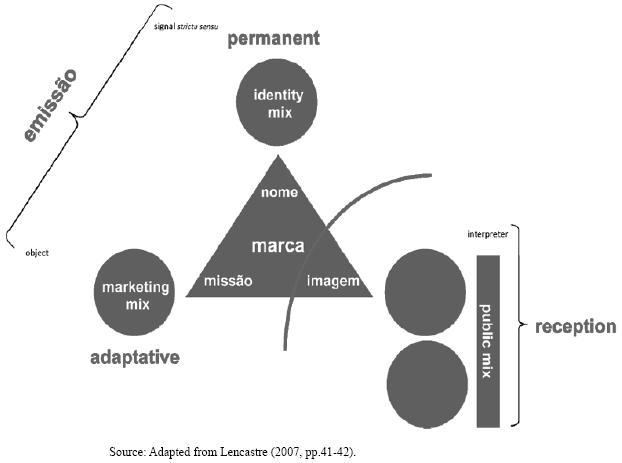
Around 1903, the American philosopher Charles Sanders Peirce developed a positivistic idea of signs, studying the relationship between them and the environment. For him, there was something more in a sign than just its “signifier” – the form, its expression – and the “signified” – the content. In his opinion, a third term would become involved in the relationship: a “referent”, which establishes a connection between the former two terms through the way the sign is interpreted. Based in the Peircean triadic conception, Lencastre (1999, p. 33) defines a sign as “anything, which is in the place of anything, in order to be interpreted by someone”. He developed what is called as “brand triangle”, where the relationship between the three elements was established schematically. The first is about the brand identity where the brand is represented. The author calls it the identity mix. The second vertex is imputed to the marketing mix, which has the marketing actions to put the brand in the market. The third pillar is connected to the brand response, the set of the cognitive, affective and behavioural responses of the different markets to the brand. Lencastre and Côrte-Real (2010) call this combination the “response mix”.
This triadic approach to the brand, with a more integrated vision, is widespread today in both the academic and business related worlds, contributing also to the brand definition proposed by David Ogilvy (in Strunck 2003, p. 137): “The brand is the intangible sum of the properties, name, package and price, its history, reputation and the way it is promoted. The brand is also defined by the consumer’s impressions about the people who use them; as well as their own personal experience.”
METHODOLOGY
We attempted to uncover the reasons behind the internationalisation process of Havaianas. To analyse this, several variables at play simultaneously are considered to be important. This encapsulates a phenomenon in which political, economical and social contextualisation is necessary, and for situations like this Yin (1993) advises the use of a study supported by a qualitative approach. This is mainly due to the diversity of variables and the importance they establish in the results achieved by the organisation under analysis. We also followed Eisenhardt (1989) in the idea that overlapped data fosters the analysis of the case and stresses possible adjustments on data collection.
In our case, it is relevant to stress that Havaianas have maintained a trajectory of solid growth since their transformation and repositioning in the market – which started in 1994 – developing an increasingly strengthened brand on the world stage. The political, economical and social contextualisation exerts great influence on Havaianas’ course in the Brazilian businesses environment and their expansion abroad, We therefore consider a case study to be the best approach to uncovering this process. We also relied upon triangulation, a data confirmation method proposed by Yin (1994). This method assumes that a result may have different proveniences since there is information convergence. Thus, several sources of information were used (annual financial reports, press releases, news, interviews and the authors’’ observations of the facts) in order to enrich the study and guarantee the quality of the conclusions. Hence, we proceeded accordingly and conducted interviews with managers involved in strategic management, and collected data including the firm’s reports, archives and news published in newspapers and magazines.
Figure 1 – The Dimensions of Internationalization
]]>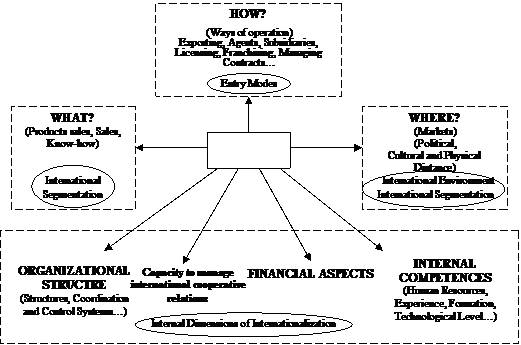
Figure 2 - Brand triangle
THE HAVAIANAS CASE
Havaianas were so successful in building an image with strong, favourable and unique associations (Keller, 1998) that, in less than a decade, they became world phenomena. Nowadays, even Americans, English and Australians can name the brand of their flip-flops (as the sandals are called outside Brazil): “the Brazilian ra-VYAH-nas”. However, it was not always that way. The story of São Paulo Alpargatas, the company that afterwards would create Havaianas sandals, began about a hundred years ago in Brazil. What started as a popular product, seen by many as an exclusively functional commodity, became a fashion in less than four decades.
São Paulo Alpargatas, the owner of the Havaianas brand, appeared in 1907, on the initiative of the Scotsman Robert Fraser in association with an English group. Together they started the production of “alpargatas”, a type of footwear very popular at the time when working the land, and especially when growing coffee (an activity that then dominated the São Paulo region). Its shares have been quoted on the São Paulo stock market since 1913.
In 1962, Alpargatas launched a new product in the market: the Havaianas. This new model was inspired by the traditional Japanese sandals, Zori, which were made of wood. The Brazilian national version had a specific characteristic: they were made of rubber. In less than a year, São Paulo Alpargatas, still limited to the national market, was selling more than a thousand pairs of Havaianas every day through local shops and small businesses. The idea of this new sandal was so simple that its fame grew rapidly and began to be copied by several rival brands.
]]> Figure 3 - Havaianas advertising campaign in the sixties and in the eighties

Segmentation and positioning until 1997
Until 1994, Havaianas’ performance was a simple one, in a certain measure effective, but not efficient. It is considered effective because of the portion of market achieved, having been the leader in the national sandal sector since they were launched. Meanwhile, the low contribution margins created by the product did not favour investment and changes in marketing variables. The orientation to the market was made under a perspective of sales, taking into consideration only the companies’ and vendors’ needs.
The sandals were distributed uniformly to all market segments and exhibited without any attempt to allure: piled up in powdered soap boxes or tied up with wires and hung inside tents. At fairs they were left exposed to the elements; in traditional businesses they were relegated to areas with less movement and visibility; in malls they were kept among the stock, and in some stores they wouldn’t even be displayed in the windows. Limited to only five basic colours (black, blue, green, red and yellow), all with a white sole, they did not bring any added value to the product and stayed like that for 30 years. Exchange relations were based almost exclusively on the price. The Havaianas were simply recognised as the cheapest way to wear shoes. Because of this, they carried the stigma of being slippers for ”poor people and domestic staff“.
Segmentation efforts practically did not exist. The market segments which adopted the sandals as a regular item of consumption – the C, D and E classes – did so more as a result of the price policy, the easy accessibility to the product and its low added value, than as a result of the will or attitude of the company itself. Marketing was one of the company’s weaknesses. Furthermore, their communication actions, for example, were limited to the seasonal transmission of advertising campaigns on television, always presented by the comedian Chico Anysio. These campaigns always approached the product’s originality and legitimacy, showing the consumers that they should avoid counterfeits.
The brand’s mission at this time was limited to the product’s physical and functional characteristics: durability, comfort and hygiene, at a low price. As result, the sandals had their positioning in the market limited to the simplest of the benefits that they could transmit: protection for the feet at a low cost.
Success came, as well as the growth of the organisation, but not in a sustainable way. The company, which had a 90% share in the national market of rubber sandals, with sales reaching 100 million pairs per year, found itself in trouble in 1993 when sales were cut down incredibly to 65 million pairs. This was how the company understood it needed to change.
The gradual transformation
]]> From 1994, the Alpargatas went through a complex transformation. Even though its products were still market leaders, results were worsening every year and did not stop falling. Sandals were seen as real commodities, the production process was fairly simple, and therefore very easy to counterfeit, which made the creation of long-lasting competitive advantages difficult, as stated by Porter (2007).Considering that marketing was not one of the company’s strengths, its managers saw in advertising the only tool to get close to the consumer, though no studies were made in order to know what was effectively assimilated by the public. Facing these difficulties, the company started to implement a series of changes from 1994. At the identity-mix level, the changes occurred in a very subtle manner. The central identity or the name stricto sensu remained the same. The tangible identity, both design and lettering, were also unchanged. The only change made was to colouring: the brand received a new combination of colours.
Effective changes happened only in the marketing mix, through the product, price, communications and distribution variables and, later, when the company decided on active and structured internationalisation in search of an international positioning similar to the one achieved locally.
Marketing mix changes
Changes in the marketing mix happened in a gradual way. Initially, the plan set was centred in what the company considered its two biggest potentialities: product and communication, although the latter did not present itself in a very effective way, due to the facts mentioned above.
The company launched the Havaianas Top, whose purpose was to reconquer the Brazilian middle class. This brought a revision of the product’s concept. Although the design was kept, the colouring was changed to a limited series; packaging, a box very similar to the ones used for shoes, was added; and a rack was issued to assure the product’s exhibition near shop windows and avoid its being piled up in shops’ stock. At the same time, a media campaign was carried out whose main focus was centred on the users valorisation of wearing these sandals and no longer on the product. Recorded testimonies of famous artists were used, giving credibility to the message in an irreverent manner, two items which made the messages more appealing to the public.
The results achieved by the end of the first year of the Havaianas Top project signalled the way forward. The financial results, and especially the great spontaneous exposure which the brand achieved in the media, without the need of big efforts, pointed to the need to develop a structured strategy with public relations and press advice.
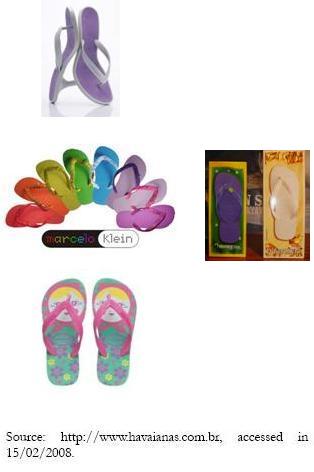
At the product level, the company increased its portfolio from two to 25 different models, including for the first time new designs and fashionable colours; and added new customised packaging.
Figure 4 - Havaianas, new designs, colours and shapes; and the new customized packaging
]]>
Concerning price, although the new sandals cost five or six times more than the traditional ones, the business unit tried to maintain a price relation that did not affect the association that the customers had towards the old models: “an excellent value for money”. Since the old product was not taken off the market, it was possible to keep the former consumer. Regarding communication, the campaigns continued in the media, characterised by humour, and famous people using Havaianas in the most ordinary situations. The focus was centred on the image of people and on lifestyle, and no longer on the product characteristics. The message to the public was: “Everyone (people of all classes) wears them.”
At this stage, the role of public relations and press advice was crucial: both were responsible for giving credibility to the message passed to the public and assuring that personalities would appear in public using the products, whether at events, on the beach, at parties, etc. The artists were photographed and the photos published in magazines, which were read by the target chosen by the company. Finally, concerning distribution, contracts were made with exclusive distributers in order to guarantee greater levels of commitment to the strategy and the results. Its function would be to exhibit the products in the most attractive way for the clients, using new display cases.
International performance
Another significant change for the company was its option for new markets in different countries. Alpargatas knew how to overcome the barriers usually associated with internationalisation since it also licensed foreign brands (initially Nike and later Timberland and Mizuno) in Brazil, and was responsible for representing these brands in other Latin American countries. The company had exported indirectly to Latin American countries since 1998, using the same price strategy and the same products as in the national market. Internationalisation was, in this sense, seen as a simple extension of the national territory due to the similarities of the new markets, the small geographical distances, and the knowledge they already had of the market, which therefore had less associated risk.
Three factors contributed strongly to the company exporting directly, through their own distributors, to regions with more potential purchasing power. The first was the measure of notoriety that the brand had achieved in Brazil: according to research carried out by the Brazilian Institute of Public Opinion and Statistics (IBOPE), about 75% of Brazilians, when questioned about sandals, mentioned Havaianas in first place. Secondly, the control necessary to ensure brand positioning abroad did not compensate the venture of leaving the product in the hands of someone without any commitment to performance in the market. And finally, previous experience: although not directly involved, the company did have some familiarity with foreign markets.
Thus, we may consider that Havaianas’ international path started in the nearest countries with fewer psychological barriers. The company went from an indirect export model to a direct model, trying to increase the sales potential of the markets. It made a giant leap and decided to launch the brand in the most important cities in the fashion world – Paris and New York – with direct exports through sales distributors established in these cities. In 2007, Alpargatas chose New York to house its first foreign sales subsidiary.
They realised, therefore, that the knowledge acquired about the market was fundamental in building up the internationalisation process, especially when internationalisation involves a greater control, a greater venture and a greater commitment of resources. The last stage of the process, according to company managers, will occur with the decision to establish a production subsidiary in China, which will take place very soon. Thus we can plot Havaianas’ internationalisation stages according to Uppsala Model (see Figure 5). Figure 6 helps in the understanding of all the dimensions in the international trajectory adopted by Havaianas, which will be explained below.
]]> Figure 5 - The most important landmarks in the international operation modes used by Havaianas
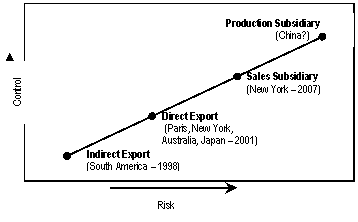
Figure 6 - The Havaianas internationalization dimensions
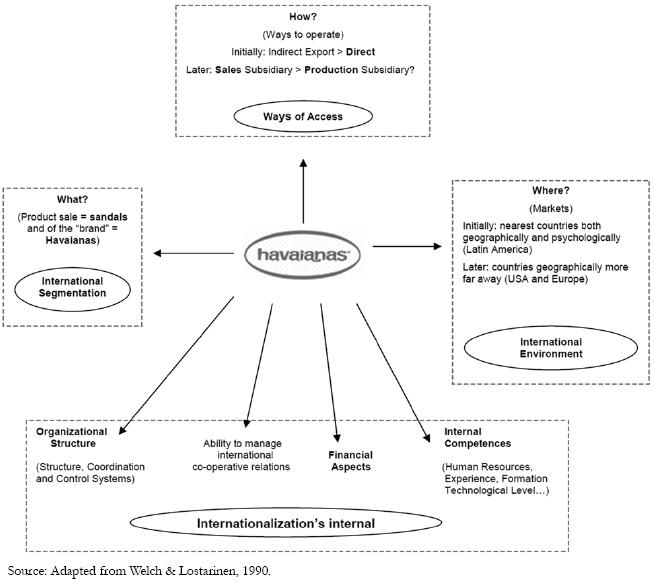
Concerning the internal dimensions of internationalisation, we may say that internal competences and the ability to manage international co-operative relations (Simões, 1997) should be emphasised. The concern was to create a transnational network of resources totally prepared to perform locally, namely with the changes carried out in the promotional compound. Initially, the company had adopted a standardised marketing policy that was not very different from the one adopted in the place of origin. However, that raised some issues. The same products were purchased by third parties in Brazil, at low prices, and afterwards exported to several places in the world through export companies; the local distributors had been chosen for their experience and market knowledge, forgetting that communication could only be effective with the teamwork of public relations and press advisory and the distribution teams.
With the problems identified, improvements had to be implemented, and only after that did the company continue its marketing policy, now adjusted to some particularities of the local markets. Thus, the improvements made, based on the planning and implementation of marketing policies in an integrated way, made it possible to achieve and even surpass the foreseen sales goals. The integration of the marketing policies at an international level also made it possible to obtain a positive impact on the brand’s image, assuring a place of reputation alongside the world’s brands.
Segmentation and positioning after 1997
Based on the definition of marketing policies guided towards the consolidation of brand values, the company decided after 1997 to implement a new value proposition. In this new proposition, the brand was successful in transmitting unique benefits to its consumers (Lencastre, 2007), who started to recognise a set of strong and favourable associations unique to Havaianas (Keller, 1998). Thanks to this new value proposition, Havaianas started to perform better. The new value proposition was accompanied by a good segmentation strategy that led to attractive market segments.
]]> Based in the slogan “Everybody wears them”, the brand tried to offer different products to everyone, with differentiated prices, that could be found in differentiated places and mass communicated, but also in a segmented way that would satisfy and enchant the consumers – through a strategic positioning of the brand’s sale and not only the sale of the product itself, customers could recognise in it a unique benefit. Table 2 presents some associations of the brand which were identified in different market segments in research commissioned by the company.
Table 2 - Associations to the Havaianas brand - Cognitive answers and Affective answers
| Cognitive: share of mind | Affective: share of heart | ||
| Before 1994 | After 1994 | Before 1994 | After 1994 |
| Durable: “Don’t deform, Don’t drop strips…” | ]]>
New associations: “The sandal” style Fashion sandals (more than 80 models and 60 thousands colors) 100% natural 100% Brazilian | Practical | Brazilian national identity |
| Hygienic: “Don’t have smell” | Functional | Tropical nature: ]]> BeachHeat Holidays Joy and relaxation | |
| Useful: “Comfort” | Protects the feet of needed population at a low cost: “Poor’s slipper” “Housemaid slipper” | Physical and emotional wellness: Comfort ]]> FashionCustomization Sexy
| |
| Product used be the poorest strata of population | Associations maintained: Excellent cost-benefit relation Accessibility Comfort Durability ]]> Hygienic | ||
| Excellent cost-benefit relation | |||
| A single model “traditional” | |||
| 5 colors | |||
Source: Adapted from the CD Rom – Institutional Havaianas, 2007.
DISCUSSION AND CONCLUSIONS
Havaianas capitalised on Brazil's positive image in the world, becoming an icon of "Brazilian Fashion". A reporter from The Independent Review of London wrote that with Havaianas on one's feet, one would be dreaming of the beach and somehow become an honorary Brazilian. The adoption of integrated marketing actions, involving all the promotional compound variables, to a greater or lesser degree, was responsible for conquering international positioning, obtained from an image previously achieved in Brazil. The success achieved by the combination of product, price, distribution and promotion strategies, just as it was imagined by McCarthy (1960), allowed the company to ensure the desired strategic positioning for Havaianas in the international market.
After a century of existence, in April 2007, São Paulo Alpargatas, as a major Brazilian producer of footwear and sport accessories, could already emphasise its presence in two of the most important fashion markets in the world: New York and Paris. These are very important markets not only because of their reputation, but also because of their purchasing potential. This allowed Havaianas to become a Brazilian company recognised worldwide, side by side with names such as Petrobrás, Odebrecht, Embraer, Natura and Vale do Rio Doce.
In that achievement, the joint performances of public relations and press advisory should be emphasised, ensuring the brand’s positioning in major worldwide fashion event, and at other events where the regular audience includes those who lead fashion, for example the National Academy Awards (the Oscars) and the Grammy Awards. Furthermore, the performance of exclusive distributors ensured the product’s exhibition in shop windows recognised worldwide, such as the Lafayette Galleries and Printemps in Paris. It is important to note that abroad, the PR and press advisory is also the distributor’s responsibility, besides the entire sales management in those territories.
]]> We understand that there still is a huge potential market abroad for these sandals. Its exploration can be carried out by other Brazilian companies or even companies from other countries. This is the reason why Havaianas cannot sit back on the success achieved internationally so far. The search for success in the future depends on the conquest of international markets, and that is the path the company intends to follow. Therefore, the business unit’s goal until 2011 is that the company’s exports should represent around 15% of total profits, since it is advisable that it continues to grow at a fast pace. As Paulo Lalli (principal of Havaianas business unit) says: “The moment now is to maintain the positioning achieved by the brand abroad and to increase the sales volume.”Findings
The succes of an effective brand repositioning strategy, which started in the internal market and was later widened abroad, should be analysed considering some fundamental ideas concerning the marketing mix and its associations with brand positioning. These factors may be understood in the following way. In the first place, they should develop an integrated and combined analysis of the marketing-mix variables, as proposed by Kotler and Keller (2006). This involves trying to understand which changes are necessary at the product, price, distribution and communication level, using public relations and press advisory work in order to create spontaneous media and word-of-mouth, two forms of communication with extreme credibility. These methods have shown themselves to be more effective than communication through advertising. These changes in the marketing-mix variables should be made in order to offer the target segments the possibility of recognising in the brand some associations, preferably strong, and immediately remembered by the consumer when he comes upon the brand. These associations should be also favourable, positive for the brand, and unique, since they stand out among the alternatives that can be found in the market (Keller, 1998). Among the associations created, the organisation should try to choose one to work with as a unique benefit associated with the brand, thus becoming its positioning, that is, the element that distinguishes the brand from the others (Ries and Trout, 1996).
At the same time a strong brand creates a positioning, it becomes one of the most sustainable and valuable competitive advantages (Porter, 1986), allowing the company to be in a strong position compared to competitors. Besides this, in the case analysed, the ability to manufacture with higher levels of flexibility (Porter, 2007) allowed the company to produce a huge variety of products in smaller quantities, thus allowing them to serve different markets – also a source of competitive advantage. This supported, for example, adaptations that occurred in the product according to the market needs.
It is important to consider that in terms of the internationalisation process, it also seems that the company followed an already well-established model. In fact, the internationalisation strategy occurred in a gradual and sequential way (Johanson and Vahlne 1977; Johanson and Wiedersheim-Paul 1975), since the company tried initially to serve the most sophisticated consumers in the domestic market, and later moved into other geographical markets which were psychologically similar, such as other Latin American countries. There, the firm gained experience that grounded its future moves to more distant countries.
Finally, it is necessary to assess the standardisation versus adaptation dilemma concerning these variables in the different markets. We believe that a superior internationalisation policy can be found somewhere between both. In fact, from an economic efficiency point of view, performance should be as uniform as possible, considering the changes made in terms of marketing-mix policy. However, from the market efficiency point of view, there are strong arguments pointing to the need for adaptation. In this case, some changes were made in the marketing-mix variables, such as the product, which was manufactured in a wide variety of models and colours adjusted to local realities. Nevertheless, Havaianas kept its basic raw material (rubber) untouched and the same in every country where it can be found. This, of course, is also the case for the brand. In sum, adaptation was more evident in the distribution and price, which are higher in foreign countries than in Brazil.
Study limitations and suggestions for future research
The use of only one case creates fewer possibilities of reproduction. However, we were able to explore this case thoroughly. This article was intended to show how Havaianas’s strategic decisions, whether in terms of brand repositioning in Brazil and later in terms of internationalisation, were successfully applied. One of the recipes for success seemed to be the creation of an integrated communication plan, strongly featuring press advisory and public relations, to widen its exposure in association with Brazilian and international personalities. In future studies, it would be interesting to assess whether similar results could be replicated in other Brazilian companies which are looking to increase their intervention on the global stage, and how action of this nature can reverse negative aspects associated with a “made in Brazil” image (Bilkey and Nes 1982). As matter of fact, considering that the mark “made in Brazil” may have both negative and positive associations worldwide, it would be relevant to carry out a study to identify which other Brazilian industries and brands could benefit from the allure created by the positioning associated with values such as heat, sun, beaches, etc, in order to enter into the international market. For that reason, a possible suggestion would be the analysis of other businesses that could use these values as their brand’s strong characteristics in international operations, for example bikini or natural juice companies.
REFERENCES
]]> ALPARGATAS (2006): Annual Report 2006, Alpargatas, Report.AMA (1960): Marketing definitions: a glossary of marketing terms, Chicago, American Marketing Association.
CHENG, JULIAN M-S., CHARLES BLAKSON, PAUL C.S. WU and SOMY S.M. CHEN (2005): “A Stage Model of International Brand Development: The perspectives of manufacturers from two newly industrialized economies – South Korea and Taiwan”, Industrial Marketing Management, [S.l.]: Elsevier, Vol.34, pp.504-514.
BILKEY, WARREN J. and E. NES (1982): “Country-of-origin effects on product evaluations”, Journal of International Business Studies, Vol. 13, nº 1, pp. 89-99.
BRITO, CARLOS (2007): “Gestão relacional da marca” in Paulo Lencastre, coord. – O livro da marca, Lisboa, Dom Quixote, pp.329-344.
BURT, STEVE L. and LEIGH SPARKS (2002): “Corporate branding, retailing, and retail internationalization”, Corporate Reputation Review, [S.l.]: Henry Stewart Publications 5 (2/3), pp.194-212.
GOBÉ, MARC (2001): Emotional Branding – The New Paradigm for Connecting Brands to People, New York, Allworth Press.
GRÖNROOS, CHRISTIAN (2001): Service management and marketing: a customer relationship management approach, West Sussex: Wiley.
HAVAIANAS (2007): Institucional Havaianas, CD Rom.
KELLER, KEVIN L. (1998): Strategic Brand Management: Building, Measuring and Managing Brand Equity, Upper Saddle River, Prentice Hall.
]]> KOTABE, MIKE and KRISTIAAN HELSEN (2000): Administração de marketing global, São Paulo, Atlas.KOTLER, PHILIP and KEVIN L. KELLER (2006): Administração de Marketing, 12th edition, São Paulo, Prentice Hall.
LEERSNYDER, JEAN-MARC (1986): Marketing International, Paris, Dalloz.
LENCASTRE, PAULO (1999): “A marca: o sinal, a missão e a imagem”, Revista Portuguesa de Marketing, nº 8, pp.105-119. [ Links ]
LENCASTRE, PAULO, coord. (2007) – O livro da marca, Lisboa, Dom Quixote.
LINDON, D., LÉVY J., DIONÍSIO P., LENDREVIE J. and RODRIGUES, J. (2004): Mercator XXI. Teoria e prática do marketing, 10th edition, Lisboa, Publicações Dom Quixote.
LORGA, SUSANA C. S. (2003): Internacionalização e Redes de Empresas. Conceitos e Teorias, Lisboa, São Paulo, Verbo.
JOHANSON, JAN and JAN-ERIK VAHLNE (1977): “The Internationalization Process of the Firm – A Model of Knowledge Development and Increasing Foreign Market Commitments”, Journal of International Business Studies. Vol.8, nº1, pp 23-32.
JOHANSON, JAN and FINN WIEDERSHEIM-PAUL (1975): “The Internationalization of the Firm: Four Swedish Cases”, Journal of Management Studies, [S.l.: s.n.]. Vol.12, nº3, pp 305-322.
MCCARTHY, JEROME (1960): Basic Marketing Approach, Homewood, IL: Irwin.
]]> NICKELS, WILLIAM G. and MARIAN BURK WOOD (1999): Marketing: relacionamentos, qualidade, valor, Rio de Janeiro: LTC.PORTER, MICHAEL E. (1986): Estratégia competitiva: técnicas para análise de indústrias e da concorrência, Rio de Janeiro, Campus.
RIES, AL and JACK TROUT (1996): Posicionamento: a batalha pela sua mente, 6th edition, São Paulo, Pioneira.
SARATHY, RAVI and VERN TERPSTRA (1991): International Marketing, 5th edition, [S.l.], The Dryden Press.
SIMÕES, VICENTE C. (1997): “Internacionalização das Empresas Portuguesas: Que Papel para a Cooperação?”, Economia e Prospectiva, [S.l.: s.n.]. Vol.1, nº2, pp.17-31. [ Links ]
STRUNCK, GILBERTO (2003): Como criar identidades visuais para marcas de sucesso, Rio de Janeiro, Rio Books.
WELCH, LAWRENCE and REIJO LUOSTARINEN (1990): Internationalization: Process of the Firm. International Business Operations, Helsinki, Helsinki School of Economics. pp.248-273.
YIN, ROBERT K. (1993): Applications of case study research, California, Sage Publications.
YIN, ROBERT K. (2005): Estudo de caso. Planejamento e Métodos. 3rd edition, Porto Alegre, Bookman.
ZYMAN, SÉRGIO and SCOTT MILLER (2001): A força da marca: descubra a diferença entre a tragédia e o triunfo na era do e-Commerce, Rio de Janeiro, Campus.
]]>Submitted: 15.07.2010
Approved: 16.11.2010
]]>