<?xml version="1.0" encoding="ISO-8859-1"?><article xmlns:mml="http://www.w3.org/1998/Math/MathML" xmlns:xlink="http://www.w3.org/1999/xlink" xmlns:xsi="http://www.w3.org/2001/XMLSchema-instance">
<front>
<journal-meta>
<journal-id>1646-5830</journal-id>
<journal-title><![CDATA[Acta Obstétrica e Ginecológica Portuguesa]]></journal-title>
<abbrev-journal-title><![CDATA[Acta Obstet Ginecol Port]]></abbrev-journal-title>
<issn>1646-5830</issn>
<publisher>
<publisher-name><![CDATA[Euromédice, Edições Médicas Lda.]]></publisher-name>
</publisher>
</journal-meta>
<article-meta>
<article-id>S1646-58302018000400007</article-id>
<title-group>
<article-title xml:lang="en"><![CDATA[Postmenopausal Meig's syndrome with extremely elevated CA 125: case report and review of the literature]]></article-title>
<article-title xml:lang="pt"><![CDATA[Síndrome de Meig’s na pós-menopausa com níveis de CA 125 extremamente elevados: relato de caso e revisão da literatura]]></article-title>
</title-group>
<contrib-group>
<contrib contrib-type="author">
<name>
<surname><![CDATA[Marujo]]></surname>
<given-names><![CDATA[Ana Teresa]]></given-names>
</name>
<xref ref-type="aff" rid="A1"/>
</contrib>
<contrib contrib-type="author">
<name>
<surname><![CDATA[Ambrósio]]></surname>
<given-names><![CDATA[Paula]]></given-names>
</name>
<xref ref-type="aff" rid="A2"/>
</contrib>
<contrib contrib-type="author">
<name>
<surname><![CDATA[Relva]]></surname>
<given-names><![CDATA[Andreia]]></given-names>
</name>
<xref ref-type="aff" rid="A2"/>
</contrib>
<contrib contrib-type="author">
<name>
<surname><![CDATA[Marques]]></surname>
<given-names><![CDATA[Carlos]]></given-names>
</name>
<xref ref-type="aff" rid="A3"/>
</contrib>
</contrib-group>
<aff id="AA1">
<institution><![CDATA[,Maternidade Alfredo da Costa Serviço de Ginecologia e Obstetricia ]]></institution>
<addr-line><![CDATA[ ]]></addr-line>
</aff>
<aff id="AA2">
<institution><![CDATA[,Hospital de Vila Franca de Xira Unidade de Oncologia Ginecológica ]]></institution>
<addr-line><![CDATA[Vila Franca de Xira ]]></addr-line>
</aff>
<aff id="AA3">
<institution><![CDATA[,Hospital de Vila Franca de Xira Serviço de Ginecologia-Obstetrícia ]]></institution>
<addr-line><![CDATA[Vila Franca de Xira ]]></addr-line>
</aff>
<pub-date pub-type="pub">
<day>00</day>
<month>12</month>
<year>2018</year>
</pub-date>
<pub-date pub-type="epub">
<day>00</day>
<month>12</month>
<year>2018</year>
</pub-date>
<volume>12</volume>
<numero>4</numero>
<fpage>297</fpage>
<lpage>301</lpage>
<copyright-statement/>
<copyright-year/>
<self-uri xlink:href="http://scielo.pt/scielo.php?script=sci_arttext&amp;pid=S1646-58302018000400007&amp;lng=en&amp;nrm=iso"></self-uri><self-uri xlink:href="http://scielo.pt/scielo.php?script=sci_abstract&amp;pid=S1646-58302018000400007&amp;lng=en&amp;nrm=iso"></self-uri><self-uri xlink:href="http://scielo.pt/scielo.php?script=sci_pdf&amp;pid=S1646-58302018000400007&amp;lng=en&amp;nrm=iso"></self-uri><abstract abstract-type="short" xml:lang="en"><p><![CDATA[Ectopic pregnancy, a potentially life-threatening condition, represents 1-2% of all pregnancies. Tubal pregnancy represents about 95% of the cases, but other locations can occur such as ovary, uterine cervix and abdominal cavity. Abdominal pregnancy is a rare event, seen in about 1.3% of ectopic pregnancies. We present a case of abdominal pregnancy located at the Douglas pouch and superficially infiltrated the rectovaginal septum in a woman under intra-uterine device contraception.]]></p></abstract>
<kwd-group>
<kwd lng="en"><![CDATA[Ectopic pregnancy]]></kwd>
<kwd lng="en"><![CDATA[Abdominal pregnancy]]></kwd>
</kwd-group>
</article-meta>
</front><body><![CDATA[ <p align="right"><font size="2"><b>CASE REPORT/</B>CASO CLÍNICO</font></p>     <p><font size="4"><b>Postmenopausal Meig's syndrome with extremely elevated CA    125: case report and review of the literature</b></font></p>     <p><font size="3"><b>Síndrome de Meig’s na pós-menopausa com níveis de CA 125    extremamente elevados: relato de caso e revisão da literatura</b></font></p>     <p><b>Ana Teresa Marujo*, Paula Ambrósio**, Andreia Relva***, Carlos Marques****</b></p>     <p>Hospital Vila Franca de Xira</p>     <p>*Assistente hospitalar de Ginecologia e Obstetricia da MAC </p>     <p>**Assistente Hospitalar da Unidade de Oncologia Ginecológica do Hospital de    Vila Franca de Xira</p>     <p>***Assistente Hospitalar da Unidade de Oncologia Ginecológica do Hospital de    Vila Franca de Xira</p>     <p>****Director do Serviço de Ginecologia-Obstetrícia do Hospital de Vila Franca    de Xira</p>     <p><a href="#c0">Endere&ccedil;o para correspond&ecirc;ncia</a> | <a href="#c0">Direcci&oacute;n    para correspondencia</a> | <a href="#c0">Correspondence</a><a name="topc0"></a></p> <hr/>     ]]></body>
<body><![CDATA[<p>&nbsp;</p>     <p><b>ABSTRACT</B></p>     <p>Ectopic pregnancy, a potentially life-threatening condition, represents 1-2%    of all pregnancies. Tubal pregnancy represents about 95% of the cases, but other    locations can occur such as ovary, uterine cervix and abdominal cavity. Abdominal    pregnancy is a rare event, seen in about 1.3% of ectopic pregnancies. We present    a case of abdominal pregnancy located at the Douglas pouch and superficially    infiltrated the rectovaginal septum in a woman under intra-uterine device contraception.</p>     <p><b>Keywords:</b> Ectopic pregnancy; Abdominal pregnancy.</p> <hr/>     <p>&nbsp;</p>     <p><b>Introduction</b></p>     <p>Typical Meigs’ syndrome (MS), first described in 1937, is a rare syndrome that    consists of 4 characteristics: 1) presence ovarian fibroma, 2) ascites, 3) hydrothorax    and 4) complete resolution of the clinical picture after removal of the tumor<sup>1</sup>.    When there is absence of hydrotorax is called atypical MS and when associated    with other histological types is called pseudosyndrome.</p>     <p>Its clinical relevance rests on the fact that it often mimics the clinical    presentation of ovarian cancer, especially when it occurs in postmenopausal    women, due to the higher incidence of this cancer in the 7<sup>th</sup> decade    of life<sup>2</sup>. Ovarian cancer is the 7<sup>th</sup> most frequent cancer    in women worldwide and is the most lethal gynecologic cancer. This is mostly    related with the fact that 70-75% of all cases are diagnosed in advanced stages    (III-IV), with a low five-year survival rate<sup>2</sup>.</p>     <p>When there is clinical and radiologic suspicion of ovarian cancer, the evaluation    of serum tumor markers is often performed in order to support the differential    diagnosis. Serum CA125 is the most widely used tumor marker in this setting    since it is increased in 90% of stage II or higher ovary epithelial tumors<sup>3</sup>.    It is known that this tumor marker has low sensitivity for the diagnosis of    early stages of ovarian cancer<sup>4,5</sup> and that its diagnostic accuracy    decreases significantly in women of reproductive age since it is frequently    increased in different benign conditions such as inflammatory pelvic disease,    endometriosis, uterine myomas and adenomyosis<sup>4</sup>. However, in postmenopausal    women, its sensitivity and specificity is substantially higher, making it a    more useful marker in this population of women<sup>5,6</sup>.</p>     <p>Although there are some reported cases of MS in postmenopausal women associated    with an elevated CA 125, the association with values &#8203;&#8203;above 1000    U/ml is exceptional.</p>     ]]></body>
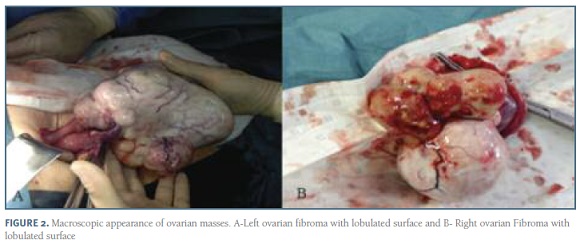
<body><![CDATA[<p>The authors present a case of MS with very high levels of CA 125 as well as    a review of the existing literature regarding the association between this benign    syndrome and extremely elevated levels of this tumor marker in postmenopausal    women. </p>     <p><b>Case Description</b></p>     <p>An 81-year-old nulliparous woman, presented in our hospital with complaints    of progressive dyspnoea, nausea and vomiting with one week of duration. She    also referred pelvic pain, anorexia and loss of 10 Kg in the previous 6 months.    She had medical history of hypertension and spontaneous menopause occurred at    the age of 51 years.</p>     <p>On physical examination, she was cachectic, with a protuberant abdomen and    a painless pelvic mass of hard nodular consistency extending to the umbilicus    was found. Ascites was clinically evident. On pelvic investigation, speculum    examination showed no abnormalities and pelvic bimanual examination revealed    a bulky pelvic mass, difficult to mobilize and to determine its point of origin.    Dullness to percussion and decreased breath sounds were found on the right lung    field.</p>     <p>Chest radiography revealed a right moderate pleural effusion with no other    abnormalities.</p>     <p>Abdominal and Pelvic ultrasound showed two bulky solid masses with bossed contour    in the pelvic cavity, one with 136x113mm on a right paramedian location and    one more posterior and left sided with 82x60mm. Moderate amount of ascites fluid    was described. No other abnormal findings were described. Magnetic Resonance    revealed a significant amount of free fluid in the pelvis and two voluminous    pelvic masses: the largest in anterior topography, measuring 136x77x118mm with    lobulated heterogeneous contour and central hypersignal area and the smallest    (86x62x79mm) in the posterior cul-de-sac, with similar characteristics but associated    with a cystic area of 40x48mm and hypointense areas suspected of primary adnexal    atypia or eventual metastization (<a href="#f1">Figure 1</a>). Endoscopy and    colonoscopy were normal. Blood tests showed no abnormal results other than extremely    elevated values of serum CA125: 1172 U/ml (normal value &lt;35 U/ml). Serum    levels of both Carcinoembrionic antigen and CA 19.9 were normal. </p>     <p>&nbsp;</p>     <p align="center"><a name="f1"></a><img src="/img/revistas/aogp/v12n4/12n4a07f1.jpg"/></p>     
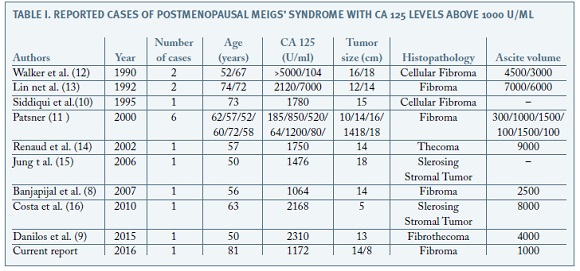
<p>&nbsp;</p>     <p>Thoracocentesis, with drainage of 900 ml of clear fluid, and pleural biopsy    were performed. Both results were negative for malignancy. On the basis of clinical    suspicion of ovarian malignancy an exploratory laparotomy was performed. We    found a significant amount of serous ascites (1000 ml) and two solid ovarian    masses, both lobulated and with whitish appearance: the left one with 14cm and    the right one with 8cm (<a href="#f2">Figure 2</a>). Bilateral adnexectomy was    performed and intra-operative frozen section examination revealed histological    characteristics compatible with bilateral ovarian fibroma. There were no signs    of malignancy in the remaining pelvic or abdominal organs.</p>     ]]></body>
<body><![CDATA[<p>&nbsp;</p>     <p align="center"><a name="f2"></a><img src="/img/revistas/aogp/v12n4/12n4a07f2.jpg"/></p>     
<p>&nbsp;</p>     <p>Final histological report confirmed the presence of bilateral fibroma of the    ovary and cytological analysis of ascitic fluid showed no signs of malignancy.    The ascites and pleural effusion completely disappeared following surgery and    the patient recovered well.</p>     <p>CA 125 was 30 U/ml 2 months after surgery and the patient was asymptomatic    one year after surgery.</p>     <p><b>Discussion</b></p>     <p>The clinical approach of pelvic masses is one of the greatest diagnostic challenges    in gynecology with the majority of cases corresponding to benign tumors<sup>5</sup>.</p>     <p>However, in clinical practice, the presence of anorexia, weight loss, adnexal    tumor, ascites and hydrothorax in a postmenopausal woman, especially when associated    with increased CA 125 values, are strongly suggestive of ovarian cancer<sup>6</sup>.  </p>     <p>Despite this, it is extremely important to remember that, although rare, some    benign conditions, like MS, can mimic the clinical presentation of ovarian malignancy.    Even so, given the importance of ovarian cancer, MS is always a diagnosis of    exclusion, done only when malignancy has been ruled out. Since its first description    in 1937<sup>1</sup>, MS cases have been reported in several publications with    ovarian fibroma being the most common type of tumor associated with this syndrome<sup>7,8</sup>.    Ovarian fibroma is a rare benign tumor, accounting for 2-5% of ovarian tumors    and it’s more common in women of reproductive age<sup>8</sup>. In the vast majority    of cases, it appears as a unilateral mass<sup>7,8</sup> but it may also appear    as bilateral mass as presented in this case. Given its benignity, the adnexectomy    is sufficient for treatment. However, when it occurs associated with ascites    (10-15%) and hydrothorax (1%)<sup>8</sup>, a clinical suspicion of malignant    disease is raised and there is often a tendency to perform a more invasive treatment<sup>9,10</sup>,    with a consequent increased risk of morbidity. This clinical case corroborates    the relevance of performing intra-operative frozen section examination since    it allows the differential diagnosis between benign and malignant disease, making    possible to adapt the aggressiveness of the surgery to the patient disease.  </p>     <p>Although MS has been known for more than 70 years, its etiopathogenesis remains    incompletely understood.The cause of pleural effusion is also unclear but it    is thought to be associated with the shift of ascitic fluid through the transdiaphragmatic    lymphatic channels<sup>1</sup>.</p>     ]]></body>
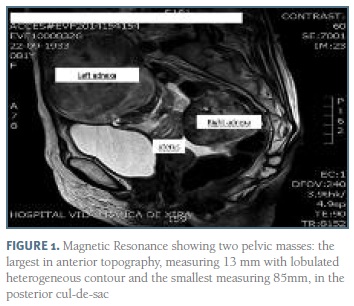
<body><![CDATA[<p>In 1989, a case of MS associated with high level of CA125 &#8203;&#8203;was    published for the first time<sup>5</sup>, with an important subsequent number    of publications documenting this association after this. However, most of these    cases refer to premenopausal women, being this association much less frequent    in postmenopausal women. In addition, in cases in which this association is    described in postmenopausal women, the elevation of serum CA 125 is generally    small to moderate, and its association with values &#8203;&#8203;above 1000    U / ml is very rare. Of all the published cases of MS in postmenopausal women    with elevated serum levels of CA125, only 9 reported values greater than 1000    (<a href="#t1">Table 1</a>).</p>     <p>&nbsp;</p>     <p align="center"><a name="t1"></a><img src="/img/revistas/aogp/v12n4/12n4a07t1.jpg"/></p>     
<p>&nbsp;</p>     <p>CA 125, initially described in 1983, is the most widely used tumor marker in    the approach of the adnexal masses, not only for its diagnosis but also for    its follow-up<sup>4,5</sup>. It is a transmembrane glycoprotein that derives    from the coelomic and mullerian epithelium, and can therefore be increased in    diseases affecting the pericardium, pleura, peritoneum, epithelium of the fallopian    tubes, ovaries, endometrium and endocervix<sup>4</sup>.</p>     <p>For this reason, there are different gynecological conditions, malignant and    benign, that can be associated with increased values of this marker although    the elevations found in the benign conditions of the ovary are generally small    to moderate<sup> 4,5</sup>. Extremely high values of this tumor marker are suggestive    of malignant disease, especially in postmenopausal women, where the sensitivity    and specificity of this marker is significantly higher than in premenopausal    women (80% and 88% versus 63% and 70 %, respectively)<sup>4,5</sup>.</p>     <p>The precise mechanism by which this marker increases is still not fully understood.    It may be due to increased production by the tumor itself or to inflammation    of peritoneum cells<sup>1,8,9</sup>. Some recent studies suggest that this increase    is more related to the volume of ascites than to the production by the tumor    itself<sup>9,10</sup>.<sup> </sup>This case report underlines the importance    of a thorough differential diagnosis of ovarian tumors in postmenopausal women,    even when all the findings point to a malignant etiology. In these cases, surgery    must be performed in centers with specialized teams, prepared for complete oncological    surgery.</p>     <p>The association between adnexal tumor, ascites, hydrothorax, and elevated serum    CA 125 in a postmenopausal woman is highly suggestive of advanced ovarian cancer<sup>    6,11</sup>. Therefore the relevance of reporting this case rests not only on    the importance of recalling that a small percentage of women with these characteristics    actually have a benign disease but also for underlining the lack of accuracy    of CA 125, even in postmenopausal women, noting the importance of its careful    use and interpretation. </p>     <p>Since 1989, very few cases of postmenopausal women with MS and elevated serum    CA 125 have been published, with only 9 cases reporting a CA 125 greater than    1000 U/ml. We emphasize the fact that the literature review carried out in the    presenting article is the first to focus only in postmenopausal women, where    the sensitivity and specificity of this tumor marker is expected to be higher    for malignancy. In addition, the case described is only the second one found    in the literature of bilateral ovarian fibroma associated with MS.</p>     <p>&nbsp;</p>     ]]></body>
<body><![CDATA[<p><b>REFER&Ecirc;NCIAS BIBLIOGR&Aacute;FICAS</b></p>     <!-- ref --><p>1. Meigs JV, Cass J. Fibroma of ovary with ascites and hidrotorax. Am J Obstet    Gynecol 1937;33:249-267.    &nbsp;&nbsp;&nbsp;&nbsp;&nbsp;&nbsp;&nbsp;&nbsp;[&#160;<a href="javascript:void(0);" onclick="javascript: window.open('/scielo.php?script=sci_nlinks&ref=1873255&pid=S1646-5830201800040000700001&lng=','','width=640,height=500,resizable=yes,scrollbars=1,menubar=yes,');">Links</a>&#160;]<!-- end-ref --></p>     <!-- ref --><p>2. Siegel R, Ma J, Zou Z, Jemal A. Cancer Statistics, 2014. CA Cancer J Clin    2014; 64:9-29.    &nbsp;&nbsp;&nbsp;&nbsp;&nbsp;&nbsp;&nbsp;&nbsp;[&#160;<a href="javascript:void(0);" onclick="javascript: window.open('/scielo.php?script=sci_nlinks&ref=1873257&pid=S1646-5830201800040000700002&lng=','','width=640,height=500,resizable=yes,scrollbars=1,menubar=yes,');">Links</a>&#160;]<!-- end-ref --></p>     <!-- ref --><p>3. Bast RC Jr, Badgwell D, Lu Z, Marquez R, Rosen D, Liu J,et al. New tumor    markers: CA 125 and beyond. Int J Gynecol Cancer 2005; 15:274-281.    &nbsp;&nbsp;&nbsp;&nbsp;&nbsp;&nbsp;&nbsp;&nbsp;[&#160;<a href="javascript:void(0);" onclick="javascript: window.open('/scielo.php?script=sci_nlinks&ref=1873259&pid=S1646-5830201800040000700003&lng=','','width=640,height=500,resizable=yes,scrollbars=1,menubar=yes,');">Links</a>&#160;]<!-- end-ref --></p>     <!-- ref --><p>4. Myers ER, Bastian A, Havrilesky LJ, Kulasingam SL, Terplan MS, Cline KE,    et al. Management of adnexal mass. Evid Rep Technol Assess 2006;130:1-145.    &nbsp;&nbsp;&nbsp;&nbsp;&nbsp;&nbsp;&nbsp;&nbsp;[&#160;<a href="javascript:void(0);" onclick="javascript: window.open('/scielo.php?script=sci_nlinks&ref=1873261&pid=S1646-5830201800040000700004&lng=','','width=640,height=500,resizable=yes,scrollbars=1,menubar=yes,');">Links</a>&#160;]<!-- end-ref --></p>     <!-- ref --><p>5. Jones OW 3rd, Surwit EA. Meigs’ Syndrome and elevated CA 125. Obstet Gynecol    1989;73:520-521.    &nbsp;&nbsp;&nbsp;&nbsp;&nbsp;&nbsp;&nbsp;&nbsp;[&#160;<a href="javascript:void(0);" onclick="javascript: window.open('/scielo.php?script=sci_nlinks&ref=1873263&pid=S1646-5830201800040000700005&lng=','','width=640,height=500,resizable=yes,scrollbars=1,menubar=yes,');">Links</a>&#160;]<!-- end-ref --></p>     <!-- ref --><p>6. American College of Obstetricians and Gynecologists. The role of the obstetrician-gynecologist    in the early detection of the epithelial ovarian cancer. ACOG Committee Opinion    No.477. Obstet Gynecol 2011;117:742-746.    &nbsp;&nbsp;&nbsp;&nbsp;&nbsp;&nbsp;&nbsp;&nbsp;[&#160;<a href="javascript:void(0);" onclick="javascript: window.open('/scielo.php?script=sci_nlinks&ref=1873265&pid=S1646-5830201800040000700006&lng=','','width=640,height=500,resizable=yes,scrollbars=1,menubar=yes,');">Links</a>&#160;]<!-- end-ref --></p>     <!-- ref --><p>7. Sivanesaratnam V, Dutta R, Jayalakshmi P. Ovarian Fibroma- Clinical and    histopathological characteristics. Int J Gynecol Obstet 1990;33:243-247.    &nbsp;&nbsp;&nbsp;&nbsp;&nbsp;&nbsp;&nbsp;&nbsp;[&#160;<a href="javascript:void(0);" onclick="javascript: window.open('/scielo.php?script=sci_nlinks&ref=1873267&pid=S1646-5830201800040000700007&lng=','','width=640,height=500,resizable=yes,scrollbars=1,menubar=yes,');">Links</a>&#160;]<!-- end-ref --></p>     <!-- ref --><p>8. Benjapibal M, Sangkarat SL, Laiwejpithaya S, Viriyapak B, Chaopotong P,    Jaishuen A. Meigs’ Syndrome with Elevated Serum Ca125: Case report and review    of the literature. Case Rep Oncol 2009; 2:61-66.    &nbsp;&nbsp;&nbsp;&nbsp;&nbsp;&nbsp;&nbsp;&nbsp;[&#160;<a href="javascript:void(0);" onclick="javascript: window.open('/scielo.php?script=sci_nlinks&ref=1873269&pid=S1646-5830201800040000700008&lng=','','width=640,height=500,resizable=yes,scrollbars=1,menubar=yes,');">Links</a>&#160;]<!-- end-ref --></p>     <!-- ref --><p>9. Danilos J, Kwasniewski M, Mazurek D, Bednarek W, Kotarski J. Meigs’ syndrome    with elevated CA 125 and HE-4:a case of luteinized fibrothecoma. Prz Menopauzalny    2015; 14:152-254.    &nbsp;&nbsp;&nbsp;&nbsp;&nbsp;&nbsp;&nbsp;&nbsp;[&#160;<a href="javascript:void(0);" onclick="javascript: window.open('/scielo.php?script=sci_nlinks&ref=1873271&pid=S1646-5830201800040000700009&lng=','','width=640,height=500,resizable=yes,scrollbars=1,menubar=yes,');">Links</a>&#160;]<!-- end-ref --></p>     <!-- ref --><p>10. Siddiqui M, Toub D. Cellular Fibroma of the Ovary with Meigs’ Syndrome    and elevated CA 125. J Reprod Med 1995; 40:817-819.    &nbsp;&nbsp;&nbsp;&nbsp;&nbsp;&nbsp;&nbsp;&nbsp;[&#160;<a href="javascript:void(0);" onclick="javascript: window.open('/scielo.php?script=sci_nlinks&ref=1873273&pid=S1646-5830201800040000700010&lng=','','width=640,height=500,resizable=yes,scrollbars=1,menubar=yes,');">Links</a>&#160;]<!-- end-ref --></p>     <p>11. Patsner B.Meigs syndrome and &ldquo;false positive&rdquo; preoperative serum CA-125    levels:analysis of ten cases. Eur J Gynecol Oncol 2000;21:362-363.</p>     <!-- ref --><p>12. Walker J, Manetta A, Mannel RS, Liao SY. Cellular Fibroma Masquerading    as ovarian cancer. Obstet Gynecol 1990;76:530-1.    &nbsp;&nbsp;&nbsp;&nbsp;&nbsp;&nbsp;&nbsp;&nbsp;[&#160;<a href="javascript:void(0);" onclick="javascript: window.open('/scielo.php?script=sci_nlinks&ref=1873276&pid=S1646-5830201800040000700012&lng=','','width=640,height=500,resizable=yes,scrollbars=1,menubar=yes,');">Links</a>&#160;]<!-- end-ref --></p>     <!-- ref --><p>13. Lin JY, Angel C, Sickel JZ. Meigs syndrome with elevated serum CA 125.Obstet    Gynecol 1992;80:563-566.    &nbsp;&nbsp;&nbsp;&nbsp;&nbsp;&nbsp;&nbsp;&nbsp;[&#160;<a href="javascript:void(0);" onclick="javascript: window.open('/scielo.php?script=sci_nlinks&ref=1873278&pid=S1646-5830201800040000700013&lng=','','width=640,height=500,resizable=yes,scrollbars=1,menubar=yes,');">Links</a>&#160;]<!-- end-ref --></p>     <!-- ref --><p>14. Renaud MC, Plante M, Roy M. Ovarian Thecoma associated with a large quantity    of ascitis and elevated sérum CA 125 and CA 15-3.J Obstet Gynaecol Can 2002;    24: 963-965.    &nbsp;&nbsp;&nbsp;&nbsp;&nbsp;&nbsp;&nbsp;&nbsp;[&#160;<a href="javascript:void(0);" onclick="javascript: window.open('/scielo.php?script=sci_nlinks&ref=1873280&pid=S1646-5830201800040000700014&lng=','','width=640,height=500,resizable=yes,scrollbars=1,menubar=yes,');">Links</a>&#160;]<!-- end-ref --> </p>     <!-- ref --><p>15. Jung NH, Kim T, Kim HJ, Lee KW, Lee NW, Lee ES. Ovarian sclerosing stromal    tumor presenting as Meigs’ syndrome with elevated CA-125. J Obstet Gynaecol    Res 2006;32:619-622.    &nbsp;&nbsp;&nbsp;&nbsp;&nbsp;&nbsp;&nbsp;&nbsp;[&#160;<a href="javascript:void(0);" onclick="javascript: window.open('/scielo.php?script=sci_nlinks&ref=1873282&pid=S1646-5830201800040000700015&lng=','','width=640,height=500,resizable=yes,scrollbars=1,menubar=yes,');">Links</a>&#160;]<!-- end-ref --></p>     ]]></body>
<body><![CDATA[<!-- ref --><p>16. Costa C, Costa A, Baptista P, Paiva V. Sclerosing stromal tumor of the    ovary associated with Meigs’ syndrome and elevated CA 125. J Obstet Gynaecol    2010;30:747-748.    &nbsp;&nbsp;&nbsp;&nbsp;&nbsp;&nbsp;&nbsp;&nbsp;[&#160;<a href="javascript:void(0);" onclick="javascript: window.open('/scielo.php?script=sci_nlinks&ref=1873284&pid=S1646-5830201800040000700016&lng=','','width=640,height=500,resizable=yes,scrollbars=1,menubar=yes,');">Links</a>&#160;]<!-- end-ref --> </p>     <p>&nbsp;</p>     <p><a href="#topc0">Endere&ccedil;o para correspond&ecirc;ncia</a> | <a href="#topc0">Direcci&oacute;n    para correspondencia</a> | <a href="#topc0">Correspondence</a><a name="c0"></a></p>     <p> Ana Teresa Marujo</p>     <p>E-mail: <a href="mailto:anatmarujo@hotmail.com">anatmarujo@hotmail.com</a></p>     <p>&nbsp;</p>     <p><b>Recebido em: </b>26/07/2017</p>     <p><b>Aceite para publica&ccedil;&atilde;o: </b>06/01/2018</p>      ]]></body><back>
<ref-list>
<ref id="B1">
<label>1</label><nlm-citation citation-type="journal">
<person-group person-group-type="author">
<name>
<surname><![CDATA[Meigs]]></surname>
<given-names><![CDATA[JV]]></given-names>
</name>
<name>
<surname><![CDATA[Cass]]></surname>
<given-names><![CDATA[J]]></given-names>
</name>
</person-group>
<article-title xml:lang="en"><![CDATA[Fibroma of ovary with ascites and hidrotorax]]></article-title>
<source><![CDATA[Am J Obstet Gynecol]]></source>
<year>1937</year>
<volume>33</volume>
<page-range>249-267</page-range></nlm-citation>
</ref>
<ref id="B2">
<label>2</label><nlm-citation citation-type="journal">
<person-group person-group-type="author">
<name>
<surname><![CDATA[Siegel]]></surname>
<given-names><![CDATA[R]]></given-names>
</name>
<name>
<surname><![CDATA[Ma]]></surname>
<given-names><![CDATA[J]]></given-names>
</name>
<name>
<surname><![CDATA[Zou]]></surname>
<given-names><![CDATA[Z]]></given-names>
</name>
<name>
<surname><![CDATA[Jemal]]></surname>
<given-names><![CDATA[A]]></given-names>
</name>
</person-group>
<article-title xml:lang="en"><![CDATA[Cancer Statistics, 2014]]></article-title>
<source><![CDATA[CA Cancer J Clin]]></source>
<year>2014</year>
<volume>64</volume>
<page-range>9-29</page-range></nlm-citation>
</ref>
<ref id="B3">
<label>3</label><nlm-citation citation-type="journal">
<person-group person-group-type="author">
<name>
<surname><![CDATA[Bast Jr]]></surname>
<given-names><![CDATA[RC]]></given-names>
</name>
<name>
<surname><![CDATA[Badgwell]]></surname>
<given-names><![CDATA[D]]></given-names>
</name>
<name>
<surname><![CDATA[Lu]]></surname>
<given-names><![CDATA[Z]]></given-names>
</name>
<name>
<surname><![CDATA[Marquez]]></surname>
<given-names><![CDATA[R]]></given-names>
</name>
<name>
<surname><![CDATA[Rosen]]></surname>
<given-names><![CDATA[D]]></given-names>
</name>
<name>
<surname><![CDATA[Liu]]></surname>
<given-names><![CDATA[J]]></given-names>
</name>
</person-group>
<article-title xml:lang="en"><![CDATA[New tumor markers: CA 125 and beyond]]></article-title>
<source><![CDATA[Int J Gynecol Cancer]]></source>
<year>2005</year>
<volume>15</volume>
<page-range>274-281</page-range></nlm-citation>
</ref>
<ref id="B4">
<label>4</label><nlm-citation citation-type="journal">
<person-group person-group-type="author">
<name>
<surname><![CDATA[Myers]]></surname>
<given-names><![CDATA[ER]]></given-names>
</name>
<name>
<surname><![CDATA[Bastian]]></surname>
<given-names><![CDATA[A]]></given-names>
</name>
<name>
<surname><![CDATA[Havrilesky]]></surname>
<given-names><![CDATA[LJ]]></given-names>
</name>
<name>
<surname><![CDATA[Kulasingam]]></surname>
<given-names><![CDATA[SL]]></given-names>
</name>
<name>
<surname><![CDATA[Terplan]]></surname>
<given-names><![CDATA[MS]]></given-names>
</name>
<name>
<surname><![CDATA[Cline]]></surname>
<given-names><![CDATA[KE]]></given-names>
</name>
</person-group>
<article-title xml:lang="en"><![CDATA[Management of adnexal mass]]></article-title>
<source><![CDATA[Evid Rep Technol Assess]]></source>
<year>2006</year>
<volume>130</volume>
<page-range>1-145</page-range></nlm-citation>
</ref>
<ref id="B5">
<label>5</label><nlm-citation citation-type="journal">
<person-group person-group-type="author">
<name>
<surname><![CDATA[Jones 3rd]]></surname>
<given-names><![CDATA[OW]]></given-names>
</name>
<name>
<surname><![CDATA[Surwit]]></surname>
<given-names><![CDATA[EA]]></given-names>
</name>
</person-group>
<article-title xml:lang="en"><![CDATA[Meigs' Syndrome and elevated CA 125]]></article-title>
<source><![CDATA[Obstet Gynecol]]></source>
<year>1989</year>
<volume>73</volume>
<page-range>520-521</page-range></nlm-citation>
</ref>
<ref id="B6">
<label>6</label><nlm-citation citation-type="journal">
<collab>American College of Obstetricians and Gynecologists</collab>
<article-title xml:lang="en"><![CDATA[The role of the obstetrician-gynecologist in the early detection of the epithelial ovarian cancer: ACOG Committee Opinion No.477]]></article-title>
<source><![CDATA[Obstet Gynecol]]></source>
<year>2011</year>
<volume>117</volume>
<page-range>742-746</page-range></nlm-citation>
</ref>
<ref id="B7">
<label>7</label><nlm-citation citation-type="journal">
<person-group person-group-type="author">
<name>
<surname><![CDATA[Sivanesaratnam]]></surname>
<given-names><![CDATA[V]]></given-names>
</name>
<name>
<surname><![CDATA[Dutta]]></surname>
<given-names><![CDATA[R]]></given-names>
</name>
<name>
<surname><![CDATA[Jayalakshmi]]></surname>
<given-names><![CDATA[P]]></given-names>
</name>
</person-group>
<article-title xml:lang="en"><![CDATA[Ovarian Fibroma- Clinical and histopathological characteristics]]></article-title>
<source><![CDATA[Int J Gynecol Obstet]]></source>
<year>1990</year>
<volume>33</volume>
<page-range>243-247</page-range></nlm-citation>
</ref>
<ref id="B8">
<label>8</label><nlm-citation citation-type="journal">
<person-group person-group-type="author">
<name>
<surname><![CDATA[Benjapibal]]></surname>
<given-names><![CDATA[M]]></given-names>
</name>
<name>
<surname><![CDATA[Sangkarat]]></surname>
<given-names><![CDATA[SL]]></given-names>
</name>
<name>
<surname><![CDATA[Laiwejpithaya]]></surname>
<given-names><![CDATA[S]]></given-names>
</name>
<name>
<surname><![CDATA[Viriyapak]]></surname>
<given-names><![CDATA[B]]></given-names>
</name>
<name>
<surname><![CDATA[Chaopotong]]></surname>
<given-names><![CDATA[P]]></given-names>
</name>
<name>
<surname><![CDATA[Jaishuen]]></surname>
<given-names><![CDATA[A]]></given-names>
</name>
</person-group>
<article-title xml:lang="en"><![CDATA[Meigs' Syndrome with Elevated Serum Ca125: Case report and review of the literature]]></article-title>
<source><![CDATA[Case Rep Oncol]]></source>
<year>2009</year>
<volume>2</volume>
<page-range>61-66</page-range></nlm-citation>
</ref>
<ref id="B9">
<label>9</label><nlm-citation citation-type="journal">
<person-group person-group-type="author">
<name>
<surname><![CDATA[Danilos]]></surname>
<given-names><![CDATA[J]]></given-names>
</name>
<name>
<surname><![CDATA[Kwasniewski]]></surname>
<given-names><![CDATA[M]]></given-names>
</name>
<name>
<surname><![CDATA[Mazurek]]></surname>
<given-names><![CDATA[D]]></given-names>
</name>
<name>
<surname><![CDATA[Bednarek]]></surname>
<given-names><![CDATA[W]]></given-names>
</name>
<name>
<surname><![CDATA[Kotarski]]></surname>
<given-names><![CDATA[J]]></given-names>
</name>
</person-group>
<article-title xml:lang="en"><![CDATA[Meigs' syndrome with elevated CA 125 and HE-4: a case of luteinized fibrothecoma]]></article-title>
<source><![CDATA[Prz Menopauzalny]]></source>
<year>2015</year>
<volume>14</volume>
<page-range>152-254</page-range></nlm-citation>
</ref>
<ref id="B10">
<label>10</label><nlm-citation citation-type="journal">
<person-group person-group-type="author">
<name>
<surname><![CDATA[Siddiqui]]></surname>
<given-names><![CDATA[M]]></given-names>
</name>
<name>
<surname><![CDATA[Toub]]></surname>
<given-names><![CDATA[D]]></given-names>
</name>
</person-group>
<article-title xml:lang="en"><![CDATA[Cellular Fibroma of the Ovary with Meigs' Syndrome and elevated CA 125]]></article-title>
<source><![CDATA[J Reprod Med]]></source>
<year>1995</year>
<volume>40</volume>
<page-range>817-819</page-range></nlm-citation>
</ref>
<ref id="B11">
<label>11</label><nlm-citation citation-type="journal">
<person-group person-group-type="author">
<name>
<surname><![CDATA[Patsner]]></surname>
<given-names><![CDATA[B]]></given-names>
</name>
</person-group>
<article-title xml:lang="en"><![CDATA[Meigs syndrome and "false positive" preoperative serum CA-125 levels: analysis of ten cases]]></article-title>
<source><![CDATA[Eur J Gynecol Oncol]]></source>
<year>2000</year>
<volume>21</volume>
<page-range>362-363</page-range></nlm-citation>
</ref>
<ref id="B12">
<label>12</label><nlm-citation citation-type="journal">
<person-group person-group-type="author">
<name>
<surname><![CDATA[Walker]]></surname>
<given-names><![CDATA[J]]></given-names>
</name>
<name>
<surname><![CDATA[Manetta]]></surname>
<given-names><![CDATA[A]]></given-names>
</name>
<name>
<surname><![CDATA[Mannel]]></surname>
<given-names><![CDATA[RS]]></given-names>
</name>
<name>
<surname><![CDATA[Liao]]></surname>
<given-names><![CDATA[SY]]></given-names>
</name>
</person-group>
<article-title xml:lang="en"><![CDATA[Cellular Fibroma Masquerading as ovarian cancer]]></article-title>
<source><![CDATA[Obstet Gynecol]]></source>
<year>1990</year>
<volume>76</volume>
<page-range>530-1</page-range></nlm-citation>
</ref>
<ref id="B13">
<label>13</label><nlm-citation citation-type="journal">
<person-group person-group-type="author">
<name>
<surname><![CDATA[Lin]]></surname>
<given-names><![CDATA[JY]]></given-names>
</name>
<name>
<surname><![CDATA[Angel]]></surname>
<given-names><![CDATA[C]]></given-names>
</name>
<name>
<surname><![CDATA[Sickel]]></surname>
<given-names><![CDATA[JZ]]></given-names>
</name>
</person-group>
<article-title xml:lang="en"><![CDATA[Meigs syndrome with elevated serum CA 125: Obstet]]></article-title>
<source><![CDATA[Gynecol]]></source>
<year>1992</year>
<volume>80</volume>
<page-range>563-566</page-range></nlm-citation>
</ref>
<ref id="B14">
<label>14</label><nlm-citation citation-type="journal">
<person-group person-group-type="author">
<name>
<surname><![CDATA[Renaud]]></surname>
<given-names><![CDATA[MC]]></given-names>
</name>
<name>
<surname><![CDATA[Plante]]></surname>
<given-names><![CDATA[M]]></given-names>
</name>
<name>
<surname><![CDATA[Roy]]></surname>
<given-names><![CDATA[M]]></given-names>
</name>
</person-group>
<article-title xml:lang="en"><![CDATA[Ovarian Thecoma associated with a large quantity of ascitis and elevated sérum CA 125 and CA 15-3]]></article-title>
<source><![CDATA[J Obstet Gynaecol Can]]></source>
<year>2002</year>
<volume>24</volume>
<page-range>963-965</page-range></nlm-citation>
</ref>
<ref id="B15">
<label>15</label><nlm-citation citation-type="journal">
<person-group person-group-type="author">
<name>
<surname><![CDATA[Jung]]></surname>
<given-names><![CDATA[NH]]></given-names>
</name>
<name>
<surname><![CDATA[Kim]]></surname>
<given-names><![CDATA[T]]></given-names>
</name>
<name>
<surname><![CDATA[Kim]]></surname>
<given-names><![CDATA[HJ]]></given-names>
</name>
<name>
<surname><![CDATA[Lee]]></surname>
<given-names><![CDATA[KW]]></given-names>
</name>
<name>
<surname><![CDATA[Lee]]></surname>
<given-names><![CDATA[NW]]></given-names>
</name>
<name>
<surname><![CDATA[Lee]]></surname>
<given-names><![CDATA[ES]]></given-names>
</name>
</person-group>
<article-title xml:lang="en"><![CDATA[Ovarian sclerosing stromal tumor presenting as Meigs' syndrome with elevated CA-125]]></article-title>
<source><![CDATA[J Obstet Gynaecol Res]]></source>
<year>2006</year>
<volume>32</volume>
<page-range>619-622</page-range></nlm-citation>
</ref>
<ref id="B16">
<label>16</label><nlm-citation citation-type="journal">
<person-group person-group-type="author">
<name>
<surname><![CDATA[Costa]]></surname>
<given-names><![CDATA[C]]></given-names>
</name>
<name>
<surname><![CDATA[Costa]]></surname>
<given-names><![CDATA[A]]></given-names>
</name>
<name>
<surname><![CDATA[Baptista]]></surname>
<given-names><![CDATA[P]]></given-names>
</name>
<name>
<surname><![CDATA[Paiva]]></surname>
<given-names><![CDATA[V]]></given-names>
</name>
</person-group>
<article-title xml:lang="en"><![CDATA[Sclerosing stromal tumor of the ovary associated with Meigs' syndrome and elevated CA 125]]></article-title>
<source><![CDATA[J Obstet Gynaecol]]></source>
<year>2010</year>
<volume>30</volume>
<page-range>747-748</page-range></nlm-citation>
</ref>
</ref-list>
</back>
</article>