<?xml version="1.0" encoding="ISO-8859-1"?><article xmlns:mml="http://www.w3.org/1998/Math/MathML" xmlns:xlink="http://www.w3.org/1999/xlink" xmlns:xsi="http://www.w3.org/2001/XMLSchema-instance">
<front>
<journal-meta>
<journal-id>1646-5830</journal-id>
<journal-title><![CDATA[Acta Obstétrica e Ginecológica Portuguesa]]></journal-title>
<abbrev-journal-title><![CDATA[Acta Obstet Ginecol Port]]></abbrev-journal-title>
<issn>1646-5830</issn>
<publisher>
<publisher-name><![CDATA[Euromédice, Edições Médicas Lda.]]></publisher-name>
</publisher>
</journal-meta>
<article-meta>
<article-id>S1646-58302019000100009</article-id>
<title-group>
<article-title xml:lang="en"><![CDATA[Pregnancy after endometrial carcinoma: case report and literature review]]></article-title>
<article-title xml:lang="pt"><![CDATA[Gravidez após carcinoma do endométrio: caso clínico e revisão da literatura]]></article-title>
</title-group>
<contrib-group>
<contrib contrib-type="author">
<name>
<surname><![CDATA[Rei]]></surname>
<given-names><![CDATA[Mariana]]></given-names>
</name>
<xref ref-type="aff" rid="A1"/>
</contrib>
<contrib contrib-type="author">
<name>
<surname><![CDATA[Pedrosa]]></surname>
<given-names><![CDATA[Sofia]]></given-names>
</name>
<xref ref-type="aff" rid="A2"/>
</contrib>
<contrib contrib-type="author">
<name>
<surname><![CDATA[Sousa]]></surname>
<given-names><![CDATA[Rita]]></given-names>
</name>
<xref ref-type="aff" rid="A3"/>
</contrib>
<contrib contrib-type="author">
<name>
<surname><![CDATA[Raposo]]></surname>
<given-names><![CDATA[Sofia]]></given-names>
</name>
<xref ref-type="aff" rid="A3"/>
</contrib>
<contrib contrib-type="author">
<name>
<surname><![CDATA[Sá]]></surname>
<given-names><![CDATA[Luís]]></given-names>
</name>
<xref ref-type="aff" rid="A3"/>
</contrib>
</contrib-group>
<aff id="AA1">
<institution><![CDATA[,Centro Hospitalar Universitário de São João, EPE Serviço de Ginecologia e Obstetrícia ]]></institution>
<addr-line><![CDATA[Porto ]]></addr-line>
</aff>
<aff id="AA2">
<institution><![CDATA[,Centro Hospitalar do Baixo Vouga Serviço de Ginecologia e Obstetrícia ]]></institution>
<addr-line><![CDATA[Aveiro ]]></addr-line>
</aff>
<aff id="AA3">
<institution><![CDATA[,Instituto Português de Oncologia Francisco Gentil de Coimbra Serviço de Ginecologia ]]></institution>
<addr-line><![CDATA[Coimbra ]]></addr-line>
</aff>
<pub-date pub-type="pub">
<day>00</day>
<month>03</month>
<year>2019</year>
</pub-date>
<pub-date pub-type="epub">
<day>00</day>
<month>03</month>
<year>2019</year>
</pub-date>
<volume>13</volume>
<numero>1</numero>
<fpage>50</fpage>
<lpage>53</lpage>
<copyright-statement/>
<copyright-year/>
<self-uri xlink:href="http://scielo.pt/scielo.php?script=sci_arttext&amp;pid=S1646-58302019000100009&amp;lng=en&amp;nrm=iso"></self-uri><self-uri xlink:href="http://scielo.pt/scielo.php?script=sci_abstract&amp;pid=S1646-58302019000100009&amp;lng=en&amp;nrm=iso"></self-uri><self-uri xlink:href="http://scielo.pt/scielo.php?script=sci_pdf&amp;pid=S1646-58302019000100009&amp;lng=en&amp;nrm=iso"></self-uri><abstract abstract-type="short" xml:lang="en"><p><![CDATA[Although endometrial cancer is primarily a postmenopausal disease, around 4 percent of patients are younger than 40 years and may desire fertility, requiring conservative treatment options. We describe a clinical case of a 34-year-old nulligesta diagnosed with early stage endometrial carcinoma who achieved a term pregnancy with live birth after conservative fertility sparing treatment with progestins. At two-year follow up, after childbearing and still preserving fertility, she remains in complete remission of the disease. An insight on conservative approaches is provided and potential risks are discussed.]]></p></abstract>
<kwd-group>
<kwd lng="en"><![CDATA[Endometrial carcinoma]]></kwd>
<kwd lng="en"><![CDATA[Pregnancy]]></kwd>
<kwd lng="en"><![CDATA[Fertility sparing]]></kwd>
<kwd lng="en"><![CDATA[Conservative treatment]]></kwd>
<kwd lng="en"><![CDATA[Progestins]]></kwd>
</kwd-group>
</article-meta>
</front><body><![CDATA[ <p align="right"><font size="2"><b>CASE REPORT/CASO CLÍNICO</b></font></p>     <p><font size="4"><b>Pregnancy after endometrial carcinoma: case report and literature    review</b></font></p>     <p><font size="3"><b>Gravidez após carcinoma do endométrio: caso clínico e revisão    da literatura</b></font></p>     <p><b>Mariana Rei*, Sofia Pedrosa**, Rita Sousa***, Sofia Raposo***, Luís Sá***</b></p>     <p>Serviço de Ginecologia, Instituto Português de Oncologia Francisco Gentil de    Coimbra</p>     <p>*Serviço de Ginecologia e Obstetrícia, Centro Hospitalar Universitário de São    João, EPE Porto</p>     <p>**Serviço de Ginecologia e Obstetrícia, Centro Hospitalar do Baixo Vouga, Aveiro</p>     <p>***Serviço de Ginecologia, Instituto Português de Oncologia Francisco Gentil    de Coimbra</p>     <p><a href="#c0">Endere&ccedil;o para correspond&ecirc;ncia</a> | <a href="#c0">Direcci&oacute;n    para correspondencia</a> | <a href="#c0">Correspondence</a><a name="topc0"></a></p> <hr/>     <p>&nbsp;</p>     ]]></body>
<body><![CDATA[<p><b>ABSTRACT</B></p>     <p>Although endometrial cancer is primarily a postmenopausal disease, around 4    percent of patients are younger than 40 years and may desire fertility, requiring    conservative treatment options. We describe a clinical case of a 34-year-old    nulligesta diagnosed with early stage endometrial carcinoma who achieved a term    pregnancy with live birth after conservative fertility sparing treatment with    progestins. At two-year follow up, after childbearing and still preserving fertility,    she remains in complete remission of the disease. An insight on conservative    approaches is provided and potential risks are discussed.</p>     <p><b>Keywords: </b>Endometrial carcinoma; Pregnancy; Fertility sparing; Conservative    treatment; Progestins.</p> <hr/>     <p>&nbsp;</p>     <p><b>Introduction</b></p>     <p>Endometrial cancer represents the most common malignancy of the female genital    tract in developed countries<sup>1</sup>. In Europe, the number of newly diagnosed    cases exceeded 100,000 in 2012<sup>1</sup>, with a cumulative risk of 1.71%<sup>2</sup>.    Although more than 90% of cases of endometrial cancer occur in women over 50    years, around 4% are younger than 40 years, many of whom may desire to preserve    fertility<sup>3</sup>. Moreover, its incidence may be increasing, due to an    important increase of obesity rate and popularity of postpone delivery age<sup>4</sup>.</p>     <p>Endometrial intra-epithelial neoplasia (EIN), the pre-malignant lesion for    type I endometrial carcinoma, encloses a continuum of estrogenic stimulation    of the endometrium unopposed by progestins, proliferative glandular epithelial    changes and consequently malignant transformation<sup>5</sup>. The risk factors    enhancing this line-up are well known, and most patients typically display a    clinical profile comprising high body mass index (BMI) with other components    of metabolic syndrome. Other risk factors include unopposed estrogen therapy,    estrogen-producing tumors, early menarche, late menopause, nulliparity and infertility,    particularly due to polycystic ovarian syndrome, with almost 3-fold increased    risk<sup>2,6</sup>.</p>     <p>Although the majority of endometrial cancers are diagnosed in early stages    (80% in FIGO stage I), differences in epidemiological risk factors and histopathological    features may impact both treatment and prognosis<sup>7</sup>.</p>     <p>A large body of evidence addresses the optimal surgical approach of endometrial    cancer with hysterectomy and bilateral salpingo-oophorectomy with or without    lymphadenectomy. Conservative management in women who desires preservation of    fertility raises a therapeutic dilemma that imposes a multidisciplinary discussion    and patient involvement.</p>     <p>We aim to review a case of a successful term pregnancy after conservative treatment    of an early stage endometrial carcinoma. An insight on fertility sparing treatments    and potential risks will be disclosed.</p>     ]]></body>
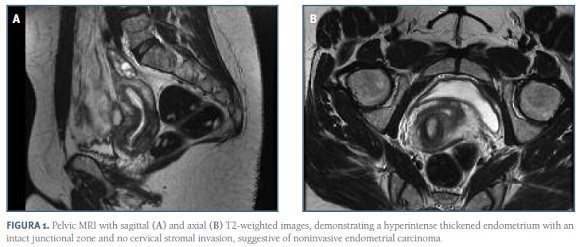
<body><![CDATA[<p><b>Case Report</b></p>     <p>We present a case of a 34-year-old nulligesta with the diagnosis of endometrial    cancer. Previous medical history included a stable hypothyroidism; pituitary    microadenoma controlled with bromocriptine; class II obesity, with a BMI of    37 Kg/m<sup>2</sup>. Concerning gynecologic history, first menses was at 11    years, with regular cycles and no current hormonal contraception. There was    no history of smoking habits. Regarding family oncologic history, her mother    had breast cancer at 40 years old.</p>     <p>She presented with uterine abnormal bleeding with a 9-months evolution, referring    abundant and prolonged menses as well as intermenstrual bleeding. A pelvic ultrasound    revealed a slightly enlarged uterus with heterogeneous endometrial thickening    of 17 mm with small regular cystic areas. An hysteroscopy under anesthesia was    performed, revealing a large multilobulated polypoid lesion with exuberant vascularization    inserted in the fundus of the cavity and right uterine wall. This surgical procedure    was finished with polypectomy with complete excision of the lesion. No peri    or post-operative complications were registered.</p>     <p>The histology revealed EIN and grade 2 endometrioid adenocarcinoma with estrogen    and progesterone receptor positivity. The patient was then referred to our oncologic    centre in order to evaluate the need for further treatments. A pelvic magnetic    resonance imaging (MRI) was performed, revealing endometrial thickness of 10    mm suggestive of an early stage endometrial neoplasia confined to the endometrium    and no cervical stromal invasion - FIGO stage IA (<a href="#f1">Figure 1A</a>    and <a href="#f1">1B</a>). Serum tumor markers Ca 125 and HE4 were within the    normal range and the cervical cytology was normal. The thoracoabdominal computed    tomography (CT) excluded distant dissemination.</p>     <p>&nbsp;</p>     <p align="center"><a name="f1"></a><img src="/img/revistas/aogp/v13n1/13n1a09f1.jpg"/></p>     
<p>&nbsp;</p>     <p>After considering the strong desire to preserve fertility and discussing all    the pros and cons of a fertility sparing option, the patient engaged with a    conservative medical treatment with close follow-up; megestrol acetate (MA)    on a single oral dose of 160 mg daily was initiated and maintained for the following    7 months.</p>     <p>At six-months follow-up after initiation of medical treatment, an heterogeneous    endometrial thickening of 11 mm was still observed in the pelvic ultrasound.    The patient underwent hysteroscopic control under anesthesia, which showed an    enlarged cavity with multiple polypoid lesions near the right tubal ostium.    Polypectomy of these lesions with bipolar energy system was performed, and the    histology was compatible with hyperprogestagenic pseudo-polypoip endometrium    and absence of malignancy. As complete remission was confirmed, the progestin    was discontinued and conception was encouraged. Three months later she conceived    spontaneously, resulting in an uneventful pregnancy with live born term delivery.    A male neonate weighing 4400g was born at 39 weeks by cesarian section due to    fetal macrosomia. Pathological examination of the placenta revealed no tumor    infiltration.</p>     <p>At three-month postpartum consultation, she was asymptomatic with no uterine    abnormal bleeding, under oral desogestrel in a daily dose of 0,075 mg. Serum    tumor markers and pelvic ultrasound were normal, revealing a linear endometrial    contour. Considering that the patient still desired to maintain fertility, a    52 mg levonorgestrel intrauterine device (LNG-IUD) was inserted. At six-month    postpartum follow up, clinical, serological and ultrasound evaluation remained    normal, and the endometrial biopsy confirmed oncologic remission. Furthermore,    counselling regarding risk reduction was provided, particularly focusing on    weight loss and nutritional coaching. A close follow-up every six months with    tumor markers, ultrasound and serial endometrial biopsies has been maintained    in our oncologic centre, and at two-year follow up she remains in complete remission    of the disease.</p>     ]]></body>
<body><![CDATA[<p><b>Discussion</b></p>     <p>The mainstay of treatment for endometrial cancer includes surgical staging,    with extrafascial total hysterectomy with bilateral salpingo-oophorectomy without    vaginal cuff. Assessment of the nodal status by lymphadenectomy should be performed    in intermediate and high risk patients for staging purposes and allows tailoring    of adjuvant therapy<sup>2,8</sup>.</p>     <p>Although this diagnosis is rare in childbearing age women, it may occur in    4% of patients under 40 years old<sup>3</sup>, imposing the need for fertility    preservation strategies. Younger and premenopausal women seem to have a better    prognosis, frequently displaying early stage well-differentiated and low-graded    tumors, enabling conservative treatment<sup>9</sup>. Despite of being a highly    effective treatment, with five-year survival rates over 95% in this setting,    the standard surgical approach results in a permanent loss of reproductive potential,    which might be of upmost importance to these women<sup>2</sup>.</p>     <p>Progestins such as medroxyprogesterone acetate (MPA, 400 - 600 mg/day) and    MA (160 - 320 mg/day), have been used as a fertility-sparing approach in this    subset of patients, with different dose regimens of cyclic (14 days every month)    or continuous therapy successfully used. Other conservative options include    local surgical excision with hysteroscopy in one to three steps, with or without    subsequent progesterone treatment; recurrent dilation and curettage (D&amp;C);    LNG-IUD, frequently in combination with gonadotrophin-releasing hormone agonists<sup>10-12</sup>.    A recent meta-analysis of 54 studies showed that hysteroscopic resection followed    by progestogens achieved a higher pooled regression and live birth rate and    a lower recurrence rate compared with oral progestogens alone, as well as a    significantly higher pooled live birth rate comparing to LNG-IUD alone<sup>13</sup>.    However, there is still no consensus regarding the optimal treatment approach,    dose and duration.</p>     <p>A proper assessment of tumor pathological features is a critical issue in patient    selection; a conservative approach may be considered in cases of grade 1 endometrial    carcinoma histology or premalignant disease as EIN<sup>9</sup>. Although D&amp;C    seems to be the optimal method to obtain the histopathology specimen for diagnosis,    reflecting FIGO tumor grade with higher accuracy comparing to office endometrial    sampling, hysteroscopy remains the gold standard for an oriented diagnosis<sup>14,15</sup>.</p>     <p>While conservative management presents high response rates of around 75%, recurrence    still occur in 30 to 40% of cases<sup>16-18</sup>. Therefore, a new D&amp;C    and imaging should be performed at 6 months to confirm therapy response. Pregnancy    seems to reduce cancer recurrence due to the progesterone environment<sup>17</sup>    and should be encouraged as soon as remission is achieved and before eventual    recurrence. Recent meta-analysis have shown a pooled live birth rate of 28 to    39% after fertility-sparing treatments<sup>19,20</sup>. Parlakgumus <i>et al    </i>retrospectively reviewed nine cases of early stage endometrial carcinoma    with desire for fertility preservation; among the 5 patients who preferred medical    treatment, there was a case of ovarian carcinoma during the follow-up; one case    of cancer recurrence diagnosed on D&amp;C for spontaneous miscarriage; only    one reported term pregnancy with live birth<sup>20</sup>.</p>     <p>We report a case of a 34-year-old women presenting with persistent abnormal    uterine bleeding for more than 6 months with relevant risk factors for endometrial    cancer, who was diagnosed with grade 2 endometrioid adenocarcinoma after hysteroscopic    polypectomy. After six months of medical treatment with daily MA, she achieved    complete remission. At this point, if complete response is achieved, conception    must be encouraged and referral to a fertility clinic is adequate. In case of    no response or disease recurrence after an initial response, standard surgical    treatment should be recommended. Furthermore, after childbearing or the age    of potencial pregnancy is completed, hysterectomy and eventual salpingo-oophorectomy    remains the standard treatment, given the significantly high recurrence rate.    Since our patient still desired to maintain fertility in view of a further pregnancy,    she will be kept in close monitoring every six month as far as complete remission    is warranted.</p>     <p>The subset of younger patients with endometrial carcinoma are frequently nulligravid    with a history of infertility, which may raise a therapeutic dilemma. Conservative    treatment of endometrial carcinoma seems a safe approach in selected cases of    early stages and low grade endometrioid histology. Although many studies have    revealed its safety in this subset of patients, there is still no standard treatment    algorithm. Patients who desire fertility-sparing options or ovarian preservation    should be counseled of the pros and cons and accept close follow-up, regarding    the high potential for recurrence and coexisting synchronous ovarian malignancy<sup>20</sup>.</p>     <p>&nbsp;</p>     <p><b>REFERÊNCIAS BIBLIOGRÁFICAS</b></p>     ]]></body>
<body><![CDATA[<!-- ref --><p>1. Ferlay J, Soerjomataram I, Ervik M, et al; International Agency for Research    on Cancer. GLOBOCAN 2012 v1.0, Cancer Incidence and Mortality Worldwide: IARC    CancerBase No. 11. <a href="http://globocan.iarc.fr" target="_blank">globocan.iarc.fr</a>.    Accessed April 15, 2017.    &nbsp;&nbsp;&nbsp;&nbsp;&nbsp;&nbsp;&nbsp;&nbsp;[&#160;<a href="javascript:void(0);" onclick="javascript: window.open('/scielo.php?script=sci_nlinks&ref=1874825&pid=S1646-5830201900010000900001&lng=','','width=640,height=500,resizable=yes,scrollbars=1,menubar=yes,');">Links</a>&#160;]<!-- end-ref --></p>     <!-- ref --><p>2. Colombo N, Creutzberg C, Amant F, et al. ESMO-ESGO-ESTRO Endometrial Consensus    Conference Working Group. ESMO-ESGO-ESTRO Consensus Conference on Endometrial    Cancer: diagnosis, treatment and follow-up. Ann Oncol 2016; 27(1):16-41.    &nbsp;&nbsp;&nbsp;&nbsp;&nbsp;&nbsp;&nbsp;&nbsp;[&#160;<a href="javascript:void(0);" onclick="javascript: window.open('/scielo.php?script=sci_nlinks&ref=1874827&pid=S1646-5830201900010000900002&lng=','','width=640,height=500,resizable=yes,scrollbars=1,menubar=yes,');">Links</a>&#160;]<!-- end-ref --></p>     <!-- ref --><p>3. Lee NK, Cheung MK, Shin JY, et al. Prognostic factors for uterine cancer    in reproductive-aged women. Obstet Gynecol 2007; 109:655Y662.    &nbsp;&nbsp;&nbsp;&nbsp;&nbsp;&nbsp;&nbsp;&nbsp;[&#160;<a href="javascript:void(0);" onclick="javascript: window.open('/scielo.php?script=sci_nlinks&ref=1874829&pid=S1646-5830201900010000900003&lng=','','width=640,height=500,resizable=yes,scrollbars=1,menubar=yes,');">Links</a>&#160;]<!-- end-ref --></p>     <p>4. Wise MR, Jordan V, Lagas A, et al. Obesity and endometrial hyperplasia and    cancer in premenopausal women: A systematic review. Am J Obstet Gynecol. 2016    Jun;214(6):689.e1-689.e17.</p>     <!-- ref --><p>5. Committee on Gynecologic Practice Society of Gynecologic Oncology, The American    College of Obstetricians and Gynecologists and Society of Gynecology Oncology.    Committee Opinion Endometrial Intraepithelial Neoplasia. Obstet Gynecol, 2015    (reaffirmed 2017). Number 631, Vol. 125, No. 5.    &nbsp;&nbsp;&nbsp;&nbsp;&nbsp;&nbsp;&nbsp;&nbsp;[&#160;<a href="javascript:void(0);" onclick="javascript: window.open('/scielo.php?script=sci_nlinks&ref=1874832&pid=S1646-5830201900010000900005&lng=','','width=640,height=500,resizable=yes,scrollbars=1,menubar=yes,');">Links</a>&#160;]<!-- end-ref --></p>     <!-- ref --><p>6. Barry JA, Azizia MM, Hardiman PJ. Risk of endometrial, ovarian and breast    cancer in women with polycystic ovary syndrome: a systematic review and meta-analysis.    Hum Reprod Update. 2014; 20:748Y758.    &nbsp;&nbsp;&nbsp;&nbsp;&nbsp;&nbsp;&nbsp;&nbsp;[&#160;<a href="javascript:void(0);" onclick="javascript: window.open('/scielo.php?script=sci_nlinks&ref=1874834&pid=S1646-5830201900010000900006&lng=','','width=640,height=500,resizable=yes,scrollbars=1,menubar=yes,');">Links</a>&#160;]<!-- end-ref --></p>     <!-- ref --><p>7. Pecorelli S. Revised FIGO staging for carcinoma of the vulva, cervix and    endometrium. Int J Gynecol Obstet 2009; 105(2):103-104 (34).    &nbsp;&nbsp;&nbsp;&nbsp;&nbsp;&nbsp;&nbsp;&nbsp;[&#160;<a href="javascript:void(0);" onclick="javascript: window.open('/scielo.php?script=sci_nlinks&ref=1874836&pid=S1646-5830201900010000900007&lng=','','width=640,height=500,resizable=yes,scrollbars=1,menubar=yes,');">Links</a>&#160;]<!-- end-ref --></p>     <!-- ref --><p>8. DiSaia PJ, Creasman WT. Adenocarcinoma of the uterus. In: DiSaia PJ, Creasman    WT (eds). Clinical Gynecologic Oncology, 5th edn. St. Louis, MO: Mosby, 1997;    134-168.    &nbsp;&nbsp;&nbsp;&nbsp;&nbsp;&nbsp;&nbsp;&nbsp;[&#160;<a href="javascript:void(0);" onclick="javascript: window.open('/scielo.php?script=sci_nlinks&ref=1874838&pid=S1646-5830201900010000900008&lng=','','width=640,height=500,resizable=yes,scrollbars=1,menubar=yes,');">Links</a>&#160;]<!-- end-ref --></p>     <!-- ref --><p>9. Duska LR, Garrett A, Rueda BR, et al. Endometrial cancer in women 40 years    old or younger. Gynecol Oncol. 2001; 83: 388Y393.    &nbsp;&nbsp;&nbsp;&nbsp;&nbsp;&nbsp;&nbsp;&nbsp;[&#160;<a href="javascript:void(0);" onclick="javascript: window.open('/scielo.php?script=sci_nlinks&ref=1874840&pid=S1646-5830201900010000900009&lng=','','width=640,height=500,resizable=yes,scrollbars=1,menubar=yes,');">Links</a>&#160;]<!-- end-ref --></p>     <!-- ref --><p>10. Perri T, Korach J, Gotlieb WH et al. Prolonged conservative treatment of    endometrial cancer patients: More than 1 pregnancy can be achieved. Int J Gynecol    Cancer 2011; 21: 72-78.    &nbsp;&nbsp;&nbsp;&nbsp;&nbsp;&nbsp;&nbsp;&nbsp;[&#160;<a href="javascript:void(0);" onclick="javascript: window.open('/scielo.php?script=sci_nlinks&ref=1874842&pid=S1646-5830201900010000900010&lng=','','width=640,height=500,resizable=yes,scrollbars=1,menubar=yes,');">Links</a>&#160;]<!-- end-ref --></p>     <!-- ref --><p>11. Mazzon I, Corrado G, Masciullo V, et al. Conservative surgical management    of stage IA endometrial carcinoma for fertility preservation. Fertil Steril    2010; 93: 1286-1289.    &nbsp;&nbsp;&nbsp;&nbsp;&nbsp;&nbsp;&nbsp;&nbsp;[&#160;<a href="javascript:void(0);" onclick="javascript: window.open('/scielo.php?script=sci_nlinks&ref=1874844&pid=S1646-5830201900010000900011&lng=','','width=640,height=500,resizable=yes,scrollbars=1,menubar=yes,');">Links</a>&#160;]<!-- end-ref --></p>     <!-- ref --><p>12. Minig L, Franchi D, Boveri S, et al. Progestin intrauterine device and    GnRH analogue for uterus-sparing treatment of endometrial precancers and well-    differentiated early endometrial carcinoma in young women. Ann Oncol 2011; 22:    643-649.    &nbsp;&nbsp;&nbsp;&nbsp;&nbsp;&nbsp;&nbsp;&nbsp;[&#160;<a href="javascript:void(0);" onclick="javascript: window.open('/scielo.php?script=sci_nlinks&ref=1874846&pid=S1646-5830201900010000900012&lng=','','width=640,height=500,resizable=yes,scrollbars=1,menubar=yes,');">Links</a>&#160;]<!-- end-ref --></p>     <p>12. Zhang Q, Qi G, Kanis MJ, et al. Comparison among fertility-sparing therapies    for well differentiated early-stage endometrial carcinoma and complex atypical    hyperplasia. Oncotarget 2017; 8(34):57642-57653.</p>     <p>13. Rodolakis A, Biliatis I, Morice P, et al. European Society of Gynecological    Oncology Task Force for Fertility Preservation: Clinical Recommendations for    Fertility-Sparing Management in Young Endometrial Cancer Patients. Int J Gynecol    Cancer 2015; 25:1258Y1265.</p>     <p>14. Leitao MM Jr, Kehoe S, Barakat RR, et al. Comparison of D&amp;C and office    endometrial biopsy accuracy in patients with FIGO grade 1 endometrial adenocarcinoma.    Gynecol Oncol. 2009;113:105Y108.</p>     <p>15. Gallos ID, Yap J, Rajkhowa M, et al. Regression, relapse, and live birth    rates with fertility-sparing therapy for endometrial cancer and atypical complex    endometrial hyperplasia: a systematic review and metaanalysis. Am J Obstet Gynecol    2012; 207:266. e1Ye12.</p>     <p>16. Park JY, Kim DY, Kim JH, et al. Long-term oncologic outcomes after fertility-sparing    management using oral progestin for young women with endometrial cancer (KGOG    2002). Eur J Cancer 2013; 49:868Y874.</p>     <p>17. Erkanli S, Ayhan A. Fertility-sparing therapy in young women with endometrial    cancer: 2010 update. Int J Gynecol Cancer 2010; 20:1170Y1187.</p>     <p>18. Koskas M, Uzan J, Luton D, et al. Prognostic factors of oncologic and reproductive    outcomes in fertility- sparing management of endometrial atypical hyperplasia    and adenocarcinoma: systematic review and meta- analysis. Fertil Steril. 2014;101:785Y794.</p>     ]]></body>
<body><![CDATA[<p>19. Parlakgumus HA, Kilicdag EB, Simsek E, et al. Fertility outcomes of patients    with early stage endometrial carcinoma. J Obstet Gynaecol Res 2014; 40:102-108.</p>     <p>&nbsp;</p>     <p><a href="#topc0">Endere&ccedil;o para correspond&ecirc;ncia</a> | <a href="#topc0">Direcci&oacute;n    para correspondencia</a> | <a href="#topc0">Correspondence</a><a name="c0"></a></p>     <p>Mariana Rei</p>     <p>E-mail: <a href="mailto:marianarei@hotmail.com">marianarei@hotmail.com</a></p>     <p>&nbsp;</p>     <p><b>Recebido em: </b>03/06/2018</p>     <p><b>Aceite para publicação: </b>10/07/2018</p>      ]]></body><back>
<ref-list>
<ref id="B1">
<label>1</label><nlm-citation citation-type="">
<person-group person-group-type="author">
<name>
<surname><![CDATA[Ferlay]]></surname>
<given-names><![CDATA[J]]></given-names>
</name>
<name>
<surname><![CDATA[Soerjomataram]]></surname>
<given-names><![CDATA[I]]></given-names>
</name>
<name>
<surname><![CDATA[Ervik]]></surname>
<given-names><![CDATA[M]]></given-names>
</name>
</person-group>
<source><![CDATA[International Agency for Research on Cancer: GLOBOCAN 2012 v1.0, Cancer Incidence and Mortality Worldwide: IARC CancerBase No. 11]]></source>
<year></year>
</nlm-citation>
</ref>
<ref id="B2">
<label>2</label><nlm-citation citation-type="journal">
<person-group person-group-type="author">
<name>
<surname><![CDATA[Colombo]]></surname>
<given-names><![CDATA[N]]></given-names>
</name>
<name>
<surname><![CDATA[Creutzberg]]></surname>
<given-names><![CDATA[C]]></given-names>
</name>
<name>
<surname><![CDATA[Amant]]></surname>
<given-names><![CDATA[F]]></given-names>
</name>
</person-group>
<article-title xml:lang="en"><![CDATA[ESMO-ESGO-ESTRO Endometrial Consensus Conference Working Group: ESMO-ESGO-ESTRO Consensus Conference on Endometrial Cancer: diagnosis, treatment and follow-up]]></article-title>
<source><![CDATA[Ann Oncol]]></source>
<year>2016</year>
<volume>27</volume>
<numero>1</numero>
<issue>1</issue>
<page-range>16-41</page-range></nlm-citation>
</ref>
<ref id="B3">
<label>3</label><nlm-citation citation-type="journal">
<person-group person-group-type="author">
<name>
<surname><![CDATA[Lee]]></surname>
<given-names><![CDATA[NK]]></given-names>
</name>
<name>
<surname><![CDATA[Cheung]]></surname>
<given-names><![CDATA[MK]]></given-names>
</name>
<name>
<surname><![CDATA[Shin]]></surname>
<given-names><![CDATA[JY]]></given-names>
</name>
</person-group>
<article-title xml:lang="en"><![CDATA[Prognostic factors for uterine cancer in reproductive-aged women]]></article-title>
<source><![CDATA[Obstet Gynecol]]></source>
<year>2007</year>
<volume>109</volume>
<page-range>655Y662</page-range></nlm-citation>
</ref>
<ref id="B4">
<label>4</label><nlm-citation citation-type="journal">
<person-group person-group-type="author">
<name>
<surname><![CDATA[Wise]]></surname>
<given-names><![CDATA[MR]]></given-names>
</name>
<name>
<surname><![CDATA[Jordan]]></surname>
<given-names><![CDATA[V]]></given-names>
</name>
<name>
<surname><![CDATA[Lagas]]></surname>
<given-names><![CDATA[A]]></given-names>
</name>
</person-group>
<article-title xml:lang="en"><![CDATA[Obesity and endometrial hyperplasia and cancer in premenopausal women: A systematic review]]></article-title>
<source><![CDATA[Am J Obstet Gynecol]]></source>
<year>2016</year>
<volume>214</volume>
<numero>6</numero>
<issue>6</issue>
<page-range>689.e1-689.e17</page-range></nlm-citation>
</ref>
<ref id="B5">
<label>5</label><nlm-citation citation-type="journal">
<collab>Society of Gynecologic Oncology^dCommittee on Gynecologic Practice</collab>
<article-title xml:lang="en"><![CDATA[The American College of Obstetricians and Gynecologists and Society of Gynecology Oncology: Committee Opinion Endometrial Intraepithelial Neoplasia]]></article-title>
<source><![CDATA[Obstet Gynecol]]></source>
<year>2015</year>
<volume>125</volume>
<numero>631</numero>
<issue>631</issue>
<page-range>5</page-range></nlm-citation>
</ref>
<ref id="B6">
<label>6</label><nlm-citation citation-type="journal">
<person-group person-group-type="author">
<name>
<surname><![CDATA[Barry]]></surname>
<given-names><![CDATA[JA]]></given-names>
</name>
<name>
<surname><![CDATA[Azizia]]></surname>
<given-names><![CDATA[MM]]></given-names>
</name>
<name>
<surname><![CDATA[Hardiman]]></surname>
<given-names><![CDATA[PJ]]></given-names>
</name>
</person-group>
<article-title xml:lang="en"><![CDATA[Risk of endometrial, ovarian and breast cancer in women with polycystic ovary syndrome: a systematic review and meta-analysis]]></article-title>
<source><![CDATA[Hum Reprod Update]]></source>
<year>2014</year>
<volume>20</volume>
<page-range>748Y758</page-range></nlm-citation>
</ref>
<ref id="B7">
<label>7</label><nlm-citation citation-type="journal">
<person-group person-group-type="author">
<name>
<surname><![CDATA[Pecorelli]]></surname>
<given-names><![CDATA[S]]></given-names>
</name>
</person-group>
<article-title xml:lang="en"><![CDATA[Revised FIGO staging for carcinoma of the vulva, cervix and endometrium]]></article-title>
<source><![CDATA[Int J Gynecol Obstet]]></source>
<year>2009</year>
<volume>105</volume>
<numero>2</numero>
<issue>2</issue>
<page-range>103-104</page-range></nlm-citation>
</ref>
<ref id="B8">
<label>8</label><nlm-citation citation-type="book">
<person-group person-group-type="author">
<name>
<surname><![CDATA[DiSaia]]></surname>
<given-names><![CDATA[PJ]]></given-names>
</name>
<name>
<surname><![CDATA[Creasman]]></surname>
<given-names><![CDATA[WT]]></given-names>
</name>
</person-group>
<article-title xml:lang="en"><![CDATA[Adenocarcinoma of the uterus]]></article-title>
<person-group person-group-type="editor">
<name>
<surname><![CDATA[DiSaia]]></surname>
<given-names><![CDATA[PJ]]></given-names>
</name>
<name>
<surname><![CDATA[Creasman]]></surname>
<given-names><![CDATA[WT]]></given-names>
</name>
</person-group>
<source><![CDATA[Clinical Gynecologic Oncology]]></source>
<year>1997</year>
<edition>5</edition>
<publisher-loc><![CDATA[St. Louis^eMO MO]]></publisher-loc>
<publisher-name><![CDATA[Mosby]]></publisher-name>
</nlm-citation>
</ref>
<ref id="B9">
<label>9</label><nlm-citation citation-type="journal">
<person-group person-group-type="author">
<name>
<surname><![CDATA[Duska]]></surname>
<given-names><![CDATA[LR]]></given-names>
</name>
<name>
<surname><![CDATA[Garrett]]></surname>
<given-names><![CDATA[A]]></given-names>
</name>
<name>
<surname><![CDATA[Rueda]]></surname>
<given-names><![CDATA[BR]]></given-names>
</name>
</person-group>
<article-title xml:lang="en"><![CDATA[Endometrial cancer in women 40 years old or younger]]></article-title>
<source><![CDATA[Gynecol Oncol]]></source>
<year>2001</year>
<volume>83</volume>
<page-range>388Y393</page-range></nlm-citation>
</ref>
<ref id="B10">
<label>10</label><nlm-citation citation-type="journal">
<person-group person-group-type="author">
<name>
<surname><![CDATA[Perri]]></surname>
<given-names><![CDATA[T]]></given-names>
</name>
<name>
<surname><![CDATA[Korach]]></surname>
<given-names><![CDATA[J]]></given-names>
</name>
<name>
<surname><![CDATA[Gotlieb]]></surname>
<given-names><![CDATA[WH]]></given-names>
</name>
</person-group>
<article-title xml:lang="en"><![CDATA[Prolonged conservative treatment of endometrial cancer patients: More than 1 pregnancy can be achieved]]></article-title>
<source><![CDATA[Int J Gynecol Cancer]]></source>
<year>2011</year>
<volume>21</volume>
<page-range>72-78</page-range></nlm-citation>
</ref>
<ref id="B11">
<label>11</label><nlm-citation citation-type="journal">
<person-group person-group-type="author">
<name>
<surname><![CDATA[Mazzon]]></surname>
<given-names><![CDATA[I]]></given-names>
</name>
<name>
<surname><![CDATA[Corrado]]></surname>
<given-names><![CDATA[G]]></given-names>
</name>
<name>
<surname><![CDATA[Masciullo]]></surname>
<given-names><![CDATA[V]]></given-names>
</name>
</person-group>
<article-title xml:lang="en"><![CDATA[Conservative surgical management of stage IA endometrial carcinoma for fertility preservation]]></article-title>
<source><![CDATA[Fertil Steril]]></source>
<year>2010</year>
<volume>93</volume>
<page-range>1286-1289</page-range></nlm-citation>
</ref>
<ref id="B12">
<label>12</label><nlm-citation citation-type="journal">
<person-group person-group-type="author">
<name>
<surname><![CDATA[Minig]]></surname>
<given-names><![CDATA[L]]></given-names>
</name>
<name>
<surname><![CDATA[Franchi]]></surname>
<given-names><![CDATA[D]]></given-names>
</name>
<name>
<surname><![CDATA[Boveri]]></surname>
<given-names><![CDATA[S]]></given-names>
</name>
</person-group>
<article-title xml:lang="en"><![CDATA[Progestin intrauterine device and GnRH analogue for uterus-sparing treatment of endometrial precancers and well- differentiated early endometrial carcinoma in young women]]></article-title>
<source><![CDATA[Ann Oncol]]></source>
<year>2011</year>
<volume>22</volume>
<page-range>643-649</page-range></nlm-citation>
</ref>
<ref id="B13">
<label>13</label><nlm-citation citation-type="journal">
<person-group person-group-type="author">
<name>
<surname><![CDATA[Zhang]]></surname>
<given-names><![CDATA[Q]]></given-names>
</name>
<name>
<surname><![CDATA[Qi]]></surname>
<given-names><![CDATA[G]]></given-names>
</name>
<name>
<surname><![CDATA[Kanis]]></surname>
<given-names><![CDATA[MJ]]></given-names>
</name>
</person-group>
<article-title xml:lang="en"><![CDATA[Comparison among fertility-sparing therapies for well differentiated early-stage endometrial carcinoma and complex atypical hyperplasia]]></article-title>
<source><![CDATA[Oncotarget]]></source>
<year>2017</year>
<volume>8</volume>
<numero>34</numero>
<issue>34</issue>
<page-range>57642-57653</page-range></nlm-citation>
</ref>
<ref id="B14">
<label>14</label><nlm-citation citation-type="journal">
<person-group person-group-type="author">
<name>
<surname><![CDATA[Rodolakis]]></surname>
<given-names><![CDATA[A]]></given-names>
</name>
<name>
<surname><![CDATA[Biliatis]]></surname>
<given-names><![CDATA[I]]></given-names>
</name>
<name>
<surname><![CDATA[Morice]]></surname>
<given-names><![CDATA[P]]></given-names>
</name>
</person-group>
<article-title xml:lang="en"><![CDATA[European Society of Gynecological Oncology Task Force for Fertility Preservation: Clinical Recommendations for Fertility-Sparing Management in Young Endometrial Cancer Patients]]></article-title>
<source><![CDATA[Int J Gynecol Cancer]]></source>
<year>2015</year>
<volume>25</volume>
<page-range>1258Y1265</page-range></nlm-citation>
</ref>
<ref id="B15">
<label>15</label><nlm-citation citation-type="journal">
<person-group person-group-type="author">
<name>
<surname><![CDATA[Leitao Jr]]></surname>
<given-names><![CDATA[MM]]></given-names>
</name>
<name>
<surname><![CDATA[Kehoe]]></surname>
<given-names><![CDATA[S]]></given-names>
</name>
<name>
<surname><![CDATA[Barakat]]></surname>
<given-names><![CDATA[RR]]></given-names>
</name>
</person-group>
<article-title xml:lang="en"><![CDATA[Comparison of D&C and office endometrial biopsy accuracy in patients with FIGO grade 1 endometrial adenocarcinoma]]></article-title>
<source><![CDATA[Gynecol Oncol]]></source>
<year>2009</year>
<volume>113</volume>
<page-range>105Y108</page-range></nlm-citation>
</ref>
<ref id="B16">
<label>16</label><nlm-citation citation-type="journal">
<person-group person-group-type="author">
<name>
<surname><![CDATA[Gallos]]></surname>
<given-names><![CDATA[ID]]></given-names>
</name>
<name>
<surname><![CDATA[Yap]]></surname>
<given-names><![CDATA[J]]></given-names>
</name>
<name>
<surname><![CDATA[Rajkhowa]]></surname>
<given-names><![CDATA[M]]></given-names>
</name>
</person-group>
<article-title xml:lang="en"><![CDATA[Regression, relapse, and live birth rates with fertility-sparing therapy for endometrial cancer and atypical complex endometrial hyperplasia: a systematic review and metaanalysis]]></article-title>
<source><![CDATA[Am J Obstet Gynecol]]></source>
<year>2012</year>
<volume>207</volume>
<page-range>266.e1Ye12</page-range></nlm-citation>
</ref>
<ref id="B17">
<label>17</label><nlm-citation citation-type="journal">
<person-group person-group-type="author">
<name>
<surname><![CDATA[Park]]></surname>
<given-names><![CDATA[JY]]></given-names>
</name>
<name>
<surname><![CDATA[Kim]]></surname>
<given-names><![CDATA[DY]]></given-names>
</name>
<name>
<surname><![CDATA[Kim]]></surname>
<given-names><![CDATA[JH]]></given-names>
</name>
</person-group>
<article-title xml:lang="en"><![CDATA[Long-term oncologic outcomes after fertility-sparing management using oral progestin for young women with endometrial cancer (KGOG 2002)]]></article-title>
<source><![CDATA[Eur J Cancer]]></source>
<year>2013</year>
<volume>49</volume>
<page-range>868Y874</page-range></nlm-citation>
</ref>
<ref id="B18">
<label>18</label><nlm-citation citation-type="journal">
<person-group person-group-type="author">
<name>
<surname><![CDATA[Erkanli]]></surname>
<given-names><![CDATA[S]]></given-names>
</name>
<name>
<surname><![CDATA[Ayhan]]></surname>
<given-names><![CDATA[A]]></given-names>
</name>
</person-group>
<article-title xml:lang="en"><![CDATA[Fertility-sparing therapy in young women with endometrial cancer: 2010 update]]></article-title>
<source><![CDATA[Int J Gynecol Cancer]]></source>
<year>2010</year>
<volume>20</volume>
<page-range>1170Y1187</page-range></nlm-citation>
</ref>
<ref id="B19">
<label>19</label><nlm-citation citation-type="journal">
<person-group person-group-type="author">
<name>
<surname><![CDATA[Koskas]]></surname>
<given-names><![CDATA[M]]></given-names>
</name>
<name>
<surname><![CDATA[Uzan]]></surname>
<given-names><![CDATA[J]]></given-names>
</name>
<name>
<surname><![CDATA[Luton]]></surname>
<given-names><![CDATA[D]]></given-names>
</name>
</person-group>
<article-title xml:lang="en"><![CDATA[Prognostic factors of oncologic and reproductive outcomes in fertility- sparing management of endometrial atypical hyperplasia and adenocarcinoma: systematic review and meta- analysis]]></article-title>
<source><![CDATA[Fertil Steril]]></source>
<year>2014</year>
<volume>101</volume>
<page-range>785Y794</page-range></nlm-citation>
</ref>
<ref id="B20">
<label>20</label><nlm-citation citation-type="journal">
<person-group person-group-type="author">
<name>
<surname><![CDATA[Parlakgumus]]></surname>
<given-names><![CDATA[HA]]></given-names>
</name>
<name>
<surname><![CDATA[Kilicdag]]></surname>
<given-names><![CDATA[EB]]></given-names>
</name>
<name>
<surname><![CDATA[Simsek]]></surname>
<given-names><![CDATA[E]]></given-names>
</name>
</person-group>
<article-title xml:lang="en"><![CDATA[Fertility outcomes of patients with early stage endometrial carcinoma]]></article-title>
<source><![CDATA[J Obstet Gynaecol Res]]></source>
<year>2014</year>
<volume>40</volume>
<page-range>102-108</page-range></nlm-citation>
</ref>
</ref-list>
</back>
</article>
